EP4230693B1 - Kautschukzusammensetzung für seitenwand - Google Patents
Kautschukzusammensetzung für seitenwand Download PDFInfo
- Publication number
- EP4230693B1 EP4230693B1 EP23153596.4A EP23153596A EP4230693B1 EP 4230693 B1 EP4230693 B1 EP 4230693B1 EP 23153596 A EP23153596 A EP 23153596A EP 4230693 B1 EP4230693 B1 EP 4230693B1
- Authority
- EP
- European Patent Office
- Prior art keywords
- mass
- less
- rubber
- parts
- tire
- Prior art date
- Legal status (The legal status is an assumption and is not a legal conclusion. Google has not performed a legal analysis and makes no representation as to the accuracy of the status listed.)
- Active
Links
Images


Classifications
-
- C—CHEMISTRY; METALLURGY
- C08—ORGANIC MACROMOLECULAR COMPOUNDS; THEIR PREPARATION OR CHEMICAL WORKING-UP; COMPOSITIONS BASED THEREON
- C08L—COMPOSITIONS OF MACROMOLECULAR COMPOUNDS
- C08L7/00—Compositions of natural rubber
-
- B—PERFORMING OPERATIONS; TRANSPORTING
- B60—VEHICLES IN GENERAL
- B60C—VEHICLE TYRES; TYRE INFLATION; TYRE CHANGING; CONNECTING VALVES TO INFLATABLE ELASTIC BODIES IN GENERAL; DEVICES OR ARRANGEMENTS RELATED TO TYRES
- B60C1/00—Tyres characterised by the chemical composition or the physical arrangement or mixture of the composition
- B60C1/0025—Compositions of the sidewalls
-
- C—CHEMISTRY; METALLURGY
- C08—ORGANIC MACROMOLECULAR COMPOUNDS; THEIR PREPARATION OR CHEMICAL WORKING-UP; COMPOSITIONS BASED THEREON
- C08L—COMPOSITIONS OF MACROMOLECULAR COMPOUNDS
- C08L9/00—Compositions of homopolymers or copolymers of conjugated diene hydrocarbons
-
- B—PERFORMING OPERATIONS; TRANSPORTING
- B60—VEHICLES IN GENERAL
- B60C—VEHICLE TYRES; TYRE INFLATION; TYRE CHANGING; CONNECTING VALVES TO INFLATABLE ELASTIC BODIES IN GENERAL; DEVICES OR ARRANGEMENTS RELATED TO TYRES
- B60C13/00—Tyre sidewalls; Protecting, decorating, marking, or the like, thereof
- B60C2013/005—Physical properties of the sidewall rubber
- B60C2013/006—Modulus; Hardness; Loss modulus or "tangens delta"
-
- B—PERFORMING OPERATIONS; TRANSPORTING
- B60—VEHICLES IN GENERAL
- B60C—VEHICLE TYRES; TYRE INFLATION; TYRE CHANGING; CONNECTING VALVES TO INFLATABLE ELASTIC BODIES IN GENERAL; DEVICES OR ARRANGEMENTS RELATED TO TYRES
- B60C13/00—Tyre sidewalls; Protecting, decorating, marking, or the like, thereof
- B60C2013/005—Physical properties of the sidewall rubber
- B60C2013/007—Thickness
Definitions
- the present invention relates to a rubber composition for sidewall.
- JP 2018-109126 A discloses a rubber composition comprising silica having a large BET specific surface area for the purpose of improving durability of a sidewall of a tire.
- JP 2018-109126 A does not refer to durability during high-speed running, and there is still room for improvement in high-speed durability of a sidewall.
- the present invention relates to a rubber composition below:
- test condition The test condition:
- the rubber composition for sidewall having improved high-speed durability is provided.
- the rubber composition for sidewall that is one embodiment of the present invention is a rubber composition for sidewall, comprising a rubber component and a thermoplastic resin, wherein the rubber component comprises a styrene-butadiene rubber and/or a butadiene rubber, wherein an amount of a cis-1,4-bond butadiene unit in a total amount of the rubber component is 80.0% by mass or less, wherein a total content R 1 (part by mass) of the thermoplastic resin based on 100 parts by mass of the rubber component is more than 10 parts by mass and less than 30 parts by mass, and wherein a crack growth rate measured under a test condition satisfies at least one of 0.20 m/s or less in a case of 250% strain (constant strain) of a test piece when fixed, and 0.30 m/s or less in a case of 300% strain (constant strain) of a test piece when fixed,
- test condition The test condition:
- the rubber composition for sidewall comprises a rubber component comprising a styrene-butadiene rubber and/or a butadiene rubber and a thermoplastic resin, and a crack growth rate when measured with a cut being made is at a certain level or lower, so that a tire composed of the rubber composition for sidewall is remarkably improved in high-speed durability.
- a rubber component comprising a styrene-butadiene rubber and/or a butadiene rubber and a thermoplastic resin
- the rubber composition of the present invention (1) comprises a styrene-butadiene rubber and/or a butadiene rubber and a thermoplastic resin, whereby the thermoplastic resin is dispersed in a butadiene rubber phase, and (2) energy of the rubber is improved, and an energy diffusion at a crack tip increases, so that (3) crack growth rate decreases. Then, with cooperation of (1) to (3), it is considered that a notable effect of dispersing the thermoplastic resin in a rubber phase to remarkably improve high-speed durability of the tire is achieved.
- the rubber composition further comprises a filler and that the filler comprises silica.
- the rubber composition comprises a filler comprising silica
- silica is further dispersed in the butadiene rubber phase, so that it is considered that strength of the butadiene rubber phase is reinforced to improve durability of the tire of the rubber composition.
- a total content of the filler is preferably less than 50 parts by mass based on 100 parts by mass of the rubber component.
- the filler When the content of the filler is within the above-described range, the filler is sufficiently dispersed in the rubber component, and friction between fillers can be prevented from being generated, so that it is considered that the rubber composition is further improved in durability while ensuring fuel efficiency.
- a tan ⁇ at 70°C of the rubber composition is preferably 0.15 or less.
- a total content R 1 (part by mass) of the thermoplastic resin based on 100 parts by mass of the rubber component is more than 10 parts by mass and less than 30 parts by mass.
- thermoplastic resin When the total content R 1 of the thermoplastic resin is within the above-described range, the thermoplastic resin is more easily dispersed in the butadiene rubber phase, and they become compatible with each other, so that it is considered that a tan ⁇ of a glass transition point is improved from the vicinity of 0°C, improving durability at high speed.
- a total styrene amount S (% by mass) of the rubber component is preferably less than 15% by mass.
- thermoplastic resin is more easily dispersed in the butadiene rubber phase, and they become compatible with each other, so that it is considered that the tan ⁇ of the glass transition point is improved from the vicinity of 0°C, improving durability at high speed.
- the rubber component further comprises an isoprene-based rubber.
- the rubber component comprises an isoprene-based rubber, it is considered that crack growth resistance can be further improved.
- the thermoplastic resin preferably comprises at least one or more selected from a group consisting of a terpene resin and a petroleum resin.
- the terpene resin and/or the petroleum resin have a good dispersibility in a rubber, and therefore, when the thermoplastic resin comprises the terpene resin and/or the petroleum resin, they become compatible with the rubber component, so that it is considered that the tan ⁇ of the glass transition point is improved from the vicinity of 0°C, further improving high-speed durability.
- the rubber composition further comprises a thermosetting resin.
- the rubber composition further comprises a thermosetting resin
- a hard substance becomes present in the rubber, inhibiting crack growth of the rubber, so that it is considered that high-speed durability is further improved.
- a ratio R 2 /R 1 of the R 2 to the R 1 is preferably 0.20 or more and 0.50 or less.
- R 2 /R 1 When R 2 /R 1 is within the above-described range, an excessive increase in hardness of the rubber is suppressed, and an excessive decrease in fracture resistance of the rubber due to presence of a foreign substance, so that it is considered that high-speed durability is further improved.
- R 1 /T is preferably 3.0 or more and 9.0 or less.
- thermoplastic resin When R 1 /T is within the above-described range, a certain amount of the thermoplastic resin is present even when the sidewall is thin, and therefore, the thermoplastic resin becomes more easily dispersed in a styrene-butadiene rubber phase, and they become compatible with each other, so that it is considered that the tan ⁇ of the glass transition point is improved from the vicinity of 0°C, further improving high-speed durability.
- a ratio S/T of the total styrene amount S of the rubber component to the thickness T of the surface rubber layer is preferably 1.0 or more and 9.0 or less.
- thermoplastic resin becomes dispersed in the styrene-butadiene rubber phase, energy of the rubber is improved, and the energy diffusion at the crack tip increases, so that it is considered that high-speed durability is further improved.
- a ratio (G/W L ) of a tire weight G (kg) to the maximum load capacity W L (kg) of the tire is preferably 0.0210 or less.
- the "crack growth rate when the rubber composition is fixed and a cut is made" is a value calculated by crack growth distance/crack observation time. The measuring method will be described later.
- the crack growth distance is a constant distance that the crack tip travels after reaching an observation point of the test piece, and it can be, for example, 100 mm.
- the crack observation time is a time from when the crack tip reaches the observation point of the test piece to the crack growth distance.
- a "standardized rim” is a rim defined for each tire in a standard system including a standard, on which the tire is based, by the standard, i.e., a "standard rim” in JATMA, "Design Rim” in TRA, or “Measuring Rim” in ETRTO.
- the standardized rim is a rim which can be assembled to the tire and whose width is narrowest among rims having the smallest diameter that does not cause air leakage between the rim and the tire.
- a “standardized internal pressure” is an air pressure defined for each tire in a standard system including a standard on, which the tire is based, by the standard, i.e., a "MAXIMUM AIR PRESSURE” in JATMA, a maximum value described in Table "TIRE LOAD LIMITS AT VARIOUS COLD INFLATION PRESSURES" in TRA, or "INFLATION PRESSURE” in ETRTO.
- the standardized internal pressure shall be 250 kPa.
- a "standardized state” is a state where the tire is rim-assembled on a standardized rim, a standardized internal pressure is filled, and no load is applied.
- the standardized state is a state where the tire is rim-assembled on the minimum rim, 250 kPa is filled, and no load is applied.
- total styrene amount (S) in the rubber component is a total content (% by mass) of styrene parts comprised in 100% by mass of the rubber component and is calculated by ⁇ (styrene content of each styrene-containing rubber (% by mass)) ⁇ content in rubber component of each styrene-containing rubber (% by mass)/100).
- a styrene amount of the styrene-containing rubber is calculated by 1 H-NMR measurement.
- the “thickness T of the surface rubber layer at the tire maximum width position” is a distance (mm) from a sidewall surface to a carcass cord surface, measured along a normal line L of the tire maximum width position PW of the sidewall.
- the “tire maximum width position PW” refers to the maximum width position within a cross section in a tire width direction measured in a standardized state.
- the "surface rubber layer” shall include a sidewall rubber.
- the "tire weight” is expressed in G (kg).
- G is a weight of a single tire not including a weight of a rim.
- G is a value including these weights.
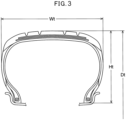
- the “maximum load capacity (W L ) (kg)" is a value calculated by the following equation (1) and (2) when a tire cross-sectional width measured in a standardized state is defined as Wt (mm), a tire cross-sectional height is defined as Ht (mm), and a tire outer diameter is defined as Dt (mm). V is a virtual volume of space occupied by a tire.
- the tire cross-sectional width Wt is the maximum width between outer surfaces of sidewalls excluding, if any, patterns or characters on the side surface of the tire in the above-described state.
- the tire cross-sectional height Ht is a distance from a bottom surface of a bead part to the outermost surface of a tread, which is half a difference between the outer diameter of the tire and a nominal size of a rim.
- the “tire cross-sectional width Wt (mm)” is the maximum width between outer surfaces of sidewalls excluding, if any, patterns or characters on the side surface of the tire in the standardized state.
- the “tire outer diameter Dt (mm)” is a tire outer diameter measured in a standardized state.
- An “oil content” also includes an amount of oil contained in the oil-extended rubber.
- the amount of the cis-1,4-bond butadiene unit is calculated by the following equation.
- Total content of cis-1,4-bond butadiene unit (100-styrene content) ⁇ (cis content of SBR) / 100
- the rubber component consists of 40% by mass of a butadiene rubber (cis content: 97% by mass), 10% by mass of a styrene-butadiene rubber (cis content: 80% by mass, styrene content: 30% by mass), and 50% by mass of an isoprene-based rubber
- the "crack growth rate when the rubber composition is fixed and a cut is made" is calculated by crack growth distance/crack observation time when a pure shear specimen with a vertical side of 22.4 mm, a horizontal side of 150.0 mm, and a thickness of 1.0 mm is pinched in parallel with arms at both horizontal sides thereof under an atmosphere at 25°C and subjected to a biaxial tensile test with both axes being parallel to a longitudinal direction using a biaxial tensile test system (e.g., Autograph AG-Xplus manufactured by Shimadzu Corporation), and then the test piece is fixed at the time when strain of the test piece becomes constant, and a 10.0 mm of cut is made parallel to a horizontal direction using scissors, starting from a middle point of a vertical side on one side of the specimen.
- a biaxial tensile test system e.g., Autograph AG-Xplus manufactured by Shimadzu Corporation
- strain of the test piece refers to a state where a force is applied to fix the test piece so that a length of the specimen becomes constant, which is also referred to as a constant strain.
- strain of the test piece indicates an amount of displacement with respect to a longitudinal length of a flat part of the specimen.
- FIG. 1(a) is a front view of a pure shear specimen. As shown in FIG. 1(a) , the pure shear specimen is rectangular with the horizontal side being longer than the vertical side when viewed from the front. The vertical side is of 22.4 mm and the horizontal side is of 15.0 mm.
- FIG. 1(b) is a view of the pure shear specimen seen from the horizontal direction. A thickness of the pure shear specimen is 1.0 mm. As shown in FIG. 1(b) , the pure shear specimen has cylindrical handle parts at both ends thereof, which serve as handles during the tensile test. As shown in FIG.
- a circular diameter of the handle part is 5.0 mm
- a vertical length of the flat part is 12.4 mm.
- the pure shear specimen consists of handle parts and a flat part.
- the handle part has two cylinders having parallel central axes and equal lengths, and both ends of the handle part are aligned.
- the longitudinal direction of the pure shear specimen is perpendicular to the surface of the handle cylinder, and the horizontal direction of the pure shear specimen is parallel to the central axis of the cylinder of the handle part.
- the flat part is a rectangular parallelepiped, and a vertical side and a thickness of the rectangular parallelepiped of the flat part are both 22.4 mm in vertical side and 1.0 mm in thickness, which are the same as the vertical side and the thickness of the pure shear specimen.
- a length of the rectangular parallelepiped of the flat part in the vertical direction is 12.4 mm, which is calculated by subtracting the diameter of 5.0 mm of the cylinder of the handle part at both ends from the vertical side of the pure shear specimen.
- the "70°C tan ⁇ " is measured under a condition of a temperature at 70°C, an initial strain of 10%, a dynamic strain of ⁇ 1%, a frequency of 10 Hz, and an elongation mode, using EPLEXOR series manufactured by gabo Systemtechnik GmbH.
- a sample with 20 mm in length ⁇ 4 mm in width ⁇ 1 mm in thickness is collected from the sidewall of the tire, so that the tire circumferential direction becomes a long side and the tire radial direction becomes a thickness direction.
- the "styrene content” is a value calculated by 1 H-NMR measurement, and is applied to, for example, a rubber component having a repeating unit derived from styrene such as a SBR.
- a "vinyl content (1,2-bond butadiene unit amount)" is a value calculated by infrared absorption spectrometry according to JIS K 6239-2:2017, and is applied to, for example, a rubber component having a repeating unit derived from butadiene such as a SBR and a BR.
- a "weight-average molecular weight (Mw)" can be calculated in terms of a standard polystyrene based on measurement values obtained by a gel permeation chromatography (GPC) (e.g., GPC-8000 Series manufactured by Tosoh Corporation, detector: differential refractometer, column: TSKGEL SUPERMULTIPORE HZ-M manufactured by Tosoh Corporation). For example, it is applied for a SBR, a BR, a resin component, a liquid rubber, and the like.
- GPC gel permeation chromatography
- a “N 2 SA of carbon black” is measured according to JIS K 6217-2:2017.
- a “N 2 SA of silica” is measured by the BET method according to ASTM D 3037-93.
- a "softening point of a resin component” is a temperature at which a sphere drops when the softening point specified in JIS K 6220-1: 2001 is measured with a ring and ball softening point measuring device.
- the crack growth rate of the rubber composition for sidewall of the present invention in the case of 250% strain is preferably 0.25 m/s or less, more preferably 0.20 m/s or less, further preferably 0.17 m/s or less, further preferably 0.15 m/s or less, further preferably 0.11 m/s or less, further preferably 0.10 m/s or less, particularly preferably 0.08 m/s or less.
- the crack growth rate in the case of 250% strain is a value calculated by the above-described method. When the crack growth rate in the case of 250% strain is within the above-described ranges, crack durability of the rubber composition for sidewall is improved, and crack growth resistance of the sidewall is improved, improving high-speed durability of the tire.
- the crack growth rate in the case of 250% strain can be decreased by increasing viscoelasticity of the rubber, and can be decreased by increasing a molecular weight of a cross-linking point of the rubber.
- the crack growth rate in the case of 300% strain can be decreased by increasing viscoelasticity of the rubber, and can be decreased by increasing the molecular weight of the cross-linking point of the rubber.
- the 70°C tan ⁇ of the rubber composition for sidewall of the present invention is preferably 0.17 or less, more preferably 0.15 or less, further preferably 0.14 or less, particularly preferably 0.13 or less, from the viewpoint of effects of the present invention.
- a lower limit value of the 70°C tan ⁇ is not particularly limited, but it can be, for example, 0.18 or more, 0.20 or more, or 0.25 or more.
- the 70°C tan ⁇ can be adjusted depending on a compounding amount of a filler, etc.
- the amount of the cis-1,4-bond butadiene unit in the total amount of the rubber component is 80.0% by mass or less, preferably less than 75.0% by mass, more preferably less than 70.0% by mass, further preferably less than 68.0% by mass.
- the amount of the cis-1,4-bond butadiene unit in the total amount of the rubber component is more than 80.0% by mass, the thermoplastic resin becomes difficult to disperse in the rubber phase.
- a lower limit value of the amount of the cis-1,4-bond butadiene unit in the total amount of the rubber component is, but not particularly limited to, preferably 5% by mass or more, more preferably 10% by mass or more, further preferably 20% by mass or more, particularly preferably more than 27% by mass, from the viewpoint of the effects of the present invention.
- the total styrene amount (S) in the rubber component is preferably less than 20.0% by mass, more preferably less than 18.0% by mass, further preferably less than 15.0% by mass, particularly preferably less than 12.0% by mass.
- S is more than 20.0% by mass, aggregation with a styrene part in a rubber matrix (sulfur-crosslinked rubber component) cannot be suppressed, making it difficult for the thermoplastic resin to disperse in the styrene part.
- a lower limit value of the S is, but not particularly limited to, preferably 3.0% by mass or more, more preferably 3.5% by mass or more, further preferably 4.0% by mass or more, particularly preferably more than 4.0% by mass, from the viewpoint of the effects of the present invention.
- the ratio (G/W L ) of the tire weight G (kg) to the maximum load capacity W L (kg) is preferably 0.0210 or less, more preferably 0.0205 or less, further preferably 0.0200 or less, particularly preferably 0.0195 or less, from the viewpoint of the effects of the present invention.
- a lower limit value of the G/W L is not particularly limited, but it can be, for example, 0.0090 or more, 0.0100 or more, 0.0110 or more, or 0.0120 or more.
- the tire weight G can be changed by a conventional method, that is, it can be increased by increasing a specific gravity of the tire or by increasing a thickness of each member of the tire, and it can be decreased by decreasing the specific gravity of the tire or by decreasing the thickness of each member of the tire.
- the maximum load capacity W L (kg) is preferably 300 or more, more preferably 400 or more, further preferably 450 or more, particularly preferably 500 or more, from the viewpoint of better exhibiting the effects of the present invention.
- the maximum load capacity W L (kg) can be, for example, 1300 or less, 1200 or less, 1100 or less, 1000 or less, 900 or less, 800 or less, 700 or less, or 650 or less, from the viewpoint of better exhibiting the effects of the present invention.
- the maximum load capacity W L can be increased by increasing the virtual volume V of the space occupied by the tire, and it can be decreased by decreasing the virtual volume V of the space occupied by the tire.
- the thickness T (mm) of the surface rubber layer at the tire maximum width position is preferably 1.0 mm or more, more preferably 1.3 mm or more, further preferably 1.5 mm or more, particularly preferably 1.7 mm or more, from the viewpoint of the effects of the present invention.
- the T (mm) is preferably 12.0 mm or less, more preferably 11.0 mm or less, further preferably 10.0 mm or less, particularly preferably 8.0 mm or less, from the viewpoint of the effects of the present invention.
- the ratio (S/T) of the total styrene amount S (% by mass) in the rubber component to the thickness T (mm) of the surface rubber layer at the tire maximum width position is preferably 0.5 or more, more preferably 0.8 or more, further preferably 1.0 or more, further preferably 1.5 or more, further preferably 2.0 or more, particularly preferably 2.5 or more.
- the S/T is preferably 6.0 or less, more preferably 5.5 or less, further preferably 5.0 or less, particularly preferably 4.5 or less.
- the rubber composition for sidewall comprises a rubber component comprising a styrene-butadiene rubber and/or a butadiene rubber and a thermoplastic resin, and it has been found that the rubber composition for sidewall in which a crack growth rate when measured with a cut being made under a predetermined test condition is at a certain level or lower can be improved in high-speed durability.
- an oil-extended SBR can be used, or a non-oil-extended SBR can be used.
- An extending oil amount of the SBR i.e., a content of an extending oil contained in the SBR when used is preferably 5 parts by mass or more, more preferably 8 parts by mass or more, further preferably 10 parts by mass or more, based on 100 parts by mass of a rubber solid content of the SBR.
- the content of the extending oil contained in the SBR is preferably 60 parts by mass or less, preferably 50 parts by mass or less, more preferably 45 parts by mass or less, based on 100 parts by mass of the rubber solid content of the SBR.
- a styrene content of the SBR can be adjusted as appropriate to satisfy a preferred range of the total styrene amount S mentioned above, but it is preferably 10.0% by mass or more, more preferably 15.0% by mass or more, further preferably 20.0% by mass or more, particularly preferably 25.0% by mass or more. Moreover, the styrene content of the SBR is preferably 50.0% by mass or less, more preferably 45.0% by mass or less, further preferably 40.0% by mass or less. Besides, the styrene content of the SBR is measured by the above-described measuring method.
- a vinyl content of the SBR is preferably 10 mol% or more, more preferably 15 mol% or more, further preferably 20 mol% or more, from the viewpoints of ensuring reactivity with the thermoplastic resin and rubber strength. Moreover, the vinyl content of the SBR is preferably 70 mol% or less, more preferably 65 mol% or less, further preferably 60 mol% or less, from the viewpoints of prevention of increase in temperature dependence, elongation at break, and abrasion resistance. Besides, the vinyl content of the SBR is measured by the above-described measuring method.
- a weight-average molecular weight (Mw) of the SBR is preferably 200,000 or more, more preferably 250,000 or more, further preferably 300,000 or more, from the viewpoint of the effects of the present invention. Moreover, it is preferably 2,000,000 or less, more preferably 1,800,000 or less, further preferably 1,500,000 or less, from the viewpoint of cross-linking uniformity. Besides, the Mw of the SBR is measured by the above-described measuring method.
- a content of the SBR in the rubber component can be appropriately selected so that the total styrene amount S in the rubber component satisfies the above-described ranges, and it can be, for example, 5% by mass or more, 10% by mass or more, or 15% by mass or more.
- the content of the SBR in the rubber component is preferably 70% by mass or less, more preferably 60% by mass or less, further preferably 50% by mass or less, particularly preferably 40% by mass or less, from the viewpoint of the effects of the present invention.
- the BR is not particularly limited, and those common in the tire industry can be used such as, for example, a BR having a cis content of less than 50 mol% (a low cis BR), a BR having a cis content of 90 mol% or more (a high cis BR), a rare-earth-based butadiene rubber synthesized using a rare-earth element-based catalyst (a rare-earth-based BR), a BR containing a syndiotactic polybutadiene crystal (a SPB-containing BR), and a modified BR (a high cis modified BR, a low cis modified BR), and it is preferable to comprise a modified BR.
- These BRs may be used alone, or two or more thereof may be used in combination.
- the high cis BR for example, those commercially available from Zeon Corporation, Ube Industries, Ltd., JSR Corporation, etc. can be used. When the high cis BR is compounded, low temperature characteristics and abrasion resistance can be improved.
- the cis content is preferably 95 mol% or more, more preferably 96 mol% or more, further preferably 97 mol% or more, particularly preferably 98 mol% or more. Besides, the cis content is measured by the above-described measuring method.
- a content of the BR in the rubber component is preferably 5% by mass or more, more preferably 10% by mass or more, further preferably 15% by mass or more, further preferably 20% by mass or more, particularly preferably 25% by mass or more, from the viewpoint of ensuring ozone resistance.
- the content of the BR in the rubber component is preferably 70% by mass or less, more preferably 65% by mass or less, further preferably 60% by mass or less, particularly preferably 55% by mass or less, from the viewpoint of high-speed durability.
- Examples of the isoprene-based rubber include a natural rubber (NR), an isoprene rubber (IR), a purified NR, a modified NR, a modified IR, and the like.
- NR natural rubber
- IR isoprene rubber
- purified NR include, for example, a deproteinized natural rubber (DPNR), an ultra pure natural rubber, and the like.
- DPNR deproteinized natural rubber
- modified NR include, for example, an epoxidized natural rubber (ENR), a hydrogenated natural rubber (HNR), a grafted natural rubber, and the like.
- modified IR examples include, for example, an epoxidized isoprene rubber, a hydrogenated isoprene rubber, a grafted isoprene rubber, and the like. These isoprene-based rubbers may be used alone, or two or more thereof may be used in combination.
- a content of the isoprene-based rubber in the rubber component is preferably 10% by mass or more, more preferably 15% by mass or more, further preferably 20% by mass or more, further preferably 25% by mass or more, particularly preferably 30% by mass or more.
- the content of the isoprene-based rubber in the rubber component is preferably 80% by mass or less, more preferably 75% by mass or less, further preferably 70% by mass or less, further preferably 65% by mass or less, further preferably 60% by mass or less, further preferably 55% by mass or less, particularly preferably 50% by mass or less.
- the rubber component can also comprise rubber components other than the above-described components as long as the effects of the present invention are not impaired, examples of which include, for example, non-diene-based rubbers such as a hydrogenated nitrile rubber (HNBR), a butyl rubber (IIR), a halogenated butyl rubber, an ethylene propylene rubber, a polynorbornene rubber, a silicone rubber, a chlorinated polyethylene rubber, a fluororubber (FKM), an acrylic rubber (ACM), and a hydrin rubber.
- non-diene-based rubbers such as a hydrogenated nitrile rubber (HNBR), a butyl rubber (IIR), a halogenated butyl rubber, an ethylene propylene rubber, a polynorbornene rubber, a silicone rubber, a chlorinated polyethylene rubber, a fluororubber (FKM), an acrylic rubber (ACM), and a hydrin rubber.
- the rubber composition of the present invention comprises a thermoplastic resin.
- the thermoplastic resin refers to a resin that can be softened and molded when heated, particularly a hydrocarbon resin having carbon and hydrogen as basic skeletons, which is used as a plasticizing agent or tackifying resin in a polymer matrix.
- thermoplastic resin examples include a cyclopentadiene resin, a coumarone resin, a petroleum resin (aliphatic petroleum resin, aromatic petroleum resin, alicyclic petroleum resins, etc.), a rosin derivative, and the like, and it is preferable to comprise at least one of a terpene resin and a petroleum resin.
- the thermoplastic resin may be used alone, or two or more thereof may be used in combination.
- the petroleum resin is not particularly limited, examples of which include an aliphatic petroleum resin, an aromatic petroleum resin, and an aliphatic/aromatic copolymerization-based petroleum resin, and they may be used alone, or two or more thereof may be used in combination.
- an aliphatic petroleum resin a resin obtained by cationically polymerizing an unsaturated monomer such as isoprene or cyclopentadiene which is an petroleum fraction (C5 fraction) equivalent to 4 to 5 carbon atoms (also referred to as a C5-based petroleum resin) can be used.
- aromatic petroleum resin a resin obtained by cationically polymerizing a monomer such as vinyltoluene, alkylstyrene, or indene which is a petroleum fraction (C9 fraction) equivalent to 8 to 10 carbon atoms (also referred to as a C9-based petroleum resin) can be used.
- a resin obtained by copolymerizing the above-described C5 fraction and C9 fraction also referred to as a C5-C9-based petroleum resin
- a resin, in which the above-described petroleum resin is hydrogenated may be used. Among them, an aromatic petroleum resin is appropriately used.
- Examples of the aromatic petroleum resin include, for example, an ⁇ -methylstyrene resin.
- Examples of an ⁇ -methylstyrene-based resin include a homopolymer of ⁇ -methylstyrene (poly- ⁇ -methylstyrene) and a copolymer of ⁇ -methylstyrene and another compound including an aromatic compound or a phenol-based compound.
- Examples of another compound that may constitute this copolymer include styrene, methylstyrene, methoxystyrene, divinylbenzene, and the like.
- As the ⁇ -methylstyrene-based resin one manufactured by Kraton Corporation, and the like are appropriately used.
- terpene-based resin examples include a polyterpene resin, a terpene phenol resin, a terpene styrene resin, and the like, and they may be used alone, or two or more thereof may be used in combination.
- a terpene styrene resin is appropriately used because it is particularly compatible with both a SBR and a BR and sulfur becomes easily dispersed in the rubber component.
- the polyterpene resin is a resin made from at least one selected from terpene compounds such as ⁇ -pinene, ⁇ -pinene, limonene, and dipentene.
- the terpene-based resin may be used alone, or two or more thereof may be used in combination.
- the terpene phenol resin is a resin made from the terpene compound and the phenol-based compound.
- the terpene styrene resin is a resin made from the terpene compound and styrene.
- the polyterpene resin and the terpene styrene resin may be hydrogenated (a hydrogenated polyterpene resin, a hydrogenated terpene styrene resin).
- the hydrogenation treatment to the terpene-based resin can be performed by a known method, and a commercially available hydrogenated resin can also be used.
- the rosin-based resin is not particularly limited, examples of which include, for example, a natural resin rosin, a rosin-modified resin obtained by modifying the natural resin rosin with hydrogenation, disproportionation, dimerization, esterification, etc., and the like, and they may be used alone, or two or more thereof may be used in combination.
- the coumarone-based resin is a resin comprising coumarone as a main component, examples of which include, for example, a coumarone resin, a coumarone indene resin, a copolymer resin comprising coumarone, indene, and styrene as main components, and the like. They may be used alone, or two or more thereof may be used in combination.
- a total content R 1 of the thermoplastic resin based on 100 parts by mass of the rubber component is preferably more than 5 parts by mass, more preferably more than 7 parts by mass, further preferably more than 8 parts by mass, further preferably more than 10 parts by mass. further preferably more than 12 parts by mass, from the viewpoint of the effects of the present invention.
- the total content R 1 of the thermoplastic resin based on 100 parts by mass of the rubber component is preferably less than 40 parts by mass, more preferably less than 30 parts by mass, further preferably less than 20 parts by mass, from the viewpoint of molding processability of the tire.
- the rubber composition of the present invention further comprises a thermosetting resin.
- thermosetting resin refers to a resin which is polymerized by heating so that a polymer forms a network structure and which is hardened to be irreversible.
- thermosetting resin examples include, for example, a cashew oil-modified phenol resin, a resorcinol resin, a modified resorcinol resin, a cresol resin, a modified cresol resin, and the like. Among them, a cashew oil-modified phenol resin is preferable. These thermosetting resins may be used alone, or two or more thereof may be used in combination. By compounding the thermosetting resin, crack growth resistance can be improved while suppressing an increase in tan ⁇ of the rubber.
- the cashew oil-modified phenol resin is resin obtained by modifying a phenol resin which is obtained by reacting phenol with aldehydes such as, for example, formaldehyde, acetaldehyde, and furfural with an acid or alkali catalyst using a cashew oil.
- aldehydes such as, for example, formaldehyde, acetaldehyde, and furfural with an acid or alkali catalyst using a cashew oil.
- resorcinol resin examples include, for example, a resorcinol-formaldehyde condensate.
- modified resorcinol resin examples include, for example, those in which a part of a repeating unit of the resorcinol resin is alkylated.
- cresol resin examples include, for example, a cresolformaldehyde condensate.
- modified cresol resin examples include, for example, those in which a methyl group at the terminal of the cresol resin is modified to a hydroxyl group and those in which a part of a repeating unit of the cresol resin is alkylated.
- a softening point of the thermosetting resin is preferably 80°C or higher, more preferably 90°C or higher, further preferably 95°C or higher, from the viewpoint of the effects of the present invention.
- an upper limit value of the softening point of the thermoplastic resin is, but not particularly limited to, usually 200°C or lower.
- a content R 2 of the thermosetting resin when compounded based on 100 parts by mass of the rubber component is preferably more than 1 part by mass, more preferably more than 3 parts by mass, further preferably more than 4 parts by mass, from the viewpoint of the effects of the present invention.
- the content of the thermosetting resin is preferably less than 20 parts by mass, more preferably less than 15 parts by mass, further preferably less than 10 parts by mass, from the viewpoint of processability (sheet rollability).
- a ratio R 2 /R 1 of a total content R 2 to a total content R 1 of the thermosetting resin based on 100 parts by mass of the rubber component is preferably 0.10 or more, preferably 0.20 or more, further preferably 0.25 or more. Moreover, R 2 /R 1 is preferably 0.80 or less, more preferably 0.70 or less, further preferably 0.60 or less, further preferably 0.50 or less.
- the rubber composition according to the present invention preferably comprises a filler, preferably comprises silica as a filler, and more preferably comprises carbon black and silica. Moreover, it may comprise a filler consisting of carbon black and silica.
- Silica is not particularly limited, and those common in the tire industry can be used, such as, for example, silica prepared by a dry process (anhydrous silica) and silica prepared by a wet process (hydrous silica). Moreover, if necessary, silica made from a biomass material such as rice husk may be used. Among them, hydrous silica prepared by a wet process is preferable from the reason that it has many silanol groups. These silica may be used alone, or two or more thereof may be used in combination.
- An average primary particle size of silica is preferably 10 nm or more, more preferably 12 nm or more, further preferably 14 nm or more.
- the average primary particle size of silica is within the above-described ranges, rubber molecules bound by silica are minimized and become easy to flexibly move, so that dispersibility of silica is improved and durability of the rubber composition is improved.
- the average primary particle size is preferably 22 nm or less, more preferably 20 nm or less, further preferably 18 nm or less, from the viewpoint of the effects of the present invention.
- the average primary particle size of silica is measured by the above-described measuring method.
- a nitrogen adsorption specific surface area (N 2 SA) of silica is preferably 110 m 2 /g or more, more preferably 140 m 2 /g or more, further preferably 170 m 2 /g or more, particularly preferably 180 m 2 /g or more, from the viewpoint of the effects of the present invention.
- the N 2 SA is preferably 350 m 2 /g or less, more preferably 300 m 2 /g or less, further preferably 250 m 2 /g or less.
- the N 2 SA of silica is measured by the above-described measuring method.
- a content of silica based on 100 parts by mass of the rubber component is preferably 1 part by mass or more, more preferably 3 parts by mass or more, further preferably 5 parts by mass or more, further preferably 10 parts by mass or more, further preferably 12 parts by mass or more, from the viewpoint of obtaining reinforcing property. Moreover, it is preferably less than 55 parts by mass, more preferably less than 50 parts by mass, more preferably less than 45 parts by mass, more preferably less than 40 parts by mass, further preferably less than 31 parts by mass, particularly preferably less than 30 parts by mass, from the viewpoint of fuel efficiency.
- Carbon black is not particularly limited, and, for example, those commonly used in the tire industry such as GPF, FEF, HAF, ISAF, and SAF can be used. These carbon black may be used alone, or two or more thereof may be used in combination.
- An average primary particle size of carbon black is preferably 40 nm or more, more preferably 45 nm or more, further preferably 50 nm or more, particularly preferably 55 nm or more.
- the average primary particle size of carbon black is within the above-described ranges, rubber molecules bound by carbon black are minimized, and it is considered that dispersibility of carbon black is improved.
- the average primary particle size is preferably 120 nm or less, more preferably 110 nm or less, further preferably 100 nm or less, particularly preferably 90 nm or less, from the viewpoint of the effects of the present invention.
- the average primary particle size of carbon black is measured by the above-described measuring method.
- a nitrogen adsorption specific surface area (N 2 SA) of carbon black is preferably 55 m 2 /g or less, more preferably 50 m 2 /g or less, further preferably 45 m 2 /g or less, from the viewpoint of the effects of the present invention.
- the N 2 SA is preferably 20 m 2 /g or more, more preferably 25 m 2 /g or more, further preferably 30 m 2 /g or more.
- the N 2 SA of carbon black is measured by the above-described measuring method.
- a content of carbon black when compounded based on 100 parts by mass of the rubber component is preferably 10 parts by mass or more, more preferably 12 parts by mass or more, further preferably 15 parts by mass or more, further preferably 20 parts by mass or more, from the viewpoints of obtaining reinforcing property and preventing deterioration. Moreover, it is preferably 55 parts by mass or less, more preferably 50 parts by mass or less, further preferably 45 parts by mass or less, from the viewpoint of fuel efficiency.
- a ratio of the content of silica to the content of carbon black when compounded as fillers is not particularly limited, and a ratio of the content of silica to a total content of silica and carbon black can be, for example, 20% by mass or more, 30% by mass or more, 40% by mass or more, 50% by mass or more, 60% by mass or more, or 70% by mass.
- fillers other than silica and carbon black those commonly used in the tire industry can be compounded, such as aluminum hydroxide, calcium carbonate, alumina, clay, and talc.
- the filler consists of silica and carbon black
- the remaining content of the other is accordingly determined.
- Silica may be used in combination with a silane coupling agent.
- the silane coupling agent is not particularly limited, and silane coupling agents conventionally used in combination with silica in the tire industry can be used, examples of which include, for example, mercapto-based silane coupling agents such as 3-mercaptopropyltrimethoxysilane, NXT-Z100, NXT-Z45, and NXT manufactured by Momentive Performance Materials; sulfide-based silane coupling agents such as bis(3-triethoxysilylpropyl)disulfide and bis(3-triethoxysilylpropyl)tetrasulfide; thioester-based silane coupling agents such as 3-octanoylthio-1-propyltriethoxysilane, 3-hexanoylthio-1-propyltriethoxysilane, and 3-octanoylthio-1-propyltrimethoxysilane;
- silane coupling agents and/or mercapto-based silane coupling agents are preferable, and sulfide-based silane coupling agents are more preferable.
- These silane coupling agents may be used alone, or two or more thereof may be used in combination.
- antioxidants include, but not particularly limited to, for example, amine-based, quinoline-based, quinone-based, phenol-based and imidazole-based compounds, and a carbamic acid metal salt, preferably, phenylenediamine-based antioxidants such as N-(1,3-dimethylbutyl)-N'-phenyl-p-phenylenediamine, N-isopropyl-N'-phenyl-p-phenylenediamine, N,N'-diphenyl-p-phenylenediamine, N,N'-di-2-naphthyl-p-phenylenediamine, N-cyclohexyl-N'-phenyl-p-phenylenediamine, and quinoline-based antioxidants such as 2,2,4-trimethyl-1,2-dihydroquinoline polymer and 6-ethoxy-2,2,4-trimethyl-1,2-dihydroquinoline. These antioxidants may be used alone, or two or
- a content of the antioxidant when compounded based on 100 parts by mass of the rubber component is preferably 0.5 parts by mass or more, more preferably 1.0 part by mass or more, further preferably 1.5 parts by mass or more, from the viewpoint of ozone crack resistance of a rubber. Moreover, it is preferably 10 parts by mass or less, more preferably 5.0 parts by mass or less, from the viewpoints of abrasion resistance and wet grip performance.
- Sulfur is appropriately used as a vulcanizing agent.
- sulfur a powdery sulfur, an oil processing sulfur, a precipitated sulfur, a colloidal sulfur, an insoluble sulfur, a highly dispersible sulfur, and the like can be used.
- vulcanization accelerator examples include, for example, sulfenamide-based, thiazole-based, thiuram-based, thiourea-based, guanidine-based, dithiocarbamic acid-based, aldehyde-amine-based or aldehyde-ammonia-based, imidazoline-based, and xantate-based vulcanization accelerators, and the like. These vulcanization accelerators may be used alone, or two or more thereof may be used in combination.
- one or more vulcanization accelerators selected from a group consisting of sulfenamide-based, guanidine-based, and thiazole-based vulcanization accelerators are preferable, from the viewpoint of desired effects can be obtained more appropriately.
- sulfenamide-based vulcanization accelerator examples include, for example, N-tert-butyl-2-benzothiazolylsulfenamide (TBBS), N-cyclohexyl-2-benzothiazolylsulfenamide (CBS), N,N-dicyclohexyl-2-benzothiazolylsulfenamide (DCBS), and the like.
- TBBS N-tert-butyl-2-benzothiazolylsulfenamide
- CBS N-cyclohexyl-2-benzothiazolylsulfenamide
- CBS N-cyclohexyl-2-benzothiazolylsulfenamide
- Examples of the guanidine-based vulcanization accelerator include, for example, 1,3-diphenylguanidine (DPG), 1,3-di-o-tolylguanidine, 1-o-tolylbiguanide, di-o-tolylguanidine salt of dicatecholborate, 1,3-di-o-cumenylguanidine, 1,3-di-o-biphenylguanidine, 1,3-di-o-cumenyl-2-propionylguanidine, and the like.
- DPG 1,3-diphenylguanidine
- DPG 1,3-diphenylguanidine
- Examples of the thiazole-based vulcanization accelerator include, for example, 2-mercaptobenzothiazole, a cyclohexylamine salt of 2-mercaptobenzothiazole, di-2-benzothiazolyl disulfide, and the like. Among them, 2-mercaptobenzothiazole is preferable.
- thermoplastic resin in order to cure the thermoplastic resin, it is preferable to use partial condensates of hexamethylenetetramine (HMT), hexamethoxymethylmelamine, hexamethoxymethylol melamine, and hexamethylol melamine pentamethyl ether (HMMPME), and the like, in combination.
- HMT hexamethylenetetramine
- HMMPME hexamethoxymethylmelamine
- HMMPME hexamethylol melamine pentamethyl ether
- They may be used alone, or two or more thereof may be used in combination.
- a total content of the vulcanization accelerator when compounded based on 100 parts by mass of the rubber component is preferably 1.0 part by mass or more, more preferably 1.5 parts by mass or more, further preferably 2.0 parts by mass or more.
- the content of the vulcanization accelerator based on 100 parts by mass of the rubber component is preferably 8.0 parts by mass or less, more preferably 7.0 parts by mass or less, further preferably 6.0 parts by mass or less, particularly preferably 5.0 parts by mass or less.
- the rubber composition according to the present invention can be produced by a known method. For example, it can be produced by kneading each of the above-described components using a rubber kneading apparatus such as an open roll and a closed type kneader (Bunbury mixer, kneader, etc.).
- a rubber kneading apparatus such as an open roll and a closed type kneader (Bunbury mixer, kneader, etc.).
- the kneading step includes, for example, a base kneading step of kneading compounding agents and additives other than vulcanizing agents and vulcanization accelerators and a final kneading (F kneading) step of adding vulcanizing agents and vulcanization accelerators to the kneaded product obtained by the base kneading step and kneading them.
- the base kneading step can be divided into a plurality of steps, if desired.
- a kneading condition is not particularly limited.
- Examples of kneading include, for example, in the base kneading step, a method of kneading at a discharge temperature at 150 to 170°C for 3 to 10 minutes, and in the final kneading step, a method of kneading at 70 to 110°C for 1 to 5 minutes.
- a vulcanization condition is not particularly limited. Examples of vulcanization include, for example, a method of vulcanizing at 150 to 200°C for 10 to 30 minutes.
- the tire of the present invention comprising the sidewall composed of the rubber composition can be produced by a usual method. That is, the tire can be produced by extruding an unvulcanized rubber composition compounded from the rubber component and other components as necessary into a shape of a sidewall, attaching it together with other tire members on a tire forming machine, and molding them by a usual method to form an unvulcanized tire, followed by heating and pressurizing this unvulcanized tire in a vulcanizing machine.
- a vulcanization condition is not particularly limited. Examples of vulcanization include, for example, a method of vulcanizing at 150 to 200°C for 10 to 30 minutes.
- the tire of the present invention can be appropriately used as a tire for a passenger car, a tire for a truck/bus, a tire for a two-wheeled vehicle, or a racing tire. Among them, it is preferably used as a tire for a passenger car.
- the tire for a passenger car is a tire on the premise that it is mounted on a car running on four wheels and refers to one having a maximum load capacity of 1000 kg or less.
- the tire of the present invention can be used as an all-season tire, a summer tire, or a winter tire such as a studless tire.
- the obtained unvulcanized rubber composition is extruded into a shape of a sidewall with an extruder equipped with a mouthpiece having a predetermined shape and attached together with other tire members, forming an unvulcanized tire, and the unvulcanized tire is press-vulcanized under a condition of 170°C for 12 minutes to produce each test tire.
- Example Comparative example 11 12 13 14 15 16 17 1 2 3 Compounding amount (part by mass) NR 45 45 45 45 45 45 45 45 100 100 40 SBR1 - - - - - - - - 30 SBR2 16.5 16.5 16.5 16.5 16.5 16.5 16.5 - - - (Solid rubber content) (15) (15) (15) (15) (15) (15) (15) (15) (15) (15) (15) (15) (15) (15) (15) - - - BR 40 40 40 40 40 40 40 40 40 40 40 - - 30 Carbon black 40 60 5 25 30 25 25 25 25 25 25 25 25 25 25 25 25 25 25 25 Silica - 15 45 30 25 15 15 15 15 15 15 Coupling agent - 1.5 4.5 2.0 2.0 1.5 1.5 1.5 1.5 1.5 1.5 1.5
Landscapes
- Chemical & Material Sciences (AREA)
- Health & Medical Sciences (AREA)
- Chemical Kinetics & Catalysis (AREA)
- Medicinal Chemistry (AREA)
- Polymers & Plastics (AREA)
- Organic Chemistry (AREA)
- Engineering & Computer Science (AREA)
- Mechanical Engineering (AREA)
- Compositions Of Macromolecular Compounds (AREA)
- Tires In General (AREA)
Claims (15)
- Kautschukzusammensetzung für eine Seitenwand, umfassend eine Kautschukkomponente und ein thermoplastisches Harz,wobei die Kautschukkomponente einen Styrol-Butadien-Kautschuk und/oder einen Butadien-Kautschuk umfasst,wobei eine Menge einer cis-1,4-Bindungs-Butadieneinheit in einer Gesamtmenge der Kautschukkomponente 80,0 Massen-% oder weniger beträgt,wobei ein gesamter Gehalt R1 (Massenteile) des thermoplastischen Harzes, bezogen auf 100 Massenteile der Kautschukkomponente, mehr als 10 Massenteile und weniger als 30 Massenteile beträgt, undwobei eine Risswachstumsrate, gemessen unter Prüfbedingungen, mindestens eines erfüllt von0,20 m/s oder weniger in einem Fall von 250% Dehnung (konstante Dehnung) eines Prüfkörpers, wenn fixiert, und0,30 m/s oder weniger in einem Fall von 300% Dehnung (konstante Dehnung) eines Prüfkörpers, wenn fixiert,Die Prüfbedingungen:Prüfkörper: eine reine Scherprobe mit einer vertikalen Seite von 22,4 mm, einer horizontalen Seite von 150,0 mm und einer Dicke von 1,0 mm;Prüfverfahren: eine biaxiale Zugprüfung wird an dem Prüfkörper parallel zu einer Längsrichtung durchgeführt, und daraufhin wird der Prüfkörper fixiert, in welchem ein Schnitt von 10,0 mm parallel zu einer Horizontalrichtung ausgehend von einem Mittelpunkt der vertikalen Seite auf einer Seite des Prüfkörpers vorgenommen wird.
- Kautschukzusammensetzung für eine Seitenwand nach Anspruch 1, zudem umfassend einen Füllstoff, wobei der Füllstoff Siliciumdioxid umfasst.
- Kautschukzusammensetzung für eine Seitenwand nach Anspruch 2, wobei ein gesamter Gehalt des Füllstoffes, bezogen auf 100 Massenteile der Kautschukkomponente, weniger als 50 Massenteile, bevorzugt 45 Massenteile, bevorzugter 42 Massenteile beträgt.
- Kautschukzusammensetzung für eine Seitenwand nach einem der Ansprüche 1 bis 3, wobei ein tan δ bei 70°C der Kautschukzusammensetzung 0,15 oder weniger, bevorzugt 0,14 oder weniger, bevorzugter 0,13 oder weniger, bevorzugter 0,12 oder weniger beträgt, wenn gemessen wie in der Beschreibung definiert.
- Kautschukzusammensetzung für eine Seitenwand nach einem der Ansprüche 1 bis 4, wobei ein gesamter Gehalt R1 (Massenteile) des thermoplastischen Harzes, bezogen auf 100 Massenteile der Kautschukkomponente, mehr als 12 Massenteile und weniger als 25 Massenteile beträgt.
- Kautschukzusammensetzung für eine Seitenwand nach einem der Ansprüche 1 bis 5, wobei eine gesamte Styrolmenge S (Massen-%) der Kautschukkomponente weniger als 15 Massen-%, bevorzugt weniger als 10 Massen-%, bevorzugter weniger als 8 Massen-%, bevorzugter weniger als 6 Massen-% beträgt.
- Kautschukzusammensetzung für eine Seitenwand nach einem der Ansprüche 1 bis 6, wobei die Kautschukkomponente zudem einen Isoprenbasierten Kautschuk umfasst.
- Kautschukzusammensetzung für eine Seitenwand nach einem der Ansprüche 1 bis 7, wobei das thermoplastische Harz mindestens eines oder mehr umfasst, welches ausgewählt ist aus einer Gruppe bestehend aus einem Terpenharz und einem Petrolharz.
- Kautschukzusammensetzung für eine Seitenwand nach einem der Ansprüche 1 bis 8, zudem umfassend ein wärmehärtendes Harz.
- Kautschukzusammensetzung für eine Seitenwand nach einem der Ansprüche 1 bis 9, wobei, wenn ein gesamter Gehalt des wärmehärtenden Harzes, bezogen auf 100 Massenteile der Kautschukkomponente, als R2 (Massenteile) definiert ist, ein Verhältnis R2/R1 des gesamten Gehalts R2 zum gesamten Gehalt R1 (Massenteile) des thermoplastischen Harzes, bezogen auf 100 Massenteile der Kautschukkomponente, 0,20 oder mehr und 0,50 oder weniger beträgt.
- Reifen, umfassend eine Seitenwand, die mit der Kautschukzusammensetzung nach einem der Ansprüche 1 bis 10 aufgebaut ist.
- Reifen nach Anspruch 11, wobei, wenn eine Dicke einer Oberflächenkautschukschicht an einer Position maximaler Reifenbreite als T (mm) definiert ist, R1/T 3,0 oder mehr und 9,0 oder weniger beträgt.
- Reifen nach Anspruch 11 oder 12, wobei, wenn eine Dicke einer Oberflächenkautschukschicht an einer Position maximaler Reifenbreite als T (mm) definiert ist, S/T 1,0 oder mehr und 9,0 oder weniger beträgt.
- Reifen nach einem der Ansprüche 11 bis 13, wobei ein Verhältnis (G/WL) eines Reifengewichts G (kg) zur maximalen Tragfähigkeit WL (kg) des Reifens 0,0210 oder weniger, bevorzugt 0,0200 oder weniger, bevorzugter 0,0180 oder weniger, bevorzugter 0,0160 oder weniger, bevorzugter 0,0150 oder weniger beträgt.
- Reifen nach einem der Ansprüche 11 bis 14, wobei der Reifen ein Reifen für einen Personenkraftwagen ist.
Applications Claiming Priority (2)
| Application Number | Priority Date | Filing Date | Title |
|---|---|---|---|
| JP2022023250 | 2022-02-17 | ||
| JP2023001265A JP2023120150A (ja) | 2022-02-17 | 2023-01-06 | サイドウォール用ゴム組成物 |
Publications (2)
| Publication Number | Publication Date |
|---|---|
| EP4230693A1 EP4230693A1 (de) | 2023-08-23 |
| EP4230693B1 true EP4230693B1 (de) | 2025-03-05 |
Family
ID=85132760
Family Applications (1)
| Application Number | Title | Priority Date | Filing Date |
|---|---|---|---|
| EP23153596.4A Active EP4230693B1 (de) | 2022-02-17 | 2023-01-27 | Kautschukzusammensetzung für seitenwand |
Country Status (1)
| Country | Link |
|---|---|
| EP (1) | EP4230693B1 (de) |
Family Cites Families (5)
| Publication number | Priority date | Publication date | Assignee | Title |
|---|---|---|---|---|
| US6070634A (en) * | 1997-09-23 | 2000-06-06 | The Goodyear Tire & Rubber Company | Tire with tread made with liquid block copolymer |
| US7091282B2 (en) * | 2003-05-15 | 2006-08-15 | Bridgestone Corporation | Composition containing ethylene/propylene/diene copolymer and polyalkylene/olefin copolymer |
| JP5771683B2 (ja) * | 2011-03-01 | 2015-09-02 | 株式会社ブリヂストン | ゴム組成物、タイヤサイド用ゴム組成物、架橋ゴム組成物、及びタイヤ |
| CN106164161B (zh) * | 2014-08-05 | 2018-05-11 | 住友橡胶工业株式会社 | 橡胶组合物与轮胎 |
| JP6992254B2 (ja) | 2017-01-05 | 2022-01-13 | 住友ゴム工業株式会社 | サイドウォール用ゴム組成物及び空気入りタイヤ |
-
2023
- 2023-01-27 EP EP23153596.4A patent/EP4230693B1/de active Active
Also Published As
| Publication number | Publication date |
|---|---|
| EP4230693A1 (de) | 2023-08-23 |
Similar Documents
| Publication | Publication Date | Title |
|---|---|---|
| EP4119358B1 (de) | Reifen | |
| EP3950381B1 (de) | Reifen | |
| EP3950387B1 (de) | Reifen | |
| EP4166353B1 (de) | Reifen | |
| EP3950386A1 (de) | Reifen | |
| EP3693185B1 (de) | Laufflächenkautschukzusammensetzung und reifen | |
| EP4331868A1 (de) | Schwerlastreifen | |
| EP3960492B1 (de) | Schwerlastreifen | |
| EP4166351B1 (de) | Reifen | |
| EP3549784B1 (de) | Kautschukzusammensetzung für lauffläche und reifen | |
| EP4389457B1 (de) | Schwerlastreifen | |
| EP4169739B1 (de) | Reifen | |
| EP4166350B1 (de) | Reifen | |
| EP4368412A1 (de) | Reifen | |
| EP4190587B1 (de) | Reifen | |
| EP4335657A1 (de) | Reifen | |
| JP2023120150A (ja) | サイドウォール用ゴム組成物 | |
| EP4230693B1 (de) | Kautschukzusammensetzung für seitenwand | |
| EP3995323B1 (de) | Reifen | |
| JP2024032595A (ja) | タイヤ | |
| EP4046820A1 (de) | Kautschukzusammensetzung für reifen sowie reifen | |
| EP4357154B1 (de) | Reifen | |
| EP4289633B1 (de) | Reifen | |
| EP4275917B1 (de) | Reifen | |
| EP4371782B1 (de) | Reifen |
Legal Events
| Date | Code | Title | Description |
|---|---|---|---|
| PUAI | Public reference made under article 153(3) epc to a published international application that has entered the european phase |
Free format text: ORIGINAL CODE: 0009012 |
|
| STAA | Information on the status of an ep patent application or granted ep patent |
Free format text: STATUS: THE APPLICATION HAS BEEN PUBLISHED |
|
| AK | Designated contracting states |
Kind code of ref document: A1 Designated state(s): AL AT BE BG CH CY CZ DE DK EE ES FI FR GB GR HR HU IE IS IT LI LT LU LV MC ME MK MT NL NO PL PT RO RS SE SI SK SM TR |
|
| STAA | Information on the status of an ep patent application or granted ep patent |
Free format text: STATUS: REQUEST FOR EXAMINATION WAS MADE |
|
| 17P | Request for examination filed |
Effective date: 20230918 |
|
| RBV | Designated contracting states (corrected) |
Designated state(s): AL AT BE BG CH CY CZ DE DK EE ES FI FR GB GR HR HU IE IS IT LI LT LU LV MC ME MK MT NL NO PL PT RO RS SE SI SK SM TR |
|
| STAA | Information on the status of an ep patent application or granted ep patent |
Free format text: STATUS: EXAMINATION IS IN PROGRESS |
|
| 17Q | First examination report despatched |
Effective date: 20240213 |
|
| P01 | Opt-out of the competence of the unified patent court (upc) registered |
Effective date: 20240327 |
|
| GRAP | Despatch of communication of intention to grant a patent |
Free format text: ORIGINAL CODE: EPIDOSNIGR1 |
|
| STAA | Information on the status of an ep patent application or granted ep patent |
Free format text: STATUS: GRANT OF PATENT IS INTENDED |
|
| INTG | Intention to grant announced |
Effective date: 20241014 |
|
| GRAS | Grant fee paid |
Free format text: ORIGINAL CODE: EPIDOSNIGR3 |
|
| GRAA | (expected) grant |
Free format text: ORIGINAL CODE: 0009210 |
|
| STAA | Information on the status of an ep patent application or granted ep patent |
Free format text: STATUS: THE PATENT HAS BEEN GRANTED |
|
| AK | Designated contracting states |
Kind code of ref document: B1 Designated state(s): AL AT BE BG CH CY CZ DE DK EE ES FI FR GB GR HR HU IE IS IT LI LT LU LV MC ME MK MT NL NO PL PT RO RS SE SI SK SM TR |
|
| REG | Reference to a national code |
Ref country code: GB Ref legal event code: FG4D |
|
| REG | Reference to a national code |
Ref country code: CH Ref legal event code: EP |
|
| REG | Reference to a national code |
Ref country code: IE Ref legal event code: FG4D |
|
| REG | Reference to a national code |
Ref country code: DE Ref legal event code: R096 Ref document number: 602023002252 Country of ref document: DE |
|
| PG25 | Lapsed in a contracting state [announced via postgrant information from national office to epo] |
Ref country code: RS Free format text: LAPSE BECAUSE OF FAILURE TO SUBMIT A TRANSLATION OF THE DESCRIPTION OR TO PAY THE FEE WITHIN THE PRESCRIBED TIME-LIMIT Effective date: 20250605 |
|
| PG25 | Lapsed in a contracting state [announced via postgrant information from national office to epo] |
Ref country code: FI Free format text: LAPSE BECAUSE OF FAILURE TO SUBMIT A TRANSLATION OF THE DESCRIPTION OR TO PAY THE FEE WITHIN THE PRESCRIBED TIME-LIMIT Effective date: 20250305 |
|
| REG | Reference to a national code |
Ref country code: NL Ref legal event code: MP Effective date: 20250305 |
|
| PG25 | Lapsed in a contracting state [announced via postgrant information from national office to epo] |
Ref country code: ES Free format text: LAPSE BECAUSE OF FAILURE TO SUBMIT A TRANSLATION OF THE DESCRIPTION OR TO PAY THE FEE WITHIN THE PRESCRIBED TIME-LIMIT Effective date: 20250305 |
|
| REG | Reference to a national code |
Ref country code: LT Ref legal event code: MG9D |
|
| PG25 | Lapsed in a contracting state [announced via postgrant information from national office to epo] |
Ref country code: NO Free format text: LAPSE BECAUSE OF FAILURE TO SUBMIT A TRANSLATION OF THE DESCRIPTION OR TO PAY THE FEE WITHIN THE PRESCRIBED TIME-LIMIT Effective date: 20250605 |
|
| PG25 | Lapsed in a contracting state [announced via postgrant information from national office to epo] |
Ref country code: HR Free format text: LAPSE BECAUSE OF FAILURE TO SUBMIT A TRANSLATION OF THE DESCRIPTION OR TO PAY THE FEE WITHIN THE PRESCRIBED TIME-LIMIT Effective date: 20250305 |
|
| PG25 | Lapsed in a contracting state [announced via postgrant information from national office to epo] |
Ref country code: LV Free format text: LAPSE BECAUSE OF FAILURE TO SUBMIT A TRANSLATION OF THE DESCRIPTION OR TO PAY THE FEE WITHIN THE PRESCRIBED TIME-LIMIT Effective date: 20250305 |
|
| PG25 | Lapsed in a contracting state [announced via postgrant information from national office to epo] |
Ref country code: GR Free format text: LAPSE BECAUSE OF FAILURE TO SUBMIT A TRANSLATION OF THE DESCRIPTION OR TO PAY THE FEE WITHIN THE PRESCRIBED TIME-LIMIT Effective date: 20250606 Ref country code: BG Free format text: LAPSE BECAUSE OF FAILURE TO SUBMIT A TRANSLATION OF THE DESCRIPTION OR TO PAY THE FEE WITHIN THE PRESCRIBED TIME-LIMIT Effective date: 20250305 |
|
| REG | Reference to a national code |
Ref country code: AT Ref legal event code: MK05 Ref document number: 1772929 Country of ref document: AT Kind code of ref document: T Effective date: 20250305 |
|
| PG25 | Lapsed in a contracting state [announced via postgrant information from national office to epo] |
Ref country code: NL Free format text: LAPSE BECAUSE OF FAILURE TO SUBMIT A TRANSLATION OF THE DESCRIPTION OR TO PAY THE FEE WITHIN THE PRESCRIBED TIME-LIMIT Effective date: 20250305 |
|
| PG25 | Lapsed in a contracting state [announced via postgrant information from national office to epo] |
Ref country code: SE Free format text: LAPSE BECAUSE OF FAILURE TO SUBMIT A TRANSLATION OF THE DESCRIPTION OR TO PAY THE FEE WITHIN THE PRESCRIBED TIME-LIMIT Effective date: 20250305 |
|
| PG25 | Lapsed in a contracting state [announced via postgrant information from national office to epo] |
Ref country code: SM Free format text: LAPSE BECAUSE OF FAILURE TO SUBMIT A TRANSLATION OF THE DESCRIPTION OR TO PAY THE FEE WITHIN THE PRESCRIBED TIME-LIMIT Effective date: 20250305 |
|
| PG25 | Lapsed in a contracting state [announced via postgrant information from national office to epo] |
Ref country code: PT Free format text: LAPSE BECAUSE OF FAILURE TO SUBMIT A TRANSLATION OF THE DESCRIPTION OR TO PAY THE FEE WITHIN THE PRESCRIBED TIME-LIMIT Effective date: 20250707 |
|
| PG25 | Lapsed in a contracting state [announced via postgrant information from national office to epo] |
Ref country code: IT Free format text: LAPSE BECAUSE OF FAILURE TO SUBMIT A TRANSLATION OF THE DESCRIPTION OR TO PAY THE FEE WITHIN THE PRESCRIBED TIME-LIMIT Effective date: 20250305 Ref country code: PL Free format text: LAPSE BECAUSE OF FAILURE TO SUBMIT A TRANSLATION OF THE DESCRIPTION OR TO PAY THE FEE WITHIN THE PRESCRIBED TIME-LIMIT Effective date: 20250305 |
|
| PG25 | Lapsed in a contracting state [announced via postgrant information from national office to epo] |
Ref country code: AT Free format text: LAPSE BECAUSE OF FAILURE TO SUBMIT A TRANSLATION OF THE DESCRIPTION OR TO PAY THE FEE WITHIN THE PRESCRIBED TIME-LIMIT Effective date: 20250305 |
|
| PG25 | Lapsed in a contracting state [announced via postgrant information from national office to epo] |
Ref country code: CZ Free format text: LAPSE BECAUSE OF FAILURE TO SUBMIT A TRANSLATION OF THE DESCRIPTION OR TO PAY THE FEE WITHIN THE PRESCRIBED TIME-LIMIT Effective date: 20250305 Ref country code: EE Free format text: LAPSE BECAUSE OF FAILURE TO SUBMIT A TRANSLATION OF THE DESCRIPTION OR TO PAY THE FEE WITHIN THE PRESCRIBED TIME-LIMIT Effective date: 20250305 |
|
| PG25 | Lapsed in a contracting state [announced via postgrant information from national office to epo] |
Ref country code: RO Free format text: LAPSE BECAUSE OF FAILURE TO SUBMIT A TRANSLATION OF THE DESCRIPTION OR TO PAY THE FEE WITHIN THE PRESCRIBED TIME-LIMIT Effective date: 20250305 |
|
| PG25 | Lapsed in a contracting state [announced via postgrant information from national office to epo] |
Ref country code: SK Free format text: LAPSE BECAUSE OF FAILURE TO SUBMIT A TRANSLATION OF THE DESCRIPTION OR TO PAY THE FEE WITHIN THE PRESCRIBED TIME-LIMIT Effective date: 20250305 |
|
| PG25 | Lapsed in a contracting state [announced via postgrant information from national office to epo] |
Ref country code: IS Free format text: LAPSE BECAUSE OF FAILURE TO SUBMIT A TRANSLATION OF THE DESCRIPTION OR TO PAY THE FEE WITHIN THE PRESCRIBED TIME-LIMIT Effective date: 20250705 |
|
| REG | Reference to a national code |
Ref country code: DE Ref legal event code: R097 Ref document number: 602023002252 Country of ref document: DE |
|
| PLBE | No opposition filed within time limit |
Free format text: ORIGINAL CODE: 0009261 |
|
| STAA | Information on the status of an ep patent application or granted ep patent |
Free format text: STATUS: NO OPPOSITION FILED WITHIN TIME LIMIT |
|
| PG25 | Lapsed in a contracting state [announced via postgrant information from national office to epo] |
Ref country code: DK Free format text: LAPSE BECAUSE OF FAILURE TO SUBMIT A TRANSLATION OF THE DESCRIPTION OR TO PAY THE FEE WITHIN THE PRESCRIBED TIME-LIMIT Effective date: 20250305 |
|
| REG | Reference to a national code |
Ref country code: CH Ref legal event code: L10 Free format text: ST27 STATUS EVENT CODE: U-0-0-L10-L00 (AS PROVIDED BY THE NATIONAL OFFICE) Effective date: 20260114 |
|
| PGFP | Annual fee paid to national office [announced via postgrant information from national office to epo] |
Ref country code: FR Payment date: 20251128 Year of fee payment: 4 |
|
| 26N | No opposition filed |
Effective date: 20251208 |