EP4216752B1 - Grössenanpassbarer webstoff, wearable-artikel und verfahren zur grössenanpassung eines stoffes - Google Patents
Grössenanpassbarer webstoff, wearable-artikel und verfahren zur grössenanpassung eines stoffes Download PDFInfo
- Publication number
- EP4216752B1 EP4216752B1 EP21791290.6A EP21791290A EP4216752B1 EP 4216752 B1 EP4216752 B1 EP 4216752B1 EP 21791290 A EP21791290 A EP 21791290A EP 4216752 B1 EP4216752 B1 EP 4216752B1
- Authority
- EP
- European Patent Office
- Prior art keywords
- threads
- size
- fabric
- footwear
- adjustable
- Prior art date
- Legal status (The legal status is an assumption and is not a legal conclusion. Google has not performed a legal analysis and makes no representation as to the accuracy of the status listed.)
- Active
Links
Images




Classifications
-
- A—HUMAN NECESSITIES
- A41—WEARING APPAREL
- A41D—OUTERWEAR; PROTECTIVE GARMENTS; ACCESSORIES
- A41D13/00—Professional, industrial or sporting protective garments, e.g. surgeons' gowns or garments protecting against blows or punches
- A41D13/05—Professional, industrial or sporting protective garments, e.g. surgeons' gowns or garments protecting against blows or punches protecting only a particular body part
-
- A—HUMAN NECESSITIES
- A41—WEARING APPAREL
- A41D—OUTERWEAR; PROTECTIVE GARMENTS; ACCESSORIES
- A41D31/00—Materials specially adapted for outerwear
- A41D31/04—Materials specially adapted for outerwear characterised by special function or use
- A41D31/24—Resistant to mechanical stress, e.g. pierce-proof
-
- A—HUMAN NECESSITIES
- A43—FOOTWEAR
- A43B—CHARACTERISTIC FEATURES OF FOOTWEAR; PARTS OF FOOTWEAR
- A43B1/00—Footwear characterised by the material
- A43B1/02—Footwear characterised by the material made of fibres or fabrics made therefrom
- A43B1/05—Footwear characterised by the material made of fibres or fabrics made therefrom woven
-
- A—HUMAN NECESSITIES
- A43—FOOTWEAR
- A43B—CHARACTERISTIC FEATURES OF FOOTWEAR; PARTS OF FOOTWEAR
- A43B23/00—Uppers; Boot legs; Stiffeners; Other single parts of footwear
- A43B23/02—Uppers; Boot legs
- A43B23/0205—Uppers; Boot legs characterised by the material
-
- A—HUMAN NECESSITIES
- A43—FOOTWEAR
- A43B—CHARACTERISTIC FEATURES OF FOOTWEAR; PARTS OF FOOTWEAR
- A43B3/00—Footwear characterised by the shape or the use
- A43B3/26—Footwear characterised by the shape or the use adjustable as to length or size
-
- A—HUMAN NECESSITIES
- A43—FOOTWEAR
- A43B—CHARACTERISTIC FEATURES OF FOOTWEAR; PARTS OF FOOTWEAR
- A43B3/00—Footwear characterised by the shape or the use
- A43B3/34—Footwear characterised by the shape or the use with electrical or electronic arrangements
- A43B3/35—Footwear characterised by the shape or the use with electrical or electronic arrangements with electric heating arrangements
-
- D—TEXTILES; PAPER
- D03—WEAVING
- D03D—WOVEN FABRICS; METHODS OF WEAVING; LOOMS
- D03D1/00—Woven fabrics designed to make specified articles
- D03D1/0088—Fabrics having an electronic function
-
- D—TEXTILES; PAPER
- D03—WEAVING
- D03D—WOVEN FABRICS; METHODS OF WEAVING; LOOMS
- D03D15/00—Woven fabrics characterised by the material, structure or properties of the fibres, filaments, yarns, threads or other warp or weft elements used
- D03D15/20—Woven fabrics characterised by the material, structure or properties of the fibres, filaments, yarns, threads or other warp or weft elements used characterised by the material of the fibres or filaments constituting the yarns or threads
- D03D15/242—Woven fabrics characterised by the material, structure or properties of the fibres, filaments, yarns, threads or other warp or weft elements used characterised by the material of the fibres or filaments constituting the yarns or threads inorganic, e.g. basalt
- D03D15/25—Metal
-
- D—TEXTILES; PAPER
- D03—WEAVING
- D03D—WOVEN FABRICS; METHODS OF WEAVING; LOOMS
- D03D15/00—Woven fabrics characterised by the material, structure or properties of the fibres, filaments, yarns, threads or other warp or weft elements used
- D03D15/20—Woven fabrics characterised by the material, structure or properties of the fibres, filaments, yarns, threads or other warp or weft elements used characterised by the material of the fibres or filaments constituting the yarns or threads
- D03D15/283—Woven fabrics characterised by the material, structure or properties of the fibres, filaments, yarns, threads or other warp or weft elements used characterised by the material of the fibres or filaments constituting the yarns or threads synthetic polymer-based, e.g. polyamide or polyester fibres
-
- D—TEXTILES; PAPER
- D03—WEAVING
- D03D—WOVEN FABRICS; METHODS OF WEAVING; LOOMS
- D03D15/00—Woven fabrics characterised by the material, structure or properties of the fibres, filaments, yarns, threads or other warp or weft elements used
- D03D15/50—Woven fabrics characterised by the material, structure or properties of the fibres, filaments, yarns, threads or other warp or weft elements used characterised by the properties of the yarns or threads
- D03D15/533—Woven fabrics characterised by the material, structure or properties of the fibres, filaments, yarns, threads or other warp or weft elements used characterised by the properties of the yarns or threads antistatic; electrically conductive
-
- D—TEXTILES; PAPER
- D03—WEAVING
- D03D—WOVEN FABRICS; METHODS OF WEAVING; LOOMS
- D03D15/00—Woven fabrics characterised by the material, structure or properties of the fibres, filaments, yarns, threads or other warp or weft elements used
- D03D15/50—Woven fabrics characterised by the material, structure or properties of the fibres, filaments, yarns, threads or other warp or weft elements used characterised by the properties of the yarns or threads
- D03D15/567—Shapes or effects upon shrinkage
Definitions
- the present disclosure relates to a resizeable fabric, and in particular to a fabric which can be repeatedly resized and which can be resized to any size within an interval of sizes.
- the disclosure further relates to a wearable item, such as a garment, a harness or the like, which can be resized using such resizeable fabric.
- the disclosure further relates to footwear, and to liners for footwear, which can be resized and/or fine-tuned with respect to size.
- various garments such as suits, jackets, pants, etc. need to be produced in a large number of sizes.
- they may frequently need to be adjusted by a tailor to fit the wearer.
- Some items may be provided with size adjustment mechanisms, such as straps and buckles, hook-and-loop type fasteners, elastic insets, cuffs or sleeves, etc.
- US20070042660A1 , GB2441589A and EP3511454A1 disclose various uses of shape memory alloys, which are integrated into the fabric in order to provide a fabric that is capable of changing size.
- US5236765 discloses a heat-recoverable fabric to be wrapped around pipes as a cover.
- the fabric comprises a heating element, which when heated causes the fabric to shrink.
- US20130260630 discloses a woven fabric used as a seat cover of a vehicle.
- the woven fabric includes high shrinkage yarn and a low shrinkage yarn arranged such that the aesthetics is maintained when the fabric is heated.
- EP0501799 discloses a woven electric heater used for heating/warming car seats etc.
- the warp of the woven electric heater includes viscose and the weft includes an electrical insulated material and the heater is woven such that the shrinkage on the weft is avoided.
- US2017280819 discloses a wearable item (boot), wherein an expandable user-engaging structure can be heated by using a heater.
- One particular object is to provide a concept that enables improved one-size-fits-all items, or at least "one-size-fits-many" items.
- a wearable item comprising a size-adjustable woven fabric comprising a first set of threads, each formed of a heat-shrink polymer material, at least one conducting thread, formed of an electrically conducting material, wherein the first set of threads runs substantially parallel with each other, and wherein the conducting thread runs substantially across the first set of threads threads, wherein the patch is arranged between and connecting said first and second fixed-size fabric portions, wherein the first set of threads extend at a greater angle a t to an edge of at least one of the first and second fixed-size fabric portions than an angle a c between said edge and the conducting thread, as illustrated in figures 5a , 6, 7, 8, 9, 10 .
- substantially parallel means parallel, except for minor variations.
- substantially across means across, except for at areas where the conducting thread turns.
- a heat-shrink polymer material may be a polymer material which during production has been treated, e.g. by cross linking, typically by ionizing radiation, so as to provide an original state, and subsequently expanded during heating to above its crystalline melting point, so as to create an expanded state, and then rapidly cooled.
- the expanded heat-shrink polymer material has the ability to return to its original state when it is heated above the crystalline melting point.
- Heat-shrink polymer materials are known as such.
- a heat-shrink polymer is able to take on any configuration between its original state and an expanded state.
- a combination of threads formed from one or more heat-shrink polymer materials can be heated by means of a conducting thread.
- a heat-shrink material By using a heat-shrink material, the length of the first set of threads can be extended and reduced by means of heating by the conducting thread while selectively applying a load to the first set of threads.
- the first set of threads may form a set of warp threads, and the conducting thread may form a weft thread.
- the conducting thread may, except for at its turns, extend at an angle of approximately 80-100 degs to the first set of threads.
- Heat-shrink polymer materials can be made of a range of polymer materials, including polyolefin, polyester, polyvinyl chloride (PVC), fluorocarbon-based synthetic rubber (such as Viton ® by The Chemours Company), polychloroprene rubber, polytetrafluoroethylene (PTFE), elastomers, fluorinated ethylene propylene (FEP) and polyvinylidene fluoride (PVDF).
- PVC polyvinyl chloride
- fluorocarbon-based synthetic rubber such as Viton ® by The Chemours Company
- PTFE polytetrafluoroethylene
- FEP fluorinated ethylene propylene
- PVDF polyvinylidene fluoride
- the heat-shrink polymer material may be a crosslinked and subsequently expanded polymer material.
- Such cross-linking may be achieved through irradiation.
- heat-shrink polyolefins may be operated at a contraction temperature of 90-120 deg C and at expansion temperatures of 120-145 deg C.
- heat-shrink polyvinylchlorides may be operated at a contraction temperature of about 100 deg C and at an expansion temperatures of about 120 deg C.
- heat-shrink PVDF may be operated at a contraction temperature of about 170 deg C and at expansion temperatures of about 210 deg C.
- The may further comprise at least one further non-conducting thread, which extends mainly parallel with the conducting thread.
- the conducting thread may run may across the entire first set of threads.
- the conducting thread may, at least at some section along a length direction of the first set of threads, run across less than all threads of the first set of threads.
- the threads of the first set of threads may present at least two different lengths.
- the fabric may further comprise at least one expansion limiting thread, which extends parallel with the first set of threads, wherein the expansion limiting thread, when the first set of threads are in a contracted state, present curved portions between crossing portions of the conducting thread.
- the conducting thread may form a warp thread and the first set of threads may form weft threads.
- a method of enlarging a size of a fabric as disclosed above comprises supplying a current through the conducting thread, for a time sufficient to heat the first set of threads to an expansion temperature, said expansion temperature being in an interval from a melting temperature of the heat-shrink polymer material to the melting temperature plus 200 degs, applying a tensile force in a direction substantially parallel with an extent of the first set of threads when said expansion temperature has been reached, expanding the fabric in said direction to a first desired degree of expansion, preferably 110-250 %, while maintaining said expansion temperature, and subsequently allowing the expanded fabric to cool to a temperature lower by at least 50 degs than the melting temperature of the heat-shrink polymer material.
- the method may further comprise supplying a current through the conducting thread, for a time sufficient to heat the first set of threads to a contraction temperature, said contraction temperature being in an interval from the melting temperature of the heat-shrink polymer material minus 50 degs to the melting temperature plus 10 degs, allowing the fabric to shrink while maintaining said contraction temperature, subsequently allowing the contracted fabric to cool to a temperature lower by at least 50 degs than the melting temperature of the heat-shrink polymer material, supplying a current through the conducting thread, for a time sufficient to heat the first set of threads to the expansion temperature, applying a tensile force in a direction substantially parallel with an extent of the first set of threads when said expansion temperature has been reached, expanding the fabric in said direction to a desired second degree of expansion, preferably 110-250 % while maintaining said expansion temperature, and subsequently allowing the expanded fabric to cool to a temperature lower by at least 50 degs than the melting temperature of the heat-shrink polymer material, wherein said second degree of expansion is different from
- the expansion temperature may be in an interval selected from a group consisting of of T m + 0 degs to T m + 5 degs; T m + 5 degs to T m + 10 degs; T m + 10 degs to T m + 15 degs; T m + 15 degs to T m + 20 degs; T m + 20 degs to T m + 30 degs; T m + 30 degs to T m + 40 degs; T m + 40 degs to T m + 50 degs; T m + 50 degs to T m + 60 degs; T m + 60 degs to T m + 80 degs; T m + 80 degs to T m + 100 degs; T m + 100 degs to T m + 125 degs; T m + 125 degs to T m + 150 degs; T m + 150 degs to T m + 175 degs
- the contraction temperature may be in a range selected from a group consisting of T m - 50 degs to T m - 40 degs; T m - 40 degs to T m -30 degs; T m - 30 degs to T m - 20 degs; T m - 20 degs to T m - 10 degs; T m - 10 degs to T m ; T m to T m + 5 degs; and T m + 5 degs to T m + 10 degs.
- the contraction temperature may be slightly, such as no more than 10 degs or no more than 5 degs, above the melting temperature of the heat-shrink polymer material.
- the first set of thread should be practically unloaded, i.e. the force applied on the first set of threads should be lower than a shrink force achievable by the first set of threads.
- a method of reducing a size a fabric as described above comprises supplying a current through the conducting thread, for a time sufficient to heat the first set of threads to a contraction temperature, allowing the fabric to shrink while maintaining said contraction temperature, and subsequently allowing the expanded fabric to cool a temperature lower by at least 50 degs than the crystalline melting point of the heat-shrink polymer material.
- a footwear comprising a first flexible fixed-size material portion, a second flexible fixed-size material portion, and a patch, formed of a size-adjustable fabric as described above, arranged between and connecting said first and second fixed-size material portions, wherein the patch is positioned at a shaft portion of the footwear, and wherein the first set of threads extend substantially along a circumference direction of a shaft of the footwear, such that a shaft width is adjustable.
- a footwear comprising a first flexible fixed-size material portion, a second flexible fixed-size material portion, and a patch, formed of a size-adjustable fabric as described above, arranged between and connecting said first and second fixed-size material portions, wherein the patch is positioned at a toe portion of the footwear, and wherein the first set of threads extend substantially along a width direction of the footwear, such that a width and/or height of the footwear is adjustable.
- Footwear as referred to above may include shoes and boots, as well as liners for shoes and boots.
- a protective wear comprising a first protecting body, a second protecting body, and a patch, formed of a size-adjustable fabric as described above, arranged between and connecting said first and second protecting bodies, wherein the first set of threads extend substantially between the first and second protecting bodies, such that a distance between the protecting bodies is adjustable.
- Protective wear as referred to above may include protective wear for sports, such as skiing, motorcycling, riding, ice hockey, etc. and may the form of back protectors, front protectors, shoulder protectors, knee protectors, elbow protectors, etc..
- the protection bodies may include various polymeric and/or metallic materials intended to absorb and/or distribute shock, and/or for preventing penetration of sharp objects or edges.
- Protective wear may also be provided for police or military use, such as for riot wear and/or ballistic protection.
- the protecting bodies may include ballistic protection material, such as woven, knitted or nonwoven fabrics, laminates, and composites which are used for ballistic protection, and/or ballistic armor plates.
- ballistic protection material such as woven, knitted or nonwoven fabrics, laminates, and composites which are used for ballistic protection, and/or ballistic armor plates.
- a footwear comprising a first flexible fixed-size material portion, a second flexible fixed-size material portion, and a patch, formed of a size-adjustable fabric as described above, arranged between and connecting said first and second fixed-size material portions.
- the patch is positioned at a rear portion of the footwear, and the first set of threads extend in a direction substantially parallel with a footbed of the footwear, such that a length of the footwear is adjustable.
- the patch may extend upwardly from the footbed and at least past a heel portion of the footwear, preferably substantially to a collar portion of the footwear.
- a footwear comprising a flexible fixed-size material portion, a portion formed of a size-adjustable fabric as described above, connected with the flexible fixed-size material portion.
- the portion is positioned at a toe portion of the footwear, and the first set of threads extend substantially along a length direction of the footwear, such that a length of the footwear is adjustable.
- a footwear comprising a first flexible fixed-size material portion, a second flexible fixed-size material portion, and a patch, formed of a size-adjustable fabric as described above, arranged between and connecting said first and second fixed-size material portions, wherein the patch is positioned at a vamp or instep portion of the footwear, and wherein the first set of threads extend in a direction substantially parallel with a footbed of the footwear, such that a length of the footwear is adjustable.
- Such footwear may be a shoe or a boot, or the like.
- the footwear may also be a liner for a shoe or a boot.
- Fig. 1 is a schematic illustration of a size-adjustable woven fabric 1 according to a first embodiment.
- the fabric illustrated in fig. 1 comprises a first set of threads, which in the illustrated example form warp threads 10a-10f, which extend substantially parallel with each other in a first direction D1.
- the fabric further comprises a conducting thread 20, which in the illustrated example forms a weft thread, in that it runs back and forth across the warp threads 10a-10f.
- the weft thread 20 will alternatingly run above and below the warp thread.
- the weft thread 20 will alternatingly run above and below the warp threads.
- the first set of threads 10a-10f are formed from a heat-shrink polymer material.
- Heat-shrink polymer materials are known as such, and can be formed based on various types of polymers or polymer combinations.
- the heat-shrink property may be achieved in two principal ways: by radiation induced cross linking or by chemically induced crosslinking, with ionizing radiation type crosslinking being the currently predominant method used.
- Each of the threads 10a-10f may be formed from one or more filaments.
- a cross section of the threads may be circular, oval or polygonal, such as rectangular.
- a major dimension of the cross section may be on the order of 0.1-5 mm.
- the conducting thread 20 is formed from a conductive and resistive material, i.e. a material which heats ups when an electric current is passed through it.
- the conducting thread 20 may comprise a metallic material.
- the conducting thread 20 may be formed from one or more filaments.
- the conducting thread 20 may be formed from a non-conducting material, which is impregnated with a conducting material.
- a conducting material for example, it would be possible to impregnate a multifilament thread with a metallic or organic conducting material, including carbon based materials, such as graphite or graphene.
- the conducting thread 20 may be electrically insulated, e.g. by being coated or by being spun with one or more non-conducting threads or filaments. However, it is desirable that the conducting thread is in sufficient contact with the first set of threads 10a-10f to enable heat conduction from the conducting thread to the first set of threads 10a-10f.
- the conducting thread 20 extends continuously over at least a portion of the fabric 1.
- a voltage source 30 is connectable to the respective ends of the conducting thread 20, such that a voltage may be applied to the conducting thread.
- a controller C may be connectable to the voltage source 30 for controlling the voltage applied by the voltage source 30.
- the controller C may be configured to control the voltage source to supply an expansion voltage, i.e. a voltage which heats the conducting thread sufficiently for it to provide an amount of heat that allows the heat-shrink to reach an expansion temperature at which the polymer material can be expanded.
- an expansion voltage i.e. a voltage which heats the conducting thread sufficiently for it to provide an amount of heat that allows the heat-shrink to reach an expansion temperature at which the polymer material can be expanded.
- the expansion temperature T e is typically based on the melting temperature T m of the polymer material(s) from which the first set of threads 10a-10f is/are formed.
- the expansion temperature T e is typically equal to or greater than the melting temperature T m of the polymer material.
- the expansion temperature T e may be in an interval which is 0-60 degs greater than the melting temperature of the material, and preferably 20-60 degs or 20-40 degs, greater than the melting temperature.
- the expansion temperature T e may be in an interval that is 100-200 degs greater than the melting temperature of the material, and preferably 150-200 degs greater than the melting temperaure.
- the expansion temperature T e may be in an interval that has a lower value and an upper value.
- the table below lists lower and upper values for the expansion temperature T e intervals, wherein the upper limit of the T e value will always be higher than the lower limit value of the T e value. From the table, the lower limit interval may be selected from the left column and the upper limit interval may be selected from the right column. The lower and upper limit intervals may be freely selected from the left and right columns, respectively.
- the T e interval (from lower limit to upper limit) may be a range of less than 50 degs, preferably less than 40 degs, less than 30 degs, less than 20 degs or less than 10 degs.
- the expansion temperature T e may be in the interval T m +0 degs to T m +200 degs.
- the expansion temperature T e may be in a range selected from a group consisting of T m + 0 degs to T m + 5 degs; T m + 5 degs to T m + 10 degs; T m + 10 degs to T m + 15 degs; T m + 15 degs to T m + 20 degs; T m + 20 degs to T m + 30 degs; T m + 30 degs to T m + 40 degs; T m + 40 degs to T m + 50 degs; T m + 50 degs to T m + 60 degs; T m + 60 degs to T m + 80 degs; T m + 80 degs to T m + 100 degs; T m + 100 degs to T m + 100 degs to T m +
- the contraction temperature T c is typically also based on the melting temperature T m of the polymer material(s) from which the first set of threads 10a-10f is/are formed.
- the contraction temperature T c is typically approximately equal to or below the melting temperature T m of the polymer material.
- the contraction temperature T c may be in an interval which is 0-40 degs, preferably 0-30 degs or 0-20 degs, below the melting temperature of the material. However, contraction temperatures T c may be also in the interval 0-10 degs greater than the melting temperature, preferably 0-5 degs greater than the melting temperature T m .
- the contraction temperature T c may considerably higher than the melting temperture.
- the T c interval (from lower limit to upper limit) may be a range of less than 50 degs, preferably less than 40 degs, less than 30 degs, less than 20 degs or less than 10 degs.
- the contraction temperature T c may be in the interval T m +50 degs to T m +10 degs.
- the contraction temperature T c may be in a range selected from a group consisting of T m - 50 degs to T m - 40 degs; T m - 40 degs to T m -30 degs; T m - 30 degs to T m - 20 degs; T m - 20 degs to T m - 10 degs; T m - 10 degs to T m ; T m to T m + 5 degs; and T m + 5 degs to T m + 10 degs.
- the controller C may also be configured to control the voltage source to supply a contraction voltage, i.e. a voltage which heats the conducting thread sufficiently for it to provide an amount of heat that allows the heat-shrink polymer material to contract.
- a contraction voltage i.e. a voltage which heats the conducting thread sufficiently for it to provide an amount of heat that allows the heat-shrink polymer material to contract.
- the contraction voltage may be lower than the expansion voltage.
- the size of the fabric 1 may be expanded as follows.
- the voltage source is controlled to provide an expansion voltage to the conducting thread 20, which is consequently heated.
- a tension force F is applied to the fabric 1 in a direction along the warp threads 10a-10f, and the fabric is drawn to the desired length in the first direction D1.
- the voltage source is then controlled to reduce or turn off the current.
- the fabric is then allowed to cool sufficiently.
- cooling may be provided by conduction or convection.
- a cooling liquid such as water
- a cooling gas stream such as air
- the size of the fabric may be reduced as follows.
- the voltage source is controlled to provide a contraction voltage to the conducting thread 20, which is consequently heated. Once a sufficient temperature has been attained, it is ensured that the warp threads are practically unloaded, such that the warp threads can contract to the desired length. Once the desired contraction has been attained, the voltage source is controlled to reduce or turn off the current.
- the fabric is then allowed to cool sufficiently.
- cooling may be provided by conduction or convection.
- a cooling liquid may be applied to the fabric and/or a cool gas stream, such as air, may be applied to the fabric.
- one or more temperature sensors may be arranged on the fabric and operatively connected to the controller to provide feedback of the fabric's 1 temperature, such that the current supplied to the conducting thread may be more accurately controlled.
- Fig. 2 schematically illustrates an embodiment of a size-adjustable fabric 2, which is identical to that described with reference to Fig. 1 , but which includes at least one, preferably several, additional weft threads 40.
- the additional weft thread or weft threads 40 may be formed of a material which is non-conducting, but which is capable of withstanding such temperatures as are typically generated by the conducting thread 20.
- the additional weft thread or weft threads 40 may follow the conducting thread 20 completely or partially.
- the additional weft thread may extend (horizontally D2 as seen in fig. 2 ) over the same number of warp threads 10a-10f as the conducting thread 20.
- the additional weft thread or weft threads 40 may extend over fewer warp threads 10a-10f than the conducting thread 20.
- the additional weft thread or weft threads 40 may extend over more warp threads 10a-10f than the conducting thread 20.
- the additional weft thread or weft threads' 40 extent in the cross direction D2 may vary.
- Fig. 3 schematically illustrates a size-adjustable fabric 3, in which the extent of the conducting thread 20 varies in the direction D2 across the warp threads 10a-10f.
- the conducting thread 20 may, in some rows 20a, 20e extend across all warp threads 10a-10f.
- the conducting thread 20 may extend over a subset 10b-10e of the warp threads.
- the size-adjustable fabric 3 illustrated in fig. 3 may otherwise be identical with those illustrated and described with reference to figs 1 and 2 .
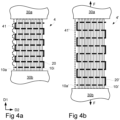
- Figs 4a and 4b schematically illustrate the operation of a size-adjustable fabric, such as the ones illustrated in any of figs 1-3 .
- FIG. 4a-4b there is schematically illustrated how the adjustable fabric 4, 4' is attached to respective non-adjustable, fixed size, fabric portions 30a, 30b, such that the adjustable fabric 4, 4' forms a connection between the non-adjustable fabric portions 30a, 30b.
- Figs 4a-4b illustrate a size-adjustable fabric 4, 4' having eight warp threads 10a-10i.
- Fig. 4a illustrates the fabric 4 in its original state and
- fig 4b illustrates the fabric 4' in its expanded state, wherein the warp threads have been stretched and subsequently cooled, as described with reference to fig. 1 .
- the warp threads 10a-10i extend at an angle of 80-100 degs, preferably about 90 degs, to edges of the fabric portions 30a, 30b.
- expansion-limiting thread 41, 41' which may be included in the woven material such that it runs in parallel with the warp threads 10a-10i, and such that it, in between weft thread 20 crossings, presents slack portions.
- expansion-limiting thread 41, 41' being formed from a non-heat-shrink material, or from a material that is less prone to heat expansion or heat shrinking than the warp material, once the fabric has been expanded, as illustrated in fig. 4b , to such an extent that the expansion-limiting thread 41, 41' becomes stretched, there will be no further expansion of the fabric 4'.
- FIGs 5a-5b schematically illustrate the operation of a size-adjustable fabric 5, 5', which is essentially as described with reference to fig. 3 , i.e. where the extent of the conducting thread 20 across the warp threads 10a-10i varies along the warp direction D1.
- figs 5a-5b there is schematically illustrated how the adjustable fabric 5, 5' is attached to respective non-adjustable, fixed size, fabric portions 35a, 35b, such that the adjustable fabric 5, 5' forms a connection between the non-adjustable fabric portions 35a, 35b.
- the length of the warp threads 10a-10i also varies, such that the fabric 5, 5' can be given a desired shape, such as triangular, as illustrated.
- Expansion limiting threads as illustrated in figs 4a-4b may also be included in the embodiment of figs 5a-5b .
- edges of the fabric portions 35a-35b are non-parallel, and may intersect, so as to form a wedge shape.
- the adjustable fabric, 5, 5' may be arranged relative to edges of the fabric portions 35a, 35b such that an angle at between the first set of threads 10a-10i, 10a'-10i' and the fabric edge is greater than an angle a c between the fabric edge and the conducting threads 20.
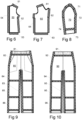
- Fig. 6 schematically illustrates a back part 50 of an upper body garment.
- a shoulder seam edge area 51 there is illustrated a shoulder seam edge area 51, a side seam edge area 52, a bodice length seam edge area 53 and a center back seam edge area 54.
- a size adjustable fabric portion 1, 2, 3 may be arranged at any one or more of these edge areas 51, 52, 53, 54, such that the size-adjustable fabric portion is connected, e.g. by stitching, to the back part 50 at the respective edge area 51, 52, 53, 54, such that the warp threads extend at a greater angle at (see figs 5a-5b ) to the respective edge of the back part 50 than the conducting thread 20 portions.
- Fig. 7 schematically illustrates a front part 60 of an upper body garment.
- a shoulder seam edge area 61 there is illustrated a shoulder seam edge area 61, a center front seam edge areas 62, a bodice length seam edge area 63 and a side seam edge area 64.
- a size adjustable fabric portion 1, 2, 3 may be arranged at any one or more of these edge areas 61, 62, 63, 64, such that the size-adjustable fabric portion is connected, e.g. by stitching, to the front part 60 at the respective edge area 61, 62, 63, 64, such that the warp threads extend at a greater angle to the respective edge of the front part 60 than the conducting thread 20 portions.
- Fig. 8 schematically illustrates a sleeve part 70 of an upper body garment.
- a sleeve cap seam edge area 71 there is illustrated a sleeve cap seam edge area 71, sleeve longitudinal seam edge areas 72, 74 and an elbow line seam area 73.
- a size adjustable fabric portion 1, 2, 3 may be arranged at any one or more of these areas 71, 72, 73, 74, such that the size-adjustable fabric portion is connected, e.g. by stitching, to the sleeve part 70 at the respective edge area 71, 72, 73, 74, such that the warp threads extend at a greater angle to the respective edge of the sleeve part 70 than the conducting thread 20 portions.
- size adjustable fabric portions 1, 2, 3 can be included in any vertically, as seen when the garment is worn by a standing wearer, running seam area 52, 54; 62, 64 to provide adjustability of chest and/or waist size.
- the position and/or width of a sleeve may likewise be adjustable by inclusion of one or more adjustable-size fabric 1, 2, 3 portions in the sleeve cap seam edge area 71 and/or in the longitudinal seam edge area 72, 74.
- the length of an arm may be adjustable by inclusion of one or more adjustable-size fabric 1, 2, 3 portions running across the longitudinal direction of the arm, such as in the elbow line seam area 73.
- Fig. 9 schematically illustrates a front part 80 of a pair of pants.
- a body rise seam area 81 there is illustrated a body rise seam area 81, a side seam area 82, an inside leg seam area 83, an upper knee line seam area 84, a lower knee line seam area 85 and a lower cross seam area 86, closer to a lower end of the pant leg than to the knee portion of the pant leg.
- fig. 10 schematically illustrates a back part 90 of a pair of pants.
- a body rise seam area 91 there is illustrated a body rise seam area 91, a side seam area 92, an inside leg seam area 93, an upper knee line seam area 94, a lower knee line seam area 95 and a lower cross seam area 96, closer to a lower end of the pant leg than to the knee portion of the pant leg.
- a size-adjustable fabric may be included in various applications, examples of which will be provided in the following.
- Size-adjustable fabric patches may be included in clothing, such as fashion clothing/sports fashion clothing, in order to provide resizeability and/or adjustability.
- Example garments include trousers, jeans, jackets, blazers, shirts, shorts, dresses and skirts.
- leather goods, such as purses, handbags and shoes may include one or more size-adjustable fabric patches.
- Size-adjustable fabric patches may be included in sportswear, such as outdoor jackets, skiing jackets/skiing suits, outdoor bags, tent textiles and protective textile covers.
- Protective textile cover can be a cover to hide in up in the mountains/hill. A helicopter can throw it down to people to protect themselves in meanwhile help is on the way.
- Size-adjustable fabric patches may be included in kidswear, such as pants, jackets, overalls, one-piece suits an bags.
- Size-adjustable fabric patches may be included in underwear, such as in corsets, brassieres or boxer shorts.
- Size-adjustable fabric patches may be included in motorsportwear, such as in biking suits, motorcycle costumes, motorcycle jackets, motorcycle pants, etc.
- Size-adjustable fabric patches may be included in interior articles, such as furniture or curtains.
- interior articles such as furniture or curtains.
- Size-adjustable fabric patches may be included in industrial applications, such as seat covers for cars, airplanes, boat cushions and in sail textiles.
- Size-adjustable fabric patches may be included in workwear, e.g. workwear for carpenters in the form of dungarees or overalls.
- Size-adjustable fabric patches may be included in protective wear, such as in harnesses, gloves, cooling vests and protection gear for water blasting, bullet-proof garments, stab-proof garments, etc.
- Size-adjustable fabric patches may be included in footwear, such as in boots, sneakers or leather shoes.
- Size-adjustable fabric patches may be included in medical applications, such as in clothing worn by hospital staff, or in supporting garments, such as rehabilitation socks, etc.
- Size-adjustable fabric patches may be included in military or similar wear, such as in pilot suits, diving suits, as well as in space suits.
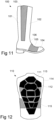
- FIG. 11 there is illustrated an embodiment of a footwear, which is provided with two patches 103, 105 of size-adjustable fabric as described above.
- a first patch 103 is provided on the shaft of the boot with a view to providing adjustability of a circumference of the shaft, such that the circumference of the shaft can be adjusted to fit wearers having differently sized and/or shaped calves.
- the shaft of the boot may comprise a pair of shaft portions 101, 102, which are separated along a vertical direction (when the boot is positioned on a horizontal surface) by the patch 103 of size-adjustable fabric.
- the size-adjustable fabric is thus connected to the shaft portions 101, 102 such that the first set of threads 10a (see figs 5a-5b ) extends between the shaft portions 101, 102, such as substantially horizontally.
- the conducting thread 20 ( figs 5a-5b ) extends substantially perpendicular to the first set of threads 10a, such as substantially horizontally.
- the distance between the shaft portions 101, 102 can be adjusted so as to enable the shaft of the boot to fit a user's calf perfectly.
- the patch 103 may be positioned at a rear portion of the shaft, at a side portion of the shaft or at a front portion of the shaft.
- the patch may be arranged in a concealed manner, such that the size-adjustable fabric may be hidden by a piece of material so as to provide for a desired aesthetic appearance and/or for preventing penetration of dirt or moisture.
- This second patch 105 may be connected to the toe box 104 and to the vamp/instep/tongue.
- the second patch 105 may be oriented such that the first set of threads run substantially along the width of the boot, whereby a width and/or height of the boot 100 may be adjustable.
- boots having a shaft, and in particular a shaft which extends partially or wholly along the user's calf
- such boots may be provided, as non-limiting examples, for functional boots, such as riding boots or motorcycle boots and for fashion boots, in particular women's boots.
- Lower boots such as ski boots, working boots or hiking boots, may also be provided one or both patches 103, 105.
- the patches 103, 104 may be provided as part of the actual shoe casing, and/or as part of a shoe liner (not shown), such as is often found in e.g. slalom boots.
- Shoes which do not extend upwardly beyond the heel or the ankle, may be provided with the second type of patch 105.
- the parts of the footwear which are not made up of the patches 103, 105 may be formed of a material such as leather, rubber or reinforced rubber, polymer material or reinforced polymer material or fabric (woven, non-woven).
- a protective wear in the form of a back protector 110 for use in skiing or motorcycle riding.
- the back protector 110 comprises two or more protecting bodies 111, 112, which may be relatively rigid bodies intended to absorb and/or distribute shock, and/or to protect against penetration of sharp objects or edges.
- a patch of size-adjustable fabric 113 as disclosed above may be arranged between the protecting bodies 111, 112, such that a distance between the protective bodies 111, 112 is adjustable. Hence, it is possible to provide size adjustability of the protective wear, such that its protective capability can be optimized for each individual user.
- a protective wear may comprise a plurality of protecting bodies 111, 112
- a patch 113 of size-adjustable fabric may be arranged along any border area between protective bodies 111, 112 and that each such patch may be individually controllable. It is also possible to provide size-adjustable fabric at some such border areas while providing rigid or elastic fabric in other border areas.
- the protective wear 110 may be a back protector and/or a front protector.
- the protective wear 110 in the form of shoulder protectors, knee protectors, arm protectors, or the like, for use in e.g. ice hockey, skiing, motorcycling, and riding.
- riot wear to be used by police or military, or for ballistic protection wear.
- Fig 13 schematically illustrates a footwear 120, which may take the form of a lining for a footwear, such as a boot, in particular for skiing, such as a slalom or telemark, or for snowboarding. It is understood that such linings may also be used in other types of footwear, such as, but not limited to, riding boots, motorcycle boots, hunting boots, hiking boots, rain boots (wellingtons) or fashion boots.
- the footwear 120 may have a toe portion 121, a heel portion 122, a wrist portion 123 and a tongue portion 124.
- one or more size-adjustable fabric patches or material portions 126 may be provided with the first set of threads 10a extending in a direction Da2 that is substantially parallel to a length direction of the footwear, such that a length of the footwear is adjustable.
- a toebox of the footwear may be produced from the size-adjustable fabric, such that the space made available for the wearer's toes may be perfectly adjusted.
- the first set of threads 10a may thus extend in a direction that is substantially parallel to a length direction of the footwear, such that the length of the footwear can be adjusted by adjusting a position of the toebox relative to a remainder of the footwear.
- the first set of threads 10a may extend substantially horizontally.
- the first set of threads 10a may extend substantially horizontally.
- a size-adjustable fabric patch extends all along the back of the footwear, such as from the footbed to a collar of the footwear, with its first set of threads 10a extending substantially horizontally.
- Such a footwear may be adjusted to fit a user by supplying a current through the second set of threads 10b so as to heat the size-adjustable fabric, and fitting the footwear to the user, whereby the first set of threads 10a are allowed to cool while the footwear is worn by the user.
- the feeding of power may take place before the footwear is fitted by the user, or while the footwear is being worn by the user.
- a footwear as described above may be provided with one or more of the patches 12'5, 126, 129 as described above.
Landscapes
- Engineering & Computer Science (AREA)
- Textile Engineering (AREA)
- Chemical & Material Sciences (AREA)
- Microelectronics & Electronic Packaging (AREA)
- Materials Engineering (AREA)
- Inorganic Chemistry (AREA)
- Physical Education & Sports Medicine (AREA)
- General Health & Medical Sciences (AREA)
- Health & Medical Sciences (AREA)
- Woven Fabrics (AREA)
- Footwear And Its Accessory, Manufacturing Method And Apparatuses (AREA)
- Professional, Industrial, Or Sporting Protective Garments (AREA)
- Yarns And Mechanical Finishing Of Yarns Or Ropes (AREA)
Claims (15)
- Wearable-Artikel, umfassend:einen ersten flexiblen Stoffabschnitt mit fester Größe (3a, 3b, 30a, 30b, 35a, 35b, 50, 60, 70, 80, 90),einen zweiten flexiblen Stoffabschnitt mit fester Größe (3a, 3b, 30a, 30b, 35a, 35b, 50, 60, 70, 80, 90) undeinen Flicken, der aus einem größenanpassbaren Stoff (1, 2, 3, 4, 4') gebildet ist, umfassend:einen ersten Satz Fäden (10a-10i), die jeweils aus einem wärmeschrumpfbaren Polymermaterial gebildet sind,mindestens einen leitenden Faden (20), der aus einem elektrisch leitenden Material gebildet ist,wobei der erste Satz Fäden (10a-10i) im Wesentlichen parallel zueinander verläuft,wobei der leitende Faden (20) im Wesentlichen quer über den ersten Satz Fäden (10a-10i) verläuft,wobei der Flicken zwischen dem ersten und zweiten Stoffabschnitt mit fester Größe angeordnet ist und diese verbindet, undwobei der erste Satz Fäden (10a-10i) in einem größeren Winkel zu mindestens einem des ersten und zweiten Stoffabschnitts mit fester Größe (3a, 3b, 30a, 30b, 35a, 35b, 50, 60, 70, 80, 90) verläuft als der leitende Faden (20).
- Wearable-Artikel nach Anspruch 1, wobei der erste Satz Fäden (10a-10i) einen Satz Kettfäden bildet und der leitende Faden (20) einen Schussfaden bildet.
- Wearable-Artikel nach einem der vorhergehenden Ansprüche, wobei der leitende Faden (20) in einem Winkel von 80 bis 100 Grad zum ersten Satz Fäden (10a-10i) verläuft.
- Wearable-Artikel nach einem der vorhergehenden Ansprüche, wobei das wärmeschrumpfbare Polymermaterial mindestens ein Material umfasst, das ausgewählt ist aus einer Gruppe bestehend aus einem Polyolefin, einem Polyester, einem Polyvinylchlorid (PVC), einem synthetischen Kautschuk auf Fluorkohlenwasserstoffbasis, einem Polychloroprenkautschuk, einem Polytetrafluorethylen (PTFE), einem Elastomer, einem fluorierten Ethylenpropylen (FEP) und einem Polyvinylidenfluorid (PVDF).
- Wearable-Artikel nach einem der vorhergehenden Ansprüche, wobei das wärmeschrumpfbare Polymermaterial ein vernetztes und anschließend expandiertes Polymermaterial ist.
- Wearable-Artikel nach einem der vorhergehenden Ansprüche, ferner umfassend mindestens einen nichtleitenden Faden (40), der hauptsächlich parallel zum leitenden Faden (20) verläuft.
- Wearable-Artikel nach einem der vorhergehenden Ansprüche, wobei der leitende Faden (20) über den gesamten ersten Satz Fäden (10a-10i) verläuft.
- Wearable-Artikel nach einem der Ansprüche 1 bis 6, wobei der leitende Faden (20) mindestens in einem Abschnitt entlang einer Längsrichtung des ersten Satzes Fäden (10a-10i) über weniger als alle Fäden des ersten Satzes Fäden (10a-10i) verläuft.
- Wearable-Artikel nach einem der vorhergehenden Ansprüche, wobei die Fäden des ersten Satzes Fäden (10a-10i) mindestens zwei unterschiedliche Längen aufweisen.
- Wearable-Artikel nach einem der vorhergehenden Ansprüche, ferner umfassend mindestens einen dehnungsbegrenzenden Faden (41, 41'), der parallel zum ersten Satz Fäden (10a-10i) verläuft, wobei der dehnungsbegrenzende Faden (41, 41'), wenn sich der erste Satz Fäden (10a-10i) in einem kontrahierten Zustand befindet, gekrümmte Abschnitte zwischen Kreuzungsabschnitten des leitenden Fadens (20) aufweist.
- Schuhwerk, umfassend:einen ersten flexiblen Materialabschnitt mit fester Größe (101),einen zweiten flexiblen Materialabschnitt mit fester Größe (102) undeinen Flicken (103), der aus einem größenanpassbaren Stoff (1, 2, 3, 4, 4') gebildet ist, umfassend: einen ersten Satz Fäden (10a-10i), die jeweils aus einem wärmeschrumpfbaren Polymermaterial gebildet sind, mindestens einen leitenden Faden (20), der aus einem elektrisch leitenden Material gebildet ist, wobei der erste Satz Fäden (10a-10i) im Wesentlichen parallel zueinander verläuft und wobei der leitende Faden (20) im Wesentlichen quer über den ersten Satz Fäden (10a-10i) verläuft,wobei der Flicken zwischen dem ersten und zweiten Stoffabschnitt mit fester Größe angeordnet ist und diese verbindet,wobei der Flicken an einem Schaftabschnitt des Schuhwerks angebracht ist, undwobei der erste Satz Fäden (10a-10i) im Wesentlichen entlang einer Umfangsrichtung eines Schafts des Schuhwerks verläuft, so dass eine Schaftbreite einstellbar ist.
- Schuhwerk, umfassend:einen ersten flexiblen Materialabschnitt mit fester Größe (104),einen zweiten flexiblen Materialabschnitt mit fester Größe (106) undeinen Flicken (105), der aus einem größenanpassbaren Stoff (1, 2, 3, 4, 4') gebildet ist,umfassend: einen ersten Satz Fäden (10a-10i), die jeweils aus einem wärmeschrumpfbaren Polymermaterial gebildet sind, mindestens einen leitenden Faden (20), der aus einem elektrisch leitenden Material gebildet ist, wobei der erste Satz Fäden (10a-10i) im Wesentlichen parallel zueinander verläuft und wobei der leitende Faden (20) im Wesentlichen quer über den ersten Satz Fäden (10a-10i) verläuft,wobei der Flicken zwischen dem ersten und zweiten Stoffabschnitt mit fester Größe angeordnet ist und diese verbindet,wobei der Flicken an einem Zehenabschnitt des Schuhwerks positioniert ist, undwobei sich der erste Satz Fäden (10a-10i) im Wesentlichen entlang einer Breitenrichtung des Schuhwerks erstreckt, so dass eine Breite und/oder Höhe des Schuhwerks einstellbar ist.
- Schutzbekleidung, umfassend:einen ersten Schutzkörper (111),einen zweiten Schutzkörper (112) undeinen Flicken (113), der aus einem größenanpassbaren Stoff (1, 2, 3, 4, 4') gebildet ist, umfassend: einen ersten Satz Fäden (10a-10i), die jeweils aus einem wärmeschrumpfbaren Polymermaterial gebildet sind, mindestens einen leitenden Faden (20), der aus einem elektrisch leitenden Material gebildet ist, wobei der erste Satz Fäden (10a-10i) im Wesentlichen parallel zueinander verläuft und wobei der leitende Faden (20) im Wesentlichen quer über den ersten Satz Fäden (10a-10i) verläuft,wobei der Flicken zwischen dem ersten und zweiten Schutzkörper (111, 112) angeordnet ist und diese verbindet,wobei der erste Satz von Fäden (10a-10i) im Wesentlichen zwischen dem ersten und dem zweiten Schutzkörper (111, 112) verläuft, so dass ein Abstand zwischen den Schutzkörpern (111, 112) einstellbar ist.
- Schuhwerk, umfassend:einen ersten flexiblen Materialabschnitt mit fester Größe (101),einen zweiten flexiblen Materialabschnitt mit fester Größe (102) undeinen Flicken (103), der aus einem größenanpassbaren Stoff (1, 2, 3, 4, 4') gebildet ist, umfassend: einen ersten Satz Fäden (10a-10i), die jeweils aus einem wärmeschrumpfbaren Polymermaterial gebildet sind, mindestens einen leitenden Faden (20), der aus einem elektrisch leitenden Material gebildet ist, wobei der erste Satz Fäden (10a-10i) im Wesentlichen parallel zueinander verläuft und wobei der leitende Faden (20) im Wesentlichen quer über den ersten Satz Fäden (10a-10i) verläuft,wobei der Flicken zwischen dem ersten und zweiten Stoffabschnitt mit fester Größe angeordnet ist und diese verbindet,wobei der Flicken an einem hinteren Abschnitt des Schuhwerks positioniert ist, undwobei sich der erste Satz Fäden (10a-10i) in einer Richtung (Da1) erstreckt, die im Wesentlichen parallel zu einem Fußbett des Schuhwerks einstellbar ist einer Breitenrichtung des Schuhwerks verläuft, so dass eine Länge des Schuhwerks einstellbar ist.
- Schuhwerk, umfassend:einen flexiblen Materialabschnitt mit fester Größe (127),einen Abschnitt (126), der aus einem größenanpassbaren Stoff (1, 2, 3, 4, 4') gebildet ist, umfassend: einen ersten Satz Fäden (10a-10i), die jeweils aus einem wärmeschrumpfbaren Polymermaterial gebildet sind, mindestens einen leitenden Faden (20), der aus einem elektrisch leitenden Material gebildet ist, wobei der erste Satz Fäden (10a-10i) im Wesentlichen parallel zueinander verläuft und wobei der leitende Faden (20) im Wesentlichen quer über den ersten Satz Fäden (10a-10i) verläuft,wobei der Abschnitt (126) mit dem flexiblen Materialabschnitt (127) mit fester Größe verbunden ist,wobei der Abschnitt (126) an einem Zehenabschnitt des Schuhwerks positioniert ist, undwobei sich der erste Satz Fäden (10a-10i) im Wesentlichen entlang einer Längenrichtung (Da2) des Schuhwerks erstreckt, so dass eine Länge des Schuhwerks einstellbar ist.
Applications Claiming Priority (3)
| Application Number | Priority Date | Filing Date | Title |
|---|---|---|---|
| SE2051177A SE544450C2 (en) | 2020-10-08 | 2020-10-08 | Size-adjustable woven fabric, wearable item and methods of resizing a fabric |
| SE2151187 | 2021-09-28 | ||
| PCT/EP2021/077876 WO2022074203A1 (en) | 2020-10-08 | 2021-10-08 | Size-adjustable woven fabric, wearable item and methods of resizing a fabric |
Publications (3)
| Publication Number | Publication Date |
|---|---|
| EP4216752A1 EP4216752A1 (de) | 2023-08-02 |
| EP4216752C0 EP4216752C0 (de) | 2024-08-21 |
| EP4216752B1 true EP4216752B1 (de) | 2024-08-21 |
Family
ID=78179373
Family Applications (1)
| Application Number | Title | Priority Date | Filing Date |
|---|---|---|---|
| EP21791290.6A Active EP4216752B1 (de) | 2020-10-08 | 2021-10-08 | Grössenanpassbarer webstoff, wearable-artikel und verfahren zur grössenanpassung eines stoffes |
Country Status (10)
| Country | Link |
|---|---|
| US (1) | US20230354951A1 (de) |
| EP (1) | EP4216752B1 (de) |
| JP (1) | JP7600388B2 (de) |
| KR (1) | KR102863702B1 (de) |
| CN (1) | CN116324062A (de) |
| AU (1) | AU2021356154A1 (de) |
| BR (1) | BR112023006120A2 (de) |
| CA (1) | CA3194252A1 (de) |
| MX (1) | MX2023004013A (de) |
| WO (1) | WO2022074203A1 (de) |
Families Citing this family (3)
| Publication number | Priority date | Publication date | Assignee | Title |
|---|---|---|---|---|
| JP2022154607A (ja) * | 2021-03-30 | 2022-10-13 | 株式会社アシックス | アッパー、靴、およびアッパーの作製方法 |
| JP2024052117A (ja) * | 2022-09-30 | 2024-04-11 | 帝人フロンティア株式会社 | 布および繊維製品 |
| KR102820603B1 (ko) * | 2022-12-01 | 2025-06-16 | 재단법인 대구경북과학기술원 | 자동 신발끈 조임 장치 |
Citations (1)
| Publication number | Priority date | Publication date | Assignee | Title |
|---|---|---|---|---|
| US20160021799A1 (en) * | 2014-07-16 | 2016-01-21 | Federal-Mogul Powertrain, Inc. | Protective Sleeve With Bonded Wire Filaments and Methods of Construction Thereof |
Family Cites Families (17)
| Publication number | Priority date | Publication date | Assignee | Title |
|---|---|---|---|---|
| AU547249B2 (en) * | 1980-04-22 | 1985-10-10 | Ube Industries, Ltd. | Heat-shrinkable cover sheet |
| US5236765A (en) * | 1984-04-06 | 1993-08-17 | Nv Raychem Sa | Heat-recoverable article |
| ES8607108A1 (es) * | 1984-04-06 | 1986-06-01 | Raychem Sa Nv | Recubrimiento termorrecuperable y procedimiento para recu- brir un objeto de forma generalmente alargada |
| RU2027320C1 (ru) * | 1991-02-27 | 1995-01-20 | Киевский завод "Электробытприбор" | Тканый электронагреватель |
| US20070042660A1 (en) | 2003-11-07 | 2007-02-22 | Koninklijke Philips Electronics N.V. | Controllable surface area fabric |
| GB2441589A (en) * | 2006-09-05 | 2008-03-12 | Anthony Walter Anson | Heat treatment method for composite textiles |
| JP5928069B2 (ja) * | 2012-03-28 | 2016-06-01 | トヨタ紡織株式会社 | 織物 |
| US20160374615A1 (en) * | 2014-01-28 | 2016-12-29 | Nippon Telegraph And Telephone Corporation | Biosignal detecting garment |
| JP2015232931A (ja) * | 2014-06-09 | 2015-12-24 | 日本圧着端子製造株式会社 | ソケットコネクタ |
| US10829872B2 (en) * | 2015-05-20 | 2020-11-10 | University Of Maryland, College Park | Composite materials with self-regulated infrared emissivity and environment responsive fibers |
| CN104902598A (zh) * | 2015-06-17 | 2015-09-09 | 邵辉 | 一种通电瞬热的电热纱线 |
| US11160327B2 (en) * | 2015-12-28 | 2021-11-02 | Asics Corporation | Shoe |
| KR102070964B1 (ko) * | 2016-01-30 | 2020-01-29 | 푸마 에스이 | 신발, 특히 스포츠 신발, 그리고 그 신발을 고정하는 방법 |
| US20170280819A1 (en) * | 2016-03-31 | 2017-10-05 | Bauer Hockey Ltd. | Athletic gear or other wearable articles comprising an expandable user-engaging structure |
| EP3636090A4 (de) * | 2017-06-09 | 2021-03-31 | Kao Corporation | Wasserabweisende eigenschaften verleihender faserartikel |
| US11280031B2 (en) * | 2017-07-14 | 2022-03-22 | Regents Of The University Of Minnesota | Active knit compression garments, devices and related methods |
| TWI720278B (zh) * | 2018-01-12 | 2021-03-01 | 智能紡織科技股份有限公司 | 溫控記憶織物及使用其製成的穿戴物 |
-
2021
- 2021-10-08 US US18/029,856 patent/US20230354951A1/en active Pending
- 2021-10-08 MX MX2023004013A patent/MX2023004013A/es unknown
- 2021-10-08 JP JP2023521027A patent/JP7600388B2/ja active Active
- 2021-10-08 CN CN202180067680.7A patent/CN116324062A/zh active Pending
- 2021-10-08 CA CA3194252A patent/CA3194252A1/en active Pending
- 2021-10-08 KR KR1020237012616A patent/KR102863702B1/ko active Active
- 2021-10-08 WO PCT/EP2021/077876 patent/WO2022074203A1/en not_active Ceased
- 2021-10-08 BR BR112023006120A patent/BR112023006120A2/pt unknown
- 2021-10-08 AU AU2021356154A patent/AU2021356154A1/en active Pending
- 2021-10-08 EP EP21791290.6A patent/EP4216752B1/de active Active
Patent Citations (1)
| Publication number | Priority date | Publication date | Assignee | Title |
|---|---|---|---|---|
| US20160021799A1 (en) * | 2014-07-16 | 2016-01-21 | Federal-Mogul Powertrain, Inc. | Protective Sleeve With Bonded Wire Filaments and Methods of Construction Thereof |
Also Published As
| Publication number | Publication date |
|---|---|
| EP4216752A1 (de) | 2023-08-02 |
| WO2022074203A1 (en) | 2022-04-14 |
| CA3194252A1 (en) | 2022-04-14 |
| US20230354951A1 (en) | 2023-11-09 |
| JP2023544606A (ja) | 2023-10-24 |
| BR112023006120A2 (pt) | 2023-05-09 |
| KR20230084179A (ko) | 2023-06-12 |
| KR102863702B1 (ko) | 2025-09-23 |
| AU2021356154A1 (en) | 2023-06-08 |
| JP7600388B2 (ja) | 2024-12-16 |
| AU2021356154A9 (en) | 2024-07-25 |
| EP4216752C0 (de) | 2024-08-21 |
| MX2023004013A (es) | 2023-04-26 |
| CN116324062A (zh) | 2023-06-23 |
Similar Documents
| Publication | Publication Date | Title |
|---|---|---|
| EP4216752B1 (de) | Grössenanpassbarer webstoff, wearable-artikel und verfahren zur grössenanpassung eines stoffes | |
| US20240156199A1 (en) | Article of apparel including fabric having interconnected cell structure | |
| TWI834425B (zh) | 編織組件、包含一編織組件之物品、處理一編織組件的方法及形成一編織組件的方法 | |
| EP3298186B1 (de) | Trainingsstrumpfhose mit vorkonfigurierten kompressionszonen und integrierten strukturmustern | |
| EP2702884B1 (de) | Bekleidungsartikel mit auxetischen Materialien | |
| US5022096A (en) | Waterproof breathable wader | |
| US10159297B2 (en) | Patterned plexus of filaments, method of producing and articles containing patterned filaments | |
| EP3478110B1 (de) | Kleidungsstück mit abschnittsweiser isolierung und variabler luftdurchlässigkeit | |
| EP3076818B1 (de) | Gestricktes band mit integrierter belüftung | |
| TW201622603A (zh) | 含有鑲設張力元件之編織部件的鞋類物件及組合方法 | |
| JP7229880B2 (ja) | 環状織スポーツ物品 | |
| US11839253B2 (en) | Article of apparel including fabric having auxetic structure | |
| US12193542B2 (en) | Shoe upper | |
| WO2018129146A1 (en) | Articles with embroidered sequins and methods of making | |
| CN113748236A (zh) | 轻质针织鞋面、鞋类制品及制造方法 | |
| SE2051177A1 (en) | Size-adjustable woven fabric, wearable item and methods of resizing a fabric | |
| EP3418048B1 (de) | Kleidungsstück mit einstellbarer grösse oder dimension | |
| KR102405483B1 (ko) | 엔지니어링된 패브릭 | |
| GB1560836A (en) | Self-ventilating abrasion-resistant garment | |
| US20250009060A1 (en) | Article of apparel with comfort strap | |
| US20120204324A1 (en) | Novel garment for recreational, medical, and fire applications | |
| HK40063577A (en) | Lightweight knitted upper, an article of footwear and a method of manufacture | |
| HK40007302A (en) | Freedom of movement garment | |
| CN111885936A (zh) | 防风雨气候调节运动裤 |
Legal Events
| Date | Code | Title | Description |
|---|---|---|---|
| STAA | Information on the status of an ep patent application or granted ep patent |
Free format text: STATUS: UNKNOWN |
|
| STAA | Information on the status of an ep patent application or granted ep patent |
Free format text: STATUS: THE INTERNATIONAL PUBLICATION HAS BEEN MADE |
|
| PUAI | Public reference made under article 153(3) epc to a published international application that has entered the european phase |
Free format text: ORIGINAL CODE: 0009012 |
|
| STAA | Information on the status of an ep patent application or granted ep patent |
Free format text: STATUS: REQUEST FOR EXAMINATION WAS MADE |
|
| 17P | Request for examination filed |
Effective date: 20230421 |
|
| AK | Designated contracting states |
Kind code of ref document: A1 Designated state(s): AL AT BE BG CH CY CZ DE DK EE ES FI FR GB GR HR HU IE IS IT LI LT LU LV MC MK MT NL NO PL PT RO RS SE SI SK SM TR |
|
| GRAP | Despatch of communication of intention to grant a patent |
Free format text: ORIGINAL CODE: EPIDOSNIGR1 |
|
| STAA | Information on the status of an ep patent application or granted ep patent |
Free format text: STATUS: GRANT OF PATENT IS INTENDED |
|
| GRAJ | Information related to disapproval of communication of intention to grant by the applicant or resumption of examination proceedings by the epo deleted |
Free format text: ORIGINAL CODE: EPIDOSDIGR1 |
|
| DAV | Request for validation of the european patent (deleted) | ||
| DAX | Request for extension of the european patent (deleted) | ||
| INTG | Intention to grant announced |
Effective date: 20231013 |
|
| GRAP | Despatch of communication of intention to grant a patent |
Free format text: ORIGINAL CODE: EPIDOSNIGR1 |
|
| INTG | Intention to grant announced |
Effective date: 20231115 |
|
| GRAS | Grant fee paid |
Free format text: ORIGINAL CODE: EPIDOSNIGR3 |
|
| GRAJ | Information related to disapproval of communication of intention to grant by the applicant or resumption of examination proceedings by the epo deleted |
Free format text: ORIGINAL CODE: EPIDOSDIGR1 |
|
| GRAL | Information related to payment of fee for publishing/printing deleted |
Free format text: ORIGINAL CODE: EPIDOSDIGR3 |
|
| STAA | Information on the status of an ep patent application or granted ep patent |
Free format text: STATUS: REQUEST FOR EXAMINATION WAS MADE |
|
| GRAP | Despatch of communication of intention to grant a patent |
Free format text: ORIGINAL CODE: EPIDOSNIGR1 |
|
| STAA | Information on the status of an ep patent application or granted ep patent |
Free format text: STATUS: GRANT OF PATENT IS INTENDED |
|
| INTC | Intention to grant announced (deleted) | ||
| INTG | Intention to grant announced |
Effective date: 20240507 |
|
| GRAS | Grant fee paid |
Free format text: ORIGINAL CODE: EPIDOSNIGR3 |
|
| GRAA | (expected) grant |
Free format text: ORIGINAL CODE: 0009210 |
|
| STAA | Information on the status of an ep patent application or granted ep patent |
Free format text: STATUS: THE PATENT HAS BEEN GRANTED |
|
| AK | Designated contracting states |
Kind code of ref document: B1 Designated state(s): AL AT BE BG CH CY CZ DE DK EE ES FI FR GB GR HR HU IE IS IT LI LT LU LV MC MK MT NL NO PL PT RO RS SE SI SK SM TR |
|
| REG | Reference to a national code |
Ref country code: GB Ref legal event code: FG4D |
|
| REG | Reference to a national code |
Ref country code: CH Ref legal event code: EP |
|
| REG | Reference to a national code |
Ref country code: DE Ref legal event code: R096 Ref document number: 602021017643 Country of ref document: DE |
|
| REG | Reference to a national code |
Ref country code: IE Ref legal event code: FG4D |
|
| U01 | Request for unitary effect filed |
Effective date: 20240920 |
|
| U07 | Unitary effect registered |
Designated state(s): AT BE BG DE DK EE FI FR IT LT LU LV MT NL PT RO SE SI Effective date: 20241010 |
|
| U20 | Renewal fee for the european patent with unitary effect paid |
Year of fee payment: 4 Effective date: 20241016 |
|
| PG25 | Lapsed in a contracting state [announced via postgrant information from national office to epo] |
Ref country code: NO Free format text: LAPSE BECAUSE OF FAILURE TO SUBMIT A TRANSLATION OF THE DESCRIPTION OR TO PAY THE FEE WITHIN THE PRESCRIBED TIME-LIMIT Effective date: 20241121 |
|
| PG25 | Lapsed in a contracting state [announced via postgrant information from national office to epo] |
Ref country code: GR Free format text: LAPSE BECAUSE OF FAILURE TO SUBMIT A TRANSLATION OF THE DESCRIPTION OR TO PAY THE FEE WITHIN THE PRESCRIBED TIME-LIMIT Effective date: 20241122 Ref country code: PL Free format text: LAPSE BECAUSE OF FAILURE TO SUBMIT A TRANSLATION OF THE DESCRIPTION OR TO PAY THE FEE WITHIN THE PRESCRIBED TIME-LIMIT Effective date: 20240821 |
|
| PG25 | Lapsed in a contracting state [announced via postgrant information from national office to epo] |
Ref country code: IS Free format text: LAPSE BECAUSE OF FAILURE TO SUBMIT A TRANSLATION OF THE DESCRIPTION OR TO PAY THE FEE WITHIN THE PRESCRIBED TIME-LIMIT Effective date: 20241221 |
|
| PG25 | Lapsed in a contracting state [announced via postgrant information from national office to epo] |
Ref country code: HR Free format text: LAPSE BECAUSE OF FAILURE TO SUBMIT A TRANSLATION OF THE DESCRIPTION OR TO PAY THE FEE WITHIN THE PRESCRIBED TIME-LIMIT Effective date: 20240821 |
|
| PG25 | Lapsed in a contracting state [announced via postgrant information from national office to epo] |
Ref country code: RS Free format text: LAPSE BECAUSE OF FAILURE TO SUBMIT A TRANSLATION OF THE DESCRIPTION OR TO PAY THE FEE WITHIN THE PRESCRIBED TIME-LIMIT Effective date: 20241121 Ref country code: ES Free format text: LAPSE BECAUSE OF FAILURE TO SUBMIT A TRANSLATION OF THE DESCRIPTION OR TO PAY THE FEE WITHIN THE PRESCRIBED TIME-LIMIT Effective date: 20240821 |
|
| PG25 | Lapsed in a contracting state [announced via postgrant information from national office to epo] |
Ref country code: RS Free format text: LAPSE BECAUSE OF FAILURE TO SUBMIT A TRANSLATION OF THE DESCRIPTION OR TO PAY THE FEE WITHIN THE PRESCRIBED TIME-LIMIT Effective date: 20241121 Ref country code: PL Free format text: LAPSE BECAUSE OF FAILURE TO SUBMIT A TRANSLATION OF THE DESCRIPTION OR TO PAY THE FEE WITHIN THE PRESCRIBED TIME-LIMIT Effective date: 20240821 Ref country code: NO Free format text: LAPSE BECAUSE OF FAILURE TO SUBMIT A TRANSLATION OF THE DESCRIPTION OR TO PAY THE FEE WITHIN THE PRESCRIBED TIME-LIMIT Effective date: 20241121 Ref country code: IS Free format text: LAPSE BECAUSE OF FAILURE TO SUBMIT A TRANSLATION OF THE DESCRIPTION OR TO PAY THE FEE WITHIN THE PRESCRIBED TIME-LIMIT Effective date: 20241221 Ref country code: HR Free format text: LAPSE BECAUSE OF FAILURE TO SUBMIT A TRANSLATION OF THE DESCRIPTION OR TO PAY THE FEE WITHIN THE PRESCRIBED TIME-LIMIT Effective date: 20240821 Ref country code: GR Free format text: LAPSE BECAUSE OF FAILURE TO SUBMIT A TRANSLATION OF THE DESCRIPTION OR TO PAY THE FEE WITHIN THE PRESCRIBED TIME-LIMIT Effective date: 20241122 Ref country code: ES Free format text: LAPSE BECAUSE OF FAILURE TO SUBMIT A TRANSLATION OF THE DESCRIPTION OR TO PAY THE FEE WITHIN THE PRESCRIBED TIME-LIMIT Effective date: 20240821 |
|
| PG25 | Lapsed in a contracting state [announced via postgrant information from national office to epo] |
Ref country code: SM Free format text: LAPSE BECAUSE OF FAILURE TO SUBMIT A TRANSLATION OF THE DESCRIPTION OR TO PAY THE FEE WITHIN THE PRESCRIBED TIME-LIMIT Effective date: 20240821 |
|
| PG25 | Lapsed in a contracting state [announced via postgrant information from national office to epo] |
Ref country code: CZ Free format text: LAPSE BECAUSE OF FAILURE TO SUBMIT A TRANSLATION OF THE DESCRIPTION OR TO PAY THE FEE WITHIN THE PRESCRIBED TIME-LIMIT Effective date: 20240821 |
|
| PG25 | Lapsed in a contracting state [announced via postgrant information from national office to epo] |
Ref country code: SK Free format text: LAPSE BECAUSE OF FAILURE TO SUBMIT A TRANSLATION OF THE DESCRIPTION OR TO PAY THE FEE WITHIN THE PRESCRIBED TIME-LIMIT Effective date: 20240821 |
|
| REG | Reference to a national code |
Ref country code: CH Ref legal event code: PL |
|
| PLBE | No opposition filed within time limit |
Free format text: ORIGINAL CODE: 0009261 |
|
| STAA | Information on the status of an ep patent application or granted ep patent |
Free format text: STATUS: NO OPPOSITION FILED WITHIN TIME LIMIT |
|
| PG25 | Lapsed in a contracting state [announced via postgrant information from national office to epo] |
Ref country code: MC Free format text: LAPSE BECAUSE OF FAILURE TO SUBMIT A TRANSLATION OF THE DESCRIPTION OR TO PAY THE FEE WITHIN THE PRESCRIBED TIME-LIMIT Effective date: 20240821 |
|
| PG25 | Lapsed in a contracting state [announced via postgrant information from national office to epo] |
Ref country code: CH Free format text: LAPSE BECAUSE OF NON-PAYMENT OF DUE FEES Effective date: 20241031 |
|
| 26N | No opposition filed |
Effective date: 20250522 |
|
| PG25 | Lapsed in a contracting state [announced via postgrant information from national office to epo] |
Ref country code: IE Free format text: LAPSE BECAUSE OF NON-PAYMENT OF DUE FEES Effective date: 20241008 |
|
| U20 | Renewal fee for the european patent with unitary effect paid |
Year of fee payment: 5 Effective date: 20250929 |
|
| PG25 | Lapsed in a contracting state [announced via postgrant information from national office to epo] |
Ref country code: CY Free format text: LAPSE BECAUSE OF FAILURE TO SUBMIT A TRANSLATION OF THE DESCRIPTION OR TO PAY THE FEE WITHIN THE PRESCRIBED TIME-LIMIT; INVALID AB INITIO Effective date: 20211008 |