EP4215661A1 - Verfahren zur herstellung von edelmetallnetzen auf flachstrickmaschinen - Google Patents
Verfahren zur herstellung von edelmetallnetzen auf flachstrickmaschinen Download PDFInfo
- Publication number
- EP4215661A1 EP4215661A1 EP22152845.8A EP22152845A EP4215661A1 EP 4215661 A1 EP4215661 A1 EP 4215661A1 EP 22152845 A EP22152845 A EP 22152845A EP 4215661 A1 EP4215661 A1 EP 4215661A1
- Authority
- EP
- European Patent Office
- Prior art keywords
- precious metal
- layer
- mesh
- abutting
- knitting
- Prior art date
- Legal status (The legal status is an assumption and is not a legal conclusion. Google has not performed a legal analysis and makes no representation as to the accuracy of the status listed.)
- Granted
Links
Images

Classifications
-
- D—TEXTILES; PAPER
- D04—BRAIDING; LACE-MAKING; KNITTING; TRIMMINGS; NON-WOVEN FABRICS
- D04B—KNITTING
- D04B1/00—Weft knitting processes for the production of fabrics or articles not dependent on the use of particular machines; Fabrics or articles defined by such processes
- D04B1/14—Other fabrics or articles characterised primarily by the use of particular thread materials
-
- D—TEXTILES; PAPER
- D02—YARNS; MECHANICAL FINISHING OF YARNS OR ROPES; WARPING OR BEAMING
- D02G—CRIMPING OR CURLING FIBRES, FILAMENTS, THREADS, OR YARNS; YARNS OR THREADS
- D02G3/00—Yarns or threads, e.g. fancy yarns; Processes or apparatus for the production thereof, not otherwise provided for
- D02G3/02—Yarns or threads characterised by the material or by the materials from which they are made
- D02G3/12—Threads containing metallic filaments or strips
-
- D—TEXTILES; PAPER
- D04—BRAIDING; LACE-MAKING; KNITTING; TRIMMINGS; NON-WOVEN FABRICS
- D04B—KNITTING
- D04B1/00—Weft knitting processes for the production of fabrics or articles not dependent on the use of particular machines; Fabrics or articles defined by such processes
- D04B1/22—Weft knitting processes for the production of fabrics or articles not dependent on the use of particular machines; Fabrics or articles defined by such processes specially adapted for knitting goods of particular configuration
-
- D—TEXTILES; PAPER
- D04—BRAIDING; LACE-MAKING; KNITTING; TRIMMINGS; NON-WOVEN FABRICS
- D04B—KNITTING
- D04B7/00—Flat-bed knitting machines with independently-movable needles
- D04B7/04—Flat-bed knitting machines with independently-movable needles with two sets of needles
-
- D—TEXTILES; PAPER
- D10—INDEXING SCHEME ASSOCIATED WITH SUBLASSES OF SECTION D, RELATING TO TEXTILES
- D10B—INDEXING SCHEME ASSOCIATED WITH SUBLASSES OF SECTION D, RELATING TO TEXTILES
- D10B2101/00—Inorganic fibres
- D10B2101/20—Metallic fibres
-
- D—TEXTILES; PAPER
- D10—INDEXING SCHEME ASSOCIATED WITH SUBLASSES OF SECTION D, RELATING TO TEXTILES
- D10B—INDEXING SCHEME ASSOCIATED WITH SUBLASSES OF SECTION D, RELATING TO TEXTILES
- D10B2403/00—Details of fabric structure established in the fabric forming process
- D10B2403/02—Cross-sectional features
- D10B2403/024—Fabric incorporating additional compounds
- D10B2403/0242—Fabric incorporating additional compounds enhancing chemical properties
-
- D—TEXTILES; PAPER
- D10—INDEXING SCHEME ASSOCIATED WITH SUBLASSES OF SECTION D, RELATING TO TEXTILES
- D10B—INDEXING SCHEME ASSOCIATED WITH SUBLASSES OF SECTION D, RELATING TO TEXTILES
- D10B2403/00—Details of fabric structure established in the fabric forming process
- D10B2403/03—Shape features
- D10B2403/032—Flat fabric of variable width, e.g. including one or more fashioned panels
Definitions
- the present invention relates to a method for producing a two-layer precious metal mesh on a flat knitting machine which has a first and a second needle bed.
- the method includes providing at least one wire containing precious metal and knitting the precious metal mesh.
- the first and second layers of precious metal net are knitted on the first and second needle beds and a support net is knitted using a supporting thread on the first and second needle beds.
- An abutting edge of the support mesh is connected to the two layers of the noble metal mesh via connecting knit stitches and the knit rows containing the connection are knitted over both needle beds.
- the heterogeneous noble metal-catalyzed oxidation of ammonia (NH 3 ) to nitric acid (HNO 3 , Ostwald process) or the production of hydrogen cyanide (HCN, Andrussow process) is of great importance due to the central relevance of the products for the chemical industry.
- the catalyst systems used for this purpose are usually installed in the form of gas-permeable flat structures in the reaction zone of a flow reactor in a plane perpendicular to the direction of flow of the fresh gas. Collection or catchment systems for recovering evaporated catalytically active components are also often based on such net-like structures.
- a plurality of meshes are usually arranged one behind the other and combined to form a stack of catalyst meshes.
- the individual nets consist of fine noble metal wires, which mainly contain platinum (Pt), palladium (Pd), rhodium (Rh) or alloys of these metals.
- Catchment nets in particular can also contain other components such as nickel.
- a number of processes are known for producing such knitted goods, for example weaving, warp-knitting and knitting. Weaving and knitting are particularly suitable for the production of rectangular webs of netting with a homogeneous material distribution and structure. They offer little flexibility in terms of shape and material variability of the products to be manufactured. In an additional process step, the nets must be cut from the fabricated webs to the size and shape suitable for the reactors, with waste containing precious metal components being produced. In addition, the machines used require long set-up times and a high use of materials.
- knitting offers greater flexibility: the knitting pattern, wires (both in terms of thickness and material), needles and tension of the wire used can be used to vary both the basis weight and the structure, stretchability and strength of the available knitted fabrics. Another advantage is the significantly shorter set-up times for the machines.
- the use of different materials in one knit is possible, with the so-called In intarsia knitting, for example, different areas are made of different yarns or wires.
- the length of a knitted fabric is not limited, but in the case of flat knitting machines, the maximum width is predetermined by the width of the needle beds.
- Flat knitting machines or circular knitting machines can be used for knitting.
- the needles are arranged in a circular needle bed and the thread or wire is fed accordingly in a circular movement.
- Such machines primarily allow the production of tubular knitwear.
- the shape and size of the knitted fabric can be varied. The latter can also have more than one needle bed, between which the yarn or wire is guided back and forth by means of thread guides during production.
- a single-layer knit can be created in two ways: On the one hand, if you only work on one needle bed, i.e. only stitches are formed on one of the needle beds and knitted together. On the other hand, stitches created on the first needle bed can be knitted with stitches created on the second needle bed, i.e. the thread is guided back and forth within a back and/or back row between the two needle beds. Accordingly, a two-layer knitted fabric is created when knitting is carried out in parallel on both needle beds and the stitches produced on the first row of needles are not knitted or only selectively knitted over the edge stitches with the stitches produced on the second needle bed. With this production method, two single-layer knitted fabrics or layers can also be produced in parallel on the first and second needle beds.
- EP 0364153 A1 describes the use of an additional non-precious metal thread when knitting a precious metal mesh, which increases process stability.
- the additional thread is knitted in parallel with the precious metal and can be removed from the homogeneous knitted fabric produced, consisting of precious metal material and thread material, after the knitting process if necessary.
- this process was further developed in such a way that the additional thread and the precious metal are not knitted in parallel, but simultaneously. Precious metal-free areas can thus be retained in the finished knitted fabric, which has led to a reduction in the use of precious metals.
- the object of the present invention was therefore to provide a method with high process stability for the production of noble metal nets on flat knitting machines using wires containing noble metal and threads free of noble metal.
- the method according to the invention relates to knitting on a flat knitting machine with a first and a second needle bed.
- Knitting is characterized by the production of the resulting knitted fabric in rows, in which interlocking stitches are formed.
- a row of knitting is first formed on at least one of the needle beds.
- the next knitting row is then formed in the knitting direction, the part of the knitted fabric containing the first knitting row being referred to as "below” in the following.
- the thread or wire is guided from one side of the needle bed or beds to the other side and back. If in the following reference is made to a "thread", the respective embodiment should also apply to a corresponding "wire”.
- a knitting row therefore includes a forward row and a back row, which results from the thread guide.
- the thread can be guided in a knitting row over only one or both needle beds.
- the thread may be passed first on the first needle bed (row row), then the thread is passed in the opposite direction on the same needle bed or the second needle bed (row row).
- the thread can also be guided alternately on the two needle beds in a forward and/or reverse row, with connections being produced between stitches on the two needle beds within a row of knitting.
- the thread guide can on the take place over the entire width of the needle bed or needle beds, but it is also possible to knit over parts of the width of the needle beds. Depending on the width of the needle bed you are knitting, you can determine the width and shape of the knitted fabric.
- the method includes providing at least one wire containing noble metal.
- a wire containing noble metal is understood to mean a wire which consists of at least one noble metal or contains a significant proportion (>50% by weight) of noble metal.
- noble metals are understood as meaning a metal selected from the group consisting of platinum metals, gold and silver.
- Platinum metals are the metals of the so-called platinum group, i.e. platinum (Pt), palladium (Pd), iridium (Ir), rhodium (Rh), osmium (Os) and ruthenium (Ru).
- the at least one wire containing noble metal preferably consists of platinum, a platinum alloy, palladium or a palladium alloy.
- a platinum-based alloy contains more than 50 wt.
- a palladium-based alloy contains more than 50% by weight of palladium.
- the at least one noble metal-containing wire consists of an alloy selected from the group consisting of platinum with 1-15% by weight rhodium, platinum with 1-15% by weight rhodium and 0.1-20% by weight palladium, platinum with 1-15% by weight rhodium, 0.1-20% by weight palladium and 0.1-5% by weight ruthenium, platinum with 1-15% by weight rhodium, 0.1-40 palladium and 0.001 - 5 wt. % iridium, platinum with 1 - 15 wt. % rhodium, 0.1 - 20 wt. % palladium and 0.001 - 5 wt. % tantalum, platinum with 1 - 15 wt.
- Wires containing noble metals are preferably used which have a diameter of 40-150 ⁇ m, preferably 50-130 ⁇ m.
- the at least one wire containing noble metal can be in the form of a round wire, that is to say with a round cross section.
- the wire can be designed as a flattened round wire or as a wire with a different cross section.
- the at least one noble metal-containing wire can include a plurality of wires, in this case also referred to as filaments, which can preferably be twisted together.
- the filaments can all consist of the same material, i.e. all contain precious metals, or consist of different materials, which in turn do not all have to contain precious metals.
- wires containing precious metals In many cases it can be advantageous to knit together two or more wires containing precious metals. In other words, several noble-metal-containing wires can be guided together when forming a mesh.
- the wires containing noble metal consist of the same material; in further embodiments wires containing noble metal consisting of at least two different materials can be used.
- the multiple wires may have the same or different diameters.
- the first layer of the two-layer precious metal mesh is knitted simultaneously on the first needle bed and the second layer of the precious metal mesh is knitted on the second needle bed.
- two parts of the precious metal mesh to be produced are knitted simultaneously on one needle bed each, so the two layers are not produced one after the other.
- two-layer noble metal nets are such noble metal nets that have two layers, whereby the layers can be connected to one another via one or more of their respective abutting edges or can also not be connected at their abutting edges.
- the two layers lie on top of one another, ie they overlap at least partially in the area of their surface area.
- Precious metal meshes which, as in the case of the present invention, are connected to one another on one side via the abutting edges of the two layers are also referred to as two-layer noble metal meshes.
- a single-layer precious metal net is available when unfolded along the common abutting edge.
- the first and second layers of the two-layer precious metal mesh each have two abutting edges, i.e. each layer has an abutting edge on one side and another abutting edge on the other side.
- the first layer has the butt edges S11 and S12 and the second layer has the butt edges S21 and S22.
- the sides of the precious metal layers are to be understood here in relation to the position of the abutting edges on the two needle beds perpendicular to the knitting direction.
- the abutting edges of a ply may not intersect, as in the case of a rectangular ply, or may intersect, such as in the case of a semi-circular ply.
- Butt edges can be connected to each other, preferably by at least one connecting knit stitch. However, abutting edges can also abut without being connected. The butt edges are formed during the knitting process in the knitting direction from bottom to top.
- the two precious metal layers can also have an upper and/or lower edge or abutting edge, the presence of these edges depends on the shape of the respective layer.
- a rectangular layer has, for example, a lower and an upper edge or abutting edge, while a semi-circular layer has no other edges or abutting edges.
- the lower edges are to be understood as meaning those edges which are formed first in the knitting direction, ie are located at the bottom of the knitted fabric. Accordingly, the upper edges are to be understood as those which are formed later in the direction of knitting.
- An abutting edge of the first layer of the noble metal mesh S11 at least partially abuts an abutting edge of the second layer of the noble metal mesh S21.
- the respective other abutting edges of the first and second layer of the precious metal mesh, ie abutting edge S12 and abutting edge S22 at least partially abut one another.
- “At least partially abutting” is to be understood here as meaning that the abutting edges abut over parts of their length in the knitting direction, ie over parts of the knit rows that form them. In other words, the abutting edges can also be at least partially offset from one another.
- the first and the second layer of the two-layer precious metal mesh can be connected at least partially at their abutting edges by connecting knit stitches. Below is closed understand that the two layers are connected to one another at their edge meshes via meshes that are formed from the at least one noble metal-containing wire.
- This connection of the first and second layer of the two-layer precious metal mesh can be done on only one side or on both sides.
- the connection or connections can be made over the entire length or over parts of the length of the butt edges. It can be advantageous that the connection is made on one side over the entire length of the butt edges.
- connection can be made on both sides of the first and second layer of the two-layer noble metal mesh at least over parts of their respective abutting edges, whereby these partial connections can be made at the same height, i.e. in the same knitting row or the same knitting rows or at different heights.
- the partial connections can be made over the same length of the butt edges on both sides, i.e. over the same number of knit rows.
- the partial connections can also be made via a different length of the abutting edges on both sides.
- the partial connections are made at least partially over the same courses of knitting.
- knitting or circular knitting is carried out at least partially, in other words a ring-like structure is created via these knitting rows. It has been shown that knitting such an at least partially ring-like structure can have a further positive effect on the stability of the knitting process.
- the reference for the height of the knitted fabric is the bottom row of the knitted fabric. Even if the knitting of a layer is started in different knitting rows, the height of the total knitted fabric remains the same, in other words the layers of the knitted fabric at different heights can comprise a different number of knitting rows.
- the first and the second layer of the two-layer precious metal mesh can be knitted from a wire containing precious metal or wires containing precious metal of the same composition.
- the two layers can also be knitted from wire containing precious metal or wires of different composition containing precious metal.
- Wire containing precious metals of the same or different diameters can be used to knit the first and second layers of the two-layer precious metal mesh. It has proven to be favorable that the first and the second layer of the precious metal mesh are knitted from wire containing precious metal or wires containing precious metal of the same diameter.
- the first and the second layer of the two-layer precious metal net can be knitted in the same or different knitting patterns. Different knitting patterns can arise, for example, from different stitch lengths, floats or catches. In preferred embodiments, the first and second layers of precious metal mesh are knitted in the same knit pattern.
- the first and the second layer of the two-layer noble metal net can have the same or different lengths in the knitting direction and/or the same or different widths perpendicular to the knitting direction.
- the first and the second layer of the precious metal mesh preferably have the same length and the same width.
- the first and second layers of the two-layer noble metal mesh can have the same shape or different shapes. Particularly preferably, the first and second layers of the two-layer noble metal mesh have the same shape. It can be advantageous for the first and the second layer of the two-layer noble metal mesh to have the shape of a semicircle. It can be particularly advantageous that these two semicircles have the same width and the same length.
- the first and second layers of the two-layer noble metal mesh are congruent, in other words the two layers can have the same length, the same width and the same shape.
- the method includes providing at least one non-precious metal supporting thread.
- Suitable non-precious metal support threads can be selected through routine experimentation and taking into account the ultimate use of the two-layer precious metal mesh and any additional steps in the manufacturing process.
- Preferred non-precious metal support threads can be removed after the production of the precious metal mesh, for example by dissolving in acidic or basic media, cutting off, melting or flaming.
- Such support threads can be natural or synthetic, organic in nature or inorganic in nature. Examples of suitable materials are polyamides, polyesters, cellulosic fibers, cotton, acrylic-styrene polymers, nylon, PVA and other vinyl polymers, alginate, copper, silver, aluminum, or even low melting point metals such as tin and lead alloys.
- the at least one non-precious metal supporting thread can consist of only one thread-like element; such individual thread-like elements are also referred to as filaments in the case of threads that are free of noble metal.
- the precious metal-free supporting thread can also consist of more than one filament, which can advantageously be twisted together. These multiple filaments can be made of the same or different materials.
- a supporting mesh is knitted on the first and second needle bed simultaneously with the first and second layer of the two-layer noble metal mesh using the at least one noble metal-free supporting thread.
- the support mesh is knitted at the same time as the two layers of the precious metal mesh to be manufactured, so the two layers and the support mesh are not manufactured one after the other.
- Support mesh means the areas of the knitted fabric that are at least partially knitted using the non-precious metal support thread.
- the support mesh can also include other threads or wires.
- the knitted fabric includes all the knit courses formed during the process.
- the knitted fabric comprises at least the first and second layer of the two-layer precious metal mesh and the support mesh.
- the knitted fabric can also include other parts or areas.
- all rows of the knitted fabric are knitted over the same width of the needle beds, in other words, the knitted fabric is preferably rectangular.
- the support net has an abutting edge SH and an opposite edge KH.
- the abutting edge SH and the opposite edge KH may not intersect, as in the case of a rectangular support net, or intersect, such as in the case of a semi-circular support net.
- the hem SH and the edge KH are formed during the knitting process in the knitting direction from bottom to top.
- the abutting edge SH of the supporting mesh abuts an abutting edge S11 and S21 of the first and second layer of the two-layer precious metal mesh.
- the edge of the support mesh that abuts the two layers of the two-layer precious metal mesh is referred to as the abutting edge SH.
- the abutting edge SH encompasses the rows of knitting in which both the layers of the two-layer precious metal mesh and the support mesh are knitted.
- the opposite edge KH is accordingly that of the abutting edge SH opposite edge of the supporting net in the same knitting rows, ie the abutting edge SH and the edge KH have the same length in the knitting direction.
- the edge KH does not touch one of the two layers of the two-layer precious metal mesh.
- the shape of the edge and abutting edge of the support net is not further restricted.
- the shape of the support network is designed in such a way that the overall shape of the knitted fabric is rectangular.
- the support mesh supplements the layers of the noble metal mesh in such a way that the shape of the knitted fabric, comprising the noble metal layer or noble metal layers and support mesh, is rectangular overall.
- the shape of the support mesh preferably correlates with the shape of the first and second layers of the precious metal mesh.
- the support mesh preferably has a concave shape if the first and second layers of the precious metal mesh have a convex shape.
- the abutting edge SH has the same length as the abutting edges S11 and S12.
- the abutting edge SH comprises the same rows of knitting as the abutting edges S11 and S12, so the support mesh abuts the abutting edges of the layers of the two-layer noble metal mesh over the entire length of the layers of the precious metal mesh.
- the abutting edge SH of the support mesh and the respective abutting edges S11 and S21 of the first and second layer of the two-layer noble metal mesh are connected to one another via at least one knitting stitch.
- the support mesh is at least partially connected to the two layers of the two-layer precious metal mesh during the knitting process. This achieves a stabilization of the knitting process.
- the abutting edge SH of the support mesh is connected to the respective abutting edges S11 and S21 of the first and second layer of the two-layer precious metal mesh over its entire length.
- the connecting knitted stitch or the connecting knitted stitches can be formed from the at least one noble metal-containing wire or the noble metal-free supporting thread.
- the connecting knitted stitch or the connecting knitted stitches are preferably formed from the non-precious metal supporting thread.
- the support net is knitted with connecting stitches from both needle beds in the row or rows in which the butt edge SH of the support net is connected to the respective butt edges of the two layers of the noble metal net S11 and S21. Under “connecting stitches” are here to understand such knitting stitches between the first and the second needle bed are formed. In other words, the support net is at least partially knitted in one layer. It has been shown that the single-layer design of the support mesh in the area or areas that are connected to the layers of the precious metal mesh leads to an increase in process stability.
- the precious metal-free supporting thread can be knitted in parallel with the at least one precious metal-containing wire, i.e. stitches can be formed during knitting that comprise precious metal-containing wire and supporting thread.
- the relevant part of the resulting knitted fabric contains both precious metal and the material of the supporting thread.
- the supporting thread can also be used for parts or areas of the knitted fabric that do not contain any wire containing precious metal, i.e. in these cases the resulting knitted fabric contains areas with and areas without wire containing precious metal.
- the support network can span multiple areas.
- the support mesh can also include rows of knitting in which no wire containing precious metal is used, ie in which only the support thread free of precious metal is knitted.
- the knitted fabric can include areas that do not contain any wire containing precious metal.
- the support network can also include other edges in addition to the abutting edge SH and the edge KH. Such edges can be formed in rows of knitting in which no loops of the layers of precious metal mesh are knitted.
- the knitted fabric can also have knit rows that are only formed by areas of the support mesh.
- the support net is knitted in two layers in the areas with knit rows that do not contain any wire containing precious metal. In other words, the support net cannot be knitted with connecting stitches between the first and second needle beds in these knitting courses. These two layers can be connected at the edge stitches via connecting knit stitches, so it can be advantageous for the support net to have a tubular structure in these areas. It can also be preferred that the support mesh is knitted in a single layer in the areas that do not include any wire containing precious metal.
- the support mesh comprises areas knitted in one layer and areas knitted in two layers which do not comprise any wire containing precious metals.
- the support mesh abuts the two layers of the two-layer precious metal mesh only at the abutting edges S11 and S21. It can also be preferred that the support mesh also abuts the two layers of the two-layer precious metal mesh at the respective other edges or abutting edges of the two layers of the two-layer noble metal mesh S12 and S22.
- the abutting edge of the supporting net SH and the two abutting edges of the two layers of the two-layer precious metal net S12 and S22 can be connected to one another via at least one knitting stitch of the supporting thread. However, such a connection does not have to be made; in such embodiments, these abutting edges are not connected to one another via knit stitches.
- the support mesh also abuts the respective lower and/or upper edges of the two layers of the two-layer precious metal mesh.
- the support mesh can only abut the lower or upper edges of the two layers of precious metal mesh or the lower and upper edges.
- the support mesh surrounds the two layers of the two-layer precious metal mesh on at least two sides.
- the support mesh can surround the two layers of the two-layer precious metal mesh on more than two sides.
- the support mesh surrounds the sides of the two layers of the two-layer precious metal mesh by at least 50%. This means that at least 50% of the circumference of the two layers of the two-layer noble metal mesh is surrounded by the supporting mesh, more preferably at least 60%, even more preferably at least 80%. It can be particularly preferred that the support mesh completely surrounds the two layers of the two-layer noble metal mesh.
- all areas of the support network can be knitted from non-precious metal support threads of the same composition.
- different areas can also be knitted from non-precious metal support threads of different compositions.
- Different areas of the support mesh can be knitted in the same or different knit patterns.
- the method according to the invention can include further steps.
- the method may include providing at least one additional wire or filament.
- Suitable additional wires or threads can be used depending on the intended use and/or function in the manufacturing process or for the subsequent use of the precious metal mesh to be chosen.
- the additional wire can be a wire made from a non-noble metal that is suitable for stabilizing the noble metal network when used in the reactor, for example it can be a steel or stainless steel wire.
- the method comprises the simultaneous knitting of areas of the knitted fabric using the at least one further wire or thread.
- the knitted fabric can include parts or areas that only contain the additional wire or thread or parts or areas that contain both the additional wire or thread and the precious metal-containing wire or parts or areas that contain both the additional wire or thread and the precious metal-free supporting thread or parts or areas that contain both the additional wire or thread and the precious metal-containing wire as well as the precious metal-free supporting thread.
- the support mesh can preferably be removed in a further step. Suitable methods are known in principle to those skilled in the art and depend on the type of non-precious metal supporting thread used and the precious metal-containing wire. For example, the support mesh can be decomposed, dissolved, melted, flamed, or cut off.
- a connecting stitch or several connecting stitches between the first and second layer of the two-layer precious metal mesh can be removed on at least one side, in other words a connection of the two layers made via the edge stitches can be separated on at least one side.
- a single-layer precious metal mesh can be produced which is at least partially connected to the two layers on only one side, i.e. via only one abutting edge. In other words, a single-layer noble metal mesh can be obtained in this way.
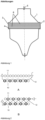
- illustration 1 shows schematically a vertically positioned flow reactor 1 for the heterogeneous-catalytic combustion of ammonia.
- the catalyst system 2 forms the actual reaction zone of the flow reactor 1. It comprises a catalyst packing 3 and downstream catchment nets 4.
- the catalyst packing 3 comprises several catalyst nets 6 arranged one behind the other in the direction of flow 5 of the fresh gas.
- the catalyst nets 6 are typically knitted nets, which are produced, for example, by knitting together wire with a diameter of 76 ⁇ m from various platinum-rhodium alloys.
- catchment nets 4 can be provided.
- Figure 2 shows schematically the thread guide in an exemplary front row of a knitting row between two needle beds 10 and 11 of a flat knitting machine. Needles that are used during the knitting process are highlighted, the direction of thread guidance is indicated by arrows. Each circle symbolizes a needle.
- Figure 2A the thread guide for a thread or wire 12 for a right row is illustrated in which only stitches are knitted on the first needle bed. In the event that only stitches are knitted on the first needle bed 10 in the back row and all further complete rows of knitting, a single-layer knitted fabric is obtained. If only stitches are knitted on the second needle bed 11 in the back rows, a two-layer fabric is obtained.
- the knitting pattern used also contains a float: stitches are only formed on every second needle of the needle bed.
- Figure 2B shows the right side row for a single-layer knitted fabric in which 12 stitches are knitted on the first and second needle beds 10 and 11 with the thread or wire.
- Figure 3 shows embodiments of two-layer noble metal nets that can be produced with the method according to the invention on flat-bed knitting machines with two needle beds.
- Figure 3 A and B show a two-layer precious metal mesh 100 made of two rectangular layers 101 and 102, with the front view in Figure 3A only the first layer 101 is visible.
- Figure 3B shows an open view of the noble metal mesh 100 along the abutting edges 111 of the first layer 101 or the abutting edge 112 of the second layer 102.
- the abutting edge 112 of the first layer is congruent with the abutting edge 113 of the second layer 102.
- the "opening" is to be understood virtually at this point and serves to better understand the Invention.
- the two layers 101 and 102 are connected along their abutting edges 112 and 113 to the abutting edge 120 of a support net 130 (in the illustration in Figure 3B the connection to the abutting edge 113 is no longer shown for the sake of clarity).
- the support net 130 is knitted in a single layer from a support thread, preferably a cotton thread, from connecting stitches from both needle beds.
- the edge 121 of the support mesh 130 opposite the abutting edge 120 does not abut any other sides or edges of the precious metal mesh 20'.
- Figure 3C shows a two-layer precious metal mesh 200 surrounded on two sides by a support mesh. Only the frontal view of a first rectangular layer 201, which lies congruently over a further layer, is shown. Both layers are connected to two supporting mesh areas 230 and 231 via their respective two abutting edges (only the abutting edges of the first layer 201 (210 and 211) can be seen in the figure).
- the first area of the support mesh 230 is made in one layer.
- the second area 231 can be manufactured in one or two layers.
- Figure 3D shows one to Fig. 3C analogous view of a two-layer noble metal mesh 300, which is surrounded by a support mesh on two adjacent sides.
- the lower area 331 of the support mesh can be started with the knitting, after which the two layers of the noble metal mesh 300 and a further area 330 of the support mesh are produced simultaneously.
- stitches are thus formed from the support material and the wire containing precious metal.
- the two areas of the support network 330 and 331 can be conveniently connected to one another.
- FIG 3E shows one to Fig. 3C analogous view of a two-layer noble metal mesh 400 surrounded on all four sides by a support mesh.
- the support network is appropriately divided into areas 430, 431, 432 and 433; these areas are preferably connected to one another.
- a two-layer precious metal mesh 500 is also surrounded on four sides by support mesh areas (530, 531, 532, 533).
- One of the support mesh areas 532 does not abut the noble metal mesh 500 but is spaced from the noble metal mesh by a gap 534 .
- all areas are produced simultaneously, ie during a single knitting process, in the knitting direction from bottom to top.
- Figure 3G shows one to Fig. 3C Analogous view of a two-layer precious metal mesh 600 made up of two semi-circular layers (only the first layer 601 is visible). The two layers are connected on one side along the respective abutting edge (610 in the case of the first layer 601) to the support net 630 via its abutting edge 620.
- Figure 3H also shows a two-layer precious metal mesh 700 formed from two semicircular layers, in which the layers are surrounded by two supporting mesh areas 730 and 731 at both abutting edges.
- a rectangular layer (100 cm wide, 200 cm long) was knitted on a flat knitting machine with two needle beds on each needle bed with a PtRh5 wire (76 ⁇ m diameter), the two layers being connected to one another on one side.
- a cotton yarn was used as the support thread.
- a single-layer support mesh area was knitted with the cotton yarn on both layers on the non-joined side.
- a single-layer knitted fabric with two areas (precious metal layer and support mesh) was knitted on each of the two needle beds.
- a single-layer support net knitted over both needle beds was knitted on the non-joined side of the two layers. The two precious metal layers were therefore only knitted with stitches on one needle bed each, while the supporting net was knitted with stitches on both needle beds.
- the knitted fabric of the example according to the invention had a more uniform structure compared to the knitted fabric of the comparative example.
- Such irregularities in the knit represent potential mechanical weak points that have a negative effect on the use of the net in the reactor.
Landscapes
- Engineering & Computer Science (AREA)
- Textile Engineering (AREA)
- Mechanical Engineering (AREA)
- Knitting Of Fabric (AREA)
Abstract
Description
- Die vorliegende Erfindung betrifft ein Verfahren zur Herstellung eines zweilagigen Edelmetallnetzes auf einer Flachstrickmaschine, die ein erstes und ein zweites Nadelbett aufweist. Das Verfahren umfasst das Bereitstellen von mindestens einem edelmetallhaltigen Draht und das Stricken des Edelmetallnetzes. Auf dem ersten und zweiten Nadelbett werden simultan die erste und die zweite Lage des Edelmetallnetzes und unter Verwendung eines Stützfadens auf dem ersten und zweiten Nadelbett ein Stütznetz gestrickt. Eine Stoßkante des Stütznetzes wird dabei mit den beiden Lagen des Edelmetallnetzes über verbindende Strickmaschen verbunden und in den die Verbindung enthaltenden Strickreihen wird über beide Nadelbetten gestrickt.
- Die heterogen edelmetallkatalysierte Oxidation von Ammoniak (NH3) zu Salpetersäure (HNO3, Ostwald-Verfahren) oder Herstellung von Cyanwasserstoff (HCN, Andrussow-Verfahren) ist aufgrund der zentralen Relevanz der Produkte für die chemische Industrie von großer Bedeutung. Die dafür eingesetzten Katalysatorsysteme werden meist in Form von gasdurchlässigen Flächengebilden in die Reaktionszone eines Strömungsreaktors in einer Ebene senkrecht zur Strömungsrichtung des Frischgases eingebaut. Auch Auffang- oder Catchment-Systeme zur Rückgewinnung von verdampften katalytisch aktiven Bestandteilen basieren häufig auf solchen netzförmigen Strukturen. Es werden zweckmäßigerweise meist mehrere Netze hintereinander angeordnet und zu einem Katalysatornetzstapel zusammengefasst. Die einzelnen Netze bestehen dabei aus feinen Edelmetalldrähten, die überwiegend Platin (Pt), Palladium (Pd), Rhodium (Rh) oder Legierungen dieser Metalle enthalten. Vor allem Catchment-Netze können auch weitere Bestandteile wie beispielsweise Nickel enthalten.
- Zur Herstellung solcher Maschenwaren sind eine Reihe von Verfahren bekannt, zum Beispiel das Weben, Wirken und Stricken. Weben und Wirken sind vor allem für die Herstellung rechteckiger Netzbahnen mit homogener Materialverteilung und Struktur geeignet. In Bezug auf die Formgestaltung und Materialvariabilität der zu fertigenden Produkte bieten sie wenig Flexibilität. Aus den gefertigten Bahnen müssen in einem zusätzlichen Verfahrensschritt die Netze auf für die Reaktoren geeignete Größe und Form zugeschnitten werden, wobei Verschnitt mit Edelmetallbestandteilen entsteht. Außerdem erfordern die eingesetzten Maschinen lange Rüstzeiten und einen hohen Materialeinsatz.
- Das Stricken bietet im Vergleich eine höhere Flexibilität: über die verwendeten Strickmuster, Drähte (sowohl was Dicke und Material betrifft), Nadeln und Zugspannung des Drahtes kann sowohl das Flächengewicht als auch die Struktur, Dehnbarkeit und Festigkeit der erhältlichen Gestricke variiert werden. Ein weiterer Vorteil sind die deutlich kürzeren Rüstzeiten der Maschinen. Außerdem ist die Verwendung unterschiedlicher Materialien in einem Gestrick möglich, beim s.g. Intarsien-Stricken werden beispielsweise unterschiedliche Bereiche aus unterschiedlichen Garnen oder Drähten gefertigt. Die Länge eines Gestricks ist dabei prinzipiell nicht begrenzt, die maximale Breite ist jedoch im Fall von Flachstrickmaschinen durch die Breite der Nadelbetten vorgegeben.
- Beim Stricken können Flachstrickmaschinen oder Rundstrickmaschinen zum Einsatz kommen. Bei Rundstrickmaschinen sind die Nadeln in einem kreisförmigen Nadelbett angeordnet und die Faden- bzw. Drahtzuführung erfolgt entsprechend in einer kreisförmigen Bewegung. Solche Maschinen erlauben vor allem die Herstellung von schlauchförmigen Strickwaren. Auf Flachstrickmaschinen dagegen können Form und Maß der Gestricke variiert werden. Letztere können auch über mehr als ein Nadelbett verfügen, zwischen denen bei der Fertigung das Garn bzw. der Draht mittels Fadenführern hin- und her geführt wird.
- Die Verwendung von zwei Nadelbetten erlaubt die Herstellung eines einlagigen oder zweilagigen Gestricks. Ein einlagiges Gestrick kann prinzipiell auf zwei Arten entstehen: Einerseits, wenn nur auf einem Nadelbett gearbeitet wird, d.h. nur Maschen auf einem der Nadelbetten gebildet und miteinander verstrickt werden. Andererseits können auf dem ersten Nadelbett erzeugte Maschen mit auf dem zweiten Nadelbett erzeugten Maschen verstrickt werden, d.h. der Faden wird innerhalb einer Hin- und/oder Rückreihe zwischen den beiden Nadelbetten hin- und her geführt. Ein zweilagiges Gestrick entsteht dementsprechend, wenn parallel auf beiden Nadelbetten gestrickt wird und die auf der ersten Nadelreihe erzeugten Maschen nicht oder nur punktuell mit den auf dem zweiten Nadelbett erzeugten Maschen über die Randmaschen verstrickt werden. Bei dieser Herstellungsweise können also auch zwei einlagige Gestricke bzw. Lagen parallel auf dem ersten und zweiten Nadelbett gefertigt werden.
- Das Stricken von Edelmetallnetzen ist in der
EP 0544710 A1 beschrieben. In derEP 3795728 A1 kommen dafür Flachstrickmaschinen zum Einsatz. Es wird beschrieben, dass separate Lagen, erzeugt auf unterschiedlichen Nadelbetten, mittels einer verbindenden Strickreihe an einer Seite der beiden Strickflächen miteinander verbunden werden können. Das erlaube die Herstellung von Gestrickflächen mit größeren Breiten als vorher möglich. - In der
EP 0364153 A1 wird der Einsatz eines zusätzlichen edelmetallfreien Fadens beim Stricken eines Edelmetallnetzes beschrieben, der die Prozessstabilität erhöht. Der zusätzliche Faden wird parallel mit dem Edelmetall verstrickt und kann aus dem hergestellten homogenen Gestrick, bestehend aus Edelmetallmaterial und Fadenmaterial, nach dem Strickvorgang bei Bedarf entfernt werden. In derEP 3779005 A1 wurde dieses Verfahren dahingehend weiterentwickelt, dass der zusätzliche Faden und das Edelmetall nicht parallel, sondern simultan verstrickt werden. Im fertigen Gestrick können so edelmetallfreie Bereiche erhalten werden, was zu einer Verringerung des Edelmetalleinsatzes führte. - Es hat sich allerdings gezeigt, dass das simultane Stricken von edelmetallhaltigen und edelmetallfreien Drähten bzw. Fäden besondere Herausforderungen an den Strickprozess stellt und es, mutmaßlich durch die verschiedenen Materialeigenschaften, zum Verziehen des Gestricks und dadurch zu Instabilitäten im Produktionsprozess kommen kann. Solche Instabilitäten können sich einerseits in Abrissen des Drahtes während des Strickprozesses und andererseits in Unregelmäßigkeiten in Bezug auf die Struktur und die mechanischen Eigenschaften äußern, was beides ein Produkt mit mangelnder Qualität zur Folge haben kann.
- Aufgabe der vorliegenden Erfindung war daher die Bereitstellung eines Verfahrens mit hoher Prozessstabilität zur Herstellung von Edelmetallnetzen auf Flachstrickmaschinen unter Verwendung von edelmetallhaltigen Drähten und edelmetallfreien Fäden.
- Die Aufgabe wird gelöst durch ein Verfahren zur Herstellung eines zweilagigen Edelmetallnetzes auf einer Flachstrickmaschine, wobei die Flachstrickmaschine ein erstes und ein zweites Nadelbett aufweist, umfassend die Schritte
- Bereitstellen von mindestens einem edelmetallhaltigen Draht,
- Bereitstellen von mindestens einem edelmetallfreien Stützfaden,
- Stricken einer ersten Lage des Edelmetallnetzes auf dem ersten Nadelbett und einer zweiten Lage des Edelmetallnetzes auf dem zweiten Nadelbett,
wobei die erste Lage über die Stoßkanten S11 und S12 und die zweite Lage über die Stoßkanten S21 und S22 verfügt, wobei die Stoßkante S11 zumindest teilweise an die Stoßkante S21 und die Stoßkante S12 zumindest teilweise an die Stoßkante S22 stößt, - Stricken eines Stütznetzes auf dem ersten und zweiten Nadelbett unter Verwendung des mindestens einen edelmetallfreien Stützfadens, wobei das Stütznetz über eine Stoßkante SH und eine der Stoßkante gegenüberliegende Kante KH verfügt, wobei die Stoßkante SH an jeweils eine Stoßkante S11 und S21 der beiden Lagen des Edelmetallnetzes stößt,
- Im Rahmen der Erfindung wurde als überraschend erkannt, dass das Stricken eines Stütznetzes über beide Nadelbetten im Bereich, in dem es mit den Lagen des Edelmetallnetzes verbunden wird, eine stabilisierende Wirkung auf den Strickprozess hat. Mit anderen Worten bewirkt das zumindest teilweise Einbetten des Edelmetallnetzes in eine einlagige Stützstruktur eine Verminderung von Prozessstörungen in Form von Abrissen des edelmetallhaltigen Drahtes oder Unregelmäßigkeiten im Edelmetallgestrick.
- Das erfindungsgemäße Verfahren betrifft das Stricken auf einer Flachstrickmaschine mit einem ersten und einem zweiten Nadelbett.
- Stricken ist charakterisiert durch die reihenweise Herstellung der entstehenden Gestricke, bei der ineinandergreifende Maschen gebildet werden. Während des Strickvorgangs auf einer Flachstrickmaschine mit zwei Nadelbetten wird zunächst eine Strickreihe auf mindestens einem der Nadelbetten gebildet. In Strickrichtung wird im Anschluss die nächste Strickreihe gebildet, wobei im Folgenden auf den Teil des Gestricks, der die erste Strickreihe enthält als "unten" Bezug genommen wird. Die Faden- bzw. Drahtführung erfolgt von einer Seite des Nadelbettes oder der Nadelbetten zur anderen Seite und zurück. Wenn im Folgenden Bezug auf einen "Faden" genommen wird soll die jeweilige Ausführung auch für einen entsprechenden "Draht" gelten. Eine Strickreihe umfasst daher eine Hin- und eine Rückreihe, was sich aus der Fadenführung ergibt. Die Fadenführung kann dabei in einer Strickreihe über nur eines oder beide Nadelbetten erfolgen. Typischerweise kann der Faden für eine vollständige Strickreihe zunächst auf dem ersten Nadelbett geführt werden (Hinreihe), anschließend wird der Faden in entgegengesetzte Richtung auf dem gleichen Nadelbett oder dem zweiten Nadelbett geführt (Rückreihe). Der Faden kann aber auch in einer Hin- und/oder Rückreihe abwechselnd auf beiden Nadelbetten geführt werden, wobei innerhalb einer Strickreihe Verbindungen zwischen Maschen auf den beiden Nadelbetten erzeugt werden. Die Fadenführung kann über die gesamte Breite des Nadelbetts bzw. der Nadelbetten erfolgen, es kann aber auch nur über Teile der Breite der Nadelbetten gestrickt werden. Je nachdem über welche Breite der Nadelbetten gestrickt wird kann die Breite und auch die Form des Gestricks bestimmt werden.
- Beim erfindungsgemäßen Verfahren erfolgen alle Strickvorgänge simultan. Darunter ist zu verstehen, dass mehrere Teilbereiche des zu fertigenden Gestricks gleichzeitig auf den beiden Nadelbetten gestrickt werden, die Fertigung der Teilbereiche also nicht nacheinander in mehreren Strickschritten erfolgt.
- Das Verfahren umfasst das Bereitstellen von mindestens einem edelmetallhaltigen Draht.
- Unter einem edelmetallhaltigen Draht wird ein Draht verstanden, der aus mindestens einem Edelmetall besteht oder einen nennenswerten Anteil (> 50 Gew.-%) an Edelmetall enthält. Unter Edelmetallen wird im Rahmen der vorliegenden Erfindung ein Metall ausgewählt aus der Gruppe bestehend aus Platinmetallen, Gold und Silber verstanden. Unter Platinmetallen sind die Metalle der sogenannten Platingruppe, also Platin (Pt), Palladium (Pd), Iridium (Ir), Rhodium (Rh), Osmium (Os) und Ruthenium (Ru), zu verstehen.
- Bevorzugt besteht der mindestens eine edelmetallhaltige Draht aus Platin, einer Platinlegierung, Palladium oder einer Palladiumlegierung. Eine platinbasierte Legierung enthält mehr als 50 Gew.-% Platin, als weitere Legierungsbestandteile sind insbesondere Palladium, Rhodium und Ruthenium zu nennen. Eine palladiumbasierte Legierung enthält mehr als 50 Gew.-% Palladium.
- Bevorzugt besteht der mindestens eine edelmetallhaltige Draht aus einer Legierung ausgewählt aus der Gruppe bestehend aus Platin mit 1 - 15 Gew.-% Rhodium, Platin mit 1 - 15 Gew.-% Rhodium und 0,1 - 20 Gew.-% Palladium, Platin mit 1 - 15 Gew.-% Rhodium, 0,1 - 20 Gew.-% Palladium und 0,1 - 5 Gew.-% Ruthenium, Platin mit 1 - 15 Gew.-% Rhodium, 0,1 - 40 Gew.-% Palladium und 0,001 - 5 Gew.-% Iridium, Platin mit 1 - 15 Gew.-% Rhodium, 0,1 - 20 Gew.-% Palladium und 0,001 - 5 Gew.-% Tantal, Platin mit 1 - 15 Gew.-% Rhodium, 0,001 - 5 Gew% Iridium und 0,001 - 5 Gew.-% Tantal, Palladium mit 1 - 25 Gew.-% Platin, Palladium mit 1 - 20 Gew.-% Platin und 1 - 15 Gew.-% Rhodium, Palladium mit 1 - 25 Gew.-% Wolfram, Palladium mit 1 - 15 Gew.-% Nickel, Palladium mit 0,001 - 5 Gew.-% Rhodium, Palladium mit 1 - 15 Gew.-% Kupfer, Palladium mit 1 - 15 Gew.-% Kupfer und 1 - 15 Gew.-% Nickel und Palladium mit 1 - 30 Gew.-% Cobalt.
- Vorzugsweise werden edelmetallhaltige Drähte eingesetzt, die einen Durchmesser 40 - 150 µm aufweisen, bevorzugt 50 - 130 µm.
- Der mindestens eine edelmetallhaltige Draht kann als Runddraht, das heißt mit einem runden Querschnitt, ausgebildet sein. In einer anderen Ausführung kann der Draht als abgeflachter Runddraht oder als Draht mit einem anderen Querschnitt ausgeführt werden.
- Der mindestens eine edelmetallhaltige Draht kann mehrere Drähte, in diesem Fall auch als Filamente bezeichnet, umfassen, die bevorzugt miteinander verdrillt sein können. Die Filamente können alle aus dem gleichen Material bestehen, d.h. alle edelmetallhaltig sein, oder aus unterschiedlichen Materialien bestehen, die wiederum nicht alle edelmetallhaltig sein müssen.
- In vielen Fällen kann es vorteilhaft sein, zwei oder mehr edelmetallhaltige Drähte gemeinsam miteinander zu verstricken. Mit anderen Worten können bei der Bildung einer Masche mehrere edelmetallhaltige Drähte gemeinsam geführt werden. Beim Stricken mit mehreren Drähten bestehen in einer Ausführungsform die edelmetallhaltigen Drähte aus dem gleichen Material, in weiteren Ausführungsformen können edelmetallhaltige Drähte bestehend aus mindestens zwei unterschiedlichen Materialien verwendet werden. Die mehreren Drähte können den gleichen oder unterschiedliche Durchmesser aufweisen.
- Im erfindungsgemäßen Verfahren werden simultan auf dem ersten Nadelbett die erste Lage des zweilagigen Edelmetallnetzes und auf dem zweiten Nadelbett die zweite Lage des Edelmetallnetzes gestrickt. Mit anderen Worten werden während des Strickvorgangs gleichzeitig zwei Teile des zu fertigenden Edelmetallnetzes auf jeweils einem Nadelbett gestrickt, die Fertigung der beiden Lagen erfolgt also nicht nacheinander.
- Unter "zweilagigen Edelmetallnetzen" werden im Rahmen der vorliegenden Erfindung solche Edelmetallnetze verstanden, die über zwei Lagen verfügen, wobei die Lagen über eine oder mehrere ihrer jeweiligen Stoßkanten miteinander verbunden sein können oder auch nicht an ihren Stoßkanten verbunden sein können. Die beiden Lagen liegen dabei übereinander, das heißt sie überlappen zumindest teilweise im Bereich ihrer Flächenausdehnung. Auch Edelmetallnetze die, wie im Fall der vorliegenden Erfindung, an einer Seite über die Stoßkanten der zwei Lagen miteinander verbunden sind werden als zweilagige Edelmetallnetze bezeichnet.
- Bei einem Aufklappen entlang der gemeinsamen Stoßkante ist ein einlagiges Edelmetallnetz erhältlich.
- Die erste und die zweite Lage des zweilagigen Edelmetallnetzes verfügen jeweils über zwei Stoßkanten, d.h. jede Lage verfügt auf der einen Seite über eine Stoßkante und auf ihrer anderen Seite über eine weitere Stoßkante. Die erste Lage verfügt über die Stoßkanten S11 und S12 und die zweite Lage über die Stoßkanten S21 und S22. Die Seiten der Edelmetalllagen sind hierbei in Bezug auf die Lage der Stoßkanten auf den beiden Nadelbetten senkrecht zur Strickrichtung zu verstehen. Je nach Form der jeweiligen Lage können sich die Stoßkanten einer Lage nicht schneiden, wie im Fall einer rechteckigen Lage, oder sich schneiden, wie beispielsweise im Fall einer halbkreisförmigen Lage.
- Stoßkanten können miteinander verbunden sein, bevorzugt durch mindestens eine verbindende Strickmasche. Stoßkanten können aber auch aneinanderstoßen, ohne verbunden zu sein. Die Stoßkanten werden während des Strickvorgangs in Strickrichtung von unten nach oben gebildet. Die beiden Edelmetalllagen können auch über eine obere und/oder untere Kante oder Stoßkante verfügen, das Vorhandensein dieser Kanten hängt von der Form der jeweiligen Lage ab. Eine rechteckige Lage verfügt neben den beiden seitlichen Stoßkanten beispielsweise über eine untere und eine obere Kante oder Stoßkante, eine halbkreisförmige Lage verfügt dagegen über keine weiteren Kanten oder Stoßkanten.
- Unter den unteren Kanten sind hierbei diejenigen Kanten zu verstehen, die in Strickrichtung zuerst gebildet werden, sich also unten im Gestrick befinden. Dementsprechend sind unter den oberen Kanten diejenigen zu verstehen, die in Strickrichtung später gebildet werden.
- Eine Stoßkante der ersten Lage des Edelmetallnetzes S11 stößt zumindest teilweise an eine Stoßkante der zweiten Lage des Edelmetallnetzes S21. Außerdem stoßen die jeweils anderen Stoßkanten der ersten und zweiten Lage des Edelmetallnetzes, also die Stoßkante S12 und die Stoßkante S22, zumindest teilweise aneinander. Unter einem "zumindest teilweisen Aneinanderstoßen" ist hierbei zu verstehen, dass die Stoßkanten über Teile ihrer Länge in Strickrichtung aneinanderstoßen, also über Teile der sie bildenden Strickreihen. Mit anderen Worten könne die Stoßkanten auch zumindest teilweise versetzt zueinander sein.
- Die erste und die zweite Lage des zweilagigen Edelmetallnetzes können durch verbindende Strickmaschen zumindest teilweise an ihren Stoßkanten verbunden werden. Darunter ist zu verstehen, dass die beiden Lagen über Maschen, die aus dem mindestens einen edelmetallhaltigen Draht gebildet werden, an ihren Randmaschen miteinander verbunden werden. Diese Verbindung der ersten und zweiten Lage des zweilagigen Edelmetallnetzes kann auf nur einer Seite oder auf beiden Seiten erfolgen. Die Verbindung oder die Verbindungen können über die gesamte Länge oder über Teile der Länge der Stoßkanten erfolgen. Vorteilhaft kann sein, dass die Verbindung an einer Seite über die gesamte Länge der Stoßkanten erfolgt.
- In weiteren Ausführungsformen kann die Verbindung auf beiden Seiten der ersten und zweiten Lage des zweilagigen Edelmetallnetzes zumindest über Teile ihrer jeweiligen Stoßkanten erfolgen, wobei diese teilweisen Verbindungen auf gleicher Höhe, also in der gleichen Strickreihe oder den gleichen Strickreihen oder auf unterschiedlichen Höhen erfolgen können. Die teilweisen Verbindungen können über die gleiche Länge der Stoßkanten auf beiden Seiten erfolgen, also über die gleiche Anzahl von Strickreihen. Die teilweisen Verbindungen können aber auch über eine unterschiedliche Länge der Stoßkanten auf beiden Seiten erfolgen. In einer bevorzugten Ausführungsform erfolgen die teilweisen Verbindungen zumindest teilweise über die gleichen Strickreihen. In einer solchen Ausführungsform wird also zumindest teilweise im Kreis gestrickt bzw. rundgestrickt, mit anderen Worten entsteht über diese Strickreihen eine ringartige Struktur. Es hat sich gezeigt, dass das Stricken einer solchen zumindest teilweise ringartigen Struktur die Stabilität des Strickprozesses weiter positiv beeinflussen kann.
- Der Bezug für die Höhe des Gestricks ist die untere Strickreihe des Gestricks. Auch für den Fall, dass in unterschiedlichen Strickreihen mit dem Stricken einer Lage begonnen wird bleibt die Höhe des Gesamtgestricks gleich, mit anderen Worten können die Lagen des Gestricks auf unterschiedlichen Höhen eine unterschiedliche Anzahl von Strickreihen umfassen.
- Bevorzugt kann die erste und die zweite Lage des zweilagigen Edelmetallnetzes aus einem edelmetallhaltigen Draht oder edelmetallhaltigen Drähten gleicher Zusammensetzung gestrickt werden. Die beiden Lagen können aber auch aus edelmetallhaltigem Draht oder edelmetallhaltigen Drähten unterschiedlicher Zusammensetzung gestrickt werden.
- Zum Stricken der ersten und zweiten Lage des zweilagigen Edelmetallnetzes kann edelmetallhaltiger Draht mit dem gleichen oder unterschiedlichen Durchmessern verwendet werden. Es hat sich als günstig erwiesen, dass die erste und die zweite Lage des Edelmetallnetzes aus edelmetallhaltigem Draht oder edelmetallhaltigen Drähten gleichen Durchmessers gestrickt werden.
- Die erste und die zweite Lage des zweilagigen Edelmetallnetzes können in gleichen oder unterschiedlichen Strickmustern gestrickt werden. Unterschiedliche Strickmuster können beispielsweise durch unterschiedliche Maschenlängen, Flottungen oder Fänge entstehen. In bevorzugten Ausführungsformen werden die erste und die zweite Lage des Edelmetallnetzes im gleichen Strickmuster gestrickt.
- Die erste und die zweite Lage des zweilagigen Edelmetallnetzes können die gleiche oder unterschiedliche Längen in Strickrichtung und/oder die gleiche oder unterschiedliche Breiten senkrecht zur Strickrichtung aufweisen. Bevorzugt haben die erste und die zweite Lage des Edelmetallnetzes die gleiche Länge und die gleiche Breite.
- Die erste und die zweite Lage des zweilagigen Edelmetallnetzes können die gleiche Form oder unterschiedliche Formen haben. Besonders bevorzugt haben die erste und zweite Lage des zweilagigen Edelmetallnetzes die gleiche Form. Es kann vorteilhaft sein, dass die erste und die zweite Lage des zweilagigen Edelmetallnetzes die Form eines Halbkreises aufweisen. Besonders vorteilhaft kann sein, dass diese beiden Halbkreise die gleiche Breite und die gleiche Länge aufweisen.
- In bevorzugten Ausführungsformen sind die erste und die zweite Lage des zweilagigen Edelmetallnetzes deckungsgleich, mit anderen Worten können die beiden Lagen die gleiche Länge, die gleiche Breite und die gleiche Form haben.
- Das Verfahren umfasst das Bereitstellen von mindestens einem edelmetallfreien Stützfaden.
- Geeignete edelmetallfreie Stützfäden können durch Routineversuche und unter Berücksichtigung des endgültigen Verwendungszwecks des zweilagigen Edelmetallnetzes und eventuellen zusätzlichen Schritten im Herstellverfahren ausgewählt werden. Bevorzugte edelmetallfreie Stützfäden lassen sich nach der Herstellung des Edelmetallnetzes entfernen, beispielsweise durch Auflösen in sauren oder basischen Medien, Abschneiden, Schmelzen oder Abflammen. Solche Stützfäden können natürlicher oder synthetischer organischer Natur oder anorganischer Natur sein. Beispiele für geeignete Materialien sind Polyamide, Polyester, Zellulosefasern, Baumwolle, Acryl-Styrol-Polymere, Nylon, PVA und andere Vinylpolymere, Alginat, Kupfer, Silber, Aluminium, oder auch Metalle mit niedrigem Schmelzpunkt wie Zinn- und Blei-Legierungen.
- Der mindestens eine edelmetallfreie Stützfaden kann aus nur einem fadenförmigen Element bestehen, solche einzelnen fadenförmigen Elemente werden auch im Fall von edelmetallfreien Fäden als Filamente bezeichnet. Der edelmetallfreie Stützfaden kann auch aus mehr als einem Filament bestehen, die vorteilhafterweise miteinander verdrillt sein können. Diese mehreren Filamente können aus dem gleichen oder unterschiedlichen Materialien bestehen.
- Im erfindungsgemäßen Verfahren wird simultan zur ersten und zweiten Lage des zweilagigen Edelmetallnetzes unter Verwendung des mindestens einen edelmetallfreien Stützfadens ein Stütznetz auf dem ersten und zweiten Nadelbett gestrickt. Mit anderen Worten wird das Stütznetz gleichzeitig mit den beiden Lagen des zu fertigenden Edelmetallnetzes gestrickt, die Fertigung der beiden Lagen und des Stütznetzes erfolgt also nicht nacheinander.
- Unter "Stütznetz" werden die Bereiche des Gestricks verstanden, die zumindest teilweise unter Verwendung des edelmetallfreien Stützfadens gestrickt werden. Das Stütznetz kann auch weitere Fäden oder Drähte umfassen.
- Das Gestrick umfasst alle Strickreihen, die während des Verfahrens gebildet werden. Das Gestrick umfasst mindestens die erste und zweite Lage des zweilagigen Edelmetallnetzes und das Stütznetz. Das Gestrick kann aber auch weitere Teile oder Bereiche umfassen. Bevorzugt werden alle Strickreihen des Gestricks über die gleiche Breite der Nadelbetten gestrickt, mit anderen Worten ist das Gestrick bevorzugt rechteckig.
- Das Stütznetz verfügt über eine Stoßkante SH und eine gegenüberliegende Kante KH. Je nach Form des Stütznetzes können sich die Stoßkante SH und die gegenüberliegende Kante KH nicht schneiden, wie im Fall eines rechteckigen Stütznetzes, oder sich schneiden, wie beispielsweise im Fall eines halbkreisförmigen Stütznetzes. Die Stoßkante SH und die Kante KH werden während des Strickvorgangs in Strickrichtung von unten nach oben gebildet.
- Die Stoßkante SH des Stütznetzes stößt an jeweils eine Stoßkante S11 und S21 der ersten und zweiten Lage des zweilagigen Edelmetallnetzes. Mit anderen Worten wird die Kante des Stütznetzes, die an die beiden Lagen des zweilagigen Edelmetallnetzes stößt, als Stoßkante SH bezeichnet. Die Stoßkante SH umfasst dementsprechend die Strickreihen, in denen sowohl die Lagen des zweilagigen Edelmetallnetzes als auch das Stütznetz gestrickt werden. Mit der gegenüberliegenden Kante KH wird dementsprechend die der Stoßkante SH gegenüberliegende Kante des Stütznetzes in den gleichen Strickreihen bezeichnet, d.h. die Stoßkante SH und die Kante KH haben in Strickrichtung die gleiche Länge. Die Kante KH stößt nicht an eine der beiden Lagen des zweilagigen Edelmetallnetzes.
- Die Form der Kante und Stoßkante des Stütznetzes ist nicht weiter beschränkt. Es hat sich aber als vorteilhaft erwiesen, dass die Form des Stütznetzes so gestaltet ist, dass die Form des Gestrickes insgesamt rechteckig ist. Mit anderen Worten ergänzt das Stütznetz die Lagen des Edelmetallnetzes derart, dass die Form des Gestricks, umfassend Edelmetalllage oder Edelmetalllagen und Stütznetz, insgesamt rechteckig ist. Dementsprechend korreliert die Form des Stütznetzes bevorzugt mit der Form der ersten und zweiten Lage des Edelmetallnetzes. Beispielsweise weist das Stütznetz bevorzugt eine konkave Form auf, falls die der erste und zweite Lage des Edelmetallnetzes eine konvexe Form aufweisen.
- In bevorzugten Ausführungsformen hat die Stoßkante SH die gleiche Länge wie die Stoßkanten S11 und S12. Mit anderen Worten umfasst die Stoßkante SH die gleichen Strickreihen wie die Stoßkanten S11 und S12, das Stütznetz stößt also über die gesamte Länge der Lagen des Edelmetallnetzes an die Stoßkanten der Lagen des zweilagigen Edelmetallnetzes.
- Die Stoßkante SH des Stütznetzes und die jeweiligen Stoßkanten S11 und S21 der ersten und zweiten Lage des zweilagigen Edelmetallnetzes werden über mindestens eine Strickmasche miteinander verbunden. Mit anderen Worten wird das Stütznetz während des Strickvorgangs zumindest teilweise mit den beiden Lagen des zweilagigen Edelmetallnetzes verbunden. Dadurch wird eine Stabilisierung des Strickprozesses erreicht. Es kann bevorzugt sein, dass die Stoßkante SH des Stütznetzes über ihre gesamte Länge mit den jeweiligen Stoßkanten S11 und S21 der ersten und zweiten Lage des zweilagigen Edelmetallnetzes verbunden wird.
- Die verbindende Strickmasche oder die verbindenden Strickmaschen können aus dem mindestens einen edelmetallhaltigen Draht oder dem edelmetallfreien Stützfaden gebildet werden. Bevorzugt wird die verbindende Strickmasche oder die verbindenden Strickmaschen aus dem edelmetallfreien Stützfaden gebildet.
- Das Stütznetz wird in der oder den Strickreihen, in denen die Stoßkante SH des Stütznetzes mit den jeweiligen Stoßkanten der beiden Lagen des Edelmetallnetzes S11 und S21 verbunden wird, mit verbindenden Maschen von beiden Nadelbetten gestrickt. Unter "verbindenden Maschen" sind hierbei solche Strickmaschen zu verstehen, die zwischen dem ersten und dem zweiten Nadelbett gebildet werden. Mit anderen Worten wird das Stütznetz zumindest teilweise einlagig gestrickt. Es hat sich gezeigt, dass die einlagige Ausführung des Stütznetzes im Bereich oder Bereichen, die mit den Lagen des Edelmetallnetzes verbunden sind, zu einer Erhöhung der Prozessstabilität führt.
- Der edelmetallfreie Stützfaden kann parallel mit dem mindestens einen edelmetallhaltigen Draht verstrickt werden, d.h. es können beim Stricken Maschen gebildet werden, die edelmetallhaltigen Draht und Stützfaden umfassen. Der betreffende Teil des entstehenden Gestricks enthält in diesen Fällen sowohl Edelmetall als auch das Material des Stützfadens. In anderen Ausführungsformen kann der Stützfaden auch für Teile oder Bereiche des Gestricks eingesetzt werden, die keinen edelmetallhaltigen Draht enthalten, d.h. das entstehende Gestrick enthält in diesen Fällen Bereiche mit und Bereiche ohne edelmetallhaltigen Draht.
- Das Stütznetz kann mehrere Bereiche umfassen. Beispielsweise kann das Stütznetz auch Strickreihen umfassen, in denen kein edelmetallhaltiger Draht eingesetzt wird, in denen also nur mit dem edelmetallfreien Stützfaden gestrickt wird. Mit anderen Worten kann das Gestrick Bereiche umfassen, die keinen edelmetallhaltigen Draht enthalten. In diesem Fall kann das Stütznetz neben der Stoßkante SH und der Kante KH auch weitere Kanten umfassen. Solche Kanten können in Strickreihen gebildet werden, in denen keine Maschen der Lagen des Edelmetallnetzes gestrickt werden. Mit anderen Worten kann das Gestrick auch über Strickreihen verfügen, die nur von Bereichen des Stütznetzes gebildet werden.
- Es kann bevorzugt sein, dass das Stütznetz in den Bereichen mit Strickreihen, die keinen edelmetallhaltigen Draht enthalten, zweilagig gestrickt wird. Mit anderen Worten kann das Stütznetz in diesen Strickreihen nicht mit verbindenden Maschen zwischen dem ersten und zweiten Nadelbett gestrickt werden. Diese beiden Lagen können an den Randmaschen über verbindende Strickmaschen verbunden sein, es kann also vorteilhaft sein, dass das Stütznetz in diesen Bereichen eine schlauchartige Struktur hat. Bevorzugt kann auch sein, dass das Stütznetz in den Bereichen, die keinen edelmetallhaltigen Draht umfassen, einlagig gestrickt wird.
- In bevorzugten Ausführungsformen umfasst das Stütznetz einlagig gestrickte Bereiche und zweilagig gestrickte Bereiche, die keinen edelmetallhaltigen Draht umfassen.
- In bevorzugten Ausführungsformen stößt das Stütznetz nur an den Stoßkanten S11 und S21 an die beiden Lagen des zweilagigen Edelmetallnetzes. Es kann auch bevorzugt sein, dass das Stütznetz auch an den jeweilig anderen Kanten oder Stoßkanten der beiden Lagen des zweilagigen Edelmetallnetzes S12 und S22 an die beiden Lagen des zweilagigen Edelmetallnetzes stößt. Die Stoßkante des Stütznetzes SH und die beiden Stoßkanten der beiden Lagen des zweilagigen Edelmetallnetzes S12 und S22 können über mindestens eine Strickmasche des Stützfadens miteinander verbunden werden. Eine solche Verbindung muss aber nicht erfolgen, in solchen Ausführungsformen sind diese Stoßkanten nicht über Strickmaschen miteinander verbunden.
- Es kann bevorzugt sein, dass das Stütznetz auch an die jeweiligen unteren und/oder oberen Kanten der beiden Lagen des zweilagigen Edelmetallnetzes stößt. Das Stütznetz kann dabei nur an die unteren oder oberen Kanten der beiden Lagen des Edelmetallnetzes oder an die unteren und oberen Kanten stoßen. In solchen Ausführungsformen umgibt das Stütznetz die beiden Lagen des zweilagigen Edelmetallnetzes an mindestens zwei Seiten.
- Es kann vorteilhaft sein, dass das Stütznetz die beiden Lagen des zweilagigen Edelmetallnetzes an mehr als zwei Seiten umgibt. In bevorzugten Ausführungsformen umgibt das Stütznetz die Seiten der beiden Lagen des zweilagigen Edelmetallnetzes zu mindestens 50 %. Darunter ist zu verstehen, dass mindestens 50 % des Umfangs der beiden Lagen des zweilagigen Edelmetallnetzes vom Stütznetz umgeben sind, bevorzugter mindestens 60 %, noch bevorzugter mindestens 80 %. Besonders bevorzugt kann sein, dass das Stütznetz die beiden Lagen des zweilagigen Edelmetallnetzes vollständig umgibt.
- Bevorzugt können alle Bereiche des Stütznetzes aus edelmetallfreien Stützfäden der gleichen Zusammensetzung gestrickt werden. Unterschiedliche Bereiche können aber auch aus edelmetallfreien Stützfäden unterschiedlicher Zusammensetzung gestrickt werden. Unterschiedliche Bereiche des Stütznetzes können in gleichen oder unterschiedlichen Strickmustern gestrickt werden.
- Das erfindungsgemäße Verfahren kann weitere Schritte umfassen.
- Das Verfahren kann das Bereitstellen von mindestens einem weiteren Draht oder Faden umfassen. Geeignete weitere Drähte oder Fäden können je nach vorgesehener Verwendung und/oder Funktion im Herstellverfahren oder für die spätere Anwendung des Edelmetallnetzes ausgewählt werden. Beispielsweise kann es sich bei dem weiteren Draht um einen Draht aus einem Nicht-Edelmetall handeln, der geeignet ist, um das Edelmetallnetz beim Einsatz im Reaktor zu stabilisieren, zum Beispiel kann es sich dabei um einen Stahl- oder Edelstahldraht handeln. Das Verfahren umfasst in diesen Fällen das simultane Stricken von Bereichen des Gestricks unter Verwendung des mindestens einen weiteren Drahtes oder Fadens. Das Gestrick kann in diesem Fall Teile oder Bereiche umfassen, die nur den weiteren Draht oder Faden enthalten oder Teile oder Bereiche, die sowohl den weiteren Draht oder Faden als auch den edelmetallhaltigen Draht enthalten oder Teile oder Bereiche, die sowohl den weiteren Draht oder Faden als auch den edelmetallfreien Stützfaden enthalten oder Teile oder Bereiche, die sowohl den weiteren Draht oder Faden als auch den edelmetallhaltigen Draht, als auch den edelmetallfreien Stützfaden enthalten.
- Bevorzugt kann das Stütznetz in einem weiteren Schritt entfernt werden. Geeignete Verfahren sind dem Fachmann prinzipiell bekannt und sind von der Art des eingesetzten edelmetallfreien Stützfadens und dem edelmetallhaltigen Draht abhängig. Das Stütznetz kann zum Beispiel zersetzt, aufgelöst, geschmolzen, abgeflammt oder abgeschnitten werden.
- In einem weiteren Schritt können auch eine verbindende Masche oder mehrere verbindende Maschen zwischen der ersten und zweiten Lage des zweilagigen Edelmetallnetzes an mindestens einer Seite entfernt werden, mit anderen Worten kann eine über die Randmaschen erfolgte Verbindung der beiden Lagen an zumindest einer Seite getrennt werden. Dadurch kann ein einlagiges Edelmetallnetz hergestellt werden, das nur noch an einer Seite, d.h. über jeweils nur eine Stoßkante, der beiden Lagen zumindest teilweise verbunden ist. Mit anderen Worten kann so ein einlagiges Edelmetallnetz erhalten werden.
- Nachfolgend wird die Erfindung anhand von Abbildungen und einem Beispiel näher erläutert. Sie ist jedoch nicht auf diese Ausführungsformen beschränkt.
- Abbildung 1
- zeigt einen Strömungsreaktor zur heterogen-katalytischen Verbrennung von Ammoniak in schematischer Darstellung.
- Abbildung 2
- zeigt schematisch die Fadenführung einer exemplarischen Hinreihe zwischen den zwei Nadelbetten einer Flachstrickmaschine.
- Abbildung 3
- zeigt Ausführungsformen von zweilagigen Edelmetallnetzen, die mit dem erfindungsgemäßen Verfahren auf Flachbettstrickmaschinen mit zwei Nadelbetten hergestellt werden können.
-
Abbildung 1 zeigt schematisch einen senkrecht positionierten Strömungsreaktor 1 zur heterogen-katalytischen Verbrennung von Ammoniak. Das Katalysatorsystem 2 bildet die eigentliche Reaktionszone des Strömungsreaktors 1. Es umfasst eine Katalysatorpackung 3 und nachgeschaltete Catchment-Netze 4. Die Katalysatorpackung 3 umfasst mehrere, in Strömungsrichtung 5 des Frischgases hintereinander angeordnete Katalysatornetze 6. Typischerweise sind die Katalysatornetze 6 gestrickte Netze, die beispielsweise durch Verstricken von Draht mit einem Durchmesser von 76 µm aus verschiedenen Platin-RhodiumLegierungen hergestellt werden. Zusätzlich können Catchment-Netze 4 vorgesehen sein. -
Abbildung 2 zeigt schematisch die Fadenführung in einer exemplarischen Hinreihe einer Strickreihe zwischen zwei Nadelbetten 10 und 11 einer Flachstrickmaschine. Nadeln, die während des Strickvorgangs zum Einsatz kommen, sind hervorgehoben, die Richtung der Fadenführung ist durch Pfeile angedeutet. Jeder Kreis symbolisiert hierbei eine Nadel. InAbbildung 2 A wird die Fadenführung für einen Faden oder Draht 12 für eine Hinreihe verdeutlicht, in der nur Maschen auf dem ersten Nadelbett gestrickt werden. Für den Fall, das auch in der Rückreihe und allen weiteren vollständigen Strickreihen nur Maschen auf dem ersten Nadelbett 10 gestrickt werden, wird ein einlagiges Gestrick erhalten. Wenn in den Rückreihen ausschließlich Maschen auf dem zweiten Nadelbett 11 gestrickt werden, wird ein zweilagiges Gestrick erhalten. Das inAbbildung 2 A zum Einsatz kommende Strickmuster enthält außerdem eine Flottung: es werden nur Maschen auf jeder zweiten Nadel des Nadelbettes gebildet.Abbildung 2 B zeigt die Hinreihe für ein einlagiges Gestrick, bei dem mit dem Faden oder Draht 12 Maschen auf dem ersten und zweiten Nadelbett 10 und 11 gestrickt werden. -
Abbildung 3 zeigt Ausführungsformen von zweilagigen Edelmetallnetzen, die mit dem erfindungsgemäßen Verfahren auf Flachbettstrickmaschinen mit zwei Nadelbetten hergestellt werden können. -
Abbildung 3 A und B zeigen ein zweilagiges Edelmetallnetz 100 aus zwei rechteckigen Lagen 101 und 102, wobei in der frontalen Ansicht inAbbildung 3 A nur die erste Lage 101 sichtbar ist.Abbildung 3 B zeigt eine entlang der Stoßkanten 111 der ersten Lage 101 bzw. der an diese stoßende Stoßkante 112 der zweiten Lage 102 geöffnete Sicht des Edelmetallnetzes 100. Die Stoßkante 112 der ersten Lage ist deckungsgleich mit der Stoßkante 113 der zweiten Lage 102. Das "Öffnen" ist an dieser Stelle virtuell zu verstehen und dient dem besseren Verständnis der Erfindung. Die beiden Lagen 101 und 102 sind entlang ihrer Stoßkanten 112 und 113 mit der Stoßkante 120 eines Stütznetzes 130 verbunden (in der Darstellung inAbbildung 3 B ist die Verbindung zur Stoßkante 113 zur besseren Darstellung nicht mehr gezeigt). Das Stütznetz 130 ist einlagig aus einem Stützfaden, vorzugsweise einem Baumwollfaden, aus verbindenden Maschen von beiden Nadelbetten gestrickt. Die der Stoßkante 120 gegenüberliegende Kante 121 des Stütznetzes 130 stößt an keine weiteren Seiten bzw. Kanten des Edelmetallnetzes 20'. -
Abbildung 3 C zeigt ein zweilagiges Edelmetallnetz 200, das an zwei Seiten von einem Stütznetz umgeben ist. Gezeigt ist nur die Frontalaufsicht auf eine erste rechteckige Lage 201, die deckungsgleich über einer weiteren Lage liegt. Beide Lagen sind über ihre jeweiligen beiden Stoßkanten (in der Abbildung sind nur die Stoßkanten der ersten Lage 201 (210 und 211) zu sehen) mit zwei Stütznetzbereichen 230 und 231 verbunden. Der erste Bereich des Stütznetzes 230 ist einlagig gefertigt. Der zweite Bereich 231 kann ein- oder zweilagig gefertigt sein. -
Abbildung 3 D zeigt eine zuAbb. 3 C analoge Ansicht eines zweilagigen Edelmetallnetzes 300, das an zwei aneinander liegenden Seiten von einem Stütznetz umgeben ist. Bei einem Edelmetallnetz dieser Ausführungsform kann beispielsweise mit dem Stricken des unteren Bereichs 331 des Stütznetzes begonnen werden, im Anschluss werden simultan die beiden Lagen des Edelmetallnetzes 300 und ein weiterer Bereich 330 des Stütznetzes gefertigt. In den entsprechenden Strickreihen werden also Maschen aus dem Stützmaterial und dem edelmetallhaltigen Draht gebildet. Die beiden Bereiche des Stütznetzes 330 und 331 können zweckmäßigerweise miteinander verbunden sein. -
Abbildung 3 E zeigt eine zuAbb. 3 C analoge Ansicht eines zweilagigen Edelmetallnetzes 400, das an allen vier Seiten von einem Stütznetz umgeben ist. Das Stütznetz ist in der Abbildung zweckmäßig in die Bereiche 430, 431, 432 und 433 aufgeteilt, diese Bereiche sind bevorzugt miteinander verbunden. In der in Abbildung F gezeigten Ausführungsform ist ein zweilagiges Edelmetallnetz 500 ebenfalls an vier Seiten mit Stütznetzbereichen (530, 531, 532, 533) umgeben. Einer der Stütznetzbereiche 532 stößt nicht an das Edelmetallnetz 500, sondern ist durch eine Lücke 534 vom Edelmetallnetz beabstandet. Auch bei dieser Ausführungsform werden alle Bereiche simultan, also während eines einzigen Strickprozesses, in Strickrichtung von unten nach oben gefertigt. -
Abbildung 3 G zeigt eine zuAbb. 3 C analoge Ansicht eines zweilagigen Edelmetallnetzes 600 aus zwei halbkreisförmigen Lagen (nur die erste Lage 601 ist sichtbar). Die beiden Lagen sind auf einer Seite entlang der jeweiligen Stoßkante (610 im Fall der ersten Lage 601) mit dem Stütznetz 630 über dessen Stoßkante 620 verbunden. InAbbildung 3 H ist ebenfalls ein aus zwei halbkreisförmigen Lagen gebildetes zweilagiges Edelmetallnetz 700 gezeigt, bei dem die Lagen an beiden Stoßkanten von zwei Stütznetzbereichen 730 und 731 umgeben sind. - Im erfindungsgemäßen Beispiel und im Vergleichsbeispiel wurde auf einer Flachstrickmaschine mit zwei Nadelbetten auf jedem Nadelbett mit einem PtRh5 Draht (76 µm Durchmesser) jeweils eine rechteckige Lage (100 cm Breite, 200 cm Länge) gestrickt, wobei die beiden Lagen auf einer Seite miteinander verbunden wurden. Als Stützfaden wurde ein Baumwollgarn eingesetzt. Im Vergleichsbeispiel wurde an beiden Lagen auf der nicht verbundenen Seite jeweils mit dem Baumwollgarn ein einlagiger Stütznetz-Bereich mitgestrickt. Auf den beiden Nadelbetten wurde also jeweils ein einlagiges Gestrick mit zwei Bereichen (Edelmetalllage und Stütznetz) gestrickt. Im erfindungsgemäßen Beispiel wurde auf der nicht verbundenen Seite der beiden Lagen ein einlagiges, über beide Nadelbetten gestricktes Stütznetz gestrickt. Die beiden Edelmetall-Lagen wurden also nur mit Maschen auf jeweils einem Nadelbett gestrickt, während das Stütznetz mit Maschen auf beiden Nadelbetten gestrickt wurde.
- Das Gestrick des erfindungsgemäßen Beispiels wies im Vergleich zum Gestrick des Vergleichsbeispiels eine gleichmäßigere Struktur auf. Solche Ungleichmäßigkeiten im Gestrick stellen potenziell mechanische Schwachstellen dar, die sich in der Anwendung des Netzes im Reaktor negativ auswirken.
-
- 1
- Strömungsreaktor
- 2
- Katalysatorsystem
- 3
- Katalysatorpackung
- 4
- Catchment-Netze
- 5
- Strömungsrichtung
- 6
- einlagige Katalysatornetze
- 10
- Erstes Nadelbett
- 11
- Zweites Nadelbett
- 12
- Faden / Draht
- 100, 200, 300, 400, 500, 600, 700
- Edelmetallnetz
- 101, 201, 301, 401, 501, 601, 701
- Erste Lage des Edelmetallnetzes
- 102
- Zweite Lage des Edelmetallnetzes
- 110, 210, 310, 410, 510, 610, 710
- Stoßkanten der ersten Lage des Edelmetallnetzes
- 111, 211, 311, 411, 511, 611, 711 112, 113
- Stoßkanten der zweiten Lage des Edelmetallnetzes
- 130, 230, 330, 430, 530, 630, 730
- Stütznetz
- 120, 220, 320, 420, 520, 620, 720
- Stoßkante des Stütznetzes
- 121, 221, 321, 421, 521, 621, 721
- Kante des Stütznetzes
- 231, 331, 431, 531, 731
- Zweiter Stütznetzbereich
- 432, 532
- Dritter Stütznetzbereich
- 433, 533
- Vierter Stütznetzbereich
- 534
- Lücke zwischen Edelmetallnetz und Stütznetz
dadurch gekennzeichnet, dass die Stoßkante SH des Stütznetzes mit den jeweiligen Stoßkanten S11 und S21 der beiden Lagen des Edelmetallnetzes über mindestens eine Strickmasche verbunden wird und dass das Stütznetz in den Strickreihen, auf der die Stoßkante SH des Stütznetzes mit den jeweiligen Stoßkanten der beiden Lagen des Edelmetallnetzes S11 und S21 verbunden wird, mit verbindenden Maschen von beiden Nadelbetten gestrickt wird.
Claims (14)
- Verfahren zur Herstellung eines zweilagigen Edelmetallnetzes auf einer Flachstrickmaschine, wobei die Flachstrickmaschine ein erstes und ein zweites Nadelbett aufweist, umfassend die Schritte- Bereitstellen von mindestens einem edelmetallhaltigen Draht,- Bereitstellen von mindestens einem edelmetallfreien Stützfaden,- Stricken einer ersten Lage des Edelmetallnetzes auf dem ersten Nadelbett und einer zweiten Lage des Edelmetallnetzes auf dem zweiten Nadelbett,
wobei die erste Lage über die Stoßkanten S11 und S12 und die zweite Lage über die Stoßkanten S21 und S22 verfügt, wobei die Stoßkante S11 zumindest teilweise an die Stoßkante S21 und die Stoßkante S12 zumindest teilweise an die Stoßkante S22 stößt,- Stricken eines Stütznetzes auf dem ersten und zweiten Nadelbett unter Verwendung des mindestens einen edelmetallfreien Stützfadens, wobei das Stütznetz über eine Stoßkante SH und eine der Stoßkante gegenüberliegende Kante KH verfügt, wobei die Stoßkante SH an jeweils eine Stoßkante S11 und S21 der beiden Lagen des Edelmetallnetzes stößt,wobei alle Strickvorgänge simultan erfolgen,dadurch gekennzeichnet, dassdie Stoßkante SH des Stütznetzes mit den jeweiligen Stoßkanten S11 und S21 der beiden Lagen des Edelmetallnetzes über mindestens eine Strickmasche verbunden wird und dass das Stütznetz in den Strickreihen, auf der die Stoßkante SH des Stütznetzes mit den jeweiligen Stoßkanten der beiden Lagen des Edelmetallnetzes S11 und S21 verbunden wird, mit verbindenden Maschen von beiden Nadelbetten gestrickt wird. - Verfahren nach Anspruch 1, wobei der mindestens eine edelmetallhaltige Draht aus Platin, einer Platinlegierung, Palladium oder einer Palladiumlegierung besteht.
- Verfahren nach einem der vorangegangenen Ansprüche, wobei die erste und die zweite Lage des zweilagigen Edelmetallnetzes aus einem edelmetallhaltigen Draht oder edelmetallhaltigen Drähten gleicher Zusammensetzung gestrickt werden.
- Verfahren nach einem der vorangegangenen Ansprüche, wobei die erste und die zweite Lage des Edelmetallnetzes aus einem edelmetallhaltigen Draht oder edelmetallhaltigen Drähten gleichen Durchmessers gestrickt werden.
- Verfahren nach einem der vorangegangenen Ansprüche, wobei die erste und die zweite Lage des Edelmetallnetzes im gleichen Strickmuster gestrickt werden.
- Verfahren nach einem der vorangegangenen Ansprüche, wobei die erste und zweite Lage des Edelmetallnetzes deckungsgleich sind.
- Verfahren nach einem der vorangegangenen Ansprüche, wobei die erste und die zweite Lage des zweilagigen Edelmetallnetzes durch mindestens eine verbindende Strickmasche zumindest teilweise an ihren Stoßkanten verbunden werden.
- Verfahren nach einem der vorangegangenen Ansprüche, wobei die Stoßkante SH des Stütznetzes die gleiche Länge hat wie die Stoßkanten S11 und S12 der ersten und zweiten Lage des zweilagigen Edelmetallnetzes.
- Verfahren nach einem der vorangegangenen Ansprüche, wobei die Form des Stütznetzes mit der Form der ersten und zweiten Lage des zweilagigen Edelmetallnetzes korreliert.
- Verfahren nach einem der vorangegangenen Ansprüche, wobei die Stoßkante SH des Stütznetzes über ihre gesamte Länge mit den jeweiligen Stoßkanten S11 und S21 der ersten und zweiten Lage des zweilagigen Edelmetallnetzes verbunden wird.
- Verfahren nach einem der vorangegangenen Ansprüche, wobei das Stütznetz die Seiten der ersten und zweiten Lage des zweilagigen Edelmetallnetzes zu mindestens 50 % umgibt.
- Verfahren nach dem vorangegangenen Anspruch, wobei das Stütznetz mehrere Bereiche umfasst.
- Verfahren nach dem vorangegangenen Anspruch, wobei das Verfahren einen weiteren Schritt umfasst, in dem das Stütznetz entfernt wird.
- Verfahren nach einem der vorangegangenen Ansprüche, wobei das Verfahren einen weiteren Schritt umfasst, in dem eine verbindende Masche oder verbindende Maschen zwischen der ersten und zweiten Lage des Edelmetallnetzes an einer Seite entfernt werden.
Priority Applications (5)
| Application Number | Priority Date | Filing Date | Title |
|---|---|---|---|
| EP22152845.8A EP4215661B1 (de) | 2022-01-24 | 2022-01-24 | Verfahren zur herstellung von edelmetallnetzen auf flachstrickmaschinen |
| PL22152845.8T PL4215661T3 (pl) | 2022-01-24 | 2022-01-24 | Sposób wytwarzania siatki z metalu szlachetnego na płaskich maszynach dziewiarskich |
| PCT/EP2022/080425 WO2023138806A1 (de) | 2022-01-24 | 2022-11-01 | Verfahren zur herstellung von edelmetallnetzen auf flachstrickmaschinen |
| US18/730,667 US20250163619A1 (en) | 2022-01-24 | 2022-11-01 | Method for producing noble metal meshes on flatbed knitting machines |
| CN202280089966.XA CN118591665B (zh) | 2022-01-24 | 2022-11-01 | 用于在平型针织机上生产贵金属网的方法 |
Applications Claiming Priority (1)
| Application Number | Priority Date | Filing Date | Title |
|---|---|---|---|
| EP22152845.8A EP4215661B1 (de) | 2022-01-24 | 2022-01-24 | Verfahren zur herstellung von edelmetallnetzen auf flachstrickmaschinen |
Publications (2)
| Publication Number | Publication Date |
|---|---|
| EP4215661A1 true EP4215661A1 (de) | 2023-07-26 |
| EP4215661B1 EP4215661B1 (de) | 2024-06-05 |
Family
ID=80001434
Family Applications (1)
| Application Number | Title | Priority Date | Filing Date |
|---|---|---|---|
| EP22152845.8A Active EP4215661B1 (de) | 2022-01-24 | 2022-01-24 | Verfahren zur herstellung von edelmetallnetzen auf flachstrickmaschinen |
Country Status (5)
| Country | Link |
|---|---|
| US (1) | US20250163619A1 (de) |
| EP (1) | EP4215661B1 (de) |
| CN (1) | CN118591665B (de) |
| PL (1) | PL4215661T3 (de) |
| WO (1) | WO2023138806A1 (de) |
Families Citing this family (2)
| Publication number | Priority date | Publication date | Assignee | Title |
|---|---|---|---|---|
| PL4215662T3 (pl) * | 2022-01-24 | 2024-08-05 | Heraeus Precious Metals Gmbh & Co. Kg | Sposób wytwarzania siatek z metali szlachetnych na płaskich maszynach dziewiarskich |
| DE102024121410B4 (de) * | 2024-07-26 | 2026-02-05 | Umicore Ag & Co. Kg | Verfahren zur Herstellung von Edelmetallnetzen zur Ammoniakoxidation |
Citations (5)
| Publication number | Priority date | Publication date | Assignee | Title |
|---|---|---|---|---|
| EP0364153A1 (de) | 1988-10-12 | 1990-04-18 | Johnson Matthey Public Limited Company | Metallgewebe |
| EP0544710A1 (de) | 1990-07-31 | 1993-06-09 | Pgp Industries, Inc. | Katalysatoren und gettersysteme |
| EP1358010B1 (de) * | 2001-02-08 | 2004-10-06 | Umicore AG & Co. KG | Dreidimensionale, in zwei oder mehreren schichten gestrickte katalysatornetze |
| EP3779005A1 (de) | 2019-08-16 | 2021-02-17 | Umicore Ag & Co. Kg | Stricken von edelmetallnetzen unter verwendung von unedelmaterial am rand, damit hergestelltes edelmetallnetz und ein verfahren mit verwendung des edelmetallnetzes |
| EP3795728A1 (de) | 2019-09-17 | 2021-03-24 | Umicore Ag & Co. Kg | Stricken von edelmetallnetzen und verfahren mit verwendung dieser netze |
Family Cites Families (3)
| Publication number | Priority date | Publication date | Assignee | Title |
|---|---|---|---|---|
| DE4206199C1 (de) * | 1991-03-16 | 1992-11-12 | Degussa Ag, 6000 Frankfurt, De | |
| US10974964B2 (en) * | 2015-11-27 | 2021-04-13 | Basf Se | Modular catalyst monoliths |
| PL4215662T3 (pl) * | 2022-01-24 | 2024-08-05 | Heraeus Precious Metals Gmbh & Co. Kg | Sposób wytwarzania siatek z metali szlachetnych na płaskich maszynach dziewiarskich |
-
2022
- 2022-01-24 EP EP22152845.8A patent/EP4215661B1/de active Active
- 2022-01-24 PL PL22152845.8T patent/PL4215661T3/pl unknown
- 2022-11-01 US US18/730,667 patent/US20250163619A1/en active Pending
- 2022-11-01 CN CN202280089966.XA patent/CN118591665B/zh active Active
- 2022-11-01 WO PCT/EP2022/080425 patent/WO2023138806A1/de not_active Ceased
Patent Citations (6)
| Publication number | Priority date | Publication date | Assignee | Title |
|---|---|---|---|---|
| EP0364153A1 (de) | 1988-10-12 | 1990-04-18 | Johnson Matthey Public Limited Company | Metallgewebe |
| EP0364153B1 (de) * | 1988-10-12 | 1992-03-04 | Johnson Matthey Public Limited Company | Metallgewebe |
| EP0544710A1 (de) | 1990-07-31 | 1993-06-09 | Pgp Industries, Inc. | Katalysatoren und gettersysteme |
| EP1358010B1 (de) * | 2001-02-08 | 2004-10-06 | Umicore AG & Co. KG | Dreidimensionale, in zwei oder mehreren schichten gestrickte katalysatornetze |
| EP3779005A1 (de) | 2019-08-16 | 2021-02-17 | Umicore Ag & Co. Kg | Stricken von edelmetallnetzen unter verwendung von unedelmaterial am rand, damit hergestelltes edelmetallnetz und ein verfahren mit verwendung des edelmetallnetzes |
| EP3795728A1 (de) | 2019-09-17 | 2021-03-24 | Umicore Ag & Co. Kg | Stricken von edelmetallnetzen und verfahren mit verwendung dieser netze |
Also Published As
| Publication number | Publication date |
|---|---|
| US20250163619A1 (en) | 2025-05-22 |
| EP4215661B1 (de) | 2024-06-05 |
| CN118591665A (zh) | 2024-09-03 |
| WO2023138806A1 (de) | 2023-07-27 |
| CN118591665B (zh) | 2026-05-01 |
| PL4215661T3 (pl) | 2024-08-12 |
Similar Documents
| Publication | Publication Date | Title |
|---|---|---|
| DE69309470T2 (de) | Fäden aus einem spiralförmigen element, deren anordnung und verwendung dieser anordnung als katalysator bzw. zur zurückgewinnung von edelmetallen | |
| DE4206199C1 (de) | ||
| EP4215661B1 (de) | Verfahren zur herstellung von edelmetallnetzen auf flachstrickmaschinen | |
| EP2689841B1 (de) | Katalysator | |
| EP4215662B1 (de) | Verfahren zur herstellung von edelmetallnetzen auf flachstrickmaschinen | |
| DE60201502T3 (de) | Dreidimensionale, in zwei oder mehreren schichten gestrickte katalysatornetze | |
| WO2020148143A1 (de) | Katalysatorsystem sowie verfahren zur katalytischen verbrennung von ammoniak zu stickstoffoxiden in einer mitteldruckanlage | |
| EP4031699B1 (de) | Verfahren zum stricken von edelmetallnetzen | |
| EP4248008B1 (de) | Edelmetallnetz für die katalysierung von gasphasenreaktionen, sein herstellungsverfahren und seine verwendung in einem ammoniak oxidationsverfahren | |
| WO2020148144A1 (de) | Katalysatorsystem sowie verfahren zur katalytischen verbrennung von ammoniak zu stickstoffoxiden in einer mitteldruckanlage | |
| EP4247554B1 (de) | Edelmetallnetz für die katalysierung von gasphasenreaktionen | |
| EP4464828A1 (de) | Verfahren zur herstellung von edelmetallnetzen auf flachstrickmaschinen | |
| DE4305547C2 (de) | Drahtgestrickschlauch sowie Verfahren und Vorrichtung zu dessen Herstellung | |
| WO2022029042A1 (de) | Netzen mit tertiärstruktur zur katalytischen umsetzung von fluiden | |
| EP4344773A1 (de) | Katalysatorsystem mit einem katalysatornetz umfassend einen edelmetalldraht für lange kampagnen in der ammoniakoxidation | |
| EP4566707A1 (de) | Katalysatorsystem für einen strömungsreaktor sowie verfahren zur katalytischen oxidation von ammoniak | |
| DE102024121410B4 (de) | Verfahren zur Herstellung von Edelmetallnetzen zur Ammoniakoxidation | |
| WO2025087895A1 (de) | Verwendung von edelmetallnetzen zur oxidation von ammoniak | |
| EP4407083A1 (de) | Fadenführer für eine strickmaschine für edelmetallnetze | |
| DE202023002903U1 (de) | Fadenführer für eine Strickmaschine für Edelmetallnetze | |
| DE2417902A1 (de) | Verfahren zur herstellung eines schlauchfoermig gestrickten warenstuecks mit einer oeffnung zur bildung eines elastischen randes auf einer rundstrickmaschine | |
| DE139675C (de) | ||
| DE2925760A1 (de) | Verfahren und vorrichtung zum stricken von kettenstuhlware |
Legal Events
| Date | Code | Title | Description |
|---|---|---|---|
| PUAI | Public reference made under article 153(3) epc to a published international application that has entered the european phase |
Free format text: ORIGINAL CODE: 0009012 |
|
| STAA | Information on the status of an ep patent application or granted ep patent |
Free format text: STATUS: REQUEST FOR EXAMINATION WAS MADE |
|
| 17P | Request for examination filed |
Effective date: 20220124 |
|
| AK | Designated contracting states |
Kind code of ref document: A1 Designated state(s): AL AT BE BG CH CY CZ DE DK EE ES FI FR GB GR HR HU IE IS IT LI LT LU LV MC MK MT NL NO PL PT RO RS SE SI SK SM TR |
|
| RAP1 | Party data changed (applicant data changed or rights of an application transferred) |
Owner name: HERAEUS PRECIOUS METALS GMBH & CO. KG |
|
| GRAP | Despatch of communication of intention to grant a patent |
Free format text: ORIGINAL CODE: EPIDOSNIGR1 |
|
| STAA | Information on the status of an ep patent application or granted ep patent |
Free format text: STATUS: GRANT OF PATENT IS INTENDED |
|
| INTG | Intention to grant announced |
Effective date: 20240319 |
|
| GRAS | Grant fee paid |
Free format text: ORIGINAL CODE: EPIDOSNIGR3 |
|
| GRAA | (expected) grant |
Free format text: ORIGINAL CODE: 0009210 |
|
| STAA | Information on the status of an ep patent application or granted ep patent |
Free format text: STATUS: THE PATENT HAS BEEN GRANTED |
|
| AK | Designated contracting states |
Kind code of ref document: B1 Designated state(s): AL AT BE BG CH CY CZ DE DK EE ES FI FR GB GR HR HU IE IS IT LI LT LU LV MC MK MT NL NO PL PT RO RS SE SI SK SM TR |
|
| REG | Reference to a national code |
Ref country code: CH Ref legal event code: EP |
|
| P01 | Opt-out of the competence of the unified patent court (upc) registered |
Effective date: 20240513 |
|
| REG | Reference to a national code |
Ref country code: DE Ref legal event code: R096 Ref document number: 502022000974 Country of ref document: DE |
|
| REG | Reference to a national code |
Ref country code: IE Ref legal event code: FG4D Free format text: LANGUAGE OF EP DOCUMENT: GERMAN |
|
| REG | Reference to a national code |
Ref country code: LT Ref legal event code: MG9D |
|
| PG25 | Lapsed in a contracting state [announced via postgrant information from national office to epo] |
Ref country code: BG Free format text: LAPSE BECAUSE OF FAILURE TO SUBMIT A TRANSLATION OF THE DESCRIPTION OR TO PAY THE FEE WITHIN THE PRESCRIBED TIME-LIMIT Effective date: 20240605 |
|
| REG | Reference to a national code |
Ref country code: NL Ref legal event code: MP Effective date: 20240605 |
|
| PG25 | Lapsed in a contracting state [announced via postgrant information from national office to epo] |
Ref country code: HR Free format text: LAPSE BECAUSE OF FAILURE TO SUBMIT A TRANSLATION OF THE DESCRIPTION OR TO PAY THE FEE WITHIN THE PRESCRIBED TIME-LIMIT Effective date: 20240605 Ref country code: FI Free format text: LAPSE BECAUSE OF FAILURE TO SUBMIT A TRANSLATION OF THE DESCRIPTION OR TO PAY THE FEE WITHIN THE PRESCRIBED TIME-LIMIT Effective date: 20240605 |
|
| PG25 | Lapsed in a contracting state [announced via postgrant information from national office to epo] |
Ref country code: GR Free format text: LAPSE BECAUSE OF FAILURE TO SUBMIT A TRANSLATION OF THE DESCRIPTION OR TO PAY THE FEE WITHIN THE PRESCRIBED TIME-LIMIT Effective date: 20240906 |
|
| PG25 | Lapsed in a contracting state [announced via postgrant information from national office to epo] |
Ref country code: ES Free format text: LAPSE BECAUSE OF FAILURE TO SUBMIT A TRANSLATION OF THE DESCRIPTION OR TO PAY THE FEE WITHIN THE PRESCRIBED TIME-LIMIT Effective date: 20240605 |
|
| PG25 | Lapsed in a contracting state [announced via postgrant information from national office to epo] |
Ref country code: LV Free format text: LAPSE BECAUSE OF FAILURE TO SUBMIT A TRANSLATION OF THE DESCRIPTION OR TO PAY THE FEE WITHIN THE PRESCRIBED TIME-LIMIT Effective date: 20240605 |
|
| PG25 | Lapsed in a contracting state [announced via postgrant information from national office to epo] |
Ref country code: LV Free format text: LAPSE BECAUSE OF FAILURE TO SUBMIT A TRANSLATION OF THE DESCRIPTION OR TO PAY THE FEE WITHIN THE PRESCRIBED TIME-LIMIT Effective date: 20240605 Ref country code: HR Free format text: LAPSE BECAUSE OF FAILURE TO SUBMIT A TRANSLATION OF THE DESCRIPTION OR TO PAY THE FEE WITHIN THE PRESCRIBED TIME-LIMIT Effective date: 20240605 Ref country code: GR Free format text: LAPSE BECAUSE OF FAILURE TO SUBMIT A TRANSLATION OF THE DESCRIPTION OR TO PAY THE FEE WITHIN THE PRESCRIBED TIME-LIMIT Effective date: 20240906 Ref country code: FI Free format text: LAPSE BECAUSE OF FAILURE TO SUBMIT A TRANSLATION OF THE DESCRIPTION OR TO PAY THE FEE WITHIN THE PRESCRIBED TIME-LIMIT Effective date: 20240605 Ref country code: ES Free format text: LAPSE BECAUSE OF FAILURE TO SUBMIT A TRANSLATION OF THE DESCRIPTION OR TO PAY THE FEE WITHIN THE PRESCRIBED TIME-LIMIT Effective date: 20240605 Ref country code: BG Free format text: LAPSE BECAUSE OF FAILURE TO SUBMIT A TRANSLATION OF THE DESCRIPTION OR TO PAY THE FEE WITHIN THE PRESCRIBED TIME-LIMIT Effective date: 20240605 Ref country code: RS Free format text: LAPSE BECAUSE OF FAILURE TO SUBMIT A TRANSLATION OF THE DESCRIPTION OR TO PAY THE FEE WITHIN THE PRESCRIBED TIME-LIMIT Effective date: 20240905 |
|
| PG25 | Lapsed in a contracting state [announced via postgrant information from national office to epo] |
Ref country code: NL Free format text: LAPSE BECAUSE OF FAILURE TO SUBMIT A TRANSLATION OF THE DESCRIPTION OR TO PAY THE FEE WITHIN THE PRESCRIBED TIME-LIMIT Effective date: 20240605 |
|
| PG25 | Lapsed in a contracting state [announced via postgrant information from national office to epo] |
Ref country code: NL Free format text: LAPSE BECAUSE OF FAILURE TO SUBMIT A TRANSLATION OF THE DESCRIPTION OR TO PAY THE FEE WITHIN THE PRESCRIBED TIME-LIMIT Effective date: 20240605 |
|
| PG25 | Lapsed in a contracting state [announced via postgrant information from national office to epo] |
Ref country code: PT Free format text: LAPSE BECAUSE OF FAILURE TO SUBMIT A TRANSLATION OF THE DESCRIPTION OR TO PAY THE FEE WITHIN THE PRESCRIBED TIME-LIMIT Effective date: 20241007 |
|
| PG25 | Lapsed in a contracting state [announced via postgrant information from national office to epo] |
Ref country code: PT Free format text: LAPSE BECAUSE OF FAILURE TO SUBMIT A TRANSLATION OF THE DESCRIPTION OR TO PAY THE FEE WITHIN THE PRESCRIBED TIME-LIMIT Effective date: 20241007 |
|
| PG25 | Lapsed in a contracting state [announced via postgrant information from national office to epo] |
Ref country code: EE Free format text: LAPSE BECAUSE OF FAILURE TO SUBMIT A TRANSLATION OF THE DESCRIPTION OR TO PAY THE FEE WITHIN THE PRESCRIBED TIME-LIMIT Effective date: 20240605 |
|
| PG25 | Lapsed in a contracting state [announced via postgrant information from national office to epo] |
Ref country code: IS Free format text: LAPSE BECAUSE OF FAILURE TO SUBMIT A TRANSLATION OF THE DESCRIPTION OR TO PAY THE FEE WITHIN THE PRESCRIBED TIME-LIMIT Effective date: 20241005 |
|
| PG25 | Lapsed in a contracting state [announced via postgrant information from national office to epo] |
Ref country code: RO Free format text: LAPSE BECAUSE OF FAILURE TO SUBMIT A TRANSLATION OF THE DESCRIPTION OR TO PAY THE FEE WITHIN THE PRESCRIBED TIME-LIMIT Effective date: 20240605 Ref country code: SK Free format text: LAPSE BECAUSE OF FAILURE TO SUBMIT A TRANSLATION OF THE DESCRIPTION OR TO PAY THE FEE WITHIN THE PRESCRIBED TIME-LIMIT Effective date: 20240605 |
|
| PG25 | Lapsed in a contracting state [announced via postgrant information from national office to epo] |
Ref country code: SM Free format text: LAPSE BECAUSE OF FAILURE TO SUBMIT A TRANSLATION OF THE DESCRIPTION OR TO PAY THE FEE WITHIN THE PRESCRIBED TIME-LIMIT Effective date: 20240605 |
|
| PG25 | Lapsed in a contracting state [announced via postgrant information from national office to epo] |
Ref country code: SM Free format text: LAPSE BECAUSE OF FAILURE TO SUBMIT A TRANSLATION OF THE DESCRIPTION OR TO PAY THE FEE WITHIN THE PRESCRIBED TIME-LIMIT Effective date: 20240605 Ref country code: SK Free format text: LAPSE BECAUSE OF FAILURE TO SUBMIT A TRANSLATION OF THE DESCRIPTION OR TO PAY THE FEE WITHIN THE PRESCRIBED TIME-LIMIT Effective date: 20240605 Ref country code: RO Free format text: LAPSE BECAUSE OF FAILURE TO SUBMIT A TRANSLATION OF THE DESCRIPTION OR TO PAY THE FEE WITHIN THE PRESCRIBED TIME-LIMIT Effective date: 20240605 Ref country code: IS Free format text: LAPSE BECAUSE OF FAILURE TO SUBMIT A TRANSLATION OF THE DESCRIPTION OR TO PAY THE FEE WITHIN THE PRESCRIBED TIME-LIMIT Effective date: 20241005 Ref country code: EE Free format text: LAPSE BECAUSE OF FAILURE TO SUBMIT A TRANSLATION OF THE DESCRIPTION OR TO PAY THE FEE WITHIN THE PRESCRIBED TIME-LIMIT Effective date: 20240605 |
|
| PG25 | Lapsed in a contracting state [announced via postgrant information from national office to epo] |
Ref country code: IT Free format text: LAPSE BECAUSE OF FAILURE TO SUBMIT A TRANSLATION OF THE DESCRIPTION OR TO PAY THE FEE WITHIN THE PRESCRIBED TIME-LIMIT Effective date: 20240605 |
|
| REG | Reference to a national code |
Ref country code: DE Ref legal event code: R097 Ref document number: 502022000974 Country of ref document: DE |
|
| PLBE | No opposition filed within time limit |
Free format text: ORIGINAL CODE: 0009261 |
|
| STAA | Information on the status of an ep patent application or granted ep patent |
Free format text: STATUS: NO OPPOSITION FILED WITHIN TIME LIMIT |
|
| PG25 | Lapsed in a contracting state [announced via postgrant information from national office to epo] |
Ref country code: DK Free format text: LAPSE BECAUSE OF FAILURE TO SUBMIT A TRANSLATION OF THE DESCRIPTION OR TO PAY THE FEE WITHIN THE PRESCRIBED TIME-LIMIT Effective date: 20240605 |
|
| 26N | No opposition filed |
Effective date: 20250306 |
|
| REG | Reference to a national code |
Ref country code: CH Ref legal event code: PL |
|
| PG25 | Lapsed in a contracting state [announced via postgrant information from national office to epo] |
Ref country code: SE Free format text: LAPSE BECAUSE OF FAILURE TO SUBMIT A TRANSLATION OF THE DESCRIPTION OR TO PAY THE FEE WITHIN THE PRESCRIBED TIME-LIMIT Effective date: 20240605 |
|
| PG25 | Lapsed in a contracting state [announced via postgrant information from national office to epo] |
Ref country code: MC Free format text: LAPSE BECAUSE OF FAILURE TO SUBMIT A TRANSLATION OF THE DESCRIPTION OR TO PAY THE FEE WITHIN THE PRESCRIBED TIME-LIMIT Effective date: 20240605 Ref country code: LU Free format text: LAPSE BECAUSE OF NON-PAYMENT OF DUE FEES Effective date: 20250124 |
|
| PG25 | Lapsed in a contracting state [announced via postgrant information from national office to epo] |
Ref country code: BE Free format text: LAPSE BECAUSE OF NON-PAYMENT OF DUE FEES Effective date: 20250131 |
|
| PG25 | Lapsed in a contracting state [announced via postgrant information from national office to epo] |
Ref country code: FR Free format text: LAPSE BECAUSE OF NON-PAYMENT OF DUE FEES Effective date: 20250131 |
|
| PG25 | Lapsed in a contracting state [announced via postgrant information from national office to epo] |
Ref country code: CH Free format text: LAPSE BECAUSE OF NON-PAYMENT OF DUE FEES Effective date: 20250131 |
|
| REG | Reference to a national code |
Ref country code: BE Ref legal event code: MM Effective date: 20250131 |
|
| PG25 | Lapsed in a contracting state [announced via postgrant information from national office to epo] |
Ref country code: IE Free format text: LAPSE BECAUSE OF NON-PAYMENT OF DUE FEES Effective date: 20250124 |
|
| PGFP | Annual fee paid to national office [announced via postgrant information from national office to epo] |
Ref country code: GB Payment date: 20260123 Year of fee payment: 5 |
|
| PGFP | Annual fee paid to national office [announced via postgrant information from national office to epo] |
Ref country code: NO Payment date: 20260123 Year of fee payment: 5 Ref country code: DE Payment date: 20260121 Year of fee payment: 5 |
|
| PGFP | Annual fee paid to national office [announced via postgrant information from national office to epo] |
Ref country code: AT Payment date: 20260301 Year of fee payment: 5 |
|
| PGFP | Annual fee paid to national office [announced via postgrant information from national office to epo] |
Ref country code: CZ Payment date: 20260120 Year of fee payment: 5 |
|
| PGFP | Annual fee paid to national office [announced via postgrant information from national office to epo] |
Ref country code: PL Payment date: 20260217 Year of fee payment: 5 |