EP4213799B1 - Mittel zur oxidativen farbveränderung von keratinischen fasern mit komplexbildner und aminosäure und/oder proteinhydrolysat - Google Patents
Mittel zur oxidativen farbveränderung von keratinischen fasern mit komplexbildner und aminosäure und/oder proteinhydrolysat Download PDFInfo
- Publication number
- EP4213799B1 EP4213799B1 EP21772718.9A EP21772718A EP4213799B1 EP 4213799 B1 EP4213799 B1 EP 4213799B1 EP 21772718 A EP21772718 A EP 21772718A EP 4213799 B1 EP4213799 B1 EP 4213799B1
- Authority
- EP
- European Patent Office
- Prior art keywords
- agent
- group
- agent according
- agents
- hair
- Prior art date
- Legal status (The legal status is an assumption and is not a legal conclusion. Google has not performed a legal analysis and makes no representation as to the accuracy of the status listed.)
- Active
Links
Classifications
-
- A—HUMAN NECESSITIES
- A61—MEDICAL OR VETERINARY SCIENCE; HYGIENE
- A61Q—SPECIFIC USE OF COSMETICS OR SIMILAR TOILETRY PREPARATIONS
- A61Q5/00—Preparations for care of the hair
- A61Q5/10—Preparations for permanently dyeing the hair
-
- A—HUMAN NECESSITIES
- A61—MEDICAL OR VETERINARY SCIENCE; HYGIENE
- A61K—PREPARATIONS FOR MEDICAL, DENTAL OR TOILETRY PURPOSES
- A61K8/00—Cosmetics or similar toiletry preparations
- A61K8/18—Cosmetics or similar toiletry preparations characterised by the composition
- A61K8/30—Cosmetics or similar toiletry preparations characterised by the composition containing organic compounds
- A61K8/40—Cosmetics or similar toiletry preparations characterised by the composition containing organic compounds containing nitrogen
- A61K8/44—Aminocarboxylic acids or derivatives thereof, e.g. aminocarboxylic acids containing sulfur; Salts; Esters or N-acylated derivatives thereof
-
- A—HUMAN NECESSITIES
- A61—MEDICAL OR VETERINARY SCIENCE; HYGIENE
- A61K—PREPARATIONS FOR MEDICAL, DENTAL OR TOILETRY PURPOSES
- A61K8/00—Cosmetics or similar toiletry preparations
- A61K8/18—Cosmetics or similar toiletry preparations characterised by the composition
- A61K8/30—Cosmetics or similar toiletry preparations characterised by the composition containing organic compounds
- A61K8/46—Cosmetics or similar toiletry preparations characterised by the composition containing organic compounds containing sulfur
-
- A—HUMAN NECESSITIES
- A61—MEDICAL OR VETERINARY SCIENCE; HYGIENE
- A61K—PREPARATIONS FOR MEDICAL, DENTAL OR TOILETRY PURPOSES
- A61K8/00—Cosmetics or similar toiletry preparations
- A61K8/18—Cosmetics or similar toiletry preparations characterised by the composition
- A61K8/30—Cosmetics or similar toiletry preparations characterised by the composition containing organic compounds
- A61K8/49—Cosmetics or similar toiletry preparations characterised by the composition containing organic compounds containing heterocyclic compounds
- A61K8/4906—Cosmetics or similar toiletry preparations characterised by the composition containing organic compounds containing heterocyclic compounds with one nitrogen as the only hetero atom
- A61K8/4913—Cosmetics or similar toiletry preparations characterised by the composition containing organic compounds containing heterocyclic compounds with one nitrogen as the only hetero atom having five membered rings, e.g. pyrrolidone carboxylic acid
-
- A—HUMAN NECESSITIES
- A61—MEDICAL OR VETERINARY SCIENCE; HYGIENE
- A61K—PREPARATIONS FOR MEDICAL, DENTAL OR TOILETRY PURPOSES
- A61K8/00—Cosmetics or similar toiletry preparations
- A61K8/18—Cosmetics or similar toiletry preparations characterised by the composition
- A61K8/30—Cosmetics or similar toiletry preparations characterised by the composition containing organic compounds
- A61K8/49—Cosmetics or similar toiletry preparations characterised by the composition containing organic compounds containing heterocyclic compounds
- A61K8/494—Cosmetics or similar toiletry preparations characterised by the composition containing organic compounds containing heterocyclic compounds with more than one nitrogen as the only hetero atom
- A61K8/4946—Imidazoles or their condensed derivatives, e.g. benzimidazoles
-
- A—HUMAN NECESSITIES
- A61—MEDICAL OR VETERINARY SCIENCE; HYGIENE
- A61K—PREPARATIONS FOR MEDICAL, DENTAL OR TOILETRY PURPOSES
- A61K8/00—Cosmetics or similar toiletry preparations
- A61K8/18—Cosmetics or similar toiletry preparations characterised by the composition
- A61K8/30—Cosmetics or similar toiletry preparations characterised by the composition containing organic compounds
- A61K8/64—Proteins; Peptides; Derivatives or degradation products thereof
-
- A—HUMAN NECESSITIES
- A61—MEDICAL OR VETERINARY SCIENCE; HYGIENE
- A61K—PREPARATIONS FOR MEDICAL, DENTAL OR TOILETRY PURPOSES
- A61K8/00—Cosmetics or similar toiletry preparations
- A61K8/18—Cosmetics or similar toiletry preparations characterised by the composition
- A61K8/30—Cosmetics or similar toiletry preparations characterised by the composition containing organic compounds
- A61K8/64—Proteins; Peptides; Derivatives or degradation products thereof
- A61K8/645—Proteins of vegetable origin; Derivatives or degradation products thereof
-
- A—HUMAN NECESSITIES
- A61—MEDICAL OR VETERINARY SCIENCE; HYGIENE
- A61K—PREPARATIONS FOR MEDICAL, DENTAL OR TOILETRY PURPOSES
- A61K8/00—Cosmetics or similar toiletry preparations
- A61K8/18—Cosmetics or similar toiletry preparations characterised by the composition
- A61K8/30—Cosmetics or similar toiletry preparations characterised by the composition containing organic compounds
- A61K8/64—Proteins; Peptides; Derivatives or degradation products thereof
- A61K8/65—Collagen; Gelatin; Keratin; Derivatives or degradation products thereof
-
- A—HUMAN NECESSITIES
- A61—MEDICAL OR VETERINARY SCIENCE; HYGIENE
- A61K—PREPARATIONS FOR MEDICAL, DENTAL OR TOILETRY PURPOSES
- A61K2800/00—Properties of cosmetic compositions or active ingredients thereof or formulation aids used therein and process related aspects
- A61K2800/40—Chemical, physico-chemical or functional or structural properties of particular ingredients
- A61K2800/51—Chelating agents
Definitions
- the present invention is in the field of cosmetics and relates to agents for the oxidative color change of keratin fibers, in particular human hair.
- the oxidizing agents contained in bleaching agents are able to lighten the hair fiber through the oxidative destruction of the hair's own pigment, melanin.
- the use of hydrogen peroxide - if necessary with the use of ammonia or other alkalizing agents - as the oxidizing agent alone is sufficient; to achieve a stronger bleaching effect, a mixture of hydrogen peroxide and peroxodisulfate salts and/or peroxomonosulfate salts is usually used.
- complexing agents in oxidative color changes of keratin fibers is known in the art.
- the complexing agents are intended, among other things, to prevent the decomposition of hydrogen peroxide by metal ions enriched in the hair fibers.
- EP 1714634 A1 a hair treatment kit for dyeing human hair, comprising a first compartment containing a complexing agent and a second compartment containing dyeing agents.
- a complexing agent is intended to prevent undesirable reactions on and with hair that lead to undesirable heating.
- HEDP etidronic acid
- EDTA ethylenediamine tetraacetate
- Both HEDP and EDTA effectively stabilize hydrogen peroxide and complex existing metal ions so efficiently that an undesirable increase in temperature during use is almost completely avoided.
- the major disadvantage of HEDP and EDTA is their poor biodegradability. Recently, users have been paying more and more attention to the ecological profile of the cosmetic products they use. Users prefer cosmetics that are as sustainable as possible and contain biodegradable ingredients.
- EP 1462090 A1 Agents for bleaching, coloring or shaping hair, which contain the combination of at least one oxidizing agent and at least one polyhydroxycarboxylic acid. Even if the polyhydroxycarboxylic acids of the EP 1462090 A1 are readily biodegradable, the application properties of the products described in this document still require improvement and, in particular, the bleaching performance cannot yet be considered optimal.
- DE 10 2016 212430 A describes a bleaching powder as an agent for lightening keratin fibers, in particular human hair, containing at least one oxidizing agent selected from sodium percarbonates and inorganic salts of a peroxosulfuric acid, 2-[2-hydroxy-3-(trimethylammonio)propoxy]ethylcellulose ether chloride, 0.1-7 wt.% of at least one amino acid selected from arginine, lysine, histidine or their salts and 0.1-1.4 wt.% of at least one complexing agent.
- oxidizing agent selected from sodium percarbonates and inorganic salts of a peroxosulfuric acid, 2-[2-hydroxy-3-(trimethylammonio)propoxy]ethylcellulose ether chloride, 0.1-7 wt.% of at least one amino acid selected from arginine, lysine, histidine or their salts and 0.1-1.4 wt.% of at least one complexing agent.
- the aim of the present invention was to find hair treatment agents, in particular bleaching agents or agents for oxidative color change, with biodegradable complexing agents that are as superior as possible to the bleaching or lightening agents known from the state of the art in terms of their bleaching performance.
- the bleaching agents should have sufficiently high stability and not heat up too much even when used on hair with a higher metal or heavy metal content.
- hair damage should be reduced when complexing agents are used in lightening or bleaching agents.
- an agent is applied to the keratin fibers which, in addition to the oxidizing agent (c) responsible for the lightening, also contains at least one special complexing agent (a) of formula (I) as well as an amino acid and/or a protein hydrolysate (b).
- Keratin fibers include fur, wool, feathers and especially human hair. Although the products are primarily suitable for treating or lightening keratin fibers, especially human hair, there is nothing in principle to prevent them from being used in other areas as well.
- oxidative color change used in the invention basically encompasses any possible form of treatment in which the color of the keratin fiber is changed using at least one oxidizing agent.
- This invention particularly encompasses agents for oxidative coloring, lightening coloring, lightening shading and lightening, whereby the lightening can alternatively also be referred to as bleaching or bleaching.
- Lightening is understood to mean any form of color change of the fibers in which the keratin fibers have a lighter color compared to the color before the agent was used.
- the lightening of the hair is brought about by at least one oxidizing agent present in the agent.
- the agents according to the invention can also contain coloring components for the purpose of lightening, such as oxidation dye precursors and/or direct dyes.
- coloring components for the purpose of lightening, such as oxidation dye precursors and/or direct dyes.
- the color loss of the resulting color during lightening can be easily modified by the coloring components.
- these coloring components are preferably present in such small amounts that The amounts contained in the product mean that the color impression of the keratin fibers treated with the product is still lighter than their original color.
- Corresponding coloring techniques can also be referred to as coloring bleaching or nuanced bleaching.
- This agent according to the invention is a ready-to-use agent which can be applied in this form to the keratin fibres for the purpose of bleaching or lightening or oxidative colouring.
- the complexing agents of formula (I) are described as biodegradable and therefore represent an ecologically advantageous replacement for HEDP and EDTA. Surprisingly, it has been found that, in addition, the use of these special complexing agents (a) in the agent according to the invention also massively improves the bleaching performance.
- Physiologically acceptable salts are understood to be salts that can be used in cosmetics under physiological conditions without adverse effects.
- Examples of a physiologically acceptable salt of a carboxy-C 1 -C 6 -alkyl group are, for example, the sodium salt, the potassium salt and the ammonium salt of the carboxy-C 1 -C 6 -alkyl group.
- the residue R2 stands for a methyl group and the residue R3 stands for a hydrogen atom.
- An explicitly particularly preferred complexing agent (a) of this embodiment is N,N-bis(carboxymethyl)-L-alanine, which can alternatively be referred to as 2-methyl-2',2",2′′′-nitrilotriacetic acid and is abbreviated as substance MGDA (methylglycinediacetic acid).
- MGDA methylglycinediacetic acid
- MGDA has the CAS number 29578-05-0 and can be purchased commercially from various suppliers, for example from ABClabtory Scientific Co. Ltd, from Chemieliva Pharmaceutical Co. Ltd, from SIA "Chemspace” or from Hong Kong Chemhere Co. Ltd.
- MGDA has the formula (Ia).
- the physiologically acceptable salts of MGDA are also according to the invention.
- MGDA has a stereogenic center. Both the D-form and the L-form and a mixture of D- and L-form are according to the invention.
- the complexing agent(s) (a) are preferably used in certain quantity ranges in the agent according to the invention.
- the agent - based on the total weight of the agent - contains one or more complexing agents (a) of the formula (I) in a total amount of 0.05 to 10.0% by weight, preferably 0.05 to 7.5% by weight, more preferably 0.05 to 2.5% by weight and very particularly preferably 0.05 to 1.5% by weight.
- an agent according to the invention is characterized in that it contains - based on the total weight of the agent - one or more complexing agents (a) of the formula (I) in a total amount of 0.05 to 10.0 wt. %, preferably 0.05 to 7.5 wt. %, more preferably 0.05 to 2.5 wt. %, and most preferably 0.05 to 1.5 wt. %.
- the agent according to the invention contains at least one amino acid and/or a protein hydrolysate (b).
- An amino acid is a chemical compound with an amino group and a carboxylic acid group.
- the class of amino acids includes organic compounds that contain at least one amino group (-NH 2 or substituted -NR 2 ) and one carboxy group (-COOH) as functional groups, i.e. they have structural features of amines and carboxylic acids. Chemically, they can be differentiated according to the position of their amino group in relation to the carboxy group - if the amino group on the C ⁇ atom is immediately adjacent to the terminal carboxy group, this is called ⁇ -position and is referred to as ⁇ -amino acids.
- Carboxylic acids with a total number of C atoms of C2-C20, more preferably C2-C15, and particularly preferably C2-C10 are preferred.
- an agent according to the invention is characterized in that it contains at least one amino acid (b) from the group consisting of lysine, arginine, histidine, asparagine, glutamine, cysteine, methionine, tryptophan, serine, alanine, aspartic acid, glutamic acid, glycine, isoleucine, leucine, phenylalanine, proline, threonine, tyrosine and valine.
- Very particularly preferred amino acids (b) are selected from the group consisting of lysine, arginine, histidine, asparagine, glutamine, cysteine, methionine, tryptophan, serine, alanine, aspartic acid, glutamic acid, glycine, isoleucine, leucine, phenylalanine, proline, threonine, tyrosine and valine as well as Mixtures of these amino acids.
- a particularly high color shift i.e. a particularly high delta-E value
- the agents according to the invention contained at least one amino acid (b) from the group consisting of lysine, arginine, serine, alanine, glycine, and valine.
- Agents containing at least one amino acid (b) from the group consisting of lysine, arginine, serine, alanine, glycine and valine are therefore particularly preferred with regard to improving the lightening performance.
- the agents according to the invention contained at least one amino acid (b) from the group consisting of lysine, glycine and arginine.
- the temperature on the hair could therefore be controlled particularly well.
- Chiral amino acids have a sterogenic center and can occur in mirror-image forms.
- arginine occurs in the form of L-arginine and D-arginine. Both the L-form of an amino acid and its D-form as well as mixtures thereof are encompassed by the present invention.
- both possible enantiomers can therefore be used equally as a specific compound or mixtures thereof, in particular as racemates.
- a particularly preferred agent according to the invention is characterized in that it contains at least one amino acid (b) from the group consisting of L-lysine, L-arginine, L-histidine, L-asparagine, L-glutamine, L-cysteine, L-methionine, L-tryptophan, L-serine, L-alanine, L-aspartic acid, L-glutamic acid, glycine, L-isoleucine, L-leucine, L-phenylalanine, L-proline, L-threonine, L-tyrosine and L-valine.
- amino acid (b) from the group consisting of L-lysine, L-arginine, L-histidine, L-asparagine, L-glutamine, L-cysteine, L-methionine, L-tryptophan, L-serine, L-alanine, L-aspartic acid, L-glutamic acid,
- the amino acid(s) (b) are preferably used in certain quantity ranges. It has proven to be particularly advantageous if the agent - based on its total weight - contains one or more amino acids (b) in a total amount of 0.1 to 10.0 wt.%, preferably 0.1 to 5.0 wt.%, more preferably 0.1 to 2.5 wt.% and most preferably 0.1 to 1.0 wt.%.
- an agent according to the invention is characterized in that it contains - based on the total weight of the agent - one or more amino acids (b) in a total amount of 0.1 to 10.0 wt.%, preferably 0.1 to 5.0 wt.%, more preferably from 0.1 to 2.5 wt.% and most preferably from 0.1 to 1.0 wt.%.
- protein hydrolysates are degradation products of proteins which are produced by acidic, basic or enzymatic reactions. Due to the production process, protein hydrolysates have a distribution of molecular weight.
- the protein hydrolysates according to the invention also include oligopeptides, as these can also be produced from proteins by corresponding reactions. According to the invention, individual amino acids which are present as discrete individual compounds are not considered protein hydrolysates within the meaning of this invention.
- protein hydrolysates of plant, animal, marine or synthetic origin can be used.
- Protein hydrolysates within the meaning of the present invention are understood to mean at most oligomeric compounds composed of a maximum of 10 amino acids.
- Animal protein hydrolysates include elastin, collagen, keratin, silk and milk protein hydrolysates, which can also be present in the form of salts.
- Such products are sold under the trademarks Dehylan ® (Cognis), Promois ® (Interorgana), Collapuron ® (Cognis), Nutrilan ® (Cognis), Gelita-Sol ® (Deutsche Gelatine Fabriken Stoess & Co), Lexein ® (Inolex), ProSina ® (Croda) and Kerasol ® (Croda).
- preferred plant protein hydrolysates according to the invention are, for example, soy, almond, pea, moringa, potato and wheat protein hydrolysates.
- Such products are available, for example, under the trademarks Gluadin ® (Cognis), DiaMin ® (Diamalt), Lexein ® (Inolex), Hydrosoy ® (Croda), Hydrolupin ® (Croda), Hydrosesame ® (Croda), Hydrotritium ® (Croda), Crotein ® (Croda) and Puricare ® LS 9658 from Laboratoires Sérobiologiques.
- Another particularly suitable vegetable protein hydrolysate is the raw material Gluadin ® Kera-P LM, which is a "hydrolyzed vegetable protein" and can be purchased commercially, for example, from BASF.
- protein hydrolysates preferred according to the invention are of maritime origin. These include, for example, collagen hydrolysates from fish or algae and protein hydrolysates from mussels or pearl hydrolysates.
- pearl extracts according to the invention are the commercial products Pearl Protein Extract BG ® or Crodarom ® Pearl.
- cationized protein hydrolysates are to be counted among the protein hydrolysates, whereby the underlying protein hydrolysate can come from animals, for example from collagen, milk or keratin, from plants, for example from wheat, corn, rice, potatoes, soy or almonds, from marine life forms, for example from fish collagen or algae, or from biotechnologically obtained protein hydrolysates.
- Typical examples of the cationic protein hydrolysates and derivatives according to the invention are those listed under the INCI names in the " International Cosmetic Ingredient Dictionary and Handbook", (seventh edition 1997, The Cosmetic, Toiletry, and Fragrance Association 1101 17th Street, NW, Suite 300, Washington, DC 20036-4702 ) and commercially available products.
- the agent according to the invention contained at least one protein hydrolysate selected from the group of vegetable protein hydrolysates, protein hydrolysates of elastin, collagen, keratin, silk, milk protein, soy, almond, pea, moringa, potato and wheat protein hydrolysates.
- an agent according to the invention is characterized in that it contains at least one protein hydrolysate (b) which is selected from the group of vegetable protein hydrolysates, protein hydrolysates of elastin, collagen, keratin, silk, milk protein, soy, almond, pea, moringa, potato and wheat protein hydrolysates.
- b protein hydrolysate
- the protein hydrolysates (b) are preferably used in certain quantity ranges. It has proven to be particularly advantageous if the agent - based on the total weight of the agent - contains one or more protein hydrolysates (b) in a total amount of 0.1 to 10.0 wt.%, preferably 0.1 to 5.0 wt.%, more preferably 0.1 to 2.5 wt.% and most preferably 0.1 to 1.0 wt.%.
- an agent according to the invention is characterized in that it contains - based on the total weight of the agent - one or more protein hydrolysates (b) in a total amount of 0.1 to 10.0 wt. %, preferably 0.1 to 5.0 wt. %, more preferably 0.1 to 2.5 wt. %, and most preferably 0.1 to 1.0 wt. %.
- Oligopeptides are also protein hydrolysates according to the invention. Oligopeptides can be preferred in the hair treatment agents according to the invention due to their defined amino acid sequence.
- an oligopeptide containing at least one amino acid sequence Glu-Glu-Glu wherein the amino group can be free or protonated and the carboxy groups can be free or deprotonated can be particularly preferred according to the invention.
- the bracketed hydrogen atom of the amino group, as well as the bracketed hydroxy group of the acid function means that the groups in question can be present as such (in which case it is an oligopeptide with the relevant number of amino acids as in the above formula, or that the amino acid sequence is present in an oligopeptide which also comprises further amino acids - depending on where the further amino acid(s) is/are bound, the bracketed components of the above formula are replaced by the further amino acid residue(s).
- Oligopeptides in the sense of the present application are condensation products of amino acids linked in an acid amide-like manner by peptide bonds, which comprise at least 3 and a maximum of 25 amino acids.
- the oligopeptide comprises 5 to 15 amino acids, preferably 6 to 13 amino acids, particularly preferably 7 to 12 amino acids and in particular 8, 9 or 10 amino acids.
- the molecular weight of the oligopeptide contained in the agents according to the invention can vary.
- Hair treatment agents preferred according to the invention are characterized in that the oligopeptide has a molecular weight of 650 to 3000 Da, preferably 750 to 2500 Da, particularly preferably 850 to 2000 Da and in particular 1000 to 1600 Da.
- oligopeptides are preferably used which do not consist solely of the three glutamic acids, but have further amino acids bound to this sequence. These further amino acids are preferably selected from certain amino acids, while certain other representatives are less preferred according to the invention.
- a particularly preferred oligopeptide additionally contains tyrosine, which is preferably bound to the Glu-Glu-Glu sequence via its acid function.
- Hair treatment agents preferred according to the invention are therefore characterized by characterized in that the oligopeptide contained therein has at least one amino acid sequence Tyr-Glu-Glu-Glu where the amino group can be free or protonated and the carboxy groups can be free or deprotonated.
- Another particularly preferred oligopeptide additionally contains isoleucine, which is preferably bound to the Glu-Glu-Glu sequence via its amino function.
- Hair treatment agents preferred according to the invention are therefore characterized in that the oligopeptide contained therein contains at least one amino acid sequence Glu-Glu-Glu-Ile where the amino group can be free or protonated and the carboxy groups can be free or deprotonated.
- Oligopeptides which contain both of the aforementioned amino acids (tyrosine and isoleucine) are preferred according to the invention. Particularly preferred are hair treatment agents according to the invention in which the oligopeptide contained therein has at least one amino acid sequence Tyr-Glu-Glu-Glu-Ile where the amino group can be free or protonated and the carboxy groups can be free or deprotonated.
- oligopeptides additionally contain arginine, which is preferably bound to isoleucine
- oligopeptides additionally contain valine, which is preferably bound to the arginine.
- Hair treatment agents that are further preferred according to the invention are therefore characterized in that the oligopeptide contained in them has at least one amino acid sequence Tyr-Glu-Glu-Glu-Ile-Arg-Val wherein the amino groups can be free or protonated and the carboxy groups can be free or deprotonated.
- Even more preferred oligopeptides additionally contain leucine, which is preferably bound to the valine.
- Hair treatment agents that are further preferred according to the invention are characterized in that the oligopeptide contained in them has at least one amino acid sequence Tyr-Glu-Glu-Glu-Ile-Arg-Val-Leu where the amino groups can be free or protonated and the carboxy groups can be free or deprotonated.
- oligopeptides additionally contain leucine, which is preferably bound to the tyrosine.
- Hair treatment agents further preferred according to the invention are characterized in that the oligopeptide contained in them has at least one amino acid sequence Leu-Tyr-Glu-Glu-Glu-Ile-Arg-Val-Leu where the amino groups can be free or protonated and the carboxy groups can be free or deprotonated.
- the weight ratio of all complexing agents (a) of the formula (I) contained in the agent to all compounds from the group of amino acids and protein hydrolysates (b) contained in the agent i.e. the weight ratio (a)/(b)
- the weight ratio (a)/(b) is at a value of 0.1 to 10, preferably from 0.2 to 5, more preferably from 0.25 to 4.0, and very particularly preferably from 0.3 to 1.0.
- an agent according to the invention is characterized in that the weight ratio of all complexing agents (a) contained in the agent to all compounds from the group of amino acids and protein hydrolysates (b) contained in the agent, i.e. the weight ratio (a)/(b), is at a value of 0.1 to 10, preferably from 0.2 to 5, more preferably from 0.25 to 4.0, and most preferably from 0.3 to 1.0.
- an agent according to the invention is characterized in that the weight ratio of all complexing agents (a) contained in the agent to all compounds from the group of amino acids (b) contained in the agent, ie the weight ratio (a)/(b), is from 0.1 to 10, preferably from 0.2 to 5, more preferably from 0.25 to 4.0, and very particularly preferably from 0.3 to 1.0.
- the agent according to the invention contains at least one oxidizing agent (c) as the third essential component of the invention.
- Oxidizing agent can be a substance or compound that can oxidize other substances and is itself reduced in the process. Oxidizing agents can absorb electrons, while reducing agents release electrons. Oxidizing agents commonly used in hair treatment can be selected from the group of inorganic and/or organic peroxo compounds.
- Hydrogen peroxide is the oxidizing agent of choice for achieving moderate lightening effects.
- Preferred bleaching and bleaching agents are also characterized by the fact that they contain hydrogen peroxide and/or one of its solid addition products to organic or inorganic compounds. However, if a stronger lightening or bleaching effect is desired, hydrogen peroxide is used together with stronger oxidizing agents such as persulfates (sodium persulfate, potassium persulfate or ammonium persulfate).
- an agent according to the invention is characterized in that it (c) contains at least one oxidizing agent selected from the group consisting of hydrogen peroxide, ammonium peroxodisulfate, potassium peroxodisulfate and sodium peroxodisulfate.
- Ammonium peroxodisulfate which can alternatively also be called ammonium persulfate, is the persulfate with the molecular formula (NH 4 ) 2 S 2 O 8 .
- Potassium peroxodisulfate which can alternatively also be called potassium persulfate, is the persulfate with the molecular formula K 2 S 2 O 8 .
- Sodium peroxodisulfate which can also be referred to as sodium persulfate, is the persulfate with the molecular formula Na 2 S 2 O 8 .
- hydrogen peroxide itself is used as an aqueous solution.
- concentration of a hydrogen peroxide solution in the agent according to the invention is determined on the one hand by the legal requirements and on the other hand by the desired effect; preferably 3 to 12% by weight solutions in water are used.
- Agents of the first subject matter of the invention which are preferred according to the invention are characterized in that they contain, based on the total weight of the agent, (a) 0.1 to 12.0% by weight, preferably 0.5 to 10.5% by weight, more preferably 1.0 to 8.5% by weight, even more preferably from 1.5 to 7.0% by weight and very particularly preferably 1.5 to 6.0% by weight of hydrogen peroxide.
- an agent according to the invention is characterized in that it contains - based on the total weight of the agent - (c) 0.1 to 12.0 wt.%, preferably 0.5 to 10.5 wt.%, more preferably 1.0 to 8.5 wt.%, even more preferably 1.5 to 7.0 wt.% and most preferably 1.5 to 6.0 wt.% hydrogen peroxide.
- the persulfate(s) are also preferably used in certain quantity ranges in the agent according to the invention. It has been found to be preferred if the agent - based on the total weight of the agent - contains (c) one or more persulfates from the group consisting of ammonium peroxodisulfate, potassium peroxodisulfate and sodium peroxodisulfate in a total amount of 2.0 to 40.0 wt.%, preferably 4.0 to 30.0 wt.%, more preferably 6.0 to 20.0 wt.% and very particularly 8.0 to 15.0 wt.%.
- an agent according to the invention is characterized in that it contains - based on the total weight of the agent - (c) one or more persulfates from the group consisting of ammonium peroxodisulfate, potassium peroxodisulfate and sodium peroxodisulfate in a total amount of 2.0 to 40.0 wt.%, preferably 4.0 to 30.0 wt.%, more preferably 6.0 to 20.0 wt.% and very particularly 8.0 to 15.0 wt.%.
- the agent according to the invention of the first subject matter of the invention is a ready-to-use agent for lightening or bleaching keratin fibers.
- such agents are usually alkaline to strongly alkaline.
- Such high pH values are required to ensure that the outer cuticle layer opens and thus enable the active species (hydrogen peroxide and persulfates) to penetrate into the hair.
- the agent according to the invention additionally contains at least one alkalizing agent.
- an agent according to the invention is characterized in that it contains at least one alkalizing agent.
- Preferred alkalizing agents are, for example, ammonia, alkanolamines, basic amino acids, and inorganic alkalizing agents such as (earth) alkali metal hydroxides, (earth) alkali metal metasilicates, (earth) alkali metal silicates, (earth) alkali metal phosphates and (earth) alkali metal hydrogen phosphates. Lithium, sodium and/or potassium are preferably used as metal ions. Preferred alkalizing agents are (earth) alkali metal metasilicates and (earth) alkali metal silicates.
- Suitable inorganic alkalizing agents are preferably selected from sodium hydroxide, potassium hydroxide, calcium hydroxide, barium hydroxide, sodium phosphate, potassium phosphate, sodium silicate, potassium silicate, magnesium silicate, sodium carbonate and potassium carbonate.
- Sodium hydroxide and/or potassium hydroxide are particularly preferred.
- Alkanolamines as alkalizing agents are preferably selected from primary, secondary or tertiary amines having a C 2 -C 6 alkyl parent structure which carries at least one hydroxyl group.
- Particularly preferred alkanolamines are selected from the group consisting of 2-aminoethane-1-ol (monoethanolamine), 3-aminopropane-1-ol, 4-aminobutane-1-ol, 5-aminopentane-1-ol, 1-aminopropane-2-ol (monoisopropanolamine), 1-aminobutane-2-ol, 1-aminopentane-2-ol, 1-aminopentane-3-ol, 1-aminopentane-4-ol, 2-amino-2-methylpropaneol, 2-amino-2-methylbutaneol, 3-amino-2-methylpropane-1-ol, 1-amino-2-methylpropane-2-ol, 3-amin
- Basic amino acids as alkalizing agents are preferably selected from the group consisting of L-arginine, D-arginine, D/L-arginine, L-lysine, D-lysine, D/L-lysine, L-ornithine, D-ornithine, D/L-ornithine, L-histidine, D-histidine and/or D/L-histidine.
- L-arginine, D-arginine and/or D/L-arginine are particularly preferably used as an alkalizing agent.
- a basic amino acid is used as ingredient (b), which - in combination with the complexing agent (a) - both improves the lightening performance and is responsible for setting the particularly suitable alkaline pH values.
- Particularly suitable agents according to the invention have a pH in the range from 7.5 to 11.5, preferably from 8.0 to 11.5, more preferably from 8.5 to 11.5 and very particularly preferably from 9.0 to 11.0.
- the pH values in the sense of the present invention are pH values that were measured at a temperature of 22°C.
- the pH value can be measured, for example, using a commercially available glass electrode.
- an agent according to the invention characterized in that it contains water and has a pH of 7.5 to 11.5, preferably 8.0 to 11.5, more preferably 8.5 to 11.5 and most preferably 9.0 to 11.0.
- the agents according to the invention preferably contain these two complexing agents in particularly small amounts.
- the agents are particularly preferably free of these two substances.
- the agent is also particularly preferably essentially free of the salts of HEDP and EDTA.
- an agent according to the invention is characterized in that - based on the total weight of the agent - the total content of the substances contained in the agent from the group of etidronic acid and the salts of etidronic acid is below 0.2% by weight, preferably below 0.1% by weight, more preferably below 0.05% by weight and very particularly preferably below 0.001% by weight.
- an agent according to the invention is characterized in that - based on the total weight of the agent - the total content of the substances contained in the agent from the group of EDTA and the salts of EDTA is below 0.2% by weight, preferably below 0.1% by weight, more preferably below 0.05% by weight and most preferably below 0.001% by weight.
- Etidronic acid is also known as hydroxyethane-1,1-diphosphonic acid and has the CAS number 2809-21-4 .
- EDTA is alternatively known as ethylenediaminetetraacetate and carries the CAS numbers 6381-92-6 and 139-33-3 (anhydrous).
- the agent according to the invention can also contain other active ingredients and excipients as non-mandatory components. These are described below.
- the agents can also contain other active ingredients, auxiliary substances and additives, such as solvents, fatty components such as C 8 -C 30 fatty alcohols, C 8 -C 30 fatty acid triglycerides, C 8 -C 30 fatty acid monoglycerides, C 8 -C 30 fatty acid diglycerides and/or hydrocarbons; non-ionic surfactants, anionic surfactants, cationic surfactants, amphoteric and/or zwitterionic surfactants, polymers; structuring agents such as glucose, maleic acid and lactic acid, hair conditioning compounds such as phospholipids, for example lecithin and cephalins; perfume oils, dimethyl isosorbide and cyclodextrins; fiber structure-improving active ingredients, in particular mono-, di- and oligosaccharides such as glucose, galactose, fructose, fructose and lactose; dyes for coloring the product; anti-dandruff active ingredients such as piroctone o
- the expert will select these additional substances according to the desired properties of the agent.
- additional active ingredients and auxiliary substances are preferably used in the preparations according to the invention in amounts of 0.0001 to 25% by weight, in particular 0.0005 to 15% by weight, based on the total weight of the respective agent.
- the agent of the first subject matter of the invention is an agent for the oxidative color change of keratin fibers.
- the agent is particularly preferably a lightening or bleaching agent.
- This lightening-bleaching agent is a ready-to-use agent. Accordingly, the agents can be used in a process for oxidative color change, in particular for lightening the keratin fibers.
- a second subject matter of the present invention is a method for the oxidative color change of keratin fibers, in particular human hair, wherein an agent as disclosed in detail in the description of the first subject matter of the invention is applied to the keratin fibers and rinsed out again after a contact time.
- Oxidizing agents such as hydrogen oxide and persulfates are highly reactive compounds that have only limited stability, particularly in alkaline environments. For this reason, the ready-to-use bleaching agent is usually prepared shortly before use by mixing two or more separately packaged preparations.
- the oxidizing agents (c) and the alkalizing agents are packaged separately.
- Various types of packaging are conceivable for the complexing agent (a) and the amino acid and/or a protein hydrolysate (b).
- complexing agent (a) and amino acid/protein hydrolysate (b) can be formulated together with one or more persulfates and separately from hydrogen peroxide. This embodiment is particularly preferred when only two different preparations are to be mixed together to produce the ready-to-use agent.
- Preparations (A) and (B) may be mixed either with each other or with other separately packaged preparations to form an application mixture immediately before use.
- first oxidizing agent hydrogen peroxide (c1) separately in a first preparation (A)
- persulfates (c2) as the second oxidizing agent separately in a second preparation (B)
- C which contains complexing agent (a) and amino acid/protein hydrolysate (b).
- the preparations (B) containing the persulfates are preferably in powder form. Powders made from solid components with different grain sizes can be used. However, it can usually be preferred if the powders have a grain size that is as homogeneous as possible, in particular in order to facilitate uniform dispersion or dissolution of the powders in the preparations (B).
- the preparations (B) can also contain the persulfates in a solid cosmetic carrier.
- a solid cosmetic carrier can contain salts of silicic acid, in particular salts of silicates and metasilicates with ammonium, alkali metals and alkaline earth metals.
- metasilicates which, according to the formula (SiO 2 ) n (M 2 O) m , where M is an ammonium ion, an alkali metal or half a stoichiometry equivalent of an alkaline earth metal, are characterized by the ratio between n and m of ⁇ 1 and can be understood as chain-like polymeric structures of the anion [SiO 3] 2- , can preferably be used.
- Sodium metasilicate of the formula [Na 2 SiO 3 ] ⁇ is particularly preferred. Also preferred are those silicates which are formed from a silicate of the formula (SiO 2 ) n (Na 2 O) m (K 2 O) p , where n is a positive rational number and m and p independently of one another are a positive rational number or 0, with the provisos that at least one of the parameters m or p is different from 0 and the ratio between n and the sum of m and p is between 2:1 and 4:1.
- the solid preparations (B) can contain so-called flow aids, which are intended to prevent the powder components from clumping or caking.
- Preferred flow aids of this type are water-insoluble, hydrophobic or moisture-adsorbing powders of diatomaceous earth, pyrogenic silica, calcium phosphate, calcium silicates, aluminum oxide, magnesium oxide, magnesium carbonate, zinc oxide, stearates, fatty amines and the like.
- preparations (B) can additionally contain a dust-removing agent which prevents the powdered components from forming dust.
- Inert oils in particular can be used for this purpose.
- the solid cosmetic carriers preferably contain ester oils or mineral oils, preferably hydrocarbon oils such as liquid paraffin oil, as dust-removing agents.
- the ready-to-use products are prepared immediately before application to the hair by mixing the two preparations (A) and (B) or by mixing the three preparations (A) and (B) and (C).
- ready-to-use products that are mixed from more than two preparations to form a finished mixture, it may be irrelevant whether two preparations are mixed together first and then the third preparation is added and mixed in, or whether all preparations are brought together and then mixed.
- Mixing can be done by stirring in a bowl or cup or by shaking in a sealable container.
- the two preparations (A) and (B) can be mixed, for example, in a ratio of 1:5 to 5:1, preferably 1:3 to 3:1 and especially 1:2 to 2:1. If three preparations (A), (B) and (C) are mixed together, different mixing ratios are also possible, which can range, for example, from 1:1:1 to 3:1:1 to 1:3:1 to 1:1:3.
- immediate is to be understood as a period of time from a few seconds to one hour, preferably up to 30 minutes, in particular up to 15 minutes.
- Preparations (A), (B) and optionally (C) are used in a process for lightening keratin fibres, in particular human hair, in which the agent is applied to the keratin-containing fibres, left on the fibre for a contact time of 10 to 60 minutes and then rinsed out with water or washed out with a shampoo.
- the exposure time of the ready-to-use lightening agent is preferably 10 to 60 minutes, in particular 15 to 50 minutes, particularly preferably 20 to 45 minutes.
- the heat can be supplied by an external heat source, such as with the help of a warm air blower, or, in particular when lightening hair on a living test subject, by the body temperature of the test subject. In the latter case, the area to be lightened is usually covered with a hood. A exposure phase at room temperature is preferred.
- the remaining lightening preparation is rinsed out of the hair with water or a cleaning agent.
- Commercially available shampoo can be used as a cleaning agent, although the cleaning agent can be dispensed with and the rinsing process can be carried out with tap water, especially if the lightening agent has a carrier that contains a lot of surfactants.
- composition (A) % by weight disodium pyrophosphate 0.1 dipicolinic acid 0.1 Potassium hydroxide (50% aqueous solution) 0.3 cetearyl alcohol 3.6 Ceteareth-20 0.5 sodium lauryl sulfate 0.3 PEG-40 Castor Oil 0.6 isopropyl myristate 10.0 Hydrogen peroxide, 50% aqueous solution 23.2 Water ad 100
- Preparation (B) % by weight potassium persulfate 98.4 Silica (fumed) 1.4
- Preparation (C) C1 comparison C2 comparison C3 comparison C4 comparison cetearyl alcohol 5.75 5.75 5.75 5.75 Lorol techn.
- Hair strands were colorimetrically measured (Datacolor Spectraflash SF 450), pre-shampooed and dried.
- preparation (A) 60 g of preparation (A) were mixed with 20 g of preparation (B) and 60 g of preparation (C).
- the resulting application mixture was applied to the hair strands, left there for 45 minutes and then rinsed out with water. The hair strands were then colorimetrically measured again. Each application mixture was applied to two hair strands.
- ⁇ E values were measured for the hair strands that were bleached using preparations (C5), (C6), (C7), (C8), (C9) and (C10), i.e. with these formulations the color shift or color change was the greatest compared to the original hair.
- Strands with a high metal content were used to measure the temperatures that occur during bleaching.
- strands of hair were treated as follows: Strands of hair (Kerling, Euronaturhaar white, 6-0) were pre-shampooed and then pre-bleached once with a commercially available bleaching agent. The pre-bleaching was done to increase the copper absorption in the hair.
- the pre-bleached strand was doped with copper: For this purpose, 1 g of strand was immersed in 40 g of a copper solution (50 ppm copper in water, 16.8°dH) and left there for 1 minute. The strand was then removed from the solution, gently squeezed and dried at room temperature. This immersion process was repeated three times for each strand.
- the copper content of each strand of hair was then determined analytically. The determination was carried out after mineralization of the sample (one strand at a time) in the microwave digestion system with HNO3/HCL using atomic emission spectrometry (ICP-OES). The average value was calculated from 12 measurements. The average copper content of each strand of hair was 3900 mg/kg.
- reaction temperature (°C) application mixture 2 minutes 4 minutes 6 minutes 8 minutes temperature curve acceptable (A) + (B) + (C1) 37.1 38.3 36.4 34.5 Yes 0.2% HEDP (A) + (B) + (C2) 38.0 37.2 38.2 35.6 Yes 3% HEDP (A) + (B) + (C3) 38.8 41.2 40.5 38.1 no 0.2% MGDA (A) + (B) + (C4) 39.8 40.6 39.2 37.8 no 3% MGDA (A) + (B) + (C5) 31.5 34.3 35.3 34.6 Yes 0.2% MGDA + 0.5% lysine (A) + (B) + (C6) 33.1 36.9 35.6 35.2 Yes 0.2% MGDA + 0.5% Valine (A) + (B) + (C)
- composition (A) % by weight disodium pyrophosphate 0.1 dipicolinic acid 0.1 Potassium hydroxide (50% aqueous solution) 0.3 cetearyl alcohol 3.6 Ceteareth-20 0.5 sodium lauryl sulfate 0.3 PEG-40 Castor Oil 0.6 isopropyl myristate 10.0 Hydrogen peroxide, 50% aqueous solution 23.2 Water ad 100 Preparation (B) (wt%) B1 B2 B3 B4 sodium silicate 33.0 33.0 33.0 33.0 magnesium carbonate 12.8 12.8 12.8 12.8 12.8 sodium hexametaphosphate 0.2 0.2 0.2 0.2 0.2 Degalan RG S mv (methyl methacrylate, methacrylic acid copolymer, Evonik) 1.0 1.0 1.0 1.0 1.0 1.0 1.0 1.0 1.0 1.0 1.0 1.0 1.0 1.0 1.0 1.0 Polyquaternium-4 0.3 0.3 0.3 0.3 Silica (fumed) 0.4
- the ready-to-use bleaching agents were prepared by mixing preparation (A) with one of the preparations (B1) to (B8) in a ratio of 1:1.
- Preparation (A) was mixed with preparation (B) in a ratio of 1:1.
Landscapes
- Life Sciences & Earth Sciences (AREA)
- Health & Medical Sciences (AREA)
- Animal Behavior & Ethology (AREA)
- General Health & Medical Sciences (AREA)
- Public Health (AREA)
- Veterinary Medicine (AREA)
- Birds (AREA)
- Epidemiology (AREA)
- Cosmetics (AREA)
Description
- Die vorliegende Erfindung liegt im Bereich der Kosmetik und betrifft Mittel zur oxidativen Farbveränderung von keratinischen Fasern, insbesondere menschlichen Haaren.
- Die Veränderung von Form und Farbe der Haare stellt einen wichtigen Bereich der modernen Kosmetik dar. Neben der Färbung ist das Aufhellen der eigenen Haarfarbe bzw. das Blondieren der ganz spezielle Wunsch vieler Verbraucher, da eine blonde Haarfarbe als attraktiv und in modischer Hinsicht erstrebenswert betrachtet wird. Für diesen Zweck sind im Markt verschiedene Blondiermittel mit unterschiedlicher Blondierleistung erhältlich.
- Die in Blondiermitteln enthaltenen Oxidationsmittel sind in der Lage, die Haarfaser durch die oxidative Zerstörung des haareigenen Farbstoffes Melanin aufzuhellen. Für einen moderaten Blondiereffekt genügt der Einsatz von Wasserstoffperoxid - gegebenenfalls unter Einsatz von Ammoniak oder anderen Alkalisierungsmitteln - als Oxidationsmittel allein, für das Erzielen eines stärkeren Blondiereffektes wird üblicherweise eine Mischung aus Wasserstoffperoxid und Peroxodisulfatsalzen und/oder Peroxomonosulfatsalzen eingesetzt.
- Bei dunklem Ausgangshaar sind meist längere Anwendungszeiten und/oder wiederholte Blondiervorgänge notwendig, um das Haar über mehrere Nuancen aufzuhellen. Damit geht jedoch auch eine stärkere Schädigung des Haares einher, da nicht nur die Farbstoffe des Haares, sondern auch die übrigen Strukturbestandteile des Haares oxidativ geschädigt werden. Je nach Ausprägung des Schädigungsgrades reicht dieser von rauem, sprödem und schwieriger auskämmbarem Haar über eine verminderte Widerstandsfähigkeit und Reißfestigkeit des Haares bis hin zu Haarbruch.
- Der Einsatz von Komplexbildnern bei oxidativen Farbveränderungen von keratinischen Fasern ist im Stand der Technik bekannt. Die Komplexbildner sollen unter anderem die Zersetzung des Wasserstoffperoxids durch in den Haarfasern angereicherte Metallionen verhindern.
- So beschreibt die
EP 1714634 A1 ein Haarbehandlungs-Kit zum Färben von menschlichen Haaren, umfassend ein erstes Kompartiment, welches einen Komplexbildner enthält, und ein zweites Kompartiment, welches Mittel zum Färben enthält. Durch den Einsatz eines Komplexbildners sollen unerwünschte Reaktionen an und mit Haaren, die zu einer unerwünschten Erwärmung führen, verhindert werden. - In vielen auf dem Markt befindlichen Blondierprodukten werden als Komplexbildner HEDP (Etidronsäure) oder deren Salze oder aber EDTA (Ethylendiamin-Tetraacetat) oder dessen Salze eingesetzt. Sowohl HEDP als auch EDTA stabilieren Wasserstoffperoxid auf effektive Weise und komplexieren vorhandene Metallionen so effizient, dass eine bei der Anwendung stattfindende unerwünschte Temperaturerhöhung quasi vollständig vermieden wird. Der große Nachteil von HEDP und EDTA besteht jedoch in ihrer schlechten biologischen Abbaubarkeit. Gerade in jüngster Zeit achtet der Anwender zunehmend auf das ökologische Profil der von ihm verwendeten kosmetischen Produkte. So bevorzugt der Anwender vor allem möglichst nachhaltige Kosmetika mit biologisch abbaubaren Inhaltsstoffen.
- Auch der Einsatz von Substanzen natürlicher Herkunft als Komplexbildner ist in der Literatur bereits bekannt. So beschreibt beispielsweise
EP 1462090 A1 Mittel zum Blondieren, Färben bzw. Verformen von Haaren, welche die Kombination aus mindestens einem Oxidationsmittel und mindestens einer Polyhydroxycarbonsäure enthalten. Auch wenn die Polyhydroxycarbonsäuren derEP 1462090 A1 biologisch gut abbaubar sind, so sind die anwendungstechnischen Eigenschaften der in dieser Schrift beschriebenen Mittel immer noch verbesserungswürdig, und insbesondere die Blondierleistung kann noch nicht als optimal betrachtet werden. -
DE 10 2016 212430 A beschreibt ein Blondierpulver als Mittel zum Aufhellen von keratinischen Fasern, insbesondere menschlichen Haaren, enthaltend mindestens ein Oxidationsmittel, ausgewählt aus Natriumpercarbonaten und anorganischen Salzen einer Peroxoschwefelsäure,, 2-[2-Hydroxy-3-(trimethylammonio)propoxy]ethylcelluloseetherchlorid, 0.1-7 Gew.% mindestens einer Aminosäure, ausgewählt aus Arginin, Lysin, Histidin oder deren Salze und 0,1-1,4 Gew.% mindestens eines Komplexbildners. - Es war die Aufgabe der vorliegenden Erfindung, Haarbehandlungsmittel, insbesondere Blondiermittel bzw. Mittel zur oxidativen Farbveränderung, mit biologisch abbaubaren Komplexierungmitteln zu finden, die im Hinblick auf ihre Blondierleistung den aus dem Stand der Technik bekannten Blondier- bzw. Aufhellmitteln möglichst überlegen sind. Des Weiteren sollten die Blondiermittel eine ausreichend hohe Stabilität besitzen und sich auch bei der Anwendung auf Haaren mit höherem Metall- bzw. Schwermetallgehalt nicht zu stark erwärmen. Zudem sollte bei Anwendung der Komplexbildner in Aufhell- bzw. Blondiermitteln die Haarschädigung verringert werden.
- Überraschenderweise hat sich nun herausgestellt, dass diese Aufgabe in vollem Umfang gelöst werden kann, wenn auf den Keratinfasern ein Mittel zur Anwendung kommt, welches neben dem für die Aufhellung verantwortlichen Oxidationsmittel (c) weiterhin mindestens einen speziellen Komplexbildner (a) der Formel (I) sowie eine Aminosäure und/oder ein Proteinhydrolysat (b) enthält.
- Ein erster Gegenstand der vorliegenden Erfindung ist ein Mittel zur oxidativen Farbveränderung von keratinischen Fasern, insbesondere menschlichen Haaren, enthaltend
- (a) mindestens einen Komplexbildner der allgemeinen Formel (I),

- R1 für eine Carboxymethylgruppe oder für ein physiologisch verträgliches Salz hiervon steht, 1f
- R2 für eine Methylgruppe steht und
- R3 für ein Wasserstoffatom steht, und
- M1, M2 uabhängig voneinander für ein Wasserstoffatom oder ein Äquivalent eines Alkali, Erdalkali- oder Metallions, bevorzugt für Natrium, Kalium, ½ Magnesium, ½ Calcium, ½ Zink, oder für ein Ammoniumion (NH4') stehen, und
- (b) mindestens eine Aminosäure und/oder ein Proteinhydrolysat, und
- (c) mindestens ein Oxidationsmittel.
- Unter keratinischen Fasern oder auch Keratinfasern sind dabei Pelze, Wolle, Federn und insbesondere menschliche Haare zu verstehen. Obwohl die Mittel in erster Linie zum Behandeln bzw. Aufhellen von Keratinfasern, insbesondere menschlichen Haaren, geeignet sind, steht prinzipiell einer Verwendung auch auf anderen Gebieten nichts entgegen.
- Der erfindungsgemäß verwendete Begriff der "oxidativen Farbveränderung" umfasst prinzipiell jede mögliche Form der Behandlung, bei welcher die Färbung der Keratinfaser unter Anwendung mindestens eines Oxidationsmittels verändert wird. Insbesondere von dieser Erfindung umfasst sind Mittel zur oxidativen Färbung, zur aufhellenden Färbung, zur aufhellenden Nuancierung und zur Aufhellung, wobei die Aufhellung alternativ auch als Blondierung oder als Bleiche bezeichnet werden kann. Unter einer Aufhellung ist jedwede Form der Farbveränderung der Fasern zu verstehen, bei welcher die Keratinfasern im Vergleich zu der vor der Anwendung des Mittels vorhandenen Farbe eine hellere Färbung besitzen. Die Hellerfärbung der Haare wird durch mindestens ein im Mittel vorhandenen Oxidationsmittel bewirkt. Zusätzlich zu dem oder den Oxidationsmitteln können die erfindungsgemäßen Mittel zum Zwecke der Aufhellung auch noch farbgebende Komponenten, wie beispielsweise Oxidationsfarbstoffvorprodukte und/oder direktziehende Farbstoffe, enthalten. Durch die farbgebenden Komponenten kann der Farbausfall der resultierenden Färbung bei der Aufhellung leicht modifiziert werden. Bevorzugt sind diese farbgebenden Komponenten jedoch in so geringen Mengen im Mittel enthalten, dass der Farbeindruck der mit dem Mittel behandelten Keratinfasern dennoch heller als ihre Ursprungsfarbe ist. Entsprechende Färbetechniken können auch als färbende Blondierungen oder als nuancierende Blondierung bezeichnet werden.
- Das Mittel enthält die erfindungswesentlichen Bestandteile (a), (b) und (c) bevorzugt in einem kosmetischen Träger. Als kosmetischer Träger kann für das Mittel beispielsweise ein geeigneter wässriger, alkoholischer oder wässrig-alkoholischer Träger eingesetzt werden. Zum Zwecke der Haarfärbung sind solche Träger beispielsweise Cremes, Emulsionen, Gele, Pasten oder auch tensidhaltige schäumende Lösungen, wie beispielsweise Shampoos, Schaumaerosole, Schaumformulierungen oder andere Zubereitungen, die für die Anwendung auf dem Haar geeignet sind. Bevorzugt ist das erfindungsgemäße Mittel demzufolge ein Mittel zur oxidativen Farbveränderung von keratinischen Fasern, insbesondere menschlichen Haaren, enthaltend in einem kosmetischen Träger
- (a) mindestens einen Komplexbildner der allgemeinen Formel (I),

- R1 für eine Carboxymethylgruppe oder für ein physiologisch verträgliches Salz hiervon steht,
- R2 für eine Methylgruppe steht und
- R3 für ein Wasserstoffatom steht, und
- M1, M2 uabhängig voneinander für ein Wasserstoffatom oder ein Äquivalent eines
- Alkali, Erdalkali- oder Metallions, bevorzugt für Natrium, Kalium, ½ Magnesium,
- ½ Calcium, ½ Zink, oder für ein Ammoniumion (NH4') stehen, und
- (b) mindestens eine Aminosäure und/oder ein Proteinhydrolysat, und
- (c) mindestens ein Oxidationsmittel.
- Bei diesem erfindungsgemäßen Mittel handelt es sich um ein anwendungsbereites Mittel, das in dieser Form zum Zweck der Blondierung bzw. Aufhellung oder oxidativen Färbung auf die Keratinfasern appliziert werden kann.
- Als ersten erfindungswesentlichen Inhaltsstoff enthält das erfindungsgemäße Mittel mindestens einen Komplexbildner (a) der allgemeinen Formel (I),

- R1 für eine Carboxymethylgruppe oder für ein physiologisch verträgliches Salz hiervon steht, R2 für eine Methylgruppe steht und
- R3 für ein Wasserstoffatom steht, und
- M1, M2 uabhängig voneinander für ein Wasserstoffatom oder ein Äquivalent
- eines Alkali, Erdalkali- oder Metallions, bevorzugt für Natrium, Kalium, ½
- Magnesium, ½ Calcium, ½ Zink, oder für ein Ammoniumion (NH4') stehen.
- Die Komplexbildner der Formel (I) werden als biologisch abbaubar beschrieben und stellen daher einen ökologisch vorteilhaften Ersatz für HEDP und EDTA dar. Überraschenderweise hat sich herausgestellt, dass darüberhinaus mit Einsatz dieser speziellen Komplexbildner (a) im erfindungsgemäßen Mittel auch die Blondierleistung massiv verbessert werden konnte.
- Unter physiologisch verträglichen Salzen werden die Salze verstanden, die unter physiologischen Bedingungen ohne nachteilige Wirkung in Kosmetika eingesetzt werden können. Beispiele für ein physiologisch verträgliches Salz einer Carboxy-C1-C6-Alkylgruppe sind beispielsweise das Natriumsalz, das Kaliumsalz und das Ammoniumsalz der Carboxy-C1-C6-Alkylgruppe.
- Das erfindungsgemäße Mittel ist dadurch gekennzeichnet, dass es mindestens einen Komplexbildner (a) der allgemeinen Formel (I) enthält, wobei
- R1
- für eine Carboxymethylgruppe oder für ein physiologisch verträgliches Salz hiervon, steht.
- In den Komplexbildnern der allgemeinen Formel (I) steht der Rest R2 für eine Methylgruppe und der Rest R3 für ein Wasserstoffatom.
- Die besten Blondierergebnisse konnten mit Komplexbildnern (a) der Formel (I) erhalten werden, bei welchen
- R1
- für eine Carboxymethylgruppe oder für ein physiologisch verträgliches Salz hiervon steht,
- R2
- für eine Methylgruppe steht und
- R3
- für ein Wasserstoffatom steht.
- Das erfindungsgemäße Mittel ist dadurch gekennzeichnet, dass es mindestens einen Komplexbildner (a) der allgemeinen Formel (I) enthält, wobei
- R1
- für eine Carboxymethylgruppe oder für ein physiologisch verträgliches Salz hiervon steht,
- R2
- für eine Methylgruppe steht und
- R3
- für ein Wasserstoffatom steht.
- Ein explizit ganz besonders bevorzugter Komplexbildner (a) dieser Ausführungsform ist N,N-Bis(carboxymethyl)-L-alanin, das alternativ auch als 2-Methyl-2',2",2‴-nitrilotriessigsäure bezeichnet werden kann und als Substanz MGDA (Methylglycindiessigsäure) abgekürzt wird. MGDA besitzt die CAS-Nummer 29578-05-0 und kann kommerziell von verschiedenen Anbietern, beispielsweise von der Firma ABClabtory Scientific Co. Ltd, von der Firma Chemieliva Pharmaceutical Co. Ltd., von der Firma SIA "Chemspace" oder von der Firma Hong Kong Chemhere Co. Ltd, erworben werden. MGDA hat die Formel (I-a). Auch die physiologisch verträglichen Salze von MGDA sind erfindungsgemäß.

- MGDA besitzt ein stereogenes Zentrum. Sowohl die D-Form als auch die L-Form und ein Gemisch aus D- und L-Form sind erfindungsgemäß.
- Zur weiteren Optimierung der Blondier- bzw. Aufhellwirkung werden das oder die Komplexbildner (a) bevorzugt in bestimmten Mengenbereichen im erfindungsgemäßen Mittel eingesetzt.
- Versuche mit dem aus dem Stand der Technik bekannten Komplexbilner HEDP (Etidronsäure, CAS-Nr. 2809-21-4) haben ergeben, dass eine Erhöhung der Einsatzmenge an HEDP nicht unbedingt auch zur einer Verbesserung der Blondierleistung führt. Bei HEDP kann die Blondierleistung daher gerade nicht durch Erhöhung der Einsatzmenge verbessert werden.
- Vor dem Hintergrund der für HEDP bekannten Ergebnisse war nicht zu erwarten, dass für die erfindungsgemäßen Komplexbildner (a) andere Mengen-Wirkungsverhältnisse bestehen. Nun wurde jedoch überraschenderweise festgestellt, dass die erfindungsgemäßen Komplexbildner (a) bei Verwendung höherer Einsatzmengen im Mittel die Blondierwirkung noch weiter verbessern.
- Es ist daher ganz besonders bevorzugt, wenn das Mittel - bezogen auf das Gesamtgewicht des Mittels - einen oder mehrere Komplexbildner (a) der Formel (I) in einer Gesamtmenge in einer Gesamtmenge 0,05 bis 10,0 Gew.-%, bevorzugt von 0,05 bis 7,5 Gew.-%, weiter bevorzugt von 0,05 bis 2,5 Gew.-% und ganz besonders bevorzugt von 0,05 bis 1,5 Gew.-% enthält.
- Im Rahmen einer besonders bevorzugten Ausführungsform ist ein erfindungsgemäßes Mittel dadurch gekennzeichnet, dass es - bezogen auf das Gesamtgewicht des Mittels - einen oder mehrere Komplexbildner (a) der Formel (I) in einer Gesamtmenge von 0,05 bis 10,0 Gew.-%, bevorzugt von 0,05 bis 7,5 Gew.-%, weiter bevorzugt von 0,05 bis 2,5 Gew.-% und ganz besonders bevorzugt von 0,05 bis 1,5 Gew.-% enthält.
- Als zweiten erfindungswesentlichen Bestandteil enthält das erfindungsgemäße Mittel mindestens eine Aminosäure und/oder ein Proteinhydrolysat (b).
- Unter einer Aminosäure ist eine chemische Verbindung mit einer Aminogruppe und einer Carbonsäuregruppe zu verstehen. Zur Klasse der Aminosäuren zählen organische Verbindungen, die zumindest eine Aminogruppe (-NH2 bzw. substituiert -NR2) und eine Carboxygruppe (-COOH) als funktionelle Gruppen enthalten, also Strukturmerkmale der Amine und der Carbonsäuren aufweisen. Chemisch lassen sie sich nach der Stellung ihrer Aminogruppe zur Carboxygruppe unterscheiden - steht die Aminogruppe am Cα-Atom unmittelbar benachbart zur endständigen Carboxygruppe, nennt man dies α-ständig und spricht von α-Aminosäuren. Bevorzugt werden Carbonsäuren mit einer Gesamtzahl an C-Atomen von C2-C20, bevorzugter von C2-C15, besonders bevorzugt von C2-C10 eingesetzt.
- Im Rahmen einer weiteren besonders bevorzugten Ausführungsform ist ein erfindungsgemäßes Mittel dadurch gekennzeichnet, dass es mindestens eine Aminosäure (b) aus der Gruppe aus Lysin, Arginin, Histidin, Asparagin, Glutamin, Cystein, Methionin, Tryptophan, Serin, Alanin, Asparaginsäure, Glutaminsäure, Glycin, Isoleucin, Leucin, Phenylalanin, Prolin, Threonin, Tyrosin und Valin enthält.
- Ganz besonder bevorzugte Aminosäuren (b) sind ausgewählt aus der Gruppe aus Lysin, Arginin, Histidin, Asparagin, Glutamin, Cystein, Methionin, Tryptophan, Serin, Alanin, Asparaginsäure, Glutaminsäure, Glycin, Isoleucin, Leucin, Phenylalanin, Prolin, Threonin, Tyrosin und Valin sowie Mischungen dieser Aminosäuren.
- Bei Anwendung der erfindungsgemäßen Mittel konnnte im Vergleich zum Ausgangshaar dann eine besonders hohe Farberschiebung (d.h. ein besonder hoher delta-E-Wert) erzielt werden, wenn die erfindungsgemäßen Mittel mindestens eine Aminosäure (b) aus der Gruppe aus Lysin, Arginin, Serin, Alanin, Glycin, und Valin enthielten.
- Mittel, enthaltend mindestens eine Aminosäure (b) aus der Gruppe aus Lysin, Arginin, Serin, Alanin, Glycin, und Valin sind im Hinblick auf die Verbesserung der Aufhelleistung daher ganz besonders bevorzugt.
- Des weitereren wurde ein besonders vorteilhafter Temperaturverlauf gemessen, wenn die erfindungsgemäßen Mittel mindestens eine Aminosäure (b) aus der Gruppe aus Lysin, Glycin und Arginin enthielten.
- Bei Anwendung der Mittel, die mindestens eine Aminosäure aus der Gruppe aus Lysin, Arginin und Glycin enthielten, konnte die Temperatur auf dem Haar daher besonders gut kontrolliert werden.
- Chirale Aminosäuren besitzen ein sterogenes Zentrum und können in spiegelbildlichen Formen auftreten. Beipsielsweise tritt Arginin in Form des L-Arginins und des D-Arginins auf. Sowohl die L-Form einer Aminosäure als auch ihre D-Form sowie die Gemische hiervon sind von der vorliegenden Erfindung umfasst. Im Rahmen der vorliegenden Erfindung können demnach beide möglichen Enantiomere als spezifische Verbindung oder auch deren Gemische, insbesondere als Racemate, gleichermaßen eingesetzt werden. Es ist jedoch besonders vorteilhaft, die natürlich bevorzugt vorkommende Isomerenform, üblicherweise in L-Konfiguration, einzusetzen.
- Demzufolge ist ein besonders bevorzugtes ein erfindungsgemäßes Mittel dadurch gekennzeichnet, dass es mindestens eine Aminosäure (b) aus der Gruppe aus L-Lysin, L-Arginin, L-Histidin, L-Asparagin, L-Glutamin, L-Cystein, L-Methionin, L-Tryptophan, L-Serin, L-Alanin, L-Asparaginsäure, L-Glutaminsäure, Glycin, L-Isoleucin, L-Leucin, L-Phenylalanin, L-Prolin, L-Threonin, L-Tyrosin und L-Valin enthält.
- Für die Erzielung möglichst guter Ergebnisse, insbesondere guter Aufhell-Ergebnisse, werden die Aminosäure(n) (b) bevorzugt in bestimmten Mengenbereichen eingesetzt. Es hat sich als besonders vorteilhaft herausgestellt, wenn das Mittel - bezogen auf sein Gesamtgewicht - eine oder mehrere Aminosäuren (b) in einer Gesamtmenge von 0,1 bis 10,0 Gew.-%, bevorzugt 0,1 bis 5,0 Gew.-% enthält, weiter bevorzugt von 0,1 bis 2,5 Gew.-% und ganz besonders bevorzugt von 0,1 bis 1,0 Gew.-% enthält.
- Im Rahmen einer weiteren besonders bevorzugten Ausführungsform ist ein erfindungsgemäßes Mittel dadurch gekennzeichnet, dass es - bezogen auf das Gesamtgewicht des Mittels - eine oder mehrere Aminosäuren (b) in einer Gesamtmenge von 0,1 bis 10,0 Gew.-%, bevorzugt 0,1 bis 5,0 Gew.-% enthält, weiter bevorzugt von 0,1 bis 2,5 Gew.-% und ganz besonders bevorzugt von 0,1 bis 1,0 Gew.-% enthält.
- Weiterhin gute Ergebnisse können erhalten werden, wenn im Mittel zusätzlich zu oder anstatt der Aminosäure mindestens ein Proteinhydrolysat eingesetzt wurde.
- Proteinhydrolysate sind erfindungsgemäß Abbauprodukte von Proteinen, welche durch saure, basische oder enzymatische Reaktion hergestellt werden. Aufgrund des Herstellungsprozesses weisen Proteinhydrolysate eine Verteilung des Molekulargewichtes auf. Zu den erfindungsgemäßen Proteinhydrolysaten sind auch Oligopeptide zu zählen, da diese ebenfalls durch entsprechende Reaktionen aus Proteinen hergestellt werden können. Einzelne Aminosäuren, welche als diskrete Einzelverbindung vorliegen, zählen erfindungsgemäß nicht zu den Proteinhydrolysaten im Sinne dieser Erfindung. Erfindungsgemäß können Proteinhydrolysate sowohl pflanzlichen als auch tierischen oder marinen oder synthetischen Ursprungs eingesetzt werden.
- Unter Proteinhydrolysaten im Sinne der vorliegenden Erfindung werden höchstens oligomere Verbindungen verstanden, die sich aus maximal 10 Aminosäuren zusammensetzen.
- Tierische Proteinhydrolysate sind beispielsweise Elastin-, Kollagen-, Keratin-, Seiden- und Milcheiweiß-Proteinhydrolysate, die auch in Form von Salzen vorliegen können. Solche Produkte werden beispielsweise unter den Warenzeichen Dehylan® (Cognis), Promois® (Interorgana), Collapuron® (Cognis), Nutrilan® (Cognis), Gelita-Sol® (Deutsche Gelatine Fabriken Stoess & Co), Lexein® (Inolex), ProSina® (Croda) und Kerasol® (Croda) vertrieben.
- Weiterhin sind erfindungsgemäß bevorzugte pflanzliche Proteinhydrolysaten wie beispielsweise Soja-, Mandel-, Erbsen-, Moringa-, Kartoffel- und Weizenproteinhydrolysate. Solche Produkte sind beispielsweise unter den Warenzeichen Gluadin® (Cognis), DiaMin® (Diamalt), Lexein® (Inolex), Hydrosoy® (Croda), Hydrolupin® (Croda), Hydrosesame® (Croda), Hydrotritium® (Croda), Crotein® (Croda) und Puricare® LS 9658 von der Fa. Laboratoires Sérobiologiques erhältlich.
- Ein weiteres ganz besonders gut geeignetes pflanzliches Proteinhydrolysat ist der Rostoff Gluadin®Kera-P LM, der ein "Hydrolyzed Vegetable Protein" darstellt und beispielweise von der Firma BASF kommerziell erworben werden kann.
- Weitere erfindungsgemäß bevorzugte Proteinhydrolysate sind maritimen Ursprunges. Hierzu zählen beispielsweise Kollagenhydrolysate von Fischen oder Algen sowie Proteinhydrolysate von Muscheln bzw. Perlenhydrolysate. Beispiele für erfindungsgemäße Perlenextrakte sind die Handelsprodukte Pearl Protein Extract BG® oder Crodarom® Pearl.
- Weiterhin sind kationisierte Proteinhydrolysate zu den Proteinhydrolysaten zu zählen, wobei das zugrundeliegende Proteinhydrolysat vom Tier, beispielsweise aus Collagen, Milch oder Keratin, von der Pflanze, beispielsweise aus Weizen, Mais, Reis, Kartoffeln, Soja oder Mandeln, von marinen Lebensformen, beispielsweise aus Fischcollagen oder Algen, oder biotechnologisch gewonnenen Proteinhydrolysaten, stammen kann. Als typische Beispiele für die erfindungsgemäßen kationischen Proteinhydrolysate und -derivate seien die unter den INCI - Bezeichnungen im "International Cosmetic Ingredient Dictionary and Handbook", (seventh edition 1997, The Cosmetic, Toiletry, and Fragrance Association 1101 17th Street, N.W., Suite 300, Washington, DC 20036-4702) genannten und im Handel erhältlichen Produkte genannt.
- Gute Ergebnisse konnten beobachtet werden, wenn des erfindungsgemäße Mittel mindestens ein Proteinhydrolysat enthielt, das ausgewählt ist aus der Gruppe der pflanzlichen Proteinhydrolysate, der Proteinhydrolysate des Elastins, des Kollagens, des Keratins, der Seide, des Milcheiweißes, Soja-, Mandel-, Erbsen-, Moringa-, Kartoffel- und Weizenproteinhydrolysaten.
- Im Rahmen einer weiteren besonders bevorzugten Ausführungsform ist ein erfindungsgemäßes Mittel dadurch gekennzeichnet, dass es mindestens ein Proteinhydrolysat (b) enthält, das ausgewählt ist aus der Gruppe der pflanzlichen Proteinhydrolysate, der Proteinhydrolysate des Elastins, des Kollagens, des Keratins, der Seide, des Milcheiweißes, Soja-, Mandel-, Erbsen-, Moringa-, Kartoffel- und Weizenproteinhydrolysaten.
- Für die Erzielung möglichst guter Ergebnisse, insbesondere guter Aufhell-Ergebnisse, werden die Proteinhydrolysate (b) bevorzugt in bestimmten Mengenbereichen eingesetzt. Es hat sich als besonders vorteilhaft herausgestellt, wenn das Mittel - bezogen auf das Gesamtgewicht des Mittels - ein oder mehrere Proteinhydrolysate (b) in einer Gesamtmenge von 0,1 bis 10,0 Gew.-%, bevorzugt 0,1 bis 5,0 Gew.-% enthält, weiter bevorzugt von 0,1 bis 2,5 Gew.-% und ganz besonders bevorzugt von 0,1 bis 1,0 Gew.-% enthält.
- Im Rahmen einer weiteren besonders bevorzugten Ausführungsform ist ein erfindungsgemäßes Mittel dadurch gekennzeichnet, dass es - bezogen auf das Gesamtgewicht des Mittels - ein oder mehrere Proteinhydrolysate (b) in einer Gesamtmenge von 0,1 bis 10,0 Gew.-%, bevorzugt 0,1 bis 5,0 Gew.-% enthält, weiter bevorzugt von 0,1 bis 2,5 Gew.-% und ganz besonders bevorzugt von 0,1 bis 1,0 Gew.-% enthält.
- Ebenfalls erfindungsgemäße Proteinhydrolysate sind Oligopeptide. Oligopeptide können in den erfindungsgemäßen Haarbehandlungsmitteln aufgrund ihrer definierten Aminosäuresequenz bevorzugt sein.
- Ein Oligopeptid, welches mindestens eine Aminosäuresequenz Glu-Glu-Glu

- Oligopeptide im Sinne der vorliegenden Anmeldung sind durch Peptid-Bindungen Säureamid-artig verknüpfte Kondensationsprodukte von Aminosäuren, die mindestens 3 und maximal 25 Aminosäuren umfassen. In erfindungsgemäß bevorzugten Haarbehandlungsmitteln umfaßt das Oligopeptid 5 bis 15 Aminosäuren, vorzugsweise 6 bis 13 Aminosäuren, besonders bevorzugt 7 bis 12 Aminosäuren und insbesondere 8, 9 oder 10 Aminosäuren. Je nachdem, ob weitere Aminosäuren an die Sequenz Glu-Glu-Glu gebunden sind und je nach Art dieser Aminosäuren kann die Molmasse des in den erfindungsgemäßen Mitteln enthaltenen Oligopeptids variieren. Erfindungsgemäß bevorzugte Haarbehandlungsmittel sind dadurch gekennzeichnet, daß das Oligopeptid eine Molmasse von 650 bis 3000 Da, vorzugsweise von 750 bis 2500 Da, besonders bevorzugt von 850 bis 2000 Da und insbesondere von 1000 bis 1600 Da aufweist. Wie aus der bevorzugten Anzahl von Aminisäuren in den Oligopeptiden und dem bevorzugten Molmassenbereich zu ersehen ist, werden vorzugsweise Oligopeptide eingesetzt, die nicht allein aus den drei Glutaminsäuren bestehen, sondern weitere, an diese Sequenz gebundene Aminosäuren aufweisen. Diese weiteren Aminosäuren sind vorzugsweise aus bestimmten Aminosäuren ausgewählt, während bestimmte andere Vertreter erfindungsgemäß weniger bevorzugt sind. Ein besonders bevorzugtes Oligopeptid enthält zusätzlich Tyrosin, das vorzugsweise über seine Säurefunktion an die Glu-Glu-Glu-Sequenz gebunden ist. Erfindungsgemäß bevorzugte Haarbehandlungsmittel sind daher dadurch gekennzeichnet, daß das in ihnen enthaltene Oligopeptid mindestens eine Aminosäuresequenz Tyr-Glu-Glu-Glu

- Ein weiteres besonders bevorzugtes Oligopeptid enthält zusätzlich Isoleucin, das vorzugsweise über seine Aminofunktion an die Glu-Glu-Glu-Sequenz gebunden ist. Erfindungsgemäß bevorzugte Haarbehandlungsmittel sind daher dadurch gekennzeichnet, daß das in ihnen enthaltene das Oligopeptid mindestens eine Aminosäuresequenz Glu-Glu-Glu-Ile

- Oligopeptide, die beide vorgenannten Aminosäuren (Tyrosin und Isoleucin) aufweisen, sind erfindungsgemäß bevorzugt. Besonders bevorzugt sind dabei erfindungsgemäße Haarbehandlungsmittel, bei denen das in ihnen enthaltene Oligopeptid mindestens eine Aminosäuresequenz Tyr-Glu-Glu-Glu-Ile

- Weiter bevorzugte Oligopeptide enthalten zusätzlich Arginin, das vorzugsweise an Isoleucin gebunden vorliegt
Noch weiter bevorzugte Oligopeptide enthalten zusätzlich Valin, das vorzugsweise an das Arginin gebunden vorliegt. Erfindungsgemäß weiter bevorzugte Haarbehandlungsmittel sind daher dadurch gekennzeichnet, daß das in ihnen enthaltene Oligopeptid mindestens eine Aminosäuresequenz Tyr-Glu-Glu-Glu-Ile-Arg-Val

- Insbesondere bevorzugte Oligopeptide enthalten zusätzlich Leucin, das vorzugsweise an das Tyrosin gebunden vorliegt. Erfindungsgemäß weiter bevorzugte Haarbehandlungsmittel sind dadurch gekennzeichnet, daß das in ihnen enthaltene Oligopeptid mindestens eine Aminosäuresequenz Leu-Tyr-Glu-Glu-Glu-Ile-Arg-Val-Leu

- Die zu dieser Erfindung führenden Arbeiten haben gezeigt, dass zwischen den Bestandteilen (a) und (b) eine synergistische Wirkung zu bestehen scheint. Bei Einsatz beider Bestandeile (a) und (b) in einem Mittel zur oxidativen Farbveränderung hat sich gezeigt, dass (a) und (b) zusammen die Aufhell-Leistung insbesondere dann ganz besonders stark verbessern, wenn sie in einem bestimmten Gewichtsverhältnis zueinander im Mittel vorhanden sind.
- Aus diesem Grund hat es sich als ganz besonders bevorzugt herausgestellt, wenn das Gewichtsverhältnis aus allen im Mittel enthaltenen Komplexbildnern (a) der Formel (I) zu allen im Mittel enthaltenen Verbindungen aus der Gruppe der Aminosäuren und Proteinhydrolysate (b), d.h. das Gewichtsverhältnis (a)/(b), bei einem Wert von 0,1 bis 10, bevorzugt von 0,2 bis 5, weiter bevorzugt von 0,25 bis 4,0, und ganz besonders bevorzugt von 0,3 bis 1,0 liegt.
- Im Rahmen einer weiteren bevorzugten Ausführungsform ist ein erfindungsgemäßes Mittel dadurch gekennzeichnet, dass das Gewichtsverhältnis aus allen im Mittel enthaltenen Komplexbildnern (a) zu allen im Mittel enthaltenen Verbindungen aus der Gruppe der Aminosäuren und Proteinhydrolysate (b), d.h. das Gewichtsverhältnis (a)/(b), bei einem Wert von 0,1 bis 10, bevorzugt von 0,2 bis 5, weiter bevorzugt von 0,25 bis 4,0, und ganz besonders bevorzugt von 0,3 bis 1,0 liegt.
- Im Rahmen ganz besonders bevorzugten Ausführungsform ist ein erfindungsgemäßes Mittel dadurch gekennzeichnet, dass das Gewichtsverhältnis aus allen im Mittel enthaltenen Komplexbildnern (a) zu allen im Mittel enthaltenen Verbindungen aus der Gruppe der Aminosäuren (b), d.h. das Gewichtsverhältnis (a)/(b), bei einem Wert von 0,1 bis 10, bevorzugt von 0,2 bis 5, weiter bevorzugt von 0,25 bis 4,0, und ganz besonders bevorzugt von 0,3 bis 1,0 liegt.
- Die Kombination der Inhaltsstoffe (a) und (b) zeigt ihr Potential in Mitteln zur oxidativen Farbveränderung, insbesondere zur Aufhellung oder zur Blondierung von Haaren. Aus diesem Grund enthält das erfindungsgemäße Mittel als dritten erfindungswesentlichen Bestandteil mindestens ein Oxidationsmittel (c).
- Unter einem Oxidationsmittel versteht der Fachmann eine Substanz oder eine Verbindung, die andere Stoffe oxidieren kann und dabei selbst reduziert wird. Oxidationsmittel können Elektronen aufnehmen, während Reduktionsmittel Elektronen abgeben. In der Haarbehandlung übliche Oxidationsmittel können ausgewählt werden aus der Gruppe der anorganischen und/oder organischen Peroxo-Verbindungen.
- Zur Erzielung moderater Aufhelleffekte ist Wasserstoffperoxid das Oxidationsmittel der Wahl. Als Blondier- und Bleichmittel sind bevorzugte Mittel weiterhin dadurch gekennzeichnet, dass sie Wasserstoffperoxid und/oder eines seiner festen Anlagerungsprodukte an organische oder anorganische Verbindungen enthalten. Wird jedoch eine stärkere Aufhellung bzw. Blondierung gewünscht, wird Wasserstoffperoxid zusammen mit stärkeren Oxidationsmitteln wie beispielsweise Persulfaten (Natriumpersulfat, Kaliumpersulfat oder Ammoniumpersulfat) eingesetzt.
- Im Rahmen einer besonders bevorzugten Ausführungsform ist ein erfindungsgemäßes Mittel dadurch gekennzeichnet, dass es
(c) mindestens ein Oxidationsmittel aus der Gruppe aus Wasserstoffperoxid, Ammoniumperoxodisulfat, Kaliumperoxodisulfat und Natriumperoxodisulfat enthält. - Rahmen dieser Ausführungsform besonders bevorzugt ist daher ein Mittel zur oxidativen Farbveränderung von keratinischen Fasern, insbesondere menschlichen Haaren, enthaltend in einem kosmetischen Träger
- (a) mindestens einen Komplexbildner der allgemeinen Formel (I),

- R1 für eine Carboxymethylgruppe oder für ein physiologisch verträgliches Salz hiervon steht,
- R2 für eine Methylgruppe steht und
- R3 für ein Wasserstoffatom steht, und
- M1, M2 uabhängig voneinander für ein Wasserstoffatom oder ein Äquivalent
- eines Alkali, Erdalkali- oder Metallions, bevorzugt für Natrium, Kalium, ½
- Magnesium, ½ Calcium, ½ Zink, oder für ein Ammoniumion (NH4') stehen,
- (b) mindestens eine Aminosäure und/oder ein Proteinhydrolysat, und
- (c) mindestens ein Oxidationsmittel aus der Gruppe aus Wasserstoffperoxid, Ammoniumperoxodisulfat, Kaliumperoxodisulfat und Natriumperoxodisulfat.
- Unter Ammoniumperoxodisulfat, das alternativ auch als Ammoniumpersulfat bezeichnet werden kann, wird das Persufat mit der Summenfomel (NH4)2S2O8 verstanden.
- Unter Kaliumperoxodisulfat, das alternativ auch als Kaliumpersulfat bezeichnet werden kann, wird das Persulfat mit der Summenformel K2S2O8 verstanden.
- Unter Natriumperoxodisulfat, das alternativ auch als Natriumpersulfat bezeichnet werden kann, wird das Persulfat mit der Summenformel Na2S2O8 verstanden.
- Im Rahmen einer besonders bevorzugten Ausführungsform ist ein erfindungsgemäßes Mittel dadurch gekennzeichnet, dass es enthält
- (c1) Wasserstoffperoxid und
- (c2) mindestens ein Persulfat aus der Gruppe aus Ammoniumperoxodisulfat, Kaliumperoxodisulfat und Natriumperoxodisulfat.
- In einer weiteren bevorzugten Ausführungsform wird Wasserstoffperoxid selbst als wässrige Lösung verwendet. Die Konzentration einer Wasserstoffperoxid-Lösung im erfindungsgemäßen Mittel wird einerseits von den gesetzlichen Vorgaben und andererseits von dem gewünschten Effekt bestimmt; vorzugsweise werden 3 bis 12 Gew.-%ige Lösungen in Wasser verwendet. Erfindungsgemäß bevorzugte Mittel des ersten Erfindungsgegenstands sind dadurch gekennzeichnet, dass sie, bezogen auf das Gesamtgewicht des Mittels, (a) 0,1 bis 12,0 Gew.-% bevorzugt 0,5 bis 10,5 Gew.-%, weiter bevorzugt 1,0 bis 8,5 Gew.-%, noch weiter bevorzugt von 1,5 bis 7,0 Gew.-% und ganz besonders bevorzugt 1,5 bis 6,0 Gew.-% Wasserstoffperoxid enthalten.
- Im Rahmen einer besonders bevorzugten Ausführungsform ist ein erfindungsgemäßes Mittel dadurch gekennzeichnet, es - bezogen auf das Gesamtgewicht des Mittels - (c) 0,1 bis 12,0 Gew.-% bevorzugt 0,5 bis 10,5 Gew.-%, weiter bevorzugt 1,0 bis 8,5 Gew.-%, noch weiter bevorzugt von 1,5 bis 7,0 Gew.-% und ganz besonders bevorzugt 1,5 bis 6,0 Gew.-% Wasserstoffperoxid enthält.
- Auch das das oder die Persulfate werden bevorzugt in bestimmten Mengenbereichen im erfindungsgemäßen Mittel eingesetzt. Es hat sich als bevorzugt herausgestellt, wenn das Mittel - bezogen auf das Gesamtgewicht des Mittels - (c) ein oder mehrere Persulfate aus der Gruppe aus Ammoniumperoxodisulfat, Kaliumperoxodisulfat und Natriumperoxodisulfat in einer Gesamtmenge von 2,0 bis 40,0 Gew.-%, bevorzugt von 4,0 bis 30,0 Gew.-%, weiter bevorzugt von 6,0 bis 20,0 Gew.-% und ganz besonders von 8,0 bis 15,0 Gew.-% enthält.
- Im Rahmen einer besonders bevorzugten Ausführungsform ist ein erfindungsgemäßes Mittel dadurch gekennzeichnet, dass es - bezogen auf das Gesamtgewicht des Mittels - (c) ein oder mehrere Persulfate aus der Gruppe aus Ammoniumperoxodisulfat, Kaliumperoxodisulfat und Natriumperoxodisulfat in einer Gesamtmenge von 2,0 bis 40,0 Gew.-%, bevorzugt von 4,0 bis 30,0 Gew.-%, weiter bevorzugt von 6,0 bis 20,0 Gew.-% und ganz besonders von 8,0 bis 15,0 Gew.-% enthält.
- Rahmen dieser Ausführungsform besonders bevorzugt ist daher ein Mittel zur oxidativen Farbveränderung von keratinischen Fasern, insbesondere menschlichen Haaren, enthaltend in einem kosmetischen Träger
- (a) mindestens einen Komplexbildner der allgemeinen Formel (I), und
- (b) mindestens eine Aminosäure und/oder ein Proteinhydrolysat, und
- (c1) 1,5 bis 6,0 Gew.-% Wasserstoffperoxid, und
- (c2) ein oder mehrere Persulfate aus der Gruppe aus Ammoniumperoxodisulfat, Kaliumperoxodisulfat und Natriumperoxodisulfat in einer Gesamtmenge von 8,0 bis 15,0 Gew.-%,
- Wie bereits zuvor beschrieben, handelt es sich bei dem erfindungsgemäßen Mittel des ersten Erfindungsgegenstands um ein anwendungsbereites Mittel zum Aufhellen bzw. Blondieren von Keratinfasern. Um eine ausreichenden Blondierwirkung zu erzielen, sind derartige Mittel üblicherweise alkalisch bis stark alkalisch eingestellt. Derart hohe pH-Werte sind erforderlich, um eine Öffnung der äußeren Schuppenschicht (Cuticula) zu gewährleisten und somit eine Penetration der aktiven Spezies (Wasserstoffperoxid und Persulfate) ins Haar zu ermöglichen.
- Aus diesem Grund hat es sich als ganz besonders bevorzugt herausgestellt, wenn das erfindungsgemäße Mittel zusätzlich mindestens ein Alkalisieurngsmittel enthält.
- Im Rahmen einer weiteren bevorzugten Ausführungsform ist ein erfindungsgemäßes Mittel dadurch gekennzeichnet, dass es mindestens ein Alkaliisierungsmittel enthält.
- Bevorzugte Alkalisierungsmittel sind beispielsweise Ammoniak, Alkanolamine, basische Aminosäuren, sowie anorganische Alkalisierungsmittel wie (Erd-)Alkalimetallhydroxide, (Erd-)-Alkalimetallmetasilikate, (Erd-)Alkalimetallsilikate, (Erd-) Alkalimetallphosphate und (Erd-)-Alkali-metallhydrogenphosphate. Als Metallionen dienen bevorzugt Lithium, Natrium und/oder Kalium. Bevorzugte Alkalisierungsmittel sind (Erd-)Alkalimetallmetasilikate und (Erd-)Alkalimetallsilikate.
- Geeignete, anorganische Alkalisierungsmittel sind bevorzugt ausgewählt aus Natriumhydroxid, Kaliumhydroxid, Calciumhydroxid, Bariumhydroxid, Natriumphosphat, Kaliumphosphat, Natriumsilicat, Kaliumsilicat, Magnesiumsilicat, Natriumcarbonat und Kaliumcarbonat. Besonders bevorzugt sind Natriumhydroxid und/oder Kaliumhydroxid.
- Alkanolamine als Alkalisierungsmittel werden bevorzugt ausgewählt aus primären, sekundären oder tertiären Aminen mit einem C2-C6-Alkylgrundkörper, der mindestens eine Hydroxylgruppe trägt. Besonders bevorzugte Alkanolamine werden aus der Gruppe ausgewählt, die gebildet wird, aus 2-Aminoethan-1-ol (Monoethanolamin), 3-Aminopropan-1-ol, 4-Aminobutan-1-ol, 5-Aminopentan-1-ol, 1-Aminopropan-2-ol (Monoisopropanolamin), 1-Aminobutan-2-ol, 1-Aminopentan-2-ol, 1-Aminopentan-3-ol, 1-Aminopentan-4-ol, 2-Amino-2-methyl-propanol, 2-Amino-2-methylbutanol, 3-Amino-2-methylpropan-1-ol, 1-Amino-2-methylpropan-2-ol, 3-Aminopropan-1,2-diol, 2-Amino-2-methylpropan-1,3-diol, 2-Amino-2-ethyl-1,3-propandiol, N,N-Dimethylethanolamin, Methylglucamin, Triethanolamin, Diethanolamin und Triisopropanolamin. Insbesondere bevorzugte Alkanolamine sind Monoethanolamin, 2-Amino-2-methyl-propanol und Triethanolamin.
- Basische Aminosäuren als Alkalisierungsmittel werden bevorzugt ausgewählt aus der Gruppe, die gebildet wird aus L-Arginin, D-Arginin, D/L-Arginin, L-Lysin, D-Lysin, D/L-Lysin, L-Ornithin, D-Ornithin, D/L- Ornithin, L-Histidin, D-Histidin und/oder D/L-Histidin. Besonders bevorzugt werden L-Arginin, D-Arginin und/oder D/L-Arginin als ein Alkalisierungsmittel eingesetzt. Im Rahmen dieser Ausführungsform als Inhaltsstoff (b) eine basische Aminosäure eingesetzt werden, die sowohl - in Kombination mit dem Komplexbildner (a) - eine Verbesserung der Aufhellleistung bewirkt als auch für die Einstellung der besonders gut geeigneten alkalischen pH-Werte verantwortlich ist.
- Besonders gut geeignete erfindungsgemäße Mittel besitzen einen pH-Wert im Bereich von 7,5 bis 11,5, bevorzugt von 8,0 bis 11,5, weiter bevorzugt von 8,5 bis 11,5 und ganz besonders bevorzugt von 9,0 bis 11,0. Bei den pH-Werten im Sinne der vorliegenden Erfindung handelt es sich um pH-Werte, die bei einer Temperatur von 22°C gemessen wurden. Die Messung des pH-Wertes kann beispielsweise mit einer kommerziell erhältlichen Glaselektrode gemessen werden.
- Im Rahmen einer besonders bevorzugten Ausführungsform ist ein erfindungsgemäßes Mittel dadurch gekennzeichnet, dass es Wasser enthält und einen pH-Wert von 7,5 bis 11,5, bevorzugt von 8,0 bis 11,5, weiter bevorzugt von 8,5 bis 11,5 und ganz besonders bevorzugt von 9,0 bis 11,0 besitzt.
- Ziel der vorliegenden Anmeldung ist insbesondere der Verzicht auf die biologisch nicht abbaubaren Komplexbildner HEDP und EDTA. Aus diesem Grund enthalten die erfindungsgemäßen Mittel diese beiden Komplexbildner bevorzugt in besonders geringen Mengen. Ganz besonders bevorzugt sind die Mittel frei von diesen beiden Substanzen. Ganz besonders bevorzugt ist das Mittel auch im wesentlichen frei von den Salzen von HEDP und EDTA.
- Im Rahmen einer weiteren bevorzugten Ausführungsform ist ein erfindungsgemäßes Mittel dadurch gekennzeichnet, dass - bezogen auf das Gesamtgewicht des Mittels - der Gesamtgehalt der im Mittel enthaltenen Substanzen aus der Gruppe aus Etidronsäure und den Salze der Etidronäure unterhalb von 0,2 Gew.-%, bevorzugt unterhalb von 0,1 Gew.-%, weiter bevorzugt unterhalb von 0,05 Gew.-% und ganz besonders bevorzugt unterhalb von 0,001 Gew.-% liegt.
- Im Rahmen einer weiteren bevorzugten Ausführungsform ist ein erfindungsgemäßes Mittel dadurch gekennzeichnet, dass - bezogen auf das Gesamtgewicht des Mittels - der Gesamtgehalt der im Mittel enthaltenen Substanzen aus der Gruppe aus EDTA und den Salzen des EDTA unterhalb von 0,2 Gew.-%, bevorzugt unterhalb von 0,1 Gew.-%, weiter bevorzugt unterhalb von 0,05 Gew.-% und ganz besonders bevorzugt unterhalb von 0,001 Gew.-% liegt
- Etidronsäure wird alternativ auch als Hydroxyethan-1,1-diphosphonsäure bezeichnet und trägt die CAS-Nummer 2809-21-4.
- EDTA wird alternativ auc als Ethylendiamin-tetraacetat bezeichnet und trägt die CAS-Nummern 6381-92-6 und 139-33-3 (wasserfrei).
- Zusätzlich zu den erfindungswesentlichen Inhaltsstoffen (a), (b) und (c) - sowie optional den Alkalisierungsmitteln - kann das erfindungsgemäße Mittel als nicht zwingende Bestandteile auch weitere Wirk- und Hilfsstoffe beinhalten. Diese werden nachfolgend beschrieben.
- So können die Mittel ferner auch noch weitere Wirk-, Hilfs- und Zusatzstoffe enthalten, wie beispielsweise Lösungsmittel, Fettbestandteile wie beispielsweise der C8-C30-Fettalkohole, der C8-C30-Fettsäuretriglyceride, der C8-C30-Fettsäuremonoglyceride, der C8-C30-Fettsäurediglyceride und/oder der Kohlenwasserstoffe; nichtionische Tensid, anionische Tenside, kationische Tenside, amphotere u/o zwitterionische Tenside, Polymere; Strukturanten wie Glucose, Maleinsäure und Milchsäure, haarkonditionierende Verbindungen wie Phospholipide, beispielsweise Lecitin und Kephaline; Parfümöle, Dimethylisosorbid und Cyclodextrine; faserstrukturverbessernde Wirkstoffe, insbesondere Mono-, Di- und Oligosaccharide wie beispielsweise Glucose, Galactose, Fructose, Fruchtzucker und Lactose; Farbstoffe zum Anfärben des Mittels; Antischuppenwirkstoffe wie Piroctone Olamine, Zink Omadine und Climbazol; pflanzliche Öle; Lichtschutzmittel und UV-Blocker; Wirkstoffe wie Panthenol, Pantothensäure, Pantolacton, Allantoin, Pyrrolidinoncarbonsäuren und deren Salze sowie Bisabolol; Polyphenole, insbesondere Hydroxyzimtsäuren, 6,7-Dihydroxycumarine, Hydroxybenzoesäuren, Pflanzenextrakte; Fette und Wachse wie Fettalkohole, Bienenwachs, Montanwachs und Paraffine; Quell- und Penetrationsstoffe wie Glycerin, Propylenglykolmonoethylether, Carbonate, Hydrogencarbonate, Guanidine, Harnstoffe sowie primäre, sekundäre und tertiäre Phosphate; Trübungsmittel wie Latex, Styrol/PVP- und Styrol/Acrylamid-Copolymere; Perlglanzmittel wie Ethylenglykolmono- und -distearat sowie PEG-3-distearat; Oxidationsfarbstoffvorprodukte, direktziehende Farbstoffe, sowie Treibmittel wie Propan-Butan-Gemische, NzO, Dimethylether, COz und Luft.
- Die Auswahl dieser weiteren Stoffe wird der Fachmann gemäß der gewünschten Eigenschaften der Mittel treffen. Bezüglich weiterer fakultativer Komponenten sowie der eingesetzten Mengen dieser Komponenten wird ausdrücklich auf die dem Fachmann bekannten einschlägigen Handbücher verwiesen. Die zusätzlichen Wirk- und Hilfsstoffe werden in den erfindungsgemäßen Zubereitungen bevorzugt in Mengen von jeweils 0,0001 bis 25 Gew.-%, insbesondere von 0,0005 bis 15 Gew.-%, bezogen auf das Gesamtgewicht des jeweiligen Mittels, eingesetzt.
- Wie bereits zuvor beschrieben stellt das Mittel des ersten Erfindungsgegenstands ein Mittel zur oxidativen Farbveränderung von Keratinfasern dar. Ganz besonders bevorzugt handelt es sich bei bei dem Mittel um ein Aufhell- bzw. Blondiermittel. Dieses Aufhell-Blondiermittel stellt ein anwendungsbereites Mittel dar. Dementsprechend können die Mittel in einem Verfahren zur oxidativen Farbveränderung, insbesondere zur Aufhellung der Keratinfasern eingesetzt werden.
- Ein zweiter Gegenstand der vorliegenden Erfindung ist ein Verfahren zur zur oxidativen Farbveränderung von keratinischen Fasern, insbesondere menschlichen Haaren, wobei ein Mittel, wie es bei der Beschreibung des ersten Erfindungsgegenstands im Detail offenbart wurde, auf die Keratinfasern aufgetragen und nach einer Einwirkzeit wieder ausgespült wird.
- Oxidationsmittel wie Wasserstoffoxid und Persulfate stellen hochreaktive Verbindungen da, die insbesondere im alkalischen Milieu nur eine begrenzte Stabilität besitzen. Aus diesem Grund wird das anwendungsbereite Blondiermittel üblicherweise kurz vor der Anwendung durch Vermischen von zwei oder mehreren separat verpackten Zubereitungen hergestellt.
- Üblicherweise werden die Oxidationsmittel (c) und die Alkalisierungsmittel getrennt voneinander konfektioniert. Für den Komplexbildner (a) und die Aminosäure und/oder ein Proteinhydrolysate (b) sind nun verschiedene Arten der Konfektionierung denkbar.
- So können Komplexbildner (a) und Aminosäure/Proteinhydrolysat (b) beispielsweise zusammen mit einem oder mehreren Persulfaten und getrennt vom Wasserstoffperoxid konfektioniert werden. Diese Ausführungsform ist insbesondere dann bevorzugt, wenn zur Herstellung des anwendungsbereiten Mittels nur zwei verschiedene Zubereitungen miteinander vermischt werden sollen.
- In einer bevorzugten Ausführungsform ist ein Verfahren zur oxidativen Farbveränderung keratinischer Fasern dadurch gekennzeichnet, dass mindestens zwei getrennt voneinander verpackte Zubereitungen (A) und (B) zu einer Anwendungsmischung vermischt werden, diese auf die Fasern aufgetragen wird und nach einer Einwirkungszeit wieder abgespült wird, wobei
- die Zubereitung (A) Wasserstoffperoxid (c1) enthält, und
- die Zubereitung (B) enthält
- mindestens einen Komplexbildner (a) der allgemeinen Formel (I),und
- mindestens ein Aminosäure und/oder ein Proteinhydrolysat (b), und
- mindestens ein Persulfat (c2) aus der Gruppe aus Ammoniumperoxodisulfat, Kaliumperoxodisulfat und Natriumperoxodisulfat,
- Die Zubereitungen (A) und (B) können entweder nur miteinander oder mit weiteren separat verpackten Zubereitungen unmittelbar vor der Anwendung zu einer Anwendungsmischung vermischt werden.
- Wenn zur Herstellung des anwendungsbereiten Mittels drei verschiedene Zubereitungen miteinander vermischt werden sollen, kann es bevorzugt sein, das erste Oxidationsmittel Wasserstoffperoxid (c1) getrennt in einer ersten Zubereitung (A) bereit zu stellen, die Persulfate (c2) als zweites Oxidationsmittel getrennt in einer zweiten Zubereitung (B) bereitzustellen und weiterhin eine dritte Zubereitung (C) zur Verfügung zu stellen, welche Komplexbildner (a) und Aminosäure/Proteinhydrolysat (b) beinhaltet.
- In einer weiteren bevorzugten Ausführungsform ist ein Verfahren zur oxidativen Farbveränderung keratinischer Fasern dadurch gekennzeichnet, dass mindestens drei getrennt voneinander verpackte Zubereitungen (A) und (B) und (C) zu einer Anwendungsmischung vermischt werden, diese auf die Fasern aufgetragen wird und nach einer Einwirkungszeit wieder abgespült wird, wobei
- die Zubereitung (A) Wasserstoffperoxid (c1) enthält, und
- die Zubereitung (B) mindestens ein Persulfat (c2) aus der Gruppe aus Ammoniumperoxodisulfat, Kaliumperoxodisulfat und Natriumperoxodisulfat enthält, und
- die Zubereitung (C) mindestens einen Komplexbildner (a) der allgemeinen Formel (I) enthält und mindestens eine Aminosäure und/oder ein Proteinhydrolysat (b) enthält,
- Die Zubereitungen (B), welche die Persulfate enthalten, sind bevorzugt pulverförmig. Dabei können Pulver aus festen Bestandteilen mit unterschiedlichen Korngrößen eingesetzt werden. Üblicherweise kann es bevorzugt sein, wenn die Pulver jedoch eine möglichst homogene Korngröße aufweisen, insbesondere um eine einheitliche Dispersion bzw. Auflösung der Pulver in den Zubereitungen (B) zu erleichtern.
- Weiterin können die Zubereitungen (B) können die Persulfate auch in einem festen kosmetischen Träger enthalten. Ein fester kosmetischer Träger kann Salze der Kieselsäure, insbesondere Salze der Silicate und Metasilicate mit Ammonium, Alkalimetallen sowie Erdalkalimetallen enthalten. Insbesondere Metasilicate, die sich gemäß Formel (SiO2)n(M2O)m , wobei M für ein Ammoniumion, ein Alkalimetall oder ein halbes Stöchiometrieäquivalents eines Erdalkalimetalls steht, durch das Verhältnis zwischen n und m von ≤ 1 auszeichnen und sich als kettenförmige polymere Strukturen des Anions [SiO3] 2- auffassen lassen, können bevorzugt eingesetzt werden. Natriummetasilicat der Formel [Na2SiO3]∞, ist dabei besonders bevorzugt. Gleichfalls bevorzugt sind solche Silicate, die aus einem Silicat der Formel (SiO2)n(Na2O)m(K2O)p gebildet werden, wobei n für eine positive rationale Zahl und m und p unabhängig voneinander für eine positive rationale Zahl oder für 0 stehen, mit den Maßgaben, dass mindestens einer der Parameter m oder p von 0 verschieden ist und das Verhältnis zwischen n und der Summe aus m und p zwischen 2:1 und 4:1 liegt.
- Weiterhin können die festen Zubereitungen (B) so genannte Rieselhilfen enthalten, die ein Verklumpen oder Verbacken der Pulver-Bestandteile verhindern sollen. Als solche Rieselhilfen kommen bevorzugt wasserunlösliche, hydrophobierende oder Feuchtigkeit adsorbierende Pulver von Kieselgur, pyrogenen Kieselsäuren, Calciumphosphat, Calciumsilicaten, Aluminiumoxid, Magnesiumoxid, Magnesiumcarbonat, Zinkoxid, Stearaten, Fettaminen und dergleichen in Frage.
- Schließlich können Zubereitungen (B) noch zusätzlich ein Entstaubungsmittel enthalten, die die Staubbildung der pulverförmigen Bestandteile verhindert. Hierzu können insbesondere inerte Öle eingesetzt werden. Bevorzugt enthalten die festen, kosmetischen Träger als Entstaubungsmittel Esteröle oder Mineralöle, bevorzugt Kohlenwasseröle, wie flüssiges Paraffinöl.
- Die anwendungsbereiten Mittel werden unmittelbar vor der Anwendung auf dem Haar durch Mischen der zwei Zubereitungen (A) und (B) bzw. durch Vermischen der drei Zubereitungen (A) und (B) und (C) hergestellt. Bei anwendungsbereiten Mitteln, die aus mehr als zwei Zubereitungen zu einer fertigen Anwendungsmischung vermischt werden, kann es unerheblich sein, ob zunächst zwei Zubereitungen miteinander vermischt werden und anschließend die dritte Zubereitung zugegeben und untergemischt wird, oder ob alle Zubereitungen gemeinsam zusammengeführt und anschließend vermischt werden. Das Vermischen kann durch Verrühren in einer Schale oder einem Becher erfolgen oder durch Schütteln in einem verschließbaren Behälter.
- Das Mischen der zwei Zubereitungen (A) und (B) kann beispielsweise in einem Mengenverhältnis von 1:5 bis 5:1, bevorzugt 1:3 bis 3:1 und besonders 1:2 bis 2:1 erfolgen. Werden drei Zubereitungen (A), (B) und (C) miteinander vermischt, so sind ebenfalls verschiedene Mischungsverhältnisse möglich, die beispielsweise von 1:1:1 bis 3:1:1 bis 1:3:1 bis 1:1:3 reichen können.
- Der Begriff "unmittelbar" ist dabei als Zeitraum von wenigen Sekunden bis eine Stunde, vorzugsweise bis 30 min, insbesondere bis 15 min zu verstehen.
- Die Zubereitungen (A), (B) sowie gegebenenfalls (C) werden in einem Verfahren zum Aufhellen von keratinischen Fasern, insbesondere menschlichen Haaren, angewendet, bei dem das Mittel auf die keratinhaltigen Fasern aufgebracht, für eine Einwirkdauer von 10 bis 60 Minuten auf der Faser belassen und anschließend mit Wasser wieder ausgespült oder mit einem Shampoo ausgewaschen wird.
- Bevorzugt beträgt die Einwirkzeit der anwendungsbereiten Aufhellmittel 10 bis 60 min, insbesondere 15 bis 50 min, besonders bevorzugt 20 bis 45 min. Während der Einwirkzeit des Mittels auf der Faser kann es vorteilhaft sein, den Aufhellvorgang durch geringe Wärmezufuhr zu unterstützen. Die Wärmezufuhr kann durch eine externe Wärmequelle, wie mit Hilfe eines Warmluftgebläses, als auch, insbesondere bei einer Haaraufhellung am lebenden Probanden, durch die Körpertemperatur des Probanden erfolgen. Bei letzterer Möglichkeit wird üblicherweise die aufzuhellende Partie mit einer Haube abgedeckt. Eine Einwirkphase bei Raumtemperatur ist bevorzugt. Nach Ende der Einwirkzeit wird die verbleibende Aufhellzubereitung mit Wasser oder einem Reinigungsmittel aus dem Haar gespült. Als Reinigungsmittel kann dabei insbesondere handelsübliches Shampoo dienen, wobei insbesondere dann auf das Reinigungsmittel verzichtet werden kann und der Ausspülvorgang mit Leitungswasser erfolgen kann, wenn das Aufhellmittel einen stark Tensid-haltigen Träger besitzt.
- Die oben beschriebenen bevorzugten Ausführungsformen des Mittels gelten mutatis mutandis auch für das Verfahren.
- Es wurden die folgenden Zubereitungen hergestellt (alle Angaben, sofern nichts anderes angegeben ist in Gew.-%).
Zusammensetzung (A) Gew.-% Dinatriumpyrophosphat 0,1 Dipicolinsäure 0,1 Kaliumhydroxid (50 %ige wässrige Lösung) 0,3 Cetearylalkohol 3,6 Ceteareth-20 0,5 Natriumlaurylsulfat 0,3 PEG-40 Castor Oil 0,6 Isopropylmyristat 10,0 Wasserstoffperoxid, 50 %ige wässrige Lösung 23,2 Wasser ad 100 Zubereitung (B) Gew.-% Kaliumpersulfat 98,4 Silica (fumed) 1,4 Zubereitung (C) C1 Vergleich C2 Vergleich C3 Vergleich C4 Vergleich Cetearylalkohol 5,75 5,75 5,75 5,75 Lorol techn. (C12-C18-Fettalkohole) 2,7 2,7 2,7 2,7 Ceteareth-20 0,25 0,25 0,25 0,25 Natriumlaurethsulfat (C12-14, 2EO 27% ige wässrige Lsg.) 6 6 6 6 Ammonium sulfat 0,5 0,5 0,5 0,5 Ammonia 25 % 7,6 7,6 7,6 7,6 Sodium silicate 40/42 0,5 0,5 0,5 0,5 Kaliumhydroxid 50% 1 1 1 1 HEDP 0,2 3,0 --- --- MGDA Powder --- --- 0,2 3,0 Wasser ad 100 ad 100 ad 100 ad 100 MGDA Powder: N,N-Bis(carboxymethyl)-L-alanin, CAS-Nr. 29578-05-0
HEDP: Hydroxyethan-1,1-diphosphonsäure, CAS-Nr. 2809-21-4Zubereitung (C) C5 Erfindung C6 Erfindung C7 Erfindung Cetearylalkohol 5,75 5,75 5,75 Lorol techn. 12-C18-Fettalkohole) 2,7 2,7 2,7 Ceteareth-20 0,25 0,25 0,25 Natriumlaurethsulfat (C12-14, 2EO 27% ige wässrige Lsg.) 6 6 6 Ammonium sulfat 0,5 0,5 0,5 Ammonia 25 % 7,6 7,6 7,6 Sodium silicate 40/42 0,5 0,5 0,5 Kaliumhydroxid 50% 1 1 1 HEDP --- --- --- MGDA Powder 0,2 0,2 0,2 L-Lysin 0,5 --- --- L-Valin --- 0,5 --- L-Serin --- --- 0,5 Wasser ad 100 ad 100 ad 100 Zubereitung (C) C8 Erfindung C9 Erfindung C10 Erfindung Cetearlalkohol 5,75 5,75 5,75 Lorol techn. 12-C18-Fettalkohole) 2,7 2,7 2,7 Ceteareth-20 0,25 0,25 0,25 Natriumlaurethsulfat (C12-14, 2EO 27% ige wässrige Lsg.) 6 6 6 Ammonium sulfat 0,5 0,5 0,5 Ammonia 25 % 7,6 7,6 7,6 Sodium silicate 40/42 0,5 0,5 0,5 Kaliumhydroxid 50% 1 1 1 HEDP --- --- --- MGDA Powder 0,2 0,2 0,2 L-Glutaminsäure 0,5 --- --- L-Arginin --- 0,5 --- Glycin --- --- 0,5 Wasser ad 100 ad 100 ad 100 - Haarsträhnen (Kerling, Euronaturhaar 4-0) wurden farbmetrisch vermessen (Datacolor Spectraflash SF 450), vorshampooniert und getrocknet.
- Zur Herstellung des anwendungsbereiten Aufhell- bzw. Blondiermittels wurden jeweils 60 g der Zubereitung (A) mit 20 g der Zubereitung (B) und 60 g der Zubereitung (C) vermischt. Die so erhaltene Anwendungsmischung wurde auf die Haarsträhnen appliziert, dort für 45 Minuten belassen und danach wieder mit Wasser ausgespült. Danach wurden die Haarsträhnen erneut farbmetrisch vermessen. Jede Anwendungsmischung wurde auf zwei Haarsträhnen appliziert.
- Je höher der ΔL-Wert ist, desto größer ist die Aufhellung der Strähnen im Vergleich zum unbehandelten Haar.
- Je höher der ΔE-Wert ist, desto größer ist die Farbverschiebung der Strähnen im Vergleich zum unbehandelten Haar.
Anwendungsmischung L a b ΔL ΔE (A) + (B) + (C1) 37,71 10,75 22,51 17,83 26,52 0,2% HEDP (A) + (B) + (C1) 38,88 10,54 22,69 19,00 27,38 0,2% HEDP (A) + (B) + (C2) 36,69 10,93 21,51 16,81 25,19 3% HEDP (A) + (B) + (C2) 38,13 11,16 23,40 18,25 27,52 3% HEDP (A) + (B) + (C3) 39,86 11,47 24,48 19,98 29,51 0,2% MGDA (A) + (B) + (C3) 39,70 11,14 24,40 19,82 29,27 0,2% MGDA (A) + (B) + (C4) 44,57 11,29 27,59 24,69 34,85 3% MGDA (A) + (B) + (C4) 44,53 10,92 27,01 24,65 34,36 3% MGDA (A) + (B) + (C5) 44,55 11,33 26,50 17,24 36,06 0,2% MGDA + 0,5 % Lysin (A) + (B) + (C5) 45,72 11,23 27,53 16,07 36,33 0,2% MGDA + 0,5 % Lysin (A) + (B) + (C6) 44,44 10,93 25,68 17,35 35,32 0,2% MGDA + 0,5 % Valin (A) + (B) + (C6) 43,21 11,34 25,88 18,58 36,24 0,2% MGDA + 0,5 % Valin (A) + (B) + (C7) 43,21 11,34 25,88 18,58 36,24 0,2% MGDA + 0,5 % Serin (A) + (B) + (C7) 44,29 10,81 25,76 17,50 35,42 0,2% MGDA + 0,5 % Serin (A) + (B) + (C8) 40,96 10,65 23,07 20,83 35,11 0,2% MGDA +0,5 % Glutaminsäure (A) + (B) + (C8) 45,28 10,75 25,73 16,50 34,90 0,2% MGDA + 0,5 % Glutaminsäure (A) + (B) + (C9) 44,13 10,91 25,88 17,66 35,63 0,2% MGDA + 0,5 % Arginin (A) + (B) + (C9) 44,14 11,24 26,20 17,65 35,99 0,2% MGDA + 0,5 % Arginin (A) + (B) + (C10) 44,14 11,31 26,09 17,64 35,93 0,2 % MGDA + 0,5 % Glycin (A) + (B) + (C10) 44,43 10,87 26,15 17,36 35,68 0,2 % MGDA + 0,5 % Glycin - Bei den Haarsträhnen, die unter Einsatz der Zubereitungen (C5), (C6), (C7), (C8), (C9) und (C10) blondiert wurden konnten besonders hohe ΔE-Werte gemessen werden, d.h. mit diesen Formulierungen war die Farbverschiebung bzw. Farbveränderung im Vergleich zum Ausgangshaar am größten.
- Zur Messung der bei der Blondierung auftretenden Temperaturen wurden Strähnen mit hohem Metallgehalt verwendet. Für die Herstellung dieser Haare wurden Haarsträhnen wie folgt behandelt:
Haarsträhnen (Kerling, Euronaturhaar weiß, 6-0) wurden vorshampooniert und danach einmal mit einem handelsüblichen Blondiermittel vorblondiert. Die Vorblondierung erfolgte, um die Kupferaufnahme im Haar zu erhöhen. Die so vorblondierte Strähne wurde mit Kupfer dotiert:
Hierzu wurde jeweils 1 g Strähne in 40 g einer Kupfer-Lösung (50 ppm Kuper in Wasser, 16,8°dH) getaucht und dort für 1 Minute belassen. Dann wurde die Strähne aus der Lösung genommen, leicht ausgedrückt und bei Raumtemperatur getocknet. Bei jeder Strähne wurde dieser Tauchvorgang dreimal wiederholt. - Danach wurde der Kupfergehalt jeder Haarsträhne analytisch bestimmt. Die Bestimmung erfolgte nach Mineralisierung der Probe (jeweils eine Strähne) im Mikrowellenaufschlusssystem mit HNO3/HCL mittels Atomemissionsspektrometrie (ICP-OES). Aus 12 Messungen wurde der Mittelwert gebildet. Der Kupfergehalt jeder Haarsträhne lag im Mittelwert bei 3900 mg/kg.
- Auf die so behandelten Haare wurden die unter Punkt 2 beschriebenen Anwendungsmischungen appliziert. Die Strähnen wurden mit einem Pt100 Messfühler versehen und in Alufolie eingepackt. Die Reaktionstemperatur wurde nach einer Einwirkzeit von 2, 4, 6 und 8 Minuten gemessen und dokumentiert.
Reaktionstemperatur (°C) Anwendungsmischung 2 min 4 min 6 min 8 min Temperaturverlauf akztepabel (A) + (B) + (C1) 37,1 38,3 36,4 34,5 ja 0,2% HEDP (A) + (B) + (C2) 38,0 37,2 38,2 35,6 ja 3% HEDP (A) + (B) + (C3) 38,8 41,2 40,5 38,1 nein 0,2% MGDA (A) + (B) + (C4) 39,8 40,6 39,2 37,8 nein 3% MGDA (A) + (B) + (C5) 31,5 34,3 35,3 34,6 ja 0,2% MGDA + 0,5 % Lysin (A) + (B) + (C6) 33,1 36,9 35,6 35,2 ja 0,2% MGDA + 0,5 % Valin (A) + (B) + (C7) 35,3 37,1 36,5 35,4 ja 0,2% MGDA + 0,5 % Serin (A) + (B) + (C8) 35,9 37,0 35,7 34,8 ja 0,2% MGDA +0,5 % Glutaminsäure (A) + (B) + (C9) 31,9 35,3 34,8 33,7 ja 0,2% MGDA + 0,5 % Arginin (A) + (B) + (C10) 34,9 34,8 33,8 32,5 ja 0,2 % MGDA + 0,5 % Glycin - Wenn die auf den Haaren gemessene Reaktionstemperatur 40 °C überstieg, wurde der entsprechende Temperaturverlauf als nicht akzeptabel eingestuft. Rezepturen, die einen nicht akzeptablen Temperaturverlauf zeigen, kommen für eine Anwendung am lebenden Probenden nicht in Frage. Die Rezepturen (A) + (B) + (C3) und (A) + (B) + (C4) sind für eine Anwendung auf dem menschlichen Kopf daher nicht geeignet.
- Es konnte beobachtet werden, dass die erfindungsgemäßen Anwendungsmischungen, bei welchen die Zubereitungen (C5), (C6), (C7), (C8), (C9) und (C10) eingesetzt wurden, während der Anwendung weniger warm wurden und somit ein vorteillhafteres Temperaturprofil zeigten. Die mit diesen Zubereitungen hergestellten Anwendungsmischungen waren somit für die Anwnedung auf dem menschlichen Kopf geeignet.
- Herstellung des anwendungsbereiten Aufhellmittels durch Vermischen von zwei Zubereitungen (A) und (B)
Zusammensetzung (A) Gew.-% Dinatriumpyrophosphat 0,1 Dipicolinsäure 0,1 Kaliumhydroxid (50 %ige wässrige Lösung) 0,3 Cetearylalkohol 3,6 Ceteareth-20 0,5 Natriumlaurylsulfat 0,3 PEG-40 Castor Oil 0,6 Isopropylmyristat 10,0 Wasserstoffperoxid, 50 %ige wässrige Lösung 23,2 Wasser ad 100 Zubereitung (B) (Gew-%) B1 B2 B3 B4 Natriumsilicat 33,0 33,0 33,0 33,0 Magnesiumcarbonat 12,8 12,8 12,8 12,8 Natriumhexametaphosphat 0,2 0,2 0,2 0,2 Degalan RG S mv (Methyl methacrylate, Methacrylsäure Copolymer, Evonik) 1,0 1,0 1,0 1,0 Polyquaternium-4 0,3 0,3 0,3 0,3 Silica (fumed) 0,4 0,4 0,4 0,4 Kaliumpersulfat 32,0 32,0 32,0 32,0 Ammoniumpersulfat 10,0 10,0 10,0 10,0 Ariabel Blue 300302 0,2 0,2 0,2 0,2 Dimethicone, Dimethiconol 1,5 1,5 1,5 1,5 MGDA 0,5 1,0 2,0 3,0 L-Lysin 0,9 --- --- --- L-Arginin --- 1,5 --- --- Glycin --- --- 3,0 --- L-Valin --- --- --- 3,5 Paraffinum Liquidum ad 100 ad 100 ad 100 ad 100 Zubereitung (B) (Gew-%) B5 B6 B7 B8 Natriumsilicat 33,0 33,0 33,0 33,0 Magnesiumcarbonat 12,8 12,8 12,8 12,8 Natriumhexametaphosphat 0,2 0,2 0,2 0,2 Degalan RG S mv (Methyl methacrylate, Methacrylsäure Copolymer, Evonik) 1,0 1,0 1,0 1,0 Polyquaternium-4 0,3 0,3 0,3 0,3 Silica (fumed) 0,4 0,4 0,4 0,4 Kaliumpersulfat 32,0 32,0 32,0 32,0 Ammoniumpersulfat 10,0 10,0 10,0 10,0 Ariabel Blue 300302 0,2 0,2 0,2 0,2 Dimethicone, Dimethiconol 1,5 1,5 1,5 1,5 MGDA 0,5 1,0 2,0 3,0 Serin 0,9 --- --- --- L-Valin --- 1,2 --- --- L-Gluatminsäure --- --- 3,1 --- Arginin --- --- --- 3,8 Paraffinum Liquidum ad 100 ad 100 ad 100 ad 100 - Durch Vermischen der Zubereitung (A) mit jeweils einer der Zubereitungen (B1) bis (B8) im Mengenverhältnis 1:1 wurden die anwendungsbereiten Blondiermittel hergestellt.
-
Zubereitung (A) Gew.-% Phosphorsäure 85 %ig 0,04 Wasserstoffperoxid (50 %ige, wässrige Lösung) 12,00 Emulgade F (INCI: Cetearylalcohol, PEG-40 Castor Oil, Sodium Cetearyl sulfate) 2,10 Natriumbenzoat 0,04 Dinatriumpyrophosphat 0,30 Wasser ad 100 Zubereitung (B) B1 Gew.-% B2 Gew.-% B3 Gew.-% B4 Gew.-% Cetearyl Alcohol 8,00 8,00 8,00 8,00 Paraffinium Liquidum 7,40 7,40 7,40 7,40 Eumulgin B 3 (INCI: Ceteareth-30) 1,30 1,30 1,30 1,30 Acrylamidopropyltrimonium chloride /Acrylate Copolymer 2,00 2,00 2,00 2,00 p-Toluylendiamin Sulfat 0,15 0,15 0,15 0,15 Resorcin 0,058 0,058 0,058 0,058 m-Aminophenol 0,016 0,016 0,016 0,016 3-Amino-2-methylamino-6-methoxypyridin 0,005 0,005 0,005 0,005 Kaliumhydroxid (50 %ig) 0,7 0,7 0,7 0,7 Natriumsilikat 42 (3,1 SiOz : NazO) 0,5 0,5 0,5 0,5 Ammoniak (25 Gew.-%ige wässrige Lösung) 5,80 5,80 5,80 5,80 Parfum 0,40 0,40 0,40 0,40 MGDA 0,4 0,6 0,8 1,5 L-Arginine 1,0 0,3 --- --- Lysine HCl --- 0,3 2,0 0,5 L-Valine --- 0,6 --- 2,5 Glycine --- --- --- --- Wasser ad 100 ad 100 ad 100 ad 100 - Die Zubereitung (A) wurde jeweils im Mengenverhältnis 1:1 mit der Zubereitung (B) vermischt.
Claims (12)
- Mittel zur oxidativen Farbveränderung von keratinischen Fasern, insbesondere menschlichen Haaren, enthaltend(a) mindestens einen Komplexbildner der allgemeinen Formel (I),
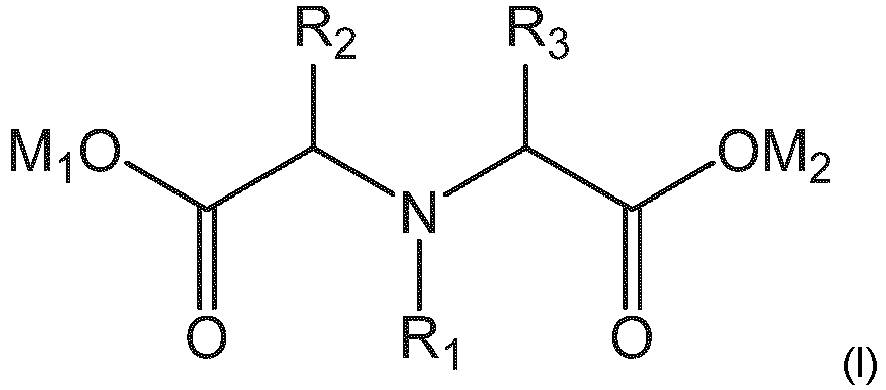 R1 für eine Carboxymethylgruppe oder für ein physiologisch verträgliches Salz hiervon steht,R2 für eine Methylgruppe steht undR3 für ein Wasserstoffatom steht, undM1, M2 unabhängig voneinander für ein Wasserstoffatom oder ein Äquivalent eines Alkali, Erdalkali- oder Metallions, bevorzugt für Natrium, Kalium, ½ Magnesium, ½ Calcium, ½ Zink, oder für ein Ammoniumion (NH4 +) stehen, und(b) mindestens eine Aminosäure und/oder ein Proteinhydrolysat, und(c) mindestens ein Oxidationsmittel.
 - Mittel nach Anspruch 1, dadurch gekennzeichnet, dass es - bezogen auf das Gesamtgewicht des Mittels - einen oder mehrere Komplexbildner (a) der Formel (I) in einer Gesamtmenge von 0,05 bis 10,0 Gew.-%, bevorzugt von 0,05 bis 7,5 Gew.-%, weiter bevorzugt von 0,05 bis 2,5 Gew.-% und ganz besonders bevorzugt von 0,05 bis 1,5 Gew.-% enthält.
- Mittel nach einem der Ansprüche 1 bis 2, dadurch gekennzeichnet, dass es mindestens eine Aminosäure (b) aus der Gruppe aus Lysin, Arginin, Histidin, Asparagin, Glutamin, Cystein, Methionin, Tryptophan, Serin, Alanin, Asparaginsäure, Glutaminsäure, Glycin, Isoleucin, Leucin, Phenylalanin, Prolin, Threonin, Tyrosin und Valin enthält.
- Mittel nach einem der Ansprüche 1 bis 3, dadurch gekennzeichnet, dass es - bezogen auf das Gesamtgewicht des Mittels - eine oder mehrere Aminosäuren (b) in einer Gesamtmenge von 0,1 bis 10,0 Gew.-%, bevorzugt 0,1 bis 5,0 Gew.-% enthält, weiter bevorzugt von 0,1 bis 2,5 Gew.-% und ganz besonders bevorzugt von 0,1 bis 1,0 Gew.-% enthält.
- Mittel nach einem der Ansprüche 1 bis 4, dadurch gekennzeichnet, dass es mindestens ein Proteinhydrolysat (b) enthält, das ausgewählt ist aus der Gruppe der pflanzlichen Proteinhydrolysate, der Proteinhydrolysate des Elastins, des Kollagens, des Keratins, der Seide, des Milcheiweißes, Soja-, Mandel-, Erbsen-, Moringa-, Kartoffel- und Weizenproteinhydrolysaten.
- Mittel nach einem der Ansprüche 1 bis 5, dadurch gekennzeichnet, dass es - bezogen auf das Gesamtgewicht des Mittels - ein oder mehrere Proteinhydrolysate (b) in einer Gesamtmenge von 0,1 bis 10,0 Gew.-%, bevorzugt 0,1 bis 5,0 Gew.-% enthält, weiter bevorzugt von 0,1 bis 2,5 Gew.-% und ganz besonders bevorzugt von 0,1 bis 1,0 Gew.-% enthält.
- Mittel nach einem der Ansprüche 1 bis 6, dadurch gekennzeichnet, dass das Gewichtsverhältnis aus allen im Mittel enthaltenen Komplexbildnern (a) zu allen im Mittel enthaltenen Verbindungen aus der Gruppe der Aminosäuren und Proteinhydrolysate (b), d.h. das Gewichtsverhältnis (a)/(b), bei einem Wert von 0,1 bis 10, bevorzugt von 0,2 bis 5, weiter bevorzugt von 0,25 bis 4,0, und ganz besonders bevorzugt von 0,3 bis 1,0 liegt.
- Mittel nach einem der Ansprüche 1 bis 7, dadurch gekennzeichnet, dass es (c) mindestens ein Oxidationsmittel aus der Gruppe aus Wasserstoffperoxid, Ammoniumperoxodisulfat, Kaliumperoxodisulfat und Natriumperoxodisulfat enthält.
- Mittel nach einem der Ansprüche 1 bis 8, dadurch gekennzeichnet, dass es - bezogen auf das Gesamtgewicht des Mittels - (c) 0,1 bis 12,0 Gew.-%, bevorzugt 0,5 bis 10,5 Gew.-%, weiter bevorzugt 1,0 bis 8,5 Gew.-%, noch weiter bevorzugt von 1,5 bis 7,0 Gew.-% und ganz besonders bevorzugt 1,5 bis 6,0 Gew.-% Wasserstoffperoxid enthält.
- Mittel nach einem der Ansprüche 1 bis 9, dadurch gekennzeichnet, dass es - bezogen auf das Gesamtgewicht des Mittels - (c) ein oder mehrere Persulfate aus der Gruppe aus Ammoniumperoxodisulfat, Kaliumperoxodisulfat und Natriumperoxodisulfat in einer Gesamtmenge von 2,0 bis 40,0 Gew.-%, bevorzugt von 4,0 bis 30,0 Gew.-%, weiter bevorzugt von 6,0 bis 20,0 Gew.-% und ganz besonders von 8,0 bis 15,0 Gew.-% enthält.
- Mittel nach einem der Ansprüche 1 bis 10, dadurch gekennzeichnet, dass es Wasser enthält und einen pH-Wert von 7,5 bis 11,5, bevorzugt von 8,0 bis 11,5, weiter bevorzugt von 8,5 bis 11,5 und ganz besonders bevorzugt von 9,0 bis 11,0 besitzt.
- Verfahren zur zur oxidativen Farbveränderung von keratinischen Fasern, insbesondere menschlichen Haaren, wobei ein Mittel nach einem der Ansprüche 1 bis 11 auf die Keratinfasern aufgetragen und nach einer Einwirkzeit wieder ausgespült wird.
Applications Claiming Priority (2)
| Application Number | Priority Date | Filing Date | Title |
|---|---|---|---|
| DE102020211751.9A DE102020211751A1 (de) | 2020-09-21 | 2020-09-21 | Mittel zur oxidativen Farbveränderung von keratinischen Fasern mit Komplexbildner und Aminosäure und/oder Proteinhydrolysat |
| PCT/EP2021/073862 WO2022058147A2 (de) | 2020-09-21 | 2021-08-30 | Mittel zur oxidativen farbveränderung von keratinischen fasern mit komplexbildner und aminosäure und/oder proteinhydrolysat |
Publications (2)
| Publication Number | Publication Date |
|---|---|
| EP4213799A2 EP4213799A2 (de) | 2023-07-26 |
| EP4213799B1 true EP4213799B1 (de) | 2024-11-06 |
Family
ID=77801683
Family Applications (1)
| Application Number | Title | Priority Date | Filing Date |
|---|---|---|---|
| EP21772718.9A Active EP4213799B1 (de) | 2020-09-21 | 2021-08-30 | Mittel zur oxidativen farbveränderung von keratinischen fasern mit komplexbildner und aminosäure und/oder proteinhydrolysat |
Country Status (3)
| Country | Link |
|---|---|
| EP (1) | EP4213799B1 (de) |
| DE (1) | DE102020211751A1 (de) |
| WO (1) | WO2022058147A2 (de) |
Families Citing this family (4)
| Publication number | Priority date | Publication date | Assignee | Title |
|---|---|---|---|---|
| DE102020211751A1 (de) | 2020-09-21 | 2022-03-24 | Henkel Ag & Co. Kgaa | Mittel zur oxidativen Farbveränderung von keratinischen Fasern mit Komplexbildner und Aminosäure und/oder Proteinhydrolysat |
| DE102021200031A1 (de) | 2021-01-05 | 2022-07-07 | Henkel Ag & Co. Kgaa | Mittel zur oxidativen Farbveränderung von keratinischen Fasern mit Komplexbildner, Aktivator und Oxidationsmittel |
| DE102022201371A1 (de) * | 2022-02-10 | 2023-08-10 | Henkel Ag & Co. Kgaa | Oxidatives Haarbehandlungsmittel mit kontrollierter Wärmeentwicklung auf der Basis von umweltverträglichen Inhaltsstoffen |
| DE102022204091A1 (de) * | 2022-04-27 | 2023-11-02 | Henkel Ag & Co. Kgaa | Oxidatives Haaraufhellungsmittel mit kontrolliertem Aufquellverhalten |
Citations (9)
| Publication number | Priority date | Publication date | Assignee | Title |
|---|---|---|---|---|
| WO2002089754A1 (en) * | 2001-03-20 | 2002-11-14 | The Procter & Gamble Company | Compositions suitable for the treatment of hair comprising chelants and methods for reducing oxidative hair damage |
| EP1475074A1 (de) | 2003-03-25 | 2004-11-10 | L'oreal | Use of polycarboxylic acids and their salts as complexing agents in oxidizing compositions for dyeing, bleaching or permanently setting keratin fibers |
| US20040237217A1 (en) | 2003-03-25 | 2004-12-02 | L'oreal S.A. | Composition for dyeing keratinous fibers, comprising at least one polycarboxylic acid or a salt, ready-to-use composition comprising it, implementation process and device |
| EP2103299A2 (de) | 2007-11-05 | 2009-09-23 | The Procter and Gamble Company | Oxidierende Haarfärbezusammensetzungen |
| EP2356978A2 (de) | 2010-02-16 | 2011-08-17 | Henkel AG & Co. KGaA | Färbemittel mit bestimmten Aminosäuren |
| EP1813259B1 (de) * | 2006-01-26 | 2017-04-19 | Henkel AG & Co. KGaA | Aufhell- und/oder Färbemittel mit reduziertem Irritationspotential |
| DE102016212430A1 (de) | 2016-07-07 | 2018-01-11 | Henkel Ag & Co. Kgaa | Blondiermittel und Verfahren zur schonenden oxidativen Aufhellung von keratinischen Fasern |
| WO2020064268A1 (de) | 2018-09-25 | 2020-04-02 | Henkel Ag & Co. Kgaa | Reduzierte haarschädigung während der blondierung durch einsatz von einem biologisch abbaubaren komplexbildner |
| US20200197281A1 (en) * | 2018-12-19 | 2020-06-25 | Henkel Ag & Co. Kgaa | Oxidation coloring agent in red shades with reduced color shift due to copper ions |
Family Cites Families (5)
| Publication number | Priority date | Publication date | Assignee | Title |
|---|---|---|---|---|
| FR2852834B1 (fr) | 2003-03-25 | 2008-02-15 | Oreal | Composition oxydante comprenant des acides hydroxycarboxyliques et leurs sels comme agents complexants pour la coloration, la decoloration ou la deformation permanente des fibres keratiniques |
| DE102005013438A1 (de) | 2005-03-21 | 2006-09-28 | Henkel Kgaa | Haarbehandlungs-Kit mit Komplexbildnern |
| DE102006047732A1 (de) * | 2006-10-06 | 2008-04-10 | Henkel Kgaa | Mittel zur Behandlung von blondem oder blondiertem Haar |
| WO2022050147A1 (ja) | 2020-09-01 | 2022-03-10 | パナソニックIpマネジメント株式会社 | 接合方法 |
| DE102020211751A1 (de) | 2020-09-21 | 2022-03-24 | Henkel Ag & Co. Kgaa | Mittel zur oxidativen Farbveränderung von keratinischen Fasern mit Komplexbildner und Aminosäure und/oder Proteinhydrolysat |
-
2020
- 2020-09-21 DE DE102020211751.9A patent/DE102020211751A1/de not_active Withdrawn
-
2021
- 2021-08-30 EP EP21772718.9A patent/EP4213799B1/de active Active
- 2021-08-30 WO PCT/EP2021/073862 patent/WO2022058147A2/de not_active Ceased
Patent Citations (10)
| Publication number | Priority date | Publication date | Assignee | Title |
|---|---|---|---|---|
| WO2002089754A1 (en) * | 2001-03-20 | 2002-11-14 | The Procter & Gamble Company | Compositions suitable for the treatment of hair comprising chelants and methods for reducing oxidative hair damage |
| EP1475074A1 (de) | 2003-03-25 | 2004-11-10 | L'oreal | Use of polycarboxylic acids and their salts as complexing agents in oxidizing compositions for dyeing, bleaching or permanently setting keratin fibers |
| US20040237217A1 (en) | 2003-03-25 | 2004-12-02 | L'oreal S.A. | Composition for dyeing keratinous fibers, comprising at least one polycarboxylic acid or a salt, ready-to-use composition comprising it, implementation process and device |
| US7303588B2 (en) * | 2003-03-25 | 2007-12-04 | L'oreal S.A. | Composition for dyeing keratinous fibers, comprising at least one polycarboxylic acid or a salt, ready-to-use composition comprising it, implementation process and device |
| EP1813259B1 (de) * | 2006-01-26 | 2017-04-19 | Henkel AG & Co. KGaA | Aufhell- und/oder Färbemittel mit reduziertem Irritationspotential |
| EP2103299A2 (de) | 2007-11-05 | 2009-09-23 | The Procter and Gamble Company | Oxidierende Haarfärbezusammensetzungen |
| EP2356978A2 (de) | 2010-02-16 | 2011-08-17 | Henkel AG & Co. KGaA | Färbemittel mit bestimmten Aminosäuren |
| DE102016212430A1 (de) | 2016-07-07 | 2018-01-11 | Henkel Ag & Co. Kgaa | Blondiermittel und Verfahren zur schonenden oxidativen Aufhellung von keratinischen Fasern |
| WO2020064268A1 (de) | 2018-09-25 | 2020-04-02 | Henkel Ag & Co. Kgaa | Reduzierte haarschädigung während der blondierung durch einsatz von einem biologisch abbaubaren komplexbildner |
| US20200197281A1 (en) * | 2018-12-19 | 2020-06-25 | Henkel Ag & Co. Kgaa | Oxidation coloring agent in red shades with reduced color shift due to copper ions |
Non-Patent Citations (1)
| Title |
|---|
| JING HODES ET AL.: "The role of chelating agents and amino acids in preventing free radical formation in bleaching systems", ELSEVIER FREE RADICAL BIOLOGY AND MEDICINE, vol. 129, 19 September 2018 (2018-09-19), pages 194 - 201, XP085537577, DOI: 10.1016/j.freeradbiomed.2018.09.023 |
Also Published As
| Publication number | Publication date |
|---|---|
| WO2022058147A3 (de) | 2022-05-12 |
| EP4213799A2 (de) | 2023-07-26 |
| WO2022058147A2 (de) | 2022-03-24 |
| DE102020211751A1 (de) | 2022-03-24 |
Similar Documents
| Publication | Publication Date | Title |
|---|---|---|
| WO2022058147A2 (de) | Mittel zur oxidativen farbveränderung von keratinischen fasern mit komplexbildner und aminosäure und/oder proteinhydrolysat | |
| EP4182034A1 (de) | Mittel zur behandlung von keratinischen fasern mit komplexbildner und aminosäure und/oder proteinhydrolysat | |
| EP3093046B1 (de) | Mittel zur schonenden oxidativen aufhellung von keratinhaltigen fasern | |
| WO2017102582A1 (de) | Oxidationsmittel zur oxidativen färbe- und blondierbehandlung keratinischer fasern mit reduzierter schädigung | |
| WO2017207630A1 (de) | Ausgewählte dicarbonsäuren in haar schonenden mittel und verfahren zur oxidativen haarfärbung oder blondierung | |
| WO2015086230A1 (de) | Haarglättung durch glyoxylsäure | |
| DE102010039878A1 (de) | Blondierung mit reduktiver Vorbehandlung | |
| WO2022083922A1 (de) | Mittel zur oxidativen farbveränderung von keratinischen fasern mit komplexbildner, aktivator und oxidationsmittel | |
| EP3644946B1 (de) | Verfahren zum aufhellen von haaren enthaltend spezielle oxo-carbonsäuren | |
| EP4213798B1 (de) | Mittel zur oxidativen farbveränderung von keratinischen fasern mit glycylglycin und aminosäure und/oder proteinhydrolysat | |
| DE102021200031A1 (de) | Mittel zur oxidativen Farbveränderung von keratinischen Fasern mit Komplexbildner, Aktivator und Oxidationsmittel | |
| EP3506878B1 (de) | Permanente haarverformungsmittel mit bunte-salzen von aminosäuren und oligopeptiden | |
| EP2497536A2 (de) | Haaraufhellverfahren mit reduktiver Nachbehandlung | |
| DE102020204145A1 (de) | Mittel zur verbesserten oxidativen Aufhellung von keratinhaltigen Fasern | |
| DE102010030337A1 (de) | Ammoniumsalz-haltige Blondierpulver | |
| DE69205995T2 (de) | Verwendung von 4-[(2-oxo-3-bornylidene)methyl]-fenyltrimethylammonium methylsulfat in einer zusammensetzung zur dauerhaften verformung. | |
| WO2026037517A1 (de) | Mittel zur oxidativen farbveränderung von keratinischen fasern enthaltend wasserstoffperoxid, persulfat, komplexbildner und aminoalkylsulfonsäure | |
| DE102023205102A1 (de) | Verfahren zum auswählen von substanzen zum schutz vor schäden an der haarstruktur und zur verwendung in haarkosmetischen mitteln | |
| EP2418003A2 (de) | Ammoniumsalz-haltige Blondiermittel | |
| WO2019057470A1 (de) | Verbesserte entfärbung von gefärbten keratinischen fasern | |
| KR20230026882A (ko) | 누에 혈림프 유래 저분자를 포함하는 모발 보호 및 수복용 화장용 조성물 | |
| WO2025061335A1 (de) | Verfahren zum färben von keratinfasern umfassend die anwendung eines oxidativen vorbehandlungsmittels und eines färbemittels mit direktziehenden farbstoffen | |
| DE102024209500A1 (de) | Haarpflegeshampoo mit Keratin restrukturierender Wirkung | |
| DE10120305A1 (de) | Vitamin B6-Derivate als Pflegekomponenten in der oxidativen Haarbehandlung |
Legal Events
| Date | Code | Title | Description |
|---|---|---|---|
| STAA | Information on the status of an ep patent application or granted ep patent |
Free format text: STATUS: UNKNOWN |
|
| STAA | Information on the status of an ep patent application or granted ep patent |
Free format text: STATUS: THE INTERNATIONAL PUBLICATION HAS BEEN MADE |
|
| PUAI | Public reference made under article 153(3) epc to a published international application that has entered the european phase |
Free format text: ORIGINAL CODE: 0009012 |
|
| STAA | Information on the status of an ep patent application or granted ep patent |
Free format text: STATUS: REQUEST FOR EXAMINATION WAS MADE |
|
| 17P | Request for examination filed |
Effective date: 20230113 |
|
| AK | Designated contracting states |
Kind code of ref document: A2 Designated state(s): AL AT BE BG CH CY CZ DE DK EE ES FI FR GB GR HR HU IE IS IT LI LT LU LV MC MK MT NL NO PL PT RO RS SE SI SK SM TR |
|
| TPAC | Observations filed by third parties |
Free format text: ORIGINAL CODE: EPIDOSNTIPA |
|
| DAV | Request for validation of the european patent (deleted) | ||
| DAX | Request for extension of the european patent (deleted) | ||
| TPAC | Observations filed by third parties |
Free format text: ORIGINAL CODE: EPIDOSNTIPA |
|
| RIC1 | Information provided on ipc code assigned before grant |
Ipc: A61Q 5/10 20060101ALI20240528BHEP Ipc: A61K 8/65 20060101ALI20240528BHEP Ipc: A61K 8/64 20060101ALI20240528BHEP Ipc: A61K 8/49 20060101ALI20240528BHEP Ipc: A61K 8/46 20060101ALI20240528BHEP Ipc: A61K 8/44 20060101AFI20240528BHEP |
|
| GRAP | Despatch of communication of intention to grant a patent |
Free format text: ORIGINAL CODE: EPIDOSNIGR1 |
|
| STAA | Information on the status of an ep patent application or granted ep patent |
Free format text: STATUS: GRANT OF PATENT IS INTENDED |
|
| INTG | Intention to grant announced |
Effective date: 20240723 |
|
| GRAS | Grant fee paid |
Free format text: ORIGINAL CODE: EPIDOSNIGR3 |
|
| GRAA | (expected) grant |
Free format text: ORIGINAL CODE: 0009210 |
|
| STAA | Information on the status of an ep patent application or granted ep patent |
Free format text: STATUS: THE PATENT HAS BEEN GRANTED |
|
| P01 | Opt-out of the competence of the unified patent court (upc) registered |
Free format text: CASE NUMBER: APP_52407/2024 Effective date: 20240918 |
|
| AK | Designated contracting states |
Kind code of ref document: B1 Designated state(s): AL AT BE BG CH CY CZ DE DK EE ES FI FR GB GR HR HU IE IS IT LI LT LU LV MC MK MT NL NO PL PT RO RS SE SI SK SM TR |
|
| REG | Reference to a national code |
Ref country code: GB Ref legal event code: FG4D Free format text: NOT ENGLISH |
|
| REG | Reference to a national code |
Ref country code: CH Ref legal event code: EP |
|
| REG | Reference to a national code |
Ref country code: DE Ref legal event code: R096 Ref document number: 502021005739 Country of ref document: DE |
|
| REG | Reference to a national code |
Ref country code: IE Ref legal event code: FG4D Free format text: LANGUAGE OF EP DOCUMENT: GERMAN |
|
| REG | Reference to a national code |
Ref country code: LT Ref legal event code: MG9D |
|
| REG | Reference to a national code |
Ref country code: NL Ref legal event code: MP Effective date: 20241106 |
|
| PG25 | Lapsed in a contracting state [announced via postgrant information from national office to epo] |
Ref country code: HR Free format text: LAPSE BECAUSE OF FAILURE TO SUBMIT A TRANSLATION OF THE DESCRIPTION OR TO PAY THE FEE WITHIN THE PRESCRIBED TIME-LIMIT Effective date: 20241106 Ref country code: PT Free format text: LAPSE BECAUSE OF FAILURE TO SUBMIT A TRANSLATION OF THE DESCRIPTION OR TO PAY THE FEE WITHIN THE PRESCRIBED TIME-LIMIT Effective date: 20250306 Ref country code: IS Free format text: LAPSE BECAUSE OF FAILURE TO SUBMIT A TRANSLATION OF THE DESCRIPTION OR TO PAY THE FEE WITHIN THE PRESCRIBED TIME-LIMIT Effective date: 20250306 |
|
| PG25 | Lapsed in a contracting state [announced via postgrant information from national office to epo] |
Ref country code: FI Free format text: LAPSE BECAUSE OF FAILURE TO SUBMIT A TRANSLATION OF THE DESCRIPTION OR TO PAY THE FEE WITHIN THE PRESCRIBED TIME-LIMIT Effective date: 20241106 Ref country code: NL Free format text: LAPSE BECAUSE OF FAILURE TO SUBMIT A TRANSLATION OF THE DESCRIPTION OR TO PAY THE FEE WITHIN THE PRESCRIBED TIME-LIMIT Effective date: 20241106 |
|
| PG25 | Lapsed in a contracting state [announced via postgrant information from national office to epo] |
Ref country code: BG Free format text: LAPSE BECAUSE OF FAILURE TO SUBMIT A TRANSLATION OF THE DESCRIPTION OR TO PAY THE FEE WITHIN THE PRESCRIBED TIME-LIMIT Effective date: 20241106 |
|
| PG25 | Lapsed in a contracting state [announced via postgrant information from national office to epo] |
Ref country code: ES Free format text: LAPSE BECAUSE OF FAILURE TO SUBMIT A TRANSLATION OF THE DESCRIPTION OR TO PAY THE FEE WITHIN THE PRESCRIBED TIME-LIMIT Effective date: 20241106 |
|
| PG25 | Lapsed in a contracting state [announced via postgrant information from national office to epo] |
Ref country code: NO Free format text: LAPSE BECAUSE OF FAILURE TO SUBMIT A TRANSLATION OF THE DESCRIPTION OR TO PAY THE FEE WITHIN THE PRESCRIBED TIME-LIMIT Effective date: 20250206 |
|
| PG25 | Lapsed in a contracting state [announced via postgrant information from national office to epo] |
Ref country code: LV Free format text: LAPSE BECAUSE OF FAILURE TO SUBMIT A TRANSLATION OF THE DESCRIPTION OR TO PAY THE FEE WITHIN THE PRESCRIBED TIME-LIMIT Effective date: 20241106 Ref country code: GR Free format text: LAPSE BECAUSE OF FAILURE TO SUBMIT A TRANSLATION OF THE DESCRIPTION OR TO PAY THE FEE WITHIN THE PRESCRIBED TIME-LIMIT Effective date: 20250207 |
|
| PG25 | Lapsed in a contracting state [announced via postgrant information from national office to epo] |
Ref country code: PL Free format text: LAPSE BECAUSE OF FAILURE TO SUBMIT A TRANSLATION OF THE DESCRIPTION OR TO PAY THE FEE WITHIN THE PRESCRIBED TIME-LIMIT Effective date: 20241106 |
|
| PG25 | Lapsed in a contracting state [announced via postgrant information from national office to epo] |
Ref country code: RS Free format text: LAPSE BECAUSE OF FAILURE TO SUBMIT A TRANSLATION OF THE DESCRIPTION OR TO PAY THE FEE WITHIN THE PRESCRIBED TIME-LIMIT Effective date: 20250206 |
|
| PG25 | Lapsed in a contracting state [announced via postgrant information from national office to epo] |
Ref country code: SM Free format text: LAPSE BECAUSE OF FAILURE TO SUBMIT A TRANSLATION OF THE DESCRIPTION OR TO PAY THE FEE WITHIN THE PRESCRIBED TIME-LIMIT Effective date: 20241106 |
|
| PG25 | Lapsed in a contracting state [announced via postgrant information from national office to epo] |
Ref country code: DK Free format text: LAPSE BECAUSE OF FAILURE TO SUBMIT A TRANSLATION OF THE DESCRIPTION OR TO PAY THE FEE WITHIN THE PRESCRIBED TIME-LIMIT Effective date: 20241106 |
|
| PG25 | Lapsed in a contracting state [announced via postgrant information from national office to epo] |
Ref country code: EE Free format text: LAPSE BECAUSE OF FAILURE TO SUBMIT A TRANSLATION OF THE DESCRIPTION OR TO PAY THE FEE WITHIN THE PRESCRIBED TIME-LIMIT Effective date: 20241106 |
|
| PG25 | Lapsed in a contracting state [announced via postgrant information from national office to epo] |
Ref country code: RO Free format text: LAPSE BECAUSE OF FAILURE TO SUBMIT A TRANSLATION OF THE DESCRIPTION OR TO PAY THE FEE WITHIN THE PRESCRIBED TIME-LIMIT Effective date: 20241106 |
|
| PG25 | Lapsed in a contracting state [announced via postgrant information from national office to epo] |
Ref country code: SK Free format text: LAPSE BECAUSE OF FAILURE TO SUBMIT A TRANSLATION OF THE DESCRIPTION OR TO PAY THE FEE WITHIN THE PRESCRIBED TIME-LIMIT Effective date: 20241106 |
|
| PG25 | Lapsed in a contracting state [announced via postgrant information from national office to epo] |
Ref country code: CZ Free format text: LAPSE BECAUSE OF FAILURE TO SUBMIT A TRANSLATION OF THE DESCRIPTION OR TO PAY THE FEE WITHIN THE PRESCRIBED TIME-LIMIT Effective date: 20241106 |
|
| PG25 | Lapsed in a contracting state [announced via postgrant information from national office to epo] |
Ref country code: IT Free format text: LAPSE BECAUSE OF FAILURE TO SUBMIT A TRANSLATION OF THE DESCRIPTION OR TO PAY THE FEE WITHIN THE PRESCRIBED TIME-LIMIT Effective date: 20241106 |
|
| REG | Reference to a national code |
Ref country code: DE Ref legal event code: R026 Ref document number: 502021005739 Country of ref document: DE |
|
| PLBI | Opposition filed |
Free format text: ORIGINAL CODE: 0009260 |
|
| PLAX | Notice of opposition and request to file observation + time limit sent |
Free format text: ORIGINAL CODE: EPIDOSNOBS2 |
|
| PG25 | Lapsed in a contracting state [announced via postgrant information from national office to epo] |
Ref country code: SE Free format text: LAPSE BECAUSE OF FAILURE TO SUBMIT A TRANSLATION OF THE DESCRIPTION OR TO PAY THE FEE WITHIN THE PRESCRIBED TIME-LIMIT Effective date: 20241106 |
|
| 26 | Opposition filed |
Opponent name: WELLA GERMANY GMBH Effective date: 20250806 |
|
| PGFP | Annual fee paid to national office [announced via postgrant information from national office to epo] |
Ref country code: DE Payment date: 20250820 Year of fee payment: 5 |
|
| PGFP | Annual fee paid to national office [announced via postgrant information from national office to epo] |
Ref country code: GB Payment date: 20250821 Year of fee payment: 5 |
|
| PGFP | Annual fee paid to national office [announced via postgrant information from national office to epo] |
Ref country code: FR Payment date: 20250828 Year of fee payment: 5 Ref country code: AT Payment date: 20251020 Year of fee payment: 5 |
|
| PLBB | Reply of patent proprietor to notice(s) of opposition received |
Free format text: ORIGINAL CODE: EPIDOSNOBS3 |
|
| REG | Reference to a national code |
Ref country code: CH Ref legal event code: H13 Free format text: ST27 STATUS EVENT CODE: U-0-0-H10-H13 (AS PROVIDED BY THE NATIONAL OFFICE) Effective date: 20260324 |
|
| PG25 | Lapsed in a contracting state [announced via postgrant information from national office to epo] |
Ref country code: MC Free format text: LAPSE BECAUSE OF FAILURE TO SUBMIT A TRANSLATION OF THE DESCRIPTION OR TO PAY THE FEE WITHIN THE PRESCRIBED TIME-LIMIT Effective date: 20241106 |
|
| PG25 | Lapsed in a contracting state [announced via postgrant information from national office to epo] |
Ref country code: LU Free format text: LAPSE BECAUSE OF NON-PAYMENT OF DUE FEES Effective date: 20250830 |
|
| PG25 | Lapsed in a contracting state [announced via postgrant information from national office to epo] |
Ref country code: CH Free format text: LAPSE BECAUSE OF NON-PAYMENT OF DUE FEES Effective date: 20250831 |