EP4205884A1 - Negativelektrodenaktivmaterial für sekundärbatterien und sekundärbatterie - Google Patents
Negativelektrodenaktivmaterial für sekundärbatterien und sekundärbatterie Download PDFInfo
- Publication number
- EP4205884A1 EP4205884A1 EP21861553.2A EP21861553A EP4205884A1 EP 4205884 A1 EP4205884 A1 EP 4205884A1 EP 21861553 A EP21861553 A EP 21861553A EP 4205884 A1 EP4205884 A1 EP 4205884A1
- Authority
- EP
- European Patent Office
- Prior art keywords
- negative electrode
- intermetallic compound
- active material
- electrode active
- secondary battery
- Prior art date
- Legal status (The legal status is an assumption and is not a legal conclusion. Google has not performed a legal analysis and makes no representation as to the accuracy of the status listed.)
- Pending
Links
Images




Classifications
-
- H—ELECTRICITY
- H01—ELECTRIC ELEMENTS
- H01M—PROCESSES OR MEANS, e.g. BATTERIES, FOR THE DIRECT CONVERSION OF CHEMICAL ENERGY INTO ELECTRICAL ENERGY
- H01M4/00—Electrodes
- H01M4/02—Electrodes composed of, or comprising, active material
- H01M4/36—Selection of substances as active materials, active masses, active liquids
- H01M4/38—Selection of substances as active materials, active masses, active liquids of elements or alloys
- H01M4/386—Silicon or alloys based on silicon
-
- C—CHEMISTRY; METALLURGY
- C01—INORGANIC CHEMISTRY
- C01B—NON-METALLIC ELEMENTS; COMPOUNDS THEREOF; METALLOIDS OR COMPOUNDS THEREOF NOT COVERED BY SUBCLASS C01C
- C01B33/00—Silicon; Compounds thereof
- C01B33/06—Metal silicides
-
- C—CHEMISTRY; METALLURGY
- C22—METALLURGY; FERROUS OR NON-FERROUS ALLOYS; TREATMENT OF ALLOYS OR NON-FERROUS METALS
- C22C—ALLOYS
- C22C19/00—Alloys based on nickel or cobalt
- C22C19/03—Alloys based on nickel or cobalt based on nickel
-
- C—CHEMISTRY; METALLURGY
- C22—METALLURGY; FERROUS OR NON-FERROUS ALLOYS; TREATMENT OF ALLOYS OR NON-FERROUS METALS
- C22C—ALLOYS
- C22C28/00—Alloys based on a metal not provided for in groups C22C5/00 - C22C27/00
-
- C—CHEMISTRY; METALLURGY
- C22—METALLURGY; FERROUS OR NON-FERROUS ALLOYS; TREATMENT OF ALLOYS OR NON-FERROUS METALS
- C22C—ALLOYS
- C22C30/00—Alloys containing less than 50% by weight of each constituent
-
- H—ELECTRICITY
- H01—ELECTRIC ELEMENTS
- H01M—PROCESSES OR MEANS, e.g. BATTERIES, FOR THE DIRECT CONVERSION OF CHEMICAL ENERGY INTO ELECTRICAL ENERGY
- H01M10/00—Secondary cells; Manufacture thereof
- H01M10/05—Accumulators with non-aqueous electrolyte
- H01M10/052—Li-accumulators
-
- H—ELECTRICITY
- H01—ELECTRIC ELEMENTS
- H01M—PROCESSES OR MEANS, e.g. BATTERIES, FOR THE DIRECT CONVERSION OF CHEMICAL ENERGY INTO ELECTRICAL ENERGY
- H01M10/00—Secondary cells; Manufacture thereof
- H01M10/05—Accumulators with non-aqueous electrolyte
- H01M10/052—Li-accumulators
- H01M10/0525—Rocking-chair batteries, i.e. batteries with lithium insertion or intercalation in both electrodes; Lithium-ion batteries
-
- H—ELECTRICITY
- H01—ELECTRIC ELEMENTS
- H01M—PROCESSES OR MEANS, e.g. BATTERIES, FOR THE DIRECT CONVERSION OF CHEMICAL ENERGY INTO ELECTRICAL ENERGY
- H01M4/00—Electrodes
- H01M4/02—Electrodes composed of, or comprising, active material
- H01M4/13—Electrodes for accumulators with non-aqueous electrolyte, e.g. for lithium-accumulators; Processes of manufacture thereof
- H01M4/134—Electrodes based on metals, Si or alloys
-
- H—ELECTRICITY
- H01—ELECTRIC ELEMENTS
- H01M—PROCESSES OR MEANS, e.g. BATTERIES, FOR THE DIRECT CONVERSION OF CHEMICAL ENERGY INTO ELECTRICAL ENERGY
- H01M4/00—Electrodes
- H01M4/02—Electrodes composed of, or comprising, active material
- H01M4/36—Selection of substances as active materials, active masses, active liquids
-
- H—ELECTRICITY
- H01—ELECTRIC ELEMENTS
- H01M—PROCESSES OR MEANS, e.g. BATTERIES, FOR THE DIRECT CONVERSION OF CHEMICAL ENERGY INTO ELECTRICAL ENERGY
- H01M4/00—Electrodes
- H01M4/02—Electrodes composed of, or comprising, active material
- H01M4/36—Selection of substances as active materials, active masses, active liquids
- H01M4/362—Composites
- H01M4/364—Composites as mixtures
-
- H—ELECTRICITY
- H01—ELECTRIC ELEMENTS
- H01M—PROCESSES OR MEANS, e.g. BATTERIES, FOR THE DIRECT CONVERSION OF CHEMICAL ENERGY INTO ELECTRICAL ENERGY
- H01M4/00—Electrodes
- H01M4/02—Electrodes composed of, or comprising, active material
- H01M4/36—Selection of substances as active materials, active masses, active liquids
- H01M4/38—Selection of substances as active materials, active masses, active liquids of elements or alloys
-
- H—ELECTRICITY
- H01—ELECTRIC ELEMENTS
- H01M—PROCESSES OR MEANS, e.g. BATTERIES, FOR THE DIRECT CONVERSION OF CHEMICAL ENERGY INTO ELECTRICAL ENERGY
- H01M4/00—Electrodes
- H01M4/02—Electrodes composed of, or comprising, active material
- H01M4/36—Selection of substances as active materials, active masses, active liquids
- H01M4/48—Selection of substances as active materials, active masses, active liquids of inorganic oxides or hydroxides
- H01M4/52—Selection of substances as active materials, active masses, active liquids of inorganic oxides or hydroxides of nickel, cobalt or iron
- H01M4/525—Selection of substances as active materials, active masses, active liquids of inorganic oxides or hydroxides of nickel, cobalt or iron of mixed oxides or hydroxides containing iron, cobalt or nickel for inserting or intercalating light metals, e.g. LiNiO2, LiCoO2 or LiCoOxFy
-
- H—ELECTRICITY
- H01—ELECTRIC ELEMENTS
- H01M—PROCESSES OR MEANS, e.g. BATTERIES, FOR THE DIRECT CONVERSION OF CHEMICAL ENERGY INTO ELECTRICAL ENERGY
- H01M4/00—Electrodes
- H01M4/02—Electrodes composed of, or comprising, active material
- H01M2004/021—Physical characteristics, e.g. porosity, surface area
-
- H—ELECTRICITY
- H01—ELECTRIC ELEMENTS
- H01M—PROCESSES OR MEANS, e.g. BATTERIES, FOR THE DIRECT CONVERSION OF CHEMICAL ENERGY INTO ELECTRICAL ENERGY
- H01M4/00—Electrodes
- H01M4/02—Electrodes composed of, or comprising, active material
- H01M2004/026—Electrodes composed of, or comprising, active material characterised by the polarity
- H01M2004/027—Negative electrodes
-
- Y—GENERAL TAGGING OF NEW TECHNOLOGICAL DEVELOPMENTS; GENERAL TAGGING OF CROSS-SECTIONAL TECHNOLOGIES SPANNING OVER SEVERAL SECTIONS OF THE IPC; TECHNICAL SUBJECTS COVERED BY FORMER USPC CROSS-REFERENCE ART COLLECTIONS [XRACs] AND DIGESTS
- Y02—TECHNOLOGIES OR APPLICATIONS FOR MITIGATION OR ADAPTATION AGAINST CLIMATE CHANGE
- Y02E—REDUCTION OF GREENHOUSE GAS [GHG] EMISSIONS, RELATED TO ENERGY GENERATION, TRANSMISSION OR DISTRIBUTION
- Y02E60/00—Enabling technologies; Technologies with a potential or indirect contribution to GHG emissions mitigation
- Y02E60/10—Energy storage using batteries
Definitions
- the present disclosure mainly relates to a negative electrode active material for a secondary battery.
- Non-aqueous electrolyte secondary batteries especially lithium ion secondary batteries, because of their high voltage and high energy density, have been expected as promising power sources for small consumer applications, power storage devices, and electric cars.
- an alloy-type material containing silicon (Si) that forms an alloy with lithium has been expected to be utilized as a negative electrode active material having a high theoretical capacity density (e.g., Patent Literature 1). It is known, however, that the alloy-type material undergoes great changes in volume associated with charge and discharge.
- Patent Literature 2 proposes an electrode material for a non-aqueous electrolyte battery including an alloy which includes, as a main phase, an intermetallic compound phase containing an R element, Sn, an M element and a Z element, as essential components, and has a composition represented by a general formula: R a Sn b M c T d X e A f Z g .
- R is at least one element selected from rare earth elements
- M is at least one element selected from the group consisting of Co, Ni, Fe, Cu, Mn, V, and Cr
- T is at least one element selected from the group consisting of Ti, Zr, Hf, Nb, Ta, Mo, and W
- X is at least one element selected from the group consisting of Si, Al, Sb, and In
- A is at least one element selected from the group consisting of Mg, Ca, Sr, and Ba
- Z is at least one element selected from the group consisting of C, N, B, and P
- the intermetallic compound disclosed in Patent Literature 2 includes Sn element as a major component, leading to an increased weight of the secondary battery, and is not suited to mobile applications. For example, in the application for electric cars, in order to increase the cruising range, a lighter element is required to be utilized. Moreover, since Sn is a rare element, the manufacturing cost of the battery might increase when a material containing Sn is used as a major component.
- one aspect of the present disclosure relates to a negative electrode active material for a secondary battery, including an intermetallic compound having a cage structure, wherein the cage structure is constituted of at least one first atom located within a cage, and a plurality of second atoms arranged in a cage-like form so as to surround the first atom, the first atom is a cerium atom, and the plurality of the second atoms include 8 or more and 16 or less silicon atoms.
- a secondary battery including: a positive electrode; a negative electrode; and an electrolyte, wherein the negative electrode includes the above-mentioned negative electrode active material for a secondary battery.
- the present disclosure proposes utilizing an intermetallic compound which is lightweight and inexpensive and is capable of insertion and desorption of lithium ions, as a negative electrode active material for a secondary battery.
- a negative electrode active material for a secondary battery includes an intermetallic compound having a cage structure.
- the cage structure refers to a cage-type (basket-type) structure formed of predetermined atoms in the crystal structure.
- the cage structure is constituted of at least one first atom located within a cage, and a plurality of second atoms arranged in a cage-like form so as to surround the first atom.
- the first atom can be, for example, one central atom located at the center of the cage.
- the second atoms are arranged so as to surround the first atom or the central atom, forming the cage.
- the second atoms are sometimes referred to as cage atoms.
- the cage structure is, typically, when assuming a polyhedron with its vertices being the cage atoms, a structure having one central atom within a space defined by the polyhedron.
- the crystal structure In order for the insertion and desorption of lithium ions to proceed stably, the crystal structure should have a cage structure. Also, the magnitude of the capacity developed through insertion and desorption of lithium ions greatly depends on the kinds of the first and second atoms.
- the first atom is a cerium atom
- the plurality of the second atoms include 8 or more and 16 or less silicon atoms
- the intermetallic compound having a cage structure has a high capacity density (mAh/g).
- the intermetallic compound having a cage structure not all the atoms should be forming a cage structure. Part of the atoms constituting the intermetallic compound may be located at the site other than the cage structure, and may form another structure. Furthermore, not all the cage structures included in the intermetallic compound should have a cerium atom as the first atom and 8 or more and 16 or less silicon atoms as the second atoms. However, desirably, a half or more of the cage structures included in the intermetallic compound each have a cerium atom as the first atom and 8 or more and 16 or less silicon atoms as the second atoms.
- Various modifications are possible in the crystal structure of the intermetallic compound and the kinds of elements, as long as the intermetallic compound can develop a high practical capacity (e.g., 80 mAh/g or more).
- the intermetallic compound may include a subphase or impurity phase (e.g., CeSi 2 , CeNiSi 2 ).
- the content of the subphase or impurity phase is desirably within a range in which the intermetallic compound can develop a high practical capacity (e.g., 80 mAh/g or more), but is not limited thereto.
- an intermetallic compound having a cage structure constituted of at least one first atom located within a cage and a plurality of second atoms arranged in a cage-like form so as to surround the first atom, in which the first atom is a cerium atom, and the plurality of the second atoms include 8 or more and 16 or less silicon atoms is sometimes referred to as an "intermetallic compound CS.”
- a silicon atom (Si) has an atomic weight of 28.09 and is lighter in weight and less expensive than Sn (atomic weight: 118.71). Furthermore, the intermetallic compound CS has a capacity density of, for example, 100 mAh/g or more (further 140 mAh/g or more). Therefore, the intermetallic compound CS is extremely attractive as a negative electrode active material for a secondary battery used for mobile applications (e.g., electric car application).
- the plurality of the second atoms preferably include one or more nickel atoms.
- the capacity density of the intermetallic compound CS is further increased.
- the total number of the silicon atoms and the nickel atoms included in one cage structure may be 17 or more and 19 or less, and may be 18.
- the atomic ratio of the silicon atoms to the nickel atoms may be, for example, 1 to 1.3, and may be, for example, 1.25.
- the number of the silicon atoms included in the cage atoms may be 11 to 13, and may be, for example, 12.
- the intermetallic compound CS may have a phase of a composition represented by a general formula: Ce x Ni y Si z .
- the intermetallic compound CS can contain Ce that is not located within the cage.
- the Ni and the Si is the second atom (cage atom), but the intermetallic compound CS may contain Ni or Si that does not constitute the cage. Therefore, the ratio of (y+z) to x can be different from the ratio of the number of the second atoms to the number of the first atoms in the cage structure (e.g., 11 to 19).
- the ratio of (y+z) to x: (y+z) / x may be, for example, 1.5 to 5, or 2 to 4, and may be, for example, 2 or 4.
- the number of the nickel atoms included in the second atoms may be, for example, 7 or more and 9 or less. At this time, all the rest of the second atoms may be a silicon atom or an atom of another element. Even when the intermetallic compound CS contains an atom of an element other than Ce, Si and Ni, the intermetallic compound CS desirably has at least a phase having a composition represented by the general formula: Ce x Ni y Si z .
- the number of the silicon atoms included in the second atoms is, for example, 10 in a preferred embodiment, and is, for example, 12 in another embodiment.
- Such an intermetallic compound CS can form a stable cage structure, which can also enhance the overall stability of the crystal structure. Therefore, when the intermetallic compound CS is used as a negative electrode active material for a secondary battery, the deterioration in charge-discharge cycles becomes less likely to occur.
- a specific example of the intermetallic compound CS is, for example, at least one phase selected from the group consisting of CeNi 2 Si 2 and CeSi 2 .
- CeNi 2 Si 2 can develop a capacity density of 140 mAh/g or more.
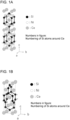
- FIG. 1A schematically shows a crystal structure of CeNi 2 Si 2 .
- the unit lattice has a symmetry belonging to the I 4/ mmm space group.
- Two cage structures are included in the unit lattice near its central part. At the center of the cage, Ce is located as the central atom.
- Si and Ni are arranged in a cage-like form so as to surround Ce.
- the number of the cage atoms (here, the total number of Si and Ni) is 18, with the Si sites being 10 and the Ni sites being 8, but is not limited thereto.
- Various modifications can take place within a range in which the intermetallic compound can develop a high practical capacity (e.g., 80 mAh/g or more) or within a crystallographically acceptable range.
- FIG. 1B schematically shows a crystal structure of CeSi 2 .
- the unit lattice has a symmetry belonging to the I 41/ amd space group.
- One cage structure is included in the unit lattice near its central part.
- Ce is located, as the central atom, at the center of the cage.
- Si is arranged in a cage-like form so as to surround Ce.
- the number of the cage atoms is 12, but is not limited thereto.
- Various modifications can take place within a range in which the intermetallic compound can exhibit a high practical capacity (e.g., 80 mAh/g or more) or within a crystallographically acceptable range.
- the presence of the intermetallic compound CS can be confirmed by X-ray diffractometry using CuK ⁇ rays.
- the intermetallic compound CS belongs to a tetragonal or orthorhombic crystal system.
- the lattice constants a and c determined by X-ray diffractometry satisfy 3.0 ⁇ ⁇ a ⁇ 4.5 ⁇ , and 7 ⁇ ⁇ c ⁇ 15 ⁇ .
- the lattice constants a , b , and c determined by X-ray diffractometry satisfy 3.0 ⁇ ⁇ a ⁇ 4.5 ⁇ , 3.0 ⁇ ⁇ b ⁇ 4.5 ⁇ , and 7 ⁇ ⁇ c ⁇ 15 ⁇ .
- the lattice constants a and b in a more stable crystal structure, preferably satisfy 3.9 ⁇ ⁇ a, and b ⁇ 4.2 ⁇ , and further satisfy 4.0 ⁇ ⁇ a, and b ⁇ 4.1 ⁇ .
- the lattice constant c in a more stable crystal structure, preferably satisfies 8.0 ⁇ ⁇ c ⁇ 11.0 ⁇ , and further satisfies 9.0 ⁇ ⁇ c ⁇ 10.0 ⁇ .
- the d -value of a diffraction peak given by the hkl index of 112 is 2.38 ⁇ or more and 2.52 ⁇ or less, and is 2.40 ⁇ or more and 2.50 ⁇ or less.
- the intermetallic compound CS may contain an atom Me different from any of Ce, Ni and Si.
- the atom Me may be incorporated into the crystal structure of a phase included in the intermetallic compound CS.
- the intermetallic compound CS may be a solid solution containing an Me element.
- the atom Me is not limited, but Fe, La, Pr, Cr, Co, Al, C, Ca, Pb, Nd, Mg, Cu, Zn, and the like can be mentioned as examples of the atom Me.
- Fe-containing intermetallic compound CS when used as a negative electrode active material for a secondary battery, the capacity of the secondary battery and the workability with the material in the production process of the negative electrode can be effectively improved.
- Fe has a function to improve the capacity of the intermetallic compound CS and a function to reduce the alkalinity of the intermetallic compound CS.
- the capacity is improved by Fe is unclear, it is considered that with the Fe-containing intermetallic compound CS, the conductivity and strength can be more improved than with the intermetallic compound CS not containing Fe.
- the changes in conductivity and strength are presumed to have relevance to the changes in capacity.
- the stability of the negative electrode slurry can be improved.
- the intermetallic compound CS may be a solid solution containing Fe.
- the content of the Me element (such as Fe) contained in the intermetallic compound CS can be measured by, for example, inductively coupled plasma atomic emission spectrometry (ICP).
- ICP inductively coupled plasma atomic emission spectrometry
- a sample of the intermetallic compound CS is completely dissolved in a heated acid solution (e.g., a mixed acid of hydrofluoric acid, nitric acid and sulfuric acid), and the solution residue is removed by filtration, and then analyzed by ICP, to measure the spectral intensity of each element.
- a calibration curve is drawn, from which the content of each element contained in the intermetallic compound CS is calculated.
- the Fe content in the intermetallic compound may be, for example, 1 mass% or less, may be 0.5 mass% or less, may be 0.3 mass% or less, and may be 0.1 mass% or less.
- the lower limit of the Fe content until which the effect of Fe can be obtained is, for example, 0.001 mass% or more, and is 0.01 mass% or more.
- These upper and lower limits may be combined in any combination when setting the range of the content.
- the Fe content in the intermetallic compound may be 0.001 mass% or more and 0.3 mass% or less, and may be 0.001 mass% or more and 0.1 mass% or less.
- the intermetallic compound CS can be produced by weighing raw materials, melting the raw materials to form a molten metal, and then, cooling the molten metal.
- a simple substance material e.g., metal lump, metal powder
- Melting of the raw materials is preferably performed using an arc melting furnace in an inert gas atmosphere, such as argon.
- an inert gas atmosphere such as argon.
- the crystallization of the intermetallic compound has, in some cases, failed to proceed sufficiently. Therefore, it is desirable to anneal the metal lump by heating it in a reduced pressure of 2.0 ⁇ 10 -3 Pa or less or in a vacuum atmosphere.
- the heating temperature during annealing is not limited, but may be set at 600 °C or higher and 900 °C or lower.
- the heating time during annealing is not limited, but may be 10 hours or more and 120 hours or less.
- a secondary battery according to an embodiment of the present disclosure includes a positive electrode, a negative electrode, and a non-aqueous electrolyte, and the negative electrode includes the above-described negative electrode active material (intermetallic compound CS).
- the secondary battery will be described in detail, with a lithium ion secondary battery taken as an example.
- the negative electrode may include a negative electrode current collector, and a negative electrode mixture layer supported on a surface of negative electrode current collector.
- the negative electrode mixture layer can be formed by applying a negative electrode slurry of a negative electrode mixture dispersed in a dispersion medium, onto a surface of the negative electrode current collector, followed by drying. The applied film after drying may be rolled as needed.
- the negative electrode mixture contains a negative electrode active material (intermetallic compound CS) as an essential component, and can contain a binder, conductive agent, thickener, and the like, as optional components.
- a negative electrode active material intermetallic compound CS
- the negative electrode active material may further contain, in addition to the intermetallic compound CS, a material that electrochemically absorbs and releases lithium ions.
- a material can include, but is not limited to, a carbon material.
- the carbon material include graphite, graphitizable carbon (soft carbon), and non-graphitizable carbon (hard carbon).
- Examples of the negative electrode current collector include a non-porous conductive substrate (e.g., metal foil) and a porous conductive substrate (e.g., mesh, net, punched sheet).
- the negative electrode current collector may be made of, for example, stainless steel, nickel, a nickel alloy, copper, or a copper alloy.
- the binder may be a resin material, examples of which include: fluorocarbon resin, such as polytetrafluoroethylene and polyvinylidene fluoride (PVDF); polyolefin resin, such as polyethylene and polypropylene; polyamide resin, such as aramid resin; polyimide resin, such as polyimide and polyamide-imide; acrylic resin, such as polyacrylic acid, methyl polyacrylate, and ethylene-acrylic acid copolymer; vinyl resin, such as polyacrylonitrile and polyvinyl acetate; polyvinyl pyrrolidone; polyether sulfone; and a rubbery material, such as styrene-butadiene copolymer rubber (SBR).
- the binder may be used singly or in combination of two or more kinds.
- the conductive agent examples include: carbons, such as acetylene black; conductive fibers, such as carbon fibers and metal fibers; fluorinated carbon; metal powders, such as aluminum; conductive whiskers, such as zinc oxide and potassium titanate; conductive metal oxides, such as titanium oxide; and organic conductive materials, such as phenylene derivatives.
- the conductive agent may be used singly or in combination of two or more kinds.
- the thickener examples include: cellulose derivatives (e.g., cellulose ethers), such as carboxymethyl cellulose (CMC) and modified products thereof (including salts such as Na salts), and methyl cellulose; saponificated products of polymers having vinyl acetate units, such as polyvinyl alcohol; and polyethers (e.g., polyalkylene oxide, such as polyethylene oxide).
- CMC carboxymethyl cellulose
- the thickener may be used singly or in combination of two or more kinds.
- the positive electrode may include a positive electrode current collector, and a positive electrode mixture layer supported on a surface of the positive electrode current collector.
- the positive electrode mixture layer can be formed by applying a positive electrode slurry of a positive electrode mixture dispersed in a dispersion medium, onto a surface of the positive electrode current collector, and drying the slurry. The dry applied film may be rolled as needed.
- the positive electrode mixture can contain a positive electrode active material as an essential component, and can contain a binder, a conductive agent, and the like as optional components.
- a lithium-containing composite oxide can be used as the positive electrode active material.
- a lithium-containing composite oxide examples thereof include Li a CoO 2 , Li a NiO 2 , Li a MnO 2 , Li a Co b Ni 1-b O 2 , Li a Co b Me 1-b O c , Li a Ni 1-b Me b O c , Li a Mn 2 O 4 , Li a Mn 2-b Me b O 4 , LiMePO 4 , Li 2 MePO 4 F, where Me is at least one selected from the group consisting of Na, Mg, Sc, Y, Mn, Fe, Co, Ni, Cu, Zn, Al, Cr, Pb, Sb, and B.
- a 0 to 1.2
- b 0 to 0.9
- c 2.0 to 2.3.
- the value a representing the molar ratio of lithium is subjected to increase and decrease during charging and discharging.
- the binder and the conductive agent may be like those exemplified for the negative electrode.
- the conductive agent graphite, such as natural graphite and artificial graphite, may be used.
- the form and the thickness of the positive electrode current collector may be respectively selected from the forms and the ranges corresponding to those of the negative electrode current collector.
- the positive electrode current collector may be made of, for example, stainless steel, aluminum, an aluminum alloy, or titanium.
- the electrolyte contains a solvent, and a lithium salt dissolved in the solvent.
- concentration of the lithium salt in the electrolyte is preferably, for example, 0.5 mol/L or more and 2 mol/L or less. By controlling the lithium salt concentration within the above range, an electrolyte having excellent ion conductivity and moderate viscosity can be obtained.
- the lithium salt concentration is not limited to the above.
- the solvent may be aqueous or non-aqueous.
- the non-aqueous solvent include cyclic carbonic acid esters, chain carbonic acid esters, cyclic carboxylic acid esters, and chain carboxylic acid esters.
- the cyclic carbonic acid esters are exemplified by propylene carbonate (PC) and ethylene carbonate (EC).
- the chain carbonic acid esters are exemplified by diethyl carbonate (DEC), ethyl methyl carbonate (EMC), and dimethyl carbonate (DMC).
- the cyclic carboxylic acid esters are exemplified by ⁇ -butyrolactone (GBL) and ⁇ -valerolactone (GVL).
- the chain carboxylic acid esters are exemplified by methyl formate, ethyl formate, propyl formate, methyl acetate, ethyl acetate, propyl acetate, methyl propionate, ethyl propionate, and propyl propionate.
- the non-aqueous solvent may be used singly or in combination of two or more kinds.
- lithium salt examples include: LiClO 4 , LiBF 4 , LiPF 6 , LiAlCl 4 , LiSbF 6 , LiSCN, LiCF 3 SO 3 , LiCF 3 CO 2 , LiAsF 6 , LiB 10 Cl 10 , lithium lower aliphatic carboxylate, LiCl, LiBr, LiI, borates, and imides.
- borates examples include lithium bis(1,2-benzenediolate(2-)-O,O') borate, lithium bis(2,3-naphthalenediolate(2-)-O,O') borate, lithium bis(2,2'-biphenyldiolate(2-)-O,O') borate, and lithium bis(5-fluoro-2-olate-1-benzenesulfonate-O,O') borate.
- the imides include lithium bisfluorosulfonyl imide (LiN(FSO 2 ) 2 ), lithium bis(trifluoromethanesulfonyl)imide (LiN(CF 3 SO 2 ) 2 ), lithium trifluoromethanesulfonyl nonafluorobutanesulfonyl imide (LiN(CF 3 SO 2 )(C 4 F 9 SO 2 )), and lithium bis(pentafluoroethanesulfonyl)imide (LiN(C 2 F 5 SO 2 ) 2 ).
- the lithium salt may be used singly or in combination of two or more kinds.
- the separator is excellent in ion permeability and has moderate mechanical strength and electrically insulating properties.
- the separator may be, for example, a microporous thin film, a woven fabric, or a nonwoven fabric.
- the separator is preferably made of a polyolefin, such as polypropylene and polyethylene.
- an electrode group is housed together with the electrolyte in an outer body.
- the electrode group may be a wound electrode group formed by winding the positive electrode and the negative electrode, with the separator interposed therebetween, may be a stacked electrode group formed by stacking the positive electrode and the negative electrode, with the separator interposed therebetween, and may be of a different form.
- the secondary battery may be of any type, such as cylindrical, prismatic, coin, button, or laminate type.
- the resulting metal lump was turned upside down within the furnace using a turning bar, followed by melting and rapid cooling again by the arc melting method, and was further turned upside down, followed by melting and rapid cooling.
- the above process was repeated five times to obtain a metal lump containing constituent elements in a composition of CeNi 2 Si 2 .
- the obtained metal lump was enclosed in a quartz tube evacuated to a vacuum of 2.0 ⁇ 10 -3 Pa or less, and annealed at 800 °C for 48 hours, to allow crystallization to proceed sufficiently.
- the annealed metal lump was ground in a mortar to a particle size of 45 ⁇ m or less, and used as a negative electrode active material (intermetallic compound CS).
- a negative electrode mixture containing the intermetallic compound CS, carbon black, SBR, and CMC at a mass ratio of 95:0.5:1.5:3.0 was mixed with an appropriate amount of water, to prepare a negative electrode slurry.
- the negative electrode slurry was applied onto a surface of a copper foil, so that the mass of the negative electrode mixture per 1 m 2 of the copper foil was 150 g.
- the applied film was dried, and then rolled, to produce an electrode plate with a negative electrode mixture layer having a density of 2 g/cm 3 formed on one side of the copper foil.
- the electrode plate was punched into a circle of 12.5 mm in diameter, and used as a negative electrode.
- a counter electrode was prepared by punching a 300- ⁇ m-thick metal lithium foil into a circle of 17 mm in diameter.
- a liquid electrolyte was prepared by dissolving LiPF 6 at a concentration of 1.0 mol/L in a mixed solvent containing ethylene carbonate and ethyl methyl carbonate in a volume ratio of 1:3.
- a bottomed cell case made of stainless steel having an opening was prepared, into which the negative electrode and a separator were placed in this order.
- the separator used here was a 0.45-mm-thick non-woven fabric made of polyphenylene sulfide (PPS).
- PPS polyphenylene sulfide
- a sealing plate made of stainless steel provided with a polypropylene gasket at its periphery was prepared, and a lithium foil serving as a counter electrode was attached to the inner surface of the sealing plate. After injecting the liquid electrolyte into the cell case, the opening of the cell case was closed with the sealing plate, to completer a cell A1.
- the cell size was set to 20 mm in diameter and 3.2 mm in thickness.
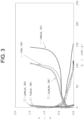
- FIG. 3 A discharge capacity at the first cycle, and a ratio of the discharge capacity to the charge capacity (initial efficiency) are shown in Table 1.
- FIG. 3 and Table 1 show that the cell A1 has a capacity density of 145 mAh/g. Also, the initial efficiency was high, which was 79 %.
- a cell A2 was fabricated and evaluated in the same manner as in Example 1, except that the obtained intermetallic compound (CeSi 2 ) was used as the negative electrode active material.
- the charge-discharge curve at the first cycle is shown in FIG. 3 .
- the discharge capacity at the first cycle, and the initial efficiency are shown in Table 1.
- FIG. 3 and Table 1 show that that the cell A2 has a capacity density of approximately 105 mAh/g.
- the cell A2 is more excellent in the flatness of the discharge curve than a below-described cell B1.
- the initial efficiency was high, which was about 75%.
- a cell B1 was fabricated and evaluated in the same manner as in Example 1, except that an intermetallic compound (La 3 Ni 2 Sn 7 ) having a crystal structure as shown in FIG. 4 was used as the negative electrode active material.
- the charge-discharge curve at the first cycle is shown in FIG. 3 .
- the discharge capacity at the first cycle, and the initial efficiency are shown in Table 1.
- La 3 Ni 2 Sn 7 has a symmetry belonging to the Cmmm space group.
- One cage structure is included at the center of the unit lattice; however, the central atom is La, and 12 Sn atoms are arranged in a cage-like form so as to surround La. Since La 3 Ni 2 Sn 7 contains Sn as a major component, the capacity density is small, and the cell A1 of Example 1 is more excellent than the cell B1 in terms of the capacity density and the initial efficiency.
- a cell B2 was fabricated and evaluated in the same manner as in Example 1, except that an intermetallic compound (Ti 4 Ni 4 Si 7 ) having a crystal structure as shown in FIG. 5 was used as the negative electrode active material.
- the charge-discharge curve at the first cycle is shown in FIG. 3 .
- the discharge capacity at the first cycle, and the initial efficiency are shown in Table 1.
- Ti 4 Ni 4 Si 7 is an intermetallic compound containing Ti in place of Ce, and has a crystal structure significantly different from that of CeNi 2 Si 2 . Also, Ti 4 Ni 4 Si 7 has almost no electrochemical activity. This indicates that a capacity density as high as that of CeNi 2 Si 2 cannot be obtained simply because the kinds of elements are in common.
- a cell B3 was fabricated and evaluated in the same manner as in Example 1, except that an intermetallic compound (LaMn 2 Si 2 ) having a crystal structure as shown in FIG. 6 was used as the negative electrode active material.
- the charge-discharge curve at the first cycle is shown in FIG. 3 .
- the discharge capacity at the first cycle, and the initial efficiency are shown in Table 1.
- LaMn 2 Si 2 has a cage structure, the central atom is La, and 10 Si atoms and 8 Ni atoms are arranged in a cage-like form so as to surround La.
- LaMn 2 Si 2 has a symmetry similar to that of CeNi 2 Si 2 , and is also similar thereto in the crystal structure.
- LaMn 2 Si 2 has almost no electrochemical activity. This indicates that the capacity density greatly depends on the kinds of elements.
- X-ray diffraction patterns of the intermetallic compounds CS-1 and CS-2 are shown in FIG. 7 .
- the X-ray diffraction patterns of the Fe-containing intermetallic compounds CS are substantially the same as that of the intermetallic compound CS of Example 2 with no addition of a predetermined amount of Fe, and no significant difference was observed. It can be said therefore that the intermetallic compounds CS-1 and CS-2 have a crystal structure approximately the same as shown in FIG. 1B .
- Example 3 a cell A3 of Example 3 and a cell A4 of Example 4 were fabricated in the same manner as in Example 1, except that the intermetallic compound CS-1 and the intermetallic compound CS-2 were respectively used as the negative electrode active material.
- the negative electrode was charged to 0.01 V at 0.5 mA, which was a rate higher than that in Examples 1 and 2 and Comparative Examples 1 to 3, and subsequently, the negative electrode was discharged to 1.5 V
- the charge-discharge curves at this first charge-discharge cycle are shown in FIG. 8 .
- the discharge capacities at the first cycle are shown in Table 2.
- Table 2 the Fe content of A2 is indicated as "-", as Fe was not added when obtaining the intermetallic compound CS.
- FIG. 8 and Table 2 show that the addition of a small amount of Fe in the intermetallic compound CS can increase the discharge capacity.
- the Fe content in the intermetallic compound CS has increased, the discharge capacity has dropped. It can be seen therefore that the Fe content is desirably 0.001 mass% or more and 0.3 mass% or less, more desirably 0.001 mass% or more and 0.1 mass% or less.
- CeSi 2 of Example 2 was used as the base of the intermetallic compound CS in the above Examples 3 and 4, a similar tendency can be observed when CeNi 2 Si 2 of Example 1 is used as the base, in terms of the improvement in capacity and the stability of the negative electrode slurry.
- the negative electrode active material for a secondary battery according to the present disclosure is useful as a negative electrode active material for a secondary battery used in mobile applications (e.g., electric cars, mobile communication devices, portable electronic devices).
- mobile applications e.g., electric cars, mobile communication devices, portable electronic devices.
Landscapes
- Chemical & Material Sciences (AREA)
- Chemical Kinetics & Catalysis (AREA)
- General Chemical & Material Sciences (AREA)
- Electrochemistry (AREA)
- Engineering & Computer Science (AREA)
- Materials Engineering (AREA)
- Organic Chemistry (AREA)
- Mechanical Engineering (AREA)
- Metallurgy (AREA)
- Inorganic Chemistry (AREA)
- Manufacturing & Machinery (AREA)
- Composite Materials (AREA)
- Battery Electrode And Active Subsutance (AREA)
Applications Claiming Priority (3)
| Application Number | Priority Date | Filing Date | Title |
|---|---|---|---|
| JP2020146293 | 2020-08-31 | ||
| JP2020162564 | 2020-09-28 | ||
| PCT/JP2021/030981 WO2022045128A1 (ja) | 2020-08-31 | 2021-08-24 | 二次電池用負極活物質および二次電池 |
Publications (2)
| Publication Number | Publication Date |
|---|---|
| EP4205884A1 true EP4205884A1 (de) | 2023-07-05 |
| EP4205884A4 EP4205884A4 (de) | 2024-02-21 |
Family
ID=80353717
Family Applications (1)
| Application Number | Title | Priority Date | Filing Date |
|---|---|---|---|
| EP21861553.2A Pending EP4205884A4 (de) | 2020-08-31 | 2021-08-24 | Negativelektrodenaktivmaterial für sekundärbatterien und sekundärbatterie |
Country Status (5)
| Country | Link |
|---|---|
| US (1) | US12614721B2 (de) |
| EP (1) | EP4205884A4 (de) |
| JP (1) | JP7796333B2 (de) |
| CN (1) | CN116018223A (de) |
| WO (1) | WO2022045128A1 (de) |
Families Citing this family (1)
| Publication number | Priority date | Publication date | Assignee | Title |
|---|---|---|---|---|
| CN118575299A (zh) * | 2022-01-31 | 2024-08-30 | 松下知识产权经营株式会社 | 锂离子电池 |
Family Cites Families (8)
| Publication number | Priority date | Publication date | Assignee | Title |
|---|---|---|---|---|
| US6235427B1 (en) * | 1998-05-13 | 2001-05-22 | Fuji Photo Film Co., Ltd. | Nonaqueous secondary battery containing silicic material |
| EP1028476A4 (de) | 1998-09-08 | 2007-11-28 | Sumitomo Metal Ind | Negatives elektroden-material für nichtwässerige elektroden, sekundäre batterie und verfahren für deren herstellung |
| JP3769277B2 (ja) * | 2003-04-17 | 2006-04-19 | 株式会社東芝 | 非水電解質二次電池 |
| JP4127692B2 (ja) * | 2004-03-23 | 2008-07-30 | 株式会社東芝 | 非水電解質二次電池 |
| US8287772B2 (en) * | 2009-05-14 | 2012-10-16 | 3M Innovative Properties Company | Low energy milling method, low crystallinity alloy, and negative electrode composition |
| WO2011155770A2 (ko) | 2010-06-10 | 2011-12-15 | 주식회사 엘지화학 | 리튬 이차전지용 음극 활물질 및 이를 구비하는 리튬 이차전지 |
| JP5318129B2 (ja) | 2011-02-07 | 2013-10-16 | 株式会社東芝 | 非水電解質電池用電極材料およびその製造方法、非水電解質電池用電極および非水電解質電池 |
| WO2016035290A1 (ja) | 2014-09-03 | 2016-03-10 | 三洋電機株式会社 | 非水電解質二次電池用負極活物質及び非水電解質二次電池 |
-
2021
- 2021-08-24 US US18/014,842 patent/US12614721B2/en active Active
- 2021-08-24 EP EP21861553.2A patent/EP4205884A4/de active Pending
- 2021-08-24 CN CN202180053184.6A patent/CN116018223A/zh active Pending
- 2021-08-24 JP JP2022544623A patent/JP7796333B2/ja active Active
- 2021-08-24 WO PCT/JP2021/030981 patent/WO2022045128A1/ja not_active Ceased
Also Published As
| Publication number | Publication date |
|---|---|
| CN116018223A (zh) | 2023-04-25 |
| JP7796333B2 (ja) | 2026-01-09 |
| US20230275220A1 (en) | 2023-08-31 |
| EP4205884A4 (de) | 2024-02-21 |
| US12614721B2 (en) | 2026-04-28 |
| JPWO2022045128A1 (de) | 2022-03-03 |
| WO2022045128A1 (ja) | 2022-03-03 |
Similar Documents
| Publication | Publication Date | Title |
|---|---|---|
| US6872491B2 (en) | Positive electrode active material and lithium ion secondary battery | |
| US20050079417A1 (en) | Negative active material for non-aqueous electrolyte battery, method of preparing same, and non-aqueous electrolyte battery comprising same | |
| US20080193831A1 (en) | Anode active material, method of preparing the same, anode and lithium battery containing the material | |
| KR101047450B1 (ko) | 리튬 이차 전지용 음극 활물질, 이의 제조방법 및 이를 포함하는 리튬 이차 전지 | |
| JP2018116930A (ja) | 正極活物質、および、電池 | |
| US10811671B2 (en) | Positive-electrode active material and battery | |
| JPWO2018198410A1 (ja) | 正極活物質、および、電池 | |
| US8148014B2 (en) | Composite anode active material, method of preparing the same, and anode and lithium battery containing the material | |
| US9893356B2 (en) | Cathode active material for nonaqueous electrolyte secondary battery, nonaqueous electrolyte secondary battery, and method of producing cathode active material for nonaqueous electrolyte secondary battery | |
| US20250140817A1 (en) | Negative electrode active material for secondary battery, and secondary battery | |
| US11588177B2 (en) | Solid-state electrolyte, solid-state battery including the electrolyte, and method of making the same | |
| US12614721B2 (en) | Negative-electrode active material for secondary batteries, and secondary battery | |
| KR101134566B1 (ko) | 신규한 리튬 이차전지용 양극 활물질 및 이를 이용한 리튬 이차전지용 양극 박막의 제조방법 | |
| CN115119527A (zh) | 锂过渡金属氧化物、锂二次电池用正极添加剂以及包含其的锂二次电池 | |
| JP3530174B2 (ja) | 正極活物質及びリチウムイオン二次電池 | |
| KR100681465B1 (ko) | 고용량 및 장수명 특성을 갖는 전극활물질 및 이를포함하는 리튬 이차 전지 | |
| KR20120088280A (ko) | 리튬 이차 전지용 양극 활물질 및 이를 포함하는 리튬 이차 전지 | |
| KR101224618B1 (ko) | 리튬 이차전지용 양극 활물질, 리튬 이차전지용 양극, 리튬 이차전지 및 이들의 제조방법 | |
| EP4205885A1 (de) | Negativelektrodenaktivmaterial für sekundärbatterien und sekundärbatterie | |
| US20230411618A1 (en) | Negative electrode active material for nonaqueous electrolyte secondary batteries, and nonaqueous electrolyte secondary battery | |
| JP4561040B2 (ja) | 非水電解質二次電池 | |
| US9397336B2 (en) | Battery active material comprising a crystal phase having a Ruddlesden-Popper structure and battery including the same | |
| JP3984184B2 (ja) | 非水電解質二次電池 | |
| KR101443500B1 (ko) | 리튬금속산화물 및 이를 포함하는 리튬이차전지 | |
| JP2004087385A (ja) | 非水電解質二次電池 |
Legal Events
| Date | Code | Title | Description |
|---|---|---|---|
| STAA | Information on the status of an ep patent application or granted ep patent |
Free format text: STATUS: THE INTERNATIONAL PUBLICATION HAS BEEN MADE |
|
| PUAI | Public reference made under article 153(3) epc to a published international application that has entered the european phase |
Free format text: ORIGINAL CODE: 0009012 |
|
| STAA | Information on the status of an ep patent application or granted ep patent |
Free format text: STATUS: REQUEST FOR EXAMINATION WAS MADE |
|
| 17P | Request for examination filed |
Effective date: 20230120 |
|
| AK | Designated contracting states |
Kind code of ref document: A1 Designated state(s): AL AT BE BG CH CY CZ DE DK EE ES FI FR GB GR HR HU IE IS IT LI LT LU LV MC MK MT NL NO PL PT RO RS SE SI SK SM TR |
|
| DAV | Request for validation of the european patent (deleted) | ||
| DAX | Request for extension of the european patent (deleted) | ||
| A4 | Supplementary search report drawn up and despatched |
Effective date: 20240122 |
|
| RIC1 | Information provided on ipc code assigned before grant |
Ipc: H01M 4/38 20060101ALI20240116BHEP Ipc: C22C 19/03 20060101ALI20240116BHEP Ipc: C22C 30/00 20060101ALI20240116BHEP Ipc: C22C 28/00 20060101ALI20240116BHEP Ipc: C01B 33/06 20060101ALI20240116BHEP Ipc: B22F 5/00 20060101AFI20240116BHEP |