EP4204246B1 - Antriebsvorrichtung für eine elektrifizierte fahrzeugachse - Google Patents
Antriebsvorrichtung für eine elektrifizierte fahrzeugachse Download PDFInfo
- Publication number
- EP4204246B1 EP4204246B1 EP22733967.8A EP22733967A EP4204246B1 EP 4204246 B1 EP4204246 B1 EP 4204246B1 EP 22733967 A EP22733967 A EP 22733967A EP 4204246 B1 EP4204246 B1 EP 4204246B1
- Authority
- EP
- European Patent Office
- Prior art keywords
- module
- bolt
- drive device
- stop sleeve
- cantilever end
- Prior art date
- Legal status (The legal status is an assumption and is not a legal conclusion. Google has not performed a legal analysis and makes no representation as to the accuracy of the status listed.)
- Active
Links
Images




Classifications
-
- F—MECHANICAL ENGINEERING; LIGHTING; HEATING; WEAPONS; BLASTING
- F16—ENGINEERING ELEMENTS AND UNITS; GENERAL MEASURES FOR PRODUCING AND MAINTAINING EFFECTIVE FUNCTIONING OF MACHINES OR INSTALLATIONS; THERMAL INSULATION IN GENERAL
- F16H—GEARING
- F16H57/00—General details of gearing
- F16H57/02—Gearboxes; Mounting gearing therein
- F16H57/028—Gearboxes; Mounting gearing therein characterised by means for reducing vibration or noise
-
- B—PERFORMING OPERATIONS; TRANSPORTING
- B60—VEHICLES IN GENERAL
- B60K—ARRANGEMENT OR MOUNTING OF PROPULSION UNITS OR OF TRANSMISSIONS IN VEHICLES; ARRANGEMENT OR MOUNTING OF PLURAL DIVERSE PRIME-MOVERS IN VEHICLES; AUXILIARY DRIVES FOR VEHICLES; INSTRUMENTATION OR DASHBOARDS FOR VEHICLES; ARRANGEMENTS IN CONNECTION WITH COOLING, AIR INTAKE, GAS EXHAUST OR FUEL SUPPLY OF PROPULSION UNITS IN VEHICLES
- B60K1/00—Arrangement or mounting of electrical propulsion units
-
- B—PERFORMING OPERATIONS; TRANSPORTING
- B60—VEHICLES IN GENERAL
- B60K—ARRANGEMENT OR MOUNTING OF PROPULSION UNITS OR OF TRANSMISSIONS IN VEHICLES; ARRANGEMENT OR MOUNTING OF PLURAL DIVERSE PRIME-MOVERS IN VEHICLES; AUXILIARY DRIVES FOR VEHICLES; INSTRUMENTATION OR DASHBOARDS FOR VEHICLES; ARRANGEMENTS IN CONNECTION WITH COOLING, AIR INTAKE, GAS EXHAUST OR FUEL SUPPLY OF PROPULSION UNITS IN VEHICLES
- B60K11/00—Arrangement in connection with cooling of propulsion units
- B60K11/02—Arrangement in connection with cooling of propulsion units with liquid cooling
-
- F—MECHANICAL ENGINEERING; LIGHTING; HEATING; WEAPONS; BLASTING
- F16—ENGINEERING ELEMENTS AND UNITS; GENERAL MEASURES FOR PRODUCING AND MAINTAINING EFFECTIVE FUNCTIONING OF MACHINES OR INSTALLATIONS; THERMAL INSULATION IN GENERAL
- F16H—GEARING
- F16H57/00—General details of gearing
- F16H57/04—Features relating to lubrication or cooling or heating
- F16H57/0467—Elements of gearings to be lubricated, cooled or heated
- F16H57/0476—Electric machines and gearing, i.e. joint lubrication or cooling or heating thereof
-
- B—PERFORMING OPERATIONS; TRANSPORTING
- B60—VEHICLES IN GENERAL
- B60K—ARRANGEMENT OR MOUNTING OF PROPULSION UNITS OR OF TRANSMISSIONS IN VEHICLES; ARRANGEMENT OR MOUNTING OF PLURAL DIVERSE PRIME-MOVERS IN VEHICLES; AUXILIARY DRIVES FOR VEHICLES; INSTRUMENTATION OR DASHBOARDS FOR VEHICLES; ARRANGEMENTS IN CONNECTION WITH COOLING, AIR INTAKE, GAS EXHAUST OR FUEL SUPPLY OF PROPULSION UNITS IN VEHICLES
- B60K1/00—Arrangement or mounting of electrical propulsion units
- B60K2001/001—Arrangement or mounting of electrical propulsion units one motor mounted on a propulsion axle for rotating right and left wheels of this axle
-
- B—PERFORMING OPERATIONS; TRANSPORTING
- B60—VEHICLES IN GENERAL
- B60Y—INDEXING SCHEME RELATING TO ASPECTS CROSS-CUTTING VEHICLE TECHNOLOGY
- B60Y2306/00—Other features of vehicle sub-units
- B60Y2306/03—Lubrication
-
- F—MECHANICAL ENGINEERING; LIGHTING; HEATING; WEAPONS; BLASTING
- F16—ENGINEERING ELEMENTS AND UNITS; GENERAL MEASURES FOR PRODUCING AND MAINTAINING EFFECTIVE FUNCTIONING OF MACHINES OR INSTALLATIONS; THERMAL INSULATION IN GENERAL
- F16H—GEARING
- F16H57/00—General details of gearing
- F16H57/02—Gearboxes; Mounting gearing therein
- F16H2057/02026—Connection of auxiliaries with a gear case; Mounting of auxiliaries on the gearbox
-
- F—MECHANICAL ENGINEERING; LIGHTING; HEATING; WEAPONS; BLASTING
- F16—ENGINEERING ELEMENTS AND UNITS; GENERAL MEASURES FOR PRODUCING AND MAINTAINING EFFECTIVE FUNCTIONING OF MACHINES OR INSTALLATIONS; THERMAL INSULATION IN GENERAL
- F16H—GEARING
- F16H57/00—General details of gearing
- F16H57/02—Gearboxes; Mounting gearing therein
- F16H2057/02034—Gearboxes combined or connected with electric machines
-
- F—MECHANICAL ENGINEERING; LIGHTING; HEATING; WEAPONS; BLASTING
- F16—ENGINEERING ELEMENTS AND UNITS; GENERAL MEASURES FOR PRODUCING AND MAINTAINING EFFECTIVE FUNCTIONING OF MACHINES OR INSTALLATIONS; THERMAL INSULATION IN GENERAL
- F16H—GEARING
- F16H57/00—General details of gearing
- F16H57/02—Gearboxes; Mounting gearing therein
- F16H2057/02039—Gearboxes for particular applications
- F16H2057/02043—Gearboxes for particular applications for vehicle transmissions
- F16H2057/02052—Axle units; Transfer casings for four wheel drive
Definitions
- the invention relates to a drive device for an electrified vehicle axle of a vehicle according to the preamble of claim 1.
- An electrified vehicle axle of an at least partially electrically operated, two-track vehicle can have an electric machine that drives via a transmission on output shafts that lead to vehicle wheels of the vehicle axle.
- An oil module is also provided which supplies the electric machine and/or the transmission with oil.
- the electric machine, the gearbox and the oil module are assembled into a frame-shaped, vibration-resistant structural unit.
- the electric machine and the oil module are flanged to the transmission at an axial distance from one another.
- the electric machine has a radially projecting arm on its side axially opposite the transmission, which bridges a center distance to the oil module.
- the boom is connected to the oil module via screw points in a force-transmitting manner. In this way, operational vibrations in the frame-shaped structural unit can be reduced.
- the object of the invention is to provide a drive device in which assembly is possible in a simple manner, essentially free of component deformations.
- the invention is based on a drive device for an electrified vehicle axle, which has an electric machine, a transmission and a coolant and/or lubricant module that supplies the electric machine and/or the transmission with coolant and/or lubricant.
- the electric machine, the gearbox and the module are assembled into a vibration-resistant, frame-shaped structural unit.
- the electric machine and the coolant/lubricant module are flanged to the transmission at an axial distance from one another.
- the electric machine also has a radially projecting arm on its side axially opposite the transmission. This bridges a center distance to the module.
- a free boom end is connected to the module in a force-transmitting manner via at least one screw point.
- a stop element is provided at the boom end, which is stroke-adjustable between a non-use position and a support position. In the non-use position, the stop element is spaced from a module support surface via a free tolerance gap. In this way, a module that is still dismantled can be assembled with the structural unit without any interference contours.
- the stop element Before tightening the screw point, the stop element can be adjusted in stroke, using up the tolerance gap, until it comes into contact with the module support surface. This is followed by a screwing process in which the cantilever end and the module can be clamped together without any tolerance-related component deformations.
- the screw point can have a screw bolt. This can be guided through a screw hole in the boom end and its bolt shaft is in threaded engagement with a module-side Internal threaded hole can be made.
- the stop element can be a stop sleeve that is integrated directly into the screw point.
- the stop sleeve can have a thread-free inner circumference and an outer circumference with an external thread.
- the stop sleeve can be brought into threaded engagement with an internal thread of the boom end via its external thread.
- the bolt shank of the screw bolt can be guided directly through the stop sleeve.
- the end face of the stop sleeve can be brought into contact with an opening edge area of the internal threaded hole on the module side.
- the opening edge area of the internal threaded hole on the module side forms the module support surface, against which the stop sleeve is supported in its support position.
- the boom end together with the stop sleeve can be supported between the bolt head of the screw bolt and the opening edge area of the internal threaded hole on the module side.
- the bolt head can be supported directly on the end face of the stop sleeve facing away from the module.
- the bolt head can be supported independently of the stop sleeve on the opening edge area of the screw hole of the boom end.
- the stop sleeve can have a tool attachment on its end face facing away from the module, via which the stop sleeve can be screw-operated with the aid of a tool.
- the tool attachment of the stop sleeve and a tool attachment of the screw bolt can be in Be essentially the same. In this way, the stop sleeve and the screw bolt can be actuated with the same tool.
- the screw point can be aligned axially parallel to the electric machine axis or to the module axis.
- the boom end can be connected to the module via at least a second screw point. Their screw axis can be aligned at right angles to the screw axis of the first screw point.
- the second screw point can have a screw bolt which can be guided through a screw hole in the boom end and whose bolt shaft can be brought into threaded engagement with an internally threaded hole on the module side.
- transverse vibrations that is to say vibrations transverse to the axial direction of the screwing axis of the second screwing point
- the screwing point can be constructed as follows: A compensating sleeve with small hole play can be inserted into the screw hole of the boom end. Their sleeve length can be larger than the screw hole length of the boom end.
- the compensating sleeve when clamped, the compensating sleeve is supported between the bolt head and the opening edge area of the internal threaded hole on the module side.
- the boom end is mounted in sliding contact with the outer circumference of the compensating sleeve in an adjustable manner in the axial direction. Due to the small hole clearance between the compensating sleeve and the screw hole, transverse vibrations transverse to the axial direction are largely blocked.
- the electric machine is first brought into a flange connection with the gearbox. This creates a sufficiently large assembly clearance between the boom end of the electric machine and the gearbox.
- the module is inserted into this assembly clearance without any interference contours.
- a second process step in which the module is advanced by one feed stroke in the axial direction to the assembly position in which the flange connection is made between the module and the gearbox.
- the end of the boom is clamped to the module at the screwing point.
- the electric machine is also assigned power electronics. This can be arranged in a space-saving manner on the top of the frame-shaped structural unit and span the interior of the frame-shaped structural unit.
- a double-function contact housing for electrical supply lines can also be integrated into the boom. With the help of the electrical supply lines, the power electronics are electrically connected to the electric machine.
- a drive device for a vehicle axle of a two-track vehicle is shown in a simplified block diagram.
- the vehicle axle has an electric machine 1 which, when installed transversely, is arranged axially parallel to the drive shafts 3, 4 guided to the vehicle wheels.
- the rotor shaft 5 of the electric machine 1 is in operational connection with the two drive shafts 3, 4 via a gear 7.
- the transmission 7 has a double spur gear stage, which is in driving connection with an input-side gear 9 of an axle differential 11.
- the axle differential 11 drives on both sides of the drive shafts 3, 4 which are guided to the vehicle wheels.
- the drive device has an oil module 13, the structure of which is described below only to the extent that it is necessary for understanding the invention.
- the oil module 13 has an oil tank 15, which is connected to a pressure pump 17 via a suction line.
- a pressure line leads from the pressure pump 17 to a branching point at which the pressure line branches off into supply lines 19, 21.
- Oil is fed to the meshing points of the gearbox 7 via the supply line 19.
- the oil drips from there and collects in a lubricating oil sump 23.
- the oil is fed into the electric machine 1 via the supply line 21. From there the oil also flows towards oil sump 23.
- the oil collected in the oil sump 23 is returned to the oil tank 15 with the help of a return pump 25.
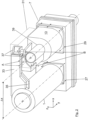
- the electric machine 1, the gearbox 7 and the oil module 13 are assembled into a frame-shaped structural unit.
- the electric machine 1 and the oil module 13 are flanged to one another via flange connections 27, 29 on the transmission 7, spaced apart from one another by an axial distance ⁇ x.
- the electric machine 1 is assigned power electronics 31 (indicated by a dotted line). This is located on the top of the frame-shaped structural unit and spans the interior of the frame-shaped structural unit.
- the power electronics 31 is connected to the electric machine 1 via electrical supply lines, which run within a contact housing 33 in FIG.
- the contact housing 33 is part of a cantilever 35, which protrudes radially on the side of the electric machine axially opposite the transmission 7.
- the boom 35 bridges the axis distance ⁇ x to the oil module 13.
- a free boom end 37 is connected to the oil module 13 in a force-transmitting manner via a total of four screw points A, B in order to reduce operational vibrations in the structural unit.
- the screw points are divided into a total of two first screw points A and two second screw points B.
- the screw axes of the first screw points A are aligned in the vertical direction z.
- the screw axes of the screw points B are aligned in the axial direction of the electric machine 1 or the oil module 13.
- the oil module 13 has a shaft bushing 39 through which a drive shaft 3, 4, not shown, is guided up to the respective vehicle wheel.
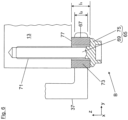
- the screw point A has a screw bolt 41. This is guided through a screw hole 43 of the boom end 37 and with its bolt shaft 45 in threaded engagement with an internally threaded hole 47 on the module side.
- a stop sleeve 49 is also assigned to the screw point A. This has a thread-free inner circumference and an outer circumference with an external thread 51. The stop sleeve 49 is in threaded engagement via its external thread 51 with an internal thread 53 of the screw hole 43 of the boom end 37.
- the bolt shaft 45 of the screw bolt 41 is guided through the stop sleeve 49.
- the stop sleeve 49 has a tool attachment 61 on its end face facing away from the oil module 13, via which the stop sleeve 49 can be screw-operated.
- the tool attachment 61 of the stop sleeve 49 and the tool attachment 63 of the screw bolt 41 are essentially designed in the same way with an internal polygon. Therefore, both the stop sleeve 49 and the screw bolt 41 can be actuated with the same tool.
- the second screw point B has a screw bolt 65, which is guided through a screw hole 67 of the boom end 37 and with its bolt shaft 69 is in threaded engagement with an internally threaded bore 71 on the module side.
- a compensating sleeve 73 with small hole clearance is inserted into the screw hole 67 of the boom end 37.
- Their sleeve length I 1 is larger than the screw hole length I 2 of the boom end 37.
- a clamped state is shown in which the compensating sleeve 73 is supported between the bolt head 75 of the screw bolt 67 and an opening edge region 77 of the internal threaded bore 71 on the module side.
- the boom end 37 is in sliding contact with the smooth cylindrical compensating sleeve outer circumference, so that a floating bearing in the axial direction results, but transverse vibrations transverse to the axial direction are largely blocked.
- Both the outer circumference and the inner circumference of the compensating sleeve 73 are smooth cylindrical or thread-free - the screw bolt 65 therefore extends through the compensating sleeve 73 without thread engagement.
- the structural unit is shown with the oil module 13 still dismantled.
- the unit has an assembly clearance f between the boom end 37 and the gear 7.
- the oil module 13 is inserted into the assembly clearance f in an assembly direction x without any interference contours.
- a second process step in which the oil module 13 is advanced by an advance stroke in the axial direction y into an assembly position.
- the flange connection 29 can be made between the oil module 13 and the transmission 7.
- the boom end 37 is clamped to the oil module 13 at the screw points A, B.
- the stop sleeve 49 is brought into contact with the opening edge area 55 of the internal threaded hole 47 on the module side (see Figure 3 ).
Landscapes
- Engineering & Computer Science (AREA)
- Mechanical Engineering (AREA)
- General Engineering & Computer Science (AREA)
- Chemical & Material Sciences (AREA)
- Combustion & Propulsion (AREA)
- Transportation (AREA)
- Vibration Prevention Devices (AREA)
- Arrangement Or Mounting Of Propulsion Units For Vehicles (AREA)
- Connection Of Motors, Electrical Generators, Mechanical Devices, And The Like (AREA)
- Connection Of Plates (AREA)
Description
- Die Erfindung betrifft eine Antriebsvorrichtung für eine elektrifizierte Fahrzeugachse eines Fahrzeugs nach dem Oberbegriff des Anspruches 1.
- Eine elektrifizierte Fahrzeugachse eines zumindest teilweise elektrisch betriebenen, zweispurigen Fahrzeugs kann eine Elektromaschine aufweisen, die über ein Getriebe auf Abtriebswellen abtreibt, die zu Fahrzeugrädern der Fahrzeugachse führen. Zudem ist ein Ölmodul vorgesehen, das die Elektromaschine und/oder das Getriebe mit Öl versorgt.
- In einer gattungsgemäßen Antriebsvorrichtung sind die Elektromaschine, das Getriebe sowie das Ölmodul zu einer rahmenförmigen, schwingungssteifen Baueinheit zusammengefügt. In dieser Baueinheit sind die Elektromaschine und das Ölmodul zueinander axial beabstandet am Getriebe angeflanscht. Zudem weist die Elektromaschine an ihrer, dem Getriebe axial gegenüberliegenden Seite einen radial abragenden Ausleger auf, der einen Achsabstand zum Ölmodul überbrückt. An seinem freien Ausleger-Ende ist der Ausleger über Schraubstellen kraftübertragend an dem Ölmodul angebunden. Auf diese Weise können betriebsbedingte Schwingungen in der rahmenförmigen Baueinheit reduziert werden.
- Aus der
DE 10 2004 014 787 A1 ist ein Ölmodul bekannt. Aus derDE 197 39 668 A1 ist ein Ölpumpenmodul bekannt. Aus derDE 10 2017 004 778 A1 ist eine toleranzausgleichende Verbindungsanordnung bekannt. - Die Aufgabe der Erfindung besteht darin, eine Antriebsvorrichtung bereitzustellen, bei der in einfacher Weise ein Zusammenbau im Wesentlichen frei von Bauteil-Verformungen ermöglicht ist.
- Die Aufgabe ist durch die Merkmale des Anspruches 1 gelöst. Bevorzugte Weiterbildungen der Erfindung sind in den Unteransprüchen offenbart.
- Die Erfindung geht von einer Antriebsvorrichtung für eine elektrifizierte Fahrzeugachse aus, die eine Elektromaschine, ein Getriebe sowie ein Kühl- und/oder Schmiermittel-Modul aufweist, das die Elektromaschine und/oder das Getriebe mit Kühl- und/oder Schmiermittel versorgt. Die Elektromaschine, das Getriebe und das Modul sind zu einer schwingungssteifen, rahmenförmigen Baueinheit zusammengefügt. In der Baueinheit sind die Elektromaschine und das Kühl-/Schmiermittel-Modul zueinander axial beabstandet am Getriebe angeflanscht. Die Elektromaschine weist zudem an ihrer, dem Getriebe axial gegenüberliegenden Seite einen radial abragenden Ausleger auf. Dieser überbrückt einen Achsabstand zum Modul. Ein freies Ausleger-Ende ist über zumindest eine Schraubstelle kraftübertragend an dem Modul angebunden. Auf diese Weise können betriebsbedingte Schwingungen in der Baueinheit reduziert werden. Gemäß dem kennzeichnenden Teil des Anspruches 1 ist am Ausleger-Ende ein Anschlagelement bereitgestellt, das zwischen einer Nichtgebrauchsstellung und einer Stützstellung hubverstellbar ist. Das Anschlagelement ist in der Nichtgebrauchsstellung über einen freien Toleranzspalt von einer Modul-Stützfläche beabstandet. Auf diese Weise kann ein noch demontiertes Modul störkonturfrei mit der Baueinheit zusammengebaut werden. Vor dem Festspannen der Schraubstelle kann das Anschlagelement unter Aufbrauch des Toleranzspalts bis in Anlage mit der Modul-Stützfläche hubverstellt werden. Anschließend folgt ein Schraubprozess, bei dem das Ausleger-Ende und das Modul frei von toleranzbedingten Bauteil-Verformungen miteinander verspannt werden können.
- In einer technischen Umsetzung kann die Schraubstelle einen Schraubbolzen aufweisen. Dieser ist durch ein Schraubloch des Ausleger-Endes führbar und mit seinem Bolzenschaft in Gewindeeingriff mit einer modulseitigen Innengewindebohrung bringbar. Im Hinblick auf eine bauraumgünstige Realisierung kann das Anschlagelement eine Anschlaghülse sein, die unmittelbar in der Schraubstelle integriert ist. In diesem Fall kann die Anschlaghülse einen gewindefreien Innenumfang sowie einen Außenumfang mit Außengewinde aufweisen. Die Anschlaghülse kann über ihr Außengewinde in Gewindeeingriff mit einem Innengewinde des Ausleger-Endes gebracht werden. Für eine kompakte Ausführung ist es bevorzugt, wenn die Anschlaghülse mit einem Innengewinde im Schraubloch des Ausleger-Endes in Gewindeeingriff bringbar ist. Zur Hubverstellung wird die Anschlaghülse vom Werker schraubbetätigt.
- In einer bauraumgünstigen Ausführungsform kann der Bolzenschaft des Schraubbolzens unmittelbar durch die Anschlaghülse geführt werden. In der Stützstellung kann die Anschlaghülse mit ihrer Stirnseite bis in Anlage mit einem Öffnungsrandbereich der modulseitigen Innengewindebohrung gebracht sein. In diesem Fall bildet der Öffnungsrandbereich der modulseitigen Innengewindebohrung die Modul-Stützfläche, gegenüber der die Anschlaghülse in ihrer Stützstellung abgestützt ist.
- Im festgespannten Zustand kann das Ausleger-Ende mitsamt Anschlaghülse zwischen dem Bolzenkopf des Schraubbolzens und dem Öffnungsrandbereich der modulseitigen Innengewindebohrung abgestützt sein. In einer ersten Variante kann der Bolzenkopf unmittelbar auf der vom Modul abgewandten Anschlaghülsen-Stirnseite abgestützt sein. Alternativ dazu kann der Bolzenkopf unabhängig von der Anschlaghülse auf dem Öffnungsrandbereich des Schraubloches des Ausleger-Endes abgestützt sein.
- Eine einfache Montagebetätigung der Anschlaghülse ist im Hinblick auf eine reduzierte Prozessdauer im Zusammenbauvorgang von Bedeutung. Vor diesem Hintergrund kann die Anschlaghülse an ihrer, von dem Modul abgewandten Stirnseite einen Werkzeugansatz aufweisen, über den die Anschlaghülse mit Hilfe eines Werkzeugs schraubbetätigbar ist. Zur weiteren Vereinfachung des Montagevorgangs kann der Werkzeugansatz der Anschlaghülse sowie ein Werkzeugansatz des Schraubbolzens im Wesentlichen gleich ausgeführt sein. Auf diese Weise kann die Anschlaghülse und der Schraubbolzen mit gleichem Werkzeug betätigbar sein.
- In einer technischen Umsetzung kann die Schraubstelle achsparallel zur Elektromaschinen-Achse bzw. zur Modul-Achse ausgerichtet sein. Zur weiteren Reduzierung von betriebsbedingten Schwingungen kann das Ausleger-Ende über zumindest zweite Schraubstelle mit dem Modul verbunden werden. Deren Schraubachse kann rechtwinklig zur Schraubachse der ersten Schraubstelle ausgerichtet sein.
- Die zweite Schraubstelle kann einen Schraubbolzen aufweisen, der durch ein Schraubloch des Ausleger-Endes führbar ist und mit seinem Bolzenschaft in Gewindeeingriff mit einer modulseitigen Innengewindebohrung bringbar ist. Mittels der zweiten Schraubstelle können insbesondere Querschwingungen, das heißt Schwingungen quer zur Achsrichtung der Schraubachse der zweiten Schraubstelle, blockiert werden. Hierzu kann die Schraubstelle wie folgt aufgebaut sein: So kann in das Schraubloch des Ausleger-Endes eine Ausgleichhülse mit geringem Lochspiel eingesetzt sein. Deren Hülsenlänge kann größer bemessen sein als die Schraubloch-Länge des Ausleger-Endes. Auf diese Weise stützt sich im festgespannten Zustand die Ausgleichshülse zwischen dem Bolzenkopf und dem Öffnungsrandbereich der modulseitigen Innengewindebohrung ab. Zudem ist das Ausleger-Ende in Gleitkontakt mit dem Ausgleichhülsen-Außenumfang in Achsrichtung verstellbar gelagert. Aufgrund des geringen Lochspiels zwischen der Ausgleichhülse und dem Schraubloch sind Querschwingungen quer zur Achsrichtung weitgehend blockiert.
- In einem Zusammenbauprozess wird zunächst die Elektromaschine in Flanschverbindung mit dem Getriebe gebracht. Dabei bildet sich ein ausreichend großer Montagefreigang zwischen dem Ausleger-Ende der Elektromaschine und dem Getriebe. In einem ersten Prozessschritt wird das Modul störkonturfrei in diesen Montagefreigang eingeführt. Anschließend folgt ein zweiter Prozessschritt, in dem das Modul um einen Zustellhub in Axialrichtung bis in die Montageposition zugestellt wird, in der die Flanschverbindung zwischen dem Modul und dem Getriebe hergestellt wird. In einem weiteren dritten Prozessschritt wird das Ausleger-Ende an der Schraubstelle mit dem Modul verspannt.
- Der Elektromaschine ist außerdem eine Leistungselektronik zugeordnet. Diese kann bauraumgünstig auf der Oberseite der rahmenförmigen Baueinheit angeordnet sein und den Innenraum der rahmenförmigen Baueinheit überspannen. In diesem Fall kann im Ausleger in Doppelfunktion zusätzlich ein Kontaktgehäuse für elektrische Versorgungsleitungen integriert sein. Mit Hilfe der elektrischen Versorgungsleitungen ist die Leistungselektronik mit der Elektromaschine elektrisch verbunden.
- Nachfolgend ist ein Ausführungsbeispiel der Erfindung anhand der beigefügten Figuren beschrieben.
- Es zeigen:
- Fig. 1
- in einem grob schematischen Blockschaltdiagramm die Antriebsvorrichtung der Erfindung;
- Fig. 2
- in einer perspektivischen Darstellung die Antriebsvorrichtung im zusammengebauten Zustand;
- Fig. 3 und 4
- eine Schraubstelle in unterschiedlichen Betriebszuständen;
- Fig. 5
- in einer Ansicht entsprechend der
Fig. 3 eine Variante der Schraubstelle; - Fig. 6
- eine weitere Schraubstelle; und
- Fig. 7
- in einer Ansicht entsprechend der
Fig. 2 die Antriebsvorrichtung mit noch demontiertem Ölmodul. - In der
Figur 1 ist in einem vereinfachten Blockschaltdiagramm eine Antriebsvorrichtung für eine Fahrzeugachse eines zweispurigen Fahrzeugs gezeigt. Die Fahrzeugachse weist eine Elektromaschine 1 auf, die im Quereinbau achsparallel zu den, zu den Fahrzeugrädern geführten Antriebswellen 3, 4 angeordnet ist. Die Rotorwelle 5 der Elektromaschine 1 ist über ein Getriebe 7 in trieblicher Verbindung mit den beiden Antriebswellen 3, 4. In derFigur 1 weist das Getriebe 7 eine doppelte Stirnradstufe auf, die in trieblicher Verbindung mit einem eingangsseitigen Zahnrad 9 eines Achsdifferenzials 11 ist. Das Achsdifferenzial 11 treibt beidseitig auf die zu den Fahrzeugrädern geführten Antriebswellen 3, 4 ab. Zudem weist die Antriebsvorrichtung ein Ölmodul 13 auf, dessen Aufbau nachfolgend nur insoweit beschrieben ist, als es für das Verständnis der Erfindung erforderlich ist. Demzufolge weist das Ölmodul 13 einen Öltank 15 auf, der über eine Saugleitung mit einer Druckpumpe 17 verbunden ist. Von der Druckpumpe 17 führt eine Druckleitung bis zu einer Verzweigungsstelle, an der sich die Druckleitung in Versorgungsleitungen 19, 21 aufgabelt. Über die Versorgungsleitung 19 wird Öl zu Zahneingriffsstellen des Getriebes 7 geführt. Von dort tropft das Öl ab und sammelt sich in einem Schmierölsumpf 23. Über die Versorgungsleitung 21 wird das Öl in die Elektromaschine 1 geführt. Von dort fließt das Öl ebenfalls in Richtung Ölsumpf 23 ab. Das im Ölsumpf 23 gesammelte Öl wird mit Hilfe einer Rückführpumpe 25 zurück in den Öltank 15 geführt. - In der
Figur 2 sind die Elektromaschine 1, das Getriebe 7 und das Ölmodul 13 zu einer rahmenförmigen Baueinheit zusammengefügt. In der Baueinheit sind die Elektromaschine 1 und das Ölmodul 13 zueinander über einen Axialabstand Δx beabstandet über Flanschverbindungen 27, 29 am Getriebe 7 angeflanscht. Der Elektromaschine 1 ist eine (mit gepunkteter Linie angedeutete) Leistungselektronik 31 zugeordnet. Diese befindet sich auf der Oberseite der rahmenförmigen Baueinheit und überspannt den Innenraum der rahmenförmigen Baueinheit. Die Leistungselektronik 31 ist mit der Elektromaschine 1 über elektrische Versorgungsleitungen verbunden, die in der Figur 2 innerhalb eines Kontaktgehäuses 33 verlaufen. Das Kontaktgehäuse 33 ist Bestandteil eines Auslegers 35, der auf der, dem Getriebe 7 axial gegenüberliegenden Elektromaschinen-Seite radial abragt. - Wie aus der
Figur 2 hervorgeht, überbrückt der Ausleger 35 den Achsabstand Δx zum Ölmodul 13. Ein freies Ausleger-Ende 37 ist über insgesamt vier Schraubstellen A, B kraftübertragend am Ölmodul 13 angebunden, um betriebsbedingte Schwingungen in der Baueinheit zu reduzieren. - Wie aus der
Figur 2 hervorgeht, sind die Schraubstellen in insgesamt zwei erste Schraubstellen A und zwei zweite Schraubstellen B aufgeteilt. Die Schraubachsen der ersten Schraubstellen A sind in der Hochrichtung z ausgerichtet. Die Schraubachsen der Schraubstellen B sind in der Achsrichtung der Elektromaschine 1 bzw. des Ölmoduls 13 ausgerichtet. In derFigur 2 weist das Ölmodul 13 eine Wellendurchführung 39 auf, durch die eine nicht gezeigte Antriebswelle 3, 4 bis zu dem jeweiligen Fahrzeugrad geführt ist. - Nachfolgend ist anhand der
Figur 3 der Aufbau einer der Schraubstellen A beschrieben. Demzufolge weist die Schraubstelle A einen Schraubbolzen 41 auf. Dieser ist durch ein Schraubloch 43 des Ausleger-Endes 37 geführt und mit seinem Bolzenschaft 45 in Gewindeeingriff mit einer modulseitigen Innengewindebohrung 47. Der Schraubstelle A ist ferner eine Anschlaghülse 49 zugeordnet. Diese weist einen gewindefreien Innenumfang sowie einen Außenumfang mit Außengewinde 51 auf. Die Anschlaghülse 49 ist über ihr Außengewinde 51 in Gewindeeingriff mit einem Innengewinde 53 des Schraubloches 43 des Ausleger-Endes 37. In derFigur 3 ist der Bolzenschaft 45 des Schraubbolzens 41 durch die Anschlaghülse 49 geführt. Durch Schraubbetätigung kann die Anschlaghülse 49 zwischen einer in derFigur 4 gezeigten Nichtgebrauchsstellung N und einer in derFigur 3 gezeigten Stützstellung S hubbetätigt werden. In der in derFigur 3 gezeigten Stützstellung S ist die Anschlaghülse 49 in Anlage mit einem Öffnungsrandbereich 55 der modulseitigen Innengewindebohrung 47. Der Bolzenkopf 57 des Schraubbolzens 41 ist in derFigur 3 auf dem Öffnungsrandbereich des Schraubloches 43 des Ausleger-Endes 37 abgestützt. Die Anschlaghülse 49 ragt mit einem Übermaß Δh aus dem Schraubloch 43 des Ausleger-Endes 37, mit dem Toleranzspalt Δy (Figur 4 ) zwischen dem Ausleger-Ende 37 und dem Ölmodul 13 überbrückt ist. - Die Anschlaghülse 49 weist an ihrer, von dem Ölmodul 13 abgewandten Stirnseite einen Werkzeugansatz 61 auf, über den die Anschlaghülse 49 schraubbetätigbar ist. Der Werkzeugansatz 61 der Anschlaghülse 49 sowie der Werkzeugansatz 63 des Schraubbolzens 41 sind im Wesentlichen gleich mit einem Innen-Mehrkant ausgebildet. Von daher sind sowohl die Anschlaghülse 49 als auch der Schraubbolzen 41 mit gleichem Werkzeug betätigbar.
- In der
Figur 3 befindet sich die vom Öffnungsrandbereich 55 der modulseitigen Innengewindebohrung 47 abgewandte Stirnseite der Anschlaghülse 49 innerhalb des Schraubloches 43 des Ausleger-Endes 37. Von daher ist in derFigur 3 der Bolzenkopf 57 des Schraubbolzens 41 unmittelbar auf dem Öffnungsrandbereich des Schraubloches 43 des Ausleger-Endes 37 abgestützt. Alternativ dazu ist in derFigur 5 eine Variante der Schraubstelle A gezeigt, in der die vom Öffnungsrandbereich 55 der modulseitigen Innengewindebohrung 47 abgewandte Stirnseite der Anschlaghülse 49 das Ausleger-Ende 37 mit einem Überstand a überragt. In diesem Fall ist der Bolzenkopf 57 des Schraubbolzens 41 unmittelbar auf der Anschlaghülse 49 abgestützt. - In der
Figur 6 ist der Aufbau einer der zweiten Schraubstellen B gezeigt. Demnach weist die zweite Schraubstelle B einen Schraubbolzen 65 auf, der durch ein Schraubloch 67 des Ausleger-Endes 37 geführt ist und mit seinem Bolzenschaft 69 in Gewindeeingriff mit einer modulseitigen Innengewindebohrung 71 ist. In das Schraubloch 67 des Ausleger-Endes 37 ist eine Ausgleichhülse 73 mit geringem Lochspiel eingesetzt. Deren Hülsenlänge I1 ist größer bemessen als die Schraubloch-Länge I2 des Ausleger-Endes 37. In derFigur 6 ist ein festgespannter Zustand gezeigt, bei dem die Ausgleichshülse 73 zwischen dem Bolzenkopf 75 des Schraubbolzens 67 und einem Öffnungsrandbereich 77 der modulseitigen Innengewindebohrung 71 abgestützt ist. In diesem Fall ist das Ausleger-Ende 37 in Gleitkontakt mit dem glattzylindrischen Ausgleichshülsen-Außenumfang, so dass sich eine schwimmende Lagerung in Achsrichtung ergibt, jedoch Querschwingungen quer zur Achsrichtung weitgehend blockiert sind. - Sowohl der Außenumfang als auch der Innenumfang der Ausgleichshülse 73 sind glattzylindrisch bzw. gewindefrei realisiert- Der Schraubbolzen 65 erstreckt sich daher ohne Gewindeeingriff durch die Ausgleichshülse 73.
- In der
Figur 7 ist die Baueinheit mit noch demontiertem Ölmodul 13 gezeigt. Die Baueinheit weist einen Montagefreigang f zwischen dem Ausleger-Ende 37 und dem Getriebe 7 auf. In einem ersten Prozessschritt wird das Ölmodul 13 störkonturfrei in einer Montagerichtung x in den Montagefreigang f eingeführt. Anschließend folgt ein zweiter Prozessschritt, bei dem das Ölmodul 13 um einen Zustellhub in Axialrichtung y bis in eine Montageposition zugestellt wird. In der Montageposition kann die Flanschverbindung 29 zwischen dem Ölmodul 13 und dem Getriebe 7 hergestellt werden. In einem abschließenden dritten Prozessschritt wird das Ausleger-Ende 37 an den Schraubstellen A, B mit dem Ölmodul 13 verspannt. Vor Durchführung des Spannvorgangs wird die Anschlaghülse 49 in Anlage mit dem Öffnungsrandbereich 55 der modulseitigen Innengewindebohrung 47 gebracht (sieheFigur 3 ). -
- 1
- Elektromaschine
- 3, 4
- Antriebswellen
- 5
- Rotorwelle
- 7
- Getriebe
- 9
- Eingangszahnrad
- 11
- Achsdifferenzial
- 13
- Ölmodul
- 15
- Öltank
- 17
- Druckpumpe
- 19, 21
- Versorgungsleitungen
- 23
- Ölsumpf
- 25
- Rücklaufpumpe
- 27, 29
- Flanschverbindungen
- 31
- Leistungselektronik
- 33
- Kontaktgehäuse
- 35
- Ausleger
- 37
- Ausleger-Ende
- 39
- Wellendurchführung
- 41
- Schraubbolzen
- 43
- Schraubloch
- 45
- Bolzenschaft
- 47
- modulseitige Innengewindebohrung
- 49
- Anschlaghülse
- 51
- Außengewinde
- 53
- Schraubloch-Innengewinde
- 55
- Öffnungsrandbereich
- 57
- Bolzenkopf
- 61, 63
- Werkzeugansätze
- 65
- Schraubbolzen
- 67
- Schraubloch
- 69
- Bolzenschaft
- 71
- modulseitige Innengewindebohrung
- 73
- Ausgleichhülse
- 75
- Bolzenkopf
- 77
- Öffnungsrandbereich
- Δx
- Achsabstand
- Δh
- Übermaß
- Δy
- Toleranzspalt
- f
- Montagefreigang
- I1
- Hülsen-Länge
- I2
- Schraubloch-Länge
- N
- Nichtgebrauchsstellung
- S
- Stützstellung
- A, B
- Schraubstellen
- a
- Überstand
Claims (11)
- Antriebsvorrichtung für eine elektrifizierte Fahrzeugachse eines Fahrzeugs, mit einer Elektromaschine (1), die über ein Getriebe (7) auf Antriebswellen (3, 4) abtreibt, die zu Fahrzeugrädern der Fahrzeugachse führen, und mit einem Kühl- und/oder Schmiermittel-Modul (13), das die Elektromaschine (1) und/oder das Getriebe (7) mit Kühl- und/oder Schmiermittel versorgt, wobei die Elektromaschine (1), das Getriebe (7) und das Modul (13) zu einer Baueinheit zusammengefügt sind, in der die Elektromaschine (1) und das Kühl-/Schmiermittel-Modul (13) zueinander axial beabstandet am Getriebe (7) angeflanscht sind, und wobei die Elektromaschine (1) an ihrer dem Getriebe (7) axial gegenüberliegenden Seite einen radial abragenden Ausleger (35) aufweist, der einen Achsabstand (Δx) zum Kühl-/Schmiermittel-Modul (13) überbrückt und der an seinem freien Ausleger-Ende (37) über zumindest eine Schraubstelle (A) kraftübertragend an dem Kühl-/Schmiermittel-Modul (13) angebunden ist, insbesondere um betriebsbedingte Schwingungen in der Baueinheit zu reduzieren,
dadurch gekennzeichnet,
dass am Ausleger-Ende (37) ein zwischen einer Nichtgebrauchsstellung (N) und einer Stützstellung (S) hubverstellbares Anschlagelement (49) bereitgestellt ist, und dass insbesondere das Anschlagelement (49) in der Nichtgebrauchsstellung (N) über einen freien Toleranzspalt von einem Öffnungsrandbereich (55) beabstandet ist, und dass insbesondere vor dem Festspannen der Schraubstelle (A) das Anschlagelement (49) unter Aufbrauch des Toleranzspalts bis in Anlage mit dem Öffnungsrandbereich (55) hubverstellbar ist, so dass das Ausleger-Ende (37) und das Modul (13) frei von toleranzbedingten Bauteil-Verformungen miteinander verspannbar sind. - Antriebsvorrichtung nach Anspruch 1, dadurch gekennzeichnet, dass die Schraubstelle (A) einen Schraubbolzen (41) aufweist, der durch ein Schraubloch (43) des Ausleger-Endes (37) führbar ist und mit seinem Bolzenschaft (45) in Gewindeeingriff mit einer modulseitigen Innengewindebohrung (47) bringbar ist.
- Antriebsvorrichtung nach Anspruch 2, dadurch gekennzeichnet, dass das Anschlagelement (49) eine Anschlaghülse ist, die einen gewindefreien Innenumfang sowie einen Außenumfang mit Außengewinde (51) aufweist, über das die Anschlaghülse (49) in Gewindeeingriff mit einem Innengewinde (53) des Ausleger-Endes (37) ist, und dass insbesondere das Innengewinde (53) im Schraubloch (43) des Ausleger-Endes (37) ausgebildet ist, und/oder dass insbesondere für eine Hubverstellung die Anschlaghülse (49) schraubbetätigbar ist.
- Antriebsvorrichtung nach Anspruch 3, dadurch gekennzeichnet, dass der Bolzenschaft (45) des Schraubbolzens (41) durch die Anschlaghülse (49) führbar ist, und/oder dass in der Stützstellung (S) eine Stirnseite der Anschlaghülse (49) in Anlage mit einem Öffnungsrandbereich (55) der Innengewindebohrung (47) des Moduls (13) ist, der die Modul-Stützfläche bildet.
- Antriebsvorrichtung nach Anspruch 3 oder 4, dadurch gekennzeichnet, dass im festgespannten Zustand das Ausleger-Ende (37) mitsamt Anschlaghülse (49) zwischen dem Bolzenkopf (57) des Schraubbolzens (41) und dem Öffnungsrandbereich (55) der Innengewindebohrung (47) des Moduls (13) abgestützt ist, und dass insbesondere der Bolzenkopf (57) unmittelbar auf der vom Modul (13) abgewandten Anschlaghülsen-Stirnseite abgestützt ist, oder dass der Bolzenkopf (57) unabhängig von der Anschlaghülse (49) auf dem Öffnungsrandbereich des Schraubloches (59) des Ausleger-Endes (37) abgestützt ist.
- Antriebsvorrichtung nach einem der Ansprüche 3, 4 oder 5, dadurch gekennzeichnet, dass die Anschlaghülse (49) an ihrer von dem Modul (13) abgewandten Stirnseite einen Werkzeugansatz (61) aufweist, über den die Anschlaghülse (49) schraubbetätigbar ist, und dass insbesondere der Werkzeugansatz (61) der Anschlaghülse (49) sowie ein Werkzeugansatz (63) des Schraubbolzens (41) im Wesentlichen gleich sind, so dass die Anschlaghülse (49) und der Schraubbolzen (41) mit gleichem Werkzeug betätigbar sind.
- Antriebsvorrichtung nach einem der vorhergehenden Ansprüche, dadurch gekennzeichnet, dass die Schraubstelle (A) achsparallel zur Elektromaschinen-Achse bzw. zur Modul-Achse ausgerichtet ist, und/oder dass insbesondere zur weiteren Reduzierung von betriebsbedingten Schwingungen das Ausleger-Ende (37) über zumindest eine zweite Schraubstelle (B) mit dem Modul (13) verbindbar ist, deren Schraubachse rechtwinklig zur Schraubachse der ersten Schraubstelle (A) ausgerichtet ist.
- Antriebsvorrichtung nach Anspruch 7, dadurch gekennzeichnet, dass die zweite Schraubstelle (B) einen Schraubbolzen (65) aufweist, der durch ein Schraubloch (67) des Ausleger-Endes (37) führbar ist und mit seinem Bolzenschaft (69) in Gewindeeingriff mit einer modulseitigen Innengewindebohrung (71) bringbar ist.
- Antriebsvorrichtung nach Anspruch 8, dadurch gekennzeichnet, dass in das Schraubloch (67) des Ausleger-Endes (37) eine Ausgleichshülse mit geringem Lochspiel eingesetzt ist, deren Hülsenlänge (I1) größer bemessen ist als die Schraubloch-Länge (I2) des Ausleger-Endes (37), und dass insbesondere im festgespannten Zustand die Ausgleichhülse (73) zwischen dem Bolzenkopf (75) und dem Öffnungsrandbereich (77) der modulseitigen Innengewindebohrung (71) abgestützt ist und das Ausleger-Ende (37) in Gleitkontakt mit dem Ausgleichhülsen-Außenumfang in Achsrichtung verstellbar ist, jedoch Querschwingungen quer zur Achsrichtung blockiert sind.
- Antriebsvorrichtung nach einem der vorhergehenden Ansprüche, dadurch gekennzeichnet, dass bei noch demontiertem Modul (13) die Baueinheit einen Montagefreigang (f) zwischen dem Ausleger-Ende (37) und dem Getriebe (7) aufweist, und dass in einem ersten Prozessschritt das Modul (13) störkonturfrei in den Montagefreigang (f) einführbar ist, in einem zweiten Prozessschritt das Modul (13) um einen Zustellhub in Axialrichtung bis in eine Montageposition zustellbar ist, in der die Flanschverbindung (29) zwischen dem Modul (13) und dem Getriebe (7) herstellbar ist, und in einem dritten Prozessschritt das Ausleger-Ende (37) an der Schraubstelle (A, B) mit dem Modul (13) verspannbar ist.
- Antriebsvorrichtung nach einem der vorhergehenden Ansprüche, dadurch gekennzeichnet, dass der Elektromaschine (1) eine Leistungselektronik (31) zugeordnet ist, die insbesondere auf der Oberseite der rahmenförmigen Baueinheit angeordnet ist, und dass der Ausleger (35) ein Kontaktgehäuse (33) für elektrische Versorgungsleitungen aufweist, über die die Leistungselektronik (31) mit der Elektromaschine (1) verbindbar ist.
Applications Claiming Priority (2)
| Application Number | Priority Date | Filing Date | Title |
|---|---|---|---|
| DE102021117059.1A DE102021117059B4 (de) | 2021-07-02 | 2021-07-02 | Antriebsvorrichtung für eine elektrifizierte Fahrzeugachse |
| PCT/EP2022/066646 WO2023274758A1 (de) | 2021-07-02 | 2022-06-20 | Antriebsvorrichtung für eine elektrifizierte fahrzeugachse |
Publications (2)
| Publication Number | Publication Date |
|---|---|
| EP4204246A1 EP4204246A1 (de) | 2023-07-05 |
| EP4204246B1 true EP4204246B1 (de) | 2023-12-20 |
Family
ID=82218475
Family Applications (1)
| Application Number | Title | Priority Date | Filing Date |
|---|---|---|---|
| EP22733967.8A Active EP4204246B1 (de) | 2021-07-02 | 2022-06-20 | Antriebsvorrichtung für eine elektrifizierte fahrzeugachse |
Country Status (5)
| Country | Link |
|---|---|
| US (1) | US12473966B2 (de) |
| EP (1) | EP4204246B1 (de) |
| CN (1) | CN116438091B (de) |
| DE (1) | DE102021117059B4 (de) |
| WO (1) | WO2023274758A1 (de) |
Families Citing this family (1)
| Publication number | Priority date | Publication date | Assignee | Title |
|---|---|---|---|---|
| DE102024121047A1 (de) * | 2024-07-24 | 2026-01-29 | Mahle International Gmbh | Leistungsmodul |
Family Cites Families (24)
| Publication number | Priority date | Publication date | Assignee | Title |
|---|---|---|---|---|
| US5821653A (en) * | 1995-12-21 | 1998-10-13 | Aisin Aw Co., Ltd. | Drive apparatus for electric vehicle |
| JP3348767B2 (ja) | 1997-08-22 | 2002-11-20 | トヨタ自動車株式会社 | ディスクブレーキ装置 |
| DE19739668A1 (de) | 1997-09-10 | 1999-03-11 | Daimler Benz Ag | Ölpumpenmodul |
| DE10034400A1 (de) | 2000-07-14 | 2002-01-24 | Daimler Chrysler Ag | Trockensumpfschmiereinrichtung |
| JP4096858B2 (ja) | 2002-10-23 | 2008-06-04 | 日産自動車株式会社 | 車両用電動モータの冷却装置 |
| US7488135B2 (en) * | 2003-07-29 | 2009-02-10 | Aoyama Seisakusho Co., Ltd. | Fastening device |
| JP4873598B2 (ja) * | 2003-07-29 | 2012-02-08 | 株式会社青山製作所 | 締結具 |
| DE102004014787A1 (de) | 2004-03-24 | 2005-10-13 | Mann + Hummel Gmbh | Ölmodul |
| DE202011005545U1 (de) | 2011-03-09 | 2013-06-21 | TAKATA Aktiengesellschaft | Lenkrad für ein Kraftfahrzeug |
| JP5617996B2 (ja) * | 2011-03-23 | 2014-11-05 | トヨタ自動車株式会社 | 車両用駆動装置 |
| JP5509289B2 (ja) | 2012-10-05 | 2014-06-04 | 本田技研工業株式会社 | 車両用駆動装置 |
| DE102016222094B4 (de) | 2016-11-10 | 2023-10-12 | Volkswagen Aktiengesellschaft | Batteriegehäuse für eine Traktionsbatterie eines elektrisch betriebenen Fahrzeugs |
| JP6551389B2 (ja) * | 2016-12-27 | 2019-07-31 | トヨタ自動車株式会社 | ハイブリッド車両の潤滑構造 |
| JP6285056B2 (ja) | 2017-01-18 | 2018-02-28 | Ntn株式会社 | ディスクブレーキ装置 |
| DE102017004778A1 (de) | 2017-05-18 | 2018-11-22 | Mann+Hummel Gmbh | Toleranzausgleichende Verbindungsanordnung und Bauteilanordnung, insbesondere eines motornahen Funktionsbauteils und eines Motorblocks |
| DE102018106799B4 (de) * | 2018-03-22 | 2022-02-17 | Dr. Ing. H.C. F. Porsche Aktiengesellschaft | Elektrischer Achsantrieb |
| DE102018209340B3 (de) * | 2018-06-12 | 2019-04-25 | Bayerische Motoren Werke Aktiengesellschaft | Betriebsstrategie für einen Mehrphasensystem-Inverter einer elektrischen Antriebseinheit für ein Kraftfahrzeug |
| DE102018211357B4 (de) * | 2018-07-10 | 2020-10-29 | Audi Ag | Schmiermittelversorgungssystem für eine Antriebsvorrichtung eines elektrisch betriebenen Fahrzeugs |
| DE102019115511A1 (de) * | 2019-06-07 | 2020-12-10 | Schaeffler Technologies AG & Co. KG | Elektrische Achse mit Beölungskonzept |
| DE102019117893B4 (de) * | 2019-07-03 | 2021-10-07 | Dr. Ing. H.C. F. Porsche Aktiengesellschaft | Antriebsstrang für ein Kraftfahrzeug mit einer direktgekühlten elektrischen Maschine und einem Getriebe, Kraftfahrzeug |
| DE102019211723A1 (de) * | 2019-08-05 | 2021-02-11 | Audi Ag | Traktionsbatterie für ein elektrisch betriebenes Fahrzeug sowie Toleranzausgleichseinheit |
| US11772480B2 (en) * | 2019-10-15 | 2023-10-03 | Drivetech Co., Ltd. | Transaxle-integrated cooling circulation system |
| CN212677022U (zh) * | 2020-05-13 | 2021-03-09 | 赛格威科技有限公司 | 一种动力总成 |
| JP7420054B2 (ja) * | 2020-11-09 | 2024-01-23 | トヨタ自動車株式会社 | 車両用トランスアクスル |
-
2021
- 2021-07-02 DE DE102021117059.1A patent/DE102021117059B4/de not_active Expired - Fee Related
-
2022
- 2022-06-20 EP EP22733967.8A patent/EP4204246B1/de active Active
- 2022-06-20 US US18/262,294 patent/US12473966B2/en active Active
- 2022-06-20 WO PCT/EP2022/066646 patent/WO2023274758A1/de not_active Ceased
- 2022-06-20 CN CN202280007317.0A patent/CN116438091B/zh active Active
Also Published As
| Publication number | Publication date |
|---|---|
| WO2023274758A1 (de) | 2023-01-05 |
| DE102021117059B4 (de) | 2023-03-30 |
| CN116438091B (zh) | 2026-01-02 |
| EP4204246A1 (de) | 2023-07-05 |
| DE102021117059A1 (de) | 2023-01-05 |
| US12473966B2 (en) | 2025-11-18 |
| US20240084886A1 (en) | 2024-03-14 |
| CN116438091A (zh) | 2023-07-14 |
Similar Documents
| Publication | Publication Date | Title |
|---|---|---|
| EP2720907B1 (de) | Befestigungselement mit toleranzausgleichsfunktion | |
| DE102019127242B4 (de) | Anordnung eines Getriebes und einer Elektromaschine | |
| DE102010043974A1 (de) | Getriebe-Antriebseinheit | |
| EP4204246B1 (de) | Antriebsvorrichtung für eine elektrifizierte fahrzeugachse | |
| EP2636911A1 (de) | Befestigungsanordnung | |
| WO2007131830A1 (de) | Vorrichtung und verfahren zur befestigung eines wischermotors an ein wischergestänge | |
| EP4029132B1 (de) | Elektrische antriebseinrichtung und antriebsanordnung | |
| EP1037775A1 (de) | Rohrplatine für eine wischeranlage | |
| DE19750920A1 (de) | Getriebekopfanordnung und Verfahren zur Montage derselben an einen Motor | |
| DE102014002570A1 (de) | Verfahren zum Montieren einer Ölwanne sowie Anordnung einer Ölwanne an einer durch ein Kurbelgehäuse und ein Schwungradgehäuse gebildeten Baugruppe | |
| WO2009115142A1 (de) | Handwerkzeugmaschine, insbesondere handgeführte schleifmaschine | |
| WO2020074256A1 (de) | Verfahren zum verbinden eines ersten bauteils mit einem zweiten bauteil | |
| EP3599388B1 (de) | Ladeeinrichtung | |
| DE19939255A1 (de) | Fahrzeugsitzvorrichtung | |
| EP3683441B1 (de) | Montageeinheit als baugruppe für eine schmierstoffpumpe | |
| EP4297986B1 (de) | Antriebsvorrichtung für eine fahrzeugachse | |
| DE102015004983A1 (de) | Trägerelement zum Aufnehmen von Kräften in einem Fahrzeug | |
| WO2017102201A1 (de) | Differentiallageranordnung zur lagerung eines differentialkorbes | |
| DE102021128585B4 (de) | Bauteilverbindung | |
| EP3686076A1 (de) | Getriebegehäuse und anordnung zur abstützung eines getriebes | |
| DE102019106426A1 (de) | Motorwellenlagerung für einen Elektromotor | |
| DE102008027510A1 (de) | Befestigungsvorrichtung für einen Fensterheberantrieb | |
| DE102009024830B4 (de) | Elektromechanische Lenkung | |
| DE202009011566U1 (de) | Schnellwechselvorrichtung zum manuellen und präzisen Wechseln von Bauteilen | |
| EP1334283A1 (de) | Gleitgelagerte, geschweisste baueinheit |
Legal Events
| Date | Code | Title | Description |
|---|---|---|---|
| STAA | Information on the status of an ep patent application or granted ep patent |
Free format text: STATUS: UNKNOWN |
|
| STAA | Information on the status of an ep patent application or granted ep patent |
Free format text: STATUS: THE INTERNATIONAL PUBLICATION HAS BEEN MADE |
|
| PUAI | Public reference made under article 153(3) epc to a published international application that has entered the european phase |
Free format text: ORIGINAL CODE: 0009012 |
|
| STAA | Information on the status of an ep patent application or granted ep patent |
Free format text: STATUS: REQUEST FOR EXAMINATION WAS MADE |
|
| 17P | Request for examination filed |
Effective date: 20230331 |
|
| AK | Designated contracting states |
Kind code of ref document: A1 Designated state(s): AL AT BE BG CH CY CZ DE DK EE ES FI FR GB GR HR HU IE IS IT LI LT LU LV MC MK MT NL NO PL PT RO RS SE SI SK SM TR |
|
| GRAP | Despatch of communication of intention to grant a patent |
Free format text: ORIGINAL CODE: EPIDOSNIGR1 |
|
| STAA | Information on the status of an ep patent application or granted ep patent |
Free format text: STATUS: GRANT OF PATENT IS INTENDED |
|
| INTG | Intention to grant announced |
Effective date: 20230711 |
|
| GRAS | Grant fee paid |
Free format text: ORIGINAL CODE: EPIDOSNIGR3 |
|
| GRAA | (expected) grant |
Free format text: ORIGINAL CODE: 0009210 |
|
| STAA | Information on the status of an ep patent application or granted ep patent |
Free format text: STATUS: THE PATENT HAS BEEN GRANTED |
|
| AK | Designated contracting states |
Kind code of ref document: B1 Designated state(s): AL AT BE BG CH CY CZ DE DK EE ES FI FR GB GR HR HU IE IS IT LI LT LU LV MC MK MT NL NO PL PT RO RS SE SI SK SM TR |
|
| DAV | Request for validation of the european patent (deleted) | ||
| DAX | Request for extension of the european patent (deleted) | ||
| REG | Reference to a national code |
Ref country code: GB Ref legal event code: FG4D Free format text: NOT ENGLISH |
|
| P01 | Opt-out of the competence of the unified patent court (upc) registered |
Effective date: 20231117 |
|
| REG | Reference to a national code |
Ref country code: DE Ref legal event code: R096 Ref document number: 502022000342 Country of ref document: DE |
|
| REG | Reference to a national code |
Ref country code: CH Ref legal event code: EP |
|
| REG | Reference to a national code |
Ref country code: IE Ref legal event code: FG4D Free format text: LANGUAGE OF EP DOCUMENT: GERMAN |
|
| PG25 | Lapsed in a contracting state [announced via postgrant information from national office to epo] |
Ref country code: GR Free format text: LAPSE BECAUSE OF FAILURE TO SUBMIT A TRANSLATION OF THE DESCRIPTION OR TO PAY THE FEE WITHIN THE PRESCRIBED TIME-LIMIT Effective date: 20240321 |
|
| REG | Reference to a national code |
Ref country code: LT Ref legal event code: MG9D |
|
| PG25 | Lapsed in a contracting state [announced via postgrant information from national office to epo] |
Ref country code: LT Free format text: LAPSE BECAUSE OF FAILURE TO SUBMIT A TRANSLATION OF THE DESCRIPTION OR TO PAY THE FEE WITHIN THE PRESCRIBED TIME-LIMIT Effective date: 20231220 |
|
| REG | Reference to a national code |
Ref country code: NL Ref legal event code: MP Effective date: 20231220 |
|
| PG25 | Lapsed in a contracting state [announced via postgrant information from national office to epo] |
Ref country code: ES Free format text: LAPSE BECAUSE OF FAILURE TO SUBMIT A TRANSLATION OF THE DESCRIPTION OR TO PAY THE FEE WITHIN THE PRESCRIBED TIME-LIMIT Effective date: 20231220 |
|
| PG25 | Lapsed in a contracting state [announced via postgrant information from national office to epo] |
Ref country code: LT Free format text: LAPSE BECAUSE OF FAILURE TO SUBMIT A TRANSLATION OF THE DESCRIPTION OR TO PAY THE FEE WITHIN THE PRESCRIBED TIME-LIMIT Effective date: 20231220 Ref country code: GR Free format text: LAPSE BECAUSE OF FAILURE TO SUBMIT A TRANSLATION OF THE DESCRIPTION OR TO PAY THE FEE WITHIN THE PRESCRIBED TIME-LIMIT Effective date: 20240321 Ref country code: FI Free format text: LAPSE BECAUSE OF FAILURE TO SUBMIT A TRANSLATION OF THE DESCRIPTION OR TO PAY THE FEE WITHIN THE PRESCRIBED TIME-LIMIT Effective date: 20231220 Ref country code: ES Free format text: LAPSE BECAUSE OF FAILURE TO SUBMIT A TRANSLATION OF THE DESCRIPTION OR TO PAY THE FEE WITHIN THE PRESCRIBED TIME-LIMIT Effective date: 20231220 Ref country code: BG Free format text: LAPSE BECAUSE OF FAILURE TO SUBMIT A TRANSLATION OF THE DESCRIPTION OR TO PAY THE FEE WITHIN THE PRESCRIBED TIME-LIMIT Effective date: 20240320 |
|
| PG25 | Lapsed in a contracting state [announced via postgrant information from national office to epo] |
Ref country code: NL Free format text: LAPSE BECAUSE OF FAILURE TO SUBMIT A TRANSLATION OF THE DESCRIPTION OR TO PAY THE FEE WITHIN THE PRESCRIBED TIME-LIMIT Effective date: 20231220 |
|
| PG25 | Lapsed in a contracting state [announced via postgrant information from national office to epo] |
Ref country code: SE Free format text: LAPSE BECAUSE OF FAILURE TO SUBMIT A TRANSLATION OF THE DESCRIPTION OR TO PAY THE FEE WITHIN THE PRESCRIBED TIME-LIMIT Effective date: 20231220 Ref country code: RS Free format text: LAPSE BECAUSE OF FAILURE TO SUBMIT A TRANSLATION OF THE DESCRIPTION OR TO PAY THE FEE WITHIN THE PRESCRIBED TIME-LIMIT Effective date: 20231220 Ref country code: NO Free format text: LAPSE BECAUSE OF FAILURE TO SUBMIT A TRANSLATION OF THE DESCRIPTION OR TO PAY THE FEE WITHIN THE PRESCRIBED TIME-LIMIT Effective date: 20240320 Ref country code: NL Free format text: LAPSE BECAUSE OF FAILURE TO SUBMIT A TRANSLATION OF THE DESCRIPTION OR TO PAY THE FEE WITHIN THE PRESCRIBED TIME-LIMIT Effective date: 20231220 Ref country code: LV Free format text: LAPSE BECAUSE OF FAILURE TO SUBMIT A TRANSLATION OF THE DESCRIPTION OR TO PAY THE FEE WITHIN THE PRESCRIBED TIME-LIMIT Effective date: 20231220 Ref country code: HR Free format text: LAPSE BECAUSE OF FAILURE TO SUBMIT A TRANSLATION OF THE DESCRIPTION OR TO PAY THE FEE WITHIN THE PRESCRIBED TIME-LIMIT Effective date: 20231220 |
|
| PG25 | Lapsed in a contracting state [announced via postgrant information from national office to epo] |
Ref country code: IS Free format text: LAPSE BECAUSE OF FAILURE TO SUBMIT A TRANSLATION OF THE DESCRIPTION OR TO PAY THE FEE WITHIN THE PRESCRIBED TIME-LIMIT Effective date: 20240420 |
|
| PG25 | Lapsed in a contracting state [announced via postgrant information from national office to epo] |
Ref country code: CZ Free format text: LAPSE BECAUSE OF FAILURE TO SUBMIT A TRANSLATION OF THE DESCRIPTION OR TO PAY THE FEE WITHIN THE PRESCRIBED TIME-LIMIT Effective date: 20231220 |
|
| PG25 | Lapsed in a contracting state [announced via postgrant information from national office to epo] |
Ref country code: SK Free format text: LAPSE BECAUSE OF FAILURE TO SUBMIT A TRANSLATION OF THE DESCRIPTION OR TO PAY THE FEE WITHIN THE PRESCRIBED TIME-LIMIT Effective date: 20231220 |
|
| PG25 | Lapsed in a contracting state [announced via postgrant information from national office to epo] |
Ref country code: SM Free format text: LAPSE BECAUSE OF FAILURE TO SUBMIT A TRANSLATION OF THE DESCRIPTION OR TO PAY THE FEE WITHIN THE PRESCRIBED TIME-LIMIT Effective date: 20231220 Ref country code: SK Free format text: LAPSE BECAUSE OF FAILURE TO SUBMIT A TRANSLATION OF THE DESCRIPTION OR TO PAY THE FEE WITHIN THE PRESCRIBED TIME-LIMIT Effective date: 20231220 Ref country code: RO Free format text: LAPSE BECAUSE OF FAILURE TO SUBMIT A TRANSLATION OF THE DESCRIPTION OR TO PAY THE FEE WITHIN THE PRESCRIBED TIME-LIMIT Effective date: 20231220 Ref country code: IT Free format text: LAPSE BECAUSE OF FAILURE TO SUBMIT A TRANSLATION OF THE DESCRIPTION OR TO PAY THE FEE WITHIN THE PRESCRIBED TIME-LIMIT Effective date: 20231220 Ref country code: IS Free format text: LAPSE BECAUSE OF FAILURE TO SUBMIT A TRANSLATION OF THE DESCRIPTION OR TO PAY THE FEE WITHIN THE PRESCRIBED TIME-LIMIT Effective date: 20240420 Ref country code: EE Free format text: LAPSE BECAUSE OF FAILURE TO SUBMIT A TRANSLATION OF THE DESCRIPTION OR TO PAY THE FEE WITHIN THE PRESCRIBED TIME-LIMIT Effective date: 20231220 Ref country code: CZ Free format text: LAPSE BECAUSE OF FAILURE TO SUBMIT A TRANSLATION OF THE DESCRIPTION OR TO PAY THE FEE WITHIN THE PRESCRIBED TIME-LIMIT Effective date: 20231220 |
|
| PG25 | Lapsed in a contracting state [announced via postgrant information from national office to epo] |
Ref country code: PT Free format text: LAPSE BECAUSE OF FAILURE TO SUBMIT A TRANSLATION OF THE DESCRIPTION OR TO PAY THE FEE WITHIN THE PRESCRIBED TIME-LIMIT Effective date: 20240422 Ref country code: PL Free format text: LAPSE BECAUSE OF FAILURE TO SUBMIT A TRANSLATION OF THE DESCRIPTION OR TO PAY THE FEE WITHIN THE PRESCRIBED TIME-LIMIT Effective date: 20231220 |
|
| PG25 | Lapsed in a contracting state [announced via postgrant information from national office to epo] |
Ref country code: PT Free format text: LAPSE BECAUSE OF FAILURE TO SUBMIT A TRANSLATION OF THE DESCRIPTION OR TO PAY THE FEE WITHIN THE PRESCRIBED TIME-LIMIT Effective date: 20240422 Ref country code: PL Free format text: LAPSE BECAUSE OF FAILURE TO SUBMIT A TRANSLATION OF THE DESCRIPTION OR TO PAY THE FEE WITHIN THE PRESCRIBED TIME-LIMIT Effective date: 20231220 |
|
| REG | Reference to a national code |
Ref country code: DE Ref legal event code: R097 Ref document number: 502022000342 Country of ref document: DE |
|
| PG25 | Lapsed in a contracting state [announced via postgrant information from national office to epo] |
Ref country code: DK Free format text: LAPSE BECAUSE OF FAILURE TO SUBMIT A TRANSLATION OF THE DESCRIPTION OR TO PAY THE FEE WITHIN THE PRESCRIBED TIME-LIMIT Effective date: 20231220 |
|
| PLBE | No opposition filed within time limit |
Free format text: ORIGINAL CODE: 0009261 |
|
| STAA | Information on the status of an ep patent application or granted ep patent |
Free format text: STATUS: NO OPPOSITION FILED WITHIN TIME LIMIT |
|
| PG25 | Lapsed in a contracting state [announced via postgrant information from national office to epo] |
Ref country code: SI Free format text: LAPSE BECAUSE OF FAILURE TO SUBMIT A TRANSLATION OF THE DESCRIPTION OR TO PAY THE FEE WITHIN THE PRESCRIBED TIME-LIMIT Effective date: 20231220 |
|
| PG25 | Lapsed in a contracting state [announced via postgrant information from national office to epo] |
Ref country code: SI Free format text: LAPSE BECAUSE OF FAILURE TO SUBMIT A TRANSLATION OF THE DESCRIPTION OR TO PAY THE FEE WITHIN THE PRESCRIBED TIME-LIMIT Effective date: 20231220 Ref country code: DK Free format text: LAPSE BECAUSE OF FAILURE TO SUBMIT A TRANSLATION OF THE DESCRIPTION OR TO PAY THE FEE WITHIN THE PRESCRIBED TIME-LIMIT Effective date: 20231220 |
|
| 26N | No opposition filed |
Effective date: 20240923 |
|
| PG25 | Lapsed in a contracting state [announced via postgrant information from national office to epo] |
Ref country code: MC Free format text: LAPSE BECAUSE OF FAILURE TO SUBMIT A TRANSLATION OF THE DESCRIPTION OR TO PAY THE FEE WITHIN THE PRESCRIBED TIME-LIMIT Effective date: 20231220 |
|
| PG25 | Lapsed in a contracting state [announced via postgrant information from national office to epo] |
Ref country code: LU Free format text: LAPSE BECAUSE OF NON-PAYMENT OF DUE FEES Effective date: 20240620 |
|
| PG25 | Lapsed in a contracting state [announced via postgrant information from national office to epo] |
Ref country code: IE Free format text: LAPSE BECAUSE OF NON-PAYMENT OF DUE FEES Effective date: 20240620 |
|
| PG25 | Lapsed in a contracting state [announced via postgrant information from national office to epo] |
Ref country code: BE Free format text: LAPSE BECAUSE OF NON-PAYMENT OF DUE FEES Effective date: 20240630 |
|
| REG | Reference to a national code |
Ref country code: BE Ref legal event code: MM Effective date: 20240630 |
|
| PGFP | Annual fee paid to national office [announced via postgrant information from national office to epo] |
Ref country code: DE Payment date: 20250630 Year of fee payment: 4 |
|
| PGFP | Annual fee paid to national office [announced via postgrant information from national office to epo] |
Ref country code: FR Payment date: 20250617 Year of fee payment: 4 |
|
| PGFP | Annual fee paid to national office [announced via postgrant information from national office to epo] |
Ref country code: AT Payment date: 20250721 Year of fee payment: 4 |
|
| PG25 | Lapsed in a contracting state [announced via postgrant information from national office to epo] |
Ref country code: CY Free format text: LAPSE BECAUSE OF FAILURE TO SUBMIT A TRANSLATION OF THE DESCRIPTION OR TO PAY THE FEE WITHIN THE PRESCRIBED TIME-LIMIT; INVALID AB INITIO Effective date: 20220620 |
|
| REG | Reference to a national code |
Ref country code: CH Ref legal event code: H13 Free format text: ST27 STATUS EVENT CODE: U-0-0-H10-H13 (AS PROVIDED BY THE NATIONAL OFFICE) Effective date: 20260127 |
|
| PG25 | Lapsed in a contracting state [announced via postgrant information from national office to epo] |
Ref country code: HU Free format text: LAPSE BECAUSE OF FAILURE TO SUBMIT A TRANSLATION OF THE DESCRIPTION OR TO PAY THE FEE WITHIN THE PRESCRIBED TIME-LIMIT; INVALID AB INITIO Effective date: 20220620 |
|
| PG25 | Lapsed in a contracting state [announced via postgrant information from national office to epo] |
Ref country code: CH Free format text: LAPSE BECAUSE OF NON-PAYMENT OF DUE FEES Effective date: 20250630 |