EP4201639B1 - Procédé et dispositif de chauffage d'ébauches en plastique au moyen d'une mesure d'absorption - Google Patents
Procédé et dispositif de chauffage d'ébauches en plastique au moyen d'une mesure d'absorption Download PDFInfo
- Publication number
- EP4201639B1 EP4201639B1 EP22212517.1A EP22212517A EP4201639B1 EP 4201639 B1 EP4201639 B1 EP 4201639B1 EP 22212517 A EP22212517 A EP 22212517A EP 4201639 B1 EP4201639 B1 EP 4201639B1
- Authority
- EP
- European Patent Office
- Prior art keywords
- plastic
- plastic preforms
- absorption
- transmission
- preforms
- Prior art date
- Legal status (The legal status is an assumption and is not a legal conclusion. Google has not performed a legal analysis and makes no representation as to the accuracy of the status listed.)
- Active
Links
Images
Classifications
-
- B—PERFORMING OPERATIONS; TRANSPORTING
- B29—WORKING OF PLASTICS; WORKING OF SUBSTANCES IN A PLASTIC STATE IN GENERAL
- B29C—SHAPING OR JOINING OF PLASTICS; SHAPING OF MATERIAL IN A PLASTIC STATE, NOT OTHERWISE PROVIDED FOR; AFTER-TREATMENT OF THE SHAPED PRODUCTS, e.g. REPAIRING
- B29C49/00—Blow-moulding, i.e. blowing a preform or parison to a desired shape within a mould; Apparatus therefor
- B29C49/42—Component parts, details or accessories; Auxiliary operations
- B29C49/64—Heating or cooling preforms, parisons or blown articles
- B29C49/6409—Thermal conditioning of preforms
- B29C49/6418—Heating of preforms
-
- B—PERFORMING OPERATIONS; TRANSPORTING
- B29—WORKING OF PLASTICS; WORKING OF SUBSTANCES IN A PLASTIC STATE IN GENERAL
- B29C—SHAPING OR JOINING OF PLASTICS; SHAPING OF MATERIAL IN A PLASTIC STATE, NOT OTHERWISE PROVIDED FOR; AFTER-TREATMENT OF THE SHAPED PRODUCTS, e.g. REPAIRING
- B29C49/00—Blow-moulding, i.e. blowing a preform or parison to a desired shape within a mould; Apparatus therefor
- B29C49/42—Component parts, details or accessories; Auxiliary operations
- B29C49/78—Measuring, controlling or regulating
- B29C49/80—Testing, e.g. for leaks
-
- B—PERFORMING OPERATIONS; TRANSPORTING
- B07—SEPARATING SOLIDS FROM SOLIDS; SORTING
- B07C—POSTAL SORTING; SORTING INDIVIDUAL ARTICLES, OR BULK MATERIAL FIT TO BE SORTED PIECE-MEAL, e.g. BY PICKING
- B07C5/00—Sorting according to a characteristic or feature of the articles or material being sorted, e.g. by control effected by devices which detect or measure such characteristic or feature; Sorting by manually actuated devices, e.g. switches
- B07C5/34—Sorting according to other particular properties
- B07C5/3416—Sorting according to other particular properties according to radiation transmissivity, e.g. for light, x-rays, particle radiation
-
- B—PERFORMING OPERATIONS; TRANSPORTING
- B07—SEPARATING SOLIDS FROM SOLIDS; SORTING
- B07C—POSTAL SORTING; SORTING INDIVIDUAL ARTICLES, OR BULK MATERIAL FIT TO BE SORTED PIECE-MEAL, e.g. BY PICKING
- B07C5/00—Sorting according to a characteristic or feature of the articles or material being sorted, e.g. by control effected by devices which detect or measure such characteristic or feature; Sorting by manually actuated devices, e.g. switches
- B07C5/34—Sorting according to other particular properties
- B07C5/342—Sorting according to other particular properties according to optical properties, e.g. colour
-
- B—PERFORMING OPERATIONS; TRANSPORTING
- B29—WORKING OF PLASTICS; WORKING OF SUBSTANCES IN A PLASTIC STATE IN GENERAL
- B29C—SHAPING OR JOINING OF PLASTICS; SHAPING OF MATERIAL IN A PLASTIC STATE, NOT OTHERWISE PROVIDED FOR; AFTER-TREATMENT OF THE SHAPED PRODUCTS, e.g. REPAIRING
- B29C35/00—Heating, cooling or curing, e.g. crosslinking or vulcanising; Apparatus therefor
- B29C35/02—Heating or curing, e.g. crosslinking or vulcanizing during moulding, e.g. in a mould
- B29C35/08—Heating or curing, e.g. crosslinking or vulcanizing during moulding, e.g. in a mould by wave energy or particle radiation
- B29C35/0805—Heating or curing, e.g. crosslinking or vulcanizing during moulding, e.g. in a mould by wave energy or particle radiation using electromagnetic radiation
-
- B—PERFORMING OPERATIONS; TRANSPORTING
- B29—WORKING OF PLASTICS; WORKING OF SUBSTANCES IN A PLASTIC STATE IN GENERAL
- B29C—SHAPING OR JOINING OF PLASTICS; SHAPING OF MATERIAL IN A PLASTIC STATE, NOT OTHERWISE PROVIDED FOR; AFTER-TREATMENT OF THE SHAPED PRODUCTS, e.g. REPAIRING
- B29C49/00—Blow-moulding, i.e. blowing a preform or parison to a desired shape within a mould; Apparatus therefor
- B29C49/42—Component parts, details or accessories; Auxiliary operations
- B29C49/64—Heating or cooling preforms, parisons or blown articles
- B29C49/6409—Thermal conditioning of preforms
-
- B—PERFORMING OPERATIONS; TRANSPORTING
- B29—WORKING OF PLASTICS; WORKING OF SUBSTANCES IN A PLASTIC STATE IN GENERAL
- B29C—SHAPING OR JOINING OF PLASTICS; SHAPING OF MATERIAL IN A PLASTIC STATE, NOT OTHERWISE PROVIDED FOR; AFTER-TREATMENT OF THE SHAPED PRODUCTS, e.g. REPAIRING
- B29C49/00—Blow-moulding, i.e. blowing a preform or parison to a desired shape within a mould; Apparatus therefor
- B29C49/42—Component parts, details or accessories; Auxiliary operations
- B29C49/64—Heating or cooling preforms, parisons or blown articles
- B29C49/68—Ovens specially adapted for heating preforms or parisons
-
- B—PERFORMING OPERATIONS; TRANSPORTING
- B29—WORKING OF PLASTICS; WORKING OF SUBSTANCES IN A PLASTIC STATE IN GENERAL
- B29C—SHAPING OR JOINING OF PLASTICS; SHAPING OF MATERIAL IN A PLASTIC STATE, NOT OTHERWISE PROVIDED FOR; AFTER-TREATMENT OF THE SHAPED PRODUCTS, e.g. REPAIRING
- B29C49/00—Blow-moulding, i.e. blowing a preform or parison to a desired shape within a mould; Apparatus therefor
- B29C49/42—Component parts, details or accessories; Auxiliary operations
- B29C49/78—Measuring, controlling or regulating
-
- G—PHYSICS
- G01—MEASURING; TESTING
- G01N—INVESTIGATING OR ANALYSING MATERIALS BY DETERMINING THEIR CHEMICAL OR PHYSICAL PROPERTIES
- G01N21/00—Investigating or analysing materials by the use of optical means, i.e. using sub-millimetre waves, infrared, visible or ultraviolet light
- G01N21/17—Systems in which incident light is modified in accordance with the properties of the material investigated
- G01N21/59—Transmissivity
-
- H—ELECTRICITY
- H05—ELECTRIC TECHNIQUES NOT OTHERWISE PROVIDED FOR
- H05B—ELECTRIC HEATING; ELECTRIC LIGHT SOURCES NOT OTHERWISE PROVIDED FOR; CIRCUIT ARRANGEMENTS FOR ELECTRIC LIGHT SOURCES, IN GENERAL
- H05B3/00—Ohmic-resistance heating
- H05B3/0033—Heating devices using lamps
- H05B3/0038—Heating devices using lamps for industrial applications
- H05B3/0057—Heating devices using lamps for industrial applications for plastic handling and treatment
-
- B—PERFORMING OPERATIONS; TRANSPORTING
- B29—WORKING OF PLASTICS; WORKING OF SUBSTANCES IN A PLASTIC STATE IN GENERAL
- B29C—SHAPING OR JOINING OF PLASTICS; SHAPING OF MATERIAL IN A PLASTIC STATE, NOT OTHERWISE PROVIDED FOR; AFTER-TREATMENT OF THE SHAPED PRODUCTS, e.g. REPAIRING
- B29C49/00—Blow-moulding, i.e. blowing a preform or parison to a desired shape within a mould; Apparatus therefor
- B29C49/42—Component parts, details or accessories; Auxiliary operations
- B29C49/78—Measuring, controlling or regulating
- B29C2049/788—Controller type or interface
- B29C2049/78805—Computer or PLC control
-
- B—PERFORMING OPERATIONS; TRANSPORTING
- B29—WORKING OF PLASTICS; WORKING OF SUBSTANCES IN A PLASTIC STATE IN GENERAL
- B29C—SHAPING OR JOINING OF PLASTICS; SHAPING OF MATERIAL IN A PLASTIC STATE, NOT OTHERWISE PROVIDED FOR; AFTER-TREATMENT OF THE SHAPED PRODUCTS, e.g. REPAIRING
- B29C2949/00—Indexing scheme relating to blow-moulding
- B29C2949/07—Preforms or parisons characterised by their configuration
- B29C2949/0715—Preforms or parisons characterised by their configuration the preform having one end closed
-
- B—PERFORMING OPERATIONS; TRANSPORTING
- B29—WORKING OF PLASTICS; WORKING OF SUBSTANCES IN A PLASTIC STATE IN GENERAL
- B29C—SHAPING OR JOINING OF PLASTICS; SHAPING OF MATERIAL IN A PLASTIC STATE, NOT OTHERWISE PROVIDED FOR; AFTER-TREATMENT OF THE SHAPED PRODUCTS, e.g. REPAIRING
- B29C49/00—Blow-moulding, i.e. blowing a preform or parison to a desired shape within a mould; Apparatus therefor
- B29C49/02—Combined blow-moulding and manufacture of the preform or the parison
- B29C49/06—Injection blow-moulding
-
- B—PERFORMING OPERATIONS; TRANSPORTING
- B29—WORKING OF PLASTICS; WORKING OF SUBSTANCES IN A PLASTIC STATE IN GENERAL
- B29K—INDEXING SCHEME ASSOCIATED WITH SUBCLASSES B29B, B29C OR B29D, RELATING TO MOULDING MATERIALS OR TO MATERIALS FOR MOULDS, REINFORCEMENTS, FILLERS OR PREFORMED PARTS, e.g. INSERTS
- B29K2067/00—Use of polyesters or derivatives thereof, as moulding material
- B29K2067/003—PET, i.e. poylethylene terephthalate
-
- B—PERFORMING OPERATIONS; TRANSPORTING
- B29—WORKING OF PLASTICS; WORKING OF SUBSTANCES IN A PLASTIC STATE IN GENERAL
- B29L—INDEXING SCHEME ASSOCIATED WITH SUBCLASS B29C, RELATING TO PARTICULAR ARTICLES
- B29L2031/00—Other particular articles
- B29L2031/712—Containers; Packaging elements or accessories, Packages
- B29L2031/7158—Bottles
-
- G—PHYSICS
- G01—MEASURING; TESTING
- G01N—INVESTIGATING OR ANALYSING MATERIALS BY DETERMINING THEIR CHEMICAL OR PHYSICAL PROPERTIES
- G01N21/00—Investigating or analysing materials by the use of optical means, i.e. using sub-millimetre waves, infrared, visible or ultraviolet light
- G01N21/84—Systems specially adapted for particular applications
- G01N2021/8411—Application to online plant, process monitoring
-
- H—ELECTRICITY
- H05—ELECTRIC TECHNIQUES NOT OTHERWISE PROVIDED FOR
- H05B—ELECTRIC HEATING; ELECTRIC LIGHT SOURCES NOT OTHERWISE PROVIDED FOR; CIRCUIT ARRANGEMENTS FOR ELECTRIC LIGHT SOURCES, IN GENERAL
- H05B2203/00—Aspects relating to Ohmic resistive heating covered by group H05B3/00
- H05B2203/032—Heaters specially adapted for heating by radiation heating
Definitions
- the present invention relates to a method and a device for producing plastic containers. It has long been known from the prior art that plastic preforms are heated and these heated plastic preforms are then blow molded, for example with a stretch blow molding machine. It is also known that plastic preforms are expanded directly with a product to be filled in. Such stretch blow molding systems thus process plastic preforms, for example made of PET, into containers.
- the plastic preforms usually pass through a heating device which heats the plastic preforms to a processing temperature using thermal radiation, i.e. in particular using infrared radiation. This is preferably near infrared (NIR) radiation in a corresponding spectral range that is particularly suitable for uniform heating of the plastic.
- thermal radiation i.e. in particular using infrared radiation.
- NIR near infrared
- the IR radiation is generated by means of emitters (such as IR radiators) which emit a spectrum of electromagnetic waves.
- This can, for example, be a continuous spectrum similar to a Planck radiator.
- the use of discrete spectral ranges would also be possible, for example heating using an LED, a laser, a magnetron or similar devices.
- the heating process requires the absorption of the emitted radiation into the plastic preform. of particular importance.
- emitters with a continuous spectrum of radiated energy, this is not only emitted in the infrared but also partly in the visible wavelength range.
- the containers ultimately produced are checked for their quality, for example with regard to the wall thickness of the respective base bodies of the containers.
- the absorption behavior in the infrared spectral range is therefore particularly observed, since the actual heating also takes place with infrared light.
- the infrared absorption level is determined in at least one area of the plastic and that a value characteristic of this IR level is subsequently used in the manufacture of the containers.
- the present invention is therefore based on the object of better characterizing the heat or radiation absorption behavior of the plastic preforms (and/or the plastic containers subsequently produced therefrom) in comparison with the prior art. This is achieved according to the invention by a method and a device according to the independent patent claims. Advantageous embodiments and further developments are the subject of the subclaims.
- the plastic preforms are transported along a predetermined transport path and are heated during this transport by exposure to electromagnetic radiation. Furthermore, an absorption and/or transmission of the plastic preforms for radiation in an infrared wavelength range is determined.
- absorption and/or transmission of the plastic preforms and/or the plastic containers made from them are also intended for radiation in a visible wavelength range.
- an infrared wavelength range or an absorption behavior of the plastic preform in this wavelength range is usually determined in order to generate the absorption behavior for the heating radiation.
- the applicant has found that taking into account the absorption in the visible wavelength range is also relevant for the heating behavior of the plastic preforms. This is also based on the fact that the infrared radiators used to heat the plastic preforms also have a comparatively high energy content in the visible wavelength range.
- the visible light range has not usually received special attention. However, this also contributes to the energy transfer in the plastic preforms.
- Evaluation devices for evaluating and viewing the color information served to evaluate geometric or superficial defects in the plastic preforms and/or the plastic containers produced therefrom.
- the visible wavelength range refers to the wavelength range of the Light that can be perceived by the human eye is understood to be a wavelength range between approximately 400 nm and 780 nm.
- the infrared wavelength range is understood to be the wavelength range that has longer wavelengths than 780 nm, in particular the near infrared wavelength range, which lies, for example, between 780 nm and 3000 nm.
- observation of the far infrared (FIR) wavelength range would also be conceivable.
- the impression of the heat absorption behavior of the plastic preforms can be completed with the measuring devices for recording the absorption and/or transmission (or the absorption and/or transmission behavior) in the infrared wavelength range and the recording, in particular, of the color in the visible part of the electromagnetic spectrum.
- limit values for the absorption and/or transmission of electromagnetic radiation by the plastic preforms are defined. If these are exceeded, it is possible to issue alarms or to reject the corresponding plastic preforms before or after heating.
- a color of the plastic preforms and/or the plastic containers produced therefrom is determined and preferably the absorption and/or transmission of the plastic preforms for radiation in the visible wavelength range is determined from the color of the plastic preforms.
- a targeted use of the color information can be used to To achieve evaluations. This can include, for example, the conversion, recording, display and further processing of advantageous color coordinates.
- a Lab color coordinate system or L*a*b* color space or CIELAB color space can preferably be used, which is particularly suitable for displaying a color impression for people and/or for recording color differences.
- the absorption and/or transmission in the infrared wavelength range and the color and/or the absorption or transmission in the visible range can be used individually or in combination. For example, it is possible to record, log or even statistically evaluate the inspected plastic preforms and/or containers.
- the recorded data on the absorption and/or transmission of the plastic preforms are stored and preferably stored for a large number of plastic preforms.
- Statistics can be created from these stored data, for example with regard to the absorption and/or transmission of a specific batch of plastic preforms.
- the recorded absorption and/or transmission data can be assigned to the individual inspected plastic preforms. In this way, it is possible to reject certain individual plastic preforms or to treat individual plastic preforms differently, especially in a subsequent blow molding process.
- limit values in particular discrete limit values, for example in order to issue messages, to stop production or to make other interventions in the processes of the processing plants.
- At least one absorption and/or transmission is measured and/or determined before heating the plastic preforms.
- a color evaluation can also be carried out before heating the plastic preforms.
- absorption and/or transmission is carried out during and/or after heating of the plastic preforms. In this way, subsequent processing steps, such as a forming process, can be adapted in response to these measurements.
- the heated plastic preforms are expanded to form plastic containers and in particular plastic bottles.
- blow molding machines in particular stretch blow molding machines, can be used. This expansion can be carried out by blowing pressure, but also by means of liquid, for example with a beverage to be filled.
- an absorption behavior and/or transmission behavior of the plastic containers made from the plastic preforms is determined.
- the absorption behavior it is possible for the absorption behavior to be determined in the infrared range or in the visible range. This can be done, for example, immediately after the plastic container has been manufactured.
- measurement and/or evaluation is carried out continuously, with interventions being particularly preferably carried out to adjust process parameters of a (particularly subsequent) processing system.
- the aim of this adjustment can be to ensure a constant initial quality even when the quality of the plastic preforms changes.
- the plastic preforms are those plastic preforms which consist of at least a predetermined proportion of recycled plastic material. Such plastic preforms often have a lower homogeneity of their material.
- At least one absorption and/or transmission measured depending on location. It is therefore possible to examine an area of the plastic preform and/or the surface of the plastic preform (or the container made from it) with regard to its absorption and/or transmission.
- the absorption and/or transmission can be specified as a function of a position in the longitudinal direction or over the circumference of the plastic preform, as well as in both directions.
- plastic preforms are eliminated in response to the measurements taken here.
- plastic preforms or containers can be eliminated on the basis of these measurement results. It would also be possible for plastic preforms or containers to be sorted on the basis of the measurement results.
- At least one characteristic feature of the manufactured containers is determined, with this feature particularly preferably being a wall thickness of the manufactured container or the occurrence of fluctuations in the wall thickness.
- This wall thickness can also be determined, for example, using absorption and/or transmission measurements.
- At least one value that is characteristic of a heat absorption behavior of the plastic preforms is determined from the absorption behavior and/or transmission behavior for electromagnetic radiation. It is possible that this behavior is determined from an infrared absorption behavior and/or an absorption behavior (or the absorption and/or transmission) for visible light.
- the absorption behavior is particularly preferably determined in predetermined areas of the plastic preforms.
- the behavior is determined as a function of the height of the plastic preforms.
- an emitter is used to determine the absorption and/or transmission behavior (or the absorption and/or transmission), which emits the electromagnetic radiation in a predetermined wavelength spectrum.
- infrared radiation can be generated using emitters that emit a spectrum of electromagnetic waves. This is particularly preferably a continuous spectrum, preferably in the manner of a Planck radiator, for example. However, it would also be possible for discrete spectral ranges to be emitted, which can be done using LEDs or lasers or similar devices.
- the absorption of the emitted light or radiation in the plastic preform is crucial for the heating process.
- this is not only emitted in the infrared part of the wavelength spectrum, but also partly in the visible wavelength range.
- absorption and/or transmission in the visible wavelength range it is possible to use absorption and/or transmission in the visible wavelength range to determine a color of the plastic preforms and/or.
- the absorption and/or transmission in the visible wavelength range is measured and from this absorption it is determined or calculated which color impression the plastic preforms will create.
- a statistical evaluation of the plastic preforms and/or plastic containers is carried out. It is possible to record a large number of measurement results for a large number of plastic preforms and/or plastic containers, on the basis of which statistical values about an absorption behavior derived and/or determined.
- the present invention is further directed to a device for heating plastic preforms with a transport device which transports the plastic containers along a predetermined transport path and with at least one heating device which heats the plastic preforms by exposing them to electromagnetic radiation (and in particular infrared radiation) and with a detection device which detects an absorption and/or transmission of the plastic preforms for electromagnetic radiation in an infrared wavelength range (and/or with an intensity maximum in the infrared wavelength range).
- a transport device which transports the plastic containers along a predetermined transport path and with at least one heating device which heats the plastic preforms by exposing them to electromagnetic radiation (and in particular infrared radiation) and with a detection device which detects an absorption and/or transmission of the plastic preforms for electromagnetic radiation in an infrared wavelength range (and/or with an intensity maximum in the infrared wavelength range).
- the device has one and preferably a further detection device which at least indirectly detects an absorption and/or transmission of the plastic preforms and/or the plastic containers later produced from these plastic preforms for electromagnetic radiation (or a value characteristic of this absorption and/or transmission or a value from which a value for the absorption and/or transmission can be derived) in a visible wavelength range.
- Indirect detection means that the absorption and/or transmission is derived from other data, such as the color behavior of the plastic preforms or plastic containers.
- Direct detection means in particular the recording of an absorption and/or transmission spectrum.
- This additional detection device can also be a combination of an emitter and a detector, but it would also be possible for the absorption and/or transmission of the plastic preforms to be obtained from a color impression of the plastic preforms or the plastic containers. This color impression can be achieved, for example, by taking pictures of the plastic preforms or plastic containers with a color camera.
- the transport device is suitable and intended to transport the plastic preforms individually.
- individual holding devices such as holding mandrels can be provided, which hold individual plastic preforms and transport them, for example, through heating lanes.
- the heating device is arranged stationary. This makes it possible for the plastic preforms to be transported past heating devices such as heating boxes. These heating devices can each have a plurality of heating radiators which are arranged one above the other in the longitudinal direction of the plastic preforms to be heated and/or extend in the transport direction of the plastic preforms.
- the first and/or the second detection device is also arranged stationary and the plastic preforms are transported past them.
- At least one detection device is provided which determines a wall thickness of the plastic preforms.
- the absorption and/or transmission can be measured spatially resolved with respect to the plastic preform or the plastic container.
- At least one detection device is arranged in the transport direction of the plastic preforms before or after the heating device. It would also be possible for one detection device to be arranged before and one after the heating device. In a further preferred embodiment, at least one detection device is arranged in an area of a feed device which feeds the plastic preforms to the heating device or in an area of a discharge device which discharges the heated plastic preforms. It would also be possible for both detection devices to be arranged in this area.
- the device has an evaluation device which, using measurement results from the first detection device and/or the second detection device, determines at least one value which is representative of an absorption behavior and/or a transmission behavior of the plastic preforms and/or the plastic containers produced from these plastic preforms.
- At least one detection device has an emitter device which emits electromagnetic radiation and a detector device which detects radiation emitted by the emitter device and transmitted by plastic preforms and/or plastic containers. In this way, a wavelength spectrum can be recorded from which the absorption behavior of the plastic preforms or plastic containers can be determined.
- At least one detection device and in particular the detection device for determining the absorption behavior in the visible wavelength range has an image recording device which records a spatially resolved image of the plastic preforms and/or the plastic containers produced from them. Furthermore, in this case, an evaluation device is preferably provided which derives information from this image which is characteristic of an absorption and/or transmission of the plastic preform.
- the present invention is further directed to a system for producing plastic containers with a device of the type described above, as well as a forming device arranged downstream of this device in a transport direction of the plastic preforms for forming plastic preforms into plastic containers.
- This forming device is particularly preferably a blow molding machine and in particular a stretch blow molding machine.
- This forming device particularly preferably has a plurality of forming stations, which are preferably arranged on a common movable and in particular rotatable carrier. These are preferably forming stations and blow molding stations. These forming stations preferably each have rod-like bodies and in particular stretching rods, which stretch the plastic preforms in their longitudinal direction. In addition, the forming stations preferably also have loading devices, which apply a flowable and in particular gaseous medium to the plastic preforms.
- the forming device has a control device which controls the forming processes in particular separately for each forming station.
- the control device is particularly preferably suitable and intended to control and/or regulate the forming processes depending on the measurement results of the detection devices. For example, blowing pressures and the time sequence with which the plastic preforms are subjected to them can be adjusted. A movement of the above-mentioned stretching rod can also be adjusted to the values measured by the detection devices.
- the control device particularly preferably allows individual control of the forming process for each individual plastic preform.
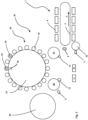
- Fig. 1 shows a system 50 for producing plastic containers 15.
- This system has a device 1 for heating plastic preforms 10 and a forming device 20 arranged downstream of this device 1 for forming these plastic preforms 10 into plastic containers 15.
- the forming device 20 has a rotatable carrier 22 on which a plurality of forming stations 24 are arranged for forming the plastic preforms into the plastic containers 15.
- the individual forming stations 24 preferably each have blow molds 26 within which the plastic preforms are formed.
- the forming stations 24 each have stretching rods 28 which can be inserted into the plastic preforms 10 in order to stretch them in their longitudinal direction.
- the individual forming stations 24 each have valve units 32 with a plurality of valves which control the supply of blowing air with which the plastic preforms are expanded.
- the reference numeral 8 designates a feed star which feeds the plastic preforms to the forming device 20 and the reference numeral 36 designates a discharge star which discharges the manufactured plastic containers 15 from the forming device 20.
- the reference numeral 40 designates a further treatment device for treating the plastic containers, such as in particular but not exclusively a filling device which fills the plastic containers with a liquid and in particular a beverage.
- the reference number 1 designates the device for heating the plastic preforms.
- This device 1 has a transport device 2 which transports the plastic preforms individually and in particular transports them past stationary heating devices 4 (transport path P).
- the reference numeral 30 designates a feeding device which feeds the plastic preforms 10 to the device 1 and the reference numeral 34 designates a feeding star which removes the heated plastic preforms 10 from the device 1 and feeds them to the forming device.
- the reference number 6 roughly schematically designates a first detection device which is suitable and intended to determine an absorption and/or transmission of the plastic preforms to be heated, the determination being made in particular in a near-infrared wavelength range.
- This detection device is arranged here on the feed device. However, it would also be possible to provide this detection device at another location, for example in a deflection area of the device 1, in which the transport direction of the plastic preforms is reversed, or in an area of the feed star 34.
- this detection device 6 has at least one emitter and at least one detector, wherein the plastic preforms are transported between this emitter and this detector and in this way the absorption and/or transmission is determined.
- the reference number 8 designates a second detection device, which at least indirectly enables detection of an absorption and/or transmission of the plastic preforms or the plastic containers made from them (in particular in a visible wavelength range).
- This further detection device can be positioned in different areas of the system 50, as in Fig. 1 shown.
- This detection device can also have at least one emitter and at least one detector. However, it would also be possible for this detection device to be used to detect other properties such as a color of the plastic preforms or plastic containers and for these properties to be used to determine an absorption and/or transmission of the plastic preforms in the visible wavelength range.
- the heating of the plastic preforms can be controlled depending on the absorption and/or transmission values recorded by the detection device 6 and/or the detection device 8.
- the forming of the plastic preforms into the plastic containers is also controlled using these values.
- the individual valve devices of the valve units 32 can be controlled accordingly.
- an allocation device 16 is preferably provided, which allocates a specific forming station to each plastic preform detected and/or inspected by the detection device 6, in which this plastic preform is later blown into a plastic container. This allocation makes it possible to adapt the parameters with which this plastic preform is formed to this plastic preform individually.
Landscapes
- Physics & Mathematics (AREA)
- Mechanical Engineering (AREA)
- Manufacturing & Machinery (AREA)
- Engineering & Computer Science (AREA)
- Thermal Sciences (AREA)
- Health & Medical Sciences (AREA)
- General Health & Medical Sciences (AREA)
- Toxicology (AREA)
- Analytical Chemistry (AREA)
- Pathology (AREA)
- Immunology (AREA)
- General Physics & Mathematics (AREA)
- Biochemistry (AREA)
- Chemical & Material Sciences (AREA)
- Life Sciences & Earth Sciences (AREA)
- Electromagnetism (AREA)
- Oral & Maxillofacial Surgery (AREA)
- Blow-Moulding Or Thermoforming Of Plastics Or The Like (AREA)
Claims (15)
- Procédé de chauffage de préformes en matière plastique (10), dans lequel les préformes en matière plastique (10) sont transportées le long d'un trajet de transport prédéfini et sont chauffées par exposition à un rayonnement électromagnétique pendant ledit transport, dans lequel une absorption et/ou une transmission des préformes en matière plastique (10) pour le rayonnement sont définies dans une plage de longueurs d'onde infrarouge,
caractérisé en ce que
une absorption et/ou une transmission des préformes en matière plastique et/ou des récipients en matière plastique fabriqués à partir desdites préformes en matière plastique (10) pour le rayonnement sont définies dans une plage de longueurs d'onde visible. - Procédé selon la revendication 1,
caractérisé en ce que
une couleur des préformes en matière plastique (10) et/ou des récipients en matière plastique fabriqués à partir desdites préformes en matière plastique (10) est déterminée et en particulier l'absorption et/ou la transmission des préformes en matière plastique (10) pour le rayonnement sont déterminées dans la plage d'ondes visible à partir de la couleur des préformes en matière plastique (10). - Procédé selon au moins l'une quelconque des revendications précédentes,
caractérisé en ce que
au moins une absorption et/ou une transmission des préformes en matière plastique (10) sont mesurées avant le chauffage des préformes en matière plastique (10). - Procédé selon au moins l'une quelconque des revendications précédentes,
caractérisé en ce que
les préformes en matière plastique (10) chauffées sont expansées en des récipients en matière plastique et en particulier en des bouteilles en matière plastique. - Procédé selon la revendication précédente,
caractérisé en ce que
un comportement d'absorption des récipients en matière plastique produits à partir des préformes en matière plastique (10) est défini. - Procédé selon au moins l'une quelconque des revendications précédentes,
caractérisé en ce que
au moins une caractéristique propre aux récipients en matière plastique produits est définie, et cette caractéristique est choisie parmi un groupe de caractéristiques, lequel contient une épaisseur de paroi du récipient en matière plastique, une répartition d'épaisseur de paroi, une couleur, l'apparition de défauts de matériau et similaires. - Procédé selon au moins l'une quelconque des revendications précédentes,
caractérisé en ce que
est définie à partir de l'absorption ou de la transmission pour le rayonnement électromagnétique au moins une valeur, qui est propre à un niveau d'absorption de chaleur des préformes en matière plastique. - Procédé selon au moins l'une quelconque des revendications précédentes,
caractérisé en ce que
pour définir l'absorption et/ou la transmission, des émetteurs sont utilisés, lesquels émettent un rayonnement électromagnétique dans un spectre de longueurs d'onde prédéfini en particulier dans une plage de longueurs d'onde proche de l'infrarouge et/ou visible. - Procédé selon au moins l'une quelconque des revendications précédentes,
caractérisé en ce que
l'absorption et/ou la transmission sont utilisées par ailleurs dans la plage de longueurs d'onde visible pour déterminer une couleur des préformes en matière plastique. - Procédé selon au moins l'une quelconque des revendications précédentes,
caractérisé en ce que
une évaluation statistique des préformes en matière plastique et/ou des récipients en matière plastique fabriqués à partir desdites préformes en matière plastique (10) est effectuée. - Dispositif (1) de chauffage de préformes en matière plastique (10) avec un système de transport (2), lequel transporte les récipients en matière plastique le long d'une voie de transport (P) prédéfinie, et avec au moins un système de chauffage (4), lequel chauffe les préformes en matière plastique (10) par exposition à l'action d'un rayonnement électromagnétique, et avec un système de détection (6), lequel détecte une absorption et/ou une transmission des préformes en matière plastique pour un rayonnement électromagnétique dans une plage de longueurs d'onde infrarouge,
caractérisé en ce que
le dispositif (1) présente un système de détection (8), lequel détecte au moins indirectement dans une plage de longueurs d'onde visible une absorption et/ou une transmission des préformes en matière plastique et/ou des récipients en matière plastique (15) fabriqués ultérieurement à partir desdites préformes en matière plastique pour le rayonnement électromagnétique. - Dispositif (1) selon la revendication 11,
caractérisé en ce que
au moins un système de détection (6) est disposé devant ou après le système de chauffage (1) dans la direction de transport des préformes en matière plastique (10). - Dispositif (1) selon au moins l'une quelconque des revendications 11 - 12,
caractérisé en ce que
le dispositif (1) présente un système d'évaluation (14), lequel détermine, en utilisant des résultats de mesure du premier système d'évaluation et du deuxième système d'évaluation, au moins une valeur, qui détermine un comportement d'absorption et/ou un comportement de transmission des préformes en matière plastique (10) et/ou des récipients en matière plastique (15) fabriqués à partir desdites préformes en matière plastique (10). - Dispositif (1) selon au moins l'une quelconque des revendications 11 - 13,
caractérisé en ce que
au moins un système de détection (8) présente un système émetteur, qui émet le rayonnement électromagnétique, ainsi qu'un système détecteur, lequel détecte un rayonnement émis par le système émetteur, transmis par les préformes en matière plastique (10) et/ou les récipients en matière plastique. - Installation de fabrication de récipients en matière plastique avec un dispositif (1) selon au moins l'une quelconque des revendications précédentes 11 - 14 et un système de façonnage (20) disposé en aval dudit dispositif (1) dans une direction de transport des préformes en matière plastique, destiné à façonner des préformes en matière plastique (10) en des récipients en matière plastique (15).
Applications Claiming Priority (1)
| Application Number | Priority Date | Filing Date | Title |
|---|---|---|---|
| DE102021134262.7A DE102021134262A1 (de) | 2021-12-22 | 2021-12-22 | Verfahren und Vorrichtung zum Erwärmen von Kunststoffvorformlingen mit Absorptionsmessung |
Publications (2)
| Publication Number | Publication Date |
|---|---|
| EP4201639A1 EP4201639A1 (fr) | 2023-06-28 |
| EP4201639B1 true EP4201639B1 (fr) | 2024-11-13 |
Family
ID=84487773
Family Applications (1)
| Application Number | Title | Priority Date | Filing Date |
|---|---|---|---|
| EP22212517.1A Active EP4201639B1 (fr) | 2021-12-22 | 2022-12-09 | Procédé et dispositif de chauffage d'ébauches en plastique au moyen d'une mesure d'absorption |
Country Status (4)
| Country | Link |
|---|---|
| US (1) | US12337521B2 (fr) |
| EP (1) | EP4201639B1 (fr) |
| CN (1) | CN116330621A (fr) |
| DE (1) | DE102021134262A1 (fr) |
Families Citing this family (2)
| Publication number | Priority date | Publication date | Assignee | Title |
|---|---|---|---|---|
| FR3151240A1 (fr) | 2023-07-21 | 2025-01-24 | Sidel Participations | Procédé de commande d’une unité de formage |
| DE102024101050A1 (de) * | 2024-01-15 | 2025-07-17 | Krones Aktiengesellschaft | Vorrichtung und Verfahren zum Herstellen von Kunststoffvorformlingen mit Spektralanalyseeinrichtung |
Family Cites Families (15)
| Publication number | Priority date | Publication date | Assignee | Title |
|---|---|---|---|---|
| US7425296B2 (en) * | 2004-12-03 | 2008-09-16 | Pressco Technology Inc. | Method and system for wavelength specific thermal irradiation and treatment |
| DE102005044206B4 (de) * | 2005-09-15 | 2014-05-28 | Krones Aktiengesellschaft | Verfahren zur Qualitätskontrolle von Kunststoffbehältern |
| AU2008261768A1 (en) * | 2007-06-08 | 2008-12-18 | Pressco Technology Inc. | A method and system for wavelength specific thermal irradiation and treatment |
| EP2011617A1 (fr) | 2007-07-02 | 2009-01-07 | Carlsberg Breweries A/S | Procédé de moulage par étirage-soufflage d'un produit, préforme à utiliser avec le procédé et produit réalisé par le procédé |
| DE102008019176A1 (de) * | 2008-04-17 | 2009-10-22 | Krones Ag | Verfahren und Vorrichtung zur Herstellung von Kunststoffbehältnissen mit Infrarot-Absorptionsüberwachung |
| EP2110224B1 (fr) | 2008-04-17 | 2014-06-11 | Krones AG | Procédé et dispositif de fabrication de récipients en plastique avec surveillance de l'absorption par infrarouges |
| DE102009015522A1 (de) | 2009-04-02 | 2010-10-07 | Krones Ag | Vorrichtung zum Umformen von Kunststoffvorformlingen zu Kunststoffbehältnissen mit Formaterkennung |
| FR2977312B1 (fr) | 2011-06-29 | 2014-06-13 | Sidel Participations | Procede de mesure de l'epaisseur d'une paroi transparente d'un recipient par interferometrie et dispositif pour la mise en oeuvre du procede |
| SG10201601705VA (en) * | 2011-09-06 | 2016-04-28 | Kocher Plastik Maschinenbau Gmbh | Method for establishing the presence of specified characteristics of a container product and device for performing said method |
| DE102012215581A1 (de) * | 2012-09-03 | 2014-03-06 | Krones Ag | Erwärmen von Kunststoffbehältern, insbesondere PET-Vorformlingen mit spektral schmalbandigem Licht |
| EP3033215B1 (fr) * | 2013-08-12 | 2017-08-02 | Agr International, Inc. | Systèmes et procédés de commande de machine à mouler par soufflage |
| DE102017120612A1 (de) * | 2017-09-07 | 2019-03-07 | Krones Ag | Verfahren und Vorrichtung zum Überprüfen eines Umformungsvorgangs von Kunststoffvorformlingen zu Kunststoffbehältnissen und insbesondere Kunststoffflaschen |
| DE102017120634A1 (de) * | 2017-09-07 | 2019-03-07 | Krones Ag | Vorrichtung und Verfahren zum Erwärmen von Kunststoffvorformlingen mit steuerbarer Heizleistung |
| DE102018107368A1 (de) * | 2018-03-28 | 2019-10-02 | Krones Ag | Verfahren und Vorrichtung zum Überprüfen eines Umformungsvorgangs von Kunststoffvorformlingen zu Kunststoffbehältnissen und insbesondere Kunststoffflaschen |
| DE102018123623A1 (de) * | 2018-09-25 | 2020-03-26 | Krones Ag | Vorrichtung und Verfahren zum Umformen von Kunststoffvorformlingen zu Kunststoffbehältnissen mit Temperaturüberwachung |
-
2021
- 2021-12-22 DE DE102021134262.7A patent/DE102021134262A1/de active Pending
-
2022
- 2022-12-02 US US18/074,328 patent/US12337521B2/en active Active
- 2022-12-09 EP EP22212517.1A patent/EP4201639B1/fr active Active
- 2022-12-16 CN CN202211645187.1A patent/CN116330621A/zh active Pending
Also Published As
| Publication number | Publication date |
|---|---|
| CN116330621A (zh) | 2023-06-27 |
| US12337521B2 (en) | 2025-06-24 |
| US20230191688A1 (en) | 2023-06-22 |
| EP4201639A1 (fr) | 2023-06-28 |
| DE102021134262A1 (de) | 2023-06-22 |
Similar Documents
| Publication | Publication Date | Title |
|---|---|---|
| EP2110224B1 (fr) | Procédé et dispositif de fabrication de récipients en plastique avec surveillance de l'absorption par infrarouges | |
| EP4201639B1 (fr) | Procédé et dispositif de chauffage d'ébauches en plastique au moyen d'une mesure d'absorption | |
| EP4219120B1 (fr) | Dispositif et procédé de chauffage d'ébauches en plastique au moyen d'une détection de température à résolution spatiale | |
| EP3964349B1 (fr) | Dispositif et procédé de chauffage de préformes en matière plastique à détection de température à résolution espace | |
| DE102013215372A1 (de) | Verfahren zur Produktionskontrolle beim Streckblasen von Kunststoffbehältern und Testvorformling | |
| EP4063833A1 (fr) | Procédé et dispositif d'analyse des ébauches en matière plastique | |
| EP4200584A1 (fr) | Procédé pour l'impression d'une décoration, et appareil pour celui-ci | |
| EP4335622A1 (fr) | Procédé et dispositif de traitement de récipients avec identification de récipients déviés | |
| DE102008019176A1 (de) | Verfahren und Vorrichtung zur Herstellung von Kunststoffbehältnissen mit Infrarot-Absorptionsüberwachung | |
| EP4070084A1 (fr) | Procédé de contrôle d'une épaisseur de paroi d'un récipient constitué d'un matériau au moins partiellement transparent | |
| EP3046864B1 (fr) | Procédé et dispositif pour le remplissage de récipients en matériau synthétique de forme instable par un matériau de remplissage liquide | |
| DE102019005487B3 (de) | Verfahren zur Wandstärkenmessung eines Hohlglasartikels | |
| DE102008039375A1 (de) | Verfahren und Vorrichtung zur Herstellung von Kunststoffbehältnissen mit Infrarot-Absorptionsüberwachung | |
| EP4392227B1 (fr) | Appareil et méthode de production de récipients avec inspection | |
| DE102020127196A1 (de) | Blasfolienanlage, verfahren zum herstellen einer blasfolienbahn und damit hergestellte folie | |
| DE102018113435A1 (de) | Vorrichtung und Verfahren zur Behandlung von mit aufschäumbarem flüssigen Füllgut befüllten Behältern | |
| DE102017120861A1 (de) | Verfahren und Vorrichtung zur Herstellung von Behältern aus thermoplastischem Material | |
| DE102021119650A1 (de) | Verfahren und Vorrichtung zum Herstellen von Behältern | |
| EP4405659B1 (fr) | Procédé et dispositif de détermination d'un paramètre d'une répartition dimensionnelle d'un mélange, installation de fabrication de panneaux de matériau et produit-programme d'ordinateur | |
| EP4566795A1 (fr) | Procédé et dispositif de fabrication de récipients en matière plastique | |
| EP4585394A1 (fr) | Dispositif et procédé de fabrication d'ébauches en plastique au moyen d'un dispositif d'analyse spectrale | |
| EP4585397A2 (fr) | Dispositif et procédé de traitement d'ébauches en plastique à l'aide d'une détection de température | |
| DE102024116795A1 (de) | Verfahren zum Ermitteln von Einstellparametern für eine Temperiervorrichtung zur Temperaturkonditionierung von Vorformlingen sowie Steuerung dafür | |
| DE102022111523A1 (de) | Verfahren und Vorrichtung zur Herstellung von Kunststoffbehältnissen mit zonenweiser Inspektion von Kunststoffvorformlingen | |
| DE102023114301A1 (de) | Vorrichtung und Verfahren zum Herstellen von Kunststoffbehältnissen mit Wandstärkenmessung |
Legal Events
| Date | Code | Title | Description |
|---|---|---|---|
| PUAI | Public reference made under article 153(3) epc to a published international application that has entered the european phase |
Free format text: ORIGINAL CODE: 0009012 |
|
| STAA | Information on the status of an ep patent application or granted ep patent |
Free format text: STATUS: THE APPLICATION HAS BEEN PUBLISHED |
|
| AK | Designated contracting states |
Kind code of ref document: A1 Designated state(s): AL AT BE BG CH CY CZ DE DK EE ES FI FR GB GR HR HU IE IS IT LI LT LU LV MC ME MK MT NL NO PL PT RO RS SE SI SK SM TR |
|
| STAA | Information on the status of an ep patent application or granted ep patent |
Free format text: STATUS: REQUEST FOR EXAMINATION WAS MADE |
|
| 17P | Request for examination filed |
Effective date: 20231206 |
|
| RBV | Designated contracting states (corrected) |
Designated state(s): AL AT BE BG CH CY CZ DE DK EE ES FI FR GB GR HR HU IE IS IT LI LT LU LV MC ME MK MT NL NO PL PT RO RS SE SI SK SM TR |
|
| GRAP | Despatch of communication of intention to grant a patent |
Free format text: ORIGINAL CODE: EPIDOSNIGR1 |
|
| STAA | Information on the status of an ep patent application or granted ep patent |
Free format text: STATUS: GRANT OF PATENT IS INTENDED |
|
| RIC1 | Information provided on ipc code assigned before grant |
Ipc: B29L 31/00 20060101ALN20240508BHEP Ipc: B29K 67/00 20060101ALN20240508BHEP Ipc: B29C 49/06 20060101ALN20240508BHEP Ipc: B29C 49/78 20060101ALI20240508BHEP Ipc: B29C 49/64 20060101AFI20240508BHEP |
|
| INTG | Intention to grant announced |
Effective date: 20240605 |
|
| GRAS | Grant fee paid |
Free format text: ORIGINAL CODE: EPIDOSNIGR3 |
|
| GRAA | (expected) grant |
Free format text: ORIGINAL CODE: 0009210 |
|
| STAA | Information on the status of an ep patent application or granted ep patent |
Free format text: STATUS: THE PATENT HAS BEEN GRANTED |
|
| AK | Designated contracting states |
Kind code of ref document: B1 Designated state(s): AL AT BE BG CH CY CZ DE DK EE ES FI FR GB GR HR HU IE IS IT LI LT LU LV MC ME MK MT NL NO PL PT RO RS SE SI SK SM TR |
|
| REG | Reference to a national code |
Ref country code: GB Ref legal event code: FG4D Free format text: NOT ENGLISH |
|
| REG | Reference to a national code |
Ref country code: CH Ref legal event code: EP |
|
| REG | Reference to a national code |
Ref country code: DE Ref legal event code: R096 Ref document number: 502022002124 Country of ref document: DE |
|
| REG | Reference to a national code |
Ref country code: IE Ref legal event code: FG4D Free format text: LANGUAGE OF EP DOCUMENT: GERMAN |
|
| P01 | Opt-out of the competence of the unified patent court (upc) registered |
Free format text: CASE NUMBER: APP_1738/2025 Effective date: 20250110 |
|
| REG | Reference to a national code |
Ref country code: LT Ref legal event code: MG9D |
|
| REG | Reference to a national code |
Ref country code: NL Ref legal event code: MP Effective date: 20241113 |
|
| PG25 | Lapsed in a contracting state [announced via postgrant information from national office to epo] |
Ref country code: IS Free format text: LAPSE BECAUSE OF FAILURE TO SUBMIT A TRANSLATION OF THE DESCRIPTION OR TO PAY THE FEE WITHIN THE PRESCRIBED TIME-LIMIT Effective date: 20250313 Ref country code: PT Free format text: LAPSE BECAUSE OF FAILURE TO SUBMIT A TRANSLATION OF THE DESCRIPTION OR TO PAY THE FEE WITHIN THE PRESCRIBED TIME-LIMIT Effective date: 20250313 Ref country code: HR Free format text: LAPSE BECAUSE OF FAILURE TO SUBMIT A TRANSLATION OF THE DESCRIPTION OR TO PAY THE FEE WITHIN THE PRESCRIBED TIME-LIMIT Effective date: 20241113 |
|
| PG25 | Lapsed in a contracting state [announced via postgrant information from national office to epo] |
Ref country code: NL Free format text: LAPSE BECAUSE OF FAILURE TO SUBMIT A TRANSLATION OF THE DESCRIPTION OR TO PAY THE FEE WITHIN THE PRESCRIBED TIME-LIMIT Effective date: 20241113 Ref country code: FI Free format text: LAPSE BECAUSE OF FAILURE TO SUBMIT A TRANSLATION OF THE DESCRIPTION OR TO PAY THE FEE WITHIN THE PRESCRIBED TIME-LIMIT Effective date: 20241113 |
|
| PG25 | Lapsed in a contracting state [announced via postgrant information from national office to epo] |
Ref country code: BG Free format text: LAPSE BECAUSE OF FAILURE TO SUBMIT A TRANSLATION OF THE DESCRIPTION OR TO PAY THE FEE WITHIN THE PRESCRIBED TIME-LIMIT Effective date: 20241113 |
|
| PG25 | Lapsed in a contracting state [announced via postgrant information from national office to epo] |
Ref country code: ES Free format text: LAPSE BECAUSE OF FAILURE TO SUBMIT A TRANSLATION OF THE DESCRIPTION OR TO PAY THE FEE WITHIN THE PRESCRIBED TIME-LIMIT Effective date: 20241113 |
|
| PG25 | Lapsed in a contracting state [announced via postgrant information from national office to epo] |
Ref country code: NO Free format text: LAPSE BECAUSE OF FAILURE TO SUBMIT A TRANSLATION OF THE DESCRIPTION OR TO PAY THE FEE WITHIN THE PRESCRIBED TIME-LIMIT Effective date: 20250213 |
|
| PG25 | Lapsed in a contracting state [announced via postgrant information from national office to epo] |
Ref country code: LV Free format text: LAPSE BECAUSE OF FAILURE TO SUBMIT A TRANSLATION OF THE DESCRIPTION OR TO PAY THE FEE WITHIN THE PRESCRIBED TIME-LIMIT Effective date: 20241113 Ref country code: GR Free format text: LAPSE BECAUSE OF FAILURE TO SUBMIT A TRANSLATION OF THE DESCRIPTION OR TO PAY THE FEE WITHIN THE PRESCRIBED TIME-LIMIT Effective date: 20250214 |
|
| PG25 | Lapsed in a contracting state [announced via postgrant information from national office to epo] |
Ref country code: PL Free format text: LAPSE BECAUSE OF FAILURE TO SUBMIT A TRANSLATION OF THE DESCRIPTION OR TO PAY THE FEE WITHIN THE PRESCRIBED TIME-LIMIT Effective date: 20241113 |
|
| PGFP | Annual fee paid to national office [announced via postgrant information from national office to epo] |
Ref country code: IT Payment date: 20241231 Year of fee payment: 3 |
|
| PG25 | Lapsed in a contracting state [announced via postgrant information from national office to epo] |
Ref country code: RS Free format text: LAPSE BECAUSE OF FAILURE TO SUBMIT A TRANSLATION OF THE DESCRIPTION OR TO PAY THE FEE WITHIN THE PRESCRIBED TIME-LIMIT Effective date: 20250213 |
|
| PG25 | Lapsed in a contracting state [announced via postgrant information from national office to epo] |
Ref country code: SM Free format text: LAPSE BECAUSE OF FAILURE TO SUBMIT A TRANSLATION OF THE DESCRIPTION OR TO PAY THE FEE WITHIN THE PRESCRIBED TIME-LIMIT Effective date: 20241113 |
|
| PG25 | Lapsed in a contracting state [announced via postgrant information from national office to epo] |
Ref country code: DK Free format text: LAPSE BECAUSE OF FAILURE TO SUBMIT A TRANSLATION OF THE DESCRIPTION OR TO PAY THE FEE WITHIN THE PRESCRIBED TIME-LIMIT Effective date: 20241113 |
|
| PG25 | Lapsed in a contracting state [announced via postgrant information from national office to epo] |
Ref country code: EE Free format text: LAPSE BECAUSE OF FAILURE TO SUBMIT A TRANSLATION OF THE DESCRIPTION OR TO PAY THE FEE WITHIN THE PRESCRIBED TIME-LIMIT Effective date: 20241113 |
|
| PG25 | Lapsed in a contracting state [announced via postgrant information from national office to epo] |
Ref country code: RO Free format text: LAPSE BECAUSE OF FAILURE TO SUBMIT A TRANSLATION OF THE DESCRIPTION OR TO PAY THE FEE WITHIN THE PRESCRIBED TIME-LIMIT Effective date: 20241113 |
|
| PG25 | Lapsed in a contracting state [announced via postgrant information from national office to epo] |
Ref country code: SK Free format text: LAPSE BECAUSE OF FAILURE TO SUBMIT A TRANSLATION OF THE DESCRIPTION OR TO PAY THE FEE WITHIN THE PRESCRIBED TIME-LIMIT Effective date: 20241113 |
|
| PG25 | Lapsed in a contracting state [announced via postgrant information from national office to epo] |
Ref country code: CZ Free format text: LAPSE BECAUSE OF FAILURE TO SUBMIT A TRANSLATION OF THE DESCRIPTION OR TO PAY THE FEE WITHIN THE PRESCRIBED TIME-LIMIT Effective date: 20241113 |
|
| REG | Reference to a national code |
Ref country code: DE Ref legal event code: R026 Ref document number: 502022002124 Country of ref document: DE |
|
| PLBI | Opposition filed |
Free format text: ORIGINAL CODE: 0009260 |
|
| PG25 | Lapsed in a contracting state [announced via postgrant information from national office to epo] |
Ref country code: LU Free format text: LAPSE BECAUSE OF NON-PAYMENT OF DUE FEES Effective date: 20241209 |
|
| PLAB | Opposition data, opponent's data or that of the opponent's representative modified |
Free format text: ORIGINAL CODE: 0009299OPPO |
|
| PLAX | Notice of opposition and request to file observation + time limit sent |
Free format text: ORIGINAL CODE: EPIDOSNOBS2 |
|
| PG25 | Lapsed in a contracting state [announced via postgrant information from national office to epo] |
Ref country code: SE Free format text: LAPSE BECAUSE OF FAILURE TO SUBMIT A TRANSLATION OF THE DESCRIPTION OR TO PAY THE FEE WITHIN THE PRESCRIBED TIME-LIMIT Effective date: 20241113 |
|
| PG25 | Lapsed in a contracting state [announced via postgrant information from national office to epo] |
Ref country code: MC Free format text: LAPSE BECAUSE OF FAILURE TO SUBMIT A TRANSLATION OF THE DESCRIPTION OR TO PAY THE FEE WITHIN THE PRESCRIBED TIME-LIMIT Effective date: 20241113 |
|
| 26 | Opposition filed |
Opponent name: SIDEL PARTICIPATIONS S.A.S. Effective date: 20250813 |
|
| R26 | Opposition filed (corrected) |
Opponent name: SIDEL PARTICIPATIONS S.A.S. Effective date: 20250813 |
|
| REG | Reference to a national code |
Ref country code: BE Ref legal event code: MM Effective date: 20241231 |
|
| PG25 | Lapsed in a contracting state [announced via postgrant information from national office to epo] |
Ref country code: BE Free format text: LAPSE BECAUSE OF NON-PAYMENT OF DUE FEES Effective date: 20241231 |
|
| PG25 | Lapsed in a contracting state [announced via postgrant information from national office to epo] |
Ref country code: IE Free format text: LAPSE BECAUSE OF NON-PAYMENT OF DUE FEES Effective date: 20241209 |
|
| PLBB | Reply of patent proprietor to notice(s) of opposition received |
Free format text: ORIGINAL CODE: EPIDOSNOBS3 |
|
| PGFP | Annual fee paid to national office [announced via postgrant information from national office to epo] |
Ref country code: DE Payment date: 20251104 Year of fee payment: 4 |
|
| PGFP | Annual fee paid to national office [announced via postgrant information from national office to epo] |
Ref country code: AT Payment date: 20260113 Year of fee payment: 4 |
|
| PGFP | Annual fee paid to national office [announced via postgrant information from national office to epo] |
Ref country code: FR Payment date: 20251110 Year of fee payment: 4 |