EP4198022A1 - Preparation of compounds useful for treating aids - Google Patents
Preparation of compounds useful for treating aids Download PDFInfo
- Publication number
- EP4198022A1 EP4198022A1 EP22193611.5A EP22193611A EP4198022A1 EP 4198022 A1 EP4198022 A1 EP 4198022A1 EP 22193611 A EP22193611 A EP 22193611A EP 4198022 A1 EP4198022 A1 EP 4198022A1
- Authority
- EP
- European Patent Office
- Prior art keywords
- group
- formula
- compound
- hydrogen atom
- nmr
- Prior art date
- Legal status (The legal status is an assumption and is not a legal conclusion. Google has not performed a legal analysis and makes no representation as to the accuracy of the status listed.)
- Pending
Links
Classifications
-
- C—CHEMISTRY; METALLURGY
- C07—ORGANIC CHEMISTRY
- C07D—HETEROCYCLIC COMPOUNDS
- C07D215/00—Heterocyclic compounds containing quinoline or hydrogenated quinoline ring systems
- C07D215/02—Heterocyclic compounds containing quinoline or hydrogenated quinoline ring systems having no bond between the ring nitrogen atom and a non-ring member or having only hydrogen atoms or carbon atoms directly attached to the ring nitrogen atom
- C07D215/16—Heterocyclic compounds containing quinoline or hydrogenated quinoline ring systems having no bond between the ring nitrogen atom and a non-ring member or having only hydrogen atoms or carbon atoms directly attached to the ring nitrogen atom with hetero atoms or with carbon atoms having three bonds to hetero atoms with at the most one bond to halogen, e.g. ester or nitrile radicals, directly attached to ring carbon atoms
- C07D215/38—Nitrogen atoms
-
- C—CHEMISTRY; METALLURGY
- C07—ORGANIC CHEMISTRY
- C07D—HETEROCYCLIC COMPOUNDS
- C07D401/00—Heterocyclic compounds containing two or more hetero rings, having nitrogen atoms as the only ring hetero atoms, at least one ring being a six-membered ring with only one nitrogen atom
- C07D401/02—Heterocyclic compounds containing two or more hetero rings, having nitrogen atoms as the only ring hetero atoms, at least one ring being a six-membered ring with only one nitrogen atom containing two hetero rings
- C07D401/12—Heterocyclic compounds containing two or more hetero rings, having nitrogen atoms as the only ring hetero atoms, at least one ring being a six-membered ring with only one nitrogen atom containing two hetero rings linked by a chain containing hetero atoms as chain links
-
- C—CHEMISTRY; METALLURGY
- C07—ORGANIC CHEMISTRY
- C07D—HETEROCYCLIC COMPOUNDS
- C07D403/00—Heterocyclic compounds containing two or more hetero rings, having nitrogen atoms as the only ring hetero atoms, not provided for by group C07D401/00
- C07D403/02—Heterocyclic compounds containing two or more hetero rings, having nitrogen atoms as the only ring hetero atoms, not provided for by group C07D401/00 containing two hetero rings
- C07D403/12—Heterocyclic compounds containing two or more hetero rings, having nitrogen atoms as the only ring hetero atoms, not provided for by group C07D401/00 containing two hetero rings linked by a chain containing hetero atoms as chain links
-
- A—HUMAN NECESSITIES
- A61—MEDICAL OR VETERINARY SCIENCE; HYGIENE
- A61K—PREPARATIONS FOR MEDICAL, DENTAL OR TOILETRY PURPOSES
- A61K31/00—Medicinal preparations containing organic active ingredients
- A61K31/33—Heterocyclic compounds
- A61K31/395—Heterocyclic compounds having nitrogen as a ring hetero atom, e.g. guanethidine or rifamycins
- A61K31/435—Heterocyclic compounds having nitrogen as a ring hetero atom, e.g. guanethidine or rifamycins having six-membered rings with one nitrogen as the only ring hetero atom
- A61K31/47—Quinolines; Isoquinolines
- A61K31/4709—Non-condensed quinolines and containing further heterocyclic rings
-
- A—HUMAN NECESSITIES
- A61—MEDICAL OR VETERINARY SCIENCE; HYGIENE
- A61K—PREPARATIONS FOR MEDICAL, DENTAL OR TOILETRY PURPOSES
- A61K31/00—Medicinal preparations containing organic active ingredients
- A61K31/33—Heterocyclic compounds
- A61K31/395—Heterocyclic compounds having nitrogen as a ring hetero atom, e.g. guanethidine or rifamycins
- A61K31/495—Heterocyclic compounds having nitrogen as a ring hetero atom, e.g. guanethidine or rifamycins having six-membered rings with two or more nitrogen atoms as the only ring heteroatoms, e.g. piperazine or tetrazines
- A61K31/4985—Pyrazines or piperazines ortho- or peri-condensed with heterocyclic ring systems
-
- A—HUMAN NECESSITIES
- A61—MEDICAL OR VETERINARY SCIENCE; HYGIENE
- A61P—SPECIFIC THERAPEUTIC ACTIVITY OF CHEMICAL COMPOUNDS OR MEDICINAL PREPARATIONS
- A61P35/00—Antineoplastic agents
-
- C—CHEMISTRY; METALLURGY
- C07—ORGANIC CHEMISTRY
- C07D—HETEROCYCLIC COMPOUNDS
- C07D213/00—Heterocyclic compounds containing six-membered rings, not condensed with other rings, with one nitrogen atom as the only ring hetero atom and three or more double bonds between ring members or between ring members and non-ring members
- C07D213/02—Heterocyclic compounds containing six-membered rings, not condensed with other rings, with one nitrogen atom as the only ring hetero atom and three or more double bonds between ring members or between ring members and non-ring members having three double bonds between ring members or between ring members and non-ring members
- C07D213/04—Heterocyclic compounds containing six-membered rings, not condensed with other rings, with one nitrogen atom as the only ring hetero atom and three or more double bonds between ring members or between ring members and non-ring members having three double bonds between ring members or between ring members and non-ring members having no bond between the ring nitrogen atom and a non-ring member or having only hydrogen or carbon atoms directly attached to the ring nitrogen atom
- C07D213/60—Heterocyclic compounds containing six-membered rings, not condensed with other rings, with one nitrogen atom as the only ring hetero atom and three or more double bonds between ring members or between ring members and non-ring members having three double bonds between ring members or between ring members and non-ring members having no bond between the ring nitrogen atom and a non-ring member or having only hydrogen or carbon atoms directly attached to the ring nitrogen atom with hetero atoms or with carbon atoms having three bonds to hetero atoms with at the most one bond to halogen, e.g. ester or nitrile radicals, directly attached to ring carbon atoms
- C07D213/72—Nitrogen atoms
- C07D213/74—Amino or imino radicals substituted by hydrocarbon or substituted hydrocarbon radicals
-
- C—CHEMISTRY; METALLURGY
- C07—ORGANIC CHEMISTRY
- C07D—HETEROCYCLIC COMPOUNDS
- C07D215/00—Heterocyclic compounds containing quinoline or hydrogenated quinoline ring systems
- C07D215/02—Heterocyclic compounds containing quinoline or hydrogenated quinoline ring systems having no bond between the ring nitrogen atom and a non-ring member or having only hydrogen atoms or carbon atoms directly attached to the ring nitrogen atom
- C07D215/16—Heterocyclic compounds containing quinoline or hydrogenated quinoline ring systems having no bond between the ring nitrogen atom and a non-ring member or having only hydrogen atoms or carbon atoms directly attached to the ring nitrogen atom with hetero atoms or with carbon atoms having three bonds to hetero atoms with at the most one bond to halogen, e.g. ester or nitrile radicals, directly attached to ring carbon atoms
- C07D215/38—Nitrogen atoms
- C07D215/42—Nitrogen atoms attached in position 4
-
- C—CHEMISTRY; METALLURGY
- C07—ORGANIC CHEMISTRY
- C07D—HETEROCYCLIC COMPOUNDS
- C07D215/00—Heterocyclic compounds containing quinoline or hydrogenated quinoline ring systems
- C07D215/02—Heterocyclic compounds containing quinoline or hydrogenated quinoline ring systems having no bond between the ring nitrogen atom and a non-ring member or having only hydrogen atoms or carbon atoms directly attached to the ring nitrogen atom
- C07D215/16—Heterocyclic compounds containing quinoline or hydrogenated quinoline ring systems having no bond between the ring nitrogen atom and a non-ring member or having only hydrogen atoms or carbon atoms directly attached to the ring nitrogen atom with hetero atoms or with carbon atoms having three bonds to hetero atoms with at the most one bond to halogen, e.g. ester or nitrile radicals, directly attached to ring carbon atoms
- C07D215/38—Nitrogen atoms
- C07D215/42—Nitrogen atoms attached in position 4
- C07D215/46—Nitrogen atoms attached in position 4 with hydrocarbon radicals, substituted by nitrogen atoms, attached to said nitrogen atoms
-
- C—CHEMISTRY; METALLURGY
- C07—ORGANIC CHEMISTRY
- C07D—HETEROCYCLIC COMPOUNDS
- C07D215/00—Heterocyclic compounds containing quinoline or hydrogenated quinoline ring systems
- C07D215/58—Heterocyclic compounds containing quinoline or hydrogenated quinoline ring systems with hetero atoms directly attached to the ring nitrogen atom
- C07D215/60—N-oxides
-
- C—CHEMISTRY; METALLURGY
- C07—ORGANIC CHEMISTRY
- C07D—HETEROCYCLIC COMPOUNDS
- C07D241/00—Heterocyclic compounds containing 1,4-diazine or hydrogenated 1,4-diazine rings
- C07D241/36—Heterocyclic compounds containing 1,4-diazine or hydrogenated 1,4-diazine rings condensed with carbocyclic rings or ring systems
- C07D241/38—Heterocyclic compounds containing 1,4-diazine or hydrogenated 1,4-diazine rings condensed with carbocyclic rings or ring systems with only hydrogen or carbon atoms directly attached to the ring nitrogen atoms
- C07D241/40—Benzopyrazines
- C07D241/44—Benzopyrazines with hetero atoms or with carbon atoms having three bonds to hetero atoms with at the most one bond to halogen, e.g. ester or nitrile radicals, directly attached to carbon atoms of the hetero ring
Definitions
- the invention relates to novel compounds for the preparation of compositions useful for the treatment of diseases resulting from changes in splicing processes.
- indole derivative compounds such as ellipticine derivatives and aza-ellipticine derivatives are already known as intercalating molecules for correcting dysfunctions in gene expression, notably in DNA replication. They have been more specifically described for treating diseases such as cancer, leukemia or AIDS (see in particular patents FR 2 627 493 , FR 2 645 861 , FR 2 436 786 ).
- NRTIs nucleosidic
- NRTIs non-nucleosidic
- PIs protease inhibitors
- anti-retroviral compound used for its ability to prevent viruses from entering the cell.
- entry inhibitors can be either peptides that interfere with the fusion of viral glycoproteins gp41 or gp120 with the membrane of CD4 cells or molecules that target HIV cellular co-receptors CCR5 and CXCR4.
- the absence of cellular proteins resembling HIV integrase has also been exploited to develop novel anti-HIV molecules that inhibit this enzymatic activity.
- integrase inhibitors are in the clinical trial phase, no molecule is yet available on the market.
- the intracellular splicing process consists of eliminating introns in pre-messenger RNAs to produce mature messenger RNAs that can be used by the translation mechanism of the cell ( SHARP, Cell, vol. 77, p. 805-815, 1994 ).
- the same precursor can be the source of messenger RNAs coding for proteins with distinct functions ( BLACK, Annu. Rev. Biochem. vol. 72, p. 291-336, 2003 ).
- the precise selection of 5' and 3' splicing sites is thus a mechanism that generates diversity and that can lead to the regulation of gene expression according to the type of tissue or during the development of an organism.
- SR RNA recognition motifs
- RISPR RNA recognition motifs
- RS domain a domain rich in arginine and serine residues
- ESE exonic splicing enhancer
- ISE intronic splicing enhancer
- SR proteins are able to activate, in a dose-dependant manner, sub-optimal splicing sites and to enable the inclusion of exons ( GRAVELEY, RNA, vol. 6, p. 1197-1211, 2000 ).
- ESE exonic splicing enhancer
- ISE intra splicing enhancer
- GRAVELEY RNA, vol. 6, p. 1197-1211, 2000
- the activity of an SR protein in alternative splicing is specific insofar as the inactivation of the corresponding gene is lethal ( WANG et al., Mol. Cell, vol. 7, p. 331-342, 2001 ).
- mutations can interfere with splicing by inactivating or creating splicing sites, but also by modifying or generating regulating elements such as splicing enhancers or splicing silencers in a particular gene ( CARTEGNI et al., Nat. Rev. Genet., vol. 3, p. 285-298, 2002 ; TAZI et al., TIBS, vol. 40, p. 469-478, 2005 ).
- the compounds described have a flat structure with four rings that have the disadvantage of intercalating between DNA bases and can thus lead to cellular toxicity.
- a subject-matter of the present invention relates to a compound of formula (I) wherein:
- the present invention relates to a compound of formula (I) as defined above, wherein Z is N, V is C, Y is N, X is C, T is C, U is C and W is C, for use as an agent for preventing, inhibiting or treating AIDS.
- the present invention relates to a compound of formula (I) as defined above, wherein Z is C, V is C, Y is N, X is C, T is C, U is C and W is C, for use as an agent for preventing, inhibiting or treating AIDS.
- the present invention relates to a compound of formula (I) as defined above, wherein Z is N, V is C, Y is C, X is N, T is C, U is C and W is C, for use as an agent for preventing, inhibiting or treating AIDS.
- the present invention relates to a compound of formula (I) as defined above, wherein Z is N, V is C, Y is C, X is C, T is C, U is C and W is N, for use as an agent for preventing, inhibiting or treating AIDS.
- the present invention relates to a compound of formula (I) as defined above, wherein Z is N, V is N and is in para of Z, Y is N, X is C, T is C, U is C and W is C, for use as an agent for preventing, inhibiting or treating AIDS.
- the present invention relates to a compound of formula (I) as defined above, wherein Z is C, V is N and is in para of Z, Y is C, X is N, T is C, U is C and W is C, for use as an agent for preventing, inhibiting or treating AIDS.
- the present invention relates to a compound of formula (I) as defined above, wherein Z is C, V is N and is in meta of Z and is in para of the bond linked to NR", Y is N, X is C, T is C, U is C and W is C, for use as an agent for preventing, inhibiting or treating AIDS.
- the present invention relates to a compound of formula (I) as defined above, wherein Z is C, V is N and is in meta of Z and is in para of the bond linked to NR", Y is C, X is N, T is C, U is C and W is C, for use as an agent for preventing, inhibiting or treating AIDS.
- the present invention relates to a compound of formula (I) as defined above, wherein Z is C, V is C, Y is C, X is N, T is C, U is C and W is C, for use as an agent for preventing, inhibiting or treating AIDS.
- the present invention relates to a compound of formula (I) as defined above, wherein Z is C, V is C, Y is N, X is N, T is C, U is C and W is C, for use as an agent for preventing, inhibiting or treating AIDS.
- the present invention relates to a compound of formula (I) as defined above, wherein Z is N, V is N and is in meta of Z and in ortho of the bond linked to NR", Y is N, X is C, T is C, U is C and W is C, for use as an agent for preventing, inhibiting or treating AIDS.
- the present invention relates to a compound of formula (I) as defined above, wherein Z is N, V is N and is in para of Z, Y is C, X is C, T is C, U is C and W is N, for use as an agent for preventing, inhibiting or treating AIDS.
- the present invention relates to a compound of formula (I) as defined above, wherein Z is N, V is N and is in para of Z, Y is C, X is N, T is C, U is C and W is C, for use as an agent for preventing, inhibiting or treating AIDS.
- the present invention relates to a compound of formula (I) as defined above, wherein Z is N, V is C, Y is N, X is N, T is C, U is C and W is C, for use as an agent for preventing, inhibiting or treating AIDS.
- the present invention relates to a compound of formula (I) as defined above, wherein Z is N, V is N and is in meta of Z and is in ortho of the bond linked to NR", Y is N, X is N, T is C, U is C and W is C, for use as an agent for preventing, inhibiting or treating AIDS.
- the present invention relates to a compound of formula (I) as defined above, wherein Z is C, V is C, Y is C, X is C, T is N, U is C and W is C, for use as an agent for preventing, inhibiting or treating AIDS.
- the present invention relates to a compound of formula (I) as defined above, wherein Z is N, V is C, Y is C, X is C, T is N, U is C and W is C, for use as an agent for preventing, inhibiting or treating AIDS.
- the present invention relates to a compound of formula (I) as defined above, wherein Z is N, V is C, Y is C, X is C, T is C, U is N and W is C, for use as an agent for preventing, inhibiting or treating AIDS.
- the compounds of the invention may exist in the form of free bases or of addition salts with pharmaceutically acceptable acids.
- Suitable physiologically acceptable acid addition salts of compounds of formula (I) include hydrobromide, tartrate, citrate, trifluoroacetate, ascorbate, hydrochloride, tartrate, triflate, maleate, mesylate, formate, acetate and fumarate.
- the compounds of formula (I) and or salts thereof may form solvates (e.g. hydrates) and the invention includes all such solvates.
- the present invention relates to a compound of formula (I) as defined above, wherein Z is N, V is C, Y is N, X is C, T is C, U is C and W is C, for use as an agent for preventing, inhibiting or treating AIDS.
- the present invention relates to a compound of formula (I) as defined above, wherein Z is C, V is C, Y is N, X is C, T is C, U is C and W is C, for use as an agent for preventing, inhibiting or treating AIDS.
- the present invention relates to a compound of formula (I) as defined above, wherein Z is N, V is C, Y is C, X is N, T is C, U is C and W is C, for use as an agent for preventing, inhibiting or treating AIDS.
- the present invention relates to a compound of formula (I) as defined above, wherein Z is N, V is N and is in para of Z, Y is N, X is C, T is C, U is C and W is C, for use as an agent for preventing, inhibiting or treating AIDS.
- the present invention relates to a compound of formula (I) as defined above, wherein Z is N, V is C, Y is N, X is N, T is C, U is C and W is C, for use as an agent for preventing, inhibiting or treating AIDS.
- Another object of the present invention relates to a compound of the following formula (I'): wherein:
- Halogen atom means the group comprising F, Cl, Br and I, preferably said halogen atom is a chlorine atom.
- Unsaturated means that the group comprises at least one double bond.
- X1 represents a CR8 group when X2 represents a nitrogen group
- X2 represents a CR8 group when X1 represents a nitrogen group.
- At least one of X3 and X4 is a nitrogen atom when the cycle A is in position a.
- X3 and X4 are different, and even more preferably X3 represents a CR8 group when X2 represents a nitrogen group or a and X4 represents a CR8 group when X1 represents a nitrogen group.
- R1 represents a hydrogen atom or a methoxy group.
- R2, R3, R4 and R5 independently represent a hydrogen atom or a halogen atom or an alkyl, or benzyl, optionally substituted.
- R4 represents a hydrogen atom.
- R2 represents a hydrogen atom or a C1 to C4 alkyl group, preferably a methyl.
- R3, R5 and R6 independently represent a hydrogen atom.
- R7 represents a hydrogen, or halogen atom, more preferably a hydrogen or a chlorine atom.
- the ring A is attached at position a or b of the compound of formula I via the carbons numbered 1 and 2 in ring A.
- R4 is the carbon atom numbered 2 of the ring A, more preferably R4 is the carbon atom numbered 2 of the ring A and R10 is the carbon numbered 1.
- X4 is the carbon atom numbered 1 of the ring A, more preferably, X4 is the carbon atom numbered 1 of the ring A and R10 is the carbon numbered 2.
- the compound as described above does not include the following compounds:
- the compound of formula I is chosen among the group comprising:
- an additional subject-matter of the present invention is a compound of formula (Ia) wherein:
- an additional subject-matter of the present invention is a compound of formula (Ib) wherein :
- an additional subject-matter of the present invention is a compound of formula (Ic) wherein:
- an additional subject-matter of the present invention is a compound of formula (Id) wherein:
- an additional subject-matter of the present invention is a compound of formula (Ie) wherein:
- an additional subject-matter of the present invention is a compound of formula (If) wherein:
- an additional subject-matter of the present invention is a compound of formula (Ig) wherein:
- an additional subject-matter of the present invention is a compound of formula (Ih) wherein:
- an additional subject-matter of the present invention is a compound of formula (Ii) wherein:
- an additional subject-matter of the present invention is a compound of formula (Ij) wherein:
- an additional subject-matter of the present invention is a compound of formula (Ik) wherein:
- an additional subject-matter of the present invention is a compound of formula (Il) wherein:
- an additional subject-matter of the present invention is a compound of formula (Im) wherein:
- an additional subject-matter of the present invention is a compound of formula (Io) wherein:
- an additional subject-matter of the present invention is a compound of formula (Ip) wherein:
- an additional subject-matter of the present invention is a compound of formula (Iq) wherein:
- an additional subject-matter of the present invention is a compound of formula (Ir) wherein:
- an additional subject-matter of the present invention is a compound of formula (lee) wherein:
- the present invention further relates to a compound of formula (Ia), (Ib), (Ic), (Ie) and (Io), as defined above, for use as an agent for preventing, inhibiting or treating AIDS.
- the present invention particularly focuses on a compound of formula (Ia) wherein:
- the present invention more preferably focuses on compounds of formula (Ia'), wherein,
- the present invention particularly focuses on a compound of formula (Ib) wherein:
- the present invention more preferably focuses on compounds of formula (Ib'), wherein:
- the present invention particularly focuses on a compound of formula (Ic) wherein:
- the present invention particularly focuses on a compound of formula (Ie) wherein:
- the present invention particularly focuses on a compound of formula (Io) wherein:
- the present invention relates to a compound of formula (Ia), (Ic) or (Io) as defined above or one of its pharmaceutically acceptable salts, for use as an agent for preventing, inhibiting or treating AIDS.
- the compound for use as an agent for preventing, inhibiting or treating AIDS is chosen from:
- compounds (1), (6), (33), (34), (35), (36), (37), (38), (42), (43), (44), (45), (46), (48), (50), (64), (68), (69), (70), (71), (72), (73), (74), (75), (77), (78), (79), (80), (81), (82), (86), (87), (88), (90), (92), (96), (104), (106), (109), (112), (136), (139), (140) and (141) are of particular interest.
- the present invention therefore extends to compounds (1), (6), (33), (34), (35), (36), (37), (38), (42), (43), (44), (45), (46), (48), (50), (64), (68), (69), (70), (71), (72), (73), (74), (75), (77), (78), (79), (80), (81), (82), (86), (87), (88), (90), (92), (96), (104), (106), (109), (112), (136), (139), (140) and (141) or one of its pharmaceutically acceptable salts for use as an agent for preventing, inhibiting or treating AIDS.
- Some of said preceding compounds are new and form part of the present invention: (1), (6), (33), (34), (35), (36), (37), (38), (42), (43), (44), (46), (48), (50), (64), (68), (69), (70), (71), (72), (73), (74), (75), (77), (78), (79), (80), (81), (82), (86), (87), (88), (90), (92), (96), (104), (106), (109), (112), (136), (139), (140), (141) and their pharmaceutically acceptable salts, such as hydrobromide, tartrate, citrate, trifluoroacetate, ascorbate, hydrochloride, tartrate, triflate, maleate, mesylate, formate, acetate and fumarate.
- pharmaceutically acceptable salts such as hydrobromide, tartrate, citrate, trifluoroacetate, ascorbate, hydrochloride, tartrate, triflate, maleate
- the compounds of formulae (I), (Ia), (Ib), (Ic), (Id), (Ie), (If), (Ig), (Ih), (Ii), (Ij), (Ik), (Il), (Im), (Io), (Ip), (Iq), (Ir) and (lee) can comprise one or more asymmetric carbon atoms. They can thus exist in the form of enantiomers or of diastereoisomers. These enantiomers, diastereoisomers and their mixtures, including the racemic mixtures, are encompassed within the scope of the present invention.
- the present invention encompasses compounds of formula (Ig) wherein:
- the present invention encompasses compounds of formula (If) wherein:
- the present invention encompasses compounds of formula (Ih) wherein:
- the present invention encompasses compounds of formula (II) wherein:
- the present invention encompasses compounds of formula (Im) wherein:
- the present invention encompasses compounds of formula (Ia), as such, wherein:
- the present invention more preferably focuses on compounds of formula (Ia'), as such, wherein,
- the present invention further relates to a compound of formula (Ib) as defined above, as such wherein :
- the present invention encompasses compounds of formula (Ic), as such, wherein:
- the present invention further relates to a compound of formula (Ie) as defined above, as such wherein:
- the present invention encompasses compounds of formula (Io), as such, wherein:
- compounds (1), (2), (5)-(8), (10)-(16), (18), (21)-(44), (46)-(75), (77)-(84), (86)-(119), (121), (124)-(130), (132), (135)-(141), (143)-(147), (149)-(168) and their pharmaceutically acceptable salts are of particular interest.
- the present invention therefore extends to compounds (1), (2), (5)-(8), (10)-(16), (18), (21)-(44), (46)-(75), (77)-(84), (86)-(119), (121), (124)-(130), (132), (135)-(141), (143)-(147), (149)-(168) and their pharmaceutically acceptable salts, as such.
- the present invention therefore extends more preferably to compounds (8), (75), (77)-(84), (86)-(104), (109)-(117), (155)-(158) and their pharmaceutically acceptable salts, such as hydrobromide, tartrate, citrate, trifluoroacetate, ascorbate, hydrochloride, tartrate, triflate, maleate, mesylate, formate, acetate and fumarate.
- pharmaceutically acceptable salts such as hydrobromide, tartrate, citrate, trifluoroacetate, ascorbate, hydrochloride, tartrate, triflate, maleate, mesylate, formate, acetate and fumarate.
- the present invention extends to compounds (75), (77), (78), (79), (80), (81), (82), (86), (87), (88), (90), (92), (96), (104), (109), (112), and their pharmaceutically acceptable salts, such as hydrobromide, tartrate, citrate, trifluoroacetate, ascorbate, hydrochloride, tartrate, triflate, maleate, mesylate, formate, acetate and fumarate.
- pharmaceutically acceptable salts such as hydrobromide, tartrate, citrate, trifluoroacetate, ascorbate, hydrochloride, tartrate, triflate, maleate, mesylate, formate, acetate and fumarate.
- the new compounds of the present invention i.e. compounds of formulae (Ia), (Ic), (Io), (Ib), (Ib'), (Ib") and (Ie) and the specific compounds as listed above, are not only useful as agent for inhibiting, preventing or treating AIDS but can also be useful for inhibiting, preventing or treating premature aging and for inhibiting, preventing or treating cancer, and more particularly colorectal cancer, pancreatic cancer, lung cancer including non-small cell lung cancer, breast cancer, bladder cancer, gall bladder cancer, liver cancer, thyroid cancer, melanoma, uterine/cervical cancer, oesophageal cancer, kidney cancer, ovarian cancer, prostate cancer, head and neck cancer and stomach cancer, etc.
- said compounds may be useful to inhibit, prevent and/or treat diseases with premature aging and that are likely related to an aberrant splicing of the nuclear lamin A gene.
- said disease may include Hutchinson Guilford Progeria Syndrome (HGPS), progeria, premature aging associated with HIV infection, muscular dystrophy, Charcot-Marie-Tooth disorder, Werner syndrome, but also atherosclerosis, insulin resistant type II diabetes, cataracts, osteoporosis and aging of the skin such as restrictive dermopathy.
- HGPS Hutchinson Guilford Progeria Syndrome
- the compounds of the present invention can be prepared by conventional methods of organic synthesis practiced by those skilled in the art.
- the general reaction sequences outlined below represent a general method useful for preparing the compounds of the present invention and are not meant to be limiting in scope or utility.
- the synthesis is based on a coupling reaction alternatively starting from a halogeno-bicycle of formula (III), wherein X, Y, W, T, U, n', R' and R" are as defined above and X' is a chlorine atom or a bromine atom or from a chloro-monocycle of formula (V), wherein Z, V, n and R are as defined above and X' is a chlorine atom or a bromine atom.
- a halogeno-bicycle of formula (III) wherein X, Y, W, T, U, n', R' and R" are as defined above and X' is a chlorine atom or a bromine atom or from a chloro-monocycle of formula (V), wherein Z, V, n and R are as defined above and X' is a chlorine atom or a bromine atom.
- the compound of formula (III) is placed in a protic solvent such as tert-butanol.
- the compound of formula (IV) is then added in a molar ratio ranging from 1 to 1.5 with respect to the compound of formula (III) in presence of an inorganic base, such as Cs 2 CO 3 or K 2 CO 3 in a molar ratio ranging from 1 and 2, in the presence of a diphosphine, such as Xantphos (4,5-Bis(diphenylphosphino)-9,9-dimethylxanthene) or X-Phos (2-Dicyclohexylphosphino-2',4',6'-triisopropylbiphenyl) in an amount ranging from 2mol% to 10mol% relative to the total amount of compound of formula (III), and in the presence of a catalyst, such as Pd(OAc)2 or Pd2dba3 in an amount ranging from 2mol% and 10mol% relative to the total amount of a catalyst
- the reaction mixture can then be heated at a temperature ranging from 80 to 120°C, for example at 90°C and stirred for a time ranging form 15 to 25 hours, for example during 20 hours under inert gas and for example argon.
- the reaction mixture can be concentrated under reduced pressure.
- the compound of formula (V) is placed in a protic solvent such as tert-butanol.
- the compound of formula (VI) is then added in a molar ratio ranging from 1 to 1.5 with respect to the compound of formula (V) in presence of an inorganic base, such as Cs 2 CO 3 or K 2 CO 3 in a molar ratio ranging from 1 to 2, in the presence of a diphosphine, such as Xantphos (4,5-Bis(diphenylphosphino)-9,9-dimethylxanthene) or X-Phos (2-Dicyclohexylphosphino-2',4',6'-triisopropylbiphenyl) in an amount ranging from 2 mol% to 10 mol% relative to the total amount of compound of formula (V), and in the presence of a catalyst, such as Pd(OAc)2 or Pd2dba3 in an amount ranging from 2 mol% to 10 mol% relative to
- the reaction mixture can then be heated at a temperature ranging from 80 to 120°C, for example at 90°C and stirred for a time ranging form 15 to 25 hours, for example during 20 hours under inert gas and for example argon.
- the reaction mixture can be concentrated under reduced pressure.
- the compound of formula (III) is placed in a protic solvent such as tert-butanol.
- the compound of formula (IV) is then added in a 1.1 molar ratio with respect to the compound of formula (III) in presence of Cs 2 CO 3 , in a 2.8 molar ratio, in the presence of Xantphos (4,5-Bis(diphenylphosphino)-9,9-dimethylxanthene), in a 2 mol% amount relative to the total amount of compound of formula (III), and in the presence of Pd(OAc)2, in a 2 mol% amount relative to the total amount of compound of formula (III).
- the reaction mixture is then heated at 90°C, and stirred during 20 hours, under argon.
- reaction mixture is concentrated under reduced pressure and the resulting residue is diluted with ethyl acetate.
- organic phase is then washed twice with water, dried on magnesium sulphate, fitrered and concentrated under reduced pressure.
- the residue could then be purified by column chromatography on silica gel to yield pure compounds (6), (43), (77), (80), (90), (112) and (136).
- the compound of formula (V) is placed in a protic solvent such as tert-butanol.
- the compound of formula (VI) is then added in a 1.1 molar ratio with respect to the compound of formula (V) in presence of Cs 2 CO 3 in a 2.8 molar ratio, in the presence of Xantphos (4,5-Bis(diphenylphosphino)-9,9-dimethylxanthene) in a 2 mol% amount relative to the total amount of compound of formula (V), and in the presence of a Pd(OAc)2, in a 2 mol% amount relative to the total amount of compound of formula (V).
- the reaction mixture is then heated at 90°C, and stirred during 20 hours, under argon.
- Example 8 Method for synthesizing the compounds of the present invention
- the compounds of the invention have been the subject of pharmacological tests which have demonstrated their relevance as active substances in therapy and in particular for preventing, inhibiting or treating AIDS.
- compound IDC16 (BAKKOUR et al., cited above, 2007) interacts functionally with the SF2/ASF complex and thus contributes to blocking alternative splicing during HIV replication, leading to the termination of the production of Tat protein.
- the inventors thus sought to develop novel molecules exhibiting activity comparable to IDC16, in terms of activity inhibiting HIV splicing, but while not exhibiting the characteristics of DNA intercalating agents.
- Example 10 Inhibition of HIV-1 production in infected peripheral blood mononuclear cells (PBMCs)
- the first determination is that of the concentration of compound that exhibits the fewest side effects in terms of cell viability and progression of the cell cycle.
- peripheral blood mononuclear cells of healthy donors are isolated by centrifugation on a FICOLL gradient. The cells are then cultivated to a density of 2.5 ⁇ 10 6 cells/ml with RPMI medium supplemented with 1% inactivated human AB serum, then incubated at 37 °C, 5% CO 2 for an additional hour. The peripheral blood mononuclear cells are then recovered and cultivated for two days in RPMI medium supplemented with 10% fetal calf serum.
- a standard experiment using 96 plates to test 30 molecules in triplicates including positive and negative controls is performed as follows: 50 10 6 Ficoll purified PBMCs (10% DMSO 90% FCS) are washed with RPMI 10% FCS and resuspended in 25 ml of RPMI 10% FCS, glutamax containing 1000 U/ml of IL2 and 5 ⁇ g/ml PHA. The cells are then incubated for 3 days at 37°C before to be washed with 50 ml PBS then with 50 ml RPMI 10% FCS. The cells are resuspended in 100 ⁇ l of RPMI 10% FCS containing 100 U/ml IL2 and seeded in 96 wells (1.5 10 5 cells/well).
- Viral infection is performed with 1 ng of AdaM/well. 100 ⁇ l of tested molecules at concentration of 10 ⁇ M are added to each well. Virus production is determined by p24 antigen immunosorbent assays after 3 and 6 days of infection (Kit Innogenetics). Typically PBMCs are prepared from several healthy donors (around 11 different donors). Dose response curves were then established with selected compounds to determine IC 50 .
- Example 11 Inhibition of HIV-1 production in infected macrophages
- macrophages can be infected by the Ada-M R5 HIV strain and treated for 18 hours with various concentrations of the compounds of the present invention.
- the culture medium is then eliminated and the cells washed with an abundance of PBS.
- the cells are then cultivated under normal conditions.
- the culture medium and the cells are then collected at days 4, 7 and 14.
- virus replication is measured indirectly by determining the level of p24 antigen in both the culture supernatant and the cellular lysate by the ELISA method.
- cell viability of the macrophages in the presence of the compounds of of the present invention is measured as before.
- HOS-CD4 + -CCR5 + cells to defective virions obtained by cotransfecting 293T cells with a plasmid encoding the R5 envelope of the AD8 strain and another plasmid containing the entire HIV-1 genome mutated in the envelope gene and harbouring a luciferase marker gene fused to nef ( Connor RI, Chen BK, Choe S, Landau NR. (1995) Vpr is required for efficient replication of human immunodeficiency virus type-1 in mononuclear phagocytes. Virology 206: 935-944 .).
- luciferase activity in cells infected with these virions reflect both the number of integrated proviruses and expression of multiply spliced species encoding nef/luc. Two days post-infection, luciferase activity in HOS-CD4+-CCR5+ infected cells was measured.
- a further object of the invention consists of a pharmaceutical composition
- a pharmaceutical composition comprising at least one compound of formula (Ib) or (Ie) or anyone of compounds (8), (75), (77)-(84), (86)-(104), (109)-(117), (155)-(158) and their pharmaceutically acceptable salts, such as hydrobromide, tartrate, citrate, trifluoroacetate, ascorbate, hydrochloride, tartrate, triflate, maleate, mesylate, formate, acetate and fumarate and, optionally, a pharmaceutically acceptable support.
- pharmaceutically acceptable salts such as hydrobromide, tartrate, citrate, trifluoroacetate, ascorbate, hydrochloride, tartrate, triflate, maleate, mesylate, formate, acetate and fumarate and, optionally, a pharmaceutically acceptable support.
- the composition can include emulsions, microemulsions, oil in water emulsions, anhydrous lipids and water in oil emulsions or other types of emulsions.
- the inventive composition can further include one or more additives such as diluents, excipients, stabilizers and preservatives.
- additives are well known to those skilled in the art and are described notably in “ Ullmann's Encyclopedia of Industrial Chemistry, 6th Ed.” (various editors, 1989-1998, Marcel Dekker ) and in “ Pharmaceutical Dosage Forms and Drug Delivery Systems” (ANSEL et al., 1994, WILLIAMS & WILKINS ).
- excipients are selected according to the dosage form and the desired mode of administration.
- any pharmaceutical form which is suitable for enteral or parenteral administration, in association with appropriate excipients, for example in the form of plain or coated tablets, hard gelatine, soft shell capsules and other capsules, suppositories, or drinkable, such as suspensions, syrups, or injectable solutions or suspensions, in doses which enable the daily administration of from 0.1 to 1000 mg of active substance.
- Still a further object consists of the use of at least one compound of formula (I), (Ia), (Ib), (Ic), (Id), (Ie), (If), (Ig), (Ih), (Ii), (Ij), (Ik), (Il), (Im), (Io), (Ip), (Iq), (Ir) or (lee) as defined above, and compounds (1) to (168) as defined above, or one of its pharmaceutically acceptable salts according to the present invention in preparing a drug to treat, in a subject, a disease resulting from at least one splicing anomaly.
- the present invention relates to a compound of formula (I), (Ia), (Ib), (Ic), (Id), (Ie), (If), (Ig), (Ih), (Ii), (Ij), (Ik), (Il), (Im), (Io), (Ip), (Iq), (Ir) or (lee) as defined above, and compounds (1) to (168) as defined above, or one of its pharmaceutically acceptable salts according to the present invention for preparing a drug to treat, in a subject, a disease resulting from at least one splicing anomaly.
- the term "subject” refers to a mammal such as a rodent, cat, dog, primate or human, preferably said subject is a human.
- the inventive compounds have the ability to inhibit pre-messenger RNA splicing processes that are either constitutive or, more specifically, dependent on regulating sequences known as an ESE (exonic splicing enhancer), ISE (intronic splicing enhancer), ESS (exonic splicing silencer) and ISS (intronic splicing silencer).
- ESE exonic splicing enhancer
- ISE intra splicing enhancer
- ESS exonic splicing silencer
- ISS intra splicing silencer
- splicing processes are either constitutive and/or or dependent on ESE regulating sequences.
- the present invention relates to the use of the at least one compound of formula (I), (I), (Ia), (Ib), (Ic), (Id), (Ie), (If), (Ig), (Ih), (Ii), (Ij), (Ik), (Il), (Im), (Io), (Ip), (Iq), (Ir) or (lee) as defined above, or one of its pharmaceutically acceptable salts according to the present invention, and more particularly of formula (Ia), (Ib), (Ic), (Ie) and (Io) as described above for preparing a drug to treat, in a subject, AIDS.
- formula (Ia), (Ib), (Ic), (Ie) and (Io) as described above for preparing a drug to treat, in a subject, AIDS.
- the present invention relates to a one of said compounds, and more particularly to a compound (1) to (168) or one of its acceptable salts for treating AIDS.
- Another object of the invention relates to a therapeutic method for treating a subject for a genetic disease resulting from splicing anomalies comprising the administration of a therapeutically effective quantity of a compound of formula (I), (Ia), (Ib), (Ic), (Id), (Ie), (If), (Ig), (Ih), (Ii), (Ij), (Ik), (Il), (Im), (Io), (Ip), (Iq), (Ir) or (lee) as defined above, more particularly of formula (Ia), (Ib), (Ic), (Ie) and (Io) as described above, and even more particularly of at least one compound (1) to (168) or one of its acceptable salts.
- said genetic disease resulting from splicing anomalies is AIDS.
- a “therapeutically effective quantity” means a quantity that induces inhibition of the splicing of the pre-mRNAs of interest. Those skilled in the art will be able to determine said therapeutically effective quantity based on their general knowledge and on the methods described in the examples.
- the compounds can be administered by any mode of administration such as, for example, by intramuscular, intravenous or oral route, etc.
- said composition further includes an excipient making it possible to formulate the inventive compounds in such a way that said composition is provided in solid or liquid form to be prepared and administered by intravenous route.
- the inventive compounds preferably will be administered by intravenous route at a concentration of 80-100 mg/m 2 .
- concentration will be chosen by those skilled in the art according to the organ or tissue to be treated, the state of advancement of the disease and the targeting mode used.
Landscapes
- Chemical & Material Sciences (AREA)
- Organic Chemistry (AREA)
- Health & Medical Sciences (AREA)
- Public Health (AREA)
- Veterinary Medicine (AREA)
- Medicinal Chemistry (AREA)
- Pharmacology & Pharmacy (AREA)
- Life Sciences & Earth Sciences (AREA)
- Animal Behavior & Ethology (AREA)
- General Health & Medical Sciences (AREA)
- Epidemiology (AREA)
- Nuclear Medicine, Radiotherapy & Molecular Imaging (AREA)
- General Chemical & Material Sciences (AREA)
- Chemical Kinetics & Catalysis (AREA)
- Pharmaceuticals Containing Other Organic And Inorganic Compounds (AREA)
- Plural Heterocyclic Compounds (AREA)
- Quinoline Compounds (AREA)
- Organic Low-Molecular-Weight Compounds And Preparation Thereof (AREA)
- Medicines That Contain Protein Lipid Enzymes And Other Medicines (AREA)
- Nitrogen Condensed Heterocyclic Rings (AREA)
- Steroid Compounds (AREA)
Abstract
Description
- The invention relates to novel compounds for the preparation of compositions useful for the treatment of diseases resulting from changes in splicing processes.
- Certain indole derivative compounds such as ellipticine derivatives and aza-ellipticine derivatives are already known as intercalating molecules for correcting dysfunctions in gene expression, notably in DNA replication. They have been more specifically described for treating diseases such as cancer, leukemia or AIDS (see in particular patents
FR 2 627 493 FR 2 645 861 FR 2 436 786 - Concerning current treatments for AIDS, the various approaches aimed at reducing viral load in patients infected by HIV utilize molecules intended to inhibit the enzymatic activity of viral reverse transcriptase or of the protease involved in virus protein maturation. Regarding reverse transcriptase inhibitors, these can be nucleosidic (NRTIs), non-nucleosidic (NNRTIs) or nucleotidic in nature. The purpose of using these compounds is to prevent a DNA copy of the retroviral genome from being produced and, consequently, from being integrated into the genome of the host cell. Protease inhibitors (PIs) interfere with the proper maturation of viral proteins and cause the production of incomplete particles with altered infectious capacities. There is another type of anti-retroviral compound used for its ability to prevent viruses from entering the cell. These entry inhibitors can be either peptides that interfere with the fusion of viral glycoproteins gp41 or gp120 with the membrane of CD4 cells or molecules that target HIV cellular co-receptors CCR5 and CXCR4. The absence of cellular proteins resembling HIV integrase has also been exploited to develop novel anti-HIV molecules that inhibit this enzymatic activity. Although a number of integrase inhibitors are in the clinical trial phase, no molecule is yet available on the market.
- The intracellular splicing process consists of eliminating introns in pre-messenger RNAs to produce mature messenger RNAs that can be used by the translation mechanism of the cell (SHARP, Cell, vol. 77, p. 805-815, 1994). In the case of alternative splicing, the same precursor can be the source of messenger RNAs coding for proteins with distinct functions (BLACK, Annu. Rev. Biochem. vol. 72, p. 291-336, 2003). The precise selection of 5' and 3' splicing sites is thus a mechanism that generates diversity and that can lead to the regulation of gene expression according to the type of tissue or during the development of an organism. The factors involved in this selection include a family of proteins called SR, characterized by the presence of one or two RNA recognition motifs (RRM) and a domain rich in arginine and serine residues called an RS domain (MANLEY & TACKE, Genes Dev., vol. 10, p. 1569-1579, 1996). By binding to short exon or intron sequences of the pre-mRNA, called ESE (exonic splicing enhancer) or ISE (intronic splicing enhancer), SR proteins are able to activate, in a dose-dependant manner, sub-optimal splicing sites and to enable the inclusion of exons (GRAVELEY, RNA, vol. 6, p. 1197-1211, 2000). The activity of an SR protein in alternative splicing is specific insofar as the inactivation of the corresponding gene is lethal (WANG et al., Mol. Cell, vol. 7, p. 331-342, 2001).
- Sequencing of the human genome and analysis of EST (expressed sequence tag) banks has revealed that 65% of genes are expressed in the form of alternatively spliced variants (EWING & GREEN, Nat. Genet., vol. 25, p. 232-234, 2000; JOHNSON et al., Science, vol. 302, p. 2141-2144, 2003). This mechanism is thus a favored target of modifications that can affect the factors involved in regulating splicing and of mutations that affect the sequences necessary for this regulation. At present, it is estimated that roughly 50% of the point mutations responsible for genetic diseases induce aberrant splicing. These mutations can interfere with splicing by inactivating or creating splicing sites, but also by modifying or generating regulating elements such as splicing enhancers or splicing silencers in a particular gene (CARTEGNI et al., Nat. Rev. Genet., vol. 3, p. 285-298, 2002; TAZI et al., TIBS, vol. 40, p. 469-478, 2005).
- The strategies currently developed to correct these splicing defects rest on the use of various types of molecules (TAZI et al., cited above, 2005).
- One strategy aimed at developing novel molecules to correct or eliminate abnormal splicing, for example, rests on the overexpression of proteins that interfere with this type of splicing (NISSIM-RAFINIA et al., Hum. Mol. Genet., vol. 9, p. 1771-1778, 2000; HOFINANN et al., Proc. Natl. Acad. Sci. U.S.A., vol. 97, p. 9618-9623, 2000).
- Other strategies rest on the use of antisense oligonucleotides (SAZANI et al., Nat. Biotechnol., vol. 20, p. 1228-1233, 2002; SAZANI & KOLE, Prog. Mol. Subcell. Biol., vol. 31, p. 217-239, 2003) or of PNA (CARTEGNI et al., Nat. Struct. Biol., vol. 10, p. 120-125, 2003) enabling, respectively, the inhibition or activation of a splicing event.
- Yet another strategy rests on the identification of compounds that influence the splicing efficiency of the pre-mRNA of interest (ANDREASSI et al., Hum. Mol. Genet., vol. 10, p. 2841-2849, 2001).
- Lastly, a strategy based on the use of trans-splicing to replace mutant exons has been described (LIU et al., Nat. Biotechnol., vol. 20, p. 47-52, 2002).
- One of the disadvantages of the developed strategies cited above to correct or eliminate abnormal splicing is their production cost. Indeed, the cost of producing antisense oligonucleotides that must be modified to improve their stability, and that of PNA molecules, is high.
- Another disadvantage of the developed strategies cited above is that they require the use of expression vectors, such as, for example, for the strategy based on the use of trans-splicing.
- International application
WO05023255 FR0310460 FR0400973 - Thus it was recently shown that certain indole derivatives prove particularly effective in treating metastatic cancer and in treating AIDS (BAKKOUR et al., PLoS Pathogens, vol. 3, p. 1530-1539, 2007).
- However, the compounds described have a flat structure with four rings that have the disadvantage of intercalating between DNA bases and can thus lead to cellular toxicity.
- In order to minimize the risk that these indole derivatives intercalate between DNA bases, the inventors developed novel compounds that are particularly effective in treating diseases related to the splicing process, but which, in a surprising manner, have a cellular toxicity that is clearly less than the indole derivatives of the prior art. In addition, these compounds are able to selectively inhibit certain splicing events.
- According to a first aspect, a subject-matter of the present invention relates to a compound of formula (I)

-

- R independently represent a hydrogen atom, a halogen atom or a group chosen among a -CN group, a hydroxyl group, a -COOR1 group, a (C1-C3)fluoroalkyl group, a (C1-C3)fluoroalkoxy group, a -NO2 group, a -NR1R2 group, a (C1-C4)alkoxy group, a phenoxy group and a (C1-C3)alkyl group, said alkyl being optionally mono-substituted by a hydroxyl group,
- R1 and R2 are independently a hydrogen atom or a (C1-C3)alkyl group,
- n is 1, 2 or 3,
- n' is 1 or 2,
- R' is a hydrogen atom or a group chosen among a (C1-C3)alkyl group, a halogen atom, a hydroxyl group, a -COOR1 group, a -NO2 group, a -NR1R2 group, a morpholinyl or a morpholino group, a N-methylpiperazinyl group, a (C1-C3)fluoroalkyl group, a (C1-C4)alkoxy group and a -CN group,
- R" is a hydrogen atom or a (C1-C4)alkyl group,
- Z is N or C,
- Y is N or C,
- X is N or C,
- W is N or C,
- T is N or C,
- U is N or C,
- and wherein at most four of the groups V, T, U, Z, Y, X and W are N,
- and at least one of the groups T, U, Y, X and W is N,
- or anyone of its pharmaceutically acceptable salt,
- for use as an agent for preventing, inhibiting or treating AIDS.
- According to one aspect, the present invention relates to a compound of formula (I) as defined above, wherein Z is N, V is C, Y is N, X is C, T is C, U is C and W is C, for use as an agent for preventing, inhibiting or treating AIDS.
- According to another aspect, the present invention relates to a compound of formula (I) as defined above, wherein Z is C, V is C, Y is N, X is C, T is C, U is C and W is C, for use as an agent for preventing, inhibiting or treating AIDS.
- According to another aspect, the present invention relates to a compound of formula (I) as defined above, wherein Z is N, V is C, Y is C, X is N, T is C, U is C and W is C, for use as an agent for preventing, inhibiting or treating AIDS.
- According to another aspect, the present invention relates to a compound of formula (I) as defined above, wherein Z is N, V is C, Y is C, X is C, T is C, U is C and W is N, for use as an agent for preventing, inhibiting or treating AIDS.
- According to another aspect, the present invention relates to a compound of formula (I) as defined above, wherein Z is N, V is N and is in para of Z, Y is N, X is C, T is C, U is C and W is C, for use as an agent for preventing, inhibiting or treating AIDS.
- According to another aspect, the present invention relates to a compound of formula (I) as defined above, wherein Z is C, V is N and is in para of Z, Y is C, X is N, T is C, U is C and W is C, for use as an agent for preventing, inhibiting or treating AIDS.
- According to another aspect, the present invention relates to a compound of formula (I) as defined above, wherein Z is C, V is N and is in meta of Z and is in para of the bond linked to NR", Y is N, X is C, T is C, U is C and W is C, for use as an agent for preventing, inhibiting or treating AIDS.
- According to another aspect, the present invention relates to a compound of formula (I) as defined above, wherein Z is C, V is N and is in meta of Z and is in para of the bond linked to NR", Y is C, X is N, T is C, U is C and W is C, for use as an agent for preventing, inhibiting or treating AIDS.
- According to another aspect, the present invention relates to a compound of formula (I) as defined above, wherein Z is C, V is C, Y is C, X is N, T is C, U is C and W is C, for use as an agent for preventing, inhibiting or treating AIDS.
- According to another aspect, the present invention relates to a compound of formula (I) as defined above, wherein Z is C, V is C, Y is N, X is N, T is C, U is C and W is C, for use as an agent for preventing, inhibiting or treating AIDS.
- According to another aspect, the present invention relates to a compound of formula (I) as defined above, wherein Z is N, V is N and is in meta of Z and in ortho of the bond linked to NR", Y is N, X is C, T is C, U is C and W is C, for use as an agent for preventing, inhibiting or treating AIDS.
- According to another aspect, the present invention relates to a compound of formula (I) as defined above, wherein Z is N, V is N and is in para of Z, Y is C, X is C, T is C, U is C and W is N, for use as an agent for preventing, inhibiting or treating AIDS.
- According to another aspect, the present invention relates to a compound of formula (I) as defined above, wherein Z is N, V is N and is in para of Z, Y is C, X is N, T is C, U is C and W is C, for use as an agent for preventing, inhibiting or treating AIDS.
- According to another aspect, the present invention relates to a compound of formula (I) as defined above, wherein Z is N, V is C, Y is N, X is N, T is C, U is C and W is C, for use as an agent for preventing, inhibiting or treating AIDS.
- According to another aspect, the present invention relates to a compound of formula (I) as defined above, wherein Z is N, V is N and is in meta of Z and is in ortho of the bond linked to NR", Y is N, X is N, T is C, U is C and W is C, for use as an agent for preventing, inhibiting or treating AIDS.
- According to another aspect, the present invention relates to a compound of formula (I) as defined above, wherein Z is C, V is C, Y is C, X is C, T is N, U is C and W is C, for use as an agent for preventing, inhibiting or treating AIDS.
- According to another aspect, the present invention relates to a compound of formula (I) as defined above, wherein Z is N, V is C, Y is C, X is C, T is N, U is C and W is C, for use as an agent for preventing, inhibiting or treating AIDS.
- According to another aspect, the present invention relates to a compound of formula (I) as defined above, wherein Z is N, V is C, Y is C, X is C, T is C, U is N and W is C, for use as an agent for preventing, inhibiting or treating AIDS.
- The compounds of the invention may exist in the form of free bases or of addition salts with pharmaceutically acceptable acids.
- Suitable physiologically acceptable acid addition salts of compounds of formula (I) include hydrobromide, tartrate, citrate, trifluoroacetate, ascorbate, hydrochloride, tartrate, triflate, maleate, mesylate, formate, acetate and fumarate.
- The compounds of formula (I) and or salts thereof may form solvates (e.g. hydrates) and the invention includes all such solvates.
- In the context of the present invention, the term:
- "halogen" is understood to mean chlorine, fluorine, bromine, or iodine, and in particular denotes chlorine, fluorine or bromine,
- "(C1-C3)alkyl" as used herein respectively refers to C1-C3 normal, secondary or tertiary saturated hydrocarbon. Examples are, but are not limited to, methyl, ethyl, 1-propyl, 2-propyl,
- "(C1-C3)alkoxy" as used herein respectively refers to O-(C1-C3)alkyl moiety, wherein alkyl is as defined above. Examples are, but are not limited to, methoxy, ethoxy, 1-propoxy, 2-propoxy,
- "fluoroalkyl group" and "fluoroalkoxy group" refers respectively to alkyl group and alkoxy group as above-defined, said groups being substituted by at least one fluorine atom. Examples are perfluoroalkyl groups, such as trifluoromethyl or perfluoropropyl, and
- "patient" may extend to humans or mammals, such as cats or dogs.
- According to one preferred aspect, the present invention relates to a compound of formula (I) as defined above, wherein Z is N, V is C, Y is N, X is C, T is C, U is C and W is C, for use as an agent for preventing, inhibiting or treating AIDS.
- According to another preferred aspect, the present invention relates to a compound of formula (I) as defined above, wherein Z is C, V is C, Y is N, X is C, T is C, U is C and W is C, for use as an agent for preventing, inhibiting or treating AIDS.
- According to another preferred aspect, the present invention relates to a compound of formula (I) as defined above, wherein Z is N, V is C, Y is C, X is N, T is C, U is C and W is C, for use as an agent for preventing, inhibiting or treating AIDS.
- According to another preferred aspect, the present invention relates to a compound of formula (I) as defined above, wherein Z is N, V is N and is in para of Z, Y is N, X is C, T is C, U is C and W is C, for use as an agent for preventing, inhibiting or treating AIDS.
- According to another preferred aspect, the present invention relates to a compound of formula (I) as defined above, wherein Z is N, V is C, Y is N, X is N, T is C, U is C and W is C, for use as an agent for preventing, inhibiting or treating AIDS.
- Another object of the present invention relates to a compound of the following formula (I'):

- X1, X2 and X3 independently represent a nitrogen atom, or a CR8 group, at least one of X1 and X2 being a nitrogen atom;
- R8 represents a hydrogen atom or a halogen atom, a hydroxyl, alkyl, trifluoroalkyl, ester, ether, such as a methoxy or trifluoromethoxy group, or benzyl, optionally substituted, a nitro or a cyano group, preferably R8 represents a hydrogen atom,
- when a ring A, defined below, is in position a, X4 represents a nitrogen atom or a CR8 group, and when a ring A is in position b, X4 represents a carbon atom part of the ring A,
- R1, R2, R3 and R5 independently represent a hydrogen or a halogen atom, an alkyl, a trifluoroalkylgroup, ether, such as a methoxy or trifluoromethoxy group, or benzyl, optionally substituted, a nitro or a cyano group.
- when the ring A is at position b, R4 represents a hydrogen atom, a halogen atom or an alkyl, a trifluoroalkyl, , ester, ether group, such as a methoxy or trifluoromethoxy group, or benzyl, optionally substituted, and when the ring A is at position a, R4 is a carbon atom part of the ring A,
- R10 represents a carbon atom part of ring A,
- R6 represents a hydrogen atom or an alkyl group,
- A represents a ring at position a or b of formula I, said ring A corresponding to:
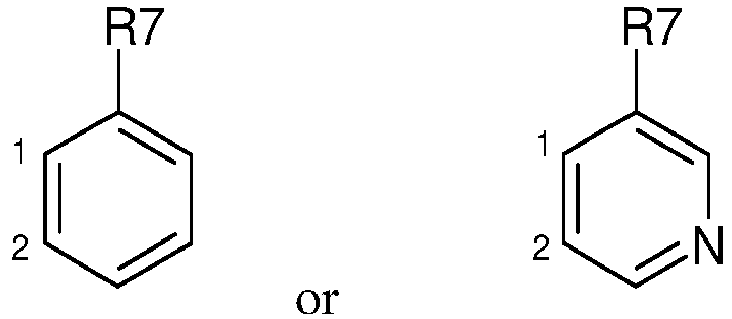
- R7 represents a hydrogen, or halogen atom or an alkyl, hydroxyl or amine group which can be linear or branched and/or unsaturated and optionally substituted,
- pharmaceutically acceptable salts of said compounds, isomers thereof and/or mixtures of the same,
- with the exception of the following compound:

- "Halogen atom" means the group comprising F, Cl, Br and I, preferably said halogen atom is a chlorine atom.
- "Unsaturated" means that the group comprises at least one double bond.
- All the compounds disclosed in the examples are in the scope of the present invention.
- Preferably, X1 represents a CR8 group when X2 represents a nitrogen group, and
- X2 represents a CR8 group when X1 represents a nitrogen group.
- Preferably, at least one of X3 and X4 is a nitrogen atom when the cycle A is in position a.
- Preferably X3 and X4 are different, and even more preferably X3 represents a CR8 group when X2 represents a nitrogen group or a and X4 represents a CR8 group when X1 represents a nitrogen group.
- Preferably, R1 represents a hydrogen atom or a methoxy group.
- Preferably, R2, R3, R4 and R5 independently represent a hydrogen atom or a halogen atom or an alkyl, or benzyl, optionally substituted.
- Preferably, R4 represents a hydrogen atom.
- Preferably, R2 represents a hydrogen atom or a C1 to C4 alkyl group, preferably a methyl.
- Preferably, R3, R5 and R6 independently represent a hydrogen atom.
- Preferably, R7 represents a hydrogen, or halogen atom, more preferably a hydrogen or a chlorine atom.
- Preferably, the ring A is attached at position a or b of the compound of formula I via the carbons numbered 1 and 2 in ring A.
- Preferably, when the ring A is at position a, R4 is the carbon atom numbered 2 of the ring A, more preferably R4 is the carbon atom numbered 2 of the ring A and R10 is the carbon numbered 1.
- Preferably, when a ring A is in position b, X4 is the carbon atom numbered 1 of the ring A, more preferably, X4 is the carbon atom numbered 1 of the ring A and R10 is the carbon numbered 2.
- Preferably, the compound as described above does not include the following compounds:
-

-

-

- Advantageously, the compound of formula I is chosen among the group comprising:
-

-

-

-

- According to a particular embodiment, an additional subject-matter of the present invention is a compound of formula (Ia)

- R independently represent a hydrogen atom, a halogen atom or a group chosen among a (C1-C3)alkyl group, a -CN group, a hydroxyl group, a -COOR1 group, a (C1-C3)fluoroalkyl group, a -NO2 group, a -NR1R2 group and a (C1-C3)alkoxy group,
- R" is as defined above and is advantageously a hydrogen atom,
- n is as defined above and is advantageously 1,
- n' is as defined above and is advantageously 1,
- R' is a hydrogen atom, a halogen atom or a group chosen among a (C1-C3)alkyl group, a -NO2 group, a (C1-C3)alkoxy group and a -NR1R2 group,
- R1 and R2 are a hydrogen atom or a (C1-C3)alkyl group,
- or one of its pharmaceutically acceptable salt,
- for use as an agent for preventing, inhibiting or treating AIDS.
- According to another particular embodiment, an additional subject-matter of the present invention is a compound of formula (Ib)

- R independently represent a hydrogen atom, a halogen atom or a group chosen among a (C1-C3)alkyl group, a -NR1R2 group, a (C1-C3)fluoroalkoxy group, a -NO2 group, a phenoxy group and a (C1-C4)alkoxy group,
- R1 and R2 are independently a hydrogen atom or a (C1-C3)alkyl group,
- R" is as defined above and is advantageously a hydrogen atom,
- n is as defined above and is preferably 1 or 2,
- n' is as defined above and is preferably 1,
- R' is a hydrogen atom, a halogen atom or a group chosen among a (C1-C3)alkyl group and a (C1-C4)alkoxy group,
- or one of its pharmaceutically acceptable salt,
- for use as an agent for preventing, inhibiting or treating AIDS.
- According to another particular embodiment, an additional subject-matter of the present invention is a compound of formula (Ic)

- R independently represent a hydrogen atom or a group chosen among a (C1-C3)alkyl group, a (C1-C3)fluoroalkyl group, a -NR1R2 group, a -COOR1 group, a -NO2 group and a (C1-C3)alkoxy group,
- R" is as defined above and is advantageously a hydrogen atom,
- n is as defined above and is advantageously 1,
- n' is as defined above and is advantageously 1,
- R' is a hydrogen atom,
- R1 and R2 are independently a hydrogen atom or a (C1-C3)alkyl group,
- or one of its pharmaceutically acceptable salt,
- for use as an agent for preventing, inhibiting or treating AIDS.
- According to another particular embodiment, an additional subject-matter of the present invention is a compound of formula (Id)

- R independently represent a hydrogen atom or a group chosen among a (C1-C3)alkyl group, a (C1-C3)fluoroalkyl group and a (C1-C3)alkoxy group,
- R" is as defined above and is advantageously a hydrogen atom,
- n is as defined above and is advantageously 1,
- n' is as defined above and is advantageously 1,
- R' is a hydrogen atom,
- or one of its pharmaceutically acceptable salt,
- for use as an agent for preventing, inhibiting or treating AIDS.
- According to another particular embodiment, an additional subject-matter of the present invention is a compound of formula (Ie)

- R represents a hydrogen atom,
- R" is as defined above and is advantageously a hydrogen atom,
- n is as defined above and is advantageously 1,
- n' is as defined above and is advantageously 1,
- R' is a hydrogen atom, a halogen atom or a group chosen among a (C1-C3)alkyl group and a (C1-C3)alkoxy group,
- or one of its pharmaceutically acceptable salt,
- for use as an agent for preventing, inhibiting or treating AIDS.
- According to another particular embodiment, an additional subject-matter of the present invention is a compound of formula (If)

- R represents a hydrogen atom,
- R" is as defined above and is advantageously a hydrogen atom,
- n is as defined above and is advantageously 1,
- n' is as defined above and is advantageously 1,
- R' is a hydrogen atom,
- or one of its pharmaceutically acceptable salt,
- for use as an agent for preventing, inhibiting or treating AIDS.
- According to another particular embodiment, an additional subject-matter of the present invention is a compound of formula (Ig)

- R represents a hydrogen atom,
- R" is as defined above and is advantageously a hydrogen atom,
- n is as defined above and is advantageously 1,
- n' is as defined above and is advantageously 1,
- R' is a hydrogen atom or a halogen atom,
- or one of its pharmaceutically acceptable salt,
- for use as an agent for preventing, inhibiting or treating AIDS.
- According to another particular embodiment, an additional subject-matter of the present invention is a compound of formula (Ih)

- R represents a hydrogen atom,
- R" is as defined above and is advantageously a hydrogen atom,
- n is as defined above and is advantageously 1,
- n' is as defined above and is advantageously 1,
- R' is a hydrogen atom,
- or one of its pharmaceutically acceptable salt,
- for use as an agent for preventing, inhibiting or treating AIDS.
- According to another particular embodiment, an additional subject-matter of the present invention is a compound of formula (Ii)

- R independently represent a hydrogen atom or a group chosen among a (C1-C3)fluoroalkoxy group and a (C1-C3)alkoxy group,
- R" is as defined above and is advantageously a hydrogen atom,
- n is as defined above and is advantageously 1,
- n' is as defined above and is advantageously 1,
- R' is a hydrogen atom,
- or one of its pharmaceutically acceptable salt,
- for use as an agent for preventing, inhibiting or treating AIDS.
- According to another particular embodiment, an additional subject-matter of the present invention is a compound of formula (Ij)

- R independently represent a hydrogen atom or a group chosen among a (C1-C3)fluoroalkoxy group and a (C1-C3)alkyl group,
- R" is as defined above and is advantageously a hydrogen atom,
- n is as defined above and is advantageously 1,
- n' is as defined above and is advantageously 1,
- R' is a hydrogen atom,
- or one of its pharmaceutically acceptable salt,
- for use as an agent for preventing, inhibiting or treating AIDS.
- According to another particular embodiment, an additional subject-matter of the present invention is a compound of formula (Ik)

- R represents a hydrogen atom,
- R" is as defined above and is advantageously a hydrogen atom,
- n is as defined above and is advantageously 1,
- n' is as defined above and is advantageously 1,
- R' is a hydrogen atom, a halogen atom or a (C1-C3)alkyl group,
- or one of its pharmaceutically acceptable salt,
- for use as an agent for preventing, inhibiting or treating AIDS.
- According to another particular embodiment, an additional subject-matter of the present invention is a compound of formula (Il)

- R represents a hydrogen atom,
- R" is as defined above and is advantageously a hydrogen atom,
- n is as defined above and is advantageously 1,
- n' is as defined above and is advantageously 1,
- R' is a hydrogen atom,
- or one of its pharmaceutically acceptable salt,
- for use as an agent for preventing, inhibiting or treating AIDS.
- According to another particular embodiment, an additional subject-matter of the present invention is a compound of formula (Im)

- R represents a hydrogen atom,
- R" is as defined above and is advantageously a hydrogen atom,
- n is as defined above and is advantageously 1,
- n' is as defined above and is advantageously 1,
- R' is a hydrogen atom,
- or one of its pharmaceutically acceptable salt,
- for use as an agent for preventing, inhibiting or treating AIDS.
- According to another particular embodiment, an additional subject-matter of the present invention is a compound of formula (Io)

- R independently represent a hydrogen atom or a halogen atom or a group chosen among, a -NO2 group, a -CN group and a (C1-C3)alkyl group, said alkyl being optionally mono-substituted by a hydroxyl group,
- R" is as defined above and is advantageously a hydrogen atom,
- n is as defined above and is advantageously 1,
- n' is as defined above and is advantageously 1,
- R' is a hydrogen atom, a halogen atom or a (C1-C3)fluoroalkyl group,
- or one of its pharmaceutically acceptable salt,
- for use as an agent for preventing, inhibiting or treating AIDS.
- According to another particular embodiment, an additional subject-matter of the present invention is a compound of formula (Ip)
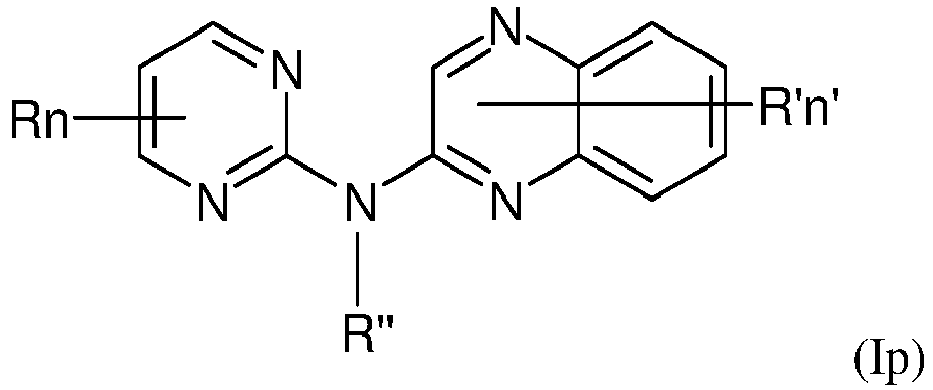
- R represents a hydrogen atom,
- R" is as defined above and is advantageously a hydrogen atom,
- n is as defined above and is advantageously 1,
- n' is as defined above and is advantageously 1,
- R' is a hydrogen atom,
- or one of its pharmaceutically acceptable salt,
- for use as an agent for preventing, inhibiting or treating AIDS.
- According to another particular embodiment, an additional subject-matter of the present invention is a compound of formula (Iq)

- R independently represent a hydrogen atom, a (C1-C3)alkoxy group or a (C1-C3)fluoroalkoxy group,
- R" is as defined above and is advantageously a hydrogen atom,
- n is as defined above and is advantageously 1,
- n' is as defined above and is advantageously 1,
- R' is a hydrogen atom or a group chosen among a -NR1R2 group, a N-methylpiperazinyl group, a (C1-C3)alkoxy group and a morpholino group,
- R1 and R2 are independently a hydrogen atom or a (C1-C3)alkyl group,
- or one of its pharmaceutically acceptable salt,
- for use as an agent for preventing, inhibiting or treating AIDS.
- According to another particular embodiment, an additional subject-matter of the present invention is a compound of formula (Ir)

- R independently represent a hydrogen atom or a (C1-C3)alkyl group,
- R" is as defined above and is advantageously a hydrogen atom,
- n is as defined above and is advantageously 1,
- n' is as defined above and is advantageously 1,
- R' is a hydrogen atom or a group chosen among a -NR1R2 group, a morpholino group and a (C1-C3)alkoxy group,
- R1 and R2 are independently a hydrogen atom or a (C1-C3)alkyl group,
- or one of its pharmaceutically acceptable salt,
- for use as an agent for preventing, inhibiting or treating AIDS.
- According to another particular embodiment, an additional subject-matter of the present invention is a compound of formula (lee)

- R independently represent a hydrogen atom, a (C1-C3)alkyl group or a (C1-C3)fluoroalkyl group,
- R" is as defined above and is advantageously a hydrogen atom,
- n is as defined above and is advantageously 1,
- n' is as defined above and is advantageously 2,
- R' is a hydrogen atom or a (C1-C3)alkyl group,
- or one of its pharmaceutically acceptable salt,
- for use as an agent for preventing, inhibiting or treating AIDS.
- Among the previous defined families of compounds of formulae (Ia) to (lee), some are more particularly preferred for their use as an agent for preventing, inhibiting or treating AIDS. These preferred compounds particularly belong to formulae (Ia), (Ib), (Ic), (Ie) and (Io), as defined above or one of its pharmaceutically acceptable salts.
- Accordingly the present invention further relates to a compound of formula (Ia), (Ib), (Ic), (Ie) and (Io), as defined above, for use as an agent for preventing, inhibiting or treating AIDS.
- Thus, according to a more particular embodiment, the present invention particularly focuses on a compound of formula (Ia)
wherein: - R independently represent a hydrogen atom, a halogen atom or a group chosen among a (C1-C3)alkyl group, a (C1-C3)fluoroalkyl group, a hydroxyl group, a -CN group, a-COOH group and a (C1-C3)alkoxy group,
- R" is as defined above and more preferably is a hydrogen atom,
- n is as defined above and more preferably is 1,
- n' is as defined above,
- R' is a hydrogen atom, a halogen atom, a -NO2 group or a (C1-C3)alkyl group,
- or one of its pharmaceutically acceptable salt,
- for use as an agent for preventing, inhibiting or treating AIDS.
- Still according to this more particular embodiment, the present invention more preferably focuses on compounds of formula (Ia'),
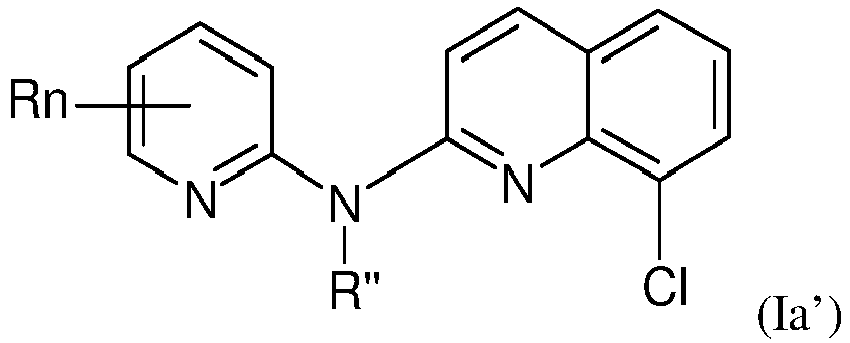
- R independently represent a hydrogen atom, a -CN group, a (C1-C3)alkyl group, a (C1-C3)fluoroalkyl group, a halogen atom or a hydroxyl group,
- R' is as defined in formula (Ia) and is preferably a halogen, a (C1-C3)alkyl group or a NO2 group,
- R" is a hydrogen atom,
- n is 1 or 2
- or one of its pharmaceutically acceptable salt,
- for use as an agent for preventing, inhibiting or treating AIDS.
- According to another more particular embodiment, the present invention particularly focuses on a compound of formula (Ib)
wherein: - R independently represent a hydrogen atom, a halogen atom, a group chosen among a (C1-C4)alkyl group, a -NR1R2 group, a (C1-C3)alkoxy group and a (C1-C3)fluoroalkoxy group,
- R1 and R2 are independently a hydrogen atom or a (C1-C3)alkyl group,
- R" is as defined above and more preferably is a hydrogen atom,
- n is as defined above,
- n' is as defined above,
- R' is a hydrogen atom, halogen atom or a (C1-C3)alkyl group,
- or one of its pharmaceutically acceptable salt,
- for use as an agent for preventing, inhibiting or treating AIDS.
- Still according to this more particular embodiment, the present invention more preferably focuses on compounds of formula (Ib'),

- R independently represent a hydrogen atom, a halogen atom, a group chosen among a (C1-C3)alkoxy group, a (C1-C3)fluoroalkoxy group,
- R" is as defined above and more preferably is a hydrogen atom,
- n is as defined above and more preferably is 1,
- or one of its pharmaceutically acceptable salt,
- for use as an agent for preventing, inhibiting or treating AIDS.
- According to another more particular embodiment, the present invention particularly focuses on a compound of formula (Ic)
wherein: - R independently represent a hydrogen atom or a group chosen among a (C1-C3)fluoroalkyl group, a -NO2 group, a -NR1R2 group and a (C1-C3)alkoxy group,
- R1 and R2 are independently a hydrogen atom or a (C1-C3)alkyl group,
- R" is as defined above and more preferably is a hydrogen atom,
- n is as defined above and more preferably is 1,
- n' is as defined above,
- R' is a hydrogen atom,
- or one of its pharmaceutically acceptable salt,
- for use as an agent for preventing, inhibiting or treating AIDS.
- According to another more particular embodiment, the present invention particularly focuses on a compound of formula (Ie)
wherein: - R represents a hydrogen atom,
- R" is as defined above and more preferably is a hydrogen atom,
- n is as defined above and more preferably is 1,
- n' is as defined above,
- R' is a hydrogen atom or a halogen atom,
- or one of its pharmaceutically acceptable salt,
- for use as an agent for preventing, inhibiting or treating
- According to another more particular embodiment, the present invention particularly focuses on a compound of formula (Io)
wherein: - R independently represent a hydrogen atom, a halogen atom or a group chosen among a (C1-C3)alkyl group and a -NO2 group,
- R" is as defined above and more preferably is a hydrogen atom,
- n is 1, 2 or 3,
- n' is as defined above,
- R' is a hydrogen atom or a (C1-C3)fluoroalkyl group,
- or one of its pharmaceutically acceptable salt,
- for use as an agent for preventing, inhibiting or treating AIDS.
- In a particular embodiment, the present invention relates to a compound of formula (Ia), (Ic) or (Io) as defined above or one of its pharmaceutically acceptable salts, for use as an agent for preventing, inhibiting or treating AIDS.
- According to a preferred embodiment of the present invention, the compound for use as an agent for preventing, inhibiting or treating AIDS, is chosen from:
- (1) (8-Chloro-quinolin-2-yl)-pyridin-2-yl-amine
- (2) 2-(Quinolin-2-ylamino)-isonicotinic acid
- (3) (4-Methyl-pyridin-2-yl)-quinolin-2-yl-amine
- (4) Pyridin-2-yl-quinolin-2-yl-amine
- (5) 2-(8-Chloro-quinolin-2-ylamino)-isonicotinic acid
- (6) (8-Chloro-quinolin-2-yl)-(4-methyl-pyridin-2-yl)-amine
- (7) 6-(Quinolin-2-ylamino)-nicotinonitrile
- (8) Quinolin-2-yl-(4-trifluoromethoxy-phenyl)-amine
- (9) Pyridin-2-yl-quinolin-3-yl-amine
- (10) (3-Methoxy-pyridin-2-yl)-quinolin-3-yl-amine
- (11) Quinolin-3-yl-(5-trifluoromethyl-pyridin-2-yl)-amine
- (12) (5-Nitro-pyridin-2-yl)-quinolin-3-yl-amine
- (13) (5-Methyl-pyridin-2-yl)-quinolin-3-yl-amine
- (14) 2-(Quinolin-3-ylamino)-isonicotinic acid
- (15) Quinolin-6-yl-(5-trifluoromethyl-pyridin-2-yl)-amine
- (16) (6-Methyl-pyridin-2-yl)-quinolin-6-yl-amine
- (17) N-(6-methylpyridin-2-yl)quinolin-2-amine
- (18) 8-chloro-N-(6-methylpyridin-2-yl)quinolin-2-amine
- (19) 4-methyl-N-(pyridin-2-yl)quinolin-2-amine
- (20) 4-methyl-N-(4-methylpyridin-2-yl)quinolin-2-amine
- (21) 3-methyl-N-(4-methylpyridin-2-yl)quinolin-2-amine
- (22) 3-methyl-N-(pyridin-2-yl)quinolin-2-amine
- (23) 6-((4-methylquinolin-2-yl)amino)nicotinonitrile
- (24) 6-((3-methylquinolin-2-yl)amino)nicotinonitrile
- (25) 6-chloro-N-(4-methylpyridin-2-yl)quinolin-2-amine
- (26) 6-chloro-N-(6-methylpyridin-2-yl)quinolin-2-amine
- (27) 4-methyl-N-(5-nitropyridin-2-yl)quinolin-2-amine
- (28) N-(3-nitropyridin-2-yl)quinolin-2-amine
- (29) 8-chloro-N-(3-nitropyridin-2-yl)quinolin-2-amine
- (30) 2-((4-methylquinolin-2-yl)amino)nicotinonitrile
- (31) N-(3-methylpyridin-2-yl)quinolin-2-amine
- (32) N-(5-methylpyridin-2-yl)quinolin-2-amine
- (33) 2-(quinolin-2-ylamino)isonicotinonitrile
- (34) N-(5-(trifluoromethyl)pyridin-2-yl)quinolin-2-amine
- (35) 8-chloro-N-(3-methylpyridin-2-yl)quinolin-2-amine
- (36) 8-chloro-N-(5-methylpyridin-2-yl)quinolin-2-amine
- (37) 8-chloro-N-(5-(trifluoromethyl)pyridin-2-yl)quinolin-2-amine
- (38) N-(3-methoxypyridin-2-yl)quinolin-2-amine
- (39) N-(5-nitropyridin-2-yl)quinolin-2-amine
- (40) 6-((8-chloroquinolin-2-yl)amino)nicotinonitrile
- (41) N-(5-fluoropyridin-2-yl)quinolin-2-amine
- (42) N-(6-(trifluoromethyl)pyridin-2-yl)quinolin-2-amine
- (43) 8-chloro-N-(5-fluoropyridin-2-yl)quinolin-2-amine
- (44) 2-((8-chloroquinolin-2-yl)amino)nicotinic acid
- (45) 4-methyl-N-(6-methylpyridin-2-yl)quinolin-2-amine
- (46) 3-methyl-N-(6-methylpyridin-2-yl)quinolin-2-amine
- (47) 5-cyano-2-(quinolin-2-ylamino)pyridin-1-ium chloride
- (48) 2-((8-chloroquinolin-2-yl)amino)-4-methylpyridin-1-ium chloride
- (49) 8-chloro-N-(4-ethylpyridin-2-yl)quinolin-2-amine
- (50) 8-chloro-N-(6-ethylpyridin-2-yl)quinolin-2-amine
- (51) 8-chloro-N-(4,6-dimethylpyridin-2-yl)quinolin-2-amine
- (52) 6-((8-chloroquinolin-2-yl)amino)-2-methylnicotinonitrile
- (53) 8-chloro-N-(4-chloropyridin-2-yl)quinolin-2-amine
- (54) 8-methyl-N-(4-methylpyridin-2-yl)quinolin-2-amine
- (55) N-(5-bromo-4-methylpyridin-2-yl)-8-chloroquinolin-2-amine
- (56) 8-chloro-N-(3-ethyl-6-methylpyridin-2-yl)quinolin-2-amine
- (57) 8-fluoro-N-(4-methylpyridin-2-yl)quinolin-2-amine
- (58) 8-bromo-N-(4-methylpyridin-2-yl)quinolin-2-amine
- (59) methyl 6-(quinolin-2-ylamino)nicotinate
- (60) methyl 6-[(8-chloroquinolin-2-yl)amino]pyridine-3-carboxylate
- (61) methyl 6-[(3-methylquinolin-2-yl)amino]pyridine-3-carboxylate
- (62) methyl 2-[(8-chloroquinolin-2-yl)amino]pyridine-3-carboxylate
- (63) 8-methoxy-N-(4-methylpyridin-2-yl)quinolin-2-amine
- (64) N-(4-methylpyridin-2-yl)-5-nitroquinolin-2-amine
- (65) 2-N-(4-methylpyridin-2-yl)quinoline-2,8-diamine
- (66) 2-N-(4-methylpyridin-2-yl)quinoline-2,5-diamine
- (67) methyl 6-[(4-methylquinolin-2-yl)amino]pyridine-3-carboxylate
- (68) 8-chloro-N-[4-(trifluoromethyl)pyridin-2-yl]quinolin-2-amine
- (69) 2-[(8-chloroquinolin-2-yl)amino]pyridin-3-ol
- (70) 8-chloro-N-[6-(trifluoromethyl)pyridin-2-yl]quinolin-2-amine
- (71) 6-chloro-N-(5-fluoropyridin-2-yl)quinolin-2-amine
- (72) N-(6-ethylpyridin-2-yl)-3-methylquinolin-2-amine
- (73) N-(5-fluoropyridin-2-yl)-3-methylquinolin-2-amine
- (74) 3-methyl-N-[5-(trifluoromethyl)pyridin-2-yl]quinolin-2-amine
- (75) 4-N-(8-chloroquinolin-2-yl)-1-N,1-N-dimethylbenzene-1,4-diamine
- (76) N-(4-methoxyphenyl)quinolin-2-amine
- (77) 8-chloro-N-(4-methoxyphenyl)quinolin-2-amine
- (78) 4-methyl-N-[4-(trifluoromethoxy)phenyl]quinolin-2-amine
- (79) N-(4-methoxyphenyl)-3-methylquinolin-2-amine
- (80) 3-methyl-N-[4-(trifluoromethoxy)phenyl]quinolin-2-amine
- (81) 1-N,1-N-dimethyl-4-N-(3 -methylquinolin-2-yl)benzene-1,4-diamine
- (82) N-[2-methyl-4-(trifluoromethoxy)phenyl]quinolin-2-amine
- (83) N-[3-(trifluoromethoxy)phenyl]quinolin-2-amine
- (84) N-[2-(trifluoromethoxy)phenyl]quinolin-2-amine
- (85) N-(4-nitrophenyl)quinolin-2-amine
- (86) N-(3-fluorophenyl)quinolin-2-amine
- (87) 8-chloro-N-[3-(trifluoromethoxy)phenyl]quinolin-2-amine
- (88) 8-chloro-N-(3-fluorophenyl)quinolin-2-amine
- (89) 2-{[4-(trifluoromethoxy)phenyl]amino}quinolin-1-ium chloride
- (90) 8-chloro-N-[4-(trifluoromethoxy)phenyl]quinolin-2-amine
- (91) 3-methyl-N-[2-methyl-4-(trifluoromethoxy)phenyl]quinolin-2-amine
- (92) 3-methyl-N-[3-(trifluoromethoxy)phenyl]quinolin-2-amine
- (93) 3-methyl-N-[2-(trifluoromethoxy)phenyl]quinolin-2-amine
- (94) 8-chloro-N-[2-methyl-4-(trifluoromethoxy)phenyl]quinolin-2-amine
- (95) 3-methyl-2-{[4-(trifluoromethoxy)phenyl]amino}quinolin-1-ium chloride
- (96) 6-chloro-N-(4-(trifluoromethoxy)phenyl)quinolin-2-amine
- (97) 4-methyl-2-{[4-(trifluoromethoxy)phenyl]amino}quinolin-1-ium chloride
- (98) 8-bromo-N-[4-(trifluoromethoxy)phenyl]quinolin-2-amine
- (99) 8-fluoro-N-[4-(trifluoromethoxy)phenyl]quinolin-2-amine
- (100) 8-methyl-N-[4-(trifluoromethoxy)phenyl]quinolin-2-amine
- (101) N-(4-butoxyphenyl)-8-chloroquinolin-2-amine
- (102) N-(4-phenoxyphenyl)quinolin-2-amine
- (103) 8-methoxy-N-[4-(trifluoromethoxy)phenyl]quinolin-2-amine
- (104) 8-chloro-N-[3-chloro-4-(trifluoromethoxy)phenyl]quinolin-2-amine
- (105) N-(6-methylpyridin-2-yl)quinolin-3-amine
- (106) N-(3-nitropyridin-2-yl)quinolin-3-amine
- (107) N-(5-methylpyridin-2-yl)quinolin-6-amine
- (108) N-(3-methoxypyridin-2-yl)quinolin-6-amine
- (109) 6-chloro-N-(pyrazin-2-yl)quinolin-2-amine
- (110) 8-bromo-N-(pyrazin-2-yl)quinolin-2-amine
- (111) 8-methyl-N-(pyrazin-2-yl)quinolin-2-amine
- (112) 8-chloro-N-(pyrazin-2-yl)quinolin-2-amine
- (113) N-(pyrazin-2-yl)quinolin-2-amine
- (114) 4-methyl-N-(pyrazin-2-yl)quinolin-2-amine
- (115) 3-methyl-N-(pyrazin-2-yl)quinolin-2-amine
- (116) 8-fluoro-N-(pyrazin-2-yl)quinolin-2-amine
- (117) 8-methoxy-N-(pyrazin-2-yl)quinolin-2-amine
- (118) N-(pyridin-3-yl)quinolin-3-amine
- (119) 8-chloro-N-(pyridin-4-yl)quinolin-2-amine
- (120) N-(pyridin-4-yl)quinolin-2-amine
- (121) N-(pyridin-4-yl)quinolin-3-amine
- (122) N-[4-(trifluoromethoxy)phenyl]quinolin-3-amine
- (123) N-(4-methoxyphenyl)quinolin-3-amine
- (124) N-[4-(trifluoromethoxy)phenyl]quinoxalin-2-amine
- (125) N-[2-methyl-4-(trifluoromethoxy)phenyl]quinoxalin-2-amine
- (126) N-[3-(trifluoromethoxy)phenyl]quinoxalin-2-amine
- (127) N-[2-(trifluoromethoxy)phenyl]quinoxalin-2-amine
- (128) N-(pyrimidin-2-yl)quinolin-2-amine
- (129) 8-chloro-N-(pyrimidin-2-yl)quinolin-2-amine
- (130) 4-methyl-N-(pyrimidin-2-yl)quinolin-2-amine
- (131) N-(pyrazin-2-yl)quinolin-6-amine
- (132) N-(pyrazin-2-yl)quinolin-3-amine
- (133) 6-methyl-N-(naphthalen-2-yl)pyridin-2-amine
- (134) N-(naphthalen-2-yl)pyridin-2-amine
- (135) N-(pyridin-2-yl)quinoxalin-2-amine
- (136) N-(4-methylpyridin-2-yl)quinoxalin-2-amine
- (137) 6-(quinoxalin-2-ylamino)pyridine-3-carbonitrile
- (138) N-(6-methylpyridin-2-yl)quinoxalin-2-amine
- (139) N-(4-methylpyridin-2-yl)-3-(trifluoromethyl)quinoxalin-2-amine
- (140) N-(3,5-dichloro-4-methylpyridin-2-yl)quinoxalin-2-amine
- (141) N-(4-methyl-3-nitropyridin-2-yl)quinoxalin-2-amine
- (142) N-(pyrimidin-2-yl)quinoxalin-2-amine
- (143) 4-N,4-N-dimethyl-7-N-[4-(trifluoromethoxy)phenyl]quinoline-4,7-diamine
- (144) 4-(morpholin-4-yl)-N-[4-(trifluoromethoxy)phenyl]quinolin-7-amine
- (145) 4-methoxy-N-(pyridin-2-yl)quinolin-7-amine
- (146) 4-methoxy-N-(4-methylpyridin-2-yl)quinolin-7-amine
- (147) 4-N,4-N-dimethyl-7-N-(4-methylpyridin-2-yl)quinoline-4,7-diamine
- (148) 5,8-dimethyl-N-(5-methylpyridin-2-yl)isoquinolin-6-amine
- (149) 5,8-dimethyl-N-(5-methylpyridin-2-yl)isoquinolin-6-amine
- (150) N-(4-methylpyridin-2-yl)-8-nitroquinolin-2-amine
- (151) 6-chloro-N-(6-ethylpyridin-2-yl)quinolin-2-amine
- (152) 6-chloro-N-(5-methylpyridin-2-yl)quinolin-2-amine
- (153) 6-chloro-N-[5-(trifluoromethyl)pyridin-2-yl]quinolin-2-amine
- (154) N2-(8-chloroquinolin-2-yl)-4-methylpyridine-2,3-diamine
- (155) N-(4-butoxyphenyl)-3-methylquinolin-2-amine
- (156) 4-N-(6-chloroquinolin-2-yl)-1-N,1-N-dimethylbenzene-1,4-diamine
- (157) 8-chloro-N-(3-chloro-4-methoxyphenyl)quinolin-2-amine
- (158) N1-(8-chloroquinolin-2-yl)-4-(trifluoromethoxy)benzene-1,2-diamine
- (159) 2-{4-[(8-chloroquinolin-2-yl)amino]phenoxy}ethan-1-ol
- (160) 6-chloro-N-(4-methylpyridin-2-yl)quinoxalin-2-amine
- (161) N-(4-ethylpyridin-2-yl)quinoxalin-2-amine
- (162) N-(5-bromo-4-methylpyridin-2-yl)quinoxalin-2-amine
- (163) N-(4,6-dimethylpyridin-2-yl)quinoxalin-2-amine
- (164) [2-(quinoxalin-2-ylamino)pyridin-4-yl]methanol
- (165) N-(4-methyl-5-nitropyridin-2-yl)quinoxalin-2-amine
- (166) N-(4-methoxyphenyl)-4-(4-methylpiperazin-1-yl)quinolin-7-amine
- (167) 4-methoxy-N-[4-(trifluoromethoxy)phenyl]quinolin-7-amine
- (168) N-(4-methylpyridin-2-yl)-4-(morpholin-4-yl)quinolin-7-amine
- and their pharmaceutically acceptable salts.
- Among said compounds, compounds (1), (6), (33), (34), (35), (36), (37), (38), (42), (43), (44), (45), (46), (48), (50), (64), (68), (69), (70), (71), (72), (73), (74), (75), (77), (78), (79), (80), (81), (82), (86), (87), (88), (90), (92), (96), (104), (106), (109), (112), (136), (139), (140) and (141) are of particular interest.
- The present invention therefore extends to compounds (1), (6), (33), (34), (35), (36), (37), (38), (42), (43), (44), (45), (46), (48), (50), (64), (68), (69), (70), (71), (72), (73), (74), (75), (77), (78), (79), (80), (81), (82), (86), (87), (88), (90), (92), (96), (104), (106), (109), (112), (136), (139), (140) and (141) or one of its pharmaceutically acceptable salts for use as an agent for preventing, inhibiting or treating AIDS.
- Some of said preceding compounds are new and form part of the present invention: (1), (6), (33), (34), (35), (36), (37), (38), (42), (43), (44), (46), (48), (50), (64), (68), (69), (70), (71), (72), (73), (74), (75), (77), (78), (79), (80), (81), (82), (86), (87), (88), (90), (92), (96), (104), (106), (109), (112), (136), (139), (140), (141) and their pharmaceutically acceptable salts, such as hydrobromide, tartrate, citrate, trifluoroacetate, ascorbate, hydrochloride, tartrate, triflate, maleate, mesylate, formate, acetate and fumarate.
- The compounds of formulae (I), (Ia), (Ib), (Ic), (Id), (Ie), (If), (Ig), (Ih), (Ii), (Ij), (Ik), (Il), (Im), (Io), (Ip), (Iq), (Ir) and (lee) can comprise one or more asymmetric carbon atoms. They can thus exist in the form of enantiomers or of diastereoisomers. These enantiomers, diastereoisomers and their mixtures, including the racemic mixtures, are encompassed within the scope of the present invention.
- Among the compounds of formula (I), some of them are new and form part of the invention, as well as their pharmaceutically acceptable salts, such as hydrobromide, tartrate, citrate, trifluoroacetate, ascorbate, hydrochloride, tartrate, triflate, maleate, mesylate, formate, acetate and fumarate.
- According to a particular embodiment, the present invention encompasses compounds of formula (Ig)
wherein: - R independently represent a hydrogen atom, a halogen atom or a group chosen among a (C1-C3)alkyl group, a -CN group, a hydroxyl group, a -COOR1 group, a (C1-C3)fluoroalkyl group, a (C1-C3)fluoroalkoxy group, a -NO2 group, a -NR1R2 group, and a (C1-C3)alkoxy group,
- n is 1 or 2,
- n' is 1 or 2,
- R' is a hydrogen atom or a group chosen among a (C1-C3)alkyl group, a halogen atom, a hydroxyl group, a -COOR1 group, a -NO2 group, a -NR1R2 group, a (C1-C3)alkoxy group and a -CN group,
- R" is a hydrogen atom or a (C1-C4)alkyl group,
- R1 and R2 are independently a hydrogen atom or a (C1-C3)alkyl group,
- with the proviso that R and R' are not simultaneously a hydrogen atom,
- and when n and n' are 1 and R is a hydrogen atom then R' is not a -COOH group,
- or anyone of its pharmaceutically acceptable salt.
- According to another particular embodiment, the present invention encompasses compounds of formula (If)
wherein: - R independently represent a hydrogen atom, a halogen atom or a group chosen among a (C1-C3)alkyl group, a -CN group, a hydroxyl group, a -COOR1 group, a (C1-C3)fluoroalkyl group, a (C1-C3)fluoroalkoxy group, a -NO2 group, a -NR1R2 group, and a (C1-C3)alkoxy group,
- n is 1 or 2,
- n' is 1 or 2,
- R' is a hydrogen atom or a group chosen among a (C1-C3)alkyl group, a halogen atom, a hydroxyl group, a -COOR1 group, a -NO2 group, a -NR1R2 group, a (C1-C3)alkoxy group and a -CN group,
- R" is a hydrogen atom or a (C1-C4)alkyl group,
- R1 and R2 are independently a hydrogen atom or a (C1-C3)alkyl group,
- or anyone of its pharmaceutically acceptable salt.
- According to another particular embodiment, the present invention encompasses compounds of formula (Ih)
wherein: - R independently represent a hydrogen atom, a halogen atom or a group chosen among a (C1-C3)alkyl group, a -CN group, a hydroxyl group, a -COOR1 group, a (C1-C3)fluoroalkyl group, a (C1-C3)fluoroalkoxy group, a -NO2 group, a -NR1R2 group, and a (C1-C3)alkoxy group,
- n is 1 or 2,
- n' is 1 or 2,
- R' is a hydrogen atom or a group chosen among a (C1-C3)alkyl group, a halogen atom, a hydroxyl group, a -COOR1 group, a -NO2 group, a -NR1R2 group, a (C1-C3)alkoxy group and a -CN group,
- R" is a hydrogen atom or a (C1-C4)alkyl group,
- R1 and R2 are independently a hydrogen atom or a (C1-C3)alkyl group,
- or anyone of its pharmaceutically acceptable salt.
- According to another particular embodiment, the present invention encompasses compounds of formula (II)
wherein: - R independently represent a hydrogen atom, a halogen atom or a group chosen among a (C1-C3)alkyl group, a -CN group, a hydroxyl group, a -COOR1 group, a (C1-C3)fluoroalkyl group, a (C1-C3)fluoroalkoxy group, a -NO2 group, a -NR1R2 group, and a (C1-C3)alkoxy group,
- n is 1 or 2,
- n' is 1 or 2,
- R' is a hydrogen atom or a group chosen among a (C1-C3)alkyl group, a halogen atom, a hydroxyl group, a -COOR1 group, a -NO2 group, a -NR1R2 group, a (C1-C3)alkoxy group and a -CN group,
- R" is a hydrogen atom or a (C1-C4)alkyl group,
- R1 and R2 are independently a hydrogen atom or a (C1-C3)alkyl group,
- with the proviso that R and R' are not simultaneously a hydrogen atom,
- or anyone of its pharmaceutically acceptable salt.
- According to another particular embodiment, the present invention encompasses compounds of formula (Im)
wherein: - R independently represent a hydrogen atom, a halogen atom or a group chosen among a (C1-C3)alkyl group, a -CN group, a hydroxyl group, a -COOR1 group, a (C1-C3)fluoroalkyl group, a (C1-C3)fluoroalkoxy group, a -NO2 group, a -NR1R2 group, and a (C1-C3)alkoxy group,
- n is 1 or 2,
- n' is 1 or 2,
- R' is a hydrogen atom or a group chosen among a (C1-C3)alkyl group, a halogen atom, a hydroxyl group, a -COOR1 group, a -NO2 group, a -NR1R2 group, a (C1-C3)alkoxy group and a -CN group,
- R" is a hydrogen atom or a (C1-C4)alkyl group,
- R1 and R2 are independently a hydrogen atom or a (C1-C3)alkyl group,
- with the proviso that when n and n' are 1 and R is a hydrogen atom, R' is not a chlorine atom,
- or anyone of its pharmaceutically acceptable salt.
- For a sake of simplification, the following compounds and their corresponding definitions are called "new compounds".
- According to another particular embodiment, the present invention encompasses compounds of formula (Ia), as such,
wherein: - R" and n are as defined in formula (Ia),
- n' is 1,
- R independently represent a hydrogen atom, a halogen atom or a group chosen among a (C1-C3)alkyl group, a -CN group, a hydroxyl group, a -COOR1 group, a (C1-C3)fluoroalkyl group, a -NO2 group, a (C1-C3)fluoroalkoxy group and a (C1-C3)alkoxy group,
- R' is a hydrogen atom or a halogen atom or a group chosen among a (C1-C3)alkyl group, a -COOR1 group, and a -CN group,
- and wherein:
- with the proviso that
- when R and R' are not simultaneously a hydrogen atom,
- when n is 1, R is not a methyl group in ortho or para position with respect to Z, Z being N,
- when R' is a hydrogen atom, R is not a bromine atom or a chlorine atom,
- when R is a hydrogen atom, R' is not a methyl or ethyl group, a -COOH group, a COOC2H5 group or a bromine atom, said bromine atom being in ortho position of the bond linked to NR",
- or one of its pharmaceutically acceptable salt.
- Still according to this particular embodiment, the present invention more particularly focuses on compounds of formula (Ia), as such, wherein,
- R independently represent a hydrogen atom, a (C1-C3)fluoroalkyl group, a halogen atom, a -CN group or a (C1-C3) alkyl group,
- R" is as defined in formula (Ia),
- R' is a hydrogen atom, a halogen atom or a -NO2 group,
- n' is 1,
- n is 1,
- with the proviso that
- when n is 1, R is not a methyl group in ortho or para position with respect to Z, Z being N,
- R is not a bromine atom or a chlorine atom when R' is a hydrogen atom,
- or one of its pharmaceutically acceptable salt.
- Still according to this particular embodiment, the present invention more preferably focuses on compounds of formula (Ia'), as such,

- R independently represent a hydrogen atom, a (C1-C3) alkyl group, a (C1-C3)fluoroalkyl group, a halogen atom or a hydroxyl group,
- R" is as defined in formula (Ia),
- n is 1 or 2, and preferably 1,
- or one of its pharmaceutically acceptable salt.
- The present invention further relates to a compound of formula (Ib) as defined above, as such

- R' and R" are as defined in formula (Ib),
- n is 1, and
- R is a hydrogen atom or a (C1-C3)fluoroalkoxy group,
- Still according to this particular embodiment, the present invention more particularly focuses on compounds of formula (Ib)
wherein: - R is a hydrogen atom or a (C1-C3)fluoroalkoxy group,
- R' is a hydrogen atom, a halogen atom or a (C1-C4)alkyl group,
- R" is as defined in the formula (Ib),
- n' is 1 or 2 and is preferably 1,
- n is 1 or 2 and is preferably 1,
- or one of its pharmaceutically acceptable salt.
- Still according to this particular embodiment, the present invention more particularly focuses on compounds of formula (Ib')
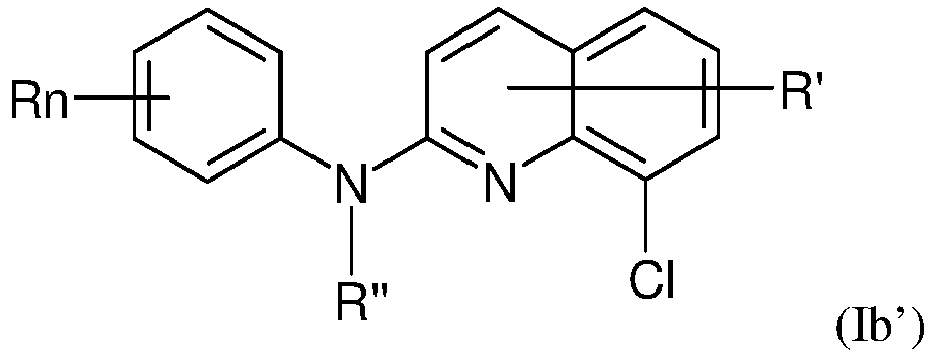
- R, R" and n are as defined in formula (Ib),
- R' is as defined in formula (Ib),
- with the proviso that R' is different from a methyl group in position 4 on the quinoline,
- or one of its pharmaceutically acceptable salt.
- Still according to this particular embodiment, the present invention more particularly focuses on compounds of formula (Ib")

- R, R" and n are as defined in formula (Ib),
- with the proviso that when n is 1, R is not a hydrogen atom, a methyl group in para of the bond linked to NR", a ethoxy group in para of the bond linked to NR", nor a fluorine atom in para of the bond linked to NR",
- or one of its pharmaceutically acceptable salt.
- According to another particular embodiment, the present invention encompasses compounds of formula (Ic), as such,
wherein: - R independently represent a hydrogen atom, a halogen atom or a group chosen among a (C1-C3)alkyl group, a -CN group, a hydroxyl group, a -COOR1 group, a (C1-C3)fluoroalkyl group, a -NO2 group, a -NR1R2 group and a (C1-C3)alkoxy group,
- R1 and R2 are independently a hydrogen atom or a (C1-C3)alkyl group,
- n is 1 or 2, and advantageously 1,
- n' is 1 or 2,
- R" is as defined in formula (Ic),
- R' is a hydrogen atom or a group chosen among a (C1-C3)alkyl group, a -NO2 group, a -NR1R2 group and a (C1-C3)alkoxy group,
- with the proviso that
- R and R' are not simultaneously a hydrogen atom,
- R is not a bromine atom when R' is a hydrogen atom,
- or one of its pharmaceutically acceptable salt.
- Still according to this particular embodiment, the present invention more particularly focuses on compounds of formula (Ic), as such, wherein,
- R is a hydrogen atom or a -NO2 group,
- n is 1,
- R', R" and n' are as defined in formula (Ic), and
- R' is preferably a (C1-C3)alkyl group or a hydrogen atom,
- or one of its pharmaceutically acceptable salt.
- The present invention further relates to a compound of formula (Ie) as defined above, as such

- R, R', R" n and n' are as defined in formula (I),
- with the proviso that
- when R is a hydrogen atom, R' is not a bromine atom,
- or one of its pharmaceutically acceptable salt.
- According to another particular embodiment, the present invention encompasses compounds of formula (Io), as such,
wherein: - R independently represent a hydrogen atom, a halogen atom or a group chosen among a (C1-C3)alkyl group, a -CN group, a hydroxyl group, a -COOR1 group, a (C1-C3)fluoroalkyl group, a (C1-C3)fluoroalkoxy group, a -NO2 group, a -NR1R2 group and a (C1-C3)alkoxy group,
- R1 and R2 are independently a hydrogen atom or a (C1-C3)alkyl group,
- n is 1, 2 or 3,
- n' is 1 or 2,
- R' is a hydrogen atom or a group chosen among a (C1-C3)alkyl group, a halogen atom, a hydroxyl group, a -COOR1 group, a -NO2 group, a -NR1R2 group, a (C1-C3)alkoxy group and a -CN group,
- R" is a hydrogen atom or a (C1-C4)alkyl group,
- with the proviso that
- when R is a hydrogen atom and n' is 1, R' is not a hydroxyl group,
- or one of its pharmaceutically acceptable salt.
- Still according to this particular embodiment, the present invention more particularly focuses on compounds of formula (Io'), as such, wherein

- n is 1, 2 or 3,
- n' is 1 or 2,
- R independently represent a hydrogen atom, a halogen atom or a group chosen among a (C1-C3)alkyl group, a -CN group, a hydroxyl group, a -COOR1 group, a (C1-C3)fluoroalkyl group, a (C1-C3)fluoroalkoxy group, a -NO2 group, a -NR1R2 group and a (C1-C3)alkoxy group, and is preferably a -NO2 group, a hydrogen atom or a halogen atom,
- R' is a hydrogen atom or a group chosen among a (C1-C3)alkyl group, a halogen atom, a hydroxyl group, a -COOR1 group, a -NO2 group, a -NR1R2 group, a (C1-C3)alkoxy group and a -CN group, a (C1-C3)fluroralkyl group, and preferably is a hydrogen atom or a (C1-C3)fluoroalkyl group,
- R1 and R2 are as defined in formula (Io),
- R" is a hydrogen atom or a (C1-C4)alkyl group,
- or one of its pharmaceutically acceptable salt.
- Among said compounds as such, compounds (1), (2), (5)-(8), (10)-(16), (18), (21)-(44), (46)-(75), (77)-(84), (86)-(119), (121), (124)-(130), (132), (135)-(141), (143)-(147), (149)-(168) and their pharmaceutically acceptable salts are of particular interest.
- The present invention therefore extends to compounds (1), (2), (5)-(8), (10)-(16), (18), (21)-(44), (46)-(75), (77)-(84), (86)-(119), (121), (124)-(130), (132), (135)-(141), (143)-(147), (149)-(168) and their pharmaceutically acceptable salts, as such.
- More preferably, compounds (8), (75), (77)-(84), (86)-(104), (109)-(117), (155)-(158) and their pharmaceutically acceptable salts are of particular interest.
- The present invention therefore extends more preferably to compounds (8), (75), (77)-(84), (86)-(104), (109)-(117), (155)-(158) and their pharmaceutically acceptable salts, such as hydrobromide, tartrate, citrate, trifluoroacetate, ascorbate, hydrochloride, tartrate, triflate, maleate, mesylate, formate, acetate and fumarate.
- Still more preferably, the present invention extends to compounds (75), (77), (78), (79), (80), (81), (82), (86), (87), (88), (90), (92), (96), (104), (109), (112), and their pharmaceutically acceptable salts, such as hydrobromide, tartrate, citrate, trifluoroacetate, ascorbate, hydrochloride, tartrate, triflate, maleate, mesylate, formate, acetate and fumarate.
- The new compounds of the present invention, i.e. compounds of formulae (Ia), (Ic), (Io), (Ib), (Ib'), (Ib") and (Ie) and the specific compounds as listed above, are not only useful as agent for inhibiting, preventing or treating AIDS but can also be useful for inhibiting, preventing or treating premature aging and for inhibiting, preventing or treating cancer, and more particularly colorectal cancer, pancreatic cancer, lung cancer including non-small cell lung cancer, breast cancer, bladder cancer, gall bladder cancer, liver cancer, thyroid cancer, melanoma, uterine/cervical cancer, oesophageal cancer, kidney cancer, ovarian cancer, prostate cancer, head and neck cancer and stomach cancer, etc.
- According to an aspect of the invention said compounds may be useful to inhibit, prevent and/or treat diseases with premature aging and that are likely related to an aberrant splicing of the nuclear lamin A gene. Among all, said disease may include Hutchinson Guilford Progeria Syndrome (HGPS), progeria, premature aging associated with HIV infection, muscular dystrophy, Charcot-Marie-Tooth disorder, Werner syndrome, but also atherosclerosis, insulin resistant type II diabetes, cataracts, osteoporosis and aging of the skin such as restrictive dermopathy.
- The compounds of the present invention can be prepared by conventional methods of organic synthesis practiced by those skilled in the art. The general reaction sequences outlined below represent a general method useful for preparing the compounds of the present invention and are not meant to be limiting in scope or utility.
- The compounds of general formula (I) can be prepared according to scheme 1 below.

- As appears in said scheme two routes are available for recovering a compound of formula (I) according to the present invention.
- The synthesis is based on a coupling reaction alternatively starting from a halogeno-bicycle of formula (III), wherein X, Y, W, T, U, n', R' and R" are as defined above and X' is a chlorine atom or a bromine atom or from a chloro-monocycle of formula (V), wherein Z, V, n and R are as defined above and X' is a chlorine atom or a bromine atom.
- According to route (A), the compound of formula (III) is placed in a protic solvent such as tert-butanol. The compound of formula (IV) is then added in a molar ratio ranging from 1 to 1.5 with respect to the compound of formula (III) in presence of an inorganic base, such as Cs2CO3 or K2CO3 in a molar ratio ranging from 1 and 2, in the presence of a diphosphine, such as Xantphos (4,5-Bis(diphenylphosphino)-9,9-dimethylxanthene) or X-Phos (2-Dicyclohexylphosphino-2',4',6'-triisopropylbiphenyl) in an amount ranging from 2mol% to 10mol% relative to the total amount of compound of formula (III), and in the presence of a catalyst, such as Pd(OAc)2 or Pd2dba3 in an amount ranging from 2mol% and 10mol% relative to the total amount of compound of formula (III). The reaction mixture can then be heated at a temperature ranging from 80 to 120°C, for example at 90°C and stirred for a time ranging form 15 to 25 hours, for example during 20 hours under inert gas and for example argon. The reaction mixture can be concentrated under reduced pressure.
- According to route (B) the compound of formula (V) is placed in a protic solvent such as tert-butanol. The compound of formula (VI) is then added in a molar ratio ranging from 1 to 1.5 with respect to the compound of formula (V) in presence of an inorganic base, such as Cs2CO3 or K2CO3 in a molar ratio ranging from 1 to 2, in the presence of a diphosphine, such as Xantphos (4,5-Bis(diphenylphosphino)-9,9-dimethylxanthene) or X-Phos (2-Dicyclohexylphosphino-2',4',6'-triisopropylbiphenyl) in an amount ranging from 2 mol% to 10 mol% relative to the total amount of compound of formula (V), and in the presence of a catalyst, such as Pd(OAc)2 or Pd2dba3 in an amount ranging from 2 mol% to 10 mol% relative to the total amount of compound of formula (V). The reaction mixture can then be heated at a temperature ranging from 80 to 120°C, for example at 90°C and stirred for a time ranging form 15 to 25 hours, for example during 20 hours under inert gas and for example argon. The reaction mixture can be concentrated under reduced pressure.
- The starting compounds of formula (III), (IV), (V) and (VI) are commercially available or can be prepared according to methods known to the person skilled in the art.
- The chemical structures and spectroscopic data of some compounds of formula (I) of the invention are illustrated respectively in the following Table I and Table II.
Table I 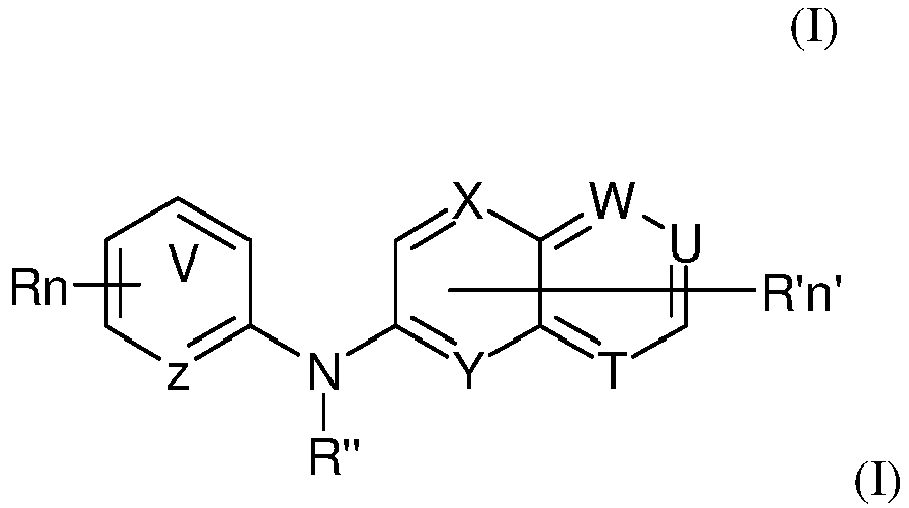
Formula (Ia) 1 
2 
3 
4 
5 
6 
7 
17 
18 
19 
20 
21 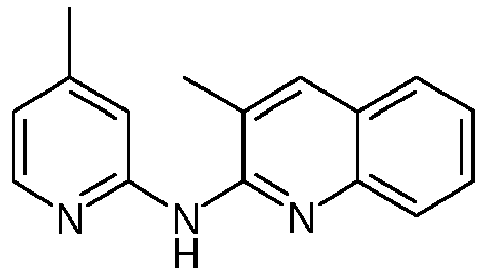
22 
23 
24 
25 
26 
27 
28 
29 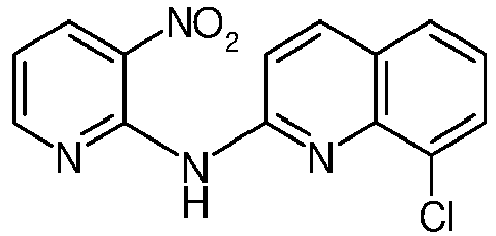
30 
31 
32 
33 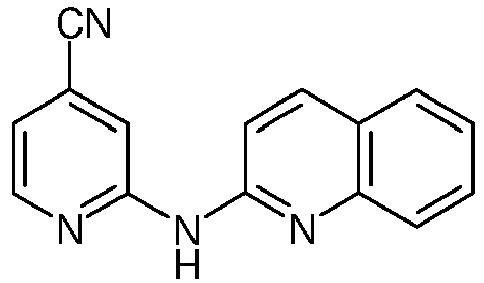
34 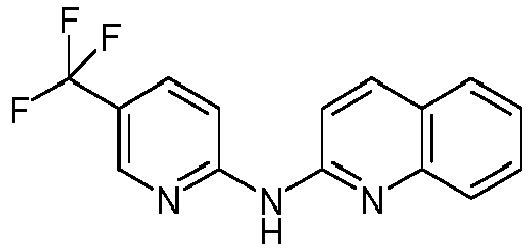
35 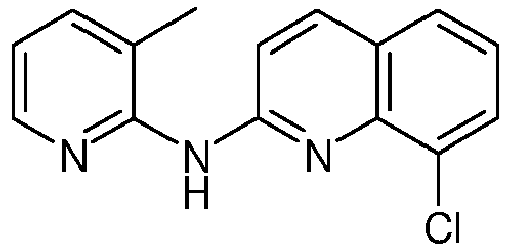
36 
37 
38 
39 
40 
41 
42 
43 
44 
45 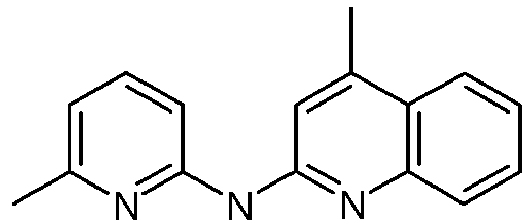
46 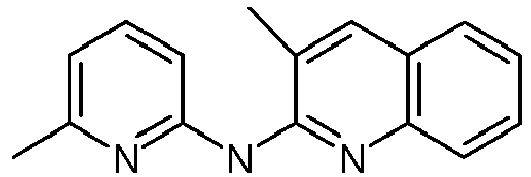
47 
48 
49 
50 
51 
52 
53 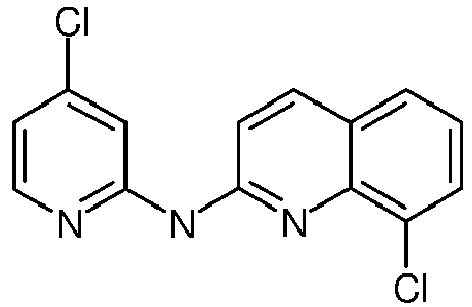
54 
55 
56 
57 
58 
59 
60 
61 
62 
63 
64 
65 
66 
67 
68 
69 
70 
71 
72 
73 
74 
150 
151 
152 
153 
154 
Formula (Ib) 8 
75 
76 
77 
78 
79 
80 
81 
82 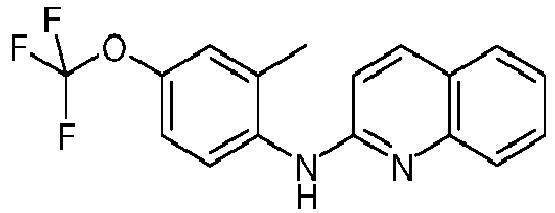
83 
84 
85 
86 
87 
88 
89 
90 
91 
92 
93 
94 
95 
96 
97 
98 
99 
100 
101 
102 
103 
104 
155 
156 
157 
158 
Formula (Ic) 9 
10 
11 
12 
13 
14 
105 
106 
159 
Formula (Id) 15 
16 
107 
108 
Formula (Ie) 109 
110 
111 
112 
113 
114 
115 
116 
117 
Formula (If) 118 
Formula (Ig) 119 
120 
Formula (Ih) 121 
Formula (Ii) 122 
123 
Formula (Ij) 124 
125 
126 
127 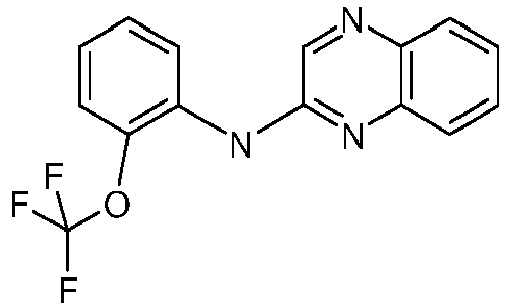
Formula (Ik) 128 
129 
130 
Formula (II) 131 
Formula (Im) 132 
Formula (Io) 135 
136 
137 
138 
139 
140 
141 
160 
161 
162 
163 
164 
165 
Formula (Ip) 142 
Formula (Iq) 143 
144 
166 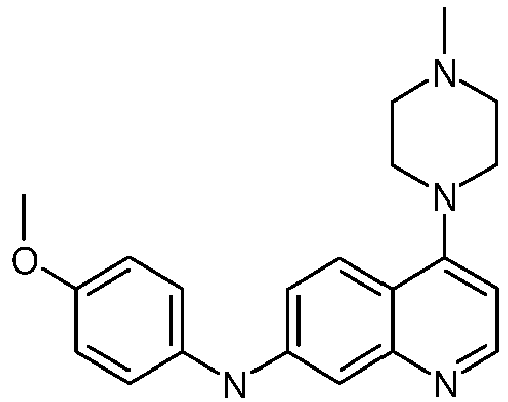
167 
Formula (Ir) 145 
146 
147 
168 
Formula (lee) 148 
149 
Table II Ex Characterizations 1 MS (ESI) [M+H] +=256 2 1H NMR (300 MHz, D2O) δ 8.31 (d, J = 5.1, 1H), 8.21 (d, J = 9.3, 1H), 7.60 (d, J = 7.5, 3H), 7.34 (dd, J = 6.2, 15.6, 2H), 7.18 (s, 1H), 6.99 (d, J = 9.1, 1H) MS (ESI) [M+H] +=266 5 MS (ESI) [M+H] +=300 6 1H NMR (300 MHz, DMSO) δ 10.23 (s, 1H), 8.96 (s, 1H), 8.18 (d, J = 8.8, 2H), 7.78 (dd, J = 7.7, 13.7, 2H), 7.46 (d, J = 8.9, 1H), 7.31 (t, J = 7.8, 1H), 6.86 (d, J = 4.3, 1H), 2.37 (s, 3H). 13C NMR (75 MHz, DMSO) δ 153.63, 153.61, 148.37, 147.32, 142.65, 137.52, 129.68, 129.47, 126.82, 125.06, 123.26, 118.36, 115.10, 113.31, 21.24. MS (ESI) [M+H] +=270 7 1H NMR (300 MHz, DMSO) δ 10.71 (s, 1H), 8.71 (d, J = 1.4, 1H), 8.62 (d, J = 8.9, 1H), 8.24 (d, J = 8.9, 1H), 8.17 (dd, J = 1.9, 8.9, 1H), 7.89-7.74 (m, 2H), 7.66 (dd, J = 7.9, 14.2, 2H), 7.42 (t, J = 7.3, 1H). 13C NMR (75 MHz, DMSO) δ 156.09, 152.40, 152.11, 146.24, 141.07, 137.83, 129.87, 127.67, 126.78, 124.50, 124.21, 118.04, 114.49, 111.67, 100.12. MS (ESI) [M+H] +=247 8 1H NMR (300 MHz, CDCl3) δ 7.92 (d, J = 8.9, 1H), 7.79 (d, J = 8.4, 1H), 7.65 (t, J = 7.7, 3H), 7.59 (dd, J = 7.1, 8.3, 1H), 7.31 (t, J = 7.0, 1H), 7.20 (d, J = 8.5, 2H), 6.88 (d, J =8.9, 1H), 6.80 (s, 1H) 13C NMR (75 MHz, CDCl3) δ 153.88, 147.62, 144.35, 139.26, 138.11, 130.13, 127.65, 127.12, 124.43, 123.70, 122.20, 120.95, 112.25. MS (ESI) [M+H] +=305 10 1H NMR (300 MHz, CDCl3) δ 9.10 (d, J = 2.5, 1H), 8.83 (d, J = 2.6, 1H), 8.02 (d, J = 7.9, 1H), 7.94 (dd, J = 1.3,5.0, 1H), 7.85 -7.79 (m, 1H), 7.52 (pd, J = 1.5, 6.9, 2H), 7.33 (s, 1H), 7.04 (dd, J= 1.2,7.9, 1H), 6.81 (dd, J = 5.1, 7.9, 1H), 3.95 (s, 3H) 11 MS (ESI) [M+H]+=290 12 1H NMR (300 MHz, CDC13) δ 9.18 (d, J = 2.7, 1H), 8.86 (d, J = 2.5, 1H), 8.56 (d, J = 2.3, 1H), 8.33 (dd, J = 2.7,9.2, 1H), 8.08 (d, J = 8.5, 1H), 7.83 (d, J = 8.5, 1H), 7.71 -7.63 (m, 2H), 7.57 (t, J = 7.4, 2H), 6.82 (d, J = 9.1, 1H) 13 1H NMR (300 MHz, CDC13) δ 8.83 (d, J = 2.6, 1H), 8.37 (d, J = 2.3, 1H), 8.00 (d, J = 8.2, 1H), 7.71 (d, J = 7.7, 1H), 7.59 - 7.51 (m, 1H), 7.46 (dd, J = 7.3, 15.1, 2H), 6.71 (d, J = 8.3, 1H), 6.67 (d, J = 7.4, 1H), 2.49 (s, 3H) 13C NMR (75 MHz, CDC13) δ 157.13, 154.59, 145.81, 144.43, 138.78, 134.54, 129.22, 128.86, 127.41, 127.27, 121.48, 115.41, 106.50, 24.18. MS (ESI) [M+H] +=236 14 MS (ESI) [M+H]+= 266 15 MS (ESI) [M+H]+= 290 16 1H NMR (300 MHz, CDCl3) δ 8.77 (dd, J = 1.5,4.2, 1H), 8.04 (dd, J = 4.7, 8.7, 2H), 7.92 (d, J = 2.4, 1H), 7.59 (dd, J = 2.5,9.1, 1H), 7.47 (t, J = 7.8, 1H), 7.35 (dd, J = 4.2,8.3, 1H), 6.87 (s, 1H), 6.81 (d, J = 8.2, 1H), 6.70 (d, J = 7.4, 1H), 2.50 (s, 3H) MS (ESI) [M+H] +=236 18 1H NMR (300 MHz, CDCl3) δ 8.53 (d, J = 59.9, 2H), 7.76 (d, J = 8.6, 1H), 7.58 (t, J = 8.3, 2H), 7.42 (d, J = 7.8, 1H), 7.09 (t, J = 7.7, 1H), 6.95 (d, J = 8.7, 1H), 6.71 (d, J = 7.3, 1H), 2.38 (s, 3H) 21 1H NMR (300 MHz, CDCl3) δ 8.78 (s, 1H), 8.13 (d, J = 5.1, 1H), 7.89 (d, J = 8.3, 1H), 7.79 (s, 1H), 7.63 (d, J = 8.0, 1H), 7.56 (d, J = 7.3, 1H), 7.38 (s, 1H), 7.33 (t, J = 7.5, 1H), 6.79 (d, J = 4.9, 1H), 2.44 (s, 6H) 22 1H NMR (300 MHz, CDCl3) δ 8.95 (d, J = 8.4, 1H), 8.28 (d, J = 5.7, 1H), 7.87 (d, J = 8.3, 1H), 7.78 (s, 1H), 7.76 - 7.70 (m, 1H), 7.62 (d, J = 8.0, 1H), 7.60 - 7.52 (m, 1H), 7.42 (s, 1H), 7.32 (t, J = 7.4, 1H), 6.95 (dd, J = 5.1, 6.5, 1H), 2.45 (s, 3H) 23 1H NMR (300 MHz, CDCl3) δ 8.64 (d, J = 8.4, 1H), 8.55 (d, J = 2.1, 1H), 8.03 (s, 1H), 7.90 (d, J = 8.5, 4H), 7.66 (t, J = 7.6, 1H), 7.44 (t, J = 7.6, 1H), 7.06 (s, 1H), 2.67 (s, 4H) 24 1H NMR (300 MHz, CDCl3) δ 9.09 (d, J = 8.9, 1H), 8.53 (d, J = 1.7, 1H), 7.94 (dd, J = 2.2,8.9, 1H), 7.92 -7.84 (m, 2H), 7.67 (d, J = 8.6, 2H), 7.65 - 7.58 (m, 1H), 7.40 (t, J = 7.4, 1H), 2.49 (s, 3H) 25 1H NMR (300 MHz, CDCl3) δ 8.16 (d, J = 5.2, 1H), 8.10 (s, 1H), 7.90 (d, J= 8.8, 1H), 7.79 (d, J = 9.0, 1H), 7.66 (d, J = 2.2, 1H), 7.55 (dd, J = 2.3, 8.9, 1H), 7.39 (d, J = 9.0, 1H), 6.79 (d, J = 5.2, 1H), 2.42 (s, 3H) MS (ESI) [M+H] +=270 26 1H NMR (300 MHz, CDCl3) δ 8.06 (d, J = 8.3, 1H), 7.70 (d, J = 9.0, 1H), 7.64 (d, J = 8.9, 1H), 7.49 (t, J = 7.9, 2H), 7.40 (dd, J = 2.3, 8.9, 1H), 7.18 (d, J = 8.9, 1H), 6.68 (d, J = 7.4, 1H), 2.38 (s, 3H) MS (ESI) [M+H] +=270 27 1H NMR (300 MHz, CDCl3) δ 9.17 (d, J = 2.5, 1H), 8.71 (s, 1H), 8.49 (dd, J = 2.6, 9.0, 1H), 7.99 (s, 1H), 7.93 (d, J = 8.9, 2H), 7.74 -7.64 (m, 1H), 7.48 (dd, J = 4.2, 11.4, 1H), 7.09 (s, 1H), 2.71 (s, 3H) 28 1H NMR (300 MHz, CDCl3) δ 8.64 - 8.51 (m, 3H), 8.18 (d, J = 9.0, 1H), 7.93 (d, J = 8.4, 1H), 7.79 (d, J = 8.1, 1H), 7.73 -7.64 (m, 1H), 7.51-7.41 (m, 1H), 7.00 (dd, J = 4.6,8.2, 1H), 6.75 (dd, J = 4.6,8.3, 0H) 29 1H NMR (300 MHz, CDCl3) δ 10.77 (s, 1H), 8.60 (s, 3H), 8.19 (d, J = 8.2, 1H), 7.76 (dd, J = 6.6, 25.5, 2H), 7.38 (d, J = 7.2, 1H), 7.04 (d, J = 4.4, 1H) 30 1H NMR (300 MHz, CDCl3) δ 8.46 (dd, J = 1.9,5.0, 1H), 7.87 (dd, J = 2.0,7.6, 1H), 7.82 (d, J = 7.3, 1H), 7.60 (t, J = 7.3, 2H), 7.43 - 7.33 (m, 1H), 6.90 (dd, J = 5.0, 7.6, 1H), 2.64 (s, 3H) 31 1H NMR (300 MHz, CDCl3) δ 8.44 (d, J = 9.1, 1H), 8.17 (d, J = 4.8, 1H), 8.03 (d, J = 9.1, 1H), 7.78 (d, J = 8.4, 1H), 7.68 (d, J = 8.0, 1H), 7.62 - 7.54 (m, 1H), 7.39 (d, J = 7.3, 1H), 7.32 (t, J = 7.5, 1H), 6.82 (dd, J = 5.0, 7.3, 1H), 2.31 (s, 3H) MS (ESI) [M+H] +=236 32 1H NMR (300 MHz, CDCl3) δ 8.23 (d, J = 8.5, 1H), 8.10 (s, 1H), 7.91 (d, J = 8.9, 1H), 7.82 (d, J = 8.4, 1H), 7.62 (d, J = 8.3, 1H), 7.56 (d, J = 7.3, 1H), 7.50 (dd, J = 1.8,8.5, 1H), 7.37 -7.24 (m, 2H), 2.26 (s, 3H) MS (ESI) [M+H] +=236 33 1H NMR (300 MHz, CDCl3) δ 8.87 (s, 1H), 8.32 (d, J = 5.0, 1H), 7.95 (d, J = 8.8, 1H), 7.84 (d, J = 8.3, 1H), 7.60 (dd, J = 7.4, 14.1, 2H), 7.32 (t, J = 7.5, 1H), 7.04 (dd, J = 5.0,9.0, 2H) MS (ESI) [M+H] +=247 34 1H NMR (300 MHz, CDCl3) δ 8.52 (s, 1H), 8.45 (d, J = 8.6, 1H), 8.01 (d, J = 8.8, 1H), 7.87 (dd, J = 2.5,8.5, 2H), 7.72 -7.56 (m, 2H), 7.39 (d, J = 9.0, 2H) MS (ESI) [M+H] +=290 35 1H NMR (300 MHz, CDCl3) δ 8.32 (d, J = 9.1, 1H), 8.07 (d, J = 4.8, 1H), 7.93 (d, J = 9.1, 1H), 7.59 (t, J = 7.9, 1H), 7.52 (d, J = 8.0, 1H), 7.36 (d, J = 7.2, 1H), 7.14 (t, J = 7.8, 1H), 6.77 (dd, J = 5.0, 7.3, 1H), 2.29 (s, 3H) MS (ESI) [M+H] +=270 36 1H NMR (300 MHz, CDCl3) δ 8.70 (d, J = 7.2, 1H), 8.01 (s, 1H), 7.82 (d, J = 8.9, 1H), 7.62 (d, J = 7.6, 1H), 7.53 (dd, J = 1.8, 8.6, 1H), 7.46 (d, J = 7.9, 1H), 7.12 (t, J = 7.8, 1H), 7.05 (d, J = 8.8, 1H), 2.21 (s, 3H) MS (ESI) [M+H] +=270 37 1H NMR (300 MHz, CDCl3) δ 9.08 (d, J = 8.5, 1H), 8.55 (s, 1H), 8.36 (s, 1H), 8.02 (d, J = 8.1, 2H), 7.77 (d, J = 7.2, 1H), 7.62 (d, J = 7.6, 1H), 7.35 -7.24 (m, 1H), 7.12 (d, J = 8.8, 1H) MS (ESI) [M+H] +=324 38 1H NMR (300 MHz, CDCl3) δ 8.69 (d, J = 9.1, 1H), 7.97 (d, J = 9.1, 1H), 7.80-7.74 (m, 1H), 7.70 (d, J = 8.4, 1H), 7.59 (d, J = 8.0, 1H), 7.54 -7.45 (m, 1H), 7.22 (t, J = 7.5, 1H), 6.87 (d, J = 7.9, 1H), 6.68 (dd, J = 5.0, 7.9, 1H), 3.73 (s, 3H) MS (ESI) [M+H] +=252 39 1H NMR (300 MHz, CDCl3) δ 8.57 (d, J = 29.4, 1H), 7.80 (d, J = 8.8, 1H), 7.66 (t, J = 6.7, 2H), 7.46 (d, J = 7.9, 1H), 7.14 (t, J = 7.8, 1H), 7.06 (d, J = 8.8, 1H), 6.79 (d, J= 7.3, 1H), 2.73 (dd, J = 7.6, 15.2, 2H), 1.28 (t, J = 7.7, 3H) 40 1H NMR (300 MHz, DMSO) δ 9.75 (s, 1H), 9.12 (d, J = 2.3, 1H), 8.50 (d, J = 2.2, 1H), 8.48 (s, 1H), 8.13 (s, 1H), 7.83 (s, 1H), 7.80 (s, 1H), 7.64 (t, J = 7.7, 1H), 7.45 (t, J = 7.8, 1H) 41 1H NMR (300 MHz, CDCl3) δ 8.52 (dd, J = 2.8,8.6, 1H), 8.35 (s, 1H), 8.15 (d, J = 2.3, 1H), 7.94 (d, J = 8.8, 1H), 7.84 (d, J = 8.2, 1H), 7.65 (d, J = 7.8, 1H), 7.59 (d, J = 7.2, 1H), 7.50-7.40 (m, 1H), 7.33 (t, J = 7.4, 1H), 7.11 (d, J = 8.9, 1H) MS (ESI) [M+H] +=240 42 1H NMR (300 MHz, CDCl3) δ 8.55 (d, J = 6.8, 1H), 8.01 (d, J = 8.9, 2H), 7.82 (dd, J = 9.1, 17.3, 2H), 7.69 (d, J = 8.0, 1H), 7.63 (t, J = 7.6, 1H), 7.37 (t, J = 7.5, 1H), 7.32 -7.18 (m, 2H) MS (ESI) [M+H] +=290 43 1H NMR (300 MHz, DMSO) δ 10.41 (s, 1H), 9.08 (dd, J = 4.1,9.3, 1H), 8.31 (d, J = 2.9, 1H), 8.20 (d, J = 8.9, 1H), 7.88 - 7.70 (m, 3H), 7.44 (d, J = 8.9, 1H), 7.32 (t, J = 7.8, 1H) 13C NMR (75 MHz, DMSO) δ 156.30, 153.32, 153.04, 150.17, 142.55, 137.73, 135.06, 134.74, 129.58, 129.49, 126.86, 125.29, 125.14, 125.04, 123.36, 114.91, 113.36. MS (ESI) [M+H] +=274 44 1H NMR (300 MHz, CDC13) δ 11.09 (s, 1H), 8.78 (d, J = 9.0, 1H), 8.42 (dd, J = 1.9,4.7, 1H), 8.28 (dd, J = 1.9,7.8, 1H), 8.11 (d, J = 9.1, 1H), 7.73 (d, J = 7.5, 1H), 7.65 (d, J = 8.1, 1H), 7.27 (dd, J = 6.4, 9.2, 1H), 6.88 (dd, J = 4.8, 7.8, 1H) MS (ESI) [M+H] +=300 46 1H NMR (300 MHz, CDCl3) δ 8.59 (d, J = 8.3, 1H), 7.73 (d, J = 8.3, 1H), 7.57 (s, 1H), 7.51 (t, J = 7.9, 1H), 7.43 (t, J = 9.2, 2H), 7.17 (t, J = 7.4, 1H), 6.67 (d, J = 7.4, 1H), 2.36 (s, 3H), 2.28 (s, 3H) 47 1H NMR (300 MHz, MeOD) δ 8.99 (s, 1H), 8.76 (d, J = 9.2, 1H), 8.32 (d, J = 8.7, 1H), 8.22 (d, J = 8.6, 1H), 8.11 (d, J = 7.8, 1H), 8.01 (t, J = 7.1, 1H), 7.76 (t, J = 7.4, 1H), 7.55-7.43 (m, 2H) MS (ESI) [M+H] +=247 48 1H NMR (300 MHz, MeOD) δ 8.48 (d, J = 9.1, 1H), 8.40 (d, J = 6.7, 1H), 7.94 (d, J = 8.4, 1H), 7.90 (d, J = 7.8, 1H), 7.54 (t, J = 8.0, 1H), 7.38 (d, J = 8.6, 1H), 7.30 (s, 2H), 2.58 (s, 3H) MS (ESI) [M+H] +=270 49 1H NMR (300 MHz, CDCl3) δ 9.34 (s, 1H), 8.95 (s, 1H), 8.21 (d, J = 5.1, 1H), 7.87 (d, J = 8.9, 1H), 7.71 (d, J = 7.5, 1H), 7.52 (d, J = 7.9, 1H), 7.19 (t, J = 7.8, 1H), 7.05 (d, J = 8.9, 1H), 6.84 (d, J = 5.1, 1H), 2.76 (q, J = 7.6, 2H), 1.37 (t, J = 7.6, 3H) 50 1H NMR (300 MHz, CDC13) δ 8.57 (d, J = 29.4, 1H), 7.80 (d, J = 8.8, 1H), 7.66 (t, J = 6.7, 2H), 7.46 (d, J = 7.9, 1H), 7.14 (t, J = 7.8, 1H), 7.06 (d, J = 8.8, 1H), 6.79 (d, J = 7.3, 1H), 2.73 (dd, J = 7.6, 15.2, 2H), 1.28 (t, J = 7.7, 3H) 51 1H NMR (300 MHz, CDCl3) δ 8.64 (s, 1H), 8.06 (s, 1H), 7.89 (d, J = 8.7, 1H), 7.71 (d, J = 7.4, 1H), 7.54 (d, J = 7.8, 1H), 7.20 (t, J = 7.7, 1H), 7.02 (d, J = 8.8, 1H), 6.67 (s, 1H), 2.43 (s, 3H), 2.39 (s, 3H) 13C NMR (75 MHz, CDC13) δ 156.15, 153.17, 152.82, 150.16, 143.70, 137.92, 131.34, 129.89, 126.49, 125.47, 123.43, 118.62, 114.47, 111.02, 24.13, 21.70. MS (ESI) [M+H] +=284 52 1H NMR (300 MHz, CDC13) δ 8.89 (d, J = 8.8, 1H), 8.05 (d, J = 8.8, 1H), 8.01 (s, 1H), 7.93 (d, J = 8.8, 1H), 7.79 (d, J = 7.5, 1H), 7.64 (d, J = 8.0, 1H), 7.32 (t, J = 7.8, 1H), 7.13 (d, J = 8.8, 1H), 2.67 (s, 3H) 53 1H NMR (300 MHz, CDC13) δ 9.27 (s, 1H), 8.33 (d, J = 5.7, 1H), 8.13 (d, J = 5.2, 1H), 8.00 (d, J = 8.8, 1H), 7.76 (d, J = 7.4, 1H), 7.60 (d, J = 8.0, 1H), 7.29 (d, J = 7.9, 1H), 7.07 (d, J = 8.9, 1H), 6.97 (d, J = 4.8, 1H) 54 MS (ESI) [M+H] +=250 55 1H NMR (300 MHz, CDCl3) δ 8.19 (s, 1H), 7.90 (d, J = 9.0, 1H), 7.63 (d, J = 7.5, 1H), 7.52 (d, J = 7.9, 1H), 7.33 (d, J = 7.4, 1H), 7.14 (t, J = 7.8, 1H), 6.69 (d, J = 7.5, 1H), 2.70 (dd, J = 7.3, 14.8, 2H), 2.47 (s, 3H), 1.26 (t, J = 7.7, 3H) 56 1H NMR (300 MHz, CDC13) δ 8.20 (s, 1H), 7.90 (d, J = 9.0, 1H), 7.63 (d, J = 7.5, 1H), 7.52 (d, J = 7.9, 1H), 7.33 (d, J = 7.4, 1H), 7.14 (t, J = 7.8, 1H), 6.69 (d, J = 7.5, 1H), 2.70 (dd, J = 7.3, 14.8, 2H), 2.47 (s, 3H), 1.25 (dd, J = 7.5, 15.5, 3H) 57 MS (ESI) [M+H] +=253 58 MS (ESI) [M+H] +=314-316 59 1H NMR (300 MHz, CDCl3) δ 8.91 (d, J = 1.7, 1H), 8.46 (d, J = 8.8, 1H), 8.28 (dd, J = 2.0,8.8, 1H), 8.23 (s, 1H), 8.03 (d, J = 8.8, 1H), 7.88 (d, J = 8.3, 1H), 7.70 (d, J = 8.0, 1H), 7.67 -7.58 (m, 1H), 7.38 (t, J = 7.4, 1H), 7.32 (d, J = 8.8, 2H), 3.91 (s, 3H) 60 1H NMR (300 MHz, CDCl3) δ 8.94 (d, J = 8.9, 1H), 8.91 (d, J = 1.8, 1H), 8.37 (dd, J = 2.2,8.8, 1H), 8.04 (d, J = 8.9, 2H), 7.77 (d, J = 7.5, 1H), 7.62 (d, J = 7.2, 1H), 7.30 (t, J = 7.8, 2H), 7.19 (d, J = 8.8, 2H), 3.92 (s, 3H) 61 1H NMR (300 MHz, CDCl3) δ 8.96 (d, J = 8.8, 1H), 8.85 (d, J = 1.3, 1H), 8.28 (d, J = 9.9, 1H), 7.84 (d, J= 8.0, 1H), 7.77 (s, 1H), 7.65 (s, 1H), 7.59 (d, J= 8.4, 2H), 7.53 (d, J = 8.4, 1H), 7.31 (t, J = 7.4, 1H), 3.88 (s, 4H), 2.42 (s, 4H) MS (ESI) [M+H] +=294 62 1H NMR (300 MHz, CDCl3) δ 11.02 (s, 1H), 8.75 (d, J = 9.2, 1H), 8.44 (d, J = 3.7, 1H), 8.31 (d, J = 7.9, 1H), 8.10 (d, J = 9.0, 1H), 7.72 (d, J = 7.5, 1H), 7.64 (d, J = 8.2, 1H), 7.27 (d, J = 8.1, 1H), 6.88 (dd, J = 4.7,7.8, 1H), 3.97 (s, 3H) MS (ESI) [M+H] +=314 63 MS (ESI) [M+H] +=266 64 1H NMR (300 MHz, DMSO) δ 10.38 (s, 1H), 8.56 (s, 1H), 8.28 (d, J= 9.1, 1H), 8.20 - 8.03 (m, 3H), 7.50 (d, J = 8.7, 1H), 7.45 (d, J = 8.0, 1H), 6.88 (d, J = 4.4, 1H), 2.37 (s, 3H) 65 MS (ESI) [M+H]+=314-316 66 MS (ESI) [M+H] +=250 67 1H NMR (300 MHz, DMSO) δ 10.51 (s, 1H), 8.83 (d, J = 2.3, 1H), 8.62 (d, J= 9.3, 1H), 8.24 (dd, J = 2.7,9.1, 1H), 7.96 (d, J = 8.9, 1H), 7.81 (d, J = 7.8, 1H), 7.67 (t, J= 7.6, 1H), 7.45 (d, J = 11.2, 2H), 3.86 (s, 3H), 2.62 (s, 3H) MS (ESI) [M+H] +=294 68 1H NMR (300 MHz, CDCl3) δ 9.57 (s, 1H), 8.44 (d, J = 4.8, 1H), 8.05 (d, J = 8.8, 1H), 7.86 (s, 1H), 7.80 (d, J = 7.5, 1H), 7.64 (d, J = 8.0, 1H), 7.31 (t, J = 7.8, 1H), 7.19 (d, J = 4.3, 1H), 7.04 (d, J = 8.8, 1H) 69 1H NMR (300 MHz, CDCl3) δ 9.12 (s, 1H), 7.94 (d, J = 8.6, 1H), 7.71 (d, J = 7.5, 1H), 7.57 (d, J = 7.8, 1H), 7.40 (s, 1H), 7.25 (d, J = 10.2, 2H), 7.17 (s, 1H), 7.05 (s, 1H) 70 1H NMR (300 MHz, CDCl3) δ 9.07 (d, J = 8.5, 1H), 7.97 (d, J = 8.8, 1H), 7.90 (t, J = 8.0, 1H), 7.84 (s, 1H), 7.75 (dd, J = 1.1,7.5, 1H), 7.62 -7.55 (m, 1H), 7.31 (d, J = 7.6, 1H), 7.27 (t, J = 7.8, 1H), 7.08 (d, J = 8.8, 1H) MS (ESI) [M+H] +=274 71 MS (ESI) [M+H] +=274 72 1H NMR (300 MHz, CDCl3) δ 8.67 (d, J = 7.9, 1H), 7.83 (d, J = 8.3, 1H), 7.71 (s, 1H), 7.69 - 7.61 (m, 1H), 7.57 (d, J = 7.9, 2H), 7.52 (d, J = 7.1, 1H), 7.28 (t, J = 7.4, 1H), 2.74 (q, J = 7.6, 2H), 2.42 (s, 3H), 1.31 (t, J = 7.6, 3H) MS (ESI) [M+H] +=264 73 1H NMR (300 MHz, CDCl3) δ 8.91 (dd, J = 3.8,9.0, 1H), 8.11 (d, J = 2.9, 1H), 7.81 (d, J = 8.3, 1H), 7.71 (s, 1H), 7.56 (dd, J = 7.4, 14.1, 2H), 7.51-7.42 (m, 1H), 7.29 (d, J = 7.2, 1H), 2.38 (s, 3H) MS (ESI) [M+H] +=254 74 1H NMR (300 MHz, CDCl3) δ 8.96 (d, J = 8.3, 1H), 8.49 (s, 1H), 7.89 (dd, J = 1.9, 9.0, 1H), 7.82 (d, J = 8.2, 1H), 7.72 (s, 1H), 7.57 (t, J = 8.7, 3H), 7.33 (t, J = 7.4, 1H), 2.37 (s, 3H) MS (ESI) [M+H] +=304 75 1H NMR (300 MHz, CDCl3) 7.83 (d, J = 9.0, 1H), 7.69 (dd, J = 1.3,7.6, 1H), 7.53 (dd, J = 1.2, 8.0, 1H), 7.42 (d, J = 8.9, 2H), 7.15 (t, J = 7.8, 1H), 6.89 (d, J = 8.9, 2H), 6.79 (d, J = 8.9, 2H), 2.97 (s, 6H) 77 1H NMR (300 MHz, CDC13) δ 7.83 (d, J = 8.8, 1H), 7.70 (d, J = 7.6, 1H), 7.59 (d, J = 8.6, 2H), 7.52 (d, J = 7.3, 1H), 7.16 (t, J = 7.7, 1H), 6.94 (d, J = 8.4, 3H), 6.86 (d, J = 8.8, 1H), 3.82 (s, 3H) 13C NMR (75 MHz, CDC13) δ 156.40, 155.54, 144.29, 138.09, 132.96, 130.44, 129.99, 126.61, 125.22, 123.29, 122.66, 114.73, 112.16, 55.74. MS (ESI) [M+H] +=285 78 1H NMR (300 MHz, CDC13) δ 7.80 (t, J = 7.6, 2H), 7.64 (d, J = 8.9, 2H), 7.61 - 7.55 (m, 1H), 7.33 (t, J = 7.6, 1H), 7.19 (d, J = 8.7, 2H), 2.59 (s, 3H) 79 1H NMR (300 MHz, CDC13) δ 7.78 (d, J = 8.4, 1H), 7.76 - 7.71 (m, 2H), 7.69 (s, 1H), 7.57 (dd, J = 1.1, 8.0, 1H), 7.51 (ddd, J = 1.5, 7.0, 8.4, 1H), 7.29 -7.21 (m, 1H), 6.96 - 6.90 (m, 2H), 3.82 (s, 3H), 2.35 (s, 3H) 80 1H NMR (300 MHz, CDC13) δ 7.92 (d, J = 8.9 Hz, 2H), 7.84 (d, J = 8.3 Hz, 1H), 7.78 (s, 1H), 7.62 (d, J = 8.0 Hz, 1H), 7.57 (t, J = 7.7 Hz, 1H), 7.32 (t, J = 7.4 Hz, 1H), 7.24 (d, J = 8.7 Hz, 2H), 6.53 (s, 1H), 2.42 (s, 3H) 13C NMR (75 MHz, CDC13) δ 152.46, 146.25, 143.86, 139.33, 136.83, 128.93, 126.96, 126.71, 124.75, 123.56, 121.88, 120.44, 119.95, 17.77. MS (ESI) [M+H] +=319 81 1H NMR (300 MHz, CDCl3) δ 7.75 (d, J = 8.3, 1H), 7.66 (d, J = 8.5, 3H), 7.55 (d, J = 7.8, 1H), 7.48 (t, J = 7.6, 1H), 7.20 (d, J = 7.2, 1H), 6.80 (d, J = 8.8, 2H), 6.32 (s, 1H), 2.93 (s, 7H), 2.35 (s, 3H) 82 1H NMR (300 MHz, CDCl3) δ 7.92 (d, J = 8.9, 1H), 7.82 - 7.70 (m, 2H), 7.66 (d, J = 7.8, 1H), 7.59 (t, J = 7.6, 1H), 7.30 (dd, J = 6.0, 13.5, 1H), 7.14 (s, 1H), 7.11 (s, 1H), 6.84 (d, J = 8.9, 1H), 2.32 (s, 3H) MS (ESI) [M+H] +=319 83 1H NMR (300 MHz, CDC13) δ 7.93 -7.86 (m, 1H), 7.85 (s, 1H), 7.82 (d, J = 8.4, 1H), 7.59 (dd, J = 8.2, 15.5, 2H), 7.44 -7.38 (m, 1H), 7.29 (dd, J = 8.3, 16.8, 2H), 6.91 (d, J = 9.0, 1H), 6.87 (d, J = 8.3, 1H) MS (ESI) [M+H] +=305 84 1H NMR (300 MHz, CDC13) δ 8.67 (d, J = 8.1, 1H), 7.92 (d, J = 8.9, 1H), 7.85 (d, J = 8.4, 1H), 7.63 (d, J = 7.6, 1H), 7.58 (d, J = 7.3, 1H), 7.30 (dd, J = 6.8, 14.8, 3H), 7.02 (t, J = 7.8, 1H), 6.89 (d, J = 8.9, 1H) MS (ESI) [M+H] +=305 86 1H NMR (300 MHz, CDC13) δ 7.93 (d, J = 8.9, 1H), 7.83 (d, J = 8.3, 1H), 7.70 (d, J = 12.0, 1H), 7.61 (dd, J = 7.9, 18.1, 2H), 7.32 (d, J = 7.9, 1H), 7.31 -7.25 (m, 1H), 7.21 (t, J = 6.5, 1H), 6.92 (d, J = 8.9, 1H), 6.79 - 6.68 (m, 1H) MS (ESI) [M+H] +=239 87 1H NMR (300 MHz, CDC13) δ 8.27 (s, 1H), 7.76 (d, J = 8.9, 1H), 7.67 (d, J = 7.5, 1H), 7.51 (d, J = 8.2, 1H), 7.45 (d, J = 7.9, 1H), 7.28 (d, J = 8.2, 1H), 7.14 (t, J = 7.8, 1H), 6.86 (d, J = 10.1, 1H), 6.76 (d, J = 8.9, 1H) MS (ESI) [M+H] +=339 88 1H NMR (300 MHz, CDCl3) δ 8.11 (dt, J = 2.1, 12.1, 1H), 7.76 (d, J = 8.9, 1H), 7.66 (dd, J = 1.2, 7.6, 1H), 7.45 (dd, J = 1.1, 8.0, 1H), 7.22 (dd, J = 1.4,7.2, 2H), 7.18 (d, J = 7.6, 1H), 7.12 (d, J = 7.8, 1H), 6.75 (d, J = 8.9, 1H), 6.69 (d, J = 7.9, 1H) MS (ESI) [M+H] +=273 89 1H NMR (300 MHz, DMSO) δ 11.38 (s, 1H), 8.41 (d, J = 9.1, 1H), 7.93 (d, J = 7.8, 1H), 7.80 (dt, J = 8.1, 20.9, 4H), 7.50 (d, J = 7.8, 3H), 7.36 (d, J = 9.3, 1H) 90 1H NMR (300 MHz, CDCl3) δ 7.84 (d, J = 9.1, 2H), 7.79 (d, J = 8.9, 1H), 7.67 (dd, J = 1.2,7.6, 1H), 7.48 (dd, J = 1.1, 8.0, 1H), 7.18 (s, 3H), 6.89 (s, 1H), 6.75 (d, J = 8.9, 1H) 13C NMR (75 MHz, CDCl3) δ 153.88, 144.30, 143.91, 139.00, 138.25, 131.13, 130.13, 126.55, 125.42, 123.45, 122.50, 122.17, 120.49, 119.10, 113.24. MS (ESI) [M+H] +=339 91 1H NMR (300 MHz, CDCl3) δ 8.74 (s, 1H), 8.54 (s, 1H), 8.46 (d, J = 8.8, 1H), 7.91 (dd, J = 5.5, 14.5, 2H), 7.79 (d, J = 8.9, 1H), 7.67 (d, J = 2.1, 1H), 7.56 (dd, J = 2.3, 8.9, 1H), 7.35 (d, J= 8.9, 1H) 92 1H NMR (300 MHz, CDCl3) δ 8.67 (d, J = 7.9, 1H), 7.83 (d, J = 8.3, 1H), 7.71 (s, 1H), 7.69 - 7.61 (m, 1H), 7.55 (dd, J = 7.5, 14.4, 2H), 7.29 (d, J = 7.8, 1H), 6.80 (d, J = 7.4, 1H) 93 1H NMR (300 MHz, CDCl3) δ 9.21 (dd, J = 1.5, 8.4, 1H), 7.85 (d, J = 8.4, 1H), 7.73 (s, 1H), 7.58 (d, J = 7.8, 1H), 7.53 (dd, J = 1.3, 8.3, 1H), 7.40 -7.35 (m, 1H), 7.32 (dd, J = 1.1,4.6, 1H), 7.31 -7.24 (m, 2H), 7.04 (s, 1H), 7.02 - 6.94 (m, 1H), 2.38 (s, 3H) 94 1H NMR (300 MHz, CDCl3) δ 8.16 (d, J = 8.7, 1H), 7.83 (d, J = 8.9, 1H), 7.63 (d, J = 7.6, 1H), 7.48 (d, J = 8.0, 1H), 7.13 (t, J = 7.8, 1H), 7.08 (s, 1H), 7.04 (s, 2H), 6.81 (d, J = 8.9, 2H), 2.27 (s, 3H) MS (ESI) [M+H] +=353 95 1H NMR (300 MHz, MeOD) δ 8.42 (s, 1H), 7.94 (d, J= 7.9, 1H), 7.83 (d, J = 8.1, 1H), 7.78 (d, J = 7.1, 1H), 7.72 (d, J = 8.7, 2H), 7.58 (d, J = 8.2, 3H), 2.60 (s, 3H) MS (ESI) [M+H] +=319 96 1H NMR (300 MHz, CDCl3) δ 7.79 (d, J = 8.9, 1H), 7.70 (d, J = 8.9, 1H), 7.64 (d, J = 8.9, 2H), 7.59 (d, J = 2.1, 1H), 7.50 (dd, J = 2.3, 8.9, 1H), 7.19 (d, J = 8.6, 2H), 6.85 (d, J = 8.9, 1H) MS (ESI) [M+H] +=281 97 1H NMR (300 MHz, MeOD) δ 8.11 (d, J = 8.4, 1H), 7.81 (s, 2H), 7.62 (d, J = 8.7, 3H), 7.51 (d, J = 8.3, 2H), 7.12 (s, 1H), 2.77 (s, 3H) MS (ESI) [M+H] +=319 98 MS (ESI) [M+H] +=383-385 99 MS (ESI) [M+H] +=320 100 MS (ESI) [M+H] +=316 101 1H NMR (300 MHz, CDCl3) δ 7.82 (d, J = 8.9, 1H), 7.70 -7.63 (m, 1H), 7.51 (dd, J = 5.3, 7.6, 3H), 7.14 (t, J = 7.8, 1H), 6.91 (d, J = 8.8, 3H), 6.85 (d, J = 9.0, 2H), 3.96 (t, J = 6.5, 2H), 1.84 - 1.68 (m, 3H), 1.49 (dd, J = 7.4, 15.0, 3H), 0.97 (t, J = 7.4,3H)MS (ESI) [M+H] +=327 102 1H NMR (300 MHz, CDCl3) δ 7.89 (d, J = 8.9, 1H), 7.76 (d, J = 8.5, 1H), 7.63 (d, J = 8.1, 1H), 7.59 (s, 1H), 7.54 (d, J = 8.8, 2H), 7.38 - 7.24 (m, 3H), 7.09 (d, J = 7.4, 1H), 7.02 (dd, J = 2.4, 8.8, 4H), 6.90 (d, J = 8.9, 1H) MS (ESI) [M+H] +=313 103 MS (ESI) [M+H] +=334 104 1H NMR (300 MHz, CDCl3) δ 8.49 (d, J = 2.5, 1H), 7.89 (d, J = 8.8, 1H), 7.72 (d, J = 7.6, 1H), 7.63 (dd, J = 2.5, 8.9, 1H), 7.53 (d, J = 8.0, 1H), 7.23 (dd, J = 6.2, 14.0, 2H), 7.04 (s, 1H), 6.81 (d, J = 8.8, 1H) MS (ESI) [M+H] +=373 105 1H NMR (300 MHz, CDCl3) δ 8.85 (d, J = 2.6, 1H), 8.45 (d, J = 2.3, 1H), 8.01 (d, J = 8.1, 1H), 7.71 (d, J = 7.8, 1H), 7.58 (s, 1H), 7.53 (d, J = 7.6, 1H), 7.51 - 7.45 (m, 2H), 7.45 - 7.36 (m, 1H), 6.72 - 6.62 (m, 2H), 2.48 (s, 3H) 13C NMR (75 MHz, CDCl3) δ 157.18, 154.80, 145.42, 143.80, 138.17, 135.04, 128.88, 128.76, 127.17, 127.04, 120.69, 115.22, 106.73, 24.38 106 1H NMR (300 MHz, DMSO) δ 10.24 (s, 1H), 9.06 (d, J = 2.3, 1H), 8.65 (d, J = 1.8, 1H), 8.60 (d, J = 8.3, 1H), 8.56 (d, J = 4.5, 1H), 7.97 (dd, J = 8.2, 14.4, 2H), 7.69 (t, J = 6.9, 1H), 7.59 (t, J = 7.4, 1H), 7.08 (dd, J = 4.6, 8.3, 1H) MS (ESI) [M+H] +=267 107 1H NMR (300 MHz, CDCl3) δ 8.77 (dd, J = 1.5, 4.3, 1H), 8.06 (dd, J = 10.8, 18.4, 3H), 7.93 (d, J = 2.4, 1H), 7.57 (dd, J = 2.4, 9.0, 1H), 7.39 (ddd, J = 3.1, 8.3, 12.5, 3H), 6.93 (d, J = 8.4, 1H), 6.89 (s, 1H), 2.29 (s, 3H) 108 1H NMR (300 MHz, CDCl3) δ 8.72 (dd, J = 1.6, 4.2, 1H), 8.61 (d, J = 2.4, 1H), 8.11 (d, J = 8.3, 1H), 8.00 (d, J = 9.0, 1H), 7.91 (dd, J = 1.2, 5.0, 1H), 7.69 (dd, J = 2.4,9.1, 1H), 7.35 - 7.26 (m, 2H), 7.01 (dd, J = 1.2, 7.9, 1H), 6.77 (dd, J = 5.1, 7.8, 1H), 3.93 (s, 3H) 109 1H NMR (300 MHz, CDCl3) δ 9.68 (s, 1H), 8.21 (s, 2H), 7.94 (d, J = 8.9, 1H), 7.79 (d, J = 9.2, 1H), 7.67 (d, J = 2.3, 1H), 7.56 (dd, J = 2.3, 8.9, 1H), 7.34 (d, J = 8.9, 1H) MS (ESI) [M+H] +=257 110 1H NMR (300 MHz, CDCl3) δ 10.32 (s, 1H), 8.33 - 8.21 (m, 2H), 8.05 (d, J = 8.9, 1H), 8.00 (dd, J = 1.2, 7.6, 1H), 7.69 (dd, J = 1.1, 7.8, 1H), 7.61 (s, 1H), 7.30 - 7.22 (m, 3H), 7.16 (d, J = 8.8, 1H). MS (ESI) [M+H] +=301-303 111 1H NMR (300 MHz, CDCl3) 7.82 (d, J = 8.9, 1H), 7.70 - 7.63 (m, 1H), 7.51 (dd, J = 5.3, 7.6, 3H), 7.14 (t, J = 7.8, 1H), 6.91 (d, J = 8.8, 3H), 6.85 (d, J = 9.0, 2H), 3.96 (t, J = 6.5, 2H), 1.84 - 1.68 (m, 3H), 1.49 (dd, J = 7.4, 15.0, 3H), 0.97 (t, J = 7.4, 3H) 112 1H NMR (300 MHz, CDCl3) δ 7.89 (d, J = 8.9, 1H), 7.76 (d, J = 8.5, 1H), 7.63 (d, J = 8.1, 1H), 7.59 (s, 1H), 7.54 (d, J = 8.8, 2H), 7.38 - 7.24 (m, 3H), 7.09 (d, J = 7.4, 1H), 7.02 (dd, J = 2.4, 8.8, 4H), 6.90 (d, J = 8.9, 1H) 13C NMR (75 MHz, DMSO) δ 152.94, 150.19, 142.48, 142.18, 138.20, 137.55, 135.74, 129.71, 126.99, 125.35, 123.84, 114.75. MS (ESI) [M+H] +=255 113 1H NMR (300 MHz, CDCl3) δ 9.74 (s, 1H), 8.20 (s, 2H), 8.03 (d, J = 8.6, 1H), 7.87 (d, J = 7.6, 1H), 7.80 (s, 1H), 7.70 (d, J = 8.0, 1H), 7.63 (t, J = 7.7, 1H), 7.37 (t, J = 7.4, 1H), 7.30 (d, J = 8.7, 1H) 114 1H NMR (300 MHz, CDCl3) δ 9.67 (s, 1H), 8.34 - 8.12 (m, 2H), 7.84 (d, J = 8.0, 2H), 7.70 - 7.54 (m, 1H), 7.38 (t, J = 7.6, 1H), 7.17 (s, 1H), 2.61 (s, 3H) MS (ESI) [M+H] +=237 115 1H NMR (300 MHz, CDCl3) δ 10.15 (s, 1H), 8.24 - 8.12 (m, 2H), 7.79 (s, 1H), 7.71 (s, 1H), 7.55 (t, J = 8.3, 2H), 7.30 (t, J = 7.9, 1H), 2.38 (s, 3H) MS (ESI) [M+H] +=237 116 MS (ESI) [M+H] +=240 117 MS (ESI) [M+H] +=253 118 MS (ESI) [M+H] +=222 119 MS (ESI) [M+H] +=256 121 MS (ESI) [M+H] +=222 124 1H NMR (300 MHz, CDCl3) δ 8.42 (s, 1H), 7.95 (dd, J = 1.3, 8.2, 1H), 7.87 - 7.78 (m, 3H), 7.70 - 7.61 (m, 1H), 7.55 - 7.47 (m, 1H), 7.26 (dd, J = 2.4, 6.5, 3H), 6.90 (s, 1H) MS (ESI) [M+H] +=306 125 1H NMR (300 MHz, CDCl3) δ 8.42 (s, 1H), 8.03 (d, J = 9.5, 1H), 7.92 (d, J = 8.2, 1H), 7.73 (d, J = 8.2, 1H), 7.61 (t, J = 7.3, 1H), 7.46 (t, J = 7.2, 1H), 7.13 (s, 2H), 6.84 (s, 1H), 2.35 (s, 3H) 126 1H NMR (300 MHz, CDCl3) δ 8.40 (s, 1H), 8.03 (s, 1H), 7.94 (d, J = 8.2, 1H), 7.84 (d, J = 8.2, 1H), 7.65 (t, J = 7.4, 1H), 7.53 (d, J = 7.1, 1H), 7.48 (d, J = 7.2, 1H), 7.35 (t, J = 8.2, 1H), 7.22 (s, 1H), 6.94 (d, J = 8.1, 1H) 127 1H NMR (300 MHz, CDCl3) δ 8.85 (dd, J = 1.0, 8.3, 1H), 8.47 (s, 1H), 7.96 (d, J = 8.2, 1H), 7.85 (d, J = 8.3, 1H), 7.72 - 7.61 (m, 1H), 7.57 - 7.47 (m, 1H), 7.42 - 7.36 (m, 1H), 7.33 (d, J = 10.0, 1H), 7.14 (s, 1H), 7.13 - 7.04 (m, 1H) 128 1H NMR (300 MHz, CDCl3) δ 9.17 (s, 1H), 8.68 (d, J = 9.1, 1H), 8.64 (d, J = 4.8, 2H), 8.15 (d, J = 9.1, 1H), 7.87 (d, J = 8.4, 1H), 7.76 (d, J = 8.1, 1H), 7.64 (t, J = 7.7, 1H), 7.39 (t, J = 7.5, 1H), 6.87 (t, J = 4.8, 1H) 13C NMR (75 MHz, CDCl3) δ 158.34, 138.07, 129.85, 127.63, 127.31, 124.34, 114.20, 113.90. 129 1H NMR (300 MHz, CDCl3) δ 9.14 (s, 1H), 8.73 (d, J = 21.2, 3H), 8.17 (s, 1H), 7.73 (d, J = 20.3, 2H), 7.28 (d, J = 9.6, 2H), 6.91 (s, 1H) 130 1H NMR (300 MHz, CDCl3) δ 9.05 (s, 1H), 8.64 (d, J = 4.8, 2H), 8.52 (s, 1H), 7.89 (dd, J = 8.5, 14.6, 2H), 7.63 (t, J = 7.5, 1H), 7.41 (t, J = 7.4, 1H), 6.86 (t, J = 4.8, 1H), 2.74 (s, 3H) MS (ESI) [M+H] +=237 132 1H NMR (300 MHz, CDCl3) δ 8.86 (d, J = 2.6, 1H), 8.70 (d, J = 2.5, 1H), 8.32 (d, J = 1.1, 1H), 8.25 - 8.21 (m, 1H), 8.10 (d, J = 2.7, 1H), 8.06 (d, J = 8.3, 1H), 7.82 (dd, J = 1.2, 7.9, 1H), 7.66 - 7.51 (m, 3H), 6.89 (s, 1H) 135 1H NMR (300 MHz, CDCl3) δ 9.09 (s, 1H), 8.71 (s, 1H), 8.54 (d, J = 8.4, 1H), 8.37 (dd, J = 1.0, 4.9, 1H), 7.96 (d, J = 8.2, 1H), 7.85 (d, J = 8.3, 1H), 7.82 - 7.74 (m, 1H), 7.66 (t, J = 7.6, 1H), 7.52 (dd, J = 7.0, 8.1, 1H), 7.02 (dd, J = 5.0, 7.2, 1H) MS (ESI) [M+H] +=223 136 1H NMR (300 MHz, CDCl3) δ 9.02 (s, 1H), 8.70 (s, 1H), 8.30 (s, 1H), 8.20 (d, J = 5.1, 1H), 7.94 (d, J = 8.1, 1H), 7.84 (d, J = 8.2, 1H), 7.64 (t, J = 7.6, 1H), 7.49 (t, J = 8.1, 1H), 6.83 (d, J = 5.0, 1H), 2.43 (s, 3H) 13C NMR (75 MHz, CDCl3) δ 153.28, 150.20, 148.55, 147.40, 140.93, 139.83, 138.35, 130.44, 129.16, 127.18, 126.28, 119.70, 113.75, 21.87. MS (ESI) [M+H] +=237 137 1H NMR (300 MHz, DMSO) δ 11.10 (s, 1H), 9.03 (s, 1H), 8.82 - 8.75 (m, 1H), 8.56 (d, J = 8.9, 1H), 8.24 (dd, J = 2.3, 8.9, 1H), 7.96 (dd, J = 1.2, 8.2, 1H), 7.87 (dd, J = 1.0, 8.3, 1H), 7.79 - 7.71 (m, 1H), 7.61 (ddd, J = 1.4, 7.0, 8.3, 1H) MS (ESI) [M+H] +=248 138 1H NMR (300 MHz, CDCl3) δ 8.72 (s, 1H), 8.53 (s, 1H), 8.20 (d, J = 8.3, 1H), 7.93 (d, J = 8.2, 1H), 7.81 (d, J = 8.3, 1H), 7.62 (td, J = 3.4, 8.1, 2H), 7.53 - 7.43 (m, 1H), 6.83 (d, J = 7.4, 1H), 2.48 (s, 3H) 13C NMR (75 MHz, CDCl3) δ 156.86, 152.27, 148.40, 140.92, 139.70, 139.00, 138.35, 130.42, 129.13, 127.14, 126.27, 117.76, 110.01, 24.15. MS (ESI) [M+H] +=237 139 1H NMR (300 MHz, CDCl3) δ 8.53 (s, 1H), 8.20 (d, J = 4.8, 1H), 8.04 (d, J = 8.3, 1H), 7.92 (d, J = 8.4, 1H), 7.87 (s, 1H), 7.79 (t, J = 7.6, 1H), 7.60 (t, J = 7.6, 1H), 6.88 (d, J = 4.7, 1H), 2.46 (s, 3H) 140 1H NMR (300 MHz, CDCl3) δ 9.93 (s, 1H), 8.19 (s, 1H), 8.05 (d, J = 8.1, 1H), 7.99 (s, 1H), 7.82 (d, J = 8.2, 1H), 7.69 (t, J = 7.6, 1H), 7.59 (t, J = 8.2, 1H), 2.53 (s, 4H) 141 1H NMR (300 MHz, CDCl3) δ 9.72 (s, 1H), 9.35 (s, 1H), 8.30 (d, J = 5.0, 1H), 8.05 (d, J = 7.7, 1H), 7.87 (d, J = 7.0, 1H), 7.66 (dd, J = 7.4, 16.9, 3H), 6.92 (d, J = 4.9, 1H), 2.58 (s, 3H) 143 1H NMR (300 MHz, DMSO) δ 8.85 (s, 1H), 8.42 (d, J = 5.3, 1H), 7.96 (d, J = 9.1, 1H), 7.44 (s, 1H), 7.30 (s, 4H), 7.28 - 7.21 (m, 2H), 6.66 (d, J = 5.3, 1H), 2.99 (s, 6H) 13C NMR (75 MHz, DMSO) δ 156.82, 150.25, 149.69, 143.79, 141.71, 125.95, 122.33, 118.88, 117.37, 115.95, 109.39, 104.92, 43.57 MS (ESI) [M+H]+ = 348 144 MS (ESI) [M+H] +=390 145 MS (ESI) [M+H] +=252 146 1H NMR (300 MHz, DMSO) δ 9.34 (s, 1H), 8.59 (d, J = 5.2, 1H), 8.53 (s, 1H), 8.13 (d, J = 5.1, 1H), 7.98 (d, J = 9.0, 1H), 7.66 (d, J = 9.1, 1H), 6.80 (d, J = 5.2, 1H), 6.76 (s, 1H), 6.69 (d, J = 4.9, 1H), 4.00 (s, 3H), 2.26 (s, 3H) 13C NMR (75 MHz, DMSO) δ 161.31, 155.67, 151.63, 150.25, 147.77, 147.01, 142.97, 121.56, 119.16, 116.61, 114.75, 112.60, 111.41, 98.91, 55.78, 20.66. MS (ESI) [M+H]+= 266 147 MS (ESI) [M+H] +=279 149 MS (ESI) [M+H] +=318 150 MS (ESI) [M+H] +=280 151 1H NMR (300 MHz, CDCl3) δ 8.35 (s, 1H), 8.04 (d, J = 8.3, 1H), 7.82 (d, J = 8.9, 1H), 7.74 (d, J = 8.9, 1H), 7.60 (t, J = 7.8, 2H), 7.50 (dd, J = 2.3, 8.9, 1H), 7.36 (d, J = 8.9, 1H), 6.79 (d, J = 7.4, 1H), 2.75 (q, J = 7.6, 2H), 1.30 (t, J = 7.6, 3H). MS (ESI) [M+H]+= 284 152 1H NMR (300 MHz, CDCl3) δ 8.30 (d, J = 8.5, 1H), 8.08 (s, 1H), 7.90 (d, J = 9.0, 1H), 7.77 (d, J = 8.9, 1H), 7.65 (d, J = 2.2, 1H), 7.55 (td, J = 2.0, 8.8, 2H), 7.39 (d, J = 9.0, 1H), 2.31 (s, 3H). MS (ESI) [M+H]+= 270 153 1H NMR (300 MHz, CDCl3) δ 8.75 (s, 1H), 8.54 (s, 1H), 8.46 (d, J = 8.8, 1H), 7.91 (dd, J = 5.5, 14.5, 2H), 7.79 (d, J = 8.9, 1H), 7.67 (d, J = 2.1, 1H), 7.56 (dd, J = 2.3, 8.9, 1H), 7.35 (d, J = 8.9, 1H). MS (ESI) [M+H]+= 324 154 1H NMR (300 MHz, DMSO) δ 9.08 (s, 1H), 8.12 (d, J = 8.4, 1H), 7.73 (d, J = 8.2, 2H), 7.66 (d, J = 10.0, 1H), 7.53 (s, 1H), 7.25 (s, 1H), 6.82 (s, 1H), 5.10 (s, 2H), 2.16 (s, 4H). MS (ESI) [M+H]+= 285 155 1H NMR (300 MHz, CDCl3) δ 7.68 (d, J = 8.3, 1H), 7.61 (s, 1H), 7.56 (d, J = 11.5, 2H), 7.44 (d, J = 8.3, 1H), 7.38 (d, J = 7.8, 1H), 7.13 (t, J = 7.4, 1H), 6.80 (d, J = 8.7, 2H), 3.85 (t, J = 6.5, 2H), 2.18 (s, 3H), 1.73 - 1.58 (m, 2H), 1.48 - 1.31 (m, 2H), 0.88 (t, J = 7.3, 3H) MS (ESI) [M+H]+= 307 156 1H NMR (300 MHz, CDCl3) δ 7.75 (d, J = 9.1, 1H), 7.62 (d, J = 8.9, 1H), 7.58 (d, J = 2.2, 1H), 7.48 (dd, J = 2.4, 8.9, 1H), 7.30 (d, J = 8.9, 2H), 6.86 (d, J = 9.0, 1H), 6.77 (d, J = 8.9, 2H), 6.71 (s, 1H), 2.97 (s, 6H) MS (ESI) [M+H]+= 298 157 1H NMR (300 MHz, CDCl3) δ 7.98 (d, J = 2.6, 1H), 7.89 (d, J = 8.9, 1H), 7.72 (d, J = 7.5, 1H), 7.62 (dd, J = 2.6, 8.8, 1H), 7.55 (d, J = 7.8, 1H), 7.20 (t, J = 7.8, 1H), 6.95 (d, J = 8.9, 1H), 6.84 (d, J = 8.9, 1H), 6.79 (s, 1H), 3.91 (s, 3H) MS (ESI) [M+H]+= 319 158 1H NMR (300 MHz, CDCl3) δ 7.89 (d, J = 9.0, 1H), 7.70 (dd, J = 1.2, 7.5, 1H), 7.56 (dd, J = 1.1, 8.0, 1H), 7.30 (d, J = 8.6, 1H), 7.20 (t, J = 7.8, 1H), 6.71 (t, J = 5.9, 2H), 6.64 (d, J = 9.5, 1H). MS (ESI) [M+H]+= 354 159 1H NMR (300 MHz, CDCl3) δ 8.80 (d, J = 2.6, 1H), 8.37 (d, J = 2.6, 1H), 8.01 (d, J = 8.1, 1H), 7.91 (dd, J = 1.6, 4.9, 1H), 7.78 - 7.70 (m, 1H), 7.58 - 7.43 (m, 2H), 7.09 (dd, J = 1.6, 7.6, 1H), 6.84 (dd, J = 4.9, 7.6, 1H), 6.69 (s, 1H), 3.82 - 3.07 (m, 2H). 160 1H NMR (300 MHz, CDCl3) δ 9.68 - 8.90 (m, 1H), 8.77 (s, 1H), 8.35 (s, 1H), 8.14 (d, J = 5.0, 1H), 7.96 (s, 1H), 7.79 (d, J = 8.8, 1H), 7.61 (d, J = 8.5, 1H), 6.88 (d, J = 4.8, 1H), 2.46 (s, 3H) 161 1H NMR (300 MHz, CDCl3) δ 9.98 (s, 1H), 8.70 (s, 1H), 8.45 (s, 1H), 8.27 (d, J = 5.2, 1H), 7.94 (d, J = 8.1, 1H), 7.84 (d, J = 8.2, 1H), 7.63 (t, J = 7.5, 1H), 7.48 (t, J = 7.5, 1H), 6.87 (d, J = 5.0, 1H), 2.74 (q, J = 7.6, 2H), 1.34 (t, J = 7.6, 3H). MS (ESI) [M+H]+= 251 162 1H NMR (300 MHz, CDCl3) δ 8.73 (s, 1H), 8.70 - 8.60 (m, 1H), 8.48 (s, 1H), 8.31 (s, 1H), 7.98 (d, J = 8.1, 1H), 7.86 (d, J = 7.9, 1H), 7.68 (t, J = 8.2, 1H), 7.54 (t, J = 8.1, 1H), 2.49 (s, 3H) MS (ESI) [M+H]+= 315 163 1H NMR (300 MHz, CDCl3) δ 8.75 (s, 1H), 8.68 (s, 1H), 8.01 (s, 1H), 7.95 (d, J = 8.2, 1H), 7.84 (d, J = 8.3, 1H), 7.64 (t, J = 8.2, 1H), 7.49 (t, J = 7.0, 1H), 6.69 (s, 1H), 2.45 (s, 3H), 2.38 (s, 3H) MS (ESI) [M+H]+= 251 164 1H NMR (300 MHz, DMSO) δ 10.46 (s, 1H), 9.00 (s, 1H), 8.41 (s, 1H), 8.24 (d, J = 3.0, 1H), 7.90 (d, J = 8.2, 1H), 7.79 (d, J = 8.3, 1H), 7.69 (t, J = 7.0, 1H), 7.52 (t, J = 7.4, 1H), 6.98 (d, J = 4.8, 1H), 5.45 (q, J = 5.6, 1H), 4.58 (d, J = 5.7, 2H). MS (ESI) [M+H]+= 253 165 1H NMR (300 MHz, CDCl3) δ 9.07 (s, 1H), 8.79 (s, 1H), 8.51 (s, 1H), 8.18 (s, 1H), 8.09 - 8.01 (m, 1H), 7.94 (d, J = 8.4, 1H), 7.81 - 7.71 (m, 1H), 7.69 - 7.59 (m, 1H), 2.80 (s, 3H) MS (ESI) [M+H]+= 282 166 1H NMR (300 MHz, CDCl3) δ 8.49 (d, J = 5.0, 1H), 7.77 (d, J = 9.0, 1H), 7.32 (d, J = 2.0, 1H), 7.12 (d, J = 9.0, 2H), 6.99 (dd, J = 2.0, J = 9.0, 1H), 6.82 (d, J = 9.0, 2H), 6.57 (d, J = 5.0, 1H), 5.78 (s, 1H), 3.74 (s, 3H), 3.17 (s, 4H), 2.62 (s, 4H), 2.34 (s, 3H) 167 MS (ESI) [M+H] +=335 168 MS (ESI) [M+H] +=321 - The following examples are provided as illustrations and in no way limit the scope of this invention.
- The following examples illustrate in detail the preparation of some compounds according to the invention. The structures of the products obtained have been confirmed by NMR spectra.
- According to route (A), the compound of formula (III) is placed in a protic solvent such as tert-butanol. The compound of formula (IV) is then added in a 1.1 molar ratio with respect to the compound of formula (III) in presence of Cs2CO3, in a 2.8 molar ratio, in the presence of Xantphos (4,5-Bis(diphenylphosphino)-9,9-dimethylxanthene), in a 2 mol% amount relative to the total amount of compound of formula (III), and in the presence of Pd(OAc)2, in a 2 mol% amount relative to the total amount of compound of formula (III). The reaction mixture is then heated at 90°C, and stirred during 20 hours, under argon. The reaction mixture is concentrated under reduced pressure and the resulting residue is diluted with ethyl acetate. The organic phase is then washed twice with water, dried on magnesium sulphate, fitrered and concentrated under reduced pressure. The residue could then be purified by column chromatography on silica gel to yield pure compounds (6), (43), (77), (80), (90), (112) and (136).
- According to route (B), the compound of formula (V) is placed in a protic solvent such as tert-butanol. The compound of formula (VI) is then added in a 1.1 molar ratio with respect to the compound of formula (V) in presence of Cs2CO3 in a 2.8 molar ratio, in the presence of Xantphos (4,5-Bis(diphenylphosphino)-9,9-dimethylxanthene) in a 2 mol% amount relative to the total amount of compound of formula (V), and in the presence of a Pd(OAc)2, in a 2 mol% amount relative to the total amount of compound of formula (V). The reaction mixture is then heated at 90°C, and stirred during 20 hours, under argon. The reaction mixture is concentrated under reduced pressure and the resulting residue is diluted with ethyl acetate. The organic phase is then washed twice with water, dried on magnesium sulphate, filtered and concentrated under reduced pressure. The residue could then be purified by column chromatography on silica gel to yield pure compound (106).
- According to route (A), a mixture of 2,8-dichloroquinoline (1.5g) and 2-amino-4methylpyridine (904mg), Pd(OAc)2 (34mg), XantPhos (88mg) and Cs2CO3 (7.0g) in 30mL of t-BuOH gave compound (6) (1.3g).
- 1H NMR (300 MHz, DMSO) δ 10.23 (s, 1H), 8.96 (s, 1H), 8.18 (d, J = 8.8, 2H), 7.78 (dd, J = 7.7, 13.7, 2H), 7.46 (d, J = 8.9, 1H), 7.31 (t, J = 7.8, 1H), 6.86 (d, J = 4.3, 1H), 2.37 (s, 3H).
- 13C NMR (75 MHz, DMSO) δ 153.63, 153.61, 148.37, 147.32, 142.65, 137.52, 129.68, 129.47, 126.82, 125.06, 123.26, 118.36, 115.10, 113.31, 21.24.
- MS (ESI) [M+H]+= 270
- According to route (A), a mixture of 2,8-dichloroquinoline (394mg) and 2-amino-5fluoropyridine (246mg), Pd(OAc)2 (9mg), XantPhos (23mg) and Cs2CO3 (1.8g) in 8mL of t-BuOH gave compound (43) (320mg).
- 1H NMR (300 MHz, DMSO) δ 10.41 (s, 1H), 9.08 (dd, J = 4.1, 9.3, 1H), 8.31 (d, J = 2.9, 1H), 8.20 (d, J = 8.9, 1H), 7.88 - 7.70 (m, 3H), 7.44 (d, J = 8.9, 1H), 7.32 (t, J = 7.8, 1H).
- 13C NMR (75 MHz, DMSO) δ 156.30, 153.32, 153.04, 150.17, 142.55, 137.73, 135.06, 134.74, 129.58, 129.49, 126.86, 125.29, 125.14, 125.04, 123.36, 114.91, 113.36.
- MS (ESI) [M+H]+= 274
- According to route (A), a mixture of 2,8-dichloroquinoline (985mg) and p-anisidine (677mg), Pd(OAc)2 (22mg), XantPhos (58mg) and Cs2CO3 (4.6g) in 20mL of t-BuOH gave compound (77) (629mg).
- 1H NMR (300 MHz, CDCl3) δ 7.83 (d, J = 8.8, 1H), 7.70 (d, J = 7.6, 1H), 7.59 (d, J = 8.6, 2H), 7.52 (d, J = 7.3, 1H), 7.16 (t, J = 7.7, 1H), 6.94 (d, J = 8.4, 3H), 6.86 (d, J = 8.8, 1H), 3.82 (s, 3H).
- 13C NMR (75 MHz, CDCl3) δ 156.40, 155.54, 144.29, 138.09, 132.96, 130.44, 129.99, 126.61, 125.22, 123.29, 122.66, 114.73, 112.16, 55.74.
- MS (ESI) [M+H]+= 285
- According to route (A), a mixture of 2-chloro-3methylquinoline (885mg) and 4-(trifluoromethoxy)aniline (743µL), Pd(OAc)2 (22mg), XantPhos (58mg) and Cs2CO3 (4.6g) in 20mL of t-BuOH gave compound (80) (1.3g).
- 1H NMR (300 MHz, CDCl3) δ 7.92 (d, J = 8.9 Hz, 2H), 7.84 (d, J = 8.3 Hz, 1H), 7.78 (s, 1H), 7.62 (d, J = 8.0 Hz, 1H), 7.57 (t, J = 7.7 Hz, 1H), 7.32 (t, J = 7.4 Hz, 1H), 7.24 (d, J = 8.7 Hz, 2H), 6.53 (s, 1H), 2.42 (s, 3H).
- 13C NMR (75 MHz, CDCl3) δ 152.46, 146.25, 143.86, 139.33, 136.83, 128.93, 126.96, 126.71, 124.75, 123.56, 121.88, 120.44, 119.95, 17.77.
- MS (ESI) [M+H]+= 319
- According to route (A), a mixture of 2,8-dichloroquinoline (984mg) and 4-(trifluoromethoxy)aniline (743µL), Pd(OAc)2 (22mg), XantPhos (58mg) and Cs2CO3 (4.6g) in 20mL of t-BuOH gave compound (90) (1.1g).
- 1H NMR (300 MHz, CDCl3) δ 7.84 (d, J = 9.1, 2H), 7.79 (d, J = 8.9, 1H), 7.67 (dd, J = 1.2, 7.6, 1H), 7.48 (dd, J = 1.1, 8.0, 1H), 7.18 (s, 3H), 6.89 (s, 1H), 6.75 (d, J = 8.9, 1H).
- 13C NMR (75 MHz, CDCl3) δ 153.88, 144.30, 143.91, 139.00, 138.25, 131.13, 130.13, 126.55, 125.42, 123.45, 122.50, 122.17, 120.49, 119.10, 113.24.
- MS (ESI) [M+H]+= 339
- According to route (B), a mixture of 3-aminoquinoline (316mg) and 2-chloro-3nitropyridine (315mg), Pd(OAc)2 (22mg), XantPhos (58mg) and Cs2CO3 (4.6g) in 20 mL of t-BuOH gave compound (106) (374.1mg).
- 1H NMR (300 MHz, DMSO) δ 10.24 (s, 1H), 9.06 (d, J = 2.3, 1H), 8.65 (d, J = 1.8, 1H), 8.60 (d, J = 8.3, 1H), 8.56 (d, J = 4.5, 1H), 7.97 (dd, J = 8.2, 14.4, 2H), 7.69 (t, J = 6.9, 1H), 7.59 (t, J = 7.4, 1H), 7.08 (dd, J = 4.6, 8.3, 1H).
- MS (ESI) [M+H]+= 267
- According to route (A), a mixture of 2,8-dichloroquinoline (958mg) and aminopyrazine (522mg), Pd(OAc)2 (22mg), XantPhos (58mg) and Cs2CO3 (4.6g) in 20 mL of t-BuOH gave compound (112) (728mg).
- 1H NMR (300 MHz, DMSO) δ 10.58 (s, 1H), 10.26 (s, 1H), 8.36 (s, 1H), 8.27 (s, 2H), 7.91 - 7.74 (m, 2H), 7.50 (d, J = 8.8, 1H), 7.37 (t, J = 7.6, 1H).
- 13C NMR (75 MHz, DMSO) δ 152.94, 150.19, 142.48, 142.18, 138.20, 137.55, 135.74, 129.71, 126.99, 125.35, 123.84, 114.75.
- MS (ESI) [M+H]+= 255
- According to route (A), a mixture of 2-chloroquinoxaline (82.0mg) and 2-amino-4methylpyridine (59.4mg), Pd(OAc)2 (2.2mg), XantPhos (5.8mg) and Cs2CO3 (456mg) in 2 mL of t-BuOH gave compound (136) (35.4mg).
- 1H NMR (300 MHz, CDCl3) δ 9.02 (s, 1H), 8.70 (s, 1H), 8.30 (s, 1H), 8.20 (d, J = 5.1, 1H), 7.94 (d, J = 8.1, 1H), 7.84 (d, J = 8.2, 1H), 7.64 (t, J = 7.6, 1H), 7.49 (t, J = 8.1, 1H), 6.83 (d, J = 5.0, 1H), 2.43 (s, 3H).
- 13C NMR (75 MHz, CDCl3) δ 153.28, 150.20, 148.55, 147.40, 140.93, 139.83, 138.35, 130.44, 129.16, 127.18, 126.28, 119.70, 113.75, 21.87.
- MS (ESI) [M+H]+= 237
- To a solution of halogeno compound (0.5mmol, 1 equiv) in tert-butanol (2mL) were added the amino moiety (0.55mmol, 1.1 equiv), Cs2CO3 (456mg, 1.4mmol, 2.8 equiv), Xantphos (4,5-Bis(diphenylphosphino)-9,9-dimethylxanthene ) (5.8mg, 0.01mmol, 2 mol%), Pd(OAc)2 (2.2mg, 0.01mmol, 2mol%). The reaction mixture was heated at 90°C and stirred for 20 h under argon. The reaction mixture was concentrated under reduced pressure. The residue was purified by column chromatography on silica gel to yield pure compounds.


- For example this procedure permitted to synthetize the following compounds:
Isoquinolin-5-yl-(3-methoxy-pyridin-2-yl)-amine - 1H NMR (300 MHz, CDCl3) δ 9.24 (s, 1H), 8.66 (dd, J = 1.7, 6.8, 1H), 8.55 (d, J = 6.0, 1H), 7.85 (d, J = 5.0, 1H), 7.76 (d, J = 6.0, 1H), 7.69 - 7.58 (m, 2H), 7.53 (s, 1H), 7.06 (d, J = 7.7, 1H), 6.78 (dd, J = 5.1, 7.8, 1H), 3.99 (s, 3H).
- 13C NMR (75 MHz, CDCl3) δ 153.23, 146.60, 142.97, 142.79, 138.53, 134.82, 129.53, 129.13, 127.95, 121.66, 119.82, 115.18, 115.05, 114.09, 100.15, 55.80.
- 1H NMR (300 MHz, CDC13) δ 8.82 (s, 1H), 8.17 (d, J = 5.1, 1H), 8.09 (s, 1H), 7.98 (d, J = 8.9, 1H), 7.76 (dd, J = 1.2, 7.6, 1H), 7.61 (dd, J = 1.0, 8.0, 1H), 7.26 (t, J = 7.8, 2H), 7.15 (d, J = 8.7, 1H), 6.83 (d, J = 5.0, 1H), 2.46 (s, 3H).
- 13C NMR (75 MHz, CDC13) δ 153.52, 153.14, 149.90, 147.43, 143.68, 138.08, 131.37, 129.98, 126.56, 125.58, 123.58, 119.17, 114.52, 114.02, 21.84.
- 1H NMR (300 MHz, DMSO) δ 9.17 (d, J = 2.5, 1H), 8.97 (d, J = 2.4, 1H), 8.79 (s, 1H), 7.94 - 7.79 (m, 3H), 7.58 - 7.46 (m, 2H), 7.31 (d, J = 7.9, 1H), 6.88 (dd, J = 5.0, 7.9, 1H), 3.94 (s, 3H).
- The compounds of the invention have been the subject of pharmacological tests which have demonstrated their relevance as active substances in therapy and in particular for preventing, inhibiting or treating AIDS.
- The inventors have shown that compound IDC16 (BAKKOUR et al., cited above, 2007) interacts functionally with the SF2/ASF complex and thus contributes to blocking alternative splicing during HIV replication, leading to the termination of the production of Tat protein.
- Accordingly, the family of polycyclic indoles, to which compound IDC16 belongs, is known to exhibit the properties of DNA intercalating agents. Such compounds thus present a risk in terms of undesirable side effects.
- The inventors thus sought to develop novel molecules exhibiting activity comparable to IDC16, in terms of activity inhibiting HIV splicing, but while not exhibiting the characteristics of DNA intercalating agents.
- In their initial hypothesis, the inventors considered that the two polar heterocycles at the two ends of compound IDC16 were associated with its activity and that the two median rings were of less importance.
- Based on this hypothesis, the inventors considered that:
- the nitrogen of the indoline and of the D ring of IDC16 might act as acceptors of hydrogen bonds;
- the N-methylated 4-pyridinone motif might be preserved in the analogues;
- the flat tetracyclic geometry was not optimal and it might be wise to replace the B and C rings by other motifs to limit DNA intercalating properties.
- The first determination is that of the concentration of compound that exhibits the fewest side effects in terms of cell viability and progression of the cell cycle.
- Within this framework, the peripheral blood mononuclear cells (PBMCs) of healthy donors are isolated by centrifugation on a FICOLL gradient. The cells are then cultivated to a density of 2.5 × 10⁶ cells/ml with RPMI medium supplemented with 1% inactivated human AB serum, then incubated at 37 °C, 5% CO2 for an additional hour. The peripheral blood mononuclear cells are then recovered and cultivated for two days in RPMI medium supplemented with 10% fetal calf serum.
- A standard experiment using 96 plates to test 30 molecules in triplicates including positive and negative controls, is performed as follows:
50 106 Ficoll purified PBMCs (10% DMSO 90% FCS) are washed with RPMI 10% FCS and resuspended in 25 ml of RPMI 10% FCS, glutamax containing 1000 U/ml of IL2 and 5 µg/ml PHA. The cells are then incubated for 3 days at 37°C before to be washed with 50 ml PBS then with 50 ml RPMI 10% FCS. The cells are resuspended in 100 µl of RPMI 10% FCS containing 100 U/ml IL2 and seeded in 96 wells (1.5 105 cells/well). Viral infection is performed with 1 ng of AdaM/well. 100 µl of tested molecules at concentration of 10 µM are added to each well. Virus production is determined by p24 antigen immunosorbent assays after 3 and 6 days of infection (Kit Innogenetics). Typically PBMCs are prepared from several healthy donors (around 11 different donors). Dose response curves were then established with selected compounds to determine IC50. - To evaluate the cytoxicity of different compounds we used the same protocol as above to seed the HOS-CD4+-CCR5+ cells or PBMCs in a final volume of 100 µl without adding the virus. After an incubation for 48h at 37°C, the medium was removed and cells were incubated with 20µl of CellTiter96 AqueousOne solution to determine the number of viable cells in proliferation and cytotoxicity assays (Promega). CellTiter96 AqueousOne is a colorimetric assay solution that has many advantages compared to MTT assays and gives us satisfactory results.
- We have also evaluated the effect of selected molecules on CD4 and CD8 proliferation using the division tracking dye carboxyfluorescein diacetate succinimidyl ester (CFSE) (In vitrogen).
-
Compound number IC50 in nM Inhibition of p24 production in HIV infected PBMCs from different donors Formula (Ia) 1 nd 4 out 6 donnors 6 0.1 9 out 14 donnors 33 nd 5 out 6 donnors 34 nd 6 out 8 donnors 35 nd 6 out 8 donnors 36 nd 6 out 8 donnors 37 nd 4 out 6 donnors 38 nd 4 out 6 donnors 42 nd 4 out 6 donnors 43 0.1 8 out of 10 donnors 44 nd 4 out 6 donnors 45 nd 4 out of 4 donnors 46 nd 4 out of 4 donnors 48 nd 4 out 4 donnors 50 nd 4 out of 4 donnors 64 nd 5 out of 5 donnors 68 nd 4 out of 4 donnors 69 nd 4 out of 4 donnors 70 nd 4 out of 4 donnors 71 nd 4 out of 4 donnors 72 nd 4 out of 4 donnors 73 nd 4 out of 4 donnors 74 nd 4 out of 4 donnors Formula (Ib) 75 nd 6 out of 7 donnors 77 0.05 11 out of 13 donnors 78 nd 7 out of 8 donnors 79 nd 7 out of 8 donnors 80 1 7 out of 8 donnors 81 nd 4 out of 4 donnors 82 nd 4 out of 4 donnors 86 nd 3 out of 4 donnors 87 nd 4 out of 4 donnors 88 nd 4 out of 4 donnors 90 0.1 8 out of 10 donnors 92 nd 3 out of 5 donnors 96 nd 5 out of 6 donnors 104 nd 4 out of 4 donnors Formula (Ic) 106 0.5 6 out of 6 donnors Formula (Ie) 109 nd 8 out of 8 donnors 112 0.1 12 out of 13 donnors Formula (Io) 136 nd 6 out of 8 donnors 139 nd 4 out of 4 donnors 140 nd 4 out of 4 donnors 141 nd 4 out of 4 donnors - In order to generalize the HIV-1 replication effect of the molecules of the present invention to other cell types, we examined various steps of the viral cycle in cells treated with the various drug at a concentration of 5 µM and submitted to one-round infection.
- For such experiences, macrophages can be infected by the Ada-M R5 HIV strain and treated for 18 hours with various concentrations of the compounds of the present invention. The culture medium is then eliminated and the cells washed with an abundance of PBS. The cells are then cultivated under normal conditions. The culture medium and the cells are then collected at days 4, 7 and 14. Finally, virus replication is measured indirectly by determining the level of p24 antigen in both the culture supernatant and the cellular lysate by the ELISA method. In parallel, cell viability of the macrophages in the presence of the compounds of of the present invention is measured as before.
- For this purpose, we exposed HOS-CD4+-CCR5+ cells to defective virions obtained by cotransfecting 293T cells with a plasmid encoding the R5 envelope of the AD8 strain and another plasmid containing the entire HIV-1 genome mutated in the envelope gene and harbouring a luciferase marker gene fused to nef (Connor RI, Chen BK, Choe S, Landau NR. (1995) Vpr is required for efficient replication of human immunodeficiency virus type-1 in mononuclear phagocytes. Virology 206: 935-944.). The amounts of luciferase activity in cells infected with these virions reflect both the number of integrated proviruses and expression of multiply spliced species encoding nef/luc. Two days post-infection, luciferase activity in HOS-CD4+-CCR5+ infected cells was measured.
- The results are shown below:
Compound Results 
+ the table I (121) of 
(2) of the table I 
+ 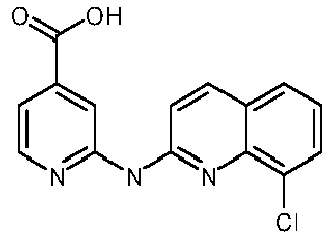
(5) of the table I 
+ (10) ot the table I 
- (14) of the table I 
- 
- 
- 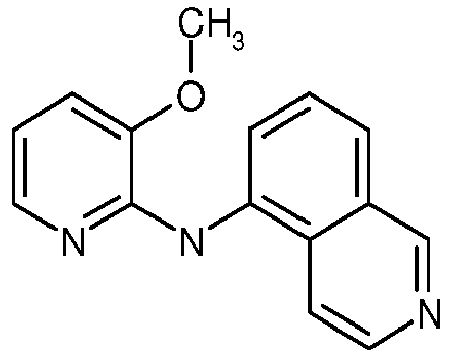
+ 
- - The results established that the compounds of the present invention show a luciferase inhibitory effect, thus showing that these compounds inhibit viral RNA splicing.
- A further object of the invention consists of a pharmaceutical composition comprising at least one compound of formula (Ib) or (Ie) or anyone of compounds (8), (75), (77)-(84), (86)-(104), (109)-(117), (155)-(158) and their pharmaceutically acceptable salts, such as hydrobromide, tartrate, citrate, trifluoroacetate, ascorbate, hydrochloride, tartrate, triflate, maleate, mesylate, formate, acetate and fumarate and, optionally, a pharmaceutically acceptable support.
- As examples of pharmaceutically acceptable supports, the composition can include emulsions, microemulsions, oil in water emulsions, anhydrous lipids and water in oil emulsions or other types of emulsions.
- The inventive composition can further include one or more additives such as diluents, excipients, stabilizers and preservatives. Such additives are well known to those skilled in the art and are described notably in " Ullmann's Encyclopedia of Industrial Chemistry, 6th Ed." (various editors, 1989-1998, Marcel Dekker) and in " Pharmaceutical Dosage Forms and Drug Delivery Systems" (ANSEL et al., 1994, WILLIAMS & WILKINS).
- The aforementioned excipients are selected according to the dosage form and the desired mode of administration.
- In this context they can be present in any pharmaceutical form which is suitable for enteral or parenteral administration, in association with appropriate excipients, for example in the form of plain or coated tablets, hard gelatine, soft shell capsules and other capsules, suppositories, or drinkable, such as suspensions, syrups, or injectable solutions or suspensions, in doses which enable the daily administration of from 0.1 to 1000 mg of active substance.
- Still a further object consists of the use of at least one compound of formula (I), (Ia), (Ib), (Ic), (Id), (Ie), (If), (Ig), (Ih), (Ii), (Ij), (Ik), (Il), (Im), (Io), (Ip), (Iq), (Ir) or (lee) as defined above, and compounds (1) to (168) as defined above, or one of its pharmaceutically acceptable salts according to the present invention in preparing a drug to treat, in a subject, a disease resulting from at least one splicing anomaly.
- Therefore, the present invention relates to a compound of formula (I), (Ia), (Ib), (Ic), (Id), (Ie), (If), (Ig), (Ih), (Ii), (Ij), (Ik), (Il), (Im), (Io), (Ip), (Iq), (Ir) or (lee) as defined above, and compounds (1) to (168) as defined above, or one of its pharmaceutically acceptable salts according to the present invention for preparing a drug to treat, in a subject, a disease resulting from at least one splicing anomaly.
- As used in the present application, the term "subject" refers to a mammal such as a rodent, cat, dog, primate or human, preferably said subject is a human.
- Preferably, the inventive compounds have the ability to inhibit pre-messenger RNA splicing processes that are either constitutive or, more specifically, dependent on regulating sequences known as an ESE (exonic splicing enhancer), ISE (intronic splicing enhancer), ESS (exonic splicing silencer) and ISS (intronic splicing silencer).
- In a particularly preferred way, splicing processes are either constitutive and/or or dependent on ESE regulating sequences.
- Preferably, the present invention relates to the use of the at least one compound of formula (I), (I), (Ia), (Ib), (Ic), (Id), (Ie), (If), (Ig), (Ih), (Ii), (Ij), (Ik), (Il), (Im), (Io), (Ip), (Iq), (Ir) or (lee) as defined above, or one of its pharmaceutically acceptable salts according to the present invention, and more particularly of formula (Ia), (Ib), (Ic), (Ie) and (Io) as described above for preparing a drug to treat, in a subject, AIDS.
- Therefore, the present invention relates to a one of said compounds, and more particularly to a compound (1) to (168) or one of its acceptable salts for treating AIDS.
- Another object of the invention relates to a therapeutic method for treating a subject for a genetic disease resulting from splicing anomalies comprising the administration of a therapeutically effective quantity of a compound of formula (I), (Ia), (Ib), (Ic), (Id), (Ie), (If), (Ig), (Ih), (Ii), (Ij), (Ik), (Il), (Im), (Io), (Ip), (Iq), (Ir) or (lee) as defined above, more particularly of formula (Ia), (Ib), (Ic), (Ie) and (Io) as described above, and even more particularly of at least one compound (1) to (168) or one of its acceptable salts.
- Preferably, said genetic disease resulting from splicing anomalies is AIDS.
- A "therapeutically effective quantity" means a quantity that induces inhibition of the splicing of the pre-mRNAs of interest. Those skilled in the art will be able to determine said therapeutically effective quantity based on their general knowledge and on the methods described in the examples.
- The compounds can be administered by any mode of administration such as, for example, by intramuscular, intravenous or oral route, etc.
- In one embodiment according to the invention, said composition further includes an excipient making it possible to formulate the inventive compounds in such a way that said composition is provided in solid or liquid form to be prepared and administered by intravenous route.
- The inventive compounds preferably will be administered by intravenous route at a concentration of 80-100 mg/m2. The concentration will be chosen by those skilled in the art according to the organ or tissue to be treated, the state of advancement of the disease and the targeting mode used.
Claims (11)
- A process for the preparation of a compound of formula (I) or one of its pharmaceutically acceptable
 wherein alternatively:- Z is N, V is C, Y is N, X is C, T is C, U is C and W is C,- Z is C, V is C, Y is N, X is C, T is C, U is C and W is C,- Z is N, V is C, Y is C, X is N, T is C, U is C and W is C,- Z is N, V is N and is in para of Z, Y is N, X is C, T is C, U is C and W is C,- Z is N, V is C, Y is N, X is N, T is C, U is C and W is C,said compound of formula (I) being alternatively chosen among:said process comprising the following steps:(1)
 R independently represent a hydrogen atom, a halogen atom or a group chosen among a (C1-C3)alkyl group, a -CN group, a hydroxyl group, a -COOR1 group, a (C1-C3)fluoroalkyl group, a -NO2 group, a -NR1R2 group and a (C1-C3)alkoxy group,R" is a hydrogen atom or a (C1-C4)alkyl group and is advantageously a hydrogen atom,n is 1, 2 or 3 and is advantageously 1,n' is 1 or 2 and is advantageously 1,R' is a hydrogen atom, a halogen atom or a group chosen among a (C1-C3)alkyl group, a -NO2 group, a (C1-C3)alkoxy group and a -NR1R2 group,R1 and R2 are a hydrogen atom or a (C1-C3)alkyl group,(2)
 R independently represent a hydrogen atom, a halogen atom or a group chosen among a (C1-C3)alkyl group, a -NR1R2 group, a (C1-C3)fluoroalkoxy group, a -NO2 group, a phenoxy group and a (C1-C4)alkoxy group,R1 and R2 are independently a hydrogen atom or a (C1-C3)alkyl group,R" is a hydrogen atom or a (C1-C4)alkyl group and is advantageously a hydrogen atom,n is 1, 2 or 3 and is preferably 1 or 2,n' is 1 or 2 and is preferably 1,R' is a hydrogen atom, a halogen atom or a group chosen among a (C1-C3)alkyl group and a (C1-C4)alkoxy group,(3)
 R independently represent a hydrogen atom or a group chosen among a (C1-C3)alkyl group, a (C1-C3)fluoroalkyl group, a -NR1R2 group, a -COOR1 group, a -NO2 group and a (C1-C3)alkoxy group,R" is a hydrogen atom or a (C1-C4)alkyl group and is advantageously a hydrogen atom,n is 1, 2 or 3 and is advantageously 1,n' is 1 or 2 and is advantageously 1,R' is a hydrogen atom,R1 and R2 are independently a hydrogen atom or a (C1-C3)alkyl group,(4)
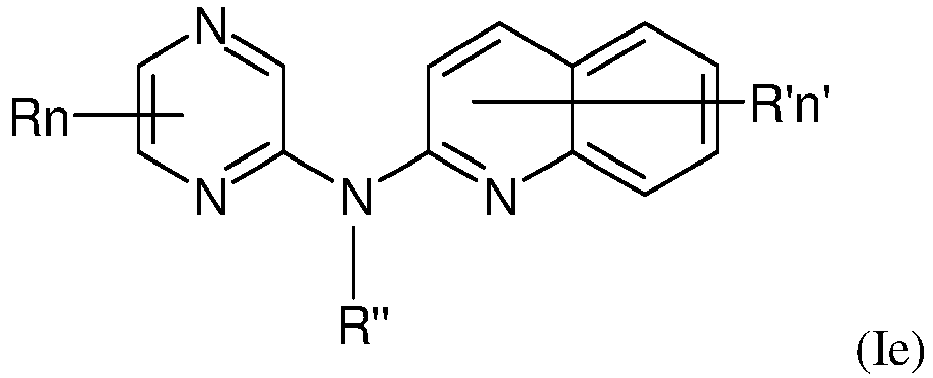 R represents a hydrogen atom,R" is a hydrogen atom or a (C1-C4)alkyl group and is advantageously a hydrogen atom,n is 1, 2 or 3 and is advantageously 1,n' is 1 or 2 and is advantageously 1,R' is a hydrogen atom, a halogen atom or a group chosen among a (C1-C3)alkyl group and a (C1-C3)alkoxy group,(5)
 R independently represent a hydrogen atom, a halogen atom or a group chosen among, a -NO2 group, a -CN group and a (C1-C3)alkyl group, said alkyl being optionally mono-substituted by a hydroxyl group,R" is a hydrogen atom or a (C1-C4)alkyl group and is advantageously a hydrogen atom,n is 1, 2 or3 and is advantageously 1,n' is 1 or 2 and is advantageously 1,R' is a hydrogen atom, a halogen atom or a (C1-C3)fluoroalkyl group,- (i) reacting a compound of formula (III)
 wherein R', n', X, Y, W, T and U are as defined above, and X' is a chlorine atom or a bromine atom,with a compound of formula (IV)
 wherein R, n, V, Z and R" are as defined above,
and then- (ii) recovering the compound of formula (I). - The process according to claim 1, wherein the compound of formula (III) is placed in a protic solvent such as tert-butanol.
- The process according to claim 1 or claim 2, wherein the compound of formula (IV) is added in a molar ratio ranging from 1 to 1.5 with respect to the compound of formula (III) in presence of an inorganic base, such as Cs2CO3 or K2CO3 in a molar ratio ranging from 1 and 2, in the presence of a diphosphine, such as Xantphos (4,5-Bis(diphenylphosphino)-9,9-dimethylxanthene) or X-Phos (2-Dicyclohexylphosphino-2',4',6'-triisopropylbiphenyl) in an amount ranging from 2mol% to 10mol% relative to the total amount of compound of formula (III), and in the presence of a catalyst, such as Pd(OAc)2 or Pd2dba3 in an amount ranging from 2mol% and 10mol% relative to the total amount of compound of formula (III).
- The process according to any one of claims 1 to 3, wherein the process further comprises after the step (i) and before the step (ii), a heating step at a temperature ranging from 80 to 120°C, for example at 90°C and a stirring step for a time ranging from 15 to 25 hours, for example during 20 hours under inert gas, for example argon.
- The process according to any one of claims 1 to 4, wherein the process further comprises after the step (i) and before the step (ii) or after the stirring/heating steps as defined in claim 4 and before the step (ii), a concentration step under reduced pressure.
- The process according to any one of claims 1 to 5, wherein the compound of formula (I) is the compound (90) 8-chloro-N-[4-(trifluoromethoxy)phenyl]quinolin-2-amine.
- The process according to any one of claims 1 to 6, wherein the compound of formula (I) is the compound (90) 8-chloro-N-[4-(trifluoromethoxy)phenyl]quinolin-2-amine, the compound of formula (III) is 2,8-dichloroquinoline, and the compound of formula (IV) is 4-(trifluoromethoxy) aniline.
- The process according to any one of claims 1 to 7, wherein the protic solvent is tert-Butanol, the inorganic base is Cs2CO3, the diphosphine is XantPhos, and the catalyst is Pd(OAc)2.
- The process according to any one of claims 1 to 8, wherein the compound of formula (I) is the compound (90) 8-chloro-N-[4-(trifluoromethoxy)phenyl]quinolin-2-amine, the compound of formula (III) is placed in a protic solvent such as tert-butanol, the compound of formula (IV) is then added in a 1.1 molar ratio with respect to the compound of formula (III) in presence of Cs2CO3, in a 2.8 molar ratio, in the presence of Xantphos, in a 2 mol% amount relative to the total amount of compound of formula (III), and in the presence of Pd(OAc)2, in a 2 mol% amount relative to the total amount of compound of formula (III), the compound of formula (III) being 2,8-dichloroquinoline and the compound of formula (IV) being 4-(trifluoromethoxy)aniline.
- The process according to the preceding claim, wherein the process further comprises after the step (i) and before the step (ii), a heating step at 90°C, a stirring step during 20 hours under argon, a concentration step under reduced pressure to obtain a residue and a dilution step with ethyl acetate of the thus obtained residue.
- The process according to the preceding claim, wherein the process further comprises two washing steps of the organic phase with water, a drying step on magnesium sulphate, a filtering step and a concentration step under reduced pressure.
Applications Claiming Priority (6)
| Application Number | Priority Date | Filing Date | Title |
|---|---|---|---|
| US18655209P | 2009-06-12 | 2009-06-12 | |
| US18654409P | 2009-06-12 | 2009-06-12 | |
| EP09162630A EP2261214A1 (en) | 2009-06-12 | 2009-06-12 | Compounds useful to treat premature aging and in particular progeria |
| EP20090305540 EP2266972A1 (en) | 2009-06-12 | 2009-06-12 | New chemical molecules that inhibit the splicing mechanism for treating diseases resulting from splicing anomalies |
| PCT/IB2010/052651 WO2010143169A2 (en) | 2009-06-12 | 2010-06-14 | Compounds useful for treating aids |
| EP10757474.1A EP2440547B1 (en) | 2009-06-12 | 2010-06-14 | New chemical molecules that inhibit the splicing mechanism for the treatment of diseases resulting from splicing defects |
Related Parent Applications (2)
| Application Number | Title | Priority Date | Filing Date |
|---|---|---|---|
| EP10757474.1A Division-Into EP2440547B1 (en) | 2009-06-12 | 2010-06-14 | New chemical molecules that inhibit the splicing mechanism for the treatment of diseases resulting from splicing defects |
| EP10757474.1A Division EP2440547B1 (en) | 2009-06-12 | 2010-06-14 | New chemical molecules that inhibit the splicing mechanism for the treatment of diseases resulting from splicing defects |
Publications (1)
| Publication Number | Publication Date |
|---|---|
| EP4198022A1 true EP4198022A1 (en) | 2023-06-21 |
Family
ID=43309298
Family Applications (6)
| Application Number | Title | Priority Date | Filing Date |
|---|---|---|---|
| EP19157827.7A Active EP3517534B1 (en) | 2009-06-12 | 2010-06-14 | Compounds useful for treating cancer |
| EP19157824.4A Active EP3521283B1 (en) | 2009-06-12 | 2010-06-14 | Compounds useful for treating cancer |
| EP10757474.1A Active EP2440547B1 (en) | 2009-06-12 | 2010-06-14 | New chemical molecules that inhibit the splicing mechanism for the treatment of diseases resulting from splicing defects |
| EP10728369.9A Active EP2440546B1 (en) | 2009-06-12 | 2010-06-14 | Compounds useful for treating premature aging and in particular progeria |
| EP10728368.1A Active EP2440545B1 (en) | 2009-06-12 | 2010-06-14 | Compounds useful for treating cancer |
| EP22193611.5A Pending EP4198022A1 (en) | 2009-06-12 | 2010-06-14 | Preparation of compounds useful for treating aids |
Family Applications Before (5)
| Application Number | Title | Priority Date | Filing Date |
|---|---|---|---|
| EP19157827.7A Active EP3517534B1 (en) | 2009-06-12 | 2010-06-14 | Compounds useful for treating cancer |
| EP19157824.4A Active EP3521283B1 (en) | 2009-06-12 | 2010-06-14 | Compounds useful for treating cancer |
| EP10757474.1A Active EP2440547B1 (en) | 2009-06-12 | 2010-06-14 | New chemical molecules that inhibit the splicing mechanism for the treatment of diseases resulting from splicing defects |
| EP10728369.9A Active EP2440546B1 (en) | 2009-06-12 | 2010-06-14 | Compounds useful for treating premature aging and in particular progeria |
| EP10728368.1A Active EP2440545B1 (en) | 2009-06-12 | 2010-06-14 | Compounds useful for treating cancer |
Country Status (23)
| Country | Link |
|---|---|
| US (7) | US20120329796A1 (en) |
| EP (6) | EP3517534B1 (en) |
| JP (8) | JP6041671B2 (en) |
| KR (14) | KR101897221B1 (en) |
| CN (13) | CN104844510B (en) |
| AU (3) | AU2010258295B2 (en) |
| BR (5) | BRPI1010772B8 (en) |
| CA (5) | CA3070823C (en) |
| CU (4) | CU24093B1 (en) |
| DK (4) | DK3517534T3 (en) |
| ES (4) | ES2940885T3 (en) |
| FI (3) | FI2440546T3 (en) |
| HR (3) | HRP20230248T1 (en) |
| HU (2) | HUE045548T2 (en) |
| LT (1) | LT2440547T (en) |
| MX (10) | MX373120B (en) |
| PL (4) | PL2440547T3 (en) |
| PT (4) | PT2440545T (en) |
| RU (1) | RU2567752C2 (en) |
| SI (1) | SI2440547T1 (en) |
| TR (1) | TR201910781T4 (en) |
| WO (3) | WO2010143169A2 (en) |
| ZA (2) | ZA201109031B (en) |
Families Citing this family (85)
| Publication number | Priority date | Publication date | Assignee | Title |
|---|---|---|---|---|
| US10253020B2 (en) | 2009-06-12 | 2019-04-09 | Abivax | Compounds for preventing, inhibiting, or treating cancer, AIDS and/or premature aging |
| FI2440546T3 (en) * | 2009-06-12 | 2023-03-30 | Abivax | Compounds useful for treating premature aging and in particular progeria |
| HRP20191460T1 (en) * | 2009-06-12 | 2019-11-15 | Abivax | COMPOUNDS USEFUL FOR TREATMENT OF CANCER |
| EA021275B9 (en) | 2009-09-03 | 2015-08-31 | Байоэнердженикс | Heterocyclic compounds, pharmaceutical composition comprising same and use thereof for treatment of pask-mediated disease |
| GB201007286D0 (en) | 2010-04-30 | 2010-06-16 | Astex Therapeutics Ltd | New compounds |
| GB201020179D0 (en) | 2010-11-29 | 2011-01-12 | Astex Therapeutics Ltd | New compounds |
| EP2465502A1 (en) * | 2010-12-15 | 2012-06-20 | Société Splicos | Compounds useful for treating AIDS |
| KR101858292B1 (en) | 2011-01-05 | 2018-05-15 | 바이오에너제닉스 | Heterocyclic compounds for the inhibition of pask |
| US8916561B2 (en) | 2011-03-02 | 2014-12-23 | Bioenergenix, Llc | Substituted quinoxaline compounds for the inhibition of PASK |
| EP2681207B1 (en) | 2011-03-02 | 2016-12-28 | Bioenergenix | Heterocyclic compounds for the inhibition of pask |
| GB201118656D0 (en) | 2011-10-28 | 2011-12-07 | Astex Therapeutics Ltd | New compounds |
| GB201118675D0 (en) | 2011-10-28 | 2011-12-14 | Astex Therapeutics Ltd | New compounds |
| GB201118652D0 (en) | 2011-10-28 | 2011-12-07 | Astex Therapeutics Ltd | New compounds |
| GB201118654D0 (en) | 2011-10-28 | 2011-12-07 | Astex Therapeutics Ltd | New compounds |
| FR2987627B1 (en) * | 2012-03-05 | 2016-03-18 | Splicos | USE OF RBM39 AS A BIOMARKER |
| GB201209613D0 (en) | 2012-05-30 | 2012-07-11 | Astex Therapeutics Ltd | New compounds |
| GB201209609D0 (en) | 2012-05-30 | 2012-07-11 | Astex Therapeutics Ltd | New compounds |
| IN2014DN11205A (en) | 2012-06-20 | 2015-10-02 | Eutropics Pharmaceuticals Inc | |
| US9145411B2 (en) | 2012-08-02 | 2015-09-29 | Asana Biosciences, Llc | Substituted amino-pyrimidine derivatives |
| JP6193374B2 (en) | 2012-08-13 | 2017-09-06 | 武田薬品工業株式会社 | Quinoxaline derivatives as GPR6 modulators |
| JP2014237624A (en) * | 2012-10-23 | 2014-12-18 | 日本曹達株式会社 | Pyridine compound or salt thereof, pest-controlling agent, insecticide or acaricide, and ectoparasite controlling agent |
| US20160038503A1 (en) | 2012-11-21 | 2016-02-11 | David Richard | Methods and compositions useful for treating diseases involving bcl-2 family proteins with isoquinoline and quinoline derivatives |
| GB201301571D0 (en) * | 2012-11-27 | 2013-03-13 | Fundanci N Pedro Barri De La Maza | Product and use |
| US20140194465A1 (en) * | 2013-01-04 | 2014-07-10 | Novarx Corporation | Compositions for treatment of cancer |
| EP2757161A1 (en) | 2013-01-17 | 2014-07-23 | Splicos | miRNA-124 as a biomarker of viral infection |
| GB201307577D0 (en) | 2013-04-26 | 2013-06-12 | Astex Therapeutics Ltd | New compounds |
| MX382692B (en) * | 2013-07-05 | 2025-03-13 | Abivax | BICYCLIC COMPOUNDS USEFUL FOR THE TREATMENT OF DISEASES CAUSED BY RETROVIRUSES. |
| JPWO2015005491A1 (en) * | 2013-07-12 | 2017-03-02 | 国立大学法人京都大学 | Screening method for substances capable of suppressing abnormal splicing that contributes to the onset or progression of disease |
| US10732182B2 (en) | 2013-08-01 | 2020-08-04 | Eutropics Pharmaceuticals, Inc. | Method for predicting cancer sensitivity |
| US10640803B2 (en) | 2013-10-30 | 2020-05-05 | Eutropics Pharmaceuticals, Inc. | Methods for determining chemosensitivity and chemotoxicity |
| JO3466B1 (en) | 2013-12-20 | 2020-07-05 | Takeda Pharmaceuticals Co | Tetrahydropyridopyrazines modulators of gpr6 |
| WO2015123505A1 (en) | 2014-02-14 | 2015-08-20 | Takeda Pharmaceutical Company Limited | Pyridopyrazines modulators of gpr6 |
| MA39784B1 (en) | 2014-03-26 | 2021-03-31 | Astex Therapeutics Ltd | Combinations of fgfr and cmet inhibitors for cancer treatment |
| AU2015238305B2 (en) | 2014-03-26 | 2020-06-18 | Astex Therapeutics Ltd | Combinations of an FGFR inhibitor and an IGF1R inhibitor |
| JO3512B1 (en) | 2014-03-26 | 2020-07-05 | Astex Therapeutics Ltd | Quinoxaline derivatives useful as fgfr kinase modulators |
| EP2975034A1 (en) | 2014-07-17 | 2016-01-20 | Abivax | A quinoline derivative for the treatment of inflammatory diseases and AIDS |
| EP2974729A1 (en) * | 2014-07-17 | 2016-01-20 | Abivax | Quinoline derivatives for use in the treatment of inflammatory diseases |
| CA2973942C (en) | 2015-01-30 | 2023-07-11 | Centre National De La Recherche Scientifique (Cnrs) | Delta133p53beta and delta133p53gamma isoforms are biomarkers of cancer stem cells |
| JO3695B1 (en) | 2015-02-10 | 2020-08-27 | Astex Therapeutics Ltd | Pharmaceutical compositions comprising n-(3,5-dimethoxyphenyl)-n'-(1-methylethyl)-n-[3-(1-methyl-1h-pyrazol-4-yl)quinoxalin-6-yl]ethane-1,2-diamine |
| EP3058940A1 (en) * | 2015-02-23 | 2016-08-24 | Abivax | Quinoline derivatives for use in the treatment or prevention of viral infection |
| EP3059236A1 (en) | 2015-02-23 | 2016-08-24 | Abivax | A new quinoline derivative for use in the treatment and prevention of viral infections |
| EP3059591A1 (en) | 2015-02-23 | 2016-08-24 | Abivax | Methods for screening compounds for treating or preventing a viral infection or a virus-related condition |
| US10478494B2 (en) | 2015-04-03 | 2019-11-19 | Astex Therapeutics Ltd | FGFR/PD-1 combination therapy for the treatment of cancer |
| CN108137546B (en) | 2015-09-23 | 2021-07-27 | 詹森药业有限公司 | Diheteroaryl-substituted 1,4-benzodiazepine compounds and their use in the treatment of cancer |
| KR102703498B1 (en) | 2015-09-23 | 2024-09-04 | 얀센 파마슈티카 엔브이 | new compound |
| EP3390378B1 (en) * | 2015-12-17 | 2022-03-30 | AlonBio Ltd. | Small molecules against cancer |
| ES2818531T3 (en) | 2015-12-17 | 2021-04-13 | Biokine Therapeutics Ltd | Small molecules to inhibit chemokine activity and / or cancer cell growth |
| EP3411083A1 (en) * | 2016-02-03 | 2018-12-12 | Janssen Pharmaceutica NV | Tau pet imaging ligands |
| PL3429998T3 (en) | 2016-03-18 | 2022-03-14 | Prosynergia S.à.r.l. | METHOD OF MAKING CHINOLINE-2-YLO-PHENYLAMINE DERIVATIVES AND ITS SALT |
| ES2846833T3 (en) | 2016-07-18 | 2021-07-29 | Janssen Pharmaceutica Nv | PET imaging ligands |
| AR112027A1 (en) * | 2017-06-15 | 2019-09-11 | Biocryst Pharm Inc | ALK 2 KINASE INHIBITORS CONTAINING IMIDAZOLE |
| WO2019002228A1 (en) | 2017-06-26 | 2019-01-03 | Institut Pasteur | Treatments to eliminate hiv reservoirs and reduce viral load |
| JP6965432B2 (en) * | 2017-08-29 | 2021-11-10 | チュラポーン ファンデーション | Derivatives and compositions of quinoline and diazanaphthalene |
| US12528810B2 (en) * | 2018-03-01 | 2026-01-20 | Arizona Board Of Regents On Behalf Of The University Of Arizona | Small molecule inhibitors of DYRK/CLK and uses thereof |
| WO2019186277A1 (en) | 2018-03-28 | 2019-10-03 | Institut Pasteur | Ultrasensitive hiv-1 p24 detection assay |
| EP3594206A1 (en) | 2018-07-09 | 2020-01-15 | Abivax | Phenyl-n-quinoline derivatives for treating a rna virus infection |
| EP3594205A1 (en) | 2018-07-09 | 2020-01-15 | Abivax | Phenyl-n-aryl derivatives for treating a rna virus infection |
| WO2020128033A1 (en) | 2018-12-20 | 2020-06-25 | Institut Pasteur | Cellular metabolism of hiv-1 reservoir seeding in cd4+ t cells |
| EP3669874A1 (en) * | 2018-12-20 | 2020-06-24 | Abivax | Quinoline derivatives for use in the treatment or prevention of cancer |
| EP3669873A1 (en) | 2018-12-20 | 2020-06-24 | Abivax | Quinoline derivatives for use ine the traeatment of inflammation diseases |
| CN114096524B (en) | 2019-05-15 | 2025-03-04 | 阿龙拜欧有限公司 | Small molecules for treating cancer, inhibiting chemokine activity and/or inducing cell death |
| PL3999493T3 (en) | 2019-07-19 | 2024-04-22 | Abivax | Aryl-N-aryl derivatives for the treatment of RNA virus infection |
| EP3858815A1 (en) | 2020-01-31 | 2021-08-04 | Abivax | Co-crystals and salts of 8-chloro-n-(4-(trifluoromethoxy)phenyl)quinolin-2-amine |
| EP3858336A1 (en) | 2020-01-31 | 2021-08-04 | Abivax | Amorphous solid dispersion of 8-chloro-n-(4-(trifluoromethoxy)phenyl)quinolin-2-amine |
| AU2021213321B2 (en) * | 2020-01-31 | 2026-02-19 | Abivax | Amorphous solid dispersion of 8-chloro-N-(4-(trifluoromethoxy)phenyl)quinolin-2-amine |
| CN115605205A (en) | 2020-03-20 | 2023-01-13 | Abivax公司(Fr) | Compounds for treating or preventing infections of the family coronaviridae and methods and uses for assessing the occurrence of infections of the family coronaviridae |
| US11691971B2 (en) | 2020-06-19 | 2023-07-04 | Incyte Corporation | Naphthyridinone compounds as JAK2 V617F inhibitors |
| WO2021257863A1 (en) | 2020-06-19 | 2021-12-23 | Incyte Corporation | Pyrrolotriazine compounds as jak2 v617f inhibitors |
| WO2022006456A1 (en) | 2020-07-02 | 2022-01-06 | Incyte Corporation | Tricyclic pyridone compounds as jak2 v617f inhibitors |
| BR112023000047A2 (en) | 2020-07-02 | 2023-03-14 | Incyte Corp | TRICYCLIC UREA COMPOUNDS AS JAK2 V617F INHIBITORS |
| US11661422B2 (en) | 2020-08-27 | 2023-05-30 | Incyte Corporation | Tricyclic urea compounds as JAK2 V617F inhibitors |
| TW202237119A (en) | 2020-12-10 | 2022-10-01 | 美商住友製藥腫瘤公司 | Alk-5 inhibitors and uses thereof |
| WO2022140231A1 (en) | 2020-12-21 | 2022-06-30 | Incyte Corporation | Deazaguaine compounds as jak2 v617f inhibitors |
| AR125273A1 (en) | 2021-02-25 | 2023-07-05 | Incyte Corp | SPIROCYCLIC LACTAMS AS JAK2 INHIBITORS V617F |
| EP4063351A1 (en) | 2021-03-26 | 2022-09-28 | Abivax | Preparation method of quinoline derivative compounds |
| MX2023013972A (en) | 2021-05-27 | 2023-12-11 | Jiangsu Hengrui Pharmaceuticals Co Ltd | Quinolinamine compound, preparation method therefor and application thereof in pharmaceuticals. |
| KR20230072900A (en) | 2021-11-18 | 2023-05-25 | 동우 화인켐 주식회사 | A micro led structure and a method for manufacturing the same |
| EP4212156A1 (en) | 2022-01-13 | 2023-07-19 | Abivax | Combination of 8-chloro-n-(4-(trifluoromethoxy)phenyl)quinolin-2-amine and its derivatives with a s1p receptor modulator |
| TW202333698A (en) * | 2022-01-24 | 2023-09-01 | 大陸商江蘇恆瑞醫藥股份有限公司 | Quinoline amine compounds, preparation method and medical use thereof |
| EP4215196A1 (en) | 2022-01-24 | 2023-07-26 | Abivax | Combination of 8-chloro-n-(4-(trifluoromethoxy)phenyl)quinolin-2-amine and its derivatives with a jak inhibitor |
| KR20240163688A (en) | 2022-03-17 | 2024-11-19 | 인사이트 코포레이션 | Tricyclic urea compounds as JAK2 V617F inhibitors |
| CN118027024A (en) * | 2022-11-14 | 2024-05-14 | 南京同诺康医药科技有限公司 | Pyrido[1,2-a]pyrimidin-4-one derivatives and preparation methods and uses thereof |
| JP2025538576A (en) | 2022-11-25 | 2025-11-28 | 江▲蘇▼恒瑞医▲薬▼股▲フン▼有限公司 | Crystalline forms of quinoline amine compounds and their preparation methods |
| KR20260042485A (en) | 2023-08-01 | 2026-03-31 | 아비박스 | Obephagimod for the treatment of ulcerative colitis |
| AU2024334442A1 (en) * | 2023-08-30 | 2026-03-05 | Jiangsu Chia Tai Fenghai Pharmaceutical Co., Ltd. | Compound for regulating activity of microrna-124 |
Citations (5)
| Publication number | Priority date | Publication date | Assignee | Title |
|---|---|---|---|---|
| FR400973A (en) | 1909-03-19 | 1909-08-13 | Jean Victor Massillon | New hand crimper for the manufacture of cartridges |
| FR2436786A1 (en) | 1978-09-21 | 1980-04-18 | Anvar | NOVEL PYRIDO (4,3-B) CARBAZOLES (ELLIPTICINS) DERIVATIVES, SUBSTITUTED IN POSITION 1 BY A POLYAMINE CHAIN, THEIR OBTAINMENT AND THEIR APPLICATION AS MEDICAMENTS |
| FR2627493A1 (en) | 1988-02-23 | 1989-08-25 | Sanofi Sa | PROCESS FOR THE PREPARATION OF ISOQUINOLINE DERIVATIVES |
| FR2645861A1 (en) | 1989-04-17 | 1990-10-19 | Inst Nat Sante Rech Med | USE OF DIPYRIDO (4,3-B) (3,4-F) INDOLES FOR THE PREPARATION OF MEDICAMENTS USEFUL FOR THE TREATMENT OF AIDS |
| WO2005023255A2 (en) | 2003-09-04 | 2005-03-17 | Centre National De La Recherche Scientifique (Cnrs) | Use of indole-derived compounds for the preparation of a medicament that can be used to treat diseases related to the splicing process |
Family Cites Families (43)
| Publication number | Priority date | Publication date | Assignee | Title |
|---|---|---|---|---|
| GB585362A (en) | 1944-08-31 | 1947-02-05 | Francis Henry Swinden Curd | New heterocyclic compounds |
| BE486034A (en) | 1947-11-28 | |||
| DE958647C (en) | 1952-12-28 | 1957-02-21 | Hoechst Ag | Process for the preparation of 7-amino-2-oxy-4-methyl-quinolines |
| FR2387229A1 (en) | 1977-04-13 | 1978-11-10 | Anvar | DIPYRIDO (4,3-B) (3,4-F) INDOLES, PROCESS FOR OBTAINING, THERAPEUTIC APPLICATION AND PHARMACEUTICAL COMPOSITIONS CONTAINING THEM |
| US6177401B1 (en) | 1992-11-13 | 2001-01-23 | Max-Planck-Gesellschaft Zur Forderung Der Wissenschaften | Use of organic compounds for the inhibition of Flk-1 mediated vasculogenesis and angiogenesis |
| EP1165064B1 (en) | 1999-04-05 | 2004-02-25 | City of Hope | Novel inhibitors of formation of advanced glycation endproducts (age's) |
| UA75055C2 (en) | 1999-11-30 | 2006-03-15 | Пфайзер Продактс Інк. | Benzoimidazole derivatives being used as antiproliferative agent, pharmaceutical composition based thereon |
| DE10013318A1 (en) * | 2000-03-17 | 2001-09-20 | Merck Patent Gmbh | Quinoxaline derivatives are used as photo-stable UV filters in cosmetic or pharmaceutical sunscreens for the hair or skin |
| WO2002074726A2 (en) | 2001-01-22 | 2002-09-26 | Memory Pharmaceuticals Corporation | Aniline derivatives useful as phosphodiesterase 4 inhibitors |
| PL375552A1 (en) | 2002-05-22 | 2005-11-28 | Amgen Inc. | Vanilloid receptor ligands and their medical applications |
| AU2002950217A0 (en) * | 2002-07-16 | 2002-09-12 | Prana Biotechnology Limited | 8- Hydroxy Quinoline Derivatives |
| CA2492907A1 (en) * | 2002-07-19 | 2004-01-29 | Memory Pharmaceuticals Corporation | Phosphodiesterase 4 inhibitors, including n-substituted aniline and diphenylamine analogs |
| WO2006081444A2 (en) | 2005-01-28 | 2006-08-03 | The Government Of The Usa As Represented By The Secretary Of The Dept. Of Health And Human Services | Farnesyltransferase inhibitors for treatment of laminopathies, cellular aging and atherosclerosis |
| FR2849474B3 (en) | 2002-12-27 | 2004-12-03 | Olivier Jean Noel Juin | INSTALLATION FOR TRANSFORMING THE KINETIC ENERGY OF A FLUID INTO ELECTRIC ENERGY |
| WO2004078731A1 (en) | 2003-03-06 | 2004-09-16 | 'chemical Diversity Research Institute', Ltd. | Quinoline-carboxylic acids and the derivatives thereof, a focused library |
| CA2518398A1 (en) * | 2003-03-10 | 2004-09-23 | Schering Corporation | Heterocyclic kinase inhibitors: methods of use and synthesis |
| FR2859475A1 (en) | 2003-09-04 | 2005-03-11 | Centre Nat Rech Scient | Use of ellipticin, or its aza-derivatives, in treatment of genetic disorders caused by alteration of RNA splicing, e.g. parkinsonism, neuropathy and cancers |
| US7691866B2 (en) * | 2003-10-16 | 2010-04-06 | Novartis Vaccines And Diagnostics, Inc. | 2,6-disubstituted quinazolines, quinoxalines, quinolines and isoquinolines and methods of their use as inhibitors of Raf kinase |
| NZ547481A (en) * | 2003-11-19 | 2009-12-24 | Array Biopharma Inc | Heterocyclic inhibitors of mek and methods of use thereof |
| CA2585490A1 (en) * | 2004-11-12 | 2006-05-18 | Galapagos Nv | Nitrogen heteroaromatic compounds which bind to the active site of protein kinase enzymes |
| US20090088513A1 (en) * | 2005-06-29 | 2009-04-02 | Adeka Corporation | Resin additive composition and resin composition |
| FR2903312B1 (en) | 2006-07-05 | 2008-09-26 | Univ Aix Marseille Ii | USE OF INHIBITORS OF HMG-COA REDUCTASE AND FARNESYL-PYROPHOSPHATE SYNTHASE IN THE PREPARATION OF A MEDICINAL PRODUCT |
| US8030487B2 (en) * | 2006-07-07 | 2011-10-04 | Targegen, Inc. | 2-amino—5-substituted pyrimidine inhibitors |
| BRPI0806898A2 (en) * | 2007-01-19 | 2015-07-14 | Ardea Biosciences Inc | Mek inhibitors |
| FR2912745A1 (en) | 2007-02-19 | 2008-08-22 | Centre Nat Rech Scient | NEW INDOLE-DERIVED COMPOUNDS AND PHARMACEUTICAL COMPOSITIONS CONTAINING THEM |
| CA2681481A1 (en) * | 2007-03-16 | 2008-09-25 | Mount Sinai School Of Medicine | Induction and/or maintenance of tumor dormancy by disruption of urokinase plasminogen activator receptor-integrin interaction |
| KR100961821B1 (en) * | 2007-05-17 | 2010-06-08 | 주식회사 엘지화학 | Novel anthracene derivatives and organic electronic devices using the same |
| UY31272A1 (en) * | 2007-08-10 | 2009-01-30 | Almirall Lab | NEW DERIVATIVES OF AZABIFENILAMINOBENZOIC ACID |
| AU2008286760A1 (en) | 2007-08-15 | 2009-02-19 | Memory Pharmaceuticals Corporation | 3' substituted compounds having 5-HT6 receptor affinity |
| WO2009029617A1 (en) * | 2007-08-27 | 2009-03-05 | Kalypsys, Inc. | Diarylamine-substituted quinolones useful as inducible nitric oxide synthase inhibitors |
| KR100974562B1 (en) * | 2007-12-31 | 2010-08-06 | 다우어드밴스드디스플레이머티리얼 유한회사 | Novel organic light emitting compound and organic light emitting device employing the same as light emitting material |
| FR2926297B1 (en) | 2008-01-10 | 2013-03-08 | Centre Nat Rech Scient | INHIBITORY CHEMICAL MOLECULES IN THE SPLICE MECHANISM FOR TREATING DISEASES RESULTING FROM SPLICE ANOMALIES. |
| WO2010076339A1 (en) * | 2009-01-05 | 2010-07-08 | Fraunhofer-Gesellschaft zur Förderung der angewandten Forschung e.V. | Means and method for the treatment of antibody deficiency diseases based on il-21 and il-21 variants |
| JP5828151B6 (en) * | 2009-01-06 | 2018-09-19 | アンスティチュ ナショナル ドゥ ラ サンテ エ ドゥ ラ ルシェルシュ メディカル | B cell depleting agent for the treatment of atherosclerosis |
| EP2373611A2 (en) * | 2009-01-06 | 2011-10-12 | DSM IP Assets B.V. | Process for resveratrol intermediate |
| EP2266972A1 (en) | 2009-06-12 | 2010-12-29 | Splicos | New chemical molecules that inhibit the splicing mechanism for treating diseases resulting from splicing anomalies |
| FI2440546T3 (en) | 2009-06-12 | 2023-03-30 | Abivax | Compounds useful for treating premature aging and in particular progeria |
| HRP20191460T1 (en) * | 2009-06-12 | 2019-11-15 | Abivax | COMPOUNDS USEFUL FOR TREATMENT OF CANCER |
| US8962583B2 (en) | 2009-06-25 | 2015-02-24 | The Brigham And Women's Hospital, Inc. | Treatment of inflammatory diseases using miR-124 |
| EP2465502A1 (en) | 2010-12-15 | 2012-06-20 | Société Splicos | Compounds useful for treating AIDS |
| JP2016504268A (en) | 2012-10-04 | 2016-02-12 | オヤジェン インコーポレイテッドOyaGen, Inc. | Small molecules as anti-HIV agents that disrupt self-association of VIF and methods of use thereof |
| EP2757161A1 (en) | 2013-01-17 | 2014-07-23 | Splicos | miRNA-124 as a biomarker of viral infection |
| JP2015120566A (en) * | 2013-12-20 | 2015-07-02 | ニチユ三菱フォークリフト株式会社 | Cargo handling vehicle |
-
2010
- 2010-06-14 FI FIEP10728369.9T patent/FI2440546T3/en active
- 2010-06-14 DK DK19157827.7T patent/DK3517534T3/en active
- 2010-06-14 BR BRPI1010772A patent/BRPI1010772B8/en active IP Right Grant
- 2010-06-14 ES ES10728369T patent/ES2940885T3/en active Active
- 2010-06-14 CN CN201510023109.1A patent/CN104844510B/en active Active
- 2010-06-14 US US13/377,753 patent/US20120329796A1/en not_active Abandoned
- 2010-06-14 CN CN201510023124.6A patent/CN104844570B/en active Active
- 2010-06-14 PT PT10728368T patent/PT2440545T/en unknown
- 2010-06-14 PT PT107283699T patent/PT2440546T/en unknown
- 2010-06-14 KR KR1020177031675A patent/KR101897221B1/en active Active
- 2010-06-14 FI FIEP19157827.7T patent/FI3517534T3/en active
- 2010-06-14 CN CN201710158473.8A patent/CN106928205B/en active Active
- 2010-06-14 CN CN201510020820.1A patent/CN104945378B/en active Active
- 2010-06-14 JP JP2012514585A patent/JP6041671B2/en active Active
- 2010-06-14 PL PL10757474.1T patent/PL2440547T3/en unknown
- 2010-06-14 CN CN201410106644.9A patent/CN103948594B/en active Active
- 2010-06-14 PT PT107574741T patent/PT2440547T/en unknown
- 2010-06-14 CN CN201080032055.0A patent/CN102596935B/en active Active
- 2010-06-14 MX MX2018009425A patent/MX373120B/en unknown
- 2010-06-14 SI SI201032127T patent/SI2440547T1/en unknown
- 2010-06-14 PL PL19157827.7T patent/PL3517534T3/en unknown
- 2010-06-14 FI FIEP10757474.1T patent/FI2440547T3/en active
- 2010-06-14 KR KR1020177021820A patent/KR101863021B1/en not_active Expired - Fee Related
- 2010-06-14 HR HRP20230248TT patent/HRP20230248T1/en unknown
- 2010-06-14 WO PCT/IB2010/052651 patent/WO2010143169A2/en not_active Ceased
- 2010-06-14 KR KR1020197004605A patent/KR102016890B1/en active Active
- 2010-06-14 HR HRP20240582TT patent/HRP20240582T1/en unknown
- 2010-06-14 US US13/377,745 patent/US20120277230A1/en not_active Abandoned
- 2010-06-14 KR KR1020197004606A patent/KR102016891B1/en active Active
- 2010-06-14 KR KR1020197004608A patent/KR102016893B1/en active Active
- 2010-06-14 JP JP2012514586A patent/JP5826745B2/en active Active
- 2010-06-14 CN CN201510021597.2A patent/CN104945379B/en active Active
- 2010-06-14 AU AU2010258295A patent/AU2010258295B2/en active Active
- 2010-06-14 ES ES10728368T patent/ES2736198T3/en active Active
- 2010-06-14 MX MX2011013122A patent/MX340095B/en active IP Right Grant
- 2010-06-14 LT LTEPPCT/IB2010/052651T patent/LT2440547T/en unknown
- 2010-06-14 CN CN202110307700.5A patent/CN113004249A/en active Pending
- 2010-06-14 PL PL10728368T patent/PL2440545T3/en unknown
- 2010-06-14 MX MX2015016291A patent/MX364279B/en unknown
- 2010-06-14 EP EP19157827.7A patent/EP3517534B1/en active Active
- 2010-06-14 CN CN201710158474.2A patent/CN106928194B/en active Active
- 2010-06-14 MX MX2015016293A patent/MX364989B/en unknown
- 2010-06-14 ES ES19157827T patent/ES2985082T3/en active Active
- 2010-06-14 TR TR2019/10781T patent/TR201910781T4/en unknown
- 2010-06-14 WO PCT/IB2010/052650 patent/WO2010143168A2/en not_active Ceased
- 2010-06-14 CN CN201080032036.8A patent/CN102574835B/en active Active
- 2010-06-14 MX MX2015016290A patent/MX364282B/en unknown
- 2010-06-14 CN CN201710122014.4A patent/CN106905232B/en active Active
- 2010-06-14 EP EP19157824.4A patent/EP3521283B1/en active Active
- 2010-06-14 EP EP10757474.1A patent/EP2440547B1/en active Active
- 2010-06-14 DK DK10728369.9T patent/DK2440546T3/en active
- 2010-06-14 MX MX2016003039A patent/MX359575B/en unknown
- 2010-06-14 CA CA3070823A patent/CA3070823C/en active Active
- 2010-06-14 KR KR1020127000915A patent/KR101789275B1/en active Active
- 2010-06-14 CU CU2011000230A patent/CU24093B1/en active IP Right Grant
- 2010-06-14 CN CN201910120757.7A patent/CN109776496B/en active Active
- 2010-06-14 KR KR1020127000916A patent/KR101769616B1/en active Active
- 2010-06-14 CA CA2965791A patent/CA2965791C/en active Active
- 2010-06-14 CA CA2764027A patent/CA2764027C/en active Active
- 2010-06-14 PT PT191578277T patent/PT3517534T/en unknown
- 2010-06-14 AU AU2010258294A patent/AU2010258294B2/en not_active Ceased
- 2010-06-14 KR KR1020197004607A patent/KR102016892B1/en active Active
- 2010-06-14 KR KR1020197004604A patent/KR102016889B1/en active Active
- 2010-06-14 JP JP2012514587A patent/JP5905385B2/en active Active
- 2010-06-14 MX MX2016007353A patent/MX367601B/en unknown
- 2010-06-14 KR KR1020187025626A patent/KR101982463B1/en not_active Expired - Fee Related
- 2010-06-14 HR HRP20230143TT patent/HRP20230143T1/en unknown
- 2010-06-14 CN CN201080032045.7A patent/CN102625804B/en active Active
- 2010-06-14 KR KR1020187025624A patent/KR101973348B1/en active Active
- 2010-06-14 MX MX2015016292A patent/MX364280B/en unknown
- 2010-06-14 DK DK10757474.1T patent/DK2440547T3/en active
- 2010-06-14 HU HUE10728368A patent/HUE045548T2/en unknown
- 2010-06-14 CU CUP2015000024A patent/CU24245B1/en unknown
- 2010-06-14 CA CA2764024A patent/CA2764024C/en active Active
- 2010-06-14 DK DK10728368.1T patent/DK2440545T3/en active
- 2010-06-14 BR BRPI1012892A patent/BRPI1012892B8/en active IP Right Grant
- 2010-06-14 HU HUE10757474A patent/HUE061262T2/en unknown
- 2010-06-14 KR KR1020127000914A patent/KR20120051643A/en not_active Ceased
- 2010-06-14 CU CU2011000228A patent/CU24461B1/en unknown
- 2010-06-14 BR BRPI1010768A patent/BRPI1010768C8/en not_active IP Right Cessation
- 2010-06-14 CU CUP2011000229A patent/CU24124B1/en active IP Right Grant
- 2010-06-14 MX MX2011013120A patent/MX338823B/en active IP Right Grant
- 2010-06-14 BR BR122019013687A patent/BR122019013687B1/en active IP Right Grant
- 2010-06-14 EP EP10728369.9A patent/EP2440546B1/en active Active
- 2010-06-14 PL PL10728369.9T patent/PL2440546T3/en unknown
- 2010-06-14 WO PCT/IB2010/052652 patent/WO2010143170A2/en not_active Ceased
- 2010-06-14 US US13/377,760 patent/US9145367B2/en active Active
- 2010-06-14 MX MX2011013119A patent/MX353776B/en active IP Right Grant
- 2010-06-14 KR KR1020187025625A patent/KR101982462B1/en not_active Expired - Fee Related
- 2010-06-14 ES ES10757474T patent/ES2938532T3/en active Active
- 2010-06-14 AU AU2010258214A patent/AU2010258214B2/en active Active
- 2010-06-14 EP EP10728368.1A patent/EP2440545B1/en active Active
- 2010-06-14 BR BR122019013686-6A patent/BR122019013686B1/en active IP Right Grant
- 2010-06-14 CA CA2764026A patent/CA2764026C/en active Active
- 2010-06-14 KR KR1020187025623A patent/KR101982461B1/en not_active Expired - Fee Related
- 2010-06-14 RU RU2011149571/04A patent/RU2567752C2/en active
- 2010-06-14 EP EP22193611.5A patent/EP4198022A1/en active Pending
-
2011
- 2011-12-08 ZA ZA2011/09031A patent/ZA201109031B/en unknown
- 2011-12-08 ZA ZA2011/09032A patent/ZA201109032B/en unknown
-
2013
- 2013-11-22 US US14/087,762 patent/US9108919B2/en active Active
-
2014
- 2014-04-18 US US14/256,334 patent/US9908869B2/en not_active Expired - Fee Related
-
2015
- 2015-04-27 JP JP2015090437A patent/JP2015155453A/en active Pending
- 2015-06-15 JP JP2015120568A patent/JP6158251B2/en active Active
- 2015-06-15 JP JP2015120566A patent/JP2015187150A/en not_active Withdrawn
- 2015-06-15 JP JP2015120567A patent/JP6158250B2/en not_active Expired - Fee Related
- 2015-07-01 US US14/789,250 patent/US10017498B2/en active Active
- 2015-07-01 US US14/789,149 patent/US9637475B2/en active Active
-
2019
- 2019-10-18 JP JP2019191500A patent/JP7042245B2/en active Active
Patent Citations (5)
| Publication number | Priority date | Publication date | Assignee | Title |
|---|---|---|---|---|
| FR400973A (en) | 1909-03-19 | 1909-08-13 | Jean Victor Massillon | New hand crimper for the manufacture of cartridges |
| FR2436786A1 (en) | 1978-09-21 | 1980-04-18 | Anvar | NOVEL PYRIDO (4,3-B) CARBAZOLES (ELLIPTICINS) DERIVATIVES, SUBSTITUTED IN POSITION 1 BY A POLYAMINE CHAIN, THEIR OBTAINMENT AND THEIR APPLICATION AS MEDICAMENTS |
| FR2627493A1 (en) | 1988-02-23 | 1989-08-25 | Sanofi Sa | PROCESS FOR THE PREPARATION OF ISOQUINOLINE DERIVATIVES |
| FR2645861A1 (en) | 1989-04-17 | 1990-10-19 | Inst Nat Sante Rech Med | USE OF DIPYRIDO (4,3-B) (3,4-F) INDOLES FOR THE PREPARATION OF MEDICAMENTS USEFUL FOR THE TREATMENT OF AIDS |
| WO2005023255A2 (en) | 2003-09-04 | 2005-03-17 | Centre National De La Recherche Scientifique (Cnrs) | Use of indole-derived compounds for the preparation of a medicament that can be used to treat diseases related to the splicing process |
Non-Patent Citations (25)
| Title |
|---|
| "Ullmann's Encyclopedia of Industrial Chemistry", 1989, MARCEL DEKKER |
| ANDREASSI ET AL., HUM. MOL. GENET, vol. 10, 2001, pages 2841 - 2849 |
| ANSEL ET AL.: "Pharmaceutical Dosage Forms and Drug Delivery Systems", 1994, WILLIAMS & WILKINS |
| BAKKOUR ET AL., PLOS PATHOGENS, vol. 3, 2007, pages 1530 - 1539 |
| BLACK, ANNU. REV. BIOCHEM., vol. 72, 2003, pages 291 - 336 |
| CARTEGNI ET AL., NAT. REV. GENET., vol. 3, 2002, pages 285 - 298 |
| CARTEGNI ET AL., NAT. STRUCT. BIOL., vol. 10, 2003, pages 120 - 125 |
| CONNOR RICHEN BKCHOE SLANDAU NR: "Vpr is required for efficient replication of human immunodeficiency virus type-1 in mononuclear phagocytes", VIROLOGY, vol. 206, 1995, pages 935 - 944, XP002443025, DOI: 10.1006/viro.1995.1016 |
| DHANABAL T ET AL: "Heteroatom directed photoannulation: synthesis of indoloquinoline alkaloids: cryptolepine, cryptotackieine, cryptosanguinolentine, and their methyl derivatives", TETRAHEDRON, ELSEVIER SIENCE PUBLISHERS, AMSTERDAM, NL, vol. 62, no. 26, 26 June 2006 (2006-06-26), pages 6258 - 6263, XP025002141, ISSN: 0040-4020, [retrieved on 20060626], DOI: 10.1016/J.TET.2006.04.050 * |
| EWINGGREEN, NAT. GENET., vol. 25, 2000, pages 232 - 234 |
| GRAVELEY, RNA, vol. 6, 2000, pages 1197 - 1211 |
| HOFINANN ET AL., PROC. NATL. ACAD. SCI. U.S.A., vol. 97, 2000, pages 9618 - 9623 |
| JOHNSON ET AL., SCIENCE, vol. 302, 2003, pages 2141 - 2144 |
| KAILA NEELU ET AL: "2-(4-Chlorobenzyl)-3-hydroxy-7,8,9,10-tetrahydrobenzo[H]quinoline-4-carboxylic Acid (PSI-697):? Identification of a Clinical Candidate from the Quinoline Salicylic Acid Series of P-Selectin Antagonists", JOURNAL OF MEDICINAL CHEMISTRY, vol. 50, no. 1, 1 January 2007 (2007-01-01), US, pages 40 - 64, XP093295015, ISSN: 0022-2623, Retrieved from the Internet <URL:https://pubs.acs.org/doi/pdf/10.1021/jm060631p?ref=article_openPDF> DOI: 10.1021/jm060631p * |
| KIDWAI MAZAAHIR ET AL: "Synthesis of dibenzo(b,g)-5-methyl-1 ,8-naphthyridines", vol. 40B, 1 January 2001 (2001-01-01), pages 248 - 249, XP093021922, Retrieved from the Internet <URL:http://nopr.niscpr.res.in/bitstream/123456789/22226/1/IJCB%2040B(3)%20248-249.pdf> * |
| LOONES ET AL: "Synthesis of pyrido[2',1':2,3]imidazo[4,5-b]quinoline and pyrido[1',2':1,2]imidazo[4,5-b]quinoline and their benzo and aza analogs via tandem catalysis", TETRAHEDRON, ELSEVIER SIENCE PUBLISHERS, AMSTERDAM, NL, vol. 63, no. 36, 25 July 2007 (2007-07-25), pages 8954 - 8961, XP022169082, ISSN: 0040-4020, DOI: 10.1016/J.TET.2007.06.011 * |
| MANLEYTACKE, GENES DEV, vol. 10, 1996, pages 1569 - 1579 |
| MICHAEL G ORGAN ET AL: "Pd-Catalyzed Aryl Amination Mediated by Well Defined, N-Heterocyclic Carbene (NHC)-Pd Precatalysts, PEPPSI", CHEMISTRY - A EUROPEAN JOURNAL, JOHN WILEY & SONS, INC, DE, vol. 14, no. 8, 25 January 2008 (2008-01-25), pages 2443 - 2452, XP071828513, ISSN: 0947-6539, DOI: 10.1002/CHEM.200701621 * |
| NISSIM-RAFINIA ET AL., HUM. MOL. GENET, vol. 9, 2000, pages 1771 - 1778 |
| SAZANI ET AL., NAT. BIOTECHNOL., vol. 20, 2002, pages 1228 - 1233 |
| SAZANIKOLE, PROG. MOL. SUBCELL. BIOL., vol. 31, 2003, pages 217 - 239 |
| SHARP, CELL, vol. 77, 1994, pages 805 - 815 |
| SILBERG J ET AL: "N-Acyl-N,N-dipyridyl and N-acyl-N-pyridyl-N-quinoyl amine based palladium complexes. Synthesis, X-ray structures, heterogenization and use in Heck couplings", JOURNAL OF ORGANOMETALLIC CHEMISTRY, ELSEVIER, AMSTERDAM, NL, vol. 622, no. 1-2, 9 March 2001 (2001-03-09), pages 6 - 18, XP004230323, ISSN: 0022-328X, DOI: 10.1016/S0022-328X(00)00783-X * |
| TAZI ET AL., TIBS, vol. 40, 2005, pages 469 - 478 |
| WANG ET AL., MOL. CEL, vol. 7, 2001, pages 331 - 342 |
Also Published As
Similar Documents
| Publication | Publication Date | Title |
|---|---|---|
| EP2440547B1 (en) | New chemical molecules that inhibit the splicing mechanism for the treatment of diseases resulting from splicing defects | |
| KR102326068B1 (en) | Bicyclic compounds useful for treating diseases caused by retroviruses | |
| JP6606577B2 (en) | Compounds useful for treating AIDS | |
| US20170226095A1 (en) | Compounds for preventing, inhibiting, or treating cancer, aids and/or premature aging | |
| HK40086860A (en) | Preparation of compounds useful for treating aids | |
| RU2575845C2 (en) | Compounds applicable for treating aids | |
| HK1173726B (en) | Compounds useful for treating aids |
Legal Events
| Date | Code | Title | Description |
|---|---|---|---|
| PUAI | Public reference made under article 153(3) epc to a published international application that has entered the european phase |
Free format text: ORIGINAL CODE: 0009012 |
|
| STAA | Information on the status of an ep patent application or granted ep patent |
Free format text: STATUS: THE APPLICATION HAS BEEN PUBLISHED |
|
| AC | Divisional application: reference to earlier application |
Ref document number: 2440547 Country of ref document: EP Kind code of ref document: P |
|
| AK | Designated contracting states |
Kind code of ref document: A1 Designated state(s): AL AT BE BG CH CY CZ DE DK EE ES FI FR GB GR HR HU IE IS IT LI LT LU LV MC MK MT NL NO PL PT RO SE SI SK SM TR |
|
| P01 | Opt-out of the competence of the unified patent court (upc) registered |
Effective date: 20230623 |
|
| REG | Reference to a national code |
Ref country code: HK Ref legal event code: DE Ref document number: 40086860 Country of ref document: HK |
|
| STAA | Information on the status of an ep patent application or granted ep patent |
Free format text: STATUS: REQUEST FOR EXAMINATION WAS MADE |
|
| 17P | Request for examination filed |
Effective date: 20231102 |
|
| RBV | Designated contracting states (corrected) |
Designated state(s): AL AT BE BG CH CY CZ DE DK EE ES FI FR GB GR HR HU IE IS IT LI LT LU LV MC MK MT NL NO PL PT RO SE SI SK SM TR |
|
| STAA | Information on the status of an ep patent application or granted ep patent |
Free format text: STATUS: EXAMINATION IS IN PROGRESS |
|
| 17Q | First examination report despatched |
Effective date: 20250717 |