EP4196024B1 - Tension band systems - Google Patents
Tension band systems Download PDFInfo
- Publication number
- EP4196024B1 EP4196024B1 EP21770093.9A EP21770093A EP4196024B1 EP 4196024 B1 EP4196024 B1 EP 4196024B1 EP 21770093 A EP21770093 A EP 21770093A EP 4196024 B1 EP4196024 B1 EP 4196024B1
- Authority
- EP
- European Patent Office
- Prior art keywords
- bone
- fixation member
- flexible tensioning
- elongate
- elongate fixation
- Prior art date
- Legal status (The legal status is an assumption and is not a legal conclusion. Google has not performed a legal analysis and makes no representation as to the accuracy of the status listed.)
- Active
Links
Images













Classifications
-
- A—HUMAN NECESSITIES
- A61—MEDICAL OR VETERINARY SCIENCE; HYGIENE
- A61B—DIAGNOSIS; SURGERY; IDENTIFICATION
- A61B17/00—Surgical instruments, devices or methods
- A61B17/56—Surgical instruments or methods for treatment of bones or joints; Devices specially adapted therefor
- A61B17/58—Surgical instruments or methods for treatment of bones or joints; Devices specially adapted therefor for osteosynthesis, e.g. bone plates, screws or setting implements
- A61B17/68—Internal fixation devices, including fasteners and spinal fixators, even if a part thereof projects from the skin
- A61B17/72—Intramedullary devices, e.g. pins or nails
- A61B17/7216—Intramedullary devices, e.g. pins or nails for bone lengthening or compression
- A61B17/7225—Intramedullary devices, e.g. pins or nails for bone lengthening or compression for bone compression
-
- A—HUMAN NECESSITIES
- A61—MEDICAL OR VETERINARY SCIENCE; HYGIENE
- A61B—DIAGNOSIS; SURGERY; IDENTIFICATION
- A61B17/00—Surgical instruments, devices or methods
- A61B17/56—Surgical instruments or methods for treatment of bones or joints; Devices specially adapted therefor
- A61B17/58—Surgical instruments or methods for treatment of bones or joints; Devices specially adapted therefor for osteosynthesis, e.g. bone plates, screws or setting implements
- A61B17/68—Internal fixation devices, including fasteners and spinal fixators, even if a part thereof projects from the skin
- A61B17/72—Intramedullary devices, e.g. pins or nails
- A61B17/7208—Flexible pins, e.g. ENDER pins
-
- A—HUMAN NECESSITIES
- A61—MEDICAL OR VETERINARY SCIENCE; HYGIENE
- A61B—DIAGNOSIS; SURGERY; IDENTIFICATION
- A61B17/00—Surgical instruments, devices or methods
- A61B17/56—Surgical instruments or methods for treatment of bones or joints; Devices specially adapted therefor
- A61B17/58—Surgical instruments or methods for treatment of bones or joints; Devices specially adapted therefor for osteosynthesis, e.g. bone plates, screws or setting implements
- A61B17/68—Internal fixation devices, including fasteners and spinal fixators, even if a part thereof projects from the skin
- A61B17/72—Intramedullary devices, e.g. pins or nails
- A61B17/7233—Intramedullary devices, e.g. pins or nails with special means of locking the nail to the bone
-
- A—HUMAN NECESSITIES
- A61—MEDICAL OR VETERINARY SCIENCE; HYGIENE
- A61B—DIAGNOSIS; SURGERY; IDENTIFICATION
- A61B17/00—Surgical instruments, devices or methods
- A61B17/56—Surgical instruments or methods for treatment of bones or joints; Devices specially adapted therefor
- A61B17/58—Surgical instruments or methods for treatment of bones or joints; Devices specially adapted therefor for osteosynthesis, e.g. bone plates, screws or setting implements
- A61B17/88—Osteosynthesis instruments; Methods or means for implanting or extracting internal or external fixation devices
- A61B17/8861—Apparatus for manipulating flexible wires or straps
-
- A—HUMAN NECESSITIES
- A61—MEDICAL OR VETERINARY SCIENCE; HYGIENE
- A61B—DIAGNOSIS; SURGERY; IDENTIFICATION
- A61B17/00—Surgical instruments, devices or methods
- A61B17/56—Surgical instruments or methods for treatment of bones or joints; Devices specially adapted therefor
- A61B17/58—Surgical instruments or methods for treatment of bones or joints; Devices specially adapted therefor for osteosynthesis, e.g. bone plates, screws or setting implements
- A61B17/88—Osteosynthesis instruments; Methods or means for implanting or extracting internal or external fixation devices
- A61B17/8869—Tensioning devices
-
- A—HUMAN NECESSITIES
- A61—MEDICAL OR VETERINARY SCIENCE; HYGIENE
- A61B—DIAGNOSIS; SURGERY; IDENTIFICATION
- A61B17/00—Surgical instruments, devices or methods
- A61B17/56—Surgical instruments or methods for treatment of bones or joints; Devices specially adapted therefor
- A61B17/58—Surgical instruments or methods for treatment of bones or joints; Devices specially adapted therefor for osteosynthesis, e.g. bone plates, screws or setting implements
- A61B17/68—Internal fixation devices, including fasteners and spinal fixators, even if a part thereof projects from the skin
- A61B2017/681—Alignment, compression, or distraction mechanisms
Definitions
- the present disclosure relates to surgical implants and systems. More specifically, the present disclosure relates to surgical implants and systems related to bone fracture repair.
- Bone fractures may be reduced and repaired with many different types of orthopedic internal fixation devices, systems, and methods.
- Two common types of orthopedic internal fixation devices include intramedullary rods and bone plates.
- Intramedullary rods and bone plates each have their own particular advantages and disadvantages.
- intramedullary rods typically require smaller incision sites and have less or no prominence in comparison to bone plates. Both of these characteristics may be desirable from a cosmetic perspective.
- Intramedullary rods usually cause fewer disturbances to surrounding soft tissues (e.g., less/no soft tissue stripping/irritation) in comparison to bone plates, reducing the risk of complications that may develop after surgery.
- a bone plate may provide better structural integrity for certain types of bone fractures.
- a bone plate surgical procedure may also be less difficult to perform in comparison to an intramedullary rod surgical procedure.
- both intramedullary rods and bone plates can be associated with many risks, including, but not limited to breaking, bone screws that may loosen/pull-out over time, delayed healing/non-unions, infections, subsequent hardware removal issues (e.g., revision surgery) resulting in bone voids that can weaken the bone, etc.
- certain types of bone fractures may be subject to large tensile or traction forces that tend to "pull apart" a fractured bone, further complicating the bone healing process.
- Example bone fractures that can experience large tensile forces include, but are not limited to clavicle fractures, olecranon fractures, fibula fractures, patellar fractures, malleolar fractures, etc.
- an intramedullary rod or bone plate alone may not provide an optimal solution for fixation strength and sustained fracture reduction during the bone healing process.
- a tension band is another form of orthopedic internal fixation device that may be utilized to help resist tensile forces to increase fixation, reduce bone fractures, and help promote the bone healing process.
- a tension band alone may not provide optimal fixation strength, reduction characteristics, and/or bone healing in every scenario.
- US2011282346 discloses bone fixation device with an elongate body having a longitudinal axis and having a first state in which at least a portion of the body is flexible and a second state in which the body is generally rigid, an actuateable gripper disposed at a distal location on the elongated body, a hub located on a proximal end of the elongated body, and an actuator operably connected to the gripper to deploy the gripper from a retracted configuration to an expanded configuration.
- US8133225 discloses an implant for tubular bones. The implant is used to connect two parts of a tubular bine that has broken with a substantially smooth break.
- the implant is formed by a shaped piece that is intended to be inserted into the medullary cavity of a broken tubular bone.
- the shaped piece has at least one through-opening, which has a substantially constant internal diameter and extends substantially through the whole of the shaped piece and through which a cord can be pulled in order to stabilize the fracture.
- the shaped piece is made of resorbable material, and two anchor parts can be secured on the cord.
- the various bone fixation devices and systems of the present disclosure have been developed in response to the present state of the art, and in particular, in response to the problems and needs in the art that have not yet been fully solved by currently available bone fixation devices, systems, and methods.
- the bone fixation devices and systems of the present disclosure may provide improved fixation, reduction, and healing between bone fragments.
- the present invention relates to a bone fixation assembly as claimed hereafter.
- Preferred embodiments of the invention are set forth in the dependent claims. Associated methods are also described herein to aid understanding of the invention, but these do not form part of the claimed invention. References to "embodiments" throughout the description which are not under the scope of the appended claims merely represent possible exemplary executions and are therefore not part of the present invention.
- the bone fixation assembly includes an elongate fixation member and a flexible tensioning element.
- the elongate fixation member may include a central longitudinal axis, a first portion couplable within a first intramedullary canal of a first bone fragment of a bone, a second portion couplable within a second intramedullary canal of a second bone fragment of the bone to provide fixation of the second bone fragment relative to the first bone fragment, a first transverse passageway formed through the first portion of the elongate fixation member, and a second transverse passageway formed through the second portion of the elongate fixation member.
- the flexible tensioning element is couplable to the first and second portions of the elongate fixation member to secure the elongate fixation member to the bone.
- the first transverse passageway may be configured to receive the flexible tensioning element therethrough from a first direction transverse to the central longitudinal axis of the elongate fixation member
- the second transverse passageway may be configured to receive the flexible tensioning element therethrough from a second direction transverse to the central longitudinal axis of the elongate fixation member.
- the flexible tensioning element is configured to span a bone fracture intermediate the first bone fragment and the second bone fragment to preload the bone fracture in compression to resist tensile force imparted across the bone fracture, thereby maintaining fixation of the first bone fragment relative to the second bone fragment.
- a first end of the flexible tensioning element is couplable with a second end of the flexible tensioning element to secure the elongate fixation member to the bone.
- the flexible tensioning element may include a first tension band couplable to the first portion of the elongate fixation member through the first transverse passageway, and a second tension band couplable to the second portion of the elongate fixation member through the second transverse passageway.
- the first and second tension bands are couplable to each other to secure the elongate fixation member to the bone.
- a first end of the first tension band may be couplable with a second end of the second tension band, and a second end of the first tension band may be couplable with a first end of the second tension band to form a crisscross pattern that spans the bone fracture and secures the elongate fixation member to the bone.
- a securing element may be couplable to the flexible tensioning element and configured to prevent loosening of the flexible tensioning element.
- a tensioner element may be couplable to the flexible tensioning element and configured to impart a tension force to the flexible tensioning element.
- the bone fixation assembly includes an elongate fixation member and a flexible tensioning element.
- the elongate fixation member includes a central longitudinal axis, a distal portion couplable to a first bone fragment of a bone, and a proximal portion couplable to a second bone fragment of the bone to provide fixation of the second bone fragment relative to the first bone fragment.
- the flexible tensioning element is couplable to the proximal portion and the distal portion of the elongate fixation member to secure the elongate fixation member to the bone.
- the flexible tensioning element is configured to span a bone fracture intermediate the first bone fragment and the second bone fragment to preload the bone fracture in compression to resist tensile force imparted across the bone fracture, thereby maintaining fixation of the first bone fragment relative to the second bone fragment.
- a first end of the flexible tensioning element is couplable with a second end of the flexible tensioning element to secure the elongate fixation member to the bone.
- a surface of the elongate fixation member may include one or more channels configured to receive the flexible tensioning element therein to secure the elongate fixation member to the bone.
- the flexible tensioning element may include a first tension band couplable to the distal portion of the elongate fixation member, and a second tension band couplable to the proximal portion of the elongate fixation member and to the first tension band to secure the elongate fixation member to the bone.
- the elongate fixation member may include a first transverse passageway formed through the distal portion of the elongate fixation member.
- the first transverse passageway may be configured to receive the first tension band therethrough from a first direction transverse to the central longitudinal axis of the elongate fixation member.
- the elongate fixation member may also include a second transverse passageway formed through the proximal portion of the elongate fixation member.
- the second transverse passageway may be configured to receive the second tension band therethrough from a second direction transverse to the central longitudinal axis of the elongate fixation member.
- the elongate fixation member may include a longitudinal passageway configured to receive the flexible tensioning element therethrough.
- a securing element may be couplable to the flexible tensioning element and configured to prevent loosening of the flexible tensioning element.
- a tensioner element may be couplable to the flexible tensioning element and configured to impart a tension force to the flexible tensioning element.
- a method not claimed method of fixing a first bone fragment of a bone relative to a second bone fragment of the bone may include forming one or more first bone tunnels in the first bone fragment and forming one or more second bone tunnels in the second bone fragment.
- the method may also include coupling a first portion of an elongate fixation member to the first bone fragment and coupling a second portion of the elongate fixation member to the second bone fragment to provide fixation of the second bone fragment relative to the first bone fragment.
- the method may additionally include passing a flexible tensioning element through the one or more first bone tunnels and the one or more second bone tunnels, coupling the flexible tensioning element to the first portion of the elongate fixation member and the second portion of the elongate fixation member to secure the elongate fixation member to the bone, and spanning a bone fracture intermediate the first bone fragment and the second bone fragment with the flexible tensioning element to preload the bone fracture in compression to resist tensile force imparted across the bone fracture, thereby maintaining fixation of the first bone fragment relative to the second bone fragment.
- forming the one or more first bone tunnels in the first bone fragment may include at least one of: forming a first transverse bone tunnel in the first bone fragment, and forming a first longitudinal bone tunnel in a first intramedullary canal of the first bone fragment.
- forming the one or more second bone tunnels in the second bone fragment comprises at least one of: forming a second transverse bone tunnel in the second bone fragment, and forming a second longitudinal bone tunnel in a second intramedullary canal of the second bone fragment.
- coupling the first portion of the elongate fixation member to the first bone fragment may include coupling the first portion of the elongate fixation member within the first intramedullary canal of the first bone fragment.
- coupling the second portion of the elongate fixation member to the second bone fragment may include coupling the second portion of the elongate fixation member within the second intramedullary canal of the second bone fragment.
- coupling the first portion of the elongate fixation member to the first bone fragment may include coupling the first portion of the elongate fixation member to a first surface of the first bone fragment.
- coupling the second portion of the elongate fixation member to the second bone fragment may include coupling the second portion of the elongate fixation member to a second surface of the second bone fragment.
- the not claimed method may also include coupling a first end of the flexible tensioning element with a second end of the flexible tensioning element to secure the elongate fixation member to the bone.
- Coupled and “couplable” can include components that are coupled to each other, or that are capable of being coupled to each other, via integral formation, as well as components that are removably and/or non-removably coupled/couplable with each other. Two components may be functionally coupled to each other even though they are not in direct contact with each other.
- the term “abutting” refers to components that may be in direct physical contact with each other, although the components may not necessarily be attached together.
- the terms “flexible tensioning element” and “tension band” can comprise any tensioning element that may be utilized to preload a bone fracture in compression to resist tensile or distraction forces imparted across the bone fracture and maintain fixation/reduction of the bone fracture.
- Any flexible tensioning element or tension band described herein may include, but is not limited to a wire, a suture, a fabric, a strap, a strip, etc.
- any flexible tensioning element or tension band described herein can comprise any flexible, semi-flexible, semi-rigid, or rigid material, or any combination thereof suitable for preloading a bone fracture in compression.
- any flexible tensioning element or tension band described herein may include, but is not limited to a metal, an alloy, a plastic, a fiber (or group of fibers braided/woven together such as Dacron, etc.), a polymer, an elastomeric material, a flexible laminate, a resin, a film, an adhesive, etc.
- any of the devices, features, instruments, method steps, etc., that are described herein with respect to any particular bone fixation assembly or procedure may also be utilized in conjunction with (or omitted from) any other bone fixation assembly or that is described or contemplated herein in any combination.
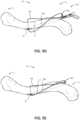
- FIGS. 1A-1L illustrate example devices, instruments, and not claimed method steps for a bone fixation assembly.
- FIG. 1 illustrates a bone 10 comprising a first bone fragment 1 and a second bone fragment 2 separated by a bone fracture 3.
- the bone 10 may comprise a clavicle bone.
- the various devices, instruments, and method steps described herein can be utilized in any combination with each other and for any type of bone fracture including, but not limited to olecranon fractures, fibula fractures, patellar fractures, malleolar fractures, etc.
- FIG. 1B illustrates a first step of the procedure, in which the intramedullary canals of the first and second bone fragments 1, 2 may be prepared with a drill bit or reamer 30.
- the intramedullary canals of the first and second bone fragments 1, 2 may be drilled and/or reamed with any diameter drill bit or reamer to any desired depth within the intramedullary canal in order to form a prepared intramedullary canal.
- FIG. 1D illustrates the first and second bone fragments 1, 2 with prepared intramedullary canals including a first longitudinal bone tunnel or first intramedullary canal 11, and a second longitudinal bone tunnel or second intramedullary canal 12.
- a 4.2 mm diameter drill bit may be utilized and each intramedullary canal of the first and second bone fragments 1, 2 may be drilled and/or reamed to a depth of about 3 cm.
- any diameter size and/or any depth may be utilized, as desired.
- the intramedullary canals of the bone fragments may not require preparation, such as drilling, reaming, etc.
- a suitable intramedullary rod may be press-fit and/or tamped into an unprepared intramedullary canal of a bone fragment.
- FIG. 1C illustrates a second step of the procedure, in which a drill guide 40 may be utilized to place one or more transverse bone tunnels through a cortical surface 4 of the bone 10 and down into the prepared intramedullary canals of the bone fragments with a suitable drill bit (not shown).
- the drill guide 40 may be configured to utilize the reamer 30 as a reference to place a drill guide barrel 41 at a correct location along the cortical surface 4 of the bone 10, as shown in FIG. 1C . In this manner, the drill guide 40 may utilize the morphology and/or depth of the prepared intramedullary canals to guide the placement of the one or more transverse bone tunnels via the drill guide barrel 41.
- FIG. 1D illustrates the first and second bone fragments 1, 2 with prepared transverse bone tunnels including one or more first transverse bone tunnels 21 and one or more second transverse bone tunnels 22.
- FIG. 1E illustrates a third step of the procedure, in which one or more retrieval wires 50 may be placed through the first and second transverse bone tunnels 21, 22 and out the first and second intramedullary canals 11, 12.
- This step (and/or other similar steps described herein) may be facilitated with any suitable tool.
- a magnetic wire retriever (not shown) with one or more magnets located on a tip of the magnetic wire retriever may be utilized.
- the magnetic wire retriever may be inserted into a bone tunnel to magnetically capture a wire and retrieve the wire from the bone tunnel.
- any other tool (or not tool at all) may be utilized to help facilitate the step of threading a flexible tensioning element through a bone tunnel.
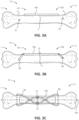
- FIG. 1F illustrates an elongate fixation member 110, according to an embodiment of the present disclosure.
- the elongate fixation member 110 may generally include a distal portion or first portion 101, a proximal portion or second portion 102, and a central longitudinal axis 103.
- the elongate fixation member 110 may be configured to couple with at least one flexible tensioning element to secure the elongate fixation member to the bone 10.
- a first end of the flexible tensioning element may be couplable with a second end of the flexible tensioning element to secure the elongate fixation member 110 to the bone 10.
- the flexible tensioning element may comprise a first tension band or a first flexible tensioning element 61, as well as a second tension band or a second flexible tensioning element 62 in order to secure the elongate fixation member 110 to the bone 10.
- the elongate fixation member 110 may include a first transverse passageway 106 configured to receive the first flexible tensioning element 61 therethrough from a first direction transverse to the central longitudinal axis 103 of the elongate fixation member 110.
- the elongate fixation member 110 may also include a second transverse passageway 107 configured to receive the second flexible tensioning element 62 therethrough from a second direction transverse to the central longitudinal axis 103 of the elongate fixation member 110.
- the first direction and the second direction may be similar to each other.
- the first direction and the second direction may be opposite from each other.
- first and second flexible tensioning elements 61, 62 may be couplable to each other in order to secure the elongate fixation member 110 to the bone 10.
- a first end 63 of the first flexible tensioning element 61 may be couplable with a second end 66 of the second flexible tensioning element 62, and a second end 64 of the first flexible tensioning element 61 may be couplable with a first end 65 of the second flexible tensioning element 62 to form a crisscross pattern that spans the bone fracture 3 and secures the elongate fixation member 110 to the bone 10.
- the flexible tensioning elements may be configured to span the bone fracture 3 intermediate the first bone fragment 1 and the second bone fragment 2 to preload the bone fracture 3 in compression to resist tensile force imparted across the bone fracture 3, thereby maintaining fixation of the first bone fragment 1 relative to the second bone fragment 2.
- the elongate fixation member 110 may comprise an intramedullary rod.
- the elongate fixation member 110 may include a generally cylindrical shape.
- the elongate fixation member 110 may be solid or substantially solid. However, it will also be understood that in some embodiments the elongate fixation member 110 may comprise an at least partially hollow interior.
- the elongate fixation member 110 may comprise a rigid material to provide rigid fixation of the first and second bone fragments 1, 2 relative to each other.
- FIG. 1G illustrates a fourth step of the procedure, in which the one or more retrieval wires 50 shown in FIG. 1E may be utilized to couple with and retrieve the first and second flexible tensioning elements 61, 62 in order to pull the first and second flexible tensioning elements 61, 62 through the intramedullary canals and back through the transverse bone tunnels formed in the bone fragments.
- FIGS. 1G and 1H illustrate a fifth and sixth step of the procedure, in which the elongate fixation member 110 may be inserted into the prepared intramedullary canals of the first and second bone fragments 1, 2.
- FIG. 1G illustrates the elongate fixation member 110 inserted into the second bone fragment 2 in a fifth step
- FIG. 1H illustrates the elongate fixation member 110 inserted into both the first and second bone fragments 1, 2 in a sixth step with the bone fracture 3 reduced.
- first portion 101 of the elongate fixation member 110 may be couplable within the first intramedullary canal 11 of the first bone fragment 1 of the bone 10
- second portion 102 of the elongate fixation member 110 may be couplable within the second intramedullary canal 12 of the second bone fragment 2 of the bone 10 to provide fixation of the second bone fragment 2 relative to the first bone fragment 1.
- steps four through six discussed above can be performed together in a partial stepwise manner in order to ensure the flexible tensioning elements remain threaded through the transverse bone tunnels during the procedure.
- initial reduction and/or initial fixation of the bone fracture 3 may be achieved through either or both of: (1) inserting the elongate fixation member 110 into the intramedullary canals of the bone fragments via a press fit; and/or (2) tensioning the flexible tensioning elements in order to draw the bone fragments together to achieve initial reduction and/or initial fixation of the bone fracture 3.
- FIG. 1I illustrates a seventh step of the procedure, in which the first and second flexible tensioning elements 61, 62 may be woven around the bone fracture 3 and secured together.
- the first and second flexible tensioning elements 61, 62 may be configured to span the bone fracture 3 and preload the bone fracture 3 in compression to resist tensile and/or distraction forces imparted across the bone fracture 3, thereby maintaining fixation of the first bone fragment 1 relative to the second bone fragment 2.
- the bone fracture 3 may receive improved fixation and reduction strength by combining the elongate fixation member 110 with the first and second flexible tensioning elements 61, 62.
- first and second flexible tensioning elements 61, 62 may be woven around the bone fracture 3 such that they form a crisscross pattern that spans the bone fracture 3 on a side of the bone 10.
- first and second flexible tensioning elements 61, 62 may be woven around the bone fracture 3 such that they form a crisscross pattern that spans the bone fracture 3 on a superior side of the bone 10.
- the flexible tensioning elements may be woven around the bone fracture 3 to form any suitable pattern and on any side of the bone 10 to achieve a desired resistance to tensile and/or distraction force that may be imparted across the bone fracture 3.
- FIGS. 1J-1L illustrate an eighth step of the procedure, in which a clamp or securing element may be applied to the flexible tensioning elements to secure flexible tensioning elements in place and prevent the flexible tensioning elements from loosening over time.
- FIG. 1J illustrates a top view of a first securing element 71, as one non-limiting example of the present disclosure, that may be utilized to secure the first and second flexible tensioning elements 61, 62 in place and prevent the first and second flexible tensioning elements 61, 62 from loosening over time.
- the first securing element 71 may include one or more attachment features 75 that may be configured to couple with the bone 10 and/or the first and second flexible tensioning elements 61, 62 to prevent loosening of the first and second flexible tensioning elements 61, 62 over time.
- FIG. 1K illustrates a top view of a second securing element 72, as another non-limiting example of the present disclosure, that may be utilized to secure the first and second flexible tensioning elements 61, 62 in place and prevent the first and second flexible tensioning elements 61, 62 from loosening over time.
- FIG. IL illustrates the second securing element 72 of FIG. 1K coupled to the first and second flexible tensioning elements 61, 62 of the bone fixation assembly from FIG. 1I .
- the second securing element 72 may be configured to receive and/or couple with the crisscross pattern formed by the first and second flexible tensioning elements 61, 62 to prevent the first and second flexible tensioning elements 61, 62 from loosening over time.
- the second securing element 72 may include one or more holes or channels (not shown) configured to receive the first and second flexible tensioning elements 61, 62 therein.
- first and second flexible tensioning elements 61, 62 may be threaded into/through the second securing element 72 via the holes/channels in order to secure the flexible tensioning elements in place and prevent the flexible tensioning elements from loosening over time.
- the second securing element 72 may include a fastener 76 (e.g., such as a set screw, a screw cap, etc.) and a fastener aperture 77 configured to receive the fastener 76 therein.
- the fastener 76 may removably couple with the second securing element 72 (e.g., via threading or by some other means) and may be configured to apply a compression force to the first and second flexible tensioning elements 61, 62 to prevent the first and second flexible tensioning elements 61, 62 from loosening over time.
- the fastener 76 may also be configured to apply a tension force to the first and second flexible tensioning elements 61, 62 in order to preload the bone fracture in compression to further resist tensile/distraction forces that may be imparted across the bone fracture 3 and provide additional fixation of the first bone fragment 1 relative to the second bone fragment 2.
- the fastener 76 may include one or more prongs (not shown) that may engage with the first and second flexible tensioning elements 61, 62 as the fastener 76 rotates into the fastener aperture 77 via threading or by some other means.
- the one or more prongs may also engage with and rotate the first and second flexible tensioning elements 61, 62 to tighten them up and impart a tension force to the first and second flexible tensioning elements 61, 62 to preload the bone fracture 3 in compression.
- the flexible tensioning elements may cross each other on top of the second securing element 72. However, it will also be understood that in other embodiments the flexible tensioning elements may cross each other within the second securing element 72 and/or under the second securing element 72.
- one or more bone fasteners 78 may also be utilized to provide additional tension and/or fixation to the first and second flexible tensioning elements 61, 62 in order to preload the bone fracture 3 in compression and/or to prevent the first and second flexible tensioning elements 61, 62 from loosening over time, as shown in FIG. 1L .
- the one or more bone fasteners 78 may be configured to hold the ends of the first and second flexible tensioning elements 61, 62 in place with respect to the first and second bone fragments 1, 2.
- the one or more bone fasteners 78 may comprise bone screws configured to couple with the bone 10.
- the bone screws may include bone screw heads configured to capture and/or hold the first and second flexible tensioning elements 61, 62 in order to preload the bone fracture 3 in compression and/or to prevent the first and second flexible tensioning elements 61, 62 from loosening over time.
- FIGS. 2A-2F illustrate example devices, instruments, and not claimed method steps for a bone fixation assembly , according to another embodiment of the present disclosure.
- the bone 10 may comprise a distal or proximal end of a bone, such as a fractured olecranon process of the ulna, as one non-limiting example.
- a bone such as a fractured olecranon process of the ulna
- the various devices, instruments, and method steps described herein can be utilized in any combination with each other and for any type of bone fracture including, but not limited to clavicle fractures, fibula fractures, patellar fractures, malleolar fractures, olecranon process fractures, etc.
- FIG. 2A illustrates a first step of the procedure, in which the intramedullary canals of the first and second bone fragments 1, 2 may be prepared with the reamer 30.
- the intramedullary canals of the first and second bone fragments 1, 2 may be drilled and/or reamed with any diameter drill bit or reamer to any desired depth within the intramedullary canals.
- FIG. 2B illustrates the first and second bone fragments 1, 2 with prepared first and second intramedullary canals 11, 12.
- FIG. 2C illustrates a side view of an elongate fixation member 120, according to another embodiment of the present disclosure.
- the elongate fixation member 120 may generally include the distal or first portion 101, the proximal or second portion 102, and the central longitudinal axis 103.
- the elongate fixation member 120 may be configured to couple with at least one flexible tensioning element to secure the elongate fixation member 120 to the bone 10.
- the elongate fixation member 120 may comprise a longitudinal passageway 104 formed through the elongate fixation member 120 and configured to receive the at least one flexible tensioning element therethrough.
- a first end of the at least one flexible tensioning element may be couplable with a second end of the at least one flexible tensioning element to secure the elongate fixation member 110 to the bone 10.
- the at least one flexible tensioning element may comprise the first flexible tensioning element 61 and the second flexible tensioning element 62 to secure the elongate fixation member 110 to the bone 10.
- first and second flexible tensioning elements 61, 62 may be couplable to each other in order to secure the elongate fixation member 110 to the bone 10.
- first end 63 of the first flexible tensioning element 61 may be couplable with the second end 64 of the first flexible tensioning element 61
- first end 65 of the second flexible tensioning element 62 may be couplable with the second end 66 of the second flexible tensioning element 62 such that the first and second flexible tensioning elements 61, 62 span the bone fracture 3 and secure the elongate fixation member 120 to the bone 10, as shown in FIG. 2F .
- one or more first transverse bone tunnels 21 may be formed in the first bone fragment 1, as can be seen in FIG. 2D .
- the one or more first transverse bone tunnels 21 may intersect the first intramedullary canal 11, as previously described herein.
- one or more second transverse bone tunnels (not shown) may also be formed in the second bone fragment 2 that may intersect the second intramedullary canal 12.
- the one or more second transverse bone tunnels may be slightly spread apart from each other in the tip of the fractured olecranon process on either side of the second intramedullary canal 12.
- first and second flexible tensioning elements 61, 62 This will create more distance between the first and second flexible tensioning elements 61, 62 which can provide more rotational control of the fracture and/or allow the first and second flexible tensioning elements 61, 62 to be buried underneath soft tissues with a lower profile to avoid prominent and/or painful protrusion of the first and second flexible tensioning elements 61, 62 (e.g., under the skin, muscles, soft tissues, etc.).
- FIG. 2D illustrates a third step of the procedure, in which one or more retrieval wires 50 may be placed through the first transverse bone tunnels 21 and the first and second intramedullary canals 11, 12 to retrieve the first and second flexible tensioning elements 61, 62, as previously described herein.
- FIG. 2E shows the first and second flexible tensioning elements 61, 62 pulled through the first transverse bone tunnels 21.
- FIG. 2F illustrates a fourth step of the procedure, in which the elongate fixation member 120 may be inserted into the prepared first and second intramedullary canals 11, 12 of the first and second bone fragments 1, 2.
- FIG. 2F also illustrates a fifth step of the procedure, in which the first and second flexible tensioning elements 61, 62 may be coupled to each other, woven around the bone fracture 3, and secured together.
- first and second flexible tensioning elements 61, 62 may be additionally secured in place and/or tensioned via any of the securing element and/or tensioning element designs described or contemplated herein.
- first and second flexible tensioning elements 61, 62 may be configured to span the bone fracture 3 and preload the bone fracture in compression to resist tensile and/or distraction forces imparted across the bone fracture 3, thereby maintaining fixation of the first bone fragment 1 relative to the second bone fragment 2.
- the bone fracture 3 may receive improved fixation and reduction strength by combining the elongate fixation member 120 with the first and second flexible tensioning elements 61, 62.
- the devices and procedures described herein can be utilized for bone fractures in other various locations throughout the body.
- the procedure for an olecranon process fracture could be slightly modified for a different type of bone fracture, such as a fractured fibula.
- the technique would be similar to the olecranon process, except the surgeon would drill up initially from the tip of the fibula along the lateral ankle, then drill holes past the fracture into the fibulae shaft proximal to the fracture. Then, the surgeon would pull the device from the tip of the lateral malleolus, through the fracture site, and then secure the flexible tensioning element as previously discussed.
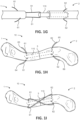
- FIGS. 3A-3C illustrate an example bone fixation assembly that utilizes an elongate fixation member 130 comprising a bone plate in combination with a flexible tensioning element 60, according to another embodiment of the present disclosure.
- the bone fracture 3 may be provisionally reduced and the elongate fixation member 130 may be secured to cortical surfaces 4 of the first and second bone fragments 1, 2 (e.g., via bone screws, not shown) in order to provide initial fixation for the bone fracture 3.
- the elongate fixation member 130 may be located superiorly on the bone 10.
- the elongate fixation member 130 may be placed along any side of the bone 10, and/or multiple bone plates may be utilized to stabilize the bone fracture 3 on any side of the bone 10.
- first and second transverse bone tunnels 21, 22 may be drilled through the first and second bone fragments 1, 2. In some embodiments, the first and second transverse bone tunnels 21, 22 may be drilled through the first and second bone fragments 1, 2 in an anterior to posterior direction (e.g., for a clavicle bone). In some embodiments, the first and second transverse bone tunnels 21, 22 may be drilled through the first and second bone fragments 1, 2 at locations that are past the proximal and distal portions 101, 102 of the elongate fixation member 130.
- first and second transverse bone tunnels 21, 22 may not be drilled through the first and second bone fragments 1, 2 in any particular direction, or at any location past the proximal and distal portions 101, 102 of the elongate fixation member 130.
- the flexible tensioning element 60 may be threaded through the first and second transverse bone tunnels 21, 22 and woven around or cinched over the bone fracture 3 such that the flexible tensioning element 60 forms one or more crisscross patterns on top of, within, and/or below the elongate fixation member 130.
- the flexible tensioning element 60 may be woven around the bone fracture 3 to form any suitable pattern on any side of the bone 10 and/or any side of the elongate fixation member 130 to preload the bone fracture 3 in compression and resist tensile/distraction forces imparted across the bone fracture 3.
- the flexible tensioning element 60 may comprise a single flexible tensioning element.
- the flexible tensioning element 60 may comprise one or more flexible tensioning elements that may be couplable to each other, such as the first and second flexible tensioning elements 61, 62 previously described herein.
- the elongate fixation member 130 may comprise one or more grooves (not shown) located on top of, within, or on the bottom of the elongate fixation member 130 that may be configured to receive the flexible tensioning element 60 therein to achieve a lower overall profile and reduce the risk of prominence and/or complications due to soft tissue disturbances.
- the flexible tensioning element 60 may be threaded through one or more sleeves (not shown) to prevent the flexible tensioning element 60 from cutting through the bone 10 over time.
- the one or more sleeves may be made of any biocompatible material including, but not limited to metals, plastics, PEEK, rubber, silicone, etc.
- the flexible tensioning element 60 may also be secured in place and/or tensioned via one or more third securing elements 73 (see FIG. 3C ), which may include any of the securing element designs and/or tensioning element designs described or contemplated herein.
- FIGS. 4A-4O illustrate example devices and instruments for a bone fixation assembly and not claimed surgical procedure that may be performed from a lateral approach.
- the bone 10 illustrated in FIG. 4A may comprise a clavicle bone.
- the various devices, instruments, and method steps described herein may be utilized in any combination with each other and for any type of bone fracture including, but not limited to olecranon fractures, fibula fractures, patellar fractures, malleolar fractures, etc.
- FIG. 4B-4F illustrate a first step of the procedure, in which the first and second intramedullary canals 11, 12 of the first and second bone fragments 1, 2 may be prepared with a drill bit or reamer 30.
- the reamer 30 may be guided through a reamer passageway 37 that is formed through a reamer guide 35.
- the reamer guide 35 may also include a reference member 36 projecting from the reamer guide 35.
- the reference member 36 may be configured to abut a cortical surface 4 of the first and/or second bone fragments 1, 2 to orient the reamer passageway 37 with respect to the cortical surfaces 4 of the first and/or second bone fragments 1, 2.
- first and second intramedullary canals 11, 12 of the first and second bone fragments 1, 2 may be drilled and/or reamed with any diameter drill bit or reamer to any desired depth within the intramedullary canal in order to form prepared intramedullary canals.
- the intramedullary canals of the bone fragments may not require preparation, such as drilling, reaming, etc.
- a suitable elongate fixation member may be press-fit and/or tamped into an unprepared intramedullary canal of a bone fragment.
- FIGS. 4G-4I illustrate a second step of the procedure, in which a drill guide 45 and drill bit 31 may be utilized to place one or more first transverse bone tunnels 21 through the cortical surface 4 of the first bone fragment 1 down into the prepared first intramedullary canal 11.
- the drill guide 45 may include one or more drill guide barrels 46, an insert member 47, and a handle 48.
- the insert member 47 may be inserted into the prepared first intramedullary canal 11 to orient the one or more drill guide barrels 46 with respect to the prepared first intramedullary canal 11 of the first bone fragment 1.
- FIGS. 4J-4L illustrate a third step of the procedure, in which a retrieval wire 50 may be placed through the second intramedullary canal 12 of the second bone fragment 2 in order to capture and pull the first flexible tensioning elements 61 through the second intramedullary canal 12 of the second bone fragment 2, as shown in FIG. 4L .
- FIG. 4M illustrates a fourth step of the procedure, in which one of the first flexible tensioning elements 61 may be passed through the first transverse passageway 106 of the elongate fixation member 180 and then coupled to the other one of the first flexible tensioning elements 61, as can be seen in FIG. 4M .
- the elongate fixation member 180 will be discussed in more detail below with respect to FIG. 8E .
- FIG. 4N illustrates a fifth step of the procedure, in which the elongate fixation member 180 may be inserted into the prepared first and second intramedullary canals 11, 12 of the first and second bone fragments 1, 2 from a lateral approach. This may be accomplished by pulling the first flexible tensioning elements 61 through the first transverse bone tunnels 21, and/or by impacting the distal end of the elongate fixation member 180 with an impact driver (not shown).
- FIG. 4O illustrates a sixth step of the procedure, in which the first and second flexible tensioning elements 61, 62 may be woven around the bone fracture 3 and secured together, as previously described herein.
- the first and second flexible tensioning elements 61, 62 may be configured to span the bone fracture 3 and preload the bone fracture 3 in compression to resist tensile and/or distraction forces imparted across the bone fracture 3, thereby maintaining fixation of the first bone fragment 1 relative to the second bone fragment 2.
- the bone fracture 3 may receive improved fixation and reduction strength by combining the elongate fixation member 180 with the first and second flexible tensioning elements 61, 62.
- first and second flexible tensioning elements 61, 62 may also be secured in place and/or tensioned via one or more fourth securing elements 74 (see FIG. 4O ), which may include any of the securing element designs and/or tensioning element designs described or contemplated herein.
- FIGS. 5A-5H illustrate example devices and instruments for a bone fixation assembly and surgical procedure that may be performed from a lateral approach.
- the first and second bone fragments 1, 2 may be prepared in a similar manner to the first bone fragment 1 shown in FIGS. 4A-4I in a first step and a second step.
- the first and second intramedullary canals 11, 12 of the first and second bone fragments 1, 2 may also be tapped with a tap tool 80 in a third step to form internal bone threads 81 within the first and second intramedullary canals 11, 12 (e.g., see FIG. 5A ).
- FIGS. 5B-5D illustrate a fourth step of the procedure, in which the first and second flexible tensioning elements 61, 62 may be pulled through the bone tunnels of the first bone fragment 1, the longitudinal passageway 104 of the elongate fixation member 150, and the second intramedullary canal 12 of the second bone fragment 2 via a retrieval wire (not shown) in FIGS. 5B-5D .
- the elongate fixation member 150 may generally include a distal or first portion 101, a proximal or second portion 102, a central longitudinal axis 103, a longitudinal passageway 104, a first thread 151, a second thread 152, an intermediate portion 153, and a torque reception feature 154.
- the elongate fixation member 150 may comprise a compression screw design.
- the first thread 151 may comprise a first pitch
- the second thread 152 may comprise a second pitch that is different from the first pitch of the first thread 151.
- the first and second bone fragments 1, 2 may be drawn toward each other in compression as the elongate fixation member 150 is inserted into the first and second intramedullary canals 11, 12, due to the differential thread pitches between the first and second threads 151, 152.
- the elongate fixation member 150 may comprise a resorbable material (such as PEEK, hydroxyapatite, etc.), and/or any other biocompatible material such as titanium, stainless steel, polymer, etc.
- a resorbable material such as PEEK, hydroxyapatite, etc.
- any other biocompatible material such as titanium, stainless steel, polymer, etc.
- FIGS. 5D-5F illustrate a fifth step of the procedure, in which the elongate fixation member 150 may be inserted into the first and second intramedullary canals 11, 12 of the first and second bone fragments 1, 2 from a lateral approach.
- FIGS. 5D and 5E illustrate a driver 90 that may be utilized to couple the elongate fixation member 150 to the first and second bone fragments 1, 2.
- the driver 90 may include a torque transmission feature 94 that may be configured to mate with a complementary shaped torque reception feature 154 formed within the longitudinal passageway 104 of the elongate fixation member 150 to drive the elongate fixation member 150 into the first and second intramedullary canals 11, 12 of the first and second bone fragments 1, 2.
- FIG. 5F shows the elongate fixation member 150 after it has been fully inserted into the first and second intramedullary canals 11, 12 and the bone fracture 3 has been reduced in compression by the compression screw design of the elongate fixation member 150.
- FIGS. 5F also illustrates a sixth step of the procedure, in which the first and second flexible tensioning elements 61, 62 may be pulled through the second transverse bone tunnels 22 of the second bone fragment 2 after the driver 90 is removed. This may be accomplished with one or more retrieval wires, as previously discussed.
- FIGS. 5G and 5H illustrate a seventh step of the procedure, in which the first and second flexible tensioning elements 61, 62 may be coupled to each other and woven around the bone fracture 3 to further preload the bone fracture 3 in compression to resist tensile/distraction forces that may be imparted across the bone fracture 3, as previously described.
- combining the elongate fixation member 150 with the first and second flexible tensioning elements 61, 62 provides additional fixation, stabilization, and reduction of the bone fracture 3 over an elongate fixation member or flexible tensioning element alone.
- first and second flexible tensioning elements 61, 62 may also be secured in place and/or tensioned via one or more fourth securing elements 74, which may include any of the securing element designs and/or tensioning element designs described or contemplated herein.
- FIGS. 6A-6F illustrate example devices and instruments for a bone fixation assembly and surgical procedure that may be performed from both a medial and lateral approach.
- the first and second bone fragments 1, 2 may be prepared in a similar manner to the first bone fragment 1 shown in FIGS. 4A-4I in a first step and a second step.
- the first and second intramedullary canals 11, 12 of the first and second bone fragments 1, 2 may also be tapped with the tap tool 80 shown in FIG. 5A in a third step to form internal bone threads 81 within the first and second intramedullary canals 11, 12.
- FIGS. 6A and 6B illustrate a fourth step of the procedure, in which the first and second flexible tensioning elements 61, 62 may be pulled through a first driver 91, the second intramedullary canal 12 of the second bone fragment 2, the elongate fixation member 150, and a second driver 92. This may be accomplished with one or more retrieval wires, as previously discussed.
- FIG. 6C illustrates a fifth step of the procedure, in which the second driver 92 may be utilized to drive the elongate fixation member 150 into the second intramedullary canal 12 of the second bone fragment 2 from a medial direction.
- FIG. 6D illustrates a sixth step of the procedure, in which the first bone fragment 1 may be positioned adjacent the second bone fragment 2 and the first driver 91 may be utilized to drive the elongate fixation member 150 into the first intramedullary canal 11 of the first bone fragment 1 from a lateral direction in order to couple the elongate fixation member 150 to the first and second bone fragments 1, 2.
- FIG. 6E illustrates a seventh step of the procedure, in which the first and second flexible tensioning elements 61, 62 may be pulled through the first and second transverse bone tunnels 21, 22 of the bone fragments after the first and second drivers 91, 92 have been removed. This may be accomplished with one or more retrieval wires, as previously discussed.
- FIG. 6F illustrates an eighth step of the procedure, in which the first and second flexible tensioning elements 61, 62 may be coupled to each other and woven around the bone fracture 3 to preload the bone fracture 3 in compression to further resist tensile/distraction forces that may be imparted across the bone fracture 3, as previously described.
- combining the elongate fixation member 150 with the first and second flexible tensioning elements 61, 62 provides additional fixation, stabilization, and reduction of the bone fracture 3 over an elongate fixation member or flexible tensioning element alone.
- first and second flexible tensioning elements 61, 62 may also be secured in place and/or tensioned via one or more securing elements (not shown), which may include any of the securing element designs and/or tensioning element designs described or contemplated herein.
- FIGS. 7A-7D illustrate example devices and instruments for a bone fixation assembly and not claimed surgical procedure.
- the first and second bone fragments 1, 2 may be prepared in a similar manner to the first and second bone fragments 1, 2 shown in FIGS. 1B-1D in a first step and a second step.
- FIG. 7A illustrates a third step of the procedure, in which the first and second flexible tensioning elements 61, 62 may be passed through a centrally located transverse passageway 175 of an elongate fixation member 170, through the first and second intramedullary canals 11, 12, and out of the first and second transverse bone tunnels 21, 22. This may be accomplished with one or more retrieval wires, as previously discussed.
- the elongate fixation member 170 may include one or more grooves 176 formed in opposing sides of the elongate fixation member 170.
- the one or more grooves 176 may be configured to receive the first and second flexible tensioning elements 61, 62 therein to facilitate insertion of the elongate fixation member 170 into the first and second intramedullary canals 11, 12 by preventing frictional binding of the first and second flexible tensioning elements 61, 62 against the walls of the first and second intramedullary canals 11, 12.
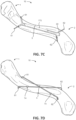
- FIG. 7B and 7C illustrate a fourth step of the procedure, in which the elongate fixation member 170 may be inserted into the first and second intramedullary canals 11, 12 of the first and second bone fragments 1, 2 reducing the bone fracture 3.
- FIG. 7D illustrates a fifth step of the procedure, in which the first and second flexible tensioning elements 61, 62 may be coupled to each other and woven around the bone fracture 3 to preload the bone fracture 3 in compression to further resist tensile/distraction forces that may be imparted across the bone fracture 3, as previously described.
- combining the elongate fixation member 170 with the first and second flexible tensioning elements 61, 62 provides additional fixation, stabilization, and reduction of the bone fracture 3 over an elongate fixation member or flexible tensioning element alone.
- first and second flexible tensioning elements 61, 62 may also be secured in place and/or tensioned via one or more fourth securing elements 74, which may include any of the securing element designs and/or tensioning element designs described or contemplated herein.
- FIGS. 8A-8O illustrate example devices and instruments for a bone fixation assembly and one or more simplified not claimed surgical procedures.
- FIGS. 8A and 8B illustrate a first step of a simplified procedure, in which a drill bit 31 may be utilized to create pilot holes through the first and second intramedullary canals 11, 12 of the first and second bone fragments 1, 2.
- FIGS. 8C and 8D illustrate a second step of the simplified procedure, in which the first and second bone fragments 1, 2 may be aligned with each other to reduce the bone fracture 3 and a reamer 30 may then be utilized to enlarge or ream out the pilot holes of FIGS. 8A and 8B in order to create prepared first and second intramedullary canals 11, 12 that are aligned with each other.
- the reamer 30 may be utilized from a lateral direction. However, it will be understood that in other examples the reamer 30 may be utilized from a medial direction.
- FIG. 8E illustrates an elongate fixation member 180, according to another embodiment of the present disclosure.
- the elongate fixation member 180 may generally include a distal portion or first portion 101, a proximal portion or second portion 102, and a central longitudinal axis 103.
- the proximal and/or distal portions 101, 102 may comprise tapered ends 181 to facilitate insertion of the elongate fixation member 180 into bone.
- the elongate fixation member 180 may include a first transverse passageway 106 configured to receive a first flexible tensioning element 61 therethrough from a first direction that may be transverse to the central longitudinal axis 103 of the elongate fixation member 180.
- the elongate fixation member 180 may also include a second transverse passageway 107 configured to receive a second flexible tensioning element 62 therethrough from a second direction that may be transverse to the central longitudinal axis 103 of the elongate fixation member 180.
- the first direction and the second direction may be the same, or similar to each other.
- the first direction and the second direction may be opposite from each other.
- the elongate fixation member 180 may comprise an intramedullary rod.
- the elongate fixation member 180 may include a generally cylindrical shape.
- the elongate fixation member 180 may be solid or substantially solid. However, it will also be understood that in some embodiments the elongate fixation member 180 may comprise an at least partially hollow interior.
- the elongate fixation member 180 may comprise a rigid material to provide rigid fixation of the first and second bone fragments 1, 2 relative to each other.
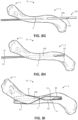
- FIGS. 8F-8H illustrate a third step of the simplified procedure, in which the elongate fixation member 180 may be inserted into the first and second intramedullary canals 11, 12 of the first and second bone fragments 1, 2.
- FIG. 8F shows the first flexible tensioning element 61 passing through the first and second intramedullary canals 11, 12. This may be accomplished with one or more retrieval wires, as previously discussed.
- FIG. 8G shows the elongate fixation member 180 being forced into the first and second intramedullary canals 11, 12 with an impact driver tool 93
- FIG. 8H shows the elongate fixation member 180 placed within the first and second intramedullary canals 11, 12.
- FIG. 8I illustrates a fourth step of the simplified procedure, in which the first and second flexible tensioning elements 61, 62 may be woven around the bone fracture 3 and secured together.
- the first and second flexible tensioning elements 61, 62 may be configured to span the bone fracture 3 and preload the bone fracture 3 in compression to resist tensile and/or distraction forces imparted across the bone fracture 3, thereby maintaining fixation of the first bone fragment 1 relative to the second bone fragment 2.
- the bone fracture 3 may receive improved fixation and reduction strength by combining the elongate fixation member 180 with the first and second flexible tensioning elements 61, 62.
- first and second flexible tensioning elements 61, 62 may also be secured in place and/or tensioned via one or more fourth securing elements 74, which may include any of the securing element designs and/or tensioning element designs described or contemplated herein.
- FIGS. 8J-8O illustrate example devices and instruments for a bone fixation assembly and an alternative simplified surgical procedure.
- first and second bone fragments 1, 2 may be prepared in a similar manner to the first and second bone fragments 1, 2 shown in FIGS. 8A-8D in a first step and a second step.
- FIG. 8J illustrates a third step of the alternative simplified procedure, in which the elongate fixation member 180 may be inserted into the first and second intramedullary canals 11, 12 of the first and second bone fragments 1, 2 without the first and second flexible tensioning elements 61, 62 being coupled to the elongate fixation member 180.
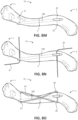
- FIGS. 8K-8M illustrate a fourth step of the alternative simplified procedure, in which the first and second transverse bone tunnels 21, 22 may be formed through the first and second bone fragments 1, 2 with a drill bit 31.
- first and second transverse passageways 106, 107 of the elongate fixation member 180 may be utilized to guide the drill bit 31 through the first and second bone fragments 1, 2 to quickly form the first and second transverse bone tunnels 21, 22 therethrough.
- FIG. 8N illustrates a fifth step of the alternative simplified procedure, in which the first and second flexible tensioning elements 61, 62 may be inserted through the first and second transverse bone tunnels 21, 22 and through the first and second transverse passageways 106, 107 of the elongate fixation member 180.
- FIG. 8O illustrates a sixth step of the alternative simplified procedure, in which the first and second flexible tensioning elements 61, 62 may be woven around the bone fracture 3 and secured together.
- the first and second flexible tensioning elements 61, 62 may be configured to span the bone fracture 3 and preload the bone fracture 3 in compression to resist tensile and/or distraction forces imparted across the bone fracture 3, thereby maintaining fixation of the first bone fragment 1 relative to the second bone fragment 2.
- the bone fracture 3 may receive improved fixation and reduction strength by combining the elongate fixation member 180 with the first and second flexible tensioning elements 61, 62.
- first and second flexible tensioning elements 61, 62 may also be secured in place and/or tensioned via one or more securing elements (not shown), which may include any of the securing element designs and/or tensioning element designs described or contemplated herein.
- FIGS. 9A-9E illustrate example devices and instruments for a bone fixation assembly and procedure.
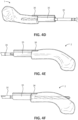
- FIG. 9A illustrates an elongate fixation member 190 couplable with a tensioner element.
- the elongate fixation member 190 may include a distal or first portion 101, a proximal or second portion 102, an eyelet 199 at the distal portion, one or more attachment features 197, and a recess 194 formed in the proximal portion of the elongate fixation member 190.
- the tensioner element 195 may include an attachment member 196, a resilient member 193, and an opening 198 formed in the resilient member 193.
- the resilient member 193 may be slightly angled with respect to the attachment member 196 in a free state.
- the tensioner element 195 may comprise a super elastic material (e.g., such as nitinol, etc.) that may be configured to provide a tensioning force to the flexible tensioning element 60, as shown in FIGS. 9D and 9E .
- a super elastic material e.g., such as nitinol, etc.
- the attachment member 196 may be received within the recess 194 formed in the proximal portion of the elongate fixation member 190 to removably couple the tensioner element 195 with the elongate fixation member 190.
- the tensioner element 195 may be integrally formed with, or otherwise permanently attached to, the elongate fixation member 190.
- the elongate fixation member 190 may comprise a resorbable material (such as PEEK, hydroxyapatite, etc.) and/or any other biocompatible material such as titanium, stainless steel, polymer, etc.
- a resorbable material such as PEEK, hydroxyapatite, etc.
- any other biocompatible material such as titanium, stainless steel, polymer, etc.
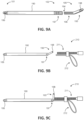
- FIGS. 9B and 9C illustrate the elongate fixation member 190 of FIG. 9A in conjunction with an actuation tool 210, according to an embodiment of the present disclosure.
- the actuation tool 210 may include an actuator 211 coupled with a handle 212.
- the actuation tool 210 may also include one or more attachment features (not shown) which may be configured to engage with the one or more attachment features 197 of the elongate fixation member 190 to removably couple the actuation tool 210 with the elongate fixation member 190, as shown in FIGS. 9C and 9D .
- the actuator 211 may comprise a threaded thumb screw which may be advanced toward the resilient member 193 via rotation in a first direction to bend the resilient member 193 forward, as shown in FIGS. 9C and 9D .
- the resilient member 193 of the tensioner element 195 may be bent to about 90 degrees when fully loaded by the actuator 211.
- the actuator 211 may be retracted from the resilient member 193 via rotation in a second direction to release the resilient member 193 and/or remove the actuation tool 210 from the elongate fixation member 190, as shown in FIGS. 9B and 9E .
- FIG. 9D illustrates the elongate fixation member 190 inserted into a bone 10 and a flexible tensioning element 60 passing through the opening 198 in the resilient member 193 with the actuation tool 210 attached to the elongate fixation member 190 and applying a bending force to the resilient member 193.
- the surgeon can couple the flexible tensioning element 60 to the resilient member 193 as tight as possible while the resilient member 193 is bent forward by the actuator 211.
- FIG. 9E illustrates the bone fixation assembly of FIG. 9D with the actuation tool 210 removed from the elongate fixation member 190, thus allowing the resilient member 193 to pull the flexible tensioning element 60 even tighter and further preload the bone fracture 3 in compression to resist tensile/distraction forces that may be imparted across the bone fracture 3, as previously described.
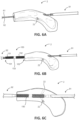
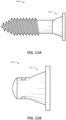
- FIGS. 10A-11B illustrate various alternative devices for tensioning a flexible tensioning element, according to embodiments of the present disclosure.
- FIG. 10A illustrates an elongate fixation member 200 with an angled cap 220 attached thereto at an angle with respect to the elongate fixation member 200.
- a bottom surface 221 of the angled cap 220 may act to press downward on a flexible tensioning element (not shown) that may be coupled to the bottom surface 221 of the angled cap 220. This may further tension the flexible tensioning element and preload a bone fracture in compression to resist tensile/distraction forces that may be imparted across the bone fracture, as previously described herein.
- FIG. 10B illustrates an elongate fixation member 201 with an angled fastener 230 attached thereto at an angle with respect to the elongate fixation member 201.
- a bottom surface 231 of the angled fastener 230 may likewise act to press downward on a flexible tensioning element (not shown) that may be coupled to the bottom surface 231 of the angled fastener 230. This may further tension the flexible tensioning element and preload a bone fracture in compression to resist tensile/distraction forces that may be imparted across the bone fracture, as previously described herein.
- FIG. 10C illustrates the elongate fixation member 201 and the angled fastener 230 inserted into a bone 10.
- FIG. 11A illustrates a flared fastener 240 comprising a flared portion 241 near the head of the flared fastener 240.
- the flared fastener 240 may be coupled with an elongate fixation member (not shown) without the need of angling the flared fastener 240 with respect to the elongate fixation member, due to the inherent angle already created by the flared portion 241.
- the flared portion 241 may act to press on a flexible tensioning element (not shown) as the flared fastener 240 couples with an elongate fixation member. This may further tension the flexible tensioning element and preload a bone fracture in compression to resist tensile/distraction forces that may be imparted across the bone fracture, as previously described herein.
- FIG. 11B illustrates a flared cap 250 comprising a flared portion 251 near the head of the flared cap 250.
- the flared cap 250 may likewise be coupled with an elongate fixation member (not shown) without the need of angling the flared cap 250 with respect to the elongate fixation member, due to the inherent angle already created by the flared portion 251.
- the flared portion 251 may likewise act to press on a flexible tensioning element (not shown) as the flared cap 250 couples with an elongate fixation member. This may further tension the flexible tensioning element and preload a bone fracture in compression to resist tensile/distraction forces that may be imparted across the bone fracture, as previously described herein.
- phrases “connected to,” “coupled to,” and “in communication with” refer to any form of interaction between two or more entities, including mechanical, electrical, magnetic, electromagnetic, fluid, and thermal interaction.
- fluid communication refers to two or more features that are connected such that a fluid within one feature is able to pass into another feature.
- substantially means within +/- 20% of a target value, measurement, or desired characteristic.
Landscapes
- Health & Medical Sciences (AREA)
- Orthopedic Medicine & Surgery (AREA)
- Surgery (AREA)
- Life Sciences & Earth Sciences (AREA)
- Heart & Thoracic Surgery (AREA)
- Animal Behavior & Ethology (AREA)
- Engineering & Computer Science (AREA)
- Biomedical Technology (AREA)
- Neurology (AREA)
- Medical Informatics (AREA)
- Molecular Biology (AREA)
- Nuclear Medicine, Radiotherapy & Molecular Imaging (AREA)
- General Health & Medical Sciences (AREA)
- Public Health (AREA)
- Veterinary Medicine (AREA)
- Surgical Instruments (AREA)
- Measuring Pulse, Heart Rate, Blood Pressure Or Blood Flow (AREA)
- Devices For Conveying Motion By Means Of Endless Flexible Members (AREA)
- Tension Adjustment In Filamentary Materials (AREA)
Applications Claiming Priority (2)
| Application Number | Priority Date | Filing Date | Title |
|---|---|---|---|
| US202063065188P | 2020-08-13 | 2020-08-13 | |
| PCT/US2021/044965 WO2022035698A1 (en) | 2020-08-13 | 2021-08-06 | Tension band systems |
Publications (2)
| Publication Number | Publication Date |
|---|---|
| EP4196024A1 EP4196024A1 (en) | 2023-06-21 |
| EP4196024B1 true EP4196024B1 (en) | 2025-06-04 |
Family
ID=77750325
Family Applications (1)
| Application Number | Title | Priority Date | Filing Date |
|---|---|---|---|
| EP21770093.9A Active EP4196024B1 (en) | 2020-08-13 | 2021-08-06 | Tension band systems |
Country Status (5)
| Country | Link |
|---|---|
| US (2) | US11504170B2 (https=) |
| EP (1) | EP4196024B1 (https=) |
| JP (1) | JP2023537773A (https=) |
| AU (1) | AU2021324639A1 (https=) |
| WO (1) | WO2022035698A1 (https=) |
Families Citing this family (2)
| Publication number | Priority date | Publication date | Assignee | Title |
|---|---|---|---|---|
| AU2021324639A1 (en) * | 2020-08-13 | 2023-03-09 | Robert Glen COLEMAN | Tension band systems |
| WO2025188582A1 (en) * | 2024-03-04 | 2025-09-12 | Carroll Jacob Hudson | Tension band systems and methods |
Family Cites Families (9)
| Publication number | Priority date | Publication date | Assignee | Title |
|---|---|---|---|---|
| JPH11337A (ja) * | 1997-07-02 | 1999-01-06 | Kazuyoshi Akiyama | 骨折整復に用いる穴開き鋼線 |
| US20090306718A1 (en) * | 2001-10-18 | 2009-12-10 | Orthoip, Llc | Filament and cap systems and methods for the fixation of bone fractures |
| WO2009152272A1 (en) | 2008-06-10 | 2009-12-17 | Sonoma Orthopedic Products, Inc. | Fracture fixation device, tools and methods |
| CN2885151Y (zh) * | 2005-12-13 | 2007-04-04 | 诸澄 | 用于外科手术的骨折内固定器 |
| WO2008061543A1 (de) * | 2006-11-21 | 2008-05-29 | Oliver Pieske | Implantat für röhrenknochen sowie behandlungsverfahren |
| WO2014117107A1 (en) | 2013-01-28 | 2014-07-31 | Cartiva, Inc. | Systems and methods for orthopedic repair |
| US9351771B2 (en) * | 2013-02-08 | 2016-05-31 | Robert Gorsline | Systems, methods, and apparatuses for fusion, stabilization, or fixation of bones |
| CN107224319A (zh) * | 2016-03-25 | 2017-10-03 | 文阳洋 | 一种骨折复位用免拆除钉线内固定系统 |
| AU2021324639A1 (en) * | 2020-08-13 | 2023-03-09 | Robert Glen COLEMAN | Tension band systems |
-
2021
- 2021-08-06 AU AU2021324639A patent/AU2021324639A1/en active Pending
- 2021-08-06 US US17/396,107 patent/US11504170B2/en active Active
- 2021-08-06 EP EP21770093.9A patent/EP4196024B1/en active Active
- 2021-08-06 JP JP2023511586A patent/JP2023537773A/ja active Pending
- 2021-08-06 WO PCT/US2021/044965 patent/WO2022035698A1/en not_active Ceased
-
2022
- 2022-11-21 US US17/991,246 patent/US12171472B2/en active Active
Also Published As
| Publication number | Publication date |
|---|---|
| US20230092603A1 (en) | 2023-03-23 |
| JP2023537773A (ja) | 2023-09-05 |
| US20220047307A1 (en) | 2022-02-17 |
| US11504170B2 (en) | 2022-11-22 |
| WO2022035698A1 (en) | 2022-02-17 |
| EP4196024A1 (en) | 2023-06-21 |
| AU2021324639A1 (en) | 2023-03-09 |
| US12171472B2 (en) | 2024-12-24 |
Similar Documents
| Publication | Publication Date | Title |
|---|---|---|
| EP2611371B1 (en) | Orthopedic implant for treatment of bone deformities | |
| US9538998B2 (en) | Method and apparatus for fracture fixation | |
| US6368326B1 (en) | Internal cord fixation device | |
| EP1836984B1 (en) | Medical device positioning tool | |
| US8814935B2 (en) | Interference screw driver assembly and method of use | |
| US9675344B2 (en) | Surgical instrument | |
| US20040127907A1 (en) | Internal cord fixation device | |
| EP1836981A2 (en) | A bone fracture fixation system | |
| US20140228898A1 (en) | Universal method and apparatus for repairing bone, ligament and tendon | |
| US20110118838A1 (en) | Graft pulley and methods of use | |
| US12171472B2 (en) | Tension band systems and methods | |
| EP1833392A1 (en) | Trocar with obturator having longitudinally passing holes for guide wires | |
| WO2015112124A1 (en) | Fracture reduction structure | |
| JP2023554221A (ja) | キャニュレイティド縫合糸および/または移植アンカー | |
| US8758345B2 (en) | Interlocking nail geometry and method of use | |
| US20250120756A1 (en) | Tension band systems and methods | |
| WO2023233359A1 (en) | Devices for semi-rigid bone fixation | |
| WO2025188582A1 (en) | Tension band systems and methods | |
| US20260007438A1 (en) | Fracture plating systems and methods | |
| US20260013913A1 (en) | Fracture plating systems and methods | |
| US20260013915A1 (en) | Fracture plating systems and methods | |
| WO2018183837A1 (en) | Fixation device and method of using the same |
Legal Events
| Date | Code | Title | Description |
|---|---|---|---|
| STAA | Information on the status of an ep patent application or granted ep patent |
Free format text: STATUS: UNKNOWN |
|
| STAA | Information on the status of an ep patent application or granted ep patent |
Free format text: STATUS: THE INTERNATIONAL PUBLICATION HAS BEEN MADE |
|
| PUAI | Public reference made under article 153(3) epc to a published international application that has entered the european phase |
Free format text: ORIGINAL CODE: 0009012 |
|
| STAA | Information on the status of an ep patent application or granted ep patent |
Free format text: STATUS: REQUEST FOR EXAMINATION WAS MADE |
|
| 17P | Request for examination filed |
Effective date: 20230228 |
|
| AK | Designated contracting states |
Kind code of ref document: A1 Designated state(s): AL AT BE BG CH CY CZ DE DK EE ES FI FR GB GR HR HU IE IS IT LI LT LU LV MC MK MT NL NO PL PT RO RS SE SI SK SM TR |
|
| DAV | Request for validation of the european patent (deleted) | ||
| DAX | Request for extension of the european patent (deleted) | ||
| GRAP | Despatch of communication of intention to grant a patent |
Free format text: ORIGINAL CODE: EPIDOSNIGR1 |
|
| STAA | Information on the status of an ep patent application or granted ep patent |
Free format text: STATUS: GRANT OF PATENT IS INTENDED |
|
| INTG | Intention to grant announced |
Effective date: 20240930 |
|
| GRAJ | Information related to disapproval of communication of intention to grant by the applicant or resumption of examination proceedings by the epo deleted |
Free format text: ORIGINAL CODE: EPIDOSDIGR1 |
|
| STAA | Information on the status of an ep patent application or granted ep patent |
Free format text: STATUS: REQUEST FOR EXAMINATION WAS MADE |
|
| GRAP | Despatch of communication of intention to grant a patent |
Free format text: ORIGINAL CODE: EPIDOSNIGR1 |
|
| STAA | Information on the status of an ep patent application or granted ep patent |
Free format text: STATUS: GRANT OF PATENT IS INTENDED |
|
| INTC | Intention to grant announced (deleted) | ||
| INTG | Intention to grant announced |
Effective date: 20250129 |
|
| GRAS | Grant fee paid |
Free format text: ORIGINAL CODE: EPIDOSNIGR3 |
|
| GRAA | (expected) grant |
Free format text: ORIGINAL CODE: 0009210 |
|
| STAA | Information on the status of an ep patent application or granted ep patent |
Free format text: STATUS: THE PATENT HAS BEEN GRANTED |
|
| AK | Designated contracting states |
Kind code of ref document: B1 Designated state(s): AL AT BE BG CH CY CZ DE DK EE ES FI FR GB GR HR HU IE IS IT LI LT LU LV MC MK MT NL NO PL PT RO RS SE SI SK SM TR |
|
| REG | Reference to a national code |
Ref country code: GB Ref legal event code: FG4D |
|
| REG | Reference to a national code |
Ref country code: CH Ref legal event code: EP |
|
| REG | Reference to a national code |
Ref country code: DE Ref legal event code: R096 Ref document number: 602021031829 Country of ref document: DE |
|
| REG | Reference to a national code |
Ref country code: IE Ref legal event code: FG4D |
|
| REG | Reference to a national code |
Ref country code: NL Ref legal event code: MP Effective date: 20250604 |
|
| PG25 | Lapsed in a contracting state [announced via postgrant information from national office to epo] |
Ref country code: FI Free format text: LAPSE BECAUSE OF FAILURE TO SUBMIT A TRANSLATION OF THE DESCRIPTION OR TO PAY THE FEE WITHIN THE PRESCRIBED TIME-LIMIT Effective date: 20250604 Ref country code: ES Free format text: LAPSE BECAUSE OF FAILURE TO SUBMIT A TRANSLATION OF THE DESCRIPTION OR TO PAY THE FEE WITHIN THE PRESCRIBED TIME-LIMIT Effective date: 20250604 |
|
| PGFP | Annual fee paid to national office [announced via postgrant information from national office to epo] |
Ref country code: DE Payment date: 20250813 Year of fee payment: 5 |
|
| REG | Reference to a national code |
Ref country code: LT Ref legal event code: MG9D |
|
| PG25 | Lapsed in a contracting state [announced via postgrant information from national office to epo] |
Ref country code: GR Free format text: LAPSE BECAUSE OF FAILURE TO SUBMIT A TRANSLATION OF THE DESCRIPTION OR TO PAY THE FEE WITHIN THE PRESCRIBED TIME-LIMIT Effective date: 20250905 Ref country code: NO Free format text: LAPSE BECAUSE OF FAILURE TO SUBMIT A TRANSLATION OF THE DESCRIPTION OR TO PAY THE FEE WITHIN THE PRESCRIBED TIME-LIMIT Effective date: 20250904 |
|
| PG25 | Lapsed in a contracting state [announced via postgrant information from national office to epo] |
Ref country code: PL Free format text: LAPSE BECAUSE OF FAILURE TO SUBMIT A TRANSLATION OF THE DESCRIPTION OR TO PAY THE FEE WITHIN THE PRESCRIBED TIME-LIMIT Effective date: 20250604 |
|
| PG25 | Lapsed in a contracting state [announced via postgrant information from national office to epo] |
Ref country code: BG Free format text: LAPSE BECAUSE OF FAILURE TO SUBMIT A TRANSLATION OF THE DESCRIPTION OR TO PAY THE FEE WITHIN THE PRESCRIBED TIME-LIMIT Effective date: 20250604 |
|
| PGFP | Annual fee paid to national office [announced via postgrant information from national office to epo] |
Ref country code: GB Payment date: 20250716 Year of fee payment: 5 |
|
| PG25 | Lapsed in a contracting state [announced via postgrant information from national office to epo] |
Ref country code: HR Free format text: LAPSE BECAUSE OF FAILURE TO SUBMIT A TRANSLATION OF THE DESCRIPTION OR TO PAY THE FEE WITHIN THE PRESCRIBED TIME-LIMIT Effective date: 20250604 |
|
| PGFP | Annual fee paid to national office [announced via postgrant information from national office to epo] |
Ref country code: FR Payment date: 20250808 Year of fee payment: 5 Ref country code: AT Payment date: 20251020 Year of fee payment: 5 |
|
| PG25 | Lapsed in a contracting state [announced via postgrant information from national office to epo] |
Ref country code: RS Free format text: LAPSE BECAUSE OF FAILURE TO SUBMIT A TRANSLATION OF THE DESCRIPTION OR TO PAY THE FEE WITHIN THE PRESCRIBED TIME-LIMIT Effective date: 20250904 |
|
| PG25 | Lapsed in a contracting state [announced via postgrant information from national office to epo] |
Ref country code: LV Free format text: LAPSE BECAUSE OF FAILURE TO SUBMIT A TRANSLATION OF THE DESCRIPTION OR TO PAY THE FEE WITHIN THE PRESCRIBED TIME-LIMIT Effective date: 20250604 |
|
| PG25 | Lapsed in a contracting state [announced via postgrant information from national office to epo] |
Ref country code: NL Free format text: LAPSE BECAUSE OF FAILURE TO SUBMIT A TRANSLATION OF THE DESCRIPTION OR TO PAY THE FEE WITHIN THE PRESCRIBED TIME-LIMIT Effective date: 20250604 |
|
| PG25 | Lapsed in a contracting state [announced via postgrant information from national office to epo] |
Ref country code: PT Free format text: LAPSE BECAUSE OF FAILURE TO SUBMIT A TRANSLATION OF THE DESCRIPTION OR TO PAY THE FEE WITHIN THE PRESCRIBED TIME-LIMIT Effective date: 20251006 |
|
| REG | Reference to a national code |
Ref country code: AT Ref legal event code: MK05 Ref document number: 1799619 Country of ref document: AT Kind code of ref document: T Effective date: 20250604 |
|
| PG25 | Lapsed in a contracting state [announced via postgrant information from national office to epo] |
Ref country code: IS Free format text: LAPSE BECAUSE OF FAILURE TO SUBMIT A TRANSLATION OF THE DESCRIPTION OR TO PAY THE FEE WITHIN THE PRESCRIBED TIME-LIMIT Effective date: 20251004 |
|
| PG25 | Lapsed in a contracting state [announced via postgrant information from national office to epo] |
Ref country code: AT Free format text: LAPSE BECAUSE OF FAILURE TO SUBMIT A TRANSLATION OF THE DESCRIPTION OR TO PAY THE FEE WITHIN THE PRESCRIBED TIME-LIMIT Effective date: 20250604 Ref country code: SM Free format text: LAPSE BECAUSE OF FAILURE TO SUBMIT A TRANSLATION OF THE DESCRIPTION OR TO PAY THE FEE WITHIN THE PRESCRIBED TIME-LIMIT Effective date: 20250604 |
|
| PG25 | Lapsed in a contracting state [announced via postgrant information from national office to epo] |
Ref country code: CZ Free format text: LAPSE BECAUSE OF FAILURE TO SUBMIT A TRANSLATION OF THE DESCRIPTION OR TO PAY THE FEE WITHIN THE PRESCRIBED TIME-LIMIT Effective date: 20250604 |
|
| PG25 | Lapsed in a contracting state [announced via postgrant information from national office to epo] |
Ref country code: EE Free format text: LAPSE BECAUSE OF FAILURE TO SUBMIT A TRANSLATION OF THE DESCRIPTION OR TO PAY THE FEE WITHIN THE PRESCRIBED TIME-LIMIT Effective date: 20250604 |
|
| PG25 | Lapsed in a contracting state [announced via postgrant information from national office to epo] |
Ref country code: SK Free format text: LAPSE BECAUSE OF FAILURE TO SUBMIT A TRANSLATION OF THE DESCRIPTION OR TO PAY THE FEE WITHIN THE PRESCRIBED TIME-LIMIT Effective date: 20250604 |
|
| PG25 | Lapsed in a contracting state [announced via postgrant information from national office to epo] |
Ref country code: IT Free format text: LAPSE BECAUSE OF FAILURE TO SUBMIT A TRANSLATION OF THE DESCRIPTION OR TO PAY THE FEE WITHIN THE PRESCRIBED TIME-LIMIT Effective date: 20250604 |
|
| REG | Reference to a national code |
Ref country code: DE Ref legal event code: R097 Ref document number: 602021031829 Country of ref document: DE |
|
| PG25 | Lapsed in a contracting state [announced via postgrant information from national office to epo] |
Ref country code: RO Free format text: LAPSE BECAUSE OF FAILURE TO SUBMIT A TRANSLATION OF THE DESCRIPTION OR TO PAY THE FEE WITHIN THE PRESCRIBED TIME-LIMIT Effective date: 20250604 |
|
| REG | Reference to a national code |
Ref country code: CH Ref legal event code: H13 Free format text: ST27 STATUS EVENT CODE: U-0-0-H10-H13 (AS PROVIDED BY THE NATIONAL OFFICE) Effective date: 20260324 |
|
| PG25 | Lapsed in a contracting state [announced via postgrant information from national office to epo] |
Ref country code: MC Free format text: LAPSE BECAUSE OF FAILURE TO SUBMIT A TRANSLATION OF THE DESCRIPTION OR TO PAY THE FEE WITHIN THE PRESCRIBED TIME-LIMIT Effective date: 20250604 |
|
| PLBE | No opposition filed within time limit |
Free format text: ORIGINAL CODE: 0009261 |
|
| STAA | Information on the status of an ep patent application or granted ep patent |
Free format text: STATUS: NO OPPOSITION FILED WITHIN TIME LIMIT |
|
| PG25 | Lapsed in a contracting state [announced via postgrant information from national office to epo] |
Ref country code: DK Free format text: LAPSE BECAUSE OF FAILURE TO SUBMIT A TRANSLATION OF THE DESCRIPTION OR TO PAY THE FEE WITHIN THE PRESCRIBED TIME-LIMIT Effective date: 20250604 |
|
| PG25 | Lapsed in a contracting state [announced via postgrant information from national office to epo] |
Ref country code: LU Free format text: LAPSE BECAUSE OF NON-PAYMENT OF DUE FEES Effective date: 20250806 |
|
| REG | Reference to a national code |
Ref country code: CH Ref legal event code: L10 Free format text: ST27 STATUS EVENT CODE: U-0-0-L10-L00 (AS PROVIDED BY THE NATIONAL OFFICE) Effective date: 20260416 |
|
| PG25 | Lapsed in a contracting state [announced via postgrant information from national office to epo] |
Ref country code: CH Free format text: LAPSE BECAUSE OF NON-PAYMENT OF DUE FEES Effective date: 20250831 |