EP4194478A1 - Verbesserte hydrolysestabilität bei polycarbonat-zusammensetzungen - Google Patents
Verbesserte hydrolysestabilität bei polycarbonat-zusammensetzungen Download PDFInfo
- Publication number
- EP4194478A1 EP4194478A1 EP21212673.4A EP21212673A EP4194478A1 EP 4194478 A1 EP4194478 A1 EP 4194478A1 EP 21212673 A EP21212673 A EP 21212673A EP 4194478 A1 EP4194478 A1 EP 4194478A1
- Authority
- EP
- European Patent Office
- Prior art keywords
- polycarbonate
- aromatic
- composition
- weight
- polycarbonates
- Prior art date
- Legal status (The legal status is an assumption and is not a legal conclusion. Google has not performed a legal analysis and makes no representation as to the accuracy of the status listed.)
- Withdrawn
Links
Classifications
-
- C—CHEMISTRY; METALLURGY
- C08—ORGANIC MACROMOLECULAR COMPOUNDS; THEIR PREPARATION OR CHEMICAL WORKING-UP; COMPOSITIONS BASED THEREON
- C08G—MACROMOLECULAR COMPOUNDS OBTAINED OTHERWISE THAN BY REACTIONS ONLY INVOLVING UNSATURATED CARBON-TO-CARBON BONDS
- C08G64/00—Macromolecular compounds obtained by reactions forming a carbonic ester link in the main chain of the macromolecule
- C08G64/04—Aromatic polycarbonates
- C08G64/06—Aromatic polycarbonates not containing aliphatic unsaturation
- C08G64/14—Aromatic polycarbonates not containing aliphatic unsaturation containing a chain-terminating or -crosslinking agent
-
- C—CHEMISTRY; METALLURGY
- C08—ORGANIC MACROMOLECULAR COMPOUNDS; THEIR PREPARATION OR CHEMICAL WORKING-UP; COMPOSITIONS BASED THEREON
- C08L—COMPOSITIONS OF MACROMOLECULAR COMPOUNDS
- C08L69/00—Compositions of polycarbonates; Compositions of derivatives of polycarbonates
Definitions
- the invention relates to the use of mixtures of at least two different aromatic polycarbonates of different viscosities.
- Thermoplastic compositions are suitable for a large number of applications and are a popular material alternative because they are easy to process and can be converted into a wide variety of molded parts relatively easily.
- Polycarbonate is a particularly interesting material because it has high heat resistance and high toughness at room temperature. It can be provided in a wide variety of material appearances. Depending on the ingredients in the recipe, a wide variety of materials with a wide range of properties in terms of thermal, rheological and mechanical properties can be achieved.
- the possible uses of polycarbonate are correspondingly diverse, for example in the automotive sector, for rail vehicles, for the construction sector, in the field of electrical/electronics/IT, battery housings, for household appliances, in the lighting sector for indoor and outdoor applications, for 3D printing or in the field of medical technology ( Medical products such as dialyzers, Luer systems, stopcocks or tubes).
- Aromatic monohydroxy compounds mixed with aromatic dihydroxy compounds are used in the phase interface process to adjust and regulate the molecular weight and thus also the viscosity.
- the desired molecular weights can be adjusted in a targeted manner via the molar ratios of the two aromatic hydroxy compounds.
- the molecular weights directly determine the solution and melt viscosities: with increasing molecular weights, the melt viscosities also increase.
- notched impact strength is the third core property of aromatic polycarbonates, giving them a unique property profile.
- Epoxy compounds can also react with the polycarbonate chain, changing the rheological properties of the polycarbonate compositions.
- the inorganic salts for example aluminum hydroxides, often lead to turbidity and catalyze the polymer degradation.
- the object was therefore to improve the hydrolytic stability of a polycarbonate-based composition, with the improvement being evident compared to a reference composition which has approximately the same viscosity, understood as melt volume flow rate MVR, as the improved composition.
- compositions thus differ only in that the amount M1 of aromatic polycarbonate comprises different polycarbonates, while the thermoplastic polycarbonate compositions Z1 and Z2 are otherwise identical and optionally contain further aromatic polycarbonate and/or one or more additive(s) and/or further polymers.
- the overall composition of the polycarbonate composition resulting from the invention is referred to as "Z1".
- This mixture is present in the composition Z1 in exactly such an amount that corresponds to the amount of aromatic polycarbonate from the composition Z2 that is replaced by the mixture of polycarbonates, denoted "M1".
- the reference composition Z2 and the resulting composition Z1 according to the invention can contain additives, but also further polycarbonate.
- the mixture particularly preferably comprises, in addition to polycarbonate having tert-butylphenol end groups, polycarbonate having phenol end groups.
- melt volume flow rate is understood to mean that the respective polycarbonates which are part of the polycarbonate compositions according to the invention have a different viscosity and therefore also different molecular weights.
- the hydrolytic stability of a polycarbonate composition is preferably determined according to the invention by measuring the notched Izod impact strength according to ISO 180 (2019) on 80 mm x 10 mm x 3 mm standard test bars before carrying out storage in moisture under thermal stress and after a defined period of time, for example 50 h, 100 h or 250 h long, specifically as a change in the notched Izod impact strength of the respective thermoplastic polycarbonate composition Z1 or Z2 before and after storage in a humid environment under thermal stress over a defined period of time.
- thermoplastic polycarbonate composition Z1 compared to the thermoplastic polycarbonate composition Z2 This is the case when, in the case of the polycarbonate composition Z1, noticeably fewer test specimens break under thermal stress after storage in a humid environment. According to the invention, “improvement in hydrolytic stability” is therefore equivalent to “improvement in notched Izod impact strength after storage in moisture under thermal stress”.
- Polycarbonate in the sense of the invention is understood to mean both aromatic homopolycarbonates and aromatic copolycarbonates.
- the polycarbonates can be linear or branched in a known manner.
- the polycarbonates contained in the compositions are produced in a known manner from dihydroxyaryl compounds, carbonic acid derivatives, optionally chain terminators and branching agents.
- Aromatic polycarbonates are produced, for example, by reacting dihydroxyaryl compounds with carbonic acid halides, preferably phosgene, and/or with aromatic dicarboxylic acid dihalides, preferably benzenedicarboxylic acid dihalides, by the phase interface process, optionally using chain terminators and optionally using trifunctional or more than trifunctional branching agents. Production via a melt polymerization process by reacting dihydroxyaryl compounds with, for example, diphenyl carbonate is also possible.
- dihydroxyaryl compounds suitable for producing the polycarbonates are hydroquinone, resorcinol, dihydroxydiphenyls, bis(hydroxyphenyl)alkanes, bis(hydroxyphenyl)cycloalkanes, bis(hydroxyphenyl) sulfides, bis(hydroxyphenyl) ethers, bis( hydroxyphenyl) ketones, bis(hydroxyphenyl) sulfones, bis(hydroxyphenyl) sulfoxides, ⁇ , ⁇ '-bis(hydroxyphenyl)diisopropylbenzenes, phthalimidines derived from isatin or Phenolphthalein derivatives, and their nucleus-alkylated, nucleus-arylated and nucleus-halogenated compounds.
- Preferred dihydroxyaryl compounds are 4,4'-dihydroxydiphenyl, 2,2-bis(4-hydroxyphenyl)propane (bisphenol A), 2,4-bis(4-hydroxyphenyl)-2-methylbutane, 1,1-bis- (4-hydroxyphenyl)-p-diisopropylbenzene, 2,2-bis(3-methyl-4-hydroxyphenyl)propane, dimethyl bisphenol A, bis(3,5-dimethyl-4-hydroxyphenyl)methane, 2 ,2-bis(3,5-dimethyl-4-hydroxyphenyl)propane, bis(3,5-dimethyl-4-hydroxyphenyl)sulfone, 2,4-bis(3,5-dimethyl-4- hydroxyphenyl)-2-methylbutane, 1,1-bis(3,5-dimethyl-4-hydroxyphenyl)-p-diisopropylbenzene and 1,1-bis(4-hydroxyphenyl)-3,3,5-trimethylcyclohexane,
- bisphenols are 2,2-bis(4-hydroxyphenyl)propane (bisphenol A), 2,2-bis(3,5-dimethyl-4-hydroxyphenyl)propane, 1,1-bis(4 -hydroxyphenyl)cyclohexane, 1,1-bis(4-hydroxyphenyl)-3,3,5-trimethylcyclohexane, 4,4'-dihydroxydiphenyl and dimethylbisphenol A and the bisphenols of the formulas (I), (II) and (III).
- bisphenol A 2,2-bis(4-hydroxyphenyl)propane
- bisphenol A 2,2-bis(3,5-dimethyl-4-hydroxyphenyl)propane
- 1,1-bis(4 -hydroxyphenyl)cyclohexane 1,1-bis(4-hydroxyphenyl)-3,3,5-trimethylcyclohexane
- 4,4'-dihydroxydiphenyl and dimethylbisphenol A 4,4'-dihydroxydiphenyl and dimethylbisphenol A
- dihydroxyaryl compounds are, for example, in U.S. 3,028,635A , U.S. 2,999,825 A , U.S. 3,148,172 A , U.S. 2,991,273 A , U.S. 3,271,367 A , U.S. 4,982,014A and U.S. 2,999,846 A , in DE 1 570 703 A , DE 2063 050 A , DE 2 036 052 A , DE 2 211 956 A and DE 3 832 396 A , in FR 1 561 518 A , in the monograph " H. Schnell, Chemistry and Physics of Polycarbonates, Interscience Publishers, New York 1964 " as in JP 62039/1986 A , JP 62040/1986 A and JP 105550/1986 A described.
- Suitable carbonic acid derivatives are phosgene or diphenyl carbonate.
- Suitable chain terminators that can be used in the production of the polycarbonates are monophenols.
- suitable monophenols are phenol itself, alkylphenols such as cresols, p-tert-butylphenol, isooctylphenol, cumylphenol and mixtures thereof.
- Preferred chain terminators are the phenols which are mono- or polysubstituted with C 1 - to C 30 -alkyl radicals, linear or branched, preferably unsubstituted, or substituted with tert-butyl.
- Particularly preferred chain terminators are phenol, cumylphenol and/or p-tert-butylphenol.
- the amount of chain terminator to be used is preferably 0.1 to 5 mol %, based on moles of dihydroxyaryl compounds used in each case.
- the chain terminators can be added before, during or after the reaction with a carbonic acid derivative.
- Suitable branching agents are the trifunctional or more than trifunctional compounds known in polycarbonate chemistry, in particular those having three or more than three phenolic OH groups.
- branching agents are 1,3,5-tri-(4-hydroxyphenyl)benzene, 1,1,1-tri-(4-hydroxyphenyl)ethane, tri-(4-hydroxyphenyl)phenylmethane, 2,4- bis-(4-hydroxyphenylisopropyl)-phenol, 2,6-bis-(2-hydroxy-5'-methyl-benzyl)-4-methylphenol, 2-(4-hydroxyphenyl)-2-(2,4-dihydroxyphenyl) -propane, tetra-(4-hydroxyphenyl)methane, tetra-(4-(4-hydroxyphenylisopropyl)phenoxy)methane and 1,4-bis-((4',4"-dihydroxytriphenyl)methyl)benzene and 3,3-bis(3-methyl-4-hydroxyphenyl)-2-oxo-2,3-dihydroindole.
- the amount of any branching agents to be used is preferably 0.05 mol % to 2.00 mol %, based on moles of dihydroxyaryl compounds used in each case.
- the branching agents can either be initially taken with the dihydroxyaryl compounds and the chain terminators in the aqueous-alkaline phase or, dissolved in an organic solvent, can be added before the phosgenation. In the case of the transesterification process, the branching agents are used together with the dihydroxyaryl compounds.
- Particularly preferred polycarbonates are the homopolycarbonate based on bisphenol A, the copolycarbonates based on 1,1-bis(4-hydroxyphenyl)-3,3,5-trimethylcyclohexane and 4,4'-dihydroxydiphenyl, and the copolycarbonates based on the two Monomers of bisphenol A and 1,1-bis-(4-hydroxyphenyl)-3,3,5-trimethylcyclohexane, and of the dihydroxyaryl compounds of the formulas (I), (II) and (III) , in which R 'in each case represents C 1 - to C 4 -alkyl, aralkyl or aryl, preferably methyl or phenyl, very particularly preferably methyl, derived homo- or copolycarbonates, in particular with bisphenol A.
- Bisphenol A-based polycarbonate is very particularly preferably used.
- the siloxane block can be derived from the following structure or where a in formula (IV), (V) and (VI) is an average number of 10 to 400, preferably 10 to 100 and particularly preferably 15 to 50.
- At least two identical or different siloxane blocks of the general formulas (IV), (V) or (VI) are linked to one another via terephthalic acid and/or isophthalic acid to form ester groups.
- V is C3 -alkylene
- R8 and R9 are methyl
- W is C 3 -alkylene
- m 1
- R 5 is hydrogen or C 1 - to C 4 -alkyl, preferably hydrogen or methyl
- R 6 and R 7 are each independently C 1 - bis C 4 alkyl, preferably methyl
- o 10 to 500.
- Copolycarbonates with monomer units of the formula (Ia) and in particular their production are in the WO 2015/052106 A2 described.
- Copolycarbonates with monomer units of the formula (IV) and in particular their production are in the WO 2015/052106 A2 described.
- one or several conventional additives for polycarbonate can be used in the usual amounts without the effect being noticeably affected.
- Such further additives as are usually added to polycarbonates are, in particular, heat stabilizers, flame retardants, antioxidants, mold release agents, Anti-drip agents, such as polytetrafluoroethylene (Teflon) or SAN-encapsulated PTFE (e.g. Blendex 449), UV absorbers, IR absorbers, impact modifiers, antistatic agents, optical brighteners, fillers, light scattering agents, transesterification inhibitors, compatibilizers, inorganic pigments different from component B and/or Laser marking additives, particularly in the amounts customary for polycarbonate-based compositions.
- heat stabilizers flame retardants
- antioxidants antioxidants
- mold release agents such as polytetrafluoroethylene (Teflon) or SAN-encapsulated PTFE (e.g. Blendex 449)
- Anti-drip agents such as polytetrafluoroethylene (Teflon) or SAN-encapsulated PTFE (e.g. Blendex 449)
- Such additives are for example in EP-A 0 839 623 , WO-A 96/15102 , EP-A 0 500 496 or in " Plastics Additives Handbook", Hans Zweifel, 5th Edition 2000, Hanser Verlag, Münch en described. These additives can be added individually or as a mixture. It goes without saying that only such additives and only in such amounts may be added if they do not have a significantly negative effect on the inventive effect of improved hydrolytic stability.
- the additives are preferably selected from the group consisting of thermal stabilizers, flame retardants, antioxidants, mold release agents, anti-drip agents, UV absorbers, IR absorbers, impact modifiers, antistatic agents, optical brighteners, light scattering agents, transesterification inhibitors, compatibilizers and/or additives for laser marking.
- compositions resulting from the use according to the invention are very particularly preferably free from hydrolysis stabilizers, in particular free from epoxy compounds, carbodiimides and water-absorbing inorganic salts.
- the other additives are particularly preferably those from the group consisting of flame retardants, anti-drip agents, UV absorbers, thermal stabilizers, antioxidants, antistatic agents, mold release agents, impact modifiers, transesterification inhibitors.
- Suitable flame retardants are those selected from the group consisting of the alkali metal, alkaline earth metal and ammonium salts of aliphatic or aromatic sulfonic acid, sulfonamide and sulfonimide derivatives, or else combinations of these.
- derivatives are understood here and elsewhere to mean compounds whose molecular structure has an atom or another atom group in place of an H atom or a functional group, or in which one or more atoms/atomic groups have been removed. The parent connection is thus still recognizable.
- Particularly preferred flame retardants are one or more compounds selected from the group consisting of sodium or potassium perfluorobutane sulfate, sodium or potassium perfluoromethanesulfonate, sodium or potassium perfluorooctane sulfate, sodium or Potassium 2,5-dichlorobenzene sulfate, sodium or potassium 2,4,5-trichlorobenzene sulfate, sodium or potassium diphenylsulfonate, sodium or potassium 2-formylbenzenesulfonate, sodium or potassium (N-benzenesulfonyl)benzenesulfonamide, or mixtures thereof .
- Sodium or potassium perfluorobutane sulfate, sodium or potassium perfluorooctane sulfate, sodium or potassium diphenylsulfonate or mixtures thereof are preferably used.
- Potassium perfluoro-1-butanesulfonate which is commercially available, inter alia as Bayowet® C4 from Lanxess, Leverkusen, Germany, is very particularly preferred.
- polyphosphazene derivatives and mixtures thereof for example Rabitle FP110 (Fushimi Pharmaceutical Co. Ltd).
- the amounts of alkali metal, alkaline earth metal and/or ammonium salts of aliphatic or aromatic sulfonic acid, sulfonamide and sulfonimide derivatives in the thermoplastic composition are preferably 0.05% by weight to 0.5% by weight. -%, more preferably 0.06% by weight to 0.3% by weight, particularly preferably 0.06% by weight to 0.2% by weight, very particularly preferably 0.065% by weight to 0, 12% by weight, most preferably 0.065% to 0.9% by weight.
- preferred additives are heat stabilizers.
- Phosphorus-based stabilizers selected from the group consisting of phosphates, phosphites, phosphonites, phosphines and mixtures thereof are particularly suitable as thermal stabilizers. Mixtures of different compounds from one of these subgroups can also be used, for example two phosphites. Phosphorus compounds with the oxidation number +III, in particular phosphines and/or phosphites, are preferably used as thermal stabilizers.
- heat stabilizers are triphenylphosphine, tris-(2,4-di-tert-butylphenyl)phosphite (Irgafos 168), tetrakis-(2,4-di-tert-butylphenyl)-[1,1-biphenyl]-4 ,4'-diylbisphosphonite, octadecyl 3-(3,5-di-tert-butyl-4-hydroxyphenyl)propionate (Irganox 1076), bis(2,4-dicumylphenyl)pentaerythritol diphosphite (Doverphos S-9228), bis(2,6-di-tert-butyl-4-methylphenyl)pentaerythritol diphosphite (ADK STAB PEP-36).
- Irganox B900 mixture of Irgafos168 and Irganox 1076 in the ratio 4:1
- Doverphos S-9228 with Irganox B900 or Irganox 1076.
- the heat stabilizers are preferably used in amounts up to 1.0% by weight, more preferably from 0.003% to 1.0% by weight, even more preferably from 0.005% to 0.5% by weight, especially preferably 0.01% by weight to 0.2% by weight.
- Preferred additives are also special UV stabilizers which have the lowest possible transmission below 400 nm and the highest possible transmission above 400 nm.
- Ultraviolet absorbers which are particularly suitable for use in the composition according to the invention are benzotriazoles, triazines, benzophenones and/or arylated cyanoacrylates.
- Particularly suitable ultraviolet absorbers are hydroxybenzotriazoles, such as 2-(3',5'-bis-(1,1-dimethylbenzyl)-2'-hydroxyphenyl)benzotriazole (Tinuvin 234, BASF SE, Ludwigshafen), 2 -(2'-Hydroxy-5'-(tert-octyl)-phenyl)-benzotriazole (Tinuvin 329, BASF SE, Ludwigshafen), bis-(3-(2H-benzotriazolyl)-2-hydroxy-5-tert.
- hydroxybenzotriazoles such as 2-(3',5'-bis-(1,1-dimethylbenzyl)-2'-hydroxyphenyl)benzotriazole (Tinuvin 234, BASF SE, Ludwigshafen), 2 -(2'-Hydroxy-5'-(tert-octyl)-phenyl)-benzotriazole (Tinuvin 329, BASF SE, Ludwigshafen),
- UV stabilizers are Tinuvin 360, Tinuvin 329, Tinuvin 326, Tinuvin 1600, Tinuvin 312, Uvinul 3030 and/or Hostavin B-Cap, Tinuvin 329 and Tinuvin 360 are very particularly preferred. absorbers are used.
- the composition preferably contains ultraviolet absorbers in an amount of up to 0.8% by weight, preferably 0.05% by weight to 0.5% by weight, more preferably 0.08% by weight. -% to 0.4% by weight, very particularly preferably 0.1% by weight to 0.35% by weight, based on the total composition.
- compositions may also contain phosphates or sulfonic acid esters as transesterification inhibitors.
- Triisooctyl phosphate is preferably present as a transesterification inhibitor.
- Triisooctyl phosphate is preferred in amounts of from 0.003% to 0.05%, more preferably from 0.005% to 0.04%, and most preferably from 0.01% to 0.03% by weight % by weight, based on the total composition.
- impact modifiers suitable as additives are: acrylate core-shell systems such as ABS or MBS or butadiene rubbers (Paraloid types from DOW Chemical Company); Olefin-acrylate copolymers such as. B. Elvaloy ® grades from DuPont; Silicone acrylate rubbers such. B. the Metablen ® grades from Mitsubishi Rayon Co., Ltd..
- Customary additives are optional in the thermoplastic compositions in amounts of preferably up to 30% by weight, more preferably up to 10.0% by weight, even more preferably from 0.01% to 6.0% by weight , particularly preferably 0.1% by weight to 3.0% by weight.
- thermoplastic compositions examples include polyesters such as polyethylene terephthalate (PET) or polybutylene terephthalate (PBT).
- PET polyethylene terephthalate
- PBT polybutylene terephthalate
- the aromatic polycarbonate for the thermoplastic polycarbonate composition Z1 is preferably chosen such that the end groups are selected from the group consisting of phenol, cumylphenol, p-tert-butylphenol.
- One of the at least two aromatic polycarbonates has alkyl phenol end groups, preferably p-tert-butyl phenol end groups.
- Another of the at least two aromatic polycarbonates preferably has phenol end groups.
- the aromatic polycarbonates used with alkylphenol end groups were preferably prepared by the continuous interfacial condensation process, more preferably with a high-viscosity work-up step, such as a vented extruder or strand evaporator to isolate the polycarbonate.
- suitable polycarbonates which form the polycarbonate mixture in the quantity M1 in the thermoplastic polycarbonate composition Z1 preferably contain 25 to 40% by weight of an aromatic polycarbonate with an MVR of 15 to 19 cm 3 /(10 min), determined according to ISO 1133:2012-03 at a test temperature of 250°C and 2.16 kg load, and 60 to 75% by weight of an aromatic polycarbonate with an MVR of 5 to 9 cm 3 /(10 min), determined according to ISO 1133 :2012-03 at a test temperature of 300°C and a load of 1.2 kg.
- such mixtures preferably contain 5 to 20% by weight of an aromatic polycarbonate with an MVR of 15 to 19 cm 3 /(10 min), determined according to ISO 1133:2012-03 at a test temperature of 250° C. and 2.16 kg load, 80 to 95% by weight of an aromatic polycarbonate having an MVR of 8 to 11 cm 3 /(10 min), determined according to ISO 1133:2012-03 at a test temperature of 300°C and 1.2 kg load, and 0 to 5% by weight an aromatic polycarbonate with an MVR of 5 to 9 cm 3 /(10 min), determined according to ISO 1133:2012-03 at a test temperature of 300°C and 1.2 kg load.
- the polycarbonate compositions Z1 resulting from the use according to the invention can, in addition to the mixture of polycarbonates in the amount M1, which replace a single polycarbonate or polycarbonate with a melt volume flow rate with an end group to improve hydrolytic stability, other additives or else Contain polycarbonate, the composition Z1 resulting from the use according to the invention and the reference composition Z2 being otherwise identical.
- compositions are preferably used for the production of moldings.
- the compositions preferably have a melt volume flow rate (MVR) of from 3 to 40 cm 3 /(10 min), more preferably from 6 to 35 cm 3 /(10 min), particularly preferably from 8.5 to 24 cm 3 /(10 min), very particularly preferably from 9 to 20 cm 3 /(10 min), determined according to ISO 1133:2012-3 (test temperature 300° C., mass 1.2 kg).
- MVR melt volume flow rate
- Hydrolytic stability is particularly, but not exclusively, important in outdoor applications such as e.g. B. swimming pool covers, stadium roofs, polycarbonate panels in construction, such as for greenhouses and patio roofs, a lighting unit, e.g. and which are intended to be exposed to the elements during use.
- Corresponding molded parts are also part of an optical (lens) system, a medical product or a filament for 3D printing.
- Other applications include dinnerware, bowls, mugs, glasses, cups, water bottles, automotive interior parts such as switches, display films and covers, medical applications such as B. Dialyzer housing or multi-way valves.
- Corresponding molded parts including profiles, filaments for e.g present invention.
- the polycarbonate-based compositions described in the following examples were produced by compounding on a ZE 25 extruder from Berstorff with a throughput of 10 kg/h.
- the melt temperature was 275°C.
- the sample plates were each produced by injection molding.
- melt volume flow rate was determined in accordance with ISO 1133:2012-03 (at a test temperature of 300° C., mass 1.2 kg) using the Zwick 4106 device from Zwick Roell.
- MVR value was measured after 20 minutes of preheating (IMVR20'). This is a measure of melt stability under increased thermal stress.
- the melt viscosity was determined on the basis of ISO 11443:2005 using the Visco-Robo 45.00 device from Göttfert.
- the solution viscosity (eta rel, ⁇ rel ) was determined according to ISO 1628-4:1999-03 using an Ubbelohde viscometer. To do this, the granules were dissolved and the fillers separated off by filtration. The filtrate was concentrated and dried. The film obtained was used to measure the solution viscosity.
- the Vicat softening point VST/B50 as a measure of the heat resistance was determined in accordance with ISO 306:2013 on test specimens measuring 80 mm ⁇ 10 mm ⁇ 4 mm with a stamp load of 50 N and a heating rate of 50°C/h using the Coesfeld Eco device 2920 from Coesfeld Materialtest.
- the notched Izod impact strength was determined according to ISO 180 (2019) on 80 mm ⁇ 10 mm ⁇ 3 mm standard test bars in the initial state and after the boiling test was carried out over a defined period of time.
- Moist storage or boiling test The standard test bars were stored under reflux in a 6 liter round bottom flask filled with deionized water. This means damp storage under thermal stress. After different times, test rods were removed and the notched impact strength was determined on them, and the solution viscosity ⁇ rel was measured with an Ubbelohde viscometer.
- Polycarbonate composition Z1 is the overall composition of run E2.
- the polycarbonate reference composition Z2 is the overall composition of test V1.
- E2 has the Mixture according to the invention, consisting of 30% by weight of A-1 and 70% by weight of A-2, which replaces 100% by weight of A-3 from experiment V1.
- the amount of polycarbonate mixture in Z1 is 100% by weight, corresponding to the amount of A-3 in experiment C1.
- the overall composition Z1 from experiment E2 has a melt volume flow rate MVR1.
- the overall composition from experiment V1 has a melt volume flow rate MVR2.
- MVR2 is almost on the same level as MVR1 with 10.1 cm 3 /(10 min).
- the aromatic polycarbonates of the mixture in the amount M1 in the composition Z1 are chosen such that their MVR approximately corresponds to that of the aromatic polycarbonate in the reference composition Z2. This selection is within the ability of those skilled in the art. This also results in the corresponding MVR1 and MVR2 values, which according to patent claim 1 differ only slightly from one another and are regarded as corresponding to one another by a person skilled in the art.
- the designation in the examples V3 and E4 is analogous.
- the total composition of test E4 is Z1, the total composition of test V3 is Z2.
- the total amount of aromatic polycarbonates replacing the same amount of a polycarbonate from composition Z2 of test V3 is M1.
- M1 equals 95% by weight - the amounts of polycarbonates A-1 and A-2 replacing the amount of polycarbonate A-3 from V3.
- the overall composition of run E4 has a melt volume flow rate MVR1.
- the overall composition of reference experiment V3 has a melt volume flow rate MVR2. These are almost the same for the expert, the deviation is less than 10%.
- both compositions also contain a small amount of polycarbonate in powder form, A-2a, which is used to reduce dosage fluctuations and for homogeneous Compounding in the additives was used. This is the "further polycarbonate" which is also mentioned in patent claim 1.
- the inventive use of mixtures of polycarbonates in which one of the mixture components has an alkylphenol end group, preferably a p-tert-butylphenol end group, in compositions whose mixture melt volume flow rate is equivalent to the melt volume flow rate of the reference composition is, the impact strength is improved; fewer rods break.
- the improved notched impact strength can also be seen after the boiling test has been carried out, i.e. storage in a humid environment under thermal stress; improved hydrolytic stability is thus obtained in the experiments according to the invention.
- the good Heat resistance is retained.
- the melt viscosities of the mixtures according to the invention are lower than in the reference compositions at various shear rates and temperatures. This has a positive effect in the form of better flow on the processing behavior in injection molding, especially in thin-film applications, ie with wall thicknesses of less than 3 mm, preferably less than 2 mm, particularly preferably less than 1.5 mm.
Landscapes
- Chemical & Material Sciences (AREA)
- Health & Medical Sciences (AREA)
- Chemical Kinetics & Catalysis (AREA)
- Medicinal Chemistry (AREA)
- Polymers & Plastics (AREA)
- Organic Chemistry (AREA)
- Compositions Of Macromolecular Compounds (AREA)
Abstract
Beschrieben ist die Verwendung von mindestens zwei aromatischen Polycarbonaten unterschiedlicher Viskosität, von denen mindestens eines Alkylphenol-Endgruppen aufweist, zur Erzielung einer verbesserten Hydrolysestabilität gegenüber einer solchen thermoplastischen Zusammensetzung, die nur ein aromatisches Polycarbonat enthält, das im Wesentlichen die gleiche Viskosität aufweist wie die Mischung der mindestens zwei aromatischen Polycarbonate.
Description
- Die Erfindung betrifft die Verwendung von Mischungen aus mindestens zwei verschiedenen aromatischen Polycarbonaten unterschiedlicher Viskosität.
- Thermoplastische Zusammensetzungen sind für eine Vielzahl von Anwendungen geeignet und eine beliebte Materialalternative, da sie gut verarbeitbar sind und vergleichsweise einfach in die unterschiedlichsten Formteile überführt werden können.
- Polycarbonat ist dabei ein besonders interessantes Material, da es eine hohe Wärmeformbeständigkeit und eine hohe Zähigkeit bei Raumtemperatur aufweist. Es lässt sich in unterschiedlichsten Materialerscheinungsformen bereitstellen. Je nach Rezepturbestandteilen sind unterschiedlichste Materialien mit breiten Eigenschaftsprofilen hinsichtlich der thermischen, rheologischen und mechanischen Eigenschaften erreichbar. Die Einsatzmöglichkeiten von Polycarbonat sind entsprechend vielfältig, beispielsweise im Automobilbereich, für Schienenfahrzeuge, für den Bausektor, im Bereich Elektro/Elektronik/IT, Batteriegehäuse, für Haushaltsgeräte, im Beleuchtungssektor für Innen- und Außenanwendungen, für 3D-Printing oder im Bereich der Medizintechnik (Medical-Produkte wie Dialysatoren, Luer-Systeme, Hähne oder Tuben).
- Zur Einstellung und Regulierung des Molekulargewichts und damit auch der Viskosität werden beim Phasengrenzflächenverfahren aromatische Monohydroxyverbindungen im Gemisch mit aromatischen Dihydroxyverbindungen eingesetzt. Über die molaren Verhältnisse der beiden aromatischen Hydroxyverbindungen lassen sich gezielt die gewünschten Molekulargewichte einstellen. Die Molekulargewichte bestimmen direkt die Lösungs- und Schmelzviskositäten: Mit steigenden Molekulargewichten nehmen auch die Schmelzviskositäten zu.
- Die Kerbschlagzähigkeit ist neben der hohen Wärmeformbeständigkeit und den guten optischen Eigenschaften die dritte Kerneigenschaft von aromatischen Polycarbonaten, die dadurch über ein einzigartiges Eigenschaftsprofil verfügen.
- In Umgebungen mit feuchter Atmosphäre kommt es häufig zu einer Verschlechterung der Kerbschlagzähigkeit als Folge unzureichender Hydrolysestabilität aromatischer Polycarbonate. Bei längerer Feuchtelagerung in einem Klimaschrank mit definierter Temperatur und relativer Feuchte oder in einem Kochtest, die jeweils einen realen Anwendungszweck simulieren sollen, ist üblicherweise ein Molekulargewichtsabbau zu beobachten, der praktisch nicht vermeidbar ist und auch für Polyester typisch ist. Niedrigere Molekulargewichte führen zu schlechteren mechanischen und thermischen Eigenschaften. Dies ist besonders bei Polycarbonaten von Bedeutung, die in alkalischer Lösung nach dem Phasengrenzflächenverfahren hergestellt wurden, da Restalkalimengen im isolierten Polycarbonat verbleiben. Bei Feuchtelagerungen ist dann ein besonders starker Polymerabbau zu beobachten. Den Effekt der unzureichenden Hydrolysestabilität gilt es, so weit wie möglich zu vermeiden, um die mechanischen Eigenschaften, speziell die Kerbschlagzähigkeit, auf einem guten Niveau zu erhalten. Funktionstüchtige Hydrolysestabilisatoren sind in der Polycarbonatchemie nicht bekannt.
- Der Einsatz von Epoxidverbindungen oder wasserabsorbierenden anorganischen Salzen ist theoretisch möglich, führt aber zu anderen Nachteilen. Epoxidverbindungen können auch mit der Polycarbonatkette reagieren, wodurch sich die rheologischen Eigenschaften der Polycarbonatzusammensetzungen ändern. Die anorganischen Salze, beispielsweise Aluminiumhydroxide, führen häufig zu Trübungen und katalysieren den Polymerabbau.
- Auch die für andere Polymerklassen beschriebenen Carbodiimide sind für Polycarbonatzusammensetzungen nicht geeignet, da die aus der Reaktion mit Wasser (Feuchtigkeit) entstehenden Harnstoffderivate ebenfalls mit der Polycarbonatkette reagieren und in diesem Fall zu einem Polymerabbau führen.
- Es bestand daher die Aufgabe, die Hydrolysestabilität einer Polycarbonat-basierten Zusammensetzung zu verbessern, wobei sich die Verbesserung gegenüber einer Referenzzusammensetzung zeigen sollte, welche annähernd dieselbe Viskosität, verstanden als Schmelze-Volumenfließrate MVR, aufweist wie die verbesserte Zusammensetzung.
- Überraschend hat sich gezeigt, dass diese Aufgabe gelöst wird durch die Verwendung einer Mischung von mindestens zwei aromatischen Polycarbonaten mit unterschiedlicher Schmelze-Volumenfließrate MVR, wobei mindestens ein aromatisches Polycarbonat Alkylphenol-Endgruppen, bevorzugt p-tert.-Butylphenol-Endgruppen, aufweist, in einer Gesamtmenge M1 in einer thermoplastischen Polycarbonat-Zusammensetzung Z1, wobei die thermoplastische Polycarbonat-Zusammensetzung Z1 eine Schmelzevolumenfließrate MVR1 aufweist, anstelle eines aromatischen Polycarbonats in insgesamt derselben Menge M1 in einer thermoplastischen Polycarbonat-Zusammensetzung Z2 aufweisend eine Schmelzevolumenfließrate MVR2 = (MVR1 ± 10%). Die Zusammensetzungen unterscheiden sich somit lediglich darin, dass die Menge M1 aus aromatischem Polycarbonat unterschiedliche Polycarbonate umfasst, während die thermoplastischen Polycarbonat-Zusammensetzungen Z1 und Z2 ansonsten identisch sind und optional weiteres aromatisches Polycarbonat und/oder ein oder mehrere Additiv(e) und/oder weitere Polymere enthalten.
- Gegenstand der Erfindung ist somit die Verwendung nach Anspruch 1.
- Es versteht sich, dass die Angabe "± 10%" berechnet wird auf einer Basis von MVR1 = 100% und der Differenz aus MVR2 und MVR1.
- Das eine aromatische Polycarbonat in der Menge M2 = M1 in der Zusammensetzung Z2, also in der Gesamtzusammensetzung der Referenz, weist nur eine Art von Endgruppen, z.B. nur p-tert.-Butylphenolendgruppen, Cumylphenolendgruppen oder nur Phenol-Endgruppen, auf. Die Gesamtzusammensetzung der sich erfindungsgemäß ergebenden Polycarbonat-Zusammensetzung ist als "Z1" bezeichnet. Diese enthält eine Mischung von Polycarbonaten mit bevorzugt unterschiedlichen Endgruppen, wobei mindestens ein aromatisches Polycarbonat Alkylphenol-Endgruppen, bevorzugt tert.-Butylphenol-Endgruppen, aufweist. Diese Mischung ist genau in einer solchen Menge in der Zusammensetzung Z1 enthalten, die der Menge des aromatischen Polycarbonats aus der Zusammensetzung Z2, die durch die Mischung der Polycarbonate ersetzt wird, entspricht, bezeichnet als "M1". Daneben können die Referenzzusammensetzung Z2 und sich erfindungsgemäße ergebende Zusammensetzung Z1 Additive, aber auch weiteres Polycarbonat, enthalten. Besonders bevorzugt umfasst die Mischung neben Polycarbonat mit tert.-Butylphenol-Endgruppen Polycarbonat mit Phenol-Endgruppen.
- Eine unterschiedliche Schmelzevolumenfließrate wird erfindungsgemäß so verstanden, dass die jeweiligen Polycarbonate, die Bestandteil der erfindungsgemäßen Polycarbonatzusammensetzungen sind, eine unterschiedliche Viskosität und daher auch unterschiedliche Molekulargewichte aufweisen.
- Die Hydrolysestabilität einer Polycarbonat-Zusammensetzung wird erfindungsgemäß bevorzugt ermittelt durch Messung der Izod-Kerbschlagzähigkeit nach ISO 180 (2019) an 80 mm x 10 mm x 3 mm Normprüfstäben vor Durchführung einer Feuchtelagerung unter thermischer Belastung und nach einem definierten Zeitraum, der beispielsweise 50h, 100h oder 250h lang ist, und zwar als Veränderung der Izod-Kerbschlagzähigkeit der jeweiligen thermoplastischen Polycarbonat-Zusammensetzung Z1 oder Z2 vor und nach Feuchtelagerung unter thermischer Belastung über einen definierten Zeitraum. Eine Verbesserung der Hydrolysestabilität der thermoplastischen Polycarbonat-Zusammensetzung Z1 gegenüber der thermoplastischen Polycarbonat-Zusammensetzung Z2 liegt vor, wenn bei der Polycarbonat-Zusammensetzung Z1 erkennbar weniger Prüfkörper nach Feuchtelagerung unter thermischer Belastung brechen. "Verbesserung der Hydrolysestabilität" ist erfindungsgemäß somit äquivalent einer "Verbesserung der Izod-Kerbschlagzähigkeit nach Feuchtelagerung unter thermischer Belastung".
- Unter "Polycarbonat" im erfindungsgemäßen Sinne werden sowohl aromatische Homopolycarbonate als auch aromatische Copolycarbonate verstanden. Dabei können die Polycarbonate in bekannter Weise linear oder verzweigt sein.
- Die Herstellung der Polycarbonate, die in den Zusammensetzungen enthalten sind, erfolgt in bekannter Weise aus Dihydroxyarylverbindungen, Kohlensäurederivaten, gegebenenfalls Kettenabbrechern und Verzweigern.
- Einzelheiten der Herstellung von Polycarbonaten sind in vielen Patentschriften seit etwa 40 Jahren niedergelegt. Beispielhaft sei hier auf Schnell, "Chemistry and Physics of Polycarbonates", Polymer Reviews, Volume 9, Interscience Publishers, New York, London, Sydney 1964, auf D. Freitag, U. Grigo, P.R. Müller, H. Nouvertne, BAYER AG, "Polycarbonates" in Encyclopedia of Polymer Science and Engineering, Volume 11, Second Edition, 1988, Seiten 648-718 und schließlich auf U. Grigo, K. Kirchner und P.R. Müller "Polycarbonate" in Becker/Braun, Kunststoff-Handbuch, Band 3/1, Polycarbonate, Polyacetale, Polyester, Celluloseester, Carl Hanser Verlag München, Wien 1992, Seiten 117 bis 299 verwiesen.
- Die Herstellung aromatischer Polycarbonate erfolgt z.B. durch Umsetzung von Dihydroxyarylverbindungen mit Kohlensäurehalogeniden, vorzugsweise Phosgen, und/oder mit aromatischen Dicarbonsäuredihalogeniden, vorzugsweise Benzoldicarbonsäuredihalogeniden, nach dem Phasengrenzflächenverfahren, gegebenenfalls unter Verwendung von Kettenabbrechern und gegebenenfalls unter Verwendung von trifunktionellen oder mehr als trifunktionellen Verzweigern. Ebenso ist eine Herstellung über ein Schmelzepolymerisationsverfahren durch Umsetzung von Dihydroxyarylverbindungen mit beispielsweise Diphenylcarbonat möglich.
- Für die Herstellung der Polycarbonate geeignete Dihydroxyarylverbindungen sind beispielsweise Hydrochinon, Resorcin, Dihydroxydiphenyle, Bis-(hydroxyphenyl)-alkane, Bis-(hydroxyphenyl)-cycloalkane, Bis-(hydroxyphenyl)-sulfide, Bis-(hydroxyphenyl)-ether, Bis-(hydroxyphenyl)-ketone, Bis-(hydroxyphenyl)-sulfone, Bis-(hydroxyphenyl)-sulfoxide, α-α'-Bis-(hydroxyphenyl)-diisopropylbenzole, Phthalimidine, abgeleitet von Isatin- oder Phenolphthaleinderivaten, sowie deren kernalkylierte, kernarylierte und kernhalogenierte Verbindungen.
- Bevorzugte Dihydroxyarylverbindungen sind 4,4'-Dihydroxydiphenyl, 2,2-Bis-(4-hydroxyphenyl)-propan (Bisphenol A), 2,4-Bis-(4-hydroxyphenyl)-2-methylbutan, 1,1-Bis-(4-hydroxyphenyl)-p-diisopropylbenzol, 2,2-Bis-(3-methyl-4-hydroxyphenyl)-propan, Dimethyl-Bisphenol A, Bis-(3,5-dimethyl-4-hydroxyphenyl)-methan, 2,2-Bis-(3,5-dimethyl-4-hydroxyphenyl)-propan, Bis-(3,5-dimethyl-4-hydroxyphenyl)-sulfon, 2,4-Bis-(3,5-dimethyl-4-hydroxyphenyl)-2-methylbutan, 1,1-Bis-(3,5-dimethyl-4-hydroxyphenyl)-p-diisopropylbenzol und 1,1-Bis-(4-hydroxyphenyl)-3,3,5-trimethylcyclohexan, sowie die Bisphenole (I) bis (III)

- Besonders bevorzugte Bisphenole sind 2,2-Bis-(4-hydroxyphenyl)-propan (Bisphenol A), 2,2-Bis-(3,5-dimethyl-4-hydroxyphenyl)-propan, 1,1-Bis-(4-hydroxyphenyl)-cyclohexan, 1,1-Bis-(4-hydroxyphenyl)-3,3,5-trimethylcyclohexan, 4,4'-Dihydroxydiphenyl und Dimethyl-Bisphenol A sowie die Bisphenole der Formeln (I), (II) und (III).
- Diese und weitere geeignete Dihydroxyarylverbindungen sind z.B. in
US 3 028 635 A ,US 2 999 825 A ,US 3 148 172 A ,US 2 991 273 A ,US 3 271 367 A ,US 4 982 014 A undUS 2 999 846 A , inDE 1 570 703 A ,DE 2063 050 A ,DE 2 036 052 A ,DE 2 211 956 A undDE 3 832 396 A , inFR 1 561 518 A JP 62039/1986 A JP 62040/1986 A JP 105550/1986 A - Im Fall der Homopolycarbonate wird nur eine Dihydroxyarylverbindung eingesetzt, im Fall der Copolycarbonate werden mehrere Dihydroxyarylverbindungen eingesetzt.
- Geeignete Kohlensäurederivate sind beispielsweise Phosgen oder Diphenylcarbonat.
- Geeignete Kettenabbrecher, die bei der Herstellung der Polycarbonate eingesetzt werden können, sind Monophenole. Geeignete Monophenole sind beispielsweise Phenol selbst, Alkylphenole wie Kresole, p-tert.-Butylphenol, Isooctylphenol, Cumylphenol sowie deren Mischungen.
- Bevorzugte Kettenabbrecher sind die Phenole, welche ein- oder mehrfach mit C1- bis C30-Alkylresten, linear oder verzweigt, bevorzugt unsubstituiert, oder mit tert-Butyl substituiert sind. Besonders bevorzugte Kettenabbrecher sind Phenol, Cumylphenol und/oder p-tert-Butylphenol.
- Die Menge an einzusetzendem Kettenabbrecher beträgt bevorzugt 0,1 bis 5 Mol-%, bezogen auf Mole an jeweils eingesetzten Dihydroxyarylverbindungen. Die Zugabe der Kettenabbrecher kann vor, während oder nach der Umsetzung mit einem Kohlensäurederivat erfolgen.
- Geeignete Verzweiger sind die in der Polycarbonatchemie bekannten tri- oder mehr als trifunktionellen Verbindungen, insbesondere solche mit drei oder mehr als drei phenolischen OH-Gruppen.
- Geeignete Verzweiger sind beispielsweise 1,3,5-Tri-(4-hydroxyphenyl)-benzol, 1,1,1-Tri-(4-hydroxyphenyl)-ethan, Tri-(4-hydroxyphenyl)-phenylmethan, 2,4-Bis-(4-hydroxyphenylisopropyl)-phenol, 2,6-Bis-(2-hydroxy-5'-methyl-benzyl)-4-methylphenol, 2-(4-Hydroxyphenyl)-2-(2,4-dihydroxyphenyl)-propan, Tetra-(4-hydroxyphenyl)-methan, Tetra-(4-(4-hydroxyphenylisopropyl)-phenoxy)-methan und 1,4-Bis-((4',4"-dihydroxytriphenyl)-methyl)-benzol und 3,3-Bis-(3-methyl-4-hydroxyphenyl)-2-oxo-2,3-dihydroindol.
- Die Menge der gegebenenfalls einzusetzenden Verzweiger beträgt bevorzugt 0,05 Mol-% bis 2,00 Mol-%, bezogen auf Mole an jeweils eingesetzten Dihydroxyarylverbindungen.
- Die Verzweiger können entweder mit den Dihydroxyarylverbindungen und den Kettenabbrechern in der wässrig alkalischen Phase vorgelegt werden oder in einem organischen Lösungsmittel gelöst vor der Phosgenierung zugegeben werden. Im Fall des Umesterungsverfahrens werden die Verzweiger zusammen mit den Dihydroxyarylverbindungen eingesetzt.
- Besonders bevorzugte Polycarbonate sind das Homopolycarbonat auf Basis von Bisphenol A, die Copolycarbonate auf Basis von 1,1-Bis-(4-hydroxyphenyl)-3,3,5-trimethylcyclohexan und 4,4'-Dihydroxydiphenyl sowie die Copolycarbonate auf Basis der beiden Monomere Bisphenol A und 1,1-Bis-(4-hydroxyphenyl)-3,3,5-trimethylcyclohexan, sowie von den Dihydroxyarylverbindungen der Formeln (I), (II) und (III)

abgeleitete Homo- oder Copolycarbonate, insbesondere mit Bisphenol A. Ganz besonders bevorzugt wird Bisphenol A basiertes Polycarbonat eingesetzt. - Bevorzugt sind auch Copolycarbonate, zu deren Herstellung Diphenole der allgemeinen Formel (la) eingesetzt wurden:

- R5 für Wasserstoff oder C1- bis C4- Alkyl, C1- bis C3-Alkoxy, vorzugsweise für Wasserstoff; Methoxy oder Methyl, steht,
- R6, R7, R8 und R9 jeweils unabhängig voneinander für C1- bis C4-Alkyl oder C6- bis C12-Aryl, vorzugsweise für Methyl oder Phenyl stehen,
- Y für eine Einfachbindung, SO2-, -S-, -CO-, -O-, C1- bis C6-Alkylen, C2- bis Cs-Alkyliden, C6- bis C12-Arylen, welches gegebenenfalls mit weiteren Heteroatome enthaltenden aromatischen Ringen kondensiert sein kann oder für einen C5- bis C6-Cycloalkylidenrest, der ein- oder mehrfach mit C1- bis C4-Alkyl substituiert sein kann, bevorzugt für eine Einfachbindung, -O-, Isopropyliden oder für einen C5- bis C6-Cycloalkylidenrest, der ein- oder mehrfach mit C1- bis C4-Alkyl substituiert sein kann, steht,
- V für Sauerstoff, C2- bis C6-Alkylen oder C3- bis C6-Alkyliden, bevorzugt für Sauerstoff oder C3-Alkylen,
- p, q und r jeweils unabhängig für 0 oder 1 stehen,
- wenn q = 0 ist, W für eine Einfachbindung steht, wenn q = 1 und r = 0 ist, W für Sauerstoff, C2- bis C6-Alkylen oder C3- bis C6-Alkyliden, bevorzugt für Sauerstoff oder C3-Alkylen steht,
- wenn q = 1 und r = 1 ist, W und V jeweils unabhängig für C2- bis C6-Alkylen oder C3- bis C6-Alkyliden, bevorzugt C3-Alkylen steht,
- Z für ein C1- bis C6-Alkylen, bevorzugt C2-Alkylen steht,
- o für eine durchschnittliche Anzahl von Wiederholungseinheiten von 10 bis 500, bevorzugt 10 bis 100 steht, und
- m für eine durchschnittliche Anzahl von Wiederholungseinheiten von 1 bis 10, bevorzugt 1 bis 6, weiter bevorzugt 1,5 bis 5 steht. Ebenso ist es möglich, dass Diphenole verwendet werden, in denen zwei oder mehrere Siloxanblöcke der allgemeinen Formel (1a) über Terephthalsäure und/oder Isophthalsäure miteinander unter Ausbildung von Estergruppen verknüpft sind.
- Insbesondere bevorzugt sind (Poly)Siloxane der Formeln (2) und (3)


- wobei R1 für Wasserstoff, C1- bis C4-Alkyl, vorzugsweise für Wasserstoff oder Methyl steht und insbesondere bevorzugt für Wasserstoff,
- R2 unabhängig voneinander für Aryl oder Alkyl, bevorzugt für Methyl,
- X für eine Einfachbindung, -SO2-, -CO-, -O-, -S-, C1- bis C6-Alkylen, C2- bis C5-Alkyliden oder für C6- bis C12-Arylen, welches gegebenenfalls mit weiteren Heteroatome enthaltenden aromatischen Ringen kondensiert sein kann, steht,
- X bevorzugt für eine Einfachbindung, C1- bis C5-Alkylen, C2- bis Cs-Alkyliden, C5- bis C12-Cycloalkyliden, -O-, -SO- -CO-, -S-, -SO2-, besonders bevorzugt steht X für eine Einfachbindung, Isopropyliden, C5- bis C12-Cycloalkyliden oder Sauerstoff, und ganz besonders bevorzugt für Isopropyliden steht,
- n eine durchschnittliche Zahl von 10 bis 400, bevorzugt 10 und 100, insbesondere bevorzugt 15 bis 50 bedeutet und
- m für eine durchschnittliche Zahl von 1 bis 10, bevorzugt von 1 bis 6 und insbesondere bevorzugt von 1,5 bis 5 steht.
- Ebenso bevorzugt kann der Siloxanblock von folgender Struktur abgeleitet sein


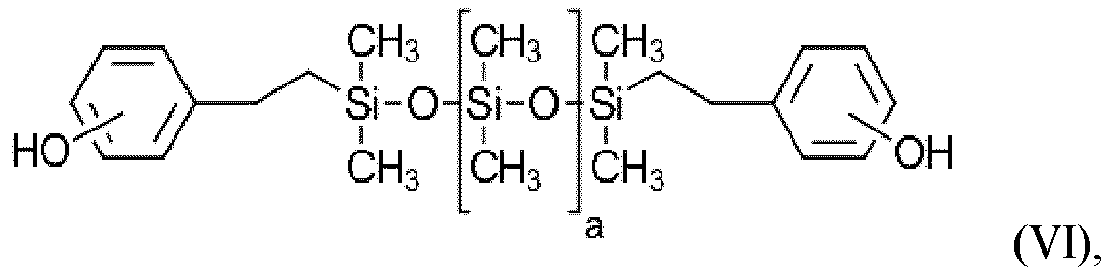
- Dabei ist es ebenso bevorzugt, dass mindestens zwei gleiche oder verschiedene der Siloxanblöcke der allgemeinen Formeln (IV), (V) oder (VI) über Terephthalsäure und/oder Isophthalsäure miteinander unter Ausbildung von Estergruppen verknüpft sind.
- Ebenso ist es bevorzugt, wenn in der Formel (la) p = 0 ist, V für C3-Alkylen steht, r = 1 ist, Z für C2-Alkylen steht, R8 und R9 für Methyl stehen, q = 1 ist, W für C3-Alkylen steht, m = 1 ist, R5 für Wasserstoff oder C1- bis C4-Alkyl, vorzugsweise für Wasserstoff oder Methyl, steht, R6 und R7 jeweils unabhängig voneinander für C1- bis C4-Alkyl, vorzugsweise für Methyl stehen und o für 10 bis 500 steht.
- Copolycarbonate mit Monomereinheiten der Formel (la) und insbesondere auch deren Herstellung sind in der
WO 2015/052106 A2 beschrieben. - Copolycarbonate mit Monomereinheiten der Formel (IV) und insbesondere auch deren Herstellung sind in der
WO 2015/052106 A2 beschrieben. - Bei der Verwendung der mindestens zwei aromatischen Polycarbonate mit unterschiedlicher Viskosität, ausgedrückt in einer unterschiedlichen Schmelze-Volumenfließrate MVR, bevorzugt bestimmt nach ISO 1133:2012-03, von denen mindestens ein aromatisches Polycarbonat Alkylphenol-Endgruppen aufweist, zur Verbesserung der Hydrolysestabilität können grundsätzlich ein oder mehrere übliche Additive für Polycarbonat in den üblichen Mengen eingesetzt werden, ohne dass der Effekt merklich beeinflusst würde.
- Solche weiteren Additive, wie sie üblicherweise Polycarbonaten zugesetzt werden, sind insbesondere Thermostabilisatoren, Flammschutzmittel, Antioxidantien, Entformungsmittel, Antitropfmittel, etwa Polytetrafluorethylen (Teflon) oder SAN-gekapseltes PTFE (z.B. Blendex 449), UV-Absorber, IR-Absorber, Schlagzähmodifikatoren, Antistatika, optische Aufheller, Füllstoffe, Lichtstreumittel, Umesterungsinhibitoren, Verträglichkeitsvermittler, von Komponente B verschiedene anorganische Pigmente und/oder Additive zur Lasermarkierung, insbesondere in den für Polycarbonat-basierte Zusammensetzungen üblichen Mengen. Derartige Additive sind beispielsweise in
EP-A 0 839 623 ,WO-A 96/15102 EP-A 0 500 496 oder im "Plastics Additives Handbook", Hans Zweifel, 5th Edition 2000, Hanser Verlag, München beschrieben. Diese Additive können einzeln oder auch im Gemisch zugesetzt werden. Es versteht sich, dass nur solche Additive und nur in solchen Mengen zugesetzt werden dürfen, wenn sie sich nicht signifikant negativ auf den erfindungsgemäßen Effekt der verbesserten Hydrolysestabilität auswirken. - Bevorzugt sind die Additive ausgewählt aus der Gruppe der Thermostabilisatoren, Flammschutzmittel, Antioxidantien, Entformungsmittel, Antitropfmittel, UV-Absorber, IR-Absorber, Schlagzähmodifikatoren, Antistatika, optischen Aufheller, Lichtstreumittel, Umesterungsinhibitoren, Verträglichkeitsvermittler und/oder Additive zur Lasermarkierung.
- Ganz besonders bevorzugt sind die Zusammensetzungen, welche sich durch die erfindungsgemäße Verwendung ergeben, frei von Hydrolysestabilisatoren, insbesondere frei von Epoxidverbindungen, Carbodiimiden und wasserabsorbierenden anorganischen Salzen.
- Die weiteren Additive sind besonders bevorzugt solche aus der Gruppe, bestehend aus Flammschutzmitteln, Antitropfmitteln, UV-Absorbern, Thermostabilisatoren, Antioxidantien, Antistatika, Entformungsmitteln, Schlagzähmodifikatoren, Umesterungsinhibitoren.
- Geeignete Flammschutzmittel sind solche, ausgewählt aus der Gruppe der Alkali-, Erdalkali-, Ammoniumsalze von aliphatischen bzw. aromatischen Sulfonsäure-, Sulfonamid- und Sulfonimidderivaten, oder auch Kombinationen aus diesen.
- Unter "Derivaten" werden erfindungsgemäß an dieser und anderer Stelle solche Verbindungen verstanden, deren Molekülstruktur an der Stelle eines H-Atoms oder einer funktionellen Gruppe ein anderes Atom oder eine andere Atomgruppe besitzt bzw. bei denen ein oder mehrere Atome/Atomgruppen entfernt wurden. Die Stammverbindung ist somit noch weiterhin erkennbar.
- Besonders bevorzugte Flammschutzmittel sind ein oder mehrere Verbindungen, ausgewählt aus der Gruppe, bestehend aus Natrium- oder Kaliumperfluorbutansulfat, Natrium- oder Kaliumperfluormethansulfonat, Natrium- oder Kaliumperfluoroctansulfat, Natrium- oder Kalium-2,5-dichlorbenzolsulfat, Natrium- oder Kalium-2,4,5-trichlorbenzolsulfat, Natrium- oder Kaliumdiphenylsulfonsulfonat, Natrium- oder Kalium-2-formylbenzolsulfonat, Natrium- oder Kalium-(N-benzolsulfonyl)-benzolsulfonamid oder deren Mischungen. Bevorzugt werden Natrium- oder Kaliumperfluorbutansulfat, Natrium- oder Kaliumperfluoroctansulfat, Natrium- oder Kaliumdiphenylsulfonsulfonat oder deren Mischungen eingesetzt. Ganz besonders bevorzugt ist Kaliumperfluor-1-butansulfonat, welches kommerziell erhältlich ist, unter anderem als Bayowet® C4 von der Firma Lanxess, Leverkusen, Deutschland.
- Weiterhin bevorzugt sind Polyphosphazenderivate und deren Mischungen, beispielsweise Rabitle FP110 (Fushimi Pharmaceutical Co. Ltd).
- Die Mengen von Alkali-, Erdalkali- und/oder Ammoniumsalzen von aliphatischen bzw. aromatischen Sulfonsäure-, Sulfonamid- und Sulfonimidderivaten in der thermoplastische Zusammensetzung, sofern diese eingesetzt werden, betragen bevorzugt insgesamt 0,05 Gew.-% bis 0,5 Gew.-%, weiter bevorzugt 0,06 Gew.-% bis 0,3 Gew.-%, besonders bevorzugt 0,06 Gew.-% bis 0,2 Gew.-%, ganz besonders bevorzugt 0,065 Gew.-% bis 0,12 Gew.-%, äußerst bevorzugt 0,065 Gew.-% bis 0,9 Gew.-%.
- Zusätzlich oder alternativ enthaltene, bevorzugte Additive sind Thermostabilisatoren. Als Thermostabilisatoren sind insbesondere Phosphor-basierte Stabilisatoren, ausgewählt aus der Gruppe der Phosphate, Phosphite, Phosphonite, Phosphine und deren Mischungen, geeignet. Es können auch Mischungen von verschiedenen Verbindungen aus einer dieser Untergruppen eingesetzt werden, z.B. zwei Phosphite. Als Thermostabilisatoren werden bevorzugt Phosphor-Verbindungen mit der Oxidationszahl +III, insbesondere Phosphine und/oder Phosphite, eingesetzt. Als Thermostabilisatoren eignen sich besonders bevorzugt Triphenylphosphin, Tris-(2,4-di-tert-butylphenyl)phosphit (Irgafos 168), Tetrakis-(2,4-di-tert-butylphenyl)-[1,1-biphenyl]-4,4'-diylbisphosphonit, Octadecyl-3-(3,5-di-tert-butyl-4-hydroxyphenyl)-propionat (Irganox 1076), Bis-(2,4-dicumylphenyl)-pentaerythritoldiphosphit (Doverphos S-9228), Bis-(2,6-di-tert-butyl-4-methylphenyl)-pentaerythritoldiphosphit (ADK STAB PEP-36). Sie werden allein oder im Gemisch, z. B. Irganox B900 (Gemisch aus Irgafos168 und Irganox 1076 im Verhältnis 4:1) oder Doverphos S-9228 mit Irganox B900 bzw. Irganox 1076, eingesetzt.
- Die Thermostabilisatoren werden bevorzugt in Mengen bis zu 1,0 Gew.-%, weiter bevorzugt 0,003 Gew.-% bis 1,0 Gew.-%, noch weiter bevorzugt 0,005 Gew.-% bis 0,5 Gew.-%, besonders bevorzugt 0,01 Gew.-% bis 0,2 Gew.-%, eingesetzt.
- Bevorzugte Additive sind auch spezielle UV-Stabilisatoren, die eine möglichst geringe Transmission unterhalb 400 nm und eine möglichst hohe Transmission oberhalb von 400 nm besitzen. Für den Einsatz in der erfindungsgemäßen Zusammensetzung besonders geeignete Ultraviolett-Absorber sind Benzotriazole, Triazine, Benzophenone und/oder arylierte Cyanoacrylate. Besonders geeignete Ultraviolett-Absorber sind Hydroxy-Benzotriazole, wie 2-(3',5'-Bis-(1,1-dimethylbenzyl)-2'-hydroxy-phenyl)-benzotriazol (Tinuvin 234, BASF SE, Ludwigshafen), 2-(2'-Hydroxy-5'-(tert.-octyl)-phenyl)-benzotriazol (Tinuvin 329, BASF SE, Ludwigshafen), Bis-(3-(2H-benztriazolyl)-2-hydroxy-5-tert.-octyl)methan (Tinuvin 360, BASF SE, Ludwigshafen), 2-(4,6-Diphenyl-1,3,5-triazin-2-yl)-5-(hexyloxy)-phenol (Tinuvin® 1577, BASF SE, Ludwigshafen), 2-(5chloro-2H-benzotriazol-2-yl)-6-(1,1-dimethylethyl)-4-methyl-phenol (Tinuvin 326, BASF SE, Ludwigshafen), sowie Benzophenone wie 2,4-Dihydroxybenzophenon (Chimasorb 22 , BASF SE, Ludwigshafen) und 2-Hydroxy-4-(octyloxy)-benzophenon (Chimassorb 81, BASF SE, Ludwigshafen), 2,2-Bis [[(2-cyano-1-oxo-3,3 -diphenyl-2-propenyl)oxy] -methyl] -1,3 -propandiylester (9CI) (Uvinul 3030, BASF SE, Ludwigshafen), 2-[2-Hydroxy-4-(2-ethylhexyl)oxy]phenyl-4,6-di(4-phenyl)phenyl-1,3,5-triazine (Tinuvin 1600, BASF SE, Ludwigshafen), Tetraethyl-2,2'-(1,4-phenylen-dimethyliden)-bismalonat (Hostavin B-Cap, Clariant AG) oder N-(2-Ethoxyphenyl)-N'-(2-ethylphenyl)-ethandiamid (Tinuvin 312, CAS-Nr. 23949-66-8, BASF SE, Ludwigshafen). Besonders bevorzugte spezielle UV-Stabilisatoren sind Tinuvin 360, Tinuvin 329, Tinuvin 326, Tinuvin 1600, Tinuvin 312, Uvinul 3030 und/oder Hostavin B-Cap, ganz besonders bevorzugt sind Tinuvin 329 und Tinuvin 360. Es können auch Mischungen der genannten Ultraviolett-Absorber eingesetzt werden.
- Sofern UV-Absorber enthalten sind, enthält die Zusammensetzung bevorzugt Ultraviolett-Absorber in einer Menge bis 0,8 Gew.-%, bevorzugt 0,05 Gew.-% bis 0,5 Gew.-%, weiter bevorzugt 0,08 Gew.-% bis 0,4 Gew.-%, ganz besonders bevorzugt 0,1 Gew.-% bis 0,35 Gew.-%, bezogen auf die Gesamtzusammensetzung.
- Die Zusammensetzungen können auch Phosphate oder Sulfonsäureester als Umesterungsinhibitoren enthalten. Bevorzugt ist Triisooctylphosphat als Umesterungsinhibitor enthalten. Triisooctylphosphat wird bevorzugt in Mengen von 0,003 Gew.-% bis 0,05 Gew.-%, weiter bevorzugt 0,005 Gew.-% bis 0,04 Gew.-% und besonders bevorzugt von 0,01 Gew.-% bis 0,03 Gew.-%, bezogen auf die Gesamtzusammensetzung, eingesetzt.
- Beispiele für als Additive geeignete Schlagzähmodifikatoren sind: Acrylat-core-shell-Systeme wie ABS oder MBS oder Butadienkautschuke (Paraloid-Typen von DOW Chemical Company); Olefin-Acrylat-Copolymere wie z. B. Elvaloy®-Typen von DuPont; Siliconacrylatkautschuke wie z. B. die Metablen®-Typen von Mitsubishi Rayon Co., Ltd..
- Übliche Additive sind optional in den thermoplastischen Zusammensetzungen in Mengen von bevorzugt bis zu 30 Gew.-%, weiter bevorzugt bis zu 10,0 Gew.-%, noch weiter bevorzugt 0,01 Gew.-% bis 6,0 Gew.-%, besonders bevorzugt 0,1 Gew.-% bis 3,0 Gew.-%, enthalten.
- Beispiele für weitere Polymere als weitere mögliche Bestandteile der thermoplastischen Zusammensetzungen sind Polyester wie Polyethylenterephthalat (PET) oder Polybutylenterephthalat (PBT).
- Das aromatische Polycarbonat für die thermoplastische Polycarbonat-Zusammensetzung Z1 wird bevorzugt so gewählt, dass die Endgruppen ausgewählt sind aus der Gruppe, bestehend aus Phenol, Cumylphenol, p-tert.-Butylphenol. Eines der mindestens zwei aromatischen Polycarbonate weist Alkylphenol-Endgruppen, bevorzugt p-tert.-Butylphenol-Endgruppen, auf. Ein Weiteres der mindestens zwei aromatischen Polycarbonate weist bevorzugt Phenol-Endgruppen auf.
- Bevorzugt wurden die verwendeten aromatischen Polycarbonate mit Alkylphenol-Endgruppen, bevorzugt p-tert.-Butylphenol-Endgruppen, durch das kontinuierliche Phasengrenzflächenkondensationsverfahren, weiter bevorzugt mit einem Hochviskos-Aufarbeitungsschritt, wie Ausdampfextruder oder Strangverdampfer zur Isolierung des Polycarbonats, hergestellt.
- Konkrete Kombinationen geeigneter Polycarbonate, welche die Polycarbonatmischung in der Menge M1 in der thermoplastischen Polycarbonat-Zusammensetzung Z1 bilden, enthalten bevorzugt 25 bis 40 Gew.-% eines aromatischen Polycarbonats mit einer MVR von 15 bis 19 cm3/(10 min), bestimmt gemäß ISO 1133:2012-03 bei einer Prüftemperatur von 250°C und 2,16 kg Belastung, und 60 bis 75 Gew.-% eines aromatischen Polycarbonats mit einer MVR von 5 bis 9 cm3/(10 min), bestimmt gemäß ISO 1133:2012-03 bei einer Prüftemperatur von 300°C und 1,2 kg Belastung.
- Alternativ bevorzugt enthalten solche Mischungen 5 bis 20 Gew.-% eines aromatischen Polycarbonats mit einer MVR von 15 bis 19 cm3/(10 min), bestimmt gemäß ISO 1133:2012-03 bei einer Prüftemperatur von 250°C und 2,16 kg Belastung, 80 bis 95 Gew.-% eines aromatischen Polycarbonats mit einer MVR von 8 bis 11 cm3/(10 min), bestimmt gemäß ISO 1133:2012-03 bei einer Prüftemperatur von 300°C und 1,2 kg Belastung, und 0 bis 5 Gew.-% eines aromatische Polycarbonats mit einer MVR von 5 bis 9 cm3/(10 min), bestimmt gemäß ISO 1133:2012-03 bei einer Prüftemperatur von 300°C und 1,2 kg Belastung.
- Die Polycarbonat-Zusammensetzungen Z1, die sich durch die erfindungsgemäße Verwendung ergeben, können neben der Mischung von Polycarbonaten in der Menge M1, die zur Verbesserung der Hydrolysestabilität ein einzelnes Polycarbonat bzw. Polycarbonat mit einer Schmelzevolumenfließrate mit einer Endgruppe ersetzen, weitere Additive oder aber auch weiteres Polycarbonat enthalten, wobei die sich durch die erfindungsgemäße Verwendung ergebende Zusammensetzung Z1 und die Referenzzusammensetzung Z2 ansonsten identisch sind.
- Die Zusammensetzungen Z1 und Z2 basieren auf aromatischem Polycarbonat (= "Polycarbonat-Zusammensetzungen") und enthalten bevorzugt mindestens 70 Gew.-%, weiter bevorzugt mindestens 80 Gew.-%, besonders bevorzugt mindestens 90 Gew.-%, ganz besonders bevorzugt mindestens 95 Gew.-% aromatisches Polycarbonat insgesamt, d.h. Polycarbonat in der Menge M1 zusammen mit ggf. vorhandenem weiteren aromatischen Polycarbonat. Die erfindungsgemäße Verwendung sieht den Austausch eines Polycarbonats gegen eine Mischung aus mindestens zwei Polycarbonaten mit dem Ziel einer verbesserten Hydrolysestabilität vor.
- Die entsprechend erhaltenen Zusammensetzungen werden vorzugsweise zur Herstellung von Formteilen verwendet. Die Zusammensetzungen weisen bevorzugt eine Schmelze-Volumenfließrate (MVR) von 3 bis 40 cm3/(10 min), weiter bevorzugt von 6 bis 35 cm3/(10 min), besonders bevorzugt von 8,5 bis 24 cm3/(10 min), ganz besonders bevorzugt von 9 bis 20 cm3/(10 min), bestimmt nach ISO 1133:2012-3 (Prüftemperatur 300°C, Masse 1,2 kg), auf.
- Die Hydrolysestabilität ist besonders, aber nicht ausschließlich, wichtig bei Außenanwendungen, wie z. B. Swimmingpoolabdeckungen, Stadiondächern, Polycarbonatplatten im Bauwesen, etwa für Gewächshäuser und Terrassenüberdachungen, einer Beleuchtungseinheit, z.B. für Straßenlampengehäuse, Schalterschränke und Gehäuse für elektrische Anlagen und Bauteile, Batterieladestationen, Automobilaußenteile wie Streuscheiben oder Blinkerabdeckungen, also bei Formteilen, die Teil obiger Anwendungen sind, und welche dazu bestimmt sind, in ihrer Anwendung der Witterung ausgesetzt zu sein. Entsprechende Formteile sind auch Teil eines optischen (Linsen-)Systems, eines Medicalproduktes oder ein Filament für den 3D-Druck. Weitere Anwendungen sind Essgeschirre, Schüsseln, Becher, Gläser, Tassen, Wasserflaschen, Automobilinnenteile wie Schalter, Displayfolien und -abdeckungen, Medizinanwendungen wie z. B. Dialysatorgehäuse oder Mehrwegehähne. Entsprechende Formteile, inklusive Profile, Filamente für zum Beispiel 3D-Printing, aus sich bei erfindungsgemäßer Verwendung ergebenden Zusammensetzungen, auch mit entsprechenden als bevorzugt, weiter bevorzugt etc. für die erfindungsgemäße Verwendung angegebenen Merkmalen, welche Teil der vorgenannten Anwendungen sind, sind ebenfalls Gegenstand der vorliegenden Erfindung.
- Die in den folgenden Beispielen beschriebenen Polycarbonat-basierten Zusammensetzungen wurden auf einem Extruder ZE 25 der Fa. Berstorff mit einem Durchsatz von 10 kg/h durch Compoundierung hergestellt. Die Schmelzetemperatur betrug 275 °C.
-
- A-1:
- Lineares Polycarbonat auf Basis von Bisphenol A mit einer Schmelze-Volumenfließrate MVR von 17 cm3/(10 min) (gemäß ISO 1133:2012-03, bei einer Prüftemperatur von 250°C und 2,16 kg Belastung) mit tert.-Butylphenol als Endgruppe.
- A-2:
- Lineares Polycarbonat auf Basis von Bisphenol A mit einer Schmelze-Volumenfließrate MVR von 6 cm3/(10 min) (gemäß ISO 1133:2012-03, bei einer Prüftemperatur von 300°C und 1,2 kg Belastung) mit Phenol als Endgruppe.
- A-2a:
- Lineares Polycarbonat in Pulverform auf Basis von Bisphenol A mit einer Schmelze-Volumenfließrate MVR von 6 cm3/(10 min) (gemäß ISO 1133:2012-03, bei einer Prüftemperatur von 300°C und 1,2 kg Belastung) mit Phenol als Endgruppe.
- A-3:
- Lineares Polycarbonat auf Basis von Bisphenol A mit einer Schmelze-Volumenfließrate MVR von 12 cm3/(10 min) (gemäß ISO 1133:2012-03, bei einer Prüftemperatur von 300°C und 1,2 kg Belastung) mit Phenol als Endgruppe.
- A-4:
- Lineares Polycarbonat auf Basis von Bisphenol A mit einer Schmelze-Volumenfließrate MVR von 9,5 cm3/(10 min) (gemäß ISO 1133:2012-03, bei einer Prüftemperatur von 300°C und 1,2 kg Belastung) mit Phenol als Endgruppe.
- A-5:
- Lineares Polycarbonat auf Basis von Bisphenol A mit einer Schmelze-Volumenfließrate MVR von 19 cm3/(10 min) (gemäß ISO 1133:2012-03, bei einer Prüftemperatur von 300°C und 1,2 kg Belastung) mittert.-Butylphenol als Endgruppe.
- A-5a:
- Lineares Polycarbonat in Pulverform auf Basis von Bisphenol A mit einer Schmelze-Volumenfließrate MVR von 19 cm3/(10 min) (gemäß ISO 1133:2012-03, bei einer Prüftemperatur von 300°C und 1,2 kg Belastung) mittert.-Butylphenol als Endgruppe.
- B-1:
- Thermostabilisator Triphenylphosphin, kommerziell erhältlich bei der BASF SE, Ludwigshafen.
- B-2:
- Entformungsmittel PETS (Pentaerythrittetrastearat) der Firma Emery Oleochemicals, Loxstedt.
- B-3:
- Tinuvin 329, UV-Stabilisator mit Benzotriazolstruktur, kommerziell erhältlich bei der BASF SE, Ludwigshafen.
- Die Musterplatten wurden jeweils durch Spritzguss hergestellt.
- Die Bestimmung der Schmelze-Volumenfließrate (MVR) erfolgte nach ISO 1133:2012-03 (bei einer Prüftemperatur von 300 °C, Masse 1,2 kg) mit dem Gerät Zwick 4106 der Firma Zwick Roell. Zusätzlich wurde der MVR-Wert nach 20 Minuten Vorwärmzeit gemessen (IMVR20'). Dies ist ein Maß für die Schmelzestabilität unter erhöhtem thermischem Stress.
- Die Bestimmung der Schmelzeviskosität erfolgte in Anlehnung an ISO 11443:2005 mit dem Gerät Visco-Robo 45.00 der Fa. Göttfert.
- Die Bestimmung der Lösungsviskosität (eta rel, ηrel) erfolgte nach ISO 1628-4:1999-03 mit einem Ubbelohde-Viskosimeter. Dazu wurden die Granulate gelöst und die Füllstoffe durch Filtration abgetrennt. Das Filtrat wurde eingeengt und getrocknet. Der erhaltene Film wurde zur Messung der Lösungsviskosität verwendet.
- Die Vicat-Erweichungstemperatur VST/B50 als Maß für die Wärmeformbeständigkeit wurde gemäß ISO 306:2013 an Prüfkörpern der Abmessung 80 mm × 10 mm × 4 mm mit einer Stempellast von 50 N und einer Aufheizgeschwindigkeit von 50°C/h mit dem Gerät Coesfeld Eco 2920 der Firma Coesfeld Materialtest bestimmt.
- Die Izod-Kerbschlagzähigkeit wurde nach ISO 180 (2019) an 80 mm × 10 mm × 3 mm Normprüfstäben im Ausgangszustand und nach Durchführung des Kochtests über einen definierten Zeitraum bestimmt.
- Feuchtelagerung bzw. Kochtest: Die Normprüfstäbe wurden in einem mit vollentsalzten Wasser gefüllten 6 Liter Rundkolben unter Rückfluss gelagert. Dieses bedeutet eine Feuchtelagerung unter thermischer Belastung. Nach unterschiedlichen Zeiten wurden Prüfstäbe entnommen und an diesen die Kerbschlagzähigkeit bestimmt sowie die Lösungsviskosität ηrel mit einem Ubbelohde-Viskosimeter gemessen.
- Vergleichsversuche sind in den nachfolgenden Tabellen mit "V" gekennzeichnet, erfindungsgemäße Versuche mit "E".
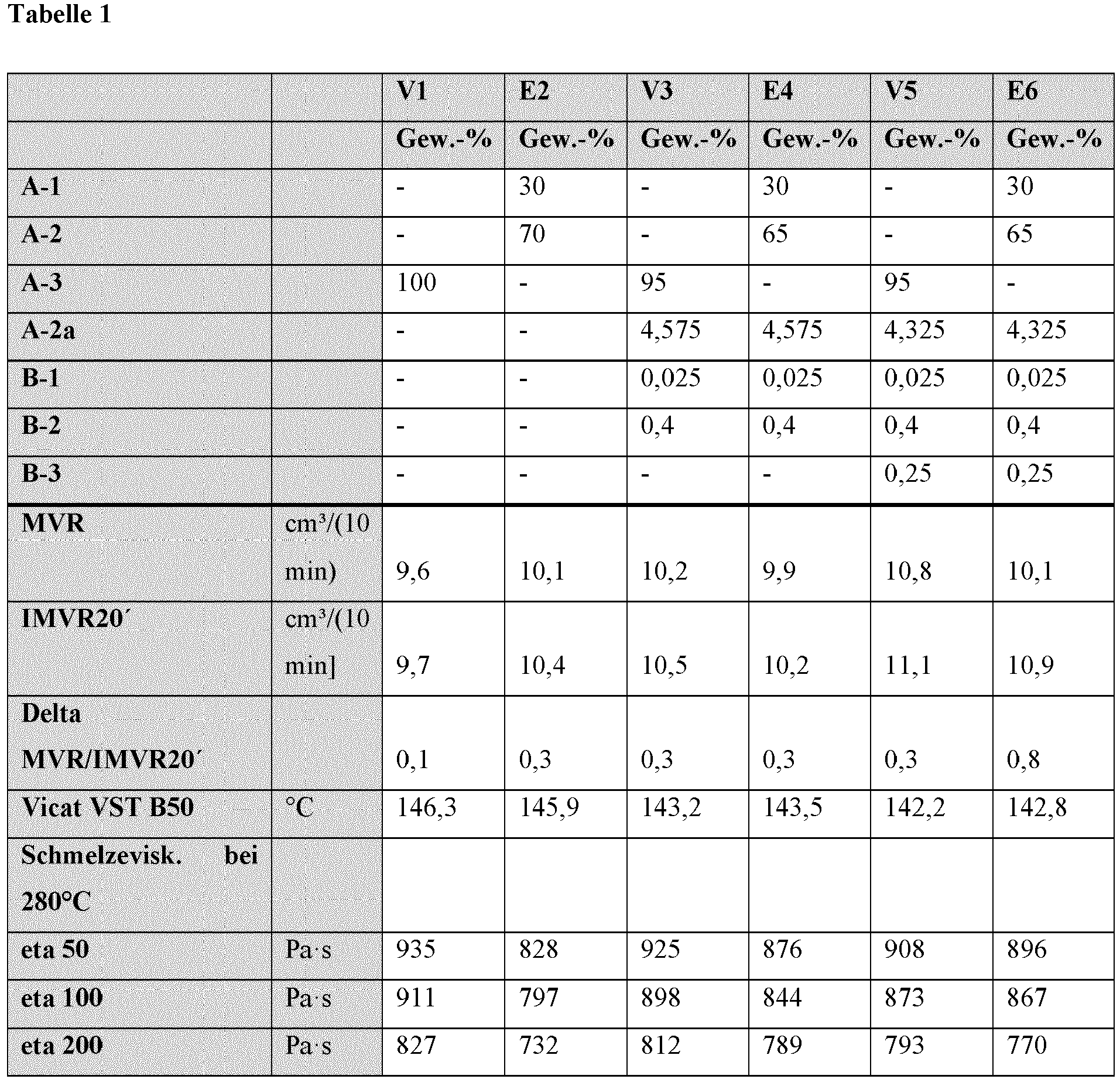

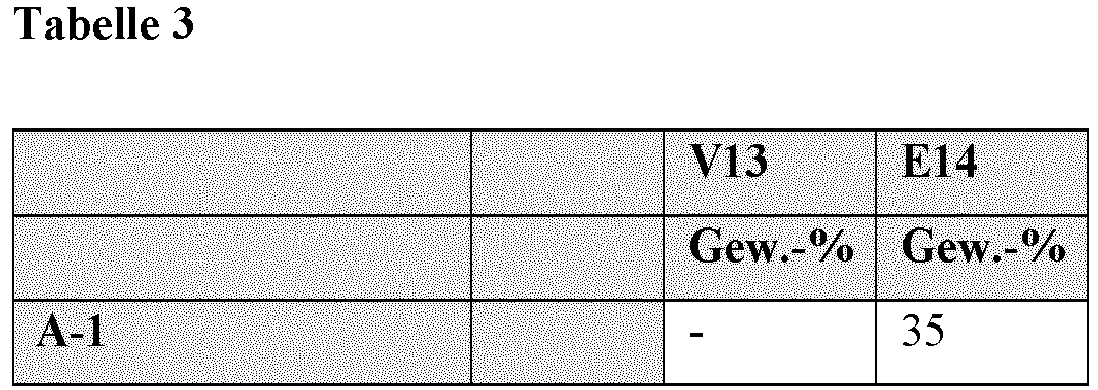
- Zur Illustration des Anspruches 1 ist nachfolgend anhand der Beispiele V1 und E2 die verwendete Nomenklatur erläutert. Die Polycarbonat-Zusammensetzung Z1 ist die Gesamtzusammensetzung des Versuches E2. Die Polycarbonat-Referenzzusammensetzung Z2 ist die Gesamtzusammensetzung des Versuches V1. In dem Versuch E2 hat die erfindungsgemäße Mischung, bestehend aus 30 Gew.-% A-1 und 70 Gew.-% A-2, die 100 Gew.-% A-3 aus Versuch V1 ersetzt. Die Menge der Polycarbonat-Mischung in Z1 ist 100 Gew.-%, entsprechend der Menge von A-3 in dem Versuch V1. Die Gesamtzusammensetzung Z1 aus Versuch E2 weist eine Schmelzevolumenfließrate MVR1 auf. Die Gesamtzusammensetzung aus Versuch V1 weist eine Schmelzevolumenfließrate MVR2 auf. Mit einem Wert von 9,6 cm3/(10 min) bewegt sich MVR2 nahezu auf gleichem Niveau wie MVR1 mit 10,1 cm3/(10 min). Die aromatischen Polycarbonate der Mischung in der Menge M1 in der Zusammensetzung Z1 sind so gewählt, dass deren MVR etwa der des aromatischen Polycarbonats in der Referenzzusammensetzung Z2 entspricht. Diese Auswahl liegt im Können des Fachmanns. Hierdurch ergeben sich auch die entsprechenden MVR1 und MVR2-Werte, die nach dem Patentanspruch 1 nur geringfügig voneinander abweichen und für den Fachmann als einander entsprechend gelten.
- Analog ist die Bezeichnung bei den Beispielen V3 und E4. Die Gesamtzusammensetzung des Versuches E4 ist Z1, die Gesamtzusammensetzung des Versuches V3 ist Z2. In der Mischung ist die Gesamtmenge der aromatischen Polycarbonate, welche die gleiche Menge eines Polycarbonates aus der Zusammensetzung Z2 des Versuches V3 ersetzen, M1. M1 ist gleich 95 Gew.-% - die Mengen von den Polycarbonaten A-1 und A-2, welche die Menge des Polycarbonats A-3 aus V3 ersetzen. Die Gesamtzusammensetzung des Versuches E4 hat eine Schmelzevolumenfließrate MVR1. Die Gesamtzusammensetzung des Referenzversuches V3 hat eine Schmelzevolumenfließrate MVR2. Diese sind für den Fachmann nahezu gleich, die Abweichung beträgt weniger als 10%. Neben dem Polycarbonat der Referenzzusammensetzung A-3, das in dem erfindungsgemäßen Versuch durch die Mischung A-1 und A-2 ersetzt ist, enthalten beide Zusammensetzungen noch eine kleine Menge Polycarbonat in Pulverform, A-2a, das zur Reduktion von Dosierschwankungen und zum homogenen Eincompoundieren der Additive verwendet wurde. Dieses ist das "weitere Polycarbonat", welches auch in Patentanspruch 1 erwähnt ist.
- Es ist zu erkennen, dass durch die erfindungsgemäße Verwendung von Mischungen von Polycarbonaten, in denen einer der Mischungspartner eine Alkylphenol-Endgruppe, bevorzugt eine p-tert.-Butylphenol-Endgruppe, aufweist, in Zusammensetzungen, deren Mischungs-Schmelzevolumenfließrate äquivalent der Schmelzevolumenfließrate der Referenzzusammensetzung ist, die Kerbschlagzähigkeit verbessert wird; weniger Stäbe brechen. Die verbesserte Kerbschlagzähigkeit ist auch nach Durchführung des Kochtests, also einer Feuchtelagerung unter thermischer Belastung, zu erkennen; es wird somit bei den erfindungsgemäßen Versuchen eine verbesserte Hydrolysestabilität erhalten. Die gute Wärmeformbeständigkeit bleibt dabei erhalten. Es ist weiterhin zu erkennen, dass die Schmelzviskositäten der erfindungsgemäßen Mischungen bei verschiedenen Scherraten und Temperaturen niedriger sind als in den Referenzzusammensetzungen. Dies wirkt sich positiv in Form eines besseren Fließens auf das Verarbeitungsverhalten im Spritzguss, speziell bei Dünnschichtanwendungen, also bei Wandstärken kleiner 3 mm, bevorzugt kleiner 2 mm, besonders bevorzugt kleiner 1,5 mm, aus.




Claims (13)
- Verwendung einer Mischung von mindestens zwei aromatischen Polycarbonaten mit unterschiedlicher Schmelze-Volumenfließrate MVR,wobei mindestens ein aromatisches Polycarbonat Alkylphenol-Endgruppen aufweist,in einer Gesamtmenge M1 in einer thermoplastischen Polycarbonat-Zusammensetzung Z1,wobei die thermoplastische Polycarbonat-Zusammensetzung Z1 eine Schmelzevolumenfließrate MVR1 aufweist,zur Verbesserung der Hydrolysestabilitätim Vergleich zu einer thermoplastischen Polycarbonat-Zusammensetzung Z2, aufweisend eine Schmelzevolumenfließrate MVR2 = (MVR1 ± 10%),die anstelle der Kombination aus mindestens zwei aromatischen Polycarbonaten in insgesamt derselben Menge M1 nur ein aromatisches Polycarbonat enthält,wobei außer dem Unterschied in dem aromatischen Polycarbonat in der Menge M1 die thermoplastische Polycarbonat-Zusammensetzung Z1 und die thermoplastische Polycarbonat-Zusammensetzung Z2 ansonsten identisch sind und optional weiteres aromatisches Polycarbonat und/oder ein oder mehrere Additiv(e) enthalten.
- Verwendung gemäß Anspruch 1, wobei die Hydrolysestabilität bestimmt wird als Veränderung der Izod-Kerbschlagzähigkeit der jeweiligen thermoplastischen Polycarbonat-Zusammensetzung Z1 oder Z2 vor und nach Feuchtelagerung unter thermischer Belastung über einen definierten Zeitraum.
- Verwendung gemäß Anspruch 1 oder 2, wobei die Alkylphenol-Endgruppen p-tert.-Butylphenol-Endgruppen sind.
- Verwendung gemäß einem der vorhergehenden Ansprüche, wobei die Endgruppen der weiteren aromatischen Polycarbonate der Mischung in der Zusammensetzung Z1 ausgewählt sind aus der Gruppe, bestehend aus Phenol, Cumylphenol, p-tert.-Butylphenol.
- Verwendung gemäß einem der vorhergehenden Ansprüche, wobei die Polycarbonate hergestellt sind durch ein kontinuierliches Phasengrenzflächenkondensationsverfahren mit einem Hochviskos-Aufarbeitungsschritt.
- Verwendung gemäß einem der vorhergehenden Ansprüche, wobei 25 bis 40 Gew.-% eines aromatische Polycarbonats mit einer MVR von 15 bis 19 cm3/(10 min), bestimmt gemäß ISO 1133:2012-03 bei einer Prüftemperatur von 250°C und 2,16 kg Belastung, und 60 bis 75 Gew.-% eines aromatischen Polycarbonats mit einer MVR von 5 bis 9 cm3/(10 min), bestimmt gemäß ISO 1133:2012-03 bei einer Prüftemperatur von 300°C und 1,2 kg Belastung, die Mischung der thermoplastischen Polycarbonat-Zusammensetzung Z1 bilden.
- Verwendung gemäß einem der vorhergehenden Ansprüche, wobei 5 bis 20 Gew.-% eines aromatische Polycarbonats mit einer MVR von 15 bis 19 cm3/(10 min), bestimmt gemäß ISO 1133:2012-03 bei einer Prüftemperatur von 250°C und 2,16 kg Belastung, 80 bis 95 Gew.-% eines aromatischen Polycarbonats mit einer MVR von 8 bis 11 cm3/(10 min), bestimmt gemäß ISO 1133:2012-03 bei einer Prüftemperatur von 300°C und 1,2 kg Belastung, und 0 bis 5 Gew.-% eines aromatischen Polycarbonats mit einer MVR von 5 bis 9 cm3/(10 min), bestimmt gemäß ISO 1133:2012-03 bei einer Prüftemperatur von 300°C und 1,2 kg Belastung, die Mischung bilden.
- Verwendung gemäß einem der vorhergehenden Ansprüche, wobei die Zusammensetzung frei von üblichen Hydrolysestabilisatoren ist.
- Verwendung gemäß einem der vorhergehenden Ansprüche, wobei die thermoplastische Polycarbonat-Zusammensetzung Z1 mindestens 70 Gew.-% aromatisches Polycarbonat enthält.
- Verwendung gemäß einem der vorhergehenden Ansprüche, wobei ein aromatisches Polycarbonat der Mischung Phenol-Endgruppen aufweist.
- Formteil aus einer thermoplastischen Polycarbonat-Zusammensetzung, umfassend eine Mischung von mindestens zwei Polycarbonaten mit unterschiedlicher Schmelze-Volumenfließrate MVR, gemessen nach ISO 1133:2012-03 bei einer Prüftemperatur von 300 °C, Masse 1,2 kg, wobei mindestens ein aromatisches Polycarbonat p-tert.-Butylphenol-Endgruppen aufweist, wobei das Formteil dazu bestimmt ist, in seiner Anwendung der Witterung ausgesetzt zu sein.
- Formteil gemäß Anspruch 11, wobei auf die Mischung der Polycarbonate die in den Ansprüchen 1 bis 10 genannten Merkmale zutreffen.
- Formteil gemäß Anspruch 11 oder 12, wobei das Formteil Teil einer Swimmingpoolabdeckung, eines Stadiondaches, einer Beleuchtungseinheit, eines Schalterschrankes, eines Gehäuses für elektrische Anlagen und Bauteile, einer Batterieladestation, eines Automobilaußenteiles, eines optischen (Linsen-)Systems, eines Medicalproduktes oder ein Filament für den 3D-Druck oder eine Polycarbonatplatte im Bauwesen ist.
Priority Applications (1)
| Application Number | Priority Date | Filing Date | Title |
|---|---|---|---|
| EP21212673.4A EP4194478A1 (de) | 2021-12-07 | 2021-12-07 | Verbesserte hydrolysestabilität bei polycarbonat-zusammensetzungen |
Applications Claiming Priority (1)
| Application Number | Priority Date | Filing Date | Title |
|---|---|---|---|
| EP21212673.4A EP4194478A1 (de) | 2021-12-07 | 2021-12-07 | Verbesserte hydrolysestabilität bei polycarbonat-zusammensetzungen |
Publications (1)
| Publication Number | Publication Date |
|---|---|
| EP4194478A1 true EP4194478A1 (de) | 2023-06-14 |
Family
ID=78822312
Family Applications (1)
| Application Number | Title | Priority Date | Filing Date |
|---|---|---|---|
| EP21212673.4A Withdrawn EP4194478A1 (de) | 2021-12-07 | 2021-12-07 | Verbesserte hydrolysestabilität bei polycarbonat-zusammensetzungen |
Country Status (1)
| Country | Link |
|---|---|
| EP (1) | EP4194478A1 (de) |
Citations (19)
| Publication number | Priority date | Publication date | Assignee | Title |
|---|---|---|---|---|
| US2991273A (en) | 1956-07-07 | 1961-07-04 | Bayer Ag | Process for manufacture of vacuum moulded parts of high molecular weight thermoplastic polycarbonates |
| US2999825A (en) | 1958-12-12 | 1961-09-12 | Gen Mills Inc | Epoxy-polyamide-ester resin reaction product |
| US2999846A (en) | 1956-11-30 | 1961-09-12 | Schnell Hermann | High molecular weight thermoplastic aromatic sulfoxy polycarbonates |
| US3028635A (en) | 1959-04-17 | 1962-04-10 | Schlumberger Cie N | Advancing screw for gill box |
| US3148172A (en) | 1956-07-19 | 1964-09-08 | Gen Electric | Polycarbonates of dihydroxyaryl ethers |
| US3271367A (en) | 1955-03-26 | 1966-09-06 | Bayer Ag | Thermoplastic polycarbonates of dihydroxydiarylene sulfones and their preparation |
| FR1561518A (de) | 1967-03-10 | 1969-03-28 | ||
| DE1570703A1 (de) | 1964-10-07 | 1970-02-12 | Gen Electric | Hydrolytisch stabile Polycarbonate sowie Verfahren zu deren Herstellung |
| DE2036052A1 (en) | 1970-07-21 | 1972-01-27 | Milchwirtschafthche Forschungs und Untersuchungs Gesellschaft mbH, 2100 Hamburg | Working up of additives in fat and protein - contng foodstuffs |
| DE2063050A1 (de) | 1970-12-22 | 1972-07-13 | Bayer | Verseifungsbeständige Polycarbonate |
| DE2211956A1 (de) | 1972-03-11 | 1973-10-25 | Bayer Ag | Verfahren zur herstellung verseifungsstabiler blockcopolycarbonate |
| DE3832396A1 (de) | 1988-08-12 | 1990-02-15 | Bayer Ag | Dihydroxydiphenylcycloalkane, ihre herstellung und ihre verwendung zur herstellung von hochmolekularen polycarbonaten |
| US4982014A (en) | 1988-08-12 | 1991-01-01 | Bayer Aktiengesellschaft | Dihydroxydiphenyl cycloalkanes, their production and their use for the production of high molecular weight polycarbonates |
| EP0500496A1 (de) | 1991-02-21 | 1992-08-26 | Ciba-Geigy Ag | Stabilisierte Polymere mit Heteroatomen in der Hauptkette |
| WO1996015102A2 (de) | 1994-11-10 | 1996-05-23 | Basf Aktiengesellschaft | 2-cyanacrylsäureester |
| EP0839623A1 (de) | 1996-10-30 | 1998-05-06 | Ciba SC Holding AG | Stabilisatorkombination für das Rotomolding-Verfahren |
| WO2015052106A2 (en) | 2013-10-08 | 2015-04-16 | Bayer Materialscience Ag | Process for preparing polysiloxane-polycarbonate block cocondensates using a salt of a weak acid |
| WO2016087480A1 (de) * | 2014-12-04 | 2016-06-09 | Covestro Deutschland Ag | Copolycarbonat-zusammensetzungen mit verbessertem verarbeitungsverhalten enthaltend pe-wachse |
| EP2242788B1 (de) * | 2008-02-13 | 2017-03-29 | Covestro Deutschland AG | Alkylphenol zur einstellung des molekulargewichtes und polycarbonatzusammensetzungen mit verbesserten eigenschaften |
-
2021
- 2021-12-07 EP EP21212673.4A patent/EP4194478A1/de not_active Withdrawn
Patent Citations (19)
| Publication number | Priority date | Publication date | Assignee | Title |
|---|---|---|---|---|
| US3271367A (en) | 1955-03-26 | 1966-09-06 | Bayer Ag | Thermoplastic polycarbonates of dihydroxydiarylene sulfones and their preparation |
| US2991273A (en) | 1956-07-07 | 1961-07-04 | Bayer Ag | Process for manufacture of vacuum moulded parts of high molecular weight thermoplastic polycarbonates |
| US3148172A (en) | 1956-07-19 | 1964-09-08 | Gen Electric | Polycarbonates of dihydroxyaryl ethers |
| US2999846A (en) | 1956-11-30 | 1961-09-12 | Schnell Hermann | High molecular weight thermoplastic aromatic sulfoxy polycarbonates |
| US2999825A (en) | 1958-12-12 | 1961-09-12 | Gen Mills Inc | Epoxy-polyamide-ester resin reaction product |
| US3028635A (en) | 1959-04-17 | 1962-04-10 | Schlumberger Cie N | Advancing screw for gill box |
| DE1570703A1 (de) | 1964-10-07 | 1970-02-12 | Gen Electric | Hydrolytisch stabile Polycarbonate sowie Verfahren zu deren Herstellung |
| FR1561518A (de) | 1967-03-10 | 1969-03-28 | ||
| DE2036052A1 (en) | 1970-07-21 | 1972-01-27 | Milchwirtschafthche Forschungs und Untersuchungs Gesellschaft mbH, 2100 Hamburg | Working up of additives in fat and protein - contng foodstuffs |
| DE2063050A1 (de) | 1970-12-22 | 1972-07-13 | Bayer | Verseifungsbeständige Polycarbonate |
| DE2211956A1 (de) | 1972-03-11 | 1973-10-25 | Bayer Ag | Verfahren zur herstellung verseifungsstabiler blockcopolycarbonate |
| DE3832396A1 (de) | 1988-08-12 | 1990-02-15 | Bayer Ag | Dihydroxydiphenylcycloalkane, ihre herstellung und ihre verwendung zur herstellung von hochmolekularen polycarbonaten |
| US4982014A (en) | 1988-08-12 | 1991-01-01 | Bayer Aktiengesellschaft | Dihydroxydiphenyl cycloalkanes, their production and their use for the production of high molecular weight polycarbonates |
| EP0500496A1 (de) | 1991-02-21 | 1992-08-26 | Ciba-Geigy Ag | Stabilisierte Polymere mit Heteroatomen in der Hauptkette |
| WO1996015102A2 (de) | 1994-11-10 | 1996-05-23 | Basf Aktiengesellschaft | 2-cyanacrylsäureester |
| EP0839623A1 (de) | 1996-10-30 | 1998-05-06 | Ciba SC Holding AG | Stabilisatorkombination für das Rotomolding-Verfahren |
| EP2242788B1 (de) * | 2008-02-13 | 2017-03-29 | Covestro Deutschland AG | Alkylphenol zur einstellung des molekulargewichtes und polycarbonatzusammensetzungen mit verbesserten eigenschaften |
| WO2015052106A2 (en) | 2013-10-08 | 2015-04-16 | Bayer Materialscience Ag | Process for preparing polysiloxane-polycarbonate block cocondensates using a salt of a weak acid |
| WO2016087480A1 (de) * | 2014-12-04 | 2016-06-09 | Covestro Deutschland Ag | Copolycarbonat-zusammensetzungen mit verbessertem verarbeitungsverhalten enthaltend pe-wachse |
Non-Patent Citations (4)
| Title |
|---|
| D. FREITAGU. GRIGOP.R. MÜLLERH. NOUVERTNE: "Encyclopedia of Polymer Science and Engineering", vol. 11, 1988, article "Polycarbonates", pages: 648 - 718 |
| H. SCHNELL: "Polymer Reviews", vol. 9, 1964, INTERSCIENCE PUBLISHERS, article "Chemistry and Physics of Polycarbonates" |
| HANS ZWEIFEL: "Plastics Additives Handbook", HANSER VERLAG |
| U. GRIGOK. KIRCHNERP.R. MÜLLER: "Becker/Braun, Kunststoff-Handbuch", vol. 3/1, 1992, CARL HANSER VERLAG, article "Polycarbonate", pages: 117 - 299 |
Similar Documents
| Publication | Publication Date | Title |
|---|---|---|
| EP0023291B2 (de) | Stabilisierte thermoplastische Formmassen auf Basis von Polycarbonaten, ABS-Polymeren und Phosphiten | |
| DE60108825T2 (de) | Regenerierte harzzusammensetzung | |
| WO2020108922A1 (de) | Sicopc blend enthaltend phosphazen und silikon/acrylat schlagzähmodifikator | |
| EP2333012A1 (de) | Copolycarbonat-Zusammensetzungen mit verbesserten thermischen Eigenschaften auf Basis von Blends | |
| EP3443033A1 (de) | Polycarbonat-zusammensetzungen enthaltend isosorbiddiester. | |
| EP2207844A1 (de) | Flammwidrige polycarbonate mit polyolen | |
| EP3227386A1 (de) | Polyethylenwachs-haltige polycarbonat-zusammensetzungen | |
| EP3227373B1 (de) | Verbesserung der fliessfähigkeit von polycarbonatzusammensetzungen | |
| WO2016087480A1 (de) | Copolycarbonat-zusammensetzungen mit verbessertem verarbeitungsverhalten enthaltend pe-wachse | |
| EP3458510B1 (de) | Polycarbonat-zusammensetzungen enthaltend eine carbonsäure und deren glycerol- oder diglycerolester | |
| EP4194479A1 (de) | Gute schlagzähigkeit bei mechanisch recyceltem polycarbonat | |
| EP4247887A1 (de) | Flammgeschützte, titandioxid enthaltende polycarbonat-zusammensetzungen | |
| EP4499750A1 (de) | Polycarbonat-zusammensetzungen mit hohem cti | |
| EP4247888A1 (de) | Verbesserung der reflexion und des yellowness-index bei thermoplastischen reflective white-zusammensetzungen | |
| WO2022106524A1 (de) | Polycarbonat-zusammensetzungen enthaltend titandioxid und metalloxid-beschichtete glimmerteilchen | |
| EP4251688B1 (de) | Polycarbonat-zusammensetzungen enthaltend titandioxid und eine titandioxid-beschichtung umfassende glas-plättchen | |
| EP4524200A1 (de) | Transparente polycarbonat/polyacrylat-blends | |
| DE102023000052A1 (de) | Herstellung eines zumindest teilweise beschichteten Formkörpers ohne Reinraum unter Verwendung einer PC-Zusammensetzung mit verbesserten Antistatikeigenschaften | |
| EP4083136A1 (de) | Polycarbonat-zusammensetzungen mit zinksulfid als weisspigment | |
| EP4341340A1 (de) | Flammwidrige zusammensetzung umfassend 0,040 bis 0,095 gew.-% eines flammschutzmittels | |
| EP3387056B1 (de) | Polyglycidylether-haltige polycarbonatzusammensetzungen | |
| EP4247886A1 (de) | Polycarbonat-zusammensetzungen enthaltend titandioxid und epoxy-gruppen enthaltendes triacylglycerol | |
| WO2022263335A1 (de) | Flammgeschützte polycarbonat-zusammensetzungen mit hohem cti | |
| WO2014161943A1 (de) | Hochtemperaturbeständige (co)polycarbonate mit verbesserten rheologischen eigenschaften | |
| EP4381015A1 (de) | Polycarbonat-zusammensetzungen mit hohem cti |
Legal Events
| Date | Code | Title | Description |
|---|---|---|---|
| PUAI | Public reference made under article 153(3) epc to a published international application that has entered the european phase |
Free format text: ORIGINAL CODE: 0009012 |
|
| STAA | Information on the status of an ep patent application or granted ep patent |
Free format text: STATUS: THE APPLICATION HAS BEEN PUBLISHED |
|
| AK | Designated contracting states |
Kind code of ref document: A1 Designated state(s): AL AT BE BG CH CY CZ DE DK EE ES FI FR GB GR HR HU IE IS IT LI LT LU LV MC MK MT NL NO PL PT RO RS SE SI SK SM TR |
|
| STAA | Information on the status of an ep patent application or granted ep patent |
Free format text: STATUS: THE APPLICATION IS DEEMED TO BE WITHDRAWN |
|
| 18D | Application deemed to be withdrawn |
Effective date: 20231215 |