EP4190944A1 - Anode für alkalische wasserelektrolyse und verfahren zur herstellung davon - Google Patents
Anode für alkalische wasserelektrolyse und verfahren zur herstellung davon Download PDFInfo
- Publication number
- EP4190944A1 EP4190944A1 EP21850577.4A EP21850577A EP4190944A1 EP 4190944 A1 EP4190944 A1 EP 4190944A1 EP 21850577 A EP21850577 A EP 21850577A EP 4190944 A1 EP4190944 A1 EP 4190944A1
- Authority
- EP
- European Patent Office
- Prior art keywords
- nickel
- electrically conductive
- conductive substrate
- alkaline water
- water electrolysis
- Prior art date
- Legal status (The legal status is an assumption and is not a legal conclusion. Google has not performed a legal analysis and makes no representation as to the accuracy of the status listed.)
- Granted
Links
Images


Classifications
-
- C—CHEMISTRY; METALLURGY
- C25—ELECTROLYTIC OR ELECTROPHORETIC PROCESSES; APPARATUS THEREFOR
- C25B—ELECTROLYTIC OR ELECTROPHORETIC PROCESSES FOR THE PRODUCTION OF COMPOUNDS OR NON-METALS; APPARATUS THEREFOR
- C25B11/00—Electrodes; Manufacture thereof not otherwise provided for
- C25B11/04—Electrodes; Manufacture thereof not otherwise provided for characterised by the material
-
- B—PERFORMING OPERATIONS; TRANSPORTING
- B01—PHYSICAL OR CHEMICAL PROCESSES OR APPARATUS IN GENERAL
- B01J—CHEMICAL OR PHYSICAL PROCESSES, e.g. CATALYSIS OR COLLOID CHEMISTRY; THEIR RELEVANT APPARATUS
- B01J23/00—Catalysts comprising metals or metal oxides or hydroxides, not provided for in group B01J21/00
- B01J23/70—Catalysts comprising metals or metal oxides or hydroxides, not provided for in group B01J21/00 of the iron group metals or copper
- B01J23/76—Catalysts comprising metals or metal oxides or hydroxides, not provided for in group B01J21/00 of the iron group metals or copper combined with metals, oxides or hydroxides provided for in groups B01J23/02 - B01J23/36
- B01J23/78—Catalysts comprising metals or metal oxides or hydroxides, not provided for in group B01J21/00 of the iron group metals or copper combined with metals, oxides or hydroxides provided for in groups B01J23/02 - B01J23/36 with alkali- or alkaline earth metals
-
- C—CHEMISTRY; METALLURGY
- C01—INORGANIC CHEMISTRY
- C01G—COMPOUNDS CONTAINING METALS NOT COVERED BY SUBCLASSES C01D OR C01F
- C01G53/00—Compounds of nickel
- C01G53/40—Complex oxides containing nickel and at least one other metal element
- C01G53/42—Complex oxides containing nickel and at least one other metal element containing alkali metals, e.g. LiNiO2
-
- C—CHEMISTRY; METALLURGY
- C25—ELECTROLYTIC OR ELECTROPHORETIC PROCESSES; APPARATUS THEREFOR
- C25B—ELECTROLYTIC OR ELECTROPHORETIC PROCESSES FOR THE PRODUCTION OF COMPOUNDS OR NON-METALS; APPARATUS THEREFOR
- C25B1/00—Electrolytic production of inorganic compounds or non-metals
- C25B1/01—Products
- C25B1/02—Hydrogen or oxygen
- C25B1/04—Hydrogen or oxygen by electrolysis of water
-
- C—CHEMISTRY; METALLURGY
- C25—ELECTROLYTIC OR ELECTROPHORETIC PROCESSES; APPARATUS THEREFOR
- C25B—ELECTROLYTIC OR ELECTROPHORETIC PROCESSES FOR THE PRODUCTION OF COMPOUNDS OR NON-METALS; APPARATUS THEREFOR
- C25B11/00—Electrodes; Manufacture thereof not otherwise provided for
- C25B11/04—Electrodes; Manufacture thereof not otherwise provided for characterised by the material
- C25B11/051—Electrodes formed of electrocatalysts on a substrate or carrier
- C25B11/052—Electrodes comprising one or more electrocatalytic coatings on a substrate
-
- C—CHEMISTRY; METALLURGY
- C25—ELECTROLYTIC OR ELECTROPHORETIC PROCESSES; APPARATUS THEREFOR
- C25B—ELECTROLYTIC OR ELECTROPHORETIC PROCESSES FOR THE PRODUCTION OF COMPOUNDS OR NON-METALS; APPARATUS THEREFOR
- C25B11/00—Electrodes; Manufacture thereof not otherwise provided for
- C25B11/04—Electrodes; Manufacture thereof not otherwise provided for characterised by the material
- C25B11/051—Electrodes formed of electrocatalysts on a substrate or carrier
- C25B11/052—Electrodes comprising one or more electrocatalytic coatings on a substrate
- C25B11/053—Electrodes comprising one or more electrocatalytic coatings on a substrate characterised by multilayer electrocatalytic coatings
-
- C—CHEMISTRY; METALLURGY
- C25—ELECTROLYTIC OR ELECTROPHORETIC PROCESSES; APPARATUS THEREFOR
- C25B—ELECTROLYTIC OR ELECTROPHORETIC PROCESSES FOR THE PRODUCTION OF COMPOUNDS OR NON-METALS; APPARATUS THEREFOR
- C25B11/00—Electrodes; Manufacture thereof not otherwise provided for
- C25B11/04—Electrodes; Manufacture thereof not otherwise provided for characterised by the material
- C25B11/051—Electrodes formed of electrocatalysts on a substrate or carrier
- C25B11/055—Electrodes formed of electrocatalysts on a substrate or carrier characterised by the substrate or carrier material
- C25B11/057—Electrodes formed of electrocatalysts on a substrate or carrier characterised by the substrate or carrier material consisting of a single element or compound
- C25B11/061—Metal or alloy
-
- C—CHEMISTRY; METALLURGY
- C25—ELECTROLYTIC OR ELECTROPHORETIC PROCESSES; APPARATUS THEREFOR
- C25B—ELECTROLYTIC OR ELECTROPHORETIC PROCESSES FOR THE PRODUCTION OF COMPOUNDS OR NON-METALS; APPARATUS THEREFOR
- C25B11/00—Electrodes; Manufacture thereof not otherwise provided for
- C25B11/04—Electrodes; Manufacture thereof not otherwise provided for characterised by the material
- C25B11/051—Electrodes formed of electrocatalysts on a substrate or carrier
- C25B11/073—Electrodes formed of electrocatalysts on a substrate or carrier characterised by the electrocatalyst material
-
- C—CHEMISTRY; METALLURGY
- C25—ELECTROLYTIC OR ELECTROPHORETIC PROCESSES; APPARATUS THEREFOR
- C25B—ELECTROLYTIC OR ELECTROPHORETIC PROCESSES FOR THE PRODUCTION OF COMPOUNDS OR NON-METALS; APPARATUS THEREFOR
- C25B11/00—Electrodes; Manufacture thereof not otherwise provided for
- C25B11/04—Electrodes; Manufacture thereof not otherwise provided for characterised by the material
- C25B11/051—Electrodes formed of electrocatalysts on a substrate or carrier
- C25B11/073—Electrodes formed of electrocatalysts on a substrate or carrier characterised by the electrocatalyst material
- C25B11/075—Electrodes formed of electrocatalysts on a substrate or carrier characterised by the electrocatalyst material consisting of a single catalytic element or catalytic compound
- C25B11/077—Electrodes formed of electrocatalysts on a substrate or carrier characterised by the electrocatalyst material consisting of a single catalytic element or catalytic compound the compound being a non-noble metal oxide
-
- C—CHEMISTRY; METALLURGY
- C25—ELECTROLYTIC OR ELECTROPHORETIC PROCESSES; APPARATUS THEREFOR
- C25B—ELECTROLYTIC OR ELECTROPHORETIC PROCESSES FOR THE PRODUCTION OF COMPOUNDS OR NON-METALS; APPARATUS THEREFOR
- C25B11/00—Electrodes; Manufacture thereof not otherwise provided for
- C25B11/04—Electrodes; Manufacture thereof not otherwise provided for characterised by the material
- C25B11/051—Electrodes formed of electrocatalysts on a substrate or carrier
- C25B11/073—Electrodes formed of electrocatalysts on a substrate or carrier characterised by the electrocatalyst material
- C25B11/091—Electrodes formed of electrocatalysts on a substrate or carrier characterised by the electrocatalyst material consisting of at least one catalytic element and at least one catalytic compound; consisting of two or more catalytic elements or catalytic compounds
-
- C—CHEMISTRY; METALLURGY
- C25—ELECTROLYTIC OR ELECTROPHORETIC PROCESSES; APPARATUS THEREFOR
- C25B—ELECTROLYTIC OR ELECTROPHORETIC PROCESSES FOR THE PRODUCTION OF COMPOUNDS OR NON-METALS; APPARATUS THEREFOR
- C25B11/00—Electrodes; Manufacture thereof not otherwise provided for
- C25B11/04—Electrodes; Manufacture thereof not otherwise provided for characterised by the material
- C25B11/051—Electrodes formed of electrocatalysts on a substrate or carrier
- C25B11/073—Electrodes formed of electrocatalysts on a substrate or carrier characterised by the electrocatalyst material
- C25B11/091—Electrodes formed of electrocatalysts on a substrate or carrier characterised by the electrocatalyst material consisting of at least one catalytic element and at least one catalytic compound; consisting of two or more catalytic elements or catalytic compounds
- C25B11/093—Electrodes formed of electrocatalysts on a substrate or carrier characterised by the electrocatalyst material consisting of at least one catalytic element and at least one catalytic compound; consisting of two or more catalytic elements or catalytic compounds at least one noble metal or noble metal oxide and at least one non-noble metal oxide
-
- C—CHEMISTRY; METALLURGY
- C01—INORGANIC CHEMISTRY
- C01P—INDEXING SCHEME RELATING TO STRUCTURAL AND PHYSICAL ASPECTS OF SOLID INORGANIC COMPOUNDS
- C01P2002/00—Crystal-structural characteristics
- C01P2002/70—Crystal-structural characteristics defined by measured X-ray, neutron or electron diffraction data
- C01P2002/72—Crystal-structural characteristics defined by measured X-ray, neutron or electron diffraction data by d-values or two theta-values, e.g. as X-ray diagram
-
- C—CHEMISTRY; METALLURGY
- C01—INORGANIC CHEMISTRY
- C01P—INDEXING SCHEME RELATING TO STRUCTURAL AND PHYSICAL ASPECTS OF SOLID INORGANIC COMPOUNDS
- C01P2002/00—Crystal-structural characteristics
- C01P2002/70—Crystal-structural characteristics defined by measured X-ray, neutron or electron diffraction data
- C01P2002/74—Crystal-structural characteristics defined by measured X-ray, neutron or electron diffraction data by peak-intensities or a ratio thereof only
-
- C—CHEMISTRY; METALLURGY
- C01—INORGANIC CHEMISTRY
- C01P—INDEXING SCHEME RELATING TO STRUCTURAL AND PHYSICAL ASPECTS OF SOLID INORGANIC COMPOUNDS
- C01P2006/00—Physical properties of inorganic compounds
- C01P2006/40—Electric properties
-
- Y—GENERAL TAGGING OF NEW TECHNOLOGICAL DEVELOPMENTS; GENERAL TAGGING OF CROSS-SECTIONAL TECHNOLOGIES SPANNING OVER SEVERAL SECTIONS OF THE IPC; TECHNICAL SUBJECTS COVERED BY FORMER USPC CROSS-REFERENCE ART COLLECTIONS [XRACs] AND DIGESTS
- Y02—TECHNOLOGIES OR APPLICATIONS FOR MITIGATION OR ADAPTATION AGAINST CLIMATE CHANGE
- Y02E—REDUCTION OF GREENHOUSE GAS [GHG] EMISSIONS, RELATED TO ENERGY GENERATION, TRANSMISSION OR DISTRIBUTION
- Y02E60/00—Enabling technologies; Technologies with a potential or indirect contribution to GHG emissions mitigation
- Y02E60/30—Hydrogen technology
-
- Y—GENERAL TAGGING OF NEW TECHNOLOGICAL DEVELOPMENTS; GENERAL TAGGING OF CROSS-SECTIONAL TECHNOLOGIES SPANNING OVER SEVERAL SECTIONS OF THE IPC; TECHNICAL SUBJECTS COVERED BY FORMER USPC CROSS-REFERENCE ART COLLECTIONS [XRACs] AND DIGESTS
- Y02—TECHNOLOGIES OR APPLICATIONS FOR MITIGATION OR ADAPTATION AGAINST CLIMATE CHANGE
- Y02E—REDUCTION OF GREENHOUSE GAS [GHG] EMISSIONS, RELATED TO ENERGY GENERATION, TRANSMISSION OR DISTRIBUTION
- Y02E60/00—Enabling technologies; Technologies with a potential or indirect contribution to GHG emissions mitigation
- Y02E60/30—Hydrogen technology
- Y02E60/36—Hydrogen production from non-carbon containing sources, e.g. by water electrolysis
-
- Y—GENERAL TAGGING OF NEW TECHNOLOGICAL DEVELOPMENTS; GENERAL TAGGING OF CROSS-SECTIONAL TECHNOLOGIES SPANNING OVER SEVERAL SECTIONS OF THE IPC; TECHNICAL SUBJECTS COVERED BY FORMER USPC CROSS-REFERENCE ART COLLECTIONS [XRACs] AND DIGESTS
- Y02—TECHNOLOGIES OR APPLICATIONS FOR MITIGATION OR ADAPTATION AGAINST CLIMATE CHANGE
- Y02P—CLIMATE CHANGE MITIGATION TECHNOLOGIES IN THE PRODUCTION OR PROCESSING OF GOODS
- Y02P20/00—Technologies relating to chemical industry
- Y02P20/10—Process efficiency
- Y02P20/133—Renewable energy sources, e.g. sunlight
Definitions
- the present invention relates to an alkaline water electrolysis anode and a method for producing the same.
- Hydrogen is secondary energy which is suitable for storage and transportation and has small environmental load, and therefore a hydrogen energy system using hydrogen as an energy carrier has been attracting attention.
- hydrogen is mainly produced by steam reforming of fossil fuel, or the like.
- water electrolysis using renewable energy, such as solar power generation and wind power generation, is important in generic technology. Water electrolysis is low cost, suitable for enlargement of scale, and therefore is a predominant technique for hydrogen production.
- alkaline water electrolysis in which a high-concentration alkali aqueous solution is used for an electrolyte.
- solid polymer electrolyte water electrolysis in which a solid polymer electrolyte (SPE) membrane is used for an electrolyte.
- SPE solid polymer electrolyte
- the upper limit of the operation temperature is controlled to about 80 to about 90°C.
- the electrolytic cell voltage has been improved to 2 V or less at a current density of 0.6 Acm -2 by the development of constitutional materials and various piping materials for an electrolytic cell, which are high-temperature resistant and resistant to a high-concentration alkali aqueous solution, and the development of a low-resistivity separator and an electrode which has an enlarged surface area and has a catalyst applied thereon.
- Non-Patent Literatures 1 and 2 A nickel-based material which is stable in a high-concentration alkali aqueous solution is used as an alkaline water electrolysis anode, and it has been reported that in the case of alkaline water electrolysis using a stable power source, a nickel-based anode has a life of several decades or longer (Non-Patent Literatures 1 and 2).
- Non-Patent Literature 3 when renewable energy is used as a power source, severe conditions, such as sudden start/shutdown and abrupt load fluctuation, are frequent, and therefore deterioration in performance of the nickel-based anode has been problematic.
- a current generated by the battery reaction leaks through piping that connects cells in the case of, for example, an electrolytic stack obtained by combining a plurality of cells, such as an anode chamber and a cathode chamber.
- Examples of the countermeasure for preventing such leakage of a current include a method of allowing a minute current to flow continuously during shutdown.
- special power source control is needed, and oxygen and hydrogen are generated at all times, and therefore there is a problem that excessive labor has to be done in terms of operation management.
- platinum group metals platinum group metal oxides, valve metal oxides, iron group oxides, lanthanide group metal oxides, and the like have been utilized as a catalyst for oxygen generation anode (anode catalyst) which is used for alkaline water electrolysis.
- alloy-based anode catalysts using nickel as a base such as Ni-Co and Ni-Fe; nickel having an enlarged surface area; spinel-based anode catalysts, such as Co 3 O 4 and NiCo 2 O 4 ; perovskite-based electrically conductive oxides (ceramic materials), such as LaCoO 3 and LaNiO 3 ; noble metal oxides; oxides containing a lanthanide group metal and a noble metal; and the like have also been known (Non-Patent Literature 3).
- Non-Patent Literature 4 A catalyst material having high activity and durability is designed using a layered structure, generation of Ni 3+ , and a particular electronic structure derived from high electron conductivity.
- the amount of cations mixing between the 3a site and 3b site can be controlled by adjusting the thermal treatment conditions in the air or in oxygen. From the results of Rietvelt analysis and ICP, it has been found that the lattice constant changes in proportion to the amount of Li by Vegard's law. In addition, it has been known that a sample in which the amount of cations mixed is largest exhibits high durability in an oxygen generation test in a KOH solution. Deterioration of a catalyst is considered to be caused by elimination of Li from a crystal, and the deterioration of the catalyst can be suppressed by increasing the amount of cations mixed.
- Non-Patent Literature 5 LiNi 0.8 Al 0.2 O 2 having a layered rock salt type structure exhibits high oxygen generation activity. It is presumed that Al plays a role of stabilizing the structure during polarization due to a synergistic effect with Ni.
- the layered rock salt structure has been developed by a thermal treatment in an oxygen gas. Attention is paid on Al 3+ doping because of stabilization of Ni 3+ in the LiNiO 2 layer and suppression of mixing of Ni 2+ in the Li + layer.
- LiNi 0.8 Fe 0.2 O 2 having a layered rock salt type structure exhibits high oxygen generation activity (Non-Patent Literature 6).
- the present invention has been completed in view of such problems of the conventional techniques, and an object of the present invention is to provide an alkaline water electrolysis anode such that even when electric power having a large output fluctuation, such as renewable energy, is used as a power source, the electrolysis performance is unlikely to be deteriorated and excellent catalytic activity is retained stably over a long period of time.
- another object of the present invention is to provide a method for producing the alkaline water electrolysis anode.
- the decomposition temperature of lithium nitrate is about 430°C
- the decomposition temperature of nickel acetate is about 373°C.
- the thermal treatment temperature is set to 450°C or higher, thereby each component can more surely be decomposed.
- the thermal treatment temperature is set in such a way as to exceed 600°C, the oxidation of the electrically conductive substrate easily progresses, and the electrode resistance increases to bring about an increase in the voltage loss in some cases.
- the thermal treatment time may appropriately be set taking the reaction rate, the productivity, the oxidation resistance at the surface of the intermediate layer, and the like into consideration.
- the alkaline water electrolysis anode of the present invention can be used as an oxygen generation anode at the time when alkaline water is electrolyzed. That is, use of the anode of the present invention can form an electrolytic cell, such as an alkaline water electrolytic cell.
- the types, constitution, and the like of the cathode and separator to be used together with the above-described anode are not particularly limited, and a cathode and a separator which are used in conventional alkaline water electrolysis can be used.
- the cathode material includes porous nickel having a large surface area, a Ni-Mo-based material, and the like.
- the cathode material includes Raney nickel-based materials, such as Ni-Al, Ni-Zn, and Ni-Co-Zn; sulfide-based materials, such as Ni-S; and hydrogen absorbing alloy-based materials, such as Ti 2 Ni; and the like.
- the catalyst preferably has characteristics of low hydrogen overpotential, high stability against short-circuit, high poisoning resistance, and the like.
- metals such as platinum, palladium, ruthenium, and iridium, and oxides thereof are preferable.
- asbestos, non-woven fabric, an ion-exchange membrane, a porous polymer membrane, and a composite membrane of an inorganic substance and an organic polymer, and the like can be used.
- an ion-permeable separator such that organic fiber cloth is incorporated in a mixture of a hydrophilic inorganic material, such as a calcium phosphate compound and calcium fluoride, and an organic binding material, such as polysulfone, polypropylene, and polyvinylidene fluoride, can be used.
- Lithium nitrate, nickel nitrate, iron nitrate, and aluminum nitrate were dissolved in an aqueous citric acid solution obtained by dissolving citric acid in ultrapure water such that the respective nitrates formed a predetermined composition, and thus an aqueous solution of a precursor was prepared.
- the prepared aqueous solution of the precursor was evaporated to dryness to obtain the precursor.
- the obtained precursor was calcined at 800°C for 15 hours to obtain a target substance in the form of a powder.
- a solution obtained by dissolving part of the obtained standard substance in an acid was used as a sample, and the composition was analyzed by inductively coupled plasma (ICP) emission spectrophotometry.
- ICP inductively coupled plasma
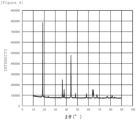
- Figure 4 is a graph showing X-ray diffraction patterns of Li(Ni 0.8 Fe 0.2 ) 0.9 Al 0.1 O 2 having a layered rock salt type structure. This X-ray diffraction was analyzed by Rietvelt analysis to ascertain that the ratio (I (003) /I (104) ) of the diffraction peak intensity I (003) of the (003) plane to the diffraction peak intensity I (104) of the (104) plane is 1.76.
- a target substance (catalyst) whose composition is represented by "Li(Ni 0.8 Fe 0.2 ) 0.95 Al 0.05 O 2 " was prepared in the same manner as in Production Example 1 described above except that the composition of the aqueous solution of the precursor was adjusted. In addition, it was ascertained that the value of I (003) /I (104) of the prepared target substance is 1.76. Further, a three-electrode cell was prepared and electrolysis operation was performed in the same manner as in Production Example 1 described above. As a result, the current value at 1.6 V was 7 mA/cm 2 . The measurement result (cyclic voltammogram) of the cyclic voltammetry is shown in Figure 5 .
- a target substance (catalyst) whose composition is represented by "LiNi 0.8 Al 0.2 O 2 " was prepared in the same manner as in Production Example 1 described above except that the composition of the aqueous solution of the precursor was adjusted. In addition, it was ascertained that the value of I (003) /I (104) of the prepared target substance is within the range of 0.1 to 1.9. Further, a three-electrode cell was prepared and electrolysis operation was performed in the same manner as in Production Example 1 described above. As a result, the current value at 1.6 V was 5 mA/cm 2 .
- a nickel expanded mesh (10 cm ⁇ 10 cm, LW ⁇ 3.7 SW ⁇ 0.9 ST ⁇ 0.8 T) on which a chemical etching treatment was performed by immersing the nickel expanded mesh for 6 minutes in 17.5% hydrochloric acid heated to near the boiling point was prepared as an anode substrate.
- This expanded mesh was subjected to a blast treatment (0.3 MPa) with alumina particles of 60 mesh, and was then immersed for 6 minutes in 20% hydrochloric acid heated to near the boiling point to perform a chemical etching treatment.
- An aqueous solution containing components to be a precursor of a lithium-containing nickel oxide was coated, with a brush, on the surface of the anode substrate after the chemical etching treatment, and was then dried at 80°C for 15 minutes.
- Lithium nitrate, nickel nitrate, iron nitrate, and aluminum nitrate were dissolved in an aqueous citric acid solution such that the respective nitrates formed a predetermined composition, and thus an aqueous solution of a precursor was obtained.
- the obtained aqueous solution of the precursor was coated, with a brush, on the surface of the intermediate layer of the intermediate product obtained above and then dried at 80°C for 15 minutes. Subsequently, the intermediate product was subjected to a thermal treatment at 600°C for 15 minutes in a pure oxygen atmosphere.
- a small-sized zero-gap type electrolytic cell using a neutral separator was prepared using: the obtained anode; a separator (trade name "Zirfon” manufactured by AGFA-Gevaert NV); and an active cathode having a catalyst layer containing Ru and Pr oxide and formed thereon.
- the area of the electrodes was set to 19 cm 2 .
- An electrolyte (25% KOH aqueous solution) was supplied to the anode chamber and the cathode chamber forming the electrolytic cell to perform electrolysis in each chamber at a current density of 6 kA/m 2 for 6 hours in each chamber.
- the overpotential on that occasion was 250 mV.
- An anode was produced in the same manner as in Example 1 described above except that the composition of the catalyst layer was changed to "LiNi 0.8 Fei 0.2 O 2 .” Further, electrolysis was performed in the same manner as in Example 1 described above to find that the overpotential was 350 mV.
- the alkaline water electrolysis anode of the present invention is suitable as, for example, an alkaline water electrolysis anode that forms electrolysis equipment or the like in which electric power having a large output fluctuation, such as renewable energy, is used as a power source.
Landscapes
- Chemical & Material Sciences (AREA)
- Organic Chemistry (AREA)
- Engineering & Computer Science (AREA)
- Chemical Kinetics & Catalysis (AREA)
- Materials Engineering (AREA)
- Electrochemistry (AREA)
- Metallurgy (AREA)
- Inorganic Chemistry (AREA)
- Electrodes For Compound Or Non-Metal Manufacture (AREA)
- Electrolytic Production Of Non-Metals, Compounds, Apparatuses Therefor (AREA)
- Catalysts (AREA)
Applications Claiming Priority (2)
| Application Number | Priority Date | Filing Date | Title |
|---|---|---|---|
| JP2020129161A JP7625204B2 (ja) | 2020-07-30 | 2020-07-30 | アルカリ水電解用アノード及びその製造方法 |
| PCT/JP2021/028171 WO2022025208A1 (ja) | 2020-07-30 | 2021-07-29 | アルカリ水電解用アノード及びその製造方法 |
Publications (4)
| Publication Number | Publication Date |
|---|---|
| EP4190944A1 true EP4190944A1 (de) | 2023-06-07 |
| EP4190944A4 EP4190944A4 (de) | 2024-08-28 |
| EP4190944B1 EP4190944B1 (de) | 2025-09-03 |
| EP4190944C0 EP4190944C0 (de) | 2025-09-03 |
Family
ID=80036336
Family Applications (1)
| Application Number | Title | Priority Date | Filing Date |
|---|---|---|---|
| EP21850577.4A Active EP4190944B1 (de) | 2020-07-30 | 2021-07-29 | Anode für alkalische wasserelektrolyse und verfahren zur herstellung davon |
Country Status (7)
| Country | Link |
|---|---|
| US (1) | US20230279566A1 (de) |
| EP (1) | EP4190944B1 (de) |
| JP (1) | JP7625204B2 (de) |
| KR (1) | KR102799606B1 (de) |
| CN (1) | CN116057209A (de) |
| ES (1) | ES3040603T3 (de) |
| WO (1) | WO2022025208A1 (de) |
Families Citing this family (3)
| Publication number | Priority date | Publication date | Assignee | Title |
|---|---|---|---|---|
| US20250083134A1 (en) * | 2022-12-29 | 2025-03-13 | POSTECH Research and Business Development Foundation | Nikel iron-based catalyst doped with metal having electronegativity lower than that of ni and fe, manufacturing method thereof, and alkaline water electrolysis system |
| WO2025238206A1 (en) | 2024-05-17 | 2025-11-20 | Magneto Special Anodes B.V. | Transition metal coated nickel electrode for alkaline water electrolysis |
| EP4675010A1 (de) * | 2024-07-03 | 2026-01-07 | Oberland Mangold GmbH | Katalysatorschicht für alkalische elektrolyse |
Family Cites Families (11)
| Publication number | Priority date | Publication date | Assignee | Title |
|---|---|---|---|---|
| US6821312B2 (en) * | 1997-06-26 | 2004-11-23 | Alcoa Inc. | Cermet inert anode materials and method of making same |
| JP4543156B2 (ja) * | 2005-03-24 | 2010-09-15 | 独立行政法人産業技術総合研究所 | リチウムフェライト系複合酸化物およびその製造方法 |
| JP2015086420A (ja) | 2013-10-29 | 2015-05-07 | 国立大学法人横浜国立大学 | アルカリ水電解用陽極 |
| JP6615682B2 (ja) | 2016-04-12 | 2019-12-04 | デノラ・ペルメレック株式会社 | アルカリ水電解用陽極及びアルカリ水電解用陽極の製造方法 |
| CN109689937B (zh) * | 2016-09-09 | 2020-03-03 | 迪诺拉永久电极股份有限公司 | 碱性水电解用阳极的制造方法和碱性水电解用阳极 |
| CN108107101B (zh) | 2017-12-12 | 2020-02-07 | 中国科学院合肥物质科学研究院 | 一种三维碳布/镍铁层状氢氧化物纳米片复合材料及其应用 |
| ES2934123T3 (es) * | 2018-03-07 | 2023-02-17 | De Nora Permelec Ltd | Electrodo de electrólisis y método para la fabricación del mismo |
| CN108447703B (zh) | 2018-03-16 | 2019-07-19 | 安徽师范大学 | 一种镍铁双金属氢氧化物@二氧化铈异质结构纳米片材料、制备方法及其应用 |
| CN109254049B (zh) | 2018-11-05 | 2021-01-29 | 济南大学 | 一种氨苄西林传感器的制备方法及应用 |
| US11362333B2 (en) * | 2019-01-23 | 2022-06-14 | Ut-Battelle, Llc | Cobalt-free layered oxide cathodes |
| CN110344078B (zh) | 2019-07-03 | 2021-04-13 | 湖北大学 | 一种泡沫镍@钴钼磷化物/镍铁双氢氧化物电极及其制备方法与应用 |
-
2020
- 2020-07-30 JP JP2020129161A patent/JP7625204B2/ja active Active
-
2021
- 2021-07-29 KR KR1020237002579A patent/KR102799606B1/ko active Active
- 2021-07-29 CN CN202180058545.6A patent/CN116057209A/zh active Pending
- 2021-07-29 WO PCT/JP2021/028171 patent/WO2022025208A1/ja not_active Ceased
- 2021-07-29 EP EP21850577.4A patent/EP4190944B1/de active Active
- 2021-07-29 US US18/005,796 patent/US20230279566A1/en active Pending
- 2021-07-29 ES ES21850577T patent/ES3040603T3/es active Active
Also Published As
| Publication number | Publication date |
|---|---|
| JP2022025951A (ja) | 2022-02-10 |
| KR102799606B1 (ko) | 2025-04-22 |
| JP7625204B2 (ja) | 2025-02-03 |
| EP4190944B1 (de) | 2025-09-03 |
| CA3186983A1 (en) | 2022-02-03 |
| EP4190944A4 (de) | 2024-08-28 |
| EP4190944C0 (de) | 2025-09-03 |
| WO2022025208A1 (ja) | 2022-02-03 |
| KR20230028784A (ko) | 2023-03-02 |
| US20230279566A1 (en) | 2023-09-07 |
| CN116057209A (zh) | 2023-05-02 |
| ES3040603T3 (en) | 2025-11-03 |
Similar Documents
| Publication | Publication Date | Title |
|---|---|---|
| EP3763849B1 (de) | Elektrolyseelektrode und verfahren zur herstellung davon | |
| US11692276B2 (en) | Alkaline water electrolysis method, and anode for alkaline water electrolysis | |
| EP3940117B1 (de) | Verfahren für alkalische wasserelektrolyse und anode für alkalische wasserelektrolyse | |
| EP4190944B1 (de) | Anode für alkalische wasserelektrolyse und verfahren zur herstellung davon | |
| EP4230772B1 (de) | Anode für alkalische wasserelektrolyse und verfahren zur herstellung davon | |
| CA3194841C (en) | Anode for alkaline water electrolysis and method for producing same | |
| CA3186983C (en) | Anode for alkaline water electrolysis and method for producing same | |
| EP4600408A1 (de) | Positivelektrode für elektrolyse und verfahren zur herstellung davon |
Legal Events
| Date | Code | Title | Description |
|---|---|---|---|
| STAA | Information on the status of an ep patent application or granted ep patent |
Free format text: STATUS: THE INTERNATIONAL PUBLICATION HAS BEEN MADE |
|
| PUAI | Public reference made under article 153(3) epc to a published international application that has entered the european phase |
Free format text: ORIGINAL CODE: 0009012 |
|
| STAA | Information on the status of an ep patent application or granted ep patent |
Free format text: STATUS: REQUEST FOR EXAMINATION WAS MADE |
|
| 17P | Request for examination filed |
Effective date: 20221230 |
|
| AK | Designated contracting states |
Kind code of ref document: A1 Designated state(s): AL AT BE BG CH CY CZ DE DK EE ES FI FR GB GR HR HU IE IS IT LI LT LU LV MC MK MT NL NO PL PT RO RS SE SI SK SM TR |
|
| DAV | Request for validation of the european patent (deleted) | ||
| DAX | Request for extension of the european patent (deleted) | ||
| REG | Reference to a national code |
Ref country code: DE Ref legal event code: R079 Free format text: PREVIOUS MAIN CLASS: C25B0011073000 Ipc: C25B0001040000 Ref document number: 602021037986 Country of ref document: DE |
|
| A4 | Supplementary search report drawn up and despatched |
Effective date: 20240730 |
|
| RIC1 | Information provided on ipc code assigned before grant |
Ipc: C25B 11/053 20210101ALI20240724BHEP Ipc: C25B 11/077 20210101ALI20240724BHEP Ipc: C25B 1/04 20210101AFI20240724BHEP |
|
| REG | Reference to a national code |
Ref country code: DE Ref legal event code: R079 Free format text: PREVIOUS MAIN CLASS: C25B0001040000 Ipc: C25B0011052000 Ref document number: 602021037986 Country of ref document: DE |
|
| GRAP | Despatch of communication of intention to grant a patent |
Free format text: ORIGINAL CODE: EPIDOSNIGR1 |
|
| STAA | Information on the status of an ep patent application or granted ep patent |
Free format text: STATUS: GRANT OF PATENT IS INTENDED |
|
| RIC1 | Information provided on ipc code assigned before grant |
Ipc: C25B 11/077 20210101ALI20250206BHEP Ipc: C25B 11/053 20210101ALI20250206BHEP Ipc: C25B 11/04 20210101ALI20250206BHEP Ipc: C01G 53/42 20250101ALI20250206BHEP Ipc: C25B 11/061 20210101ALI20250206BHEP Ipc: C25B 11/052 20210101AFI20250206BHEP |
|
| INTG | Intention to grant announced |
Effective date: 20250225 |
|
| RIN1 | Information on inventor provided before grant (corrected) |
Inventor name: MITSUSHIMA, SHIGENORI Inventor name: UCHIYAMA, TOMOKI Inventor name: UCHIMOTO, YOSHIHARU Inventor name: NISHIKI, YOSHINORI Inventor name: NAGASAWA, KENSAKU Inventor name: KURODA, YOSHIYUKI |
|
| GRAS | Grant fee paid |
Free format text: ORIGINAL CODE: EPIDOSNIGR3 |
|
| GRAA | (expected) grant |
Free format text: ORIGINAL CODE: 0009210 |
|
| STAA | Information on the status of an ep patent application or granted ep patent |
Free format text: STATUS: THE PATENT HAS BEEN GRANTED |
|
| AK | Designated contracting states |
Kind code of ref document: B1 Designated state(s): AL AT BE BG CH CY CZ DE DK EE ES FI FR GB GR HR HU IE IS IT LI LT LU LV MC MK MT NL NO PL PT RO RS SE SI SK SM TR |
|
| REG | Reference to a national code |
Ref country code: CH Ref legal event code: EP |
|
| REG | Reference to a national code |
Ref country code: DE Ref legal event code: R096 Ref document number: 602021037986 Country of ref document: DE |
|
| REG | Reference to a national code |
Ref country code: IE Ref legal event code: FG4D |
|
| U01 | Request for unitary effect filed |
Effective date: 20250922 |
|
| U07 | Unitary effect registered |
Designated state(s): AT BE BG DE DK EE FI FR IT LT LU LV MT NL PT RO SE SI Effective date: 20250929 |
|
| REG | Reference to a national code |
Ref country code: ES Ref legal event code: FG2A Ref document number: 3040603 Country of ref document: ES Kind code of ref document: T3 Effective date: 20251103 |
|
| PG25 | Lapsed in a contracting state [announced via postgrant information from national office to epo] |
Ref country code: HR Free format text: LAPSE BECAUSE OF FAILURE TO SUBMIT A TRANSLATION OF THE DESCRIPTION OR TO PAY THE FEE WITHIN THE PRESCRIBED TIME-LIMIT Effective date: 20250903 |
|
| PG25 | Lapsed in a contracting state [announced via postgrant information from national office to epo] |
Ref country code: GR Free format text: LAPSE BECAUSE OF FAILURE TO SUBMIT A TRANSLATION OF THE DESCRIPTION OR TO PAY THE FEE WITHIN THE PRESCRIBED TIME-LIMIT Effective date: 20251204 |
|
| PG25 | Lapsed in a contracting state [announced via postgrant information from national office to epo] |
Ref country code: PL Free format text: LAPSE BECAUSE OF FAILURE TO SUBMIT A TRANSLATION OF THE DESCRIPTION OR TO PAY THE FEE WITHIN THE PRESCRIBED TIME-LIMIT Effective date: 20250903 |
|
| PG25 | Lapsed in a contracting state [announced via postgrant information from national office to epo] |
Ref country code: RS Free format text: LAPSE BECAUSE OF FAILURE TO SUBMIT A TRANSLATION OF THE DESCRIPTION OR TO PAY THE FEE WITHIN THE PRESCRIBED TIME-LIMIT Effective date: 20251203 |