EP4188597B1 - Festkörperformkörper und verwendung des festkörperformkörpers - Google Patents
Festkörperformkörper und verwendung des festkörperformkörpers Download PDFInfo
- Publication number
- EP4188597B1 EP4188597B1 EP21749569.6A EP21749569A EP4188597B1 EP 4188597 B1 EP4188597 B1 EP 4188597B1 EP 21749569 A EP21749569 A EP 21749569A EP 4188597 B1 EP4188597 B1 EP 4188597B1
- Authority
- EP
- European Patent Office
- Prior art keywords
- shaped body
- solid shaped
- flutes
- radius
- range
- Prior art date
- Legal status (The legal status is an assumption and is not a legal conclusion. Google has not performed a legal analysis and makes no representation as to the accuracy of the status listed.)
- Active
Links
Images


Classifications
-
- B—PERFORMING OPERATIONS; TRANSPORTING
- B01—PHYSICAL OR CHEMICAL PROCESSES OR APPARATUS IN GENERAL
- B01J—CHEMICAL OR PHYSICAL PROCESSES, e.g. CATALYSIS OR COLLOID CHEMISTRY; THEIR RELEVANT APPARATUS
- B01J35/00—Catalysts, in general, characterised by their form or physical properties
- B01J35/50—Catalysts, in general, characterised by their form or physical properties characterised by their shape or configuration
-
- B—PERFORMING OPERATIONS; TRANSPORTING
- B01—PHYSICAL OR CHEMICAL PROCESSES OR APPARATUS IN GENERAL
- B01J—CHEMICAL OR PHYSICAL PROCESSES, e.g. CATALYSIS OR COLLOID CHEMISTRY; THEIR RELEVANT APPARATUS
- B01J23/00—Catalysts comprising metals or metal oxides or hydroxides, not provided for in group B01J21/00
- B01J23/70—Catalysts comprising metals or metal oxides or hydroxides, not provided for in group B01J21/00 of the iron group metals or copper
- B01J23/74—Iron group metals
- B01J23/755—Nickel
-
- B—PERFORMING OPERATIONS; TRANSPORTING
- B01—PHYSICAL OR CHEMICAL PROCESSES OR APPARATUS IN GENERAL
- B01J—CHEMICAL OR PHYSICAL PROCESSES, e.g. CATALYSIS OR COLLOID CHEMISTRY; THEIR RELEVANT APPARATUS
- B01J35/00—Catalysts, in general, characterised by their form or physical properties
- B01J35/30—Catalysts, in general, characterised by their form or physical properties characterised by their physical properties
- B01J35/34—Mechanical properties
- B01J35/37—Crush or impact strength
-
- B—PERFORMING OPERATIONS; TRANSPORTING
- B01—PHYSICAL OR CHEMICAL PROCESSES OR APPARATUS IN GENERAL
- B01J—CHEMICAL OR PHYSICAL PROCESSES, e.g. CATALYSIS OR COLLOID CHEMISTRY; THEIR RELEVANT APPARATUS
- B01J35/00—Catalysts, in general, characterised by their form or physical properties
- B01J35/40—Catalysts, in general, characterised by their form or physical properties characterised by dimensions, e.g. grain size
-
- B—PERFORMING OPERATIONS; TRANSPORTING
- B01—PHYSICAL OR CHEMICAL PROCESSES OR APPARATUS IN GENERAL
- B01J—CHEMICAL OR PHYSICAL PROCESSES, e.g. CATALYSIS OR COLLOID CHEMISTRY; THEIR RELEVANT APPARATUS
- B01J35/00—Catalysts, in general, characterised by their form or physical properties
- B01J35/40—Catalysts, in general, characterised by their form or physical properties characterised by dimensions, e.g. grain size
- B01J35/45—Nanoparticles
-
- B—PERFORMING OPERATIONS; TRANSPORTING
- B01—PHYSICAL OR CHEMICAL PROCESSES OR APPARATUS IN GENERAL
- B01J—CHEMICAL OR PHYSICAL PROCESSES, e.g. CATALYSIS OR COLLOID CHEMISTRY; THEIR RELEVANT APPARATUS
- B01J35/00—Catalysts, in general, characterised by their form or physical properties
- B01J35/50—Catalysts, in general, characterised by their form or physical properties characterised by their shape or configuration
- B01J35/55—Cylinders or rings
-
- B—PERFORMING OPERATIONS; TRANSPORTING
- B01—PHYSICAL OR CHEMICAL PROCESSES OR APPARATUS IN GENERAL
- B01J—CHEMICAL OR PHYSICAL PROCESSES, e.g. CATALYSIS OR COLLOID CHEMISTRY; THEIR RELEVANT APPARATUS
- B01J35/00—Catalysts, in general, characterised by their form or physical properties
- B01J35/70—Catalysts, in general, characterised by their form or physical properties characterised by their crystalline properties, e.g. semi-crystalline
- B01J35/77—Compounds characterised by their crystallite size
-
- B—PERFORMING OPERATIONS; TRANSPORTING
- B01—PHYSICAL OR CHEMICAL PROCESSES OR APPARATUS IN GENERAL
- B01J—CHEMICAL OR PHYSICAL PROCESSES, e.g. CATALYSIS OR COLLOID CHEMISTRY; THEIR RELEVANT APPARATUS
- B01J37/00—Processes, in general, for preparing catalysts; Processes, in general, for activation of catalysts
- B01J37/0009—Use of binding agents; Moulding; Pressing; Powdering; Granulating; Addition of materials ameliorating the mechanical properties of the product catalyst
-
- B—PERFORMING OPERATIONS; TRANSPORTING
- B01—PHYSICAL OR CHEMICAL PROCESSES OR APPARATUS IN GENERAL
- B01J—CHEMICAL OR PHYSICAL PROCESSES, e.g. CATALYSIS OR COLLOID CHEMISTRY; THEIR RELEVANT APPARATUS
- B01J2219/00—Chemical, physical or physico-chemical processes in general; Their relevant apparatus
- B01J2219/30—Details relating to random packing elements
- B01J2219/302—Basic shape of the elements
- B01J2219/30296—Other shapes
-
- B—PERFORMING OPERATIONS; TRANSPORTING
- B01—PHYSICAL OR CHEMICAL PROCESSES OR APPARATUS IN GENERAL
- B01J—CHEMICAL OR PHYSICAL PROCESSES, e.g. CATALYSIS OR COLLOID CHEMISTRY; THEIR RELEVANT APPARATUS
- B01J2235/00—Indexing scheme associated with group B01J35/00, related to the analysis techniques used to determine the catalysts form or properties
- B01J2235/15—X-ray diffraction
-
- Y—GENERAL TAGGING OF NEW TECHNOLOGICAL DEVELOPMENTS; GENERAL TAGGING OF CROSS-SECTIONAL TECHNOLOGIES SPANNING OVER SEVERAL SECTIONS OF THE IPC; TECHNICAL SUBJECTS COVERED BY FORMER USPC CROSS-REFERENCE ART COLLECTIONS [XRACs] AND DIGESTS
- Y10—TECHNICAL SUBJECTS COVERED BY FORMER USPC
- Y10T—TECHNICAL SUBJECTS COVERED BY FORMER US CLASSIFICATION
- Y10T428/00—Stock material or miscellaneous articles
- Y10T428/24—Structurally defined web or sheet [e.g., overall dimension, etc.]
- Y10T428/24273—Structurally defined web or sheet [e.g., overall dimension, etc.] including aperture
Definitions
- the present invention relates to a solid shaped body having a cylindrical form with a first base area, a second base area and a lateral area, wherein the solid shaped body comprises a first number of flutes in the lateral area, each extending from the first base area to the second base area, and a second number of openings, each extending from the first base area to the second base area.
- the invention further relates to a use of the solid shaped body as a catalyst.
- the performance of solid shaped bodies strongly depends on the shape and thus on the geometry of the shaped bodies.
- Mechanical strength, pressure drop, packing bed density and bed mass diffusion coefficient constitute examples of performance indicators.
- Further important parameters are the weight of a single solid shaped body, the specific surface area and heat transport as well as mass transport properties.
- Solid shaped bodies are for example applied in reforming of hydrocarbons to synthesis gas, in which Ni- or Co-containing oxide-based catalysts can be used.
- WO 2013/118078 A1 refers to a hexaaluminate-comprising catalyst for reforming of hydrocarbons and a reforming process. Catalysts are prepared as bulk material, tablets or strands.
- EP 2 323 762 B1 describes shaped hydrogenous catalyst bodies possessing an equal number of holes and flutes.
- WO 2007/051602 A1 relates to a shaped catalyst body for preparing maleic anhydride.
- a shaped catalyst body in form of a prism providing two triangular faces is proposed.
- WO 2020/120078 A1 is directed to a catalytic system comprising a tubular reactor and at least one catalyst particle located within the tubular reactor.
- a relationship between the form of the catalytic particles and the form of the tubular reactor is considered to improve heat transfer conditions.
- US 4,441,990 refers to cross-section shapes such as rectangular shaped tubes and triangular shaped tubes, which are employed to form catalytic extrudates which may be used in hydrocarbon processing operations.
- DE 31 41 942 A1 is directed to catalytic shaped bodies in form of cylinders, which have a specific circumference with convexities being wider than concavities.
- WO 2010/029324 A1 is directed to a catalyst unit comprising a cylinder, which exhibits five holes arranged in a pentagonal pattern as well as five riffles.
- WO 2006/114320 A1 describes a cylindrical catalyst member, wherein embossings are provided on the circumferential surface of the catalyst member.
- the solid shaped bodies shall offer a directed compromise between various performance indicators comprising pressure drop, surface area, mechanical strength, weight of a single shaped body, packed bed density, specific surface area of the packed bed, heat transport properties and mass transport properties.
- a solid shaped body having a cylindrical form with a first base area, a second base area and a lateral area, wherein the solid shaped body comprises a first number of flutes with at least one flute radius in the lateral area, each extending from the first base area to the second base area, and a second number of openings, each extending from the first base area to the second base area, wherein the solid shaped body has a cross-sectional area in form of a rholoid.
- the term rholoid is understood to be an intersection plane, which is formed by three superposed circles, seen in a two-dimensional view.
- the rholoid comprises three edges, in particular three curved edges, and three corners.
- a length of each of the three edges differ from an arithmetic mean value of the lengths of the three edges by less than 30%, more preferably less than 10% and most preferably less than 5%, based on the arithmetic mean value, respectively.
- the center points of the superposed circles are arranged in equidistance to the adjacent center points and thus form an isosceles triangle.
- the rholoid body is formed by intersection of three circular cylinders corresponding to the three superposed circles.
- the rholoid constitutes the basic shape of the cross-sectional area of the cylindrical shape of the solid shaped body, wherein the first base area and the second base area are preferably arranged in parallel to each other, especially in case of plane base areas, and/or as mirror images, especially in case of curved or domed base areas.
- the first base area and the second base area are preferably joined by the lateral area.
- the lateral area comprises the first number of flutes, such that a rholoid circumference of a cross-section of the shaped body is intermitted by the flutes, which can also be referred to as riffles or embossings.
- the solid shaped body further comprises the second number of openings, which can also be referred to as holes and which extend through the solid shaped body from the first base area to the second base area.
- the first number refers to the flutes and the second number refers to the openings.
- a circumference of the openings in a cross-sectional view is completely surrounded by the shaped body, whereas in contrast thereto, the flutes are solely located at the external circumference of the solid shaped body, being concave parts of the circumference of the solid shaped body.
- longitudinal axes, more preferable central axes, of the solid shaped body, the flutes and/or the openings, respectively are arranged in parallel to each other.
- the term in parallel is understood in that the longitudinal axes, more preferable the central axes, of the solid shaped body, the flutes and/or the openings, respectively, enclose an angle of less than 20°, preferably of less than 10°, more preferably of less than 5° and most preferably of less than 2°.
- the shaped body comprises 2 to 8, more preferably 3 to 7, in particular 3 openings.
- At least one opening has a second radius, more preferably all openings have the second radius, and a ratio between the at least one flute radius and the second radius of the at least one opening is preferably in a range from 0.2 to 5.0.
- a ratio between the at least one flute radius and the diameter of the solid shaped body is in a range from 0.05 to 0.50, more preferably from 0.10 to 0.30.
- the first number of flutes comprises a third number of first flutes with a third radius and a fourth number of second flutes with a fourth radius, wherein the third radius is smaller than the fourth radius. More preferably, the first number is the sum of the third number and the fourth number. Most preferably, the third number of first flutes is equal to the fourth number of second flutes.
- the solid shaped body comprises 6 flutes, comprising 3 first flutes and 3 second flutes, and further preferred, the solid shaped body comprises 3 openings.
- each of the first flutes has the third radius and/or each of the second flutes has the fourth radius, respectively.
- the first flutes and the second flutes are preferably arranged in an alternating manner.
- a ratio between the third radius of the first flutes and the second radius of the at least one opening is preferably in a range from 0.2 to 3.0, more preferably from 0.5 to 1.5.
- the third radius of the first flutes is equal to the second radius of the at least one opening.
- a ratio between the fourth radius of the second flutes and the second radius of the at least one opening is preferably in a range from 0.3 to 5.0, more preferably from 1.5 to 3.0, most preferably from 1.8 to 2.5.
- a ratio between the third radius of the first flutes and the diameter of the solid shaped body is in a range from 0.05 to 0.45, more preferably from 0.05 to 0.15, and/or a ratio between the fourth radius of the second flutes and the diameter of the solid shaped body is in a range from 0.075 to 0.50, more preferably from 0.20 to 0.30.
- a ratio between the third radius to the fourth radius is preferably in a range from 0.3 to 0.6.
- the third radius is in a range from 0.8 mm to 5.0 mm, more preferably from 1.4 mm to 2.5 mm, and/or the fourth radius in a range from 1.2 mm to 5.0 mm, more preferably from 3.2 mm to 5.0 mm.
- each opening comprises a first center.
- Center is understood as geometric center.
- the first center of one of the openings can be located on the central axis of the solid shaped body.
- at least one first center of the openings are arranged in the solid shaped body at a first distance from the central axis of the solid shaped body.
- a ratio between the first distance from the central axis of the solid shaped body to at least one first center of the openings, in particular to all first centers of all openings, and the diameter of the solid shaped body is preferably in a range from 0.00 to 0.40, more preferably from 0.15 to 0.25.
- the first distance from the central axis of the solid shaped body to the at least one first center, in particular to all first centers of all openings, is preferably in a range from 2.4 mm to 9.0 mm, more preferably from 2.5 mm to 4.0 mm. Most preferably, the first distance is equal for all openings.
- the second number of openings can comprise one central opening, which extends along the central axis of the solid shaped body, and at least one peripheral opening, wherein the second number of openings is preferably the sum of the number of peripheral openings and the central opening.
- the circumference of the at least one peripheral opening is still completely comprised in the solid shaped body and surrounded by the solid shaped body.
- Each opening has preferably a circular cross-section. More preferably, the openings are arranged in equidistance to adjacent peripheral openings and in equidistance to the central axis of the solid shaped body, referring to the first centers of the openings.
- a ratio between the second radius of the at least one opening and the diameter of the solid shaped body is in a range from 0.01 to 0.50, more preferably from 0.05 to 0.20. More preferably, the second radius is in a range from 0.1 mm to 5.0 mm, even more preferably from 1.4 to 2.5 mm. In particular, the second radius is equal for all openings.
- the third number of first flutes and the fourth number of second flutes are equal to the second number of openings. More preferably, each of the openings is arranged between two second flutes.
- the openings and the second flutes are preferably arranged in separate segments of the cross-section of the solid shaped body, respectively.
- One opening and one first flutes are arranged preferably in a same segment of the cross-section of the solid shaped body. A segment, where an opening and a first flute are arranged in, can also be referred to as lobe.
- one lobe is arranged between two second flutes and one second flute is arranged between to two lobes.
- the second flutes and the lobes are preferably arranged on the circumference, and thus on the lateral area, of the solid shaped body in an alternating manner.
- each lobe comprises preferably one first flute.
- the first flutes are preferably arranged in equidistance to adjacent flutes and to the central axis of the solid shaped body and/or the second flutes are preferably arranged in equidistance to adjacent flutes and to the central axis of the solid shaped body.
- Each of the first flutes has a second center of their fictive, preferably circular, cross-sectional area and each of the second flutes has a third center of their fictive, preferably circular, cross-sectional area.
- the second centers and the third centers can be located outside of the solid shaped body, respectively.
- at least one second center of the first flutes, at least one first center of the openings and one point of the central axis of the solid shaped body build one line.
- a ratio between a second distance from the central axis of the solid shaped body to the second center of the at least one first flute and the diameter of the solid shaped body is preferably in a range from 0.3 to 0.8, more preferably from 0.4 to 0.6, for example 0.5.
- the second distance between the second center of the at least one first flute and the central axis of the solid shaped body is preferably in a range from 4 mm to 15 mm, more preferably from 7 mm to 12 mm.
- a ratio between a third distance from the central axis of the solid shaped body to the third center of at least one second flute and the diameter of the solid shaped body is preferably in a range from 0.3 to 0.8, more preferably from 0.4 to 0.6, for example 0.5.
- the third distance between the third center of the at least one second flute and the central axis of the solid shaped body is preferably in a range from 4 mm to 15 mm, more preferably from 7 mm to 12 mm.
- the second distance is equal for all first flutes and/or the third distance is equal for all second flutes. More preferably, the second distance is equal to the third distance.
- a ratio between the diameter of the solid shaped body and a height of the solid shaped body is in a range from 0.5 to 4.0, more preferably from 1.5 to 2.5.
- the diameter of the solid shaped body having a cross-sectional area in form of the rholoid is preferably the diameter of an embracing circle, comprising the three corners of the rholoid.
- the height of the solid shaped body is preferably understood as a maximum distance between the first base area and the second base area, measured perpendicularly to the base areas.
- the first base area and/or the second base area of the solid shaped body are preferably domed. More preferably, the first base area and the second base area are domed.
- a ratio between a dome height, referring to the first base area and/or the second base area, and the diameter of the solid shaped body is in a range from 0.01 to 0.40, more preferably from 0.05 to 0.10.
- the dome height is preferably in a range from 0.2 mm to 4.0 mm, more preferably from 0.8 mm to 2.0 mm.
- the dome is understood as top and bottom part, respectively, of the solid shape body, where its surface is curved in two directions.
- the dome, and thus the dome height ends, where the lateral area is curved only in one direction, which is the radial direction referring to the solid shaped body.
- the invention further relates to a use of the solid shaped body as a catalyst, preferably for reforming one or more hydrocarbons to a synthesis gas comprising hydrogen and carbon monoxide, preferably in the presence of carbon dioxide, wherein the hydrocarbons are preferably selected from a group consisting of methane, ethane, propane and butane, wherein the hydrocarbons are more preferably methane.
- the solid shaped body is used in a method for reforming one or more hydrocarbons, preferably methane, to a synthesis gas comprising hydrogen and carbon monoxide, the method comprising
- the solid shaped body preferably comprises a mixed oxide. More preferably, the mixed oxide comprises cobalt or the mixed oxide comprises nickel. Further preferably, the mixed oxide comprises oxygen, aluminum, cobalt and at least one rare earth metal such as lanthanum or the mixed oxide comprises oxygen, aluminum, nickel and at least one alkaline earth metal such as magnesium. In Particular, the at least one rare earth metal is lanthanum. In Particular, the at least one alkaline earth metal is magnesium.
- weight-% to 100 weight-% more preferably from 60 weight-% to 100 weight-%, even more preferably from 70 weight-% to 100 weight-%, further preferably from 80 weight-% to 100 weight-%, in particular from 90 weight-% to 100 weight-%, in particular preferably from 95 weight-% to 100 weight-%, most preferably from 99 weight-% to 100 weight-% of the solid shaped body consist of the mixed oxide and optionally at least one suitable binder.
- 99 weight-% to 100 weight-% even more preferably from 99.5 weight-% to 100 weight-%, most preferably from 99.9 weight-% to 100 weight-% of the solid shaped body can also consist of the mixed oxide.
- the mixed oxide preferably comprises at least nickel-magnesium mixed oxide and magnesium spinel and optionally aluminum oxide hydroxide.
- the nickel-magnesium mixed oxide has preferably an average crystallite size of ⁇ 100 nm, more preferably ⁇ 70 nm, even more preferably ⁇ 50 nm.
- the magnesium spinel phase has preferably an average crystallite size of ⁇ 100 nm, more preferably ⁇ 70 nm, even more preferably ⁇ 50 nm.
- the proportion of nickel in the mixed oxide is preferably in the region of 30 mol-%, more preferably in a range from 6 mol-% to 30 mol-%, the proportion of magnesium is preferably in the range of 8 mol-% to 38 mol-%, more preferably 23 mol-% to 35 mol-%, and the proportion of aluminum is preferably in the range of 50 mol-% to 70 mol-%.
- the intensity of the diffraction reflection of the mixed oxide at 43.09°2 ⁇ is preferably less than or equal to the intensity of the diffraction reflection at 44.82°2 ⁇ , with the intensity of the diffraction reflection at 43.08°2 ⁇ more preferably being less than the intensity of the reflection at 44.72°2 ⁇ .
- the solid shaped body can be produced for example as described in EP 3 574 994 A1 , especially when the solid shaped body comprises the mixed oxide comprising nickel.
- a weight ratio of cobalt relative to aluminum, calculated as elements is preferably at least 0.17:1 in the mixed oxide.
- contents of cobalt, lanthanum and aluminum in the mixed oxide comprised in the solid shaped body no particular restriction applies. It is preferred that from 6 weight-% to 9 weight-%, more preferably from 6.5 weight-% to 8.5 weight-%, most preferably from 7 weight% to 8 weight-% of the mixed oxide consist of cobalt, calculated as element. Further, it is preferred that from 15 weight-% to 20 weight-%, more preferably from 16 weight-% to 19 weight-%, most preferably from 17 weight-% to 18 weight-%, in particular from 17.5 weight-% to 17.8 weight-% of the mixed oxide consist of lanthanum, calculated as element.
- the mixed oxide comprising cobalt may comprise an amorphous phase, one or more crystalline phases, or an amorphous phase and one or more crystalline phases. It is preferred that the mixed oxide comprises one or more crystalline phases, more preferably at least two crystalline phases, most preferably at least three crystalline phases. It is preferred that from 80 weight-% to 100 weight-% of the mixed oxide are in crystalline form, more preferably from 90 weight-% to 100 weight-%, most preferably from 92 weight-% to 100 weight-%.
- the mixed oxide comprises one or more of a crystalline phase of LaCoAl 11 O 19 and a crystalline phase of LaAl(Co)O 3 .
- the weight ratio of LaCoAl 11 O 19 relative to LaAl(Co)O 3 is in a range of from 5:1 to 30:1, more preferably in a range of from 10:1 to 25:1, most preferably in a range of from 12:1 to 22:1, in particular in a range of from 13:1 to 20:1, for example in a range of from 13:1 to 15:1, determined via XRD.
- the mixed oxide comprises a further crystalline phase La(OH) 3 .
- the mixed oxide comprises a further crystalline phase LaAlO 3 .
- the mixed oxide comprises a further crystalline phase CoAl 2 O 4 .
- a weight ratio of LaCoAl 11 O 19 relative to CoAl 2 O 4 in the mixed oxide is in a range of from 8:1 to 35:1, more preferably in a range of from 10:1 to 30:1, further preferably in a range of from 12:1 to 30:1, in particular in a range of from 15:1 to 27:1, most preferably in a range of from 17:1 to 25:1, for example in a range of from 20:1 to 22:1.
- the solid shaped body is a calcined solid shaped body. It is more preferred that the solid shaped body is a calcined solid shaped body, wherein the calcination has been performed in a first alternative in a gas atmosphere having a temperature in a range of from 350°C to 450°C, preferably in a range of from 390°C to 410 °C. Further, it is preferred that the gas atmosphere comprises oxygen, more preferably is one or more of oxygen, air, or lean air. Preferably, the calcining is performed for 2 h to 10 h.
- the solid shaped body is a calcined solid shaped body, wherein the calcination has been performed in a gas atmosphere having a temperature in a range of from 1100°C to 1400°C, more preferably in a range of from 1175°C to 1225°C, wherein the gas atmosphere preferably comprises oxygen, more preferably is one or more of oxygen, air, or lean air.
- the calcining is performed for 2 h to 10 h.
- the solid shaped body can be produced for example by a process comprising:
- preparing the mixture according to (i) comprises kneading the mixture.
- subjecting the mixture obtained from (i) to a shaping process according to (ii.1) comprises, more preferably consists of extruding, when the reshaping process in (iii) is performed.
- the first solid shaped body is dried in a gas atmosphere, the gas atmosphere preferably having a temperature in a range of from 50°C to 150°C, more preferably in a range of from 80°C to 110°C, wherein the gas atmosphere preferably comprises oxygen, more preferably is one or more of oxygen, air, or lean air, wherein the drying according to (ii.2) is performed preferably for 5 h to 25 h.
- the first solid shaped body is dried in a gas atmosphere, the gas atmosphere preferably having a temperature in a range of from 80°C to 150 °C, more preferably in a range of from 90°C to 140°C, wherein the gas atmosphere preferably comprises oxygen, more preferably is one or more of oxygen, air, or lean air, wherein the drying according to (ii.2) is performed preferably for 0.2 h to 2 h, wherein drying is preferably conducted using a belt dryer.
- the first solid shaped body is calcined in a gas atmosphere having a temperature in a range of from 350°C to 450°C, more preferably in a range of from 390°C to 410°C.
- the gas atmosphere comprises oxygen, more preferably is one or more of oxygen, air, or lean air.
- the calcining according to (ii.3) is performed preferably for 2 h to 10 h.
- the first solid shaped body is calcined according to (ii.3) in a rotary kiln in a gas atmosphere having a temperature in a range of from 350°C to 450°C, more preferably in a range of from 390°C to 410°C.
- the gas atmosphere comprises oxygen, more preferably is one or more of oxygen, air, or lean air.
- calcining comprises separating carbon dioxide from the gas stream, more preferably with a carbon dioxide washer.
- re-shaping according to (iii) comprises crushing the calcined solid shaped body obtained from (ii) and subjecting the obtained crushed material to a re-shaping process, obtaining the second solid shaped body, wherein crushing is more preferably conducted by milling.
- re-shaping comprises crushing the calcined solid shaped body obtained from (ii) and subjecting the obtained crushed material to a re-shaping process for obtaining the second solid shaped body
- the process further comprises preparing a mixture comprising the crushed material and one or more binders, more preferably one or more of graphite, a polysaccharide, a sugar alcohol and a synthetic polymer, even more preferably one or more of graphite, a sugar alcohol, a synthetic polymer, cellulose, a modified cellulose and a starch, most preferably graphite, a sugar alcohol, a synthetic polymer, a microcrystalline cellulose, a cellulose ether, more preferably graphite, sorbitol, mannitol, polyethylene glycol (PEG), polyvinylpyrrol
- a weight ratio of the one or more binders relative to the crushed material is preferably in a range of from 1:10 to 1:20, more preferably in a range of from 1:12 to 1:18, even more preferably in a range of from 1:13 to 1:17.
- a weight of the one or more binders calculated with respect to a total weight of the mixture is in a range of from 0.5 weight-% to 10 weight-%, more preferably in a range of from 2 weight-% to 9 weight-%, even more preferably in a range of from 4 weight-% to 8 weight-%, most preferably in a range of from 5 weight% to 7 weight-%.
- re-shaping comprises crushing the calcined solid shaped body obtained from (ii) and subjecting the obtained crushed material to a re-shaping process for obtaining the second solid shaped body
- the process further comprises separating the particles of the crushed material according to their size into two or more fractions.
- the fractions of the particles with the smallest size preferably the fraction of the particles with the smallest size, are/is subjected to the re-shaping process.
- the particles with the smallest size have a maximum diameter of 2.0 mm, more preferably a maximum diameter of 1.5 mm, even more preferably a maximum diameter of 1.0 mm. Fractions with even smaller maximum sizes, such as 0.75 mm or 0.5 mm, are generally conceivable.
- the particles with the smallest size have a maximum diameter of 2.0 mm, more preferably a maximum diameter of 1.5 mm, even more preferably a maximum diameter of 1.0 mm, whereby fractions with even smaller maximum sizes, such as 0.75 mm or 0.5 mm, are also conceivable.
- re-shaping comprises crushing the calcined solid shaped body obtained from (ii) and subjecting the obtained crushed material to a re-shaping process for obtaining the second solid shaped body
- the process further comprises separating the particles of the crushed material according to their size into two or more fractions, it is preferred that the process further comprises recycling at least a portion of the particles of the fraction or fractions which do not have the smallest size to step (i) of the process, comprising preparing the mixture according to (i) comprising the lanthanum salt, the cobalt salt, the oxidic aluminum compound, the acid, more preferably water, and at least the portion of said fractions.
- the particles of the fraction or fractions which do not have the smallest size are re-agglomerated, preferably by compaction. More preferably, the obtained reagglomerated particles are recycled in the re-shaping according to (iii). As a first alternative, the obtained re-agglomerated particles are recycled in the re-shaping according to (iii) alone, thus, as calcined first solid shaped body obtained from (ii). As a second alternative, the obtained reagglomerated particles are recycled in the re-shaping according to (iii) together with the calcined first solid shaped body obtained from (ii).
- the re-shaping process according to (iii) comprises, more preferably consists of tableting.
- (iv) comprises drying the solid shaped body obtained from (ii) or (iii), more preferably from (iii), prior to calcining, in a gas atmosphere having a temperature in a range of from 50°C to 250°C, more preferably in a range of from 80°C to 100°C, wherein the gas atmosphere preferably comprises oxygen, more preferably is one or more of oxygen, air, or lean air, wherein the drying is performed more preferably for 5 h to 22 h.
- the second solid shaped body is calcined in a gas atmosphere having a temperature in a range of from 1125°C to 1275°C, more preferably in a range of from 1175°C to 1225°C, wherein the gas atmosphere more preferably comprises oxygen, more preferably is one or more of oxygen, air, or lean air, wherein the calcining according to (iv) is performed more preferably for 2 h to 10 h.
- the process for producing the solid shaped body consists of steps (i), (ii), (iii) and (iv), (iv) preferably comprising the drying as described above.
- (i) is more preferably carried out prior to (ii), wherein (ii) is more preferably carried out prior to (iii), wherein (iii) is more preferably carried out prior to (iv), wherein (ii) is more preferably carried out after (i), wherein (iii) is more preferably carried out after (ii), wherein (iv) is more preferably carried out after (iii).
- Figure 1 shows a longitudinal section of a solid shaped body 1 having a cylindrical form.
- the solid shaped body 1 comprises a first base area 3 and a second base area 5, which are connected by a lateral area 7.
- the first base area 3 and the second base are 5 are domed with a dome height 35.
- the solid shaped body 1 has a height 19 and a diameter 17.
- Figure 2 shows a cross-section of a solid shaped body 1 having a cross-sectional area in form of a rholoid 2.
- the rholoid 2 is geometrically formed by intersection of three superposed circles 4, each with a circle radius 6, and comprises three edges 8 and three corners 10.
- the three corners 10 lie on an embracing circle 12 with a diameter 17.
- the diameter 17 is understood to be the diameter 17 of the solid shaped body 1.
- the diameter 17 and the circle radius 6 are of a same length.
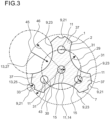
- Figure 3 shows a cross-section of a solid shaped body 1 having a cross-sectional area in form of a rholoid 2 and comprising four openings 11 and six flutes 9 with at least one flute radius 13.
- the four openings 11 with a second radius 15 comprise one central opening 14.
- the central opening 14 is located on a central axis 30 of the solid shaped body 1.
- the flutes 9 are located at the lateral surface 7 of the solid shaped body 1. Further, the flutes 9 and the openings 11 extend from the first base area 3 to the second base area 5 of the solid shaped body 1.
- First flutes 21 have a third radius 25, which is smaller than a fourth radius 27 of second flutes 23.
- Each second flute 23 is arranged between two first flutes 21 and vice versa. Two adjacent second flutes 23 are separated from each other by a lobe 37, which comprises one of the first flutes 21 and also one of the openings 11.
- the solid shaped body 1 according to figure 3 comprises three lobes 37.
- a first distance 29 from the central axis 30 of the solid shaped body 1 to first centers 31 of three of the openings 11 is represented as radius of a circle, on which the first centers 31 are located.
- a second distance 43 from the central axis 30 of the solid shaped body 1 to second centers 33 of the first flutes 21 is equal to a third distance 46 from the central axis 30 of the solid shaped body 1 to third centers 45 of the second flutes 23, in this illustrative embodiment.
- the second distance 43 is represented as radius of a circle, on which the second centers 33 of the first flutes 21 are located.
- the second centers 33 refer to a fictive circle, respectively, of which an arc forms the first flutes 21.
- the third distance 46 is represented as radius of a circle, on which the third centers 45 of the second flutes 23 are located.
- the third centers 45 refer to a fictive circle, respectively, of which an arc forms the second flutes 23.
- Figures 4 to 6 show three different test set-ups for determination of side crushing strength of a solid shaped body 1 with three different positions of the solid shaped body 1 in a testing machine 47.
- determination of a side crushing strength A is represented.
- the sample solid shaped body 1 is in a test position standing on a flute 9, specifically on a second flute 23.
- Figure 5 illustrates determination of a side crushing strength B, wherein the sample solid shaped body 1 stands on a lobe 37 and is turn by 45° or 60°, respectively, compared the set-up shown in figure 4 .
- the side crushing strength B corresponds to the side crushing strength A as each lobe is opposing one flute.
- a side crushing strength C is determined and refers to a position where openings 11 of the solid shaped body 1 are orientated in parallel to the direction of the force applied on the sample solid shaped body 1 during the test by the testing machine 47.
- Figure 7 shows a perspective view of a solid shaped body 1 according to the state of the art and figure 8 shows a cross-section of the solid shaped body 1 according to figure 7 .
- the solid shaped body 1 comprises four flutes 9 and four openings 11 extending from a first base area 3 through the solid shaped body 1.
- Figure 9 shows a perspective view of a further solid shaped body 1 according to the state of the art, which also comprises the same number of flutes 9 as openings 11.
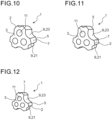
- Figures 10 to 12 show different embodiments of solid shaped bodies 1 having a cross-sectional area in form of a rholoid 2.
- Each of the solid shaped bodies comprises three openings 11 and six flutes 9, wherein three flutes 9 are first flutes 21 and three flutes 9 are second flutes 23. All openings 11 have a circular cross-section. Third radii 25 of the first flutes 21 are smaller than fourth radii 27 of the second flutes 23. Further, the openings 11 are arranged in equidistance to adjacent openings 11 and the first flutes 21 and the second flutes 23 are arranged in an alternating manner in the lateral area 7 of the solid shaped body 1.
- Table 1 Comparative example No. Reference numeral Unit 1.1 1.2 1.2.1 1.2.2 Diameter 17 mm 13.00 16.50 14.03 12.87 Height 19 mm 17.00 10.00 8.50 7.80 Dome height 35 mm 1.10 1.10 Flute radius 13 mm 1.50 2.05 Second distance 43 mm 6.50 8.25 First distance 29 mm 3.40 4.10 Second radius 15 mm 1.65 1.90
- Table 2 Reference numeral Unit 2.1 2.2 2.2.1 2.2.2 2.3 Diameter 17 mm 19.04 19.99 16.18 14.85 19.60 Height 19 mm 9.14 9.84 7.77 7.13 11.42 Dome height 35 mm 1.68 1.13 1.13 Second radius 15 mm 1.90 2.14 2.14 Third radius 25 mm 1.90 2.14 2.14 Fourth radius 27 mm 4.74 4.74 4.23 First distance 29 mm 3.42 3.42 3.76 Second distance 43 mm 9.52 9.99 9.80 Third distance 46 mm 9.52 9.99 9.80
- the surface, volume and relative weight of the respective solid shaped body were calculated and are summarized in table 3.
- the volume indicates the volume, which is filled with material, thus the total outer volume of the solid shaped body subtracting an inner volume of the openings and flutes.
- the pressure drop for each solid shaped body geometry was calculated via numerical flow simulation, which describes the flow in spaces between solid shaped bodies of a bed of solid shaped bodies.
- the procedure comprised three consecutive steps. First, a CAD model of each solid shaped body was created. A tube with an internal diameter of a typical technical reactor of ca. 100 mm was assumed as an outer container comprising the bed of the solid shaped bodies. Both the digital container geometry and the digital geometry of the solid shaped body were fed into a simulation program which allowed to calculate the arrangement of the solid shaped bodies as filled into the container, using Newton's equations of motion.
- Pressure drop calculations were performed with air at ambient temperature and Pressure drop calculations were performed with air at ambient temperature and at a superficial velocity of 1 m/s in a DN100 tube.
- Literature values for air at a constant operating pressure of 1 bar and a temperature of 20°C were used for the thermodynamic and transport properties of the gas.
- SCS side crush strength
- Finite Element Analysis was used to simulate a side crush strength test applying each CAD model of the solid shaped bodies, based on alumina.
- Crushing strength A Crushing strength B
- N Minimum SCS/particle volume (N/m 3 ) Relative packed bed density Pressure drop (Palm) Specific surface area (m 2 /m 3 )
- Axial dispersion coefficient (m 2 /s) 1.1 389 174 1.28 ⁇ 10 +8 0.94 851 423 1.55 ⁇ 10 -2 1.2 301 139 1.10 ⁇ 10 +8 1.00 816 371 1.18 ⁇ 10 -2 1.2.1 228 105 1.31 ⁇ 10 +8 1.02 949 452 1.02 ⁇ 10 -2 1.2.2 204 96 1.56 ⁇ 10 +8 1.01 975 486 1.23 ⁇ 10 -2 2.1 228 - 1.65 ⁇ 10 +8 0.92 795 347 1.43 ⁇ 10 -2 2.2 183 - 1.91 ⁇ 10 +8 0.92 856 381 1.21 ⁇ 10 -2 2.2.1.
- results according to table 4, which were derived from the modeled solid shaped bodies, show that the axial dispersion coefficient was enhanced for the examples with respect to the comparative examples, corresponding the same geometric scale, whereas examples 2.2.1 and 2.2.2 are scale-downs of example 2.2 to represent different levels of shrinkage. Further, the pressure drop was decreased for examples 2.1 and 2.3. The axial dispersion coefficient was increased over comparative example 1.2, 1.2.1 and 1.2.2, respectively.
- the 3D-printed solid shaped bodies were manufactured with a 3D-printer using a Z Corporation Spectrum Z510 model.
- the solid shaped bodies of a constant composition also referred to as tablets, were made of a mixture comprising gypsum (CaSO 4 ) using commercial VisiJet PXL Core by 4Dconcepts and a binder using commercial VisiJet PXL Binder by 4Dconcepts.
- gypsum CaSO 4
- individual solid shaped bodies were not in contact with neighboring solid shaped bodies and all shaped bodies were oriented in such a way that the openings of the solid shaped bodies extended vertically through the shaped bodies.
- 3D-printing was carried out with a 3D-printing layer thickness of 0.1 mm.
- the 3D-printed solid shaped bodies were analyzed according to the following measurement methods. Results of the measurements are summarized in table 5. For comparative example 1.2, three different sizes of the solid shaped body, were investigated. The respective solid shaped bodies were scaled down to different levels of shrinkage.
- the side crush strength of the 3D-printed shaped bodies was determined experimentally using a commercial material testing machine of the type BZ2.5/TS1S from Zwick, which allowed testing of the mechanical properties according to DIN EN ISO 7500-1:2018-06.
- 10 individual solid shape bodies were investigated.
- the applied analysis method included a preload of 0.5 N and a preload velocity of 10 mm/min. Analysis velocity was 1.6 mm/min.
- the solid shaped bodies were tested, whereby three positions were investigated allowing determination of side crushing strength A, side crushing strength B and side crushing strength C, as illustrated in figures 4 to 6 .
- the diameter and the height of the individual solid shaped bodies were determined by means of a caliper.
- the weight of the solid shaped bodies was determined by an analysis balance. Typically, 10 shaped bodies were analyzed and the average value was considered.
- Table 5 Nb. Diameter (mm) Height (mm) Weight (g) Crushing strength A (N) Crushing strength B (N) Crushing strength C (N) 1.2 16.69 9.96 1.52 38 28 243 1.2.1 14.20 8.72 1.12 76 33 162 1.2.2 13.03 7.97 0.87 70 37 150 2.1 15.35 11.61 1.96 73 - 244 2.2. 14.70 9.27 1.27 33 - 178
Landscapes
- Chemical & Material Sciences (AREA)
- Engineering & Computer Science (AREA)
- Materials Engineering (AREA)
- Organic Chemistry (AREA)
- Chemical Kinetics & Catalysis (AREA)
- Catalysts (AREA)
- Prostheses (AREA)
- Drying Of Solid Materials (AREA)
Claims (15)
- Massiv geformter Körper (1) mit einer zylindrischen Form mit einer ersten Grundfläche (3) und einer zweiten Grundfläche (5) und einer Seitenfläche (7),wobei der massiv geformte Körper (1) eine erste Anzahl von Rillen (9) umfasst, mit mindestens einem Rillenradius (13) in der Seitenfläche (7), die sich jeweils von der ersten Grundfläche (3) zu der zweiten Grundfläche (5) erstreckt, undeiner zweiten Anzahl von Öffnungen (11), die sich jeweils von der ersten Grundfläche (3) zu der zweiten Grundfläche (5) erstrecken,wobei der massiv geformte Körper (1) eine Querschnittsfläche in der Form eines Rholoids (2) aufweist.
- Massiv geformter Körper (1) nach Anspruch 1, wobei die zweite Anzahl von Öffnungen (11) in einem Bereich von 2 bis 8 liegt.
- Massiv geformter Körper (1) nach Anspruch 1 oder 2, wobei die erste Anzahl von Rillen (9) größer ist als die zweite Anzahl von Öffnungen (11).
- Massiv geformter Körper (1) nach einem der Ansprüche 1 bis 3, wobei ein Verhältnis der ersten Anzahl von Rillen (9) zu der zweiten Anzahl von Öffnungen (11) 2 beträgt.
- Massiv geformter Körper (1) nach einem der Ansprüche 1 bis 4, wobei der massiv geformte Körper (1) 6 Rillen (9) und 3 Öffnungen (11) umfasst.
- Massiv geformter Körper (1) nach einem der Ansprüche 1 bis 5, wobei ein Verhältnis eines Durchmessers (17) des massiv geformten Körpers (1) zu einer Höhe (19) des massiv geformten Körpers (1) in einem Bereich von 0,5 bis 4,0, vorzugsweise von 1,5 bis 2,5 liegt.
- Massiv geformter Körper (1) nach einem der Ansprüche 1 bis 6, wobei mindestens eine Öffnung (11) einen zweiten Radius (15) aufweist und ein Verhältnis des zweiten Radius (15) der mindestens einen Öffnung (11) zu dem Durchmesser (17) des massiv geformten Körpers (1) in einem Bereich von 0,01 bis 0,50, vorzugsweise von 0,05 bis 0,20 liegt.
- Massiv geformter Körper (1) nach einem der Ansprüche 1 bis 7, wobei die erste Anzahl von Rillen (9) eine dritte Anzahl von ersten Rillen (21) mit einem dritten Radius (25) und eine vierte Anzahl von zweiten Rillen (23) mit einem vierten Radius (27) umfasst, wobei der dritte Radius (25) kleiner ist als der vierte Radius (27) .
- Massiv geformter Körper (1) nach Anspruch 8, wobei ein Verhältnis des dritten Radius (25) der ersten Rillen (21) zum Durchmesser (17) des massiv geformten Körpers (1) in einem Bereich von 0,05 bis 0,45, vorzugsweise von 0,05 bis 0,15 liegt und/oder
ein Verhältnis des vierten Radius (27) der zweiten Rillen (23) zum Durchmesser (17) des massiv geformten Körpers (1) in einem Bereich von 0,075 bis 0,50, vorzugsweise von 0,20 bis 0,30 liegt. - Massiv geformter Körper (1) nach Anspruch 8 oder 9, wobei die dritte Anzahl von ersten Rillen (21) der vierten Anzahl von zweiten Rillen (23) entspricht.
- Massiv geformter Körper (1) nach einem der Ansprüche 8 bis 10, wobei jede der Öffnungen (11) jeweils zwischen zwei zweiten Rillen (23) angeordnet ist.
- Massiv geformter Körper (1) nach einem der Ansprüche 1 bis 11, wobei ein Verhältnis eines ersten Abstands (29) von einer Mittelachse (30) des massiv geformten Körpers (1) zu mindestens einer ersten Mitte (31) der Öffnungen (11) zum Durchmesser (17) des massiv geformten Körpers (1) in einem Bereich von 0,00 bis 0,40, vorzugsweise von 0,15 bis 0,25 liegt.
- Massiv geformter Körper (1) nach einem der Ansprüche 1 bis 12, wobei die erste Grundfläche (3) und/oder die zweite Grundfläche (5) kuppelförmig ausgebildet sind und und ein Verhältnis einer Kuppelhöhe (35) und dem Durchmesser (17) des massiv geformten Körpers (1) vorzugsweise in einem Bereich von 0,01 bis 0,40, stärker bevorzugt von 0,05 bis 0,10 liegt.
- Massiv geformter Körper (1) nach einem der Ansprüche 1 bis 13, wobei der massiv geformte Körper (1) ein Mischoxid umfasst und
das Mischoxid Sauerstoff, Aluminium, Cobalt und mindestens ein Seltenerdmetall wie Lanthan umfasst oder das Mischoxid Sauerstoff, Aluminium, Nickel und mindestens ein Erdalkalimetall wie Magnesium umfasst. - Verwendung des massiv geformten Körpers (1) nach einem der Ansprüche 1 bis 14 als ein Katalysator, vorzugsweise zum Umgestalten eines oder mehrerer Kohlenwasserstoffe zu einem Synthesegas, umfassend Wasserstoff und Kohlenmonoxid, vorzugsweise in der Gegenwart von Kohlendioxid, wobei die Kohlenwasserstoffe vorzugsweise ausgewählt sind aus einer Gruppe, bestehend aus Methan, Ethan, Propan und Butan, wobei die Kohlenwasserstoffe stärker bevorzugt Methan sind.
Applications Claiming Priority (2)
| Application Number | Priority Date | Filing Date | Title |
|---|---|---|---|
| EP20188359 | 2020-07-29 | ||
| PCT/EP2021/070653 WO2022023193A1 (en) | 2020-07-29 | 2021-07-23 | Solid shaped body and use of the solid shaped body |
Publications (4)
| Publication Number | Publication Date |
|---|---|
| EP4188597A1 EP4188597A1 (de) | 2023-06-07 |
| EP4188597C0 EP4188597C0 (de) | 2024-12-04 |
| EP4188597B1 true EP4188597B1 (de) | 2024-12-04 |
| EP4188597B8 EP4188597B8 (de) | 2025-03-26 |
Family
ID=71846271
Family Applications (1)
| Application Number | Title | Priority Date | Filing Date |
|---|---|---|---|
| EP21749569.6A Active EP4188597B8 (de) | 2020-07-29 | 2021-07-23 | Festkörperformkörper und verwendung des festkörperformkörpers |
Country Status (6)
| Country | Link |
|---|---|
| US (1) | US20230311108A1 (de) |
| EP (1) | EP4188597B8 (de) |
| JP (1) | JP2023536112A (de) |
| KR (1) | KR20230043859A (de) |
| CN (1) | CN116133750B (de) |
| WO (1) | WO2022023193A1 (de) |
Families Citing this family (1)
| Publication number | Priority date | Publication date | Assignee | Title |
|---|---|---|---|---|
| WO2025162266A1 (en) * | 2024-02-01 | 2025-08-07 | Basf Se | Solid shaped body and use of the solid shaped body |
Family Cites Families (22)
| Publication number | Priority date | Publication date | Assignee | Title |
|---|---|---|---|---|
| FR2263488B1 (de) * | 1974-03-07 | 1976-06-25 | Pilorget Andre | |
| US3918189A (en) * | 1974-04-26 | 1975-11-11 | Browning Arms Co | Indexing system for revolvers |
| FR2350141A1 (fr) | 1976-05-07 | 1977-12-02 | Ceraver | Structure ceramique de support de catalyseur |
| US4328130A (en) | 1980-10-22 | 1982-05-04 | Chevron Research Company | Shaped channeled catalyst |
| US4441990A (en) | 1982-05-28 | 1984-04-10 | Mobil Oil Corporation | Hollow shaped catalytic extrudates |
| DE3935073A1 (de) | 1989-10-20 | 1991-04-25 | Sued Chemie Ag | Verfahren zur katalytischen dehydrierung von kohlenwasserstoffen, insbesondere von alkylaromaten |
| US20030232172A1 (en) * | 2002-06-12 | 2003-12-18 | Niknafs Hassan S. | Ceramic packing element |
| US7566428B2 (en) * | 2005-03-11 | 2009-07-28 | Saint-Gobain Ceramics & Plastics, Inc. | Bed support media |
| US20060204414A1 (en) * | 2005-03-11 | 2006-09-14 | Saint-Gobain Ceramics & Plastics, Inc. | Bed support media |
| DE102005019596A1 (de) * | 2005-04-27 | 2006-11-02 | Süd-Chemie AG | Katalysatorträger |
| KR101300501B1 (ko) * | 2005-10-20 | 2013-08-26 | 에스케이이노베이션 주식회사 | 유사 하이드로탈사이트 전구체를 이용한 니켈계 촉매와이를 이용한 액화석유가스의 수증기 개질반응 |
| TW200719968A (en) | 2005-10-31 | 2007-06-01 | Sued Chemie Ag | Catalyst molding for partial oxidation reactions |
| GB0816705D0 (en) | 2008-09-12 | 2008-10-22 | Johnson Matthey Plc | Shaped heterogeneous catalysts |
| GB0816709D0 (en) * | 2008-09-12 | 2008-10-22 | Johnson Matthey Plc | Shaped heterogeneneous catalysts |
| GB0816703D0 (en) | 2008-09-12 | 2008-10-22 | Johnson Matthey Plc | Shaped heterogeneous catalysts |
| JP5144582B2 (ja) * | 2009-04-23 | 2013-02-13 | トヨタ自動車株式会社 | 蓄電装置の漏液伝達抑制構造 |
| CN103270001B (zh) * | 2010-12-29 | 2015-11-25 | 圣戈本陶瓷及塑料股份有限公司 | 多波瓣的多孔陶瓷本体及其制造方法 |
| JP6238909B2 (ja) | 2012-02-10 | 2017-11-29 | ビーエーエスエフ ソシエタス・ヨーロピアBasf Se | メタン改質方法、ヘキサアルミネート含有触媒、ヘキサアルミネート含有触媒の製造方法 |
| WO2016156042A1 (de) * | 2015-03-27 | 2016-10-06 | Basf Se | Katalysatorformkörper für die katalytische oxidation von so2 zu so3 |
| JP6604874B2 (ja) * | 2016-02-29 | 2019-11-13 | 株式会社カネカ | エチレンのオキシ塩素化による1,2−ジクロロエタンの合成に用いる触媒 |
| EP3574994A1 (de) | 2018-05-30 | 2019-12-04 | Basf Se | Verfahren zur herstellung von katalysatormonolithen zur reformierung von kohlenwasserstoffen |
| CN113195096B (zh) | 2018-12-12 | 2024-05-28 | 托普索公司 | 催化剂颗粒形状 |
-
2021
- 2021-07-23 KR KR1020237003259A patent/KR20230043859A/ko active Pending
- 2021-07-23 EP EP21749569.6A patent/EP4188597B8/de active Active
- 2021-07-23 WO PCT/EP2021/070653 patent/WO2022023193A1/en not_active Ceased
- 2021-07-23 JP JP2023505902A patent/JP2023536112A/ja active Pending
- 2021-07-23 CN CN202180059036.5A patent/CN116133750B/zh active Active
- 2021-07-23 US US18/018,049 patent/US20230311108A1/en active Pending
Also Published As
| Publication number | Publication date |
|---|---|
| EP4188597B8 (de) | 2025-03-26 |
| JP2023536112A (ja) | 2023-08-23 |
| CN116133750A (zh) | 2023-05-16 |
| WO2022023193A1 (en) | 2022-02-03 |
| EP4188597A1 (de) | 2023-06-07 |
| CN116133750B (zh) | 2025-08-08 |
| US20230311108A1 (en) | 2023-10-05 |
| EP4188597C0 (de) | 2024-12-04 |
| KR20230043859A (ko) | 2023-03-31 |
Similar Documents
| Publication | Publication Date | Title |
|---|---|---|
| US10913057B2 (en) | Shaped catalyst particle | |
| US11439996B2 (en) | Method for producing catalyst monoliths | |
| EP4188597B1 (de) | Festkörperformkörper und verwendung des festkörperformkörpers | |
| CN107743419B (zh) | 用于so2催化氧化成so3的成型催化剂体 | |
| EP0141997A1 (de) | Extrudat und Katalysator mit einer hohen geometrischen Oberfläche | |
| BR112020023668A2 (pt) | método para produzir um monólito, monólito e usos do monólito | |
| CN113329815A (zh) | 包含包含氧、镧、铝和钴的混合氧化物的模制品 | |
| US20230278021A1 (en) | Solid shaped body and use of the solid shaped body | |
| US20210162391A1 (en) | Shaped catalyst body in the form of tetralobes of uniform wall thickness | |
| EP1726358A1 (de) | Verfahren zum einfüllen eines festen katalysators | |
| GB2540240A (en) | Catalyst particle | |
| EP3647020A1 (de) | Katalysator, katalysatorträger oder absorbierender monolith von gestapelten strängen | |
| CN104043479B (zh) | 一种加氢裂化催化剂及其制备和应用 | |
| WO2025162266A1 (en) | Solid shaped body and use of the solid shaped body | |
| NO864446L (no) | Fremgangsmaate til fremstilling av en oksydisk katalysatorforloeper. | |
| WO2020094571A1 (en) | Catalyst monolith for the catalytic oxidation of so2 to so3 | |
| ES2981654T3 (es) | Cuerpo cerámico en forma de estrella para uso como catalizador | |
| CN202741153U (zh) | 一种固体催化剂颗粒 | |
| CN114478165B (zh) | 生产苯乙烯的方法 | |
| JP2025540402A (ja) | 触媒成形体 | |
| WO2024223813A1 (en) | Method for producing fe-doped beta zeolite catalyst monoliths |
Legal Events
| Date | Code | Title | Description |
|---|---|---|---|
| STAA | Information on the status of an ep patent application or granted ep patent |
Free format text: STATUS: UNKNOWN |
|
| STAA | Information on the status of an ep patent application or granted ep patent |
Free format text: STATUS: THE INTERNATIONAL PUBLICATION HAS BEEN MADE |
|
| PUAI | Public reference made under article 153(3) epc to a published international application that has entered the european phase |
Free format text: ORIGINAL CODE: 0009012 |
|
| STAA | Information on the status of an ep patent application or granted ep patent |
Free format text: STATUS: REQUEST FOR EXAMINATION WAS MADE |
|
| 17P | Request for examination filed |
Effective date: 20230228 |
|
| AK | Designated contracting states |
Kind code of ref document: A1 Designated state(s): AL AT BE BG CH CY CZ DE DK EE ES FI FR GB GR HR HU IE IS IT LI LT LU LV MC MK MT NL NO PL PT RO RS SE SI SK SM TR |
|
| DAV | Request for validation of the european patent (deleted) | ||
| DAX | Request for extension of the european patent (deleted) | ||
| REG | Reference to a national code |
Ref legal event code: R079 Free format text: PREVIOUS MAIN CLASS: B01J0035020000 Ipc: B01J0037000000 Ref country code: DE Ref legal event code: R079 Ref document number: 602021022901 Country of ref document: DE Free format text: PREVIOUS MAIN CLASS: B01J0035020000 Ipc: B01J0037000000 |
|
| GRAP | Despatch of communication of intention to grant a patent |
Free format text: ORIGINAL CODE: EPIDOSNIGR1 |
|
| STAA | Information on the status of an ep patent application or granted ep patent |
Free format text: STATUS: GRANT OF PATENT IS INTENDED |
|
| RIC1 | Information provided on ipc code assigned before grant |
Ipc: B01J 23/755 20060101ALI20240611BHEP Ipc: B01J 37/00 20060101AFI20240611BHEP |
|
| INTG | Intention to grant announced |
Effective date: 20240626 |
|
| GRAS | Grant fee paid |
Free format text: ORIGINAL CODE: EPIDOSNIGR3 |
|
| GRAA | (expected) grant |
Free format text: ORIGINAL CODE: 0009210 |
|
| STAA | Information on the status of an ep patent application or granted ep patent |
Free format text: STATUS: THE PATENT HAS BEEN GRANTED |
|
| AK | Designated contracting states |
Kind code of ref document: B1 Designated state(s): AL AT BE BG CH CY CZ DE DK EE ES FI FR GB GR HR HU IE IS IT LI LT LU LV MC MK MT NL NO PL PT RO RS SE SI SK SM TR |
|
| REG | Reference to a national code |
Ref country code: CH Ref legal event code: EP |
|
| REG | Reference to a national code |
Ref country code: DE Ref legal event code: R096 Ref document number: 602021022901 Country of ref document: DE |
|
| REG | Reference to a national code |
Ref country code: IE Ref legal event code: FG4D |
|
| U01 | Request for unitary effect filed |
Effective date: 20241223 |
|
| GRAT | Correction requested after decision to grant or after decision to maintain patent in amended form |
Free format text: ORIGINAL CODE: EPIDOSNCDEC |
|
| GRAM | Information related to correction after decision after decision to grant or to maintain patent in amended form deleted |
Free format text: ORIGINAL CODE: EPIDOSDCDEC |
|
| U07 | Unitary effect registered |
Designated state(s): AT BE BG DE DK EE FI FR IT LT LU LV MT NL PT RO SE SI Effective date: 20250113 |
|
| GRAT | Correction requested after decision to grant or after decision to maintain patent in amended form |
Free format text: ORIGINAL CODE: EPIDOSNCDEC |
|
| REG | Reference to a national code |
Ref country code: CH Ref legal event code: PK Free format text: BERICHTIGUNG B8 |
|
| PG25 | Lapsed in a contracting state [announced via postgrant information from national office to epo] |
Ref country code: HR Free format text: LAPSE BECAUSE OF FAILURE TO SUBMIT A TRANSLATION OF THE DESCRIPTION OR TO PAY THE FEE WITHIN THE PRESCRIBED TIME-LIMIT Effective date: 20241204 |
|
| PG25 | Lapsed in a contracting state [announced via postgrant information from national office to epo] |
Ref country code: ES Free format text: LAPSE BECAUSE OF FAILURE TO SUBMIT A TRANSLATION OF THE DESCRIPTION OR TO PAY THE FEE WITHIN THE PRESCRIBED TIME-LIMIT Effective date: 20241204 |
|
| PG25 | Lapsed in a contracting state [announced via postgrant information from national office to epo] |
Ref country code: NO Free format text: LAPSE BECAUSE OF FAILURE TO SUBMIT A TRANSLATION OF THE DESCRIPTION OR TO PAY THE FEE WITHIN THE PRESCRIBED TIME-LIMIT Effective date: 20250304 |
|
| PG25 | Lapsed in a contracting state [announced via postgrant information from national office to epo] |
Ref country code: GR Free format text: LAPSE BECAUSE OF FAILURE TO SUBMIT A TRANSLATION OF THE DESCRIPTION OR TO PAY THE FEE WITHIN THE PRESCRIBED TIME-LIMIT Effective date: 20250305 |
|
| PG25 | Lapsed in a contracting state [announced via postgrant information from national office to epo] |
Ref country code: RS Free format text: LAPSE BECAUSE OF FAILURE TO SUBMIT A TRANSLATION OF THE DESCRIPTION OR TO PAY THE FEE WITHIN THE PRESCRIBED TIME-LIMIT Effective date: 20250304 |
|
| PG25 | Lapsed in a contracting state [announced via postgrant information from national office to epo] |
Ref country code: SM Free format text: LAPSE BECAUSE OF FAILURE TO SUBMIT A TRANSLATION OF THE DESCRIPTION OR TO PAY THE FEE WITHIN THE PRESCRIBED TIME-LIMIT Effective date: 20241204 |
|
| PG25 | Lapsed in a contracting state [announced via postgrant information from national office to epo] |
Ref country code: PL Free format text: LAPSE BECAUSE OF FAILURE TO SUBMIT A TRANSLATION OF THE DESCRIPTION OR TO PAY THE FEE WITHIN THE PRESCRIBED TIME-LIMIT Effective date: 20241204 |
|
| PG25 | Lapsed in a contracting state [announced via postgrant information from national office to epo] |
Ref country code: IS Free format text: LAPSE BECAUSE OF FAILURE TO SUBMIT A TRANSLATION OF THE DESCRIPTION OR TO PAY THE FEE WITHIN THE PRESCRIBED TIME-LIMIT Effective date: 20250404 |
|
| PG25 | Lapsed in a contracting state [announced via postgrant information from national office to epo] |
Ref country code: SK Free format text: LAPSE BECAUSE OF FAILURE TO SUBMIT A TRANSLATION OF THE DESCRIPTION OR TO PAY THE FEE WITHIN THE PRESCRIBED TIME-LIMIT Effective date: 20241204 |
|
| PG25 | Lapsed in a contracting state [announced via postgrant information from national office to epo] |
Ref country code: CZ Free format text: LAPSE BECAUSE OF FAILURE TO SUBMIT A TRANSLATION OF THE DESCRIPTION OR TO PAY THE FEE WITHIN THE PRESCRIBED TIME-LIMIT Effective date: 20241204 |
|
| U20 | Renewal fee for the european patent with unitary effect paid |
Year of fee payment: 5 Effective date: 20250731 |
|
| PLBE | No opposition filed within time limit |
Free format text: ORIGINAL CODE: 0009261 |
|
| STAA | Information on the status of an ep patent application or granted ep patent |
Free format text: STATUS: NO OPPOSITION FILED WITHIN TIME LIMIT |
|
| PGFP | Annual fee paid to national office [announced via postgrant information from national office to epo] |
Ref country code: GB Payment date: 20250722 Year of fee payment: 5 |
|
| 26N | No opposition filed |
Effective date: 20250905 |