EP4188327B1 - Combination therapy for inhalation administration - Google Patents
Combination therapy for inhalation administration Download PDFInfo
- Publication number
- EP4188327B1 EP4188327B1 EP21755917.8A EP21755917A EP4188327B1 EP 4188327 B1 EP4188327 B1 EP 4188327B1 EP 21755917 A EP21755917 A EP 21755917A EP 4188327 B1 EP4188327 B1 EP 4188327B1
- Authority
- EP
- European Patent Office
- Prior art keywords
- solution composition
- pharmaceutical solution
- composition according
- soft mist
- ethanol
- Prior art date
- Legal status (The legal status is an assumption and is not a legal conclusion. Google has not performed a legal analysis and makes no representation as to the accuracy of the status listed.)
- Active
Links
Images


Classifications
-
- A—HUMAN NECESSITIES
- A61—MEDICAL OR VETERINARY SCIENCE; HYGIENE
- A61K—PREPARATIONS FOR MEDICAL, DENTAL OR TOILETRY PURPOSES
- A61K31/00—Medicinal preparations containing organic active ingredients
- A61K31/16—Amides, e.g. hydroxamic acids
- A61K31/165—Amides, e.g. hydroxamic acids having aromatic rings, e.g. colchicine, atenolol, progabide
- A61K31/167—Amides, e.g. hydroxamic acids having aromatic rings, e.g. colchicine, atenolol, progabide having the nitrogen of a carboxamide group directly attached to the aromatic ring, e.g. lidocaine, paracetamol
-
- A—HUMAN NECESSITIES
- A61—MEDICAL OR VETERINARY SCIENCE; HYGIENE
- A61K—PREPARATIONS FOR MEDICAL, DENTAL OR TOILETRY PURPOSES
- A61K31/00—Medicinal preparations containing organic active ingredients
- A61K31/33—Heterocyclic compounds
- A61K31/395—Heterocyclic compounds having nitrogen as a ring hetero atom, e.g. guanethidine or rifamycins
- A61K31/40—Heterocyclic compounds having nitrogen as a ring hetero atom, e.g. guanethidine or rifamycins having five-membered rings with one nitrogen as the only ring hetero atom, e.g. sulpiride, succinimide, tolmetin, buflomedil
-
- A—HUMAN NECESSITIES
- A61—MEDICAL OR VETERINARY SCIENCE; HYGIENE
- A61K—PREPARATIONS FOR MEDICAL, DENTAL OR TOILETRY PURPOSES
- A61K31/00—Medicinal preparations containing organic active ingredients
- A61K31/33—Heterocyclic compounds
- A61K31/395—Heterocyclic compounds having nitrogen as a ring hetero atom, e.g. guanethidine or rifamycins
- A61K31/435—Heterocyclic compounds having nitrogen as a ring hetero atom, e.g. guanethidine or rifamycins having six-membered rings with one nitrogen as the only ring hetero atom
- A61K31/439—Heterocyclic compounds having nitrogen as a ring hetero atom, e.g. guanethidine or rifamycins having six-membered rings with one nitrogen as the only ring hetero atom the ring forming part of a bridged ring system, e.g. quinuclidine
-
- A—HUMAN NECESSITIES
- A61—MEDICAL OR VETERINARY SCIENCE; HYGIENE
- A61K—PREPARATIONS FOR MEDICAL, DENTAL OR TOILETRY PURPOSES
- A61K31/00—Medicinal preparations containing organic active ingredients
- A61K31/33—Heterocyclic compounds
- A61K31/395—Heterocyclic compounds having nitrogen as a ring hetero atom, e.g. guanethidine or rifamycins
- A61K31/435—Heterocyclic compounds having nitrogen as a ring hetero atom, e.g. guanethidine or rifamycins having six-membered rings with one nitrogen as the only ring hetero atom
- A61K31/46—8-Azabicyclo [3.2.1] octane; Derivatives thereof, e.g. atropine, cocaine
-
- A—HUMAN NECESSITIES
- A61—MEDICAL OR VETERINARY SCIENCE; HYGIENE
- A61K—PREPARATIONS FOR MEDICAL, DENTAL OR TOILETRY PURPOSES
- A61K31/00—Medicinal preparations containing organic active ingredients
- A61K31/33—Heterocyclic compounds
- A61K31/395—Heterocyclic compounds having nitrogen as a ring hetero atom, e.g. guanethidine or rifamycins
- A61K31/435—Heterocyclic compounds having nitrogen as a ring hetero atom, e.g. guanethidine or rifamycins having six-membered rings with one nitrogen as the only ring hetero atom
- A61K31/47—Quinolines; Isoquinolines
- A61K31/4704—2-Quinolinones, e.g. carbostyril
-
- A—HUMAN NECESSITIES
- A61—MEDICAL OR VETERINARY SCIENCE; HYGIENE
- A61K—PREPARATIONS FOR MEDICAL, DENTAL OR TOILETRY PURPOSES
- A61K31/00—Medicinal preparations containing organic active ingredients
- A61K31/56—Compounds containing cyclopenta[a]hydrophenanthrene ring systems; Derivatives thereof, e.g. steroids
-
- A—HUMAN NECESSITIES
- A61—MEDICAL OR VETERINARY SCIENCE; HYGIENE
- A61K—PREPARATIONS FOR MEDICAL, DENTAL OR TOILETRY PURPOSES
- A61K31/00—Medicinal preparations containing organic active ingredients
- A61K31/56—Compounds containing cyclopenta[a]hydrophenanthrene ring systems; Derivatives thereof, e.g. steroids
- A61K31/57—Compounds containing cyclopenta[a]hydrophenanthrene ring systems; Derivatives thereof, e.g. steroids substituted in position 17 beta by a chain of two carbon atoms, e.g. pregnane or progesterone
- A61K31/573—Compounds containing cyclopenta[a]hydrophenanthrene ring systems; Derivatives thereof, e.g. steroids substituted in position 17 beta by a chain of two carbon atoms, e.g. pregnane or progesterone substituted in position 21, e.g. cortisone, dexamethasone, prednisone or aldosterone
-
- A—HUMAN NECESSITIES
- A61—MEDICAL OR VETERINARY SCIENCE; HYGIENE
- A61K—PREPARATIONS FOR MEDICAL, DENTAL OR TOILETRY PURPOSES
- A61K31/00—Medicinal preparations containing organic active ingredients
- A61K31/56—Compounds containing cyclopenta[a]hydrophenanthrene ring systems; Derivatives thereof, e.g. steroids
- A61K31/58—Compounds containing cyclopenta[a]hydrophenanthrene ring systems; Derivatives thereof, e.g. steroids containing heterocyclic rings, e.g. danazol, stanozolol, pancuronium or digitogenin
-
- A—HUMAN NECESSITIES
- A61—MEDICAL OR VETERINARY SCIENCE; HYGIENE
- A61K—PREPARATIONS FOR MEDICAL, DENTAL OR TOILETRY PURPOSES
- A61K45/00—Medicinal preparations containing active ingredients not provided for in groups A61K31/00 - A61K41/00
- A61K45/06—Mixtures of active ingredients without chemical characterisation, e.g. antiphlogistics and cardiaca
-
- A—HUMAN NECESSITIES
- A61—MEDICAL OR VETERINARY SCIENCE; HYGIENE
- A61K—PREPARATIONS FOR MEDICAL, DENTAL OR TOILETRY PURPOSES
- A61K47/00—Medicinal preparations characterised by the non-active ingredients used, e.g. carriers or inert additives; Targeting or modifying agents chemically bound to the active ingredient
- A61K47/06—Organic compounds, e.g. natural or synthetic hydrocarbons, polyolefins, mineral oil, petrolatum or ozokerite
- A61K47/08—Organic compounds, e.g. natural or synthetic hydrocarbons, polyolefins, mineral oil, petrolatum or ozokerite containing oxygen, e.g. ethers, acetals, ketones, quinones, aldehydes, peroxides
- A61K47/10—Alcohols; Phenols; Salts thereof, e.g. glycerol; Polyethylene glycols [PEG]; Poloxamers; PEG/POE alkyl ethers
-
- A—HUMAN NECESSITIES
- A61—MEDICAL OR VETERINARY SCIENCE; HYGIENE
- A61K—PREPARATIONS FOR MEDICAL, DENTAL OR TOILETRY PURPOSES
- A61K9/00—Medicinal preparations characterised by special physical form
- A61K9/0012—Galenical forms characterised by the site of application
- A61K9/007—Pulmonary tract; Aromatherapy
- A61K9/0073—Sprays or powders for inhalation; Aerolised or nebulised preparations generated by other means than thermal energy
- A61K9/0078—Sprays or powders for inhalation; Aerolised or nebulised preparations generated by other means than thermal energy for inhalation via a nebulizer such as a jet nebulizer, ultrasonic nebulizer, e.g. in the form of aqueous drug solutions or dispersions
-
- A—HUMAN NECESSITIES
- A61—MEDICAL OR VETERINARY SCIENCE; HYGIENE
- A61P—SPECIFIC THERAPEUTIC ACTIVITY OF CHEMICAL COMPOUNDS OR MEDICINAL PREPARATIONS
- A61P11/00—Drugs for disorders of the respiratory system
- A61P11/06—Antiasthmatics
-
- A—HUMAN NECESSITIES
- A61—MEDICAL OR VETERINARY SCIENCE; HYGIENE
- A61P—SPECIFIC THERAPEUTIC ACTIVITY OF CHEMICAL COMPOUNDS OR MEDICINAL PREPARATIONS
- A61P11/00—Drugs for disorders of the respiratory system
- A61P11/08—Bronchodilators
-
- A—HUMAN NECESSITIES
- A61—MEDICAL OR VETERINARY SCIENCE; HYGIENE
- A61K—PREPARATIONS FOR MEDICAL, DENTAL OR TOILETRY PURPOSES
- A61K2300/00—Mixtures or combinations of active ingredients, wherein at least one active ingredient is fully defined in groups A61K31/00 - A61K41/00
Definitions
- the present invention is related to a pharmaceutical composition for soft mist inhaler administration comprising a combination of two or three of an inhaled corticosteroid (ICS) with a long-acting ⁇ 2-agonist (LABA) and a long-acting muscarinic antagonist (LAMA) to be used in the treatment of respiratory diseases, especially in asthma and chronic obstructive pulmonary disease (COPD), and process for the preparation thereof.
- ICS inhaled corticosteroid
- LAA long-acting ⁇ 2-agonist
- LAMA long-acting muscarinic antagonist
- COPD chronic obstructive pulmonary disease
- compositions herein include the double therapy of beclometasone dipropionate (BPD) and formoterol fumarate (FF) and the triple therapy of beclometasone dipropionate (BPD), formoterol fumarate (FF) and glycopyrronium bromide (GB).
- compositions are propellant-free, multidose inhalation solutions intended for administration via soft mist inhaler.
- the delivery of a drug by inhalation allows deposition of the drug in different sections of the respiratory tract, e.g., throat, trachea, bronchi and alveoli.
- the smaller the particle size the longer the particle will remain suspended in air and the farther down the respiratory tract the drug can be delivered.
- dosage aerosols is well known as a strong part of the therapy of respiratory diseases, especially asthma and chronic obstructive pulmonary disease (COPD).
- metered dose inhalers are used by means of propellant gases. Following the recognition of the ozone damaging potential of these propellant gases, attempts to develop alternatives have increased.
- nebulizers where solutions and suspensions of pharmacologically active substances are administered in the form of a mist into the lungs with the aid of a drug delivery device such as a nebulizer.
- a nebulizer is a delivery device that was designed to overcome the pulmonary limitations of patients. Sometimes called a "breathing treatment,” a nebulizer creates a mist containing the drug, which makes it easy and pleasant to breathe the drug into the lungs.
- a nebulizer requires formulations in liquid form to function properly. Nebulizers work by forcing air through a cup containing the liquid medicine. This produces tiny mist-like particles of the liquid so that they can be inhaled deeply into the airways. Other nebulizers use an ultrasonic mechanism to generate the mist.
- nebulizers over other methods of pulmonary installation are they completely disperse without the use of propellant gases; patient coordination between inhalation and actuation is not required and the delivery of higher doses of medication is easier.
- a soft mist inhaler they are portable inhalers generating a mist without the use of external energy sources. This is one of the benefits of soft mist inhalers, but there are others compared to normal nebulizers.
- Soft mist inhalers deliver most of the mist to the lungs, with a very low amount of the drug being delivered to the mouth.
- Soft mist inhalers also deliver the full dose to the patient and none of it is wasted to the environment so this is also a safer approach.
- nebulizers differing in mode of operation are available as for example the one described in PCT Patent Application WO 97/12687 , a soft mist inhaler known under the trade name Respimat ® .
- the active ingredient is either suspended in micronized form in saline or dissolved in water-alcoholic mixtures in the presence of excipients such as buffering agents, stabilizing agents, surfactants and preservatives.
- pharmaceuticals intended for inhalation by nebulization are dissolved or suspended in an aqueous or ethanolic solution, and according to the solution characteristics of the active substances, solvent mixtures of water and ethanol may also be suitable.
- the maximum concentration of pharmaceutical in case of solutions is dependent on the solubility in the solvent and on the dosage required to achieve the desired therapeutic effect.
- Propellant-free solution formulations of this kind are known in the art. Ethanolic formulations are disclosed for example in WO 97/01329 , WO 2014/096115 . Aqueous systems are described for example by WO 98/27959 . Aqueous formulations for inhalation cannot be used, however, if the medicament ingredients are not sufficiently soluble in water. Starting from aqueous formulations, the solubility of formulation ingredients can, in some cases, be increased by adding ethanol to the aqueous system. However, it has been found that the ethanol concentration in an aqueous aerosol formulation critically influences the particle size distribution of the aerosol produced by nebulizer.
- WO 02/083113 discloses a pharmaceutical composition
- a pharmaceutical composition comprising (i) formoterol, or a derivative thereof; and (ii) a steroidal anti-inflammatory agent, or a derivative thereof; in a pharmacologically suitable fluid, wherein the composition is stable during long term storage and the fluid comprises water and surfactants in order to dissolve the steroidal anti-inflammatory agent.
- the pharmaceutical compositions are suitable to be used in a nebulizer containing no propellant.
- US 2007/293460 A1 and US 2007/098644 refer to a method of delivery of a combination therapy to the pulmonary system comprising: providing a nebulizer; providing an aqueous solution comprising a long-acting corticosteroid, a long-acting beta-agonist, and a long-acting anticholinergic; and administering said aqueous solution and surfactants in order to dissolve the long-acting corticosteroid to the patient using the nebulizer.
- Propellant-free inhalable solutions are disclosed regarding any combination by using an aqueous and/or alcoholic solvent, preferably an ethanolic solution, in WO 2012/110462 , wherein a muscarinic receptor antagonist, being dissolved in a solvent comprising at least 75% v/v of water and an optional co-solvent miscible with water; the aqueous solution may comprise 95% v/v of water and 5% v/v ethanol or 97.5% v/v water and 2.5% v/v ethanol.
- an aqueous and/or alcoholic solvent preferably an ethanolic solution
- a muscarinic receptor antagonist being dissolved in a solvent comprising at least 75% v/v of water and an optional co-solvent miscible with water
- the aqueous solution may comprise 95% v/v of water and 5% v/v ethanol or 97.5% v/v water and 2.5% v/v ethanol.
- WO 02/36106 discloses a pharmaceutical composition comprising anticholinergics and steroids
- WO 2006/114379 discloses a pharmaceutical composition comprising one or more anticholinergics, betamimetics and steroids, optionally in combination with pharmaceutically acceptable excipients.
- the solvent may be water on its own or a mixture of water and ethanol. The relative proportion of ethanol compared with water is limited to a maximum of 70 percent by volume.
- WO 07/134968 discloses propellant-free, aqueous formulation for inhalation containing one or more active substances, optionally an excipient, and ethanol in an amount of from 10 to 50% (v/v).
- US 2003/0181478 discloses formulations to be nebulized comprising tiotropium and Budesonide in a solution of a mixture of water (10 vol. %) and ethanol (90 vol. %) and additionally contain only benzalkonium chloride, an acid for adjusting the pH and sodium edetate.
- WO 2015/193213 discloses a combination of a muscarinic antagonist, especially tiotropium, and a glucocorticoid such as ciclesonide formulated as an inhalation solution comprising either water alone, or a mixture of ⁇ 95% V/V ethanol and ⁇ 5% V/V water, such as 90% V/V ethanol and 10% V/V water, benzalkonium chloride, or stabilizers such as EDTA, butylhydroxyanisole or butylhydroxytoluene. Also, it is described that the formulations may further comprise a beta-2 adrenoceptor agonist, such as salbutamol (albuterol).
- a beta-2 adrenoceptor agonist such as salbutamol (albuterol).
- Preservative may be incorporated in inhaled formulations for nebulization to minimize the possibility of microbial contamination.
- the use of antimicrobial preservatives is less desirable, since certain of these have been associated with adverse clinical effects, such as pulmonary irritation, inflammation and bronchospasm. Alternative processes may be considered.
- ICS inhaled corticosteroid
- LAA long-acting ⁇ 2-agonist
- LAMA long-acting muscarinic antagonist
- the combination of beclometasone dipropionate (BPD), an inhaled corticosteroid, formoterol fumarate (FF), a long-acting beta-agonist, and glycopyrronium bromide (GB), a long-acting muscarinic antagonist is available under the brand name Trimbow ® (87mcg/5mcg/9mcg pressurized inhalation, solution) and the combination of beclometasone dipropionate (BPD), an inhaled corticosteroid, and formoterol fumarate (FF), a long-acting beta-agonist, is available under brand name Foster ® (100mcg/6mcg pressurized inhalation, solution), both by Chiesi Farmaceutici S.p.A. in a metered dose inhaler device.
- Foster ® 100mcg/6mcg pressurized inhalation, solution
- Trimbow ® is a pressurised inhalation solution, also referred as pressurised metered dose inhaler (pMDI), containing three active substances (beclometasone dipropionate anhydrous, formoterol fumarate dihydrate and glycopyrronium bromide) dissolved in a medium consisting of norflurane (propellant), ethanol (co-solvent), hydrochloric acid (formulation stabiliser).
- pMDI pressurised metered dose inhaler
- Each delivered dose (the dose leaving the mouthpiece) contains 87 micrograms of beclometasone dipropionate, 5 micrograms of formoterol fumarate dihydrate and 9 micrograms of glycopyrronium (as 11 micrograms glycopyrronium bromide).
- Each nominal metered actuation (the dose leaving the valve) contains 100 ⁇ g BDP, 6
- Fostair ® 100/6 inhalation solution marketed by Chiesi Ltd., comprises 100 micrograms of beclometasone dipropionate, 6 micrograms of formoterol fumarate dehydrate, Norflurane (HFA-134a), Ethanol anhydrous and Hydrochloric acid to be used in a pressurised metered dose inhaler (pMDI).
- pMDI pressurised metered dose inhaler
- WO 2017/089404 discloses an MDI formulation comprising formoterol fumarate, fluticasone propionate, and glycopyrronium bromide, as well as ethanol and HFA propellant.
- MDI formulations containing ICS alone or in combination with LABA and/or LAMA versus nebulization are the presence of propellant, lack of coordination between inhaler activation and patient inhalation (challenge for elderly and children), low lung deposition and high oropharyngeal deposition.
- a method of improving the administration of drugs such as inhaled corticosteroids alone or in combination with LABA and/or LAMA, by nebulization, particularly by soft mist inhaler, would be desired.
- ICS inhaled corticosteroid
- LAA long-acting ⁇ 2-agonist
- LAMA long-acting muscarinic antagonist
- the present inventors have found a stable pharmaceutical composition for soft-mist inhaler administration comprising a combination of an inhaled corticosteroid (ICS) with a long-acting ⁇ 2-agonist (LABA) and optionally a long-acting muscarinic antagonist (LAMA) to be used in the treatment of respiratory diseases, especially in asthma and chronic obstructive pulmonary disease (COPD).
- ICS inhaled corticosteroid
- LAA long-acting ⁇ 2-agonist
- LAMA long-acting muscarinic antagonist
- COPD chronic obstructive pulmonary disease
- the present invention relates to a pharmaceutical solution composition for delivery to the pulmonary system via a soft mist inhaler:
- the pharmaceutical solution compositions are preferred wherein the inhaled corticosteroid is selected from the group consisting of beclomethasone dipropionate, budesonide, ciclesonide, fluticasone propionate, fluticasone furoate, and mometasone;
- the long-acting beta-agonist is selected from the group consisting of formoterol fumarate, salmeterol, indacaterol, vilanterol, and odolaterol;
- the long-acting muscarinic antagonist is selected from the group consisting of glycopyrronium bromide, umeclidinium, aclidinium, ipratropium, tiotropium, and oxitropium.
- the invention also relates to the use of said pharmaceutical formulation in a soft mist inhaler.
- the invention concerns the use of the present formulation in the manufacture of a medicament for the prevention and/or treatment of an inflammatory and/or obstructive airways disease, such as asthma or chronic obstructive pulmonary disease (COPD).
- an inflammatory and/or obstructive airways disease such as asthma or chronic obstructive pulmonary disease (COPD).
- COPD chronic obstructive pulmonary disease
- the principal advantage of the pharmaceutical formulations of the present invention is that they are completely dispersed without the use of propellant gases.
- they contain no stabilizing agents and/or preservatives, such as benzalkonium chloride (BAC) and disodium edetate.
- BAC benzalkonium chloride
- disodium edetate disodium edetate
- the pharmaceutical composition of the present invention is stable over time.
- the pharmaceutical composition of the present invention offers improved solubility of the active ingredients providing stable solutions of active ingredients versus suspensions by using a simple process of preparation and less concentration of active ingredients in the formulation for an equivalent amount in the lung as soft mist inhalers are more efficient. Therefore, better aerodynamic performance than pMDIs (lower oropharyngeal deposition, higher deposition in the lungs) is obtained, wherein lower amounts of active ingredients are required to have similar therapeutic effect.
- such therapy of inhaled corticosteroids and beta-agonists and optionally long-acting muscarinic antagonists shows in-vitro an equivalent amount of drug delivered to the lungs from the inhaler and with an equivalent respirable fraction with 1 puff (actuation) when compared to 2 puffs (actuations) from p-MDI formulations.
- the formulation of the present invention delivered, with 1 puff, the same amount of drug to the lungs and with minor amount of drug being delivered to the oropharyngeal region compared to 2 puffs of the p-MDI formulations.
- weight ratio by percentage refers to the percentage by weight of each active ingredient compared to the total weight of all active ingredients present in the pharmaceutical composition.
- % v/v refers to the percentage by volume of the solvent used in the formulation.
- preservative refers to a substance effective in inhibiting microbial growth, such as growth of bacteria and fungi, in solutions, such as aqueous solutions.
- examples include benzalkonium chloride (BAC) and various forms of edetate (ethylenediaminetetraacetate), such as disodium edetate.
- propellant refers to substances used to propel the active ingredients in metered dose inhalers, such as pMDIs.
- Typical propellants are hydrofluorocarbons, such as norflurane.
- terapéuticaally effective amount refers to the amount of a compound that, when administered, is sufficient to prevent the development of, or alleviate to some extent, one or more of the symptoms of the disorder or condition being treated.
- the particular dose of compound administered according to this invention will of course be determined by the particular circumstances surrounding the case, including the particular condition being treated, the duration of the treatment, the nature of any concurrent treatment, and any other factor known to the expert.
- Nominal dose refers to the loaded dose, which is the amount of active pharmaceutical ingredient (“API) in an inhalation device prior to administration to the patient.
- API active pharmaceutical ingredient
- the volume of solution containing the nominal dose is referred to as the "fill volume.”
- FPF Fraction
- % of particles below 5 ⁇ m with respects to the delivered dose It is also known as the "respirable fraction”. This is defined in European Pharmacopoeia chapter 2.9.18 (Preparations for inhalation: Aerodynamic Assessment of Fine particles) and the equivalent United States Pharmacopoeial chapter is USP ⁇ 601> Inhalation and Nasal Drug Products: Aerosols, Sprays and Powders- Performance Quality Tests.
- Fine Particle Dose is defined by the mass of active substance less than 5 ⁇ m collected when inhalation products are actuated as per Pharmacopoeial chapters through any multistage impactor enabling aerodynamic particle size fractioning of the powder.
- the "aerodynamic particle size distribution” (APSD) is the product deposition in the multistage impactor obtained from the product actuation.
- the multiusage apparatus design defined in USP ⁇ 601> consists of a connector between the impactor and the product (Induction Port), seven stages and a micro-orifice collector (MOC) or Internal Filter holder (IFH) for very fine formulations
- the Stages consist of removable cups and jets with multiple nozzles particle sizes for all stages except Stage 1, in decreasing order as the powder travels through the impactor. The sizes of these nozzles ( ⁇ m) determine the aerodynamic deposition of the product powder in each of the stages and therefore enables the FPD calculation previously described.
- the “delivered dose” is the amount delivered from the inhaler. This term is defined in European Pharmacopoeia chapter “Inhalanda: Preparations for inhalation” and for the USP in the previously mentioned chapter USP ⁇ 601>.
- the delivered dose is obtained from the dose collection in a delivered dose apparatus when actuated at standard conditions defined in these chapters.
- the present invention concerns a pharmaceutical solution composition for delivery to the pulmonary system via a soft mist inhaler comprising:
- the pharmaceutical solution composition comprises two active ingredients.
- said two active ingredients are an inhaled corticosteroid, such as beclomethasone dipropionate, and a long-acting beta-agonist, such as formoterol fumarate.
- the formulations according to the invention contain one or more pharmacologically acceptable acids and/or one or more buffers for adjusting the pH.
- said acid is hydrochloric acid.
- said buffer is citrate buffer.
- the formulations according to the invention do not contain a propellant.
- said propellant is a hydrofluorocarbon.
- said propellant is norflurane.
- formulations of the present invention are prepared according to procedures well known in the art that comprise the mixing for some specific time the active ingredients with the solvent, such as ethanol, adjusting of the pH and further mixing for a specific time.
- solvent such as ethanol
- the inhaled corticosteroid is selected from the group consisting of beclomethasone dipropionate, budesonide, ciclesonide, fluticasone propionate; fluticasone furoate, and mometasone;
- the long-acting beta-agonist is selected from the group consisting of formoterol fumarate, salmeterol, indacaterol, vilanterol, and odolaterol;
- the long-acting muscarinic antagonist is selected from the group consisting of glycopyrronium bromide, umeclidinium, aclidinium, ipratropium, tiotropium, and oxitropium.
- the active substances that may be used in the formulations according to the invention are preferably selected from Beclomethasone dipropionate (BDP), Formoterol fumarate (FF), and optionally Glycopyrronium bromide (GB).
- BDP Beclomethasone dipropionate
- FF Formoterol fumarate
- GB Glycopyrronium bromide
- Beclomethasone dipropionate is a diester of beclomethasone (also referred to as beclometasone), a synthetic corticosteroid developed for the prophylactic management of mild, moderate, or severe asthma in adults or children and for the prophylactic treatment of chronic reversible obstructive airways disease.
- the chemical name is 9-chloro-11 ⁇ ,17,21-trihydroxy-16 ⁇ -methylpregna-1,4-diene-3, 20-dione 17,21-dipropionate.
- Formoterol is a selective ⁇ 2-adrenergic receptor agonist. It is commercialized as formoterol fumarate (FF) and administered by oral inhalation. Formoterol acts locally in the lung as a bronchodilator.
- the chemical name of formoterol fumarate dihydrate is N-[2-Hydroxy-5-[(1RS)-1-hydroxy-2-[[(1RS-2-(4- methoxy-phenyl)-1-methylethyl] amino]ethyl]phenyl] formamide (E)-butenedioate dihydrate.
- Formoterol presents two asymmetric carbons, so four possible isomers exist, forming two racemates.
- the commercial formoterol is a racemic mixture of R, R (-) and S, S (+) enantiomers which is routinely ensured by a test for specific optical rotation.
- the content of diastereoisomers R*S* is controlled in the active substance.
- Glycopyrrolate is a long-acting muscarinic antagonist. It is a synthetic quaternary amine known also as glycopyrronium. It is available in oral, intravenous and inhalation forms. Glycopyrrolate is a quaternary ammonium salt with the following chemical name: 3-(2-cyclopentyl-2-hydroxy-2-phenylacetoxy)-1,1-dimethylpyrrolidinium. The molecular formula is C 19 H 28 NO 3 . There are two asymmetric carbons in the molecule. The product is a 50/50% mixture of the enantiomers. Thus, the product is not optically active. The counterion is typically bromide, in which case the long-acting muscarinic antagonist is glycopyrronium bromide (GB).
- GB glycopyrronium bromide
- the weight ratio by percentage (% w/w) of beclometasone dipropionate (BDP) to formoterol fumarate (FF) is generally 30-100% to 0.5-50%. In a further embodiment, the weight ratio by percentage is 50-100% to 0.5-25%, respectively. In another embodiment, the weight ratio by percentage is 70-100% to 0.5-10%, respectively. In still another embodiment, the weight ratio by percentage is 80-100% to 1-10%, respectively. In yet another embodiment, the weight ratio by percentage is 90-100% to 2-8%, respectively. In a further embodiment, the weight ratio by percentage is 94% to 6%.
- the weight ratio by percentage (% w/w/w) of the three active ingredients, beclometasone dipropionate (BDP), formoterol fumarate (FF), and glycopyrronium bromide (GB) is generally 30-100%, 0.5-50% and 0.5-50%, respectively. In a further embodiment the weight ratio by percentage is 50-100%, 0.5-25% and 1-25%, respectively. In another embodiment, the weight ratio by percentage is 70-100%, 0.5-10% and 2-20%, respectively. In still another embodiment, the weight ratio by percentage is 80-100%, 1-10% and 5-17%, respectively. In yet another embodiment, the weight ratio by percentage is 90-100%, 2-8% and 7-15%, respectively. In a further embodiment, the weight ratio by percentage is 84%, 11% and 5%, respectively.
- the nebulized formulations according to the invention have to meet high quality standards.
- the formulations according to the invention may be inhaled by oral or nasal route.
- Those soft mist inhalers which are capable of nebulizing a small amount of a liquid formulation in the dosage needed for therapeutic purposes within a few seconds into an aerosol suitable for therapeutic inhalation are particularly suitable.
- the soft mist inhalers are those in which an amount of less than 25 microlitres, preferably less than 20 microlitres, most preferably less than 15 microlitres of active substance solution can be nebulized preferably in one puff to form an aerosol having an average particle size (or particle diameter) of less than 10 microns, preferably less than 5 microns, so that the inhalable part of the aerosol already corresponds to the therapeutically effective quantity.
- a "nebulized formulation” refers to a solution that is dispersed in the air to form an aerosol.
- a nebulized solution is a particular form of an aerosol.
- a nebulizer is an instrument that is capable of generating very fine liquid droplets for inhalation into the lung. Within this instrument, the nebulizing liquid or solution is atomized into a mist of droplets with a broad size distribution by methods known to those of skill in the art, including, but not limited to, compressed air, ultrasonic waves, or a vibrating orifice. Nebulizers may further contain, e.g., a baffle which, along with the housing of the instrument, selectively removes large droplets from the mist by impact.
- Soft mist inhalers are a specific type of nebuliser where the mist is produced by high pressure generated during device actuation, such as by releasing a coiled spring. These nebulizers do not need the aid of any external power source. Thus, the mist inhaled into the lung contains fine aerosol droplets. Nebulizers for use herein are soft mist inhalers.
- the formulations in solutions are stored in a reservoir. It is important that the active substance formulations used are sufficiently stable when stored and at the same time are such that they can be administered directly, if possible, without any further handling, in accordance with their medical purpose. Moreover, they must not contain any ingredients which might interact with the inhaler in such a way as to damage the inhaler or the pharmaceutical quality of the solution or of the aerosol produced.
- the nebulizer is a soft mist inhaler.
- the formulation according to the invention is nebulized using the technology of a soft mist inhaler, and the mass expelled, in at least 97%, preferably at least 98% of one actuation (puff), should correspond to a defined quantity with a range of tolerance of not more than 25%, preferably 20% of this quantity.
- a defined quantity with a range of tolerance of not more than 25%, preferably 20% of this quantity.
- Preferably, between 5-25 mg, more preferably between 10-15 mg of formulation are delivered as a defined mass per puff.
- the medicament combinations according to the invention are used as specified above for preparing a pharmaceutical composition for the treatment of obstructive pulmonary diseases selected from among bronchial asthma, severe asthma, acute asthma attacks, chronic bronchitis and chronic obstructive pulmonary disease (COPD), while it is particularly preferable according to the invention to use them for preparing a medicament for the treatment of bronchial asthma and COPD.
- obstructive pulmonary diseases selected from among bronchial asthma, severe asthma, acute asthma attacks, chronic bronchitis and chronic obstructive pulmonary disease (COPD)
- COPD chronic obstructive pulmonary disease
- Example 1 Impact of ethanol in the solubilization and aerodynamic particle size distribution
- BDP Beclometasone dipropionate
- GLB glycopyrronium bromide
- FF formoterol fumarate
- HCl 1N 70% ethanol
- FF formoterol fumarate
- Beclometasone Dipropionate An Isocratic (1.4mL/min), HPLC-UV (254nm) detection was employed in a 60/40 v/v organic (THF:AcN:MeOH 94:434:472 v/v/v)/ Aqueous (phosphate buffer pH 2.35) mobile phase elution in a C18 column (Kromasil 100 ⁇ C18; 250x4.6mm; 5 ⁇ m).
- Glycopyrronium Bromide An Isocratic (1.0mL/min), HPLC-UV (225nm) detection was employed with a Mobile Phase composed of Sulphate (heptanosulphonate) buffer pH 5.9/MeOH:AcN:Sulphuric Acid 0.05M in a 61.5:15:23.5:0.3 v/v proportion with a C18 column (Zorbax Extend RR C18, 50 x 4.6 mm, 3.5 ⁇ m). External Glycopirronium Bromide standards prepared in the method diluent (35/65 v/v MeOH/Water) were used to quantify the amount of active ingredient present in the sample prepared in the same diluent using the response factor of Standard and Sample solutions. Typical System Suitability Criteria applies as per USP ⁇ 621> requirements.
- Formoterol Fumarate An Isocratic (1.5mL/min), HPLC-Electrochemical detection was employed with a Mobile Phase composed of 76/24 v/v Phosphate Buffer pH 5.6: AcN v/v with a C18 column (Supelcosil LC-ABZ, 250 x 4.6 mm, 5 ⁇ m). External Formoterol Fumarate standards prepared in the method diluent (100 % MeOH) were used to quantify the amount of active ingredient present in the sample prepared in the same diluent using the response factor of Standard and Sample solutions. Typical System Suitability Criteria applies as per USP ⁇ 621> requirements.
- Aerodynamic size distribution was plotted as a function of the stage cut-off diameter as the percentage of mass recovered from the induction port filter to the filter.
- Formulation 1 and 2 were filled into cartridges compatible with a soft mist inhaler (Respimat ® ).
- the in vitro aerodynamic particle size distribution of both formulations was evaluated using an impactor, the next generation impactor, NGI (Copley Scientific Ltd) equipped with a mouthpiece adapter for the insertion of the inhaler, an induction port and an internal filter holder (IFH) to capture the smaller particles.
- NGI Copley Scientific Ltd
- the NGI was cooled to 5°C for at least 75 min.
- the cooling chamber was then opened and, after 30 minutes, the NGI was connected to a HCP5 vacuum pump (Copley Scientific Ltd). For each experiment, ten doses were discharged per NGI actuated at 30 L/min for 5 seconds each.
- the particles deposited on the different surfaces of the impactor were extracted using a suitable diluent (methanol) and with the help of a Gentle Rocker (Copley Scientific Ltd). Active ingredients were then quantified by HPLC, with the same methods used for the assay testing described above This establishes the distribution of particles according to their aerodynamic particle size.
- Aerodynamic size distribution was plotted as a function of the stage cut-off diameter as the percentage of mass recovered from the induction port filter to the filter.
- Active Pharmaceutical Ingredient Theoretical concentration (mg mL -1 ) Formulation 1 Assay (%) (1) Formulation 2 Assay (%) (1) Beclometasone Dipropionate 7.9 40.1 99.7 Glycopyrronium Bromide 1.0 99.9 101.0 Formoterol Fumarate 0.5 93.8 100.3 (1) Active ingredient content compared to the theoretical amount expressed in percentage.
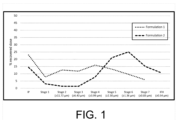
- Figure 1 shows that ethanol has an impact on the aerodynamic particle size distribution.
- ethanol allows for the particle size to be modified within the respirable range (extrafine particles or coarser ones).
- Beclometasone and formoterol solubilization are highly dependent on ethanol content. Beclometasone and Formoterol were not completely dissolved in 70% ethanol (Formulation 1) while all the active ingredients solubilized in 96% ethanol (Formulation 2).
- Formulation 2 showed better aerodynamic properties than Formulation 1.
- Example 2 Comparative of Trimbow ® formulation pMDI versus a soft mist inhaler
- the triple combination consists of the following active ingredients: beclomethasone dipropionate (BDP), glycopyrronium bromide (GB) and formoterol fumarate (FF) at the concentrations shown in Table 3.
- BDP beclomethasone dipropionate
- GB glycopyrronium bromide
- FF formoterol fumarate
- Trimbow ® pMDI a marketed product, was evaluated in this study as a product representative of triple combination products.
- BDP Beclometasone dipropionate
- GB glycopyrronium bromide
- FF formoterol fumarate
- HCl 1N HCl 1N
- Table 3 summarizes the products investigated in this study.
- Device Product Name API/Excipients Formula* ( ⁇ g/actuation) Trimbow ® pMDI Trimbow ® Beclometasone Dipropionate 87.4 ⁇ g Glycopyrronium Bromide 10.9 ⁇ g Formoterol Fumarate 5.2 ⁇ g HCl 1N 12.2 ⁇ g HFA 56645 ⁇ g Ethanol 9.6 ⁇ L Soft Mist Inhaler Triple combination with Soft Mist Beclometasone Dipropionate 87.4 ⁇ g Glycopyrronium Bromide 10.9 ⁇ g Formoterol Fumarate 5.2 ⁇ g HCl 1N 2.5 ⁇ g Ethanol 96% 11.1 ⁇ L *Theoretical mass in ⁇ g per delivered dose.
- the NGI was cooled to 5°C for at least 75 min.
- the cooling chamber was then opened and, after 30 minutes, the NGI was connected to a HCP5 vacuum pump (Copley Scientific Ltd). For each experiment, ten doses were discharged into the NGI at 30 L/min for 5 seconds each.
- the particles deposited on the different surfaces of the impactor were extracted using a suitable diluent (methanol) and with the help of a Gentle Rocker (Copley Scientific Ltd). Active ingredients were then quantified by HPLC, with the same methods used for the Example 1.
- the NGI was cooled to 5°C for at least 75 min.
- the cooling chamber was then opened and, after 30 minutes, the NGI was connected to a HCP5 vacuum pump (Copley Scientific Ltd). For each experiment, ten doses were discharged into the NGI at 30 L/min for 5 seconds each.
- the particles deposited on the different surfaces of the impactor were extracted using a suitable diluent (methanol) and with the help of a Gentle Rocker (Copley Scientific Ltd). Active ingredients were then quantified by HPLC, with the same methods used for the Example 1.
- Results are expressed as the mean value of two NGIs analysis.
- the delivered dose was tested according to USP ⁇ 601> using a dose unit sampling apparatus (DUSA) operating at 28.3 L/min for 4 seconds - the inhalation volume did not exceed 2.0 L. Five doses per device were performed. Active pharmaceutical ingredients (APIs) deposited in the sampling apparatus were quantitatively recovered with a DUSA shaker (Copley Scientific Ltd) and methanol. APIs were, then, quantified by HPLC with the same methods described in Example 1.
- DUSA dose unit sampling apparatus
- Table 4 shows that one actuation of both devices released the same dose.
- Table 4 shows that one actuation of both devices released the same dose.
- Table 4. Triple combination Beclomethasone, Fomoterol and Glycopyrroniuum in a Soft Mist Inhaler (Respimat ® ) and Trimbow ® pMDI. DUSA, Trimbow ® pMDI (1 actuation), Soft Mist Inhaler (1 actuation).
- results from the NGI assay show that one single dose of the soft mist inhaler could simulate the same aerodynamic particle size distribution in terms of respirable particles - particles from stage 1 to internal filter holder (IFH) - as two doses of Trimbow ® pMDI.
- the soft mist inhaler showed lower deposition in the induction port (IP) than Trimbow ® pMDI, which means a lower amount of coarser particles that are retained in the mouth and the throat ( Figure 2 ).
- MMAD values were around 1.2 ⁇ m, independently of the device used.
- Soft mist inhalers represent a novel approach to the delivery of inhaled drugs and overcome some of the limitations of DPIs and especially pMDIs.
- the double combination consists of the following active ingredients: beclomethasone dipropionate (BDP) and formoterol fumarate (FF) at the concentrations shown in Table 6.
- BDP Beclometasone dipropionate
- FF formoterol fumarate
- HCl 1N HCl 1N
- Table 6 summarizes the products investigated in this study. Table 6. Formulations and devices investigated in this study.
- Device Product Name API/Excipients Formula* ( ⁇ g/actuation) Foster ® pMDI Foster ® Beclometasone Dipropionate 84.6 ⁇ g Formoterol Fumarate 5.0 ⁇ g HCl 1N 11.9 ⁇ g HFA 55034 ⁇ g Ethanol 9.3 ⁇ L Soft Mist Inhaler Double combination in Soft Mist Inhaler Beclometasone Dipropionate 84.6 ⁇ g Formoterol Fumarate 5.0 ⁇ g HCl 1N 2 ⁇ g Etanol 96% 11.1 ⁇ L *Theoretical mass in ⁇ g per delivered dose.
- the in vitro aerodynamic assessment was carried using a next generation impactor, NGI (Copley Scientific Ltd), equipped with a mouthpiece adapter for the insertion of the inhaler, an induction port and an internal filter holder (IFH) to capture the smaller particles.
- NGI next generation impactor
- IHF internal filter holder
- the NGI was cooled to 5°C for at least 75 min.
- the cooling chamber was then opened and, after 30 minutes, the NGI was connected to a HCP5 vacuum pump (Copley Scientific Ltd). For each experiment, ten doses were discharged into the NGI at 30 L/min for 5 seconds each.
- the particles deposited on the different surfaces of the impactor were extracted using a suitable diluent (methanol) and with the help of a Gentle Rocker (Copley Scientific Ltd). Active ingredients were then quantified by HPLC, with the same methods used for the Example 1.
- the NGI was cooled to 5°C for at least 75 min.
- the cooling chamber was then opened and, after 30 minutes, the NGI was connected to a HCP5 vacuum pump (Copley Scientific Ltd). For each experiment, ten doses were discharged into the NGI at 30 L/min for 5 seconds each.
- the particles deposited on the different surfaces of the impactor were extracted using a suitable diluent (methanol) and with the help of a Gentle Rocker (Copley Scientific Ltd). Active ingredients were then quantified by HPLC, with the same methods used for the Example 1.
- the NGI was plotted against the stage cut-off diameter as the mass recovered from the induction port to the filter.
- Fine particle fraction (FPF%) and mass median aerodynamic diameter (MMAD) were determined from the analysis of the NGI data.
- Results are expressed as the mean value of two NGIs analysis.
- Example 4 Impact of ethanol in the aerodynamic particle size distribution of a double combination therapy
- the double combination consists of the following active ingredients: budesonide (BU) and formoterol fumarate (FF) at the concentrations shown in Table 8.
- Budesonide (BU) and formoterol fumarate (FF) were mixed in 70% ethanol (Formulation 1) and 96% ethanol (Formulation 2) at 25°C for two hours protected from evaporation. Both formulations were then filtrated, and filled into cartridges compatible with soft mist inhaler (Respimat ® ).
- Table 8 summarizes the products investigated in this study.
- Solution API/Excipients Formula* ( ⁇ g/actuation) Formulation 1 Budesonide 160.0 ⁇ g Formoterol Fumarate 4.5 ⁇ g Water for Irrigation 3.32 ⁇ L Ethanol absolute 7.74 ⁇ L Formulation 2
- Formulation 1 and 2 were filled into cartridges compatible with a soft mist inhaler (Respimat ® ).
- the in vitro aerodynamic particle size distribution of both formulations was evaluated using an impactor, the next generation impactor, NGI (Copley Scientific Ltd) equipped with a mouthpiece adapter for the insertion of the inhaler, an induction port and an internal filter holder (IFH) to capture the smaller particles.
- NGI Copley Scientific Ltd
- the NGI was cooled to 5°C for at least 75 min.
- the cooling chamber was then opened and, after 30 minutes, the NGI was connected to a HCP5 vacuum pump (Copley Scientific Ltd).
- HCP5 vacuum pump Copley Scientific Ltd.
- ten doses were discharged per NGI actuated at 28.3 L/min for 5 seconds each.
- the particles deposited on the different surfaces of the impactor were extracted using a suitable diluent (75/25 v/v MeOH/water) and with the help of a Gentle Rocker (Copley Scientific Ltd). Active ingredients were then quantified by HPLC as described above.
- Results are expressed as the mean value of two NGIs analysis.
- Formulation 1 (70% EtOH) Formulation 2 (96% EtOH) API MMAD ( ⁇ m) FPF (%) FPD ( ⁇ g) MMAD ( ⁇ m) FPF (%) FPF ( ⁇ g) Budesonide 2.6 68.5 119.1 1.1 89.2 141.0 Formoterol Fumarate 2.7 68.4 3.3 1.1 89.7 3.7
- Example 5 Comparative of Symbicort ® pMDI versus an equivalent ethanolic formulation delivered with a soft mist inhaler (Respimat ® )
- the double combination consists of the following active ingredients: Budesonide (BU) and formoterol fumarate (FF) at the concentrations shown in Table 10.
- BU Budesonide
- FF formoterol fumarate
- Symbicort ® 160/4.5 ⁇ g pMDI a marketed product, was evaluated in this study as product representative of double combination products with no ethanol in their formula.
- Budesonide (BU) and formoterol fumarate (FF) were mixed in 96% ethanol at 25°C for two hours protected from evaporation. The solution was then filtrated and filled into cartridges compatible with soft mist inhaler (Respimat ® ).
- Table 10 summarizes the products investigated in this study. Table 10. Formulations investigated in this study. Device API/Excipients Formula* ( ⁇ g/actuation) Symbicort ® pMDI Budesonide 160.0 ⁇ g Formoterol Fumarate 4.5 ⁇ g HFA227 q.s. Povidone q.s. Macrogol q.s. Soft mist inhaler Budesonide 160.0 ⁇ g Formoterol Fumarate 4.5 ⁇ g Ethanol 96% 11.05 ⁇ L *Theoretical mass in ⁇ g per delivered dose.
- Formula* ⁇ g/actuation
- the NGI was cooled to 5°C for at least 75 min.
- the cooling chamber was then opened and, after 30 minutes, the NGI was connected to a HCP5 vacuum pump (Copley Scientific Ltd).
- HCP5 vacuum pump Copley Scientific Ltd.
- ten doses were discharged per NGI actuated at 28.3 L/min for 5 seconds each.
- the particles deposited on the different surfaces of the impactor were extracted using a suitable diluent (75/25 v/v MeOH/water) and with the help of a Gentle Rocker (Copley Scientific Ltd). Active ingredients were then quantified by HPLC, with the same methods described in example 4.
- the NGI was plotted against the stage cut-off diameter as the mass recovered from the induction port to the filter. Fine particle fraction (FPF%), and mass median aerodynamic diameter (MMAD) were determined from the analysis of the NGI data.
- FPF% Fine particle fraction
- MMAD mass median aerodynamic diameter
- Results are expressed as the mean value of two NGIs analysis.
- the deposition rate of Symbicort ® pMDI and Soft Mist Inhaler was determined by a next generation impactor. Results showed that the Soft Mist Inhaler composition has an impact on the aerodynamic particle size distribution (Table 11 and Figure 6 and 7 ). The Soft Mist Inhaler composition led to a smaller particle size distribution achieving MMAD values of around 1.1 ⁇ m. This is very positive since small particle size distribution leads to deeper and more uniform lung distribution.
Landscapes
- Health & Medical Sciences (AREA)
- Chemical & Material Sciences (AREA)
- Animal Behavior & Ethology (AREA)
- Pharmacology & Pharmacy (AREA)
- Life Sciences & Earth Sciences (AREA)
- General Health & Medical Sciences (AREA)
- Public Health (AREA)
- Veterinary Medicine (AREA)
- Medicinal Chemistry (AREA)
- Epidemiology (AREA)
- Engineering & Computer Science (AREA)
- Bioinformatics & Cheminformatics (AREA)
- Pulmonology (AREA)
- Chemical Kinetics & Catalysis (AREA)
- General Chemical & Material Sciences (AREA)
- Dispersion Chemistry (AREA)
- Otolaryngology (AREA)
- Oil, Petroleum & Natural Gas (AREA)
- Nuclear Medicine, Radiotherapy & Molecular Imaging (AREA)
- Organic Chemistry (AREA)
- Pain & Pain Management (AREA)
- Emergency Medicine (AREA)
- Medicinal Preparation (AREA)
- Pharmaceuticals Containing Other Organic And Inorganic Compounds (AREA)
- Medicines That Contain Protein Lipid Enzymes And Other Medicines (AREA)
- Acyclic And Carbocyclic Compounds In Medicinal Compositions (AREA)
Applications Claiming Priority (2)
| Application Number | Priority Date | Filing Date | Title |
|---|---|---|---|
| EP20382710 | 2020-07-31 | ||
| PCT/EP2021/071369 WO2022023515A1 (en) | 2020-07-31 | 2021-07-30 | Combination therapy for inhalation administration |
Publications (2)
| Publication Number | Publication Date |
|---|---|
| EP4188327A1 EP4188327A1 (en) | 2023-06-07 |
| EP4188327B1 true EP4188327B1 (en) | 2025-05-28 |
Family
ID=72039503
Family Applications (1)
| Application Number | Title | Priority Date | Filing Date |
|---|---|---|---|
| EP21755917.8A Active EP4188327B1 (en) | 2020-07-31 | 2021-07-30 | Combination therapy for inhalation administration |
Country Status (13)
| Country | Link |
|---|---|
| US (1) | US20230270754A1 (https=) |
| EP (1) | EP4188327B1 (https=) |
| JP (1) | JP7828949B2 (https=) |
| KR (1) | KR20230052903A (https=) |
| CN (1) | CN115989032A (https=) |
| AU (1) | AU2021314977B2 (https=) |
| BR (1) | BR112023001689A2 (https=) |
| CA (1) | CA3186956A1 (https=) |
| ES (1) | ES3037198T3 (https=) |
| FI (1) | FI4188327T3 (https=) |
| MX (1) | MX2023001201A (https=) |
| PL (1) | PL4188327T3 (https=) |
| WO (1) | WO2022023515A1 (https=) |
Families Citing this family (3)
| Publication number | Priority date | Publication date | Assignee | Title |
|---|---|---|---|---|
| US20230270754A1 (en) | 2020-07-31 | 2023-08-31 | Chemo Research, S.L. | Combination therapy for inhalation administration |
| WO2026057872A1 (en) * | 2024-09-16 | 2026-03-19 | Invox Belgium Nv | Inhalable compositions |
| CN121714579A (zh) * | 2026-02-25 | 2026-03-24 | 上海臣邦医药科技股份有限公司 | 一种三联复方吸入制剂的药物组合物及其制备方法和应用 |
Citations (11)
| Publication number | Priority date | Publication date | Assignee | Title |
|---|---|---|---|---|
| WO2002028377A1 (en) | 2000-10-06 | 2002-04-11 | Orion Corporation | Ihnalation particles incorporating a combination of two or more active ingredients |
| US20030181478A1 (en) | 2000-10-31 | 2003-09-25 | Boehringer Ingelheim Pharma Kg | Inhalable formulation of a solution containing a tiotropium salt |
| US20040052732A1 (en) | 2000-10-06 | 2004-03-18 | Wiwik Watanabe | Combination particles for the treatment of asthma |
| US20060127322A1 (en) | 1995-06-27 | 2006-06-15 | Boehringer Ingelheim Kg | Stable pharmaceutical Budesonide preparation for producing propellant-free aerosols |
| US20080041369A1 (en) | 2006-08-18 | 2008-02-21 | Kirsten Radau | Aerosol formulation for the inhalation of beta agonists |
| EP2515855B1 (en) | 2009-12-23 | 2014-04-02 | Chiesi Farmaceutici S.p.A. | Combination therapy for COPD |
| WO2015189168A1 (en) | 2014-06-09 | 2015-12-17 | Chiesi Farmaceutici S.P.A. | Inhalation particles comprising a combination of an anticholinergic, a corticosteroid and a beta-adrenergic |
| WO2017089404A1 (en) | 2015-11-25 | 2017-06-01 | Jagotec Ag | Pharmaceutical composition |
| US10682345B2 (en) | 2014-06-18 | 2020-06-16 | Boehringer Ingelheim Vetmedica Gmbh | Muscarinic antagonists and combinations thereof for the treatment of airway disease in horses |
| WO2020167893A1 (en) | 2019-02-13 | 2020-08-20 | Molecular Infusions, Llc | Methods for non-irritating pulmonary administration of cannabinoids using soft mist inhalers |
| WO2022023515A1 (en) | 2020-07-31 | 2022-02-03 | Chemo Research , S.L. | Combination therapy for inhalation administration |
Family Cites Families (19)
| Publication number | Priority date | Publication date | Assignee | Title |
|---|---|---|---|---|
| US4851317A (en) | 1987-11-04 | 1989-07-25 | E. I. Du Pont De Nemours And Company | Laminar flow toning station having conductive and nonconductive elements therein |
| DE19536902A1 (de) | 1995-10-04 | 1997-04-10 | Boehringer Ingelheim Int | Vorrichtung zur Hochdruckerzeugung in einem Fluid in Miniaturausführung |
| DE19653969A1 (de) | 1996-12-20 | 1998-06-25 | Boehringer Ingelheim Kg | Neue wässrige Arzneimittelzubereitung zur Erzeugung treibgasfreier Aerosole |
| DE59901669D1 (de) * | 1998-10-17 | 2002-07-11 | Boehringer Ingelheim Pharma | Lagerfähiges wirkstoffkonzentrat mit formoterol |
| AU2000250701B2 (en) | 2000-05-22 | 2004-07-01 | Chiesi Farmaceutici S.P.A. | Stable pharmaceutical solution formulations for pressurised metered dose inhalers |
| CA2436540C (en) | 2000-10-31 | 2008-01-29 | Boehringer Ingelheim Pharma Gmbh & Co. Kg | Pharmaceutical compositions based on anticholinergics and corticosteroids |
| US20030055026A1 (en) | 2001-04-17 | 2003-03-20 | Dey L.P. | Formoterol/steroid bronchodilating compositions and methods of use thereof |
| JP2008538758A (ja) | 2005-04-23 | 2008-11-06 | ベーリンガー インゲルハイム インターナショナル ゲゼルシャフト ミット ベシュレンクテル ハフツング | 抗コリン作用薬に加えてベータ受容体刺激薬及びステロイドを含有する吸入用の医薬組成物 |
| ITMI20051999A1 (it) * | 2005-10-21 | 2007-04-22 | Eratech S R L | Formulazioni inalatorie di farmaci in fora di polvere secca per somministrazione come tale o con nebulizzatore e dotate di elevata erogabilita' respirabilita' e stabilita' |
| US20070293460A1 (en) | 2005-10-31 | 2007-12-20 | Richie's Pharmacy And Medical Supply, Incorporated | Delivery of a combination therapy for asthma and chronic obstructive pulmonary disease |
| US20070098644A1 (en) | 2005-10-31 | 2007-05-03 | Richie's Pharmacy And Medical Supply, Incorporated | Delivery of a combination therapy for asthma and chronic obstructive pulmonary disease |
| DE102006023756A1 (de) | 2006-05-20 | 2007-11-29 | Boehringer Ingelheim Pharma Gmbh & Co. Kg | Ethanolhaltige Aerosolformulierung für die Inhalation |
| SG181870A1 (en) | 2009-12-23 | 2012-07-30 | Chiesi Farma Spa | Aerosol formulation for copd |
| BR112012015334A2 (pt) | 2009-12-23 | 2016-03-15 | Chiesi Farma Spa | terapia combinada para doença pulmonar obstrutiva crônica |
| US20120220557A1 (en) | 2011-02-17 | 2012-08-30 | Chiesi Farmaceutici S.P.A. | Liquid propellant-free formulation comprising an antimuscarinic drug |
| BR112015010842B1 (pt) | 2012-12-21 | 2021-03-30 | Boehringer Ingelheim Vetmedica Gmbh | Uso da ciclesonida para o tratamento de doença das vias respiratórias em cavalos |
| RS57687B1 (sr) | 2013-12-30 | 2018-11-30 | Chiesi Farm Spa | Pod pritiskom stabilan aerosolni rastvor kompozicije glikopironijum bromida i kombinacije formoterola |
| GEAP201814192A (en) | 2013-12-30 | 2018-02-26 | Chiesi Farm Spa | Stable pressurised aerosol solution composition of glycopyrronium bromide and formoterol combination |
| US10098837B2 (en) | 2016-07-28 | 2018-10-16 | Chiesi Farmaceutici S.P.A. | Combination therapy for COPD |
-
2021
- 2021-07-30 US US18/007,426 patent/US20230270754A1/en active Pending
- 2021-07-30 CA CA3186956A patent/CA3186956A1/en active Pending
- 2021-07-30 AU AU2021314977A patent/AU2021314977B2/en active Active
- 2021-07-30 EP EP21755917.8A patent/EP4188327B1/en active Active
- 2021-07-30 KR KR1020237006563A patent/KR20230052903A/ko active Pending
- 2021-07-30 WO PCT/EP2021/071369 patent/WO2022023515A1/en not_active Ceased
- 2021-07-30 JP JP2023506220A patent/JP7828949B2/ja active Active
- 2021-07-30 PL PL21755917.8T patent/PL4188327T3/pl unknown
- 2021-07-30 CN CN202180051794.2A patent/CN115989032A/zh active Pending
- 2021-07-30 MX MX2023001201A patent/MX2023001201A/es unknown
- 2021-07-30 FI FIEP21755917.8T patent/FI4188327T3/fi active
- 2021-07-30 BR BR112023001689A patent/BR112023001689A2/pt unknown
- 2021-07-30 ES ES21755917T patent/ES3037198T3/es active Active
Patent Citations (12)
| Publication number | Priority date | Publication date | Assignee | Title |
|---|---|---|---|---|
| US20060127322A1 (en) | 1995-06-27 | 2006-06-15 | Boehringer Ingelheim Kg | Stable pharmaceutical Budesonide preparation for producing propellant-free aerosols |
| WO2002028377A1 (en) | 2000-10-06 | 2002-04-11 | Orion Corporation | Ihnalation particles incorporating a combination of two or more active ingredients |
| US20040028619A1 (en) | 2000-10-06 | 2004-02-12 | Wiwik Watanabe | Ihnalation particles incorporating a combination of two or more active ingredients |
| US20040052732A1 (en) | 2000-10-06 | 2004-03-18 | Wiwik Watanabe | Combination particles for the treatment of asthma |
| US20030181478A1 (en) | 2000-10-31 | 2003-09-25 | Boehringer Ingelheim Pharma Kg | Inhalable formulation of a solution containing a tiotropium salt |
| US20080041369A1 (en) | 2006-08-18 | 2008-02-21 | Kirsten Radau | Aerosol formulation for the inhalation of beta agonists |
| EP2515855B1 (en) | 2009-12-23 | 2014-04-02 | Chiesi Farmaceutici S.p.A. | Combination therapy for COPD |
| WO2015189168A1 (en) | 2014-06-09 | 2015-12-17 | Chiesi Farmaceutici S.P.A. | Inhalation particles comprising a combination of an anticholinergic, a corticosteroid and a beta-adrenergic |
| US10682345B2 (en) | 2014-06-18 | 2020-06-16 | Boehringer Ingelheim Vetmedica Gmbh | Muscarinic antagonists and combinations thereof for the treatment of airway disease in horses |
| WO2017089404A1 (en) | 2015-11-25 | 2017-06-01 | Jagotec Ag | Pharmaceutical composition |
| WO2020167893A1 (en) | 2019-02-13 | 2020-08-20 | Molecular Infusions, Llc | Methods for non-irritating pulmonary administration of cannabinoids using soft mist inhalers |
| WO2022023515A1 (en) | 2020-07-31 | 2022-02-03 | Chemo Research , S.L. | Combination therapy for inhalation administration |
Non-Patent Citations (21)
| Title |
|---|
| AKIRA KOARAI;HISATOSHI SUGIURA;MITSUHIRO YAMADA;TOMOHIRO ICHIKAWA;NAOYA FUJINO;TOMOTAKA KAWAYAMA;MASAKAZU ICHINOSE: "Treatment with LABA versus LAMA for stable COPD: a systematic review and meta-analysis", BMC PULMONARY MEDICINE, BIOMED CENTRAL LTD, LONDON, UK, vol. 20, no. 1, 29 April 2020 (2020-04-29), London, UK , pages 1 - 11, XP021276034, DOI: 10.1186/s12890-020-1152-8 |
| ANONYMOUS: "Early Intervention Efficacy in COPD", CLINICALTRIALS.GOV, ID: NCT04249310, 14 June 2022 (2022-06-14), pages 1 - 7, XP093088147, Retrieved from the Internet <URL:https://clinicaltrials.gov/study/NCT04249310?term=NCT04249310&rank=1&tab=table> |
| ANONYMOUS: "Early Intervention Efficacy in COPD", CLINICALTRIALS.GOV, ID: NCT04249310, 14 June 2022 (2022-06-14), pages 1 - 7, XP093088147, Retrieved from the Internet <URL:https://clinicaltrials.gov/study/NCT04249310?term=NCT04249310&rank=1&tab=table> [retrieved on 20231003] |
| ANONYMOUS: "SOFT MIST INHALERS VERSUS NEBULISERS: DELIVERY EQUIVALENCE & FUTURE THERAPIES", ONDRUGDELIVERY.COM, 1 January 2024 (2024-01-01), XP093375418, Retrieved from the Internet <URL:https://www.ondrugdelivery.com/wp-content/uploads/2024/04/158_2024_Apr_Pulmonary_Nasal_Merxin.pdf> |
| ANONYMOUS: "Trimbow - ANNEX I SUMMARY OF PRODUCT CHARACTERISTICS", EMA, 17 July 2017 (2017-07-17), XP093324876 |
| CONNELLY DAWN: "Blue, brown and now green", THE PHARMACEUTICAL JOURNAL, vol. 304, 23 June 2020 (2020-06-23), pages 7938, XP093324878, DOI: 10.1211/PJ.2020.20208093 |
| DALBY, R. SPALLEK, M. VOSHAAR, T.: "A review of the development of Respimat^(R) Soft Mist(TM) Inhaler", INTERNATIONAL JOURNAL OF PHARMACEUTICS, ELSEVIER, AMSTERDAM, NL, vol. 283, no. 1-2, 28 September 2004 (2004-09-28), AMSTERDAM, NL, pages 1 - 9, XP004560626, ISSN: 0378-5173, DOI: 10.1016/j.ijpharm.2004.06.018 |
| DATABASE PUBCHEM COMPOUND 26 October 2006 (2006-10-26), XP093375423, Database accession no. 11504295 |
| DONALD TASHKIN: "A review of nebulized drug delivery in COPD", INTERNATIONAL JOURNAL OF CHRONIC OBSTRUCTIVE PULMONARY DISEASE, vol. Volume 11, pages 2585 - 2596, XP055633158, DOI: 10.2147/COPD.S114034 |
| GARY T. FERGUSON, RICHARD N. DALBY: "Clinical implications of the tiotropium/olodaterol inhaler for patients with chronic obstructive pulmonary disease", POSTGRADUATE MEDICINE., MCGRAW-HILL, MINNEAPOLIS., US, vol. 130, no. 6, 4 July 2018 (2018-07-04), US , pages 515 - 522, XP009565968, ISSN: 0032-5481, DOI: 10.1080/00325481.2018.1481713 |
| HODDER RICK, REESE PAT RAY, SLATON TERRA, : "Asthma patients prefer Respimat® Soft Mist™ Inhaler to Turbuhaler", THE INTERNATIONAL JOURNAL OF CHRONIC OBSTRUCTIVE PULMONARY DISEASE, ALBANY, AUCKLAND : DOVE MEDICAL PRESS, vol. 4, 1 January 2009 (2009-01-01), pages 225 - 232, XP093324875, ISSN: 1178-2005, DOI: 10.2147/COPD.S3452 |
| MACGREGOR TR, ZUWALLACK R, RUBANO V, CASTLES MA, DEWBERRY H, GHAFOURI M, WOOD CC: "Efficiency of Ipratropium Bromide and Albuterol Deposition in the Lung Delivered via a Soft Mist Inhaler or Chlorofluorocarbon Metered‐Dose Inhaler", CTS - CLINICAL AND TRANSLATIONAL SCIENCE, WILEYBLACKWELL PUB., US, vol. 9, no. 2, 1 April 2016 (2016-04-01), US , pages 105 - 113, XP093375421, ISSN: 1752-8054, DOI: 10.1111/cts.12387 |
| NEWMAN S.P., STEED K.P., READER S.J., HOOPER G., ZIERENBERG B.: "Efficient Delivery to the Lungs of Flunisolide Aerosol From a New Portable Hand-Held Multidose Nebulizer", JOURNAL OF PHARMACEUTICAL SCIENCES, ELSEVIER INC, vol. 85, no. 9, 1 September 1996 (1996-09-01), pages 960 - 964, XP093088156, ISSN: 0022-3549, DOI: 10.1021/js950522q |
| NEWMAN S.P., STEED K.P., READER S.J., HOOPER G., ZIERENBERG B.: "Efficient Delivery to the Lungs of Flunisolide Aerosol From a New Portable Hand-Held Multidose Nebulizer", JOURNAL OF PHARMACEUTICAL SCIENCES, vol. 85, no. 9, 1 September 1996 (1996-09-01), pages 960 - 964, XP093088156, DOI: 10.1021/js950522q |
| NOT KNOWN: "Orange book : approved drug products with therapeutic equivalence evaluations", 19 December 2020 (2020-12-19), XP055871553 |
| PAULA ANDERSON: "Use of Respimat� Soft Mist? Inhaler in COPD patients", THE INTERNATIONAL JOURNAL OF CHRONIC OBSTRUCTIVE PULMONARY DISEASE, DOVE MEDICAL PRESS LTD., NEW ZEALAND, vol. 1, no. 3, 1 January 2006 (2006-01-01), New Zealand , pages 251 - 259, XP055730734, ISSN: 1176-9106, DOI: 10.2147/copd.2006.1.3.251 |
| PITCAIRN GARY, READER SANDIE, PAVIA DEMETRI, NEWMAN STEVE: "Deposition of Corticosteroid Aerosol in the Human Lung by Respimat® Soft Mist™ Inhaler Compared to Deposition by Metered Dose Inhaler or by Turbuhaler® Dry Powder Inhaler", JOURNAL OF AEROSOL MEDICINE, vol. 18, no. 3, 1 September 2005 (2005-09-01), pages 264 - 272, XP093088152, ISSN: 0894-2684, DOI: 10.1089/jam.2005.18.264 |
| VOSHAAR T., HAUSEN T., KARDOS P., KÖHLER D., SCHULTZE-WERNINGHAUS G., SCHÜRMANN W., VOGELMEIER C.: "Inhalationstherapie mit dem Respimat® Soft Inhaler bei Asthma und COPD", PNEUMOLOGIE, THIEME, STUTTGART, DE, vol. 59, no. 01, 1 January 2005 (2005-01-01), DE , pages 25 - 32, XP093324870, ISSN: 0934-8387, DOI: 10.1055/s-2004-830161 |
| WACHTEL HERBERT, KATTENBECK SABINE, DUNNE STEPHEN, DISSE BERND: "The Respimat® Development Story: Patient-Centered Innovation", PULMONARY THERAPY, SPRINGER HEALTHCARE, vol. 3, no. 1, 1 June 2017 (2017-06-01), pages 19 - 30, XP093324873, ISSN: 2364-1754, DOI: 10.1007/s41030-017-0040-8 |
| WACHTEL HERBERT, KATTENBECK SABINE, DUNNE STEPHEN, DISSE BERND: "The Respimat® Development Story: Patient-Centered Innovation", PULMONARY THERAPY, vol. 3, no. 1, 1 June 2017 (2017-06-01), pages 19 - 30, XP093324873, ISSN: 2364-1754, DOI: 10.1007/s41030-017-0040-8 |
| ZIERENBERG BERND: "Optimizing the in Vitro Performance of Respimat", JOURNAL OF AEROSOL MEDICINE, vol. 12, no. s1, 1 September 1999 (1999-09-01), pages S - S-24, XP009550076, ISSN: 0894-2684, DOI: 10.1089/jam.1999.12.Suppl_1.S-19 |
Also Published As
| Publication number | Publication date |
|---|---|
| JP7828949B2 (ja) | 2026-03-12 |
| CA3186956A1 (en) | 2022-02-03 |
| AU2021314977A1 (en) | 2023-03-02 |
| CN115989032A (zh) | 2023-04-18 |
| KR20230052903A (ko) | 2023-04-20 |
| PL4188327T3 (pl) | 2025-09-01 |
| JP2023540171A (ja) | 2023-09-22 |
| BR112023001689A2 (pt) | 2023-05-02 |
| FI4188327T3 (fi) | 2025-07-25 |
| WO2022023515A1 (en) | 2022-02-03 |
| US20230270754A1 (en) | 2023-08-31 |
| EP4188327A1 (en) | 2023-06-07 |
| ES3037198T3 (en) | 2025-09-30 |
| AU2021314977B2 (en) | 2025-03-13 |
| MX2023001201A (es) | 2023-05-03 |
Similar Documents
| Publication | Publication Date | Title |
|---|---|---|
| US11213485B2 (en) | Pharmaceutical solution formulations for pressurized metered dose inhalers | |
| EP2201964B1 (en) | Formoterol superfine formulation | |
| RU2327450C2 (ru) | Фармацевтические продукты и композиции, содержащие специфические антихолинергические средства, агонисты бета-2 и кортикостероиды | |
| EP1915129B1 (en) | Pharmaceutical formulations comprising a long-acting beta2-agonist for administration by nebulisation | |
| EP4188327B1 (en) | Combination therapy for inhalation administration | |
| EP4585215A1 (en) | Pharmaceutical composition for inhalation for preventing or treating respiratory disease | |
| EP1415647A1 (en) | "Long-acting beta-2 agonists ultrafine formulations" | |
| CN115397417A (zh) | 含有噻托溴铵和奥达特罗的可吸入溶液制剂 | |
| WO2020141472A1 (en) | Nebulization composition comprising tiotropium and indacaterol | |
| US20210205223A1 (en) | Propellant-free formulation for inhalation | |
| HK1228751A1 (en) | Pharmaceutical solution formulations for pressurised metered dose inhalers | |
| HK1228758A1 (en) | Pharmaceutical solution formulations for pressurised metered dose inhalers | |
| HK1181310A (en) | Pharmaceutical solution formulations for pressurised metered dose inhalers | |
| HK1128615A (en) | Pharmaceutical solution formulations for pressurised metered dose inhalers | |
| HK1079425B (zh) | 福莫特罗超细制剂 |
Legal Events
| Date | Code | Title | Description |
|---|---|---|---|
| STAA | Information on the status of an ep patent application or granted ep patent |
Free format text: STATUS: UNKNOWN |
|
| STAA | Information on the status of an ep patent application or granted ep patent |
Free format text: STATUS: THE INTERNATIONAL PUBLICATION HAS BEEN MADE |
|
| PUAI | Public reference made under article 153(3) epc to a published international application that has entered the european phase |
Free format text: ORIGINAL CODE: 0009012 |
|
| STAA | Information on the status of an ep patent application or granted ep patent |
Free format text: STATUS: REQUEST FOR EXAMINATION WAS MADE |
|
| 17P | Request for examination filed |
Effective date: 20230126 |
|
| AK | Designated contracting states |
Kind code of ref document: A1 Designated state(s): AL AT BE BG CH CY CZ DE DK EE ES FI FR GB GR HR HU IE IS IT LI LT LU LV MC MK MT NL NO PL PT RO RS SE SI SK SM TR |
|
| TPAC | Observations filed by third parties |
Free format text: ORIGINAL CODE: EPIDOSNTIPA |
|
| DAV | Request for validation of the european patent (deleted) | ||
| DAX | Request for extension of the european patent (deleted) | ||
| TPAC | Observations filed by third parties |
Free format text: ORIGINAL CODE: EPIDOSNTIPA |
|
| STAA | Information on the status of an ep patent application or granted ep patent |
Free format text: STATUS: EXAMINATION IS IN PROGRESS |
|
| 17Q | First examination report despatched |
Effective date: 20240118 |
|
| GRAP | Despatch of communication of intention to grant a patent |
Free format text: ORIGINAL CODE: EPIDOSNIGR1 |
|
| STAA | Information on the status of an ep patent application or granted ep patent |
Free format text: STATUS: GRANT OF PATENT IS INTENDED |
|
| RIC1 | Information provided on ipc code assigned before grant |
Ipc: A61K 45/06 20060101ALI20250213BHEP Ipc: A61K 31/40 20060101ALI20250213BHEP Ipc: A61K 31/167 20060101ALI20250213BHEP Ipc: A61K 31/56 20060101ALI20250213BHEP Ipc: A61K 31/58 20060101ALI20250213BHEP Ipc: A61K 31/439 20060101ALI20250213BHEP Ipc: A61P 11/08 20060101ALI20250213BHEP Ipc: A61K 47/10 20170101ALI20250213BHEP Ipc: A61K 31/573 20060101ALI20250213BHEP Ipc: A61K 9/00 20060101AFI20250213BHEP |
|
| INTG | Intention to grant announced |
Effective date: 20250310 |
|
| GRAS | Grant fee paid |
Free format text: ORIGINAL CODE: EPIDOSNIGR3 |
|
| GRAA | (expected) grant |
Free format text: ORIGINAL CODE: 0009210 |
|
| STAA | Information on the status of an ep patent application or granted ep patent |
Free format text: STATUS: THE PATENT HAS BEEN GRANTED |
|
| AK | Designated contracting states |
Kind code of ref document: B1 Designated state(s): AL AT BE BG CH CY CZ DE DK EE ES FI FR GB GR HR HU IE IS IT LI LT LU LV MC MK MT NL NO PL PT RO RS SE SI SK SM TR |
|
| REG | Reference to a national code |
Ref country code: GB Ref legal event code: FG4D |
|
| REG | Reference to a national code |
Ref country code: CH Ref legal event code: EP |
|
| REG | Reference to a national code |
Ref country code: IE Ref legal event code: FG4D Ref country code: DE Ref legal event code: R096 Ref document number: 602021031455 Country of ref document: DE |
|
| REG | Reference to a national code |
Ref country code: FI Ref legal event code: FGE |
|
| REG | Reference to a national code |
Ref country code: SE Ref legal event code: TRGR |
|
| REG | Reference to a national code |
Ref country code: NL Ref legal event code: FP |
|
| PGFP | Annual fee paid to national office [announced via postgrant information from national office to epo] |
Ref country code: NL Payment date: 20250726 Year of fee payment: 5 |
|
| REG | Reference to a national code |
Ref country code: ES Ref legal event code: FG2A Ref document number: 3037198 Country of ref document: ES Kind code of ref document: T3 Effective date: 20250930 |
|
| REG | Reference to a national code |
Ref country code: DE Ref legal event code: R026 Ref document number: 602021031455 Country of ref document: DE |
|
| PLBI | Opposition filed |
Free format text: ORIGINAL CODE: 0009260 |
|
| REG | Reference to a national code |
Ref country code: CH Ref legal event code: L10 Free format text: ST27 STATUS EVENT CODE: U-0-0-L10-L00 (AS PROVIDED BY THE NATIONAL OFFICE) Effective date: 20251008 |
|
| PGFP | Annual fee paid to national office [announced via postgrant information from national office to epo] |
Ref country code: FI Payment date: 20250725 Year of fee payment: 5 Ref country code: ES Payment date: 20250801 Year of fee payment: 5 |
|
| PGFP | Annual fee paid to national office [announced via postgrant information from national office to epo] |
Ref country code: DE Payment date: 20250729 Year of fee payment: 5 |
|
| REG | Reference to a national code |
Ref country code: LT Ref legal event code: MG9D |
|
| PG25 | Lapsed in a contracting state [announced via postgrant information from national office to epo] |
Ref country code: GR Free format text: LAPSE BECAUSE OF FAILURE TO SUBMIT A TRANSLATION OF THE DESCRIPTION OR TO PAY THE FEE WITHIN THE PRESCRIBED TIME-LIMIT Effective date: 20250829 |
|
| PGFP | Annual fee paid to national office [announced via postgrant information from national office to epo] |
Ref country code: NO Payment date: 20250729 Year of fee payment: 5 |
|
| PGFP | Annual fee paid to national office [announced via postgrant information from national office to epo] |
Ref country code: TR Payment date: 20250721 Year of fee payment: 5 Ref country code: IT Payment date: 20250721 Year of fee payment: 5 Ref country code: PL Payment date: 20250721 Year of fee payment: 5 |
|
| PG25 | Lapsed in a contracting state [announced via postgrant information from national office to epo] |
Ref country code: BG Free format text: LAPSE BECAUSE OF FAILURE TO SUBMIT A TRANSLATION OF THE DESCRIPTION OR TO PAY THE FEE WITHIN THE PRESCRIBED TIME-LIMIT Effective date: 20250528 |
|
| PGFP | Annual fee paid to national office [announced via postgrant information from national office to epo] |
Ref country code: BE Payment date: 20250728 Year of fee payment: 5 Ref country code: GB Payment date: 20250728 Year of fee payment: 5 |
|
| PG25 | Lapsed in a contracting state [announced via postgrant information from national office to epo] |
Ref country code: HR Free format text: LAPSE BECAUSE OF FAILURE TO SUBMIT A TRANSLATION OF THE DESCRIPTION OR TO PAY THE FEE WITHIN THE PRESCRIBED TIME-LIMIT Effective date: 20250528 |
|
| PGFP | Annual fee paid to national office [announced via postgrant information from national office to epo] |
Ref country code: AT Payment date: 20251020 Year of fee payment: 5 Ref country code: FR Payment date: 20250728 Year of fee payment: 5 |
|
| PGFP | Annual fee paid to national office [announced via postgrant information from national office to epo] |
Ref country code: SE Payment date: 20250727 Year of fee payment: 5 Ref country code: CH Payment date: 20250801 Year of fee payment: 5 |
|
| PG25 | Lapsed in a contracting state [announced via postgrant information from national office to epo] |
Ref country code: RS Free format text: LAPSE BECAUSE OF FAILURE TO SUBMIT A TRANSLATION OF THE DESCRIPTION OR TO PAY THE FEE WITHIN THE PRESCRIBED TIME-LIMIT Effective date: 20250828 |
|
| PGFP | Annual fee paid to national office [announced via postgrant information from national office to epo] |
Ref country code: CZ Payment date: 20250721 Year of fee payment: 5 Ref country code: IE Payment date: 20250728 Year of fee payment: 5 |
|
| PG25 | Lapsed in a contracting state [announced via postgrant information from national office to epo] |
Ref country code: IS Free format text: LAPSE BECAUSE OF FAILURE TO SUBMIT A TRANSLATION OF THE DESCRIPTION OR TO PAY THE FEE WITHIN THE PRESCRIBED TIME-LIMIT Effective date: 20250928 |
|
| PG25 | Lapsed in a contracting state [announced via postgrant information from national office to epo] |
Ref country code: LV Free format text: LAPSE BECAUSE OF FAILURE TO SUBMIT A TRANSLATION OF THE DESCRIPTION OR TO PAY THE FEE WITHIN THE PRESCRIBED TIME-LIMIT Effective date: 20250528 |
|
| 26 | Opposition filed |
Opponent name: HIGHTONE MANAGEMENT LIMITED Effective date: 20251001 |
|
| PG25 | Lapsed in a contracting state [announced via postgrant information from national office to epo] |
Ref country code: SM Free format text: LAPSE BECAUSE OF FAILURE TO SUBMIT A TRANSLATION OF THE DESCRIPTION OR TO PAY THE FEE WITHIN THE PRESCRIBED TIME-LIMIT Effective date: 20250528 Ref country code: DK Free format text: LAPSE BECAUSE OF FAILURE TO SUBMIT A TRANSLATION OF THE DESCRIPTION OR TO PAY THE FEE WITHIN THE PRESCRIBED TIME-LIMIT Effective date: 20250528 |
|
| PG25 | Lapsed in a contracting state [announced via postgrant information from national office to epo] |
Ref country code: EE Free format text: LAPSE BECAUSE OF FAILURE TO SUBMIT A TRANSLATION OF THE DESCRIPTION OR TO PAY THE FEE WITHIN THE PRESCRIBED TIME-LIMIT Effective date: 20250528 |
|
| PG25 | Lapsed in a contracting state [announced via postgrant information from national office to epo] |
Ref country code: SK Free format text: LAPSE BECAUSE OF FAILURE TO SUBMIT A TRANSLATION OF THE DESCRIPTION OR TO PAY THE FEE WITHIN THE PRESCRIBED TIME-LIMIT Effective date: 20250528 |
|
| PLBI | Opposition filed |
Free format text: ORIGINAL CODE: 0009260 |
|
| REG | Reference to a national code |
Ref country code: CH Ref legal event code: L10 Free format text: ST27 STATUS EVENT CODE: U-0-0-L10-L00 (AS PROVIDED BY THE NATIONAL OFFICE) Effective date: 20260311 |
|
| PLAX | Notice of opposition and request to file observation + time limit sent |
Free format text: ORIGINAL CODE: EPIDOSNOBS2 |
|
| PG25 | Lapsed in a contracting state [announced via postgrant information from national office to epo] |
Ref country code: LU Free format text: LAPSE BECAUSE OF NON-PAYMENT OF DUE FEES Effective date: 20250730 Ref country code: RO Free format text: LAPSE BECAUSE OF FAILURE TO SUBMIT A TRANSLATION OF THE DESCRIPTION OR TO PAY THE FEE WITHIN THE PRESCRIBED TIME-LIMIT Effective date: 20250528 |
|
| 26 | Opposition filed |
Opponent name: BRAND MURRAY FULLER LLP Effective date: 20260226 Opponent name: MURGITROYD & COMPANY Effective date: 20260227 Opponent name: SCORPIO IP LIMITED Effective date: 20260227 |