EP4188246B1 - Eine längliche vorrichtung mit einer verbesserten befestigung ihrer elemente zur mobilisierung von blutgerinnseln zur extraktion eines verschlusses aus einem blutgefäss - Google Patents
Eine längliche vorrichtung mit einer verbesserten befestigung ihrer elemente zur mobilisierung von blutgerinnseln zur extraktion eines verschlusses aus einem blutgefäss Download PDFInfo
- Publication number
- EP4188246B1 EP4188246B1 EP21742420.9A EP21742420A EP4188246B1 EP 4188246 B1 EP4188246 B1 EP 4188246B1 EP 21742420 A EP21742420 A EP 21742420A EP 4188246 B1 EP4188246 B1 EP 4188246B1
- Authority
- EP
- European Patent Office
- Prior art keywords
- seam
- forming
- extending
- weld
- pusher
- Prior art date
- Legal status (The legal status is an assumption and is not a legal conclusion. Google has not performed a legal analysis and makes no representation as to the accuracy of the status listed.)
- Active
Links
Images


Classifications
-
- A—HUMAN NECESSITIES
- A61—MEDICAL OR VETERINARY SCIENCE; HYGIENE
- A61B—DIAGNOSIS; SURGERY; IDENTIFICATION
- A61B17/00—Surgical instruments, devices or methods
- A61B17/22—Implements for squeezing-off ulcers or the like on inner organs of the body; Implements for scraping-out cavities of body organs, e.g. bones; for invasive removal or destruction of calculus using mechanical vibrations; for removing obstructions in blood vessels, not otherwise provided for
- A61B17/221—Gripping devices in the form of loops or baskets for gripping calculi or similar types of obstructions
-
- A—HUMAN NECESSITIES
- A61—MEDICAL OR VETERINARY SCIENCE; HYGIENE
- A61B—DIAGNOSIS; SURGERY; IDENTIFICATION
- A61B17/00—Surgical instruments, devices or methods
- A61B17/22—Implements for squeezing-off ulcers or the like on inner organs of the body; Implements for scraping-out cavities of body organs, e.g. bones; for invasive removal or destruction of calculus using mechanical vibrations; for removing obstructions in blood vessels, not otherwise provided for
- A61B17/221—Gripping devices in the form of loops or baskets for gripping calculi or similar types of obstructions
- A61B2017/2215—Gripping devices in the form of loops or baskets for gripping calculi or similar types of obstructions having an open distal end
Definitions
- the present invention is directed, in general, to the field of medical devices to restore blood flow or remove thrombus.
- the invention relates to an elongated device with an improved attachment of its elements.
- the elongated device is adapted to be maneuvered/manipulated during a medical intervention.
- the invention also relates to a method for connecting a working element of an elongated device to a pusher to enable the pusher to maneuver the working element.
- Elongated medical devices for restoring blood flow or remove thrombus from a blood vessel during a thrombectomy intervention have to be advanced, pulled, and kept intact within the blood vessel during the intervention. Control and advancement of these devices are challenging as the elongated devices must undergo push, pull, and torque moves. Because of the length of these elongated devices and the movements and forces that the user must apply to the elongated device during the thrombectomy intervention, it is often difficult to maintain a secure attachment/connection of the elements that are part of the elongated device.
- CN 107198554 B discloses an elongated medical device for restoring blood flow or remove thrombus from a blood vessel.
- the present invention proposes, according to one aspect, an elongated device with an improved attachment of their elements.
- the elongated device can be advanced distally and withdrawn proximally from a proximal end and rotated about a longitudinal axis from the proximal end.
- the elongated device comprises a working element (e.g., a stent retriever or other medical device) comprising a first connection portion extending proximally, the first connection portion having a first attachment surface; a pusher comprising a second connection portion extending distally, the second connection portion having a second attachment surface facing and extending longitudinally aligned to the first attachment surface to define an overlapping portion and to define first and second seams extending longitudinally along first and second lateral extents of the overlapping portion; a first weld attaching the first and second connection portions, extending from the first seam toward the second seam (i.e. laterally); and a second weld attaching the first and second connection portions, extending from the second seam toward the first seam.
- a working element e.g., a stent retriever or other medical device
- a cross-sectional shape of the first connection portion perpendicular to the longitudinal axis is a section of an annulus.
- a cross-sectional shape of the second connection portion perpendicular to the longitudinal axis is a circle.
- the first weld comprises a plurality of welding points along the first seam.
- the second weld comprises a plurality of welding points along the second seam.
- the plurality of welding points of the first and second welds are successive, i.e., the points are aligned.
- the first weld can further comprise a plurality of consecutive welding points.
- the second weld can further comprise a plurality of consecutive welding points.
- the first weld and the second weld each extend along an entire length of the overlapping portion.
- glue can be added over the first and second welds.
- a ratio of a cross-sectional area of the first connection portion perpendicular to the longitudinal axis to a corresponding cross-sectional area of the second connection portion perpendicular to the longitudinal axis is in a range of 1:4 to 2:1.
- a radius of the second attachment surface is smaller than a radius of the first attachment surface.
- the elongated device also includes a jacket extending around at least part of the overlapping portion.
- the jacket can extend proximally from the overlapping portion around at least part of the pusher.
- the elongated device can also include a radiopaque element disposed at a proximal end of the overlapping portion.
- the radiopaque element comprises a coil extending around at least part of the pusher.
- the elongated device also comprises a jacket extending around the radiopaque element.
- the jacket can extend around at least part of the overlapping portion.
- Embodiments of the present invention also provide, according to another aspect, a method for connecting a working element to a pusher to enable the pusher to maneuver the working element (e.g. advance the working element distally, withdraw the working element proximally, and rotate the working element about a longitudinal axis from a proximal end of the pusher), the distal working element comprising a first connection portion extending proximally, the first connection portion having a first attachment surface, the pusher comprising a second connection portion extending distally, the second connection portion having a second attachment surface.
- the method comprises disposing the first attachment surface longitudinally aligned to the second attachment surface to form an overlapping portion and to form first and second seams extending parallel to the longitudinal axis along first and second lateral extents of the overlapping portion; forming a first weld extending from the first seam toward the second seam, and forming a second weld extending from the second seam toward the first seam.
- a cross-sectional shape of the first connection portion perpendicular to the longitudinal axis is a section of an annulus.
- a cross-sectional shape of the second connection portion perpendicular to the longitudinal axis is a circle.
- the step of forming the first weld comprises forming a plurality of welding points extending from the first seam toward the second seam.
- the step of forming the second weld comprises forming a plurality of welding points extending from the second seam toward the first seam.
- the first and second welds are formed by sequentially forming the plurality of welding points (i.e. the welding points are aligned).
- the step of forming the first weld further comprises consecutively forming a plurality of welding points extending from the first seam toward the second seam.
- the step of forming the second weld further comprises consecutively forming a plurality of welding points extending from the second seam toward the first seam.
- the step of forming the first weld further comprises forming a first welding point of the plurality of welding points at a distal portion of the first seam and forming each other welding point of the plurality of welding points at a more proximal location along the first seam than a prior formed welding point of the plurality of welding points.
- the step of forming the second weld further comprises forming a first welding point of the plurality of welding points at a distal portion of the second seam and forming each other welding point of the plurality of welding points at a more proximal location along the second seam than a prior formed welding point of the plurality of welding points.
- the first weld can extend along an entire length of the first seam and the second weld can extend along an entire length of the second seam.
- the step of forming a first weld comprises forming a first welding point at a proximal end of the first seam and a second welding point between the proximal end and the distal end of the first seam before forming a welding point at any other points along the first seam.
- the step of forming the first weld comprises directing energy laterally at the first seam toward the second seam. In an embodiment, the step of forming the second weld comprises directing energy laterally at the second seam toward the first seam.
- the method also comprises the step of adding glue over the first and second welds.
- the method also comprises the step of placing a radiopaque element at a proximal end of the overlapping portion.
- the radiopaque element can comprise a coil extending around at least part of the pusher.
- the method also comprises the step of assembling, or placing, the radiopaque element onto a distal end of the pusher and pushing the radiopaque element towards a proximal end of the pusher.
- the method further comprises covering at least part of the overlapping portion with a jacket.
- a portion of the pusher proximal to the overlapping portion can also be covered with the jacket.
- the method further comprises covering the radiopaque element with a jacket.
- the jacket also extends around at least part of the overlapping portion.
- the method before inserting the jacket, further comprises placing, or pushing back, the radiopaque element to the distal end of the pusher (or at the proximal end of the overlapping portion), without covering the overlapping portion.
- the method comprises covering at least part of the overlapping portion with a jacket (or inner jacket), the jacket extending proximally from the overlapping portion around at least part of the pusher; placing a radiopaque element at a proximal end of the overlapping portion, the radiopaque element comprising a coil extending around at least part of the pusher; and covering the radiopaque element with a jacket (or outer jacket), the jacket extending around at least part of the overlapping portion.
- the method before inserting the inner jacket, further comprises assembling, or placing, the radiopaque element onto a distal end of the pusher and pushing the radiopaque element towards a proximal end of the pusher.
- the method before inserting the outer jacket, further comprises placing, or pushing back, the radiopaque element to the distal end of the pusher (or at the proximal end of the overlapping portion), without covering the overlapping portion.
- a ratio of a cross-sectional area of the first connection portion perpendicular to the longitudinal axis to a corresponding cross-sectional area of the second connection portion perpendicular to the longitudinal axis is in a range of 1:4 to 2:1.
- a radius of the second attachment surface is smaller than a radius of the first attachment surface.
- the working element of the elongated device comprises a working portion having a plurality of crowns (or rows) of cells.
- Each cell of the working portion includes an open area bordered by struts, where: a distal end of each cell in a first crown of the plurality of crowns is contiguous with a proximal end of a corresponding cell in a third crown of the plurality of crowns, a distal end of each cell in a second crown of the plurality of crowns is contiguous with a proximal end of a corresponding cell in a fourth crown of the plurality of crowns, the second crown is disposed distal to the first crown and proximal to the third crown, and the fourth crown is disposed distal to the third crown.
- first and second opposite midportions of each cell in each of the first, second, third and fourth crowns each are contiguous with a midportion of an adjacent cell in such crown.
- the number of crowns of cells depends on the desired length of the working portion. In some embodiments, the working portion can have at least four crowns of cells.
- the working portion can have between four and twelve crowns of cells. Particularly, the working portion can have between six and ten crowns of cells. More in particular, the working portion can have seven, eight or nine crowns of cells.
- each crown of cells in the working portion can have at least three cells. In some embodiments, each crown of cells in the working portion can have at least four cells. In some embodiments, each crown of cells in the working portion can have between four and ten cells, particularly, between four and eight cells. In an embodiment, each crown of cells in the working portion can have four or six cells.
- each crown of cells in the working portion can have four cells. In another embodiment, each crown of cells in the working portion can have six cells.
- the working portion comprises at least four crowns of cells and each crown of cells comprises at least four cells. In another embodiment, the working portion comprises eight crowns of cells and each crown of cells comprises four cells. In another embodiment, the working portion comprises seven crowns of cells and each crown of cells comprises four cells. In another embodiment, the working portion comprises nine crowns of cells and each crown of cells comprises six cells.
- the working element also comprises a tapered portion extending proximally from the proximal end of the working portion, the tapered portion also having a plurality of struts.
- the tapered portion has a smaller diameter at a proximal end than an expanded diameter of the working portion.
- at least some of the tapered portion struts have a width greater than a width of the working portion struts.
- first and second tapered portion struts of the plurality of tapered portion struts converge from a proximal end of the working portion to a distal end of a proximal connection portion to partially define a proximal cell.
- the elongated device comprises a pusher extending proximally from the proximal connection portion.
- a third tapered portion strut of the plurality of tapered portion struts extends distally from the first tapered portion strut from a point distal to the proximal connection portion.
- a fourth tapered portion strut of the plurality of tapered portion struts extends distally from the second tapered portion strut from a point distal to the proximal connection portion, the third and fourth tapered struts partially defining the proximal cell.
- the third and fourth tapered portion struts converge at the proximal end of the working portion.
- the elongated device is configured to have a compressed (or retracted) configuration (or position or state) with a compressed diameter, and an expanded configuration (or position or state) with an expanded diameter.
- the elongated device has the compressed configuration for example when it is located within a lumen of a narrow catheter or a lumen of a narrow vessel with a small diameter, and has the expanded configuration for example when it is located within a lumen of a vessel with large diameter.
- the elongated device is configured to self-expand from the compressed position (with a compressed diameter or first diameter) to an expanded position (with an expanded diameter or second diameter). In other words, the elongated device is self-expandable from the compressed configuration to the expanded configuration.
- the elongated device is configured to adapt its shape to the surrounding blood vessel, thus the elongated device can have a first diameter in a narrow vessel with a small diameter and a second diameter in a wide vessel with a large diameter.
- the elongated device, or the working element thereof should be understood as a clot mobilizer device.
- the working portion is configured to expand from a compressed diameter of less than 1.5 mm to an expanded diameter of at least 3.5 mm and to exert an outward radial force between 0.75 N and 3 N at every diameter between and including the compressed diameter and the expanded diameter.
- the working portion is configured to have a compressed diameter of less than 1.5 mm and to exert an outward radial force between 1.75 N and 3 N when the compressed diameter is around 1.5 mm. In another embodiment, the working portion is configured to have an expanded diameter of at least 3.5 mm and to exert an outward radial force between 0.75 N and 1.5 N when the expanded diameter is around 3.5 mm.
- the outward radial forces are maintained for a broad range of vessels, resulting in a flat curve behavior and a better pushability.
- This behavior allows lower radial forces in small diameters and larger radial forces in large diameters, thus without being out of a limited safety window between 1 N and 2.1 N.
- the working portion is configured to exert an outward radial force in the range, inside the safety window, between 1 N and 2.1 N at every diameter between and including a compressed diameter of 1.5 mm and an expanded diameter of 3.5 mm.
- the proposed elongated device can be used in vessels of different diameters (between 1.5-4 mm).
- the crowns of cells of the elongated device define a tubular-shaped section forming a cylindrically closed structure.
- the proposed elongated device can be manufactured by producing specified cuts either on a tube or on a wire.
- the elongated device is manufactured by producing specified cuts on a wire.
- the proposed elongated device also includes a pusher or pusher wire that is manufactured by producing specified cuts on said tube or said wire.
- the cells in the working portion have an almond shape.
- At least some of the working portion struts can have a width between 30 ⁇ m and 60 ⁇ m, particularly between 40 ⁇ m and 50 ⁇ m and more particularly 43 ⁇ m or 48 ⁇ m.
- At least some of the tapered portion struts can have a width between 60 ⁇ m and 155 ⁇ m, particularly between 70 ⁇ m and 145 ⁇ m and more particularly 71 ⁇ m or 142 ⁇ m.
- the working portion in the expanded configuration can have a length between 20 mm and 50 mm, particularly between 38 mm and 42 mm and more particularly 40 mm.
- the working portion in the compressed configuration can have a length between 10 mm and 60 mm, particularly between 47 mm and 51 mm and more particularly 49 mm.
- the tapered portion in the expanded configuration can have a length between 10 mm and 20 mm, particularly between 13 mm and 17 mm and more particularly 15 mm.
- the tapered portion in the compressed configuration can have a length between 10 mm and 20 mm, particularly between 10 and 14 mm and more particularly 12 mm.
- the tapered portion struts have a thickness equal to a thickness of the working portion struts.
- the elongated device also includes radiopaque markers located at a distal end of the working portion of the working element.
- the radiopaque markers can be also located at other sections of the working portion, for example at the middle and/or at the proximal end.
- the radiopaque markers particularly have different lengths to avoid entanglement between them or other devices.
- the radiopaque markers can be made of a Platinum Iridium alloy or of Tantalum.
- the elongated device is made of a metal including Nitinol.
- the Nitinol material complies with the ASTM (American Society of Testing and Materials) F2063 (Standard Specification for Wrought Nickel-Titanium Shape Memory Alloys for Medical Devices and Surgical Implants).
- Nitinol is well known for applications in self-expanding structures.
- other types of metals or even other types of materials can be also used, for example cobalt-chromium alloys or iron alloys such as stainless steel or spring steel.
- Embodiments of the present invention provide, according to yet another aspect, an expandable elongated device for extraction of an occlusion from a blood vessel.
- the elongated device which can be considered a clot mobilizer device, comprises a working portion having a plurality of crowns (or rows) of cells.
- Each cell of the working portion includes an open area bordered by two proximal cell struts, two distal cell struts, and two middle cell struts, where: the proximal cell struts each extends distally from a common proximal end to a proximal end of a respective one of the two middle cell struts, the distal cell struts each extends proximally from a common distal end to a distal end of a respective one of the two middle cell struts, each middle cell strut in each crown borders two adjacent cells in that crown.
- the tapered portion struts are configured to augment the radial outward force provided by the working portion and to provide pushability to the clot mobilizer to be navigated through the vasculature (e.g., the neuroanatomy) while minimizing buckling and kinking.
- the elongated device is configured to have a compressed (or retracted) configuration (or position or state) with a compressed diameter, and an expanded configuration (or position or state) with an expanded diameter.
- the elongated device has the compressed configuration for example when it is located within a lumen of a narrow catheter or a lumen of a narrow vessel with a small diameter, and has the expanded configuration for example when it is located within a lumen of a vessel with large diameter.
- the elongated device is configured to self-expand from the compressed position (with a compressed diameter or first diameter) to an expanded position (with an expanded diameter or second diameter). In other words, the elongated device is self-expandable from the compressed configuration to the expanded configuration.
- the elongated device is configured to adapt its shape to the surrounding blood vessel, thus the elongated device can have a first diameter in a narrow vessel with a small diameter and a second diameter in a wide vessel with a large diameter.
- the working portion is configured to expand from a compressed configuration with a first diameter of less than 1.5 mm to an expanded configuration with a second diameter of at least 3.0 mm and to exert an outward radial force between 0.5 N and 3 N at every diameter between and including the first diameter and the second diameter.
- the working portion is configured to exert an outward radial force between 0.5 N and 3 N in a diameter (first diameter) between 1.5 mm and 3.5 mm. In other embodiments, the working portion is configured to exert an outward radial force between 1.0 N and 2.0 N in a diameter (second diameter) between 2.0 mm and 3.0 mm.
- the working portion is configured to exert an outward radial force between 1.4 N and 3.0 N in a first diameter around 1.5 mm; and wherein the working portion is configured to exert an outward radial force between 0.5 N and 1.4 N in a second diameter around 3.5 mm.
- the working portion is configured to exert an outward radial force between 1 N and 2 N in a diameter around 2.0 mm. In an embodiment, the working portion is configured to exert an outward radial force between 1 N and 2 N in a diameter around 3.0 mm.
- the plurality of crowns of cells in the working portion of the elongated device define a tubular-shaped section forming a cylindrically closed structure.
- the working portion defines a tubular-shaped section forming a cylindrically closed structure.
- the proposed elongated device can be manufactured by producing specified cuts either on a tube or on a wire.
- the elongated device comprises a pusher (or pusher wire) manufactured by producing specified cuts on said wire.
- a pusher is configured to maneuver the clot mobilizer (e.g. advance the device distally, withdraw the device proximally, and rotate the device about a longitudinal axis from a proximal end of the pusher).
- the clot mobilizer is manufactured by providing a tube; having a longitudinal axis therethrough, providing a stationary source of laser radiation, generating a beam of laser radiation using the source of laser radiation, and cutting a desired pattern into the tube by scanning the beam over a desired region of the tube.
- the clot mobilizer is manufactured by providing a wire; having a longitudinal axis therethrough, producing predetermined cuts of the cross section of the wire by means of an ultrashort pulse laser in order to produce a predetermined shape of the stent.
- a suitable manufacturing method is described e.g., in US10434605B2 .
- each middle cell strut in the working portion can comprise at least a hinge portion. Each hinge portion is disposed between the proximal and distal ends of the middle cell strut. In an embodiment, each middle cell strut in the working portion can comprise a hinge portion. In an embodiment, each middle cell strut in the working portion can comprise a hinge portion disposed between its proximal and distal ends. In another embodiment, each middle cell strut in the working portion can comprise two hinge portions.
- the hinge portion can comprise at least a bend. In an embodiment, the hinge portion can comprise a bend. In some embodiments, the bend is disposed in a central portion of the middle cell strut. In other embodiments, the bend is disposed closer to one end of the middle cell strut than to another end of the middle cell strut.
- the hinge portion can comprise two bends.
- the hinge portion can comprise a section of increased curvature.
- the hinge portion and middle cell strut are two parts of a single structure.
- the hinge portion is therefore integral with the middle cell strut.
- the middle cell struts bordering each cell in the working portion have a width less than a width of the distal cell struts bordering that cell. In some embodiments, the middle cell struts bordering each cell in the working portion have a width less than a width of the proximal cell struts bordering that cell. In some embodiments, the middle cell struts bordering each cell have a width less than a width of the distal cell struts bordering that cell and less than a width of the proximal cell struts bordering that cell.
- the working portion can comprise at least one crown of intermediate cells.
- each intermediate cell can comprise an open area bordered by two proximal cell struts intersecting with two distal cell struts.
- the distal cell struts of each intermediate cell in the at least one crown of intermediate cells can comprise the proximal cell struts of cells in an adjacent crown of cells.
- the proximal cell struts of each intermediate cell in the at least one crown of intermediate cells can comprise the distal cell struts of cells in an adjacent crown of cells.
- the crowns of cells adjacent to the at least one crown of intermediate cells can comprise middle cell struts adapted and configured to be more flexible than the distal cell strut and proximal cell strut to which each middle cell strut extends. Therefore, the cells comprising middle cell struts are configured to transfer a desired flexibility to the working portion. And the intermediate cells are configured to transfer strength to the working portion, thus avoiding kinks (or breaks).
- the number of crowns of cells depends on the desired length of the working portion.
- the working portion can have at least four crowns of cells.
- the working portion can have between four and twelve crowns of cells.
- the working portion can have between six and ten crowns of cells. More in particular, the working portion can have seven, eight or nine crowns of cells.
- each crown of cells in the working portion can have at least three cells. In some embodiments, each crown of cells in the working portion can have at least four cells. In some embodiments, each crown of cells in the working portion can have between four and ten cells, particularly, between four and eight cells. In an embodiment, each crown of cells in the working portion can have four or six cells.
- each crown of cells in the working portion can have four cells. In another embodiment, each crown of cells in the working portion can have six cells.
- the working portion comprises at least four crowns of cells and each crown of cells comprises at least four cells. In another embodiment, the working portion comprises eight crowns of cells and each crown of cells comprises four cells. In another embodiment, the working portion comprises seven crowns of cells and each crown of cells comprises four cells. In another embodiment, the working portion comprises nine crowns of cells and each crown of cells comprises six cells.
- the distal cell struts in the working portion each can have a width greater than or equal to 0.08 mm and less than or equal to 0.13 mm. In other embodiments, the distal cell struts in the working portion each can have a width greater than or equal to 0.10 mm and less than or equal to 0.125 mm. Particularly, the distal cell struts in the working portion each can have a width of 0.10 mm, 0.12 mm, 0.124 mm or 0.125 mm.
- the proximal cell struts in the working portion each have a width greater than or equal to 0.08 mm and less than or equal to 0.13 mm. In other embodiments, the proximal cell struts in the working portion each can have a width greater than or equal to 0.10 mm and less than or equal to 0.125 mm. Particularly, the proximal cell struts in the working portion each can have a width of 0.10 mm, 0.12 mm, 0.124 mm or 0.125 mm.
- the middle cell struts in the working portion each can have a width greater than or equal to 0.05 mm and less than or equal to 0.13 mm.
- the middle cell struts in the working portion each can have a width greater than or equal to 0.08 mm and less than or equal to 0.125 mm.
- the middle cell struts in the working portion each can have a width greater than or equal to 0.08 mm and less than or equal to 0.10 mm.
- the middle cell struts in the working portion each can have a width of 0.055 mm, 0.075 mm 0.08 mm, 0.09 mm 0.10 mm or 0.125 mm.
- the distal cell struts each have a width greater than or equal to 0.10 mm and less than or equal to 0.145 mm
- the proximal cell struts each have a width greater than or equal to 0.10 mm and less than or equal to 0.145 mm
- the middle cell struts each have a width greater than or equal to 0.05 mm and less than or equal to 0.10 mm.
- the distal cell struts and the proximal cell struts can have substantially the same width.
- the elongated device further comprises a pusher extending proximally from the proximal connection portion (or first connection portion).
- the proximal connection portion acts as a pusher connector.
- the proximal connection portion can have two proximally extending arms. In an embodiment, the proximal connection portion acts as pusher connector to connect the pusher to the elongated device through the two extending arms. In an embodiment, the proximal connection portion can have a single proximally extending arm. In an embodiment, the proximal connection portion acts as pusher connector to connect the pusher to the elongated device through the single extending arm.
- Fig. 1 illustrates an elongated device 1 according to some embodiments of the present invention.
- the proposed elongated device 1 comprises a working element 100 and a pusher 200.
- the working element 100 can comprise different medical devices, particularly a stent retriever, and includes a first connection portion 101 extending proximally, the first connection portion 101 having a first attachment surface 102 (see Fig. 2 ).
- the pusher 200 can comprise a second connection portion 201 extending distally, the second connection portion 201 having a second attachment surface 202 facing and extending longitudinally aligned to the first attachment surface 102 to define an overlapping portion and to define first and second seams extending longitudinally along first and second lateral extents of the overlapping portion.
- the elongated device 1 also comprises a first weld attaching the first and second connection portions 101, 201, extending from the first seam toward the second seam, and a second weld attaching the first and second connection portions 101, 201, extending from the second seam toward the first seam.
- Fig. 2 illustrates an embodiment of the cross-sectional shape of the first connection portion 101 being a section of an annulus and of the cross-section shape of the second connection portion 201 being a circle.
- the black triangles show the direction of how the energy, particularly laser energy, is laterally applied to form the first and second welds.
- the radius of the second attachment surface 202 is smaller than the radius of the first attachment surface 102.
- the ratio of the cross-sectional area of the first connection portion 101 perpendicular to the longitudinal axis to the corresponding cross-sectional area of the second connection portion 201 perpendicular to the longitudinal axis is in the range of 1:4 to 2:1; more particularly the ratio is 3:4.
- the first weld can comprise multiple welding points along the first seam.
- the second weld can also comprise multiple welding points along the second seam.
- the welding points comprise a number between 2 and 12 welding points.
- the welding points comprise a number between 2 and 5.
- the welding points are particularly aligned with each other.
- the first weld and the second weld each can additionally comprise a welding seam disposed/arranged over the multiple welding points previously applied and formed by a plurality of consecutive welding points.
- the first weld and the second weld each extend along an entire length of the overlapping portion.
- glue can be added over the first and second welds.
- Fig. 3 illustrates another embodiment of the elongated device 1 comprising a jacket 131 or outer jacket, a jacket 132 or inner jacket, and a coil 133 as a radiopaque element extending around the pusher 200.
- the jacket 132 extends proximally from the overlapping portion over a portion of the pusher 200.
- the jacket 131 extends around the radiopaque element 133 and part of the overlapping portion.
- a heat shrinkable material can be added to the inner jacket 131 and outer jacket 132.
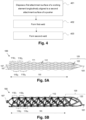
- Fig. 4 illustrates a method for associating (i.e. connecting/assembling) the working element 100 to the pusher 200 to enable the pusher 200 to maneuver the working element 100 (i.e. advance the working element 100 distally, withdraw the working element 100 proximally, and rotate the working element 100 about a longitudinal axis from a proximal end of the pusher 200).
- the first attachment surface 102 of the first connection portion 101 is disposed longitudinally aligned to the second attachment surface 202 of the second connection portion 201 to form an overlapping portion and to form first and second seams extending parallel to the longitudinal axis along first and second lateral extents of the overlapping portion.
- a first weld extending from the first seam towards the second seam is formed.
- a second weld extending from the second seam toward the first seam is formed.
- step 402 comprises forming or applying a plurality of welding points (for example between 2 and 12, particularly between 2 and 5) extending from the first seam toward the second seam.
- step 403 comprises forming or applying a plurality of welding points extending from the second seam toward the first seam.
- the plurality of welding points are aligned with each other.
- steps 402 and 403 also comprise forming a welding seam by consecutively forming or applying a plurality of welding points on top of the previously formed/applied welding points.
- step 402 further comprises forming a first welding point of the plurality of welding points at a distal portion of the first seam and forming each other welding point of the plurality of welding points at a more proximal location along the first seam than a prior formed welding point of the plurality of welding points
- step 403 further comprises forming a first welding point of the plurality of welding points at a distal portion of the second seam and forming each other welding point of the plurality of welding points at a more proximal location along the second seam than a prior formed welding point of the plurality of welding points.
- the energy device forming the weld is moved from the distal end of the first (and second) seam to the proximal end of said seam in order to avoid that the first connection portion 101, the second connection portion 102, or both, accumulate the heat which could provoke a breakage thereof.
- the method includes covering a portion of the pusher 200 proximal to the overlapping portion with a jacket 132 (or inner jacket); placing a radiopaque element 133 at a proximal end of the overlapping portion and extending the radiopaque element 133 around the pusher 200; and covering the radiopaque element 133 with a jacket 131 (or outer jacket) and extending the later at least part of the overlapping portion.
- the method before inserting the inner jacket 132, can further comprise assembling, or placing, the radiopaque element 133 onto a distal end of the pusher 200 and pushing the radiopaque element 133 towards a proximal end of the pusher 200.
- the method before inserting the outer jacket 131, can further comprise placing, or pushing back, the radiopaque element 133 to the distal end of the pusher 200 (or at the proximal end of the overlapping portion), without covering the overlapping portion.
- the method before inserting the outer jacket 131, can further comprise heat shrinking the inner jacket 132 onto the overlapping portion, and after the outer jacket 131 has been inserted, heat shrinking the outer jacket 131 onto the inner jacket 132 and the radiopaque coil 133.
- the heat shrinking can be made using a suitable shrinkable material, for example a thermoplastic material such as polytetrafluoroethylene (PTFE); fluorinated ethylene propylene (FEP); perfluoroalkoxy alkanes (PFA); ethylene tetrafluoroethylene (ETFE); polyethylene terephthalate (PET) resins, etc.
- PTFE polytetrafluoroethylene
- FEP fluorinated ethylene propylene
- PFA perfluoroalkoxy alkanes
- ETFE ethylene tetrafluoroethylene
- PET polyethylene terephthalate
- the working element 100 can be associated (i.e. connected/assembled) to the pusher 200 by other suitable attachment techniques, such as chemical or thermally bonding, friction or mechanically fitting, crimping, soldering, brazing, or even by using a connector material or member, or combinations thereof.
- the working element 100 can be associated to the pusher 200 by crimping a coated or plated band disposed around and crimped to the overlapping portion.
- the elongated device 1 can be made of Nitinol, cobalt-chromium alloys, iron alloys such as stainless steel or spring steel, etc.
- the working element 100 includes a working portion 103 comprising a plurality of crowns 110, ...110, of almond-shaped cells 111 defining a tubular-shaped section forming a cylindrically closed structure, as can be seen in the 3D representation illustrated in the embodiment of Fig. 5B , and a tapered portion 120 that extends proximally from a proximal end of the working portion 103.
- a "crown" is a closed ring extending circumferentially around the device with alternating longitudinally longer and longitudinally shorter sections.
- the working portion 103 in a compressed diameter can have a length between 10 mm and 60 mm, and the working portion 103 in an expanded diameter can have a length between 20 mm and 50 mm.
- a distal end of each cell 111 in a first crown 110 is contiguous with a proximal end of a corresponding cell 111 in a third crown 110 3
- a distal end of each cell 111 in a second crown 110 2 is contiguous with a proximal end of a corresponding cell 111 in a fourth crown 110 4
- the midportions of each cell 111 in each of the crowns each are also contiguous with a midportion of an adjacent cell 111 in such crown.
- the working element 100 illustrated in Figs. 5A-5B also include radiopaque markers 107.
- the radiopaque markers 107 can be incorporated at a distal end of the working portion 103 only (as in Figs. 5A and 5B ) or can be also incorporated at other sections of the working portion 103.
- the different radiopaque markers 107 have different lengths to avoid entanglement between them or other devices.
- the radiopaque markers 107 can be made of a Platinum Iridium alloy or of Tantalum.
- each one of cells 111 has struts 112.
- the tapered portion 120 also has at least some wide struts 122.
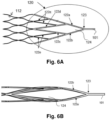
- the wide struts 122 of the tapered portion 120 have a width greater than a width of the working portion struts 112 (see Figs. 6A and 6B for an enlarged illustration thereof).
- first 122a and second 122b struts extending proximally from the proximal end of the working portion 103, converge at a distal end 123 of a proximal connection portion 101 of the working element 100.
- Third 122c and fourth 122d struts extend distally from first 122a and second 122b struts, respectively, and converge at the proximal end of the working portion 103.
- First 122a, second 122b, third 122c and fourth 122d struts together define a cell 124 in the tapered portion 120, and these struts 122a-122d are all thicker than the struts 112 in the working portion 103.
- first, second, third and fourth struts 122a-122d are thicker than other struts 122e in the tapered portion 120. These thicker struts 122a-122d help provide greater outward radial force to the working portion 103 from its compressed diameter to its expanded diameter, as discussed below.
- the wide tapered portion struts 122 have a thickness equal to the thickness of the working portion struts 112, which is predetermined by the thickness of the tube from which it is made.
- the working portion struts 112 can have a width between 30 ⁇ m and 60 ⁇ m, and at least some of the tapered portion struts 122 can have a width between 60 ⁇ m and 155 ⁇ m.
- the working portion 103 has a compressed diameter of less than 1.5 mm and an expanded diameter of approximately 3.5 mm. In some embodiments, the working portion 103 can exert an outward radial force between 0.75 N and 3 N at every diameter between and including the compressed diameter and the expanded diameter. In an embodiment, the outward radial force exerted by the working portion 103 in a compressed diameter of 1.5 mm is between 1.75 N and 3 N, particularly 2.1 N. In an embodiment, the outward radial force exerted by the working portion 103 in an expanded diameter of 3.5 mm is between 0.75 N and 1.5 N, particularly 1 N.
- FIGs. 7A-C therein different embodiments of the proposed working element 100 of the elongated device (or clot mobilizer device) 1 are illustrated. While the various embodiments all have longitudinally extending closed tubes with a tapered proximal end and an open distal end (as shown, e.g., in Fig. 7B), Fig. 7A shows opened and flattened particular embodiments to illustrate two-dimensionally the strut and cell patterns of those embodiments.
- the working element 100 includes a working portion 103 comprising a plurality of crowns 110 1 ...110 n of cells 111 defining a tubular-shaped section forming a cylindrically closed structure (as can be seen in the 3D representation illustrated in the embodiments of Figs. 7B and 7C ).
- the working portion 103 of the working element 100 comprises eight crowns of cells.
- the working portion 103 in other embodiments, can comprise seven crowns of cells (not shown) or nine crowns of cells (not shown).
- a "crown" is a closed ring extending circumferentially around the device with alternating longitudinally longer and longitudinally shorter sections.
- Each crown of cells in the working portion can comprise, for example, four or six cells, and each crown can have components that are shared with one or more adjacent crowns.
- the working portion 103 can have a length between 30 mm and 50 mm, for example approximately 40 mm.
- Each cell 111 n in the crowns of cells 110 n in the working portion 103 has an open area bordered by two proximal cell struts, two distal cell struts, and two middle cell struts 115 n .
- the distal cell struts of the first crown 110 are disposed in a distal cell strut ring 114 1 at equal distal cell strut positions along a longitudinal axis of the working element 100, and the proximal cell struts of the first crown 110, are disposed in a proximal cell strut ring 113 1 at equal positions along the longitudinal axis of the working element 100.
- the proximal cell struts each extends distally from a proximal end common to one adjacent proximal cell strut to a distal end common to another adjacent proximal cell strut, where it joins a proximal end of a respective one of the two middle cell struts 115 n .
- the distal cell struts each extends proximally from a distal end common to one adjacent distal cell strut to a proximal end common to another distal cell strut, where it joins a distal end of a respective one of the two middle cell struts 115 n .
- Each middle cell strut 115 in each crown borders two adjacent cells 111 in that crown.
- the distal strut ring 114 n of one crown of cells is the proximal strut ring 113 n+1 of the adjacent crown of cells
- the distal cell struts of distal strut ring 114 n are the proximal cell struts of proximal strut ring 113 n+1 .
- the longitudinal and circumferential arrangements of the crowns of cells 110 n in the working portion 103 of the working element 100 can affect the behavior of the device in its unexpanded and expanded configurations.
- providing a circumferential offset between adjacent crowns of cells can facilitate compression of the working element from the expanded configuration into an unexpanded configuration for delivery through a catheter.
- This circumferential offset of adjacent crowns of cells can also reduce buckling and kinking during advancement of the working element 100 (i.e., clot mobilizer) through the delivery catheter in its unexpanded delivery configuration.
- the common proximal ends of the distal cell strut ring 114 1 of a first crown 110, of cells 111 of the plurality of crowns of cells 110, ...110 n are offset from the common distal ends of the proximal cell strut ring 113 1 of the first crown 110, of cells 111 (i.e., the distal ends of the middle cell struts 115 1 ) in a first circumferential direction
- the common proximal ends of the distal cell strut ring 114 2 of a second crown 110 2 of cells 111 of the plurality of crowns of cells i.e., the proximal ends of the middle cell struts 115 2
- the common proximal ends of the distal cell strut ring 114 2 of a second crown 110 2 of cells 111 of the plurality of crowns of cells are offset from the common distal ends of the proximal cell strut ring 113 2 of the second crown 110 2 of cells 111 (i.
- each distal cell strut ring 114 n i.e., the distal ends of middle cell struts 115 n
- the common proximal ends of each distal cell strut ring 114 n are circumferentially offset from the common distal ends of the proximal cell strut ring 113 n (i.e., the proximal ends of middle cell struts 115 n ) in the same circumferential direction, such that the middle cell struts 115 between these common ends extend in a direction that is not parallel to the longitudinal axis of the working portion 103.
- the crowns are oriented one to each other in a helix pattern.
- each of the middle cell struts 115 is adapted and configured to be more flexible than the distal cell strut and proximal cell strut to which it extends.
- the working portion 103 and tapered portion 120 of the working element 100 are cut from a single tube and all elements have the same thickness (i.e., the tube thickness). As shown in the flattened view of Fig.
- the middle cell struts 115 bordering each cell 111 have a width less than a width of the distal cell struts bordering that cell 111 and less than a width of the proximal cell struts bordering that cell 111, thereby making the middle cell struts 115 more flexible than the proximal cell struts and the distal cell struts.
- the distal cell struts and proximal cell struts can have substantially the same width, e.g., in the range between 0.10 mm and 0.145 mm, particularly 0.10 mm, 0.12 or 0.125 mm, while the middle cell struts 115 can have a width in the range between 0.05 mm 0.13 mm, particularly 0.05, 0.08, 0.09 or 0.10.
- each middle cell strut 115 in the working portion 103 also has hinge portions 140 to provide additional flexibility to the middle cell strut.
- the hinge portions 140 are preformed curves or bends in the middle cell strut 115 disposed between the proximal and distal ends of the middle cell strut 115.
- the hinge portions 140 of this embodiment include two integral bends, one near the common distal end of the proximal cell struts from which the middle cell strut extends and other near the common proximal end of the distal cell struts to which the middle cell strut extends.
- the hinge portions 140 can include a third integral bend in the center of each middle cell strut, much greater than the other two bends.
- the hinge portions 140 in some middle struts 115 are two bends formed closer to the proximal end of the middle cell strut than to the distal end.
- each middle cell strut 115 in the working portion 101 can comprise fewer or more hinge portions 140.
- the hinge portion 140 can be integral with the middle cell strut, as shown e.g., in Figs. 7A , forming, e.g., a living hinge in which the hinge portion 140 and the other portions of the middle cell strut are parts of the same structure.
- each hinge portion 140 can have an integral section of increased curvature and/or bend.
- the bend forming the hinge provides added flexibility to the middle cell strut.
- the additional flexibility of the middle cell struts helps the working element adapt to the shape of the vascular anatomy, e.g., as it is advanced and withdrawn in its unexpanded delivery configuration.
- the hinges also help the elongated device 1 to adapt its shape to the vascular anatomy into which it is expanded to its expanded configuration to capture a clot.
- this feature helps avoid kinking and buckling during advancement by providing multiple bending points along the length of the elongated device 1 to distribute the advancement force when the device encounters resistance to forward movement.
- not all of the crowns of cells have hinge portions.
- one or more crowns of cells of the plurality of crown of cells in the working portion can lack flexible middle cell struts.
- the working portion 103 can also include at least one crown of intermediate cells, and each intermediate cell can comprise an open area bordered by two proximal cell struts intersecting with two distal cell struts, i.e., omitting the more flexible middle cell struts included in some of the other crowns of cells.
- the distal cell struts of each intermediate cell in the at least one crown of intermediate cells can comprise the proximal cell struts of cells in an adjacent crown of cells, and the proximal cell struts of each intermediate cell in the at least one crown of intermediate cells can comprise the distal cell struts of cells in an adjacent crown of cells. Therefore, the working portion comprises crowns with flexible middle cells and crowns without flexible middle cells.
- the working element 100 of Figs. 7A-C also includes a tapered portion 120 that extends proximally from a proximal end of the working portion 103 to a connection portion 101.
- the tapered portion 120 has a plurality of struts 122. At least some of the plurality of tapered portion struts 122 border a plurality of tapered portion cells 124.
- the struts 122 of the tapered portion 120 can have a width greater than a width of the working portion struts, e.g., the distal cell struts, the proximal cell struts and/or the middle cell struts 115, thereby making the tapered portion struts stiffer (i.e., less flexible) than the struts of the working portion.
- the taper of the tapered portion 120 is achieved by the size and number of cells 124 in the tapered portion 120 compared to the sizes and numbers of cells in the working portion 103, with only a single tapered portion cell 124 where struts 122 converge to a connection point 119 distal to a radiopaque marker 107 at a distal end of a proximal connection portion 101.
- the tapered portion 120 in the embodiment of Figs. 7A-C has four tapered portion struts 122, two of which extend proximally from the proximal end of the working portion 101 to meet at the connection point 119 distal to the radiopaque marker 107 and a proximally extending arm 126 of a connection portion 121 (arm 126 may connect to a pusher, as described with respect to Figs. 1-4 above).
- the other two struts 122 extend proximally from the proximal end of the working portion to intersect central portions of the first two struts 122. Together, the four struts define three tapered portion cells 124.
- the taper of the tapered portion 120 is achieved by the size and number of cells 124 in the tapered portion 120 compared to the sizes and numbers of cells in the working portion 103.
- the tapered portion struts help at least the proximal end of the working portion provide a radially outward force due to, e.g., the tapered portion strut angle and/or thickness and the shapes of the cells they define.
- the tapered portion struts also help with pushability by effectively transmitting a distally-directed advancement force to the working portion of the working element 100.
- the proximal connection portion 101 can comprise one or two proximally extending arms 126. Arms 126 may connect to a pusher, as described in other embodiments of the present invention.
- the working element 100 can comprise radiopaque markers 107 incorporated at a distal end of the working portion 103 only or can be also incorporated at other sections of the working portion 103.
- the different radiopaque markers 107 have different lengths to avoid entanglement between them or other devices.
- the radiopaque markers 107 can be made of a Platinum Iridium alloy or of Tantalum.
- the radiopaque markers 107 may be used under fluoroscopy to show the position and degree of expansion of working element 100.
- the working portion 103 has a compressed configuration with a first diameter of less than 1.5 mm and an expanded configuration with a second diameter of at least 3.0 mm.
- the working portion 103 can exert an outward radial force between 0.5 N and 3.0 N at every diameter between and including the first diameter and the second diameter.
- the outward radial force exerted by the working portion 103 in a first diameter of 1.5 mm is between 1.4 N and 3.0 N, more particularly 1.4 N, 1.5 N, 2 N or 2.5 N; and the outward radial force exerted by the working portion 103 in a second diameter of 3.5 mm is between 0.5 N and 1.5 N, more particularly 0.6 N, 1 N, 1.4 N or 1.5 N.
- the working portion 103 is configured to exert an outward radial force between 0.5 N and 3 N in a diameter between 1.5 mm and 3.5 mm. In other embodiments, the working portion 103 is configured to exert an outward radial force between 1.0 N and 2.0 N in a diameter between 2.0 mm and 3.0 mm. In a particular embodiment, the working portion 103 is configured to exert an outward radial force between 1 N and 2 N in a diameter around 2.0 mm. In another embodiment, the working portion 103 is configured to exert an outward radial force between 1 N and 2 N in a diameter around 3.0 mm.
- Example 1 Torque resistance test of the attachment (i.e., the connection) between the pusher 200 and the working element 100 of an elongated medical device 1 (in this particular case, a stent retriever).
- Table 2 shows the results for both, Conda and Solitaire devices: Table 2. Comparison torque results between Conda and Solitaire devices. No of revolutions before break Conda Solitaire Mean 31.2 22.0 Minimum 27.0 21.0 Maximum 34.0 23.0 Standard deviation 3.1 1.0
- the purpose of this experimental test was to measure the tensile of the connection between the pusher 200 and the working element 100 of an elongated medical device 1.
- Table 4 shows the results for both, Conda and Solitaire devices: Table 4. Comparison tensile results between Conda and Solitaire devices. Tensile strength (N) Conda Solitaire Mean 13.4 11.6 Minimum 11.2 9.8 Maximum 17.4 13.0 Standard deviation 1.9 1.1
Landscapes
- Health & Medical Sciences (AREA)
- Surgery (AREA)
- Life Sciences & Earth Sciences (AREA)
- Heart & Thoracic Surgery (AREA)
- Nuclear Medicine, Radiotherapy & Molecular Imaging (AREA)
- Vascular Medicine (AREA)
- Engineering & Computer Science (AREA)
- Biomedical Technology (AREA)
- Orthopedic Medicine & Surgery (AREA)
- Medical Informatics (AREA)
- Molecular Biology (AREA)
- Animal Behavior & Ethology (AREA)
- General Health & Medical Sciences (AREA)
- Public Health (AREA)
- Veterinary Medicine (AREA)
- Surgical Instruments (AREA)
Claims (15)
- Längliche Vorrichtung zur Wiederherstellung des Blutflusses oder zum Entfernen eines Thrombus, wobei die längliche Vorrichtung dazu angepasst ist, von einem proximalen Ende aus distal vorgeschoben und proximal zurückgezogen und vom proximalen Ende aus um eine Längsachse gedreht zu werden, wobei die längliche Vorrichtung Folgendes umfasst:ein Arbeitselement (100), umfassend einen ersten Verbindungsabschnitt (101), der sich proximal erstreckt, wobei der erste Verbindungsabschnitt (101) eine erste Befestigungsoberfläche (102) aufweist;einen Drücker (200), umfassend einen zweiten Verbindungsabschnitt (201), der sich distal erstreckt, wobei der zweite Verbindungsabschnitt (201) eine zweite Befestigungsoberfläche (202) aufweist, die der ersten Befestigungsoberfläche (102) zugewandt ist und sich in Längsrichtung darauf ausgerichtet erstreckt, um einen Überlappungsabschnitt zu definieren und eine erste und eine zweite Naht zu definieren, die sich in Längsrichtung entlang einer ersten und einer zweiten seitlichen Ausdehnung des Überlappungsabschnitts erstrecken;eine erste Schweißstelle, die den ersten und den zweiten Verbindungsabschnitt (101, 201) verbindet und sich von der ersten Naht in Richtung der zweiten Naht erstreckt; undeine zweite Schweißstelle, die den ersten und den zweiten Verbindungsabschnitt (101, 201) verbindet und sich von der zweiten Naht in Richtung der ersten Naht erstreckt.
- Vorrichtung nach Anspruch 1, wobei eine Querschnittsform des ersten Verbindungsabschnitts (101) senkrecht zur Längsachse ein Teil eines Rings ist und eine Querschnittsform des zweiten Verbindungsabschnitts (201) senkrecht zur Längsachse ein Kreis ist.
- Vorrichtung nach einem der Ansprüche 1-2, wobei die erste Schweißstelle eine Vielzahl von Schweißpunkten entlang der ersten Naht umfasst und die zweite Schweißstelle eine Vielzahl von Schweißpunkten entlang der zweiten Naht umfasst.
- Vorrichtung nach Anspruch 3, wobei die erste Schweißstelle ferner eine Vielzahl von aufeinanderfolgenden Schweißpunkten umfasst und die zweite Schweißstelle ferner eine Vielzahl von aufeinanderfolgenden Schweißpunkten umfasst.
- Vorrichtung nach einem der Ansprüche 1-4, ferner umfassend einen Innenmantel (132), der sich mindestens um einen Teil des Überlappungsabschnitts erstreckt, wobei sich der Innenmantel (132) proximal von dem Überlappungsabschnitt um mindestens einen Teil des Drückers (200) erstreckt.
- Vorrichtung nach einem der Ansprüche 1-5, ferner umfassend ein röntgendichtes Element (133), das an einem proximalen Ende des Überlappungsabschnitts angeordnet ist, wobei das röntgendichte Element (133) eine Spule umfasst, die sich um mindestens einen Teil des Drückers (200) erstreckt.
- Vorrichtung nach einem der Ansprüche 5-6, ferner umfassend einen Außenmantel (131), der sich um das röntgendichte Element (133) erstreckt, wobei sich der Außenmantel (131) um mindestens einen Teil des Überlappungsabschnitts erstreckt.
- Verfahren zum Verbinden eines Arbeitselements (100) einer länglichen Vorrichtung zur Wiederherstellung des Blutflusses oder zum Entfernen eines Thrombus mit einem Drücker (200), um es dem Drücker (200) zu ermöglichen, von einem proximalen Ende des Drückers (200) aus das Arbeitselement (100) distal vorzuschieben, das Arbeitselement (100) proximal zurückzuziehen und das Arbeitselement (100) um eine Längsachse zu drehen, wobei das Arbeitselement (100) einen ersten Verbindungsabschnitt (101) umfasst, der sich proximal erstreckt, wobei der erste Verbindungsabschnitt (101) eine erste Befestigungsoberfläche (102) aufweist, wobei der Drücker (200) einen zweiten Verbindungsabschnitt (201) umfasst, der sich distal erstreckt, wobei der zweite Verbindungsabschnitt (202) eine zweite Befestigungsoberfläche (202) aufweist, wobei das Verfahren folgende Schritte umfasst:Anordnen der ersten Befestigungsoberfläche (102) in Längsrichtung ausgerichtet zu der zweiten Befestigungsoberfläche (202), um einen Überlappungsabschnitt zu bilden und um eine erste und eine zweite Naht zu bilden, die sich parallel zu der Längsachse entlang einer ersten und einer zweiten seitlichen Ausdehnung des Überlappungsabschnitts erstrecken;Bilden einer ersten Schweißstelle, die sich von der ersten Naht in Richtung der zweiten Naht erstreckt; und Bilden einer zweiten Schweißstelle, die sich von der zweiten Naht in Richtung der ersten Naht erstreckt.
- Verfahren nach Anspruch 8, wobei eine Querschnittsform des ersten Verbindungsabschnitts (101) senkrecht zur Längsachse ein Teil eines Rings ist und eine Querschnittsform des zweiten Verbindungsabschnitts (201) senkrecht zur Längsachse ein Kreis ist.
- Verfahren nach einem der Ansprüche 8-9, wobei der Schritt des Bildens der ersten Schweißstelle das Bilden einer Vielzahl von Schweißpunkten umfasst, die sich von der ersten Naht in Richtung der zweiten Naht erstrecken, und der Schritt des Bildens der zweiten Schweißstelle das Bilden einer Vielzahl von Schweißpunkten umfasst, die sich von der zweiten Naht in Richtung der ersten Naht erstrecken.
- Verfahren nach Anspruch 10, wobei der Schritt des Bildens der ersten Schweißstelle ferner das aufeinanderfolgende Bilden einer Vielzahl von Schweißpunkten umfasst, die sich von der ersten Naht in Richtung der zweiten Naht erstrecken, und der Schritt des Bildens der zweiten Schweißstelle ferner das aufeinanderfolgende Bilden einer Vielzahl von Schweißpunkten umfasst, die sich von der zweiten Naht in Richtung der ersten Naht erstrecken.
- Verfahren nach einem der Ansprüche 8-11, wobei der Schritt des Bildens der ersten Schweißstelle ferner das Bilden eines ersten Schweißpunktes der Vielzahl von Schweißpunkten an einem distalen Abschnitt der ersten Naht und das Bilden jedes anderen Schweißpunktes der Vielzahl von Schweißpunkten an einer proximaleren Stelle entlang der ersten Naht als ein zuvor gebildeter Schweißpunkt der Vielzahl von Schweißpunkten umfasst, und wobei der Schritt des Bildens der zweiten Schweißstelle ferner das Bilden eines ersten Schweißpunktes der Vielzahl von Schweißpunkten an einem distalen Abschnitt der zweiten Naht und das Bilden jedes anderen Schweißpunktes der Vielzahl von Schweißpunkten an einer proximaleren Stelle entlang der zweiten Naht als ein zuvor gebildeter Schweißpunkt der Vielzahl von Schweißpunkten umfasst.
- Verfahren nach einem der Ansprüche 8-12, wobei:der Schritt des Bildens einer ersten Schweißstelle das Bilden eines ersten Schweißpunktes an einem proximalen Ende der ersten Naht und eines zweiten Schweißpunktes zwischen dem proximalen Ende und dem distalen Ende der ersten Naht umfasst, bevor ein Schweißpunkt an beliebigen anderen Punkten entlang der ersten Naht gebildet wird; undder Schritt des Bildens der zweiten Schweißstelle das Bilden eines ersten Schweißpunktes an einem proximalen Ende der zweiten Naht und eines zweiten Schweißpunktes zwischen dem proximalen Ende und dem distalen Ende der zweiten Naht umfasst, bevor ein Schweißpunkt an beliebigen anderen Punkten entlang der zweiten Naht gebildet wird.
- Verfahren nach einem der Ansprüche 8-13, wobei der Schritt des Bildens der ersten Schweißstelle das Richten von Energie seitlich an der ersten Naht in Richtung der zweiten Naht umfasst und der Schritt des Bildens der zweiten Schweißstelle das Richten von Energie seitlich an der zweiten Naht in Richtung der ersten Naht umfasst.
- Verfahren nach einem der Ansprüche 8-14, ferner Folgendes umfassend:Abdecken mindestens eines Teils des Überlappungsabschnitts mit einem Innenmantel (132), wobei sich der Innenmantel (132) proximal von dem Überlappungsabschnitt um mindestens einen Teil des Drückers (200) erstreckt;Platzieren eines röntgendichten Elements (133) an einem proximalen Ende des Überlappungsabschnitts, wobei das röntgendichte Element (133) eine Spule umfasst, die sich mindestens um einen Teil des Drückers (200) erstreckt; undAbdecken des röntgendichten Elements (133) mit einem Außenmantel (131), wobei sich der Außenmantel (131) mindestens um einen Teil des Überlappungsabschnitts erstreckt.
Applications Claiming Priority (4)
| Application Number | Priority Date | Filing Date | Title |
|---|---|---|---|
| EP20382718 | 2020-08-03 | ||
| EP20382719 | 2020-08-03 | ||
| EP21382165 | 2021-02-26 | ||
| PCT/EP2021/069623 WO2022028833A1 (en) | 2020-08-03 | 2021-07-14 | An elongated device with an improved attachment of its elements |
Publications (2)
| Publication Number | Publication Date |
|---|---|
| EP4188246A1 EP4188246A1 (de) | 2023-06-07 |
| EP4188246B1 true EP4188246B1 (de) | 2024-09-25 |
Family
ID=86184872
Family Applications (1)
| Application Number | Title | Priority Date | Filing Date |
|---|---|---|---|
| EP21742420.9A Active EP4188246B1 (de) | 2020-08-03 | 2021-07-14 | Eine längliche vorrichtung mit einer verbesserten befestigung ihrer elemente zur mobilisierung von blutgerinnseln zur extraktion eines verschlusses aus einem blutgefäss |
Country Status (5)
| Country | Link |
|---|---|
| US (1) | US20230270461A1 (de) |
| EP (1) | EP4188246B1 (de) |
| JP (1) | JP2023541786A (de) |
| CN (1) | CN116348048A (de) |
| ES (1) | ES2998550T3 (de) |
Families Citing this family (2)
| Publication number | Priority date | Publication date | Assignee | Title |
|---|---|---|---|---|
| US11771446B2 (en) | 2020-10-19 | 2023-10-03 | Anaconda Biomed, S.L. | Thrombectomy system and method of use |
| US12569264B2 (en) | 2018-10-16 | 2026-03-10 | Anaconda Biomed, S.L. | Device and a thrombectomy apparatus for extraction of thrombus from a blood vessel |
Family Cites Families (7)
| Publication number | Priority date | Publication date | Assignee | Title |
|---|---|---|---|---|
| US4574176A (en) * | 1983-11-28 | 1986-03-04 | Sws Incorporated | Method and apparatus for pulsed high energy density welding |
| US4794231A (en) * | 1987-12-24 | 1988-12-27 | United Technologies Corporation | Method of and arrangement for laser welding |
| US6402771B1 (en) * | 1999-12-23 | 2002-06-11 | Guidant Endovascular Solutions | Snare |
| US7740644B2 (en) * | 2003-02-24 | 2010-06-22 | Boston Scientific Scimed, Inc. | Embolic protection filtering device that can be adapted to be advanced over a guidewire |
| ES3029850T3 (en) * | 2011-03-09 | 2025-06-25 | Neuravi Ltd | A clot retrieval device for removing occlusive clot from a blood vessel |
| SI2967610T1 (sl) * | 2013-03-14 | 2019-07-31 | Neuravi Limited | Naprava za odkrivanje strdka za odstranjevanje okluzivnega strdka in krvne žile |
| US11439418B2 (en) * | 2020-06-23 | 2022-09-13 | Neuravi Limited | Clot retrieval device for removing clot from a blood vessel |
-
2021
- 2021-07-14 CN CN202180068046.5A patent/CN116348048A/zh active Pending
- 2021-07-14 ES ES21742420T patent/ES2998550T3/es active Active
- 2021-07-14 JP JP2023507522A patent/JP2023541786A/ja active Pending
- 2021-07-14 EP EP21742420.9A patent/EP4188246B1/de active Active
- 2021-07-14 US US18/040,495 patent/US20230270461A1/en active Pending
Also Published As
| Publication number | Publication date |
|---|---|
| ES2998550T3 (en) | 2025-02-20 |
| EP4188246A1 (de) | 2023-06-07 |
| JP2023541786A (ja) | 2023-10-04 |
| CN116348048A (zh) | 2023-06-27 |
| US20230270461A1 (en) | 2023-08-31 |
Similar Documents
| Publication | Publication Date | Title |
|---|---|---|
| US12127960B2 (en) | Expandable sheath | |
| US10687967B2 (en) | Stretchable stent and delivery system | |
| US11992220B2 (en) | Occlusive medical device with fixation members | |
| AU2013296736B2 (en) | Guide extension catheters and methods for manufacturing the same | |
| CA2515019A1 (en) | Stent graft assembly with attached security rings and method of use | |
| JP2006513774A (ja) | 多重編組型外装チューブ | |
| EP4188246B1 (de) | Eine längliche vorrichtung mit einer verbesserten befestigung ihrer elemente zur mobilisierung von blutgerinnseln zur extraktion eines verschlusses aus einem blutgefäss | |
| US9119626B2 (en) | Method for assembling introducer sheath with an embolic coil device | |
| EP4452099B1 (de) | Intravaskuläre vorrichtung mit verbesserter befestigung ihrer elemente und verfahren zur herstellung davon | |
| JP2024503077A (ja) | 可撓性かつ耐伸張性の長尺シャフト | |
| WO2022028833A1 (en) | An elongated device with an improved attachment of its elements | |
| WO2019143717A1 (en) | Stents with increased flexibility | |
| EP3998987B1 (de) | Stents mit erhöhter flexibilität | |
| US20250134539A1 (en) | An intravascular device with an improved attachment of its elements and a method of manufacturing thereof | |
| US10213290B2 (en) | Braided stent and method of manufacturing a braided stent | |
| JP5761494B2 (ja) | カテーテルおよびその製造方法 | |
| US20250099121A1 (en) | Thrombectomy apparatus | |
| US20240138863A1 (en) | Mechanical thrombectomy systems | |
| US20250099126A1 (en) | Thrombectomy apparatus | |
| WO2025142417A1 (ja) | ステント、ステントの撮像方法 | |
| WO2025211070A1 (ja) | 医療用シャフトおよび医療デバイス |
Legal Events
| Date | Code | Title | Description |
|---|---|---|---|
| STAA | Information on the status of an ep patent application or granted ep patent |
Free format text: STATUS: UNKNOWN |
|
| STAA | Information on the status of an ep patent application or granted ep patent |
Free format text: STATUS: THE INTERNATIONAL PUBLICATION HAS BEEN MADE |
|
| PUAI | Public reference made under article 153(3) epc to a published international application that has entered the european phase |
Free format text: ORIGINAL CODE: 0009012 |
|
| STAA | Information on the status of an ep patent application or granted ep patent |
Free format text: STATUS: REQUEST FOR EXAMINATION WAS MADE |
|
| 17P | Request for examination filed |
Effective date: 20230227 |
|
| AK | Designated contracting states |
Kind code of ref document: A1 Designated state(s): AL AT BE BG CH CY CZ DE DK EE ES FI FR GB GR HR HU IE IS IT LI LT LU LV MC MK MT NL NO PL PT RO RS SE SI SK SM TR |
|
| DAV | Request for validation of the european patent (deleted) | ||
| DAX | Request for extension of the european patent (deleted) | ||
| GRAP | Despatch of communication of intention to grant a patent |
Free format text: ORIGINAL CODE: EPIDOSNIGR1 |
|
| STAA | Information on the status of an ep patent application or granted ep patent |
Free format text: STATUS: GRANT OF PATENT IS INTENDED |
|
| RIC1 | Information provided on ipc code assigned before grant |
Ipc: A61B 17/221 20060101AFI20240430BHEP |
|
| INTG | Intention to grant announced |
Effective date: 20240521 |
|
| GRAS | Grant fee paid |
Free format text: ORIGINAL CODE: EPIDOSNIGR3 |
|
| GRAA | (expected) grant |
Free format text: ORIGINAL CODE: 0009210 |
|
| STAA | Information on the status of an ep patent application or granted ep patent |
Free format text: STATUS: THE PATENT HAS BEEN GRANTED |
|
| AK | Designated contracting states |
Kind code of ref document: B1 Designated state(s): AL AT BE BG CH CY CZ DE DK EE ES FI FR GB GR HR HU IE IS IT LI LT LU LV MC MK MT NL NO PL PT RO RS SE SI SK SM TR |
|
| REG | Reference to a national code |
Ref country code: GB Ref legal event code: FG4D |
|
| REG | Reference to a national code |
Ref country code: CH Ref legal event code: EP |
|
| REG | Reference to a national code |
Ref country code: DE Ref legal event code: R096 Ref document number: 602021019344 Country of ref document: DE |
|
| REG | Reference to a national code |
Ref country code: IE Ref legal event code: FG4D |
|
| REG | Reference to a national code |
Ref country code: LT Ref legal event code: MG9D |
|
| PG25 | Lapsed in a contracting state [announced via postgrant information from national office to epo] |
Ref country code: NO Free format text: LAPSE BECAUSE OF FAILURE TO SUBMIT A TRANSLATION OF THE DESCRIPTION OR TO PAY THE FEE WITHIN THE PRESCRIBED TIME-LIMIT Effective date: 20241225 |
|
| PG25 | Lapsed in a contracting state [announced via postgrant information from national office to epo] |
Ref country code: GR Free format text: LAPSE BECAUSE OF FAILURE TO SUBMIT A TRANSLATION OF THE DESCRIPTION OR TO PAY THE FEE WITHIN THE PRESCRIBED TIME-LIMIT Effective date: 20241226 Ref country code: FI Free format text: LAPSE BECAUSE OF FAILURE TO SUBMIT A TRANSLATION OF THE DESCRIPTION OR TO PAY THE FEE WITHIN THE PRESCRIBED TIME-LIMIT Effective date: 20240925 |
|
| PG25 | Lapsed in a contracting state [announced via postgrant information from national office to epo] |
Ref country code: BG Free format text: LAPSE BECAUSE OF FAILURE TO SUBMIT A TRANSLATION OF THE DESCRIPTION OR TO PAY THE FEE WITHIN THE PRESCRIBED TIME-LIMIT Effective date: 20240925 |
|
| PG25 | Lapsed in a contracting state [announced via postgrant information from national office to epo] |
Ref country code: LV Free format text: LAPSE BECAUSE OF FAILURE TO SUBMIT A TRANSLATION OF THE DESCRIPTION OR TO PAY THE FEE WITHIN THE PRESCRIBED TIME-LIMIT Effective date: 20240925 |
|
| PG25 | Lapsed in a contracting state [announced via postgrant information from national office to epo] |
Ref country code: RS Free format text: LAPSE BECAUSE OF FAILURE TO SUBMIT A TRANSLATION OF THE DESCRIPTION OR TO PAY THE FEE WITHIN THE PRESCRIBED TIME-LIMIT Effective date: 20241225 |
|
| REG | Reference to a national code |
Ref country code: NL Ref legal event code: MP Effective date: 20240925 |
|
| PG25 | Lapsed in a contracting state [announced via postgrant information from national office to epo] |
Ref country code: RS Free format text: LAPSE BECAUSE OF FAILURE TO SUBMIT A TRANSLATION OF THE DESCRIPTION OR TO PAY THE FEE WITHIN THE PRESCRIBED TIME-LIMIT Effective date: 20241225 Ref country code: NO Free format text: LAPSE BECAUSE OF FAILURE TO SUBMIT A TRANSLATION OF THE DESCRIPTION OR TO PAY THE FEE WITHIN THE PRESCRIBED TIME-LIMIT Effective date: 20241225 Ref country code: LV Free format text: LAPSE BECAUSE OF FAILURE TO SUBMIT A TRANSLATION OF THE DESCRIPTION OR TO PAY THE FEE WITHIN THE PRESCRIBED TIME-LIMIT Effective date: 20240925 Ref country code: GR Free format text: LAPSE BECAUSE OF FAILURE TO SUBMIT A TRANSLATION OF THE DESCRIPTION OR TO PAY THE FEE WITHIN THE PRESCRIBED TIME-LIMIT Effective date: 20241226 Ref country code: FI Free format text: LAPSE BECAUSE OF FAILURE TO SUBMIT A TRANSLATION OF THE DESCRIPTION OR TO PAY THE FEE WITHIN THE PRESCRIBED TIME-LIMIT Effective date: 20240925 Ref country code: BG Free format text: LAPSE BECAUSE OF FAILURE TO SUBMIT A TRANSLATION OF THE DESCRIPTION OR TO PAY THE FEE WITHIN THE PRESCRIBED TIME-LIMIT Effective date: 20240925 |
|
| REG | Reference to a national code |
Ref country code: AT Ref legal event code: MK05 Ref document number: 1726007 Country of ref document: AT Kind code of ref document: T Effective date: 20240925 |
|
| PG25 | Lapsed in a contracting state [announced via postgrant information from national office to epo] |
Ref country code: NL Free format text: LAPSE BECAUSE OF FAILURE TO SUBMIT A TRANSLATION OF THE DESCRIPTION OR TO PAY THE FEE WITHIN THE PRESCRIBED TIME-LIMIT Effective date: 20240925 |
|
| REG | Reference to a national code |
Ref country code: ES Ref legal event code: FG2A Ref document number: 2998550 Country of ref document: ES Kind code of ref document: T3 Effective date: 20250220 |
|
| PG25 | Lapsed in a contracting state [announced via postgrant information from national office to epo] |
Ref country code: IS Free format text: LAPSE BECAUSE OF FAILURE TO SUBMIT A TRANSLATION OF THE DESCRIPTION OR TO PAY THE FEE WITHIN THE PRESCRIBED TIME-LIMIT Effective date: 20250125 Ref country code: PT Free format text: LAPSE BECAUSE OF FAILURE TO SUBMIT A TRANSLATION OF THE DESCRIPTION OR TO PAY THE FEE WITHIN THE PRESCRIBED TIME-LIMIT Effective date: 20250127 |
|
| PG25 | Lapsed in a contracting state [announced via postgrant information from national office to epo] |
Ref country code: RO Free format text: LAPSE BECAUSE OF FAILURE TO SUBMIT A TRANSLATION OF THE DESCRIPTION OR TO PAY THE FEE WITHIN THE PRESCRIBED TIME-LIMIT Effective date: 20240925 Ref country code: SM Free format text: LAPSE BECAUSE OF FAILURE TO SUBMIT A TRANSLATION OF THE DESCRIPTION OR TO PAY THE FEE WITHIN THE PRESCRIBED TIME-LIMIT Effective date: 20240925 |
|
| PG25 | Lapsed in a contracting state [announced via postgrant information from national office to epo] |
Ref country code: AT Free format text: LAPSE BECAUSE OF FAILURE TO SUBMIT A TRANSLATION OF THE DESCRIPTION OR TO PAY THE FEE WITHIN THE PRESCRIBED TIME-LIMIT Effective date: 20240925 Ref country code: EE Free format text: LAPSE BECAUSE OF FAILURE TO SUBMIT A TRANSLATION OF THE DESCRIPTION OR TO PAY THE FEE WITHIN THE PRESCRIBED TIME-LIMIT Effective date: 20240925 |
|
| PG25 | Lapsed in a contracting state [announced via postgrant information from national office to epo] |
Ref country code: PL Free format text: LAPSE BECAUSE OF FAILURE TO SUBMIT A TRANSLATION OF THE DESCRIPTION OR TO PAY THE FEE WITHIN THE PRESCRIBED TIME-LIMIT Effective date: 20240925 Ref country code: CZ Free format text: LAPSE BECAUSE OF FAILURE TO SUBMIT A TRANSLATION OF THE DESCRIPTION OR TO PAY THE FEE WITHIN THE PRESCRIBED TIME-LIMIT Effective date: 20240925 |
|
| PG25 | Lapsed in a contracting state [announced via postgrant information from national office to epo] |
Ref country code: SK Free format text: LAPSE BECAUSE OF FAILURE TO SUBMIT A TRANSLATION OF THE DESCRIPTION OR TO PAY THE FEE WITHIN THE PRESCRIBED TIME-LIMIT Effective date: 20240925 Ref country code: IT Free format text: LAPSE BECAUSE OF FAILURE TO SUBMIT A TRANSLATION OF THE DESCRIPTION OR TO PAY THE FEE WITHIN THE PRESCRIBED TIME-LIMIT Effective date: 20240925 |
|
| REG | Reference to a national code |
Ref country code: DE Ref legal event code: R097 Ref document number: 602021019344 Country of ref document: DE |
|
| PG25 | Lapsed in a contracting state [announced via postgrant information from national office to epo] |
Ref country code: DK Free format text: LAPSE BECAUSE OF FAILURE TO SUBMIT A TRANSLATION OF THE DESCRIPTION OR TO PAY THE FEE WITHIN THE PRESCRIBED TIME-LIMIT Effective date: 20240925 |
|
| PLBE | No opposition filed within time limit |
Free format text: ORIGINAL CODE: 0009261 |
|
| STAA | Information on the status of an ep patent application or granted ep patent |
Free format text: STATUS: NO OPPOSITION FILED WITHIN TIME LIMIT |
|
| 26N | No opposition filed |
Effective date: 20250626 |
|
| PG25 | Lapsed in a contracting state [announced via postgrant information from national office to epo] |
Ref country code: SE Free format text: LAPSE BECAUSE OF FAILURE TO SUBMIT A TRANSLATION OF THE DESCRIPTION OR TO PAY THE FEE WITHIN THE PRESCRIBED TIME-LIMIT Effective date: 20240925 |
|
| PGFP | Annual fee paid to national office [announced via postgrant information from national office to epo] |
Ref country code: ES Payment date: 20250801 Year of fee payment: 5 |
|
| PGFP | Annual fee paid to national office [announced via postgrant information from national office to epo] |
Ref country code: DE Payment date: 20250729 Year of fee payment: 5 |
|
| PGFP | Annual fee paid to national office [announced via postgrant information from national office to epo] |
Ref country code: GB Payment date: 20250728 Year of fee payment: 5 |
|
| PGFP | Annual fee paid to national office [announced via postgrant information from national office to epo] |
Ref country code: FR Payment date: 20250725 Year of fee payment: 5 |
|
| PG25 | Lapsed in a contracting state [announced via postgrant information from national office to epo] |
Ref country code: HR Free format text: LAPSE BECAUSE OF FAILURE TO SUBMIT A TRANSLATION OF THE DESCRIPTION OR TO PAY THE FEE WITHIN THE PRESCRIBED TIME-LIMIT Effective date: 20240925 |
|
| REG | Reference to a national code |
Ref country code: CH Ref legal event code: H13 Free format text: ST27 STATUS EVENT CODE: U-0-0-H10-H13 (AS PROVIDED BY THE NATIONAL OFFICE) Effective date: 20260224 |
|
| PG25 | Lapsed in a contracting state [announced via postgrant information from national office to epo] |
Ref country code: LU Free format text: LAPSE BECAUSE OF NON-PAYMENT OF DUE FEES Effective date: 20250714 |
|
| REG | Reference to a national code |
Ref country code: BE Ref legal event code: MM Effective date: 20250731 |
|
| PG25 | Lapsed in a contracting state [announced via postgrant information from national office to epo] |
Ref country code: BE Free format text: LAPSE BECAUSE OF NON-PAYMENT OF DUE FEES Effective date: 20250731 |