EP4182159B1 - Vorrichtung und verfahren zum trennen von miteinander vermischten stoffen unterschiedlicher fliessfähigkeit - Google Patents
Vorrichtung und verfahren zum trennen von miteinander vermischten stoffen unterschiedlicher fliessfähigkeit Download PDFInfo
- Publication number
- EP4182159B1 EP4182159B1 EP21745954.4A EP21745954A EP4182159B1 EP 4182159 B1 EP4182159 B1 EP 4182159B1 EP 21745954 A EP21745954 A EP 21745954A EP 4182159 B1 EP4182159 B1 EP 4182159B1
- Authority
- EP
- European Patent Office
- Prior art keywords
- hollow drum
- cooling medium
- hollow
- nozzle
- product
- Prior art date
- Legal status (The legal status is an assumption and is not a legal conclusion. Google has not performed a legal analysis and makes no representation as to the accuracy of the status listed.)
- Active
Links
Images
Classifications
-
- B—PERFORMING OPERATIONS; TRANSPORTING
- B30—PRESSES
- B30B—PRESSES IN GENERAL
- B30B15/00—Details of, or accessories for, presses; Auxiliary measures in connection with pressing
- B30B15/34—Heating or cooling presses or parts thereof
-
- A—HUMAN NECESSITIES
- A22—BUTCHERING; MEAT TREATMENT; PROCESSING POULTRY OR FISH
- A22C—PROCESSING MEAT, POULTRY, OR FISH
- A22C17/00—Other devices for processing meat or bones
- A22C17/04—Bone cleaning devices
-
- B—PERFORMING OPERATIONS; TRANSPORTING
- B30—PRESSES
- B30B—PRESSES IN GENERAL
- B30B9/00—Presses specially adapted for particular purposes
- B30B9/02—Presses specially adapted for particular purposes for squeezing-out liquid from liquid-containing material, e.g. juice from fruits, oil from oil-containing material
- B30B9/24—Presses specially adapted for particular purposes for squeezing-out liquid from liquid-containing material, e.g. juice from fruits, oil from oil-containing material using an endless pressing band
- B30B9/241—Presses specially adapted for particular purposes for squeezing-out liquid from liquid-containing material, e.g. juice from fruits, oil from oil-containing material using an endless pressing band co-operating with a drum or roller
Definitions
- the invention relates to a device designed and equipped for separating mixed materials of different flowability, comprising a frame, a hollow drum which is driven in rotation and mounted on the frame and has a perforated outer surface and at least one at least partially open end face, an endless press belt which can be pressed from the outside onto the outer surface by wrapping around part of the circumference of the hollow drum and which is driven in rotation, a product intake wedge formed by the press belt and hollow drum for guiding a product flow consisting of pressed material between the hollow drum and the press belt in an inlet region of the product flow into the device, a support device for the press belt with at least one support element which is arranged on the side of the press belt opposite the hollow drum, and a device for removing separated material pressed through the perforated outer surface into the hollow space of the hollow drum from the at least partially open end face of the hollow drum.
- the invention further relates to a method for separating mixed materials of different flowability, comprising the steps of: feeding a product stream consisting of pressed material into a product intake wedge, which is formed by a hollow drum with a perforated outer surface and a press belt, which rests on the hollow drum from the outside and wraps around part of the circumference, rotating the hollow drum and/or the press belt to draw the product stream between the hollow drum and the press belt, wherein the more easily flowing components of the product stream are pressed by means of the press belt as separating material through the perforation of the outer surface of the hollow drum into the hollow space of the hollow drum and are discharged from an at least partially open front side of the Hollow drum, while the heavier flowing components of the product stream remain on the outside surface of the hollow drum and are discharged separately.
- Substances, materials or products that differ from one another or whose composition differs from one another due to their different flow properties can be separated within the meaning of the invention.
- the possibility and/or necessity of separating mixed substances with different flow properties exists in particular in the production of foodstuffs of animal origin (such as separating the meat from the skin, tendons, bones or fish bones, etc.), from fruit and vegetables (such as separating the pulp from the peel, stalks, seeds or stones, etc.), in the processing of incorrectly packaged foodstuffs (such as separating butter or cheese from the packaging material) or the like.
- Specific application examples include pitting dates or unpacking cheese slices wrapped in foil.
- a product flow is conveyed from a product feed area with a product intake wedge between the pressing element, e.g. the pressing belt, and the hollow drum to a product output area.
- the product intake wedge is formed by the arrangement of the pressing belt to the hollow drum and leads to an (inlet) angle in the inlet area of the product flow into the device. Due to the rotating drive of the hollow drum and/or the rotating drive of the pressing belt, the product flow in the inlet area is drawn in between the hollow drum and the pressing belt in the conveying direction F, so that a distance/gap (filled with product flow) is created between the pressing belt and the hollow drum.
- the wrap between the pressing belt and the hollow drum creates a pressing area through which the product flow is conveyed.
- the materials with different flow properties are separated by pressing the more easily flowing materials, for example meat when processing products of animal origin, at least partially as a material to be separated, which in the case of products of animal origin consists of small threads of meat or small strands of meat, into the hollow drum and then removing them from there.
- the removal takes place via an at least partially open front side of the hollow drum, e.g. on the front side of the device, whereby the front side can also be defined as the back side. can.
- the more difficult-flowing substances again using the example of products of animal origin, such as bones, tendons, skin, etc., are collected in the conveying direction F of the product flow behind the hollow drum in the product output area and discharged.
- the portion of the product flow pressed into the interior of the hollow drum, i.e. into the hollow space, through the perforated outer surface M is discharged and sent for further processing.
- the residual flow of the product flow not pressed into the interior of the hollow drum through the perforated outer surface M usually adheres at least partially to the outside of the outer surface of the hollow drum. This residual flow adhering to the outside of the hollow drum can be removed, for example, using a stripping agent.
- the product flow is pressed from the outside against the perforated outer surface of the hollow drum by means of the press belt or any other pressing element. Under this pressure, the more easily flowing components of the product flow are pressed through the perforation of the outer surface into the inner cavity of the rotating hollow drum as material to be separated, while the more difficult-flowing components of the product flow remain on the outer surface of the hollow drum and are possibly discharged in the outlet area in the conveying direction F behind the hollow drum.
- considerable pressure and high friction occur, which heats up the product flow and in particular the material to be separated pressed or squeezed through the perforation.
- US 4 156 384 A shows a device according to the preamble of claim 1 and a method according to the preamble of claim 12.
- the invention is therefore based on the object of proposing a simple and reliable device for separating substances with different flow properties in a way that is gentle on the product.
- the object is also to propose a corresponding method.
- a device of the type mentioned at the outset in that the hollow drum is assigned a cooling device which is designed and set up to cool the material to be separated during processing using a cryogenic cooling medium, the cooling device being arranged in the hollow space of the hollow drum and comprising at least one nozzle which is connected to a reservoir of cooling medium via a supply line.
- processing in the context of the invention means that the material to be separated is cooled while still in the hollow drum, specifically when and directly when it swells out of the openings in the perforated outer surface of the hollow drum as a meat thread or meat strand.
- a continuous cooling chain can also be achieved during the separation process. At least a shortening of the interruption of the cooling chain for the separated goods is ensured by the cryogenic cooling medium acting directly on them during pressing, namely immediately when the separated goods arrive in the cavity.
- Cryogenic cooling media and in particular liquid cryogens enable efficient and rapid cooling of the separated goods when they hit their surface.
- Cryogenic gases can of course also be used, which liquefy under normal pressure at a critical temperature below room temperature. Since the separated goods with their narrow flesh threads or strands have a very large surface area, the cooling effect is correspondingly high, and particularly when exposed to liquid, cryogenic cooling medium. This enables a particularly gentle separation process for the product.
- the cooling of the material to be separated within the device compensates for or even overcompensates for heating due to mechanical stress, and a previously unattainable level of process control and product quality of the material to be separated is made available.
- the liquid cryogenic cooling medium can be easily and evenly distributed over the material to be separated.
- the number of nozzles can vary, as can their positioning in the cavity.
- the nozzles are preferably arranged on a support arm or the like, which projects through the at least partially open front side of the hollow drum, so that the rotation of the hollow drum is not impaired.
- the or each nozzle is connected to the reservoir via a flexible or rigid feed line.
- the or each nozzle can also be held in the cavity via a feed line that is then essentially rigid.
- Suitable containers for storing the liquid cryogens such as nitrogen, helium, argon, carbon dioxide or the like, can serve as a reservoir, and these containers feed the nozzles with the cooling medium via suitable feed lines.
- the or each nozzle is directed at least at the area of the inner surface of the hollow drum that is approximately opposite the area of the product intake wedge and/or the adjoining pressing area. This ensures significant cooling of the material to be separated directly at the processing location. Immediately upon formation or during formation of the thread-like/strand-like material to be separated, it is cooled in the interior of the hollow drum and can then be discharged in a cooled state.
- a preferred development is characterized in that the or each nozzle is designed as a flat jet nozzle which has a nozzle opening for forming a spray fan, such that the cooling medium emerging from the nozzle ensures a linear impact on the material to be separated pressed through the outer surface, extending over the entire width of the hollow drum.
- the or each flat jet nozzle ensures optimal introduction of the cooling medium.
- the line can also be made wider, so that a flat (rectangular) impact is possible.
- the free end of the spray fan has a width which corresponds at least to the width or depth of the inner surface of the hollow drum, so that every opening of the perforated outer surface is covered on the inside by the spray fan over the width/depth.
- the or each nozzle is assigned a cover which at least partially covers the or each nozzle.
- the preferably roof-shaped cover protects the nozzle or the nozzle opening from contamination by material to be separated falling from the inner surface of the hollow drum and also ensures that the spray fan has free access to the material to be separated.
- other designs for partially shielding the nozzle can also be used.
- the cooling device is associated with a device for collecting and removing the cooling medium fed into the hollow space of the hollow drum.
- the cryogenic cooling medium that hits the material to be separated in the liquid phase evaporates at least partially after impact or is converted into the gaseous phase.
- the heated or heating cooling medium is sucked off and removed accordingly in gaseous form, as an aerosol, mist, steam, smoke or even in liquid droplet form, in order to protect the environment and the operator.
- the device for collecting the cooling medium comprises at least one cover and an exhaust fan connected to the cover via exhaust air lines.
- the "used" cooling medium can be collected and discharged, for example, via an exhaust air line or an exhaust fan or the like.
- other extraction systems inside or outside the hollow drum can also be used.
- the or each supply line for supplying the cryogenic cooling medium to the or each nozzle comprises a measuring and/or control section.
- the measuring and/or control section can be formed within the supply line or replace it at least in sections.
- the measuring and/or control section can be used to monitor and control the inflow quantity, temperature, inflow speed, etc. of the cooling medium in order to achieve an optimal cooling effect.
- a desired temperature can be set for optimal process control and product quality.
- leaks in the supply line can also be monitored and evaluated for control purposes.
- Nitrogen is a readily available medium and has a high cooling capacity. Nitrogen is particularly advantageous because it creates an inert atmosphere inside the hollow drum and particularly in the area of the surface of the material being separated. Nitrogen can of course also be used in gaseous form for cooling. The oxygen (O 2 ) contained in the ambient air no longer reaches the product. This prevents certain chemical reactions in the material being separated, which means that the material being separated can be kept fresher. The inert atmosphere can also reduce the growth of germs on and in the material being separated.
- Carbon dioxide is also widely available and has a particularly high cooling effect. Carbon dioxide can of course also be used in gaseous form for cooling. Other cryogenic media can of course also be used.
- the device for removing the material to be separated expediently comprises a stripping element and/or an ejection screw. In individual designs, both components can be provided. However, either an ejection screw or a stripping element is preferably provided. Other means for releasing the material to be separated from the inner surface and/or for removing the material to be separated from the hollow drum can also be used.
- the stripping element advantageously comprises a product stripping edge and a product guide surface, the product guide surface being shaped and/or aligned in such a way that the product to be separated, which is stripped from the inner surface of the hollow drum by means of the product stripping edge, is guided in the direction of the open front side of the hollow drum.
- the stripping element can be arranged, for example, on a support that projects into the hollow space of the hollow drum.
- the stripping element is preferably arranged on a cross member that is preferably detachably attached to the frame, in such a way that the stripping element projects into the hollow drum through the at least partially open front side.
- the stripping element can be designed in several parts or in one part.
- the product to be separated by means of the stripping element or the ejection screw or any other The separated material discharged from the hollow drum can, for example, fall onto a preferably cooled tub, trough or any other conveying element and be transported away for further processing.
- the task is also solved by a method with the steps mentioned at the beginning in that the material to be separated pressed through the perforated outer surface into the hollow space of the hollow drum is cooled by means of a cryogenic cooling medium in the hollow drum, whereby the material to be separated is exposed to the cryogenic cooling medium directly and immediately during the separation process, i.e. when pressed through the outer surface and/or when removed from the hollow drum.
- a cryogenic cooling medium hits the material to be separated and cools it, whereby the cryogenic cooling medium gradually converts at least partially back into the gaseous phase after impact. Cooling therefore already takes place within the device as soon as the meat threads or meat strands press through the perforated outer surface into the interior of the hollow drum. This means that the cooling medium hits the material to be separated at the earliest possible time.
- cooling medium in a line shape across the entire width of the hollow drum onto the material being separated, which has been comminuted by the separation process. It is also possible to apply it over a large area, e.g. in a fan shape or similar.
- the material to be separated is exposed to nitrogen (N 2 ) as a cryogenic cooling medium.
- the material to be separated is exposed to carbon dioxide (CO 2 ) as a cryogenic cooling medium.
- the desired temperature of the material to be separated is controlled by supplying the cooling medium to the material to be separated.
- the cooling medium By applying the cooling medium to the material to be separated and controlling it in terms of temperature and/or quantity and/or speed, among other things, optimal process control and product quality can be achieved.
- cooling medium fed into the hollow space of the hollow drum is collected and drained away. Gases, aerosols, mist, steam, smoke or even droplets that are produced, i.e. all "unused" cooling medium, can be extracted in order to protect the environment and in particular the operators.
- the cooled material to be separated is stripped from the inner surface of the hollow drum and discharged from the hollow drum.
- the method is carried out with a device according to one or more of claims 1 to 11.
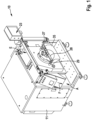
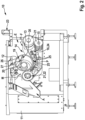
- the device shown in the drawing serves for separating meat on the one hand and bones, bone remnants, tendons, cartilage and the like on the other hand and has a number of preferred features. Other embodiments that have fewer or different features are not explicitly shown.
- the device can also be used in the same way for separating, for example, fruit pulp from seeds or for separating any other mixed materials with different flow properties.
- the device 10 shown is designed and configured to separate mixed substances of different flowability.
- the device 10 comprises a frame 11, a hollow drum 12 which is driven in rotation and mounted on the frame 11 and has a perforated outer surface M and at least one at least partially open end face S V , S H , an endless press belt 13 which can be pressed from the outside onto the outer surface by wrapping around part of the circumference of the hollow drum 12 and which is driven in rotation, a product intake wedge 14 formed by the press belt 13 and the hollow drum 12 for guiding a product flow consisting of material to be pressed between the hollow drum 12 and the press belt 13 in an inlet area E of the product flow into the device 10, a support device 15 for the press belt 13 with at least one support element 16 which is arranged on the side of the press belt 13 opposite the hollow drum 12, and a device 17 for discharging material through the perforated outer surface M into the cavity H of the hollow drum 12. pressed material to be separated from the at least partially open front side S V , S H of the hollow drum 12.
- the device 17 for removing the separated material from the hollow drum 12 can be an integral part of the hollow drum 12 or can be designed as a separate component.
- the front side Sv of the hollow drum 12 facing the front is designed to be open, the opposite front side S H is preferably designed to be closed.
- the opening 18 shown in the rear end wall S H serves to accommodate or support the hollow drum 12 on a drive shaft.
- the front and rear sides can also be swapped.
- This device 10 is characterized according to the invention in that the hollow drum 12 is assigned a cooling device 19 which is designed and configured to cool the material to be separated during processing by means of a cryogenic cooling medium 20.
- the frame 11 can be, for example, a closed or at least partially closed housing or a profile construction or the like. Preferably, the housing is essentially closed on all sides.
- the drive unit (not shown) for the hollow drum 12 and/or the press belt 13 is arranged on or in the frame 11.
- the drive unit can comprise a common drive or separate drive means.
- the axis of rotation R of the hollow drum 12 runs transversely to the conveying direction F of the product flow.
- holes/openings are formed, which can be arranged in different patterns and allow parts of the product flow, in particular the more easily flowing, soft and squeezable parts, to pass into the interior of the hollow drum 12.
- the hollow drum 12 is preferably provided with the openings over its entire depth or width B, which forms the working area.
- the press belt 13 is preferably made of an elastic material, e.g. rubber, polyurethane or the like, and is guided around several deflection elements 21.
- a deflection element 21 is designed and set up as a drive roller 22.
- the deflection element 21, which is placed behind the hollow drum 12 in the conveying direction F is the drive roller 22 in order to pull the press belt 13 and thus the product flow past the hollow drum 12.
- the drive roller 22 is simultaneously designed and set up as a pressure roller and/or tension roller for the press belt 13.
- the drive roller 22 is designed to be adjustable.
- the conveying of the product flow in the conveying direction F can be further supported by the hollow drum 12's own drive.
- stripping elements can be arranged in the inlet area E, i.e. above the product intake wedge 14, and/or in the outlet area A, i.e. in the conveying direction F behind the hollow drum 12, which is also referred to as a perforated drum.
- These stripping elements can be rigid, i.e. with a fixed distance to the hollow drum 12 or more precisely to the outer surface M, or variably controllable, i.e. variable in distance to the hollow drum 12 or more precisely to the outer surface M.
- the hollow drum 12 and the press belt 13 can be driven at the same speed.
- the hollow drum 12 and the press belt 13 can also be driven at different speeds. The speed difference can be controlled and/or regulated by means of a control and/or regulating device 23.
- the support device 15 can be a support chain or a support belt.
- the support device 15 is designed as a roller conveyor 24 which comprises a plurality of rollers 25 which are arranged one behind the other in the conveying direction F of the product flow and are at least partially spring-mounted.
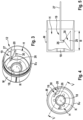
- the cooling device 19 is arranged in the cavity H of the hollow drum 12 and comprises at least one nozzle 26, which is connected to a reservoir of cooling medium 20 (not explicitly shown) via a supply line 27.
- the supply line 27 is led out of the open end face Sv of the hollow drum 12.
- a cross member 28 is arranged in front of the open front side Sv, which is detachably attached to the frame 11.
- the supply line 27 is supported on the cross member 28, either directly or, as shown, indirectly via a type of splash guard 29, which at least partially covers the open front side Sv. Only a single nozzle 26 is shown in the drawing. However, several nozzles 26 can also be used optionally. Other options for fastening, supporting or resting the nozzle 26 and/or the supply line 27 are also possible.
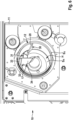
- each nozzle 26 is directed towards the area of the inner surface of the hollow drum 12 which is approximately opposite the area of the product intake wedge 14 and/or the adjoining pressing area P.
- one nozzle 26 or nozzle bar can be directed towards the area of the product intake wedge 14 - as shown - while a second nozzle 26 or nozzle bar - not shown - is directed towards the pressing area P.
- the position and/or orientation of each nozzle 26 is, however, variable and changeable.
- the or each nozzle 26 is designed as a flat jet nozzle which has a nozzle opening for forming a spray fan 30 such that the cooling medium 20 emerging from the nozzle 26 ensures a linear impact on the material to be separated pressed through the outer surface M, extending over the entire depth/width B of the hollow drum 12.
- the spray fan 30 preferably covers the entire working width of the hollow drum 12.
- other designs of nozzles 26 with different nozzle openings can also be used.
- the or each nozzle 26 can be freely arranged in the cavity H.
- the or each nozzle 26 is assigned a cover 31 which at least partially covers the or each nozzle 26.
- the cover 31 is roof-shaped and is preferably also arranged on the cross member 28.
- the or each nozzle 26 is arranged below the cover 31 which is closed at the top and open at the bottom, so that the spray fan 30 can be formed without obstruction.
- the device 10 can comprise a device (not explicitly shown) for collecting and removing the cooling medium 20 fed into the cavity H of the hollow drum 12, which is associated with the cooling device 19.
- the device for collecting the cooling medium 20 can comprise at least one cover and an exhaust fan connected to the cover via exhaust air lines.
- the cover can, for example, enclose the entire area of the open front side Sv of the hollow drum 12, in the sense of covering it, so that suction of the used, at least predominantly gaseous cooling medium 20 is ensured.
- Other designs for suctioning the used cooling medium 20 from the cavity H of the hollow drum 12 can also be used.
- the or each supply line 27 for supplying the cryogenic cooling medium 20 to the or each nozzle 26 comprises a measuring and/or control section, which can be part of the device 10 or a higher-level unit.
- Liquid nitrogen (LN 2 ) is particularly preferably used as the cryogenic cooling medium 20.
- liquid carbon dioxide (LCO 2 ) can also be used as the cryogenic cooling medium 20.
- the cooling media can also be used in gaseous form.
- the material to be separated pressed through the outer surface M can be removed from the hollow drum 12 by itself, solely through the rotation of the hollow drum 12.
- the hollow drum 12 then forms the device 17 for removing the material to be separated.
- the device 17 for removing the material to be separated preferably comprises a stripping element 32 and/or an ejection screw.
- the drawing shows the preferred stripping element 32, which can also be detachably attached to the cross member 28.
- the stripping element 32 comprises a product stripping edge 33 and a product guide surface 34, the product guide surface 34 being shaped and/or aligned such that the material to be separated, which is stripped from the inner surface of the hollow drum 12 by means of the product stripping edge 33, is guided in the direction of the open front side Sv of the hollow drum 12.
- stripping element 32 which is preferably formed in one piece, and other constructions for removing the material to be separated from the hollow space H of the hollow drum 12 can also be used.
- the removed material to be separated can, for example, fall onto a discharge trough 35 or the like, which can optionally be cooled and is connected to a corresponding device for this purpose.
- a product stream consisting of pressed material is fed into a product intake wedge 14, which is formed by a hollow drum 12 with a perforated outer surface M and a press belt 13, which rests on the outside of the hollow drum 12 and wraps around part of the circumference.
- a product intake wedge 14 which is formed by a hollow drum 12 with a perforated outer surface M and a press belt 13, which rests on the outside of the hollow drum 12 and wraps around part of the circumference.
- the hollow drum 12 and the press belt 13 are driven in rotation to draw the product stream between the hollow drum 12 and the press belt 13.
- the hollow drum 12 is preferably (in the view according to Figure 1 ) is driven clockwise, while the drive roller 22 for the press belt (in the view according to the Figures 1 and 2 ) is driven anti-clockwise so that the hollow drum 12 and the press belt 13 have the same conveying direction F in the area of the wrap, i.e. in the pressing area P, where the speeds can be the same or different from one another.
- the more easily flowing components of the product flow are pressed by means of the pressing belt 13 as material to be separated through the perforation of the outer surface M of the hollow drum 12 into the inner cavity H of the hollow drum 12 and are discharged from an at least partially open front side S V and/or S H of the hollow drum 12, while the more difficult-flowing components of the product flow remain on the outside of the outer surface M of the hollow drum 12 and are discharged separately.
- the press belt 13 is supported on the side of the press belt 13 opposite the hollow drum 12 by a support device 15 comprising at least one support element 16.
- This method is characterized according to the invention in that the material to be separated, which is pressed through the perforated outer surface M into the cavity H of the hollow drum 12, is cooled by means of a cryogenic cooling medium 20 in the hollow drum 12, the material to be separated being exposed to the cryogenic cooling medium 20 directly and immediately during the separation process, i.e. when pressed through the outer surface M and/or when removed from the hollow drum 12.
- the cooling medium 20 is applied in a linear, fan-shaped or other manner over the entire width B (corresponding to the working depth/width) of the hollow drum 12 - aligned parallel to the axis of rotation R of the hollow drum 12 - to the material to be separated, which has been comminuted by the separation process and has had its surface enlarged.
- liquid nitrogen (LN 2 ) as a liquid, cryogenic cooling medium 20
- liquid carbon dioxide (LCO 2 ) as a liquid, cryogenic cooling medium
- other liquid or gaseous cryogenic cooling media 20 can also be used.
- the unused cooling medium 20 can escape into the environment in gaseous and/or liquid form, e.g. as an aerosol, steam, mist, smoke or the like, depending on the respective cooling medium 20.
- the cooling medium 20 fed into the cavity H of the hollow drum 12 is collected and discharged. This can be, for example, suction.
- the cooled separated material can, for example, fall out of the open front side Sv of the hollow drum 12 due to the rotation of the hollow drum 12.
- the cooled separated material is stripped from the inner surface of the hollow drum 12 and discharged from the hollow drum 12.
- the desired temperature of the material to be separated is particularly preferably controlled by supplying the cooling medium to the material to be separated.
- the measuring and/or control section within the supply line 27 can be used for this purpose.
- the measuring and/or control section can be used to monitor and control the inflow quantity, temperature, inflow speed, etc. of the cooling medium in order to achieve an optimal cooling effect.
- a desired temperature can be set for optimal process control and product quality.
- the method is carried out with a device 10 according to one or more of claims 1 to 11.
Landscapes
- Engineering & Computer Science (AREA)
- Life Sciences & Earth Sciences (AREA)
- Mechanical Engineering (AREA)
- Wood Science & Technology (AREA)
- Zoology (AREA)
- Food Science & Technology (AREA)
- Meat, Egg Or Seafood Products (AREA)
- Processing Of Solid Wastes (AREA)
- Extraction Or Liquid Replacement (AREA)
- Apparatuses For Bulk Treatment Of Fruits And Vegetables And Apparatuses For Preparing Feeds (AREA)
- Separation By Low-Temperature Treatments (AREA)
Applications Claiming Priority (2)
| Application Number | Priority Date | Filing Date | Title |
|---|---|---|---|
| DE102020118720.3A DE102020118720A1 (de) | 2020-07-15 | 2020-07-15 | Vorrichtung und Verfahren zum Trennen von miteinander vermischten Stoffen unterschiedlicher Fließfähigkeit |
| PCT/EP2021/069645 WO2022013305A1 (de) | 2020-07-15 | 2021-07-14 | Vorrichtung und verfahren zum trennen von miteinander vermischten stoffen unterschiedlicher fliessfähigkeit |
Publications (2)
| Publication Number | Publication Date |
|---|---|
| EP4182159A1 EP4182159A1 (de) | 2023-05-24 |
| EP4182159B1 true EP4182159B1 (de) | 2024-08-28 |
Family
ID=77050990
Family Applications (1)
| Application Number | Title | Priority Date | Filing Date |
|---|---|---|---|
| EP21745954.4A Active EP4182159B1 (de) | 2020-07-15 | 2021-07-14 | Vorrichtung und verfahren zum trennen von miteinander vermischten stoffen unterschiedlicher fliessfähigkeit |
Country Status (12)
| Country | Link |
|---|---|
| US (1) | US12168333B2 (pl) |
| EP (1) | EP4182159B1 (pl) |
| CN (1) | CN115812030B (pl) |
| AU (1) | AU2021310432B2 (pl) |
| BR (1) | BR112023000693A2 (pl) |
| CA (1) | CA3182787A1 (pl) |
| DE (1) | DE102020118720A1 (pl) |
| DK (1) | DK4182159T3 (pl) |
| ES (1) | ES2990245T3 (pl) |
| MX (1) | MX2023000680A (pl) |
| PL (1) | PL4182159T3 (pl) |
| WO (1) | WO2022013305A1 (pl) |
Family Cites Families (20)
| Publication number | Priority date | Publication date | Assignee | Title |
|---|---|---|---|---|
| US3368363A (en) | 1966-05-31 | 1968-02-13 | Du Pont | Process for freezing food using liquid refrigerant |
| US4018389A (en) | 1975-09-29 | 1977-04-19 | Paoli Stephen A | High production mechanical separator machine |
| US4156384A (en) | 1976-08-30 | 1979-05-29 | Stoelting, Inc. | Method and apparatus for separating liquids from soft particulate food solids |
| JPS60237934A (ja) * | 1984-05-12 | 1985-11-26 | 東洋水産機械株式会社 | 魚肉採取機 |
| DE3615406A1 (de) | 1986-05-07 | 1987-11-12 | Linde Ag | Vorrichtung zur herstellung von tiefgefrorenem granulat |
| US4889048A (en) * | 1988-04-13 | 1989-12-26 | Miller Ray R | High heat flux roll and press utilizing same |
| DE4116476C2 (de) * | 1991-05-21 | 1994-09-22 | Nordischer Maschinenbau | Separiereinrichtung |
| DE4319062A1 (de) | 1993-06-09 | 1994-12-22 | Kraftanlagen Ag Heidelberg | Verfahren und Vorrichtung zur Herstellung von Bahnen aus thermoplastischen Kunststoff-Mischungen, Harzgemischen o. dgl. mittels Bandpressen |
| DE4328627C2 (de) | 1993-08-27 | 1995-10-05 | Nordischer Maschinenbau | Separator zum Gewinnen des Restfleisches von Knochensträngen |
| DE4411502A1 (de) | 1994-04-06 | 1995-10-12 | Alexander Seitz | Verfahren und Vorrichtung zum Ablösen von Fleisch |
| JP3935143B2 (ja) | 2003-12-08 | 2007-06-20 | 月島機械株式会社 | ベルトプレス型脱水機の洗浄方法 |
| AU2010231505B2 (en) * | 2009-04-01 | 2013-12-19 | Freddy Hirsch Group (Proprietary) Limited | A system, method and apparatus for processing food products |
| DE202010011056U1 (de) | 2010-08-04 | 2011-11-07 | Modernpack Hoppe Gmbh | Trennmaschine |
| GB201405975D0 (en) | 2014-04-02 | 2014-05-14 | Univ Ulster | A method and apparatus for pressing oilseed to extract oil therefrom |
| DE102016108200B3 (de) | 2016-05-03 | 2016-12-15 | Nordischer Maschinenbau Rud. Baader Gmbh + Co. Kg | Separator zum Trennen von miteinander vermischten Stoffen unterschiedlicher Fließfähigkeit |
| US11173426B2 (en) * | 2017-12-22 | 2021-11-16 | Sustainable Energy Solutions, Inc. | Method for solid-liquid separations |
| DE102018101985B3 (de) * | 2018-01-30 | 2018-09-27 | Modernpack Hoppe Gmbh | Weichseparator mit füllzustandsabhängiger Anpassung der Geschwindigkeit und Verfahren zum Betreiben eines solchen Weichseparators |
| DE102019116720B3 (de) * | 2019-06-20 | 2020-06-10 | Nordischer Maschinenbau Rud. Baader Gmbh + Co. Kg | Vorrichtung und Verfahren zum Trennen von miteinander vermischten Stoffen unterschiedlicher Fließfähigkeit |
| US11832623B2 (en) * | 2019-11-08 | 2023-12-05 | Provisur Technologies, Inc. | Separating machine with feeding wheel |
| EP3939777B1 (de) * | 2020-07-15 | 2025-04-02 | Nordischer Maschinenbau Rud. Baader Gmbh + Co Kg | Vorrichtung zum trennen von miteinander vermischten Stoffen unterschiedlicher Fliessfähigkeit |
-
2020
- 2020-07-15 DE DE102020118720.3A patent/DE102020118720A1/de active Pending
-
2021
- 2021-07-14 PL PL21745954.4T patent/PL4182159T3/pl unknown
- 2021-07-14 MX MX2023000680A patent/MX2023000680A/es unknown
- 2021-07-14 US US18/016,529 patent/US12168333B2/en active Active
- 2021-07-14 DK DK21745954.4T patent/DK4182159T3/da active
- 2021-07-14 CN CN202180047827.6A patent/CN115812030B/zh active Active
- 2021-07-14 BR BR112023000693A patent/BR112023000693A2/pt unknown
- 2021-07-14 ES ES21745954T patent/ES2990245T3/es active Active
- 2021-07-14 EP EP21745954.4A patent/EP4182159B1/de active Active
- 2021-07-14 AU AU2021310432A patent/AU2021310432B2/en active Active
- 2021-07-14 WO PCT/EP2021/069645 patent/WO2022013305A1/de not_active Ceased
- 2021-07-14 CA CA3182787A patent/CA3182787A1/en active Pending
Also Published As
| Publication number | Publication date |
|---|---|
| WO2022013305A1 (de) | 2022-01-20 |
| MX2023000680A (es) | 2023-03-13 |
| CA3182787A1 (en) | 2022-01-20 |
| EP4182159A1 (de) | 2023-05-24 |
| AU2021310432B2 (en) | 2024-08-29 |
| US12168333B2 (en) | 2024-12-17 |
| DK4182159T3 (da) | 2024-11-25 |
| BR112023000693A2 (pt) | 2023-04-25 |
| AU2021310432A1 (en) | 2023-02-16 |
| CN115812030B (zh) | 2025-03-11 |
| US20230286241A1 (en) | 2023-09-14 |
| CN115812030A (zh) | 2023-03-17 |
| WO2022013305A8 (de) | 2022-09-22 |
| ES2990245T3 (es) | 2024-11-29 |
| DE102020118720A1 (de) | 2022-01-20 |
| PL4182159T3 (pl) | 2025-02-03 |
Similar Documents
| Publication | Publication Date | Title |
|---|---|---|
| DE112011100359B4 (de) | Vorrichtung zum Trennen von miteinander vermischten Stoffen unterschiedlicher Fließfähigkeit | |
| DE3020351C2 (pl) | ||
| DE102017001784B4 (de) | Conchiervorrichtung und Verfahren zum Conchieren einer Produktmasse | |
| EP1389046A1 (de) | Vorrichtung zum abschwarten und enthäuten von behandlungsgut | |
| DE102007063465B4 (de) | Vorrichtung und Verfahren zum Trennen von miteinander vermischten Stoffen unterschiedlicher Fließfähigkeit | |
| EP0640290B1 (de) | Separator zum Gewinnen des Restfleisches von Knochensträngen | |
| EP3962722B1 (de) | Vorrichtung und Verfahren zum trennen von miteinander vermischten Stoffen unterschiedlicher Fliessfähigkeit | |
| EP4182159B1 (de) | Vorrichtung und verfahren zum trennen von miteinander vermischten stoffen unterschiedlicher fliessfähigkeit | |
| EP3939777B1 (de) | Vorrichtung zum trennen von miteinander vermischten Stoffen unterschiedlicher Fliessfähigkeit | |
| EP3894203B1 (de) | Vorrichtung und verfahren zum trennen von miteinander vermischten stoffen unterschiedlicher fliessfähigkeit | |
| DE102018102672B3 (de) | Vorrichtung zum Trennen von miteinander vermischten Stoffen unterschiedlicher Fließfähigkeit | |
| DE4446323A1 (de) | Tabakrecycling | |
| DE3844302C2 (de) | Trennmaschine | |
| EP4182158A1 (de) | Vorrichtung und verfahren zum trennen von miteinander vermischten stoffen unterschiedlicher fliessfähigkeit | |
| EP0658311B1 (de) | Vorrichtung zum Entfernen der Haut von den Körpern geschlachteten Geflügels | |
| DE4207730C2 (de) | Gezogenes oder selbstfahrendes Ernte- und Verarbeitungsfahrzeug | |
| EP1910753A1 (de) | Vorrichtung und verfahren zur oberflächenkühlung von gegenständen | |
| DE2454663A1 (de) | Verfahren und vorrichtung zum spalten und entkernen und entstielen von schoten und fruechten | |
| DE7438492U (de) | Vorrichtung zum spalten entkernen und entstielen von schoten und fruechten | |
| DE1582628A1 (de) | Verfahren und Vorrichtung zur Trennung von Feststoffen und von diesen befreiten Artikeln | |
| DE29622810U1 (de) | Einrichtung zum Gewinnen von Fischfleisch in musartiger Konsistenz |
Legal Events
| Date | Code | Title | Description |
|---|---|---|---|
| STAA | Information on the status of an ep patent application or granted ep patent |
Free format text: STATUS: UNKNOWN |
|
| STAA | Information on the status of an ep patent application or granted ep patent |
Free format text: STATUS: THE INTERNATIONAL PUBLICATION HAS BEEN MADE |
|
| PUAI | Public reference made under article 153(3) epc to a published international application that has entered the european phase |
Free format text: ORIGINAL CODE: 0009012 |
|
| STAA | Information on the status of an ep patent application or granted ep patent |
Free format text: STATUS: REQUEST FOR EXAMINATION WAS MADE |
|
| 17P | Request for examination filed |
Effective date: 20230109 |
|
| AK | Designated contracting states |
Kind code of ref document: A1 Designated state(s): AL AT BE BG CH CY CZ DE DK EE ES FI FR GB GR HR HU IE IS IT LI LT LU LV MC MK MT NL NO PL PT RO RS SE SI SK SM TR |
|
| DAV | Request for validation of the european patent (deleted) | ||
| DAX | Request for extension of the european patent (deleted) | ||
| GRAP | Despatch of communication of intention to grant a patent |
Free format text: ORIGINAL CODE: EPIDOSNIGR1 |
|
| STAA | Information on the status of an ep patent application or granted ep patent |
Free format text: STATUS: GRANT OF PATENT IS INTENDED |
|
| INTG | Intention to grant announced |
Effective date: 20240209 |
|
| GRAS | Grant fee paid |
Free format text: ORIGINAL CODE: EPIDOSNIGR3 |
|
| GRAA | (expected) grant |
Free format text: ORIGINAL CODE: 0009210 |
|
| STAA | Information on the status of an ep patent application or granted ep patent |
Free format text: STATUS: THE PATENT HAS BEEN GRANTED |
|
| P01 | Opt-out of the competence of the unified patent court (upc) registered |
Free format text: CASE NUMBER: APP_39895/2024 Effective date: 20240704 |
|
| AK | Designated contracting states |
Kind code of ref document: B1 Designated state(s): AL AT BE BG CH CY CZ DE DK EE ES FI FR GB GR HR HU IE IS IT LI LT LU LV MC MK MT NL NO PL PT RO RS SE SI SK SM TR |
|
| REG | Reference to a national code |
Ref country code: CH Ref legal event code: EP |
|
| REG | Reference to a national code |
Ref country code: DE Ref legal event code: R096 Ref document number: 502021004971 Country of ref document: DE |
|
| REG | Reference to a national code |
Ref country code: IE Ref legal event code: FG4D Free format text: LANGUAGE OF EP DOCUMENT: GERMAN |
|
| REG | Reference to a national code |
Ref country code: NL Ref legal event code: FP |
|
| REG | Reference to a national code |
Ref country code: DK Ref legal event code: T3 Effective date: 20241119 |
|
| REG | Reference to a national code |
Ref country code: ES Ref legal event code: FG2A Ref document number: 2990245 Country of ref document: ES Kind code of ref document: T3 Effective date: 20241129 |
|
| REG | Reference to a national code |
Ref country code: LT Ref legal event code: MG9D |
|
| PG25 | Lapsed in a contracting state [announced via postgrant information from national office to epo] |
Ref country code: GR Free format text: LAPSE BECAUSE OF FAILURE TO SUBMIT A TRANSLATION OF THE DESCRIPTION OR TO PAY THE FEE WITHIN THE PRESCRIBED TIME-LIMIT Effective date: 20241129 Ref country code: FI Free format text: LAPSE BECAUSE OF FAILURE TO SUBMIT A TRANSLATION OF THE DESCRIPTION OR TO PAY THE FEE WITHIN THE PRESCRIBED TIME-LIMIT Effective date: 20240828 Ref country code: PT Free format text: LAPSE BECAUSE OF FAILURE TO SUBMIT A TRANSLATION OF THE DESCRIPTION OR TO PAY THE FEE WITHIN THE PRESCRIBED TIME-LIMIT Effective date: 20241230 |
|
| PG25 | Lapsed in a contracting state [announced via postgrant information from national office to epo] |
Ref country code: BG Free format text: LAPSE BECAUSE OF FAILURE TO SUBMIT A TRANSLATION OF THE DESCRIPTION OR TO PAY THE FEE WITHIN THE PRESCRIBED TIME-LIMIT Effective date: 20240828 |
|
| PG25 | Lapsed in a contracting state [announced via postgrant information from national office to epo] |
Ref country code: LV Free format text: LAPSE BECAUSE OF FAILURE TO SUBMIT A TRANSLATION OF THE DESCRIPTION OR TO PAY THE FEE WITHIN THE PRESCRIBED TIME-LIMIT Effective date: 20240828 |
|
| PG25 | Lapsed in a contracting state [announced via postgrant information from national office to epo] |
Ref country code: HR Free format text: LAPSE BECAUSE OF FAILURE TO SUBMIT A TRANSLATION OF THE DESCRIPTION OR TO PAY THE FEE WITHIN THE PRESCRIBED TIME-LIMIT Effective date: 20240828 |
|
| PG25 | Lapsed in a contracting state [announced via postgrant information from national office to epo] |
Ref country code: RS Free format text: LAPSE BECAUSE OF FAILURE TO SUBMIT A TRANSLATION OF THE DESCRIPTION OR TO PAY THE FEE WITHIN THE PRESCRIBED TIME-LIMIT Effective date: 20241128 |
|
| PG25 | Lapsed in a contracting state [announced via postgrant information from national office to epo] |
Ref country code: RS Free format text: LAPSE BECAUSE OF FAILURE TO SUBMIT A TRANSLATION OF THE DESCRIPTION OR TO PAY THE FEE WITHIN THE PRESCRIBED TIME-LIMIT Effective date: 20241128 Ref country code: PT Free format text: LAPSE BECAUSE OF FAILURE TO SUBMIT A TRANSLATION OF THE DESCRIPTION OR TO PAY THE FEE WITHIN THE PRESCRIBED TIME-LIMIT Effective date: 20241230 Ref country code: LV Free format text: LAPSE BECAUSE OF FAILURE TO SUBMIT A TRANSLATION OF THE DESCRIPTION OR TO PAY THE FEE WITHIN THE PRESCRIBED TIME-LIMIT Effective date: 20240828 Ref country code: HR Free format text: LAPSE BECAUSE OF FAILURE TO SUBMIT A TRANSLATION OF THE DESCRIPTION OR TO PAY THE FEE WITHIN THE PRESCRIBED TIME-LIMIT Effective date: 20240828 Ref country code: GR Free format text: LAPSE BECAUSE OF FAILURE TO SUBMIT A TRANSLATION OF THE DESCRIPTION OR TO PAY THE FEE WITHIN THE PRESCRIBED TIME-LIMIT Effective date: 20241129 Ref country code: FI Free format text: LAPSE BECAUSE OF FAILURE TO SUBMIT A TRANSLATION OF THE DESCRIPTION OR TO PAY THE FEE WITHIN THE PRESCRIBED TIME-LIMIT Effective date: 20240828 Ref country code: BG Free format text: LAPSE BECAUSE OF FAILURE TO SUBMIT A TRANSLATION OF THE DESCRIPTION OR TO PAY THE FEE WITHIN THE PRESCRIBED TIME-LIMIT Effective date: 20240828 |
|
| PG25 | Lapsed in a contracting state [announced via postgrant information from national office to epo] |
Ref country code: SM Free format text: LAPSE BECAUSE OF FAILURE TO SUBMIT A TRANSLATION OF THE DESCRIPTION OR TO PAY THE FEE WITHIN THE PRESCRIBED TIME-LIMIT Effective date: 20240828 Ref country code: RO Free format text: LAPSE BECAUSE OF FAILURE TO SUBMIT A TRANSLATION OF THE DESCRIPTION OR TO PAY THE FEE WITHIN THE PRESCRIBED TIME-LIMIT Effective date: 20240828 |
|
| PG25 | Lapsed in a contracting state [announced via postgrant information from national office to epo] |
Ref country code: EE Free format text: LAPSE BECAUSE OF FAILURE TO SUBMIT A TRANSLATION OF THE DESCRIPTION OR TO PAY THE FEE WITHIN THE PRESCRIBED TIME-LIMIT Effective date: 20240828 |
|
| PG25 | Lapsed in a contracting state [announced via postgrant information from national office to epo] |
Ref country code: CZ Free format text: LAPSE BECAUSE OF FAILURE TO SUBMIT A TRANSLATION OF THE DESCRIPTION OR TO PAY THE FEE WITHIN THE PRESCRIBED TIME-LIMIT Effective date: 20240828 |
|
| PG25 | Lapsed in a contracting state [announced via postgrant information from national office to epo] |
Ref country code: SK Free format text: LAPSE BECAUSE OF FAILURE TO SUBMIT A TRANSLATION OF THE DESCRIPTION OR TO PAY THE FEE WITHIN THE PRESCRIBED TIME-LIMIT Effective date: 20240828 |
|
| REG | Reference to a national code |
Ref country code: DE Ref legal event code: R097 Ref document number: 502021004971 Country of ref document: DE |
|
| PLBE | No opposition filed within time limit |
Free format text: ORIGINAL CODE: 0009261 |
|
| STAA | Information on the status of an ep patent application or granted ep patent |
Free format text: STATUS: NO OPPOSITION FILED WITHIN TIME LIMIT |
|
| PGFP | Annual fee paid to national office [announced via postgrant information from national office to epo] |
Ref country code: PL Payment date: 20250603 Year of fee payment: 5 |
|
| PGFP | Annual fee paid to national office [announced via postgrant information from national office to epo] |
Ref country code: IS Payment date: 20250623 Year of fee payment: 5 |
|
| 26N | No opposition filed |
Effective date: 20250530 |
|
| PGFP | Annual fee paid to national office [announced via postgrant information from national office to epo] |
Ref country code: NL Payment date: 20250723 Year of fee payment: 5 |
|
| PG25 | Lapsed in a contracting state [announced via postgrant information from national office to epo] |
Ref country code: SE Free format text: LAPSE BECAUSE OF FAILURE TO SUBMIT A TRANSLATION OF THE DESCRIPTION OR TO PAY THE FEE WITHIN THE PRESCRIBED TIME-LIMIT Effective date: 20240828 |
|
| PGFP | Annual fee paid to national office [announced via postgrant information from national office to epo] |
Ref country code: ES Payment date: 20250819 Year of fee payment: 5 |
|
| PGFP | Annual fee paid to national office [announced via postgrant information from national office to epo] |
Ref country code: DK Payment date: 20250723 Year of fee payment: 5 Ref country code: DE Payment date: 20250722 Year of fee payment: 5 |
|
| PGFP | Annual fee paid to national office [announced via postgrant information from national office to epo] |
Ref country code: NO Payment date: 20250722 Year of fee payment: 5 |
|
| PGFP | Annual fee paid to national office [announced via postgrant information from national office to epo] |
Ref country code: IT Payment date: 20250731 Year of fee payment: 5 |
|
| PGFP | Annual fee paid to national office [announced via postgrant information from national office to epo] |
Ref country code: GB Payment date: 20250724 Year of fee payment: 5 |
|
| PGFP | Annual fee paid to national office [announced via postgrant information from national office to epo] |
Ref country code: FR Payment date: 20250723 Year of fee payment: 5 Ref country code: AT Payment date: 20251020 Year of fee payment: 5 |
|
| REG | Reference to a national code |
Ref country code: CH Ref legal event code: H13 Free format text: ST27 STATUS EVENT CODE: U-0-0-H10-H13 (AS PROVIDED BY THE NATIONAL OFFICE) Effective date: 20260224 |
|
| PG25 | Lapsed in a contracting state [announced via postgrant information from national office to epo] |
Ref country code: LU Free format text: LAPSE BECAUSE OF NON-PAYMENT OF DUE FEES Effective date: 20250714 |