EP4181818B1 - Zahnärztliche vorrichtung und verfahren zur herstellung einer thermoplastischen folie - Google Patents
Zahnärztliche vorrichtung und verfahren zur herstellung einer thermoplastischen folie Download PDFInfo
- Publication number
- EP4181818B1 EP4181818B1 EP21763262.9A EP21763262A EP4181818B1 EP 4181818 B1 EP4181818 B1 EP 4181818B1 EP 21763262 A EP21763262 A EP 21763262A EP 4181818 B1 EP4181818 B1 EP 4181818B1
- Authority
- EP
- European Patent Office
- Prior art keywords
- coating
- core
- agent
- process according
- foil
- Prior art date
- Legal status (The legal status is an assumption and is not a legal conclusion. Google has not performed a legal analysis and makes no representation as to the accuracy of the status listed.)
- Active
Links
Images

Classifications
-
- A—HUMAN NECESSITIES
- A61—MEDICAL OR VETERINARY SCIENCE; HYGIENE
- A61C—DENTISTRY; APPARATUS OR METHODS FOR ORAL OR DENTAL HYGIENE
- A61C7/00—Orthodontics, i.e. obtaining or maintaining the desired position of teeth, e.g. by straightening, evening, regulating, separating, or by correcting malocclusions
- A61C7/08—Mouthpiece-type retainers or positioners, e.g. for both the lower and upper arch
-
- A—HUMAN NECESSITIES
- A61—MEDICAL OR VETERINARY SCIENCE; HYGIENE
- A61F—FILTERS IMPLANTABLE INTO BLOOD VESSELS; PROSTHESES; DEVICES PROVIDING PATENCY TO, OR PREVENTING COLLAPSING OF, TUBULAR STRUCTURES OF THE BODY, e.g. STENTS; ORTHOPAEDIC, NURSING OR CONTRACEPTIVE DEVICES; FOMENTATION; TREATMENT OR PROTECTION OF EYES OR EARS; BANDAGES, DRESSINGS OR ABSORBENT PADS; FIRST-AID KITS
- A61F5/00—Orthopaedic methods or devices for non-surgical treatment of bones or joints; Nursing devices ; Anti-rape devices
- A61F5/56—Devices for preventing snoring
- A61F5/566—Intra-oral devices
-
- A—HUMAN NECESSITIES
- A61—MEDICAL OR VETERINARY SCIENCE; HYGIENE
- A61K—PREPARATIONS FOR MEDICAL, DENTAL OR TOILETRY PURPOSES
- A61K9/00—Medicinal preparations characterised by special physical form
- A61K9/0012—Galenical forms characterised by the site of application
- A61K9/0053—Mouth and digestive tract, i.e. intraoral and peroral administration
- A61K9/0063—Periodont
-
- B—PERFORMING OPERATIONS; TRANSPORTING
- B29—WORKING OF PLASTICS; WORKING OF SUBSTANCES IN A PLASTIC STATE IN GENERAL
- B29C—SHAPING OR JOINING OF PLASTICS; SHAPING OF MATERIAL IN A PLASTIC STATE, NOT OTHERWISE PROVIDED FOR; AFTER-TREATMENT OF THE SHAPED PRODUCTS, e.g. REPAIRING
- B29C48/00—Extrusion moulding, i.e. expressing the moulding material through a die or nozzle which imparts the desired form; Apparatus therefor
- B29C48/001—Combinations of extrusion moulding with other shaping operations
- B29C48/0017—Combinations of extrusion moulding with other shaping operations combined with blow-moulding or thermoforming
-
- B—PERFORMING OPERATIONS; TRANSPORTING
- B29—WORKING OF PLASTICS; WORKING OF SUBSTANCES IN A PLASTIC STATE IN GENERAL
- B29C—SHAPING OR JOINING OF PLASTICS; SHAPING OF MATERIAL IN A PLASTIC STATE, NOT OTHERWISE PROVIDED FOR; AFTER-TREATMENT OF THE SHAPED PRODUCTS, e.g. REPAIRING
- B29C48/00—Extrusion moulding, i.e. expressing the moulding material through a die or nozzle which imparts the desired form; Apparatus therefor
- B29C48/15—Extrusion moulding, i.e. expressing the moulding material through a die or nozzle which imparts the desired form; Apparatus therefor incorporating preformed parts or layers, e.g. extrusion moulding around inserts
- B29C48/154—Coating solid articles, i.e. non-hollow articles
Definitions
- thermoplastic functional foil comprising a core of thermoplastic material, in particular a core made from a thermoplastic polymer, and a thermoplastic coating at least partially covering the core.
- This foil is particularly suited for intra-oral use as a dental appliance to be worn inside the oral cavity on the teeth, since such an appliance may be easily formed from such a foil.
- the disclosure also concerns a dental appliance fabricated, in particular formed, most preferably thermoformed, from such a functional foil.
- the dental appliance may be used as an orthodontic appliance or a protective appliance for protection of teeth and/or gingiva of the user of the appliance.
- intraoral orthodontic devices have been used in orthodontic therapy for realigning teeth.
- the devices are typically designed as a dental splint, which is applied to teeth over several hours.
- the dental splint exerts forces on the individual teeth of the patient, which results in a realignment of the teeth in directions of desired teeth positions.
- intraoral orthodontic devices in particular dental splints
- bleaching pastes which are applied to the teeth by the device, or use of such devices for treating snoring overnight.
- Intraoral appliances such as orthodontic devices are also used for avoiding clenching and grinding. Chronic teeth clenching and teeth grinding can cause overuse of the muscles controlling the lower jaw, leading to pain from those muscles. The load on the joint itself can also cause changes inside the joint, leading to pain and limited opening of the mouth.
- US 2005/10853 A1 discloses an appliance for use in an oral cavity comprising a polymeric shell.
- the appliance is fabricated by thermoforming a sheet which is shaped from a mixture of thermoplastic polymers.
- US 2013/259920 A1 describes a process for fabrication of a bilayered laminate from two thermoplastic hot-melts by coextrusion with the aim of forming a uniform transverse cross-section of the laminate that can be used as a buccal dosage form.
- both thermoplastic components are heated to a molten state and forced through an orifice where the extruded laminate is formed into its final shape and which solidifies upon cooling. No lamination step is thus required to form the two-layer laminate.
- US 2008/293007 A1 also discusses methods for intra-oral drug delivery and proposes to attach bio-active substances to an oral appliance.
- it is suggested to adhere a layer with embedded agent to a portion of a surface of the oral appliance.
- the layer can thus later release the agent into the mouth of the patient, when the patient is wearing the appliance in his mouth.
- the invention aims at further enhancing the functionality and biocompatibility of such dental appliances and - in relation to this fundamental aim - at providing an efficient method for fabricating such devices.
- a process for making a thermoplastic functional foil as described at the beginning featuring a thermoplastic core and a thermoplastic coating at least partially, but preferably fully, covering the core.
- This process comprises the following steps: providing a carrier liquid comprising an organic polymer, which may preferably be a thermoplastic polymer; adding an agent, releasable from the coating in aqueous environment, to the carrier liquid prior to forming the coating; applying the carrier liquid in the form of a liquid coating onto the solid core, which has the form of a core foil; and solidifying the liquid coating afterwards on the core foil to form a solid thermoplastic coating covering the core.
- PET polyethylene terephthalate
- PC polycarbonate
- PU polyurethane
- the invention suggests to apply the coating in the form of liquid coating onto a solid core, which has the form of a core foil, in particular onto both sides of such a core foil, and to solidify the liquid coating afterwards on the core to form a solid thermoplastic coating covering the core.
- a carrier melt may also be applied onto a solid core to form a functional coating.
- the coating may form a thermoplastic cap layer of a dental appliance fabricated from the foil.
- the cap layer fully covers the core of the device, and hence the thermoplastic coating may fully cover the core of the functional foil.
- the agent may be added to the carrier liquid in the form of an agent liquid, as many agents can be obtained already in liquid form.
- an agent may be in particular an agent that is releasable from the coating in aqueous environments. This has the advantage that such an agent can be released from the coating into an oral cavity of a user that is wearing a dental appliance formed from the functional foil.
- the agent is derived from a bio-based material.
- the agent may be derived from a renewable biological resource, in particular a material of non-fossil origin produced by a living organism.
- bio-based material may be understood here in the sense that a bio-based material may comprise a non-fossil carbon content containing a detectable portion of the carbon isotope 14 C.
- the non-fossil carbon content may constitute at least 20%, preferably at least 35%, most preferably more than 50% of the bio-based material.
- about 80% to 65% but preferably much less of the bio-based material can be based on other organic material, in particular polymers, derived from fossil sources such as crude oil.
- such a bio-based material may also be used as the material for the coating and/or such a bio-based material may fully cover a core of a dental appliance fabricated from said functional foil, with the core not being made from a bio-based material.
- the presence of the 14 C in a material is thus a direct proof that the material is obtained, at least in part, from non-fossil renewable biological sources. This is because organic polymers derived from fossil oil for example do not show any 14 C any more, since the half-time of radioactive 14 C is less than 6.000 years.
- Detectable portion may be understood here in that the fraction of the 14 C among all C-atoms of the non-fossil carbon content of the bio-based material may be at least 1 ppq, preferably at least 10 ppq or even at least 100 ppq.
- the bio-based material may be further characterized in that it comprises a bio-based content of at least 40%, preferably of at least 50%, and wherein said bio-based content includes the non-fossil carbon content containing 14 C described above as well as nitrogen, oxygen and hydrogen bound to the non-fossil carbon content.
- the coating may be based on one or more bio-based materials.
- the coating may be fabricated exclusively from bio-based materials.
- the agent may be derived from an essential oil.
- an oil may be extracted directly from non-fossil plants.
- Such features ensure that the bio-based agent is not harmful to the body of the user of the dental appliance.
- a myriad of different functionalities such as adding flavor or antimicrobial protection may be achieved by relying on natural products that do not lead to harmful contaminations inside the oral cavity.
- the agent may comprise at least one of the following substances: an essential oil, an extract of an essential oil, or a derivative from the chemical family of phenols, monoterpenols, aldehydes, ketones, oxide terpenes, ethers, monoterpenes, lactone, phthalides, terpenic aldehydes, sestequiterpen alcohols, sestequiterpen, terpene esters, coumarins, in particular a substance such as cinnamaldehyde, lime, thymol, eugenol, linalool, carvacrol, nutmeg, pimenta berry, rosemary, petitgrain, coffee, anise, spearmint.
- an essential oil an extract of an essential oil
- a derivative from the chemical family of phenols monoterpenols, aldehydes, ketones, oxide terpenes, ethers, monoterpenes, lactone, phthalides, terpenic aldehy
- a particular advantage of using lime and cinnamaldehyde as agents is that they are not only highly effective antimicrobial agents but also provide a softening and plasticizing effect to the thermoplastic coating.
- the organic polymer contained in the carrier liquid is a bio-based material or at least derived from a bio-based material.
- the organic polymer (forming the coating) may be derived from a renewable biological resource, in particular a material of non-fossil origin produced by a living organism.
- a particular suitable choice for the organic polymer (forming the coating) is a cellulose-based material, in particular a cellulose-based composite. This is because cellulose is a bio-based material that can render the surface of the dental appliance soft, after swelling in water; in addition, cellulose offers favorable chemcial interactions with the mentioned agents to be loaded or reloaded into the CAP layer comprising cellulose based composites.
- Suitable materials for fabricating the core of the foil are cellulose acetate, cellulose acetate butyrate, PLA, chitosan or a polyester, a co-polyester, polycarbonate, polyurethane, polypropylene, polyethylene, polypropylene and polyethylene copolymer, acrylic, cyclic block copolymer, polyetheretherketone, polyamide, polyethylene terephthalate, polybutylene terephthalate, polyetherimide, polyethersulfone, polytrimethylene terephthalate or a combination thereof (e.g., a blend of at least two of the listed hard polymeric materials).
- the core of the device can include polymeric materials, such as polycarbonate, a co-polyester, a polyester, and polyurethane.
- the core can also be composed of multiple layers, e.g., two or more polymer layers.
- the core should mainly consist of a thermoplastic polymer (to render the foil thermoformable).
- CAB cellulose acetate butyrate
- the agent embedded into the coating is releasable from the coating, in particular in aqueous environments, for example in the oral cavity.
- the agent can be achieved by adequate choice of the agent, for example by using cinnamaldehyde as the agent, that the coating provides antimicrobial protection (through the release of an antimicrobial agent).
- the agent may be an antimicrobial agent.
- a glass transition temperature T g,coating of the coating, and/or in particular a glass transition temperature of the organic polymer T g,polymer is/are in the range of 80-165°C. This is particularly true when using CAB as the organic polymer.
- a suitable corresponding melting range of the coating, and in particular said organic polymer may be from 120-200°C.
- the number average molecular weight of the organic polymer used for the coating is another important factor for achieving satisfying results when thermoforming the functional foil.
- the number average molecular weight may be more than 12.000 g/mol, preferably more than 20.000 g/mol, and most preferably more than 30.000 g/mol. Such numbers are particularly suited if CAB is chosen as the organic polymer.
- the carrier liquid is a carrier solution
- the carrier liquid may be a solution of a solvent and the organic polymer.
- the carrier solution is obtained by dissolving the organic polymer in a solvent.
- the coating may be solidified on the core by evaporating the solvent from the coating.
- the core may actually be a core foil and hence, the carrier solution may be applied to both sides of the core foil uniformly.
- the coating can be formed by a physical coating process such as spin coating or blade-based coating, or by spray coating or by roll-to-roll coating.
- a physical coating process such as spin coating or blade-based coating, or by spray coating or by roll-to-roll coating.
- roll-to-roll coating e.g. air knife coating, gap coating, immersion dip coating, roller coating, etc.
- spray coating spray painting, thermal spraying, plasma spraying etc.
- the solvent of the carrier solution can be used to modify the surface of the core.
- the solvent can soften the core's surface by reducing the interaction of molecular chains of the material of the core.
- the core and the coating or to be more precise, the organic polymer of the coating
- the solvent may be simply evaporated thus forming a final solid coating.
- Such as softening of the core can be achieved, for example, when using acetone as the solvent and PETG as the core material, but there exist other combinations of core materials and suitable solvents, which achieve the same softening effect, as is readily apparent in the literature.
- the invention suggests to use this effect for enhancing the adhesion of the coating on the core of a functional foil intended for fabricating a dental appliance.
- Another approach for improving the mechanical and/or chemical interaction of the coating and the core is to safeguard that a glass transition temperature T g,core of the core and a glass transition temperature T g,coating of the coating differ by less than 80°C, preferably by less than 60°C.
- a glass transition temperature T g,core of the core and a glass transition temperature T g,coating of the coating differ by less than 80°C, preferably by less than 60°C.
- Such a material choice will result in enough mobility of the molecular chains of both core and coating such that efficient thermal interlocking can be achieved through thermal fusion (sometimes referred to as "thermal welding") between core and coating during the final thermoforming of the functional foil.
- the glass transition temperature of the coating T g,coating is higher than the glass transition temperature of the core T g,core .
- Such a material choice will result in a sufficient mechanical stability during thermoforming of the device, as the organic polymer can provide some stability to the foil.
- PETG which is a useful material for the core, can have a glass transition temperature of 80°C, and a melting temperature as high as 210°C.
- Such a core can be combined with a coating based on cellulose acetate butyrate (CAB), and such a CAB-coating may feature a glass transition temperature T g,coating of 120°C or above, but at the same time a relatively low melting temperature T m,coating of 160°C.
- CAB cellulose acetate butyrate
- the coating should reach its melting temperature T m,coating before the core reaches its melting temperature T m,core or the core should reach its melting temperature before the coating reaches its own.
- This may be achieved - in particular when considering thermoforming - by safeguarding that a melting temperature of the core T m,core and a melting temperature of the coating T m,coating differ by at least 20°C, preferable at least 40°C, most preferably at least 60°C.
- a compound material may be produced at the interface between core and coating during thermoforming of the functional foil, because when for example the coating reaches its melting temperature, the core may still be in the glass transition phase/temperature range (or vice versa). This compound material will thus comprise chains from the organic polymer of the thermoplastic coating and parts of the material used for the thermoplastic core.
- the melting temperature of the core T m,core is at least 20°C, preferable at least 40°C, most preferably at least 60°C, higher than the melting temperature of the coating T m,coating .
- the coating will become molten while the core material is still solid or still in the glass transition stage. This is highly beneficial for obtaining a robust process control, when thermoforming the foil.
- the solvent used for the carrier solution may comprise at least one of acetone, methyl acetate, ethyl acetate, methylethyl ketone, isopropyl acetate, butyl acetate, ethyl lactate, cyclohexane, diacetone alcohol, butyl lactate or suitable mixtures of these solvents.
- agent itself may be a liquid.
- agent liquid agent liquid
- the agent in liquid form may be simply mixed with the carrier liquid.
- the agent may be added to the carrier liquid by dissolving or emulsifying the agent first in an aqueous or oil-based solution and mixing this solution (agent liquid) with the carrier liquid.
- this solution agent liquid
- this ratio may be typically between 0.01/99.99 and 30/70 by weight, for example 2-3g of agent and 7g of organic polymer.
- the ratio between the agent and the organic polymer is between 0.1/99.9 and 20/80 by weight.
- the core of the functional foil is made from Polyethylenterephthalat (PET).
- PET Polyethylenterephthalat
- the core may be made at least partly from recycled PET.
- the thermoplastic material of the core may comprise recycled PET.
- glykol modified Polyethylenterephthalat may be chosen as the material for the core.
- a highly suitable solvent for achieving the softening effect described above is acetone.
- the process may be further modified in that a natural softening agent, preferably triacetin or polycaprolactone-triol (PCL-T), is added as a plasticizer to the carrier liquid prior to forming the coating.
- a natural softening agent preferably triacetin or polycaprolactone-triol (PCL-T)
- PCL-T polycaprolactone-triol
- thermoforming the foil may be done after application of the coating onto the core, as both the core and the coating may be thermoplastic.
- the organic polymer may form a conformal functional coating, preferably fully covering the core of the foil, which then constitutes the core of the dental appliance.
- an agent previously embedded in the coating may then provide antimicrobial protection or regenerative functionality for teeth and gingiva or a flavor or simply a nice color to the dental appliance.
- thermoforming An important aspect with regard to the final thermoforming is the thermal stability of the agent.
- a decomposition temperature of the agent T d,agent should be at least 10°C above the melting temperature T m,coating of the coating (the decomposition temperature T d,agent may thus lie up to 60°C above the glass transition temperature T g,coating of the coating) .
- this dental appliance may be an orthodontic appliance or a protective appliance for protection of teeth and/or gingiva, and it is thermoformed from a functional foil fabricated with a process as described herein or as described by one of the claims directed towards such a process.
- the agent described above with respect to the functional foil or an agent embedded into the dental appliance may be releasable from the dental appliance during intra-oral use.
- said agent may be reloadable into a cap layer of the dental appliance using a reload-liquid.
- the dental appliance may consist entirely of the functional foil, which may have a low thickness of less than 400 ⁇ m, preferably of less than 300 ⁇ m, most preferably of less than 200 ⁇ m.
- the invention thus proposes a dental appliance which may be described as featuring a core of thermoplastic material, a thermoplastic coating at least partially covering the core, and an agent embedded in the coating and releasable from the coating in aqueous environment.
- the core, coating , and agent may be chosen and/or designed as has been described in detail above with respect to the fabrication process or as defined by features of one of the sub-claims directed towards this process.
- the agent should be embedded in the coating with a surface density of at least 0.05 mg of the agent per cm 2 surface area of the coating, because this guarantees a release rate sufficient for achieving the desired functionality of the appliance when worn in the mouth.
- a surface density may be easily reached by using a reload-liquid as defined in one of the claims directed towards a use of such a reload-liquid and/or as described in detail further below.
- a release rate of the agent from the dental appliance of at least 1 mg/m 2 surface area of the coating per hour over a period of 24 hours can be maintained, when the appliance is worn in the mouth; this is particularly true when using a cellulose-based coating and an agent such as Limonene, cinnamaldehyde, methyl Salicylate or trans-anethole.
- a release rate has been found to be adequate in particular when the agent is chosen to provide antimicrobial protection.
- the embedded agent may also serve as a plasticizer, which reduces the brittleness of the thermoformed dental appliance and enables a long-term stable flexibility during a typical wearing period of two weeks (e.g. for each aligner in a series of aligners).
- a reload-liquid can load the agent into the dental appliance, in particular into the coating/cap layer described previously.
- the reload-liquid can re-load an agent initially present in the coating but consumed through release from the appliance into the mouth again into the coating.
- the reload-liquid can be used both for re-loading a dental appliance (which may be designed and/or fabricated as described previously) with a releasable agent.
- a dental appliance which may be designed and/or fabricated as described previously
- the reload-liquid contains the agent and the dental appliance is immersed in the reload-liquid to load the agent into the dental appliance.
- the reload-liquid contains a concentration of the agent of at least 0.2 g/l.
- a surface density of the agent embedded in the dental appliance of 0.05 mg/cm 2 can be achieved. This may result in a release rate from the dental appliance, in particular from said coating / said cap layer, of at least 1 mg/m 2 per hour, when the dental appliance is worn in the mouth during a typical wearing period of at least 24 hours.
- thermoforming it is also possible to use such a liquid for loading a releasable agent into a thermoplastic functional foil according to the invention, in particular prior to thermoforming.
- the reload-liquid may be in the form of an aqueous solution or an oil-based liquid. It can also contain solvents such as ethanol. Such a solvent can reduce the surface tension and help in wetting the appliance with the reload liquid.
- a particular convenient way is to obtain the reload-liquid from a liquid precursor comprising the agent (and preferably a surfactant to be described below), which may then be diluted to obtain the reload liquid.
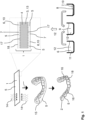
- FIG 1 provides an overview of a fabrication process according to the invention:
- An organic polymer 6, namely cellulose acetate butyrate (CAB) is dissolved in a solvent 12, namely acetone, to form a carrier solution 11.
- the carrier solution 11 is next mixed with an agent liquid 8 containing cinnamaldehyde, which is a bio-based antimicrobial agent 7, to form a carrier liquid 9, in which the agent 7 and the CAB are homogenously mixed.
- This carrier liquid 9 is then applied by dip coating onto a core foil 13 of a thermoplastic material 4. After evaporation of the solvent 12, a solid thermoplastic coating 5 is obtained on both sides of the core-foil 13, which thus completely covers the core 3 of the resulting functional foil 1 (c.f. the cross-section visible in Figure 1 ).
- the foil 1 in fact, constitutes a multi-layer structure with a core 3 made from glykol modified Polyethylenterephthalat (PETG) with a thickness of 200 ⁇ m and top and bottom functional coatings 5 which each have a thickness (after solidification) of less than 20 ⁇ m, thus resulting in a total thickness of the thermoplastic functional foil 1 of less than 250 ⁇ m.
- PETG Polyethylenterephthalat
- a pre-form 15 is formed from the functional foil 1 by thermoforming, applying heat 14 from both sides to the foil 1 and thus distorting the core 3 and the coatings 5 together in one step.
- the coating 5 is already firmly linked to the core 3 prior to thermoforming.
- the acetone 12 modifies the surface of the PETG core 3 leading to a softening of the PETG surface such that the CAB molecules 6 can interlock on a nanometer scale at the interface 17 (cf. Figure 1 ) with the PETG of the core 3.
- glass transition temperatures T g,core of the PETG-core 3 and T g,coating of the coating differ by less than 60°C, during thermoforming the adhesion of the coating 5 on the core foil 13 is further improved, as a thermal interlocking is achieved through thermal fusion of the CAB-coating 5 with the PETG.
- the pre-form 15 is cut such that the resulting dental appliance 2 visible on the bottom left of Figure 1 covers both teeth and adjoining parts of the gingiva.
- the dental appliance 2 further features multiple cavities 16 designed for taking up single teeth and which are matching the natural positions of the teeth of the user.
- the user experiences no forces on his teeth when wearing the dental appliance 2 on his teeth.
- the appliance 2 is very thin, highly conformable and offers a soft and highly deformable functional coating 5, which, due to the CAB used, even softens when getting into contact with saliva and offers antimicrobial protection due to the embedded cinnamaldehyde, the appliance 2 is ideally suited to be worn overnight or while smoking, even for hours.
- the user can benefit from the protection provided by the appliance 2 against cigarette smoke, as the appliance 2 is impermeable to smoke, but also from gingivitis and parodontitis, due to the antimicrobial effect that is produced when the cinnamaldehyde 7 is slowly released from the coating 5 into the oral cavity of the user.
- the CAB used for the coating 5 encapsulating the core 3 as illustrated on the right of Figure 1 is in fact a bio-based material 10, as it is produced by blending organic materials derived from fossil sources with organic material, in particular cellulose, derived from non-fossil natural sources such as plants. Therefore, the complete outer surface 18 of the appliance 2 is formed from bio-based materials 10. Any mechanical abrasion from this surface 18 will thus not be harmful for the user wearing the appliance 2 in his mouth.
- the agent 7 embedded in the coating 5 can be derived from natural sources such as essential oils extracted directly from non-fossil plants. This allows use of agents such as lime, thymol, eugenol, linalool, carvacrol, nutmeg, pimenta berry, rosemary, petitgrain, coffee, anise, to name a few.
- the appliance 2 can deliver both flavor and antimicrobial protection and still be highly biocompatible and non-harmful to wear.
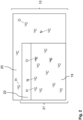
- bio-based material as understood herein may mean that the organic polymer 6 as well as the agent 7 used for the coating 5 may contain a significant portion of non-fossil carbon content 19, for example at least 40%.
- This non-fossil carbon content 19 is characterized in that it contains the carbon isotope 14 C in a detectable fraction (e.g. more than 10 ppq or even more than 100 ppq).
- a fossil carbon content 20 cf. Figure 4 ), which is based on fossil sources and containing the isotope 12 C but no detectable fraction of 14 C any more, as the 14 C has been diminished by radioactive decay over thousands of years.
- This fraction of the material 5 comprises the non-fossil carbon content 19 as well as all hydrogen H-, oxygen O-, and nitrogen N-atoms 22 bound to the non-fossil carbon content 19.
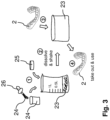
- Figure 3 illustrates the formation and use of a reload-liquid:
- a highly concentrated liquid precursor 24 containing the agent 7 and a surfactant are first dispensed in water using a low-cost pipette 26; alternatively, a tab 25 containing the agent 7 and a surfactant may be dissolved in the water.
- a reload-liquid 23 may be formed.
- the reload-liquid 23 is shaken to allow thorough mixing of the liquid precursor 24 with the water and/or full dissolving of the tab 24 in the water.
- the dental appliance 2 is immersed and soaked in the formed reload-liquid 23 for a duration of 15-30 minutes.
- the dental appliance 2 is taken out of the reload-liquid 23 and is now loaded with the agent 7 and ready for use in the mouth, where the agent 7 can be released from the dental appliance 2, for example for producing a pleasant taste and/or an antimicrobial effect.
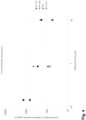
- Figure 4 displays experimental data obtained by first loading four different thermoplastic materials with an agent 7 (cinnamaldehyde) by immersing the respective thermoplastic material in a reload-liquid 23 (comprising 12 g of a surfactant and 0.56 g of the agent 7 dissolved in 100 ml of water) for a time period of 60 min, respectively. Afterwards, the materials were immersed repeatedly in fresh ethanol-solution, which was used as an extraction medium for extracting the agent 7 from the materials, and the concentration of the agent 7 in the respective ethanol-solution was measured each time. In other words, at different points in time, fresh ethanol-solutions were used for extracting the agent from the respective thermoplastic material.
- the graph displays the measured concentration of the agent 7 in the respective solution for each material for an extraction time of 0.7 h, 7 h, and 70 h, respectively.
- the proposed material system (upper two symbols), comprising a cellulose-based cap layer (materials NA750 and NA550, respectively) applied onto a core of a thermoplastic material, can initially load more of the agent 7 from the same reload-liquid 23 and additionally can store the agent 7 for a much longer period of time (thus offering a lower release rate of the agent 7 over time), as compared to a poly-urethane (PU) based thermofoil (Zendura) or a pure PETG-based thermofoil (both without any coating).
- PU poly-urethane
- Zendura pure PETG-based thermofoil
- the approach according to the invention allows for an increase in release rate by a factor of 2..6 after a reload time of only 60 minutes; the period of time during which a significant release of the agent is maintained (and thus the desired anti-microbial functionality of the dental appliance) is extended by about six times.
- the uptake of the cellulose-based cap layers is at least a factor of 2..4 higher, as compared to the pure core materials PETG and PU.
- the graph shows the concentration of each agent 7 in 40% ethanol-water-solution, which was used as an extraction medium over a period of 24 hours.
- the capacity to interact with the dental appliance can vary by a factor of up to 10000, as can be seen by comparing the data for Carvacrol and Cinnamaldehyde.
- Cinnamaldehyde appears as an agent that is particularly suited for the applications described herein.
- non-polar and polar agents should be noted here, since the polarity of the agent 7 will define the reload speed into the cellulose-based (e.g. CAB) coating of the dental appliance 2 as well as the extraction speed in the saliva of the patient. Furthermore, the polarities of the agents 5 impact their respective interaction when combined together in one reload-liquid 23 and thus influence the reload speed of each single agent 7, depending on the ratio to each other and the ratio to the surfactant (if present in the reload-liquid 23).
- the polarity of the agent 7 will define the reload speed into the cellulose-based (e.g. CAB) coating of the dental appliance 2 as well as the extraction speed in the saliva of the patient.
- the polarities of the agents 5 impact their respective interaction when combined together in one reload-liquid 23 and thus influence the reload speed of each single agent 7, depending on the ratio to each other and the ratio to the surfactant (if present in the reload-liquid 23).
- cinnamaldehyde is polar, while limonene and methyl salicylate are non-polar, cinnamaldehyde is particularly suited as an anti-microbial agent 7 to be used with a material system as proposed herein with a cellulose-based cap layer, because cinnamaldehyde offers similar anti-microbial protection but superior reload speed.
- a combination of Limonene or cinnamaldehyde and methyl salicylate or trans-anethole is proposed to be used as the agent 7 in the reload-liquid 23 described previously and thus as the antimicrobial agent 7 to be delivered by the dental appliance 2 to the user.
- thermoforming the functional foil 1 A carrier liquid 9 containing an organic and preferably bio-based polymer 6 is enriched with an agent 7 and applied onto a solid thermoplastic core foil 13. After evaporating of a solvent 12 contained in the carrier liquid 9, a uniform and highly homogenous functional thermoplastic coating 5 is obtained on the core foil 13. After thermoforming of the foil 1, the dental appliance 2 thus features an outer protective coating 5 offering enhanced functionality (c.f. Figure 1 ). Moreover, it is possible to reload the agent 7 into the coating 5 of the appliance 2 using a reload-liquid.
Landscapes
- Health & Medical Sciences (AREA)
- Life Sciences & Earth Sciences (AREA)
- Veterinary Medicine (AREA)
- Public Health (AREA)
- General Health & Medical Sciences (AREA)
- Animal Behavior & Ethology (AREA)
- Epidemiology (AREA)
- Engineering & Computer Science (AREA)
- Nursing (AREA)
- Medicinal Chemistry (AREA)
- Chemical & Material Sciences (AREA)
- Physiology (AREA)
- Oral & Maxillofacial Surgery (AREA)
- Dentistry (AREA)
- Nutrition Science (AREA)
- Vascular Medicine (AREA)
- Pulmonology (AREA)
- Otolaryngology (AREA)
- Biomedical Technology (AREA)
- Orthopedic Medicine & Surgery (AREA)
- Pharmacology & Pharmacy (AREA)
- Heart & Thoracic Surgery (AREA)
- Mechanical Engineering (AREA)
- Dental Preparations (AREA)
- Cosmetics (AREA)
- Pharmaceuticals Containing Other Organic And Inorganic Compounds (AREA)
- Acyclic And Carbocyclic Compounds In Medicinal Compositions (AREA)
- Coating Of Shaped Articles Made Of Macromolecular Substances (AREA)
Claims (17)
- Verfahren zur Herstellung einer thermoplastischen funktionalen Folie (1), insbesondere zur intraoralen Verwendung als eine Dentalvorrichtung (2),- wobei die funktionale Folie (1) einen Kern (3) aus thermoplastischem Material (4) und eine thermoplastische Beschichtung (5) umfasst, die den Kern (3) mindestens teilweise bedeckt, und wobei das Verfahren die folgenden Schritte umfasst:- Bereitstellen einer Trägerflüssigkeit (9), insbesondere in der Form einer Trägerschmelze, die ein organisches Polymer (6) umfasst;- Hinzufügen eines Mittels (7), das in einer wässrigen Umgebung aus der Beschichtung (5) freigesetzt werden kann, zu der Trägerflüssigkeit (9) vor Formen der Beschichtung (5); dadurch gekennzeichnet, dass- die Trägerflüssigkeit (9) in der Form einer flüssigen Beschichtung (5) auf den festen Kern (3), der die Form einer Kernfolie (13) aufweist, aufgetragen wird und- die flüssige Beschichtung (5) anschließend auf der Kernfolie (13) ausgehärtet wird, um eine feste thermoplastische Beschichtung (5) zu formen, die den Kern (3) bedeckt.
- Verfahren nach Anspruch 1,- wobei das Mittel (7) aus einer erneuerbaren biologischen Ressource, insbesondere einem Material nichtfossiler Herkunft, das durch einen lebenden Organismus hervorgebracht wird,- am bevorzugtesten aus einem ätherischen Öl, das insbesondere unmittelbar aus nichtfossilen Pflanzen extrahiert ist, abgeleitet ist.
- Verfahren nach Anspruch 1 oder 2,- wobei das Mittel (7) mindestens eine der folgenden Substanzen umfasst: ein ätherisches Öl, ein Extrakt eines ätherischen Öls oder ein Derivat wie etwa Zimtaldehyd, Limette, Thymol, Eugenol, Linalool, Carvacrol, Muskatnuss, Pimentbeere, Rosmarin, Petitgrain, Kaffee oder Anis.
- Verfahren nach einem der vorhergehenden Ansprüche,- wobei das organische Polymer (6) aus einer erneuerbaren biologischen Ressource, insbesondere einem Material nichtfossiler Herkunft, das durch einen lebenden Organismus hervorgebracht wird, abgeleitet ist, und/oder- wobei das organische Polymer (6) ein zellulosebasiertes Material, insbesondere ein zellulosebasiertes Verbundprodukt, ist,- wobei bevorzugt das organische Polymer (6) Zelluloseacetatbutyrat (CAB) ist,- wobei am bevorzugtesten ein Butyrylgehalt des CAB zwischen 15 und 60 Gewichts-% beträgt.
- Verfahren nach einem der vorhergehenden Ansprüche,- wobei die Beschichtung (5) antimikrobiellen Schutz, insbesondere durch die Freigabe eines antimikrobiellen Mittels (7), am bevorzugtesten Zimtaldehyds, bereitstellt.
- Verfahren nach einem der vorhergehenden Ansprüche,- wobei sich eine Schmelztemperatur Tm,core des Kerns (3) und eine Schmelztemperatur Tm,coating der Beschichtung (5) um mindestens 20 °C, bevorzugt um mindestens 40 °C, unterscheiden,- wobei am bevorzugtesten die Schmelztemperatur Tm,core des Kerns (3) höher als die Schmelztemperatur Tm,coating der Beschichtung (5) ist.
- Verfahren nach einem der vorhergehenden Ansprüche,- wobei der Kern (3) aus Polyethylenterephthalat (PET), insbesondere mindestens teilweise aus wiederverwendetem PET,- bevorzugt aus Glykol-modifiziertem Polyethylenterephthalat (PETG) hergestellt ist.
- Verfahren nach einem der vorhergehenden Ansprüche,- wobei das Mittel (7) eine Kombination der folgenden ätherischen Öle umfasst:Limonen oder Zimtaldehyd
undMethylsalicylat oder Transanethol. - Verfahren nach einem der vorhergehenden Ansprüche,- wobei eine Glasübergangstemperatur Tg,coating der Beschichtung (5) in dem Bereich von 80-165 °C liegt,- wobei bevorzugt eine Zersetzungstemperatur Td,agent des Mittels (7) mindestens 10 °C über einer Schmelztemperatur Tm,coating der Beschichtung (5) liegt und/oder- wobei ein entsprechender Schmelzbereich der Beschichtung (5), insbesondere des organischen Polymers (6), in dem Bereich von 120-200 °C liegt
und/oder- wobei das organische Polymer (6), insbesondere das CAB, das für die Beschichtung (5) verwendet wird, ein zahlenmittleres Molekulargewicht von mehr als 12,000 g/mol, bevorzugt mehr als 20,000 g/mol, aufweist. - Verfahren nach einem der vorhergehenden Ansprüche,- wobei die Trägerflüssigkeit (9) eine Trägerlösung (11) ist,- wobei bevorzugt die Trägerlösung (11) durch Auflösen des organischen Polymers (6) in einem Lösemittel (12) erlangt wird,- wobei am bevorzugtesten die Beschichtung (5) auf dem Kern (3) durch Verdampfen des Lösemittels (12) von der Beschichtung (5) ausgehärtet wird und/oder- wobei der Kern (3) eine Kernfolie (13) ist.
- Verfahren nach einem der vorhergehenden Ansprüche,- wobei die Beschichtung (5) durch ein physikalisches Beschichtungsverfahren, wie etwa Schleuderbeschichten oder rakelbasiertes Beschichten, oder durch Sprühbeschichten oder durch Rolle-zu-Rolle-Beschichten geformt wird.
- Verfahren nach einem der vorhergehenden Ansprüche,- wobei sich eine Glasübergangstemperatur Tg,core des Kerns (3) und eine Glasübergangstemperatur Tg,coating der Beschichtung (5) um weniger als 80 °C, bevorzugt um weniger als 60 °C unterscheiden, wobei insbesondere Tg,coating höher als Tg,core ist.
- Verfahren nach einem der Ansprüche 10 bis 12,- wobei das Lösemittel (12) die Oberfläche des Kerns (3) insbesondere durch Reduzieren der Interaktion molekularer Ketten des Materials des Kerns (3) derart modifiziert, dass sich der Kern (3) und die Beschichtung (5) auf einer Nanometerskala gegenseitig verriegeln können, woraus sich eine verbesserte Haftung der Beschichtung (5) auf dem Kern (3) ergibt, und/oder- wobei das Lösemittel (12) mindestens eines von Aceton, Methylacetat, Ethylacetat, Methylethylketon, Isopropylacetat, Butylacetat, Ethyllactat, Cyclohexan, Diacetonalkohol, Butyllactat oder geeigneten Mischungen dieser Lösemittel umfasst.
- Verfahren nach einem der vorhergehenden Ansprüche,- wobei das Mittel (7) selbst eine Flüssigkeit ist oder- wobei das Mittel (7) durch Auflösen oder Emulgieren des Mittels (7) in einer wässrigen oder ölbasierten Lösung und Mischen der Lösung mit der Trägerflüssigkeit (9) zu der Trägerflüssigkeit (9) hinzugefügt wird,- wobei bevorzugt die Lösung, die das Mittel (7) enthält, z. B. durch ein Rührwerk mit der Trägerflüssigkeit (9) gemischt wird, um vor dem Formen der Beschichtung (5) eine homogene Trägerlösung (11) zu formen.
- Verfahren nach einem der vorhergehenden Ansprüche,- wobei ein Verhältnis zwischen dem Mittel (7) und dem organischen Polymer (6) zwischen 0,01/99,99 und 30/70 nach Gewicht liegt.
- Verfahren nach einem der vorhergehenden Ansprüche,- wobei eine Dentalvorrichtung (2) aus der funktionalen Folie (1) durch Thermoformen der Folie (1) nach dem Auftragen der Beschichtung (5) auf den Kern (3) geformt wird,- insbesondere derart, dass nach dem Thermoformen das organische Polymer (6) eine konforme funktionale Beschichtung (5) formt, die bevorzugt den Kern (3) völlig bedeckt,- wobei insbesondere das Mittel (7), das in die Beschichtung (5) eingebettet ist, der Dentalvorrichtung (2) eine antimikrobielle oder regenerative Wirkung für Zähne und Zahnfleisch oder einen Geschmack bereitstellt.
- Dentalvorrichtung (2), wie etwa eine zahnregulierende Vorrichtung (2) oder eine Schutzvorrichtung (2) zum Schutz von Zähnen und/oder Zahnfleisch, die aus einer funktionalen Folie (1) thermogeformt ist,
dadurch gekennzeichnet, dass- die funktionale Folie (1) mit einem Verfahren nach einem der vorhergehenden Ansprüche hergestellt ist,- wobei bevorzugt die Dentalvorrichtung (2) gänzlich aus der Folie (1) besteht.
Priority Applications (1)
| Application Number | Priority Date | Filing Date | Title |
|---|---|---|---|
| EP24215594.3A EP4545042B1 (de) | 2020-08-14 | 2021-08-06 | Verfahren zur herstellung einer dentalvorrichtung |
Applications Claiming Priority (2)
| Application Number | Priority Date | Filing Date | Title |
|---|---|---|---|
| EP20191189.8A EP3954321A1 (de) | 2020-08-14 | 2020-08-14 | Verfahren zur herstellung einer zahnärztlichen vorrichtung und nicht-therapeutische verwendung einer zahnärztlichen vorrichtung |
| PCT/EP2021/072046 WO2022033985A1 (en) | 2020-08-14 | 2021-08-06 | Process for fabricating a dental appliance and accompanying use cases |
Related Child Applications (2)
| Application Number | Title | Priority Date | Filing Date |
|---|---|---|---|
| EP24215594.3A Division EP4545042B1 (de) | 2020-08-14 | 2021-08-06 | Verfahren zur herstellung einer dentalvorrichtung |
| EP24215594.3A Division-Into EP4545042B1 (de) | 2020-08-14 | 2021-08-06 | Verfahren zur herstellung einer dentalvorrichtung |
Publications (3)
| Publication Number | Publication Date |
|---|---|
| EP4181818A1 EP4181818A1 (de) | 2023-05-24 |
| EP4181818B1 true EP4181818B1 (de) | 2025-04-02 |
| EP4181818C0 EP4181818C0 (de) | 2025-04-02 |
Family
ID=72088003
Family Applications (3)
| Application Number | Title | Priority Date | Filing Date |
|---|---|---|---|
| EP20191189.8A Ceased EP3954321A1 (de) | 2020-08-14 | 2020-08-14 | Verfahren zur herstellung einer zahnärztlichen vorrichtung und nicht-therapeutische verwendung einer zahnärztlichen vorrichtung |
| EP21763262.9A Active EP4181818B1 (de) | 2020-08-14 | 2021-08-06 | Zahnärztliche vorrichtung und verfahren zur herstellung einer thermoplastischen folie |
| EP24215594.3A Active EP4545042B1 (de) | 2020-08-14 | 2021-08-06 | Verfahren zur herstellung einer dentalvorrichtung |
Family Applications Before (1)
| Application Number | Title | Priority Date | Filing Date |
|---|---|---|---|
| EP20191189.8A Ceased EP3954321A1 (de) | 2020-08-14 | 2020-08-14 | Verfahren zur herstellung einer zahnärztlichen vorrichtung und nicht-therapeutische verwendung einer zahnärztlichen vorrichtung |
Family Applications After (1)
| Application Number | Title | Priority Date | Filing Date |
|---|---|---|---|
| EP24215594.3A Active EP4545042B1 (de) | 2020-08-14 | 2021-08-06 | Verfahren zur herstellung einer dentalvorrichtung |
Country Status (4)
| Country | Link |
|---|---|
| US (1) | US20230201025A1 (de) |
| EP (3) | EP3954321A1 (de) |
| JP (1) | JP2023539448A (de) |
| WO (1) | WO2022033985A1 (de) |
Families Citing this family (2)
| Publication number | Priority date | Publication date | Assignee | Title |
|---|---|---|---|---|
| CN114404078B (zh) * | 2022-01-04 | 2023-05-23 | 深圳技术大学 | 一种隐形矫治器的制备方法及隐形矫治器 |
| EP4497429A1 (de) | 2023-07-06 | 2025-01-29 | Bottmedical AG | Pflegelösung, insbesondere zur verwendung mit 3d-gedruckten polymerzahnvorrichtungen |
Family Cites Families (8)
| Publication number | Priority date | Publication date | Assignee | Title |
|---|---|---|---|---|
| US6536448B2 (en) * | 2000-12-29 | 2003-03-25 | Kimberly-Clark Worldwide, Inc. | Hemostat coated dental floss and hemostat coated dental tape |
| US7210926B2 (en) * | 2003-11-10 | 2007-05-01 | General Electric Company | Formable sheets for medical applications and methods of manufacture thereof |
| US20060115785A1 (en) * | 2004-11-30 | 2006-06-01 | Chunhua Li | Systems and methods for intra-oral drug delivery |
| EP1829932B1 (de) * | 2004-12-03 | 2013-10-23 | Rocky Mountain Morita Corporation | Flächengebilde zur evaluierung von bruxismus |
| NZ572206A (en) * | 2006-03-24 | 2012-02-24 | Auxilium Int Holdings Inc | Process for the preparation of a hot-melt extruded laminate |
| WO2013077077A1 (ja) * | 2011-11-22 | 2013-05-30 | 株式会社アドバンテスト | 生体光計測用ファントム、ファントム積層体およびファントムの製造方法 |
| EP2949311B1 (de) * | 2014-05-30 | 2019-10-16 | Shofu Inc. | Dentalzusammensetzung enthaltend Glas mit verzögerter Freisetzung von Ionen |
| US20220409351A1 (en) * | 2019-11-22 | 2022-12-29 | Emanate Biomedical, Inc. | Oral appliance for delivery of an antimicrobial composition |
-
2020
- 2020-08-14 EP EP20191189.8A patent/EP3954321A1/de not_active Ceased
-
2021
- 2021-08-06 WO PCT/EP2021/072046 patent/WO2022033985A1/en not_active Ceased
- 2021-08-06 JP JP2023510371A patent/JP2023539448A/ja active Pending
- 2021-08-06 EP EP21763262.9A patent/EP4181818B1/de active Active
- 2021-08-06 EP EP24215594.3A patent/EP4545042B1/de active Active
- 2021-08-06 US US18/021,019 patent/US20230201025A1/en active Pending
Also Published As
| Publication number | Publication date |
|---|---|
| US20230201025A1 (en) | 2023-06-29 |
| EP4545042A1 (de) | 2025-04-30 |
| EP4545042C0 (de) | 2025-10-01 |
| EP4545042B1 (de) | 2025-10-01 |
| WO2022033985A1 (en) | 2022-02-17 |
| EP4181818A1 (de) | 2023-05-24 |
| EP4181818C0 (de) | 2025-04-02 |
| JP2023539448A (ja) | 2023-09-14 |
| EP3954321A1 (de) | 2022-02-16 |
Similar Documents
| Publication | Publication Date | Title |
|---|---|---|
| EP4181818B1 (de) | Zahnärztliche vorrichtung und verfahren zur herstellung einer thermoplastischen folie | |
| EP3589229B1 (de) | Dentalgerät mit unterschiedlichen eigenschaften | |
| CA2169729C (en) | Water-soluble pressure-sensitive mucoadhesive | |
| DE60218036T2 (de) | Mehrschichtige pflaster zum aufhellen von zähnen | |
| DE3311963C2 (de) | Fluoridhaltige Zahnseide | |
| EP0949925B1 (de) | Flache arzneizubereitung zur applikation und freisetzung von buprenorphin oder einer pharmakologisch vergleichbaren substanz in der mundhöhle und verfahren zu ihrer herstellung | |
| EP0259749A1 (de) | Darreichungs- und Dosierungsform für Arzneimittelwirkstoffe, Reagentien oder dergleichen sowie Verfahren zu deren Herstellung | |
| EP2034817A1 (de) | Präparierung von produkten, insbesondere zellulosehaltigen produkten, und/oder von räumen | |
| TW200533372A (en) | Stabilized peroxide compositions | |
| JPH07148280A (ja) | マスク | |
| JP2007308443A (ja) | 口腔用貼付剤製品 | |
| WO1998034600A1 (de) | Dehnbares transdermales therapeutisches system | |
| KR101986053B1 (ko) | 황칠 추출물을 이용한 치실 및 그 제조방법 | |
| EP0828523A1 (de) | Transdermales therapeutisches system mit druckfarbenfreier identifikation und verfahren zu seiner herstellung | |
| KR101100783B1 (ko) | 재사용이 가능한 종이컵 | |
| KR20140135664A (ko) | 물이 필요없는 일회용 칫솔 및 일회용 칫솔의 제조 방법 | |
| CN108094656A (zh) | 一种含有纳米多孔活性炭的口香糖及其制备方法 | |
| KR20110060571A (ko) | 천연분말 한지 하이드로젤 마스크 팩 | |
| CN113993594A (zh) | 牙齿用贴片 | |
| WO1999032046A1 (en) | Coating of ptfe dental floss | |
| JP2009528900A (ja) | 不透過性中央部を有した医療用多層パッチ | |
| KR200389177Y1 (ko) | 은 나노와 향이 함유된 칫솔 보관함 | |
| CN211721660U (zh) | 包覆缓释型颗粒农药 | |
| DE102004028415B4 (de) | Dermales oder transdermales therapeutisches System enthaltend eine Abdeckfolie mit Barrierewirkung | |
| EP1523305A2 (de) | Vorrichtung und pflaster zur kontrollierten freisetzung von vanillin |
Legal Events
| Date | Code | Title | Description |
|---|---|---|---|
| STAA | Information on the status of an ep patent application or granted ep patent |
Free format text: STATUS: UNKNOWN |
|
| STAA | Information on the status of an ep patent application or granted ep patent |
Free format text: STATUS: THE INTERNATIONAL PUBLICATION HAS BEEN MADE |
|
| PUAI | Public reference made under article 153(3) epc to a published international application that has entered the european phase |
Free format text: ORIGINAL CODE: 0009012 |
|
| STAA | Information on the status of an ep patent application or granted ep patent |
Free format text: STATUS: REQUEST FOR EXAMINATION WAS MADE |
|
| 17P | Request for examination filed |
Effective date: 20230215 |
|
| AK | Designated contracting states |
Kind code of ref document: A1 Designated state(s): AL AT BE BG CH CY CZ DE DK EE ES FI FR GB GR HR HU IE IS IT LI LT LU LV MC MK MT NL NO PL PT RO RS SE SI SK SM TR |
|
| GRAP | Despatch of communication of intention to grant a patent |
Free format text: ORIGINAL CODE: EPIDOSNIGR1 |
|
| STAA | Information on the status of an ep patent application or granted ep patent |
Free format text: STATUS: GRANT OF PATENT IS INTENDED |
|
| INTG | Intention to grant announced |
Effective date: 20230928 |
|
| DAV | Request for validation of the european patent (deleted) | ||
| DAX | Request for extension of the european patent (deleted) | ||
| GRAJ | Information related to disapproval of communication of intention to grant by the applicant or resumption of examination proceedings by the epo deleted |
Free format text: ORIGINAL CODE: EPIDOSDIGR1 |
|
| STAA | Information on the status of an ep patent application or granted ep patent |
Free format text: STATUS: REQUEST FOR EXAMINATION WAS MADE |
|
| GRAP | Despatch of communication of intention to grant a patent |
Free format text: ORIGINAL CODE: EPIDOSNIGR1 |
|
| STAA | Information on the status of an ep patent application or granted ep patent |
Free format text: STATUS: GRANT OF PATENT IS INTENDED |
|
| INTC | Intention to grant announced (deleted) | ||
| INTG | Intention to grant announced |
Effective date: 20240228 |
|
| GRAS | Grant fee paid |
Free format text: ORIGINAL CODE: EPIDOSNIGR3 |
|
| 19U | Interruption of proceedings before grant |
Effective date: 20240521 |
|
| 19W | Proceedings resumed before grant after interruption of proceedings |
Effective date: 20250203 |
|
| GRAA | (expected) grant |
Free format text: ORIGINAL CODE: 0009210 |
|
| STAA | Information on the status of an ep patent application or granted ep patent |
Free format text: STATUS: THE PATENT HAS BEEN GRANTED |
|
| RAP3 | Party data changed (applicant data changed or rights of an application transferred) |
Owner name: BUSSMEDICAL AG |
|
| AK | Designated contracting states |
Kind code of ref document: B1 Designated state(s): AL AT BE BG CH CY CZ DE DK EE ES FI FR GB GR HR HU IE IS IT LI LT LU LV MC MK MT NL NO PL PT RO RS SE SI SK SM TR |
|
| REG | Reference to a national code |
Ref country code: GB Ref legal event code: FG4D |
|
| REG | Reference to a national code |
Ref country code: CH Ref legal event code: EP |
|
| REG | Reference to a national code |
Ref country code: DE Ref legal event code: R096 Ref document number: 602021028593 Country of ref document: DE |
|
| REG | Reference to a national code |
Ref country code: IE Ref legal event code: FG4D |
|
| U01 | Request for unitary effect filed |
Effective date: 20250430 |
|
| U07 | Unitary effect registered |
Designated state(s): AT BE BG DE DK EE FI FR IT LT LU LV MT NL PT RO SE SI Effective date: 20250509 |
|
| U20 | Renewal fee for the european patent with unitary effect paid |
Year of fee payment: 5 Effective date: 20250821 |
|
| PG25 | Lapsed in a contracting state [announced via postgrant information from national office to epo] |
Ref country code: ES Free format text: LAPSE BECAUSE OF FAILURE TO SUBMIT A TRANSLATION OF THE DESCRIPTION OR TO PAY THE FEE WITHIN THE PRESCRIBED TIME-LIMIT Effective date: 20250402 |
|
| PG25 | Lapsed in a contracting state [announced via postgrant information from national office to epo] |
Ref country code: NO Free format text: LAPSE BECAUSE OF FAILURE TO SUBMIT A TRANSLATION OF THE DESCRIPTION OR TO PAY THE FEE WITHIN THE PRESCRIBED TIME-LIMIT Effective date: 20250702 Ref country code: GR Free format text: LAPSE BECAUSE OF FAILURE TO SUBMIT A TRANSLATION OF THE DESCRIPTION OR TO PAY THE FEE WITHIN THE PRESCRIBED TIME-LIMIT Effective date: 20250703 |
|
| PG25 | Lapsed in a contracting state [announced via postgrant information from national office to epo] |
Ref country code: PL Free format text: LAPSE BECAUSE OF FAILURE TO SUBMIT A TRANSLATION OF THE DESCRIPTION OR TO PAY THE FEE WITHIN THE PRESCRIBED TIME-LIMIT Effective date: 20250402 |
|
| PG25 | Lapsed in a contracting state [announced via postgrant information from national office to epo] |
Ref country code: HR Free format text: LAPSE BECAUSE OF FAILURE TO SUBMIT A TRANSLATION OF THE DESCRIPTION OR TO PAY THE FEE WITHIN THE PRESCRIBED TIME-LIMIT Effective date: 20250402 |
|
| PGFP | Annual fee paid to national office [announced via postgrant information from national office to epo] |
Ref country code: CH Payment date: 20250901 Year of fee payment: 5 |
|
| PG25 | Lapsed in a contracting state [announced via postgrant information from national office to epo] |
Ref country code: RS Free format text: LAPSE BECAUSE OF FAILURE TO SUBMIT A TRANSLATION OF THE DESCRIPTION OR TO PAY THE FEE WITHIN THE PRESCRIBED TIME-LIMIT Effective date: 20250702 |
|
| PG25 | Lapsed in a contracting state [announced via postgrant information from national office to epo] |
Ref country code: IS Free format text: LAPSE BECAUSE OF FAILURE TO SUBMIT A TRANSLATION OF THE DESCRIPTION OR TO PAY THE FEE WITHIN THE PRESCRIBED TIME-LIMIT Effective date: 20250802 |