EP3589229B1 - Dentalgerät mit unterschiedlichen eigenschaften - Google Patents
Dentalgerät mit unterschiedlichen eigenschaften Download PDFInfo
- Publication number
- EP3589229B1 EP3589229B1 EP18760863.3A EP18760863A EP3589229B1 EP 3589229 B1 EP3589229 B1 EP 3589229B1 EP 18760863 A EP18760863 A EP 18760863A EP 3589229 B1 EP3589229 B1 EP 3589229B1
- Authority
- EP
- European Patent Office
- Prior art keywords
- dental appliance
- teeth
- polymeric material
- gum line
- activity
- Prior art date
- Legal status (The legal status is an assumption and is not a legal conclusion. Google has not performed a legal analysis and makes no representation as to the accuracy of the status listed.)
- Active
Links
Images



Classifications
-
- A—HUMAN NECESSITIES
- A61—MEDICAL OR VETERINARY SCIENCE; HYGIENE
- A61C—DENTISTRY; APPARATUS OR METHODS FOR ORAL OR DENTAL HYGIENE
- A61C19/00—Dental auxiliary appliances
- A61C19/06—Implements for therapeutic treatment
- A61C19/063—Medicament applicators for teeth or gums, e.g. treatment with fluorides
- A61C19/066—Bleaching devices; Whitening agent applicators for teeth, e.g. trays or strips
-
- A—HUMAN NECESSITIES
- A61—MEDICAL OR VETERINARY SCIENCE; HYGIENE
- A61C—DENTISTRY; APPARATUS OR METHODS FOR ORAL OR DENTAL HYGIENE
- A61C7/00—Orthodontics, i.e. obtaining or maintaining the desired position of teeth, e.g. by straightening, evening, regulating, separating, or by correcting malocclusions
- A61C7/08—Mouthpiece-type retainers or positioners, e.g. for both the lower and upper arch
-
- B—PERFORMING OPERATIONS; TRANSPORTING
- B32—LAYERED PRODUCTS
- B32B—LAYERED PRODUCTS, i.e. PRODUCTS BUILT-UP OF STRATA OF FLAT OR NON-FLAT, e.g. CELLULAR OR HONEYCOMB, FORM
- B32B25/00—Layered products comprising a layer of natural or synthetic rubber
-
- B—PERFORMING OPERATIONS; TRANSPORTING
- B32—LAYERED PRODUCTS
- B32B—LAYERED PRODUCTS, i.e. PRODUCTS BUILT-UP OF STRATA OF FLAT OR NON-FLAT, e.g. CELLULAR OR HONEYCOMB, FORM
- B32B25/00—Layered products comprising a layer of natural or synthetic rubber
- B32B25/04—Layered products comprising a layer of natural or synthetic rubber comprising rubber as the main or only constituent of a layer, which is next to another layer of the same or of a different material
- B32B25/08—Layered products comprising a layer of natural or synthetic rubber comprising rubber as the main or only constituent of a layer, which is next to another layer of the same or of a different material of synthetic resin
-
- B—PERFORMING OPERATIONS; TRANSPORTING
- B32—LAYERED PRODUCTS
- B32B—LAYERED PRODUCTS, i.e. PRODUCTS BUILT-UP OF STRATA OF FLAT OR NON-FLAT, e.g. CELLULAR OR HONEYCOMB, FORM
- B32B25/00—Layered products comprising a layer of natural or synthetic rubber
- B32B25/14—Layered products comprising a layer of natural or synthetic rubber comprising synthetic rubber copolymers
-
- B—PERFORMING OPERATIONS; TRANSPORTING
- B32—LAYERED PRODUCTS
- B32B—LAYERED PRODUCTS, i.e. PRODUCTS BUILT-UP OF STRATA OF FLAT OR NON-FLAT, e.g. CELLULAR OR HONEYCOMB, FORM
- B32B27/00—Layered products comprising a layer of synthetic resin
- B32B27/06—Layered products comprising a layer of synthetic resin as the main or only constituent of a layer, which is next to another layer of the same or of a different material
- B32B27/08—Layered products comprising a layer of synthetic resin as the main or only constituent of a layer, which is next to another layer of the same or of a different material of synthetic resin
-
- B—PERFORMING OPERATIONS; TRANSPORTING
- B32—LAYERED PRODUCTS
- B32B—LAYERED PRODUCTS, i.e. PRODUCTS BUILT-UP OF STRATA OF FLAT OR NON-FLAT, e.g. CELLULAR OR HONEYCOMB, FORM
- B32B27/00—Layered products comprising a layer of synthetic resin
- B32B27/18—Layered products comprising a layer of synthetic resin characterised by the use of special additives
- B32B27/20—Layered products comprising a layer of synthetic resin characterised by the use of special additives using fillers, pigments, thixotroping agents
-
- B—PERFORMING OPERATIONS; TRANSPORTING
- B32—LAYERED PRODUCTS
- B32B—LAYERED PRODUCTS, i.e. PRODUCTS BUILT-UP OF STRATA OF FLAT OR NON-FLAT, e.g. CELLULAR OR HONEYCOMB, FORM
- B32B27/00—Layered products comprising a layer of synthetic resin
- B32B27/28—Layered products comprising a layer of synthetic resin comprising synthetic resins not wholly covered by any one of the sub-groups B32B27/30 - B32B27/42
-
- B—PERFORMING OPERATIONS; TRANSPORTING
- B32—LAYERED PRODUCTS
- B32B—LAYERED PRODUCTS, i.e. PRODUCTS BUILT-UP OF STRATA OF FLAT OR NON-FLAT, e.g. CELLULAR OR HONEYCOMB, FORM
- B32B27/00—Layered products comprising a layer of synthetic resin
- B32B27/36—Layered products comprising a layer of synthetic resin comprising polyesters
-
- B—PERFORMING OPERATIONS; TRANSPORTING
- B32—LAYERED PRODUCTS
- B32B—LAYERED PRODUCTS, i.e. PRODUCTS BUILT-UP OF STRATA OF FLAT OR NON-FLAT, e.g. CELLULAR OR HONEYCOMB, FORM
- B32B27/00—Layered products comprising a layer of synthetic resin
- B32B27/40—Layered products comprising a layer of synthetic resin comprising polyurethanes
-
- B—PERFORMING OPERATIONS; TRANSPORTING
- B32—LAYERED PRODUCTS
- B32B—LAYERED PRODUCTS, i.e. PRODUCTS BUILT-UP OF STRATA OF FLAT OR NON-FLAT, e.g. CELLULAR OR HONEYCOMB, FORM
- B32B7/00—Layered products characterised by the relation between layers; Layered products characterised by the relative orientation of features between layers, or by the relative values of a measurable parameter between layers, i.e. products comprising layers having different physical, chemical or physicochemical properties; Layered products characterised by the interconnection of layers
- B32B7/02—Physical, chemical or physicochemical properties
-
- B—PERFORMING OPERATIONS; TRANSPORTING
- B32—LAYERED PRODUCTS
- B32B—LAYERED PRODUCTS, i.e. PRODUCTS BUILT-UP OF STRATA OF FLAT OR NON-FLAT, e.g. CELLULAR OR HONEYCOMB, FORM
- B32B7/00—Layered products characterised by the relation between layers; Layered products characterised by the relative orientation of features between layers, or by the relative values of a measurable parameter between layers, i.e. products comprising layers having different physical, chemical or physicochemical properties; Layered products characterised by the interconnection of layers
- B32B7/02—Physical, chemical or physicochemical properties
- B32B7/022—Mechanical properties
-
- A—HUMAN NECESSITIES
- A61—MEDICAL OR VETERINARY SCIENCE; HYGIENE
- A61C—DENTISTRY; APPARATUS OR METHODS FOR ORAL OR DENTAL HYGIENE
- A61C19/00—Dental auxiliary appliances
- A61C19/06—Implements for therapeutic treatment
- A61C19/063—Medicament applicators for teeth or gums, e.g. treatment with fluorides
-
- B—PERFORMING OPERATIONS; TRANSPORTING
- B32—LAYERED PRODUCTS
- B32B—LAYERED PRODUCTS, i.e. PRODUCTS BUILT-UP OF STRATA OF FLAT OR NON-FLAT, e.g. CELLULAR OR HONEYCOMB, FORM
- B32B2255/00—Coating on the layer surface
- B32B2255/10—Coating on the layer surface on synthetic resin layer or on natural or synthetic rubber layer
-
- B—PERFORMING OPERATIONS; TRANSPORTING
- B32—LAYERED PRODUCTS
- B32B—LAYERED PRODUCTS, i.e. PRODUCTS BUILT-UP OF STRATA OF FLAT OR NON-FLAT, e.g. CELLULAR OR HONEYCOMB, FORM
- B32B2255/00—Coating on the layer surface
- B32B2255/26—Polymeric coating
-
- B—PERFORMING OPERATIONS; TRANSPORTING
- B32—LAYERED PRODUCTS
- B32B—LAYERED PRODUCTS, i.e. PRODUCTS BUILT-UP OF STRATA OF FLAT OR NON-FLAT, e.g. CELLULAR OR HONEYCOMB, FORM
- B32B2264/00—Composition or properties of particles which form a particulate layer or are present as additives
- B32B2264/02—Synthetic macromolecular particles
- B32B2264/0214—Particles made of materials belonging to B32B27/00
-
- B—PERFORMING OPERATIONS; TRANSPORTING
- B32—LAYERED PRODUCTS
- B32B—LAYERED PRODUCTS, i.e. PRODUCTS BUILT-UP OF STRATA OF FLAT OR NON-FLAT, e.g. CELLULAR OR HONEYCOMB, FORM
- B32B2264/00—Composition or properties of particles which form a particulate layer or are present as additives
- B32B2264/10—Inorganic particles
-
- B—PERFORMING OPERATIONS; TRANSPORTING
- B32—LAYERED PRODUCTS
- B32B—LAYERED PRODUCTS, i.e. PRODUCTS BUILT-UP OF STRATA OF FLAT OR NON-FLAT, e.g. CELLULAR OR HONEYCOMB, FORM
- B32B2264/00—Composition or properties of particles which form a particulate layer or are present as additives
- B32B2264/10—Inorganic particles
- B32B2264/101—Glass
-
- B—PERFORMING OPERATIONS; TRANSPORTING
- B32—LAYERED PRODUCTS
- B32B—LAYERED PRODUCTS, i.e. PRODUCTS BUILT-UP OF STRATA OF FLAT OR NON-FLAT, e.g. CELLULAR OR HONEYCOMB, FORM
- B32B2264/00—Composition or properties of particles which form a particulate layer or are present as additives
- B32B2264/10—Inorganic particles
- B32B2264/102—Oxide or hydroxide
-
- B—PERFORMING OPERATIONS; TRANSPORTING
- B32—LAYERED PRODUCTS
- B32B—LAYERED PRODUCTS, i.e. PRODUCTS BUILT-UP OF STRATA OF FLAT OR NON-FLAT, e.g. CELLULAR OR HONEYCOMB, FORM
- B32B2264/00—Composition or properties of particles which form a particulate layer or are present as additives
- B32B2264/10—Inorganic particles
- B32B2264/104—Oxysalt, e.g. carbonate, sulfate, phosphate or nitrate particles
-
- B—PERFORMING OPERATIONS; TRANSPORTING
- B32—LAYERED PRODUCTS
- B32B—LAYERED PRODUCTS, i.e. PRODUCTS BUILT-UP OF STRATA OF FLAT OR NON-FLAT, e.g. CELLULAR OR HONEYCOMB, FORM
- B32B2264/00—Composition or properties of particles which form a particulate layer or are present as additives
- B32B2264/10—Inorganic particles
- B32B2264/107—Ceramic
- B32B2264/108—Carbon, e.g. graphite particles
-
- B—PERFORMING OPERATIONS; TRANSPORTING
- B32—LAYERED PRODUCTS
- B32B—LAYERED PRODUCTS, i.e. PRODUCTS BUILT-UP OF STRATA OF FLAT OR NON-FLAT, e.g. CELLULAR OR HONEYCOMB, FORM
- B32B2270/00—Resin or rubber layer containing a blend of at least two different polymers
-
- B—PERFORMING OPERATIONS; TRANSPORTING
- B32—LAYERED PRODUCTS
- B32B—LAYERED PRODUCTS, i.e. PRODUCTS BUILT-UP OF STRATA OF FLAT OR NON-FLAT, e.g. CELLULAR OR HONEYCOMB, FORM
- B32B2307/00—Properties of the layers or laminate
- B32B2307/40—Properties of the layers or laminate having particular optical properties
- B32B2307/402—Coloured
-
- B—PERFORMING OPERATIONS; TRANSPORTING
- B32—LAYERED PRODUCTS
- B32B—LAYERED PRODUCTS, i.e. PRODUCTS BUILT-UP OF STRATA OF FLAT OR NON-FLAT, e.g. CELLULAR OR HONEYCOMB, FORM
- B32B2307/00—Properties of the layers or laminate
- B32B2307/40—Properties of the layers or laminate having particular optical properties
- B32B2307/406—Bright, glossy, shiny surface
-
- B—PERFORMING OPERATIONS; TRANSPORTING
- B32—LAYERED PRODUCTS
- B32B—LAYERED PRODUCTS, i.e. PRODUCTS BUILT-UP OF STRATA OF FLAT OR NON-FLAT, e.g. CELLULAR OR HONEYCOMB, FORM
- B32B2307/00—Properties of the layers or laminate
- B32B2307/40—Properties of the layers or laminate having particular optical properties
- B32B2307/412—Transparent
-
- B—PERFORMING OPERATIONS; TRANSPORTING
- B32—LAYERED PRODUCTS
- B32B—LAYERED PRODUCTS, i.e. PRODUCTS BUILT-UP OF STRATA OF FLAT OR NON-FLAT, e.g. CELLULAR OR HONEYCOMB, FORM
- B32B2307/00—Properties of the layers or laminate
- B32B2307/40—Properties of the layers or laminate having particular optical properties
- B32B2307/414—Translucent
-
- B—PERFORMING OPERATIONS; TRANSPORTING
- B32—LAYERED PRODUCTS
- B32B—LAYERED PRODUCTS, i.e. PRODUCTS BUILT-UP OF STRATA OF FLAT OR NON-FLAT, e.g. CELLULAR OR HONEYCOMB, FORM
- B32B2307/00—Properties of the layers or laminate
- B32B2307/40—Properties of the layers or laminate having particular optical properties
- B32B2307/416—Reflective
-
- B—PERFORMING OPERATIONS; TRANSPORTING
- B32—LAYERED PRODUCTS
- B32B—LAYERED PRODUCTS, i.e. PRODUCTS BUILT-UP OF STRATA OF FLAT OR NON-FLAT, e.g. CELLULAR OR HONEYCOMB, FORM
- B32B2307/00—Properties of the layers or laminate
- B32B2307/50—Properties of the layers or laminate having particular mechanical properties
-
- B—PERFORMING OPERATIONS; TRANSPORTING
- B32—LAYERED PRODUCTS
- B32B—LAYERED PRODUCTS, i.e. PRODUCTS BUILT-UP OF STRATA OF FLAT OR NON-FLAT, e.g. CELLULAR OR HONEYCOMB, FORM
- B32B2307/00—Properties of the layers or laminate
- B32B2307/50—Properties of the layers or laminate having particular mechanical properties
- B32B2307/51—Elastic
-
- B—PERFORMING OPERATIONS; TRANSPORTING
- B32—LAYERED PRODUCTS
- B32B—LAYERED PRODUCTS, i.e. PRODUCTS BUILT-UP OF STRATA OF FLAT OR NON-FLAT, e.g. CELLULAR OR HONEYCOMB, FORM
- B32B2307/00—Properties of the layers or laminate
- B32B2307/70—Other properties
- B32B2307/714—Inert, i.e. inert to chemical degradation, corrosion
- B32B2307/7145—Rot proof, resistant to bacteria, mildew, mould, fungi
-
- B—PERFORMING OPERATIONS; TRANSPORTING
- B32—LAYERED PRODUCTS
- B32B—LAYERED PRODUCTS, i.e. PRODUCTS BUILT-UP OF STRATA OF FLAT OR NON-FLAT, e.g. CELLULAR OR HONEYCOMB, FORM
- B32B2307/00—Properties of the layers or laminate
- B32B2307/70—Other properties
- B32B2307/724—Permeability to gases, adsorption
-
- B—PERFORMING OPERATIONS; TRANSPORTING
- B32—LAYERED PRODUCTS
- B32B—LAYERED PRODUCTS, i.e. PRODUCTS BUILT-UP OF STRATA OF FLAT OR NON-FLAT, e.g. CELLULAR OR HONEYCOMB, FORM
- B32B2307/00—Properties of the layers or laminate
- B32B2307/70—Other properties
- B32B2307/726—Permeability to liquids, absorption
-
- B—PERFORMING OPERATIONS; TRANSPORTING
- B32—LAYERED PRODUCTS
- B32B—LAYERED PRODUCTS, i.e. PRODUCTS BUILT-UP OF STRATA OF FLAT OR NON-FLAT, e.g. CELLULAR OR HONEYCOMB, FORM
- B32B2307/00—Properties of the layers or laminate
- B32B2307/70—Other properties
- B32B2307/732—Dimensional properties
-
- B—PERFORMING OPERATIONS; TRANSPORTING
- B32—LAYERED PRODUCTS
- B32B—LAYERED PRODUCTS, i.e. PRODUCTS BUILT-UP OF STRATA OF FLAT OR NON-FLAT, e.g. CELLULAR OR HONEYCOMB, FORM
- B32B2535/00—Medical equipment, e.g. bandage, prostheses or catheter
Definitions
- the disclosure relates to improved dental materials and dental appliances made therefrom.
- Some dental appliances are purely cosmetic, others are designed to induce movement of the teeth.
- Some dental appliances are shells comprising transparent plastics including polycarbonate, polyurethane, polyesters or other rigid plastics.
- Orthodontic retainers are used to maintain teeth in a specific alignment, typically after tooth straightening orthodontic procedures and utilize a combination of plastics and metal components (Hawley Retainer).
- a number of useful dental appliances are produced by forming a shell adapted to fit over one or more teeth, for example orthodontic tooth positioners or aligners, as described in: Chisti et al., US Patent No. 5,975,893 , Phan, et al., US Patent No. 6,524,101 , Tricca et al., US Patent No. 7,255,561 ; retainers, as described in: Anderson, WO 2006009745 , Stewart, WO 2013130552 ; mouth guards, as described in: Mack, US Patent Publication No. 20110179851 , Ambis, 20110088703 ; bleaching trays, as described in: Schwartz, US Patent No. 6,089,869 , Jensen, US Patent No.
- US Patent No. 6,454,565 discloses methods and constructions to produce devices having different mechanical properties in different areas.
- US Patent No. 9,138,298 discloses a dental aligner incorporating reinforcing fabric in selected regions to modify forces on teeth to facilitate movement.
- US Patent No. 8,986,003 discloses an aligner made of a polyurethane resin wherein at least the facial surfaces are a pearlescent white color.
- Such devices may be conveniently manufactured by one of several methods including thermoforming, subtractive machining, additive (3D) printing or by other known methods or combinations of methods.
- Some dental appliances function to impart substantial force on the teeth and can prevent tooth movement or lessen mechanical impact to teeth.
- the rigidity of such a polymeric appliance is a result of the modulus of the thermoformable polymer materials from which it is made. The higher the modulus of the materials, the more rigid the appliance. However, the more rigid the appliance, the more difficult it is to fit it over the teeth and the less comfortable it is for the wearer.
- the polymeric shells may be degraded by the environment in the oral cavity and lose their effectiveness over time in terms of mechanical properties or aesthetics.
- Dental appliances comprising a laminar shell composed of at least two layers, with at least a portion of the innermost layer configured to engage individual teeth and the outermost layer having a lower elastic modulus than the inner layer have been described.
- Such appliances impart different forces to the immediately underlying teeth, for example the portion of the appliance covering the molars imparts a different force than portions of the appliance covering the remainder of the teeth.
- Dental appliances have also been described that comprise a laminar shell having an inner layer and an outer layer, wherein the inner layer includes at least two segments which conform to individual teeth or groups of teeth, and the outer layer joins segments of the inner layer together, wherein the outer layer has a lower modulus of elasticity than the inner layer.
- Dental appliances for delivery of substances to teeth or gums concurrently with the realignment of teeth using elastic polymeric shells have been described.
- the substance is provided in active form in or on a carrier or binder, encapsulated in the device or microencapsulated in a polymer material used to make the shell.
- Exemplary agents include, antibiotics, bleaching materials such as carbamide peroxide, fluoride, breath fresheners and the like.
- bleaching agents include, antibiotics, bleaching materials such as carbamide peroxide, fluoride, breath fresheners and the like.
- Currently available options to improve the appearance of teeth have substantial disadvantages.
- Many cosmetic procedures make use of bleaching agents which are applied directly to the teeth. Such bleaching agents can damage the natural tooth structure itself and/or can produce inconsistent cosmetic effects or stains on the natural tooth structure and/or fillings or crowns.
- Other proposed cosmetic procedures make use of treatments which form a coating over the teeth.
- dental appliances Although there are many dental appliances on the market and a variety of features are available, there remains a need for dental appliances that have a range of flexibility, that retain strength and exhibit improved effectiveness in orthodontic treatment. Also, of interest are dental appliances that provide a more natural appearance, are more comfortable for the individual wearing the dental appliance, and/or are useful for administration of therapeutic or cosmetic treatment modalities.
- A1 is used herein with reference to a portion of teeth, e.g., two or more teeth, for example, 2, 3, 4, 5, 6, 7, 8, 9, 10, 11, 12, 13, 14 or 15 teeth for each of the upper and lower jaw.
- A2 is used herein with reference to a gingival region corresponding to (or adjacent) the portion of the teeth identified by "A1".
- color measurement is used herein to refer to measurements made using the LAB CIE color scale wherein L refers to total reflected light, A refers to the Red (+) - Green (-) color Axis and B refers the Yellow (+) - Blue (-) color axis measured using a D65 light source (daylight).
- L refers to total reflected light
- A refers to the Red (+) - Green (-) color Axis
- B refers the Yellow (+) - Blue (-) color axis measured using a D65 light source (daylight).
- color can also be measured using the CYMK scale which makes use of digital images.
- Other color measurement systems are known, and any suitable method may be used in evaluating products described herein.
- Dental appliance is used herein with reference to any device placed in or on the teeth of a subject.
- Dental appliances include but are not limited to orthodontic, prosthetic, retaining, snoring/airway, cosmetic, therapeutic and habit-modification devices.
- coloring agent is used herein to denote a coloring agent that is soluble or molecularly dispersed in a polymer.
- elastic modulus is used herein with reference to the rigidity of a material and/or resistance of the material to elastic deformation. The higher the elastic modulus of the material, the more rigid.
- fluorescent agent is used herein to denote a material that absorbs light in one region of the spectrum and emits light in the same or different region of the spectrum. The emission may be almost immediate or may be delayed.
- the fluorescent agent is selected from the group consisting of triazinestilbenes, coumarins, imidazolines, diazoles, triazoles, benzyloxazolines, and biphenyl-stilbenes or other fluorescent agents.
- gingiva line is referred to herein as the line separating the gum (or gingiva) from the exposed part of the tooth.
- incident light is used herein to denote light which shines onto an object and which may be reflected, scattered or least partially absorbed by the object.
- light scattering particles is used herein to denote particles having a size from about 0.2 to about 20 ⁇ and which are transparent or substantially white. By white is meant that the particles do not absorb significant amounts of light in the range from about 400 nm to about 700 nm.
- light transmission is used herein to denote the amount of light passing through a sample. Unless otherwise stated, transmission refers to visible light as measured by a method similar to ASTM D1003 - 11 Standard Test Method for Haze and Luminous Transmittance of Transparent Plastics. Light transmission may also be measured using a colorimeter and a white reference sample, in which case the measurement includes two passages of light through the sample. Other measurements may be used, and specific methods reported based on equipment used and sample characteristics.
- MA1 is used herein with reference to a material conforming to at least a portion of the teeth.
- MA2 is used herein with reference to a material conforming to at least part of the gingival area. MA2 has at least one different material property than MA2.
- material properties is used herein with reference to properties selected from the group consisting of mechanical, optical, chemical, physical, electrical and biochemical properties.
- optical additive is used herein to mean an additive which substantially changes the color or light transmission properties of the polymeric material.
- An optical additive comprises one or more of a pigment, a dye, light scattering or absorbing particles and a fluorescent material with optical properties.
- pigment is used herein to denote a solid particulate coloring agent which can be mixed with a polymer or a mixture of more than one polymer.
- the polymer(s) may be selected from the group consisting of elastomers, polyesters, polyurethanes, polyolefins, acrylic resins, methacrylic resins, polyamides, polycarbonates, polyethers, ionomer raisins, cellulose esters, cellulose ethers, and fluoropolymers, examples of which are listed in Table 5.
- reflected light is used herein to denote incident light which reflects off the surface of an object after impinging on the object.
- scattered light is used herein to denote light which diverges from a straight path after it has impinged on an object.
- shell is used herein with reference to polymeric shells which fit over the teeth and are removably placeable over the teeth.
- stain resistant is used herein with reference to a material designed to be resistant to being stained.
- thermoplastic polymer is used herein to denote a polymer which is relatively hard at a lower temperature, which becomes relatively soft when subjected to heat and pressure, and again becomes relatively hard when cooled, provided that the heat and pressure do not chemically decompose the polymer.
- thermosetting polymer is used herein to denote a polymeric material which is a solid or viscous material at a relatively low temperature and which, when subjected to heat and/or suitable radiation, and/or when the material undergoes one or more chemical reactions, changes irreversibly into an infusible polymer network.
- thermoset polymer is used to denote a cured thermosetting polymer.
- teeth and teeth include natural teeth, including natural teeth which have been modified by fillings or by crowns, implanted teeth, artificial teeth that are part of a bridge or other fitting secured to one or more natural or implanted teeth, and artificial teeth that are part of a removable fitting.
- trimmed to the gum line is used herein to mean that at least a portion of a dental appliance or shell is formed, trimmed (or cut) to track the line where the gum meets the tooth (i.e., the gingival line or gingival margin).
- the term "functional effect" is used to mean that the dental appliance does not have a purely cosmetic function. It is to be understood, however, that the shell may also improve the appearance of the teeth.
- an appliance is prepared by thermoforming one or more thermoplastic components over a model of the patient's teeth.
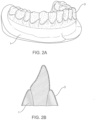
- the thermoformed device When the appliances are constructed by thermoforming thin sheets (typically with a thickness of from about 0.25 to about 4 mm), the thermoformed device will be removed from the model and the excess material trimmed. Trimming may be done at the gum line closely following the shape of teeth ( FIG. 1 ) or somewhat below (beyond) the gum line such that the device covers part of the gingiva ( FIG. 2 ). Studies disclosed herein have shown that aligners which are trimmed approximately 1-2 mm below (beyond) the gum line are more effective in retaining strength and moving teeth than comparable aligners trimmed at or very near the gum line. Additionally, the inventors have found that appliances trimmed at the gum line are more prone to breakage and can be more irritating to the patient than devices that extend below (beyond) the gum line.
- aligners typically a polyester resin or polyurethane
- aligners are rigid and inflexible making removal difficult. Additionally, such aligners suffer from low oxygen permeability.
- Bleaching trays are used to hold a tooth whitening agent (typically hydrogen peroxide or carbamide peroxide) adjacent to tooth surfaces. However, because these trays are trimmed below (beyond) the gum line, the gingival area is subjected to harsh bleaching agents which may cause irritation or damage to the gum tissue.
- a tooth whitening agent typically hydrogen peroxide or carbamide peroxide
- the dental appliance comprises two or more materials adapted to conform to at least a portion of teeth (A1) and to at least a portion of a corresponding gingival region (A2), wherein at least a portion of the material(s) conforming to a portion of the teeth (MA1), and a material conforming to at least a portion of the gingival area (MA2), differ in at least one material property selected from a mechanical, optical, electrical, physical, chemical or biochemical property.
- the dental appliance comprises at least an inner and outer component.
- the inner and outer components comprise distinct or different materials and there may or may not be a distinct dividing line between them.
- the components are continuous layers. Each layer comprises a different material.
- the components of a dental appliance may different in a mechanical property, e.g., elastic modulus, and/or other mechanical properties.
- Elastic modulus is a measure of how well a material resists deformation. If a sample has a high modulus, it resists deformation. If a sample has a low modulus, it is easily deformed.
- the elastic modulus of a material is enhanced or otherwise modified by inclusion of an additive, for example, CaCO 3 , talc, TiO 2 , glass, diamond or a polymer powder or by methods such as layering, coating, treating the material or appliance with a chemical agent, or altering the temperature.
- an additive for example, CaCO 3 , talc, TiO 2 , glass, diamond or a polymer powder or by methods such as layering, coating, treating the material or appliance with a chemical agent, or altering the temperature.
- a dental appliance will have an elastic modulus of from 0.5 to 5 GigaPascal (GPa), for example, 0.5 GPa, 0.6 GPa, 0.7 GPa, 0.8 GPa, 0.9 GPa, 1.0 GPa, 1.1 GPa, 1.2 GPa, 1.3 GPa, 1.4 GPa, 1.5 GPa, 1.6 GPa, 1.7 GPa, 1.8 GPa, 1.9 GPa, 2.0 GPa, 2.1 GPa, 2.2 GPa, 2.3 GPa, 2.4 GPa, 2.5 GPa, 2.6 GPa, 2.7 GPa, 2.8 GPa, 2.9 GPa, 3.0 GPa, 3.1 GPa, 3.2 GPa, 3.3 GPa, 3.4 GPa, 3.5 GPa, 3.6 GPa, 3.7 GPa, 3.8 GPa, 3.9 GPa, 4.0 GPa, 4.1 GPa, 4.2 GPa,
- the modulus of material (MA1), which covers the teeth is 1.5 times, 2 times, 3 times, 4 times, 5 times, 6 times, 7 times, 8 times, 9 times, 10 times, from 1 to 2 times, from 2 to 3 times, from 3 to 4 times, from 4 to 5 times, from 5 to 6 times, from 6 to 7 times, from 7 to 8 times, from 8 to 9 times, or from 9 to 10 times the modulus of material (MA2), which covers the gingival area.
- the modulus of material (MA1), which covers the teeth is the same as the modulus of material (MA2), which covers the gingival area.
- the modulus of material (MA2), which covers the gingival area is 1.5 times, 2 times, 3 times, 4 times, 5 times, 6 times, 7 times, 8 times, 9 times, 10 times, from 1 to 2 times, from 2 to 3 times, from 3 to 4 times, from 4 to 5 times, from 5 to 6 times, from 6 to 7 times, from 7 to 8 times, from 8 to 9 times, or from 9 to 10 times greater than the modulus of material (MA1), which covers the teeth.
- Optical properties include but are not limited to visible light transmission, reflectivity, anti-glare, gloss control, and haze and color. See, e.g., US Patent Publication No. 20150374464 .
- the polymeric composition can contain a single optical additive or a mixture of two or more optical additives.
- the polymeric material can contain other additives which are not optical additives.
- the optical additives may be one or more optical additives selected from the group consisting of pigments, dyes, light scattering particles and fluorescent materials.
- the light transmission of MA1 is less than MA2. In some embodiments, the light transmission of MA1 is less than 80%, less than 70%, less than 60%, less than 50%, 70-80%, 60-70%, 50-60%, 40-50%, 30-40%, or 20-30% and the light transmission of MA2 is greater than 70%, greater than 80%, greater than 85%, greater than 90%, 70-80%, 80-90%, 90-95%, or 95-100%.
- the haze value of MA1 is greater than MA2. In some embodiments, the haze value of MA1 is less than 10 and the haze value of MA2 is greater than 10.
- the material(s) containing an optical additive can optionally have one or both of the following characteristics: (1) absorption of light within the range of about 550 to about 700 nm; or (2) when measured on a reference white color tile using the CIELAB color scale values for the combination of the white color tile and the material have an L value of between about 80 and 95, an A value from about -2 to + 2 and a B value is from about +2 to -10. See, e.g., US Patent Publication No. 20150374464 .
- the material(s) containing an optical additive when measured on a reference black color tile can alter the perceived color of the black color tile when measured using a Byk Gardner Colorimeter as follows. Color measurement was made directly on the black tile and the CIELAB color scale values were recorded. Next, a thin film of water was applied to the color tile and the test film was laid onto the tile and gently smoothed to remove excess water to provide good optical coupling between the film and the color tile. The color measurements were then repeated, measuring on the combined structure and the LAB color values recorded, as shown in Tables 1 and 2. Table 1. Film Composition, Structure and Measured Color Values on Black Color Tile.
- the materials increase the "brightness" as shown by the L values - decrease the yellowness of the tiles as shown by the B values.
- the materials have a visible light transmission of greater than 50%, 60%, 70%, or 75%.
- the materials have an incident light reflection of greater than 20%, 25%, 35%, 45%, 55%, 60%, or less than 80%, 70%, 60%, 50%, 40%.
- the dental appliance is adapted to fit over one or more teeth and at least a portion of the gum wherein a portion of the dental appliance covering at least a portion of a tooth exhibits a whitening effect and a portion covering the gum is substantially transparent.
- differential electrical fields may be applied to teeth and/or underlying tissue to facilitate tooth movement.
- the electrical conductivity of MA1 is higher than MA2. In some embodiments the electrical conductivity of MA1 is lower than MA2. In some embodiments one or more materials has a differential piezoelectrical activity than another material.
- the dental appliances described herein are used for orthodontic treatment while concurrently providing a dental/periodontal therapy or a cosmetic treatment modality.
- Such treatments are traditionally provided with the use of a variety of accessories and devices applied when the repositioning appliance is removed from the patient's mouth.
- Bleaching trays are used to hold a tooth whitening agent (typically hydrogen peroxide or carbamide peroxide) adjacent to tooth surfaces. However, because these trays are trimmed below (beyond) the gum line the gingival area is subjected to harsh bleaching agents which may cause irritation or damage to gum tissue.
- a tooth whitening agent typically hydrogen peroxide or carbamide peroxide
- the dental appliances described herein incorporate a dental/periodontal or cosmetic treatment modality into or on the innermost component of the dental appliance.
- the dental appliance comprises a laminated structure where a second or outermost polymeric material is trimmed approximately 2 mm beyond the gum line, either conforming to the edge of the teeth or having a substantially straight edge and extending beyond the gum line, but not directly conforming to the contours of the teeth.
- the dental/periodontal or cosmetic treatment modality is provided in a form that must be activated in order for it to be effective.
- the dental appliance comprises a dental/periodontal or cosmetic treatment modality in the form of a decomposition catalyst.
- the decomposition catalyst activity is for decomposition of a peroxy compound and is present in the innermost portion of the dental appliance that conforms to the teeth or conforms to the teeth and the gums.
- the dental appliance comprises a single material comprising a decomposition catalyst and the material is (a) not trimmed; (b) trimmed to the gum line; or (3) trimmed approximately 2 mm beyond the gum line, either conforming to the edge of the teeth or having a substantially straight edge and extending beyond the gum line, but not directly conforming to the contours of the teeth.
- the dental appliance comprises more than one material comprising a decomposition catalyst and the material is: (a) not trimmed; (b) trimmed to the gum line; or (3) trimmed approximately 2 mm beyond the gum line, either conforming to the edge of the teeth or having a substantially straight edge and extending beyond the gum line, but not directly conforming to the contours of the teeth.
- the catalytic activity is derived from Zeolite Socony Mobil-5 (Zeolite SM-5), an aluminosilicate zeolite belonging to the pentasil family of zeolites.
- the chemical formula is Na n Al n Si 96-n O 192 ⁇ 16H 2 O (0 ⁇ n ⁇ 27) and it is available from multiple sources.
- This Zeolite is insoluble, non-toxic, and known to catalyze the decomposition of peroxides such as hydrogen peroxide producing oxidizing species including hydroxy radicals. See, e.g., Gabriel Ovejero et al, Ind. Eng. Chem. Res., 2001, 40 (18), pp 3921-3928, entitled, "Wet Peroxide Oxidation of Phenolic Solutions over Different Iron-Containing Zeolitic Materials ".
- the catalytic activity is derived from one or more of an iron, nickel or manganese compound.
- the catalytic activity is derived from a heterogeneous catalyst or magnetically separable iron mixed oxides such as (Co(II), Cu(II), Mn(II) ferrite and magnetite.
- the dental appliance comprises a dental/periodontal or cosmetic treatment modality in the form of a photocatalytic agent.
- the photocatalytic agent is present in the innermost portion of the dental appliance that conforms to the teeth or conforms to the teeth and the gums.
- the dental appliance comprises a single material comprising a photocatalytic agent and the material is (a) not trimmed; (b) trimmed to the gum line; or (3) trimmed approximately 2 mm beyond the gum line, either conforming to the edge of the teeth or having a substantially straight edge and extending beyond the gum line, but not directly conforming to the contours of the teeth.
- the dental appliance comprises more than one material and the material comprising a photocatalytic agent is: (a) not trimmed; (b) trimmed to the gum line; or (3) trimmed approximately 2 mm beyond the gum line, either conforming to the edge of the teeth or having a substantially straight edge and extending beyond the gum line, but not directly conforming to the contours of the teeth.
- the photocatalyst is comprised of a finely divided titanium dioxide, CuO-SnO 2 , ZnS-CdS, ZnO, or Nb 2 0 5 or other known photocatalytic agent.
- the catalytic activity is provided by Anatase titanium dioxide, a photocatalytic semiconducting material. Anatase is known to produce hydroxyl radicals and other oxidizing species in the presence of UVA (400 nm) light.
- the dental appliance comprises a dental/periodontal or cosmetic treatment modality in the form of a component having antibacterial activity.
- the antibacterial activity of MA1 is greater than the antibacterial activity of MA2.
- the calcium binding capacity of MA1 is greater than the calcium binding capacity of MA2. Is some embodiments MA1 has greater mineralizing activity than MA2. In some embodiments the calcium transport property of MA2 is greater than the calcium transport property of MA1.
- the dental appliances or shells may vary in terms of fluid permeability. This can be optimized by varying the diameter and the density of pores. The pore density and diameter can be of uniform or non-uniform distribution across the dental appliance or shell.
- the dental appliances or shells may vary in terms of oxygen permeability and/or fluid permeability.
- the oxygen permeability of MA2 is greater than MA1. In some embodiments the rate of saliva transport is greater for MA1 than MA2.
- the dental appliance comprises at least a first or innermost component and a second or outermost component.
- a first or innermost component of the dental appliance or shell more closely tracks the conformation of the teeth than the second or outermost component. In some embodiments the first or innermost component has a thinner wall thickness than a second or outermost component.
- the innermost and outermost components comprise similar or the same materials.
- the innermost component fitting over the teeth is trimmed to the gum line such that there is little to no coverage of the gingiva. In some embodiments substantially, all of the innermost material is trimmed to the gum line over the region which is readily visible to an observer when the appliance is worn. In some embodiments some of the innermost materials are not trimmed to the gum line over a region which is not readily visible to an observer when the appliance is worn (e.g., the back of the teeth). In some cases, the innermost component fitting over the teeth comprises more than one layer or more than one material and has a thickness as shown in Table 3. Table 3. Exemplary Thickness Ranges for Innermost Component of Dental Appliances. Minimum (mm) Maximum (mm) 0.0125 0.75 0.0125 0.0125 0.25 0.0125 0.05 0.025 0.75 0.025 0.5 0.025 0.25 0.025 0.125 0.025 0.05 0.125 0.5 0.125 0.25
- a second or outermost component of the dental appliance or shell has less contours (i.e., is less conformal) than the first or inner component.
- the outer component is not coextensive with teeth, may be transparent or translucent and has a thickness as shown in Table 4. Table 4. Exemplary Thickness Ranges for Outermost Component of Dental Appliances. Minimum (mm) Maximum (mm) 0.125 1 0.25 1 0.375 1 0.5 1 0.75 1 0.125 0.75 0.25 0.75 0.375 0.75 0.5 0.75 0.125 0.5 0.25 0.5 0.375 0.5
- a second or outermost component of the dental appliance is one or more of thicker, stronger, and more transparent than the first or innermost component of the dental appliance.
- the components of the dental appliance are attached or laminated to one another.
- the outermost component is not trimmed to gum line and extends over the gum line, for example, 1 mm, 2mm, 3mm, 4mm, 5mm, 6mm, 7mm, 10mm, 1 to 3mm, 2 to 4mm, 4 to 6mm, 5 to 6mm, 6 to 7mm, 7 to 8mm, 8 to 9mm, or 9 to 10mm over the gum line.
- the components of the dental appliance may or may not be layers, and the material that extends beyond the gum line is not the same as the material that covers the teeth.
- the components of the dental appliance may or may not be layers, and the material that extends beyond the gum line is the same as the material the covers the teeth.
- the dental appliance shells are of variable thickness, for example, 0.2mm, 0.3mm, 0.4mm, 0.5mm, 0.6mm, 0.7mm, 0.8mm, 0.9mm, 1.0mm, 1.1mm, 1.2mm, 1.3mm, 1.4mm, 1.5mm, from 0.2mm to 0.6mm, from 0.4mm to 0.8mm, from 0.6mm to 1.0mm, from 0.8mm to 1.2mm, or from 1.0mm to 1.4mm.
- the thickness may vary for different portions of the dental appliance or shell either by design or as a result of the manufacturing process.
- the polymer in a material used to make the dental appliance or shell is a homopolymer, or a random, block or a graft copolymer.
- the composition can contain a single polymer or a mixture of two or more polymers. Generally, the polymer is substantially transparent. In some embodiments, the optical characteristics of the dental appliance or shell are dominated by optical additives which are mixed with the polymer. In some embodiments, the polymer is a semicrystalline polymer which scatters light.
- the devices described herein may be prepared from any suitable plastic or polymeric resin, examples of which are listed in Table 5.
- the shell material may be a thermoplastic or a thermoset resin.
- the polymer can optionally have one or more of the following characteristics (i.e., a single one of the following characteristics or any possible combination of two or more of the following characteristics).
- the polymer comprises a thermoplastic polymer.
- the polymer comprises a thermoset polymer.
- the polymer is an elastomer, preferably an elastomer having elongation to break greater than 200% and a 100% modulus of less than 25 MPA.
- Table 5 Exemplary Polymers for use in Making Dental Appliances.
- Type of Polymer Exemplary Polymers Exemplary Co-polymers
- Polyolefins polyethylene, high-density polyethylene, (HDPE), low-density polyethylene (LDPE), medium density polyethylene, (MDPE), linear low density polyethylene (LLDPE), polypropylene, poly methyl pentene, polybutene Ethylene copolymer with vinyl a
- the dental appliance or shell is prepared by thermoforming one more materials which are or are not of uniform thickness, for example by thermoforming one or more materials over a model of the teeth to which the dental appliance is to be fitted.
- the polymeric materials in the dental appliance may comprise two or more different polymeric materials, such as a polymer disclosed above, and one or more additives.
- a material for example, an elastomeric polyurethane, is provided in the form of a uniform sheet having a thickness of 0.5mm, 0.625mm, 0.76mm, 1.0mm, from 0.40 to 0.55mm, from 0.55 to 0.65mm, from 0.65 to 0.76mm, from 0.76mm to 1.0mm, or from 1.0mm to 1.1mm.
- the material is provided in the form of discs, squares, triangles or other shapes of the material having a thickness of 0.5 mm, 0.625mm, 0.76mm, 1.0mm, from 0.40 to 0.55mm, from 0.55 to 0.65mm, from 0.65 to 0.76mm, from 0.76mm to 1.0mm, or from 1.0mm to 1.1mm.
- a material for example, a rigid polyurethane (for example, Zendura A, Bay Materials LLC), is provided in the form of a uniform sheet having a thickness of 0.5 mm, 0.625mm, 0.76mm, 1.0mm, from 0.40 to 0.55mm, from 0.55 to 0.65mm, from 0.65 to 0.76mm, from 0.76mm to 1.0mm, or from 1.0mm to 1.1mm.
- a rigid polyurethane for example, Zendura A, Bay Materials LLC
- the material is provided in the form of discs, squares, triangles or other shapes of the material having a thickness of 0.5 mm, 0.625mm, 0.76mm, 1.0mm, from 0.40 to 0.55mm, from 0.55 to 0.65mm, from 0.65 to 0.76mm, from 0.76mm to 1.0mm, or from 1.0mm to 1.1mm.
- a material for example, polymethyl pentene (e.g., TPX) or polyethylene terephthalate glycol (PETG) is provided in the form of a uniform sheet or discs, squares, triangles or other shapes of the material having a thickness of 0.4mm, 0.5 mm, 0.625mm, 0.76mm, 1.0mm, from 0.3 to 0.4mm, from 0.4 to 0.5mm, from 0.5 to 0.6mm, from 0.6 to 0.7mm or from 0.7mm to 1.0mm. (maybe we can condense as the "polymer" and the thickness are essentially independent variables
- the teeth are natural looking and as white as desired by the patient or individual whose teeth are being treated.
- one material used to make the dental appliance comprise one or more additives that provide the appropriate color to the teeth.
- a material for example, pigment-containing rigid polyurethane is provided in the form of a uniform sheet, or discs, squares, triangles or other shapes of the material having a thickness of 0.0125, 0.025, 0.05, 0.125, 0.25, 0.5 mm, from 0.125mm to 0.5mm, from 0.05 to 0.5 mm, 0.125 to 0.5 mm
- a material for example, a polyurethane treated with Anatase, Zeolite or another agent is provided in the form of a uniform sheet, discs, squares, triangles or other shapes of material having a thickness of 0.125 mm, 0.25mm, 0.3mm, 0.35mm, 0.4mm, 0.45mm, 0.5mm, from 0.125 to 0.3mm, from 0.25 to 0.4mm, or from 0.4 to 0.5mm.
- a polymeric dental appliance is produced by shaping, e.g., thermoforming a polymeric sheet of a selected material over a model of the teeth. In some cases, one or more additional materials are thermoformed over a model of the teeth resulting in a laminate.
- the dental appliance is a composite. In some embodiments, the dental appliance is 3D printed. In some embodiments, the dental appliance is produced by spraying a polymer solution over a model or dip coating.
- compositions and methods are further illustrated by the following examples.
- the examples are provided for illustrative purposes only. They are not to be construed as limiting the scope or content of the described subject matter in any way.
- a tooth model as shown in FIG. 1 is created by casting dental stone using a silicone dental impression according to standard methods routinely employed in the art. The cast model is trimmed, and imperfections repaired. Alternatively, a model is produced by 3D printing or stereolithographic printing (SLA).
- SLA stereolithographic printing
- a series of elastomeric polyurethane sheets 0.5 mm (B1), 0.625 (B2), 0.76 (B3), and 1.0 (B4) mm having a durometer of 55D were prepared by extrusion of Pellethane 2363-55D (Lubrizol) using a 3 ⁇ 4" extruder and flat sheet die.
- Pre-dried discs or sheets of ZENDURA A, 0.25 mm (C1), 0.5 mm (C2), 0.625 (C3), 0.76 (C4), and 1.0 (C5) thick rigid polyurethane were provided (Bay Materials, LLC).
- a series of lightly pigmented rigid polyurethane films (D, E, F, G) of varying thickness were prepared by extrusion of a blend of Isoplast 2530 White (Lubrizol) having an estimated
- the translucent lightly pigmented films increased the "brightness" as shown by the L values and decreased the yellowness of the tiles as shown by the B values.
- Zeolite Socony Mobil-5 (Zeolite SM-5) is an aluminosilicate zeolite belonging to the pentasil family of zeolites. Its chemical formula is Na n Al n Si 96-n O 192 ⁇ 16H 2 O (0 ⁇ n ⁇ 27) and is available from multiple sources. This Zeolite is insoluble, non-toxic and known to catalyze the decomposition of peroxides such as hydrogen peroxide producing oxidizing species including hydroxy radicals. 100 grams of Zeolite SM-5 was dry milled in a ball mill for 8 hours to provide a finely divided powder which was sieved and the fraction passing through a 20-micron sieve was collected, washed, filtered and dried.
- a 2% w/w solution of polyvinyl alcohol (PVA) was prepared by dissolving Evanol 75-15 (Kuraray) in hot water followed by cooling. To 100 ml of a 2% PVA solution was added 5 grams of powdered SM-5 Zeolite and one drop of Surfynol 104 surfactant (Air Products). The mixture was stirred with a high speed overhead mixer for 30 minutes. Sheets of transparent rigid polyurethane (Bay Materials, LLC) were coated with the PVA - Zeolite solution using a wire wound rod. After the coated solution evaporated the sheets were places initially in an 80 C oven for 4 hours, and then moved to a 100 C oven for 3 hours.
- PVA polyvinyl alcohol
- Zeolite SM-5 impregnated polyurethane sheets have an approximate thickness of 0.25 mm (H1) and 0.76 mm (H2).
- a 2 % w/w solution of polyvinyl alcohol (PVA) was prepared by dissolving Evanol 75-15 (Kuraray) in hot water followed by cooling. To 100 ml of a 2% PVA solution was added 10 grams of submicron particle size Anatase titanium dioxide a photocatalytic semiconducting material. Anatase is known to produce hydroxyl radicals and other oxidizing species in the presence of UVA (400 nm) light. The mixture was stirred with a high speed overhead mixer for 30 minutes. Sheets of transparent rigid polyurethane (Bay Materials, LLC) were coated with the PVA - Anatase solution using a wire wound rod.
- PVA polyvinyl alcohol
- a tooth model of the upper teeth of an individual was placed in a Biostar pressure forming machine and a 0.5 mm thick sheet of rigid polyurethane (C2) was thermoformed over the model.
- C2 rigid polyurethane
- the thermoformed sheet was removed from the model and carefully trimmed very close to the gum line, as shown in FIG. 3A , and placed back on the model. The molded part did not extend beyond the tooth area.
- a 0.5 mm thick sheet of polyurethane elastomer (B1) was thermoformed over the appliance resulting in a laminated structure.
- the dental appliance was removed from the model and trimmed approximately 2 mm beyond the gum line over most of the dental appliance, as shown in FIG. 5A (dental appliance 1). This dental appliance can be used as a retainer to maintain teeth in their correct position.
- Dental Appliances 2a, 2b and 2c are examples of prior art devices.
- the results presented in Table 3 highlight the deficiencies of the materials used to make currently available dental appliances and the advantages of the present devices.
- a tooth model of the upper teeth of an individual was placed in a Biostar pressure forming machine and a 0.05 mm thick sheet of pigment containing rigid polyurethane (E) was thermoformed over the model.
- the thermoformed sheet was removed from the model and carefully trimmed very close to the gum line, as shown in FIG. 3A , and placed back on the model. The molded part did not extend beyond the tooth area.
- a 0.76 mm thick sheet of rigid polyurethane (C4) was thermoformed over the appliance resulting in a laminated structure.
- the dental appliance was removed from the model and trimmed approximately 2 mm beyond the gum line over most of the dental appliance, as shown in FIG. 5A (dental appliance 3).
- a model of the upper teeth of an individual was placed in a Biostar pressure forming machine and a 0.05 mm thick sheet of pigment containing rigid polyurethane (E) was thermoformed over the model.
- E pigment containing rigid polyurethane
- C4 rigid polyurethane
- a model of the upper teeth of an individual was placed in a Biostar pressure forming machine and a 0.05 mm thick sheet of pigment containing rigid polyurethane (E) was thermoformed over the model.
- E rigid polyurethane
- C4 rigid polyurethane
- the dental appliance was removed from the model and trimmed at the gum line over most of the dental appliance.
- (dental appliance 5) Table 9. Evaluation of Dental Appliances for Aesthetics and Function.
- White component over gums dramatically impairs aesthetics. 5 Excellent Poor, dental appliance does not completely match tooth line and sharp edges are prone to cracking and irritation of gum.
- Dental appliances were prepared in the manner and construction of dental appliance 3 using each of film D, E, F, and G (a series of thin, lightly pigmented rigid polyurethane films; dental appliances 6, 7, 8, 9). An additional dental appliance was made using two layers of film E followed by one layer of (C) and then trimming 2 mm beyond the gum line (dental appliance 10). Table 10. Evaluation of Dental Appliances for Aesthetics and Whitening Effect. Dental appliance Aesthetic and Whitening Effect Functional Effect 6 Good Excellent 7 Excellent Excellent 8 Good Excellent 9 Very good Excellent Excellent 10 Too white, looks unnatural Excellent
- Polymethyl pentene is a transparent polymer available under the trade name TPX from Mistui Chemical. Polymethyl pentene has very high oxygen permeability, approximately 100 times greater than polyethylene terephthalate glycol (PETG) a material commonly used to make dental appliances such as aligners and retainers. PETG sheets may be obtained from Great Lakes Orthodontics. DX310 grade of TPX was extruded to produce sheet having a thickness of 0.5 mm (L).
- PETG polyethylene terephthalate glycol
- a model of the upper teeth of an individual was placed in a Biostar pressure forming machine and a 0.5 mm thick sheet of PETG was thermoformed over the model.
- the dental appliance was removed from the model, trimmed at the gum line and placed back on the Model.
- a 0.5 mm thick sheet of TPX (L) was thermoformed over the appliance resulting in a laminated structure.
- the dental appliance was removed from the model and trimmed approximately 2 mm below (beyond) the gum line over most of the dental appliance to provide an appliance having increased oxygen permeation over the gum line (dental appliance 11).
- a model of the upper teeth of an individual was placed in a Biostar pressure forming machine and a 0.25 mm thick sheet of anatase impregnated polyurethane (J1) was thermoformed over the model.
- J1 anatase impregnated polyurethane
- the dental appliance was removed from the model, trimmed at the gum line and placed back on the Model.
- a 0.625 mm thick sheet of polyurethane elastomer (B2) was thermoformed over the appliance resulting in a laminated structure.
- the dental appliance was removed from the model and trimmed approximately 2 mm below (beyond) the gum line (dental appliance 11).
- a model of the upper teeth of an individual was placed in a Biostar pressure forming machine and a 0.25 mm thick sheet of Zeolite SM-5 impregnated polyurethane (H1) was thermoformed over the model.
- the dental appliance was removed from the model, trimmed at the gum line and placed back on the Model.
- a 0.625 mm thick sheet of polyurethane elastomer (B2) was thermoformed over the appliance resulting in a laminated structure.
- the dental appliance was removed from the model and trimmed approximately 2 mm below (beyond) the gum line.
- This dental appliance can be utilized as a bleaching tray in combination with one or more peroxy compounds, for example hydrogen peroxide or carbamide peroxide.
- Peroxy compounds put inside the tray selectively decompose at the surface of the teeth generate strong whitening effects without need for acceleration by light or other means. Additionally, it is observed that the peroxide activation occurs selectively at the tooth surface relative to the gingival area resulting in less irritation to gum tissue.
- compositions or devices “comprising” (or “which comprises”) components A, B and C can contain only components A, B and C, or can contain not only components A, B and C but also one or more other components.
- the defined steps can be carried out in any order or simultaneously (except where the context excludes that possibility), and the method can optionally include one or more other steps which are carried out before any of the defined steps, between two of the defined steps, or after all the defined steps, except where the context excludes that possibility.
- first and second features are generally done for identification purposes; unless the context requires otherwise, the first and second features can be the same or different, and reference to a first feature does not mean that a second feature is necessarily present (though it may be present).
- the selected component can be a single one of the specified sub-components or a mixture of two or more of the specified sub-components.
Landscapes
- Health & Medical Sciences (AREA)
- Oral & Maxillofacial Surgery (AREA)
- Dentistry (AREA)
- Epidemiology (AREA)
- Life Sciences & Earth Sciences (AREA)
- Animal Behavior & Ethology (AREA)
- General Health & Medical Sciences (AREA)
- Public Health (AREA)
- Veterinary Medicine (AREA)
- Engineering & Computer Science (AREA)
- Mechanical Engineering (AREA)
- Dental Tools And Instruments Or Auxiliary Dental Instruments (AREA)
- Dental Preparations (AREA)
Claims (15)
- Dentalgerät (11), das bei Anwendung auf die Zähne einer Person eine funktionelle Wirkung ausübt und sich an ein den Zähnen entsprechendes Modell anpasst, wobei das Modell eine Zahnfleischlinie und einen Gingiva-Bereich aufweist, wobei sich die Zähne über die Zahnfleischlinie erstrecken und der Gingiva-Bereich unterhalb der Zahnfleischlinie liegt, wobei das Dentalgerät mindestens ein erstes oder innerstes polymeres Material MA1, das sich sowohl der lingualen als auch der bukkalen Seite der Zähne (A1) anpasst, und ein zweites oder äußerstes polymeres Material MA2, das sich an den Gingiva-Bereich (A2) anpasst, umfasst, wobei MA2 von MA1 verschieden ist, wobei das erste oder innerste polymere Material MA1 und das zweite oder äußerste polymere Material MA2 durchgehende Schichten umfassen und wobei MA1 mindestens eine Eigenschaft aufweist, die von MA2 verschieden ist, ausgewählt aus:(i) einer optischen Eigenschaft,(ii) Sauerstoffdurchlässigkeit, wobei die Sauerstoffdurchlässigkeit von MA2 höher ist als die Sauerstoffdurchlässigkeit von MA1,(iii) Fluiddurchlässigkeit, wobei die Fluiddurchlässigkeit von MA1 höher ist als die Fluiddurchlässigkeit von MA2,(iv) antibakterieller Wirkung, wobei die antibakterielle Aktivität von MA1 höher ist als die antibakterielle Aktivität von MA2,(v) Calciumbindungskapazität, wobei die Calciumbindungsaktivität von MA1 höher ist als die Calciumbindungskapazität von MA2,(vi) katalytischer Aktivität zur Zersetzung einer Peroxyverbindung und(vii) photokatalytischer Aktivität.
- Dentalgerät nach Anspruch 1, wobei mindestens ein Teil des Materials MA2, das sich dem Gingiva-Bereich anpasst, zugeschnitten wird bis zu:(i) der Zahnfleischlinie; oder(ii) ungefähr 0,5 mm, 1 mm, 2 mm, 3 mm, 4 mm und 5 mm, 0,5 bis 1,5 mm, 1 bis 2,5 mm, 2 bis 3 mm oder 3 bis 4 mm über die (jenseits der) Zahnfleischlinie.
- Dentalgerät nach Anspruch 1, wobei die Eigenschaft ferner die mechanische Eigenschaft des Moduls umfasst und der Modul von MA1 größer oder gleich dem Modul von MA2 ist, wobei der Modul von MA1 1,5-mal, 2-mal, 5-mal, 10-mal, 1- bis 2-mal, 2- bis 3-mal, 3- bis 5-mal oder 5- bis 10-mal höher als der Modul von MA2 ist.
- Dentalgerät nach Anspruch 1, wobei die optische Eigenschaft Durchlässigkeit für sichtbares Licht, Reflexion, Blendschutz, Glanzkontrolle, Trübung oder Farbe umfasst.
- Dentalgerät nach Anspruch 4, wobei die Durchlässigkeit für sichtbares Licht von MA1 niedriger ist als die Durchlässigkeit für Licht von MA2.
- Dentalgerät nach Anspruch 1, wobei die Eigenschaft eine oder mehrere von (a) Sauerstoffdurchlässigkeit, wobei die Sauerstoffdurchlässigkeit von MA2 höher als die Sauerstoffdurchlässigkeit von MA1 ist, (b) Fluiddurchlässigkeit, wobei die Fluiddurchlässigkeit von MA1 höher als die Fluiddurchlässigkeit von MA2 ist, (c) antibakterieller Aktivität, wobei die antibakterielle Aktivität von MA1 höher als die antibakterielle Aktivität von MA2 ist, und (d) Calciumbindung, wobei die Calciumbindungsaktivität von MA1 höher als die Calciumbindungskapazität von MA2 ist, ist.
- Dentalgerät nach Anspruch 1, wobei das innerste polymere Material MA1 derart thermogeformt ist, dass es über die Zähne passt und derart bis zu der Zahnfleischlinie zugeschnitten ist, dass es den Gingiva-Bereich wenig oder gar nicht bedeckt.
- Dentalgerät nach Anspruch 1, wobei die Dicke des innersten polymeren Materials MA1 ausgewählt ist aus der Gruppe bestehend aus 0,0125 bis 0,75 mm, 0,0125 bis 0,5 mm, 0,0125 bis 0,25 mm, 0,0125 bis 0,05 mm, 0,025 bis 0,75 mm, 0,025 bis 0,5 mm, 0,025 bis 0,25 mm, 0, 025 bis 0,125 mm, 0,025 bis 0,05 mm, 0,125 bis 0,5 mm und 0,125 bis 0,25 mm.
- Dentalgerät nach Anspruch 1, wobei die Dicke des äußersten polymeren Materials MA2 ausgewählt ist aus der Gruppe bestehend aus 0,125 bis 1 mm, 0,25 bis 1 mm, 0,375 bis 1 mm, 0,5 bis 1 mm, 0,75 bis 1 mm, 0,125 bis 0,75 mm, 0,25 bis 0,75 mm, 0,375 bis 0,75 mm, 0,5 bis 0,75 mm, 0,125 bis 0,5 mm, 0,25 mm bis 0,5 mm und 0,375 bis 0,5.
- Dentalgerät nach Anspruch 1, wobei das innerste polymere Material MA1 und das äußerste polymere Material MA2 des Dentalgeräts aneinander befestigt oder laminiert sind.
- Dentalgerät nach Anspruch 1, ferner Folgendes umfassend:(i) katalytische Aktivität zur Zersetzung einer Peroxyverbindung, wobei die katalytische Aktivität von MA1 höher als die katalytische Aktivität von MA2 ist; und(ii) eine Eigenschaft, die ausgewählt ist aus (a) katalytischer Aktivität zur Zersetzung einer Peroxyverbindung, die abgeleitet ist von (i) einer oder mehreren einer Eisen-, Nickel- oder Manganverbindung, (ii) einem heterogenen Katalysator, (iii) Zeolith-Socony-Mobil-5 (ZSM-5) oder (iv) magnetisch abtrennbaren Eisenmischoxiden, und (b) photokatalytischer Aktivität, wobei die photokatalytische Aktivität von MA1 höher ist als die photokatalytische Aktivität von MA2.
- Dentalgerät nach Anspruch 1, wobei mindestens ein Teil des Materials, das sich dem Gingiva-Bereich anpasst, bis zu 1 bis 2,5 mm über die Zahnfleischlinie zugeschnitten wird.
- Dentalgerät nach Anspruch 1, wobei das erste oder innerste polymere Material MA1 den Gingiva-Bereich nicht überlappt.
- Dentalgerät nach Anspruch 1, wobei das zweite oder äußerste polymere Material MA2 die Zähne nicht berührt.
- Dentalgerät nach Anspruch 1, wobei das erste oder innerste polymere Material MA1 mindestens eine Eigenschaft aufweist, die sich von dem zweiten oder äußersten polymeren Material MA2 unterscheidet, ausgewählt aus:(a) einer optischen Eigenschaft;(b) antibakterieller Wirkung, wobei die antibakterielle Aktivität von MA1 höher ist als die antibakterielle Aktivität von MA2; oder(c) Sauerstoffdurchlässigkeit, wobei die Sauerstoffdurchlässigkeit von MA2 höher ist als die Sauerstoffdurchlässigkeit von MA1.
Priority Applications (1)
| Application Number | Priority Date | Filing Date | Title |
|---|---|---|---|
| EP24211573.1A EP4512364A3 (de) | 2017-03-02 | 2018-03-01 | Dentalgerät mit unterschiedlichen eigenschaften |
Applications Claiming Priority (2)
| Application Number | Priority Date | Filing Date | Title |
|---|---|---|---|
| US201762465824P | 2017-03-02 | 2017-03-02 | |
| PCT/US2018/020511 WO2018160875A1 (en) | 2017-03-02 | 2018-03-01 | Dental appliance with differential properties |
Related Child Applications (1)
| Application Number | Title | Priority Date | Filing Date |
|---|---|---|---|
| EP24211573.1A Division EP4512364A3 (de) | 2017-03-02 | 2018-03-01 | Dentalgerät mit unterschiedlichen eigenschaften |
Publications (3)
| Publication Number | Publication Date |
|---|---|
| EP3589229A1 EP3589229A1 (de) | 2020-01-08 |
| EP3589229A4 EP3589229A4 (de) | 2021-01-13 |
| EP3589229B1 true EP3589229B1 (de) | 2024-11-20 |
Family
ID=63370250
Family Applications (2)
| Application Number | Title | Priority Date | Filing Date |
|---|---|---|---|
| EP18760863.3A Active EP3589229B1 (de) | 2017-03-02 | 2018-03-01 | Dentalgerät mit unterschiedlichen eigenschaften |
| EP24211573.1A Pending EP4512364A3 (de) | 2017-03-02 | 2018-03-01 | Dentalgerät mit unterschiedlichen eigenschaften |
Family Applications After (1)
| Application Number | Title | Priority Date | Filing Date |
|---|---|---|---|
| EP24211573.1A Pending EP4512364A3 (de) | 2017-03-02 | 2018-03-01 | Dentalgerät mit unterschiedlichen eigenschaften |
Country Status (5)
| Country | Link |
|---|---|
| US (1) | US11553990B2 (de) |
| EP (2) | EP3589229B1 (de) |
| CN (1) | CN110891518B (de) |
| ES (1) | ES3009019T3 (de) |
| WO (1) | WO2018160875A1 (de) |
Families Citing this family (23)
| Publication number | Priority date | Publication date | Assignee | Title |
|---|---|---|---|---|
| US10555792B2 (en) * | 2014-01-31 | 2020-02-11 | Align Technology, Inc. | Direct fabrication of orthodontic appliances with elastics |
| EP3589229B1 (de) | 2017-03-02 | 2024-11-20 | Bay Materials LLC | Dentalgerät mit unterschiedlichen eigenschaften |
| US20180271620A1 (en) * | 2017-03-22 | 2018-09-27 | Ormco Corporation | Orthodontic appliances and methods of fabricating same |
| JP7394858B2 (ja) * | 2018-12-31 | 2023-12-08 | スリーエム イノベイティブ プロパティズ カンパニー | 多層歯科装具 |
| US12433719B2 (en) | 2019-01-28 | 2025-10-07 | Smylio Inc. | Elastic orthodontic appliances, systems, and methods for use |
| US11317992B2 (en) | 2019-01-28 | 2022-05-03 | Smylio Inc. | Elastic orthodontic appliances, systems, and methods for use |
| US10925691B2 (en) * | 2019-03-05 | 2021-02-23 | Sdc U.S. Smilepay Spv | Systems and methods for trimming dental aligners |
| US11273009B2 (en) | 2019-03-05 | 2022-03-15 | Sdc U.S. Smilepay Spv | Systems and methods for trimming dental aligners |
| US10466676B1 (en) | 2019-04-08 | 2019-11-05 | SmileDirectClub LLC | Systems and methods for shearing adjustment of a dental aligner cutting tool |
| US10687916B1 (en) * | 2019-08-15 | 2020-06-23 | SmileDirectClub LLC | Systems and methods for intraoral device quality control |
| CN110682523B (zh) * | 2019-10-15 | 2021-09-28 | 浙江隐齿丽医学技术有限公司 | 一种压膜装置 |
| CA3157978C (en) * | 2019-11-11 | 2023-01-17 | Smylio Inc. | Orthodontic appliances and materials |
| CA3159533C (en) | 2019-11-11 | 2023-12-12 | Loc Phan | Systems and methods for customizing oral appliance appearance |
| US12251285B2 (en) | 2020-01-23 | 2025-03-18 | 3Shape A/S | System and method for fabricating a dental tray |
| US20240207558A1 (en) * | 2020-03-06 | 2024-06-27 | R.I.P., Llc | Oral appliance for use with cpap headgear |
| US12290463B2 (en) | 2020-08-07 | 2025-05-06 | Secured Injury Devices, Inc. | Mechanism for automated injury stabilization and treatment |
| JP2022054094A (ja) * | 2020-09-25 | 2022-04-06 | 株式会社ホワイトライン | 樹脂材料 |
| CN112336475B (zh) * | 2020-10-29 | 2022-06-10 | 广州瑞通生物科技有限公司 | 一种牙齿矫治器的制作方法 |
| US20220323180A1 (en) * | 2021-04-08 | 2022-10-13 | Skynet Electronic Co., Ltd. | Method for making hard clear aligner set for stepwise orthodontic treatment |
| EP4366939A1 (de) * | 2021-07-09 | 2024-05-15 | Reset Technology Corporation | Netzwerkaktivierte 3d-druck- und automatisierte verarbeitungstechniken für orale vorrichtungen |
| US20230115305A1 (en) * | 2021-10-08 | 2023-04-13 | Caroline M. Girard | Oral tray and method |
| USD1033652S1 (en) * | 2021-10-29 | 2024-07-02 | Lisa Shaffer | Dental appliance set |
| US11897205B2 (en) | 2022-06-02 | 2024-02-13 | Sdc U.S. Smilepay Spv | Laser-based support structure removal |
Citations (1)
| Publication number | Priority date | Publication date | Assignee | Title |
|---|---|---|---|---|
| US20030205234A1 (en) * | 2002-05-06 | 2003-11-06 | Laura Bardach | Therapeutic and protective dental device useful as an intra-oral delivery system |
Family Cites Families (49)
| Publication number | Priority date | Publication date | Assignee | Title |
|---|---|---|---|---|
| US4032627A (en) | 1973-04-02 | 1977-06-28 | Koh-I-Noor Rapidograph, Inc. | Tooth whitening cosmetic composition |
| US5003994A (en) * | 1989-10-10 | 1991-04-02 | Cook George W | Oral appliance for improving breathing and methods of using and making same |
| US5032178A (en) * | 1990-02-02 | 1991-07-16 | Demetron Research Corporation | Dental composition system and method for bleaching teeth |
| US5975893A (en) | 1997-06-20 | 1999-11-02 | Align Technology, Inc. | Method and system for incrementally moving teeth |
| US6162055A (en) | 1998-02-13 | 2000-12-19 | Britesmile, Inc. | Light activated tooth whitening composition and method of using same |
| US6126443A (en) * | 1998-08-13 | 2000-10-03 | 3M Innovative Properties Company | Medication delivery tray |
| US6309625B1 (en) | 1998-11-12 | 2001-10-30 | Ultradent Products, Inc. | One-part dental compositions and methods for bleaching and desensitizing teeth |
| US6274122B1 (en) * | 1999-01-07 | 2001-08-14 | Mclaughlin Gerald | Device and method using dry mixtures for whitening teeth |
| US6089869A (en) | 1999-03-15 | 2000-07-18 | Schwartz; Dann A. | Low-density polyethylene dental bleaching trays |
| CA2373857C (en) | 1999-07-02 | 2011-09-06 | Mitsubishi Gas Chemical Company, Inc. | Tooth bleaching compositions and methods for bleaching discolored tooth |
| US6986883B2 (en) | 1999-09-09 | 2006-01-17 | Discus Dental, Inc. | Increased peroxide content tooth bleaching gel |
| US20030036037A1 (en) * | 2000-03-27 | 2003-02-20 | Zavitsanos Peter D. | System and method for whitening teeth |
| JP2004515261A (ja) * | 2000-04-25 | 2004-05-27 | アライン テクノロジー, インコーポレイテッド | 歯科用アプライアンスの埋め込み機能および方法 |
| US6454565B2 (en) * | 2000-04-25 | 2002-09-24 | Align Technology, Inc. | Systems and methods for varying elastic modulus appliances |
| US6524101B1 (en) | 2000-04-25 | 2003-02-25 | Align Technology, Inc. | System and methods for varying elastic modulus appliances |
| US6354837B1 (en) | 2001-05-15 | 2002-03-12 | Steven Jensen | Method for bleaching teeth |
| US6503485B1 (en) | 2001-08-06 | 2003-01-07 | Ultradent Products, Inc. | Two-part dental bleaching systems having improved gel stability and methods for bleaching teeth using such systems |
| US20040202983A1 (en) | 2001-09-28 | 2004-10-14 | Align Technology, Inc. | Method and kits for forming pontics in polymeric shell aligners |
| KR20050004256A (ko) * | 2002-05-30 | 2005-01-12 | 오서-테인 인코포레이티드 | 부착가능한 상하 절반부를 갖는 치과기구, 및 부정교합치료용 시스템 및 방법 |
| US20070086960A1 (en) | 2003-05-21 | 2007-04-19 | Tarver J G | Systems and methods for enhancing the appearance of teeth |
| US20050175552A1 (en) | 2004-02-10 | 2005-08-11 | Hoic Diego A. | Tooth coating compositions and methods therefor |
| CA2571109C (en) | 2004-06-18 | 2014-01-28 | Dentsply International Inc. | Plastic sheets for thermoforming dental products |
| US7882839B2 (en) | 2004-06-25 | 2011-02-08 | Ambis Jr Edward J | Custom mouthguard |
| US7357637B2 (en) * | 2005-03-25 | 2008-04-15 | Snap On Smile Llc | Dental appliance |
| GB0526608D0 (en) * | 2005-12-30 | 2006-02-08 | Ortho Pro Teknica Ltd | Method and apparatus for manufacturing orthodontic appliances |
| US20080044786A1 (en) | 2006-08-21 | 2008-02-21 | Tom Kalili | Orthodontic repositioning appliance |
| WO2008024482A1 (en) | 2006-08-23 | 2008-02-28 | Dentsply International Inc. | Thermoformed dental appliance from multiple ply sheet |
| US20100186756A1 (en) * | 2007-06-27 | 2010-07-29 | Nihon University | Mouth guard and process for producing the same |
| CN201061564Y (zh) * | 2007-07-13 | 2008-05-21 | 王兵 | 整体式牙套 |
| US20100028829A1 (en) * | 2008-07-31 | 2010-02-04 | Ultradent Products, Inc. | Chemically activated dental bleaching trays |
| US9597163B2 (en) * | 2007-09-07 | 2017-03-21 | Clearpath Orthodontics Hfz | Tooth positioners, method and apparatus for making the same, and method of positioning teeth using the same |
| US8656926B2 (en) * | 2008-02-13 | 2014-02-25 | Marc Doctors | Intra-oral device and method of relieving head, neck, facial, joint and tooth pain |
| US8074659B2 (en) * | 2009-08-07 | 2011-12-13 | Hanna Wadia M | Method and apparatus for protecting teeth, preventing the effects of bruxism and protecting oral structures from sports injuries |
| US20110179851A1 (en) | 2010-01-22 | 2011-07-28 | X2Impact, Inc. | Mouth guard formation methods |
| CN102113917A (zh) * | 2010-03-10 | 2011-07-06 | 千吉文 | 活动牙齿矫治器及制作方法 |
| WO2011143620A2 (en) * | 2010-05-13 | 2011-11-17 | Symdent, Inc. | Dental appliance, dental appliance adhesive and related methods and uses |
| US9138298B2 (en) | 2011-07-12 | 2015-09-22 | Ribbond, Inc. | Fiber reinforced dental appliances and prostheses |
| US8641414B2 (en) * | 2011-10-10 | 2014-02-04 | Align Technology, Inc. | Automatic placement of precision cuts |
| WO2013130552A1 (en) | 2012-02-27 | 2013-09-06 | Bay Materials Llc | Dental products and procedures |
| US9655691B2 (en) * | 2012-05-14 | 2017-05-23 | Align Technology, Inc. | Multilayer dental appliances and related methods and systems |
| US8986003B2 (en) | 2012-09-13 | 2015-03-24 | Orthoaccel Technologies, Inc. | Pearlescent white aligners |
| US20150059769A1 (en) * | 2013-08-28 | 2015-03-05 | Michael Powers | Tooth impact guard |
| US9320576B2 (en) | 2013-09-13 | 2016-04-26 | David A. Pechersky | Therapeutically countoured, compliance encouraging aligner implement |
| JP6877139B2 (ja) * | 2013-10-11 | 2021-05-26 | ウルトラデント プロダクツ インコーポレイテッド | ワックスを基剤とした組成物、それから作製される物品、ならびに、製造および使用の方法 |
| US9937018B2 (en) * | 2013-12-11 | 2018-04-10 | Martin G. Martz | Tooth positioning appliance with curved interconnecting elements |
| US10299894B2 (en) * | 2014-02-21 | 2019-05-28 | Align Technology, Inc. | Treatment plan specific bite adjustment structures |
| US9610141B2 (en) * | 2014-09-19 | 2017-04-04 | Align Technology, Inc. | Arch expanding appliance |
| CN106109027A (zh) * | 2016-07-16 | 2016-11-16 | 上海正雅齿科科技有限公司 | 多维牙套、其制备方法及应用 |
| EP3589229B1 (de) | 2017-03-02 | 2024-11-20 | Bay Materials LLC | Dentalgerät mit unterschiedlichen eigenschaften |
-
2018
- 2018-03-01 EP EP18760863.3A patent/EP3589229B1/de active Active
- 2018-03-01 WO PCT/US2018/020511 patent/WO2018160875A1/en not_active Ceased
- 2018-03-01 US US16/490,464 patent/US11553990B2/en active Active
- 2018-03-01 CN CN201880028754.4A patent/CN110891518B/zh active Active
- 2018-03-01 EP EP24211573.1A patent/EP4512364A3/de active Pending
- 2018-03-01 ES ES18760863T patent/ES3009019T3/es active Active
Patent Citations (1)
| Publication number | Priority date | Publication date | Assignee | Title |
|---|---|---|---|---|
| US20030205234A1 (en) * | 2002-05-06 | 2003-11-06 | Laura Bardach | Therapeutic and protective dental device useful as an intra-oral delivery system |
Also Published As
| Publication number | Publication date |
|---|---|
| US11553990B2 (en) | 2023-01-17 |
| EP4512364A3 (de) | 2025-08-13 |
| EP3589229A1 (de) | 2020-01-08 |
| CN110891518B (zh) | 2021-10-22 |
| WO2018160875A1 (en) | 2018-09-07 |
| EP4512364A2 (de) | 2025-02-26 |
| US20200015937A1 (en) | 2020-01-16 |
| CN110891518A (zh) | 2020-03-17 |
| ES3009019T3 (en) | 2025-03-25 |
| EP3589229A4 (de) | 2021-01-13 |
Similar Documents
| Publication | Publication Date | Title |
|---|---|---|
| EP3589229B1 (de) | Dentalgerät mit unterschiedlichen eigenschaften | |
| JP6385828B2 (ja) | 歯牙に適合する高分子シェルを作製する方法 | |
| CN110958862B (zh) | 基于聚合物的耐水牙科制品 | |
| AU2019360713B2 (en) | Dental appliance with structured surface | |
| Liu et al. | Colour stabilities of three types of orthodontic clear aligners exposed to staining agents | |
| Macrì et al. | Clinical performances and biological features of clear aligners materials in orthodontics | |
| US6267590B1 (en) | Antimicrobial dental products | |
| EP4284292A1 (de) | Dentalgeräte aus mehrschichtigen filmen mit diskreten strukturen, die von einer ionendurchlässigen trennschicht abgedeckt sind | |
| AU2007217017A1 (en) | Prefabricated dental crowns | |
| KR20220112747A (ko) | 바이오 기반 치열 교정 장치 및 이를 열성형하기 위한 공정 | |
| CN115335002A (zh) | 正畸矫治器及材料 | |
| WO2018160870A1 (en) | Composite removable veneer | |
| JP2010515015A (ja) | 歯表面用の艶ガイド、および歯表面の艶を評価する方法 | |
| WO2021191773A1 (en) | Dental appliance with graphic image | |
| Rohinikumar et al. | Comparative evaluation of optical property changes in direct printed aligners using two resins: An in vivo investigation | |
| JP2024506097A (ja) | 抗菌活性を有する歯科器具 | |
| EP4580542A1 (de) | Artikel mit einer mikrostrukturierten gekrümmten oberfläche, werkzeugartikel und verfahren | |
| JP2025062436A (ja) | マウスピース | |
| HK40083421A (en) | Orthodontic appliances and materials | |
| TW201412269A (zh) | 具保健效果之刷毛結構 | |
| KR20060098702A (ko) | 은 나노와 향이 함유된 칫솔 보관함 | |
| KR20190017115A (ko) | 불소바니시 도포를 위한 다공성 개인 트레이 | |
| TW201412268A (zh) | 可保護牙齒之刷毛結構 |
Legal Events
| Date | Code | Title | Description |
|---|---|---|---|
| STAA | Information on the status of an ep patent application or granted ep patent |
Free format text: STATUS: THE INTERNATIONAL PUBLICATION HAS BEEN MADE |
|
| PUAI | Public reference made under article 153(3) epc to a published international application that has entered the european phase |
Free format text: ORIGINAL CODE: 0009012 |
|
| STAA | Information on the status of an ep patent application or granted ep patent |
Free format text: STATUS: REQUEST FOR EXAMINATION WAS MADE |
|
| 17P | Request for examination filed |
Effective date: 20190925 |
|
| AK | Designated contracting states |
Kind code of ref document: A1 Designated state(s): AL AT BE BG CH CY CZ DE DK EE ES FI FR GB GR HR HU IE IS IT LI LT LU LV MC MK MT NL NO PL PT RO RS SE SI SK SM TR |
|
| AX | Request for extension of the european patent |
Extension state: BA ME |
|
| DAV | Request for validation of the european patent (deleted) | ||
| DAX | Request for extension of the european patent (deleted) | ||
| RIC1 | Information provided on ipc code assigned before grant |
Ipc: A61C 19/06 20060101ALI20201006BHEP Ipc: A61C 7/08 20060101ALI20201006BHEP Ipc: B32B 25/00 20060101ALI20201006BHEP Ipc: A61K 8/00 20060101ALI20201006BHEP Ipc: A61C 7/00 20060101AFI20201006BHEP |
|
| A4 | Supplementary search report drawn up and despatched |
Effective date: 20201215 |
|
| RIC1 | Information provided on ipc code assigned before grant |
Ipc: B32B 25/00 20060101ALI20201209BHEP Ipc: A61C 19/06 20060101ALI20201209BHEP Ipc: A61C 7/08 20060101ALI20201209BHEP Ipc: A61K 8/00 20060101ALI20201209BHEP Ipc: A61C 7/00 20060101AFI20201209BHEP |
|
| STAA | Information on the status of an ep patent application or granted ep patent |
Free format text: STATUS: EXAMINATION IS IN PROGRESS |
|
| 17Q | First examination report despatched |
Effective date: 20221018 |
|
| GRAP | Despatch of communication of intention to grant a patent |
Free format text: ORIGINAL CODE: EPIDOSNIGR1 |
|
| STAA | Information on the status of an ep patent application or granted ep patent |
Free format text: STATUS: GRANT OF PATENT IS INTENDED |
|
| INTG | Intention to grant announced |
Effective date: 20240612 |
|
| GRAS | Grant fee paid |
Free format text: ORIGINAL CODE: EPIDOSNIGR3 |
|
| GRAA | (expected) grant |
Free format text: ORIGINAL CODE: 0009210 |
|
| STAA | Information on the status of an ep patent application or granted ep patent |
Free format text: STATUS: THE PATENT HAS BEEN GRANTED |
|
| RIN1 | Information on inventor provided before grant (corrected) |
Inventor name: STEWART, RAY F. |
|
| AK | Designated contracting states |
Kind code of ref document: B1 Designated state(s): AL AT BE BG CH CY CZ DE DK EE ES FI FR GB GR HR HU IE IS IT LI LT LU LV MC MK MT NL NO PL PT RO RS SE SI SK SM TR |
|
| REG | Reference to a national code |
Ref country code: GB Ref legal event code: FG4D |
|
| REG | Reference to a national code |
Ref country code: CH Ref legal event code: EP |
|
| REG | Reference to a national code |
Ref country code: DE Ref legal event code: R096 Ref document number: 602018076728 Country of ref document: DE |
|
| REG | Reference to a national code |
Ref country code: IE Ref legal event code: FG4D |
|
| REG | Reference to a national code |
Ref country code: LT Ref legal event code: MG9D Ref country code: ES Ref legal event code: FG2A Ref document number: 3009019 Country of ref document: ES Kind code of ref document: T3 Effective date: 20250325 |
|
| REG | Reference to a national code |
Ref country code: NL Ref legal event code: MP Effective date: 20241120 |
|
| PG25 | Lapsed in a contracting state [announced via postgrant information from national office to epo] |
Ref country code: IS Free format text: LAPSE BECAUSE OF FAILURE TO SUBMIT A TRANSLATION OF THE DESCRIPTION OR TO PAY THE FEE WITHIN THE PRESCRIBED TIME-LIMIT Effective date: 20250320 Ref country code: PT Free format text: LAPSE BECAUSE OF FAILURE TO SUBMIT A TRANSLATION OF THE DESCRIPTION OR TO PAY THE FEE WITHIN THE PRESCRIBED TIME-LIMIT Effective date: 20250320 Ref country code: HR Free format text: LAPSE BECAUSE OF FAILURE TO SUBMIT A TRANSLATION OF THE DESCRIPTION OR TO PAY THE FEE WITHIN THE PRESCRIBED TIME-LIMIT Effective date: 20241120 |
|
| PGFP | Annual fee paid to national office [announced via postgrant information from national office to epo] |
Ref country code: DE Payment date: 20250319 Year of fee payment: 8 |
|
| PG25 | Lapsed in a contracting state [announced via postgrant information from national office to epo] |
Ref country code: NL Free format text: LAPSE BECAUSE OF FAILURE TO SUBMIT A TRANSLATION OF THE DESCRIPTION OR TO PAY THE FEE WITHIN THE PRESCRIBED TIME-LIMIT Effective date: 20241120 Ref country code: FI Free format text: LAPSE BECAUSE OF FAILURE TO SUBMIT A TRANSLATION OF THE DESCRIPTION OR TO PAY THE FEE WITHIN THE PRESCRIBED TIME-LIMIT Effective date: 20241120 |
|
| REG | Reference to a national code |
Ref country code: AT Ref legal event code: MK05 Ref document number: 1742892 Country of ref document: AT Kind code of ref document: T Effective date: 20241120 |
|
| PG25 | Lapsed in a contracting state [announced via postgrant information from national office to epo] |
Ref country code: BG Free format text: LAPSE BECAUSE OF FAILURE TO SUBMIT A TRANSLATION OF THE DESCRIPTION OR TO PAY THE FEE WITHIN THE PRESCRIBED TIME-LIMIT Effective date: 20241120 |
|
| PG25 | Lapsed in a contracting state [announced via postgrant information from national office to epo] |
Ref country code: NO Free format text: LAPSE BECAUSE OF FAILURE TO SUBMIT A TRANSLATION OF THE DESCRIPTION OR TO PAY THE FEE WITHIN THE PRESCRIBED TIME-LIMIT Effective date: 20250220 |
|
| PG25 | Lapsed in a contracting state [announced via postgrant information from national office to epo] |
Ref country code: AT Free format text: LAPSE BECAUSE OF FAILURE TO SUBMIT A TRANSLATION OF THE DESCRIPTION OR TO PAY THE FEE WITHIN THE PRESCRIBED TIME-LIMIT Effective date: 20241120 Ref country code: LV Free format text: LAPSE BECAUSE OF FAILURE TO SUBMIT A TRANSLATION OF THE DESCRIPTION OR TO PAY THE FEE WITHIN THE PRESCRIBED TIME-LIMIT Effective date: 20241120 Ref country code: GR Free format text: LAPSE BECAUSE OF FAILURE TO SUBMIT A TRANSLATION OF THE DESCRIPTION OR TO PAY THE FEE WITHIN THE PRESCRIBED TIME-LIMIT Effective date: 20250221 |
|
| PG25 | Lapsed in a contracting state [announced via postgrant information from national office to epo] |
Ref country code: PL Free format text: LAPSE BECAUSE OF FAILURE TO SUBMIT A TRANSLATION OF THE DESCRIPTION OR TO PAY THE FEE WITHIN THE PRESCRIBED TIME-LIMIT Effective date: 20241120 |
|
| PGFP | Annual fee paid to national office [announced via postgrant information from national office to epo] |
Ref country code: FR Payment date: 20250326 Year of fee payment: 8 |
|
| PGFP | Annual fee paid to national office [announced via postgrant information from national office to epo] |
Ref country code: GB Payment date: 20250324 Year of fee payment: 8 |
|
| PG25 | Lapsed in a contracting state [announced via postgrant information from national office to epo] |
Ref country code: RS Free format text: LAPSE BECAUSE OF FAILURE TO SUBMIT A TRANSLATION OF THE DESCRIPTION OR TO PAY THE FEE WITHIN THE PRESCRIBED TIME-LIMIT Effective date: 20250220 |
|
| PG25 | Lapsed in a contracting state [announced via postgrant information from national office to epo] |
Ref country code: SM Free format text: LAPSE BECAUSE OF FAILURE TO SUBMIT A TRANSLATION OF THE DESCRIPTION OR TO PAY THE FEE WITHIN THE PRESCRIBED TIME-LIMIT Effective date: 20241120 |
|
| PG25 | Lapsed in a contracting state [announced via postgrant information from national office to epo] |
Ref country code: DK Free format text: LAPSE BECAUSE OF FAILURE TO SUBMIT A TRANSLATION OF THE DESCRIPTION OR TO PAY THE FEE WITHIN THE PRESCRIBED TIME-LIMIT Effective date: 20241120 |
|
| PGFP | Annual fee paid to national office [announced via postgrant information from national office to epo] |
Ref country code: ES Payment date: 20250429 Year of fee payment: 8 |
|
| PG25 | Lapsed in a contracting state [announced via postgrant information from national office to epo] |
Ref country code: EE Free format text: LAPSE BECAUSE OF FAILURE TO SUBMIT A TRANSLATION OF THE DESCRIPTION OR TO PAY THE FEE WITHIN THE PRESCRIBED TIME-LIMIT Effective date: 20241120 |
|
| PGFP | Annual fee paid to national office [announced via postgrant information from national office to epo] |
Ref country code: CH Payment date: 20250401 Year of fee payment: 8 |
|
| PG25 | Lapsed in a contracting state [announced via postgrant information from national office to epo] |
Ref country code: RO Free format text: LAPSE BECAUSE OF FAILURE TO SUBMIT A TRANSLATION OF THE DESCRIPTION OR TO PAY THE FEE WITHIN THE PRESCRIBED TIME-LIMIT Effective date: 20241120 |
|
| PG25 | Lapsed in a contracting state [announced via postgrant information from national office to epo] |
Ref country code: SK Free format text: LAPSE BECAUSE OF FAILURE TO SUBMIT A TRANSLATION OF THE DESCRIPTION OR TO PAY THE FEE WITHIN THE PRESCRIBED TIME-LIMIT Effective date: 20241120 |
|
| PG25 | Lapsed in a contracting state [announced via postgrant information from national office to epo] |
Ref country code: CZ Free format text: LAPSE BECAUSE OF FAILURE TO SUBMIT A TRANSLATION OF THE DESCRIPTION OR TO PAY THE FEE WITHIN THE PRESCRIBED TIME-LIMIT Effective date: 20241120 |
|
| PG25 | Lapsed in a contracting state [announced via postgrant information from national office to epo] |
Ref country code: IT Free format text: LAPSE BECAUSE OF FAILURE TO SUBMIT A TRANSLATION OF THE DESCRIPTION OR TO PAY THE FEE WITHIN THE PRESCRIBED TIME-LIMIT Effective date: 20241120 |
|
| REG | Reference to a national code |
Ref country code: DE Ref legal event code: R097 Ref document number: 602018076728 Country of ref document: DE |
|
| PG25 | Lapsed in a contracting state [announced via postgrant information from national office to epo] |
Ref country code: SE Free format text: LAPSE BECAUSE OF FAILURE TO SUBMIT A TRANSLATION OF THE DESCRIPTION OR TO PAY THE FEE WITHIN THE PRESCRIBED TIME-LIMIT Effective date: 20241120 |
|
| PLBE | No opposition filed within time limit |
Free format text: ORIGINAL CODE: 0009261 |
|
| STAA | Information on the status of an ep patent application or granted ep patent |
Free format text: STATUS: NO OPPOSITION FILED WITHIN TIME LIMIT |
|
| PG25 | Lapsed in a contracting state [announced via postgrant information from national office to epo] |
Ref country code: MC Free format text: LAPSE BECAUSE OF FAILURE TO SUBMIT A TRANSLATION OF THE DESCRIPTION OR TO PAY THE FEE WITHIN THE PRESCRIBED TIME-LIMIT Effective date: 20241120 |
|
| 26N | No opposition filed |
Effective date: 20250821 |
|
| PG25 | Lapsed in a contracting state [announced via postgrant information from national office to epo] |
Ref country code: LU Free format text: LAPSE BECAUSE OF NON-PAYMENT OF DUE FEES Effective date: 20250301 |