EP4177005A2 - Verbesserte bearbeitungseinheit - Google Patents
Verbesserte bearbeitungseinheit Download PDFInfo
- Publication number
- EP4177005A2 EP4177005A2 EP22204625.2A EP22204625A EP4177005A2 EP 4177005 A2 EP4177005 A2 EP 4177005A2 EP 22204625 A EP22204625 A EP 22204625A EP 4177005 A2 EP4177005 A2 EP 4177005A2
- Authority
- EP
- European Patent Office
- Prior art keywords
- working
- piston
- tool
- force
- detecting device
- Prior art date
- Legal status (The legal status is an assumption and is not a legal conclusion. Google has not performed a legal analysis and makes no representation as to the accuracy of the status listed.)
- Pending
Links
Images



Classifications
-
- B—PERFORMING OPERATIONS; TRANSPORTING
- B23—MACHINE TOOLS; METAL-WORKING NOT OTHERWISE PROVIDED FOR
- B23Q—DETAILS, COMPONENTS, OR ACCESSORIES FOR MACHINE TOOLS, e.g. ARRANGEMENTS FOR COPYING OR CONTROLLING; MACHINE TOOLS IN GENERAL CHARACTERISED BY THE CONSTRUCTION OF PARTICULAR DETAILS OR COMPONENTS; COMBINATIONS OR ASSOCIATIONS OF METAL-WORKING MACHINES, NOT DIRECTED TO A PARTICULAR RESULT
- B23Q5/00—Driving or feeding mechanisms; Control arrangements therefor
- B23Q5/22—Feeding members carrying tools or work
- B23Q5/26—Fluid-pressure drives
- B23Q5/261—Fluid-pressure drives for spindles
-
- B—PERFORMING OPERATIONS; TRANSPORTING
- B23—MACHINE TOOLS; METAL-WORKING NOT OTHERWISE PROVIDED FOR
- B23B—TURNING; BORING
- B23B39/00—General-purpose boring or drilling machines or devices; Sets of boring and/or drilling machines
- B23B39/16—Drilling machines with a plurality of working-spindles; Drilling automatons
-
- B—PERFORMING OPERATIONS; TRANSPORTING
- B23—MACHINE TOOLS; METAL-WORKING NOT OTHERWISE PROVIDED FOR
- B23B—TURNING; BORING
- B23B49/00—Measuring or gauging equipment on boring machines for positioning or guiding the drill; Devices for indicating failure of drills during boring; Centering devices for holes to be bored
- B23B49/001—Devices for detecting or indicating failure of drills
-
- B—PERFORMING OPERATIONS; TRANSPORTING
- B23—MACHINE TOOLS; METAL-WORKING NOT OTHERWISE PROVIDED FOR
- B23Q—DETAILS, COMPONENTS, OR ACCESSORIES FOR MACHINE TOOLS, e.g. ARRANGEMENTS FOR COPYING OR CONTROLLING; MACHINE TOOLS IN GENERAL CHARACTERISED BY THE CONSTRUCTION OF PARTICULAR DETAILS OR COMPONENTS; COMBINATIONS OR ASSOCIATIONS OF METAL-WORKING MACHINES, NOT DIRECTED TO A PARTICULAR RESULT
- B23Q17/00—Arrangements for observing, indicating or measuring on machine tools
- B23Q17/09—Arrangements for observing, indicating or measuring on machine tools for indicating or measuring cutting pressure or for determining cutting-tool condition, e.g. cutting ability, load on tool
- B23Q17/0952—Arrangements for observing, indicating or measuring on machine tools for indicating or measuring cutting pressure or for determining cutting-tool condition, e.g. cutting ability, load on tool during machining
- B23Q17/0966—Arrangements for observing, indicating or measuring on machine tools for indicating or measuring cutting pressure or for determining cutting-tool condition, e.g. cutting ability, load on tool during machining by measuring a force on parts of the machine other than a motor
-
- B—PERFORMING OPERATIONS; TRANSPORTING
- B27—WORKING OR PRESERVING WOOD OR SIMILAR MATERIAL; NAILING OR STAPLING MACHINES IN GENERAL
- B27C—PLANING, DRILLING, MILLING, TURNING OR UNIVERSAL MACHINES FOR WOOD OR SIMILAR MATERIAL
- B27C3/00—Drilling machines or drilling devices; Equipment therefor
- B27C3/04—Stationary drilling machines with a plurality of working spindles
-
- B—PERFORMING OPERATIONS; TRANSPORTING
- B27—WORKING OR PRESERVING WOOD OR SIMILAR MATERIAL; NAILING OR STAPLING MACHINES IN GENERAL
- B27C—PLANING, DRILLING, MILLING, TURNING OR UNIVERSAL MACHINES FOR WOOD OR SIMILAR MATERIAL
- B27C9/00—Multi-purpose machines; Universal machines; Equipment therefor
- B27C9/04—Multi-purpose machines; Universal machines; Equipment therefor with a plurality of working spindles
-
- B—PERFORMING OPERATIONS; TRANSPORTING
- B23—MACHINE TOOLS; METAL-WORKING NOT OTHERWISE PROVIDED FOR
- B23B—TURNING; BORING
- B23B2260/00—Details of constructional elements
- B23B2260/108—Piezoelectric elements
-
- B—PERFORMING OPERATIONS; TRANSPORTING
- B23—MACHINE TOOLS; METAL-WORKING NOT OTHERWISE PROVIDED FOR
- B23B—TURNING; BORING
- B23B2270/00—Details of turning, boring or drilling machines, processes or tools not otherwise provided for
- B23B2270/02—Use of a particular power source
- B23B2270/027—Pneumatics
Definitions
- the present invention relates to an improved working unit, in particular a unit for drilling panels and the like.
- the invention relates to an improved working unit, designed and manufactured in particular for machining pieces made of wood or other materials, such as fiberglass, plastic, metal, or the like, which can be used for any machining process which requires the use of a tool that can wear out with use.
- a drilling unit comprises a plurality of working units, equipped with a drilling bit.
- Said drilling bit is associated, in particular by means of a spindle, with a piston, arranged in a pneumatic cylinder, comprising a shell, a base, and an end stroke element.
- Said piston is movably arranged between a retracted position, in which it abuts with said base, and an extracted position, in which it abuts with said limit switch element.
- the movement of the piston from said retracted position to said extracted position occurs through the injection of air into the pneumatic cylinder. Also arranged between the piston and the shell of the pneumatic cylinder is a return spring, which tends to return said piston from said extracted position to said retracted position.
- the drilling unit is moved, by motor means, in the direction of the workpiece to be machined, from a non-operating position, in which the tool is not in contact with the workpiece to be machined, to a working position, in which the tool interferes with the workpiece.
- said piston Before performing the drilling operation, said piston is moved from said retracted position to said extracted position and, subsequently, said drilling group is moved from said non-operating position to said working position.
- the actual drilling operation takes place, during which said drilling group is moved in the direction of the piece to be machined, in such a way that said drilling bit, associated with said spindle, is placed in rotation by a motor, it penetrates inside the piece, making the hole.
- drilling bits tend to wear out with use.
- the wear of the bits or of the tool in general
- the section the surface in contact with the panel
- Therefore, a bit with a larger section tends to wear more easily than one with a smaller section.
- the same replacement criterion tends to apply, regardless of the section, with the result that some bits could be replaced when too worn, therefore, they could have worked in non-standard conditions, while others could be replaced ahead of time.
- drilling bits like all machining tools, are subject to breakage. Since a bit breakage detection system is not available, it is possible to have defective pieces, increasing production waste, with the consequent operating costs.
- object of the present invention to propose a system that can automatically detect when a specific tool, such as a specific drilling bit, a circular saw, a milling cutter, and the like has to be replaced.
- a further object of the present invention is to provide a system, that can automatically detect the breaking of a specific tool.
- Another object of the present invention is to provide a system that can detect the extracted or retracted position of a piston associated with a specific tool.
- working unit for carrying out a working, such as drilling, milling, cutting or the like, on a piece made of wood, plastic, fiberglass or the like, comprising a working tool, characterized in that it comprises a detecting device for detecting at least one input of the force exerted by said tool on said piece for carrying out said working.
- said working unit may comprise: a pneumatic cylinder; and a piston associated to said working tool; wherein said piston is movable inside said pneumatic cylinder, between a retracted position, in which said working tool is excluded, and an extracted position, in which said working tool is selected; and said detecting tool may be arranged so that when said piston is in said extracted position, said detecting device interferes with said piston for detecting said at least one input of force exerted by said tool on said piece during said working.
- said working unit may comprise an end stroke element arranged inside said pneumatic cylinder, and when said piston is in said extracted position, said end stroke element, said detecting device and said piston are arranged adjacent to each other, so that said detecting device may detect the force of said piston on said end stroke element.
- said piston when said piston is in said extracted position, it may be in abutment with said detecting device, interposed between said end stroke element and said piston.
- said detecting device may be arranged on said end stroke element.
- said detecting device may be coupled to said piston.
- said detecting device may be a piezoelectric sensor.
- said detecting device may be a load cell.
- said tool may be a drilling bit.
- said working unit may comprise returning means, such as a returning spring, for returning said piston from said extracted position to said retracted position.
- said detecting device may generate an electrical signal whose value is a substantially proportional function of the force acting when said tool carries out said working on said piece, and said detecting device may be connected to at least one control unit, configured for detecting said electric signal from said detecting signal.
- said at least one control unit may be configured for detecting if said piston exerts a mechanical stress on said limit switch element.
- It is further object of the present invention drilling group comprising: a supporting frame having one or more seats; one or more working unit, according to any one of the preceding claims, arranged as a matrix, each one housed in a respective seat of said frame; and an electric motor, associated to said supporting frame, arranged to provide the motive force necessary for moving said working units.
- said working units may be powered by compressed air for moving each piston of each working unit from said retracted position to said extracted position.
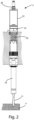
- a drilling group 1 can be seen, on which a plurality of working units 2 are installed for drilling a panel P or a piece in general, using a tool, such as a bit 21.
- the drilling group 1 comprising a support frame 11, having a plurality of seats 12, each one of which houses a working unit 2.
- the drilling group 1 also comprises an electric motor 13, to provide, by means of suitable transmission (not shown in the figure) installed within said support frame 11, the driving force required to move said working units 2.
- the drilling group 1 is also moved by possible further motor means in the direction of the piece to be working, to bring the tool, e.g., the tip 21, into contact therewith.
- the drilling group 1 can pass from a non-operative position, in which the bit 21 (or the tool, in general) is not in contact with the piece, to a working position, in which the bit is in contact with the piece.
- Each of said working units 2 is equipped with a specific bit 21 possibly of a different section according to the hole to be made.
- the bit 21 of the selected working unit 2 is placed in contact with a piece P to make one or more holes on one or more faces thereof.
- Each working unit 2 comprises a pneumatic cylinder 22 vertically arranged, coupled to said support frame 11 of the drilling group 1.
- Said pneumatic cylinder 22 is delimited by a base 221 and a shell 222.
- Compressed air is injected into the pneumatic cylinder 22 through a compressed air inlet 28.
- the compressed air inlet 28 is obtained on said base 221.
- the compressed air inlet 28 can be placed in other alternative positions.
- said compressed air inlet 28 can be obtained on said shell 222.
- cylinder pneumatic 22 also comprises a limit switch or abutment element 25, arranged inside it.
- said end stroke element 25 is arranged on the inner surface of said shell 222, at an intermediate point of the length of the pneumatic cylinder 22. The function of said end stroke element 25 will be better described below.
- each working unit 2 also comprises a piston 24, which is slidably movable inside said pneumatic cylinder 22, between a retracted position, in which it preferably abuts said base 221 of said pneumatic cylinder 22, and an extracted position, wherein said piston 24 exerts a mechanical stress on said end stroke element 25.
- Each working unit 2 also comprises a spindle 29, associated with said piston 24.
- the bit 21 of the working unit 2 is fixed to one end of said spindle 29.
- the spindle 29 is, in use, driven in rotation by said electric motor 13.
- Said end stroke element 25 is arranged so that the piston 24 can in particular be movable from said retracted position, in which it preferably abuts said base 221 of said pneumatic cylinder 22, to said extracted position, in which said piston 24 exerts a mechanical stress on said end stroke element 25.
- Said piston 24 is moved by injecting compressed air into the pneumatic cylinder 22 through said compressed air inlet 28.
- the working unit 2 also comprises return means, and in particular in the present embodiment, a returning spring 26, which is arranged inside of the pneumatic 22, between said piston 24 and said shell 222.
- the returning spring 26 is configured to return said piston 24 from said extracted position to said retracted position.
- said working unit 2 comprises a detecting device 23, arranged on said end stroke element 25, so that, when said piston 24 is in said extracted position, it exerts stress on said end stroke element 25, and said detecting device 23 is interposed between said end stroke element 25 and said piston 24.
- Said detecting device 23 is made of piezoelectric material, and it is able to detect the force that said piston 24 exerts on said end stroke element 25.
- said detecting device 23 is arranged in an internal section of said end stroke element 25.
- said piezoelectric detecting device 23 generates an electric signal following the mechanical stress received by the piston 24 on said end stroke element 25.
- the force that the piston 24 exerts on the pneumatic cylinder 22 is detected, which, as will be better described below, is proportional to that the bit 21 exerts on the piece P to be drilled.
- said detecting device 23 can be a load cell or another type of force sensor.
- Each drilling group 1 comprises one or a plurality of control units 27, connected to a respective detecting device 23.
- the control unit 27 detects the electrical signal generated by said detecting device 23, to determine, as better explained below when the force between said piston 24 and said end stroke element 25 is outside a predefinable range of values and/or if said piston 24 exerts mechanical stress on said end stroke element 25.
- the working unit 2 described above operates as follows.
- the working unit 2 Before actually drilling a piece P, the working unit 2 is selected which installs the bit 21 of interest, and compressed air is introduced through the compressed air inlet 28 of the selected working unit 2. This causes the passage of the piston 24 of the working unit 2 chosen from said retracted position, to said extracted position, in which, as mentioned, the piston 24 exerts mechanical stress on said end stroke element 25. At the same time, the returning spring 26 exerts a return force, having a direction opposite to the force exerted by the compressed air on the piston 24.
- the spindle 29 is actuated and rotated. With it, the bit 21 is rotated, to drill the piece P.
- the drilling group 1 is moved in the direction of the piece P, according to arrow A of figure 1 , i.e., in the working position, so that said bit 21 comes into contact and penetrates inside the piece to be machined, making the hole.
- the resulting force R is included in a predefined interval between a respective lower threshold value, and a respective upper threshold value.
- Bits 21 of different diameters wear out at different times.
- the resulting force R becomes less than a predetermined lower threshold value, as the resistance force to drilling P m increases.
- the electric signal generated by the detecting device 23 is processed by the control logic unit 27 in order to emit an alarm or warning signal so that the worn bit 21 can be replaced.
- the detecting device 23 When this threshold value is exceeded, the detecting device 23 emits an electric signal, processed by the control logic unit 27 in order to emit an alarm or warning signal.
- control logic unit 27 When the piston 24 exerts mechanical stress with the end stroke element 25, the control logic unit 27, by processing the electric signal emitted by the detecting device 23, is also capable of detecting the presence of the piston 24, in order to provide evidence of the extracted position of the piston 24.
- An advantage of the present invention is that of allowing the replacement of specific machining tools, in particular drilling bits, as soon as they are subject to a degree of wear, such as to cause non-optimal machining and avoid a late or early replacement.
- Another advantage of the present invention is that of reducing the machining waste by detecting the breakage of specific tools.
- Yet another advantage of the invention is that of signaling incorrect positioning of the working tools.
Landscapes
- Engineering & Computer Science (AREA)
- Mechanical Engineering (AREA)
- Life Sciences & Earth Sciences (AREA)
- Wood Science & Technology (AREA)
- Forests & Forestry (AREA)
- Machine Tool Sensing Apparatuses (AREA)
- Apparatus For Radiation Diagnosis (AREA)
- Polarising Elements (AREA)
- Sink And Installation For Waste Water (AREA)
Applications Claiming Priority (1)
| Application Number | Priority Date | Filing Date | Title |
|---|---|---|---|
| IT102021000028367A IT202100028367A1 (it) | 2021-11-08 | 2021-11-08 | Unità di lavorazione perfezionata |
Publications (2)
| Publication Number | Publication Date |
|---|---|
| EP4177005A2 true EP4177005A2 (de) | 2023-05-10 |
| EP4177005A3 EP4177005A3 (de) | 2023-07-12 |
Family
ID=79831072
Family Applications (1)
| Application Number | Title | Priority Date | Filing Date |
|---|---|---|---|
| EP22204625.2A Pending EP4177005A3 (de) | 2021-11-08 | 2022-10-31 | Verbesserte bearbeitungseinheit |
Country Status (2)
| Country | Link |
|---|---|
| EP (1) | EP4177005A3 (de) |
| IT (1) | IT202100028367A1 (de) |
Family Cites Families (4)
| Publication number | Priority date | Publication date | Assignee | Title |
|---|---|---|---|---|
| DE4016480C2 (de) * | 1990-05-22 | 1994-07-14 | Gustav Weeke Maschinenbau Gmbh | Spindeleinheit für eine Bohr-Fräsmaschine |
| SE533114C2 (sv) * | 2008-11-05 | 2010-06-29 | Atlas Copco Tools Ab | Borrspindelenhet |
| US10875138B1 (en) * | 2016-08-09 | 2020-12-29 | M4 Sciences Llc | Tool holder assembly for machining system |
| IT201800007340A1 (it) * | 2018-07-19 | 2020-01-19 | Gruppo operatore per la lavorazione di un pannello ed il relativo metodo di lavorazione. |
-
2021
- 2021-11-08 IT IT102021000028367A patent/IT202100028367A1/it unknown
-
2022
- 2022-10-31 EP EP22204625.2A patent/EP4177005A3/de active Pending
Also Published As
| Publication number | Publication date |
|---|---|
| IT202100028367A1 (it) | 2023-05-08 |
| EP4177005A3 (de) | 2023-07-12 |
Similar Documents
| Publication | Publication Date | Title |
|---|---|---|
| CN110297461B (zh) | 异常检测装置 | |
| US6937942B2 (en) | Method and apparatus of detecting tool abnormality in a machine tool | |
| US4563897A (en) | Apparatus for monitoring tool life | |
| CA2853535C (en) | Sawing machine and method for controlling a sawing machine | |
| US4532599A (en) | Quality control method | |
| GB2414203A (en) | A method for operating a guided machine tool | |
| JP5937727B1 (ja) | 工具摩耗評価装置 | |
| JP6722052B2 (ja) | 多刃工具の異常検知方法 | |
| CN111890124A (zh) | 刀具在线监测系统及方法 | |
| JP3291677B2 (ja) | 工作機械用加工刃の状態監視方法とその装置 | |
| US4551808A (en) | Tool wear sensors | |
| MX2024004412A (es) | Metodo para monitorear la condicion de una maquina cortadora de engranajes. | |
| EP4177005A2 (de) | Verbesserte bearbeitungseinheit | |
| Thangaraj et al. | Drill wear sensing and failure prediction for untended machining | |
| JP2007098523A (ja) | ブローチの寿命判断方法、ブローチ品質管理装置、及びブローチ加工装置 | |
| GB2133881A (en) | Apparatus for monitoring tool life | |
| CN217749365U (zh) | 主轴组件 | |
| Novak et al. | Reliability of the cutting force monitoring in FMS-installations | |
| KR20170100387A (ko) | 공작물 가공장치 | |
| CN117428229A (zh) | 一种数控钻孔机及其控制系统 | |
| JP2001277075A (ja) | 工作機械における切削工具の負荷検出方法および装置 | |
| RU2496629C2 (ru) | Способ контроля состояния режущих кромок сборных многолезвийных инструментов | |
| JPS61252052A (ja) | 穴明工具の異常検出装置 | |
| JP2008087092A (ja) | 工具の異常検出装置 | |
| JP2008000828A (ja) | Nc旋盤およびnc旋盤における切削工具の工具状態検出方法 |
Legal Events
| Date | Code | Title | Description |
|---|---|---|---|
| PUAI | Public reference made under article 153(3) epc to a published international application that has entered the european phase |
Free format text: ORIGINAL CODE: 0009012 |
|
| STAA | Information on the status of an ep patent application or granted ep patent |
Free format text: STATUS: THE APPLICATION HAS BEEN PUBLISHED |
|
| AK | Designated contracting states |
Kind code of ref document: A2 Designated state(s): AL AT BE BG CH CY CZ DE DK EE ES FI FR GB GR HR HU IE IS IT LI LT LU LV MC ME MK MT NL NO PL PT RO RS SE SI SK SM TR |
|
| PUAL | Search report despatched |
Free format text: ORIGINAL CODE: 0009013 |
|
| P01 | Opt-out of the competence of the unified patent court (upc) registered |
Effective date: 20230518 |
|
| AK | Designated contracting states |
Kind code of ref document: A3 Designated state(s): AL AT BE BG CH CY CZ DE DK EE ES FI FR GB GR HR HU IE IS IT LI LT LU LV MC ME MK MT NL NO PL PT RO RS SE SI SK SM TR |
|
| RIC1 | Information provided on ipc code assigned before grant |
Ipc: B27C 9/04 20060101ALI20230602BHEP Ipc: B27C 3/04 20060101ALI20230602BHEP Ipc: B23Q 17/09 20060101ALI20230602BHEP Ipc: B23B 39/24 20060101ALI20230602BHEP Ipc: B23B 39/16 20060101ALI20230602BHEP Ipc: B23Q 5/26 20060101AFI20230602BHEP |
|
| STAA | Information on the status of an ep patent application or granted ep patent |
Free format text: STATUS: REQUEST FOR EXAMINATION WAS MADE |
|
| 17P | Request for examination filed |
Effective date: 20240111 |
|
| RBV | Designated contracting states (corrected) |
Designated state(s): AL AT BE BG CH CY CZ DE DK EE ES FI FR GB GR HR HU IE IS IT LI LT LU LV MC ME MK MT NL NO PL PT RO RS SE SI SK SM TR |
|
| GRAP | Despatch of communication of intention to grant a patent |
Free format text: ORIGINAL CODE: EPIDOSNIGR1 |
|
| STAA | Information on the status of an ep patent application or granted ep patent |
Free format text: STATUS: GRANT OF PATENT IS INTENDED |
|
| INTG | Intention to grant announced |
Effective date: 20260216 |
|
| RAP1 | Party data changed (applicant data changed or rights of an application transferred) |
Owner name: HITECO S.R.L. |