EP4173545B1 - Schuhpflegegerät - Google Patents
Schuhpflegegerät Download PDFInfo
- Publication number
- EP4173545B1 EP4173545B1 EP21858465.4A EP21858465A EP4173545B1 EP 4173545 B1 EP4173545 B1 EP 4173545B1 EP 21858465 A EP21858465 A EP 21858465A EP 4173545 B1 EP4173545 B1 EP 4173545B1
- Authority
- EP
- European Patent Office
- Prior art keywords
- supporter
- rail
- supply
- shutter
- door
- Prior art date
- Legal status (The legal status is an assumption and is not a legal conclusion. Google has not performed a legal analysis and makes no representation as to the accuracy of the status listed.)
- Active
Links
Images








Classifications
-
- A—HUMAN NECESSITIES
- A47—FURNITURE; DOMESTIC ARTICLES OR APPLIANCES; COFFEE MILLS; SPICE MILLS; SUCTION CLEANERS IN GENERAL
- A47L—DOMESTIC WASHING OR CLEANING; SUCTION CLEANERS IN GENERAL
- A47L23/00—Cleaning footwear
- A47L23/02—Shoe-cleaning machines, with or without applicators for shoe polish
-
- A—HUMAN NECESSITIES
- A43—FOOTWEAR
- A43D—MACHINES, TOOLS, EQUIPMENT OR METHODS FOR MANUFACTURING OR REPAIRING FOOTWEAR
- A43D3/00—Lasts
- A43D3/14—Stretching or spreading lasts; Boot-trees; Fillers; Devices for maintaining the shape of the shoe
- A43D3/1408—Devices for heating or drying shoes
-
- A—HUMAN NECESSITIES
- A47—FURNITURE; DOMESTIC ARTICLES OR APPLIANCES; COFFEE MILLS; SPICE MILLS; SUCTION CLEANERS IN GENERAL
- A47L—DOMESTIC WASHING OR CLEANING; SUCTION CLEANERS IN GENERAL
- A47L23/00—Cleaning footwear
- A47L23/18—Devices for holding footwear during cleaning or shining; Holding devices with stretching effect
-
- A—HUMAN NECESSITIES
- A47—FURNITURE; DOMESTIC ARTICLES OR APPLIANCES; COFFEE MILLS; SPICE MILLS; SUCTION CLEANERS IN GENERAL
- A47L—DOMESTIC WASHING OR CLEANING; SUCTION CLEANERS IN GENERAL
- A47L23/00—Cleaning footwear
- A47L23/20—Devices or implements for drying footwear, also with heating arrangements
-
- A—HUMAN NECESSITIES
- A47—FURNITURE; DOMESTIC ARTICLES OR APPLIANCES; COFFEE MILLS; SPICE MILLS; SUCTION CLEANERS IN GENERAL
- A47L—DOMESTIC WASHING OR CLEANING; SUCTION CLEANERS IN GENERAL
- A47L23/00—Cleaning footwear
- A47L23/20—Devices or implements for drying footwear, also with heating arrangements
- A47L23/205—Devices or implements for drying footwear, also with heating arrangements with heating arrangements
-
- F—MECHANICAL ENGINEERING; LIGHTING; HEATING; WEAPONS; BLASTING
- F26—DRYING
- F26B—DRYING SOLID MATERIALS OR OBJECTS BY REMOVING LIQUID THEREFROM
- F26B21/00—Arrangements for supplying or controlling air or other gases for drying solid materials or objects
- F26B21/006—Arrangements for supplying or controlling air or other gases for drying solid materials or objects with the air or gases passing through hollow spaces or cores within the materials or objects to be dried, e.g. tubes, pipes or bottles
- F26B21/008—Arrangements for supplying or controlling air or other gases for drying solid materials or objects with the air or gases passing through hollow spaces or cores within the materials or objects to be dried, e.g. tubes, pipes or bottles the objects being flexible, e.g. inflatable tubes or sausage casings
-
- F—MECHANICAL ENGINEERING; LIGHTING; HEATING; WEAPONS; BLASTING
- F26—DRYING
- F26B—DRYING SOLID MATERIALS OR OBJECTS BY REMOVING LIQUID THEREFROM
- F26B21/00—Arrangements for supplying or controlling air or other gases for drying solid materials or objects
- F26B21/20—Circulating air or gases in closed cycles, e.g. wholly within the drying enclosure
- F26B21/202—Circulating air or gases in closed cycles, e.g. wholly within the drying enclosure with means for changing the flow pattern, e.g. by reversing gas flow or by moving the materials or objects through subsequent compartments, at least two of which have a different flow direction
- F26B21/208—Circulating air or gases in closed cycles, e.g. wholly within the drying enclosure with means for changing the flow pattern, e.g. by reversing gas flow or by moving the materials or objects through subsequent compartments, at least two of which have a different flow direction by air valves, movable baffles or nozzle arrangements
-
- F—MECHANICAL ENGINEERING; LIGHTING; HEATING; WEAPONS; BLASTING
- F26—DRYING
- F26B—DRYING SOLID MATERIALS OR OBJECTS BY REMOVING LIQUID THEREFROM
- F26B21/00—Arrangements for supplying or controlling air or other gases for drying solid materials or objects
- F26B21/30—Controlling, e.g. regulating, parameters of gas supply
-
- F—MECHANICAL ENGINEERING; LIGHTING; HEATING; WEAPONS; BLASTING
- F26—DRYING
- F26B—DRYING SOLID MATERIALS OR OBJECTS BY REMOVING LIQUID THEREFROM
- F26B21/00—Arrangements for supplying or controlling air or other gases for drying solid materials or objects
- F26B21/30—Controlling, e.g. regulating, parameters of gas supply
- F26B21/33—Humidity
- F26B21/333—Humidity by condensing the moisture in the drying medium, which may be recycled, e.g. using a heat pump cycle
Definitions
- the present invention relates to a shoe care apparatus, and more particularly, to a shoe care apparatus including a blowing flow path.
- Shoes are worn on the feet when walking or exercising, and the shoes may be contaminated by soil or dirt, and may also be contaminated by sweat. Therefore, it is required to periodically wash the shoes for the comfortable use.
- a degree of contamination is typically greater than that of clothes and thus it is difficult to wash the shoes and the clothes together.
- shoes include various parts such as an upper, a midsole, an outsole, an insole, a tongue, a heel cup, and a heeltap.
- various materials may be applied to each part.
- a relatively hard material may be applied to a midsole, an outsole, and/or a heel cup
- a relatively soft material may be applied to an insole and a heel tab.
- Shoes have a relatively complex structure, and thus it is not easy to care for the shoes with a conventional clothes care apparatus.
- JP S59 204 B2 discloses a shoe care cabinet having a valve arrangement for opening and closing a supply port to supply air to shoes in the cabinet.
- the present invention is directed to providing a shoe care apparatus capable of preventing foreign substances from entering a blow duct.
- the present invention is directed to providing a shoe care apparatus capable of having an increased usability.
- a shoe care apparatus may open and close a blow duct depending on whether a supporter is mounted or not, thereby preventing foreign substances from entering the blow duct.
- a shoe care apparatus may automatically open and close a blow duct depending on whether a supporter is mounted, and thus the convenience of use may be increased.
- shoe care apparatus 1 for caring for shoes is described as an example, but the shoe care apparatus 1 according to one embodiment of the present invention may be used to care for clothes and/or miscellaneous goods other than shoes.
- a direction along the X-axis may be defined as a left and right direction
- a direction along the Y-axis may be defined as a front and rear direction
- a direction along the-Z axis may be defined as an up and down direction.
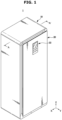
- a shoe care apparatus 1 may include a cabinet 10 forming an exterior and a cabinet door 20 rotatably coupled to the cabinet 10.
- the cabinet 10 may have a rectangular parallelepiped shape with an open front surface.
- a cabinet opening 10a may be formed in an open front surface of the cabinet 10.
- the cabinet door 20 may be rotatably coupled to the cabinet 10 to open and close a care chamber 30 formed inside the cabinet 10.
- the cabinet door 20 may be coupled to the cabinet 10 through a hinge 23.
- the cabinet door 20 may include a hanger 21 arranged on one surface that faces the inside of the care chamber when the cabinet door 20 closes the care chamber 30. At least one hanger 21 may be provided.
- the hanger 21 may be provided to allow a supporter 50, which is described later, to be hung thereon, thereby easily storing the supporter 50.
- the use of the hanger 21 is not limited thereto, and may be used to store other components.
- the cabinet door 20 may further include an input device 22 arranged on a front surface of the shoe care apparatus 1.
- a user can set various care courses through the input device 22 based on the type of shoes for which to be cared.
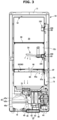
- the cabinet 10 may include an outer case 11 and an inner case 12 disposed inside the outer case 11.
- the inner case 12 may form the care chamber 30.
- the care chamber 30 may be provided to accommodate a plurality of shoes.
- a machine room 40 in which a heat exchanger 47 for dehumidifying or heating air inside the care chamber 30 is arranged, may be provided in the cabinet 10.
- the supporter 50 configured to support shoes may be provided inside the care chamber 30.
- the supporter 50 may be installed on one side of the care chamber 30.
- FIGS. 2 and 3 illustrate that the supporter 50 is located on the right side of the care chamber 30, but the position of the supporter 50 is not limited thereto.
- the supporter 50 may be located on the left side or on the rear inner side of the care chamber 30.
- the supporter 50 may be detachably provided in the cabinet 10. At least one supporter 50 may be provided.
- the supporter 50 may be formed in a shape that may be inserted into a shoe.
- a drain pan 48 detachably provided to the cabinet 10 may be installed at a lower portion of the cabinet 10.
- the drain pan 48 may be disposed under the care chamber 30.
- the drain pan 48 may be provided to easily collect condensed water generated by the heat exchanger 47.
- the drain pan 48 may be provided under the machine room 40.
- the machine room 40 may be located at the lower end of the cabinet 10.
- the machine room 40 may be provided under the care chamber 30.
- the heat exchanger 47 may be configured to dehumidify and/or heat the air inside the care chamber 30 as needed.
- the heat exchanger 47 may be configured to supply hot dry air to the inside of the care chamber 30.
- the heat exchanger 47 may include an evaporator 42 and a condenser 43 through which a refrigerant circulates.
- the heat exchanger 47 may be configured to dehumidify and/or heat the air.
- the evaporator 42 may condense and remove moisture from the surrounding air.
- the refrigerant passing through the evaporator 42 becomes a high-temperature and high-pressure state while passing through the compressor 41.
- the condenser 43 may heat the surrounding air by releasing latent heat toward the surrounding air.
- Air introduced into the machine room 40 through a fan 44 may be dehumidified and heated by passing through the evaporator 42 and the condenser 43.
- the fan 44 may be provided as a centrifugal fan that sucks air in a rotation axis direction and discharges air in a radial direction.
- the type of fan 44 is not limited thereto, and may be provided as an axial flow fan or a mixed flow fan.
- connection flow path 46a through which air passing through the evaporator 42, the condenser 43, and the blower fan 44 flows, may be formed in the machine room 40.
- the connection flow path 46a may be formed by a connection duct 46.
- the connection duct 46 may communicate with the care chamber 30.
- the shoe care apparatus 1 may further include a water tank (not shown), a steam generator (not shown) configured to generate steam by receiving water from the water tank, and a steam spraying device (not shown) configured to receive steam from the steam generator and spray the steam.
- a water tank not shown
- a steam generator not shown
- a steam spraying device not shown
- the water tank may be disposed under the care chamber 30. Water in the water tank may be supplied to the steam generator and used to form steam. The water tank may be installed to be detached from the cabinet 10 to facilitate water replenishment.
- the steam generator may be disposed in the machine room 40.
- the steam generator may generate steam and guide the steam to the steam spraying device.
- the steam generator may be connected to the steam spraying device through a steam supply pipe (not shown).
- the shoe care apparatus 1 may further include a deodorizer 45.
- the deodorizer 45 may be disposed within the machine room 40.
- the deodorizer 45 may be disposed in the connection duct 46 to remove odors from the air passing through the care chamber 30.
- the deodorizer 45 is illustrated as being located on the left side of the blower fan 44, but is not limited thereto. Alternatively, the deodorizer 45 may be located on the right side of the blower fan 44.
- the deodorizer 45 may include a deodorizing filter 45a and a germicidal lamp 45b.
- the deodorizing filter 45a may include a ceramic filter.
- the germicidal lamp 45b may include an ultraviolet lamp.
- the deodorizing filter is not limited thereto, and the deodorizing filter 45a may include various filters as long as a filter is configured to remove odors from the air, and the germicidal lamp 45b may also include various devices as long as a device is configured to sterilize germs.
- At least one plate 90 may be provided in the care chamber 30.
- the plate 90 may be provided to hold shoes.
- a supply port 60 and the supporter 50 may be positioned adjacent to the plate 90.
- the plate 90 may include a duct plate 95.
- the duct plate 95 may include an internal flow path 96 as shown in FIG. 3 .
- the heated air passing through the internal flow path 96 may be sprayed toward shoes from a spray port 95a of the duct plate 95 and a spray port 97a of a circular duct 97, respectively.
- the heated air may pass through the internal flow path 96 and be discharged to the care chamber 30 through a plate outlet 98.
- the supply port 60 and a return port 31 may be provided in the care chamber 30.
- the supply port 60 may be located on a side wall of the inner case 12. Particularly, the supply port 60 may be formed on the left surface, in which the supporter 50 is located, of the care chamber 30. However, the position of the supply port 60 is not limited thereto, and may be formed on the right side of the care chamber 30 as long as the position corresponds to the position of the supporter 50. At least one supply port 60 may be formed, and shoes may be dried by supplying heated air into the care chamber 30.
- the shape of the supply port 60 may be approximately circular. However, the shape of the supply port 60 is not limited thereto, and as long as the supply port is provided to supply heated air into the care chamber 30 so as to dry shoes, the support port 60 may have various shapes such as squares and polygons.
- the return port 31 may be disposed at the front end of the bottom surface of the care chamber 30. However, the position of the return port 31 is not limited thereto, and may also be disposed at the rear end and/or the side end of the bottom surface of the care chamber 30. Air drying shoes in the care chamber 30 may be returned to the connection duct 46 to be described later through the return port 31. A return hole 31a and a return grille 31b may be provided in the return port 31.
- connection duct 46 may be provided to communicate with a supply duct 70 and the return port 31 of the care chamber 30. One end of the connection duct 46 may communicate with the supply duct 70 and the other end may communicate with the return port 31.
- the air introduced through the return port 31 may be dehumidified and/or heated while passing through the connection duct 46, and then the dehumidified and/or heated air may be discharged back to the care chamber 30 through the supply duct 70 and the supply port 60.
- the supply duct 70 may be provided to extend vertically between the outer case 11 and the inner case 12 of the cabinet 10.
- the supply duct 70 may be located on one side, to which the supporter 50 is mounted, of the cabinet 10.
- One end of the supply duct 70 may communicate with the connection duct 46.
- the supply duct 70 may be provided to communicate with the supply port 60.
- the supply duct 70 may form a guide flow path 71 provided to guide heated air to the supply port 60.
- FIG. 4 is an enlarged view of part B of FIG. 2 .
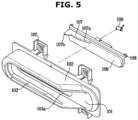
- FIG. 5 is an exploded view of the supporter rail of FIG. 4 .
- FIG. 6 is a view illustrating a state in which a supporter of FIG. 2 starts to be mounted on the supporter rail.
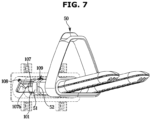
- FIG. 7 is a view illustrating a state in which the supporter of FIG. 6 opens a supply door while being mounted on the supporter rail.
- FIG. 8 is a view illustrating a state in which the supporter of FIG. 7 completely opens the supply door while being completely mounted on the supporter rail.
- the supporter rail 100 may include a rail body 101 fixed to the inner case 12.
- the rail body 101 may include a fixer 105 coupled to a fixing member (not shown) and fixed to the inner case 12.
- a guide rail 103 may be formed on the supporter rail 100 to guide the supporter 50 when the supporter 50 is mounted on or separated from the supporter rail 100.
- the guide rail 103 may protrude from the supporter supporting member 102.
- the guide rail 103 may extend along a direction in which the supporter 50 is mounted on the supporter rail 100 or a direction in which the supporter 50 is separated from the supporter rail 100.
- the supporter rail 100 may include the supply door 106.
- the supply door 106 may be rotatably coupled to the rail body 101.
- the supply door 106 may include a door shaft 108 rotatably coupled to the rail body 101.
- the supply door 106 may be configured to open and close the rail opening 101a.
- the supporter rail 100 may include an elastic body 109 provided to elastically bias the supply door 106 to a direction of closing the rail opening 101a.
- the elastic body 109 may press the supply door 106 to the direction of closing the rail opening 101a.
- the elastic body 109 may be provided as a spring.
- the trigger 107 may include a first member 107a in which a pressure by the supporter 50 starts when the supporter 50 is mounted.
- the first member 107a may be more inclined, with respect to a direction away from the supply door 106, as the supporter is along a direction of being mounted to the supporter rail. Accordingly, when the supporter 50 is mounted on the supporter rail 100, the supply door 106 may be gradually opened as the supporter 50 presses the first member 107a of the trigger 107 and moves.
- the trigger 107 may include a second member 107b that extends further from the supply door 106 than the first member 107a.
- the second member 107b may be disposed to be pressed by the supporter 50 when the supporter 50 is completely mounted to the supporter rail 100.
- the second member 107b of the trigger 107 may be provided to further open the supply door 106 than when the supporter 50 presses the first member 107a.
- FIGS. 6 to 8 An operation of the supply door 106 according to one embodiment of the present invention will be described with reference to FIGS. 6 to 8 .
- the supporter 50 may include a guide 52 into which the guide rail 103 is inserted.
- the guide 52 may include a member extending along a direction in which the supporter 50 is mounted on the supporter rail 100.
- the supporter 50 may include a pressing member 51 provided to press the trigger 107.
- the pressing member 51 may be inserted into the supporter supporting member 102.
- the pressing member 51 presses the first member 107a of the trigger 107. Accordingly, the supply door 106 is rotated by a predetermined angle and opens the rail opening 101a.
- the pressing member 51 presses the second member 107b of the trigger 107. Accordingly, the supply door 106 is further rotated by a predetermined angle and completely opens the rail opening 101a. Accordingly, the supply port 60 may be opened.
- the pressing member 51 releases the pressure of the trigger 107.
- the elastic body 109 applies an elastic force to the supply door 106 to the direction in which the supply door 106 closes the rail opening 101a. Accordingly, the supply door 106 is rotated to a position to close the rail opening 101a as the supporter 50 is separated from the supporter rail 100. Therefore, the supply port 60 may be closed.
- the supporter rail 100 may discharge the air, which is guided through the guide flow path 71, to the care chamber 30 through the supporter 50 when the supporter 50 is mounted. Further, the supporter rail 100 may prevent foreign substances from entering the guide flow path 71 when the supporter 50 is separated.
- FIG. 9 is an exploded view of a supporter rail according to another embodiment of the present invention.
- a supporter rail 200 according to another embodiment of the present invention will be described with reference to FIG. 9 .
- the same reference numerals are assigned to the same components as those of the supporter rail 100 shown in FIGS. 4 and 5 , and detailed descriptions thereof may be omitted.
- the supporter rail 200 may include a supply door 206 rotatably coupled to the rail body 101.
- the supply door 206 may include a door shaft 208 rotatably coupled to the rail body 101.
- the supply door 206 may include a trigger 207 provided to be pressed by the supporter 50 so as to gradually open the supply door 206.
- the trigger 207 may include a first member 207a primarily opening the supply door 206 and a second member 207b secondarily opening the supply door 206.
- the supply door 206 may include a weight member 209.
- the weight member 209 may be located at a lower end of the supply door 206.
- the weight member 209 may be provided to rotate the supply door 206 to a direction of closing the rail opening 101a when the supporter 50 is separated from the supporter rail 200. Accordingly, the supply port 60 may be closed.
- the weight member 209 may be provided to have a heavier weight than other parts of the supply door 206.
- the supporter rail 200 may discharge the air, which is guided through the guide flow path 71, to the care chamber 30 through the supporter 50 when the supporter 50 is mounted. Further, the supporter rail 200 may prevent foreign substances from entering the guide flow path 71 when the supporter 50 is separated.
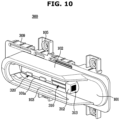
- FIG. 10 is a view of a supporter rail according to still another embodiment of the present invention.
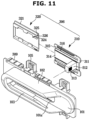
- FIG. 11 is an exploded view of the supporter rail of FIG. 10 .
- FIG. 12 is a view illustrating a state in which the supporter of FIG. 10 starts to be mounted on the supporter rail.
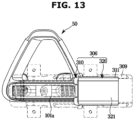
- FIG. 13 is a view illustrating a state in which the supporter of FIG. 12 opens a first shutter of a supply door while being mounted on the supporter rail.
- FIG. 14 is a view illustrating a state in which the supporter of FIG. 13 completely opens a second shutter of the supply door while being completely mounted on the supporter rail.
- FIG. 15 is a view illustrating a state in which the supporter of FIG.
- FIG. 16 is a view illustrating a state in which the supporter of FIG. 15 is moved to a direction, in which the second shutter is closed, as being moved to the direction, in which the first shutter of the supporter rail is closed while being separated from the supporter rail.
- a supporter rail 300 according to still another embodiment of the present invention will be described with reference to FIGS. 10 to 16 .
- the same reference numerals are assigned to the same components as those of the embodiment shown in FIGS. 4 and 5 , and detailed descriptions thereof may be omitted.
- the supporter rail 300 may include a supply door 306 configured to open and close the rail opening 101a of the rail body 101.
- the supply door 306 may be slidably coupled to the rail body 101.
- the rail body 101 may include a door supporting member 309 provided to slidably support the supply door 306.
- the supply door 306 may include a first shutter 310 and a second shutter 320.
- the first shutter 310 may be slidably coupled to the second shutter 320.
- the first shutter 310 may include a first shutter body 311 and a lever 312 protruding from the first shutter body 311 to interfere with the supporter 50 when the supporter 50 is coupled.
- the lever 312 may penetrate the rail opening 101a and extend to a space between the supporter supporting member 102.
- the second shutter 320 may be slidably coupled to the first shutter 310.
- the second shutter 320 may include the second shutter body 321.
Landscapes
- Engineering & Computer Science (AREA)
- Mechanical Engineering (AREA)
- General Engineering & Computer Science (AREA)
- Drying Of Solid Materials (AREA)
- Support Devices For Sliding Doors (AREA)
- Drawers Of Furniture (AREA)
Claims (14)
- Schuhpflegegerät (1), umfassend:einen Schrank (10), der eine Pflegekammer (30) ausbildet und einen Zuführanschluss (60) einschließt;einen Zuführkanal (70), der dazu bereitgestellt ist, Luft durch den Zuführanschluss (60) der Pflegekammer zuzuführen;eine Stützschiene (100), die eine Führungsschiene (103) einschließt; undeine Stütze (50) zum Stützen eines Schuhs, die lösbar an der Stützschiene (100, 200) in der Pflegekammer montierbar ist,wobei die Stützschiene (100, 200) und die Stütze (50) so konfiguriert sind, dass:der Zuführanschluss (60) als Reaktion darauf geöffnet wird, dass die Stütze durch die Führungsschiene (103) geführt und an der Stützschiene montiert wird, und die Stütze (50) die Luft aufnimmt, die durch den Zuführanschluss zugeführt wird, undder Zuführanschluss (60) als Reaktion darauf geschlossen wird, dass die Stütze (50) durch die Führungsschiene (103) geführt und von der Stützschiene (100) getrennt wird.
- Schuhpflegegerät nach Anspruch 1, wobei
die Stützschiene (100, 200) Folgendes einschließt:einen Schienenkörper (101), der an dem Schrank befestigt ist, undeine Zuführklappe (106, 206), die so an den Schienenkörper gekoppelt ist, dass sie drehbar ist, um den Zuführanschluss zu öffnen und den Zuführanschluss zu schließen. - Schuhpflegegerät nach Anspruch 2, wobei
die Stützschiene (100) ferner Folgendes einschließt:
einen elastischen Körper (109), der dazu bereitgestellt ist, eine elastische Kraft auf die Zuführklappe in einer Richtung anzuwenden, um den Zuführanschluss zu schließen. - Schuhpflegegerät nach Anspruch 2, wobei
die Zuführklappe (106, 206) Folgendes einschließt:
ein Gewichtselement (209), das so an einem unteren Ende der Zuführklappe angeordnet ist, dass es die Zuführklappe in einer Richtung dreht, um den Zuführanschluss zu schließen. - Schuhpflegegerät nach Anspruch 2, wobei
die Stützschiene ferner Folgendes einschließt:
einen Auslöser (107, 207), der dazu bereitgestellt ist, so durch die Stütze (50) gedrückt zu werden, dass er als Reaktion darauf, dass die Stütze an der Stützschiene montiert wird, die Zuführklappe in einer Richtung dreht, um den Zuführanschluss zu öffnen. - Schuhpflegegerät nach Anspruch 5, wobei
der Auslöser Folgendes einschließt:
ein Element (107a, 207a), das dazu ausgebildet ist, sich von der Zuführklappe in eine Richtung zu erstrecken, in der Luft aus dem Zuführanschluss ausgestoßen wird, und in einer Richtung geneigt zu sein, entlang der sich die Stütze bewegt, während sie an der Stützschiene (100, 200) montiert wird. - Schuhpflegegerät nach Anspruch 5, wobei
der Auslöser (107, 207) an einem hinteren Ende der Zuführklappe in Bezug auf eine Richtung angeordnet ist, entlang der sich die Stütze bewegt, während sie an der Stützschiene montiert wird. - Schuhpflegegerät nach Anspruch 5, wobei
der Auslöser (107, 207) Folgendes einschließt:ein erstes Element (107a, 207a) undein zweites Element (107b, 207b), das dazu ausgebildet ist, weiter von der Zuführklappe hervorzustehen als das erste Element. - Schuhpflegegerät nach Anspruch 1, wobei die Stützschiene (100) Folgendes einschließt:einen Schienenkörper (101), der an dem Schrank befestigt ist, undeine Zuführklappe (306), die so an den Schienenkörper gekoppelt ist, dass sie verschiebbar ist, um den Zuführanschluss zu öffnen und den Zuführanschluss zu schließen.
- Schuhpflegegerät nach Anspruch 9, wobei
die Zuführklappe (206) Folgendes einschließt:einen ersten Verschluss (310), der einen Hebel (312) einschließt, der dazu bereitgestellt ist, als Reaktion darauf, dass die Stütze an der Stützschiene montiert wird, durch die Stütze gedrückt zu werden, undeinen zweiten Verschluss (320), der verschiebbar an den ersten Verschluss gekoppelt ist. - Schuhpflegegerät nach Anspruch 10, wobei
die Stütze (50) Folgendes einschließt:ein Drückelement (51), das dazu bereitgestellt ist, den Hebel zu drücken, undeinen Magneten (59) oder ein magnetisches Material, das in dem Drückelement angeordnet ist,wobei ein magnetisches Material oder ein Magnet in dem Hebel (312) bereitgestellt ist, um eine Anziehungskraft zwischen dem Hebel und dem Drückelement anzuwenden. - Schuhpflegegerät nach Anspruch 10, wobei
der erste Verschluss (310) einen Haken (315) einschließt, der dazu bereitgestellt ist, in einen Abschnitt des zweiten Verschlusses (320) einzugreifen, um zu verhindern, dass der erste Verschluss von dem zweiten Verschluss getrennt wird, wenn die Stütze von der Stützschiene getrennt wird. - Schuhpflegegerät nach Anspruch 10, wobei
der erste Verschluss (310) dazu bereitgestellt ist, als Reaktion darauf, dass der Zuführanschluss geöffnet wird, wenn die Stütze an der Stützschiene montiert wird, den zweiten Verschluss (320) zu überlappen. - Schuhpflegegerät nach Anspruch 9, wobei
der Schienenkörper (101) ein Klappenstützelement (309) einschließt, das dazu bereitgestellt ist, die Zuführklappe (306) so zu stützen, dass sie verschiebbar ist.
Applications Claiming Priority (2)
| Application Number | Priority Date | Filing Date | Title |
|---|---|---|---|
| KR1020200105219A KR102758276B1 (ko) | 2020-08-21 | 2020-08-21 | 신발 관리기 |
| PCT/KR2021/008065 WO2022039377A1 (ko) | 2020-08-21 | 2021-06-28 | 신발 관리기 |
Publications (4)
| Publication Number | Publication Date |
|---|---|
| EP4173545A1 EP4173545A1 (de) | 2023-05-03 |
| EP4173545A4 EP4173545A4 (de) | 2023-11-22 |
| EP4173545C0 EP4173545C0 (de) | 2025-03-12 |
| EP4173545B1 true EP4173545B1 (de) | 2025-03-12 |
Family
ID=80323511
Family Applications (1)
| Application Number | Title | Priority Date | Filing Date |
|---|---|---|---|
| EP21858465.4A Active EP4173545B1 (de) | 2020-08-21 | 2021-06-28 | Schuhpflegegerät |
Country Status (4)
| Country | Link |
|---|---|
| US (1) | US12653372B2 (de) |
| EP (1) | EP4173545B1 (de) |
| KR (1) | KR102758276B1 (de) |
| WO (1) | WO2022039377A1 (de) |
Families Citing this family (2)
| Publication number | Priority date | Publication date | Assignee | Title |
|---|---|---|---|---|
| WO2020007121A1 (zh) * | 2018-07-06 | 2020-01-09 | 林承传 | 一种能伸缩的烘鞋机 |
| KR20250007254A (ko) * | 2023-07-05 | 2025-01-14 | 엘지전자 주식회사 | 신발 거치장치 및 이를 포함하는 신발 관리기 |
Family Cites Families (22)
| Publication number | Priority date | Publication date | Assignee | Title |
|---|---|---|---|---|
| US3793744A (en) * | 1972-06-12 | 1974-02-26 | Y Saita | Device for drying shoes |
| US4136464A (en) * | 1977-10-12 | 1979-01-30 | Alexander Hay | Boot drying apparatus |
| JPS59204B2 (ja) * | 1979-05-31 | 1984-01-05 | 松下電工株式会社 | 下駄箱 |
| JPH07269895A (ja) | 1994-03-31 | 1995-10-20 | Aisin Seiki Co Ltd | 除湿保管装置 |
| KR0175866B1 (ko) | 1995-12-23 | 1999-10-01 | 김광호 | 공기조화기의 실내기의 흡입구 차폐장치 |
| JP3767301B2 (ja) | 2000-02-16 | 2006-04-19 | 三菱電機株式会社 | 乾燥装置 |
| JP2002136466A (ja) | 2000-11-02 | 2002-05-14 | Toshiba Tec Corp | 靴乾燥器 |
| KR200270578Y1 (ko) | 2001-12-26 | 2002-04-12 | 김중언 | 신발 건조장치 |
| KR100529801B1 (ko) | 2002-10-10 | 2005-11-22 | 영진전문대학 산학협력단 | 신발 살균탈취기 |
| KR200427783Y1 (ko) * | 2006-07-11 | 2006-09-29 | (주) 크렌즈 | 도어 개폐를 이용한 공기 차단기능을 갖는 신발살균탈취기 |
| KR20070000354U (ko) * | 2007-03-02 | 2007-03-22 | 권기락 | 신발 건조장치 |
| RU2520044C2 (ru) * | 2009-06-23 | 2014-06-20 | Электролюкс Хоум Продактс Корпорейшн Н.В. | Посудомоечная машина, в частности бытовая посудомоечная машина |
| JP5458449B1 (ja) | 2012-10-30 | 2014-04-02 | 美賀子 堂城 | マグネット式シャッター開閉機構を備える温冷配膳車 |
| KR20140107876A (ko) | 2013-02-28 | 2014-09-05 | 김인전 | 신발 살균 및 건조기 |
| KR102365494B1 (ko) | 2014-09-29 | 2022-02-21 | 주식회사 피코그램 | 도어 개폐시 연동되는 유로개폐용 밸브를 구비하는 정수기 |
| KR20160117978A (ko) * | 2015-04-01 | 2016-10-11 | 이정율 | 건조기 |
| KR200481915Y1 (ko) | 2016-03-21 | 2016-11-25 | 주식회사 중화정밀 | 신발 건조기 |
| KR20180001463U (ko) | 2016-11-08 | 2018-05-16 | 씨원 주식회사 | 신발 건조장치 |
| KR102166463B1 (ko) | 2018-09-17 | 2020-10-15 | 강정수 | 원형배열 거치식 신발 건조장치 |
| JP2021040909A (ja) | 2019-09-10 | 2021-03-18 | 三星電子株式会社Samsung Electronics Co.,Ltd. | 靴乾燥機及びその制御方法 |
| KR102756975B1 (ko) | 2019-12-30 | 2025-01-21 | 삼성전자주식회사 | 신발 관리기 |
| WO2021261767A1 (ko) * | 2020-06-24 | 2021-12-30 | 엘지전자 주식회사 | 신발 관리 장치 |
-
2020
- 2020-08-21 KR KR1020200105219A patent/KR102758276B1/ko active Active
-
2021
- 2021-06-28 EP EP21858465.4A patent/EP4173545B1/de active Active
- 2021-06-28 WO PCT/KR2021/008065 patent/WO2022039377A1/ko not_active Ceased
-
2023
- 2023-02-08 US US18/107,254 patent/US12653372B2/en active Active
Also Published As
| Publication number | Publication date |
|---|---|
| US12653372B2 (en) | 2026-06-16 |
| KR102758276B1 (ko) | 2025-01-23 |
| WO2022039377A1 (ko) | 2022-02-24 |
| EP4173545A1 (de) | 2023-05-03 |
| EP4173545C0 (de) | 2025-03-12 |
| EP4173545A4 (de) | 2023-11-22 |
| US20230180994A1 (en) | 2023-06-15 |
| KR20220023468A (ko) | 2022-03-02 |
Similar Documents
| Publication | Publication Date | Title |
|---|---|---|
| KR102756975B1 (ko) | 신발 관리기 | |
| US11319664B2 (en) | Clothes care apparatus | |
| US12502050B2 (en) | Shoe care apparatus | |
| US20230180994A1 (en) | Shoe care apparatus | |
| KR101155002B1 (ko) | 의류 처리 장치 | |
| US12203207B2 (en) | Clothes care apparatus | |
| KR20130053216A (ko) | 의류처리장치 및 그 제어방법 | |
| KR20140108454A (ko) | 의류처리장치 | |
| KR102789424B1 (ko) | 의류 관리기 | |
| EP4249668B1 (de) | Vorrichtung zur behandlung von kleidung | |
| JP5098986B2 (ja) | 洗濯乾燥機 | |
| KR20230085556A (ko) | 신발 겸용 의류 관리를 위한 전자 장치 및 그 동작 제어 방법 | |
| US12024811B2 (en) | Air inlet assembly and laundry treatment apparatus including the same | |
| US20240148230A1 (en) | Shoe care apparatus | |
| KR200357805Y1 (ko) | 건조탈취기능을 갖는 옷장 | |
| KR20240143506A (ko) | 의류 관리 장치 | |
| US20240426044A1 (en) | Garment processing device | |
| KR20210146198A (ko) | 의류 홀더 및 이를 포함하는 의류관리기 | |
| JP3172370B2 (ja) | 乾燥機 |
Legal Events
| Date | Code | Title | Description |
|---|---|---|---|
| STAA | Information on the status of an ep patent application or granted ep patent |
Free format text: STATUS: THE INTERNATIONAL PUBLICATION HAS BEEN MADE |
|
| PUAI | Public reference made under article 153(3) epc to a published international application that has entered the european phase |
Free format text: ORIGINAL CODE: 0009012 |
|
| STAA | Information on the status of an ep patent application or granted ep patent |
Free format text: STATUS: REQUEST FOR EXAMINATION WAS MADE |
|
| 17P | Request for examination filed |
Effective date: 20230130 |
|
| AK | Designated contracting states |
Kind code of ref document: A1 Designated state(s): AL AT BE BG CH CY CZ DE DK EE ES FI FR GB GR HR HU IE IS IT LI LT LU LV MC MK MT NL NO PL PT RO RS SE SI SK SM TR |
|
| A4 | Supplementary search report drawn up and despatched |
Effective date: 20231025 |
|
| RIC1 | Information provided on ipc code assigned before grant |
Ipc: F26B 21/08 20060101ALI20231019BHEP Ipc: A47B 61/04 20060101ALI20231019BHEP Ipc: F26B 21/00 20060101ALI20231019BHEP Ipc: A47L 23/02 20060101ALI20231019BHEP Ipc: A43D 3/14 20060101ALI20231019BHEP Ipc: F26B 21/06 20060101ALI20231019BHEP Ipc: F26B 21/02 20060101ALI20231019BHEP Ipc: A47L 23/18 20060101ALI20231019BHEP Ipc: A47L 23/20 20060101AFI20231019BHEP |
|
| DAV | Request for validation of the european patent (deleted) | ||
| DAX | Request for extension of the european patent (deleted) | ||
| GRAP | Despatch of communication of intention to grant a patent |
Free format text: ORIGINAL CODE: EPIDOSNIGR1 |
|
| STAA | Information on the status of an ep patent application or granted ep patent |
Free format text: STATUS: GRANT OF PATENT IS INTENDED |
|
| INTG | Intention to grant announced |
Effective date: 20241017 |
|
| GRAS | Grant fee paid |
Free format text: ORIGINAL CODE: EPIDOSNIGR3 |
|
| GRAA | (expected) grant |
Free format text: ORIGINAL CODE: 0009210 |
|
| STAA | Information on the status of an ep patent application or granted ep patent |
Free format text: STATUS: THE PATENT HAS BEEN GRANTED |
|
| AK | Designated contracting states |
Kind code of ref document: B1 Designated state(s): AL AT BE BG CH CY CZ DE DK EE ES FI FR GB GR HR HU IE IS IT LI LT LU LV MC MK MT NL NO PL PT RO RS SE SI SK SM TR |
|
| REG | Reference to a national code |
Ref country code: GB Ref legal event code: FG4D |
|
| REG | Reference to a national code |
Ref country code: CH Ref legal event code: EP |
|
| REG | Reference to a national code |
Ref country code: DE Ref legal event code: R096 Ref document number: 602021027634 Country of ref document: DE |
|
| REG | Reference to a national code |
Ref country code: IE Ref legal event code: FG4D |
|
| U01 | Request for unitary effect filed |
Effective date: 20250326 |
|
| U07 | Unitary effect registered |
Designated state(s): AT BE BG DE DK EE FI FR IT LT LU LV MT NL PT RO SE SI Effective date: 20250401 |
|
| PG25 | Lapsed in a contracting state [announced via postgrant information from national office to epo] |
Ref country code: RS Free format text: LAPSE BECAUSE OF FAILURE TO SUBMIT A TRANSLATION OF THE DESCRIPTION OR TO PAY THE FEE WITHIN THE PRESCRIBED TIME-LIMIT Effective date: 20250612 |
|
| PG25 | Lapsed in a contracting state [announced via postgrant information from national office to epo] |
Ref country code: ES Free format text: LAPSE BECAUSE OF FAILURE TO SUBMIT A TRANSLATION OF THE DESCRIPTION OR TO PAY THE FEE WITHIN THE PRESCRIBED TIME-LIMIT Effective date: 20250312 |
|
| PG25 | Lapsed in a contracting state [announced via postgrant information from national office to epo] |
Ref country code: NO Free format text: LAPSE BECAUSE OF FAILURE TO SUBMIT A TRANSLATION OF THE DESCRIPTION OR TO PAY THE FEE WITHIN THE PRESCRIBED TIME-LIMIT Effective date: 20250612 |
|
| PG25 | Lapsed in a contracting state [announced via postgrant information from national office to epo] |
Ref country code: HR Free format text: LAPSE BECAUSE OF FAILURE TO SUBMIT A TRANSLATION OF THE DESCRIPTION OR TO PAY THE FEE WITHIN THE PRESCRIBED TIME-LIMIT Effective date: 20250312 |
|
| PG25 | Lapsed in a contracting state [announced via postgrant information from national office to epo] |
Ref country code: GR Free format text: LAPSE BECAUSE OF FAILURE TO SUBMIT A TRANSLATION OF THE DESCRIPTION OR TO PAY THE FEE WITHIN THE PRESCRIBED TIME-LIMIT Effective date: 20250613 |
|
| U20 | Renewal fee for the european patent with unitary effect paid |
Year of fee payment: 5 Effective date: 20250624 |
|
| PG25 | Lapsed in a contracting state [announced via postgrant information from national office to epo] |
Ref country code: SM Free format text: LAPSE BECAUSE OF FAILURE TO SUBMIT A TRANSLATION OF THE DESCRIPTION OR TO PAY THE FEE WITHIN THE PRESCRIBED TIME-LIMIT Effective date: 20250312 |
|
| PG25 | Lapsed in a contracting state [announced via postgrant information from national office to epo] |
Ref country code: PL Free format text: LAPSE BECAUSE OF FAILURE TO SUBMIT A TRANSLATION OF THE DESCRIPTION OR TO PAY THE FEE WITHIN THE PRESCRIBED TIME-LIMIT Effective date: 20250312 |
|
| PG25 | Lapsed in a contracting state [announced via postgrant information from national office to epo] |
Ref country code: CZ Free format text: LAPSE BECAUSE OF FAILURE TO SUBMIT A TRANSLATION OF THE DESCRIPTION OR TO PAY THE FEE WITHIN THE PRESCRIBED TIME-LIMIT Effective date: 20250312 |
|
| PG25 | Lapsed in a contracting state [announced via postgrant information from national office to epo] |
Ref country code: SK Free format text: LAPSE BECAUSE OF FAILURE TO SUBMIT A TRANSLATION OF THE DESCRIPTION OR TO PAY THE FEE WITHIN THE PRESCRIBED TIME-LIMIT Effective date: 20250312 |
|
| PG25 | Lapsed in a contracting state [announced via postgrant information from national office to epo] |
Ref country code: IS Free format text: LAPSE BECAUSE OF FAILURE TO SUBMIT A TRANSLATION OF THE DESCRIPTION OR TO PAY THE FEE WITHIN THE PRESCRIBED TIME-LIMIT Effective date: 20250712 |
|
| PLBE | No opposition filed within time limit |
Free format text: ORIGINAL CODE: 0009261 |
|
| STAA | Information on the status of an ep patent application or granted ep patent |
Free format text: STATUS: NO OPPOSITION FILED WITHIN TIME LIMIT |
|
| REG | Reference to a national code |
Ref country code: CH Ref legal event code: L10 Free format text: ST27 STATUS EVENT CODE: U-0-0-L10-L00 (AS PROVIDED BY THE NATIONAL OFFICE) Effective date: 20260121 |
|
| REG | Reference to a national code |
Ref country code: CH Ref legal event code: H13 Free format text: ST27 STATUS EVENT CODE: U-0-0-H10-H13 (AS PROVIDED BY THE NATIONAL OFFICE) Effective date: 20260127 |
|
| PG25 | Lapsed in a contracting state [announced via postgrant information from national office to epo] |
Ref country code: MC Free format text: LAPSE BECAUSE OF FAILURE TO SUBMIT A TRANSLATION OF THE DESCRIPTION OR TO PAY THE FEE WITHIN THE PRESCRIBED TIME-LIMIT Effective date: 20250312 |
|
| 26N | No opposition filed |
Effective date: 20251215 |
|
| PG25 | Lapsed in a contracting state [announced via postgrant information from national office to epo] |
Ref country code: IE Free format text: LAPSE BECAUSE OF NON-PAYMENT OF DUE FEES Effective date: 20250628 |
|
| PG25 | Lapsed in a contracting state [announced via postgrant information from national office to epo] |
Ref country code: CH Free format text: LAPSE BECAUSE OF NON-PAYMENT OF DUE FEES Effective date: 20250630 |
|
| PGFP | Annual fee paid to national office [announced via postgrant information from national office to epo] |
Ref country code: GB Payment date: 20260526 Year of fee payment: 6 |
|
| U20 | Renewal fee for the european patent with unitary effect paid |
Year of fee payment: 6 Effective date: 20260624 |
|
| PG25 | Lapsed in a contracting state [announced via postgrant information from national office to epo] |
Ref country code: CY Free format text: LAPSE BECAUSE OF FAILURE TO SUBMIT A TRANSLATION OF THE DESCRIPTION OR TO PAY THE FEE WITHIN THE PRESCRIBED TIME-LIMIT Effective date: 20250312 |