EP4171069A1 - Hearing aid and method for operating same - Google Patents
Hearing aid and method for operating same Download PDFInfo
- Publication number
- EP4171069A1 EP4171069A1 EP22196748.2A EP22196748A EP4171069A1 EP 4171069 A1 EP4171069 A1 EP 4171069A1 EP 22196748 A EP22196748 A EP 22196748A EP 4171069 A1 EP4171069 A1 EP 4171069A1
- Authority
- EP
- European Patent Office
- Prior art keywords
- frequency range
- detector
- noise
- hearing aid
- background noise
- Prior art date
- Legal status (The legal status is an assumption and is not a legal conclusion. Google has not performed a legal analysis and makes no representation as to the accuracy of the status listed.)
- Pending
Links
Images

Classifications
-
- H—ELECTRICITY
- H04—ELECTRIC COMMUNICATION TECHNIQUE
- H04R—LOUDSPEAKERS, MICROPHONES, GRAMOPHONE PICK-UPS OR LIKE ACOUSTIC ELECTROMECHANICAL TRANSDUCERS; ELECTRIC HEARING AIDS; PUBLIC ADDRESS SYSTEMS
- H04R25/00—Electric hearing aids
- H04R25/50—Customised settings for obtaining desired overall acoustical characteristics
- H04R25/505—Customised settings for obtaining desired overall acoustical characteristics using digital signal processing
-
- H—ELECTRICITY
- H04—ELECTRIC COMMUNICATION TECHNIQUE
- H04R—LOUDSPEAKERS, MICROPHONES, GRAMOPHONE PICK-UPS OR LIKE ACOUSTIC ELECTROMECHANICAL TRANSDUCERS; ELECTRIC HEARING AIDS; PUBLIC ADDRESS SYSTEMS
- H04R1/00—Details of transducers, loudspeakers or microphones
- H04R1/10—Earpieces; Attachments therefor ; Earphones; Monophonic headphones
- H04R1/1083—Reduction of ambient noise
-
- H—ELECTRICITY
- H04—ELECTRIC COMMUNICATION TECHNIQUE
- H04R—LOUDSPEAKERS, MICROPHONES, GRAMOPHONE PICK-UPS OR LIKE ACOUSTIC ELECTROMECHANICAL TRANSDUCERS; ELECTRIC HEARING AIDS; PUBLIC ADDRESS SYSTEMS
- H04R2225/00—Details of deaf aids covered by H04R25/00, not provided for in any of its subgroups
- H04R2225/41—Detection or adaptation of hearing aid parameters or programs to listening situation, e.g. pub, forest
-
- H—ELECTRICITY
- H04—ELECTRIC COMMUNICATION TECHNIQUE
- H04R—LOUDSPEAKERS, MICROPHONES, GRAMOPHONE PICK-UPS OR LIKE ACOUSTIC ELECTROMECHANICAL TRANSDUCERS; ELECTRIC HEARING AIDS; PUBLIC ADDRESS SYSTEMS
- H04R2225/00—Details of deaf aids covered by H04R25/00, not provided for in any of its subgroups
- H04R2225/43—Signal processing in hearing aids to enhance the speech intelligibility
-
- H—ELECTRICITY
- H04—ELECTRIC COMMUNICATION TECHNIQUE
- H04R—LOUDSPEAKERS, MICROPHONES, GRAMOPHONE PICK-UPS OR LIKE ACOUSTIC ELECTROMECHANICAL TRANSDUCERS; ELECTRIC HEARING AIDS; PUBLIC ADDRESS SYSTEMS
- H04R2430/00—Signal processing covered by H04R, not provided for in its groups
- H04R2430/03—Synergistic effects of band splitting and sub-band processing
Definitions
- the invention relates to a hearing aid and a method for operating such a hearing aid.
- a hearing device is generally used to output sound signals to a user of the hearing device.
- the hearing aid is designed to pick up sound signals from the environment, process them and finally output them modified (i.e. regularly amplified) in such a way that the hearing deficit is at least partially compensated for.
- non-stationary and here specifically transient and/or impulse-type background noise i.e. broadband with high temporal variability
- loud background noise i.e. with high amplitude
- low-frequency noise ie with low amplitude
- high-frequency noise with predominantly high frequency components
- low-frequency noise with predominantly low frequency components
- non-transient noise are stationary noise, e.g. a fan, or disruptive music or speech in the background, typically referred to by the term "cocktail party".
- a hearing device works regularly in a specific frequency range, the so-called working range, in which the input signal is modified in order to be adapted for the user, preferably in order to compensate for a hearing deficit of the user.
- the working range for a corresponding modification of the input signal by means of the signal processing, an audiogram of the user, which is restricted to the working area, is preferably stored in particular in the hearing device.
- there is no modification of the input signal outside the working range at least no active modification to compensate for a hearing deficit of the user.
- the working range is regularly only a part of the acoustic frequency spectrum.
- This acoustic frequency spectrum is defined in particular as a frequency range from 20 Hz to 20 kHz. This restriction to a sub-range of the acoustic frequency spectrum is typically due to the technical boundary conditions of the hearing device, since this is generally not able to process frequencies of any high frequency.
- a background noise is detected, for example, in such a way that particularly loud frequency components, ie those with a predetermined minimum amplitude, are recognized as background noise.
- a background noise is detected here by detecting that the minimum amplitude has been exceeded in one or more frequency ranges.
- the amplification by the hearing aid is then reduced in these frequency ranges, for example, so that the background noise is then less amplified than useful noise in other frequency ranges.
- the problem is the detection of background noise that has a comparatively low amplitude, ie an amplitude that is comparable to or lower than the possible or usual amplitude of useful noise.
- Such noise is also referred to as "quiet noise”, “low volume noise” or “soft noise”.
- These quiet background noises are not detected or are only inadequately detected by a detector, which requires a predetermined minimum amplitude to be exceeded for detection.
- the minimum amplitude is expediently chosen to be so high that, as far as possible, there is no impairment of useful noise, specifically speech. Speech thus regularly also has transient and/or impulse-like components, but represents useful noise and not background noise and should therefore be retained.
- the detector can therefore only detect noise above a certain volume, i.e. the minimum amplitude cannot be chosen arbitrarily low.
- the detector can only poorly recognize such interference noises which have a comparatively low amplitude, specifically an amplitude in the range of normal amplitudes for speech.
- the suppression of background noise there is a conflict of objectives between the least possible influence on useful noise, specifically speech, by false detection on the one hand and suppression of quiet background noise on the other.
- an object of the invention to improve the detection of background noise when a hearing aid is in operation.
- the aim is to improve the detection of quiet background noise in particular.
- an improved hearing device and an improved method for operating a hearing device are to be specified.
- a hearing device with the features according to claim 1 and by a method with the features according to claim 15.
- Advantageous refinements, developments and variants are the subject matter of the dependent claims.
- the explanations in connection with the hearing aid also apply to the method. If steps of the method are specified below, preferred configurations result the hearing device in that it is designed to carry out one or more of these steps, in particular by means of a control unit which is part of the hearing device.
- a core idea of the invention is in particular to carry out the detection of an interference noise in a frequency range in which the conflict of objectives in the design of a detector for the interference noise is resolved by the fact that useful noises are not present there or only to a small extent.
- a lower minimum amplitude can advantageously be used for detection than in a frequency range in which useful noise is expected, without thereby significantly increasing the risk of false detections.
- quiet noises are better recognized, at least those quiet noises that have frequency components in the said frequency range.
- This is specifically the case for broadband noise, in particular transient and/or impulsive noise, which regularly has frequency components in an upper frequency range outside a working range (in particular as described above) of a hearing aid and/or outside a speech frequency range.
- a hearing device therefore has at least one microphone which is designed to pick up sound signals within an overall frequency range and to convert them into an input signal.
- the hearing aid also has signal processing for processing the input signal within a lower frequency range, which is part of the overall frequency range.
- the hearing device thus has a working range (in particular as described above) which contains at least and preferably exclusively the lower frequency range.
- the hearing aid also has a detector for detecting an interference noise that has frequency components both within the lower frequency range and outside of it, namely in an upper frequency range above the lower frequency range.
- the upper frequency range preferably directly follows the lower frequency range, but this is not mandatory.
- the hearing aid is designed in such a way that the detector recognizes the noise based on its frequency component in the upper frequency range. As a result, the core idea described above is implemented in particular. Overall, the hearing device is thus designed to recognize an interference noise during operation.
- the term "recognition of an interference noise” is used here, but more precisely it means that an interference signal is detected in the input signal, which results from an acoustic interference noise, which is part of the sound signals of the environment. As a result, a background noise is thus recognized.
- the upper frequency range and the lower frequency range do not overlap.
- the upper frequency range is preferably not part of the working range, but this is not mandatory per se, so that an embodiment is also possible and suitable in which the working range also contains the upper frequency range in whole or in part.
- the upper frequency range is characterized in that less useful noise is present and/or is to be expected in it than in the lower frequency range.
- the SNR signal-to-noise ratio
- the background noise considered is the "signal” and all other noises and Interfering noises, form the "noise”
- the proportion of speech is regularly particularly low, so that false detections are efficiently reduced.
- the invention is based in particular on the consideration that sound signals in general and background noise in particular are not limited to the working range of the hearing aid, but can also be outside of it, but still within the acoustic frequency spectrum mentioned at the outset (defined from 20 Hz to 20 kHz). .
- Particularly transient and/or impulsive noise is broadband and thus spans a wide frequency range, therefore also have high-frequency components, which are regularly outside the working range (the terms "component” and “frequency component” are generally regarded as equivalent and used interchangeably).
- a noise is referred to as broadband in particular when the associated frequencies span a frequency range of at least one octave.
- the amplitude of high-frequency noise i.e. noise with a high-frequency component
- the amplitude of low-frequency noise i.e. noise which is typically within the working range.
- noise which is typically within the working range.
- a clanking noise also known as "cling-clang sound”
- Such interference noises in particular are now better recognized by means of the hearing aid according to the invention, since quiet interference noises are also recognized in the upper frequency range. The risk of false detections is significantly reduced, since little or no useful noise is to be expected in the upper frequency range, because this is predominantly or exclusively in the lower frequency range.
- An advantage of the invention is therefore in particular that quiet, transient and/or impulse-like interference noises are better recognized. This results from their detection by monitoring specifically the upper frequency range. A transient and / or impulsive noise is therefore based on his Frequency component detected outside the lower frequency range, so that the problems described in a detection within this lower frequency range can be avoided. This exploits the fact that the background noise is broadband and has frequency components both in the lower and in the upper frequency range.
- the background noise is preferably suppressed by means of the signal processing and then optionally only within the lower frequency range and not necessarily in the upper frequency range. It is assumed here that the background noise, which is detected in the upper frequency range, is correspondingly broadband and extends into the lower frequency range. Which frequency components in the lower frequency range are sensibly suppressed when a background noise in the upper frequency range is detected is determined in advance in experiments, for example, or is estimated based on the usual bandwidths of background noise, which also have components in the upper frequency range. Also suitable is an embodiment in which suppression simply takes place over a predefined frequency range within the lower frequency range, without actual knowledge of whether this actually also includes the background noise.
- the knowledge is used that the background noise has a broad frequency spectrum and only lasts for a short time and is therefore very likely to be in the previously defined frequency range.
- the previously defined frequency range is, for example, 1 kHz to 5 kHz from an upper limit of the lower frequency range into this.
- the background noise is suppressed by the input signal being averaged over a specific period of time, e.g. 1 s to 5 s, and thereby smoothed.
- the suppression of the background noise is not relevant in detail; the subject matter here is rather the most reliable possible detection of a background noise.
- An embodiment is also advantageous in which, in addition to the detector already mentioned (first detector), a further, second detector, for example a pulse detector, monitors the lower frequency range and then an impact this second detector is required as an additional criterion for suppression in order to ensure that a corresponding background noise is actually present. Suppression then takes place, for example, only if a transient and/or impulse-like noise is detected both in the upper frequency range by the first detector and by the second detector in the lower frequency range.
- the lower frequency range is suitably divided more roughly than for the signal processing, eg only into two frequency bands, for example a first frequency band from 100 Hz to 1000 Hz and a second frequency band from 1000 Hz to 12 kHz.
- the hearing aid is preferably used to supply a hearing-impaired user, i.e. a user with a hearing deficit.
- the hearing aid has the microphone already mentioned above, which picks up sound signals from the environment and generates an electrical input signal. This is fed to the signal processing, which has also already been mentioned, for processing.
- the signal processing is preferably part of a control unit of the hearing device. The processing takes place in particular using an individual audiogram of the user, which is assigned to the hearing device, so that an individual hearing deficit of the user is compensated. Preferably, the processing is accordingly reinforcement.
- the result of the signal processing is an electrical output signal, which is then output to the user via a receiver of the hearing aid, e.g. again as a sound signal, which is generated from the output signal by the receiver.
- the hearing device is just a headphone and then preferably has a noise suppression for the targeted suppression of noise, which correspondingly benefits from the improved detection of noise.
- the exact design of the detector is initially not relevant, what is more important is that it works in the upper frequency range and searches for background noise there.
- a conventional detector is suitable, which would otherwise be used on the lower frequency range, but now instead monitors the upper frequency range.
- a restriction of the detector to the upper frequency range results, for example, from the fact that the detector only monitors the upper frequency range or that only the upper frequency range is fed to the detector.
- the hearing device has a filter bank which divides the input signal into a number of channels which are each assigned to a frequency band.
- the filter bank is either integrated into the signal processing or designed separately from it.
- the filter bank has a large number of channels, in particular at least three, but typically a two-digit number. A first partial number of channels then forms the lower frequency range and a second, different partial number of channels forms the upper frequency range, which is then fed to the detector.
- a filter bank is also advantageous for suppressing background noise, because then the gain can be specifically adjusted in each individual channel, so that exactly those components that belong to background noise are specifically reduced.
- An embodiment is also possible in which the filter bank is limited to the lower frequency range and the upper frequency range is routed past the filter bank to the detector.
- the detector is a pulse detector, preferably a gradient based pulse detector.
- a gradient based pulse detector For a gradient based pulse detector.
- Such a device is characterized in particular by the fact that it detects a transient and/or pulse-like noise based on a specific increase in the amplitude over time.
- the detector is designed as a level detector and thereby recognizes the noise as such if its amplitude exceeds a minimum amplitude in the upper frequency range.
- the minimum amplitude depends on the individual preference and the hearing deficit of the user and can expediently be set by the user. The detector thus strikes when the minimum amplitude is exceeded in the upper frequency range and recognizes a disturbing noise.
- the minimum amplitude is selected to be lower (eg half as large) than a minimum amplitude which would be selected for a detector which monitors the lower frequency range.
- the detector is suitably designed as a gradient detector and thereby detects the noise as such if its amplitude in the upper frequency range undergoes a minimum change during a predefined time interval.
- the gradient detector thus monitors how much the amplitude changes (e.g. increases) over a predefined time interval, so that the detector only strikes if the amplitude makes at least a minimum change (i.e. a minimum amplitude change) during this predefined time interval.
- the predefined time interval depends in particular on a sampling rate for the input signal in the hearing aid and is in the range from 1 ms to 20 ms, for example.
- the minimum change is just as individual as the minimum amplitude, the above explanations apply analogously.
- An embodiment is also suitable in which the detector is alternatively or additionally designed as its wavelet detector and thereby recognizes the background noise as such on the basis of its spectral shape.
- the spectral form is in particular the frequency-dependent amplitude profile of the background noise.
- a wavelet is specified, which is an ideal form of the spectral shape and which is then compared with the actual noise, in particular by correlating the wavelet with the noise. The more the wavelet correlates with the noise, the more the noise corresponds to the wavelet. This is basically similar to an image comparison. In this way, specific interference noises whose spectral shape is fundamentally known can be searched for and recognized in a targeted manner. For example, a simple pulse is used as a wavelet.
- a second detector for the lower frequency range is not necessarily additionally used in the present case, but is in addition to the first detector described here advantageous for the upper frequency range, for example to detect narrow-band noise in the lower frequency range, which is not possible with the detector described here in particular.
- the second detector for the lower frequency range then has a higher minimum amplitude than the detector for the upper frequency range in an embodiment as a level detector. Because of the problems described at the outset, a minimum amplitude that is greater than the usual or maximum achievable amplitude of useful noise in the lower frequency range is required to detect background noise in the lower frequency range. Since there is little or no useful noise in the upper frequency range, a correspondingly lower minimum amplitude is possible here and is also advantageous, since quiet background noise is then also better recognized. Otherwise, the explanations for the first detector also apply analogously to the optional, second detector.
- the background noise that can be detected with the detector is preferably a transient and/or pulsed background noise.
- Such an interference noise is broadband and thus regularly has components in the upper frequency range (and typically also in the lower frequency range at the same time), so it can be detected there with the detector.
- interference noises are often quiet, i.e. so quiet that they are not necessarily reliably recognizable in the lower frequency range.
- the disturbing noise is or will be generated by clinking crockery and/or cutlery.
- This generation mechanism results in a specific frequency spectrum for the background noise, ie viewed in the frequency domain, the background noise has a characteristic profile, namely a broad spectrum and a low amplitude, because the background noise is a quiet, transient and/or impulsive background noise.
- the characteristic profile in the frequency domain has already been mentioned above in connection with a wavelet detector and is referred to there as a spectral shape; both designations are equivalent to one another.
- the profile (i.e. the spectral shape) of the background noise is of secondary importance; the impulsive nature of the background noise is more important.
- Such background noise is often very loud and yet difficult to detect, since other transient and/or impulse-like noises also occur in the frequency range of a hearing aid (e.g. 100 Hz to 10 kHz), which are not noise but useful noise (e.g. plosives in speech) and not should be suppressed. It is therefore important to differentiate between wanted and unwanted transient and/or impulsive noises, i.e. between transient and/or impulsive useful noises on the one hand and transient and/or impulse-like background noises on the other.
- the upper frequency range is preferably not part of the working range of the hearing aid.
- the lower frequency range is a working area of the signal processing, so that the processing of the input signal by the signal processing is limited to the lower frequency range.
- the working range and the lower frequency range are identical for this.
- the processing is preferably reinforcement. Accordingly, the signal processing does not process, preferably amplifies, the upper frequency range; this is only used for the detector and possibly other functions of the hearing device that are not relevant here. Amplification with the aim of compensating for a hearing deficit of the user does not take place in the upper frequency range, but exclusively in the working area.
- a voice frequency range is completely or at least predominantly (ie in particular at least 90%) covered by the lower frequency range.
- the speech frequency range specifies precisely that frequency range within which speech lies.
- the speech frequency range extends, for example, from 100 Hz to 4 kHz, to 6 kHz, to 8 kHz or to 12 kHz, the higher upper limits apply in particular when overtones are also taken into account.
- the exact definition of the speech frequency range is not important at first, it is more important that speech is predominant or is completely covered by the lower frequency range and accordingly is not present or only negligibly present in the upper frequency range.
- the voice frequency range is expediently completely covered by the working area. Also possible and suitable is an embodiment in which the working range and the voice frequency range have the same upper limit and/or lower limit. However, configurations are also conceivable in which the working range is larger or smaller than the voice frequency range. Especially in an embodiment in which the working range also includes the upper frequency range, the working range is then larger than the voice frequency range, which is preferably limited to the lower frequency range or less.
- the upper frequency range suitably has an upper limit which corresponds at least to an upper limit of the speech frequency range already mentioned. This ensures that speech is not incorrectly detected as transient and/or impulsive noise in the upper frequency range.
- the lower frequency range preferably has an upper limit of 12 kHz, 8 kHz, 6 kHz or 4 kHz. At the same time, this upper limit is preferably, but not necessarily, a lower limit of the upper frequency range.
- the upper limit of 12 kHz is based on the consideration that speech then lies entirely in the lower frequency range and thus incorrect detection of background noise with the detector in the upper frequency range is avoided. Furthermore, typical hearing aids regularly have a working range with an upper limit of 12 kHz for the same reason.
- the lower frequency range also has a lower limit, the exact value of which is not relevant here. For example, a lower limit of 20 Hz is suitable.
- the upper frequency range has an upper limit which is suitably defined by a technical boundary condition of the hearing device, in particular a limited frequency range of the filter bank and/or a limited sampling rate (ie sampling rate) of an A/D converter (ie analog-to-digital converter) which digitizes the input signal from the microphone.
- the upper frequency range has a lower limit of 12 kHz and/or an upper limit of 16 kHz.
- the lower limit results in particular from the same considerations as the upper limit of the lower frequency range.
- the exact value of the upper limit is fundamentally irrelevant and, in a suitable embodiment, results very generally from the technical boundary conditions of the hearing device.
- the upper limit of 16 kHz mentioned here results in particular from the usual technical boundary conditions of the hearing device, in particular a sampling rate of 32 kHz of an A/D converter in the hearing device.
- the hearing device has an A/D converter for digitizing the input signal, and the upper frequency range has an upper limit which corresponds at most to half a sampling rate of the A/D converter.
- the upper frequency range thus results from a technical boundary condition, which is specified by the A/D converter.
- the A/D converter has a sampling rate of 32 kHz, so that the upper limit corresponds to a maximum of 16 kHz.
- the sampling rate is in particular an actually set sampling rate of the A/D converter, ie that sampling rate which is actually set.
- the A/D converter itself has a significantly higher possible sampling rate, eg of several MHz, but is operated as an oversampling A/D converter (ie as an "oversampled A/D converter") with a significantly lower actual rate set sampling rate of 32 kHz.
- the sampling rate specifically the sampling rate that is actually set for an oversampling A/D converter, is also regularly subject to a tolerance, which is due in particular to a deviation in the oscillation frequency of a quartz crystal for clocking the A/D converter from an ideal frequency on the one hand, and multiple division on the other in particular by 2 the oscillation frequency up to the actually set one sampling rate results.
- an actually set sampling rate of 32 kHz corresponds to a sampling rate of 32 kHz plus-minus a tolerance of eg 5%.
- the method according to the invention serves to operate a hearing device, in particular a hearing device as described above.
- the hearing aid has a microphone, signal processing and a detector.
- sound signals are recorded by means of the microphone within an overall frequency range and converted into an input signal.
- the input signal is processed exclusively or at least within a lower frequency range, which is part of the overall frequency range, by means of the signal processing.
- the detector detects a background noise that has frequency components both within the lower frequency range and outside of it, namely in an upper frequency range above the lower frequency range, with the detector detecting the background noise based on its frequency component in the upper frequency range.
- the background noise in the input signal is expediently suppressed and the input signal is output via an earpiece.
- a hearing device 2 according to the invention is shown.
- This has at least one microphone 4, which is designed to record sound signals 6 within an overall frequency range Fg and to convert them into an input signal 8.
- the hearing aid 2 also has a signal processor 10 for processing the input signal 8 within a lower frequency range Fu, which is part of the overall frequency range Fg.
- the hearing aid 2 thus has a working range Fa which at least and in the exemplary embodiment shown here even exclusively contains the lower frequency range Fu.
- the hearing aid 2 also has a detector 12 for detecting a background noise 14 which has frequency components both within the lower frequency range Fu and outside it, namely in an upper frequency range Fo above the lower frequency range Fu.
- the upper frequency range Fo directly follows the lower frequency range Fu, but this is not mandatory.
- the upper frequency range Fo and the lower frequency range Fu also do not overlap in the exemplary embodiment shown.
- the upper frequency range Fo is not part of the working range Fa here, but this is not mandatory per se, so that an embodiment is also possible in which the working range Fa also contains the upper frequency range Fo in whole or in part.
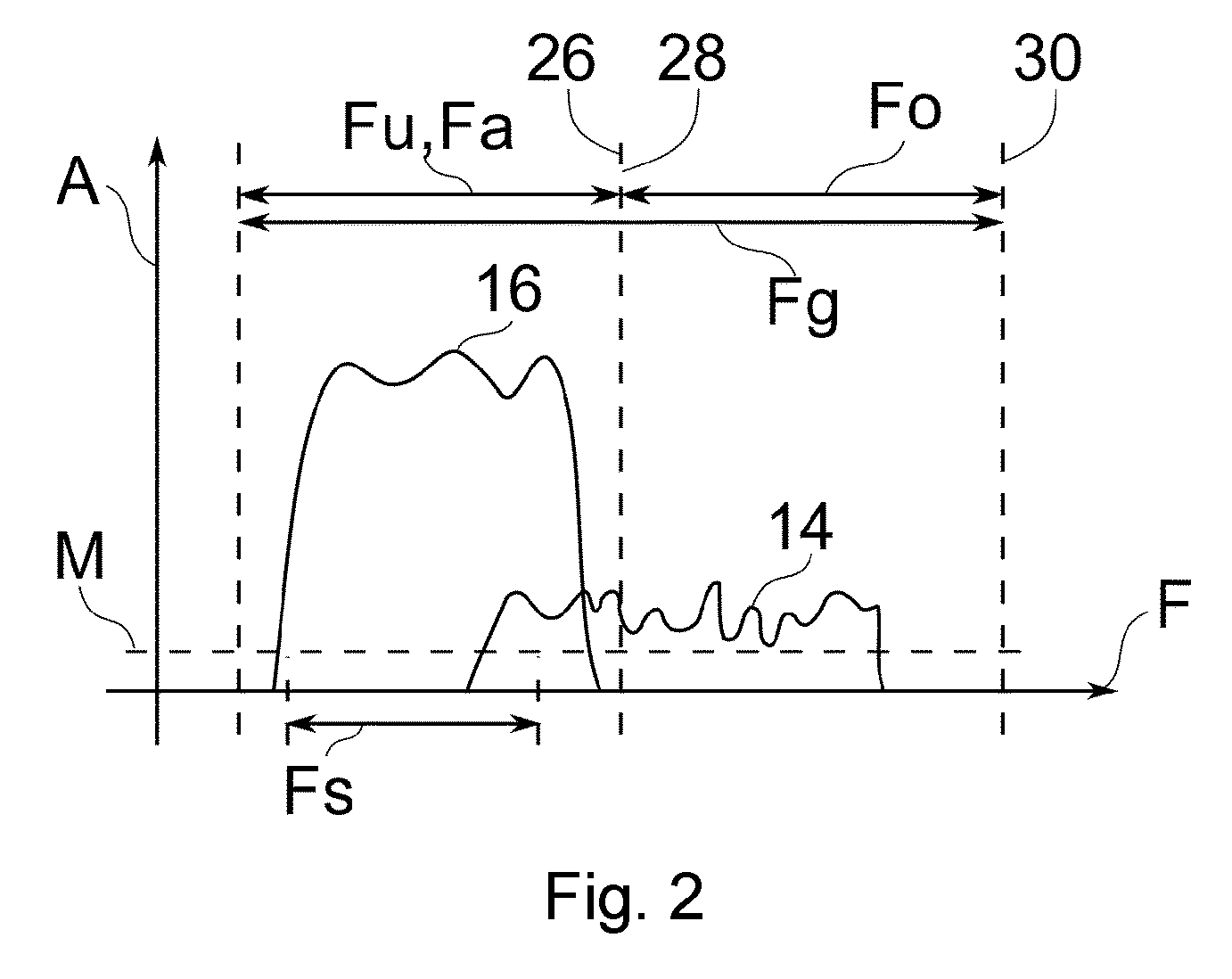
- the upper frequency range Fo is characterized above all by the fact that less useful noise 16 is present and/or is to be expected in it than in the lower frequency range Fu, as is also the case in FIG 2 is recognizable. Outside of the lower frequency range Fu, the proportion of speech (which is useful noise 16) is regularly particularly low.
- Sound signals 6 in general and background noise 14 in particular are not limited to the working area Fa of the hearing aid 2, but can also lie outside of it.
- Particularly transient and/or impulse-like noise 14 is broadband and thus spans a wide frequency range, i.e. it also has high-frequency components which are regularly outside the working range Fa, as in 2 for the noise 14 shown there (the terms “component” and “frequency portion” are generally regarded as equivalent and used interchangeably).
- the detection of such background noise 14 is not particularly reliable when the detection takes place at low frequencies, e.g. in the working range Fa of the hearing aid 2, where other stationary and non-stationary background noise (in 2 not explicitly shown) are present, which are often also louder, ie have a higher amplitude A.
- non-stationary components of speech can also lead to false recognition, ie speech which is actually useful noise 16 is falsely recognized as background noise 14 .
- the amplitude A of high-frequency noise 14 is often less than the amplitude A of low-frequency noise 14, which typically lies within the working range Fa.
- a clanking background noise 14 which is a quiet, transient and/or impulsive background noise 14 and also has a high-frequency component that is regularly outside the working range Fa, as exemplified in 2 is shown.
- Such interference noises 14 in particular are now better recognized by means of the hearing aid 2 since quiet interference noises 14 are also recognized in the upper frequency range Fo.
- Noise 14 is suppressed, for example, by means of signal processing 10 and then optionally only within the lower frequency range Fu and not necessarily in the upper frequency range Fo.
- the hearing device 2 shown here is used to supply a hearing-impaired user, i.e. a user with a hearing deficit.
- the hearing device 2 has the microphone 4 already mentioned above, which picks up sound signals 6 from the environment and generates the electrical input signal 8 .
- this is fed to the likewise already mentioned signal processing 10 , which is also part of a control unit 18 of the hearing device 2 here.
- the processing is based on an individual audiogram of the user, which is assigned to the hearing device 2, so that an individual hearing deficit of the user is compensated.
- the signal processing 10 outputs an electrical output signal 20 which is then output to the user via a receiver 22 of the hearing device 2 .
- the hearing aid 2 is merely a headphone and then has a noise suppression for the targeted suppression of noise 14, for example, which correspondingly benefits from the detection of noise 14 described here.
- the exact configuration of the detector 12 is not relevant here; what is more important is that it works in the upper frequency range Fo and searches for an interference noise 14 there.
- a conventional detector 12 is suitable, which would otherwise be used on the lower frequency range Fu, but now instead monitors the upper frequency range Fo.
- a limitation of the detector 12 to the upper frequency range Fo results, for example, from the fact that the detector 12 only monitors the upper frequency range Fo or that the detector 12 is only supplied with the upper frequency range Fo.
- the hearing aid 2 has a filter bank 24 which divides the input signal 8 into a number of channels which are each assigned to a frequency band.
- the filter bank 24 is designed here separately from the signal processing unit 10, but is alternatively integrated into it.
- the filter bank 24 has a large number of channels, in particular at least three, but typically a two-digit number. A first partial number of channels then forms the lower frequency range Fu and a second, different partial number of channels forms the upper frequency range Fo, which is then fed to the detector 12 .
- a filter bank 24 is also advantageous for suppressing the background noise 14, since the amplification can then be adjusted in a targeted manner in each individual channel, so that exactly those components which belong to a background noise 14 are reduced in a targeted manner.
- the filter bank 24 is limited to the lower frequency range Fu and the upper frequency range Fo is routed past the filter bank 24 to the detector 12 . this is in 1 the case according to which the input signal 8 is supplied to the detector 12 as a whole, which then controls the signal processing 10 in order to suppress noise.
- the detector 12 - as already indicated - controls the filter bank 24 for suppression.
- the detector 12 is not fed the entire input signal 8, but only the upper frequency range Fo from the filter bank 24
- the detector 12 is embodied as a level detector, for example, and thereby detects the background noise 14 as such if its amplitude A exceeds a minimum amplitude M in the upper frequency range Fo.
- the detector 12 strikes and thereby detects a noise 14.
- the minimum amplitude M is selected to be lower (e.g. half as large) as a minimum amplitude M which would be selected for a detector which covers the lower frequency range Fu monitors.
- Such a detector for the lower frequency range Fu is not used in the present case, but is present in an alternative, not shown, in addition to the detector 12 described here for the upper frequency range Fo, for example around to recognize narrow-band noise in the lower frequency range Fu, which is not possible with the detector 12 described here.
- the detector for the lower frequency range Fu then has a higher minimum amplitude M than the detector 12 for the upper frequency range Fo.
- a minimum amplitude M is required, which is greater than the usual or maximum achievable amplitude A of useful noise 16 in the lower frequency range Fu, as shown in FIG 2 is recognizable. Since there is little or no useful noise 16 in the upper frequency range Fo, a correspondingly lower minimum amplitude M is possible here and quiet background noise 14 is also detected.
- the detector 12 is, for example, a gradient-based pulse detector.
- a configuration as a gradient detector or wavelet detector is also possible, as is a combination of the configurations mentioned here and further above.
- the upper frequency range Fo in the embodiment shown is not part of the working range Fa of the hearing aid 2.
- the lower frequency range Fu is a working range Fa of the signal processing 10, so that the processing of the input signal 8 by the signal processing 10 is limited to the lower frequency range Fu is limited.
- the signal processing 10 does not process the upper frequency range Fo; this is only used for the detector 12 and possibly other functions of the hearing aid 2 that are not relevant here. It is irrelevant whether the filter bank 24 only transfers the lower frequency range Fu to the signal processing 10 or whether the signal processing 10 discards the upper frequency range Fu from the signal from the filter bank 24 or simply leaves it unprocessed. Amplification with the aim of compensating for a hearing deficit of the user does not take place in the upper frequency range Fo.
- a speech frequency range Fs is also shown, which in the present example is completely covered by the lower frequency range Fu.
- the speech frequency range Fs indicates that frequency range within which speech lies.
- the voice frequency range Fs ranges from 100 Hz to 4 kHz or up to 12 kHz if overtones are taken into account.
- the voice frequency range Fs is completely covered by the working range Fa.
- an alternative configuration (not shown) is also possible, in which the working range Fa and the voice frequency range Fs have the same upper limit and/or lower limit. Configurations are also conceivable in which the working range Fa is larger or smaller than the voice frequency range Fs. Especially in a configuration in which the working range Fa also includes the upper frequency range Fo, the working range Fa is then larger than the voice frequency range Fs.
- the lower frequency range Fu has an upper limit 26 of 12 kHz, for example. This upper limit 26 is here at the same time, but not necessarily, a lower limit 28 of the upper frequency range Fo.
- the upper frequency range Fo has an upper limit 30, which is defined here by a technical boundary condition of the hearing aid 2, e.g. a limited frequency range of the filter bank 24 and/or a limited sampling rate (i.e. sampling rate) of an A/D converter 32 (i.e. analog -to-digital converter) which digitizes the input signal 8 from the microphone 4.
- the upper frequency range Fo has a lower limit 28 of 12 kHz and an upper limit 30 of 16 kHz.
- the lower limit 28 results from the same considerations as the upper limit 26 of the lower frequency range Fu.
- the upper limit 30 of 16 kHz results here from the technical boundary conditions of a sampling rate of 32 kHz of the A/D converter 32.
- a frequency spectrum in an exemplary environment here a canteen.
- the frequency F is plotted in the vertical direction and the time T in the horizontal direction.
- the amplitude A for a given frequency F at a given time T is shown in shades of grey, where the lighter/whiter the greater the amplitude A and vice versa, the darker/blacker the smaller the amplitude A.
- the upper frequency range Fo is framed for identification, the lower frequency range Fu follows directly below the upper frequency range Fo.
- the frame contains the frequency range from 11 kHz to 16 kHz.
- In 4 is this frequency range within the frame from 3 shown enlarged, whereby the structure of the upper frequency range Fo can be seen more clearly. Numerous light, vertical stripes are clearly visible, ie high amplitudes A for only short times T, which result from impulse-like and/or background noise 14 .
Landscapes
- Physics & Mathematics (AREA)
- Engineering & Computer Science (AREA)
- Acoustics & Sound (AREA)
- Signal Processing (AREA)
- Health & Medical Sciences (AREA)
- General Health & Medical Sciences (AREA)
- Neurosurgery (AREA)
- Otolaryngology (AREA)
- Measurement Of Mechanical Vibrations Or Ultrasonic Waves (AREA)
- Noise Elimination (AREA)
- Circuit For Audible Band Transducer (AREA)
Abstract
Es wird ein Hörgerät (2) angegeben, welches wenigstens ein Mikrofon (4) aufweist, welches ausgebildet ist, inner-halb eines Gesamtfrequenzbereichs (Fg) Schallsignale (6) aufzunehmen und in ein Eingangssignal (8) umzuwandeln, welches eine Signalverarbeitung (10) aufweist, zur Verarbeitung des Eingangssignals (8) innerhalb eines unteren Frequenzbereichs (Fu), welcher ein Teil des Gesamtfrequenzbereichs (Fg) ist, welches einen Detektor (12) aufweist, zur Erkennung eines Störgeräuschs (14), welches Frequenzanteile sowohl innerhalb des unteren Frequenzbereichs (Fu) aufweist als auch außerhalb desselben, nämlich in einem oberen Frequenzbereich (Fo) oberhalb des unteren Frequenzbereichs (Fu), welches derart ausgebildet ist, dass der Detektor (12) das Störgeräusch (14) anhand von dessen Frequenzanteil im oberen Frequenzbereich (Fo) erkennt. Weiter wird ein Verfahren zum Betrieb eines Hörgeräts (2) angegeben.
Description
Die Erfindung betrifft ein Hörgerät sowie ein Verfahren zum Betrieb eines solchen.The invention relates to a hearing aid and a method for operating such a hearing aid.
Ein Hörgerät dient allgemein zur Ausgabe von Schallsignalen an einen Nutzer des Hörgeräts. Speziell bei einem Hörgerät zur Versorgung eines Nutzers, welcher ein Hördefizit aufweist, ist das Hörgerät ausgebildet, Schallsignale aus der Umgebung aufzunehmen, zu verarbeiten und schließlich derart modifiziert (d.h. regelmäßig verstärkt) auszugeben, dass das Hördefizit zumindest teilweise ausgeglichen wird.A hearing device is generally used to output sound signals to a user of the hearing device. Especially in the case of a hearing aid for supplying a user who has a hearing deficit, the hearing aid is designed to pick up sound signals from the environment, process them and finally output them modified (i.e. regularly amplified) in such a way that the hearing deficit is at least partially compensated for.
In einer gegebenen Umgebung existieren regelmäßig sowohl Nutzgeräusche als auch Störgeräusche. Erstere sollen für den Nutzer möglichst verständlich wiedergegeben werden, während letztere möglichst umfänglich unterdrückt werden sollen, um den Betrieb des Hörgeräts und dessen Nutzen für den Nutzer zu verbessern. Die effektive Unterdrückung von Störgeräuschen erfordert jedoch eine möglichst effektive Erkennung dieser Störgeräusche. Grundsätzlich existieren verschiedene Arten von Störgeräuschen, deren Erkennung unterschiedlich schwierig ist. Störgeräusche unterscheiden sich z.B. in ihrer Bandbreite, Amplitude und/oder Lage in einem Gesamtfrequenzspektrum, welches von dem Hörgerät aufgenommen wird. Beispiele für unterschiedliche Arten von Störgeräuschen sind dann entsprechend stationäre Störgeräusche (d.h. schmalbandig und mit geringer zeitlicher Variabilität), nicht-stationäre und hierbei speziell transiente und/oder impulsartige Störgeräusche (d.h. breitbandig mit hoher zeitliche Variabilität), laute Störgeräusche (d.h. mit hoher Amplitude), leise Störgeräusche (d.h. mit geringer Amplitude), hochfrequente Störgeräusche (mit überwiegend hohen Frequenzanteilen) und niederfrequente Störgeräusche (mit überwiegend niedrigen Frequenzanteilen). Beispiele für nicht-transiente Störgeräusche sind stationärer Lärm, z.B. ein Lüfter, oder störende Musik oder störende Sprache im Hintergrund, typischerweise mit dem Begriff "Cocktailparty" bezeichnet.In a given environment, useful noise as well as background noise regularly exist. The former should be reproduced in a manner that is as understandable as possible for the user, while the latter should be suppressed as extensively as possible in order to improve the operation of the hearing device and its usefulness for the user. However, the effective suppression of background noise requires the most effective possible detection of this background noise. In principle, there are different types of background noise, the difficulty of which varies in their detection. Disturbing noises differ, for example, in their bandwidth, amplitude and/or position in an overall frequency spectrum that is picked up by the hearing device. Examples of different types of background noise are correspondingly stationary background noise (i.e. narrow-band and with low temporal variability), non-stationary and here specifically transient and/or impulse-type background noise (i.e. broadband with high temporal variability), loud background noise (i.e. with high amplitude) , low-frequency noise (ie with low amplitude), high-frequency noise (with predominantly high frequency components) and low-frequency noise (with predominantly low frequency components). Examples of non-transient noise are stationary noise, e.g. a fan, or disruptive music or speech in the background, typically referred to by the term "cocktail party".
Im Betrieb eines Hörgeräts hängt die Unterdrückung von Störgeräuschen, speziell von transienten und/oder impulsartigen Störgeräuschen von deren zuverlässiger Erkennung ab. Ein Hörgerät arbeitet regelmäßig in einem bestimmten Frequenzbereich, dem sogenannten Arbeitsbereich, in welchem das Eingangssignal modifiziert wird, um für den Nutzer angepasst zu werden, vorzugsweise um ein Hördefizit des Nutzers auszugleichen. Für eine entsprechende Modifikation des Eingangssignals mittels der Signalverarbeitung ist insbesondere im Hörgerät vorzugsweise ein Audiogram des Nutzers hinterlegt, welches auf den Arbeitsbereich beschränkt ist. Außerhalb des Arbeitsbereichs erfolgt insbesondere keine Modifikation des Eingangssignals, zumindest keine aktive Modifikation zum Ausgleich eines Hördefizits des Nutzers. Der Arbeitsbereich ist regelmäßig lediglich ein Teilbereich des akustischen Frequenzspektrums. Dieses akustische Frequenzspektrum ist insbesondere als Frequenzbereich von 20 Hz bis 20 kHz definiert. Diese Beschränkung auf einen Teilbereich des akustischen Frequenzspektrums ist typischerweise bedingt durch technische Randbedingungen des Hörgeräts, da dieses regelmäßig nicht beliebig hohe Frequenzen verarbeiten kann.During the operation of a hearing aid, the suppression of background noise, specifically transient and/or impulse-type background noise, depends on its reliable detection. A hearing device works regularly in a specific frequency range, the so-called working range, in which the input signal is modified in order to be adapted for the user, preferably in order to compensate for a hearing deficit of the user. For a corresponding modification of the input signal by means of the signal processing, an audiogram of the user, which is restricted to the working area, is preferably stored in particular in the hearing device. In particular, there is no modification of the input signal outside the working range, at least no active modification to compensate for a hearing deficit of the user. The working range is regularly only a part of the acoustic frequency spectrum. This acoustic frequency spectrum is defined in particular as a frequency range from 20 Hz to 20 kHz. This restriction to a sub-range of the acoustic frequency spectrum is typically due to the technical boundary conditions of the hearing device, since this is generally not able to process frequencies of any high frequency.
Im Arbeitsbereich erfolgt die Erkennung eines Störgeräuschs beispielsweise derart, dass besonders laute Frequenzanteile, also solche mit einer vorgegebenen Mindestamplitude, als Störgeräusch erkannt werden. Beispielsweise wird hierbei ein Störgeräusch dadurch erkannt, dass ein Überschreiten der Mindestamplitude in einem oder mehreren Frequenzbereichen erkannt wird. Zur Unterdrückung des Störgeräuschs wird dann in diesen Frequenzbereichen z.B. die Verstärkung durch das Hörgerät reduziert, sodass das Störgeräusch dann weniger verstärkt wird als Nutzgeräusche in anderen Frequenzbereichen.In the work area, a background noise is detected, for example, in such a way that particularly loud frequency components, ie those with a predetermined minimum amplitude, are recognized as background noise. For example, a background noise is detected here by detecting that the minimum amplitude has been exceeded in one or more frequency ranges. In order to suppress the background noise, the amplification by the hearing aid is then reduced in these frequency ranges, for example, so that the background noise is then less amplified than useful noise in other frequency ranges.
Problematisch ist jedoch die Erkennung von Störgeräuschen, welche eine vergleichsweise geringe Amplitude aufweisen, d.h. eine Amplitude, welche vergleichbar oder geringer ist als die mögliche oder übliche Amplitude von Nutzgeräuschen.The problem, however, is the detection of background noise that has a comparatively low amplitude, ie an amplitude that is comparable to or lower than the possible or usual amplitude of useful noise.
Solche Störgeräusche werden auch als "leise Störgeräusche", "wenig laute Störgeräusche" oder "weiche Störgeräusche" bezeichnet. Diese leisen Störgeräusche werden nicht oder nur mangelhaft von einem Detektor erkannt, welcher zur Erkennung das Überschreiten einer vorgegebenen Mindestamplitude erfordert. Die Mindestamplitude ist nämlich zweckmäßigerweise derart hoch gewählt, dass möglichst keine Beeinträchtigung von Nutzgeräuschen, speziell Sprache erfolgt. So weist Sprache regelmäßig ebenfalls transiente und/oder impulsartige Komponenten auf, stellt jedoch ein Nutzgeräusch und kein Störgeräusch dar und soll daher erhalten bleiben. Der Detektor kann somit letztendlich nur Störgeräusche ab einer bestimmten Lautstärke erkennen, d.h. die Mindestamplitude kann nicht beliebig gering gewählt werden. Somit kann der Detektor nur schlecht solche Störgeräusche erkennen, welche eine vergleichsweise geringe Amplitude aufweisen, speziell eine Amplitude im Bereich üblicher Amplituden für Sprache. Entsprechend ergibt sich bei der Unterdrückung von Störgeräuschen ein Zielkonflikt zwischen einer möglichst geringen Beeinflussung von Nutzgeräuschen, speziell Sprache, durch eine Falscherkennung einerseits und einer Unterdrückung auch leiser Störgeräusche andererseits.Such noise is also referred to as "quiet noise", "low volume noise" or "soft noise". These quiet background noises are not detected or are only inadequately detected by a detector, which requires a predetermined minimum amplitude to be exceeded for detection. The minimum amplitude is expediently chosen to be so high that, as far as possible, there is no impairment of useful noise, specifically speech. Speech thus regularly also has transient and/or impulse-like components, but represents useful noise and not background noise and should therefore be retained. Ultimately, the detector can therefore only detect noise above a certain volume, i.e. the minimum amplitude cannot be chosen arbitrarily low. Thus, the detector can only poorly recognize such interference noises which have a comparatively low amplitude, specifically an amplitude in the range of normal amplitudes for speech. Correspondingly, in the suppression of background noise, there is a conflict of objectives between the least possible influence on useful noise, specifically speech, by false detection on the one hand and suppression of quiet background noise on the other.
Verschiedene Hörgeräte werden beschrieben in
Vor diesem Hintergrund ist es eine Aufgabe der Erfindung, die Erkennung von Störgeräuschen im Betrieb eines Hörgeräts zu verbessern. Dabei soll speziell die Erkennung von leisen Störgeräuschen verbessert werden. Hierzu sollen ein verbessertes Hörgerät sowie ein verbessertes Verfahren zum Betrieb eines Hörgeräts angegeben werden.Against this background, it is an object of the invention to improve the detection of background noise when a hearing aid is in operation. The aim is to improve the detection of quiet background noise in particular. To this end, an improved hearing device and an improved method for operating a hearing device are to be specified.
Die Aufgabe wird erfindungsgemäß gelöst durch ein Hörgerät mit den Merkmalen gemäß Anspruch 1 sowie durch ein Verfahren mit den Merkmalen gemäß Anspruch 15. Vorteilhafte Ausgestaltungen, Weiterbildungen und Varianten sind Gegenstand der Unteransprüche. Die Ausführungen im Zusammenhang mit dem Hörgerät gelten sinngemäß auch für das Verfahren. Sofern nachfolgend Schritte des Verfahrens angegeben sind, ergeben sich bevorzugte Ausgestaltungen für das Hörgerät dadurch, dass dieses ausgebildet ist, einen oder mehrerer dieser Schritte auszuführen, insbesondere mittels einer Steuereinheit, welche ein Teil des Hörgeräts ist.The object is achieved according to the invention by a hearing device with the features according to claim 1 and by a method with the features according to claim 15. Advantageous refinements, developments and variants are the subject matter of the dependent claims. The explanations in connection with the hearing aid also apply to the method. If steps of the method are specified below, preferred configurations result the hearing device in that it is designed to carry out one or more of these steps, in particular by means of a control unit which is part of the hearing device.
Ein Kerngedanke der Erfindung ist insbesondere, die Erkennung eines Störgeräuschs in einem Frequenzbereich durchzuführen, in welchem der Zielkonflikt bei der Auslegung eines Detektors für das Störgeräusch dadurch aufgelöst ist, dass dort Nutzgeräusche nicht oder nur in geringem Maße vorhanden sind. Dadurch kann vorteilhaft eine geringere Mindestamplitude zur Erkennung verwendet werden als in einem Frequenzbereich, in welchem Nutzgeräusche erwartet werden, ohne dadurch das Risiko von Falscherkennungen signifikant zu erhöhen. Auf diese Weise werden dann auch leise Störgeräusche besser erkannt, wenigstens solche leisen Störgeräusche, welche Frequenzanteile in dem besagten Frequenzbereich aufweisen. Dies ist speziell der Fall für breitbandige Störgeräusche, insbesondere transiente und/oder impulsartige Störgeräusche, welche regelmäßig Frequenzanteile in einem oberen Frequenzbereich außerhalb eines Arbeitsbereichs (insbesondere wie oben beschrieben) eines Hörgeräts und/oder außerhalb eines Sprachfrequenzbereichs aufweisen.A core idea of the invention is in particular to carry out the detection of an interference noise in a frequency range in which the conflict of objectives in the design of a detector for the interference noise is resolved by the fact that useful noises are not present there or only to a small extent. As a result, a lower minimum amplitude can advantageously be used for detection than in a frequency range in which useful noise is expected, without thereby significantly increasing the risk of false detections. In this way, even quiet noises are better recognized, at least those quiet noises that have frequency components in the said frequency range. This is specifically the case for broadband noise, in particular transient and/or impulsive noise, which regularly has frequency components in an upper frequency range outside a working range (in particular as described above) of a hearing aid and/or outside a speech frequency range.
Daher weist ein erfindungsgemäßes Hörgerät wenigstens ein Mikrofon auf, welches ausgebildet ist, innerhalb eines Gesamtfrequenzbereichs Schallsignale aufzunehmen und in ein Eingangssignal umzuwandeln. Weiter weist das Hörgerät eine Signalverarbeitung auf, zur Verarbeitung des Eingangssignals innerhalb eines unteren Frequenzbereichs, welcher ein Teil des Gesamtfrequenzbereichs ist. Somit weist das Hörgerät einen Arbeitsbereich auf (insbesondere wie oben beschrieben), welcher wenigstens und vorzugsweise ausschließlich den unteren Frequenzbereich enthält. Weiter weist das Hörgerät einen Detektor auf, zur Erkennung eines Störgeräuschs, welches Frequenzanteile sowohl innerhalb des unteren Frequenzbereichs aufweist als auch außerhalb desselben, nämlich in einem oberen Frequenzbereich oberhalb des unteren Frequenzbereichs. Vorzugsweise schließt sich der obere Frequenzbereich unmittelbar an den unteren Frequenzbereich an, dies ist aber nicht zwingend. Weiter ist das Hörgerät derart ausgebildet, dass der Detektor das Störgeräusch anhand von dessen Frequenzanteil im oberen Frequenzbereich erkennt. Dadurch wird insbesondere der oben beschriebene Kerngedanke umgesetzt. Insgesamt ist das Hörgerät somit ausgebildet, im Betrieb ein Störgeräusch zu erkennen.A hearing device according to the invention therefore has at least one microphone which is designed to pick up sound signals within an overall frequency range and to convert them into an input signal. The hearing aid also has signal processing for processing the input signal within a lower frequency range, which is part of the overall frequency range. The hearing device thus has a working range (in particular as described above) which contains at least and preferably exclusively the lower frequency range. The hearing aid also has a detector for detecting an interference noise that has frequency components both within the lower frequency range and outside of it, namely in an upper frequency range above the lower frequency range. The upper frequency range preferably directly follows the lower frequency range, but this is not mandatory. Furthermore, the hearing aid is designed in such a way that the detector recognizes the noise based on its frequency component in the upper frequency range. As a result, the core idea described above is implemented in particular. Overall, the hearing device is thus designed to recognize an interference noise during operation.
Vorliegend wird der Einfachheit halber der Begriff "Erkennung eines Störgeräuschs" verwendet, genauer wird darunter jedoch verstanden, dass im Eingangssignal ein Störsignal erkannt wird, welches sich aus einem akustischen Störgeräusch ergibt, welches ein Teil der Schallsignale der Umgebung ist. Im Ergebnis wird somit ein Störgeräusch in der Umgebung erkannt.For the sake of simplicity, the term "recognition of an interference noise" is used here, but more precisely it means that an interference signal is detected in the input signal, which results from an acoustic interference noise, which is part of the sound signals of the environment. As a result, a background noise is thus recognized.
Der obere Frequenzbereich und der untere Frequenzbereich überlappen insbesondere nicht. Der obere Frequenzbereich ist vorzugsweise kein Teil des Arbeitsbereichs, dies ist jedoch an sich nicht zwingend, sodass auch eine Ausgestaltung möglich und geeignet ist, bei welcher der Arbeitsbereich auch den oberen Frequenzbereich ganz oder teilweise enthält. Wichtiger ist zunächst insbesondere, dass der obere Frequenzbereich dadurch charakterisiert ist, dass in diesem weniger Nutzgeräusche vorliegen und/oder zu erwarten sind als in dem unteren Frequenzbereich. Mit anderen Worten: im oberen Frequenzbereich ist das SNR (Signal-zu-Rausch-Verhältnis) speziell für die genannten leisen Störgeräusche größer als im unteren Frequenzbereich (dabei ist bei der Betrachtung des SNR das betrachtete Störgeräusch das "Signal" und alle übrigen Geräusche und Störgeräusche, bilden das "Rauschen"). Außerhalb des unteren Frequenzbereichs ist auch der Anteil an Sprache regelmäßig besonders gering, sodass Falscherkennungen effizient reduziert werden.In particular, the upper frequency range and the lower frequency range do not overlap. The upper frequency range is preferably not part of the working range, but this is not mandatory per se, so that an embodiment is also possible and suitable in which the working range also contains the upper frequency range in whole or in part. First of all, it is particularly important that the upper frequency range is characterized in that less useful noise is present and/or is to be expected in it than in the lower frequency range. In other words: in the upper frequency range, the SNR (signal-to-noise ratio), especially for the mentioned quiet background noise, is greater than in the lower frequency range (when considering the SNR, the background noise considered is the "signal" and all other noises and Interfering noises, form the "noise"). Outside of the lower frequency range, the proportion of speech is regularly particularly low, so that false detections are efficiently reduced.
Der Erfindung liegt insbesondere die Überlegung zugrunde, dass Schallsignale im Allgemeinen und Störgeräusche im Speziellen nicht auf den Arbeitsbereich des Hörgeräts beschränkt sind, sondern auch außerhalb davon liegen können und dabei aber noch innerhalb des eingangs genannten akustischen Frequenzspektrums (definiert von 20 Hz bis 20 kHz). Besonders transiente und/oder impulsartige Störgeräusche sind breitbandig und überspannen somit einen breiten Frequenzbereich, weisen also auch hochfrequente Komponenten auf, welche regelmäßig außerhalb des Arbeitsbereichs liegen (die Begriffe "Komponente" und "Frequenzanteil" werden allgemein als äquivalent angesehen und austauschbar verwendet). Ein Störgeräusch wird insbesondere dann als breitbandig bezeichnet, wenn die zugehörigen Frequenzen einen Frequenzbereich von wenigstens einer Oktave überspannen. Die Erkennung solcher Störgeräusche ist besonders dann wenig zuverlässig, wenn die Erkennung bei niedrigen Frequenzen erfolgt, speziell im Arbeitsbereich des Hörgeräts, wo häufig zusätzlich noch andere stationäre und nicht-stationäre Störgeräusche vorhanden sind, welche häufig auch lauter sind, d.h. eine höhere Amplitude aufweisen. Zusätzlich können auch nicht-stationäre Komponenten von Sprache zu Falscherkennungen führen, d.h. Sprache, welche tatsächlich ein Nutzgeräusch ist, wird fälschlicherweise als Störgeräusch erkannt.The invention is based in particular on the consideration that sound signals in general and background noise in particular are not limited to the working range of the hearing aid, but can also be outside of it, but still within the acoustic frequency spectrum mentioned at the outset (defined from 20 Hz to 20 kHz). . Particularly transient and/or impulsive noise is broadband and thus spans a wide frequency range, therefore also have high-frequency components, which are regularly outside the working range (the terms "component" and "frequency component" are generally regarded as equivalent and used interchangeably). A noise is referred to as broadband in particular when the associated frequencies span a frequency range of at least one octave. The detection of such background noises is particularly unreliable when the detection takes place at low frequencies, especially in the working range of the hearing aid, where other stationary and non-stationary background noises are often also present, which are often also louder, ie have a higher amplitude. In addition, non-stationary components of speech can also lead to false recognition, ie speech that is actually useful noise is falsely recognized as background noise.
Es wurde jedoch beobachtet, dass die Amplitude hochfrequenter Störgeräusche (d.h. Störgeräusche mit einer hochfrequenten Komponente) häufig geringer ist als die Amplitude von niederfrequenten Störgeräuschen, also solchen Störgeräuschen, welche typischerweise innerhalb des Arbeitsbereichs liegen. Beispielsweise erzeugen in einem Restaurant oder einer Kantine Besteck und Geschirr beim Aneinanderschlagen ein klirrendes Störgeräusch (auch als "cling-clang sound" bezeichnet), welches ein leises, transientes und/oder impulsartiges Störgeräusch ist und dabei auch eine hochfrequente Komponente aufweist, welche regelmäßig außerhalb des Arbeitsbereichs liegt. Speziell solche Störgeräusche werden nun mittels des erfindungsgemäßen Hörgeräts besser erkannt, da im oberen Frequenzbereich auch leise Störgeräusche erkannt werden. Dabei ist das Risiko von Falscherkennungen deutlich reduziert, da im oberen Frequenzbereich keine oder nur wenig Nutzgeräusche zu erwarten sind, denn diese befinden sich überwiegend oder ausschließlich im unteren Frequenzbereich.However, it has been observed that the amplitude of high-frequency noise (i.e. noise with a high-frequency component) is often less than the amplitude of low-frequency noise, i.e. noise which is typically within the working range. For example, in a restaurant or canteen, when cutlery and crockery hit each other, they produce a clanking noise (also known as "cling-clang sound"), which is a quiet, transient and/or impulsive noise and also has a high-frequency component that is regularly outside of the work area. Such interference noises in particular are now better recognized by means of the hearing aid according to the invention, since quiet interference noises are also recognized in the upper frequency range. The risk of false detections is significantly reduced, since little or no useful noise is to be expected in the upper frequency range, because this is predominantly or exclusively in the lower frequency range.
Ein Vorteil der Erfindung ist somit insbesondere, dass leise, transiente und/oder impulsartige Störgeräusche besser erkannt werden. Dies ergibt sich aus deren Erkennung durch eine Überwachung speziell des oberen Frequenzbereichs. Ein transientes und/oder impulsartiges Störgeräusch wird demnach anhand seines Frequenzanteils außerhalb des unteren Frequenzbereichs erkannt, sodass die beschriebenen Probleme bei einer Erkennung innerhalb dieses unteren Frequenzbereichs vermieden werden. Dabei wird ausgenutzt, dass das Störgeräusch breitbandig ist und Frequenzanteile sowohl im unteren als auch im oberen Frequenzbereich aufweist.An advantage of the invention is therefore in particular that quiet, transient and/or impulse-like interference noises are better recognized. This results from their detection by monitoring specifically the upper frequency range. A transient and / or impulsive noise is therefore based on his Frequency component detected outside the lower frequency range, so that the problems described in a detection within this lower frequency range can be avoided. This exploits the fact that the background noise is broadband and has frequency components both in the lower and in the upper frequency range.
Eine Unterdrückung des Störgeräuschs erfolgt vorzugsweise mittels der Signalverarbeitung und dann gegebenenfalls lediglich innerhalb des unteren Frequenzbereichs und nicht notwendigerweise im oberen Frequenzbereich. Dabei wird davon ausgegangen, dass das Störgeräusch, welches im oberen Frequenzbereich erkannt wird, entsprechend breitbandig ist und sich bis in den unteren Frequenzbereich erstreckt. Welche Frequenzanteile im unteren Frequenzbereich bei Erkennung eines Störgeräuschs im oberen Frequenzbereich sinnvollerweise unterdrückt werden, wird z.B. vorab in Experimenten ermittelt oder anhand üblicher Bandbreiten von Störgeräuschen, welche auch Komponenten im oberen Frequenzbereich aufweisen, geschätzt. Geeignet ist auch eine Ausgestaltung, bei welcher einfach über einen vorab fest definierten Frequenzbereich innerhalb des unteren Frequenzbereichs eine Unterdrückung erfolgt, ohne tatsächliche Kenntnis darüber, ob davon tatsächlich auch das Störgeräusch umfasst ist. Dabei wird die Erkenntnis genutzt, dass das Störgeräusch ein breites Frequenzspektrum aufweist und nur kurze Zeit besteht und damit sehr wahrscheinlich in dem vorab definierten Frequenzbereich liegt. Der vorab definierte Frequenzbereich beträgt beispielsweise 1 kHz bis 5 kHz ab einer Obergrenze des unteren Frequenzbereichs in diesen hinein. Geeignet ist auch eine Ausgestaltung, bei welcher das Störgeräusch unterdrückt wird, indem das Eingangssignal insgesamt über einen bestimmten Zeitraum von z.B. 1 s bis 5 s gemittelt und dadurch geglättet wird. Auf die Unterdrückung des Störgeräuschs kommt es vorliegend jedoch nicht im Detail an, Gegenstand ist vorliegend vielmehr die möglichst zuverlässige Erkennung eines Störgeräuschs.The background noise is preferably suppressed by means of the signal processing and then optionally only within the lower frequency range and not necessarily in the upper frequency range. It is assumed here that the background noise, which is detected in the upper frequency range, is correspondingly broadband and extends into the lower frequency range. Which frequency components in the lower frequency range are sensibly suppressed when a background noise in the upper frequency range is detected is determined in advance in experiments, for example, or is estimated based on the usual bandwidths of background noise, which also have components in the upper frequency range. Also suitable is an embodiment in which suppression simply takes place over a predefined frequency range within the lower frequency range, without actual knowledge of whether this actually also includes the background noise. Here, the knowledge is used that the background noise has a broad frequency spectrum and only lasts for a short time and is therefore very likely to be in the previously defined frequency range. The previously defined frequency range is, for example, 1 kHz to 5 kHz from an upper limit of the lower frequency range into this. Also suitable is an embodiment in which the background noise is suppressed by the input signal being averaged over a specific period of time, e.g. 1 s to 5 s, and thereby smoothed. In the present case, however, the suppression of the background noise is not relevant in detail; the subject matter here is rather the most reliable possible detection of a background noise.
Vorteilhaft ist auch eine Ausgestaltung, bei welcher zusätzlich zu dem bereits erwähnten Detektor (erster Detektor) ein weiterer, zweiter Detektor, z.B. ein Impulsdetektor, den unteren Frequenzbereich überwacht und dann ein Anschlagen dieses zweiten Detektors als zusätzliches Kriterium für eine Unterdrückung gefordert wird, um sicherzustellen, dass tatsächlich ein entsprechendes Störgeräusch vorliegt. Eine Unterdrückung erfolgt dann beispielsweise nur, wenn sowohl im oberen Frequenzbereich vom ersten Detektor ein transientes und/oder impulsartiges Störgeräusch erkannt wird als auch vom zweiten Detektor im unteren Frequenzbereich. Für diesen Detektor wird der untere Frequenzbereich geeigneterweise gröber aufgeteilt als für die Signalverarbeitung, z.B. lediglich in zwei Frequenzbänder, beispielsweise ein erstes Frequenzband von 100 Hz bis 1000 Hz und ein zweites Frequenzband von 1000 Hz bis 12 kHz.An embodiment is also advantageous in which, in addition to the detector already mentioned (first detector), a further, second detector, for example a pulse detector, monitors the lower frequency range and then an impact this second detector is required as an additional criterion for suppression in order to ensure that a corresponding background noise is actually present. Suppression then takes place, for example, only if a transient and/or impulse-like noise is detected both in the upper frequency range by the first detector and by the second detector in the lower frequency range. For this detector, the lower frequency range is suitably divided more roughly than for the signal processing, eg only into two frequency bands, for example a first frequency band from 100 Hz to 1000 Hz and a second frequency band from 1000 Hz to 12 kHz.
Das Hörgerät dient vorzugsweise zur Versorgung eines hörgeschädigten Nutzers, d.h. eines Nutzers mit einem Hördefizit. Hierzu weist das Hörgerät das oben bereits genannte Mikrofon auf, welches Schallsignale aus der Umgebung aufnimmt und ein elektrisches Eingangssignal erzeugt. Dieses wird zur Verarbeitung der ebenfalls bereits genannten Signalverarbeitung zugeführt. Die Signalverarbeitung ist vorzugsweise ein Teil einer Steuereinheit des Hörgeräts. Die Verarbeitung erfolgt insbesondere anhand eines individuellen Audiogramms des Nutzers, welcher dem Hörgerät zugeordnet ist, sodass ein individuelles Hördefizit des Nutzers ausgeglichen wird. Vorzugsweise ist die Verarbeitung entsprechend eine Verstärkung. Die Signalverarbeitung gibt als Ergebnis ein elektrisches Ausgangssignal aus, welches dann über einen Hörer des Hörgeräts an den Nutzer ausgegeben wird, z.B. wieder als Schallsignal, welches vom Hörer aus dem Ausgangssignal erzeugt wird.The hearing aid is preferably used to supply a hearing-impaired user, i.e. a user with a hearing deficit. For this purpose, the hearing aid has the microphone already mentioned above, which picks up sound signals from the environment and generates an electrical input signal. This is fed to the signal processing, which has also already been mentioned, for processing. The signal processing is preferably part of a control unit of the hearing device. The processing takes place in particular using an individual audiogram of the user, which is assigned to the hearing device, so that an individual hearing deficit of the user is compensated. Preferably, the processing is accordingly reinforcement. The result of the signal processing is an electrical output signal, which is then output to the user via a receiver of the hearing aid, e.g. again as a sound signal, which is generated from the output signal by the receiver.
Alternativ ist das Hörgerät lediglich ein Kopfhörer und weist dann vorzugsweise zur gezielten Unterdrückung von Störgeräuschen eine Störgeräuschunterdrückung auf, welche entsprechend von der verbesserten Erkennung von Störgeräuschen profitiert.Alternatively, the hearing device is just a headphone and then preferably has a noise suppression for the targeted suppression of noise, which correspondingly benefits from the improved detection of noise.
Die genaue Ausgestaltung des Detektors ist zunächst nicht relevant, wichtiger ist, dass dieser im oberen Frequenzbereich arbeitet und dort nach einem Störgeräusch sucht. Grundsätzlich ist ein herkömmlicher Detektor geeignet, welcher ansonsten auf dem unteren Frequenzbereich genutzt würde, nun aber stattdessen den oberen Frequenzbereich überwacht. Eine Beschränkung des Detektors auf den oberen Frequenzbereich ergibt sich beispielsweise dadurch, dass der Detektor ausschließlich den oberen Frequenzbereich überwacht oder dass dem Detektor lediglich der obere Frequenzbereich zugeführt wird.The exact design of the detector is initially not relevant, what is more important is that it works in the upper frequency range and searches for background noise there. In principle, a conventional detector is suitable, which would otherwise be used on the lower frequency range, but now instead monitors the upper frequency range. A restriction of the detector to the upper frequency range results, for example, from the fact that the detector only monitors the upper frequency range or that only the upper frequency range is fed to the detector.
In einer geeigneten Ausgestaltung weist das Hörgerät eine Filterbank auf, welche das Eingangssignal auf mehrere Kanäle aufteilt, welche jeweils einem Frequenzband zugeordnet sind. Die Filterbank ist entweder in die Signalverarbeitung integriert oder separat von dieser ausgebildet. Die Filterbank weist eine Vielzahl an Kanälen auf, insbesondere wenigstens drei, typischerweise jedoch eine zweistellige Anzahl. Eine erste Teilanzahl der Kanäle bildet dann den unteren Frequenzbereich und eine zweite, andere Teilanzahl der Kanäle bildet analog den oberen Frequenzbereich, welcher dann dem Detektor zugeführt wird. Unabhängig davon ist eine Filterbank auch zur Unterdrückung des Störgeräuschs vorteilhaft, denn dann ist die Verstärkung gezielt in jedem einzelnen Kanal einstellbar, sodass genau solche Komponenten, welche zu einem Störgeräusch gehören, gezielt reduziert werden. Möglich ist auch eine Ausgestaltung, bei welcher die Filterbank auf den unteren Frequenzbereich beschränkt ist und der obere Frequenzbereich an der Filterbank vorbei zum Detektor geführt wird.In a suitable refinement, the hearing device has a filter bank which divides the input signal into a number of channels which are each assigned to a frequency band. The filter bank is either integrated into the signal processing or designed separately from it. The filter bank has a large number of channels, in particular at least three, but typically a two-digit number. A first partial number of channels then forms the lower frequency range and a second, different partial number of channels forms the upper frequency range, which is then fed to the detector. Irrespective of this, a filter bank is also advantageous for suppressing background noise, because then the gain can be specifically adjusted in each individual channel, so that exactly those components that belong to background noise are specifically reduced. An embodiment is also possible in which the filter bank is limited to the lower frequency range and the upper frequency range is routed past the filter bank to the detector.
Zweckmäßigerweise ist der Detektor ein Impulsdetektor, vorzugsweise ein gradientenbasierter Impulsdetektor. Für einen gradientenbasierten Impulsdetektor. Ein solcher zeichnet sich insbesondere dadurch aus, dass dieser ein transientes und/oder impulsartiges Störgeräusch aufgrund eines bestimmten zeitlichen Anstiegs der Amplitude erkennt.Conveniently the detector is a pulse detector, preferably a gradient based pulse detector. For a gradient based pulse detector. Such a device is characterized in particular by the fact that it detects a transient and/or pulse-like noise based on a specific increase in the amplitude over time.
In einer geeigneten Ausgestaltung ist der Detektor als Pegeldetektor ausgebildet und erkennt dadurch das Störgeräusch als solches, falls dessen Amplitude im oberen Frequenzbereich eine Mindestamplitude überschreitet. Die Mindestamplitude ist abhängig von der individuellen Präferenz und dem Hördefizit des Nutzers und zweckmäßigerweise durch diesen einstellbar. Der Detektor schlägt somit bei Überschreiten der Mindestamplitude im oberen Frequenzbereich an und erkennt dadurch ein Störgeräusch. Die Mindestamplitude ist insbesondere geringer gewählt (z.B. halb so groß) als eine Mindestamplitude, welche für einen Detektor gewählt würde, welcher den unteren Frequenzbereich überwacht.In a suitable embodiment, the detector is designed as a level detector and thereby recognizes the noise as such if its amplitude exceeds a minimum amplitude in the upper frequency range. The minimum amplitude depends on the individual preference and the hearing deficit of the user and can expediently be set by the user. The detector thus strikes when the minimum amplitude is exceeded in the upper frequency range and recognizes a disturbing noise. In particular, the minimum amplitude is selected to be lower (eg half as large) than a minimum amplitude which would be selected for a detector which monitors the lower frequency range.
Alternativ oder zusätzlich ist der Detektor geeigneterweise als ein Gradientendetektor ausgebildet und erkennt dadurch das Störgeräusch als solches, falls dessen Amplitude im oberen Frequenzbereich während eines vordefinierten Zeitintervalls eine Mindeständerung vollzieht. Der Gradientendetektor überwacht demnach, wie stark sich die Amplitude über einen vordefiniertes Zeitintervall ändert (z.B. ansteigt), sodass der Detektor nur dann anschlägt, wenn die Amplitude während dieses vordefinierten Zeitintervalls wenigstens eine Mindeständerung (d.h. eine Mindestamplitudenänderung) durchführt. Das vordefinierte Zeitintervall ist insbesondere abhängig von einer Abtastrate für das Eingangssignal im Hörgerät und liegt beispielsweise im Bereich von 1 ms bis 20 ms. Die Mindeständerung ist ebenso individuell wie die Mindestamplitude, die obigen Ausführungen hierzu gelten analog.Alternatively or additionally, the detector is suitably designed as a gradient detector and thereby detects the noise as such if its amplitude in the upper frequency range undergoes a minimum change during a predefined time interval. The gradient detector thus monitors how much the amplitude changes (e.g. increases) over a predefined time interval, so that the detector only strikes if the amplitude makes at least a minimum change (i.e. a minimum amplitude change) during this predefined time interval. The predefined time interval depends in particular on a sampling rate for the input signal in the hearing aid and is in the range from 1 ms to 20 ms, for example. The minimum change is just as individual as the minimum amplitude, the above explanations apply analogously.
Geeignet ist auch eine Ausgestaltung, bei welcher der Detektor alternativ oder zusätzlich als sein Wavelet-Detektor ausgebildet ist und dadurch das Störgeräusch als solches anhand von dessen spektraler Form erkennt. Die spektrale Form ist insbesondere der frequenzabhängige Amplitudenverlauf des Störgeräuschs. Zur Erkennung des Störgeräuschs ist ein Wavelet vorgegeben, welches eine Idealform der spektralen Form ist und welches dann mit dem tatsächlichen Störgeräusch verglichen wird, insbesondere indem das Wavelet mit dem Störgeräusch korreliert wird. Je mehr das Wavelet mit dem Störgeräusch korreliert, desto mehr entspricht das Störgeräusch dem Wavelet. Dies ist im Grunde ähnlich zu einem Bildvergleich. Auf diese Weise können gezielt spezifische Störgeräusche, deren spektrale Form grundsätzlich bekannt ist, gesucht und erkannt werden. Als Wavelet wird beispielsweise ein einfacher Impuls verwendet.An embodiment is also suitable in which the detector is alternatively or additionally designed as its wavelet detector and thereby recognizes the background noise as such on the basis of its spectral shape. The spectral form is in particular the frequency-dependent amplitude profile of the background noise. To identify the noise, a wavelet is specified, which is an ideal form of the spectral shape and which is then compared with the actual noise, in particular by correlating the wavelet with the noise. The more the wavelet correlates with the noise, the more the noise corresponds to the wavelet. This is basically similar to an image comparison. In this way, specific interference noises whose spectral shape is fundamentally known can be searched for and recognized in a targeted manner. For example, a simple pulse is used as a wavelet.
Ein zweiter Detektor für den unteren Frequenzbereich wird vorliegend nicht zwingend zusätzlich verwendet, ist aber ergänzend zum hier beschriebenen ersten Detektor für den oberen Frequenzbereich vorteilhaft, z.B. um schmalbandige Störgeräusche im unteren Frequenzbereich zu erkennen, was mit dem hier beschriebenen Detektor insbesondere nicht möglich ist. Entsprechend weist dann der zweite Detektor für den unteren Frequenzbereich in einer Ausgestaltung als Pegeldetektor eine höhere Mindestamplitude auf als der Detektor für den oberen Frequenzbereich. Aufgrund der eingangs geschilderten Problematik ist zur Erkennung von Störgeräuschen im unteren Frequenzbereich eine Mindestamplitude erforderlich, welche größer ist als die übliche oder maximal erreichbare Amplitude von Nutzgeräuschen im unteren Frequenzbereich. Da im oberen Frequenzbereich keine oder nur wenige Nutzgeräusche vorhanden sind, ist hier eine entsprechend geringere Mindestamplitude möglich und auch vorteilhaft, da dann auch leise Störgeräusche besser erkannt werden. Im Übrigen gelten die Ausführungen zum ersten Detektor analog auch für den optionalen, zweiten Detektor.A second detector for the lower frequency range is not necessarily additionally used in the present case, but is in addition to the first detector described here advantageous for the upper frequency range, for example to detect narrow-band noise in the lower frequency range, which is not possible with the detector described here in particular. Correspondingly, the second detector for the lower frequency range then has a higher minimum amplitude than the detector for the upper frequency range in an embodiment as a level detector. Because of the problems described at the outset, a minimum amplitude that is greater than the usual or maximum achievable amplitude of useful noise in the lower frequency range is required to detect background noise in the lower frequency range. Since there is little or no useful noise in the upper frequency range, a correspondingly lower minimum amplitude is possible here and is also advantageous, since quiet background noise is then also better recognized. Otherwise, the explanations for the first detector also apply analogously to the optional, second detector.
Wie bereits angedeutet, ist das Störgeräusch, welches mit dem Detektor erkennbar ist, bevorzugterweise ein transientes und/oder impulsartiges Störgeräusch. Ein solches Störgeräusch ist breitbandig und weist damit regelmäßig Komponenten im oberen Frequenzbereich auf (und typischerweise zugleich auch im unteren Frequenzbereich), ist dort also mit dem Detektor erkennbar. Gleichzeitig sind solche Störgeräusche häufig leise, d.h. derart leise, dass diese auf dem unteren Frequenzbereich nicht unbedingt zuverlässig erkennbar sind.As already indicated, the background noise that can be detected with the detector is preferably a transient and/or pulsed background noise. Such an interference noise is broadband and thus regularly has components in the upper frequency range (and typically also in the lower frequency range at the same time), so it can be detected there with the detector. At the same time, such interference noises are often quiet, i.e. so quiet that they are not necessarily reliably recognizable in the lower frequency range.
In einer vorteilhaften Ausgestaltung ist oder wird das Störgeräusch durch klirrendes Geschirr und/oder Besteck erzeugt. Aus diesem Erzeugungsmechanismus ergibt sich ein bestimmtes Frequenzspektrum für das Störgeräusch, d.h. das Störgeräusch weist im Frequenzraum betrachtet ein charakteristisches Profil auf, nämlich ein breites Spektrum sowie eine geringe Amplitude, denn dass Störgeräusch ist ein leises, transientes und/oder impulsartiges Störgeräusch. Das charakteristische Profil im Frequenzraum wurde oben bereits im Zusammenhang mit einem Wavelet-Detektor erwähnt und dort als spektrale Form bezeichnet, beide Bezeichnungen sind äquivalent zueinander.In an advantageous embodiment, the disturbing noise is or will be generated by clinking crockery and/or cutlery. This generation mechanism results in a specific frequency spectrum for the background noise, ie viewed in the frequency domain, the background noise has a characteristic profile, namely a broad spectrum and a low amplitude, because the background noise is a quiet, transient and/or impulsive background noise. The characteristic profile in the frequency domain has already been mentioned above in connection with a wavelet detector and is referred to there as a spectral shape; both designations are equivalent to one another.
Im Detail ist das Profil (d.h. die spektrale Form) des Störgeräuschs jedoch von untergeordneter Bedeutung, wichtiger ist die Impulshaftigkeit des Störgeräuschs. Solche Störgeräusche sind oft sehr laut und dennoch schwierig zu detektieren, da im Frequenzbereich eines Hörgeräts (z.B. 100 Hz bis 10 kHz) auch andere transiente und/oder impulsartige Geräusche vorkommen, die kein Störgeräusch sind, sondern Nutzgeräusche (z.B. Plosive in Sprache) und nicht unterdrückt werden sollten. Wichtig ist demnach vorrangig die Unterscheidung von gewollten und ungewollten transienten und/oder impulsartigen Geräuschen, d.h. von transienten und/oder impulsartigen Nutzgeräuschen einerseits und transienten und/oder impulsartigen Störgeräuschen andererseits.In detail, however, the profile (i.e. the spectral shape) of the background noise is of secondary importance; the impulsive nature of the background noise is more important. Such background noise is often very loud and yet difficult to detect, since other transient and/or impulse-like noises also occur in the frequency range of a hearing aid (e.g. 100 Hz to 10 kHz), which are not noise but useful noise (e.g. plosives in speech) and not should be suppressed. It is therefore important to differentiate between wanted and unwanted transient and/or impulsive noises, i.e. between transient and/or impulsive useful noises on the one hand and transient and/or impulse-like background noises on the other.
Wie bereits weiter oben erwähnt wurde, ist der obere Frequenzbereich vorzugsweise kein Teil des Arbeitsbereichs des Hörgeräts. Hierzu ist in einer geeigneten Ausgestaltung der untere Frequenzbereich ein Arbeitsbereich der Signalverarbeitung, sodass die Verarbeitung des Eingangssignals durch die Signalverarbeitung auf den unteren Frequenzbereich beschränkt ist. Insbesondere sind hierzu der Arbeitsbereich und der untere Frequenzbereich identisch. Die Verarbeitung ist vorzugsweise eine Verstärkung. Die Signalverarbeitung verarbeitet, vorzugsweise verstärkt, demnach den oberen Frequenzbereich nicht, dieser wird nur für den Detektor und gegebenenfalls andere, hier nicht weiter relevante Funktionen des Hörgeräts verwendet. Eine Verstärkung mit dem Ziel eines Ausgleichs eines Hördefizits des Nutzers erfolgt im oberen Frequenzbereich gerade nicht, sondern ausschließlich im Arbeitsbereich.As already mentioned above, the upper frequency range is preferably not part of the working range of the hearing aid. For this purpose, in a suitable embodiment, the lower frequency range is a working area of the signal processing, so that the processing of the input signal by the signal processing is limited to the lower frequency range. In particular, the working range and the lower frequency range are identical for this. The processing is preferably reinforcement. Accordingly, the signal processing does not process, preferably amplifies, the upper frequency range; this is only used for the detector and possibly other functions of the hearing device that are not relevant here. Amplification with the aim of compensating for a hearing deficit of the user does not take place in the upper frequency range, but exclusively in the working area.
Alternativ oder zusätzlich ist ein Sprachfrequenzbereich vollständig oder wenigstens überwiegend (d.h. insbesondere zu wenigstens 90%) von dem unteren Frequenzbereich umfasst. Der Sprachfrequenzbereich gibt insbesondere genau denjenigen Frequenzbereich an, innerhalb dessen Sprache liegt. Der Sprachfrequenzbereich reicht beispielsweise von 100 Hz bis 4 kHz, bis 6 kHz, bis 8 kHz oder bis 12 kHz, die höheren Obergrenzen gelten insbesondere dann, wenn Obertöne mit berücksichtig werden. Die genaue Definition des Sprachfrequenzbereichs ist zunächst jedoch nicht von Bedeutung, wichtiger ist, dass Sprache weit überwiegend oder vollständig vom unteren Frequenzbereich umfasst ist und entsprechend nicht oder nur vernachlässigbar im oberen Frequenzbereich vorhanden ist.Alternatively or additionally, a voice frequency range is completely or at least predominantly (ie in particular at least 90%) covered by the lower frequency range. In particular, the speech frequency range specifies precisely that frequency range within which speech lies. The speech frequency range extends, for example, from 100 Hz to 4 kHz, to 6 kHz, to 8 kHz or to 12 kHz, the higher upper limits apply in particular when overtones are also taken into account. However, the exact definition of the speech frequency range is not important at first, it is more important that speech is predominant or is completely covered by the lower frequency range and accordingly is not present or only negligibly present in the upper frequency range.
Zweckmäßigerweise ist der Sprachfrequenzbereich vollständig vom Arbeitsbereich umfasst. Möglich und geeignet ist auch eine Ausgestaltung, bei welcher der Arbeitsbereich und der Sprachfrequenzbereich dieselbe Obergrenze und/oder Untergrenze aufweisen. Denkbar sind aber auch Ausgestaltungen, bei welchen der Arbeitsbereich größer oder kleiner ist als der Sprachfrequenzbereich. Speziell in einer Ausgestaltung, bei welcher der Arbeitsbereich auch den oberen Frequenzbereich umfasst, ist der Arbeitsbereich dann größer als der Sprachfrequenzbereich, welcher sich vorzugsweise auf den unteren Frequenzbereich oder weniger beschränkt.The voice frequency range is expediently completely covered by the working area. Also possible and suitable is an embodiment in which the working range and the voice frequency range have the same upper limit and/or lower limit. However, configurations are also conceivable in which the working range is larger or smaller than the voice frequency range. Especially in an embodiment in which the working range also includes the upper frequency range, the working range is then larger than the voice frequency range, which is preferably limited to the lower frequency range or less.
Geeigneterweise weist der obere Frequenzbereich eine Obergrenze auf, welche wenigstens einer Obergrenze des bereits genannten Sprachfrequenzbereichs entspricht. Damit ist sichergestellt, dass im oberen Frequenzbereich keine Fehldetektion von Sprache als transientes und/oder impulsartiges Störgeräusch erfolgt.The upper frequency range suitably has an upper limit which corresponds at least to an upper limit of the speech frequency range already mentioned. This ensures that speech is not incorrectly detected as transient and/or impulsive noise in the upper frequency range.
Bevorzugterweise weist der untere Frequenzbereich eine Obergrenze von 12 kHz, 8 kHz, 6 kHz oder 4 kHz auf. Diese Obergrenze ist zugleich vorzugsweise, jedoch nicht zwingend eine Untergrenze des oberen Frequenzbereichs. Der Obergrenze von 12 kHz liegt die Überlegung zugrunde, dass dann Sprache vollständig im unteren Frequenzbereich liegt und damit eine Falscherkennung von Störgeräuschen mit dem Detektor auf dem oberen Frequenzbereich vermieden wird. Weiter weisen typische Hörgeräte aus dem gleichen Grund regelmäßig einen Arbeitsbereich mit einer Obergrenze von 12 kHz auf. Der untere Frequenzbereich weist auch eine Untergrenze auf, deren genauer Wert hier nicht relevant ist. Geeignet ist z.B. eine Untergrenze von 20 Hz.The lower frequency range preferably has an upper limit of 12 kHz, 8 kHz, 6 kHz or 4 kHz. At the same time, this upper limit is preferably, but not necessarily, a lower limit of the upper frequency range. The upper limit of 12 kHz is based on the consideration that speech then lies entirely in the lower frequency range and thus incorrect detection of background noise with the detector in the upper frequency range is avoided. Furthermore, typical hearing aids regularly have a working range with an upper limit of 12 kHz for the same reason. The lower frequency range also has a lower limit, the exact value of which is not relevant here. For example, a lower limit of 20 Hz is suitable.
Der obere Frequenzbereich weist eine Obergrenze auf, welche geeigneterweise durch eine technische Randbedingung des Hörgeräts definiert ist, insbesondere einen begrenzten Frequenzumfang der Filterbank und/oder einer begrenzten Abtastrate (d.h. sampling rate) eines A/D-Konverters (d.h. Analog-zu-Digital-Konverter), welcher das Eingangssignal vom Mikrofon digitalisiert. In einer bevorzugten Ausgestaltung weist der obere Frequenzbereich eine Untergrenze von 12 kHz und/oder eine Obergrenze von 16 kHz auf. Die Untergrenze ergibt sich insbesondere aus den gleichen Überlegungen wie die Obergrenze des unteren Frequenzbereichs. Der genaue Wert der Obergrenze ist aber grundsätzlich nicht relevant und ergibt sich in einer geeigneten Ausgestaltung ganz allgemein aus technischen Randbedingungen des Hörgeräts. Die hier genannte Obergrenze von 16 kHz ergibt sich insbesondere aus üblichen technischen Randbedingungen des Hörgeräts, insbesondere einer Abtastrate von 32 kHz eines A/D-Konverters des Hörgeräts.The upper frequency range has an upper limit which is suitably defined by a technical boundary condition of the hearing device, in particular a limited frequency range of the filter bank and/or a limited sampling rate (ie sampling rate) of an A/D converter (ie analog-to-digital converter) which digitizes the input signal from the microphone. In a preferred embodiment, the upper frequency range has a lower limit of 12 kHz and/or an upper limit of 16 kHz. The lower limit results in particular from the same considerations as the upper limit of the lower frequency range. However, the exact value of the upper limit is fundamentally irrelevant and, in a suitable embodiment, results very generally from the technical boundary conditions of the hearing device. The upper limit of 16 kHz mentioned here results in particular from the usual technical boundary conditions of the hearing device, in particular a sampling rate of 32 kHz of an A/D converter in the hearing device.
In einer geeigneten Ausgestaltung weist das Hörgerät einen A/D-Konverter auf, zur Digitalisierung des Eingangssignals, und der obere Frequenzbereich weist eine Obergrenze auf, welche höchstens der Hälfte einer Abtastrate des A/D-Konverters entspricht. Der obere Frequenzbereich ergibt sich somit durch eine technische Randbedingung, welche durch den A/D-Konverter vorgegeben ist. Je nach Auslegung des Hörgeräts ergibt sich dann für den oberen Frequenzbereich eine entsprechende Obergrenze. In einer geeigneten Ausgestaltung weist der A/D-Konverter eine Abtastrate von 32 kHz auf, sodass die Obergrenze höchsten 16 kHz entspricht. Die Abtastrate ist dabei insbesondere eine tatsächlich eingestellte Abtastrate des A/D-Konverters, d.h. diejenige Abtastrate, welche tatsächlich eingestellt ist. Beispielsweise weist der A/D-Konverter an sich eine deutlich höhere, mögliche Abtastrate z.B. von mehreren MHz auf, wird jedoch als überabtastender A/D-Konverter betrieben (d.h. als "oversampled A/D-converter") mit einer deutlich geringeren, tatsächlich eingestellten Abtastrate von 32 kHz. Die Abtastrate, speziell die tatsächlich eingestellte Abtastrate bei einem überabtastenden A/D-Konverter, unterliegt zudem regelmäßig einer Toleranz, welche sich insbesondere aufgrund einerseits einer Abweichung einer Schwingfrequenz eines Quarzkristalls zur Taktung des A/D-Konverters von einer Idealfrequenz und andererseits einer mehrfachen Division insbesondere durch 2 der Schwingfrequenz bis zur tatsächlich eingestellten Abtastrate ergibt. Mit anderen Worten: eine tatsächlich eingestellte Abtastrate von 32 kHz entspricht real einer Abtastrate von 32 kHz plusminus einer Toleranz von z.B. 5%.In a suitable embodiment, the hearing device has an A/D converter for digitizing the input signal, and the upper frequency range has an upper limit which corresponds at most to half a sampling rate of the A/D converter. The upper frequency range thus results from a technical boundary condition, which is specified by the A/D converter. Depending on the design of the hearing aid, there is then a corresponding upper limit for the upper frequency range. In a suitable embodiment, the A/D converter has a sampling rate of 32 kHz, so that the upper limit corresponds to a maximum of 16 kHz. In this case, the sampling rate is in particular an actually set sampling rate of the A/D converter, ie that sampling rate which is actually set. For example, the A/D converter itself has a significantly higher possible sampling rate, eg of several MHz, but is operated as an oversampling A/D converter (ie as an "oversampled A/D converter") with a significantly lower actual rate set sampling rate of 32 kHz. The sampling rate, specifically the sampling rate that is actually set for an oversampling A/D converter, is also regularly subject to a tolerance, which is due in particular to a deviation in the oscillation frequency of a quartz crystal for clocking the A/D converter from an ideal frequency on the one hand, and multiple division on the other in particular by 2 the oscillation frequency up to the actually set one sampling rate results. In other words: an actually set sampling rate of 32 kHz corresponds to a sampling rate of 32 kHz plus-minus a tolerance of eg 5%.
Das erfindungsgemäße Verfahren dient zum Betrieb eines Hörgeräts, insbesondere eines Hörgeräts wie zuvor beschrieben. Das Hörgerät weist ein Mikrofon, eine Signalverarbeitung und einen Detektor auf. Bei dem Verfahren, d.h. im Betrieb des Hörgeräts, werden mittels des Mikrofons innerhalb eines Gesamtfrequenzbereichs Schallsignale aufgenommen und in ein Eingangssignal umgewandelt. Weiter wird mittels der Signalverarbeitung das Eingangssignal ausschließlich oder wenigstens innerhalb eines unteren Frequenzbereichs verarbeitet, welcher ein Teil des Gesamtfrequenzbereichs ist. Mittels des Detektors wird dann ein Störgeräusch erkannt, welches Frequenzanteile sowohl innerhalb des unteren Frequenzbereichs aufweist als auch außerhalb desselben, nämlich in einem oberen Frequenzbereich oberhalb des unteren Frequenzbereichs, wobei der Detektor das Störgeräusch anhand von dessen Frequenzanteil im oberen Frequenzbereich erkennt. Vorteile und bevorzugte Weiterbildungen ergeben sich aus dem bereits Gesagten. Zweckmäßigerweise wird das Störgeräusch im Eingangssignal unterdrückt und das Eingangssignal über einen Hörer ausgegeben.The method according to the invention serves to operate a hearing device, in particular a hearing device as described above. The hearing aid has a microphone, signal processing and a detector. During the process, i.e. during operation of the hearing aid, sound signals are recorded by means of the microphone within an overall frequency range and converted into an input signal. Furthermore, the input signal is processed exclusively or at least within a lower frequency range, which is part of the overall frequency range, by means of the signal processing. The detector then detects a background noise that has frequency components both within the lower frequency range and outside of it, namely in an upper frequency range above the lower frequency range, with the detector detecting the background noise based on its frequency component in the upper frequency range. Advantages and preferred developments result from what has already been said. The background noise in the input signal is expediently suppressed and the input signal is output via an earpiece.
Nachfolgend werden Ausführungsbeispiele der Erfindung anhand einer Zeichnung näher erläutert. Darin zeigen jeweils schematisch:
-
Fig. 1 ein Hörgerät, -
Fig. 2 ein Frequenzspektrum, -
Fig. 3 ein anderes Frequenzspektrum, -
Fig. 4 einen Ausschnitt des Frequenzspektrums ausFig. 3 .
-
1 a hearing aid, -
2 a frequency spectrum, -
3 a different frequency spectrum, -
4 a section of the frequency spectrum3 .
In
Vorliegend schließt sich der obere Frequenzbereich Fo unmittelbar an den unteren Frequenzbereich Fu an, dies ist aber nicht zwingend. Der obere Frequenzbereich Fo und der untere Frequenzbereich Fu überlappen im gezeigten Ausführungsbeispiel auch nicht. Der obere Frequenzbereich Fo ist hier zudem kein Teil des Arbeitsbereichs Fa, dies ist jedoch an sich nicht zwingend, sodass auch eine Ausgestaltung möglich ist, bei welcher der Arbeitsbereich Fa auch den oberen Frequenzbereich Fo ganz oder teilweise enthält. Der obere Frequenzbereich Fo ist vor allem dadurch charakterisiert, dass in diesem weniger Nutzgeräusche 16 vorliegen und/oder zu erwarten sind als in dem unteren Frequenzbereich Fu, wie auch beispielhaft in
Schallsignale 6 im Allgemeinen und Störgeräusche 14 im Speziellen sind nicht auf den Arbeitsbereich Fa des Hörgeräts 2 beschränkt, sondern können auch außerhalb davon liegen. Besonders transiente und/oder impulsartige Störgeräusche 14 sind breitbandig und überspannen somit einen breiten Frequenzbereich, weisen also auch hochfrequente Komponenten auf, welche regelmäßig außerhalb des Arbeitsbereichs Fa liegen, wie in
Es wurde jedoch beobachtet, dass die Amplitude A hochfrequenter Störgeräusche 14 häufig geringer ist als die Amplitude A von niederfrequenten Störgeräuschen 14, welche typischerweise innerhalb des Arbeitsbereichs Fa liegen. Beispielsweise erzeugen in einem Restaurant oder einer Kantine Besteck und Geschirr beim Aneinanderschlagen ein klirrendes Störgeräusch 14, welches ein leises, transientes und/oder impulsartiges Störgeräusch 14 ist und dabei auch eine hochfrequente Komponente aufweist, welche regelmäßig außerhalb des Arbeitsbereichs Fa liegt, wie beispielhaft in
Eine Unterdrückung des Störgeräuschs 14 erfolgt beispielsweise mittels der Signalverarbeitung 10 und dann gegebenenfalls lediglich innerhalb des unteren Frequenzbereichs Fu und nicht notwendigerweise im oberen Frequenzbereich Fo.
Das hier gezeigte Hörgerät 2 dient zur Versorgung eines hörgeschädigten Nutzers, d.h. eines Nutzers mit einem Hördefizit. Hierzu weist das Hörgerät 2 das oben bereits genannte Mikrofon 4 auf, welches Schallsignale 6 aus der Umgebung aufnimmt und das elektrische Eingangssignal 8 erzeugt. Dieses wird zur Verarbeitung (hier speziell Verstärkung) der ebenfalls bereits genannten Signalverarbeitung 10 zugeführt, welche hier auch ein Teil einer Steuereinheit 18 des Hörgeräts 2 ist. Die Verarbeitung erfolgt anhand eines individuellen Audiogramms des Nutzers, welcher dem Hörgerät 2 zugeordnet ist, sodass ein individuelles Hördefizit des Nutzers ausgeglichen wird. Die Signalverarbeitung 10 gibt als Ergebnis ein elektrisches Ausgangssignal 20 aus, welches dann über einen Hörer 22 des Hörgeräts 2 an den Nutzer ausgegeben wird. In einer nicht gezeigten Alternative ist das Hörgerät 2 lediglich ein Kopfhörer und weist dann beispielsweise zur gezielten Unterdrückung von Störgeräuschen 14 eine Störgeräuschunterdrückung auf, welche entsprechend von der hier beschriebenen Erkennung von Störgeräuschen 14 profitiert.The
Die genaue Ausgestaltung des Detektors 12 ist hier nicht relevant, wichtiger ist, dass dieser im oberen Frequenzbereich Fo arbeitet und dort nach einem Störgeräusch 14 sucht. Grundsätzlich ist ein herkömmlicher Detektor 12 geeignet, welcher ansonsten auf dem unteren Frequenzbereich Fu genutzt würde, nun aber stattdessen den oberen Frequenzbereich Fo überwacht. Eine Beschränkung des Detektors 12 auf den oberen Frequenzbereich Fo ergibt sich beispielsweise dadurch, dass der Detektor 12 ausschließlich den oberen Frequenzbereich Fo überwacht oder dass dem Detektor 12 lediglich der obere Frequenzbereich Fo zugeführt wird.The exact configuration of the
In der hier beispielhaft gezeigten Ausgestaltung weist das Hörgerät 2 eine Filterbank 24 auf, welche das Eingangssignal 8 auf mehrere Kanäle aufteilt, welche jeweils einem Frequenzband zugeordnet sind. Die Filterbank 24 ist hier separat zur Signalverarbeitung 10 ausgebildet, alternativ jedoch in diese integriert. Die Filterbank 24 weist eine Vielzahl an Kanälen auf, insbesondere wenigstens drei, typischerweise jedoch eine zweistellige Anzahl. Eine erste Teilanzahl der Kanäle bildet dann den unteren Frequenzbereich Fu und eine zweite, andere Teilanzahl der Kanäle bildet analog den oberen Frequenzbereich Fo, welcher dann dem Detektor 12 zugeführt wird. Unabhängig davon ist eine Filterbank 24 auch zur Unterdrückung des Störgeräuschs 14 vorteilhaft, denn dann ist die Verstärkung gezielt in jedem einzelnen Kanal einstellbar, sodass genau solche Komponenten, welche zu einem Störgeräusch 14 gehören, gezielt reduziert werden. Möglich ist auch eine Ausgestaltung, bei welcher die Filterbank 24 auf den unteren Frequenzbereich Fu beschränkt ist und der obere Frequenzbereich Fo an der Filterbank 24 vorbei zum Detektor 12 geführt wird. Dies ist in
Vorliegend ist der Detektor 12 beispielhaft als Pegeldetektor ausgebildet und erkennt dadurch das Störgeräusch 14 als solches, falls dessen Amplitude A im oberen Frequenzbereich Fo eine Mindestamplitude M überschreitet. Bei Überschreiben der Mindestamplitude M im oberen Frequenzbereich Fo schlägt der Detektor 12 an und erkennt dadurch ein Störgeräusch 14. Die Mindestamplitude M ist dabei geringer gewählt (z.B. halb so groß) als eine Mindestamplitude M, welche für einen Detektor gewählt würde, welcher den unteren Frequenzbereich Fu überwacht. Ein solcher Detektor für den unteren Frequenzbereich Fu wird vorliegend nicht verwendet, ist aber in einer nicht gezeigten Alternative ergänzend zum hier beschriebenen Detektor 12 für den oberen Frequenzbereich Fo vorhanden, z.B. um schmalbandige Störgeräusche im unteren Frequenzbereich Fu zu erkennen, was mit dem hier beschriebenen Detektor 12 nicht möglich ist. Entsprechend weist dann der Detektor für den unteren Frequenzbereich Fu eine höhere Mindestamplitude M auf als der Detektor 12 für den oberen Frequenzbereich Fo. Zur Erkennung von Störgeräuschen 14 im unteren Frequenzbereich Fu ist jedoch eine Mindestamplitude M erforderlich, welche größer ist als die übliche oder maximal erreichbare Amplitude A von Nutzgeräuschen 16 im unteren Frequenzbereich Fu, wie aus
Der Detektor 12 ist beispielsweise ein gradientenbasierter Impulsdetektor. Auch eine Ausgestaltung als Gradientendetektor oder Wavelet-Detektor ist möglich, ebenso eine Kombination der hier und weiter oben genannten Ausgestaltungen.The
Wie bereits erwähnt wurde, ist der obere Frequenzbereich Fo in der gezeigten Ausgestaltung kein Teil des Arbeitsbereichs Fa des Hörgeräts 2. Hierzu ist der untere Frequenzbereich Fu ein Arbeitsbereich Fa der Signalverarbeitung 10, sodass die Verarbeitung des Eingangssignals 8 durch die Signalverarbeitung 10 auf den unteren Frequenzbereich Fu beschränkt ist. Die Signalverarbeitung 10 verarbeitet demnach den oberen Frequenzbereich Fo nicht, dieser wird nur für den Detektor 12 und gegebenenfalls andere, hier nicht weiter relevante Funktionen des Hörgeräts 2 verwendet. Dabei ist es irrelevant, ob die Filterbank 24 lediglich den unteren Frequenzbereich Fu an die Signalverarbeitung 10 übergibt, oder ob die Signalverarbeitung 10 den oberen Frequenzbereich Fu aus dem Signal der Filterbank 24 verwirft oder einfach unverarbeitet lässt. Eine Verstärkung mit dem Ziel eines Ausgleichs eines Hördefizits des Nutzers erfolgt im oberen Frequenzbereich Fo gerade nicht.As already mentioned, the upper frequency range Fo in the embodiment shown is not part of the working range Fa of the
In
Der untere Frequenzbereich Fu weist beispielsweise eine Obergrenze 26 von 12 kHz auf. Diese Obergrenze 26 ist hier zugleich, jedoch nicht zwingend, eine Untergrenze 28 des oberen Frequenzbereichs Fo.The lower frequency range Fu has an
Der obere Frequenzbereich Fo weist eine Obergrenze 30 auf, welche vorliegend durch eine technische Randbedingung des Hörgeräts 2 definiert ist, z.B. einen begrenzten Frequenzumfang der Filterbank 24 und/oder einer begrenzten Abtastrate (d.h. sampling rate) eines A/D-Konverters 32 (d.h. Analog-zu-Digital-Konverter), welcher das Eingangssignal 8 vom Mikrofon 4digitalisiert. In der hier gezeigten Ausgestaltung weist der obere Frequenzbereich Fo eine Untergrenze 28 von 12 kHz und eine Obergrenze 30 von 16 kHz auf. Die Untergrenze 28 ergibt sich aus den gleichen Überlegungen wie die Obergrenze 26 des unteren Frequenzbereichs Fu. Die Obergrenze 30 von 16 kHz ergibt sich hier aus der technischen Randbedingungen einer Abtastrate von 32 kHz des A/D-Konverters 32.The upper frequency range Fo has an
Zur weiteren Illustration zeigt
- 22
- Hörgeräthearing aid
- 44
- Mikrofonmicrophone
- 66
- Schallsignalsound signal
- 88th
- Eingangssignalinput signal
- 1010
- Signalverarbeitungsignal processing
- 1212
- Detektordetector
- 1414
- Störgeräuschnoise
- 1616
- Nutzgeräuschuseful noise
- 1818
- Steuereinheitcontrol unit
- 2020
- Ausgangssignaloutput signal
- 2222
- Hörerlistener
- 2424
- Filterbankfilter bank
- 2626
- Obergrenze (des unteren Frequenzbereichs)upper limit (of the lower frequency range)
- 2828
- Untergrenze (des oberen Frequenzbereichs)lower limit (of the upper frequency range)
- 3030
- Obergrenze (des oberen Frequenzbereichs)upper limit (of the upper frequency range)
- 3232
- A/D-KonverterA/D converter
- AA
- Amplitudeamplitude
- Ff
- Frequenzfrequency
- Fafa
- ArbeitsbereichWorkspace
- Fgfg
- Gesamtfrequenzbereichoverall frequency range
- FoFo
- oberer Frequenzbereichupper frequency range
- FsFs
- Sprachfrequenzbereichvoice frequency range
- Fufoot
- unterer Frequenzbereichlower frequency range
- MM
- Mindestamplitudeminimum amplitude
- TT
- ZeitTime
Claims (15)
wobei der Detektor (12) ein Impulsdetektor ist.Hearing aid (2) according to claim 1,
wherein the detector (12) is a pulse detector.
wobei der Detektor (12) als ein Pegeldetektor ausgebildet ist und dadurch das Störgeräusch (14) als solches, falls dessen Amplitude (A) im oberen Frequenzbereich (Fo) eine Mindestamplitude (M) überschreitet.Hearing aid (2) according to claim 1 or 2,
the detector (12) being designed as a level detector and thereby the background noise (14) as such if its amplitude (A) in the upper frequency range (Fo) exceeds a minimum amplitude (M).
wobei der Detektor (12) als ein Gradientendetektor ausgebildet und erkennt dadurch das Störgeräusch (14) als solches, falls dessen Amplitude (A) im oberen Frequenzbereich (Fo) während eines vordefinierten Zeitintervalls eine Mindeständerung vollzieht.Hearing aid (2) according to one of Claims 1 to 3,
the detector (12) being designed as a gradient detector and thereby detecting the background noise (14) as such if its amplitude (A) in the upper frequency range (Fo) undergoes a minimum change during a predefined time interval.
wobei der Detektor (12) als ein Wavelet-Detektor ausgebildet ist und dadurch das Störgeräusch (14) als solches anhand von dessen spektraler Form erkennt.Hearing aid (2) according to one of Claims 1 to 4,
wherein the detector (12) is designed as a wavelet detector and thereby detects the noise (14) as such on the basis of its spectral shape.
wobei das Störgeräusch (14) ein transientes und/oder impulsartiges Störgeräusch (14) ist.Hearing aid (2) according to one of Claims 1 to 5,
wherein the noise (14) is a transient and/or impulsive noise (14).
wobei das Störgeräusch (14) durch klirrendes Geschirr und/oder Besteck erzeugt ist.Hearing aid (2) according to one of Claims 1 to 6,
wherein the disturbing noise (14) is generated by clinking crockery and/or cutlery.
wobei der untere Frequenzbereich (Fu) ein Arbeitsbereich (Fa) der Signalverarbeitung (10) ist, sodass die Verarbeitung des Eingangssignals (8) durch die Signalverarbeitung (10) auf den unteren Frequenzbereich (Fu) beschränkt ist.Hearing aid (2) according to one of Claims 1 to 7,
wherein the lower frequency range (Fu) is a working range (Fa) of the signal processing (10), so that the processing of the input signal (8) by the signal processing (10) is limited to the lower frequency range (Fu).
wobei ein Sprachfrequenzbereich (Fs) vollständig oder wenigstens überwiegend von dem unteren Frequenzbereich (Fu) umfasst ist.Hearing aid (2) according to one of Claims 1 to 8,
wherein a speech frequency range (Fs) is completely or at least predominantly comprised by the lower frequency range (Fu).
wobei der obere Frequenzbereich (Fo) eine Obergrenze (30) aufweist, welche wenigstens einer Obergrenze eines Sprachfrequenzbereichs (Fs) entspricht.Hearing aid (2) according to one of Claims 1 to 9,
wherein the upper frequency range (Fo) has an upper limit (30) which corresponds to at least one upper limit of a voice frequency range (Fs).
wobei der untere Frequenzbereich (Fu) eine Obergrenze (26) von 12 kHz aufweist.Hearing aid (2) according to one of Claims 1 to 10,
the lower frequency range (Fu) having an upper limit (26) of 12 kHz.
wobei der obere Frequenzbereich (Fo) eine Untergrenze (28) von 12 kHz aufweist.Hearing aid (2) according to one of Claims 1 to 11,
the upper frequency range (Fo) having a lower limit (28) of 12 kHz.
wobei der obere Frequenzbereich (Fo) und eine Obergrenze (30) von 16 kHz aufweist.Hearing aid (2) according to one of Claims 1 to 12,
wherein the upper frequency range (Fo) and has an upper limit (30) of 16 kHz.
Applications Claiming Priority (1)
| Application Number | Priority Date | Filing Date | Title |
|---|---|---|---|
| DE102021211879.8A DE102021211879B4 (en) | 2021-10-21 | 2021-10-21 | Hearing aid and method for operating such a device |
Publications (1)
| Publication Number | Publication Date |
|---|---|
| EP4171069A1 true EP4171069A1 (en) | 2023-04-26 |
Family
ID=83400754
Family Applications (1)
| Application Number | Title | Priority Date | Filing Date |
|---|---|---|---|
| EP22196748.2A Pending EP4171069A1 (en) | 2021-10-21 | 2022-09-21 | Hearing aid and method for operating same |
Country Status (4)
| Country | Link |
|---|---|
| US (1) | US12219323B2 (en) |
| EP (1) | EP4171069A1 (en) |
| CN (1) | CN116017247B (en) |
| DE (1) | DE102021211879B4 (en) |
Citations (5)
| Publication number | Priority date | Publication date | Assignee | Title |
|---|---|---|---|---|
| US20130156208A1 (en) | 2011-04-11 | 2013-06-20 | Yutaka Banba | Hearing aid and method of detecting vibration |
| US20150005845A1 (en) * | 2012-08-27 | 2015-01-01 | Med-El Elektromedizinische Geraete Gmbh | Reduction of Transient Sounds in Hearing Implants |
| US20150181356A1 (en) * | 2013-12-19 | 2015-06-25 | International Business Machines Corporation | Smart hearing aid |
| DE102015204253A1 (en) | 2015-03-10 | 2016-09-15 | Sivantos Pte. Ltd. | Method for frequency-dependent noise suppression of an input signal and hearing aid |
| EP3793209A1 (en) | 2019-09-11 | 2021-03-17 | Sivantos Pte. Ltd. | Hearing device with active noise cancellation and method for operating it |
Family Cites Families (4)
| Publication number | Priority date | Publication date | Assignee | Title |
|---|---|---|---|---|
| WO2009042635A1 (en) * | 2007-09-24 | 2009-04-02 | Sound Innovations Inc. | In-ear digital electronic noise cancelling and communication device |
| US10362412B2 (en) * | 2016-12-22 | 2019-07-23 | Oticon A/S | Hearing device comprising a dynamic compressive amplification system and a method of operating a hearing device |
| CN107910013B (en) * | 2017-11-10 | 2021-09-24 | Oppo广东移动通信有限公司 | A kind of output processing method and device of voice signal |
| CN109246519B (en) * | 2018-10-18 | 2022-03-04 | 珠海市杰理科技股份有限公司 | Line control earphone signal identification method and device, computer equipment and storage medium |
-
2021
- 2021-10-21 DE DE102021211879.8A patent/DE102021211879B4/en active Active
-
2022
- 2022-09-21 EP EP22196748.2A patent/EP4171069A1/en active Pending
- 2022-10-21 CN CN202211293838.5A patent/CN116017247B/en active Active
- 2022-10-21 US US17/970,762 patent/US12219323B2/en active Active
Patent Citations (5)
| Publication number | Priority date | Publication date | Assignee | Title |
|---|---|---|---|---|
| US20130156208A1 (en) | 2011-04-11 | 2013-06-20 | Yutaka Banba | Hearing aid and method of detecting vibration |
| US20150005845A1 (en) * | 2012-08-27 | 2015-01-01 | Med-El Elektromedizinische Geraete Gmbh | Reduction of Transient Sounds in Hearing Implants |
| US20150181356A1 (en) * | 2013-12-19 | 2015-06-25 | International Business Machines Corporation | Smart hearing aid |
| DE102015204253A1 (en) | 2015-03-10 | 2016-09-15 | Sivantos Pte. Ltd. | Method for frequency-dependent noise suppression of an input signal and hearing aid |
| EP3793209A1 (en) | 2019-09-11 | 2021-03-17 | Sivantos Pte. Ltd. | Hearing device with active noise cancellation and method for operating it |
Also Published As
| Publication number | Publication date |
|---|---|
| CN116017247A (en) | 2023-04-25 |
| US20230129796A1 (en) | 2023-04-27 |
| DE102021211879A1 (en) | 2023-04-27 |
| US12219323B2 (en) | 2025-02-04 |
| DE102021211879B4 (en) | 2025-05-08 |
| CN116017247B (en) | 2026-03-06 |
Similar Documents
| Publication | Publication Date | Title |
|---|---|---|
| DE69816610T2 (en) | METHOD AND DEVICE FOR NOISE REDUCTION, ESPECIALLY WITH HEARING AIDS | |
| EP1853089A2 (en) | Method for elimination of feedback and for spectral expansion in hearing aids | |
| DE102015204639B3 (en) | Method for operating a hearing device and hearing aid | |
| EP3454572B1 (en) | Method for detection of a defect in a listening instrument | |
| EP3598778B1 (en) | Hearing device and method for operating a hearing device for detecting the own voice on the basis of an individual threshold value | |
| DE102006051071A1 (en) | Level-dependent noise reduction | |
| EP2023669A2 (en) | Method for operating a hearing aid system and hearing aid system | |
| EP3393143B1 (en) | Method for operating a hearing aid | |
| CH691787A5 (en) | Klirrunterdruckung hearing aids with AGC. | |
| EP1401242B1 (en) | Feedback compensation for hearing-aids with system distance estimation | |
| EP3793209A1 (en) | Hearing device with active noise cancellation and method for operating it | |
| EP3490270B1 (en) | Method for operating a hearing aid | |
| WO2000005923A1 (en) | Hearing aid having an improved speech intelligibility by means of frequency selective signal processing, and a method for operating such a hearing aid | |
| DE102019213809B3 (en) | Method for operating a hearing aid and hearing aid | |
| EP2161949A2 (en) | Method for operating a hearing aid with directional effect and accompanying hearing aid | |
| EP3951780B1 (en) | Hearing aid and method for operating a hearing aid | |
| DE102021211879B4 (en) | Hearing aid and method for operating such a device | |
| EP1850634A2 (en) | Method for setting a hearing aid with high frequency amplification | |
| EP1453355B1 (en) | Signal processing in a hearing aid | |
| EP1052881A2 (en) | Hearing aid with oscillation detector and method for detecting oscillations in a hearing aid | |
| EP1445761B1 (en) | Apparatus and method for operating voice controlled systems in vehicles | |
| EP1416764B1 (en) | Method of setting parameters of a hearing aid and device for carrying out this method | |
| EP1351550B1 (en) | Method for adapting a signal amplification in a hearing aid and a hearing aid | |
| EP1649719B1 (en) | Device and method for operating voice-assisted systems in motor vehicles | |
| EP1653773B1 (en) | Method for operating a hearing aid and hearing aid |
Legal Events
| Date | Code | Title | Description |
|---|---|---|---|
| PUAI | Public reference made under article 153(3) epc to a published international application that has entered the european phase |
Free format text: ORIGINAL CODE: 0009012 |
|
| STAA | Information on the status of an ep patent application or granted ep patent |
Free format text: STATUS: THE APPLICATION HAS BEEN PUBLISHED |
|
| AK | Designated contracting states |
Kind code of ref document: A1 Designated state(s): AL AT BE BG CH CY CZ DE DK EE ES FI FR GB GR HR HU IE IS IT LI LT LU LV MC MK MT NL NO PL PT RO RS SE SI SK SM TR |
|
| STAA | Information on the status of an ep patent application or granted ep patent |
Free format text: STATUS: REQUEST FOR EXAMINATION WAS MADE |
|
| 17P | Request for examination filed |
Effective date: 20231024 |
|
| RBV | Designated contracting states (corrected) |
Designated state(s): AL AT BE BG CH CY CZ DE DK EE ES FI FR GB GR HR HU IE IS IT LI LT LU LV MC MK MT NL NO PL PT RO RS SE SI SK SM TR |
|
| STAA | Information on the status of an ep patent application or granted ep patent |
Free format text: STATUS: EXAMINATION IS IN PROGRESS |
|
| 17Q | First examination report despatched |
Effective date: 20250318 |