EP4171069A1 - Dispositif auditif et procédé de fonctionnement d'un tel dispositif auditif - Google Patents
Dispositif auditif et procédé de fonctionnement d'un tel dispositif auditif Download PDFInfo
- Publication number
- EP4171069A1 EP4171069A1 EP22196748.2A EP22196748A EP4171069A1 EP 4171069 A1 EP4171069 A1 EP 4171069A1 EP 22196748 A EP22196748 A EP 22196748A EP 4171069 A1 EP4171069 A1 EP 4171069A1
- Authority
- EP
- European Patent Office
- Prior art keywords
- frequency range
- detector
- noise
- hearing aid
- background noise
- Prior art date
- Legal status (The legal status is an assumption and is not a legal conclusion. Google has not performed a legal analysis and makes no representation as to the accuracy of the status listed.)
- Pending
Links
Images

Classifications
-
- H—ELECTRICITY
- H04—ELECTRIC COMMUNICATION TECHNIQUE
- H04R—LOUDSPEAKERS, MICROPHONES, GRAMOPHONE PICK-UPS OR LIKE ACOUSTIC ELECTROMECHANICAL TRANSDUCERS; ELECTRIC HEARING AIDS; PUBLIC ADDRESS SYSTEMS
- H04R25/00—Electric hearing aids
- H04R25/50—Customised settings for obtaining desired overall acoustical characteristics
- H04R25/505—Customised settings for obtaining desired overall acoustical characteristics using digital signal processing
-
- H—ELECTRICITY
- H04—ELECTRIC COMMUNICATION TECHNIQUE
- H04R—LOUDSPEAKERS, MICROPHONES, GRAMOPHONE PICK-UPS OR LIKE ACOUSTIC ELECTROMECHANICAL TRANSDUCERS; ELECTRIC HEARING AIDS; PUBLIC ADDRESS SYSTEMS
- H04R1/00—Details of transducers, loudspeakers or microphones
- H04R1/10—Earpieces; Attachments therefor ; Earphones; Monophonic headphones
- H04R1/1083—Reduction of ambient noise
-
- H—ELECTRICITY
- H04—ELECTRIC COMMUNICATION TECHNIQUE
- H04R—LOUDSPEAKERS, MICROPHONES, GRAMOPHONE PICK-UPS OR LIKE ACOUSTIC ELECTROMECHANICAL TRANSDUCERS; ELECTRIC HEARING AIDS; PUBLIC ADDRESS SYSTEMS
- H04R2225/00—Details of deaf aids covered by H04R25/00, not provided for in any of its subgroups
- H04R2225/41—Detection or adaptation of hearing aid parameters or programs to listening situation, e.g. pub, forest
-
- H—ELECTRICITY
- H04—ELECTRIC COMMUNICATION TECHNIQUE
- H04R—LOUDSPEAKERS, MICROPHONES, GRAMOPHONE PICK-UPS OR LIKE ACOUSTIC ELECTROMECHANICAL TRANSDUCERS; ELECTRIC HEARING AIDS; PUBLIC ADDRESS SYSTEMS
- H04R2225/00—Details of deaf aids covered by H04R25/00, not provided for in any of its subgroups
- H04R2225/43—Signal processing in hearing aids to enhance the speech intelligibility
-
- H—ELECTRICITY
- H04—ELECTRIC COMMUNICATION TECHNIQUE
- H04R—LOUDSPEAKERS, MICROPHONES, GRAMOPHONE PICK-UPS OR LIKE ACOUSTIC ELECTROMECHANICAL TRANSDUCERS; ELECTRIC HEARING AIDS; PUBLIC ADDRESS SYSTEMS
- H04R2430/00—Signal processing covered by H04R, not provided for in its groups
- H04R2430/03—Synergistic effects of band splitting and sub-band processing
Definitions
- the invention relates to a hearing aid and a method for operating such a hearing aid.
- a hearing device is generally used to output sound signals to a user of the hearing device.
- the hearing aid is designed to pick up sound signals from the environment, process them and finally output them modified (i.e. regularly amplified) in such a way that the hearing deficit is at least partially compensated for.
- non-stationary and here specifically transient and/or impulse-type background noise i.e. broadband with high temporal variability
- loud background noise i.e. with high amplitude
- low-frequency noise ie with low amplitude
- high-frequency noise with predominantly high frequency components
- low-frequency noise with predominantly low frequency components
- non-transient noise are stationary noise, e.g. a fan, or disruptive music or speech in the background, typically referred to by the term "cocktail party".
- a hearing device works regularly in a specific frequency range, the so-called working range, in which the input signal is modified in order to be adapted for the user, preferably in order to compensate for a hearing deficit of the user.
- the working range for a corresponding modification of the input signal by means of the signal processing, an audiogram of the user, which is restricted to the working area, is preferably stored in particular in the hearing device.
- there is no modification of the input signal outside the working range at least no active modification to compensate for a hearing deficit of the user.
- the working range is regularly only a part of the acoustic frequency spectrum.
- This acoustic frequency spectrum is defined in particular as a frequency range from 20 Hz to 20 kHz. This restriction to a sub-range of the acoustic frequency spectrum is typically due to the technical boundary conditions of the hearing device, since this is generally not able to process frequencies of any high frequency.
- a background noise is detected, for example, in such a way that particularly loud frequency components, ie those with a predetermined minimum amplitude, are recognized as background noise.
- a background noise is detected here by detecting that the minimum amplitude has been exceeded in one or more frequency ranges.
- the amplification by the hearing aid is then reduced in these frequency ranges, for example, so that the background noise is then less amplified than useful noise in other frequency ranges.
- the problem is the detection of background noise that has a comparatively low amplitude, ie an amplitude that is comparable to or lower than the possible or usual amplitude of useful noise.
- Such noise is also referred to as "quiet noise”, “low volume noise” or “soft noise”.
- These quiet background noises are not detected or are only inadequately detected by a detector, which requires a predetermined minimum amplitude to be exceeded for detection.
- the minimum amplitude is expediently chosen to be so high that, as far as possible, there is no impairment of useful noise, specifically speech. Speech thus regularly also has transient and/or impulse-like components, but represents useful noise and not background noise and should therefore be retained.
- the detector can therefore only detect noise above a certain volume, i.e. the minimum amplitude cannot be chosen arbitrarily low.
- the detector can only poorly recognize such interference noises which have a comparatively low amplitude, specifically an amplitude in the range of normal amplitudes for speech.
- the suppression of background noise there is a conflict of objectives between the least possible influence on useful noise, specifically speech, by false detection on the one hand and suppression of quiet background noise on the other.
- an object of the invention to improve the detection of background noise when a hearing aid is in operation.
- the aim is to improve the detection of quiet background noise in particular.
- an improved hearing device and an improved method for operating a hearing device are to be specified.
- a hearing device with the features according to claim 1 and by a method with the features according to claim 15.
- Advantageous refinements, developments and variants are the subject matter of the dependent claims.
- the explanations in connection with the hearing aid also apply to the method. If steps of the method are specified below, preferred configurations result the hearing device in that it is designed to carry out one or more of these steps, in particular by means of a control unit which is part of the hearing device.
- a core idea of the invention is in particular to carry out the detection of an interference noise in a frequency range in which the conflict of objectives in the design of a detector for the interference noise is resolved by the fact that useful noises are not present there or only to a small extent.
- a lower minimum amplitude can advantageously be used for detection than in a frequency range in which useful noise is expected, without thereby significantly increasing the risk of false detections.
- quiet noises are better recognized, at least those quiet noises that have frequency components in the said frequency range.
- This is specifically the case for broadband noise, in particular transient and/or impulsive noise, which regularly has frequency components in an upper frequency range outside a working range (in particular as described above) of a hearing aid and/or outside a speech frequency range.
- a hearing device therefore has at least one microphone which is designed to pick up sound signals within an overall frequency range and to convert them into an input signal.
- the hearing aid also has signal processing for processing the input signal within a lower frequency range, which is part of the overall frequency range.
- the hearing device thus has a working range (in particular as described above) which contains at least and preferably exclusively the lower frequency range.
- the hearing aid also has a detector for detecting an interference noise that has frequency components both within the lower frequency range and outside of it, namely in an upper frequency range above the lower frequency range.
- the upper frequency range preferably directly follows the lower frequency range, but this is not mandatory.
- the hearing aid is designed in such a way that the detector recognizes the noise based on its frequency component in the upper frequency range. As a result, the core idea described above is implemented in particular. Overall, the hearing device is thus designed to recognize an interference noise during operation.
- the term "recognition of an interference noise” is used here, but more precisely it means that an interference signal is detected in the input signal, which results from an acoustic interference noise, which is part of the sound signals of the environment. As a result, a background noise is thus recognized.
- the upper frequency range and the lower frequency range do not overlap.
- the upper frequency range is preferably not part of the working range, but this is not mandatory per se, so that an embodiment is also possible and suitable in which the working range also contains the upper frequency range in whole or in part.
- the upper frequency range is characterized in that less useful noise is present and/or is to be expected in it than in the lower frequency range.
- the SNR signal-to-noise ratio
- the background noise considered is the "signal” and all other noises and Interfering noises, form the "noise”
- the proportion of speech is regularly particularly low, so that false detections are efficiently reduced.
- the invention is based in particular on the consideration that sound signals in general and background noise in particular are not limited to the working range of the hearing aid, but can also be outside of it, but still within the acoustic frequency spectrum mentioned at the outset (defined from 20 Hz to 20 kHz). .
- Particularly transient and/or impulsive noise is broadband and thus spans a wide frequency range, therefore also have high-frequency components, which are regularly outside the working range (the terms "component” and “frequency component” are generally regarded as equivalent and used interchangeably).
- a noise is referred to as broadband in particular when the associated frequencies span a frequency range of at least one octave.
- the amplitude of high-frequency noise i.e. noise with a high-frequency component
- the amplitude of low-frequency noise i.e. noise which is typically within the working range.
- noise which is typically within the working range.
- a clanking noise also known as "cling-clang sound”
- Such interference noises in particular are now better recognized by means of the hearing aid according to the invention, since quiet interference noises are also recognized in the upper frequency range. The risk of false detections is significantly reduced, since little or no useful noise is to be expected in the upper frequency range, because this is predominantly or exclusively in the lower frequency range.
- An advantage of the invention is therefore in particular that quiet, transient and/or impulse-like interference noises are better recognized. This results from their detection by monitoring specifically the upper frequency range. A transient and / or impulsive noise is therefore based on his Frequency component detected outside the lower frequency range, so that the problems described in a detection within this lower frequency range can be avoided. This exploits the fact that the background noise is broadband and has frequency components both in the lower and in the upper frequency range.
- the background noise is preferably suppressed by means of the signal processing and then optionally only within the lower frequency range and not necessarily in the upper frequency range. It is assumed here that the background noise, which is detected in the upper frequency range, is correspondingly broadband and extends into the lower frequency range. Which frequency components in the lower frequency range are sensibly suppressed when a background noise in the upper frequency range is detected is determined in advance in experiments, for example, or is estimated based on the usual bandwidths of background noise, which also have components in the upper frequency range. Also suitable is an embodiment in which suppression simply takes place over a predefined frequency range within the lower frequency range, without actual knowledge of whether this actually also includes the background noise.
- the knowledge is used that the background noise has a broad frequency spectrum and only lasts for a short time and is therefore very likely to be in the previously defined frequency range.
- the previously defined frequency range is, for example, 1 kHz to 5 kHz from an upper limit of the lower frequency range into this.
- the background noise is suppressed by the input signal being averaged over a specific period of time, e.g. 1 s to 5 s, and thereby smoothed.
- the suppression of the background noise is not relevant in detail; the subject matter here is rather the most reliable possible detection of a background noise.
- An embodiment is also advantageous in which, in addition to the detector already mentioned (first detector), a further, second detector, for example a pulse detector, monitors the lower frequency range and then an impact this second detector is required as an additional criterion for suppression in order to ensure that a corresponding background noise is actually present. Suppression then takes place, for example, only if a transient and/or impulse-like noise is detected both in the upper frequency range by the first detector and by the second detector in the lower frequency range.
- the lower frequency range is suitably divided more roughly than for the signal processing, eg only into two frequency bands, for example a first frequency band from 100 Hz to 1000 Hz and a second frequency band from 1000 Hz to 12 kHz.
- the hearing aid is preferably used to supply a hearing-impaired user, i.e. a user with a hearing deficit.
- the hearing aid has the microphone already mentioned above, which picks up sound signals from the environment and generates an electrical input signal. This is fed to the signal processing, which has also already been mentioned, for processing.
- the signal processing is preferably part of a control unit of the hearing device. The processing takes place in particular using an individual audiogram of the user, which is assigned to the hearing device, so that an individual hearing deficit of the user is compensated. Preferably, the processing is accordingly reinforcement.
- the result of the signal processing is an electrical output signal, which is then output to the user via a receiver of the hearing aid, e.g. again as a sound signal, which is generated from the output signal by the receiver.
- the hearing device is just a headphone and then preferably has a noise suppression for the targeted suppression of noise, which correspondingly benefits from the improved detection of noise.
- the exact design of the detector is initially not relevant, what is more important is that it works in the upper frequency range and searches for background noise there.
- a conventional detector is suitable, which would otherwise be used on the lower frequency range, but now instead monitors the upper frequency range.
- a restriction of the detector to the upper frequency range results, for example, from the fact that the detector only monitors the upper frequency range or that only the upper frequency range is fed to the detector.
- the hearing device has a filter bank which divides the input signal into a number of channels which are each assigned to a frequency band.
- the filter bank is either integrated into the signal processing or designed separately from it.
- the filter bank has a large number of channels, in particular at least three, but typically a two-digit number. A first partial number of channels then forms the lower frequency range and a second, different partial number of channels forms the upper frequency range, which is then fed to the detector.
- a filter bank is also advantageous for suppressing background noise, because then the gain can be specifically adjusted in each individual channel, so that exactly those components that belong to background noise are specifically reduced.
- An embodiment is also possible in which the filter bank is limited to the lower frequency range and the upper frequency range is routed past the filter bank to the detector.
- the detector is a pulse detector, preferably a gradient based pulse detector.
- a gradient based pulse detector For a gradient based pulse detector.
- Such a device is characterized in particular by the fact that it detects a transient and/or pulse-like noise based on a specific increase in the amplitude over time.
- the detector is designed as a level detector and thereby recognizes the noise as such if its amplitude exceeds a minimum amplitude in the upper frequency range.
- the minimum amplitude depends on the individual preference and the hearing deficit of the user and can expediently be set by the user. The detector thus strikes when the minimum amplitude is exceeded in the upper frequency range and recognizes a disturbing noise.
- the minimum amplitude is selected to be lower (eg half as large) than a minimum amplitude which would be selected for a detector which monitors the lower frequency range.
- the detector is suitably designed as a gradient detector and thereby detects the noise as such if its amplitude in the upper frequency range undergoes a minimum change during a predefined time interval.
- the gradient detector thus monitors how much the amplitude changes (e.g. increases) over a predefined time interval, so that the detector only strikes if the amplitude makes at least a minimum change (i.e. a minimum amplitude change) during this predefined time interval.
- the predefined time interval depends in particular on a sampling rate for the input signal in the hearing aid and is in the range from 1 ms to 20 ms, for example.
- the minimum change is just as individual as the minimum amplitude, the above explanations apply analogously.
- An embodiment is also suitable in which the detector is alternatively or additionally designed as its wavelet detector and thereby recognizes the background noise as such on the basis of its spectral shape.
- the spectral form is in particular the frequency-dependent amplitude profile of the background noise.
- a wavelet is specified, which is an ideal form of the spectral shape and which is then compared with the actual noise, in particular by correlating the wavelet with the noise. The more the wavelet correlates with the noise, the more the noise corresponds to the wavelet. This is basically similar to an image comparison. In this way, specific interference noises whose spectral shape is fundamentally known can be searched for and recognized in a targeted manner. For example, a simple pulse is used as a wavelet.
- a second detector for the lower frequency range is not necessarily additionally used in the present case, but is in addition to the first detector described here advantageous for the upper frequency range, for example to detect narrow-band noise in the lower frequency range, which is not possible with the detector described here in particular.
- the second detector for the lower frequency range then has a higher minimum amplitude than the detector for the upper frequency range in an embodiment as a level detector. Because of the problems described at the outset, a minimum amplitude that is greater than the usual or maximum achievable amplitude of useful noise in the lower frequency range is required to detect background noise in the lower frequency range. Since there is little or no useful noise in the upper frequency range, a correspondingly lower minimum amplitude is possible here and is also advantageous, since quiet background noise is then also better recognized. Otherwise, the explanations for the first detector also apply analogously to the optional, second detector.
- the background noise that can be detected with the detector is preferably a transient and/or pulsed background noise.
- Such an interference noise is broadband and thus regularly has components in the upper frequency range (and typically also in the lower frequency range at the same time), so it can be detected there with the detector.
- interference noises are often quiet, i.e. so quiet that they are not necessarily reliably recognizable in the lower frequency range.
- the disturbing noise is or will be generated by clinking crockery and/or cutlery.
- This generation mechanism results in a specific frequency spectrum for the background noise, ie viewed in the frequency domain, the background noise has a characteristic profile, namely a broad spectrum and a low amplitude, because the background noise is a quiet, transient and/or impulsive background noise.
- the characteristic profile in the frequency domain has already been mentioned above in connection with a wavelet detector and is referred to there as a spectral shape; both designations are equivalent to one another.
- the profile (i.e. the spectral shape) of the background noise is of secondary importance; the impulsive nature of the background noise is more important.
- Such background noise is often very loud and yet difficult to detect, since other transient and/or impulse-like noises also occur in the frequency range of a hearing aid (e.g. 100 Hz to 10 kHz), which are not noise but useful noise (e.g. plosives in speech) and not should be suppressed. It is therefore important to differentiate between wanted and unwanted transient and/or impulsive noises, i.e. between transient and/or impulsive useful noises on the one hand and transient and/or impulse-like background noises on the other.
- the upper frequency range is preferably not part of the working range of the hearing aid.
- the lower frequency range is a working area of the signal processing, so that the processing of the input signal by the signal processing is limited to the lower frequency range.
- the working range and the lower frequency range are identical for this.
- the processing is preferably reinforcement. Accordingly, the signal processing does not process, preferably amplifies, the upper frequency range; this is only used for the detector and possibly other functions of the hearing device that are not relevant here. Amplification with the aim of compensating for a hearing deficit of the user does not take place in the upper frequency range, but exclusively in the working area.
- a voice frequency range is completely or at least predominantly (ie in particular at least 90%) covered by the lower frequency range.
- the speech frequency range specifies precisely that frequency range within which speech lies.
- the speech frequency range extends, for example, from 100 Hz to 4 kHz, to 6 kHz, to 8 kHz or to 12 kHz, the higher upper limits apply in particular when overtones are also taken into account.
- the exact definition of the speech frequency range is not important at first, it is more important that speech is predominant or is completely covered by the lower frequency range and accordingly is not present or only negligibly present in the upper frequency range.
- the voice frequency range is expediently completely covered by the working area. Also possible and suitable is an embodiment in which the working range and the voice frequency range have the same upper limit and/or lower limit. However, configurations are also conceivable in which the working range is larger or smaller than the voice frequency range. Especially in an embodiment in which the working range also includes the upper frequency range, the working range is then larger than the voice frequency range, which is preferably limited to the lower frequency range or less.
- the upper frequency range suitably has an upper limit which corresponds at least to an upper limit of the speech frequency range already mentioned. This ensures that speech is not incorrectly detected as transient and/or impulsive noise in the upper frequency range.
- the lower frequency range preferably has an upper limit of 12 kHz, 8 kHz, 6 kHz or 4 kHz. At the same time, this upper limit is preferably, but not necessarily, a lower limit of the upper frequency range.
- the upper limit of 12 kHz is based on the consideration that speech then lies entirely in the lower frequency range and thus incorrect detection of background noise with the detector in the upper frequency range is avoided. Furthermore, typical hearing aids regularly have a working range with an upper limit of 12 kHz for the same reason.
- the lower frequency range also has a lower limit, the exact value of which is not relevant here. For example, a lower limit of 20 Hz is suitable.
- the upper frequency range has an upper limit which is suitably defined by a technical boundary condition of the hearing device, in particular a limited frequency range of the filter bank and/or a limited sampling rate (ie sampling rate) of an A/D converter (ie analog-to-digital converter) which digitizes the input signal from the microphone.
- the upper frequency range has a lower limit of 12 kHz and/or an upper limit of 16 kHz.
- the lower limit results in particular from the same considerations as the upper limit of the lower frequency range.
- the exact value of the upper limit is fundamentally irrelevant and, in a suitable embodiment, results very generally from the technical boundary conditions of the hearing device.
- the upper limit of 16 kHz mentioned here results in particular from the usual technical boundary conditions of the hearing device, in particular a sampling rate of 32 kHz of an A/D converter in the hearing device.
- the hearing device has an A/D converter for digitizing the input signal, and the upper frequency range has an upper limit which corresponds at most to half a sampling rate of the A/D converter.
- the upper frequency range thus results from a technical boundary condition, which is specified by the A/D converter.
- the A/D converter has a sampling rate of 32 kHz, so that the upper limit corresponds to a maximum of 16 kHz.
- the sampling rate is in particular an actually set sampling rate of the A/D converter, ie that sampling rate which is actually set.
- the A/D converter itself has a significantly higher possible sampling rate, eg of several MHz, but is operated as an oversampling A/D converter (ie as an "oversampled A/D converter") with a significantly lower actual rate set sampling rate of 32 kHz.
- the sampling rate specifically the sampling rate that is actually set for an oversampling A/D converter, is also regularly subject to a tolerance, which is due in particular to a deviation in the oscillation frequency of a quartz crystal for clocking the A/D converter from an ideal frequency on the one hand, and multiple division on the other in particular by 2 the oscillation frequency up to the actually set one sampling rate results.
- an actually set sampling rate of 32 kHz corresponds to a sampling rate of 32 kHz plus-minus a tolerance of eg 5%.
- the method according to the invention serves to operate a hearing device, in particular a hearing device as described above.
- the hearing aid has a microphone, signal processing and a detector.
- sound signals are recorded by means of the microphone within an overall frequency range and converted into an input signal.
- the input signal is processed exclusively or at least within a lower frequency range, which is part of the overall frequency range, by means of the signal processing.
- the detector detects a background noise that has frequency components both within the lower frequency range and outside of it, namely in an upper frequency range above the lower frequency range, with the detector detecting the background noise based on its frequency component in the upper frequency range.
- the background noise in the input signal is expediently suppressed and the input signal is output via an earpiece.
- a hearing device 2 according to the invention is shown.
- This has at least one microphone 4, which is designed to record sound signals 6 within an overall frequency range Fg and to convert them into an input signal 8.
- the hearing aid 2 also has a signal processor 10 for processing the input signal 8 within a lower frequency range Fu, which is part of the overall frequency range Fg.
- the hearing aid 2 thus has a working range Fa which at least and in the exemplary embodiment shown here even exclusively contains the lower frequency range Fu.
- the hearing aid 2 also has a detector 12 for detecting a background noise 14 which has frequency components both within the lower frequency range Fu and outside it, namely in an upper frequency range Fo above the lower frequency range Fu.
- the upper frequency range Fo directly follows the lower frequency range Fu, but this is not mandatory.
- the upper frequency range Fo and the lower frequency range Fu also do not overlap in the exemplary embodiment shown.
- the upper frequency range Fo is not part of the working range Fa here, but this is not mandatory per se, so that an embodiment is also possible in which the working range Fa also contains the upper frequency range Fo in whole or in part.
- the upper frequency range Fo is characterized above all by the fact that less useful noise 16 is present and/or is to be expected in it than in the lower frequency range Fu, as is also the case in FIG 2 is recognizable. Outside of the lower frequency range Fu, the proportion of speech (which is useful noise 16) is regularly particularly low.
- Sound signals 6 in general and background noise 14 in particular are not limited to the working area Fa of the hearing aid 2, but can also lie outside of it.
- Particularly transient and/or impulse-like noise 14 is broadband and thus spans a wide frequency range, i.e. it also has high-frequency components which are regularly outside the working range Fa, as in 2 for the noise 14 shown there (the terms “component” and “frequency portion” are generally regarded as equivalent and used interchangeably).
- the detection of such background noise 14 is not particularly reliable when the detection takes place at low frequencies, e.g. in the working range Fa of the hearing aid 2, where other stationary and non-stationary background noise (in 2 not explicitly shown) are present, which are often also louder, ie have a higher amplitude A.
- non-stationary components of speech can also lead to false recognition, ie speech which is actually useful noise 16 is falsely recognized as background noise 14 .
- the amplitude A of high-frequency noise 14 is often less than the amplitude A of low-frequency noise 14, which typically lies within the working range Fa.
- a clanking background noise 14 which is a quiet, transient and/or impulsive background noise 14 and also has a high-frequency component that is regularly outside the working range Fa, as exemplified in 2 is shown.
- Such interference noises 14 in particular are now better recognized by means of the hearing aid 2 since quiet interference noises 14 are also recognized in the upper frequency range Fo.
- Noise 14 is suppressed, for example, by means of signal processing 10 and then optionally only within the lower frequency range Fu and not necessarily in the upper frequency range Fo.
- the hearing device 2 shown here is used to supply a hearing-impaired user, i.e. a user with a hearing deficit.
- the hearing device 2 has the microphone 4 already mentioned above, which picks up sound signals 6 from the environment and generates the electrical input signal 8 .
- this is fed to the likewise already mentioned signal processing 10 , which is also part of a control unit 18 of the hearing device 2 here.
- the processing is based on an individual audiogram of the user, which is assigned to the hearing device 2, so that an individual hearing deficit of the user is compensated.
- the signal processing 10 outputs an electrical output signal 20 which is then output to the user via a receiver 22 of the hearing device 2 .
- the hearing aid 2 is merely a headphone and then has a noise suppression for the targeted suppression of noise 14, for example, which correspondingly benefits from the detection of noise 14 described here.
- the exact configuration of the detector 12 is not relevant here; what is more important is that it works in the upper frequency range Fo and searches for an interference noise 14 there.
- a conventional detector 12 is suitable, which would otherwise be used on the lower frequency range Fu, but now instead monitors the upper frequency range Fo.
- a limitation of the detector 12 to the upper frequency range Fo results, for example, from the fact that the detector 12 only monitors the upper frequency range Fo or that the detector 12 is only supplied with the upper frequency range Fo.
- the hearing aid 2 has a filter bank 24 which divides the input signal 8 into a number of channels which are each assigned to a frequency band.
- the filter bank 24 is designed here separately from the signal processing unit 10, but is alternatively integrated into it.
- the filter bank 24 has a large number of channels, in particular at least three, but typically a two-digit number. A first partial number of channels then forms the lower frequency range Fu and a second, different partial number of channels forms the upper frequency range Fo, which is then fed to the detector 12 .
- a filter bank 24 is also advantageous for suppressing the background noise 14, since the amplification can then be adjusted in a targeted manner in each individual channel, so that exactly those components which belong to a background noise 14 are reduced in a targeted manner.
- the filter bank 24 is limited to the lower frequency range Fu and the upper frequency range Fo is routed past the filter bank 24 to the detector 12 . this is in 1 the case according to which the input signal 8 is supplied to the detector 12 as a whole, which then controls the signal processing 10 in order to suppress noise.
- the detector 12 - as already indicated - controls the filter bank 24 for suppression.
- the detector 12 is not fed the entire input signal 8, but only the upper frequency range Fo from the filter bank 24
- the detector 12 is embodied as a level detector, for example, and thereby detects the background noise 14 as such if its amplitude A exceeds a minimum amplitude M in the upper frequency range Fo.
- the detector 12 strikes and thereby detects a noise 14.
- the minimum amplitude M is selected to be lower (e.g. half as large) as a minimum amplitude M which would be selected for a detector which covers the lower frequency range Fu monitors.
- Such a detector for the lower frequency range Fu is not used in the present case, but is present in an alternative, not shown, in addition to the detector 12 described here for the upper frequency range Fo, for example around to recognize narrow-band noise in the lower frequency range Fu, which is not possible with the detector 12 described here.
- the detector for the lower frequency range Fu then has a higher minimum amplitude M than the detector 12 for the upper frequency range Fo.
- a minimum amplitude M is required, which is greater than the usual or maximum achievable amplitude A of useful noise 16 in the lower frequency range Fu, as shown in FIG 2 is recognizable. Since there is little or no useful noise 16 in the upper frequency range Fo, a correspondingly lower minimum amplitude M is possible here and quiet background noise 14 is also detected.
- the detector 12 is, for example, a gradient-based pulse detector.
- a configuration as a gradient detector or wavelet detector is also possible, as is a combination of the configurations mentioned here and further above.
- the upper frequency range Fo in the embodiment shown is not part of the working range Fa of the hearing aid 2.
- the lower frequency range Fu is a working range Fa of the signal processing 10, so that the processing of the input signal 8 by the signal processing 10 is limited to the lower frequency range Fu is limited.
- the signal processing 10 does not process the upper frequency range Fo; this is only used for the detector 12 and possibly other functions of the hearing aid 2 that are not relevant here. It is irrelevant whether the filter bank 24 only transfers the lower frequency range Fu to the signal processing 10 or whether the signal processing 10 discards the upper frequency range Fu from the signal from the filter bank 24 or simply leaves it unprocessed. Amplification with the aim of compensating for a hearing deficit of the user does not take place in the upper frequency range Fo.
- a speech frequency range Fs is also shown, which in the present example is completely covered by the lower frequency range Fu.
- the speech frequency range Fs indicates that frequency range within which speech lies.
- the voice frequency range Fs ranges from 100 Hz to 4 kHz or up to 12 kHz if overtones are taken into account.
- the voice frequency range Fs is completely covered by the working range Fa.
- an alternative configuration (not shown) is also possible, in which the working range Fa and the voice frequency range Fs have the same upper limit and/or lower limit. Configurations are also conceivable in which the working range Fa is larger or smaller than the voice frequency range Fs. Especially in a configuration in which the working range Fa also includes the upper frequency range Fo, the working range Fa is then larger than the voice frequency range Fs.
- the lower frequency range Fu has an upper limit 26 of 12 kHz, for example. This upper limit 26 is here at the same time, but not necessarily, a lower limit 28 of the upper frequency range Fo.
- the upper frequency range Fo has an upper limit 30, which is defined here by a technical boundary condition of the hearing aid 2, e.g. a limited frequency range of the filter bank 24 and/or a limited sampling rate (i.e. sampling rate) of an A/D converter 32 (i.e. analog -to-digital converter) which digitizes the input signal 8 from the microphone 4.
- the upper frequency range Fo has a lower limit 28 of 12 kHz and an upper limit 30 of 16 kHz.
- the lower limit 28 results from the same considerations as the upper limit 26 of the lower frequency range Fu.
- the upper limit 30 of 16 kHz results here from the technical boundary conditions of a sampling rate of 32 kHz of the A/D converter 32.
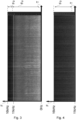
- a frequency spectrum in an exemplary environment here a canteen.
- the frequency F is plotted in the vertical direction and the time T in the horizontal direction.
- the amplitude A for a given frequency F at a given time T is shown in shades of grey, where the lighter/whiter the greater the amplitude A and vice versa, the darker/blacker the smaller the amplitude A.
- the upper frequency range Fo is framed for identification, the lower frequency range Fu follows directly below the upper frequency range Fo.
- the frame contains the frequency range from 11 kHz to 16 kHz.
- In 4 is this frequency range within the frame from 3 shown enlarged, whereby the structure of the upper frequency range Fo can be seen more clearly. Numerous light, vertical stripes are clearly visible, ie high amplitudes A for only short times T, which result from impulse-like and/or background noise 14 .
Landscapes
- Physics & Mathematics (AREA)
- Engineering & Computer Science (AREA)
- Acoustics & Sound (AREA)
- Signal Processing (AREA)
- Health & Medical Sciences (AREA)
- General Health & Medical Sciences (AREA)
- Neurosurgery (AREA)
- Otolaryngology (AREA)
- Measurement Of Mechanical Vibrations Or Ultrasonic Waves (AREA)
- Noise Elimination (AREA)
- Circuit For Audible Band Transducer (AREA)
Applications Claiming Priority (1)
| Application Number | Priority Date | Filing Date | Title |
|---|---|---|---|
| DE102021211879.8A DE102021211879B4 (de) | 2021-10-21 | 2021-10-21 | Hörgerät und Verfahren zum Betrieb eines solchen |
Publications (1)
| Publication Number | Publication Date |
|---|---|
| EP4171069A1 true EP4171069A1 (fr) | 2023-04-26 |
Family
ID=83400754
Family Applications (1)
| Application Number | Title | Priority Date | Filing Date |
|---|---|---|---|
| EP22196748.2A Pending EP4171069A1 (fr) | 2021-10-21 | 2022-09-21 | Dispositif auditif et procédé de fonctionnement d'un tel dispositif auditif |
Country Status (4)
| Country | Link |
|---|---|
| US (1) | US12219323B2 (fr) |
| EP (1) | EP4171069A1 (fr) |
| CN (1) | CN116017247B (fr) |
| DE (1) | DE102021211879B4 (fr) |
Citations (5)
| Publication number | Priority date | Publication date | Assignee | Title |
|---|---|---|---|---|
| US20130156208A1 (en) | 2011-04-11 | 2013-06-20 | Yutaka Banba | Hearing aid and method of detecting vibration |
| US20150005845A1 (en) * | 2012-08-27 | 2015-01-01 | Med-El Elektromedizinische Geraete Gmbh | Reduction of Transient Sounds in Hearing Implants |
| US20150181356A1 (en) * | 2013-12-19 | 2015-06-25 | International Business Machines Corporation | Smart hearing aid |
| DE102015204253A1 (de) | 2015-03-10 | 2016-09-15 | Sivantos Pte. Ltd. | Verfahren zur frequenzabhängigen Rauschunterdrückung eines Eingangssignals sowie Hörgerät |
| EP3793209A1 (fr) | 2019-09-11 | 2021-03-17 | Sivantos Pte. Ltd. | Appareil auditif avec annulation active du bruit et procédé de fonctionnement de lequel |
Family Cites Families (4)
| Publication number | Priority date | Publication date | Assignee | Title |
|---|---|---|---|---|
| WO2009042635A1 (fr) * | 2007-09-24 | 2009-04-02 | Sound Innovations Inc. | Dispositif numérique intra-auriculaire de communication et de suppression de bruit électronique |
| US10362412B2 (en) * | 2016-12-22 | 2019-07-23 | Oticon A/S | Hearing device comprising a dynamic compressive amplification system and a method of operating a hearing device |
| CN107910013B (zh) * | 2017-11-10 | 2021-09-24 | Oppo广东移动通信有限公司 | 一种语音信号的输出处理方法及装置 |
| CN109246519B (zh) * | 2018-10-18 | 2022-03-04 | 珠海市杰理科技股份有限公司 | 线控耳机信号识别方法、装置、计算机设备及存储介质 |
-
2021
- 2021-10-21 DE DE102021211879.8A patent/DE102021211879B4/de active Active
-
2022
- 2022-09-21 EP EP22196748.2A patent/EP4171069A1/fr active Pending
- 2022-10-21 CN CN202211293838.5A patent/CN116017247B/zh active Active
- 2022-10-21 US US17/970,762 patent/US12219323B2/en active Active
Patent Citations (5)
| Publication number | Priority date | Publication date | Assignee | Title |
|---|---|---|---|---|
| US20130156208A1 (en) | 2011-04-11 | 2013-06-20 | Yutaka Banba | Hearing aid and method of detecting vibration |
| US20150005845A1 (en) * | 2012-08-27 | 2015-01-01 | Med-El Elektromedizinische Geraete Gmbh | Reduction of Transient Sounds in Hearing Implants |
| US20150181356A1 (en) * | 2013-12-19 | 2015-06-25 | International Business Machines Corporation | Smart hearing aid |
| DE102015204253A1 (de) | 2015-03-10 | 2016-09-15 | Sivantos Pte. Ltd. | Verfahren zur frequenzabhängigen Rauschunterdrückung eines Eingangssignals sowie Hörgerät |
| EP3793209A1 (fr) | 2019-09-11 | 2021-03-17 | Sivantos Pte. Ltd. | Appareil auditif avec annulation active du bruit et procédé de fonctionnement de lequel |
Also Published As
| Publication number | Publication date |
|---|---|
| CN116017247A (zh) | 2023-04-25 |
| US20230129796A1 (en) | 2023-04-27 |
| DE102021211879A1 (de) | 2023-04-27 |
| US12219323B2 (en) | 2025-02-04 |
| DE102021211879B4 (de) | 2025-05-08 |
| CN116017247B (zh) | 2026-03-06 |
Similar Documents
| Publication | Publication Date | Title |
|---|---|---|
| DE69816610T2 (de) | Verfahren und vorrichtung zur rauschverminderung, insbesondere bei hörhilfegeräten | |
| EP1853089A2 (fr) | Méthode pour la suppression de la rétroaction et pour l'éxpansion spéctrale pour des appareils de correction auditive | |
| DE102015204639B3 (de) | Verfahren zum Betrieb eines Hörgeräts sowie Hörgerät | |
| EP3454572B1 (fr) | Procédé de reconnaissance d'un défaut dans un appareil auditif | |
| EP3598778B1 (fr) | Procédé de fonctionnement d'un appareil auditif ainsi qu'appareil auditif pour la detection de la propre voix sur la base d'une valeur seuil individuelle | |
| DE102006051071A1 (de) | Pegelabhängige Geräuschreduktion | |
| EP2023669A2 (fr) | Procédé destiné au fonctionnement d'un système d'appareil auditif et système d'appareil auditif | |
| EP3393143B1 (fr) | Procédé de fonctionnement d'une aide auditive | |
| CH691787A5 (de) | Klirrunterdruckung bei Hörgeräten mit AGC. | |
| EP1401242B1 (fr) | Compensation de la rétroaction pour prothèses auditives avec système d'estimation de la distance | |
| EP3793209A1 (fr) | Appareil auditif avec annulation active du bruit et procédé de fonctionnement de lequel | |
| EP3490270B1 (fr) | Procédé de fonctionnement d'un dispositif de correction auditive | |
| WO2000005923A1 (fr) | Appareil auditif permettant une meilleure comprehension de la parole grace a un traitement de signal selectif en frequence, et procede permettant de faire fonctionner un tel appareil auditif | |
| DE102019213809B3 (de) | Verfahren zum Betrieb eines Hörgeräts sowie Hörgerät | |
| EP2161949A2 (fr) | Procédé de fonctionnement d'un dispositif auditif ayant une directivité et dispositif auditif correspondant | |
| EP3951780B1 (fr) | Procédé de fonctionnement d'un appareil auditif et appareil auditif | |
| DE102021211879B4 (de) | Hörgerät und Verfahren zum Betrieb eines solchen | |
| EP1850634A2 (fr) | Procédé de réglage d'une prothèse auditive avec amplification des hautes fréquences | |
| EP1453355B1 (fr) | Traitement de signal dans un appareil auditif | |
| EP1052881A2 (fr) | Prothèse acoustique avec détecteur d'oscillations et méthode de detection d'oscillations dans une prothése acoustique | |
| EP1445761B1 (fr) | Appareil et méthode pour le fonctionnement de systèmes assistés par la parole dans des véhicules automobiles | |
| EP1416764B1 (fr) | Procédé d'établissement des paramètres d'une prothèse auditive et dispositif pour la mise en oeuvre du procédé | |
| EP1351550B1 (fr) | Procédé d'adaptation d'une amplification de signal dans une prothèse auditive et prothèse auditive | |
| EP1649719B1 (fr) | Dispositif et procédé pour exploiter des systèmes à assistance vocale dans des automobiles | |
| EP1653773B1 (fr) | Procédé d'opération d'une prothèse auditive et prothèse auditive |
Legal Events
| Date | Code | Title | Description |
|---|---|---|---|
| PUAI | Public reference made under article 153(3) epc to a published international application that has entered the european phase |
Free format text: ORIGINAL CODE: 0009012 |
|
| STAA | Information on the status of an ep patent application or granted ep patent |
Free format text: STATUS: THE APPLICATION HAS BEEN PUBLISHED |
|
| AK | Designated contracting states |
Kind code of ref document: A1 Designated state(s): AL AT BE BG CH CY CZ DE DK EE ES FI FR GB GR HR HU IE IS IT LI LT LU LV MC MK MT NL NO PL PT RO RS SE SI SK SM TR |
|
| STAA | Information on the status of an ep patent application or granted ep patent |
Free format text: STATUS: REQUEST FOR EXAMINATION WAS MADE |
|
| 17P | Request for examination filed |
Effective date: 20231024 |
|
| RBV | Designated contracting states (corrected) |
Designated state(s): AL AT BE BG CH CY CZ DE DK EE ES FI FR GB GR HR HU IE IS IT LI LT LU LV MC MK MT NL NO PL PT RO RS SE SI SK SM TR |
|
| STAA | Information on the status of an ep patent application or granted ep patent |
Free format text: STATUS: EXAMINATION IS IN PROGRESS |
|
| 17Q | First examination report despatched |
Effective date: 20250318 |