EP4170650A1 - Sprachsteuerungsverfahren für miniprogramm sowie vorrichtungen und speichermedium - Google Patents
Sprachsteuerungsverfahren für miniprogramm sowie vorrichtungen und speichermedium Download PDFInfo
- Publication number
- EP4170650A1 EP4170650A1 EP20943669.0A EP20943669A EP4170650A1 EP 4170650 A1 EP4170650 A1 EP 4170650A1 EP 20943669 A EP20943669 A EP 20943669A EP 4170650 A1 EP4170650 A1 EP 4170650A1
- Authority
- EP
- European Patent Office
- Prior art keywords
- applet
- voice
- target applet
- target
- control instruction
- Prior art date
- Legal status (The legal status is an assumption and is not a legal conclusion. Google has not performed a legal analysis and makes no representation as to the accuracy of the status listed.)
- Granted
Links
Images


Classifications
-
- G—PHYSICS
- G10—MUSICAL INSTRUMENTS; ACOUSTICS
- G10L—SPEECH ANALYSIS TECHNIQUES OR SPEECH SYNTHESIS; SPEECH RECOGNITION; SPEECH OR VOICE PROCESSING TECHNIQUES; SPEECH OR AUDIO CODING OR DECODING
- G10L15/00—Speech recognition
- G10L15/22—Procedures used during a speech recognition process, e.g. man-machine dialogue
-
- G—PHYSICS
- G06—COMPUTING OR CALCULATING; COUNTING
- G06F—ELECTRIC DIGITAL DATA PROCESSING
- G06F3/00—Input arrangements for transferring data to be processed into a form capable of being handled by the computer; Output arrangements for transferring data from processing unit to output unit, e.g. interface arrangements
- G06F3/16—Sound input; Sound output
- G06F3/167—Audio in a user interface, e.g. using voice commands for navigating, audio feedback
-
- G—PHYSICS
- G06—COMPUTING OR CALCULATING; COUNTING
- G06F—ELECTRIC DIGITAL DATA PROCESSING
- G06F9/00—Arrangements for program control, e.g. control units
- G06F9/06—Arrangements for program control, e.g. control units using stored programs, i.e. using an internal store of processing equipment to receive or retain programs
- G06F9/30—Arrangements for executing machine instructions, e.g. instruction decode
- G06F9/30003—Arrangements for executing specific machine instructions
- G06F9/30076—Arrangements for executing specific machine instructions to perform miscellaneous control operations, e.g. NOP
- G06F9/3009—Thread control instructions
-
- G—PHYSICS
- G06—COMPUTING OR CALCULATING; COUNTING
- G06F—ELECTRIC DIGITAL DATA PROCESSING
- G06F9/00—Arrangements for program control, e.g. control units
- G06F9/06—Arrangements for program control, e.g. control units using stored programs, i.e. using an internal store of processing equipment to receive or retain programs
- G06F9/44—Arrangements for executing specific programs
- G06F9/445—Program loading or initiating
-
- G—PHYSICS
- G06—COMPUTING OR CALCULATING; COUNTING
- G06F—ELECTRIC DIGITAL DATA PROCESSING
- G06F9/00—Arrangements for program control, e.g. control units
- G06F9/06—Arrangements for program control, e.g. control units using stored programs, i.e. using an internal store of processing equipment to receive or retain programs
- G06F9/44—Arrangements for executing specific programs
- G06F9/445—Program loading or initiating
- G06F9/44505—Configuring for program initiating, e.g. using registry, configuration files
-
- G—PHYSICS
- G06—COMPUTING OR CALCULATING; COUNTING
- G06F—ELECTRIC DIGITAL DATA PROCESSING
- G06F9/00—Arrangements for program control, e.g. control units
- G06F9/06—Arrangements for program control, e.g. control units using stored programs, i.e. using an internal store of processing equipment to receive or retain programs
- G06F9/44—Arrangements for executing specific programs
- G06F9/445—Program loading or initiating
- G06F9/44568—Immediately runnable code
-
- G—PHYSICS
- G10—MUSICAL INSTRUMENTS; ACOUSTICS
- G10L—SPEECH ANALYSIS TECHNIQUES OR SPEECH SYNTHESIS; SPEECH RECOGNITION; SPEECH OR VOICE PROCESSING TECHNIQUES; SPEECH OR AUDIO CODING OR DECODING
- G10L15/00—Speech recognition
- G10L15/08—Speech classification or search
- G10L15/18—Speech classification or search using natural language modelling
-
- G—PHYSICS
- G10—MUSICAL INSTRUMENTS; ACOUSTICS
- G10L—SPEECH ANALYSIS TECHNIQUES OR SPEECH SYNTHESIS; SPEECH RECOGNITION; SPEECH OR VOICE PROCESSING TECHNIQUES; SPEECH OR AUDIO CODING OR DECODING
- G10L15/00—Speech recognition
- G10L15/08—Speech classification or search
- G10L15/18—Speech classification or search using natural language modelling
- G10L15/1822—Parsing for meaning understanding
-
- G—PHYSICS
- G10—MUSICAL INSTRUMENTS; ACOUSTICS
- G10L—SPEECH ANALYSIS TECHNIQUES OR SPEECH SYNTHESIS; SPEECH RECOGNITION; SPEECH OR VOICE PROCESSING TECHNIQUES; SPEECH OR AUDIO CODING OR DECODING
- G10L15/00—Speech recognition
- G10L15/22—Procedures used during a speech recognition process, e.g. man-machine dialogue
- G10L2015/223—Execution procedure of a spoken command
Definitions
- the present application relates to a voice technology in computer technologies, and in particular, to a voice control method for applets, a device, and a storage medium.
- many intelligent voice devices that support voice interaction can also use applets, but distributions of the applets mainly depend on manually calling up, and interaction processes between users and applets are mainly through manually touching, for example, information video applets on screen-attached speakers need to be selected by triggering an applet center before being called up, and can be browsed and viewed by manually turning pages up and down, clicking and playing, etc.
- the present application provides a voice control method for applets and a device, and a storage medium, so as to realize voice control of applets on an intelligent voice device, improve convenience of interaction between a user and an applet, thereby improving interaction experience.
- a voice control method for applets the method being applied to an intelligent voice device, where the intelligent voice device is configured with a voice interaction system and a target applet, and the method includes:
- a voice control method for applets the method being applied to an intelligent voice device, where the intelligent voice device is configured with a voice interaction system and a target applet, and the method includes:
- a voice control method for applets the method being applied to an intelligent voice device, where the intelligent voice device is configured with a voice interaction system and a target applet, and the method includes:
- an intelligent voice device on which a voice interaction system and a target applet are configured; where the voice interaction system includes:
- an electronic device including:
- a non-transitory computer-readable storage medium storing computer instructions, where the computer instructions are used to cause the computer to execute the method according to the first aspect or the second aspect or the third aspect.
- a voice control instruction for a target applet in an intelligent voice device from a user is acquired through a voice collecting device; voice recognition and intention analysis are performed by the voice interaction system on the voice control instruction to acquire intention information, and the intention information is transmitted to a target applet; the intention information is received and converted into a control instruction executable by a thread of the target applet by the target applet, and the control instruction is executed by the thread of the target applet.
- voice control to the target applet can be implemented, thereby improving convenience of an interaction process, and avoiding attention separation caused by unsustainable voice interaction which is due to the fact that the interaction with the applet needs to be performed in a touching manner, improving user experience of using the applet, and providing a strong support for distribution and usage of the applet in the intelligent voice device.
- the present application provides a voice control method for applets applied in a voice technology in computer technologies, through interactions between the voice interaction system and an applet framework, voice control to the target applet can be implemented, thereby improving convenience of an interaction process, and avoiding attention separation caused by unsustainable voice interaction which is due to the fact that the interaction with the applet needs to be performed in a touching manner, improving user experience of using the applet, and providing a strong support for distribution and usage of the applet in intelligent voice devices.
- the present application can be applied to intelligent voice devices with screens, and of course can also be applied to intelligent voice devices without screens.
- the applet can still have a function of being called up and controlled by manually touching.
- an intelligent voice device 100 is configured with a voice interaction system 110 and a target applet 120, where the voice interaction system 110 can perform voice recognition and intention analysis on voice control instructions collected by a voice collecting device and from a user for a target applet to acquire intention information, and transmit the intention information to the target applet 120, and the target applet 120 receives the intention information, and converts the intention information into a control instruction executable by a thread of the target applet 120, and the thread of the target applet 120 executes the control instruction.
- the voice interaction system 110 can perform voice recognition and intention analysis on voice control instructions collected by a voice collecting device and from a user for a target applet to acquire intention information, and transmit the intention information to the target applet 120, and the target applet 120 receives the intention information, and converts the intention information into a control instruction executable by a thread of the target applet 120, and the thread of the target applet 120 executes the control instruction.
- FIG. 2 is a flowchart of the voice control method for applets according to an embodiment of the present application.
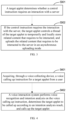
- An executive body can be an intelligent voice device, on which a voice interaction system and a target applet are configured; as shown in FIG. 2 , specific steps of the voice control method for applets are as follows: S201, acquiring, through a voice collecting device, a voice control instruction for a target applet in an intelligent voice device from a user.
- a voice control instruction can be sent, for example, if the user wants to control a called up video applet A on an intelligent speaker to play a variety show B, the user can send a voice control instruction of "I want to watch variety show B in video applet A", and then the voice control instruction of the user can be collected by a voice collecting device such as a microphone on the intelligent speaker.
- the video applet A and the variety show B can be a real video applet and a real variety show, which are processed to be invisible here.
- the voice interaction system performs voice recognition and intention analysis on the voice control instruction to acquire intention information, and transmits the intention information to the target applet.
- the voice interaction system of the intelligent voice device since the voice interaction system of the intelligent voice device usually has functions of voice recognition and intention analysis, after the voice collecting device collects the voice control instruction for the target applet, the voice recognition and intention analysis are performed through the voice recognition and intention analysis functions of the voice interaction system, where the voice recognition is to convert the collected voice control instruction into characters understandable by a machine, while the intention analysis is to analyze and process machine characters and to interpret key information, for example, following keywords can be resolved from the above voice control instruction, "applet”, "video applet A” and "variety show B", hence, the intention information of the user is acquired; however, there is no need to deploy voice recognition and intention analysis functions in the target applet, after the voice interaction system acquires the intention information, the voice interaction system can transmit the intention information to the target applet, that is, transmit the intention information to a thread of the target applet.
- the target applet receives the intention information, and converts the intention information into a control instruction executable by a thread of the target applet, and the thread of the target applet executes the control instruction.
- the target applet since different applets may adopt different frameworks or development languages during a development process, which may be different from that of the voice interaction system, and the intention information acquired by the voice interaction system may not be understood and executed by applets. Therefore, when the target applet is called up in the intelligent voice device, after receiving the intention information transmitted by the voice interaction system, the target applet converts the intention information into a control instruction executable by a thread of the target applet, and the control instruction is further executed by the thread of the target applet, thereby implementing intention or functions required by the user.
- a video applet A is called up on an intelligent speaker, after the video applet A receives related intention information that the user wants to play a variety show B, the intention information is converted into a search resource pool instruction and a play instruction that the video applet A can execute, and the search resource pool instruction and the play instruction are further executed to implement playing the variety show B in the video applet A.
- the target applet needs to be called up by the voice interaction system before the target applet performs the above process.
- a voice control instruction for a target applet in the intelligent voice device from a user is acquired through a voice collecting device; voice recognition and intention analysis are performed by the voice interaction system on the voice control instruction to acquire intention information, and the intention information is transmitted to a target applet; the intention information is received and converted into a control instruction executable by a thread of the target applet by the target applet, and the control instruction is executed by the thread of the target applet.
- voice control to the target applet can be implemented, thereby improving convenience of an interaction process, and avoiding attention separation caused by unsustainable voice interaction which is due to the fact that the interaction with the applet needs to be performed in a touching manner, improving user experience of using the applet, and providing a strong support for distribution and usage of the applet in the intelligent voice device.
- the method may specifically include:
- the voice interaction system can convert the intention analysis result into the intention information satisfying the preset protocol according to the preset protocol, where the preset protocol can specifically include a protocol header and a content part of the protocol, where the protocol header can specifically include but not limited to a namespace of an instruction, a name of the instruction and an encryption type (if the system embeds a protocol, encryption transmission is not required), and the content part of the protocol can include but not limited to operation information corresponding to the intention and target applet information, where the operation information can include but not limited to an operation type and extension information, the extension information can supplement the operation type, and the target applet information can include an applet identifier of the target applet; for example, if the user intends to fast forward a video currently played by the video applet A, the operation type is "fast forward", the applet identifier is an identifier of the video applet A, and the extension information is a fast forward speed, such as 2 times fast forward speed.
- the preset protocol can specifically include a protocol header and a content part of the protocol
- the target applet After receiving the intention information that satisfies the preset protocol transmitted by the voice interaction system, the target applet converts the intention information into a control instruction executable by the target applet, for example, the target applet is of a SwanJS (Smart Web Application Native JavaScript) architecture, and the SwanJS is a core of applet frameworks of an Internet enterprise, so the intention information that satisfies the preset protocol needs to be converted into a SwanJS event command.
- the target applet is of a SwanJS (Smart Web Application Native JavaScript) architecture
- the SwanJS is a core of applet frameworks of an Internet enterprise
- the target applet acquires a preset conversion rule corresponding to the protocol header according to the protocol header in the intention information, where the preset conversion rule includes a corresponding relationship between the preset operation information and the preset control instruction; according to the corresponding relationship between the preset operation information and the preset control instruction, the target applet converts the content part of the protocol in the intention information into the control instruction executable by the thread of the target applet.
- the agreed instruction space is analyzed, and it can be determined whether the intention information is aimed at the target applet according to an instruction space, an operation type, an encryption type, an applet identifier, etc., if not, it is determined that the intention information is invalid for the target applet, and return directly, so that a subsequent voice control process is not carried out, the applet thread needs not to be occupied, and a running overhead is reduced, and if yes, the subsequent voice control process can be continued; and the content part of the protocol is a part that needs to be executed by the control instruction, event calling up of a developer application program is supported, the content part of the protocol can be converted into the control instruction under a SwanJS framework according to the conversion rule, for example, all control instructions executable in the target applet, and a corresponding relationship between respective preset control instructions and preset operation types can be preset, hence, which control instruction corresponds to the content part of the protocol is determined.
- SwanJS only implements a general function of an interface, and for a mode of specific applet and specific scenario, a developer can rewrite an instruction execution function through the interface.
- a fast forwarding control instruction SwanJS only provides an interface to implement a general function of fast forwarding, and in which way the fast forwarding is performed can be configured by the developer according to the specific scenario.
- the method when the control instruction is executed by the thread of the target applet in S203, the method may further specifically includes:
- a synchronous uploading manner can also be adopted.
- asynchronous and synchronous uploading are compatible, which can be selected according to specific scenarios such as network environment.
- the control instruction can be executed locally; when the interaction is needed, it is determined whether the control instruction needs to be temporarily and locally stored, if not needing to be temporarily and locally stored, the control instruction is directly uploaded to the server, if needing to be temporarily and locally stored, the control instruction is temporarily and locally stored, and then uploaded to the server asynchronously.
- asynchronous uploading can also be adopted to ensure that the same user has the same experience when using the same target applet on different devices, for example, favorites, historical browsing records, comments, likes, purchase orders and other data of the user can be viewed on the same target applet on different intelligent speakers.
- the method may further include:
- S201-S203 are voice control of the target applet after the target applet has been called up in the intelligent voice device
- the target applet needs to be called up before the voice control of the target applet.
- calling up can be performed through a voice control method during a calling up process, that is, acquiring a voice calling up instruction from the user for the target applet through a voice collecting device, for example, the user sends a voice calling up instruction of "starting the video applet A", the voice recognition and intention analysis can be carried out by the voice interaction system, the intention of the user to call up the target applet "video applet A" is determined, and then the target applet can be called up.
- the method when calling up the target applet by the voice interaction system according to S402, the method may specifically include:
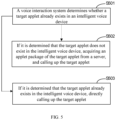
- the target applet if the target applet has been used before and is still cached in the intelligent voice device, or if the target applet has not been used before but is cached in advance, it is not necessary to acquire the applet package of the target applet from the server, and the target applet can be directly called up; otherwise, the target applet does not exist in the intelligent voice device, then the applet package of the target applet needs to be acquired from the server, and then the target applet is called up.
- the method when acquiring the applet package of the target applet from the server according to S502, the method may specifically include:
- the voice interaction system acquires an SDK (software development kit) applet package of the target applet from the server
- whether the intelligent voice device has an ability of supporting the voice interaction with the applet can be first determined, and if the intelligent voice device supports the voice interaction with the applet, a full SDK applet package of the target applet is acquired from the server; if the intelligent voice device does not support the voice interaction with the applet, a partial SDK applet package of the target applet is acquired from the server, comparing with the full SDK applet package, the partial SDK applet package does not load a module related to the voice interaction, that is, the target applet does not have an ability of receiving the intention information, and converting the intention information into the control instruction executable by the thread of the target applet, in this way, a package size of the applet is reduced, data package consumption during a loading process is reduced, and a calling up speed of the target applet is improved.
- SDK software development kit
- the determining the target applet to be called up according to an intention analysis result includes:
- the voice calling up instruction for the target applet sent by the user can specifically include a name of the target applet and the requested resource information, for example, in a case that the intelligent voice device does not currently call up the video applet A, when the voice instruction "I want to watch the variety show B of the video applet A" is sent by the user, at this time, the voice instruction can be considered as a non-voice calling up instruction, after voice recognition and intention analysis, it can be determined that the target applet to be called up is the video applet A, and the resource requested by the user is the variety show B, at this time, whether the resource exists in a resource pool of the video applet A can be searched in the server, and if the resource exists, the video applet A is called up, including directly calling up or calling up after acquiring the applet package; if the resource does not exist in the resource pool of the video applet A, it can be searched whether the resource exists in resource pools of other applets, for example, the resource exists in a resource pool of a video applet C,
- fuzzy search can be performed according to the requested resource to determine the target applet, for example, the user sends a voice instruction of "I want to watch the variety show B", the applets where the resource exists can be searched, so as to determine the applet as the target applet and call up the applet.
- the voice control method for applets may further include: the voice interaction system periodically acquires a predetermined number of applet packages of popular applets from the server and caches the apple packages.
- the voice interaction system can access the server periodically to acquire related information of the popular applets, and the voice interaction system can select a predetermined number of popular applets according to the related information of the popular applets, and acquire the applet packages of these popular applets from the server for caching, so as to realize quick calling up when the user needs to call up a certain popular applet.
- the related information of the popular applets can also be periodically pushed by the server to the voice interaction system, and then the voice interaction system can select a predetermined number of popular applets according to the related information of popular applets.
- the number of popular applets to be cached can be determined according to a storage space of the intelligent voice device; and a selection of popular applets for caching can be determined according to a download amount of applets, user interests and other factors.
- voice control of target applets can be implemented through interactions between a voice interaction system and a target applet framework; in addition, when not called up, the target applet can be called up through voice control, therefore, convenience of calling up of the applet is improved, an operation process of finding and opening the applet by touching is simplified, user experience of using the applet is improved, and a strong support for distribution and usage of the applet in intelligent voice devices is provided.
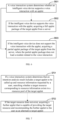
- An embodiment of the present application provides a voice control method for applets, which is applied to an intelligent voice device, where the intelligent voice device is configured with a voice interaction system and a target applet, the method includes:
- the intention information is intention information generated by the voice interaction system in accordance with a preset protocol according to an intention analysis result
- the target applet converts the intention information into a control instruction executable by a thread of the target applet includes: the target applet determines a preset converting rule according to the intention information, and converts the intention information into the control instruction executable by the thread of the target applet according to the preset converting rule.
- the preset protocol includes a protocol header and content of the protocol, where the content of the protocol includes operation information corresponding to the intention and target applet information; where the target applet determines a preset converting rule according to the intention information, and converts the intention information into the control instruction executable by the thread of the target applet according to the preset converting rule includes:
- the thread of the target applet executes the control instruction includes: if the target applet determines that the control instruction requires an interaction with a server, the target applet controls the thread of the target applet to temporarily and locally store related content that requires to be interacted, and uploads the related content that requires to be interacted to the server in an asynchronous uploading mode.
- the method before the target applet receives the intention information transmitted by the voice interaction system, the method further includes: the voice interaction system calls up the target applet according to a voice calling up instruction for the target applet sent by the user.
- the intelligent voice device is an intelligent speaker.
- the voice control method for applets provided by the present embodiment is a process executed by the target applet in the intelligent voice device in the above-mentioned embodiment, for specific implementations and technical effects thereof, reference can be made to the above-mentioned embodiments, which will not be repeated here.
- An embodiment of the present application provides a voice control method for applets, which is applied to an intelligent voice device, where the intelligent voice device is configured with a voice interaction system and a target applet, the method includes:
- the acquiring the intention information includes: the voice interaction system generates the intention information in accordance with a preset protocol according to an preset protocol, where the preset protocol includes a protocol header and content of the protocol, where the content of the protocol includes operation information corresponding to the intention and target applet information.
- the method before the voice interaction system acquires a voice control instruction for the target applet sent by a user, the method further includes:
- the calling up the target applet includes:
- the acquiring the applet package of the target applet from a server includes:
- the determining the target applet to be called up according to the intention analysis result includes:
- the method further includes: the voice interaction system periodically acquires a predetermined number of applet packages of popular applets from the server and caching the apple packages.
- the intelligent voice device is an intelligent speaker.
- the voice control method for applets provided by the present embodiment is a process executed by the voice interaction system in the intelligent voice device in the above-mentioned embodiment, for specific implementations and technical effects thereof, reference can be made to the above-mentioned embodiments, which will not be repeated here.
- FIG. 8 is a structural diagram of an intelligent voice device according to an embodiment of the present application.
- the intelligent voice device 800 is configured with a voice interaction system 810 and a target applet 820.
- the voice interaction system 810 may include: an acquiring module 811 and a voice processing module 812;
- the target applet 820 may include: a receiving module 821, an instruction converting module 822 and an executing module 823;
- the voice processing module 812 when acquiring the intention information, is configured to:
- the executing module 823 when executing the control instruction through the thread of the target applet, is configured to:
- the executing module 823 may specifically include a scheduling submodule and an uploading submodule.
- the acquiring module 811 is further configured to: acquire a calling up instruction for the target applet from the user through the voice collecting device; the voice interaction system 810 further includes an applet calling up module 813, which is configured to: perform voice recognition and intention analysis on the voice calling up instruction, determine the target applet to be called up according to an intention analysis result, and call up the target applet.
- the applet calling up module 813 is configured to:
- the applet calling up module 813 is configured to:
- the applet calling up module is configured to:
- the applet calling up module 813 is further configured to: periodically acquire a predetermined number of applet packages of popular applets from the server and cache the apple packages.
- the intelligent voice device provided in the present embodiment can be specifically configured to execute the method embodiments provided in the above figures, and detailed functions will not be described here.
- a voice control instruction for a target applet in an intelligent voice device from a user is acquired through a voice collecting device; voice recognition and intention analysis are performed by the voice interaction system on the voice control instruction to acquire intention information, and the intention information is transmitted to the target applet; the intention information is received and converted into a control instruction executable by a thread of the target applet by the target applet, and the control instruction is executed by the thread of the target applet.
- voice control to the target applet can be implemented, thereby improving convenience of an interaction process, and avoiding attention separation caused by unsustainable voice interaction which is due to the fact that the interaction with the applet needs to be performed in a touching manner, improving user experience of using the applet, and providing a strong support for distribution and usage of the applet in intelligent voice devices.
- the present application further provides an electronic device and a readable storage medium.
- FIG. 9 is a block diagram of an electronic device of the voice control method for applets according to the embodiments of the present application.
- the electronic device is intended to represent various forms of digital computers, such as laptop computers, desktop computers, workstations, personal digital assistants, servers, blade servers, mainframe computers, and other suitable computers.
- Electronic devices can also represent various forms of mobile devices, such as personal digital processing, cellular phones, smart phones, wearable devices and other similar computing devices.
- Components shown herein, connections, relationships and functions thereof are merely examples, and are not intended to limit the implementation of the application described and/or claimed herein.
- the electronic device includes: one or more processors 901, a memory 902, and interfaces for connecting various components, including a high-speed interface and a low-speed interface. Respective components connect to each other by using different buses, and can be installed on a common mainboard or can be installed in other methods according to requests.
- the processor may process instructions executed in the electronic device, including instructions stored in or on the memory to display graphical information of GUI on an external input/output device, such as a display device coupled to an interface. In other embodiments, if needed, multiple processors and/or multiple buses may be used with multiple memories.
- multiple electronic devices can be connected, and each device provides some necessary operations (for example, as a server array, a group of blade servers, or a multiprocessor system).
- One processor 901 is taken as an example in FIG. 9 .
- the processor 902 is a non-transitory computer-readable storage medium provided by the present application.
- the memory stores instructions executable by at least one processor, causing the at least one processor to execute the voice control method for applets provided by the present application.
- the non-transitory computer-readable storage medium stores a computer instruction, the computer instruction is used to cause a computer to execute the voice control method for applets provided by the present application.
- the memory 902 can be used to store non-transitory software programs, non-transitory computer-executable programs and modules, such as program instructions/modules corresponding to the voice control method for applets in the embodiments of the present application (for example, respective modules shown in FIG. 8 ).
- the processor 901 executes various functional applications and data processing of the server by running non-transitory software programs, instructions and modules stored in the memory 902, that is, implements the voice control method for applets in the above method embodiment.
- the memory 902 may include a program storage area and a data storage area, where the program storage area may store an application program required by an operating system and at least one function; the data storage area may store data created according to the use of the electronic device of the voice control method for applets, etc.
- the memory 902 may include a high-speed random access memory, and may also include a non-transitory memory, such as at least one disk memory device, a flash memory device, or other non-transitory solid-state memory devices.
- the memory 902 may optionally include memories remotely located with respect to the processor 901, and the remote memories may be connected to the electronic devices of the voice control method for applets through a network. Examples of the above networks include, but are not limited to, the Internet, an intranet, a local area network, a mobile communication network and combinations thereof.
- the electronic device of the voice control method for applets may further include: an input device 903 and an output device 904.
- the processor 901, the memory 902, the input device 903 and the output device 904 can be connected through a bus or through other methods, being connected through a bus being taken an example in FIG. 9 .
- the input device 903 can receive inputted digital or character information, and generate key signal input related to user setting and function control of the electronic device of the voice control method for applets, such as a touch screen, a keypad, a mouse, a track pad, a touch pad, an indicator stick, one or more mouse buttons, a trackball, a joystick and other input devices.
- the output device 904 may include display devices, auxiliary lighting devices (e.g., LEDs), haptic feedback devices (e.g., vibration motors), and the like.
- the display device may include but is not limited to, a liquid crystal display (LCD), a light emitting diode (LED) display and a plasma display. In some embodiments, the display device can be a touch screen.
- Various embodiments of systems and techniques described here may be implemented in digital electronic circuit systems, integrated circuit systems, ASIC (application specific integrated circuits), computer hardware, firmware, software, and/or combinations thereof.
- the various embodiments may include: being implemented in one or more computer programs that can be executed and/or interpreted on a programmable system including at least one programmable processor, the programmable processor can be a special or general programmable processor and can receive data and instructions from a storage system, at least one input device and at least one output device, and transmit the data and instructions to the storage system, the at least one input device, and the at least one output device.
- the computer programs include machine instructions of programmable processors, and can be implemented by using high-level procedures and/or object-oriented programming languages, and/or assembly/machine languages.
- machine-readable medium and “computer-readable medium” refer to any computer program products, devices, and/or apparatuses (e.g., a magnetic disk, an optical disk, a memory, a programmable logic device (PLD)) used to provide machine instructions and/or data to a programmable processor, including a machine-readable medium that receives machine instructions as machine-readable signals.
- a term "machine-readable signal” refers to any signal used to provide machine instructions and/or data to a programmable processor.
- the systems and techniques described here can be implemented on a computer, the computer having: a display device (e.g., a CRT (cathode ray tube) or an LCD (liquid crystal display) monitor) configured to display information to the user; and a keyboard and a pointing device (e.g., a mouse or a trackball) through which the user can provide input to the computer.
- a display device e.g., a CRT (cathode ray tube) or an LCD (liquid crystal display) monitor
- a keyboard and a pointing device e.g., a mouse or a trackball
- Other kinds of devices can also be configured to provide interactions with the user; for example, feedbacks provided to the user can be any form of sensory feedback (for example, visual feedbacks, auditory feedbacks, or haptic feedbacks); and inputs from the user can be received in any form, including sound input, voice input or haptic input.
- the systems and technologies described herein can be implemented in a computing system including background components (e.g., as a data server), or a computing system including middleware components (e.g., an application server), or a computing system including front-end components (e.g., a user computer with a graphical user interface or a web browser through which the user can interact with embodiments of the systems and technologies described here), or a computing system including any combination of the background components, the middleware components, or the front-end components.
- Components of the system can be connected to each other through digital data communication (e.g., communication network) in any form or medium. Examples of communication networks include a local area network (LAN), a wide area networks (WAN), and the Internet.
- LAN local area network
- WAN wide area networks
- the Internet the global information network
- a computer system may include a client and a server.
- Clients and servers are generally remote from each other and usually interact through communication networks.
- a relationship between the client and the server can be generated by executing a computer program having a client-server relationship to each other on a corresponding computer.
- a voice control instruction for a target applet in an intelligent voice device from a user is acquired through a voice collecting device; voice recognition and intention analysis are performed by the voice interaction system on the voice control instruction to acquire intention information, and the intention information is transmitted to the target applet; the intention information is received and converted into a control instruction executable by a thread of the target applet by the target applet, and the control instruction is executed by the thread of the target applet.
- voice control to the target applet can be implemented, thereby improving convenience of an interaction process, and avoiding attention separation caused by unsustainable voice interaction which is due to the fact that the interaction with the applet needs to be performed in a touching manner, improving user experience of using the applet, and providing a strong support for distribution and usage of the applet in intelligent voice devices.
Landscapes
- Engineering & Computer Science (AREA)
- Software Systems (AREA)
- Physics & Mathematics (AREA)
- Theoretical Computer Science (AREA)
- Multimedia (AREA)
- Health & Medical Sciences (AREA)
- Audiology, Speech & Language Pathology (AREA)
- Human Computer Interaction (AREA)
- Acoustics & Sound (AREA)
- Computational Linguistics (AREA)
- General Physics & Mathematics (AREA)
- General Engineering & Computer Science (AREA)
- Artificial Intelligence (AREA)
- General Health & Medical Sciences (AREA)
- User Interface Of Digital Computer (AREA)
- Stored Programmes (AREA)
- Telephonic Communication Services (AREA)
Applications Claiming Priority (2)
| Application Number | Priority Date | Filing Date | Title |
|---|---|---|---|
| CN202010605375.6A CN111724785B (zh) | 2020-06-29 | 2020-06-29 | 小程序的语音控制方法、设备及存储介质 |
| PCT/CN2020/117498 WO2022000828A1 (zh) | 2020-06-29 | 2020-09-24 | 小程序的语音控制方法、设备及存储介质 |
Publications (3)
| Publication Number | Publication Date |
|---|---|
| EP4170650A1 true EP4170650A1 (de) | 2023-04-26 |
| EP4170650A4 EP4170650A4 (de) | 2024-07-17 |
| EP4170650B1 EP4170650B1 (de) | 2025-07-09 |
Family
ID=77145724
Family Applications (1)
| Application Number | Title | Priority Date | Filing Date |
|---|---|---|---|
| EP20943669.0A Active EP4170650B1 (de) | 2020-06-29 | 2020-09-24 | Sprachsteuerungsverfahren für miniprogramm sowie vorrichtungen und speichermedium |
Country Status (4)
| Country | Link |
|---|---|
| US (1) | US11984120B2 (de) |
| EP (1) | EP4170650B1 (de) |
| JP (1) | JP7373063B2 (de) |
| KR (1) | KR102875308B1 (de) |
Families Citing this family (13)
| Publication number | Priority date | Publication date | Assignee | Title |
|---|---|---|---|---|
| CN112216275B (zh) * | 2019-07-10 | 2024-07-19 | 阿里巴巴集团控股有限公司 | 一种语音信息的处理方法、装置及电子设备 |
| CN115701633B (zh) * | 2021-08-02 | 2025-11-11 | 博泰车联网(南京)有限公司 | 应用程序的语音控制方法、装置、存储介质及电子设备 |
| CN114461349A (zh) * | 2022-03-02 | 2022-05-10 | 中国建设银行股份有限公司 | 应用程序跳转小程序的处理方法、装置、计算机设备 |
| CN115001885B (zh) * | 2022-04-22 | 2024-01-26 | 青岛海尔科技有限公司 | 设备控制方法及装置、存储介质及电子装置 |
| CN115002206B (zh) * | 2022-04-29 | 2024-01-26 | 青岛海尔科技有限公司 | 智能设备的控制方法和装置、存储介质及电子装置 |
| WO2024005364A1 (ko) * | 2022-06-30 | 2024-01-04 | 삼성전자 주식회사 | 음성 입력에 기초하여 가전 기기를 제어하는 방법 및 그에 따른 가전 기기 |
| CN116246624B (zh) * | 2023-01-31 | 2025-11-04 | 青岛海尔科技有限公司 | 智能设备的语音控制方法、装置、存储介质及电子装置 |
| CN116109460A (zh) * | 2023-02-17 | 2023-05-12 | 江西江投电力技术与试验研究有限公司 | 一种基于边缘计算的建筑运行管理系统 |
| CN116382108A (zh) * | 2023-03-27 | 2023-07-04 | 青岛海尔科技有限公司 | 用于控制智能家电的方法、装置、控制系统、存储介质及电子装置 |
| CN116401439A (zh) * | 2023-04-06 | 2023-07-07 | 杭州萤石软件有限公司 | 一种智能客服系统、信息处理方法、装置及电子设备 |
| JP7708817B2 (ja) * | 2023-07-24 | 2025-07-15 | PayPay株式会社 | 電子決済システム、電子決済方法、およびプログラム |
| CN117198292B (zh) * | 2023-11-08 | 2024-02-02 | 太平金融科技服务(上海)有限公司 | 一种语音融合处理方法、装置、设备及介质 |
| CN117301074B (zh) * | 2023-11-17 | 2024-04-30 | 浙江孚宝智能科技有限公司 | 智能机器人的控制方法及芯片 |
Family Cites Families (36)
| Publication number | Priority date | Publication date | Assignee | Title |
|---|---|---|---|---|
| JPH10222337A (ja) * | 1997-02-13 | 1998-08-21 | Meidensha Corp | コンピュータシステム |
| US6916291B2 (en) | 2001-02-07 | 2005-07-12 | East Carolina University | Systems, methods and products for diagnostic hearing assessments distributed via the use of a computer network |
| JP2002351652A (ja) * | 2001-05-23 | 2002-12-06 | Nec System Technologies Ltd | 音声認識操作支援システム、音声認識操作支援方法、および、音声認識操作支援プログラム |
| US20040107250A1 (en) | 2002-10-21 | 2004-06-03 | Guillermo Marciano | Methods and systems for integrating communication resources using the internet |
| US7257583B2 (en) * | 2004-01-09 | 2007-08-14 | Microsoft Corporation | System and method for updating an on-device application catalog in a mobile device receiving a push message from a catalog server indicating availability of an application for download |
| US20070286360A1 (en) | 2006-03-27 | 2007-12-13 | Frank Chu | System and Method for Providing Screen-Context Assisted Information Retrieval |
| US8832201B2 (en) | 2008-08-18 | 2014-09-09 | International Business Machines Corporation | Method, system and program product for providing selective enhanced privacy and control features to one or more portions of an electronic message |
| JP5887162B2 (ja) * | 2012-02-23 | 2016-03-16 | 株式会社Nttドコモ | 通信端末、制御方法及びプログラム |
| US9959865B2 (en) | 2012-11-13 | 2018-05-01 | Beijing Lenovo Software Ltd. | Information processing method with voice recognition |
| KR102098815B1 (ko) * | 2013-05-20 | 2020-04-08 | 삼성전자주식회사 | 어플리케이션의 운영을 위한 전자 장치 |
| US9548066B2 (en) * | 2014-08-11 | 2017-01-17 | Amazon Technologies, Inc. | Voice application architecture |
| US10205797B2 (en) | 2014-12-29 | 2019-02-12 | Facebook, Inc. | Application service delivery through an application service avatar |
| KR102387567B1 (ko) * | 2015-01-19 | 2022-04-18 | 삼성전자주식회사 | 음성 인식 방법 및 음성 인식 장치 |
| US9472196B1 (en) * | 2015-04-22 | 2016-10-18 | Google Inc. | Developer voice actions system |
| CN112214260B (zh) * | 2015-09-21 | 2023-09-22 | 创新先进技术有限公司 | 终端应用app的加载方法及装置 |
| US10332513B1 (en) * | 2016-06-27 | 2019-06-25 | Amazon Technologies, Inc. | Voice enablement and disablement of speech processing functionality |
| CN106297782A (zh) | 2016-07-28 | 2017-01-04 | 北京智能管家科技有限公司 | 一种人机交互方法及系统 |
| CN107765838A (zh) | 2016-08-18 | 2018-03-06 | 北京北信源软件股份有限公司 | 人机交互辅助方法及装置 |
| US10127908B1 (en) | 2016-11-11 | 2018-11-13 | Amazon Technologies, Inc. | Connected accessory for a voice-controlled device |
| WO2018102980A1 (zh) | 2016-12-06 | 2018-06-14 | 吉蒂机器人私人有限公司 | 语音交互方法、装置及系统 |
| US11204787B2 (en) * | 2017-01-09 | 2021-12-21 | Apple Inc. | Application integration with a digital assistant |
| US10713007B2 (en) * | 2017-12-12 | 2020-07-14 | Amazon Technologies, Inc. | Architecture for a hub configured to control a second device while a connection to a remote system is unavailable |
| US10867601B2 (en) * | 2018-01-17 | 2020-12-15 | Citrix Systems, Inc. | In-band voice-assistant/concierge for controlling online meetings |
| CN108470566B (zh) | 2018-03-08 | 2020-09-15 | 腾讯科技(深圳)有限公司 | 一种应用操作方法以及装置 |
| CN108632140A (zh) | 2018-04-22 | 2018-10-09 | 厦门声连网信息科技有限公司 | 一种基于小程序的声音处理系统、方法及服务器 |
| CN110659013A (zh) | 2018-06-28 | 2020-01-07 | 比亚迪股份有限公司 | 一种消息处理方法与装置、存储介质 |
| EP3816774A4 (de) * | 2018-06-28 | 2022-01-05 | Sony Group Corporation | Informationsverarbeitungsvorrichtung zur parallelen ausführung von mehreren prozessen |
| CN109036396A (zh) * | 2018-06-29 | 2018-12-18 | 百度在线网络技术(北京)有限公司 | 一种第三方应用的交互方法及系统 |
| US11100926B2 (en) * | 2018-09-27 | 2021-08-24 | Coretronic Corporation | Intelligent voice system and method for controlling projector by using the intelligent voice system |
| CN110060679B (zh) | 2019-04-23 | 2022-02-11 | 诚迈科技(南京)股份有限公司 | 一种全程语音控制的交互方法和系统 |
| CN110309006B (zh) | 2019-06-28 | 2021-06-04 | 百度在线网络技术(北京)有限公司 | 一种功能调用方法、装置、终端设备及存储介质 |
| CN110797022B (zh) | 2019-09-06 | 2023-08-08 | 腾讯科技(深圳)有限公司 | 一种应用控制方法、装置、终端和服务器 |
| CN110647305B (zh) | 2019-09-29 | 2023-10-31 | 阿波罗智联(北京)科技有限公司 | 应用程序的语音交互方法、装置、设备和介质 |
| CN110580904A (zh) | 2019-09-29 | 2019-12-17 | 百度在线网络技术(北京)有限公司 | 通过语音控制小程序的方法、装置、电子设备及存储介质 |
| CN110718221A (zh) | 2019-10-08 | 2020-01-21 | 百度在线网络技术(北京)有限公司 | 语音技能控制方法、语音设备、客户端以及服务器 |
| CN111145755A (zh) | 2019-12-24 | 2020-05-12 | 北京摩拜科技有限公司 | 一种语音调用共享单车应用开锁界面的方法、装置及终端设备 |
-
2020
- 2020-09-24 JP JP2022520806A patent/JP7373063B2/ja active Active
- 2020-09-24 KR KR1020217020655A patent/KR102875308B1/ko active Active
- 2020-09-24 EP EP20943669.0A patent/EP4170650B1/de active Active
-
2021
- 2021-06-24 US US17/357,660 patent/US11984120B2/en active Active
Also Published As
| Publication number | Publication date |
|---|---|
| US20210327426A1 (en) | 2021-10-21 |
| EP4170650A4 (de) | 2024-07-17 |
| KR20210091328A (ko) | 2021-07-21 |
| KR102875308B1 (ko) | 2025-10-23 |
| JP7373063B2 (ja) | 2023-11-01 |
| US11984120B2 (en) | 2024-05-14 |
| EP4170650B1 (de) | 2025-07-09 |
| JP2022550609A (ja) | 2022-12-02 |
Similar Documents
| Publication | Publication Date | Title |
|---|---|---|
| EP4170650B1 (de) | Sprachsteuerungsverfahren für miniprogramm sowie vorrichtungen und speichermedium | |
| CN111724785B (zh) | 小程序的语音控制方法、设备及存储介质 | |
| JP7194162B2 (ja) | データ処理方法、装置、電子機器及び記憶媒体 | |
| KR102490776B1 (ko) | 디지털 개인 비서 내에서 헤드리스로 작업을 완료하기 위한 기법 | |
| KR102591878B1 (ko) | 검색 방법, 검색 장치, 전자 기기, 저장 매체 및 컴퓨터 프로그램 | |
| US10002115B1 (en) | Hybrid rendering of a web page | |
| JP2021103583A (ja) | ターゲットデータの取得方法、ターゲットデータの取得装置、電子機器、非一時的なコンピュータ可読記憶媒体およびコンピュータプログラム | |
| JP7167222B2 (ja) | アプレットデータの取得方法、装置、機器及び記憶媒体 | |
| JP7087121B2 (ja) | ランディングページの処理方法、装置、機器及び媒体 | |
| JP7130803B2 (ja) | 検索方法、検索装置、電子機器及び記憶媒体 | |
| JP7381518B2 (ja) | アプリケーションプログラムの操作ガイダンス方法、装置、機器及び読み取り可能な記憶媒体 | |
| KR20210034452A (ko) | 영상 재생 방법, 장치, 전자 기기 및 판독 가능 저장 매체 | |
| CN111159592B (zh) | 搜索结果页生成方法、装置、电子设备及存储介质 | |
| JP2021099887A (ja) | 音声認識によるページ操作方法、装置、機器、媒体及びプログラム | |
| JP7081014B2 (ja) | インスタンス数を調整するための方法および装置、電子機器、記憶媒体並びにコンピュータプログラム | |
| CN110727434A (zh) | 渲染方法、装置、电子设备及存储介质 | |
| KR20210042283A (ko) | 애플릿용 데이터 처리 방법, 장치, 기기 및 매체 | |
| US10223458B1 (en) | Automatic magazine generator for web content | |
| CN111930539B (zh) | 基于标签引擎的任务管理方法、装置、设备及存储介质 | |
| KR20210038812A (ko) | 음성 제어 방법, 장치, 전자 기기 및 판독 가능 저장 매체 | |
| US11831735B2 (en) | Method and device for processing mini program data | |
| CN111246305A (zh) | 视频预览方法、装置、设备及存储介质 | |
| US20250258587A1 (en) | Systems, methods, and devices for optimized web content delivery | |
| CN114401337A (zh) | 基于云手机的数据分享方法、装置、设备及存储介质 | |
| JP2021119531A (ja) | 業務内容出力方法、装置、機器、記憶媒体及びプログラムプロダクト |
Legal Events
| Date | Code | Title | Description |
|---|---|---|---|
| STAA | Information on the status of an ep patent application or granted ep patent |
Free format text: STATUS: THE INTERNATIONAL PUBLICATION HAS BEEN MADE |
|
| PUAI | Public reference made under article 153(3) epc to a published international application that has entered the european phase |
Free format text: ORIGINAL CODE: 0009012 |
|
| STAA | Information on the status of an ep patent application or granted ep patent |
Free format text: STATUS: REQUEST FOR EXAMINATION WAS MADE |
|
| 17P | Request for examination filed |
Effective date: 20230118 |
|
| AK | Designated contracting states |
Kind code of ref document: A1 Designated state(s): AL AT BE BG CH CY CZ DE DK EE ES FI FR GB GR HR HU IE IS IT LI LT LU LV MC MK MT NL NO PL PT RO RS SE SI SK SM TR |
|
| DAV | Request for validation of the european patent (deleted) | ||
| DAX | Request for extension of the european patent (deleted) | ||
| A4 | Supplementary search report drawn up and despatched |
Effective date: 20240619 |
|
| RIC1 | Information provided on ipc code assigned before grant |
Ipc: G06F 3/16 20060101ALI20240613BHEP Ipc: G06F 9/445 20180101ALI20240613BHEP Ipc: G10L 15/18 20130101ALI20240613BHEP Ipc: G10L 15/22 20060101AFI20240613BHEP |
|
| STAA | Information on the status of an ep patent application or granted ep patent |
Free format text: STATUS: EXAMINATION IS IN PROGRESS |
|
| 17Q | First examination report despatched |
Effective date: 20250205 |
|
| GRAP | Despatch of communication of intention to grant a patent |
Free format text: ORIGINAL CODE: EPIDOSNIGR1 |
|
| STAA | Information on the status of an ep patent application or granted ep patent |
Free format text: STATUS: GRANT OF PATENT IS INTENDED |
|
| INTG | Intention to grant announced |
Effective date: 20250428 |
|
| GRAS | Grant fee paid |
Free format text: ORIGINAL CODE: EPIDOSNIGR3 |
|
| GRAA | (expected) grant |
Free format text: ORIGINAL CODE: 0009210 |
|
| STAA | Information on the status of an ep patent application or granted ep patent |
Free format text: STATUS: THE PATENT HAS BEEN GRANTED |
|
| P01 | Opt-out of the competence of the unified patent court (upc) registered |
Free format text: CASE NUMBER: APP_22350/2025 Effective date: 20250512 |
|
| AK | Designated contracting states |
Kind code of ref document: B1 Designated state(s): AL AT BE BG CH CY CZ DE DK EE ES FI FR GB GR HR HU IE IS IT LI LT LU LV MC MK MT NL NO PL PT RO RS SE SI SK SM TR |
|
| REG | Reference to a national code |
Ref country code: GB Ref legal event code: FG4D |
|
| REG | Reference to a national code |
Ref country code: CH Ref legal event code: EP |
|
| REG | Reference to a national code |
Ref country code: IE Ref legal event code: FG4D |
|
| REG | Reference to a national code |
Ref country code: DE Ref legal event code: R096 Ref document number: 602020054423 Country of ref document: DE |
|
| PGFP | Annual fee paid to national office [announced via postgrant information from national office to epo] |
Ref country code: DE Payment date: 20250919 Year of fee payment: 6 |
|
| PGFP | Annual fee paid to national office [announced via postgrant information from national office to epo] |
Ref country code: FR Payment date: 20250926 Year of fee payment: 6 |
|
| REG | Reference to a national code |
Ref country code: NL Ref legal event code: MP Effective date: 20250709 |
|
| PG25 | Lapsed in a contracting state [announced via postgrant information from national office to epo] |
Ref country code: PT Free format text: LAPSE BECAUSE OF FAILURE TO SUBMIT A TRANSLATION OF THE DESCRIPTION OR TO PAY THE FEE WITHIN THE PRESCRIBED TIME-LIMIT Effective date: 20251110 |
|
| PG25 | Lapsed in a contracting state [announced via postgrant information from national office to epo] |
Ref country code: NL Free format text: LAPSE BECAUSE OF FAILURE TO SUBMIT A TRANSLATION OF THE DESCRIPTION OR TO PAY THE FEE WITHIN THE PRESCRIBED TIME-LIMIT Effective date: 20250709 |
|
| REG | Reference to a national code |
Ref country code: AT Ref legal event code: MK05 Ref document number: 1812652 Country of ref document: AT Kind code of ref document: T Effective date: 20250709 |