EP4170067A2 - System und verfahren zur extraktion von sauerstoff aus metallpulvern - Google Patents
System und verfahren zur extraktion von sauerstoff aus metallpulvern Download PDFInfo
- Publication number
- EP4170067A2 EP4170067A2 EP22201875.6A EP22201875A EP4170067A2 EP 4170067 A2 EP4170067 A2 EP 4170067A2 EP 22201875 A EP22201875 A EP 22201875A EP 4170067 A2 EP4170067 A2 EP 4170067A2
- Authority
- EP
- European Patent Office
- Prior art keywords
- cathode
- anode
- electrolyte
- conducting
- oxygen
- Prior art date
- Legal status (The legal status is an assumption and is not a legal conclusion. Google has not performed a legal analysis and makes no representation as to the accuracy of the status listed.)
- Pending
Links
Images

Classifications
-
- C—CHEMISTRY; METALLURGY
- C25—ELECTROLYTIC OR ELECTROPHORETIC PROCESSES; APPARATUS THEREFOR
- C25B—ELECTROLYTIC OR ELECTROPHORETIC PROCESSES FOR THE PRODUCTION OF COMPOUNDS OR NON-METALS; APPARATUS THEREFOR
- C25B11/00—Electrodes; Manufacture thereof not otherwise provided for
- C25B11/02—Electrodes; Manufacture thereof not otherwise provided for characterised by shape or form
-
- C—CHEMISTRY; METALLURGY
- C25—ELECTROLYTIC OR ELECTROPHORETIC PROCESSES; APPARATUS THEREFOR
- C25C—PROCESSES FOR THE ELECTROLYTIC PRODUCTION, RECOVERY OR REFINING OF METALS; APPARATUS THEREFOR
- C25C3/00—Electrolytic production, recovery or refining of metals by electrolysis of melts
- C25C3/04—Electrolytic production, recovery or refining of metals by electrolysis of melts of magnesium
-
- C—CHEMISTRY; METALLURGY
- C25—ELECTROLYTIC OR ELECTROPHORETIC PROCESSES; APPARATUS THEREFOR
- C25B—ELECTROLYTIC OR ELECTROPHORETIC PROCESSES FOR THE PRODUCTION OF COMPOUNDS OR NON-METALS; APPARATUS THEREFOR
- C25B1/00—Electrolytic production of inorganic compounds or non-metals
- C25B1/01—Products
- C25B1/02—Hydrogen or oxygen
-
- C—CHEMISTRY; METALLURGY
- C25—ELECTROLYTIC OR ELECTROPHORETIC PROCESSES; APPARATUS THEREFOR
- C25B—ELECTROLYTIC OR ELECTROPHORETIC PROCESSES FOR THE PRODUCTION OF COMPOUNDS OR NON-METALS; APPARATUS THEREFOR
- C25B11/00—Electrodes; Manufacture thereof not otherwise provided for
- C25B11/04—Electrodes; Manufacture thereof not otherwise provided for characterised by the material
- C25B11/042—Electrodes formed of a single material
- C25B11/047—Ceramics
-
- C—CHEMISTRY; METALLURGY
- C25—ELECTROLYTIC OR ELECTROPHORETIC PROCESSES; APPARATUS THEREFOR
- C25B—ELECTROLYTIC OR ELECTROPHORETIC PROCESSES FOR THE PRODUCTION OF COMPOUNDS OR NON-METALS; APPARATUS THEREFOR
- C25B13/00—Diaphragms; Spacing elements
- C25B13/04—Diaphragms; Spacing elements characterised by the material
- C25B13/05—Diaphragms; Spacing elements characterised by the material based on inorganic materials
- C25B13/07—Diaphragms; Spacing elements characterised by the material based on inorganic materials based on ceramics
-
- C—CHEMISTRY; METALLURGY
- C25—ELECTROLYTIC OR ELECTROPHORETIC PROCESSES; APPARATUS THEREFOR
- C25C—PROCESSES FOR THE ELECTROLYTIC PRODUCTION, RECOVERY OR REFINING OF METALS; APPARATUS THEREFOR
- C25C3/00—Electrolytic production, recovery or refining of metals by electrolysis of melts
- C25C3/06—Electrolytic production, recovery or refining of metals by electrolysis of melts of aluminium
-
- C—CHEMISTRY; METALLURGY
- C25—ELECTROLYTIC OR ELECTROPHORETIC PROCESSES; APPARATUS THEREFOR
- C25C—PROCESSES FOR THE ELECTROLYTIC PRODUCTION, RECOVERY OR REFINING OF METALS; APPARATUS THEREFOR
- C25C3/00—Electrolytic production, recovery or refining of metals by electrolysis of melts
- C25C3/26—Electrolytic production, recovery or refining of metals by electrolysis of melts of titanium, zirconium, hafnium, tantalum or vanadium
-
- C—CHEMISTRY; METALLURGY
- C25—ELECTROLYTIC OR ELECTROPHORETIC PROCESSES; APPARATUS THEREFOR
- C25C—PROCESSES FOR THE ELECTROLYTIC PRODUCTION, RECOVERY OR REFINING OF METALS; APPARATUS THEREFOR
- C25C3/00—Electrolytic production, recovery or refining of metals by electrolysis of melts
- C25C3/34—Electrolytic production, recovery or refining of metals by electrolysis of melts of metals not provided for in groups C25C3/02 - C25C3/32
-
- C—CHEMISTRY; METALLURGY
- C25—ELECTROLYTIC OR ELECTROPHORETIC PROCESSES; APPARATUS THEREFOR
- C25C—PROCESSES FOR THE ELECTROLYTIC PRODUCTION, RECOVERY OR REFINING OF METALS; APPARATUS THEREFOR
- C25C7/00—Constructional parts, or assemblies thereof, of cells; Servicing or operating of cells
- C25C7/005—Constructional parts, or assemblies thereof, of cells; Servicing or operating of cells of cells for the electrolysis of melts
-
- C—CHEMISTRY; METALLURGY
- C25—ELECTROLYTIC OR ELECTROPHORETIC PROCESSES; APPARATUS THEREFOR
- C25C—PROCESSES FOR THE ELECTROLYTIC PRODUCTION, RECOVERY OR REFINING OF METALS; APPARATUS THEREFOR
- C25C7/00—Constructional parts, or assemblies thereof, of cells; Servicing or operating of cells
- C25C7/02—Electrodes; Connections thereof
- C25C7/025—Electrodes; Connections thereof used in cells for the electrolysis of melts
Definitions
- the invention relates to a system and a method for extracting oxygen from powdered metal oxides.
- Electrolytic devices to produce metals and transition metals are exemplarily known from GB 2 534 332 A , EP 3 161 189 B1 and EP 2 935 656 B1 . They operate by direct reduction of solid or powdered oxide-containing starting materials.
- Established electrolytic devices and electrolytic processes such as the SOM process (see e.g. US 5,976,345 A and US 6,299,742 B1 ), or FFC process, are aimed in particular at the chemical reduction of metal oxides and transition metal oxides for the production of pure metals or alloys, for example for the production of magnesium, aluminium, silicon, titanium, or tantalum from their oxides.
- the respective starting material is in electrical contact with a cathode, with molten halide salts used as an electrolyte.
- a respective anode assembly typically consists of a graphite or metallic rod, or an oxygen ion-conducting membrane in contact with an appropriate anode and anode current collector.
- US 8,066,861 B1 and DE 101 56 349 A1 describe electrolysis devices, in which an oxygen ion-conducting membrane is used as part of the anode structure, which is thus not consumed by the process.
- a DC voltage is applied between the cathode and the anode assembly at a working temperature of typically 700°C to 1400°C.
- the electrochemical processes reduce the starting material to pure metal or alloy at the cathode, and oxygen or an oxygen product is produced at the anode.
- US 6,299,742 B1 and US 5,976,345 A describe an in-situ apparatus and technique for measuring the concentrations and transport properties of easily dissociable oxides in slags, utilizing an electrolyte to separate a reference-gas compartment from the slag of interest.
- a method and apparatus for metals extraction is also described, which includes a vessel for holding a molten electrolyte.
- an oxygen-producing inert anode is described in US 2009/0000955A1 .
- the anode consists of liquid metal silver and stabilized zirconia composites. It is in contact with an oxygen-ion conducting membrane.
- a cathode positioned to contact a metal oxide is also in contact with the membrane.
- space-qualified space-qualified technologies to produce oxygen, water, and fuel from materials present on the Moon, Mars, or in and/or on asteroids.
- the term "space-qualified” is to be understood as referring to a reusable, low-wear/maintenance device, a process without the use of consumables, and devices with a lightweight and compact design and/or high energy and/or material efficiency.
- oxide containing rock especially regolith, Martian rock, especially Martian regolith, or asteroidal rock, which is generally available in powdered form with grain sizes typically ranging in the ⁇ m up to the mm range.
- a dedicated porous cathode has been described in e.g. EP 3 812 483 A1 .
- the cathode comprises the respective oxide powder, but allows the molten halide electrolyte to pass through.
- the reduction of the oxides occurs at the triple-phase boundary, where the oxide, the halide salt and the cathode are in contact with each other.
- a system for extracting oxygen from powdered metal oxides comprising a container comprising an electrolyte in the form of meltable or molten salt, at least one cathode, at least one anode, a power supply, and a conducting structure, wherein the cathode is shaped as a receptacle having a porous shell, which has an upper opening, the cathode being arranged in the electrolyte with the opening protruding over the electrolyte, wherein the conducting structure comprises a plurality of conducting elements and gaps between the conducting elements, wherein the power supply is connectable to the at least one cathode and the at least one anode to selectively apply an electric potential across the cathode and the anode, wherein the conducting structure is insertable into the cathode, such that the conducting elements reach into an inner space of the cathode, wherein the conducting structure is electrically connectable to the cathode, and wherein the system is adapted for reducing at least one respective metallic species
- the system is based on an electrolysis device, which in at least one operating state, is provided for carrying out electrolysis, i.e. a redox reaction.
- the system is provided for a particularly recurring electrolytic production of oxygen from oxide-containing starting material.
- the material may be any kind of mineral and oxide that may particularly be provided in the form of a powder.
- the at least one cathode at least partially delimits the receiving space, which in at least one operating state is provided for receiving the feedstock in the form of metal oxide powder or similar.
- the cathode may thus be shaped in the form of a cup or a cup-like component.
- the at least one anode may be provided in the form of a plurality of anodes. Any inert anode may be used to produce oxygen and reduced metal alloys in this device.
- the system may constitute a single electrolysis cell and a power supply attachable thereto.
- the system comprises several electrolysis cells, which are to be understood as units having at least two electrodes each, one of which is designed as a cathode and one of which is designed as an anode, and having an electric circuit connecting the two electrodes. In at least one operating state an electrolyte is arranged between the electrodes.
- the several electrolysis cells may be connected in series.
- a single power supply or a plurality of power supplies less or equal than the number of electrolysis cells may supply the electrolysis cells with the required potential.
- the electrolyte may be any ion-conducting substance.
- the electrolyte comprises a meltable or molten salt, in particular a halide salt.
- ionic liquids or aqueous solutions such as ionic liquids or aqueous solutions.
- the operating temperature may be in a range from about 700°C to about 1400°C.
- the conducting structure may comprise an electrically conducting mesh, lattice structure or porous structure inside the cathode or contact pins protruding from the cathode into the metal-oxide material.
- the system thus increases the surface area of the cathode and therefore the initial area of the triple-phase boundary. Furthermore, the average distance between the cathode elements and the metal-oxide is reduced. Both aspects lead to a clear increase in efficiency and reduction of reaction time of the process to be carried out by the system.
- the process may be carried out on Earth under normal gravity or in space under conditions of reduced or increased gravity.
- the denomination "g" refers to the value of gravitational acceleration on Earth, i.e. of 9.81 m/s 2 .
- the system method may also be operated in space, such as at microgravity in a spacecraft, in a process in a spacecraft at accelerations of 10 -6 g to 10g, on a planet, such as Mars, and/or on a satellite, such as the Moon.
- the g-values are to be understood on a planet and/or an asteroid or in a flying spacecraft. In principle, however, a g-value can be drastically increased procedurally, such as to 100g.
- a facility and/or reactor may/may not be subjected to an artificial process acceleration that deviates from the specified g-values.
- “conditions of reduced gravity” are intended to mean conditions, in which a gravity effect of at most 0.9g, advantageously of at least up to 10 -3 g, preferably of at least up to 10 -6 g, and particularly preferably of at least up to 10 -8 g, is effective.
- the term "conditions of increased gravity” shall in particular be understood as conditions, in which a gravity effect of at least 1.1g, preferably up to a maximum of 10g, is effective.
- the gravity effect may be generated by gravity and/or artificially by acceleration.
- the system may advantageously be operated in life support systems and/or air conditioning systems in space, such as spacecraft, habitats in space and/or manned systems.
- the potential may be less than the dissociation potential of the electrolyte.
- the conducting structure may be designed to be insertable into the cathode through the upper opening.
- the cathode may be designed to be dismantled, in which case the conducting structure may be introduced in a different way.
- the conducting structure may comprise a wire mesh.
- the at least one wire mesh may comprise a plurality of mesh cells arranged on a common plane, in particular in form of a regular pattern.
- the conducting structure may comprise a plurality of pins arranged at a distance to each other.
- the pins may extend from a common plate into the receiving space of the cathode.
- the pins may be provided in the form of an array and may particularly constitute a regular pattern at least in a section.
- the electrolyte may comprise a meltable or molten salt. It is particularly advantageous if the electrolyte comprises a halide salt.
- the anode may comprise at least one selective oxygen pump.
- the oxygen pump may comprise yttria-stabilized zirconia.
- the oxygen pump allows to provide an adjustable oxygen partial pressure. At least in this case, the potential does not need to be less than the dissociation potential of the electrolyte.
- the system may further comprise a cover, which is designed for covering a top opening of the container, thereby enclosing a seal with the top opening.
- the seal comprises a sufficient chemical resistance.
- the invention further relates to a method for extracting oxygen from powdered metal oxides through an electrolysis cell comprising a container, at least one cathode shaped as a receptacle having a porous shell with an upper opening, and at least one anode, the method comprising providing an oxygen ion conducting electrolyte powder into the container, such that the electrolyte surrounds the shell of the cathode at least partially, inserting a conducting structure having a plurality of conducting elements and gaps between the conducting elements into the cathode, such that the conducting elements reach into a receiving space of the cathode, electrically connecting the conducting structure to the cathode, providing a feedstock comprising at least one metal oxide in powdered form into the upper opening of the at least one cathode, and applying an electric potential across the cathode and the anode, the cathode being in communication with the electrolyte and the anode being in communication with the electrolyte and the feedstock
- the feedstock may comprise at least one of a group of materials or a chemical compound comprising at least one of the group of materials, the group consisting of iron, titanium, and regolith.
- Regolith may comprise several different metal oxide compounds, which may also comprise aluminium, magnesium, and silicon.
- the electrolyte may comprise a meltable or molten salt, in particular a halide salt.
- the anode may also comprise at least one selective oxygen pump, in particular yttria-stabilized zirconia.
- the electrolysis cell may be operated at a temperature greater than about 500 °C.
- the electrolysis cell may be operated at a temperature in the range of about 500 °C to about 1400 °C.
- the method may further comprise collecting molecular oxygen at the anode.
- high-purity oxygen is produced in parallel to metal powder and is to be collected for further use and/or processing at the anode.
- Fig. 1 shows a system 2 for extracting oxygen from powdered metal oxides in a schematic view.
- the system 2 comprises a container 4, in which an electrolyte 6 in the form of a molten salt is provided.
- the molten salt may be any suitable molten salt used for electrolytic reduction.
- the salt may be a halide salt, a suitable mixture of calcium fluoride, magnesium fluoride, and yttrium fluoride, or a calcium chloride salt comprising a portion of calcium oxide.
- a cathode 8 which has a cup shape, comprises a porous shell 10 and an upper opening 12. Inside the shell 10, a receiving space 14 is defined, which holds a feedstock 16 in the form of a metal oxide powder to be reduced.
- the metal oxide powder may comprise any suitable metal oxide.
- a number of metal oxides have been reduced using direct electrolytic processes such as the SOM process or FFC process and are known in the prior art, for example, titanium oxide or tantalum oxide.
- An anode 18 is arranged in the electrolyte 16. Both the anode 18 and the cathode 8 are connected to a power supply 20 to apply a potential between the cathode 8 and its associated metal oxide on the one hand and the anode 18 on the other hand. Furthermore, a conducting structure 22 in the form of a wire mesh is inserted into the receiving space 14 of the cathode 8 and is in electrical contact with the cathode 8. The conducting structure 22 is in contact with and surrounded by the feedstock 16. When a potential is applied across the anode 18 and the cathode 8, the conducting structure 22 in addition to the shell 10 acts as a cathode. The active surface of the cathode 8 is thus enlarged.
- the surface area where the reduction reaction takes place is enlarged, which results in the reduction of a higher quantity of metal oxide and therefore more oxygen production per time. Furthermore, an average distance between the cathode 8 and the metal-oxide 16 is reduced, which results in a faster reduction process.
- the container 4 comprises a top opening 24 at an upper surface, through which the interior space of the container 4 is accessible.
- the top opening 24 is coverable by a cover 26.
- a suitable, chemically resistant seal 28 is arranged between the top opening 24 and the cover 26.
- the container may comprise any suitable chemically resistant material, such as a stainless steel or a ceram ic.
- Fig. 2 shows a modified system 30 for extracting oxygen from powdered metal oxides.
- a conducting structure 32 in the form of a plurality of pins is provided, which are attached to a common plate 34.
- the plate 34 covers the upper opening 12 of the cathode 8 and encloses a conducting seal element 36 with the upper opening 12.
- An anode 38 which comprises at least one selective oxygen pump 40.
- the oxygen pump 40 comprises a solid electrolyte membrane, e.g. a zirconium oxide element, which is provided for a selective transfer of oxygen from the receiving area, i.e. outside the anode 38, into a pumping space, i.e. an interior of the anode 38.
- the zirconium oxide ceramic is stabilized, in particular with other oxides, such as calcium oxide (CaO), magnesium oxide (MgO) and/or yttrium oxide (Y2O3).
- it may comprise any elements which appear useful to a person skilled in the art.
- an element comprising titanium oxide, vanadium oxide, niobium oxide or perovskite, or a combination of the named oxides may be used.
- the respective oxides may in each case in turn be stabilized by another oxide.
- the anode 38 may comprise liquid silver 39 to serve as a medium to carry out a charge-transfer reaction at the interface between the liquid silver and the membrane.
- Oxygen which enters the liquid silver anode through the oxygen-ion-conducting membrane, evolves as oxygen gas, since silver oxide is not stable at the operating temperature. Silver has low vapor pressure, high oxygen solubility and high oxygen diffusivity in this temperature range.
- Other oxygen-producing anodes 38 may be used if they are stable under the oxidizing conditions of the anode 38.
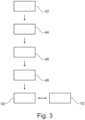
- Fig. 3 shows a method for extracting oxygen from powdered metal oxides through an electrolysis cell comprising a container, at least one cathode shaped as a receptacle having a porous shell with an upper opening, and at least one anode as described above.
- the method comprises providing 42 an oxygen ion conducting electrolyte powder into the container, such that the electrolyte surrounds the shell of the cathode at least partially, inserting 44 a conducting structure having a plurality of conducting elements and gaps between the conducting elements into the cathode, such that the conducting elements reach into a receiving space of the cathode, electrically connecting 46 the conducting structure to the cathode, providing 48 a feedstock comprising at least one metal oxide in powdered form into the upper opening of the at least one cathode, and applying 50 an electric potential across the cathode and the anode, the cathode being in communication with the electrolyte and the anode being in communication with the electrolyte and the feedstock, such that at least one respective metallic species of the at least one metal oxide is reduced at the cathode and oxygen is oxidized at the anode to form molecular oxygen.
- the potential across the cathode and the anode is greater than the dissociation potential of the at least one
Landscapes
- Chemical & Material Sciences (AREA)
- Engineering & Computer Science (AREA)
- Chemical Kinetics & Catalysis (AREA)
- Electrochemistry (AREA)
- Materials Engineering (AREA)
- Metallurgy (AREA)
- Organic Chemistry (AREA)
- Inorganic Chemistry (AREA)
- Ceramic Engineering (AREA)
- Electrolytic Production Of Non-Metals, Compounds, Apparatuses Therefor (AREA)
- Oxygen, Ozone, And Oxides In General (AREA)
- Electrolytic Production Of Metals (AREA)
Applications Claiming Priority (1)
| Application Number | Priority Date | Filing Date | Title |
|---|---|---|---|
| US17/509,431 US11987893B2 (en) | 2021-10-25 | 2021-10-25 | System and method for extracting oxygen from powdered metal oxides |
Publications (2)
| Publication Number | Publication Date |
|---|---|
| EP4170067A2 true EP4170067A2 (de) | 2023-04-26 |
| EP4170067A3 EP4170067A3 (de) | 2023-05-10 |
Family
ID=83898475
Family Applications (1)
| Application Number | Title | Priority Date | Filing Date |
|---|---|---|---|
| EP22201875.6A Pending EP4170067A3 (de) | 2021-10-25 | 2022-10-17 | System und verfahren zur extraktion von sauerstoff aus metallpulvern |
Country Status (2)
| Country | Link |
|---|---|
| US (1) | US11987893B2 (de) |
| EP (1) | EP4170067A3 (de) |
Cited By (1)
| Publication number | Priority date | Publication date | Assignee | Title |
|---|---|---|---|---|
| EP4549615A1 (de) | 2023-11-01 | 2025-05-07 | Airbus Defence and Space GmbH | Reaktorvorrichtung zur umwandlung von metalloxidpulvern und umwandlungssystem damit |
Families Citing this family (1)
| Publication number | Priority date | Publication date | Assignee | Title |
|---|---|---|---|---|
| US20240400450A1 (en) * | 2023-06-05 | 2024-12-05 | Hamed Niroumand | Method of production and use of a nano-regolith for preparing a construction material for extraterrestial purposes |
Citations (13)
| Publication number | Priority date | Publication date | Assignee | Title |
|---|---|---|---|---|
| US5976345A (en) | 1997-01-06 | 1999-11-02 | Boston University | Method and apparatus for metal extraction and sensor device related thereto |
| DE10156349A1 (de) | 2001-11-16 | 2003-05-28 | Ballard Power Systems | Vorrichtung zur Dosierung von Sauerstoff |
| US20090000955A1 (en) | 2005-07-15 | 2009-01-01 | Trustees Of Boston University | Oxygen-Producing Inert Anodes for Som Process |
| US8066861B1 (en) | 2008-02-14 | 2011-11-29 | The United States Of America As Represented By The Department Of Energy | Method for preparing metal powder, device for preparing metal powder, method for processing spent nuclear fuel |
| GB2534332A (en) | 2014-06-26 | 2016-07-27 | Metalysis Ltd | Method and apparatus for producing metallic tantalum by electrolytic reduction of a feedstock |
| EP2764137B1 (de) | 2011-10-04 | 2017-04-05 | Metalysis Limited | Elektrolytische herstellung von pulver |
| EP2935656B1 (de) | 2012-12-24 | 2017-08-09 | Metalysis Limited | Verfahren und vorrichtung zur metallherstellung durch elektrolytische reduktion |
| WO2017203245A1 (en) | 2016-05-24 | 2017-11-30 | Metalysis Limited | Manufacturing apparatus and method |
| EP2430216B1 (de) | 2009-05-12 | 2018-08-15 | Metalysis Limited | Vorrichtung und verfahren zur reduzierung eines festen rohstoffes |
| EP3161189B1 (de) | 2014-06-26 | 2018-08-22 | Metalysis Limited | Verfahren und vorrichtung zur elektrolytischen reduktion eines rohmaterials mit sauerstoff und einem ersten metall |
| EP2640871B1 (de) | 2010-11-18 | 2018-10-17 | Metalysis Limited | Verfahren und system zur elektrolytischen reduktion eines festen rohstoffes |
| EP2640872B1 (de) | 2010-11-18 | 2019-03-13 | Metalysis Limited | Elektrolysegerät |
| EP3812483A1 (de) | 2019-10-24 | 2021-04-28 | Airbus Defence and Space GmbH | Elektrolysevorrichtung zur elektrolytischen produktion von sauerstoff aus oxidhaltigem ausgangsmaterial |
Family Cites Families (6)
| Publication number | Priority date | Publication date | Assignee | Title |
|---|---|---|---|---|
| US6540902B1 (en) | 2001-09-05 | 2003-04-01 | The United States Of America As Represented By The United States Department Of Energy | Direct electrochemical reduction of metal-oxides |
| JP4511498B2 (ja) | 2006-07-04 | 2010-07-28 | 韓国原子力研究院 | キャパシター用タンタルまたはニオブ粉末の製造方法 |
| CN101302630B (zh) | 2008-01-17 | 2010-11-10 | 上海交通大学 | 固体氧化物电解槽制备金属的方法 |
| WO2009102419A2 (en) * | 2008-02-11 | 2009-08-20 | The University Of Alabama | Aluminum recovery process |
| US20160108532A1 (en) * | 2014-10-17 | 2016-04-21 | Infinium, Inc. | Method and apparatus for liquid metal electrode connection in production or refining of metals |
| CN108505070B (zh) | 2018-04-23 | 2019-07-16 | 东北大学 | 一种从月壤月岩中提取氧气和金属的方法 |
-
2021
- 2021-10-25 US US17/509,431 patent/US11987893B2/en active Active
-
2022
- 2022-10-17 EP EP22201875.6A patent/EP4170067A3/de active Pending
Patent Citations (14)
| Publication number | Priority date | Publication date | Assignee | Title |
|---|---|---|---|---|
| US5976345A (en) | 1997-01-06 | 1999-11-02 | Boston University | Method and apparatus for metal extraction and sensor device related thereto |
| US6299742B1 (en) | 1997-01-06 | 2001-10-09 | Trustees Of Boston University | Apparatus for metal extraction |
| DE10156349A1 (de) | 2001-11-16 | 2003-05-28 | Ballard Power Systems | Vorrichtung zur Dosierung von Sauerstoff |
| US20090000955A1 (en) | 2005-07-15 | 2009-01-01 | Trustees Of Boston University | Oxygen-Producing Inert Anodes for Som Process |
| US8066861B1 (en) | 2008-02-14 | 2011-11-29 | The United States Of America As Represented By The Department Of Energy | Method for preparing metal powder, device for preparing metal powder, method for processing spent nuclear fuel |
| EP2430216B1 (de) | 2009-05-12 | 2018-08-15 | Metalysis Limited | Vorrichtung und verfahren zur reduzierung eines festen rohstoffes |
| EP2640871B1 (de) | 2010-11-18 | 2018-10-17 | Metalysis Limited | Verfahren und system zur elektrolytischen reduktion eines festen rohstoffes |
| EP2640872B1 (de) | 2010-11-18 | 2019-03-13 | Metalysis Limited | Elektrolysegerät |
| EP2764137B1 (de) | 2011-10-04 | 2017-04-05 | Metalysis Limited | Elektrolytische herstellung von pulver |
| EP2935656B1 (de) | 2012-12-24 | 2017-08-09 | Metalysis Limited | Verfahren und vorrichtung zur metallherstellung durch elektrolytische reduktion |
| GB2534332A (en) | 2014-06-26 | 2016-07-27 | Metalysis Ltd | Method and apparatus for producing metallic tantalum by electrolytic reduction of a feedstock |
| EP3161189B1 (de) | 2014-06-26 | 2018-08-22 | Metalysis Limited | Verfahren und vorrichtung zur elektrolytischen reduktion eines rohmaterials mit sauerstoff und einem ersten metall |
| WO2017203245A1 (en) | 2016-05-24 | 2017-11-30 | Metalysis Limited | Manufacturing apparatus and method |
| EP3812483A1 (de) | 2019-10-24 | 2021-04-28 | Airbus Defence and Space GmbH | Elektrolysevorrichtung zur elektrolytischen produktion von sauerstoff aus oxidhaltigem ausgangsmaterial |
Cited By (1)
| Publication number | Priority date | Publication date | Assignee | Title |
|---|---|---|---|---|
| EP4549615A1 (de) | 2023-11-01 | 2025-05-07 | Airbus Defence and Space GmbH | Reaktorvorrichtung zur umwandlung von metalloxidpulvern und umwandlungssystem damit |
Also Published As
| Publication number | Publication date |
|---|---|
| US20230131327A1 (en) | 2023-04-27 |
| US11987893B2 (en) | 2024-05-21 |
| EP4170067A3 (de) | 2023-05-10 |
Similar Documents
| Publication | Publication Date | Title |
|---|---|---|
| EP4170067A2 (de) | System und verfahren zur extraktion von sauerstoff aus metallpulvern | |
| Fray | Emerging molten salt technologies for metals production | |
| KR100738124B1 (ko) | 고체화합물로부터 물질을 제거하는 방법 | |
| JP5203426B2 (ja) | 金属種の組成及び輸送特性の測定方法及び装置 | |
| US6540902B1 (en) | Direct electrochemical reduction of metal-oxides | |
| US5213908A (en) | Alkali metal carbon dioxide electrochemical system for energy storage and/or conversion of carbon dioxide to oxygen | |
| US6911134B2 (en) | Three-electrode metal oxide reduction cell | |
| KR20120024671A (ko) | 원소의 일차 생산 | |
| US4804448A (en) | Apparatus for simultaneous generation of alkali metal species and oxygen gas | |
| EP4170066B1 (de) | Verfahren und system zur extraktion von metall und sauerstoff aus metallpulvern | |
| US11479869B2 (en) | Electrolysis apparatus for the electrolytic production of oxygen from oxide-containing starting material | |
| US20220145484A1 (en) | An electrochemical method of reducing metal oxide | |
| WO2008046018A1 (en) | Magnesiothermic som process for production of metals | |
| US8658007B2 (en) | Oxygen-producing inert anodes for SOM process | |
| AU2006219725A1 (en) | Electrochemical method and apparatus for removing oxygen from a compound or metal | |
| Martin et al. | The electrochemical deoxidation of metal oxides by calcium using a solid oxide membrane | |
| US6214194B1 (en) | Process of manufacturing layers of oxygen ion conducting oxides | |
| EP4549615A1 (de) | Reaktorvorrichtung zur umwandlung von metalloxidpulvern und umwandlungssystem damit | |
| WO2011040979A1 (en) | Method and apparatus for producing magnesium with a solid oxide membrane elelctrolysis system | |
| EP4107295A1 (de) | Elektrolyse von geschmolzenem oxid basierend auf einer flüssigen anode/herstellung von sauerstoff durch elektrolyse von geschmolzenem oxid | |
| US20160032473A1 (en) | Electrochemical cell for recovery of metals from solid metal oxides | |
| Adrian et al. | Method and system for extractin metal and oxygen from powdered metal oxides (EP000004170066A2) | |
| EP1167558B1 (de) | Vorrichtung und Anlage zur elektrochemischen Raffination von Natriumschmelze | |
| McConohy et al. | A High Temperature Lithium Metal-Air Primary Battery Based on Solid Electrolytes and Molten Salt | |
| Pal | Oxygen-producing inert anodes for SOM process |
Legal Events
| Date | Code | Title | Description |
|---|---|---|---|
| PUAI | Public reference made under article 153(3) epc to a published international application that has entered the european phase |
Free format text: ORIGINAL CODE: 0009012 |
|
| STAA | Information on the status of an ep patent application or granted ep patent |
Free format text: STATUS: THE APPLICATION HAS BEEN PUBLISHED |
|
| PUAL | Search report despatched |
Free format text: ORIGINAL CODE: 0009013 |
|
| AK | Designated contracting states |
Kind code of ref document: A2 Designated state(s): AL AT BE BG CH CY CZ DE DK EE ES FI FR GB GR HR HU IE IS IT LI LT LU LV MC ME MK MT NL NO PL PT RO RS SE SI SK SM TR |
|
| AK | Designated contracting states |
Kind code of ref document: A3 Designated state(s): AL AT BE BG CH CY CZ DE DK EE ES FI FR GB GR HR HU IE IS IT LI LT LU LV MC ME MK MT NL NO PL PT RO RS SE SI SK SM TR |
|
| RIC1 | Information provided on ipc code assigned before grant |
Ipc: C25C 7/02 20060101ALI20230331BHEP Ipc: C25C 7/00 20060101ALI20230331BHEP Ipc: C25C 3/34 20060101ALI20230331BHEP Ipc: C25C 3/26 20060101ALI20230331BHEP Ipc: C25C 3/06 20060101ALI20230331BHEP Ipc: C25C 3/04 20060101ALI20230331BHEP Ipc: C25B 1/02 20060101AFI20230331BHEP |
|
| STAA | Information on the status of an ep patent application or granted ep patent |
Free format text: STATUS: REQUEST FOR EXAMINATION WAS MADE |
|
| 17P | Request for examination filed |
Effective date: 20231110 |
|
| RBV | Designated contracting states (corrected) |
Designated state(s): AL AT BE BG CH CY CZ DE DK EE ES FI FR GB GR HR HU IE IS IT LI LT LU LV MC ME MK MT NL NO PL PT RO RS SE SI SK SM TR |