EP4166766A1 - Längsgespülter grossdieselmotor - Google Patents
Längsgespülter grossdieselmotor Download PDFInfo
- Publication number
- EP4166766A1 EP4166766A1 EP21202858.3A EP21202858A EP4166766A1 EP 4166766 A1 EP4166766 A1 EP 4166766A1 EP 21202858 A EP21202858 A EP 21202858A EP 4166766 A1 EP4166766 A1 EP 4166766A1
- Authority
- EP
- European Patent Office
- Prior art keywords
- piston rod
- diesel engine
- large diesel
- piston
- engine according
- Prior art date
- Legal status (The legal status is an assumption and is not a legal conclusion. Google has not performed a legal analysis and makes no representation as to the accuracy of the status listed.)
- Withdrawn
Links
- 238000002485 combustion reaction Methods 0.000 claims abstract description 48
- 230000006835 compression Effects 0.000 claims abstract description 37
- 238000007906 compression Methods 0.000 claims abstract description 37
- 239000000446 fuel Substances 0.000 claims description 66
- 239000007788 liquid Substances 0.000 claims description 29
- 239000000463 material Substances 0.000 claims description 29
- 238000004519 manufacturing process Methods 0.000 claims description 8
- 238000007789 sealing Methods 0.000 claims description 6
- 239000007789 gas Substances 0.000 description 52
- 238000002347 injection Methods 0.000 description 13
- 239000007924 injection Substances 0.000 description 13
- 239000000203 mixture Substances 0.000 description 11
- 238000013461 design Methods 0.000 description 9
- 230000002000 scavenging effect Effects 0.000 description 9
- 239000000295 fuel oil Substances 0.000 description 6
- 238000000034 method Methods 0.000 description 6
- 230000008569 process Effects 0.000 description 6
- 230000008901 benefit Effects 0.000 description 5
- 238000012423 maintenance Methods 0.000 description 5
- 239000003921 oil Substances 0.000 description 5
- 239000002283 diesel fuel Substances 0.000 description 4
- 239000003949 liquefied natural gas Substances 0.000 description 4
- 239000003915 liquefied petroleum gas Substances 0.000 description 4
- VNWKTOKETHGBQD-UHFFFAOYSA-N methane Chemical compound C VNWKTOKETHGBQD-UHFFFAOYSA-N 0.000 description 4
- 238000005240 physical vapour deposition Methods 0.000 description 4
- OKKJLVBELUTLKV-UHFFFAOYSA-N Methanol Chemical compound OC OKKJLVBELUTLKV-UHFFFAOYSA-N 0.000 description 3
- 238000001816 cooling Methods 0.000 description 3
- VYZAMTAEIAYCRO-UHFFFAOYSA-N Chromium Chemical compound [Cr] VYZAMTAEIAYCRO-UHFFFAOYSA-N 0.000 description 2
- OTMSDBZUPAUEDD-UHFFFAOYSA-N Ethane Chemical compound CC OTMSDBZUPAUEDD-UHFFFAOYSA-N 0.000 description 2
- LFQSCWFLJHTTHZ-UHFFFAOYSA-N Ethanol Chemical compound CCO LFQSCWFLJHTTHZ-UHFFFAOYSA-N 0.000 description 2
- 229910000831 Steel Inorganic materials 0.000 description 2
- 238000000576 coating method Methods 0.000 description 2
- 239000000567 combustion gas Substances 0.000 description 2
- 239000000839 emulsion Substances 0.000 description 2
- 238000010438 heat treatment Methods 0.000 description 2
- 239000010763 heavy fuel oil Substances 0.000 description 2
- 238000003754 machining Methods 0.000 description 2
- 238000012544 monitoring process Methods 0.000 description 2
- 239000003345 natural gas Substances 0.000 description 2
- 238000012545 processing Methods 0.000 description 2
- 239000010959 steel Substances 0.000 description 2
- 239000000725 suspension Substances 0.000 description 2
- 230000007704 transition Effects 0.000 description 2
- 238000011282 treatment Methods 0.000 description 2
- 238000003466 welding Methods 0.000 description 2
- 150000001298 alcohols Chemical class 0.000 description 1
- 230000008859 change Effects 0.000 description 1
- 239000002817 coal dust Substances 0.000 description 1
- 239000011248 coating agent Substances 0.000 description 1
- 230000001419 dependent effect Effects 0.000 description 1
- 238000010892 electric spark Methods 0.000 description 1
- 239000012530 fluid Substances 0.000 description 1
- 238000000227 grinding Methods 0.000 description 1
- 229930195733 hydrocarbon Natural products 0.000 description 1
- 150000002430 hydrocarbons Chemical class 0.000 description 1
- 239000010687 lubricating oil Substances 0.000 description 1
- 238000005457 optimization Methods 0.000 description 1
- 230000000737 periodic effect Effects 0.000 description 1
- 239000003208 petroleum Substances 0.000 description 1
- 230000009467 reduction Effects 0.000 description 1
- 230000001105 regulatory effect Effects 0.000 description 1
- 238000004381 surface treatment Methods 0.000 description 1
- XLYOFNOQVPJJNP-UHFFFAOYSA-N water Substances O XLYOFNOQVPJJNP-UHFFFAOYSA-N 0.000 description 1
Images


Classifications
-
- F—MECHANICAL ENGINEERING; LIGHTING; HEATING; WEAPONS; BLASTING
- F02—COMBUSTION ENGINES; HOT-GAS OR COMBUSTION-PRODUCT ENGINE PLANTS
- F02B—INTERNAL-COMBUSTION PISTON ENGINES; COMBUSTION ENGINES IN GENERAL
- F02B25/00—Engines characterised by using fresh charge for scavenging cylinders
- F02B25/02—Engines characterised by using fresh charge for scavenging cylinders using unidirectional scavenging
-
- F—MECHANICAL ENGINEERING; LIGHTING; HEATING; WEAPONS; BLASTING
- F02—COMBUSTION ENGINES; HOT-GAS OR COMBUSTION-PRODUCT ENGINE PLANTS
- F02D—CONTROLLING COMBUSTION ENGINES
- F02D15/00—Varying compression ratio
- F02D15/02—Varying compression ratio by alteration or displacement of piston stroke
-
- F—MECHANICAL ENGINEERING; LIGHTING; HEATING; WEAPONS; BLASTING
- F02—COMBUSTION ENGINES; HOT-GAS OR COMBUSTION-PRODUCT ENGINE PLANTS
- F02B—INTERNAL-COMBUSTION PISTON ENGINES; COMBUSTION ENGINES IN GENERAL
- F02B25/00—Engines characterised by using fresh charge for scavenging cylinders
- F02B25/02—Engines characterised by using fresh charge for scavenging cylinders using unidirectional scavenging
- F02B25/04—Engines having ports both in cylinder head and in cylinder wall near bottom of piston stroke
-
- F—MECHANICAL ENGINEERING; LIGHTING; HEATING; WEAPONS; BLASTING
- F02—COMBUSTION ENGINES; HOT-GAS OR COMBUSTION-PRODUCT ENGINE PLANTS
- F02B—INTERNAL-COMBUSTION PISTON ENGINES; COMBUSTION ENGINES IN GENERAL
- F02B75/00—Other engines
- F02B75/02—Engines characterised by their cycles, e.g. six-stroke
-
- F—MECHANICAL ENGINEERING; LIGHTING; HEATING; WEAPONS; BLASTING
- F02—COMBUSTION ENGINES; HOT-GAS OR COMBUSTION-PRODUCT ENGINE PLANTS
- F02B—INTERNAL-COMBUSTION PISTON ENGINES; COMBUSTION ENGINES IN GENERAL
- F02B75/00—Other engines
- F02B75/04—Engines with variable distances between pistons at top dead-centre positions and cylinder heads
- F02B75/044—Engines with variable distances between pistons at top dead-centre positions and cylinder heads by means of an adjustable piston length
-
- F—MECHANICAL ENGINEERING; LIGHTING; HEATING; WEAPONS; BLASTING
- F02—COMBUSTION ENGINES; HOT-GAS OR COMBUSTION-PRODUCT ENGINE PLANTS
- F02B—INTERNAL-COMBUSTION PISTON ENGINES; COMBUSTION ENGINES IN GENERAL
- F02B75/00—Other engines
- F02B75/32—Engines characterised by connections between pistons and main shafts and not specific to preceding main groups
-
- F—MECHANICAL ENGINEERING; LIGHTING; HEATING; WEAPONS; BLASTING
- F02—COMBUSTION ENGINES; HOT-GAS OR COMBUSTION-PRODUCT ENGINE PLANTS
- F02D—CONTROLLING COMBUSTION ENGINES
- F02D15/00—Varying compression ratio
- F02D15/04—Varying compression ratio by alteration of volume of compression space without changing piston stroke
-
- F—MECHANICAL ENGINEERING; LIGHTING; HEATING; WEAPONS; BLASTING
- F02—COMBUSTION ENGINES; HOT-GAS OR COMBUSTION-PRODUCT ENGINE PLANTS
- F02D—CONTROLLING COMBUSTION ENGINES
- F02D19/00—Controlling engines characterised by their use of non-liquid fuels, pluralities of fuels, or non-fuel substances added to the combustible mixtures
- F02D19/06—Controlling engines characterised by their use of non-liquid fuels, pluralities of fuels, or non-fuel substances added to the combustible mixtures peculiar to engines working with pluralities of fuels, e.g. alternatively with light and heavy fuel oil, other than engines indifferent to the fuel consumed
- F02D19/08—Controlling engines characterised by their use of non-liquid fuels, pluralities of fuels, or non-fuel substances added to the combustible mixtures peculiar to engines working with pluralities of fuels, e.g. alternatively with light and heavy fuel oil, other than engines indifferent to the fuel consumed simultaneously using pluralities of fuels
-
- F—MECHANICAL ENGINEERING; LIGHTING; HEATING; WEAPONS; BLASTING
- F02—COMBUSTION ENGINES; HOT-GAS OR COMBUSTION-PRODUCT ENGINE PLANTS
- F02B—INTERNAL-COMBUSTION PISTON ENGINES; COMBUSTION ENGINES IN GENERAL
- F02B75/00—Other engines
- F02B75/02—Engines characterised by their cycles, e.g. six-stroke
- F02B2075/022—Engines characterised by their cycles, e.g. six-stroke having less than six strokes per cycle
- F02B2075/025—Engines characterised by their cycles, e.g. six-stroke having less than six strokes per cycle two
-
- F—MECHANICAL ENGINEERING; LIGHTING; HEATING; WEAPONS; BLASTING
- F02—COMBUSTION ENGINES; HOT-GAS OR COMBUSTION-PRODUCT ENGINE PLANTS
- F02B—INTERNAL-COMBUSTION PISTON ENGINES; COMBUSTION ENGINES IN GENERAL
- F02B75/00—Other engines
- F02B75/02—Engines characterised by their cycles, e.g. six-stroke
- F02B2075/022—Engines characterised by their cycles, e.g. six-stroke having less than six strokes per cycle
- F02B2075/027—Engines characterised by their cycles, e.g. six-stroke having less than six strokes per cycle four
-
- F—MECHANICAL ENGINEERING; LIGHTING; HEATING; WEAPONS; BLASTING
- F02—COMBUSTION ENGINES; HOT-GAS OR COMBUSTION-PRODUCT ENGINE PLANTS
- F02D—CONTROLLING COMBUSTION ENGINES
- F02D19/00—Controlling engines characterised by their use of non-liquid fuels, pluralities of fuels, or non-fuel substances added to the combustible mixtures
- F02D19/06—Controlling engines characterised by their use of non-liquid fuels, pluralities of fuels, or non-fuel substances added to the combustible mixtures peculiar to engines working with pluralities of fuels, e.g. alternatively with light and heavy fuel oil, other than engines indifferent to the fuel consumed
- F02D19/08—Controlling engines characterised by their use of non-liquid fuels, pluralities of fuels, or non-fuel substances added to the combustible mixtures peculiar to engines working with pluralities of fuels, e.g. alternatively with light and heavy fuel oil, other than engines indifferent to the fuel consumed simultaneously using pluralities of fuels
- F02D19/10—Controlling engines characterised by their use of non-liquid fuels, pluralities of fuels, or non-fuel substances added to the combustible mixtures peculiar to engines working with pluralities of fuels, e.g. alternatively with light and heavy fuel oil, other than engines indifferent to the fuel consumed simultaneously using pluralities of fuels peculiar to compression-ignition engines in which the main fuel is gaseous
-
- F—MECHANICAL ENGINEERING; LIGHTING; HEATING; WEAPONS; BLASTING
- F02—COMBUSTION ENGINES; HOT-GAS OR COMBUSTION-PRODUCT ENGINE PLANTS
- F02D—CONTROLLING COMBUSTION ENGINES
- F02D2400/00—Control systems adapted for specific engine types; Special features of engine control systems not otherwise provided for; Power supply, connectors or cabling for engine control systems
- F02D2400/04—Two-stroke combustion engines with electronic control
-
- Y—GENERAL TAGGING OF NEW TECHNOLOGICAL DEVELOPMENTS; GENERAL TAGGING OF CROSS-SECTIONAL TECHNOLOGIES SPANNING OVER SEVERAL SECTIONS OF THE IPC; TECHNICAL SUBJECTS COVERED BY FORMER USPC CROSS-REFERENCE ART COLLECTIONS [XRACs] AND DIGESTS
- Y02—TECHNOLOGIES OR APPLICATIONS FOR MITIGATION OR ADAPTATION AGAINST CLIMATE CHANGE
- Y02T—CLIMATE CHANGE MITIGATION TECHNOLOGIES RELATED TO TRANSPORTATION
- Y02T10/00—Road transport of goods or passengers
- Y02T10/10—Internal combustion engine [ICE] based vehicles
- Y02T10/30—Use of alternative fuels, e.g. biofuels
Definitions
- the invention relates to a large diesel engine according to the preamble of the independent patent claim.
- Large diesel engines are traditionally operated with heavy fuel oil.
- Large diesel engines which can be designed as two-stroke or four-stroke machines, for example as longitudinally scavenged two-stroke large diesel engines, are often used as drive units for ships or in stationary operation, e.g. to drive large generators to generate electrical energy.
- the motors usually run continuously for considerable periods of time, which places high demands on operational reliability and availability. Long maintenance intervals, low wear and economical use of operating materials are therefore key criteria for the operator.
- Large diesel engines typically have cylinders with an inside diameter (bore) of at least 200 mm.
- large diesel engines with a bore of up to 960 mm or even more are used.
- liquid fuels are used, ie fuels that are introduced into the combustion chamber in a liquid state as well as gaseous fuels, i.e. fuels that are introduced into the combustion chamber in a gaseous state.
- liquid fuels as known alternatives to heavy oil are other heavy hydrocarbons, which remain in particular as residues in petroleum refineries, alcohols, in particular methanol or ethanol, petrol, diesel, or else emulsions or suspensions. It is e.g. For example, it is known to use emulsions referred to as MSAR (Multiphase Superfine Atomized Residue) as fuel.
- MSAR Multiphase Superfine Atomized Residue
- a well-known suspension is that of coal dust and water, which is also used as a fuel for large engines.
- Natural gases such as LNG (liquefied natural gas), liquid gases such as LPG (liquefied petroleum gas) or ethane are known as gaseous fuels.
- such large diesel engines are also known which can be operated with at least two different fuels, the engine being operated with either one fuel or the other fuel, depending on the operating situation or the environment.
- An example of a large diesel engine that can be operated with two different fuels is a large diesel engine that is designed as a dual-fuel large diesel engine. This is operable in a liquid mode in which a liquid fuel is introduced into the cylinder for combustion, and in a gas mode in which a gas is introduced into the cylinder as fuel.
- large diesel engine refers to engines that can be operated at least in diesel mode.
- large diesel engine also includes such large dual-fuel engines that can be operated in another mode, for example Otto mode, in addition to diesel mode.
- gas mode or “operation in gas mode” means that only the gas or gaseous fuel for the torque-generating combustion is used as fuel.
- a small amount of a self-igniting liquid fuel such as B. heavy oil, is injected to perform the spark ignition, but still the combustion process that produces the torque is entirely gas or gaseous fuel driven.
- pilot injection This spark ignition process by self-igniting a small amount of liquid fuel is sometimes referred to as pilot injection.
- This pilot injection has nothing to do with the injection of liquid fuel into the combustion chamber when the large engine is operated in liquid mode.
- a different injection device is usually used for the pilot injection than for injecting the liquid fuel in liquid mode.
- the small amount of liquid fuel is often not injected directly into the combustion chamber, but rather into at least one antechamber, which is connected to the combustion chamber via a duct.
- the gas inlet opening(s) are arranged at such a height between the lower reversal point and the upper reversal point of the piston movement that the gas can be introduced into the cylinder during the upward movement of the piston as long as no or at least no significant compression has taken place in the cylinder .
- Large diesel engines are usually designed in such a way that the compression ratio is optimized at the 100% load point, i.e. at full load, and the large diesel engine has the best possible compromise between combustion behavior and efficiency there, i.e. the large diesel engines are designed in such a way that they have the highest possible thermodynamic efficiency at the 100% load point, i.e. at full load and maximum speed.
- the compression ratio is a geometric variable which is the ratio of a first volume of the combustion chamber before the compression of the air-fuel mixture to a remaining second volume of the combustion chamber after compression of the air-fuel mixture.
- the optimization of the combustion behavior at the 100% load point means that the efficiency of the large diesel engine is no longer optimal in lower load ranges, for example at a lower mean pressure.
- VCR Variable Compression Ratio
- a large diesel engine is proposed, with at least one cylinder, which has a combustion chamber that is delimited by a piston, which is arranged such that it can be moved back and forth along a cylinder axis, and with a rotatable crankshaft, the piston being connected to a crosshead via a piston rod which has a crosshead journal, the crosshead being connected to the crankshaft via a connecting rod, the piston rod being arranged in the crosshead journal, and a control device being provided for setting a compression ratio, with which the piston rod is moved relative to the crosshead journal in the direction of the cylinder axis is movable.
- the piston rod comprises a lower part and an upper part, the lower part being arranged in the crosshead pin, the upper part connecting the piston to the lower part, and the lower part and the upper part being detachably connected to each other.
- This configuration of the piston rod with a lower part and with an upper part represents a particularly advantageous and economical embodiment with which the compression ratio in the cylinder can be changed.
- the lower part of the piston rod which is arranged in the crosshead pin and is exposed to very high loads during operation, can be manufactured from a higher-quality material and/or with greater precision than the upper part of the piston rod, which is made from a less expensive material and/or can be manufactured with lower precision requirements.
- the configuration also has advantages with regard to maintenance or service work. If, for example, the piston and the piston rod are to be removed from the cylinder as part of maintenance work, the lower part of the piston rod can remain in the crosshead pin in the configuration according to the invention, while the piston together with the upper part of the piston rod are removed from the cylinder is pulled out. Thus, the lower part, which remains in the crosshead, is much better protected.
- the configuration of the piston rod with the lower and the upper part is also very advantageous with regard to production. Machining the lower part is much easier. Bores in the lower part, which are required, for example, for supplying and removing cooling oil that is routed through the piston rod to the piston in the operating state, can be made much more simply, namely directly from the upper side of the lower part. It is no longer necessary to carry out such productions from the upper end, that is to say from the end of the piston rod which is connected to the piston.
- the overall machining of the lower part is much easier because it can be manufactured separately from the rest of the piston rod.
- the lower part which must be fitted into the crosshead pin of the crosshead, usually requires a significantly higher level of precision, which can be achieved much more easily if the lower part is manufactured separately.
- Other processing steps on the lower part such as grinding operations, surface treatments, e.g. B. surface hardening, surface coatings, e.g. with chrome, using PVD (PVD: Physical Vapor Deposition), using build-up welding or heat treatments are much easier to carry out because the lower part can be manufactured and machined separately from the rest of the piston rod.
- PVD Physical Vapor Deposition
- the lower part of the piston rod is designed as a hydraulic piston which delimits a hydraulic chamber which is arranged in the crosshead pin.
- the control device for setting the compression ratio is then designed as a hydraulic device.
- a hydraulic medium for example an oil
- the piston rod can be moved relative to the lower part designed as a hydraulic piston Crosshead pins are shifted in the direction of the cylinder axis, so that the minimum volume of the combustion chamber is reduced.
- the piston rod can be lowered relative to the crosshead pin, so that the minimum volume of the combustion chamber is increased.
- the lower part of the piston rod is designed as a hydraulic piston
- the high requirement for the precise design of the hydraulic piston can thus be achieved much more easily.
- the lower part is made of a first material and the upper part is made of a second material, the first material being different from the second material.
- the first material is preferably a material with high strength that can withstand the strong mechanical stresses, especially when the lower part is provided with the bores for example cooling oil, lubricating oil or other fluids.
- the second material is preferably a less expensive material, for example steel, as a result of which the production costs can be reduced.
- the first material is the same material as the second material, i.e. the lower part and the upper part of the piston rod consist of the same material.
- the lower part has a first length in the direction of the cylinder axis
- the upper part has a second length in the direction of the cylinder axis, the second length being at least three times, preferably at least five times, the first length is.
- the boundary between the lower part and the upper part of the piston rod is preferably arranged such that the lower part of the piston rod is always located below a sealing arrangement which seals the passage of the piston rod into the cylinder during operation of the large diesel engine.
- the passage of the piston rod into the cylinder in a large diesel engine is usually sealed by means of a stuffing box. Then the boundary between the lower and the upper part of the piston rod is arranged in such a way that this boundary does not move through the stuffing box, but always remains below the stuffing box during the working movement of the piston.
- the lower part of the piston rod has an upper end connected to a lower end of the upper part of the piston rod.
- the upper end of the lower part of the piston rod has a larger outside diameter than the lower end of the upper part of the piston rod.
- the upper end of the lower part of the piston rod has the same outside diameter as the lower end of the upper part of the piston rod.
- the upper end of the lower part of the piston rod has a recess which accommodates the lower end of the upper part of the piston rod.
- the upper end of the lower part of the piston rod completely surrounds the lower end of the upper part.
- the lower end of the upper part of the piston rod has a seat which receives the upper end of the lower part of the piston rod.
- the lower end of the upper part of the piston rod completely surrounds the upper end of the lower part.
- the production of the lower part preferably includes surface hardening.
- the large diesel engine is preferably designed as a longitudinally scavenged two-stroke large diesel engine.
- the large diesel engine is particularly preferably designed as a dual-fuel large diesel engine which can be operated in a liquid mode, in which a liquid fuel is introduced into the combustion chamber for combustion, and which can also be operated in a gas mode, in which a gas for combustion is introduced into the combustion chamber is introduced.
- large diesel engine means such engines as are usually used as the main propulsion units for ships or in stationary operation, e.g. for driving large generators for generating electrical energy.
- the cylinders of a large diesel engine each have an inside diameter (bore) of at least about 200 mm.
- longitudinally scavenged means that the scavenging or charge air is introduced into the cylinder in the region of the lower end. The combustion residues, in particular the exhaust gases, are discharged at the upper end of the cylinder.
- a large diesel engine that is designed as a dual-fuel large diesel engine, ie as an engine that can be operated with two different fuels.
- the dual-fuel large diesel engine can be operated in a liquid mode in which only a liquid fuel is injected into a combustion chamber of a cylinder.
- the liquid fuel for example heavy oil or diesel oil, is usually injected directly into the combustion chamber at a suitable time and ignites there according to the diesel principle of self-ignition.
- the Large diesel engines can also be operated in a gas mode in which a gas serving as a fuel, for example a natural gas such as LNG (Liquefied Natural Gas) or LPG (Liquefied Petroleum Gas) or ethane, is spark-ignited in the combustion chamber in the form of a premixed air-fuel mixture is burned.
- a gas serving as a fuel for example a natural gas such as LNG (Liquefied Natural Gas) or LPG (Liquefied Petroleum Gas) or ethane, is spark-ignited in the combustion chamber in the form of a premixed air-fuel mixture is burned.
- gas mode or “operation in gas mode” in the context of this application is to be understood in such a way that the large diesel engine is operated in this gas mode only with gas or with a gaseous fuel, with optionally a small amount of a self-igniting fuel, e.g. heavy oil or diesel oil, is only introduced into the combustion chamber or one or more pre-chambers for the purpose of external ignition of the air-gas mixture (pilot injection).
- a self-igniting fuel e.g. heavy oil or diesel oil
- the large diesel engine works in gas mode according to a low-pressure process, i.e. the gas is introduced into the cylinder in the gaseous state, with the injection pressure at which the gas is introduced into the cylinder being at most 50 bar and preferably at most 20 bar.
- the air-gas mixture is ignited in the combustion chamber according to the Otto principle.
- This spark ignition is preferably brought about by introducing a small amount of self-igniting liquid fuel (e.g. diesel or heavy oil) into the combustion chamber or into an antechamber or several antechambers at a suitable moment, which then ignites itself and thereby the spark ignition of the air-fuel mixture in the combustion chamber.
- a small amount of self-igniting liquid fuel e.g. diesel or heavy oil
- a large diesel engine which is designed as a longitudinally scavenged dual-fuel two-stroke large diesel engine with a crosshead drive.
- the invention is not limited to dual-fuel large diesel engines, but relates to any type of large diesel engine, ie large engines that can be operated at least in diesel mode.
- 1 1 shows, in a highly schematic representation, an exemplary embodiment of a large diesel engine according to the invention, which is denoted overall by the reference symbol 1. In 1 only one cylinder 2 of the usually several cylinders 2 of the large diesel engine 1 is shown.
- a piston 3 is arranged in a manner known per se, which is arranged to be movable back and forth along a cylinder axis A between a lower reversal point and an upper reversal point. 1 shows the piston 3 at the upper turning point of its periodic movement.
- the piston 3 has an upper side 31 which, together with a cylinder cover 21, delimits a combustion chamber 4 in which the combustion process takes place.
- the piston 3 is connected via a piston rod 6 to a crosshead 7, which is connected via a connecting rod 8 to a crankshaft 9, so that the movement of the piston 3 via the piston rod 6, the crosshead 7 and the Push rod 8 is transmitted to the crankshaft 9 in order to rotate it.
- the crosshead 7 is designed in a manner known per se in such a way that it converts the linear up and down movement of the piston 3 and the piston rod 6 into a rotational movement of the push rod 8, the push rod 8 being pivotably mounted about a crosshead pin 71 of the crosshead 7.
- Seal assembly 22 preferably includes a stuffing box.
- the turbocharger system (not shown) for providing the scavenging or charging air and the monitoring and control system (not shown) for such a large diesel engine 1 are well known to those skilled in the art both for the design as a two-stroke engine and for the design as a four-stroke engine and require them therefore no further explanation here.
- the gas supply system for the gas mode usually comprises two gas inlet openings (not shown) through which the gas serving as fuel is introduced into the cylinder 2 in the gas mode.
- the two gas inlet openings are preferably arranged in the wall of the cylinder 2, particularly preferably in such a way that they are diametrically opposite one another and are arranged approximately in the middle between the upper and lower reversal point with respect to the axial direction defined by the cylinder axis A.
- the monitoring and control system is an electronic system with which all engine or cylinder functions, in particular the injection (start and end of injection) both in gas mode and in liquid mode, and the actuation of the exhaust valve 5 are usually set or controlled or let it be regulated.
- scavenging air slots are usually provided in the lower area of each cylinder 2 or cylinder liner, which are periodically closed and opened by the movement of the piston 3 in the cylinder 2, so that a turbocharger Scavenging air provided under a charge air pressure in an intake receiver (not shown) can flow through the scavenging air slots into the cylinder 2 as long as they are open.
- the mostly centrally located outlet valve 5 is provided, through which the Combustion gases can be discharged from the cylinder 2 into the exhaust system (not shown) after the combustion process.
- the exhaust system directs at least part of the combustion gases to a turbine (not shown) of the turbocharger, the compressor of which provides the charge air in the intake receiver at the charge air pressure.
- One or more fuel injection nozzles are provided for introducing the liquid fuel into the combustion chamber 4 of the cylinder 2 in the liquid mode and are arranged, for example, in the cylinder cover 21 in the vicinity of the outlet valve 5 .
- the liquid mode for example, heavy oil or a diesel oil can be burned as the liquid fuel.
- a gas supply system known per se which comprises the gas inlet openings (not shown).
- the gas inlet openings are preferably each designed as a gas inlet valve with a gas inlet nozzle.
- the piston rod 6 is arranged in the crosshead pin 71 with its lower end according to the illustration.
- a control device 10 for setting a compression ratio is also provided.
- the compression ratio is a geometric variable which is the ratio of a first volume of combustion chamber 4 before the scavenging air or the air-fuel mixture is compressed to a remaining second volume of combustion chamber 4 after the scavenging air or air-fuel mixture has been compressed.
- the first volume is the volume of the combustion chamber 4 immediately after the exhaust valve 5 closes, ie at the point in time when compression begins as the piston 3 moves upwards.
- the second volume is the volume of the combustion chamber 4 at maximum compression of the scavenging air or the air/fuel mixture. This is essentially the volume of the combustion chamber 4 at the start of the combustion process.
- Control devices 10 for changing the compression ratio are known from the prior art, for example from that already mentioned EP-A-2 687 707 and therefore do not need any further explanation here.
- the control device 10 for setting the compression ratio is designed such that the piston rod 6 arranged in the crosshead pin 71 can be displaced overall relative to the crosshead pin 71 in the direction of the cylinder axis A.
- the piston rod 6 and thus also the piston 3 can be moved relative to the crosshead pin 71 up or down. If the piston rod 6 is pushed upwards as shown, the second volume, ie the volume at maximum compression, is thereby reduced, as a result of which the compression ratio increases. If the piston rod 6 is pushed downwards as shown, the second volume, ie the volume at maximum compression, is thereby increased, as a result of which the compression ratio is reduced.
- the large diesel engine 1 can be operated in gas mode with a lower compression ratio than in liquid mode.
- the compression ratio optimally as a function of other operating conditions or operating parameters, for example as a function of the temperature of the scavenging air (charge air), the methane number of the gas that is used as fuel in gas mode, or as a function of other operating parameters.
- the piston rod comprises a lower part 61 and an upper part 62, the lower part 61 being arranged in the crosshead pin 71, and the upper part 62 connecting the piston 3 to the lower part 61.
- the lower part 61 and the upper part 62 of the piston rod 6 are detachably connected to one another, preferably by means of a plurality of bolts (not shown), which implement a screw connection between the upper part 61 and the lower part 62, so that the upper part 61 and the lower part 62 are firmly but releasably connected to one another.
- each bolt can engage in a thread which is provided in the lower part 61 or in the upper part 62 .
- the lower part 61 of the piston rod 6 is designed as a hydraulic piston which delimits a hydraulic chamber 11 of the control device 10 .
- the hydraulic chamber 11 is provided in the crosshead pin 71 .
- supply and discharge lines (not shown) are provided with valves or shut-off devices, through which a hydraulic medium, for example an oil, can be introduced into the hydraulic chamber 11 or discharged from the hydraulic chamber 11 .
- hydraulic medium is introduced into the hydraulic chamber 11 in order to increase the pressure in the hydraulic chamber 11 .
- This pressure increase in the hydraulic chamber 11 causes an upward force, as shown, to act on the lower part 61 of the piston rod 6 designed as a hydraulic piston, whereby the piston rod 6 and the piston 3 firmly connected to it are moved upwards.
- hydraulic medium is drained from the hydraulic chamber 11 in order to reduce the pressure in the hydraulic chamber 11 .
- This reduction in pressure in the hydraulic chamber 11 moves the Piston rod downwards due to the weight force as shown in the illustration, which reduces the compression ratio.
- the compression ratio can be changed or adjusted hydraulically and steplessly.
- the configuration of the piston rod 6 with the lower part 61 and the upper part 62, which are detachably connected to one another, has the particular advantage that the lower part 61 and the upper part 62 can each be produced separately from one another. This makes it possible in a simple manner to manufacture the lower part 61 from a first material and the upper part from a second material which is different from the first material.
- a high-quality material with very good mechanical properties such as high tensile strength, great hardness, elasticity, etc. can be selected for the lower part 61, which is exposed to significantly higher mechanical loads in the operating state than the upper part 62, while for the less stressed part upper part 62, a more cost-effective material, such as steel, can be selected.
- the lower part 61 it is also easily possible to subject the lower part 61 to additional treatment processes, for example surface hardening, e.g. B. by means of a laser, or a heat treatment to improve the mechanical properties. It is also possible, in particular, to provide the lower part 61 with a surface coating, for example with chrome, or with a PVD process or with build-up welding.
- additional treatment processes for example surface hardening, e.g. B. by means of a laser, or a heat treatment to improve the mechanical properties.
- a surface coating for example with chrome, or with a PVD process or with build-up welding.
- the lower part 61 is much easier to process the lower part 61 as a separate component with high precision, for example to grind it. This is also an essential aspect in particular when the lower part 1 is designed as a hydraulic piston, which requires a very precise fitting into the hydraulic chamber 11 .
- bores can be made in the lower part 61 in a very simple manner, which are used to supply and discharge cooling oil into and out of the interior(s) of the piston rod 6 .
- the configuration of the piston rod with the lower part 61 and the upper part 62 is also particularly advantageous for maintenance work.
- the connection between the upper part 62 and the lower part 61 can be released.
- the piston 3 can then be removed from the cylinder 2 together with the upper part 62 of the piston rod 6, while the lower part 61 remains in the crosshead pin 71 and is protected there. This is a very great advantage, particularly when the lower part 61 is designed as a hydraulic piston.
- the lower part 61 of the piston rod 6 is preferably designed to be significantly shorter than the upper part 62 of the piston rod 6, because the lower part 61 interacts with the crosshead pin 71 and therefore usually requires greater precision during manufacture and/or consists of a higher-quality material than the upper part 62 of the piston rod 6.
- the lower part 61 has a first length L1 ( 2 ) and the upper part 62 has a second length L2 in the direction of the cylinder axis A.
- the second length L2 is preferably at least three times, preferably at least five times, the first length L1.
- the lower part 61 is particularly preferably designed with respect to its first length L1 such that the lower part 61 of the piston rod 6 is always located below the sealing arrangement 22 during operation of the large diesel engine, which seals the passage of the piston rod 6 into the cylinder 2. This makes it possible to avoid that the parting surface or the parting area where the first part 61 and the upper part 62 meet runs through the sealing arrangement 22 or into the sealing arrangement 22
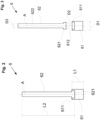
- FIG. 2 shows a schematic sectional view of an embodiment of the piston rod 6, which is the same design that is also shown in 1 is shown.
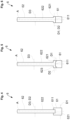
- 3 shows 3 the embodiment 2 again, but with the lower part 61 shown separated from the upper part 62.
- the lower part 61 is designed essentially in the form of a circular cylinder and has an upper end 611 with which the lower part 61 adjoins the upper part 62 .
- the upper part 62 comprises a circular-cylindrical rod 622 and a lower end 621 which adjoins the rod 622 at the end face of the rod 622 facing the lower part 61 .
- the upper part 62 adjoins the lower part 61 with the lower end 621 .
- the lower end 621 of the upper part 62 is also designed in the shape of a circular cylinder and has an outer diameter D2 which is larger than the outer diameter D3 of the rod 622 of the upper part 62, so that the lower end 621 is designed as a kind of foot of the upper part 62.
- the upper end 611 of the lower part 61 of the piston rod 6 has an outer diameter D1 which is larger than the outer diameter D2 of the lower end 621 of the upper part 62.
- the upper end 611 of the lower part 61 has a centrally located recess 612 configured to receive the lower end 621 of the upper part 62 .
- the inner diameter of the recess 612 preferably corresponds to the outer diameter D2 of the lower end 621 of the upper part 62, except for a necessary fit, for example a clearance fit or a transition fit.
- the upper end 611 of the lower part 61 encloses the lower end 621 of the upper part 62.
- the lower end 621 of the upper part 62 has a centrally located receptacle 623 which is configured in such a way that it can receive the upper end 611 of the lower part 61 .
- the upper end 611 of the lower part 61 has the outer diameter D1 which is smaller than the outer diameter of the rest of the lower part 61 such that the upper end 611 forms a projection.
- the inner diameter of the receptacle 623 preferably corresponds to the outer diameter D1 of the upper end 611 of the lower part 61, except for a necessary fit, for example a clearance fit or a transition fit.
- the lower end 621 of the upper part 62 encloses the upper end 611 of the lower part 61.
- the outer diameter D2 of the lower end 621 of the upper part 62 is larger than the outer diameter D3 of the rod 622 of the upper part 62 and equal to the outer diameter D1 of the upper end 611 of the lower part 61 of the piston rod 6.
- the outer diameter D2 of the lower end 621 of the upper part 62 is the same size as the outer diameter D3 of the rod 622 of the upper part 62 and smaller than the outer diameter D1 of the upper end 611 of the lower part 61 of the piston rod 6.
- the outside diameter D2 of the lower end 621 of the upper part 62 is the same as the outside diameter D3 of the rod 622 of the upper part 62 and the same size as the outside diameter D1 of the upper end 611 of the lower part 61 of the piston rod 6.
- the outer diameter D2 of the lower end 621 of the upper part 62 is the same size as the outer diameter D3 of the rod 622 of the upper part 62 and larger than the outer diameter D1 of the upper end 611 of the lower part 61 of the piston rod 6.
Landscapes
- Engineering & Computer Science (AREA)
- Chemical & Material Sciences (AREA)
- Combustion & Propulsion (AREA)
- Mechanical Engineering (AREA)
- General Engineering & Computer Science (AREA)
- Oil, Petroleum & Natural Gas (AREA)
- Output Control And Ontrol Of Special Type Engine (AREA)
Priority Applications (4)
| Application Number | Priority Date | Filing Date | Title |
|---|---|---|---|
| EP21202858.3A EP4166766A1 (de) | 2021-10-15 | 2021-10-15 | Längsgespülter grossdieselmotor |
| CN202211126069.XA CN115977788A (zh) | 2021-10-15 | 2022-09-16 | 纵向扫气式大型柴油发动机 |
| KR1020220122991A KR20230054268A (ko) | 2021-10-15 | 2022-09-28 | 종방향으로 소기되는 대형 디젤 엔진 |
| JP2022157774A JP2023059836A (ja) | 2021-10-15 | 2022-09-30 | 長手方向掃気式大型ディーゼル・エンジン |
Applications Claiming Priority (1)
| Application Number | Priority Date | Filing Date | Title |
|---|---|---|---|
| EP21202858.3A EP4166766A1 (de) | 2021-10-15 | 2021-10-15 | Längsgespülter grossdieselmotor |
Publications (1)
| Publication Number | Publication Date |
|---|---|
| EP4166766A1 true EP4166766A1 (de) | 2023-04-19 |
Family
ID=78483114
Family Applications (1)
| Application Number | Title | Priority Date | Filing Date |
|---|---|---|---|
| EP21202858.3A Withdrawn EP4166766A1 (de) | 2021-10-15 | 2021-10-15 | Längsgespülter grossdieselmotor |
Country Status (4)
| Country | Link |
|---|---|
| EP (1) | EP4166766A1 (enExample) |
| JP (1) | JP2023059836A (enExample) |
| KR (1) | KR20230054268A (enExample) |
| CN (1) | CN115977788A (enExample) |
Citations (5)
| Publication number | Priority date | Publication date | Assignee | Title |
|---|---|---|---|---|
| DE3516506A1 (de) * | 1985-05-08 | 1986-11-13 | M.A.N.- B & W Diesel GmbH, 8900 Augsburg | Mehrteiliges pleuel fuer einen grossdieselmotor |
| DE19712090C1 (de) * | 1997-03-22 | 1998-04-02 | Man B & W Diesel Gmbh | Hubkolbenbrennkraftmaschine |
| EP0851101B1 (de) * | 1996-12-24 | 2002-07-10 | Wärtsilä Schweiz AG | Dieselmotor |
| EP2503116A1 (de) * | 2011-03-23 | 2012-09-26 | Wärtsilä Schweiz AG | Zylinderanordnung, sowie Kolben für eine längsgespülte Hubkolbenbrennkraftmaschine |
| EP2687707A2 (en) | 2012-07-17 | 2014-01-22 | Wärtsilä Schweiz AG | A large reciprocating piston combustion engine, a control apparatus and a method for controlling such an engine |
-
2021
- 2021-10-15 EP EP21202858.3A patent/EP4166766A1/de not_active Withdrawn
-
2022
- 2022-09-16 CN CN202211126069.XA patent/CN115977788A/zh active Pending
- 2022-09-28 KR KR1020220122991A patent/KR20230054268A/ko active Pending
- 2022-09-30 JP JP2022157774A patent/JP2023059836A/ja active Pending
Patent Citations (5)
| Publication number | Priority date | Publication date | Assignee | Title |
|---|---|---|---|---|
| DE3516506A1 (de) * | 1985-05-08 | 1986-11-13 | M.A.N.- B & W Diesel GmbH, 8900 Augsburg | Mehrteiliges pleuel fuer einen grossdieselmotor |
| EP0851101B1 (de) * | 1996-12-24 | 2002-07-10 | Wärtsilä Schweiz AG | Dieselmotor |
| DE19712090C1 (de) * | 1997-03-22 | 1998-04-02 | Man B & W Diesel Gmbh | Hubkolbenbrennkraftmaschine |
| EP2503116A1 (de) * | 2011-03-23 | 2012-09-26 | Wärtsilä Schweiz AG | Zylinderanordnung, sowie Kolben für eine längsgespülte Hubkolbenbrennkraftmaschine |
| EP2687707A2 (en) | 2012-07-17 | 2014-01-22 | Wärtsilä Schweiz AG | A large reciprocating piston combustion engine, a control apparatus and a method for controlling such an engine |
Also Published As
| Publication number | Publication date |
|---|---|
| CN115977788A (zh) | 2023-04-18 |
| KR20230054268A (ko) | 2023-04-24 |
| JP2023059836A (ja) | 2023-04-27 |
Similar Documents
| Publication | Publication Date | Title |
|---|---|---|
| DE69200519T2 (de) | Kraftstoffeinspritzventil und mit diesem ausgestatteter Motor. | |
| EP0546985A1 (de) | Brennstoffeinspritzventil für eine Hubkolbenbrennkraftmaschine für wahlweisen Betrieb mit Dieselöl oder mit einem gasförmigen Brennstoff | |
| DE112020000519T5 (de) | Kombinierte mehrzylindrige hochdruckölpumpe für einen langsam laufenden schiffsmotor | |
| DE69013283T2 (de) | Hochdruck-Kraftstoffeinspritzeinheit mit Steuerung des Druckes der Kammer für den Spritzzeitpunkt. | |
| CH681647A5 (enExample) | ||
| EP3951160B1 (de) | Brennstoffeinspritzventil und brennstoffeinspritzverfahren für einen grossdieselmotor, sowie grossdieselmotor | |
| EP3786498A1 (de) | Absperrventil für eine doppelwandige leitung, gaszuführsystem und grossmotor | |
| EP3574204B1 (de) | Verbrennungskraftmaschine mit kraftstoff-einspritzdüse mit zusätzlicher zuführung eines verbrennungsfördernden mediums in den brennraum | |
| DE2644389A1 (de) | Aufgeladene rotationskolben-brennkraftmaschine | |
| EP3862611A1 (de) | Flanschverbindung zum verbinden zweier doppelwandige leitungsteile, gasversorgungssystem und grossmotor | |
| DE19833692C2 (de) | Injektoreinheit mit Zeitsteuerplungerkolben mit festem Anschlag | |
| DE102008038076A1 (de) | Kolben für einen Hubkolbenmotor mit verstellbarem Verdichtungsverhältnis | |
| EP4166766A1 (de) | Längsgespülter grossdieselmotor | |
| EP3147477B1 (de) | Gaszuführsystem und zylinderliner für eine hubkolbenbrennkraftmaschine, hubkolbenbrennkraftmaschine, sowie verfahren zum betreiben einer hubkolbenbrennkraftmaschine | |
| DE3012022A1 (de) | Verbrennungs-kolbenkraftmaschine | |
| DE19602474B4 (de) | Einspritzzeitpunkt-Steuervorrichtung für eine Kraftstoffeinspritzpumpe | |
| EP3798413A1 (de) | Steuerventil für einen dampfmotor, ein das steuerventil aufweisender dampfmotor sowie eine den dampfmotor aufweisende kraft-wärme-kopplungsanlage | |
| DE20220664U1 (de) | Motor mit separatem Kolbenboden | |
| EP3564642A1 (de) | Vorrichtung zur bestimmung des drucks in einem brennraum eines grossmotors sowie grossmotor | |
| EP3751123A1 (de) | Zylinderdeckel für einen zylinder eines grossdieselmotors und verfahren zum reparieren eines zylinderdeckels | |
| EP4019751B1 (de) | Verfahren zum betreiben eines grossdieselmotors, sowie grossdieselmotor | |
| EP4453401A1 (de) | Kolben, kurbeltrieb sowie hubkolben-verbrennungsmotor | |
| DE3921581A1 (de) | Verbrennungsmotor | |
| DE19527719A1 (de) | Kraftstoffeinspritzsystem | |
| CH712921A2 (de) | Längsgespülter Grossmotor. |
Legal Events
| Date | Code | Title | Description |
|---|---|---|---|
| PUAI | Public reference made under article 153(3) epc to a published international application that has entered the european phase |
Free format text: ORIGINAL CODE: 0009012 |
|
| STAA | Information on the status of an ep patent application or granted ep patent |
Free format text: STATUS: THE APPLICATION HAS BEEN PUBLISHED |
|
| AK | Designated contracting states |
Kind code of ref document: A1 Designated state(s): AL AT BE BG CH CY CZ DE DK EE ES FI FR GB GR HR HU IE IS IT LI LT LU LV MC MK MT NL NO PL PT RO RS SE SI SK SM TR |
|
| STAA | Information on the status of an ep patent application or granted ep patent |
Free format text: STATUS: THE APPLICATION IS DEEMED TO BE WITHDRAWN |
|
| 18D | Application deemed to be withdrawn |
Effective date: 20231020 |