EP4162153B1 - Pre-combustion chamber assembly - Google Patents
Pre-combustion chamber assembly Download PDFInfo
- Publication number
- EP4162153B1 EP4162153B1 EP21729407.3A EP21729407A EP4162153B1 EP 4162153 B1 EP4162153 B1 EP 4162153B1 EP 21729407 A EP21729407 A EP 21729407A EP 4162153 B1 EP4162153 B1 EP 4162153B1
- Authority
- EP
- European Patent Office
- Prior art keywords
- carrier
- tip
- combustion chamber
- chamber assembly
- longitudinal axis
- Prior art date
- Legal status (The legal status is an assumption and is not a legal conclusion. Google has not performed a legal analysis and makes no representation as to the accuracy of the status listed.)
- Active
Links
Images


Classifications
-
- F—MECHANICAL ENGINEERING; LIGHTING; HEATING; WEAPONS; BLASTING
- F02—COMBUSTION ENGINES; HOT-GAS OR COMBUSTION-PRODUCT ENGINE PLANTS
- F02B—INTERNAL-COMBUSTION PISTON ENGINES; COMBUSTION ENGINES IN GENERAL
- F02B19/00—Engines characterised by precombustion chambers
- F02B19/16—Chamber shapes or constructions not specific to sub-groups F02B19/02 - F02B19/10
-
- F—MECHANICAL ENGINEERING; LIGHTING; HEATING; WEAPONS; BLASTING
- F02—COMBUSTION ENGINES; HOT-GAS OR COMBUSTION-PRODUCT ENGINE PLANTS
- F02B—INTERNAL-COMBUSTION PISTON ENGINES; COMBUSTION ENGINES IN GENERAL
- F02B19/00—Engines characterised by precombustion chambers
- F02B19/10—Engines characterised by precombustion chambers with fuel introduced partly into pre-combustion chamber, and partly into cylinder
- F02B19/1004—Engines characterised by precombustion chambers with fuel introduced partly into pre-combustion chamber, and partly into cylinder details of combustion chamber, e.g. mounting arrangements
-
- F—MECHANICAL ENGINEERING; LIGHTING; HEATING; WEAPONS; BLASTING
- F02—COMBUSTION ENGINES; HOT-GAS OR COMBUSTION-PRODUCT ENGINE PLANTS
- F02M—SUPPLYING COMBUSTION ENGINES IN GENERAL WITH COMBUSTIBLE MIXTURES OR CONSTITUENTS THEREOF
- F02M21/00—Apparatus for supplying engines with non-liquid fuels, e.g. gaseous fuels stored in liquid form
- F02M21/02—Apparatus for supplying engines with non-liquid fuels, e.g. gaseous fuels stored in liquid form for gaseous fuels
-
- F—MECHANICAL ENGINEERING; LIGHTING; HEATING; WEAPONS; BLASTING
- F02—COMBUSTION ENGINES; HOT-GAS OR COMBUSTION-PRODUCT ENGINE PLANTS
- F02M—SUPPLYING COMBUSTION ENGINES IN GENERAL WITH COMBUSTIBLE MIXTURES OR CONSTITUENTS THEREOF
- F02M21/00—Apparatus for supplying engines with non-liquid fuels, e.g. gaseous fuels stored in liquid form
- F02M21/02—Apparatus for supplying engines with non-liquid fuels, e.g. gaseous fuels stored in liquid form for gaseous fuels
- F02M21/0218—Details on the gaseous fuel supply system, e.g. tanks, valves, pipes, pumps, rails, injectors or mixers
-
- F—MECHANICAL ENGINEERING; LIGHTING; HEATING; WEAPONS; BLASTING
- F02—COMBUSTION ENGINES; HOT-GAS OR COMBUSTION-PRODUCT ENGINE PLANTS
- F02B—INTERNAL-COMBUSTION PISTON ENGINES; COMBUSTION ENGINES IN GENERAL
- F02B19/00—Engines characterised by precombustion chambers
- F02B19/12—Engines characterised by precombustion chambers with positive ignition
-
- Y—GENERAL TAGGING OF NEW TECHNOLOGICAL DEVELOPMENTS; GENERAL TAGGING OF CROSS-SECTIONAL TECHNOLOGIES SPANNING OVER SEVERAL SECTIONS OF THE IPC; TECHNICAL SUBJECTS COVERED BY FORMER USPC CROSS-REFERENCE ART COLLECTIONS [XRACs] AND DIGESTS
- Y02—TECHNOLOGIES OR APPLICATIONS FOR MITIGATION OR ADAPTATION AGAINST CLIMATE CHANGE
- Y02T—CLIMATE CHANGE MITIGATION TECHNOLOGIES RELATED TO TRANSPORTATION
- Y02T10/00—Road transport of goods or passengers
- Y02T10/10—Internal combustion engine [ICE] based vehicles
- Y02T10/12—Improving ICE efficiencies
-
- Y—GENERAL TAGGING OF NEW TECHNOLOGICAL DEVELOPMENTS; GENERAL TAGGING OF CROSS-SECTIONAL TECHNOLOGIES SPANNING OVER SEVERAL SECTIONS OF THE IPC; TECHNICAL SUBJECTS COVERED BY FORMER USPC CROSS-REFERENCE ART COLLECTIONS [XRACs] AND DIGESTS
- Y02—TECHNOLOGIES OR APPLICATIONS FOR MITIGATION OR ADAPTATION AGAINST CLIMATE CHANGE
- Y02T—CLIMATE CHANGE MITIGATION TECHNOLOGIES RELATED TO TRANSPORTATION
- Y02T10/00—Road transport of goods or passengers
- Y02T10/10—Internal combustion engine [ICE] based vehicles
- Y02T10/30—Use of alternative fuels, e.g. biofuels
Definitions
- the present invention refers to a pre-combustion chamber assembly for use in an internal combustion engine, in particular a gas engine, and to an internal combustion engine which is equipped with such a pre-chamber combustion assembly.
- Internal combustion engines and especially internal combustion engines which are powered with a lean fuel air mixture of a gaseous fuel and air, for example a mixture of natural gas and air, may comprise a pre-chamber, which is also referred to as a pre-combustion chamber, per cylinder for ignition purposes.
- a pre-chamber which is also referred to as a pre-combustion chamber, per cylinder for ignition purposes.
- Large-bore engines may benefit from those pre-chambers as it is otherwise difficult to consistently achieve complete and thorough combustion using lean fuel air mixtures.
- Known pre-chamber arrangements typically comprise a pre-chamber tip including the actual pre-chamber which is defined by an encircling wall of the tip.
- Flow transfer passages are fluidly connecting the pre-chamber and the exterior of the pre-chamber arrangements, and in particular fluidly connecting the pre-chamber and the main combustion chamber of the respective cylinder.
- the flow transfer passages allow the flow of the lean mixture of gaseous fuel and air from the main combustion chamber into the pre-chamber during the compression stroke.
- the lean mixture of gaseous fuel and air in the pre-chamber is then ignited in the pre-chamber by an igniter such as a spark plug.
- the ignition of the lean mixture causes a flame front of hot gases that propagates from the pre-chamber through the flow transfer passages into the main combustion chamber.
- the flame front is led by the flow transfer passages to form ejecting torches which are directed in different directions such that a homogenous and more preferred ignition of the gaseous mixture in the main combustion chamber can be achieved.
- the lean mixture of the gaseous fuel and air which is transferred into the pre-chamber at the compression stroke of the cylinder can also be enriched by adding small quantities of gaseous fuel directly into the pre-chamber via a separate fuel feed passage and, consequently, the enriched mixture is ignited by the spark plug.
- the tip of the pre-chamber arrangement experiences high temperature loads during operation and is thus particular prone to wear. Accordingly, it is required to maintain or replace pre-chamber arrangement after certain runtime periods which is usually cost and time consuming.
- pre-chamber assemblies which allow for interchangeably mounting the tip to a carrier of the pre-chamber assembly.
- EP 2 977 582 A1 discloses a pre-chamber assembly with an interchangeable tip. Further technological background is known from GB 1 464 610 A and JP H06 73335 U .
- a pre-combustion chamber assembly for use in an internal combustion engine which comprises a pre-combustion chamber tip and a carrier which are releasably mounted to one another.
- the tip and the carrier are designed such that, in an engaged state of the tip and the carrier, the tip is dis-engageable from the carrier upon being displaced relative to the carrier along a release direction which is transverse to a longitudinal axis of the assembly.
- the assembly is configured to be mounted to a cylinder head of the internal combustion engine such that the tip is force-fittingly connected to the carrier by being pressed against the carrier.
- an internal combustion engine in particular a gas engine, is provided which is equipped with the above-described pre-combustion chamber assembly.
- the provided internal combustion engine comprises the above described pre-combustion chamber assembly
- technical features which are described in connection with the pre-combustion chamber assembly in the present disclosure may also refer and be applied to the proposed internal combustion engine, and vice versa.
- Figure 1 shows a pre-combustion chamber assembly 10, also referred to as the "assembly" in the following, which is installed in an internal combustion engine, in particular a gas engine which is powered with a lean fuel air mixture of a gaseous fuel and air, for example a mixture of natural gas and air.
- a section of one exemplary cylinder 12 of the engine is shown.
- the engine preferably comprises a plurality of cylinders, for example six, eight or twelve cylinders, wherein one pre-combustion chamber assembly 10 is provided per cylinder.
- the assembly 10 is shown in a mounted state in which it is firmly fastened to a cylinder head 14 of the cylinder 12 associated thereto. In this state, the assembly 10 protrudes into a combustion chamber 16 formed within the cylinder 12.
- the assembly 10 has an elongated shape. In other words, an extension of the assembly 10 along its longitudinal axis L is greater than along a traverse direction, i.e. being travers to the longitudinal axis L.
- the assembly 10 is received in a mounting recess 18 in the form of a through-hole provided in the cylinder head 14.
- An inner surface of the mounting recess 18 has an inner surface which is designed complementary to a part of an outer surface of the assembly 10 such that, in the mounted state, the inner surface of the mounting recess 18 and the outer surface of the assembly 10 are in tight contact.
- the assembly 10 is inserted into the recess from outside the cylinder 12 along a assembling direction until the inners surface of the mounting recess 18 is in tight contact to the outer surface of the assembly 10 such that a tip portion of the assembly 10 is inserted into the combustion chamber 16. Accordingly, for dissembling the assembly 10 from the cylinder, the assembly 10 is removed from the cylinder 12 by being displaced in a disassembling direction which is opposed to the assembling direction.
- the assembling and dissembling directions are parallel to the longitudinal axis L of the assembly 10.
- the assembly 10 is provided with a multi-part configuration.
- the assembly 10 is built up from multiple pieces.
- the assembly 10 comprises a pre-combustion chamber tip 20, also referred to as the "tip” in the following, and a carrier 22 which are releasably mounted to one another.
- the tip 20 and the carrier 22 are provided in the form of turning parts, i.e. produced, inter alia, by turning, e.g. on a lathe.
- the tip 20 and the carrier 22 are made from a semi-finished product having a symmetry about an axis which, in the shown configuration, coincides with a longitudinal axis L of the assembly 10, but alternatively may also be displaced, parallel and/or traverse to the longitudinal axis L.
- the tip 20 is configured to protrude into the combustion chamber 16 in the mounted state of the assembly 10 and includes a pre-combustion chamber 24 which is defined and delimited by an encircling wall 26 of the tip 20.
- Flow transfer passages 28 are fluid-communicatively connecting the pre-combustion chamber 24 and the exterior of the assembly 10, i.e. the pre-combustion chamber 24 and the main combustion chamber 16 of the cylinder 12.
- the flow transfer passages 28 are configured to allow a flow of the fuel air mixture form the main combustion chamber 16 into the pre-combustion chamber 24 during compression stroke of a piston (not shown) accommodated in the cylinder 12.
- an ignition device (not shown), for example a spark plug, is received in the carrier 22 such that a tip portion thereof protrudes into the pre-combustion chamber 24.
- the carrier 22 is provided with an ignition device receiving recess 30 which extends lengthwise through the carrier 22 and which is designed to receive the ignition device.
- the ignition device is configured to ignite the fuel air mixture in the pre-combustion chamber 24 which causes a flame front of hot gases that propagates from the pre-chamber through the flow transfer passages into the main combustion chamber. By doing so, the flame front is led by the flow transfer passages 28 to form ejecting torches which cause a homogenous ignition of the gaseous mixture in the main combustion chamber 16.
- the carrier 22 may further accommodate or comprise an injection device for injecting fuel medium into the pre-combustion chamber 24.
- the injection device may be configured to directly inject fuel medium into the pre-combustion chamber 24, i.e. without guiding the fuel medium through the main combustion chamber 16 and without mixing it with air before entering the pre-combustion chamber 24.
- the carrier 22 may be provided with an injection device receiving recess 32 for accommodating the injection device in the assembly 10.
- a fuel supply passage 34 fluid-communicatively connects the further receiving recess 32 to the pre-combustion chamber 24.
- the fuel supply passage 34 guide fuel medium discharged from the injection device into the pre-combustion chamber 24.
- the assembly 10 is configured and designed such that the tip 20 and the carrier 22 are releasably coupled to one another.
- the assembly 10 is configured and designed such that the tip 20 can be selectively engaged with or disengaged from the carrier 22.
- the assembly 10 is provided with a modular design allowing that its tip portion, i.e. the pre-combustion chamber tip 20, can be interchangeably replaced.
- the portion of the assembly 10 which is particularly prone to wear during operation can be easily renewed, i.e. by replacing the tip 20.
- the tip 20 can be replaced by a new tip 20.
- the proposed solution does not require replacement of the whole pre-combustion chamber arrangement when the tip has reached the end of its lifetime. In this way, the proposed assembly contributes to a cost-efficient maintenance and repair of the engine.
- Fig. 2 shows the assembly 10 in a state in which it is decoupled from the engine.
- the tip 20 is partially received in and engage with the carrier 22.
- the structural interface between the tip 20 and the carrier 22 is described which enables to releasably couple the tip 20 to the carrier 22.
- the tip 20 comprises an engagement section which is arranged opposed to a tip end section of the tip 20 and which is designed to be structurally coupled to and received in the carrier 22.
- the carrier 22 comprises a locking section which is constituted by a recessed portion at a front end of the carrier 22 and which is designed complementary to the engagement section of the tip 20.
- the engagement section of the tip 20 and the locking section of the carrier 22 are designed such that a form-fit or form-locking connection between the tip 20 and the carrier 22 is provided along the longitudinal axis L when being in the engaged state.
- the form-fit connection between the tip 20 and the carrier 22 is designed to lock a translational movement of the tip 20 relative to the carrier 22 along the longitudinal axis L in a direction pointing away from the carrier 22. Accordingly, by being provided with the form-fit connection between the tip 20 and the carrier 22, the tip 20 and the carrier are prevented from being disengaged from one another when the tip 20 and the carrier 22 are subject to opposing forces, i.e. pointing away from one another, along the longitudinal axis L.
- the engagement section of the tip 20 is provided with an engagement collar 36 which is designed complementary to an undercut section 38, also referred to as locking element, of the carrier's locking section.
- an engagement collar 36 of the tip 20 is pushed against and tightly fit to the undercut section 38 of the carrier 22, thereby engaging the form-fit connection.
- the term "engaged state” refers to any state in which the tip 20 is engaged or interlocked with the carrier 22.
- the tip 20 and the carrier 22 are shown in an engaged state.
- the assembly 10 in its mounted state, i.e. being installed in the cylinder head 14, in which the tip 20 is force-fittingly connected and thus tightly fit to the carrier 22 as will be described below.
- Fig. 2 by contrast, the assembly 10 is decoupled from the engine, i.e. the cylinder head 14, and the tip 20 is loosely coupled to, but still engaged with the carrier 22 by means of the form-fit connection.
- disengaged state refers to a state of the assembly 10 in which the tip 20 is disengaged from the carrier 22, i.e. is not received or accommodated in the locking section thereof.
- the tip 20 is not limited in its degrees of freedom relative to the carrier 22 compared to the engaged state in which at least one degree of freedom of the tip 20 relative to the carrier 22 is locked.
- the tip 20 and the carrier 22 are designed such that, in the engaged state of the tip 20 and the carrier 22, the tip 20 is dis-engageable from the carrier 22 upon being displaced relative to the carrier 22 along a release direction R which is transverse to the longitudinal axis L of the assembly 10.
- the release direction R is perpendicular or substantially perpendicular to the longitudinal axis L.
- the tip 20 can be disengaged or removed from the carrier 22 upon moving the tip 20 in the release direction R relative to the carrier 22. By doing so, the tip 20 is removed from the carrier 22 upon being guided through a removal/insertion opening or recess 40. Accordingly, in a state in which the assembly 10 is in the disengaged state, the tip 20 is engageable to the carrier 22 upon being displaced relative to the carrier 22 along a locking direction which is opposed to the release direction R.
- the removal/insertion recess 40 is provided at one side at a tip end of the carrier 22.
- the removal/insertion recess 40 may be provided at opposing sides of the carrier 22.
- the tip 20 may be engaged with or disengaged from the carrier 22 either by being moved relative to the carrier 22 in the release direction R or in a direction opposed thereto.
- the removal/insertion recess 40 of the carrier 22 has a shape, i.e. an inner contour and an inner surface, which is designed complementary to an outer shape, i.e. an outer contour and outer surface of the engagement section, of the tip 20. Accordingly, for engaging the tip 20 with the carrier 22, the two components need to be properly oriented to one another.
- the locking section of the carrier 22, i.e. its removal/insertion recess 40 requires that the tip 20 is oriented such that it longitudinal axis is parallel to the longitudinal axis of the carrier 22. More specifically, the longitudinal axis of the tip 20 needs to lie within a plane to which the locking section of the carrier 22 is mirror symmetric.
- Fig. 1 shows the assembly 10 in the mounted state in which the tip 20 is force-fittingly connected and thus tightly fit to the carrier 22.
- the tip 20 is force-fittingly connected to the carrier 22 at a connecting surface.
- the connecting surface is constituted by a front surface of the carrier 22 and an end surface of the tip 20. In the shown configuration, the connecting surface extends substantially perpendicular to the longitudinal axis and substantially in parallel to the release direction R.
- the tip 20 is force-fittingly connected to the carrier 22.
- the assembly 10 is configured to be mounted to a cylinder head configuration of the internal combustion engine such that the tip 20 is force-fittingly connected to the carrier 22 by being pressed against the carrier 22.
- the tip 20 is coupled to a cylinder head plate 42 and the end surface of the tip 20 is pressed against the front surface of the carrier 22 hold in the cylinder head 14.
- a sealing element 44 in particular provided in the form of a sealing ring, is provided between the tip 20 and the carrier 22 at the connecting surface.
- the end surface of the tip 20 is provided with a circumferential groove which encircles the pre-combustion chamber 24 and which is configured to receive the sealing element 44.
- the front end of the carrier 22 may be provided with a circumferential groove for receiving the sealing element 44.
- a bearing play 46 is provided between the collar 36 of the tip 20 and the undercut section 38 of the carrier 22 along the longitudinal axis L.
- the tip 20 in a state in which the tip 20 is loosely coupled, i.e. not force-fittingly connected to the carrier 22, the tip 20 is allowed to be displaced relative to the carrier 22 along the longitudinal axis L to a certain extent, i.e. which is defined and delimited by the bearing play 46.
- the tip 20 in the engaged state, the tip 20 is displaceable relative to the carrier 22 along the longitudinal axis L to a certain extent. This is achieved by the form-fit connection between the tip 20 and the carrier 22 which is provided with the bearing play 46 along the longitudinal axis L.
- the assembly 10 is designed such that, in the engaged state, the tip 20 is displaceable relative to the carrier 232 along the longitudinal axis L between a first end position and a second end position.
- end position refers to a position beyond which the tip cannot be further moved relative to the carrier 22 along the longitudinal axis L.
- the tip 22 is depicted in its first end position.
- the assembly 10 is designed such that a translational movement of the tip 20 relative to the carrier 22 along the release direction R is allowed or enabled when the tip 20 is arranged in the first end position. In this position, the end surface of the tip 20 is fit to or contacts the front end of the carrier 22.
- the tip 20 In the second end position, the tip 20 is displaced relative to the carrier 22 along the longitudinal axis L in the direction pointing away from the carrier 22 to a maximum extent compared to the first end position.
- the collar 36 of the tip 20 contacts the undercut section 38. Specifically, a circumferential surface of the collar 36 which faces the undercut section 38 in a longitudinal direction lies upon an opposing circumferential inner surface of the undercut section 38.
- the locking section of the carrier 22 is provided with a locking protrusion 48 which delimits the removal/insertion recess 40.
- the locking protrusion 48 is designed such that it prevents or blocks a movement of the tip 20 in the release direction R relative to the carrier 22 when the tip 20 is arranged in the second end position. In other words, when the tip 20 is placed in the second end position, a translational movement of the tip 20 relative to the carrier 22 along the release direction R is locked.
- the proposed assembly 10 may prevent that the tip 20 is unintendedly disengaged from the carrier 22, for example during installation or maintenance of the assembly 10.
- the tip 20 in order to replace or disengage the tip 20 from the carrier 22, the tip 20, at first, is required to be moved into first end position before it can be released from the engagement with the carrier 22, i.e. upon being moved into the release direction R. If the tip 20 is not moved into the first end position, it cannot be released from the carrier 22.
- the form-looking connection between the tip 20 and the carrier 22 is provided along the release direction R which prevents the tip 20 from being displaced relative to the carrier 22 in the release direction R and thus for being disengage from the carrier 22.
- the form -looking connection between the tip 20 and the carrier 22 is released, thereby allowing that the tip 22 can be displaced relative to the carrier 22 in the release direction R and thus from being dis-engaged from the carrier unit 22.
- an outer surface of the engagement section of the tip 20 is symmetric around the longitudinal axis of the tip 20. Accordingly, the tip 20 may be engaged to the carrier 22 in any rotational orientation around its longitudinal axis. In other words, when being engaged with the carrier 22, i.e. loosely coupled thereto, the tip 20 can be rotate around its longitudinal axis relative to the carrier 22.
- Figs. 3 and 4 show a pre-combustion chamber assembly 10 according to a further embodiment in which, compared to the configuration depicted in Fig. 1 and 2 , a relative rotational orientation between the tip 20 and the carrier 22 is pre-set. Accordingly, in this configuration, the tip 20 is engageable to the carrier 22 in merely one predefined rotational orientation around its longitudinal axis relative to the carrier 22. In other words, the assembly 10 is designed such that the tip 20 can only be inserted into the carrier body 22 in one preset relative rotational orientation between the tip 20 and the carrier 22. In this way, an orientation of the tip 20 in the mounted state of the assembly 10 is predefined, thereby facilitating proper installation of the assembly 10 in the cylinder 12.
- the tip 20, i.e. its engagement section is provided with an outer surface or contour which is non-symmetric around its longitudinal axis.
- an outer contour of a cross-sectional profile of the engagement section, in particular which extends perpendicular to the longitudinal axis of the tip 20, is not point symmetric.
- the outer surface thereof is provided with a coding recess 50 which ensures that the tip can only be inserted into the carrier 22 in one rotational orientation relative to the carrier 22.
- the removal/insertion recess 40 is provided with a shape that is non-mirror symmetric in particular relative to a plane of symmetry which is spanned by the release direction R and the longitudinal axis L.
- the assembly 10 is designed such that, when being positioned into its first end position in which the end surface of the tip 20 fits to the front surface of the carrier 22, a translational movement of the tip 20 relative to the carrier 22 along the release direction R is locked by means of the locking protrusion 48. However, when being placed in the second end position as depicted in Fig. 4 , the translational movement of the tip 20 relative to the carrier 22 along the release direction R is released.
- a pre-combustion chamber assembly for use in an internal combustion engine, comprising a pre-combustion chamber tip and a carrier which are releasably mounted to one another.
- the assembly is configured and designed to be mounted to a cylinder head of the engine such that the tip is force-fittingly connected to the carrier by being pressed against the carrier.
- the tip and the carrier are designed such that, in an engaged state of the tip and the carrier, the tip is dis-engageable form the carrier upon being displaced relative to the carrier along a release direction which is transverse to a longitudinal axis of the assembly.
- the assembly may be configured and designed such that, in the engaged state of the tip and the carrier, a form-fit connection between the carrier and the tip is provided which locks a translational movement of the tip relative to the carrier along the longitudinal axis, particularly in a direction pointing away from the carrier.
- the carrier and the tip are designed such that, in an dis-engaged state of the tip and the carrier, the tip is engageable to the carrier upon being displaced relative to the carrier along a locking direction being opposed to the release direction.
- a pre-combustion chamber arrangement is inserted into a cylinder head or removed therefrom by being moved along an assembling or disassembling direction which is parallel to its longitudinal axis.
- the proposed pre-combustion chamber assembly is provided with a structural configuration in which the tip is dis-engageable from the carrier upon being moved relative to carrier in a direction being transverse to the assembling or dissembling direction, i.e. the longitudinal axis of the assembly. In this way, the assembly may be prevented from being unintendedly disengaged or disassembled when being installed to or deinstalling from an engine, thereby facilitating installation or maintenance procedures for an operator.
- the proposed pre-combustion chamber assembly may be intended to be used in any suitable internal combustion engines, such as large-bore engines employed in vessels or power plants. Specifically, the assembly may be used in gas engines, i.e. which run on gaseous fuel, such as natural gas. However, the proposed assembly is not limited to these applications.
- the proposed assembly When being equipped in an engine, the proposed assembly may be associated to one cylinder. Accordingly, the number of assemblies installed in the engine may depend on the number of cylinders. Specifically, an engine may be equipped with one assembly per cylinder.
- the tip and the carrier may be connected to one another at a connecting surface.
- the connecting surface may be constituted by an end surface of the tip and a front surface of the carrier which, in the engaged state, face each other.
- the assembly may be provided such that the connecting surface is perpendicular to the longitudinal axis of the assembly and/or parallel to the release direction.
- a sealing element in particular a sealing ring, may be provided at the connecting surface, i.e. between the tip and the carrier.
- the sealing element may be received in a circumferential groove provided at the tip, in particular at its end surface, and/or the carrier, in particular at its front surface.
- the carrier and the tip may be configured and designed such that, in the engaged state, the tip is displaceable relative to the carrier along the longitudinal axis to a certain extent.
- the form-fit connection between the tip and the carrier may be provided with a bearing play along the longitudinal axis.
- the assembly may be configured such that, in the engaged state, the tip is displaceable relative to the carrier along the longitudinal axis between a first position, in particular a first end position, and a second end position, in particular a second end position.
- a translational movement of the tip relative to the carrier along the release direction may be allowed, and wherein when being place in the second end position, the translational movement of the tip relative to the carrier along the release direction may be locked.
- the assembly may be provided such that in the mounted state in which the tip and the carrier contact each other at the connecting surface, the tip is positioned in the first or second position relative to the carrier.
- the assembly may be designed and configured such that, in the engaged state, a relative rotational orientation between the carrier and the tip, in particular around the longitudinal axis, is preset or predefined, in particular structurally fixed.
- the tip may be provided with an engagement section which forms a structural interface for releasably mounting the tip to the carrier.
- the engagement section may be provided with a shape or contour, in particular an outer shape or contour, which is non-symmetric around a longitudinal axis of the tip.
- an internal combustion engine in particular a gas engine, may be provided which is equipped with a pre-combustion chamber assembly as described above.
- a pre-combustion chamber assembly 10 for an internal combustion engine comprising a pre-combustion chamber tip 20 and a tip carrier 22 which are releasably mounted to one another.
- the tip 20 and the carrier 22 are designed such that, in an engaged state of the tip 20 and the carrier 22, the tip 20 is dis-engageable form the carrier 22 upon being displaced relative to the carrier 22 along a release direction R which is transverse to a longitudinal axis L of the assembly 10.
- the pre-combustion chamber assembly 10 as mentioned above is applicable in internal combustion engines and especially in internal combustion engines which are powered with a lean fuel air mixture or a gaseous fuel and air, for example a mixture of natural gas and air. It may replace conventional pre-combustion chamber arrangements and may serve as a replacement or retrofit part.
Landscapes
- Engineering & Computer Science (AREA)
- Chemical & Material Sciences (AREA)
- Combustion & Propulsion (AREA)
- Mechanical Engineering (AREA)
- General Engineering & Computer Science (AREA)
- Chemical Kinetics & Catalysis (AREA)
- General Chemical & Material Sciences (AREA)
- Oil, Petroleum & Natural Gas (AREA)
- Cylinder Crankcases Of Internal Combustion Engines (AREA)
Description
- The present invention refers to a pre-combustion chamber assembly for use in an internal combustion engine, in particular a gas engine, and to an internal combustion engine which is equipped with such a pre-chamber combustion assembly.
- Internal combustion engines and especially internal combustion engines which are powered with a lean fuel air mixture of a gaseous fuel and air, for example a mixture of natural gas and air, may comprise a pre-chamber, which is also referred to as a pre-combustion chamber, per cylinder for ignition purposes. Large-bore engines may benefit from those pre-chambers as it is otherwise difficult to consistently achieve complete and thorough combustion using lean fuel air mixtures.
- Known pre-chamber arrangements typically comprise a pre-chamber tip including the actual pre-chamber which is defined by an encircling wall of the tip. Flow transfer passages are fluidly connecting the pre-chamber and the exterior of the pre-chamber arrangements, and in particular fluidly connecting the pre-chamber and the main combustion chamber of the respective cylinder. The flow transfer passages allow the flow of the lean mixture of gaseous fuel and air from the main combustion chamber into the pre-chamber during the compression stroke. The lean mixture of gaseous fuel and air in the pre-chamber is then ignited in the pre-chamber by an igniter such as a spark plug. The ignition of the lean mixture causes a flame front of hot gases that propagates from the pre-chamber through the flow transfer passages into the main combustion chamber. The flame front is led by the flow transfer passages to form ejecting torches which are directed in different directions such that a homogenous and more preferred ignition of the gaseous mixture in the main combustion chamber can be achieved.
- In preferred embodiments, the lean mixture of the gaseous fuel and air which is transferred into the pre-chamber at the compression stroke of the cylinder can also be enriched by adding small quantities of gaseous fuel directly into the pre-chamber via a separate fuel feed passage and, consequently, the enriched mixture is ignited by the spark plug.
- The tip of the pre-chamber arrangement experiences high temperature loads during operation and is thus particular prone to wear. Accordingly, it is required to maintain or replace pre-chamber arrangement after certain runtime periods which is usually cost and time consuming.
- For avoiding that the whole pre-chamber arrangement needs to be replaced during maintenance, the use of pre-chamber assemblies is known which allow for interchangeably mounting the tip to a carrier of the pre-chamber assembly.
- For example,
EP 2 977 582 A1 discloses a pre-chamber assembly with an interchangeable tip. Further technological background is known fromGB 1 464 610 A JP H06 73335 U - Starting from the prior art, it is an objective to provide an improved design of a pre-combustion chamber assembly which in particular contributes to simplified installation and maintenance procedures of the pre-combustion chamber assembly in an internal combustion engine. Further, it is an objective to provide an internal combustion engine which is equipped with such a pre-combustion chamber assembly.
- This objective is solved by the subject matter according to the independent claims. Preferred embodiments are set forth in the present specification, the Figures as well as the dependent claims.
- Accordingly, a pre-combustion chamber assembly for use in an internal combustion engine is provided which comprises a pre-combustion chamber tip and a carrier which are releasably mounted to one another. The tip and the carrier are designed such that, in an engaged state of the tip and the carrier, the tip is dis-engageable from the carrier upon being displaced relative to the carrier along a release direction which is transverse to a longitudinal axis of the assembly. The assembly is configured to be mounted to a cylinder head of the internal combustion engine such that the tip is force-fittingly connected to the carrier by being pressed against the carrier.
- Furthermore, an internal combustion engine, in particular a gas engine, is provided which is equipped with the above-described pre-combustion chamber assembly.
- Since the provided internal combustion engine comprises the above described pre-combustion chamber assembly, technical features which are described in connection with the pre-combustion chamber assembly in the present disclosure may also refer and be applied to the proposed internal combustion engine, and vice versa.
- The present disclosure will be more readily appreciated by reference to the following detailed description when being considered in connection with the accompanying drawings in which:
-
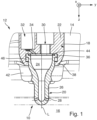
Fig. 1 schematically shows a longitudinal section through a pre-combustion chamber assembly in a state in which it is installed in an internal combustion engine; -
Fig. 2 schematically shows a perspective view of the pre-combustion chamber assembly depicted inFigure 1 in an uninstalled state; -
Fig. 3 schematically shows a perspective view of a pre-combustion chamber assembly according to a further embodiment in a disengaged state; and -
Fig. 4 schematically show a side view of a part of the pre-combustion chamber assembly depicted inFigure 3 . - In the following, the invention will be explained in more detail with reference to the accompanying figures. In the Figures, like elements are denoted by identical reference numerals and repeated description thereof may be omitted in order to avoid redundancies.
-
Figure 1 shows apre-combustion chamber assembly 10, also referred to as the "assembly" in the following, which is installed in an internal combustion engine, in particular a gas engine which is powered with a lean fuel air mixture of a gaseous fuel and air, for example a mixture of natural gas and air. InFigure 1 , a section of oneexemplary cylinder 12 of the engine is shown. The engine preferably comprises a plurality of cylinders, for example six, eight or twelve cylinders, wherein onepre-combustion chamber assembly 10 is provided per cylinder. - In the following, the structural and function configuration of the
assembly 10 installed in thecylinder 12 depicted inFigure 1 and associated to the present invention is described which applies accordingly to the other assemblies associated to the other cylinders of the engine, respectively. - In
Figure 1 , theassembly 10 is shown in a mounted state in which it is firmly fastened to acylinder head 14 of thecylinder 12 associated thereto. In this state, theassembly 10 protrudes into acombustion chamber 16 formed within thecylinder 12. - The
assembly 10 has an elongated shape. In other words, an extension of theassembly 10 along its longitudinal axis L is greater than along a traverse direction, i.e. being travers to the longitudinal axis L. In the mounted state, theassembly 10 is received in amounting recess 18 in the form of a through-hole provided in thecylinder head 14. An inner surface of themounting recess 18 has an inner surface which is designed complementary to a part of an outer surface of theassembly 10 such that, in the mounted state, the inner surface of the mounting recess 18 and the outer surface of theassembly 10 are in tight contact. For installing theassembly 10 on thecylinder 12, i.e. thecylinder head 14, theassembly 10 is inserted into the recess from outside thecylinder 12 along a assembling direction until the inners surface of the mounting recess 18 is in tight contact to the outer surface of theassembly 10 such that a tip portion of theassembly 10 is inserted into thecombustion chamber 16. Accordingly, for dissembling theassembly 10 from the cylinder, theassembly 10 is removed from thecylinder 12 by being displaced in a disassembling direction which is opposed to the assembling direction. The assembling and dissembling directions are parallel to the longitudinal axis L of theassembly 10. - Further, the
assembly 10 is provided with a multi-part configuration. In other words, theassembly 10 is built up from multiple pieces. Specifically, theassembly 10 comprises apre-combustion chamber tip 20, also referred to as the "tip" in the following, and acarrier 22 which are releasably mounted to one another. Thetip 20 and thecarrier 22 are provided in the form of turning parts, i.e. produced, inter alia, by turning, e.g. on a lathe. Accordingly, thetip 20 and thecarrier 22 are made from a semi-finished product having a symmetry about an axis which, in the shown configuration, coincides with a longitudinal axis L of theassembly 10, but alternatively may also be displaced, parallel and/or traverse to the longitudinal axis L. - The
tip 20 is configured to protrude into thecombustion chamber 16 in the mounted state of theassembly 10 and includes apre-combustion chamber 24 which is defined and delimited by anencircling wall 26 of thetip 20.Flow transfer passages 28 are fluid-communicatively connecting thepre-combustion chamber 24 and the exterior of theassembly 10, i.e. thepre-combustion chamber 24 and themain combustion chamber 16 of thecylinder 12. By such a configuration, theflow transfer passages 28 are configured to allow a flow of the fuel air mixture form themain combustion chamber 16 into thepre-combustion chamber 24 during compression stroke of a piston (not shown) accommodated in thecylinder 12. - For igniting the fuel air mixture present in the
pre-combustion chamber 24, an ignition device (not shown), for example a spark plug, is received in thecarrier 22 such that a tip portion thereof protrudes into thepre-combustion chamber 24. Thecarrier 22 is provided with an ignitiondevice receiving recess 30 which extends lengthwise through thecarrier 22 and which is designed to receive the ignition device. - The ignition device is configured to ignite the fuel air mixture in the
pre-combustion chamber 24 which causes a flame front of hot gases that propagates from the pre-chamber through the flow transfer passages into the main combustion chamber. By doing so, the flame front is led by theflow transfer passages 28 to form ejecting torches which cause a homogenous ignition of the gaseous mixture in themain combustion chamber 16. - Optionally, the
carrier 22 may further accommodate or comprise an injection device for injecting fuel medium into thepre-combustion chamber 24. Specifically, the injection device may be configured to directly inject fuel medium into thepre-combustion chamber 24, i.e. without guiding the fuel medium through themain combustion chamber 16 and without mixing it with air before entering thepre-combustion chamber 24. In this way, the fuel air mixture transferred into the pre-combustion chamber from themain combustion chamber 16 through theflow transfer passages 28 at the compression stroke is enriched by being supplemented with the fuel medium discharged from the injection device. In such a configuration, thecarrier 22 may be provided with an injectiondevice receiving recess 32 for accommodating the injection device in theassembly 10. Afuel supply passage 34 fluid-communicatively connects the further receivingrecess 32 to thepre-combustion chamber 24. As such, thefuel supply passage 34 guide fuel medium discharged from the injection device into thepre-combustion chamber 24. - As set forth above, the
assembly 10 is configured and designed such that thetip 20 and thecarrier 22 are releasably coupled to one another. In other words, theassembly 10 is configured and designed such that thetip 20 can be selectively engaged with or disengaged from thecarrier 22. By such a configuration, theassembly 10 is provided with a modular design allowing that its tip portion, i.e. thepre-combustion chamber tip 20, can be interchangeably replaced. As a result, the portion of theassembly 10 which is particularly prone to wear during operation can be easily renewed, i.e. by replacing thetip 20. When having reached the end of its intended operating duration or lifetime, thetip 20 can be replaced by anew tip 20. Compared to known pre-combustion chamber arrangement in which the tip and the carrier component are inextricably coupled to one another, e.g. by weld, the proposed solution does not require replacement of the whole pre-combustion chamber arrangement when the tip has reached the end of its lifetime. In this way, the proposed assembly contributes to a cost-efficient maintenance and repair of the engine. - Compared to
Fig. 1 in which the assembly is depicted in the mounted state, i.e. installed in thecylinder head 14,Fig. 2 shows theassembly 10 in a state in which it is decoupled from the engine. However, in both configurations and states depicted inFig. 1 and2 , thetip 20 is partially received in and engage with thecarrier 22. - In the following, the structural interface between the
tip 20 and thecarrier 22 is described which enables to releasably couple thetip 20 to thecarrier 22. - The
tip 20 comprises an engagement section which is arranged opposed to a tip end section of thetip 20 and which is designed to be structurally coupled to and received in thecarrier 22. To that end, thecarrier 22 comprises a locking section which is constituted by a recessed portion at a front end of thecarrier 22 and which is designed complementary to the engagement section of thetip 20. - The engagement section of the
tip 20 and the locking section of thecarrier 22 are designed such that a form-fit or form-locking connection between thetip 20 and thecarrier 22 is provided along the longitudinal axis L when being in the engaged state. The form-fit connection between thetip 20 and thecarrier 22 is designed to lock a translational movement of thetip 20 relative to thecarrier 22 along the longitudinal axis L in a direction pointing away from thecarrier 22. Accordingly, by being provided with the form-fit connection between thetip 20 and thecarrier 22, thetip 20 and the carrier are prevented from being disengaged from one another when thetip 20 and thecarrier 22 are subject to opposing forces, i.e. pointing away from one another, along the longitudinal axis L. - For interlocking the
tip 20 and thecarrier 22 in the engaged state along the longitudinal axis L, the engagement section of thetip 20 is provided with anengagement collar 36 which is designed complementary to an undercutsection 38, also referred to as locking element, of the carrier's locking section. Upon being displaced relative to thecarrier 22 along the longitudinal axis L in the direction pointing away from thecarrier 22, thecollar 36 of thetip 20 is pushed against and tightly fit to the undercutsection 38 of thecarrier 22, thereby engaging the form-fit connection. - In the context of the present disclosure, the term "engaged state" refers to any state in which the
tip 20 is engaged or interlocked with thecarrier 22. Thus, in both configurations depicted inFig. 1 and2 , thetip 20 and thecarrier 22 are shown in an engaged state. Specifically, inFig. 1 , theassembly 10 is in its mounted state, i.e. being installed in thecylinder head 14, in which thetip 20 is force-fittingly connected and thus tightly fit to thecarrier 22 as will be described below. InFig. 2 , by contrast, theassembly 10 is decoupled from the engine, i.e. thecylinder head 14, and thetip 20 is loosely coupled to, but still engaged with thecarrier 22 by means of the form-fit connection. - Further, the term "disengaged state" refers to a state of the
assembly 10 in which thetip 20 is disengaged from thecarrier 22, i.e. is not received or accommodated in the locking section thereof. Thus, thetip 20 is not limited in its degrees of freedom relative to thecarrier 22 compared to the engaged state in which at least one degree of freedom of thetip 20 relative to thecarrier 22 is locked. - In the proposed
assembly 10, thetip 20 and thecarrier 22 are designed such that, in the engaged state of thetip 20 and thecarrier 22, thetip 20 is dis-engageable from thecarrier 22 upon being displaced relative to thecarrier 22 along a release direction R which is transverse to the longitudinal axis L of theassembly 10. As can be gathered fromFig. 2 , in the shown configuration, the release direction R is perpendicular or substantially perpendicular to the longitudinal axis L. In other words, in the state depicted inFig. 2 , thetip 20 can be disengaged or removed from thecarrier 22 upon moving thetip 20 in the release direction R relative to thecarrier 22. By doing so, thetip 20 is removed from thecarrier 22 upon being guided through a removal/insertion opening orrecess 40. Accordingly, in a state in which theassembly 10 is in the disengaged state, thetip 20 is engageable to thecarrier 22 upon being displaced relative to thecarrier 22 along a locking direction which is opposed to the release direction R. - The removal/
insertion recess 40 is provided at one side at a tip end of thecarrier 22. Alternatively, the removal/insertion recess 40 may be provided at opposing sides of thecarrier 22. In this alternative configuration, thetip 20 may be engaged with or disengaged from thecarrier 22 either by being moved relative to thecarrier 22 in the release direction R or in a direction opposed thereto. Further, the removal/insertion recess 40 of thecarrier 22 has a shape, i.e. an inner contour and an inner surface, which is designed complementary to an outer shape, i.e. an outer contour and outer surface of the engagement section, of thetip 20. Accordingly, for engaging thetip 20 with thecarrier 22, the two components need to be properly oriented to one another. Specifically, in order to allow that thetip 20 can be inserted into the removal/insertion recess 40, the locking section of thecarrier 22, i.e. its removal/insertion recess 40, requires that thetip 20 is oriented such that it longitudinal axis is parallel to the longitudinal axis of thecarrier 22. More specifically, the longitudinal axis of thetip 20 needs to lie within a plane to which the locking section of thecarrier 22 is mirror symmetric. - As set forth above,
Fig. 1 shows theassembly 10 in the mounted state in which thetip 20 is force-fittingly connected and thus tightly fit to thecarrier 22. In other words, in the mounted state, thetip 20 is force-fittingly connected to thecarrier 22 at a connecting surface. The connecting surface is constituted by a front surface of thecarrier 22 and an end surface of thetip 20. In the shown configuration, the connecting surface extends substantially perpendicular to the longitudinal axis and substantially in parallel to the release direction R. - In the mounted state, as set forth above, the
tip 20 is force-fittingly connected to thecarrier 22. For doing so, theassembly 10 is configured to be mounted to a cylinder head configuration of the internal combustion engine such that thetip 20 is force-fittingly connected to thecarrier 22 by being pressed against thecarrier 22. Specifically, in the mounted state, thetip 20 is coupled to acylinder head plate 42 and the end surface of thetip 20 is pressed against the front surface of thecarrier 22 hold in thecylinder head 14. - A sealing
element 44, in particular provided in the form of a sealing ring, is provided between thetip 20 and thecarrier 22 at the connecting surface. Specifically, the end surface of thetip 20 is provided with a circumferential groove which encircles thepre-combustion chamber 24 and which is configured to receive the sealingelement 44. By such a configuration, a tight connection between thetip 20 and thecarrier 22 of theassembly 10 may be ensured. Alternatively or additionally, the front end of thecarrier 22 may be provided with a circumferential groove for receiving the sealingelement 44. - As can be gathered from
Fig. 1 , a bearingplay 46 is provided between thecollar 36 of thetip 20 and the undercutsection 38 of thecarrier 22 along the longitudinal axis L. Thus, in a state in which thetip 20 is loosely coupled, i.e. not force-fittingly connected to thecarrier 22, thetip 20 is allowed to be displaced relative to thecarrier 22 along the longitudinal axis L to a certain extent, i.e. which is defined and delimited by the bearingplay 46. In other words, in the engaged state, thetip 20 is displaceable relative to thecarrier 22 along the longitudinal axis L to a certain extent. This is achieved by the form-fit connection between thetip 20 and thecarrier 22 which is provided with the bearingplay 46 along the longitudinal axis L. - More specifically, the
assembly 10 is designed such that, in the engaged state, thetip 20 is displaceable relative to the carrier 232 along the longitudinal axis L between a first end position and a second end position. In the context of the present invention, the term "end position" refers to a position beyond which the tip cannot be further moved relative to thecarrier 22 along the longitudinal axis L. - In
Fig. 1 and2 , thetip 22 is depicted in its first end position. Theassembly 10 is designed such that a translational movement of thetip 20 relative to thecarrier 22 along the release direction R is allowed or enabled when thetip 20 is arranged in the first end position. In this position, the end surface of thetip 20 is fit to or contacts the front end of thecarrier 22. - In the second end position, the
tip 20 is displaced relative to thecarrier 22 along the longitudinal axis L in the direction pointing away from thecarrier 22 to a maximum extent compared to the first end position. In the second end position, thecollar 36 of thetip 20 contacts the undercutsection 38. Specifically, a circumferential surface of thecollar 36 which faces the undercutsection 38 in a longitudinal direction lies upon an opposing circumferential inner surface of the undercutsection 38. - As can be gathered from
Fig. 2 , the locking section of thecarrier 22 is provided with a lockingprotrusion 48 which delimits the removal/insertion recess 40. The lockingprotrusion 48 is designed such that it prevents or blocks a movement of thetip 20 in the release direction R relative to thecarrier 22 when thetip 20 is arranged in the second end position. In other words, when thetip 20 is placed in the second end position, a translational movement of thetip 20 relative to thecarrier 22 along the release direction R is locked. - By such a configuration, the proposed
assembly 10 may prevent that thetip 20 is unintendedly disengaged from thecarrier 22, for example during installation or maintenance of theassembly 10. As to substance, in order to replace or disengage thetip 20 from thecarrier 22, thetip 20, at first, is required to be moved into first end position before it can be released from the engagement with thecarrier 22, i.e. upon being moved into the release direction R. If thetip 20 is not moved into the first end position, it cannot be released from thecarrier 22. In other words, when being placed in the second end position, the form-looking connection between thetip 20 and thecarrier 22 is provided along the release direction R which prevents thetip 20 from being displaced relative to thecarrier 22 in the release direction R and thus for being disengage from thecarrier 22. However, when being placed in the first end position, the form -looking connection between thetip 20 and thecarrier 22 is released, thereby allowing that thetip 22 can be displaced relative to thecarrier 22 in the release direction R and thus from being dis-engaged from thecarrier unit 22. - In the configuration shown in
Fig. 1 and2 , an outer surface of the engagement section of thetip 20 is symmetric around the longitudinal axis of thetip 20. Accordingly, thetip 20 may be engaged to thecarrier 22 in any rotational orientation around its longitudinal axis. In other words, when being engaged with thecarrier 22, i.e. loosely coupled thereto, thetip 20 can be rotate around its longitudinal axis relative to thecarrier 22. -
Figs. 3 and4 show apre-combustion chamber assembly 10 according to a further embodiment in which, compared to the configuration depicted inFig. 1 and2 , a relative rotational orientation between thetip 20 and thecarrier 22 is pre-set. Accordingly, in this configuration, thetip 20 is engageable to thecarrier 22 in merely one predefined rotational orientation around its longitudinal axis relative to thecarrier 22. In other words, theassembly 10 is designed such that thetip 20 can only be inserted into thecarrier body 22 in one preset relative rotational orientation between thetip 20 and thecarrier 22. In this way, an orientation of thetip 20 in the mounted state of theassembly 10 is predefined, thereby facilitating proper installation of theassembly 10 in thecylinder 12. - For doing so, the
tip 20, i.e. its engagement section, is provided with an outer surface or contour which is non-symmetric around its longitudinal axis. In other words, an outer contour of a cross-sectional profile of the engagement section, in particular which extends perpendicular to the longitudinal axis of thetip 20, is not point symmetric. Specifically, for providing the non-symmetric shape of thetip 20, the outer surface thereof is provided with acoding recess 50 which ensures that the tip can only be inserted into thecarrier 22 in one rotational orientation relative to thecarrier 22. Accordingly, as can be gathered fromFig 4 , the removal/insertion recess 40 is provided with a shape that is non-mirror symmetric in particular relative to a plane of symmetry which is spanned by the release direction R and the longitudinal axis L. - Further, in the configuration depicted in
Fig. 3 and4 , theassembly 10 is designed such that, when being positioned into its first end position in which the end surface of thetip 20 fits to the front surface of thecarrier 22, a translational movement of thetip 20 relative to thecarrier 22 along the release direction R is locked by means of the lockingprotrusion 48. However, when being placed in the second end position as depicted inFig. 4 , the translational movement of thetip 20 relative to thecarrier 22 along the release direction R is released. - It will be obvious for a person skilled in the art that these embodiments and items only depict examples of a plurality of possibilities. Hence, the embodiments shown here should not be understood to form a limitation of these features and configurations.
- According to the invention, a pre-combustion chamber assembly for use in an internal combustion engine is provided, comprising a pre-combustion chamber tip and a carrier which are releasably mounted to one another. The assembly is configured and designed to be mounted to a cylinder head of the engine such that the tip is force-fittingly connected to the carrier by being pressed against the carrier.
- The tip and the carrier are designed such that, in an engaged state of the tip and the carrier, the tip is dis-engageable form the carrier upon being displaced relative to the carrier along a release direction which is transverse to a longitudinal axis of the assembly.
- Further, the assembly may be configured and designed such that, in the engaged state of the tip and the carrier, a form-fit connection between the carrier and the tip is provided which locks a translational movement of the tip relative to the carrier along the longitudinal axis, particularly in a direction pointing away from the carrier.
- Still further, the carrier and the tip are designed such that, in an dis-engaged state of the tip and the carrier, the tip is engageable to the carrier upon being displaced relative to the carrier along a locking direction being opposed to the release direction.
- Typically, during installation or de-installation of pre-combustion chamber arrangements, a pre-combustion chamber arrangement is inserted into a cylinder head or removed therefrom by being moved along an assembling or disassembling direction which is parallel to its longitudinal axis. In order to facilitate installation, deinstallation or maintenance procedures, the proposed pre-combustion chamber assembly is provided with a structural configuration in which the tip is dis-engageable from the carrier upon being moved relative to carrier in a direction being transverse to the assembling or dissembling direction, i.e. the longitudinal axis of the assembly. In this way, the assembly may be prevented from being unintendedly disengaged or disassembled when being installed to or deinstalling from an engine, thereby facilitating installation or maintenance procedures for an operator.
- The proposed pre-combustion chamber assembly may be intended to be used in any suitable internal combustion engines, such as large-bore engines employed in vessels or power plants. Specifically, the assembly may be used in gas engines, i.e. which run on gaseous fuel, such as natural gas. However, the proposed assembly is not limited to these applications.
- When being equipped in an engine, the proposed assembly may be associated to one cylinder. Accordingly, the number of assemblies installed in the engine may depend on the number of cylinders. Specifically, an engine may be equipped with one assembly per cylinder.
- More specifically, the tip and the carrier may be connected to one another at a connecting surface. The connecting surface may be constituted by an end surface of the tip and a front surface of the carrier which, in the engaged state, face each other. The assembly may be provided such that the connecting surface is perpendicular to the longitudinal axis of the assembly and/or parallel to the release direction.
- In a further development, a sealing element, in particular a sealing ring, may be provided at the connecting surface, i.e. between the tip and the carrier. Specifically, the sealing element may be received in a circumferential groove provided at the tip, in particular at its end surface, and/or the carrier, in particular at its front surface.
- Additionally or alternatively, the carrier and the tip may be configured and designed such that, in the engaged state, the tip is displaceable relative to the carrier along the longitudinal axis to a certain extent. For doing so, the form-fit connection between the tip and the carrier may be provided with a bearing play along the longitudinal axis.
- In a further development, the assembly may be configured such that, in the engaged state, the tip is displaceable relative to the carrier along the longitudinal axis between a first position, in particular a first end position, and a second end position, in particular a second end position. When being placed in the first position, a translational movement of the tip relative to the carrier along the release direction may be allowed, and wherein when being place in the second end position, the translational movement of the tip relative to the carrier along the release direction may be locked.
- Additionally, the assembly may be provided such that in the mounted state in which the tip and the carrier contact each other at the connecting surface, the tip is positioned in the first or second position relative to the carrier.
- In a further development, the assembly may be designed and configured such that, in the engaged state, a relative rotational orientation between the carrier and the tip, in particular around the longitudinal axis, is preset or predefined, in particular structurally fixed. Further, the tip may be provided with an engagement section which forms a structural interface for releasably mounting the tip to the carrier. For locking or coding the relative rotational position between the tip and the carrier in the engaged state, the engagement section may be provided with a shape or contour, in particular an outer shape or contour, which is non-symmetric around a longitudinal axis of the tip.
- Furthermore, an internal combustion engine, in particular a gas engine, may be provided which is equipped with a pre-combustion chamber assembly as described above.
- With reference to the Figures, a
pre-combustion chamber assembly 10 for an internal combustion engine is suggested, comprising apre-combustion chamber tip 20 and atip carrier 22 which are releasably mounted to one another. Thetip 20 and thecarrier 22 are designed such that, in an engaged state of thetip 20 and thecarrier 22, thetip 20 is dis-engageable form thecarrier 22 upon being displaced relative to thecarrier 22 along a release direction R which is transverse to a longitudinal axis L of theassembly 10. - The
pre-combustion chamber assembly 10 as mentioned above is applicable in internal combustion engines and especially in internal combustion engines which are powered with a lean fuel air mixture or a gaseous fuel and air, for example a mixture of natural gas and air. It may replace conventional pre-combustion chamber arrangements and may serve as a replacement or retrofit part.
Claims (13)
- Pre-combustion chamber assembly (10) for use in an internal combustion engine, comprising a pre-combustion chamber tip (20) and a carrier (22) which are releasably mounted to one another, wherein the assembly (10) is suitable for being mounted to a cylinder head (14) of the internal combustion engine such that the tip is force-fittingly connected to the carrier (22) by being pressed against the carrier (22),
characterized in that
the tip (20) and the carrier (22) are designed such that, in an engaged state of the tip (20) and the carrier (22), the tip (20) is dis-engageable from the carrier (22) upon being displaced relative to the carrier (22) along a release direction (R) which is transverse to a longitudinal axis (L) of the assembly (10). - Pre-combustion chamber assembly according to claim 1, wherein in the engaged state of the tip (20) and the carrier (22), a form-fit connection between the tip (20) and the carrier (22) is provided which locks a translational movement of the tip (20) relative to the carrier (22) along the longitudinal axis (L) in a direction pointing away from the carrier (22).
- Pre-combustion chamber assembly according to claim 1 or 2, wherein the tip (20) and the carrier (22) are designed such that, in an disengaged state of the tip (20) and the carrier (22), the tip (20) is engageable to the carrier (22) upon being displaced relative to the carrier (22) along a locking direction being opposed to the release direction (R).
- Pre-combustion chamber assembly according to any one of claims 1 to 4, wherein a connecting surface between the tip (20) and the carrier (22) is constituted by an end surface of the tip (20) and a front surface of the carrier (22).
- Pre-combustion chamber assembly according to claim 4, wherein the connecting surface is perpendicular to the longitudinal axis (L) or parallel to the release direction (R).
- Pre-combustion chamber assembly according to any one of claims 1 to 5, further comprising a sealing element (44) which is received in a circumferential groove provided at the tip (20) or the carrier (22).
- Pre-combustion chamber assembly according to any one of claims 1 to 6, wherein the tip (20) and the carrier (22) are configured such that, in the engaged state, the tip is displaceable relative to the carrier (22) along the longitudinal axis to a certain extent.
- Pre-combustion chamber assembly according to any one of claims 2 to 7, wherein the form-fit connection between the tip (20) and the carrier (22) is provided with a bearing play (46) along the longitudinal axis (L).
- Pre-combustion chamber assembly according to any one of claims 1 to 8, wherein in the engaged state, the tip (20) is displaceable relative to the carrier (22) along the longitudinal axis (L) between a first position and a second position, wherein when being placed in the first position, a translational movement of the tip (20) relative to the carrier (22) along the release direction (R) is allowed, and wherein when being place in the second end position, the translational movement of the tip (20) relative to the carrier (22) along the release direction (R) is locked.
- Pre-combustion chamber assembly according to claim 9, wherein in the mounted state, the tip (20) is positioned in the first or second position relative to the carrier (22).
- Pre-combustion chamber assembly according to any one of claims 1 to 10, wherein in the engaged state, a relative rotational orientation between the tip (20) and the carrier (22) is preset.
- Pre-combustion chamber assembly according to any one of claims 1 to 11, wherein an engagement section of the tip (20) forming a structural interface for coupling the tip (20) to the carrier (22) has a shape or contour which is non-symmetric around a longitudinal axis of the tip (20).
- Internal combustion engine, in particular gas engine, being equipped with a pre-combustion chamber assembly (10) according to any one of claims 1 to 12.
Applications Claiming Priority (2)
| Application Number | Priority Date | Filing Date | Title |
|---|---|---|---|
| GB2008527.0A GB2595730B (en) | 2020-06-05 | 2020-06-05 | Pre-combustion chamber assembly |
| PCT/EP2021/025187 WO2021244775A1 (en) | 2020-06-05 | 2021-05-19 | Pre-combustion chamber assembly |
Publications (2)
| Publication Number | Publication Date |
|---|---|
| EP4162153A1 EP4162153A1 (en) | 2023-04-12 |
| EP4162153B1 true EP4162153B1 (en) | 2024-09-11 |
Family
ID=71615957
Family Applications (1)
| Application Number | Title | Priority Date | Filing Date |
|---|---|---|---|
| EP21729407.3A Active EP4162153B1 (en) | 2020-06-05 | 2021-05-19 | Pre-combustion chamber assembly |
Country Status (3)
| Country | Link |
|---|---|
| EP (1) | EP4162153B1 (en) |
| GB (1) | GB2595730B (en) |
| WO (1) | WO2021244775A1 (en) |
Family Cites Families (6)
| Publication number | Priority date | Publication date | Assignee | Title |
|---|---|---|---|---|
| DE2357433C3 (en) * | 1973-11-17 | 1980-10-02 | Kloeckner-Humboldt-Deutz Ag, 5000 Koeln | Attachment of an insert in an antechamber of a reciprocating internal combustion engine |
| JPH0673335U (en) * | 1993-03-23 | 1994-10-18 | いすゞ自動車株式会社 | Sub-chamber diesel engine |
| US20070236122A1 (en) * | 2006-04-10 | 2007-10-11 | Borror Bruce M | Pre-chamber type spark plug |
| KR101307080B1 (en) * | 2011-07-19 | 2013-09-11 | 현대중공업 주식회사 | Pre combustion chamber for gas engine |
| EP2977582B1 (en) * | 2014-07-22 | 2018-03-28 | Caterpillar Energy Solutions GmbH | Ignition device with pre-combustion chamber |
| EP3012431B1 (en) * | 2014-10-21 | 2017-11-22 | Caterpillar Energy Solutions GmbH | Pre-combustion chamber assembly for internal combustion engines |
-
2020
- 2020-06-05 GB GB2008527.0A patent/GB2595730B/en not_active Expired - Fee Related
-
2021
- 2021-05-19 EP EP21729407.3A patent/EP4162153B1/en active Active
- 2021-05-19 WO PCT/EP2021/025187 patent/WO2021244775A1/en not_active Ceased
Also Published As
| Publication number | Publication date |
|---|---|
| EP4162153A1 (en) | 2023-04-12 |
| GB202008527D0 (en) | 2020-07-22 |
| GB2595730A (en) | 2021-12-08 |
| GB2595730B (en) | 2022-11-23 |
| WO2021244775A1 (en) | 2021-12-09 |
Similar Documents
| Publication | Publication Date | Title |
|---|---|---|
| JP4815513B2 (en) | Gas turbine combustor | |
| FI125706B (en) | THE COMBUSTION ENGINE OF THE COMBUSTION ENGINE | |
| EP2735717B1 (en) | Precombustion chamber structure for gas engine | |
| RU2490547C2 (en) | Guide device of element in hole of combustion chamber wall of gas-turbine engine, combustion chamber and gas-turbine engine | |
| EP0964204A2 (en) | Premixing fuel injector with improved secondary fuel-air injection | |
| KR20100087319A (en) | Prechamber arrangement of a combustion engine | |
| EP3051092B1 (en) | Cooling of pre-chamber in internal combustion engine | |
| CN101280754A (en) | Fuel injector with secondary combustion seal | |
| US20130174561A1 (en) | Late Lean Injection System Transition Piece | |
| EP0588629A1 (en) | Gas turbine fuel nozzle with replaceable cap | |
| EP3182534B1 (en) | Pre-chamber spark plug | |
| EP3118433B1 (en) | Pre-combustion chamber assembly for internal combustion engines | |
| KR20010043036A (en) | Mounting/Demounting Device For Mounting And/Or Demounting A Fuel Injection Valve | |
| EP4162153B1 (en) | Pre-combustion chamber assembly | |
| CN104487773B (en) | Burner nozzle assembly, the burner possessing this burner nozzle assembly and gas turbine | |
| CN110872983A (en) | Pre-combustion chamber | |
| EP3085918B1 (en) | Gas engine and assembling method for gas engine | |
| AU2022203224B2 (en) | Insert device for fuel injection | |
| JP6145298B2 (en) | System and method for assembling an end cover of a combustor | |
| JP2005273492A (en) | Sub-chamber internal combustion engine | |
| EP3431745A1 (en) | Spark plug for an internal combustion engine | |
| KR20140127042A (en) | Gas ventilation valve assembly for dual fuel engine | |
| CN117552882A (en) | Cylinder head components and engines | |
| KR20250121095A (en) | internal combustion engine | |
| KR200152393Y1 (en) | Manifold of gas boiler |
Legal Events
| Date | Code | Title | Description |
|---|---|---|---|
| STAA | Information on the status of an ep patent application or granted ep patent |
Free format text: STATUS: UNKNOWN |
|
| STAA | Information on the status of an ep patent application or granted ep patent |
Free format text: STATUS: THE INTERNATIONAL PUBLICATION HAS BEEN MADE |
|
| PUAI | Public reference made under article 153(3) epc to a published international application that has entered the european phase |
Free format text: ORIGINAL CODE: 0009012 |
|
| STAA | Information on the status of an ep patent application or granted ep patent |
Free format text: STATUS: REQUEST FOR EXAMINATION WAS MADE |
|
| 17P | Request for examination filed |
Effective date: 20221116 |
|
| AK | Designated contracting states |
Kind code of ref document: A1 Designated state(s): AL AT BE BG CH CY CZ DE DK EE ES FI FR GB GR HR HU IE IS IT LI LT LU LV MC MK MT NL NO PL PT RO RS SE SI SK SM TR |
|
| DAV | Request for validation of the european patent (deleted) | ||
| DAX | Request for extension of the european patent (deleted) | ||
| GRAP | Despatch of communication of intention to grant a patent |
Free format text: ORIGINAL CODE: EPIDOSNIGR1 |
|
| STAA | Information on the status of an ep patent application or granted ep patent |
Free format text: STATUS: GRANT OF PATENT IS INTENDED |
|
| INTG | Intention to grant announced |
Effective date: 20240320 |
|
| GRAS | Grant fee paid |
Free format text: ORIGINAL CODE: EPIDOSNIGR3 |
|
| P01 | Opt-out of the competence of the unified patent court (upc) registered |
Free format text: CASE NUMBER: APP_39578/2024 Effective date: 20240703 |
|
| GRAA | (expected) grant |
Free format text: ORIGINAL CODE: 0009210 |
|
| STAA | Information on the status of an ep patent application or granted ep patent |
Free format text: STATUS: THE PATENT HAS BEEN GRANTED |
|
| AK | Designated contracting states |
Kind code of ref document: B1 Designated state(s): AL AT BE BG CH CY CZ DE DK EE ES FI FR GB GR HR HU IE IS IT LI LT LU LV MC MK MT NL NO PL PT RO RS SE SI SK SM TR |
|
| REG | Reference to a national code |
Ref country code: GB Ref legal event code: FG4D |
|
| REG | Reference to a national code |
Ref country code: CH Ref legal event code: EP |
|
| REG | Reference to a national code |
Ref country code: DE Ref legal event code: R096 Ref document number: 602021018673 Country of ref document: DE |
|
| REG | Reference to a national code |
Ref country code: IE Ref legal event code: FG4D |
|
| REG | Reference to a national code |
Ref country code: LT Ref legal event code: MG9D |
|
| PG25 | Lapsed in a contracting state [announced via postgrant information from national office to epo] |
Ref country code: NO Free format text: LAPSE BECAUSE OF FAILURE TO SUBMIT A TRANSLATION OF THE DESCRIPTION OR TO PAY THE FEE WITHIN THE PRESCRIBED TIME-LIMIT Effective date: 20241211 |
|
| REG | Reference to a national code |
Ref country code: NL Ref legal event code: MP Effective date: 20240911 |
|
| PG25 | Lapsed in a contracting state [announced via postgrant information from national office to epo] |
Ref country code: GR Free format text: LAPSE BECAUSE OF FAILURE TO SUBMIT A TRANSLATION OF THE DESCRIPTION OR TO PAY THE FEE WITHIN THE PRESCRIBED TIME-LIMIT Effective date: 20241212 Ref country code: FI Free format text: LAPSE BECAUSE OF FAILURE TO SUBMIT A TRANSLATION OF THE DESCRIPTION OR TO PAY THE FEE WITHIN THE PRESCRIBED TIME-LIMIT Effective date: 20240911 |
|
| PG25 | Lapsed in a contracting state [announced via postgrant information from national office to epo] |
Ref country code: BG Free format text: LAPSE BECAUSE OF FAILURE TO SUBMIT A TRANSLATION OF THE DESCRIPTION OR TO PAY THE FEE WITHIN THE PRESCRIBED TIME-LIMIT Effective date: 20240911 |
|
| PG25 | Lapsed in a contracting state [announced via postgrant information from national office to epo] |
Ref country code: LV Free format text: LAPSE BECAUSE OF FAILURE TO SUBMIT A TRANSLATION OF THE DESCRIPTION OR TO PAY THE FEE WITHIN THE PRESCRIBED TIME-LIMIT Effective date: 20240911 |
|
| PG25 | Lapsed in a contracting state [announced via postgrant information from national office to epo] |
Ref country code: HR Free format text: LAPSE BECAUSE OF FAILURE TO SUBMIT A TRANSLATION OF THE DESCRIPTION OR TO PAY THE FEE WITHIN THE PRESCRIBED TIME-LIMIT Effective date: 20240911 |
|
| PG25 | Lapsed in a contracting state [announced via postgrant information from national office to epo] |
Ref country code: RS Free format text: LAPSE BECAUSE OF FAILURE TO SUBMIT A TRANSLATION OF THE DESCRIPTION OR TO PAY THE FEE WITHIN THE PRESCRIBED TIME-LIMIT Effective date: 20241211 Ref country code: ES Free format text: LAPSE BECAUSE OF FAILURE TO SUBMIT A TRANSLATION OF THE DESCRIPTION OR TO PAY THE FEE WITHIN THE PRESCRIBED TIME-LIMIT Effective date: 20240911 |
|
| PG25 | Lapsed in a contracting state [announced via postgrant information from national office to epo] |
Ref country code: RS Free format text: LAPSE BECAUSE OF FAILURE TO SUBMIT A TRANSLATION OF THE DESCRIPTION OR TO PAY THE FEE WITHIN THE PRESCRIBED TIME-LIMIT Effective date: 20241211 Ref country code: NO Free format text: LAPSE BECAUSE OF FAILURE TO SUBMIT A TRANSLATION OF THE DESCRIPTION OR TO PAY THE FEE WITHIN THE PRESCRIBED TIME-LIMIT Effective date: 20241211 Ref country code: LV Free format text: LAPSE BECAUSE OF FAILURE TO SUBMIT A TRANSLATION OF THE DESCRIPTION OR TO PAY THE FEE WITHIN THE PRESCRIBED TIME-LIMIT Effective date: 20240911 Ref country code: HR Free format text: LAPSE BECAUSE OF FAILURE TO SUBMIT A TRANSLATION OF THE DESCRIPTION OR TO PAY THE FEE WITHIN THE PRESCRIBED TIME-LIMIT Effective date: 20240911 Ref country code: GR Free format text: LAPSE BECAUSE OF FAILURE TO SUBMIT A TRANSLATION OF THE DESCRIPTION OR TO PAY THE FEE WITHIN THE PRESCRIBED TIME-LIMIT Effective date: 20241212 Ref country code: FI Free format text: LAPSE BECAUSE OF FAILURE TO SUBMIT A TRANSLATION OF THE DESCRIPTION OR TO PAY THE FEE WITHIN THE PRESCRIBED TIME-LIMIT Effective date: 20240911 Ref country code: ES Free format text: LAPSE BECAUSE OF FAILURE TO SUBMIT A TRANSLATION OF THE DESCRIPTION OR TO PAY THE FEE WITHIN THE PRESCRIBED TIME-LIMIT Effective date: 20240911 Ref country code: BG Free format text: LAPSE BECAUSE OF FAILURE TO SUBMIT A TRANSLATION OF THE DESCRIPTION OR TO PAY THE FEE WITHIN THE PRESCRIBED TIME-LIMIT Effective date: 20240911 |
|
| REG | Reference to a national code |
Ref country code: AT Ref legal event code: MK05 Ref document number: 1722854 Country of ref document: AT Kind code of ref document: T Effective date: 20240911 |
|
| PG25 | Lapsed in a contracting state [announced via postgrant information from national office to epo] |
Ref country code: NL Free format text: LAPSE BECAUSE OF FAILURE TO SUBMIT A TRANSLATION OF THE DESCRIPTION OR TO PAY THE FEE WITHIN THE PRESCRIBED TIME-LIMIT Effective date: 20240911 |
|
| PG25 | Lapsed in a contracting state [announced via postgrant information from national office to epo] |
Ref country code: IS Free format text: LAPSE BECAUSE OF FAILURE TO SUBMIT A TRANSLATION OF THE DESCRIPTION OR TO PAY THE FEE WITHIN THE PRESCRIBED TIME-LIMIT Effective date: 20250111 Ref country code: PT Free format text: LAPSE BECAUSE OF FAILURE TO SUBMIT A TRANSLATION OF THE DESCRIPTION OR TO PAY THE FEE WITHIN THE PRESCRIBED TIME-LIMIT Effective date: 20250113 |
|
| PG25 | Lapsed in a contracting state [announced via postgrant information from national office to epo] |
Ref country code: SM Free format text: LAPSE BECAUSE OF FAILURE TO SUBMIT A TRANSLATION OF THE DESCRIPTION OR TO PAY THE FEE WITHIN THE PRESCRIBED TIME-LIMIT Effective date: 20240911 Ref country code: RO Free format text: LAPSE BECAUSE OF FAILURE TO SUBMIT A TRANSLATION OF THE DESCRIPTION OR TO PAY THE FEE WITHIN THE PRESCRIBED TIME-LIMIT Effective date: 20240911 |
|
| PG25 | Lapsed in a contracting state [announced via postgrant information from national office to epo] |
Ref country code: AT Free format text: LAPSE BECAUSE OF FAILURE TO SUBMIT A TRANSLATION OF THE DESCRIPTION OR TO PAY THE FEE WITHIN THE PRESCRIBED TIME-LIMIT Effective date: 20240911 Ref country code: EE Free format text: LAPSE BECAUSE OF FAILURE TO SUBMIT A TRANSLATION OF THE DESCRIPTION OR TO PAY THE FEE WITHIN THE PRESCRIBED TIME-LIMIT Effective date: 20240911 |
|
| PG25 | Lapsed in a contracting state [announced via postgrant information from national office to epo] |
Ref country code: CZ Free format text: LAPSE BECAUSE OF FAILURE TO SUBMIT A TRANSLATION OF THE DESCRIPTION OR TO PAY THE FEE WITHIN THE PRESCRIBED TIME-LIMIT Effective date: 20240911 Ref country code: PL Free format text: LAPSE BECAUSE OF FAILURE TO SUBMIT A TRANSLATION OF THE DESCRIPTION OR TO PAY THE FEE WITHIN THE PRESCRIBED TIME-LIMIT Effective date: 20240911 |
|
| PG25 | Lapsed in a contracting state [announced via postgrant information from national office to epo] |
Ref country code: IT Free format text: LAPSE BECAUSE OF FAILURE TO SUBMIT A TRANSLATION OF THE DESCRIPTION OR TO PAY THE FEE WITHIN THE PRESCRIBED TIME-LIMIT Effective date: 20240911 Ref country code: SK Free format text: LAPSE BECAUSE OF FAILURE TO SUBMIT A TRANSLATION OF THE DESCRIPTION OR TO PAY THE FEE WITHIN THE PRESCRIBED TIME-LIMIT Effective date: 20240911 |
|
| REG | Reference to a national code |
Ref country code: DE Ref legal event code: R097 Ref document number: 602021018673 Country of ref document: DE |
|
| PGFP | Annual fee paid to national office [announced via postgrant information from national office to epo] |
Ref country code: DE Payment date: 20250423 Year of fee payment: 5 |
|
| PG25 | Lapsed in a contracting state [announced via postgrant information from national office to epo] |
Ref country code: DK Free format text: LAPSE BECAUSE OF FAILURE TO SUBMIT A TRANSLATION OF THE DESCRIPTION OR TO PAY THE FEE WITHIN THE PRESCRIBED TIME-LIMIT Effective date: 20240911 |
|
| PLBE | No opposition filed within time limit |
Free format text: ORIGINAL CODE: 0009261 |
|
| STAA | Information on the status of an ep patent application or granted ep patent |
Free format text: STATUS: NO OPPOSITION FILED WITHIN TIME LIMIT |
|
| 26N | No opposition filed |
Effective date: 20250612 |
|
| PG25 | Lapsed in a contracting state [announced via postgrant information from national office to epo] |
Ref country code: SE Free format text: LAPSE BECAUSE OF FAILURE TO SUBMIT A TRANSLATION OF THE DESCRIPTION OR TO PAY THE FEE WITHIN THE PRESCRIBED TIME-LIMIT Effective date: 20240911 |
|
| REG | Reference to a national code |
Ref country code: CH Ref legal event code: H13 Free format text: ST27 STATUS EVENT CODE: U-0-0-H10-H13 (AS PROVIDED BY THE NATIONAL OFFICE) Effective date: 20251223 |
|
| PG25 | Lapsed in a contracting state [announced via postgrant information from national office to epo] |
Ref country code: LU Free format text: LAPSE BECAUSE OF NON-PAYMENT OF DUE FEES Effective date: 20250519 |
|
| PG25 | Lapsed in a contracting state [announced via postgrant information from national office to epo] |
Ref country code: CH Free format text: LAPSE BECAUSE OF NON-PAYMENT OF DUE FEES Effective date: 20250531 |
|
| GBPC | Gb: european patent ceased through non-payment of renewal fee |
Effective date: 20250519 |
|
| REG | Reference to a national code |
Ref country code: BE Ref legal event code: MM Effective date: 20250531 |
|
| PG25 | Lapsed in a contracting state [announced via postgrant information from national office to epo] |
Ref country code: MC Free format text: LAPSE BECAUSE OF FAILURE TO SUBMIT A TRANSLATION OF THE DESCRIPTION OR TO PAY THE FEE WITHIN THE PRESCRIBED TIME-LIMIT Effective date: 20240911 |
|
| PG25 | Lapsed in a contracting state [announced via postgrant information from national office to epo] |
Ref country code: GB Free format text: LAPSE BECAUSE OF NON-PAYMENT OF DUE FEES Effective date: 20250519 |
|
| PG25 | Lapsed in a contracting state [announced via postgrant information from national office to epo] |
Ref country code: IE Free format text: LAPSE BECAUSE OF NON-PAYMENT OF DUE FEES Effective date: 20250519 |
|
| PG25 | Lapsed in a contracting state [announced via postgrant information from national office to epo] |
Ref country code: BE Free format text: LAPSE BECAUSE OF NON-PAYMENT OF DUE FEES Effective date: 20250531 |
|
| PG25 | Lapsed in a contracting state [announced via postgrant information from national office to epo] |
Ref country code: FR Free format text: LAPSE BECAUSE OF NON-PAYMENT OF DUE FEES Effective date: 20250531 |