EP4159511B1 - Cooling module support bracket - Google Patents
Cooling module support bracket Download PDFInfo
- Publication number
- EP4159511B1 EP4159511B1 EP21199852.1A EP21199852A EP4159511B1 EP 4159511 B1 EP4159511 B1 EP 4159511B1 EP 21199852 A EP21199852 A EP 21199852A EP 4159511 B1 EP4159511 B1 EP 4159511B1
- Authority
- EP
- European Patent Office
- Prior art keywords
- crash
- connection means
- bracket
- cooling module
- box
- Prior art date
- Legal status (The legal status is an assumption and is not a legal conclusion. Google has not performed a legal analysis and makes no representation as to the accuracy of the status listed.)
- Active
Links
Images


Classifications
-
- B—PERFORMING OPERATIONS; TRANSPORTING
- B62—LAND VEHICLES FOR TRAVELLING OTHERWISE THAN ON RAILS
- B62D—MOTOR VEHICLES; TRAILERS
- B62D21/00—Understructures, i.e. chassis frame on which a vehicle body may be mounted
- B62D21/15—Understructures, i.e. chassis frame on which a vehicle body may be mounted having impact absorbing means, e.g. a frame designed to permanently or temporarily change shape or dimension upon impact with another body
- B62D21/152—Front or rear frames
-
- B—PERFORMING OPERATIONS; TRANSPORTING
- B60—VEHICLES IN GENERAL
- B60K—ARRANGEMENT OR MOUNTING OF PROPULSION UNITS OR OF TRANSMISSIONS IN VEHICLES; ARRANGEMENT OR MOUNTING OF PLURAL DIVERSE PRIME-MOVERS IN VEHICLES; AUXILIARY DRIVES FOR VEHICLES; INSTRUMENTATION OR DASHBOARDS FOR VEHICLES; ARRANGEMENTS IN CONNECTION WITH COOLING, AIR INTAKE, GAS EXHAUST OR FUEL SUPPLY OF PROPULSION UNITS IN VEHICLES
- B60K11/00—Arrangement in connection with cooling of propulsion units
- B60K11/02—Arrangement in connection with cooling of propulsion units with liquid cooling
- B60K11/04—Arrangement or mounting of radiators, radiator shutters, or radiator blinds
-
- B—PERFORMING OPERATIONS; TRANSPORTING
- B60—VEHICLES IN GENERAL
- B60R—VEHICLES, VEHICLE FITTINGS, OR VEHICLE PARTS, NOT OTHERWISE PROVIDED FOR
- B60R19/00—Wheel guards; Radiator guards, e.g. grilles; Obstruction removers; Fittings damping bouncing force in collisions
- B60R19/02—Bumpers, i.e. impact receiving or absorbing members for protecting vehicles or fending off blows from other vehicles or objects
- B60R19/24—Arrangements for mounting bumpers on vehicles
- B60R19/26—Arrangements for mounting bumpers on vehicles comprising yieldable mounting means
- B60R19/34—Arrangements for mounting bumpers on vehicles comprising yieldable mounting means destroyed upon impact, e.g. one-shot type
-
- B—PERFORMING OPERATIONS; TRANSPORTING
- B60—VEHICLES IN GENERAL
- B60R—VEHICLES, VEHICLE FITTINGS, OR VEHICLE PARTS, NOT OTHERWISE PROVIDED FOR
- B60R19/00—Wheel guards; Radiator guards, e.g. grilles; Obstruction removers; Fittings damping bouncing force in collisions
- B60R19/02—Bumpers, i.e. impact receiving or absorbing members for protecting vehicles or fending off blows from other vehicles or objects
- B60R19/48—Bumpers, i.e. impact receiving or absorbing members for protecting vehicles or fending off blows from other vehicles or objects combined with, or convertible into, other devices or objects, e.g. bumpers combined with road brushes, bumpers convertible into beds
-
- B—PERFORMING OPERATIONS; TRANSPORTING
- B62—LAND VEHICLES FOR TRAVELLING OTHERWISE THAN ON RAILS
- B62D—MOTOR VEHICLES; TRAILERS
- B62D25/00—Superstructure or monocoque structure sub-units; Parts or details thereof not otherwise provided for
- B62D25/08—Front or rear portions
- B62D25/082—Engine compartments
- B62D25/084—Radiator supports
-
- B—PERFORMING OPERATIONS; TRANSPORTING
- B60—VEHICLES IN GENERAL
- B60Y—INDEXING SCHEME RELATING TO ASPECTS CROSS-CUTTING VEHICLE TECHNOLOGY
- B60Y2306/00—Other features of vehicle sub-units
- B60Y2306/01—Reducing damages in case of crash, e.g. by improving battery protection
Definitions
- This is related to support parts for a heat exchanger, particularly for securing a cooling module in the front end structure of a vehicle.
- the front end structure of a vehicle typically includes a cooling module with a radiator, positioned behind the front end of the vehicle.
- the front end usually has a bumper positioned at the very front, with crash-boxes just behind the bumper on each of the sides of the vehicle.
- a bracket for a cooling module in a front end structure of a vehicle is known from EP 1 323 566 A1 .
- a bracket for a cooling module in a front end structure of a vehicle comprises forward crash-box connection means; cooling module connection means; a rigid arm extending between the forward crash-box connection means at a forward side and the cooling module connection means at a rearward side; rear crash-box connection means; and a break-away arm extending from the rearward side of the rigid arm to the rear crash-box connection means.
- a bracket can help to minimize or prevent damage to a cooling module in an engine in the event of a front end collision.
- the bracket allows for the cooling module to move rearward in the event of such a collision with the break-away arm breaking away and moving the cooling module with any movement of the front end of the vehicle. This allows for less-expensive repairs, and often the ability to still drive the vehicle after such a collision.
- the forward crash-box connection means and/or the rear crash-box connection means comprises a plurality of connectors.
- these can be bores, bolts, screws and/or other types of fasteners to securely connect the parts.
- these can be two vertically spaced crash-box connection means for each of the forward crash-box connection means and the rear crash-box connection means.
- Such connection means can provide a strong and stable connection, even when experiences large forces such as in a collision.
- the cooling module connection means comprises a screw connection to a cooler side bushing.
- a connection means can provide a secure and simple means of connecting the bracket to the cooling module (or an in-between part).
- the break-away arm extends substantially vertically from the cooling module connection means.
- This configuration can provide a bracket that is both simple to manufacture and connect while strong enough to withstand normal operational forces but break upon a frontal collision.
- the angle between the break-away arm and the rigid arm is less than 90 degrees. This configuration can help to ensure proper strength levels for the bracket, as well and ensure the bracket remains sufficiently compact to take up less space in the vehicle and be usable with a variety of different vehicles.
- the rigid arm comprises an arm which expands in height from the rearward side to the forward side. This could also be seen an a taper from the forward side. In some embodiments, there could be more than one taper angle, a first at the forward side, and a second taper angle at the rearward side. This configuration helps the rigid arm have sufficient strength and rigidity to ensure that the cooling module is moved rearward with any movement of the frontal end of the vehicle.
- the rigid arm comprises cut-out sections and/or sections of reduced material. Such a configuration saves on weight of the bracket and materials costs when manufacturing while still maintaining the necessary strength and rigidity.
- the bracket further comprises a protrusion on one side of the bracket.
- the protrusion can be formed and located such that the bracket would only connect on a proper side of the cooling module, reducing the risk that the bracket could be connected on the wrong side and possibly not function as intended.
- the bracket is formed of metal.
- this can be aluminium (including alloys) or another type of metal or other material with sufficient strength and rigidity.
- the bracket could be formed by die casting.
- a cooling module includes a first bracket as previously described connected to a first cooling module bushing on a first side of the cooling module, and a second bracket as previously described connected to a second cooling module bushing on a second side of the cooling module; wherein for each of the first and second brackets, the cooling module connection means connects to the cooling module bushing with a screw or bolt connection.
- a frontal vehicle structure includes a cooling module and first and second brackets as previously described, and further comprises a first crash-box on the first side and a second crash-box on the second side.
- the forward crash-box connection means and the rearward crash-box connection means connects to forward and rearward positions of the crash-box, respectively.
- Such a cooling module (and frontal vehicle structure) with first and second brackets connected on either side provides a simple, yet strong and durable side connection for the cooling module in normal vehicle operation, and allows for rearward movement of the cooling module in a low-speed frontal impact crash to reduce or eliminate damage to the cooling module in such a collision.
- each of the first and second brackets are dimensioned such that the break-away arms break in one or more pieces at a frontal impact crash, and the rigid arms maintain their rigidity to move the cooling module rearward upon rearward movement of the crash-box and forward crash-box connection means.
- This can be provided by the materials and/or configuration of each of the rigid arms and break-away arms. This can ensure that the vehicle performs as intended, such that the break-away arms break upon a frontal impact collision, and the cooling module is able to be moved rearward to reduce or prevent damage to the cooling module, thereby minimizing overall damage and repair costs.
- each bracket comprises forward crash-box connection means, cooling module connection means; a rigid arm extending between the cooling module connection means at a rearward side and forward crash-box connection means at a forward side, rear crash-box connection means, and a break-away arm extending from the rearward side of the rigid arm to the rear crash-box connection means.
- the method comprises a) connecting the cooling module connection means of the first bracket to a first side bushing of the cooling module; b) connecting the forward crash-box connection means of the first bracket to a first side crash-box; c) connecting the rear crash-box connection means of the first bracket to the first side crash-box at a rearward position from the forward crash-box connection means; d) connecting the cooling module connection means of the second bracket to a second side bushing of the cooling module; e) connecting the forward crash-box connection means of the second bracket to a second side crash-box; and f) connecting the rear crash-box connection means of the second bracket to the second side crash-box at a rearward position from the forward crash-box connection means.
- the connections are with one or more bolts and/or screws.
- Such a method provides an efficient and secure way of connecting a cooling module to a frontal structure of a vehicle in such a way that the cooling module can move rearward with the frontal end structure in the event of a frontal impact collision. This can reduce and/or prevent damage to the cooling module, and reduce the costs of repair overall.
- the bracket is a very versatile bracket, able to be used with a number of different vehicles due to its size and configuration. In some embodiments, the size would vary, but the general configuration is the same as that described and shown in the drawings. This can lead to less costly production (e.g., common tooling), less complex storage, logistics and assembly, as well as an overall less costly product.
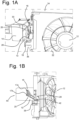
- FIG. 1A is a rear perspective view of a cooling module bracket 10 connecting a cooling module 12 to a side crash-box 14
- FIG. 1B is a side view of the bracket 10 and front vehicle structure, with the crash-box transparent for viewing purposes
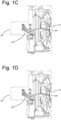
- FIG. 1C is a side view of the bracket 10 and front vehicle structure at the start of a front impact crash
- FIG. 1D is a side view of the bracket 10 and front vehicle structure after the front impact crash.
- Cooling module 12 includes fan 32, radiator 34 and cooling bushings 36. Cooling module 12 typically extends along the width of the front end of the vehicle between crash-boxes 14 on a first side and a second side (not shown), with a bumper 40 or other front structure (see FIG. 1D ) extending in front of the cooling module 12.
- Each side of cooling module 12 connects to a side crash-box 14 via bracket 10. While only one side of the vehicle frontal structure is shown in FIGS. 1A-1D , the other side connection of the cooling module 12 to side crash-box 14 would be a mirror image of the one shown, also connecting by a bracket 10. Brackets 10 would be mirror images of each other on each of the first and second sides, with protrusion 30 ensuring that bracket 10 is connected on the correct side. Protrusion 30 would extend outward, not allowing rear crash-box connection means 26 to bolt into crash-box 14 if someone attempted to use the bracket shown in Fig. 1A on the opposite side of the cooling module 12. While protrusion 30 is shown as the feature to ensure proper side connection, other embodiments could vary the size, shape, etc. so long as the features function to ensure that the specific bracket 10 only connects on the intended side.
- Bracket 10 includes forward crash-box connection means 16, cooling module connection means 18, rigid arm 20 with frontal side 22 and rearward side 24, rear crash-box connection means 26, break-away arm 28, and protrusion 30.
- Forward crash-box connection means 16 is shown as two bores in bracket 10 for receiving two bolts 17a, 17b spaced vertically from each other along the frontal side of the rigid arm 20 and connecting to the crash-box 14.
- Rear crashbox connection means 26 are also shown as two vertically spaced bores in bracket 10 for receiving bolts connecting to the crash-box 14 at a rearward position from the connection location of forward crash-box connection means 16. While two bores and bolts are shown, there can be more or fewer connectors, different types of connectors and/or could be arranged differently for connecting the bracket to the crash-box at the forward connection means and/or the rearward connection means.
- brackets 10 connect cooling module 12 to the crash-box on a first side and second side of the vehicle (right side and left side when looking at the vehicle from a front).
- a screw 42 extends in a vertical direction through a bore in bracket 10 (which could be threaded), connecting a rearward side 24 of rigid arm 20 with a cooling bushing 36 at the side of the cooling module 12.
- the cooling bushing 36 can be integrally formed with parts of the cooling module 12, or can be formed separately and securely connected at a side.
- the other connection means 16, 26 of bracket 10 connect to the crash-box 14.
- brackets 10 secure cooling module 12 within the vehicle.
- Brackets 10 with rigid forwardly-extending arm 20 and break-away arm 28, help to promote distance being maintained between the front end of the vehicle and the cooling module 12 in a low-speed frontal impact crash by moving the cooling module 12 rearward with any movement of the front end of the vehicle.
- Brackets 10 extend forward of the cooling module 12 for their forward crash-box connection means 16 to connect to the crash-box 14 on either side of the cooling module 12. This can be about 120-125 mm forward from the connection point, though can vary in different applications, for example, 90 mm - 160 mm. The extension forward makes it possible to sense the forward collision at an early moment.
- FIG. 1C shows the front portion of the vehicle, including the portion to which forward crash-box connection means 16 connects, moves rearward.
- Rigid arm 20 then translates this to move the entire cooling module 12 rearward through cooling module connection means 18.
- Break-away arm 28 breaks upon the impact force, allowing for the rearward movement of the rigid arm 20 and cooling module 12 in the case of a crash.
- FIG. 1C shows the point where break-away arm 28 starts to separate
- FIG. 1D shows the parts of bracket 10 and vehicle front end after the crash and resulting movement.
- side brackets 10 to connect cooling module to crash-boxes 14 is a simple way to reduce or eliminate damage to the cooling module 12 from a low speed frontal impact collision.
- the overall resulting damage is less and the vehicle is therefore less expensive to repair.
- the driver can often drive the vehicle to a repair shop themselves, resulting in time and cost savings by avoiding the need for a tow-truck.
- such a bracket 10 can result in economic savings in car insurance by reducing the likelihood of costly repairs after low-speed frontal impact collisions.
- FIG. 2A is a perspective view of a first (inner) side of bracket 10
- FIG. 2B is a perspective view of a second (outer) side of the bracket 10
- FIG. 2C is a side view of bracket 10
- FIG. 2D is a rear view of bracket 10.
- Bracket 10 includes forward crash-box connection means 16, cooling module connection means 18, rigid arm 20 with frontal side 22 and rearward side 24, rear crash-box connection means 26, break-away arm 28, and protrusion 30.
- Bracket 10 shown in FIGS. 2A-2D is a right side bracket (when viewing the vehicle from a front), and the left side bracket would be a mirror image from the side ( Fig. 2C ).
- Forward crash-box connection means 16 include two vertically spaced bores 45, each for receiving a connector such as a bolt or screw
- the bores 45 could include interior threads.
- Rear crash-box connection means 26 also includes two vertically spaced bores 46, each for receiving a connector such as a bolt or screw, and could be similarly threaded.
- the vertically spaced bores 45 can be in a portion of rigid arm 20 which has a tapered shape.
- the tapered shape can be from the front side 22 to the rearward side 24, and in some embodiments, such as the one shown in Figs. 2A-2D , have two separate tapers, a first larger taper at the front side 22, and a second taper where that ends to the rear side 24. As described and shown, these can have cut-out portions as needed for either accommodating other pass-through parts or for simply saving materials when additional strength is not required.
- Break-away arm 28 connects rear crash-box connection means 26 with rearward side 24 of rigid arm 20.
- Break-away arm 28 is much thinner (in a side view, see Fig. 2C ) than rigid arm 20, and is dimensioned such that break-away arm 28 will break in one or more places upon a frontal impact collision, disconnecting bracket 10 and cooling module 12 from rear crash-box connection means 26.
- Cooling module connection means is a vertically extending cavity 48, which could include threads for receiving a connector such as a bolt or screw to connect to the cooling module bushing 36.
- a collar 50 surrounds cavity 48 for connecting securely to cooling module and preventing upward movement of the cooling module.
- Rigid arm 20 extends from a rearward side 24 forward and upwards to a frontal end 22. As can be seen in FIGS. 2A-2C , rigid arm expands in height from the rearward side 24 to the forward side 22 as well, as can be seen clearly in FIG. 2C .
- the lower side of rigid arm 20 extends generally straight or planar in a forwards and upwards direction, with the top side having a first section extending upward at an angle, and a second section extending upward at a steeper angle toward the frontal end 22. This angle is typically less than 90 degrees. Corners and sides are generally rounded.
- rigid arm 20 includes a number of cut-out sections 52, which can reduce the weight and materials needed, as well as could provide throughpaths for cables within the vehicle.
- FIG. 2C shows sample dimensions for bracket 10, though these could vary in different embodiments.
- Side length L S between the rear crash-box connection means 26 (and cooling module connection means 18) to forward crash-box connection means 16 is about 115 mm
- the height of bracket 10 H B from the bottom of bracket 10 at crash-box connection means 26 to the top of both the rear crash-box connection means 16 and the forward crash-box connection means 16 is about 132 mm
- the height of break-away arm 28 H A from the bottom of bracket 10 at crash-box connection means 26 to the first connector opening 46 of rear crash-box connection means
- Bracket 10 can be formed by a metal material, for example aluminium (including alloys), and could be formed by die casting and/or other means.
- bracket 10 provides a simple, yet strong and durable side connection for the cooling module 12 in normal operation, and allows for rearward movement of the cooling module in a low-speed frontal impact crash to reduce or eliminate damage to the cooling module in such a collision.
- the break-away arm 28 is strong enough to handle the durability loads in normal operation (e.g., 15g in the Z-direction and 5g in the X and Y directions), but thin enough to break very quickly (e.g., within 45 miliseconds) upon a frontal impact crash to decouple the cooling module 12 from the body structure. This decoupling allows for rearward movement of the rigid arm 20 of bracket 10 and therefore cooling module 12 through the bracket connection means 18 to bushing 30.
- Rigid arm 20 is designed to meet high speed crash requirements and minimize materials and weight while ensuring sufficient strength to push the cooling module 12 back as much as possible upon impact.
- the rearward movement of cooling module then helps to protect the expensive cooling module 12 as much as possible from damage after a front end impact, only needing the less expensive crash-boxes 14 and/or brackets 10 needing repairing and/or replacement after such an impact.
- the vehicle can still generally be driven to a repair shop instead of requiring a tow.
- Bracket 10 also meets the requirements for normal operation and for high speed impacts, minimizing or eliminating the possibility of parts unintentionally fully detaching in such a high speed impact crash and damaging other parts of the vehicle.
- Bracket 10 additionally can be used in many different vehicles, making fewer design variations needed, and thereby simplifying manufacturing and assembly. The ability to use in many different vehicles due to the design also helps to lower overall costs.
- bracket 10 with connections means 16, 18, 26 are shown with specific design and details in the drawings, such designs could vary.
- connection means could differ
- the bracket rigid arm 20 could have a different configuration and/or the break-away arm 28 could be placed slightly differently, as long as the bracket 10 design ensures that front connection means are located in front of the cooling module 12, and that in the event of a frontal impact crash, that break-away arm 28 will separate to allow rigid arm to move cooling module rearward .
- the relative dimensions, sizing, and exact configuration of components could vary.
- bracket is shown and described as connecting directly to the crash-box and the cooling module, some embodiments would not have a direct connection and there could be one or more parts between in the same chain.
- one or more bushings could be between the bracket and crash-box and/or the bracket could be connected to an external cooling module carrier.
Landscapes
- Engineering & Computer Science (AREA)
- Mechanical Engineering (AREA)
- Chemical & Material Sciences (AREA)
- Combustion & Propulsion (AREA)
- Transportation (AREA)
- Body Structure For Vehicles (AREA)
Description
- This is related to support parts for a heat exchanger, particularly for securing a cooling module in the front end structure of a vehicle.
- The front end structure of a vehicle typically includes a cooling module with a radiator, positioned behind the front end of the vehicle. The front end usually has a bumper positioned at the very front, with crash-boxes just behind the bumper on each of the sides of the vehicle.
- In a frontal impact crash, the front end of the vehicle can be damaged, pushing the bumper and other front parts into the parts behind. This can result in damage to the cooling module and fan, even in very low speed crashes. Such damage to the cooling module can require costly repairs and a tow, since a vehicle with a damaged cooling module and fan can no longer be driven.
- A bracket for a cooling module in a front end structure of a vehicle is known from
EP 1 323 566 A1 . - According to a first aspect of the invention, a bracket for a cooling module in a front end structure of a vehicle comprises forward crash-box connection means; cooling module connection means; a rigid arm extending between the forward crash-box connection means at a forward side and the cooling module connection means at a rearward side; rear crash-box connection means; and a break-away arm extending from the rearward side of the rigid arm to the rear crash-box connection means. Such a bracket can help to minimize or prevent damage to a cooling module in an engine in the event of a front end collision. The bracket allows for the cooling module to move rearward in the event of such a collision with the break-away arm breaking away and moving the cooling module with any movement of the front end of the vehicle. This allows for less-expensive repairs, and often the ability to still drive the vehicle after such a collision.
- According to an embodiment, the forward crash-box connection means and/or the rear crash-box connection means comprises a plurality of connectors. Optionally, these can be bores, bolts, screws and/or other types of fasteners to securely connect the parts. Further optionally, these can be two vertically spaced crash-box connection means for each of the forward crash-box connection means and the rear crash-box connection means. Such connection means can provide a strong and stable connection, even when experiences large forces such as in a collision.
- According to an embodiment, the cooling module connection means comprises a screw connection to a cooler side bushing. Such a connection means can provide a secure and simple means of connecting the bracket to the cooling module (or an in-between part).
- According to an embodiment, the break-away arm extends substantially vertically from the cooling module connection means. This configuration can provide a bracket that is both simple to manufacture and connect while strong enough to withstand normal operational forces but break upon a frontal collision.
- According to an embodiment, the angle between the break-away arm and the rigid arm is less than 90 degrees. This configuration can help to ensure proper strength levels for the bracket, as well and ensure the bracket remains sufficiently compact to take up less space in the vehicle and be usable with a variety of different vehicles.
- According to an embodiment, the rigid arm comprises an arm which expands in height from the rearward side to the forward side. This could also be seen an a taper from the forward side. In some embodiments, there could be more than one taper angle, a first at the forward side, and a second taper angle at the rearward side. This configuration helps the rigid arm have sufficient strength and rigidity to ensure that the cooling module is moved rearward with any movement of the frontal end of the vehicle.
- According to an embodiment, the rigid arm comprises cut-out sections and/or sections of reduced material. Such a configuration saves on weight of the bracket and materials costs when manufacturing while still maintaining the necessary strength and rigidity.
- According to an embodiment, the bracket further comprises a protrusion on one side of the bracket. The protrusion can be formed and located such that the bracket would only connect on a proper side of the cooling module, reducing the risk that the bracket could be connected on the wrong side and possibly not function as intended.
- According to an embodiment, the bracket is formed of metal. Optionally, this can be aluminium (including alloys) or another type of metal or other material with sufficient strength and rigidity. Further optionally, the bracket could be formed by die casting.
- According to a further aspect of the invention, a cooling module includes a first bracket as previously described connected to a first cooling module bushing on a first side of the cooling module, and a second bracket as previously described connected to a second cooling module bushing on a second side of the cooling module; wherein for each of the first and second brackets, the cooling module connection means connects to the cooling module bushing with a screw or bolt connection.
- According to an aspect of the invention, a frontal vehicle structure includes a cooling module and first and second brackets as previously described, and further comprises a first crash-box on the first side and a second crash-box on the second side. For each of the first and second brackets, the forward crash-box connection means and the rearward crash-box connection means connects to forward and rearward positions of the crash-box, respectively.
- Such a cooling module (and frontal vehicle structure) with first and second brackets connected on either side provides a simple, yet strong and durable side connection for the cooling module in normal vehicle operation, and allows for rearward movement of the cooling module in a low-speed frontal impact crash to reduce or eliminate damage to the cooling module in such a collision.
- According to an embodiment, each of the first and second brackets are dimensioned such that the break-away arms break in one or more pieces at a frontal impact crash, and the rigid arms maintain their rigidity to move the cooling module rearward upon rearward movement of the crash-box and forward crash-box connection means. This can be provided by the materials and/or configuration of each of the rigid arms and break-away arms. This can ensure that the vehicle performs as intended, such that the break-away arms break upon a frontal impact collision, and the cooling module is able to be moved rearward to reduce or prevent damage to the cooling module, thereby minimizing overall damage and repair costs.
- According to a further aspect of the invention, a method of protecting a cooling module in a frontal impact crash using first and second side brackets is provided. Each bracket comprises forward crash-box connection means, cooling module connection means; a rigid arm extending between the cooling module connection means at a rearward side and forward crash-box connection means at a forward side, rear crash-box connection means, and a break-away arm extending from the rearward side of the rigid arm to the rear crash-box connection means. The method comprises a) connecting the cooling module connection means of the first bracket to a first side bushing of the cooling module; b) connecting the forward crash-box connection means of the first bracket to a first side crash-box; c) connecting the rear crash-box connection means of the first bracket to the first side crash-box at a rearward position from the forward crash-box connection means; d) connecting the cooling module connection means of the second bracket to a second side bushing of the cooling module; e) connecting the forward crash-box connection means of the second bracket to a second side crash-box; and f) connecting the rear crash-box connection means of the second bracket to the second side crash-box at a rearward position from the forward crash-box connection means. Optionally, the connections are with one or more bolts and/or screws.
- Such a method provides an efficient and secure way of connecting a cooling module to a frontal structure of a vehicle in such a way that the cooling module can move rearward with the frontal end structure in the event of a frontal impact collision. This can reduce and/or prevent damage to the cooling module, and reduce the costs of repair overall.
- The bracket is a very versatile bracket, able to be used with a number of different vehicles due to its size and configuration. In some embodiments, the size would vary, but the general configuration is the same as that described and shown in the drawings. This can lead to less costly production (e.g., common tooling), less complex storage, logistics and assembly, as well as an overall less costly product.
-
-
FIG. 1A is a perspective view of a cooling module bracket connecting a cooling module to a side crash-box. -
FIG. 1B is a side view of the cooling bracket and front vehicle parts, with the crash-box transparent for viewing purposes. -
FIG. 1C is a side view of the cooling bracket and front vehicle parts at the start of a front impact crash. -
FIG. 1D is a side view of the cooling bracket and front vehicle parts after the front impact crash. -
FIG. 2A is a perspective view of an innert side of the bracket ofFIGS. 1A-1C . -
FIG. 2B is a perspective view of an outer side of the bracket ofFIG. 2A . -
FIG. 2C is a side view of the bracket ofFIG. 2A . -
FIG. 2D is a rear view of the bracket ofFIG. 2A . -
FIG. 1A is a rear perspective view of acooling module bracket 10 connecting acooling module 12 to a side crash-box 14,FIG. 1B is a side view of thebracket 10 and front vehicle structure, with the crash-box transparent for viewing purposes,FIG. 1C is a side view of thebracket 10 and front vehicle structure at the start of a front impact crash, andFIG. 1D is a side view of thebracket 10 and front vehicle structure after the front impact crash. -
Cooling module 12 includesfan 32,radiator 34 and coolingbushings 36.Cooling module 12 typically extends along the width of the front end of the vehicle between crash-boxes 14 on a first side and a second side (not shown), with abumper 40 or other front structure (seeFIG. 1D ) extending in front of thecooling module 12. - Each side of cooling
module 12 connects to a side crash-box 14 viabracket 10. While only one side of the vehicle frontal structure is shown inFIGS. 1A-1D , the other side connection of thecooling module 12 to side crash-box 14 would be a mirror image of the one shown, also connecting by abracket 10.Brackets 10 would be mirror images of each other on each of the first and second sides, withprotrusion 30 ensuring thatbracket 10 is connected on the correct side.Protrusion 30 would extend outward, not allowing rear crash-box connection means 26 to bolt into crash-box 14 if someone attempted to use the bracket shown inFig. 1A on the opposite side of thecooling module 12. Whileprotrusion 30 is shown as the feature to ensure proper side connection, other embodiments could vary the size, shape, etc. so long as the features function to ensure that thespecific bracket 10 only connects on the intended side. -
Bracket 10 includes forward crash-box connection means 16, cooling module connection means 18,rigid arm 20 withfrontal side 22 andrearward side 24, rear crash-box connection means 26, break-awayarm 28, andprotrusion 30. Forward crash-box connection means 16 is shown as two bores inbracket 10 for receiving twobolts rigid arm 20 and connecting to the crash-box 14. Rear crashbox connection means 26 are also shown as two vertically spaced bores inbracket 10 for receiving bolts connecting to the crash-box 14 at a rearward position from the connection location of forward crash-box connection means 16. While two bores and bolts are shown, there can be more or fewer connectors, different types of connectors and/or could be arranged differently for connecting the bracket to the crash-box at the forward connection means and/or the rearward connection means. - In use,
brackets 10 connectcooling module 12 to the crash-box on a first side and second side of the vehicle (right side and left side when looking at the vehicle from a front). Ascrew 42 extends in a vertical direction through a bore in bracket 10 (which could be threaded), connecting arearward side 24 ofrigid arm 20 with a coolingbushing 36 at the side of thecooling module 12. The coolingbushing 36 can be integrally formed with parts of thecooling module 12, or can be formed separately and securely connected at a side. The other connection means 16, 26 ofbracket 10 connect to the crash-box 14. Thus, in normal operations, brackets 10 (one on each side)secure cooling module 12 within the vehicle. - In the case of a low-speed front end collision, the front of the vehicle is typically damaged and the
bumper 40, and other front parts of the vehicle are moved rearward from the frontal impact force. In past systems, this typically pushed the front end of the vehicle into thecooling module 12, often damaging thecooling module 12, even in low speed collisions. A damagedcooling module 12 is often expensive to repair, and the vehicle is usually not driveable until the repair has been done. -
Brackets 10, with rigid forwardly-extendingarm 20 and break-awayarm 28, help to promote distance being maintained between the front end of the vehicle and thecooling module 12 in a low-speed frontal impact crash by moving thecooling module 12 rearward with any movement of the front end of the vehicle.Brackets 10 extend forward of thecooling module 12 for their forward crash-box connection means 16 to connect to the crash-box 14 on either side of thecooling module 12. This can be about 120-125 mm forward from the connection point, though can vary in different applications, for example, 90 mm - 160 mm. The extension forward makes it possible to sense the forward collision at an early moment. - As shown in
FIG. 1C , upon initiation of a low-speed frontal impact, the front portion of the vehicle, including the portion to which forward crash-box connection means 16 connects, moves rearward.Rigid arm 20 then translates this to move theentire cooling module 12 rearward through cooling module connection means 18. Break-awayarm 28 breaks upon the impact force, allowing for the rearward movement of therigid arm 20 andcooling module 12 in the case of a crash.FIG. 1C shows the point where break-awayarm 28 starts to separate, andFIG. 1D shows the parts ofbracket 10 and vehicle front end after the crash and resulting movement. - Thus, the use of
side brackets 10 to connect cooling module to crash-boxes 14 is a simple way to reduce or eliminate damage to thecooling module 12 from a low speed frontal impact collision. By reducing or preventing damage to thecooling module 12, the overall resulting damage is less and the vehicle is therefore less expensive to repair. Additionally, if thecooling module 12 is not damaged in such a collision, the driver can often drive the vehicle to a repair shop themselves, resulting in time and cost savings by avoiding the need for a tow-truck. Moreover, such abracket 10 can result in economic savings in car insurance by reducing the likelihood of costly repairs after low-speed frontal impact collisions. -
FIG. 2A is a perspective view of a first (inner) side ofbracket 10,FIG. 2B is a perspective view of a second (outer) side of thebracket 10,FIG. 2C is a side view ofbracket 10, andFIG. 2D is a rear view ofbracket 10.Bracket 10 includes forward crash-box connection means 16, cooling module connection means 18,rigid arm 20 withfrontal side 22 andrearward side 24, rear crash-box connection means 26, break-awayarm 28, andprotrusion 30.Bracket 10 shown inFIGS. 2A-2D is a right side bracket (when viewing the vehicle from a front), and the left side bracket would be a mirror image from the side (Fig. 2C ). - Forward crash-box connection means 16 include two vertically spaced bores 45, each for receiving a connector such as a bolt or screw The
bores 45 could include interior threads. Rear crash-box connection means 26 also includes two vertically spaced bores 46, each for receiving a connector such as a bolt or screw, and could be similarly threaded. The vertically spaced bores 45 can be in a portion ofrigid arm 20 which has a tapered shape. The tapered shape can be from thefront side 22 to therearward side 24, and in some embodiments, such as the one shown inFigs. 2A-2D , have two separate tapers, a first larger taper at thefront side 22, and a second taper where that ends to therear side 24. As described and shown, these can have cut-out portions as needed for either accommodating other pass-through parts or for simply saving materials when additional strength is not required. - Break-away
arm 28 connects rear crash-box connection means 26 withrearward side 24 ofrigid arm 20. Break-awayarm 28 is much thinner (in a side view, seeFig. 2C ) thanrigid arm 20, and is dimensioned such that break-awayarm 28 will break in one or more places upon a frontal impact collision, disconnectingbracket 10 andcooling module 12 from rear crash-box connection means 26. - Cooling module connection means is a vertically extending
cavity 48, which could include threads for receiving a connector such as a bolt or screw to connect to thecooling module bushing 36. In thebracket 10 shown, acollar 50 surroundscavity 48 for connecting securely to cooling module and preventing upward movement of the cooling module. -
Rigid arm 20 extends from arearward side 24 forward and upwards to afrontal end 22. As can be seen inFIGS. 2A-2C , rigid arm expands in height from therearward side 24 to theforward side 22 as well, as can be seen clearly inFIG. 2C . In this embodiment, the lower side ofrigid arm 20 extends generally straight or planar in a forwards and upwards direction, with the top side having a first section extending upward at an angle, and a second section extending upward at a steeper angle toward thefrontal end 22. This angle is typically less than 90 degrees. Corners and sides are generally rounded. Additionally,rigid arm 20 includes a number of cut-outsections 52, which can reduce the weight and materials needed, as well as could provide throughpaths for cables within the vehicle. There can beother parts 54 which are made generally less thick for further reducing material while maintaining strength and stability requirements forrigid arm 20 to not break upon a low-speed frontal impact collision, and move cooling module back 12 with any movement of the front end of the vehicle. -
FIG. 2C shows sample dimensions forbracket 10, though these could vary in different embodiments. Side length LS between the rear crash-box connection means 26 (and cooling module connection means 18) to forward crash-box connection means 16 is about 115 mm, the height of bracket 10 HB from the bottom ofbracket 10 at crash-box connection means 26 to the top of both the rear crash-box connection means 16 and the forward crash-box connection means 16 is about 132 mm, with the height of break-away arm 28 HA(from the bottom ofbracket 10 at crash-box connection means 26 to thefirst connector opening 46 of rear crash-box connection means) being about 74.5 mm. -
Bracket 10 can be formed by a metal material, for example aluminium (including alloys), and could be formed by die casting and/or other means. - In summary,
bracket 10 provides a simple, yet strong and durable side connection for thecooling module 12 in normal operation, and allows for rearward movement of the cooling module in a low-speed frontal impact crash to reduce or eliminate damage to the cooling module in such a collision. The break-awayarm 28 is strong enough to handle the durability loads in normal operation (e.g., 15g in the Z-direction and 5g in the X and Y directions), but thin enough to break very quickly (e.g., within 45 miliseconds) upon a frontal impact crash to decouple thecooling module 12 from the body structure. This decoupling allows for rearward movement of therigid arm 20 ofbracket 10 and therefore coolingmodule 12 through the bracket connection means 18 tobushing 30.Rigid arm 20 is designed to meet high speed crash requirements and minimize materials and weight while ensuring sufficient strength to push thecooling module 12 back as much as possible upon impact. The rearward movement of cooling module then helps to protect theexpensive cooling module 12 as much as possible from damage after a front end impact, only needing the less expensive crash-boxes 14 and/orbrackets 10 needing repairing and/or replacement after such an impact. Additionally, when the cooling module is not damaged, the vehicle can still generally be driven to a repair shop instead of requiring a tow.Bracket 10 also meets the requirements for normal operation and for high speed impacts, minimizing or eliminating the possibility of parts unintentionally fully detaching in such a high speed impact crash and damaging other parts of the vehicle. -
Bracket 10 additionally can be used in many different vehicles, making fewer design variations needed, and thereby simplifying manufacturing and assembly. The ability to use in many different vehicles due to the design also helps to lower overall costs. - While
bracket 10 with connections means 16, 18, 26 are shown with specific design and details in the drawings, such designs could vary. For example, the connection means could differ, the bracketrigid arm 20 could have a different configuration and/or the break-awayarm 28 could be placed slightly differently, as long as thebracket 10 design ensures that front connection means are located in front of thecooling module 12, and that in the event of a frontal impact crash, that break-awayarm 28 will separate to allow rigid arm to move cooling module rearward . The relative dimensions, sizing, and exact configuration of components could vary. - While the bracket is shown and described as connecting directly to the crash-box and the cooling module, some embodiments would not have a direct connection and there could be one or more parts between in the same chain. For example, one or more bushings could be between the bracket and crash-box and/or the bracket could be connected to an external cooling module carrier.
- While the invention has been described with reference to exemplary embodiments, it will be understood by those skilled in the art that various changes may be made and that the invention will include all embodiments falling within the scope of the appended claims.
Claims (15)
- A bracket (10) for a cooling module (12) in a front end structure of a vehicle, the bracket comprising:forward crash-box connection means (16);cooling module connection means (18); anda rigid arm (20) extending between the forward crash-box connection means (16) at a forward side and the cooling module connection means (18) at a rearward side;characterised in that the bracket further comprises:rear crash-box connection means (26); anda break-away arm (28) extending from the rearward side of the rigid arm (20) to the rear crash-box connection means (26).
- The bracket (10) of claim 1, wherein the forward crash-box connection means (16) comprises a plurality of connectors, preferably two vertically spaced connectors.
- The bracket (10) of any of the preceding claims, wherein the cooling module connection means (18) comprises a screw connection to a cooler side bushing (36).
- The bracket (10) of any of the preceding claims, wherein the rear crash-box connection means (26) comprises a plurality of connectors, preferably two vertically spaced connectors.
- The bracket (10) of any of the preceding claims, wherein the break-away arm (28) extends substantially vertically from the cooling module connection means (18).
- The bracket (10) of any of the preceding claims, wherein the rigid arm (20) forms an angle of less than 90 degrees with the break-away arm (28).
- The bracket (10) of any of the preceding claims, wherein the rigid arm (20) comprises an arm which expands in height from the rearward side (24) to the forward side (22).
- The bracket (10) of any of the preceding claims, wherein the rigid arm (20) comprises cut-out sections (52) and/or sections of reduced material (54).
- The bracket (10) of any of the preceding claims, and further comprising a protrusion (30) on one side of the bracket (30).
- The bracket (10) of any of the preceding claims, wherein the bracket is formed of metal.
- A cooling module (12) with a first bracket (10) according to one of the preceding claims connected to a first cooling module bushing (36) on a first side of the cooling module (12), and a second bracket (10) according to one of the preceding claims connected to a second cooling module bushing (36) on a second side of the cooling module; wherein for each of the first and second brackets (10), the cooling module connection means (28) connects to the cooling module bushing with a screw or bolt connection.
- A frontal vehicle structure comprising the cooling module (12) and first and second brackets (10) according to claim 11, and further comprising a first crash-box (14) on the first side and a second crash-box (14) on the second side; wherein for each of the first and second brackets (10), the forward crash-box connection means (16) and the rearward crash-box connection means (26) connects to forward and rearward positions of the crash-box (14), respectively.
- The frontal vehicle structure of claim 12, wherein each of the first and second brackets (10) are dimensioned such that the break-away arms (28) break in one or more pieces at a frontal impact crash, and the rigid arms (20) maintain their rigidity to move the cooling module (12) rearward upon rearward movement of the crash-box (14) and forward crash-box connection means (16).
- A method of protecting a cooling module (12) in a frontal impact crash using first and second side brackets (10), each bracket (10) comprising forward crash-box connection means (16), cooling module connection means (18); a rigid arm (20) extending between the cooling module connection means (18) at a rearward side and forward crash-box connection means (16) at a forward side, rear crash-box connection means (26), and a break-away arm (28) extending from the rearward side of the rigid arm (20) to the rear crash-box connection means (26), the method comprising:a) connecting the cooling module connection means (18) of the first bracket (10) to a first side bushing (36) of the cooling module (12);b) connecting the forward crash-box connection means (16) of the first bracket (10) to a first side crash-box (14);c) connecting the rear crash-box connection means (26) of the first bracket (10) to the first side crash-box (14) at a rearward position from the forward crash-box connection means (16);d) connecting the cooling module connection means (18) of the second bracket (10) to a second side bushing of the cooling module (12);e) connecting the forward crash-box connection means (16) of the second bracket (10) to a second side crash-box (14); andc) connecting the rear crash-box connection means (26) of the second bracket (10) to the second side crash-box (14) at a rearward position from the forward crash-box connection means (16).
- The method of claim 14, wherein the connections are with one or more bolts or screws.
Priority Applications (3)
| Application Number | Priority Date | Filing Date | Title |
|---|---|---|---|
| EP21199852.1A EP4159511B1 (en) | 2021-09-29 | 2021-09-29 | Cooling module support bracket |
| US17/941,098 US12296888B2 (en) | 2021-09-29 | 2022-09-09 | Cooling module support bracket |
| CN202211199134.1A CN115871797A (en) | 2021-09-29 | 2022-09-29 | Cooling module support bracket |
Applications Claiming Priority (1)
| Application Number | Priority Date | Filing Date | Title |
|---|---|---|---|
| EP21199852.1A EP4159511B1 (en) | 2021-09-29 | 2021-09-29 | Cooling module support bracket |
Publications (2)
| Publication Number | Publication Date |
|---|---|
| EP4159511A1 EP4159511A1 (en) | 2023-04-05 |
| EP4159511B1 true EP4159511B1 (en) | 2024-11-06 |
Family
ID=78232248
Family Applications (1)
| Application Number | Title | Priority Date | Filing Date |
|---|---|---|---|
| EP21199852.1A Active EP4159511B1 (en) | 2021-09-29 | 2021-09-29 | Cooling module support bracket |
Country Status (3)
| Country | Link |
|---|---|
| US (1) | US12296888B2 (en) |
| EP (1) | EP4159511B1 (en) |
| CN (1) | CN115871797A (en) |
Families Citing this family (1)
| Publication number | Priority date | Publication date | Assignee | Title |
|---|---|---|---|---|
| FR3165814A1 (en) * | 2024-09-05 | 2026-03-06 | Ampere Sas | Arrangement for motor vehicle. |
Family Cites Families (15)
| Publication number | Priority date | Publication date | Assignee | Title |
|---|---|---|---|---|
| US1189562A (en) * | 1915-05-17 | 1916-07-04 | Briscoe Mfg Co | Radiator-bracket. |
| DE10161432A1 (en) * | 2001-12-14 | 2003-07-03 | Hella Behr Fahrzeugsysteme | Holding device for a cooling module |
| US20040124028A1 (en) * | 2002-09-05 | 2004-07-01 | Daniel Lachapelle | Convection cooled radiator for an all terrain vehicle |
| DE10260787B3 (en) * | 2002-12-23 | 2004-07-15 | Daimlerchrysler Ag | Holding device for climate control unit in vehicle has two holding element between two crash box parts at sides of unit |
| DE10260793B4 (en) * | 2002-12-23 | 2008-12-11 | Daimler Ag | Crash box cooler intake |
| JP4296827B2 (en) * | 2003-04-24 | 2009-07-15 | トヨタ自動車株式会社 | Vehicle front structure |
| JP4453511B2 (en) * | 2004-04-28 | 2010-04-21 | トヨタ自動車株式会社 | Cooling system support structure for vehicles |
| DE102004058361A1 (en) * | 2004-12-03 | 2006-06-08 | Daimlerchrysler Ag | Holder for the fastening of units, has two fastening arms for fastening of holder to crash box or bearing structure whereby clearance is provided between fastening arm and holder, into which crash box can deform |
| JP2006290224A (en) * | 2005-04-13 | 2006-10-26 | Toyota Motor Corp | Body front structure |
| DE102008012204B4 (en) * | 2008-03-03 | 2018-08-16 | Mahle International Gmbh | Fastening device for a heat exchanger |
| JP5308926B2 (en) * | 2009-06-10 | 2013-10-09 | 豊田鉄工株式会社 | Support structure for vehicle cooling unit |
| US9016416B2 (en) * | 2011-12-15 | 2015-04-28 | Toyota Jidosha Kabushiki Kaisha | Vehicle front structure |
| WO2014162574A1 (en) * | 2013-04-04 | 2014-10-09 | トヨタ自動車株式会社 | Vehicle body end portion structure |
| JP6186341B2 (en) * | 2014-11-28 | 2017-08-23 | 豊田鉄工株式会社 | Body front structure |
| JP6923876B2 (en) * | 2017-03-28 | 2021-08-25 | 株式会社ワイテック | Front body structure of the car |
-
2021
- 2021-09-29 EP EP21199852.1A patent/EP4159511B1/en active Active
-
2022
- 2022-09-09 US US17/941,098 patent/US12296888B2/en active Active
- 2022-09-29 CN CN202211199134.1A patent/CN115871797A/en active Pending
Also Published As
| Publication number | Publication date |
|---|---|
| US12296888B2 (en) | 2025-05-13 |
| CN115871797A (en) | 2023-03-31 |
| US20230101269A1 (en) | 2023-03-30 |
| EP4159511A1 (en) | 2023-04-05 |
Similar Documents
| Publication | Publication Date | Title |
|---|---|---|
| US11420507B2 (en) | Power train support structure for vehicle | |
| JP5176460B2 (en) | Automotive front structure | |
| US8251438B2 (en) | Front-end structure of a motor vehicle | |
| JP6186341B2 (en) | Body front structure | |
| US10967914B2 (en) | Arrangement structure of electrical apparatus in electric automobile | |
| EP4159511B1 (en) | Cooling module support bracket | |
| EP4026758B1 (en) | Vehicle headlamp mounting assembly and vehicle | |
| EP3290304B1 (en) | Motor vehicle provided with a powertrain unit and a safety device for moving the powertrain unit sideways during an impact | |
| EP1785306A2 (en) | Air guide structure adapted for motor vehicle | |
| US6758515B2 (en) | Front end structure of vehicle with crushable zones for collision damage | |
| EP1062110B1 (en) | Vehicle power unit mounting arrangements | |
| CN116278717A (en) | Mounting Bracket Assembly, Angled Cooling Module Assembly and Vehicle | |
| US11198406B2 (en) | Grille shutter | |
| US6808039B2 (en) | Front end of a motor vehicle | |
| US20150283895A1 (en) | Radiator and vehicle equipped with the radiator | |
| JP5167749B2 (en) | Automotive front structure | |
| US12447916B2 (en) | Mounting for a sensor on a vehicle structure, and vehicle comprising a mounting of this type | |
| CN118597033A (en) | Front end anti-collision assembly and vehicle | |
| CN112440913B (en) | A collision protection structure for a vehicle and a vehicle | |
| CN217730203U (en) | Radiator mounting structure and car | |
| JP7307893B2 (en) | Vehicle powertrain support structure | |
| JP7205800B2 (en) | vehicle cooling system | |
| KR101417118B1 (en) | Radiator mounting structure of automobile | |
| US20090102237A1 (en) | Vehicle Body for a Motor Vehicle | |
| CN108473080B (en) | Headlamp with a fragmentable and guided fixing bracket |
Legal Events
| Date | Code | Title | Description |
|---|---|---|---|
| PUAI | Public reference made under article 153(3) epc to a published international application that has entered the european phase |
Free format text: ORIGINAL CODE: 0009012 |
|
| STAA | Information on the status of an ep patent application or granted ep patent |
Free format text: STATUS: THE APPLICATION HAS BEEN PUBLISHED |
|
| AK | Designated contracting states |
Kind code of ref document: A1 Designated state(s): AL AT BE BG CH CY CZ DE DK EE ES FI FR GB GR HR HU IE IS IT LI LT LU LV MC MK MT NL NO PL PT RO RS SE SI SK SM TR |
|
| STAA | Information on the status of an ep patent application or granted ep patent |
Free format text: STATUS: REQUEST FOR EXAMINATION WAS MADE |
|
| 17P | Request for examination filed |
Effective date: 20230925 |
|
| RBV | Designated contracting states (corrected) |
Designated state(s): AL AT BE BG CH CY CZ DE DK EE ES FI FR GB GR HR HU IE IS IT LI LT LU LV MC MK MT NL NO PL PT RO RS SE SI SK SM TR |
|
| GRAP | Despatch of communication of intention to grant a patent |
Free format text: ORIGINAL CODE: EPIDOSNIGR1 |
|
| STAA | Information on the status of an ep patent application or granted ep patent |
Free format text: STATUS: GRANT OF PATENT IS INTENDED |
|
| RIC1 | Information provided on ipc code assigned before grant |
Ipc: B60K 11/04 20060101AFI20240408BHEP |
|
| INTG | Intention to grant announced |
Effective date: 20240422 |
|
| GRAS | Grant fee paid |
Free format text: ORIGINAL CODE: EPIDOSNIGR3 |
|
| P01 | Opt-out of the competence of the unified patent court (upc) registered |
Free format text: CASE NUMBER: APP_41265/2024 Effective date: 20240712 |
|
| GRAA | (expected) grant |
Free format text: ORIGINAL CODE: 0009210 |
|
| STAA | Information on the status of an ep patent application or granted ep patent |
Free format text: STATUS: THE PATENT HAS BEEN GRANTED |
|
| AK | Designated contracting states |
Kind code of ref document: B1 Designated state(s): AL AT BE BG CH CY CZ DE DK EE ES FI FR GB GR HR HU IE IS IT LI LT LU LV MC MK MT NL NO PL PT RO RS SE SI SK SM TR |
|
| REG | Reference to a national code |
Ref country code: GB Ref legal event code: FG4D |
|
| REG | Reference to a national code |
Ref country code: CH Ref legal event code: EP |
|
| REG | Reference to a national code |
Ref country code: DE Ref legal event code: R096 Ref document number: 602021021326 Country of ref document: DE |
|
| REG | Reference to a national code |
Ref country code: IE Ref legal event code: FG4D |
|
| REG | Reference to a national code |
Ref country code: LT Ref legal event code: MG9D |
|
| REG | Reference to a national code |
Ref country code: NL Ref legal event code: MP Effective date: 20241106 |
|
| PG25 | Lapsed in a contracting state [announced via postgrant information from national office to epo] |
Ref country code: PT Free format text: LAPSE BECAUSE OF FAILURE TO SUBMIT A TRANSLATION OF THE DESCRIPTION OR TO PAY THE FEE WITHIN THE PRESCRIBED TIME-LIMIT Effective date: 20250306 Ref country code: IS Free format text: LAPSE BECAUSE OF FAILURE TO SUBMIT A TRANSLATION OF THE DESCRIPTION OR TO PAY THE FEE WITHIN THE PRESCRIBED TIME-LIMIT Effective date: 20250306 Ref country code: HR Free format text: LAPSE BECAUSE OF FAILURE TO SUBMIT A TRANSLATION OF THE DESCRIPTION OR TO PAY THE FEE WITHIN THE PRESCRIBED TIME-LIMIT Effective date: 20241106 |
|
| PG25 | Lapsed in a contracting state [announced via postgrant information from national office to epo] |
Ref country code: NL Free format text: LAPSE BECAUSE OF FAILURE TO SUBMIT A TRANSLATION OF THE DESCRIPTION OR TO PAY THE FEE WITHIN THE PRESCRIBED TIME-LIMIT Effective date: 20241106 Ref country code: FI Free format text: LAPSE BECAUSE OF FAILURE TO SUBMIT A TRANSLATION OF THE DESCRIPTION OR TO PAY THE FEE WITHIN THE PRESCRIBED TIME-LIMIT Effective date: 20241106 |
|
| REG | Reference to a national code |
Ref country code: AT Ref legal event code: MK05 Ref document number: 1739020 Country of ref document: AT Kind code of ref document: T Effective date: 20241106 |
|
| PG25 | Lapsed in a contracting state [announced via postgrant information from national office to epo] |
Ref country code: BG Free format text: LAPSE BECAUSE OF FAILURE TO SUBMIT A TRANSLATION OF THE DESCRIPTION OR TO PAY THE FEE WITHIN THE PRESCRIBED TIME-LIMIT Effective date: 20241106 |
|
| PG25 | Lapsed in a contracting state [announced via postgrant information from national office to epo] |
Ref country code: ES Free format text: LAPSE BECAUSE OF FAILURE TO SUBMIT A TRANSLATION OF THE DESCRIPTION OR TO PAY THE FEE WITHIN THE PRESCRIBED TIME-LIMIT Effective date: 20241106 |
|
| PG25 | Lapsed in a contracting state [announced via postgrant information from national office to epo] |
Ref country code: NO Free format text: LAPSE BECAUSE OF FAILURE TO SUBMIT A TRANSLATION OF THE DESCRIPTION OR TO PAY THE FEE WITHIN THE PRESCRIBED TIME-LIMIT Effective date: 20250206 |
|
| PG25 | Lapsed in a contracting state [announced via postgrant information from national office to epo] |
Ref country code: LV Free format text: LAPSE BECAUSE OF FAILURE TO SUBMIT A TRANSLATION OF THE DESCRIPTION OR TO PAY THE FEE WITHIN THE PRESCRIBED TIME-LIMIT Effective date: 20241106 Ref country code: GR Free format text: LAPSE BECAUSE OF FAILURE TO SUBMIT A TRANSLATION OF THE DESCRIPTION OR TO PAY THE FEE WITHIN THE PRESCRIBED TIME-LIMIT Effective date: 20250207 Ref country code: AT Free format text: LAPSE BECAUSE OF FAILURE TO SUBMIT A TRANSLATION OF THE DESCRIPTION OR TO PAY THE FEE WITHIN THE PRESCRIBED TIME-LIMIT Effective date: 20241106 |
|
| PG25 | Lapsed in a contracting state [announced via postgrant information from national office to epo] |
Ref country code: PL Free format text: LAPSE BECAUSE OF FAILURE TO SUBMIT A TRANSLATION OF THE DESCRIPTION OR TO PAY THE FEE WITHIN THE PRESCRIBED TIME-LIMIT Effective date: 20241106 |
|
| PG25 | Lapsed in a contracting state [announced via postgrant information from national office to epo] |
Ref country code: RS Free format text: LAPSE BECAUSE OF FAILURE TO SUBMIT A TRANSLATION OF THE DESCRIPTION OR TO PAY THE FEE WITHIN THE PRESCRIBED TIME-LIMIT Effective date: 20250206 |
|
| PG25 | Lapsed in a contracting state [announced via postgrant information from national office to epo] |
Ref country code: SM Free format text: LAPSE BECAUSE OF FAILURE TO SUBMIT A TRANSLATION OF THE DESCRIPTION OR TO PAY THE FEE WITHIN THE PRESCRIBED TIME-LIMIT Effective date: 20241106 |
|
| PG25 | Lapsed in a contracting state [announced via postgrant information from national office to epo] |
Ref country code: DK Free format text: LAPSE BECAUSE OF FAILURE TO SUBMIT A TRANSLATION OF THE DESCRIPTION OR TO PAY THE FEE WITHIN THE PRESCRIBED TIME-LIMIT Effective date: 20241106 |
|
| PG25 | Lapsed in a contracting state [announced via postgrant information from national office to epo] |
Ref country code: EE Free format text: LAPSE BECAUSE OF FAILURE TO SUBMIT A TRANSLATION OF THE DESCRIPTION OR TO PAY THE FEE WITHIN THE PRESCRIBED TIME-LIMIT Effective date: 20241106 |
|
| PG25 | Lapsed in a contracting state [announced via postgrant information from national office to epo] |
Ref country code: RO Free format text: LAPSE BECAUSE OF FAILURE TO SUBMIT A TRANSLATION OF THE DESCRIPTION OR TO PAY THE FEE WITHIN THE PRESCRIBED TIME-LIMIT Effective date: 20241106 |
|
| PG25 | Lapsed in a contracting state [announced via postgrant information from national office to epo] |
Ref country code: SK Free format text: LAPSE BECAUSE OF FAILURE TO SUBMIT A TRANSLATION OF THE DESCRIPTION OR TO PAY THE FEE WITHIN THE PRESCRIBED TIME-LIMIT Effective date: 20241106 |
|
| PG25 | Lapsed in a contracting state [announced via postgrant information from national office to epo] |
Ref country code: CZ Free format text: LAPSE BECAUSE OF FAILURE TO SUBMIT A TRANSLATION OF THE DESCRIPTION OR TO PAY THE FEE WITHIN THE PRESCRIBED TIME-LIMIT Effective date: 20241106 |
|
| PG25 | Lapsed in a contracting state [announced via postgrant information from national office to epo] |
Ref country code: IT Free format text: LAPSE BECAUSE OF FAILURE TO SUBMIT A TRANSLATION OF THE DESCRIPTION OR TO PAY THE FEE WITHIN THE PRESCRIBED TIME-LIMIT Effective date: 20241106 |
|
| REG | Reference to a national code |
Ref country code: DE Ref legal event code: R097 Ref document number: 602021021326 Country of ref document: DE |
|
| PG25 | Lapsed in a contracting state [announced via postgrant information from national office to epo] |
Ref country code: SE Free format text: LAPSE BECAUSE OF FAILURE TO SUBMIT A TRANSLATION OF THE DESCRIPTION OR TO PAY THE FEE WITHIN THE PRESCRIBED TIME-LIMIT Effective date: 20241106 |
|
| PLBE | No opposition filed within time limit |
Free format text: ORIGINAL CODE: 0009261 |
|
| STAA | Information on the status of an ep patent application or granted ep patent |
Free format text: STATUS: NO OPPOSITION FILED WITHIN TIME LIMIT |
|
| PGFP | Annual fee paid to national office [announced via postgrant information from national office to epo] |
Ref country code: DE Payment date: 20250820 Year of fee payment: 5 |
|
| 26N | No opposition filed |
Effective date: 20250807 |
|
| PGFP | Annual fee paid to national office [announced via postgrant information from national office to epo] |
Ref country code: GB Payment date: 20250822 Year of fee payment: 5 |
|
| PGFP | Annual fee paid to national office [announced via postgrant information from national office to epo] |
Ref country code: FR Payment date: 20250820 Year of fee payment: 5 |