EP4158271B1 - Appareil de climatisation avec un organe de protection pour une tubulure d'un échangeur de chaleur - Google Patents
Appareil de climatisation avec un organe de protection pour une tubulure d'un échangeur de chaleur Download PDFInfo
- Publication number
- EP4158271B1 EP4158271B1 EP21729510.4A EP21729510A EP4158271B1 EP 4158271 B1 EP4158271 B1 EP 4158271B1 EP 21729510 A EP21729510 A EP 21729510A EP 4158271 B1 EP4158271 B1 EP 4158271B1
- Authority
- EP
- European Patent Office
- Prior art keywords
- protective member
- housing element
- air
- air conditioning
- unit
- Prior art date
- Legal status (The legal status is an assumption and is not a legal conclusion. Google has not performed a legal analysis and makes no representation as to the accuracy of the status listed.)
- Active
Links
Images
Classifications
-
- F—MECHANICAL ENGINEERING; LIGHTING; HEATING; WEAPONS; BLASTING
- F28—HEAT EXCHANGE IN GENERAL
- F28F—DETAILS OF HEAT-EXCHANGE AND HEAT-TRANSFER APPARATUS, OF GENERAL APPLICATION
- F28F27/00—Control arrangements or safety devices specially adapted for heat-exchange or heat-transfer apparatus
-
- B—PERFORMING OPERATIONS; TRANSPORTING
- B60—VEHICLES IN GENERAL
- B60H—ARRANGEMENTS OF HEATING, COOLING, VENTILATING OR OTHER AIR-TREATING DEVICES SPECIALLY ADAPTED FOR PASSENGER OR GOODS SPACES OF VEHICLES
- B60H1/00—Heating, cooling or ventilating devices
- B60H1/00507—Details, e.g. mounting arrangements, desaeration devices
- B60H1/00514—Details of air conditioning housings
- B60H1/00521—Mounting or fastening of components in housings, e.g. heat exchangers, fans, electronic regulators
-
- B—PERFORMING OPERATIONS; TRANSPORTING
- B60—VEHICLES IN GENERAL
- B60H—ARRANGEMENTS OF HEATING, COOLING, VENTILATING OR OTHER AIR-TREATING DEVICES SPECIALLY ADAPTED FOR PASSENGER OR GOODS SPACES OF VEHICLES
- B60H1/00—Heating, cooling or ventilating devices
- B60H1/00507—Details, e.g. mounting arrangements, desaeration devices
- B60H1/00557—Details of ducts or cables
- B60H1/00564—Details of ducts or cables of air ducts
-
- F—MECHANICAL ENGINEERING; LIGHTING; HEATING; WEAPONS; BLASTING
- F28—HEAT EXCHANGE IN GENERAL
- F28F—DETAILS OF HEAT-EXCHANGE AND HEAT-TRANSFER APPARATUS, OF GENERAL APPLICATION
- F28F9/00—Casings; Header boxes; Auxiliary supports for elements; Auxiliary members within casings
-
- F—MECHANICAL ENGINEERING; LIGHTING; HEATING; WEAPONS; BLASTING
- F28—HEAT EXCHANGE IN GENERAL
- F28F—DETAILS OF HEAT-EXCHANGE AND HEAT-TRANSFER APPARATUS, OF GENERAL APPLICATION
- F28F9/00—Casings; Header boxes; Auxiliary supports for elements; Auxiliary members within casings
- F28F9/02—Header boxes; End plates
- F28F9/0246—Arrangements for connecting header boxes with flow lines
-
- F—MECHANICAL ENGINEERING; LIGHTING; HEATING; WEAPONS; BLASTING
- F28—HEAT EXCHANGE IN GENERAL
- F28F—DETAILS OF HEAT-EXCHANGE AND HEAT-TRANSFER APPARATUS, OF GENERAL APPLICATION
- F28F9/00—Casings; Header boxes; Auxiliary supports for elements; Auxiliary members within casings
- F28F9/02—Header boxes; End plates
- F28F9/0246—Arrangements for connecting header boxes with flow lines
- F28F9/0256—Arrangements for coupling connectors with flow lines
-
- B—PERFORMING OPERATIONS; TRANSPORTING
- B60—VEHICLES IN GENERAL
- B60H—ARRANGEMENTS OF HEATING, COOLING, VENTILATING OR OTHER AIR-TREATING DEVICES SPECIALLY ADAPTED FOR PASSENGER OR GOODS SPACES OF VEHICLES
- B60H1/00—Heating, cooling or ventilating devices
- B60H1/00007—Combined heating, ventilating, or cooling devices
- B60H1/00021—Air flow details of HVAC devices
- B60H2001/00078—Assembling, manufacturing or layout details
- B60H2001/00092—Assembling, manufacturing or layout details of air deflecting or air directing means inside the device
-
- B—PERFORMING OPERATIONS; TRANSPORTING
- B60—VEHICLES IN GENERAL
- B60H—ARRANGEMENTS OF HEATING, COOLING, VENTILATING OR OTHER AIR-TREATING DEVICES SPECIALLY ADAPTED FOR PASSENGER OR GOODS SPACES OF VEHICLES
- B60H1/00—Heating, cooling or ventilating devices
- B60H1/00507—Details, e.g. mounting arrangements, desaeration devices
- B60H2001/006—Noise reduction
Definitions
- the present invention relates to an air conditioning unit according to the preamble of claim 1 with a protective member for a pipe of a heat exchanger of a motor vehicle air conditioning unit, this exchanger being for example an evaporator of the air conditioning unit, this protective member comprising a wall arranged to at least partially surround the pipe to be protected, this protective member forming a wall portion of an air channel inside the air conditioning unit.
- Heating, ventilation and cooling devices also called air conditioning devices, for motor vehicles comprise, in a known manner, at least two pairs of ducts which are connected respectively to the heat exchanger for heating the air and to the evaporator for cooling the air.
- the free ends of these ducts emerge outside the devices to be connected to the engine cooling and air conditioning circuits, which is why they remain uncovered over a more or less long section.
- the ducts can release fluids which disperse in an uncontrolled manner in the passenger compartment of the motor vehicle, for example under the dashboard, with a consequent risk of breakdowns. Tubes for covering these ducts are difficult to produce and install to solve this drawback, because of the shape and arrangement of the latter. In addition, it is difficult to keep the free ends of the ducts in position during their connection to said circuits.
- HVAC heating, ventilation and air-conditioning
- the invention aims to improve the protection of such pipes.
- the invention thus relates to an air conditioning device according to claim 1.
- the protective member is made in one piece, in particular from plastic.
- the protective member comprises a leg forming part of the wall portion of the air channel.
- the protective member comprises a roof to which the leg is connected, this roof and this leg forming the wall portion of the air channel.
- the roof comprises an extension arranged to at least partially surround the tubing to be protected.
- this extension has a curved shape, in particular with a concavity directed towards the tubing.
- the roof forms a separator between the air channel and the tubing.
- the invention therefore relates to an air conditioning device according to claim 1, in particular for a motor vehicle, comprising a heat exchanger, a tube connected to this heat exchanger and a protection member, arranged to protect this tube.
- the air conditioning apparatus comprises an upper housing element and a lower housing element arranged to be assembled together, and thus generally define a housing of the apparatus.
- the upper housing element comprises a window and the tubing protection member is housed in the window, and in particular by being in the continuity of the upper housing element.
- this protective member and the upper housing element define a continuous wall of an air channel of the air conditioning unit.
- the window is substantially at a middle of the upper housing element.
- the upper housing element comprises an extension arranged to form with the extension of the protective member a housing surrounding the tube(s) of the heat exchanger.
- this housing is in particular of rectangular profile with rounded corners.
- this housing makes it possible to isolate the air flow pipe(s) in the air conditioning unit.
- the invention makes it possible in particular to avoid condensation on the tube(s).
- the invention also makes it possible to attenuate noise between the air conditioning loop and the air conditioning unit.
- the protective member is arranged to be fixed to the upper housing element, and in particular by being held in a sandwich between the upper and lower housing elements.
- this protective member comprises an edge which runs along a joint between the two housing elements.
- the air conditioning unit comprises an air flow separation wall added between the two housing elements, and the protective member clamps onto this separation wall.
- the protective member is attached to the housing elements without additional fastening elements such as screws.
- the invention makes it possible to have a mechanically more robust assembly.
- the air conditioning unit is of the semi-centered type. This means that the unit includes an air blower, also called a blower in English, which is arranged on one side of the unit.
- an air blower also called a blower in English
- the air blower is located in one of these two halves.
- FIG. 1 An air conditioning unit 1, or HVAC, according to an exemplary embodiment of the invention.
- This unit is arranged to have, within it, separate air flows at the top and bottom.
- This type of unit is called a double-layer unit, or Dual Layer.
- This device 1 comprises pipes 2 which are connected to an evaporator 3 for cooling the air.
- the free ends of these pipes 2 emerge outside a housing 5 of the air conditioning device to be connected via a flange 4 to the engine cooling and air conditioning circuits, not shown.
- the air conditioning unit 1 comprises an upper housing element 7 and a lower housing element 8 arranged to be assembled together, and thus generally define a housing 5 of the unit.
- the upper housing element 7 comprises a window 9 and a protective member 10 for the pipes 2 is housed in the window 9, being in the continuity of the upper housing element 7.
- this protective member 10 and the upper housing element 7 define a continuous wall 12 of an air channel 11 of the air conditioning unit.
- Window 9 is approximately in the middle of the upper case element.
- the upper housing element 7 comprises an extension 14 arranged to form with an extension 15 of the protective member 10 a housing 16 surrounding the tube(s) 2 of the heat exchanger.
- This 16-room accommodation is notably rectangular in profile with rounded corners.
- This housing 16 makes it possible to isolate the air flow pipe(s) in the air conditioning unit.
- the invention also makes it possible to attenuate noise between the air conditioning loop and the air conditioning unit.
- the protective member 10 is arranged to be fixed on the upper housing element 7, being held in a sandwich between the upper 7 and lower 8 housing elements.
- This protective member 10 comprises an edge 20 which runs along a joint 21 between the two housing elements 7 and 8.
- the air conditioning unit 1 comprises an air flow separation wall 24 added between the two housing elements 7 and 8, and the protective member 10 clamps onto this separation wall 25.
- the protective member 10 is fixed to the housing elements 7 and 8 without additional fixing elements such as screws.
- the protective member 10 is made in one piece, in particular from plastic.
- the protective member 10 comprises a leg 27 forming part of the wall portion of the air channel 11.
- the protective member 10 comprises a roof 28 to which the leg 27 is connected, this roof and this leg forming the wall portion 12 of the air channel.
- This leg 27 forms a wall portion delimiting the air channel 11.
- the roof 28 includes the extension 15 arranged to at least partially surround the tubing 2 to be protected.
- This extension 15 has a curved shape, notably with a concavity directed towards the tubing.
- the roof 28 forms a separator between the air channel and the tubing.
- the extension 15 and the roof 28 form a wall 30 surrounding the pipes 2.
- the air conditioning unit is of the semi-centered type. This means that the unit includes an air blower, also called a blower in English, which is arranged on one side of the unit. In the arrangement of the figure 1 , the air blower, of a motor-fan unit, is arranged to the right of the protection member, which is notably substantially in the middle of this device.
Landscapes
- Engineering & Computer Science (AREA)
- Physics & Mathematics (AREA)
- Thermal Sciences (AREA)
- Mechanical Engineering (AREA)
- General Engineering & Computer Science (AREA)
- Air-Conditioning For Vehicles (AREA)
Description
- La présente invention se rapporte à un appareil de climatisation selon le préambule de la revendication 1 avec un organe de protection pour une tubulure d'un échangeur de chaleur d'un appareil de climatisation de véhicule automobile, cet échangeur étant par exemple un évaporateur de l'appareil de climatisation, cet organe de protection comportant une paroi agencée pour entourer au moins partiellement la tubulure à protéger, cet organe de protection formant une portion de paroi d'un canal d'air à l'intérieur de l'appareil de climatisation.
- Les appareils de chauffage, de ventilation et de refroidissement, ou encore appelés appareil de climatisation, pour véhicules automobiles comprennent, de manière connue, au moins deux paires de conduits qui sont reliés respectivement à l'échangeur de chaleur pour le chauffage de l'air et à l'évaporateur pour le refroidissement de l'air. Les extrémités libres de ces conduits ressortent à l'extérieur des appareils pour être reliées aux circuits de refroidissement du moteur et de conditionnement de l'air, c'est pourquoi elles restent découvertes sur un tronçon plus ou moins long. En cas de fuites ou de formation de condensation, les conduits peuvent libérer des fluides qui se dispersent de manière incontrôlée dans l'habitacle du véhicule automobile, par exemple sous le tableau de bord, avec un risque consécutif de pannes. Des tubes permettant de recouvrir ces conduits sont difficiles à réaliser et à installer pour résoudre cet inconvénient, à cause de la forme et de la disposition de ces derniers. En outre, il est difficile de maintenir les extrémités libres des conduits en position pendant leur raccordement auxdits circuits.
- Ces appareils sont également appelés HVAC ( heating, ventilation and air-conditioning) en anglais.
FR 3 058 361 A1 - L'invention vise à améliorer la protection de telles tubulures.
- L'invention a ainsi pour objet un appareil de climatisation selon la revendication 1.
- Selon l'un des aspects de l'invention, l'organe de protection est réalisé d'un seul tenant, notamment en matière plastique.
- Selon l'un des aspects de l'invention, l'organe de protection comporte une jambe faisant partie de la portion de paroi du canal d'air.
- Selon l'un des aspects de l'invention, l'organe de protection comporte un toit sur lequel se raccorde la jambe, ce toit et cette jambe formant la portion de paroi du canal d'air.
- Selon l'un des aspects de l'invention, le toit comporte une extension agencée pour entourer au moins partiellement la tubulure à protéger.
- Selon l'un des aspects de l'invention, cette extension présente une frome courbe, notamment avec une concavité dirigée vers la tubulure.
- Selon l'un des aspects de l'invention, le toit forme un séparateur entre le canal d'air et la tubulure.
- L'invention a donc pour objet un appareil de climatisation selon la revendication 1 notamment pour véhicule automobile, comportant un échangeur de chaleur, une tubulure reliée à cet échangeur de chaleur et un organe de protection, agencé pour protéger cette tubulure.
- Selon l'invention, l'appareil de climatisation comporte un élément de boitier supérieur et un élément de boitier inférieur agencés pour être assemblés ensemble, et ainsi définir globalement un boitier de l'appareil.
- Selon l'un des aspects de l'invention, l'élément de boitier supérieur comporte une fenêtre et l'organe de protection de la tubulure vient se loger dans la fenêtre, et notamment en étant dans la continuité de l'élément de boitier supérieur.
- Autrement dit, une fois l'organe de protection placé dans la fenêtre, cet organe de protection et l'élément de boitier supérieur définissent une paroi continue d'un canal d'air de l'appareil de climatisation.
- Selon l'un des aspects de l'invention, la fenêtre est sensiblement à un milieu de l'élément de boitier supérieur.
- Selon l'un des aspects de l'invention, l'élément de boitier supérieur comporte une extension agencée pour former avec l'extension de l'organe de protection un logement entourant la ou les tubulures de l'échangeur de chaleur.
- Selon l'un des aspects de l'invention, ce logement est notamment de profil rectangulaire avec des coins arrondis.
- Selon l'un des aspects de l'invention, ce logement permet d'isoler la ou les tubulures de flux d'air dans l'appareil de climatisation.
- L'invention permet notamment d'éviter la condensation sur la ou les tubulures.
- L'invention permet également d'atténuer des bruits entre la boucle de climatisation et l'appareil de climatisation.
- Selon l'un des aspects de l'invention, l'organe de protection est agencé pour être fixé sur l'élément de boitier supérieur, et notamment en étant maintenu en sandwich entre les éléments de boitier supérieur et inferieur.
- Selon l'un des aspects de l'invention, cet organe de protection comporte un bord qui longe une jointure entre les deux éléments de boitier.
- Selon l'un des aspects de l'invention, l'appareil de climatisation comporte une paroi de séparation de flux d'air ajouté entre les deux éléments de boitier, et l'organe de protection vient en serrage sur cette paroi de séparation.
- Selon l'un des aspects de l'invention, l'organe de protection est fixé aux éléments de boitier sans éléments de fixation supplémentaires tels que des vis.
- L'invention permet d'avoir un ensemble mécaniquement plus robuste.
- L'appareil de climatisation est de type semi-centré. Ceci signifie que l'appareil comprend un pulseur d'air, encore appelé Blower en anglais, qui est disposé sur un côté de l'appareil. Ainsi si l'on coupe fictivement l'appareil de climatisation en deux moitiés par un plan passant par l'organe de protection, et ce plan coupant perpendiculairement le plan de joint entre les éléments de boitier, le pulseur d'air se trouve dans l'une de ces deux moitiés.
- L'invention et ses différentes applications seront mieux comprises à la lecture de la description qui suit et à l'examen des figures qui l'accompagnent :
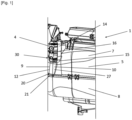
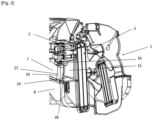
- la [
Fig. 1 ] illustre schématiquement un appareil de climatisation selon un mode de réalisation non limitatif de l'invention, - la [
Fig. 2 ] illustre une partie de l'appareil de lafigure 1 . - On a représenté sur
Fig. 1 un appareil de climatisation 1, ou HVAC, selon un exemple de réalisation de l'invention. Cet appareil est agencé pour avoir, en son sein, des flux d'air séparés en haut et en bas. Ce type d'appareil est appelé à double couche, ou Dual Layer. - Cet appareil 1 comprend des tubulures 2 qui sont reliées à un évaporateur 3 pour le refroidissement de l'air. Les extrémités libres de ces tubulures 2 ressortent à l'extérieur d'un boitier 5 de l'appareil de climatisation pour être reliées via une bride 4 aux circuits de refroidissement du moteur et de conditionnement de l'air, non représentés.
- L'appareil de climatisation 1 comporte un élément de boitier supérieur 7 et un élément de boitier inférieur 8 agencés pour être assemblés ensemble, et ainsi définir globalement un boitier 5 de l'appareil.
- L'élément de boitier supérieur 7 comporte une fenêtre 9 et un organe de protection 10 des tubulures 2 vient se loger dans la fenêtre 9, en étant dans la continuité de l'élément de boitier supérieur 7.
- Autrement dit, une fois l'organe de protection 10 placé dans la fenêtre 9, cet organe de protection 10 et l'élément de boitier supérieur 7 définissent une paroi continue 12 d'un canal d'air 11 de l'appareil de climatisation.
- La fenêtre 9 est sensiblement à un milieu de l'élément de boitier supérieur.
- L'élément de boitier supérieur 7 comporte une extension 14 agencée pour former avec une extension 15 de l'organe de protection 10 un logement 16 entourant la ou les tubulures 2 de l'échangeur de chaleur.
- Ce logement 16 est notamment de profil rectangulaire avec des coins arrondis.
- Ce logement 16 permet d'isoler la ou les tubulures de flux d'air dans l'appareil de climatisation.
- L'invention permet également d'atténuer des bruits entre la boucle de climatisation et l'appareil de climatisation.
- L'organe de protection 10 est agencé pour être fixé sur l'élément de boitier supérieur 7, en étant maintenu en sandwich entre les éléments de boitier supérieur 7 et inferieur 8.
- Cet organe de protection 10 comporte un bord 20 qui longe une jointure 21 entre les deux éléments de boitier 7 et 8.
- L'appareil de climatisation 1 comporte une paroi de séparation 24 de flux d'air ajouté entre les deux éléments de boitier 7 et 8, et l'organe de protection 10 vient en serrage sur cette paroi de séparation 25.
- L'organe de protection 10 est fixé aux éléments de boitier 7 et 8 sans éléments de fixation supplémentaires tels que des vis.
- L'organe de protection 10 est réalisé d'un seul tenant, notamment en matière plastique.
- L'organe de protection 10 comporte une jambe 27 faisant partie de la portion de paroi du canal d'air 11.
- L'organe de protection 10 comporte un toit 28 sur lequel se raccorde la jambe 27, ce toit et cette jambe formant la portion de paroi 12 du canal d'air. Cette jambe 27 forme une portion de paroi délimitant la canal d'air 11.
- Le toit 28 comporte l'extension 15 agencée pour entourer au moins partiellement la tubulure 2 à protéger.
- Cette extension 15 présente une frome courbe, notamment avec une concavité dirigée vers la tubulure.
- Le toit 28 forme un séparateur entre le canal d'air et la tubulure.
- L'extension 15 et le toit 28 forme une paroi 30 entourant les tubulures 2.
- L'appareil de climatisation est de type semi-centré. Ceci signifie que l'appareil comprend un pulseur d'air, encore appelé Blower en anglais, qui est disposé sur un côté de l'appareil. Dans la disposition de la
figure 1 , le pulseur d'air, d'un groupe moto-ventilateur, est disposé à droite de l'organe de protection, lequel est notamment sensiblement à un milieu de cet appareil.
Claims (8)
- Appareil de climatisation (1) notamment pour véhicule automobile, comportant un échangeur de chaleur, une tubulure reliée à cet échangeur de chaleur et un organe de protection (10) , cet échangeur étant par exemple un évaporateur de l'appareil de climatisation, cet organe de protection comportant une paroi (30) agencée pour entourer au moins partiellement la tubulure à protéger, cet organe de protection formant une portion de paroi (27) d'un canal d'air à l'intérieur de l'appareil de climatisation, l'appareil de climatisation comportant un élément de boitier supérieur (7) et un élément de boitier inférieur (8) agencés pour être assemblés ensemble, et ainsi définir globalement un boitier de l'appareil, caractérisé en ce que l'organe de protection est fixé sur l'élément de boitier supérieur, et maintenu en sandwich entre les éléments de boitier supérieur (7) et inferieur.
- Appareil selon la revendication précédente, dans lequel l'organe de protection (10) est réalisé d'un seul tenant, notamment en matière plastique.
- Appareil selon l'une des revendications précédentes, dans lequel l'organe de protection comporte une jambe (27) faisant partie de la portion de paroi du canal d'air.
- Appareil selon la revendication précédente, dans lequel l'organe de protection (10) comporte un toit (28) sur lequel se raccorde la jambe (27), ce toit et cette jambe formant la portion de paroi du canal d'air.
- Appareil selon l'une des revendications précédentes, dans lequel l'élément de boitier supérieur comporte une fenêtre et l'organe de protection de la tubulure vient se loger dans la fenêtre, et notamment en étant dans la continuité de l'élément de boitier supérieur.
- Appareil selon l'une des revendications précédentes, dans lequel l'élément de boitier supérieur (7) comporte une extension agencée pour former avec l'extension de l'organe de protection un logement entourant la ou les tubulures de l'échangeur de chaleur.
- Appareil selon l'une des revendications précédentes, dans lequel cet organe de protection comporte un bord qui longe une jointure entre les deux éléments de boitier (7,8).
- Appareil selon l'une des revendications précédentes, dans lequel cet appareil est de type semi-centré.
Applications Claiming Priority (2)
| Application Number | Priority Date | Filing Date | Title |
|---|---|---|---|
| FR2005747 | 2020-06-01 | ||
| PCT/EP2021/064360 WO2021244968A1 (fr) | 2020-06-01 | 2021-05-28 | Organe de protection pour une tubulure d'un échangeur de chaleur |
Publications (2)
| Publication Number | Publication Date |
|---|---|
| EP4158271A1 EP4158271A1 (fr) | 2023-04-05 |
| EP4158271B1 true EP4158271B1 (fr) | 2024-09-11 |
Family
ID=72178783
Family Applications (1)
| Application Number | Title | Priority Date | Filing Date |
|---|---|---|---|
| EP21729510.4A Active EP4158271B1 (fr) | 2020-06-01 | 2021-05-28 | Appareil de climatisation avec un organe de protection pour une tubulure d'un échangeur de chaleur |
Country Status (3)
| Country | Link |
|---|---|
| EP (1) | EP4158271B1 (fr) |
| CN (1) | CN115667836A (fr) |
| WO (1) | WO2021244968A1 (fr) |
Family Cites Families (8)
| Publication number | Priority date | Publication date | Assignee | Title |
|---|---|---|---|---|
| GB1414473A (en) * | 1972-02-10 | 1975-11-19 | Covrad Ltd | Heat exchangers |
| DE2413165C3 (de) * | 1973-04-16 | 1986-05-07 | The Garrett Corp., Los Angeles, Calif. | Plattengegenstrom-Wärmeaustauscher und Verfahren zu seiner Herstellung |
| FR2746892B1 (fr) * | 1996-03-28 | 1998-05-22 | Valeo Climatisation | Dispositif de raccordement pour echangeur de chaleur a plaques, en particulier pour vehicule automobile |
| FR2877306B1 (fr) * | 2004-10-28 | 2008-05-16 | Plastic Omnium Cie | Organe de structure de toit, arche de toit, cadre de toit et module de toit de vehicule automobile |
| ATE515673T1 (de) * | 2007-11-21 | 2011-07-15 | Petroleum Oil And Gas Corp Of South Africa Pty Ltd | Rohrplattenanordnung |
| FR3014371B1 (fr) * | 2013-12-05 | 2015-12-18 | Valeo Systemes Thermiques | Installation pour vehicule automobile |
| FR3054613B1 (fr) * | 2016-07-29 | 2020-04-10 | Sogefi Air & Refroidissement France | Repartiteur d'admission a echangeur de chaleur integre |
| FR3058361B1 (fr) * | 2016-11-08 | 2019-11-08 | Valeo Systemes Thermiques | Dispositif de chauffage, ventilation et/ou climatisation pour un habitacle d'un vehicule automobile |
-
2021
- 2021-05-28 CN CN202180038207.6A patent/CN115667836A/zh active Pending
- 2021-05-28 EP EP21729510.4A patent/EP4158271B1/fr active Active
- 2021-05-28 WO PCT/EP2021/064360 patent/WO2021244968A1/fr not_active Ceased
Also Published As
| Publication number | Publication date |
|---|---|
| CN115667836A (zh) | 2023-01-31 |
| WO2021244968A1 (fr) | 2021-12-09 |
| EP4158271A1 (fr) | 2023-04-05 |
Similar Documents
| Publication | Publication Date | Title |
|---|---|---|
| EP1764245A1 (fr) | Appareil de chauffage, ventilation et/ou clilmatisation à acoustique améliorée | |
| EP4158271B1 (fr) | Appareil de climatisation avec un organe de protection pour une tubulure d'un échangeur de chaleur | |
| EP1919724B1 (fr) | Traverse aeraulique pour vehicule automobile | |
| FR2460219A1 (fr) | Structure de l'extremite avant d'un vehicule | |
| US9616732B2 (en) | Air outlet for ventilating the interior of a motor vehicle | |
| FR3014371A1 (fr) | Installation pour vehicule automobile | |
| FR3070317B1 (fr) | Dispositif de chauffage, ventilation et/ou climatisation pour vehicule automobile | |
| FR2571314A1 (fr) | Receptacle d'eau de condensation pour une installation de climatisation d'un vehicule automobile | |
| EP1726463B1 (fr) | Couvercle pour conduits d'appareils de chauffage, ventilation et refroidissement de l'air dans les habitacles de véhicules | |
| FR2761013A1 (fr) | Boitier d'appareil de chauffage-climatisation pour vehicule automobile | |
| FR3022987B1 (fr) | Dispositif de generation d'un flux d'air | |
| EP2878467B1 (fr) | Dispositif conducteur d'air concu pour le maintien d'un radiateur de chauffage automobile et son etancheite | |
| US1600219A (en) | Exhaust heater for vehicles | |
| EP3077234B1 (fr) | Unite de conditionnement d'air pour vehicule automobile | |
| EP2736749B1 (fr) | Cloison anti-recyclage d'un vehicule automobile. | |
| EP2918451B1 (fr) | Véhicule automobile à écran thermique pour la protection de son habitacle | |
| WO2026082431A1 (fr) | Dispositif de chauffage, de ventilation et/ou de conditionnement d'air | |
| FR3154347A1 (fr) | Boîtier et dispositif de chauffage, ventilation et/ou conditionnement d’air, notamment pour véhicule automobile | |
| FR2890146A1 (fr) | Dispositif de positionnement et d'immobilisation d'un conduit dans un corps creux et poutre d'une traverse de planche de bord munie d'un tel dispositif. | |
| FR3148829A1 (fr) | Aérateur à effet coanda pour une planche de bord de véhicule automobile | |
| FR3152246A1 (fr) | Système d’étanchéité interposé entre une installation de ventilation, chauffage et/ou climatisation et une paroi d’un véhicule. | |
| FR3164870A1 (fr) | Dispositif de mise à l’air d’un carter pour compatibilité électromagnétique | |
| FR2933044A3 (fr) | Dispositif d'admission d'air pour vehicule automobile | |
| EP4499432A1 (fr) | Guide d'air pour dispositif de refroidissement de véhicule automobile présentant un bord supérieur avant arrondi pour choc piéton | |
| FR2891200A3 (fr) | Dispositif perfectionne de ventilation et de degivrage |
Legal Events
| Date | Code | Title | Description |
|---|---|---|---|
| STAA | Information on the status of an ep patent application or granted ep patent |
Free format text: STATUS: UNKNOWN |
|
| STAA | Information on the status of an ep patent application or granted ep patent |
Free format text: STATUS: THE INTERNATIONAL PUBLICATION HAS BEEN MADE |
|
| PUAI | Public reference made under article 153(3) epc to a published international application that has entered the european phase |
Free format text: ORIGINAL CODE: 0009012 |
|
| STAA | Information on the status of an ep patent application or granted ep patent |
Free format text: STATUS: REQUEST FOR EXAMINATION WAS MADE |
|
| 17P | Request for examination filed |
Effective date: 20221205 |
|
| AK | Designated contracting states |
Kind code of ref document: A1 Designated state(s): AL AT BE BG CH CY CZ DE DK EE ES FI FR GB GR HR HU IE IS IT LI LT LU LV MC MK MT NL NO PL PT RO RS SE SI SK SM TR |
|
| DAV | Request for validation of the european patent (deleted) | ||
| DAX | Request for extension of the european patent (deleted) | ||
| GRAP | Despatch of communication of intention to grant a patent |
Free format text: ORIGINAL CODE: EPIDOSNIGR1 |
|
| STAA | Information on the status of an ep patent application or granted ep patent |
Free format text: STATUS: GRANT OF PATENT IS INTENDED |
|
| INTG | Intention to grant announced |
Effective date: 20240425 |
|
| GRAS | Grant fee paid |
Free format text: ORIGINAL CODE: EPIDOSNIGR3 |
|
| GRAA | (expected) grant |
Free format text: ORIGINAL CODE: 0009210 |
|
| STAA | Information on the status of an ep patent application or granted ep patent |
Free format text: STATUS: THE PATENT HAS BEEN GRANTED |
|
| AK | Designated contracting states |
Kind code of ref document: B1 Designated state(s): AL AT BE BG CH CY CZ DE DK EE ES FI FR GB GR HR HU IE IS IT LI LT LU LV MC MK MT NL NO PL PT RO RS SE SI SK SM TR |
|
| REG | Reference to a national code |
Ref country code: GB Ref legal event code: FG4D Free format text: NOT ENGLISH |
|
| REG | Reference to a national code |
Ref country code: CH Ref legal event code: EP |
|
| REG | Reference to a national code |
Ref country code: DE Ref legal event code: R096 Ref document number: 602021018674 Country of ref document: DE |
|
| REG | Reference to a national code |
Ref country code: IE Ref legal event code: FG4D Free format text: LANGUAGE OF EP DOCUMENT: FRENCH |
|
| REG | Reference to a national code |
Ref country code: LT Ref legal event code: MG9D |
|
| PG25 | Lapsed in a contracting state [announced via postgrant information from national office to epo] |
Ref country code: NO Free format text: LAPSE BECAUSE OF FAILURE TO SUBMIT A TRANSLATION OF THE DESCRIPTION OR TO PAY THE FEE WITHIN THE PRESCRIBED TIME-LIMIT Effective date: 20241211 |
|
| REG | Reference to a national code |
Ref country code: NL Ref legal event code: MP Effective date: 20240911 |
|
| PG25 | Lapsed in a contracting state [announced via postgrant information from national office to epo] |
Ref country code: GR Free format text: LAPSE BECAUSE OF FAILURE TO SUBMIT A TRANSLATION OF THE DESCRIPTION OR TO PAY THE FEE WITHIN THE PRESCRIBED TIME-LIMIT Effective date: 20241212 Ref country code: FI Free format text: LAPSE BECAUSE OF FAILURE TO SUBMIT A TRANSLATION OF THE DESCRIPTION OR TO PAY THE FEE WITHIN THE PRESCRIBED TIME-LIMIT Effective date: 20240911 |
|
| PG25 | Lapsed in a contracting state [announced via postgrant information from national office to epo] |
Ref country code: BG Free format text: LAPSE BECAUSE OF FAILURE TO SUBMIT A TRANSLATION OF THE DESCRIPTION OR TO PAY THE FEE WITHIN THE PRESCRIBED TIME-LIMIT Effective date: 20240911 |
|
| PG25 | Lapsed in a contracting state [announced via postgrant information from national office to epo] |
Ref country code: LV Free format text: LAPSE BECAUSE OF FAILURE TO SUBMIT A TRANSLATION OF THE DESCRIPTION OR TO PAY THE FEE WITHIN THE PRESCRIBED TIME-LIMIT Effective date: 20240911 |
|
| PG25 | Lapsed in a contracting state [announced via postgrant information from national office to epo] |
Ref country code: HR Free format text: LAPSE BECAUSE OF FAILURE TO SUBMIT A TRANSLATION OF THE DESCRIPTION OR TO PAY THE FEE WITHIN THE PRESCRIBED TIME-LIMIT Effective date: 20240911 |
|
| PG25 | Lapsed in a contracting state [announced via postgrant information from national office to epo] |
Ref country code: ES Free format text: LAPSE BECAUSE OF FAILURE TO SUBMIT A TRANSLATION OF THE DESCRIPTION OR TO PAY THE FEE WITHIN THE PRESCRIBED TIME-LIMIT Effective date: 20240911 Ref country code: RS Free format text: LAPSE BECAUSE OF FAILURE TO SUBMIT A TRANSLATION OF THE DESCRIPTION OR TO PAY THE FEE WITHIN THE PRESCRIBED TIME-LIMIT Effective date: 20241211 |
|
| PG25 | Lapsed in a contracting state [announced via postgrant information from national office to epo] |
Ref country code: RS Free format text: LAPSE BECAUSE OF FAILURE TO SUBMIT A TRANSLATION OF THE DESCRIPTION OR TO PAY THE FEE WITHIN THE PRESCRIBED TIME-LIMIT Effective date: 20241211 Ref country code: NO Free format text: LAPSE BECAUSE OF FAILURE TO SUBMIT A TRANSLATION OF THE DESCRIPTION OR TO PAY THE FEE WITHIN THE PRESCRIBED TIME-LIMIT Effective date: 20241211 Ref country code: LV Free format text: LAPSE BECAUSE OF FAILURE TO SUBMIT A TRANSLATION OF THE DESCRIPTION OR TO PAY THE FEE WITHIN THE PRESCRIBED TIME-LIMIT Effective date: 20240911 Ref country code: HR Free format text: LAPSE BECAUSE OF FAILURE TO SUBMIT A TRANSLATION OF THE DESCRIPTION OR TO PAY THE FEE WITHIN THE PRESCRIBED TIME-LIMIT Effective date: 20240911 Ref country code: GR Free format text: LAPSE BECAUSE OF FAILURE TO SUBMIT A TRANSLATION OF THE DESCRIPTION OR TO PAY THE FEE WITHIN THE PRESCRIBED TIME-LIMIT Effective date: 20241212 Ref country code: FI Free format text: LAPSE BECAUSE OF FAILURE TO SUBMIT A TRANSLATION OF THE DESCRIPTION OR TO PAY THE FEE WITHIN THE PRESCRIBED TIME-LIMIT Effective date: 20240911 Ref country code: ES Free format text: LAPSE BECAUSE OF FAILURE TO SUBMIT A TRANSLATION OF THE DESCRIPTION OR TO PAY THE FEE WITHIN THE PRESCRIBED TIME-LIMIT Effective date: 20240911 Ref country code: BG Free format text: LAPSE BECAUSE OF FAILURE TO SUBMIT A TRANSLATION OF THE DESCRIPTION OR TO PAY THE FEE WITHIN THE PRESCRIBED TIME-LIMIT Effective date: 20240911 |
|
| REG | Reference to a national code |
Ref country code: AT Ref legal event code: MK05 Ref document number: 1723050 Country of ref document: AT Kind code of ref document: T Effective date: 20240911 |
|
| PG25 | Lapsed in a contracting state [announced via postgrant information from national office to epo] |
Ref country code: NL Free format text: LAPSE BECAUSE OF FAILURE TO SUBMIT A TRANSLATION OF THE DESCRIPTION OR TO PAY THE FEE WITHIN THE PRESCRIBED TIME-LIMIT Effective date: 20240911 |
|
| PG25 | Lapsed in a contracting state [announced via postgrant information from national office to epo] |
Ref country code: IS Free format text: LAPSE BECAUSE OF FAILURE TO SUBMIT A TRANSLATION OF THE DESCRIPTION OR TO PAY THE FEE WITHIN THE PRESCRIBED TIME-LIMIT Effective date: 20250111 Ref country code: PT Free format text: LAPSE BECAUSE OF FAILURE TO SUBMIT A TRANSLATION OF THE DESCRIPTION OR TO PAY THE FEE WITHIN THE PRESCRIBED TIME-LIMIT Effective date: 20250113 |
|
| PG25 | Lapsed in a contracting state [announced via postgrant information from national office to epo] |
Ref country code: RO Free format text: LAPSE BECAUSE OF FAILURE TO SUBMIT A TRANSLATION OF THE DESCRIPTION OR TO PAY THE FEE WITHIN THE PRESCRIBED TIME-LIMIT Effective date: 20240911 Ref country code: SM Free format text: LAPSE BECAUSE OF FAILURE TO SUBMIT A TRANSLATION OF THE DESCRIPTION OR TO PAY THE FEE WITHIN THE PRESCRIBED TIME-LIMIT Effective date: 20240911 |
|
| PG25 | Lapsed in a contracting state [announced via postgrant information from national office to epo] |
Ref country code: AT Free format text: LAPSE BECAUSE OF FAILURE TO SUBMIT A TRANSLATION OF THE DESCRIPTION OR TO PAY THE FEE WITHIN THE PRESCRIBED TIME-LIMIT Effective date: 20240911 Ref country code: EE Free format text: LAPSE BECAUSE OF FAILURE TO SUBMIT A TRANSLATION OF THE DESCRIPTION OR TO PAY THE FEE WITHIN THE PRESCRIBED TIME-LIMIT Effective date: 20240911 |
|
| PG25 | Lapsed in a contracting state [announced via postgrant information from national office to epo] |
Ref country code: PL Free format text: LAPSE BECAUSE OF FAILURE TO SUBMIT A TRANSLATION OF THE DESCRIPTION OR TO PAY THE FEE WITHIN THE PRESCRIBED TIME-LIMIT Effective date: 20240911 Ref country code: CZ Free format text: LAPSE BECAUSE OF FAILURE TO SUBMIT A TRANSLATION OF THE DESCRIPTION OR TO PAY THE FEE WITHIN THE PRESCRIBED TIME-LIMIT Effective date: 20240911 |
|
| PG25 | Lapsed in a contracting state [announced via postgrant information from national office to epo] |
Ref country code: IT Free format text: LAPSE BECAUSE OF FAILURE TO SUBMIT A TRANSLATION OF THE DESCRIPTION OR TO PAY THE FEE WITHIN THE PRESCRIBED TIME-LIMIT Effective date: 20240911 Ref country code: SK Free format text: LAPSE BECAUSE OF FAILURE TO SUBMIT A TRANSLATION OF THE DESCRIPTION OR TO PAY THE FEE WITHIN THE PRESCRIBED TIME-LIMIT Effective date: 20240911 |
|
| REG | Reference to a national code |
Ref country code: DE Ref legal event code: R097 Ref document number: 602021018674 Country of ref document: DE |
|
| PGFP | Annual fee paid to national office [announced via postgrant information from national office to epo] |
Ref country code: DE Payment date: 20250513 Year of fee payment: 5 |
|
| PG25 | Lapsed in a contracting state [announced via postgrant information from national office to epo] |
Ref country code: DK Free format text: LAPSE BECAUSE OF FAILURE TO SUBMIT A TRANSLATION OF THE DESCRIPTION OR TO PAY THE FEE WITHIN THE PRESCRIBED TIME-LIMIT Effective date: 20240911 |
|
| PGFP | Annual fee paid to national office [announced via postgrant information from national office to epo] |
Ref country code: FR Payment date: 20250530 Year of fee payment: 5 |
|
| PLBE | No opposition filed within time limit |
Free format text: ORIGINAL CODE: 0009261 |
|
| STAA | Information on the status of an ep patent application or granted ep patent |
Free format text: STATUS: NO OPPOSITION FILED WITHIN TIME LIMIT |
|
| 26N | No opposition filed |
Effective date: 20250612 |
|
| PG25 | Lapsed in a contracting state [announced via postgrant information from national office to epo] |
Ref country code: SE Free format text: LAPSE BECAUSE OF FAILURE TO SUBMIT A TRANSLATION OF THE DESCRIPTION OR TO PAY THE FEE WITHIN THE PRESCRIBED TIME-LIMIT Effective date: 20240911 |
|
| REG | Reference to a national code |
Ref country code: CH Ref legal event code: H13 Free format text: ST27 STATUS EVENT CODE: U-0-0-H10-H13 (AS PROVIDED BY THE NATIONAL OFFICE) Effective date: 20251223 |
|
| PG25 | Lapsed in a contracting state [announced via postgrant information from national office to epo] |
Ref country code: LU Free format text: LAPSE BECAUSE OF NON-PAYMENT OF DUE FEES Effective date: 20250528 |
|
| PG25 | Lapsed in a contracting state [announced via postgrant information from national office to epo] |
Ref country code: CH Free format text: LAPSE BECAUSE OF NON-PAYMENT OF DUE FEES Effective date: 20250531 |
|
| GBPC | Gb: european patent ceased through non-payment of renewal fee |
Effective date: 20250528 |
|
| REG | Reference to a national code |
Ref country code: BE Ref legal event code: MM Effective date: 20250531 |
|
| PG25 | Lapsed in a contracting state [announced via postgrant information from national office to epo] |
Ref country code: MC Free format text: LAPSE BECAUSE OF FAILURE TO SUBMIT A TRANSLATION OF THE DESCRIPTION OR TO PAY THE FEE WITHIN THE PRESCRIBED TIME-LIMIT Effective date: 20240911 |
|
| PG25 | Lapsed in a contracting state [announced via postgrant information from national office to epo] |
Ref country code: GB Free format text: LAPSE BECAUSE OF NON-PAYMENT OF DUE FEES Effective date: 20250528 |
|
| PG25 | Lapsed in a contracting state [announced via postgrant information from national office to epo] |
Ref country code: IE Free format text: LAPSE BECAUSE OF NON-PAYMENT OF DUE FEES Effective date: 20250528 |
|
| PG25 | Lapsed in a contracting state [announced via postgrant information from national office to epo] |
Ref country code: BE Free format text: LAPSE BECAUSE OF NON-PAYMENT OF DUE FEES Effective date: 20250531 |