EP4157910B1 - Use of epoxy compounds as carbon dioxide scavengers in pir comprising foams for superior thermal insulation properties - Google Patents
Use of epoxy compounds as carbon dioxide scavengers in pir comprising foams for superior thermal insulation properties Download PDFInfo
- Publication number
- EP4157910B1 EP4157910B1 EP21728261.5A EP21728261A EP4157910B1 EP 4157910 B1 EP4157910 B1 EP 4157910B1 EP 21728261 A EP21728261 A EP 21728261A EP 4157910 B1 EP4157910 B1 EP 4157910B1
- Authority
- EP
- European Patent Office
- Prior art keywords
- reactive composition
- foam
- isocyanate
- reactive
- pir
- Prior art date
- Legal status (The legal status is an assumption and is not a legal conclusion. Google has not performed a legal analysis and makes no representation as to the accuracy of the status listed.)
- Active
Links
Images
Classifications
-
- C—CHEMISTRY; METALLURGY
- C08—ORGANIC MACROMOLECULAR COMPOUNDS; THEIR PREPARATION OR CHEMICAL WORKING-UP; COMPOSITIONS BASED THEREON
- C08G—MACROMOLECULAR COMPOUNDS OBTAINED OTHERWISE THAN BY REACTIONS ONLY INVOLVING UNSATURATED CARBON-TO-CARBON BONDS
- C08G18/00—Polymeric products of isocyanates or isothiocyanates
- C08G18/06—Polymeric products of isocyanates or isothiocyanates with compounds having active hydrogen
- C08G18/08—Processes
- C08G18/14—Manufacture of cellular products
-
- C—CHEMISTRY; METALLURGY
- C08—ORGANIC MACROMOLECULAR COMPOUNDS; THEIR PREPARATION OR CHEMICAL WORKING-UP; COMPOSITIONS BASED THEREON
- C08G—MACROMOLECULAR COMPOUNDS OBTAINED OTHERWISE THAN BY REACTIONS ONLY INVOLVING UNSATURATED CARBON-TO-CARBON BONDS
- C08G18/00—Polymeric products of isocyanates or isothiocyanates
- C08G18/06—Polymeric products of isocyanates or isothiocyanates with compounds having active hydrogen
- C08G18/70—Polymeric products of isocyanates or isothiocyanates with compounds having active hydrogen characterised by the isocyanates or isothiocyanates used
- C08G18/72—Polyisocyanates or polyisothiocyanates
- C08G18/74—Polyisocyanates or polyisothiocyanates cyclic
- C08G18/76—Polyisocyanates or polyisothiocyanates cyclic aromatic
- C08G18/7657—Polyisocyanates or polyisothiocyanates cyclic aromatic containing two or more aromatic rings
- C08G18/7664—Polyisocyanates or polyisothiocyanates cyclic aromatic containing two or more aromatic rings containing alkylene polyphenyl groups
-
- C—CHEMISTRY; METALLURGY
- C08—ORGANIC MACROMOLECULAR COMPOUNDS; THEIR PREPARATION OR CHEMICAL WORKING-UP; COMPOSITIONS BASED THEREON
- C08G—MACROMOLECULAR COMPOUNDS OBTAINED OTHERWISE THAN BY REACTIONS ONLY INVOLVING UNSATURATED CARBON-TO-CARBON BONDS
- C08G18/00—Polymeric products of isocyanates or isothiocyanates
- C08G18/06—Polymeric products of isocyanates or isothiocyanates with compounds having active hydrogen
- C08G18/08—Processes
- C08G18/09—Processes comprising oligomerisation of isocyanates or isothiocyanates involving reaction of a part of the isocyanate or isothiocyanate groups with each other in the reaction mixture
- C08G18/092—Processes comprising oligomerisation of isocyanates or isothiocyanates involving reaction of a part of the isocyanate or isothiocyanate groups with each other in the reaction mixture oligomerisation to isocyanurate groups
-
- C—CHEMISTRY; METALLURGY
- C08—ORGANIC MACROMOLECULAR COMPOUNDS; THEIR PREPARATION OR CHEMICAL WORKING-UP; COMPOSITIONS BASED THEREON
- C08G—MACROMOLECULAR COMPOUNDS OBTAINED OTHERWISE THAN BY REACTIONS ONLY INVOLVING UNSATURATED CARBON-TO-CARBON BONDS
- C08G18/00—Polymeric products of isocyanates or isothiocyanates
- C08G18/06—Polymeric products of isocyanates or isothiocyanates with compounds having active hydrogen
- C08G18/08—Processes
- C08G18/16—Catalysts
- C08G18/161—Catalysts containing two or more components to be covered by at least two of the groups C08G18/166, C08G18/18 or C08G18/22
- C08G18/163—Catalysts containing two or more components to be covered by at least two of the groups C08G18/166, C08G18/18 or C08G18/22 covered by C08G18/18 and C08G18/22
-
- C—CHEMISTRY; METALLURGY
- C08—ORGANIC MACROMOLECULAR COMPOUNDS; THEIR PREPARATION OR CHEMICAL WORKING-UP; COMPOSITIONS BASED THEREON
- C08G—MACROMOLECULAR COMPOUNDS OBTAINED OTHERWISE THAN BY REACTIONS ONLY INVOLVING UNSATURATED CARBON-TO-CARBON BONDS
- C08G18/00—Polymeric products of isocyanates or isothiocyanates
- C08G18/06—Polymeric products of isocyanates or isothiocyanates with compounds having active hydrogen
- C08G18/08—Processes
- C08G18/16—Catalysts
- C08G18/18—Catalysts containing secondary or tertiary amines or salts thereof
- C08G18/1808—Catalysts containing secondary or tertiary amines or salts thereof having alkylene polyamine groups
-
- C—CHEMISTRY; METALLURGY
- C08—ORGANIC MACROMOLECULAR COMPOUNDS; THEIR PREPARATION OR CHEMICAL WORKING-UP; COMPOSITIONS BASED THEREON
- C08G—MACROMOLECULAR COMPOUNDS OBTAINED OTHERWISE THAN BY REACTIONS ONLY INVOLVING UNSATURATED CARBON-TO-CARBON BONDS
- C08G18/00—Polymeric products of isocyanates or isothiocyanates
- C08G18/06—Polymeric products of isocyanates or isothiocyanates with compounds having active hydrogen
- C08G18/08—Processes
- C08G18/16—Catalysts
- C08G18/18—Catalysts containing secondary or tertiary amines or salts thereof
- C08G18/1875—Catalysts containing secondary or tertiary amines or salts thereof containing ammonium salts or mixtures of secondary of tertiary amines and acids
-
- C—CHEMISTRY; METALLURGY
- C08—ORGANIC MACROMOLECULAR COMPOUNDS; THEIR PREPARATION OR CHEMICAL WORKING-UP; COMPOSITIONS BASED THEREON
- C08G—MACROMOLECULAR COMPOUNDS OBTAINED OTHERWISE THAN BY REACTIONS ONLY INVOLVING UNSATURATED CARBON-TO-CARBON BONDS
- C08G18/00—Polymeric products of isocyanates or isothiocyanates
- C08G18/06—Polymeric products of isocyanates or isothiocyanates with compounds having active hydrogen
- C08G18/08—Processes
- C08G18/16—Catalysts
- C08G18/22—Catalysts containing metal compounds
- C08G18/225—Catalysts containing metal compounds of alkali or alkaline earth metals
-
- C—CHEMISTRY; METALLURGY
- C08—ORGANIC MACROMOLECULAR COMPOUNDS; THEIR PREPARATION OR CHEMICAL WORKING-UP; COMPOSITIONS BASED THEREON
- C08G—MACROMOLECULAR COMPOUNDS OBTAINED OTHERWISE THAN BY REACTIONS ONLY INVOLVING UNSATURATED CARBON-TO-CARBON BONDS
- C08G18/00—Polymeric products of isocyanates or isothiocyanates
- C08G18/06—Polymeric products of isocyanates or isothiocyanates with compounds having active hydrogen
- C08G18/28—Polymeric products of isocyanates or isothiocyanates with compounds having active hydrogen characterised by the compounds used containing active hydrogen
- C08G18/40—High-molecular-weight compounds
- C08G18/42—Polycondensates having carboxylic or carbonic ester groups in the main chain
- C08G18/4205—Polycondensates having carboxylic or carbonic ester groups in the main chain containing cyclic groups
- C08G18/4208—Polycondensates having carboxylic or carbonic ester groups in the main chain containing cyclic groups containing aromatic groups
- C08G18/4211—Polycondensates having carboxylic or carbonic ester groups in the main chain containing cyclic groups containing aromatic groups derived from aromatic dicarboxylic acids and dialcohols
-
- C—CHEMISTRY; METALLURGY
- C08—ORGANIC MACROMOLECULAR COMPOUNDS; THEIR PREPARATION OR CHEMICAL WORKING-UP; COMPOSITIONS BASED THEREON
- C08J—WORKING-UP; GENERAL PROCESSES OF COMPOUNDING; AFTER-TREATMENT NOT COVERED BY SUBCLASSES C08B, C08C, C08F, C08G or C08H
- C08J9/00—Working-up of macromolecular substances to porous or cellular articles or materials; After-treatment thereof
- C08J9/0014—Use of organic additives
- C08J9/0023—Use of organic additives containing oxygen
-
- C—CHEMISTRY; METALLURGY
- C08—ORGANIC MACROMOLECULAR COMPOUNDS; THEIR PREPARATION OR CHEMICAL WORKING-UP; COMPOSITIONS BASED THEREON
- C08J—WORKING-UP; GENERAL PROCESSES OF COMPOUNDING; AFTER-TREATMENT NOT COVERED BY SUBCLASSES C08B, C08C, C08F, C08G or C08H
- C08J9/00—Working-up of macromolecular substances to porous or cellular articles or materials; After-treatment thereof
- C08J9/04—Working-up of macromolecular substances to porous or cellular articles or materials; After-treatment thereof using blowing gases generated by a previously added blowing agent
- C08J9/12—Working-up of macromolecular substances to porous or cellular articles or materials; After-treatment thereof using blowing gases generated by a previously added blowing agent by a physical blowing agent
- C08J9/14—Working-up of macromolecular substances to porous or cellular articles or materials; After-treatment thereof using blowing gases generated by a previously added blowing agent by a physical blowing agent organic
- C08J9/141—Hydrocarbons
-
- C—CHEMISTRY; METALLURGY
- C08—ORGANIC MACROMOLECULAR COMPOUNDS; THEIR PREPARATION OR CHEMICAL WORKING-UP; COMPOSITIONS BASED THEREON
- C08J—WORKING-UP; GENERAL PROCESSES OF COMPOUNDING; AFTER-TREATMENT NOT COVERED BY SUBCLASSES C08B, C08C, C08F, C08G or C08H
- C08J9/00—Working-up of macromolecular substances to porous or cellular articles or materials; After-treatment thereof
- C08J9/04—Working-up of macromolecular substances to porous or cellular articles or materials; After-treatment thereof using blowing gases generated by a previously added blowing agent
- C08J9/12—Working-up of macromolecular substances to porous or cellular articles or materials; After-treatment thereof using blowing gases generated by a previously added blowing agent by a physical blowing agent
- C08J9/14—Working-up of macromolecular substances to porous or cellular articles or materials; After-treatment thereof using blowing gases generated by a previously added blowing agent by a physical blowing agent organic
- C08J9/143—Halogen containing compounds
- C08J9/144—Halogen containing compounds containing carbon, halogen and hydrogen only
-
- C—CHEMISTRY; METALLURGY
- C08—ORGANIC MACROMOLECULAR COMPOUNDS; THEIR PREPARATION OR CHEMICAL WORKING-UP; COMPOSITIONS BASED THEREON
- C08K—Use of inorganic or non-macromolecular organic substances as compounding ingredients
- C08K5/00—Use of organic ingredients
- C08K5/04—Oxygen-containing compounds
- C08K5/15—Heterocyclic compounds having oxygen in the ring
- C08K5/151—Heterocyclic compounds having oxygen in the ring having one oxygen atom in the ring
- C08K5/1515—Three-membered rings
-
- C—CHEMISTRY; METALLURGY
- C08—ORGANIC MACROMOLECULAR COMPOUNDS; THEIR PREPARATION OR CHEMICAL WORKING-UP; COMPOSITIONS BASED THEREON
- C08G—MACROMOLECULAR COMPOUNDS OBTAINED OTHERWISE THAN BY REACTIONS ONLY INVOLVING UNSATURATED CARBON-TO-CARBON BONDS
- C08G2101/00—Manufacture of cellular products
-
- C—CHEMISTRY; METALLURGY
- C08—ORGANIC MACROMOLECULAR COMPOUNDS; THEIR PREPARATION OR CHEMICAL WORKING-UP; COMPOSITIONS BASED THEREON
- C08G—MACROMOLECULAR COMPOUNDS OBTAINED OTHERWISE THAN BY REACTIONS ONLY INVOLVING UNSATURATED CARBON-TO-CARBON BONDS
- C08G2110/00—Foam properties
- C08G2110/0016—Foam properties semi-rigid
-
- C—CHEMISTRY; METALLURGY
- C08—ORGANIC MACROMOLECULAR COMPOUNDS; THEIR PREPARATION OR CHEMICAL WORKING-UP; COMPOSITIONS BASED THEREON
- C08G—MACROMOLECULAR COMPOUNDS OBTAINED OTHERWISE THAN BY REACTIONS ONLY INVOLVING UNSATURATED CARBON-TO-CARBON BONDS
- C08G2110/00—Foam properties
- C08G2110/0025—Foam properties rigid
-
- C—CHEMISTRY; METALLURGY
- C08—ORGANIC MACROMOLECULAR COMPOUNDS; THEIR PREPARATION OR CHEMICAL WORKING-UP; COMPOSITIONS BASED THEREON
- C08G—MACROMOLECULAR COMPOUNDS OBTAINED OTHERWISE THAN BY REACTIONS ONLY INVOLVING UNSATURATED CARBON-TO-CARBON BONDS
- C08G2110/00—Foam properties
- C08G2110/0041—Foam properties having specified density
- C08G2110/005—< 50kg/m3
-
- C—CHEMISTRY; METALLURGY
- C08—ORGANIC MACROMOLECULAR COMPOUNDS; THEIR PREPARATION OR CHEMICAL WORKING-UP; COMPOSITIONS BASED THEREON
- C08G—MACROMOLECULAR COMPOUNDS OBTAINED OTHERWISE THAN BY REACTIONS ONLY INVOLVING UNSATURATED CARBON-TO-CARBON BONDS
- C08G2330/00—Thermal insulation material
-
- C—CHEMISTRY; METALLURGY
- C08—ORGANIC MACROMOLECULAR COMPOUNDS; THEIR PREPARATION OR CHEMICAL WORKING-UP; COMPOSITIONS BASED THEREON
- C08J—WORKING-UP; GENERAL PROCESSES OF COMPOUNDING; AFTER-TREATMENT NOT COVERED BY SUBCLASSES C08B, C08C, C08F, C08G or C08H
- C08J2203/00—Foams characterized by the expanding agent
- C08J2203/14—Saturated hydrocarbons, e.g. butane; Unspecified hydrocarbons
-
- C—CHEMISTRY; METALLURGY
- C08—ORGANIC MACROMOLECULAR COMPOUNDS; THEIR PREPARATION OR CHEMICAL WORKING-UP; COMPOSITIONS BASED THEREON
- C08J—WORKING-UP; GENERAL PROCESSES OF COMPOUNDING; AFTER-TREATMENT NOT COVERED BY SUBCLASSES C08B, C08C, C08F, C08G or C08H
- C08J2205/00—Foams characterised by their properties
- C08J2205/08—Semi-flexible foams
-
- C—CHEMISTRY; METALLURGY
- C08—ORGANIC MACROMOLECULAR COMPOUNDS; THEIR PREPARATION OR CHEMICAL WORKING-UP; COMPOSITIONS BASED THEREON
- C08J—WORKING-UP; GENERAL PROCESSES OF COMPOUNDING; AFTER-TREATMENT NOT COVERED BY SUBCLASSES C08B, C08C, C08F, C08G or C08H
- C08J2205/00—Foams characterised by their properties
- C08J2205/10—Rigid foams
-
- C—CHEMISTRY; METALLURGY
- C08—ORGANIC MACROMOLECULAR COMPOUNDS; THEIR PREPARATION OR CHEMICAL WORKING-UP; COMPOSITIONS BASED THEREON
- C08J—WORKING-UP; GENERAL PROCESSES OF COMPOUNDING; AFTER-TREATMENT NOT COVERED BY SUBCLASSES C08B, C08C, C08F, C08G or C08H
- C08J2375/00—Characterised by the use of polyureas or polyurethanes; Derivatives of such polymers
- C08J2375/04—Polyurethanes
-
- C—CHEMISTRY; METALLURGY
- C08—ORGANIC MACROMOLECULAR COMPOUNDS; THEIR PREPARATION OR CHEMICAL WORKING-UP; COMPOSITIONS BASED THEREON
- C08J—WORKING-UP; GENERAL PROCESSES OF COMPOUNDING; AFTER-TREATMENT NOT COVERED BY SUBCLASSES C08B, C08C, C08F, C08G or C08H
- C08J2375/00—Characterised by the use of polyureas or polyurethanes; Derivatives of such polymers
- C08J2375/04—Polyurethanes
- C08J2375/06—Polyurethanes from polyesters
Definitions
- the present invention is related to polyisocyanurate (PIR) comprising insulation foams, more in particular semi-rigid and rigid PIR comprising insulation foams having significantly improved long term insulation values when used under diffusion tight conditions such that low thermal conductivity (lambda value) is achieved during the average economic lifetime of the foam.
- PIR polyisocyanurate
- the present invention is related to a reactive composition and a process for preparing PIR comprising insulation foams having significantly improved thermal insulation properties maintained over the average economic lifetime of the foam thereby making use of blowing agents having low lambda gas values ( ⁇ 12 mW/m.K at 10 °C) in combination with a predetermined amount of CO 2 scavengers.
- the invention is further related to the use of epoxy compounds as CO 2 scavengers in PIR comprising insulation foams.
- closed cell rigid polyisocyanurate (PIR) and polyurethane (PUR) comprising insulation foams generally contain CO 2 which is released during foaming.
- the thermal conductivity (expressed in mW/m.K and noted as “lambda” or “ ⁇ ” value) of CO 2 gas is higher than the thermal conductivity of commonly used physical blowing agents, the total lambda value of a given PUR and PIR comprising foam is typically higher than if CO 2 gas was not present.
- CO 2 scavengers have been previously identified and successfully used for isocyanate-based foams (EP 1 031 601 and EP 0 618 253 ), such as for instance zeolites, calcium hydroxide, sodium hydroxide, lithium hydroxide,...
- WO2019/211259 discloses the use of NaOH and KOH compounds as CO 2 scavengers. Due to their low cost (commodity chemicals) and their quantitative reaction with CO 2 these compounds result in efficient scavenging. Nevertheless, they are used in the form of solid particles which is not ideal in terms of processing. Moreover, they are only applicable to ageing conditions in which some moisture diffusion inside the foams can take place (i.e. moisture-catalyzed scavenging), which then excludes their use in applications such as Composite Panels, Appliances or Pipes, unless specific moisture permeable facers are used.
- the criteria for thermal insulation foams especially for use in construction and consumer goods, become more and more stringent and there is a need to further improve (i.e. reduce) the lambda value (thermal conductivity) of predominantly PIR comprising foams and to maintain the low lambda value over the whole life time of the foam.
- HFCs Hydro Fluoro Carbons
- HFOs Hydro Fluoro Olefins
- HCFOs Hydro Chloro Fluoro Olefins
- PIR polyisocyanurate
- the goal of the invention is achieved by capturing the CO 2 released during foaming and during ageing, in combination with the use and presence of blowing agents having low thermal conductivity.
- the present invention relates to novel polyisocyanurate (PIR) comprising insulation foams having significantly improved insulation values maintained over the average economic lifetime of the foam as well as a novel reactive mixture and processing method to fabricate said improved insulation foams and use of the improved insulation foams for thermal insulation.
- PIR polyisocyanurate
- a reactive composition for making a PIR comprising foam at an isocyanate index of at least 120 wherein said foam is having significantly improved insulation values maintained over the average economic lifetime of the foam.
- Said reactive composition comprising at least:
- the amount of isocyanate-reactive compounds b) in the reactive composition is at least 15 wt%, preferably at least 20 wt% calculated on the total weight of the reactive composition.
- the molar amount of epoxy compounds in the reactive composition is preferably at least 10 times, more preferably at least 15 times higher than the molar amount of CO 2 formed by the water present in the reactive composition after reaction with isocyanates.
- the ratio of the molar amounts of epoxy compounds in the reactive composition over the molar amount of CO 2 formed by the water is also referred to in this application as the molar ratio of epoxy groups over water in the reactive composition.
- the maximum amount of all epoxy compounds in the reactive composition is ⁇ 25 wt%, preferably ⁇ 20 wt% calculated on the total weight of the reactive composition.
- the at least one epoxy compound in the reactive composition is selected from epoxy compounds having equivalent weight lower than 250g/mol, preferably lower than 200g/mol and wherein the at least one epoxy compound used is liquid at 20 °C.
- the catalyst used for promoting epoxy reaction with CO 2 is selected from ammonium salts, more preferably selected from tetrabutylammonium bromide and/or tetrabutylammonium iodide.
- the at least one physical blowing agent having a lambda gas value ⁇ 12 mW/m.K @ 10°C is selected from an HFO blowing agent and/or HCFO blowing agent and/or hydrocarbon blowing agent such as cyclopentane and mixtures thereof.
- the at least one physical blowing agent having a lambda gas value ⁇ 12 mW/m.K @ 10°C is selected from chlorofluorocarbons (CFCs) and/or hydrofluorocarbons (HFCs) and/or hydrochlorofluorocarbons (HCFCs).
- the polyisocyanate compounds in the reactive composition are selected from a toluene diisocyanate, a methylene diphenyl diisocyanate or a polyisocyanate composition comprising a methylene diphenyl diisocyanate or a mixture of such polyisocyanates.
- the one or more isocyanate reactive compounds in the reactive composition comprise polyols and polyol mixtures having average hydroxyl numbers of from 50 to 1000, especially from 150 to 700 mg KOH/g, and hydroxyl functionalities of from 2 to 8, especially from 3 to 8.
- the blowing agent is present in the reactive composition in an amount of 1 to 60 parts by weight, preferably from 2 to 45 parts by weight per hundred parts by weight isocyanate reactive compounds.
- the reactive composition is further comprising beside the blowing agents having a lambda gas value ⁇ 12 mW/m.K at 10°C additional blowing agents having a lambda gas value >12 mW/m.K at 10°C and wherein the ratio of blowing agents having a lambda gas value ⁇ 12 mW/m.K at 10°C to the additional blowing agents is in the weight ratio 95/5 up to 5/95 calculated on the total weight of all blowing agents.
- the invention discloses a process for making a PIR comprising insulation foam having significantly improved insulation values maintained over the average economic lifetime of the foam, said process comprising combining and/or mixing the ingredients of the reactive composition at an isocyanate index of at least 120, preferably at least 150, more preferably at least 200, most preferably at least 250.
- the process for making a PIR comprising insulation foam of the invention is further including a step of sealing the foam with a gas diffusion tight sealing wherein at least 50%, preferably at least 90%, more preferably 95 %, most preferably 90-100 % of the foam surfaces are covered with the gas diffusion tight sealing.
- the gas diffusion tight sealing in the PIR comprising insulation foam of the invention is selected from metal foils such as Aluminum foil or metal multilayers comprising Aluminum foil and/or gas barrier polymer layers such as ethylene vinyl alcohol copolymer (EVOH), polyvinyl alcohol (PVOH) and its copolymers, polyvinylidene chloride (PVDC), polyamide (PA), polyethylene terephthalate (PET), Polyketones (PK), Polyacrilonitriles (PAN) and combinations thereof and/or a thermoplastic polymer such as polyethylene and/or polypropylene.
- metal foils such as Aluminum foil or metal multilayers comprising Aluminum foil and/or gas barrier polymer layers
- EVOH ethylene vinyl alcohol copolymer
- PVDC polyvinylidene chloride
- PA polyamide
- PET polyethylene terephthalate
- PK Polyketones
- PAN Polyacrilonitriles
- the process for making a PIR comprising insulation foam of the invention is further including after sealing the foam a step of ageing the foam, said ageing step includes keeping the foam at a given temperature above room temperature until a stable low lambda value is obtained, preferably at a temperature between 25 and 100°C, more preferably between 40 and 80°C, even more preferably between 55 and 70°C for less than one month, more preferably for less than one week, even more preferably for less than one day.
- the invention discloses a stabilized PIR comprising insulation foam made using the process according to the invention wherein the wt % of CO 2 in the stabilized aged foam is between 0 and 2 wt%, preferably between 0 and 1 wt %, more preferably between 0 and 0.5 wt %, calculated on the total weight of the stabilized aged foam.
- the stabilized PIR comprising insulation foam according to the invention is having a foam density ⁇ 45 kg/m 3 and a stabilized thermal conductivity ⁇ 20 mW/m.K at 10 °C, preferably 14 up to 20 mW/m.K at 10°C.
- the stabilized PIR comprising insulation foam according to the invention is having a foam density > 45 kg/m 3 and a stabilized thermal conductivity ⁇ 25 mW/m.K at 10 °C, preferably 14 up to 25 mW/m.K at 10°C.
- the stabilized PIR comprising insulation foam according to the invention is suitable for use as thermal insulator such as construction thermal insulation foam, appliance thermal insulation foam or pipe insulation.
- the present invention relates to polyisocyanurate (PIR) comprising insulation foams suffering from deteriorated insulation values due to the formation of CO 2 .
- PIR polyisocyanurate
- the present invention developed a method in which an optimized amount of CO 2 scavenger compound is added to the reactive compositions used to make PIR comprising foams which captures most of the CO 2 formed during foaming and ageing in combination with the use of blowing agents with lambda ⁇ 12mW/m.k at 10°C.
- the present invention therefore relates to novel polyisocyanurate (PIR) comprising insulation foams having significantly improved thermal insulation values maintained over the average economic lifetime of the foam, a novel processing method to fabricate said improved thermal insulation foams and use of the improved insulation foams for thermal insulation.
- PIR polyisocyanurate
- a reactive composition for making a polyisocyanurate (PIR) comprising insulation foam having significantly improved thermal insulation properties maintained over the average economic lifetime of the foam is disclosed.
- the reactive composition used to make the PIR comprising foam of the invention at an isocyanate index of at least 120 is comprising:
- the amount of isocyanate-reactive compounds b) in the reactive composition is at least 10 wt%, preferably at least 15 wt%, more preferably at least 20 wt% calculated on the total weight of the reactive composition.
- the molar amount of epoxy groups in the reactive composition is preferably at least 10 times, more preferably at least 15 times higher than the molar amount of CO 2 formed by the water present in the reactive composition after reaction with isocyanates.
- the total amount of epoxy compounds in the reactive composition should be at least a few weight percent, preferably > 2 wt%, more preferably > 5wt%, most preferably > 10 wt% calculated on the total weight of the reactive composition independently of the amount of water present in the reactive composition in order to be able to scavenge the CO 2 formed from carbodiimide reaction and/or additional CO 2 formed by the reaction between residual NCOs and moisture.
- the maximum amount of all epoxy compounds in the reactive composition should be ⁇ 25 wt%, preferably ⁇ 20 wt% calculated on the total weight of the reactive composition to avoid issues such as excessive reaction with isocyanate, increased exotherm, dimensional stability issues, too much unreacted epoxy compounds,...
- the at least one epoxy compound is selected from epoxy compounds having equivalent weight lower than 300g/mol, preferably lower than 250g/mol, more preferably lower than 200g/mol.
- epoxy compound with low equivalent weight is advantageous to ensure using as little as possible epoxy compound (in wt% of the total formulation) for optimum CO 2 scavenging.
- the epoxy compound(s) used is/are liquid at 20 °C.
- (poly)epoxy compound(s) in which the 1,2-epoxy groups are bonded to different hetero atoms or functional groups; these compounds include, for example, the N,N,O-triglycidyl derivative of 4-aminophenol, the glycidyl ether-glycidyl ester of salicylic acid, N-glycidyl-N'-(2-glycidyloxypropyl)-5,5-dimethylhydantoin or 2-glycidyloxy-1,3-bis(5,5-dimethyl-1-glycidylhydantoin-3-yl)propane.
- these compounds include, for example, the N,N,O-triglycidyl derivative of 4-aminophenol, the glycidyl ether-glycidyl ester of salicylic acid, N-glycidyl-N'-(2-glycidyloxypropyl)-5,5-dimethylhydantoin or 2-glycidy
- suitable epoxy compounds include phenyl glycidyl ether, butanediol diglycidyl ether (available from Huntsman as Araldite ® DY-D) and bisphenol A diglycidyl ether (available from Huntsman as Araldite ® GY240).
- the catalyst used for promoting epoxy reaction with CO 2 may be selected from ammonium salts represented by tetrabutylammonium bromide, tetrabutylammonium iodide or the like.
- ammonium salts represented by tetrabutylammonium bromide, tetrabutylammonium iodide or the like.
- Other preferred onium salts are a phosphonium salt represented by tetraphenyl phosphonium bromide, triphenylmethyl phosphonium bromide, and a sulfonium salt represented by tributylsulfonium bromide.
- a complex compound of an iodofluorohydrocarbon with a non-conjugated amine, ammonium salt, or a quaternary ammonium salt can be used.
- Metal halides and alkali metal halides can also be used, alone or in combination with other catalysts.
- metal halides include zinc chloride, zinc bromide and zinc iodide.
- alkali metal halides include lithium chloride, lithium bromide, lithium iodide and sodium iodide.
- the blowing agents in the reactive composition are selected from at least HFO blowing agents and/or HCFO blowing agents and/or hydrocarbons such as cyclo-pentane having a lambda gas value ⁇ 12 mW/m.K at 10°C.
- the blowing agents comprise at least HFO blowing agents and/or HCFO blowing agents and/or hydrocarbon such as cyclo-pentane having a a lambda gas value ⁇ 12 mW/m.K at 10°C.
- the blowing agents in the reactive composition comprise at least 3,3,3-trifluoropropene, 1,2,3,3,3 -pentafluoropropene, cis- and/or trans-1,3,3,3-tetrafluoropropene and/or 2,3,3,3-tetrafluoropropene, and/or 1,1,1,4,4,4-hexafluorobut-2-ene, and/or 1-chloro-3,3,3-trifluoropropene, and/or 2-chloro-3,3,3-trifluoropropene and mixtures thereof.
- the reactive composition may comprise blowing agents having a lambda gas value ⁇ 12 mW/m.K at 10°C selected from hydrofluorocarbons (HFCs) and/or hydrocarbons such as cyclo-pentane and mixtures thereof.
- blowing agents having a lambda gas value ⁇ 12 mW/m.K at 10°C selected from hydrofluorocarbons (HFCs) and/or hydrocarbons such as cyclo-pentane and mixtures thereof.
- the reactive composition may further comprise blowing agents such as hydrocarbons selected from iso-pentane, iso-butane, n-pentane and mixtures thereof having a lambda gas value > 12 mW/m.K at 10°C.
- blowing agents such as hydrocarbons selected from iso-pentane, iso-butane, n-pentane and mixtures thereof having a lambda gas value > 12 mW/m.K at 10°C.
- the reactive composition may further comprise additional blowing agents selected from formic acid, methylformate, dimethyl ether, water, methylene chloride, acetone, t-butanol, argon, krypton, xenon and mixtures thereof.
- the reactive composition may further comprise (optionally) one or more surfactants, one or more flame retardants, one or more antioxidants, one or more auxiliary blowing agents, one or more auxiliary urethane catalysts, one or more auxiliary trimerisation catalysts, or combinations thereof.
- the amount of isocyanate-reactive compounds b) in the reactive composition is at least 10 wt%, preferably at least 15 wt%, more preferably at least 20 wt% calculated on the total weight of the reactive composition.
- the molar amount of epoxy groups in the reactive composition is preferably at least 10 times, more preferably at least 15 times higher than the molar amount of CO 2 formed by the water present in the reactive composition after reaction with isocyanates.
- the total amount of epoxy compounds in the reactive composition should be at least a few weight percent, preferably > 2 wt%, more preferably > 5wt% , most preferably > 10 wt% calculated on the total weight of the reactive composition independently of the amount of water present in the reactive composition in order to be able to scavenge the CO 2 formed from carbodiimide reaction and/or additional CO 2 formed by the reaction between residual NCOs and moisture.
- the maximum amount of all epoxy compounds in the reactive composition should be ⁇ 25 wt%, preferably ⁇ 20 wt% calculated on the total weight of the reactive composition to avoid issues such as excessive reaction with isocyanate, increased exotherm, dimensional stability issues, too much unreacted epoxy compounds,...
- process for making the polyisocyanurate (PIR) comprising insulation foam according to the invention may further comprise combining and mixing one or more surfactants, one or more additives such as nucleating agents, adhesion promoters, one or more flame retardants, water, one or more antioxidants, one or more auxiliary blowing agents, one or more auxiliary urethane catalysts, one or more auxiliary trimerisation catalysts, one or more blowing catalysts or combinations thereof;
- the process for making the polyisocyanurate (PIR) comprising insulation foam according to the invention is performed at an isocyanate index of at least 120, preferably at least 150, more preferably at an isocyanate index higher than 200, most preferably at an isocyanate index higher than 250.
- the trimerization catalyst compound is a metal salt trimerisation catalyst selected from a Lithium halide salt, preferably LiCl compounds. Said Lithium halide (LiCl) compounds forming an active trimerization catalyst once combined with the epoxy compound(s).
- the trimerization catalyst compound is a metal salt trimerization catalyst selected from potassium ethoxide, sodium ethoxide, potassium methoxide, sodium methoxide, potassium tert-butoxide, titanium isopropoxide and mixtures thereof dissolved in a suitable carrier such as a monool/polyol composition.
- the process for making the polyisocyanurate (PIR) comprising insulation foam according to the invention further includes the step of sealing the foam with a gas diffusion tight sealing wherein at least 50%, at least 75%, preferably at least 90%, more preferably 95 %, most preferably 90-100 % of the foam surfaces are covered with the gas diffusion tight sealing.
- the gas diffusion tight sealing is selected from metal foils such as Aluminum foil or metal multilayers comprising Aluminum foil and wherein at least 50%, preferably 50-95%, more preferably 50-85 %, most preferably 50-75 % of the foam surfaces are covered with this gas diffusion tight sealing.
- the gas diffusion tight sealing is a moisture permeable layer, preferably comprising at least an ethylene vinyl alcohol (EVOH) copolymer resin layer as gas barrier polymer.
- EVOH ethylene vinyl alcohol
- the gas diffusion tight sealing may comprise at least one layer of a gas barrier polymer selected from ethylene vinyl alcohol copolymer (EVOH), polyvinyl alcohol (PVOH) and its copolymers, polyvinylidene chloride (PVDC), polyamide (PA), polyethylene terephthalate (PET), Polyketones (PK), Polyacrylonitriles (PAN) and combinations thereof.
- the gas barrier polymer layer may further comprise one or more additional layers which can, for example, comprise or consist of a thermoplastic polymer such as polyethylene and/or polypropylene. Further suitable sealings for use in the present invention are disclosed in EP 3 000 592 .
- the polyisocyanate composition comprises mixtures of polyisocyanates.
- a mixture of tolylene diisocyanate isomers such as the commercially available mixtures of 2,4- and 2,6- isomers and also the mixture of di- and higher poly-isocyanates produced by phosgenation of aniline/formaldehyde condensates.
- Such mixtures are well-known in the art and include the crude phosgenation products containing mixtures of methylene bridged polyphenyl polyisocyanates, including diisocyanate, triisocyanate and higher polyisocyanates together with any phosgenation byproducts.
- Preferred polyisocyanate compositions of the present invention are those wherein the polyisocyanate is an aromatic diisocyanate or polyisocyanate of higher functionality in particular crude mixtures of methylene bridged polyphenyl polyisocyanates containing diisocyanates, triisocyanate and higher functionality polyisocyanates.
- Methylene bridged polyphenyl polyisocyanates e.g. Methylene diphenyl diisocyanate, abbreviated as MDI
- MDI Methylene diphenyl diisocyanate
- suitable polyisocyanate compositions may include isocyanate ended prepolymers made by reaction of an excess of a diisocyanate or higher functionality polyisocyanate with a hydroxyl ended polyester or hydroxyl ended polyether and products obtained by reacting an excess of diisocyanate or higher functionality polyisocyanate with a monomeric polyol or mixture of monomeric polyols such as ethylene glycol, trimethylol propane or butanediol.
- One preferred class of isocyanate-ended prepolymers are the isocyanate ended prepolymers of the crude mixtures of methylene bridged polyphenyl polyisocyanates containing diisocyanates, triisocyanates and higher functionality polyisocyanates.
- the polyisocyanate compounds in the polyisocyanate composition are selected from a toluene diisocyanate, a methylene diphenyl diisocyanate or a polyisocyanate composition comprising a methylene diphenyl diisocyanate or a mixture of such polyisocyanates.
- Suitable initiators include: polyols, for example glycerol, trimethylolpropane, triethanolamine, pentaerythritol, sorbitol and sucrose; polyamines, for example ethylene diamine, tolylene diamine (TDA), diaminodiphenylmethane (DADPM) and polymethylene polyphenylene polyamines; and aminoalcohols, for example ethanolamine and diethanolamine; and mixtures of such initiators.
- Other suitable polymeric polyols include polyesters obtained by the condensation of appropriate proportions of glycols and higher functionality polyols with dicarboxylic or polycarboxylic acids.
- Still further suitable polymeric polyols include hydroxyl terminated polythioethers, polyamides, polyesteramides, polycarbonates, polyacetals, polyolefins and polysiloxanes.
- the quantities of the polyisocyanate compositions and the one or more isocyanate reactive compounds to be reacted will depend upon the nature of the polyisocyanurate (PIR) comprising insulation foam to be produced and can be readily determined by those skilled in the art.
- PIR polyisocyanurate
- the physical blowing agent with a lambda gas ⁇ 12 mW/m.K at 10 °C is selected from at least HFO blowing agents and/or HCFO blowing agents and/or hydrocarbons such as cyclo-pentane having a a lambda gas value ⁇ 12 mW/m.K at 10°C.
- the physical blowing agent with a lambda gas ⁇ 12 mW/m.K at 10 °C comprises at least HFO blowing agents and/or HCFO blowing agents and/or hydrocarbon such as cyclo-pentane having a a lambda gas value ⁇ 12 mW/m.K at 10°C.
- the physical blowing agent with a lambda gas ⁇ 12 mW/m.K at 10 °C comprise at least 3,3,3-trifluoropropene, 1,2,3,3,3 -pentafluoropropene, cis- and/or trans-1,3,3,3-tetrafluoropropene and/or 2,3,3,3-tetrafluoropropene, and/or 1,1,1,4,4,4-hexafluorobut-2-ene, and/or 1-chloro-3,3,3-trifluoropropene, and/or 2-chloro-3,3,3-trifluoropropene and mixtures thereof.
- the reactive composition may further comprise blowing agents having a lambda gas value ⁇ 12 mW/m.K at 10°C selected from hydrofluorocarbons (HFCs) and/or hydrocarbons such as cyclo-pentane and mixtures thereof.
- blowing agents having a lambda gas value ⁇ 12 mW/m.K at 10°C selected from hydrofluorocarbons (HFCs) and/or hydrocarbons such as cyclo-pentane and mixtures thereof.
- the reactive composition may further comprise additional blowing agents such as hydrocarbons selected from iso-pentane, iso-butane, n-pentane and mixtures thereof having a lambda gas value > 12 mW/m.K at 10°C.
- additional blowing agents such as hydrocarbons selected from iso-pentane, iso-butane, n-pentane and mixtures thereof having a lambda gas value > 12 mW/m.K at 10°C.
- the amount of blowing agent used can vary based on, for example, the intended use and application of the foam product and the desired foam properties and density.
- the blowing agent may be present in amounts from 1 to 60 parts by weight (pbw) per hundred parts by weight isocyanate reactive compounds (polyol), more preferably from 2 to 45 pbw.
- water is used as one of the blowing agents in the foam formulation, the amount of water is preferably limited to amounts up to 15 pbw, preferably ⁇ 5 pbw, more preferably ⁇ 3 pbw.
- the at least one blowing agent having a lambda gas value ⁇ 12 mW/m.K at 10°C may comprise additional blowing agents having a lambda gas value > 12 mW/m.K at 10°C and the ratio of blowing agent having a lambda gas value ⁇ 12 mW/m.K at 10°C to the additional blowing agents is in the weight ratio 95/5 up to 5/95 calculated on the total weight of all blowing agents.
- the combining and mixing of the CO 2 scavenging compound(s) may be performed by adding said CO 2 scavenging compound(s) to the polyisocyanate composition before combining and/or mixing with the isocyanate-reactive composition (in other words the CO 2 scavenging compound(s) is added to the polyisocyanate composition before it is allowed to react with the polyisocyanate-reactive composition).
- the combining and mixing of the CO 2 scavenging compound(s) may be performed by adding said CO 2 scavenging compound(s) after lay-down of the reactive composition, said reactive composition being created by combining and/or mixing the polyisocyanate composition, the isocyanate-reactive composition, the catalyst compound(s), blowing agent(s) and optionally other ingredients.
- the combining and mixing of the CO 2 scavenging compound(s) may be performed by adding said CO 2 scavenging compound(s) to the mould before injecting the reactive composition in the mould, said reactive composition being created by combining and/or mixing the polyisocyanate composition, the isocyanate-reactive composition, the catalyst compound(s), blowing agent(s) and optionally other ingredients.
- the PIR comprising foam according to the invention has preferably an amount of residual scavenging compound in the stabilized aged foam between 0 and 10 wt%, more preferably between 0 and 5 wt%, even more preferably between 0 and 3 wt% calculated on the total weight of the stabilized aged foam.
- the PIR comprising insulation foam of the invention has a stabilized aged lambda value which is at least 1 mW/m.K at 10°C lower compared to state of the art polyisocyanurate (PIR) insulation foams using equal amounts and type of blowing agents but without using CO 2 scavengers after the same period of time.
- the wt % of CO 2 in the stabilized aged foam is between 0 and 2 wt%, preferably between 0 and 1 wt %, more preferably between 0 and 0.5 wt %, calculated on the total weight of the stabilized aged foam.
- the amount of residual epoxy compound in the stabilized aged foam is between 0 and 10 wt%, more preferably between 0 and 5 wt%, even more preferably between 0 and 3 wt% calculated on the total weight of the stabilized aged foam.
- the gas diffusion tight sealing is a moisture permeable layer, preferably comprising at least an ethylene vinyl alcohol (EVOH) copolymer resin layer as gas barrier polymer.
- EVOH ethylene vinyl alcohol
- the polyisocyanurate (PIR) comprising insulation foam according to the invention is kept under air diffusion tight conditions and the gas diffusion tight sealing is selected from metal foils such as Aluminum foil or metal multilayers comprising Aluminum foil and wherein at least 50%, preferably 50-95%, more preferably 50-85 %, most preferably 50-75 % of the foam surfaces are covered with the gas diffusion tight sealing.
- metal foils such as Aluminum foil or metal multilayers comprising Aluminum foil and wherein at least 50%, preferably 50-95%, more preferably 50-85 %, most preferably 50-75 % of the foam surfaces are covered with the gas diffusion tight sealing.
- the PIR comprising insulation foams according to the invention will give rise (after a stabilizing period wherein the scavenger is capturing the CO 2 ) to insulation foams having significantly low thermal conductivity.
- Said polyisocyanurate (PIR) comprising insulation foams may have a stabilized aged thermal conductivity over time which is lower than the initial thermal conductivity immediately after production of the foam due to the consumption of CO 2 by the CO 2 scavenger, the use of blowing agents having a a lambda gas value ⁇ 12 mW/m.K at 10°C such as HFO/HCFO comprising blowing agents and the diffusion tight conditions.
- the polyisocyanurate (PIR) comprising insulation foam according to the invention is a rigid insulation foam.
- the polyisocyanurate (PIR) comprising insulation foam according to the invention has a foam density ⁇ 45 kg/m 3 and a stabilized thermal conductivity ⁇ 20 mW/m.K at 10 °C, preferably 14 up to 20 mW/m.K at 10 °C.
- the polyisocyanurate (PIR) comprising insulation foam according to the invention has a foam density > 45 kg/m 3 and a stabilized thermal conductivity ⁇ 25 mW/m.K at 10 °C, preferably 14 up to 25 mW/m.K at 10 °C.
- the polyisocyanurate (PIR) comprising insulation foam according to the invention has a closed cell content higher than 70% calculated on the total amount of closed and open cells being present in the material.
- the PIR comprising foam of the instant invention may be used as thermal insulator such as construction thermal insulation foam, appliance thermal insulation foam or pipe insulation.
- the polyisocyanurate (PIR) comprising insulation foam of the instant invention fulfills all the requirements for use as insulation material especially due to its low thermal conductivity value.
- the CO 2 /epoxy reaction catalyst (TBAB) was first dissolved inside the epoxy compound before mixing the resulting solution with the rest of the polyol blend prior reaction with the isocyanate, and the weight ratio TBAB/PGE was kept constant at 0.33.
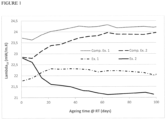
- Comparative Example 1 which is free of CO 2 scavenger epoxy compound has the highest aged lambda value and the largest amount of CO 2 .
- Comparative Example 2 which comprises a small amount of epoxy compound in its formulation displays only a negligible decrease in its aged lambda value compared to the epoxy compound-free Comparative Example 1, together with a significant level of residual CO 2 .
- Examples 1 and 2 according to the invention have higher amounts of epoxy compounds and ultimately display lower aged lambda values and significantly lower levels of CO 2 compared to Comparative Examples 1 and 2, indicative of successful CO 2 scavenging. Carbonate group formation was confirmed as well by the well noticeable presence of FTIR absorption peaks at 1798cm -1 .
- PIR foam properties Molar ratio epoxy group/water in starting formulation PGE amount in starting formulation (wt%) CO 2 amount in aged foams (wt%) Lambda (10°C) fresh foams (mW/m.K) Lambda (10°C) aged foams (mW/m.K) Delta lambda (10°C, aged-fresh) FTIR carbonate signal intensity at 1798 cm -1 (aged foams) Comp. Ex. 1 0 0 2.38 23.7 24.3 +0.6 No Peak Comp. Ex. 2 1.5 1.4 1.67 22.8 24.0 +1.2 Very Small Ex. 1 7.8 6.8 0.53 21.8 22.1 +0.3 Small Ex. 2 17.7 13.8 0.05 22.8 21.1 -1.7 Medium
Landscapes
- Chemical & Material Sciences (AREA)
- Health & Medical Sciences (AREA)
- Chemical Kinetics & Catalysis (AREA)
- Medicinal Chemistry (AREA)
- Polymers & Plastics (AREA)
- Organic Chemistry (AREA)
- Engineering & Computer Science (AREA)
- Materials Engineering (AREA)
- Emergency Medicine (AREA)
- Manufacturing & Machinery (AREA)
- Polyurethanes Or Polyureas (AREA)
Applications Claiming Priority (2)
| Application Number | Priority Date | Filing Date | Title |
|---|---|---|---|
| EP20177774 | 2020-06-02 | ||
| PCT/EP2021/064750 WO2021245120A1 (en) | 2020-06-02 | 2021-06-02 | Use of epoxy compounds as carbon dioxide scavengers in pir comprising foams for superior thermal insulation properties |
Publications (2)
| Publication Number | Publication Date |
|---|---|
| EP4157910A1 EP4157910A1 (en) | 2023-04-05 |
| EP4157910B1 true EP4157910B1 (en) | 2025-02-26 |
Family
ID=70975765
Family Applications (1)
| Application Number | Title | Priority Date | Filing Date |
|---|---|---|---|
| EP21728261.5A Active EP4157910B1 (en) | 2020-06-02 | 2021-06-02 | Use of epoxy compounds as carbon dioxide scavengers in pir comprising foams for superior thermal insulation properties |
Country Status (9)
| Country | Link |
|---|---|
| US (1) | US20230203231A1 (pl) |
| EP (1) | EP4157910B1 (pl) |
| CN (1) | CN115605524B (pl) |
| BR (1) | BR112022024699A2 (pl) |
| CA (1) | CA3184900A1 (pl) |
| MX (1) | MX2022015117A (pl) |
| PL (1) | PL4157910T3 (pl) |
| TW (1) | TWI886287B (pl) |
| WO (1) | WO2021245120A1 (pl) |
Family Cites Families (18)
| Publication number | Priority date | Publication date | Assignee | Title |
|---|---|---|---|---|
| US5371113A (en) | 1993-03-29 | 1994-12-06 | General Electric Company | Polyurethane foam of low thermal conductivity and method of preparation |
| KR100188298B1 (ko) | 1995-01-30 | 1999-06-01 | 모리시따요오이찌 | 단열발포체 및 그 제조방법 |
| JP3135106B2 (ja) * | 1995-02-16 | 2001-02-13 | 松下電器産業株式会社 | 断熱発泡体およびその製造方法 |
| WO1997009361A1 (en) * | 1995-09-01 | 1997-03-13 | Matsushita Electric Industrial Co., Ltd. | Heat-insulating foam, process for producing the same, and heat-insulating box |
| AU4885197A (en) | 1997-11-06 | 1999-05-31 | Matsushita Refrigeration Company | Foamed insulating material, insulating box body made using said foamed insulating material, and process for preparing foamed insulating material |
| EP1045872A1 (en) * | 1998-05-22 | 2000-10-25 | Huntsman ICI Chemicals LLC | Evacuated insulation panels |
| DE10150737A1 (de) * | 2001-10-15 | 2003-04-30 | Hilti Ag | Mehrkomponenten-Ortschaumsystem und dessen Verwendung |
| DE10309798A1 (de) * | 2003-03-05 | 2004-09-16 | Basf Ag | Kohlenstoffmaterialien für die elektrische Energiespeicherung und Verfahren zu deren Herstellung |
| US9695267B2 (en) * | 2009-08-11 | 2017-07-04 | Honeywell International Inc. | Foams and foamable compositions containing halogenated olefin blowing agents |
| US9453115B2 (en) * | 2007-10-12 | 2016-09-27 | Honeywell International Inc. | Stabilization of polyurethane foam polyol premixes containing halogenated olefin blowing agents |
| EP3000592A1 (en) | 2014-09-29 | 2016-03-30 | Mondi AG | Gas-tight material |
| PL3250620T3 (pl) * | 2015-01-30 | 2019-05-31 | Covestro Deutschland Ag | Pianki poliuretanowe bazujące na poliolach polieterowęglanowych |
| TW201634514A (zh) * | 2015-02-05 | 2016-10-01 | 羅傑斯公司 | 發泡體產物及其製備方法 |
| JP6349369B2 (ja) * | 2015-10-29 | 2018-06-27 | 三ツ星ベルト株式会社 | 伝動ベルト用心線の製造方法並びに処理剤及び処理用キット |
| FR3054548B1 (fr) * | 2016-07-28 | 2018-08-31 | Soprema | Procede de fabrication d'une mousse polyurethane modifiee, mousse obtenue et utilisations |
| PL3728367T3 (pl) * | 2017-12-21 | 2025-10-20 | Econic Technologies Limited | Sztywne pianki |
| WO2019211259A1 (en) | 2018-05-03 | 2019-11-07 | Huntsman International Llc | Long term improvement of thermal insulation values in rigid polyisocyanurate/polyurethane comprising insulation foams |
| US11702499B2 (en) * | 2018-12-11 | 2023-07-18 | Trimer Technologies Llc | Polyisocyanurate based polymers and fiber reinforced composites |
-
2021
- 2021-06-02 EP EP21728261.5A patent/EP4157910B1/en active Active
- 2021-06-02 BR BR112022024699A patent/BR112022024699A2/pt unknown
- 2021-06-02 MX MX2022015117A patent/MX2022015117A/es unknown
- 2021-06-02 CA CA3184900A patent/CA3184900A1/en active Pending
- 2021-06-02 PL PL21728261.5T patent/PL4157910T3/pl unknown
- 2021-06-02 WO PCT/EP2021/064750 patent/WO2021245120A1/en not_active Ceased
- 2021-06-02 CN CN202180039582.2A patent/CN115605524B/zh active Active
- 2021-06-02 TW TW110120067A patent/TWI886287B/zh active
- 2021-06-02 US US17/928,558 patent/US20230203231A1/en active Pending
Also Published As
| Publication number | Publication date |
|---|---|
| US20230203231A1 (en) | 2023-06-29 |
| CA3184900A1 (en) | 2021-12-09 |
| MX2022015117A (es) | 2023-03-02 |
| TWI886287B (zh) | 2025-06-11 |
| CN115605524B (zh) | 2025-09-02 |
| EP4157910A1 (en) | 2023-04-05 |
| CN115605524A (zh) | 2023-01-13 |
| WO2021245120A1 (en) | 2021-12-09 |
| BR112022024699A2 (pt) | 2022-12-27 |
| TW202204498A (zh) | 2022-02-01 |
| PL4157910T3 (pl) | 2025-05-12 |
Similar Documents
| Publication | Publication Date | Title |
|---|---|---|
| US9878318B2 (en) | Trimer catalyst additives for improving foam processability | |
| US11434320B2 (en) | Long term improvement of thermal insulation values in rigid polyisocyanurate/polyurethane comprising insulation foams | |
| US20140234613A1 (en) | Process for producing a rigid polyurethane-isocyanurate foam | |
| WO2013030101A1 (en) | Polyurethane rigid foams | |
| US9815932B2 (en) | Trimer catalysts with improved processability and surface cure | |
| CN106102910A (zh) | 用于制造泡沫的催化剂组合物和方法 | |
| RU2707290C2 (ru) | Катализатор тримеризации изоцианата для изготовления полиизоцианурат-содержащих пеноматериалов | |
| US20080312351A1 (en) | Tetraalkylammonium Carboxylate Salts as Trimerization Catalysts for Spray Foam Applications | |
| US20250101198A1 (en) | A reaction mixture for manufacturing an inorganic-filler based closed-cell rigid polyurethane or polyisocyanurate containing foam with low water content | |
| EP4157910B1 (en) | Use of epoxy compounds as carbon dioxide scavengers in pir comprising foams for superior thermal insulation properties | |
| US20250129227A1 (en) | A reaction mixture for manufacturing an inorganic-filler based closed-cell rigid pir-comprising foam | |
| KR102756424B1 (ko) | 긴 크림 시간 및 스냅-경화 거동을 갖는 폴리이소시아누레이트 포함 발포체 | |
| RU2773280C1 (ru) | Долговременное улучшение величин тепловой изоляции у жестких изоляционных пеноматериалов, содержащих полиизоцианурат/полиуретан | |
| WO2020018087A1 (en) | Polyurethane foam additives to improve foam adhesion to organic polymers |
Legal Events
| Date | Code | Title | Description |
|---|---|---|---|
| STAA | Information on the status of an ep patent application or granted ep patent |
Free format text: STATUS: UNKNOWN |
|
| STAA | Information on the status of an ep patent application or granted ep patent |
Free format text: STATUS: THE INTERNATIONAL PUBLICATION HAS BEEN MADE |
|
| PUAI | Public reference made under article 153(3) epc to a published international application that has entered the european phase |
Free format text: ORIGINAL CODE: 0009012 |
|
| STAA | Information on the status of an ep patent application or granted ep patent |
Free format text: STATUS: REQUEST FOR EXAMINATION WAS MADE |
|
| 17P | Request for examination filed |
Effective date: 20230102 |
|
| AK | Designated contracting states |
Kind code of ref document: A1 Designated state(s): AL AT BE BG CH CY CZ DE DK EE ES FI FR GB GR HR HU IE IS IT LI LT LU LV MC MK MT NL NO PL PT RO RS SE SI SK SM TR |
|
| DAV | Request for validation of the european patent (deleted) | ||
| DAX | Request for extension of the european patent (deleted) | ||
| GRAP | Despatch of communication of intention to grant a patent |
Free format text: ORIGINAL CODE: EPIDOSNIGR1 |
|
| STAA | Information on the status of an ep patent application or granted ep patent |
Free format text: STATUS: GRANT OF PATENT IS INTENDED |
|
| INTG | Intention to grant announced |
Effective date: 20240927 |
|
| GRAS | Grant fee paid |
Free format text: ORIGINAL CODE: EPIDOSNIGR3 |
|
| GRAA | (expected) grant |
Free format text: ORIGINAL CODE: 0009210 |
|
| STAA | Information on the status of an ep patent application or granted ep patent |
Free format text: STATUS: THE PATENT HAS BEEN GRANTED |
|
| AK | Designated contracting states |
Kind code of ref document: B1 Designated state(s): AL AT BE BG CH CY CZ DE DK EE ES FI FR GB GR HR HU IE IS IT LI LT LU LV MC MK MT NL NO PL PT RO RS SE SI SK SM TR |
|
| REG | Reference to a national code |
Ref country code: GB Ref legal event code: FG4D |
|
| REG | Reference to a national code |
Ref country code: CH Ref legal event code: EP |
|
| REG | Reference to a national code |
Ref country code: DE Ref legal event code: R096 Ref document number: 602021026783 Country of ref document: DE |
|
| P01 | Opt-out of the competence of the unified patent court (upc) registered |
Free format text: CASE NUMBER: APP_7429/2025 Effective date: 20250217 |
|
| REG | Reference to a national code |
Ref country code: IE Ref legal event code: FG4D |
|
| REG | Reference to a national code |
Ref country code: NL Ref legal event code: MP Effective date: 20250226 |
|
| PG25 | Lapsed in a contracting state [announced via postgrant information from national office to epo] |
Ref country code: RS Free format text: LAPSE BECAUSE OF FAILURE TO SUBMIT A TRANSLATION OF THE DESCRIPTION OR TO PAY THE FEE WITHIN THE PRESCRIBED TIME-LIMIT Effective date: 20250526 |
|
| PG25 | Lapsed in a contracting state [announced via postgrant information from national office to epo] |
Ref country code: FI Free format text: LAPSE BECAUSE OF FAILURE TO SUBMIT A TRANSLATION OF THE DESCRIPTION OR TO PAY THE FEE WITHIN THE PRESCRIBED TIME-LIMIT Effective date: 20250226 |
|
| PGFP | Annual fee paid to national office [announced via postgrant information from national office to epo] |
Ref country code: DE Payment date: 20250626 Year of fee payment: 5 |
|
| PG25 | Lapsed in a contracting state [announced via postgrant information from national office to epo] |
Ref country code: ES Free format text: LAPSE BECAUSE OF FAILURE TO SUBMIT A TRANSLATION OF THE DESCRIPTION OR TO PAY THE FEE WITHIN THE PRESCRIBED TIME-LIMIT Effective date: 20250226 |
|
| REG | Reference to a national code |
Ref country code: LT Ref legal event code: MG9D |
|
| PG25 | Lapsed in a contracting state [announced via postgrant information from national office to epo] |
Ref country code: NO Free format text: LAPSE BECAUSE OF FAILURE TO SUBMIT A TRANSLATION OF THE DESCRIPTION OR TO PAY THE FEE WITHIN THE PRESCRIBED TIME-LIMIT Effective date: 20250526 Ref country code: IS Free format text: LAPSE BECAUSE OF FAILURE TO SUBMIT A TRANSLATION OF THE DESCRIPTION OR TO PAY THE FEE WITHIN THE PRESCRIBED TIME-LIMIT Effective date: 20250626 |
|
| PG25 | Lapsed in a contracting state [announced via postgrant information from national office to epo] |
Ref country code: NL Free format text: LAPSE BECAUSE OF FAILURE TO SUBMIT A TRANSLATION OF THE DESCRIPTION OR TO PAY THE FEE WITHIN THE PRESCRIBED TIME-LIMIT Effective date: 20250226 |
|
| PG25 | Lapsed in a contracting state [announced via postgrant information from national office to epo] |
Ref country code: HR Free format text: LAPSE BECAUSE OF FAILURE TO SUBMIT A TRANSLATION OF THE DESCRIPTION OR TO PAY THE FEE WITHIN THE PRESCRIBED TIME-LIMIT Effective date: 20250226 |
|
| PG25 | Lapsed in a contracting state [announced via postgrant information from national office to epo] |
Ref country code: LV Free format text: LAPSE BECAUSE OF FAILURE TO SUBMIT A TRANSLATION OF THE DESCRIPTION OR TO PAY THE FEE WITHIN THE PRESCRIBED TIME-LIMIT Effective date: 20250226 Ref country code: PT Free format text: LAPSE BECAUSE OF FAILURE TO SUBMIT A TRANSLATION OF THE DESCRIPTION OR TO PAY THE FEE WITHIN THE PRESCRIBED TIME-LIMIT Effective date: 20250626 |
|
| PGFP | Annual fee paid to national office [announced via postgrant information from national office to epo] |
Ref country code: FR Payment date: 20250624 Year of fee payment: 5 |
|
| PG25 | Lapsed in a contracting state [announced via postgrant information from national office to epo] |
Ref country code: BG Free format text: LAPSE BECAUSE OF FAILURE TO SUBMIT A TRANSLATION OF THE DESCRIPTION OR TO PAY THE FEE WITHIN THE PRESCRIBED TIME-LIMIT Effective date: 20250226 Ref country code: GR Free format text: LAPSE BECAUSE OF FAILURE TO SUBMIT A TRANSLATION OF THE DESCRIPTION OR TO PAY THE FEE WITHIN THE PRESCRIBED TIME-LIMIT Effective date: 20250527 |
|
| REG | Reference to a national code |
Ref country code: AT Ref legal event code: MK05 Ref document number: 1770580 Country of ref document: AT Kind code of ref document: T Effective date: 20250226 |
|
| PG25 | Lapsed in a contracting state [announced via postgrant information from national office to epo] |
Ref country code: SE Free format text: LAPSE BECAUSE OF FAILURE TO SUBMIT A TRANSLATION OF THE DESCRIPTION OR TO PAY THE FEE WITHIN THE PRESCRIBED TIME-LIMIT Effective date: 20250226 |
|
| PG25 | Lapsed in a contracting state [announced via postgrant information from national office to epo] |
Ref country code: SM Free format text: LAPSE BECAUSE OF FAILURE TO SUBMIT A TRANSLATION OF THE DESCRIPTION OR TO PAY THE FEE WITHIN THE PRESCRIBED TIME-LIMIT Effective date: 20250226 |
|
| PG25 | Lapsed in a contracting state [announced via postgrant information from national office to epo] |
Ref country code: DK Free format text: LAPSE BECAUSE OF FAILURE TO SUBMIT A TRANSLATION OF THE DESCRIPTION OR TO PAY THE FEE WITHIN THE PRESCRIBED TIME-LIMIT Effective date: 20250226 |
|
| PG25 | Lapsed in a contracting state [announced via postgrant information from national office to epo] |
Ref country code: IT Free format text: LAPSE BECAUSE OF FAILURE TO SUBMIT A TRANSLATION OF THE DESCRIPTION OR TO PAY THE FEE WITHIN THE PRESCRIBED TIME-LIMIT Effective date: 20250226 |
|
| PGFP | Annual fee paid to national office [announced via postgrant information from national office to epo] |
Ref country code: PL Payment date: 20250523 Year of fee payment: 5 |
|
| PG25 | Lapsed in a contracting state [announced via postgrant information from national office to epo] |
Ref country code: AT Free format text: LAPSE BECAUSE OF FAILURE TO SUBMIT A TRANSLATION OF THE DESCRIPTION OR TO PAY THE FEE WITHIN THE PRESCRIBED TIME-LIMIT Effective date: 20250226 |
|
| PG25 | Lapsed in a contracting state [announced via postgrant information from national office to epo] |
Ref country code: EE Free format text: LAPSE BECAUSE OF FAILURE TO SUBMIT A TRANSLATION OF THE DESCRIPTION OR TO PAY THE FEE WITHIN THE PRESCRIBED TIME-LIMIT Effective date: 20250226 Ref country code: CZ Free format text: LAPSE BECAUSE OF FAILURE TO SUBMIT A TRANSLATION OF THE DESCRIPTION OR TO PAY THE FEE WITHIN THE PRESCRIBED TIME-LIMIT Effective date: 20250226 |
|
| PG25 | Lapsed in a contracting state [announced via postgrant information from national office to epo] |
Ref country code: RO Free format text: LAPSE BECAUSE OF FAILURE TO SUBMIT A TRANSLATION OF THE DESCRIPTION OR TO PAY THE FEE WITHIN THE PRESCRIBED TIME-LIMIT Effective date: 20250226 |
|
| PG25 | Lapsed in a contracting state [announced via postgrant information from national office to epo] |
Ref country code: SK Free format text: LAPSE BECAUSE OF FAILURE TO SUBMIT A TRANSLATION OF THE DESCRIPTION OR TO PAY THE FEE WITHIN THE PRESCRIBED TIME-LIMIT Effective date: 20250226 |
|
| REG | Reference to a national code |
Ref country code: DE Ref legal event code: R097 Ref document number: 602021026783 Country of ref document: DE |
|
| PLBE | No opposition filed within time limit |
Free format text: ORIGINAL CODE: 0009261 |
|
| STAA | Information on the status of an ep patent application or granted ep patent |
Free format text: STATUS: NO OPPOSITION FILED WITHIN TIME LIMIT |
|
| REG | Reference to a national code |
Ref country code: CH Ref legal event code: L10 Free format text: ST27 STATUS EVENT CODE: U-0-0-L10-L00 (AS PROVIDED BY THE NATIONAL OFFICE) Effective date: 20260107 |
|
| REG | Reference to a national code |
Ref country code: CH Ref legal event code: H13 Free format text: ST27 STATUS EVENT CODE: U-0-0-H10-H13 (AS PROVIDED BY THE NATIONAL OFFICE) Effective date: 20260127 |
|
| PG25 | Lapsed in a contracting state [announced via postgrant information from national office to epo] |
Ref country code: MC Free format text: LAPSE BECAUSE OF FAILURE TO SUBMIT A TRANSLATION OF THE DESCRIPTION OR TO PAY THE FEE WITHIN THE PRESCRIBED TIME-LIMIT Effective date: 20250226 |
|
| 26N | No opposition filed |
Effective date: 20251127 |
|
| PG25 | Lapsed in a contracting state [announced via postgrant information from national office to epo] |
Ref country code: LU Free format text: LAPSE BECAUSE OF NON-PAYMENT OF DUE FEES Effective date: 20250602 |
|
| GBPC | Gb: european patent ceased through non-payment of renewal fee |
Effective date: 20250602 |
|
| REG | Reference to a national code |
Ref country code: BE Ref legal event code: MM Effective date: 20250630 |
|
| PG25 | Lapsed in a contracting state [announced via postgrant information from national office to epo] |
Ref country code: GB Free format text: LAPSE BECAUSE OF NON-PAYMENT OF DUE FEES Effective date: 20250602 |
|
| PG25 | Lapsed in a contracting state [announced via postgrant information from national office to epo] |
Ref country code: IE Free format text: LAPSE BECAUSE OF NON-PAYMENT OF DUE FEES Effective date: 20250602 |
|
| PG25 | Lapsed in a contracting state [announced via postgrant information from national office to epo] |
Ref country code: BE Free format text: LAPSE BECAUSE OF NON-PAYMENT OF DUE FEES Effective date: 20250630 |