EP4155655B1 - Refrigerant distributor, heat exchanger, and air conditioner - Google Patents
Refrigerant distributor, heat exchanger, and air conditioner Download PDFInfo
- Publication number
- EP4155655B1 EP4155655B1 EP21808264.2A EP21808264A EP4155655B1 EP 4155655 B1 EP4155655 B1 EP 4155655B1 EP 21808264 A EP21808264 A EP 21808264A EP 4155655 B1 EP4155655 B1 EP 4155655B1
- Authority
- EP
- European Patent Office
- Prior art keywords
- refrigerant
- inner pipe
- pipe
- liquid
- outer pipe
- Prior art date
- Legal status (The legal status is an assumption and is not a legal conclusion. Google has not performed a legal analysis and makes no representation as to the accuracy of the status listed.)
- Active
Links
Images





Classifications
-
- F—MECHANICAL ENGINEERING; LIGHTING; HEATING; WEAPONS; BLASTING
- F25—REFRIGERATION OR COOLING; COMBINED HEATING AND REFRIGERATION SYSTEMS; HEAT PUMP SYSTEMS; MANUFACTURE OR STORAGE OF ICE; LIQUEFACTION SOLIDIFICATION OF GASES
- F25B—REFRIGERATION MACHINES, PLANTS OR SYSTEMS; COMBINED HEATING AND REFRIGERATION SYSTEMS; HEAT PUMP SYSTEMS
- F25B39/00—Evaporators; Condensers
- F25B39/02—Evaporators
- F25B39/028—Evaporators having distributing means
-
- F—MECHANICAL ENGINEERING; LIGHTING; HEATING; WEAPONS; BLASTING
- F25—REFRIGERATION OR COOLING; COMBINED HEATING AND REFRIGERATION SYSTEMS; HEAT PUMP SYSTEMS; MANUFACTURE OR STORAGE OF ICE; LIQUEFACTION SOLIDIFICATION OF GASES
- F25B—REFRIGERATION MACHINES, PLANTS OR SYSTEMS; COMBINED HEATING AND REFRIGERATION SYSTEMS; HEAT PUMP SYSTEMS
- F25B13/00—Compression machines, plants or systems, with reversible cycle
-
- F—MECHANICAL ENGINEERING; LIGHTING; HEATING; WEAPONS; BLASTING
- F25—REFRIGERATION OR COOLING; COMBINED HEATING AND REFRIGERATION SYSTEMS; HEAT PUMP SYSTEMS; MANUFACTURE OR STORAGE OF ICE; LIQUEFACTION SOLIDIFICATION OF GASES
- F25B—REFRIGERATION MACHINES, PLANTS OR SYSTEMS; COMBINED HEATING AND REFRIGERATION SYSTEMS; HEAT PUMP SYSTEMS
- F25B39/00—Evaporators; Condensers
-
- F—MECHANICAL ENGINEERING; LIGHTING; HEATING; WEAPONS; BLASTING
- F28—HEAT EXCHANGE IN GENERAL
- F28D—HEAT-EXCHANGE APPARATUS, NOT PROVIDED FOR IN ANOTHER SUBCLASS, IN WHICH THE HEAT-EXCHANGE MEDIA DO NOT COME INTO DIRECT CONTACT
- F28D1/00—Heat-exchange apparatus having stationary conduit assemblies for one heat-exchange medium only, the media being in contact with different sides of the conduit wall, in which the other heat-exchange medium is a large body of fluid, e.g. domestic or motor car radiators
- F28D1/02—Heat-exchange apparatus having stationary conduit assemblies for one heat-exchange medium only, the media being in contact with different sides of the conduit wall, in which the other heat-exchange medium is a large body of fluid, e.g. domestic or motor car radiators with heat-exchange conduits immersed in the body of fluid
- F28D1/04—Heat-exchange apparatus having stationary conduit assemblies for one heat-exchange medium only, the media being in contact with different sides of the conduit wall, in which the other heat-exchange medium is a large body of fluid, e.g. domestic or motor car radiators with heat-exchange conduits immersed in the body of fluid with tubular conduits
- F28D1/0408—Multi-circuit heat exchangers, e.g. integrating different heat exchange sections in the same unit or heat exchangers for more than two fluids
- F28D1/0426—Multi-circuit heat exchangers, e.g. integrating different heat exchange sections in the same unit or heat exchangers for more than two fluids with units having particular arrangement relative to the large body of fluid, e.g. with interleaved units or with adjacent heat exchange units in common air flow or with units extending at an angle to each other or with units arranged around a central element
- F28D1/0443—Combination of units extending one beside or one above the other
-
- F—MECHANICAL ENGINEERING; LIGHTING; HEATING; WEAPONS; BLASTING
- F28—HEAT EXCHANGE IN GENERAL
- F28D—HEAT-EXCHANGE APPARATUS, NOT PROVIDED FOR IN ANOTHER SUBCLASS, IN WHICH THE HEAT-EXCHANGE MEDIA DO NOT COME INTO DIRECT CONTACT
- F28D1/00—Heat-exchange apparatus having stationary conduit assemblies for one heat-exchange medium only, the media being in contact with different sides of the conduit wall, in which the other heat-exchange medium is a large body of fluid, e.g. domestic or motor car radiators
- F28D1/02—Heat-exchange apparatus having stationary conduit assemblies for one heat-exchange medium only, the media being in contact with different sides of the conduit wall, in which the other heat-exchange medium is a large body of fluid, e.g. domestic or motor car radiators with heat-exchange conduits immersed in the body of fluid
- F28D1/04—Heat-exchange apparatus having stationary conduit assemblies for one heat-exchange medium only, the media being in contact with different sides of the conduit wall, in which the other heat-exchange medium is a large body of fluid, e.g. domestic or motor car radiators with heat-exchange conduits immersed in the body of fluid with tubular conduits
- F28D1/053—Heat-exchange apparatus having stationary conduit assemblies for one heat-exchange medium only, the media being in contact with different sides of the conduit wall, in which the other heat-exchange medium is a large body of fluid, e.g. domestic or motor car radiators with heat-exchange conduits immersed in the body of fluid with tubular conduits the conduits being straight
- F28D1/0535—Heat-exchange apparatus having stationary conduit assemblies for one heat-exchange medium only, the media being in contact with different sides of the conduit wall, in which the other heat-exchange medium is a large body of fluid, e.g. domestic or motor car radiators with heat-exchange conduits immersed in the body of fluid with tubular conduits the conduits being straight the conduits having a non-circular cross-section
- F28D1/05366—Assemblies of conduits connected to common headers, e.g. core type radiators
-
- F—MECHANICAL ENGINEERING; LIGHTING; HEATING; WEAPONS; BLASTING
- F28—HEAT EXCHANGE IN GENERAL
- F28D—HEAT-EXCHANGE APPARATUS, NOT PROVIDED FOR IN ANOTHER SUBCLASS, IN WHICH THE HEAT-EXCHANGE MEDIA DO NOT COME INTO DIRECT CONTACT
- F28D1/00—Heat-exchange apparatus having stationary conduit assemblies for one heat-exchange medium only, the media being in contact with different sides of the conduit wall, in which the other heat-exchange medium is a large body of fluid, e.g. domestic or motor car radiators
- F28D1/02—Heat-exchange apparatus having stationary conduit assemblies for one heat-exchange medium only, the media being in contact with different sides of the conduit wall, in which the other heat-exchange medium is a large body of fluid, e.g. domestic or motor car radiators with heat-exchange conduits immersed in the body of fluid
- F28D1/04—Heat-exchange apparatus having stationary conduit assemblies for one heat-exchange medium only, the media being in contact with different sides of the conduit wall, in which the other heat-exchange medium is a large body of fluid, e.g. domestic or motor car radiators with heat-exchange conduits immersed in the body of fluid with tubular conduits
- F28D1/053—Heat-exchange apparatus having stationary conduit assemblies for one heat-exchange medium only, the media being in contact with different sides of the conduit wall, in which the other heat-exchange medium is a large body of fluid, e.g. domestic or motor car radiators with heat-exchange conduits immersed in the body of fluid with tubular conduits the conduits being straight
- F28D1/0535—Heat-exchange apparatus having stationary conduit assemblies for one heat-exchange medium only, the media being in contact with different sides of the conduit wall, in which the other heat-exchange medium is a large body of fluid, e.g. domestic or motor car radiators with heat-exchange conduits immersed in the body of fluid with tubular conduits the conduits being straight the conduits having a non-circular cross-section
- F28D1/05366—Assemblies of conduits connected to common headers, e.g. core type radiators
- F28D1/05375—Assemblies of conduits connected to common headers, e.g. core type radiators with particular pattern of flow, e.g. change of flow direction
-
- F—MECHANICAL ENGINEERING; LIGHTING; HEATING; WEAPONS; BLASTING
- F28—HEAT EXCHANGE IN GENERAL
- F28F—DETAILS OF HEAT-EXCHANGE AND HEAT-TRANSFER APPARATUS, OF GENERAL APPLICATION
- F28F9/00—Casings; Header boxes; Auxiliary supports for elements; Auxiliary members within casings
- F28F9/02—Header boxes; End plates
- F28F9/026—Header boxes; End plates with static flow control means, e.g. with means for uniformly distributing heat exchange media into conduits
- F28F9/027—Header boxes; End plates with static flow control means, e.g. with means for uniformly distributing heat exchange media into conduits in the form of distribution pipes
- F28F9/0273—Header boxes; End plates with static flow control means, e.g. with means for uniformly distributing heat exchange media into conduits in the form of distribution pipes with multiple holes
-
- F—MECHANICAL ENGINEERING; LIGHTING; HEATING; WEAPONS; BLASTING
- F25—REFRIGERATION OR COOLING; COMBINED HEATING AND REFRIGERATION SYSTEMS; HEAT PUMP SYSTEMS; MANUFACTURE OR STORAGE OF ICE; LIQUEFACTION SOLIDIFICATION OF GASES
- F25B—REFRIGERATION MACHINES, PLANTS OR SYSTEMS; COMBINED HEATING AND REFRIGERATION SYSTEMS; HEAT PUMP SYSTEMS
- F25B2313/00—Compression machines, plants or systems with reversible cycle not otherwise provided for
- F25B2313/023—Compression machines, plants or systems with reversible cycle not otherwise provided for using multiple indoor units
- F25B2313/0233—Compression machines, plants or systems with reversible cycle not otherwise provided for using multiple indoor units in parallel arrangements
-
- F—MECHANICAL ENGINEERING; LIGHTING; HEATING; WEAPONS; BLASTING
- F28—HEAT EXCHANGE IN GENERAL
- F28D—HEAT-EXCHANGE APPARATUS, NOT PROVIDED FOR IN ANOTHER SUBCLASS, IN WHICH THE HEAT-EXCHANGE MEDIA DO NOT COME INTO DIRECT CONTACT
- F28D21/00—Heat-exchange apparatus not covered by any of the groups F28D1/00 - F28D20/00
- F28D2021/0019—Other heat exchangers for particular applications; Heat exchange systems not otherwise provided for
- F28D2021/0068—Other heat exchangers for particular applications; Heat exchange systems not otherwise provided for for refrigerant cycles
-
- F—MECHANICAL ENGINEERING; LIGHTING; HEATING; WEAPONS; BLASTING
- F28—HEAT EXCHANGE IN GENERAL
- F28F—DETAILS OF HEAT-EXCHANGE AND HEAT-TRANSFER APPARATUS, OF GENERAL APPLICATION
- F28F9/00—Casings; Header boxes; Auxiliary supports for elements; Auxiliary members within casings
- F28F9/02—Header boxes; End plates
- F28F2009/0285—Other particular headers or end plates
- F28F2009/0297—Side headers, e.g. for radiators having conduits laterally connected to common header
Definitions
- the present disclosure relates to a double-channel refrigerant distributor including an inner pipe and an outer pipe, a heat exchanger, and an air-conditioning apparatus.
- a refrigerant distributor configured to distribute refrigerant through the use of a double-channel pipe having an inner pipe and an outer pipe.
- a refrigerant distributor including a double-channel pipe has a refrigerant outflow hole (also called “orifice") provided in the lowermost part of the inner pipe. Refrigerant having flowed out through the refrigerant outflow hole is ejected into a space between the inner pipe and the outer pipe, flows into a heat transfer pipe through the outer pipe, and exchanges heat with air through the heat transfer pipe (see, for example, Patent Literature 1).
- Patent Literature 2 states that a heat exchanger includes headers and tubes two ends of each of which are connected with and communicate the headers. Each of fins is disposed between adjacent tubes. An end cover is formed with a center hole and fixed to a proximal end of one of the headers. A distal end of a sleeve passes through the center hole to extend into the header, and a proximal end of the sleeve is held by a proximal end surface of the end cover.
- a first distribution-collection tube is fixed to the sleeve and defines an open proximal end and a closed distal end passing through the sleeve to extend into the header in which openings are formed along a longitudinal direction of the distribution-collection tube in a portion thereof extended into the header.
- a fixing nut is screwed onto the end cover to press the proximal end of the sleeve against the proximal end surface of the end cover.
- Patent Literature 3 states that, to provide an accumulated type refrigerant evaporator capable of enhancing cooling capacity by uniformly distributing liquid refrigerant to each of a plurality of tubes and eliminating variation in temperatures of air blown between the tubes, a refrigerant distributing pipe having a plurality of supply holes provided in correspondence with each of tubes is inserted into an interior of an inlet tank in such a manner as to penetrate each of inlet tank portions of an accumulated type refrigerant evaporator.
- the refrigerant distributing pipe is provided with a partition plate in an interior thereof and with a guiding wall 6 at an outlet side end portion of an inlet pipe so that an annular refrigerant passage consisting of a normal flow refrigerant passage, a U-turn flow refrigerant passage , a reverse flow refrigerant passage and a U-turn flow refrigerant passage is formed.
- an annular refrigerant passage consisting of a normal flow refrigerant passage, a U-turn flow refrigerant passage , a reverse flow refrigerant passage and a U-turn flow refrigerant passage is formed.
- height difference of a gas-liquid interface caused by inertia of the liquid refrigerant is alleviated and variation in flow rates of the refrigerant flowing through the supply holes into each of the tubes is reduced.
- Patent Literature 4 states that to distribute refrigerant evenly to each branch tube in quantity.
- a refrigerant distributor includes: an outer tube to which a plurality of branch pipes where a refrigerant flows are connected at a predetermined interval; an inner tube having a plurality of refrigerant discharge holes and accommodated in the outer tube, and whose upper side being closed and from whose lower side the refrigerant flows in; and foam metal, or a wire gauze formed in a cylindrical shape and inserted between the outer tube and the inner tube.
- the refrigerant distributor can retain liquid refrigerant evenly in the inner wall due to the surface tension effect of the wire gauze or the capillary phenomenon of the foam metal, and have the liquid refrigerant flowing out evenly from each branch pipes connected to the outer tube.
- Patent Literature 5 states that an evaporator includes a manifold receiving a distributor insert.
- the distributor insert receives the flow of refrigerant to be delivered into the manifold, and has openings to communicate this refrigerant into a plurality of chambers which are defined between adjacent dividing elements of the distributor insert within the manifold. In this manner, these chambers are each associated with distinct heat transfer tubes and such that these chambers are isolated from each other.
- Patent Literature 6 states that a heat exchanger includes tubes and an inlet manifold to direct a first fluid into the tubes at a third direction. Heat is exchanged between the first fluid and a second fluid in the tubes.
- the heat exchanger also includes a distributor tube located within the inlet manifold.
- the distributor tube includes a short tube including a plurality of first orifices that direct the first fluid into the inlet manifold at a first direction, and a long tube including a plurality of second orifices that direct the first fluid into the inlet manifold at a second direction.
- the refrigerant hardly undergoes transition in flow condition to an annular flow, and regardless of annular drainage in a typical flow pattern map, there are imbalances in the distribution of a liquid phase across a vertical cross-section of the refrigerant distributor.
- Examples include a case in which a refrigerant inflow pipe is short, a case in which one heat exchanger is constituted by connecting a heat exchanger to a heat exchanger via a connecting pipe having a bend, or other cases.
- the related-art refrigerant distributor has suffered from imbalances in the distribution of refrigerant due to such imbalances in the distribution of a liquid phase.
- the present disclosure was made under such circumferences, and has as an object to provide a refrigerant distributor configured to reduce imbalances in the distribution of a liquid phase across the refrigerant distributor and appropriately distribute refrigerant, a heat exchanger, and an air-conditioning apparatus.
- a refrigerant distributor as defined in the independent claim is provided.
- the refrigerant distributor according to the embodiment of the present disclosure has an inner or outer pipe provided with a structural part in which refrigerant enters an undeveloped state of two-phase gas-liquid flow.
- the refrigerant having passed through the structural part flows into the inner pipe in an undeveloped state of two-phase gas-liquid flow.
- Only one refrigerant outflow hole is provided in a vertical cross-section of the inner pipe at a position where the refrigerant outflow hole is provided.
- the refrigerant outflow hole is provided such that an angle ⁇ between a lower end of the inner pipe on a vertical line passing through the center of the inner pipe and the position of presence of the refrigerant outflow hole falls within a range of 10 degrees ⁇ ⁇ ⁇ 80 degrees.
- the refrigerant outflow hole is provided only near the liquid surface of the refrigerant. This allows the refrigerant distributor to, even when the refrigerant flows into the inner pipe in an undeveloped state of two-phase gas-liquid flow, evenly distribute the refrigerant into a space formed between the inner pipe and the outer pipe, making it possible to appropriately distribute the refrigerant.
- Fig. 1 is a refrigerant circuit diagram of an air-conditioning apparatus 100 according to Embodiment 1.
- the air-conditioning apparatus 100 includes an outdoor unit 10 and a plurality of indoor units 11, 12, and 13.
- the indoor units 11, 12, and 13 are connected in parallel to one another.
- Refrigerant circulates through the outdoor unit 10 and the plurality of indoor units 11, 12, and 13.
- the air-conditioning apparatus 100 is a variable refrigerant flow air-conditioning apparatus. It should be noted that Embodiment 1 is not intended to limit the number of indoor units 11, 12, and 13 that are connected to the outdoor unit 10.
- the air-conditioning apparatus 100 has a refrigerant circuit in which a compressor 1, a four-way valve 2, an outdoor heat exchanger 3, expansion valves 5, indoor heat exchangers 6, and an accumulator 8 are connected to one another by a refrigerant pipe 26 and a refrigerant pipe 27.
- the outdoor heat exchanger 3 and each of the indoor heat exchangers 6 exchange heat between refrigerant and air flowing inside on the wind generated by a fan 4 and fans 7.
- high-temperature and high-pressure gas refrigerant compressed by the compressor 1 flows via the four-way valve 2 into the outdoor heat exchanger 3 through the refrigerant pipe 26, which connects the four-way valve 2 to the outdoor heat exchanger 3.
- the refrigerant exchanges heat with the wind generated by the fan 4 and then flows out through the refrigerant pipe 27, which connects the outdoor heat exchanger 3 to the expansion valves 5.
- heating operation that is, in a case in which the outdoor heat exchanger 3 functions as an evaporator
- the refrigerant flows in a direction opposite to that in which the refrigerant flows in a case in which the outdoor heat exchanger 3 functions as a condenser.
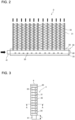
- Fig. 2 is a side schematic view of the outdoor heat exchanger 3 of the air-conditioning apparatus 100 according to Embodiment 1.
- Fig. 3 is a top schematic view of the outdoor heat exchanger 3 of the air-conditioning apparatus 100 according to Embodiment 1.
- the black arrows in Fig. 2 represent the flow of refrigerant in a case in which the outdoor heat exchanger 3 functions as an evaporator.
- the outdoor heat exchanger 3 which is mounted in the outdoor unit 10 of the air-conditioning apparatus 100, causes heat exchange to be performed between the refrigerant and outside air sucked through an air inlet by the fan 4.
- the outdoor heat exchanger 3 is disposed below the fan 4.
- the outdoor heat exchanger 3 has a refrigerant distributor 30, a plurality of heat transfer pipes 31, and a plurality of fins 32.
- the refrigerant distributor 30 is disposed in a horizontal direction.
- the plurality of heat transfer pipes 31 are provided at spacings from each other, and each have one end inserted in the refrigerant distributor 30.
- the fins 32 are attached to the heat transfer pipes 31, and are provided between the heat transfer pipes 31. The fins 32 transfer heat to the heat transfer pipes 31.
- the refrigerant distributor 30 is a double-pipe structure including an inner pipe 33 and an outer pipe 34.
- the plurality of heat transfer pipes 31 are connected in a direction of extension of the outer pipe 34. Refrigerant having flowed into a space between the inner pipe 33 and the outer pipe 34 is distributed to the plurality of heat transfer pipes 31.
- the inner pipe 33 is kept horizontal in a direction of pipe extension. Refrigerant containing liquid refrigerant flows in through one end of the inner pipe 33.
- a cap 36 is provided at the furthest downstream end of the inner pipe 33 in the flow of refrigerant in a case in which the outdoor heat exchanger 3 functions as an evaporator.
- the refrigerant pipe 27 of the refrigeration cycle circuit is connected to the furthest upstream end of the inner pipe 33 in the flow of refrigerant in a case in which the outdoor heat exchanger 3 functions as an evaporator.
- the inner pipe 33 has refrigerant outflow holes 35 (also called “orifices”) formed therein at a spacing from each other in the direction of pipe extension of the inner pipe 33 and between the heat transfer pipes 31.
- refrigerant outflow holes 35 also called “orifices”
- Providing the refrigerant outflow holes 35 between the heat transfer pipes 31 makes it possible to bring about further improvement in refrigerant distribution performance of the refrigerant distributor 30 than in a case in which the refrigerant outflow holes 35 are provided in the inner pipe 33 directly below the heat transfer pipes 31.
- the refrigerant outflow holes 35 may be formed in the inner pipe 33 directly below the heat transfer pipes 31.
- the inner pipe 33 is provided with a flow inlet 41.
- the flow inlet 41 has a length L as an entrance length. Assuming that D is the inside diameter of the inner pipe 33, L ⁇ 5D holds.
- Fig. 4 is a diagram showing states of refrigerant in the inner pipe 33 of the air-conditioning apparatus 100 according to Embodiment 1.
- the refrigerant is present in two states, namely gas-phase refrigerant and liquid-phase refrigerant, in the inner pipe 33, which is a shower pipe.
- the refrigerant outflow holes 35 are provided at around the angle ⁇ ' of the liquid surface AL of the liquid-phase refrigerant.
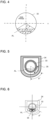
- Fig. 5 is a vertical cross-sectional view of the refrigerant distributor 30 of the air-conditioning apparatus 100 according to Embodiment 1 as taken along line A-A in Fig. 3 .
- Fig. 5 is a diagram showing a state where refrigerant is flowing in a state of semi-annular flow through the inner pipe 33.
- Fig. 5 shows an example in which a refrigerant outflow hole 35 is provided at the angle ⁇ ' of the liquid surface AL of the liquid-phase refrigerant.
- the angle ⁇ at which the refrigerant outflow hole 35 is provided that is, the angle ⁇ between a lower end of the inner pipe 33 on a vertical line passing through the center of the inner pipe 33 and the position of presence of the refrigerant outflow hole 35 as seen from the center of the inner pipe 33, needs only fall within the range of 10 degrees ⁇ ⁇ ⁇ 80 degrees.
- Formula (1) is a prediction formula, based on the Nusselt's liquid membrane estimation formula, in which results of experimentation conducted by the inventors are reflected. [Math.
- the quantities of state and the values of physical properties are estimated by the pressure of inflow into the refrigerant distributor 30.
- Fig. 6 is a vertical cross-sectional view, intended to explain the effects of the air-conditioning apparatus 100 according to Embodiment 1, that shows a relationship between the liquid surface AL of refrigerant in the inner pipe 33 and a refrigerant outflow hole 35.
- Fig. 6 shows a case in which the liquid phase of refrigerant flowing through the inner pipe 33 is a semi-annular flow, and also shows a case in which the refrigerant outflow hole 35 is provided in the lowermost part of the inner pipe 33.
- Fig. 6 shows a case in which the liquid phase of refrigerant flowing through the inner pipe 33 is a semi-annular flow, and also shows a case in which the refrigerant outflow hole 35 is provided in the lowermost part of the inner pipe 33.
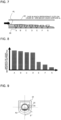
- FIG. 7 is a diagram, intended to explain the effects of the air-conditioning apparatus 100 according to Embodiment 1 that shows a range of influence of refrigerant outflow holes 35 on the refrigerant and a flow condition of the refrigerant.
- Fig. 8 is a diagram, intended to explain the effects of the air-conditioning apparatus 100 according to Embodiment 1, that shows the characteristics of the amounts of refrigerant that are distributed in a case in which the refrigerant outflow holes 35 are provided in a lower part of the inner pipe 33.
- the refrigerant outflow holes 35 are provided in the lowermost part of the inner pipe 33.
- the refrigerant outflow holes 35 are assigned sings A to G in alphabetical order by proximity to the flow inlet 41.
- the dashed lines represent the range of influence of each separate refrigerant outflow hole 35, and at some point in time, refrigerant within the dashed lines passes through the refrigerant outflow holes 35 to be distributed.
- the amounts of liquid refrigerant that are distributed to the upstream refrigerant outflow holes A to D are larger than the amounts of liquid refrigerant that are distributed to the downstream refrigerant outflow holes E to G.
- Fig. 9 is a vertical cross-sectional view, intended to explain the effects of the air-conditioning apparatus 100 according to Embodiment 1, that shows a relationship between the liquid surface AL of refrigerant in the inner pipe 33 and a refrigerant outflow hole 35.
- FIG. 10 is a diagram, intended to explain the effects of the air-conditioning apparatus 100 according to Embodiment 1 that shows a range of influence of refrigerant outflow holes 35 on the refrigerant and a flow condition of the refrigerant.
- Fig. 11 is a diagram, intended to explain the effects of the air-conditioning apparatus 100 according to Embodiment 1, that shows the characteristics of the amounts of refrigerant that are distributed in a case in which the refrigerant outflow holes 35 are provided in an upper part of the inner pipe 33.
- the amounts of liquid refrigerant that are distributed to the upstream refrigerant outflow holes A to C are larger than the amounts of liquid refrigerant that are distributed to the downstream refrigerant outflow holes D to G.
- Fig. 12 is a vertical cross-sectional view showing a relationship between the liquid surface AL of refrigerant in the inner pipe 33 and a refrigerant outflow hole 35 in the air-conditioning apparatus 100 according to Embodiment 1.
- Fig. 12 shows a case in which the liquid phase of refrigerant flowing through the inner pipe 33 is a semi-annular flow.
- the refrigerant outflow hole 35 is provided near the liquid surface AL in the inner pipe 33. Only one refrigerant outflow hole 35 is provided in a vertical cross-section of the inner pipe 33.
- FIG. 13 is a diagram showing a range of influence of refrigerant outflow holes 35 on the refrigerant and a flow condition of the refrigerant in the air-conditioning apparatus 100 according to Embodiment 1.
- Fig. 14 is a diagram showing the characteristics of the amounts of refrigerant that are distributed in a case in which the refrigerant outflow holes 35 are provided in the liquid surface AL in the inner pipe 33 in the air-conditioning apparatus 100 according to Embodiment 1.
- the refrigerant outflow holes 35 are provided at position of the liquid surface AL in the inner pipe 33.
- the refrigerant outflow holes 35 are provided near the liquid surface AL even in a case in which a sufficient entrance length cannot be ensured (L ⁇ 5D).
- the air-conditioning apparatus 100 according to Embodiment 1 makes it possible to distribute gas and liquid relatively evenly to the space formed between the outer pipe 34 and the inner pipe 33. Therefore, the refrigerant distributor 30 can appropriately distribute refrigerant.
- Embodiment 1 has illustrated the case of one outdoor heat exchanger 3.
- Embodiment 2 illustrates a case in which a first outdoor heat exchanger 3a and a second outdoor heat exchanger 3b are connected to each other by a bent inner pipe 33r.
- Fig. 15 is a top schematic view of an outdoor heat exchanger 3 of an air-conditioning apparatus 100 according to Embodiment 2.
- the outdoor heat exchanger 3 includes a first outdoor heat exchanger 3a and a second outdoor heat exchanger 3b.
- a first refrigerant distributor 30a of the first outdoor heat exchanger 3a and a second refrigerant distributor 30b of the second outdoor heat exchanger 3b are connected to each other by a bent inner pipe 33r having a bend having a curvature.
- the bent inner pipe 33r connects an inner pipe 33 of the first outdoor heat exchanger 3a to an inner pipe 33 of the second outdoor heat exchanger 3b.
- Fig. 16 is a vertical cross-sectional view of the first refrigerant distributor 30a of the air-conditioning apparatus 100 according to Embodiment 2 as taken along line A-A in Fig. 15 .
- the flow pattern of refrigerant flowing through the inner pipe 33 of the first refrigerant distributor 30a of the first outdoor heat exchanger 3a is a semi-annular flow.
- Fig. 17 is a vertical cross-sectional view of the first refrigerant distributor 30a of the air-conditioning apparatus 100 according to Embodiment 2 as taken along line B-B in Fig. 15 .
- the flow pattern of refrigerant flowing through the inner pipe 33 of the second refrigerant distributor 30b of the second outdoor heat exchanger 3b is a separated flow.
- the angle ⁇ 2 of a refrigerant outflow hole 35 of the second refrigerant distributor 30b is larger within the range of -180 degrees to 180 degrees than the angle ⁇ 1 of a refrigerant outflow hole 35 of the first refrigerant distributor 30a ( ⁇ 2 > ⁇ 1).
- the flow pattern of refrigerant flowing through the inner pipe 33 of the first refrigerant distributor 30a before passing through the bent inner pipe 33r is a semi-annular flow.
- the flow pattern of refrigerant flowing through the inner pipe 33 of the second refrigerant distributor 30b after having passed through the bent inner pipe 33r is a separated flow. Therefore, as shown in Fig. 17 , the liquid surface AL of the refrigerant rises, with the result that there is deterioration in refrigerant distribution performance.
- the angle ⁇ 2 of a refrigerant outflow hole 35 of the second refrigerant distributor 30b is larger than the angle ⁇ 1 of a refrigerant outflow hole 35 of the first refrigerant distributor 30a. This makes it possible to bring about improvement in refrigerant distribution performance of the first and second refrigerant distributors 30a and 30b.
- the bent inner pipe 33r may be an L-shaped pipe fitting (elbow), or may be one formed by bending an outer pipe 34 of the first refrigerant distributor 30a.
- Embodiment 3 is configured such that an outdoor heat exchanger 3 includes a first outdoor heat exchanger 3a and a second outdoor heat exchanger 3b.
- the second outdoor heat exchanger 3b has an inner pipe 33 whose diameter becomes smaller toward one terminal end.
- Fig. 18 is a side schematic view of a second outdoor heat exchanger 3b of an air-conditioning apparatus 100 according to Embodiment 3.
- the second outdoor heat exchanger 3b has an inner pipe 33a and an inner pipe 33b.
- the inner pipe 33 of the first outdoor heat exchanger 3a is connected to the inner pipe 33a (see Fig. 15 ) of the second outdoor heat exchanger 3b via the bent inner pipe 33r (see Fig. 15 ).
- the inside diameter of the inner pipe 33a of the second outdoor heat exchanger 3b is equal to the inside diameter of the inner pipe 33 of the first outdoor heat exchanger 3a.
- the inner pipe 33a is connected to the inner pipe 33b.
- the inside diameter of the inner pipe 33b is smaller than the inside diameter of the inner pipe 33a.
- a cap 36 is provided at a terminal end of the inner pipe 33b. That is, the inside diameter of the terminal end of the inner pipe 33b of the second outdoor heat exchanger 3b, at which the cap 36 is provided, is smaller than the inside diameter of a starting end of the inner pipe 33a of the second heat exchanger to which the bent inner pipe 33r is connected.
- the air-conditioning apparatus 100 according to Embodiment 3 makes it possible to prevent the flow pattern from changing from a semi-annular flow to a separated flow due to a decrease in flow rate of refrigerant at a terminal end of the second refrigerant distributor 30b of the second outdoor heat exchanger 3b. This makes it possible to bring about improvement in flow robustness of refrigerant distribution characteristics.
- Embodiment 3 has illustrated a case in which the second outdoor heat exchanger 3b has the inner pipe 33a and the inner pipe 33b
- the inner pipe 33 of the second outdoor heat exchanger 3b may be a pipe whose inside diameter becomes gradually smaller from the starting end toward the terminal end.
- Embodiment 4 is configured such that a structural part C in which refrigerant flowing through an inner pipe 33 enters an undeveloped state of two-phase gas-liquid flow is provided upstream of the inner pipe 33.
- the "undeveloped state of two-phase gas-liquid flow” refers to a state where the refrigerant flowing through the inner pipe 33 is in a state of not being a two-phase gas-liquid flow and in a state of being a stratified flow.
- Fig. 19 is a side schematic view of an outdoor heat exchanger 3 according to a first example of an air-conditioning apparatus 100 according to Embodiment 4.
- Fig. 19 is a diagram showing a structural part C1 of a first example of a refrigerant distributor 30 according to the air-conditioning apparatus 100 according to Embodiment 4.
- a lower inner pipe 33_1 is provided with a refrigerant outflow hole 35 (not illustrated) at position described in Embodiment 1.
- a relation of connection between a plurality of heat transfer pipes 31 and a lower outer pipe 34_1 is similar to that of Embodiment 1.
- an upper outer pipe 34 is provided on top of the plurality of heat transfer pipes 31 and fins 32 (not illustrated).
- a relation of connection between the upper outer pipe 34 and the plurality of heat transfer pipes 31 is similar to the relation of connection between the lower outer pipe 34_1 and the plurality of heat transfer pipes 31.
- an outflow pipe 42 whose diameter is smaller than that of the upper outer pipe 34 is provided.
- the lower inner pipe 33_1 is housed in the lower outer pipe 34_1 and has an upstream side further extended than the lower outer pipe 34_1.
- the extended portion of the lower inner pipe 33_1 is a linear flow inlet 41 serving as an entrance through which the refrigerant flows into the lower outer pipe 34_1.
- the flow inlet 41 which is the extended portion of the lower inner pipe 33_1, is also referred to as "structural part C1".
- L ⁇ 10 ⁇ D holds. It is more desirable that L ⁇ 5 ⁇ D hold.
- Refrigerant having passed through such a structural part C1 enters an undeveloped state of two-phase gas-liquid flow, and then flows into the lower inner pipe 33_1. Then, the refrigerant, which is in an undeveloped state of two-phase gas-liquid flow, passes through a refrigerant outflow hole 35 (not illustrated) from the lower inner pipe 33_1, and then flows out to the lower outer pipe 34_1. After having flowed out to the lower outer pipe 34_1, the refrigerant flows into the upper outer pipe 34 through the plurality of heat transfer pipes 31. After having flowed into the upper outer pipe 34, the refrigerant flows into the outflow pipe 42 and flows out of the outdoor heat exchanger 3 through the outflow pipe 42.
- Examples of methods for estimating a flow pattern of refrigerant include flow pattern maps such as Baker's maps. Many of these flow pattern maps represent a sufficiently developed state of gas-liquid flow, that is, a pattern of flow in a case in which a sufficient entrance length is provided.
- the refrigerant distributor 30, which has the structural part C1, of the air-conditioning apparatus 100 according to Embodiment 4 makes it possible to evenly distribute a two-phase gas-liquid flow by providing the lower inner pipe 33_1 with the structural part C1, bringing about improvement in distribution performance.
- Fig. 20 is a side schematic view of an outdoor heat exchanger 3 according to a second example of the air-conditioning apparatus 100 according to Embodiment 4.
- Fig. 20 is a diagram showing a structural part C2 of a second example of the refrigerant distributor 30 according to the air-conditioning apparatus 100 according to Embodiment 4.
- the outdoor heat exchanger 3 has a divider 51_1 provided inside a lower outer pipe 34_1 and a divider 51_2 provided inside an upper outer pipe 34_2 to bring about improvement in velocity of flow of refrigerant and improvement in performance.
- the divider 51_1 is provided inside the lower outer pipe 34_1.
- the divider 51_1 divides the interior of the lower outer pipe 34_1 into a lower outer pipe 34_1_1 and a lower outer pipe 34_1_2 in a direction parallel with an axis of the outer pipe 34_1.
- a flow inlet 41 whose diameter is smaller than that of the lower outer pipe 34_1_1 is provided.
- an outflow pipe 42 whose diameter is smaller than that of the lower outer pipe 34_1_2 is connected to an outflow side of the lower outer pipe 34_1_2.
- a relation of connection between a plurality of heat transfer pipes 31 and the lower outer pipe 34_1 is similar to that of Embodiment 1.
- the upper outer pipe 34_2 and an upper inner pipe 33_2 are provided on top of the plurality of heat transfer pipes 31 and fins 32 (not illustrated).
- a relation of connection between the upper outer pipe 34_2 and the plurality of heat transfer pipes 31 is similar to the relation of connection between the lower outer pipe 34_1 and the plurality of heat transfer pipes 31.
- the upper outer pipe 34_2 houses the upper inner pipe 33_2. As in the case of Embodiment 1, the upper inner pipe 33_2 is provided with refrigerant outflow holes 35.
- the divider 51_2 is provided inside the upper outer pipe 34_2.
- the divider 51_2 is provided above the divider 51_1, and divides the interior of the upper outer pipe 34_2 into an upper outer pipe 34_2_1 and an upper outer pipe 34_2_2 in a direction parallel with an axis of the outer pipe 24_2.
- the divider 51_2 divides the inner periphery of the upper outer pipe 34_2 and the upper inner pipe 33_2 from each other in a direction parallel with the axis of the outer pipe 24_2.
- the upper outer pipe 34_2 is further extended than the upper inner pipe 33_2.
- the interior of the upper outer pipe 34_2_1 forms a confluence space S_1.
- the plurality of heat transfer pipes 31 are connected, and in the confluence space S_1, flows of refrigerant having passed through the flow inlet 41, the lower outer pipe 34_1_1, and the plurality of heat transfer pipes 31 merge with one another.
- the confluence space S_1 is also referred to as "structural part C2".
- the flows of refrigerant having merged with one another in the confluence space S_1 flow into the upper inner pipe 33_2. Further, the flows of refrigerant having merged with one another in the confluence space S_1 partly flow into the upper inner pipe 33_2 after having been turned back by the divider 51_2.
- the confluence space S_1 is structured such that assuming that A1 is the flow passage cross-sectional area of the confluence space S_1 and AS is the flow passage cross-sectional area of the upper inner pipe 33_2, A1 > AS holds.
- Such a structure causes the refrigerant to decrease in two-phase gas-liquid flow when flowing into the upper inner pipe 33_2, which is small in flow passage cross-sectional area, from the confluence space S_1, which is large in flow passage cross-sectional area, but in the confluence space S_1, the refrigerant enters an undeveloped state of two-phase gas-liquid flow.
- Fig. 21 is a cross-sectional schematic view of the upper outer and inner pipes 34_2_2 and 33_2 of the outdoor heat exchanger 3 according to the second example of the air-conditioning apparatus 100 according to Embodiment 4 as taken along line A-A in Fig. 20 .
- Fig. 21 shows an example in which in the upper inner pipe 33_2, a refrigerant outflow hole 35 is provided at the angle ⁇ ' of the liquid surface AL of the liquid-phase refrigerant as in the case of Embodiment 1 described with reference to Fig. 5 .
- the angle ⁇ ' at which the refrigerant outflow hole 35 is provided is an angle between a lower end of the inner pipe 33_2 on a vertical line passing through the center of the inner pipe 33_2 and the position of presence of the refrigerant outflow hole 35 as seen from the center of the inner pipe 33_2, and needs only fall within the range of 10 degrees ⁇ ⁇ ' ⁇ 80 degrees.
- refrigerant having flowed out of the refrigerant outflow hole 35 of the upper inner pipe 33_2 passes through the upper outer pipe 34_2_2 and the plurality of heat transfer pipes 31 in sequence and flows into the lower outer pipe 34_1_2. After having flowed into the lower outer pipe 34_1_2, the refrigerant flows into the outflow pipe 42 and flows out of the outdoor heat exchanger 3.
- the refrigerant distributor 30, which has the structural part C2, of the air-conditioning apparatus 100 according to Embodiment 4 makes it possible to evenly distribute a two-phase gas-liquid flow, bringing about improvement in distribution performance.
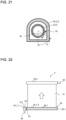
- Fig. 22 is a side schematic view of an outdoor heat exchanger 3 according to a third example of the air-conditioning apparatus 100 according to Embodiment 4.
- Fig. 22 is a diagram showing a structural part C3 of a third example of the refrigerant distributor 30 according to the air-conditioning apparatus 100 according to Embodiment 4.
- a divider 61 is provided inside a lower outer pipe 34_1.
- the divider 61 divides the lower outer pipe 34_1 into a lower outer pipe 34_1_1 and a lower outer pipe 34_1_2. Specifically, the divider 61 divides the inner periphery of the lower outer pipe 34_1 and a lower inner pipe 33_1 from each other.
- the lower outer pipe 34_1_1 is further extended than the lower inner pipe 33_1.
- the lower outer pipe 34_1_1 has an opening port (not illustrated) in a lower surface thereof. To the opening port, a refrigerant inflow pipe 62 is connected.
- the interior of the lower outer pipe 34_1 constitutes an inflow space S_2.
- refrigerant flows from the refrigerant inflow pipe 62.
- the inflow space S_2 is also referred to as "structural part C3". Refrigerant having flowed into the inflow space S_2 flows into the lower inner pipe 33_1.
- the inflow space S_2 is structured such that assuming that A2 is the flow passage cross-sectional area of the inflow space S_2 and AS is the flow passage cross-sectional area of the lower inner pipe 33_1, A2 > AS holds.
- Such a structure causes the refrigerant to decrease in two-phase gas-liquid flow when flowing into the lower inner pipe 33_1, which is small in flow passage cross-sectional area, from the inflow space S_2, which is large in flow passage cross-sectional area, but in the inflow space S_2, the refrigerant enters an undeveloped state of two-phase gas-liquid flow.
- a relation of connection between a plurality of heat transfer pipes 31 and the lower outer pipe 34_1 is similar to that of Embodiment 1.
- An upper outer pipe 34_2 is provided on top of the plurality of heat transfer pipes 31 and fins 32 (not illustrated).
- a relation of connection between the upper outer pipe 34_2 and the plurality of heat transfer pipes 31 is similar to the relation of connection between the lower outer pipe 34_1 and the plurality of heat transfer pipes 31.
- an outflow pipe 42 whose diameter is smaller than that of the upper outer pipe 34_2 is provided.
- Refrigerant having flowed into the lower inner pipe 33_1 passes through a refrigerant outflow hole 35 (not illustrated) from the lower inner pipe 33_1, and then flows out to the lower outer pipe 34_1. After having flowed out to the lower outer pipe 34_1, the refrigerant flows into the upper outer pipe 34_2 through the plurality of heat transfer pipes 31. After having flowed into the upper outer pipe 34_2, the refrigerant flows into the outflow pipe 42 and flows out of the outdoor heat exchanger 3.
- Fig. 22 has illustrated a case in which the refrigerant inflow pipe 62 is provided on the lower surface of the lower outer pipe 34_1_1, the number of refrigerant inflow pipes 62 is not limited to 1. Further, the refrigerant inflow pipe 62 may be fitted, for example, to an upper or side surface of the lower outer pipe 34_1_1.
- the refrigerant distributor 30 of the air-conditioning apparatus 100 according to Embodiment 4 has the structural part C3, which is a portion of the lower outer pipe 34_1_1 further extended than the lower inner pipe 33_1, and the structural part C3 has the inflow space S_2.
- the lower inner pipe 33_1 is housed in and protected by the lower outer pipe 34_1. This makes it unnecessary to increase the thickness of the lower inner pipe 33_1 to ensure strength, making it possible to achieve a reduction in wall thickness of the lower inner pipe 33_1 and savings in space. Further, since the lower inner pipe 33_1 is not exposed to the outside, the wall thickness of the lower inner pipe 33_1 can be reduced.
- connecting the refrigerant inflow pipe 62 to the lower outer pipe 34_1_1 makes it possible to check an increase in piping space resulting from the pipe routing of the refrigerant inflow pipe 62 or other pipes, making it possible to bring about improvement in mountability of the outdoor heat exchanger 3.
- Fig. 23 is a side schematic view of an outdoor heat exchanger 3 according to a fourth example of the air-conditioning apparatus 100 according to Embodiment 4.
- Fig. 23 is a diagram showing a structural part C4 of a fourth example of the refrigerant distributor 30 according to the air-conditioning apparatus 100 according to Embodiment 4.
- a lower inner pipe 33_1 is provided with a refrigerant outflow hole 35 (not illustrated) at position described in Embodiment 1.
- a relation of connection between a plurality of heat transfer pipes 31 and a lower outer pipe 34_1 is similar to that of Embodiment 1.
- an upper outer pipe 34_2 is provided on top of the plurality of heat transfer pipes 31 and fins 32 (not illustrated).
- a relation of connection between the upper outer pipe 34_2 and the plurality of heat transfer pipes 31 is similar to the relation of connection between the lower outer pipe 34_1 and the plurality of heat transfer pipes 31.
- an outflow pipe 42 whose diameter is smaller than that of the upper outer pipe 34_2 is provided.
- the lower inner pipe 33_1 is housed in the lower outer pipe 34_1 and has an upstream side further extended than the lower outer pipe 34_1.
- An extended portion of the lower inner pipe 33_1 is linear.
- a bent inflow pipe 63 is provided upstream of the extended linear portion of the lower inner pipe 33_1.
- the bent inflow pipe 63 is also referred to as "structural part C4".
- Refrigerant having passed through such a structural part C4 enters an undeveloped state of two-phase gas-liquid flow. Then, the refrigerant, which is in an undeveloped state of two-phase gas-liquid flow, flows into the lower inner pipe 33_1. After having flowed into the lower inner pipe 33_1, the refrigerant passes through the refrigerant outflow hole 35 (not illustrated) from the lower inner pipe 33_1, and then flows out to the lower outer pipe 34_1. After having flowed out to the lower outer pipe 34_1, the refrigerant flows into the upper outer pipe 34_2 through the plurality of heat transfer pipes 31. After having flowed into the upper outer pipe 34_2, the refrigerant flows into the outflow pipe 42 and flows out of the outdoor heat exchanger 3.
- Fig. 23 has illustrated a case in which the lower inner pipe 33_1 is provided with the bent inflow pipe 63, the bent inflow pipe 63 may be formed by bending part of the lower inner pipe 33_1.
- the refrigerant distributor 30, which has the structural part C4, of the air-conditioning apparatus 100 according to Embodiment 4 subjects gas-liquid refrigerant flowing through the bent inflow pipe 63 to centrifugal force by providing the bent inflow pipe 63. This causes the refrigerant flowing through the bent inflow pipe 63 to enter an undeveloped state of two-phase gas-liquid flow.
- the refrigerant distributor 30, which has the structural part C4, of the air-conditioning apparatus 100 according to Embodiment 4 makes it possible to evenly distribute a two-phase gas-liquid flow by providing the lower outer pipe 34_1 with the structural part C4, bringing about improvement in distribution performance.
- Embodiment 4 Providing the structural parts C1 to C4 described in Embodiment 4 causes refrigerant flowing into the inner pipe 33 to enter an undeveloped state of two-phase gas-liquid flow. As a result of the inventors' analysis, they found a more appropriate angle of a refrigerant outflow hole 35 in this case.
- Embodiment 5 is intended to define a more appropriate angle ⁇ of a refrigerant outflow hole 35 in the case of an undeveloped state of two-phase gas-liquid flow.
- the angle ⁇ is an angle between a lower end of the inner pipe 33 on a vertical line passing through the center of the inner pipe 33 and the position of presence of the refrigerant outflow hole 35 as seen from the center of the inner pipe 33.
- Fig. 24 is a diagram showing the angle ⁇ of a refrigerant outflow hole 35 in an inner pipe 33 in an air-conditioning apparatus 100 according to Embodiment 5.
- ⁇ is the optimum angle of the refrigerant outflow hole 35
- ⁇ D0 is the liquid-surface angle in a case in which it is assumed that the gas-liquid slip ratio of the refrigerant is 1 and the gas-liquid interface of the refrigerant is flat and horizontal
- ⁇ DS is the wetting boundary angle in a pipe circumferential direction that is used, for example, in the prediction of an evaporative transfer coefficient in consideration of the gas-liquid slip ratio and inertial force of the refrigerant
- AS is the flow passage cross-sectional area of the inner pipe 33.
- ⁇ DS is defined as the liquid-surface angle of a flow pattern
- the angle ⁇ of the refrigerant outflow hole 35 is expressed as ⁇ D0 ⁇ ⁇ ⁇ ⁇ DS .
- ⁇ D0 and ⁇ DS are computed according to Formulas (5) and (6), respectively, using Formulas (2) to (4) for liquid surface angle, proposed by Mori et al., that are used in the prediction of the evaporative heat transfer coefficient of a horizontal smooth pipe.
- ⁇ S 1 + 0.72 x 1 ⁇ x ⁇ L ⁇ G 0.5 n ⁇ L ⁇ G 0.17 ⁇ 0 [Math.
- the wetting boundary angle ⁇ DS in a pipe circumferential direction as calculated by the formulas of Mori et al. is a boundary angle with a very thin region taken into account, as the formulas are formulas obtained by an analysis based on a measurement database of heat transfer coefficients and a heat transfer coefficient is high in heat transfer coefficient contribution in a very thin liquid film region.
- the angle ⁇ of optimum distribution of a refrigerant outflow hole 35 at which to achieve appropriate distribution in refrigerant distribution should be an angle that is smaller than a portion in which the liquid film is thick to some extent, that is, ⁇ DS .
- this angle ⁇ of optimum distribution is present at an angle that is larger than the liquid-surface angle ⁇ D0 in a case in which, as shown in Fig. 24 , it is virtually assumed that the gas-liquid slip ratio is 1 and the gas-liquid interface is flat and horizontal.
- the angle ⁇ of optimum distribution is nearly equal to 1.5 ⁇ D0 .
- the angle of the liquid surface is particularly dominantly affected by the quality of refrigerant, although the angle of the liquid surface is affected by the flow rate and quality of refrigerant and the gas-liquid density ratio.
- the maximum flow under a representative condition of heating rated operation in the range of 0.05 to 0.80, which highly frequently occurs as the evaporator inlet quality of common air-conditioning equipment. It is found that in this case, the optimum distribution angle is present in the range of 80 degrees to 10 degrees and an increase in quality leads to a decrease in optimum distribution angle.
- Formulas (6) and (7) are ⁇ D0 and ⁇ DS prediction formulas obtained by the analysis conducted by the inventors using Formulas (2) to (6).
- Formulas (6) and (7) represent a relationship between the flow passage cross-sectional area AS [mm 2 ] of the inner pipe 33, which is a dominant shape parameter of the inner pipe 33 in a case in which the flow condition of refrigerant during heating rated operation common to air-conditioning equipment is taken into account as a representative condition, and the angle ⁇ of optimum distribution.
- the angle ⁇ of optimum distribution satisfies ⁇ D0 ⁇ ⁇ ⁇ ⁇ DS
- the distribution performance of the inner pipe 33 can be improved.
- the refrigerant distributor 30 of the air-conditioning apparatus 100 according to Embodiment 5 makes it possible to place the angle ⁇ of a refrigerant outflow hole 35 at more appropriate position, thus making it possible to more evenly distribute refrigerant.
- Fig. 25 is a diagram showing a flow pattern map (Baker's map) drawn by plotting flow conditions of the refrigerant inside the inner pipes 33 under conditions of experimentation conducted by the inventors on the refrigerant in the distributors according to Embodiments 1 to 5.
- the inventors attempted to reduce imbalances in liquid phases due to the internal gravities of the inner pipes 33 by designing the inside diameters of the inner pipes 33 to attain a flow condition for an annular flow or an annular spray flow on the Baker's map.
- Fig. 26 is a diagram showing a modified Baker's flow pattern map drawn in Embodiment 6 under refrigerant inflow conditions that are identical to those of Fig. 25 .
- the inside diameter of the inner pipe 33 is D A /6.
- the conditions of an annular flow and an annular spray flow on the Baker's flow pattern map shown in Fig. 25 are laminar flows and the flow pattern of refrigerant as observed by the actual refrigerant visualization largely agrees with the flow pattern of refrigerant shown in Fig. 26 .
- G L W G /A m
- G L W L /A m
- W G W ⁇ x
- W L W ⁇ (1 - x)
- a m (D/2) 2 ⁇ ⁇
- G L is the liquid-phase mass velocity [kg/m 2 s]
- G G is the gas-phase mass velocity [kg/m 2 s]
- W L is the liquid-phase mass flow rate [kg/s]
- W G is the gas-phase mass flow rate [kg/s]
- a m is the flow passage cross-sectional area of the inner pipe 33 [m 2 ]
- x is the quality [-]
- ⁇ is the density [kg/m 3 ]
- ⁇ is the coefficient of viscosity [Pa ⁇ s]
- ⁇ is the surface tension [N/m].
- Fig. 27 is a diagram showing a relationship between the flow passage cross-sectional area AS of the inner pipe 33 and the rate of improvement in refrigerant distribution brought about by the refrigerant outflow holes 35 in Embodiment 6. As shown in Fig. 27 , in the region R_1, where 0 ⁇ AS ⁇ 31.6 mm 2 , the refrigerant easily undergoes transition in flow pattern to an annular flow in many cases, so that the effect of improvement in distribution brought about by the angle of the refrigerant outflow holes 35 is low.
- the effect of improvement in distribution is high, as it is a region of undeveloped flow patterns of wavy and laminar flows.
- the flow passage cross-sectional area of the inner pipe 33 is large for a heat exchanger that is used in common air-conditioning equipment, so that there are tendencies turning toward a decrease in the inertial force and deterioration in distribution. This leads to a decrease in the effect of improvement in distribution.
- Fig. 28 is a vertical cross-sectional view of a refrigerant distributor 30 of an air-conditioning apparatus 100 according to Embodiment 7.
- the angle ⁇ 1 of a refrigerant outflow hole 35 is not limited to particular orientations, and the effect of improvement in distribution can be brought about by positioning the refrigerant outflow hole 35 near the liquid surface AL.
- the orientation of the angle ⁇ 1 of a refrigerant outflow hole 35 at which the refrigerant distributor 30 is mounted in a heat exchanger, that is, the direction of opening of the refrigerant outflow hole 35 is set as follows.
Landscapes
- Engineering & Computer Science (AREA)
- Physics & Mathematics (AREA)
- Thermal Sciences (AREA)
- Mechanical Engineering (AREA)
- General Engineering & Computer Science (AREA)
- Heat-Exchange Devices With Radiators And Conduit Assemblies (AREA)
- Details Of Heat-Exchange And Heat-Transfer (AREA)
- Other Air-Conditioning Systems (AREA)
Applications Claiming Priority (2)
| Application Number | Priority Date | Filing Date | Title |
|---|---|---|---|
| PCT/JP2020/020352 WO2021234959A1 (ja) | 2020-05-22 | 2020-05-22 | 冷媒分配器、熱交換器及び空気調和装置 |
| PCT/JP2021/018888 WO2021235463A1 (ja) | 2020-05-22 | 2021-05-19 | 冷媒分配器、熱交換器及び空気調和装置 |
Publications (3)
| Publication Number | Publication Date |
|---|---|
| EP4155655A1 EP4155655A1 (en) | 2023-03-29 |
| EP4155655A4 EP4155655A4 (en) | 2023-11-15 |
| EP4155655B1 true EP4155655B1 (en) | 2025-05-21 |
Family
ID=78707811
Family Applications (1)
| Application Number | Title | Priority Date | Filing Date |
|---|---|---|---|
| EP21808264.2A Active EP4155655B1 (en) | 2020-05-22 | 2021-05-19 | Refrigerant distributor, heat exchanger, and air conditioner |
Country Status (5)
| Country | Link |
|---|---|
| US (1) | US12270581B2 (https=) |
| EP (1) | EP4155655B1 (https=) |
| JP (1) | JP7353480B2 (https=) |
| CN (1) | CN115667832A (https=) |
| WO (2) | WO2021234959A1 (https=) |
Families Citing this family (7)
| Publication number | Priority date | Publication date | Assignee | Title |
|---|---|---|---|---|
| JP7693095B2 (ja) * | 2022-03-18 | 2025-06-16 | 三菱電機株式会社 | 空気調和装置の室外機および空気調和装置 |
| WO2024042575A1 (ja) * | 2022-08-22 | 2024-02-29 | 三菱電機株式会社 | 熱交換器および冷凍サイクル装置 |
| WO2024257145A1 (ja) * | 2023-06-12 | 2024-12-19 | 三菱電機株式会社 | 熱交換器及び空気調和装置 |
| JP7612110B1 (ja) * | 2023-09-27 | 2025-01-10 | 三菱電機株式会社 | 熱交換器、室外機および空気調和装置 |
| JPWO2025158523A1 (https=) * | 2024-01-23 | 2025-07-31 | ||
| WO2025159144A1 (ja) * | 2024-01-23 | 2025-07-31 | 三菱電機株式会社 | 分配器、熱交換器、分配器の製造方法および、熱交換器の製造方法 |
| WO2025158522A1 (ja) * | 2024-01-23 | 2025-07-31 | 三菱電機株式会社 | 熱交換器、室外機および冷凍サイクル装置 |
Family Cites Families (16)
| Publication number | Priority date | Publication date | Assignee | Title |
|---|---|---|---|---|
| JPH0886591A (ja) * | 1994-07-22 | 1996-04-02 | Nippondenso Co Ltd | 熱交換器、および冷媒蒸発器 |
| EP1548380A3 (en) * | 2003-12-22 | 2006-10-04 | Hussmann Corporation | Flat-tube evaporator with micro-distributor |
| US20100089559A1 (en) * | 2006-10-13 | 2010-04-15 | Carrier Corporation | Method and apparatus for improving distribution of fluid in a heat exchanger |
| CN101487669B (zh) * | 2008-01-17 | 2012-08-22 | 开利公司 | 包括多管式分配器的热交换器 |
| CN102027308A (zh) * | 2008-05-16 | 2011-04-20 | 开利公司 | 具有增强的制冷剂分布的微通道热交换器 |
| CN101782297B (zh) * | 2009-01-19 | 2012-08-22 | 三花控股集团有限公司 | 一种热交换器 |
| DE102009057232A1 (de) * | 2009-12-05 | 2011-06-09 | GM Global Technology Operations LLC, ( n. d. Ges. d. Staates Delaware ), Detroit | Rohrförmiger Wärmetauscher für Kraftfahrzeug-Klimaanlage |
| CN101839590B (zh) * | 2010-02-22 | 2012-03-21 | 三花丹佛斯(杭州)微通道换热器有限公司 | 一种微通道换热器 |
| JP2012002475A (ja) * | 2010-06-21 | 2012-01-05 | Mitsubishi Electric Corp | 冷媒分配器及びこの冷媒分配器を用いたヒートポンプ装置 |
| JP2012021734A (ja) * | 2010-07-16 | 2012-02-02 | Showa Denko Kk | 二重管式熱交換器 |
| KR101217454B1 (ko) * | 2012-05-29 | 2013-01-02 | 안정국 | 축냉시스템의 냉매분배기 |
| CN103604254B (zh) * | 2013-11-12 | 2016-07-06 | 清华大学 | 一种内置气液两相流分流结构 |
| CN107208948B (zh) * | 2015-04-24 | 2019-12-24 | 株式会社电装 | 制冷剂蒸发器 |
| JP6523858B2 (ja) * | 2015-08-05 | 2019-06-05 | 東芝キヤリア株式会社 | 冷凍サイクル装置 |
| EP4279850A3 (en) * | 2018-06-11 | 2024-03-06 | Mitsubishi Electric Corporation | Outdoor unit of air-conditioning apparatus and air-conditioning apparatus |
| KR102132742B1 (ko) * | 2018-07-25 | 2020-07-10 | 엘지전자 주식회사 | 열교환기 |
-
2020
- 2020-05-22 WO PCT/JP2020/020352 patent/WO2021234959A1/ja not_active Ceased
-
2021
- 2021-05-19 EP EP21808264.2A patent/EP4155655B1/en active Active
- 2021-05-19 WO PCT/JP2021/018888 patent/WO2021235463A1/ja not_active Ceased
- 2021-05-19 JP JP2022524504A patent/JP7353480B2/ja active Active
- 2021-05-19 CN CN202180035734.1A patent/CN115667832A/zh active Pending
- 2021-05-19 US US17/918,237 patent/US12270581B2/en active Active
Also Published As
| Publication number | Publication date |
|---|---|
| JP7353480B2 (ja) | 2023-09-29 |
| CN115667832A (zh) | 2023-01-31 |
| WO2021235463A1 (ja) | 2021-11-25 |
| WO2021234959A1 (ja) | 2021-11-25 |
| US12270581B2 (en) | 2025-04-08 |
| US20230146747A1 (en) | 2023-05-11 |
| EP4155655A4 (en) | 2023-11-15 |
| JPWO2021235463A1 (https=) | 2021-11-25 |
| EP4155655A1 (en) | 2023-03-29 |
Similar Documents
| Publication | Publication Date | Title |
|---|---|---|
| EP4155655B1 (en) | Refrigerant distributor, heat exchanger, and air conditioner | |
| US11365912B2 (en) | Suction duct and multiple suction ducts inside a shell of a flooded evaporator | |
| EP3605000B1 (en) | Air conditioning device | |
| EP3805687B1 (en) | Refrigerant distributor, heat exchanger, and air conditioner | |
| EP3569938B1 (en) | Air conditioner | |
| EP3619492B1 (en) | Heat exchanger for heat pump applications | |
| JPWO2021235463A5 (https=) | ||
| CN108107075A (zh) | 管壳式换热器性能测试装置及测试方法 | |
| US12055326B2 (en) | Condenser | |
| JP6644194B1 (ja) | 室外機及び空気調和装置 | |
| JP6766980B1 (ja) | 熱交換器及び熱交換器を搭載した空気調和装置 | |
| CN220507311U (zh) | 一种微通道换热器和空调器 | |
| US20200271402A1 (en) | Helical insert for shell and tube heat exchanger | |
| CN116972454A (zh) | 一种换热系统 | |
| US20230304749A1 (en) | Fluid distributor for a microchannel heat exchanger | |
| CN223243391U (zh) | 一种套管换热器及换热系统 | |
| WO2024261909A1 (ja) | 熱交換器及び空気調和装置 | |
| JP5193631B2 (ja) | 冷媒分流器及び冷媒分流器を備えた熱交換器 | |
| CN218210198U (zh) | 一种分配结构、分配器及空调 | |
| CN116817493A (zh) | 一种微通道换热器和空调器 | |
| KR20020045044A (ko) | 열교환기 | |
| GB2596994A (en) | Outdoor unit and refrigeration cycle device | |
| CN112325516A (zh) | 一种同轴换热器、蒸发器、冷凝器和制冷系统 |
Legal Events
| Date | Code | Title | Description |
|---|---|---|---|
| STAA | Information on the status of an ep patent application or granted ep patent |
Free format text: STATUS: THE INTERNATIONAL PUBLICATION HAS BEEN MADE |
|
| PUAI | Public reference made under article 153(3) epc to a published international application that has entered the european phase |
Free format text: ORIGINAL CODE: 0009012 |
|
| STAA | Information on the status of an ep patent application or granted ep patent |
Free format text: STATUS: REQUEST FOR EXAMINATION WAS MADE |
|
| 17P | Request for examination filed |
Effective date: 20221012 |
|
| AK | Designated contracting states |
Kind code of ref document: A1 Designated state(s): AL AT BE BG CH CY CZ DE DK EE ES FI FR GB GR HR HU IE IS IT LI LT LU LV MC MK MT NL NO PL PT RO RS SE SI SK SM TR |
|
| DAV | Request for validation of the european patent (deleted) | ||
| DAX | Request for extension of the european patent (deleted) | ||
| A4 | Supplementary search report drawn up and despatched |
Effective date: 20231016 |
|
| RIC1 | Information provided on ipc code assigned before grant |
Ipc: F28D 21/00 20060101ALI20231010BHEP Ipc: F25B 13/00 20060101ALI20231010BHEP Ipc: F25B 39/00 20060101ALI20231010BHEP Ipc: F28D 1/04 20060101ALI20231010BHEP Ipc: F28D 1/053 20060101ALI20231010BHEP Ipc: F28F 9/02 20060101AFI20231010BHEP |
|
| GRAP | Despatch of communication of intention to grant a patent |
Free format text: ORIGINAL CODE: EPIDOSNIGR1 |
|
| STAA | Information on the status of an ep patent application or granted ep patent |
Free format text: STATUS: GRANT OF PATENT IS INTENDED |
|
| INTG | Intention to grant announced |
Effective date: 20241223 |
|
| GRAS | Grant fee paid |
Free format text: ORIGINAL CODE: EPIDOSNIGR3 |
|
| GRAA | (expected) grant |
Free format text: ORIGINAL CODE: 0009210 |
|
| STAA | Information on the status of an ep patent application or granted ep patent |
Free format text: STATUS: THE PATENT HAS BEEN GRANTED |
|
| AK | Designated contracting states |
Kind code of ref document: B1 Designated state(s): AL AT BE BG CH CY CZ DE DK EE ES FI FR GB GR HR HU IE IS IT LI LT LU LV MC MK MT NL NO PL PT RO RS SE SI SK SM TR |
|
| REG | Reference to a national code |
Ref country code: GB Ref legal event code: FG4D |
|
| REG | Reference to a national code |
Ref country code: CH Ref legal event code: EP |
|
| REG | Reference to a national code |
Ref country code: DE Ref legal event code: R096 Ref document number: 602021031209 Country of ref document: DE |
|
| REG | Reference to a national code |
Ref country code: IE Ref legal event code: FG4D |
|
| REG | Reference to a national code |
Ref country code: NL Ref legal event code: MP Effective date: 20250521 |
|
| PG25 | Lapsed in a contracting state [announced via postgrant information from national office to epo] |
Ref country code: PT Free format text: LAPSE BECAUSE OF FAILURE TO SUBMIT A TRANSLATION OF THE DESCRIPTION OR TO PAY THE FEE WITHIN THE PRESCRIBED TIME-LIMIT Effective date: 20250922 Ref country code: ES Free format text: LAPSE BECAUSE OF FAILURE TO SUBMIT A TRANSLATION OF THE DESCRIPTION OR TO PAY THE FEE WITHIN THE PRESCRIBED TIME-LIMIT Effective date: 20250521 Ref country code: FI Free format text: LAPSE BECAUSE OF FAILURE TO SUBMIT A TRANSLATION OF THE DESCRIPTION OR TO PAY THE FEE WITHIN THE PRESCRIBED TIME-LIMIT Effective date: 20250521 |
|
| REG | Reference to a national code |
Ref country code: LT Ref legal event code: MG9D |
|
| PG25 | Lapsed in a contracting state [announced via postgrant information from national office to epo] |
Ref country code: GR Free format text: LAPSE BECAUSE OF FAILURE TO SUBMIT A TRANSLATION OF THE DESCRIPTION OR TO PAY THE FEE WITHIN THE PRESCRIBED TIME-LIMIT Effective date: 20250822 Ref country code: NO Free format text: LAPSE BECAUSE OF FAILURE TO SUBMIT A TRANSLATION OF THE DESCRIPTION OR TO PAY THE FEE WITHIN THE PRESCRIBED TIME-LIMIT Effective date: 20250821 |
|
| PG25 | Lapsed in a contracting state [announced via postgrant information from national office to epo] |
Ref country code: NL Free format text: LAPSE BECAUSE OF FAILURE TO SUBMIT A TRANSLATION OF THE DESCRIPTION OR TO PAY THE FEE WITHIN THE PRESCRIBED TIME-LIMIT Effective date: 20250521 Ref country code: PL Free format text: LAPSE BECAUSE OF FAILURE TO SUBMIT A TRANSLATION OF THE DESCRIPTION OR TO PAY THE FEE WITHIN THE PRESCRIBED TIME-LIMIT Effective date: 20250521 |
|
| PG25 | Lapsed in a contracting state [announced via postgrant information from national office to epo] |
Ref country code: BG Free format text: LAPSE BECAUSE OF FAILURE TO SUBMIT A TRANSLATION OF THE DESCRIPTION OR TO PAY THE FEE WITHIN THE PRESCRIBED TIME-LIMIT Effective date: 20250521 |
|
| PG25 | Lapsed in a contracting state [announced via postgrant information from national office to epo] |
Ref country code: HR Free format text: LAPSE BECAUSE OF FAILURE TO SUBMIT A TRANSLATION OF THE DESCRIPTION OR TO PAY THE FEE WITHIN THE PRESCRIBED TIME-LIMIT Effective date: 20250521 |
|
| PG25 | Lapsed in a contracting state [announced via postgrant information from national office to epo] |
Ref country code: RS Free format text: LAPSE BECAUSE OF FAILURE TO SUBMIT A TRANSLATION OF THE DESCRIPTION OR TO PAY THE FEE WITHIN THE PRESCRIBED TIME-LIMIT Effective date: 20250821 |
|
| PG25 | Lapsed in a contracting state [announced via postgrant information from national office to epo] |
Ref country code: IS Free format text: LAPSE BECAUSE OF FAILURE TO SUBMIT A TRANSLATION OF THE DESCRIPTION OR TO PAY THE FEE WITHIN THE PRESCRIBED TIME-LIMIT Effective date: 20250921 |
|
| PG25 | Lapsed in a contracting state [announced via postgrant information from national office to epo] |
Ref country code: LV Free format text: LAPSE BECAUSE OF FAILURE TO SUBMIT A TRANSLATION OF THE DESCRIPTION OR TO PAY THE FEE WITHIN THE PRESCRIBED TIME-LIMIT Effective date: 20250521 |
|
| REG | Reference to a national code |
Ref country code: AT Ref legal event code: MK05 Ref document number: 1797062 Country of ref document: AT Kind code of ref document: T Effective date: 20250521 |
|
| PG25 | Lapsed in a contracting state [announced via postgrant information from national office to epo] |
Ref country code: AT Free format text: LAPSE BECAUSE OF FAILURE TO SUBMIT A TRANSLATION OF THE DESCRIPTION OR TO PAY THE FEE WITHIN THE PRESCRIBED TIME-LIMIT Effective date: 20250521 Ref country code: DK Free format text: LAPSE BECAUSE OF FAILURE TO SUBMIT A TRANSLATION OF THE DESCRIPTION OR TO PAY THE FEE WITHIN THE PRESCRIBED TIME-LIMIT Effective date: 20250521 Ref country code: SM Free format text: LAPSE BECAUSE OF FAILURE TO SUBMIT A TRANSLATION OF THE DESCRIPTION OR TO PAY THE FEE WITHIN THE PRESCRIBED TIME-LIMIT Effective date: 20250521 |
|
| PG25 | Lapsed in a contracting state [announced via postgrant information from national office to epo] |
Ref country code: CZ Free format text: LAPSE BECAUSE OF FAILURE TO SUBMIT A TRANSLATION OF THE DESCRIPTION OR TO PAY THE FEE WITHIN THE PRESCRIBED TIME-LIMIT Effective date: 20250521 |
|
| PG25 | Lapsed in a contracting state [announced via postgrant information from national office to epo] |
Ref country code: EE Free format text: LAPSE BECAUSE OF FAILURE TO SUBMIT A TRANSLATION OF THE DESCRIPTION OR TO PAY THE FEE WITHIN THE PRESCRIBED TIME-LIMIT Effective date: 20250521 |
|
| PG25 | Lapsed in a contracting state [announced via postgrant information from national office to epo] |
Ref country code: SK Free format text: LAPSE BECAUSE OF FAILURE TO SUBMIT A TRANSLATION OF THE DESCRIPTION OR TO PAY THE FEE WITHIN THE PRESCRIBED TIME-LIMIT Effective date: 20250521 |
|
| PG25 | Lapsed in a contracting state [announced via postgrant information from national office to epo] |
Ref country code: IT Free format text: LAPSE BECAUSE OF FAILURE TO SUBMIT A TRANSLATION OF THE DESCRIPTION OR TO PAY THE FEE WITHIN THE PRESCRIBED TIME-LIMIT Effective date: 20250521 |
|
| REG | Reference to a national code |
Ref country code: DE Ref legal event code: R097 Ref document number: 602021031209 Country of ref document: DE |
|
| PLBE | No opposition filed within time limit |
Free format text: ORIGINAL CODE: 0009261 |
|
| STAA | Information on the status of an ep patent application or granted ep patent |
Free format text: STATUS: NO OPPOSITION FILED WITHIN TIME LIMIT |
|
| REG | Reference to a national code |
Ref country code: CH Ref legal event code: L10 Free format text: ST27 STATUS EVENT CODE: U-0-0-L10-L00 (AS PROVIDED BY THE NATIONAL OFFICE) Effective date: 20260402 |
|
| PGFP | Annual fee paid to national office [announced via postgrant information from national office to epo] |
Ref country code: GB Payment date: 20260323 Year of fee payment: 6 |
|
| 26N | No opposition filed |
Effective date: 20260224 |