EP4154246B1 - Auf unterhaltungsaudio reagierendes strassengeräuschunterdrückungssystem - Google Patents
Auf unterhaltungsaudio reagierendes strassengeräuschunterdrückungssystem Download PDFInfo
- Publication number
- EP4154246B1 EP4154246B1 EP21734984.4A EP21734984A EP4154246B1 EP 4154246 B1 EP4154246 B1 EP 4154246B1 EP 21734984 A EP21734984 A EP 21734984A EP 4154246 B1 EP4154246 B1 EP 4154246B1
- Authority
- EP
- European Patent Office
- Prior art keywords
- cancellation
- signal
- audio
- noise
- entertainment audio
- Prior art date
- Legal status (The legal status is an assumption and is not a legal conclusion. Google has not performed a legal analysis and makes no representation as to the accuracy of the status listed.)
- Active
Links
Images

Classifications
-
- G—PHYSICS
- G10—MUSICAL INSTRUMENTS; ACOUSTICS
- G10K—SOUND-PRODUCING DEVICES; METHODS OR DEVICES FOR PROTECTING AGAINST, OR FOR DAMPING, NOISE OR OTHER ACOUSTIC WAVES IN GENERAL; ACOUSTICS NOT OTHERWISE PROVIDED FOR
- G10K11/00—Methods or devices for transmitting, conducting or directing sound in general; Methods or devices for protecting against, or for damping, noise or other acoustic waves in general
- G10K11/16—Methods or devices for protecting against, or for damping, noise or other acoustic waves in general
- G10K11/175—Methods or devices for protecting against, or for damping, noise or other acoustic waves in general using interference effects; Masking sound
- G10K11/178—Methods or devices for protecting against, or for damping, noise or other acoustic waves in general using interference effects; Masking sound by electro-acoustically regenerating the original acoustic waves in anti-phase
- G10K11/1783—Methods or devices for protecting against, or for damping, noise or other acoustic waves in general using interference effects; Masking sound by electro-acoustically regenerating the original acoustic waves in anti-phase handling or detecting of non-standard events or conditions, e.g. changing operating modes under specific operating conditions
- G10K11/17837—Methods or devices for protecting against, or for damping, noise or other acoustic waves in general using interference effects; Masking sound by electro-acoustically regenerating the original acoustic waves in anti-phase handling or detecting of non-standard events or conditions, e.g. changing operating modes under specific operating conditions by retaining part of the ambient acoustic environment, e.g. speech or alarm signals that the user needs to hear
-
- H—ELECTRICITY
- H04—ELECTRIC COMMUNICATION TECHNIQUE
- H04R—LOUDSPEAKERS, MICROPHONES, GRAMOPHONE PICK-UPS OR LIKE ACOUSTIC ELECTROMECHANICAL TRANSDUCERS; ELECTRIC HEARING AIDS; PUBLIC ADDRESS SYSTEMS
- H04R3/00—Circuits for transducers
- H04R3/02—Circuits for transducers for preventing acoustic reaction, i.e. acoustic oscillatory feedback
-
- G—PHYSICS
- G10—MUSICAL INSTRUMENTS; ACOUSTICS
- G10K—SOUND-PRODUCING DEVICES; METHODS OR DEVICES FOR PROTECTING AGAINST, OR FOR DAMPING, NOISE OR OTHER ACOUSTIC WAVES IN GENERAL; ACOUSTICS NOT OTHERWISE PROVIDED FOR
- G10K11/00—Methods or devices for transmitting, conducting or directing sound in general; Methods or devices for protecting against, or for damping, noise or other acoustic waves in general
- G10K11/16—Methods or devices for protecting against, or for damping, noise or other acoustic waves in general
- G10K11/175—Methods or devices for protecting against, or for damping, noise or other acoustic waves in general using interference effects; Masking sound
- G10K11/178—Methods or devices for protecting against, or for damping, noise or other acoustic waves in general using interference effects; Masking sound by electro-acoustically regenerating the original acoustic waves in anti-phase
- G10K11/1785—Methods, e.g. algorithms; Devices
- G10K11/17853—Methods, e.g. algorithms; Devices of the filter
- G10K11/17854—Methods, e.g. algorithms; Devices of the filter the filter being an adaptive filter
-
- G—PHYSICS
- G10—MUSICAL INSTRUMENTS; ACOUSTICS
- G10K—SOUND-PRODUCING DEVICES; METHODS OR DEVICES FOR PROTECTING AGAINST, OR FOR DAMPING, NOISE OR OTHER ACOUSTIC WAVES IN GENERAL; ACOUSTICS NOT OTHERWISE PROVIDED FOR
- G10K11/00—Methods or devices for transmitting, conducting or directing sound in general; Methods or devices for protecting against, or for damping, noise or other acoustic waves in general
- G10K11/16—Methods or devices for protecting against, or for damping, noise or other acoustic waves in general
- G10K11/175—Methods or devices for protecting against, or for damping, noise or other acoustic waves in general using interference effects; Masking sound
- G10K11/178—Methods or devices for protecting against, or for damping, noise or other acoustic waves in general using interference effects; Masking sound by electro-acoustically regenerating the original acoustic waves in anti-phase
- G10K11/1787—General system configurations
- G10K11/17879—General system configurations using both a reference signal and an error signal
- G10K11/17883—General system configurations using both a reference signal and an error signal the reference signal being derived from a machine operating condition, e.g. engine RPM or vehicle speed
-
- H—ELECTRICITY
- H04—ELECTRIC COMMUNICATION TECHNIQUE
- H04R—LOUDSPEAKERS, MICROPHONES, GRAMOPHONE PICK-UPS OR LIKE ACOUSTIC ELECTROMECHANICAL TRANSDUCERS; ELECTRIC HEARING AIDS; PUBLIC ADDRESS SYSTEMS
- H04R2499/00—Aspects covered by H04R or H04S not otherwise provided for in their subgroups
- H04R2499/10—General applications
- H04R2499/13—Acoustic transducers and sound field adaptation in vehicles
Definitions
- This disclosure is generally directed to systems and methods for controlling a noise-cancellation output signal based on entertainment audio.
- Various examples are directed to systems and methods for controlling a noise-cancellation output signal based on entertainment audio.
- the invention relates to a vehicle implemented noise-cancellation system and a system for monitoring entertainment audio according to the independent claims.
- Advantageous embodiments are set forth in the dependent claims.
- a processor or controller can be associated with one or more storage media (generically referred to herein as "memory,” e.g., volatile and non-volatile computer memory such as ROM, RAM, PROM, EPROM, and EEPROM, floppy disks, compact disks, optical disks, magnetic tape, Flash, OTP-ROM, SSD, HDD, etc.).
- the storage media can be encoded with one or more programs that, when executed on one or more processors and/or controllers, perform at least some of the functions discussed herein.
- Various storage media can be fixed within a processor or controller or can be transportable, such that the one or more programs stored thereon can be loaded into a processor or controller so as to implement various aspects as discussed herein.
- program or “computer program” are used herein in a generic sense to refer to any type of computer code (e.g., software or microcode) that can be employed to program one or more processors or controllers.
- An adaptive noise-cancellation system employs the use of at least one reference signal from a reference sensor in order to generate a noise-cancellation signal.
- the reference sensors are typically accelerometers operably mounted to the vehicle to detect vibrations in the chassis, which are transduced by the chassis into what is perceived by a passenger as road noise.
- the entertainment audio system of the vehicle is playing loud music (specifically loud music with deep bass hits or thumps), the music may cause vibrations in the car that excite the accelerometers. This may give the noise-cancellation system a false indication of road noise, and thus cause it to play this excitation through secondary noise-cancellation speakers.
- the provided system for monitoring entertainment audio addresses the aforementioned problems.
- the system utilizes two sets of thresholds.
- the first set of thresholds triggers the system to enable or disable the adaptation of an adaptive filter of the noise-cancellation system.
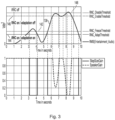
- the second set of thresholds triggers the system to enable, attenuate, or disable the noise-cancellation signal. Accordingly, as the entertainment audio increases in volume and magnitude, the system first disables the adaptation of the adaptive filter, then attenuates the noise-cancellation signal, then completely disables the noise-cancellation signal. Conversely, as the entertainment audio decreases, the system first enables the noise-cancellation signal, then reduces the attenuation (thereby increasing the amplitude) of the noise-cancellation signal, and then enables the adaptation of the adaptive filter.
- the system monitors the entertainment based on the signals generated by the entertainment audio system. For example, the system can monitor the left and right audio channel signals generated by the entertainment audio system. In an alternative example, the system monitors the numerous output audio channel signals provided to the vehicle loudspeakers. The system can perform a weighted or un-weighted root-mean-squared (RMS) calculation of the monitored signals to determine an entertainment audio monitor signal. The system then controls the adaptation of the adaptive filter and the noise-cancellation signal based on the relationship of the entertainment audio monitor signal and the aforementioned thresholds.
- RMS root-mean-squared
- FIG. 1 is a schematic view of an example noise-cancellation system 100.
- Noise-cancellation system 100 is configured to destructively interfere with undesired sound in at least one cancellation zone 102 within a predefined volume 104 such as a vehicle cabin.
- a predefined volume 104 such as a vehicle cabin.
- an example of noise-cancellation system 100 can include a reference sensor 106, an error sensor 108, an actuator 110, and a controller 112.
- reference sensor 106 is configured to generate noise signal(s) 114 representative of the undesired sound, or a source of the undesired sound, within predefined volume 104.
- reference sensor 106 can be an accelerometer, or a plurality of accelerometers, mounted to and configured to detect vibrations transmitted through a vehicle structure 116. Vibrations transmitted through the vehicle structure 116 are transduced by the structure into undesired sound in the vehicle cabin (perceived as road noise), thus an accelerometer mounted to the structure provides a signal representative of the undesired sound.
- Actuators 110 are speakers distributed in discrete locations about the perimeter of the predefined volume.
- four or more speakers can be disposed within a vehicle cabin, each of the four speakers being located within a respective door of the vehicle and configured to project sound into the vehicle cabin.
- speakers can be located within a headrest, or elsewhere in the vehicle cabin.
- a noise-cancellation signal 118 can be generated by controller 112 and provided to one or more speakers in the predefined volume, which transduce the noise-cancellation signal 118 to acoustic energy (i.e., sound waves).
- the acoustic energy produced as a result of noise-cancellation signal 118 is approximately 180° out of phase with-and thus destructively interferes with-the undesired sound within the cancellation zone 102.
- the combination of sound waves generated from the noise-cancellation signal 118 and the undesired noise in the predefined volume results in cancellation of the undesired noise, as perceived by a listener in a cancellation zone.
- noise-cancellation system 100 is configured to create the greatest noise-cancellation within one or more predefined cancellation zones 102 within the predefined volume.
- the noise-cancellation within the cancellation zones can reduce undesired sound by approximately 3 dB or more (although in varying examples, different amounts of noise-cancellation can occur).
- the noise-cancellation can cancel sounds in a range of frequencies, such as frequencies less than approximately 350 Hz (although other ranges are possible).
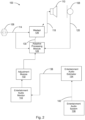
- FIG. 2 shows a block diagram of an example of noise-cancellation system 100, including a plurality of filters implemented by controller 112. As shown, the controller can define a control system including W adapt filter 126 and an adaptive processing module 128.
- T ⁇ de is an estimate of the physical transfer function between actuator 110 and the noise-cancellation zone 102
- T ⁇ ' de is the conjugate transpose of T ⁇ de
- e is the error signal
- x is the output signal of reference sensor 106.
- the output signal x of reference sensor is divided by the norm of x , represented as
- the total number of filters is generally equal to the number of reference sensors (M) multiplied by the number of speakers (N). Each reference sensor signal is filtered N times, and each speaker signal is then obtained as a summation of M signals (each sensor signal filtered by the corresponding filter).
- An entertainment audio estimator 134 generates a single entertainment audio monitor signal 138 based on the one or more entertainment audio signals 140.
- the entertainment audio monitor signal 138 can be an RMS estimate of the one or more entertainment audio signals 140.
- the one or more entertainment audio signals 140 can include a left channel audio signal 140a and a right channel audio signal 140b, such as the left and right channel of a stereo audio track on a compact disc, digital music file, or digital music stream played by the entertainment audio system 136.
- the entertainment audio monitor signal 138 can then be an RMS estimate of the left channel audio signal 140a and the right channel audio signal 140b. While this example describes the entertainment audio monitor signal 138 as the result of an RMS estimate of one or more audio signals, in further examples the entertainment audio monitor signal 138 could be any other metric or figure corresponding to the loudness of entertainment audio within the vehicle.
- the second set of two thresholds serve a different purpose.
- a driver's choice of the loudness of entertainment audio is subjective, and at a certain point (corresponding to the cancellation enable threshold) entertainment audio may be so loud that it starts to mask all road noise.
- road noise-cancellation is no longer necessary. So, to forego the road noise-cancellation whenever the entertainment audio reaches this loud volume, when the entertainment audio monitor signal 138 exceeds a cancellation enable threshold 146, road noise-cancellation is disabled by ramping down the speaker gain associated with actuator 110 from 1 to 0.
- Filter 126 adaptation is re-enabled when the entertainment audio monitor signal 138 dips below the adaptation enable threshold 144 at approximately 9.75 seconds.
- noise-cancellation systems 100 described above are merely provided as examples of such a system 100.
- This system 100, variants of this system 100, and other suitable noise-cancellation systems can be used within the scope of this disclosure.
- a computer program can be written in any form of programming language, including compiled or interpreted languages, and it can be deployed in any form, including as a stand-alone program or as a module, component, subroutine, or other unit suitable for use in a computing environment.
- a computer program can be deployed to be executed on one computer or on multiple computers at one site or distributed across multiple sites and interconnected by a network.
Landscapes
- Physics & Mathematics (AREA)
- Engineering & Computer Science (AREA)
- Acoustics & Sound (AREA)
- Multimedia (AREA)
- Health & Medical Sciences (AREA)
- General Health & Medical Sciences (AREA)
- Otolaryngology (AREA)
- Signal Processing (AREA)
- Audiology, Speech & Language Pathology (AREA)
- Soundproofing, Sound Blocking, And Sound Damping (AREA)
- Fittings On The Vehicle Exterior For Carrying Loads, And Devices For Holding Or Mounting Articles (AREA)
Claims (8)
- In einem Fahrzeug implementiertes Geräuschunterdrückungssystem (100), umfassend:ein Geräuschunterdrückungs-Teilsystem, das in einem Fahrzeug angeordnet ist, wobei das Geräuschunterdrückungssystem einen adaptiven Filter (126) umfasst, der gemäß einem Referenzsignal (114) und einem Fehlersignal (120) angepasst wird, wobei der adaptive Filter ein Geräuschunterdrückungssignal (118) ausgibt, das, wenn es von einem Lautsprecher (110) in ein Geräuschunterdrückungsaudiosignal umgewandelt wird, Straßengeräusche innerhalb mindestens einer Zone (102) innerhalb einer Fahrgastzelle des Fahrzeugs unterdrückt; undein Unterhaltungsaudioüberwachungs-Teilsystem, das so konfiguriert ist, dass es:ein Unterhaltungsaudioüberwachungssignal (138) erzeugt, das Unterhaltungsaudio entspricht, das aus einem Unterhaltungsaudiosystem (136) des Fahrzeugs stammt;dadurch gekennzeichnet, dass das Unterhaltungsaudioüberwachungs-Teilsystem weiter so konfiguriert ist, dass es:Adaption des adaptiven Filters deaktiviert, wenn die Amplitude des Unterhaltungsaudioüberwachungssignals größer ist als eine Adaptionseinfrierschwelle (142);im Anschluss an das Deaktivieren der Adaption des adaptiven Filters Adaption des adaptiven Filters aktiviert, wenn die Amplitude des Unterhaltungsaudioüberwachungssignals kleiner ist als eine Adaptionsaktivierungsschwelle (144),das Geräuschunterdrückungsaudiosignal deaktiviert, wenn die Amplitude des Unterhaltungsaudioüberwachungssignals größer ist als eine Unterdrückungsdeaktivierungsschwelle (148); unddas Geräuschunterdrückungsaudiosignal dämpft, wenn die Amplitude des Unterhaltungsaudioüberwachungssignals größer ist als eine Unterdrückungsaktivierungsschwelle (146), wobei die Dämpfung des Geräuschunterdrückungsaudiosignals relativ zur Amplitude des Unterhaltungsaudioüberwachungssignals zunimmt, wenn die Amplitude des Unterhaltungsaudioüberwachungssignals kleiner ist als die Unterdrückungsdeaktivierungsschwelle.
- In einem Fahrzeug implementiertes Geräuschunterdrückungssystem (100) nach Anspruch 1, wobei das Unterhaltungsaudioüberwachungssignal auf mindestens einem von einem oder mehreren Unterhaltungsaudiosignalen basiert, die vom Unterhaltungsaudiosystem erzeugt werden.
- In einem Fahrzeug implementiertes Geräuschunterdrückungssystem (100) nach Anspruch 2, wobei das eine oder die mehreren Unterhaltungsaudiosignale ein Audiosignal für den linken Kanal und ein Audiosignal für den rechten Kanal umfassen, und wobei das Unterhaltungsaudioüberwachungssignal eine Schätzung des quadratischen Mittelwerts ("RMS") des Audiosignals für den linken Kanal und eines Audiosignals für den rechten Kanal ist.
- In einem Fahrzeug implementiertes Geräuschunterdrückungssystem (100) nach Anspruch 3, wobei das eine oder die mehreren Unterhaltungsaudiosignale weiter eine Vielzahl von Ausgangsaudiokanalsignalen umfassen, die auf dem Audiosignal für den linken Kanal und/oder dem Audiosignal für den rechten Kanal basieren, und wobei das Unterhaltungsaudioüberwachungssignal eine gewichtete RMS-Schätzung der Vielzahl von Ausgangsaudiokanalsignalen ist.
- In einem Fahrzeug implementiertes Geräuschunterdrückungssystem (100) nach Anspruch 1, das weiter einen Beschleunigungsmesser umfasst, der so konfiguriert ist, dass er das Referenzsignal erzeugt.
- System zum Überwachen von Unterhaltungsaudio, das so konfiguriert ist, dass es:ein Unterhaltungsaudioüberwachungssignal (138) erzeugt, das Unterhaltungsaudio entspricht, das aus einem Unterhaltungsaudiosystem (136) eines Fahrzeugs stammt;Adaption eines adaptiven Filters (126) deaktiviert, wenn die Amplitude des Unterhaltungsaudioüberwachungssignals größer ist als eine Adaptionseinfrierschwelle (142);im Anschluss an das Deaktivieren der Adaption des adaptiven Filters Adaption des adaptiven Filters aktiviert, wenn die Amplitude des Unterhaltungsaudioüberwachungssignals kleiner ist als eine Adaptionsaktivierungsschwelle (144),ein Geräuschunterdrückungsaudiosignal deaktiviert, wenn die Amplitude des Unterhaltungsaudioüberwachungssignals größer ist als eine Unterdrückungsdeaktivierungsschwelle (148); unddas Geräuschunterdrückungsaudiosignal dämpft, wenn die Amplitude des Unterhaltungsaudioüberwachungssignals größer ist als eine Unterdrückungsaktivierungsschwelle (146), wobei die Dämpfung des Geräuschunterdrückungsaudiosignals relativ zur Amplitude des Unterhaltungsaudioüberwachungssignals zunimmt, wenn die Amplitude des Unterhaltungsaudioüberwachungssignals kleiner ist als die Unterdrückungsdeaktivierungsschwelle.
- System nach Anspruch 6, wobei das Unterhaltungsaudioüberwachungssignal auf mindestens einem von einem oder mehreren Unterhaltungsaudiosignalen basiert, die vom Unterhaltungsaudiosystem erzeugt werden.
- System nach Anspruch 7, wobei das Audioüberwachungssignal eine gewichtete RMS-Schätzung einer Vielzahl von Ausgangsaudiokanalsignalen ist, die vom Unterhaltungsaudiosystem erzeugt werden.
Applications Claiming Priority (2)
| Application Number | Priority Date | Filing Date | Title |
|---|---|---|---|
| US202063028179P | 2020-05-21 | 2020-05-21 | |
| PCT/US2021/033410 WO2021236931A1 (en) | 2020-05-21 | 2021-05-20 | Road noise-cancellation system responsive to entertainment audio |
Publications (2)
| Publication Number | Publication Date |
|---|---|
| EP4154246A1 EP4154246A1 (de) | 2023-03-29 |
| EP4154246B1 true EP4154246B1 (de) | 2025-06-25 |
Family
ID=76624130
Family Applications (1)
| Application Number | Title | Priority Date | Filing Date |
|---|---|---|---|
| EP21734984.4A Active EP4154246B1 (de) | 2020-05-21 | 2021-05-20 | Auf unterhaltungsaudio reagierendes strassengeräuschunterdrückungssystem |
Country Status (5)
| Country | Link |
|---|---|
| US (2) | US11564034B2 (de) |
| EP (1) | EP4154246B1 (de) |
| JP (1) | JP7571157B2 (de) |
| CN (1) | CN115867963B (de) |
| WO (1) | WO2021236931A1 (de) |
Citations (1)
| Publication number | Priority date | Publication date | Assignee | Title |
|---|---|---|---|---|
| US20170178617A1 (en) * | 2015-12-17 | 2017-06-22 | Harman Becker Automotive Systems Gmbh | Active noise control by adaptive noise filtering |
Family Cites Families (13)
| Publication number | Priority date | Publication date | Assignee | Title |
|---|---|---|---|---|
| JP2006254187A (ja) * | 2005-03-11 | 2006-09-21 | Yamaha Corp | 音場判定方法及び音場判定装置 |
| US8194873B2 (en) * | 2006-06-26 | 2012-06-05 | Davis Pan | Active noise reduction adaptive filter leakage adjusting |
| JP2008137636A (ja) * | 2006-11-07 | 2008-06-19 | Honda Motor Co Ltd | 能動型騒音制御装置 |
| US8306240B2 (en) * | 2008-10-20 | 2012-11-06 | Bose Corporation | Active noise reduction adaptive filter adaptation rate adjusting |
| US8355512B2 (en) * | 2008-10-20 | 2013-01-15 | Bose Corporation | Active noise reduction adaptive filter leakage adjusting |
| US8189799B2 (en) * | 2009-04-09 | 2012-05-29 | Harman International Industries, Incorporated | System for active noise control based on audio system output |
| EP2375408B1 (de) | 2010-04-12 | 2021-03-10 | Harman Becker Gépkocsirendszer Gyártó Korlátolt Felelösségü Társaság | Verfahren zur Anpassung der Rauschreduktion und System zur Audiobereitstellung mit Rauschreduktion |
| JP5957810B2 (ja) * | 2011-06-06 | 2016-07-27 | ソニー株式会社 | 信号処理装置、信号処理方法 |
| JP5822862B2 (ja) * | 2013-03-21 | 2015-11-25 | 本田技研工業株式会社 | 車両用能動型振動騒音制御装置 |
| US20180190258A1 (en) * | 2016-12-30 | 2018-07-05 | Qualcomm Incorporated | Adaptations for active noise cancellation inside a vehicle |
| CN110085208A (zh) * | 2018-01-26 | 2019-08-02 | 优酷网络技术(北京)有限公司 | 一种降噪方法、计算机存储介质、辅寝设备及服务器 |
| CN108711434A (zh) * | 2018-04-04 | 2018-10-26 | 北京小米移动软件有限公司 | 车辆降噪方法及装置 |
| JP7346121B2 (ja) * | 2018-10-26 | 2023-09-19 | パナソニック インテレクチュアル プロパティ コーポレーション オブ アメリカ | 騒音制御装置、騒音制御方法及びプログラム |
-
2021
- 2021-05-20 EP EP21734984.4A patent/EP4154246B1/de active Active
- 2021-05-20 US US17/325,928 patent/US11564034B2/en active Active
- 2021-05-20 CN CN202180049166.0A patent/CN115867963B/zh active Active
- 2021-05-20 WO PCT/US2021/033410 patent/WO2021236931A1/en not_active Ceased
- 2021-05-20 JP JP2022570704A patent/JP7571157B2/ja active Active
-
2022
- 2022-12-06 US US18/062,315 patent/US11863947B2/en active Active
Patent Citations (1)
| Publication number | Priority date | Publication date | Assignee | Title |
|---|---|---|---|---|
| US20170178617A1 (en) * | 2015-12-17 | 2017-06-22 | Harman Becker Automotive Systems Gmbh | Active noise control by adaptive noise filtering |
Also Published As
| Publication number | Publication date |
|---|---|
| US11863947B2 (en) | 2024-01-02 |
| CN115867963B (zh) | 2026-03-06 |
| EP4154246A1 (de) | 2023-03-29 |
| US20230102460A1 (en) | 2023-03-30 |
| US11564034B2 (en) | 2023-01-24 |
| JP7571157B2 (ja) | 2024-10-22 |
| WO2021236931A1 (en) | 2021-11-25 |
| US20210368265A1 (en) | 2021-11-25 |
| JP2023526483A (ja) | 2023-06-21 |
| CN115867963A (zh) | 2023-03-28 |
Similar Documents
| Publication | Publication Date | Title |
|---|---|---|
| US10714073B1 (en) | Wind noise suppression for active noise cancelling systems and methods | |
| US8306240B2 (en) | Active noise reduction adaptive filter adaptation rate adjusting | |
| US8335318B2 (en) | Active noise reduction adaptive filtering | |
| US11514882B2 (en) | Feedforward active noise control | |
| US8355512B2 (en) | Active noise reduction adaptive filter leakage adjusting | |
| EP3008724B1 (de) | Steuerung der stabilität bei anr-vorrichtungen | |
| EP3678129B1 (de) | Reduzierung der vernehmbarkeit des sensorrauschbodens in einem fahrgeräuschunterdrückungssystem | |
| EP0631383A2 (de) | Akustisches Wiedergabesystem | |
| KR102663259B1 (ko) | 피드백 보상을 이용한 능동적 노이즈 제어 | |
| EP3529798B1 (de) | Lärmunterdrückung | |
| US9980043B2 (en) | Method and device for adjusting balance between frequency components of an audio signal | |
| EP3844741A1 (de) | Systeme und verfahren zur rauschunterdrückung mit formungs- und gewichtungsfiltern | |
| EP3948846B1 (de) | Steuerung der rauschunterdrückungssignalsättigung | |
| EP3844742B1 (de) | Systeme und verfahren zur deaktivierung der anpassung in einem adaptiven vorwärtssteuerungssystem | |
| EP4154246B1 (de) | Auf unterhaltungsaudio reagierendes strassengeräuschunterdrückungssystem | |
| US10861434B2 (en) | Systems and methods for noise-cancellation | |
| JP3260102B2 (ja) | 音響再生装置 | |
| JPH05273985A (ja) | 能動騒音制御装置 | |
| JP3365940B2 (ja) | 音響再生装置 | |
| JPH07271383A (ja) | 電子消音装置 |
Legal Events
| Date | Code | Title | Description |
|---|---|---|---|
| STAA | Information on the status of an ep patent application or granted ep patent |
Free format text: STATUS: UNKNOWN |
|
| STAA | Information on the status of an ep patent application or granted ep patent |
Free format text: STATUS: THE INTERNATIONAL PUBLICATION HAS BEEN MADE |
|
| PUAI | Public reference made under article 153(3) epc to a published international application that has entered the european phase |
Free format text: ORIGINAL CODE: 0009012 |
|
| STAA | Information on the status of an ep patent application or granted ep patent |
Free format text: STATUS: REQUEST FOR EXAMINATION WAS MADE |
|
| 17P | Request for examination filed |
Effective date: 20221202 |
|
| AK | Designated contracting states |
Kind code of ref document: A1 Designated state(s): AL AT BE BG CH CY CZ DE DK EE ES FI FR GB GR HR HU IE IS IT LI LT LU LV MC MK MT NL NO PL PT RO RS SE SI SK SM TR |
|
| P01 | Opt-out of the competence of the unified patent court (upc) registered |
Effective date: 20230516 |
|
| DAV | Request for validation of the european patent (deleted) | ||
| DAX | Request for extension of the european patent (deleted) | ||
| STAA | Information on the status of an ep patent application or granted ep patent |
Free format text: STATUS: EXAMINATION IS IN PROGRESS |
|
| 17Q | First examination report despatched |
Effective date: 20231113 |
|
| GRAP | Despatch of communication of intention to grant a patent |
Free format text: ORIGINAL CODE: EPIDOSNIGR1 |
|
| STAA | Information on the status of an ep patent application or granted ep patent |
Free format text: STATUS: GRANT OF PATENT IS INTENDED |
|
| INTG | Intention to grant announced |
Effective date: 20250306 |
|
| GRAS | Grant fee paid |
Free format text: ORIGINAL CODE: EPIDOSNIGR3 |
|
| GRAA | (expected) grant |
Free format text: ORIGINAL CODE: 0009210 |
|
| STAA | Information on the status of an ep patent application or granted ep patent |
Free format text: STATUS: THE PATENT HAS BEEN GRANTED |
|
| AK | Designated contracting states |
Kind code of ref document: B1 Designated state(s): AL AT BE BG CH CY CZ DE DK EE ES FI FR GB GR HR HU IE IS IT LI LT LU LV MC MK MT NL NO PL PT RO RS SE SI SK SM TR |
|
| REG | Reference to a national code |
Ref country code: GB Ref legal event code: FG4D |
|
| REG | Reference to a national code |
Ref country code: CH Ref legal event code: EP |
|
| REG | Reference to a national code |
Ref country code: CH Ref legal event code: EP |
|
| REG | Reference to a national code |
Ref country code: IE Ref legal event code: FG4D |
|
| REG | Reference to a national code |
Ref country code: DE Ref legal event code: R096 Ref document number: 602021032870 Country of ref document: DE |
|
| PG25 | Lapsed in a contracting state [announced via postgrant information from national office to epo] |
Ref country code: FI Free format text: LAPSE BECAUSE OF FAILURE TO SUBMIT A TRANSLATION OF THE DESCRIPTION OR TO PAY THE FEE WITHIN THE PRESCRIBED TIME-LIMIT Effective date: 20250625 |
|
| REG | Reference to a national code |
Ref country code: LT Ref legal event code: MG9D |
|
| PG25 | Lapsed in a contracting state [announced via postgrant information from national office to epo] |
Ref country code: NO Free format text: LAPSE BECAUSE OF FAILURE TO SUBMIT A TRANSLATION OF THE DESCRIPTION OR TO PAY THE FEE WITHIN THE PRESCRIBED TIME-LIMIT Effective date: 20250925 Ref country code: GR Free format text: LAPSE BECAUSE OF FAILURE TO SUBMIT A TRANSLATION OF THE DESCRIPTION OR TO PAY THE FEE WITHIN THE PRESCRIBED TIME-LIMIT Effective date: 20250926 |
|
| PG25 | Lapsed in a contracting state [announced via postgrant information from national office to epo] |
Ref country code: BG Free format text: LAPSE BECAUSE OF FAILURE TO SUBMIT A TRANSLATION OF THE DESCRIPTION OR TO PAY THE FEE WITHIN THE PRESCRIBED TIME-LIMIT Effective date: 20250625 |
|
| PG25 | Lapsed in a contracting state [announced via postgrant information from national office to epo] |
Ref country code: HR Free format text: LAPSE BECAUSE OF FAILURE TO SUBMIT A TRANSLATION OF THE DESCRIPTION OR TO PAY THE FEE WITHIN THE PRESCRIBED TIME-LIMIT Effective date: 20250625 |
|
| PG25 | Lapsed in a contracting state [announced via postgrant information from national office to epo] |
Ref country code: RS Free format text: LAPSE BECAUSE OF FAILURE TO SUBMIT A TRANSLATION OF THE DESCRIPTION OR TO PAY THE FEE WITHIN THE PRESCRIBED TIME-LIMIT Effective date: 20250925 |
|
| PG25 | Lapsed in a contracting state [announced via postgrant information from national office to epo] |
Ref country code: LV Free format text: LAPSE BECAUSE OF FAILURE TO SUBMIT A TRANSLATION OF THE DESCRIPTION OR TO PAY THE FEE WITHIN THE PRESCRIBED TIME-LIMIT Effective date: 20250625 |
|
| REG | Reference to a national code |
Ref country code: NL Ref legal event code: MP Effective date: 20250625 |
|
| PG25 | Lapsed in a contracting state [announced via postgrant information from national office to epo] |
Ref country code: NL Free format text: LAPSE BECAUSE OF FAILURE TO SUBMIT A TRANSLATION OF THE DESCRIPTION OR TO PAY THE FEE WITHIN THE PRESCRIBED TIME-LIMIT Effective date: 20250625 |
|
| PG25 | Lapsed in a contracting state [announced via postgrant information from national office to epo] |
Ref country code: PT Free format text: LAPSE BECAUSE OF FAILURE TO SUBMIT A TRANSLATION OF THE DESCRIPTION OR TO PAY THE FEE WITHIN THE PRESCRIBED TIME-LIMIT Effective date: 20251027 |
|
| REG | Reference to a national code |
Ref country code: AT Ref legal event code: MK05 Ref document number: 1807406 Country of ref document: AT Kind code of ref document: T Effective date: 20250625 |
|
| PG25 | Lapsed in a contracting state [announced via postgrant information from national office to epo] |
Ref country code: IS Free format text: LAPSE BECAUSE OF FAILURE TO SUBMIT A TRANSLATION OF THE DESCRIPTION OR TO PAY THE FEE WITHIN THE PRESCRIBED TIME-LIMIT Effective date: 20251025 |
|
| PG25 | Lapsed in a contracting state [announced via postgrant information from national office to epo] |
Ref country code: AT Free format text: LAPSE BECAUSE OF FAILURE TO SUBMIT A TRANSLATION OF THE DESCRIPTION OR TO PAY THE FEE WITHIN THE PRESCRIBED TIME-LIMIT Effective date: 20250625 Ref country code: SM Free format text: LAPSE BECAUSE OF FAILURE TO SUBMIT A TRANSLATION OF THE DESCRIPTION OR TO PAY THE FEE WITHIN THE PRESCRIBED TIME-LIMIT Effective date: 20250625 |
|
| PG25 | Lapsed in a contracting state [announced via postgrant information from national office to epo] |
Ref country code: CZ Free format text: LAPSE BECAUSE OF FAILURE TO SUBMIT A TRANSLATION OF THE DESCRIPTION OR TO PAY THE FEE WITHIN THE PRESCRIBED TIME-LIMIT Effective date: 20250625 |
|
| PG25 | Lapsed in a contracting state [announced via postgrant information from national office to epo] |
Ref country code: PL Free format text: LAPSE BECAUSE OF FAILURE TO SUBMIT A TRANSLATION OF THE DESCRIPTION OR TO PAY THE FEE WITHIN THE PRESCRIBED TIME-LIMIT Effective date: 20250625 |
|
| PG25 | Lapsed in a contracting state [announced via postgrant information from national office to epo] |
Ref country code: EE Free format text: LAPSE BECAUSE OF FAILURE TO SUBMIT A TRANSLATION OF THE DESCRIPTION OR TO PAY THE FEE WITHIN THE PRESCRIBED TIME-LIMIT Effective date: 20250625 |
|
| PG25 | Lapsed in a contracting state [announced via postgrant information from national office to epo] |
Ref country code: SK Free format text: LAPSE BECAUSE OF FAILURE TO SUBMIT A TRANSLATION OF THE DESCRIPTION OR TO PAY THE FEE WITHIN THE PRESCRIBED TIME-LIMIT Effective date: 20250625 |
|
| PG25 | Lapsed in a contracting state [announced via postgrant information from national office to epo] |
Ref country code: ES Free format text: LAPSE BECAUSE OF FAILURE TO SUBMIT A TRANSLATION OF THE DESCRIPTION OR TO PAY THE FEE WITHIN THE PRESCRIBED TIME-LIMIT Effective date: 20250625 |
|
| PG25 | Lapsed in a contracting state [announced via postgrant information from national office to epo] |
Ref country code: DK Free format text: LAPSE BECAUSE OF FAILURE TO SUBMIT A TRANSLATION OF THE DESCRIPTION OR TO PAY THE FEE WITHIN THE PRESCRIBED TIME-LIMIT Effective date: 20250625 |
|
| PG25 | Lapsed in a contracting state [announced via postgrant information from national office to epo] |
Ref country code: IT Free format text: LAPSE BECAUSE OF FAILURE TO SUBMIT A TRANSLATION OF THE DESCRIPTION OR TO PAY THE FEE WITHIN THE PRESCRIBED TIME-LIMIT Effective date: 20250625 |
|
| PLBE | No opposition filed within time limit |
Free format text: ORIGINAL CODE: 0009261 |
|
| STAA | Information on the status of an ep patent application or granted ep patent |
Free format text: STATUS: NO OPPOSITION FILED WITHIN TIME LIMIT |