EP4152813B1 - Drahtloskommunikationsverfahren, endgerätevorrichtung und netzwerkvorrichtung - Google Patents
Drahtloskommunikationsverfahren, endgerätevorrichtung und netzwerkvorrichtung Download PDFInfo
- Publication number
- EP4152813B1 EP4152813B1 EP20947200.0A EP20947200A EP4152813B1 EP 4152813 B1 EP4152813 B1 EP 4152813B1 EP 20947200 A EP20947200 A EP 20947200A EP 4152813 B1 EP4152813 B1 EP 4152813B1
- Authority
- EP
- European Patent Office
- Prior art keywords
- equal
- time
- service
- survival
- terminal device
- Prior art date
- Legal status (The legal status is an assumption and is not a legal conclusion. Google has not performed a legal analysis and makes no representation as to the accuracy of the status listed.)
- Active
Links
Images


Classifications
-
- H—ELECTRICITY
- H04—ELECTRIC COMMUNICATION TECHNIQUE
- H04W—WIRELESS COMMUNICATION NETWORKS
- H04W4/00—Services specially adapted for wireless communication networks; Facilities therefor
-
- H—ELECTRICITY
- H04—ELECTRIC COMMUNICATION TECHNIQUE
- H04W—WIRELESS COMMUNICATION NETWORKS
- H04W76/00—Connection management
- H04W76/10—Connection setup
- H04W76/18—Management of setup rejection or failure
-
- H—ELECTRICITY
- H04—ELECTRIC COMMUNICATION TECHNIQUE
- H04W—WIRELESS COMMUNICATION NETWORKS
- H04W28/00—Network traffic management; Network resource management
- H04W28/16—Central resource management; Negotiation of resources or communication parameters, e.g. negotiating bandwidth or QoS [Quality of Service]
- H04W28/18—Negotiating wireless communication parameters
Definitions
- Embodiments of the disclosure relate to the field of communications, and more specifically, to a wireless communication method, a terminal device and a network device.
- a Release (R) 17 Ultra Reliable and Low Latency Communications (URLLC) project requires a radio access network (RAN) to be enhanced on the basis of survival time of an application or a service.
- RAN radio access network
- survival time of a service is that, the survival time is defined by an Application Function (AF) by unit of time.
- the time may be evaluated based on a burst periodicity (that is, a service cycle) or the maximum number of continuous message transmission errors (that is, failure).
- a message is a data package or an architecture, or a group of data packages or architectures included in an independent burst (that is, the burst periodicity).
- the message transmission error means that the message cannot meet a requirement for a packet delay budget (PDB). That is to say, for an application or a service, when the survival time is characterized by a service cycle and equals the service cycle, and after transmission of a data package fails, the next package to the data package is required to be correctly transmitted.
- PDB packet delay budget
- a transmission error of the communication service occurs.
- the survival time is characterized by data packages that are continuously incorrectly transmitted, and the survival time equals X data packages that are continuously incorrectly transmitted
- a transmission error of the communication service occurs when X continuous data packages are continuously incorrectly transmitted.
- transmission of X-1 continuous data packages fails, the Xth data package is required to be correctly transmitted.
- GATT "Survival time support in 5GS", 3GPP DRAFT; R2-1900159, 3RD GENERATION PARTNERSHIP PROJECT (3GPP), MOBILE COMPETENCE CENTRE; 650, ROUTE DES LUCIOLES; F-06921 SOPHIA-ANTIPOLIS CEDEX; FRANCE vol. RAN WG2, no.
- Embodiments of the disclosure provide wireless communication methods, a terminal device and a network device, to enhance the transmission success rate of a communication service.
- the invention is set out in the appended claims.
- the terminal device processes service transmission based on the survival-time-related parameter. That is to say, the terminal device processes the service transmission when the received first indication information instructs the terminal device to process the service transmission based on the survival-time-related parameter, so as to enhance the transmission success rate of a communication service.
- GSM Global System of Mobile communication
- CDMA Code Division Multiple Access
- WCDMA Wideband Code Division Multiple Access
- GPRS General Packet Radio Service
- LTE Long Term Evolution
- LTE-A Advanced Long Term Evolution
- NR New Radio
- LTE-U LTE-based Access to Unlicensed Spectrum
- UMTS Universal Mobile Telecommunications System
- WLAN Wireless Local Area Network
- WiFi Wireless Fidelity
- a mobile communication system not only supports traditional communication, but also supports, for example, Device to Device (D2D) communication, Machine to Machine (M2M) communication, Machine Type Communication (MTC), and Vehicle to Vehicle (V2V) communication.
- D2D Device to Device
- M2M Machine to Machine
- MTC Machine Type Communication
- V2V Vehicle to Vehicle
- the communication system may be applied to a carrier aggregation (CA) scenario, or may be applied to a dual connectivity (DC) scenario, or may be applied to a standalone (SA) networking scenario.
- CA carrier aggregation
- DC dual connectivity
- SA standalone
- an applied spectrum is not limited.
- the embodiments of the disclosure may be applied to a licensed spectrum or an unlicensed spectrum.
- the communication system 100 may include a network device 110.
- the network device 110 may be a device communicating with a terminal device 120 (or called a communication terminal or a terminal).
- the network device 110 may provide communication coverage for a specific geographical region, and may communicate with the terminal device located in the coverage region.
- FIG. 1 exemplarily shows a network device and two terminal devices.
- the communication system 100 may include a plurality of network devices, and the coverage of each network device may include other numbers of terminal devices.
- the embodiments of the disclosure are not limited thereto.
- the communication system 100 may further include other network entities such as a network controller and a mobile management entity.
- network entities such as a network controller and a mobile management entity.
- the embodiments of the disclosure are not limited thereto.
- a device having a communication function in a network/system in the embodiments of the disclosure may be called as a communication device.
- the communication device may include a network device 110 having a communication function and a terminal device 120.
- the network device 110 and the terminal device 120 may be specific devices described above, which are not described herein again.
- the communication device may further include other devices in the communication system 100, such as other network entities such as a network controller and a mobile management entity.
- the embodiments of the disclosure are not limited thereto.
- the terminal device may also be called a User Equipment (UE), an access terminal, a user unit, a user station, a mobile station, a mobile platform, a remote station, a remote terminal, a mobile device, a user terminal, a terminal, a wireless communication device, a user agent, or a user device.
- UE User Equipment
- the terminal device may be a STAION (ST) in the WLAN, or may be a cellular phone, a cordless phone, a Session Initiation Protocol (SIP) phone, a Wireless Local Loop (WLL) station, a Personal Digital Assistant (PDA) device, a handheld device having a wireless communication function, a computing device or another processing device of a wireless modem, a vehicle device, a wearable device or a next generation of communication systems, for example, a terminal device in an NR network, or a terminal device in a future evolved Public Land Mobile Network (PLMN).
- ST STAION
- PDA Personal Digital Assistant
- the terminal device may be a wearable device.
- the wearable device may also be called a wearable intelligent device, which is a generic term of daily wearable devices that are intelligently designed and developed by means of a wearable technology, for example, glasses, gloves, watches, clothing and shoes.
- the wearable device is a portable device that is directly worn on the body or integrated into the clothes or accessories of a user.
- the wearable device is not only a hardware device, but also achieves powerful functions by means of software support, data interaction, and cloud interaction.
- the wearable intelligent device includes complete or partial functions that are complete in function and large in size, and are implemented without relying on smart phones, for example, a smart watch or smart glasses, and various smart wristbands or smart ornaments for physical sign monitoring that only concentrate on a certain disclosure function and are required to be used by cooperating with other devices such as the smart phones.
- the network device may be a device that is configured to communicate with a mobile device.
- the network device may be an Access Point (AP) in the WLAN, GSM or a Base Transceiver Station (BTS) in the CDMA, or may be NodeB (NB) in the WCDMA, or may also be an Evolutional Node B (eNB or eNodeB) in the LTE, or a relay station or access point, or the vehicle device, the wearable device, and a network device in the NR network or the gNBs or a network device in a future evolved PLMN network, or the like.
- AP Access Point
- GSM Global System for Mobile communications
- BTS Base Transceiver Station
- NB NodeB
- eNB Evolutional Node B
- eNodeB Evolutional Node B
- the network device provides a service for a cell.
- the terminal device may communicate with the network device by means of a transmission resource (for example, a frequency domain resource, or to say, a spectrum resource) used by the cell.
- the cell may be a cell corresponding to the network device (such as a base station).
- the cell may belong to a macro base station, or may belong to a base station corresponding to a small cell.
- the small cell here may include a metro cell, a micro cell, a pico cell, a femto cell, and the like. These small cells have characteristics such as small coverage and low transmitting power, and are suitable for providing high-speed data transmission services.
- An International Telecommunication Union is a 5 Generation (5G) mobile communication system; and the future mobile communication system defines three types of application scenarios: an Enhanced Mobile Broadband (eMBB), Ultra Reliable and Low Latency Communications (URLLC), and massive Machine Type Communications (mMTC).
- eMBB services include: ultra-high-definition videos, Augmented Reality (AR), Virtual Reality (VR), and the like. These services have such main characteristics as a large amount of transmitted data and a high transmission speed.
- Typical URLLC services include: wireless control in industrial manufacturing or production processes, motion control of driverless cars and unmanned aerial vehicles, and haptic interaction applications such as remote repairing and remote surgery. These services require ultra-high reliability, low latency, small amount of data transmitted, and burstiness.
- Typical mMTC services include: smart grid distribution automation, smart city, and the like.
- the services have such main characteristics as huge number of networking devices, small amount of transmitted data, and insensitive transmission latency of data.
- These mMTC terminals are required to meet requirements of low cost and very long standby time.
- an R17 URLLC project requires an RAN to be enhanced on the basis of survival time of an application or a service.
- the service cannot meet the requirement of the survival time, failure of the communication service is caused.
- service transmission is processed based on a survival-time-related parameter, so as to enhance the transmission success rate of a communication service.
- FIG. 2 is an interaction flowchart of a wireless communication method according to an embodiment of the disclosure. The method includes the following operations.
- a network device sends a survival-time-related parameter of a first service to a terminal device.
- the terminal device processes service transmission based on the survival-time-related parameter.
- the first service may be a service of any one of following levels: a terminal device level, a data radio bearer (DRB) level, a quality of service (QoS) flow level, a protocol data unit (PDU) session level, a time sensitive network (TSN) stream level, or a data package level.
- DRB data radio bearer
- QoS quality of service
- PDU protocol data unit
- TSN time sensitive network
- the terminal device level refers to a level for a certain terminal device.
- the first service of the terminal device level is a first service for a certain terminal device.
- the first service is a service of terminal device 1.
- the DRB level refers to a level for a certain DRB.
- the first service of the DRB level is a first service for a certain DRB.
- the first service is a service of DRB 1.
- the QoS flow level refers to a level for a certain QoS flow.
- the first service of the QoS flow level is a first service for a certain QoS flow.
- the first service is a service of QoS flow 1.
- the PDU session level refers to a level for a certain PDU session.
- the first service of the PDU session level is a first service for a certain PDU session.
- the first service is a service of PDU session 1.
- the TSN stream level refers to a level for a certain TSN stream.
- the first service of the TSN stream level is a first service for a certain TSN stream.
- the first service is a service of TSN stream 1.
- the data package level refers to a level for a certain data package.
- the first service of the data package level is a first service for a certain data package.
- the first service is a service of data package 1.
- the survival-time-related parameter may include at least one of followings: a DRB identifier, a QoS flow identifier, a TSN stream identifier, a PDU session identifier, survival time, a preset threshold for the survival time, burst periodicity, burst arrival time, and a first PDB.
- the survival-time-related parameter may include the DRB identifier, and may or may not include the QoS flow identifier, the TSN stream identifier and the PDU session identifier.
- the survival-time-related parameter may include the QoS flow identifier, and may or may not include the DRB identifier, the TSN stream identifier and the PDU session identifier.
- the survival-time-related parameter may include the TSN stream identifier, and may or may not include the DRB identifier, the QoS flow identifier and the PDU session identifier.
- the survival-time-related parameter may or may not include the DRB identifier, the QoS flow identifier, the TSN stream identifier and the PDU session identifier.
- the survival-time-related parameter may be carried in dedicated signaling or a broadcast message.
- the dedicated signaling may be any one of followings: radio resource control (RRC) signaling, media access control control element (MAC CE) signaling, and downlink control information (DCI).
- RRC radio resource control
- MAC CE media access control control element
- DCI downlink control information
- the preset threshold may be configured for the terminal device by the network device according to network actual situations.
- the manner of determining the preset threshold is not limited.
- the terminal device may process the service transmission when the survival-time-related parameter meets a corresponding preset condition. Details include any one of followings, but are not limited thereto.
- survival time is configured or indicated means that the survival-time-related parameter includes survival time.
- the terminal device may process the service transmission. On the contrary, when the survival-time-related parameter does not include the survival time, the terminal device does not process the service transmission.
- the first preset condition may include any one of followings:
- the second preset condition may include any one of followings:
- the third preset condition may include any one of followings:
- one data package may be transmitted in one service cycle.
- the fourth preset condition may include any one of followings:
- the fifth preset condition may include any one of followings:
- the sixth preset condition may include any one of followings.
- the burst periodicity included in the survival-time-related parameter is called first burst periodicity.
- the seventh preset condition may be that: the survival time equals X service cycles, and the burst periodicity of the K data packages or K continuous data packages is greater than or equal to the first burst periodicity, where K is greater than or equal to the preset threshold, or K equals X, where X is an integer greater than or equal to 1.
- the burst arrival time included in the survival-time-related parameter is called first burst arrival time.
- the eighth preset condition may be that: the survival time equals X service cycles, and the burst arrival time of the K data packages or K continuous data packages is greater than or equal to the first burst arrival time, where K is greater than or equal to the preset threshold, or K equals X, where X is an integer greater than or equal to 1.
- At least one of the above items in the first preset condition to the eighth preset condition may be configured for the terminal device by the network device by means of dedicated signaling or a broadcast message.
- the dedicated signaling for the first preset condition to the eighth preset condition may be any one of followings: RRC signaling, MAC CE signaling, or DCI.
- time of the service transmission may be determined based on the burst arrival time and/or the first burst periodicity, so as to determine whether the survival time meets requirements.
- the terminal device may process the service transmission at any one of following levels: a terminal device level, a DRB level, a PDU session level, a TSN stream level, or a data package level.
- the terminal device may further receive first indication information.
- the first indication information is configured to instruct the terminal device to process the service transmission based on the survival-time-related parameter. Based on this, the terminal device may process the service transmission based on the first indication information and the survival-time-related parameter.
- the network device may send the first indication information and the survival-time-related parameter together to the terminal device, for example, carrying the first indication information and the survival-time-related parameter in the RRC signaling, the MAC CE, or the DCI.
- the network device may separately send the first indication information and the survival-time-related parameter to the terminal device.
- the first indication information may be carried in two different RRC signaling, or carried in two different MAC CEs, or carried in two different pieces of DCI.
- the first indication information may be carried in the RRC signaling
- the survival-time-related parameter may be carried in the MAC CE or the DCI.
- the manner that the network device sends the first indication information and the survival-time-related parameter is not limited.
- the terminal device may process service transmission based on the survival-time-related parameter. That is to say, when the survival-time-related parameter meets a corresponding preset condition, the terminal device processes the service transmission, so as to enhance the transmission success rate of a communication service.
- the terminal device processes the service transmission. Processing the service transmission by the terminal device is described in detail below.
- processing the service transmission by the terminal device may include at least one of following items:
- processing the service transmission by the terminal device may be implemented when the survival-time-related parameter of the terminal device meets a corresponding preset condition.
- processing the service transmission by the terminal device is not limited by a fact that whether the survival-time-related parameter of the terminal device meets a corresponding preset condition. The disclosure is not limited thereto.
- the item 1) is described below.
- the transmission resource may include any one of followings: a media access control (MAC) PDU, a physical-layer transmission resource, and a transmission grant.
- MAC media access control
- the transmission resource that is to be first transmitted may be or may not be the transmission resource of the first service.
- the transmission resource for the first service may be first transmitted.
- the terminal device may select, according to a priority rule of LCHs corresponding to the services, a transmission resource that is to be first transmitted.
- the terminal device may select a transmission resource of a service corresponding to a highest-priority LCH from the at least one service that meets the first preset condition to the eighth preset condition as the transmission resource that is to be first transmitted.
- the priority rule may be an LCH priority rule in R16, or may be an LCH priority rule in R15.
- the disclosure is not limited thereto.
- the terminal device may select, according to the LCH priority rule in R16 or the LCH priority rule in R15, a transmission resource that is to be first transmitted.
- the item 2) is described below.
- the mapping limit parameter may include any one of followings: a type of the transmission resource, an allowed serving cell parameter (allowedServingCells), an allowed configured grant list (allowedCG-List), and an allowed physical layer priority index (allowedPHY-PriorityIndex).
- the type of the transmission resource may be configured Grant Type 1.
- priority of physical-layer resources may be different. Some LCHs may be transmitted on a high-priority physical-layer resource, and some LCHs may be transmitted on a low-priority physical-layer resource. Therefore, the allowedPHY-PriorityIndex is used to indicate on which physical-layer resource the first service may be transmitted.
- the selected or adjusted mapping limit parameter is used to map the LCH into all transmission resources or a first resource set.
- the transmission resource here is a physical-layer transmission resource, and the first resource set is also a physical-layer transmission resource set.
- the transmission resource here may be an MAC-layer transmission resource (for example, a MAC PDU or an Uplink Shared Channel (UL-SCH)), and the first resource set may be also an MAC-layer transmission resource (for example, a MAC PDU or UL-SCH) set.
- the correspondence between the LCH and the first resource set and/or the first resource set may be pre-configured or indicated by the network device.
- the network device may indicate the correspondence between the LCH and the first resource set and/or the first resource set by means of RRC signaling, a MAC CE, or DCI.
- the terminal device may use an existing rule of mapping from a LCH to a transmission resource to map the LCH onto a corresponding transmission resource.
- the mapping parameter may include any one of followings: priority of the LCH, a prioritised bit rate of the LCH, a bucket size duration (BSD) of the LCH.
- priority of the LCH a prioritised bit rate of the LCH
- BSD bucket size duration
- the selected or adjusted mapping parameter may be pre-configured or indicated by the network device.
- the network device may indicate the selected or adjusted mapping parameter by means of RRC signaling, a MAC CE, or DCI.
- the terminal device may use an existing LCH mapping parameter to map the LCH onto a corresponding transmission resource.
- the transmission parameter may include any one of followings: a modulation and coding scheme (MCS), the number of repeated transmissions of the data packages, the number of duplicate transmissions of the data packages, and an indication parameter about whether to use duplicate transmission.
- MCS modulation and coding scheme
- the indication parameter about whether to use duplicate transmission is used to indicate an indication parameter regarding the use of duplicate transmission.
- the selected or adjusted transmission parameter may be pre-configured or indicated by the network device.
- the network device may indicate the selected or adjusted transmission parameter by means of RRC signaling, a MAC CE, or DCI.
- the terminal device may use an existing transmission parameter to perform the service transmission.
- the duplicate transmission mode may be a transmission mode of any one of following levels: a terminal device level, a DRB level, a QoS flow level, a data package level, a TSN stream level, and a PDU session level.
- the level of the duplicate transmission mode may be pre-configured or indicated by the network device.
- the network device may indicate the duplicate transmission mode by means of RRC signaling, a MAC CE, or DCI.
- a duplicate transmission mechanism may be used.
- the terminal device may performs the service transmission in a manner of deactivating duplicate transmission.
- the selected or adjusted carrier wave may be pre-configured or indicated by the network device.
- the selected or adjusted carrier wave may be determined by the terminal device.
- the network device may indicate the selected or adjusted carrier wave by means of RRC signaling, a MAC CE, or DCI.
- the terminal device may use an existing carrier wave to perform the service transmission.
- the selected or adjusted BWP may be pre-configured or indicated by the network device.
- the selected or adjusted BWP may be determined by the terminal device.
- the network device may indicate the selected or adjusted BWP by means of RRC signaling, a MAC CE, or DCI.
- the terminal device may use an existing BWP to perform the service transmission.
- the "selection" of a certain or a group of parameters means that a parameter is selected from at least one parameter, or a group of parameters is selected from at least one group of parameters.
- “Adjustment” means that, when there is one or one group of parameters, the one or one group of parameters may be adjusted, so as to obtain another or another group of adjusted parameters.
- the transmission state may include at least one of following items:
- the first data package may be any data package of the first service.
- the first service cycle may be any service cycle of the first service.
- the parameter selected by the terminal device or the adjusted parameter information may also be indicated.
- the selection or adjustment may include at least one of followings.
- the item 14 actually includes at least one of item 1 to item 13.
- the item 15 includes at least one of the item 1, item 2, item 5, item 6, and item 9.
- the item 16 includes at least one of the item 3, the item 4, the item 7, the item 8, or the item 10 to the item 13.
- the first service does not meet the survival-time requirement. That is to say, according to the definition of the survival time, for an application or a service, when the survival time is characterized by a service cycle and equals the service cycle, and after transmission of a data package fails, the next package to the data package is required to be correctly transmitted. Otherwise, the survival-time requirement is not met, resulting in an error in the transmission of the communication service.
- the survival time when the survival time is characterized by data packages that are continuously incorrectly transmitted, the survival time equals X data packages that are continuously incorrectly transmitted, and when X continuous data packages are continuously incorrectly transmitted, the survival-time requirement is not met, resulting in an error in the transmission of the communication service.
- the terminal device may drop the first data package.
- the terminal device may drop the K data packages or K continuous data packages.
- the terminal device may drop the data package of the first service cycle.
- the terminal device may drop the data packages within the K service cycles or K continuous service cycles.
- the terminal device may drop the data package of the first service cycle. In response to determining by the terminal device that the transmission latency of the data packages within the K service cycles or K continuous service cycles is greater than or equal to the first PDB, the terminal device may drop the data packages within the K service cycles or K continuous service cycles. In response to determining by the terminal device that the first service does not meet the PDB requirement, the terminal device may drop the data package of the first service or may drop a data package that does not meet the PDB requirement.
- the terminal device may drop the data package of the first service or may drop a data package that does not meet the duration of the first PDB. In response to determining by the terminal device that the first service does not meet a cumulative duration of the first PDB, the terminal device may drop the data package of the first service or may drop a data package that does not meet the cumulative duration of the first PDB. In response to determining the first service by the terminal device to not meet the survival-time requirement, the terminal device may drop the data package of the first service or may drop a data package that does not meet the survival-time requirement.
- the K data packages or K continuous data packages may be data packages of any one of following levels: a terminal device level, a DRB level, a QoS flow level, a TSN stream level, and a PDU session level.
- the data package may be dropped by the terminal device in at least one of following protocol layers: a packet data convergence protocol (PDCP) layer, a radio link control (RLC) layer, and an MAC layer.
- PDCP packet data convergence protocol
- RLC radio link control
- MAC MAC
- the transmission state may include at least one of followings: time of sending the data package; transmission latency or cumulative transmission latency, calculated by the terminal device, of the data package; and feedback information of the data package.
- the time of sending the data package may be the time of sending one or more data packages of the first service.
- the time of sending one data package may include initial transmission time and/or retransmission time of the data package.
- the initial transmission time of the data package may also be described as the first transmission time or the first time for sending the data package.
- the retransmission time of the data package may also be described as the time of re-sending the data package. The disclosure is not limited thereto.
- the transmission latency of the data package may be determined by the terminal device based on a non-acknowledgement (NACK) feedback, or determined by the terminal device based on scheduling information of the network device, or determined by the terminal device based on the time of sending the data package and timer time.
- the timer time may be estimated time of receiving the NACK feedback.
- the NACK feedback may be HARQ NACK, RLC NACK, or PDCP NACK.
- the terminal device may calculate a time difference between the time of sending the data package and the time of receiving the NACK feedback, so as to obtain the transmission latency of the data package.
- the scheduling information may be a New Data Indicator (NDI), which is used to instruct whether to turn over. Turning over represents Acknowledgement (ACK), and not turning over represents NACK. Therefore, when the terminal device determines non-turning over, that is, NACK, based on the scheduling information of the network device, a time difference between the time of sending the data package and the scheduling information may be calculated, so as to obtain the transmission latency of the data package.
- NDI New Data Indicator
- the scheduling information may be a Downlink Feedback Indicator (DFI), which is used to instruct whether to retransmit.
- DFI Downlink Feedback Indicator
- NACK means retransmission
- ACK means successful transmission. Therefore, when the terminal device determines NACK based on the DFI information of the network device, the time difference between the time of sending the data package and the scheduling information may be calculated, so as to obtain the transmission latency of the data package.
- DFI Downlink Feedback Indicator
- the terminal device may determine whether DCI or DFI is received within a period of time T1.
- the DCI or the DFI is used to indicate that a data package is received. If the terminal device receives the DCI or the DFI within the period of time, it indicates that the network device receives the data package. If the terminal device does not receive the DCI or the DFI within the period of time, it indicates that the network device does not receive the data package. In this case, the terminal device determines that T1 is the transmission latency of the data package.
- the initial time of T1 may be the time of sending the data package.
- the terminal device may determine whether DCI or DFI is received within a period of time T2.
- the DCI or the DFI is used to indicate that a data package is not received. If the terminal device receives the DCI or the DFI within the period of time, it indicates that the network device does not receive the data package. In this case, the terminal device determines that T2 is the transmission latency of the data package. If the terminal device does not receive the DCI or the DFI within the period of time, it indicates that the network device receives the data package.
- the initial time of T2 may be the time of sending the data package.
- the terminal device may calculate the time difference between the time of sending the data package and the estimated time of receiving the NACK feedback, so as to obtain the transmission latency of the data package.
- the feedback information of the data package may include ACK/NACK feedback and/or the feedback time of ACK/NACK feedback.
- the terminal device may report the transmission latency of the data package and/or the feedback information of the data package.
- the terminal device may report at least one of followings: the time of sending the data package (including the initial transmission time and/or the retransmission time), or the transmission latency of the data package.
- transmission state corresponds to the above 14 transmission states.
- the transmission state here is equivalent to "a cause”
- the network device may obtain the above 14 transmission states, that is, obtaining "a result”.
- the transmission state may further include at least one of followings: a DRB identifier, a QoS flow identifier, a TSN stream identifier, and a PDU session identifier.
- the transmission state may be a transmission state of any one of following levels: a data package level, a terminal device level, a DRB level, a QoS flow level, a PDU session level, and a TSN stream-level data package level.
- the time of sending the data package, the transmission latency or cumulative transmission latency, calculated by the terminal device, of the data package, and the feedback information of the data package may be understood as statistical information for a plurality of data packages, for example, an average value.
- processing service transmission by the terminal device may include at least one of followings: selecting a transmission resource that is to be first transmitted; selecting or adjusting a mapping limit parameter of a LCH; selecting or adjusting a mapping parameter of the LCH; selecting or adjusting a transmission parameter; activating a duplicate transmission mode; selecting or adjusting a carrier wave; selecting or adjusting a BWP; determining whether to report a transmission state; and reporting the transmission state.
- selecting a transmission resource that is to be first transmitted selecting or adjusting a mapping limit parameter of a LCH
- selecting or adjusting a mapping parameter of the LCH selecting or adjusting a transmission parameter
- activating a duplicate transmission mode selecting or adjusting a carrier wave
- selecting or adjusting a BWP selecting or adjusting a BWP
- FIG. 3 is a schematic block diagram of a terminal device 300 according to an embodiment of the disclosure. As shown in FIG. 3 , the terminal device 300 includes a communication unit and a processing unit.
- the communication unit 310 is configured to receive a survival-time-related parameter of a first service.
- the processing unit 320 is configured to process service transmission based on the survival-time-related parameter.
- the survival-time-related parameter may include at least one of followings: a DRB identifier, a QoS flow identifier, a TSN stream identifier, a PDU session identifier, survival time, a preset threshold for the survival time, a burst periodicity, burst arrival time, and a first PDB.
- processing unit 320 is specifically configured to the following operations.
- the service transmission is processed.
- the service transmission is processed.
- the service transmission is processed.
- the service transmission is processed.
- the service transmission is processed.
- the service transmission is processed.
- the service transmission is processed.
- the first preset condition may include any one of followings:
- the second preset condition may include any one of followings:
- the third preset condition may include any one of followings:
- the fourth preset condition may include any one of followings:
- the fifth preset condition may include any one of followings:
- the sixth preset condition may include any one of followings:
- processing unit 320 is specifically configured to implement at least one of followings:
- the transmission resource may include any one of followings: an MAC PDU, a physical-layer transmission resource, and a transmission grant.
- the mapping limit parameter may include any one of followings: a type of the transmission resource, allowedServingCells, allowedCG-List, or allowedPHY-PriorityIndex.
- the mapping parameter may include any one of followings: priority of the LCH, a prioritised bit rate of the LCH, and a BSD of the LCH.
- the transmission parameter may include any one of followings: an MCS, the number of repeated transmissions of the data packages, the number of duplicate transmissions of the data packages, and an indication parameter about whether to use duplicate transmission.
- the processing unit 320 is specifically configured to: take a transmission resource for the first service as the transmission resource that is to be first transmitted; or select, according to a priority rule of the LCH and at least one service that meets the first preset condition, the second preset condition, the third preset condition, the fourth preset condition, the fifth preset condition or the sixth preset condition, the transmission resource that is to be first transmitted.
- the processing unit 320 is specifically configured to: select a transmission resource of a service corresponding to a highest-priority LCH from the at least one service that meets the first preset condition, the second preset condition, the third preset condition, the fourth preset condition, the fifth preset condition or the sixth preset condition as the transmission resource that is to be first transmitted.
- the selected or adjusted mapping limit parameter is used to map the LCH into all transmission resources or a first resource set.
- the correspondence and/or the first resource set may be pre-configured or indicated by a network device.
- the selected or adjusted mapping parameter may be pre-configured or indicated by a network device.
- the selected or adjusted transmission parameter may be pre-configured or indicated by a network device.
- the duplicate transmission mode may be a transmission mode of any one of following levels: a terminal device level, a DRB level, a QoS flow level, a TSN stream level, and a PDU session level.
- the level of the duplicate transmission mode may be pre-configured or indicated by a network device.
- the transmission state may include at least one of following situations:
- the processing unit 320 is further configured to: in response to determining the transmission latency of the first data package to be greater than or equal to the first PDB, drop the first data package; in response to determining the transmission latency of the K data packages or K continuous data packages to be greater than or equal to the first PDB, drop the K data packages or K continuous data packages; in response to determining the transmission latency of the first service cycle to be greater than or equal to the first PDB, drop the data package of the first service cycle; in response to determining the transmission latency of the K service cycles or K continuous service cycles to be greater than or equal to the first PDB, drop the data packages within the K service cycles or K continuous service cycles; in response to determining transmission latency of a data package within the first service cycle to be greater than or equal to the first PDB, drop the data package of the first service cycle; in response to determining the transmission latency of the data packages within the K service cycles or K continuous service cycles to be greater than or equal to the first PDB, drop the data package of the first service cycle; in response to
- the K data packages or K continuous data packages may be data packages of any one of following levels: a terminal device level, a DRB level, a QoS flow level, a TSN stream level, and a PDU session level.
- the data package may be dropped by the terminal device in at least one of following protocol layers: a PDCP layer, an RLC layer, and an MAC layer.
- protocol layers a PDCP layer, an RLC layer, and an MAC layer.
- the transmission state may include at least one of followings: time of sending the data package; transmission latency or cumulative transmission latency, calculated by the terminal device, of the data package; or feedback information of the data package.
- the transmission latency of the data package may be determined by the terminal device based on NACK feedback, or may be determined by the terminal device based on scheduling information of the network device, or may be determined by the terminal device based on the time of sending the data package and timer time.
- the timer time may be estimated time of receiving the NACK feedback.
- the time of sending may include initial transmission time and/or retransmission time.
- the transmission state may further include at least one of followings: a DRB identifier, a QoS flow identifier, a TSN stream identifier, and a PDU session identifier.
- the transmission state may be a transmission state of any one of following levels: a terminal device level, a DRB level, a QoS flow level, a PDU session level, a TSN stream level, and a data package level.
- the terminal device may process the service transmission at any one of following levels: a terminal device level, a DRB level, a QoS flow level, a PDU session level, a TSN stream level, and a data package level.
- the survival-time-related parameter may be carried in dedicated signaling or a broadcast message.
- the dedicated signaling may be any one of followings: RRC signaling, MAC CE signaling, or DCI.
- the communication unit 310 is further configured to: receive first indication information.
- the first indication information is used to instruct the terminal device to process the service transmission based on the survival-time-related parameter.
- the communication unit may be a communication interface or a transceiver, or an input/output interface of a communication chip or system on chip.
- the processing unit may be one or more processors.
- the terminal device 300 may correspond to the terminal device in the method embodiments of the disclosure.
- the above and other operations and/or functions of each unit in the terminal device 300 are corresponding processes that are respectively for implementing the terminal device in the above method embodiments. For the sake of brevity, details are not described herein again.
- FIG. 4 is a schematic block diagram of a network device 400 according to an embodiment of the disclosure.
- the network device 400 includes: a communication unit 410, configured to send a survival-time-related parameter of a first service.
- the survival-time-related parameter is configured for a terminal device to process service transmission.
- the survival-time-related parameter may include at least one of followings: a DRB identifier, a QoS flow identifier, a TSN stream identifier, a PDU session identifier, survival time, a preset threshold for the survival time, a burst periodicity, burst arrival time, and a first PDB.
- the survival-time-related parameter may be specifically configured to achieve one of the following operations:
- the first preset condition may include any one of followings:
- the second preset condition may include any one of followings:
- the third preset condition may include any one of followings:
- the fourth preset condition may include any one of followings:
- the fifth preset condition may include any one of followings:
- the sixth preset condition may include any one of followings:
- the processing of the service transmission by the terminal device may include at least one of followings:
- the transmission resource may include any one of followings: an MAC PDU, a physical-layer transmission resource, and a transmission grant.
- the mapping limit parameter may include any one of followings: the type of the transmission resource, allowedServingCells, allowedCG-List, and allowedPHY-PriorityIndex.
- the mapping parameter may include any one of followings: priority of the LCH, a prioritised bit rate of the LCH, and a BSD of the LCH.
- the transmission parameter may include any one of followings: an MCS, the number of repeated transmissions of the data packages, the number of duplicate transmissions of the data packages, and an indication parameter about whether to use duplicate transmission.
- the selected or adjusted mapping limit parameter is used to map the LCH into all transmission resources or a first resource set.
- the correspondence and/or the first resource set may be pre-configured or indicated by the network device.
- the selected or adjusted mapping parameter may be pre-configured or indicated by the network device.
- the selected or adjusted transmission parameter may be pre-configured or indicated by the network device.
- the duplicate transmission mode may be a transmission mode of any one of following levels: a terminal device level, a DRB level, a QoS flow level, a TSN stream level, and a PDU session level.
- the level of the duplicate transmission mode may be pre-configured or indicated by the network device.
- the transmission state may include at least one of following situations:
- the transmission state may include at least one of followings: time of sending the data package; transmission latency or cumulative transmission latency, calculated by the terminal device, of the data package; and feedback information of the data package.
- the transmission latency of the data package may be determined by the terminal device based on NACK feedback, or may be determined by the terminal device based on scheduling information of the network device, or may be determined by the terminal device based on the time of sending the data package and timer time.
- the timer time is estimated time of receiving the NACK feedback.
- the time of sending may include initial transmission time and/or retransmission time.
- the transmission state may further include at least one of followings: a DRB identifier, a QoS flow identifier, a TSN stream identifier, and a PDU session identifier.
- the transmission state may be a transmission state of any one of following levels: a terminal device level, a DRB level, a QoS flow level, a PDU session level, a TSN stream level, and a data package level.
- the terminal device may process the service transmission at any one of following levels: a terminal device level, a DRB level, a QoS flow level, a PDU session level, a TSN stream level, and a data package level.
- the survival-time-related parameter may be carried in dedicated signaling or a broadcast message.
- the dedicated signaling may be any one of followings: RRC signaling, MAC CE signaling, or DCI.
- the communication unit 310 is further configured to: send first indication information.
- the first indication information is configured to instruct the terminal device to process the service transmission based on the survival-time-related parameter.
- the communication unit may be a communication interface or a transceiver, or an input/output interface of a communication chip or system on chip.
- the processing unit may be one or more processors.
- the network device 400 may correspond to the network device in the method embodiments of the disclosure.
- the above and other operations and/or functions of each unit in the network device 400 are corresponding processes that are respectively for implementing the network device in the above method embodiments. For the sake of brevity, details are not described herein again.
- FIG. 5 is a schematic structural diagram of a communication device 500 according to an embodiment of the disclosure.
- the communication device 500 shown in FIG. 5 includes a processor 510.
- the processor 510 may call and run a computer program in a memory, so as to implement the method in the embodiments of the disclosure.
- the communication device 500 may further include the memory 520.
- the processor 510 may invoke and run the computer program in the memory 520 to implement the method in the embodiments of the disclosure.
- the memory 520 may be an independent device independent of the processor 510 and may also be integrated into the processor 510.
- the communication device 500 may further include a transceiver 530.
- the processor 510 may control the transceiver 530 to communicate with another device, specifically transmitting information or data to another device or receiving information or data transmitted by another device.
- the transceiver 530 may include a transmitter and a receiver.
- the transceiver 530 may further include antennae, and there may be one or more antennae.
- the communication device 500 may specifically be a network device in the embodiment of the disclosure.
- the communication device 500 may implement corresponding flows implemented by the network device in each method of the embodiments of the disclosure. For simplicity, elaborations are omitted herein.
- the communication device 500 may specifically be a terminal device in the embodiments of the disclosure.
- the communication device 500 may implement corresponding processes implemented by the terminal device in each method of the embodiments of the disclosure. For simplicity, elaborations are omitted herein.
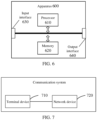
- FIG. 6 is a schematic structural diagram of an apparatus according to an embodiment of the disclosure.
- the apparatus 600 shown in FIG. 6 includes a processor 610.
- the processor 610 may invoke and run a computer program in a memory to implement the method in the embodiments of the disclosure.
- the apparatus 600 may further include the memory 620.
- the processor 610 may invoke and run the computer program in the memory 620 to implement the method in the embodiments of the disclosure.
- the memory 620 may be an independent device independent of the processor 610 and may also be integrated into the processor 610.
- the apparatus 600 may further include an input interface 630.
- the processor 610 may control the input interface 630 to communicate with another device or chip, specifically acquiring information or data transmitted by another device or chip.
- the apparatus 600 may further include an output interface 640.
- the processor 610 may control the output interface 640 to communicate with another device or chip, specifically outputting information or data transmitted by another device or chip.
- the apparatus is applicable to the network device in the embodiments of the disclosure, and the apparatus may implement corresponding flows implemented by the network device in each method of the embodiments of the disclosure.
- the apparatus may implement corresponding flows implemented by the network device in each method of the embodiments of the disclosure.
- elaborations are omitted herein.
- the apparatus is applicable to the terminal device in the embodiments of the disclosure, and the apparatus may implement corresponding flows implemented by the terminal device in each method of the embodiments of the disclosure.
- the apparatus may implement corresponding flows implemented by the terminal device in each method of the embodiments of the disclosure.
- elaborations are omitted herein.
- the apparatus provided in the embodiments of the disclosure may also be a chip, for example, a system-level chip, a system chip, a chip system, or a system on chip.
- FIG. 7 is a schematic block diagram of a communication system 700 according to an embodiment of the disclosure. As shown in FIG. 7 , the communication system 700 includes a terminal device 710 and a network device 720.
- the terminal device 710 may be configured to implement corresponding functions implemented by the terminal device in the above method.
- the network device 720 may be configured to implement the corresponding functions implemented by the network device or the base station in the above method. For simplicity, elaborations are omitted herein.
- the processor in the embodiment of the disclosure may be an integrated circuit chip and has a signal processing capacity.
- each operation of the method embodiments may be completed by an integrated logical circuit of hardware in the processor or an instruction in a software form.
- the above processor may be a general processor, a Digital Signal Processor (DSP), an Application Specific Integrated Circuit (ASIC), a Field-Programmable Gate Array (FPGA) or other programmable logic devices, discrete gate or transistor logic devices, and discrete hardware components.
- DSP Digital Signal Processor
- ASIC Application Specific Integrated Circuit
- FPGA Field-Programmable Gate Array
- Each method, operation and logical block diagram disclosed in the embodiments of the disclosure may be implemented or executed.
- the general processors may be microprocessors or the processor may also be any conventional processors.
- the operations may be directly implemented by a hardware processor, or may be performed by a combination of hardware and software modules in the decoding processor.
- the software module may be located in a mature storage medium in the field such as a Random Access Memory (RAM), a flash memory, a Read-Only Memory (ROM), a Programmable ROM (PROM) or Electrically Erasable PROM (EEPROM), and a register.
- RAM Random Access Memory
- ROM Read-Only Memory
- PROM Programmable ROM
- EEPROM Electrically Erasable PROM
- the storage medium is located in a memory, and the processor reads information in the memory, and completes the operations of the method in combination with hardware.
- the memory in the embodiment of the disclosure may be a volatile memory or a non-volatile memory, or may include both the volatile and non-volatile memories.
- the non-volatile memory may be an ROM, a PROM, an Erasable PROM (EPROM), an EEPROM or a flash memory.
- the volatile memory may be an RAM, and is used as an external high-speed cache.
- RAMs in various forms may be adopted, such as a Static RAM (SRAM), a Dynamic RAM (DRAM), a Synchronous DRAM (SDRAM), a Double Data Rate SDRAM (DDR SDRAM), an Enhanced SDRAM (ESDRAM), a Synchlink DRAM (SLDRAM) and a Direct Rambus RAM (DR RAM).
- SRAM Static RAM
- DRAM Dynamic RAM
- SDRAM Synchronous DRAM
- DDR SDRAM Double Data Rate SDRAM
- ESDRAM Enhanced SDRAM
- SLDRAM Synchlink DRAM
- DR RAM Direct Rambus RAM
- the above memory is exemplarily but unlimitedly described that the memory in the embodiments of the disclosure may be as SRAM, a DRAM, an SDRAM, a DDR SDRAM, an ESDRAM, an SLDRAM, and a DR RAM. That is to say, the memory in the embodiments of the disclosure is intended to include, but not limited to, memories of these and any other proper types.
- An embodiment of the disclosure further provides a computer-readable storage medium, configured to store a computer program.
- the computer-readable storage medium is applicable to a network device or a base station in the embodiments of the disclosure, and the computer program causes a computer to execute corresponding flows implemented by the network device or a base station in each method of the embodiments of the disclosure.
- the computer program causes a computer to execute corresponding flows implemented by the network device or a base station in each method of the embodiments of the disclosure.
- the computer-readable storage medium is applicable to a mobile terminal/terminal device in the embodiments of the disclosure, and the computer program causes a computer to execute corresponding flows implemented by the mobile terminal/terminal device in each method of the embodiments of the disclosure.
- the computer program causes a computer to execute corresponding flows implemented by the mobile terminal/terminal device in each method of the embodiments of the disclosure.
- elaborations are omitted herein.
- An embodiment of the disclosure further provides a computer program product, including a computer program instruction.
- the computer program product is applicable to a network device or a base station in the embodiments of the disclosure, and the computer program causes a computer to execute corresponding flows implemented by the network device or a base station in each method of the embodiments of the disclosure.
- the computer program causes a computer to execute corresponding flows implemented by the network device or a base station in each method of the embodiments of the disclosure.
- the computer program product is applicable to a mobile terminal/terminal device in the embodiments of the disclosure, and the computer program instruction causes a computer to execute corresponding flows implemented by the mobile terminal/terminal device in each method of the embodiments of the disclosure.
- the computer program instruction causes a computer to execute corresponding flows implemented by the mobile terminal/terminal device in each method of the embodiments of the disclosure.
- An embodiment of the disclosure further provides a computer program.
- the computer program is applicable to a network device or a base station in the embodiments of the disclosure.
- the computer program executes corresponding flows implemented by the network device or a base station in each method of the embodiments of the disclosure. For simplicity, elaborations are omitted herein.
- the computer program is applicable to a mobile terminal/terminal device in the embodiments of the disclosure.
- the computer program executes corresponding flows implemented by the mobile terminal/terminal device in each method of the embodiments of the disclosure. For simplicity, elaborations are omitted herein.
- the function is implemented in the form of the software functional unit and sold or used as an independent product, it can be stored in the computer readable storage medium.
- the computer software product is stored in a storage medium, including a plurality of instructions for causing a computer device (which may be a personal computer, a server, or a network device, and the like) to execute all or part of the operations of the method described in the various embodiments of the disclosure.
- the storage medium includes: various media capable of storing program codes such as a U disk, a mobile Hard Disk Drive (HDD), a Read-Only Memory (ROM), a Random Access Memory (RAM), a magnetic disk or an optical disk.
Landscapes
- Engineering & Computer Science (AREA)
- Computer Networks & Wireless Communication (AREA)
- Signal Processing (AREA)
- Mobile Radio Communication Systems (AREA)
Claims (8)
- Drahtloskommunikationsverfahren, das Folgendes umfasst:Empfangen (S210) durch eine Endgerätvorrichtung eines überlebenszeitbezogenen Parameters eines ersten Dienstes; undVerarbeiten (S220) durch die Endgerätvorrichtung einer Dienstübertragung anhand des überlebenszeitbezogenen Parameters,wobei der überlebenszeitbezogene Parameter eine Kennung eines Datenfunkträgers, DRB-Kennung, enthält,wobei das Verfahren ferner Folgendes umfasst:Empfangen durch die Endgerätvorrichtung erster Angabeinformationen,wobei die ersten Angabeinformationen konfiguriert sind, die Endgerätvorrichtung anzuweisen, die Dienstübertragung anhand des überlebenszeitbezogenen Parameters zu verarbeiten,dadurch gekennzeichnet, dassdie ersten Angabeinformationen und der überlebenszeitbezogene Parameter getrennt durch die Endgerätvorrichtung empfangen werden,wobei das Verarbeiten durch die Endgerätvorrichtung einer Dienstübertragung anhand des überlebenszeitbezogenen Parameters Folgendes umfasst:
in Reaktion darauf, dass die Überlebenszeit konfiguriert oder angeben ist, Verarbeiten der Dienstübertragung durch die Endgerätvorrichtung, wobei der Fall, dass die Überlebenszeit konfiguriert oder angegeben ist, bedeutet, dass der überlebenszeitbezogene Parameter die Überlebenszeit enthält. - Verfahren nach Anspruch 1, wobei das Verarbeiten durch die Endgerätvorrichtung einer Dienstübertragung Folgendes umfasst:
Aktivieren durch die Endgerätvorrichtung einer Duplikatübertragungsbetriebsart. - Verfahren nach Anspruch 1, wobei die Dienstübertragung durch die Endgerätvorrichtung auf einer DRB-Ebene verarbeitet wird.
- Drahtloskommunikationsverfahren, das Folgendes umfasst:Senden (S210) durch eine Netzvorrichtung eines überlebenszeitbezogenen Parameters eines ersten Dienstes,wobei der überlebenszeitbezogene Parameter für eine Endgerätvorrichtung konfiguriert wird, um eine Dienstübertragung zu verarbeiten,wobei der überlebenszeitbezogene Parameter eine Kennung eines Datenfunkträgers, DRB-Kennung, umfasst,wobei das Verfahren ferner Folgendes umfasst:Senden durch die Netzvorrichtung erster Angabeinformationen,wobei die ersten Angabeinformationen konfiguriert sind, die Endgerätvorrichtung anzuweisen, die Dienstübertragung anhand des überlebenszeitbezogenen Parameters zu verarbeiten,dadurch gekennzeichnet, dass der überlebenszeitbezogene Parameter für die Endgerätvorrichtung in Reaktion darauf, dass die Überlebenszeit konfiguriert oder angegeben ist, konfiguriert wird, um die Dienstübertragung zu verarbeiten, wobei der Fall, dass die Überlebenszeit konfiguriert oder angegeben ist, bedeutet, dass der überlebenszeitbezogene Parameter die Überlebenszeit enthält,wobei die ersten Angabeinformationen und der überlebenszeitbezogene Parameter durch die Netzvorrichtung getrennt gesendet werden.
- Endgerätvorrichtung (300), die Folgendes umfasst:eine Kommunikationseinheit (310), die konfiguriert ist, einen überlebenszeitbezogenen Parameter eines ersten Dienstes zu empfangen; undeine Verarbeitungseinheit (320), die konfiguriert ist, eine Dienstübertragung anhand des überlebenszeitbezogenen Parameters zu verarbeiten,wobei der überlebenszeitbezogene Parameter eine Kennung eines Datenfunkträgers, DRB-Kennung, umfasst,wobei die Kommunikationseinheit (310) ferner konfiguriert ist, erste Angabeinformationen zu empfangen,wobei die ersten Angabeinformationen konfiguriert sind, die Endgerätvorrichtung anzuweisen, die Dienstübertragung anhand des überlebenszeitbezogenen Parameters zu verarbeiten,dadurch gekennzeichnet, dassdie ersten Angabeinformationen und der überlebenszeitbezogene Parameter getrennt durch die Endgerätvorrichtung empfangen werden,wobei die Verarbeitungseinheit (320) ferner konfiguriert ist zum:
in Reaktion darauf, dass die Überlebenszeit konfiguriert oder angeben ist, Verarbeiten der Dienstübertragung durch die Endgerätvorrichtung, wobei der Fall, dass die Überlebenszeit konfiguriert oder angegeben ist, bedeutet, dass der überlebenszeitbezogene Parameter die Überlebenszeit enthält. - Endgerätvorrichtung (300) nach Anspruch 5, wobei die Verarbeitungseinheit (320) ferner konfiguriert ist zum:
Aktivieren einer Duplikatübertragungsbetriebsart. - Endgerätvorrichtung (300) nach Anspruch 5, wobei die Dienstübertragung auf einer DRB-Ebene verarbeitet wird.
- Netzvorrichtung (400), die Folgendes umfasst:eine Kommunikationseinheit (410), die konfiguriert ist, einen überlebenszeitbezogenen Parameter eines ersten Dienstes zu senden,wobei der überlebenszeitbezogene Parameter für eine Endgerätvorrichtung konfiguriert wird, um eine Dienstübertragung zu verarbeiten, und der überlebenszeitbezogene Parameter eine Kennung eines Datenfunkträgers, DRB-Kennung, umfasst,wobei die Kommunikationseinheit (410) ferner konfiguriert ist zum:Senden erster Angabeinformationen,wobei die ersten Angabeinformationen konfiguriert sind, die Endgerätvorrichtung anzuweisen, die Dienstübertragung anhand des überlebenszeitbezogenen Parameters zu verarbeiten,dadurch gekennzeichnet, dassder überlebenszeitbezogene Parameter für die Endgerätvorrichtung in Reaktion darauf, dass die Überlebenszeit konfiguriert oder angegeben ist, konfiguriert wird, um die Dienstübertragung zu verarbeiten, wobei der Fall, dass die Überlebenszeit konfiguriert oder angegeben ist, bedeutet, dass der überlebenszeitbezogene Parameter die Überlebenszeit enthält,wobei die ersten Angabeinformationen und der überlebenszeitbezogene Parameter getrennt durch die Netzvorrichtung gesendet werden.
Applications Claiming Priority (1)
| Application Number | Priority Date | Filing Date | Title |
|---|---|---|---|
| PCT/CN2020/104946 WO2022021021A1 (zh) | 2020-07-27 | 2020-07-27 | 无线通信方法、终端设备和网络设备 |
Publications (3)
| Publication Number | Publication Date |
|---|---|
| EP4152813A1 EP4152813A1 (de) | 2023-03-22 |
| EP4152813A4 EP4152813A4 (de) | 2023-05-10 |
| EP4152813B1 true EP4152813B1 (de) | 2025-06-04 |
Family
ID=80037957
Family Applications (1)
| Application Number | Title | Priority Date | Filing Date |
|---|---|---|---|
| EP20947200.0A Active EP4152813B1 (de) | 2020-07-27 | 2020-07-27 | Drahtloskommunikationsverfahren, endgerätevorrichtung und netzwerkvorrichtung |
Country Status (4)
| Country | Link |
|---|---|
| US (1) | US12471166B2 (de) |
| EP (1) | EP4152813B1 (de) |
| CN (1) | CN116210268B (de) |
| WO (1) | WO2022021021A1 (de) |
Families Citing this family (3)
| Publication number | Priority date | Publication date | Assignee | Title |
|---|---|---|---|---|
| GB2597778B (en) * | 2020-08-05 | 2023-01-25 | Samsung Electronics Co Ltd | Survival time in radio access networks |
| CN116171538B (zh) * | 2020-12-07 | 2025-06-24 | Oppo广东移动通信有限公司 | 通信方法、设备和系统 |
| WO2024197833A1 (zh) * | 2023-03-31 | 2024-10-03 | 上海移远通信技术股份有限公司 | 用于通信的方法、通信设备以及网络设备 |
Family Cites Families (17)
| Publication number | Priority date | Publication date | Assignee | Title |
|---|---|---|---|---|
| CN105099933B (zh) * | 2009-04-02 | 2018-07-24 | 瑞典爱立信有限公司 | 用于处理网络通信的技术 |
| CN103716114B (zh) * | 2012-09-28 | 2018-02-23 | 华为技术有限公司 | 数据传输业务中参数设置方法、终端和基站 |
| WO2017206529A1 (zh) * | 2016-06-03 | 2017-12-07 | 华为技术有限公司 | 质量参数的传输方法、终端和网络侧设备 |
| CN108923995B (zh) * | 2017-04-24 | 2021-04-02 | 上海大唐移动通信设备有限公司 | 一种传输时延的确定方法和装置 |
| CN109788509B (zh) * | 2017-11-15 | 2023-03-10 | 华为技术有限公司 | 连续数据包传输失败的规避方法及装置 |
| CN111108778B (zh) * | 2017-12-28 | 2025-02-11 | Oppo广东移动通信有限公司 | 无线通信的方法、终端设备和网络设备 |
| US10716031B2 (en) | 2018-04-09 | 2020-07-14 | Nokia Technologies Oy | Network node configured to provide wireless access with enhanced resource allocation |
| WO2020087509A1 (zh) * | 2018-11-02 | 2020-05-07 | Oppo广东移动通信有限公司 | 无线通信方法、终端设备和网络设备 |
| CN111148234A (zh) * | 2018-11-02 | 2020-05-12 | 华为技术有限公司 | 传输数据的方法和装置 |
| EP3874642A1 (de) * | 2018-11-02 | 2021-09-08 | Nokia Technologies Oy | Dynamisches zuverlässigkeitsziel für drahtlose netzwerke |
| CN109257771B (zh) | 2018-11-16 | 2020-11-06 | 腾讯科技(深圳)有限公司 | 业务数据的传输方法、装置及设备 |
| CN111327404B (zh) * | 2018-12-13 | 2022-08-26 | 大唐移动通信设备有限公司 | 业务生存期处理方法及装置 |
| CN111432440B (zh) * | 2019-01-10 | 2022-12-13 | 华为技术有限公司 | 实现业务连续性的方法、装置及系统 |
| US11082882B2 (en) * | 2019-01-18 | 2021-08-03 | Lg Electronics Inc. | Method for transmitting quality of service state report by wireless node in wireless communication system and apparatus therefor |
| EP3954150B1 (de) * | 2019-04-30 | 2023-11-29 | Huawei Technologies Co., Ltd. | Netzwerkeinheit und benutzergerät zur ausnutzung der resilienz gegenüber aufeinanderfolgenden übertragungsfehlern |
| EP4038945A4 (de) * | 2019-10-03 | 2023-10-25 | Nokia Technologies Oy | Paketabhängige logische kanalbegrenzung |
| CN114324400B (zh) | 2021-12-21 | 2024-05-07 | 龙游运城压纹制版有限公司 | 一种压纹版辊表面缺陷检测装置 |
-
2020
- 2020-07-27 WO PCT/CN2020/104946 patent/WO2022021021A1/zh not_active Ceased
- 2020-07-27 EP EP20947200.0A patent/EP4152813B1/de active Active
- 2020-07-27 CN CN202080104594.4A patent/CN116210268B/zh active Active
-
2022
- 2022-12-09 US US18/064,066 patent/US12471166B2/en active Active
Also Published As
| Publication number | Publication date |
|---|---|
| CN116210268A (zh) | 2023-06-02 |
| CN116210268B (zh) | 2025-10-24 |
| EP4152813A1 (de) | 2023-03-22 |
| US20230104242A1 (en) | 2023-04-06 |
| EP4152813A4 (de) | 2023-05-10 |
| US12471166B2 (en) | 2025-11-11 |
| WO2022021021A1 (zh) | 2022-02-03 |
Similar Documents
| Publication | Publication Date | Title |
|---|---|---|
| JP5572762B2 (ja) | マルチポイント高速ダウンリンクパケットアクセスネットワークにおけるタイミング制御 | |
| US12471166B2 (en) | Wireless communication method, terminal device and network device | |
| CN116455529B (zh) | 混合自动重传请求应答harq-ack的反馈方法和终端设备 | |
| CN115804202B (zh) | 无线通信方法、终端设备和网络设备 | |
| US20230362707A1 (en) | Wireless communication method and device | |
| WO2023155655A1 (zh) | 算力能力感知方法和装置 | |
| US12556301B2 (en) | Wireless communication method and apparatus | |
| CN116491166A (zh) | 通信配置的方法和通信装置 | |
| US20230224763A1 (en) | Wireless communication method, terminal device, and network device | |
| US20230421312A1 (en) | Survival time processing method, and terminal device | |
| CN115701172B (zh) | 分组数据汇聚协议状态报告发送方法、设备及装置 | |
| US12526082B2 (en) | Communication method and device | |
| US20230239875A1 (en) | Wireless Communication Method and Terminal Device | |
| CN115699656B (zh) | 无线通信方法、终端设备和网络设备 | |
| CN115913466A (zh) | 数据传输的方法和装置 | |
| US20240244476A1 (en) | Wireless communication method, and devices | |
| EP4391414A1 (de) | Datenübertragungsverfahren und -vorrichtung | |
| CN116114197B (zh) | 无线通信的方法、终端设备和网络设备 | |
| US20250351161A1 (en) | Data transmission method and communication apparatus | |
| JPWO2020079734A1 (ja) | 受信装置、送信装置、無線通信システム及び通信状態報告方法 | |
| WO2026016149A1 (zh) | 一种信息报告方法、通信系统及存储介质 | |
| CN121773688A (zh) | 数据传输的方法和装置 | |
| CN118044142A (zh) | 无线通信的方法、终端设备和网络设备 |
Legal Events
| Date | Code | Title | Description |
|---|---|---|---|
| STAA | Information on the status of an ep patent application or granted ep patent |
Free format text: STATUS: THE INTERNATIONAL PUBLICATION HAS BEEN MADE |
|
| PUAI | Public reference made under article 153(3) epc to a published international application that has entered the european phase |
Free format text: ORIGINAL CODE: 0009012 |
|
| STAA | Information on the status of an ep patent application or granted ep patent |
Free format text: STATUS: REQUEST FOR EXAMINATION WAS MADE |
|
| 17P | Request for examination filed |
Effective date: 20221213 |
|
| AK | Designated contracting states |
Kind code of ref document: A1 Designated state(s): AL AT BE BG CH CY CZ DE DK EE ES FI FR GB GR HR HU IE IS IT LI LT LU LV MC MK MT NL NO PL PT RO RS SE SI SK SM TR |
|
| REG | Reference to a national code |
Ref country code: DE Ref legal event code: R079 Free format text: PREVIOUS MAIN CLASS: H04W0028240000 Ipc: H04W0004000000 Ref document number: 602020052498 Country of ref document: DE |
|
| A4 | Supplementary search report drawn up and despatched |
Effective date: 20230406 |
|
| RIC1 | Information provided on ipc code assigned before grant |
Ipc: H04W 28/18 20090101ALN20230331BHEP Ipc: H04W 4/00 20180101AFI20230331BHEP |
|
| STAA | Information on the status of an ep patent application or granted ep patent |
Free format text: STATUS: EXAMINATION IS IN PROGRESS |
|
| DAV | Request for validation of the european patent (deleted) | ||
| DAX | Request for extension of the european patent (deleted) | ||
| 17Q | First examination report despatched |
Effective date: 20231025 |
|
| GRAP | Despatch of communication of intention to grant a patent |
Free format text: ORIGINAL CODE: EPIDOSNIGR1 |
|
| STAA | Information on the status of an ep patent application or granted ep patent |
Free format text: STATUS: GRANT OF PATENT IS INTENDED |
|
| RIC1 | Information provided on ipc code assigned before grant |
Ipc: H04W 28/18 20090101ALN20250109BHEP Ipc: H04W 4/00 20180101AFI20250109BHEP |
|
| RIC1 | Information provided on ipc code assigned before grant |
Ipc: H04W 28/18 20090101ALN20250114BHEP Ipc: H04W 4/00 20180101AFI20250114BHEP |
|
| INTG | Intention to grant announced |
Effective date: 20250123 |
|
| GRAS | Grant fee paid |
Free format text: ORIGINAL CODE: EPIDOSNIGR3 |
|
| GRAA | (expected) grant |
Free format text: ORIGINAL CODE: 0009210 |
|
| STAA | Information on the status of an ep patent application or granted ep patent |
Free format text: STATUS: THE PATENT HAS BEEN GRANTED |
|
| AK | Designated contracting states |
Kind code of ref document: B1 Designated state(s): AL AT BE BG CH CY CZ DE DK EE ES FI FR GB GR HR HU IE IS IT LI LT LU LV MC MK MT NL NO PL PT RO RS SE SI SK SM TR |
|
| REG | Reference to a national code |
Ref country code: GB Ref legal event code: FG4D |
|
| REG | Reference to a national code |
Ref country code: CH Ref legal event code: EP |
|
| REG | Reference to a national code |
Ref country code: DE Ref legal event code: R096 Ref document number: 602020052498 Country of ref document: DE |
|
| REG | Reference to a national code |
Ref country code: IE Ref legal event code: FG4D |
|
| P01 | Opt-out of the competence of the unified patent court (upc) registered |
Free format text: CASE NUMBER: UPC_APP_5309_4152813/2025 Effective date: 20250829 |
|
| REG | Reference to a national code |
Ref country code: NL Ref legal event code: MP Effective date: 20250604 |
|
| PG25 | Lapsed in a contracting state [announced via postgrant information from national office to epo] |
Ref country code: ES Free format text: LAPSE BECAUSE OF FAILURE TO SUBMIT A TRANSLATION OF THE DESCRIPTION OR TO PAY THE FEE WITHIN THE PRESCRIBED TIME-LIMIT Effective date: 20250604 Ref country code: FI Free format text: LAPSE BECAUSE OF FAILURE TO SUBMIT A TRANSLATION OF THE DESCRIPTION OR TO PAY THE FEE WITHIN THE PRESCRIBED TIME-LIMIT Effective date: 20250604 |
|
| PGFP | Annual fee paid to national office [announced via postgrant information from national office to epo] |
Ref country code: DE Payment date: 20250730 Year of fee payment: 6 |
|
| REG | Reference to a national code |
Ref country code: LT Ref legal event code: MG9D |
|
| PG25 | Lapsed in a contracting state [announced via postgrant information from national office to epo] |
Ref country code: NO Free format text: LAPSE BECAUSE OF FAILURE TO SUBMIT A TRANSLATION OF THE DESCRIPTION OR TO PAY THE FEE WITHIN THE PRESCRIBED TIME-LIMIT Effective date: 20250904 Ref country code: GR Free format text: LAPSE BECAUSE OF FAILURE TO SUBMIT A TRANSLATION OF THE DESCRIPTION OR TO PAY THE FEE WITHIN THE PRESCRIBED TIME-LIMIT Effective date: 20250905 |
|
| PG25 | Lapsed in a contracting state [announced via postgrant information from national office to epo] |
Ref country code: PL Free format text: LAPSE BECAUSE OF FAILURE TO SUBMIT A TRANSLATION OF THE DESCRIPTION OR TO PAY THE FEE WITHIN THE PRESCRIBED TIME-LIMIT Effective date: 20250604 |
|
| PG25 | Lapsed in a contracting state [announced via postgrant information from national office to epo] |
Ref country code: BG Free format text: LAPSE BECAUSE OF FAILURE TO SUBMIT A TRANSLATION OF THE DESCRIPTION OR TO PAY THE FEE WITHIN THE PRESCRIBED TIME-LIMIT Effective date: 20250604 |
|
| PGFP | Annual fee paid to national office [announced via postgrant information from national office to epo] |
Ref country code: GB Payment date: 20250730 Year of fee payment: 6 |
|
| PG25 | Lapsed in a contracting state [announced via postgrant information from national office to epo] |
Ref country code: HR Free format text: LAPSE BECAUSE OF FAILURE TO SUBMIT A TRANSLATION OF THE DESCRIPTION OR TO PAY THE FEE WITHIN THE PRESCRIBED TIME-LIMIT Effective date: 20250604 |
|
| PG25 | Lapsed in a contracting state [announced via postgrant information from national office to epo] |
Ref country code: RS Free format text: LAPSE BECAUSE OF FAILURE TO SUBMIT A TRANSLATION OF THE DESCRIPTION OR TO PAY THE FEE WITHIN THE PRESCRIBED TIME-LIMIT Effective date: 20250904 |
|
| PG25 | Lapsed in a contracting state [announced via postgrant information from national office to epo] |
Ref country code: LV Free format text: LAPSE BECAUSE OF FAILURE TO SUBMIT A TRANSLATION OF THE DESCRIPTION OR TO PAY THE FEE WITHIN THE PRESCRIBED TIME-LIMIT Effective date: 20250604 |
|
| PG25 | Lapsed in a contracting state [announced via postgrant information from national office to epo] |
Ref country code: NL Free format text: LAPSE BECAUSE OF FAILURE TO SUBMIT A TRANSLATION OF THE DESCRIPTION OR TO PAY THE FEE WITHIN THE PRESCRIBED TIME-LIMIT Effective date: 20250604 |
|
| PG25 | Lapsed in a contracting state [announced via postgrant information from national office to epo] |
Ref country code: PT Free format text: LAPSE BECAUSE OF FAILURE TO SUBMIT A TRANSLATION OF THE DESCRIPTION OR TO PAY THE FEE WITHIN THE PRESCRIBED TIME-LIMIT Effective date: 20251006 |
|
| REG | Reference to a national code |
Ref country code: AT Ref legal event code: MK05 Ref document number: 1801522 Country of ref document: AT Kind code of ref document: T Effective date: 20250604 |
|
| PG25 | Lapsed in a contracting state [announced via postgrant information from national office to epo] |
Ref country code: IS Free format text: LAPSE BECAUSE OF FAILURE TO SUBMIT A TRANSLATION OF THE DESCRIPTION OR TO PAY THE FEE WITHIN THE PRESCRIBED TIME-LIMIT Effective date: 20251004 |
|
| PG25 | Lapsed in a contracting state [announced via postgrant information from national office to epo] |
Ref country code: SM Free format text: LAPSE BECAUSE OF FAILURE TO SUBMIT A TRANSLATION OF THE DESCRIPTION OR TO PAY THE FEE WITHIN THE PRESCRIBED TIME-LIMIT Effective date: 20250604 Ref country code: AT Free format text: LAPSE BECAUSE OF FAILURE TO SUBMIT A TRANSLATION OF THE DESCRIPTION OR TO PAY THE FEE WITHIN THE PRESCRIBED TIME-LIMIT Effective date: 20250604 |
|
| PG25 | Lapsed in a contracting state [announced via postgrant information from national office to epo] |
Ref country code: CZ Free format text: LAPSE BECAUSE OF FAILURE TO SUBMIT A TRANSLATION OF THE DESCRIPTION OR TO PAY THE FEE WITHIN THE PRESCRIBED TIME-LIMIT Effective date: 20250604 |
|
| PG25 | Lapsed in a contracting state [announced via postgrant information from national office to epo] |
Ref country code: EE Free format text: LAPSE BECAUSE OF FAILURE TO SUBMIT A TRANSLATION OF THE DESCRIPTION OR TO PAY THE FEE WITHIN THE PRESCRIBED TIME-LIMIT Effective date: 20250604 |
|
| PG25 | Lapsed in a contracting state [announced via postgrant information from national office to epo] |
Ref country code: SK Free format text: LAPSE BECAUSE OF FAILURE TO SUBMIT A TRANSLATION OF THE DESCRIPTION OR TO PAY THE FEE WITHIN THE PRESCRIBED TIME-LIMIT Effective date: 20250604 |
|
| PG25 | Lapsed in a contracting state [announced via postgrant information from national office to epo] |
Ref country code: IT Free format text: LAPSE BECAUSE OF FAILURE TO SUBMIT A TRANSLATION OF THE DESCRIPTION OR TO PAY THE FEE WITHIN THE PRESCRIBED TIME-LIMIT Effective date: 20250604 |
|
| PG25 | Lapsed in a contracting state [announced via postgrant information from national office to epo] |
Ref country code: RO Free format text: LAPSE BECAUSE OF FAILURE TO SUBMIT A TRANSLATION OF THE DESCRIPTION OR TO PAY THE FEE WITHIN THE PRESCRIBED TIME-LIMIT Effective date: 20250604 |
|
| REG | Reference to a national code |
Ref country code: CH Ref legal event code: H13 Free format text: ST27 STATUS EVENT CODE: U-0-0-H10-H13 (AS PROVIDED BY THE NATIONAL OFFICE) Effective date: 20260224 |
|
| PG25 | Lapsed in a contracting state [announced via postgrant information from national office to epo] |
Ref country code: LU Free format text: LAPSE BECAUSE OF NON-PAYMENT OF DUE FEES Effective date: 20250727 |