EP4152002A1 - Heterogene rezeptor-ligand-testvorrichtung, insbesondere lateral-flow-testvorrichtung, sowie zugehörige vorrichtungen und verfahren - Google Patents
Heterogene rezeptor-ligand-testvorrichtung, insbesondere lateral-flow-testvorrichtung, sowie zugehörige vorrichtungen und verfahren Download PDFInfo
- Publication number
- EP4152002A1 EP4152002A1 EP21197768.1A EP21197768A EP4152002A1 EP 4152002 A1 EP4152002 A1 EP 4152002A1 EP 21197768 A EP21197768 A EP 21197768A EP 4152002 A1 EP4152002 A1 EP 4152002A1
- Authority
- EP
- European Patent Office
- Prior art keywords
- carrier
- analyte
- light source
- light
- markers
- Prior art date
- Legal status (The legal status is an assumption and is not a legal conclusion. Google has not performed a legal analysis and makes no representation as to the accuracy of the status listed.)
- Withdrawn
Links
Images


Classifications
-
- G—PHYSICS
- G01—MEASURING; TESTING
- G01N—INVESTIGATING OR ANALYSING MATERIALS BY DETERMINING THEIR CHEMICAL OR PHYSICAL PROPERTIES
- G01N33/00—Investigating or analysing materials by specific methods not covered by groups G01N1/00 - G01N31/00
- G01N33/48—Biological material, e.g. blood, urine; Haemocytometers
- G01N33/50—Chemical analysis of biological material, e.g. blood, urine; Testing involving biospecific ligand binding methods; Immunological testing
- G01N33/53—Immunoassay; Biospecific binding assay; Materials therefor
- G01N33/543—Immunoassay; Biospecific binding assay; Materials therefor with an insoluble carrier for immobilising immunochemicals
- G01N33/54366—Apparatus specially adapted for solid-phase testing
- G01N33/54386—Analytical elements
- G01N33/54387—Immunochromatographic test strips
- G01N33/54388—Immunochromatographic test strips based on lateral flow
Definitions
- the invention relates to the detection of the presence of a target substance in a liquid sample, more particularly, it relates to heterogeneous receptor-ligand assays, such as to lateral flow tests. More specifically, it relates to methods and apparatuses according to the opening clauses of the claims.
- Heterogeneous receptor-ligand assays like, for example, lateral flow tests, find application in medicine and in biochemistry and other areas, e.g., in the detection of pathogens and/or viruses in a body liquid.
- Heterogeneous receptor-ligand assays are widely used for detection of an analyte (the receptor) according to the lock-and-key principle, the ligand binding specifically to the analyte.
- immobilized biospecific ligands can be used therefor.
- Heterogeneous receptor-ligand assays are also known as heterogeneous receptor-ligand binding assays or heterogeneous ligand binding assays.
- Optical principles are particularly important to the disclosed invention; they include, e.g., fluorimetry and colorimetry.
- the ligand can function as a marker for detecting the analyte when bonded to the ligand.
- the ligand is hard to detect. Therefore, in order to facilitate detection of the analyte (bonded to the ligand), the ligand is bonded to a marking agent, thus forming a conjugate; and in the assay, the analyte is bonded to the conjugate, more particularly to the ligand portion of the conjugate.
- the conjugate then functions as a marker, due to the marking agent portion of the conjugate.
- the marking agent can be, e.g., a luminescent agent, such as a fluorescent agent, e.g., a fluorescent molecule; or a coloring agent, such as a gold particle or a latex particle or a dye molecule.
- a luminescent agent such as a fluorescent agent, e.g., a fluorescent molecule
- a coloring agent such as a gold particle or a latex particle or a dye molecule.
- the assays can be designed in various ways, for example as lateral flow assays, as through flow assays or as assays where the ligand does not flow but remains in a cavity.
- lateral flow assays also referred to as lateral flow tests (LF tests, LFT).
- LF tests lateral flow tests
- the flow of the liquid sample is due to capillary forces, which may be accomplished by, e.g., the use of felt-like or fibrous materials or microstructured materials or microchannels.
- the most prominen heterogeneous receptor-ligand assays are immunoassays which rely on the specific interaction of antibodies with antigens. Further typical applications are based on hybridisation of nucleic acids or on lectine-saccaride interaction.
- the assay herein described can be an assay of any of the above or below kinds. However, in the following, we shall mainly focus on the example of a lateral flow test such as on a lateral flow immunochromatographic assay.
- the following example of a lateral flow test describes, how the presence of an analyte in a liquid sample can be detected, e.g., can be visually detected:
- the liquid sample is applied to a carrier, such as to a strip, more particularly to a sample pad of the carrier, and runs along the carrier, across a pad referred to as conjugate pad (or conjugate release pad) providing markers (e.g., conjugates) which bond to the analyte.
- conjugate pad or conjugate release pad
- the liquid sample runs further to a test area in which analyte bonding agents are fixed to the carrier, such that at least a portion of the analyte stays there instead of continuing running across the carrier.
- the markers bonded to the analyte do, when bonded to the analyte bonding agent, show a specific color (first color). In some cases, they can show this first color by themselves. In other cases, such as when fluorescent markers are used, they can show this first color in reaction to an excitation, typically by incident light, more particularly when the test area is illuminated by light of an excitation wavelength resulting in emission of light of an emission (fluorescent) wavelength which is usually different from, typically longer than, the excitation wavelength and which generally corresponds to the first color.
- Detecting that first color can mean a positive test result (non-competitive assay):
- the analyte is contained in the liquid; in particular when a threshold color intensity of the first color is exceeded.
- the carrier can have a control area in which marker bonding agents are fixed to the carrier, such that markers stay there instead of continuing running across the carrier, e.g., in order to be finally taken up by a porous material, such as by a porous material comprised in a wicking pad.
- the markers when bonded to the marker bonding agent, also show a specific color (second color), again, by themselves or upon excitation, as described above for the first color, and detection can be accomplished analogously.
- the first and second colors can be equal or different. Typically, the first and second colors are identical.
- the test area In presence of the analyte in the liquid, the test area, in case of a non-competitive assay, will show the first color after the liquid had enough time to reach the test area. And the intensity of this color can be indicative of the concentration of the analyte in the liquid sample.
- the liquid sample When the liquid sample had enough time to reach the control area, it will also show a specific color, namely the second color - which is particularly important in cases where the liquid sample does not contain any of the analyte, namely in order to ensure that the test has generally worked and that it is correct that the test area does not show the first color because the liquid lacks analyte.
- the first and second colors are identical.
- a test area can be, e.g., line-shaped or dot-shaped.
- an assay can comprise more than one test areas, such as an array of dot-shaped test areas.
- Each test area can be dedicated to detection of a different analyte, such as by having different analyte bonding agents (specific to a respective analyte each) fixed to the carrier in the different test areas.
- a parallel and/or simultaneous detection of two or more analytes in the liquid is possible this way.
- the color intensity changes such as when the color is outside the visible range, like, e.g., for wavelengths (for the first and/or second color) below about 380 nm or above about 750 nm.
- color as used herein relates to (electromagnetic) wavelengths and is not limited to the visible range. Already below 400 nm and above 700 nm, detection by vision will usually not result in satisfactory results, such that assisted or automated detection will be preferred.
- the term "light” used herein means electromagnetic waves in general. More particularly, it refers to electromagnetic waves in the range including the infrared range, the visible range and the ultraviolet range.
- a single-use and/or disposable and/or portable monitoring device and heterogeneous receptor-ligand assay device would be desirable which can be used on-site and/or which enables high accuracy color detection.
- such assays / testing shall be enabled without requiring said dedicated apparatuses.
- heterogeneous receptor-ligand assays e.g., LF tests
- can make use of widely available tools such as of mobile communication devices and/or computing devices, e.g., of mobile phones or tablet computers; or of power banks, such as power banks for use with said mobile communication devices and/or computing devices.
- the assays / tests and devices can be designed such that said widely available tools do not constitute a part of the assay or test which would have to be required to fulfill specific regulatory requirements, such as ISO 13485.
- the devices shall be very cost-efficient, i.e. be manufacturable at very low cost. And it shall be possible to readily mass-produce the devices. Furthermore, they shall be very small. And they should have a long shelf life. Finally, they shall be insensitive to environmental influences, such as to temperature changes or high temperatures and/or to humidity changes and/or to high humidity.
- a possible object of the invention is to create new ways of detecting color and/or color changes, in particular new ways of detecting, in particular optically detecting, substances, more particularly new heterogeneous receptor-ligand assays, such as new ways of LF testing.
- Another possible object of the invention is to do so in an automated fashion.
- Another possible object of the invention is to do so in a particularly cost-efficient fashion.
- Another possible object of the invention is to do so at a particularly high accuracy (reproducibility).
- Another possible object of the invention is to do so at a particularly high sensitivity.
- Another possible object of the invention is to do so in a particularly energy-efficient way.
- Another possible object of the invention is to do so using an assay device which has a long shelf life.
- Another possible object of the invention is to do so without requiring dedicated apparatuses as described above.
- Another possible object of the invention is to do so using portable devices only.
- Another possible object of the invention is to do so using an assay device which is particularly small.
- Another possible object of the invention is to do so in an environment-friendly way.
- Another possible object of the invention is to do so using devices for which admission regarding regulatory requirements (such as requirements according to ISO13485) can be meaningfully obtained, in particular in the sense that said devices can be readily obtained and produced, respectively, over a long period of time, such as over many years.
- regulatory requirements such as requirements according to ISO13485
- Another possible object of the invention is to create ways of detecting color and/or color changes, in particular new ways of detecting, in particular optically detecting, substances, more particularly new heterogeneous receptor-ligand assays, such as new ways of LF testing, which can be carried out on-site.
- corresponding devices shall be provided as well as corresponding methods and uses- This concerns in particular monitoring devices for use in heterogeneous receptor-ligand assays (e.g., in lateral flow testing) and/or heterogeneous receptor-ligand assay devices, such as LFT devices.
- Another possible object of the invention is to provide monitoring devices and/or LFT devices which are single-use and/or disposable.
- Another possible object of the invention is to provide monitoring devices and/or heterogeneous receptor-ligand assay devices which are very small and lightweight.
- Another possible object of the invention is to provide monitoring devices and/or heterogeneous receptor-ligand assay devices which can be used on-site.
- Another possible object of the invention is to provide monitoring devices and/or heterogeneous receptor-ligand assay devices which are manufacturable at very low cost.
- Another possible object of the invention is to provide monitoring devices and/or heterogeneous receptor-ligand assay devices which can be readily mass-produced.
- Another possible object of the invention is to provide monitoring devices and/or heterogeneous receptor-ligand assay devices which have a long shelf life and/or which are insensitive to environmental influences, such as to temperature changes or high temperatures and/or to humidity changes and/or to high humidity.
- Another possible object of the invention is to provide monitoring devices and/or heterogeneous receptor-ligand assay devices which are disposable devices and/or which are single-use devices.
- Another possible object of the invention is to provide monitoring devices and/or heterogeneous receptor-ligand assay devices which are portable.
- Another possible object of the invention is to provide monitoring devices and/or heterogeneous receptor-ligand assay devices which are environment-friendly.
- Another possible object of the invention is to provide monitoring devices and/or heterogeneous receptor-ligand assay devices for which admission regarding regulatory requirements (such as requirements according to ISO13485) can be meaningfully obtained, in particular in the sense that said devices can be readily obtained and produced, respectively, over a long period of time, such as over many years.
- regulatory requirements such as requirements according to ISO13485
- the power consumption of electrical consumers of a device for automated color detection has been identified as a particularly important issue. And this applies in particular to the one or more light sources used in the device for the color detection.
- the first aspect concerns the power supply of the device. It is suggested to include an energy receiving unit in the power supply. This way, the device can receive energy from an external device. And this way, electrical consumers of the device, in particular all of them, can be powered by an external device.
- the device may be devoid of a battery which would be included in the device. This is environment-friendly. And the device can be smaller, more lightweight, and problems associated with ageing of a battery (limited shelf life, susceptibility to temperature and/or humidty) can be avoided.
- energy from the external device is received by the energy receiving unit and, simultaneously, consumed by the electrical consumers.
- the monitoring device for use in a heterogeneous receptor-ligand assay e.g., for use in a lateral flow test, for detecting presence or amount of an analyte in a liquid
- a heterogeneous receptor-ligand assay e.g., for use in a lateral flow test, for detecting presence or amount of an analyte in a liquid
- the monitoring device for use in a heterogeneous receptor-ligand assay e.g., for use in a lateral flow test, for detecting presence or amount of an analyte in a liquid
- a heterogeneous receptor-ligand assay e.g., for use in a lateral flow test
- the second aspect concerns a light source included in the device, more particularly a light source used for the color detection in the device.
- the device includes a light source which is a vertical-cavity surface-emitting laser (VCSEL).
- VCSEL vertical-cavity surface-emitting laser
- the energy consumption of a VCSEL can be extremely low, for example only 2 to 3 mW, where for a comparable performance, a light emitting diode (LED) would consume around 40 mW.
- LED light emitting diode
- One fact leading to this advantage is the strong directivity of the light emitted from a VCSEL.
- the monitoring device for use in a heterogeneous receptor-ligand assay, e.g., in a lateral flow test, for detecting presence or amount of an analyte in a liquid can comprise
- the monitoring device can comprise a unit for color detection comprising at least said first light source.
- the unit for color detection can furthermore comprise a detecting unit.
- the first light source is a constituent of the detecting unit. In other embodiments, the first light source is separate from rhte detecting unit.
- the unit for color detection can be accomodated or integrated in the housing.
- a color detected by the unit for color detection in particular from an intensity of the color, presence or amount of the analyte in the liquid can be inferred, e.g., as explained above.
- the two aspects can be well combined, as the very low power consumption of the VCSEL makes possible to use widely available tools as mentioned above, e.g., mobile phones or tablet computers, and/or widespread power transmission standards, for supplying the device with power, in particular in a wireless fashion. This can mean a tremendous advantage.
- the external device is a mobile communication device and/or a mobile computing device, e.g., a mobile phone, such as a smart phone.
- the energy receiving unit is operable for receiving energy in a wireless fashion. This can simplify handling and operation.
- the energy receiving unit comprises a coil (in particular: induction coil) for wireless power transmission by electromagnetic induction.
- a coil in particular: induction coil
- electromagnetic fields in particular electromagnetic waves, emitted from the external device, can be used to transmit energy into the energy receiving unit.
- electromagnetic waves in the radio frequency (RF) range can be used to transfer energy into the energy receiving unit.
- RFID radio frequency identification
- NFC near-field communication
- RFID radio frequency identification
- NFC near-field communication
- Such techniques are well established and can be used in the monitoring device, provided the overall power consumption of the monitoring device is sufficiently low. And this can be accomplished in particular by using one or more VCSELs as the one or more light sources for the color detection.
- the power supply unit comprises an AC-DC converter (also known as rectifier).
- AC (alternating current) power signals produced by the energy receiving unit e.g., from inductive power transmission, such as via the coil, e.g., from alternating electromagnetic fields, such as RF fields
- DC (direct current) can be transformed into DC (direct current) by means of which the electrical consumers are supplied by the power supply unit.
- the direct current can in particular have a voltage of at most 6 V, more particularly of at most 4 V, and still more particularly of at most 3 V.
- VCSELs can be operable at as little as 3 V or even 2 V.
- the energy receiving unit is operable for receiving energy in a wirebound fashion. This can simplify handling and operation, but requires the presence of a suitable wire or connector.
- the energy receiving unit comprises a connector, e.g., a socket or a plug.
- This connector can be provided for cooperating with another connector associated with the external device, e.g., a connector of the external device or a connector of a wire interconnecting the monitoring device with the external device.
- Electrical power can be transferred from the external device to the energy receiving unit via the connector.
- a galvanic interconnection between the external device and the energy receiving unit can be established via the connector.
- USB universal serial bus
- the device is devoid of a battery. This way, the device can be designed to be particularly small. And this can be particularly environment-friendly. And it can have a long shelf life.
- the device is devoid of an energy storage device for storing electrical energy. This can be particularly environment-friendly.
- the device can be devoid of an energy storage device for storing electrical energy having a storage capacity which exceeds 200%, in particular 100%, more particularly 50%, still more particularly 20% of an amount of energy consumed by a single measurement process of the heterogeneous receptor-ligand assay.
- the device can be devoid of an energy storage device for storing electrical energy having a storage capacity which exceeds 20 mWs, in particular 5 mWs, more particularly 2 mWs, still more particularly 1 mWs, even more particularly 0.4 mWs.
- the herein described device may, in instances, comprise, e.g., as a constituent of the power supply unit (e.g., as a constituent of the AC-DC converter), a means for ripple reduction, such as for reducing AC components in direct current signals supplied to said one or more electrical consumers.
- This means can be, e.g., a capacitor (filter capacitor), and usually has a storage capacity which is very small, in particular smaller than the storage capacities mentioned above.
- the monitoring device comprises a housing, the housing comprising a carrier holder for holding a carrier for transport of the liquid, in particular for transport of the liquid by capillary forces.
- the electrical consumers comprise at least a first light source, such as the VCSEL (second aspect).
- the first light source can in particular be used in the color detection.
- the electrical consumers comprise at least one further light source.
- the one or more further light sources can in particular be used in the color detection.
- the one or more further light sources can in particular be VCSELs.
- the first light source is structured and arranged to illuminate with light a test range in a test area of a carrier held in the carrier holder.
- the electrical consumers comprise a detecting unit, the detecting unit comprising at least one detector, in particular a light detector, e.g., a photo diode.
- the detecting unit can produce a measurement signal, in particular wherein the measurement signal is associated with presence or intensity of a specific color.
- the measurement signal can be associated with said presence or amount of said analyte in said liquid.
- light emitted from the liquid, more particularly from the test range, in reaction to illumination thereof with light from the first light source can be detected by the detecting unit, e.g., the detecting unit comprising a light detector, such as a photodiode, for the light detection.
- the detecting unit comprising a light detector, such as a photodiode, for the light detection.
- the assay is carried out based on fluorescence, i.e.
- the markers bonded to the analyte when the markers bonded to the analyte, do, when bonded to the analyte bonding agent and illuminated with light from the first light source, fluoresce (emit light due to fluorescence), the amount of fluorescence and thus the amount of light detected by the detecting unit, changes, e.g., increases (in case of a non-competitive assay), with an increasing amount of the analyte in the liquid. In case of a competitive assay, the amount of light detected by the detecting unit decreases with an increasing amount of the analyte in the liquid.
- the first light source (and optional further light sources), such as the VCSEL(s), may or may not be comprised in the detecting unit, as will become clear from the below; and can be used in the color detection, in particular for the purpose of producing light to be detected.
- the light to be detected can be (a) light emitted from the light source(s) - in which case a wavelength emitted from the light source(s) is identical with a wavelength detected; or (b) light emitted, e.g., from the markers, in reaction to illumination with the light emitted from the light source(s) - in which case a wavelength detected can differ from a wavelength emitted from the light source(s), as may be the case in photoluminescence-based assays, such as fluorescence-based assays.
- the detecting unit can comprise an optical detector for detecting an intensity of the emitted fluorescent light, e.g., it can comprise a photodiode.
- the wavelengths detectable by the optical detector can in this case comprise a wavelength of the fluorescent light while not comprising any wavelength emitted by the first light source.
- the light source(s) in this case need not be comprised in the detecting unit.
- the first light source is a resonant-cavity light source, such as a VCSEL, and self-mixing interference (SMI) is used for the color detection.
- the first light source is structured and arranged
- Interaction, more particularly interference, of the light coupled back into the cavity with light being generated inside the cavity influences the light emitted from the light source.
- the first light source is comprised in the detecting unit.
- the detecting unit can comprise an optical detector for detecting an intensity of light emitted by the first light source, in particular wherein the measurement signal is derived from the optical detector. And/or the detecting unit comprises an electrical detector for detecting an electrical supply signal feeding the light source, in particular wherein the measurement signal is derived from the electrical detector.
- SMI is a known interferometric measurement technique, usually used for distance measuring, However, it can also be used, as described, for color detection. Further details on this SMI-based color detection in assays, such as in LF testing, can be found in the European patent application No. 20 186 067.3 filed on July 15, 2020 by the same applicant - not yet published at the time of filing the instant patent application.
- the electrical consumers comprise a data transmission unit.
- the data transmission unit can in particular be provided for transmission of measurement signals, more particularly the measurement signals produced by the detecting unit. This makes possible to have the measurement signal analyzed externally from the monitoring device.
- the measurement signal can be transmitted to a cloud server, e.g., via a mobile communication device.
- An analysis of the measurement signal can then be carried out, e.g., by professional personnel, such as by health care professionals, and/or by specialized computer programs having access to the cloud server.
- the data transmission unit is, at least in part, identical to the energy receiving unit. It is possible to provide that identical parts, e.g., a coil, of the monitoring device, are used for both, receiving energy from the external device and transmitting the measurement signal. For example, this may be accomplished like in known technologies, such as in RFID technology and/or NFC technology.
- the measurement signal is transmitted to the external device.
- the external device on the one hand powers the monitoring device and on the other hand also receives the measurement signal.
- the measurement signal is transmitted to the external device.
- the external device transmits the measurement signal or a signal, e.g., a data signal, derived therefrom; this may be accomplished, e.g., via a mobile communication standard.
- the monitoring device comprise a control unit
- the electrical comsumers comprise the control unit.
- the control unit can be provided for controlling the first light source and, if present, further light sources and/or the detecting unit and/or the power supply unit and/or the data transmission unit.
- the monitoring device and the heterogeneous receptor-ligand assay device is a hand-held device.
- the monitoring device and the heterogeneous receptor-ligand assay device is a portable device.
- the monitoring device and the heterogeneous receptor-ligand assay device is a disposable device.
- the monitoring device and the heterogeneous receptor-ligand assay device, respectively is a single-use device.
- the heterogeneous receptor-ligand assay device is a heterogeneous receptor-ligand assay device for detecting presence or amount of an analyte in a liquid, comprising a monitoring device as herein described, i.e. in particular a monitoring device according to the first aspect, or a monitoring device according to the second aspect, or a monitoring device according to both, the first aspect and the second aspect. It can furthermore comprise a carrier held in the carrier holder, the carrier comprising
- control area is generally optional, thus can be dispensed with - in any herein-described embodiment.
- the assay is an immunoassay.
- the heterogeneous receptor-ligand assay device can be, more specifically, a lateral flow test device.
- it can be is a lateral flow testing device for detecting presence or amount of an analyte in a liquid, which comprises a monitoring device as herein described, i.e. in particular a monitoring device according to the first aspect, or a monitoring device according to the second aspect, or a monitoring device according to both, the first aspect and the second aspect.
- It can furthermore comprise a carrier held in the carrier holder, and the carrier can furthermore comprise
- the method according to the first aspect is a method for detecting presence or amount of an analyte in a liquid in a heterogeneous receptor-ligand assay, in particular in a lateral flow test, wherein the method comprises
- the receiving and the supplying can take place simultaneously.
- the monitoring device can be, e.g., a monitoring device as herein described.
- one of the electrical consumers is a first light source
- the method can furthermore comprise
- the carrier can in particular be a carrier as herein described.
- the steps of receiving, supplying and illuminating can take place simultaneously.
- one of the electrical consumers is a first light source
- the first light source is a VCSEL, in particular as proposed in the second aspect.
- the method according to the second aspect is a method for detecting presence or amount of an analyte in a liquid in a heterogeneous receptor-ligand assay, e.g., by lateral flow testing, wherein the method comprises
- the carrier can in particular be a carrier as herein described.
- the method can furthermore comprise producing a measurement signal by means of a detecting unit, in particular wherein the detecting unit detects light emitted from the test range in reaction to illumination with light from the first light source.
- the detected light is luminescent (photoluminescent) light, such as fluorescent light, excited by the light from the first light source.
- a wavelength of the detected (e.g., fluorescent) light can differ from any wavelength emitted from the first light source or, more precisely, from any wavelength with which the liquid in the test range is illuminated by the first light source.
- the luminescent light e.g., fluorescent light
- the luminescent light can in particular be emitted - in reaction to illumination with light from the first light source - from the markers bonded to the analyte when bonded to the analyte bonding agent, such as from marking agents of the markers.
- the carrier comprises
- the carrier can comprise a conjugate pad providing the markers
- the method comprises letting the carrier transport the liquid from the sample pad to the conjugate pad, in particular by capillary forces, and the the letting the markers bond to the analyte takes place at the conjugate pad.
- the LFT can do without a conjugate pad, e.g., constituting a dip-stick-type LFT, and the letting the markers bond to the analyte comprises or is accomplished by dipping the carrier, into a substance comprising the markers, e.g., wherein the substance is a liquid such as a solution containig the markers.
- the use according to the first aspect of the invention is the use of an energy receiving unit for receiving energy from an external device in a monitoring device for use in a heterogeneous receptor-ligand assay, e.g., in lateral flow testing, for detecting presence or amount of an analyte in a liquid.
- the monitoring device comprises one or more electrical consumers and a power supply unit for supplying said electrical consumers with electrical energy, and the energy receiving unit is comprised in the power supply unit.
- a similar use according to the first aspect of the invention is the use of an energy receiving unit for receiving energy from an external device in a heterogeneous receptor-ligand assay device.
- the use according to the second aspect of the invention is the use of a VCSEL as a light source (first light source) in a monitoring device for use in heterogeneous receptor-ligand assays, e.g., in lateral flow testing, for detecting presence or amount of an analyte in a liquid.
- the monitoring device can comprise a housing, the housing comprising a carrier holder for holding a carrier for transport of the liquid, and wherein the light source (first light source) is structured and arranged to illuminate with light a test range in a test area of a carrier held in the carrier holder.
- a similar use according to the second aspect of the invention is the use of VCSEL as a light source (first light source) in a heterogeneous receptor-ligand assay device.
- the VCSEL used for color detection in the device.
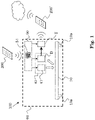
- Fig. 1 shows a very schematic illustration of the method, including a heterogeneous receptor-ligand assay device 100, more particularly an LFT device 100.
- the LFT device 100 comprises a monitoring device and a carrier 10.
- the carrier 10 can be accomodated by the monitoring device.
- the monitoring device comprises a first light source 41 and a power supply unit 50. It may further comprise, as illustrated, a detecting unit D and an optional data transmission unit T.
- the LFT device 100 further comprises a housing 60 and a carrier holder 10a for holding the carrier 10.
- First light source 41 in particular embodied as a VSCEL, emits light towards a test range of the carrier 10.
- detecting unit D detects light coming from the test range in reaction to the illumination with the light emitted by first light source 41.
- detecting unit D can comprise at least one photodetector.
- the first light source comprises a cavity, and light is coupled back into the cavity, and detection is carried out based on SMI.
- first light source 41 can be a constituent of detecting unit D; and detection can take place optically, such as using a photodetector, or electrically, monitoring an electrical supply signal feeding the first light source 41.
- first light source 41 and detecting unit D can be separate parts, e.g., the detecting unit D comprising a photodetector, such as for detecting luminescent, e.g., fluorescent light emitted (from the test range) in reaction to illumination with light from first light source 41.
- a photodetector such as for detecting luminescent, e.g., fluorescent light emitted (from the test range) in reaction to illumination with light from first light source 41.
- the electrical consumers (41; D; T) of the of the LFT device 100, and of the monitoring device, respectively, are supplied with electrical energy by power supply unit 50 which comprises an energy receiving unit 51, e.g., comprising a coil for inductive power transmission, as symbolized in Fig. 1 .
- the thin arrows symbolize power supply connections.
- the power required for operation can be received, via the energy receiving unit 51, from an external device 200, such as from a smart phone.
- the power supply unit 50 can furthermore comprise an AC-DC converter, in particular for converting an AC signal produced by the energy receiving unit, e.g., from inductive reception of electromagnetic waves, into a DC signal used for powering the consumers.
- an AC-DC converter in particular for converting an AC signal produced by the energy receiving unit, e.g., from inductive reception of electromagnetic waves, into a DC signal used for powering the consumers.
- Detecting unit D outputs a measurement signal, illustrated by the thick arrow in Fig. 1 , which is associated with the light coming from the test range.
- data transmission unit T can receive the measurement signal from the detecting unit and transmit it to an external device 200', which however can be identical to external device 200. From there, the measurement signal or a signal derived therefrom can be further transmitted, e.g., to a cloud server, as symbolized by a cloud in Fig. 1 .
- each of the light emission from first light source 41, the detection by detecting unit D, and optionally also the data transmission by data transmission unit T can take place simultaneously with the receiving of energy from external device 200 - which, via energy receiving unit 51 and power supply unit 50, makes possible to power the electrical consumers.
- the monitoring device can (optionally; not illustrated) also comprise a control unit controlling the operation of, e.g., one or more of the first light source 41, the detecting unit D, the data transmission unit T, the power supply unit 50.
- a control unit controlling the operation of, e.g., one or more of the first light source 41, the detecting unit D, the data transmission unit T, the power supply unit 50.
- the monitoring device can be considered to comprise a unit 45 for color detection, comprising the first light source 41 and the detecting unit D, and optionally also the control unit.
- a unit 45 for color detection comprising the first light source 41 and the detecting unit D, and optionally also the control unit.
- the unit 45 for color detection by means of the unit 45 for color detection, the presence and/or intensity of a color can be determined.
- the first light source 41 can in particular be a VCSEL.
- a VCSEL can be of very tiny size, and it can have a very low power consumption.
- the first light source is a VCSEL
- the power supply unit 50 is generally optional, as is the detecting unit D and the data transmission unit T.
- Fig. 2 shows a schematic illustration of a side view of an LFT device. This figure emphasizes the LFT aspect and the related method, and therefore some other details, such as a housing of the device are not illustrated in Fig. 2 .
- a carrier 10 accomodated in the device, e.g., held by carrier holder 10 comprises a sample pad 11, a conjugate pad 12, a test area 13 and an optional control area 14. It further comprises two reference areas 15a, 15b, which are generally optional, and wherein, e.g., a single reference area can, in instances, be sufficient.
- the carrier 10 can, in practice, comprise two or more constituents, e.g., pads, which are laminated one onto the other.
- Carrier 10 can comprise a sample pad, and a first end portion of a conjugate part is laminated to a first end portion of the sample pad; and a detection pad of the carrier comprising the test area and the control area is laminated at its first end portion to a second end portion of the conjugate pad (opposite the first end portion of the conjugate pad); and a wicking pad of the carrier may be laminated to a second end portion of the detection pad (opposite the first end portion of the detection pad).
- a liquid L representing a sample is applied to the sample pad 11. From there, it is transported by the carrier 10, e.g., by capillary forces, along a transport direction illustrated in the figures by the thick dashed arrow.
- the liquid L can (and in the illustrated case does) contain an analyte 1, such as a virus or an antigen.
- markers 2 are present which can bond to the analyte 1.
- a marker 2 can be, e.g., a conjugate comprising a ligand for bonding specifically to the analyte 1 and, bonded thereto, a marking agent such as a fluorescent agent, e.g., a fluorescent molecule, or a coloring agent, e.g., a gold particle or a latex particle.
- the particles formed this way when reaching the test area, can bond to analyte bonding agents 31 which are fixed to the carrier 10 in the test area 13. Accordingly, a concentration of the particles can increase there with time.
- the particles bonded to the analyte bonding agents 31 show a specific color (first color), e.g., such that an intensity of the color can increase with time and with concentration of the bonded particles in the test area 13.
- This can be detected, e.g., by detecting absorption, in particular at a wavelength of an absorption band of the bonded particles.
- This can be accomplished, e.g., based on SMI, the first light source 41 in this case constituting a part of the the detecting unit D.
- the markers are fluorescent markers, this can be detected, e.g., by detecting the fluorescent light excited by the light emitted from first light source 41 and more particularly, by detecting an intensity of the fluorescent light.
- Markers 2 not bonded to the analyte 1 are further transported by carrier 10 to the control area 14 and can bond to marker bonding members 32 which are fixed to the carrier 10 in the control area 14.
- the markers 2 bonded to the marker bonding agents 32 also show a specific color, such that, e.g., an intensity of that color can increase with time and concentration of these bonded particles in the control area 14.
- the detection of the presence and/or the concentration of the respective bonded particles in the control area 14 can again be accomplished, e.g., using SMI. Due to the color, an absorption can be detected, wherein the absorption depends on the presence and/or the concentration of the respective bonded particles. Again, e.g., absorption or fluorescent light can be detected, as described above.
- the device comprises one or more light sources; in the illustrated example, four light sources 41, 42, 43a, 43b are shown. They all can be resonant-cavity light sources comprising a cavity C. In particular, they can all be VCSELs. Each cavity C has two end mirrors, one of which is the outcoupling mirror from which the respective light source emits light. Light produced in the light source circulates in the cavity, resonating therein.
- the hollow arrows in the figures symbolize light.
- Light re-entering the cavity C can influence the light generation in the light source, in particular due to interference with light present in the cavity, i.e. with light being produced in the light source.
- a notable coherence length of the light can therefore be advantageous.
- lasers e.g., VCSELs and edge-emitting lasers (EELs) can be used.
- EELs edge-emitting lasers
- RC-LEDs resonant-cavity light-emitting diodes
- This influence on the light generation can be detected, e.g., from monitoring a supply signal applied to the respective light source.
- the current drawn by a light source at a constant supply voltage can be a measurement signal - which is related to the influences to the light generation in the light source and thus to the absorption.
- each dotted trapezoid can represent a photodiode.
- each of the light sources is connected for power supply purposes to power supply unit 50 comprising an energy receiving unit 51.
- the reference measurenment signals from the reference areas 15a, 15b can be used for calibration purposes, e.g., for monitoring the effect of a wetting of the carrier 10 by the liquid L. This can lead to more precise and/or more reliable results.
- the reference measurenment signals from the reference areas 15a, 15b can be used for calibration purposes, namely in order to compare absorption at an area (15a; 15b) without the color-bearing particles bonded to the carrier 10 to absorption at an area (13; 14) where the color-bearing particles are bonded to the carrier 10 (at least in case of presence of analyte 1 and/or markers 2).
- Fig. 3 shows a schematic illustration of a side view of an LFT device implementing, e.g., fluorescence-based detection. Many details have been described already in conjunction with Fig. 2 . Accordingly, it is referred to above for that.
- any light source in excess of first light source 41 is merely an option.
- the monitoring device comprises a housing 60 and may have a sample inlet 61.
- the housing 60 can comprise several baffles (thick lines or hatched in Fig. 3 ) to keep ambient light out of the housing and in particular away from the ranges (test range in test area 13, control range in control area 14, reference range in reference area 15a).
- the sample inlet 61 can serve as such a baffle.
- the carrier 10 is held by a carrier holder (symbolized by the large angles in Fig. 3 ).
- a lens 71, 72, 73a can be provided, disposed in the light path between the respective light source and the carrier 10. This way, the light beam exiting the respective light source can be, e.g., widened and/or parallelized.
- the lenses can optionally be attached to the respective light sources.
- a lens can be provided, in the light path between the respective range and the respective detector.
- the LFT device 100 can further comprise a printed circuit board 80 on which the light sources and the detectors are mounted.
- the device can also comprise a connector 85 which can be implemented, e.g., at the printed circuit board 80.
- the connector 85 can, as illustrated, comprise a portion of the printed circuit board 80. Power can be supplied to the LFT device via this connector 85.
- Connector 85 can be a constituent of the energy receiving unit 51 of power supply unit 50.
- the LFT device 100 can comprise a receiving unit 51 for wireless energy transmission, e.g., comprising an induction coil. In case both are provided, they can be implemented in a single unit and/or share one or more common parts.
- a data transmission unit T may be provided and may also be mounted on printed circuit board 80. It may be separate from (as illustrated) or - at least in part - identical to the energy receiving unit 51 (unlike shown in Fig. 3 ). E.g., data transmission unit T and energy receiving unit 51 may share one or more common parts, e.g., a coil, in particular an induction coil, serving both purposes: wireless reception of energy and wireless transmission of measurement signals.
- a coil in particular an induction coil
Landscapes
- Health & Medical Sciences (AREA)
- Immunology (AREA)
- Life Sciences & Earth Sciences (AREA)
- Engineering & Computer Science (AREA)
- Molecular Biology (AREA)
- Biomedical Technology (AREA)
- Chemical & Material Sciences (AREA)
- Hematology (AREA)
- Urology & Nephrology (AREA)
- Biotechnology (AREA)
- Microbiology (AREA)
- Cell Biology (AREA)
- Food Science & Technology (AREA)
- Medicinal Chemistry (AREA)
- Physics & Mathematics (AREA)
- Analytical Chemistry (AREA)
- Biochemistry (AREA)
- General Health & Medical Sciences (AREA)
- General Physics & Mathematics (AREA)
- Pathology (AREA)
- Investigating Or Analysing Materials By The Use Of Chemical Reactions (AREA)
Priority Applications (2)
| Application Number | Priority Date | Filing Date | Title |
|---|---|---|---|
| EP21197768.1A EP4152002A1 (de) | 2021-09-20 | 2021-09-20 | Heterogene rezeptor-ligand-testvorrichtung, insbesondere lateral-flow-testvorrichtung, sowie zugehörige vorrichtungen und verfahren |
| PCT/EP2022/074853 WO2023041394A1 (en) | 2021-09-20 | 2022-09-07 | Heterogeneous receptor-ligand assay device, in particuar lateral flow testing device, and related devices and methods |
Applications Claiming Priority (1)
| Application Number | Priority Date | Filing Date | Title |
|---|---|---|---|
| EP21197768.1A EP4152002A1 (de) | 2021-09-20 | 2021-09-20 | Heterogene rezeptor-ligand-testvorrichtung, insbesondere lateral-flow-testvorrichtung, sowie zugehörige vorrichtungen und verfahren |
Publications (1)
| Publication Number | Publication Date |
|---|---|
| EP4152002A1 true EP4152002A1 (de) | 2023-03-22 |
Family
ID=78077984
Family Applications (1)
| Application Number | Title | Priority Date | Filing Date |
|---|---|---|---|
| EP21197768.1A Withdrawn EP4152002A1 (de) | 2021-09-20 | 2021-09-20 | Heterogene rezeptor-ligand-testvorrichtung, insbesondere lateral-flow-testvorrichtung, sowie zugehörige vorrichtungen und verfahren |
Country Status (2)
| Country | Link |
|---|---|
| EP (1) | EP4152002A1 (de) |
| WO (1) | WO2023041394A1 (de) |
Citations (3)
| Publication number | Priority date | Publication date | Assignee | Title |
|---|---|---|---|---|
| WO2013018094A1 (en) * | 2011-08-04 | 2013-02-07 | Given Imaging Ltd. | Device, system and method for in-vivo immunoassay |
| EP3772646A1 (de) * | 2019-08-06 | 2021-02-10 | Ams Ag | Teststreifen, überwachungsvorrichtung und verfahren zur herstellung eines teststreifens |
| US20210208134A1 (en) * | 2020-01-03 | 2021-07-08 | Louay Khaled Fakhro | Systems and methods of optically determining analyte concentrations |
-
2021
- 2021-09-20 EP EP21197768.1A patent/EP4152002A1/de not_active Withdrawn
-
2022
- 2022-09-07 WO PCT/EP2022/074853 patent/WO2023041394A1/en not_active Ceased
Patent Citations (3)
| Publication number | Priority date | Publication date | Assignee | Title |
|---|---|---|---|---|
| WO2013018094A1 (en) * | 2011-08-04 | 2013-02-07 | Given Imaging Ltd. | Device, system and method for in-vivo immunoassay |
| EP3772646A1 (de) * | 2019-08-06 | 2021-02-10 | Ams Ag | Teststreifen, überwachungsvorrichtung und verfahren zur herstellung eines teststreifens |
| US20210208134A1 (en) * | 2020-01-03 | 2021-07-08 | Louay Khaled Fakhro | Systems and methods of optically determining analyte concentrations |
Also Published As
| Publication number | Publication date |
|---|---|
| WO2023041394A1 (en) | 2023-03-23 |
Similar Documents
| Publication | Publication Date | Title |
|---|---|---|
| US5922285A (en) | Integrated fluorescence-based biochemical sensor | |
| JP5908101B2 (ja) | テストストリップ検出システム | |
| US20140038222A1 (en) | Compact portable apparatus for optical assay | |
| US20220381693A1 (en) | Assay device employing fluorescent labels | |
| JP2016166878A (ja) | 診断デバイスおよび関連する方法 | |
| KR101705602B1 (ko) | 스마트폰 카메라 기반 형광검출용 광학센서 | |
| JPH10132747A (ja) | 小型集積センサ台 | |
| CN107850537A (zh) | 辐射载体及其在光学传感器中的使用 | |
| CN204439552U (zh) | 一种免疫荧光定量分析仪 | |
| US7985384B2 (en) | Analysis kit for living organism and chemical reaction | |
| CN113484310A (zh) | 多用途试纸检测装置 | |
| NL2034374B1 (en) | High-sensitivity and small-size near-infrared spr portable detection device | |
| CN212514615U (zh) | 一种多光谱调制的便携式免疫层析试纸条定量检测装置 | |
| WO2023041394A1 (en) | Heterogeneous receptor-ligand assay device, in particuar lateral flow testing device, and related devices and methods | |
| EP3772646B1 (de) | Teststreifen, überwachungsvorrichtung und verfahren zur herstellung eines teststreifens | |
| CN103196878A (zh) | 便携式荧光检测器 | |
| CN203502352U (zh) | 小型化量子点免疫层析试纸条检测设备 | |
| KR101683379B1 (ko) | 휴대형 미세조류 검출 장치 | |
| WO2018232469A1 (en) | A method, device and system for facilitating image capture of test strips/materials/components | |
| JP2006084210A (ja) | 分析装置 | |
| CN221174405U (zh) | 一种荧光采集装置及荧光检测设备 | |
| EP3798614B1 (de) | Modulare multiplex-analyse-vorrichtungen und -plattformen | |
| WO2024070697A1 (ja) | イムノクロマトグラフ検査装置 | |
| US20240009670A1 (en) | Assay device employing fluorescent labels | |
| EP3940335A1 (de) | Selbstmischende interferferometrie für absorptions- oder farberfassung und anwendung beim querflusstesten |
Legal Events
| Date | Code | Title | Description |
|---|---|---|---|
| PUAI | Public reference made under article 153(3) epc to a published international application that has entered the european phase |
Free format text: ORIGINAL CODE: 0009012 |
|
| STAA | Information on the status of an ep patent application or granted ep patent |
Free format text: STATUS: THE APPLICATION HAS BEEN PUBLISHED |
|
| AK | Designated contracting states |
Kind code of ref document: A1 Designated state(s): AL AT BE BG CH CY CZ DE DK EE ES FI FR GB GR HR HU IE IS IT LI LT LU LV MC MK MT NL NO PL PT RO RS SE SI SK SM TR |
|
| STAA | Information on the status of an ep patent application or granted ep patent |
Free format text: STATUS: REQUEST FOR EXAMINATION WAS MADE |
|
| 17P | Request for examination filed |
Effective date: 20230922 |
|
| RBV | Designated contracting states (corrected) |
Designated state(s): AL AT BE BG CH CY CZ DE DK EE ES FI FR GB GR HR HU IE IS IT LI LT LU LV MC MK MT NL NO PL PT RO RS SE SI SK SM TR |
|
| STAA | Information on the status of an ep patent application or granted ep patent |
Free format text: STATUS: THE APPLICATION IS DEEMED TO BE WITHDRAWN |
|
| 18D | Application deemed to be withdrawn |
Effective date: 20230923 |