EP4149403B1 - Hosenartiger saugfähiger artikel - Google Patents
Hosenartiger saugfähiger artikel Download PDFInfo
- Publication number
- EP4149403B1 EP4149403B1 EP20935175.8A EP20935175A EP4149403B1 EP 4149403 B1 EP4149403 B1 EP 4149403B1 EP 20935175 A EP20935175 A EP 20935175A EP 4149403 B1 EP4149403 B1 EP 4149403B1
- Authority
- EP
- European Patent Office
- Prior art keywords
- absorbent
- layer
- pant
- absorbent article
- absorbent layer
- Prior art date
- Legal status (The legal status is an assumption and is not a legal conclusion. Google has not performed a legal analysis and makes no representation as to the accuracy of the status listed.)
- Active
Links
Images




Classifications
-
- A—HUMAN NECESSITIES
- A61—MEDICAL OR VETERINARY SCIENCE; HYGIENE
- A61F—FILTERS IMPLANTABLE INTO BLOOD VESSELS; PROSTHESES; DEVICES PROVIDING PATENCY TO, OR PREVENTING COLLAPSING OF, TUBULAR STRUCTURES OF THE BODY, e.g. STENTS; ORTHOPAEDIC, NURSING OR CONTRACEPTIVE DEVICES; FOMENTATION; TREATMENT OR PROTECTION OF EYES OR EARS; BANDAGES, DRESSINGS OR ABSORBENT PADS; FIRST-AID KITS
- A61F13/00—Bandages or dressings; Absorbent pads
- A61F13/15—Absorbent pads, e.g. sanitary towels, swabs or tampons for external or internal application to the body; Supporting or fastening means therefor; Tampon applicators
- A61F13/53—Absorbent pads, e.g. sanitary towels, swabs or tampons for external or internal application to the body; Supporting or fastening means therefor; Tampon applicators characterised by the absorbing medium
- A61F13/531—Absorbent pads, e.g. sanitary towels, swabs or tampons for external or internal application to the body; Supporting or fastening means therefor; Tampon applicators characterised by the absorbing medium having a homogeneous composition through the thickness of the pad
- A61F13/532—Absorbent pads, e.g. sanitary towels, swabs or tampons for external or internal application to the body; Supporting or fastening means therefor; Tampon applicators characterised by the absorbing medium having a homogeneous composition through the thickness of the pad inhomogeneous in the plane of the pad
-
- A—HUMAN NECESSITIES
- A61—MEDICAL OR VETERINARY SCIENCE; HYGIENE
- A61F—FILTERS IMPLANTABLE INTO BLOOD VESSELS; PROSTHESES; DEVICES PROVIDING PATENCY TO, OR PREVENTING COLLAPSING OF, TUBULAR STRUCTURES OF THE BODY, e.g. STENTS; ORTHOPAEDIC, NURSING OR CONTRACEPTIVE DEVICES; FOMENTATION; TREATMENT OR PROTECTION OF EYES OR EARS; BANDAGES, DRESSINGS OR ABSORBENT PADS; FIRST-AID KITS
- A61F13/00—Bandages or dressings; Absorbent pads
- A61F13/15—Absorbent pads, e.g. sanitary towels, swabs or tampons for external or internal application to the body; Supporting or fastening means therefor; Tampon applicators
- A61F13/53—Absorbent pads, e.g. sanitary towels, swabs or tampons for external or internal application to the body; Supporting or fastening means therefor; Tampon applicators characterised by the absorbing medium
- A61F13/534—Absorbent pads, e.g. sanitary towels, swabs or tampons for external or internal application to the body; Supporting or fastening means therefor; Tampon applicators characterised by the absorbing medium having an inhomogeneous composition through the thickness of the pad
- A61F13/535—Absorbent pads, e.g. sanitary towels, swabs or tampons for external or internal application to the body; Supporting or fastening means therefor; Tampon applicators characterised by the absorbing medium having an inhomogeneous composition through the thickness of the pad inhomogeneous in the plane of the pad, e.g. core absorbent layers being of different sizes
-
- A—HUMAN NECESSITIES
- A61—MEDICAL OR VETERINARY SCIENCE; HYGIENE
- A61F—FILTERS IMPLANTABLE INTO BLOOD VESSELS; PROSTHESES; DEVICES PROVIDING PATENCY TO, OR PREVENTING COLLAPSING OF, TUBULAR STRUCTURES OF THE BODY, e.g. STENTS; ORTHOPAEDIC, NURSING OR CONTRACEPTIVE DEVICES; FOMENTATION; TREATMENT OR PROTECTION OF EYES OR EARS; BANDAGES, DRESSINGS OR ABSORBENT PADS; FIRST-AID KITS
- A61F13/00—Bandages or dressings; Absorbent pads
- A61F13/15—Absorbent pads, e.g. sanitary towels, swabs or tampons for external or internal application to the body; Supporting or fastening means therefor; Tampon applicators
- A61F13/53—Absorbent pads, e.g. sanitary towels, swabs or tampons for external or internal application to the body; Supporting or fastening means therefor; Tampon applicators characterised by the absorbing medium
- A61F2013/530481—Absorbent pads, e.g. sanitary towels, swabs or tampons for external or internal application to the body; Supporting or fastening means therefor; Tampon applicators characterised by the absorbing medium having superabsorbent materials, i.e. highly absorbent polymer gel materials
- A61F2013/530708—Absorbent pads, e.g. sanitary towels, swabs or tampons for external or internal application to the body; Supporting or fastening means therefor; Tampon applicators characterised by the absorbing medium having superabsorbent materials, i.e. highly absorbent polymer gel materials characterized by the absorbency properties
- A61F2013/530737—Absorbent pads, e.g. sanitary towels, swabs or tampons for external or internal application to the body; Supporting or fastening means therefor; Tampon applicators characterised by the absorbing medium having superabsorbent materials, i.e. highly absorbent polymer gel materials characterized by the absorbency properties by the absorbent capacity
-
- A—HUMAN NECESSITIES
- A61—MEDICAL OR VETERINARY SCIENCE; HYGIENE
- A61F—FILTERS IMPLANTABLE INTO BLOOD VESSELS; PROSTHESES; DEVICES PROVIDING PATENCY TO, OR PREVENTING COLLAPSING OF, TUBULAR STRUCTURES OF THE BODY, e.g. STENTS; ORTHOPAEDIC, NURSING OR CONTRACEPTIVE DEVICES; FOMENTATION; TREATMENT OR PROTECTION OF EYES OR EARS; BANDAGES, DRESSINGS OR ABSORBENT PADS; FIRST-AID KITS
- A61F13/00—Bandages or dressings; Absorbent pads
- A61F13/15—Absorbent pads, e.g. sanitary towels, swabs or tampons for external or internal application to the body; Supporting or fastening means therefor; Tampon applicators
- A61F13/53—Absorbent pads, e.g. sanitary towels, swabs or tampons for external or internal application to the body; Supporting or fastening means therefor; Tampon applicators characterised by the absorbing medium
- A61F13/534—Absorbent pads, e.g. sanitary towels, swabs or tampons for external or internal application to the body; Supporting or fastening means therefor; Tampon applicators characterised by the absorbing medium having an inhomogeneous composition through the thickness of the pad
- A61F2013/53445—Absorbent pads, e.g. sanitary towels, swabs or tampons for external or internal application to the body; Supporting or fastening means therefor; Tampon applicators characterised by the absorbing medium having an inhomogeneous composition through the thickness of the pad from several sheets
Definitions
- the present disclosure pertains to a pant-type absorbent article such as a pant diaper, a sanitary pant or an incontinence pad. More specifically, the present disclosure pertains to a pant-type absorbent article adapted for use during nighttime or for bedridden users.
- Disposable pant-type absorbent articles have defined core regions and elasticized front and rear regions to provide a comfortable fit and to enable the articles to be pulled up and down over the hips of the wearer.
- the pant-type articles are designed to allow the wearer or caregiver to easily put on and remove the article when it has been soiled.
- An absorbent core is disposed in the crotch portion of the absorbent article and is conventionally symmetrically disposed in respect to the rear and front regions.
- Disposable pant-type absorbent articles used during nighttime needs to withstand relatively large amounts of liquid discharges and remain dry over a prolonged time.
- the wearer position and movement during nighttime differs from requirements of an absorbent article intended for daytime use.
- US2014/338822 discloses an absorbent article with a first and second absorbent layer.
- pant-type diaper according to claim 1. Further embodiments are set out in the dependent claims, in the following description and in the drawings.
- the absorbent member has an absorbent member front edge and an absorbent member rear edge.
- the chassis comprises a front section, a rear section and a crotch section located between the front section and the rear section, as seen in a longitudinal direction of the absorbent article.
- the front section and the rear section are joined to each other along two opposite longitudinal side edges to define a waist-opening and a pair of leg-openings.
- the front section comprises front elastics and the rear section comprises rear elastics, each of the front elastics and the rear elastics extending between the respective opposite longitudinal side edges in a transverse direction of the absorbent article.
- the absorbent member comprises a first absorbent layer and a second absorbent layer.
- the first absorbent layer is arranged between the topsheet and the second absorbent layer.
- the first absorbent layer has a first absorbent layer front edge and a first absorbent layer rear edge.
- the second absorbent layer has a size and a shape in a plane of the absorbent article, the size and shape of the second absorbent layer defining the size and shape of the absorbent member in the plane of the absorbent article.
- the first absorbent layer is shorter than the second absorbent layer, as seen in the longitudinal direction, such that only the second absorbent layer is present in a front portion of the absorbent member, and in a rear portion of the absorbent member.
- the front elastics extend over the front portion of the absorbent member and the rear elastics extend over the rear portion of the absorbent member.
- the first absorbent layer front edge is arranged with a front edge distance from the absorbent member front edge and the first absorbent layer rear edge is arranged with a rear edge distance from the absorbent member rear edge.
- Each of the first and the second absorbent layer comprises superabsorbent polymer particles.
- the absorbent member is in a crotch portion thereof provided with at least two channels extending in the longitudinal direction and on a respective side of a longitudinal centerline of the absorbent article.
- the first absorbent layer comprises a higher amount of superabsorbent polymer particles than the second absorbent layer.
- the absorbent member may have a total absorbent capacity of 1100 ml or more, as measured according to standard test method ISO 11948-1. A ratio between the front edge distance and the rear edge distance is 1.5 or greater.
- absorbent article refers to a product that is placed against the skin of the wearer to absorb and contain body exudates, like urine and faeces.
- the invention furthermore refers to a disposable absorbent articles, which means an article that is not intended to be laundered or otherwise restored or reused as an absorbent article after use.
- the invention refers to a "disposable pant-type absorbent article", having an outer cover being disposed on a garment facing side of the absorbent article and an absorbent core arranged in the crotch portion on a wearer facing side of the outer cover. Examples of such a pant-type absorbent article is a pant diaper, sanitary pant and incontinence pant.
- the absorbent article according to the present disclosure may be an adult incontinence article.
- the present disclosure relates to absorbent articles intended for use during the night, or heavy-incontinence articles for bed-ridden users. It has been found that almost 1/3 of absorbent article leakages happens during the night. Caregivers need to wake up several times per night to check the absorbent article, interrupting the sleep of both themselves and the caretaker. Regularly disturbed sleeps may be a serious medical health risk.
- the absorbent member having a total absorbent capacity of 1100 ml or more
- the fact that the first absorbent layer comprises a higher amount of superabsorbent polymer particles than the second absorbent layer has been seen to provide a dryer topsheet over a prolonged time providing the wearer with a dry feeling during night. This provides a better sleep to the user.
- a dryer topsheet decreases the risk for skin irritations for the wearer.
- the rear portion of the absorbent member is provided with a higher degree of absorbency to respond to the different absorbency need for a wearer lying down since most of the urine ends up being stored in the rear portion of the core. Wearing the same absorbent article during an entire night means a risk for over-hydration of the skin and skin irritations.
- the at least two channels provided in the absorbent member shapes the crotch portion of the absorbent article such that the liquid is guided to the central region of the crotch portion, as seen in the transverse direction, and rearwards where the absorbent article is provided with a high degree of absorbency.
- the absorbent member may have a groin portion arranged between the front portion and the crotch portion and a buttocks portion arranged between crotch portion and the back portion, as seen in the longitudinal direction of the absorbent article.
- the first absorbent layer may layer extend from the groin portion and to the back portion of the absorbent member.
- the first absorbent layer may extend over groin portion, the crotch portion, the buttocks portion and to the transition between the buttocks portion and the back portion of the absorbent member.
- the first absorbent layer may be a shaped absorbent layer having a wider section, as seen in the transverse direction, arranged in the groin portion and a narrower section arranged in the crotch portion of the absorbent member.
- the first absorbent layer may extend from the groin portion, such as from a transverse transition between the groin portion and the front portion of the absorbent member.
- the first absorbent layer may be wider in the frontmost part of the first absorbent layer, i.e. in the part arranged in the groin portion, and become more narrow in the crotch portion.
- the first absorbent layer conforms to the wearer anatomy and shapes the absorbent core to a bowl-shape in the groin portion since the thighs of the wearer will squeeze the wider part in the groin portion together and thereby guide the liquid to the crotch portion where absorbency capacity is available for storing of the liquid. Since the thighs of the wearer will also squeeze the crotch part together forming this section to a bowl-shape the liquid may also be temporarily stored there prior to being absorbed into the absorbent article.
- the absorbent member may have a total length of from 250 mm, such as from 300 mm or from 400 mm.
- the absorbent member may have a total length of up to 1000 mm.
- the length of the crotch portion may be from 20 % to 25% of the length of the absorbent member and be arranged with equal distance to the absorbent member front edge and to the absorbent member rear edge.
- the length of the buttocks portion may be from 25% to 35% of the length of the absorbent member.
- the area of the buttocks portion may be at least 35% of the total area of the absorbent member.
- the area of the buttocks portion may be from 35% to 45 % of the total area of the absorbent member.
- the transition between the buttocks portion and the rear portion may correspond to the first absorbent layer rear edge.
- the buttocks portion may thus be a larger and/or longer portion, thus providing additional protection in an absorbent article buttocks portion.
- This, in combination with the high total absorbency and the higher amount of superabsorbent particles in the upper, first absorbent layer has been found particularly advantageous for nighttime absorbent articles.
- 40 % or more of the total absorbent capacity of the absorbent member may be provided in the buttocks portion.
- the length of the groin portion may be from 15% to 25% of the length of the absorbent member.
- the transition between the front portion and the groin portion may correspond to the first absorbent layer front edge.
- the first absorbent layer front edge may be arranged at level with the rearmost part of the front elastics, as seen in the longitudinal direction. At level with herein may correspond to a difference of ⁇ 20 mm, such as ⁇ 10 mm, as seen in a longitudinal direction L.
- the front portion of the absorbent core is thus a single-core layer portion arranged under the front elastics providing the highly absorbent article with a less bulky front portion, tightly fitting against the belly of the wearer. This thus provides a comfortable, more aesthetically appealing night-product. However, the fact that the front portion fits tightly against the wearer also protects against side-front leakage.
- the first absorbent layer rear edge may be arranged at level with the frontmost part of the rear elastics, as seen in the longitudinal direction.
- the rear portion of the absorbent core is thus a single-core layer portion arranged under the rear elastics providing the highly absorbent article with a flat rear portion, tightly fitting against the back of the wearer.
- the fact that the rear portion fits tightly against the back wearer provides extra protection against rear leakage. This also provides a comfortable, more aesthetically appealing night-product.
- the ratio between the front edge distance and the rear edge distance may be 1.7 or greater, optionally up to 2.8.
- a side elastic member may be arranged on each side of the absorbent member outside and along the crotch portion of the absorbent member.
- the side elastic member may for example be bands or strings of elastic material, e.g. foam elastics.
- the side elastic members may for example have a width of from 1 mm to 15 mm, such as 2 mm to 10 mm.
- the absorbent article may comprise a transfer layer arranged between the topsheet and the first absorbent layer.
- the transfer layer may have a transfer layer front edge and a transfer layer rear edge.
- the transfer layer front edge may be arranged with a second front edge distance from the absorbent member front edge and the transfer layer rear edge being arranged with a second rear edge distance from the absorbent member rear edge.
- a ratio between the second front edge distance and the second rear edge distance may be 1 or greater.
- transfer layers are arranged closer to the front edge than to the rear edge of the absorbent member.
- the transfer layer is centrally arranged or rearwards arranged with respect to a transverse centerline of the absorbent member.
- a transfer layer may be arranged between the topsheet and the absorbent member to receive and spread the liquid before it is absorbed by the absorbent member.
- larger amounts of liquids may be received and contained in the absorbent structure.
- the fact that the transfer layer is arranged centrally or rearwards in the article with respect to the absorbent member ensures rapid inlet in the crotch and buttocks portion and has been found to, in combination with the specific core construction of the present disclosure, greatly reduce leakage during nighttime.
- the transfer layer may have a basis weight of 30 gsm or more, optionally of 40 gsm or more.
- the transfer layer may for example be a nonwoven material, such as a spunbonded nonwoven material.
- the amount in wt.% of superabsorbent polymer may be from 1.6 times higher in the first absorbent layer than in the second absorbent layer, preferably from 1.7 times higher in wt.% in the first absorbent layer than in the second absorbent layer.
- the amount in wt.% of superabsorbent polymer may be up to 4 times higher in wt.% in the first absorbent layer than in the second absorbent layer.
- the first absorbent layer may comprise an amount of superabsorbent polymer particles of from 30 wt.% of the total first absorbent layer.
- the first absorbent layer may comprise an amount of superabsorbent polymer particles within the range of from 30 wt.% to 90 wt.% of the total first absorbent layer.
- the second absorbent layer may comprise an amount of superabsorbent polymer particles of from 10 wt.% of the total second absorbent layer. Optionally an amount within the range of from 10 wt.% to 80 wt.% of the total second absorbent layer.
- the two channels may be provided in the second absorbent layer.
- the two channels may be provided on a respective side of a longitudinal centerline of the absorbent article.
- the two channels may be provided outboard a respective longitudinal side edge of the first absorbent layer.
- the area of the back portion of the absorbent member may be from 1.3 to 2.8 times greater than the area of the crotch portion of the absorbent member.
- the groin portion may be free from the front elastics.
- the absorbent article may comprise a crotch elastic member arranged on a garment facing side of the second absorbent layer, the crotch elastic member extending under the crotch portion of the absorbent member and along a longitudinal centerline of the pant-type absorbent article.
- the crotch elastic member may be a longitudinally extending elastic member, it may be in the form of elastic strings or an elastic band.
- the pant-type absorbent article may comprise a third central channel being provided in the second absorbent layer, the third channel extending along the longitudinal centerline of the pant-type absorbent article and coinciding with the crotch elastic member.
- the pant-type absorbent article may have a Rewet 3 value within the range of from 0 gsm to 5.5 gsm, as measured according to the Rewet Under Pressure method disclosed herein and after the 3 rd dose,
- the pant-type absorbent article may have a Rewet 4 value within the range of from 1 gsm to 12 gsm, such as 2 gsm to 11 gsm, as measured according to the Rewet Under Pressure method disclosed herein and after the 4 th dose.
- the pant-type absorbent article may have a Rewet 5 value within the range of from 5 gsm to 23 gsm, as measured according to the Rewet Under Pressure method disclosed herein and after the 5 th dose.
- the pant-type absorbent article may have a Rewet 6 value within the range of from 2 gsm to 13 gsm, as measured according to the Rewet Under Pressure method disclosed herein and 6 hours after the Rewet 5 measurement (about 7 hours after test start).
- the pant-type absorbent article chassis comprises an elasticized waist portion, i.e. front elastics, such as comprising elastic members, such as elastic threads, contractably affixed between the outer cover garment facing nonwoven material and an further material layer provided on a wearer facing side of the nonwoven material.
- the chassis may also comprise an elastic laminate, such as for example elastic laminate comprising an elastic film which on opposite sides is bonded to first and second non-elastic fibrous nonwoven material.
- the laminate may be made by bonding the non-elastic fibrous nonwoven materials to the elastic film layer and subsequently stretching the composite material, causing the non-elastic materials to break.
- the elastic film material may be of a breathable material.
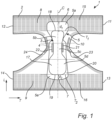
- Fig. 1 is a planar view of a pant-type absorbent article 1 according to the present disclosure in the form of a pant diaper.
- the pant diaper 1 comprises a chassis 2 including a topsheet 3, a backsheet 4 and an absorbent member 5 arranged between the topsheet 3 and the backsheet 4.
- the absorbent member 5 has an absorbent member front edge 6 and an absorbent member rear edge 7.
- the chassis 2 comprises a front section 8, a rear section 9 and a crotch section 10 located between the front section 8 and the rear section 9, as seen in a longitudinal direction L of the pant diaper 1.
- the front section 8 and the rear section 9 are joined to each other along their respective opposite longitudinal side edges 11,12,13,14 to define a waist-opening and a pair of leg-openings (shown in Fig. 3 ).
- the front section 8 of the chassis 2 comprises front elastics 15 and the rear section 9 of the chassis 2 comprises rear elastics 16.
- Each of the front elastics 15 and the rear elastics 16 extend between the respective opposite longitudinal side edges 11,12,13,14 in a transverse direction T of the absorbent article 1, here in the form of elastic threads extending between the respective opposite longitudinal side edges 11,12,13,14 in a transverse direction T of the absorbent article 1.
- the absorbent member 5 comprises a first absorbent layer 17 having a first absorbent layer front edge 18 and a first absorbent layer rear edge 19 and a second absorbent layer 20.
- the second absorbent layer 20 has a size and a shape in a plane of the absorbent article 1, the size and shape of the second absorbent layer 20 defining the size and shape of the absorbent member 5 in the plane of the pant diaper 1.
- the first absorbent layer 17 is shorter than the second absorbent layer 20, as seen in the longitudinal direction L, such that only the second absorbent layer 20 is present in a front portion 5a of the absorbent member 5 and in a rear portion 5e of the absorbent member 5.
- the front elastics 15 extend over the front portion 5a of the absorbent member 5 and the rear elastics 16 extend over the rear portion 5e of the absorbent member 5, thereby forming a flat area in the front part and in the rear portion 5eof the absorbent member 5.
- the absorbent member 5 furthermore comprises a crotch portion 5c and a groin portion 5b arranged between the front portion 5a and the crotch portion 5c, a buttocks portion 5d is arranged between the rear portion 5e and the crotch portion 5c, as seen in the longitudinal direction L.
- the length of the crotch portion 5c is from 20% to 25% of the length of the absorbent member 5 and may be arranged with equal distance to the absorbent member front edge 6 and to the absorbent member rear edge 7, i.e. a transition between the groin portion 5b and the crotch portion 5a is arranged at and equal distance from the absorbent member front edge 6 as the distance of a transition between the crotch portion 5c and the buttocks portion 5d compared to the absorbent member rear edge 7.
- the length of the groin portion 5b is from 15% to 25% of the length of the absorbent member 5 and a transition T1 between the front portion 5a and the groin portion 5b corresponds to the first absorbent layer front edge 18.
- the transition T1 is furthermore arranged at level with the rearmost part of the front elastics 15, as seen in the longitudinal direction L and the groin portion 5b is thus free from the front elastics 15.
- At level with herein may correspond to a difference of ⁇ 20 mm, such as ⁇ 10 mm, as seen in the longitudinal direction L.
- the length of the buttocks portion 5d is from 25% to 35% of the length of the absorbent member 5 and the area of the buttocks portion 5d is 35% or more of the total area of the absorbent member 5.
- a transition T2 between the buttocks portion 5d and the rear portion 5e corresponds in this Fig. 1 to the first absorbent layer rear edge 19 and the transition T2 is arranged at level with the frontmost part of the rear elastics 16, as seen in the longitudinal direction L and the buttocks portion 5d is thus free from rear elastics 16.
- At level with herein may correspond to a difference of ⁇ 20 mm, such as ⁇ 10 mm, as seen in the longitudinal direction L.
- the absorbent member 5 is provided with two channels 21,22 extending in the longitudinal direction L of the pant diaper 1 and on a respective side of a longitudinal centerline C of the pant diaper 1.
- the channels 21,22 are provided in the second absorbent layer 20 and outboard a respective longitudinal side edge of the first absorbent layer 17.
- the first absorbent layer front edge 18 is arranged with a front edge distance d1 from the absorbent member front edge 6 and the first absorbent layer rear edge 19 is arranged with a rear edge distance d2 from the absorbent member rear edge 7.
- a ratio d1/d2 between the front edge distance d1 and the rear edge distance d2 is 1.5 or greater, optionally 1.7 or greater.
- the absorbent core may comprise cellulosic fluff pulp and each of the first and the second absorbent layer 17,20 comprises superabsorbent polymer particles and the first absorbent layer 17 comprises a higher amount of superabsorbent polymer particles than the second absorbent layer 20.
- the absorbent member 5 has a total absorbent capacity of 1100 ml or more, as measured according to standard test method ISO 11948-1.
- the liquid permeable topsheet 3 can be any suitable topsheet material as known by the person skilled in the art and may be fibrous topsheet material composed of a nonwoven material, e.g. spunbonded, meltblown, carded, hydroentangled, wetlaid etc.
- Suitable nonwoven materials can be composed of natural fibers, such as woodpulp or cotton fibres, synthetic thermoplastic fibres, such as polyolefins, polyesters, polyamides and blends and combinations thereof or from a mixture of natural and synthetic fibres.
- Further examples of topsheet materials are porous foams.
- the materials suited as topsheet materials should be soft and non-irritating to the skin and be readily penetrated by body fluid, such as urine or menstrual fluid.
- the topsheet material may be essentially constituted of non-absorbent fibers, such as synthetic thermoplastic fibers, such as such as polyolefins, polyesters, polyamides and blends and combinations thereof.
- the synthetic fibers may be monocomponent fibers, bicomponent fibers or multicomponent fibers including polyesters, polyamides and/or polyolefins such as polypropylene and polyethylene.
- the backsheet 4 may be any suitable backsheet material, such as a breathable or non-breathable plastic film.
- suitable backsheet material such as a breathable or non-breathable plastic film.
- breathable materials are microporous polymeric films, nonwoven laminates from spunbond and meltblown layers, laminates from microporous polymeric films and nonwoven materials.
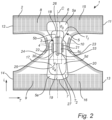
- Fig. 2 illustrates a pant diaper 1 according to the present disclosure.
- the pant diaper 1 comprises a chassis 2 including a topsheet 3, a backsheet 4 and an absorbent member 5 arranged between the topsheet 3 and the backsheet 4.
- the absorbent member 5 has an absorbent member front edge 6 and an absorbent member rear edge 7.
- a transfer layer 25 is arranged between the topsheet 3 and the absorbent member 5.
- the absorbent member 5 comprises a front portion 5a, a rear portion 5e and a crotch portion 5c.
- a groin portion 5b is arranged between the front portion 5a and the crotch portion 5c and a buttocks portion 5d is arranged between the rear portion 5e and the crotch portion 5c, as seen in a longitudinal direction L of the pant diaper 1.
- the absorbent member 5 comprises a first absorbent layer 17 and a second absorbent layer 20.
- the first absorbent layer 17 has a first absorbent layer front edge 18 and a first absorbent layer rear edge 19.
- the first absorbent layer 17 has a wider front and rear section and a narrower section in the crotch region.
- the wider front section of the first absorbent layer is arranged in the groin portion 5b of the absorbent member 5.
- the second absorbent layer 20 is wider than the first absorbent layer 17 except for in the groin portion 5b, where the first absorbent layer and the second absorbent layer 20 has essentially the same width.
- the first absorbent layer 17 is shorter than the second absorbent layer 20, as seen in the longitudinal direction L, such that only the second absorbent layer 20 is present in the front portion 5a and the rear portion 5e of the absorbent member 5.
- the first absorbent layer 17 is an upper absorbent layer and arranged between the transfer layer 25 and the second absorbent layer 20.
- the transfer layer 25 has a transfer layer front edge 26 and a transfer layer rear edge 27.
- the transfer layer front edge 26 is arranged with a second front edge distance d3 from the absorbent member front edge 6 and the transfer layer rear edge 27 is arranged with a second rear edge distance d4 from the absorbent member rear edge 7.
- a ratio d3/d4 between the second front edge distance d3 and the second rear edge distance d4 is 1 or greater.
- the chassis 2 comprises a front section 8, a rear section 9 and a crotch section 10 located between the front section 8 and the rear section 9, as seen in a longitudinal direction L of the pant diaper 1.
- the front section 8 and the rear section 9 are joined to each other along their respective opposite longitudinal side edges 11,12,13,14 to define a waist-opening and a pair of leg-openings.
- the front section 8 of the chassis 2 comprises front elastics 15 and the rear section 9 of the chassis 2 comprises rear elastics 16 and each of the front elastics 15 and the rear elastics 16 extend between the respective opposite longitudinal side edges 11,12,13,14 in a transverse direction T of the absorbent article 1.
- the front elastics 15 extend over the front portion 5a of the absorbent member 5 and the rear elastics 16 extend over the rear portion 5e of the absorbent member 5, thereby forming a flat area in the front part and in the rear portion of the absorbent member 5.
- the second absorbent layer 20 is provided with two channels 21,22 extending in the longitudinal direction L of the pant diaper 1 and on a respective side of a longitudinal centerline C of the pant diaper 1.
- the second absorbent layer 20 also comprises a third central channel 33.
- the third central channel 33 extend in the crotch portion 5c of the absorbent member 5 in the longitudinal direction L of the pant diaper 1 and coincides with the longitudinal centerline C.
- the third central channel 33 furthermore extend partly in the groin portion 5b.
- the chassis 2 of the pant diaper 1 illustrated in Fig. 2 comprises a crotch elastic member 30.
- the crotch elastic member 30 may be in the form of a plurality of parallel elastic strands or a piece of an elastic film.
- the crotch elastic member 30 extends under the crotch portion 5c of the absorbent member 5c and partly in the groin portion 5b along the longitudinal centerline C of the pant diaper 1.
- the third channel 33 coincides with the crotch elastic member 30.
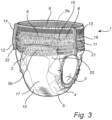
- Fig. 3 illustrates the pant diaper from Fig. 1 in an assembled use-configuration.
- the pant diaper 1 includes the chassis 2, the topsheet 3, the backsheet 4 and the absorbent member 5 arranged between the topsheet 3 and the backsheet 4.
- the chassis 2 comprises the front section 8 provided with front elastics 15 in the form of elastic threads extending between the longitudinal front side edges 11,12 and the rear section 9 provided with rear elastics 16 in the form of elastic threads extending between the longitudinal rear side edges 13,14.
- the front and rear sections 8,9 are joined to each other at a first and a second side seams 31,32 to define a waist-opening and a pair of leg-openings.
- the front elastics 15 extend over the front portion 5a of the absorbent member 5 providing a flat portion at the belly of the wearer.
- the groin portion 5b of the absorbent member 5 having a decreasing width and the narrowest portion of the absorbent member 5 is arranged in the groin portion 5b.
- the Rewet Under Pressure test method is a method for measuring rewet of a product after repeated wettings and under pressure, simulating the use-condition for a heavy-incontinence article after repeated wettings.
- the evaluation is made in a stable laboratory environment set to 23°C and 50% relative humidity.
- the absorbent articles are conditioned in this same environment for 24 hours before testing. At least six identical absorbent articles are tested. The procedure is described for one of these absorbent articles.
- the absorbent article 1 to be tested is cut along the side seams to remove elastics, and stretched flat on a laboratory bench, as illustrated in Fig. 7 .
- the front and rear sections 8,9 of the absorbent article 1 are marked (the front part faces the stomach of the user).
- the front edge 6 of the absorbent member 5 is identified.
- a crosswise reference line r is drawn over the topsheet of the absorbent article at a distance of 40% of the total length of the absorbent member from the front edge of the absorbent member 6.
- Mark a second point P2 65 mm rearward from the reference line r (centered in the transverse direction T) as a guide for placement of the collagen pad for the rewet measurement.
- the vertical wall sections 108a,108c having an angle inwardly towards the middle wall section 108b and are designed to fit tightly against the respective block first side walls 104b, 105b of the leg blocks 104,105.
- Remove the distance template. Place a 10 kg metal weight 109 centered onto the buttocks template 106 as illustrated in Fig. 8b .
- the fluid outlet tube being arranged 10 mm above the liquid inlet point P1.
- a total of five 100 ml doses are then added to the absorbent article 1.
- a stop watch is started when each dose has been absorbed (i.e. when there is no more pooled fluid on the diaper surface), and the subsequent dose is introduced after a waiting time of 15 minutes.
- Rewet is measured 10 minutes after the third, fourth and fifth doses. For this purpose, remove the 10 kg weight and the buttocks template 12. Wipe the bottom side of the buttocks template 106, intended to be facing the absorbent article 1, free from liquid and moist. Weigh a collagen pad (8 sheets), and then place it on the absorbent article 1, with the length direction of the pad aligned with the longitudinal direction L of the absorbent article 1. The collagen pad is arranged by aligning the front edge of the collagen pad with the second point arranged 65 mm rearwards from the reference line r. The length of the collagen pad is positioned away from the reference line r, towards the rear part of the diaper.
- the total procedure takes about 7,5 hours corresponding to a night's sleep.
- Comparative tests between an Example absorbent article and a Reference absorbent articles were carried out to compare the dryness of the topsheet under pressure, i.e. the rewet under pressure as measured according to the Rewet Under Pressure method disclosed herein.
- Table 1 below illustrates the amount of absorbent materials in the first and second absorbent layers of the Example and the Reference article.
- the reference article currently on the market is Tena Pant Super from Essity Hygiene and Health AB.
- the Example absorbent article and the reference article have the same Rothwell, total capacity, value of 2010 ml.
- Both of the articles comprises an absorbent member having a first absorbent layer, a second absorbent layer and a transfer layer arranged between the upper first absorbent layer and the topsheet.
- the dimension of the respective layer are substantially the same between the Example and the Reference article.
- the transfer layer is arranged 60 mm towards a rear edge of the absorbent member compared to the Reference article.
- the first absorbent layer is arranged 25 mm more towards the ear edge of the absorbent member compared to the Reference article.
- Table 1 Fluff pulp (grams) SAP (grams)
- Table 2 shown below, shows test data from an Example absorbent article according to the present disclose compared with the Reference absorbent article currently on the market.
- Table 2 Absorbent article No. of replicates Rewet 3 (gsm) Rewet 4 (gsm) Rewet 5 (gsm) Rewet 6 (gsm) Example 15 3.8 9.9 21.3 9.5 Ref. article 9 6.9 14.0 24.3 14.0
Landscapes
- Health & Medical Sciences (AREA)
- Life Sciences & Earth Sciences (AREA)
- Engineering & Computer Science (AREA)
- Biomedical Technology (AREA)
- Heart & Thoracic Surgery (AREA)
- Vascular Medicine (AREA)
- Epidemiology (AREA)
- Animal Behavior & Ethology (AREA)
- General Health & Medical Sciences (AREA)
- Public Health (AREA)
- Veterinary Medicine (AREA)
- Absorbent Articles And Supports Therefor (AREA)
- Orthopedics, Nursing, And Contraception (AREA)
Claims (15)
- Hosenartiger saugfähiger Artikel (1) wie zum Beispiel eine Höschenwindel, ein Hygienehöschen oder ein Inkontinenzhöschen, wobei der Artikel (1) ein Chassis (2), eine Oberschicht (3), eine Unterschicht (4) und ein zwischen der Oberschicht (3) und der Unterschicht (4) angeordnetes saugfähiges Element (5) umfasst, wobei das saugfähige Element (5) eine vordere Kante (6) des saugfähigen Elements und eine hintere Kante (7) des saugfähigen Elements aufweist, wobei das Chassis (2) einen vorderen Abschnitt (8), einen hinteren Abschnitt (9) und einen Schrittabschnitt (10) umfasst, der sich in einer Längsrichtung (L) des absorbierenden Artikels (1) gesehen zwischen dem vorderen Abschnitt (8) und dem hinteren Abschnitt (9) befindet, wobei der vordere Abschnitt (8) und der hintere Abschnitt (9) entlang ihrer jeweiligen gegenüberliegenden Längsseitenkanten (11,12,13,14) miteinander verbunden sind, um eine Taillenöffnung und ein Paar Beinöffnungen zu definieren, wobei der vordere Abschnitt (8) vordere Gummibänder (15) umfasst und der hintere Abschnitt (9) hintere Gummibänder (16) umfasst, wobei sich jedes der vorderen Gummibänder (15) und der hinteren Gummibänder (16) zwischen den jeweils gegenüberliegenden Längsseitenkanten (11,12,13,14) in einer Querrichtung (1) des saugfähigen Artikels (1) erstreckt, wobei das saugfähige Element (5) eine erste saugfähige Schicht (17) und eine zweite saugfähige Schicht (20) umfasst, wobei die erste saugfähige Schicht (17) zwischen der Oberschicht (3) und der zweiten saugfähigen Schicht (20) angeordnet ist, wobei die erste saugfähige Schicht (17) eine vordere Kante (18) der ersten saugfähigen Schicht und eine hintere Kante (19) der ersten saugfähigen Schicht aufweist, wobei die zweite saugfähige Schicht (20) eine Größe und eine Form in einer Ebene des saugfähigen Artikels aufweist, wobei die Größe und Form der zweiten saugfähigen Schicht die Größe und Form des saugfähigen Elements in der Ebene des saugfähigen Artikels definieren, wobei die erste saugfähige Schicht (17) in Längsrichtung (L) gesehen kürzer als die zweite saugfähige Schicht (20) ist, so dass nur die zweite saugfähige Schicht (20) in einem vorderen Abschnitt (5a) des saugfähigen Elements (5) und in einem hinteren Abschnitt (5e) des saugfähigen Elements (5) vorhanden ist, wobei sich die vorderen Gummibänder (15) über den vorderen Abschnitt (5a) des saugfähigen Elements (5) erstrecken und sich die hinteren Gummibänder (16) über den hinteren Abschnitt (5e) des saugfähigen Elements (5) erstrecken, wobei die vordere Kante (18) der ersten saugfähigen Schicht mit einem vorderen Kantenabstand (d1) von der vorderen Kante (6) des saugfähigen Elements angeordnet ist und die hintere Kante (19) der ersten saugfähigen Schicht mit einem hinteren Kantenabstand (d2) von der hinteren Kante (7) des saugfähigen Elements angeordnet ist, wobei jede der ersten und zweiten saugfähigen Schicht (17,20) superabsorbierende Polymerpartikel umfasst, gekennzeichnet dadurch, dass das saugfähige Element (5) in einem Schrittabschnitt (5c) davon mit mindestens zwei Kanälen (21,22) versehen ist, die sich in Längsrichtung (L) und auf einer jeweiligen Seite einer Längsmittellinie (C) des saugfähigen Artikels (1) erstrecken, die erste saugfähige Schicht (17) eine höhere Menge an superabsorbierenden Polymerpartikeln in Gew.-% als die zweite saugfähige Schicht (20) aufweist, das saugfähige Element (5) eine gesamte Saugfähigkeit von 1100 ml oder mehr aufweist, gemessen nach der Standardtestmethode ISO 11948-1, und dass ein Verhältnis zwischen dem vorderen Kantenabstand (d1) und dem hinteren Kantenabstand (d2) 1,5 oder mehr beträgt.
- Hosenartiger saugfähiger Artikel (1) nach Anspruch 1, wobei das saugfähige Element (5) einen Leistenabschnitt (5b), der zwischen dem vorderen Abschnitt (5a) und dem Schrittabschnitt (5c) angeordnet ist, und einen Gesäßabschnitt (5d) aufweist, der in Längsrichtung (L) des saugfähigen Artikels (1) gesehen zwischen dem Schrittabschnitt (5c) und dem hinteren Abschnitt (5e) angeordnet ist, wobei sich die erste saugfähige Schicht (17) von dem Leistenabschnitt (5b) und zu dem hinteren Abschnitt (5e) des saugfähigen Elements (5) erstreckt, wobei die erste saugfähige Schicht (17) eine geformte saugfähige Schicht ist, die einen in Querrichtung (1) gesehen breiteren Abschnitt, der in dem Leistenabschnitt (5b) angeordnet ist, und einen schmaleren Abschnitt aufweist, der in dem Schrittabschnitt (5c) des saugfähigen Elements (5) angeordnet ist.
- Hosenartiger saugfähiger Artikel (1) nach Anspruch 1 oder 2, wobei die Länge des Schrittabschnitts (5c) 20 % bis 25 % der Länge des saugfähigen Elements (5) beträgt und mit gleichem Abstand zu der vorderen Kante (6) des saugfähigen Elements und zu der hinteren Kante (7) des saugfähigen Elements angeordnet ist und/oder wobei die Länge des Gesäßabschnitts (5d) 25 % bis 35 % der Länge des saugfähigen Elements (5) beträgt.
- Hosenartiger saugfähiger Artikel (1) nach einem der vorhergehenden Ansprüche, wobei ein Übergang (T2) zwischen dem Gesäßabschnitt (5d) und dem hinteren Abschnitt (5e) der ersten saugfähigen hinteren Kante (19) entspricht.
- Hosenartiger saugfähiger Artikel (1) nach einem der vorhergehenden Ansprüche, wobei der Bereich des Gesäßabschnitts (5d) mindestens 35 % des Gesamtbereichs des saugfähigen Elements (5) beträgt und/oder wobei ein Bereich des hinteren Abschnitts (5e) des saugfähigen Elements (5) 1,3- bis 2,8-mal größer als ein Bereich des Schrittabschnitts (5c) des saugfähigen Elements (5) ist,
und/oder wobei 40 % oder mehr der gesamten Saugfähigkeit des saugfähigen Elements (5) in dem Gesäßabschnitt (5d) vorgesehen sind. - Hosenartiger saugfähiger Artikel (1) nach einem der Ansprüche 2 - 5, wobei die Länge des Leistenabschnitts (5b) 15 % bis 25 % der Länge des saugfähigen Elements (5) beträgt,und/oder wobei der Übergang (T1) zwischen dem vorderen Abschnitt (5a) und dem Leistenabschnitt (5b) der vorderen Kante (18) der ersten saugfähigen Schicht entspricht,und/oder wobei der Leistenabschnitt (5b) frei von den vorderen Gummibändern (15) ist.
- Hosenartiger saugfähiger Artikel (1) nach einem der vorhergehenden Ansprüche, wobei die vordere Kante (18) der ersten saugfähigen Schicht in Längsrichtung (L) gesehen auf einer Höhe mit dem hintersten Abschnitt der vorderen Gummibänder (15) angeordnet ist.
- Hosenartiger saugfähiger Artikel (1) nach einem der vorhergehenden Ansprüche, wobei das Verhältnis zwischen dem vorderen Kantenabstand (d1) und dem hinteren Kantenabstand (d2) 1,7 oder mehr, optional bis zu 2,8 beträgt.
- Hosenartiger saugfähiger Artikel (1) nach einem der vorhergehenden Ansprüche, wobei ein seitliches elastisches Element (23,24) auf jeder Seite des saugfähigen Elements (5) außerhalb und entlang des Schrittabschnitts (5c) des saugfähigen Elements (5) angeordnet ist.
- Hosenartiger saugfähiger Artikel (1) nach einem der vorhergehenden Ansprüche, wobei der saugfähige Artikel (1) eine Übertragungsschicht (25) umfasst, die zwischen der Oberschicht (3) und der ersten saugfähigen Schicht (17) angeordnet ist, wobei die Übertragungsschicht (25) eine vordere Übertragungsschichtkante (26) und eine hintere Übertragungsschichtkante (27) aufweist, wobei die vordere Übertragungsschichtkante (26) mit einem zweiten vorderen Kantenabstand (d3) von der vorderen Kante (6) des saugfähigen Elements angeordnet ist und die hintere Übertragungsschichtkante (27) mit einem zweiten hinteren Kantenabstand (d4) von der vorderen Kante (7) des saugfähigen Elements angeordnet ist, und wobei ein Verhältnis zwischen dem zweiten vorderen Kantenabstand (d3) und dem zweiten hinteren Kantenabstand (d4) 1 oder mehr beträgt, wobei vorzugsweise die Übertragungsschicht (25) ein Basisgewicht von 30 gsm oder mehr, optional von 40 gsm oder mehr aufweist.
- Hosenartiger saugfähiger Artikel (1) nach einem der vorhergehenden Ansprüche, wobei die Menge des superabsorbierenden Polymers in Gew.-% in der ersten saugfähigen Schicht (17) 1,6-mal höher als in der zweiten saugfähigen Schicht (20) ist, optional 1,7-mal höher in Gew.-% in der ersten saugfähigen Schicht (17) als in der zweiten saugfähigen Schicht (20), optional bis zu 4-mal höher in Gew.-% in der ersten saugfähigen Schicht (17) als in der zweiten saugfähigen Schicht (20).
- Hosenartiger saugfähiger Artikel (1) nach einem der vorhergehenden Ansprüche, wobei die erste saugfähige Schicht (17) eine Menge an superabsorbierenden Polymerpartikeln von 30 Gew.-% der gesamten ersten saugfähigen Schicht (17) umfasst, optional eine Menge im Bereich von 30 Gew.-% bis 90 Gew.-% der gesamten ersten saugfähigen Schicht (17),
und/oder wobei die zweite saugfähige Schicht (20) eine Menge an superabsorbierenden Polymerpartikeln von 10 Gew.-% der gesamten zweiten saugfähigen Schicht (20) umfasst, optional eine Menge im Bereich von 10 Gew.-% bis 80 Gew.-% der gesamten zweiten saugfähigen Schicht (20). - Hosenartiger saugfähiger Artikel (1) nach einem der vorhergehenden Ansprüche, wobei die zwei sich in Längsrichtung erstreckenden Kanäle (21,22) in der zweiten saugfähigen Schicht (20) vorgesehen sind, wobei sich die Kanäle (21,22) optional auf einer jeweiligen Seite einer Längsmittellinie (C) des hosenartigen saugfähigen Artikels (1) erstrecken.
- Hosenartiger saugfähiger Artikel (1) nach einem der vorhergehenden Ansprüche, wobei der saugfähige Artikel (1) ein elastischen Schrittelement (30) umfasst, das auf einer der Kleidung zugewandten Seite der zweiten saugfähigen Schicht (20) angeordnet ist, wobei sich das elastische Schrittelement (30) unter dem Schrittabschnitt (5c) des saugfähigen Elements (5c) und entlang einer Längsmittellinie (C) des hosenartigen saugfähigen Artikels (1) erstreckt und wobei vorzugsweise ein dritter zentraler Kanal (33) in der zweiten saugfähigen Schicht (20) vorgesehen ist, wobei sich der dritte Kanal (33) entlang der Längsmittellinie des hosenartigen saugfähigen Artikels (1) erstreckt und mit dem elastischen Schrittelement (30) zusammenfällt.
- Hosenartiger saugfähiger Artikel (1) nach einem der vorhergehenden Ansprüche, wobei der saugfähige Artikel (1) einen Rewet 3-Wert im Bereich von 0 gsm bis 5,5 gsm aufweist, gemessen nach dem in der Beschreibung offenbarten Rewet Under Pressure-Verfahren und nach der 3. Dosis,und/oder wobei der saugfähige Artikel (1) einen Rewet 4-Wert im Bereich von 1 gsm bis 12 gsm aufweist, wie zum Beispiel 2 gsm bis 11 gsm, gemessen nach dem in der Beschreibung offenbarten Rewet Under Pressure-Verfahren und nach der 4. Dosis, und/oder wobei der saugfähige Artikel (1) einen Rewet 5-Wert im Bereich von 5 gsm bis 23 gsm aufweist, gemessen nach dem in der Beschreibung offenbarten Rewet Under Pressure-Verfahren und nach der 5. Dosis,und/oder wobei der saugfähige Artikel (1) einen Rewet 6-Wert im Bereich von 2 gsm bis 13 gsm aufweist, gemessen nach dem in der Beschreibung offenbarten Rewet Under Pressure-Verfahren und 6 Stunden nach der Rewet 5-Messung.
Applications Claiming Priority (1)
| Application Number | Priority Date | Filing Date | Title |
|---|---|---|---|
| PCT/SE2020/050495 WO2021230782A1 (en) | 2020-05-14 | 2020-05-14 | Pant-type absorbent article |
Publications (4)
| Publication Number | Publication Date |
|---|---|
| EP4149403A1 EP4149403A1 (de) | 2023-03-22 |
| EP4149403A4 EP4149403A4 (de) | 2024-01-24 |
| EP4149403C0 EP4149403C0 (de) | 2024-11-13 |
| EP4149403B1 true EP4149403B1 (de) | 2024-11-13 |
Family
ID=78524702
Family Applications (1)
| Application Number | Title | Priority Date | Filing Date |
|---|---|---|---|
| EP20935175.8A Active EP4149403B1 (de) | 2020-05-14 | 2020-05-14 | Hosenartiger saugfähiger artikel |
Country Status (12)
| Country | Link |
|---|---|
| US (1) | US12409082B2 (de) |
| EP (1) | EP4149403B1 (de) |
| JP (1) | JP7540005B2 (de) |
| KR (1) | KR102886842B1 (de) |
| CN (1) | CN115443119A (de) |
| AU (1) | AU2020447116B2 (de) |
| CA (1) | CA3178579A1 (de) |
| CO (1) | CO2022017105A2 (de) |
| ES (1) | ES2997311T3 (de) |
| MX (1) | MX2022014268A (de) |
| PL (1) | PL4149403T3 (de) |
| WO (1) | WO2021230782A1 (de) |
Families Citing this family (2)
| Publication number | Priority date | Publication date | Assignee | Title |
|---|---|---|---|---|
| DE102021133725A1 (de) | 2021-12-17 | 2023-06-22 | Paul Hartmann Ag | Inkontinenzartikel mit Kanal |
| DE102023116341A1 (de) * | 2023-06-21 | 2024-12-24 | Paul Hartmann Ag | Inkontinenzartikel in Höschenform mit Kanal |
Family Cites Families (35)
| Publication number | Priority date | Publication date | Assignee | Title |
|---|---|---|---|---|
| CN2612365Y (zh) * | 2002-10-29 | 2004-04-21 | 福建恒安集团有限公司 | 多功能吸收垫 |
| JP4014585B2 (ja) | 2004-08-04 | 2007-11-28 | 花王株式会社 | 吸収性物品 |
| JP4159539B2 (ja) | 2004-11-22 | 2008-10-01 | 花王株式会社 | 使い捨ておむつ |
| DK1688111T3 (da) * | 2005-02-08 | 2013-09-08 | Attends Healthcare Ab | Absorberende artikel |
| EA018634B1 (ru) | 2007-09-05 | 2013-09-30 | Юни-Чарм Корпорейшн | Способ изготовления подгузника одноразового использования |
| US8791321B2 (en) * | 2010-08-26 | 2014-07-29 | Medline Industries, Inc. | Disposable absorbent lift device |
| JP5939773B2 (ja) | 2010-12-22 | 2016-06-22 | ユニ・チャーム株式会社 | 使い捨て着用物品の吸収層 |
| JP5749942B2 (ja) * | 2011-03-08 | 2015-07-15 | ユニ・チャーム株式会社 | 使い捨て着用物品 |
| JP6005916B2 (ja) * | 2011-08-29 | 2016-10-12 | ユニ・チャーム株式会社 | 吸収性物品の製造方法 |
| US20130090619A1 (en) * | 2011-10-07 | 2013-04-11 | Scahygiene Products Ab | Disposable absorbent product with multiple fluid storage structures and related methods |
| JP5947610B2 (ja) * | 2012-04-23 | 2016-07-06 | ユニ・チャーム株式会社 | 吸収性物品 |
| JP5977590B2 (ja) * | 2012-06-18 | 2016-08-24 | ユニ・チャーム株式会社 | 吸収性物品及び吸収性物品の製造方法 |
| EP2679208B1 (de) * | 2012-06-28 | 2015-01-28 | The Procter & Gamble Company | Absorbierender Kern zur Verwendung in saugfähigen Artikeln |
| PL2740449T3 (pl) * | 2012-12-10 | 2019-07-31 | The Procter & Gamble Company | Artykuł chłonny o wysokiej zawartości materiału chłonnego |
| DE102012024751A1 (de) * | 2012-12-17 | 2014-06-18 | Volkswagen Aktiengesellschaft | Übersetzungs- und Ausgleichsgetriebe sowie Motor- und Getriebeeinheit |
| US9789009B2 (en) | 2013-12-19 | 2017-10-17 | The Procter & Gamble Company | Absorbent articles having channel-forming areas and wetness indicator |
| EP2949299B1 (de) | 2014-05-27 | 2017-08-02 | The Procter and Gamble Company | Saugfähiger Kern mit saugfähiger Materialstruktur |
| US20170312148A1 (en) * | 2014-10-24 | 2017-11-02 | Basf Se | Fluid-absorbent article |
| US10456307B2 (en) | 2015-01-16 | 2019-10-29 | The Procter & Gamble Company | Adult disposable absorbent articles and arrays of said articles comprising absorbent cores having channels |
| CN104958136B (zh) * | 2015-07-23 | 2018-05-01 | 杭州可靠护理用品股份有限公司 | 一种一次性成人纸尿裤 |
| JP6382172B2 (ja) * | 2015-10-02 | 2018-08-29 | ユニ・チャーム株式会社 | パンツ型おむつ |
| JP6404201B2 (ja) * | 2015-10-02 | 2018-10-10 | ユニ・チャーム株式会社 | パンツ型おむつ |
| PL3175832T3 (pl) | 2015-12-02 | 2021-06-14 | Paul Hartmann Ag | Wyrób chłonny z ulepszonym rdzeniem |
| MY176762A (en) | 2015-12-31 | 2020-08-21 | Sj Circle Sdn Bhd | Diaper core with triple leak guard |
| JP6427520B2 (ja) * | 2016-03-29 | 2018-11-21 | ユニ・チャーム株式会社 | 吸収性物品 |
| JP6412899B2 (ja) * | 2016-06-06 | 2018-10-24 | ユニ・チャーム株式会社 | 吸収性物品 |
| CN205964304U (zh) * | 2016-06-29 | 2017-02-22 | 黄山富田精工制造有限公司 | 一种吸收性物品 |
| JP6835532B2 (ja) | 2016-11-01 | 2021-02-24 | 花王株式会社 | パンツ型使い捨ておむつ |
| US10828208B2 (en) | 2016-11-21 | 2020-11-10 | The Procte & Gamble Company | Low-bulk, close-fitting, high-capacity disposable absorbent pant |
| CN108720999A (zh) | 2017-04-24 | 2018-11-02 | 北京爸爸的选择科技有限公司 | 纸尿裤吸收芯体及其制备方法 |
| US20190185112A1 (en) | 2017-12-14 | 2019-06-20 | Jamel W. Patton | Camera Buoy for Underwater Photography |
| WO2019125298A1 (en) | 2017-12-21 | 2019-06-27 | Essity Hygiene And Health Aktiebolag | Absorbent article with a sealing arrangement comprising welding spots and method for manufacturing the absorbent article |
| MY192267A (en) * | 2018-03-26 | 2022-08-15 | Essity Hygiene & Health Ab | Disposable absorbent hygiene product comprising absorbent assembly |
| JP7013304B2 (ja) * | 2018-03-29 | 2022-01-31 | 大王製紙株式会社 | 吸収性物品 |
| CN111971008A (zh) | 2018-04-24 | 2020-11-20 | 宝洁公司 | 具有带有通道的吸收芯的吸收裤 |
-
2020
- 2020-05-14 AU AU2020447116A patent/AU2020447116B2/en active Active
- 2020-05-14 ES ES20935175T patent/ES2997311T3/es active Active
- 2020-05-14 JP JP2022568910A patent/JP7540005B2/ja active Active
- 2020-05-14 US US17/919,624 patent/US12409082B2/en active Active
- 2020-05-14 WO PCT/SE2020/050495 patent/WO2021230782A1/en not_active Ceased
- 2020-05-14 PL PL20935175.8T patent/PL4149403T3/pl unknown
- 2020-05-14 EP EP20935175.8A patent/EP4149403B1/de active Active
- 2020-05-14 KR KR1020227040394A patent/KR102886842B1/ko active Active
- 2020-05-14 CA CA3178579A patent/CA3178579A1/en active Pending
- 2020-05-14 MX MX2022014268A patent/MX2022014268A/es unknown
- 2020-05-14 CN CN202080100133.XA patent/CN115443119A/zh active Pending
-
2022
- 2022-11-29 CO CONC2022/0017105A patent/CO2022017105A2/es unknown
Also Published As
| Publication number | Publication date |
|---|---|
| EP4149403C0 (de) | 2024-11-13 |
| CO2022017105A2 (es) | 2022-12-09 |
| AU2020447116B2 (en) | 2025-06-26 |
| CN115443119A (zh) | 2022-12-06 |
| KR102886842B1 (ko) | 2025-11-18 |
| JP7540005B2 (ja) | 2024-08-26 |
| BR112022022031A2 (pt) | 2022-12-13 |
| WO2021230782A1 (en) | 2021-11-18 |
| EP4149403A1 (de) | 2023-03-22 |
| AU2020447116A1 (en) | 2022-10-13 |
| US12409082B2 (en) | 2025-09-09 |
| ES2997311T3 (en) | 2025-02-17 |
| CA3178579A1 (en) | 2021-11-18 |
| JP2023531364A (ja) | 2023-07-24 |
| KR20230010652A (ko) | 2023-01-19 |
| PL4149403T3 (pl) | 2025-02-10 |
| MX2022014268A (es) | 2022-12-06 |
| EP4149403A4 (de) | 2024-01-24 |
| US20230149227A1 (en) | 2023-05-18 |
Similar Documents
| Publication | Publication Date | Title |
|---|---|---|
| US8092440B2 (en) | Absorbent article with improved leakage security and fit | |
| US7888549B2 (en) | Absorbent article | |
| EP3364927B1 (de) | Absorbierender artikel, absorbierender kern und verfahren zur herstellung des absorbierenden artikels | |
| US20220304867A1 (en) | Multi-piece absorbent articles and arrays thereof | |
| US8282615B2 (en) | Absorbent article with leak barriers | |
| KR20170094547A (ko) | 흡수 물품 | |
| US6852101B2 (en) | Liquid absorbent pad having a single large through slit and absorbent article comprising same | |
| EP4149403B1 (de) | Hosenartiger saugfähiger artikel | |
| US10973706B2 (en) | Multi-core absorbent article | |
| EP3364928B1 (de) | Absorbierender artikel, absorbierender kern und verfahren zur herstellung des absorbierenden artikels | |
| CN101227880A (zh) | 具有改善的身体贴合性的柔韧吸收制品 | |
| EP4149404B1 (de) | Saugfähiger artikel mit einem gleitmittel | |
| BR112022022031B1 (pt) | Artigo absorvente do tipo calça |
Legal Events
| Date | Code | Title | Description |
|---|---|---|---|
| STAA | Information on the status of an ep patent application or granted ep patent |
Free format text: STATUS: THE INTERNATIONAL PUBLICATION HAS BEEN MADE |
|
| PUAI | Public reference made under article 153(3) epc to a published international application that has entered the european phase |
Free format text: ORIGINAL CODE: 0009012 |
|
| STAA | Information on the status of an ep patent application or granted ep patent |
Free format text: STATUS: REQUEST FOR EXAMINATION WAS MADE |
|
| 17P | Request for examination filed |
Effective date: 20221209 |
|
| AK | Designated contracting states |
Kind code of ref document: A1 Designated state(s): AL AT BE BG CH CY CZ DE DK EE ES FI FR GB GR HR HU IE IS IT LI LT LU LV MC MK MT NL NO PL PT RO RS SE SI SK SM TR |
|
| DAV | Request for validation of the european patent (deleted) | ||
| DAX | Request for extension of the european patent (deleted) | ||
| A4 | Supplementary search report drawn up and despatched |
Effective date: 20231221 |
|
| RIC1 | Information provided on ipc code assigned before grant |
Ipc: A61F 13/53 20060101ALI20231215BHEP Ipc: A61F 13/496 20060101ALI20231215BHEP Ipc: A61F 13/535 20060101AFI20231215BHEP |
|
| REG | Reference to a national code |
Ref country code: DE Ref legal event code: R079 Free format text: PREVIOUS MAIN CLASS: A61F0013535000 Ipc: A61F0013532000 Ref document number: 602020041501 Country of ref document: DE |
|
| GRAP | Despatch of communication of intention to grant a patent |
Free format text: ORIGINAL CODE: EPIDOSNIGR1 |
|
| STAA | Information on the status of an ep patent application or granted ep patent |
Free format text: STATUS: GRANT OF PATENT IS INTENDED |
|
| RIC1 | Information provided on ipc code assigned before grant |
Ipc: A61F 13/53 20060101ALI20240617BHEP Ipc: A61F 13/535 20060101ALI20240617BHEP Ipc: A61F 13/534 20060101ALI20240617BHEP Ipc: A61F 13/532 20060101AFI20240617BHEP |
|
| INTG | Intention to grant announced |
Effective date: 20240702 |
|
| GRAS | Grant fee paid |
Free format text: ORIGINAL CODE: EPIDOSNIGR3 |
|
| GRAA | (expected) grant |
Free format text: ORIGINAL CODE: 0009210 |
|
| STAA | Information on the status of an ep patent application or granted ep patent |
Free format text: STATUS: THE PATENT HAS BEEN GRANTED |
|
| AK | Designated contracting states |
Kind code of ref document: B1 Designated state(s): AL AT BE BG CH CY CZ DE DK EE ES FI FR GB GR HR HU IE IS IT LI LT LU LV MC MK MT NL NO PL PT RO RS SE SI SK SM TR |
|
| REG | Reference to a national code |
Ref country code: GB Ref legal event code: FG4D |
|
| REG | Reference to a national code |
Ref country code: CH Ref legal event code: EP |
|
| REG | Reference to a national code |
Ref country code: DE Ref legal event code: R096 Ref document number: 602020041501 Country of ref document: DE |
|
| REG | Reference to a national code |
Ref country code: IE Ref legal event code: FG4D |
|
| U01 | Request for unitary effect filed |
Effective date: 20241210 |
|
| U07 | Unitary effect registered |
Designated state(s): AT BE BG DE DK EE FI FR IT LT LU LV MT NL PT RO SE SI Effective date: 20241219 |
|
| REG | Reference to a national code |
Ref country code: ES Ref legal event code: FG2A Ref document number: 2997311 Country of ref document: ES Kind code of ref document: T3 Effective date: 20250217 |
|
| PG25 | Lapsed in a contracting state [announced via postgrant information from national office to epo] |
Ref country code: HR Free format text: LAPSE BECAUSE OF FAILURE TO SUBMIT A TRANSLATION OF THE DESCRIPTION OR TO PAY THE FEE WITHIN THE PRESCRIBED TIME-LIMIT Effective date: 20241113 Ref country code: IS Free format text: LAPSE BECAUSE OF FAILURE TO SUBMIT A TRANSLATION OF THE DESCRIPTION OR TO PAY THE FEE WITHIN THE PRESCRIBED TIME-LIMIT Effective date: 20250313 |
|
| PG25 | Lapsed in a contracting state [announced via postgrant information from national office to epo] |
Ref country code: NO Free format text: LAPSE BECAUSE OF FAILURE TO SUBMIT A TRANSLATION OF THE DESCRIPTION OR TO PAY THE FEE WITHIN THE PRESCRIBED TIME-LIMIT Effective date: 20250213 |
|
| PG25 | Lapsed in a contracting state [announced via postgrant information from national office to epo] |
Ref country code: GR Free format text: LAPSE BECAUSE OF FAILURE TO SUBMIT A TRANSLATION OF THE DESCRIPTION OR TO PAY THE FEE WITHIN THE PRESCRIBED TIME-LIMIT Effective date: 20250214 |
|
| PG25 | Lapsed in a contracting state [announced via postgrant information from national office to epo] |
Ref country code: RS Free format text: LAPSE BECAUSE OF FAILURE TO SUBMIT A TRANSLATION OF THE DESCRIPTION OR TO PAY THE FEE WITHIN THE PRESCRIBED TIME-LIMIT Effective date: 20250213 |
|
| U20 | Renewal fee for the european patent with unitary effect paid |
Year of fee payment: 6 Effective date: 20250526 |
|
| PG25 | Lapsed in a contracting state [announced via postgrant information from national office to epo] |
Ref country code: SM Free format text: LAPSE BECAUSE OF FAILURE TO SUBMIT A TRANSLATION OF THE DESCRIPTION OR TO PAY THE FEE WITHIN THE PRESCRIBED TIME-LIMIT Effective date: 20241113 |
|
| PGFP | Annual fee paid to national office [announced via postgrant information from national office to epo] |
Ref country code: PL Payment date: 20250424 Year of fee payment: 6 |
|
| PGFP | Annual fee paid to national office [announced via postgrant information from national office to epo] |
Ref country code: GB Payment date: 20250520 Year of fee payment: 6 Ref country code: ES Payment date: 20250611 Year of fee payment: 6 |
|
| PG25 | Lapsed in a contracting state [announced via postgrant information from national office to epo] |
Ref country code: SK Free format text: LAPSE BECAUSE OF FAILURE TO SUBMIT A TRANSLATION OF THE DESCRIPTION OR TO PAY THE FEE WITHIN THE PRESCRIBED TIME-LIMIT Effective date: 20241113 |
|
| PG25 | Lapsed in a contracting state [announced via postgrant information from national office to epo] |
Ref country code: CZ Free format text: LAPSE BECAUSE OF FAILURE TO SUBMIT A TRANSLATION OF THE DESCRIPTION OR TO PAY THE FEE WITHIN THE PRESCRIBED TIME-LIMIT Effective date: 20241113 |
|
| PLBE | No opposition filed within time limit |
Free format text: ORIGINAL CODE: 0009261 |
|
| STAA | Information on the status of an ep patent application or granted ep patent |
Free format text: STATUS: NO OPPOSITION FILED WITHIN TIME LIMIT |
|
| 26N | No opposition filed |
Effective date: 20250814 |
|
| REG | Reference to a national code |
Ref country code: CH Ref legal event code: H13 Free format text: ST27 STATUS EVENT CODE: U-0-0-H10-H13 (AS PROVIDED BY THE NATIONAL OFFICE) Effective date: 20251223 |
|
| PG25 | Lapsed in a contracting state [announced via postgrant information from national office to epo] |
Ref country code: CH Free format text: LAPSE BECAUSE OF NON-PAYMENT OF DUE FEES Effective date: 20250531 |
|
| PG25 | Lapsed in a contracting state [announced via postgrant information from national office to epo] |
Ref country code: MC Free format text: LAPSE BECAUSE OF FAILURE TO SUBMIT A TRANSLATION OF THE DESCRIPTION OR TO PAY THE FEE WITHIN THE PRESCRIBED TIME-LIMIT Effective date: 20241113 |
|
| PG25 | Lapsed in a contracting state [announced via postgrant information from national office to epo] |
Ref country code: IE Free format text: LAPSE BECAUSE OF NON-PAYMENT OF DUE FEES Effective date: 20250514 |