EP4143468B1 - Ventileinrichtung, insbesondere wischwasserventil - Google Patents
Ventileinrichtung, insbesondere wischwasserventil Download PDFInfo
- Publication number
- EP4143468B1 EP4143468B1 EP21723201.6A EP21723201A EP4143468B1 EP 4143468 B1 EP4143468 B1 EP 4143468B1 EP 21723201 A EP21723201 A EP 21723201A EP 4143468 B1 EP4143468 B1 EP 4143468B1
- Authority
- EP
- European Patent Office
- Prior art keywords
- valve
- housing
- valve device
- spring
- media channel
- Prior art date
- Legal status (The legal status is an assumption and is not a legal conclusion. Google has not performed a legal analysis and makes no representation as to the accuracy of the status listed.)
- Active
Links
Images

Classifications
-
- F—MECHANICAL ENGINEERING; LIGHTING; HEATING; WEAPONS; BLASTING
- F16—ENGINEERING ELEMENTS AND UNITS; GENERAL MEASURES FOR PRODUCING AND MAINTAINING EFFECTIVE FUNCTIONING OF MACHINES OR INSTALLATIONS; THERMAL INSULATION IN GENERAL
- F16K—VALVES; TAPS; COCKS; ACTUATING-FLOATS; DEVICES FOR VENTING OR AERATING
- F16K31/00—Actuating devices; Operating means; Releasing devices
- F16K31/002—Actuating devices; Operating means; Releasing devices actuated by temperature variation
-
- B—PERFORMING OPERATIONS; TRANSPORTING
- B60—VEHICLES IN GENERAL
- B60S—SERVICING, CLEANING, REPAIRING, SUPPORTING, LIFTING, OR MANOEUVRING OF VEHICLES, NOT OTHERWISE PROVIDED FOR
- B60S1/00—Cleaning of vehicles
- B60S1/02—Cleaning windscreens, windows or optical devices
- B60S1/46—Cleaning windscreens, windows or optical devices using liquid; Windscreen washers
- B60S1/48—Liquid supply therefor
Definitions
- the invention relates to a valve device, in particular a washer fluid valve, with a housing that has an inlet connection, an outlet connection and a media channel connecting the inlet connection to the outlet connection, and with a displaceable valve element that is pressed against a valve seat formed in the housing by a first spring element in order to close the media channel, and that can be moved away from the valve seat by a second spring element in order to open the media channel, wherein the first spring element is made of a thermally activatable material and in a deactivated state has a first spring force that is smaller than that of the second spring element, and in an activated state has a second spring force that is greater than that of the second spring element such that the valve element is displaced to close the media channel, wherein the first spring element is held at least in sections in a hollow cylindrical housing projection of the housing that protrudes outwards from the housing.
- a particularly annular sealing element is arranged on the valve element, which is designed to cooperate sealingly with the valve seat.
- valve devices of the type mentioned above are already known from the prior art.
- the published patent application EP 3 455 529 A1 a valve device of the generic type.
- valve devices have a thermally activated spring element that switches depending on a temperature acting on the valve, they are often referred to as a thermal valve or thermal valve device.
- a thermal valve or thermal valve device It is known to arrange such a valve device in a tank of a motor vehicle with a liquid medium, such as windshield washer fluid, coolant or lubricant or the like, so that the housing of the valve device is exposed to the medium and thus to the temperature of the medium.
- the thermally activated spring element is advantageously arranged in a housing projection that protrudes from the rest of the housing of the valve device, so that the spring element is located as far as possible outside the housing and inside the tank, so that the thermal energy of the medium in which the valve device is arranged can be transferred quickly and with little loss to the spring element. is transmitted so that it reaches its activation temperature promptly and switches so that it has the increased spring force, through which the valve element in the media channel is displaced against the valve seat and against the spring force of the second spring element, which acts as a return spring, so that the media channel is tightly closed and the connection between the inlet connection and the outlet connection is safely interrupted.
- the above-mentioned prior art provides for the housing to be designed in several parts, with a division between the inlet connection and the outlet connection.
- the published patent application JP 2006 138235 A discloses another thermal valve device.
- the invention is based on the object of creating an improved valve device which ensures permanently safe operation of the valve device using simple means.
- valve device with the features of claim 1.
- This has the advantage that an overload of the sealing element is reliably prevented with a simple design measure. This ensures that the sealing element cannot be overloaded and damaged due to excessive elastic deformation.
- the sealing element can be arranged on the valve element easily and with little elastic deformation.
- the valve element has at least one radial projection axially spaced from the sealing element in the direction of the housing projection, which is designed to cooperate with at least one axial stop formed in the housing axially spaced from the valve seat in the direction of the valve seat to limit maximum deformation of the sealing element.
- the sealing element can be easily pushed onto the valve element and fastened from the free end face assigned to the media channel. Because the radial projection is arranged or formed on the opposite side, a small radial projection is sufficient on the side of the valve element facing the media channel, which axially holds the sealing element back on the valve element in a form-fitting manner and over which the sealing element must be pushed during assembly under elastic deformation. This protects the sealing element during assembly and yet ensures a secure fit and secure sealing in the valve device.
- the advantageous radial projection makes it easy to limit the deformation of the sealing element.
- the axial stop and the valve seat on the other hand are designed such that the distance between the axial stop and the valve seat is slightly smaller compared to the axial distance between the radial projection and the valve element, so that an elastic deformation of the sealing element at the sealing seat is ensured, but an overload of the sealing element is prevented.
- the sealing element is designed as an elastomer element, for example as an O-ring.
- an elastomer element for example as an O-ring.
- the valve element particularly preferably has a circumferential groove for receiving the sealing element.
- the circumferential groove has an inner diameter that at least essentially corresponds to the inner diameter of the sealing element in the relaxed state, so that the valve element is held in the circumferential groove in particular without prestress, so that it is not loaded when not in use.
- the inner diameter of the circumferential groove is selected such that the sealing element protrudes radially beyond the valve element in order to reliably ensure contact with the valve seat.
- valve device ensures that the circumferential groove only has to have a small side wall height, at least on the side facing the valve seat, because the valve element does not have or does not have to have an axial stop on this side. This ensures that the sealing element can be easily installed in the circumferential groove.
- the housing has a further axial stop for the radial projection, which is arranged at a distance from the axial stop in such a way that the radial projection can only be moved axially between the axial stops.
- the valve element therefore has only one radial projection, which, however, cooperates in both sliding directions of the valve element, i.e. in the sliding direction in the direction of the valve seat and in the opposite direction, in order to limit the movement path of the valve element in the valve device or in the housing of the valve device. This ensures a simple structural design of the valve element and the housing.
- the further axial stop is formed in or on the housing projection of the housing.
- the valve element with the radial projection thus projects axially up to or into the housing projection, which enables a compact design of the valve device.
- the housing projection has a heat-conducting mandrel on its free side facing away from the housing, which projects into the housing projection in the direction of the valve element and thereby forms an annular receiving pocket for a longitudinal section of the spring element in the housing projection. Because the heat-conducting mandrel projects into the housing projection, the section of the spring element located in the receiving pocket is exposed to the temperature of the medium both from the outside, i.e. through an outer wall of the housing projection, and from the inside through the heat-conducting mandrel. If the heat-conducting mandrel is solid, the heat is conducted through the material of the heat-conducting mandrel into the interior of the housing.
- the first spring element is designed as a helical spring, which is attached to the housing projection on the heat-conducting mandrel.
- the spring element Due to the design as a helical spring, the spring element has a ring-shaped, in particular circular, cross-section, the inner diameter of which is larger than the outer diameter of the heat-conducting mandrel, so that the helical spring can be pushed onto the heat-conducting mandrel and inserted into the receiving pocket.
- this also results in the advantage of secure axial guidance and alignment of the Coil spring in the housing of the valve device.
- the advantageous design of the first spring element with the aid of the heat conducting mandrel makes assembly of the valve device easier.
- the heat conducting mandrel is designed as a cup-shaped hollow mandrel that is open towards the front side of the housing projection.
- the surrounding medium also penetrates into the heat conducting mandrel itself, so that the surrounding medium not only surrounds the first spring element from the outside, but is also present inside the coil spring, namely within the hollow area of the heat conducting mandrel.
- the heat conducting mandrel is preferably made of a material with a high thermal conductivity value.
- the heat conducting mandrel is made of aluminum, silver, copper or gold, for example.
- the advantageous choice of material further optimizes or shortens the switching time of the valve device after the surrounding medium has reached the activation temperature.
- the valve seat is particularly preferably designed as a chamfer in the media channel. The chamfer ensures that the valve element, in particular the sealing element, is pressed securely onto the valve element, thus ensuring that the media channel is securely sealed when the first spring element is activated.
- valve device is preferably designed such that the inlet connection and/or the outlet connection open radially into the media channel. This ensures an advantageous arrangement of the connections and the media channel as well as the valve element in the housing, in which the inlet connection can be safely separated from the outlet connection in fluid terms by the valve element.
- valve element is located in the media channel at least essentially independently of its sliding position, at least in sections, in the area of the inlet connection, i.e. in the area of the media channel in which the inlet connection opens into the media channel.
- the valve element is therefore always located in the area of the inlet connection so that it is washed around or wetted by the medium to be controlled or switched, whereby on the one hand the pressure of the medium to be switched also acts on the valve element in the closing direction, and on the other hand the supplied medium prevents, in particular, an optionally provided sealing element from drying out.
- the housing projection is preferably formed by a housing flange that protrudes from the rest of the housing and a cover arranged on the front side of the housing flange, with the heat-conducting mandrel being arranged on the cover.
- the two-part design of the housing projection makes it easy to assemble the valve device.
- the second spring element, the valve element and the first spring element can be introduced one after the other through the housing flange into the media channel and the media channel or the housing can then be closed by the cover.
- the advantageous design of the heat-conducting mandrel and the resulting receiving pocket for the first spring element, in particular in the form of the helical spring, ensures safe and simple guidance of the cover to the housing flange during assembly, in which the helical spring in particular is prevented from buckling or tilting sideways during assembly.
- the heat-conducting mandrel is particularly preferably formed in one piece with the cover, so that advantageous heat conduction through the cover in the heat-conducting mandrel is ensured.
- the cover is integrally connected to the housing flange so that, on the one hand, the tightness of the housing to the surrounding medium is ensured, and, on the other hand, advantageous heat conduction is also ensured at the interface between the cover and the housing flange, through which the thermal energy of the surrounding medium also acts on the spring element arranged in the area of the housing flange in order to enable early switching of the valve device.
- the cover forms the further axial stop.
- the radial projection of the valve element thus abuts the cover in the direction of the housing projection in order to limit the displacement path of the valve element.
- the contact with the cover ensures a simple and safe limitation of the displacement path, whereby the displacement path can be easily and inexpensively adapted to different boundary conditions by appropriately shaping the cover.
- the valve element particularly preferably has a cup-shaped receiving recess in which the coil spring or the first spring element is arranged in some areas.
- the receiving recess ensures secure mounting of the coil spring on the one hand and secure actuation of the valve element on the other hand by the first spring element.
- the coil spring or the first spring element is pre-tensioned between the valve element and the cover of the housing flange or the housing projection. held, regardless of whether it is activated or not. This ensures that the valve element is in a clear storage position because it is always subjected to a spring force by the first and second spring elements, regardless of the activation state of the first spring element.
- the valve element has a cross-section that increases in the direction of the first spring element and the media channel has a cross-section that increases in the direction of the cover, so that the valve element can be axially inserted into the media channel through the housing flange.
- the increase in the cross-section in the direction of the cover of the valve element and media channel ensures that the valve device is easy to install.
- the valve element and/or the media channel have one or more undercuts - as seen in the direction of insertion into the media channel - but without the valve element engaging behind the media channel in the direction of insertion. Rather, the undercuts or recesses or tapers then serve to improve the media conduction.
- the leakage gap ensures that some of the medium to be regulated, which flows through the inlet connection into the media channel, reaches the interior of the housing flange, in which the first spring element is also located. This ensures that the housing flange is filled with medium, which improves the heat transfer from the housing flange and in particular from the heat-conducting mandrel into the first spring element. Because there is only one leakage gap, i.e. a gap that only allows a small flow, there is essentially stagnant medium in the housing flange, the temperature of which can change quickly with the temperature of the surrounding medium and thus switch the first spring element.
- the inlet connection between the step and the valve seat opens into the media channel.
- the inlet connection is thus located between the valve seat and the radial projection of the valve element, so that it is ensured that in the closed state of the valve device, when the valve element is pressed against the valve seat, the medium to be switched/regulated flows around it, so that the medium can penetrate into the housing projection through the aforementioned optional leakage gap.
- the sealing element is preferably arranged axially spaced from the radial projection on the valve element, so that the sealing element and the radial projection act independently of one another and in particular the above function is ensured that a maximum elastic deformation of the sealing element is limited by the radial projection.
- the space in the housing containing the helical spring is preferably permanently connected in terms of fluid technology to the media channel, in particular to the inlet connection, through the leakage opening.
- the second spring element is preferably designed as a helical spring, pushed onto an axial projection of the valve element at one end and held axially prestressed between the valve element and the housing.
- the second spring element is thus supported axially on the housing on the one hand and on the valve body on the other, so that the valve body is subjected to a prestressing force by the second spring element.
- the axial projection ensures advantageous radial guidance of the helical spring on the valve element.
- the axial projection preferably protrudes so far into the media channel when the first spring element is in the deactivated state that the free end of the axial projection is opposite an inner wall section of the media channel on which the helical spring is guided radially on the outside, so that regardless of the sliding position of the valve element, the helical spring is always guided radially inside and/or outside in the valve device, so that it can never buckle, jam or become distorted.
- the helical springs are aligned axially in alignment with the media channel and the valve element is mounted so that it can be displaced axially in the media channel. This results in an advantageous installation.
- the axial projection protrudes at least substantially axially from the sealing element and is designed in particular as a radial guide for the second spring element, as already mentioned above. Because the axial projection protrudes from the sealing element, the sealing element is set back from the free end of the valve element and thus also spaced apart from the coil spring or the second spring element. As a result, the sealing element is held in a safe area in which it cannot be damaged in particular by the second spring element during operation.
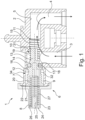
- FIG. 1 shows a simplified sectional view of an advantageous valve device 1 for installation in a tank, for example for windshield washer fluid of a motor vehicle.
- the valve device 1 has a housing 2 which has an inlet connection 3 and an outlet connection 4 for a liquid and/or gaseous medium.
- the inlet connection 3 and the outlet connection 4 are designed as channels in the housing 2 which are aligned parallel to one another and open into a media channel.
- the inlet connection 3 and the outlet connection 4 are aligned radially or perpendicularly to the longitudinal extension of the media channel 5, which in this case runs in a straight line, so that they also open radially into the media channel 5 at an axial distance from one another.
- the media channel 5 is closed at one end on the side of the drain opening 4, and at the other end the media channel 5 leads into a housing projection 6 protruding from the housing 2.
- the housing projection 6 has a housing flange 7 which is formed in one piece with the housing 2 and protrudes in the axial extension of the media channel 5 and which is closed at the front by a cover 8.
- the cover 8 is cup-shaped in longitudinal section, so that the cover 8 together with the housing flange 7 forms an interior 9 which is flush with the media channel 5.
- the housing flange 7 has a cross-section that is larger than that of the media channel 5 running in the housing 2, the media channel 5 itself having two steps 10 and 11 that taper the cross-section in the direction of the drain connection 4.
- the step 10 adjoins the inlet connection 3 on the side of the media channel 5 facing the drain connection 4.
- the step 11 lies between the step 10 and the drain connection 4 in the media channel 5.
- the steps 10 and 11 are formed completely in the media channel 5, so that they each extend completely annularly over the circumference of the media channel 5.
- the stop of step 11 can also extend only partially over the circumference of the media channel 5.
- the optional complete extension is shown in Figure 1 indicated by dashed lines.
- a piston-shaped valve element 12 is arranged, which can be moved axially relative to the media channel 5.
- the valve element 12 has an axial projection 13 at one end, which is designed to penetrate into the media channel 5 in the direction of the outlet connection 4.
- the axial projection 13 has, at a distance from its free end, a step 14 which increases the cross-section and serves as an axial stop for a spring element 15.
- the spring element 15 is designed as a helical spring, which is supported at one end on the step 14 and the other end on the step 11 of the housing 2. The helical spring is held axially prestressed between the valve element 12 and the housing 2, so that the spring element 15 applies a spring force to the valve element 12 in the direction of the cover 8.
- the valve element 12 On the side of the step 14 facing away from the free end face, the valve element 12 has a further step 16 which has a larger cross-section than the step 14. Between the steps 14 and 16, an annular recess 17 is formed as a circumferential groove in the valve element 12. An annular sealing element 18 is arranged in this recess 17 and is held axially positively on the valve element 12 by the steps 14 and 16.
- the sealing element 18 is designed as an elastically deformable sealing element, in particular as an elastomer element, in the present case in the form of an O-ring, the inner diameter of which is smaller than the outer diameter of the smaller step 14.
- the sealing element 18 has a diameter that essentially corresponds to the diameter of the step 10, wherein the valve element 12 can be pushed so far into the media channel 5 with the end 13 that the sealing element 18 is pressed against the step 10, whereby a fluid connection between the inlet connection 3 and the outlet connection 4 is interrupted or the media channel 5 between the inlet opening 3 and the outlet connection 4 is closed.
- the step 10 thus forms a valve seat 19 for the sealing element 18 of the valve element 12.
- the valve element 12 On the end facing away from the axial projection 13, the valve element 12 has an axial receiving recess 20, which is opposite the cup-shaped recess of the cover 8. In addition, this end has a radial projection 21, which extends over the entire circumference of the valve element 12, which is at least substantially rotationally symmetrical.
- the radial projection 21 serves as an axial stop on the end face 22 of the cover 8 facing the housing 2.
- the outer radius of the radial projection 21 is slightly smaller than the inner diameter of the Housing flange 7, so that the valve element 12 can be displaced axially in the housing flange 7, wherein the radial projection 22 serves to radially guide the valve element 12. Because the outer diameter of the radial projection 21 is slightly smaller than the inner diameter of the housing flange 7, a leakage gap is ensured through which a medium can flow past the radial projection 21.
- the cover 8 is cup-shaped and thereby extends the housing projection 7.
- the cover 8 has a cylindrical projection 23 which extends in alignment with the receptacle 20 of the valve element 12 and ends at the projecting end face 22 of the cover 8, which is opposite the housing flange.
- the end of the cover 8 or the projection 23 facing away from the housing flange 7 is closed, which gives the cover 8 its cup shape, with a heat-conducting mandrel 25 being formed in the free and closed end face 24 of the projection 23, which extends as a hollow mandrel into the projection 23 in the direction of the housing flange 7.
- the heat-conducting mandrel 25 is formed coaxially to the projection 23, so that an annular receiving pocket 26 is formed between the heat-conducting mandrel 25 and the projection 23.
- the heat conducting mandrel 25 is open towards the front side 24 so that a medium surrounding the housing 2 can flow into the heat conducting mandrel 25.
- the heat conducting mandrel 25 is closed, in particular solid.
- the heat conducting mandrel 25 is advantageously formed in one piece with the cover 8, wherein the heat conducting mandrel 25 is made of a material with a high thermal conductivity value, such as silver, gold, copper or aluminum.
- a spring element 27 is held axially pre-tensioned between the valve element 12 and the cover 8.
- the spring element 27 is designed as a helical spring, which at one end axially rests against the bottom of the receptacle 20 of the valve element 12, and at the other end against the bottom of the receptacle pocket 26.
- the helical spring is partially inserted into the receptacle pocket 26 or is placed on the heat-conducting mandrel 25 so that the latter extends into the helical spring.
- the coil spring is made of a thermally activatable material, for example a shape memory alloy, so that the spring element 27 has two states with different spring forces. Below an activation temperature, the spring element 27 has a first spring force that is lower than the spring force of the spring element 15. In the first state, the spring element 15 thus pushes the valve element 12 into the figure 1 shown position, in which the sealing element 18 is arranged at a distance from the sealing seat formed by the step 10 in the media channel 5, so that the connection between the inlet connection 3 and the outlet connection 4 is established and a medium supplied to the inlet connection flows through the valve device, as indicated by the arrows in Figure 1 shown.
- the medium is, for example, the coolant from a coolant circuit of the motor vehicle not shown in detail here.
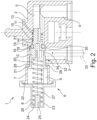
- the spring element 27 If the activation temperature of the spring element 27 is exceeded, the spring element 27 is activated and thus has a spring force that is greater than that of the spring element 15. As a result, the valve element 12 is pushed by the spring force of the now activated spring element 27 against the spring force of the spring element 15 with the sealing element 18 against the valve seat 19, so that the media channel 5 is closed and the connection between the inlet connection 3 and the outlet connection 4 is interrupted, as in Figure 2 shown as an example.
- FIG. 2 shows the valve device 1 from Figure 1 in the second switching state, also in a sectional view. From Figure 1 already known elements are therefore provided with the same reference numerals.
- the valve device 1 is arranged or can be arranged in a tank which serves to store a particularly liquid operating medium, such as an oil tank, fuel tank, exhaust aftertreatment agent tank or windshield washer fluid tank.
- the housing 2 of the valve device 1 is thus surrounded by a particularly tempered medium when used as intended.
- the advantageous heat-conducting mandrel 25 also allows the medium to reach an area within the spring element 23, so that the spring element 23 is exposed to the thermal energy of the medium surrounding the valve device 1 both radially from the outside and radially from the inside.
- the radial projection 21 of the valve element 12 can be displaced axially between the cover 8 and a step 29 formed in the housing flange 7.
- the radial projection 21 and the step 29 are designed in such a way that they limit maximum deformation of the sealing element 18. This ensures that the sealing element 18 fits tightly on the housing 2 when the activation temperature of the spring element 27 has been exceeded, and at the same time it is ensured that the sealing element 18 is not overloaded, thereby ensuring a long service life of the valve device 1.
- the fact that the valve element 12 is located in the area of the inlet connection 3 ensures that the sealing element 18 is also permanently wetted by the medium supplied through the inlet connection 3, so that the sealing element 18 is prevented from drying out. For this purpose, even in the closed state of the valve device 1, as in Figure 2 shown, an opening 30 between the valve element 12 and the housing 2, which leads to the sealing element 18.
- the axial projection 13 of the valve element 12 is furthermore designed to be so long that the helical spring of the spring element 15 is always guided or held and supported radially over its entire length either by the end 13 of the valve element 12 and/or by the inside of the media channel 5 in the housing 2.
- the axial projection 13 extends into the area of the media channel 5 downstream of the step 10, in which the helical spring of the spring element 15 is guided on an inner wall section 31 of the media channel 5.
- the Figure 3 shows the valve device 1 in a simplified perspective exploded view.
- the advantageous design of the valve device 1 also allows for easy assembly. Due to the cross-section of the media channel 5, which increases in the direction of the cover 8, and the cross-section of the Valve element 12, which also increases substantially in the direction of the cover 8, ensures that during assembly, first the spring element 15, then the valve element 12 with the sealing ring 10 and then the spring element 27 can be introduced through the housing flange 7 into the media channel 5.
- the advantageous receiving pocket 26 in the cover 8 ensures that when the cover 8 is pushed onto the spring element 27 and the spring elements 27 and 15 are thereby pre-tensioned, in particular the spring element 27 cannot break out sideways or become detached from the cover 8 during assembly.
- the valve device 1 also has an advantageous assembly aid 34, which makes it easier for the fitter, for example, to hold the valve element 12 pushed into the interior 9 of the housing flange 7 against the spring force of the spring element 15 when assembling the valve device 1, so that the spring element 27 and in particular the cover 8 can be fastened to the free end of the housing flange 7 without any special effort.
- the assembly aid 34 in particular prevents one or a high spring tension of the spring elements 15 and 27 from acting on the cover 8 when assembling the cover 8, so that the cover 8 can also be glued or welded to the housing flange 7, for example, without additional clamping devices being required on the cover 8 and/or housing flange 7.
- the assembly aid 34 has a circumferential groove 32 in the outer side of the valve element 12, which lies axially between the step 16 and the radial projection 21 of the valve element 12.
- the circumferential groove 32 is formed close to the step 16 in the axial extension of the valve element 12.
- the position of the circumferential groove 32 is selected in particular such that in the inserted state of the valve element 12, in which it rests in particular on the sealing surface 19, the circumferential groove 32 is at the level of the inlet connection 3, as in Figure 2 shown.
- a tool 33 can be inserted through the inlet connection 3 into the housing 2 in such a way that it engages in the circumferential groove 32, as shown for example in Figure 2 shown with dashed lines.
- a tool such as an open-end wrench or spanner can be used, which can be pushed onto the valve element 12 in the area of the circumferential groove 32, so that the open-end wrench lies in the circumferential groove 32 in an axially positive manner and thereby counteracts the spring force of the spring element 15 and thereby prevents the valve element 12 from being displaced in the direction of the cover 8.
- the tool 33 is removed again and thereby the spring force of the spring element 15 is released or exerted on the valve element 12.
Landscapes
- Engineering & Computer Science (AREA)
- General Engineering & Computer Science (AREA)
- Mechanical Engineering (AREA)
- Temperature-Responsive Valves (AREA)
Description
- Die Erfindung betrifft eine Ventileinrichtung, insbesondere ein Wischwasserventil, mit einem Gehäuse, das einen Zulaufanschluss, einen Ablaufanschluss und einen den Zulaufanschluss mit dem Ablaufanschluss verbindenden Medienkanal aufweist, und mit einem verlagerbaren Ventilelement, das durch ein erstes Federelement gegen einen in dem Gehäuse ausgebildeten Ventilsitz gedrängt ist, um den Medienkanal zu verschließen, und das durch ein zweites Federelement von dem Ventilsitz wegbewegbar ist, um den Medienkanal zu öffnen, wobei das erste Federelement aus einem thermisch aktivierbaren Material gefertigt ist und in einem deaktivierten Zustand eine erste Federkraft aufweist, die kleiner ist als die des zweiten Federelements, und in einem aktivierten Zustand eine zweite Federkraft, die derart größer ist als die des zweiten Federelements, dass das Ventilelement zum Schließen des Medienkanals verlagert wird, wobei das erste Federelement zumindest abschnittsweise in einem hohlzylinderförmigen, nach außen von dem Gehäuse vorstehenden Gehäusevorsprung des Gehäuses gehalten ist. Dabei ist an dem Ventilelement ein insbesondere ringförmiges Dichtelement angeordnet, das dazu ausgebildet ist, mit dem Ventilsitz dichtend zusammenzuwirken.
- Ventileinrichtungen der eingangs genannten Art sind aus dem Stand der Technik bereits bekannt. So offenbart beispielsweise die Offenlegungsschrift
EP 3 455 529 A1 eine Ventileinrichtung der gattungsgemäßen Art. Weil derartige Ventileinrichtungen ein thermisch aktivierbares Federelement aufweisen, das in Abhängigkeit von einer auf das Ventil einwirkenden Temperatur schaltet, werden sie oft als Thermoventil oder Thermoventileinrichtung bezeichnet. So ist es bekannt, eine derartige Ventileinrichtung in einem Tank eines Kraftfahrzeugs mit flüssigem Medium, wie beispielsweise Scheibenwischwasser, Kühlmittel oder Schmiermittel oder dergleichen, anzuordnen, sodass das Gehäuse der Ventileinrichtung dem Medium und damit der Temperatur des Mediums ausgesetzt ist. Das thermisch aktivierbare Federelement ist dabei vorteilhafterweise in einem Gehäusevorsprung angeordnet, der von dem übrigen Gehäuse der Ventileinrichtung vorsteht, sodass das Federelement zu möglichst großen Teilen außerhalb des Gehäuses und innerhalb des Tanks liegt, sodass die Wärmeenergie des Mediums, in welchem die Ventileinrichtung angeordnet ist, schnell und mit geringen Verlusten auf das Federelement übertragen wird, sodass dieses zeitnah seine Aktivierungstemperatur erreicht und schaltet, sodass es die erhöhte Federkraft aufweist, durch welche das Ventilelement in dem Medienkanal gegen den Ventilsitz und entgegen der Federkraft des zweiten Federelements, das als Rückstellfeder wirkt, verlagert wird, sodass der Medienkanal dicht verschlossen und damit die Verbindung zwischen Zulaufanschluss und Ablaufanschluss sicher unterbrochen ist. Zur einfachen Montage ist in dem oben genannten Stand der Technik vorgesehen, dass das Gehäuse mehrteilig ausgebildet ist, wobei eine Teilung zwischen Zulaufanschluss und Ablaufanschluss vorgesehen ist. Die OffenlegungsschriftJP 2006 138235 A - Der Erfindung liegt die Aufgabe zugrunde, eine verbesserte Ventileinrichtung zu schaffen, welche mit einfachen Mitteln einen dauerhaft sicheren Betrieb der Ventileinrichtung gewährleistet.
- Die der Erfindung zugrundeliegende Aufgabe wird durch eine Ventileinrichtung mit den Merkmalen des Anspruchs 1 gelöst. Diese hat den Vorteil, dass mit einer einfachen konstruktiven Maßnahme eine Überanspruchung des Dichtelements sicher verhindert ist. Dadurch wird gewährleistet, dass das Dichtelement nicht aufgrund einer zu starken elastischen Verformung überansprucht und beschädigt werden kann. Darüber hinaus ergibt sich der Vorteil, dass das Dichtelement einfach und unter geringer elastischer Verformung auf dem Ventilelement anordenbar ist. Erfindungsgemäß ist dazu vorgesehen, dass das Ventilelement axial beabstandet von dem Dichtelement in Richtung zu dem Gehäusevorsprung zumindest einen Radialvorsprung aufweist, der dazu ausgebildet ist, mit zumindest einem in dem Gehäuse axial beabstandet zu dem Ventilsitz ausgebildeten Axialanschlag in Richtung des Ventilsitzes zur Begrenzung einer maximalen Verformung des Dichtelements zusammenzuwirken. Dadurch, dass der Radialvorsprung in Richtung zu dem Gehäusevorsprung beabstandet zu dem Dichtelement an dem Ventilelement ausgebildet ist, kann das Dichtelement einfach von der freien Stirnseite, die dem Medienkanal zugeordnet ist, auf das Ventilelement aufgeschoben und befestigt werden. Dadurch, dass der Radialvorsprung auf der abgewandten Seite angeordnet oder ausgebildet ist, reicht auf der dem Medienkanal zugewandten Seite des Ventilelements ein kleiner Radialvorsprung aus, welcher das Dichtelement auf dem Ventilelement formschlüssig axial zurückhält, und über welchen das Dichtelement bei seiner Montage unter elastischer Verformung geschoben werden muss. Dadurch wird das Dichtelement bei der Montage geschont und dennoch ein sicherer Sitz sowie ein sicheres Dichten in der Ventileinrichtung gewährleistet. Durch den vorteilhaften Radialvorsprung ist die Begrenzung der Verformung des Dichtelements einfach einerseits und der Axialanschlag und der Ventilsitz andererseits derart ausgebildet, dass der Abstand zwischen dem Axialanschlag und dem Ventilsitz geringfügig kleiner ist im Vergleich zu dem axialen Abstand zwischen Radialvorsprung und Ventilelement, sodass ein elastisches Verformen des Dichtelements an dem Dichtsitz gewährleistet, eine Überanspruchung des Dichtelements jedoch verhindert ist.
- Gemäß einer bevorzugten Weiterbildung der Erfindung ist das Dichtelement als Elastomerelement, beispielsweise als O-Ring ausgebildet. Dadurch kann auf bereits bekannte Ausführungsform des Dichtelements zurückgegriffen werden, die in der erfindungsgemäßen ausgebildeten Ventileinrichtung vor einer Überlastung sicher geschützt ist. Durch die Ausbildung als O-Ring ergibt sich außerdem eine einfache Montage, wie zuvor bereits erwähnt, und eine kostengünstige Realisierung der Ventileinrichtung.
- Besonders bevorzugt weist das Ventilelement eine Umfangsnut zur Aufnahme des Dichtelements auf. Dadurch ist eine sichere Arretierung des Dichtelements auf dem beziehungsweise an dem Ventilelement gewährleistet. Insbesondere weist die Umfangsnut einen Innendurchmesser auf, der zumindest im Wesentlichen dem Innendurchmesser des Dichtelements im entspannten Zustand entspricht, sodass das Ventilelement insbesondere vorspannungsfrei in der Umfangsnut gehalten ist, sodass es bei Nicht-Gebrauch nicht belastet ist. Insbesondere ist der Innendurchmesser der Umfangsnut derart gewählt, dass das Dichtelement radial über das Ventilelement vorsteht, um den Anlagekontakt mit dem Ventilsitz sicher zu gewährleisten. Durch die vorteilhafte Ausbildung der Ventileinrichtung ist gewährleistet, dass die Umfangsnut zumindest auf der dem Ventilsitz zugewandten Seite eine nur geringe Seitenwandhöhe aufweisen muss, weil das Ventilelement an dieser Seite keinen Axialanschlag aufweist oder aufweisen muss. Dadurch ist eine einfache Montage des Dichtelements in der Umfangsnut gewährleistet.
- Gemäß einer bevorzugten Weiterbildung der Erfindung weist das Gehäuse einen weiteren Axialanschlag für den Radialvorsprung auf, der beabstandet zu dem Axialanschlag derart angeordnet ist, dass der Radialvorsprung axial nur zwischen den Axialanschlägen verschiebbar ist. Damit weist das Ventilelement nur einen Radialvorsprung auf, der jedoch in beide Schieberichtungen des Ventilelements, also in der Schieberichtung in Richtung des Ventilsitzes sowie in der entgegengesetzten Richtung, zusammenwirkt, um den Bewegungsweg des Ventilelements in der Ventileinrichtung beziehungsweise in dem Gehäuse der Ventileinrichtung zu begrenzen. Dadurch ist eine einfache konstruktive Ausgestaltung des Ventilelements sowie des Gehäuses gewährleistet.
- Vorzugsweise ist der weitere Axialanschlag in oder an dem Gehäusevorsprung des Gehäuses ausgebildet. Damit ragt das Ventilelement mit dem Radialvorsprung axial gesehen bis zu oder bis in den Gehäusevorsprung, wodurch eine kompakte Ausgestaltung der Ventileinrichtung ermöglicht ist.
- Gemäß einer bevorzugten Weiterbildung der Erfindung weist der Gehäusevorsprung an seiner freien, von dem Gehäuse abgewandten Seite einen Wärmeleitdorn auf, der in den Gehäusevorsprung hinein in Richtung des Ventilelements vorsteht und dadurch eine ringförmige Aufnahmetasche für einen Längsabschnitt des Federelements in dem Gehäusevorsprung bildet. Dadurch, dass der Wärmeleitdorn in den Gehäusevorsprung hinein vorsteht, wird der in der Aufnahmetasche befindliche Abschnitt des Federelements sowohl von außen, also durch eine Außenwand des Gehäusevorsprungs, als auch durch den Wärmeleitdorn von innen mit der Temperatur des Mediums beaufschlagt. Ist der Wärmeleitdorn massiv ausgebildet, so erfolgt die Wärmeleitung durch das Material des Wärmeleitdorns in den Innenraum des Gehäuses. Durch eine vorteilhafte Materialwahl ist hierbei ein guter Wärmeübergang beziehungsweise eine hohe Wärmeleitfähigkeit gewährleistet, die das frühzeitige Schalten der Ventileinrichtung ermöglicht. Hierdurch ergibt sich der Vorteil, dass ein Wärmeeintrag in das erste Federelement durch den Gehäusevorsprung hindurch verbessert wird. Insbesondere wird das Federelement nunmehr nicht nur von einer Seite, nämlich von außerhalb des Gehäusevorsprungs mit der Wärmeenergie des umgebenden Mediums beaufschlagt, sondern auch innerhalb des Gehäusevorsprungs. Dadurch ergibt sich, dass eine frühzeitige Schaltung beziehungsweise Aktivierung des thermisch sensiblen ersten Federelements (Thermofederelement) erfolgt, sodass ein Schalten der Ventileinrichtung zeitnah nach Erreichen der Aktivierungstemperatur durch das umgebende Medium gewährleistet ist. Gemäß einer bevorzugten Weiterbildung der Erfindung ist das erste Federelement als Schraubenfeder ausgebildet, die an dem Gehäusevorsprung auf dem Wärmeleitdorn aufgesteckt ist. Durch die Ausbildung als Schraubenfeder weist das Federelement im Querschnitt einen ringförmigen, insbesondere kreisringförmigen Querschnitt auf, dessen Innendurchmesser größer ist als der Außendurchmesser des Wärmeleitdorns, sodass die Schraubenfeder auf dem Wärmeleitdorn aufschiebbar und in die Aufnahmetasche einschiebbar ist. Dadurch ergibt sich neben der zuvor beschriebenen vorteilhaften Wärmeübertragung auf das erste Federelement außerdem der Vorteil einer sicheren axialen Führung und Ausrichtung der Schraubenfeder in dem Gehäuse der Ventileinrichtung. Außerdem wird durch die vorteilhafte Ausbildung des ersten Federelements mithilfe des Wärmeleitdorns die Montage der Ventileinrichtung erleichtert. Weiterhin ist bevorzugt vorgesehen, dass der Wärmeleitdorn als becherförmiger Hohldorn zu der Stirnseite des Gehäusevorsprungs hin offen ausgebildet ist. Damit dringt das umgebende Medium auch in den Wärmeleitdorn selbst ein, sodass das umgebende Medium das erste Federelement nicht nur von außen umgibt, sondern auch innerhalb der Schraubenfeder, nämlich innerhalb des hohlen Bereichs des Wärmeleitdorns vorhanden ist. Dadurch erfolgt ein noch direkterer Wärmeübergang von dem Medium in das Federelement beziehungsweise in die Schraubenfeder von zwei Seiten, nämlich von außen und von innen, sodass ein noch früheres Schalten der Ventileinrichtung gewährleistet ist. Vorzugsweise ist der Wärmeleitdorn aus einem Material mit einem hohen Wärmeleitfähigkeitswert gefertigt. Dazu ist der Wärmeleitdorn beispielsweise aus Aluminium, Silber, Kupfer oder Gold gefertigt. Durch die vorteilhafte Materialwahl wird die Schaltzeit der Ventileinrichtung, nachdem das umgebende Medium die Aktivierungstemperatur erreicht hat, weiter optimiert beziehungsweise verkürzt. Besonders bevorzugt ist der Ventilsitz als eine Fase in dem Medienkanal ausgebildet. Durch die Fase ist ein sicheres Andrücken des Ventilelements, insbesondere des Dichtelements auf dem Ventilelement gewährleistet, wodurch eine sichere Abdichtung des Medienkanals in aktiviertem Zustand des ersten Federelements gewährleistet ist.
- Darüber hinaus ist die Ventileinrichtung bevorzugt derart ausgebildet, dass der Zulaufanschluss und/oder der Ablaufanschluss radial in den Medienkanal münden. Dadurch ist eine vorteilhafte Anordnung der Anschlüsse und des Medienkanals sowie des Ventilelements in dem Gehäuse gewährleistet, bei welcher der Zulaufanschluss durch das Ventilelement fluidtechnisch sicher von dem Ablaufanschluss trennbar ist.
- Weiterhin ist bevorzugt vorgesehen, dass das Ventilelement zumindest im Wesentlichen unabhängig von seiner Schiebestellung zumindest abschnittsweise im Bereich des Zulaufanschluss, also im Bereich des Medienkanals, in welchem der Zulaufanschluss in dem Medienkanal mündet, in dem Medienkanal liegt. Damit liegt das Ventilelement stets im Bereich des Zulaufanschluss sodass es von dem zu regelnden beziehungsweise schaltenden Medium umspült oder benetzt ist, wodurch zum einen der Druck des zu schaltenden Mediums ebenfalls auf das Ventilelement in Schließrichtung wirkt, und wodurch zum anderen durch das zugeführte Medium verhindert wird, dass insbesondere ein optional vorgesehenes Dichtelement austrocknet. Weiterhin ist bevorzugt der Gehäusevorsprung von einem Gehäuseflansch, der von dem übrigen Gehäuse vorsteht, und einem stirnseitig an dem Gehäuseflansch angeordneten Deckel gebildet, wobei der Wärmeleitdorn an dem Deckel angeordnet ist. Durch die zweiteilige Ausbildung des Gehäusevorsprungs wird eine einfache Montierbarkeit der Ventileinrichtung geboten. So können das zweite Federelement, das Ventilelement und das erste Federelement nacheinander durch den Gehäuseflansch in den Medienkanal eingeführt und anschließend der Medienkanal beziehungsweise das Gehäuse durch den Deckel verschlossen werden. Durch die vorteilhafte Ausbildung des Wärmeleitdorns und die dadurch verfügbare Aufnahmetasche für das erste Federelement, insbesondere in Form der Schraubenfeder, ist bei der Montage eine sichere und einfache Führung des Deckels zu dem Gehäuseflansch hin gewährleistet, bei welcher insbesondere die Schraubenfeder an einem seitlichen Ausknicken oder Verkanten bei einer Montage gehindert ist. Besonders bevorzugt ist der Wärmeleitdorn einstückig mit dem Deckel ausgebildet, sodass eine vorteilhafte Wärmeleitung durch den Deckel in dem Wärmeleitdorn gewährleistet ist. Vorzugsweise ist der Deckel mit dem Gehäuseflansch stoffschlüssig verbunden, sodass zum einen die Dichtheit des Gehäuses zu dem umgebenden Medium gewährleistet ist, und sodass zum anderen auch an der Schnittstelle zwischen Deckel und Gehäuseflansch eine vorteilhafte Wärmeleitung gewährleistet ist, durch welche die Wärmeenergie des umgebenden Mediums auch im Bereich des Gehäuseflanschs auf das darin angeordnete Federelement wirkt, um ein frühzeitiges Schalten der Ventileinrichtung zu ermöglichen.
- Weiterhin ist bevorzugt vorgesehen, dass der Deckel den weiteren Axialanschlag bildet. Damit stößt der Radialvorsprung des Ventilelements in Richtung des Gehäusevorsprungs an dem Deckel an, um den Verschiebeweg des Ventilelements zu begrenzen. Durch die Anlage an dem Deckel ist eine einfache und sichere Begrenzung des Verschiebewegs gewährleistet, wobei hier der Verschiebeweg durch eine entsprechende Ausformung des Deckels einfach und kostengünstig an unterschiedliche Randbedingungen angepasst werden kann.
- Besonders bevorzugt weist das Ventilelement eine becherförmige Aufnahmevertiefung auf, in welcher die Schraubenfeder beziehungsweise das erste Federelement bereichsweise angeordnet ist. Durch die Aufnahmevertiefung ist eine sichere Montage der Schraubenfeder einerseits sowie eine sichere Betätigung des Ventilelements andererseits durch das erste Federelement gewährleistet. Die Schraubenfeder oder das erste Federelement ist vorgespannt zwischen dem Ventilelement und dem Deckel des Gehäuseflanschs beziehungsweise dem Gehäusevorsprung gehalten, unabhängig davon, ob es aktiviert oder nicht aktiviert ist. Dadurch ist eine eindeutige Lagerstellung des Ventilelements gewährleistet, weil es stets von dem ersten und von dem zweiten Federelement mit einer Federkraft beaufschlagt wird, unabhängig von dem Aktivierungszustand des ersten Federelements.
- Gemäß einer bevorzugten Weiterbildung der Erfindung weist das Ventilelement einen in Richtung des ersten Federelements größer werdenden Querschnitt auf und der Medienkanal einen in Richtung des Deckels größer werdenden Querschnitt, sodass das Ventilelement durch den Gehäuseflansch in den Medienkanal axial einführbar ist. Die Querschnittsvergrößerung in Richtung des Deckels von Ventilelement und Medienkanal gewährleistet eine einfache Montage der Ventileinrichtung. Optional weisen das Ventilelement und/oder der Medienkanal einen oder mehrere Hinterschnitte auf - in Einführrichtung in den Medienkanal gesehen - jedoch ohne, dass das Ventilelement den Medienkanal in Einschubrichtung hintergreift. Vielmehr dienen dann die Hinterschnitte beziehungsweise Aussparungen oder Verjüngungen zur verbesserten Medienleitung.
- Vorzugsweise ist zwischen dem Ventilelement und dem Gehäuseflansch ein Leckagespalt vorhanden. Der Leckagespalt gewährleistet, dass etwas von dem zu regelnden Medium, das durch den Zulaufanschluss in den Medienkanal strömt, in den Innenraum des Gehäuseflanschs gelangt, in welchem auch das erste Federelement liegt. Dadurch ist gewährleistet, dass der Gehäuseflansch mit Medium gefüllt ist, welches den Wärmeübergang von dem Gehäuseflansch und insbesondere auch von dem Wärmeleitdorn in das erste Federelement verbessert. Dadurch, dass nur ein Leckagespalt vorhanden ist, also ein Spalt, der nur einen geringen Strömungsfluss zulässt, befindet sich in dem Gehäuseflansch im Wesentlichen stehendes Medium, dessen Temperatur sich schnell mit der Temperatur des umgebenden Mediums verändern und dadurch das erste Federelement schalten kann.
- Weiterhin ist bevorzugt vorgesehen, dass der Zulaufanschluss zwischen der Stufe und dem Ventilsitz in den Medienkanal mündet. Damit liegt der Zulaufanschluss zwischen dem Ventilsitz und dem Radialvorsprung des Ventilelements, sodass gewährleistet ist, dass im geschlossenen Zustand der Ventileinrichtung, wenn das Ventilelement gegen den Ventilsitz gedrückt ist, von dem zu schaltenden/zu regelnden Medium umströmt ist, sodass das Medium durch den zuvor genannten optionalen Leckagespalt in den Gehäusevorsprung eindringen kann.
- Weiterhin ist bevorzugt das Dichtelement axial beabstandet von dem Radialvorsprung an dem Ventilelement angeordnet, sodass Dichtelement und Radialvorsprung unabhängig voneinander wirken und insbesondere die obenstehende Funktion gewährleistet wird, dass eine maximale elastische Verformung des Dichtelements durch den Radialvorsprung begrenzt wird.
- Weiterhin ist bevorzugt der die Schraubenfeder enthaltene Raum des Gehäuses fluidtechnisch durch die Leckageöffnung mit dem Medienkanal, insbesondere mit dem Zulaufanschluss dauerhaft verbunden. Hierdurch ergibt sich der oben bereits genannte Vorteil, dass sich in dem Innenraum des Gehäusevorsprungs ein Medium befindet, welches zur Wärmeleitung in das erste Federelement in vorteilhafter Weise einwirkt.
- Vorzugsweise ist das zweite Federelement als Schraubenfeder ausgebildet, einendig auf einen Axialvorsprung des Ventilelements aufgeschoben und axial zwischen dem Ventilelement und dem Gehäuse vorgespannt gehalten. Das zweite Federelement stützt sich somit axial an dem Gehäuse einerseits und an dem Ventilkörper andererseits ab, sodass der Ventilkörper durch das zweite Federelement mit einer Vorspannkraft beaufschlagt ist. Durch den Axialvorsprung ist eine vorteilhafte Radialführung der Schraubenfeder an dem Ventilelement gewährleistet. Vorzugsweise ragt der Axialvorsprung derart weit in den Medienkanal hinein, wenn sich das erste Federelement im deaktivierten Zustand befindet, dass das freie Ende des Axialvorsprungs einem Innenwandabschnitt des Medienkanals, an welchem die Schraubenfeder radial außen geführt ist, gegenüberliegt, sodass unabhängig von der Schiebestellung des Ventilelements die Schraubenfeder stets radial innen und/oder außen in der Ventileinrichtung geführt ist, sodass diese niemals ausknicken, verklemmen oder verspannen kann. Weiterhin ist bevorzugt vorgesehen, dass die Schraubenfedern axial fluchtend zu dem Medienkanal ausgerichtet und das Ventilelement axial in dem Medienkanal verschiebbar gelagert sind. Damit ergibt sich eine vorteilhafte Montage.
- Vorzugsweise steht der Axialvorsprung zumindest im Wesentlichen von dem Dichtelement axial vor und ist insbesondere als radiale Führung für das zweite Federelement, wie vorstehend bereits erwähnt, ausgebildet. Dadurch, dass der Axialvorsprung von dem Dichtelement vorsteht, liegt das Dichtelement zurückgesetzt von dem freien Ende des Ventilelements und damit auch beabstandet von der Schraubenfeder beziehungsweise dem zweiten Federelement. Dadurch ist das Dichtelement in einem sicheren Bereich gehalten, in welchem es insbesondere nicht durch das zweite Federelement im Betrieb beschädigt werden kann.
- Im Folgenden soll die Erfindung anhand der Zeichnung näher erläutert werden. Dazu zeigen
- Figur 1
- eine vorteilhafte Ventileinrichtung in einem ersten Schaltzustand,
- Figur 2
- die Ventileinrichtung in einem zweiten Schaltzustand, jeweils in einer vereinfachten Längsschnittdarstellung, und
- Figur 3
- eine perspektivische Explosionsdarstellung der Ventileinrichtung.
-
Figur 1 zeigt in einer vereinfachten Schnittdarstellung eine vorteilhafte Ventileinrichtung 1 zum Einbau in einem Tank, beispielsweise für Scheibenwischwasser eines Kraftfahrzeugs. Die Ventileinrichtung 1 weist ein Gehäuse 2 auf, das einen Zulaufanschluss 3 und einen Ablaufanschluss 4 für ein flüssiges und/oder gasförmiges Medium aufweist. Der Zulaufanschluss 3 und der Ablaufanschluss 4 sind dabei als parallel zueinander ausgerichtete Kanäle in dem Gehäuse 2 ausgebildet, die in einen Medienkanal münden. Dabei sind Zulaufanschluss 3 und Ablaufanschluss 4 radial beziehungsweise senkrecht zur Längserstreckung des vorliegend geradlinig verlaufenden Medienkanals 5 ausgerichtet, sodass sie auch radial in den Medienkanal 5 axial beabstandet zueinander münden. Der Medienkanal 5 ist einendig an der Seite der Ablauföffnung 4 geschlossen ausgebildet, und anderendig führt der Medienkanal 5 in einen von dem Gehäuse 2 vorstehenden Gehäusevorsprung 6. Der Gehäusevorsprung 6 weist einen einstückig mit dem Gehäuse 2 ausgebildeten und in Axialerstreckung des Medienkanals 5 vorstehenden Gehäuseflansch 7 auf, der stirnseitig durch einen Deckel 8 verschlossen ist. Der Deckel 8 ist im Längsschnitt becherförmig ausgebildet, sodass der Deckel 8 zusammen mit dem Gehäuseflansch 7 einen Innenraum 9 ausbildet, der mit dem Medienkanal 5 fluchtet. - Der Gehäuseflansch 7 weist einen Querschnitt auf, der größer ist als der des in dem Gehäuse 2 verlaufenden Medienkanals 5, wobei der Medienkanal 5 selbst zwei den Querschnitt in Richtung des Ablaufanschlusses 4 verjüngende Stufen 10 und 11 aufweist. Die Stufe 10 grenzt dabei an den Zulaufanschluss 3 auf der dem Ablaufanschluss 4 zugewandten Seite des Medienkanals 5 an. Die Stufe 11 liegt zwischen der Stufe 10 und dem Ablaufanschluss 4 in dem Medienkanal 5. Vorzugsweise sind die Stufen 10 und 11 vollumfänglich in dem Medienkanal 5 ausgebildet, sodass sie sich jeweils über den Umfang des Medienkanals 5 vollständig ringförmig erstrecken. In
Figur 1 ist beispielhaft dargestellt, dass sich der Anschlag der Stufe 11 auch nur bereichsweise über den Umfang des Medienkanals 5 erstrecken kann. Die optionale vollständige Erstreckung ist inFigur 1 durch gestrichelte Linien angedeutet. - Im Bereich des Zulaufanschluss 3 und des Gehäusevorsprungs 6 ist ein kolbenförmiges Ventilelement 12 angeordnet, das axial zu dem Medienkanal 5 verschiebbar ist. Das Ventilelement 12 weist einendig einen Axialvorsprung 13 auf, der dazu ausgebildet ist, in den Medienkanal 5 in Richtung des Ablaufanschlusses 4 einzudringen. Der Axialvorsprung 13 weist beabstandet zu seinem freien Ende eine den Querschnitt vergrößernde Stufe 14 auf, die als Axialanschlag für ein Federelement 15 dient. Das Federelement 15 ist vorliegend als Schraubenfeder ausgebildet, die sich einendig an der Stufe 14 und anderendig an der Stufe 11 des Gehäuses 2 abstützt. Die Schraubenfeder ist dabei axial vorgespannt zwischen dem Ventilelement 12 und dem Gehäuse 2 gehalten, sodass das Federelement 15 das Ventilelement 12 in Richtung des Deckels 8 mit einer Federkraft beaufschlagt.
- Auf der von der freien Stirnseite abgewandten Seite der Stufe 14 weist das Ventilelement 12 eine weitere Stufe 16 auf, die einen größeren Querschnitt aufweist, als die Stufe 14. Zwischen den Stufen 14 und 16 ist eine ringförmige Vertiefung 17 als Umfangsnut in dem Ventilelement 12 ausgebildet. In dieser Vertiefung 17 ist ein ringförmiges Dichtelement 18 angeordnet und durch die Stufen 14 und 16 axial formschlüssig an dem Ventilelement 12 gehalten. Das Dichtelement 18 ist dabei als elastisch verformbares Dichtelement, insbesondere als Elastomerelement, vorliegend in Form eines O-Rings ausgebildet, dessen Innendurchmesser kleiner ist als der Außendurchmesser der kleineren Stufe 14.
- Das Dichtelement 18 weist dabei einen Durchmesser auf, der im Wesentlichen dem Durchmesser der Stufe 10 entspricht, wobei das Ventilelement 12 derart weit in den Medienkanal 5 mit dem Ende 13 hineinschiebbar ist, dass das Dichtelement 18 gegen die Stufe 10 gedrückt wird, wodurch eine fluidtechnische Verbindung zwischen dem Zulaufanschluss 3 und dem Ablaufanschluss 4 unterbrochen beziehungsweise der Medienkanal 5 zwischen Zulauföffnung 3 und Ablaufanschluss 4 geschlossen wird. Die Stufe 10 bildet somit einen Ventilsitz 19 für das Dichtelement 18 des Ventilelements 12.
- Auf dem von dem Axialvorsprung 13 abgewandten Ende weist das Ventilelement 12 eine axiale Aufnahmevertiefung 20 auf, welche der becherförmigen Vertiefung des Deckels 8 gegenüberliegt. Darüber hinaus weist dieses Ende einen Radialvorsprung 21 auf, der sich über den gesamten Umfang des Ventilelements 12, das zumindest im Wesentlichen rotationssymmetrisch ausgebildet ist, erstreckt. Der Radialvorsprung 21 dient als Axialanschlag an der dem Gehäuse 2 zugewandten Stirnseite 22 des Deckels 8. Der Außenradius des Radialvorsprungs 21 ist dabei geringfügig kleiner als der Innendurchmesser des Gehäuseflansches 7, sodass das Ventilelement 12 axial in dem Gehäuseflansch 7 verlagerbar ist, wobei der Radialvorsprung 22 zur radialen Führung des Ventilelements 12 dient. Dadurch, dass der Außendurchmesser des Radialvorsprungs 21 jedoch geringfügig kleiner ist als der Innendurchmesser des Gehäuseflansches 7 ist ein Leckagespalt gewähreistet, durch welchen ein Medium an dem Radialvorsprung 21 vorbei strömen kann.
- Der Deckel 8 ist becherförmig ausgebildet und verlängert dadurch den Gehäusevorsprung 7. Dazu weist der Deckel 8 einen zylinderförmigen Vorsprung 23 auf, der sich fluchtend zu der Aufnahme 20 des Ventilelements 12 erstreckt und an der auskragenden Stirnseite 22 des Deckels 8, welche dem Gehäuseflansch gegenüberliegt, endet. Das von dem Gehäuseflansch 7 abgewandte Ende des Deckels 8 beziehungsweise des Vorsprungs 23 ist geschlossen ausgebildet, wodurch der Deckel 8 seine Becherform erhält, wobei in der freien und geschlossenen Stirnseite 24 des Vorsprungs 23 ein Wärmeleitdorn 25 ausgebildet ist, der als Hohldorn sich in Richtung des Gehäuseflansches 7 in den Vorsprung 23 hinein erstreckt. Der Wärmeleitdorn 25 ist koaxial zu dem Vorsprung 23 ausgebildet, sodass zwischen dem Wärmeleitdorn 25 und dem Vorsprung 23 eine ringförmige Aufnahmetasche 26 gebildet ist. Der Wärmeleitdorn 25 ist zur Stirnseite 24 hin offen ausgebildet, sodass ein das Gehäuse 2 umgebendes Medium in den Wärmeleitdorn 25 hinein strömen kann. Gemäß einem alternativen Ausführungsbeispiel ist der Wärmeleitdorn 25 geschlossen, insbesondere massiv ausgebildet. Vorteilhafterweise ist der Wärmeleitdorn 25 einstückig mit dem Deckel 8 ausgebildet, wobei der Wärmeleitdorn 25 aus einem Material mit einem hohen Wärmeleitfähigkeitswert, wie beispielsweise aus Silber, Gold, Kupfer oder Aluminium gefertigt ist.
- Zwischen dem Ventilelement 12 und dem Deckel 8 ist ein Federelement 27 axial vorgespannt gehalten. Dazu ist das Federelement 27 als Schraubenfeder ausgebildet, die einendig an dem Boden der Aufnahme 20 des Ventilelements 12 axial anliegt, und anderendig an dem Boden der Aufnahmetasche 26. Dazu ist die Schraubenfeder bereichsweise in die Aufnahmetasche 26 einbeziehungsweise auf den Wärmeleitdorn 25 aufgesteckt, sodass sich dieser in die Schraubenfeder hinein erstreckt.
- Die Schraubenfeder ist aus einem thermisch aktivierbaren Material, beispielsweise aus einer Formgedächtnislegierung, gefertigt, sodass das Federelement 27 zwei Zustände mit unterschiedlichen Federkräften aufweist. Unterhalb einer Aktivierungstemperatur weist das Federelement 27 eine erste Federkraft auf, die niedriger ist als die Federkraft des Federelements 15. In dem ersten Zustand drängt somit das Federelement 15 das Ventilelement 12 in die in
Figur 1 gezeigte Stellung, in welcher das Dichtelement 18 beabstandet zu dem durch die Stufe 10 gebildeten Dichtsitz in dem Medienkanal 5 angeordnet ist, sodass die Verbindung zwischen dem Zulaufanschluss 3 und dem Ablaufanschluss 4 hergestellt ist und ein dem Zulaufanschluss zugeführtes Medium durch die Ventileinrichtung strömt, wie durch die Pfeile inFigur 1 gezeigt. Bei dem Medium handelt es sich beispielsweise um das Kühlmittel von einem Kühlmittelkreislauf des hier nicht näher dargestellten Kraftfahrzeugs. Wird die Aktivierungstemperatur des Federelements 27 überschritten, so wird das Federelement 27 aktiviert und weist dadurch eine Federkraft auf, die größer ist als die des Federelements 15. In Folge dessen wird das Ventilelement 12 durch die Federkraft des nunmehr aktivierten Federelements 27 entgegen der Federkraft des Federelements 15 mit dem Dichtelement 18 gegen den Ventilsitz 19 geschoben, sodass der Medienkanal 5 verschlossen und die Verbindung zwischen dem Zulaufanschluss 3 und dem Ablaufanschluss 4 unterbrochen wird, wie inFigur 2 beispielhaft gezeigt. -
Figur 2 zeigt die Ventileinrichtung 1 ausFigur 1 in dem zweiten Schaltzustand, ebenfalls in einer Schnittdarstellung. AusFigur 1 bereits bekannte Elemente, sind daher mit den gleichen Bezugszeichen versehen. Wie eingangs bereits erwähnt, ist die Ventileinrichtung 1 in einem Tank angeordnet oder anordenbar, der zur Aufbewahrung eines insbesondere flüssigen Betriebsmittels dient, wie beispielsweise ein Öltank, Kraftauftank, Abgasnachbehandlungsmitteltank oder eben Scheibenwischwassertank. Damit ist das Gehäuse 2 der Ventileinrichtung 1 bei bestimmungsgemäßem Gebrauch von einem insbesondere temperierten Medium umgeben. Durch den vorteilhaften Wärmeleitdorn 25 gelangt das Medium auch in einen Bereich innerhalb des Federelements 23, sodass das Federelement 23 sowohl radial von außen als auch radial von innen mit der Wärmeenergie des die Ventileinrichtung 1 umgebenden Mediums beaufschlagt wird. - Zwischen dem Ventilelement 12 und dem Gehäuse 2 ist unabhängig von der Schiebestellung des Ventilelements 12 stets ein Leckagespalt 28 vorhanden, durch welche das von dem Zulaufanschluss 3 kommende Medium in den Innenraum 9 und damit auch in den Innenraum des Deckels 8 gelangen kann. Es ergibt sich dadurch im Normalbetrieb, dass in dem Innenraum des Gehäusevorsprungs 6 Flüssigkeit beziehungsweise flüssiges Medium steht, das ebenfalls als Wärmeübertrager dient. Somit erfolgt nunmehr eine Wärmeübertragung von dem umgebenen Medium durch den Deckel 8, der aus einem Material mit hoher Wärmeleitfähigkeit gefertigt ist, in das Medium im Innenraum 9 des Gehäusevorsprungs 6 und/oder direkt in das Federelement 27. Durch die vorteilhafte Ausbildung insbesondere des Wärmeleitdorns 25 wird erreicht, dass das Federelement 27 durch das umgebene Medium besonders schnell auf die Temperatur des umgebenen Mediums aufgewärmt wird und dadurch beispielsweise besonders schnell die Aktivierungstemperatur überschreitet. Es erfolgt somit ein zeitnaher Schaltvorgang der Wärmeeinrichtung 1 in Abhängigkeit von der Temperatur des umgebenen Mediums.
- Der Radialvorsprung 21 des Ventilelements 12 ist axial zwischen dem Deckel 8 und einer in dem Gehäuseflansch 7 ausgebildeten Stufe 29 verlagerbar. Der Radialvorsprung 21 und die Stufe 29 sind dabei derart ausgebildet, dass sie eine maximale Verformung des Dichtelements 18 begrenzen. Dadurch wird einerseits ein dichtender Sitz des Dichtelements 18 an dem Gehäuse 2 gewährleistet, wenn die Aktivierungstemperatur des Federelements 27 überschritten wurde, und gleichzeitig wird gewährleistet, dass das Dichtelement 18 nicht überlastet wird, wodurch eine hohe Lebensdauer der Ventileinrichtung 1 gewährleistet wird. Dadurch, dass sich das Ventilelement 12 im Bereich des Zulaufanschlusses 3 befindet, ist gewährleistet, dass das Dichtelement 18 außerdem dauerhaft von dem Zug durch den Zulaufanschluss 3 zugeführten Medium benetzt erst, sodass ein Austrocknen des Dichtelements 18 verhindert wird. Dazu ist auch im geschlossenen Zustand der Ventileinrichtung 1, wie in
Figur 2 gezeigt, eine Öffnung 30 zwischen dem Ventilelement 12 und dem Gehäuse 2 vor, die zu dem Dichtelement 18 führt. - Der Axialvorsprung 13 des Ventilelements 12 ist weiterhin derart lang ausgebildet, dass die Schraubenfeder des Federelements 15 über ihre Gesamtlänge stets radial entweder durch das Ende 13 des Ventilelements 12 und/oder durch die Innenseite des Medienkanals 5 im Gehäuse 2 radial geführt beziehungsweise gehalten und gestützt ist. Im geöffneten Zustand, wie in
Figur 1 dargestellt, also solange die Aktivierungstemperatur des Federelements 27 nicht überschritten wurde und das Federelement 27 nicht aktiviert ist, ragt damit der Axialvorsprung 13 bis in den Bereich des Medienkanals 5 stromabwärts der Stufe 10 hinein, in welchem die Schraubenfeder des Federelements 15 an einem Innenwandabschnitt 31 des Medienkanals 5 geführt ist. Durch diese Überschneidung beziehungsweise aneinander Angrenzung der radialen Führungen der Schraubenfeder in axialer Richtung ist gewährleistet, dass die Schraubenfeder 15 stets geführt in dem Medienkanal vorliegt und nicht ausknicken, verkanten oder verklemmen kann. - Die
Figur 3 zeigt in einer vereinfachten perspektivischen Explosionsdarstellung die Ventileinrichtung 1. Hier ist gut zu erkennen, dass die vorteilhafte Ausbildung der Ventileinrichtung 1 außerdem auch eine einfache Montage erlaubt. Durch den Querschnitt des Medienkanals 5, der sich in Richtung des Deckels 8 vergrößert, und durch den Querschnitt des Ventilelements 12, das sich ebenfalls in Richtung des Deckels 8 im Wesentlichen vergrößert, ist gewährleistet, dass bei der Montage zunächst das Federelement 15, anschließend das Ventilelement 12 mit dem Dichtring 10 und anschließend das Federelement 27 durch den Gehäuseflansch 7 in den Medienkanal 5 eingeführt werden können. Durch die vorteilhafte Aufnahmetasche 26 in den Deckel 8 ist gewährleistet, dass dann, wenn der Deckel 8 auf das Federelement 27 aufgeschoben und dadurch die Federelemente 27 und 15 vorgespannt werden, insbesondere das Federelement 27 nicht seitlich ausbrechen oder sich von dem Deckel 8 bei der Montage lösen kann. - Gemäß dem vorliegenden Ausführungsbeispiel der
Figuren 1 bis 3 weist die Ventileinrichtung 1 außerdem eine vorteilhafte Montagehilfe 34 auf, die es beispielsweise dem Monteur erleichtert, bei der Montage der Ventileinrichtung 1 das Ventilelement 12 entgegen der Federkraft des Federelements 15 in dem Innenraum 9 des Gehäuseflanschs 7 eingeschoben zu halten, sodass ohne besonderen Kraftaufwand das Federelement 27 und insbesondere der Deckel 8 an dem freien Ende des Gehäuseflansches 7 befestigt werden können. Durch die Montagehilfe 34 wird insbesondere verhindert, dass bei der Montage des Deckels 8 eine oder eine hohe Federspannung der Federelemente 15 und 27 auf den Deckel 8 wirkt, sodass der Deckel 8 auch beispielsweise an dem Gehäuseflansch 7 verklebt oder verschweißt werden kann, ohne dass hierfür zusätzliche Klemmvorrichtungen an dem Deckel 8 und/oder Gehäuseflansch 7 benötigt werden. - Die Montagehilfe 34 weist dazu eine Umfangsnut 32 in der Mantelaußenseite des Ventilelements 12 auf, die axial zwischen der Stufe 16 und dem Radialvorsprung 21 des Ventilelements 12 liegt. Insbesondere ist dabei die Umfangsnut 32 nahe zu der Stufe 16 in axialer Erstreckung des Ventilelements 12 gesehen ausgebildet. Dabei ist die Position der Umfangsnut 32 insbesondere derart gewählt, dass im eingeschobenen Zustand des Ventilelements 12, in welchem dieses insbesondere an der Dichtfläche 19 anliegt, die Umfangsnut 32 auf Höhe des Zulaufanschluss 3 liegt, wie in
Figur 2 gezeigt. Bei der Montage der Ventileinrichtung 1 ist ein Werkzeug 33 durch den Zulaufanschluss 3 in das Gehäuse 2 derart einführbar, dass es in die Umfangsnut 32 eingreift, wie beispielhaft inFigur 2 mit gestrichelten Linien gezeigt. Hierzu kann beispielsweise ein Werkzeug in der Art eines Maulschlüssels oder Schraubenschlüssel genutzt werden, der auf das Ventilelement 12 im Bereich der Umfangsnut 32 aufschiebbar ist, sodass der Maulschlüssel insbesondere axial formschlüssig in der Umfangsnut 32 einliegt und dadurch der Federkraft des Federelements 15 entgegenwirkt und dadurch ein Verlagern des Ventilelements 12 in Richtung des Deckels 8 verhindert. Nach erfolgter Montage des Deckels 8 auf dem Gehäuseflansch 7 kann das Werkzeug 33 wieder entfernt und dadurch die Federkraft des Federelements 15 freigegeben beziehungsweise auf das Ventilelement 12 ausgeübt werden.
Claims (16)
- Ventileinrichtung (1), insbesondere Wischwasserventil, mit einem Gehäuse (2), das einen Zulaufanschluss (3), einen Ablaufanschluss (4) und einen den Zulaufanschluss (3) mit dem Ablaufanschluss (4) verbindenden Medienkanal (5) aufweist, und mit einem verlagerbaren Ventilelement (12), das durch ein erstes Federelement (27) gegen einen in dem Gehäuse (2) ausgebildeten Ventilsitz (19) gedrängt ist, um den Medienkanal (5) zu verschließen, und das durch ein zweites Federelement (15) von dem Ventilsitz weggedrängt wird, um den Medienkanal (5) zu öffnen, wobei das erste Federelement (27) aus einem thermisch aktivierbaren Material gefertigt ist und in einem deaktivierten Zustand eine erste Federkraft aufweist, die kleiner ist als die des zweiten Federelements (15), und in einem aktivierten Zustand eine zweite Federkraft, die derart größer ist als die des zweiten Federelements (15), dass das Ventilelement (12) zum Schließen des Medienkanals (5) verlagert wird, wobei das erste Federelement (27) zumindest abschnittsweise in einem hohlzylinderförmigen, nach außen von dem Gehäuse (2) vorstehenden Gehäusevorsprung (6) gehalten ist, dadurch gekennzeichnet, dass an dem Ventilelement (12) ein insbesondere ringförmiges Dichtelement (18) angeordnet ist, das dazu ausgebildet ist, mit dem Ventilsitz (19) in dem aktivierten Zustand des ersten Federelements zusammenzuwirken, und dass das Ventilelement (12) axial beabstandet von dem Dichtelement (18) in Richtung zu dem Gehäusevorsprung (6) zumindest einen Radialvorsprung (21) aufweist, der dazu ausgebildet ist, mit zumindest einem in dem Gehäuse (2) axial beabstandet zu dem Ventilsitz (19) ausgebildeten Axialanschlag (29) in Richtung des Ventilsitzes (19) zur Begrenzung einer maximalen Verformung des Dichtelements (18) zusammenzuwirken.
- Ventileinrichtung nach Anspruch 1, dadurch gekennzeichnet, dass das Dichtelement (18) als Elastomerelement, insbesondere als O-Ring ausgebildet ist.
- Ventileinrichtung nach einem der vorhergehenden Ansprüche, dadurch gekennzeichnet, dass das Ventilelement (12) eine Umfangsnut (17) zur bereichsweisen Aufnahme des Dichtelements (18) aufweist.
- Ventileinrichtung nach einem der vorhergehenden Ansprüche, dadurch gekennzeichnet, dass das Gehäuse (2) einen weiteren Axialanschlag für den Radialvorsprung (21) aufweist, der beabstandet zu dem Axialanschlag (29) derart angeordnet ist, dass der Radialvorsprung (21) axial nur zwischen den Axialanschlägen verschiebbar ist.
- Ventileinrichtung nach einem der vorhergehenden Ansprüche, dadurch gekennzeichnet, dass der weitere Axialanschlag in oder an dem Gehäusevorsprung (6) ausgebildet ist.
- Ventileinrichtung nach einem der vorhergehenden Ansprüche, dadurch gekennzeichnet, dass der Zulaufanschluss (3) und/oder der Ablaufanschluss (4) radial in dem Medienkanal (5) münden.
- Ventileinrichtung nach einem der vorhergehenden Ansprüche, dadurch gekennzeichnet, dass das Ventilelement (12) zumindest im Wesentlichen unabhängig von seiner Schiebestellung zumindest abschnittsweise im Bereich des Zulaufkanals in dem Medienkanal (5) liegt.
- Ventileinrichtung nach einem der vorhergehenden Ansprüche, dadurch gekennzeichnet, dass der Gehäusevorsprung (6) von einem Gehäuseflansch (7) und einem stirnseitig an dem Gehäuseflansch (7) angeordneten Deckel (8) gebildet ist, wobei ein Wärmeleitdorn (25) an dem Deckel (8) angeordnet insbesondere einstückig mit dem Deckel (8) ausgebildet ist.
- Ventileinrichtung nach Anspruch 8, dadurch gekennzeichnet, dass der Deckel (10) den weiteren Axialanschlag bildet.
- Ventileinrichtung nach einem der vorhergehenden Ansprüche, dadurch gekennzeichnet, dass das Ventilelement (12) eine becherförmige Aufnahmevertiefung (20) aufweist, in welcher das erste Federelement (27) bereichsweise eingesteckt ist.
- Ventileinrichtung nach Anspruch 8, dadurch gekennzeichnet, dass das Ventilelement (12) einen in Richtung des ersten Federelements (27) größer werdenden Querschnitt aufweist, und dass der Medienkanal (5) einen in Richtung des Deckels (8) größer werdenden Querschnitt aufweist, sodass das die Federelemente (15, 27) und das Ventilelement (12) durch den Gehäuseflansch (7) in den Medienkanal (5) einführbar sind.
- Ventileinrichtung nach einem der vorhergehenden Ansprüche, dadurch gekennzeichnet, dass zwischen dem Ventilelement (12) und dem Gehäuseflansch (6) ein Leckagespalt (28) vorhanden ist.
- Ventileinrichtung nach einem der vorhergehenden Ansprüche, dadurch gekennzeichnet, dass der Zulaufanschluss (3) zwischen der Stufe (29) und dem Ventilsitz (19) in den Medienkanal (5) mündet.
- Ventileinrichtung nach einem der vorhergehenden Ansprüche, dadurch gekennzeichnet, dass der das erste Federelement (27) enthaltene Raum des Gehäuses (2) fluidtechnisch durch den Leckagespalt (28) mit dem Zulaufanschluss (3) dauerhaft verbunden ist.
- Ventileinrichtung nach einem der vorhergehenden Ansprüche, dadurch gekennzeichnet, dass das zweite Federelement (15) als Schraubenfeder ausgebildet, einendig auf einen Axialvorsprung (13) des Ventilelements (12) aufgeschoben und axial zwischen dem Ventilelement (12) und dem Gehäuse (2) vorgespannt ist.
- Ventileinrichtung nach einem der vorhergehenden Ansprüche, dadurch gekennzeichnet, dass der Axialvorsprung (13) zumindest im Wesentlichen von dem Dichtelement (18) axial vorsteht und insbesondere als radiale Führung für zumindest einen Abschnitt des zweiten Federelements (15) ausgebildet ist.
Applications Claiming Priority (2)
| Application Number | Priority Date | Filing Date | Title |
|---|---|---|---|
| DE102020205554.8A DE102020205554A1 (de) | 2020-04-30 | 2020-04-30 | Ventileinrichtung, insbesondere Wischwasserventil |
| PCT/EP2021/061381 WO2021219841A1 (de) | 2020-04-30 | 2021-04-30 | Ventileinrichtung, insbesondere wischwasserventil |
Publications (3)
| Publication Number | Publication Date |
|---|---|
| EP4143468A1 EP4143468A1 (de) | 2023-03-08 |
| EP4143468B1 true EP4143468B1 (de) | 2024-05-29 |
| EP4143468C0 EP4143468C0 (de) | 2024-05-29 |
Family
ID=75787085
Family Applications (1)
| Application Number | Title | Priority Date | Filing Date |
|---|---|---|---|
| EP21723201.6A Active EP4143468B1 (de) | 2020-04-30 | 2021-04-30 | Ventileinrichtung, insbesondere wischwasserventil |
Country Status (3)
| Country | Link |
|---|---|
| EP (1) | EP4143468B1 (de) |
| DE (1) | DE102020205554A1 (de) |
| WO (1) | WO2021219841A1 (de) |
Family Cites Families (3)
| Publication number | Priority date | Publication date | Assignee | Title |
|---|---|---|---|---|
| DE1898245U (de) | 1964-04-16 | 1964-08-06 | Schrupp & Co G M B H | Ventil. |
| JP2006138235A (ja) * | 2004-11-11 | 2006-06-01 | Piolax Inc | サーモスタット弁 |
| ITUA20163374A1 (it) | 2016-05-12 | 2017-11-12 | Autotest Suedtirol Srl | Valvola termica |
-
2020
- 2020-04-30 DE DE102020205554.8A patent/DE102020205554A1/de not_active Ceased
-
2021
- 2021-04-30 EP EP21723201.6A patent/EP4143468B1/de active Active
- 2021-04-30 WO PCT/EP2021/061381 patent/WO2021219841A1/de not_active Ceased
Also Published As
| Publication number | Publication date |
|---|---|
| EP4143468C0 (de) | 2024-05-29 |
| WO2021219841A1 (de) | 2021-11-04 |
| EP4143468A1 (de) | 2023-03-08 |
| DE102020205554A1 (de) | 2021-11-04 |
Similar Documents
| Publication | Publication Date | Title |
|---|---|---|
| EP0602444B1 (de) | Sicherheitsventil für Hochdruckpumpen, Hochdruckwasserstrahlmaschinen od.dgl. | |
| DE102011056774B4 (de) | Ventil für ein Fahrzeug | |
| EP3794256B1 (de) | Rückschlagventil, insbesondere für einen kälte- oder wärmekreislauf | |
| EP2988978B1 (de) | Druckmittelbehälter mit absperrvorrichtung. | |
| DE10055381B4 (de) | Lenkungsdämpfer für eine hydraulische Servolenkung | |
| DE19603799C2 (de) | Drucksteuerventil | |
| EP4229323B1 (de) | Elastischer steckverbinder | |
| DE102012214480A1 (de) | Wärmetauscheranordnung | |
| WO2005029029A1 (de) | Frosticherer flüssigkeits drucksensor für abgasreduziersysteme (dieselmotor) | |
| EP3523559B1 (de) | Ventileinrichtung | |
| EP4037803B1 (de) | Flüssigkeitsfilter und volumenausgleichs-element für einen flüssigkeitsfilter | |
| EP4143468B1 (de) | Ventileinrichtung, insbesondere wischwasserventil | |
| EP4143470B1 (de) | Ventileinrichtung, insbesondere wischwasserventil | |
| EP4143469B1 (de) | Ventileinrichtung, insbesondere wischwasserventil | |
| EP4067708B1 (de) | Ventilanordnung und schaltventil zur regelung eines massenstromes | |
| EP1560636B1 (de) | Fluessigkeitsfilter, insbesondere oelfilter fuer kraftfahrzeuge | |
| EP4390207B1 (de) | Kupplungsteil für eine hydraulikkupplung | |
| EP3982027B1 (de) | Steckverbinder mit rückstellelement | |
| EP3414476B1 (de) | Ventileinrichtung | |
| DE102004035344B4 (de) | Thermostatventil | |
| EP1062445A1 (de) | Thermische armaturensicherung zum automatischen absperren von leitungen | |
| EP1651859B1 (de) | Hydraulischer koppler und kraftstoffeinspritzventil | |
| EP1688637A1 (de) | Gasfeder | |
| EP1063466B1 (de) | Druckbegrenzungsventil | |
| EP4448994B1 (de) | Rückschlagventil und verwendung desselben in einem fluidsystem |
Legal Events
| Date | Code | Title | Description |
|---|---|---|---|
| STAA | Information on the status of an ep patent application or granted ep patent |
Free format text: STATUS: UNKNOWN |
|
| STAA | Information on the status of an ep patent application or granted ep patent |
Free format text: STATUS: THE INTERNATIONAL PUBLICATION HAS BEEN MADE |
|
| PUAI | Public reference made under article 153(3) epc to a published international application that has entered the european phase |
Free format text: ORIGINAL CODE: 0009012 |
|
| STAA | Information on the status of an ep patent application or granted ep patent |
Free format text: STATUS: REQUEST FOR EXAMINATION WAS MADE |
|
| 17P | Request for examination filed |
Effective date: 20221130 |
|
| AK | Designated contracting states |
Kind code of ref document: A1 Designated state(s): AL AT BE BG CH CY CZ DE DK EE ES FI FR GB GR HR HU IE IS IT LI LT LU LV MC MK MT NL NO PL PT RO RS SE SI SK SM TR |
|
| DAV | Request for validation of the european patent (deleted) | ||
| DAX | Request for extension of the european patent (deleted) | ||
| GRAP | Despatch of communication of intention to grant a patent |
Free format text: ORIGINAL CODE: EPIDOSNIGR1 |
|
| STAA | Information on the status of an ep patent application or granted ep patent |
Free format text: STATUS: GRANT OF PATENT IS INTENDED |
|
| INTG | Intention to grant announced |
Effective date: 20231218 |
|
| GRAS | Grant fee paid |
Free format text: ORIGINAL CODE: EPIDOSNIGR3 |
|
| GRAA | (expected) grant |
Free format text: ORIGINAL CODE: 0009210 |
|
| STAA | Information on the status of an ep patent application or granted ep patent |
Free format text: STATUS: THE PATENT HAS BEEN GRANTED |
|
| AK | Designated contracting states |
Kind code of ref document: B1 Designated state(s): AL AT BE BG CH CY CZ DE DK EE ES FI FR GB GR HR HU IE IS IT LI LT LU LV MC MK MT NL NO PL PT RO RS SE SI SK SM TR |
|
| REG | Reference to a national code |
Ref country code: CH Ref legal event code: EP |
|
| REG | Reference to a national code |
Ref country code: IE Ref legal event code: FG4D Free format text: LANGUAGE OF EP DOCUMENT: GERMAN |
|
| REG | Reference to a national code |
Ref country code: DE Ref legal event code: R096 Ref document number: 502021003869 Country of ref document: DE |
|
| U01 | Request for unitary effect filed |
Effective date: 20240626 |
|
| U07 | Unitary effect registered |
Designated state(s): AT BE BG DE DK EE FI FR IT LT LU LV MT NL PT SE SI Effective date: 20240704 |
|
| PG25 | Lapsed in a contracting state [announced via postgrant information from national office to epo] |
Ref country code: IS Free format text: LAPSE BECAUSE OF FAILURE TO SUBMIT A TRANSLATION OF THE DESCRIPTION OR TO PAY THE FEE WITHIN THE PRESCRIBED TIME-LIMIT Effective date: 20240929 |
|
| PG25 | Lapsed in a contracting state [announced via postgrant information from national office to epo] |
Ref country code: HR Free format text: LAPSE BECAUSE OF FAILURE TO SUBMIT A TRANSLATION OF THE DESCRIPTION OR TO PAY THE FEE WITHIN THE PRESCRIBED TIME-LIMIT Effective date: 20240529 |
|
| PG25 | Lapsed in a contracting state [announced via postgrant information from national office to epo] |
Ref country code: GR Free format text: LAPSE BECAUSE OF FAILURE TO SUBMIT A TRANSLATION OF THE DESCRIPTION OR TO PAY THE FEE WITHIN THE PRESCRIBED TIME-LIMIT Effective date: 20240830 |
|
| PG25 | Lapsed in a contracting state [announced via postgrant information from national office to epo] |
Ref country code: ES Free format text: LAPSE BECAUSE OF FAILURE TO SUBMIT A TRANSLATION OF THE DESCRIPTION OR TO PAY THE FEE WITHIN THE PRESCRIBED TIME-LIMIT Effective date: 20240529 |
|
| PG25 | Lapsed in a contracting state [announced via postgrant information from national office to epo] |
Ref country code: PL Free format text: LAPSE BECAUSE OF FAILURE TO SUBMIT A TRANSLATION OF THE DESCRIPTION OR TO PAY THE FEE WITHIN THE PRESCRIBED TIME-LIMIT Effective date: 20240529 |
|
| PG25 | Lapsed in a contracting state [announced via postgrant information from national office to epo] |
Ref country code: PL Free format text: LAPSE BECAUSE OF FAILURE TO SUBMIT A TRANSLATION OF THE DESCRIPTION OR TO PAY THE FEE WITHIN THE PRESCRIBED TIME-LIMIT Effective date: 20240529 Ref country code: NO Free format text: LAPSE BECAUSE OF FAILURE TO SUBMIT A TRANSLATION OF THE DESCRIPTION OR TO PAY THE FEE WITHIN THE PRESCRIBED TIME-LIMIT Effective date: 20240829 Ref country code: IS Free format text: LAPSE BECAUSE OF FAILURE TO SUBMIT A TRANSLATION OF THE DESCRIPTION OR TO PAY THE FEE WITHIN THE PRESCRIBED TIME-LIMIT Effective date: 20240929 Ref country code: HR Free format text: LAPSE BECAUSE OF FAILURE TO SUBMIT A TRANSLATION OF THE DESCRIPTION OR TO PAY THE FEE WITHIN THE PRESCRIBED TIME-LIMIT Effective date: 20240529 Ref country code: GR Free format text: LAPSE BECAUSE OF FAILURE TO SUBMIT A TRANSLATION OF THE DESCRIPTION OR TO PAY THE FEE WITHIN THE PRESCRIBED TIME-LIMIT Effective date: 20240830 Ref country code: ES Free format text: LAPSE BECAUSE OF FAILURE TO SUBMIT A TRANSLATION OF THE DESCRIPTION OR TO PAY THE FEE WITHIN THE PRESCRIBED TIME-LIMIT Effective date: 20240529 Ref country code: RS Free format text: LAPSE BECAUSE OF FAILURE TO SUBMIT A TRANSLATION OF THE DESCRIPTION OR TO PAY THE FEE WITHIN THE PRESCRIBED TIME-LIMIT Effective date: 20240829 |
|
| PG25 | Lapsed in a contracting state [announced via postgrant information from national office to epo] |
Ref country code: CZ Free format text: LAPSE BECAUSE OF FAILURE TO SUBMIT A TRANSLATION OF THE DESCRIPTION OR TO PAY THE FEE WITHIN THE PRESCRIBED TIME-LIMIT Effective date: 20240529 |
|
| PG25 | Lapsed in a contracting state [announced via postgrant information from national office to epo] |
Ref country code: SK Free format text: LAPSE BECAUSE OF FAILURE TO SUBMIT A TRANSLATION OF THE DESCRIPTION OR TO PAY THE FEE WITHIN THE PRESCRIBED TIME-LIMIT Effective date: 20240529 Ref country code: RO Free format text: LAPSE BECAUSE OF FAILURE TO SUBMIT A TRANSLATION OF THE DESCRIPTION OR TO PAY THE FEE WITHIN THE PRESCRIBED TIME-LIMIT Effective date: 20240529 |
|
| PG25 | Lapsed in a contracting state [announced via postgrant information from national office to epo] |
Ref country code: SM Free format text: LAPSE BECAUSE OF FAILURE TO SUBMIT A TRANSLATION OF THE DESCRIPTION OR TO PAY THE FEE WITHIN THE PRESCRIBED TIME-LIMIT Effective date: 20240529 |
|
| PG25 | Lapsed in a contracting state [announced via postgrant information from national office to epo] |
Ref country code: SM Free format text: LAPSE BECAUSE OF FAILURE TO SUBMIT A TRANSLATION OF THE DESCRIPTION OR TO PAY THE FEE WITHIN THE PRESCRIBED TIME-LIMIT Effective date: 20240529 Ref country code: SK Free format text: LAPSE BECAUSE OF FAILURE TO SUBMIT A TRANSLATION OF THE DESCRIPTION OR TO PAY THE FEE WITHIN THE PRESCRIBED TIME-LIMIT Effective date: 20240529 Ref country code: RO Free format text: LAPSE BECAUSE OF FAILURE TO SUBMIT A TRANSLATION OF THE DESCRIPTION OR TO PAY THE FEE WITHIN THE PRESCRIBED TIME-LIMIT Effective date: 20240529 Ref country code: CZ Free format text: LAPSE BECAUSE OF FAILURE TO SUBMIT A TRANSLATION OF THE DESCRIPTION OR TO PAY THE FEE WITHIN THE PRESCRIBED TIME-LIMIT Effective date: 20240529 |
|
| PLBE | No opposition filed within time limit |
Free format text: ORIGINAL CODE: 0009261 |
|
| STAA | Information on the status of an ep patent application or granted ep patent |
Free format text: STATUS: NO OPPOSITION FILED WITHIN TIME LIMIT |
|
| 26N | No opposition filed |
Effective date: 20250303 |
|
| U20 | Renewal fee for the european patent with unitary effect paid |
Year of fee payment: 5 Effective date: 20250425 |
|
| REG | Reference to a national code |
Ref country code: CH Ref legal event code: H13 Free format text: ST27 STATUS EVENT CODE: U-0-0-H10-H13 (AS PROVIDED BY THE NATIONAL OFFICE) Effective date: 20251125 |
|
| PG25 | Lapsed in a contracting state [announced via postgrant information from national office to epo] |
Ref country code: MC Free format text: LAPSE BECAUSE OF FAILURE TO SUBMIT A TRANSLATION OF THE DESCRIPTION OR TO PAY THE FEE WITHIN THE PRESCRIBED TIME-LIMIT Effective date: 20240529 |
|
| GBPC | Gb: european patent ceased through non-payment of renewal fee |
Effective date: 20250430 |
|
| PG25 | Lapsed in a contracting state [announced via postgrant information from national office to epo] |
Ref country code: GB Free format text: LAPSE BECAUSE OF NON-PAYMENT OF DUE FEES Effective date: 20250430 |
|
| PG25 | Lapsed in a contracting state [announced via postgrant information from national office to epo] |
Ref country code: CH Free format text: LAPSE BECAUSE OF NON-PAYMENT OF DUE FEES Effective date: 20250430 |
|
| PG25 | Lapsed in a contracting state [announced via postgrant information from national office to epo] |
Ref country code: IE Free format text: LAPSE BECAUSE OF NON-PAYMENT OF DUE FEES Effective date: 20250430 |