EP4143012B9 - Faserverstärktes verbundlaminat zur verwendung beim elektromagnetischen schweissen und verfahren zum elektromagnetischen schweissen von formteilen aus diesen laminaten - Google Patents
Faserverstärktes verbundlaminat zur verwendung beim elektromagnetischen schweissen und verfahren zum elektromagnetischen schweissen von formteilen aus diesen laminaten Download PDFInfo
- Publication number
- EP4143012B9 EP4143012B9 EP21724056.3A EP21724056A EP4143012B9 EP 4143012 B9 EP4143012 B9 EP 4143012B9 EP 21724056 A EP21724056 A EP 21724056A EP 4143012 B9 EP4143012 B9 EP 4143012B9
- Authority
- EP
- European Patent Office
- Prior art keywords
- pair
- laminate
- structural layers
- intermediate layer
- conductive fibers
- Prior art date
- Legal status (The legal status is an assumption and is not a legal conclusion. Google has not performed a legal analysis and makes no representation as to the accuracy of the status listed.)
- Active
Links
Images



Classifications
-
- B—PERFORMING OPERATIONS; TRANSPORTING
- B29—WORKING OF PLASTICS; WORKING OF SUBSTANCES IN A PLASTIC STATE IN GENERAL
- B29C—SHAPING OR JOINING OF PLASTICS; SHAPING OF MATERIAL IN A PLASTIC STATE, NOT OTHERWISE PROVIDED FOR; AFTER-TREATMENT OF THE SHAPED PRODUCTS, e.g. REPAIRING
- B29C65/00—Joining or sealing of preformed parts, e.g. welding of plastics materials; Apparatus therefor
- B29C65/02—Joining or sealing of preformed parts, e.g. welding of plastics materials; Apparatus therefor by heating, with or without pressure
- B29C65/38—Impulse heating
-
- B—PERFORMING OPERATIONS; TRANSPORTING
- B29—WORKING OF PLASTICS; WORKING OF SUBSTANCES IN A PLASTIC STATE IN GENERAL
- B29C—SHAPING OR JOINING OF PLASTICS; SHAPING OF MATERIAL IN A PLASTIC STATE, NOT OTHERWISE PROVIDED FOR; AFTER-TREATMENT OF THE SHAPED PRODUCTS, e.g. REPAIRING
- B29C65/00—Joining or sealing of preformed parts, e.g. welding of plastics materials; Apparatus therefor
- B29C65/02—Joining or sealing of preformed parts, e.g. welding of plastics materials; Apparatus therefor by heating, with or without pressure
- B29C65/18—Joining or sealing of preformed parts, e.g. welding of plastics materials; Apparatus therefor by heating, with or without pressure using heated tools
- B29C65/24—Joining or sealing of preformed parts, e.g. welding of plastics materials; Apparatus therefor by heating, with or without pressure using heated tools characterised by the means for heating the tool
- B29C65/30—Electrical means
- B29C65/32—Induction
-
- B—PERFORMING OPERATIONS; TRANSPORTING
- B29—WORKING OF PLASTICS; WORKING OF SUBSTANCES IN A PLASTIC STATE IN GENERAL
- B29C—SHAPING OR JOINING OF PLASTICS; SHAPING OF MATERIAL IN A PLASTIC STATE, NOT OTHERWISE PROVIDED FOR; AFTER-TREATMENT OF THE SHAPED PRODUCTS, e.g. REPAIRING
- B29C65/00—Joining or sealing of preformed parts, e.g. welding of plastics materials; Apparatus therefor
- B29C65/02—Joining or sealing of preformed parts, e.g. welding of plastics materials; Apparatus therefor by heating, with or without pressure
- B29C65/34—Joining or sealing of preformed parts, e.g. welding of plastics materials; Apparatus therefor by heating, with or without pressure using heated elements which remain in the joint, e.g. "verlorenes Schweisselement"
- B29C65/36—Joining or sealing of preformed parts, e.g. welding of plastics materials; Apparatus therefor by heating, with or without pressure using heated elements which remain in the joint, e.g. "verlorenes Schweisselement" heated by induction
- B29C65/3604—Joining or sealing of preformed parts, e.g. welding of plastics materials; Apparatus therefor by heating, with or without pressure using heated elements which remain in the joint, e.g. "verlorenes Schweisselement" heated by induction characterised by the type of elements heated by induction which remain in the joint
- B29C65/3636—Joining or sealing of preformed parts, e.g. welding of plastics materials; Apparatus therefor by heating, with or without pressure using heated elements which remain in the joint, e.g. "verlorenes Schweisselement" heated by induction characterised by the type of elements heated by induction which remain in the joint comprising independent continuous fibre-reinforcements
-
- B—PERFORMING OPERATIONS; TRANSPORTING
- B29—WORKING OF PLASTICS; WORKING OF SUBSTANCES IN A PLASTIC STATE IN GENERAL
- B29C—SHAPING OR JOINING OF PLASTICS; SHAPING OF MATERIAL IN A PLASTIC STATE, NOT OTHERWISE PROVIDED FOR; AFTER-TREATMENT OF THE SHAPED PRODUCTS, e.g. REPAIRING
- B29C65/00—Joining or sealing of preformed parts, e.g. welding of plastics materials; Apparatus therefor
- B29C65/02—Joining or sealing of preformed parts, e.g. welding of plastics materials; Apparatus therefor by heating, with or without pressure
- B29C65/34—Joining or sealing of preformed parts, e.g. welding of plastics materials; Apparatus therefor by heating, with or without pressure using heated elements which remain in the joint, e.g. "verlorenes Schweisselement"
- B29C65/36—Joining or sealing of preformed parts, e.g. welding of plastics materials; Apparatus therefor by heating, with or without pressure using heated elements which remain in the joint, e.g. "verlorenes Schweisselement" heated by induction
- B29C65/3604—Joining or sealing of preformed parts, e.g. welding of plastics materials; Apparatus therefor by heating, with or without pressure using heated elements which remain in the joint, e.g. "verlorenes Schweisselement" heated by induction characterised by the type of elements heated by induction which remain in the joint
- B29C65/364—Joining or sealing of preformed parts, e.g. welding of plastics materials; Apparatus therefor by heating, with or without pressure using heated elements which remain in the joint, e.g. "verlorenes Schweisselement" heated by induction characterised by the type of elements heated by induction which remain in the joint being a woven or non-woven fabric or being a mesh
-
- B—PERFORMING OPERATIONS; TRANSPORTING
- B29—WORKING OF PLASTICS; WORKING OF SUBSTANCES IN A PLASTIC STATE IN GENERAL
- B29C—SHAPING OR JOINING OF PLASTICS; SHAPING OF MATERIAL IN A PLASTIC STATE, NOT OTHERWISE PROVIDED FOR; AFTER-TREATMENT OF THE SHAPED PRODUCTS, e.g. REPAIRING
- B29C65/00—Joining or sealing of preformed parts, e.g. welding of plastics materials; Apparatus therefor
- B29C65/02—Joining or sealing of preformed parts, e.g. welding of plastics materials; Apparatus therefor by heating, with or without pressure
- B29C65/34—Joining or sealing of preformed parts, e.g. welding of plastics materials; Apparatus therefor by heating, with or without pressure using heated elements which remain in the joint, e.g. "verlorenes Schweisselement"
- B29C65/36—Joining or sealing of preformed parts, e.g. welding of plastics materials; Apparatus therefor by heating, with or without pressure using heated elements which remain in the joint, e.g. "verlorenes Schweisselement" heated by induction
- B29C65/3604—Joining or sealing of preformed parts, e.g. welding of plastics materials; Apparatus therefor by heating, with or without pressure using heated elements which remain in the joint, e.g. "verlorenes Schweisselement" heated by induction characterised by the type of elements heated by induction which remain in the joint
- B29C65/3656—Joining or sealing of preformed parts, e.g. welding of plastics materials; Apparatus therefor by heating, with or without pressure using heated elements which remain in the joint, e.g. "verlorenes Schweisselement" heated by induction characterised by the type of elements heated by induction which remain in the joint being a layer of a multilayer part to be joined, e.g. for joining plastic-metal laminates
-
- B—PERFORMING OPERATIONS; TRANSPORTING
- B29—WORKING OF PLASTICS; WORKING OF SUBSTANCES IN A PLASTIC STATE IN GENERAL
- B29C—SHAPING OR JOINING OF PLASTICS; SHAPING OF MATERIAL IN A PLASTIC STATE, NOT OTHERWISE PROVIDED FOR; AFTER-TREATMENT OF THE SHAPED PRODUCTS, e.g. REPAIRING
- B29C65/00—Joining or sealing of preformed parts, e.g. welding of plastics materials; Apparatus therefor
- B29C65/02—Joining or sealing of preformed parts, e.g. welding of plastics materials; Apparatus therefor by heating, with or without pressure
- B29C65/34—Joining or sealing of preformed parts, e.g. welding of plastics materials; Apparatus therefor by heating, with or without pressure using heated elements which remain in the joint, e.g. "verlorenes Schweisselement"
- B29C65/36—Joining or sealing of preformed parts, e.g. welding of plastics materials; Apparatus therefor by heating, with or without pressure using heated elements which remain in the joint, e.g. "verlorenes Schweisselement" heated by induction
- B29C65/3668—Joining or sealing of preformed parts, e.g. welding of plastics materials; Apparatus therefor by heating, with or without pressure using heated elements which remain in the joint, e.g. "verlorenes Schweisselement" heated by induction characterised by the means for supplying heat to said heated elements which remain in the join, e.g. special induction coils
-
- B—PERFORMING OPERATIONS; TRANSPORTING
- B29—WORKING OF PLASTICS; WORKING OF SUBSTANCES IN A PLASTIC STATE IN GENERAL
- B29C—SHAPING OR JOINING OF PLASTICS; SHAPING OF MATERIAL IN A PLASTIC STATE, NOT OTHERWISE PROVIDED FOR; AFTER-TREATMENT OF THE SHAPED PRODUCTS, e.g. REPAIRING
- B29C65/00—Joining or sealing of preformed parts, e.g. welding of plastics materials; Apparatus therefor
- B29C65/78—Means for handling the parts to be joined, e.g. for making containers or hollow articles, e.g. means for handling sheets, plates, web-like materials, tubular articles, hollow articles or elements to be joined therewith; Means for discharging the joined articles from the joining apparatus
- B29C65/7841—Holding or clamping means for handling purposes
-
- B—PERFORMING OPERATIONS; TRANSPORTING
- B29—WORKING OF PLASTICS; WORKING OF SUBSTANCES IN A PLASTIC STATE IN GENERAL
- B29C—SHAPING OR JOINING OF PLASTICS; SHAPING OF MATERIAL IN A PLASTIC STATE, NOT OTHERWISE PROVIDED FOR; AFTER-TREATMENT OF THE SHAPED PRODUCTS, e.g. REPAIRING
- B29C66/00—General aspects of processes or apparatus for joining preformed parts
- B29C66/01—General aspects dealing with the joint area or with the area to be joined
- B29C66/05—Particular design of joint configurations
- B29C66/10—Particular design of joint configurations particular design of the joint cross-sections
- B29C66/11—Joint cross-sections comprising a single joint-segment, i.e. one of the parts to be joined comprising a single joint-segment in the joint cross-section
- B29C66/112—Single lapped joints
- B29C66/1122—Single lap to lap joints, i.e. overlap joints
-
- B—PERFORMING OPERATIONS; TRANSPORTING
- B29—WORKING OF PLASTICS; WORKING OF SUBSTANCES IN A PLASTIC STATE IN GENERAL
- B29C—SHAPING OR JOINING OF PLASTICS; SHAPING OF MATERIAL IN A PLASTIC STATE, NOT OTHERWISE PROVIDED FOR; AFTER-TREATMENT OF THE SHAPED PRODUCTS, e.g. REPAIRING
- B29C66/00—General aspects of processes or apparatus for joining preformed parts
- B29C66/01—General aspects dealing with the joint area or with the area to be joined
- B29C66/347—General aspects dealing with the joint area or with the area to be joined using particular temperature distributions or gradients; using particular heat distributions or gradients
-
- B—PERFORMING OPERATIONS; TRANSPORTING
- B29—WORKING OF PLASTICS; WORKING OF SUBSTANCES IN A PLASTIC STATE IN GENERAL
- B29C—SHAPING OR JOINING OF PLASTICS; SHAPING OF MATERIAL IN A PLASTIC STATE, NOT OTHERWISE PROVIDED FOR; AFTER-TREATMENT OF THE SHAPED PRODUCTS, e.g. REPAIRING
- B29C66/00—General aspects of processes or apparatus for joining preformed parts
- B29C66/40—General aspects of joining substantially flat articles, e.g. plates, sheets or web-like materials; Making flat seams in tubular or hollow articles; Joining single elements to substantially flat surfaces
- B29C66/41—Joining substantially flat articles ; Making flat seams in tubular or hollow articles
- B29C66/43—Joining a relatively small portion of the surface of said articles
-
- B—PERFORMING OPERATIONS; TRANSPORTING
- B29—WORKING OF PLASTICS; WORKING OF SUBSTANCES IN A PLASTIC STATE IN GENERAL
- B29C—SHAPING OR JOINING OF PLASTICS; SHAPING OF MATERIAL IN A PLASTIC STATE, NOT OTHERWISE PROVIDED FOR; AFTER-TREATMENT OF THE SHAPED PRODUCTS, e.g. REPAIRING
- B29C66/00—General aspects of processes or apparatus for joining preformed parts
- B29C66/70—General aspects of processes or apparatus for joining preformed parts characterised by the composition, physical properties or the structure of the material of the parts to be joined; Joining with non-plastics material
- B29C66/71—General aspects of processes or apparatus for joining preformed parts characterised by the composition, physical properties or the structure of the material of the parts to be joined; Joining with non-plastics material characterised by the composition of the plastics material of the parts to be joined
-
- B—PERFORMING OPERATIONS; TRANSPORTING
- B29—WORKING OF PLASTICS; WORKING OF SUBSTANCES IN A PLASTIC STATE IN GENERAL
- B29C—SHAPING OR JOINING OF PLASTICS; SHAPING OF MATERIAL IN A PLASTIC STATE, NOT OTHERWISE PROVIDED FOR; AFTER-TREATMENT OF THE SHAPED PRODUCTS, e.g. REPAIRING
- B29C66/00—General aspects of processes or apparatus for joining preformed parts
- B29C66/70—General aspects of processes or apparatus for joining preformed parts characterised by the composition, physical properties or the structure of the material of the parts to be joined; Joining with non-plastics material
- B29C66/72—General aspects of processes or apparatus for joining preformed parts characterised by the composition, physical properties or the structure of the material of the parts to be joined; Joining with non-plastics material characterised by the structure of the material of the parts to be joined
- B29C66/721—Fibre-reinforced materials
- B29C66/7212—Fibre-reinforced materials characterised by the composition of the fibres
-
- B—PERFORMING OPERATIONS; TRANSPORTING
- B29—WORKING OF PLASTICS; WORKING OF SUBSTANCES IN A PLASTIC STATE IN GENERAL
- B29C—SHAPING OR JOINING OF PLASTICS; SHAPING OF MATERIAL IN A PLASTIC STATE, NOT OTHERWISE PROVIDED FOR; AFTER-TREATMENT OF THE SHAPED PRODUCTS, e.g. REPAIRING
- B29C66/00—General aspects of processes or apparatus for joining preformed parts
- B29C66/70—General aspects of processes or apparatus for joining preformed parts characterised by the composition, physical properties or the structure of the material of the parts to be joined; Joining with non-plastics material
- B29C66/72—General aspects of processes or apparatus for joining preformed parts characterised by the composition, physical properties or the structure of the material of the parts to be joined; Joining with non-plastics material characterised by the structure of the material of the parts to be joined
- B29C66/721—Fibre-reinforced materials
- B29C66/7214—Fibre-reinforced materials characterised by the length of the fibres
- B29C66/72141—Fibres of continuous length
-
- B—PERFORMING OPERATIONS; TRANSPORTING
- B29—WORKING OF PLASTICS; WORKING OF SUBSTANCES IN A PLASTIC STATE IN GENERAL
- B29C—SHAPING OR JOINING OF PLASTICS; SHAPING OF MATERIAL IN A PLASTIC STATE, NOT OTHERWISE PROVIDED FOR; AFTER-TREATMENT OF THE SHAPED PRODUCTS, e.g. REPAIRING
- B29C66/00—General aspects of processes or apparatus for joining preformed parts
- B29C66/70—General aspects of processes or apparatus for joining preformed parts characterised by the composition, physical properties or the structure of the material of the parts to be joined; Joining with non-plastics material
- B29C66/72—General aspects of processes or apparatus for joining preformed parts characterised by the composition, physical properties or the structure of the material of the parts to be joined; Joining with non-plastics material characterised by the structure of the material of the parts to be joined
- B29C66/723—General aspects of processes or apparatus for joining preformed parts characterised by the composition, physical properties or the structure of the material of the parts to be joined; Joining with non-plastics material characterised by the structure of the material of the parts to be joined being multi-layered
-
- B—PERFORMING OPERATIONS; TRANSPORTING
- B29—WORKING OF PLASTICS; WORKING OF SUBSTANCES IN A PLASTIC STATE IN GENERAL
- B29C—SHAPING OR JOINING OF PLASTICS; SHAPING OF MATERIAL IN A PLASTIC STATE, NOT OTHERWISE PROVIDED FOR; AFTER-TREATMENT OF THE SHAPED PRODUCTS, e.g. REPAIRING
- B29C66/00—General aspects of processes or apparatus for joining preformed parts
- B29C66/70—General aspects of processes or apparatus for joining preformed parts characterised by the composition, physical properties or the structure of the material of the parts to be joined; Joining with non-plastics material
- B29C66/73—General aspects of processes or apparatus for joining preformed parts characterised by the composition, physical properties or the structure of the material of the parts to be joined; Joining with non-plastics material characterised by the intensive physical properties of the material of the parts to be joined, by the optical properties of the material of the parts to be joined, by the extensive physical properties of the parts to be joined, by the state of the material of the parts to be joined or by the material of the parts to be joined being a thermoplastic or a thermoset
- B29C66/739—General aspects of processes or apparatus for joining preformed parts characterised by the composition, physical properties or the structure of the material of the parts to be joined; Joining with non-plastics material characterised by the intensive physical properties of the material of the parts to be joined, by the optical properties of the material of the parts to be joined, by the extensive physical properties of the parts to be joined, by the state of the material of the parts to be joined or by the material of the parts to be joined being a thermoplastic or a thermoset characterised by the material of the parts to be joined being a thermoplastic or a thermoset
- B29C66/7392—General aspects of processes or apparatus for joining preformed parts characterised by the composition, physical properties or the structure of the material of the parts to be joined; Joining with non-plastics material characterised by the intensive physical properties of the material of the parts to be joined, by the optical properties of the material of the parts to be joined, by the extensive physical properties of the parts to be joined, by the state of the material of the parts to be joined or by the material of the parts to be joined being a thermoplastic or a thermoset characterised by the material of the parts to be joined being a thermoplastic or a thermoset characterised by the material of at least one of the parts being a thermoplastic
- B29C66/73921—General aspects of processes or apparatus for joining preformed parts characterised by the composition, physical properties or the structure of the material of the parts to be joined; Joining with non-plastics material characterised by the intensive physical properties of the material of the parts to be joined, by the optical properties of the material of the parts to be joined, by the extensive physical properties of the parts to be joined, by the state of the material of the parts to be joined or by the material of the parts to be joined being a thermoplastic or a thermoset characterised by the material of the parts to be joined being a thermoplastic or a thermoset characterised by the material of at least one of the parts being a thermoplastic characterised by the materials of both parts being thermoplastics
-
- B—PERFORMING OPERATIONS; TRANSPORTING
- B29—WORKING OF PLASTICS; WORKING OF SUBSTANCES IN A PLASTIC STATE IN GENERAL
- B29C—SHAPING OR JOINING OF PLASTICS; SHAPING OF MATERIAL IN A PLASTIC STATE, NOT OTHERWISE PROVIDED FOR; AFTER-TREATMENT OF THE SHAPED PRODUCTS, e.g. REPAIRING
- B29C66/00—General aspects of processes or apparatus for joining preformed parts
- B29C66/80—General aspects of machine operations or constructions and parts thereof
- B29C66/83—General aspects of machine operations or constructions and parts thereof characterised by the movement of the joining or pressing tools
- B29C66/836—Moving relative to and tangentially to the parts to be joined, e.g. transversely to the displacement of the parts to be joined, e.g. using a X-Y table
-
- B—PERFORMING OPERATIONS; TRANSPORTING
- B29—WORKING OF PLASTICS; WORKING OF SUBSTANCES IN A PLASTIC STATE IN GENERAL
- B29C—SHAPING OR JOINING OF PLASTICS; SHAPING OF MATERIAL IN A PLASTIC STATE, NOT OTHERWISE PROVIDED FOR; AFTER-TREATMENT OF THE SHAPED PRODUCTS, e.g. REPAIRING
- B29C66/00—General aspects of processes or apparatus for joining preformed parts
- B29C66/80—General aspects of machine operations or constructions and parts thereof
- B29C66/84—Specific machine types or machines suitable for specific applications
- B29C66/863—Robotised, e.g. mounted on a robot arm
-
- B—PERFORMING OPERATIONS; TRANSPORTING
- B29—WORKING OF PLASTICS; WORKING OF SUBSTANCES IN A PLASTIC STATE IN GENERAL
- B29C—SHAPING OR JOINING OF PLASTICS; SHAPING OF MATERIAL IN A PLASTIC STATE, NOT OTHERWISE PROVIDED FOR; AFTER-TREATMENT OF THE SHAPED PRODUCTS, e.g. REPAIRING
- B29C66/00—General aspects of processes or apparatus for joining preformed parts
- B29C66/90—Measuring or controlling the joining process
- B29C66/91—Measuring or controlling the joining process by measuring or controlling the temperature, the heat or the thermal flux
- B29C66/919—Measuring or controlling the joining process by measuring or controlling the temperature, the heat or the thermal flux characterised by specific temperature, heat or thermal flux values or ranges
- B29C66/9192—Measuring or controlling the joining process by measuring or controlling the temperature, the heat or the thermal flux characterised by specific temperature, heat or thermal flux values or ranges in explicit relation to another variable, e.g. temperature diagrams
-
- B—PERFORMING OPERATIONS; TRANSPORTING
- B29—WORKING OF PLASTICS; WORKING OF SUBSTANCES IN A PLASTIC STATE IN GENERAL
- B29C—SHAPING OR JOINING OF PLASTICS; SHAPING OF MATERIAL IN A PLASTIC STATE, NOT OTHERWISE PROVIDED FOR; AFTER-TREATMENT OF THE SHAPED PRODUCTS, e.g. REPAIRING
- B29C70/00—Shaping composites, i.e. plastics material comprising reinforcements, fillers or preformed parts, e.g. inserts
- B29C70/04—Shaping composites, i.e. plastics material comprising reinforcements, fillers or preformed parts, e.g. inserts comprising reinforcements only, e.g. self-reinforcing plastics
- B29C70/06—Fibrous reinforcements only
- B29C70/10—Fibrous reinforcements only characterised by the structure of fibrous reinforcements, e.g. hollow fibres
- B29C70/16—Fibrous reinforcements only characterised by the structure of fibrous reinforcements, e.g. hollow fibres using fibres of substantial or continuous length
- B29C70/20—Fibrous reinforcements only characterised by the structure of fibrous reinforcements, e.g. hollow fibres using fibres of substantial or continuous length oriented in a single direction, e.g. roofing or other parallel fibres
-
- B—PERFORMING OPERATIONS; TRANSPORTING
- B29—WORKING OF PLASTICS; WORKING OF SUBSTANCES IN A PLASTIC STATE IN GENERAL
- B29C—SHAPING OR JOINING OF PLASTICS; SHAPING OF MATERIAL IN A PLASTIC STATE, NOT OTHERWISE PROVIDED FOR; AFTER-TREATMENT OF THE SHAPED PRODUCTS, e.g. REPAIRING
- B29C70/00—Shaping composites, i.e. plastics material comprising reinforcements, fillers or preformed parts, e.g. inserts
- B29C70/04—Shaping composites, i.e. plastics material comprising reinforcements, fillers or preformed parts, e.g. inserts comprising reinforcements only, e.g. self-reinforcing plastics
- B29C70/06—Fibrous reinforcements only
- B29C70/10—Fibrous reinforcements only characterised by the structure of fibrous reinforcements, e.g. hollow fibres
- B29C70/16—Fibrous reinforcements only characterised by the structure of fibrous reinforcements, e.g. hollow fibres using fibres of substantial or continuous length
- B29C70/22—Fibrous reinforcements only characterised by the structure of fibrous reinforcements, e.g. hollow fibres using fibres of substantial or continuous length oriented in at least two directions forming a two-dimensional [2D] structure
- B29C70/224—Fibrous reinforcements only characterised by the structure of fibrous reinforcements, e.g. hollow fibres using fibres of substantial or continuous length oriented in at least two directions forming a two-dimensional [2D] structure the structure being a net
-
- B—PERFORMING OPERATIONS; TRANSPORTING
- B29—WORKING OF PLASTICS; WORKING OF SUBSTANCES IN A PLASTIC STATE IN GENERAL
- B29C—SHAPING OR JOINING OF PLASTICS; SHAPING OF MATERIAL IN A PLASTIC STATE, NOT OTHERWISE PROVIDED FOR; AFTER-TREATMENT OF THE SHAPED PRODUCTS, e.g. REPAIRING
- B29C70/00—Shaping composites, i.e. plastics material comprising reinforcements, fillers or preformed parts, e.g. inserts
- B29C70/04—Shaping composites, i.e. plastics material comprising reinforcements, fillers or preformed parts, e.g. inserts comprising reinforcements only, e.g. self-reinforcing plastics
- B29C70/28—Shaping operations therefor
- B29C70/40—Shaping or impregnating by compression not applied
-
- B—PERFORMING OPERATIONS; TRANSPORTING
- B29—WORKING OF PLASTICS; WORKING OF SUBSTANCES IN A PLASTIC STATE IN GENERAL
- B29C—SHAPING OR JOINING OF PLASTICS; SHAPING OF MATERIAL IN A PLASTIC STATE, NOT OTHERWISE PROVIDED FOR; AFTER-TREATMENT OF THE SHAPED PRODUCTS, e.g. REPAIRING
- B29C70/00—Shaping composites, i.e. plastics material comprising reinforcements, fillers or preformed parts, e.g. inserts
- B29C70/88—Shaping composites, i.e. plastics material comprising reinforcements, fillers or preformed parts, e.g. inserts characterised primarily by possessing specific properties, e.g. electrically conductive or locally reinforced
- B29C70/882—Shaping composites, i.e. plastics material comprising reinforcements, fillers or preformed parts, e.g. inserts characterised primarily by possessing specific properties, e.g. electrically conductive or locally reinforced partly or totally electrically conductive, e.g. for EMI shielding
- B29C70/885—Shaping composites, i.e. plastics material comprising reinforcements, fillers or preformed parts, e.g. inserts characterised primarily by possessing specific properties, e.g. electrically conductive or locally reinforced partly or totally electrically conductive, e.g. for EMI shielding with incorporated metallic wires, nets, films or plates
-
- B—PERFORMING OPERATIONS; TRANSPORTING
- B32—LAYERED PRODUCTS
- B32B—LAYERED PRODUCTS, i.e. PRODUCTS BUILT-UP OF STRATA OF FLAT OR NON-FLAT, e.g. CELLULAR OR HONEYCOMB, FORM
- B32B37/00—Methods or apparatus for laminating, e.g. by curing or by ultrasonic bonding
- B32B37/06—Methods or apparatus for laminating, e.g. by curing or by ultrasonic bonding characterised by the heating method
-
- B—PERFORMING OPERATIONS; TRANSPORTING
- B32—LAYERED PRODUCTS
- B32B—LAYERED PRODUCTS, i.e. PRODUCTS BUILT-UP OF STRATA OF FLAT OR NON-FLAT, e.g. CELLULAR OR HONEYCOMB, FORM
- B32B5/00—Layered products characterised by the non- homogeneity or physical structure, i.e. comprising a fibrous, filamentary, particulate or foam layer; Layered products characterised by having a layer differing constitutionally or physically in different parts
- B32B5/02—Layered products characterised by the non- homogeneity or physical structure, i.e. comprising a fibrous, filamentary, particulate or foam layer; Layered products characterised by having a layer differing constitutionally or physically in different parts characterised by structural features of a fibrous or filamentary layer
- B32B5/028—Net structure, e.g. spaced apart filaments bonded at the crossing points
-
- B—PERFORMING OPERATIONS; TRANSPORTING
- B32—LAYERED PRODUCTS
- B32B—LAYERED PRODUCTS, i.e. PRODUCTS BUILT-UP OF STRATA OF FLAT OR NON-FLAT, e.g. CELLULAR OR HONEYCOMB, FORM
- B32B5/00—Layered products characterised by the non- homogeneity or physical structure, i.e. comprising a fibrous, filamentary, particulate or foam layer; Layered products characterised by having a layer differing constitutionally or physically in different parts
- B32B5/22—Layered products characterised by the non- homogeneity or physical structure, i.e. comprising a fibrous, filamentary, particulate or foam layer; Layered products characterised by having a layer differing constitutionally or physically in different parts characterised by the presence of two or more layers which are next to each other and are fibrous, filamentary, formed of particles or foamed
- B32B5/24—Layered products characterised by the non- homogeneity or physical structure, i.e. comprising a fibrous, filamentary, particulate or foam layer; Layered products characterised by having a layer differing constitutionally or physically in different parts characterised by the presence of two or more layers which are next to each other and are fibrous, filamentary, formed of particles or foamed one layer being a fibrous or filamentary layer
- B32B5/26—Layered products characterised by the non- homogeneity or physical structure, i.e. comprising a fibrous, filamentary, particulate or foam layer; Layered products characterised by having a layer differing constitutionally or physically in different parts characterised by the presence of two or more layers which are next to each other and are fibrous, filamentary, formed of particles or foamed one layer being a fibrous or filamentary layer another layer next to it also being fibrous or filamentary
-
- B—PERFORMING OPERATIONS; TRANSPORTING
- B29—WORKING OF PLASTICS; WORKING OF SUBSTANCES IN A PLASTIC STATE IN GENERAL
- B29L—INDEXING SCHEME ASSOCIATED WITH SUBCLASS B29C, RELATING TO PARTICULAR ARTICLES
- B29L2031/00—Other particular articles
- B29L2031/30—Vehicles, e.g. ships or aircraft, or body parts thereof
- B29L2031/3076—Aircrafts
-
- B—PERFORMING OPERATIONS; TRANSPORTING
- B32—LAYERED PRODUCTS
- B32B—LAYERED PRODUCTS, i.e. PRODUCTS BUILT-UP OF STRATA OF FLAT OR NON-FLAT, e.g. CELLULAR OR HONEYCOMB, FORM
- B32B2262/00—Composition or structural features of fibres which form a fibrous or filamentary layer or are present as additives
- B32B2262/10—Inorganic fibres
- B32B2262/106—Carbon fibres, e.g. graphite fibres
-
- B—PERFORMING OPERATIONS; TRANSPORTING
- B32—LAYERED PRODUCTS
- B32B—LAYERED PRODUCTS, i.e. PRODUCTS BUILT-UP OF STRATA OF FLAT OR NON-FLAT, e.g. CELLULAR OR HONEYCOMB, FORM
- B32B2307/00—Properties of the layers or laminate
- B32B2307/20—Properties of the layers or laminate having particular electrical or magnetic properties, e.g. piezoelectric
Definitions
- the present invention relates to the field of composite materials.
- the present invention relates to structures formed by electromagnetic welding of multiple molded parts made of composite materials.
- the present invention finds particular application to the field of aerostructures formed by electromagnetic welding of multiple composite molded parts.
- the carbon fibers are electrically conductive, eddy currents may be induced in the carbon fibers by an electrical conductor that generates an electromagnetic field.
- the eddy currents heat the carbon fibers and produce a heating of molded parts from within. This property offers the possibility of electromagnetic welding of molded parts of said laminates.
- the thermoplastic polymer matrix in such a process is heated by eddy currents to above its softening or melting temperature, which allows an electromagnetically weldable outside surface of each of the molded parts to fuse or weld together. Heating of portions of a molded part other than its weldable surface is generally undesirable since this may cause damage to the molded part portions.
- the document US 5 313 034 discloses in figure 18 a fiber-reinforced composite laminate, the laminate comprising two structural layers (14, 16), which may be metal or formed of electrically conductive fibers embedded in a thermoplastic matrix.
- Two pairs of thermoplastic layers (80, 88 and 82, 90) are placed next to each structural layer (14, 16) with an electrically insulating strip (84, 86) arranged between each pair (80, 88 and 82, 90) of thermoplastic layers.
- An electrically conducting strip 12 is placed in the center of the laminate between the thermoplastic layers 88 and 90.
- thermoplastic layers (80, 88, 82, 90) and the insulating strips (84, 86) are thermally conducting to bond contact surfaces of the two structural layers (14, 16), the electrically insulating strips (84, 86) the thermoplastic layers (80, 88, 28, 90) and the heating strip 12 into a single bonded entity by resistance heating of the electrically conducting strip 12.
- the laminate of US 5 313 034 requires the use of additional layers and strips, apart from the two structural layers (14, 16), which is inefficient from a structural point of view and increases weight.
- the invention provides for these and other purposes a fiber-reinforced composite laminate for use in electromagnetic welding of molded parts of said laminates in accordance with claim 1.
- the fiber-reinforced composite laminate comprises a plurality of structural layers, each formed of electrically conductive fibers embedded in a thermoplastic matrix, wherein eddy currents may be induced in the electrically conductive fibers by an electrical conductor that generates an electromagnetic field; wherein the plurality of structural layers comprises a first, a second and, optionally, a third pair of two adjacently positioned structural layers, wherein
- thermoplastic matrix polymer when an electrical conductor that generates an electromagnetic field is provided in the vicinity of the invented laminate, eddy currents are induced in the electrically conductive fibers which cause them to heat up by Joule heating, which also heats up the surrounding thermoplastic matrix polymer.
- Joule heating also known as resistive, resistance, or Ohmic heating, is a process by which the passage of an electric current through a conductor produces heat. The amount of heat is proportional to the resistance experienced in the direction in which the current flows.
- a second pair of adjacently positioned structural layers will hardly be subject to Joule heating since eddy currents are substantially prevented from flowing between the two structural layers of the second pair.
- This is made possible by providing an intermediate layer in such a second pair having an out-of-plane electrical volume resistance R 2 that is relatively high compared to R 1 .
- Joule heating is substantially confined to the eddy currents induced in the electrically conductive fibers of each layer separately, which causes less heat generation. This prevents portions of a laminate that contain one or more second pairs from heating too much under the influence of an electromagnetic field. Such second pair portions may therefore be prevented from overheating, which may otherwise be damaging.
- an electromagnetic field has to heat up other portions of the laminate in order to be able to bring the thermoplastic matrix polymer in said portions to a temperature exceeding a softening or melting temperature of the matrix polymer.
- a third pair of adjacently positioned structural layers may be used.
- a third pair of adjacently positioned structural layers will heat up by so-called junction heating caused by direct fiber-fiber contact and/or dielectric hysteresis. Eddy currents are substantially allowed to flow between the two structural layers of the third pair, which layers indeed are connected directly to each other without the intervention of an intermediate layer with a relatively elevated finite out-of-plane electrical volume resistance R 2 .
- Joule losses in third pairs are modest since the current in an out-of-plane direction flows against an electrical surface resistivity ⁇ 3 (in Ohm.m 2 ) which is relatively low.
- Measured electrical surface resistivity p 3 values are typically less than 10 -3 Ohm.m 2 , for instance between 0,20.10 -4 and 5.10 -4 Ohm.m 2 .
- a first pair has an intermediate layer positioned in between the two structural layers of the pair, wherein the intermediate layer has an out-of-plane electrical volume resistance R 1 , which substantially allows eddy currents to flow between the two structural layers of the first pair.
- the out-of-plane electrical volume resistance R 1 is selected to be large enough to cause the Joule heating to be higher in a first pair than in a laminate only comprising second and third pairs of structural layers.
- the electrical volume resistance R 1 on the other hand is smaller than R 2 to allow eddy currents to flow between structural layers of the first pair.
- first pairs in other words allow optimizing the laminate in terms of efficiency of heating up.
- Second pairs of the laminate stay relatively cool to prevent damage, while first pairs heat up more efficiently than known in the art, which prior art indeed relies on using third pairs only, i.e. laminates having a plurality of structural layers that are connected directly to each other.
- ⁇ 1 is the electrical volumetric resistivity of the material of the intermediate layer in Ohm.m
- 't' is the average thickness of the intermediate layer
- 'A' is the area through which the electrical current flows.
- the area 'A' in a laminate is about equal to the surface area of the laminate. From this it follows that the out-of-plane electrical volume resistance R 1 may be influenced by selecting the (electrical resistivity of the) material of the intermediate layer, and/or the average thickness 't' of the intermediate layer.
- the upper bound R 2 may be determined by providing a laminate with second pairs and observing the heat generated in such a laminate by an electromagnetic field.
- the surface resistance R 3 in a third pair of structural layers between layers equals ⁇ 3 /A, and that the total resistance between two layers in a first pair equals the volume resistance R 1 + 2 times the surface resistances R 3 . Indeed, two interfaces exist between each structural layer and an intermediate layer. Since R 1 is generally substantially larger than R 3 , the contribution of R 3 may be neglected.
- An improved embodiment of the invention provides a laminate wherein 0,1 R 2 ⁇ R 1 ⁇ 0,9 R 2 , more preferably 0,2 R 2 ⁇ R 1 ⁇ 0,8 R 2 , even more preferably 0,3 R 2 ⁇ R 1 ⁇ 0,7 R 2 , and most preferably 0,4 R 2 ⁇ R 1 ⁇ 0,6 R 2 .
- Another embodiment of the laminate according to the invention has an electromagnetically weldable outside surface and the first pair is located in the laminate at the weldable outside of the laminate in the out-of-plane direction of the laminate. This will promote heating of the weldable outside surface.
- Yet another embodiment of the laminate according to the invention has an electromagnetically weldable outside surface and one of the second or third pair is located in the laminate at an outside opposite the weldable outside or inside the laminate. This will prevent overheating of the outside opposite the weldable outside or of the inside of the laminate. This embodiment also reduces the necessity of using a heat sink to reduce heating of portions of the laminate other than the weldable outside surface.
- the intermediate layer in the second pair comprises non-conductive fibers, such as in the form of a thickness calibration gauze or mesh.
- yet another preferred embodiment provides a laminate wherein at least the intermediate layer in the first pair comprises non-conductive fibers, such as in the form of a thickness calibration gauze or mesh.
- the above-mentioned embodiments allow a better control over the volumetric resistances R 1 and/or R 2 . Indeed, when these laminates are molded into a molded product, the average thickness of the intermediate layer of the first and/or second pair will be less subject to change. Indeed, the non-conductive fibers are not easily compressed and may provide some protection against squeezing out of softened polymer. This is particularly relevant for the intermediate layer of a first pair, which indeed is heated up to a higher temperature than the intermediate layer of a second pair, given that R 1 ⁇ R 2 .
- Non-conductive fibers in the context of the present application are less apt to conduct electricity than carbon or graphite fibers for instance.
- Suitable examples are glass fibers, natural fibers such as jute, and organic fibers, such as polyethylene and polyaramide fibers.
- heating under the action of an electromagnetic field may be promoted further by providing a laminate according to an embodiment wherein the electrically conductive fibers in at least one of the structural layers of the first, second and/or third pair are locally interrupted in at least one of the adjacent structural layers. The heating is seen to increase substantially at the local interruption.
- Another useful embodiment provides a laminate wherein the electrically conductive fibers in two of the structural layers of the first, second and/or third pair are locally interrupted along a line in one structural layer of the pair, and along another line in the other adjacent layer of the pair, whereby both lines cross each-other.
- Yet another useful embodiment provides a laminate wherein the electrically conductive fibers in two of the structural layers of the first, second and/or third pair are locally interrupted along a line in one structural layer of the pair, and along another line in the other adjacent layer of the pair, whereby both lines coincide with each-other.
- a particularly useful embodiment provides a laminate wherein the electrically conductive fibers in the first and/or third pair are locally interrupted, since efficient heating is in particular desirable in these pairs.
- the conductive fibers may be present in the structural layers in any form known in the art.
- the conductive fibers may be applied in the form of a woven fabric in which fibers run straight in a main fiber direction an undulated transverse fibers run in a direction about perpendicular to the main fiber direction.
- the conductive fibers may be applied in the form of a random mat in which fibers run randomly in the plane of the mat.
- Other forms may comprise 3-dimensional structures, such as braided structures for instance.
- Yet another form may comprise a plurality of unidirectionally oriented fibers that run parallel to each other in a fiber direction.
- a preferred embodiment provides a laminate wherein the conductive fibers in the structural layers are unidirectionally oriented. The same holds for the optional non-conductive fibers that may be present in the intermediate layer of a pair.
- a laminate according to a preferred embodiment is characterized in that at least the first pair comprises structural layers in which the unidirectional fiber direction differs from one structural layer to another. Particularly preferred is a first pair in which the unidirectional fiber direction in one structural layer runs about perpendicular to the unidirectional fiber direction in the other structural layer of the pair.
- the material of the intermediate layers may be any material suitable for the purpose.
- suitable materials used in the intermediate layers may be a rubber, a thermosetting and/or a thermoplastic polymer, or combinations of those. It has advantages when the material of the intermediate layer in a pair of structural layers is the same as, or similar to the thermoplastic matrix polymer used in the structural layers of the pair.
- an embodiment of the laminate may be built up of fiber-reinforced prepregs 20 as structural layers (11, 12).
- Each prepreg 20 has a thickness 21 and a matrix polymer-rich area 22 that extends over part 23 of the thickness at one side of the prepreg 20, namely at a top side of the prepreg 20 as shown in the left-hand side figure of figure 4 .
- a fiber-reinforced area 25 comprises the reinforcing fibers of the prepreg 20 embedded in the matrix polymer.
- the polymer-rich area 22 is essentially void of reinforcing fibers.
- the fiber-reinforced area 25 extends to a bottom side of the prepreg 20 and this bottom side is referred to as a polymer-starved area 26.
- These prepregs 20 are used to build the laminate 10 by stacking a plurality of such prepregs 20 on top of each other according to a certain stacking sequence. Examples of a stack of two prepregs 20 are shown in the right-hand side figure of figure 4 .
- a first stack 24a of two prepregs 20 comprises prepregs 20 in which the polymer-rich area 22 of one prepreg 20 contacts a polymer-starved area 26 of the second prepreg 20 to form an intermediate layer of thickness 23.
- FIG. 6 Yet another embodiment of the invented laminate 10 is shown in figure 6 .
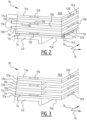
- a pair 17c of two structural layers (11c, 12c) is shown only (reference numbers are in accordance with figure 2 ), wherein the pair 17c further comprises an intermediate layer 14, shown as a transparent layer.
- the electrically conductive fibers (60, 61) in two of the structural layers (11c, 12c) of the first pair 17c are locally interrupted along a line 55, parallel to the longitudinal direction 15 of the laminate, in a lower structural layer 12c of the pair , in which the fibers 61 extend in the transverse direction 16 of the laminate, and along another line 56, parallel to the transverse direction 16 of the laminate, in the upper structural layer 11c of the pair, in which the fibers 60 extend in the longitudinal direction 15 of the laminate.
- both lines (55, 56) cross each-other at an area B, and it has turned out that heating is strongly enhanced in and around this area B, due to the interruption of the electrically conducting fibers.
- a number of fibers 60 is seen to be coated or surrounded by a polymer layer or sheet 63.
- the polymer layer or sheet 63 may have an out-of-plane electrical volume resistance R 1 , which substantially allows eddy currents to flow between two structural monolayers 7 stacked on top of each other.
- the polymer layer or sheet 63 may have an out-of-plane electrical volume resistance R 2 , which substantially prevents eddy currents from flowing between two structural monolayers 7 stacked on top of each other.
- figure 7B shows a plurality of fibers 60 that are coated or surrounded by the polymer layer or sheet 63, such coating or sheeting 63 may also be applied around one fiber (having multiple filaments) or fiber bundle.
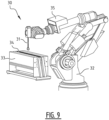
- FIG. 9 finally shows a welding device 30 provided with a joining inductor 31.
- the inductor 31 may be guided along a line of welding which may be a pre-programmed path by means of an industrial six-axis robot 32 in order to achieve a desired weld.
- molded parts in accordance with embodiments of the invention may be fixed for welding and pressed together in a mold 33, manufactured for this purpose.
- Mold 33 may be provided with a recess 34 through which the inductor 15 may be moved close to the molded parts for welding.
- the inductor 15 may be connected to an alternating current generator 35 arranged on robot 32 for the purpose of generating the electromagnetic field.
- the strength of the electromagnetic field may be varied along the line of welding to at least partly compensate for any temperature variations that may occur in the contact plane of the molded parts along the line of welding.
Landscapes
- Engineering & Computer Science (AREA)
- Mechanical Engineering (AREA)
- Chemical & Material Sciences (AREA)
- Composite Materials (AREA)
- Textile Engineering (AREA)
- Physics & Mathematics (AREA)
- Thermal Sciences (AREA)
- Robotics (AREA)
- Laminated Bodies (AREA)
- Lining Or Joining Of Plastics Or The Like (AREA)
Claims (16)
- Faserverstärktes Verbundlaminat (10) für eine Verwendung bei elektromagnetischem Schweißen von Formteilen der Laminate, wobei das Laminat eine Vielzahl von Strukturschichten (11a, 11b, 11c, 12a, 12b, 12c) umfasst;die jeweils aus elektrisch leitfähigen Fasern, die in eine thermoplastische Matrix eingebettet sind, ausgebildet sind, wobei Wirbelströme in den elektrisch leitfähigen Fasern durch einen elektrischen Leiter, der ein elektromagnetisches Feld erzeugt, induziert werden können;wobei die Vielzahl von Strukturschichten ein erstes (17c), ein zweites (17b) und optional ein drittes Paar (17a) aus zwei angrenzend positionierten Strukturschichten umfasst, wobei- das erste Paar (17c) eine Zwischenschicht (14) aufweist, die zwischen den zwei Strukturschichten (11c, 12c) des Paars positioniert ist, wobei die Zwischenschicht einen elektrischen Durchgangswiderstand R1 aus der Ebene aufweist, der im Wesentlichen ermöglicht, dass Wirbelströme zwischen den zwei Strukturschichten des ersten Paars fließen;- das zweite Paar (17b) eine Zwischenschicht (13a, 13b, 13c) aufweist, die zwischen den zwei Strukturschichten (12a und 11b, 11b und 12b, 12b und 11c) des Paars positioniert ist, wobei die Zwischenschicht einen elektrischen Durchgangswiderstand R2 aus der Ebene aufweist, der im Wesentlichen verhindert, dass Wirbelströme zwischen den zwei Strukturschichten des zweiten Paars fließen; und- das optionale dritte Paar keine Zwischenschicht zwischen den zwei Strukturschichten des Paars aufweist;wobei außerdem;- R1 und R2 endlich sind und 0 < R1 < R2;- die Zwischenschicht in jedem ersten und zweiten Paar sich von den zwei Strukturschichten in jedem ersten und zweiten Paar dadurch unterscheidet, dass die Zwischenschicht in jedem ersten und zweiten Paar nicht die elektrisch leitfähigen Fasern umfasst; unddie Bedingung R1 < R2 dadurch erreicht wird, dass ρ1 . t1 < ρ2 . t2 gilt, wobei ρ1 der elektrische Volumenwiderstand des Materials der Zwischenschicht in dem ersten Paar ist, t1 die durchschnittliche Dicke der Zwischenschicht in dem ersten Paar ist, ρ2 der elektrische Volumenwiderstand des Materials der Zwischenschicht in dem zweiten Paar ist und t2 die durchschnittliche Dicke der Zwischenschicht in dem zweiten Paar ist.
- Laminat nach Anspruch 1, wobei das Laminat eine elektromagnetisch schweißbare Außenoberfläche (150) aufweist und das erste Paar sich in dem Laminat an der schweißbaren Außenseite des Laminats in der aus der Ebene heraus verlaufenden Richtung des Laminats befindet.
- Laminat nach Anspruch 1 oder 2, wobei das Laminat eine elektromagnetisch schweißbare Außenoberfläche aufweist und eines des zweiten oder optional des dritten Paars sich in dem Laminat an einer der schweißbaren Außen- oder Innenseite des Laminats gegenüberliegenden Außenseite befindet.
- Laminat nach einem der vorstehenden Ansprüche, wobei mindestens die Zwischenschicht in dem zweiten Paar nichtleitfähige Fasern, wie in Form einer Dickenkalibrierungsgaze oder eines Dickenkalibrierungsnetzes, umfasst.
- Laminat nach einem der vorstehenden Ansprüche, wobei die elektrisch leitfähigen Fasern in mindestens einer der Strukturschichten des ersten, des zweiten und/oder optional des dritten Paars in mindestens einer der angrenzenden Strukturschichten lokal unterbrochen sind.
- Laminat nach Anspruch 5, wobei die elektrisch leitfähigen Fasern in zwei der Strukturschichten des ersten, des zweiten und/oder optional des dritten Paars entlang einer Linie in einer Strukturschicht des Paars und entlang einer anderen Linie in der anderen angrenzenden Schicht des Paars lokal unterbrochen sind, wobei beide Linien einander kreuzen.
- Laminat nach einem der Ansprüche 5 bis 6, wobei die elektrisch leitfähigen Fasern in dem ersten und/oder optional dem dritten Paar lokal unterbrochen sind.
- Laminat nach einem der vorstehenden Ansprüche, wobei die leitfähigen Fasern in den Strukturschichten unidirektional ausgerichtet sind.
- Laminat nach einem der vorstehenden Ansprüche, wobei die Zwischenschicht des ersten Paars ein thermoplastisches Polymer umfasst und eine durchschnittliche Dicke zwischen 0,05 und 0,15 mm, mehr bevorzugt zwischen 0,07 und 0,12 mm, aufweist, und wobei die Zwischenschicht des zweiten Paars ein thermoplastisches Polymer umfasst und eine durchschnittliche Dicke von mehr als 0,20 mm aufweist.
- Laminat nach einem der vorstehenden Ansprüche, wobei die Strukturschichten eine Dicke aufweisen und ein matrixpolymerreicher Bereich sich über einen Teil der Dicke auf einer oder beiden Seiten einiger der Schichten erstreckt.
- Laminat nach Anspruch 10, wobei die Zwischenschicht des ersten und/oder des zweiten Paars durch den polymerreichen Bereich mindestens einer der angrenzenden Strukturschichten des Paars ausgebildet wird.
- Laminat nach einem der vorstehenden Ansprüche, wobei die Zwischenschicht des ersten Paars leitfähige Partikel umfasst, die in ein thermoplastisches Polymer eingebettet sind, um den elektrischen Durchgangswiderstand R1 aus der Ebene abzustimmen, wobei im Wesentlichen ermöglicht wird, dass Wirbelströme zwischen den zwei Strukturschichten des ersten Paars fließen.
- Laminat nach einem der vorstehenden Ansprüche, wobei das Material der Zwischenschicht des ersten und/oder des zweiten Paars angrenzender Strukturschichten einen elektrischen spezifischen Durchgangswiderstand zwischen 1015 Ohm.cm und 20.1015 Ohm.cm, gemessen nach ASTM D257, aufweist.
- Verfahren zum elektromagnetischen Schweißen von Formteilen eines Laminats nach einem der Ansprüche 1 bis 13, umfassend die Schritte:- Inkontaktbringen der schweißbaren Außenoberflächen der Formteile miteinander, um eine Kontaktoberfläche zu definieren;- Bereitstellen eines Induktors, der ein elektromagnetisches Feld unter Wechselspannung erzeugt und die elektrisch leitfähigen Fasern in den Formteilen derart erhitzt, dass das Matrixpolymer der Strukturschichten des zweiten Paars jedes Formteils über seiner Schmelztemperatur gehalten wird; und- das Matrixpolymer der Strukturschichten des ersten und des optionalen dritten Paars jedes Formteils unterhalb seiner Schmelztemperatur gehalten wird; und- optional Zusammenpressen der Formteile.
- Verfahren nach Anspruch 14, wobei der Induktor relativ zu der Kontaktoberfläche der Formteile entlang eines Pfades derart bewegt wird, dass die elektrisch leitfähigen Fasern in einem vorbestimmten Teil der Kontaktoberfläche erhitzt werden.
- Verfahren nach Anspruch 14 oder 15, wobei der Induktor ein lineares Induktionssegment umfasst, das ein elektromagnetisches Feld erzeugt, das in mindestens einer Schweißrichtung im Wesentlichen zylindrisch ist.
Applications Claiming Priority (2)
| Application Number | Priority Date | Filing Date | Title |
|---|---|---|---|
| NL2025473A NL2025473B1 (en) | 2020-04-30 | 2020-04-30 | Fiber-reinforced composite laminate for use in electromagnetic welding and method of electromagnetic welding of molded parts of said laminates |
| PCT/NL2021/050286 WO2021221510A1 (en) | 2020-04-30 | 2021-04-30 | Fiber-reinforced composite laminate for use in electromagnetic welding and method of electromagnetic welding of molded parts of said laminates |
Publications (3)
| Publication Number | Publication Date |
|---|---|
| EP4143012A1 EP4143012A1 (de) | 2023-03-08 |
| EP4143012B1 EP4143012B1 (de) | 2024-09-18 |
| EP4143012B9 true EP4143012B9 (de) | 2024-12-18 |
Family
ID=71575751
Family Applications (1)
| Application Number | Title | Priority Date | Filing Date |
|---|---|---|---|
| EP21724056.3A Active EP4143012B9 (de) | 2020-04-30 | 2021-04-30 | Faserverstärktes verbundlaminat zur verwendung beim elektromagnetischen schweissen und verfahren zum elektromagnetischen schweissen von formteilen aus diesen laminaten |
Country Status (10)
| Country | Link |
|---|---|
| US (1) | US12064925B2 (de) |
| EP (1) | EP4143012B9 (de) |
| JP (1) | JP7467681B2 (de) |
| KR (1) | KR102919600B1 (de) |
| CN (1) | CN115996833B (de) |
| BR (1) | BR112022021896A2 (de) |
| CA (1) | CA3176022A1 (de) |
| ES (1) | ES2999143T3 (de) |
| NL (1) | NL2025473B1 (de) |
| WO (1) | WO2021221510A1 (de) |
Families Citing this family (1)
| Publication number | Priority date | Publication date | Assignee | Title |
|---|---|---|---|---|
| US12558853B2 (en) * | 2022-06-08 | 2026-02-24 | Spirit Aerosystems, Inc. | Semi-conformable pressure application system and method for joining composite parts |
Family Cites Families (16)
| Publication number | Priority date | Publication date | Assignee | Title |
|---|---|---|---|---|
| US5313034A (en) * | 1992-01-15 | 1994-05-17 | Edison Welding Institute, Inc. | Thermoplastic welding |
| CA2282542A1 (en) * | 1997-02-28 | 1998-09-03 | Robert Harlan Johnson Jr. | High efficiency heating agents |
| US6323468B1 (en) * | 2000-04-25 | 2001-11-27 | The Boeing Company | Static coil apparatus and method for welding thermoplastic composite structures |
| US6519835B1 (en) * | 2000-08-18 | 2003-02-18 | Watlow Polymer Technologies | Method of formable thermoplastic laminate heated element assembly |
| WO2003026821A1 (en) * | 2001-09-25 | 2003-04-03 | Gerhard Jack K | Apparatus and method for induction lamination of electrically conductive fiber reinforced composite materials |
| EP2080781A4 (de) * | 2006-11-09 | 2014-06-11 | Teijin Chemicals Ltd | Verbundwerkstoff und herstellungsverfahren dafür |
| DE102009047671A1 (de) * | 2009-12-08 | 2011-06-09 | Airbus Operations Gmbh | Verfahren zum Anbinden eines Faserverbundbauteils an ein Strukturbauteil eines Luft- und Raumfahrzeuges und eine entsprechende Anordnung |
| KR101449204B1 (ko) * | 2012-12-27 | 2014-10-13 | 주식회사 포스코 | 연속 탄소섬유 강화 열가소성 프리프레그의 제조 방법 |
| DE102018002011A1 (de) * | 2018-03-13 | 2019-09-19 | Premium Aerotec Gmbh | Verfahren und Vorrichtung zum thermischen Fügen thermoplastischer Faserverbundbauteile sowie Abdeckung für eine dazu geeignete Druckbeaufschlagungseinrichtung |
| EP4458685A3 (de) * | 2018-05-03 | 2025-01-01 | Qarbon Aerospace (Foundation), LLC | Thermoplastische flugzeugstruktur mit lokalisierter lagenisolierung und verfahren zur herstellung einer flugzeugstruktur |
| NL2021039B1 (en) * | 2018-06-01 | 2019-12-10 | Kok & Van Engelen Composite Structures B V | Method and device for joining moulded parts by electromagnetic welding |
| CN112739528A (zh) * | 2018-07-16 | 2021-04-30 | 阿科玛法国公司 | 焊接热塑性材料部件的方法 |
| EP3611010A1 (de) * | 2018-08-16 | 2020-02-19 | Airbus Operations GmbH | Heizelement, vorrichtung und verfahren zum widerstandsschweissen von thermoplastischen komponenten, insbesondere zur herstellung von flugzeugen, und flugzeug |
| DE102018119990A1 (de) * | 2018-08-16 | 2020-02-20 | Airbus Operations Gmbh | Heizelement, System und Verfahren zum Widerstandsschweißen thermoplastischer Bauteile, insbesondere für die Herstellung von Luftfahrzeugen |
| US11235537B2 (en) * | 2019-07-01 | 2022-02-01 | The Boeing Company | Hybrid braided composite parts |
| JP7677143B2 (ja) | 2020-03-18 | 2025-05-15 | 東レ株式会社 | 積層体およびそれを用いた溶着体 |
-
2020
- 2020-04-30 NL NL2025473A patent/NL2025473B1/en active
-
2021
- 2021-04-30 JP JP2022566271A patent/JP7467681B2/ja active Active
- 2021-04-30 BR BR112022021896A patent/BR112022021896A2/pt unknown
- 2021-04-30 CN CN202180046322.8A patent/CN115996833B/zh active Active
- 2021-04-30 CA CA3176022A patent/CA3176022A1/en active Pending
- 2021-04-30 ES ES21724056T patent/ES2999143T3/es active Active
- 2021-04-30 WO PCT/NL2021/050286 patent/WO2021221510A1/en not_active Ceased
- 2021-04-30 EP EP21724056.3A patent/EP4143012B9/de active Active
- 2021-04-30 KR KR1020227041879A patent/KR102919600B1/ko active Active
- 2021-04-30 US US17/920,976 patent/US12064925B2/en active Active
Also Published As
| Publication number | Publication date |
|---|---|
| CN115996833A (zh) | 2023-04-21 |
| US12064925B2 (en) | 2024-08-20 |
| BR112022021896A2 (pt) | 2022-12-20 |
| CA3176022A1 (en) | 2021-11-04 |
| JP7467681B2 (ja) | 2024-04-15 |
| JP2023524955A (ja) | 2023-06-14 |
| WO2021221510A1 (en) | 2021-11-04 |
| EP4143012A1 (de) | 2023-03-08 |
| EP4143012B1 (de) | 2024-09-18 |
| NL2025473B1 (en) | 2021-11-18 |
| ES2999143T3 (en) | 2025-02-24 |
| CN115996833B (zh) | 2025-10-31 |
| KR102919600B1 (ko) | 2026-01-30 |
| US20230166458A1 (en) | 2023-06-01 |
| KR20230005332A (ko) | 2023-01-09 |
Similar Documents
| Publication | Publication Date | Title |
|---|---|---|
| US5313034A (en) | Thermoplastic welding | |
| RU2767025C1 (ru) | Способ сварки деталей из термопластического материала | |
| AU666664B2 (en) | Method for induction heating of composite materials | |
| US9421742B2 (en) | Sandwich laminate and manufacturing method | |
| US20230166478A1 (en) | Thermoplastic aerostructure with localized ply isolation and method for forming aerostructure | |
| CN114206606A (zh) | 用于接合纤维增强聚合物和金属结构的金属网状物过渡件 | |
| KR20140139493A (ko) | 탄소 섬유 프리폼, 탄소 섬유 강화 플라스틱, 탄소 섬유 프리폼의 제조 방법 | |
| NL2027363B1 (en) | Resistance welding methods and apparatus | |
| EP4143012B1 (de) | Faserverstärktes verbundlaminat zur verwendung beim elektromagnetischen schweissen und verfahren zum elektromagnetischen schweissen von formteilen aus diesen laminaten | |
| EP0454703A1 (de) | Verbinden von verbundwerkstoffen | |
| EP4289606A1 (de) | Halbkonformierbares druckanwendungssystem und verfahren zum verbinden von verbundteilen | |
| JP7537102B2 (ja) | 溶着方法及び溶着装置 | |
| CN121866145A (zh) | 使用感应加热生产的热塑性复合材料 | |
| JP2022516418A (ja) | 複合材料およびその製造方法 | |
| WO1999041059A1 (en) | Joining method using a ptc polymer | |
| EP4302959B1 (de) | Formwerkzeug, verfahren zur herstellung desselben und verwendung zur herstellung eines verbundteils | |
| JP6287831B2 (ja) | プリフォームの製造方法および製造装置 | |
| CN121358590A (zh) | 用于接合纤维增强塑料(frp)部件的感应焊接方法及frp复合构件 | |
| US20210078262A1 (en) | Method for producing composite material and composite material | |
| JP2013227509A (ja) | 繊維強化熱可塑性樹脂シートの製造方法 | |
| CN119116375A (zh) | 一种热塑性复合材料电阻焊接用的加热元件 | |
| JPH09283265A (ja) | 面状発熱体の製造方法 |
Legal Events
| Date | Code | Title | Description |
|---|---|---|---|
| STAA | Information on the status of an ep patent application or granted ep patent |
Free format text: STATUS: UNKNOWN |
|
| STAA | Information on the status of an ep patent application or granted ep patent |
Free format text: STATUS: THE INTERNATIONAL PUBLICATION HAS BEEN MADE |
|
| PUAI | Public reference made under article 153(3) epc to a published international application that has entered the european phase |
Free format text: ORIGINAL CODE: 0009012 |
|
| STAA | Information on the status of an ep patent application or granted ep patent |
Free format text: STATUS: REQUEST FOR EXAMINATION WAS MADE |
|
| 17P | Request for examination filed |
Effective date: 20221104 |
|
| AK | Designated contracting states |
Kind code of ref document: A1 Designated state(s): AL AT BE BG CH CY CZ DE DK EE ES FI FR GB GR HR HU IE IS IT LI LT LU LV MC MK MT NL NO PL PT RO RS SE SI SK SM TR |
|
| DAV | Request for validation of the european patent (deleted) | ||
| DAX | Request for extension of the european patent (deleted) | ||
| GRAP | Despatch of communication of intention to grant a patent |
Free format text: ORIGINAL CODE: EPIDOSNIGR1 |
|
| STAA | Information on the status of an ep patent application or granted ep patent |
Free format text: STATUS: GRANT OF PATENT IS INTENDED |
|
| INTG | Intention to grant announced |
Effective date: 20231207 |
|
| GRAJ | Information related to disapproval of communication of intention to grant by the applicant or resumption of examination proceedings by the epo deleted |
Free format text: ORIGINAL CODE: EPIDOSDIGR1 |
|
| STAA | Information on the status of an ep patent application or granted ep patent |
Free format text: STATUS: REQUEST FOR EXAMINATION WAS MADE |
|
| GRAP | Despatch of communication of intention to grant a patent |
Free format text: ORIGINAL CODE: EPIDOSNIGR1 |
|
| STAA | Information on the status of an ep patent application or granted ep patent |
Free format text: STATUS: GRANT OF PATENT IS INTENDED |
|
| INTC | Intention to grant announced (deleted) | ||
| INTG | Intention to grant announced |
Effective date: 20240425 |
|
| GRAS | Grant fee paid |
Free format text: ORIGINAL CODE: EPIDOSNIGR3 |
|
| GRAA | (expected) grant |
Free format text: ORIGINAL CODE: 0009210 |
|
| STAA | Information on the status of an ep patent application or granted ep patent |
Free format text: STATUS: THE PATENT HAS BEEN GRANTED |
|
| AK | Designated contracting states |
Kind code of ref document: B1 Designated state(s): AL AT BE BG CH CY CZ DE DK EE ES FI FR GB GR HR HU IE IS IT LI LT LU LV MC MK MT NL NO PL PT RO RS SE SI SK SM TR |
|
| REG | Reference to a national code |
Ref country code: GB Ref legal event code: FG4D |
|
| REG | Reference to a national code |
Ref country code: CH Ref legal event code: EP |
|
| P01 | Opt-out of the competence of the unified patent court (upc) registered |
Free format text: CASE NUMBER: APP_49667/2024 Effective date: 20240902 |
|
| REG | Reference to a national code |
Ref country code: IE Ref legal event code: FG4D |
|
| REG | Reference to a national code |
Ref country code: DE Ref legal event code: R096 Ref document number: 602021018983 Country of ref document: DE |
|
| REG | Reference to a national code |
Ref country code: SE Ref legal event code: TRGR |
|
| REG | Reference to a national code |
Ref country code: NL Ref legal event code: FP |
|
| REG | Reference to a national code |
Ref country code: CH Ref legal event code: PK Free format text: BERICHTIGUNG B9 |
|
| REG | Reference to a national code |
Ref country code: SE Ref legal event code: RPOT |
|
| REG | Reference to a national code |
Ref country code: LT Ref legal event code: MG9D |
|
| PG25 | Lapsed in a contracting state [announced via postgrant information from national office to epo] |
Ref country code: NO Free format text: LAPSE BECAUSE OF FAILURE TO SUBMIT A TRANSLATION OF THE DESCRIPTION OR TO PAY THE FEE WITHIN THE PRESCRIBED TIME-LIMIT Effective date: 20241218 |
|
| PG25 | Lapsed in a contracting state [announced via postgrant information from national office to epo] |
Ref country code: GR Free format text: LAPSE BECAUSE OF FAILURE TO SUBMIT A TRANSLATION OF THE DESCRIPTION OR TO PAY THE FEE WITHIN THE PRESCRIBED TIME-LIMIT Effective date: 20241219 Ref country code: FI Free format text: LAPSE BECAUSE OF FAILURE TO SUBMIT A TRANSLATION OF THE DESCRIPTION OR TO PAY THE FEE WITHIN THE PRESCRIBED TIME-LIMIT Effective date: 20240918 |
|
| PG25 | Lapsed in a contracting state [announced via postgrant information from national office to epo] |
Ref country code: BG Free format text: LAPSE BECAUSE OF FAILURE TO SUBMIT A TRANSLATION OF THE DESCRIPTION OR TO PAY THE FEE WITHIN THE PRESCRIBED TIME-LIMIT Effective date: 20240918 |
|
| PG25 | Lapsed in a contracting state [announced via postgrant information from national office to epo] |
Ref country code: LV Free format text: LAPSE BECAUSE OF FAILURE TO SUBMIT A TRANSLATION OF THE DESCRIPTION OR TO PAY THE FEE WITHIN THE PRESCRIBED TIME-LIMIT Effective date: 20240918 |
|
| PG25 | Lapsed in a contracting state [announced via postgrant information from national office to epo] |
Ref country code: HR Free format text: LAPSE BECAUSE OF FAILURE TO SUBMIT A TRANSLATION OF THE DESCRIPTION OR TO PAY THE FEE WITHIN THE PRESCRIBED TIME-LIMIT Effective date: 20240918 |
|
| PG25 | Lapsed in a contracting state [announced via postgrant information from national office to epo] |
Ref country code: RS Free format text: LAPSE BECAUSE OF FAILURE TO SUBMIT A TRANSLATION OF THE DESCRIPTION OR TO PAY THE FEE WITHIN THE PRESCRIBED TIME-LIMIT Effective date: 20241218 |
|
| PG25 | Lapsed in a contracting state [announced via postgrant information from national office to epo] |
Ref country code: RS Free format text: LAPSE BECAUSE OF FAILURE TO SUBMIT A TRANSLATION OF THE DESCRIPTION OR TO PAY THE FEE WITHIN THE PRESCRIBED TIME-LIMIT Effective date: 20241218 Ref country code: NO Free format text: LAPSE BECAUSE OF FAILURE TO SUBMIT A TRANSLATION OF THE DESCRIPTION OR TO PAY THE FEE WITHIN THE PRESCRIBED TIME-LIMIT Effective date: 20241218 Ref country code: LV Free format text: LAPSE BECAUSE OF FAILURE TO SUBMIT A TRANSLATION OF THE DESCRIPTION OR TO PAY THE FEE WITHIN THE PRESCRIBED TIME-LIMIT Effective date: 20240918 Ref country code: HR Free format text: LAPSE BECAUSE OF FAILURE TO SUBMIT A TRANSLATION OF THE DESCRIPTION OR TO PAY THE FEE WITHIN THE PRESCRIBED TIME-LIMIT Effective date: 20240918 Ref country code: GR Free format text: LAPSE BECAUSE OF FAILURE TO SUBMIT A TRANSLATION OF THE DESCRIPTION OR TO PAY THE FEE WITHIN THE PRESCRIBED TIME-LIMIT Effective date: 20241219 Ref country code: FI Free format text: LAPSE BECAUSE OF FAILURE TO SUBMIT A TRANSLATION OF THE DESCRIPTION OR TO PAY THE FEE WITHIN THE PRESCRIBED TIME-LIMIT Effective date: 20240918 Ref country code: BG Free format text: LAPSE BECAUSE OF FAILURE TO SUBMIT A TRANSLATION OF THE DESCRIPTION OR TO PAY THE FEE WITHIN THE PRESCRIBED TIME-LIMIT Effective date: 20240918 |
|
| REG | Reference to a national code |
Ref country code: ES Ref legal event code: FG2A Ref document number: 2999143 Country of ref document: ES Kind code of ref document: T3 Effective date: 20250224 |
|
| PG25 | Lapsed in a contracting state [announced via postgrant information from national office to epo] |
Ref country code: PT Free format text: LAPSE BECAUSE OF FAILURE TO SUBMIT A TRANSLATION OF THE DESCRIPTION OR TO PAY THE FEE WITHIN THE PRESCRIBED TIME-LIMIT Effective date: 20250120 Ref country code: IS Free format text: LAPSE BECAUSE OF FAILURE TO SUBMIT A TRANSLATION OF THE DESCRIPTION OR TO PAY THE FEE WITHIN THE PRESCRIBED TIME-LIMIT Effective date: 20250118 |
|
| PG25 | Lapsed in a contracting state [announced via postgrant information from national office to epo] |
Ref country code: RO Free format text: LAPSE BECAUSE OF FAILURE TO SUBMIT A TRANSLATION OF THE DESCRIPTION OR TO PAY THE FEE WITHIN THE PRESCRIBED TIME-LIMIT Effective date: 20240918 Ref country code: SM Free format text: LAPSE BECAUSE OF FAILURE TO SUBMIT A TRANSLATION OF THE DESCRIPTION OR TO PAY THE FEE WITHIN THE PRESCRIBED TIME-LIMIT Effective date: 20240918 |
|
| PG25 | Lapsed in a contracting state [announced via postgrant information from national office to epo] |
Ref country code: EE Free format text: LAPSE BECAUSE OF FAILURE TO SUBMIT A TRANSLATION OF THE DESCRIPTION OR TO PAY THE FEE WITHIN THE PRESCRIBED TIME-LIMIT Effective date: 20240918 |
|
| PG25 | Lapsed in a contracting state [announced via postgrant information from national office to epo] |
Ref country code: PL Free format text: LAPSE BECAUSE OF FAILURE TO SUBMIT A TRANSLATION OF THE DESCRIPTION OR TO PAY THE FEE WITHIN THE PRESCRIBED TIME-LIMIT Effective date: 20240918 Ref country code: CZ Free format text: LAPSE BECAUSE OF FAILURE TO SUBMIT A TRANSLATION OF THE DESCRIPTION OR TO PAY THE FEE WITHIN THE PRESCRIBED TIME-LIMIT Effective date: 20240918 |
|
| PG25 | Lapsed in a contracting state [announced via postgrant information from national office to epo] |
Ref country code: SK Free format text: LAPSE BECAUSE OF FAILURE TO SUBMIT A TRANSLATION OF THE DESCRIPTION OR TO PAY THE FEE WITHIN THE PRESCRIBED TIME-LIMIT Effective date: 20240918 |
|
| PGFP | Annual fee paid to national office [announced via postgrant information from national office to epo] |
Ref country code: NL Payment date: 20250427 Year of fee payment: 5 |
|
| REG | Reference to a national code |
Ref country code: DE Ref legal event code: R097 Ref document number: 602021018983 Country of ref document: DE |
|
| PGFP | Annual fee paid to national office [announced via postgrant information from national office to epo] |
Ref country code: DE Payment date: 20250429 Year of fee payment: 5 |
|
| PG25 | Lapsed in a contracting state [announced via postgrant information from national office to epo] |
Ref country code: DK Free format text: LAPSE BECAUSE OF FAILURE TO SUBMIT A TRANSLATION OF THE DESCRIPTION OR TO PAY THE FEE WITHIN THE PRESCRIBED TIME-LIMIT Effective date: 20240918 |
|
| PGFP | Annual fee paid to national office [announced via postgrant information from national office to epo] |
Ref country code: GB Payment date: 20250428 Year of fee payment: 5 Ref country code: ES Payment date: 20250505 Year of fee payment: 5 |
|
| PGFP | Annual fee paid to national office [announced via postgrant information from national office to epo] |
Ref country code: IT Payment date: 20250422 Year of fee payment: 5 |
|
| PGFP | Annual fee paid to national office [announced via postgrant information from national office to epo] |
Ref country code: FR Payment date: 20250425 Year of fee payment: 5 |
|
| PGFP | Annual fee paid to national office [announced via postgrant information from national office to epo] |
Ref country code: CH Payment date: 20250501 Year of fee payment: 5 |
|
| PGFP | Annual fee paid to national office [announced via postgrant information from national office to epo] |
Ref country code: TR Payment date: 20250418 Year of fee payment: 5 |
|
| PLBE | No opposition filed within time limit |
Free format text: ORIGINAL CODE: 0009261 |
|
| STAA | Information on the status of an ep patent application or granted ep patent |
Free format text: STATUS: NO OPPOSITION FILED WITHIN TIME LIMIT |
|
| PGFP | Annual fee paid to national office [announced via postgrant information from national office to epo] |
Ref country code: SE Payment date: 20250430 Year of fee payment: 5 |
|
| 26N | No opposition filed |
Effective date: 20250619 |
|
| PG25 | Lapsed in a contracting state [announced via postgrant information from national office to epo] |
Ref country code: LU Free format text: LAPSE BECAUSE OF NON-PAYMENT OF DUE FEES Effective date: 20250430 |
|
| PG25 | Lapsed in a contracting state [announced via postgrant information from national office to epo] |
Ref country code: MC Free format text: LAPSE BECAUSE OF FAILURE TO SUBMIT A TRANSLATION OF THE DESCRIPTION OR TO PAY THE FEE WITHIN THE PRESCRIBED TIME-LIMIT Effective date: 20240918 |
|
| REG | Reference to a national code |
Ref country code: BE Ref legal event code: MM Effective date: 20250430 |
|
| PG25 | Lapsed in a contracting state [announced via postgrant information from national office to epo] |
Ref country code: BE Free format text: LAPSE BECAUSE OF NON-PAYMENT OF DUE FEES Effective date: 20250430 |
|
| REG | Reference to a national code |
Ref country code: AT Ref legal event code: UEP Ref document number: 1724342 Country of ref document: AT Kind code of ref document: T Effective date: 20240918 |
|
| PG25 | Lapsed in a contracting state [announced via postgrant information from national office to epo] |
Ref country code: IE Free format text: LAPSE BECAUSE OF NON-PAYMENT OF DUE FEES Effective date: 20250430 |
|
| PGFP | Annual fee paid to national office [announced via postgrant information from national office to epo] |
Ref country code: AT Payment date: 20260410 Year of fee payment: 5 |
|
| REG | Reference to a national code |
Ref country code: CH Ref legal event code: U11 Free format text: ST27 STATUS EVENT CODE: U-0-0-U10-U11 (AS PROVIDED BY THE NATIONAL OFFICE) Effective date: 20260501 |