EP4138749B1 - Klebstoff für einen saugfähigen artikel - Google Patents
Klebstoff für einen saugfähigen artikel Download PDFInfo
- Publication number
- EP4138749B1 EP4138749B1 EP21725310.3A EP21725310A EP4138749B1 EP 4138749 B1 EP4138749 B1 EP 4138749B1 EP 21725310 A EP21725310 A EP 21725310A EP 4138749 B1 EP4138749 B1 EP 4138749B1
- Authority
- EP
- European Patent Office
- Prior art keywords
- adhesive
- kpa
- absorbent article
- pfa
- degrees
- Prior art date
- Legal status (The legal status is an assumption and is not a legal conclusion. Google has not performed a legal analysis and makes no representation as to the accuracy of the status listed.)
- Active
Links
Images





















Classifications
-
- A—HUMAN NECESSITIES
- A61—MEDICAL OR VETERINARY SCIENCE; HYGIENE
- A61L—METHODS OR APPARATUS FOR STERILISING MATERIALS OR OBJECTS IN GENERAL; DISINFECTION, STERILISATION OR DEODORISATION OF AIR; CHEMICAL ASPECTS OF BANDAGES, DRESSINGS, ABSORBENT PADS OR SURGICAL ARTICLES; MATERIALS FOR BANDAGES, DRESSINGS, ABSORBENT PADS OR SURGICAL ARTICLES
- A61L15/00—Chemical aspects of, or use of materials for, bandages, dressings or absorbent pads
- A61L15/16—Bandages, dressings or absorbent pads for physiological fluids such as urine or blood, e.g. sanitary towels, tampons
- A61L15/42—Use of materials characterised by their function or physical properties
- A61L15/58—Adhesives
- A61L15/585—Mixtures of macromolecular compounds
-
- A—HUMAN NECESSITIES
- A61—MEDICAL OR VETERINARY SCIENCE; HYGIENE
- A61F—FILTERS IMPLANTABLE INTO BLOOD VESSELS; PROSTHESES; DEVICES PROVIDING PATENCY TO, OR PREVENTING COLLAPSING OF, TUBULAR STRUCTURES OF THE BODY, e.g. STENTS; ORTHOPAEDIC, NURSING OR CONTRACEPTIVE DEVICES; FOMENTATION; TREATMENT OR PROTECTION OF EYES OR EARS; BANDAGES, DRESSINGS OR ABSORBENT PADS; FIRST-AID KITS
- A61F13/00—Bandages or dressings; Absorbent pads
- A61F13/15—Absorbent pads, e.g. sanitary towels, swabs or tampons for external or internal application to the body; Supporting or fastening means therefor; Tampon applicators
- A61F13/45—Absorbent pads, e.g. sanitary towels, swabs or tampons for external or internal application to the body; Supporting or fastening means therefor; Tampon applicators characterised by the shape
- A61F13/47—Sanitary towels, incontinence pads or napkins
- A61F13/472—Sanitary towels, incontinence pads or napkins specially adapted for female use
-
- A—HUMAN NECESSITIES
- A61—MEDICAL OR VETERINARY SCIENCE; HYGIENE
- A61F—FILTERS IMPLANTABLE INTO BLOOD VESSELS; PROSTHESES; DEVICES PROVIDING PATENCY TO, OR PREVENTING COLLAPSING OF, TUBULAR STRUCTURES OF THE BODY, e.g. STENTS; ORTHOPAEDIC, NURSING OR CONTRACEPTIVE DEVICES; FOMENTATION; TREATMENT OR PROTECTION OF EYES OR EARS; BANDAGES, DRESSINGS OR ABSORBENT PADS; FIRST-AID KITS
- A61F13/00—Bandages or dressings; Absorbent pads
- A61F13/15—Absorbent pads, e.g. sanitary towels, swabs or tampons for external or internal application to the body; Supporting or fastening means therefor; Tampon applicators
- A61F13/56—Supporting or fastening means
- A61F13/5605—Supporting or fastening means specially adapted for sanitary napkins or the like
- A61F13/5611—Supporting or fastening means specially adapted for sanitary napkins or the like using fastening strips, e.g. adhesive, on the undergarment-facing side
-
- C—CHEMISTRY; METALLURGY
- C09—DYES; PAINTS; POLISHES; NATURAL RESINS; ADHESIVES; COMPOSITIONS NOT OTHERWISE PROVIDED FOR; APPLICATIONS OF MATERIALS NOT OTHERWISE PROVIDED FOR
- C09J—ADHESIVES; NON-MECHANICAL ASPECTS OF ADHESIVE PROCESSES IN GENERAL; ADHESIVE PROCESSES NOT PROVIDED FOR ELSEWHERE; USE OF MATERIALS AS ADHESIVES
- C09J123/00—Adhesives based on homopolymers or copolymers of unsaturated aliphatic hydrocarbons having only one carbon-to-carbon double bond; Adhesives based on derivatives of such polymers
- C09J123/02—Adhesives based on homopolymers or copolymers of unsaturated aliphatic hydrocarbons having only one carbon-to-carbon double bond; Adhesives based on derivatives of such polymers not modified by chemical after-treatment
- C09J123/04—Homopolymers or copolymers of ethene
- C09J123/08—Copolymers of ethene
- C09J123/0846—Copolymers of ethene with unsaturated hydrocarbons containing other atoms than carbon or hydrogen atoms
- C09J123/0853—Vinylacetate
-
- C—CHEMISTRY; METALLURGY
- C09—DYES; PAINTS; POLISHES; NATURAL RESINS; ADHESIVES; COMPOSITIONS NOT OTHERWISE PROVIDED FOR; APPLICATIONS OF MATERIALS NOT OTHERWISE PROVIDED FOR
- C09J—ADHESIVES; NON-MECHANICAL ASPECTS OF ADHESIVE PROCESSES IN GENERAL; ADHESIVE PROCESSES NOT PROVIDED FOR ELSEWHERE; USE OF MATERIALS AS ADHESIVES
- C09J131/00—Adhesives based on homopolymers or copolymers of compounds having one or more unsaturated aliphatic radicals, each having only one carbon-to-carbon double bond, and at least one being terminated by an acyloxy radical of a saturated carboxylic acid, of carbonic acid, or of a haloformic acid; Adhesives based on derivatives of such polymers
- C09J131/02—Homopolymers or copolymers of esters of monocarboxylic acids
- C09J131/04—Homopolymers or copolymers of vinyl acetate
-
- C—CHEMISTRY; METALLURGY
- C09—DYES; PAINTS; POLISHES; NATURAL RESINS; ADHESIVES; COMPOSITIONS NOT OTHERWISE PROVIDED FOR; APPLICATIONS OF MATERIALS NOT OTHERWISE PROVIDED FOR
- C09J—ADHESIVES; NON-MECHANICAL ASPECTS OF ADHESIVE PROCESSES IN GENERAL; ADHESIVE PROCESSES NOT PROVIDED FOR ELSEWHERE; USE OF MATERIALS AS ADHESIVES
- C09J153/00—Adhesives based on block copolymers containing at least one sequence of a polymer obtained by reactions only involving carbon-to-carbon unsaturated bonds; Adhesives based on derivatives of such polymers
- C09J153/02—Vinyl aromatic monomers and conjugated dienes
-
- C—CHEMISTRY; METALLURGY
- C09—DYES; PAINTS; POLISHES; NATURAL RESINS; ADHESIVES; COMPOSITIONS NOT OTHERWISE PROVIDED FOR; APPLICATIONS OF MATERIALS NOT OTHERWISE PROVIDED FOR
- C09J—ADHESIVES; NON-MECHANICAL ASPECTS OF ADHESIVE PROCESSES IN GENERAL; ADHESIVE PROCESSES NOT PROVIDED FOR ELSEWHERE; USE OF MATERIALS AS ADHESIVES
- C09J7/00—Adhesives in the form of films or foils
- C09J7/20—Adhesives in the form of films or foils characterised by their carriers
- C09J7/29—Laminated material
-
- C—CHEMISTRY; METALLURGY
- C09—DYES; PAINTS; POLISHES; NATURAL RESINS; ADHESIVES; COMPOSITIONS NOT OTHERWISE PROVIDED FOR; APPLICATIONS OF MATERIALS NOT OTHERWISE PROVIDED FOR
- C09J—ADHESIVES; NON-MECHANICAL ASPECTS OF ADHESIVE PROCESSES IN GENERAL; ADHESIVE PROCESSES NOT PROVIDED FOR ELSEWHERE; USE OF MATERIALS AS ADHESIVES
- C09J7/00—Adhesives in the form of films or foils
- C09J7/30—Adhesives in the form of films or foils characterised by the adhesive composition
- C09J7/38—Pressure-sensitive adhesives [PSA]
- C09J7/381—Pressure-sensitive adhesives [PSA] based on macromolecular compounds obtained by reactions involving only carbon-to-carbon unsaturated bonds
- C09J7/387—Block-copolymers
-
- C—CHEMISTRY; METALLURGY
- C09—DYES; PAINTS; POLISHES; NATURAL RESINS; ADHESIVES; COMPOSITIONS NOT OTHERWISE PROVIDED FOR; APPLICATIONS OF MATERIALS NOT OTHERWISE PROVIDED FOR
- C09J—ADHESIVES; NON-MECHANICAL ASPECTS OF ADHESIVE PROCESSES IN GENERAL; ADHESIVE PROCESSES NOT PROVIDED FOR ELSEWHERE; USE OF MATERIALS AS ADHESIVES
- C09J2203/00—Applications of adhesives in processes or use of adhesives in the form of films or foils
- C09J2203/358—Applications of adhesives in processes or use of adhesives in the form of films or foils for garments and textiles
-
- C—CHEMISTRY; METALLURGY
- C09—DYES; PAINTS; POLISHES; NATURAL RESINS; ADHESIVES; COMPOSITIONS NOT OTHERWISE PROVIDED FOR; APPLICATIONS OF MATERIALS NOT OTHERWISE PROVIDED FOR
- C09J—ADHESIVES; NON-MECHANICAL ASPECTS OF ADHESIVE PROCESSES IN GENERAL; ADHESIVE PROCESSES NOT PROVIDED FOR ELSEWHERE; USE OF MATERIALS AS ADHESIVES
- C09J2301/00—Additional features of adhesives in the form of films or foils
- C09J2301/10—Additional features of adhesives in the form of films or foils characterized by the structural features of the adhesive tape or sheet
- C09J2301/12—Additional features of adhesives in the form of films or foils characterized by the structural features of the adhesive tape or sheet by the arrangement of layers
- C09J2301/124—Additional features of adhesives in the form of films or foils characterized by the structural features of the adhesive tape or sheet by the arrangement of layers the adhesive layer being present on both sides of the carrier, e.g. double-sided adhesive tape
-
- C—CHEMISTRY; METALLURGY
- C09—DYES; PAINTS; POLISHES; NATURAL RESINS; ADHESIVES; COMPOSITIONS NOT OTHERWISE PROVIDED FOR; APPLICATIONS OF MATERIALS NOT OTHERWISE PROVIDED FOR
- C09J—ADHESIVES; NON-MECHANICAL ASPECTS OF ADHESIVE PROCESSES IN GENERAL; ADHESIVE PROCESSES NOT PROVIDED FOR ELSEWHERE; USE OF MATERIALS AS ADHESIVES
- C09J2301/00—Additional features of adhesives in the form of films or foils
- C09J2301/30—Additional features of adhesives in the form of films or foils characterized by the chemical, physicochemical or physical properties of the adhesive or the carrier
- C09J2301/302—Additional features of adhesives in the form of films or foils characterized by the chemical, physicochemical or physical properties of the adhesive or the carrier the adhesive being pressure-sensitive, i.e. tacky at temperatures inferior to 30°C
-
- C—CHEMISTRY; METALLURGY
- C09—DYES; PAINTS; POLISHES; NATURAL RESINS; ADHESIVES; COMPOSITIONS NOT OTHERWISE PROVIDED FOR; APPLICATIONS OF MATERIALS NOT OTHERWISE PROVIDED FOR
- C09J—ADHESIVES; NON-MECHANICAL ASPECTS OF ADHESIVE PROCESSES IN GENERAL; ADHESIVE PROCESSES NOT PROVIDED FOR ELSEWHERE; USE OF MATERIALS AS ADHESIVES
- C09J2301/00—Additional features of adhesives in the form of films or foils
- C09J2301/30—Additional features of adhesives in the form of films or foils characterized by the chemical, physicochemical or physical properties of the adhesive or the carrier
- C09J2301/312—Additional features of adhesives in the form of films or foils characterized by the chemical, physicochemical or physical properties of the adhesive or the carrier parameters being the characterizing feature
-
- C—CHEMISTRY; METALLURGY
- C09—DYES; PAINTS; POLISHES; NATURAL RESINS; ADHESIVES; COMPOSITIONS NOT OTHERWISE PROVIDED FOR; APPLICATIONS OF MATERIALS NOT OTHERWISE PROVIDED FOR
- C09J—ADHESIVES; NON-MECHANICAL ASPECTS OF ADHESIVE PROCESSES IN GENERAL; ADHESIVE PROCESSES NOT PROVIDED FOR ELSEWHERE; USE OF MATERIALS AS ADHESIVES
- C09J2400/00—Presence of inorganic and organic materials
- C09J2400/20—Presence of organic materials
- C09J2400/26—Presence of textile or fabric
- C09J2400/263—Presence of textile or fabric in the substrate
-
- C—CHEMISTRY; METALLURGY
- C09—DYES; PAINTS; POLISHES; NATURAL RESINS; ADHESIVES; COMPOSITIONS NOT OTHERWISE PROVIDED FOR; APPLICATIONS OF MATERIALS NOT OTHERWISE PROVIDED FOR
- C09J—ADHESIVES; NON-MECHANICAL ASPECTS OF ADHESIVE PROCESSES IN GENERAL; ADHESIVE PROCESSES NOT PROVIDED FOR ELSEWHERE; USE OF MATERIALS AS ADHESIVES
- C09J2453/00—Presence of block copolymer
-
- C—CHEMISTRY; METALLURGY
- C09—DYES; PAINTS; POLISHES; NATURAL RESINS; ADHESIVES; COMPOSITIONS NOT OTHERWISE PROVIDED FOR; APPLICATIONS OF MATERIALS NOT OTHERWISE PROVIDED FOR
- C09J—ADHESIVES; NON-MECHANICAL ASPECTS OF ADHESIVE PROCESSES IN GENERAL; ADHESIVE PROCESSES NOT PROVIDED FOR ELSEWHERE; USE OF MATERIALS AS ADHESIVES
- C09J7/00—Adhesives in the form of films or foils
- C09J7/40—Adhesives in the form of films or foils characterised by release liners
- C09J7/405—Adhesives in the form of films or foils characterised by release liners characterised by the substrate of the release liner
Definitions
- the present invention pertains to an improved adhesive for fastening a disposable absorbent article to an article of clothing, particularly underwear.
- Feminine hygiene articles are widely used to absorb menstrual fluid, urine, and other liquid insults.
- feminine hygiene articles are donned by attaching the article to underwear of the user.
- adhesives for securing feminine hygiene articles to undergarments for personal hygiene is well known in the art.
- these adhesives are termed panty-fastening-adhesives, position fastening adhesives or positioning adhesives.
- PFA position fastening adhesives
- the PFA should be strong enough to attach the feminine hygiene article to the undergarment at an initial attachment stage.
- This can prove to be more difficult than initially thought. Users of these articles tend to not apply very much pressure to the feminine hygiene article during initial application due to hygienic concerns, e.g. less product touches equals less contamination.
- the low amount of application pressure can cause the absorbent article to lack good attachment during the initial application.
- This problem can be exacerbated by the fact that some feminine hygiene articles, e.g. adult incontinence pads, comprise elastic barrier cuffs. The elastic forces in the cuffs can act to pull the feminine hygiene article away from the underwear of the user.
- Another problem that plagues the initial application of the feminine hygiene article to the underwear is that users tend to stretch their undergarment prior to application to create a flatter surface for adhering the feminine hygiene article to. This stretching can cause an immediate shear on the adhesive. This shear stress on the adhesive can also negatively impact the initial adherence of the feminine hygiene article to the underwear.
- the PFA should keep the feminine hygiene article in place.
- the user of the feminine hygiene article will typically not be stationary for the entire time that they are wearing the feminine hygiene article.
- the PFA should be strong enough to hold the feminine hygiene article in place regardless of the movement of the user and the user's undergarments. Failure to do so, could result in an increased bunching of the article which can lead to discomfort for the wearer along with an increased likelihood of leakage.
- the removal of the feminine hygiene article from the undergarment also plays an important role in how the feminine hygiene article will be perceived by the user.
- a manufacturer may try to utilize higher amounts of PFA on the article; however, such applications may also result in consumer negatives.
- higher amounts of PFA can lead to product tearing and adhesive residues left on the undergarment during removal.
- Adhesive residues left on the undergarment post removal of the article can create a negative image in the user's mind regarding the feminine hygiene article.
- the material of the undergarment can impact how a PFA reacts regarding the above three responsibilities.
- Two popular types of material utilized in undergarments include cotton (natural) and microfiber (synthetic).
- Some commercially available PFA's can perform the previously mentioned three functions rather well with cotton underwear, while they usually do not perform as well in the context of microfiber undergarments.
- US 2015/038938 A1 relates to an absorbent article with an adhesive for attaching the article to microfiber garments.
- the adhesive is defined by its peel strength, complex modulus and glass transition properties.
- US 2015/034244 A1 is concerned with methods for adhering articles substrates to microfiber garments.
- the adhesive provides a certain complex modulus and glass transition temperature.
- US 2014/371703 A1 discloses a pressure-sensitive hot melt adhesive composition.
- the adhesive includes at least 10% by weight of a first propylene thermoplastic elastomer, at least 25% of a tackifying agent, and at least 25% plasticizer.
- the tackifying agent exhibits a softening point of at least 120° C.
- US 6 620 143 B1 pertains to a sanitary napkin having a body-side adhesive.
- the adhesive exhibits a tan delta ranging from about 0.01 to about 0.6 at a frequency of about 0.1 radians per second and a tan delta ranging from about 0.1 to about 1.7 at a frequency of about 1000 radians per second.
- AU 745 377 B2 relates to a sanitary napkin having a body-side adhesive.
- the adhesive is defined by its glass transition temperature, storage modulus, loss modulus, tensile strength and tan delta values at different frequencies.
- US 2016/166447 A1 is concerned with absorbent articles comprising a fastening adhesive applied on the backsheet garment facing surface. At least a portion of the fastening adhesive is applied in a pattern.
- the pattern comprises two or more spaced apart geometric figures comprising a major dimension, which is oriented substantially perpendicular to a direction of article removal about its longitudinal axis from one's undergarment.
- US 2009/062761 A1 discloses undergarment attached absorbent articles with adhesive patterns.
- the pattern includes separating the adhesive applied to the front portion, the middle portion, and the back portion at the fold lines of the absorbent article that are substantially free from adhesive. Additionally, the middle portion of the undergarment attached absorbent article contains a specifically placed adhesive. ⁇ insert p. 2a, 2b>
- absorbent article having an improved PFA which can provide good initial attachment, stay in place protection, and good removal characteristics, for a variety of undergarment materials including cotton, microfiber, and the like.
- the absorbent articles of the present disclosure can alleviate one or more of the problems associated with commercially available absorbent articles.
- Absorbent articles of the present disclosure can offer good attachment to an undergarment, sufficient adhesion during the complex movements of a wearer to provide good stay in place characteristics, and good removal characteristics over that of conventional absorbent articles.
- the present invention pertains to a disposable absorbent article, which is a sanitary napkin, pantiliner, or incontinence pad, comprising: a longitudinal centerline, a transverse centerline generally perpendicular to the longitudinal centerline, a wearer-facing surface and an opposing garment-facing surface, a front end region, an opposing back end region, and a central region disposed between the front end region and the back end region.
- the absorbent article further comprises: a topsheet; a backsheet; an absorbent system disposed between the topsheet and the backsheet; and a plurality of pre-formed adhesive portions disposed on the garment-facing surface, wherein the absorbent article exhibits a peel force of at least 1.0 N, more preferably about 1.1 N or most preferably about 1.2 N, in accordance with the Peel Force test, and leaves no residue in accordance with the Adhesive Residue test method, wherein the central region does not comprise adhesive portions.
- absorbent article refers to articles which absorb and contain body exudates or discharges such as body fluids, and includes sanitary napkins, pantiliners, and incontinence pads (and other articles worn in the crotch region of a garment) which are intended to be placed inside a user's undergarment and adhered thereto.
- Longitudinal with respect to an absorbent article, refers to the direction from front-to-rear or from rear-to-front of the article from the wearer's perspective.
- Transverse with respect to an absorbent article, refers to the direction perpendicular to the longitudinal direction, and from side-to-side of the article from the wearer's perspective.
- a “wearer-facing” component is the component disposed closest to the wearer's skin when the article is worn, and a “garment-facing” component is the component disposed furthest from the wearer's skin.
- the "wearer-facing” surface is the surface facing the wearer's skin when the article is worn, and the opposing “outward-facing” surface is the surface facing away from the wearer's skin.
- microfiber material is one of the recent major developments in the fabric industry. These fibers conventionally have less than 1 denier. Microfibers have found use in especially the clothing industry, where they are used to form fabrics having unique physical and mechanical performance. Because microfibers are thinner than silk, have very good strength, uniformity and processing characteristics, they can provide a wearer with a luxurious look and feel.
- PFA's which work well with cotton undergarments may not work so well with microfiber undergarments. This can be understood in terms of surface properties of the system composed by undergarment and adhesive and in terms of relative elasticity mismatch between underwear and pads.
- washing habits may similarly impact the performance of PFA's. It is believed that since the introduction of washing and drying aids such as fabric softeners and dryer sheets, the performance of PFA's have been impacted. It is further believed that the decreased performance of PFA's may be negatively impacted by these washing and drying aids depositing hydrophobic active (e.g. Alky Ester Quat & Fatty Acid) in the fabric softener on the surface of the clothing.
- hydrophobic active e.g. Alky Ester Quat & Fatty Acid
- the number and frequency of washes can have an impact on the ability of the PFA's to attach to the underwear, regardless of the underwear material. It is believed that this is due to the increased “fuzz” or loose fiber production by garments on their surface with increased washes. This increased “fuzz” can provide additional anchoring points for the adhesive and help create a stronger bond. However, the increased anchoring points can negatively impact the removal of the article (and its PFA) from the undergarment potentially leading to increased residual PFA left behind on the undergarment.
- the adhesives discovered by the inventors are not conventional in the sense that they are not used as PFA's. Instead, these adhesives have indicated uses which are vastly different than that of a PFA. These discovered adhesives may comprise pre-formed adhesive portions.
- Pre-formed adhesive portions of the present disclosure differ from traditional PFA's in the sense that the pre-formed adhesive portions can be applied to a garment-facing surface of an absorbent article in solid form.
- Conventional PFA's are typically sprayed or coated onto the garment-facing surface. These application techniques are performed while the PFA is in a liquid or highly molten state.
- These pre-formed adhesive portions may comprise double-sided tapes.
- Double-sided tapes may comprise a substrate, e.g. a film, a nonwoven, a woven, a foam, combinations thereof, comprising adhesive on either side of the substrate.
- Pre-formed adhesive may also be configured sans a substrate therein. In such constructions, the adhesive portions may simply be a solid block of adhesive. Pre-formed adhesives are discussed in additional detail regarding FIGS. 15A-15D .
- adhesives of the present disclosure can be applied to a garment-facing surface of the absorbent articles as part of an absorbent article manufacturing process, e.g. cut and place operation. Still in another example, the adhesive can be placed upon the garment-facing surface of the absorbent article by hand. Or, the adhesive may be placed upon the garment-facing surface via a blend of manufacturing process and by hand. Still in other processes, the absorbent article manufacturer may provide the garment-facing surface of the absorbent article to an adhesive supplier, and the adhesive supplier may place the double-sided tape on the garment-facing surface.
- the adhesives of the present disclosure may be applied in a front end region and a back end region of the absorbent article.
- the inventors have found that placement of the adhesive in the central region is not required.
- the front end region, back end region and central region may each comprise about one third of the overall length of the absorbent article in a completely flattened state.
- the adhesives of the present disclosure when placed in the end regions, without adhesive in the central regions, that these adhesives can provide improved initial attachment, improved stay in place and/or improved removal characteristics over conventional PFAs.
- the adhesive may have a length which is at least 15 percent of a length of the end regions, more preferably in at least about 30 percent, or most preferably in at least about 40 percent, specifically reciting all values within these ranges and any ranges created thereby.
- the front end region may comprise a length generally parallel to a longitudinal centerline of the absorbent article.
- the length of the front end region may range from about 30 mm to about 170 mm.
- the adhesive in the front end region can have a length, generally parallel to the longitudinal centerline of the absorbent article which is from about 15 percent of the length of the front end region to about 93 percent, specifically reciting all values within these ranges and any ranges created thereby.
- the length of the adhesive in the front end region can be from about 25 mm to about 100 mm, more preferably from about 25 mm to about 90 mm or most preferably from about 25 mm to about 50 mm, specifically reciting all values within these ranges and any ranges created thereby.
- the adhesive in the front end region can have a length which is about 30 mm.
- the adhesive for the back end region can be configured similar to that of the front end region.
- the length of the adhesive in the front end region or the back end region can begin adjacent end edges of an absorbent core.
- the placement of the adhesives of the present disclosure in the front end region and back end region can impact how the adhesive performs in the context as a PFA. It is believed that the closer to the end edges of the absorbent core the adhesive is placed, the better performing the adhesive will be.
- the adhesive in the front end region and back end region may comprise adhesive which is disposed 3 mm or less from an end edge of the absorbent core or more preferably 2 mm or less from an end edge of the absorbent core.
- the adhesives of the present disclosure may be disposed 3 mm or less from a longitudinal side edge of the absorbent core or more preferably 2 mm or less from the longitudinal side edge of the absorbent core.
- the adhesives of the present disclosure can have any suitable caliper. However, as the caliper increases, complexities in manufacturing may occur. Additionally, with an increase in caliper, the user may be able to feel variable pressure being applied to the skin and/or the variable pressure may be applied to the outer garment such that an imprint of the adhesive may be visible on the outer garments of the wearer. So, in some instances, the caliper of the adhesives of the present disclosure can have a thickness which is 1 mm or less, specifically reciting all values within this range and any range created thereby.
- the thickness of the adhesive may be reduced.
- mechanical means such as skiving, cutting, slicing, the like, etc., may be utilized to reduce the caliper of the adhesive portions. Re-casting of the adhesive portions is also possible.
- Adhesives applied to the garment-facing surface of the absorbent article can have the rheological and mechanical properties described herein. And, such adhesives can provide improved performance over that of conventional PFAs as described herein.
- Tan delta--1 is measured as described herein at a frequency of between 0.01 and 1 Hz at 37 degrees C. It is believed that 37 degrees C more closely mimics body temperature as well as the conditions under which the adhesive will perform.
- tan delta--1 coupled with a low value of the storage modulus--1 (G' 1), as disclosed herein
- G' 1 storage modulus--1
- the higher value of compliance in turn promotes a better conformability of the adhesive to the surface of the undergarment and a more intimate contact, leading to a stronger bonding of the double-sided tape to the undergarment.
- the compliance value is discussed in additional detail hereafter.
- the ability to attach to a greater number of fibers of the underwear - regardless of material, e.g. cotton, microfiber, or the like, particularly during initial application -- is believed to be a critical piece in obtaining a successful initial attachment of the absorbent article to the undergarment.
- the adhesives of the present disclosure can exhibit a tan delta--1 value of between 0.28 to 1.2, more preferably between 0.28 to 1.13, or most preferably between 0.28 to 0.51, when measured over a frequency range of between 0.01Hz and 1 Hz at 37 degrees C in accordance with the Frequency Sweep - Oscillatory Rheometry Test Method described herein, specifically reciting all values within this range and any ranges created thereby. Additionally, these adhesives can exhibit a tan delta--1 value from between 0.28 to 0.9 at 0.01 Hz at 37 degrees C, specifically reciting all values within this range and any ranges created thereby.
- these adhesives can exhibit the above tan delta--1 value over the entire range of 0.01 Hz to 1 Hz. So, at 0.01 Hz and at 1 Hz, the tan delta--1 value can be between 0.28 to 1.2, specifically reciting all values within this range and any ranges created thereby.
- the adhesive can have a long time to be able to flow and create intimate contact with the fibers of the underwear.
- the application of the article to the undergarment, from a time perspective, is highly variable.
- initial application is critical in establishing good adhesion between the adhesive and the underwear. So, in some forms, the adhesive can exhibit the values for tan delta-1 expressed heretofore over the entire frequency range of 0.01 Hz to 1 Hz.
- the absorbent article once applied to the undergarment, can provide the adhesive with a variable amount of time to bond to the undergarment.
- the relaxation time of the adhesive may be of import.
- the temperature at which the relaxation time is measured can greatly impact this criterion. For example, the relaxation time of an adhesive measured at 25 degrees C can be substantially longer than the relaxation time of the same adhesive measured at 37 degrees C.
- the adhesive and the absorbent article are likely to be closer to room temperature, i.e. 25 degrees C than body temperature, i.e. 37 degrees C.
- room temperature i.e. 25 degrees C
- body temperature i.e. 37 degrees C.
- the absorbent article and the adhesive begin to increase in temperature.
- the absorbent article and adhesive reach steady state near body temperature, i.e. 37 degrees C, minus a couple / few degrees.
- the relaxation time of the adhesive can be substantially less than that which is measured at 25 degrees C.
- Adhesives of the present disclosure can have a relaxation time, at 37 degrees C, of 100 seconds or less, more preferably 30 seconds or less, or most preferably 20 seconds or less, specifically reciting all values within these ranges and any ranges created thereby.
- the damping factor of the adhesives or the present disclosure can be important for determining the behavior of the adhesive regarding initial attachment and staying in place.
- the damping factor at a higher frequency can also be of import, since the consumer can remove the product in a fraction of a second.
- a tan delta--2 value can be measured between 50 and 100 Hz at 37 degrees C.
- the adhesives of the present disclosure can delaminate adhesively from the panty and have high enough cohesive strength to minimize the likelihood of residue on the underwear post article removal.
- Adhesives of the present disclosure can exhibit a tan delta--2 value of 1.9 or less, more preferably 1.8 or less or most preferably 1.38 or less, over a frequency range of between 50 and 100 Hz at 37 degrees C, when measured in accordance with the Frequency Sweep - Oscillatory Rheometry Test Method disclosed herein, specifically reciting all values within the range and any ranges created thereby.
- the adhesives of the present disclosure can exhibit a tan delta--2 value of between 0.25 and 1.9, more preferably between 0.25 and 1.8, or most preferably between about 0.28 to about 1.38, at a frequency of between 50 and 100 Hz at 37 degrees C, specifically reciting all values within these ranges and any ranges created thereby.
- the adhesives of the present disclosure can exhibit the above tan delta--2 values over the entire range of 50 Hz to 100 Hz. So, at 50 Hz and at 100 Hz, the tan delta--2 value can be 1.9 or less, more preferably 1.8 or less or most preferably 1.38 or less, specifically reciting all values within this range and any ranges created thereby.
- the adhesives of the present disclosure can have a "soft" character so that the adhesive can adapt to any discontinuities of the surface of the fibers of the undergarment to which the absorbent article is attached. This "soft" character can influence not only initial application but also the stay in place aspect of the absorbent article and its debonding.
- the storage modulus (G') of an adhesive at a frequency range of 0.01 Hz to 1 Hz can be indicative of the "softness" of the adhesive and its ability to adapt to the substrate and generate adhesion - termed storage modulus--1.
- the storage modulus of the adhesive at a frequency range of 50 Hz to 100 Hz can be an important contributor of both adhesion and cohesive strength of the adhesive upon removal of the article - termed storage modulus 2. This adhesion and cohesive strength can minimize the likelihood of residue left behind on the undergarment post removal of the absorbent article.
- the storage modulus--1 criterion and the storage modulus--2 criterion can be competing interests. As the former is low to accommodate better adhesion during application and the latter is high to accommodate the cohesive nature of the adhesive, storage modulus--1 and storage modulus--2 can be challenging to accommodate in a single adhesive.
- Adhesives of the present disclosure can exhibit a storage modulus--1 value of less than 85 kPa at a frequency of between 0.01 to 1 Hz at 37 degrees C, more preferably 74 kPa or less or most preferably 57 kPa or less, specifically reciting all values within this range and any range created thereby.
- the adhesives of the present disclosure can exhibit a storage modulus--1 value of between 1 kPa and 84 kPa, more preferably between 3 kPa and 74 kPa, or most preferably from 12 kPa to 57 kPa, at a frequency of between 0.01 and 1 Hz at 37 degrees C, specifically reciting all values within these ranges and any ranges created thereby.
- these adhesives can exhibit a storage modulus--1 value of between 5 kPa and 84 kPa, more preferably between 5 kPa and 80 kPa, most preferably between 5 kPa and 74 kPa, at 1 Hz at 37 degrees C, specifically reciting all values within these ranges and any ranges created thereby.
- these adhesives can also exhibit a storage modulus--1 value of between 1 kPa and 50 kPa, more preferably between 1 kPa and 40 kPa, or most preferably between 1 kPa and 30 kPa at 0.01 Hz at 37 degrees C, specifically reciting all values within these ranges and any ranges created thereby.
- adhesives of the present disclosure can exhibit a storage modulus--2 value of 40 kPa or greater, more preferably 73 kPa or greater, or most preferably 146 kPa or greater, between 50 and 100 Hz at 37 degrees C in accordance with the Frequency Sweep - Oscillatory Rheometry Test Method disclosed herein, specifically reciting all values within this range and any ranges created thereby.
- these adhesives can exhibit a storage modulus--2 value of between 40 and 300 kPa, more preferably between 73 kPa and 300 kPa, or most preferably between 146kPa and 300 kPa, specifically reciting all values within this range and any ranges created thereby.
- the storage modulus must be considered in its entirety as a continuous, monotonic increasing function of the frequency. This means that the storage modulus-2 value can never be less than the storage modulus-1 value.
- the inventors have additionally discovered that the PFA's of the present disclosure, for initial attachment and stay in place functions, can exhibit a bonding compliance value -- J1.
- the bonding compliance value characterizes the relationship between tan delta--1 and storage modulus--1.
- bonding compliance values indicate how well an adhesive can flow and bond to the structure to which attachment is sought.
- the bonding compliance value is indicative of how well the adhesive will flow and attach to the macrostructure (on the fiber level) of the undergarment.
- these PFA's can exhibit a bonding compliance value of between 7.5 mm 2 /N and 950 mm 2 /N, more preferably from between 8.5 mm 2 /N to about 600 mm 2 /N or most preferably from about 9. mm 2 /N to about 321 mm 2 /N, specifically reciting all values within this range and any range created thereby.
- the debonding compliance value utilizes the relationship between tan delta 2 and storage modulus 2.
- J 2 tan ⁇ 2 G ′ 2 ⁇ 1 1 + ta n 2 ⁇ 2 wherein G' 2 is the storage modulus-2 value described herein and the tan 2 ⁇ 2 is the square of the tan delta-2 value described herein.
- the debonding compliance value is indicative of the cohesive strength of the adhesive. And, it is therefore believed that the debonding compliance value can be indicative of whether an adhesive will leave residue on an undergarment upon removal of the article from the undergarment.
- these PFA's can exhibit a debonding compliance value of between 0.3 mm 2 /N and 255.6 mm 2 /N, more preferably from about 1.5 mm 2 /N to about 150 mm 2 /N or most preferably from about 2.2 mm 2 /N to about 13.2 mm 2 /N, specifically reciting all values within this range and any ranges created thereby.
- the elastic modulus or Young's modulus of the adhesive can provide insight into how an adhesive will perform when utilized in the PFA context. Recall that users often stretch the underwear prior to the application of the feminine hygiene article to the underwear. This stretching of the underwear can cause stress on the PFA of the feminine hygiene article. It is believed that PFA's that have a higher elastic modulus can better accommodate these forces.
- PFA's of the present disclosure can have an elastic modulus of 0.1 MPa to 1.5MPa, more preferably between 0.12 MPa and 1.2 MPa, and most preferably between 0.14 MPa and 1MPa, as measured at an elongation rate of 0.1 1/sec and an ambient temperature of 23 degrees C plus or minus 2 degrees C.
- the yield stress of the adhesives can provide useful insight as well. Without wishing to be bound by theory, it is believed that an adhesive acting as a PFA undergoes stress during removal. Recall that while in use, the PFA creates an adhesive interface between the backsheet of the absorbent article and the PFA as well as an adhesive interface between the PFA and the undergarment. It is believed that where the yield stress of the adhesive is below about 32 kPa, the adhesive interfaces survive removal and instead, the PFA fails internally. This internal failure can lead to increased residue left on the undergarment.
- the adhesive has sufficient cohesive strength to cause the PFA to break the adhesive interface between the PFA and the undergarment thereby reducing the likelihood of PFA residue being left behind on the undergarment.
- the adhesives of the present disclosure can exhibit a yield stress of 32 kPa or greater, more preferably 40 kPa or greater, or most preferably 50 kPa or greater, specifically reciting all values within these ranges and any ranges created thereby, when measured at 37 degrees C, in accordance with the Extensional Test Method for Yield Stress described herein.
- the adhesives of the present disclosure can exhibit a yield stress of from between 30 kPa to about 100 kPa, more preferably from about 40 kPa to about 100 kPa, or most preferably from about 50 kPa to about 100 kPa, specifically reciting all values within these ranges and any ranges created thereby.
- the adhesives of the present disclosure can exhibit a surface energy of less than 25 milliJoules per square meter as measured in accordance with the total surface energy method disclosed herein, specifically reciting all values within this range and any ranges created thereby.
- the adhesives of the present disclosure can exhibit a surface energy of between 10 mJ/m 2 to 24 mJ/m 2 , more preferably from 12.5 mJ/m 2 to 24 mJ/m 2 , or most preferably from 15 mJ to 24 mJ/m 2 , specifically reciting all values within these ranges and any ranges created thereby.
- the adhesives of the present disclosure can exhibit a polar component of the surface energy of less than 10 percent.
- the polar component can be between 1 percent to 9 percent, more preferably from 2 percent to 9 percent, or most preferably from 3 percent to 9 percent, specifically reciting all values within these ranges and any ranges created thereby.
- the adhesives of the present disclosure may comprise any suitable chemistry.
- the adhesives of the present disclosure are (as a reminder) pressure sensitive adhesives, which is intended to mean an adhesive that is inherently tacky, visco-elastic and cohesive in its normal dry state.
- the adhesives of the present disclosure may comprise a polymer or polymer blend and a tackifier.
- adhesives may comprise any number of polymer backbones.
- adhesives of the present disclosure may comprise polymer backbones comprising at least one of: a thermoplastic polyurethane (TPU) silicone, an acrylate ester/vinyl pyrrolidone copolymers, dimethyl silicone polymers, styrene block copolymers. acrylate polymers or any suitable combination thereof.
- TPU thermoplastic polyurethane
- acrylate ester/vinyl pyrrolidone copolymers dimethyl silicone polymers
- styrene block copolymers acrylate polymers or any suitable combination thereof.
- Adhesives of the present disclosure may comprise a mixture of 60 to 90 weight percent of a pure rubbery copolymer (C-3-C12 alkyl ester) and from 10 to 40 weight percent of a polar component.
- a pure rubbery copolymer C-3-C12 alkyl ester
- polar component examples include acrylic acid, methacrylic acid, ethylene-vinyl acetate, N-vinyl pyrrolidone and styrene block copolymer.
- an adhesive of the present disclosure comprises an ethylene-vinyl acetate and styrene block copolymer polymer backbone.
- These adhesives may utilize one or more tackifiers or blends thereof.
- the benefits of using tackifiers include (i) increasing the open time of the adhesive, which enables in general a better transfer to the second substrate in the lamination process, particularly when the open time of the process (defined as the distance between applicator and combining point divided by the line speed) is short, and (ii) enabling to achieve the desired polarity of the adhesive, which contributes to increase the bond strength to more polymer substrates (like e.g. polyester fibers), particularly for bonds in which an optimum entanglement of the fibers is difficult to achieve.
- the inventors have surprisingly found that minimizing the amount of tackifier has a net positive effect towards delivering better adhesion to underwear presenting a significantly higher dispersive component than polar component of the surface energy, as result of washing habits or because of a surface finish treatment in the case of most microfiber manufacturers.
- the tackifier preferably has a Mw below 6,000 Da and a Tg below room temperature or slightly above. A Tg which is significantly above room temperature would yield an adhesive which is incompatible with the storage modulus values mentioned herein.
- Suitable classes of tackifier include, for example, aromatic, aliphatic and cycloaliphatic hydrocarbon resins, mixed aromatic and aliphatic modified hydrocarbon resins, aromatic modified aliphatic hydrocarbon resins; terpenes, modified terpenes; natural rosins, modified rosins, rosin esters, and combinations thereof.
- Suitable commercial tackifiers include, for example, the ESCOREZ series of trade designations from Exxon Mobil Chemical Company (Houston, Texas) including, ESCOREZ 5300, ESCOREZ 5400 and ESCOREZ 5600, the EASTOTAC series of trade designations from Eastman Chemical (Kingsport, Tenn.) including EASTOTAC H-100R and EASTOTAC H-100L.
- an adhesive in accordance with the present disclosure comprises an acylate polymer based backbone.
- These adhesives may comprise from 80 to 100 weight percent of isooctyl acrylate and from 0 to 20 weight percent of acrylic acid.
- the acrylic pressure-sensitive adhesives may be self-tacky or tackified.
- Useful tackifiers (less than 2% weight fraction) for acrylics are rosin esters such as FORAL TM 85 or aromatics resins such as PICCOTEX TM LC-55WKm, both available from Hercules, Inc. of Wilmington, DL, or else aliphatic resins such as ESCOREZ TM 1310LC, available from Exxon Chemical Co., Houston, TX.
- thermoplastic elastomeric materials specifically useful for the present invention are for example styrene-isoprene block copolymers such as KRATON TM D1107P or linear styrene-(ethylene-butylene) block copolymers such as KRATON TM G1657 or else linear styrene-(ethylene-propylene) block copolymers such as KRATON TM G1657X and star styrene-butadiene block copolymer such as KRATON TM D1118X all available from Shell Chemical Co, Houston, TX.
- styrene-isoprene block copolymers such as KRATON TM D1107P
- linear styrene-(ethylene-butylene) block copolymers such as KRATON TM G1657
- linear styrene-(ethylene-propylene) block copolymers such as KRATON TM G1657X
- thermoplastic elastomeric or elastomeric materials can also be modified with tackifying resins or plasticizers to lower their melt viscosity to facilitate the formation of fine dispersions, with the smallest phase dimension preferably less than about 20 microns when blended with the acrylic pressure-sensitive adhesive.
- Tackifying resins or plasticizers useful with the elastomeric materials or the thermoplastic elastomeric materials are preferably miscible at the molecular level, i.e., soluble in, any or all of the polymeric segments of the elastomeric material or the thermoplastic elastomeric material.
- the tackifying resin when present needs to be kept in low concentration, for reasons of reducing polar fraction of the adhesive surface energy as discuss previously, and may comprise about 5 to 600 parts by weight, more typically up to about 500 parts by weight, based on 100 parts by weight of the elastomeric material or the thermoplastic elastomeric material.
- tackifiers suitable for the adhesives of the present disclosure include but are not limited to liquid rubbers, hydrocarbon resins, rosin, natural resins such as dimerized or hydrogenated balsams and esterified abietic acids, polyterpenes, terpene phenolics, phenol-formaldehyde resins, and rosin esters.
- Plasticizers are also an important ingredient in the PFA's of the present disclosure and are usually present between 5 and 10 % by weight.
- plasticizers include but are not limited to polybutene, paraffinic oils, petrolatum, and certain phthalates with long aliphatic side chains such as ditridecyl phthalate.
- the adhesives of the present disclosure may also optionally comprise additives such as one or more antioxidant, UV stabilizer, brightener, colorant, fragrance, odor control actives, etc.
- the adhesive may comprise less than 5% by weight of such additives. Any antioxidant known to a person of ordinary skill in the art may be used in the adhesives of the present disclosure.
- Samples 1-3 were polyacrylate based adhesives and each had good adhesion to microfiber undergarments.
- Sample 4 was a mixture of ethylene vinyl acetate and styrene block copolymer-based adhesives and had good adhesion to microfiber undergarments.
- Samples 5-6 were polyurethane elastomer-based adhesives and each did not provide sufficient adhesion to microfiber undergarments.
- Samples 7-8 were styrene block copolymer-based adhesives and each did not provide sufficient adhesion to microfiber undergarments.
- Sample 9 was a styrene block copolymer based adhesive.
- Samples 1-2 utilized adhesives that are commercially available as general-purpose adhesives.
- Sample 1 is available under the trade name "Voxmude Double Sided Clear Adhesive Gel Grip Tape.” This tape is advertised as being able to be utilized on a variety of wall surfaces and floor surfaces.
- Sample 2 is available under the trade name "Avalution Nano Tape” by Anothera. This tape is advertised as being able to be utilized on a variety of surfaces, e.g. glass, metal, kitchen cabinets, and tile.
- Samples 3 and 4 were fabric adhesives tapes that are commercially available for securing fabric to the skin.
- Sample 3 is available from 3M under the trade name "Essentials Wardrobe Tape Strips.”
- Sample 4 is available as Hollywood Fashion Secrets ® Fashion Tape.
- Sample 5 was an adhesive that is commercially available as a general-purpose adhesive. Sample 5 is available under the trade name "Ivy Grip Tape, Washable Adhesive Tape.” This tape is listed as a being able to attach items to walls, cell phone holders, etc.
- Sample 6 is commercially available and sold under the trade name "The Stikk brand gel pad.” These gel pads are utilized for attaching bundles of electrical cords / wires to a wall or their respective enclosures.
- Samples 7-9 are commercially available adhesive which have been utilized as PFA's.
- Samples 3 and 4 are more transient than those of Samples 1 and 2, as their indications are for attachment of fabric to skin.
- these tapes are primarily used for blouse gaps, securing necklines and generally reducing the likelihood of wardrobe malfunctions.
- stresses and strains experienced by an adhesive placed on one's neckline versus those experienced by a PFA are quite disparate.
- the stresses and strains that a PFA experiences are much greater as the region in which the PFA is disposed during use can be subject to a much larger range of motion than a neckline.
- Table 1 shows the total surface energy, the polar component of the surface energy, surface polarity, yield stress and relaxation time, of the adhesives that were measured.
- Table 1 Sample No. Surface Energy (mJ/m ⁇ 2) Polar Component of Surface Energy (mJ/m 2 ) Surface Polarity (%) Yield Stress (kPa) Relaxation Time (s) 1 23.1 0.858 3.72 - 11.49 2 22.4 0.795 3.55 - 11.05 3 22.0 1.339 6.10 - 10.80 4 20.4 0.736 3.60 53.32 10.17 5 22.4 3.09 13.79 - 30.91 6 27.1 4.94 18.23 - 41.99 7 31.2 5.63 18.05 16.49 24.30 8 30.6 4.97 16.25 15.74 31.78 9 28.4 3.01 10.61 16.69 29.15
- the PFA's of the present disclosure can exhibit a peel force of at least 1.0 N, more preferably about 1.1 N or most preferably about 1.2 N, in accordance with the Peel Force Test, specifically reciting all values within these ranges and any ranges created thereby. Also, it is believed that in order to reduce the likelihood of leaving residue behind and/or yielding the backsheet of the absorbent article, the peel force can be less than about 5 N, more preferably less than about 4 N, or most preferably about 3N or less, specifically reciting all values within these ranges and any ranges created thereby.
- the PFA's of the present disclosure can exhibit a peel force of at least 1N to about 5.0 N, more preferably from about 1.0 N to about 4.0 N or most preferably from about 1.0 N to about 3.0 N, specifically reciting all values within these ranges and any ranges created thereby.
- Sample 4' is an acrylate based adhesive version of Sample 4.
- Sample 4' is sold under the same trade name as Sample 4. It is also worth noting that in accordance with the Adhesive Residue test method, Samples 1-4 and Sample 4' left no residue on the undergarment upon removal of the article.
- absorbent articles were constructed from the following materials: (i) 18 gsm spunbond bico nonwoven topsheet; (ii)55 gsm spunlaced secondary topsheet; (iii) a pair of pulp airlaid cores each of 135 gsm; (iv) a pair of superabsorbent polymer layers being substantially air-felt free; and (v) a 12 gsm film backsheet.
- the adhesive was applied to cover an area of 300 mm by 59 mm of the pad.
- the basis weight of the adhesive was 15 gsm. The remainder of the adhesives were applied to the garment-facing surface of the articles in the basis weights in which they were purchased.
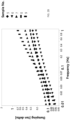
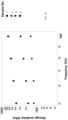
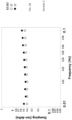
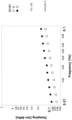
- FIGS. 1A , 1B , 2A and 2B demonstrate that samples 1-4 fall within the scope of the claimed ranges for adhesives which work well for both cotton and microfiber undergarments.
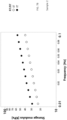
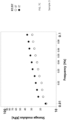
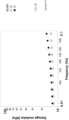
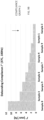
- FIGS. 1A , 1B , 2A and 2B are graphs which show the storage modulus--1 and tan delta--1 values for Samples 1-9, respectively, in the frequency range of 0.01 Hz to 1 Hz. Recall that this frequency range can be indicative of initial bonding and stay in place functionality for the adhesive and the absorbent article.
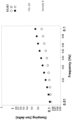
- FIGS. 1A and 1B show graphs of the storage modulus--1 value for the Samples 1-4 and 5-9, respectively.
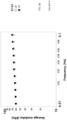
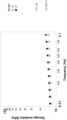
- FIGS. 2A and 2B show graphs of the tan delta--1 for Samples 1-4 and 5-9, respectively.
- Samples 1-4 can provide improved performance over conventional PFAs particularly in the context of microfiber undergarments.
- Samples 5-9 do not provide good adhesion to microfiber undergarments.
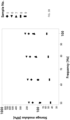
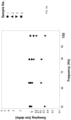
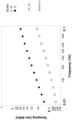
- FIGS. 3A , 3B , 4A and 4B are graphs which show the storage modulus--2 and tan delta--2 values for Samples 1-9, respectively, in the frequency range of 50 Hz to 100 Hz. Recall that this frequency range can be indicative of the cohesiveness of the adhesive and be an indicator of how the adhesive will perform during removal from the underwear. Specifically, FIGS. 3A and 3B , show graphs of the storage modulus--2 values for Samples 1-4 and Samples 5-9, respectively.
- FIGS. 4A and 4B show graphs of the tan delta--2 values for Samples 1-4 and Samples 5-9, respectively. As shown, Samples 1-4 are within the ranges of tan delta--2 values described heretofore.
- FIGS. 5A-5E and 6A-6E are graphs showing tan delta--1 value behavior at 25 degrees C versus 37 degrees C for Samples 1-4 and Samples 5-9, respectively.
- FIGS. 7A-7E and 8A-8E are graphs showing the storage modulus--1 value behavior at 25 degrees C versus 37 degrees C for Samples 1-4 and Samples 5-9, respectively.
- the behavior of the adhesives of the present disclosure at both of these temperature points can be important. Without wishing to be bound by theory, it is believed that during use, a user's undergarments are close to body temperature (37 degrees C) or at least approaches body temperature minus a couple / few degrees. However, during application of an absorbent article, the undergarment is pulled down and the absorbent article is applied. While the undergarment is down, it is believed that the undergarment is close to or at least approaches room temperature (25 degrees C). And as noted previously, it is at this temperature at which initial application occurs. Subsequent to the application of the article to the undergarment, the undergarment - along with the absorbent article - is pulled up into wearing position.
- both the absorbent article and the undergarment increase in temperature. And over a brief period of time, it is believed that both the absorbent article and undergarment are close to body temperature or at least asymptotically approach body temperature.
- adhesives which have a similar tan delta--1 range 0.28 - 1.2 at room temperature (25 degrees C) as at body temperature (37 degree C) and a Storage Modulus-1 value of ⁇ 85 KPa in the frequency range of 0.01 Hz to 0.1 Hz, form better attachment to the undergarment whether they are of cotton or microfiber material.
- FIGS. 9A and 9B show graphs of the bonding compliance values and debonding compliance values, respectively.
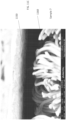
- FIGS 10A and 10B show microCT images of Samples 1 and 6, respectively, and their attachment to a microfiber underwear substrate. As shown, in FIG. 10A , there is no visual gap between adhesive 1000 and a microfiber underwear substrate 1010. In contrast, in FIG. 10B , there is a substantial gap between adhesive 1050 and a microfiber underwear substrate 1060. And, the gap exists the full length in the analyzed microCT image.
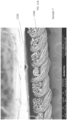
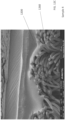
- FIGS. 11A-11D show SEM images of Sample 7 and its attempt at bonding to a portion of a microfiber undergarment.
- a cross section of adhesive 1150 and microfiber undergarment 1160 was taken to show how the adhesive 1150 only bonds to a portion of the fibers in the undergarment 1160.
- the adhesive 1150 contacts portions of fiber bundles at high points in the undergarment 1160.
- the undergarment comprises bundles of fibers which are woven with other bundles of fibers. So, each fiber bundle has a high point where it crosses over a fiber bundle running in a direction perpendicular to itself and low points where it crosses under the next adjacent fiber running perpendicular to itself.
- the adhesive 1150 is shown attached, to some extent to the high points of the fiber bundles.
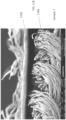
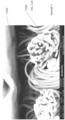
- FIGS. 12A-12D show SEM image of Sample 4 and how it bonds to a portion of a microfiber undergarment 1250.
- adhesive 1200 is attached not only to the high points of the fibers but also exhibits more attached surface area to the various fiber bundles.
- the adhesive 1200 flows to such an extent that, in cross-section under SEM, there is no gap between the adhesive 1200 and fibers which are oriented perpendicular to the plane of the image - in contrast to the images of FIGS. 11A-11D . So, the adhesive 1200 is disposed on these fibers such that a portion of their circumference at the plane of the image is coated with adhesive. And the adhesive 1200, as shown, can bond to the circumference of the fibers such that the adhesive flows between adjacent fibers which are perpendicular to the plane of the image.
- the adhesives of the present disclosure can be utilized in a myriad of absorbent articles to attach the article to the undergarment of a user or to an outer shell of material as in the case with disposable inserts.
- Exemplary articles where the adhesives of the present disclosure may be utilized are menstrual pads, catamenial pads, incontinence pads, male incontinence guards, liners.
- the adhesives of the present disclosure may be a removable, repositionable adhesive, similar to one of the samples available, inter alia, through the 3M corporation of St. Paul, Minn.
- absorbent article manufacturer purchases adhesives from adhesive suppliers rather than formulate / blend the adhesives themselves.
- an adhesive supplier may create an adhesive within the scope of the present disclosure and subsequently apply the adhesive to a material web, e.g. film.
- the adhesive manufacturer may then supply the film with the adhesive applied thereto to the absorbent article manufacturer.
- the absorbent article manufacturer after obtaining the film with the adhesive applied thereto, may manufacture at least one of feminine hygiene articles, adult incontinence pads, male incontinence guards, absorbent liners or absorbent inserts for durable panties and/or disposable diapers or combinations thereof.
- absorbent article manufacturers producing at least one of feminine hygiene articles, adult incontinence pads, male incontinence guards, absorbent liners or absorbent inserts for durable panties and/or disposable diapers or combinations thereof, may obtain adhesives of the present disclosure from adhesive suppliers. Subsequently, the absorbent article manufacturer may apply the adhesive to a backsheet and/or a portion of a garment-facing surface of the absorbent article.
- Absorbent articles of the present disclosure comprise a topsheet, a backsheet, and an absorbent system disposed between the topsheet and the backsheet.
- the topsheet and the backsheet are peripherally joined either directly or indirectly generally outboard of the absorbent system.
- Adhesives of the present disclosure are disposed on a garment-facing side of the absorbent article which, at least in part, comprises at least a portion of the backsheet.
- FIG. 13 represents an exemplary absorbent article 10 according to the present disclosure as seen from a garment-facing side.
- the absorbent article 10 has a longitudinal axis 80 a transversal axis 90, a front end region 50 a back end region 60 and a central region 70.
- the lines 20 and 30 illustrate the approximate boundaries between the front end region 50 and the central region 70 and the back end region 60 and the central region 70, respectively.
- Adhesives 100 as described herein are disposed on the garment-facing surface in the front end region 50 and the back end region 60.
- the adhesive 100 can have an adhesive length 40 in the front end region 50, and the front end region 50 can have a front end region length 45.
- a ratio of the adhesive length 40 to the front end region length 45 was disclosed previously herein.
- the adhesive 100 in the back end region 60 can have a similar ratio of adhesive length to back end region length as the front end region 50.
- the back end region adhesive length can be different than the front end region adhesive length 40.
- the adhesive 100 may extend from end edges 190 of an absorbent core longitudinally toward the transversal axis 90. And, the adhesive 100 may extend from longitudinal side edges 180 toward the longitudinal axis 80.
- absorbent articles of the present disclosure may comprise wings.
- the intent of the wings is to protect the sides of the undergarments and typically wings fold along the crotch area of the underwear and are attached below it.
- Wings can be provided as separate pieces and be attached to the article, typically a pantyliner or a sanitary napkin, or they can be integral with the materials of the absorbent articles, e.g., by being an integral extension of the topsheet, the backsheet, or of both.
- wings are not considered part of the backsheet (even when they are formed by an integral extension of it). Wings typically include adhesive on the backsheet side in order to affix them below the crotch of the underwear, and any typical adhesive distribution pattern can be used in conjunction with the absorbent articles of the present disclosure. Some examples include a continuous application or a patterned application. A patterned application of adhesive on the wings may provide the same benefits as the patterned adhesive application on the backsheet of the article when the article is removed thus reducing the risk of tearing the wing material.
- the adhesives of the present disclosure may comprise pre-formed adhesives.
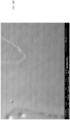
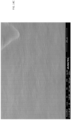
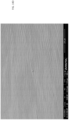
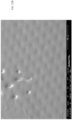
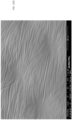
- FIGS. 14A-14D show conventional coated adhesive (applied in liquid / molten form) onto a backsheet versus pre-formed adhesives shown in FIGS. 15A-15D .
- the scanning electron microscope (SEM) images were taken at 30X, 100X, 250X and 500X magnification, respectively.
- the conventional adhesive does not comprise any discernable pattern in any of the images. Instead shown are some random air bubbles and what appear to be areas of increased caliper.
- striations in the adhesive appear; however, while these striations generally have a uniform direction from left to right in the image, the striations are random in length and direction to some extent.
- FIGS. 15A-15D the SEM images were taken at 30X, 100X, 250X and 500X magnification, respectively.
- the pre-formed adhesive specifically tape in this instance, there appears to be air bubbles and other asperities.
- a pattern in the adhesive is clear even at 30X magnification.
- the arrangement of dots / nodes in a repeating pattern is prevalent in the image. At the higher resolutions, these nodes appear to be depressions and form what appears to be a quilted pattern.
- FIG. 16 shows an adhesive on the backsheet of an absorbent article highlighted in black.
- the adhesive comprises a plurality of stripes shown from left to right in the image.
- Each of the stripes comprises a leading portion 2610 and a trailing portion 2620 and a central portion disposed between the leading portion 2610 and the trailing portion 2620.
- the leading portion 2610 and the trailing portion 2620 each comprise about one third of the overall length of the adhesive stripe.
- the trailing portion 2620 generally has a lower basis weight than does the leading portion 2610 and the central portion.
- the basis weight in the central portion can have a basis weight which varies on average by no more than about 20 than about 15%, or no more than about 10%, such as by no more than about 5% over the length of the central portion.
- the trailing portion 2620 can gradually decrease from the average basis weight of the central portion to zero.
- the leading portion 2610 can have a higher basis weight than the central portion.
- pre-formed adhesive is shown on the backsheet of an absorbent article. Similar to the adhesive of FIG. 16 , the pre-formed adhesive of FIG. 17 may comprise a leading portion 2710 and a trailing portion 2720 along with a central portion disposed therebetween. And similarly, the leading portion 2710 and the trailing portion 2720 may each comprise about a third of the overall length of the pre-formed adhesive. However, unlike the adhesive of FIG. 16 , the pre-formed adhesive of FIG. 17 has a relatively uniform basis weight throughout the leading portion 2710, central portion and trailing portion 2720. Specifically, the trailing portion 2720 does not gradually decrease to zero as in the trailing portion 2620 of FIG. 16 .
- leading portions and trailing portions are shown extending generally in a transverse direction on the backsheet of the absorbent article.
- adhesive which is applied generally in a longitudinal direction.
- the leading portion and the trailing portion would be oriented generally parallel to the longitudinal axis.
- adhesive which are applied in molten / liquid form will have a trailing portion which gradually decreases basis weight to zero while the pre-formed adhesives will comprise a trailing portion which has a generally uniform basis weight as noted regarding the central portion and a trailing portion which does not gradually decrease in basis weight to zero.
- pre-formed adhesive can be determined via visual inspection of the leading portions and trailing portions of the adhesive on the backsheets of the absorbent articles.
- pre-formed adhesive is a tape
- regular microscopy or close visual inspection may be utilized to determine whether a substrate is disposed between two layers of adhesive.
- the topsheet may comprise any suitable substrate.
- Some examples include films, nonwovens, laminates of films and nonwovens, laminates of films and films, laminates of nonwovens and nonwovens, composites of films and nonwovens, composites of films and films, and composites of nonwovens and nonwovens.
- a laminate of two different materials regards the combination of the materials after each has been made.
- a film web may be combined with a nonwoven web via mechanical processing, adhesives, ultrasonic or fusion bonding, etc.
- a composite of two different materials regards the combination of the materials when one of the materials is made.
- a semi-molten film web may be extruded onto a nonwoven. This composite material will not need additional bonding as the semi-molten material is able to flow - to some extent - into the interstices of the nonwoven fibers.
- the topsheet is preferably compliant, soft feeling, and non-irritating to the wearers skin and hair. Further, the topsheet is liquid pervious, permitting liquids (e.g., menses and/or urine) to readily penetrate through its thickness.
- a suitable topsheet may be manufactured from a wide range of materials such as woven and nonwoven materials (e.g., a nonwoven web of fibers); polymeric materials such as apertured formed thermoplastic films, apertured plastic films, and hydroformed thermoplastic films; porous foams; reticulated foams; reticulated thermoplastic films; and thermoplastic scrims.
- Suitable woven and nonwoven materials can be comprised of natural fibers (e.g., wood or cotton fibers), synthetic fibers (e.g., polymeric fibers such as polyester, polypropylene, or polyethylene fibers) or from a combination of natural and synthetic fibers.
- the topsheet comprises a nonwoven web
- the web may be manufactured by a wide number of known techniques. For example, the web may be spunbonded, carded, wet-laid, melt-blown, hydroentangled, combinations of the above, or the like.
- Topsheets of the present disclosure may be provided with texture, such as protrusions or depressions.
- the protrusions and/or depressions may be treated hydrophobically or hydrophilically as desired.
- Some suitable examples of protrusions and depressions and their respective treatments and methods of doing so are described in U.S. Patent Publication Nos. US2017/0258955 ; US2018/0071151 ; US2017/0027774 ; US2017/0029994 ; US2018/0216269 ; US2019/0374405 ; US2019/0380887 ; and US2019/0298587 .
- the absorbent articles of the present disclosure comprise an absorbent system disposed between the topsheet and the backsheet.
- the absorbent system may comprise several layers.
- a layer of material which is most proximal to the topsheet - often termed acquisition layer or secondary topsheet - may be utilized to quickly acquire liquid insults from the topsheet.
- the secondary topsheet or acquisition layer may comprise any suitable material. Some examples include films and nonwovens or laminates or composites thereof. Film based secondary topsheets, if utilized correctly, can provide a good barrier against rewet; however, care must be taken to ensure that the film secondary topsheet comprises adequate fluid transport openings to allow acquired liquid insults from the topsheet to pass to one or more storage layers.
- Nonwoven based secondary topsheets may also be utilized.
- secondary topsheets of the present disclosure may comprise a tissue layer or a nonwoven, such as carded resin-bonded nonwovens, embossed carded resin-bonded nonwovens, high-loft carded resin-bonded nonwovens, carded through-air-bonded nonwovens, carded thermo-bonded nonwovens, spunbonded nonwovens, and the like.
- a variety of fibers can be used in the secondary topsheet or acquisition layer, including natural fibers, e.g.
- biodegradable fibers such as polylactic acid fibers, and synthetic fibers such as polyolefins (e.g., polyethylene and polypropylene), polyesters, polyamides, synthetic cellulosics (e.g., RAYON ® , Lyocell), cellulose acetate, bicomponent fibers, and blends thereof.
- polyolefins e.g., polyethylene and polypropylene
- polyesters e.g., polyamides
- synthetic cellulosics e.g., RAYON ® , Lyocell
- cellulose acetate cellulose acetate
- bicomponent fibers cellulose acetate
- 2020/0306099 entitled “FLUID MANAGEMENT LAYER FOR AN ABSORBENT ARTICLE”
- 2020/0315870 entitled “Fluid Management Layer For An Absorbent Article”
- 2020/0315861 entitled “Absorbent Layer For An Absorbent Article.” Additional exemplary secondary topsheets are described in U.S. Patent No. 10,532,123 ; U.S. Patent Application Publication Nos. US2019/0247244 and US2018/0098893 .
- the absorbent system may comprise, in addition to or independently thereof, an absorbent core.
- the absorbent core can be formed from any of the materials well known to those of ordinary skill in the art. Examples of such materials include multiple plies of creped cellulose wadding, fluffed cellulose fibers, wood pulp fibers also known as airfelt, textile fibers, a blend of fibers, a mass or batt of fibers, airlaid webs of fibers, a web of polymeric fibers, and a blend of polymeric fibers.
- Other suitable absorbent core materials include absorbent foams such as polyurethane foams or high internal phase emulsion ("HIPE") foams. Suitable HIPE foams are disclosed in US Patent Nos.
- the absorbent core can comprise superabsorbent materials such as absorbent gelling materials (AGM), including AGM fibers, as is known in the art.
- AGM absorbent gelling materials
- the absorbent core can therefore constitute a layer comprising superabsorbent material.
- the absorbent core may comprise a blend of components as well and/or a myriad of layers.
- a layer may comprise a mixture of cellulose (pulp) and AGM.
- Another layer may comprise a foam layer, e.g. a HIPE foam or a polyurethane foam layer. Additional HIPE foam layer configurations are possible.
- a HIPE foam or portions thereof may be deposited on a nonwoven web.
- Such structures are defined in additional details in U.S. Patent Application Nos. US2015/0313770 ; US2015/0335498 ; US2015/0349391 ; US 2017/0071795 ; US2017/0119587 ; and US2017/0119597 . Additional structures are described in U.S. Patent Nos.
- an absorbent core layer may comprise a nonwoven web upon which AGM is deposited and secured thereto by adhesive.
- a nonwoven / AGM layer may be joined to a cellulose layer and/or a HIPE foam layer.
- a cellulose layer may be joined with a HIPE foam layer and/or a polyurethane foam layer.
- a layer comprising a mixture of cellulose and AGM may be joined with a HIPE foam layer and/or a polyurethane foam layer.
- any of the foregoing combinations may be utilized in conjunction with one another and/or duplicated.
- a nonwoven / AGM layer may be joined to a cellulose layer which is joined to another cellulose layer, which is joined to a nonwoven / AGM layer.
- an absorbent core may comprise a distribution layer which is substantially free of AGM, a superabsorbent layer which is substantially free of pulp, a second distribution layer substantially free of AGM and a second superabsorbent layer substantially free of pulp.
- These layer may be arranged in any suitable manner.
- the first distribution layer may be disposed proximal to a secondary topsheet which the first superabsorbent layer is disposed between the first distribution layer and the second distribution layer.
- the second superabsorbent layer may be disposed between the second distribution layer and the backsheet.
- the second superabsorbent layer may be disposed between the first superabsorbent layer and the second distribution layer.
- the first distribution layer may be disposed between the first superabsorbent layer and the second superabsorbent layer.
- absorbent core constructions are provided in additional detail in U.S. Patent Application Publication Nos. 2020/0375810 A1 ; 2019/0314212 A1 ; 2018/0098893 A1 and 2018/0098896 A1 .
- the absorbent core can be relatively thin, less than about 5 mm in thickness, or less than about 3 mm, or less than about 1 mm in thickness. Thickness can be determined by measuring the thickness at the midpoint along the longitudinal centerline of the pad by any means known in the art for doing while under a uniform pressure of 1.72 kPa.
- the overall thickness of the absorbent article can similarly be relatively thin.
- pantiliners can range from 1.5 mm to about 3.0 mm.
- Menstrual pads can have a thickness ranging from 2.0 mm to about 3.5 mm.
- Adult incontinence pads can have a thickness of from about 2.6 mm to about 6.5 mm.
- polyacrylate based materials typically partially neutralized polymers, are commonly incorporated in absorbent articles and are known as superabsorbent polymers or superabsorbents and are crosslinked.
- the polyacrylate material has neutralized, typically with sodium, carboxylate groups hanging off the main polymer chain. In contact with water, the sodium detaches and goes in solution, leaving only carboxyl ions. Being negatively charged, these ions repel one another so that the polymer unwinds and absorbs more and more water, which is instead attracted by the carboxyl ions, as further carboxyl ions become available.
- the hydrogen in water is trapped by the polyacrylate due to the atomic bonds associated with the polarity forces between the atoms.
- the cross-links which bridge different polymer chains, lead to a three-dimensional structure, which upon liquid absorption constitutes the swollen gel.
- the absorbent gelling material which can be comprised in the absorbent core can be selected among the polyacrylate based polymers described in the European Patent Application EP 05023061.4, filed on 21 Oct. 2005, in the name of The Procter and Gamble Company .
- polyacrylate based materials being very slightly crosslinked, or substantially not crosslinked at all, incorporated in absorbent articles for the absorption of proteinaceous or serous body fluids such as for example menses, blood, plasma, vaginal secretions, and also mucus or milk, but particularly menses or blood, provide an improved absorption and retention capacity for such body fluids, and an improved absorption rate as well, compared to traditional crosslinked superabsorbents.
- the absorbent gelling materials can be typically used in the form of discrete particles.
- Such absorbent gelling materials can be of any desired shape, e.g., spherical or semi-spherical, cubic, rod-like polyhedral, etc. Shapes having a large greatest dimension/smallest dimension ratio, like needles and flakes, are also contemplated for use herein. Agglomerates of absorbent gelling material particles may also be used.
- Absorbent cores may include a core wrap i.e. a thin layer of fluid pervious material (usually a tissue paper or a think nonwoven layer) which wraps the core in order to preserve its integrity during manufacturing of the article and during its use.
- a core wrap i.e. a thin layer of fluid pervious material (usually a tissue paper or a think nonwoven layer) which wraps the core in order to preserve its integrity during manufacturing of the article and during its use.
- the absorbent article can comprise further components such as side cuffs, typically found in incontinence pads, or side wings or side flaps, typically found in sanitary napkins. These side wings or side flaps may comprise one or more adhesive portions described herein.
- the absorbent articles herein are preferably disposable after a single use and are usually commercialized in packages comprising multiple units which in some cases can be individually wrapped.
- the backsheet of the absorbent articles of the present disclosure is the outer layer of the article on a garment facing side.
- the outer layer of the absorbent article on its garment-facing side is a composite material (such as a laminate of a film and a nonwoven material) for the purpose of the present disclosure
- the term "backsheet” indicates exclusively the outermost layer of the layers forming said composite material.
- the term "backsheet” indicates exclusively said outer PE film layer.
- the backsheet of the absorbent articles of the present invention is a plastic film and is preferably flexible and soft.
- the term "flexible and soft” refers to materials which are compliant and will readily conform to the general shape and contours of the human body and will give the users a pleasant tactile feel on the skin.
- the backsheet prevents the exudates absorbed and contained in the absorbent core from wetting articles which contact the absorbent article such as bedsheets, pants, pajamas and undergarments.
- the backsheet can also be vapor permeable ("breathable"), while remaining fluid impermeable. In this case typically microporous plastic films are used which are water vapor permeable while remaining essentially impermeable to liquids.
- the backsheet can be a plastic film having a basis weight of less than 40 gsm or less than 30 gsm or less than 24 gsm or less than 18 gsm or less than 15 gsm or less than 13 gsm.
- Any type of plastic film can be used as backsheets according to the present invention.
- Suitable films can be formed by a thermoplastic polymeric material and can be obtained by known film making processes.
- Plastic films can be selected from single layer or multilayer films which are obtainable for example through a single layer extrusion or a multilayer co-extrusion process.
- US2014/0248484 discloses a method for producing thin plastic films usable as backsheets in the present invention wherein an initial film web made of a thermoplastic polymer material containing a polyethylene matrix, and 1 to 70 parts by weight of polypropylene per 100 parts by weight of polyethylene matrix, is, after being heated, guided through a cooled roll gap whereby the initial film web is heated only until the polyethylene matrix material melts but below the melting temperature of the polypropylene.
- the plastic films usable herein as backsheets can comprise a single polymer or a blend of different polymers.
- the plastic films of the present disclosure can comprise additives such as for example pigments, dyes, chemical additives such as light protectors, antioxidants, and inert materials such as titanium oxide, calcium carbonate, or also kaolin, diatomaceous earth, or mixtures thereof.
- additives such as for example pigments, dyes, chemical additives such as light protectors, antioxidants, and inert materials such as titanium oxide, calcium carbonate, or also kaolin, diatomaceous earth, or mixtures thereof.
- an inert component typically calcium carbonate
- backsheet films are typically heat sealed along the perimeter to the topsheet of the absorbent article.
- inert materials are sometime included in plastic films which are mechanically stretched when cold so that the inert particles form a network of channels which allows the passage of water vapor while maintaining a good permeability.
- plastic films which are mechanically stretched when cold so that the inert particles form a network of channels which allows the passage of water vapor while maintaining a good permeability.
- Such films are normally identified as "microporous films” are suitable as backsheets in the present invention and they can provide improved breathability in the absorbent articles (as known in the art).
- the plastic films usable herein as backsheets of the present invention are preferably thermoplastic polyolefin-based film.
- the plastic film for of the present invention can be for example a polyethylene (PE) based film, a polypropylene based (PP) or a PE/PP blend-based film.
- a film is "based" on a polymer (e.g. PE) or on a mixture of polymers (e.g. PE/PP blend), it is intended that the majority of the mass of the film is constituted by the polymer(s) of which is based on, preferably more than 80% wt. even more preferably more than 90% wt.
- the remaining mass of the film can be formed by other polymers and customary film additives as known in the art.
- the backsheet forms the garment-facing surface of the absorbent article on which the fastening adhesive is placed.
- a protective cover means such as a silicone coated release paper, a silicone coated plastic film or any other easily removable cover.
- the protective cover means can be provided as a single piece or in a multitude of pieces, e.g. to cover individual adhesive areas (e.g. on the backsheet and on the wings).
- the protective cover means can also perform other functions such as provide individualized packaging for the article or provide a disposal function as known in the art. Any commercially available release paper or film may be used. Suitable examples include BL 30 MG-A SILOX EI/O, BL 30 MG-A SILOX 4 P/O available from Akrosil Corporation, and M&W films available from Gronau in Germany, under the code X-5432.
- the adhesives of the present disclosure which are disposed on the garment-facing surface of the absorbent article which can include a portion of the backsheet and/or a portion of wings / side flaps. Adhesives may be evaluated against the characteristics of the present disclosure prior to their application on the backsheets of their respective absorbent articles.
- Table 3 is provided for the convenience of the reader. Table 3 includes a non-exhaustive list of properties as well as a non-exhaustive list of corresponding values for each of the properties discussed herein for the PFA's of the present disclosure. There is no requirement that the PFA's of the present disclosure exhibit all of these properties.
- Table 3 Property Value Tan delta -1 0.28 to 1.2 Tan delta -2 0.25 to 1.9 Storage modulus -1 1 kPa to 84 kPa Storage modulus --2 40 to 300 kPa Yield stress 32 kPa to about 100 kPa Relaxation time 100 seconds or less Surface Energy 10 mJ/m 2 to 24 mJ/m 2 Polar component 1 percent to 9 percent
- Example A A method of making a disposable absorbent article having a wearer-facing surface and a garment-facing surface, a front end region, a back end region, and a central region disposed between the front end region and the back end region, the method comprising the steps of: obtaining a topsheet; obtaining a backsheet; obtaining an absorbent system; combining the topsheet, backsheet, and absorbent system such that the absorbent system is disposed between the topsheet and the backsheet, and joining the topsheet and the backsheet together outboard of the absorbent system; obtaining pre-formed adhesive portions; and attaching one side of the pre-formed adhesive portions to the backsheet.
- Contact angles on substrates are determined using a goniometer and appropriate image analysis software (a suitable instrument is the DSA100 Drop Shape Analyzer, Kruss GmbH, Hamburg, Germany, or equivalent) fitted with a gas tight syringe and steel needle capable of dispensing 1.0 uL drops.
- Two test fluids are used: Type II reagent water (distilled) in accordance with ASTM Specification D1193-99 and 99+% purity diiodomethane (both available from Sigma Aldrich, St. Louis, MO). Contact angles from these two test fluids can further be used to calculate surface energy based on the Fowkes Theory. All testing is to be performed at about 23 °C ⁇ 2 C° and a relative humidity of about 50% ⁇ 2%.
- test specimens taken from the raw material or obtained from a material layer removed from an absorbent article.
- the test location is on an adhesive, do not remove any protective cover that may be present until the measurement is to be made in order to decrease the likelihood of contaminating the adhesive layer.
- the test specimen must be of an appropriate size such that it fits onto the stage of the goniometer and can accommodate any potential spreading of the applied test fluid. Prepare enough test specimens for a total of twenty test locations (ten locations for each test fluid).
- the video capture device must have an acquisition speed capable of capturing at least 10-20 images from the time the drop of test fluid hits the surface of the specimen to the time it cannot be resolved from the specimen's surface. A capture rate of 900 images/sec is typical. Depending on the hydrophobicity / hydrophilicity of the specimen, the drop may or may not rapidly wet the surface of the test specimen. If the test specimen is capable of absorbing the test fluid at a slow rate, the images should be acquired until no more than 2% of the volume of the drop is absorbed into the specimen. If the test specimen is capable of absorbing the test fluid quickly, the first resolved image should be used if the second image shows more than 2% volume loss.
- the values should be excluded and the test repeated at an equivalent location on the specimen. Identify nine additional equivalent sites on the specimen and repeat for a total of 10 measurements (20 angles). Calculate the arithmetic mean for all replicates and report as Contact Angle with Diiodomethane to the nearest 0.01°. In like fashion, measure the contact angle with water as the test fluid, and report as Contact Angle with Water to the nearest 0.01°.
- Eq 4 can be solved for the dispersive component of surface energy ( ⁇ D s) and reported to the nearest 0.01 mJ/m 2 .
- Eq 3 can be solved for the polar component of surface energy ( ⁇ P s ) and reported to the nearest 0.01 mJ/m 2 .
- Total surface energy of the test specimen ( ⁇ s ) is calculated as the sum of ⁇ D s + ⁇ P s and reported to the nearest 0.01 mJ/m 2 .
- surface polarity by dividing the polar component of surface energy ( ⁇ P s ) by the total surface energy ( ⁇ s ), then multiplying by 100 and reporting to the nearest 0.01%.
- the Oscillatory Rheometry Test Method is used to measure the Storage Modulus and the Loss Factor (also known as tan delta) of adhesive tapes or hot melt adhesive compositions.
- a rotational rheometer (such as DHR3 or ARES G2, TA Instruments, New Castle, DE, USA, or equivalent) capable of sample temperature control with a precision equal to or exceeding 0.5 degrees C over at least the range of 0 degrees C to 150 degrees C.
- the rheometer needs to have a normal force control system to enable the axial force control on the specimen with an accuracy of 0.1 N.
- the rheometer is operated in a parallel plate configuration with 25 mm stainless steel parallel-plate tooling for hot melt adhesives and 20 mm for adhesive tapes or 8 mm when the adhesive tape width is smaller than 20mm.
- the rheometer is heated to 150 degrees C, the adhesive or polymer composition is introduced in the rheometer, the gap is set to 1050 ⁇ m, excess protruding sample is trimmed, and the gap is then set to 1000 ⁇ m.
- the axial force control of the rheometer is set to 0 N and be maintained within ⁇ 0.1 N of axial force during the experiment, thereby thermal expansion/contraction of the sample itself is compensated by adjusting the gap in order to avoid overfilling or underfilling in addition to the abovementioned compensation of the tooling.
- the rheometer is then allowed to cool to 37 degrees C or 25 +/- 0.5 °C if obtaining data for 25 degrees C.
- the sample is equilibrated at 37 degrees C + / - 0.5 degrees C (or 25 +/- 0.5 degrees C, if obtaining data for 25 degrees C) for 300 s.
- An oscillatory frequency sweep with 0.1% strain is performed from 0.01 - 100 Hz [1/s] at 37 degrees C + / - 0.5 degrees C (or 25 +/- 0.5 degrees C, if obtaining data for 25 degrees C).
- 10 points per decade are acquired (see frequency table).
- the storage modulus G' and the loss factor (tan delta) is calculated and recorded from 0.01 to 100 Hz for 10 frequencies per decade in a logarithmic matter.
- the storage modulus values are reported in kilopascal (KPa) to the nearest 0.01 KPa.
- the loss factor also known as tan delta) are recorded to the nearest hundredth.
- the Extensional Test Method is used to determine the Yield Stress for a specimen of an adhesive composition.
- a thin film specimen formed of adhesive composition is analyzed with a rotational rheometer fitted with a specialized fixture with counter rotating rollers, and the stress associated with extensional strain imparted is measured and recorded.
- a rotational rheometer (ARES G2, TA Instruments, New Castle, DE, USA, or equivalent) is fitted with a fixture that has counter rotating cylindrical metal rollers specifically designed for the interrogation of extension deformation of films.
- An example of a suitable fixture is the Extensional Viscosity Fixture, or EVF (EVF, TA Instruments, or equivalent).
- the rheometer is further fitted with a forced-convection oven FCO (FCO, TA Instruments, or equivalent) and cooling system (ACS 2, TA Instruments, or equivalent) capable of controlling temperate from at least -50 to 250 °C to a within a tolerance of 0.5 °C.
- FCO forced-convection oven
- ACS 2 TA Instruments, or equivalent
- the adhesive If the adhesive is mounted on a substrate, it must be separated before preparing it as a test specimen. This can be done by extracting the adhesive from the substrate with an organic solvent such as Tetrahydrofuran (THF) and evaporating the entire solvent afterwards gently at room temperature (20°C - 30°C) to obtain the adhesive for test specimen preparation.
- an organic solvent such as Tetrahydrofuran (THF)
- the adhesive composition is placed in a circular polytetrafluoroethane (PTFE) bowl with a flat bottom (diameter of 60 mm or 25 mm ⁇ 2 mm ) and introduced into a vacuum oven held at 170°C. After 15 minutes at ambient pressure, the pressure is lowered to 10 mbar, and the adhesive composition is subsequently held at 170°C and at 10 mbar for 45 minutes to remove air bubbles from the adhesive composition . If 170°C is insufficient to melt the adhesive composition s a temperature 30 ⁇ 10 °C above the melting temperature of the polymer material composition is used.
- PTFE polytetrafluoroethane
- the adhesive composition is removed from the vacuum oven and allowed to cool to ambient lab conditions (23 ⁇ 2 °C) for 90 ⁇ 30 minutes, at which point the adhesive composition is removed from the PTFE bowl and placed between 2 sheets of siliconised paper (such as product number 114918, Mondi Group, Hilm, Austria, or equivalent).
- a metal shim 500 ⁇ 30 ⁇ m in thickness is used in the heated press as a spacer to obtain a film thickness of 500 ⁇ m when pressed with a heated press at 90 °C for 60 seconds at a pressure sufficient to form a polymeric film.
- a temperature approximately 10 ⁇ 5 °C below the melting point of the sample material composition such that the sample material composition is in a semi-solid state is used.
- the film is stored at least 120 hours in the laboratory at 23 ⁇ 2 °C prior to testing. From the film individual specimens for measurement are punched with a sample cutter to the final specimen dimensions of 20.0 mm by 10.0 mm by 500 ⁇ m.
- the specimen is briefly pressed onto the cylinders of the EVF to secure it to the cylinder surfaces.
- the specimen is placed with its length perpendicular to the axis of rotation of the cylinders.
- the specimen mounted on the EVF is then placed in the forced convection oven of the rheometer for thermal conditioning and is kept isothermal at 37 ⁇ 0.5 °C for 300 ⁇ 10 s. After this time has elapsed, the specimen is mechanically conditioned. To mechanically condition the specimen, the torque transducer is zeroed, and the sample is put under a pre-stretch rate of 0.001 s -1 for 0.30 s and then allowed to relax for 60 s (in this method, all strain is expressed in terms of Hencky strain, also known as "true strain” or "logarithmic strain.”).
- extensional stress in kilopascals, or KPa
- Hencky strain data are plotted in semilogarithmic fashion with Hencky strain on the abscissa (linear scale) and extensional stress on the ordinate (logarithmic scale).
- a linear range is sought in this plot between a Hencky strain of 0.7 and 1.3.
- the value of the fitted line at a Hencky strain of zero is defined as the Yield Stress, which is reported in KPa to the nearest kilopascal.
- This peel force test method is used to determine the force required to peel a strip of microfiber material from the panty fastening adhesive (PFA) on the garment-facing side of an absorbent article. This method is intended to simulate the removal of an absorbent article adhered to a user's undergarment during use. Peel force is measured on a constant rate of extension tensile tester interfaced to a computer (a suitable instrument is the MTS Alliance using Testsuite software, as available from MTS Systems Corp., Eden Prairie, MN, or equivalent) using a load cell for which the forces measured are within 1% - 99% of the limit of the cell. All testing is performed in a room controlled at 23°C ⁇ 3C° and 50% ⁇ 2% relative humidity and test samples are conditioned in this environment for at least 2 hours prior to testing.
- PFA panty fastening adhesive
- a rigid backing plate (stainless steel with a thickness of about 1.5 mm) is used.
- the dimensions of the backing plate are governed by the size of the sample being tested as follows.
- the length of the plate is about 25 mm longer than the overall longitudinal length of the test sample, and the width of the plate is about 10 mm wider than the lateral width of the test sample measured at its widest location (excluding wings).
- a strip of microfiber material is used to simulate the wearer's undergarment.
- the microfiber material used for this peel test is 92% polyester / 8% spandex, 130gsm (or equivalent).
- This specific material can be obtained from Fruit of the Loom, Inc microfiber briefs (largest size; available from any convenient source).
- the material (or intact briefs) Prior to testing, the material (or intact briefs) are washed 1 time to remove any finishes as follows.
- the material (or intact briefs) are placed into a high efficiency, front-loading washing machine (any convenient source) along with 48g of Tide Free and Gentle (or equivalent, without additional additives like odor defense, oxi boost or fabric softener).
- the washer is set to "normal" cycle using warm wash and rinse water.
- the material (or intact briefs) are placed into a clothes dryer (tumbling with drying sensor; any convenient source).
- the clothes dryer temperature is set to "regular” and run until dry as indicated by the drying sensor.
- the material (or intact briefs) are equilibrated in a room controlled at 23°C ⁇ 3C° and 50% ⁇ 2% relative humidity for at least 2 hours.
- Prepare a strip of microfiber material that has a width equal to the widest portion of the PFA pattern with a length that is about 30 mm longer than twice the longitudinal length of the PFA pattern on the sample.
- the microfiber material strip must be sufficiently wide enough to cover the entire width of the PFA pattern and long enough to cover the entire length of the PFA pattern, overlap itself entirely and still have enough excess leftover to insert into the upper grip of the tensile tester. If the microfiber material is obtained from the briefs, the length of the strip is cut in a direction that is perpendicular to the waistband and should not include any seams, waistband material or gusset. Note which side of the material is intended to face the body (i.e. the inside of the briefs). The length of the microfiber material strip must be long enough to cover the entire longitudinal length of the PFA pattern on the test sample.
- a strip of non-elastic standard cotton material (100% bleached cotton weave, about 100 g/m 2 available from Testfabrics, Inc., West Pittston, PA, or equivalent) is used to supplement the length of the trailing end of the microfiber strip.
- the standard cotton is cut to the same width as the microfiber strip and attached to the microfiber strip as follows. One of the longitudinal ends of the strip of standard cotton is placed over the trailing end of the microfiber strip, overlapping the trailing end of the microfiber by 25mm.
- a piece of masking tape (1" wide; any convenient source) as follows.
- the masking tape is placed perpendicular to the longitudinal length of the material strips such that its width covers equal portions of the microfiber and cotton strips.
- the masking tape is sufficiently long enough such that it can cover both sides of the overlapping strips.
- the masking tape is pressed firmly onto both sides of the material strip to ensure it is properly secured.
- a fresh microfiber material strip is used for each test sample.
- a padded weight assembly is used to ensure adequate and even attachment of the microfiber material strip to the PFA.
- the weight assembly must impart a pressure of 26 - 27 g/cm 2 with a base that has about the same length and width as that of the test sample (width determined at widest location on test sample excluding wings).
- the weight assembly is constructed as follows. Lay a single layer of polyethylene film (0.02 - 0.04 mm thick; any convenient source) flat on a bench surface. A piece of flexible insulation foam (Buna-N/PVC, 1 inch thick, density of 4.5 pounds/cubic foot; available from McMaster-Carr, Princeton, NJ, or equivalent) that is cut to the predetermined base size is laid centered on top of the film. A metal weight (same length and width as the predetermined base size) with a handle is then attached to the insulation foam using double sided tape. Next the polyethylene film is wrapped around the insulation foam and secured to the sides of the metal weight using transparent tape.
- test sample To prepare the test sample, first remove it from any wrapper present, but leave the PFA protective cover (e.g. release paper) intact. If the wrapper is the protective cover (e.g. PFA is attached directly to the wrapper), then leave the wrapper intact. If the sample is folded, gently unfold it, smooth out any wrinkles and determine which end of the sample is intended to be the front end. If wings are present, unfold the wings. Without disturbing the PFA protective cover, determine the overall length of the PFA pattern using a steel ruler (NIST certified), and record as PFA L to the nearest mm.
- PFA protective cover e.g. release paper
- Attach the sample to the backing plate as follows. Lay the backing plate on a horizontally flat rigid surface. With the body facing side of the sample facing down, laterally center the sample over the backing plate and align the front longitudinal edge of the sample within 1 cm from the upper longitudinal edge of the backing plate.
- the sample is secured to the backing plate using one-sided tape (about 1 inch wide) as follows. The tape is placed no closer than about 1 cm from any portion of the PFA pattern, and no tape is attached to any portion of the PFA protective cover (e.g release paper, wrapper). Secure the front end of the sample to the backing plate by overlapping the end of the sample with a strip of tape positioned approximately parallel to the lateral axis of the sample.
- the sample taut to remove any wrinkles and secure the back end of the sample to the backing plate by overlapping the end of the sample with a strip of tape positioned approximately parallel to the lateral axis of the sample. If the sample does not contain wings, secure the entire length of the lateral edge on both sides of the sample to the backing plate using strips of tape. If the sample contains wings, fold each wing around the lateral edges of the backing plate and secure to the backside of the plate with tape. Then in like fashion, secure the remaining length of the lateral edge on both sides of the sample to the top side of the backing plate. The sample is secured in such a way that it is held taut without stretching to keep it flat against the backing plate during the peeling process. In instances where the PFA covers the entire backsheet, tape is used only at the front and back edges of the sample such that the tape overlaps each end by no more than about 1 cm.
- the prepared strip of microfiber material as follows. Remove the PFA protective cover from the sample and determine whether the PFA pattern is continuous in the longitudinal direction (e.g. one or more stripes with no lateral spaces along its longitudinal length). Measure the overall longitudinal length of the PFA pattern and record as PFA L to the nearest 0.1 mm. Now laterally center the microfiber material strip over the sample (inside of briefs facing the sample). Position the leading edge of the microfiber material strip at a distance no more than 1 cm above the front edge of the PFA pattern.
- the longitudinal axis of the microfiber material strip is aligned with the longitudinal axis of the sample and secure it to the front edge of the PFA pattern.
- the microfiber material strip may be an excess length of microfiber material (or standard cotton if used to supplement the length of the microfiber) trailing off the back longitudinal end of the sample, referred to as the trailing end of the microfiber material strip.
- the trailing end of the microfiber material strip Center and then place the prepared weight assembly over the sample on top of the attached microfiber material strip. After 30 ⁇ 2 seconds have elapsed, remove the weight assembly and set it aside. The sample is now prepped for testing and must be analyzed within 1 minute after the weight assembly has been removed.
- the gauge length is governed by the length of the backing plate and is set to a distance that is about 10 mm greater than the length of the backing plate that will not be within the lower grip.
- the gauge length is set using a calibrated ruler traceable to NIST, or equivalent.
- the path length is governed by the length of the PFA pattern, PFA L , and is set to a distance that is about 5 mm greater than PFA L .
- the resultant graph will consist of a series of peaks (adhesive region) and valleys (non-adhesive region).
- the maximum force at each peak along the path length is recorded to the nearest 0.01 N.
- the Average of Peak Forces (F p ) is recorded to the nearest 0.01 N.
- F p Average of Peak Forces
- This test method is intended to simulate in-use removal of an absorbent article adhered to the user's undergarment via PFA (Panty Fastening Adhesive). Post removal, the presence of residual adhesive on the undergarment is determined by visual inspection after enhancing the appearance of the residue with carbon black paper. All testing is performed in a room controlled at 23°C ⁇ 3C° and 50% ⁇ 2% relative humidity and test samples are conditioned in this environment for at least 2 hours prior to testing.
- a pair of cylinders are used to simulate a user's lower legs.
- Each cylinder is 6 inches in diameter, about 18 inches tall and composed of high-density polypropylene foam (e.g. Amazon Basics High Density Round Foam Roller, available from Amazon.com, or equivalent).
- the cylinders are mounted about 6 inches apart on a rigid base large enough to prevent tipping, and they are secured in such a way as to prevent rotation during use.
- a foam pad, a rigid weight and a surface warmer are used to ensure adequate and even attachment of the test sample to the cotton briefs.
- the foam pad is a piece of flexible insulation foam (Buna-N/PVC, 1 inch thick, density of 4.5 pounds/cubic foot; available from McMaster-Carr, Princeton, NJ, or equivalent) cut to a size of 69 mm by 305 mm. To prevent shedding when in contact with the white, cotton briefs, the foam pad is lightly wrapped with a paper towel secured with masking tape.
- the rigid, flat contact surface weight is 69 mm by 305 mm and has a handle attached.
- the rigid weight can be made of any material (e.g.
- the surface warmer must be able to accommodate a set temperature of 37° C and have a contact surface area large enough to house the test sample, pad and rigid weight.
- a suitable surface warmer is the Premiere Slide Warmer, model XH-2001 (available from Amazon.com), or equivalent.
- a suitable paper is the Pelikan carbon 1015G paper in size A4 (21 x 31 cm) available from any convenient source, or equivalent paper and size.
- the test sample is attached to the cotton briefs as follows. Place the foam pad lengthwise on the outside of the gusset/crotch region of a pair of the pre-washed/dried cotton briefs. Now turn the briefs inside out, conforming the gusset/crotch region over the foam pad in order to ensure a flat, unwrinkled inner surface of the briefs. Place the foam pad and briefs assembly on a flat, rigid surface with the inside of the gusset/crotch region of the briefs facing up, and note which end is the front of the briefs. Remove the test sample from any outer packaging, unfold it and determine which end is intended to be the front end of the pad.
- wings are present, cut them from the test sample using a scissor with care so as not to disturb the absorbent body or PFA of the test sample.
- the test sample is removed from the briefs as follows.
- the briefs with the attached test sample are placed onto the foam cylinders that represent the user's legs. With the briefs upside down, place one leg hole over one of the cylinders and then the other leg hole over the other cylinder.
- the motion to remove the test sample from the briefs is meant to realistically mimic the removal of a pad from an undergarment.
- the presence of adhesive residue is determined as follows. Remove the cotton briefs from the cylinders, using care not to disturb the inner side of the gusset where the test sample was removed. Place the briefs on a flat, rigid surface with the inside of the gusset/crotch region of the briefs facing up. Place 1 sheet of the carbon black paper centered over the inside gusset of the briefs where the test sample was removed. Now place the rigid 0.72 psi weight lengthwise over the paper, centered over the gusset, ensuring that the placement of the weight does not cause any movement of the carbon black paper on the briefs. Alternatively, in lieu of the rigid weight, apply pressure by hand to the carbon paper along the area where the test sample was removed.
Landscapes
- Health & Medical Sciences (AREA)
- Epidemiology (AREA)
- Chemical & Material Sciences (AREA)
- Organic Chemistry (AREA)
- Life Sciences & Earth Sciences (AREA)
- Public Health (AREA)
- Veterinary Medicine (AREA)
- General Health & Medical Sciences (AREA)
- Engineering & Computer Science (AREA)
- Animal Behavior & Ethology (AREA)
- Vascular Medicine (AREA)
- Biomedical Technology (AREA)
- Heart & Thoracic Surgery (AREA)
- Chemical Kinetics & Catalysis (AREA)
- Hematology (AREA)
- Materials Engineering (AREA)
- Absorbent Articles And Supports Therefor (AREA)
- Adhesives Or Adhesive Processes (AREA)
Claims (15)
- Absorptionsartikel der eine Damenbinde, eine Slipeinlage oder eine Inkontinenzeinlage ist, umfassend eine Mittellinie in Längsrichtung, eine Quermittellinie die im Allgemeinen lotrecht zu der Mittellinie in Längsrichtung ist, eine trägerseitige Oberfläche und eine einander entgegengesetzte bekleidungsseitige Oberfläche, einen vorderseitigen Endbereich, einen einander entgegengesetzten rückseitigen Endbereich und einen Zentralbereich, der zwischen dem vorderseitigen Endbereich und dem rücken Endbereich angeordnet ist, der Absorptionsartikel ferner umfassend:eine Oberschicht;eine Unterschicht;ein Absorptionssystem, das zwischen der Oberschicht und der Unterschicht angeordnet ist; undeine Vielzahl von vorgeformten Klebstoffabschnitten, die auf der bekleidungsseitigen Oberfläche angeordnet sind, wobei der Absorptionsartikel gemäß der Schälkraftprüfung eine Schälkraft von wenigstens 1,0 N, mehr bevorzugt etwa 1,1 N oder am meisten bevorzugt etwa 1,2 N, vorweist und gemäß dem Klebstoffrückstandsprüfverfahren keine Rückstände hinterlässt, wobei der Zentralbereich keine Klebstoffabschnitte umfasst.
- Absorptionsartikel nach Anspruch 1, wobei der Absorptionsartikel eine Schälkraft von zwischen 1,0 N und etwa 5,0 N, mehr bevorzugt von 1,0 N bis etwa 4,0 N oder am meisten bevorzugt von 1,0 N bis etwa 3,0 N, vorweist.
- Absorptionsartikel nach einem der vorstehenden Ansprüche, wobei die Vielzahl von Klebstoffabschnitten in dem vorderseitigen Endbereich und in dem rückseitigen Endbereich angeordnet ist.
- Absorptionsartikel nach einem der vorstehenden Ansprüche, wobei der vorderseitige Endbereich einen oder mehrere Klebstoffabschnitte umfasst, und wobei eine Länge des einen oder der mehreren vorgeformten Abschnitte wenigstens etwa 15 Prozent einer Länge des vorderseitigen Endbereichs, mehr bevorzugt etwa 30 Prozent oder am meisten bevorzugt etwa 40 Prozent, beträgt.
- Absorptionsartikel nach einem der vorstehenden Ansprüche, wobei die vorgeformten Klebstoffabschnitte ein doppelseitiges Band umfassen.
- Absorptionsartikel nach Anspruch 5, wobei das doppelseitige Band ein Substrat, das zwischen zwei Klebstoffschichten in Sandwichform angeordnet ist, umfasst.
- Absorptionsartikel nach einem der vorstehenden Ansprüche, wobei die Klebstoffabschnitte jedes des Folgenden vorweisen: gemäß dem Frequenzdurchlauf-Oszillationsrheometrie-Prüfverfahren einen tan Delta--1-Wert von zwischen 0,28 bis 1,2, mehr bevorzugt 0,28 bis 1,13 oder am meisten bevorzugt 0,28 bis 0,51, über einen Frequenzbereich von zwischen 0,01 Hz und 1 Hz bei 37 Grad C; gemäß dem Frequenzdurchlauf-Oszillationsrheometrie-Prüfverfahren einen Speichermodul--1-Wert von weniger als 85 kPa, mehr bevorzugt 74 kPa oder weniger oder am meisten bevorzugt 57 kPa oder weniger, zwischen 0,01 und 1 Hz bei 37 Grad C; gemäß dem Frequenzdurchlauf-Oszillationsrheometrie-Prüfverfahren einen tan Delta--2-Wert von 1,9 oder weniger, mehr bevorzugt 1,8 oder weniger oder am meisten bevorzugt 1,38 oder weniger, über einen Frequenzbereich von zwischen 50 und 100 Hz bei 37 Grad C; gemäß dem Frequenzdurchlauf-Oszillationsrheometrie-Prüfverfahren einen Speichermodul--2-Wert von mehr als 40 kPa, mehr bevorzugt 73 kPa oder mehr oder am meisten bevorzugt 146 kPa oder mehr, zwischen 50 Hz und 100 Hz bei 37 Grad C, wobei der Speichermodul--2-Wert größer als der Speichermodul--1-Wert ist.
- Absorptionsartikel nach einem der vorstehenden Ansprüche, wobei die Klebstoffabschnitte polyacrylatbasiert sind oder eine Mischung aus Ethylenvinylacetat und Styrolblockcopolymer umfassen.
- Absorptionsartikel nach einem der vorstehenden Ansprüche, wobei die Klebstoffabschnitte einen tan Delta--2 von zwischen 0,25 und 1,9, mehr bevorzugt zwischen 0,25 und 1,8 oder am meisten bevorzugt 0,25 und 1,38, in einem Frequenzbereich zwischen 50 Hz und 100 Hz bei 37 Grad C vorweisen.
- Absorptionsartikel nach einem der vorstehenden Ansprüche, wobei die Klebstoffabschnitte eine Oberflächenenergie von zwischen etwa 10 mJ/m2 bis etwa 25 mJ/m2, mehr bevorzugt von etwa 12,5 mJ/m2 bis etwa 25 mJ/ m2 oder am meisten bevorzugt von etwa 15 mJ/m2 bis etwa 25 mJ/m2, vorweisen.
- Absorptionsartikel nach einem der vorstehenden Ansprüche, wobei die Klebstoffabschnitte einen polaren Bestandteil der Oberflächenenergie von zwischen 1 Prozent bis 10 Prozent, mehr bevorzugt von 2 Prozent bis 10 Prozent oder am meisten bevorzugt von 3 Prozent bis 10 Prozent, vorweisen.
- Absorptionsartikel nach einem der vorstehenden Ansprüche, wobei die Klebstoffabschnitte einen Speichermodul--1-Wert von zwischen 1 kPa und 84 kPa, mehr bevorzugt zwischen 3 kPa und 74 kPa oder am meisten bevorzugt zwischen 12 kPa und 57 kPa bei einer Frequenz von zwischen 0,01 und 1 Hz bei 37 Grad C, aufweisen.
- Absorptionsartikel nach einem der vorstehenden Ansprüche, wobei die Klebstoffabschnitte bei einer Temperatur von 37 Grad C eine Relaxationszeit von 100 Sekunden oder weniger, mehr bevorzugt 30 Sekunden oder weniger oder am meisten bevorzugt 20 Sekunden oder weniger, vorweisen.
- Absorptionsartikel nach einem der vorstehenden Ansprüche, wobei die Klebstoffabschnitte eine Fließspannung von 32 kPa oder mehr, mehr bevorzugt 40 kPa oder mehr und am meisten bevorzugt 50 kPa oder mehr, vorweisen.
- Absorptionsartikel nach einem der vorstehenden Ansprüche, wobei die Klebstoffabschnitte eine Fließspannung von zwischen etwa 32 kPa bis etwa 100 kPa, mehr bevorzugt von etwa 40 kPa bis etwa 100 kPa oder am meisten bevorzugt von etwa 50 kPa bis etwa 100 kPa, vorweisen.
Applications Claiming Priority (2)
| Application Number | Priority Date | Filing Date | Title |
|---|---|---|---|
| US202063013573P | 2020-04-22 | 2020-04-22 | |
| PCT/US2021/028625 WO2021216859A1 (en) | 2020-04-22 | 2021-04-22 | Adhesive for an absorbent article |
Publications (2)
| Publication Number | Publication Date |
|---|---|
| EP4138749A1 EP4138749A1 (de) | 2023-03-01 |
| EP4138749B1 true EP4138749B1 (de) | 2025-05-21 |
Family
ID=75888261
Family Applications (2)
| Application Number | Title | Priority Date | Filing Date |
|---|---|---|---|
| EP21725310.3A Active EP4138749B1 (de) | 2020-04-22 | 2021-04-22 | Klebstoff für einen saugfähigen artikel |
| EP21724939.0A Active EP4138748B1 (de) | 2020-04-22 | 2021-04-22 | Verbesserter klebstoff für einen saugfähigen artikel |
Family Applications After (1)
| Application Number | Title | Priority Date | Filing Date |
|---|---|---|---|
| EP21724939.0A Active EP4138748B1 (de) | 2020-04-22 | 2021-04-22 | Verbesserter klebstoff für einen saugfähigen artikel |
Country Status (9)
| Country | Link |
|---|---|
| US (3) | US12485201B2 (de) |
| EP (2) | EP4138749B1 (de) |
| JP (1) | JP7614221B2 (de) |
| CN (2) | CN115413234A (de) |
| DE (1) | DE112021002491T5 (de) |
| ES (1) | ES3037817T3 (de) |
| GB (1) | GB2609818B (de) |
| HU (1) | HUE072585T2 (de) |
| WO (2) | WO2021216834A1 (de) |
Families Citing this family (1)
| Publication number | Priority date | Publication date | Assignee | Title |
|---|---|---|---|---|
| EP4138749B1 (de) | 2020-04-22 | 2025-05-21 | The Procter & Gamble Company | Klebstoff für einen saugfähigen artikel |
Family Cites Families (82)
| Publication number | Priority date | Publication date | Assignee | Title |
|---|---|---|---|---|
| US4719261A (en) | 1978-09-22 | 1988-01-12 | H. B. Fuller Company | Hot melt adhesive for elastic banding and method for utlizing the same |
| US4460364A (en) | 1982-08-26 | 1984-07-17 | Personal Products Company | Pressure sensitive hot melt adhesive for sanitary products |
| US4554304A (en) | 1984-05-31 | 1985-11-19 | Shell Oil Company | Hot melt butylene/ethylene adhesives |
| US5100963A (en) | 1985-03-14 | 1992-03-31 | Avery Dennison Corporation | Pressure-sensitive adhesives based on similar polymers |
| US4810523A (en) | 1985-05-06 | 1989-03-07 | Neutron Products, Inc. | Pressure-sensitive adhesives |
| US5268224A (en) | 1991-08-12 | 1993-12-07 | The Procter & Gamble Company | Absorbent foam materials for aqueous body fluids and absorbent articles containing such materials |
| US5387207A (en) | 1991-08-12 | 1995-02-07 | The Procter & Gamble Company | Thin-unit-wet absorbent foam materials for aqueous body fluids and process for making same |
| US5352711A (en) | 1991-08-12 | 1994-10-04 | The Proctor & Gamble Company | Method for hydrophilizing absorbent foam materials |
| US5429630A (en) | 1992-05-29 | 1995-07-04 | Kimberly-Clark Corporation | Absorbent article and a method of removing said article from an undergarment |
| ES2179844T3 (es) | 1993-05-03 | 2003-02-01 | Avery Dennison Corp | Sistema de cinta adhesiva de sujecion repetible. |
| CA2171542C (en) | 1993-10-12 | 1999-09-14 | Carolyn Marie Anderson | Polystyrene-ethylene/butylene-polystyrene hot melt adhesive |
| CA2173855C (en) | 1993-10-29 | 2007-06-26 | Mieczyslaw H. Mazurek | Pressure-sensitive adhesives having microstructured surfaces |
| US5614574A (en) * | 1994-07-12 | 1997-03-25 | Lyondell Petrochemical Company | Wettable polyolefin fiber compositions and method |
| US6620143B1 (en) | 1994-10-28 | 2003-09-16 | Kimberly-Clark Worldwide, Inc. | Sanitary napkin article having body-facing adhesive |
| AU745377B2 (en) | 1994-10-28 | 2002-03-21 | Kimberly-Clark Worldwide, Inc. | Sanitary napkin having body-facing adhesive |
| US5559165A (en) | 1995-08-08 | 1996-09-24 | National Starch And Chemical Investment Holding Corporation | Hot melt adhesives for bonding to sensitive areas of the human body |
| US5550167A (en) | 1995-08-30 | 1996-08-27 | The Procter & Gamble Company | Absorbent foams made from high internal phase emulsions useful for acquiring aqueous fluids |
| US5874143A (en) | 1996-02-26 | 1999-02-23 | Minnesota Mining And Manufacturing Company | Pressure sensitive adhesives for use on low energy surfaces |
| DE69630362D1 (de) | 1996-04-15 | 2003-11-20 | Eastman Chemical Resins Inc | Heissschmelzklebstoff auf der Basis von styrolhaltigen Blockcopolymeren |
| US6720387B1 (en) | 1998-02-18 | 2004-04-13 | 3M Innovative Properties Company | Hot-melt adhesive compositions comprising acidic polymer and basic polymer blends |
| US6465557B1 (en) | 1999-06-25 | 2002-10-15 | Kraton Polymers U.S. Llc | Hot melt pressure sensitive positioning adhesive |
| US6497949B1 (en) | 2000-08-11 | 2002-12-24 | 3M Innovative Properties Company | Adhesive blends comprising hydrophilic and hydrophobic pressure sensitive adhesives |
| EP1262531B1 (de) * | 2001-06-02 | 2005-12-14 | The Procter & Gamble Company | Verfahren zum Drucken von Klebemitteln, mit Klebemittel versehene Gegenstände und Tiefdruckrolle |
| US20050013996A1 (en) | 2002-03-08 | 2005-01-20 | Hatfield Stephen F. | Hot melt pressure sensitive adhesives for disposable articles |
| EP1913913A3 (de) | 2003-02-12 | 2008-05-28 | The Procter and Gamble Company | Saugfähiger Kern für einen saugfähigen Artikel |
| EP1574227A1 (de) | 2004-03-09 | 2005-09-14 | The Procter & Gamble Company | Absorbierender Einwegartikel mit verbesserter Haftung auf hydrophoben Oberflächen, insbesondere Mikrofaser-Materialien |
| EP1574226B1 (de) | 2004-03-09 | 2017-06-28 | The Procter & Gamble Company | Absorbierender Einwegartikel mit verbesserter Klebkraft auf hydrophoben Kleidungsoberflächen, insbesondere Mikrofaser-Materialien |
| EP1600131A1 (de) | 2004-05-24 | 2005-11-30 | The Procter & Gamble Company | Einzeln verpacktes Reinigungstuch |
| ATE464034T1 (de) | 2004-07-28 | 2010-04-15 | Procter & Gamble | Indirekter druck von amg |
| DE602004026566D1 (de) | 2004-07-28 | 2010-05-27 | Procter & Gamble | Indirekter Druck von AMG |
| US20060229411A1 (en) | 2005-04-06 | 2006-10-12 | Stephen Hatfield | Hot melt pressure sensitive adhesives based on blends of styrene/butadiene copolymers |
| US20070299383A1 (en) * | 2006-06-01 | 2007-12-27 | Andover Coated Products, Inc. | Foam layer cohesive articles and wound care bandages and methods of making and using same |
| EP1864636A1 (de) | 2006-06-09 | 2007-12-12 | The Procter & Gamble Company | Absorbierende Einwegartikel mit verbessertem Klebstoff zur Befestigung an Kleidungsstücken |
| US20090062761A1 (en) * | 2007-08-30 | 2009-03-05 | Kimberly-Clark Worldwide, Inc. | Attachment Pattern for Undergarment Attached Absorbent Articles |
| US8652447B2 (en) * | 2008-12-18 | 2014-02-18 | Chevron U.S.A. Inc. | Cosmetic and personal care products containing synthetic magnesium alumino-silicate clays |
| JP5679641B2 (ja) | 2009-06-26 | 2015-03-04 | 日東電工株式会社 | 粘着テープ |
| PL2565013T3 (pl) | 2011-09-02 | 2015-05-29 | Rkw Se | Sposób rozciągania wstęgi folii |
| EP2793790B1 (de) * | 2011-12-20 | 2019-10-02 | The Procter and Gamble Company | Absorbierender artikel enthaltend ein parfüm oder eine komposition zur geruchskontrolle |
| JP5963639B2 (ja) | 2012-02-29 | 2016-08-03 | ユニ・チャーム株式会社 | 吸収性物品 |
| JP5745487B2 (ja) | 2012-09-28 | 2015-07-08 | ユニ・チャーム株式会社 | 吸収性物品 |
| US8889240B2 (en) | 2012-12-28 | 2014-11-18 | 3M Innovative Properties Company | Stretch release article |
| US9157019B2 (en) | 2013-03-26 | 2015-10-13 | Jiali Wu | Thermal conductivity improved composition with addition of nano particles used for interface materials |
| GB2529099B (en) | 2013-05-17 | 2020-02-12 | Procter & Gamble | Hydroentangled Fibrous Structures |
| US9522213B2 (en) | 2013-06-18 | 2016-12-20 | H.B. Fuller Company | Pressure-sensitive hot melt adhesive composition including propylene thermoplastic elastomer and articles including the same |
| JP2016526414A (ja) | 2013-06-20 | 2016-09-05 | スリーエム イノベイティブ プロパティズ カンパニー | 引き伸ばし剥離物品及びファスナ |
| US20150038938A1 (en) * | 2013-08-05 | 2015-02-05 | Mcneil-Ppc, Inc. | Adhesive and Use for Attachment to Microfiber Garments |
| US20150038937A1 (en) | 2013-08-05 | 2015-02-05 | Mcneil-Ppc, Inc. | Adhesive and Use for Attachment to Microfiber Garments |
| JP6042311B2 (ja) | 2013-11-20 | 2016-12-14 | 花王株式会社 | 吸収性物品 |
| EP3139887B1 (de) | 2014-05-05 | 2019-11-27 | The Procter and Gamble Company | Heterogene masse mit schaum |
| US20150335498A1 (en) | 2014-05-22 | 2015-11-26 | The Procter & Gamble Company | Heterogenous mass containing foam |
| US9882250B2 (en) | 2014-05-30 | 2018-01-30 | Duracell U.S. Operations, Inc. | Indicator circuit decoupled from a ground plane |
| BR112016028320A2 (pt) | 2014-06-06 | 2017-08-22 | Procter & Gamble | não tecidos à base de fibra têxtil cardada |
| EP2959922B1 (de) | 2014-06-27 | 2019-03-20 | The Procter and Gamble Company | Offenzelliger Schaum enthaltend einen zweiten offenzelligen Schaum |
| EP3020380B1 (de) | 2014-11-14 | 2018-07-25 | The Procter and Gamble Company | Verfahren zur Herstellung von Verbundstrukturen mit einer Mehrzahl von absorbierenden Schaumteilchen |
| WO2016089968A2 (en) | 2014-12-02 | 2016-06-09 | Massachusetts Institute Of Technology | Thermoreversible hydrogels from the arrested phase separation of elastin-like polypeptides |
| EP3034055B1 (de) | 2014-12-15 | 2019-08-07 | The Procter and Gamble Company | Absorbierende Artikel mit dünnerer Rückschicht |
| GB201423274D0 (en) | 2014-12-28 | 2015-02-11 | Wilton Trustees Ltd | Particle entrained air permeable structures |
| GB201501965D0 (en) | 2015-02-05 | 2015-03-25 | Lumina Adhesives Ab | Polyurethane based switchable adhesives |
| JP7007189B2 (ja) | 2015-03-16 | 2022-01-24 | エイチ.ビー.フラー カンパニー | 低塗布温度ホットメルト接着剤組成物 |
| EP3313664A1 (de) | 2015-06-29 | 2018-05-02 | The Procter and Gamble Company | Anpassbare vorrichtung und verfahren zum transportieren und abscheiden von flüssigkeiten |
| US10729600B2 (en) | 2015-06-30 | 2020-08-04 | The Procter & Gamble Company | Absorbent structure |
| AR105372A1 (es) | 2015-07-27 | 2017-09-27 | Dow Global Technologies Llc | Laminados elásticos, métodos para su fabricación y artículos que los comprenden |
| WO2017023656A1 (en) | 2015-07-31 | 2017-02-09 | The Procter & Gamble Company | Package of absorbent articles utilizing a shaped nonwoven |
| CA2992032C (en) | 2015-07-31 | 2020-10-27 | The Procter & Gamble Company | Shaped nonwoven |
| HUE064700T2 (hu) | 2015-11-04 | 2024-04-28 | Procter & Gamble | Vékony és flexibilis nedvszívó termékek |
| BR112018009086A8 (pt) | 2015-11-04 | 2019-02-26 | Procter & Gamble | artigos absorventes delgados e flexíveis |
| CA3017187A1 (en) | 2016-03-09 | 2017-09-14 | The Procter & Gamble Company | Absorbent article with activatable material |
| CN109562006A (zh) | 2016-09-09 | 2019-04-02 | 宝洁公司 | 将组合物施加于纤维网的系统和方法及其纤维网 |
| EP3526380B1 (de) | 2016-10-11 | 2020-11-25 | The Procter and Gamble Company | Saugfähiger wegwerfartikel mit einem kern mit mehreren laminaten |
| EP3555222B1 (de) * | 2016-12-19 | 2023-03-29 | 3M Innovative Properties Company | Haftzusammensetzungen und artikel |
| GB2571693B (en) | 2017-01-31 | 2022-09-14 | Procter & Gamble | Shaped nonwoven |
| US10765565B2 (en) | 2018-01-25 | 2020-09-08 | The Procter & Gamble Company | Method for manufacturing topsheets for absorbent articles |
| EP3773396B1 (de) | 2018-04-11 | 2023-10-11 | The Procter & Gamble Company | Saugfähige einwegartikel |
| CN111971007B (zh) | 2018-04-20 | 2022-06-24 | 宝洁公司 | 包含粘合剂组合物的吸收制品 |
| RU2755611C1 (ru) | 2018-06-12 | 2021-09-17 | Дзе Проктер Энд Гэмбл Компани | Абсорбирующие изделия, содержащие формованные мягкие и текстурные нетканые материалы |
| EP3810056B1 (de) | 2018-06-19 | 2025-01-08 | The Procter & Gamble Company | Saugfähiger artikel mit funktionsgeformter deckschicht und verfahren zu seiner herstellung |
| US11779496B2 (en) * | 2018-07-26 | 2023-10-10 | The Procter And Gamble Company | Absorbent cores comprising a superabsorbent polymer immobilizing material |
| EP4218702B1 (de) | 2019-03-29 | 2025-07-16 | The Procter & Gamble Company | Flüssigkeitsmanagementschicht für einen saugfähigen artikel |
| WO2020205480A1 (en) | 2019-04-04 | 2020-10-08 | The Procter & Gamble Company | Absorbent article with improved performance |
| CN113784696A (zh) | 2019-04-04 | 2021-12-10 | 宝洁公司 | 用于吸收制品的吸收层 |
| WO2020247972A1 (en) | 2019-06-03 | 2020-12-10 | The Procter & Gamble Company | Disposable absorbent articles |
| EP4138749B1 (de) | 2020-04-22 | 2025-05-21 | The Procter & Gamble Company | Klebstoff für einen saugfähigen artikel |
-
2021
- 2021-04-22 EP EP21725310.3A patent/EP4138749B1/de active Active
- 2021-04-22 HU HUE21724939A patent/HUE072585T2/hu unknown
- 2021-04-22 WO PCT/US2021/028587 patent/WO2021216834A1/en not_active Ceased
- 2021-04-22 US US17/237,174 patent/US12485201B2/en active Active
- 2021-04-22 EP EP21724939.0A patent/EP4138748B1/de active Active
- 2021-04-22 DE DE112021002491.4T patent/DE112021002491T5/de active Pending
- 2021-04-22 CN CN202180028714.1A patent/CN115413234A/zh active Pending
- 2021-04-22 ES ES21724939T patent/ES3037817T3/es active Active
- 2021-04-22 CN CN202180028656.2A patent/CN115426996B/zh active Active
- 2021-04-22 GB GB2215864.6A patent/GB2609818B/en active Active
- 2021-04-22 US US17/237,559 patent/US12042568B2/en active Active
- 2021-04-22 WO PCT/US2021/028625 patent/WO2021216859A1/en not_active Ceased
- 2021-04-22 JP JP2022562172A patent/JP7614221B2/ja active Active
-
2025
- 2025-11-04 US US19/379,037 patent/US20260053974A1/en active Pending
Also Published As
| Publication number | Publication date |
|---|---|
| CN115426996B (zh) | 2023-09-15 |
| DE112021002491T5 (de) | 2023-02-23 |
| US20260053974A1 (en) | 2026-02-26 |
| ES3037817T3 (en) | 2025-10-07 |
| JP2023521424A (ja) | 2023-05-24 |
| EP4138749A1 (de) | 2023-03-01 |
| CN115413234A (zh) | 2022-11-29 |
| US12042568B2 (en) | 2024-07-23 |
| GB2609818A (en) | 2023-02-15 |
| HUE072585T2 (hu) | 2025-11-28 |
| US20210330856A1 (en) | 2021-10-28 |
| EP4138748A1 (de) | 2023-03-01 |
| JP7614221B2 (ja) | 2025-01-15 |
| US20210330520A1 (en) | 2021-10-28 |
| EP4138748B1 (de) | 2025-06-25 |
| WO2021216834A1 (en) | 2021-10-28 |
| GB202215864D0 (en) | 2022-12-07 |
| WO2021216859A1 (en) | 2021-10-28 |
| CN115426996A (zh) | 2022-12-02 |
| GB2609818B (en) | 2025-04-23 |
| US12485201B2 (en) | 2025-12-02 |
Similar Documents
| Publication | Publication Date | Title |
|---|---|---|
| US20240016669A1 (en) | Absorbent article with adhesive pattern | |
| JP5425937B2 (ja) | 使い捨て吸収性物品のための外側カバー | |
| SA111330079B1 (ar) | منتج ماص فى صورة سراويل البوكسر القصيرة وطريقة لتصنيعها | |
| US20260053974A1 (en) | Adhesive for an absorbent article | |
| AU2018202572A1 (en) | Adhesive and use for attachment to microfiber garments | |
| US20230135421A1 (en) | Adhesive for an absorbent article | |
| US20150038938A1 (en) | Adhesive and Use for Attachment to Microfiber Garments |
Legal Events
| Date | Code | Title | Description |
|---|---|---|---|
| STAA | Information on the status of an ep patent application or granted ep patent |
Free format text: STATUS: UNKNOWN |
|
| STAA | Information on the status of an ep patent application or granted ep patent |
Free format text: STATUS: THE INTERNATIONAL PUBLICATION HAS BEEN MADE |
|
| PUAI | Public reference made under article 153(3) epc to a published international application that has entered the european phase |
Free format text: ORIGINAL CODE: 0009012 |
|
| STAA | Information on the status of an ep patent application or granted ep patent |
Free format text: STATUS: REQUEST FOR EXAMINATION WAS MADE |
|
| 17P | Request for examination filed |
Effective date: 20221028 |
|
| AK | Designated contracting states |
Kind code of ref document: A1 Designated state(s): AL AT BE BG CH CY CZ DE DK EE ES FI FR GB GR HR HU IE IS IT LI LT LU LV MC MK MT NL NO PL PT RO RS SE SI SK SM TR |
|
| P01 | Opt-out of the competence of the unified patent court (upc) registered |
Effective date: 20230429 |
|
| DAV | Request for validation of the european patent (deleted) | ||
| DAX | Request for extension of the european patent (deleted) | ||
| REG | Reference to a national code |
Ref country code: DE Ref legal event code: R079 Free format text: PREVIOUS MAIN CLASS: A61F0013472000 Ipc: C09J0007290000 Ref country code: DE Ref legal event code: R079 Ref document number: 602021031121 Country of ref document: DE Free format text: PREVIOUS MAIN CLASS: A61F0013472000 Ipc: C09J0007290000 |
|
| GRAP | Despatch of communication of intention to grant a patent |
Free format text: ORIGINAL CODE: EPIDOSNIGR1 |
|
| STAA | Information on the status of an ep patent application or granted ep patent |
Free format text: STATUS: GRANT OF PATENT IS INTENDED |
|
| RIC1 | Information provided on ipc code assigned before grant |
Ipc: A61F 13/56 20060101ALI20241205BHEP Ipc: A61F 13/472 20060101ALI20241205BHEP Ipc: C09J 7/29 20180101AFI20241205BHEP |
|
| INTG | Intention to grant announced |
Effective date: 20241220 |
|
| GRAS | Grant fee paid |
Free format text: ORIGINAL CODE: EPIDOSNIGR3 |
|
| GRAA | (expected) grant |
Free format text: ORIGINAL CODE: 0009210 |
|
| STAA | Information on the status of an ep patent application or granted ep patent |
Free format text: STATUS: THE PATENT HAS BEEN GRANTED |
|
| AK | Designated contracting states |
Kind code of ref document: B1 Designated state(s): AL AT BE BG CH CY CZ DE DK EE ES FI FR GB GR HR HU IE IS IT LI LT LU LV MC MK MT NL NO PL PT RO RS SE SI SK SM TR |
|
| REG | Reference to a national code |
Ref country code: GB Ref legal event code: FG4D |
|
| REG | Reference to a national code |
Ref country code: CH Ref legal event code: EP |
|
| REG | Reference to a national code |
Ref country code: DE Ref legal event code: R096 Ref document number: 602021031121 Country of ref document: DE |
|
| REG | Reference to a national code |
Ref country code: IE Ref legal event code: FG4D |
|
| REG | Reference to a national code |
Ref country code: NL Ref legal event code: MP Effective date: 20250521 |
|
| PG25 | Lapsed in a contracting state [announced via postgrant information from national office to epo] |
Ref country code: FI Free format text: LAPSE BECAUSE OF FAILURE TO SUBMIT A TRANSLATION OF THE DESCRIPTION OR TO PAY THE FEE WITHIN THE PRESCRIBED TIME-LIMIT Effective date: 20250521 Ref country code: ES Free format text: LAPSE BECAUSE OF FAILURE TO SUBMIT A TRANSLATION OF THE DESCRIPTION OR TO PAY THE FEE WITHIN THE PRESCRIBED TIME-LIMIT Effective date: 20250521 Ref country code: PT Free format text: LAPSE BECAUSE OF FAILURE TO SUBMIT A TRANSLATION OF THE DESCRIPTION OR TO PAY THE FEE WITHIN THE PRESCRIBED TIME-LIMIT Effective date: 20250922 |
|
| REG | Reference to a national code |
Ref country code: LT Ref legal event code: MG9D |
|
| PG25 | Lapsed in a contracting state [announced via postgrant information from national office to epo] |
Ref country code: GR Free format text: LAPSE BECAUSE OF FAILURE TO SUBMIT A TRANSLATION OF THE DESCRIPTION OR TO PAY THE FEE WITHIN THE PRESCRIBED TIME-LIMIT Effective date: 20250822 Ref country code: NO Free format text: LAPSE BECAUSE OF FAILURE TO SUBMIT A TRANSLATION OF THE DESCRIPTION OR TO PAY THE FEE WITHIN THE PRESCRIBED TIME-LIMIT Effective date: 20250821 |
|
| PG25 | Lapsed in a contracting state [announced via postgrant information from national office to epo] |
Ref country code: NL Free format text: LAPSE BECAUSE OF FAILURE TO SUBMIT A TRANSLATION OF THE DESCRIPTION OR TO PAY THE FEE WITHIN THE PRESCRIBED TIME-LIMIT Effective date: 20250521 Ref country code: PL Free format text: LAPSE BECAUSE OF FAILURE TO SUBMIT A TRANSLATION OF THE DESCRIPTION OR TO PAY THE FEE WITHIN THE PRESCRIBED TIME-LIMIT Effective date: 20250521 |
|
| PG25 | Lapsed in a contracting state [announced via postgrant information from national office to epo] |
Ref country code: BG Free format text: LAPSE BECAUSE OF FAILURE TO SUBMIT A TRANSLATION OF THE DESCRIPTION OR TO PAY THE FEE WITHIN THE PRESCRIBED TIME-LIMIT Effective date: 20250521 |
|
| PG25 | Lapsed in a contracting state [announced via postgrant information from national office to epo] |
Ref country code: HR Free format text: LAPSE BECAUSE OF FAILURE TO SUBMIT A TRANSLATION OF THE DESCRIPTION OR TO PAY THE FEE WITHIN THE PRESCRIBED TIME-LIMIT Effective date: 20250521 |
|
| PG25 | Lapsed in a contracting state [announced via postgrant information from national office to epo] |
Ref country code: RS Free format text: LAPSE BECAUSE OF FAILURE TO SUBMIT A TRANSLATION OF THE DESCRIPTION OR TO PAY THE FEE WITHIN THE PRESCRIBED TIME-LIMIT Effective date: 20250821 |
|
| PG25 | Lapsed in a contracting state [announced via postgrant information from national office to epo] |
Ref country code: IS Free format text: LAPSE BECAUSE OF FAILURE TO SUBMIT A TRANSLATION OF THE DESCRIPTION OR TO PAY THE FEE WITHIN THE PRESCRIBED TIME-LIMIT Effective date: 20250921 |
|
| PG25 | Lapsed in a contracting state [announced via postgrant information from national office to epo] |
Ref country code: LV Free format text: LAPSE BECAUSE OF FAILURE TO SUBMIT A TRANSLATION OF THE DESCRIPTION OR TO PAY THE FEE WITHIN THE PRESCRIBED TIME-LIMIT Effective date: 20250521 |
|
| REG | Reference to a national code |
Ref country code: AT Ref legal event code: MK05 Ref document number: 1796752 Country of ref document: AT Kind code of ref document: T Effective date: 20250521 |
|
| PG25 | Lapsed in a contracting state [announced via postgrant information from national office to epo] |
Ref country code: SM Free format text: LAPSE BECAUSE OF FAILURE TO SUBMIT A TRANSLATION OF THE DESCRIPTION OR TO PAY THE FEE WITHIN THE PRESCRIBED TIME-LIMIT Effective date: 20250521 Ref country code: AT Free format text: LAPSE BECAUSE OF FAILURE TO SUBMIT A TRANSLATION OF THE DESCRIPTION OR TO PAY THE FEE WITHIN THE PRESCRIBED TIME-LIMIT Effective date: 20250521 Ref country code: DK Free format text: LAPSE BECAUSE OF FAILURE TO SUBMIT A TRANSLATION OF THE DESCRIPTION OR TO PAY THE FEE WITHIN THE PRESCRIBED TIME-LIMIT Effective date: 20250521 |
|
| PG25 | Lapsed in a contracting state [announced via postgrant information from national office to epo] |
Ref country code: CZ Free format text: LAPSE BECAUSE OF FAILURE TO SUBMIT A TRANSLATION OF THE DESCRIPTION OR TO PAY THE FEE WITHIN THE PRESCRIBED TIME-LIMIT Effective date: 20250521 |
|
| PG25 | Lapsed in a contracting state [announced via postgrant information from national office to epo] |
Ref country code: EE Free format text: LAPSE BECAUSE OF FAILURE TO SUBMIT A TRANSLATION OF THE DESCRIPTION OR TO PAY THE FEE WITHIN THE PRESCRIBED TIME-LIMIT Effective date: 20250521 |
|
| PG25 | Lapsed in a contracting state [announced via postgrant information from national office to epo] |
Ref country code: SK Free format text: LAPSE BECAUSE OF FAILURE TO SUBMIT A TRANSLATION OF THE DESCRIPTION OR TO PAY THE FEE WITHIN THE PRESCRIBED TIME-LIMIT Effective date: 20250521 |
|
| PG25 | Lapsed in a contracting state [announced via postgrant information from national office to epo] |
Ref country code: IT Free format text: LAPSE BECAUSE OF FAILURE TO SUBMIT A TRANSLATION OF THE DESCRIPTION OR TO PAY THE FEE WITHIN THE PRESCRIBED TIME-LIMIT Effective date: 20250521 |
|
| REG | Reference to a national code |
Ref country code: DE Ref legal event code: R097 Ref document number: 602021031121 Country of ref document: DE |
|
| PLBE | No opposition filed within time limit |
Free format text: ORIGINAL CODE: 0009261 |
|
| STAA | Information on the status of an ep patent application or granted ep patent |
Free format text: STATUS: NO OPPOSITION FILED WITHIN TIME LIMIT |
|
| REG | Reference to a national code |
Ref country code: CH Ref legal event code: L10 Free format text: ST27 STATUS EVENT CODE: U-0-0-L10-L00 (AS PROVIDED BY THE NATIONAL OFFICE) Effective date: 20260402 |
|
| PGFP | Annual fee paid to national office [announced via postgrant information from national office to epo] |
Ref country code: GB Payment date: 20260303 Year of fee payment: 6 |
|
| PGFP | Annual fee paid to national office [announced via postgrant information from national office to epo] |
Ref country code: FR Payment date: 20260309 Year of fee payment: 6 |