EP4134622B1 - Drive and sense balanced, fully-coupled 3-axis gyroscope - Google Patents
Drive and sense balanced, fully-coupled 3-axis gyroscope Download PDFInfo
- Publication number
- EP4134622B1 EP4134622B1 EP22196652.6A EP22196652A EP4134622B1 EP 4134622 B1 EP4134622 B1 EP 4134622B1 EP 22196652 A EP22196652 A EP 22196652A EP 4134622 B1 EP4134622 B1 EP 4134622B1
- Authority
- EP
- European Patent Office
- Prior art keywords
- gyroscope
- proof masses
- exemplary
- axis
- inner frame
- Prior art date
- Legal status (The legal status is an assumption and is not a legal conclusion. Google has not performed a legal analysis and makes no representation as to the accuracy of the status listed.)
- Active
Links
Images





Classifications
-
- G—PHYSICS
- G01—MEASURING; TESTING
- G01C—MEASURING DISTANCES, LEVELS OR BEARINGS; SURVEYING; NAVIGATION; GYROSCOPIC INSTRUMENTS; PHOTOGRAMMETRY OR VIDEOGRAMMETRY
- G01C19/00—Gyroscopes; Turn-sensitive devices using vibrating masses; Turn-sensitive devices without moving masses; Measuring angular rate using gyroscopic effects
- G01C19/56—Turn-sensitive devices using vibrating masses, e.g. vibratory angular rate sensors based on Coriolis forces
- G01C19/5719—Turn-sensitive devices using vibrating masses, e.g. vibratory angular rate sensors based on Coriolis forces using planar vibrating masses driven in a translation vibration along an axis
- G01C19/5733—Structural details or topology
-
- G—PHYSICS
- G01—MEASURING; TESTING
- G01C—MEASURING DISTANCES, LEVELS OR BEARINGS; SURVEYING; NAVIGATION; GYROSCOPIC INSTRUMENTS; PHOTOGRAMMETRY OR VIDEOGRAMMETRY
- G01C19/00—Gyroscopes; Turn-sensitive devices using vibrating masses; Turn-sensitive devices without moving masses; Measuring angular rate using gyroscopic effects
- G01C19/56—Turn-sensitive devices using vibrating masses, e.g. vibratory angular rate sensors based on Coriolis forces
- G01C19/5705—Turn-sensitive devices using vibrating masses, e.g. vibratory angular rate sensors based on Coriolis forces using masses driven in reciprocating rotary motion about an axis
- G01C19/5712—Turn-sensitive devices using vibrating masses, e.g. vibratory angular rate sensors based on Coriolis forces using masses driven in reciprocating rotary motion about an axis the devices involving a micromechanical structure
-
- G—PHYSICS
- G01—MEASURING; TESTING
- G01C—MEASURING DISTANCES, LEVELS OR BEARINGS; SURVEYING; NAVIGATION; GYROSCOPIC INSTRUMENTS; PHOTOGRAMMETRY OR VIDEOGRAMMETRY
- G01C19/00—Gyroscopes; Turn-sensitive devices using vibrating masses; Turn-sensitive devices without moving masses; Measuring angular rate using gyroscopic effects
- G01C19/56—Turn-sensitive devices using vibrating masses, e.g. vibratory angular rate sensors based on Coriolis forces
- G01C19/5783—Mountings or housings not specific to any of the devices covered by groups G01C19/5607 - G01C19/5719
Definitions
- the present invention relates generally to angular velocity sensors and more particularly relates to angular velocity sensors that include guided mass systems.
- Vibratory rate gyroscopes broadly function by driving the sensor into a first motion and measuring a second motion of the sensor that is responsive to both the first motion and the angular velocity to be sensed.
- MEMS gyroscopes may not provide adequate solutions that reduce sensitivity to vibration and part-to-part coupling, reduce levitation force induced in-phase offset shift, and/or reduce sensitivity to package stress.
- Linear and angular momentum balanced 3-axis gyroscope architectures for better offset stability, vibration rejection, and lower part-to-part coupling are disclosed.
- a linear and angular momentum balanced 3-axis gyroscope architecture is described, which comprises one or more inner frame gyroscopes, two or more drive shuttles coupled to the one or more inner frame gyroscopes, two or more additional proof masses coupled to the inner frame gyroscopes, one or more outer frame gyroscope or saddle gyroscope coupled to the one or more inner frame gyroscopes, two outer frame lever arms associated with the outer frame gyroscope, and at least two drive shuttles, as defined in claim 1.
- Various embodiments described herein can facilitate providing linear and angular momentum balanced 3-axis gyroscope architectures for better offset stability, vibration rejection, and lower part-to-part coupling. Further non-limiting embodiments can be directed to methods associated with various embodiments described herein.
- EP 2 884 229 A1 relates to a gyroscope which comprises a substrate and a guided mass system.
- the guided mass system comprises proof masses and guiding arms disposed in a plane parallel to the substrate.
- the proof masses are coupled to the guiding arm by springs.
- the guiding arm is coupled to the substrate by springs.
- At least one of the proof-masses is directly coupled to the substrate by at least one anchor via a spring system.
- the gyroscope also comprises an actuator for vibrating one of the proof-masses in the first direction, which causes another proof mass to rotate in the plane.
- the gyroscope also includes transducers for sensing motion of the guided mass system in response to angular velocities about a single axis or multiple input axes.
- EP 2 339 293 A1 discusses an integrated MEMS gyroscope (1; 1'; 1") with: at least a first driving mass driven with a first driving movement along a first axis (x) upon biasing of an assembly of driving electrodes, the first driving movement generating at least one sensing movement, in the presence of rotations of the integrated MEMS gyroscope (1; 1'; 1"); and at least a second driving mass driven with a second driving movement along a second axis (y), transverse to the first axis (x), the second driving movement generating at least a respective sensing movement, in the presence of rotations of the integrated MEMS gyroscope (1; 1'; 1").
- the integrated MEMS gyroscope is moreover provided with a first elastic coupling element, which elastically couples the first driving mass and the second driving mass in such a way as to couple the first driving movement to the second driving movement with a given ratio of movement.
- MEMS microelectromechanical systems
- the present invention relates generally to angular velocity sensors and more particularly relates to angular velocity sensors that include guided mass systems.
- the following description is presented to enable one of ordinary skill in the art to make and use the invention and is provided in the context of a patent application and its requirements.
- Various modifications to the preferred embodiments and the generic principles and features described herein will be readily apparent to those skilled in the art.
- the present invention is not intended to be limited to the embodiments shown, but is to be accorded the widest scope consistent with the principles and features described herein. Accordingly, while a brief overview is provided, certain aspects of the subject disclosure are described or depicted herein for the purposes of illustration and not limitation. Thus, variations of the disclosed embodiments as suggested by the disclosed apparatuses, systems, and methodologies are intended to be encompassed within the scope of the subject matter disclosed herein.
- conventional MEMS vibratory rate gyroscopes may not provide adequate solutions that reduce sensitivity to vibration (e.g. , linear vibration and/or angular vibration) and part-to-part coupling, reduce levitation force induced in-phase offset shift, and/or reduce sensitivity to package stress.
- Various embodiments described herein can overcome one or more of these and/or related drawbacks of conventional MEMS vibratory rate gyroscopes.
- the subject disclosure provides exemplary 3-axis (e.g. , GX, GY, and GZ) linear and angular momentum balanced vibratory rate gyroscope architectures with fully-coupled sense modes.
- various exemplary embodiments can employ balanced drive and/or balanced sense components to reduce induced vibrations and/or part to part coupling, as described herein.
- various exemplary embodiments can employ a stress isolation frame to reduce package induced stress, as further described herein.
- various exemplary embodiments can employ mechanical coupling to facilitate linear vibration rejection.
- various exemplary embodiments can employ one or more drive shuttles to reject levitation force induced in-phase offset.
- various exemplary embodiments can facilitate fabrication of gyroscopes having improvements in cross-axis sensitivity due to decoupling of in-plane and out-of-plane gyroscopes, as described herein.
- exemplary embodiments can comprise two inner frame (e.g., GY) gyroscopes, wherein the inner frame gyroscopes facilitate GY sense mode and can facilitate drive system coupling, one outer frame (e .g.
- GX GX gyroscope
- the outer frame gyroscope facilitates GX sense mode and can facilitate drive system coupling, four drive shuttles coupled to the two inner frame gyroscopes or outer frame gyroscope, four GZ proof masses coupled to the inner frame gyroscopes, and/or coupling mechanisms that facilitate coupling GZ proof masses, coupling the inner frame gyroscopes, and/or facilitate coupling the inner frame gyroscopes with the outer frame gyroscope and/or drive shuttles.
- various exemplary embodiments can be configured such that components can be removed from an exemplary overall architecture to fabricate a single axis or two axis gyroscope and/or can be configured such that a number of proof-masses can be reduced in half from an exemplary overall architecture to fabricate a half-gyroscope, as further described herein.
- an exemplary 3-axis (e.g. , GX, GY, and GZ) gyroscope can be reduced to a 2-axis or 1-axis gyroscope by removing components from the architecture, employing fewer sense transducers, etc.
- exemplary gyroscope architectures as described herein can be functionally cut in half to create a more compact 3-axis (e.g. , GX, GY, and GZ, or fewer axes) gyroscope, by forgoing drive and/or sense balanced aspects of the exemplary 3-axis (e.g. , GX, GY, and GZ) gyroscope architectures.
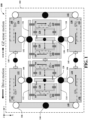
- FIG. 1 illustrates a functional block diagram of non-limiting embodiments of an exemplary gyroscope architecture 100, according to non-limiting aspects of the subject disclosure.
- exemplary embodiments of a gyroscope architecture 100 can comprise a MEMS device disposed in an X-Y plane parallel to a substrate 102 and can comprise two inner frame (e.g. , GY) gyroscopes, that can each comprise two inner frame proof masses (e.g.
- exemplary embodiments of a gyroscope architecture 100 can comprise a coupling mechanism that couples the two inner frame ( e.g. , GY) gyroscopes to each other.
- exemplary embodiments of a gyroscope architecture 100 can comprise a drive system comprising four drive shuttles (not shown), comprising guided masses and configured to be coupled to the two inner frame gyroscopes, respectively.
- exemplary gyroscope architecture 100 can comprise four GZ proof masses (e.g. , GZ proof masses 120, 122, 124, 126), configured to be coupled to each other via coupling mechanisms 128 and 130 ( e.g. , via a spring and/or other coupling structures), respectively, wherein respective pairs of the four GZ proof masses (e.g. , GZ proof masses 120, 122, 124, 126) are coupled to each other via coupling mechanisms or lever arms 128, 130 that are configured to couple the respective pairs of the four proof masses (e.g. , GZ proof masses 120, 122, 124, 126) motions, and wherein the four GZ proof masses (e.g.
- GZ proof masses 120, 122, 124, 126) can be configured to facilitate providing a GZ sense mode, or measuring a component of angular velocity associated with the MEMS device around another axis ( e.g. , Z axis).
- exemplary gyroscope architecture 100 can comprise an outer frame or saddle (e.g. , GX) gyroscope ( e.g. , GX) that can comprise two outer frame gyroscopes, comprising two pairs of two proof masses (e.g.
- GX proof mass 132, 134, 136, 138 wherein the GX, outer frame, or saddle gyroscope can be configured to facilitate providing a GX sense mode, or measuring a component of angular velocity associated with the MEMS device around another axis ( e.g. , X axis), can be configured to be coupled to the inner frame gyroscopes, respectively, and can be configured to couple the drive system with the outer frame gyroscopes, wherein respective pairs of two GX proof masses (e.g. , GX proof mass 132/134, 136/138)can be configured to be coupled to each other, and wherein respective GX proof masses of the pairs ( e.g. , GX proof mass 132/134, 136/138) can be configured to be coupled to each other via respective outer frame lever arms 140/142.
- respective pairs of two GX proof masses e.g. , GX proof mass 132/134, 136/138
- respective GX proof masses of the pairs e.
- exemplary gyroscope architecture 100 can comprise exemplary anchor points (e.g. , depicted herein as rectangles with an X), which can facilitate anchoring various components to the substrate 102 and/or to an exemplary stress isolation frame (not shown) configured to be attached to the substrate 102 or package.
- exemplary gyroscope architecture 100 of FIG. 1 is depicted comprising exemplary fixed pivot points 144 ( e.g. , black-filled circles), which can functionally represent a center about which various components can be configured to rotate ( e.g.
- exemplary translating pivot points 146 e.g. , white-filled circles
- exemplary translating pivot points 146 can functionally represent a pivot point or hinge about which various components can be configured to rotate and translate ( e.g. , in a plane parallel to the X-Y plane of the substrate 102, in a plane orthogonal to the X-Y plane of the substrate 102, etc. ).
- pivot points can be understood to be a functional representation of the centers of rotational motions as a result of the processes required to create such devices via MEMS fabrication, which typically comprise a set of springs, flexures, rigid bodies, or suspension mechanisms or components arranged to produce the desired motion, as further described herein.
- exemplary gyroscope architecture 100 of FIG. 1 is depicted comprising exemplary springs (e.g. , spring 145), suspension elements, or coupling mechanisms, which can comprise flexures or other structures that are particularly rigid, or flexibly and/or torsionally compliant in particular directions to constrain or define motions ( e.g. , to anti-phase motion, to in-plane motion, to guide mass motions of guided masses, etc. ) and/or transfer motions of the various components of exemplary gyroscope architecture 100, suspend various components of exemplary gyroscope architecture 100 to exemplary anchor points 302, for example, as depicted in FIG. 3 , function as exemplary fixed pivot points 144 and/or exemplary translating pivot points 146, and so on, as further described herein.
- springs e.g. , spring 145
- suspension elements e.g. 145
- coupling mechanisms can comprise flexures or other structures that are particularly rigid, or flexibly and/or torsionally comp
- exemplary gyroscope architecture 100 of FIG. 1 is depicted as comprising an outer frame or saddle (e.g., GX) gyroscope (e.g. , GX, outer frame, or saddle gyroscope) that can comprise two GX outer frame gyroscopes, comprising two pairs of two proof masses (e.g. , GX proof mass 132, 134, 136, 138), wherein the GX, outer frame, or saddle gyroscope can be configured to be coupled to the inner frame gyroscopes (e.g.
- GX outer frame or saddle gyroscope
- exemplary GX, outer frame, or saddle gyroscope can be configured to be coupled to the inner frame gyroscopes ( e.g.
- respective pairs of the four exemplary GZ proof masses can be coupled to each other via coupling mechanisms or lever arms 128, 130 that are configured to coupled the respective pairs of the four proof masses (e.g. , GZ proof masses 120/122, 124/126) motions.
- exemplary GZ proof mass 120 is coupled to exemplary GZ proof mass 122 via coupling mechanisms or lever arm 128 and configured to force the respective pair of the four proof masses (e.g.
- exemplary GZ proof mass 120/122) into anti-phase motion, generally in an X-Y plane, parallel to exemplary substrate 102, as a result of a component of angular velocity associated with the MEMS device around the Z-axis.
- Such exemplary coupling is shown in FIG. 1 functionally as a rotation of coupling mechanisms or lever arm 128 about a fixed pivot point, centered on coupling mechanisms or lever arm 128, and is shown schematically in FIGS. 3-6 , for example.
- the two exemplary inner frame gyroscopes can be configured to be coupled to each other (e.g. , shown functionally via a spring coupling exemplary GY proof mass 106 to exemplary GY proof mass 108, such as shown schematically as spring 145 of FIG. 1 associated with GX proof mass 136) to facilitate constraining a motion associated with the two GY or inner frame gyroscopes into a condition of linear and angular momentum balance.
- exemplary GY proof mass 106 can be coupled to exemplary GY proof mass 108 via a spring or other structure or combination of structures that can facilitate constraining a motion associated with the two inner frame gyroscopes into a condition of linear and angular momentum balance, as further described herein.
- a spring or other structure or combination of structures that can facilitate constraining a motion associated with the two inner frame gyroscopes into a condition of linear and angular momentum balance, as further described herein.
- Such coupling is shown schematically in FIGS. 3-6 , for example.
- the two exemplary GX, or outer frame (saddle) gyroscopes, each comprising two proof masses e.g.
- GX proof mass 132, 134, 136, 138 can be coupled, respectively, to the two exemplary GY or inner frame gyroscopes, and/or can be configured to couple the two exemplary GX, outer frame, or saddle gyroscope to the four drive shuttles (not shown), as further described herein.
- FIG. 3 schematically, as the GY proof masses 108/110 (104/106) between GX proof masses 136 and 138 (132 and 134) ( e.g. , via springs, flexures, drive shuttles, lever arms 112, 114, 116, 118, etc.
- FIGS. 3-6 Such exemplary coupling is shown schematically in FIGS. 3-6 , for example.
- exemplary gyroscope architecture 100 of FIG. 1 is depicted comprising various sense electrodes or transducer elements, which can be respectively configured to detect motions of the various proof masses or other components of the exemplary gyroscope architecture 100, for example, to detect motions as a result of Coriolis forces induced on the various proof masses to provide a measure of the angular velocity about the X, Y, or Z axes, to detect drive motions, etc.
- electrostatic actuators and transducers are described throughout this specification, one of ordinary skill in the art recognizes that a variety of actuators and/or transducers could be utilized for these functions, and that use would be within the scope of the subject disclosure.
- exemplary actuators and/or transducers could comprise piezoelectric, thermal, electromagnetic, actuators and/or transducers, or the like.
- exemplary gyroscope architecture 100 can comprise capacitive electrodes 156, 158, 160, 162, configured to respectively detect motions of exemplary GX proof masses 132, 134, 136, 138, and can comprise capacitive electrodes 164, 166, 168, 170 configured to respectively detect motions of exemplary GY proof masses 104, 106, 108, 110, and so on.
- exemplary capacitive electrodes 156, 158, 160, 162, 164, 166, 168, 170 can be configured to primarily facilitate detection of Coriolis forces acting on respective proof masses as a result of angular velocity associated with the MEMS device about respective axes ( e.g. , X or Y axes). As further described herein, these Coriolis forces acting on respective proof masses as a result of angular velocity associated with the MEMS device about respective axes (e.g.
- out-of-plane motions of the respective proof masses can result in out-of-plane motions of the respective proof masses, wherein the out-of-plane motion is defined as motion in the direction of the Z axis ( e.g. , out of the X-Y plane).
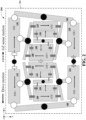
- exemplary gyroscope architecture 100 of FIG. 1 is depicted as undergoing drive motion in FIG. 2 , at a particular instance in time, which is indicated by a solid arrow in the direction of the respective various components of exemplary gyroscope architecture 100.
- an electrostatic force can be applied with exemplary drive combs (not shown) that can be coupled to exemplary drive shuttles (not shown), respectively, which exemplary drive shuttles can comprise the guided masses configured to be coupled to the two inner frame gyroscopes, the GX, outer frame, or saddle gyroscope, and/or combinations, or portions thereof, as described herein.
- an electrostatic force can be applied via the exemplary drive combs (not shown) to the exemplary drive shuttles (not shown) to generate the drive force at the drive frequency, which can result in the drive motions of the respective various components of exemplary gyroscope architecture 100 as indicated in FIG. 1 .
- This drive force applied to respective exemplary drive shuttles (not shown) is configured to be transferred to the various components of exemplary gyroscope architecture 100, via the above described coupling mechanisms, lever arms, pivot points, and springs, as described above, which results in the drive motions of the various components of exemplary gyroscope architecture 100, as depicted in FIG.
- FIG. 2 depicts deflection of various components of exemplary gyroscope architecture 100 as a result of a Coriolis force from angular velocity about the respective axes with the given direction of drive motion as positive (e.g. , GX+, GY+), or above the X-Y plane of the MEMS device, and as negative ( e.g. , GX-, GY-), or below the X-Y plane of the MEMS device.
- positive e.g. , GX+, GY+
- negative e.g. , GX-, GY-
- the four exemplary GZ proof masses (e.g. , GZ proof masses 120, 122, 124, 126) are configured to be coupled ( e.g. , via a spring or other coupling structure) to the four GY proof masses 104, 106, 108, 110, respectively, wherein respective pairs of the four GZ proof masses (e.g. , GZ proof masses 120, 122, 124, 126) are coupled to each other via coupling mechanisms or lever arms 128, 130 that are configured to couple the respective pairs of the four proof masses (e.g. , GZ proof masses 120, 122, 124, 126) motions.
- a Coriolis force acting on respective GZ proof masses e.g.
- GZ proof masses 120, 122, 124, 126) as a result of angular velocity associated with the MEMS device about the Z axis can result in motions of the respective GZ proof masses (e.g. , GZ proof masses 120, 122, 124, 126), generally in-plane, wherein the in-plane motion is defined as motion in the direction of the X axis ( e.g. , in the X-Y plane), as depicted.
- respective GZ proof masses (e.g. , GZ proof masses 120, 122, 124, 126) of exemplary gyroscope architecture 100 of FIG. 1 is depicted as experiencing a sensed motion, at a particular instance in time, which is indicated by a dashed arrow in the direction of the respective various components of exemplary gyroscope architecture 100 in FIG. 2 .
- exemplary gyroscope architecture 100 can comprise further capacitive electrodes (not shown) that can be configured to respectively detect motions of respective GZ proof masses (e.g. , GZ proof masses 120, 122, 124, 126).
- GZ proof masses e.g. , GZ proof masses 120, 122, 124, 126.
- exemplary capacitive electrodes can be configured to primarily facilitate detection of Coriolis forces acting on respective proof masses as a result of angular velocity associated with the MEMS device about the Z axis.
- the transducers, electrodes, or actuators e.g.
- drive combs are described above as capacitive transducers, electrodes, or actuators, various types of transducers, electrodes, or actuators could be utilized including, but not limited to piezoelectric, thermal, electromagnetic, optical, or the like, as appropriate, and its use would be within the scope of the disclosed subject matter.
- FIG. 2 illustrates a functional block diagram 200 of non-limiting embodiments ( e.g. , corresponding FIG. 1 ) of an exemplary gyroscope architecture in driven motion, which demonstrates further non-limiting aspects of the subject disclosure.
- FIG. 2 depicts resulting translation and rotation motions of the various components of exemplary gyroscope architecture 100 as a result of drive force applied to respective exemplary drive shuttles (not shown) and transferred to the various components of exemplary gyroscope architecture 100, via the above described coupling mechanisms, lever arms, pivot points, and springs, as described above.
- some reference characters and/or components of exemplary gyroscope architecture 100, as depicted in FIG. 1 are not shown in functional block diagram 200, for clarity.
- drive motions of the respective proof masses and components are linear and/or angular momentum balanced, according to various non-limiting embodiments. That is, drive motion of exemplary drive shuttles (not shown) can be in anti-phase motion or opposite directions, as further described herein. Secondly, drive motions of the two inner frame gyros are also anti-phase or in opposite directions, which is facilitated by the coupling of the anti-phase drive motion of the four exemplary drive shuttles (not shown) to the GY proof masses (e.g.
- GY proof masses 104, 106, 108, 110 via the respective exemplary lever arms 112, 114, 116, 118 that provides rotation about the fixed pivot points and translation of the X proof masses (e.g. , GX proof masses 132, 134, 136, 138) via the pivot points, and which is facilitated by coupling the two exemplary GY or inner frame gyroscopes to each other ( e.g. , shown functionally via a spring coupling exemplary GY proof mass 106 to exemplary GY proof mass 108, such as shown schematically as spring 145 of FIG. 1 associated with GX proof mass 136).
- the two inner frame gyroscopes comprise a four bar system that deforms into a parallelogram under applied drive motion.
- the coupling of the exemplary GX, outer frame, or saddle gyroscope to the respective GY or inner frame gyroscopes ensures that the drive motions of the GX, outer frame, or saddle gyroscope are also anti-phase or in opposite directions.
- drive motions of the four exemplary GZ proof masses e.g. , GZ proof masses 120, 122, 124, 126) coupled ( e.g. , via a spring or other coupling structure) to the GY proof masses (e.g.
- GY proof masses 104, 106, 108, 110 are also anti-phase or in opposite directions.
- the drive motion of the 3-axis (e.g. , GX, GY, and GZ) gyroscope depicted in FIGS. 1-2 can benefit from linear and angular momentum balance, according to exemplary aspects described herein.
- vibration rejection can be improved.
- various components of exemplary gyroscope architecture 100 these various components do not move independently of each other.
- motion in same direction is referred to as common motion, or common mode
- motion in opposite direction is referred to as anti-phase motion, or differential motion.
- common motion is susceptible to acceleration from outside sources, such as vibration, where acceleration can be thought of as a uniform body load. And because it is uniform, it is by definition in one direction, or linear acceleration. This linear acceleration will excite common motion.
- exemplary devices as described herein can minimize cross-talk, or part to part coupling, that might otherwise result in undesirable noise and offsets on the devices experiencing cross-talk as a result of unbalanced masses or momentum.
- FIG. 2 depicts deflection of various components of exemplary gyroscope architecture 100 as a result of a Coriolis force from angular velocity about the respective axes with the given direction of drive motion as positive (e.g. , GX+, GY+), or above the X-Y plane of the MEMS device, and as negative ( e.g. , GX-, GY-), or below the X-Y plane of the MEMS device.
- a Coriolis force from angular velocity about the respective axes with the given direction of drive motions will result in out-of-plane (e.g.
- exemplary capacitive electrodes 156, 158, 160, 162, 164, 166, 168, 170 can be configured to primarily facilitate detection of Coriolis forces acting on respective proof masses as a result of angular velocity associated with the MEMS device about respective axes ( e.g. , X or Y axes).
- the four exemplary GZ proof masses (e.g. , GZ proof masses 120, 122, 124, 126) are coupled ( e.g. , via a spring or other coupling structure) to the GY proof masses ( e.g. , GY proof masses 104, 106, 108, 110), respectively, wherein respective pairs of the four exemplary GZ proof masses ( e.g. , GZ proof masses 120, 122, 124, 126) are coupled to each other via coupling mechanisms or lever arms 128, 130 that are configured to couple the respective pairs of the four proof masses (e.g. , GZ proof masses 120, 122, 124, 126) motions.
- exemplary GZ proof masses e.g. , GZ proof masses 120, 122, 124, 126)
- a Coriolis force from angular velocity about the Z axis with the given direction of drive motions will result in-plane ( e.g. , in the X-Y plane) deflection in the X direction.
- exemplary gyroscope architecture 100 can comprise further capacitive electrodes (not shown) that can be configured to respectively detect motions of respective GZ proof masses (e.g. , GZ proof masses 120, 122, 124, 126) to primarily facilitate detection of Coriolis forces acting on respective proof masses as a result of angular velocity associated with the MEMS device about the Z axis.
- an exemplary drive system can be decoupled from exemplary GX, outer frame, or saddle gyroscope and/or the exemplary GY or inner frame gyroscopes, such that the drive motion on both the exemplary GX, outer frame, or saddle gyroscope and the exemplary GY or inner frame gyroscopes can be symmetric, and/or the GZ gyroscopes comprising the GZ proof masses (e.g. , GZ proof masses 120, 122, 124, 126) can be configured such that compliance of the GZ gyroscopes comprising the GZ proof masses (e.g.
- GZ proof masses 120, 122, 124, 126) to out-of-plane motion can be made very stiff, according to various non-limiting aspects.
- exemplary embodiments as described herein can experience parasitic modes on GZ sense modes, in a further non-limiting aspect.
- conventional MEMS vibratory rate gyroscopes may not provide adequate solutions that reduce sensitivity to vibration (e.g. , linear vibration and/or angular vibration) and part-to-part coupling, reduce levitation force induced in-phase offset shift, and/or reduce sensitivity to package stress.
- vibration e.g. , linear vibration and/or angular vibration
- part-to-part coupling reduce levitation force induced in-phase offset shift
- reduce sensitivity to package stress e.g. , linear vibration and/or angular vibration
- weak coupling between the out-of-plane gyroscopes e.g.
- various non-limiting embodiments can facilitate minimizing the out-of-plane or levitation force transferred to the GZ gyroscopes, and/or it can be rejected.
- decoupling of in-plane and out-of-plane gyroscopes can result in improvements in cross-axis sensitivity.
- the sensor is expected to output a signal that is proportional to the angular velocity.
- the out-of-plane gyroscopes e.g. , GY or frame gyroscopes and GX, outer frame, or saddle gyroscope
- the in-plane gyroscopes e.g.
- GZ gyroscope the offset or bias error, which is how much shift there is between the quantity of interest and the quantity being reported (e.g. , Coriolis force as a result of angular velocity about the z-axis), there will be reduced out-of-plane force (or levitation force) on the GZ gyroscope, which might otherwise be sensed as an applied angular velocity.
- various embodiments described herein can reduce levitation force induced in-phase offset shift via employment of exemplary drive shuttles (not shown) on the GX and/or GY gyroscopes.
- GY or inner frame gyroscopes and GX, outer frame, or saddle gyroscope are out-of plane gyroscopes, where MEMS device rotation around the X or Y axes will result in out-of-plane motion of the GY proof masses (e.g. , GY proof masses 104, 106, 108, 110) and GX proof masses ( e.g. , GX proof masses 132, 134, 136, 138).
- the in plane motion components (GZ) e.g. , GZ proof masses 120, 122, 124, 126
- the transmission of the levitation force (and associated offset shift) associated with the out-of-plane motion components (GX, GY) can be minimized.
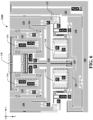
- FIG. 3 depicts further aspects of non-limiting embodiments of an exemplary gyroscope architecture 100, as described herein.
- the exemplary GY proof masses e.g. , GY proof masses 104, 106, 108, 110
- exemplary GX proof masses e.g. , GX proof masses 132, 134, 136, 138
- the coupling there between exemplary lever arms 112, 114, 116, 118, anchors 302, and various springs 145 ( e.g. , GZ spring 304, etc. ), couplings ( e.g. , GX or outer frame gyro to drive shuttle coupling 306, etc. ), suspension elements, etc. depicted therein.
- FIG. 3 depicts an exemplary stress isolation frame 308, according to further non-limiting aspects.
- offset shift can be induced by levitation force induced in the drive shuttles or induced by deformation of the gyroscope structure due to external stresses ( e.g. , package stresses). Offset shift can also be affected by other sources such as package stress, temperature effects, etc.
- an exemplary stress isolation frame 308 can be employed in various non-limiting embodiments. While not shown in FIG. 1 , an exemplary stress isolation frame 308 can be shown connected to all the outer anchor points 302 illustrated in FIG. 3 .
- exemplary stress isolation frame 308 can be connected to the package or the substrate 102, and the peripheral components of the components of exemplary gyroscope architecture 100 can be suspended therefrom and/or anchored to, including, but not limited to the four exemplary drive shuttles 310, exemplary coupling mechanisms or lever arms 128, 130, etc.
- package bend or deformation sensitivity can be improved, according to further non-limiting aspects, wherein offset resulting from bending of a package associated with the MEMS device can be reduced by employing one or more of an exemplary stress isolation frame 308, along with exemplary drive shuttles 310, etc. , as described herein.
- FIG. 3 further depicts exemplary drive sense combs 312, which can be configured to detect drive motion.
- exemplary drive sense combs 312 are depicted as coupled to GY or inner frame gyroscope components (e.g. , GY proof masses 104, 106, 108, 110), in non-limiting embodiments, in further non-limiting embodiments, exemplary drive sense combs 312 can be coupled to other of the various components of the exemplary gyroscope architecture 100, including, but not limited to, one or more of the four exemplary drive shuttles 310, etc.
- FIG. 1 is depicted as coupled to GY or inner frame gyroscope components (e.g. , GY proof masses 104, 106, 108, 110), in non-limiting embodiments, in further non-limiting embodiments, exemplary drive sense combs 312 can be coupled to other of the various components of the exemplary gyroscope architecture 100, including, but not limited to, one or more of the four exemplary drive shuttle
- FIG. 3 further depicts exemplary drive combs 314, which can be coupled to the exemplary drive shuttles 310 to generate the drive force at the drive frequency, and which can result in the drive motions of the respective various components of exemplary gyroscope architecture 100, as described above regarding FIGS. 1-2 .
- FIG. 3 depicts further capacitive electrodes 316 that can be configured to respectively detect motions of respective GZ proof masses (e.g. , GZ proof masses 120, 122, 124, 126), as further described above regarding FIGS. 1-2 .
- GZ proof masses e.g. , GZ proof masses 120, 122, 124, 126
- FIG. 4 depicts still further exemplary aspects of non-limiting embodiments of an exemplary gyroscope architecture 100.
- FIG. 4 depicts relative locations of exemplary capacitive electrodes 156, 158, 160, 162, 164, 166, 168, 170, in the depiction of FIG. 3 , which can be configured to primarily facilitate detection of Coriolis forces acting on respective proof masses as a result of angular velocity associated with the MEMS device about respective axes ( e.g. , X or Y axes), for example, as further described above regarding FIG. 1 .
- respective axes e.g. , X or Y axes
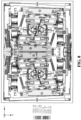
- FIG. 5 depicts still further exemplary aspects of non-limiting embodiments of an exemplary gyroscope architecture 100.
- anchor 302 locations are depicted as black boxes, instead of as in FIGS. 1-2 .
- FIG. 5 depicts inset 502, which is further described, regarding FIG. 6 .
- FIG. 6 depicts still further exemplary aspects of non-limiting embodiments of an exemplary gyroscope architecture 100.
- FIG. 6 depicts the relative locations and configurations of various components of exemplary gyroscope architecture 100, as depicted in FIGS. 1-5 , for inset 502.
- FIG. 5 depicts still further exemplary aspects of non-limiting embodiments of an exemplary gyroscope architecture 100.
- anchor 302 locations are depicted as black boxes, instead of as in FIGS. 1-2 .
- FIG. 5 depicts inset 502, which is further described, regarding FIG. 6 .
- FIG. 6 depicts still further exemplary aspects of non-limiting embodiments of an exemplary g
- FIG. 7 depicts yet another non-limiting embodiment of an exemplary gyroscope architecture 100, depicting relative locations of exemplary capacitive electrodes 156, 158, 160, 162, 164, 166, 168, 170, in the depiction of FIG. 7 , which can be configured to primarily facilitate detection of Coriolis forces acting on respective proof masses as a result of angular velocity associated with the MEMS device about respective axes ( e.g. , X or Y axes), for example, as further described above regarding FIGS. 1 , 4 , etc.
- the coupling mechanisms or lever arms 128, 130 that are configured to couple the respective pairs of the four proof masses (e.g. , GZ proof masses 120, 122, 124, 126) motions, which corresponds respectively to construction of a functional fixed pivot point between respective pairs of GZ proof masses, as described above regarding FIGS. 1-2 .
- FIG. 8 depicts an exemplary drive mode shape of a non-limiting embodiment of an exemplary gyroscope architecture 100, according to further non-limiting aspects described herein.
- drive motion applied via the four exemplary drive shuttles 310 as described above result in deflection and translation of the various components of exemplary gyroscope architecture 100, as described herein.
- FIG. 8 It can be seen in FIG. 8 from the relative lack of displacement of the in-plane motion components (GZ), which are separated from the out-of-plane motion components (GX) and constrained by the coupling mechanisms or lever arms 128, 130 that are configured to couple the respective pairs of the four proof masses (e.g.
- GZ in-plane motion components
- GX out-of-plane motion components
- GZ proof masses 120, 122, 124, 126) motions various embodiments as described herein can be configured to constrain transmission of the out-of-plane motion components (GX, GY) to the in plain motion components (GZ) (drive shuttle, Z proof masses), and, thus, the transmission of the levitation force associated with the out-of-plane motion components (GX, GY) can be minimized.
- FIG. 9 depicts an exemplary GX mode shape of a non-limiting embodiment of an exemplary gyroscope architecture 100, according to still further non-limiting aspects described herein.
- FIG. 9 depicts the relative displacement above and below X-Y plane, where the "+" symbol indicates above plane X-Y plane displacement and the "-" symbol indicates below plane displacement, in lieu of color heat map or adequate grey scale resolution.
- the GX, outer frame, or saddle gyroscope sense mode is a balanced sense mode, where each of the GX proof masses are in anti-phase motion, as facilitated by exemplary fixed pivot point functionally generated by the structures indicated in FIG. 9 .
- FIG. 10 depicts an exemplary GY mode shape of a non-limiting embodiment of an exemplary gyroscope architecture, according to still further non-limiting aspects described herein.
- FIG. 10 depicts the relative displacement above and below X-Y plane, where the "+" symbol indicates above plane X-Y plane displacement and the "-" symbol indicates below plane displacement, in lieu of color heat map or adequate grey scale resolution.
- GY or frame gyroscope sense mode is a balanced sense mode, where each of the GY proof masses are in anti-phase motion ( e.g. , both linear and angular momentum balanced). It can be further seen in FIG.
- various embodiments as described herein can be configured to constrain transmission of the out-of-plane motion components (GX, GY) to the in plain motion components (GZ) (drive shuttle, Z proof masses), and, thus, the transmission of the levitation force associated with the out-of-plane motion components (GX, GY) can be minimized.
- FIG. 10 can facilitate isolation of levitation forces on the drive combs ( e.g. , drive combs 314) from being transferred to the frame proof masses.
- FIG. 11 depicts an exemplary GZ sense mode shape of a non-limiting embodiment of an exemplary gyroscope architecture, according to non-limiting aspects described herein.
- FIG. 11 depicts the relative displacement in the X-Y plane, where the "+" symbol indicates +X displacement and the "-" symbol indicates -X displacement, in lieu of color heat map or adequate grey scale resolution. It can be seen in FIG. 11 , that the GZ gyroscope sense mode is a balanced sense mode, where each of the GZ proof masses are in anti-phase motion.
- FIG. 12 depicts an exemplary GZ parasitic mode shape of a non-limiting embodiment of an exemplary gyroscope architecture, according to still further non-limiting aspects described herein.
- FIG. 12 depicts the relative displacement in the X-Y plane, where the "+" symbol indicates + displacement and the "-" symbol indicates - displacement, in lieu of color heat map or adequate grey scale resolution. It can be seen in FIG. 12 , that the GZ gyroscope has a linear and angular momentum balanced parasitic mode.
- exemplary non-limiting embodiments can comprise a 3-axis Coriolis vibratory rate gyroscope, in a roughly 2 dimensional device architecture, with the geometry largely being flat, and capable of being fabricated in silicon.
- exemplary embodiments as described herein can comprise two inner frame (e.g., GY) gyroscopes, wherein the inner frame gyroscopes facilitate GY sense mode and drive system coupling, two outer frame, or saddle gyroscope, four drive shuttles coupled to the two outer frame gyroscopes, four GZ proof masses coupled to the GY or inner frame gyroscopes, and/or two lever arms or coupling mechanisms that facilitate coupling GZ proof masses.
- GY inner frame
- various exemplary embodiments can be configured such that components can be removed from an exemplary overall architecture to fabricate a single axis or two axis gyroscope and/or can be configured such that a number of proof-masses can be reduced in half from an exemplary overall architecture to fabricate a half-gyroscope, as further described herein.
- FIG. 13 illustrates a functional block diagram of other non-limiting embodiments of an exemplary gyroscope architecture 100, according to further non-limiting aspects of the subject disclosure.
- an exemplary 3-axis (e.g. , GX, GY, and GZ) gyroscope architecture 100 can be reduced to a 2-axis or 1-axis gyroscope by removing components from the architecture, employing fewer sense transducers, etc.
- exemplary gyroscope architectures as described herein can be functionally cut in half to create a more compact 3-axis (e.g.
- GX, GY, and GZ gyroscope
- the four GZ proof masses can be omitted to fabricate a balanced two axis ( e.g. , X-Y gyroscope).
- two GX proof masses, or outer frame gyroscopes and respective GY or inner frame gyroscope can be omitted from the fabrication as in FIG.
- GY electrodes 162, 164, 166, 168 can be omitted from the fabrication or electrical connection, such that variants of exemplary gyroscope architecture 100 could yield a 1-axis gyroscope.
- FIG. 14 illustrates another functional block diagram of still other non-limiting embodiments of an exemplary gyroscope architecture 100, according to further non-limiting aspects of the subject disclosure.
- exemplary gyroscope architecture 100 could yield a more compact but non-balanced drive and sense 3-axis gyroscope by omitting one half of the components of exemplary gyroscope architecture 100.
- Other variants can include omission of the GZ proof masses to yield a 2-axis, X-Y gyroscope with drive system coupled to the GY or frame gyros as described herein.
- an exemplary MEMS device (e.g. , comprising exemplary gyroscope architecture 100, or portions thereof) comprises one or more inner frame gyroscope (e.g. , GY or inner frame gyroscope comprising two or more GY proof masses 104, 106, 108, 110, etc. ) configured to sense a first component of angular velocity associated with the MEMS device ( e.g. , comprising exemplary gyroscope architecture 100, or portions thereof) around a first axis (e.g. , Y axis), for example, as described herein.
- a first axis e.g. , Y axis
- a frame gyroscope can be understood to comprise a guided mass system comprising two proof masses and a rotating arm connecting the two proof masses and constraining the proof masses to anti-phase motion.
- an outer frame gyroscope can be understood to surround and/or be flexibly coupled to the inner frame gyroscope.
- an exemplary MEMS device e.g. , comprising exemplary gyroscope architecture 100, or portions thereof
- an outer frame gyroscope comprising at least two proof masses (e.g. , GX or outer frame gyroscope comprising two or more GX proof masses 132, 134, 136, 138, etc ), flexibly coupled ( e.g. , via coupling 148/150/152/154, or portions thereof) to the one or more inner frame gyroscope (e.g. , GY or inner frame gyroscope comprising two or more GY proof masses 104, 106, 108, 110, etc.
- an inner frame gyroscope comprising at least two proof masses (e.g. , GX or outer frame gyroscope comprising two or more GX proof masses 132, 134, 136, 138, etc ), flexibly coupled ( e.g. , via coupling 148/150/152/154, or portions
- a second component of angular velocity associated with the MEMS device e.g. , comprising exemplary gyroscope architecture 100, or portions thereof
- a second axis e.g. , X axis
- first axis e.g. , Y axis
- an exemplary MEMS device (e.g. , comprising exemplary gyroscope architecture 100, or portions thereof) further comprises two or more additional proof masses (e.g. , of GZ proof masses 120, 122, 124, 126) coupled to the one or more inner frame gyroscope ( e.g. , GY or inner frame gyroscope comprising two or more GY proof masses 104, 106, 108, 110, etc. ) and configured to sense a third component of angular velocity associated with the MEMS device ( e.g. , comprising exemplary gyroscope architecture 100, or portions thereof) around a third axis ( e.g. , Z axis) that can be orthogonal to the first axis ( e.g. , Y axis) and the second axis ( e.g. , X axis).
- a third axis e.g. , Z axis
- a motion associated with the two or more proof masses can be coupled, at least in part, to in plane motion (e.g. , X-Y plane) of the one or more inner frame gyroscope (e.g. , GY or inner frame gyroscope comprising two or more GY proof masses 104, 106, 108, 110, etc. ) via respective coupling mechanisms (e.g. , via coupling mechanisms or lever arms 128, 130), and wherein the in plane motion can be defined with reference to a plane comprising the first axis ( e.g.
- the two or more proof masses can be configured to facilitate constraining, at least in part, the motion associated with the two or more proof masses (e.g. , of GZ proof masses 120, 122, 124, 126) into a condition of linear and angular momentum balance.
- an exemplary MEMS device (e.g. , comprising exemplary gyroscope architecture 100, or portions thereof) can further comprise one or more coupling mechanism (e.g. , coupling mechanisms or lever arms 128, 130) between the two or more proof masses ( e.g. , of GZ proof masses 120, 122, 124, 126) configured to force the two or more proof masses ( e.g. , of GZ proof masses 120, 122, 124, 126) into anti-phase motion as a result of the third component of angular velocity applied to the MEMS device ( e.g. , comprising exemplary gyroscope architecture 100, or portions thereof) around the third axis ( e.g. , Z axis).
- coupling mechanism e.g. , coupling mechanisms or lever arms 128, 130
- an exemplary MEMS device e.g. , comprising exemplary gyroscope architecture 100, or portions thereof
- an exemplary MEMS device further comprises two or more drive shuttles (e.g. , drive shuttles 310) flexibly coupled ( e.g. , via lever arms 112, 114, 116, 118, or portions thereof) to the inner frame gyroscope (e.g. , GY or inner frame gyroscope comprising two or more GY proof masses 104, 106, 108, 110, etc .) and to the at least two proof masses of the outer frame gyroscope (e.g.
- one or more of the outer frame gyroscope e.g. , GX or outer frame gyroscope comprising two or more GX proof masses 132, 134, 136, 138, etc.
- the one or more inner frame gyroscope e.g. , GY or inner frame gyroscope comprising two or more GY proof masses 104, 106, 108, 110, etc.
- one or more of the two or more drive shuttles can be configured to sense drive motion ( e.g. , via drive sense combs 312) associated with the oscillation.
- the two or more drive shuttles e.g.
- drive shuttles 310) can be configured to move in anti-phase drive motion and can be configured to minimize transmission of out of plane motion of the two or more drive shuttles ( e.g. , drive shuttles 310) to the one or more inner frame gyroscope ( e.g. , GY or inner frame gyroscope comprising two or more GY proof masses 104, 106, 108, 110, etc. ).
- inner frame gyroscope e.g. , GY or inner frame gyroscope comprising two or more GY proof masses 104, 106, 108, 110, etc.
- an exemplary MEMS device e.g. , comprising exemplary gyroscope architecture 100, or portions thereof
- a set of drive electrodes e.g. , drive combs 3114
- an exemplary MEMS device e.g. , comprising exemplary gyroscope architecture 100, or portions thereof
- one or more inner frame gyroscope e.g. , GY or inner frame gyroscope comprising two or more GY proof masses 104, 106, 108, 110, etc.
- a first component of angular velocity associated with the MEMS device e.g. , comprising exemplary gyroscope architecture 100, or portions thereof
- a first axis e.g. , Y axis
- an exemplary MEMS device (e.g. , comprising exemplary gyroscope architecture 100, or portions thereof) can further comprise two or more proof masses (e.g. , of GZ proof masses 120, 122, 124, 126) coupled to the one or more inner frame gyroscope ( e.g. , GY or inner frame gyroscope comprising two or more GY proof masses 104, 106, 108, 110, etc. ) and configured to sense a second component of angular velocity associated with the MEMS device (e.g. , comprising exemplary gyroscope architecture 100, or portions thereof) around a second axis (e.g. , Z axis) that can be orthogonal to the first axis ( e.g. , Y axis).
- two or more proof masses e.g. , of GZ proof masses 120, 122, 124, 1266
- inner frame gyroscope e.g. , GY or
- an exemplary MEMS device comprising exemplary gyroscope architecture 100, or portions thereof
- exemplary MEMS device comprising one or more coupling mechanism between the two or more proof masses (e.g. , of GZ proof masses 120, 122, 124, 126) configured to force the two or more proof masses ( e.g. , of GZ proof masses 120, 122, 124, 126) into anti-phase motion as a result of the second component of angular velocity applied to the MEMS device (e.g. , comprising exemplary gyroscope architecture 100, or portions thereof) around the second axis ( e.g. , Z axis), for example, as described herein.
- the MEMS device e.g. , comprising exemplary gyroscope architecture 100, or portions thereof
- second axis e.g. , Z axis
- a motion associated with the two or more proof masses can be coupled, at least in part, to in plane motion of the one or more inner frame gyroscope (e.g. , GY or inner frame gyroscope comprising two or more GY proof masses 104, 106, 108, 110, etc. ) via respective coupling mechanisms, and wherein the in plane motion can be defined with reference to a plane normal to the second axis ( e.g. , X-Y plane).
- the two or more proof masses e.g.
- GZ proof masses 120, 122, 124, 126) can be configured to facilitate constraining, at least in part, the motion associated with the two or more proof masses ( e.g. , of GZ proof masses 120, 122, 124, 126) into a condition of linear and angular momentum balance.
- an exemplary MEMS device (e.g. , comprising exemplary gyroscope architecture 100, or portions thereof) can further comprise two or more drive shuttles (e.g. , drive shuttles 310) coupled to the one or more inner frame gyroscope ( e.g. , GY or inner frame gyroscope comprising two or more GY proof masses 104, 106, 108, 110, etc. ) and configured to force the one or more inner frame gyroscope ( e.g. , GY or inner frame gyroscope comprising two or more GY proof masses 104, 106, 108, 110, etc. ) into oscillation.
- two or more drive shuttles e.g. , drive shuttles 310 coupled to the one or more inner frame gyroscope ( e.g. , GY or inner frame gyroscope comprising two or more GY proof masses 104, 106, 108, 110, etc. ) and configured to force the one
- the two or more drive shuttles can be configured to move in anti-phase drive motion and can be configured to minimize transmission of out of plane motion of the two or more drive shuttles ( e.g. , drive shuttles 310) to the one or more inner frame gyroscope ( e.g. , GY or inner frame gyroscope comprising two or more GY proof masses 104, 106, 108, 110, etc. ).
- the inner frame gyroscope e.g. , GY or inner frame gyroscope comprising two or more GY proof masses 104, 106, 108, 110, etc.
- an exemplary MEMS device (e.g. , comprising exemplary gyroscope architecture 100, or portions thereof) comprising two inner frame gyroscopes ( e.g. , GY or inner frame gyroscope comprising GY proof masses 104, 106, 108, 110, etc. ) configured to sense a first component of angular velocity associated with the MEMS device ( e.g. , comprising exemplary gyroscope architecture 100, or portions thereof) around a first axis ( e.g. , Y axis), for example, as described herein.
- an exemplary MEMS device e.g.
- one of the two inner frame gyroscopes e.g. , GY or inner frame gyroscope comprising GY proof masses 104, 106, 108, 110, etc.
- one of the two inner frame gyroscopes can be flexibly coupled ( e.g. , via a spring or flexure 145) to the other of the two inner frame gyroscopes ( e.g.
- GY or inner frame gyroscope comprising GY proof masses 104, 106, 108, 110, etc.
- the two inner frame gyroscopes e.g. , GY or inner frame gyroscope comprising GY proof masses 104, 106, 108, 110, etc.
- an exemplary MEMS device (e.g. , comprising exemplary gyroscope architecture 100, or portions thereof) can further comprise two outer frame gyroscopes (e.g. , GX or outer frame gyroscope comprising GX proof masses 132, 134, 136, 138, etc. ) configured to sense a second component of angular velocity associated with the MEMS device ( e.g. , comprising exemplary gyroscope architecture 100, or portions thereof) around a second axis (e.g. , X axis) that can be orthogonal to the first axis ( e.g. , Y axis).
- two outer frame gyroscopes e.g. , GX or outer frame gyroscope comprising GX proof masses 132, 134, 136, 138, etc.
- a second component of angular velocity associated with the MEMS device e.g. , comprising exemplary gyr
- the two outer frame gyroscopes (e.g. , GX or outer frame gyroscope comprising GX proof masses 132, 134, 136, 138, etc. ) can be coupled ( e.g. , via coupling 148/150/152/154, or portions thereof) to the two inner frame gyroscope ( e.g. , GY or inner frame gyroscope comprising two or more GY proof masses 104, 106, 108, 110, etc. ) at least in part via the four drive shuttles ( e.g. , drive shuttles 310).
- the outer frame gyroscope e.g., GX or outer frame gyroscope comprising GX proof masses 132, 134, 136, 138, etc.
- the two inner frame gyroscope e.g. , GY or inner frame gyroscope comprising two or more GY proof masses 104, 106, 108, 110, etc
- GX or outer frame gyroscope comprising two or more GX proof masses 132, 134, 136, 138, etc.
- the one or more of the two inner frame gyroscopes can be configured to be driven by a set of drive electrodes ( e.g. , drive combs 314, as further described herein.
- the two outer frame gyroscopes e.g. , GX or outer frame gyroscope comprising GX proof masses 132, 134, 136, 138, etc.
- the two inner frame gyroscopes e.g. , GY or inner frame gyroscope comprising GY proof masses 104, 106, 108, 110, etc.
- the two outer frame gyroscopes e.g. , GX or outer frame gyroscope comprising GX proof masses 132, 134, 136, 138, etc.
- the two inner frame gyroscopes e.g. , GY or inner frame gyroscope comprising GY proof masses 104, 106, 108, 110, etc.
- GX or outer frame gyroscope comprising GX proof masses 132, 134, 136, 138, etc.
- the two inner frame gyroscopes e.g. , GY or inner frame gyroscope comprising GY proof masses 104, 106, 108, 110, etc.
- an exemplary MEMS device (e.g. , comprising exemplary gyroscope architecture 100, or portions thereof) can further comprise four proof masses (e.g. , of GZ proof masses 120, 122, 124, 126) coupled to the two inner frame gyroscopes ( e.g. , GY or inner frame gyroscope comprising GY proof masses 104, 106, 108, 110, etc. ) and configured to sense a third component of angular velocity associated with the MEMS device ( e.g. , comprising exemplary gyroscope architecture 100, or portions thereof) around a third axis ( e.g. , Z axis) that can be orthogonal to the first axis ( e.g. , Y axis) and the second axis ( e.g. , X axis).
- proof masses e.g. , of GZ proof masses 120, 122, 124, 1266
- an exemplary MEMS device (e.g. , comprising exemplary gyroscope architecture 100, or portions thereof) comprising two coupling mechanisms (e.g. , coupling mechanisms or lever arms 128, 130) associated with pairs of the four proof masses ( e.g. , of GZ proof masses 120, 122, 124, 126) configured to force the pairs of the four proof masses ( e.g. , of GZ proof masses 120, 122, 124, 126) into anti-phase motion as a result of the third component of angular velocity applied to the MEMS device ( e.g. , comprising exemplary gyroscope architecture 100, or portions thereof) around the third axis ( e.g.
- an exemplary MEMS device (e.g. , comprising exemplary gyroscope architecture 100, or portions thereof) can further comprise four drive shuttles (e.g. , drive shuttles 310) coupled to one or more of the two inner frame gyroscopes (e.g. , GY or inner frame gyroscope comprising GY proof masses 104, 106, 108, 110, etc. ) and the outer frame gyroscope (e.g. , GX or outer frame gyroscope comprising two or more GX proof masses 132, 134, 136, 138, etc.
- the two inner frame gyroscopes e.g. , GY or inner frame gyroscope comprising GY proof masses 104, 106, 108, 110, etc.
- the outer frame gyroscope e.g. , GX or outer frame gyroscope comprising two or more GX proof masses 132, 134, 136,
- the two inner frame gyroscopes e.g. , GY or inner frame gyroscope comprising GY proof masses 104, 106, 108, 110, etc.
- the outer frame gyroscope e.g. , GX or outer frame gyroscope comprising two or more GX proof masses 132, 134, 136, 138, etc.
- the outer frame gyroscope e.g. , GX or outer frame gyroscope comprising two or more GX proof masses 132, 134, 136, 138, etc.
- the two inner frame gyroscopes e.g. , GY or inner frame gyroscope comprising GY proof masses 104, 106, 108, 110, etc.
- one or more of the four drive shuttles can be configured to sense drive motion (e.g. , via drive sense combs 312) associated with the oscillation.
- pairs of the four drive shuttles e.g. , drive shuttles 310) can be configured to move in anti-phase drive motion and can be configured to minimize transmission of out of plane motion of the pairs of the four drive shuttles ( e.g.
- an exemplary MEMS device (e.g. , comprising exemplary gyroscope architecture 100, or portions thereof) comprises two outer frame lever arms ( e.g. , via fixed pivot points 144 and respective outer frame lever arms 140/142 or portions thereof ) associated with two outer frame gyroscopes ( e.g. , GX or outer frame gyroscope comprising GX proof masses 132, 134, 136, 138, etc. ) configured to force the two outer frame gyroscopes ( e.g. , GX or outer frame gyroscope comprising GX proof masses 132, 134, 136, 138, etc.
- the MEMS device e.g. , comprising exemplary gyroscope architecture 100, or portions thereof
- the second axis e.g. , X axis
- exemplary MEMS device e.g. , comprising exemplary gyroscope architecture 100, or portions thereof
- a stress isolation frame e.g. , stress isolation frame 308 coupled to the MEMS device ( e.g. , comprising exemplary gyroscope architecture 100, or portions thereof) and configured to reject stress transmitted from a package associated with the MEMS device ( e.g. , comprising exemplary gyroscope architecture 100, or portions thereof) to the MEMS device ( e.g. , comprising exemplary gyroscope architecture 100, or portions thereof), for example, as further described herein.
- a stress isolation frame e.g. , stress isolation frame 308
Landscapes
- Physics & Mathematics (AREA)
- Engineering & Computer Science (AREA)
- General Physics & Mathematics (AREA)
- Radar, Positioning & Navigation (AREA)
- Remote Sensing (AREA)
- Gyroscopes (AREA)
Description
- This application claims priority to
U.S. Non-Provisional Patent Application Serial No. 16/138,637 Filed September 21, 2018 - The present invention relates generally to angular velocity sensors and more particularly relates to angular velocity sensors that include guided mass systems.
- Sensing of angular velocity is frequently performed using vibratory rate gyroscopes. Vibratory rate gyroscopes broadly function by driving the sensor into a first motion and measuring a second motion of the sensor that is responsive to both the first motion and the angular velocity to be sensed.
- In addition, conventional vibratory rate microelectromechanical systems (MEMS) gyroscopes may not provide adequate solutions that reduce sensitivity to vibration and part-to-part coupling, reduce levitation force induced in-phase offset shift, and/or reduce sensitivity to package stress.
- Accordingly, what is desired is to provide a system and method that overcomes the above issues. The present invention addresses such a need.
- The above-described deficiencies are merely intended to provide an overview of some of the problems of conventional implementations, and are not intended to be exhaustive. Other problems with conventional implementations and techniques, and corresponding benefits of the various aspects described herein, may become further apparent upon review of the following description.
- Linear and angular momentum balanced 3-axis gyroscope architectures for better offset stability, vibration rejection, and lower part-to-part coupling are disclosed. In non-limiting embodiments, a linear and angular momentum balanced 3-axis gyroscope architecture is described, which comprises one or more inner frame gyroscopes, two or more drive shuttles coupled to the one or more inner frame gyroscopes, two or more additional proof masses coupled to the inner frame gyroscopes, one or more outer frame gyroscope or saddle gyroscope coupled to the one or more inner frame gyroscopes, two outer frame lever arms associated with the outer frame gyroscope, and at least two drive shuttles, as defined in claim 1.
- Various embodiments described herein can facilitate providing linear and angular momentum balanced 3-axis gyroscope architectures for better offset stability, vibration rejection, and lower part-to-part coupling. Further non-limiting embodiments can be directed to methods associated with various embodiments described herein.
- These and other embodiments are described in more detail below.
-
EP 2 884 229 A1 relates to a gyroscope which comprises a substrate and a guided mass system. The guided mass system comprises proof masses and guiding arms disposed in a plane parallel to the substrate. The proof masses are coupled to the guiding arm by springs. The guiding arm is coupled to the substrate by springs. At least one of the proof-masses is directly coupled to the substrate by at least one anchor via a spring system. The gyroscope also comprises an actuator for vibrating one of the proof-masses in the first direction, which causes another proof mass to rotate in the plane. Finally, the gyroscope also includes transducers for sensing motion of the guided mass system in response to angular velocities about a single axis or multiple input axes. -
EP 2 339 293 A1 discusses an integrated MEMS gyroscope (1; 1'; 1") with: at least a first driving mass driven with a first driving movement along a first axis (x) upon biasing of an assembly of driving electrodes, the first driving movement generating at least one sensing movement, in the presence of rotations of the integrated MEMS gyroscope (1; 1'; 1"); and at least a second driving mass driven with a second driving movement along a second axis (y), transverse to the first axis (x), the second driving movement generating at least a respective sensing movement, in the presence of rotations of the integrated MEMS gyroscope (1; 1'; 1"). The integrated MEMS gyroscope is moreover provided with a first elastic coupling element, which elastically couples the first driving mass and the second driving mass in such a way as to couple the first driving movement to the second driving movement with a given ratio of movement. - It is the object of the present invention to provide an improved microelectromechanical systems (MEMS) device.
- This object is solved by the subject matter of the independent claims. Preferred embodiments of the present invention are defined by the dependent claims.
- Various non-limiting embodiments are further described with reference to the accompanying drawings, in which:
-
FIG. 1 illustrates a functional block diagram of non-limiting embodiments of an exemplary gyroscope architecture, according to non-limiting aspects of the subject disclosure; -
FIG. 2 illustrates a functional block diagram of non-limiting embodiments (e.g., correspondingFIG. 10 ) of an exemplary gyroscope architecture in driven motion, which demonstrates further non-limiting aspects of the subject disclosure; -
FIG. 3 depicts further aspects of non-limiting embodiments of an exemplary gyroscope architecture, as described herein; -
FIG. 4 depicts still further exemplary aspects of non-limiting embodiments of an exemplary gyroscope architecture; -
FIG. 5 depicts still further exemplary aspects of non-limiting embodiments of an exemplary gyroscope architecture; -
FIG. 6 depicts still further exemplary aspects of non-limiting embodiments of an exemplary gyroscope architecture; -
FIG. 7 depicts yet another non-limiting embodiment of an exemplary gyroscope architecture, according to non-limiting aspects of the subject disclosure; -
FIG. 8 depicts an exemplary drive mode shape of a non-limiting embodiment of an exemplary gyroscope architecture, according to further non-limiting aspects described herein; -
FIG. 9 depicts an exemplary GX mode shape of a non-limiting embodiment of an exemplary gyroscope architecture, according to still further non-limiting aspects described herein; -
FIG. 10 depicts an exemplary GY mode shape of a non-limiting embodiment of an exemplary gyroscope architecture, according to still further non-limiting aspects described herein; -
FIG. 11 depicts an exemplary GZ sense mode shape of a non-limiting embodiment of an exemplary gyroscope architecture, according to non-limiting aspects described herein; -
FIG. 12 depicts an exemplary GZ parasitic mode shape of a non-limiting embodiment of an exemplary gyroscope architecture, according to still further non-limiting aspects described herein; -
FIG. 13 illustrates a functional block diagram of other non-limiting embodiments of an exemplary gyroscope architecture, according to further non-limiting aspects of the subject disclosure; and -
FIG. 14 illustrates another functional block diagram of still other non-limiting embodiments of an exemplary gyroscope architecture, according to further non-limiting aspects of the subject disclosure.. - The present invention relates generally to angular velocity sensors and more particularly relates to angular velocity sensors that include guided mass systems. The following description is presented to enable one of ordinary skill in the art to make and use the invention and is provided in the context of a patent application and its requirements. Various modifications to the preferred embodiments and the generic principles and features described herein will be readily apparent to those skilled in the art. Thus, the present invention is not intended to be limited to the embodiments shown, but is to be accorded the widest scope consistent with the principles and features described herein. Accordingly, while a brief overview is provided, certain aspects of the subject disclosure are described or depicted herein for the purposes of illustration and not limitation. Thus, variations of the disclosed embodiments as suggested by the disclosed apparatuses, systems, and methodologies are intended to be encompassed within the scope of the subject matter disclosed herein.
- As noted above, conventional MEMS vibratory rate gyroscopes may not provide adequate solutions that reduce sensitivity to vibration (e.g., linear vibration and/or angular vibration) and part-to-part coupling, reduce levitation force induced in-phase offset shift, and/or reduce sensitivity to package stress. Various embodiments described herein can overcome one or more of these and/or related drawbacks of conventional MEMS vibratory rate gyroscopes.
- The subject disclosure provides exemplary 3-axis (e.g., GX, GY, and GZ) linear and angular momentum balanced vibratory rate gyroscope architectures with fully-coupled sense modes. In a non-limiting aspect, various exemplary embodiments can employ balanced drive and/or balanced sense components to reduce induced vibrations and/or part to part coupling, as described herein. In another non-limiting aspect, various exemplary embodiments can employ a stress isolation frame to reduce package induced stress, as further described herein. In yet another non-limiting aspect, various exemplary embodiments can employ mechanical coupling to facilitate linear vibration rejection. In still another non-limiting aspect, various exemplary embodiments can employ one or more drive shuttles to reject levitation force induced in-phase offset. In addition, various exemplary embodiments can facilitate fabrication of gyroscopes having improvements in cross-axis sensitivity due to decoupling of in-plane and out-of-plane gyroscopes, as described herein.
- As a non-limiting example, exemplary embodiments can comprise two inner frame (e.g., GY) gyroscopes, wherein the inner frame gyroscopes facilitate GY sense mode and can facilitate drive system coupling, one outer frame (e.g., GX) gyroscope, wherein the outer frame gyroscope facilitates GX sense mode and can facilitate drive system coupling, four drive shuttles coupled to the two inner frame gyroscopes or outer frame gyroscope, four GZ proof masses coupled to the inner frame gyroscopes, and/or coupling mechanisms that facilitate coupling GZ proof masses, coupling the inner frame gyroscopes, and/or facilitate coupling the inner frame gyroscopes with the outer frame gyroscope and/or drive shuttles. In still further non-limiting aspects, various exemplary embodiments can be configured such that components can be removed from an exemplary overall architecture to fabricate a single axis or two axis gyroscope and/or can be configured such that a number of proof-masses can be reduced in half from an exemplary overall architecture to fabricate a half-gyroscope, as further described herein. For instance, according to a non-limiting aspect, an exemplary 3-axis (e.g., GX, GY, and GZ) gyroscope can be reduced to a 2-axis or 1-axis gyroscope by removing components from the architecture, employing fewer sense transducers, etc., and exemplary gyroscope architectures as described herein can be functionally cut in half to create a more compact 3-axis (e.g., GX, GY, and GZ, or fewer axes) gyroscope, by forgoing drive and/or sense balanced aspects of the exemplary 3-axis (e.g., GX, GY, and GZ) gyroscope architectures.
-
FIG. 1 illustrates a functional block diagram of non-limiting embodiments of anexemplary gyroscope architecture 100, according to non-limiting aspects of the subject disclosure. As a non-limiting example, exemplary embodiments of agyroscope architecture 100 can comprise a MEMS device disposed in an X-Y plane parallel to asubstrate 102 and can comprise two inner frame (e.g., GY) gyroscopes, that can each comprise two inner frame proof masses (e.g.,GY proof masses lever arms gyroscope architecture 100 can comprise a coupling mechanism that couples the two inner frame (e.g., GY) gyroscopes to each other. In a further non-limiting aspect, exemplary embodiments of agyroscope architecture 100 can comprise a drive system comprising four drive shuttles (not shown), comprising guided masses and configured to be coupled to the two inner frame gyroscopes, respectively. - In another non-limiting aspect,
exemplary gyroscope architecture 100 can comprise four GZ proof masses (e.g., GZproof masses coupling mechanisms 128 and 130 (e.g., via a spring and/or other coupling structures), respectively, wherein respective pairs of the four GZ proof masses (e.g., GZproof masses arms proof masses proof masses exemplary gyroscope architecture 100 can comprise an outer frame or saddle (e.g., GX) gyroscope (e.g., GX) that can comprise two outer frame gyroscopes, comprising two pairs of two proof masses (e.g., GXproof mass proof mass 132/134, 136/138)can be configured to be coupled to each other, and wherein respective GX proof masses of the pairs (e.g., GXproof mass 132/134, 136/138) can be configured to be coupled to each other via respective outerframe lever arms 140/142. - In still other non-limiting aspects,
exemplary gyroscope architecture 100 can comprise exemplary anchor points (e.g., depicted herein as rectangles with an X), which can facilitate anchoring various components to thesubstrate 102 and/or to an exemplary stress isolation frame (not shown) configured to be attached to thesubstrate 102 or package. In further non-limiting aspects,exemplary gyroscope architecture 100 ofFIG. 1 is depicted comprising exemplary fixed pivot points 144 (e.g., black-filled circles), which can functionally represent a center about which various components can be configured to rotate (e.g., in a plane parallel to the X-Y plane of thesubstrate 102, in a plane orthogonal to the X-Y plane of thesubstrate 102, etc.), which can comprise exemplary anchor points, and comprising exemplary translating pivot points 146 (e.g., white-filled circles), which can functionally represent a pivot point or hinge about which various components can be configured to rotate and translate (e.g., in a plane parallel to the X-Y plane of thesubstrate 102, in a plane orthogonal to the X-Y plane of thesubstrate 102, etc.). These exemplary pivot points can be understood to be a functional representation of the centers of rotational motions as a result of the processes required to create such devices via MEMS fabrication, which typically comprise a set of springs, flexures, rigid bodies, or suspension mechanisms or components arranged to produce the desired motion, as further described herein. - Accordingly,
exemplary gyroscope architecture 100 ofFIG. 1 is depicted comprising exemplary springs (e.g., spring 145), suspension elements, or coupling mechanisms, which can comprise flexures or other structures that are particularly rigid, or flexibly and/or torsionally compliant in particular directions to constrain or define motions (e.g., to anti-phase motion, to in-plane motion, to guide mass motions of guided masses, etc.) and/or transfer motions of the various components ofexemplary gyroscope architecture 100, suspend various components ofexemplary gyroscope architecture 100 to exemplary anchor points 302, for example, as depicted inFIG. 3 , function as exemplary fixed pivot points 144 and/or exemplary translatingpivot points 146, and so on, as further described herein. - As a non-limiting example,
exemplary gyroscope architecture 100 ofFIG. 1 is depicted as comprising an outer frame or saddle (e.g., GX) gyroscope (e.g., GX, outer frame, or saddle gyroscope) that can comprise two GX outer frame gyroscopes, comprising two pairs of two proof masses (e.g., GXproof mass coupling 148/150), respectively, to leverarm 112/114 of exemplary GY frame gyroscope comprising GYproof masses lever arm 112/114 of exemplary GY frame gyroscope and GXproof masses 132/134. Likewise, exemplary GX, outer frame, or saddle gyroscope can be configured to be coupled to the inner frame gyroscopes (e.g., viacoupling 152/154), respectively, to leverarm 116/118 of exemplary GY frame gyroscope comprising GYproof masses lever arm 116/118 of exemplary GY frame gyroscope and GXproof masses 136/138. Such exemplary coupling is shown schematically inFIGS. 3-6 , for example. - As another non-limiting example, respective pairs of the four exemplary GZ proof masses (e.g., GZ
proof masses arms proof masses 120/122, 124/126) motions. For instance, exemplary GZproof mass 120 is coupled to exemplary GZproof mass 122 via coupling mechanisms orlever arm 128 and configured to force the respective pair of the four proof masses (e.g., exemplary GZproof mass 120/122) into anti-phase motion, generally in an X-Y plane, parallel toexemplary substrate 102, as a result of a component of angular velocity associated with the MEMS device around the Z-axis. Such exemplary coupling is shown inFIG. 1 functionally as a rotation of coupling mechanisms orlever arm 128 about a fixed pivot point, centered on coupling mechanisms orlever arm 128, and is shown schematically inFIGS. 3-6 , for example. - As another non-limiting example, the two exemplary inner frame gyroscopes can be configured to be coupled to each other (e.g., shown functionally via a spring coupling exemplary GY
proof mass 106 to exemplary GYproof mass 108, such as shown schematically asspring 145 ofFIG. 1 associated with GX proof mass 136) to facilitate constraining a motion associated with the two GY or inner frame gyroscopes into a condition of linear and angular momentum balance. For instance, as further described herein exemplary GYproof mass 106 can be coupled to exemplary GYproof mass 108 via a spring or other structure or combination of structures that can facilitate constraining a motion associated with the two inner frame gyroscopes into a condition of linear and angular momentum balance, as further described herein. Such coupling is shown schematically inFIGS. 3-6 , for example. In another non-limiting example, the two exemplary GX, or outer frame (saddle) gyroscopes, each comprising two proof masses (e.g., GXproof mass FIG. 3 , schematically, as the GYproof masses 108/110 (104/106) between GXproof masses 136 and 138 (132 and 134) (e.g., via springs, flexures, drive shuttles, leverarms proof masses proof masses proof masses 104 and 106 (108 and 110) to the GXproof masses FIGS. 3-6 , for example. - In addition,
exemplary gyroscope architecture 100 ofFIG. 1 is depicted comprising various sense electrodes or transducer elements, which can be respectively configured to detect motions of the various proof masses or other components of theexemplary gyroscope architecture 100, for example, to detect motions as a result of Coriolis forces induced on the various proof masses to provide a measure of the angular velocity about the X, Y, or Z axes, to detect drive motions, etc. Although electrostatic actuators and transducers are described throughout this specification, one of ordinary skill in the art recognizes that a variety of actuators and/or transducers could be utilized for these functions, and that use would be within the scope of the subject disclosure. For example, exemplary actuators and/or transducers could comprise piezoelectric, thermal, electromagnetic, actuators and/or transducers, or the like. In a non-limiting aspect,exemplary gyroscope architecture 100 can comprisecapacitive electrodes proof masses capacitive electrodes proof masses capacitive electrodes - In addition,
exemplary gyroscope architecture 100 ofFIG. 1 is depicted as undergoing drive motion inFIG. 2 , at a particular instance in time, which is indicated by a solid arrow in the direction of the respective various components ofexemplary gyroscope architecture 100. As further described herein, to generate the drive motion, an electrostatic force can be applied with exemplary drive combs (not shown) that can be coupled to exemplary drive shuttles (not shown), respectively, which exemplary drive shuttles can comprise the guided masses configured to be coupled to the two inner frame gyroscopes, the GX, outer frame, or saddle gyroscope, and/or combinations, or portions thereof, as described herein. By applying an alternating current (AC) voltage to the respective exemplary drive combs (not shown) at a drive frequency, an electrostatic force can be applied via the exemplary drive combs (not shown) to the exemplary drive shuttles (not shown) to generate the drive force at the drive frequency, which can result in the drive motions of the respective various components ofexemplary gyroscope architecture 100 as indicated inFIG. 1 . This drive force applied to respective exemplary drive shuttles (not shown) is configured to be transferred to the various components ofexemplary gyroscope architecture 100, via the above described coupling mechanisms, lever arms, pivot points, and springs, as described above, which results in the drive motions of the various components ofexemplary gyroscope architecture 100, as depicted inFIG. 1 , and which results in the translation of the various components ofexemplary gyroscope architecture 100, as depicted inFIG. 2 . Note thatFIG. 2 depicts deflection of various components ofexemplary gyroscope architecture 100 as a result of a Coriolis force from angular velocity about the respective axes with the given direction of drive motion as positive (e.g., GX+, GY+), or above the X-Y plane of the MEMS device, and as negative (e.g., GX-, GY-), or below the X-Y plane of the MEMS device. - Note that, as described above, the four exemplary GZ proof masses (e.g., GZ
proof masses proof masses proof masses arms proof masses proof masses proof masses proof masses exemplary gyroscope architecture 100 ofFIG. 1 is depicted as experiencing a sensed motion, at a particular instance in time, which is indicated by a dashed arrow in the direction of the respective various components ofexemplary gyroscope architecture 100 inFIG. 2 . - Thus, as a further non-limiting example,
exemplary gyroscope architecture 100 can comprise further capacitive electrodes (not shown) that can be configured to respectively detect motions of respective GZ proof masses (e.g., GZproof masses -
FIG. 2 illustrates a functional block diagram 200 of non-limiting embodiments (e.g., correspondingFIG. 1 ) of an exemplary gyroscope architecture in driven motion, which demonstrates further non-limiting aspects of the subject disclosure.FIG. 2 depicts resulting translation and rotation motions of the various components ofexemplary gyroscope architecture 100 as a result of drive force applied to respective exemplary drive shuttles (not shown) and transferred to the various components ofexemplary gyroscope architecture 100, via the above described coupling mechanisms, lever arms, pivot points, and springs, as described above. Note further that some reference characters and/or components ofexemplary gyroscope architecture 100, as depicted inFIG. 1 , are not shown in functional block diagram 200, for clarity. - Several points are apparent from a review of
FIGS. 1-2 . First, note that the drive motions of the respective proof masses and components are linear and/or angular momentum balanced, according to various non-limiting embodiments. That is, drive motion of exemplary drive shuttles (not shown) can be in anti-phase motion or opposite directions, as further described herein. Secondly, drive motions of the two inner frame gyros are also anti-phase or in opposite directions, which is facilitated by the coupling of the anti-phase drive motion of the four exemplary drive shuttles (not shown) to the GY proof masses (e.g., GYproof masses exemplary lever arms proof masses proof mass 106 to exemplary GYproof mass 108, such as shown schematically asspring 145 ofFIG. 1 associated with GX proof mass 136). Thus, the two inner frame gyroscopes comprise a four bar system that deforms into a parallelogram under applied drive motion. In addition, the coupling of the exemplary GX, outer frame, or saddle gyroscope to the respective GY or inner frame gyroscopes ensures that the drive motions of the GX, outer frame, or saddle gyroscope are also anti-phase or in opposite directions. Lastly, note that drive motions of the four exemplary GZ proof masses (e.g., GZproof masses proof masses FIGS. 1-2 can benefit from linear and angular momentum balance, according to exemplary aspects described herein. - According to various non-limiting embodiments, by employing balanced masses, arranged such that their drive motions are opposite to each other and such that their net linear momentum and angular momentum from drive motion are zero, vibration rejection can be improved. For example, by coupling various components of
exemplary gyroscope architecture 100, these various components do not move independently of each other. As used herein, motion in same direction is referred to as common motion, or common mode, and motion in opposite direction is referred to as anti-phase motion, or differential motion. It can be that understood common motion is susceptible to acceleration from outside sources, such as vibration, where acceleration can be thought of as a uniform body load. And because it is uniform, it is by definition in one direction, or linear acceleration. This linear acceleration will excite common motion. However, because the various drive motions are coupled, physically, to ensure it is anti-phase (not common) or in opposite directions, a uniform body load or linear acceleration will not create a motion in the sense mode, which improves ability to reject vibration, in various non-limiting aspects. Moreover, by employing balanced masses, arranged such that their drive motions are opposite to each other and such that their net linear momentum and angular momentum from drive motion are zero, torque applied to a device package at the drive frequency to the printed circuit board (PCB) can be minimized. Thus, in exemplary implementations where multiple MEMS gyroscope devices are mounted to the same PCB, where resonant frequencies are close to each other, exemplary devices as described herein can minimize cross-talk, or part to part coupling, that might otherwise result in undesirable noise and offsets on the devices experiencing cross-talk as a result of unbalanced masses or momentum. - Note that, as in
FIG. 1 ,FIG. 2 depicts deflection of various components ofexemplary gyroscope architecture 100 as a result of a Coriolis force from angular velocity about the respective axes with the given direction of drive motion as positive (e.g., GX+, GY+), or above the X-Y plane of the MEMS device, and as negative (e.g., GX-, GY-), or below the X-Y plane of the MEMS device. Thus, it can be seen inFIGS. 1-2 , under the given drive motion, a Coriolis force from angular velocity about the respective axes with the given direction of drive motions will result in out-of-plane (e.g., out of X-Y plane) deflection of the GY or inner frame gyroscopes and the GX, outer frame, or saddle gyroscope. As described above, exemplarycapacitive electrodes - However, note further that the four exemplary GZ proof masses (e.g., GZ
proof masses proof masses proof masses arms proof masses proof masses exemplary gyroscope architecture 100 can comprise further capacitive electrodes (not shown) that can be configured to respectively detect motions of respective GZ proof masses (e.g., GZproof masses - Note regarding
FIGS. 1-2 that an exemplary drive system can be decoupled from exemplary GX, outer frame, or saddle gyroscope and/or the exemplary GY or inner frame gyroscopes, such that the drive motion on both the exemplary GX, outer frame, or saddle gyroscope and the exemplary GY or inner frame gyroscopes can be symmetric, and/or the GZ gyroscopes comprising the GZ proof masses (e.g., GZproof masses proof masses FIGS. 11-12 , for example, note that exemplary embodiments as described herein can experience parasitic modes on GZ sense modes, in a further non-limiting aspect. - As noted above, conventional MEMS vibratory rate gyroscopes may not provide adequate solutions that reduce sensitivity to vibration (e.g., linear vibration and/or angular vibration) and part-to-part coupling, reduce levitation force induced in-phase offset shift, and/or reduce sensitivity to package stress. However, according to various non-limiting implementations, as described herein, by placing the exemplary drive system in exemplary drive shuttles (not shown), and by employing weak coupling between the out-of-plane gyroscopes (e.g., GY or inner frame gyroscopes and GX, outer frame, or saddle gyroscope), various non-limiting embodiments can facilitate minimizing the out-of-plane or levitation force transferred to the GZ gyroscopes, and/or it can be rejected. In addition, decoupling of in-plane and out-of-plane gyroscopes can result in improvements in cross-axis sensitivity.
- This can result in better offset stability, because, being a sensor that measures a quantity of interest, e.g., angular velocity about the Z axis by detection of the Coriolis force on the four exemplary GZ proof masses (e.g., GZ
proof masses - For example, various embodiments described herein can reduce levitation force induced in-phase offset shift via employment of exemplary drive shuttles (not shown) on the GX and/or GY gyroscopes. For instance, as described above, GY or inner frame gyroscopes and GX, outer frame, or saddle gyroscope are out-of plane gyroscopes, where MEMS device rotation around the X or Y axes will result in out-of-plane motion of the GY proof masses (e.g., GY
proof masses proof masses proof masses proof masses arms coupling proof masses -
FIG. 3 depicts further aspects of non-limiting embodiments of anexemplary gyroscope architecture 100, as described herein. Note the relative locations and configurations of the exemplary GY proof masses (e.g., GYproof masses proof masses exemplary lever arms GZ spring 304, etc.), couplings (e.g., GX or outer frame gyro to driveshuttle coupling 306, etc.), suspension elements, etc. depicted therein. - In addition,
FIG. 3 depicts an exemplarystress isolation frame 308, according to further non-limiting aspects. Recall that offset shift can be induced by levitation force induced in the drive shuttles or induced by deformation of the gyroscope structure due to external stresses (e.g., package stresses). Offset shift can also be affected by other sources such as package stress, temperature effects, etc. In order to decouple package deformation from exemplary devices and, thus, minimize package deformation induced offset, an exemplarystress isolation frame 308 can be employed in various non-limiting embodiments. While not shown inFIG. 1 , an exemplarystress isolation frame 308 can be shown connected to all the outer anchor points 302 illustrated inFIG. 3 . Here, note that the exemplarystress isolation frame 308 can be connected to the package or thesubstrate 102, and the peripheral components of the components ofexemplary gyroscope architecture 100 can be suspended therefrom and/or anchored to, including, but not limited to the four exemplary drive shuttles 310, exemplary coupling mechanisms or leverarms stress isolation frame 308, along with exemplary drive shuttles 310, etc., as described herein. -
FIG. 3 further depicts exemplary drive sense combs 312, which can be configured to detect drive motion. Note that, while exemplary drive sense combs 312 are depicted as coupled to GY or inner frame gyroscope components (e.g., GYproof masses exemplary gyroscope architecture 100, including, but not limited to, one or more of the four exemplary drive shuttles 310, etc.FIG. 3 further depicts exemplary drive combs 314, which can be coupled to the exemplary drive shuttles 310 to generate the drive force at the drive frequency, and which can result in the drive motions of the respective various components ofexemplary gyroscope architecture 100, as described above regardingFIGS. 1-2 . In addition,FIG. 3 depicts furthercapacitive electrodes 316 that can be configured to respectively detect motions of respective GZ proof masses (e.g., GZproof masses FIGS. 1-2 . -
FIG. 4 depicts still further exemplary aspects of non-limiting embodiments of anexemplary gyroscope architecture 100. For instance,FIG. 4 depicts relative locations of exemplarycapacitive electrodes FIG. 3 , which can be configured to primarily facilitate detection of Coriolis forces acting on respective proof masses as a result of angular velocity associated with the MEMS device about respective axes (e.g., X or Y axes), for example, as further described above regardingFIG. 1 . -
FIG. 5 depicts still further exemplary aspects of non-limiting embodiments of anexemplary gyroscope architecture 100. Note that inFIG. 5 , anchor 302 locations are depicted as black boxes, instead of as inFIGS. 1-2 .FIG. 5 depictsinset 502, which is further described, regardingFIG. 6 . For example,FIG. 6 depicts still further exemplary aspects of non-limiting embodiments of anexemplary gyroscope architecture 100.FIG. 6 depicts the relative locations and configurations of various components ofexemplary gyroscope architecture 100, as depicted inFIGS. 1-5 , forinset 502.FIG. 7 depicts yet another non-limiting embodiment of anexemplary gyroscope architecture 100, depicting relative locations of exemplarycapacitive electrodes FIG. 7 , which can be configured to primarily facilitate detection of Coriolis forces acting on respective proof masses as a result of angular velocity associated with the MEMS device about respective axes (e.g., X or Y axes), for example, as further described above regardingFIGS. 1 ,4 , etc. Note further the fabrication design of the coupling mechanisms or leverarms proof masses FIGS. 1-2 . -
FIG. 8 depicts an exemplary drive mode shape of a non-limiting embodiment of anexemplary gyroscope architecture 100, according to further non-limiting aspects described herein. As depicted inFIG. 2 , drive motion applied via the four exemplary drive shuttles 310 as described above result in deflection and translation of the various components ofexemplary gyroscope architecture 100, as described herein. It can be seen inFIG. 8 from the relative lack of displacement of the in-plane motion components (GZ), which are separated from the out-of-plane motion components (GX) and constrained by the coupling mechanisms or leverarms proof masses -
FIG. 9 depicts an exemplary GX mode shape of a non-limiting embodiment of anexemplary gyroscope architecture 100, according to still further non-limiting aspects described herein.FIG. 9 depicts the relative displacement above and below X-Y plane, where the "+" symbol indicates above plane X-Y plane displacement and the "-" symbol indicates below plane displacement, in lieu of color heat map or adequate grey scale resolution. It can be seen inFIG. 9 , that the GX, outer frame, or saddle gyroscope sense mode is a balanced sense mode, where each of the GX proof masses are in anti-phase motion, as facilitated by exemplary fixed pivot point functionally generated by the structures indicated inFIG. 9 . -
FIG. 10 depicts an exemplary GY mode shape of a non-limiting embodiment of an exemplary gyroscope architecture, according to still further non-limiting aspects described herein.FIG. 10 depicts the relative displacement above and below X-Y plane, where the "+" symbol indicates above plane X-Y plane displacement and the "-" symbol indicates below plane displacement, in lieu of color heat map or adequate grey scale resolution. It can be seen inFIG. 10 , that GY or frame gyroscope sense mode is a balanced sense mode, where each of the GY proof masses are in anti-phase motion (e.g., both linear and angular momentum balanced). It can be further seen inFIG. 10 from the relative lack of displacement of the in-plane motion components (GZ), which are separated from the out-of-plane motion components (GX) and constrained by the coupling mechanisms or leverarms proof masses FIG. 10 can facilitate isolation of levitation forces on the drive combs (e.g., drive combs 314) from being transferred to the frame proof masses. -
FIG. 11 depicts an exemplary GZ sense mode shape of a non-limiting embodiment of an exemplary gyroscope architecture, according to non-limiting aspects described herein.FIG. 11 depicts the relative displacement in the X-Y plane, where the "+" symbol indicates +X displacement and the "-" symbol indicates -X displacement, in lieu of color heat map or adequate grey scale resolution. It can be seen inFIG. 11 , that the GZ gyroscope sense mode is a balanced sense mode, where each of the GZ proof masses are in anti-phase motion. -
FIG. 12 depicts an exemplary GZ parasitic mode shape of a non-limiting embodiment of an exemplary gyroscope architecture, according to still further non-limiting aspects described herein.FIG. 12 depicts the relative displacement in the X-Y plane, where the "+" symbol indicates + displacement and the "-" symbol indicates - displacement, in lieu of color heat map or adequate grey scale resolution. It can be seen inFIG. 12 , that the GZ gyroscope has a linear and angular momentum balanced parasitic mode. - Accordingly, exemplary non-limiting embodiments can comprise a 3-axis Coriolis vibratory rate gyroscope, in a roughly 2 dimensional device architecture, with the geometry largely being flat, and capable of being fabricated in silicon. In non-limiting aspects, exemplary embodiments as described herein can comprise two inner frame (e.g., GY) gyroscopes, wherein the inner frame gyroscopes facilitate GY sense mode and drive system coupling, two outer frame, or saddle gyroscope, four drive shuttles coupled to the two outer frame gyroscopes, four GZ proof masses coupled to the GY or inner frame gyroscopes, and/or two lever arms or coupling mechanisms that facilitate coupling GZ proof masses. In still further non-limiting aspects, various exemplary embodiments can be configured such that components can be removed from an exemplary overall architecture to fabricate a single axis or two axis gyroscope and/or can be configured such that a number of proof-masses can be reduced in half from an exemplary overall architecture to fabricate a half-gyroscope, as further described herein.
- For example,
FIG. 13 illustrates a functional block diagram of other non-limiting embodiments of anexemplary gyroscope architecture 100, according to further non-limiting aspects of the subject disclosure. For instance, according to a non-limiting aspect, an exemplary 3-axis (e.g., GX, GY, and GZ)gyroscope architecture 100 can be reduced to a 2-axis or 1-axis gyroscope by removing components from the architecture, employing fewer sense transducers, etc., and exemplary gyroscope architectures as described herein can be functionally cut in half to create a more compact 3-axis (e.g., GX, GY, and GZ) gyroscope, by forgoing drive and/or sense balanced aspects of the exemplary 3-axis (e.g., GX, GY, and GZ) gyroscope architectures. For instance, as depicted inFIG. 13 , the four GZ proof masses can be omitted to fabricate a balanced two axis (e.g., X-Y gyroscope). In a further non-limiting aspect, two GX proof masses, or outer frame gyroscopes and respective GY or inner frame gyroscope can be omitted from the fabrication as in FIG. 15 to yield a 2-axis gyroscope in half the footprint of the balanced 2-axis gyroscope. In other non-limiting aspects,GY electrodes exemplary gyroscope architecture 100 could yield a 1-axis gyroscope. - In another non-limiting example,
FIG. 14 illustrates another functional block diagram of still other non-limiting embodiments of anexemplary gyroscope architecture 100, according to further non-limiting aspects of the subject disclosure. For instance,exemplary gyroscope architecture 100 could yield a more compact but non-balanced drive and sense 3-axis gyroscope by omitting one half of the components ofexemplary gyroscope architecture 100. Other variants can include omission of the GZ proof masses to yield a 2-axis, X-Y gyroscope with drive system coupled to the GY or frame gyros as described herein. - Accordingly, in other non-limiting implementations, an exemplary MEMS device (e.g., comprising
exemplary gyroscope architecture 100, or portions thereof) comprises one or more inner frame gyroscope (e.g., GY or inner frame gyroscope comprising two or more GYproof masses exemplary gyroscope architecture 100, or portions thereof) around a first axis (e.g., Y axis), for example, as described herein. As used herein, a frame gyroscope can be understood to comprise a guided mass system comprising two proof masses and a rotating arm connecting the two proof masses and constraining the proof masses to anti-phase motion. As further used herein an outer frame gyroscope can be understood to surround and/or be flexibly coupled to the inner frame gyroscope. - As further described herein, an exemplary MEMS device (e.g., comprising
exemplary gyroscope architecture 100, or portions thereof) further comprises an outer frame gyroscope comprising at least two proof masses (e.g., GX or outer frame gyroscope comprising two or more GXproof masses coupling 148/150/152/154, or portions thereof) to the one or more inner frame gyroscope (e.g., GY or inner frame gyroscope comprising two or more GYproof masses exemplary gyroscope architecture 100, or portions thereof) around a second axis (e.g., X axis) that can be orthogonal to the first axis (e.g., Y axis). - In addition, an exemplary MEMS device (e.g., comprising
exemplary gyroscope architecture 100, or portions thereof) further comprises two or more additional proof masses (e.g., of GZproof masses proof masses exemplary gyroscope architecture 100, or portions thereof) around a third axis (e.g., Z axis) that can be orthogonal to the first axis (e.g., Y axis) and the second axis (e.g., X axis). - In a non-limiting aspect, a motion associated with the two or more proof masses (e.g., of GZ
proof masses proof masses arms 128, 130), and wherein the in plane motion can be defined with reference to a plane comprising the first axis (e.g., Y axis) and the second axis (e.g., X axis). For instance, in another non-limiting aspect, the two or more proof masses (e.g., of GZproof masses proof masses - As further described herein, an exemplary MEMS device (e.g., comprising
exemplary gyroscope architecture 100, or portions thereof) can further comprise one or more coupling mechanism (e.g., coupling mechanisms or leverarms 128, 130) between the two or more proof masses (e.g., of GZproof masses proof masses exemplary gyroscope architecture 100, or portions thereof) around the third axis (e.g., Z axis). - In addition, an exemplary MEMS device (e.g., comprising
exemplary gyroscope architecture 100, or portions thereof) further comprises two or more drive shuttles (e.g., drive shuttles 310) flexibly coupled (e.g., vialever arms proof masses proof masses proof masses proof masses proof masses proof masses - In another non-limiting aspect, one or more of the outer frame gyroscope (e.g., GX or outer frame gyroscope comprising two or more GX
proof masses proof masses proof masses - As further described herein, an exemplary MEMS device (e.g., comprising
exemplary gyroscope architecture 100, or portions thereof) can further comprise one or more of the outer frame gyroscope (e.g., GX or outer frame gyroscope comprising two or more GXproof masses proof masses - In addition, in still other non-limiting implementations, an exemplary MEMS device (e.g., comprising
exemplary gyroscope architecture 100, or portions thereof) comprising one or more inner frame gyroscope (e.g., GY or inner frame gyroscope comprising two or more GYproof masses exemplary gyroscope architecture 100, or portions thereof) around a first axis (e.g., Y axis), for example, as described herein. - As further described herein, an exemplary MEMS device (e.g., comprising
exemplary gyroscope architecture 100, or portions thereof) can further comprise two or more proof masses (e.g., of GZproof masses proof masses exemplary gyroscope architecture 100, or portions thereof) around a second axis (e.g., Z axis) that can be orthogonal to the first axis (e.g., Y axis). - In addition, in still other non-limiting implementations, an exemplary MEMS device (e.g., comprising
exemplary gyroscope architecture 100, or portions thereof) comprising one or more coupling mechanism between the two or more proof masses (e.g., of GZproof masses proof masses exemplary gyroscope architecture 100, or portions thereof) around the second axis (e.g., Z axis), for example, as described herein. In a non-limiting aspect, a motion associated with the two or more proof masses (e.g., of GZproof masses proof masses proof masses proof masses - As further described herein, an exemplary MEMS device (e.g., comprising
exemplary gyroscope architecture 100, or portions thereof) can further comprise two or more drive shuttles (e.g., drive shuttles 310) coupled to the one or more inner frame gyroscope (e.g., GY or inner frame gyroscope comprising two or more GYproof masses proof masses proof masses - In other non-limiting implementations, in still other non-limiting implementations, an exemplary MEMS device (e.g., comprising
exemplary gyroscope architecture 100, or portions thereof) comprising two inner frame gyroscopes (e.g., GY or inner frame gyroscope comprising GYproof masses exemplary gyroscope architecture 100, or portions thereof) around a first axis (e.g., Y axis), for example, as described herein. As a non-limiting example, an exemplary MEMS device (e.g., comprisingexemplary gyroscope architecture 100, or portions thereof) can be configured to operate as one or more of a two axis gyroscope or a three axis gyroscope. In a non-limiting aspect, one of the two inner frame gyroscopes (e.g., GY or inner frame gyroscope comprising GYproof masses proof masses proof masses - As further described herein, an exemplary MEMS device (e.g., comprising
exemplary gyroscope architecture 100, or portions thereof) can further comprise two outer frame gyroscopes (e.g., GX or outer frame gyroscope comprising GXproof masses exemplary gyroscope architecture 100, or portions thereof) around a second axis (e.g., X axis) that can be orthogonal to the first axis (e.g., Y axis). In a non-limiting aspect, the two outer frame gyroscopes (e.g., GX or outer frame gyroscope comprising GXproof masses coupling 148/150/152/154, or portions thereof) to the two inner frame gyroscope (e.g., GY or inner frame gyroscope comprising two or more GYproof masses proof masses proof masses - As a further non-limiting example, the two outer frame gyroscopes (e.g., GX or outer frame gyroscope comprising GX
proof masses coupling 148/150/152/154, or portions thereof) to the two inner frame gyroscopes (e.g., GY or inner frame gyroscope comprising GYproof masses proof masses proof masses - In addition, an exemplary MEMS device (e.g., comprising
exemplary gyroscope architecture 100, or portions thereof) can further comprise four proof masses (e.g., of GZproof masses proof masses exemplary gyroscope architecture 100, or portions thereof) around a third axis (e.g., Z axis) that can be orthogonal to the first axis (e.g., Y axis) and the second axis (e.g., X axis). - Moreover, in still other non-limiting implementations, an exemplary MEMS device (e.g., comprising
exemplary gyroscope architecture 100, or portions thereof) comprising two coupling mechanisms (e.g., coupling mechanisms or leverarms 128, 130) associated with pairs of the four proof masses (e.g., of GZproof masses proof masses exemplary gyroscope architecture 100, or portions thereof) around the third axis (e.g., Z axis) and configured to result no net angular momentum in the four proof masses (e.g., of GZproof masses proof masses - As further described herein, an exemplary MEMS device (e.g., comprising
exemplary gyroscope architecture 100, or portions thereof) can further comprise four drive shuttles (e.g., drive shuttles 310) coupled to one or more of the two inner frame gyroscopes (e.g., GY or inner frame gyroscope comprising GYproof masses proof masses proof masses proof masses proof masses proof masses proof masses - In addition, in still other non-limiting implementations, an exemplary MEMS device (e.g., comprising
exemplary gyroscope architecture 100, or portions thereof) comprises two outer frame lever arms (e.g., via fixed pivot points 144 and respective outerframe lever arms 140/142 or portions thereof ) associated with two outer frame gyroscopes (e.g., GX or outer frame gyroscope comprising GXproof masses proof masses exemplary gyroscope architecture 100, or portions thereof) around the second axis (e.g., X axis), for example, as described herein. - Other non-limiting implementations of exemplary MEMS device (e.g., comprising
exemplary gyroscope architecture 100, or portions thereof) can comprise a stress isolation frame (e.g., stress isolation frame 308) coupled to the MEMS device (e.g., comprisingexemplary gyroscope architecture 100, or portions thereof) and configured to reject stress transmitted from a package associated with the MEMS device (e.g., comprisingexemplary gyroscope architecture 100, or portions thereof) to the MEMS device (e.g., comprisingexemplary gyroscope architecture 100, or portions thereof), for example, as further described herein.
Claims (11)
- A microelectromechanical systems, MEMS, device, comprising:at least one inner frame gyroscope configured to sense a first component of angular velocity associated with the MEMS device around a first axis;an outer frame gyroscope, comprising at least two proof masses, flexibly coupled to the at least one inner frame gyroscope and configured to sense a second component of angular velocity associated with the MEMS device around a second axis that is orthogonal to the first axis;at least two additional proof masses coupled to the at least one inner frame gyroscope, wherein the at least two additional proof masses are configured to sense a third component of angular velocity associated with the MEMS device around a third axis that is orthogonal to the first axis and the second axis;two outer frame lever arms associated with the outer frame gyroscope, coupled to the at least two proof masses of the outer frame gyroscope, and configured to force the outer frame gyroscope into anti-phase motion; andat least two drive shuttles flexibly coupled to the at least two proof masses of the outer frame gyroscope and to the at least one inner frame gyroscope, and configured to force the at least one inner frame gyroscope and the outer frame gyroscope into anti-phase motion.
- The MEMS device of claim 1, wherein:a motion associated with the at least two proof masses is coupled, at least in part, to in plane motion of the at least one inner frame gyroscope via respective coupling mechanisms, wherein the in plane motion is defined with reference to a plane comprising the first axis and the second axis, and wherein the motion associated with the at least two proof masses is linear and angular momentum balanced via coupling of the at least two proof masses to the at least one inner frame gyroscope by the at least two drive shuttles; orat least one coupling mechanism between the at least two proof masses configured to force the at least two proof masses into anti-phase motion as a result of the third component of angular velocity applied to the MEMS device around the third axis.
- The MEMS device of claims 1 to 2, wherein:
at least one of the outer frame gyroscope, the at least one inner frame gyroscope, or at least one of the at least two drive shuttles is configured to sense drive motion associated with the anti-phase motion. - The MEMS device of one of claims 1 to 3, wherein at least one of the outer frame gyroscope or the at least one inner frame gyroscope is configured to be driven by a set of drive electrodes.
- A microelectromechanical systems, MEMS, device according to claim 1, comprising:two inner frame gyroscopes configured to sense a first component of angular velocity associated with the MEMS device around a first axis;two outer frame gyroscopes configured to sense a second component of angular velocity associated with the MEMS device around a second axis that is orthogonal to the first axis,wherein each of the two outer frame gyroscopes comprises two proof masses coupled to one of the two inner frame gyroscopes and configured to sense a third component of angular velocity associated with the MEMS device around a third axis that is orthogonal to the first axis and the second axis;the MEMS device comprising four drive shuttles flexibly coupled between the two inner frame gyroscopes and the proof masses of the two outer frame gyroscopes, and configured to force the two inner frame gyroscopes and the two outer frame gyroscopes into anti-phase motion;two outer frame lever arms, wherein each outer frame lever arm is associated with one of the two outer frame gyroscopes and is coupled to the two proof masses of the associated outer frame gyroscope, wherein the two outer frame lever arms are configured to force the two outer frame gyroscopes into anti-phase motion.
- The MEMS device of claim 5, further comprising:
two coupling mechanisms associated with pairs of the four proof masses configured to force the pairs of the four proof masses into anti-phase motion as a result of the third component of angular velocity applied to the MEMS device around the third axis and configured to result in no net angular momentum in the four proof masses as a result of the two inner frame gyroscopes. - The MEMS device of claim 5 or 6, wherein the MEMS device is configured to operate as at least one of a one axis gyroscope, a two axis gyroscope, or a three axis gyroscope.
- The MEMS device of claim 5, wherein:
at least one of the two outer frame gyroscopes, at least one of the two inner frame gyroscopes, or at least one of the four drive shuttles is configured to sense drive motion associated with the anti-phase motion, and wherein the at least one of the two outer frame gyroscopes or the at least one of the two inner frame gyroscopes is configured to be driven by a set of drive electrodes. - The MEMS device of claim 5, wherein out of plane and in plane motion of the two outer frame gyroscopes and the two inner frame gyroscopes are maintained in phase via respective coupling of the four proof masses to the two inner frame gyroscopes by the four drive shuttles, and wherein one of the two inner frame gyroscopes is flexibly coupled to the other of the two inner frame gyroscopes and the out of plane and the in plane motion of the two inner frame gyroscopes are maintained in phase via the coupling of the one of the two inner frame gyroscopes to the other of the two inner frame gyroscopes.
- The MEMS device of claim 5, further comprising:
coupling mechanisms associated with two outer frame gyroscopes configured to force the two outer frame gyroscopes into anti-phase motion as a result of the second component of angular velocity applied to the MEMS device around the second axis. - The MEMS device of one of claims 5 to 10, further comprising:
a stress isolation frame coupling the MEMS device to at least one of a substrate or package comprising the MEMS device.
Applications Claiming Priority (3)
| Application Number | Priority Date | Filing Date | Title |
|---|---|---|---|
| US16/138,637 US11118907B2 (en) | 2018-09-21 | 2018-09-21 | Drive and sense balanced, fully-coupled 3-axis gyroscope |
| EP19782854.4A EP3853557B1 (en) | 2018-09-21 | 2019-09-20 | Drive and sense balanced, fully-coupled 3-axis gyroscope |
| PCT/US2019/052243 WO2020061506A1 (en) | 2018-09-21 | 2019-09-20 | Drive and sense balanced, fully-coupled 3-axis gyroscope |
Related Parent Applications (2)
| Application Number | Title | Priority Date | Filing Date |
|---|---|---|---|
| EP19782854.4A Division EP3853557B1 (en) | 2018-09-21 | 2019-09-20 | Drive and sense balanced, fully-coupled 3-axis gyroscope |
| EP19782854.4A Division-Into EP3853557B1 (en) | 2018-09-21 | 2019-09-20 | Drive and sense balanced, fully-coupled 3-axis gyroscope |
Publications (2)
| Publication Number | Publication Date |
|---|---|
| EP4134622A1 EP4134622A1 (en) | 2023-02-15 |
| EP4134622B1 true EP4134622B1 (en) | 2025-04-02 |
Family
ID=68136566
Family Applications (2)
| Application Number | Title | Priority Date | Filing Date |
|---|---|---|---|
| EP22196652.6A Active EP4134622B1 (en) | 2018-09-21 | 2019-09-20 | Drive and sense balanced, fully-coupled 3-axis gyroscope |
| EP19782854.4A Active EP3853557B1 (en) | 2018-09-21 | 2019-09-20 | Drive and sense balanced, fully-coupled 3-axis gyroscope |
Family Applications After (1)
| Application Number | Title | Priority Date | Filing Date |
|---|---|---|---|
| EP19782854.4A Active EP3853557B1 (en) | 2018-09-21 | 2019-09-20 | Drive and sense balanced, fully-coupled 3-axis gyroscope |
Country Status (4)
| Country | Link |
|---|---|
| US (2) | US11118907B2 (en) |
| EP (2) | EP4134622B1 (en) |
| CN (1) | CN112739982B (en) |
| WO (1) | WO2020061506A1 (en) |
Families Citing this family (21)
| Publication number | Priority date | Publication date | Assignee | Title |
|---|---|---|---|---|
| US10696541B2 (en) | 2016-05-26 | 2020-06-30 | Honeywell International Inc. | Systems and methods for bias suppression in a non-degenerate MEMS sensor |
| WO2020203011A1 (en) * | 2019-03-29 | 2020-10-08 | パナソニックIpマネジメント株式会社 | Angular velocity sensor |
| TWI770605B (en) * | 2019-09-10 | 2022-07-11 | 昇佳電子股份有限公司 | Microelectromechanical systems gyroscope |
| US11193771B1 (en) * | 2020-06-05 | 2021-12-07 | Analog Devices, Inc. | 3-axis gyroscope with rotational vibration rejection |
| US11680798B2 (en) | 2020-08-24 | 2023-06-20 | Invensense, Inc. | Digital demodulator and complex compensator for MEMS gyroscope |
| CN112113554B (en) * | 2020-09-02 | 2024-10-29 | 美新半导体(天津)有限公司 | A decoupled micro gyroscope |
| US11525680B2 (en) * | 2021-02-17 | 2022-12-13 | Nxp Usa, Inc. | Angular rate sensor with centrally positioned coupling structures |
| GB202107476D0 (en) | 2021-05-26 | 2021-07-07 | Autorient Tech As | Angular rate sensors |
| CN113310478B (en) * | 2021-06-23 | 2025-09-02 | 美新半导体(天津)有限公司 | A gyroscope for detecting out-of-plane |
| DE102021212100A1 (en) * | 2021-10-27 | 2023-04-27 | Robert Bosch Gesellschaft mit beschränkter Haftung | Micromechanical component for a yaw rate sensor |
| CN116660570A (en) * | 2022-02-18 | 2023-08-29 | 华为技术有限公司 | Angular velocity sensors, inertial sensors and electronics |
| CN217155417U (en) * | 2022-02-22 | 2022-08-09 | 瑞声开泰科技(武汉)有限公司 | A three-axis detection MEMS gyroscope |
| CN114719834B (en) * | 2022-03-09 | 2025-04-22 | 瑞声开泰科技(武汉)有限公司 | A three-axis MEMS gyroscope |
| CN114858152B (en) * | 2022-03-30 | 2025-06-17 | 瑞声开泰科技(武汉)有限公司 | A MEMS single-axis gyroscope |
| CN114646309B (en) * | 2022-05-18 | 2022-08-23 | 绍兴圆方半导体有限公司 | Three-axis gyroscope |
| CN115389781B (en) * | 2022-07-29 | 2025-12-19 | 瑞声开泰科技(武汉)有限公司 | Accelerometer |
| CN115493577B (en) * | 2022-08-16 | 2025-01-17 | 瑞声开泰科技(武汉)有限公司 | Triaxial gyroscope |
| US12222203B2 (en) * | 2022-09-20 | 2025-02-11 | AAC Kaitai Technologies (Wuhan) CO., LTD | Fully decoupled three-axis MEMS gyroscope |
| GB2626998B (en) | 2023-02-13 | 2025-06-11 | Lapadatu Daniel | Mechanically amplified high-precision, high-stability angular rate sensors |
| US20250290751A1 (en) * | 2024-03-12 | 2025-09-18 | Invensense, Inc. | Compact drive and sense balanced multi-axis gyroscope |
| CN121632078A (en) * | 2026-02-05 | 2026-03-10 | 河北美泰电子科技有限公司 | Fully Decoupled MEMS Gyroscope |
Family Cites Families (10)
| Publication number | Priority date | Publication date | Assignee | Title |
|---|---|---|---|---|
| US8549915B2 (en) * | 2009-10-23 | 2013-10-08 | The Regents Of The University Of California | Micromachined gyroscopes with 2-DOF sense modes allowing interchangeable robust and precision operation |
| ITTO20091042A1 (en) | 2009-12-24 | 2011-06-25 | St Microelectronics Srl | MICROELETTROMECHANICAL INTEGRATED GYROSCOPE WITH IMPROVED DRIVE STRUCTURE |
| US8616057B1 (en) * | 2010-01-23 | 2013-12-31 | Minyao Mao | Angular rate sensor with suppressed linear acceleration response |
| US10914584B2 (en) * | 2011-09-16 | 2021-02-09 | Invensense, Inc. | Drive and sense balanced, semi-coupled 3-axis gyroscope |
| CN102607545A (en) * | 2012-04-12 | 2012-07-25 | 厦门大学 | Micro-machinery gyroscope based on field emission of carbon nano tube array |
| EP2884229B1 (en) | 2013-09-30 | 2018-09-19 | InvenSense, Inc. | Micromachined gyroscope including a guided mass system |
| EP2887013B1 (en) * | 2013-12-18 | 2016-08-10 | Tronic's Microsystems | MEMS sensor for measuring z-axis angular rate |
| CN104406579B (en) * | 2014-11-27 | 2017-05-10 | 歌尔股份有限公司 | Micro-electromechanical deformable structure and triaxial multi-degree of freedom micro-electromechanical gyroscope |
| CN104613952B (en) * | 2015-02-12 | 2017-09-19 | 东南大学 | Three-axis monolithic integrated fully decoupled angular vibration ring silicon gyroscope and its processing method |
| CN107063223B (en) * | 2017-04-17 | 2019-04-30 | 东南大学 | Monolithic resonant accelerometer gyroscope structure |
-
2018
- 2018-09-21 US US16/138,637 patent/US11118907B2/en active Active
-
2019
- 2019-09-20 EP EP22196652.6A patent/EP4134622B1/en active Active
- 2019-09-20 CN CN201980061301.6A patent/CN112739982B/en active Active
- 2019-09-20 EP EP19782854.4A patent/EP3853557B1/en active Active
- 2019-09-20 WO PCT/US2019/052243 patent/WO2020061506A1/en not_active Ceased
-
2021
- 2021-09-03 US US17/467,145 patent/US11841228B2/en active Active
Also Published As
| Publication number | Publication date |
|---|---|
| CN112739982A (en) | 2021-04-30 |
| WO2020061506A1 (en) | 2020-03-26 |
| US20210396519A1 (en) | 2021-12-23 |
| US11118907B2 (en) | 2021-09-14 |
| US20200096337A1 (en) | 2020-03-26 |
| EP3853557A1 (en) | 2021-07-28 |
| EP4134622A1 (en) | 2023-02-15 |
| CN112739982B (en) | 2025-04-25 |
| US11841228B2 (en) | 2023-12-12 |
| EP3853557B1 (en) | 2024-04-17 |
Similar Documents
| Publication | Publication Date | Title |
|---|---|---|
| EP4134622B1 (en) | Drive and sense balanced, fully-coupled 3-axis gyroscope | |
| US12228404B2 (en) | Drive and sense balanced, semi-coupled 3-axis gyroscope | |
| US11047685B2 (en) | Configuration to reduce non-linear motion | |
| USRE45855E1 (en) | Microelectromechanical sensor with improved mechanical decoupling of sensing and driving modes | |
| KR101178692B1 (en) | Coriolis Gyroscope | |
| CN102575934B (en) | Dual-axis anti-seismic rotation rate sensor with nested linearly oscillating seismic elements | |
| JP7812234B2 (en) | Three-axis angular rate sensor having a substrate and dual rotors | |
| US8256290B2 (en) | Tri-axis angular rate sensor | |
| US6089089A (en) | Multi-element micro gyro | |
| US9315376B2 (en) | Planar structure for a triaxial gyrometer | |
| CN107179074B (en) | Micromechanical detection structure with improved drive characteristics for a MEMS sensor device, in particular a MEMS gyroscope | |
| EP1893945A1 (en) | Torsional rate sensor with momentum balance and mode decoupling | |
| EP3649432B1 (en) | Drive and sense balanced, semi-coupled 3-axis gyroscope | |
| EP1899680A1 (en) | Torsional rate sensor with momentum balance and mode decoupling | |
| EP4718026A2 (en) | Triaxial microelectromechanical gyroscope with improved performances | |
| Sabageh | Design and modeling of decoupled and tunable bandwidth (40-330 Hz) MEMS vibratory gyroscopes |
Legal Events
| Date | Code | Title | Description |
|---|---|---|---|
| PUAI | Public reference made under article 153(3) epc to a published international application that has entered the european phase |
Free format text: ORIGINAL CODE: 0009012 |
|
| STAA | Information on the status of an ep patent application or granted ep patent |
Free format text: STATUS: REQUEST FOR EXAMINATION WAS MADE |
|
| 17P | Request for examination filed |
Effective date: 20220920 |
|
| AC | Divisional application: reference to earlier application |
Ref document number: 3853557 Country of ref document: EP Kind code of ref document: P |
|
| AK | Designated contracting states |
Kind code of ref document: A1 Designated state(s): AL AT BE BG CH CY CZ DE DK EE ES FI FR GB GR HR HU IE IS IT LI LT LU LV MC MK MT NL NO PL PT RO RS SE SI SK SM TR |
|
| STAA | Information on the status of an ep patent application or granted ep patent |
Free format text: STATUS: EXAMINATION IS IN PROGRESS |
|
| 17Q | First examination report despatched |
Effective date: 20240126 |
|
| GRAP | Despatch of communication of intention to grant a patent |
Free format text: ORIGINAL CODE: EPIDOSNIGR1 |
|
| STAA | Information on the status of an ep patent application or granted ep patent |
Free format text: STATUS: GRANT OF PATENT IS INTENDED |
|
| INTG | Intention to grant announced |
Effective date: 20241126 |
|
| RIN1 | Information on inventor provided before grant (corrected) |
Inventor name: SEEGER, JOSEPH Inventor name: JOHARI-GALLE, HOURI Inventor name: HENNESSY, ROBERT Inventor name: SENKAL, DORUK |
|
| GRAS | Grant fee paid |
Free format text: ORIGINAL CODE: EPIDOSNIGR3 |
|
| GRAA | (expected) grant |
Free format text: ORIGINAL CODE: 0009210 |
|
| STAA | Information on the status of an ep patent application or granted ep patent |
Free format text: STATUS: THE PATENT HAS BEEN GRANTED |
|
| P01 | Opt-out of the competence of the unified patent court (upc) registered |
Free format text: CASE NUMBER: APP_4756/2025 Effective date: 20250129 |
|
| AC | Divisional application: reference to earlier application |
Ref document number: 3853557 Country of ref document: EP Kind code of ref document: P |
|
| AK | Designated contracting states |
Kind code of ref document: B1 Designated state(s): AL AT BE BG CH CY CZ DE DK EE ES FI FR GB GR HR HU IE IS IT LI LT LU LV MC MK MT NL NO PL PT RO RS SE SI SK SM TR |
|
| REG | Reference to a national code |
Ref country code: GB Ref legal event code: FG4D |
|
| REG | Reference to a national code |
Ref country code: CH Ref legal event code: EP |
|
| REG | Reference to a national code |
Ref country code: IE Ref legal event code: FG4D |
|
| REG | Reference to a national code |
Ref country code: DE Ref legal event code: R096 Ref document number: 602019068310 Country of ref document: DE |
|
| REG | Reference to a national code |
Ref country code: NL Ref legal event code: MP Effective date: 20250402 |
|
| PG25 | Lapsed in a contracting state [announced via postgrant information from national office to epo] |
Ref country code: NL Free format text: LAPSE BECAUSE OF FAILURE TO SUBMIT A TRANSLATION OF THE DESCRIPTION OR TO PAY THE FEE WITHIN THE PRESCRIBED TIME-LIMIT Effective date: 20250402 |
|
| REG | Reference to a national code |
Ref country code: AT Ref legal event code: MK05 Ref document number: 1781659 Country of ref document: AT Kind code of ref document: T Effective date: 20250402 |
|
| PG25 | Lapsed in a contracting state [announced via postgrant information from national office to epo] |
Ref country code: ES Free format text: LAPSE BECAUSE OF FAILURE TO SUBMIT A TRANSLATION OF THE DESCRIPTION OR TO PAY THE FEE WITHIN THE PRESCRIBED TIME-LIMIT Effective date: 20250402 Ref country code: FI Free format text: LAPSE BECAUSE OF FAILURE TO SUBMIT A TRANSLATION OF THE DESCRIPTION OR TO PAY THE FEE WITHIN THE PRESCRIBED TIME-LIMIT Effective date: 20250402 Ref country code: PT Free format text: LAPSE BECAUSE OF FAILURE TO SUBMIT A TRANSLATION OF THE DESCRIPTION OR TO PAY THE FEE WITHIN THE PRESCRIBED TIME-LIMIT Effective date: 20250804 |
|
| PGFP | Annual fee paid to national office [announced via postgrant information from national office to epo] |
Ref country code: DE Payment date: 20250702 Year of fee payment: 7 |
|
| REG | Reference to a national code |
Ref country code: LT Ref legal event code: MG9D |
|
| PG25 | Lapsed in a contracting state [announced via postgrant information from national office to epo] |
Ref country code: GR Free format text: LAPSE BECAUSE OF FAILURE TO SUBMIT A TRANSLATION OF THE DESCRIPTION OR TO PAY THE FEE WITHIN THE PRESCRIBED TIME-LIMIT Effective date: 20250703 Ref country code: NO Free format text: LAPSE BECAUSE OF FAILURE TO SUBMIT A TRANSLATION OF THE DESCRIPTION OR TO PAY THE FEE WITHIN THE PRESCRIBED TIME-LIMIT Effective date: 20250702 |
|
| PG25 | Lapsed in a contracting state [announced via postgrant information from national office to epo] |
Ref country code: PL Free format text: LAPSE BECAUSE OF FAILURE TO SUBMIT A TRANSLATION OF THE DESCRIPTION OR TO PAY THE FEE WITHIN THE PRESCRIBED TIME-LIMIT Effective date: 20250402 |
|
| PG25 | Lapsed in a contracting state [announced via postgrant information from national office to epo] |
Ref country code: BG Free format text: LAPSE BECAUSE OF FAILURE TO SUBMIT A TRANSLATION OF THE DESCRIPTION OR TO PAY THE FEE WITHIN THE PRESCRIBED TIME-LIMIT Effective date: 20250402 |
|
| PG25 | Lapsed in a contracting state [announced via postgrant information from national office to epo] |
Ref country code: HR Free format text: LAPSE BECAUSE OF FAILURE TO SUBMIT A TRANSLATION OF THE DESCRIPTION OR TO PAY THE FEE WITHIN THE PRESCRIBED TIME-LIMIT Effective date: 20250402 |
|
| PG25 | Lapsed in a contracting state [announced via postgrant information from national office to epo] |
Ref country code: AT Free format text: LAPSE BECAUSE OF FAILURE TO SUBMIT A TRANSLATION OF THE DESCRIPTION OR TO PAY THE FEE WITHIN THE PRESCRIBED TIME-LIMIT Effective date: 20250402 |
|
| PG25 | Lapsed in a contracting state [announced via postgrant information from national office to epo] |
Ref country code: RS Free format text: LAPSE BECAUSE OF FAILURE TO SUBMIT A TRANSLATION OF THE DESCRIPTION OR TO PAY THE FEE WITHIN THE PRESCRIBED TIME-LIMIT Effective date: 20250702 |
|
| PG25 | Lapsed in a contracting state [announced via postgrant information from national office to epo] |
Ref country code: IS Free format text: LAPSE BECAUSE OF FAILURE TO SUBMIT A TRANSLATION OF THE DESCRIPTION OR TO PAY THE FEE WITHIN THE PRESCRIBED TIME-LIMIT Effective date: 20250802 |
|
| PG25 | Lapsed in a contracting state [announced via postgrant information from national office to epo] |
Ref country code: LV Free format text: LAPSE BECAUSE OF FAILURE TO SUBMIT A TRANSLATION OF THE DESCRIPTION OR TO PAY THE FEE WITHIN THE PRESCRIBED TIME-LIMIT Effective date: 20250402 |
|
| REG | Reference to a national code |
Ref country code: DE Ref legal event code: R097 Ref document number: 602019068310 Country of ref document: DE |
|
| PG25 | Lapsed in a contracting state [announced via postgrant information from national office to epo] |
Ref country code: DK Free format text: LAPSE BECAUSE OF FAILURE TO SUBMIT A TRANSLATION OF THE DESCRIPTION OR TO PAY THE FEE WITHIN THE PRESCRIBED TIME-LIMIT Effective date: 20250402 Ref country code: SM Free format text: LAPSE BECAUSE OF FAILURE TO SUBMIT A TRANSLATION OF THE DESCRIPTION OR TO PAY THE FEE WITHIN THE PRESCRIBED TIME-LIMIT Effective date: 20250402 |
|
| PG25 | Lapsed in a contracting state [announced via postgrant information from national office to epo] |
Ref country code: CZ Free format text: LAPSE BECAUSE OF FAILURE TO SUBMIT A TRANSLATION OF THE DESCRIPTION OR TO PAY THE FEE WITHIN THE PRESCRIBED TIME-LIMIT Effective date: 20250402 |
|
| PG25 | Lapsed in a contracting state [announced via postgrant information from national office to epo] |
Ref country code: EE Free format text: LAPSE BECAUSE OF FAILURE TO SUBMIT A TRANSLATION OF THE DESCRIPTION OR TO PAY THE FEE WITHIN THE PRESCRIBED TIME-LIMIT Effective date: 20250402 |
|
| PG25 | Lapsed in a contracting state [announced via postgrant information from national office to epo] |
Ref country code: SK Free format text: LAPSE BECAUSE OF FAILURE TO SUBMIT A TRANSLATION OF THE DESCRIPTION OR TO PAY THE FEE WITHIN THE PRESCRIBED TIME-LIMIT Effective date: 20250402 |
|
| PG25 | Lapsed in a contracting state [announced via postgrant information from national office to epo] |
Ref country code: IT Free format text: LAPSE BECAUSE OF FAILURE TO SUBMIT A TRANSLATION OF THE DESCRIPTION OR TO PAY THE FEE WITHIN THE PRESCRIBED TIME-LIMIT Effective date: 20250402 |
|
| PLBE | No opposition filed within time limit |
Free format text: ORIGINAL CODE: 0009261 |
|
| STAA | Information on the status of an ep patent application or granted ep patent |
Free format text: STATUS: NO OPPOSITION FILED WITHIN TIME LIMIT |
|
| PG25 | Lapsed in a contracting state [announced via postgrant information from national office to epo] |
Ref country code: RO Free format text: LAPSE BECAUSE OF FAILURE TO SUBMIT A TRANSLATION OF THE DESCRIPTION OR TO PAY THE FEE WITHIN THE PRESCRIBED TIME-LIMIT Effective date: 20250402 |
|
| REG | Reference to a national code |
Ref country code: CH Ref legal event code: L10 Free format text: ST27 STATUS EVENT CODE: U-0-0-L10-L00 (AS PROVIDED BY THE NATIONAL OFFICE) Effective date: 20260211 |
|
| 26N | No opposition filed |
Effective date: 20260105 |
|
| REG | Reference to a national code |
Ref country code: CH Ref legal event code: H13 Free format text: ST27 STATUS EVENT CODE: U-0-0-H10-H13 (AS PROVIDED BY THE NATIONAL OFFICE) Effective date: 20260425 |