EP4127262B1 - Verfahren zum verdichten von verbundwerkstoffen - Google Patents
Verfahren zum verdichten von verbundwerkstoffen Download PDFInfo
- Publication number
- EP4127262B1 EP4127262B1 EP21716505.9A EP21716505A EP4127262B1 EP 4127262 B1 EP4127262 B1 EP 4127262B1 EP 21716505 A EP21716505 A EP 21716505A EP 4127262 B1 EP4127262 B1 EP 4127262B1
- Authority
- EP
- European Patent Office
- Prior art keywords
- densification
- gas phase
- furnace
- reactive gas
- reactive
- Prior art date
- Legal status (The legal status is an assumption and is not a legal conclusion. Google has not performed a legal analysis and makes no representation as to the accuracy of the status listed.)
- Active
Links
Images
Classifications
-
- C—CHEMISTRY; METALLURGY
- C23—COATING METALLIC MATERIAL; COATING MATERIAL WITH METALLIC MATERIAL; CHEMICAL SURFACE TREATMENT; DIFFUSION TREATMENT OF METALLIC MATERIAL; COATING BY VACUUM EVAPORATION, BY SPUTTERING, BY ION IMPLANTATION OR BY CHEMICAL VAPOUR DEPOSITION, IN GENERAL; INHIBITING CORROSION OF METALLIC MATERIAL OR INCRUSTATION IN GENERAL
- C23C—COATING METALLIC MATERIAL; COATING MATERIAL WITH METALLIC MATERIAL; SURFACE TREATMENT OF METALLIC MATERIAL BY DIFFUSION INTO THE SURFACE, BY CHEMICAL CONVERSION OR SUBSTITUTION; COATING BY VACUUM EVAPORATION, BY SPUTTERING, BY ION IMPLANTATION OR BY CHEMICAL VAPOUR DEPOSITION, IN GENERAL
- C23C16/00—Chemical coating by decomposition of gaseous compounds, without leaving reaction products of surface material in the coating, i.e. chemical vapour deposition [CVD] processes
- C23C16/04—Coating on selected surface areas, e.g. using masks
- C23C16/045—Coating cavities or hollow spaces, e.g. interior of tubes; Infiltration of porous substrates
-
- C—CHEMISTRY; METALLURGY
- C04—CEMENTS; CONCRETE; ARTIFICIAL STONE; CERAMICS; REFRACTORIES
- C04B—LIME, MAGNESIA; SLAG; CEMENTS; COMPOSITIONS THEREOF, e.g. MORTARS, CONCRETE OR LIKE BUILDING MATERIALS; ARTIFICIAL STONE; CERAMICS; REFRACTORIES; TREATMENT OF NATURAL STONE
- C04B35/00—Shaped ceramic products characterised by their composition; Ceramics compositions; Processing powders of inorganic compounds preparatory to the manufacturing of ceramic products
- C04B35/622—Forming processes; Processing powders of inorganic compounds preparatory to the manufacturing of ceramic products
- C04B35/626—Preparing or treating the powders individually or as batches ; preparing or treating macroscopic reinforcing agents for ceramic products, e.g. fibres; mechanical aspects section B
- C04B35/628—Coating the powders or the macroscopic reinforcing agents
- C04B35/62844—Coating fibres
- C04B35/62857—Coating fibres with non-oxide ceramics
- C04B35/62873—Carbon
-
- C—CHEMISTRY; METALLURGY
- C04—CEMENTS; CONCRETE; ARTIFICIAL STONE; CERAMICS; REFRACTORIES
- C04B—LIME, MAGNESIA; SLAG; CEMENTS; COMPOSITIONS THEREOF, e.g. MORTARS, CONCRETE OR LIKE BUILDING MATERIALS; ARTIFICIAL STONE; CERAMICS; REFRACTORIES; TREATMENT OF NATURAL STONE
- C04B35/00—Shaped ceramic products characterised by their composition; Ceramics compositions; Processing powders of inorganic compounds preparatory to the manufacturing of ceramic products
- C04B35/622—Forming processes; Processing powders of inorganic compounds preparatory to the manufacturing of ceramic products
- C04B35/626—Preparing or treating the powders individually or as batches ; preparing or treating macroscopic reinforcing agents for ceramic products, e.g. fibres; mechanical aspects section B
- C04B35/628—Coating the powders or the macroscopic reinforcing agents
- C04B35/62884—Coating the powders or the macroscopic reinforcing agents by gas phase techniques
-
- C—CHEMISTRY; METALLURGY
- C04—CEMENTS; CONCRETE; ARTIFICIAL STONE; CERAMICS; REFRACTORIES
- C04B—LIME, MAGNESIA; SLAG; CEMENTS; COMPOSITIONS THEREOF, e.g. MORTARS, CONCRETE OR LIKE BUILDING MATERIALS; ARTIFICIAL STONE; CERAMICS; REFRACTORIES; TREATMENT OF NATURAL STONE
- C04B35/00—Shaped ceramic products characterised by their composition; Ceramics compositions; Processing powders of inorganic compounds preparatory to the manufacturing of ceramic products
- C04B35/71—Ceramic products containing macroscopic reinforcing agents
- C04B35/78—Ceramic products containing macroscopic reinforcing agents containing non-metallic materials
- C04B35/80—Fibres, filaments, whiskers, platelets, or the like
- C04B35/83—Carbon fibres in a carbon matrix
-
- C—CHEMISTRY; METALLURGY
- C23—COATING METALLIC MATERIAL; COATING MATERIAL WITH METALLIC MATERIAL; CHEMICAL SURFACE TREATMENT; DIFFUSION TREATMENT OF METALLIC MATERIAL; COATING BY VACUUM EVAPORATION, BY SPUTTERING, BY ION IMPLANTATION OR BY CHEMICAL VAPOUR DEPOSITION, IN GENERAL; INHIBITING CORROSION OF METALLIC MATERIAL OR INCRUSTATION IN GENERAL
- C23C—COATING METALLIC MATERIAL; COATING MATERIAL WITH METALLIC MATERIAL; SURFACE TREATMENT OF METALLIC MATERIAL BY DIFFUSION INTO THE SURFACE, BY CHEMICAL CONVERSION OR SUBSTITUTION; COATING BY VACUUM EVAPORATION, BY SPUTTERING, BY ION IMPLANTATION OR BY CHEMICAL VAPOUR DEPOSITION, IN GENERAL
- C23C16/00—Chemical coating by decomposition of gaseous compounds, without leaving reaction products of surface material in the coating, i.e. chemical vapour deposition [CVD] processes
- C23C16/22—Chemical coating by decomposition of gaseous compounds, without leaving reaction products of surface material in the coating, i.e. chemical vapour deposition [CVD] processes characterised by the deposition of inorganic material, other than metallic material
- C23C16/26—Deposition of carbon only
-
- C—CHEMISTRY; METALLURGY
- C23—COATING METALLIC MATERIAL; COATING MATERIAL WITH METALLIC MATERIAL; CHEMICAL SURFACE TREATMENT; DIFFUSION TREATMENT OF METALLIC MATERIAL; COATING BY VACUUM EVAPORATION, BY SPUTTERING, BY ION IMPLANTATION OR BY CHEMICAL VAPOUR DEPOSITION, IN GENERAL; INHIBITING CORROSION OF METALLIC MATERIAL OR INCRUSTATION IN GENERAL
- C23C—COATING METALLIC MATERIAL; COATING MATERIAL WITH METALLIC MATERIAL; SURFACE TREATMENT OF METALLIC MATERIAL BY DIFFUSION INTO THE SURFACE, BY CHEMICAL CONVERSION OR SUBSTITUTION; COATING BY VACUUM EVAPORATION, BY SPUTTERING, BY ION IMPLANTATION OR BY CHEMICAL VAPOUR DEPOSITION, IN GENERAL
- C23C16/00—Chemical coating by decomposition of gaseous compounds, without leaving reaction products of surface material in the coating, i.e. chemical vapour deposition [CVD] processes
- C23C16/44—Chemical coating by decomposition of gaseous compounds, without leaving reaction products of surface material in the coating, i.e. chemical vapour deposition [CVD] processes characterised by the method of coating
- C23C16/4412—Details relating to the exhausts, e.g. pumps, filters, scrubbers, particle traps
-
- C—CHEMISTRY; METALLURGY
- C23—COATING METALLIC MATERIAL; COATING MATERIAL WITH METALLIC MATERIAL; CHEMICAL SURFACE TREATMENT; DIFFUSION TREATMENT OF METALLIC MATERIAL; COATING BY VACUUM EVAPORATION, BY SPUTTERING, BY ION IMPLANTATION OR BY CHEMICAL VAPOUR DEPOSITION, IN GENERAL; INHIBITING CORROSION OF METALLIC MATERIAL OR INCRUSTATION IN GENERAL
- C23C—COATING METALLIC MATERIAL; COATING MATERIAL WITH METALLIC MATERIAL; SURFACE TREATMENT OF METALLIC MATERIAL BY DIFFUSION INTO THE SURFACE, BY CHEMICAL CONVERSION OR SUBSTITUTION; COATING BY VACUUM EVAPORATION, BY SPUTTERING, BY ION IMPLANTATION OR BY CHEMICAL VAPOUR DEPOSITION, IN GENERAL
- C23C16/00—Chemical coating by decomposition of gaseous compounds, without leaving reaction products of surface material in the coating, i.e. chemical vapour deposition [CVD] processes
- C23C16/44—Chemical coating by decomposition of gaseous compounds, without leaving reaction products of surface material in the coating, i.e. chemical vapour deposition [CVD] processes characterised by the method of coating
- C23C16/455—Chemical coating by decomposition of gaseous compounds, without leaving reaction products of surface material in the coating, i.e. chemical vapour deposition [CVD] processes characterised by the method of coating characterised by the method used for introducing gases into reaction chamber or for modifying gas flows in reaction chamber
- C23C16/45593—Recirculation of reactive gases
-
- F—MECHANICAL ENGINEERING; LIGHTING; HEATING; WEAPONS; BLASTING
- F16—ENGINEERING ELEMENTS AND UNITS; GENERAL MEASURES FOR PRODUCING AND MAINTAINING EFFECTIVE FUNCTIONING OF MACHINES OR INSTALLATIONS; THERMAL INSULATION IN GENERAL
- F16D—COUPLINGS FOR TRANSMITTING ROTATION; CLUTCHES; BRAKES
- F16D69/00—Friction linings; Attachment thereof; Selection of coacting friction substances or surfaces
- F16D69/02—Composition of linings ; Methods of manufacturing
- F16D69/023—Composite materials containing carbon and carbon fibres or fibres made of carbonizable material
-
- B—PERFORMING OPERATIONS; TRANSPORTING
- B01—PHYSICAL OR CHEMICAL PROCESSES OR APPARATUS IN GENERAL
- B01D—SEPARATION
- B01D2257/00—Components to be removed
- B01D2257/70—Organic compounds not provided for in groups B01D2257/00 - B01D2257/602
- B01D2257/702—Hydrocarbons
- B01D2257/7027—Aromatic hydrocarbons
-
- B—PERFORMING OPERATIONS; TRANSPORTING
- B01—PHYSICAL OR CHEMICAL PROCESSES OR APPARATUS IN GENERAL
- B01D—SEPARATION
- B01D53/00—Separation of gases or vapours; Recovering vapours of volatile solvents from gases; Chemical or biological purification of waste gases, e.g. engine exhaust gases, smoke, fumes, flue gases, aerosols
- B01D53/24—Separation of gases or vapours; Recovering vapours of volatile solvents from gases; Chemical or biological purification of waste gases, e.g. engine exhaust gases, smoke, fumes, flue gases, aerosols by centrifugal force
-
- C—CHEMISTRY; METALLURGY
- C04—CEMENTS; CONCRETE; ARTIFICIAL STONE; CERAMICS; REFRACTORIES
- C04B—LIME, MAGNESIA; SLAG; CEMENTS; COMPOSITIONS THEREOF, e.g. MORTARS, CONCRETE OR LIKE BUILDING MATERIALS; ARTIFICIAL STONE; CERAMICS; REFRACTORIES; TREATMENT OF NATURAL STONE
- C04B2235/00—Aspects relating to ceramic starting mixtures or sintered ceramic products
- C04B2235/02—Composition of constituents of the starting material or of secondary phases of the final product
- C04B2235/30—Constituents and secondary phases not being of a fibrous nature
- C04B2235/42—Non metallic elements added as constituents or additives, e.g. sulfur, phosphor, selenium or tellurium
- C04B2235/422—Carbon
-
- C—CHEMISTRY; METALLURGY
- C04—CEMENTS; CONCRETE; ARTIFICIAL STONE; CERAMICS; REFRACTORIES
- C04B—LIME, MAGNESIA; SLAG; CEMENTS; COMPOSITIONS THEREOF, e.g. MORTARS, CONCRETE OR LIKE BUILDING MATERIALS; ARTIFICIAL STONE; CERAMICS; REFRACTORIES; TREATMENT OF NATURAL STONE
- C04B2235/00—Aspects relating to ceramic starting mixtures or sintered ceramic products
- C04B2235/02—Composition of constituents of the starting material or of secondary phases of the final product
- C04B2235/50—Constituents or additives of the starting mixture chosen for their shape or used because of their shape or their physical appearance
- C04B2235/52—Constituents or additives characterised by their shapes
- C04B2235/5208—Fibers
- C04B2235/5216—Inorganic
- C04B2235/524—Non-oxidic, e.g. borides, carbides, silicides or nitrides
- C04B2235/5248—Carbon, e.g. graphite
-
- C—CHEMISTRY; METALLURGY
- C04—CEMENTS; CONCRETE; ARTIFICIAL STONE; CERAMICS; REFRACTORIES
- C04B—LIME, MAGNESIA; SLAG; CEMENTS; COMPOSITIONS THEREOF, e.g. MORTARS, CONCRETE OR LIKE BUILDING MATERIALS; ARTIFICIAL STONE; CERAMICS; REFRACTORIES; TREATMENT OF NATURAL STONE
- C04B2235/00—Aspects relating to ceramic starting mixtures or sintered ceramic products
- C04B2235/02—Composition of constituents of the starting material or of secondary phases of the final product
- C04B2235/50—Constituents or additives of the starting mixture chosen for their shape or used because of their shape or their physical appearance
- C04B2235/52—Constituents or additives characterised by their shapes
- C04B2235/5208—Fibers
- C04B2235/5252—Fibers having a specific pre-form
-
- C—CHEMISTRY; METALLURGY
- C04—CEMENTS; CONCRETE; ARTIFICIAL STONE; CERAMICS; REFRACTORIES
- C04B—LIME, MAGNESIA; SLAG; CEMENTS; COMPOSITIONS THEREOF, e.g. MORTARS, CONCRETE OR LIKE BUILDING MATERIALS; ARTIFICIAL STONE; CERAMICS; REFRACTORIES; TREATMENT OF NATURAL STONE
- C04B2235/00—Aspects relating to ceramic starting mixtures or sintered ceramic products
- C04B2235/60—Aspects relating to the preparation, properties or mechanical treatment of green bodies or pre-forms
- C04B2235/614—Gas infiltration of green bodies or pre-forms
-
- F—MECHANICAL ENGINEERING; LIGHTING; HEATING; WEAPONS; BLASTING
- F16—ENGINEERING ELEMENTS AND UNITS; GENERAL MEASURES FOR PRODUCING AND MAINTAINING EFFECTIVE FUNCTIONING OF MACHINES OR INSTALLATIONS; THERMAL INSULATION IN GENERAL
- F16D—COUPLINGS FOR TRANSMITTING ROTATION; CLUTCHES; BRAKES
- F16D2200/00—Materials; Production methods therefor
- F16D2200/0034—Materials; Production methods therefor non-metallic
- F16D2200/0052—Carbon
-
- F—MECHANICAL ENGINEERING; LIGHTING; HEATING; WEAPONS; BLASTING
- F16—ENGINEERING ELEMENTS AND UNITS; GENERAL MEASURES FOR PRODUCING AND MAINTAINING EFFECTIVE FUNCTIONING OF MACHINES OR INSTALLATIONS; THERMAL INSULATION IN GENERAL
- F16D—COUPLINGS FOR TRANSMITTING ROTATION; CLUTCHES; BRAKES
- F16D2200/00—Materials; Production methods therefor
- F16D2200/006—Materials; Production methods therefor containing fibres or particles
- F16D2200/0065—Inorganic, e.g. non-asbestos mineral fibres
Definitions
- the invention relates to the field of densification of porous structures by chemical vapor infiltration and to installations for carrying out such densification. It brings an improvement to this densification technique as envisaged in the prior art.
- the densification of porous substrates by chemical vapor infiltration is known.
- the substrates are placed in an oven, then the oven is supplied with a reactive gas phase, making it possible to form the matrix in the porosities of the substrates.
- the choice of gas constituting the gas phase and the temperature and pressure conditions prevailing in the oven determine the nature of the matrix formed. In the case of pyrogenic carbon matrix formation, it is generally used as the reactive gas phase of short linear hydrocarbons.
- the cost of the process is directly impacted by the nature chosen for the reactive gas phase. Generally speaking, the cost is higher as the reactive gas phase is rich in carbon atoms.
- the gaseous effluents recovered at the outlet of the densification furnace are composed of species initially present in the reactive gas phase which have not reacted and also products of the reactions of the species of the reactive gas phase with each other.
- reaction products of the species of the gas phase reactive with each other we find, among others, aromatic hydrocarbons and polyaromatic hydrocarbons.
- a process as described above makes it possible to overcome the disadvantages of the processes of the prior art, to reduce costs and also to reduce the quantities of waste generated by a process, part of which can be reused.
- polyaromatic hydrocarbon compound is meant a chemical species composed of carbon and hydrogen having more than one aromatic ring.
- such polyaromatic hydrocarbon compounds suitable for the invention may be chosen from napthalene, acenaphthylene, acenaphthene, fluorene, phenanthrene, anthracene, fluoranthene, pyrene, dibenzyl-toluene and their mixtures. .
- the inventors have found that the presence of a polyaromatic hydrocarbon compound with the reactive gas phase allows the densification of the substrates, even when less reactive gas phase is introduced into the densification furnace than in the processes of the prior art.
- the introduction of polyaromatic hydrocarbons into the densification furnace with the reactive gas phase makes it possible to reduce the quantity of reactive gas phase necessary for the densification of the substrates, and therefore makes it possible to reduce the cost of the process.
- the reduction in the reactive gas phase is made possible by the very rich carbon content of the polyaromatic hydrocarbons introduced with the reactive gas phase.
- the quantity of polyaromatic hydrocarbons introduced with the reactive phase makes it possible to provide the carbon equivalent to a part of the reactive gas phase which can thus be saved.
- the quantity of polyaromatic hydrocarbons introduced into the densification furnace with the reactive gas phase is relatively low to avoid any clogging of the injection conduits, and if necessary, of the preheating chamber.
- the quantity of polyaromatic hydrocarbon introduced can be between 0.5% and 5.0% by weight of polyaromatic hydrocarbons relative to the weight of the reactive gas phase.
- the quantity of polyaromatic hydrocarbons introduced can be between 0.9% and 1.1% by weight of polyaromatic hydrocarbons relative to the weight of the gas phase.
- the mass ratio between the reintroduced gaseous effluents and the gas phase is between 0.5% and 5.0%.
- the quantity of polyaromatic hydrocarbons introduced with the reactive gas phase varies as the densification of the porous substrates progresses.
- the flow rate of polyaromatic hydrocarbons may be zero at the end of the process.
- the quantity of polyaromatic hydrocarbons introduced with the reactive gas phase can vary from 5.0% to 0.0% by weight relative to the reactive gas phase between the start and the end of the densification process.
- the quantity of polyaromatic hydrocarbons introduced at the start of infiltration is between 0.5% and 1.0% by weight relative to the weight of the reactive gas phase at the start of the process, then is gradually reduced until 'to be zero at the end of the process. In a preferred embodiment, the quantity of polyaromatic hydrocarbons introduced is gradually reduced until it is zero at approximately half the duration of the process.
- the inventors have noted that the progressive reduction in the quantity of polyaromatic hydrocarbons introduced during the process makes it possible on the one hand to increase the level of carbon present in the oven at the start of the process and on the other hand to avoid the deposit of soot at the end of the process, when the densification of the substrates is already advanced and it is no longer necessary to introduce a significant quantity of carbon into the oven.
- reactive gas phase is meant the species generating pyrocarbon introduced in gaseous form into the densification furnace.
- a carrier gas may be present to transport the reactive gas phase and the injected polyaromatic hydrocarbon fraction. in the oven, before introduction into the densification oven.
- Such a carrier gas if it does not take part in the densification reaction, is not part of the “reactive gas phase” within the meaning of the invention.
- the carrier gas can be chosen from a neutral gas, for example dinitrogen or hydrogen, a gas participating in the densification reaction, for example a hydrocarbon with less than four carbon atoms, or a mixture of two or more these gases.
- a neutral gas for example dinitrogen or hydrogen
- a gas participating in the densification reaction for example a hydrocarbon with less than four carbon atoms, or a mixture of two or more these gases.
- the method further comprises a step of separating the compounds from the gaseous effluents extracted at the outlet of the oven which can be carried out by centrifugation, by mechanical filtration, by precipitation, by decantation or by a combination of these methods.
- the polyaromatic hydrocarbons are separated from the gaseous effluents obtained at the outlet of the densification furnace to allow their reinjection with the reactive gas phase.
- the inventors have noted that the introduction with the reactive gas phase of a part of the gaseous effluents comprising at least one polyaromatic hydrocarbon compound allows the densification of substrates by pyrolytic carbon with a reactive gas phase poorer in carbon than in the processes of the prior art. This results in a process with reduced cost compared to processes using reactive gas phases composed of pyrolytic carbon precursors having longer carbon chains.
- the reactive gas phase may be composed of alkanes having up to 4 carbon atoms and preferably up to 3 carbon atoms.
- the reactive gas phase may comprise methane, ethane, propane, butane, butane isomers or a mixture of these compounds.
- the reactive gas phase may comprise methane, ethane and/or propane.
- the process comprises a step of dissolving the polyaromatic hydrocarbons in a solvent.
- the solvent used to dissolve polyaromatic hydrocarbons may be dibenzyl toluene.
- the fraction of gaseous effluents introduced with the reactive phase can be mixed with the reactive gas phase before its introduction into the densification furnace.
- the method further comprises a step of mixing the reactive gas phase with the fraction of gaseous effluents comprising at least one polyaromatic hydrocarbon compound before admitting the reactive gas phase into the densification furnace.
- Mixing the polyaromatic hydrocarbons with the reactive gas phase makes it possible to avoid any recondensation of the polyaromatic hydrocarbons and thus to avoid any clogging of the densification furnace.
- this mixture carried out before introduction into the densification furnace, allows better homogeneity of the polyaromatic hydrocarbons in the reactive gas phase introduced into the reactor, and finally a reduction in the quantity of carrier gas necessary.
- the porous substrate(s) are carbon brake preforms.
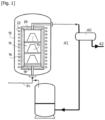
- FIG. 1 There figure 1 is a schematic representation of an installation allowing the implementation of a method of the invention.
- FIG. 1 schematically shows a chemical infiltration installation in the gas phase more particularly intended for the densification of porous substrates by a pyrolytic carbon matrix and allowing the carrying out of a process as described above.
- An oven 10 housed in an envelope 12 receives porous substrates to be densified 14, for example fibrous preforms of parts to be made from carbon matrix composite material.
- the substrates to be densified can be preforms intended to manufacture carbon brakes.
- the oven 10 is delimited by a wall 16 forming an armature, or susceptor, for example made of graphite, as well as by a bottom 18 and a cover 20.
- the susceptor 16 is coupled with an inductor 22, the heating of the oven being ensured essentially by radiation of the susceptor heated by inductive coupling with the inductor.
- a reactive gas phase is introduced into the oven, for example through the bottom 18 of the oven 10, via a pipe 24.
- the reactive gas phase comprises one or more carbon precursors in gaseous form.
- the gas phase may comprise a linear alkane having up to 4 carbon atoms.
- the effluent gas is extracted from the oven 10 through the cover 20, by a pipe 26 connected to a pumping device 28 which ensures circulation of the gas in the oven 10, maintaining the desired reduced pressure inside the latter.
- a pyrolytic carbon matrix is formed within the porosity of the substrates by decomposition of the gaseous precursor(s) contained in the reactive phase.
- Reaction by-products are also formed in the oven 10 and are collected in the effluent gas with part of the reactive gas phase which has not reacted, as well as the products obtained during the decomposition of the gaseous precursor, in particular the dihydrogen H 2 .
- FIG 1 also represents a means 40 for treating the effluent gases collected through the cover 20.
- Such treatment means 40 make it possible to separate the polyaromatic hydrocarbons from the other gaseous effluents.
- the treatment means 40 for example a centrifuge, is connected to two outlet conduits 41 and 42.
- the polyaromatic hydrocarbons separated from the other gaseous effluents by the treatment means 40 are collected via the conduit 41 towards a reservoir 30.
- the conduit 41 can be heated by means of heating elements not represented in figure 1 , to avoid condensation of polyaromatic hydrocarbons which could cause tar deposits in the pipes.
- the polyaromatic hydrocarbons 33 are, after separation from the other effluent gases, collected in a tank 30.
- the tank 30 is in fluid communication with the supply line 24 of the oven 10.
- polyaromatic hydrocarbons can be dissolved in a solvent to form a liquid oil.
- dibenzyl toluene is a preferred solvent for dissolving polyaromatic hydrocarbons.
- the tank 30 is provided with a heating system not shown in figure 1 , so that polyaromatic hydrocarbon vapors in equilibrium with the liquid polyaromatic hydrocarbons 33 in the tank 30 can escape through a pipe 31 at the head of the tank 30 and mix with the reactive gas phase in the supply pipe 24 , before the reactive gas phase enters the oven 10.
- the process may comprise a step in which passing a carrier gas passes through a reservoir 30 containing the polyaromatic hydrocarbons.
- a physical balance is created and makes it possible to obtain migration of the polyaromatic hydrocarbons towards the gas phase. from the liquid phase.
- This balance is a function of the temperature and pressure of the reservoir, as well as the concentration of the liquid phase and data specific to polyaromatic hydrocarbons such as for example the vapor pressure of polyaromatic hydrocarbons.
- the pressure of the tank 30 can be between 10 and 100 mbars, preferably between 10 and 50 mbars to charge a carrier gas present in the upper part of the tank 30 with polyaromatic hydrocarbons.
- the temperature of the tank 30 can be between 50 ° C and 150 ° C, preferably between 80 and 120 ° C to charge a carrier gas present in the upper part of the tank 30 with hydrocarbons polyaromatics.
- all of the conduits are heated to a temperature between 80°C and 100°C.
- Such heating of the conduits makes it possible to avoid the recondensation of the polyaromatic hydrocarbons and thus to prevent the polyaromatic hydrocarbons from forming soot which could clog the conduits.
- a weighing system 32 is arranged for the tank 30 in order to measure the flow rate of polyaromatic hydrocarbons leaving the tank 30 so that the content of polyaromatic hydrocarbons introduced into the densification furnace 10 can be controlled.
- the outlet conduit 42 can for its part be connected to other recycling means not shown to recycle the part of the gaseous effluents not comprising the polyaromatic hydrocarbons.
- the means of separating the different compounds from the gaseous effluents can be means of centrifugation, mechanical filtration, precipitation by an action on the temperature, decantation or a combination of these methods of the gaseous effluents.
- the separation means are chosen from mechanical filtration, precipitation, decantation or a combination of these methods.
- the separation means can be connected with a tank so that the polyaromatic hydrocarbons, separated from the gaseous effluents, can be stored.
- An installation enabling the process to be carried out may also include means for heating such a tank.
- heating the polyaromatic hydrocarbon compounds makes it possible to maintain them in liquid form and prevent them from solidifying, which could be detrimental to the pipes or the tank, the polyaromatic hydrocarbon compounds being able to solidify in the form of tars. or soot capable of blocking the ducts.
- An installation enabling the process to be carried out may further comprise means for heating all of the conduits of the installation.
- This heating makes it possible to avoid recondensation of the polyaromatic hydrocarbons in the conduits when the latter are conveyed, for example between the separation means and their reintroduction into the oven, or where appropriate the tank. Avoiding the recondensation of polyaromatic hydrocarbons in the form of soot makes it possible to increase the lifespan of the installation.
- an installation making it possible to carry out the process is free of any apparatus for transforming polyaromatic hydrocarbons because the latter do not need to be transformed to be reintroduced into the oven.
- such an installation may further comprise a means of mixing the reactive gas phase with the polyaromatic hydrocarbon compounds before supplying the furnace with the reactive gas phase.
- the reactive gas phase conveyed to the densification furnace can be brought into contact with the vapors of the polyaromatic hydrocarbon compounds resulting from the heating of a tank containing them.
- An installation enabling the process to be carried out may also include means for adjusting the flow of polyaromatic hydrocarbons during the densification of the porous substrates.
- a tank containing polyaromatic hydrocarbon compounds can be equipped with a weighing system, so that the evaporation of the polyaromatic hydrocarbon compounds can be followed over time.
- Such a reservoir can contain polyaromatic hydrocarbons dissolved in an oil.
- polyaromatic hydrocarbons dissolved in an oil.
- dibenzyl-toluene can be used as a solvent for polyaromatic hydrocarbons.
- the heating temperature of the tank can be controlled to obtain the desired gas flow of polyaromatic hydrocarbon compound.
Landscapes
- Chemical & Material Sciences (AREA)
- Engineering & Computer Science (AREA)
- Materials Engineering (AREA)
- Organic Chemistry (AREA)
- Chemical Kinetics & Catalysis (AREA)
- General Chemical & Material Sciences (AREA)
- Mechanical Engineering (AREA)
- Ceramic Engineering (AREA)
- Metallurgy (AREA)
- Manufacturing & Machinery (AREA)
- Inorganic Chemistry (AREA)
- Structural Engineering (AREA)
- Composite Materials (AREA)
- General Engineering & Computer Science (AREA)
- Analytical Chemistry (AREA)
- Oil, Petroleum & Natural Gas (AREA)
- Physical Or Chemical Processes And Apparatus (AREA)
- Organic Low-Molecular-Weight Compounds And Preparation Thereof (AREA)
- Ceramic Products (AREA)
- Carbon And Carbon Compounds (AREA)
Claims (7)
- Verfahren zum Verdichten von einem oder mehreren porösen Substraten mit pyrolytischem Kohlenstoff durch chemische Dampfinfiltration, umfassend mindestens die folgenden Schritte:- Einlassen einer reaktiven Gasphase, die mindestens einen pyrolytischen Kohlenstoffvorläufer umfasst, an dem Eingang des Verdichtungsofens,- Reagieren von mindestens einem Teil der reaktiven Gasphase mit dem oder den porösen Substrat(en),- Absaugen von gasförmigen Abströmen aus der reaktiven Gasphase an dem Ausgang des Verdichtungsofens,- Wiedereinführen von mindestens einem Teil der an dem Ausgang des Ofens abgesaugten gasförmigen Abströme mit der an dem Eingang des Verdichtungsofens eingelassenen reaktiven Gasphase,dadurch gekennzeichnet, dass der Teil der mit der reaktiven Gasphase eingeführten gasförmigen Abströme mindestens eine polyaromatische Kohlenwasserstoffverbindung umfasst.
- Verfahren zum Verdichten nach Anspruch 1, wobei die mindestens eine polyaromatische Kohlenwasserstoffverbindung aus Naphthalin, Acenaphthylen, Acenaphthen, Fluoren, Phenanthren, Anthracen, Fluoranthen, Pyren, Dibenzyltoluol und Mischungen davon ausgewählt ist.
- Verfahren zum Verdichten nach Anspruch 1 oder 2, ferner umfassend einen Schritt der Abtrennung der Verbindungen aus den an dem Ausgang des Ofens abgesaugten gasförmigen Abströmen, der durch Zentrifugieren, durch mechanische Filtration, durch Fällung, durch Dekantieren oder durch eine Kombination dieser Vorgänge umgesetzt wird.
- Verfahren nach einem der Ansprüche 1 bis 3, wobei der Teil der gasförmigen Abströme vor seiner Einleitung in den Verdichtungsofen mit der reaktiven Gasphase vermischt wird.
- Verfahren nach einem der Ansprüche 1 bis 4, wobei das Massenverhältnis zwischen den wiedereingeführten gasförmigen Abströmen und der reaktiven Gasphase zwischen 0,5 % und 5,0 % beträgt.
- Verfahren nach einem der Ansprüche 1 bis 5, wobei die reaktive Gasphase Methan, Ethan, Propan, Butan, ein Isomer von Butan oder eine Mischung dieser Verbindungen umfasst.
- Verfahren nach einem der Ansprüche 1 bis 6, wobei das oder die poröse(n) Substrat(e) Vorformen von Carbon-Bremsen sind.
Applications Claiming Priority (2)
| Application Number | Priority Date | Filing Date | Title |
|---|---|---|---|
| FR2003120A FR3108629B1 (fr) | 2020-03-30 | 2020-03-30 | Procédé de densification de matériaux composites |
| PCT/FR2021/050463 WO2021198582A1 (fr) | 2020-03-30 | 2021-03-19 | Procede de densification de materiaux composites |
Publications (2)
| Publication Number | Publication Date |
|---|---|
| EP4127262A1 EP4127262A1 (de) | 2023-02-08 |
| EP4127262B1 true EP4127262B1 (de) | 2024-04-24 |
Family
ID=71094518
Family Applications (1)
| Application Number | Title | Priority Date | Filing Date |
|---|---|---|---|
| EP21716505.9A Active EP4127262B1 (de) | 2020-03-30 | 2021-03-19 | Verfahren zum verdichten von verbundwerkstoffen |
Country Status (5)
| Country | Link |
|---|---|
| US (1) | US11674219B1 (de) |
| EP (1) | EP4127262B1 (de) |
| CN (1) | CN115398030B (de) |
| FR (1) | FR3108629B1 (de) |
| WO (1) | WO2021198582A1 (de) |
Cited By (1)
| Publication number | Priority date | Publication date | Assignee | Title |
|---|---|---|---|---|
| FR3163949A1 (fr) * | 2024-06-28 | 2026-01-02 | Safran Landing Systems | Procédé de recyclage d’une huile aromatique de capture chargée en hydrocarbures aromatiques polycycliques |
Families Citing this family (4)
| Publication number | Priority date | Publication date | Assignee | Title |
|---|---|---|---|---|
| CN110699667A (zh) * | 2019-11-25 | 2020-01-17 | 美尔森银河新材料(烟台)有限公司 | 一种炭炭坩埚生产装置 |
| FR3138140B1 (fr) * | 2022-07-22 | 2024-07-19 | Safran Ceram | procédé de préparation d’un matériau composite à matrice carbone |
| FR3147721B1 (fr) * | 2023-04-11 | 2025-04-18 | Safran Landing Systems | Procédé de recyclage d'un gaz effluent issu d'un dépôt ou d'une infiltration chimique en phase vapeur |
| CN116768644B (zh) * | 2023-06-21 | 2024-04-12 | 江苏米格新材料股份有限公司 | 一种连续气相沉积生产自动化方法 |
Citations (2)
| Publication number | Priority date | Publication date | Assignee | Title |
|---|---|---|---|---|
| US20060029804A1 (en) * | 2004-08-03 | 2006-02-09 | Klett James W | Continuous flow closed-loop rapid liquid-phase densification of a graphitizable carbon-carbon composite |
| FR2881145B1 (fr) * | 2005-01-24 | 2007-11-23 | Snecma Propulsion Solide Sa | Procede d'infiltration chimique en phase gazeuse pour la densification de substrats poreux par du carbone pyrolytique |
Family Cites Families (6)
| Publication number | Priority date | Publication date | Assignee | Title |
|---|---|---|---|---|
| FR2815890B1 (fr) * | 2000-10-30 | 2003-09-05 | Commissariat Energie Atomique | Perfectionnement aux procedes de densification par calefaction d'une structure poreuse |
| FR2832936B1 (fr) * | 2001-12-05 | 2004-02-20 | Snecma Moteurs | Procede et installation pour le traitement de gaz effluent contenant des hydrocarbures |
| CN102718535A (zh) * | 2012-07-05 | 2012-10-10 | 湖南金博复合材料科技有限公司 | 碳/碳/碳化硅复合材料及制备方法 |
| FR3018204B1 (fr) * | 2014-03-05 | 2017-11-17 | Herakles | Procede de traitement de gaz effluent contenant des hydrocarbures aromatiques polycycliques |
| US9938618B2 (en) * | 2015-03-23 | 2018-04-10 | Goodrich Corporation | Method for rapid and efficient chemical vapor infiltration and densification of carbon fiber preforms, porous substrates and close packed particulates |
| CN105601311B (zh) * | 2015-12-23 | 2018-01-19 | 北京航空航天大学 | 一种高织构炭基复合材料及制备方法 |
-
2020
- 2020-03-30 FR FR2003120A patent/FR3108629B1/fr active Active
-
2021
- 2021-03-19 WO PCT/FR2021/050463 patent/WO2021198582A1/fr not_active Ceased
- 2021-03-19 US US17/913,731 patent/US11674219B1/en active Active
- 2021-03-19 EP EP21716505.9A patent/EP4127262B1/de active Active
- 2021-03-19 CN CN202180026252.XA patent/CN115398030B/zh active Active
Patent Citations (2)
| Publication number | Priority date | Publication date | Assignee | Title |
|---|---|---|---|---|
| US20060029804A1 (en) * | 2004-08-03 | 2006-02-09 | Klett James W | Continuous flow closed-loop rapid liquid-phase densification of a graphitizable carbon-carbon composite |
| FR2881145B1 (fr) * | 2005-01-24 | 2007-11-23 | Snecma Propulsion Solide Sa | Procede d'infiltration chimique en phase gazeuse pour la densification de substrats poreux par du carbone pyrolytique |
Cited By (2)
| Publication number | Priority date | Publication date | Assignee | Title |
|---|---|---|---|---|
| FR3163949A1 (fr) * | 2024-06-28 | 2026-01-02 | Safran Landing Systems | Procédé de recyclage d’une huile aromatique de capture chargée en hydrocarbures aromatiques polycycliques |
| WO2026003465A1 (fr) * | 2024-06-28 | 2026-01-02 | Safran Landing Systems | Procédé de recyclage d'une huile aromatique de capture chargée en hydrocarbures aromatiques polycycliques |
Also Published As
| Publication number | Publication date |
|---|---|
| US20230160056A1 (en) | 2023-05-25 |
| EP4127262A1 (de) | 2023-02-08 |
| FR3108629B1 (fr) | 2022-04-01 |
| CN115398030A (zh) | 2022-11-25 |
| WO2021198582A1 (fr) | 2021-10-07 |
| FR3108629A1 (fr) | 2021-10-01 |
| US11674219B1 (en) | 2023-06-13 |
| CN115398030B (zh) | 2024-04-02 |
Similar Documents
| Publication | Publication Date | Title |
|---|---|---|
| EP4127262B1 (de) | Verfahren zum verdichten von verbundwerkstoffen | |
| EP0099765B1 (de) | Verfahren zum Fraktionieren von Gemischen durch Elutionschromatographie mit einer überkritischen fluiden Phase und Anlage zur Durchführung dieses Verfahrens | |
| EP1450934B1 (de) | Verfahren zur behandlung von kohlenwasserstoffe enthaltendem rauchgas | |
| FR2893515A1 (fr) | Procede ameliore de pretraitement de gaz naturel acide | |
| EP1844179B1 (de) | Verdichtung von porösen substraten mit kohlenstoff mittels chemischen gasphaseninfiltration | |
| FR2495177A1 (fr) | Procede de desasphaltage au solvant d'huiles residuelles d'hydrocarbures | |
| FR2727692A1 (fr) | Dispositif d'extraction de gaz pour four d'infiltration ou depot chimique en phase vapeur dans une installation de fabrication de pieces en materiau composite | |
| EP2379445A1 (de) | Verfahren zur veredelung des gasgemischs aus einer mit der herstellung eines synthesegases assoziierten entlüftungsvorrichtung und anlage dafür | |
| FR2753719A1 (fr) | Procede de deshydratation et de degazolinage d'un gaz, comportant deux etapes complementaires de regeneration du solvant | |
| EP1456433B1 (de) | Methode zur betriebsüberwachung einer verfahren mit verwendung von kohlenwasserstoffhaltigen reaktiven gasen | |
| FR2480300A1 (fr) | Procede de valorisation d'huiles lourdes | |
| FR3101256A1 (fr) | Procédé de traitement d’une huile chargée en HAP | |
| FR2512049A1 (fr) | Procede et appareil pour le vapocraquage d'hydrocarbures lourds | |
| FR3163949A1 (fr) | Procédé de recyclage d’une huile aromatique de capture chargée en hydrocarbures aromatiques polycycliques | |
| EP1466958A2 (de) | Verfahren und Anlage zur Behandlung von Kohlenwasserstoffen und zur Trennung der durch diese Behandlung hergestellten Phasen | |
| FR3113049A1 (fr) | Procédé de recyclage de sous-produits carbonés | |
| FR2490103A1 (fr) | Utilisation d'evaporateur a film tombant en multiple effet pour la recuperation d'un compose organique leger a partir d'un melange dudit compose avec un compose organique lourd | |
| FR3147721A1 (fr) | Procédé de recyclage d'un gaz effluent issu d'un dépôt ou d'une infiltration chimique en phase vapeur | |
| BE1026165B1 (fr) | Procede de production d’acide polyphosphorique et dispositif pour un tel procede | |
| WO2025131655A1 (fr) | Procédé de traitement d'une charge carbonée liquide issue d'un traitement de liquéfaction hydrothermale | |
| FR2645875A1 (fr) | Procede et dispositif de captation et de recyclage de particules solides dans une installation de vapocraquage d'hydrocarbures | |
| WO2019185698A1 (fr) | Procede de production d'acide polyphosphorique et dispositif pour un tel procede | |
| FR2624877A1 (fr) | Procede et dispositif pour le craquage catalytique de charges lourdes comportant un second strippage en lit fluide | |
| FR3143410A1 (fr) | Réacteur pour la dissolution d’une charge solide à base de matériaux thermodurcissables tels que des granulats de pneus usagés | |
| FR2630731A1 (fr) | Procede et installation pour la production de styrene |
Legal Events
| Date | Code | Title | Description |
|---|---|---|---|
| STAA | Information on the status of an ep patent application or granted ep patent |
Free format text: STATUS: UNKNOWN |
|
| STAA | Information on the status of an ep patent application or granted ep patent |
Free format text: STATUS: THE INTERNATIONAL PUBLICATION HAS BEEN MADE |
|
| PUAI | Public reference made under article 153(3) epc to a published international application that has entered the european phase |
Free format text: ORIGINAL CODE: 0009012 |
|
| STAA | Information on the status of an ep patent application or granted ep patent |
Free format text: STATUS: REQUEST FOR EXAMINATION WAS MADE |
|
| 17P | Request for examination filed |
Effective date: 20220927 |
|
| AK | Designated contracting states |
Kind code of ref document: A1 Designated state(s): AL AT BE BG CH CY CZ DE DK EE ES FI FR GB GR HR HU IE IS IT LI LT LU LV MC MK MT NL NO PL PT RO RS SE SI SK SM TR |
|
| DAV | Request for validation of the european patent (deleted) | ||
| DAX | Request for extension of the european patent (deleted) | ||
| RIN1 | Information on inventor provided before grant (corrected) |
Inventor name: GOUJARD, STEPHANE, ROGER, ANDRE Inventor name: DELEHOUZE, ARNAUD Inventor name: POTIN, JEAN-FRANCOIS, DANIEL, RENE |
|
| GRAP | Despatch of communication of intention to grant a patent |
Free format text: ORIGINAL CODE: EPIDOSNIGR1 |
|
| STAA | Information on the status of an ep patent application or granted ep patent |
Free format text: STATUS: GRANT OF PATENT IS INTENDED |
|
| INTG | Intention to grant announced |
Effective date: 20231109 |
|
| RIN1 | Information on inventor provided before grant (corrected) |
Inventor name: GOUJARD, STEPHANE ROGER ANDRE Inventor name: DELEHOUZE, ARNAUD Inventor name: POTIN, JEAN-FRANCOIS DANIEL RENE |
|
| GRAS | Grant fee paid |
Free format text: ORIGINAL CODE: EPIDOSNIGR3 |
|
| GRAA | (expected) grant |
Free format text: ORIGINAL CODE: 0009210 |
|
| STAA | Information on the status of an ep patent application or granted ep patent |
Free format text: STATUS: THE PATENT HAS BEEN GRANTED |
|
| AK | Designated contracting states |
Kind code of ref document: B1 Designated state(s): AL AT BE BG CH CY CZ DE DK EE ES FI FR GB GR HR HU IE IS IT LI LT LU LV MC MK MT NL NO PL PT RO RS SE SI SK SM TR |
|
| REG | Reference to a national code |
Ref country code: GB Ref legal event code: FG4D Free format text: NOT ENGLISH |
|
| REG | Reference to a national code |
Ref country code: CH Ref legal event code: EP |
|
| REG | Reference to a national code |
Ref country code: DE Ref legal event code: R096 Ref document number: 602021012281 Country of ref document: DE |
|
| REG | Reference to a national code |
Ref country code: IE Ref legal event code: FG4D Free format text: LANGUAGE OF EP DOCUMENT: FRENCH |
|
| REG | Reference to a national code |
Ref country code: LT Ref legal event code: MG9D |
|
| REG | Reference to a national code |
Ref country code: NL Ref legal event code: MP Effective date: 20240424 |
|
| REG | Reference to a national code |
Ref country code: AT Ref legal event code: MK05 Ref document number: 1679648 Country of ref document: AT Kind code of ref document: T Effective date: 20240424 |
|
| PG25 | Lapsed in a contracting state [announced via postgrant information from national office to epo] |
Ref country code: NL Free format text: LAPSE BECAUSE OF FAILURE TO SUBMIT A TRANSLATION OF THE DESCRIPTION OR TO PAY THE FEE WITHIN THE PRESCRIBED TIME-LIMIT Effective date: 20240424 |
|
| PG25 | Lapsed in a contracting state [announced via postgrant information from national office to epo] |
Ref country code: NL Free format text: LAPSE BECAUSE OF FAILURE TO SUBMIT A TRANSLATION OF THE DESCRIPTION OR TO PAY THE FEE WITHIN THE PRESCRIBED TIME-LIMIT Effective date: 20240424 |
|
| PG25 | Lapsed in a contracting state [announced via postgrant information from national office to epo] |
Ref country code: IS Free format text: LAPSE BECAUSE OF FAILURE TO SUBMIT A TRANSLATION OF THE DESCRIPTION OR TO PAY THE FEE WITHIN THE PRESCRIBED TIME-LIMIT Effective date: 20240824 |
|
| PG25 | Lapsed in a contracting state [announced via postgrant information from national office to epo] |
Ref country code: BG Free format text: LAPSE BECAUSE OF FAILURE TO SUBMIT A TRANSLATION OF THE DESCRIPTION OR TO PAY THE FEE WITHIN THE PRESCRIBED TIME-LIMIT Effective date: 20240424 |
|
| PG25 | Lapsed in a contracting state [announced via postgrant information from national office to epo] |
Ref country code: HR Free format text: LAPSE BECAUSE OF FAILURE TO SUBMIT A TRANSLATION OF THE DESCRIPTION OR TO PAY THE FEE WITHIN THE PRESCRIBED TIME-LIMIT Effective date: 20240424 Ref country code: FI Free format text: LAPSE BECAUSE OF FAILURE TO SUBMIT A TRANSLATION OF THE DESCRIPTION OR TO PAY THE FEE WITHIN THE PRESCRIBED TIME-LIMIT Effective date: 20240424 |
|
| PG25 | Lapsed in a contracting state [announced via postgrant information from national office to epo] |
Ref country code: GR Free format text: LAPSE BECAUSE OF FAILURE TO SUBMIT A TRANSLATION OF THE DESCRIPTION OR TO PAY THE FEE WITHIN THE PRESCRIBED TIME-LIMIT Effective date: 20240725 |
|
| PG25 | Lapsed in a contracting state [announced via postgrant information from national office to epo] |
Ref country code: PT Free format text: LAPSE BECAUSE OF FAILURE TO SUBMIT A TRANSLATION OF THE DESCRIPTION OR TO PAY THE FEE WITHIN THE PRESCRIBED TIME-LIMIT Effective date: 20240826 |
|
| PG25 | Lapsed in a contracting state [announced via postgrant information from national office to epo] |
Ref country code: ES Free format text: LAPSE BECAUSE OF FAILURE TO SUBMIT A TRANSLATION OF THE DESCRIPTION OR TO PAY THE FEE WITHIN THE PRESCRIBED TIME-LIMIT Effective date: 20240424 |
|
| PG25 | Lapsed in a contracting state [announced via postgrant information from national office to epo] |
Ref country code: AT Free format text: LAPSE BECAUSE OF FAILURE TO SUBMIT A TRANSLATION OF THE DESCRIPTION OR TO PAY THE FEE WITHIN THE PRESCRIBED TIME-LIMIT Effective date: 20240424 |
|
| PG25 | Lapsed in a contracting state [announced via postgrant information from national office to epo] |
Ref country code: PL Free format text: LAPSE BECAUSE OF FAILURE TO SUBMIT A TRANSLATION OF THE DESCRIPTION OR TO PAY THE FEE WITHIN THE PRESCRIBED TIME-LIMIT Effective date: 20240424 |
|
| PG25 | Lapsed in a contracting state [announced via postgrant information from national office to epo] |
Ref country code: LV Free format text: LAPSE BECAUSE OF FAILURE TO SUBMIT A TRANSLATION OF THE DESCRIPTION OR TO PAY THE FEE WITHIN THE PRESCRIBED TIME-LIMIT Effective date: 20240424 |
|
| PG25 | Lapsed in a contracting state [announced via postgrant information from national office to epo] |
Ref country code: PT Free format text: LAPSE BECAUSE OF FAILURE TO SUBMIT A TRANSLATION OF THE DESCRIPTION OR TO PAY THE FEE WITHIN THE PRESCRIBED TIME-LIMIT Effective date: 20240826 Ref country code: PL Free format text: LAPSE BECAUSE OF FAILURE TO SUBMIT A TRANSLATION OF THE DESCRIPTION OR TO PAY THE FEE WITHIN THE PRESCRIBED TIME-LIMIT Effective date: 20240424 Ref country code: NO Free format text: LAPSE BECAUSE OF FAILURE TO SUBMIT A TRANSLATION OF THE DESCRIPTION OR TO PAY THE FEE WITHIN THE PRESCRIBED TIME-LIMIT Effective date: 20240724 Ref country code: LV Free format text: LAPSE BECAUSE OF FAILURE TO SUBMIT A TRANSLATION OF THE DESCRIPTION OR TO PAY THE FEE WITHIN THE PRESCRIBED TIME-LIMIT Effective date: 20240424 Ref country code: IS Free format text: LAPSE BECAUSE OF FAILURE TO SUBMIT A TRANSLATION OF THE DESCRIPTION OR TO PAY THE FEE WITHIN THE PRESCRIBED TIME-LIMIT Effective date: 20240824 Ref country code: HR Free format text: LAPSE BECAUSE OF FAILURE TO SUBMIT A TRANSLATION OF THE DESCRIPTION OR TO PAY THE FEE WITHIN THE PRESCRIBED TIME-LIMIT Effective date: 20240424 Ref country code: GR Free format text: LAPSE BECAUSE OF FAILURE TO SUBMIT A TRANSLATION OF THE DESCRIPTION OR TO PAY THE FEE WITHIN THE PRESCRIBED TIME-LIMIT Effective date: 20240725 Ref country code: FI Free format text: LAPSE BECAUSE OF FAILURE TO SUBMIT A TRANSLATION OF THE DESCRIPTION OR TO PAY THE FEE WITHIN THE PRESCRIBED TIME-LIMIT Effective date: 20240424 Ref country code: ES Free format text: LAPSE BECAUSE OF FAILURE TO SUBMIT A TRANSLATION OF THE DESCRIPTION OR TO PAY THE FEE WITHIN THE PRESCRIBED TIME-LIMIT Effective date: 20240424 Ref country code: BG Free format text: LAPSE BECAUSE OF FAILURE TO SUBMIT A TRANSLATION OF THE DESCRIPTION OR TO PAY THE FEE WITHIN THE PRESCRIBED TIME-LIMIT Effective date: 20240424 Ref country code: AT Free format text: LAPSE BECAUSE OF FAILURE TO SUBMIT A TRANSLATION OF THE DESCRIPTION OR TO PAY THE FEE WITHIN THE PRESCRIBED TIME-LIMIT Effective date: 20240424 Ref country code: RS Free format text: LAPSE BECAUSE OF FAILURE TO SUBMIT A TRANSLATION OF THE DESCRIPTION OR TO PAY THE FEE WITHIN THE PRESCRIBED TIME-LIMIT Effective date: 20240724 |
|
| PG25 | Lapsed in a contracting state [announced via postgrant information from national office to epo] |
Ref country code: DK Free format text: LAPSE BECAUSE OF FAILURE TO SUBMIT A TRANSLATION OF THE DESCRIPTION OR TO PAY THE FEE WITHIN THE PRESCRIBED TIME-LIMIT Effective date: 20240424 |
|
| PG25 | Lapsed in a contracting state [announced via postgrant information from national office to epo] |
Ref country code: EE Free format text: LAPSE BECAUSE OF FAILURE TO SUBMIT A TRANSLATION OF THE DESCRIPTION OR TO PAY THE FEE WITHIN THE PRESCRIBED TIME-LIMIT Effective date: 20240424 |
|
| PG25 | Lapsed in a contracting state [announced via postgrant information from national office to epo] |
Ref country code: CZ Free format text: LAPSE BECAUSE OF FAILURE TO SUBMIT A TRANSLATION OF THE DESCRIPTION OR TO PAY THE FEE WITHIN THE PRESCRIBED TIME-LIMIT Effective date: 20240424 |
|
| PG25 | Lapsed in a contracting state [announced via postgrant information from national office to epo] |
Ref country code: RO Free format text: LAPSE BECAUSE OF FAILURE TO SUBMIT A TRANSLATION OF THE DESCRIPTION OR TO PAY THE FEE WITHIN THE PRESCRIBED TIME-LIMIT Effective date: 20240424 Ref country code: SK Free format text: LAPSE BECAUSE OF FAILURE TO SUBMIT A TRANSLATION OF THE DESCRIPTION OR TO PAY THE FEE WITHIN THE PRESCRIBED TIME-LIMIT Effective date: 20240424 |
|
| REG | Reference to a national code |
Ref country code: DE Ref legal event code: R097 Ref document number: 602021012281 Country of ref document: DE |
|
| PG25 | Lapsed in a contracting state [announced via postgrant information from national office to epo] |
Ref country code: SM Free format text: LAPSE BECAUSE OF FAILURE TO SUBMIT A TRANSLATION OF THE DESCRIPTION OR TO PAY THE FEE WITHIN THE PRESCRIBED TIME-LIMIT Effective date: 20240424 |
|
| PG25 | Lapsed in a contracting state [announced via postgrant information from national office to epo] |
Ref country code: SM Free format text: LAPSE BECAUSE OF FAILURE TO SUBMIT A TRANSLATION OF THE DESCRIPTION OR TO PAY THE FEE WITHIN THE PRESCRIBED TIME-LIMIT Effective date: 20240424 Ref country code: SK Free format text: LAPSE BECAUSE OF FAILURE TO SUBMIT A TRANSLATION OF THE DESCRIPTION OR TO PAY THE FEE WITHIN THE PRESCRIBED TIME-LIMIT Effective date: 20240424 Ref country code: RO Free format text: LAPSE BECAUSE OF FAILURE TO SUBMIT A TRANSLATION OF THE DESCRIPTION OR TO PAY THE FEE WITHIN THE PRESCRIBED TIME-LIMIT Effective date: 20240424 Ref country code: EE Free format text: LAPSE BECAUSE OF FAILURE TO SUBMIT A TRANSLATION OF THE DESCRIPTION OR TO PAY THE FEE WITHIN THE PRESCRIBED TIME-LIMIT Effective date: 20240424 Ref country code: DK Free format text: LAPSE BECAUSE OF FAILURE TO SUBMIT A TRANSLATION OF THE DESCRIPTION OR TO PAY THE FEE WITHIN THE PRESCRIBED TIME-LIMIT Effective date: 20240424 Ref country code: CZ Free format text: LAPSE BECAUSE OF FAILURE TO SUBMIT A TRANSLATION OF THE DESCRIPTION OR TO PAY THE FEE WITHIN THE PRESCRIBED TIME-LIMIT Effective date: 20240424 |
|
| PLBE | No opposition filed within time limit |
Free format text: ORIGINAL CODE: 0009261 |
|
| STAA | Information on the status of an ep patent application or granted ep patent |
Free format text: STATUS: NO OPPOSITION FILED WITHIN TIME LIMIT |
|
| 26N | No opposition filed |
Effective date: 20250127 |
|
| PGFP | Annual fee paid to national office [announced via postgrant information from national office to epo] |
Ref country code: DE Payment date: 20250218 Year of fee payment: 5 |
|
| PG25 | Lapsed in a contracting state [announced via postgrant information from national office to epo] |
Ref country code: SI Free format text: LAPSE BECAUSE OF FAILURE TO SUBMIT A TRANSLATION OF THE DESCRIPTION OR TO PAY THE FEE WITHIN THE PRESCRIBED TIME-LIMIT Effective date: 20240424 |
|
| PGFP | Annual fee paid to national office [announced via postgrant information from national office to epo] |
Ref country code: FR Payment date: 20250218 Year of fee payment: 5 |
|
| PGFP | Annual fee paid to national office [announced via postgrant information from national office to epo] |
Ref country code: GB Payment date: 20250221 Year of fee payment: 5 |
|
| PG25 | Lapsed in a contracting state [announced via postgrant information from national office to epo] |
Ref country code: SE Free format text: LAPSE BECAUSE OF FAILURE TO SUBMIT A TRANSLATION OF THE DESCRIPTION OR TO PAY THE FEE WITHIN THE PRESCRIBED TIME-LIMIT Effective date: 20240424 |
|
| PG25 | Lapsed in a contracting state [announced via postgrant information from national office to epo] |
Ref country code: MC Free format text: LAPSE BECAUSE OF FAILURE TO SUBMIT A TRANSLATION OF THE DESCRIPTION OR TO PAY THE FEE WITHIN THE PRESCRIBED TIME-LIMIT Effective date: 20240424 |
|
| REG | Reference to a national code |
Ref country code: CH Ref legal event code: H13 Free format text: ST27 STATUS EVENT CODE: U-0-0-H10-H13 (AS PROVIDED BY THE NATIONAL OFFICE) Effective date: 20251024 |
|
| PG25 | Lapsed in a contracting state [announced via postgrant information from national office to epo] |
Ref country code: LU Free format text: LAPSE BECAUSE OF NON-PAYMENT OF DUE FEES Effective date: 20250319 |
|
| REG | Reference to a national code |
Ref country code: BE Ref legal event code: MM Effective date: 20250331 |
|
| PG25 | Lapsed in a contracting state [announced via postgrant information from national office to epo] |
Ref country code: BE Free format text: LAPSE BECAUSE OF NON-PAYMENT OF DUE FEES Effective date: 20250331 |
|
| PG25 | Lapsed in a contracting state [announced via postgrant information from national office to epo] |
Ref country code: CH Free format text: LAPSE BECAUSE OF NON-PAYMENT OF DUE FEES Effective date: 20250331 |
|
| PG25 | Lapsed in a contracting state [announced via postgrant information from national office to epo] |
Ref country code: IE Free format text: LAPSE BECAUSE OF NON-PAYMENT OF DUE FEES Effective date: 20250319 |
|
| PG25 | Lapsed in a contracting state [announced via postgrant information from national office to epo] |
Ref country code: IT Free format text: LAPSE BECAUSE OF FAILURE TO SUBMIT A TRANSLATION OF THE DESCRIPTION OR TO PAY THE FEE WITHIN THE PRESCRIBED TIME-LIMIT Effective date: 20240424 |