EP4122666B1 - Smc manufacturing method - Google Patents
Smc manufacturing method Download PDFInfo
- Publication number
- EP4122666B1 EP4122666B1 EP21772392.3A EP21772392A EP4122666B1 EP 4122666 B1 EP4122666 B1 EP 4122666B1 EP 21772392 A EP21772392 A EP 21772392A EP 4122666 B1 EP4122666 B1 EP 4122666B1
- Authority
- EP
- European Patent Office
- Prior art keywords
- carbon fiber
- pin roller
- fiber bundle
- bundles
- pin
- Prior art date
- Legal status (The legal status is an assumption and is not a legal conclusion. Google has not performed a legal analysis and makes no representation as to the accuracy of the status listed.)
- Active
Links
Images






Classifications
-
- C—CHEMISTRY; METALLURGY
- C08—ORGANIC MACROMOLECULAR COMPOUNDS; THEIR PREPARATION OR CHEMICAL WORKING-UP; COMPOSITIONS BASED THEREON
- C08J—WORKING-UP; GENERAL PROCESSES OF COMPOUNDING; AFTER-TREATMENT NOT COVERED BY SUBCLASSES C08B, C08C, C08F, C08G or C08H
- C08J5/00—Manufacture of articles or shaped materials containing macromolecular substances
- C08J5/24—Impregnating materials with prepolymers which can be polymerised in situ, e.g. manufacture of prepregs
- C08J5/241—Impregnating materials with prepolymers which can be polymerised in situ, e.g. manufacture of prepregs using inorganic fibres
- C08J5/243—Impregnating materials with prepolymers which can be polymerised in situ, e.g. manufacture of prepregs using inorganic fibres using carbon fibres
-
- B—PERFORMING OPERATIONS; TRANSPORTING
- B29—WORKING OF PLASTICS; WORKING OF SUBSTANCES IN A PLASTIC STATE IN GENERAL
- B29B—PREPARATION OR PRETREATMENT OF THE MATERIAL TO BE SHAPED; MAKING GRANULES OR PREFORMS; RECOVERY OF PLASTICS OR OTHER CONSTITUENTS OF WASTE MATERIAL CONTAINING PLASTICS
- B29B15/00—Pretreatment of the material to be shaped, not covered by groups B29B7/00 - B29B13/00
- B29B15/08—Pretreatment of the material to be shaped, not covered by groups B29B7/00 - B29B13/00 of reinforcements or fillers
- B29B15/10—Coating or impregnating independently of the moulding or shaping step
- B29B15/12—Coating or impregnating independently of the moulding or shaping step of reinforcements of indefinite length
- B29B15/122—Coating or impregnating independently of the moulding or shaping step of reinforcements of indefinite length with a matrix in liquid form, e.g. as melt, solution or latex
-
- B—PERFORMING OPERATIONS; TRANSPORTING
- B29—WORKING OF PLASTICS; WORKING OF SUBSTANCES IN A PLASTIC STATE IN GENERAL
- B29B—PREPARATION OR PRETREATMENT OF THE MATERIAL TO BE SHAPED; MAKING GRANULES OR PREFORMS; RECOVERY OF PLASTICS OR OTHER CONSTITUENTS OF WASTE MATERIAL CONTAINING PLASTICS
- B29B11/00—Making preforms
- B29B11/14—Making preforms characterised by structure or composition
- B29B11/16—Making preforms characterised by structure or composition comprising fillers or reinforcement
-
- B—PERFORMING OPERATIONS; TRANSPORTING
- B29—WORKING OF PLASTICS; WORKING OF SUBSTANCES IN A PLASTIC STATE IN GENERAL
- B29C—SHAPING OR JOINING OF PLASTICS; SHAPING OF MATERIAL IN A PLASTIC STATE, NOT OTHERWISE PROVIDED FOR; AFTER-TREATMENT OF THE SHAPED PRODUCTS, e.g. REPAIRING
- B29C70/00—Shaping composites, i.e. plastics material comprising reinforcements, fillers or preformed parts, e.g. inserts
- B29C70/04—Shaping composites, i.e. plastics material comprising reinforcements, fillers or preformed parts, e.g. inserts comprising reinforcements only, e.g. self-reinforcing plastics
- B29C70/06—Fibrous reinforcements only
- B29C70/10—Fibrous reinforcements only characterised by the structure of fibrous reinforcements, e.g. hollow fibres
- B29C70/12—Fibrous reinforcements only characterised by the structure of fibrous reinforcements, e.g. hollow fibres using fibres of short length, e.g. in the form of a mat
-
- B—PERFORMING OPERATIONS; TRANSPORTING
- B29—WORKING OF PLASTICS; WORKING OF SUBSTANCES IN A PLASTIC STATE IN GENERAL
- B29C—SHAPING OR JOINING OF PLASTICS; SHAPING OF MATERIAL IN A PLASTIC STATE, NOT OTHERWISE PROVIDED FOR; AFTER-TREATMENT OF THE SHAPED PRODUCTS, e.g. REPAIRING
- B29C70/00—Shaping composites, i.e. plastics material comprising reinforcements, fillers or preformed parts, e.g. inserts
- B29C70/04—Shaping composites, i.e. plastics material comprising reinforcements, fillers or preformed parts, e.g. inserts comprising reinforcements only, e.g. self-reinforcing plastics
- B29C70/28—Shaping operations therefor
- B29C70/40—Shaping or impregnating by compression not applied
- B29C70/50—Shaping or impregnating by compression not applied for producing articles of indefinite length, e.g. prepregs, sheet moulding compounds [SMC] or cross moulding compounds [XMC]
- B29C70/502—Shaping or impregnating by compression not applied for producing articles of indefinite length, e.g. prepregs, sheet moulding compounds [SMC] or cross moulding compounds [XMC] by first forming a mat composed of short fibres
-
- B—PERFORMING OPERATIONS; TRANSPORTING
- B29—WORKING OF PLASTICS; WORKING OF SUBSTANCES IN A PLASTIC STATE IN GENERAL
- B29C—SHAPING OR JOINING OF PLASTICS; SHAPING OF MATERIAL IN A PLASTIC STATE, NOT OTHERWISE PROVIDED FOR; AFTER-TREATMENT OF THE SHAPED PRODUCTS, e.g. REPAIRING
- B29C70/00—Shaping composites, i.e. plastics material comprising reinforcements, fillers or preformed parts, e.g. inserts
- B29C70/04—Shaping composites, i.e. plastics material comprising reinforcements, fillers or preformed parts, e.g. inserts comprising reinforcements only, e.g. self-reinforcing plastics
- B29C70/28—Shaping operations therefor
- B29C70/40—Shaping or impregnating by compression not applied
- B29C70/50—Shaping or impregnating by compression not applied for producing articles of indefinite length, e.g. prepregs, sheet moulding compounds [SMC] or cross moulding compounds [XMC]
- B29C70/504—Shaping or impregnating by compression not applied for producing articles of indefinite length, e.g. prepregs, sheet moulding compounds [SMC] or cross moulding compounds [XMC] using rollers or pressure bands
-
- C—CHEMISTRY; METALLURGY
- C08—ORGANIC MACROMOLECULAR COMPOUNDS; THEIR PREPARATION OR CHEMICAL WORKING-UP; COMPOSITIONS BASED THEREON
- C08J—WORKING-UP; GENERAL PROCESSES OF COMPOUNDING; AFTER-TREATMENT NOT COVERED BY SUBCLASSES C08B, C08C, C08F, C08G or C08H
- C08J5/00—Manufacture of articles or shaped materials containing macromolecular substances
- C08J5/04—Reinforcing macromolecular compounds with loose or coherent fibrous material
- C08J5/0405—Reinforcing macromolecular compounds with loose or coherent fibrous material with inorganic fibres
- C08J5/042—Reinforcing macromolecular compounds with loose or coherent fibrous material with inorganic fibres with carbon fibres
-
- D—TEXTILES; PAPER
- D01—NATURAL OR MAN-MADE THREADS OR FIBRES; SPINNING
- D01G—PRELIMINARY TREATMENT OF FIBRES, e.g. FOR SPINNING
- D01G1/00—Severing continuous filaments or long fibres, e.g. stapling
- D01G1/02—Severing continuous filaments or long fibres, e.g. stapling to form staple fibres not delivered in strand form
- D01G1/04—Severing continuous filaments or long fibres, e.g. stapling to form staple fibres not delivered in strand form by cutting
-
- D—TEXTILES; PAPER
- D02—YARNS; MECHANICAL FINISHING OF YARNS OR ROPES; WARPING OR BEAMING
- D02J—FINISHING OR DRESSING OF FILAMENTS, YARNS, THREADS, CORDS, ROPES OR THE LIKE
- D02J1/00—Modifying the structure or properties resulting from a particular structure; Modifying, retaining, or restoring the physical form or cross-sectional shape, e.g. by use of dies or squeeze rollers
- D02J1/18—Separating or spreading
-
- B—PERFORMING OPERATIONS; TRANSPORTING
- B29—WORKING OF PLASTICS; WORKING OF SUBSTANCES IN A PLASTIC STATE IN GENERAL
- B29K—INDEXING SCHEME ASSOCIATED WITH SUBCLASSES B29B, B29C OR B29D, RELATING TO MOULDING MATERIALS OR TO MATERIALS FOR MOULDS, REINFORCEMENTS, FILLERS OR PREFORMED PARTS, e.g. INSERTS
- B29K2307/00—Use of elements other than metals as reinforcement
- B29K2307/04—Carbon
-
- C—CHEMISTRY; METALLURGY
- C08—ORGANIC MACROMOLECULAR COMPOUNDS; THEIR PREPARATION OR CHEMICAL WORKING-UP; COMPOSITIONS BASED THEREON
- C08J—WORKING-UP; GENERAL PROCESSES OF COMPOUNDING; AFTER-TREATMENT NOT COVERED BY SUBCLASSES C08B, C08C, C08F, C08G or C08H
- C08J2300/00—Characterised by the use of unspecified polymers
- C08J2300/24—Thermosetting resins
-
- C—CHEMISTRY; METALLURGY
- C08—ORGANIC MACROMOLECULAR COMPOUNDS; THEIR PREPARATION OR CHEMICAL WORKING-UP; COMPOSITIONS BASED THEREON
- C08J—WORKING-UP; GENERAL PROCESSES OF COMPOUNDING; AFTER-TREATMENT NOT COVERED BY SUBCLASSES C08B, C08C, C08F, C08G or C08H
- C08J2363/00—Characterised by the use of epoxy resins; Derivatives of epoxy resins
-
- C—CHEMISTRY; METALLURGY
- C08—ORGANIC MACROMOLECULAR COMPOUNDS; THEIR PREPARATION OR CHEMICAL WORKING-UP; COMPOSITIONS BASED THEREON
- C08J—WORKING-UP; GENERAL PROCESSES OF COMPOUNDING; AFTER-TREATMENT NOT COVERED BY SUBCLASSES C08B, C08C, C08F, C08G or C08H
- C08J2367/00—Characterised by the use of polyesters obtained by reactions forming a carboxylic ester link in the main chain; Derivatives of such polymers
- C08J2367/06—Unsaturated polyesters
Definitions
- the present invention relates to a manufacturing method of an SMC (sheet molding compound), and particularly relates to a manufacturing method of a CF-SMC which is an SMC using carbon fiber (CF).
- SMC sheet molding compound
- CF carbon fiber
- CFRP carbon fiber reinforced plastic
- a certain type of CFRP products is molded from the CF-SMC by using a compression molding method.
- the CF-SMC is a type of carbon fiber prepregs, and has a structure in which a mat comprising chopped carbon fiber bundles (also referred to as a "chopped carbon fiber tow” or a “chopped carbon fiber strand”) is impregnated with a thermosetting resin composition.
- the CFRP has higher strength when being reinforced with a carbon fiber bundle having a smaller filament number.
- the carbon fiber bundle requires a higher manufacturing cost when having a smaller filament number (smaller tow size) (Patent Document 1).
- Patent Document 2 It is proposed adding a step of partially splitting a continuous carbon fiber bundle unwound from a creel before chopping to an SMC manufacturing method in which steps are continuously performed from chopping of the continuous carbon fiber bundle to resin impregnation of a carbon fiber mat.
- Patent Document D3 is considered to disclose a method for manufacturing SMC. which includes a step of providing a spraying mechanism 8a (based on the drawing, corresponding to a pin roller) directly under a cutter unit 7, and dispersing fiber bundles, which is a part of the invention as in claim 1.
- an SMC which can give a high-strength CFRP molded product can be manufactured at low cost by using a technique of partially splitting before use a continuous carbon fiber bundle having a large filament number, typically such as a large tow.
- the present invention is made in a process of studies performed by the present inventors, based on the above-described idea, and mainly aims to provide a useful improvement in a CF-SMC manufacturing technique including a CF-SMC manufacturing method in which a continuous carbon fiber bundle is partially split before use.
- An aspect of the present invention relates to an SMC manufacturing method as defined by the independent claim 1.
- a useful improvement in a CF-SMC manufacturing technique including an SMC manufacturing method in which a continuous carbon fiber is partially split before use.
- An SMC is a sheet-shaped carbon fiber prepreg obtainable by impregnating a carbon fiber mat comprising a chopped carbon fiber bundle with a thermosetting resin composition.
- One embodiment of the present invention is an SMC manufacturing method including the following steps (i) to (iv).
- fragmentation processing is performed so that at least some of the chopped carbon fiber bundles before being deposited on the carrier film is fragmented by being brought into contact with a rotating body.
- a distribution of the filament numbers of the chopped carbon fiber bundles included in the carbon fiber mat formed in the step (iii) above becomes different from that when the fragmentation processing is not performed.
- thermosetting resin composition When necessary, a step of thickening the thermosetting resin composition is further provided after the step (iv).
- a package of the continuous carbon fiber bundle prepared in advance is used.
- the continuous carbon fiber bundle has a filament number of NK and is partially split into n sub-bundles.
- NK means N ⁇ 1000.
- a filament number of a carbon fiber bundle comprising 3,000 single filaments is 3K, and a filament number of a carbon fiber bundle comprising 12,000 single filaments is 12K.
- N is usually 12 or more, preferably 15 or more, and can be, but not limited to 18, 24, 36, 48, or 50, for example.
- a continuous carbon fiber bundle is partially split into n sub-bundles, it means, in other words, that the continuous carbon fiber bundle is partially divided into n parts.
- Each of the n fiber bundles formed by dividing into n parts is called a sub-bundle.
- the package of the partially split continuous carbon fiber bundle can be manufactured using, but not limited to a fiber package manufacturing apparatus represented in a conceptual diagram in Fig. 1 .
- a fiber package manufacturing apparatus 100 includes a spread section 110, a split section 120, and a winding section 130.
- a continuous carbon fiber bundle 10 serving as a starting material and having a filament number of NK is drawn out from a supply bobbin B1.
- the continuous carbon fiber bundle 10 drawn out from the supply bobbin B 1 before being split is first spread in the spread section 110.
- a spreader bar 111 provided in the spread section 110 may be heated and may be caused to reciprocate in a width direction of the continuous carbon fiber bundle 10. Mechanisms therefor can refer to a known technique.
- the continuous carbon fiber bundle 10 originally has a flat shape, it is further increased in width and further decreased in thickness by being rubbed against the spreader bar 111.
- the thickness of the continuous carbon fiber bundle 10 after passing through the spread section 110 is not limited, but can typically be 0.05 to 0.2 mm.
- the spread section 110 may be omitted, when the continuous carbon fiber bundle 10 is sufficiently flat at a stage when the continuous carbon fiber bundle 10 is supplied from the supply bobbin B1.
- a carbon fiber bundle having a bundle width of 50 times or more of an average thickness can be said to be sufficiently flat.
- the continuous carbon fiber bundle 10 is fed to the split section 120 and is partially split there.
- the split section 120 is provided with a rotary blade 121 for forming a slit in the continuous carbon fiber bundle 10 and a plurality of godet rolls 123 for controlling a traveling speed of the continuous carbon fiber bundle 10.
- a rotation axis of the rotary blade 121 is parallel to a width direction of the continuous carbon fiber bundle 10 traveling along a fiber direction.
- a plurality of blade parts 122 are provided at a regular interval in a circumferential direction on an outer circumference of the rotary blade 121, so that slits having a constant length are intermittently formed at a regular interval along the fiber direction of the continuous carbon fiber bundle 10.
- a slit length and a gap length between the slits can be controlled by adjusting the traveling speed of the continuous carbon fiber bundle 10, a circumferential speed of the rotary blade 121, and/or an interval between the blade portions 122.
- the continuous carbon fiber bundle 10 is partially divided into n parts due to intermittent formation of slits along the fiber direction by (n-1)-number of the rotary blades 121 aligned in a direction parallel to the width direction of the traveling continuous carbon fiber bundle 10.
- n is not limited to, but preferably 3 or more and more preferably 5 or more and may be 10 or more.
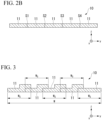
- Figs. 2A and 2B represent the continuous carbon fiber bundle 10 immediately after the slits extending in the fiber direction are intermittently formed by four rotary blades 121.
- the fiber direction (longitudinal direction) is defined as an x-direction
- the width direction is defined as a y-direction
- the thickness direction is defined as a z-direction
- Fig. 2A is a plan view when the continuous carbon fiber bundle 10 is viewed from the z-direction
- Fig. 2B represents a cross section of the continuous carbon fiber bundle 10 perpendicular to the x-direction (cross section when cut by an yz-plane).
- slit rows including a first slit row A S1 , a second slit row A S2 , a third slit row A S3 , and a fourth slit row A S4 are formed.
- the first slit row A S1 comprises a plurality of first slits S1 aligned in the x-direction.
- the second slit row A S2 comprises a plurality of second slits S2 aligned in the x-direction.
- the third slit row A S3 comprises a plurality of third slits S3 aligned in the x-direction.
- the fourth slit row A S4 comprises a plurality of fourth slits S4 aligned in the x-direction.
- the four slit rows are formed by different rotary blades and therefore are different from each other in positions in the y-direction.
- a slit length Ls and an inter-slit gap length L G are constant in any of the slit rows, and are common also among different slit rows.
- a ratio L S /(L S +L G ) of the slit length L S to a sum of the slit length L S and the inter-slit gap length L G is usually 90 % or higher and preferably 95% or higher and may be 99% for example. Therefore, as represented in Fig. 2B , the continuous carbon fiber bundle 10 is split into five sub-bundles 11 in most parts.
- the positions of the first slit row A S1 , the second slit row A S2 , the third slit row A S3 , and the fourth slit row A S4 in the y-direction are set so that the widths of the five sub-bundles 11 are approximately the same.
- the filament number of the continuous carbon fiber bundle 10 is 15K
- the filament number of each of the sub-bundles 11 is 3K ⁇ 0.5K.
- the slit length Ls is not limited to, but preferably more than 25 mm, more preferably more than 50 mm, and much more preferably more than 500 mm.
- the slit length Ls can be 10 times or more, further 20 times or more, and further 30 times or more the cutting length when the continuous carbon fiber bundle 10 is cut to manufacture an SMC.
- the slit length Ls can be more than 25 mm and 50 mm or less, more than 50 mm and 100 mm or less, more than 100 mm and 200 mm or less, more than 200 mm and 500 mm or less, more than 500 mm and 1000 mm or less, more than 1000 mm and 1500 mm or less, more than 1500 mm and 2000 mm or less, and more than 2000 mm and 3000 mm or less.
- the inter-slit gap length L G is not limited to, but for example 5 to 10 mm and may be less than 5 mm.
- positions of inter-slit gaps Gs are shifted in the x-direction between the first slit row A S1 and the second slit row A S2 .
- Such a configuration with a shifting in the positions of the inter-slit gaps Gs in the x- direction between the adjacent slit rows is not essential.
- the positions of the inter-slit gaps Gs may be aligned among all of the slit rows as represented in Fig. 14 .
- the positions of the inter-slit gaps Gs may be aligned among some of the slit rows and shifted in the x-direction among some other slit rows.
- the slit length Ls, the inter-slit gap length L G , a ratio L S /(L S +L G ) of the slit length Ls to a sum of the slit length Ls and the inter-slit gap length L G , and the position of the inter-slit gap G S as described above are not limited to a case where the continuous carbon fiber bundle 10 is partially split into the five sub-bundles, and the same applies to a case where the continuous carbon fiber bundle 10 is partially split into four sub-bundles or less or six sub-bundles or more.
- the filament number of the sub-bundle formed by splitting the continuous carbon fiber bundle 10 is preferably 5K or less, more preferably 4K or less, and much more preferably 3K or less.
- the filament number of the sub-bundle formed by splitting the continuous carbon fiber bundle 10 is preferably more than 0.5K and more preferably 1K or more.
- the filament number is more than 0.5K, straightness of the carbon fiber bundle is likely to be maintained, and a reinforcing effect tends to be relatively high.
- the filament number of the sub-bundle formed by splitting the continuous carbon fiber bundle 10 is preferably 0.5K to 5K, more preferably 0.5K to 4K and much more preferably 1K to 3K.
- the continuous carbon fiber bundle 10 partially split into n parts in the split section 120 is fed to the winding section 130, and is wound on a winding bobbin B2, thereby completing the package.
- the winding bobbin B2 is a paper tube, but is not limited thereto.
- the winding bobbin B2 can be pulled out, and the continuous carbon fiber bundle can be unwound by internal unwinding.
- the continuous carbon fiber bundle 10 is wound such that there is no gap between the sub-bundles 11. The reason is to prevent the sub-bundles 11 from biting each other between a part previously wound on the bobbin B2 and a part wound later so as to overlap the previously wound part. By winding such that there is no gap between the sub-bundles 11, the continuous carbon fiber bundle 10 can be prevented from being entangled or broken during unwinding by external unwinding or internal unwinding.
- a total width W of the continuous carbon fiber bundle 10 may be made narrower than a sum of sub-bundle widths W s as represented in Fig. 3 .
- Fig. 3 is a sectional view when the continuous carbon fiber bundle 10 is cut perpendicular to the fiber direction, showing that the five sub-bundles 11 are arranged side by side without any gap in the y-direction. That is, there is no part where the adjacent sub-bundles 11 are away from each other, and each of the sub-bundles 11 overlaps the immediately adjacent sub-bundle 11 at an edge portion.
- the width of the carbon fiber bundle can be reduced by guiding the carbon fiber bundle with a guide having a width narrower than that of the carbon fiber bundle. Therefore, in order to wind the continuous carbon fiber bundle 10 on the bobbin B2 in a state where the total width W is narrowed than a total sum of the sub-bundle widths W s , for example, a grooved roll having a groove width narrower than the total sum of the sub-bundle widths may be used in guiding the continuous carbon fiber bundle after being partially split to the winding bobbin. Alternatively, the width of a fiber bundle guide of a traverse device may be narrowed than the total sum of the sub-bundle widths.
- a manner of overlapping of the sub-bundles in the continuous carbon fiber bundle wound on the winding bobbin is not limited to the manner represented in Fig. 3 and can be various.
- the total width of the continuous carbon fiber bundles 10 when wound on the winding bobbin is preferably 90% or less, more preferably 80 % or less of the total sum of the widths of the sub-bundles.
- the total width of the continuous carbon fiber bundle when wound on the winding bobbin is preferably, but without limitation, not narrowed until the total width is equal to the width of the sub-bundle.
- the number n of sub-bundles is large, when the total width is excessively small, winding collapse is likely to occur.
- a traverse device (not represented) is usually installed in the winding section 130.
- a lead angle at a start of winding can be set to, for example, 5° to 30° and the lead angle at an end of winding can be set to, for example, 2° to 17°.
- a winding ratio represents rotation times of the bobbin during one round trip of a traverse guide, and in other words, the winding ratio may be paraphrased as the number of turns per one traverse cycle.
- the winding ratio is an integer, the yarn is wound at the same position of the bobbin in all traverse cycles, thereby causing so-called ribbon winding and a possible poor unwinding property.
- the yarn is wound at the same position of the bobbin every p-traverse cycle, thereby causing a possible poor unwinding property particularly when p is small, as in a case where the winding ratio is an integer.
- the winding ratio is usually not an integer, and further it is preferable that the fraction of the winding ratio after the decimal point is a multiple of none of 1/2, 1/3, 1/4 and 1/5.
- Fig. 4 represents a conceptual diagram of an SMC manufacturing apparatus that can be preferably used in an SMC manufacturing method of the embodiment.
- an SMC manufacturing apparatus 200 includes a first resin application section 210, a second resin application section 220, a chopping section 230, a deposition section 240, and an impregnation section 250.
- a fragmentation processing apparatus 260 is disposed between the chopping section 230 and the deposition section 240.
- the first resin application section 210 is provided with a first applicator 211 including a doctor blade to form a first resin layer 51 comprising a thermosetting resin composition 50 on a first carrier film 41 drawn out from a roll.
- the second resin application section 220 is provided with a second applicator 221 including a doctor blade to form a second resin layer 52 comprising the same thermosetting resin composition 50 on a second carrier film 42 drawn out from a roll.
- the chopping section 230 is provided with a rotary cutter 231 for chopping a continuous carbon fiber bundle 10 drawn out from a package (the bobbin may be removed).
- the rotary cutter 231 includes a guide roll 232, a pinch roll 233, and a cutter roll 234.
- a plurality of blades 235 are disposed on an outer circumference of the cutter roll 234 at a regular interval in a circumferential direction, and chopped carbon fiber bundles 20 having a constant fiber length can be cut out one after another from the continuous carbon fiber bundle 10.
- a plurality of the continuous carbon fiber bundles 10 are aligned to be parallel to each other in a plane parallel to a rotation axis direction of the rotary cutter 231 and are supplied to the rotary cutter 231 at the same time.
- the rotation axis direction of the rotary cutter 231 is a rotation axis direction of the rolls provided in the rotary cutter 231, that is, a rotation axis direction of the cutter roll 234.
- the directions of the rotation axes of the guide roll 232 and the pinch roll 233 are also the same as the direction of the rotation axis of the cutter roll 234.
- the deposition section 240 is disposed below the chopping section 230.
- the first carrier film 41 is conveyed from the first resin application section 210 to the impregnation section 250 via the deposition section 240.
- the chopped carbon fiber bundles 20 produced in the chopping section 230 are fallen and deposited on the first resin layer 51 formed on a surface of the first carrier film 41, so that a carbon fiber mat 30 is formed.
- a mechanism for gradually bringing the first carrier film 41 and the second carrier film 42 closer to each other is disposed in an upstream part of the impregnation section 250.
- An impregnation machine 251 is disposed in a main part of the impregnation section 250.
- the impregnation machine 251 includes two belt conveyors located above and below, and includes rollers for pressurizing the laminate by sandwiching it together with the conveyor belts.
- the fragmentation processing apparatus 260 disposed between the chopping section 230 and the deposition section 240 includes a cover 261, and guide plates 262 and a pair of pin rollers (first pin roller 263a and second pin roller 263b) which are disposed inside the cover.
- the first pin roller 263a and the second pin roller 263b have substantially the same axial length, and have the rotation axes parallel to each other.
- the fragmentation processing apparatus 260 is disposed such that the rotation axes of the first pin roller 263a and the second pin roller 263b are parallel to the rotation axis direction of the rotary cutter 231.
- the position of the fragmentation processing apparatus 260 is preferably right below the rotary cutter 231.
- the first pin roller 263a has a cylinder 264a, and a plurality of pins 265a having the same shapes and the same dimensions are disposed on the surface thereof.
- Both the cylinder 264a and the pins 265a are rigid bodies, and are formed of metal, for example.
- a diameter of the cylinder 264a is not limited, but can be 60 mm to 150 mm, for example.
- the pins 265a extend to be perpendicular to the rotation axis of the first pin roller 263a.
- the pin 265a has a columnar shape, for example. A boundary between an end surface and a circumferential surface may be chamfered in the pin 265a.
- the diameter of the pin 265a is not limited, but can be, for example, 1 mm to 5 mm.
- the length of the pin 265a that is, the distance from the tip to the root of the pin is not limited, but can be 10 mm to 50 mm, for example.
- the pin 265a has a circular cross section to prevent fuzzing of the chopped carbon fiber bundle 20 processed by the fragmentation processing apparatus 260.
- the pin 265a may have a shape of a cone or a truncated cone whose diameter decreases toward the tip.
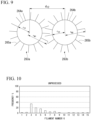
- the pin 265a is disposed at each vertex of equilateral triangles (indicated by a broken line) tessellating such that one side is parallel to the axial direction, as represented in Fig. 8 .
- the disposition of the pin 265a represented in Fig. 8 overlaps the original disposition when shifted by 2.5 mm in the axial direction and approximately 4.3 mm in the circumferential direction.
- the maximum radius of the pin roller is defined as a distance from the rotation axis to the tip of the pin.
- the radius of the cylinder 264a is preferably half or more of the maximum radius of the first pin roller 263a, and is more preferably 75% or more. The reason is that as the ratio of the cylinder radius to the maximum radius of the pin roller increases, a difference decreases between the circumferential speed at the tip of the pin and the circumferential speed at the root of the pin when the pin roller is rotated.
- the fragmentation processing apparatus 260 it is preferable that in items as many as possible, including the maximum radius, the cylinder diameter and the shape, the dimension, the number and the disposition of the pins, designs and specifications of the first pin roller 263a and the second pin roller 263b coincide with each other.
- the sum of the maximum radius r M1 of the first pin roller 263a and the maximum radius r M2 of the second pin roller 263b is larger than a distance d 12 between the rotation axes of the two pin rollers.
- the sum of the maximum radius r M1 of the first pin roller 263a and the radius r C2 of the cylinder 264b of the second pin roller is smaller than the distance d 12 between the rotation axes of the two pin rollers.
- the sum of the maximum radius r M2 of the second pin roller 263b and the radius r C1 of the cylinder 264a of the first pin roller is also smaller than the distance d 12 between the rotation axes of the two pin rollers.
- a difference ⁇ (r M1 + r M2 )) - d 12 ⁇ between the sum of the maximum radius r M1 of the first pin roller 263a and the maximum radius r M2 of the second pin roller 263b and the distance d 12 between the rotation axes is not limited but may be 20 mm or less, 15 mm or less, 10 mm or less, or 5 mm or less.
- the first pin roller 263a and the second pin roller 263b are rotationally driven by a drive mechanism (not represented). Rotation speeds of the first pin roller 263a and the second pin roller 263b may be independently controllable.
- Rotation directions of the first pin roller 263a and the second pin roller 263b are as indicated by arrows in Fig. 6 . That is, the first pin roller 263a rotates such that its pins move downward from above on its side facing the second pin roller 263b, and the second pin roller 263b rotates such that its pins move downward from above on its side facing the first pin roller 263a.
- Rotating both the first pin roller 263a and the second pin roller 263b in such a way is advantageous in preventing the chopped carbon fiber bundle 20 from being clogged between the two pin rollers.
- Substantially all of the chopped carbon fiber bundles 20 produced in the chop section 230 are fallen to the deposition section through between the cylinder 264a of the first pin roller 263a and the cylinder 264b of the second pin roller 263b. Since difference in falling positions of the chopped carbon fiber bundles 20 depending on bundle sizes is less likely to occur, even when a distribution of the bundle sizes of the chopped carbon fiber bundles 20 is wide, there is an advantage in that the carbon fiber mat 30 is likely to be uniform in the thickness direction.
- a sum of the maximum radius r M1 of the first pin roller 263a and the maximum radius r M2 of the second pin roller 263b may be equal to the distance d 12 between the rotation axes of the two pin rollers.
- a sum of the maximum radius r M1 of the first pin roller 263a and the maximum radius r M2 of the second pin roller 263b may be slightly smaller than the distance d 12 between the rotation axes of the two pin rollers, and in that case, a difference ⁇ d 12 - (r M1 + r M2 ) ⁇ therebetween is preferably 10 mm or less, and is more preferably 5 mm or less.
- An SMC manufacturing method of the embodiment will be described using, as an example, a case in which the SMC manufacturing apparatus 200 described in 1.2 above is used.
- a continuous carbon fiber bundle is drawn out from a package of the continuous carbon fiber bundle prepared in advance.
- the continuous carbon fiber bundle has a filament number of NK and is partially split into n sub-bundles in advance.
- the continuous carbon fiber bundle may be drawn out by external unwinding from a bobbin package placed on a creel, or the continuous carbon fiber bundle may be drawn out by internal unwinding from a package from which a bobbin is removed.
- the continuous carbon fiber bundle drawn out from the package includes a part in which the sub-bundles are partially overlapped and sticked to each other.
- the drawn out continuous carbon fiber bundle 10 is supplied to the chopping section 230 and cut one after another by the rotary cutter 231, thereby producing the chopped carbon fiber bundles 20 having a predetermined fiber length.
- the produced chopped carbon fiber bundles 20 fall toward the fragmentation processing apparatus 260 placed below the rotary cutter 231.
- the fiber length of the chopped carbon fiber bundle 20 is not limited, but can be 5 to 100 mm, preferably 20 to 60 mm, for example, and can be typically approximately 13 mm, approximately 25 mm, or approximately 50 mm.
- the continuous carbon fiber bundle drawn out from the package includes a part in which the sub-bundles are partially overlapped and sticked to each other.
- the chopped carbon fiber bundles produced in the chopping step include to some extent a fiber bundle having a filament number of more than ⁇ (N/n)+0.5 ⁇ K, which is generated by cutting such part of the continuous carbon fiber bundle.
- the fragmentation processing step aims to improve a distribution of the filament numbers of the chopped carbon fiber bundles in the carbon fiber mat formed in a deposition step (to be described later) by fragmentation of such fiber bundle with the fragmentation processing apparatus.
- the fragmentation processing apparatus 260 At least some of the chopped carbon fiber bundles 20 falling from the rotary cutter 231 come into contact with at least one of the first pin roller 263a and the second pin roller 263b and are divided into a plurality of fragments by an impact.
- the fragmentation processing is not intended for defibration. That is, the fragmentation processing is not to loosen the chopped carbon fiber bundle into single fiber filaments or a state close to single fiber filaments.
- a circumferential speed at a tip of the pin of each of the first pin roller 263a and the second pin roller 263b is set so that the fragmentation processing does not generate a fiber bundle having a filament number of 0.5K or less and a single fiber filament, or even when generated, so that a content thereof in the carbon fiber deposited on the first carrier film 41 is lower than 1% by weight.
- rotation speeds (rpm) of the first pin roller 263a and the second pin roller 263b are set such that the circumferential speed at the tip of the former's pin 265a and the circumferential speed at the tip of the latter's pin 265b are equal to each other.
- the first resin layer 51 comprising the thermosetting resin composition 50 is formed on the first carrier film 41 drawn out from a roll using the first applicator 221, and the second resin layer 52 comprising the same thermosetting resin composition 50 is formed on the second carrier film 42 drawn out from another roll using the second applicator 212.
- the thermosetting resin composition 50 is a fluid paste containing a thermosetting resin as a main component and in which a thickener and a curing agent are blended, and if necessary, additives such as a reactive diluent, a low shrinkage agent, a filler, and a flame retardant are blended.
- thermosetting resin examples include an epoxy resin, a vinyl ester resin, an unsaturated polyester resin, a polyimide resin, a maleimide resin and a phenol resin, and two or more types selected from these resins can be mixed and used.
- thermosetting resins are the epoxy resin, the vinyl ester resin, and the unsaturated polyester resin in view of excellent adhesiveness to the carbon fiber.
- thermosetting resin composition With regard to a specific formulation of the thermosetting resin composition, a related art can be appropriately referred to.
- the chopped carbon fiber bundles 20 processed by the fragmentation processing apparatus 260 fall on the first carrier film 41 conveyed below the fragmentation processing apparatus 260.
- the fallen chopped carbon fiber bundles 20 are deposited on the first resin layer 51 formed on a surface of the first carrier film 41, thereby forming the carbon fiber mat 30.
- the first carrier film 41 loaded with the carbon fiber mat 30 deposited on the first resin layer 51 is laminated with the second carrier film 42 with a side having the second resin layer 52 formed thereon facing downward.
- the carbon fiber mat 30 is impregnated with the thermosetting resin composition 50 by pressurizing the laminate formed by the lamination with the impregnation machine 251.
- the impregnated carbon fiber mat 30 is wound on a bobbin while sandwiched between the first carrier film 41 and the second carrier film 42 and becomes an SMC product through an aging step to be performed when necessary.
- the thermosetting resin composition 50 becomes highly viscous by an action of the added thickener and is brought into a semi-cured state.
- the continuous carbon fiber bundle having a filament number of NK and partially split into n sub-bundles is used as a raw material.
- a continuous carbon fiber bundle which has not been processed to partially split may be used as the raw material.
- An SMC manufacturing method comprising:
- a radius of a cylinder is equal to or larger than half of a maximum radius.
- thermosetting resin composition The manufacturing method according to any one of [36] to [42], wherein the carbon fiber mat is pressurized together with the thermosetting resin composition to impregnate the carbon fiber mat with the thermosetting resin composition.
- thermosetting resin composition is applied to an upper surface of the carrier film before forming the carbon fiber mat by depositing the chopped carbon fiber bundles.
- a flat continuous carbon fiber bundle (TR50S15L manufactured by Mitsubishi Chemical Corporation) having a filament number of 15K, an initial width of 8 mm and a thickness of 0.1 mm was prepared.
- the continuous carbon fiber bundle was partially split into five sub-bundles each having a width of 1.6 mm. Positions of inter-slit gaps along the fiber direction were the same among all of the slit rows.
- a carbon fiber mat was prepared from the continuous carbon fiber bundle having a filament number of 15K and partially split into five sub-bundles prepared in the above-described procedure using an SMC manufacturing apparatus having the same configuration as the SMC manufacturing apparatus represented in Fig. 4 except that the fragmentation processing apparatus was not provided.
- a plurality of the continuous carbon fiber bundles were supplied to a rotary cutter in a state of being aligned in parallel at an equal interval and were cut every 25.4 mm.
- the chopped carbon fiber bundles were fallen onto a carrier film which travels below the rotary cutter at a line speed of 5 m/min and was not coated with a thermosetting resin composition.
- the fallen chopped carbon fiber bundles were deposited on the carrier film to form a carbon fiber mat.
- Fig. 10 represents a distribution of the filament numbers of the chopped carbon fiber bundles in the carbon fiber mat, which was obtained by converting the measured weights into filament numbers.
- a content of the carbon fiber bundle having the filament number of more than 0.5K was 99.9% by weight or more.
- the carbon fiber mat was prepared using the same SMC manufacturing apparatus used in Experiment 1 except that the fragmentation processing apparatus was provided, and the distribution of the filament numbers thereof was measured in the same manner as in Experiment 1.
- the procedure for preparing the carbon fiber mat was the same as that in Experiment 1 except that the chopped carbon fiber bundles were subjected to a fragmentation processing by the fragmentation processing apparatus before being deposited on the carrier film.
- a configuration of the fragmentation processing apparatus was the same as that included in the SMC manufacturing apparatus represented in Fig. 4 .
- Both the two pin rollers were formed of metal and had the same configuration.
- a diameter and a length of a pin disposed on a cylinder circumferential surface were respectively 3 mm and 20 mm.
- the disposition of the pins on the circumferential surface of the cylinder of each pin roller was periodic, and the disposition overlapped the original disposition when shifted by 7.5 mm in the axial direction and 6.5 mm in the circumferential direction.
- the sum of the maximum radii of the two pin rollers was 10 mm larger than the distance between the rotation axes of the two pin rollers.
- the two pin rollers were rotated such that in both pin rollers the circumferential speeds at the pin tips were 377 m/min and in each pin rollers the pins moved downward from above on the side facing the other pin roller.
- Fig. 11 represents the distribution of the filament numbers of the chopped carbon fiber bundles in the prepared carbon fiber mat.
- a content of the carbon fiber bundle having the filament number of more than 0.5K was 99.9% by weight or more.
- the carbon fiber mat was prepared in the same manner as in Experiment 2 except that both the two pin rollers were rotated such that in each pin rollers the pins moved upward from below on the side facing the other pin roller, and the distribution of the filament numbers was measured.
- Fig. 12 represents the distribution of the filament numbers of the chopped carbon fiber bundles in the prepared carbon fiber mat.
- the carbon fiber mat was prepared in the same manner as in Experiment 2 except that the two pin rollers were rotated in the same direction, and the distribution of the filament numbers was measured.
- Fig. 13 represents the distribution of the filament numbers of the chopped carbon fiber bundles in the prepared carbon fiber mat.
- the carbon fiber mat was prepared in the same manner as in Experiment 2 except that the distance between the rotation axes of the two pin rollers was the same as the sum of the maximum radii of the two pin rollers, and the distribution of the filament numbers was measured.
- Fig. 15 represents the distribution of the filament numbers of the chopped carbon fiber bundles in the prepared carbon fiber mat.
- a square end type fiber package was produced by preparing and partially splitting a flat continuous carbon fiber bundle having the filament number of 15,000 (15K), the initial width of 8 mm and the thickness of 0.1 mm and thereafter, winding the partially split continuous carbon fiber bundle on a paper bobbin having a diameter of 82 mm and a length of 280 mm with a traverse length of 254 mm. Widening with a spreader was not performed.
- a splitter having four rotary blades was used for partially splitting the continuous carbon fiber bundle.
- the continuous carbon fiber bundle was split into five sub-bundles each having the width of 1.6 mm and partially joined to each other. Positions of inter-slit gap in the fiber direction were the same among all of the slit rows.
- the lead angle at the winding start was 9.9°
- the lead angle at the winding end was 5°
- the winding ratio was 11.30
- the winding amount was 5.0 kg.
- the total width of the continuous carbon fiber bundle wound on the bobbin was made to be 6 mm which was 75% of the total sum of the widths of the sub-bundles.
Landscapes
- Engineering & Computer Science (AREA)
- Chemical & Material Sciences (AREA)
- Textile Engineering (AREA)
- Mechanical Engineering (AREA)
- Materials Engineering (AREA)
- Composite Materials (AREA)
- Health & Medical Sciences (AREA)
- Chemical Kinetics & Catalysis (AREA)
- Medicinal Chemistry (AREA)
- Polymers & Plastics (AREA)
- Organic Chemistry (AREA)
- Manufacturing & Machinery (AREA)
- Inorganic Chemistry (AREA)
- Reinforced Plastic Materials (AREA)
Applications Claiming Priority (2)
| Application Number | Priority Date | Filing Date | Title |
|---|---|---|---|
| JP2020047206 | 2020-03-18 | ||
| PCT/JP2021/009970 WO2021187346A1 (ja) | 2020-03-18 | 2021-03-12 | Smcの製造方法 |
Publications (3)
| Publication Number | Publication Date |
|---|---|
| EP4122666A1 EP4122666A1 (en) | 2023-01-25 |
| EP4122666A4 EP4122666A4 (en) | 2023-08-30 |
| EP4122666B1 true EP4122666B1 (en) | 2025-01-01 |
Family
ID=77772101
Family Applications (1)
| Application Number | Title | Priority Date | Filing Date |
|---|---|---|---|
| EP21772392.3A Active EP4122666B1 (en) | 2020-03-18 | 2021-03-12 | Smc manufacturing method |
Country Status (6)
| Country | Link |
|---|---|
| US (1) | US20230020921A1 (https=) |
| EP (1) | EP4122666B1 (https=) |
| JP (1) | JP7726203B2 (https=) |
| CN (1) | CN115298006B (https=) |
| ES (1) | ES3012109T3 (https=) |
| WO (1) | WO2021187346A1 (https=) |
Families Citing this family (4)
| Publication number | Priority date | Publication date | Assignee | Title |
|---|---|---|---|---|
| EP4129602B1 (en) * | 2020-03-26 | 2024-12-11 | Mitsubishi Chemical Corporation | Method for manufacturing smc |
| JP7604802B2 (ja) * | 2020-08-05 | 2024-12-24 | 三菱ケミカル株式会社 | Cf-smcおよびcf-smcの製造方法 |
| WO2022176866A1 (ja) * | 2021-02-16 | 2022-08-25 | 三菱ケミカル株式会社 | シートモールディングコンパウンドの製造方法、炭素繊維マット堆積装置およびシートモールディングコンパウンド製造装置 |
| CN116555958A (zh) * | 2023-05-15 | 2023-08-08 | 亨弗劳恩(江苏)复合材料研发有限公司 | 一种纤维束分束装置、分束方法及smc制备方法 |
Family Cites Families (23)
| Publication number | Priority date | Publication date | Assignee | Title |
|---|---|---|---|---|
| US3081499A (en) * | 1956-07-09 | 1963-03-19 | Emil Shapiro | Fiber integrating apparatus |
| US3787929A (en) * | 1972-02-14 | 1974-01-29 | Korea Inst Sci & Tech | Compressed air scutcher |
| JPS61157335A (ja) * | 1984-12-28 | 1986-07-17 | Irie Hekizai:Kk | カ−ボン短繊維を単繊維状に分散混合した乾状態の微粉体原材料製造装置 |
| JPH0737040B2 (ja) * | 1990-09-27 | 1995-04-26 | 積水化学工業株式会社 | 繊維複合シートの製造方法 |
| JP3090723B2 (ja) * | 1990-09-27 | 2000-09-25 | 積水化学工業株式会社 | 繊維複合シートの製造方法 |
| GB9507074D0 (en) * | 1995-04-05 | 1995-05-31 | Gbe International Plc | Tobacco processing apparatus |
| JP3630221B2 (ja) * | 1998-04-28 | 2005-03-16 | 大日本インキ化学工業株式会社 | チョップドストランドの分散方法、分散機装置、ガラス繊維切断装置及び成形材料の製造方法 |
| GB0810543D0 (en) * | 2008-06-10 | 2008-07-16 | Univ Exeter The | Manufacturing arrangement |
| US20120213997A1 (en) | 2011-02-21 | 2012-08-23 | United States Council For Automotive Research | Fiber tow treatment apparatus and system |
| US9421548B2 (en) * | 2014-01-16 | 2016-08-23 | Ford Global Technologies, Llc | System and method for scutching material fibers |
| EP3546167B1 (en) * | 2015-06-24 | 2021-01-13 | Mitsubishi Chemical Corporation | Method for manufacturing fiber-reinforced resin material, and fiber bundle group inspection device |
| CN108367461B (zh) * | 2015-12-25 | 2020-06-05 | 三菱化学株式会社 | 纤维强化树脂成型材料的制造方法以及纤维强化树脂成型材料的制造装置 |
| WO2017221655A1 (ja) | 2016-06-20 | 2017-12-28 | 東レ株式会社 | 部分分繊繊維束とその製造方法、および部分分繊繊維束を用いた繊維強化樹脂成形材料とその製造方法 |
| US11371171B2 (en) * | 2016-06-22 | 2022-06-28 | Toray Industries, Inc. | Production method for separated fiber bundle, separated fiber bundle, fiber-reinforced resin molding material using separated fiber bundle, and production method for fiber-reinforced resin molding material using separated fiber bundle |
| JP7085844B2 (ja) * | 2018-01-09 | 2022-06-17 | ジャパンコンポジット株式会社 | シートモールディングコンパウンドの製造装置 |
| ES2923601T3 (es) * | 2018-01-17 | 2022-09-28 | Toray Industries | Aparato para la fabricación de mantas con fibras de refuerzo |
| WO2019146486A1 (ja) * | 2018-01-26 | 2019-08-01 | 東レ株式会社 | 強化繊維束およびその製造方法、ならびにそれを用いたチョップド繊維束および繊維強化樹脂成形材料 |
| JP7035934B2 (ja) | 2018-09-21 | 2022-03-15 | トヨタ自動車株式会社 | 情報処理装置、情報処理方法、およびプログラム |
| WO2020080238A1 (ja) * | 2018-10-19 | 2020-04-23 | 三菱ケミカル株式会社 | 炭素繊維束、炭素繊維束の製造方法、及びシートモールディングコンパウンドの製造方法 |
| WO2021149578A1 (ja) * | 2020-01-21 | 2021-07-29 | 三菱ケミカル株式会社 | Smcの製造方法 |
| EP4129602B1 (en) * | 2020-03-26 | 2024-12-11 | Mitsubishi Chemical Corporation | Method for manufacturing smc |
| ES3033411T3 (en) * | 2020-06-09 | 2025-08-04 | Mitsubishi Chem Corp | Method for producing carbon fiber bundle with slit, carbon fiber package, and method for producing carbon fiber package |
| WO2022176866A1 (ja) * | 2021-02-16 | 2022-08-25 | 三菱ケミカル株式会社 | シートモールディングコンパウンドの製造方法、炭素繊維マット堆積装置およびシートモールディングコンパウンド製造装置 |
-
2021
- 2021-03-12 WO PCT/JP2021/009970 patent/WO2021187346A1/ja not_active Ceased
- 2021-03-12 CN CN202180021170.6A patent/CN115298006B/zh active Active
- 2021-03-12 JP JP2022508304A patent/JP7726203B2/ja active Active
- 2021-03-12 EP EP21772392.3A patent/EP4122666B1/en active Active
- 2021-03-12 ES ES21772392T patent/ES3012109T3/es active Active
-
2022
- 2022-09-15 US US17/945,185 patent/US20230020921A1/en active Pending
Also Published As
| Publication number | Publication date |
|---|---|
| WO2021187346A1 (ja) | 2021-09-23 |
| CN115298006B (zh) | 2025-08-15 |
| EP4122666A4 (en) | 2023-08-30 |
| US20230020921A1 (en) | 2023-01-19 |
| ES3012109T3 (en) | 2025-04-08 |
| JPWO2021187346A1 (https=) | 2021-09-23 |
| CN115298006A (zh) | 2022-11-04 |
| EP4122666A1 (en) | 2023-01-25 |
| JP7726203B2 (ja) | 2025-08-20 |
Similar Documents
| Publication | Publication Date | Title |
|---|---|---|
| EP4094914B1 (en) | Smc manufacturing method | |
| EP4122666B1 (en) | Smc manufacturing method | |
| US12319017B2 (en) | Method for manufacturing SMC | |
| EP3473757B1 (en) | Production method for partially separated fiber bundle | |
| WO2017221657A1 (ja) | 部分分繊繊維束とその製造方法、および部分分繊繊維束を用いた繊維強化樹脂成形材料とその製造方法 | |
| EP3473758B1 (en) | Partially separated fiber bundle, production method for partially separated fiber bundle, fiber-reinforced resin molding material using partially separated fiber bundle, and production method for fiber-reinforced resin molding material using partially separated fiber bundle | |
| EP3476988A1 (en) | Production method for partially separated fiber bundle, partially separated fiber bundle, fiber-reinforced resin molding material using partially separated fiber bundle, and production method for fiber-reinforced resin molding material using partially separated fiber bundle | |
| US12023876B2 (en) | Method for producing fiber-reinforced resin molding material, and apparatus for producing fiber-reinforced resin molding material | |
| US20230103035A1 (en) | Method for Producing Slit Carbon Fiber Bundle, Carbon Fiber Package, and Method for Producing Carbon Fiber Package | |
| JP7604802B2 (ja) | Cf-smcおよびcf-smcの製造方法 |
Legal Events
| Date | Code | Title | Description |
|---|---|---|---|
| STAA | Information on the status of an ep patent application or granted ep patent |
Free format text: STATUS: THE INTERNATIONAL PUBLICATION HAS BEEN MADE |
|
| PUAI | Public reference made under article 153(3) epc to a published international application that has entered the european phase |
Free format text: ORIGINAL CODE: 0009012 |
|
| STAA | Information on the status of an ep patent application or granted ep patent |
Free format text: STATUS: REQUEST FOR EXAMINATION WAS MADE |
|
| 17P | Request for examination filed |
Effective date: 20221013 |
|
| AK | Designated contracting states |
Kind code of ref document: A1 Designated state(s): AL AT BE BG CH CY CZ DE DK EE ES FI FR GB GR HR HU IE IS IT LI LT LU LV MC MK MT NL NO PL PT RO RS SE SI SK SM TR |
|
| DAV | Request for validation of the european patent (deleted) | ||
| DAX | Request for extension of the european patent (deleted) | ||
| REG | Reference to a national code |
Ref country code: DE Ref legal event code: R079 Free format text: PREVIOUS MAIN CLASS: B29B0011160000 Ipc: B29B0015120000 Ref country code: DE Ref legal event code: R079 Ref document number: 602021024310 Country of ref document: DE Free format text: PREVIOUS MAIN CLASS: B29B0011160000 Ipc: B29B0015120000 |
|
| A4 | Supplementary search report drawn up and despatched |
Effective date: 20230801 |
|
| RIC1 | Information provided on ipc code assigned before grant |
Ipc: B29C 70/18 20060101ALI20230726BHEP Ipc: D02J 1/18 20060101ALI20230726BHEP Ipc: B29K 105/12 20060101ALI20230726BHEP Ipc: B29B 15/12 20060101AFI20230726BHEP |
|
| GRAP | Despatch of communication of intention to grant a patent |
Free format text: ORIGINAL CODE: EPIDOSNIGR1 |
|
| STAA | Information on the status of an ep patent application or granted ep patent |
Free format text: STATUS: GRANT OF PATENT IS INTENDED |
|
| INTG | Intention to grant announced |
Effective date: 20240910 |
|
| GRAS | Grant fee paid |
Free format text: ORIGINAL CODE: EPIDOSNIGR3 |
|
| GRAA | (expected) grant |
Free format text: ORIGINAL CODE: 0009210 |
|
| STAA | Information on the status of an ep patent application or granted ep patent |
Free format text: STATUS: THE PATENT HAS BEEN GRANTED |
|
| P01 | Opt-out of the competence of the unified patent court (upc) registered |
Free format text: CASE NUMBER: APP_61379/2024 Effective date: 20241115 |
|
| AK | Designated contracting states |
Kind code of ref document: B1 Designated state(s): AL AT BE BG CH CY CZ DE DK EE ES FI FR GB GR HR HU IE IS IT LI LT LU LV MC MK MT NL NO PL PT RO RS SE SI SK SM TR |
|
| REG | Reference to a national code |
Ref country code: GB Ref legal event code: FG4D |
|
| REG | Reference to a national code |
Ref country code: DE Ref legal event code: R096 Ref document number: 602021024310 Country of ref document: DE |
|
| REG | Reference to a national code |
Ref country code: CH Ref legal event code: EP |
|
| REG | Reference to a national code |
Ref country code: IE Ref legal event code: FG4D |
|
| REG | Reference to a national code |
Ref country code: ES Ref legal event code: FG2A Ref document number: 3012109 Country of ref document: ES Kind code of ref document: T3 Effective date: 20250408 |
|
| PGFP | Annual fee paid to national office [announced via postgrant information from national office to epo] |
Ref country code: AT Payment date: 20250417 Year of fee payment: 5 |
|
| REG | Reference to a national code |
Ref country code: LT Ref legal event code: MG9D |
|
| REG | Reference to a national code |
Ref country code: NL Ref legal event code: MP Effective date: 20250101 |
|
| REG | Reference to a national code |
Ref country code: AT Ref legal event code: MK05 Ref document number: 1755784 Country of ref document: AT Kind code of ref document: T Effective date: 20250101 |
|
| PG25 | Lapsed in a contracting state [announced via postgrant information from national office to epo] |
Ref country code: NL Free format text: LAPSE BECAUSE OF FAILURE TO SUBMIT A TRANSLATION OF THE DESCRIPTION OR TO PAY THE FEE WITHIN THE PRESCRIBED TIME-LIMIT Effective date: 20250101 |
|
| PG25 | Lapsed in a contracting state [announced via postgrant information from national office to epo] |
Ref country code: FI Free format text: LAPSE BECAUSE OF FAILURE TO SUBMIT A TRANSLATION OF THE DESCRIPTION OR TO PAY THE FEE WITHIN THE PRESCRIBED TIME-LIMIT Effective date: 20250101 |
|
| PG25 | Lapsed in a contracting state [announced via postgrant information from national office to epo] |
Ref country code: PL Free format text: LAPSE BECAUSE OF FAILURE TO SUBMIT A TRANSLATION OF THE DESCRIPTION OR TO PAY THE FEE WITHIN THE PRESCRIBED TIME-LIMIT Effective date: 20250101 |
|
| PGFP | Annual fee paid to national office [announced via postgrant information from national office to epo] |
Ref country code: ES Payment date: 20250402 Year of fee payment: 5 |
|
| PG25 | Lapsed in a contracting state [announced via postgrant information from national office to epo] |
Ref country code: NO Free format text: LAPSE BECAUSE OF FAILURE TO SUBMIT A TRANSLATION OF THE DESCRIPTION OR TO PAY THE FEE WITHIN THE PRESCRIBED TIME-LIMIT Effective date: 20250401 Ref country code: IS Free format text: LAPSE BECAUSE OF FAILURE TO SUBMIT A TRANSLATION OF THE DESCRIPTION OR TO PAY THE FEE WITHIN THE PRESCRIBED TIME-LIMIT Effective date: 20250501 |
|
| PG25 | Lapsed in a contracting state [announced via postgrant information from national office to epo] |
Ref country code: HR Free format text: LAPSE BECAUSE OF FAILURE TO SUBMIT A TRANSLATION OF THE DESCRIPTION OR TO PAY THE FEE WITHIN THE PRESCRIBED TIME-LIMIT Effective date: 20250101 |
|
| PG25 | Lapsed in a contracting state [announced via postgrant information from national office to epo] |
Ref country code: LV Free format text: LAPSE BECAUSE OF FAILURE TO SUBMIT A TRANSLATION OF THE DESCRIPTION OR TO PAY THE FEE WITHIN THE PRESCRIBED TIME-LIMIT Effective date: 20250101 Ref country code: PT Free format text: LAPSE BECAUSE OF FAILURE TO SUBMIT A TRANSLATION OF THE DESCRIPTION OR TO PAY THE FEE WITHIN THE PRESCRIBED TIME-LIMIT Effective date: 20250502 |
|
| PG25 | Lapsed in a contracting state [announced via postgrant information from national office to epo] |
Ref country code: BG Free format text: LAPSE BECAUSE OF FAILURE TO SUBMIT A TRANSLATION OF THE DESCRIPTION OR TO PAY THE FEE WITHIN THE PRESCRIBED TIME-LIMIT Effective date: 20250101 Ref country code: GR Free format text: LAPSE BECAUSE OF FAILURE TO SUBMIT A TRANSLATION OF THE DESCRIPTION OR TO PAY THE FEE WITHIN THE PRESCRIBED TIME-LIMIT Effective date: 20250402 |
|
| PG25 | Lapsed in a contracting state [announced via postgrant information from national office to epo] |
Ref country code: AT Free format text: LAPSE BECAUSE OF FAILURE TO SUBMIT A TRANSLATION OF THE DESCRIPTION OR TO PAY THE FEE WITHIN THE PRESCRIBED TIME-LIMIT Effective date: 20250101 |
|
| PG25 | Lapsed in a contracting state [announced via postgrant information from national office to epo] |
Ref country code: CZ Free format text: LAPSE BECAUSE OF FAILURE TO SUBMIT A TRANSLATION OF THE DESCRIPTION OR TO PAY THE FEE WITHIN THE PRESCRIBED TIME-LIMIT Effective date: 20250101 |
|
| PG25 | Lapsed in a contracting state [announced via postgrant information from national office to epo] |
Ref country code: SE Free format text: LAPSE BECAUSE OF FAILURE TO SUBMIT A TRANSLATION OF THE DESCRIPTION OR TO PAY THE FEE WITHIN THE PRESCRIBED TIME-LIMIT Effective date: 20250101 |
|
| REG | Reference to a national code |
Ref country code: DE Ref legal event code: R097 Ref document number: 602021024310 Country of ref document: DE |
|
| PG25 | Lapsed in a contracting state [announced via postgrant information from national office to epo] |
Ref country code: SM Free format text: LAPSE BECAUSE OF FAILURE TO SUBMIT A TRANSLATION OF THE DESCRIPTION OR TO PAY THE FEE WITHIN THE PRESCRIBED TIME-LIMIT Effective date: 20250101 |
|
| PG25 | Lapsed in a contracting state [announced via postgrant information from national office to epo] |
Ref country code: DK Free format text: LAPSE BECAUSE OF FAILURE TO SUBMIT A TRANSLATION OF THE DESCRIPTION OR TO PAY THE FEE WITHIN THE PRESCRIBED TIME-LIMIT Effective date: 20250101 |
|
| PG25 | Lapsed in a contracting state [announced via postgrant information from national office to epo] |
Ref country code: MC Free format text: LAPSE BECAUSE OF FAILURE TO SUBMIT A TRANSLATION OF THE DESCRIPTION OR TO PAY THE FEE WITHIN THE PRESCRIBED TIME-LIMIT Effective date: 20250101 |
|
| PG25 | Lapsed in a contracting state [announced via postgrant information from national office to epo] |
Ref country code: EE Free format text: LAPSE BECAUSE OF FAILURE TO SUBMIT A TRANSLATION OF THE DESCRIPTION OR TO PAY THE FEE WITHIN THE PRESCRIBED TIME-LIMIT Effective date: 20250101 |
|
| PG25 | Lapsed in a contracting state [announced via postgrant information from national office to epo] |
Ref country code: RO Free format text: LAPSE BECAUSE OF FAILURE TO SUBMIT A TRANSLATION OF THE DESCRIPTION OR TO PAY THE FEE WITHIN THE PRESCRIBED TIME-LIMIT Effective date: 20250101 |
|
| REG | Reference to a national code |
Ref country code: CH Ref legal event code: H13 Free format text: ST27 STATUS EVENT CODE: U-0-0-H10-H13 (AS PROVIDED BY THE NATIONAL OFFICE) Effective date: 20251023 |
|
| PG25 | Lapsed in a contracting state [announced via postgrant information from national office to epo] |
Ref country code: SK Free format text: LAPSE BECAUSE OF FAILURE TO SUBMIT A TRANSLATION OF THE DESCRIPTION OR TO PAY THE FEE WITHIN THE PRESCRIBED TIME-LIMIT Effective date: 20250101 |
|
| PLBE | No opposition filed within time limit |
Free format text: ORIGINAL CODE: 0009261 |
|
| STAA | Information on the status of an ep patent application or granted ep patent |
Free format text: STATUS: NO OPPOSITION FILED WITHIN TIME LIMIT |
|
| PG25 | Lapsed in a contracting state [announced via postgrant information from national office to epo] |
Ref country code: LU Free format text: LAPSE BECAUSE OF NON-PAYMENT OF DUE FEES Effective date: 20250312 |
|
| 26N | No opposition filed |
Effective date: 20251002 |
|
| REG | Reference to a national code |
Ref country code: BE Ref legal event code: MM Effective date: 20250331 |
|
| GBPC | Gb: european patent ceased through non-payment of renewal fee |
Effective date: 20250401 |
|
| PG25 | Lapsed in a contracting state [announced via postgrant information from national office to epo] |
Ref country code: GB Free format text: LAPSE BECAUSE OF NON-PAYMENT OF DUE FEES Effective date: 20250401 |
|
| PG25 | Lapsed in a contracting state [announced via postgrant information from national office to epo] |
Ref country code: BE Free format text: LAPSE BECAUSE OF NON-PAYMENT OF DUE FEES Effective date: 20250331 |
|
| PG25 | Lapsed in a contracting state [announced via postgrant information from national office to epo] |
Ref country code: CH Free format text: LAPSE BECAUSE OF NON-PAYMENT OF DUE FEES Effective date: 20250331 |
|
| PG25 | Lapsed in a contracting state [announced via postgrant information from national office to epo] |
Ref country code: IE Free format text: LAPSE BECAUSE OF NON-PAYMENT OF DUE FEES Effective date: 20250312 |
|
| PGFP | Annual fee paid to national office [announced via postgrant information from national office to epo] |
Ref country code: DE Payment date: 20260219 Year of fee payment: 6 |
|
| PGFP | Annual fee paid to national office [announced via postgrant information from national office to epo] |
Ref country code: IT Payment date: 20260219 Year of fee payment: 6 |
|
| PGFP | Annual fee paid to national office [announced via postgrant information from national office to epo] |
Ref country code: FR Payment date: 20260220 Year of fee payment: 6 |