EP4119031B1 - Kabelführung und anordnungen für griffe von medizinprodukten - Google Patents
Kabelführung und anordnungen für griffe von medizinprodukten Download PDFInfo
- Publication number
- EP4119031B1 EP4119031B1 EP22185248.6A EP22185248A EP4119031B1 EP 4119031 B1 EP4119031 B1 EP 4119031B1 EP 22185248 A EP22185248 A EP 22185248A EP 4119031 B1 EP4119031 B1 EP 4119031B1
- Authority
- EP
- European Patent Office
- Prior art keywords
- handle
- cable bundle
- elongate
- bundle
- shaft
- Prior art date
- Legal status (The legal status is an assumption and is not a legal conclusion. Google has not performed a legal analysis and makes no representation as to the accuracy of the status listed.)
- Active
Links
Images










Classifications
-
- A—HUMAN NECESSITIES
- A61—MEDICAL OR VETERINARY SCIENCE; HYGIENE
- A61M—DEVICES FOR INTRODUCING MEDIA INTO, OR ONTO, THE BODY; DEVICES FOR TRANSDUCING BODY MEDIA OR FOR TAKING MEDIA FROM THE BODY; DEVICES FOR PRODUCING OR ENDING SLEEP OR STUPOR
- A61M25/00—Catheters; Hollow probes
- A61M25/01—Introducing, guiding, advancing, emplacing or holding catheters
- A61M25/0105—Steering means as part of the catheter or advancing means; Markers for positioning
-
- A—HUMAN NECESSITIES
- A61—MEDICAL OR VETERINARY SCIENCE; HYGIENE
- A61B—DIAGNOSIS; SURGERY; IDENTIFICATION
- A61B1/00—Instruments for performing medical examinations of the interior of cavities or tubes of the body by visual or photographical inspection, e.g. endoscopes; Illuminating arrangements therefor
- A61B1/005—Flexible endoscopes
- A61B1/0051—Flexible endoscopes with controlled bending of insertion part
- A61B1/0055—Constructional details of insertion parts, e.g. vertebral elements
-
- A—HUMAN NECESSITIES
- A61—MEDICAL OR VETERINARY SCIENCE; HYGIENE
- A61B—DIAGNOSIS; SURGERY; IDENTIFICATION
- A61B18/00—Surgical instruments, devices or methods for transferring non-mechanical forms of energy to or from the body
- A61B18/04—Surgical instruments, devices or methods for transferring non-mechanical forms of energy to or from the body by heating
- A61B18/12—Surgical instruments, devices or methods for transferring non-mechanical forms of energy to or from the body by heating by passing a current through the tissue to be heated, e.g. high-frequency current
- A61B18/14—Probes or electrodes therefor
- A61B18/1492—Probes or electrodes therefor having a flexible, catheter-like structure, e.g. for heart ablation
-
- A—HUMAN NECESSITIES
- A61—MEDICAL OR VETERINARY SCIENCE; HYGIENE
- A61B—DIAGNOSIS; SURGERY; IDENTIFICATION
- A61B8/00—Diagnosis using ultrasonic, sonic or infrasonic waves
- A61B8/12—Diagnosis using ultrasonic, sonic or infrasonic waves in body cavities or body tracts, e.g. by using catheters
-
- A—HUMAN NECESSITIES
- A61—MEDICAL OR VETERINARY SCIENCE; HYGIENE
- A61B—DIAGNOSIS; SURGERY; IDENTIFICATION
- A61B8/00—Diagnosis using ultrasonic, sonic or infrasonic waves
- A61B8/44—Constructional features of the ultrasonic, sonic or infrasonic diagnostic device
- A61B8/4444—Constructional features of the ultrasonic, sonic or infrasonic diagnostic device related to the probe
- A61B8/445—Details of catheter construction
-
- A—HUMAN NECESSITIES
- A61—MEDICAL OR VETERINARY SCIENCE; HYGIENE
- A61B—DIAGNOSIS; SURGERY; IDENTIFICATION
- A61B8/00—Diagnosis using ultrasonic, sonic or infrasonic waves
- A61B8/44—Constructional features of the ultrasonic, sonic or infrasonic diagnostic device
- A61B8/4444—Constructional features of the ultrasonic, sonic or infrasonic diagnostic device related to the probe
- A61B8/4455—Features of the external shape of the probe, e.g. ergonomic aspects
-
- A—HUMAN NECESSITIES
- A61—MEDICAL OR VETERINARY SCIENCE; HYGIENE
- A61M—DEVICES FOR INTRODUCING MEDIA INTO, OR ONTO, THE BODY; DEVICES FOR TRANSDUCING BODY MEDIA OR FOR TAKING MEDIA FROM THE BODY; DEVICES FOR PRODUCING OR ENDING SLEEP OR STUPOR
- A61M25/00—Catheters; Hollow probes
-
- A—HUMAN NECESSITIES
- A61—MEDICAL OR VETERINARY SCIENCE; HYGIENE
- A61M—DEVICES FOR INTRODUCING MEDIA INTO, OR ONTO, THE BODY; DEVICES FOR TRANSDUCING BODY MEDIA OR FOR TAKING MEDIA FROM THE BODY; DEVICES FOR PRODUCING OR ENDING SLEEP OR STUPOR
- A61M25/00—Catheters; Hollow probes
- A61M25/01—Introducing, guiding, advancing, emplacing or holding catheters
- A61M25/0105—Steering means as part of the catheter or advancing means; Markers for positioning
- A61M25/0133—Tip steering devices
- A61M25/0136—Handles therefor
-
- A—HUMAN NECESSITIES
- A61—MEDICAL OR VETERINARY SCIENCE; HYGIENE
- A61M—DEVICES FOR INTRODUCING MEDIA INTO, OR ONTO, THE BODY; DEVICES FOR TRANSDUCING BODY MEDIA OR FOR TAKING MEDIA FROM THE BODY; DEVICES FOR PRODUCING OR ENDING SLEEP OR STUPOR
- A61M25/00—Catheters; Hollow probes
- A61M25/01—Introducing, guiding, advancing, emplacing or holding catheters
- A61M25/0105—Steering means as part of the catheter or advancing means; Markers for positioning
- A61M25/0133—Tip steering devices
- A61M25/0147—Tip steering devices with movable mechanical means, e.g. pull wires
-
- A—HUMAN NECESSITIES
- A61—MEDICAL OR VETERINARY SCIENCE; HYGIENE
- A61M—DEVICES FOR INTRODUCING MEDIA INTO, OR ONTO, THE BODY; DEVICES FOR TRANSDUCING BODY MEDIA OR FOR TAKING MEDIA FROM THE BODY; DEVICES FOR PRODUCING OR ENDING SLEEP OR STUPOR
- A61M25/00—Catheters; Hollow probes
- A61M25/01—Introducing, guiding, advancing, emplacing or holding catheters
- A61M2025/0175—Introducing, guiding, advancing, emplacing or holding catheters having telescopic features, interengaging nestable members movable in relations to one another
-
- A—HUMAN NECESSITIES
- A61—MEDICAL OR VETERINARY SCIENCE; HYGIENE
- A61M—DEVICES FOR INTRODUCING MEDIA INTO, OR ONTO, THE BODY; DEVICES FOR TRANSDUCING BODY MEDIA OR FOR TAKING MEDIA FROM THE BODY; DEVICES FOR PRODUCING OR ENDING SLEEP OR STUPOR
- A61M25/00—Catheters; Hollow probes
- A61M25/01—Introducing, guiding, advancing, emplacing or holding catheters
- A61M2025/0186—Catheters with fixed wires, i.e. so called "non-over-the-wire catheters"
Definitions
- Medical devices such as imaging catheters, may include flexible cable bundles extending therethrough that may be susceptible to noise along the cable line(s) in certain frequencies. Cable routing and handle assemblies through which the cables extend may be needed to reduce noise in the cables.
- WO2021/108562A1 describes medical devices that include a medical tool, a handle and a flexible cable bundle passing through the handle.
- the handles and cable routing therethrough are adapted to reduce noise within the cable.
- the invention is as defined in claim 1.
- One aspect of the disclosure is a medical device that includes an elongate shaft sized and configured to be advanced within a patient.
- the medical device may include a handle sized and positioned to remain outside of the patient, and a flexible elongate cable bundle extending through the elongate shaft and into the handle.
- a handle sized and positioned to remain outside of the patient, and a flexible elongate cable bundle extending through the elongate shaft and into the handle.
- one or more shield layers of the cable bundle may be removed from the cable bundle before the remainder of the cable bundle passes through an electrical noise suppression member that is disposed within the handle.
- the medical device may include an ultrasound transducer that is in communication with the flexible cable bundle, optionally wherein ultrasound transducer is disposed in a distal tip of the medical device and optionally wherein the ultrasound transducer is used for medical imaging.
- the medical device may be used with other energy modalities as well.
- the electrical noise suppression member may optionally comprise a ferrite bead.
- the flexible cable bundle may be folded upon itself in an organized manner in a folded region within the handle, and wherein the shield layer may have been removed from the cable bundle before the folded region such that the shield layer is not folded within the handle.
- the flexible cable bundle may be folded upon itself in an accordion style in a folded region.
- the shield layer may be coupled to a receptacle at a proximal end of the handle.
- the cable bundle may be coupled to a plurality of printed circuit boards that are secured within the handle, optionally after fanning out from a main cable bundle body.
- the cable bundle may extend from a proximal end of an elongate shaft that is disposed within the handle.
- the cable bundle may pass by and extend radially outside of a plurality of printed circuit boards that are disposed within the handle.
- the cable bundle passes between first and second of a plurality of printed circuit boards that are disposed within the handle.
- the cable bundle may include a movable portion that is axially moveable within the handle.
- the cable bundle may not be adapted to be moved axially within the handle after the handle is assembled.
- the electrical noise suppression member may comprise one or both of a material or configuration adapted to suppress electromagnetic interference from the elongate cable bundle.
- the electrical noise suppression member may comprise one or both of a material or configuration to suppress electromagnetic interference into the elongate cable bundle.
- One aspect of the disclosure is a medical device that includes an elongate shaft sized and configured to be advanced within a patient.
- the medical device may include a handle sized and positioned to remain outside of the patient, and a flexible elongate cable bundle extending through the elongate shaft and into the handle.
- the flexible elongate cable bundle may be folded upon itself in an organized manner in a folded region within the handle, and wherein a shield layer of the cable bundle is removed from the cable bundle before the folded region such that the shield layer is not folded in the folded region.
- This aspect may include any other suitable component, feature or functionality set forth herein, including any other feature of any other aspect in this Summary Section.
- the medical device may include an ultrasound transducer that is in communication with the flexible cable bundle, optionally wherein ultrasound transducer is disposed in a distal tip of the medical device and optionally wherein the ultrasound transducer is used for medical imaging.
- FIG. 1-13E illustrate exemplary features of imaging devices, systems, and methods of use, any of which may be incorporated with the cable routing concepts set forth herein with respect to figures 14A-20 .
- FIG. 1A illustrates an exemplary embodiment of a system that integrates steering and a medical device.
- System 1000 includes handle assembly 1002 and steering and medical device portion 1004.
- Steering and medical device portion 1004 includes a proximal portion 1006 and steerable portion 1008.
- the system is adapted so that handle assembly 1002 can be actuated to cause steering of the steerable portion 1008, and optionally can be further actuated to cause movement of medical device 1010 relative to steering and medical device portion 1004.
- handle assembly 1002 includes first actuator 1001, second actuator 1003, and third actuator 1005.
- First actuator 1001 is adapted to be actuated (in this example rotated) relative to handle body 1007 to cause the steering of steerable portion 1008, and specifically steering outer sheath 1102.
- Steerable portion 1008 in this embodiment can be steered, or bent, into the configuration shown in Figure 1A in solid lines, and can also be steered into the configuration shown in dashed lines, or anywhere in between, and in some embodiments the opposite steering function is limited to simply straightening the shaft from an initial bent configuration, such as the solid line bent configuration in Figure 1A .
- the term "steer” in this disclosure means to deflect or bend, optionally via actuation of at least one pull wire, but in some instances the term can include shaft rotation (torqueing) and axial movement.
- pull wire herein refers to any element that may transmit a tensile force from the proximal end of the device to the distal end region.
- Pull wires may be comprised of metal wire such as stainless steel or nickel titanium, either solid or stranded/braided, or it may be comprised of a polymer such as aramid fiber (Kevlar ® ), polyethylene, ptfe, eptfe, etc., preferably stranded/braided, but also in monofilament form.
- the pull wire is constructed from an aramid fiber bundle having four 50 denier multifilament (approximately 25 filaments) threads braided together at a high picks per inch.
- the wire cross-sectional diameter is typically in the .005"-.012" range, more preferably .008"-.010", although braided or stranded wire may flatten or ovalize in the device lumen.
- the preferred construction embodiments are believed to provide optimized strength and wear resistance for the size necessary to keep the shaft diameters to a minimum.
- Optional second actuator 1003 is adapted to be actuated relative to handle body 1007 (in this example rotated) to cause rotation of medical tool 1010 relative to shaft 1102 (labeled as rotation movement "R")
- optional actuator 1005 is adapted to be actuated relative to handle body 1007 (in this example axially) to cause axial (distal-proximal) movement of medical device 1010 relative the outer sheath 1102.
- Proximal portion 1006 is not configured to bend significantly when steerable portion 1008 is steered (bent/deflected), although the proximal portion may flex and bend to conform to the anatomy within which it is used. In many embodiments, this is accomplished by constructing the steerable portion 1008 from a softer or less rigid material and/or composite construction than the proximal portion 1006.
- FIG. 1A is an example of an apparatus that includes an integrated handle assembly that is in operable communication with both a steerable outer shaft and an inner medical tool.
- the handle assembly is integrated in that it is assembled and constructed to be in operable communication with the outer shaft and the inner medical tool prior to packaging and use.
- "Integrated" as that term is used in the context of an integrated handle assembly refers to a handle assembly in which at least one part of the handle assembly has to be broken or taken apart before the medical tool can be removed from within the outer shaft.
- Figure 1B illustrates an exemplary cross section A-A (shown in Fig. 1A ) of the steering and device portion 1004, and specifically in the steerable portion 1008.
- medical device 1010 is sized and configured to be disposed within a steerable sheath.
- the steerable sheath includes an outer shaft 1102 and a set of pull wires 1104, which are axially fixed in a distal region of steerable portion 1008.
- the medical tool in Figures 1A and 1B can be, for example, any medical tool herein, such as an ultrasound tool.
- ultrasound probe When “ultrasound probe” is used herein, it generally refers to an elongate tool that includes at least one ultrasound transducer and one or more conductive elements that electrically connect the at least one ultrasound transducer to a proximal region of the elongate tool.
- a proximal region of the ultrasound probe includes, or is modified to include, at least one proximal contact, which is in electrical communication with the at least one ultrasound transducer, and which can be put into electrical communication with, optionally via attachment to, an electrical contact on another device, cable, or connector.
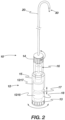
- Figure 2 illustrates an exemplary system 10 that is adapted to function similarly to the system in figures 1A and 1B , and also illustrates exemplary internal components of handle assembly 12 (internal components shown as dashed lines).
- Handle assembly 12 is integrated and in operable communication with outer steerable shaft 20 and medical tool 30.
- Handle assembly 12 includes actuator 14 that is adapted to, when actuated relative to handle body 15, cause steering of steerable shaft 20.
- Actuator 14 is in operable communication with steerable shaft 20 via steering control 16 disposed in handle assembly 12.
- Medical tool 30 includes a proximal portion 18 disposed within and incorporated into handle assembly 12.
- Actuator 13 is in operable communication with medical tool 30, and actuation of actuator 13 (in this example rotation) relative to handle body 15, causes rotation of medical tool 30 relative to outer shaft 20 via rotation control 1215.
- Optional third actuator 17 is also in operable communication with medical tool 30, and is adapted to be actuated, in this embodiment, axially (relative to handle body 15), to cause axial movement of medical tool 30 relative to outer steerable shaft 20 via axial control 1217.
- the medical tool in Figure 2 can be, for example, any medical tool herein, such as an ultrasound tool.
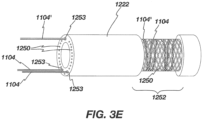
- Figures 3A-3F represent exemplary embodiments of a distal region of the sheath portion 1208 of steerable sheath 1202 in system 1200.
- the illustrated cross-sections show only the outer sheath 1208 and not the inner tool 1212.
- the outer sheath 1208 preferably has a composite construction to improve torque transmission applied to the outside of the shaft from the proximal end, or to resist torque forces applied to it from within the shaft, such as from tool 1212.
- multiple braid elements 1250 preferably formed from metal wire (round, pairs of round, or ribbon shaped) and/or multiple fibers (e.g., aramid or nylon), may be braided directly over a thin wall (e.g., .0010" ⁇ .0005") lubricious liner tube 1251, such as a PTFE or FEP material.
- a thin wall e.g., .0010" ⁇ .0005"
- lubricious liner tube 1251 such as a PTFE or FEP material.
- thermoplastic polymer 1252 (such as Pebax in a range of durometers from 25D-72D, or nylon, or other common catheter materials) may be laminated with heat using heat shrink tubing (such as FEP) to reflow the polymer over the braid elements 1250 and liner tube 1251 to form a uniform member.
- the thermoplastic polymer 1252 may also have radiopaque compounds that include materials such as bismuth, barium sulfate, or tungsten in order that the tip of the sheath be visible to the user under fluoroscopy.
- the pull wire 1104 is preferably parallel to the central access in the steerable (deflectable) portion 1222 of the sheath and also preferably provided in a lumen 1253 created within the wall of the steerable sheath 1208.
- This lumen may be created during the thermoplastic polymer tubing extrusion process or during a shaft heat lamination fusing process with the aid of a removable mandrel.
- the pull wire lumen 1253 may further be created by incorporating a pull wire tube 1254, preferably temporarily supported by a removable mandrel, within the wall.
- the removable mandrel may also be placed alongside the pull line 1104 or 1104' during the fusing process, resulting in a somewhat ovalized lumen 1253 within which a fiber pull wire may be allowed to flatten into, allowing space for free movement of the pull wire.
- the tube 1254 may include PTFE, FEP, polyimide, or another material which maintains its wall integrity during a heat lamination process up to approximately 500 °F.
- the tube is preferably surrounded and supported by the thermoplastic polymer 1252 which is preferably heat laminated against the tube.
- the pull wire lumen preferably comprising the pull wire tube, is incorporated within the weave of the braid elements 1250.
- braid elements 1250 running in one direction would pass under the pull wire lumen, while those running in the opposite direction would pass over the pull wire lumen.
- the braid reinforcement provides a more dimensionally stable lumen during catheter manipulations and also helps assure the straightness of the lumen as needed.
- the pull wire Proximal to the steerable portion, the pull wire may continue proximally parallel to the central axis on the same side of the outer sheath 1208, such as is illustrated in Figure 3Ai-iii .
- an additional pull wire 1104' within an additional pull wire lumen routed within the wall of sheath 1208, up through the steerable portion 1222, may be required to straighten the steerable portion of the device.
- This straightening pull wire 1104' is preferably routed within steerable portion 1222 on the side opposite from the pull wire(s) 1104 used for steering (deflection) in the steerable portion 1222.
- two lumens and two straightening pull wires 1104' could be used, essentially mirroring the paired 1104 pull wire configuration.
- These straightening wires could also be constructed to allow deflection in the opposite direction by tensioning a greater distance (beyond just straightening) within the handle.
- a portion 1223 of the distal catheter just proximal to the steerable (deflectable) portion 1222 may be forced to conform to a curve based on the constraints of the anatomy in which it is used. For a specific embodiment where the device is advanced into the heart chambers from a groin access, the portion 1223 forced into a curve is expected to range from 5 to 25 cm in length.
- torque is transmitted through this distal curved region 1223 to the catheter tip.
- a non-uniform cross section and/or tension of the device in this region 1223 may induce a tendency for the shaft to build up and suddenly release torque, causing a "whip" or sudden jerk in rotation as it is torqued.
- the pull wire 1104 may spiral around the central axis of the sheath in at least the curved region 1223 proximal to portion 1222.
- the pull wire of this embodiment may make a full circumferential wrap over approximately 10 cm of length, with this value ranging 5-15 cm.
- the spiral may only need to be present in the curved region 1223, continuing straight proximally thereafter through proximal portion 1224 (similar to 1006), which may minimize the friction in the pull wire lumen and the associated pull wire force required to steer (deflect) the steerable portion 1222.
- the spiral may also make a minimum of one turn before continuing straight, or spiral the full length of the shaft.
- it may only be necessary to distribute the pull wire tension to opposite sides of the shaft.
- deflection of the steerable section 1222 is accomplished with two parallel pull wires 1104 positioned adjacent one another on the same side of the sheath 1208.
- the pull wires are routed to opposite sides of the shaft, each 90° from the position in the steerable section 1222, to distribute the tension more evenly.
- any plurality of pull wires could be routed in the same configuration as illustrated in Figures 3B or Figure 3C , with the multiple proximal pull wires distributed uniformly around the shaft circumference.
- the pull wires 1104 may be routed proximally along the opposite sides of the shaft for most of the shaft proximal portion 1124 length, but preferably brought back together adjacent one another near the proximal end portion of the shaft to allow the wires to exit the same side of the proximal shaft together to facilitate them being secured together to a handle component for simultaneous actuation tension.
- Figures 3Di-iv illustrate another embodiment of the distal region of catheter with construction similar to that previously described, but instead configured to provide a distal steerable portion 1222 which can be deflected into two different directions.
- a two pairs of pull wires 1105/1107 and 1106/1108 are along the proximal shaft region 1224 and curved region 1223.
- This is similar to Figure 3Ai-iii , except that the wires are paired on each side of the shaft.
- the routing could also be spiraled as in Figure 3Bi-ii , or other configurations discussed.
- the wires are routed 90° from the proximal portions, although other angles are contemplated.
- one or more of the pull wires may be terminated and anchored to the shaft, with the remaining pull wires (e.g., 1106 and 1108) continuing to a more distal tip location 1226 where they are anchored.
- This configuration allows independent actuation of pull wires terminated at 1225 and 1226 such that different shapes may be created during actuation.
- Figure 3Dii shows both lines 1107 and 1108 tensioned to create a variable curve in the same direction.
- Figure 3Diii shows lines 1107 and 1106 tensioned to create an "S" curve. Other configurations are also possible.
- the pull wires (such as 1104 and 1104') must be terminated at their distal end in a manner that reliably affixes them to the wall of the distal steerable shaft portion 1222, such that they do not break or pull free under repeated applications of tension.
- the pull wires 1104 and 1104' upon exiting the distal pull wire lumen 1253, are circumferentially interwoven into the braid wires 1250 of the distal shaft 1222 (shown without the thermoplastic polymer 1252).
- One or more of the pull wires 1104 or 1104' may also be additionally or instead wrapped and/or tied around the outside of the braid wires 1250 for additional securing.
- the braid wires 1250 may be then trimmed distal to the securing point, with the interwoven and/or wrapped pull wires preventing the braid wires from expanding and/or unraveling. Additional adhesives such as UV cured or cyanoacrylates may also be used to secure the pull wires to the braid wires.
- the weave and/or wrap of the pull wires and braid wires is then laminated with a thermoplastic polymer which melts within the space around the wires and cools to secure them in place.
- the thermoplastic polymer may also have radiopaque compounds that include materials such as bismuth, barium sulfate, or tungsten in order that the tip of the sheath be visible to the user under fluoroscopy.
- the tool 1212 may also or alternatively be constructed with one or more pull wires to deflect the tip in a manner similar to any of the previous embodiments described for the outer sheath 1208.
- the pull wires could be routed next to the conductors inside the lumen of the tubular element 1212. Actuation of the pull wires could be from an actuator located in the proximal handle 1206.
- the distal shaft of tool 1212 may also be formed into a particular shape (e.g., an arc) such that it bends into the shape as it exits the tip of the steerable portion 1222 of outer sheath 1208.
- the stiffness of the distal shaft of tool 1212 is such that it does not substantially deform outer sheath 1208 while inside, but upon exiting is allowed to bend.
- the shape may be set by any one or combination of the following means: heat setting the polymeric material, using a moveable or fixed shaped stylet within the inner lumen of shaft 1212 or within a lumen within the wall of shaft 1212.
- a stylet could be round, oval, or rectangular in cross section, and be formed of stainless steel, nitinol, or a rigid polymer such as PEEK, Vestamid, or similar.
- the outer steerable sheath could alternatively be made to bend with a similar method as above, with or without additional pull wire deflection, and with or without additional shape or deflection of the distal portion of tool shaft 1212.
- a transition region between the tip region and the steerable (deflection) region of the shaft may be desirable to incorporate a transition region between the tip region and the steerable (deflection) region of the shaft.
- the inclusion of a transition region may decrease the tendency of the shaft to deform, e.g., kink, at the transition between the relatively rigid tip material and the relatively flexible material along the shaft in the deflection region.
- the outer shaft of the deflection region may be formed of a 35D Pebax material and the distal tip formed of Vestamid polyamide.
- a 63D Pebax region having a length of 19mm was incorporated at the transition between the Vestamid nylon tip and 35D Pebax.
- a bonding post on the interior of the shaft may provide additional rigidity-in this example the post is formed of a Dymax adhesive and has a length of about 5mm.
- the space between the post may be further reinforced with a spacer such as a polymer tube, such as 35D Pebax, or a coil formed from a metallic or insulated metallic wire or polymer strand. The spacer can also help ensure the inner shaft does not advance over portions of the inner flex circuit which are two wide for the inner diameter of the inner shaft.
- One aspect of the disclosure includes methods of disassociating at least a portion of the system from other components, optionally as part of a reposing process.
- the medical tool includes one or more electrical contacts that are coupled to other electrical contacts, which are in electrical communication with an energy console, and examples of consoles are known in the ultrasound art.
- Figure 4 illustrates merely a portion of an exemplary medical tool, such as an ultrasound probe, that can be electrically coupled directly or indirectly to an energy console, such as an ultrasound console.
- Reposing the device can involve disconnection of one or more proximal electrical contacts and moving the tool portion distally out of the distal end of the sheath portion.
- tool portion 1212 comprises at least a tool outer sheath or member 2010, distal working end 1821 (which can include at least one ultrasound transducer), and conductor bundle 2020.
- the conductor bundle 2020 extends from the distal working end 1821, through the tool outer member 2010 to a proximal connector (the connector and handle mechanism are not shown in Fig. 18 for clarity).
- the medical tool is used for ultrasound imaging, optionally where the distal working end 1821 comprises a two-dimensional (2D) array of piezo electric components mounted on an ASIC (application specific integrated circuit).
- ASIC application specific integrated circuit
- Figure 5 illustrates a merely exemplary proximal end of a medical device (the medical device is shown on the right), and in this embodiment the medical device is an ultrasound probe.
- the proximal end 2015 of the medical device is adapted to be electrically coupled to connector cable 270, which is directly or adapted to be indirectly electrically coupled to an energy console, such as an ultrasound energy console.
- flexible conductor bundle 2020 extends from a distal region of the medical tool (distal region not shown) into a proximal connector 2015 within which is housed a rigid or flexible printed circuit board (“PCB”) 2030.
- the connector bundle 2020 includes a plurality of contacts 2024 (examples of which are described below) that are attached to PCB board contacts 2031.
- Each individual trace from each contact 2031 is linked to individual exposed contacts 2050 on another portion, optionally more proximal, of the PCB.
- the individual PCB traces may also pass through other useful circuitry on the PCB.
- the exposed contacts 2050 are configured for a mechanical mating for electrical conduction to similar contacts 2060 on mating connector cable 2070, similar in concept to the proximal tool connector 1990 described previously, which links the tool 1204 to a user-interface console.
- Proximal connector 2015 can be incorporated into any of the systems, handles, steerable sheaths, medical tools, etc., herein.
- Conductor bundle as that term is used herein may be interchangeably used with “flexible conductor bundle” unless indicated to the contrary herein.
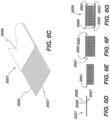
- Figures 6A and 6B illustrate an exemplary conductor strip (also referred to herein as a flexible circuit strip) 2021 that can be included in any of the conductor bundles herein.
- the embodiment in Figures 6A and 6B is an example of a conductor strip that can be included in bundle 2020 from Figures 4 and 5 .
- the embodiment in Figures 6A and 6B can be incorporated into any other system herein.
- conductor bundle 2020 comprises a plurality of flex circuit strips, including multi-trace strips 2021, as well as conductive strips for grounding 2022 and shielding 2023 (only a portion of which are shown).
- Each multi-trace strip comprises a plurality of conductive traces 2025, which can be seen clearly in Figures 6B , 6C and 6D .
- the number traces 2025 in Figures 6D-G is twelve, and the number of traces in Figures 6A-6C is sixteen, and they are both exemplary as to the number of traces 2025 that can be used.
- Each strip 2021 can be approximately .072" wide and .0022" thick, and can optionally comprise sixteen .0022" wide x about.0007” thick conductive (e.g., copper) traces, each spaced approximately .0022" apart.
- the traces are disposed on an insulating substrate layer 2027, such as a polyimide substrate, and the traces can be at least partly covered by a cover layer 2026, such as a photoimageable film cover (“PIC”) layer or other dry film solder mask (DFSM) or other similar material.
- PIC photoimageable film cover
- DFSM dry film solder mask
- the strip 2021 is approximately .055" wide and comprises twelve conductive traces (see figures 6D-G ). In other embodiments, the strip 2021 is approximately .037" wide and comprises eight copper conductive traces.
- the outer strips 2022 and 2023 used for grounding and shielding may have a similar construction and dimension except they can comprise a single full width strip of copper. As optimized for a 2D piezo array, a stack of approximately seven 16-trace strips 2021 would be required (or nine 12-trace, or fourteen 8-trace), along with one each of strips 2022 and 2023 on each side of the stack of multi-trace strips.
- Figure 6E illustrates a portion of an exemplary bundle 2020 with nine strips 2021 stacked together.
- Figure 6F illustrates a portion of the bundle that includes nine strips 2021 stacked, as well as ground strip 2022 and shield strip 2023 (only those on top are labeled).
- the complete bundle may optionally be held together with a, for example without limitation, about. 001" wall thickness shrink tube, such as the tubing 2028 in Figure 6G .
- the flex circuit dimensions and number of traces discussed above are for a particular configuration of a piezo-electric array (and/or an ASIC controller thereof) and may be varied depending on how the number and size of array elements are optimized for the particular application.
- each flex circuit strip has the conductive material (e.g., gold-plated copper) exposed over a length of approximately, for example, 3mm through removal of the cover layer 2026 at location 2024.
- Location 2024, and other exposed locations described herein, is generally referred to as a "contact.” It is understood that when used in this context, the contact actually includes a plurality of separated conductive traces (such as shown in region location), each of which is adapted to be in electrical communication with its own corresponding conductive element. "Contact” is therefore not limited to mean only a single electrical connection between two conductive elements.
- FIG. 6A shows a plurality of exposed regions 2024, the embodiment in Figure 6A will first be described herein as if there is only one exposed region (i.e., region 2024 at the proximal end).
- the strip 2021 can be made to create an electrical connection to matching exposed contacts 2031, shown in Figures 6A-C , for conductive traces on the PCB 2030.
- sixteen individual traces, sized and spaced to match sixteen traces in the multi-trace strip 2021 would be provided within a given contact 2031.
- An ACF anisotropic conductive film
- soldering conductive adhesive
- mechanical connection or any combination of these may be used to achieve a suitable electrical connection (electrical coupling) between the strip traces and the PCB contacts.
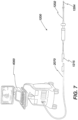
- Figure 7 illustrates the integrated system 1200 of the steerable sheath 1202 and medical tool 1204 wherein the system 1200 is connected to console 4000 via the connector cable 2070.
- the tool 1204 comprises a proximal connector 2015 which forms a mating connection to cable 2070.
- repose e.g., reprocess and reuse
- a crypto-authentication chip (crypto-chip) is incorporated into the tool 1204, preferably on the PCB 2030, although other locations, such as within the steerable handle 1206, or within the tip 3000, are contemplated.
- the crypto-chip is programmable only by the original manufacturer who controls the authentication keys.
- the console 4000 to which the system 1200 is connected has a Trusted Platform Module (TPM) which also has the authentication keys.
- TPM Trusted Platform Module
- the console 4000 is able to authenticate the system 1200 via the crypto-chip and as desired may read and write information to the chip (e.g., via an EEPROM feature).
- RFID chips preferably encrypted, may be used to read and transmit data between the console, connector, and the device.
- cleaning can refer to any type of cleaning, such as without limitation: cleaning an interior of an outer shaft using a flushing system of cleaner and/or disinfectant and optionally mechanical scrubbing with small brushes; mechanical cleaning (e.g., wipes, brushes) an outer portion of an outer shaft and/or outer portion of a medical device shaft (e.g., ultrasound probe) with a cleaner/disinfectant, and optionally submerging the shaft in an ultrasound bath of cleaner/disinfectant for a specified period of time; and optical cleaning methods such as comprising using UV light.
- cleaning as used here does not refer to a specific cleaning process, but rather refers to the general idea of cleaning an object.
- the disclosure herein also includes methods of assembling or reassembling any of the subassemblies or assemblies herein, including any of the subassemblies within any of the handle assemblies herein.
- the disclosure here includes methods of spooling one or more pull wires over a bearing surface in a spindle support and then around the spindle.
- the methods herein also include manufacturing or constructing any of the individual components of any of the subassemblies or assemblies herein.
- the disclosure includes methods of manufacturing handle shell components that have particular configurations (e.g., guides, walls, etc.) that can accommodate the internal parts that allow the assemblies or subassemblies herein to function as intended.
- any of the handle assemblies, medical tools, steerable sheaths, and electrical connections herein can be used together in a system in any combination with each other.
- Figures 8A and 8B illustrate a merely exemplary handle assembly that may be in operable communication with outer shaft 131 and inner shaft 132.
- handle assembly 120 includes handle body 123 that has an outer surface that can be gripped by a user, first actuator 121, and second actuator 122.
- Actuator 121 can be in operable communication with outer shaft 131, and actuator 122 can be in operable communication with inner shaft 132.
- Actuator 121 is adapted to be both rotated and moved axially relative to handle body 123 (and relative to second actuator 122). This allows actuator 121 to cause axial movement of the medical tool 103 and rotation of the medical tool 103 relative to a distal end of inner shaft 132.
- Second actuator 122 is adapted to be actuated (e.g., rotated in this embodiment) relative to handle body 123 to cause deflection of the inner shaft 132.
- the handle assembly can have internal components that interface with proximal ends of pull wires such that actuation of actuator 122 tensions one or more pull wires to cause deflection of the inner shaft.
- actuator 121 is distal to actuator 122, but in other designs their relative positions could be reversed.
- Figure 8B shows handle assembly 120 after actuator 121 has been advanced distally relative to its position in figure 8A . This distal advancement causes outer shaft 131 to be advanced distally, and thus causes the medical tool to be advanced distally.
- Actuator 121 can similarly be retracted proximally relative to its position in figure 8B . Tensioning members described further below are referenced with respect to actuator 121 being retracted proximally.
- actuator 121 could be in operable communication with an inner shaft and actuator 122 may be in operable communication with an outer shaft.
- the outer shaft can be moved axially relative to the inner deflectable shaft.
- the outer shaft may be constructed with sections of materials that vary in stiffness (e.g., durometer) along the length of at least a portion of the outer shaft. For example, a first portion that is distal to a second portion can have a lower durometer than the second portion. Because the outer shaft can be moved axially relative to the deflectable inner shaft, and because the stiffness of the outer shaft can vary along its length, the deflection, including the degree (or amount), of the overall device can be selectively controlled by controlling the axial position of the outer shaft (relative to the inner shaft). Axial movement of the outer shaft can thus selectively control deflection of the device.
- stiffness e.g., durometer
- a user e.g., physician
- sections of varying stiffness in the outer shaft can allow for more or less deflection depending on the relative position of the outer shaft relative to the deflectable inner shaft. For example, deflecting the inner shaft at a region where the outer shaft has a relatively higher stiffness can result in less deflection than when the inner shaft is deflected at a region where the outer shaft has less stiffness.
- Figure 9C shows exemplary apparatus medical apparatus 130, which includes elongate inner shaft 132 (see figure 9A ) and elongate outer shaft 131 (see figure 9B ).
- Medical apparatus 130 may also be referred to herein as a "catheter,” or other medical device that includes at least one elongate shaft.
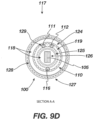
- Figure 9D illustrates Section A-A shown in the assembly in figure 9C , which is a section in the deflectable section of the device. Parts from figures 9A-9C are similarly labeled. As can be seen in figure 9D , pull wires 111 and 112 are very near to one another and about 180 degrees away from straightening pull wire 116.
- elongate inner shaft 132 includes two layers of braided material 119, and the pull wires are, at least at the location of this section, essentially sandwiched between the two layers of braided material. Annular spaces 118 allow freedom of movement and space for optional lubricant.
- Inner shaft 132 may be made from, for example without limitation, a polymeric material such as Pebax, optionally with a lubricious additive.
- Inner shaft 132 may include liner 125, such as a PTFE liner.
- the flexible cable bundle 105 may be surrounded by one or more layers of insulation 126, such as PTFE insulation.
- Outer shaft 131 may comprise a polymeric material 127, such as Pebax.
- Outer shaft 131 may also include a radially inner liner 128, such as a PTFE liner.
- a radially inner liner 128, such as a PTFE liner Any of the pullwires (e.g., 111, 112, 116) may be disposed in a lumen with a liner, such as PTFE liner 129.
- Medical apparatus 130 (or either of elongate shaft 132 and elongate shaft 131, individually) can be in operable communication with any of the handle assemblies herein, including handle assembly 120 shown in figures 8A and 8B .
- Figures 10A-10C and figure 11 illustrate an additional exemplary handle assembly that can be in operable communication with any of the medical devices, including ultrasound probes, herein.
- the exemplary handle assembly shown in figures 10A-10C can be coupled to (directly or indirectly) and in operable communication with medical apparatus 130 shown in figures 9A-9D .
- both elongate outer shaft 131 and elongate inner shaft 132 are coupled to and in operable communication with the handle assembly shown in figures 10A-10C .
- the handle assembly in figures 10A-10C and figure 11 has some similarities to the handle assemblies, the individual components, and subassemblies that are shown in figures 8A and 8BB. Unless indicated to the contrary, concepts, features and methods of use from figures 8A and 8B that can be incorporated into the handle assembly in figures 10A-C are hereby incorporated by reference for all purposes into the disclosure of the handle assembly shown in, and described with respect to, figures 10A-C . Similarly, concepts, features and methods of use that are shown in, and described with respect to, figures 10A-C that can be incorporated into other handle assemblies herein are hereby incorporated by reference for all purposes into the disclosure of any of the handle assemblies set forth herein.
- Figure 10A is side view of handle assembly 140 with a portion of handle body 141 removed so that some internal components of the handle assembly can be seen.
- Handle assembly 140 includes first actuator 143 and second actuator 142, and in this embodiment first actuator 143 is distal to second actuator 142.
- First actuator 143 can be both moved axially and rotated relative to the handle body and relative to a second actuator (in this embodiment actuator 142).
- First actuator 143 is in operable communication with an outer elongate body, such as outer shaft 131 ( see figure 9B ).
- Axial movement of actuator 143 causes axial movement of the outer shaft 131, while rotation of actuator 143 causes rotation of the outer shaft.
- Second actuator 142 is in operable communication with an inner shaft, such as inner shaft 132 ( figure 9A ). Actuation of second actuator 142, in this embodiment rotation, causes deflection of the inner shaft.
- a rotatable and axially movable actuator i.e., first actuator 143 is in operable communication with an outer shaft.
- First actuator 143 is coupled to elongate outer shaft movement assembly 150 shown in the exploded view in figure 10B , such that movement of first actuator 143 causes movement of assembly 150.
- Elongate outer shaft movement assembly 150 is similarly coupled to the elongate outer shaft so that movement of first actuator also causes movement of the elongate outer shaft.
- the outer elongate shaft is attached to removable part 153 after it is inserted into channel 156.
- Removable part 153 and channel 156 are configured so that removable part 153 is constrained by at least one inner surface of channel 156 when it is inserted therein.
- Elongate outer shaft movement assembly 150 also includes a distal head portion 151 that is secured to first actuator.
- Elongate outer shaft movement assembly 150 also includes a rotation limiting mechanism similar to that which is described herein, which limits the rotation of first actuator 143, and thereby limits the rotation of the outer elongate shaft. Any of the disclosure above related to rotation limiting subassemblies, functionality, and use, is incorporated into this embodiment for all purposes and may be incorporated into this and similar designs.
- part 157 (see fig. 10B ) interacts with part 161, and part 162 interacts with part 158.
- the physical interactions of these two sets of parts limits rotation to the desired rotation limit, e.g., such as limiting rotation up to 630 degrees of rotation of the outer body (in other embodiments the allowed rotation could be more than 630 degrees, such as up to and including 720 degrees).
- removable part 153 can be detached from the outer shaft to allow the outer shaft to be removed from the handle assembly and cleaned, before being reinserted and reattached to removable part 153 or a new removable part if part 153 is damaged or broken.
- Handle assembly 140 also includes inner shaft deflection assembly 146, which is in operable communication with second actuator 142.
- Inner shaft deflection assembly 146 includes central gear 147 adapted and configured to rotate when second actuator 142 is rotated. Central gear 147 interfaces first spindle 148 and second spindle 149 via a geared interface, such that rotation of central gear 147 causes rotation of the spindles in the opposite direction.
- the inner shaft deflection assembly 146 including the spindles, extends further proximally than the elongate outer body movement assembly 150.
- the inner shaft extends through the outer shaft and extends further proximally than the outer shaft within handle assembly 150. This allows one or more pullwires that are part of the inner shaft to extend radially outward and interface with reels 160.
- elongate outer shaft movement assembly 150 allows for the inner and outer elongate shaft to be independently controlled by first actuator 143 and second actuator 142.
- Handle assembly 140 also includes printed circuit board (“PCB”) 170 disposed within handle body 141, the PCB being in electrical communication with a cable bundle, such as flexible cable bundle 105 in figure 53, or any of the cable bundles herein that are in communication with the medical tool, such as an ultrasound transducer.
- PCB printed circuit board
- Handle assembly 140 also includes a rotation indicator 180 that can be used to show a user the extent to which at least one of the first actuator and the second actuator are rotated relative to a home, or neutral position.
- First actuator 143 can include a rotation indicator 181 that is aligned along an axis with rotation indicator 180 when first actuator 143 is in a neutral position, as shown in figure 11 .
- rotation indicator 181 is rotated relative to the axis along which rotation indicator 180 extends, which enables the user to visually understand that first actuator 143, and thus the outer shaft, is rotated to some extend relative to the neutral position.
- second actuator 142 can also have rotation indicator 182 that is aligned along an axis with rotation indicator 180 when second actuator 142 is in a neutral position, as shown in figure 11 .
- rotation indicator 182 is rotated relative to the axis along which rotation indicator 180 extends, which enables the user to visually understand that second actuator 143, and thus the inner shaft, is deflected to some extent relative to its neutral position.
- the handle assembly can include one or more sensors to track how much rotation has occurred for the outer shaft, or how much deflection has occurred in the inner shaft.
- the handle assembly can include an encoder for each actuator.
- the device can include one or more lubricants between the inner and outer shafts to make it easier to move the inner and outer shafts relative to one another by reducing friction between the two. If the medical device needs to be cleaned for reuse, additional lubricant can be added between the inner and outer shafts after the cleaning process.
- the medical device may include a flexible member, such as a flexible conductor bundle (which may be referred to herein as a conductor bundle, flex bundle or other similar derivative thereof), coupled to and extending from a distal region (e.g., probe tip) towards a proximal region of the medical device (see, for example, conductor bundle 2020 shown in exemplary figures 4-6G ; or bundle 105 from figure 9B ).
- a probe tip may include an ultrasound transducer in electrical communication with a flexible conductor bundle.
- the probe tip and conductor bundle can be axially displaced (proximally and/or distally) by actuation of a handle actuator (e.g., actuator 143 as shown in figure 10A ).
- a handle actuator e.g., actuator 143 as shown in figure 10A
- the conductor bundle is disposed within an elongate member (e.g., steerable inner elongate body 132; or elongate member 131) and moves axially relative thereto when the probe tip is advanced distally or retracted proximally.
- the conductor bundle When the distal region (e.g., ultrasound probe) and conductor bundle are retracted proximally (after being advanced distally), the conductor bundle may tend to fold up, bunch up, or otherwise bend, near or adjacent to its distal end due to friction between the bundle and, for example, the elongate member (e.g., steerable inner shaft 132) in which the conductor bundle is disposed. Bunching may occur if the medical device is in a straight configuration as well as if the medical device has some degree of bend (e.g., after being deflected from a straight or linear configuration).
- the elongate member e.g., steerable inner shaft 132
- any of the medical devices herein may include a structural tensioning member that is adapted and configured to apply or maintain tension on the flexible member, such as a flexible conductor bundle, at a location that is proximal to where the conductor bundle is coupled to the distal medical tool.
- tensioning the flexible member By tensioning the flexible member, folding or bunching up of the flexible member can be minimized or even prevented.
- the "tensioning" member is adapted and configured to reduce distal region(s) of the flexible conductor from bunching (compared to a device without a tensioning member) by proximally moving at least a distal portion of the flexible conductor bundle as the distal probe is retracted proximally.
- the structural tensioning member (e.g., a tensioning bar) may be physically secured to the flexible conductor bundle (e.g., direct or indirect attachment).
- the tensioning members herein are in operable communication with the flexible members (e.g., a flex conductor bundle) such that movement or actuation of the tensioning member applies some force to the flexible member, and may cause movement (e.g., proximal) of the flexible member.
- the structural tensioning member may be disposed in or carried by the handle assembly of the medical device. Structural tensioning member in this context may be a single component or an assembly of separate components.
- Figures 12A-12F illustrate a handle assembly portion of an exemplary medical device, which may be incorporated into any suitable medical device herein.
- the handle assembly in Figures 12A-12F may be part of a medical device that includes a medical tool (e.g., an ultrasound imaging probe) at its distal end or near its distal end, examples of which are described herein. Any other embodiment or feature herein is incorporated by reference into the exemplary handle assembly shown in figures 12A-12F .
- a medical tool e.g., an ultrasound imaging probe
- Exemplary handle assembly 310 includes first actuator 314 and second actuator 322, where first actuator 314 is distal to proximal actuator 322.
- First actuator 314 is adapted and configured to be moved axially (distally and proximally) relative to second actuator 322 (and optionally also rotatable relative thereto), and may be in operable communication with an elongate body (e.g., 131 or 132) that may include a medical tool (e.g., 103) in a distal region.
- Handle assembly 310 (including actuators) may incorporate any of the relevant disclosure from any other handle assembly herein.
- the medical device of which handle assembly 310 is a part also includes a flexible member (e.g., flexible conductor bundle 105 in figure 9B ) securely coupled to (directly or indirectly) the medical tool at a first distal location (e.g., as shown in figures 9B and 9C where medical tool 103 is secured to flexible member 105) and extends proximally from the medical tool towards handle assembly 310.
- the flexible member may be a flexible conductor bundle and can extend into handle assembly 310, as shown.
- a portion of the flexible member is disposed within an outer surface of the elongate body (e.g., within 131 and/or 132).
- the medical device also includes tensioning member that is secured to the flexible member at a second location 316, which is proximal to the first location ("first location" in this context may be referred to as a first distal location or derivative thereof).
- Figure 12A illustrates exemplary tensioning member 312, while reference number 312 in figure 12A also points to an optional elongate rigid member (in this embodiment the elongate rigid member is linear and extending axially) of the tensioning member.
- Tensioning member 312 is adapted and configured to tension the flexible member as the medical tool is retracted proximally. This may be referred herein as applying a tensile force to the flexible member, or tensioning the flexible member, or maintaining tension in the flexible member.
- tensioning member 312 is adapted and configured to tension the flexible member as the medical tool is retracted proximally, which in this embodiment occurs when first actuator 314 is retracted proximally from its position shown in figure 12A-C .
- the tensioning members herein can apply tension when the medical device is in a straight configuration and when the medical device is in a non-straight (linear) configuration, such as when the device may be deflected or bent.
- tensioning member 312 (which may include the tensioning bar shown in figure 12A ) is secured to (e.g., attached directly) the flexible conductor bundle at location 316, the location of which is inside the handle assembly in this embodiment.
- a tensioning member may alternatively be secured to the flexible member at a location that is not within a handle, such as outside of the handle, such as inside one or both of outer and inner shafts.
- the tensioning member is also axially secured relative to first actuator 314, such that axial movement of first actuator 314 causes axial movement of tensioning member 312 (which may be in a 1:1 movement ratio).
- tensioning member 312 is also secured to the flexible member (e.g., at location 316), axially movement of tensioning member 312 also causes axial movement of the flexible member at location 316.
- tensioning member 312 By securing tensioning member 312 to the flexible member, the flexible member is tensioned distal to where the tensioning member is secured to the flexible member when first actuator 314 is retracted proximally, which prevents the flexible member from folding or bunching up at its distal region near or adjacent to the medical tool (or at least reduces the extent of folding/bunching up compared to a device without a tensioning member).
- the flexible member may include a flexible conductor bundle, such as any of the flexible conductor bundles herein.
- the tensioning member comprises a rigid elongate member (generally referred to as 312 in figure 12A ) with a fixed length.
- the rigid tensioning member as shown has a general longitudinal axis, which in this embodiment is parallel with a longitudinal axis of the medical device and/or a longitudinal axis of the handle assembly.
- the rigid tensioning member may be made of a variety of materials, such as a rigid plastic member.
- the tensioning members herein can ensure that the distance traveled by the medical tool is the same as the distance traveled by any point on the flexible member between the first and second locations.
- the tensioning members herein can ensure that the distance traveled by the medical tool is the same as the distance traveled by the location where the tensioning member is secured to the flexible member (e.g., location 316 in figure 12A ).
- a flat configuration in this context can include embodiments in which the flexible member may also be twisted (i.e., the flexible member can be flat and still be twisted, but not bunched/folded).
- a flattened configuration as used herein indicates a lack of a fold or bunching of the flexible member.
- Medical devices in which a tensioning member is incorporated may also be steerable or deflectable.
- the tensioning members herein can be adapted and configured to apply a tensile force to the flexible member even if the medical device, including the flexible member, are in non-straight (e.g., deflected, steered, bent) configurations.
- this disclosure refers to maintaining a substantially flat configuration in the flexible member, it refers to instances where the medical device may be in a straight configuration, which need not be the case, such as when a medical device has been steered, bent, or deflected.
- Folding, bending, and bunching-up in this context includes a first region of the flexible member axially overlapping with a second region of the flexible member, and also includes general bending and bunching of the flexible member, such as regions of the flexible member that are not flat and, for example, form a bend, curved region, and/or meander back and forth.
- the flexible member may have flat top and bottom surfaces (e.g., a conductor bundle with one or more flat surfaces), and optionally the tensioning member may be secured to at least one of the top and bottom surfaces.
- FIGS 6A-6G illustrate a flexible member with flat or generally flat first and second surface (e.g., top and bottom surfaces), and a tensioning member may be secured to one or both of the flat or generally flat surfaces (e.g., such as at location 316). They may be secured using a variety of techniques, such as using adhesive, welding, or other bonding techniques.
- the tensioning member may be in operative communication (directly or indirectly) with a handle actuator such that axial movement of the actuator axially moves the tensioning member.
- the handle actuator may be further adapted and configured to be rotated (e.g., actuator 314) to cause rotation of the medical tool, and optionally wherein rotation of the actuator does not cause rotation of the tensioning member.
- the tensioning member can thus be adapted to be moved axially when the actuator is moved axially, but not to rotate when the actuator is rotated. This can be accomplished by the manner in which the tensioning member is operatively in communication (directly or indirectly) with the actuator.
- the medical device may include an inner elongate body (e.g., 132) including a lumen in which at least a portion of the flexible member is disposed.
- An inner elongate body may be independently steerable, such as with a separate independently actuatable handle actuator (e.g., actuator 322).
- a separate independently actuatable handle actuator e.g., actuator 322
- the inner member independently controllable e.g., axially and rotationally
- the flexible member may be coupled to a printed circuit board (e.g., 321 "boards” as shown in figure 12A ) in the handle assembly.
- the tensioning member may be coupled to a flexible member proximal to a printed circuit board. In alternative embodiments the tensioning member may be coupled to a flexible member distal to a printed circuit board.
- Figures 12A-12F is an example of a portion of a medical device that includes an elongate outer body (e.g., 131) including a probe tip in a distal region of the elongate body; a flexible conductor bundle (e.g., 105) securely coupled to the probe tip at a first location (shown in figure figures 9B and 9C ) and extending proximally from the medical tool and into a handle assembly, the flexible member disposed within an outer surface of the elongate body; an inner elongate body (e.g., 131), at least a portion of which is disposed within the elongate outer body, the inner elongate body optionally steerable, wherein at least a portion of the flexible conductor bundle is disposed within the inner elongate body and configured to be axially movable relative to the inner elongate body; a tensioning member secured to the flexible member at a second location in the handle assembly, the tensioning member adapted and configured to apply tension on the flexible member as
- Figures 12E-F illustrate a half of a handle outer shell 320, two of which form a portion of the outer surfaces of the handle assembly 310.
- Handle shells 320 include radially inwardly extending features 315 that are adapted to interface with a control the movement of the tensioning member 312.
- Features 315 can include guides that are configured to interface with the tensioning member at one or more locations and help stabilize the tensioning member.
- handle assembly component in any other embodiment herein that can be suitably integrated into handle assembly 310 is incorporated by reference herein.
- tensioning member may be replaced with “straightening member,” “flattening member,” or a derivative thereof.
- a straightening member or flattening member refers to maintaining a substantially straight or flattened configuration in the flexible member when the medical device is in a straightened configuration, and does not require that the device always has a straightened configuration. Thus, even if the flexible member is not necessarily being placed under tension, it may still be maintained in a straightened (i.e., not folded configuration) along at least a portion of its length due to a straightening member.
- Member 312 in figure 12A for example, is an example of a straightening member, even if it also functions as a tensioning member.
- the "member” can be a straightening member (or flattening member) and can also function as a tensioning member. Additionally, the phrase “tensioning member” herein may be replaced with "fold-prevention member,” “bend-prevention member,” “bunching-prevention member,” or a derivative thereof.
- the flexible member such as conductor bundle 2010, may be twisted along a portion of its length.
- a conductor bundle may be twisted to provide a more balanced cross-section along a portion of the length of the medical device.
- a conductor bundle may be twisted only in a portion of the medical device that will experience deflection.
- Figures 13A-13E illustrate a portion of an exemplary medical device that includes a twisted flexible member, such as a flexible conductor bundle.
- a twisted flexible member such as a flexible conductor bundle.
- the embodiment in figures 13A-E may be incorporated with any other suitable feature and/or medical device described herein.
- the portion 330 of the medical device shown in figures 13A-E includes a medical tool 332 at a distal region, a flexible member 331 coupled thereto and extending proximally therefrom, and a proximal end region 333 comprising a plurality of electrical connectors.
- Flexible member 331 may be a flexible conductor bundle, such as any of the bundles herein.
- Medical tool 332 may include an ultrasound imaging transducer 339.
- Flexible conductor bundle 331 has a region 338 in which the conductor bundle is twisted, the twisted region 338 having a distal end and a proximal end.
- Flexible conductor bundle 331 also includes a region 336 distal to twisted region 334 that is not twisted, and a region 340 proximal to twisted region 336 that is not twisted.
- Medical tool 332 may be coupled to an outer shaft, such as outer shaft 131 shown in figure 9B .
- the length of twisted region 338 from its distal end to its proximal end can vary, and in some embodiments is from 5-15 cm, such as from 8-15 cm, such as 11 cm.
- the length over which a complete turn is formed can vary well, such as from 1-5 cm, such as 3 cm.
- the number of twists over the length of the twisted region can vary as well, such as, for example without limitation, 7-9 full twists.
- An exemplary manner in which to form the twisted region of the flexible member is to couple the flexible member to the medical tool at the distal end (e.g., probe tip).
- a thin section of PET heat shrink may then be advanced over the flexible conductor bundle.
- a portion of the device can be held in place while another portion is twisted to the desired number of turns to form the twisted region. While the twisted configuration is maintained, the PET can be heat shrunk over the twisted bundle region. Additional layers of PET may be subsequently added.
- An elongate member (e.g., shaft 131) may then be placed over the bundle, including the twisted region, and the elongate member can be bonded to the medical tool.
- the concepts that follow may be applied to any suitable device, system, and/or method of use set forth above. While the disclosure that follows is described generally in the context of imaging catheters, and in particular ultrasound imaging catheters, the concepts that follow may be applied to any type of suitable medical device that includes a cable through which electrical signals are transmitted.
- One merely exemplary illustrative medical device is an ultrasound imaging catheter, which includes a cable bundle in electrical communication with one more ultrasound transducers, wherein the cable bundle transmits signals to and/or from the ultrasound transducers.
- Exemplary ultrasound imaging devices, including handles thereof, are shown and described with respect to figures 1-13E herein, the disclosures of which are fully incorporated by reference into the disclosure that follows.
- the handle assemblies shown in figures 14-20 and descriptions thereof may incorporate any of the disclosure herein related to the handle assemblies in any of figures 1-13E herein.
- Figures 14A and 14B illustrate an exemplary handle 1400 of a medical device, with half of a handle shell removed to show internal handle components.
- Any of the components in any of the handle assemblies herein may have exemplary designs described in more detail with respect to embodiments in figures 1-13E .
- flex bundle 1402 in figures 14A and 14B may include any of the disclosure of any of the electrical flexible bundles herein.
- the push arm 1404 in figure 1 may include any of the disclosure with respect to any tensioning members herein adapted for maintaining tensioning in the cable bundle.
- the inner shaft 1406 in figures 14A and 14B may be any of the inner members (or any derivative thereof) herein.
- the device medical extending distally from handle 1400 in figures 14A-20 may also include an outer member or outer shaft, such as any of those described herein.
- outer shaft is illustrative and the medical device shaft does not necessary require an inner shaft and an outer shaft.
- the two shafts may be axially movable relative to one other to allow for a telescoping probe tip, while in any embodiments herein an inner shaft and an outer shaft may be immovable relative to each other, such as in the example shown in figure 20 .
- Figure 14A illustrates an exemplary handle that includes therein an exemplary electrical noise suppression member 1408 that includes a lumen through which a flexible cable bundle 1402 passes.
- any of the electrical noise suppression members herein may comprise a ferrite bead, general examples of which are known. This disclosure may refer to a ferrite bead in the context of certain embodiments, but it is understood to be illustrative only and other materials and/or configurations of an electrical noise suppression member may be used.
- a noise suppression member herein may include one or both of a material or configuration such that it is adapted to increase impedance to any RF noise coupled into sensitive analog lines. It is of note that a cable bundle shield 1410, an example of which is shown in figure 18 , has been removed from the cable bundle 1402 within the handle before the cable bundle 1402 passes through the electrical noise suppression member 1408 so as not to cause a reduction in the shield 1410 impedance.
- the noise suppression members herein include a material that is configured to surround one or more signal line conductors such that the surrounding material provides a high impedance pathway intended to dissipate frequencies in a targeted range that are induced in the surrounding material from the signal line. The dissipation of the frequencies provides a filtering or noise-suppression effect.
- the surrounding material may comprise sintered powders and may be formed into a hollow cylindrical or similar extruded polygonal shape. The material may be formed as one piece with the signal line conductor running through the middle, and in some embodiments include two halves clamped together over the signal line conductor.
- the impedance and filtering effects of the surrounding material may be optimized based on the selection, size, and relative amounts of the sintered powders.
- the powders are typically formed into a ceramic compound comprising a mix of iron oxide and other materials such as cobalt, copper, manganese, magnesium, nickel, and zinc.
- the circumference, thickness, and length of the surrounding material may also be optimized for the desired effect.
- the signal line e.g., cable bundles herein
- the various constructions and configurations allow optimization of the impedance at a given frequency range.
- ferrite construction may be selected to provide enhanced immunity from frequencies ⁇ 10MHz and to suppress radiation of frequencies > 100MHz.
- Different surrounding material embodiments may be employed at different locations along the pathway of the signal line conductor (cable bundles herein) to achieve different noise suppression effects.
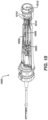
- FIGS 14A and 18 illustrate examples in which excess flex cable bundle 1402 is disposed in the handle and is folded in folded region 1412 in an organized manner in the handle, and in this embodiment is folded in an accordion style configuration as shown against an inner surface of a shell of handle 1400.
- cable bundle shield 1410 is routed out of the cable bundle 1402 before the bundle assumes its folded configuration in region 1412, as shown. Separating the shield layer 1410 from the rest of the bundle 1402 before folding in region 1412 minimizes inductance of shield layer 1410 while increasing impedance of signal cables in the frequencies of interest.
- Folding the excess cable length in an accordion style fold as shown can reduce unit to unit variation, minimizes self-inductance of the signal cable and can help reduce radiated emissions.
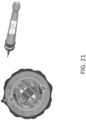
- the cable bundle may not be folded within the handle, an example of which is shown in the exemplary embodiment in figure 20 .
- a ferrite bead 1408 in figure 14A that is disposed within the handle 1400 is positioned about or around the portion of the flex cable bundle 1402 that contains the signal lines and grounds, but not the shield 1410, as shown.
- An exemplary advantage to this construction may be to increase impedance to RF entering the cable bundle (for noise reduction) without increasing impedance to the shield 1410.
- the shield impedance should be as low as possible to shunt out any RF current picked up. By removing the shield 1410 from the cable bundle 1402 in the handle before it passes through the ferrite bead 1408, the ferrite bead 1408 does not increase the impedance of the cable bundle shield 1410.
- Section of the cable bundle 1402' are shown fanned out to attachment locations on the printed circuit boards ("PCBs") with the handle.
- a receptacle flex 1414 is also shown coupled to the receptacle at the handle proximal end.
- Figure 14B illustrate the handle and labels noise suppression member 1410 without showing the cable bundle for clarity.
- the ferrite (or other suitable noise suppression member/material) can improve immunity to outside noise, such as in the 5-10MHz imaging frequency if the system is so configured.
- a ferrite bead can be selected to maximize impedance in a desired frequency range (e.g., 5-10MHz), while allowing it to fit in the handle shell.
- An exemplary impedance obtained is ⁇ 90-102 ohms in the range of interest.
- the impedance can be increased by increasing the number of "turns", or "T”, defined as how many times the cable passes through the inside of the ferrite.
- the impedance increases with the square of the number of turns.
- the cable may pass 1T through the ferrite, although it could be turned 2, 3, or 4, up to the limit of the ferrite ID.
- solid ferrite An alternative to the solid ferrite is to have a "split" ferrite which is clamped around the cable. This could allow ACF bonding and then wrapping of the cable. 1T within a solid ferrite may be adequate to adequately improve noise immunity. Additionally, for a solid core, if the cable is wrapped around the ferrite, there may not have enough slack for an ACF bonding process. In an exemplary implementation, too much impedance in the desired frequency may have a negative effect on, for example, image quality.
- excess cable bundle may be folded in a controlled and organized manner or configuration within the handle.
- an "accordion" style fold as shown in figure 14A may minimize looping and any RF being inducted back into the flex bundle.
- Ribs or other protruding members may be added directly into (e.g. formed integrally with) the inner surface of the handle shell to facilitate folding of the flex cable bundle.
- An alternative embodiment is a separate non-integral handle component to facilitate the flex cable folding.
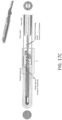
- the shield is pulled out of or removed from the cable bundle, as shown in exemplary figures 14A and figure 17A .
- Both the top and bottom shield strip are shorted to a single wire, which is soldered to the plated surface of the receptacle, as shown in figures 14A and 15 (at location 1511).
- This plating makes the shield connection to the umbilical cable plug.
- Exemplary benefits of this approach can include one or more of the following: transmitting RF out of the device in as low an impedance path as possible; preventing the shield from entering the ferrite; or minimize looping of the shield near the other conductors which would provide more noise inductance into the conductors.
- a ground line strip similar in construction to the shield line strip in the catheter body, is formed of a common strip that is folded over to form both the ground and shield strips as illustrated in Figure 14C .
- Experimental data have shown that combining the ground and shield strips lowered the overall impedance and resulted in better noise suppression.
- a single of material strip twice the desired length is folded over on itself (insulation on the inside, copper on the outside), with the folded side at the distal end.
- the ground and shield strips are positioned on both sides (top and bottom) of the conductor bundle. Accordingly, in this preferred embodiment the top and bottom strips do not require a connection between them.
- the ground strips in yet other embodiments may have a conductive pathway isolated from the shield strip.
- the grounds strips are attached to ground connections in the distal catheter tip and run parallel with other ground pathways (lines) in the conductor bundle back to the PCBs where they are again joined with other ground lines from the conductor bundle. These ground lines continue through the flex which is integrated with the electrical contacts on the catheter receptacle connector.
- the shield strips may be electrically joined with the grounds at the distal tip. This allows sharing of the shield strip pathway with the ground lines back to the proximal end of the catheter. This sharing of the pathway lowers the overall shield impedance and improve the effectiveness of the shield.
- the ground strip pathway may still route with the cable bundle through the ferrite to the PCBs and receptacle connections, but may also share a lower impedance path with the shield wire bypassing the ferrite, PCBs and receptacle contacts.
- the ground strips do not require an electrical connection again to the shield where the shield exits the conductor bundle, but this connection may be made if a performance benefit is realized.
- a thicker strip of copper (e.g., a 28 AWG wire flattened to .0035"), which may be referred to as a "drain wire" may be added to the top and/or bottom of the conductor bundle as shown in Figure 14C .
- the drain wire is electrically coupled (e.g., soldered) to the outer shield strip.
- the drain wire may run the full length of the device or, as in the preferred embodiment shown, the wire may terminate proximal to the deflection region (e.g., ⁇ 12 cm from the distal tip), so that the added stiffness of the strip does not impede deflection and tip rotation performance.
- FIGS 14A and 15 illustrate an exemplary embodiment of an imaging catheter with optional tensioning controlling push arm, which may include any of the disclosure of the tensioning members set forth herein (e.g., with respect to any of figures 1-13 ).
- a push arm may be present in catheter designs in which an inner shaft and an outer shaft are movable relative to each other.
- the cable bundle may be left intact (shields and remainder of flexes) between the exit out of the inner shaft and the push arm attachment to allow the bundle to telescope back and forth with the distal tip (2.5-3.0 cm), which may have an ultrasound transducer therein.
- Tension to the bundle is provided from the tip during advancement, while tension during retraction is provided from the point of push arm attachment.
- An additional intact portion (another 2-3 cm) proximal to the push arm attachment can be provided to allow changing of the bundle radius during advancement and retraction. While the shield could be pulled out of the bundle at the push arm attachment, it may be preferred to pull it out after the additional 2-3 cm to prevent it from having to move.
- the shield exit can be secured, and the remaining cable immediately routed into the noise suppression member.
- the cable bundle can include an additional shield wire one either or both sides of the flex bundle running the full length, or nearly the full length of the catheter shaft, terminating in the handle where the shield exits the cable bundle.
- the additional shield wire(s) terminate at the distal end, proximal of the deflection region of the shaft. This may help to minimize the stiffness of the deflection region and prevent any compromise in mechanical deflection and torque response in this region. If the cable bundle has a rectangular configuration and is disposed in a circular space, an extra wire may not be as wide as existing copper strips such that the fit of this cable bundle "rectangle" in the shaft "circle” can be optimized.
- the shield wire(s) are preferably as large as can fit in the available space to provide the minimal impedance possible. Shorting the top and bottom shields together at the tip may provide for a more even impedance distribution and reduce any dipole antennae effects.
- distal tip of the medical device such as any of the distal tips herein that include an ultrasound probe and ultrasound transducer may be the source of outside noise pickup.
- the distal tip may include shielding.
- shield strips may be extended around the tip (along the existing short flex strips), except for where the acoustic window is.
- the shield may also be wrapped around the sides of the transducer.
- Tip flex strips may also be plated or coated in a conductive material connected to the shield conductors. A very thin shield coating could be provided over the transducer at least 1/4 - 1/8 the ultrasound wavelength.
- the outer molding may be shielded with a shield strip material such as illustrated in Figure 17C .
- the shield tip material preferably coats as much of the surface area of the transducer as possible without impeding the ultrasound beams emitted from the acoustic window.
- the shield material may be the same or similar to that of the shield strips of the cable bundling internal to the device or may be implemented using other materials and techniques such as gold plating, painted silver, copper taper or other layering, conductive ink or the like. Where shielding is disposed on the outer molding of the tip, the shield material should be insulated from the patient by lamination, polymer spray coating, or other dielectric.
- Some embodiments may include additional shield layers incorporated into the layers of the PCBs and flex circuit extending between the PCBs and catheter connector.
- the shielding may also be applied externally to the PCBs and flex circuit using copper tape or other similar construction.
- the additional shielding layers can be connected to the catheter connector shield directly, or via the low impedance shield connection wire ( figure 18 ).
- the low impedance shield connection wire may terminate in the distal side of the additional shielding layers and the proximal end of the additional shielding layers terminated to the connector shield layer. Terminations may be made through the use of solder, welding, a mechanical contact, or other conventional techniques.
- Some embodiments may include an umbilical connector shielding.
- a connection may be made between the catheter and cable shield through a plated surface of the catheter receptacle and umbilical plug.
- a lower impedance connection may be preferred to be added to or provided instead of the existing plated connection.
- the central core of the receptacle and plug could be adapted to provide a direct electrical connection to one another.
- a "banana style" connection could be made or other pogo-pin, c-pin, or lever arm metal-metal mechanical connection made.
- directed braided wire flat shield wire preferred
- the umbilical cable plug could have a recessed, touch proof receptacle for a male-style pin from the catheter receptacle connector. This could be positioned on the central axis, but could also be on the inner circumference or integrated into the cable.
- Some embodiments may include an umbilical ferrite.
- a clamp on ferrite may be used over the outside of the umbilical cable to improve noise immunity.
- a 3T or 4T may be used on the cable. This use is common in the art.
- an appropriately sized ferrite may be used under the shield and have it integrated in the design. This may be located at the DLP (console connector) side, outside the DLP, or actually inside the housing (and inside the shielded cage), of the DLP. It may also be incorporated near the plug (catheter connector) side, although the extra weight in this location may not be as desirable and should be considered.
- Figures 15 and 16 illustrate photographs of a portion an exemplary handle shown in figure 14A , whereas figure 16 additionally highlights an exemplary cable bundle 1602 pathway within the handle, with components similarly labeled with respect to figures 14A , 15 , 17A , 18 and 19 .
- Figure 17 schematically illustrates an exemplary cable bundle 1702 routing within a handle (handle housing not shown) that is shown in figures 14A-16 .
- Figure 17 excludes the handle housing to provide a more clarified routing pathway.
- Shield 1710 is removed from cable bundle 1702 before it passes through noise suppression member 1708 (e.g., ferrite bead) and the cable bundle is shown folded in folding region 1712. Sections of the cable bundle are fanned out to attachment locations on the printed circuit boards 711 as shown.
- Receptacle 1713 is also shown.
- Figure 18 illustrates an exemplary embodiment of an imaging catheter in which handle 1800 does not include a noise suppression member (e.g., ferrite bead) therein.
- Handle 1800 may include any other handle component or functionality described in any of the other handles herein.
- exemplary inner shaft 1806 is shown.
- shield layers 1810 are routed directly from the cable bundle to the receptacle 1813, as shown.
- the cable bundle is folded accordion style in folded region 1812. After the shield layers are removed from the bundle, cable bundle 1802 is routed directly to the PCBs as shown, and are fanned out at locations 1803 to the PCB attachment points.
- FIG. 18 also illustrates an exemplary cable bundle cross section, wherein any of the embodiments herein may include such as cable bundle.
- the cable bundle is exemplary, however, and not every layer need be included, in this embodiment or any other embodiment.
- Figure 19 illustrates an exemplary embodiment of an imaging catheter in which handle 1900 does not include a ferrite bead, and wherein excess cable bundle 1902 is looped in looped region 1905.
- the handle shown in figures 19 may incorporate any suitable feature of any of the other handles and imaging catheters herein.
- Handle 1900 has inner shaft 1906 extending therein, from which cable bundle 1902 extends as shown. The cable bundle is fanned out at locations 1903 for attachment to the PCBs as shown.
- Handle 1900 may include any other suitable component or functionality described or shown with respect to other handles herein.
- Figure 20 illustrates an exemplary handle 2000, with half of handle housing 2005 removed to illustrate internal components therein.
- Handle includes catheter shaft control system 2010, which may include any suitable features herein to cause the deflection of a deflectable shaft herein, such as one or more pull wires routed through an elongate deflectable shaft.
- flexible cable bundle 2002 extends around a plurality of printed circuit boards 2004.
- shield 2002 is removed from the cable bundle within the handle before the remainder of the cable bundle passes through ferrite bead 2006, as shown.
- the bundle 2007 with the shield removed then extends proximally and is coupled to the printed circuit boards 2004, as shown.
- an inner and outer catheter shafts are not axially movable relative to each other (not telescoping) and the cable bundle is not axially movable within the handle after the handle is assembled.
- the flexible bundle may pass around the printed circuit boards 2004 as shown as the flexible cable bundle does not need to follow a straight axial path for easy axially movement, as may be beneficial in some examples that includes a telescoping probe tip. Routing the flexible cable bundle around the printed circuit boards 2004 may help increase the distance between the signal lines in the cable bundle 2002 and the signal lines (particularly the analog signal lines) in the printed circuit boards 2004 so as to minimize noise pickup.
- the handle may include a tongue-and-groove construction as illustrated in cross section in Figure 21 .
- the handle is formed of two halves wherein each half mates at a via male tongue on one half and a female groove on the other half.
- the tongue-and-groove construction increases the mating surface area between handle parts, provides a more secure connection, and permits cleaner bonding without the creation of an exterior glue seam.
Landscapes
- Health & Medical Sciences (AREA)
- Life Sciences & Earth Sciences (AREA)
- Engineering & Computer Science (AREA)
- Biomedical Technology (AREA)
- Veterinary Medicine (AREA)
- Public Health (AREA)
- General Health & Medical Sciences (AREA)
- Animal Behavior & Ethology (AREA)
- Heart & Thoracic Surgery (AREA)
- Surgery (AREA)
- Biophysics (AREA)
- Medical Informatics (AREA)
- Molecular Biology (AREA)
- Nuclear Medicine, Radiotherapy & Molecular Imaging (AREA)
- Physics & Mathematics (AREA)
- Radiology & Medical Imaging (AREA)
- Pathology (AREA)
- Anesthesiology (AREA)
- Pulmonology (AREA)
- Hematology (AREA)
- Cardiology (AREA)
- Plasma & Fusion (AREA)
- Optics & Photonics (AREA)
- Otolaryngology (AREA)
- Mechanical Engineering (AREA)
- Media Introduction/Drainage Providing Device (AREA)
- Endoscopes (AREA)
- Ultra Sonic Daignosis Equipment (AREA)
Claims (19)
- Ultraschallbildgebungskatheter, umfassend:einen länglichen Schaft, der bemessen und konfiguriert ist, um innerhalb eines Patienten vorgeschoben zu werden;einen Griff (1400), der bemessen und positioniert ist, um außerhalb des Patienten zu verbleiben;eine distale Spitze, die einen Ultraschallwandler einschließt;ein längliches Kabelbündel (1402), das mit dem Ultraschallwandler in Kommunikation steht, wobei das längliche Kabelbündel durch den länglichen Schaft verläuft und sich in den Griff erstreckt, das längliche Kabelbündel umfassend eine Abschirmschicht (1410) und eine Erdungsschicht angrenzend an die Abschirmschicht auf jeder Seite des Kabelbündels, unddadurch gekennzeichnet, dass eine jeweilige Abschirmschicht und Erdungsschicht aus einem gemeinsamen Streifen ausgebildet sind, der an einem distalen Ende derart gefaltet ist, dass ein distales Ende jeder Erdungsschicht mit einem distalen Ende einer jeweiligen Abschirmschicht elektrisch verbunden ist.
- Katheter nach Anspruch 1, wobei das längliche Kabelbündel durch ein Lumen eines elektrischen Rauschunterdrückungselements (1408) dahindurch verläuft, das innerhalb des Griffs befestigt ist, und wobei die Abschirmschicht des Kabelbündels an einer Stelle von dem länglichen Kabelbündel derart entfernt ist, dass die Abschirmschicht nicht durch das Lumen des elektrischen Rauschunterdrückungselements verläuft, das innerhalb des Griffs befestigt ist.
- Katheter nach Anspruch 2, wobei das Rauschunterdrückungselement eines von einem Material oder einer Konfiguration oder sowohl ein Material als auch eine Konfiguration umfasst, um elektromagnetische Störungen von dem länglichen Kabelbündel zu unterdrücken.
- Katheter nach Anspruch 2, wobei das Rauschunterdrückungselement eines von einem Material oder einer Konfiguration oder sowohl ein Material als auch eine Konfiguration umfasst, um elektromagnetische Störungen in das längliche Kabelbündel zu unterdrücken.
- Katheter nach Anspruch 2, wobei das Rauschunterdrückungselement eine Ferritperle umfasst.
- Ultraschallbildgebungskatheter nach Anspruch 1, wobei das längliche Kabelbündel durch eine Ferritperle (1408) verläuft, die innerhalb des Griffs befestigt ist, und wobei die Abschirmschicht des Kabelbündels an einer Stelle von dem länglichen Kabelbündel derart entfernt ist, dass die Abschirmschicht nicht durch die Ferritperle verläuft, die innerhalb des Griffs befestigt ist.
- Ultraschallbildgebungskatheter nach Anspruch 6, wobei das längliche Kabelbündel in einer gefalteten Region (1412) innerhalb des Griffs auf geordnete Weise auf sich selbst gefaltet ist, und wobei die Abschirmschicht vor der gefalteten Region von dem Kabelbündel derart entfernt wurde, dass die Abschirmschicht nicht innerhalb des Griffs gefaltet ist.
- Ultraschallbildgebungskatheter nach Anspruch 6, wobei sich das Kabelbündel von einem proximalen Ende eines länglichen Schafts erstreckt, der innerhalb des Griffs angeordnet ist.
- Ultraschallbildgebungskatheter nach Anspruch 6, wobei das Kabelbündel einen bewegbaren Abschnitt einschließt, der innerhalb des Griffs axial bewegbar ist.
- Ultraschallbildgebungskatheter nach Anspruch 6, wobei das Kabelbündel nicht angepasst ist, um innerhalb des Griffs axial bewegt zu werden, nachdem der Griff zusammengebaut wurde.
- Ultraschallbildgebungskatheter nach Anspruch 1, wobei das längliche Kabelbündel in einer gefalteten Region (1412) innerhalb des Griffs auf geordnete Weise auf sich selbst gefaltet ist, und wobei die Abschirmschicht des Kabels vor der gefalteten Region von dem Kabelbündel derart entfernt wird, dass die Abschirmschicht nicht in der gefalteten Region angeordnet ist.
- Ultraschallbildgebungskatheter nach Anspruch 6 oder 11, wobei das längliche Kabelbündel in der gefalteten Region ziehharmonikaartig auf sich selbst gefaltet ist.
- Ultraschallbildgebungskatheter nach Anspruch 6 oder 11, wobei die Abschirmschicht mit einer Aufnahme des Griffs gekoppelt ist.
- Ultraschallbildgebungskatheter nach Anspruch 6 oder 11, wobei das Kabelbündel mit einer Vielzahl von Leiterplatten gekoppelt ist, die innerhalb des Griffs angeordnet ist.
- Ultraschallbildgebungskatheter nach Anspruch 11, wobei sich das Kabelbündel von einem proximalen Ende eines länglichen Schafts innerhalb des Griffs erstreckt.
- Ultraschallbildgebungskatheter nach Anspruch 6 oder 15, wobei sich das Kabelbündel radial außerhalb einer Vielzahl von Leiterplatten erstreckt, die innerhalb des Griffs angeordnet ist.
- Ultraschallbildgebungskatheter nach Anspruch 6 oder 15, wobei das Kabelbündel zwischen der ersten und der zweiten einer Vielzahl von Leiterplatten verläuft, die innerhalb des Griffs angeordnet sind.
- Ultraschallbildgebungskatheter nach Anspruch 11, wobei das Kabelbündel innerhalb des Griffs axial bewegbar ist.
- Ultraschallbildgebungskatheter nach Anspruch 11, wobei das Kabelbündel innerhalb des Griffs axial unbewegbar ist.
Priority Applications (1)
| Application Number | Priority Date | Filing Date | Title |
|---|---|---|---|
| EP22205440.5A EP4151157B1 (de) | 2021-07-16 | 2022-07-15 | Medizinischer werkzeugschaft |
Applications Claiming Priority (2)
| Application Number | Priority Date | Filing Date | Title |
|---|---|---|---|
| US202163222799P | 2021-07-16 | 2021-07-16 | |
| US17/863,734 US20230012775A1 (en) | 2021-07-16 | 2022-07-13 | Cable routing and assemblies for medical device handles |
Related Child Applications (2)
| Application Number | Title | Priority Date | Filing Date |
|---|---|---|---|
| EP22205440.5A Division-Into EP4151157B1 (de) | 2021-07-16 | 2022-07-15 | Medizinischer werkzeugschaft |
| EP22205440.5A Division EP4151157B1 (de) | 2021-07-16 | 2022-07-15 | Medizinischer werkzeugschaft |
Publications (3)
| Publication Number | Publication Date |
|---|---|
| EP4119031A1 EP4119031A1 (de) | 2023-01-18 |
| EP4119031C0 EP4119031C0 (de) | 2024-10-23 |
| EP4119031B1 true EP4119031B1 (de) | 2024-10-23 |
Family
ID=82608096
Family Applications (2)
| Application Number | Title | Priority Date | Filing Date |
|---|---|---|---|
| EP22185248.6A Active EP4119031B1 (de) | 2021-07-16 | 2022-07-15 | Kabelführung und anordnungen für griffe von medizinprodukten |
| EP22205440.5A Active EP4151157B1 (de) | 2021-07-16 | 2022-07-15 | Medizinischer werkzeugschaft |
Family Applications After (1)
| Application Number | Title | Priority Date | Filing Date |
|---|---|---|---|
| EP22205440.5A Active EP4151157B1 (de) | 2021-07-16 | 2022-07-15 | Medizinischer werkzeugschaft |
Country Status (5)
| Country | Link |
|---|---|
| US (1) | US20230012775A1 (de) |
| EP (2) | EP4119031B1 (de) |
| JP (1) | JP2023014067A (de) |
| CN (1) | CN115607808A (de) |
| IL (1) | IL294773B2 (de) |
Families Citing this family (2)
| Publication number | Priority date | Publication date | Assignee | Title |
|---|---|---|---|---|
| US20230011214A1 (en) * | 2021-07-12 | 2023-01-12 | Boston Scientific Scimed, Inc. | Radially clocked steerable catheter |
| CN121001660A (zh) * | 2023-04-25 | 2025-11-21 | 纽维拉医疗公司 | 医疗工具定位装置和系统 |
Family Cites Families (29)
| Publication number | Priority date | Publication date | Assignee | Title |
|---|---|---|---|---|
| US4615330A (en) * | 1983-09-05 | 1986-10-07 | Olympus Optical Co., Ltd. | Noise suppressor for electronic endoscope |
| JP2598568B2 (ja) * | 1990-11-20 | 1997-04-09 | オリンパス光学工業株式会社 | 電子内視鏡装置 |
| US5361768A (en) * | 1992-06-30 | 1994-11-08 | Cardiovascular Imaging Systems, Inc. | Automated longitudinal position translator for ultrasonic imaging probes, and methods of using same |
| JP3277854B2 (ja) * | 1997-08-08 | 2002-04-22 | 株式会社村田製作所 | ノイズ抑制機能付き絶縁被覆電線 |
| JP2000245734A (ja) * | 1999-03-01 | 2000-09-12 | Olympus Optical Co Ltd | 超音波内視鏡診断装置 |
| EP2668906B1 (de) * | 2004-09-16 | 2014-12-03 | Olympus Medical Systems Corp. | Ultraschallsonde |
| JP4979708B2 (ja) * | 2005-11-12 | 2012-07-18 | ボストン サイエンティフィック リミテッド | 撮像カテーテルシステムにおいてノイズを低減するためのシステム |
| US8798711B2 (en) * | 2006-02-09 | 2014-08-05 | Biosense Webster, Inc. | Shielding of catheter handle |
| US8224422B2 (en) * | 2006-10-10 | 2012-07-17 | Biosense Webster, Inc. | Esophageal mapping catheter |
| WO2009137403A1 (en) * | 2008-05-05 | 2009-11-12 | Boston Scientific Scimed, Inc. | Shielding for intravascular ultrasound imaging systems and methods of making and using |
| US8664938B2 (en) * | 2010-05-05 | 2014-03-04 | Ysi Incorporated | Replaceable probe head |
| US9170132B2 (en) * | 2010-05-05 | 2015-10-27 | Ysi Incorporated | Replaceable probe head having an operational amplifier |
| US8634901B2 (en) * | 2011-09-30 | 2014-01-21 | Covidien Lp | ECG leadwire system with noise suppression and related methods |
| US20130296729A1 (en) * | 2012-05-04 | 2013-11-07 | Biosense Webster (Israel), Ltd. | Catheter having two-piece connector for a split handle assembly |
| US9386967B2 (en) * | 2012-07-31 | 2016-07-12 | St. Jude Medical, Atrial Fibrillation Division, Inc. | Magnetic field-compatible components of a medical diagnostic and/or therapeutic system |
| BR112016002781B1 (pt) * | 2013-08-07 | 2021-11-09 | Baylis Medical Company Inc. | Dispositivos para puncionar tecido, kit compreendendo os dispositivos e uso dos mesmos |
| EP3733096B1 (de) * | 2014-02-28 | 2025-04-09 | Blue Belt Technologies, Inc. | System zur positionierung einer knochenschnittführung |
| JP2017527327A (ja) * | 2014-07-03 | 2017-09-21 | セント・ジュード・メディカル・インターナショナル・ホールディング・エスエーアールエルSt. Jude Medical International Holding S.a,r.l. | 局所磁場発生装置 |
| JP6885341B2 (ja) * | 2015-11-30 | 2021-06-16 | ソニーグループ株式会社 | 内視鏡下手術用手持ち器具 |
| EP3370635B1 (de) * | 2015-12-31 | 2024-03-20 | St. Jude Medical International Holding S.à r.l. | Steckerabschirmung für sensoraktivierte medizinprodukte |
| US11175161B2 (en) * | 2016-02-23 | 2021-11-16 | Mediatek Inc. | Inductive sensor for position/orientation sensing |
| US11090063B2 (en) * | 2016-05-25 | 2021-08-17 | Blue Belt Technologies, Inc. | Cutting assembly for use with electromagnetic tracking |
| WO2018182836A1 (en) * | 2017-03-30 | 2018-10-04 | Shifamed Holdings, Llc | Medical tool positioning devices, systems, and methods of use and manufacture |
| US10359464B2 (en) * | 2017-09-18 | 2019-07-23 | Biosense Webster (Israel) Ltd. | Cable and associated continuity monitoring system and method |
| EP3840630B1 (de) * | 2018-08-23 | 2025-09-10 | NuVera Medical, Inc. | Vorrichtungen, systeme und verfahren zur positionierung von medizinischen werkzeugen |
| EP3923822A1 (de) * | 2019-05-17 | 2021-12-22 | Boston Scientific Scimed, Inc. | Medizinische bildgebungsvorrichtungen und -systeme |
| WO2021108562A1 (en) * | 2019-11-27 | 2021-06-03 | Nuvera Medical, Inc. | Cable routing and assemblies for medical device handles |
| WO2021173758A2 (en) * | 2020-02-25 | 2021-09-02 | Vanderbilt University | Methods of using optical fiber-based fluorescence spectroscopy for surgical guidance and/or tissue diagnostics and applications of same |
| US20220133139A1 (en) * | 2020-11-02 | 2022-05-05 | Vanderbilt University | System and method for surgery guidance |
-
2022
- 2022-07-13 US US17/863,734 patent/US20230012775A1/en active Pending
- 2022-07-14 IL IL294773A patent/IL294773B2/en unknown
- 2022-07-15 JP JP2022113799A patent/JP2023014067A/ja active Pending
- 2022-07-15 EP EP22185248.6A patent/EP4119031B1/de active Active
- 2022-07-15 EP EP22205440.5A patent/EP4151157B1/de active Active
- 2022-07-18 CN CN202210839960.1A patent/CN115607808A/zh active Pending
Also Published As
| Publication number | Publication date |
|---|---|
| US20230012775A1 (en) | 2023-01-19 |
| IL294773A (en) | 2023-02-01 |
| JP2023014067A (ja) | 2023-01-26 |
| EP4119031C0 (de) | 2024-10-23 |
| IL294773B2 (en) | 2025-07-01 |
| EP4151157C0 (de) | 2025-09-17 |
| IL294773B1 (en) | 2025-03-01 |
| CN115607808A (zh) | 2023-01-17 |
| EP4151157A1 (de) | 2023-03-22 |
| EP4119031A1 (de) | 2023-01-18 |
| EP4151157B1 (de) | 2025-09-17 |
Similar Documents
| Publication | Publication Date | Title |
|---|---|---|
| EP4064999B1 (de) | Kabelführung und anordnung für griffe von medizinprodukten | |
| US20220313946A1 (en) | Catheter devices and methods for making them | |
| EP3880285B1 (de) | Vorrichtungen zur positionierung von medizinischen werkzeugen | |
| EP3958744B1 (de) | Vorrichtungen, systeme und verfahren zur positionierung von medizinischen werkzeugen | |
| EP4119031B1 (de) | Kabelführung und anordnungen für griffe von medizinprodukten | |
| US20250255578A1 (en) | Cable routing and assemblies for medical device handles | |
| EP4570188A1 (de) | Positionierungsvorrichtungen, -systeme und -verfahren für ein medizinisches überdrahtwerkzeug | |
| US20240358351A1 (en) | Medical tool positioning devices, systems, and methods of use and manufacture | |
| US20260020840A1 (en) | Medical tool comprising conductive layers | |
| US20250204889A1 (en) | Medical tool positioning devices, systems, and methods of use and manufacture | |
| WO2024224267A1 (en) | Medical tool positioning device and systems |
Legal Events
| Date | Code | Title | Description |
|---|---|---|---|
| PUAI | Public reference made under article 153(3) epc to a published international application that has entered the european phase |
Free format text: ORIGINAL CODE: 0009012 |
|
| STAA | Information on the status of an ep patent application or granted ep patent |
Free format text: STATUS: THE APPLICATION HAS BEEN PUBLISHED |
|
| AK | Designated contracting states |
Kind code of ref document: A1 Designated state(s): AL AT BE BG CH CY CZ DE DK EE ES FI FR GB GR HR HU IE IS IT LI LT LU LV MC MK MT NL NO PL PT RO RS SE SI SK SM TR |
|
| STAA | Information on the status of an ep patent application or granted ep patent |
Free format text: STATUS: REQUEST FOR EXAMINATION WAS MADE |
|
| 17P | Request for examination filed |
Effective date: 20230301 |
|
| RBV | Designated contracting states (corrected) |
Designated state(s): AL AT BE BG CH CY CZ DE DK EE ES FI FR GB GR HR HU IE IS IT LI LT LU LV MC MK MT NL NO PL PT RO RS SE SI SK SM TR |
|
| STAA | Information on the status of an ep patent application or granted ep patent |
Free format text: STATUS: EXAMINATION IS IN PROGRESS |
|
| 17Q | First examination report despatched |
Effective date: 20230726 |
|
| GRAP | Despatch of communication of intention to grant a patent |
Free format text: ORIGINAL CODE: EPIDOSNIGR1 |
|
| STAA | Information on the status of an ep patent application or granted ep patent |
Free format text: STATUS: GRANT OF PATENT IS INTENDED |
|
| INTG | Intention to grant announced |
Effective date: 20240603 |
|
| GRAS | Grant fee paid |
Free format text: ORIGINAL CODE: EPIDOSNIGR3 |
|
| GRAA | (expected) grant |
Free format text: ORIGINAL CODE: 0009210 |
|
| STAA | Information on the status of an ep patent application or granted ep patent |
Free format text: STATUS: THE PATENT HAS BEEN GRANTED |
|
| AK | Designated contracting states |
Kind code of ref document: B1 Designated state(s): AL AT BE BG CH CY CZ DE DK EE ES FI FR GB GR HR HU IE IS IT LI LT LU LV MC MK MT NL NO PL PT RO RS SE SI SK SM TR |
|
| REG | Reference to a national code |
Ref country code: GB Ref legal event code: FG4D |
|
| REG | Reference to a national code |
Ref country code: CH Ref legal event code: EP |
|
| REG | Reference to a national code |
Ref country code: DE Ref legal event code: R096 Ref document number: 602022007006 Country of ref document: DE |
|
| REG | Reference to a national code |
Ref country code: IE Ref legal event code: FG4D |
|
| U01 | Request for unitary effect filed |
Effective date: 20241107 |
|
| U07 | Unitary effect registered |
Designated state(s): AT BE BG DE DK EE FI FR IT LT LU LV MT NL PT RO SE SI Effective date: 20241118 |
|
| PG25 | Lapsed in a contracting state [announced via postgrant information from national office to epo] |
Ref country code: IS Free format text: LAPSE BECAUSE OF FAILURE TO SUBMIT A TRANSLATION OF THE DESCRIPTION OR TO PAY THE FEE WITHIN THE PRESCRIBED TIME-LIMIT Effective date: 20250223 Ref country code: HR Free format text: LAPSE BECAUSE OF FAILURE TO SUBMIT A TRANSLATION OF THE DESCRIPTION OR TO PAY THE FEE WITHIN THE PRESCRIBED TIME-LIMIT Effective date: 20241023 |
|
| PG25 | Lapsed in a contracting state [announced via postgrant information from national office to epo] |
Ref country code: ES Free format text: LAPSE BECAUSE OF FAILURE TO SUBMIT A TRANSLATION OF THE DESCRIPTION OR TO PAY THE FEE WITHIN THE PRESCRIBED TIME-LIMIT Effective date: 20241023 |
|
| PG25 | Lapsed in a contracting state [announced via postgrant information from national office to epo] |
Ref country code: NO Free format text: LAPSE BECAUSE OF FAILURE TO SUBMIT A TRANSLATION OF THE DESCRIPTION OR TO PAY THE FEE WITHIN THE PRESCRIBED TIME-LIMIT Effective date: 20250123 |
|
| PG25 | Lapsed in a contracting state [announced via postgrant information from national office to epo] |
Ref country code: GR Free format text: LAPSE BECAUSE OF FAILURE TO SUBMIT A TRANSLATION OF THE DESCRIPTION OR TO PAY THE FEE WITHIN THE PRESCRIBED TIME-LIMIT Effective date: 20250124 |
|
| PG25 | Lapsed in a contracting state [announced via postgrant information from national office to epo] |
Ref country code: PL Free format text: LAPSE BECAUSE OF FAILURE TO SUBMIT A TRANSLATION OF THE DESCRIPTION OR TO PAY THE FEE WITHIN THE PRESCRIBED TIME-LIMIT Effective date: 20241023 |
|
| PG25 | Lapsed in a contracting state [announced via postgrant information from national office to epo] |
Ref country code: RS Free format text: LAPSE BECAUSE OF FAILURE TO SUBMIT A TRANSLATION OF THE DESCRIPTION OR TO PAY THE FEE WITHIN THE PRESCRIBED TIME-LIMIT Effective date: 20250123 |
|
| PG25 | Lapsed in a contracting state [announced via postgrant information from national office to epo] |
Ref country code: SM Free format text: LAPSE BECAUSE OF FAILURE TO SUBMIT A TRANSLATION OF THE DESCRIPTION OR TO PAY THE FEE WITHIN THE PRESCRIBED TIME-LIMIT Effective date: 20241023 |
|
| U20 | Renewal fee for the european patent with unitary effect paid |
Year of fee payment: 4 Effective date: 20250606 |
|
| PG25 | Lapsed in a contracting state [announced via postgrant information from national office to epo] |
Ref country code: SK Free format text: LAPSE BECAUSE OF FAILURE TO SUBMIT A TRANSLATION OF THE DESCRIPTION OR TO PAY THE FEE WITHIN THE PRESCRIBED TIME-LIMIT Effective date: 20241023 |
|
| PG25 | Lapsed in a contracting state [announced via postgrant information from national office to epo] |
Ref country code: CZ Free format text: LAPSE BECAUSE OF FAILURE TO SUBMIT A TRANSLATION OF THE DESCRIPTION OR TO PAY THE FEE WITHIN THE PRESCRIBED TIME-LIMIT Effective date: 20241023 |
|
| PLBE | No opposition filed within time limit |
Free format text: ORIGINAL CODE: 0009261 |
|
| STAA | Information on the status of an ep patent application or granted ep patent |
Free format text: STATUS: NO OPPOSITION FILED WITHIN TIME LIMIT |
|
| 26N | No opposition filed |
Effective date: 20250724 |