EP4117940B1 - Verfahren und fahrzeug zur steuerung der bewegungen des fahrzeugs - Google Patents
Verfahren und fahrzeug zur steuerung der bewegungen des fahrzeugs Download PDFInfo
- Publication number
- EP4117940B1 EP4117940B1 EP21708770.9A EP21708770A EP4117940B1 EP 4117940 B1 EP4117940 B1 EP 4117940B1 EP 21708770 A EP21708770 A EP 21708770A EP 4117940 B1 EP4117940 B1 EP 4117940B1
- Authority
- EP
- European Patent Office
- Prior art keywords
- vehicle
- motion
- wheels
- throttle
- chassis
- Prior art date
- Legal status (The legal status is an assumption and is not a legal conclusion. Google has not performed a legal analysis and makes no representation as to the accuracy of the status listed.)
- Active
Links
Images





Classifications
-
- B—PERFORMING OPERATIONS; TRANSPORTING
- B60—VEHICLES IN GENERAL
- B60G—VEHICLE SUSPENSION ARRANGEMENTS
- B60G17/00—Resilient suspensions having means for adjusting the spring or vibration-damper characteristics, for regulating the distance between a supporting surface and a sprung part of vehicle or for locking suspension during use to meet varying vehicular or surface conditions, e.g. due to speed or load
- B60G17/015—Resilient suspensions having means for adjusting the spring or vibration-damper characteristics, for regulating the distance between a supporting surface and a sprung part of vehicle or for locking suspension during use to meet varying vehicular or surface conditions, e.g. due to speed or load the regulating means comprising electric or electronic elements
- B60G17/0152—Resilient suspensions having means for adjusting the spring or vibration-damper characteristics, for regulating the distance between a supporting surface and a sprung part of vehicle or for locking suspension during use to meet varying vehicular or surface conditions, e.g. due to speed or load the regulating means comprising electric or electronic elements characterised by the action on a particular type of suspension unit
- B60G17/0157—Resilient suspensions having means for adjusting the spring or vibration-damper characteristics, for regulating the distance between a supporting surface and a sprung part of vehicle or for locking suspension during use to meet varying vehicular or surface conditions, e.g. due to speed or load the regulating means comprising electric or electronic elements characterised by the action on a particular type of suspension unit non-fluid unit, e.g. electric motor
-
- B—PERFORMING OPERATIONS; TRANSPORTING
- B60—VEHICLES IN GENERAL
- B60G—VEHICLE SUSPENSION ARRANGEMENTS
- B60G17/00—Resilient suspensions having means for adjusting the spring or vibration-damper characteristics, for regulating the distance between a supporting surface and a sprung part of vehicle or for locking suspension during use to meet varying vehicular or surface conditions, e.g. due to speed or load
- B60G17/015—Resilient suspensions having means for adjusting the spring or vibration-damper characteristics, for regulating the distance between a supporting surface and a sprung part of vehicle or for locking suspension during use to meet varying vehicular or surface conditions, e.g. due to speed or load the regulating means comprising electric or electronic elements
- B60G17/016—Resilient suspensions having means for adjusting the spring or vibration-damper characteristics, for regulating the distance between a supporting surface and a sprung part of vehicle or for locking suspension during use to meet varying vehicular or surface conditions, e.g. due to speed or load the regulating means comprising electric or electronic elements characterised by their responsiveness, when the vehicle is travelling, to specific motion, a specific condition, or driver input
- B60G17/0165—Resilient suspensions having means for adjusting the spring or vibration-damper characteristics, for regulating the distance between a supporting surface and a sprung part of vehicle or for locking suspension during use to meet varying vehicular or surface conditions, e.g. due to speed or load the regulating means comprising electric or electronic elements characterised by their responsiveness, when the vehicle is travelling, to specific motion, a specific condition, or driver input to an external condition, e.g. rough road surface, side wind
-
- B—PERFORMING OPERATIONS; TRANSPORTING
- B60—VEHICLES IN GENERAL
- B60G—VEHICLE SUSPENSION ARRANGEMENTS
- B60G11/00—Resilient suspensions characterised by arrangement, location or kind of springs
- B60G11/18—Resilient suspensions characterised by arrangement, location or kind of springs having torsion-bar springs only
-
- B—PERFORMING OPERATIONS; TRANSPORTING
- B60—VEHICLES IN GENERAL
- B60G—VEHICLE SUSPENSION ARRANGEMENTS
- B60G17/00—Resilient suspensions having means for adjusting the spring or vibration-damper characteristics, for regulating the distance between a supporting surface and a sprung part of vehicle or for locking suspension during use to meet varying vehicular or surface conditions, e.g. due to speed or load
- B60G17/015—Resilient suspensions having means for adjusting the spring or vibration-damper characteristics, for regulating the distance between a supporting surface and a sprung part of vehicle or for locking suspension during use to meet varying vehicular or surface conditions, e.g. due to speed or load the regulating means comprising electric or electronic elements
- B60G17/016—Resilient suspensions having means for adjusting the spring or vibration-damper characteristics, for regulating the distance between a supporting surface and a sprung part of vehicle or for locking suspension during use to meet varying vehicular or surface conditions, e.g. due to speed or load the regulating means comprising electric or electronic elements characterised by their responsiveness, when the vehicle is travelling, to specific motion, a specific condition, or driver input
-
- B—PERFORMING OPERATIONS; TRANSPORTING
- B60—VEHICLES IN GENERAL
- B60G—VEHICLE SUSPENSION ARRANGEMENTS
- B60G17/00—Resilient suspensions having means for adjusting the spring or vibration-damper characteristics, for regulating the distance between a supporting surface and a sprung part of vehicle or for locking suspension during use to meet varying vehicular or surface conditions, e.g. due to speed or load
- B60G17/015—Resilient suspensions having means for adjusting the spring or vibration-damper characteristics, for regulating the distance between a supporting surface and a sprung part of vehicle or for locking suspension during use to meet varying vehicular or surface conditions, e.g. due to speed or load the regulating means comprising electric or electronic elements
- B60G17/016—Resilient suspensions having means for adjusting the spring or vibration-damper characteristics, for regulating the distance between a supporting surface and a sprung part of vehicle or for locking suspension during use to meet varying vehicular or surface conditions, e.g. due to speed or load the regulating means comprising electric or electronic elements characterised by their responsiveness, when the vehicle is travelling, to specific motion, a specific condition, or driver input
- B60G17/0164—Resilient suspensions having means for adjusting the spring or vibration-damper characteristics, for regulating the distance between a supporting surface and a sprung part of vehicle or for locking suspension during use to meet varying vehicular or surface conditions, e.g. due to speed or load the regulating means comprising electric or electronic elements characterised by their responsiveness, when the vehicle is travelling, to specific motion, a specific condition, or driver input mainly during accelerating or braking
-
- B—PERFORMING OPERATIONS; TRANSPORTING
- B60—VEHICLES IN GENERAL
- B60G—VEHICLE SUSPENSION ARRANGEMENTS
- B60G17/00—Resilient suspensions having means for adjusting the spring or vibration-damper characteristics, for regulating the distance between a supporting surface and a sprung part of vehicle or for locking suspension during use to meet varying vehicular or surface conditions, e.g. due to speed or load
- B60G17/015—Resilient suspensions having means for adjusting the spring or vibration-damper characteristics, for regulating the distance between a supporting surface and a sprung part of vehicle or for locking suspension during use to meet varying vehicular or surface conditions, e.g. due to speed or load the regulating means comprising electric or electronic elements
- B60G17/019—Resilient suspensions having means for adjusting the spring or vibration-damper characteristics, for regulating the distance between a supporting surface and a sprung part of vehicle or for locking suspension during use to meet varying vehicular or surface conditions, e.g. due to speed or load the regulating means comprising electric or electronic elements characterised by the type of sensor or the arrangement thereof
- B60G17/01908—Acceleration or inclination sensors
-
- B—PERFORMING OPERATIONS; TRANSPORTING
- B60—VEHICLES IN GENERAL
- B60G—VEHICLE SUSPENSION ARRANGEMENTS
- B60G17/00—Resilient suspensions having means for adjusting the spring or vibration-damper characteristics, for regulating the distance between a supporting surface and a sprung part of vehicle or for locking suspension during use to meet varying vehicular or surface conditions, e.g. due to speed or load
- B60G17/015—Resilient suspensions having means for adjusting the spring or vibration-damper characteristics, for regulating the distance between a supporting surface and a sprung part of vehicle or for locking suspension during use to meet varying vehicular or surface conditions, e.g. due to speed or load the regulating means comprising electric or electronic elements
- B60G17/0195—Resilient suspensions having means for adjusting the spring or vibration-damper characteristics, for regulating the distance between a supporting surface and a sprung part of vehicle or for locking suspension during use to meet varying vehicular or surface conditions, e.g. due to speed or load the regulating means comprising electric or electronic elements characterised by the regulation being combined with other vehicle control systems
-
- B—PERFORMING OPERATIONS; TRANSPORTING
- B60—VEHICLES IN GENERAL
- B60G—VEHICLE SUSPENSION ARRANGEMENTS
- B60G3/00—Resilient suspensions for a single wheel
- B60G3/02—Resilient suspensions for a single wheel with a single pivoted arm
- B60G3/12—Resilient suspensions for a single wheel with a single pivoted arm the arm being essentially parallel to the longitudinal axis of the vehicle
- B60G3/14—Resilient suspensions for a single wheel with a single pivoted arm the arm being essentially parallel to the longitudinal axis of the vehicle the arm being rigid
-
- B—PERFORMING OPERATIONS; TRANSPORTING
- B60—VEHICLES IN GENERAL
- B60G—VEHICLE SUSPENSION ARRANGEMENTS
- B60G2200/00—Indexing codes relating to suspension types
- B60G2200/10—Independent suspensions
- B60G2200/13—Independent suspensions with longitudinal arms only
-
- B—PERFORMING OPERATIONS; TRANSPORTING
- B60—VEHICLES IN GENERAL
- B60G—VEHICLE SUSPENSION ARRANGEMENTS
- B60G2200/00—Indexing codes relating to suspension types
- B60G2200/10—Independent suspensions
- B60G2200/13—Independent suspensions with longitudinal arms only
- B60G2200/132—Independent suspensions with longitudinal arms only with a single trailing arm
-
- B—PERFORMING OPERATIONS; TRANSPORTING
- B60—VEHICLES IN GENERAL
- B60G—VEHICLE SUSPENSION ARRANGEMENTS
- B60G2202/00—Indexing codes relating to the type of spring, damper or actuator
- B60G2202/40—Type of actuator
- B60G2202/42—Electric actuator
- B60G2202/422—Linear motor
-
- B—PERFORMING OPERATIONS; TRANSPORTING
- B60—VEHICLES IN GENERAL
- B60G—VEHICLE SUSPENSION ARRANGEMENTS
- B60G2204/00—Indexing codes related to suspensions per se or to auxiliary parts
- B60G2204/10—Mounting of suspension elements
- B60G2204/30—In-wheel mountings
-
- B—PERFORMING OPERATIONS; TRANSPORTING
- B60—VEHICLES IN GENERAL
- B60G—VEHICLE SUSPENSION ARRANGEMENTS
- B60G2300/00—Indexing codes relating to the type of vehicle
- B60G2300/50—Electric vehicles; Hybrid vehicles
-
- B—PERFORMING OPERATIONS; TRANSPORTING
- B60—VEHICLES IN GENERAL
- B60G—VEHICLE SUSPENSION ARRANGEMENTS
- B60G2400/00—Indexing codes relating to detected, measured or calculated conditions or factors
- B60G2400/05—Attitude
- B60G2400/051—Angle
- B60G2400/0511—Roll angle
-
- B—PERFORMING OPERATIONS; TRANSPORTING
- B60—VEHICLES IN GENERAL
- B60G—VEHICLE SUSPENSION ARRANGEMENTS
- B60G2400/00—Indexing codes relating to detected, measured or calculated conditions or factors
- B60G2400/05—Attitude
- B60G2400/051—Angle
- B60G2400/0512—Pitch angle
-
- B—PERFORMING OPERATIONS; TRANSPORTING
- B60—VEHICLES IN GENERAL
- B60G—VEHICLE SUSPENSION ARRANGEMENTS
- B60G2400/00—Indexing codes relating to detected, measured or calculated conditions or factors
- B60G2400/80—Exterior conditions
- B60G2400/82—Ground surface
- B60G2400/821—Uneven, rough road sensing affecting vehicle body vibration
-
- B—PERFORMING OPERATIONS; TRANSPORTING
- B60—VEHICLES IN GENERAL
- B60G—VEHICLE SUSPENSION ARRANGEMENTS
- B60G2401/00—Indexing codes relating to the type of sensors based on the principle of their operation
- B60G2401/14—Photo or light sensitive means, e.g. Infrared
-
- B—PERFORMING OPERATIONS; TRANSPORTING
- B60—VEHICLES IN GENERAL
- B60G—VEHICLE SUSPENSION ARRANGEMENTS
- B60G2401/00—Indexing codes relating to the type of sensors based on the principle of their operation
- B60G2401/14—Photo or light sensitive means, e.g. Infrared
- B60G2401/142—Visual Display Camera, e.g. LCD
-
- B—PERFORMING OPERATIONS; TRANSPORTING
- B60—VEHICLES IN GENERAL
- B60G—VEHICLE SUSPENSION ARRANGEMENTS
- B60G2401/00—Indexing codes relating to the type of sensors based on the principle of their operation
- B60G2401/16—GPS track data
-
- B—PERFORMING OPERATIONS; TRANSPORTING
- B60—VEHICLES IN GENERAL
- B60G—VEHICLE SUSPENSION ARRANGEMENTS
- B60G2800/00—Indexing codes relating to the type of movement or to the condition of the vehicle and to the end result to be achieved by the control action
- B60G2800/01—Attitude or posture control
- B60G2800/012—Rolling condition
-
- B—PERFORMING OPERATIONS; TRANSPORTING
- B60—VEHICLES IN GENERAL
- B60G—VEHICLE SUSPENSION ARRANGEMENTS
- B60G2800/00—Indexing codes relating to the type of movement or to the condition of the vehicle and to the end result to be achieved by the control action
- B60G2800/01—Attitude or posture control
- B60G2800/014—Pitch; Nose dive
-
- B—PERFORMING OPERATIONS; TRANSPORTING
- B60—VEHICLES IN GENERAL
- B60G—VEHICLE SUSPENSION ARRANGEMENTS
- B60G2800/00—Indexing codes relating to the type of movement or to the condition of the vehicle and to the end result to be achieved by the control action
- B60G2800/01—Attitude or posture control
- B60G2800/016—Yawing condition
-
- Y—GENERAL TAGGING OF NEW TECHNOLOGICAL DEVELOPMENTS; GENERAL TAGGING OF CROSS-SECTIONAL TECHNOLOGIES SPANNING OVER SEVERAL SECTIONS OF THE IPC; TECHNICAL SUBJECTS COVERED BY FORMER USPC CROSS-REFERENCE ART COLLECTIONS [XRACs] AND DIGESTS
- Y02—TECHNOLOGIES OR APPLICATIONS FOR MITIGATION OR ADAPTATION AGAINST CLIMATE CHANGE
- Y02T—CLIMATE CHANGE MITIGATION TECHNOLOGIES RELATED TO TRANSPORTATION
- Y02T10/00—Road transport of goods or passengers
- Y02T10/60—Other road transportation technologies with climate change mitigation effect
- Y02T10/72—Electric energy management in electromobility
Definitions
- the present invention relates generally to a vehicle and a method for achieving reduced chassis motion using individually actuated wheels, without additional actuators i.e. an active suspension.
- An active suspension is a type of vehicle suspension for reducing the motion of the vehicle-chassis due to an uneven road surface.
- An active suspension uses actuators that reconfigure the suspension in response to the road surface. For instance, an active suspension can use a linear motor to move wheels up or down to reduce the impact of driving over a pot-hole. Active suspensions provide improved ride comfort, but require dedicated actuator hardware that can be potentially expensive. Naoya, Ochi, et al.: "Proposal of roll angle control method using positive and negative anti-force for electric vehicle with four in-wheel motors", 2013 IEEE Int. Conf.
- DE 10 2017 116733 A1 describes a control device for at least one wheel hub motor of a vehicle with an input interface for receiving a status signal for describing a current body movement of the vehicle, with a control module determining a wheel hub motor signal in response to the body movement, and with an output interface for outputting the wheel hub motor signal for driving the at least one wheel hub motor.
- Anti-lift and anti-squat suspensions are types of vehicle suspension for reducing the motion of the vehicle-chassis due to acceleration and/or deceleration of the vehicle.
- inertia causes the vehicle to pitch resulting in the front-end lifting and the rear-end squatting.
- an anti-squat suspension uses an angled suspension bar to redirect some of the traction force produced rear-wheels into a vertical force that counters the squatting of the rear-end. Hence the name "anti-squat" suspension.
- an anti-lift suspension uses an angled suspension bar to counter the natural lifting of the front-end during acceleration. Hence the name "anti-lift” suspension.
- the anti-lift/squat features of a suspension are a result of the geometry of the suspension design and only require standard (passive) hardware. Suspensions designed for the anti-lift/squat feature are universal in commercial vehicles.
- Some embodiments of present disclosure are based on recognition that future (e.g. electric) vehicles will employ (e.g. 4) individual motors to independently drive each wheel, rather than a single motor/engine that drives 2 or 4 wheels together.
- This invention can provide the anti-lift/squat feature of vehicle suspensions and the independently driven wheels to provide the effect of an active suspension, without any additional hardware (other than the individual motors that independently actuator each wheel).
- This invention is based on the realization that the vertical forces on the vehicle chassis can be manipulated through the anti-lift/squat suspension forces when the wheels are independently driven. For instance, a vehicle driving over a pot-hole will initial pitch forward when the front-wheels enter the pot-hole.
- This forward pitch can be counter by producing a backward pitch by applying a traction force on the front-wheels and a braking-force on the rear-wheels.
- a traction force on the front-wheels
- a braking-force on the rear-wheels.
- the opposite forces can be applied.
- a vehicle for controlling motions of a vehicle having wheels.
- the vehicle comprises a control system.
- the control system includes suspension units configured to support the wheels respectively driven by motors controlled by throttles; a set of sensors configured to detect(measure) the motions of the vehicle, wherein the motions are represented by lift, pitch, and roll values of the vehicle; a road roughness sensor; an input/output interface connected to: the set of sensors and the road roughness sensor; one or more processor, a memory device storing computer-implemented programs including a road roughness prediction program, an actuator control program and a throttle allocator program, an allocation module implemented through execution, by the one or more processor, of the throttle allocator program, and configured, in connection with the sensors, to generate and transmit allocated throttle signals to the throttles to minimize the motion by solving an optimization problem related to the motion by executing an optimization algorithm that computes a throttle/brake allocation that minimizes chassis motion in real-time; and a motor control unit configured to drive each of the motors
- the allocated throttle signals drive the motors to move the wheels on the right side closer together and the wheels on the left side farther apart to create a roll motion in response to a detected roll motion in the opposite direction.
- a road roughness measured by the road roughness sensor is used to compute traction forces, to be allocated to the wheels, and a steering angle of the vehicle, to be set, to reduce the chassis motion due to road roughness while maintaining drivability.
- a method for controlling motions of a vehicle having wheels.
- suspension units are configured to support the wheels, and the method includes driving the wheels respectively by motors controlled by throttles; measuring the motions of the vehicle using a set of sensors, wherein the motions are represented by lift, pitch, and roll values of the vehicle; computing and transmitting allocated throttle signals to the throttles to minimize the motion by solving an optimization problem related to the motion by executing an optimization algorithm that computes a throttle/brake allocation that minimizes chassis motion in real-time; and driving each of the motors via the throttles according to the allocated throttle signals.
- the allocated throttle signals drive the motors to move the wheels on the right side closer together and the wheels on the left side farther apart to create a roll motion in response to a detected roll motion in the opposite direction, using a road roughness measured by a road roughness sensor to compute traction forces and a steering angle of the vehicle, and allocating the computed traction forces to the wheels and setting the computed steering angle, to reduce the chassis motion due to road roughness while maintaining drivability.
- individual embodiments may be described as a process which is depicted as a flowchart, a flow diagram, a data flow diagram, a structure diagram, or a block diagram. Although a flowchart may describe the operations as a sequential process, many of the operations can be performed in parallel or concurrently. In addition, the order of the operations may be rearranged. A process may be terminated when its operations are completed, but may have additional steps not discussed or included in a figure. Furthermore, not all operations in any particularly described process may occur in all embodiments.
- a process may correspond to a method, a function, a procedure, a subroutine, a subprogram, etc. When a process corresponds to a function, the function's termination can correspond to a return of the function to the calling function or the main function.
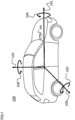
- Figure 1 shows an example of a vehicle 100 (e.g. a car) which is included to define terms used in this disclosure.
- vehicle 100 may include (at least) 4 wheels that are attached to the chassis through a suspension system (not shown).
- three axes x-axis, y-axis and z-axis are illustrated to describe rotations (102, 103, 104)) of the vehicle 100 about respective axes.
- the x-axis 101 of the coordinate frame attached to the vehicle is called the longitudinal direction.
- Longitudinal motion includes the position, velocity, acceleration, jerk, etc. of the chassis in this direction.
- Rotation 104 of the chassis about the x-axis 101 is called roll.
- Roll motion includes the angle, angular velocity, angular acceleration, etc. of the chassis in this direction.
- the y-axis 102 of the coordinate frame attached to the vehicle is called the lateral direction.
- Lateral motion includes the position, velocity, acceleration, jerk, etc. of the chassis in this direction.
- Rotation 105 of the chassis about the y-axis 102 is called pitch.
- Pitch motion includes the angle, angular velocity, angular acceleration, etc. of the chassis in this direction.
- the z-axis 103 of the coordinate frame attached to the vehicle is called the lift direction.
- Lift motion includes the position, velocity, acceleration, jerk, etc. of the chassis in this direction.
- Rotation 106 of the chassis about the z-axis 103 is called yaw.
- Yaw motion includes the angle, angular velocity, angular acceleration, etc. of the chassis in this direction.
- the invention does not eliminate all chassis motion since the purpose of a vehicle is to move the chassis (and its contents) between locations.
- the invention reduces chassis motion due to the road roughness without changing how the vehicle is driven.
- one of the features of the invention is that it maintains the drivability of the vehicle. Drivability means that the vehicle responds to the driver's (human or autonomous) commands in a predictable and repeatable manner. After all, the simplest way to eliminate a bumpy ride is to stop the vehicle, however that would not be a right solution. It is critical that the invention maintains drivability, so that the driver can safely and usefully operate the vehicle.
- the driver controls the motion of the vehicle (and its chassis) in the longitudinal and yaw directions.
- the gas/brake pedals control the longitudinal acceleration (and thus velocity and position) and the steering wheel controls the yaw-rate (and thus yaw direction).
- the invention allocates traction forces to each of the wheels and sets the steering angle to achieve the driver specified acceleration and yaw-rate while reducing the motion of the chassis in the lift, pitch, and roll directions.
- comfort will be synonymous with lift, pitch, and roll motion of the chassis.
- this invention it is possible to reduce lift, pitch, and roll motion of the chassis without sacrificing drivability since this invention is only applicable to vehicles with independently actuated wheels, which provides 3 additional degrees of freedom when maintaining drivability i.e. there are 4 "throttles" instead of 1 for vehicles with independently driven wheels.
- the invention can also reduce the lateral motion of the vehicle which depends tire slippage to reduce wear on the vehicle tires.
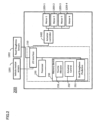
- FIG. 2 shows an actuator control system 200 arranged in the vehicle 100, according to an embodiment of the claimed invention.
- the actuator control system 200 includes an input/output interface (I/O) 210 connected to a vehicle sensor(s) 1201 and road roughness sensor(s) 1302, one or more processor 220, a memory device 230 storing computer(processor)-implemented programs including a road roughness prediction program 231, an actuator control program 232 and a throttle allocator program 233.
- I/O input/output interface
- the interface 210 is configured to form a wired network of the vehicle or a wireless network of the vehicle 100 and perform data communications among the actuator control system 200, the vehicle sensor(s) 1201, the road roughness sensors 1302 and the motors 1-4 of the wheels of the vehicle 100.
- the processor 220 is configured to perform the road roughness prediction program 231, the actuator control program 232 and the throttle allocator program 233 in response to sensor data from the vehicle sensor(s) 1201 and the road roughness sensors 1302 via the interface 210.
- the processor 220 is configured to transmit control data to an actuator controller 1402 via the interface 210 while performing the road roughness prediction program 231, the actuator control program 232 and the throttle allocator program 233 in response to signals (data) from the vehicle sensor(s) 1201 and the road roughness sensor 1302.
- the actuator controller 1402 performs the throttle allocations of the motors 1-4 and the steering control of the vehicle 100 based on the control data with respect to the throttle allocation to each of the motors 1-4 and the steering control from the processor 220.
- the memory device 230 can be one or more memory units, which may include one or combination of a random access memory (RAM), a read-only memory (ROM) and a nonvolatile memory and a hard drive. Further, the system 200 may include the actuator controller 1402 that is configured to receive output data (signals) from the processor 220 via the interface 210, and perform the steering control and the throttle/brake control of each of four motors 1-4 using throttle/brake controllers (torque allocation module) 1203 (1203-1, 1203-2, 1203-3 and 1203-4) of the wheels based on the received output data signals.
- throttle/brake controllers torque allocation module
- the actuator control system 200 allocates the traction forces to each of the wheels and sets the steering angle to reduce the chassis motion due to road roughness while maintaining drivability.
- the road roughness is measured by the road roughness sensors 1302 and these measurements are used to compute the traction forces and steering angle of the vehicle 100.
- the road roughness is unmeasured, but the resulting motion of the chassis is measured using the sensors 1201 (vehicle motion sensors 1201) on the vehicle 100 or external sensors (not shown) arranged on/in the vehicle communicating with the actuator control system 200.
- the motion sensors 1201 are used to compute the traction forces and steering angle of the vehicle 100.
- An embodiment of the claimed invention uses measurements of both the road roughness and chassis motion using the vehicle motion sensors 1201 and the road roughness sensors 1302 to compute the traction forces and steering angle that reduce chassis motion and maintain drivability.
- wheeled vehicles e.g. cars
- each of the actuated wheels is configured to control both the throttle and braking forces produced by each wheel independently each other.
- This invention can also be applied to vehicles with more than 4 independently actuate wheels or groups of independently actuated wheels. Independent actuation can be accomplished for instance by using "hub motors" located in each wheel, however this invention is also applicable when the individual motors are external to the wheel.
- Traditional vehicles have two actuators that are used to drive the vehicle: (1) the throttle/brake and (2) the steering angle of the e.g. front tires. These actuators are used to follow a desired acceleration and yaw-rate specified by the driver, which can be human or an autonomous driving system. For a human driver, the desired acceleration and yaw-rate are specified by the position of the gas/brake pedal and the steering wheel angle. For an autonomous driver, the desired acceleration and yaw-rate are specified by different methods. Note that traditional vehicles have 2 actuators which are used to achieve 2 driving objectives i.e. throttle/brake and steering wheel track the desired acceleration and yaw-rate.
- An embodiments of the invention is based on the realization that vehicles with independently throttled/braked wheels have 3 additional degrees of freedom i.e. 4 throttle/brake and 1 steering angle. It was further realized that these additional degrees of freedom can be used to improve passenger comfort by reducing the lift, pitch, and roll motion of the vehicle chassis.
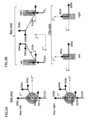
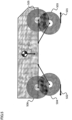
- Figures 3A and 3B show a trailing arm front suspension. It is well known that other suspension designs are dynamically equivalent to the trailing arm suspension, thus for simplicity we will focus on our discussion to this type of suspension even though some embodiments of the invention are applicable to other suspension designs.
- the key feature of the trailing arm suspension is the suspension arm which rotates around a pivot. Thus, the wheel cannot move horizontally (i.e. in the longitudinal or lateral direction) without also moving vertically due to the rotation of the suspension arm.
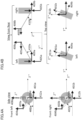
- Figures 3A and 3B show the forces on the front suspension, illustrating a free-body diagram of the front suspension.
- the front suspension exerts 4 types of forces on the vehicle chassis ( a for left forces and b for right forces):
- Longitudinal reaction forces 303a and 303b The left and right tires must produce driving forces 301a and 301b for the vehicle to accelerate/decelerate.
- the suspension transmits these driving forces 301a and 301b to the vehicle chassis, producing in the longitudinal forces 303a and 303b.
- Lateral reaction forces 305a and 305b The left and right tires produce sliding forces 309a and 309b, respectively, when the vehicle to turn i.e. the wheels are gripping the road.
- the suspension transmits these tire-sliding forces 309a and 309b to the chassis, producing the lateral forces 305a and 305b, respectively.
- Spring-damper forces 308a and 308b The deformation of the springs and the movement of the dampers in the suspension produces forces 308a and 308b on the chassis.
- the deformation/movement of the springs/dampers is caused either by the vehicle chassis moving relative to the road or by the road height "moving" relative to the vehicle i.e. the vehicle is driving over a bump.
- the spring-damper forces damp the relative chassis-road motion and restore it to the default position i.e. chassis is flat relative to the road.
- Vertical reaction forces 304a and 304b Since the suspension arms are angled, 310a/b, the longitudinal 303a/b and lateral 305a/b forces produce a torque on the suspension arm. In quasi-steady-state, this torque is balanced by the vertical reaction forces 304a/b. Applying a throttle force to one of the front wheels results in a negative vertical reaction force 304a/b on the suspension. Since Figure 3 shows the front suspension, these vertical reaction forces 304a/b are the anti-lift forces that prevent the front end of the vehicle front lifting during acceleration. Some embodiments of the invention are based on the realization that since these vertical reaction forces 304a/b depend on the actuated driving forces 303a/b, they can be manipulated to control the lift, pitch, and roll motion of the chassis.
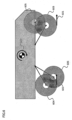
- FIGS 4A and 4B show the free-body diagram of one of the rear suspension assemblies. Similar to the front suspension assembly, we can derive how a throttle force on the rear wheel produces a positive vertical reaction force on the vehicle suspension. This force is called the anti-squat force since it prevents the rear-end of the vehicle from "power squatting" during acceleration.
- This actuator control system 200 may use these anti-lift and anti-squat forces to manipulate the motion of the vehicle chassis.
- Figure 5 shows how the throttle/brake forces to the front and rear wheels can affect the vehicle lift.
- the arrows 501 and 502 represent driving forces produced by the front and rear tire respectively.
- the traction forces 501 and 502 are in opposition direction i.e. the front wheel is throttling and the rear wheel is braking. This causes the wheels to rotate from the default positions 503 and 504, respectively, into the positions 505 and 506, respectively. This causes the chassis 507 to drop (move in negative lift direction) as shown.
- FIG. 6 Another example of the lift and pitch motion in the pitch-plane is shown in Figure 6 .
- the same traction forces 601 and 602 are applied to the front and rear wheels.
- the front wheel rotates forward from the default position 603 to 605 and the rear wheel rotates backwards from the default position 604 to 606. This will cause the chassis 607 to pitch forward as shown.
- the forward pitching is in opposition to the natural backward pitching that the vehicle will undergo when accelerating. This is called an anti-pitch effect.
- M s z ⁇ ⁇ M s g ⁇ ⁇ ij F sji + F zji J
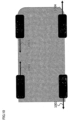
- Figure 8 shows an example of the throttle/braking force allocation that lifts the chassis without any pitch, roll, or yaw motion.
- Both the left and right rear tires have positive (i.e. throttle) forces 801 and 802 causing the rear-end to lift due to the anti-squat force.
- the left and right front tires have negative (i.e. brake) forces 803 and 804 causing the front-end of the vehicle to lift since the resulting anti-lift force is negative.
- This force pattern is similar to Figure 5 .
- the relative magnitude of the forces 801-804 depends on the numerical values of the parameters of the model.
- Figure 9 shows an example of the throttle/braking force allocation that pitches the chassis without any lift, roll, or yaw motion. All the tires have forces 901-904 in the same direction which will cause the vehicle to pitch backward. This force pattern is similar to Figure 6 . The relative magnitude of the forces 901-904 depends on the numerical values of the parameters of the model.
- Figure 10 shows an example of the throttle/braking force allocation that rolls the chassis without any lift, pitch, or yaw motion.
- the tires on the right-side of the vehicle produce forces 1002 and 1004 with the same pattern as Figure 5 , causing the right-side of the vehicle to drop (i.e. move in negative lift direction).
- the tires on the left-side of the vehicle produce forces 1001 and 1003 in the opposite pattern as Figure 5 , causing the left-side of the vehicle to lift.
- the net-result is that the center-of-mass of the vehicle remains stationary while the vehicle rolls.
- the relative magnitude of the forces 1001-1004 depends on the numerical values of the parameters of the model.
- Figure 11 shows an example of the throttle/braking force allocation that yaws the vehicle without any lift, pitch, or roll, motion.
- This force allocation is more complicated since yawing/turning the vehicle will create a centripetal force that will cause it to roll.
- This roll motion must then be compensated.
- the forces 1101-1104 cause a yaw motion by applied differential forces to the left and right side of the vehicle i.e. the on the left-side the forces 1101 and 1103 are positive while on the right-side the forces 1102 and 1104 are negative.
- the resulting yaw motion causes the vehicle to roll.
- this roll motion can be canceled.
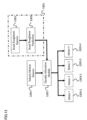
- the system 200 may include 3 modules that work together to improve passenger comfort; a sensor module 1201 that measures (or estimates) the motion of the chassis, a torque allocation module 1203 that computes the desired allocation of driving forces using model (1), and (at least) 4 throttle/brake controllers (torque allocation module) 1203 that implement the desired traction forces for each wheel.
- the sensor module 1201 can include (but is not limited to) an inertia measurement using, a gravity sensor, accelerometers, a global positioning system, etc.
- the throttle allocation (torque allocation) module 1202 computes the throttle/brake set-points for the motor/brake controllers based on measurements of the chassis motion and knowledge of how throttle/braking forces effect chassis motion (i.e. model (1)).
- the torque allocation module could consist of a digital computer processor that executes an optimization algorithm that computes the throttle/brake allocation that minimizes chassis motion in real-time.
- the torque allocation module 1202 could consist of an analog circuit that implements the gains of an H ⁇ state-feedback controller (designed using (1)) which minimizes the integrated RMS response of the chassis motion to the integrated RMS roughness of the road.
- the actuator control system 200 may include an additional module 1301 that predicts the future effects of road roughness on the chassis motion.
- the module 1301 includes 2 sub-modules; a sensor sub-module 1302 and a predictor sub-module 1303.
- the sensor sub-module 1302 senses the road ahead of the vehicle.
- the sub-module 1302 could consist of, for instance, a camera, or radar, or LiDAR (Light Detection and Ranging), or sonar that measures the road surface ahead of the vehicles.
- the predictor sub-module 1303 predicts when these road bumps will reach each of the tire of the vehicle and the effect they will have on the vehicle.
- the predictor sub-module 1303 could consist of a simple model that uses the current velocity of the vehicle and the distance to the bump to determine when a bump will pass beneath each tire.
- the torque allocation module 1202 can be modified to use this predictive information to further improve passenger comfort. For instance, if the torque allocation module includes a computer processor executing an optimization algorithm then the predicted road roughness can be included in the optimization problem to ameliorate the bump.
- Figure 7 shows 4 snapshots of a vehicle encountering a bump 701 on the road.
- the vehicle In the first snap-shot, the vehicle is approaching the bump 701.
- the actuator control system 200 applies throttle 702 to the front-tires to cause them to lift 703 over the bump 701.
- the actuator control system 200 stops the throttle causing the front wheel to return to ground height 704 after it has passed over the bump 701.
- the actuator control system 200 applies a braking force 705 to the rear-tires to lift the tires 706 over the bump 701. Finally, the braking force is released allowing the rear-tires to return to their original position 707 after passing over the bump 701.
- Figure 14 shows how the actuator control system 200 may be modified by the control/software stack of a vehicle.
- the current stack may include 2 layers; the driver 1401 (human or autonomous) and the low-level actuators controller 1402.
- the driver 1401 human or autonomous
- the driver 1401 indicates a desired acceleration/deceleration and turning/yaw-rate using the gas/brake pedals and steering wheel
- the actuators controllers 1402 implement these desired behaviors.
- low-level actuator controllers 1402 may be simple feed-through i.e. the driver is directly controlling the throttle via a cable, the brakes via a pneumatic cylinder, and the steering angle via a mechanical linkage.
- the low-level actuator controllers are often more intelligent.
- the actuator control system 200 according to the invention is compatible with any type of low-level actuator controller.
- the actuator control system 200 may add a new controller layer 1403 between the driver and the actuator controllers.
- the new controller layer 1403 is the torque allocation module which determines the set-points of each of actuators to both maintain the driving characteristics that the driver expects (i.e. desired acceleration and yaw/turning are achieved) while improving passenger comfort.
- the torque allocation module uses the additional degrees of freedom to improve passenger comfort.
- the various methods or processes outlined herein may be coded as software that is executable on one or more processors that employ any one of a variety of operating systems or platforms. Additionally, such software may be written using any of a number of suitable programming languages and/or programming or scripting tools, and also may be compiled as executable machine language code or intermediate code that is executed on a framework or virtual machine. Typically, the functionality of the program modules may be combined or distributed as desired in various embodiments.
- embodiments of the present disclosure may be embodied as a method, of which an example has been provided.
- the acts performed as part of the method may be ordered in any suitable way. Accordingly, embodiments may be constructed in which acts are performed in an order different than illustrated, which may include performing some acts concurrently, even though shown as sequential acts in illustrative embodiments.
- use of ordinal terms such as first, second, in the claims to modify a claim element does not by itself connote any priority, precedence, or order of one claim element over another or the temporal order in which acts of a method are performed, but are used merely as labels to distinguish one claim element having a certain name from another element having a same name (but for use of the ordinal term) to distinguish the claim elements.
Landscapes
- Engineering & Computer Science (AREA)
- Mechanical Engineering (AREA)
- Automation & Control Theory (AREA)
- Vehicle Body Suspensions (AREA)
- Control Of Driving Devices And Active Controlling Of Vehicle (AREA)
Claims (2)
- Fahrzeug (100), umfassend ein Steuersystem (200) zum Steuern von Bewegungen des Fahrzeugs (100), wobei das Fahrzeug (100) Räder aufweist und das Steuersystem (200) umfasst:Aufhängungseinheiten, die eingerichtet sind, die Räder zu stützen, die jeweils von Motoren angetrieben werden, die durch Drosselklappen gesteuert werden;einen Satz von Sensoren (1201), die eingerichtet sind, die Bewegungen des Fahrzeugs (100) zu detektieren;einen Fahrbahnrauhigkeitssensor (1302);eine Eingabe-/Ausgabeschnittstelle, I/O, (210), die verbunden ist mit: dem Satz von Sensoren (1201) und dem Fahrbahnrauhigkeitssensor (1302),einen oder mehrere Prozessoren (220),eine Speichervorrichtung (230), die computerimplementierte Programme speichert, einschließlich eines Fahrbahnrauhigkeits-Vorhersageprogramms (231), eines Aktuatorsteuerprogramms (232) und eines Drosselzuordnungsprogramms (233),ein Zuordnungsmodul (1202), das durch die Ausführung des Drosselzuordnungsprogramms (233) durch den einen oder mehrere Prozessoren (220) implementiert ist und in Verbindung mit den Sensoren (1201) eingerichtet ist, zugeordnete Drosselsignale zu erzeugen und an die Drosselklappen zu übertragen, um die Bewegung durch Lösen eines Optimierungsproblems in Bezug auf die Bewegung zu minimieren, indem ein Optimierungsalgorithmus ausgeführt wird, der eine Drossel-/Bremszuordnung berechnet, die die Fahrgestellbewegung in Echtzeit minimiert; undeine Motorsteuereinheit, die eingerichtet ist, jeden der Motoren (1203-1, 1203-2, 1203-3, 1203-4) über die Drosselklappen entsprechend den zugeordneten Drosselsignalen anzusteuern,wobei die Bewegungen durch Hubwerte (106), Nickwerte (105) und Rollwerte (101) des Fahrzeugs (100) repräsentiert werden, und die zugeordneten Drosselsignale die Motoren (1203-1, 1203-2, 1203-3, 1203-4) ansteuern, um die Räder (1101, 1103) auf der rechten Seite näher zusammen und die Räder (1102, 1104) auf der linken Seite weiter auseinander zu bewegen, um eine Rollbewegung in Reaktion auf eine erfasste Rollbewegung in der entgegengesetzten Richtung zu erzeugen;wobei eine vom Fahrbahnrauhigkeitssensor (1302) gemessene Fahrbahnrauhigkeit zur Berechnung von den Rädern zuzuordnenden Traktionskräften und eines einzustellenden Lenkwinkels des Fahrzeugs (100) verwendet wird, um die Fahrgestellbewegung aufgrund der Fahrbahnrauhigkeit zu verringern und gleichzeitig die Fahrbarkeit aufrechtzuerhalten.
- Verfahren zum Steuern von Bewegungen eines Fahrzeugs (100) mit Rädern und Aufhängungseinheiten, die eingerichtet sind, die Räder (1101, 1102, 1103, 1104) zu stützen, umfassend:Antreiben der Räder (1101, 1102, 1103, 1104) durch Motoren, die durch Drosselklappen gesteuert werden;Messen der Bewegungen des Fahrzeugs (100) mit einem Satz von Sensoren (1201);Berechnen und Übertragen zugeordneter Drosselsignale an die Drosselklappen, um die Bewegung zu minimieren, indem ein auf die Bewegung bezogenes Optimierungsproblem gelöst wird, indem ein Optimierungsalgorithmus ausgeführt wird, der eine Drossel-/Bremszuordnung berechnet, die die Fahrgestellbewegung in Echtzeit minimiert, gekennzeichnet durchAnsteuern jedes der Motoren über die Drosselklappen gemäß den zugeordneten Drosselsignalen, wobei die zugeordneten Drosselsignale die Motoren ansteuern, um die Räder (1101, 1103) auf der rechten Seite näher zusammen und die Räder (1102, 1104) auf der linken Seite weiter auseinander zu bewegen, um eine Rollbewegung als Reaktion auf eine erfasste Rollbewegung in der entgegengesetzten Richtung zu erzeugen, wobei die Bewegungen durch Hubwerte (106), Nickwerte (105) und Rollwerte (101) des Fahrzeugs (100) dargestellt werden,Verwenden einer von einem Fahrbahnrauhigkeitssensor (1302) gemessenen Fahrbahnrauhigkeit, um Traktionskräfte und einen Lenkwinkel des Fahrzeugs (100) zu berechnen, undZuordnen der berechneten Traktionskräfte zu den Rädern und Einstellung des berechneten Lenkwinkels, um die Fahrwerksbewegungen aufgrund von Fahrbahnunebenheiten zu verringern und gleichzeitig die Fahrbarkeit zu erhalten.
Applications Claiming Priority (2)
| Application Number | Priority Date | Filing Date | Title |
|---|---|---|---|
| US16/816,551 US20210283969A1 (en) | 2020-03-12 | 2020-03-12 | Method and System for Achieving Active Suspension using Independently Actuated Wheels |
| PCT/JP2021/001389 WO2021181871A1 (en) | 2020-03-12 | 2021-01-08 | Method and system for achieving active suspension using independently actuated wheels |
Publications (2)
| Publication Number | Publication Date |
|---|---|
| EP4117940A1 EP4117940A1 (de) | 2023-01-18 |
| EP4117940B1 true EP4117940B1 (de) | 2025-04-16 |
Family
ID=74797994
Family Applications (1)
| Application Number | Title | Priority Date | Filing Date |
|---|---|---|---|
| EP21708770.9A Active EP4117940B1 (de) | 2020-03-12 | 2021-01-08 | Verfahren und fahrzeug zur steuerung der bewegungen des fahrzeugs |
Country Status (5)
| Country | Link |
|---|---|
| US (1) | US20210283969A1 (de) |
| EP (1) | EP4117940B1 (de) |
| JP (1) | JP2023513853A (de) |
| CN (1) | CN115243907B (de) |
| WO (1) | WO2021181871A1 (de) |
Families Citing this family (21)
| Publication number | Priority date | Publication date | Assignee | Title |
|---|---|---|---|---|
| US12454295B2 (en) * | 2018-08-08 | 2025-10-28 | Transportation Ip Holdings, Llc | Vehicle control system |
| US11485393B2 (en) * | 2018-08-08 | 2022-11-01 | Transportation Ip Holdings, Llc | Vehicle control system |
| JP7318544B2 (ja) * | 2020-01-24 | 2023-08-01 | 株式会社アドヴィックス | 車両の制動制御装置 |
| US12434524B2 (en) * | 2021-01-27 | 2025-10-07 | Hitachi Astemo, Ltd. | Slip state detection apparatus and suspension control apparatus |
| JP7223798B2 (ja) * | 2021-03-25 | 2023-02-16 | 本田技研工業株式会社 | アクティブサスペンション装置、及びサスペンションの制御装置 |
| JP7214776B2 (ja) * | 2021-03-25 | 2023-01-30 | 本田技研工業株式会社 | アクティブサスペンション装置、及びサスペンションの制御装置 |
| JP7538957B2 (ja) * | 2021-06-04 | 2024-08-22 | 日立Astemo株式会社 | 車両制御装置、車両制御方法、及び車両制御システム |
| DE102021125332B3 (de) * | 2021-09-30 | 2023-04-20 | Schaeffler Technologies AG & Co. KG | Antriebs- und Bremssystem für ein Kraftfahrzeug |
| US11938772B2 (en) | 2021-10-12 | 2024-03-26 | DRiV Automotive Inc. | System for grading filling of a hydraulic suspension system |
| US11865887B2 (en) | 2021-10-12 | 2024-01-09 | DRiV Automotive Inc. | Suspension system with incremental roll and pitch stiffness control |
| US11904841B2 (en) | 2021-10-12 | 2024-02-20 | DRiV Automotive Inc. | Suspension system integration with advanced driver assistance system |
| US11865889B2 (en) | 2021-10-12 | 2024-01-09 | DRiV Automotive Inc. | Suspension system with comfort valves between cross-over hydraulic circuits |
| US11919355B2 (en) | 2021-10-12 | 2024-03-05 | DRiV Automotive Inc. | Valve diagnostic systems and methods |
| US12059937B2 (en) * | 2021-10-12 | 2024-08-13 | DRiV Automotive Inc. | Suspension system with roll and pitch stiffness deactivation based on road profile information |
| US12168378B2 (en) | 2021-10-12 | 2024-12-17 | DRiV Automotive Inc. | Accumulator check systems and methods |
| US11912092B2 (en) | 2021-10-12 | 2024-02-27 | DRiV Automotive Inc. | Suspension leak check systems and methods |
| US12097739B2 (en) | 2021-10-12 | 2024-09-24 | DRiV Automotive Inc. | Pump rinsing systems and methods |
| JP2023068985A (ja) * | 2021-11-04 | 2023-05-18 | ヤマハ発動機株式会社 | 車両 |
| JP7813588B2 (ja) * | 2022-01-26 | 2026-02-13 | Astemo株式会社 | 車両統合制御装置、車両統合制御方法 |
| AT526404B1 (de) * | 2022-07-26 | 2024-09-15 | E More Ag | Fahrzeug |
| US12479418B2 (en) * | 2023-12-22 | 2025-11-25 | GM Global Technology Operations LLC | Vehicle wheel force control systems |
Citations (3)
| Publication number | Priority date | Publication date | Assignee | Title |
|---|---|---|---|---|
| US20080073138A1 (en) * | 2006-09-22 | 2008-03-27 | Nissan Motor Co., Ltd. | Variable wheel positioning vehicle |
| WO2012173354A2 (ko) * | 2011-06-14 | 2012-12-20 | 주식회사 유디엠텍 | 인휠 모터 구동 전기자동차의 롤 운동 제어장치 |
| US20140309902A1 (en) * | 2011-11-10 | 2014-10-16 | Toyota Jidosha Kabushiki Kaisha | Vehicle behavior control apparatus |
Family Cites Families (11)
| Publication number | Priority date | Publication date | Assignee | Title |
|---|---|---|---|---|
| US5497325A (en) * | 1992-08-31 | 1996-03-05 | Fuji Jukogyo Kabushiki Kaisha | Suspension control system for a vehicle |
| JPH06122309A (ja) * | 1992-10-12 | 1994-05-06 | Mazda Motor Corp | 車両のサスペンション装置 |
| JP4321339B2 (ja) * | 2004-04-21 | 2009-08-26 | トヨタ自動車株式会社 | 車両駆動力制御装置 |
| JP4471103B2 (ja) * | 2004-10-07 | 2010-06-02 | トヨタ自動車株式会社 | 車両の制駆動力制御装置 |
| JP5024016B2 (ja) * | 2007-12-12 | 2012-09-12 | トヨタ自動車株式会社 | 車両用走行制御装置 |
| EP2612782B1 (de) * | 2010-08-31 | 2018-09-19 | Toyota Jidosha Kabushiki Kaisha | Brems-antriebskraftsteuervorrichtung für ein fahrzeug |
| JP6330671B2 (ja) * | 2015-01-15 | 2018-05-30 | トヨタ自動車株式会社 | 車両の制御装置 |
| US10507825B2 (en) * | 2016-11-08 | 2019-12-17 | Ford Global Technologies, Llc | Vehicle pitch control during a stop |
| JP6589943B2 (ja) * | 2017-06-29 | 2019-10-16 | トヨタ自動車株式会社 | 車両走行制御システム |
| DE102017116733A1 (de) * | 2017-07-25 | 2019-01-31 | Schaeffler Technologies AG & Co. KG | Kontrolleinrichtung für mindestens einen Radnabenmotor sowie Fahrzeug mit der Kontrolleinrichtung |
| CN108327714B (zh) * | 2018-02-02 | 2019-12-20 | 清华大学 | 具有主动姿态调节能力的分布式独立驱动车辆控制系统 |
-
2020
- 2020-03-12 US US16/816,551 patent/US20210283969A1/en not_active Abandoned
-
2021
- 2021-01-08 CN CN202180019935.2A patent/CN115243907B/zh active Active
- 2021-01-08 WO PCT/JP2021/001389 patent/WO2021181871A1/en not_active Ceased
- 2021-01-08 JP JP2022575021A patent/JP2023513853A/ja active Pending
- 2021-01-08 EP EP21708770.9A patent/EP4117940B1/de active Active
Patent Citations (3)
| Publication number | Priority date | Publication date | Assignee | Title |
|---|---|---|---|---|
| US20080073138A1 (en) * | 2006-09-22 | 2008-03-27 | Nissan Motor Co., Ltd. | Variable wheel positioning vehicle |
| WO2012173354A2 (ko) * | 2011-06-14 | 2012-12-20 | 주식회사 유디엠텍 | 인휠 모터 구동 전기자동차의 롤 운동 제어장치 |
| US20140309902A1 (en) * | 2011-11-10 | 2014-10-16 | Toyota Jidosha Kabushiki Kaisha | Vehicle behavior control apparatus |
Also Published As
| Publication number | Publication date |
|---|---|
| CN115243907A (zh) | 2022-10-25 |
| US20210283969A1 (en) | 2021-09-16 |
| EP4117940A1 (de) | 2023-01-18 |
| WO2021181871A1 (en) | 2021-09-16 |
| CN115243907B (zh) | 2025-10-28 |
| JP2023513853A (ja) | 2023-04-03 |
Similar Documents
| Publication | Publication Date | Title |
|---|---|---|
| EP4117940B1 (de) | Verfahren und fahrzeug zur steuerung der bewegungen des fahrzeugs | |
| US11679775B2 (en) | Vehicle control apparatus | |
| US9199639B2 (en) | Motion control system of vehicle | |
| Wang et al. | Coordinated vehicle dynamics control with control distribution | |
| EP1369287B1 (de) | Verfahren und Vorrichtung zum Steuern eines Kraftfahrzeugs | |
| CN101005981B (zh) | 车辆的控制装置 | |
| US20210213935A1 (en) | Safety and Stability Control Method against Vehicle Tire Burst | |
| Schofield et al. | Vehicle dynamics control and controller allocation for rollover prevention | |
| US20180236989A1 (en) | Stability control system and method for four-wheel drive electric vehicle, and electric vehicle | |
| US20030205867A1 (en) | Suspension coordinator subsystem and method | |
| CN113212413A (zh) | 集成式底盘域协调控制系统及车辆 | |
| CN114987537B (zh) | 基于神经网络动力学的自动驾驶车辆道路自适应漂移控制系统与方法 | |
| JP7724976B2 (ja) | 車両のモーションを制御するためのシステムおよび方法 | |
| US11738760B2 (en) | Vehicle control apparatus | |
| CN113359457A (zh) | 智能车底盘域控制器的高维动力学模型解算装置及方法 | |
| CN106347361B (zh) | 一种冗余驱动车辆动力学控制分配方法 | |
| Ali et al. | Lateral acceleration potential field function control for rollover safety of multi-wheel military vehicle with in-wheel-motors | |
| CN119142367A (zh) | 一种智能线控底盘综合控制平台 | |
| CN112987574A (zh) | 一种基于多智能体的云控智能底盘系统及控制方法 | |
| US20240149889A1 (en) | System | |
| JP7687869B2 (ja) | 車両統合制御装置及び車両統合制御方法 | |
| Zhou et al. | Vehicle stabilisation in response to exogenous impulsive disturbances to the vehicle body | |
| CN119239573A (zh) | 爆胎车辆稳定性控制方法、系统、装置、车辆、设备及介质 | |
| Itakura | Vehicle Motion Control with Jerk Constraint by Nonlinear Model Predictive Control | |
| JP2024139136A (ja) | 車両挙動制御装置 |
Legal Events
| Date | Code | Title | Description |
|---|---|---|---|
| STAA | Information on the status of an ep patent application or granted ep patent |
Free format text: STATUS: UNKNOWN |
|
| STAA | Information on the status of an ep patent application or granted ep patent |
Free format text: STATUS: THE INTERNATIONAL PUBLICATION HAS BEEN MADE |
|
| PUAI | Public reference made under article 153(3) epc to a published international application that has entered the european phase |
Free format text: ORIGINAL CODE: 0009012 |
|
| STAA | Information on the status of an ep patent application or granted ep patent |
Free format text: STATUS: REQUEST FOR EXAMINATION WAS MADE |
|
| 17P | Request for examination filed |
Effective date: 20220905 |
|
| AK | Designated contracting states |
Kind code of ref document: A1 Designated state(s): AL AT BE BG CH CY CZ DE DK EE ES FI FR GB GR HR HU IE IS IT LI LT LU LV MC MK MT NL NO PL PT RO RS SE SI SK SM TR |
|
| DAV | Request for validation of the european patent (deleted) | ||
| DAX | Request for extension of the european patent (deleted) | ||
| STAA | Information on the status of an ep patent application or granted ep patent |
Free format text: STATUS: EXAMINATION IS IN PROGRESS |
|
| 17Q | First examination report despatched |
Effective date: 20230629 |
|
| GRAP | Despatch of communication of intention to grant a patent |
Free format text: ORIGINAL CODE: EPIDOSNIGR1 |
|
| STAA | Information on the status of an ep patent application or granted ep patent |
Free format text: STATUS: GRANT OF PATENT IS INTENDED |
|
| INTG | Intention to grant announced |
Effective date: 20241220 |
|
| GRAS | Grant fee paid |
Free format text: ORIGINAL CODE: EPIDOSNIGR3 |
|
| GRAA | (expected) grant |
Free format text: ORIGINAL CODE: 0009210 |
|
| STAA | Information on the status of an ep patent application or granted ep patent |
Free format text: STATUS: THE PATENT HAS BEEN GRANTED |
|
| AK | Designated contracting states |
Kind code of ref document: B1 Designated state(s): AL AT BE BG CH CY CZ DE DK EE ES FI FR GB GR HR HU IE IS IT LI LT LU LV MC MK MT NL NO PL PT RO RS SE SI SK SM TR |
|
| REG | Reference to a national code |
Ref country code: GB Ref legal event code: FG4D |
|
| REG | Reference to a national code |
Ref country code: CH Ref legal event code: EP |
|
| REG | Reference to a national code |
Ref country code: IE Ref legal event code: FG4D |
|
| REG | Reference to a national code |
Ref country code: DE Ref legal event code: R096 Ref document number: 602021029205 Country of ref document: DE |
|
| REG | Reference to a national code |
Ref country code: NL Ref legal event code: MP Effective date: 20250416 |
|
| PG25 | Lapsed in a contracting state [announced via postgrant information from national office to epo] |
Ref country code: NL Free format text: LAPSE BECAUSE OF FAILURE TO SUBMIT A TRANSLATION OF THE DESCRIPTION OR TO PAY THE FEE WITHIN THE PRESCRIBED TIME-LIMIT Effective date: 20250416 |
|
| REG | Reference to a national code |
Ref country code: AT Ref legal event code: MK05 Ref document number: 1785369 Country of ref document: AT Kind code of ref document: T Effective date: 20250416 |
|
| PG25 | Lapsed in a contracting state [announced via postgrant information from national office to epo] |
Ref country code: FI Free format text: LAPSE BECAUSE OF FAILURE TO SUBMIT A TRANSLATION OF THE DESCRIPTION OR TO PAY THE FEE WITHIN THE PRESCRIBED TIME-LIMIT Effective date: 20250416 Ref country code: ES Free format text: LAPSE BECAUSE OF FAILURE TO SUBMIT A TRANSLATION OF THE DESCRIPTION OR TO PAY THE FEE WITHIN THE PRESCRIBED TIME-LIMIT Effective date: 20250416 Ref country code: PT Free format text: LAPSE BECAUSE OF FAILURE TO SUBMIT A TRANSLATION OF THE DESCRIPTION OR TO PAY THE FEE WITHIN THE PRESCRIBED TIME-LIMIT Effective date: 20250818 |
|
| REG | Reference to a national code |
Ref country code: LT Ref legal event code: MG9D |
|
| PG25 | Lapsed in a contracting state [announced via postgrant information from national office to epo] |
Ref country code: NO Free format text: LAPSE BECAUSE OF FAILURE TO SUBMIT A TRANSLATION OF THE DESCRIPTION OR TO PAY THE FEE WITHIN THE PRESCRIBED TIME-LIMIT Effective date: 20250716 Ref country code: GR Free format text: LAPSE BECAUSE OF FAILURE TO SUBMIT A TRANSLATION OF THE DESCRIPTION OR TO PAY THE FEE WITHIN THE PRESCRIBED TIME-LIMIT Effective date: 20250717 |
|
| PG25 | Lapsed in a contracting state [announced via postgrant information from national office to epo] |
Ref country code: PL Free format text: LAPSE BECAUSE OF FAILURE TO SUBMIT A TRANSLATION OF THE DESCRIPTION OR TO PAY THE FEE WITHIN THE PRESCRIBED TIME-LIMIT Effective date: 20250416 |
|
| PG25 | Lapsed in a contracting state [announced via postgrant information from national office to epo] |
Ref country code: BG Free format text: LAPSE BECAUSE OF FAILURE TO SUBMIT A TRANSLATION OF THE DESCRIPTION OR TO PAY THE FEE WITHIN THE PRESCRIBED TIME-LIMIT Effective date: 20250416 |
|
| PG25 | Lapsed in a contracting state [announced via postgrant information from national office to epo] |
Ref country code: HR Free format text: LAPSE BECAUSE OF FAILURE TO SUBMIT A TRANSLATION OF THE DESCRIPTION OR TO PAY THE FEE WITHIN THE PRESCRIBED TIME-LIMIT Effective date: 20250416 |
|
| PG25 | Lapsed in a contracting state [announced via postgrant information from national office to epo] |
Ref country code: AT Free format text: LAPSE BECAUSE OF FAILURE TO SUBMIT A TRANSLATION OF THE DESCRIPTION OR TO PAY THE FEE WITHIN THE PRESCRIBED TIME-LIMIT Effective date: 20250416 |
|
| PG25 | Lapsed in a contracting state [announced via postgrant information from national office to epo] |
Ref country code: RS Free format text: LAPSE BECAUSE OF FAILURE TO SUBMIT A TRANSLATION OF THE DESCRIPTION OR TO PAY THE FEE WITHIN THE PRESCRIBED TIME-LIMIT Effective date: 20250716 |
|
| PG25 | Lapsed in a contracting state [announced via postgrant information from national office to epo] |
Ref country code: IS Free format text: LAPSE BECAUSE OF FAILURE TO SUBMIT A TRANSLATION OF THE DESCRIPTION OR TO PAY THE FEE WITHIN THE PRESCRIBED TIME-LIMIT Effective date: 20250816 |
|
| PG25 | Lapsed in a contracting state [announced via postgrant information from national office to epo] |
Ref country code: LV Free format text: LAPSE BECAUSE OF FAILURE TO SUBMIT A TRANSLATION OF THE DESCRIPTION OR TO PAY THE FEE WITHIN THE PRESCRIBED TIME-LIMIT Effective date: 20250416 |
|
| PG25 | Lapsed in a contracting state [announced via postgrant information from national office to epo] |
Ref country code: DK Free format text: LAPSE BECAUSE OF FAILURE TO SUBMIT A TRANSLATION OF THE DESCRIPTION OR TO PAY THE FEE WITHIN THE PRESCRIBED TIME-LIMIT Effective date: 20250416 Ref country code: SM Free format text: LAPSE BECAUSE OF FAILURE TO SUBMIT A TRANSLATION OF THE DESCRIPTION OR TO PAY THE FEE WITHIN THE PRESCRIBED TIME-LIMIT Effective date: 20250416 |
|
| REG | Reference to a national code |
Ref country code: DE Ref legal event code: R097 Ref document number: 602021029205 Country of ref document: DE |
|
| PG25 | Lapsed in a contracting state [announced via postgrant information from national office to epo] |
Ref country code: CZ Free format text: LAPSE BECAUSE OF FAILURE TO SUBMIT A TRANSLATION OF THE DESCRIPTION OR TO PAY THE FEE WITHIN THE PRESCRIBED TIME-LIMIT Effective date: 20250416 |
|
| PG25 | Lapsed in a contracting state [announced via postgrant information from national office to epo] |
Ref country code: EE Free format text: LAPSE BECAUSE OF FAILURE TO SUBMIT A TRANSLATION OF THE DESCRIPTION OR TO PAY THE FEE WITHIN THE PRESCRIBED TIME-LIMIT Effective date: 20250416 |
|
| PG25 | Lapsed in a contracting state [announced via postgrant information from national office to epo] |
Ref country code: SK Free format text: LAPSE BECAUSE OF FAILURE TO SUBMIT A TRANSLATION OF THE DESCRIPTION OR TO PAY THE FEE WITHIN THE PRESCRIBED TIME-LIMIT Effective date: 20250416 |
|
| PG25 | Lapsed in a contracting state [announced via postgrant information from national office to epo] |
Ref country code: IT Free format text: LAPSE BECAUSE OF FAILURE TO SUBMIT A TRANSLATION OF THE DESCRIPTION OR TO PAY THE FEE WITHIN THE PRESCRIBED TIME-LIMIT Effective date: 20250416 |
|
| PLBE | No opposition filed within time limit |
Free format text: ORIGINAL CODE: 0009261 |
|
| STAA | Information on the status of an ep patent application or granted ep patent |
Free format text: STATUS: NO OPPOSITION FILED WITHIN TIME LIMIT |
|
| REG | Reference to a national code |
Ref country code: CH Ref legal event code: L10 Free format text: ST27 STATUS EVENT CODE: U-0-0-L10-L00 (AS PROVIDED BY THE NATIONAL OFFICE) Effective date: 20260225 |
|
| 26N | No opposition filed |
Effective date: 20260119 |
|
| PGFP | Annual fee paid to national office [announced via postgrant information from national office to epo] |
Ref country code: DE Payment date: 20251203 Year of fee payment: 6 |