EP4117259B1 - Drehmechanismus, stützvorrichtung und elektronische vorrichtung - Google Patents
Drehmechanismus, stützvorrichtung und elektronische vorrichtung Download PDFInfo
- Publication number
- EP4117259B1 EP4117259B1 EP22764990.2A EP22764990A EP4117259B1 EP 4117259 B1 EP4117259 B1 EP 4117259B1 EP 22764990 A EP22764990 A EP 22764990A EP 4117259 B1 EP4117259 B1 EP 4117259B1
- Authority
- EP
- European Patent Office
- Prior art keywords
- lamination surface
- sliding slot
- door panel
- guide sliding
- connector
- Prior art date
- Legal status (The legal status is an assumption and is not a legal conclusion. Google has not performed a legal analysis and makes no representation as to the accuracy of the status listed.)
- Active
Links
Images







Classifications
-
- H—ELECTRICITY
- H04—ELECTRIC COMMUNICATION TECHNIQUE
- H04M—TELEPHONIC COMMUNICATION
- H04M1/00—Substation equipment, e.g. for use by subscribers
- H04M1/02—Constructional features of telephone sets
- H04M1/0202—Portable telephone sets, e.g. cordless phones, mobile phones or bar type handsets
- H04M1/0206—Portable telephones comprising a plurality of mechanically joined movable body parts, e.g. hinged housings
- H04M1/0208—Portable telephones comprising a plurality of mechanically joined movable body parts, e.g. hinged housings characterized by the relative motions of the body parts
- H04M1/0214—Foldable telephones, i.e. with body parts pivoting to an open position around an axis parallel to the plane they define in closed position
- H04M1/0216—Foldable in one direction, i.e. using a one degree of freedom hinge
-
- G—PHYSICS
- G06—COMPUTING OR CALCULATING; COUNTING
- G06F—ELECTRIC DIGITAL DATA PROCESSING
- G06F1/00—Details not covered by groups G06F3/00 - G06F13/00 and G06F21/00
- G06F1/16—Constructional details or arrangements
- G06F1/1613—Constructional details or arrangements for portable computers
- G06F1/1633—Constructional details or arrangements of portable computers not specific to the type of enclosures covered by groups G06F1/1615 - G06F1/1626
- G06F1/1637—Details related to the display arrangement, including those related to the mounting of the display in the housing
- G06F1/1652—Details related to the display arrangement, including those related to the mounting of the display in the housing the display being flexible, e.g. mimicking a sheet of paper, or rollable
-
- G—PHYSICS
- G06—COMPUTING OR CALCULATING; COUNTING
- G06F—ELECTRIC DIGITAL DATA PROCESSING
- G06F1/00—Details not covered by groups G06F3/00 - G06F13/00 and G06F21/00
- G06F1/16—Constructional details or arrangements
- G06F1/1613—Constructional details or arrangements for portable computers
- G06F1/1633—Constructional details or arrangements of portable computers not specific to the type of enclosures covered by groups G06F1/1615 - G06F1/1626
- G06F1/1675—Miscellaneous details related to the relative movement between the different enclosures or enclosure parts
- G06F1/1681—Details related solely to hinges
-
- H—ELECTRICITY
- H04—ELECTRIC COMMUNICATION TECHNIQUE
- H04M—TELEPHONIC COMMUNICATION
- H04M1/00—Substation equipment, e.g. for use by subscribers
- H04M1/02—Constructional features of telephone sets
- H04M1/0202—Portable telephone sets, e.g. cordless phones, mobile phones or bar type handsets
- H04M1/0206—Portable telephones comprising a plurality of mechanically joined movable body parts, e.g. hinged housings
- H04M1/0208—Portable telephones comprising a plurality of mechanically joined movable body parts, e.g. hinged housings characterized by the relative motions of the body parts
- H04M1/0214—Foldable telephones, i.e. with body parts pivoting to an open position around an axis parallel to the plane they define in closed position
- H04M1/0216—Foldable in one direction, i.e. using a one degree of freedom hinge
- H04M1/022—The hinge comprising two parallel pivoting axes
-
- H—ELECTRICITY
- H04—ELECTRIC COMMUNICATION TECHNIQUE
- H04M—TELEPHONIC COMMUNICATION
- H04M1/00—Substation equipment, e.g. for use by subscribers
- H04M1/02—Constructional features of telephone sets
- H04M1/0202—Portable telephone sets, e.g. cordless phones, mobile phones or bar type handsets
- H04M1/026—Details of the structure or mounting of specific components
- H04M1/0266—Details of the structure or mounting of specific components for a display module assembly
- H04M1/0268—Details of the structure or mounting of specific components for a display module assembly including a flexible display panel
-
- G—PHYSICS
- G06—COMPUTING OR CALCULATING; COUNTING
- G06F—ELECTRIC DIGITAL DATA PROCESSING
- G06F1/00—Details not covered by groups G06F3/00 - G06F13/00 and G06F21/00
- G06F1/16—Constructional details or arrangements
- G06F1/1613—Constructional details or arrangements for portable computers
- G06F1/1633—Constructional details or arrangements of portable computers not specific to the type of enclosures covered by groups G06F1/1615 - G06F1/1626
- G06F1/1637—Details related to the display arrangement, including those related to the mounting of the display in the housing
- G06F1/1641—Details related to the display arrangement, including those related to the mounting of the display in the housing the display being formed by a plurality of foldable display components
-
- H—ELECTRICITY
- H05—ELECTRIC TECHNIQUES NOT OTHERWISE PROVIDED FOR
- H05K—PRINTED CIRCUITS; CASINGS OR CONSTRUCTIONAL DETAILS OF ELECTRIC APPARATUS; MANUFACTURE OF ASSEMBLAGES OF ELECTRICAL COMPONENTS
- H05K5/00—Casings, cabinets or drawers for electric apparatus
- H05K5/02—Details
- H05K5/0217—Mechanical details of casings
- H05K5/0226—Hinges
Definitions
- This application relates to the technical field of electronic devices, and in particular, to a rotating mechanism, a support apparatus, and an electronic device.
- a folding mechanism configured to implement inward folding of a foldable screen has a complex structure and excessive parts, and folds the foldable screen at a large inward folding angle (that is, an R angle) by using a complicated rotating mechanism, so as to prevent the foldable screen from being damaged.
- complexity of the mechanism and components makes folding unstable and prone to errors.
- CN 110 428 730 A discloses a folding screen.
- the folding screen comprises attaching parts and a folding area positioned between the attaching parts, wherein when the attaching parts on two sides of the folding area are folded, the folding area forms a water-drop-shaped structure.
- CN 110 428 730 A further provides a folding display device comprising: first and second folding plates, a back cover, a lifting plate between the first and second folding plates, a hinge mechanism, a lifting mechanism, and a folding screen.
- the back cover includes a back cover cavity, two pairs of first support walls sequentially disposed in the back cover cavity, and two pairs of second support walls between the two pairs of first support walls; between each pair of first support walls a hinge mechanism is accommodated, and between each of the pair of second support walls a lifting mechanism is accommodated.
- the hinge mechanism comprises a slider that is respectively slidably limited to the first and second folding plates, and is hingedly hinged with one end of the slider a transmission rod, wherein a transmission assembly is fixedly hinged with the transmission rod.
- the lifting mechanism includes a base having a first rotating shaft offset at both longitudinal ends thereof, a lifting member coupled to the first rotating shaft, a linkage with the lifting member a transmission wheel, a transmission member associated with the transmission wheel, wherein a transmission rod of the hinge mechanism and the transmission member of the lifting mechanism respectively form an arc avoidance portion and a curved avoidance space on opposite sides.
- a folding screen sticker covers the first and second plate facing away from the back cover side of the stack and, in the folded state, the panel is folded into a teardrop-shaped folded structure in position within an arcuate section and an arcuate avoiding interference-avoiding space.
- Embodiments of this application provide a rotating mechanism, a support apparatus, and an electronic device, which can fold a foldable region of a foldable screen into a water drop shape when the foldable region is in a folded state, thereby increasing a folding R angle and prolonging a service life of the foldable screen.
- the invention is defined in independent claim 1 with advantageous additional features being defined in dependent claims 2 to 13.
- the claimed invention relates to a rotating mechanism, where the rotating mechanism includes a base, a first door panel, a first connector, and a first swing arm.
- the first door panel is hinged to the base, and the first connector is hinged to the first door panel.
- the first connector is configured to be fixed to a first housing.
- the first door panel is provided with a first guide sliding slot.
- the first connector is provided with a second guide sliding slot.
- One end of the first swing arm is hinged to the base, the other end of the first swing arm is provided with a first sliding member, and the first sliding member is slidably connected inside the first guide sliding slot and the second guide sliding slot.
- the base, the first door panel, and the first housing each have a lamination surface, and the lamination surface is used for lamination to a foldable screen.
- the first connector is capable of rotating between an unfolding position and a folding position relative to the base. When the first connector is at the unfolding position, the lamination surface of the base, the lamination surface of the first door panel, and the lamination surface of the first housing are coplanar and face a same direction.
- an included angle between the lamination surface of the base and the lamination surface of the first door panel on a side for lamination to the foldable screen is ⁇ , where ⁇ is less than 90°; an included angle between the lamination surface of the first door panel and the lamination surface of the first housing on the side for lamination to the foldable screen is ⁇ , where ⁇ is greater than 180°; and the lamination surface of the first housing is perpendicular or approximately perpendicular to the lamination surface of the base.
- the second guide sliding slot is an arc-shaped sliding slot, and an extension path of the second guide sliding slot is arched in a direction close to the lamination surface of the first door panel.
- the first guide sliding slot is an arc-shaped sliding slot, and an extension path of the first guide sliding slot is arched in a direction away from the lamination surface of the first door panel.
- the foldable screen part attached to the lamination surface of the base, the lamination surface of the first door panel, and the lamination surface of the first housing may be folded into a water drop shape, so as to increase an R angle of the foldable screen in a bent region, thereby prolonging a service life of the foldable screen.
- the second guide sliding slot may control an inclination angle of the first door panel to change smoothly, thereby improving folding stability of the electronic device and reducing the probability of jamming.
- the second guide sliding slot matches the first guide sliding slot, so that the inclination angle of the first door panel may be controlled to change gently, and stress is stable, thereby further improving folding stability of the electronic device and reducing the probability of jamming.
- ⁇ is greater than or equal to 65° and less than or equal to 82°. In this way, the included angle between the lamination surface of the base and the lamination surface of the first door panel is moderate, which can increase the R angle of the foldable screen in the bent region and effectively prolong the service life of the foldable screen.
- a hinge axis between the first door panel and the base is a first hinge axis, the first hinge axis is located on the side which the lamination surface of the base faces, and the first hinge axis is spaced from the lamination surface of the base.
- the base may be sunk to avoid the foldable screen, so that the foldable screen has a relatively large inward folding angle, and the service life of the foldable screen can be prolonged.
- the base When the first connector rotates from the folding position to the unfolding position, the base may be lifted, so that the lamination surface of the base is flush with the lamination surface of the first door panel and the lamination surface of the first housing, to ensure that the foldable screen is flat.
- a hinge axis between the first connector and the first door panel is a second hinge axis, and the second hinge axis coincides with an edge of the lamination surface of the first door panel close to the lamination surface of the first housing.
- the first guide sliding slot and the second guide sliding slot are located on a side of the lamination surface of the first door panel away from the foldable screen.
- An orthographic projection of the first guide sliding slot on the lamination surface of the first door panel is a first projection
- an orthographic projection of the second guide sliding slot on the lamination surface of the first door panel is a second projection
- an edge of the lamination surface of the first door panel close to the lamination surface of the base is a first edge
- an edge of the lamination surface of the first door panel close to the lamination surface of the first housing is a second edge
- the first projection and the second projection are located between a straight line at which the first edge is located and a straight line at which the second edge is located.
- the rotating mechanism has a simple structure and a relatively small volume.
- the first guide sliding slot and the second guide sliding slot do not interfere with the foldable screen.
- two ends of the first guide sliding slot are a first end and a second end respectively, and the first guide sliding slot extends from the first end to the second end in a direction close to the base.
- Two ends of the second guide sliding slot are a third end and a fourth end respectively, and the second guide sliding slot extends from the third end to the fourth end in a direction close to the base.
- the second guide sliding slot extends from the third end to the fourth end in a direction away from a plane at which the lamination surface of the first housing is located. That is, a perpendicular distance between different parts of the second guide sliding slot from the third end to the fourth end and the plane at which the lamination surface of the first housing is located gradually increases.
- the second guide sliding slot may push the first sliding member to gradually move in a direction away from the foldable screen, thereby driving one end of the first door panel close to the base to be gradually inclined in a direction away from the foldable screen relatively to the other end of the first door panel close to the first connector.
- the structure is simple, and a driving force applied to the first housing can be directly transmitted to the first sliding member to push the first door panel to slantly move, so that the folding driving force of the electronic device is relatively strong, and a probability of jamming is relatively low.
- the first guide sliding slot and the second guide sliding slot each have a length range of [3.5 mm, 10 mm] along an extension path thereof. Further, optionally, the first guide sliding slot and the second guide sliding slot each have a length range of [3.5 mm, 5 mm] along an extension path thereof.
- the first guide sliding slot and the second guide sliding slot each have a curvature radius range of [3 mm, 7 mm] at each position on the extension path thereof. Further, optionally, the first guide sliding slot and the second guide sliding slot each have a curvature radius range of [4 mm, 5.5 mm] at each position on the extension path thereof.
- a hinge axis between the first connector and the first door panel is a second hinge axis.
- the base is provided with a first hinge slot, and a first arc-shaped rib is arranged in the first hinge slot.
- the first door panel is provided with a first hinge block, and the first hinge block is provided with a first arc-shaped elongated slot.
- the first hinge block is matched and accommodated in the first hinge slot, and the first arc-shaped rib is matched and embedded in the first arc-shaped elongated slot. Therefore, hinging between the base and the first door panel is implemented.
- the first door panel is provided with a second hinge block, and the second hinge block is provided with a second arc-shaped elongated slot.
- the first connector is provided with a second hinge slot, and a second arc-shaped rib is arranged in the second hinge slot.
- the second hinge block is matched and accommodated in the second hinge slot, and the second arc-shaped rib is matched and accommodated in the second arc-shaped elongated slot. Therefore, hinging between the first connector and the first door panel is implemented.
- the rotating mechanism further includes a second door panel, a second connector, and a second swing arm.
- the second door panel is hinged to the base, the second connector is hinged to the second door panel, and the second connector is configured to be fixed to a second housing.
- the second door panel is provided with a third guide sliding slot.
- the second connector is provided with a fourth guide sliding slot.
- One end of the second swing arm is hinged to the base, the other end of the second swing arm is provided with a second sliding member, and the second sliding member is slidably connected inside the third guide sliding slot and the fourth guide sliding slot.
- the second door panel and the second housing each have a lamination surface, and the lamination surface is used for lamination to the foldable screen.
- the second connector is capable of rotating between an unfolding position and a folding position relative to the base.
- the lamination surface of the base, the lamination surface of the second door panel, and the lamination surface of the second housing are coplanarly disposed and face a same direction.
- an included angle between the lamination surface of the base and the lamination surface of the second door panel on a side for lamination to the foldable screen is less than 90°
- an included angle between the lamination surface of the second door panel and the lamination surface of the second housing on a side for lamination to the foldable screen is greater than 180°
- the lamination surface of the second housing is perpendicular or approximately perpendicular to the lamination surface of the base.
- the foldable screen part (that is, a third part described below) supported on the rotating mechanism may be in a water drop shape, so that the inward folding angle of the foldable screen can be increased, and the service life of the foldable screen is prolonged.
- some embodiments of this application provide a support apparatus.
- the support apparatus includes a first housing, a second housing, and the rotating mechanism according to any one of the foregoing technical solutions, where the rotating mechanism is located between the first housing and the second housing, a first connector of the rotating mechanism is fixed to the first housing, and the base of the rotating mechanism is further connected to the second housing.
- the support apparatus includes the rotating mechanism according to any one of the foregoing technical solutions, the support apparatus and the rotating mechanism can resolve a same technical problem and achieve a same effect.
- some embodiments of this application provide an electronic device.
- the electronic device includes a foldable screen and the support apparatus according to the foregoing technical solutions.
- the foldable screen includes a first part, a second part, and a bent part, where the bent part is located between the first part and the second part, the first part is supported and fixed to a first housing, the second part is supported and fixed to a second housing, and the bent part is supported on a rotating mechanism of the support apparatus.
- the electronic device includes the support apparatus according to the foregoing technical solutions, the support apparatus and the rotating mechanism can resolve a same technical problem and achieve a same effect.
- first”, “second”, “third”, and “fourth” are used for descriptive purposes only, and cannot be construed as indicating or implying relative importance or implicitly indicating the quantity of technical features indicated. Therefore, the features defined with “first”, “second”, “third”, and “fourth” may explicitly or implicitly include one or more of the features.
- the term "including”, “containing” or any other variant thereof is intended to cover non-exclusive inclusion, so that a process, method, article or apparatus including a series of elements includes not only those elements, but also other elements not explicitly listed, or elements inherent to such a process, method, article or apparatus.
- the element defined by the sentence “including a... " does not exclude that other identical elements are also present in the process, method, article or apparatus including the element.
- the electronic device is an electronic device with a foldable screen.
- the electronic device includes, but is not limited to, a mobile phone, a tablet personal computer (tablet personal computer), a laptop computer (laptop computer), a personal digital assistant (personal digital assistant, PDA), a personal computer, a notebook (notebook), a vehicle-mounted device, and a wearable device (such as a watch).
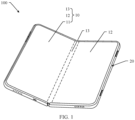
- FIG. 1 is a perspective view of an electronic device 100 according to some embodiments of this application.
- the electronic device 100 is a mobile phone with a foldable screen.
- the electronic device 100 includes a foldable screen 10 and a support apparatus 20. It may be understood that FIG. 1 shows only an example of some components included in the electronic device 100, and actual shapes, actual sizes, actual positions, and actual structures of these components are not limited by FIG. 1 .
- the foldable screen 10 is configured to display an image, a video, and the like.
- the foldable screen 10 may be folded into a first part 11 and a second part 12.
- the foldable screen 10 further includes a third part 13 located between the first part 11 and the second part 12. At least the third part 13 of the foldable screen 10 is made of a flexible material.
- the first part 11 and the second part 12 may be made of a flexible material, or may be made of a rigid material, or part of the first part 11 and the second part 12 is made of a rigid material, and the other part thereof is made of a flexible material. This is not specifically limited herein.
- the foldable screen 10 may be an organic light-emitting diode (organic light-emitting diode, OLED) screen, a micro organic light-emitting diode (micro organic light-emitting diode) screen, a quantum dot light emitting diodes (quantum dot light emitting diodes, QLED) screen, a liquid crystal display (liquid crystal display, LCD), or the like.
- OLED organic light-emitting diode
- micro organic light-emitting diode micro organic light-emitting diode
- QLED quantum dot light emitting diodes
- LCD liquid crystal display
- the foldable screen 10 can be switched between an unfolded state and a folded state.
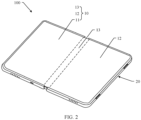
- FIG. 2 is a schematic diagram of a structure of the electronic device 100 shown in FIG. 1 when a foldable screen 10 is in an unfolded state.
- the first part 11, the second part 12, and the third part 13 are coplanarly disposed and face a same direction.
- large-screen display can be implemented, which can provide richer information to a user and bring better use experience to the user.
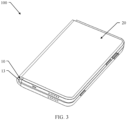
- FIG. 3 is a schematic diagram of a structure of the electronic device 100 shown in FIG. 1 when a foldable screen 10 is in a folded state.
- the foldable screen 10 When the foldable screen 10 is in the folded state, the third part 13 is in a bent state, and the first part (not shown in FIG. 3 ) is opposite to the second part (not shown in FIG. 3 ).
- the foldable screen 10 is invisible to the user, and the support apparatus 20 is protected outside the foldable screen 10 to prevent the foldable screen 10 from being scratched by a hard object.
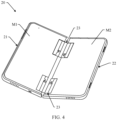
- FIG. 4 is a perspective view of a support apparatus 20 in the electronic device 100 shown in FIG. 1 .
- the support apparatus 20 includes a first housing 21, a second housing 22, and a rotating mechanism 23. It may be understood that FIG. 4 shows only an example of some components included in the support apparatus 20, and actual shapes, actual sizes, actual positions, and actual structures of these components are not limited by FIG. 4 .
- the first housing 21 is configured to fix and support the first part 11 of the foldable screen 10 in FIG. 1 .
- the first housing 21 has a lamination surface M1
- the first housing 21 is configured to fix and support the first part 11 of the foldable screen 10 in FIG. 1 by using the lamination surface M1.
- the second housing 22 is configured to fix and support the second part 12 of the foldable screen 10 in FIG. 1 .
- the second housing 22 has a lamination surface M2, and the second housing 22 is configure to fix and support the second part 12 of the foldable screen 10 in FIG. 1 by using the lamination surface M2.
- a first accommodating cavity (not shown in the figure) is formed inside the first housing 21.
- a second accommodating cavity (not shown in the figure) is formed inside the second housing 22.
- the first accommodating cavity and the second accommodating cavity are configured to accommodate electronic devices such as a mainboard, a battery, a camera module, a speaker, and an earpiece of the electronic device 100.
- the first housing 21 may be of an integral structure, or may be formed by assembling a plurality of parts.
- the second housing 22 may be an integral mechanical part or may be formed by assembling a plurality of parts.
- FIG. 5 is an exploded view of the support apparatus 20 shown in FIG. 4 .
- a first housing 21 includes a first middle frame 211 and a first back cover 212.
- a lamination surface M1 is located on the first middle frame 211.
- the first back cover 212 is fixed to a side of the first middle frame 211 that faces away from the lamination surface M1.
- the first accommodating cavity is formed between the first middle frame 211 and the first back cover 212.
- the second housing 22 includes a second middle frame 221 and a second back cover 222.
- a lamination surface M2 is located on the second middle frame 221.
- the second back cover 222 is fixed to a side of the second middle frame 221 that faces away from the lamination surface M2.
- the second accommodating cavity is formed between the second middle frame 221 and the second back cover 222.
- the rotating mechanism 23 is configured to support the third part 13 of the foldable screen 10.
- the rotating mechanism 23 is connected between the first housing 21 and the second housing 22, and the first housing 21 is rotatably connected to the second housing 22 by using the rotating mechanism 23.
- the rotating mechanism 23 is connected between the first middle frame 211 of the first housing 21 and the second middle frame 221 of the second housing 22.
- the rotating mechanism 23 may alternatively be connected between the first back cover 212 of the first housing 21 and the second back cover 222 of the second housing 22.
- FIG. 4 and FIG. 5 show only an example in which two rotating mechanisms 23 are provided. This should not be considered as a special limitation to this application.
- the two rotating mechanisms 23 are spaced from each other in a length direction of a folding axis of the foldable screen 10.
- FIG. 6 is a schematic diagram of an assembly structure of a first middle frame 211, a rotating mechanism 23, and a second middle frame 221 in a support apparatus 20 according to some embodiments of this application.
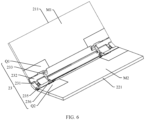
- the rotating mechanism 23 includes a base 231, a first door panel 232, a first connector Q1, and a first swing arm 233. It may be understood that FIG. 6 shows only an example of some components included in the rotating mechanism 23, and actual shapes, actual sizes, actual positions, and actual structures of these components are not limited by FIG. 6 .
- FIG. 7 is a schematic diagram of an assembly structure of the first middle frame 211, the base 231, the first door panel 232, the first connector Q1, and the first swing arm 233 in the assembly structure shown in FIG. 6
- FIG. 8 is an exploded view of the assembly structure shown in FIG. 7 .
- the first door panel 232 is hinged to the base 231.
- FIG. 9 is a schematic diagram of a structure of the base 231 in the assembly structure shown in FIG. 7 .
- the base 231 is provided with a first hinge slot 2311.
- An inner wall of the first hinge slot 2311 is provided with a first arc-shaped rib 2312.
- An extension path of the first arc-shaped rib 2312 may be a major arc (that is, an arc with a central angle greater than 180°), a minor arc (that is, an arc with a central angle less than 180°), or a semi-circular arc (that is, an arc with a central angle equal to 180°). This is not specifically limited herein.
- FIG. 1 In the embodiment shown in FIG.
- the extension path of the first arc-shaped rib 2312 is a minor arc.
- two first arc-shaped ribs 2312 are provided, the two first arc-shaped ribs 2312 are disposed on two opposite inner walls of the first hinge slot 2311 respectively, and circle center lines of the two first arc-shaped ribs 2312 are collinear.
- one first arc-shaped rib 2312 may be provided.
- the base 231 is further provided with a hinge shaft 2313, and the hinge shaft 2313 is parallel to the circle center line of the first arc-shaped rib 2312.
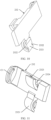
- FIG. 10 is a schematic diagram of a structure of the first door panel 232 in the assembly structure shown in FIG. 7 .
- the first door panel 232 is provided with a first hinge block 2321.
- the first hinge block 2321 may be fixed to the first door panel 232 through gluing, or may be integrally formed with the first door panel 232, that is, the first hinge block 2321 and the first door panel 232 are an integral mechanical part.
- the first hinge block 2321 is provided with a first arc-shaped elongated slot 2322.
- two first arc-shaped elongated slots 2322 are provided, the two first arc-shaped elongated slots 2322 are disposed on two opposite side walls of the first hinge block 2321 respectively, and the circle center lines of the two first arc-shaped elongated slots 2322 are collinear. In another embodiment, one first arc-shaped elongated slot 2322 may be provided.
- the first hinge block 2321 in FIG. 10 is matched and accommodated in the first hinge slot 2311 in FIG. 9 , and can rotate around the circle center line of the first arc-shaped rib 2312 in the first hinge slot 2311.
- the two first arc-shaped ribs 2312 in FIG. 9 are matched and accommodated in the two first arc-shaped elongated slots 2322 in FIG. 10 respectively. Therefore, hinging between the first door panel 232 and the base 231 is implemented. This structure is simple and easy to implement.
- first arc-shaped elongated slot 2322 may alternatively be disposed in the inner wall of the first hinge slot 2311, and the first arc-shaped rib 2312 may alternatively be disposed on the first hinge block 2321. This is not specifically limited herein.
- the first connector Q1 is hinged to the first door panel 232.
- FIG. 11 is a schematic diagram of a structure of the first door panel 232 shown in FIG. 10 at another view angle.
- the first door panel 232 is provided with a second hinge block 2323.
- the second hinge block 2323 may be fixed to the first door panel 232 through gluing, or may be integrally formed with the first door panel 232, that is, the second hinge block 2323 and the first door panel 232 are an integral mechanical part.
- the second hinge block 2323 is provided with a second arc-shaped elongated slot 2324.
- the first door panel 232 is further provided with a first guide sliding slot C1.
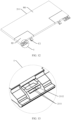
- FIG. 12 is a schematic diagram of an assembly structure of the first connector Q1 and the first middle frame 211 in the assembly structure shown in FIG. 7 .
- the first connector Q1 is further provided with a second guide sliding slot C2.
- FIG. 13 is a partial enlarged view of a region I in the assembly diagram shown in FIG. 12 .
- the first connector Q1 is provided with a second hinge slot 2111.
- a second arc-shaped rib 2112 is disposed in the second hinge slot 2111.
- the second hinge block 2323 in FIG. 11 is matched and accommodated in the second hinge slot 2111 in FIG. 13 , and can rotate around a circle center line of the second arc-shaped elongated slot 2324 in the second hinge slot 2111.
- the second arc-shaped rib 2112 in FIG. 13 is matched and accommodated in the second arc-shaped elongated slot 2324 in FIG. 11 . Therefore, hinging between the first connector Q1 and the first door panel 232 is implemented. This structure is simple and easy to implement.
- the first connector Q1 is fixed to the first middle frame 211.
- the first connector Q1 may be fixed to the first middle frame 211 in a manner such as screwing, riveting, or bonding, or may be integrally formed with the first middle frame 211.
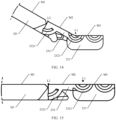
- FIG. 14 is a cross-sectional view of the assembly structure shown in FIG. 7 at line A-A.
- a hinge axis between the first door panel 232 and the base 231 is a first hinge axis L1
- a hinge axis between the first connector Q1 and the first door panel 232 is a second hinge axis L2.
- the first hinge axis L1 is parallel to the second hinge axis L2.
- the base 231 and the first door panel 232 each have a lamination surface.
- the first door panel 232 has a lamination surface M2
- the base 231 has a lamination surface M3.
- the lamination surface M2 and the lamination surface M3 are used for lamination to the third part 13 of the foldable screen 10.
- the first connector Q1 is capable of rotating between an unfolding position and a folding position relative to the base 231.
- FIG. 15 is a schematic diagram of the structure shown in FIG. 14 when the first connector Q1 is at an unfolding position.
- the lamination surface M1, the lamination surface M2, and the lamination surface M3 are coplanarly disposed.
- the lamination surface M1, the lamination surface M2, and the lamination surface M3 face a same direction.
- This position is the position of the first connector Q1 relative to the base 231 and the first door panel 232 when the foldable screen 10 is in the unfolded state.
- FIG. 16 is a schematic diagram of the structure shown in FIG. 14 when the first connector Q1 is at a folding position. At this position, the lamination surface M1 is perpendicular to the lamination surface M3. This state is the position of the first connector Q1 relative to the base 231 when the foldable screen 10 is in the folded state.
- the first hinge axis L1 is located on a side facing the lamination surface M3, and the first hinge axis L1 is spaced from the lamination surface M3.
- the base 231 may be sunk to avoid the foldable screen 10, so that the foldable screen 10 has a relatively large inward folding angle, and the service life of the foldable screen 10 can be prolonged.
- the base 231 may be lifted, so that the lamination surface M3 of the base 231 is flush with the lamination surface M1 and the lamination surface M2, to ensure that the foldable screen 10 is flat.
- the second hinge axis L2 coincides with an edge (that is, a second edge b described below) of the lamination surface M2 close to the lamination surface M1.
- a relative position between the edge of the lamination surface M2 close to the lamination surface M1 and the lamination surface M1 is fixed, so that the foldable screen 10 is not damaged, thereby prolonging the service life of the foldable screen 10.
- the first swing arm 233 is configured to control a movement state of the first door panel 232 when the first connector Q1 rotates between the unfolding position and the folding position, so that when the first connector Q1 is at the folding position, referring to FIG. 16 , an included angle between the lamination surface M2 and the lamination surface M3 on a side for lamination to the foldable screen 10 is ⁇ , ⁇ is less than 90°, an included angle between the lamination surface M2 and the lamination surface M1 on the side for lamination to the foldable screen 10 is ⁇ , ⁇ is greater than 180°, and the lamination surface M1 is perpendicular or approximately perpendicular to the lamination surface M3. ⁇ + ⁇ is approximately equal to 270°.
- the foldable screen part attached to the lamination surface M1, the lamination surface M3, and the lamination surface M2 may be folded into a water drop shape, so as to increase an inward folding angle (R angle) of the foldable screen 10 and prolong the service life of the foldable screen 10.
- R angle inward folding angle
- ⁇ is greater than or equal to 65° and less than or equal to 82°.
- the included angle ⁇ is moderate, which can increase the R angle of the bent region of the foldable screen 10 and effectively prolong the service life of the foldable screen 10.
- FIG. 17 is a schematic diagram of a structure of the first swing arm 233 in the assembly structure shown in FIG. 7 .
- One end of the first swing arm 233 is provided with a hinge hole 2331.
- the first swing arm 233 is hinged to a hinge shaft 2313 (see FIG. 9 ) of the base 231 through the hinge hole 2331.
- the other end of the first swing arm 233 is provided with a first sliding member 234.
- the first sliding member 234 is a pin shaft. In another embodiment, the first sliding member 234 may alternatively be a roller.
- FIG. 18 is a schematic diagram of a structure of the assembly structure shown in FIG. 7 at another view angle
- FIG. 19 is a partial enlarged view of a region II in FIG. 18 .
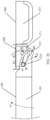
- the first sliding member 234 is slidably connected inside the first guide sliding slot C1 of the first door panel 232 and the second guide sliding slot C2 of the first connector Q1.
- the second guide sliding slot C2 may push the first sliding member 234, so that the first sliding member 234 slides along the first guide sliding slot C1 and the second guide sliding slot C2, thereby driving the first door panel 232 to move together with the first connector Q1. Therefore, an objective of controlling the movement state of the first door panel 232 is achieved.
- FIG. 20 is a schematic diagram of relative positions of a first sliding member 234, a first guide sliding slot C1, a second guide sliding slot C2, a lamination surface M3, a lamination surface M2, and a lamination surface M1 when a first connector Q1 is at an unfolding position; and
- FIG. 21 is a schematic diagram of relative positions of a first sliding member 234, a first guide sliding slot C1, a second guide sliding slot C2, a lamination surface M3, a lamination surface M2, and a lamination surface M1 when a first connector Q1 is at a folding position.
- the first guide sliding slot C1 and the second guide sliding slot C2 are located on a side of a plane in which the lamination surface M2 is located and that is away from the foldable screen 10.
- An orthographic projection of the first guide sliding slot C1 on the lamination surface M2 is a first projection K1.
- An orthographic projection of the second guide sliding slot C2 on the lamination surface M2 is a second projection K2.
- An edge of the lamination surface M2 close to the lamination surface M3 is a first edge a
- an edge of the lamination surface M2 close to the lamination surface M1 is a second edge b.
- the first projection K1 and the second projection K2 are located between a straight line at which the first edge a is located and a straight line at which the second edge b is located. In this way, the rotating mechanism 23 has a simple structure and a relatively small volume.
- the first guide sliding slot C1 and the second guide sliding slot C2 do not interfere with the foldable screen 10.
- two ends of the first guide sliding slot C1 are a first end A1 and a second end A2, respectively.
- the first guide sliding slot C1 extends from the first end A1 to the second end A2 in a direction close to the base 231.
- Two ends of the second guide sliding slot C2 are a third end B1 and a fourth end B2, respectively.
- the second guide sliding slot C2 extends from the third end B1 to the fourth end B2 in a direction close to the base 231.
- the first sliding member 234 slides from the first end A1 of the first guide sliding slot C1 and the third end B1 of the second guide sliding slot C2 to the second end A2 of the first guide sliding slot C1 and the fourth end B2 of the second guide sliding slot C2. In this way, the first connector Q1 can rotate from the unfolding position to the folding position more smoothly, and it is easier to unfold and fold the electronic device.
- the second guide sliding slot C2 extends from the third end B1 to the fourth end B2 in a direction away from a plane at which the lamination surface M1 is located. That is, when the second guide sliding slot C2 slides from the third end B1 to the fourth end B2, a perpendicular distance between the second guide sliding slot C2 and the plane at which the lamination surface M1 is located increases. In this way, referring to FIG. 20 and FIG. 21 , the second guide sliding slot C2 extends from the third end B1 to the fourth end B2 in a direction away from a plane at which the lamination surface M1 is located. That is, when the second guide sliding slot C2 slides from the third end B1 to the fourth end B2, a perpendicular distance between the second guide sliding slot C2 and the plane at which the lamination surface M1 is located increases. In this way, referring to FIG.
- the second guide sliding slot C2 may push the first sliding member 234 to gradually move in a direction away from the foldable screen 10 (that is, a direction a2), thereby driving one end of the first door panel 232 close to the base 231 to be gradually inclined in a direction away from the foldable screen 10 (that is, a direction a3) relatively to the other end of the first door panel 232 close to the first connector Q1. In this way, the first connector gradually rotates to the folding position.
- the structure is simple, and a driving force applied to the first middle frame 211 can be directly transmitted to the first sliding member 234 to push the first door panel 232 to slantly move, so that the folding driving force of the electronic device 100 is relatively strong, and a probability of jamming is relatively low.
- the second guide sliding slot C2 is an arc-shaped sliding slot. That is, the second guide sliding slot C2 extends along an arc. An extension path of the second guide sliding slot C2 is arched in a direction close to the lamination surface M2. In this way, during the rotation of the first connector Q1 from the unfolding position to the folding position in the direction a1, the second guide sliding slot C2 may control an inclination angle of the first door panel 232 to change smoothly, thereby improving folding stability of the electronic device 100 and reducing the probability of jamming.
- the first guide sliding slot C1 is an arc-shaped sliding slot. That is, the first guide sliding slot C1 also extends along an arc. An extension path of the first guide sliding slot C1 is arched in a direction away from the lamination surface M2. In this way, during the rotation of the first connector Q1 from the unfolding position to the folding position in the direction a1, the second guide sliding slot C2 matches the first guide sliding slot C1, so that the inclination angle of the first door panel 232 may be controlled to change gently, and stress is stable, thereby further improving folding stability of the electronic device 100 and reducing the probability of jamming.
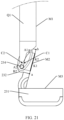
- FIG. 22 is a diagram showing a relationship between a first guide sliding slot C1, a second guide sliding slot C2, and a second hinge axis L2 when a first connector Q1 is at an unfolding position.
- the first guide sliding slot C1 has a length of d1 along an extension path thereof
- the second guide sliding slot C2 has a length of d2 along an extension path thereof.
- d1 and d2 each are in a range of [3.5 mm, 10 mm]. Further, optionally, d1 and d2 each are in a range of [3.5 mm, 5 mm].
- the first guide sliding slot C1 has a curvature radius of R1 at each position along the extension path thereof
- the second guide sliding slot C2 has a curvature radius of R2 at each position along the extension path thereof
- R1 and R2 each are in a range of [3 mm, 7 mm]. Further, optionally, R1 and R2 each are in a range of [4 mm, 5.5 mm].
- an included angle between a vertical line from the second end A2 to the second hinge axis L2 and a vertical line from the fourth end B2 to the second hinge axis L2 is ⁇ .
- the rotating mechanism 23 further includes a second door panel 235, a second connector Q2, and a second swing arm 236.
- the second door panel 235 is located between the base 231 and the second connector Q2.
- the second door panel 235 is hinged to the base 231.
- the second connector Q2 is hinged to the second door panel 235.
- the second connector Q2 is fixed to the second middle frame 221.
- the second door panel 235 has a lamination surface, and the lamination surface is used for lamination to the foldable screen 10.
- the second door panel 235 is provided with a third guide sliding slot.
- the second connector Q2 is provided with a fourth guide sliding slot.
- the second connector Q2 is capable of rotating between an unfolding position and a folding position relative to the base 231.
- the lamination surface of the base 231, the lamination surface of the second door panel 235, and the lamination surface of the second middle frame 221 are coplanar and face a same direction.
- an included angle between the lamination surface of the base 231 and the lamination surface of the second door panel 235 on a side for lamination to the foldable screen 10 is less than 90°
- an included angle between the lamination surface of the second door panel 235 and the lamination surface of the second middle frame 221 on a side for lamination to the foldable screen 10 is greater than 180°
- the lamination surface of the second middle frame 221 is perpendicular or approximately perpendicular to the lamination surface of the base 231.
- the support apparatus 20 may fold the third part 13 of the foldable screen 10 into a water drop shape, and the inward folding angle (R angle) of the third part 13 is relatively large, so that the service life of the foldable screen 10 is relatively long.
- FIG. 23 is a schematic diagram of a structure when the assembly structure shown in FIG. 6 and a foldable screen 10 are in an unfolded state.
- a lamination surface of the first middle frame 211, a lamination surface of a first door panel 232, a lamination surface of a base 231, a lamination surface of a second door panel 235, and a lamination surface of a second middle frame 221 are coplanarly disposed.
- a first part 11 of the foldable screen 10 is supported and fixed to the lamination surface of the first middle frame 211.
- a second part 12 of the foldable screen 10 is supported and fixed to the lamination surface of the second middle frame 221.
- a third part 13 of the foldable screen 10 is supported and fixed to the lamination surface of the first door panel 232 and the lamination surface of the second door panel 235.
- the third part 13 of the foldable screen 10 is further supported on the lamination surface of the base 231.
- FIG. 24 is a schematic diagram of a structure when the assembly structure shown in FIG. 6 and a foldable screen 10 are in a folded state.
- the lamination surface of the first middle frame 211 is opposite to the lamination surface of the second middle frame 221.
- the lamination surface of the first middle frame 211 and the lamination surface of the second middle frame 221 are perpendicular to the lamination surface of the base 231.
- the lamination surface of the first door panel 232 is inclined in a direction away from the foldable screen 10 from an end close to the lamination surface of the first middle frame 211 to an end close to the lamination surface of the base 231.
- the lamination surface of the second door panel 235 is inclined in a direction away from the foldable screen 10 from an end close to the lamination surface of the second middle frame 221 to an end close to the lamination surface of the base 231.
- a first part 11 of the foldable screen 10 is supported and fixed to the lamination surface of the first middle frame 211.
- a second part 12 of the foldable screen 10 is supported and fixed to the lamination surface of the second middle frame 221.
- a third part 13 of the foldable screen 10 is supported and fixed to the lamination surface of the first door panel 232 and the lamination surface of the second door panel 235.
- the third part 13 of the foldable screen 10 is in a water drop shape.
- the inward folding angle (R angle) of the third part 13 is relatively large, so that the service life of the foldable screen 10 is relatively long.
- the rotating mechanism 23 may directly fix the second housing 22 to the base 231 without including the second door panel 233, the second connector Q1, the third guide sliding slot, the fourth guide sliding slot, and the second swing arm 236, and make the lamination surface of the second housing 22 perpendicular or approximately perpendicular to the lamination surface M3 of the base 231, so as to implement 90° opening and closing and folding.
- the support apparatus 20 includes the rotating mechanism 23 according to any one of the foregoing technical solutions, the support apparatus and the rotating mechanism can resolve a same technical problem and achieve a same effect.
- the electronic device 100 includes the support apparatus 20 according to any one of the foregoing embodiments, the electronic device and the support apparatus can resolve a same technical problem and achieve a same effect.
Landscapes
- Engineering & Computer Science (AREA)
- Computer Hardware Design (AREA)
- Theoretical Computer Science (AREA)
- Signal Processing (AREA)
- Human Computer Interaction (AREA)
- Physics & Mathematics (AREA)
- General Engineering & Computer Science (AREA)
- General Physics & Mathematics (AREA)
- Telephone Set Structure (AREA)
- Casings For Electric Apparatus (AREA)
- Pivots And Pivotal Connections (AREA)
Claims (13)
- Drehmechanismus (23), der eine Basis (231), ein erstes Türblech (232), einen ersten Verbinder (Q1) und einen ersten Schwingarm (233) umfasst, wobeidas erste Türblech (232) gelenkig an der Basis (231) befestigt ist, der erste Verbinder (Q1) gelenkig an dem ersten Türblech (232) befestigt ist und der erste Verbinder (Q1) dazu ausgelegt ist, an einem ersten Gehäuse (21) fixiert zu sein;das erste Türblech (232) mit einer ersten Führungsgleitnut (C1) versehen ist, der erste Verbinder (Q1) mit einer zweiten Führungsgleitnut (C2) versehen ist, ein Ende des ersten Schwingarms (233) gelenkig an der Basis (231) befestigt ist, das andere Ende des ersten Schwingarms (233) mit einem ersten Gleitelement (234) versehen ist und das erste Gleitelement (234) gleitend innerhalb der ersten Führungsgleitnut (C1) und der zweiten Führungsgleitnut (C2) verbunden ist;die Basis (231), das erste Türblech (232) und das erste Gehäuse (21) jeweils eine Laminationsfläche aufweisen und die Laminationsfläche zur Lamination an einen klappbaren Bildschirm (10) verwendet wird; undder erste Verbinder (Q1) in der Lage ist, sich zwischen einer Ausklappposition und einer Einklappposition relativ zu der Basis (231) zu drehen; wobei, wenn sich der erste Verbinder (Q1) in der Ausklappposition befindet, die Laminationsfläche der Basis (231), die Laminationsfläche des ersten Türblechs (232) und die Laminationsfläche des ersten Gehäuses (21) komplanar sind und in eine gleiche Richtung weisen; wobei, wenn sich der erste Verbinder (Q1) in der Einklappposition befindet, ein eingeschlossener Winkel zwischen der Laminationsfläche der Basis (231) und der Laminationsfläche des ersten Türblechs (232) auf einer Seite zur Lamination an den klappbaren Bildschirm (10) kleiner als 90° ist, ein eingeschlossener Winkel zwischen der Laminationsfläche des ersten Türblechs (232) und der Laminationsfläche des ersten Gehäuses (21) auf einer Seite zur Lamination an den klappbaren Bildschirm (10) größer als 180° ist und die Laminationsfläche des ersten Gehäuses (21) senkrecht zur Laminationsfläche der Basis (231) steht; wobeidie zweite Führungsgleitnut (C2) eine bogenförmige Gleitnut ist und ein Erstreckungspfad der zweiten Führungsgleitnut (C2) in einer Richtung nahe der Laminationsfläche des ersten Türblechs (232) gebogen ist, und wobeidie erste Führungsgleitnut (C1) eine bogenförmige Gleitnut ist und ein Erstreckungspfad der ersten Führungsgleitnut (C1) in einer Richtung weg von der Laminationsfläche des ersten Türblechs (232) gebogen ist.
- Drehmechanismus (23) nach Anspruch 1, wobei die erste Führungsgleitnut (C1) und die zweite Führungsgleitnut (C2) auf einer Seite der Laminationsfläche des ersten Türblechs (232) weg von dem klappbaren Bildschirm (10) angeordnet sind; und
eine orthographische Projektion der ersten Führungsgleitnut (C1) auf die Laminationsfläche des ersten Türblechs (232) eine erste Projektion (K1) ist, eine orthographische Projektion der zweiten Führungsgleitnut (C2) auf die Laminationsfläche des ersten Türblechs (232) eine zweite Projektion (K2) ist, eine Kante der Laminationsfläche des ersten Türblechs (232) nahe der Laminationsfläche der Basis (231) eine erste Kante (a) ist, eine Kante der Laminationsfläche des ersten Türblechs (232) nahe der Laminationsfläche des ersten Gehäuses (21) eine zweite Kante (b) ist und die erste Projektion (K1) und die zweite Projektion (K2) zwischen einer geraden Linie, an der die erste Kante (a) angeordnet ist, und einer geraden Linie, an der die zweite Kante (b) angeordnet ist, angeordnet sind. - Drehmechanismus (23) nach Anspruch 2, wobei zwei Enden der ersten Führungsgleitnut (C1) ein erstes Ende (A1) bzw. ein zweites Ende (A2) sind und sich die erste Führungsgleitnut (C1) von dem ersten Ende (A1) zu dem zweiten Ende (A2) in einer Richtung nahe der Basis (231) erstreckt;wobei zwei Enden der zweiten Führungsgleitnut (C2) ein drittes Ende (B1) bzw. ein viertes Ende (B2) sind und sich die zweite Führungsgleitnut (C2) von dem dritten Ende (B1) zu dem vierten Ende (B2) in einer Richtung nahe der Basis (231) erstreckt; undwobei, wenn sich der erste Verbinder (Q1) von der Ausklappposition zu der Einklappposition dreht, das erste Gleitelement (234) von dem ersten Ende (A1) der ersten Führungsgleitnut (C1) und dem dritten Ende (B1) der zweiten Führungsgleitnut (C2) zu dem zweiten Ende (A2) der ersten Führungsgleitnut (C1) und dem vierten Ende (B2) der zweiten Führungsgleitnut (C2) gleitet.
- Drehmechanismus (23) nach Anspruch 3, wobei sich die zweite Führungsgleitnut (C2) von dem dritten Ende (B1) zu dem vierten Ende (B2) in einer Richtung weg von einer Ebene erstreckt, in der die Laminationsfläche des ersten Gehäuses (21) angeordnet ist.
- Drehmechanismus (23) nach Anspruch 4, wobei die erste Führungsgleitnut (C1) und die zweite Führungsgleitnut (C2) jeweils einen Krümmungsradiusbereich von [3 mm, 7 mm] an jeder Position auf dem Erstreckungspfad davon aufweisen.
- Drehmechanismus (23) nach einem der Ansprüche 1 bis 5, wobei, wenn sich der erste Verbinder (Q1) an der Einklappposition befindet, der eingeschlossene Winkel zwischen der Laminationsfläche der Basis (231) und der Laminationsfläche des ersten Türblechs (232) auf der Seite zur Lamination an den klappbaren Bildschirm (10) größer als oder gleich 65° und kleiner als oder gleich 82° ist.
- Drehmechanismus (23) nach einem der Ansprüche 1 bis 6, wobei die Basis (231) mit einer ersten Scharniernut (2311) versehen ist und eine erste bogenförmige Rippe (2312) in der ersten Scharniernut (2311) angeordnet ist;wobei das erste Türblech (232) mit einem ersten Scharnierblock (2321) versehen ist und der erste Scharnierblock (2321) mit einer ersten bogenförmigen Langnut (2322) versehen ist; undwobei der erste Scharnierblock (2321) auf die erste Scharniernut (2311) abgestimmt und darin aufgenommen ist und die erste bogenförmige Rippe (2312) auf die erste bogenförmige Langnut (2322) abgestimmt und darin eingebettet ist.
- Drehmechanismus (23) nach einem der Ansprüche 1 bis 7, wobei das erste Türblech (232) mit einem zweiten Scharnierblock (2323) versehen ist und der zweite Scharnierblock (2323) mit einer zweiten bogenförmigen Langnut (2324) versehen ist;wobei der erste Verbinder (Q1) mit einer zweiten Scharniernut (2111) versehen ist und eine zweite bogenförmige Rippe (2112) in der zweiten Scharniernut (2111) angeordnet ist; undwobei der zweite Scharnierblock (2323) auf die zweite Scharniernut (2111) abgestimmt und darin aufgenommen ist und die zweite bogenförmige Rippe (2112) auf die zweite bogenförmige Langnut (2324) abgestimmt und darin aufgenommen ist.
- Drehmechanismus (23) nach einem der Ansprüche 1 bis 8, wobei eine Scharnierachse zwischen dem ersten Türblech (232) und der Basis (231) eine erste Scharnierachse (L1) ist; und
wobei die erste Scharnierachse (L1) auf der Seite angeordnet ist, zu der die Laminationsfläche der Basis (232) weist, und von der Laminationsfläche der Basis (232) beabstandet ist. - Drehmechanismus (23) nach einem der Ansprüche 2 bis 5, wobei eine Scharnierachse zwischen dem ersten Verbinder (Q1) und dem ersten Türblech (232) eine zweite Scharnierachse (L2) ist; und
wobei sich die zweite Scharnierachse (L2) mit der zweiten Kante (b) deckt. - Drehmechanismus (23) nach einem der Ansprüche 1 bis 10, ferner umfassend ein zweites Türblech (235), einen zweiten Verbinder (Q2) und einen zweiten Schwingarm (236), wobeidas zweite Türblech (235) gelenkig an der Basis (231) befestigt ist, der zweite Verbinder (Q2) gelenkig an dem zweiten Türblech (235) befestigt ist und der zweite Verbinder (Q2) dazu ausgelegt ist, an einem zweiten Gehäuse (22) fixiert zu sein;wobei das zweite Türblech (235) mit einer dritten Führungsgleitnut versehen ist; der zweite Verbinder (Q2) mit einer vierten Führungsgleitnut versehen ist; ein Ende des zweiten Schwingarms (236) gelenkig an der Basis (231) befestigt ist, das andere Ende des zweiten Schwingarms (236) mit einem zweiten Gleitelement versehen ist und das zweite Gleitelement gleitend innerhalb der dritten Führungsgleitnut und der vierten Führungsgleitnut verbunden ist;das zweite Türblech (235) und das zweite Gehäuse (22) jeweils eine Laminationsfläche aufweisen und die Laminationsfläche zur Lamination an den klappbaren Bildschirm (10) verwendet wird; undder zweite Verbinder (Q2) in der Lage ist, sich zwischen einer Ausklappposition und einer Einklappposition relativ zu der Basis (231) zu drehen; wobei, wenn sich der zweite Verbinder (Q2) in der Ausklappposition befindet, die Laminationsfläche der Basis (231), die Laminationsfläche des zweiten Türblechs (235) und die Laminationsfläche des zweiten Gehäuses (22) komplanar sind und in eine gleiche Richtung weisen; wobei, wenn sich der zweite Verbinder (Q2) in der Einklappposition befindet, ein eingeschlossener Winkel zwischen der Laminationsfläche der Basis (231) und der Laminationsfläche des zweiten Türblechs (235) auf einer Seite zur Lamination an den klappbaren Bildschirm (10) kleiner als 90° ist, ein eingeschlossener Winkel zwischen der Laminationsfläche des zweiten Türblechs (235) und der Laminationsfläche des zweiten Gehäuses (22) auf einer Seite zur Lamination an den klappbaren Bildschirm (10) größer als 180° ist und die Laminationsfläche des zweiten Gehäuses (22) senkrecht zur Laminationsfläche der Basis (231) steht.
- Stützeinrichtung (20), umfassend ein erstes Gehäuse (21), ein zweites Gehäuse (22) und den Drehmechanismus (23) nach einem der Ansprüche 1 bis 11, wobei der Drehmechanismus (23) zwischen dem ersten Gehäuse (21) und dem zweiten Gehäuse (22) angeordnet ist, wobei ein erster Verbinder (Q1) des Drehmechanismus (23) an dem ersten Gehäuse (21) fixiert ist und die Basis (231) des Drehmechanismus (23) mit dem zweiten Gehäuse (22) verbunden ist.
- Elektronische Vorrichtung (100), umfassend einen klappbaren Bildschirm (10) und die Stützeinrichtung (20) nach Anspruch 12, wobeider klappbare Bildschirm (10) einen ersten Teil (11), einen zweiten Teil (12) und einen dritten Teil (13) umfasst und der dritte Teil (13) zwischen dem ersten Teil (11) und dem zweiten Teil (12) angeordnet ist; undder erste Teil (11) an einer Laminationsfläche eines ersten Gehäuses (21) der Stützeinrichtung (20) gestützt und fixiert ist, der zweite Teil (12) an einer Laminationsfläche eines zweites Gehäuses (22) der Stützeinrichtung (20) gestützt und fixiert ist und der dritte Teil (13) an einem Drehmechanismus (23) der Stützeinrichtung (20) gestützt und fixiert ist.
Applications Claiming Priority (2)
| Application Number | Priority Date | Filing Date | Title |
|---|---|---|---|
| CN202110587689.2A CN114449074B (zh) | 2021-05-27 | 2021-05-27 | 一种转动机构、支撑装置和电子设备 |
| PCT/CN2022/089402 WO2022247565A1 (zh) | 2021-05-27 | 2022-04-26 | 一种转动机构、支撑装置和电子设备 |
Publications (3)
| Publication Number | Publication Date |
|---|---|
| EP4117259A1 EP4117259A1 (de) | 2023-01-11 |
| EP4117259A4 EP4117259A4 (de) | 2023-09-27 |
| EP4117259B1 true EP4117259B1 (de) | 2024-08-07 |
Family
ID=81362605
Family Applications (1)
| Application Number | Title | Priority Date | Filing Date |
|---|---|---|---|
| EP22764990.2A Active EP4117259B1 (de) | 2021-05-27 | 2022-04-26 | Drehmechanismus, stützvorrichtung und elektronische vorrichtung |
Country Status (4)
| Country | Link |
|---|---|
| US (1) | US12169425B2 (de) |
| EP (1) | EP4117259B1 (de) |
| CN (2) | CN114449074B (de) |
| WO (1) | WO2022247565A1 (de) |
Families Citing this family (14)
| Publication number | Priority date | Publication date | Assignee | Title |
|---|---|---|---|---|
| CN117307589A (zh) * | 2022-06-23 | 2023-12-29 | 荣耀终端有限公司 | 一种转轴装置、支撑系统和折叠屏设备 |
| CN117596321B (zh) * | 2022-08-16 | 2025-03-28 | 荣耀终端股份有限公司 | 转轴组件与电子设备 |
| US12432287B2 (en) * | 2022-09-01 | 2025-09-30 | Syncmold Enterprise Corp. | Foldable electronic device |
| CN116677705B (zh) * | 2022-12-01 | 2024-07-19 | 荣耀终端有限公司 | 铰链的传动组件、铰链和可折叠的电子设备 |
| CN118474229B (zh) * | 2022-12-26 | 2025-07-11 | 荣耀终端股份有限公司 | 一种铰链及电子设备 |
| CN117128231B (zh) * | 2023-02-20 | 2024-09-06 | 荣耀终端有限公司 | 摆臂、转动机构及电子设备 |
| CN117847076B (zh) * | 2023-03-22 | 2025-05-16 | 荣耀终端股份有限公司 | 转轴机构及终端设备 |
| CN116592044B (zh) * | 2023-05-08 | 2026-01-09 | 维沃移动通信有限公司 | 折叠机构和电子设备 |
| CN119288971A (zh) * | 2023-07-10 | 2025-01-10 | 荣耀终端有限公司 | 转轴机构及电子设备 |
| CN119231215A (zh) * | 2023-07-11 | 2024-12-31 | 荣耀终端有限公司 | 一种电子设备 |
| CN119383864A (zh) * | 2023-07-26 | 2025-01-28 | 荣耀终端有限公司 | 壳体、壳体组件及电子设备 |
| CN119435561A (zh) * | 2023-08-04 | 2025-02-14 | 荣耀终端有限公司 | 转轴组件及可折叠设备 |
| CN116781814B (zh) * | 2023-08-23 | 2023-10-27 | 荣耀终端有限公司 | 一种门板组件及其制作方法、转轴机构及电子设备 |
| CN119825812B (zh) * | 2023-10-07 | 2026-01-30 | 荣耀终端股份有限公司 | 转轴机构及可折叠电子设备 |
Family Cites Families (27)
| Publication number | Priority date | Publication date | Assignee | Title |
|---|---|---|---|---|
| US9848502B1 (en) * | 2017-03-24 | 2017-12-19 | Shin Zu Shing Co., Ltd. | Hinge assembly and foldable display device using the same |
| TWM551804U (zh) * | 2017-06-08 | 2017-11-11 | First Dome Corp | 鉸鏈及具有該鉸鏈的折疊式電子裝置 |
| CN109936648B (zh) * | 2017-12-18 | 2020-08-07 | 华为技术有限公司 | 转动机构及折叠终端 |
| TWI687795B (zh) * | 2018-09-27 | 2020-03-11 | 兆利科技工業股份有限公司 | 折疊式裝置的轉軸模組 |
| CN209375705U (zh) * | 2018-10-26 | 2019-09-10 | Oppo广东移动通信有限公司 | 转轴机构及可折叠电子设备 |
| JP7223402B2 (ja) * | 2019-02-06 | 2023-02-16 | 株式会社ナチュラレーザ・ワン | 多軸ヒンジ装置、並びにこの多軸ヒンジ装置を用いた電子機器 |
| CN111698355B (zh) * | 2019-03-15 | 2021-07-09 | 华为技术有限公司 | 一种转轴机构及移动终端 |
| CN111692196B (zh) * | 2019-03-15 | 2021-10-22 | 华为技术有限公司 | 一种转轴机构及移动终端 |
| KR102375556B1 (ko) * | 2019-04-30 | 2022-03-17 | 삼성전자주식회사 | 힌지 구조물 및 이를 포함하는 전자 장치 |
| CN209657193U (zh) * | 2019-05-08 | 2019-11-19 | 珠海格力电器股份有限公司 | 一种折叠屏 |
| KR102709937B1 (ko) * | 2019-05-23 | 2024-09-26 | 삼성디스플레이 주식회사 | 폴더블 표시 장치 |
| US12289847B2 (en) * | 2019-05-28 | 2025-04-29 | Sharp Kabushiki Kaisha | Display device including a foldable housing unit and a flexible display panel |
| CN110428730B (zh) * | 2019-06-14 | 2022-05-20 | 深圳市长盈精密技术股份有限公司 | 折叠显示装置 |
| TWI695666B (zh) * | 2019-07-09 | 2020-06-01 | 富世達股份有限公司 | 樞轉機構及可撓式電子裝置 |
| CN112243053B (zh) * | 2019-07-17 | 2026-02-03 | 华为技术有限公司 | 一种转轴机构及移动终端 |
| CN110445913B (zh) * | 2019-07-31 | 2024-07-30 | 华为技术有限公司 | 折叠组件及电子设备 |
| CN110675746B (zh) * | 2019-08-26 | 2021-07-02 | 深圳市长盈精密技术股份有限公司 | 折叠显示装置及折叠手机 |
| TWI709843B (zh) * | 2019-09-19 | 2020-11-11 | 富世達股份有限公司 | 軟性顯示屏幕之折收轉軸結構 |
| CN110995892B (zh) * | 2019-10-31 | 2021-10-26 | 华为终端有限公司 | 电子设备 |
| KR102668216B1 (ko) * | 2019-12-02 | 2024-05-23 | 삼성전자주식회사 | 힌지 조립체를 포함하는 폴더블 전자 장치 |
| CN211296753U (zh) * | 2020-02-19 | 2020-08-18 | 深圳世竟液态金属有限公司 | 具有抗反折棘轮机构的支撑结构和可折叠设备 |
| CN113225412B (zh) * | 2020-04-15 | 2022-10-25 | 华为技术有限公司 | 折叠装置及电子设备 |
| CN111627329B (zh) * | 2020-05-11 | 2022-06-07 | Oppo广东移动通信有限公司 | 外折叠柔性屏支撑装置及电子设备 |
| US11927991B2 (en) * | 2021-05-12 | 2024-03-12 | Dell Products, L.P. | Synchronized hinges for foldable displays |
| WO2022252271A1 (zh) * | 2021-06-02 | 2022-12-08 | 武汉华星光电半导体显示技术有限公司 | 铰链、显示面板及电子装置 |
| EP4283433A4 (de) * | 2021-06-29 | 2024-10-02 | Samsung Electronics Co., Ltd. | Scharnieranordnung und elektronische vorrichtung damit |
| US12432287B2 (en) * | 2022-09-01 | 2025-09-30 | Syncmold Enterprise Corp. | Foldable electronic device |
-
2021
- 2021-05-27 CN CN202110587689.2A patent/CN114449074B/zh active Active
- 2021-05-27 CN CN202211669085.3A patent/CN116095208A/zh active Pending
-
2022
- 2022-04-26 EP EP22764990.2A patent/EP4117259B1/de active Active
- 2022-04-26 WO PCT/CN2022/089402 patent/WO2022247565A1/zh not_active Ceased
- 2022-04-26 US US17/914,130 patent/US12169425B2/en active Active
Also Published As
| Publication number | Publication date |
|---|---|
| US12169425B2 (en) | 2024-12-17 |
| CN114449074A (zh) | 2022-05-06 |
| WO2022247565A1 (zh) | 2022-12-01 |
| CN114449074B (zh) | 2023-01-03 |
| CN116095208A (zh) | 2023-05-09 |
| EP4117259A4 (de) | 2023-09-27 |
| EP4117259A1 (de) | 2023-01-11 |
| US20240211002A1 (en) | 2024-06-27 |
Similar Documents
| Publication | Publication Date | Title |
|---|---|---|
| EP4117259B1 (de) | Drehmechanismus, stützvorrichtung und elektronische vorrichtung | |
| EP4138373B1 (de) | Rotationsmechanismus, stützvorrichtung und elektronische vorrichtung | |
| EP4246941B1 (de) | Klappmechanismus | |
| EP4117257B1 (de) | Drehmechanismus, trägergerät und elektronische vorrichtung | |
| EP4227547B1 (de) | Drehwellenanordnung und elektronische vorrichtung | |
| JP4035051B2 (ja) | 携帯用情報表示装置用折り畳み式ケース | |
| US12324113B2 (en) | Foldable display device including a foreign material inflow prevention element | |
| BR112016019237B1 (pt) | Dispositivo dobrável | |
| EP4488535A1 (de) | Drehwellenmechanismus und elektronische vorrichtung | |
| EP4239987B1 (de) | Drehwellenmechanismus und klappbares mobiles endgerät | |
| KR100385669B1 (ko) | 접이식 멀티 디스플레이장치의 케이스 | |
| CN114430432B (zh) | 折叠机构及电子设备 | |
| US20250155935A1 (en) | Rotary Mechanism and Electronic Device | |
| WO2024067615A1 (zh) | 电子设备和折叠机构 | |
| CN114924619A (zh) | 显示终端 | |
| KR20020029698A (ko) | 접이식 멀티 디스플레이장치의 케이스 | |
| HK40068791B (en) | Rotating mechanism, supporting apparatus, and electronic device | |
| HK40068791A (en) | Rotating mechanism, supporting apparatus, and electronic device | |
| HK40068793A (en) | Rotating mechanism, supporting apparatus, and electronic device | |
| HK40068793B (en) | Rotating mechanism, supporting apparatus, and electronic device | |
| WO2025020521A1 (zh) | 壳体、壳体组件及电子设备 | |
| HK40078843B (en) | Rotating mechanism, support apparatus and electronic device | |
| EP4546762A1 (de) | Faltvorrichtung und elektronische vorrichtung | |
| CN119855997A (zh) | 转动机构和可折叠电子设备 | |
| WO2025044089A1 (zh) | 转轴机构及可折叠电子设备 |
Legal Events
| Date | Code | Title | Description |
|---|---|---|---|
| STAA | Information on the status of an ep patent application or granted ep patent |
Free format text: STATUS: UNKNOWN |
|
| STAA | Information on the status of an ep patent application or granted ep patent |
Free format text: STATUS: THE INTERNATIONAL PUBLICATION HAS BEEN MADE |
|
| PUAI | Public reference made under article 153(3) epc to a published international application that has entered the european phase |
Free format text: ORIGINAL CODE: 0009012 |
|
| STAA | Information on the status of an ep patent application or granted ep patent |
Free format text: STATUS: REQUEST FOR EXAMINATION WAS MADE |
|
| 17P | Request for examination filed |
Effective date: 20220914 |
|
| AK | Designated contracting states |
Kind code of ref document: A1 Designated state(s): AL AT BE BG CH CY CZ DE DK EE ES FI FR GB GR HR HU IE IS IT LI LT LU LV MC MK MT NL NO PL PT RO RS SE SI SK SM TR |
|
| A4 | Supplementary search report drawn up and despatched |
Effective date: 20230829 |
|
| RIC1 | Information provided on ipc code assigned before grant |
Ipc: G06F 1/16 20060101ALI20230823BHEP Ipc: H04M 1/02 20060101AFI20230823BHEP |
|
| GRAP | Despatch of communication of intention to grant a patent |
Free format text: ORIGINAL CODE: EPIDOSNIGR1 |
|
| STAA | Information on the status of an ep patent application or granted ep patent |
Free format text: STATUS: GRANT OF PATENT IS INTENDED |
|
| RIC1 | Information provided on ipc code assigned before grant |
Ipc: G06F 1/16 20060101ALI20240219BHEP Ipc: H04M 1/02 20060101AFI20240219BHEP |
|
| INTG | Intention to grant announced |
Effective date: 20240313 |
|
| GRAS | Grant fee paid |
Free format text: ORIGINAL CODE: EPIDOSNIGR3 |
|
| GRAA | (expected) grant |
Free format text: ORIGINAL CODE: 0009210 |
|
| STAA | Information on the status of an ep patent application or granted ep patent |
Free format text: STATUS: THE PATENT HAS BEEN GRANTED |
|
| AK | Designated contracting states |
Kind code of ref document: B1 Designated state(s): AL AT BE BG CH CY CZ DE DK EE ES FI FR GB GR HR HU IE IS IT LI LT LU LV MC MK MT NL NO PL PT RO RS SE SI SK SM TR |
|
| DAV | Request for validation of the european patent (deleted) | ||
| DAX | Request for extension of the european patent (deleted) | ||
| REG | Reference to a national code |
Ref country code: GB Ref legal event code: FG4D |
|
| REG | Reference to a national code |
Ref country code: CH Ref legal event code: EP |
|
| REG | Reference to a national code |
Ref country code: IE Ref legal event code: FG4D |
|
| REG | Reference to a national code |
Ref country code: DE Ref legal event code: R096 Ref document number: 602022005207 Country of ref document: DE |
|
| REG | Reference to a national code |
Ref country code: LT Ref legal event code: MG9D |
|
| REG | Reference to a national code |
Ref country code: NL Ref legal event code: MP Effective date: 20240807 |
|
| PG25 | Lapsed in a contracting state [announced via postgrant information from national office to epo] |
Ref country code: NO Free format text: LAPSE BECAUSE OF FAILURE TO SUBMIT A TRANSLATION OF THE DESCRIPTION OR TO PAY THE FEE WITHIN THE PRESCRIBED TIME-LIMIT Effective date: 20241107 |
|
| REG | Reference to a national code |
Ref country code: AT Ref legal event code: MK05 Ref document number: 1712157 Country of ref document: AT Kind code of ref document: T Effective date: 20240807 |
|
| PG25 | Lapsed in a contracting state [announced via postgrant information from national office to epo] |
Ref country code: GR Free format text: LAPSE BECAUSE OF FAILURE TO SUBMIT A TRANSLATION OF THE DESCRIPTION OR TO PAY THE FEE WITHIN THE PRESCRIBED TIME-LIMIT Effective date: 20241108 Ref country code: NL Free format text: LAPSE BECAUSE OF FAILURE TO SUBMIT A TRANSLATION OF THE DESCRIPTION OR TO PAY THE FEE WITHIN THE PRESCRIBED TIME-LIMIT Effective date: 20240807 Ref country code: PL Free format text: LAPSE BECAUSE OF FAILURE TO SUBMIT A TRANSLATION OF THE DESCRIPTION OR TO PAY THE FEE WITHIN THE PRESCRIBED TIME-LIMIT Effective date: 20240807 Ref country code: PT Free format text: LAPSE BECAUSE OF FAILURE TO SUBMIT A TRANSLATION OF THE DESCRIPTION OR TO PAY THE FEE WITHIN THE PRESCRIBED TIME-LIMIT Effective date: 20241209 Ref country code: FI Free format text: LAPSE BECAUSE OF FAILURE TO SUBMIT A TRANSLATION OF THE DESCRIPTION OR TO PAY THE FEE WITHIN THE PRESCRIBED TIME-LIMIT Effective date: 20240807 |
|
| PG25 | Lapsed in a contracting state [announced via postgrant information from national office to epo] |
Ref country code: BG Free format text: LAPSE BECAUSE OF FAILURE TO SUBMIT A TRANSLATION OF THE DESCRIPTION OR TO PAY THE FEE WITHIN THE PRESCRIBED TIME-LIMIT Effective date: 20240807 |
|
| PG25 | Lapsed in a contracting state [announced via postgrant information from national office to epo] |
Ref country code: LV Free format text: LAPSE BECAUSE OF FAILURE TO SUBMIT A TRANSLATION OF THE DESCRIPTION OR TO PAY THE FEE WITHIN THE PRESCRIBED TIME-LIMIT Effective date: 20240807 |
|
| PG25 | Lapsed in a contracting state [announced via postgrant information from national office to epo] |
Ref country code: AT Free format text: LAPSE BECAUSE OF FAILURE TO SUBMIT A TRANSLATION OF THE DESCRIPTION OR TO PAY THE FEE WITHIN THE PRESCRIBED TIME-LIMIT Effective date: 20240807 Ref country code: IS Free format text: LAPSE BECAUSE OF FAILURE TO SUBMIT A TRANSLATION OF THE DESCRIPTION OR TO PAY THE FEE WITHIN THE PRESCRIBED TIME-LIMIT Effective date: 20241207 |
|
| PG25 | Lapsed in a contracting state [announced via postgrant information from national office to epo] |
Ref country code: HR Free format text: LAPSE BECAUSE OF FAILURE TO SUBMIT A TRANSLATION OF THE DESCRIPTION OR TO PAY THE FEE WITHIN THE PRESCRIBED TIME-LIMIT Effective date: 20240807 |
|
| PG25 | Lapsed in a contracting state [announced via postgrant information from national office to epo] |
Ref country code: ES Free format text: LAPSE BECAUSE OF FAILURE TO SUBMIT A TRANSLATION OF THE DESCRIPTION OR TO PAY THE FEE WITHIN THE PRESCRIBED TIME-LIMIT Effective date: 20240807 Ref country code: RS Free format text: LAPSE BECAUSE OF FAILURE TO SUBMIT A TRANSLATION OF THE DESCRIPTION OR TO PAY THE FEE WITHIN THE PRESCRIBED TIME-LIMIT Effective date: 20241107 |
|
| PG25 | Lapsed in a contracting state [announced via postgrant information from national office to epo] |
Ref country code: RS Free format text: LAPSE BECAUSE OF FAILURE TO SUBMIT A TRANSLATION OF THE DESCRIPTION OR TO PAY THE FEE WITHIN THE PRESCRIBED TIME-LIMIT Effective date: 20241107 Ref country code: PT Free format text: LAPSE BECAUSE OF FAILURE TO SUBMIT A TRANSLATION OF THE DESCRIPTION OR TO PAY THE FEE WITHIN THE PRESCRIBED TIME-LIMIT Effective date: 20241209 Ref country code: PL Free format text: LAPSE BECAUSE OF FAILURE TO SUBMIT A TRANSLATION OF THE DESCRIPTION OR TO PAY THE FEE WITHIN THE PRESCRIBED TIME-LIMIT Effective date: 20240807 Ref country code: NO Free format text: LAPSE BECAUSE OF FAILURE TO SUBMIT A TRANSLATION OF THE DESCRIPTION OR TO PAY THE FEE WITHIN THE PRESCRIBED TIME-LIMIT Effective date: 20241107 Ref country code: NL Free format text: LAPSE BECAUSE OF FAILURE TO SUBMIT A TRANSLATION OF THE DESCRIPTION OR TO PAY THE FEE WITHIN THE PRESCRIBED TIME-LIMIT Effective date: 20240807 Ref country code: LV Free format text: LAPSE BECAUSE OF FAILURE TO SUBMIT A TRANSLATION OF THE DESCRIPTION OR TO PAY THE FEE WITHIN THE PRESCRIBED TIME-LIMIT Effective date: 20240807 Ref country code: IS Free format text: LAPSE BECAUSE OF FAILURE TO SUBMIT A TRANSLATION OF THE DESCRIPTION OR TO PAY THE FEE WITHIN THE PRESCRIBED TIME-LIMIT Effective date: 20241207 Ref country code: HR Free format text: LAPSE BECAUSE OF FAILURE TO SUBMIT A TRANSLATION OF THE DESCRIPTION OR TO PAY THE FEE WITHIN THE PRESCRIBED TIME-LIMIT Effective date: 20240807 Ref country code: GR Free format text: LAPSE BECAUSE OF FAILURE TO SUBMIT A TRANSLATION OF THE DESCRIPTION OR TO PAY THE FEE WITHIN THE PRESCRIBED TIME-LIMIT Effective date: 20241108 Ref country code: FI Free format text: LAPSE BECAUSE OF FAILURE TO SUBMIT A TRANSLATION OF THE DESCRIPTION OR TO PAY THE FEE WITHIN THE PRESCRIBED TIME-LIMIT Effective date: 20240807 Ref country code: ES Free format text: LAPSE BECAUSE OF FAILURE TO SUBMIT A TRANSLATION OF THE DESCRIPTION OR TO PAY THE FEE WITHIN THE PRESCRIBED TIME-LIMIT Effective date: 20240807 Ref country code: BG Free format text: LAPSE BECAUSE OF FAILURE TO SUBMIT A TRANSLATION OF THE DESCRIPTION OR TO PAY THE FEE WITHIN THE PRESCRIBED TIME-LIMIT Effective date: 20240807 Ref country code: AT Free format text: LAPSE BECAUSE OF FAILURE TO SUBMIT A TRANSLATION OF THE DESCRIPTION OR TO PAY THE FEE WITHIN THE PRESCRIBED TIME-LIMIT Effective date: 20240807 |
|
| PG25 | Lapsed in a contracting state [announced via postgrant information from national office to epo] |
Ref country code: DK Free format text: LAPSE BECAUSE OF FAILURE TO SUBMIT A TRANSLATION OF THE DESCRIPTION OR TO PAY THE FEE WITHIN THE PRESCRIBED TIME-LIMIT Effective date: 20240807 Ref country code: SM Free format text: LAPSE BECAUSE OF FAILURE TO SUBMIT A TRANSLATION OF THE DESCRIPTION OR TO PAY THE FEE WITHIN THE PRESCRIBED TIME-LIMIT Effective date: 20240807 |
|
| PG25 | Lapsed in a contracting state [announced via postgrant information from national office to epo] |
Ref country code: EE Free format text: LAPSE BECAUSE OF FAILURE TO SUBMIT A TRANSLATION OF THE DESCRIPTION OR TO PAY THE FEE WITHIN THE PRESCRIBED TIME-LIMIT Effective date: 20240807 |
|
| PG25 | Lapsed in a contracting state [announced via postgrant information from national office to epo] |
Ref country code: CZ Free format text: LAPSE BECAUSE OF FAILURE TO SUBMIT A TRANSLATION OF THE DESCRIPTION OR TO PAY THE FEE WITHIN THE PRESCRIBED TIME-LIMIT Effective date: 20240807 |
|
| PG25 | Lapsed in a contracting state [announced via postgrant information from national office to epo] |
Ref country code: SK Free format text: LAPSE BECAUSE OF FAILURE TO SUBMIT A TRANSLATION OF THE DESCRIPTION OR TO PAY THE FEE WITHIN THE PRESCRIBED TIME-LIMIT Effective date: 20240807 |
|
| REG | Reference to a national code |
Ref country code: DE Ref legal event code: R097 Ref document number: 602022005207 Country of ref document: DE |
|
| PLBE | No opposition filed within time limit |
Free format text: ORIGINAL CODE: 0009261 |
|
| STAA | Information on the status of an ep patent application or granted ep patent |
Free format text: STATUS: NO OPPOSITION FILED WITHIN TIME LIMIT |
|
| PGFP | Annual fee paid to national office [announced via postgrant information from national office to epo] |
Ref country code: DE Payment date: 20250305 Year of fee payment: 4 |
|
| 26N | No opposition filed |
Effective date: 20250508 |
|
| PG25 | Lapsed in a contracting state [announced via postgrant information from national office to epo] |
Ref country code: SE Free format text: LAPSE BECAUSE OF FAILURE TO SUBMIT A TRANSLATION OF THE DESCRIPTION OR TO PAY THE FEE WITHIN THE PRESCRIBED TIME-LIMIT Effective date: 20240807 |
|
| REG | Reference to a national code |
Ref country code: CH Ref legal event code: H13 Free format text: ST27 STATUS EVENT CODE: U-0-0-H10-H13 (AS PROVIDED BY THE NATIONAL OFFICE) Effective date: 20251125 |
|
| PG25 | Lapsed in a contracting state [announced via postgrant information from national office to epo] |
Ref country code: LU Free format text: LAPSE BECAUSE OF NON-PAYMENT OF DUE FEES Effective date: 20250426 |
|
| PG25 | Lapsed in a contracting state [announced via postgrant information from national office to epo] |
Ref country code: MC Free format text: LAPSE BECAUSE OF FAILURE TO SUBMIT A TRANSLATION OF THE DESCRIPTION OR TO PAY THE FEE WITHIN THE PRESCRIBED TIME-LIMIT Effective date: 20240807 |
|
| REG | Reference to a national code |
Ref country code: BE Ref legal event code: MM Effective date: 20250430 |
|
| PG25 | Lapsed in a contracting state [announced via postgrant information from national office to epo] |
Ref country code: FR Free format text: LAPSE BECAUSE OF NON-PAYMENT OF DUE FEES Effective date: 20250430 |
|
| PG25 | Lapsed in a contracting state [announced via postgrant information from national office to epo] |
Ref country code: BE Free format text: LAPSE BECAUSE OF NON-PAYMENT OF DUE FEES Effective date: 20250430 |
|
| PG25 | Lapsed in a contracting state [announced via postgrant information from national office to epo] |
Ref country code: CH Free format text: LAPSE BECAUSE OF NON-PAYMENT OF DUE FEES Effective date: 20250430 |
|
| PG25 | Lapsed in a contracting state [announced via postgrant information from national office to epo] |
Ref country code: IT Free format text: LAPSE BECAUSE OF FAILURE TO SUBMIT A TRANSLATION OF THE DESCRIPTION OR TO PAY THE FEE WITHIN THE PRESCRIBED TIME-LIMIT Effective date: 20240807 |