EP4116484A1 - Wäschetrockner und verfahren zur steuerung des wäschetrockners - Google Patents
Wäschetrockner und verfahren zur steuerung des wäschetrockners Download PDFInfo
- Publication number
- EP4116484A1 EP4116484A1 EP21765341.9A EP21765341A EP4116484A1 EP 4116484 A1 EP4116484 A1 EP 4116484A1 EP 21765341 A EP21765341 A EP 21765341A EP 4116484 A1 EP4116484 A1 EP 4116484A1
- Authority
- EP
- European Patent Office
- Prior art keywords
- steam
- washing
- controller
- heat exchange
- drum
- Prior art date
- Legal status (The legal status is an assumption and is not a legal conclusion. Google has not performed a legal analysis and makes no representation as to the accuracy of the status listed.)
- Pending
Links
Images





Classifications
-
- D—TEXTILES; PAPER
- D06—TREATMENT OF TEXTILES OR THE LIKE; LAUNDERING; FLEXIBLE MATERIALS NOT OTHERWISE PROVIDED FOR
- D06F—LAUNDERING, DRYING, IRONING, PRESSING OR FOLDING TEXTILE ARTICLES
- D06F58/00—Domestic laundry dryers
- D06F58/32—Control of operations performed in domestic laundry dryers
- D06F58/34—Control of operations performed in domestic laundry dryers characterised by the purpose or target of the control
- D06F58/45—Cleaning or disinfection of machine parts, e.g. of heat exchangers or filters
-
- A—HUMAN NECESSITIES
- A61—MEDICAL OR VETERINARY SCIENCE; HYGIENE
- A61L—METHODS OR APPARATUS FOR STERILISING MATERIALS OR OBJECTS IN GENERAL; DISINFECTION, STERILISATION OR DEODORISATION OF AIR; CHEMICAL ASPECTS OF BANDAGES, DRESSINGS, ABSORBENT PADS OR SURGICAL ARTICLES; MATERIALS FOR BANDAGES, DRESSINGS, ABSORBENT PADS OR SURGICAL ARTICLES
- A61L2/00—Methods or apparatus for disinfecting or sterilising materials or objects other than foodstuffs or contact lenses; Accessories therefor
- A61L2/02—Methods or apparatus for disinfecting or sterilising materials or objects other than foodstuffs or contact lenses; Accessories therefor using physical phenomena
- A61L2/04—Heat
- A61L2/06—Hot gas
- A61L2/07—Steam
-
- D—TEXTILES; PAPER
- D06—TREATMENT OF TEXTILES OR THE LIKE; LAUNDERING; FLEXIBLE MATERIALS NOT OTHERWISE PROVIDED FOR
- D06F—LAUNDERING, DRYING, IRONING, PRESSING OR FOLDING TEXTILE ARTICLES
- D06F33/00—Control of operations performed in washing machines or washer-dryers
- D06F33/50—Control of washer-dryers characterised by the purpose or target of the control
- D06F33/69—Control of cleaning or disinfection of washer-dryer parts, e.g. of tubs
-
- D—TEXTILES; PAPER
- D06—TREATMENT OF TEXTILES OR THE LIKE; LAUNDERING; FLEXIBLE MATERIALS NOT OTHERWISE PROVIDED FOR
- D06F—LAUNDERING, DRYING, IRONING, PRESSING OR FOLDING TEXTILE ARTICLES
- D06F58/00—Domestic laundry dryers
- D06F58/02—Domestic laundry dryers having dryer drums rotating about a horizontal axis
-
- D—TEXTILES; PAPER
- D06—TREATMENT OF TEXTILES OR THE LIKE; LAUNDERING; FLEXIBLE MATERIALS NOT OTHERWISE PROVIDED FOR
- D06F—LAUNDERING, DRYING, IRONING, PRESSING OR FOLDING TEXTILE ARTICLES
- D06F58/00—Domestic laundry dryers
- D06F58/20—General details of domestic laundry dryers
- D06F58/206—Heat pump arrangements
-
- D—TEXTILES; PAPER
- D06—TREATMENT OF TEXTILES OR THE LIKE; LAUNDERING; FLEXIBLE MATERIALS NOT OTHERWISE PROVIDED FOR
- D06F—LAUNDERING, DRYING, IRONING, PRESSING OR FOLDING TEXTILE ARTICLES
- D06F58/00—Domestic laundry dryers
- D06F58/20—General details of domestic laundry dryers
- D06F58/24—Condensing arrangements
-
- A—HUMAN NECESSITIES
- A61—MEDICAL OR VETERINARY SCIENCE; HYGIENE
- A61L—METHODS OR APPARATUS FOR STERILISING MATERIALS OR OBJECTS IN GENERAL; DISINFECTION, STERILISATION OR DEODORISATION OF AIR; CHEMICAL ASPECTS OF BANDAGES, DRESSINGS, ABSORBENT PADS OR SURGICAL ARTICLES; MATERIALS FOR BANDAGES, DRESSINGS, ABSORBENT PADS OR SURGICAL ARTICLES
- A61L2202/00—Aspects relating to methods or apparatus for disinfecting or sterilising materials or objects
- A61L2202/10—Apparatus features
- A61L2202/14—Means for controlling sterilisation processes, data processing, presentation and storage means, e.g. sensors, controllers, programs
-
- A—HUMAN NECESSITIES
- A61—MEDICAL OR VETERINARY SCIENCE; HYGIENE
- A61L—METHODS OR APPARATUS FOR STERILISING MATERIALS OR OBJECTS IN GENERAL; DISINFECTION, STERILISATION OR DEODORISATION OF AIR; CHEMICAL ASPECTS OF BANDAGES, DRESSINGS, ABSORBENT PADS OR SURGICAL ARTICLES; MATERIALS FOR BANDAGES, DRESSINGS, ABSORBENT PADS OR SURGICAL ARTICLES
- A61L2202/00—Aspects relating to methods or apparatus for disinfecting or sterilising materials or objects
- A61L2202/10—Apparatus features
- A61L2202/17—Combination with washing or cleaning means
Definitions
- the present disclosure relates to a laundry dryer and a method for controlling the laundry dryer, and more particularly, to a laundry dryer and a method for controlling the laundry dryer for generating high-temperature steam via a steam generator and controlling rotation of a drum and rotation of a fan independently.
- a laundry treating apparatus that performs a drying cycle capable of removing moisture from laundry has appeared.
- a conventional laundry treating apparatus was able to not only greatly shorten a drying time of the laundry, but also perform sterilization and disinfection of the laundry by supplying hot air to a drum for accommodating therein the laundry to dry the laundry.
- the laundry treating apparatus for performing the drying cycle also includes a conventional laundry treating apparatus for supplying steam to the laundry in order to remove wrinkles of the laundry, improve a drying efficiency, or perform the sterilization or the like.
- Korean Patent Publication Application No. 10-2013-0127816 (2013.11.25 ), which is a prior patent document, discloses a condensing dryer equipped with a heat pump system.
- Such condensing dryer has a problem of occurrence of contamination caused by condensate.
- humidity of air that has dried an object-to-be-dried while passing through the drum decreases and the condensate is generated.
- the condensate may contain contaminants or bacteria contained in the drum and the object-to-be-dried, and the bacteria may contaminate at least one of the evaporator, a water container, washing device, and a pump through which the condensate passes.
- the contamination by the bacteria or the contaminants occurred during a heat exchange process was able to be resolved only when a user washes the heat exchanger by himself/herself.
- the conventional dryer has the problem of the contamination by the bacteria occurred during the heat exchange process, but there is no specific method to prevent or resolve the contamination by the bacteria. Therefore, there is a limit that a performance, a hygiene, the drying quality, and user convenience and satisfaction of the dryer are not able to be satisfied.
- the present disclosure was created to resolve the problems of the conventional laundry dryer and the method for controlling the laundry dryer as described above, and is to provide a configuration capable of washing a heat exchanger in the dryer itself.
- a laundry dryer includes a drum rotatably installed inside a cabinet for forming an outer appearance of the laundry dryer so as to accommodate an object-to-be-dried therein, a duct assembly disposed to re-supply air discharged from the drum to the drum, a circulation fan for providing a flow force to air moving along the duct assembly, a heat exchange assembly disposed in the duct assembly and exchanging heat with air circulated along the duct assembly, a compressor for compressing a refrigerant to exchange heat with air circulated along the duct assembly, steam device for generating steam and supplying steam into the drum, washing device for spraying washing water for washing a surface of the heat exchange assembly toward the surface of the heat exchange assembly, sensing device for sensing a temperature of the heat exchange assembly, and a controller that controls the drum, the circulation fan, the compressor, the steam device, and the washing device.
- the controller may operate the steam device to supply steam, and then drives the compressor to wash and sterilize the heat exchange assembly.
- the controller may drive the circulation fan so as to allow steam to flow to the heat exchange assembly when operating the steam device.
- the controller may rotate the drum when operating the steam device.
- the controller may control the steam device to spray steam for a preset spray time, then stop the steam spraying for a preset pause time, and then respray steam for the spray time.
- the controller may rotate the circulation fan at a preset first circulation speed.
- the washing device may include a washing water sprayer for spraying the washing water onto the heat exchange assembly, a drain pump for transferring condensate stored in the cabinet, and a control valve for distributing the condensate transferred by the drain pump toward the washing water sprayer.
- the controller may control an operation of the washing device such that the washing water is sprayed onto the heat exchange assembly based on a preset spray standard after the supply of steam is terminated.
- the controller may drive the compressor at a preset first compression frequency when the washing device starts to operate.
- the controller may accelerate the compressor and drive the compressor at a preset second compression frequency after the operation of the washing device is terminated.
- the controller may rotate the circulation fan at a preset second circulation speed after the operation of the washing device is terminated.
- the controller may operate the drain pump for a washing time input in advance after the supply of the steam is terminated.
- the controller may control the washing and sterilization operations for the heat exchange assembly to be performed while the object-to-be-dried is not accommodated in the drum.
- a method for controlling a laundry dryer includes a steam supply step of supplying steam to a heat exchange assembly, a washing step of spraying washing water to the heat exchange assembly based on a preset spray standard by controlling washing device after the steam supply step, a drying step of drying the heat exchange assembly after the washing step, and a blowing step of heating the heat exchange assembly using a thermal equilibrium phenomenon so as to sterilize the heat exchange assembly.
- the steam supply step may include operating steam device so as to supply steam to the heat exchange assembly, and rotating a circulation fan at a preset first circulation speed.
- the washing step may include a washing water spray step of spraying the washing water to the heat exchange assembly based on the preset spray standard.
- the washing step may further include a first heating step of driving a compressor at a preset first compression frequency.
- the washing step may further include a pump driving step of driving a drain pump for a preset washing time.
- the drying step may include a second heating step of driving a compressor at a preset second compression frequency.
- the blowing step may include stopping driving of a compressor so as to sterilize an evaporator by heating the evaporator by the thermal equilibrium phenomenon.
- the steam supply step may include a steam water supply step of supplying water to the steam device, a steam preheating step of heating supplied water by applying power to the steam device, and a steam spraying step of spraying steam generated from the steam device.
- the steam spraying step may include spraying steam for a preset spray time, then stopping the steam spraying for a preset pause time, and then respraying steam for the spray time.
- the heat exchanger is sterilized by controlling the surface temperature of the heat exchanger to be the temperature equal to or higher than the reference temperature at which the sterilization is performed.
- the heat exchanger may be sterilized simply without a separate component/device for the sterilization.
- the surface tension and the viscosity of the foreign substances and the microorganisms attached to the surface of the heat exchanger are reduced, so that the foreign substances and the microorganisms are easily removed from the heat exchanger.
- first and second may be used to describe various components, but the components may not be limited by the terms. The above terms are only for the purpose of distinguishing one component from another.
- a first component may be referred to as a second component, and similarly, the second component may also be referred to as the first component.
- a term "and/or" may include a combination of a plurality of related listed items or any of the plurality of related listed items.
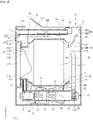
- FIG. 1 discloses a view for illustrating an outer appearance of a laundry dryer according to an embodiment of the present disclosure
- FIG. 2 discloses a cross-sectional view for illustrating an internal structure of a laundry dryer according to an embodiment of the present disclosure.
- a cabinet 10 forming an outer body of a laundry dryer 1 includes a front panel 11 constituting a front surface of the laundry dryer 1, a rear panel 12 constituting a rear surface of the laundry dryer 1, a pair of side panels 14 constituting side surfaces of the laundry dryer 1, and a top panel 13 constituting a top surface of the laundry dryer 1.
- the front panel 11 may include an inlet 111 defined therein to be in communication with a drum 20 to be described later, and a door 112 pivotably coupled to the cabinet 10 to open and close the inlet 111.
- a control panel 117 is disposed on the front panel 11.
- control panel 117 On the control panel 117, input device 118 for receiving a control command from a user, output device 119 for outputting information such as the control command or the like selectable by the user, and a main controller (not shown) that controls a command to perform a cycle of the laundry dryer 1 may be installed.
- the input device 118 may include power supply requesting device for requesting power supply to the laundry dryer, course input device for allowing the user to select a desired course among multiple courses, execution requesting device for requesting start of the course selected by the user, and the like.
- the output device 119 may include at least one of a display panel capable of outputting characters and/or figures, and a speaker capable of outputting audio signals and sounds. The user may easily identify a current situation of the ongoing cycle, a remaining time, and the like via the information output via the output device 119.
- the drum 20 rotatably disposed and providing therein a space in which laundry (an object-to-be-dried) is accommodated, a duct assembly 30 for forming a flow path for re-supplying air discharged from the drum 20 to the drum 20, and a heat exchange assembly 40 for dehumidifying and heating air introduced into the duct assembly 30 and then re-supplying the air to the drum 20.
- the drum 20 includes a cylindrical drum body 21 with an open front surface. Inside the cabinet 10, a first support 22 for rotatably supporting the front surface of the drum body 21, and a second support 23 for rotatably supporting a rear surface of the drum body 21 may be disposed.
- the first support 22 may include a first fixed body 22a fixed inside the cabinet 10, a drum inlet 22b defined to extend through the first fixed body 22a to allow the inlet 111 and an interior of the drum body 21 to communicate with each other, and a first support body 22c disposed on the first fixed body 22a and inserted into the front surface of the drum body 21.
- the first support 22 may further include a connecting body 22d for connecting the inlet 111 and the drum inlet 22b to each other.
- the connecting body 22d may be formed in a pipe shape extending from the drum inlet 22b toward the inlet 111.
- the connecting body 22d may have an air outlet 22e in communication with the duct assembly 30.
- the air outlet 22e as a passage that allows internal air of the drum body 21 to flow to the duct assembly 30 may be defined as a through-hole defined to extend through the connecting body 22d.
- the second support 23 includes a second fixed body 23a fixed inside the cabinet 10, and a second support body 23b disposed on the second fixed body 23a and inserted into the rear surface of the drum body 21.
- the second support 23 has an air inlet 23c defined to extend through the second fixed body 23a so as to allow the interior of the drum body 21 to be in communication with the interior of the cabinet 10.
- the duct assembly 30 is constructed to connect the air outlet 22e and the air inlet 23c to each other.
- the cylindrical drum body 21 may be rotated via a driver 50 of various shapes.
- FIG. 2 an embodiment in which the driver 50 includes a drum motor 51 fixed inside the cabinet 10, a pulley 52 rotated by the drum motor 51, and a belt 53 for connecting a circumferential surface of the pulley 52 and a circumferential surface of the drum body 21 to each other is shown.
- the first support 22 may have a first roller R1 for rotatably supporting the circumferential surface of the drum body 21, and the second support 23 may have a second roller R2 for rotatably supporting the circumferential surface of the drum body 21.
- a direct drive-type driver that rotates the drum as the drum motor 51 is directly connected to the drum without via the pulley and the belt is also applicable. This naturally falls within the scope of the present disclosure. For convenience, a description will be made based on the illustrated embodiment of the driver 50.
- the duct assembly 30 includes an exhaust duct 31 connected to the air outlet 22e, a supply duct 32 connected to the air inlet 23c, and a connecting duct 33 that connects the exhaust duct 31 and the supply duct 32 to each other and has the heat exchange assembly 40 installed therein.
- the heat exchange assembly 40 may be formed as various apparatuses capable of sequentially dehumidifying and heating air introduced into the duct assembly 30.
- the heat exchange assembly 40 may be formed as a heat pump system.
- the heat exchange assembly 40 may include a circulation fan 43 for moving air along the duct assembly 30, a first heat exchanger (a heat absorber 41) that performs a dehumidifying function by lowering humidity of air introduced into the duct assembly 30, and a second heat exchanger (a heater 42) that is disposed inside the duct assembly 30 and heats air that has passed through the first heat exchanger 41.
- a circulation fan 43 for moving air along the duct assembly 30
- a first heat exchanger a heat absorber 41
- a second heat exchanger a heater 42
- the circulation fan 43 is constructed to include an impeller 43a disposed in the duct assembly 30, and an impeller motor 43b for rotating the impeller 43a, and provides a flow force to the air moving along the duct assembly 30.
- the impeller 43a may be installed at any position among the exhaust duct 31, the connecting duct 33, and the supply duct 32.
- FIG. 2 shows an embodiment in which the impeller 43a is disposed in the connecting duct 33.
- the present disclosure is not limited thereto, but for convenience, a description will be made below based on the embodiment in which the impeller 43a is disposed in the connecting duct 33.
- the heat exchange assembly 40 may exchange heat with air circulated along the duct assembly 30.
- the heat absorber 41 and the heater 42 are sequentially arranged inside the connecting duct 33 along a direction from the exhaust duct 31 to the supply duct 32, and are connected to each other via a refrigerant pipe 44 for forming a circulation flow path of a refrigerant.
- the heat absorber 41 is a device for cooling air and evaporating the refrigerant by transferring a heat of air introduced into the exhaust duct 31 to the refrigerant (hereafter, referred to as an evaporator 41).
- the heater 42 is a device for heating air and condensing the refrigerant by transferring a heat of the refrigerant that has passed through a compressor 45 to air (hereinafter, referred to as a condenser 42).
- the compressor 45 compresses the refrigerant that exchanges the heat with air circulated along the duct assembly 30 by receiving a rotational force by the compressor motor 45a.
- moisture contained in air moves along a surface of the evaporator 41 when passing through the evaporator 41 and is collected on a bottom surface of the connecting duct 33.
- the laundry dryer 1 in order to collect condensate that is condensed from air passing through the evaporator 41 and collected on the bottom surface of the connecting duct 33, the laundry dryer 1 according to the present disclosure has a water collecting portion 60.
- the condensate condensed in the evaporator 41 may be primarily collected in the water collecting portion 60, and then may be secondary collected in a water storage 70.
- the water collecting portion 60 may be located inside the connecting duct 33 as shown, or may be formed separately in a space spaced apart from the connecting duct 33.
- the condensate primarily collected via the water collecting portion 60 is supplied to the water storage 70 via a condensate supply pipe 61.
- the condensate supply pipe 61 has a drain pump 62 for smooth discharge of the condensate.
- the water storage 70 includes a water storage tank 72 that is constructed to be extended from one side of the front panel 11 to the outside.
- the water storage tank 72 collects the condensate delivered from the water collecting portion 60 to be described later.
- the user may extend the water storage tank 72 from the cabinet 10 to remove the condensate and then re-install the water storage tank 72 in the cabinet 10. Accordingly, the laundry dryer according to the present disclosure may be disposed at any place where a sewer or the like is not installed.
- the water storage 70 may include the water storage tank 72 that is detachably disposed in the cabinet 10 to provide a space for storing water, and an inlet 72a defined to extend through the water storage tank 72 to introduce water discharged from the condensate supply pipe 61 into the water storage tank 72.
- the water storage tank 72 may be formed as a tank in a form of a drawer extendable from the cabinet 10.
- the front panel 11 of the cabinet has a water storage mounting hole defined therein into which the water storage tank 72 is inserted.
- a panel 71 is fixed to the front surface of the water storage tank 72.
- the panel 71 may be detachably coupled to the water storage mounting hole to form a portion of the front panel 11.
- the panel 71 may further include a groove 71a into which a user's hand is inserted to grip the panel 71.
- the panel 71 also functions as a handle for extending the water storage tank 72 from the cabinet or retracting the water storage tank 72 into the cabinet.
- the inlet 72a is defined to receive the condensate discharged from a condensate nozzle 63 fixed to the cabinet 10.
- the condensate nozzle 63 may be fixed to the top panel 13 of the cabinet 10 so as to be located above the inlet 72a when the water storage tank 72 is inserted into the cabinet 10.
- the user may drain water inside the water storage tank 72 by extending the water storage tank 72 from the cabinet 10 and then turning or tilting the water storage tank 72 in a direction in which the inlet 72a is located.
- a communication hole 72b defined to extend through a top surface of the water storage tank 72 may be further included such that water inside the water storage tank 72 is easily discharged via the inlet 72a.
- the laundry dryer 1 has first filtration device F1 and second filtration device F2 as device for removing foreign substances such as lint and dust generated in a drying process of an object to be washed such as the laundry.
- the first filtration device F1 is disposed in the exhaust duct 31 to primarily filter foreign substances contained in air discharged from the drum 20.
- the second filtration device F2 is disposed downstream of the first filtration device F1 in a flow direction of air so as to secondarily filter foreign substances contained in air that has passed through the first filtration device F1.
- the second filtration device F2 is preferably disposed upstream of the first heat exchanger 41 inside the connecting duct 33. This is to prevent the foreign substances contained in air from accumulating in the first heat exchanger 41 acting as the heat absorber and contaminating the first heat exchanger 41 or causing performance degradation of the first heat exchanger 41.
- any devices known in the art may be applied, so that a description of the detailed configurations thereof will be omitted.
- the laundry dryer 1 further includes a water supply 80 including an internal water supply 81 and an external water supply 82, and steam device 90 for receiving water from the water supply 80 and generating steam.
- a water supply 80 including an internal water supply 81 and an external water supply 82
- steam device 90 for receiving water from the water supply 80 and generating steam.
- the steam device 90 may generate steam by receiving fresh water, not the condensate.
- the steam device 90 may generate steam by heating water, using an ultrasonic wave, or vaporizing water.
- the steam device 90 may be controlled to supply steam into the drum body 21 by receiving water via the external water supply 82 as well as the internal water supply 81 as needed.
- the external water supply 82 may include a direct water valve 82a adjacent to the rear panel 12 or fixed to the rear panel 12, and a direct water pipe 82b for supplying water transferred from the direct water valve 82a to the steam device 90.
- the direct water valve 82a may be coupled to an external water supply source.
- the direct water valve 82a may be coupled to a water supply pipe (not shown) extending to the rear surface of the cabinet. Accordingly, the steam device 90 may receive water directly via the direct water valve 82a.
- the steam device 90 may receive water for the steam generation via the direct water valve 82a, when necessary.
- the direct water valve 82a may be directly controlled by a controller 100.
- the controller 100 may be installed on the control panel 117, but may be formed as a separate control panel as shown in FIG. 1 so as to prevent overload of the control panel 117 and so as not to increase a manufacturing cost.
- the controller 100 may be disposed adjacent to the steam device 90.
- the controller 100 may be disposed on the side panel 14 on which the steam device 90 is installed so as to reduce a length of a control line or the like connected to the steam device 90.
- the steam device 90 is preferably installed adjacent to the direct water valve 82a. Accordingly, residual water may be prevented from unnecessarily remaining in the direct water pipe 82b, and water may be supplied immediately when necessary.
- the controller 100 is configured to control an operation of the laundry dryer 1 based on an input of the user applied via the input device 118.
- the controller 100 may be composed of a printed circuit board and elements mounted on the printed circuit board.
- the controller 100 may control the operation of the laundry dryer 1 based on a preset algorithm.
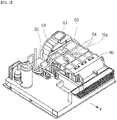
- FIG. 3 discloses a perspective view showing an internal structure of a laundry dryer according to an embodiment of the present disclosure.
- a bottom panel 15 is constructed to support mechanical elements of the laundry dryer 1, including the heat exchange assembly 40.
- the bottom panel 15 forms multiple mounting portions.
- the mounting portion refers to an area defined for the mounting of the machine elements.
- the mounting portions may be divided from each other by a step of the bottom panel.
- an air circulation flow path is eccentrically disposed to a left or right side of the drum 20.
- the eccentric disposition of the air circulation flow path is for efficient drying of an object-to-be-treated and an efficient arrangement of the parts.
- An entrance of the connecting duct 33 is disposed beneath the exhaust duct 31, and is connected to the exhaust duct 31.
- An entrance 33a of the connecting duct 33 is formed to guide air in an inclined direction together with the exhaust duct 31.
- the entrance of the connecting duct 33 becomes narrower in a downward direction.
- a left side surface of the entrance is inclined in a rightward and downward direction.
- the evaporator 41, the condenser 42, and the circulation fan 43 are sequentially arranged on a downstream side of the entrance based on the flow of air.
- the condenser 42 is disposed behind the evaporator 41
- the circulation fan 43 is disposed behind the condenser 42.
- the evaporator 41, the condenser 42, and the circulation fan 43 are respectively mounted in the mounting portions defined in the bottom panel 15.
- a base cover 15a may be installed on the evaporator 41 and the condenser 42.
- the base cover 15a may be composed of a single member or multiple members.
- the heat exchange assembly 40 may include the evaporator 41, the condenser 42, and the compressor 45 to constitute one heat pump system.
- a brief description of the heat pump system is as follows.
- the refrigerant evaporates (a liquid phase -> a gaseous phase) while absorbing heat in the evaporator 41, and becomes a gaseous state of a low-temperature and a low-pressure and is sucked into the compressor 45.
- the compressor 45 the refrigerant in the gaseous phase becomes in a high-temperature and high-pressure state while being compressed, and flows to the condenser 42.
- the condenser 42 the refrigerant is liquefied while releasing heat.
- the liquefied high-pressure refrigerant is decompressed in an expander (not shown).
- the low-temperature and low-pressure refrigerant in the liquid state enters the evaporator 41.
- Hot dry air is supplied to the drum 20 through the supply duct 32 so as to dry the object-to-be-dried.
- the hot dry air evaporates moisture of the object-to-be-treated and becomes hot and humid air.
- the hot and humid air is recovered through the exhaust duct 31, and receives heat of the refrigerant via the evaporator 41 to become low-temperature air.
- a temperature of the air decreases, an amount of saturated vapor in the air decreases, and vapor contained in the air is condensed.
- the low-temperature dry air receives the heat of the refrigerant via the evaporator 41, becomes high-temperature dry air, and is supplied to the drum 20 again.
- the base cover 15a is formed to cover the evaporator 41 and the condenser 42.
- the base cover 15a may be coupled to steps or sidewalls of the bottom panel 15 formed on left and right sides of the evaporator 41 and the condenser 42 to form a portion of the connecting duct 33.
- the circulation fan 43 is covered by the bottom panel 15 and a circulation fan cover. An exit of the circulation fan cover is formed above the circulation fan 43. The exit is connected to the supply duct 32.
- the hot dry air generated by the heat exchange assembly 40 is supplied to the drum 20 through the supply duct 32.
- the circulation fan 43 is located at a rearmost portion of the cabinet 10. In the air circulation flow path, the circulation fan 43 is disposed on a downstream side of the condenser 42 based on the flow of air.
- the circulation fan 43 may be formed as a centrifugal fan.
- the centrifugal fan is constructed to suck air in an axial direction and blows air in a radial direction.
- the condenser 42 is disposed on a line in which the rotational axis of the circulation fan 43 extends.
- the circulation fan 43 sucks the hot dry air from the condenser 42.
- the hot dry air sucked by the circulation fan 43 is ejected to the exit of the circulation fan cover formed above the circulation fan 43.
- the centrifugal fan generates a great wind volume and a high wind speed based on a strong suction power than an axial fan.
- the drain pump 62 is installed on one side of the condenser 42 or one side of the circulation fan 43.
- the drain pump 62 is constructed to transfer the collected condensate to the mounting portion where the drain pump 62 is installed.
- the bottom panel 15 is formed to drain the condensate generated during the operation of the heat exchange assembly 40 to the water collecting portion 60 where the drain pump 62 is installed.
- a bottom surface of the mounting portion may be inclined to allow the condensate to flow into the mounting portion where the drain pump 62 is installed, or a height of a step of the water collecting portion 60 where the drain pump 62 is installed may be partially small.
- the condensate is collected in the mounting portion at a bottom of the condenser 42.
- the mounting portion in which the condenser 42 is installed is defined adjacent to the water collecting portion 60 in which the drain pump 62 is installed with a partition wall forming the air circulation flow path therebetween.
- the partition wall has a flow path formed to pass through the partition wall such that the condensate collected in the mounting portion where the condenser 42 is installed may flow to the water collecting portion 60.
- the water collecting portion 60 is formed at a vertical level lower than that of a bottom surface of the mounting portion of the heat exchange assembly 40. Accordingly, the flow path is inclined downward from the water collecting portion 60 toward the mounting portion of the heat exchange assembly 40.
- the condensate collected in the water collecting portion 60 where the drain pump 62 is installed may be transferred to the water storage 70 by the drain pump 62 by such structure of the bottom panel 15.
- the condensate may be transferred by the drain pump 62 and used for washing the evaporator 41 or the condenser 42.
- the drain pump 62 is connected to a control valve 63 by a condensate supply pipe 61.
- the control valve 63 is formed to distribute the condensate transferred by the drain pump 62 to a washing water supply pipe 64 and a drain pipe 65.
- the washing water supply pipe 64 and the drain pipe 65 connected to the control valve 63 may be made of a flexible material.
- the drain pipe 65 is connected to the control valve 63 and the water storage tank 72.
- the drain pipe 65 is not directly connected to the water storage tank 72, but is connected to the water storage tank 72 via an upper portion of a water container support frame.
- the condensate transferred by the drain pump 62 flows into the drain pipe 65 by the operation of the control valve 63, the condensate flows into the water storage tank 72 along the drain pipe 65.
- the condensate is temporarily stored in the water storage tank 72 until the user empties the water storage tank 72.
- the washing water supply pipe 64 is connected to the control valve 63 and a washing water sprayer 66.
- the washing water sprayer 66 is constructed to spray the condensate onto a surface of the evaporator 41 or the condenser 42.
- dust or foreign substances may adhere to the surfaces of the evaporator 41 and the condenser 42. Because the dust or the foreign substances cause deterioration of heat exchange efficiencies of the evaporator 41 and the condenser 42, the dust or the foreign substances need to be removed promptly.
- the washing water sprayer 66 sprays the received condensate to the evaporator 41 or the condenser 42.
- a nozzle of the washing water sprayer 66 is disposed to face toward the evaporator 41 or the condenser 42.
- the condensate is sprayed into the evaporator 41 or the condenser 42 through the nozzle, the dust or the foreign substances may be removed from the evaporator 41 or the condenser 42.
- the washing water supply pipe 64 and the washing water sprayer 66 may respectively include a plurality of washing water supply pipes and a plurality of washing water sprayers so as to spray the condensate over a large area.
- the water collecting portion 60, the condensate supply pipe 61, the drain pump 62, the control valve 63, the washing water supply pipe 64, the drain pipe 65, and the washing water sprayer 66 may be connected to each other so as to constitute washing device 200 that may use the condensate stored in the cabinet 10 as washing water, and may spray the washing water toward the surface of the heat exchange assembly 40 to remove the foreign substances, the bacteria, and the like.
- FIG. 4 is a block diagram for illustrating a control configuration in a laundry dryer according to an embodiment of the present disclosure.
- the laundry dryer 1 may include at least one of the input device 118, the output device 119, communication device 115, sensing device 116, motors 51, 43b, and 45a, a drain pump 62, the steam device 90, and the controller 100.
- the input device 118 may receive a control command related to the operation of the laundry dryer 1 from the user.
- the input device 118 may be composed of a plurality of buttons or may be composed of a touch screen.
- the input device 118 may be formed in a shape to receive selection of a driving course of the laundry treating apparatus or receive a control input related to execution of the selected driving course.
- the output device 119 may output information related to the operation of the laundry dryer 1.
- the output device 119 may include at least one display.
- the information output by the output device 119 may include information related to an operating state of the laundry dryer 1. That is, the output device 119 may output information related to at least one of the selected driving course, whether a failure has occurred, a driving completion time, and an amount of laundry accommodated in the drum 20.
- the output device 119 may be a touch screen integrally formed with the input device 118.
- the communication device 115 may be in communication with an external network.
- the communication device 115 may receive the control command related to the operation of the laundry treating apparatus from the external network.
- the communication device 115 may receive an operation control command of the laundry dryer transmitted from an external terminal via the external network. This allows the user to remotely control the laundry dryer.
- the communication device 115 may transmit information related to an operation result of the laundry treating apparatus to a predetermined server via the external network.
- the communication device 115 may be in communication with another electronic device in order to establish an Internet of Things (IOT) environment.
- IOT Internet of Things
- the sensing device 116 may sense the information related to the operation of the laundry dryer.
- the sensing device 116 may include at least one of a current sensor, a voltage sensor, a vibration sensor, a noise sensor, an ultrasonic sensor, a pressure sensor, an infrared sensor, a visual sensor (a camera sensor), an electrode sensor, and a temperature sensor.
- the current sensor of the sensing device 116 may sense a current flowing at a point of a control circuit of the laundry dryer 1.
- the temperature sensor of the sensing device 116 may sense a temperature in the duct assembly 30 and may sense a temperature in the drum 20 according to an embodiment.
- the sensing device 116 may include one or more temperature sensors that sense a temperature of the heat exchange assembly 40 and transmit the sensed result to the controller 100.
- the sensing device 116 may include the one or more temperature sensors to sense one or more of temperatures of air and the refrigerant respectively circulating in the first heat exchanger 41 and the second heat exchanger 42.
- the sensing device 116 may include the one or more temperature sensors to sense a temperature of the refrigerant circulating in the compressor 45.
- the sensing device 116 may further include a plurality of temperature sensors for sensing a temperature of air flowing into or out of the drum 20.
- the sensing device 116 including the plurality of temperature sensors may be formed in a shape in which a sensing module for sensing the temperature is disposed in the heat exchange assembly 40 and a sensing module for receiving the sensed result of the plurality of temperature sensors and sensing the temperature is disposed in the controller 100.
- the sensing device 116 may include at least one of the various types of sensors, and the types of sensors equipped in the laundry dryer 1 are not limited.
- the number or installation locations of respective sensors may be designed in various ways depending on a purpose.
- the motors 51, 43b, and 45a may include a drum motor 51, an impeller motor 43b, and a compressor motor 45a, and may vary at least one of power, current, voltage, and speed in response to a control command (a command) of the controller 100.
- the drum motor 51 may vary a rotation speed (rpm) of the drum motor 51 in response to the control command of the controller 100, and vary a rotation speed (rpm) of the drum 20 connected to an output shaft of the drum motor 51.
- the impeller motor 43b may vary a rotation speed (rpm) of the circulation fan 43 in response to the control command of the controller 100.
- the compressor motor 45a may vary a frequency (Hz) of the compressor 45 in response to the control command of the controller 100.
- the steam device 90 may be controlled to supply steam into the drum body 21 by receiving water via the external water supply 82 as well as the internal water supply 81 as needed.
- the steam device 90 may include a steam generator 91 for generating steam by heating received water, a steam pipe 92 through which the generated steam flows, and a steam nozzle 93 for spraying steam into the drum body 21.
- the steam generator 91 is expressed to use a scheme (hereinafter, referred to as a 'whole heating scheme' for convenience) of generating steam by heating a certain amount of water contained therein with a heater (not shown in the drawing), but is not limited thereto.
- a scheme hereinafter, referred to as a 'whole heating scheme' for convenience
- the controller 100 may control the component included in the laundry dryer 1.
- the controller 100 may generate at least one of a power command value, a current command value, a voltage command value, and a speed command value in order to control rotation of the drum motor 51, the impeller motor 43, and the compressor motor 45a.
- the controller 100 may control the drum motor 51, the impeller motor 43b, and the compressor motor 45a, independently.
- the controller 100 may control an operation of at least one of the drum 20, the circulation fan 43, and the heat exchange assembly 40 based on the control input to the input device 118.
- the controller 100 may control the rotation speed and a rotation pattern of the drum 20 based on the control input of the user input to the input device 118.
- the controller 100 may control the rotation speed or an operation time point of the circulation fan 43 based on the control input of the user input to the input device 118.
- the drum and the circulation fan are connected to one motor. Therefore, the drum and the circulation fan rotated at the same time and stopped rotating at the same time.
- the drum motor 51 and the impeller motor 43b are formed separately from each other.
- the controller 100 may control the drum motor 51, the impeller motor 43b, and the compressor motor 45a, independently.
- controller 100 may control the heat exchange assembly 40 so as to adjust a temperature inside the drum 20 based on a control input of the user input to the input device 118.
- the controller 100 may control a driving frequency (Hz) of the compressor 45 based on the control input of the user input to the input device 118.
- Hz driving frequency
- controller 100 may generate at least one of a power command value, a current command value, and a voltage command value so as to control the operation of the steam generator 91.
- the controller 100 may stop the driving of the compressor 45, so that a surface temperature of the heat exchange assembly 40 becomes equal to or higher than a reference temperature, thereby controlling a sterilization operation to be performed.
- the controller 100 may stop the driving of the compressor 45, so that a surface temperature of the heat exchange assembly 40 becomes a temperature equal to or higher than 60 °C, which is the reference temperature.
- the controller 100 may control the drain pump 62 and the control valve 63 to spray washing water into the heat exchange assembly 40.
- the controller 100 may control a driving speed (rpm) of the drain pump 62 to move the stored condensate so as to be used as washing water.
- the controller 100 may open and close the control valve 63 to allow washing water moved from the drain pump 62 to flow to the washing water supply pipe 64. That is, the controller 100 may control the control valve 63 to allow the condensate supply pipe 61 and the washing water supply pipe 64 to communicate with each other, or allow the condensate supply pipe 61 and the drain pipe 65 to communicate with each other.
- the controller 100 allowing the condensate supply pipe 61 and the drain pipe 65 to communicate with each other is set as a default value, and the condensate supply pipe 61 and the washing water supply pipe 64 communicate with each other when the control valve 63 is operated, but the present disclosure is not limited thereto.
- the condensate supply pipe 61 and the washing water supply pipe 64 being in communication with each other may be set as the default value, and the condensate supply pipe 61 and the drain pipe 65 may communicate with each other by operating the control valve 63.
- the controller 100 may operate the steam device 90 to supply steam, and then drive the compressor 45 to wash and sterilize the heat exchange assembly 40.
- the controller 100 may allow the washing and sterilization operations for the heat exchange assembly 40 to be performed in a state in which the object-to-be-dried is not accommodated in the drum 20.
- the controller 100 may drive the circulation fan 43 to allow steam to flow to the heat exchange assembly 40, and may rotate the drum 20.
- the controller 100 may rotate the circulation fan 43 at a preset first circulation speed V1.
- the controller 100 may control the steam generator 91 to spray steam for a preset spray time ts, then stop the steam spraying for a preset pause time tp, and then respray steam for the spray time ts.
- the controller 100 may stop the driving of the compressor 45 when operating the steam device 90 in order to prevent the power supply from being cut off due to an instantaneous and sudden increase in the power consumption of the entire laundry dryer 1. Specifically, when driving the steam generator 91 to preheat water or generate steam, the controller 100 may stop the rotation of the compressor motor 45a.
- the controller 100 may control the operation of the washing device 200, so that the washing water is sprayed to the heat exchange assembly 40 based on a preset spray standard after the supply of steam is terminated.
- the controller 100 may drive the compressor 45 at a preset first compression frequency f1.
- the controller 100 may accelerate the compressor 45 and drive the compressor 45 at a preset second compression frequency f2. In this regard, the controller 100 may rotate the circulation fan 43 at a preset second circulation speed V2.
- the controller 100 may operate the drain pump 62 for a washing time tw input in advance after the supply of steam is terminated.
- control of the controller 100 over time will be described later with reference to FIGS. 5 and 6 .
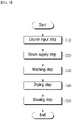
- FIG. 5 discloses a flowchart illustrating a sequence of a method for controlling a laundry dryer according to an embodiment of the present disclosure
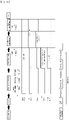
- (a) and (b) in FIG. 6 disclose illustrative views according to a specific application example of a steam drying method related to an embodiment of the present disclosure.
- a method for controlling the laundry dryer 1 is as follows.
- the method for controlling the laundry dryer 1 may include a course input step (S10), a steam supply step (S20), a washing step (S30), a drying step (S40), and a blowing step (S50).
- a control input for performing a condenser care course for washing and sterilizing the heat exchange assembly is input.
- the user may input the control input to the input device 118.
- the user may input the condenser care course to perform the wash and the sterilization on the foreign substances, the microorganisms, and the like that may exist in the heat exchange assembly 40 using the laundry dryer 1.
- the washing and sterilization operations of the heat exchange assembly 40 is performed in the state in which the object-to-be-dried is not accommodated in the drum 20.
- the controller 100 may control the steam device 90 to supply steam to the heat exchange assembly 40.
- the controller 100 may rotate the drum motor 51 at a reference speed Wr input in advance (S21). For example, the controller 100 may continuously rotate the drum motor 51 while maintaining the rotation speed of the drum motor 51 at a speed equal to or higher than 3000 rpm and equal to or lower than 3300 rpm, thereby continuously rotating the drum 20 at a constant speed.
- the drum 20 rotates in the state in which the object-to-be-dried is not accommodated in the drum 20. This is to prevent steam from condensing on the surface of the drum 20 when steam is sprayed while the drum 20 is not rotating and is still.
- the controller 100 does not drive the compressor 45 in order to prevent the instantaneous increase in the power consumption of the laundry dryer 1 (S22).
- the controller 100 may rotate the circulation fan 43 at the preset first circulation speed V1 (S23).
- the controller 100 may drive (rotate) the circulation fan 43 at a speed equal to or higher than 1000 rpm and equal to or lower than 2000 rpm.
- the controller 100 may supply steam into the drum 20 in order to supply steam to the heat exchange assembly 40 (S24).
- the steam supply step (S20) may include a steam water supply step (S24a), a steam preheating step (S24b), and a steam spraying step (S24c).
- the controller 100 may supply water from the water supply 80 to the steam device 90.
- the controller 100 may supply water into the steam generator 91 by operating a water supply pump disposed in the internal water supply 81 according to an embodiment, or may supply water into the steam generator 91 by opening the direct water valve 82a disposed in the external water supply 82.
- an amount of water equal to or greater than 150 cc and equal to or smaller than 250 cc may be supplied from the water supply 80 to the steam generator 91, and a time required to supply water of the water supply 80 to the steam generator 91 may be 30 seconds or longer and 1 minute and 30 seconds or shorter.
- the controller 100 may heat water supplied for the steam generation for a preset preheating time th by applying power to the steam device 90.
- the controller 100 may heat water supplied to the steam generator 91 by applying power to a heater (not shown in the drawing) disposed in the steam generator 91.
- the controller 100 may apply power to the heater for the preheating time th, and the preheating time th may be set to be longer than a time required for water to reach a boiling point.
- the controller 100 may generate a control command to apply power to the steam device 90 for 3 minutes and 30 seconds or longer and 4 minutes and 30 seconds or shorter.
- the controller 100 may spray steam generated from the steam device 90 into the drum 20 by a preset spray amount after the steam preheating step (S24b).
- the controller 100 may generate a control command to the steam generator 91 such that water heated in the steam generator 91 and started to boil flows through the steam pipe 92 and is sprayed into the drum body 21 via the steam nozzle 93.
- the controller 100 may spray steam for the preset spray time ts, then stop the spray of steam for the preset pause time tp, and then respray steam for the spray time ts again.
- the controller 100 may spray steam three times, each of which has a duration of the spray time ts.
- the pause time tp may exist between two spray times ts to stop the spray of steam.
- the controller 100 may spray an amount of water equal to or greater than 150 cc and equal to or smaller than 200 cc from the steam generator 91 into the drum 20 in three times.
- the controller 100 sprays steam into the drum 20 for the time ts of 110 seconds or longer and 130 seconds or shorter (first spray), then stops the spray of steam for the time tp of 20 seconds or longer and 40 seconds or shorter (first pause), then sprays steam into the drum 20 for the time ts of 110 seconds or longer and 130 seconds or shorter again (second spray), and then stops the spray of steam for the time tp of 20 seconds or longer and 40 seconds or shorter (second pause).
- the controller 100 sprays steam into the drum 20 for the time ts of 110 seconds or longer and 130 seconds or shorter (third spray).
- the steam spraying step (S24c) may be composed of the 3 steam spraying steps and the 2 pause steps performed by the controller 100.
- the controller 100 may heat an amount of water equal to or greater than 50 cc and equal to or smaller than 70 cc in the steam generator 91, vaporize the water to steam, and spray the steam into the drum 20 for each time, and repeat this three times.
- the controller 100 may supply high-temperature steam to the heat exchange assembly 40 by operating the drum 20, the circulation fan 43, and the steam device 90.
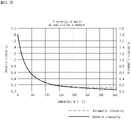
- the high-temperature steam is sprayed into the drum 20, and flows to the heat exchange assembly 40 along the duct assembly 30 by the operation of the circulation fan 43. Accordingly, the high-temperature steam is supplied to the foreign substances, the microorganisms, and the like present on the surface of the heat exchange assembly 40, and viscosity and surface tension of the foreign substances and the microorganisms are reduced as shown in FIG. 7 . Therefore, according to the steam supply step (S20) of the present disclosure, there is the effect of reducing the viscosity and the surface tension such that the foreign substances and the microorganisms easily fall from the heat exchange assembly 40 as the high-temperature steam is supplied to the heat exchange assembly 40.
- the controller 100 may control the washing device 200 to spray washing water onto the heat exchange assembly 40 based on the preset spray standard after the steam supply step (S20).
- the controller 100 may rotate the drum motor 51 at the reference speed Wr input in advance (S31). For example, the controller 100 may continuously rotate the drum motor 51 while maintaining the rotation speed of the drum motor 51 at a speed equal to or higher than 3000 rpm and equal to or lower than 3300 rpm, thereby continuously rotating the drum 20 at the constant speed.
- the controller 100 may further include a first heating step (S32) for driving the compressor 45 at the preset first compression frequency f1.
- the controller 100 may drive the compressor 45 by maintaining the operating frequency F of the compressor 45 at a frequency equal to or higher than 25 Hz and equal to or lower than 35 Hz.
- a refrigerant discharge temperature of the compressor 45 may be increased, and the temperatures inside the drum 20 and the duct assembly 30 may be increased as the air and the refrigerant passing through the heat exchange assembly 40 exchange the heat with each other.
- the power consumption of the compressor 45 is low, so that, even when the drain pump 62 and the control valve 63 are operated, there is no risk of failure or power supply cut off due to the sudden increase in the power consumption.
- the controller 100 may rotate the circulation fan 43 at the preset first circulation speed V1 following the steam supply step (S20) (S33).
- the controller 100 may drive (rotate) the circulation fan 43 at a speed equal to or higher than 1000 rpm and equal to or lower than 2000 rpm.
- the circulation fan 43 rotates along with the driving of the compressor 45, the temperatures inside the drum 20 and the duct assembly 30 may increase while heat-exchanged air circulates.
- the circulation fan 43 also rotates at a relatively low speed compared to the second circulation speed V2, which will be described later, so that, even when the drain pump 62 and the control valve 63 are operated, there is no fear of malfunction or power supply cut off due to the sudden increase in the power consumption.
- the controller 100 may not operate the steam device 90 (S34).
- the washing step (S30) of the present disclosure may further include a pump driving step (S35) of driving the drain pump 62 for a preset washing time tc.
- the controller 100 rotates the drain pump 62 at a preset driving speed (rpm) for the preset washing time tc to move the stored condensate to the control valve 63 and use the condensate as washing water.
- the controller 100 may rotate the drain pump 62 at a speed equal to or higher than 3000 rpm and equal to or lower than 4000 rpm for 20 minutes or longer and 30 minutes or shorter.
- the washing step (S30) of the present disclosure may include a washing water spraying step (S36) of spraying washing water to the heat exchange assembly 40.
- the controller 100 controls the control valve 63 to allow the condensate introduced from the drain pump 62 to flow toward the washing water supply pipe 64.
- control valve 63 of the present disclosure may be connected to the condensate supply pipe 61, the washing water supply pipe 64, and the drain pipe 65 to adjust a flow direction of the condensate.
- the controller 100 may control the control valve 63 to communicate the condensate supply pipe 61 and the washing water supply pipe 64 to each other.
- the condensate to which the flow force has been applied by the drain pump 62 may flow into the washing water supply pipe 64 as the washing water, and may be sprayed onto the heat exchange assembly 40 via the washing water sprayer 66.
- the controller 100 may control the control valve 63 based on a preset washing pattern Pc.
- the washing pattern Pc may be repeated 5 times in order to increase an amount of washing.
- the collected condensate may flow to the control valve 63 using the drain pump 62, and the washing water may be sprayed to the heat exchange assembly 40 in response to the operation of the control valve 63.
- washing water spraying step (S36) washing water with a water pressure equal to or higher than a predetermined water pressure is sprayed to the heat exchange assembly 40, so that the foreign substances including lint and the microorganisms including the bacteria whose viscosity and surface tension are reduced through the steam supply step (S20) are removed from the heat exchange assembly 40.
- the washing step (S30) the foreign substances, the microorganisms, and the like present in the heat exchange assembly 40 are washed and removed.
- the washing step (S30) may further include a first drainage step (S39) of discharging the washing water (the condensate) collected after the washing for a preset drainage time td.
- the controller 100 may operate the drain pump 62 to move the condensate collected in the water collecting portion 60, and operate the control valve 63 to allow the condensate to flow to the drain pipe 65. Consequently, the condensate may be transferred to the water storage tank 72.
- the drainage time td may be 50 seconds or longer and 70 seconds or shorter.
- the controller 100 may supply hot air into the drum 20 to dry the drum 20 and the duct assembly 30.
- the controller 100 may rotate the drum motor 51 at the reference speed Wr input in advance.
- the controller 100 may continuously rotate the drum motor 51 while maintaining the rotation speed of the drum motor 51 at a speed equal to or higher than 3000 rpm and equal to or lower than 3300 rpm, thereby continuously rotating the drum 20 at the constant speed.
- drying step (S40) may include a second heating step (S42) in which the controller 100 drives the compressor at a preset second compression frequency f2.
- the controller 100 may drive the compressor 45 by adjusting the operating frequency F of the compressor 45 to the second compression frequency f2 (S42a).
- the controller 100 may drive the compressor 45 by setting a frequency equal to or higher than 85 Hz and equal to or lower than 105 Hz as the operating frequency F.
- the controller 100 may give a control command to increase an output for driving compressor 45 to the second compression frequency f2 at once, but it is preferable that the controller 100 gives a control command to increase the rotation speed of the compressor motor 45a over several steps in order to prevent malfunction due to overload of the compressor motor 45a.
- the controller 100 may sense the temperature inside the drum 20 for energy efficiency and failure prevention, and may drive the compressor 45 while maintaining the operating frequency F of the compressor 45 at a frequency lower than the second compression frequency f2 based on the sensed temperature (S42b).
- the controller 100 may sense (measure) a temperature of the duct assembly 30 via the sensing device 116 installed in the duct assembly 30.
- the sensing device 116 installed in the duct assembly 30 may be a temperature sensor.
- the controller 100 of the present disclosure may terminate the drying step (S40) by stopping the driving of the compressor 45 based on the reference conditions.
- the reference conditions may include a condition for each of a change in a temperature of air flowing into the evaporator 41, a change in a temperature of air flowing out of the evaporator 41, a change in a temperature of the refrigerant flowing into the evaporator 41, a change in a temperature of the refrigerant flowing out of the evaporator 41, a change in a temperature of air flowing into the condenser 42, a change in a temperature of air flowing out of the condenser 42, a change in a temperature of the refrigerant flowing into the condenser 42, and a change in a temperature of the refrigerant flowing out of the condenser 42, and a condition for each of an operating time of the compressor 45, an operating section of the compressor 45, and the operating frequency of the compressor 45.
- the controller 100 may stop the driving of the compressor 45 when at least one of the conditions for the change in the temperature of air flowing into the evaporator 41, the change in the temperature of air flowing out of the evaporator 41, the change in the temperature of the refrigerant flowing into the evaporator 41, the change in the temperature of the refrigerant flowing out of the evaporator 41, the change in the temperature of air flowing into the condenser 42, the change in the temperature of air flowing out of the condenser 42, the change in the temperature of the refrigerant flowing into the condenser 42, and the change in the temperature of the refrigerant flowing out of the condenser 42, and the operating states including at least one of the operating time of the compressor 45, the operating section of the compressor 45, and the operating frequency of the compressor 45 corresponds to the reference condition.
- the controller 100 may stop the driving of the compressor 45.
- the controller 100 may stop the driving of the compressor 45.
- the controller 100 may change setting of the reference condition by applying a weight to the reference condition based on the outside temperature and the operating state.
- the setting of the reference condition may be changed by applying the weight to the reference condition.
- the controller 100 may apply a weight of ⁇ A °C to the reference condition by reflecting a fact that the temperatures of the drum 20 and the duct assembly 30 are lowered so as to change the setting of the reference condition.
- the drying step (S40) may include a second circulation step (S43) in which the controller 100 rotates the circulation fan 43 at the preset second circulation speed V2.
- the controller 100 may drive (rotate) the circulation fan 43 at a speed equal to or higher than 3500 rpm and equal to or lower than 4500 rpm while the compressor 45 is driven.
- the controller 100 may not operate the steam device 90 (S34).
- the controller 100 may drive the drum 20, the circulation fan 43, and the compressor 45.
- the drying step (S40) by driving the compressor 45, the temperatures inside the drum 20 and the duct assembly 30 may be increased, and the temperatures of the compressor 45 and the condenser 42 may be increased, so that the evaporator 41 may be sterilized.
- the controller 100 may further include a second drainage step (S49) for the preset drainage time td before activating the blowing step (S50).
- the controller 100 may operate the drain pump 62 to move the condensate collected in the water collecting portion 60, and may operate the control valve 63 to allow the condensate to flow to the drain pipe 65. Consequently, the condensate may be transferred to the water storage tank 72.
- the drainage time td may be 50 seconds or longer and 70 seconds or shorter.
- the controller 100 may sterilize the evaporator 41 based on a thermal equilibrium phenomenon by stopping the driving of the compressor 45 after the drying step (S40), and may blow hot air inside the drum 20 and the duct assembly 30 for a preset blowing time so as to evaporate the moisture remaining in the drum 20 and the duct assembly 30.
- the controller 100 may sterilize the evaporator 41 for a time of 20 minutes or longer and 30 minutes or shorter, and evaporate the moisture remaining in the drum 20 and the duct assembly 30.
- the controller 100 may rotate the drum motor 51 at the reference speed Wr input in advance (S51). For example, the controller 100 may continuously rotate the drum motor 51 while maintaining the rotation speed of the drum motor 51 at a speed equal to or higher than 3000 rpm and equal to or lower than 3300 rpm, thereby continuously rotating the drum 20 at the constant speed.
- the controller 100 may control the surface temperature of the heat exchange assembly 40 to rise to a temperature equal to or higher than the reference temperature for the sterilization by promoting the occurrence of the thermal equilibrium phenomenon on the air circulation flow path by driving the drum 20.
- the controller 100 may stop the driving of the compressor 45 so as to transfer the heat of the condenser 42 to the evaporator 41 using the thermal equilibrium phenomenon (S52).
- each of the air circulation flow path composed of the drum 20 and the duct assembly 30 and the condenser 42 is maintained at a temperature equal to or higher than a certain temperature by the heat pump cycle.
- the temperature of each of the air circulation flow path and the condenser 42 is not able to be maintained as the heat pump cycle is stopped, and the heat of at least one of the air circulation flow path and the condenser 42 moves to the evaporator 41, and thus, the thermal equilibrium phenomenon occurs.
- the temperature of each of the air circulation flow path and the condenser 42 is reduced and the surface temperature of the evaporator 41 rises, so that the surface temperature of the evaporator 41 may rise to a temperature equal to or higher than the reference temperature Ts for the sterilization.
- the controller 100 may stop the driving of the compressor 45, and remove the moisture remaining in the drum 20 and the duct assembly 30 by utilizing heat remaining inside the drum 20 and the duct assembly 30.
- the controller 100 may rotate (drive) the circulation fan 43 while maintaining the rotation speed of the circulation fan 43 at the second circulation speed V2 (S53).
- the controller 100 may promote the occurrence of thermal equilibrium phenomenon on the air circulation flow path via the driving of the circulation fan 43 so as to control the surface temperature of the heat exchange assembly 40 to rise to a temperature equal to or higher than the reference temperature.
- the controller 100 may rotate the circulation fan 43 for the preset blowing time.
- blowing time tc is preferably equal to or greater than the reference time tr (tc ⁇ tr).
- the reference time tr may mean a time required for the sterilization of the heat exchange assembly 40.
- the reference time tr may be set based on the operating frequency of the compressor 45.
- the reference time may be set corresponding to a magnitude of the operating frequency before stopping the driving of the compressor 45.
- the reference time when the magnitude of the operating frequency F before stopping the driving of the compressor 45 is lower than a reference value, the reference time may be set long as much as a degree to which the operating frequency f is lower than the reference value. In addition, when the magnitude of the operating frequency F is higher than the reference value, the reference time may be set short as much as a degree to which the operating frequency f is higher than the reference value.
- the controller 100 may maintain the stopping of the driving of the compressor 45 based on the magnitude of the operating frequency F before stopping the driving of the compressor 45.
- the controller 100 may complete the blowing step (S50) after the elapse of the reference time tr.
- blowing step (S50) is a step to remove the moisture
- the controller 100 may not operate (stop the operation of) the steam device 90 (S54).
- the surface temperature of the heat exchange assembly 40 may be maintained at the temperature equal to or higher than the reference temperature Ts for the sterilization for the reference time tr or longer using the thermal equilibrium phenomenon, and the washing water that may remain in the heat exchange assembly 40 may be removed via wind, so that there is an effect of preventing the moisture from remaining in the heat exchange assembly 40.
- FIG. 7 discloses a graph showing changes in viscosity of foreign substances and microorganisms based on a temperature in a method for controlling a laundry dryer of an embodiment of the present disclosure
- FIG. 8 discloses a graph showing changes in surface tension of foreign substances and microorganisms based on a temperature in a method for controlling a laundry dryer of an embodiment of the present disclosure
- FIG. 9 is a diagram for illustrating sterilization conditions according to a method for controlling a laundry dryer of an embodiment of the present disclosure.
- the drum 20 rotates from the steam supply step (S20) to the blowing step (S50) at the preset reference speed Wr (S21, S31, S41, and S51). Therefore, the drum 20 serves to prevent steam from being condensed on the surface of drum 20 when supplying steam, and to help the thermal equilibrium when stopping the driving of the compressor 45.
- the compressor 45 is not driven when steam is supplied (S22), then is driven at the first compression frequency f1 in the washing step (S30) (S32), then is accelerated and driven at the second compression frequency f2 in the drying step (S40) (S42), and then is stopped and heats the evaporator 41 using the thermal equilibrium phenomenon in the blowing step (S50).
- the circulation fan 43 is rotated at the first circulation speed V1 in the steam supply step (S20) and the washing step (S30) (S23 and S33), and is accelerated and rotated at the second circulation speed V2 in the drying step (S40) and the blowing step (S50) (S43 and S53). Therefore, the circulation fan 43 has the effect of drying and sterilizing the heat exchange assembly 40 by circulating hot steam and hot air.
- the steam device 90 is operated in the steam supply step (S20) (S24), and then stops operating (S34, S44, and S54).
- the drain pump 62 is operated in the washing step (S35), the first drain step (S39), and the second drain step (S49) to supply the condensate as washing water, or to drain the condensate.
- control valve 63 may be controlled in the washing step to supply washing water to the heat exchange assembly 40.
- the water stored in the steam generator 91 is sprayed three times in the steam spraying step (S24c). Therefore, there is an effect of preventing condensation of vapor inside the drum 20 due to excessive steam supply.
- the controller 100 of the present disclosure lowers the output of the circulation fan 43 and the compressor 45 in the washing step (S30) so as to enable stable power use even while driving the drain pump 62 and the control valve 63.
- the controller 100 may effectively remove the bacteria present in the evaporator 41 by controlling the driving of the compressor 45 such that the sterilization operation for the evaporator 41 is maintained at a temperature equal to or higher than the reference temperature (60 degrees Celsius) for the reference time (10 minutes) or longer.
Landscapes
- Engineering & Computer Science (AREA)
- Textile Engineering (AREA)
- Health & Medical Sciences (AREA)
- Epidemiology (AREA)
- Life Sciences & Earth Sciences (AREA)
- Animal Behavior & Ethology (AREA)
- General Health & Medical Sciences (AREA)
- Public Health (AREA)
- Veterinary Medicine (AREA)
- Detail Structures Of Washing Machines And Dryers (AREA)
- Control Of Washing Machine And Dryer (AREA)
Applications Claiming Priority (2)
| Application Number | Priority Date | Filing Date | Title |
|---|---|---|---|
| KR1020200026954A KR102836925B1 (ko) | 2020-03-04 | 2020-03-04 | 세탁물 건조기 및 세탁물 건조기의 제어방법 |
| PCT/KR2021/002370 WO2021177656A1 (ko) | 2020-03-04 | 2021-02-25 | 세탁물 건조기 및 세탁물 건조기의 제어방법 |
Publications (2)
| Publication Number | Publication Date |
|---|---|
| EP4116484A1 true EP4116484A1 (de) | 2023-01-11 |
| EP4116484A4 EP4116484A4 (de) | 2024-02-28 |
Family
ID=77614110
Family Applications (1)
| Application Number | Title | Priority Date | Filing Date |
|---|---|---|---|
| EP21765341.9A Pending EP4116484A4 (de) | 2020-03-04 | 2021-02-25 | Wäschetrockner und verfahren zur steuerung des wäschetrockners |
Country Status (6)
| Country | Link |
|---|---|
| US (1) | US20230089461A1 (de) |
| EP (1) | EP4116484A4 (de) |
| KR (1) | KR102836925B1 (de) |
| CN (1) | CN115279967A (de) |
| AU (1) | AU2021229880B2 (de) |
| WO (1) | WO2021177656A1 (de) |
Families Citing this family (4)
| Publication number | Priority date | Publication date | Assignee | Title |
|---|---|---|---|---|
| KR102836922B1 (ko) * | 2020-02-20 | 2025-07-22 | 엘지전자 주식회사 | 의류처리장치 및 의류처리장치의 제어방법 |
| CN113846462A (zh) * | 2021-09-28 | 2021-12-28 | 珠海格力电器股份有限公司 | 一种洗衣机和控制方法 |
| EP4324977B1 (de) * | 2022-08-17 | 2025-04-23 | BSH Hausgeräte GmbH | Verfahren zum betrieb einer trocknungsvorrichtung mit einer wärmepumpe und einer reinigungsvorrichtung |
| KR102717192B1 (ko) * | 2023-08-18 | 2024-10-11 | 이은정 | 건조기 및 그 제어방법 |
Family Cites Families (25)
| Publication number | Priority date | Publication date | Assignee | Title |
|---|---|---|---|---|
| CH695383A5 (de) * | 2001-07-10 | 2006-04-28 | V Zug Ag | Wäschetrockner oder Waschautomat mit Bedampfungsvorrichtung. |
| JP4030523B2 (ja) * | 2004-05-12 | 2008-01-09 | 三洋電機株式会社 | 洗濯機 |
| JP4795871B2 (ja) | 2006-06-29 | 2011-10-19 | 株式会社東芝 | 衣類乾燥機 |
| US20080092928A1 (en) * | 2006-10-19 | 2008-04-24 | Whirlpool Corporation | Method and Apparatus for Treating Biofilm in an Appliance |
| JP4388088B2 (ja) * | 2007-02-16 | 2009-12-24 | 株式会社東芝 | 衣類乾燥機 |
| KR101351034B1 (ko) * | 2007-08-03 | 2014-01-10 | 엘지전자 주식회사 | 의류처리장치 및 그 제어방법 |
| KR101467773B1 (ko) * | 2008-04-01 | 2014-12-03 | 엘지전자 주식회사 | 의류처리장치 및 의류처리장치의 제어방법 |
| EP2325375B1 (de) * | 2009-11-23 | 2016-11-09 | Miele & Cie. KG | Verfahren zum Betreiben einer Waschmaschine und Waschmaschine |
| FR2954783B1 (fr) * | 2009-12-30 | 2011-12-23 | Fagorbrandt Sas | Procede de commande en fonctionnement d'une machine a secher le linge et machine a secher le linge associee. |
| AU2011245858B2 (en) * | 2010-04-28 | 2014-06-12 | Lg Electronics Inc. | Laundry treating apparatus |
| KR20120005266A (ko) * | 2010-07-08 | 2012-01-16 | 엘지전자 주식회사 | 건조기 |
| KR101806241B1 (ko) * | 2011-03-29 | 2017-12-07 | 엘지전자 주식회사 | 열교환기 세척수단을 갖는 의류처리장치 |
| CN104011286B (zh) * | 2011-12-20 | 2017-03-15 | 松下电器产业株式会社 | 衣物干燥机以及衣物干燥机的蒸发器的清洗方法 |
| EP2628844A1 (de) * | 2012-02-20 | 2013-08-21 | Electrolux Home Products Corporation N.V. | Wäschebehandlungsvorrichtung mit Wärmetauscherreinigung |
| US9417009B2 (en) * | 2012-03-06 | 2016-08-16 | Lg Electronics Inc. | Controlling method for a washing machine |
| JP2013202159A (ja) * | 2012-03-28 | 2013-10-07 | Panasonic Corp | 衣類乾燥機 |
| KR101919887B1 (ko) | 2012-05-15 | 2018-11-19 | 엘지전자 주식회사 | 의류건조기 |
| WO2016108793A1 (en) * | 2014-12-30 | 2016-07-07 | Arçeli̇k Anoni̇m Şi̇rketi̇ | A heat pump laundry dryer |
| KR20170028037A (ko) * | 2015-09-03 | 2017-03-13 | 삼성전자주식회사 | 의류건조기 |
| KR102428247B1 (ko) * | 2016-01-05 | 2022-08-02 | 엘지전자 주식회사 | 세탁물처리장치 및 그의 급수밸브제어방법 |
| KR20180013535A (ko) * | 2016-07-29 | 2018-02-07 | 엘지전자 주식회사 | 히트펌프를 구비한 세탁건조기 및 그의 건조운전제어방법 |
| CN107687079B (zh) * | 2016-08-03 | 2021-01-26 | 重庆海尔洗衣机有限公司 | 一种干衣机及控制方法 |
| KR20190128484A (ko) * | 2018-05-08 | 2019-11-18 | 엘지전자 주식회사 | 의류 처리 장치 |
| KR102655152B1 (ko) * | 2018-09-12 | 2024-04-08 | 삼성전자주식회사 | 의류 관리기 |
| US11649581B2 (en) * | 2019-12-27 | 2023-05-16 | Samsung Electronics Co., Ltd. | Clothes treating apparatus |
-
2020
- 2020-03-04 KR KR1020200026954A patent/KR102836925B1/ko active Active
-
2021
- 2021-02-25 CN CN202180018784.9A patent/CN115279967A/zh active Pending
- 2021-02-25 EP EP21765341.9A patent/EP4116484A4/de active Pending
- 2021-02-25 US US17/909,258 patent/US20230089461A1/en active Pending
- 2021-02-25 WO PCT/KR2021/002370 patent/WO2021177656A1/ko not_active Ceased
- 2021-02-25 AU AU2021229880A patent/AU2021229880B2/en active Active
Also Published As
| Publication number | Publication date |
|---|---|
| US20230089461A1 (en) | 2023-03-23 |
| EP4116484A4 (de) | 2024-02-28 |
| AU2021229880A1 (en) | 2022-10-27 |
| AU2021229880B2 (en) | 2025-01-23 |
| KR20210111985A (ko) | 2021-09-14 |
| CN115279967A (zh) | 2022-11-01 |
| WO2021177656A1 (ko) | 2021-09-10 |
| KR102836925B1 (ko) | 2025-07-22 |
Similar Documents
| Publication | Publication Date | Title |
|---|---|---|
| AU2021229880B2 (en) | Laundry dryer and method for controlling laundry dryer | |
| EP4116483B1 (de) | Wäschetrockner und wäschetrocknersteuerungsverfahren | |
| US9909249B2 (en) | Laundry treating apparatus | |
| KR101351042B1 (ko) | 의류처리장치의 제어방법 | |
| JP4976965B2 (ja) | 衣類乾燥機 | |
| EP2107157B1 (de) | Wäschebehandlungsvorrichtung und Steuerungsverfahren dafür | |
| KR100902900B1 (ko) | 건조기 | |
| JP2005253588A (ja) | 乾燥機 | |
| JP5075771B2 (ja) | 洗濯乾燥機 | |
| EP3875675B1 (de) | Wäschetrocknungsmaschine und verfahren zur steuerung einer wäschetrocknungsmaschine | |
| JP4384203B2 (ja) | 衣類乾燥機 | |
| KR102483851B1 (ko) | 의류처리장치 및 이의 제어방법 | |
| KR102836923B1 (ko) | 세탁물 건조기 및 세탁물 건조기의 제어방법 | |
| KR102836924B1 (ko) | 세탁물 건조기 및 세탁물 건조기의 제어방법 | |
| KR102483844B1 (ko) | 의류처리장치 및 이의 제어방법 | |
| EP3805446A1 (de) | Vorrichtung zur steuerung einer kleiderbehandlungsvorrichtung, kleiderbehandlungsvorrichtung und verfahren zur steuerung der kleiderbehandlungsvorrichtung | |
| US12146260B2 (en) | Apparatus for controlling clothes treating apparatus, clothes treating apparatus and method for controlling clothes treating apparatus | |
| JP2000140492A (ja) | 衣類乾燥機 | |
| JP2025139936A (ja) | 衣類処理装置 | |
| JP2010227405A (ja) | 洗濯乾燥機 | |
| JP2005102816A (ja) | 乾燥機 |
Legal Events
| Date | Code | Title | Description |
|---|---|---|---|
| STAA | Information on the status of an ep patent application or granted ep patent |
Free format text: STATUS: THE INTERNATIONAL PUBLICATION HAS BEEN MADE |
|
| PUAI | Public reference made under article 153(3) epc to a published international application that has entered the european phase |
Free format text: ORIGINAL CODE: 0009012 |
|
| STAA | Information on the status of an ep patent application or granted ep patent |
Free format text: STATUS: REQUEST FOR EXAMINATION WAS MADE |
|
| 17P | Request for examination filed |
Effective date: 20221004 |
|
| AK | Designated contracting states |
Kind code of ref document: A1 Designated state(s): AL AT BE BG CH CY CZ DE DK EE ES FI FR GB GR HR HU IE IS IT LI LT LU LV MC MK MT NL NO PL PT RO RS SE SI SK SM TR |
|
| DAV | Request for validation of the european patent (deleted) | ||
| DAX | Request for extension of the european patent (deleted) | ||
| A4 | Supplementary search report drawn up and despatched |
Effective date: 20240131 |
|
| RIC1 | Information provided on ipc code assigned before grant |
Ipc: D06F 58/24 20060101ALI20240125BHEP Ipc: D06F 58/20 20060101ALI20240125BHEP Ipc: D06F 33/69 20200101ALI20240125BHEP Ipc: D06F 58/45 20200101AFI20240125BHEP |
|
| STAA | Information on the status of an ep patent application or granted ep patent |
Free format text: STATUS: EXAMINATION IS IN PROGRESS |
|
| 17Q | First examination report despatched |
Effective date: 20250801 |