EP4115441B1 - Lasergepumpte plasmalichtquelle und plasmazündverfahren - Google Patents
Lasergepumpte plasmalichtquelle und plasmazündverfahren Download PDFInfo
- Publication number
- EP4115441B1 EP4115441B1 EP21721647.2A EP21721647A EP4115441B1 EP 4115441 B1 EP4115441 B1 EP 4115441B1 EP 21721647 A EP21721647 A EP 21721647A EP 4115441 B1 EP4115441 B1 EP 4115441B1
- Authority
- EP
- European Patent Office
- Prior art keywords
- laser
- plasma
- light source
- chamber
- laser beam
- Prior art date
- Legal status (The legal status is an assumption and is not a legal conclusion. Google has not performed a legal analysis and makes no representation as to the accuracy of the status listed.)
- Active
Links
Images


Classifications
-
- H—ELECTRICITY
- H01—ELECTRIC ELEMENTS
- H01J—ELECTRIC DISCHARGE TUBES OR DISCHARGE LAMPS
- H01J65/00—Lamps without any electrode inside the vessel; Lamps with at least one main electrode outside the vessel
- H01J65/04—Lamps in which a gas filling is excited to luminesce by an external electromagnetic field or by external corpuscular radiation, e.g. for indicating plasma display panels
-
- F—MECHANICAL ENGINEERING; LIGHTING; HEATING; WEAPONS; BLASTING
- F02—COMBUSTION ENGINES; HOT-GAS OR COMBUSTION-PRODUCT ENGINE PLANTS
- F02P—IGNITION, OTHER THAN COMPRESSION IGNITION, FOR INTERNAL-COMBUSTION ENGINES; TESTING OF IGNITION TIMING IN COMPRESSION-IGNITION ENGINES
- F02P9/00—Electric spark ignition control, not otherwise provided for
- F02P9/002—Control of spark intensity, intensifying, lengthening, suppression
- F02P9/007—Control of spark intensity, intensifying, lengthening, suppression by supplementary electrical discharge in the pre-ionised electrode interspace of the sparking plug, e.g. plasma jet ignition
Definitions
- the present invention relates to electrodeless laser-pumped plasma light sources producing high-brightness light in the ultra-violet (UV), visible and near infrared (NIR) spectral bands and to methods for starting plasma ignition.
- UV ultra-violet
- NIR near infrared
- Continuous optical discharge is a stationary gas discharge sustained by laser radiation in pre-created relatively dense plasma.
- a COD sustained by a focused beam of a continuous wave (CW) laser, is realized in various gases, in particular, in Xe at a high gas pressure of 10-200 atm ( Carlhoff et al., "Continuous Optical Discharges at Very High Pressure," Physica 103C, 1981, pp. 439-447 ). Due to a high plasma temperature of about 20,000 K ( Raizer, "Optical Discharges,” Sov. Phys. Usp. 23 (11), Nov. 1980, pp.
- COD- based light sources are among the highest brightness continuous light sources in a wide spectral range between about 0.1 ⁇ m and 1 ⁇ m. Compared to arc lamps, such laser-pumped plasma light sources not only have a higher brightness, but also a longer lifetime, making them preferable for a variety of applications.
- One of the challenges related to designing high-brightness laser-pumped plasma light sources relates to producing initial plasma that provides reliable ignition of the COD.
- the relatively cold electrodes located near the high-temperature plasma region produce disturbances of convective gas flows in the chamber and, as a result, impair spatial and energetic stability of the laser-pumped plasma light source.
- the presence of electrodes near the radiating plasma region is characterized by "dead" spatial angles restricting the exit of plasma radiation.
- electrode material sputtering may result in decreased transparency of the bulb walls and, correspondingly, to the light source degradation over time.
- an electrode-containing chamber also include the complex technology for sealing the metal / glass joint and the complex chamber shape producing a concentration of stresses which result in lower strength of the chamber when operating at high gas pressures.
- the threshold power of laser radiation required for plasma ignition is usually from about ten to several hundreds of kilowatts or higher, while the laser radiation intensity sufficient for COD sustenance is typically just a few tens of Watts.
- using the same laser with a high output power both for plasma ignition and COD sustenance either results in reduced lifetime of the light source (when the full laser power is used for COD sustenance), or is redundant, expensive and, therefore, impractical if only a fraction of the full laser power is used to sustain the COD.
- Patent U.S. 10057973, issued on August 21, 2018 proposes to overcome this challenge by using a single CW laser with the power of less than 250 Watts and a wavelength of less than 1.1 ⁇ m. It is suggested that COD ignition and sustenance is provided by means of sharp focusing of CW laser beam with a focal area cross size of less than 1-15 microns, and a focal area length of 6 microns or lower.
- the document EP 2 280 408 A2 describes a light source device that includes a light emission tube, a continuous-wave oscillator part and a pulsed oscillator part.
- the pulsed oscillator part is used as the source of ignition for a high temperature plasma state while the continuous-wave oscillator part functions as a heating source to heat the high temperature plasma state.
- the solution suffers from drawbacks similar to those mentioned above.
- the beams of one or several igniting lasers and beams of one or several CW lasers, intended for COD sustenance are introduced into an optical fiber used for delivering the radiation of the said lasers to a condensing or focusing optical system.
- the said device superposition of the focusing areas of the pulsed lasers and of CW lasers is achieved, if the wavelengths of the said lasers are similar.
- the technical problem to be solved by the invention relates to the creation of methods and devices for highly reliable laser ignition of continuous optical discharge and to develop high-brightness highly-stable laser-pumped plasma light sources on the basis thereof.
- the technical result of the invention consists in ensuring high reliability of igniting the plasma sustained by a CW laser, and in creating electrode-free high-brightness broadband light sources with the high spatial and power stability on that basis.
- the proposed laser-pumped plasma light source comprising: a high-pressure gas filled chamber, at least a part of which is optically transparent; a region of radiating plasma sustained in the chamber by a focused beam of a continuous wave (CW) laser; at least one output beam (which may also be termed useful beam) of plasma radiation exiting the chamber, and a means for plasma ignition.
- CW continuous wave
- the light source is characterized in that the means for plasma ignition is a pulsed laser system generating a first and a second laser beams focused in the chamber, whereas said first laser beam is arranged for gas optical breakdown, and said second laser beam is arranged for plasma ignition after optical breakdown.
- the first laser beam has a peak radiation power of more than 104 Watts and a pulse length of less than 0.1 microseconds.
- the second laser beam has at least three times more laser pulse energy and at least an order of magnitude lower laser peak power compared to the first laser beam.
- the volume of the plasma ignited by the second laser beam many times, by an order of magnitude or more, exceeds the volume of the plasma created during optical breakdown by the first laser.
- the volume and density of the plasma ignited by the second laser beam are sufficient for stationary sustenance of the plasma by the focused beam of the CW laser.
- the second laser beam provides a plasma size of up to approximately 1 mm (measured as the FWHM of the free electron density or the FWHM of the brightness profile of the light emitting plasma region), and a plasma density of up to 10 18 cm -3 or more (measured as free electrons per volume).
- the output power of the CW laser does not exceed 300 Watts.
- the radiation pulse of the second laser beam ends no earlier than 50 ⁇ s after the end of the radiation pulse of the first laser beam.
- the focusing areas of the first and the second laser beams at least partially overlap or are superposed.
- the pulsed laser system comprises two lasers with common cavity mirrors, the first and the second laser beams are parallel and are introduced into the chamber through one common focusing optical system.
- the pulsed laser system is a solid-state laser system.
- the pulsed laser system generates the first laser beam in Q-switching mode or in giant-pulse generation mode.
- the pulsed laser system generates the second laser beam in free running mode.
- the focused beam of the CW laser is directed vertically upwards or close to vertical.
- the external surface and the internal surface of the chamber's transparent parts are shaped as concentric spheres or parts thereof, and the region of radiating plasma is located in the center of the said concentric spheres.
- the output beam of plasma radiation exits the chamber in all azimuths.
- the output beam of plasma radiation exits the chamber in in a solid angle of not less than 9 sr.
- the method is characterized in that the plasma ignition is provided by a pulsed laser system generating a first and a second laser beams focused in the chamber, whereas the first laser beam is used to provide an optical breakdown, after which the second laser beam is used to ignite a plasma, whose volume and density are sufficient for stationary plasma sustenance by the focused beam of the CW laser.
- the pulsed laser system generates the first laser beam in Q-switching mode and generates the second laser beam in free-running mode.
- the pulsed laser system is a solid-state laser system.
- Designing the light source in the proposed way allows achieving the reliable ignition of the COD by choosing the appropriate energy, duration and pulse power of the first and the second laser beams due to the following factors.
- a reliable optical breakdown is provided by the first laser beam.
- COD ignition using only one laser beam is unstable and problematic.
- One of the reasons is the difficulty of superposing the CW laser focusing area with the optical breakdown area, the size of which is normally very small and does not exceed the value of around 50 ⁇ m.
- Explosive processes may result in suppression of the optical discharge sustained by a CW laser with a low power which is typically not more than 300 Watts.
- this problem is solved by using the second pulsed laser beam to provide plasma ignition after an optical breakdown.
- the pulsed optical discharge sustained by the second laser beam is itself free of explosive phenomena, and the plasma ignited by the second laser beam, is resistant to disturbances caused by the optical breakdown.
- the second laser beam ensures a plasma volume and density sufficient for reliable stationary plasma sustenance by a focused beam of a CW laser with a relatively small output power. This way a reliable COD ignition is achieved.
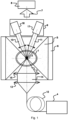
- the laser-pumped plasma light source comprises the high-pressure gas filled chamber 1, typically 10 atm or higher. At least a part of the chamber 1 is optically transparent.
- Fig. 1 shows an embodiment with a completely transparent chamber manufactured from an optically transparent material, e.g. fused quartz.
- the chamber 1 contains the radiating plasma region 2 sustained in the chamber by the focused beam 3 of the CW laser 4.
- the optical collector 6 forms the radiation beam 7 transmitted, for example, via an optical fiber and/or a system of mirrors to one or more optical consumer systems 8 which uses broadband radiation emitted by plasma.
- the light source also comprises a means for plasma ignition.
- the light source is characterized in that the means for plasma ignition is a pulsed laser system 9 generating the first laser beam 10 and the second laser beam 11 focused in the chamber 1, namely into the region intended for sustaining the radiating plasma 2.
- the first laser beam 10 is intended for starting plasma ignition or for optical breakdown in the chamber 1.
- the second laser beam 11 is intended for plasma ignition after an optical breakdown provided by the first laser beam 10.
- Designing the light source in the proposed way allows to achieve reliable ignition of the continuous optical discharge by choosing the appropriate energy, duration and, correspondingly, pulse power of the two laser beams. This allows to create electrodeless high-brightness broadband laser-pumped plasma light sources characterized by the highest possible spatial and energetic stability.
- the opening angle of the output beam 5 of plasma radiation flat angle with respect to the plane of the drawing in FIG.
- the plasma radiation is collecting by the optical collector 6 in a solid angle of 9 sr or more.
- a cost-effective near-infrared diode laser with a fiber-optic output is used as the CW laser 4.
- the expanding laser beam is directed to the collimator 13, for example, in the form of a collecting lens.
- the expanded parallel beam 14 of the CW laser is directed to the focusing optical element 15, for example, in the form of an aspherical condenser lens.
- the focusing optical element 15 ensures sharp focusing of the beam 3 of the CW laser 4 required to achieve a high brightness of the light source.
- the power of the CW laser 4 does not exceed 300 Watts, which is quite enough for a broad range of applications, but is not sufficient for igniting the continuous optical discharge without special means for plasma ignition.
- the pulsed laser system 9 comprises the first laser 16 for generating the first laser beam 10, and the second laser 17 for generating the second laser beam 11, Fig. 1 .
- Optical elements for example, in the form of condenser lenses, may be used to focus the first and the second laser beams, without restriction to this option only.
- the focusing areas of the first and the second laser beams are at least partially superposed or overlap.
- Characteristic time dependencies of the radiation power in the first and the second laser beams 10, 11, as well as in the beam of the CW laser 4, are schematically shown on the logarithmic scale in Fig. 2 .
- the first laser beam 10 is characterized by a high (at least 10 4 W) pulse radiation power. In this case it is sufficient that the laser pulse full width at half maximum does not exceed 0.1 ⁇ s.
- the second laser beam has many times lower pulse power, for example, 10 3 Watts, and many times higher laser pulse length and energy, as compared to the first laser beam. This allows, after exposure to the first laser beam, use the second laser beam to create a volume of plasma which is many times, by an order of magnitude or more, larger than the volume of plasma produced by the first laser beam. At the same time, radiation power in the second laser beam is more than by an order of magnitude higher than the CW laser power, Fig. 2 .
- the second laser beam is intended for creating plasma, the volume and density of which are sufficient for stationary plasma sustenance by the focused beam of the CW laser.
- the generating of the second laser beam begins before the generating of the first laser beam and ends not earlier than 50 ⁇ s after the end of the first laser pulse, Fig. 2 .
- it makes synchronizing the first and second laser beams easier, on the other hand, it provides sufficient time for plasma evolution under the influence of the second laser beam.
- a large plasma volume of up to around 1 mm, and a plasma density of up to 10 18 cm -3 are provided, which are sufficient for reliable stationary plasma sustenance by the focused CW laser beam.
- a plasma density of 10 18 cm -3 corresponds to a gas with a temperature of 18,000 K and 10% ionization in the region of radiating plasma at initial gas pressure in the chamber of about 16 atm.
- the laser-pumped plasma light source operates as follows.
- the focused beam 3 of the CW laser 4 is directed into the at least partially transparent high-pressure gas chamber 1, Fig. 1 .
- Xenon, other inert gases and their mixtures, including metal vapor, for example, mercury, and/or a variety of gas mixtures, including gas halides, may be contained in the chamber as a high-efficient plasma fuel.
- the focused second laser beam 11 of the second laser 17 is directed into the region intended for sustaining the radiating plasma 2.
- the maximum radiation power in the second laser beam 11 may have a value of around 10 3 Watts, while the laser pulse length may be around 10 -4 s.
- the first laser beam 10 is generated, the focusing area of which at least partially superposes on the focusing area of the second laser beam.
- the second laser beam 11, whose energy and laser pulse length are many times higher than those of the first laser beam 10, is used to sustain the optical discharge at the power of laser radiation (in the order of 10 3 W or more) which is many times higher than the radiation power in the beam 3 of the CW laser.
- the pulse length of which is around 100 ⁇ s or more the plasma volume is increased due to its moving towards the laser beam 11 along the caustic and its radial expansion. So the plasma size of up to 1 mm can be achieved. Due to the sufficiently high (in the order of 0.1 J/pulse or higher) radiation pulse energy of the second laser beam 11, in the increased plasma volume a level of electron density is provided which is sufficient for reliable sustenance of the radiating plasma by the focused beam 3 of the CW laser 4 with a relatively small power not exceeding 300 Watts. Thus, the second laser beam provides a plasma density that is higher than the threshold plasma density of a continuous optical discharge having a value in the order of 10 18 electrons/cm 3 or higher. In stationary mode, broadband radiation is output from the radiating plasma region 2 by at least one output beam 5 of the plasma radiation exiting through optically transparent part of the chamber 1 and intended for subsequent use.
- Designing the light source as proposed above achieves reliable ignition of the continuous optical discharge without the use of igniting electrodes. This allows to significantly improve the chamber's design by simplifying its shape and eliminating mechanical stresses in the points where metal is hermetically introduced into the chamber, increasing the light source reliability and lifetime. Design simplification allows to use a chamber shape that reduces aberrations introduced into the output beam of plasma radiation exiting the chamber, and thereby increase the light source brightness. Also, it provides for the possibility to use chamber material with a higher transparency in the UV spectral range. Electromagnetic noise when starting the light source is reduced. Chamber lifetime is increased because metallization of its optically transparent parts is eliminated. Besides, absence of electrodes allows to significantly increase the spatial angle of radiation output and to raise the power in the output beam of plasma radiation.
- the pulsed laser system 9 is a solid-state one, Fig. 3 .
- the pulsed laser system 9 comprises two optically pumped solid-state lasers 16, 17.
- flash lamps 18, 19 with reflectors can be used as sources of optical pumping. Lamps are switched on with an optimized delay relative to each other.
- Rods made of a transparent base material, for example, yttrium-aluminum garnet (YAG), doped with metal ions, for example, neodymium (Nd), can be used as the active elements 20, 21.
- the first and the second laser beams 10, 11 are preferably parallel and introduced into the chamber 1 via one common focusing optical system 22, for example, in the form of an aspherical condenser lens.
- the first and the second solid-state lasers 16, 17 preferably have common cavity mirrors 23, 24. This provides superposition of the focusing areas of the first and the second laser beams 10, 11, required for plasma ignition.
- the pulsed laser system 9 generates the first laser beam 10 in Q-switching mode or in giant-pulse generation mode, and the second laser beam 11 in free-running mode.
- the first laser is equipped with the Q-switch 25, for example, a passive one made of phototropic material.
- an active Q-switching may be used.
- Too high radiation power of the pulsed laser system 9 during giant pulse generation does not allow using optical fiber for transmitting its radiation, as the optical fiber can be damaged. Because of that, in the embodiments of invention only the CW laser is equipped with the fiber-optical output, Fig. 1 , Fig. 3 .
- the additional deflecting mirror 27 can be used in it, Fig. 3 , or several such mirrors.
- additional optical elements in the pathway of the CW laser beam 14, or in the pulsed laser system 9, additional optical elements (not shown) can be installed to offset chromatic aberrations and more accurately align the focusing areas of the CW and pulsed laser beams.
- additional optical elements for example, polarizers, filters, diaphragms, can be installed to control parameters of the first and the second laser beams.
- the axis of the CW laser focused beam 3 is directed vertically upwards, i.e. against the force of gravity 28, Fig. 3 , or close to vertical.
- the proposed design achieves the highest stability of the light source radiation power. This is due to the fact that usually the region of radiating plasma 2 is slightly moved from the focus towards the focused beam 3 of the CW laser up to the focused laser beam cross-section where the intensity of the focused beam 3 of the CW laser is still enough to sustain the radiating plasma region 2.
- the focused beam 3 of the CW laser is directed from the bottom upwards, the radiating plasma region 2 that contains the hottest plasma with the lowest mass density, tends to float under the influence of the buoyant force.
- the rising region of radiating plasma 2 ends up in the location closest to the focus where the cross-section of the focused beam 3 of the CW laser is smaller, and the laser radiation intensity is higher. On the one hand, this increases the plasma radiation brightness, and on the other hand, it equalizes the forces acting on the radiating plasma region, which ensures high stability of the radiation power of the high-brightness laser-pumped plasma light source.
- the chamber 1 must be axisymmetric, and the axis of the focused beam 3 of the CW laser must be aligned with the chamber's axis of symmetry.
- this invention realizes the possibility of achieving the highest brightness of laser-pumped broadband light sources, in particular, by means of optimizing the shape and dimensions of the electrode-free chamber.
- the external surface and the internal surface either of the chamber, or of its transparent parts are shaped as concentric spheres, and the region of radiating plasma 2 is located in the center of the said concentric spheres, Fig. 3 .
- aberrations introduced by the chamber walls are eliminated, making it possible to achieve a sharper focusing of the beam 3 of the CW laser and to increase the light source brightness.
- aberrations that distort the path of rays in the beam 5 of useful plasma radiation are eliminated, increasing its brightness.
- Another positive outcome of the invention is the possibility of minimizing the chamber's dimensions.
- This increases the focusing sharpness of the CW laser beam 3 due to moving the focusing optical system 22 closer to the region of radiating plasma 2.
- the closer the region of radiating plasma to the walls of the chamber 1, in particular to the top chamber wall the smaller the pulse acquired under the action of the buoyant force, by the gas heated in the region of radiating plasma 2. Consequently, the speed and turbulence of gas convective flows are the smaller, the smaller the distance from the plasma to the chamber wall.
- the possibility is provided to further increase the brightness and stability of the laser-pumped plasma light source designed according to present invention.
- the optically transparent parts of the chamber are preferably made of a material belonging to the group consisting of: crystalline magnesium fluoride (MgF 2 ), crystalline calcium fluoride (CaF 2 ), crystalline sapphire or leucosapphire (Al 2 O 3 ), fused or crystalline quartz.
- MgF 2 crystalline magnesium fluoride
- CaF 2 crystalline calcium fluoride
- Al 2 O 3 leucosapphire
- the chamber ensures that the output beam of plasma radiation 5 exits the chamber in a planar angle of 2 ⁇ radians, without restriction to this option only Fig. 1 , Fig. 3 .
- the light source can have at least three diverging output beams 5a, 5b, 5c of plasma radiation, as illustrated in Fig. 4 , which shows the light source cross-section in the horizontal plane passing through the region of radiating plasma 2.
- the laser beams in Fig. 4 used for COD ignition and sustenance, are located below the plane of the drawing. Using several, in particular, three beams of plasma radiation from a single light source is required for a variety of industrial applications.
- the chamber 1 of the laser-pumped plasma light source is installed in the housing 29 which is equipped with three optical collectors 6a, 6b, 6c.
- the optical collectors 6a, 6b, 6c form the plasma radiation beams 7a, 7b, 7c, transmitted, for example, via an optical fiber to the optical consumer systems 8a, 8b, 8c, which use broadband plasma radiation. This allows to use one light source for three or more optical consumer systems resulting in compact size of the system and identical parameters of broadband radiation in all optical channels.
- the method of plasma ignition in the laser-pumped plasma light source is as follows.
- the focused beam 3 of the CW laser 4 is directed into the high-pressure gas filled chamber 1, typically 10 atm or higher.
- the plasma ignition is provided by the pulsed laser system 9 generating the first and the second laser beams 10, 11 focused in the chamber.
- the first laser beam 10 is arranged to provide the optical breakdown, after which the second laser beam 11 is used to ignite the plasma, whose volume and density are sufficient for stationary plasma sustenance by the focused beam 3 of the CW laser 4.
- the solid-state laser system is used, which generates the first laser beam 10 in Q-switching mode and generates the second laser beam 11 in free-running mode, Fig. 3 .
- the pulsed laser system 9 preferably comprises two solid-state lasers 16, 17, for example, Nd:YAG lasers with optical pumping sources 18, 19 in the form of flash lamps.
- the first and the second laser beams 10, 11 are preferably parallel and introduced into the chamber 1 via the focusing optical system 22.
- the solid-state lasers 16, 17 preferably have the common mirrors 23, 24 of the cavity.
- the first laser 16 is equipped with the Q-switch 25.
- Xe gas pressure in the chamber is 30 atm.
- the optical breakdown plasma has a characteristic dimension of 50 to 100 ⁇ m.
- the optical breakdown mode does not provide reliable ignition of an optical discharge sustained by the focused beam 3 of the CW laser 4. Therefore, after optical breakdown the second laser beam is used to ignite the plasma, whose volume (up to 1 mm 3 ) and the density (over 10 18 cm -3 ) are sufficient for stationary plasma sustenance by the focused beam 3 of the CW laser 4.
- the energy of the second laser beam is 150 mJ
- the pulse length is 100 ⁇ s
- the radiation pulse of the second laser beam ends no earlier than 50 ⁇ s after the end of the first laser beam radiation pulse, as illustrated in Fig. 2 .
- the time of at least 50 ⁇ s is necessary to allow for decay of disturbances from the optical breakdown and for the plasma dimensions and density evolving to the values sufficient for stationary plasma sustenance by the focused beam of the CW laser.
- the proposed invention allows to ensure high reliability of laser igniting the laser-sustained plasma and to create high-brightness broadband light sources with the highest spatial and power stability on that basis.
- High-brightness high-stability laser-pumped plasma light sources designed according to this invention can be used in a variety of projection systems, for spectrochemical analysis, spectral microanalysis of bioobjects in biology and medicine, microcapillary liquid chromatography, for inspection of the optical lithography process, for spectrophotometry and for other purposes.
Landscapes
- Engineering & Computer Science (AREA)
- Physics & Mathematics (AREA)
- Plasma & Fusion (AREA)
- Electromagnetism (AREA)
- Chemical & Material Sciences (AREA)
- Combustion & Propulsion (AREA)
- Mechanical Engineering (AREA)
- General Engineering & Computer Science (AREA)
- Lasers (AREA)
- Plasma Technology (AREA)
- Coating By Spraying Or Casting (AREA)
- Glass Compositions (AREA)
Claims (15)
- Lasergepumpte Plasma-Lichtquelle, umfassend: eine gasgefüllte Kammer (1), von der mindestens ein Teil optisch transparent ist; einen Bereich von abstrahlendem Plasma (2), das in der Kammer durch einen fokussierten Strahl (3) eines Dauerstrichlasers (4) aufrechterhalten wird; mindestens einen Austrittsstrahl (5) von Plasmaabstrahlung, der aus der Kammer (1) austritt; ein Mittel zur Plasmazündung, dadurch gekennzeichnet, dassdas Mittel zur Plasmazündung ein gepulstes Lasersystem (9) ist, das so konfiguriert ist, dass es einen ersten Laserstrahl (10) im Güteschaltungsmodus und einen zweiten Laserstrahl (11) im Freilaufmodus erzeugt, wobei der erste und der zweite Laserstrahl (10, 11) in der Kammer (1) fokussiert sind, wobeider erste Laserstrahl (10) für einen optischen Gasdurchlag angeordnet ist, undder zweite Laserstrahl (11) für eine Plasmazündung nach dem optischen Durchschlag angeordnet ist.
- Lichtquelle nach Anspruch 1, wobei der erste Laserstrahl (10) eine Spitzenstrahlungsleistung von mehr als 104 Watt und eine Pulslänge von weniger als 0,1 µs aufweist.
- Lichtquelle nach Anspruch 1 oder 2, wobei der zweite Laserstrahl (11) im Vergleich zum ersten Laserstrahl (10) eine mindestens dreifach höhere Laserpulsenergie und eine mindestens um eine Größenordnung geringere Laserspitzenleistung aufweist.
- Lichtquelle nach einem der vorhergehenden Ansprüche, wobei das Volumen des durch den zweiten Laserstrahl (11) gezündeten Plasmas das Volumen des während des optischen Durchschlags durch den ersten Laser (10) erzeugten Plasmas um ein Vielfaches, um eine Größenordnung oder mehr, übersteigt.
- Lichtquelle nach einem der vorhergehenden Ansprüche, wobei das Volumen und die Dichte des durch den zweiten Laserstrahl (11) gezündeten Plasmas für die stationäre Aufrechterhaltung des Plasmas durch den fokussierten Strahl (3) des Dauerstrichlasers (4) ausreichen und/oder wobei der zweite Laserstrahl (11) eine Plasmagröße von bis zu etwa 1 mm und eine Plasmadichte von bis zu 1018 cm-3 oder mehr liefert.
- Lichtquelle nach einem der vorhergehenden Ansprüche, wobei der Strahlungspuls des zweiten Laserstrahls (11) frühestens 50 µs nach dem Ende des Strahlungspulses des ersten Laserstrahls (10) endet.
- Lichtquelle nach einem der vorhergehenden Ansprüche, wobei sich die Fokussierbereiche des ersten und des zweiten Laserstrahls (10, 11) zumindest teilweise überlappen.
- Lichtquelle nach einem der vorhergehenden Ansprüche, wobei das gepulste Lasersystem (9) zwei Laser (16, 17) mit gemeinsamen Hohlraumspiegeln (23, 24) umfasst, und wobei der erste und der zweite Laserstrahl (10, 11) parallel sind und durch ein gemeinsames fokussierendes optisches System (22) in die Kammer eingeführt werden.
- Lichtquelle nach einem der vorhergehenden Ansprüche, wobei nur der Dauerstrichlaser (4) einen faseroptischen Ausgang hat und/oder wobei die Abgabeleistung des Dauerstrichlasers (4) 300 Watt nicht überschreitet.
- Lichtquelle nach einem der vorhergehenden Ansprüche, wobei die Wellenlänge des Dauerstrichlasers (4) von den Wellenlängen der Strahlung des ersten und des zweiten Laserstrahls (10, 11) verschieden ist.
- Lichtquelle nach einem der vorhergehenden Ansprüche, wobei die Achse des fokussierten Strahls (3) des Dauerstrichlasers (4) vertikal nach oben oder annähernd vertikal ausgerichtet ist.
- Lichtquelle nach einem der vorhergehenden Ansprüche, wobei die äußere Oberfläche und die innere Oberfläche der transparenten Teile der Kammer (1) als konzentrische Kugeln oder als Abschnitte davon geformt sind und der Bereich des strahlenden Plasmas sich in der Mitte der konzentrischen Kugeln befindet.
- Lichtquelle nach einem der vorhergehenden Ansprüche, wobei der Austrittsstrahl (5) der Plasmastrahlung in allen Azimuten aus der Kammer (1) austritt, und/oder wobei der Austrittsstrahl (5) der Plasmastrahlung in einem Raumwinkel von nicht weniger als 9 sr aus der Kammer (1) austritt, und/oder wobei die Lichtquelle drei oder mehr Austrittsstrahlen (5a, 5b, 5c) der Plasmastrahlung aufweist.
- Verfahren zum Zünden eines Plasmas in einer lasergepumpten Plasma-Lichtquelle, umfassend: Richten eines fokussierten Strahls (3) eines Dauerstrichlasers (4) in eine Kammer (1) mit Hochdruckgas, Plasmazündung und stationäre Aufrechterhaltung eines strahlenden Plasmas (2) durch den fokussierten Strahl (3) des Dauerstrichlasers (4), dadurch gekennzeichnet, dassdie Plasmazündung durch ein gepulstes Lasersystem (9) erfolgt, das einen ersten Laserstrahl (10) im Güteschaltungsmodus und einen zweiten Laserstrahl (11) im Freilaufmodus erzeugt, wobei der erste und der zweite Laserstrahl (10, 11) in der Kammer (1) fokussiert sind, währendder erste Laserstrahl (10) zur Erzeugung eines optischen Durchschlags verwendet wird, wonach der zweite Laserstrahl (11) zur Zündung des Plasmas verwendet wird, dessen Volumen und Dichte für eine stationäre Plasmaerzeugung durch den fokussierten Strahl (3) des Dauerstrichlasers (4) ausreichend sind.
- Die Lichtquelle nach einem der Ansprüche 1-13 oder das Verfahren nach Anspruch 14, wobei das gepulste Lasersystem (9) ein Festkörperlasersystem ist.
Applications Claiming Priority (3)
| Application Number | Priority Date | Filing Date | Title |
|---|---|---|---|
| RU2020109782A RU2732999C1 (ru) | 2020-03-05 | 2020-03-05 | Источник света с лазерной накачкой и способ зажигания плазмы |
| US16/814,317 US10770282B1 (en) | 2020-03-10 | 2020-03-10 | Laser-pumped plasma light source and plasma ignition method |
| PCT/RU2021/050049 WO2021177859A1 (en) | 2020-03-05 | 2021-02-26 | Laser-pumped plasma light source and plasma ignition method |
Publications (2)
| Publication Number | Publication Date |
|---|---|
| EP4115441A1 EP4115441A1 (de) | 2023-01-11 |
| EP4115441B1 true EP4115441B1 (de) | 2025-02-26 |
Family
ID=75674911
Family Applications (1)
| Application Number | Title | Priority Date | Filing Date |
|---|---|---|---|
| EP21721647.2A Active EP4115441B1 (de) | 2020-03-05 | 2021-02-26 | Lasergepumpte plasmalichtquelle und plasmazündverfahren |
Country Status (7)
| Country | Link |
|---|---|
| EP (1) | EP4115441B1 (de) |
| JP (1) | JP6885636B1 (de) |
| KR (1) | KR102827289B1 (de) |
| CN (1) | CN115210849B (de) |
| CA (1) | CA3166712A1 (de) |
| IL (1) | IL294983B2 (de) |
| WO (1) | WO2021177859A1 (de) |
Families Citing this family (4)
| Publication number | Priority date | Publication date | Assignee | Title |
|---|---|---|---|---|
| EP4193384A1 (de) * | 2020-08-06 | 2023-06-14 | Isteq B.V. | Lasergepumpte plasmalichtquelle mit hoher helligkeit und verfahren zur aberrationsverringerung |
| US12144072B2 (en) * | 2022-03-29 | 2024-11-12 | Hamamatsu Photonics K.K. | All-optical laser-driven light source with electrodeless ignition |
| CN118039452B (zh) * | 2024-02-05 | 2025-01-28 | 中国科学技术大学 | 一种台式化高亮度等离子体光源 |
| CN120914601B (zh) * | 2025-10-10 | 2025-12-16 | 深圳多咪巴科技有限公司 | 一种泵浦激光发射器、激光线路及激光机 |
Citations (2)
| Publication number | Priority date | Publication date | Assignee | Title |
|---|---|---|---|---|
| WO2017062274A1 (en) * | 2015-10-04 | 2017-04-13 | Kla-Tencor Corporation | System and method for electrodeless plasma ignition in laser-sustained plasma light source |
| US20170111986A1 (en) * | 2015-10-20 | 2017-04-20 | Samsung Electronics Co., Ltd. | Plasma light source apparatus and light source system including the same |
Family Cites Families (16)
| Publication number | Priority date | Publication date | Assignee | Title |
|---|---|---|---|---|
| JPS5417349A (en) | 1977-07-11 | 1979-02-08 | Mitsubishi Aluminium | Aluminum alloy brazing material for brazing used for fluxxfree brazing in high vacuum or nonoxidizable atomosphere |
| DD243629A3 (de) | 1983-11-01 | 1987-03-11 | Walter Gaertner | Strahlungsquelle fuer optische geraete, insbesondere fuer fotolithografische abbildungssysteme |
| JPH10221499A (ja) * | 1997-02-07 | 1998-08-21 | Hitachi Ltd | レーザプラズマx線源およびそれを用いた半導体露光装置並びに半導体露光方法 |
| US6972421B2 (en) * | 2000-06-09 | 2005-12-06 | Cymer, Inc. | Extreme ultraviolet light source |
| RU2250530C2 (ru) * | 2003-06-25 | 2005-04-20 | Институт проблем механики Российской Академии наук | Лазерно-плазменный источник ионов и излучения |
| JP5557487B2 (ja) * | 2009-07-30 | 2014-07-23 | ウシオ電機株式会社 | 光源装置 |
| RU2539970C2 (ru) | 2012-12-17 | 2015-01-27 | Общество с ограниченной ответственностью "РнД-ИСАН" | Источник света с лазерной накачкой и способ генерации излучения |
| RU2534223C1 (ru) | 2013-04-11 | 2014-11-27 | Общество с ограниченной ответственностью "РнД-ИСАН" | Источник света с лазерной накачкой и способ генерации излучения |
| KR102088363B1 (ko) * | 2013-12-05 | 2020-04-14 | 삼성전자주식회사 | 플라즈마 광원 장치 및 플라즈마 광 생성 방법 |
| US9506871B1 (en) * | 2014-05-25 | 2016-11-29 | Kla-Tencor Corporation | Pulsed laser induced plasma light source |
| KR102345537B1 (ko) * | 2014-12-11 | 2021-12-30 | 삼성전자주식회사 | 플라즈마 광원, 및 그 광원을 포함하는 검사 장치 |
| US10057973B2 (en) | 2015-05-14 | 2018-08-21 | Excelitas Technologies Corp. | Electrodeless single low power CW laser driven plasma lamp |
| US10887974B2 (en) * | 2015-06-22 | 2021-01-05 | Kla Corporation | High efficiency laser-sustained plasma light source |
| CN105134453B (zh) * | 2015-08-24 | 2017-03-08 | 中国科学院半导体研究所 | 采用双模式激光气体击穿方式下的点火装置及方法 |
| US9865447B2 (en) * | 2016-03-28 | 2018-01-09 | Kla-Tencor Corporation | High brightness laser-sustained plasma broadband source |
| KR20190034018A (ko) * | 2017-09-22 | 2019-04-01 | 삼성전자주식회사 | 레이저 유도 플라즈마(lip) 기반 원자발광 분광장치, 그 장치를 포함한 반도체 제조설비, 및 그 장치를 이용한 반도체 소자 제조방법 |
-
2020
- 2020-04-23 JP JP2020076580A patent/JP6885636B1/ja active Active
-
2021
- 2021-02-25 IL IL294983A patent/IL294983B2/en unknown
- 2021-02-26 WO PCT/RU2021/050049 patent/WO2021177859A1/en not_active Ceased
- 2021-02-26 CN CN202180018909.8A patent/CN115210849B/zh active Active
- 2021-02-26 KR KR1020227029891A patent/KR102827289B1/ko active Active
- 2021-02-26 CA CA3166712A patent/CA3166712A1/en active Pending
- 2021-02-26 EP EP21721647.2A patent/EP4115441B1/de active Active
Patent Citations (2)
| Publication number | Priority date | Publication date | Assignee | Title |
|---|---|---|---|---|
| WO2017062274A1 (en) * | 2015-10-04 | 2017-04-13 | Kla-Tencor Corporation | System and method for electrodeless plasma ignition in laser-sustained plasma light source |
| US20170111986A1 (en) * | 2015-10-20 | 2017-04-20 | Samsung Electronics Co., Ltd. | Plasma light source apparatus and light source system including the same |
Also Published As
| Publication number | Publication date |
|---|---|
| IL294983B1 (en) | 2025-05-01 |
| KR102827289B1 (ko) | 2025-06-30 |
| KR20220133979A (ko) | 2022-10-05 |
| JP6885636B1 (ja) | 2021-06-16 |
| JP2021141037A (ja) | 2021-09-16 |
| EP4115441A1 (de) | 2023-01-11 |
| IL294983B2 (en) | 2025-09-01 |
| IL294983A (en) | 2022-09-01 |
| WO2021177859A1 (en) | 2021-09-10 |
| CN115210849B (zh) | 2025-06-24 |
| CN115210849A (zh) | 2022-10-18 |
| CA3166712A1 (en) | 2021-09-10 |
Similar Documents
| Publication | Publication Date | Title |
|---|---|---|
| US10770282B1 (en) | Laser-pumped plasma light source and plasma ignition method | |
| EP4115441B1 (de) | Lasergepumpte plasmalichtquelle und plasmazündverfahren | |
| RU2539970C2 (ru) | Источник света с лазерной накачкой и способ генерации излучения | |
| EP3295470B1 (de) | Elektrodenloser einzel-cw-lasergesteuerter xenonscheinwerfer | |
| US8369374B2 (en) | Light source device | |
| US10057973B2 (en) | Electrodeless single low power CW laser driven plasma lamp | |
| EP2202780B1 (de) | Lichtquellenvorrichtung | |
| KR20110040678A (ko) | 광원 장치 | |
| RU2732999C1 (ru) | Источник света с лазерной накачкой и способ зажигания плазмы | |
| EP3571708A1 (de) | Elektrodenlose einzelne lasergesteuerte plasmalampe mit niedriger leistungsaufnahme | |
| HK40077367B (en) | Laser-pumped plasma light source and plasma ignition method | |
| HK40077367A (en) | Laser-pumped plasma light source and plasma ignition method | |
| US11875986B2 (en) | Laser-pumped light source and method for laser ignition of plasma | |
| CN118103946B (zh) | 激光泵浦光源和用于激光点火等离子体的方法 | |
| RU2790613C1 (ru) | Источник света с лазерной накачкой и способ лазерного зажигания плазмы | |
| HK40124837A (zh) | 激光泵浦光源和用於激光点火等离子体的方法 | |
| HK40124837B (zh) | 激光泵浦光源和用於激光点火等离子体的方法 | |
| EP4193385A1 (de) | Lasergepumpte plasmalichtquelle und verfahren zur lichterzeugung | |
| JP7637958B2 (ja) | 広帯域レーザ励起プラズマ光源 | |
| RU2828172C1 (ru) | Способ поджига оптического разряда |
Legal Events
| Date | Code | Title | Description |
|---|---|---|---|
| STAA | Information on the status of an ep patent application or granted ep patent |
Free format text: STATUS: UNKNOWN |
|
| STAA | Information on the status of an ep patent application or granted ep patent |
Free format text: STATUS: THE INTERNATIONAL PUBLICATION HAS BEEN MADE |
|
| PUAI | Public reference made under article 153(3) epc to a published international application that has entered the european phase |
Free format text: ORIGINAL CODE: 0009012 |
|
| STAA | Information on the status of an ep patent application or granted ep patent |
Free format text: STATUS: REQUEST FOR EXAMINATION WAS MADE |
|
| 17P | Request for examination filed |
Effective date: 20220813 |
|
| AK | Designated contracting states |
Kind code of ref document: A1 Designated state(s): AL AT BE BG CH CY CZ DE DK EE ES FI FR GB GR HR HU IE IS IT LI LT LU LV MC MK MT NL NO PL PT RO RS SE SI SK SM TR |
|
| REG | Reference to a national code |
Ref country code: HK Ref legal event code: DE Ref document number: 40077367 Country of ref document: HK |
|
| DAV | Request for validation of the european patent (deleted) | ||
| DAX | Request for extension of the european patent (deleted) | ||
| RAP1 | Party data changed (applicant data changed or rights of an application transferred) |
Owner name: ISTEQ B.V. Owner name: ISTEQ GROUP HOLDING B.V. |
|
| GRAP | Despatch of communication of intention to grant a patent |
Free format text: ORIGINAL CODE: EPIDOSNIGR1 |
|
| STAA | Information on the status of an ep patent application or granted ep patent |
Free format text: STATUS: GRANT OF PATENT IS INTENDED |
|
| INTG | Intention to grant announced |
Effective date: 20241018 |
|
| RIN1 | Information on inventor provided before grant (corrected) |
Inventor name: GLUSHKOV, DENIS ALEXANDROVICH Inventor name: KIRYUKHIN, YURII BORISOVICH Inventor name: LASH, ALEKSANDR ANDREEVICH Inventor name: KRIVTSUN, VLADIMIR MIKHAILOVICH Inventor name: GAYASOV, ROBERT RAFILEVICH Inventor name: ABRAMENKO, DMITRY BORISOVICH |
|
| GRAS | Grant fee paid |
Free format text: ORIGINAL CODE: EPIDOSNIGR3 |
|
| GRAA | (expected) grant |
Free format text: ORIGINAL CODE: 0009210 |
|
| STAA | Information on the status of an ep patent application or granted ep patent |
Free format text: STATUS: THE PATENT HAS BEEN GRANTED |
|
| AK | Designated contracting states |
Kind code of ref document: B1 Designated state(s): AL AT BE BG CH CY CZ DE DK EE ES FI FR GB GR HR HU IE IS IT LI LT LU LV MC MK MT NL NO PL PT RO RS SE SI SK SM TR |
|
| REG | Reference to a national code |
Ref country code: GB Ref legal event code: FG4D |
|
| REG | Reference to a national code |
Ref country code: CH Ref legal event code: EP |
|
| REG | Reference to a national code |
Ref country code: DE Ref legal event code: R096 Ref document number: 602021026770 Country of ref document: DE |
|
| REG | Reference to a national code |
Ref country code: IE Ref legal event code: FG4D |
|
| REG | Reference to a national code |
Ref country code: NL Ref legal event code: FP |
|
| PGFP | Annual fee paid to national office [announced via postgrant information from national office to epo] |
Ref country code: AT Payment date: 20250417 Year of fee payment: 5 |
|
| PG25 | Lapsed in a contracting state [announced via postgrant information from national office to epo] |
Ref country code: RS Free format text: LAPSE BECAUSE OF FAILURE TO SUBMIT A TRANSLATION OF THE DESCRIPTION OR TO PAY THE FEE WITHIN THE PRESCRIBED TIME-LIMIT Effective date: 20250526 |
|
| PG25 | Lapsed in a contracting state [announced via postgrant information from national office to epo] |
Ref country code: FI Free format text: LAPSE BECAUSE OF FAILURE TO SUBMIT A TRANSLATION OF THE DESCRIPTION OR TO PAY THE FEE WITHIN THE PRESCRIBED TIME-LIMIT Effective date: 20250226 |
|
| PG25 | Lapsed in a contracting state [announced via postgrant information from national office to epo] |
Ref country code: PL Free format text: LAPSE BECAUSE OF FAILURE TO SUBMIT A TRANSLATION OF THE DESCRIPTION OR TO PAY THE FEE WITHIN THE PRESCRIBED TIME-LIMIT Effective date: 20250226 |
|
| PG25 | Lapsed in a contracting state [announced via postgrant information from national office to epo] |
Ref country code: ES Free format text: LAPSE BECAUSE OF FAILURE TO SUBMIT A TRANSLATION OF THE DESCRIPTION OR TO PAY THE FEE WITHIN THE PRESCRIBED TIME-LIMIT Effective date: 20250226 |
|
| REG | Reference to a national code |
Ref country code: LT Ref legal event code: MG9D |
|
| PG25 | Lapsed in a contracting state [announced via postgrant information from national office to epo] |
Ref country code: NO Free format text: LAPSE BECAUSE OF FAILURE TO SUBMIT A TRANSLATION OF THE DESCRIPTION OR TO PAY THE FEE WITHIN THE PRESCRIBED TIME-LIMIT Effective date: 20250526 Ref country code: IS Free format text: LAPSE BECAUSE OF FAILURE TO SUBMIT A TRANSLATION OF THE DESCRIPTION OR TO PAY THE FEE WITHIN THE PRESCRIBED TIME-LIMIT Effective date: 20250626 |
|
| PG25 | Lapsed in a contracting state [announced via postgrant information from national office to epo] |
Ref country code: HR Free format text: LAPSE BECAUSE OF FAILURE TO SUBMIT A TRANSLATION OF THE DESCRIPTION OR TO PAY THE FEE WITHIN THE PRESCRIBED TIME-LIMIT Effective date: 20250226 |
|
| PG25 | Lapsed in a contracting state [announced via postgrant information from national office to epo] |
Ref country code: PT Free format text: LAPSE BECAUSE OF FAILURE TO SUBMIT A TRANSLATION OF THE DESCRIPTION OR TO PAY THE FEE WITHIN THE PRESCRIBED TIME-LIMIT Effective date: 20250626 Ref country code: LV Free format text: LAPSE BECAUSE OF FAILURE TO SUBMIT A TRANSLATION OF THE DESCRIPTION OR TO PAY THE FEE WITHIN THE PRESCRIBED TIME-LIMIT Effective date: 20250226 |
|
| PG25 | Lapsed in a contracting state [announced via postgrant information from national office to epo] |
Ref country code: GR Free format text: LAPSE BECAUSE OF FAILURE TO SUBMIT A TRANSLATION OF THE DESCRIPTION OR TO PAY THE FEE WITHIN THE PRESCRIBED TIME-LIMIT Effective date: 20250527 Ref country code: BG Free format text: LAPSE BECAUSE OF FAILURE TO SUBMIT A TRANSLATION OF THE DESCRIPTION OR TO PAY THE FEE WITHIN THE PRESCRIBED TIME-LIMIT Effective date: 20250226 |
|
| REG | Reference to a national code |
Ref country code: AT Ref legal event code: MK05 Ref document number: 1771541 Country of ref document: AT Kind code of ref document: T Effective date: 20250226 |
|
| PG25 | Lapsed in a contracting state [announced via postgrant information from national office to epo] |
Ref country code: SE Free format text: LAPSE BECAUSE OF FAILURE TO SUBMIT A TRANSLATION OF THE DESCRIPTION OR TO PAY THE FEE WITHIN THE PRESCRIBED TIME-LIMIT Effective date: 20250226 |
|
| REG | Reference to a national code |
Ref country code: CH Ref legal event code: PL |
|
| PG25 | Lapsed in a contracting state [announced via postgrant information from national office to epo] |
Ref country code: SM Free format text: LAPSE BECAUSE OF FAILURE TO SUBMIT A TRANSLATION OF THE DESCRIPTION OR TO PAY THE FEE WITHIN THE PRESCRIBED TIME-LIMIT Effective date: 20250226 |
|
| PG25 | Lapsed in a contracting state [announced via postgrant information from national office to epo] |
Ref country code: DK Free format text: LAPSE BECAUSE OF FAILURE TO SUBMIT A TRANSLATION OF THE DESCRIPTION OR TO PAY THE FEE WITHIN THE PRESCRIBED TIME-LIMIT Effective date: 20250226 |
|
| PG25 | Lapsed in a contracting state [announced via postgrant information from national office to epo] |
Ref country code: IT Free format text: LAPSE BECAUSE OF FAILURE TO SUBMIT A TRANSLATION OF THE DESCRIPTION OR TO PAY THE FEE WITHIN THE PRESCRIBED TIME-LIMIT Effective date: 20250226 Ref country code: LU Free format text: LAPSE BECAUSE OF NON-PAYMENT OF DUE FEES Effective date: 20250226 |
|
| PG25 | Lapsed in a contracting state [announced via postgrant information from national office to epo] |
Ref country code: AT Free format text: LAPSE BECAUSE OF FAILURE TO SUBMIT A TRANSLATION OF THE DESCRIPTION OR TO PAY THE FEE WITHIN THE PRESCRIBED TIME-LIMIT Effective date: 20250226 |
|
| PG25 | Lapsed in a contracting state [announced via postgrant information from national office to epo] |
Ref country code: CH Free format text: LAPSE BECAUSE OF NON-PAYMENT OF DUE FEES Effective date: 20250228 |
|
| PG25 | Lapsed in a contracting state [announced via postgrant information from national office to epo] |
Ref country code: EE Free format text: LAPSE BECAUSE OF FAILURE TO SUBMIT A TRANSLATION OF THE DESCRIPTION OR TO PAY THE FEE WITHIN THE PRESCRIBED TIME-LIMIT Effective date: 20250226 Ref country code: CZ Free format text: LAPSE BECAUSE OF FAILURE TO SUBMIT A TRANSLATION OF THE DESCRIPTION OR TO PAY THE FEE WITHIN THE PRESCRIBED TIME-LIMIT Effective date: 20250226 |
|
| PG25 | Lapsed in a contracting state [announced via postgrant information from national office to epo] |
Ref country code: RO Free format text: LAPSE BECAUSE OF FAILURE TO SUBMIT A TRANSLATION OF THE DESCRIPTION OR TO PAY THE FEE WITHIN THE PRESCRIBED TIME-LIMIT Effective date: 20250226 |
|
| PG25 | Lapsed in a contracting state [announced via postgrant information from national office to epo] |
Ref country code: SK Free format text: LAPSE BECAUSE OF FAILURE TO SUBMIT A TRANSLATION OF THE DESCRIPTION OR TO PAY THE FEE WITHIN THE PRESCRIBED TIME-LIMIT Effective date: 20250226 |
|
| REG | Reference to a national code |
Ref country code: DE Ref legal event code: R097 Ref document number: 602021026770 Country of ref document: DE |
|
| REG | Reference to a national code |
Ref country code: BE Ref legal event code: MM Effective date: 20250228 |
|
| PG25 | Lapsed in a contracting state [announced via postgrant information from national office to epo] |
Ref country code: MC Free format text: LAPSE BECAUSE OF FAILURE TO SUBMIT A TRANSLATION OF THE DESCRIPTION OR TO PAY THE FEE WITHIN THE PRESCRIBED TIME-LIMIT Effective date: 20250226 |
|
| PLBE | No opposition filed within time limit |
Free format text: ORIGINAL CODE: 0009261 |
|
| STAA | Information on the status of an ep patent application or granted ep patent |
Free format text: STATUS: NO OPPOSITION FILED WITHIN TIME LIMIT |
|
| PG25 | Lapsed in a contracting state [announced via postgrant information from national office to epo] |
Ref country code: BE Free format text: LAPSE BECAUSE OF NON-PAYMENT OF DUE FEES Effective date: 20250228 |
|
| PG25 | Lapsed in a contracting state [announced via postgrant information from national office to epo] |
Ref country code: IE Free format text: LAPSE BECAUSE OF NON-PAYMENT OF DUE FEES Effective date: 20250226 |
|
| 26N | No opposition filed |
Effective date: 20251127 |
|
| PGFP | Annual fee paid to national office [announced via postgrant information from national office to epo] |
Ref country code: NL Payment date: 20260227 Year of fee payment: 6 |
|
| PGFP | Annual fee paid to national office [announced via postgrant information from national office to epo] |
Ref country code: GB Payment date: 20260225 Year of fee payment: 6 |
|
| PGFP | Annual fee paid to national office [announced via postgrant information from national office to epo] |
Ref country code: DE Payment date: 20260224 Year of fee payment: 6 |
|
| PGFP | Annual fee paid to national office [announced via postgrant information from national office to epo] |
Ref country code: FR Payment date: 20260213 Year of fee payment: 6 |