EP4112970B1 - Hydraulikverbundbuchse und dichtungsverfahren dafür - Google Patents
Hydraulikverbundbuchse und dichtungsverfahren dafür Download PDFInfo
- Publication number
- EP4112970B1 EP4112970B1 EP20937391.9A EP20937391A EP4112970B1 EP 4112970 B1 EP4112970 B1 EP 4112970B1 EP 20937391 A EP20937391 A EP 20937391A EP 4112970 B1 EP4112970 B1 EP 4112970B1
- Authority
- EP
- European Patent Office
- Prior art keywords
- flow channel
- hydraulic
- composite bushing
- channel pipe
- rubber member
- Prior art date
- Legal status (The legal status is an assumption and is not a legal conclusion. Google has not performed a legal analysis and makes no representation as to the accuracy of the status listed.)
- Active
Links
Images


Classifications
-
- B—PERFORMING OPERATIONS; TRANSPORTING
- B61—RAILWAYS
- B61F—RAIL VEHICLE SUSPENSIONS, e.g. UNDERFRAMES, BOGIES OR ARRANGEMENTS OF WHEEL AXLES; RAIL VEHICLES FOR USE ON TRACKS OF DIFFERENT WIDTH; PREVENTING DERAILING OF RAIL VEHICLES; WHEEL GUARDS, OBSTRUCTION REMOVERS OR THE LIKE FOR RAIL VEHICLES
- B61F5/00—Constructional details of bogies; Connections between bogies and vehicle underframes; Arrangements or devices for adjusting or allowing self-adjustment of wheel axles or bogies when rounding curves
- B61F5/26—Mounting or securing axle-boxes in vehicle or bogie underframes
- B61F5/30—Axle-boxes mounted for movement under spring control in vehicle or bogie underframes
- B61F5/32—Guides, e.g. plates, for axle-boxes
-
- B—PERFORMING OPERATIONS; TRANSPORTING
- B60—VEHICLES IN GENERAL
- B60G—VEHICLE SUSPENSION ARRANGEMENTS
- B60G7/00—Pivoted suspension arms; Accessories thereof
- B60G7/04—Buffer means for limiting movement of arms
-
- B—PERFORMING OPERATIONS; TRANSPORTING
- B61—RAILWAYS
- B61F—RAIL VEHICLE SUSPENSIONS, e.g. UNDERFRAMES, BOGIES OR ARRANGEMENTS OF WHEEL AXLES; RAIL VEHICLES FOR USE ON TRACKS OF DIFFERENT WIDTH; PREVENTING DERAILING OF RAIL VEHICLES; WHEEL GUARDS, OBSTRUCTION REMOVERS OR THE LIKE FOR RAIL VEHICLES
- B61F5/00—Constructional details of bogies; Connections between bogies and vehicle underframes; Arrangements or devices for adjusting or allowing self-adjustment of wheel axles or bogies when rounding curves
- B61F5/50—Other details
-
- B—PERFORMING OPERATIONS; TRANSPORTING
- B62—LAND VEHICLES FOR TRAVELLING OTHERWISE THAN ON RAILS
- B62D—MOTOR VEHICLES; TRAILERS
- B62D7/00—Steering linkage; Stub axles or their mountings
- B62D7/22—Arrangements for reducing or eliminating reaction, e.g. vibration, from parts, e.g. wheels, of the steering system
-
- F—MECHANICAL ENGINEERING; LIGHTING; HEATING; WEAPONS; BLASTING
- F16—ENGINEERING ELEMENTS AND UNITS; GENERAL MEASURES FOR PRODUCING AND MAINTAINING EFFECTIVE FUNCTIONING OF MACHINES OR INSTALLATIONS; THERMAL INSULATION IN GENERAL
- F16F—SPRINGS; SHOCK-ABSORBERS; MEANS FOR DAMPING VIBRATION
- F16F13/00—Units comprising springs of the non-fluid type as well as vibration-dampers, shock-absorbers, or fluid springs
- F16F13/04—Units comprising springs of the non-fluid type as well as vibration-dampers, shock-absorbers, or fluid springs comprising both a plastics spring and a damper, e.g. a friction damper
- F16F13/06—Units comprising springs of the non-fluid type as well as vibration-dampers, shock-absorbers, or fluid springs comprising both a plastics spring and a damper, e.g. a friction damper the damper being a fluid damper, e.g. the plastics spring not forming a part of the wall of the fluid chamber of the damper
- F16F13/08—Units comprising springs of the non-fluid type as well as vibration-dampers, shock-absorbers, or fluid springs comprising both a plastics spring and a damper, e.g. a friction damper the damper being a fluid damper, e.g. the plastics spring not forming a part of the wall of the fluid chamber of the damper the plastics spring forming at least a part of the wall of the fluid chamber of the damper
- F16F13/14—Units of the bushing type, i.e. loaded predominantly radially
- F16F13/1418—Units of the bushing type, i.e. loaded predominantly radially characterised by the location or shape of the equilibration chamber
-
- F—MECHANICAL ENGINEERING; LIGHTING; HEATING; WEAPONS; BLASTING
- F16—ENGINEERING ELEMENTS AND UNITS; GENERAL MEASURES FOR PRODUCING AND MAINTAINING EFFECTIVE FUNCTIONING OF MACHINES OR INSTALLATIONS; THERMAL INSULATION IN GENERAL
- F16F—SPRINGS; SHOCK-ABSORBERS; MEANS FOR DAMPING VIBRATION
- F16F13/00—Units comprising springs of the non-fluid type as well as vibration-dampers, shock-absorbers, or fluid springs
- F16F13/04—Units comprising springs of the non-fluid type as well as vibration-dampers, shock-absorbers, or fluid springs comprising both a plastics spring and a damper, e.g. a friction damper
- F16F13/06—Units comprising springs of the non-fluid type as well as vibration-dampers, shock-absorbers, or fluid springs comprising both a plastics spring and a damper, e.g. a friction damper the damper being a fluid damper, e.g. the plastics spring not forming a part of the wall of the fluid chamber of the damper
- F16F13/08—Units comprising springs of the non-fluid type as well as vibration-dampers, shock-absorbers, or fluid springs comprising both a plastics spring and a damper, e.g. a friction damper the damper being a fluid damper, e.g. the plastics spring not forming a part of the wall of the fluid chamber of the damper the plastics spring forming at least a part of the wall of the fluid chamber of the damper
- F16F13/14—Units of the bushing type, i.e. loaded predominantly radially
- F16F13/1445—Units of the bushing type, i.e. loaded predominantly radially characterised by method of assembly, production or treatment
-
- F—MECHANICAL ENGINEERING; LIGHTING; HEATING; WEAPONS; BLASTING
- F16—ENGINEERING ELEMENTS AND UNITS; GENERAL MEASURES FOR PRODUCING AND MAINTAINING EFFECTIVE FUNCTIONING OF MACHINES OR INSTALLATIONS; THERMAL INSULATION IN GENERAL
- F16F—SPRINGS; SHOCK-ABSORBERS; MEANS FOR DAMPING VIBRATION
- F16F13/00—Units comprising springs of the non-fluid type as well as vibration-dampers, shock-absorbers, or fluid springs
- F16F13/04—Units comprising springs of the non-fluid type as well as vibration-dampers, shock-absorbers, or fluid springs comprising both a plastics spring and a damper, e.g. a friction damper
- F16F13/06—Units comprising springs of the non-fluid type as well as vibration-dampers, shock-absorbers, or fluid springs comprising both a plastics spring and a damper, e.g. a friction damper the damper being a fluid damper, e.g. the plastics spring not forming a part of the wall of the fluid chamber of the damper
- F16F13/08—Units comprising springs of the non-fluid type as well as vibration-dampers, shock-absorbers, or fluid springs comprising both a plastics spring and a damper, e.g. a friction damper the damper being a fluid damper, e.g. the plastics spring not forming a part of the wall of the fluid chamber of the damper the plastics spring forming at least a part of the wall of the fluid chamber of the damper
- F16F13/14—Units of the bushing type, i.e. loaded predominantly radially
- F16F13/1445—Units of the bushing type, i.e. loaded predominantly radially characterised by method of assembly, production or treatment
- F16F13/1454—Sealing of units
-
- F—MECHANICAL ENGINEERING; LIGHTING; HEATING; WEAPONS; BLASTING
- F16—ENGINEERING ELEMENTS AND UNITS; GENERAL MEASURES FOR PRODUCING AND MAINTAINING EFFECTIVE FUNCTIONING OF MACHINES OR INSTALLATIONS; THERMAL INSULATION IN GENERAL
- F16F—SPRINGS; SHOCK-ABSORBERS; MEANS FOR DAMPING VIBRATION
- F16F13/00—Units comprising springs of the non-fluid type as well as vibration-dampers, shock-absorbers, or fluid springs
- F16F13/04—Units comprising springs of the non-fluid type as well as vibration-dampers, shock-absorbers, or fluid springs comprising both a plastics spring and a damper, e.g. a friction damper
- F16F13/06—Units comprising springs of the non-fluid type as well as vibration-dampers, shock-absorbers, or fluid springs comprising both a plastics spring and a damper, e.g. a friction damper the damper being a fluid damper, e.g. the plastics spring not forming a part of the wall of the fluid chamber of the damper
- F16F13/08—Units comprising springs of the non-fluid type as well as vibration-dampers, shock-absorbers, or fluid springs comprising both a plastics spring and a damper, e.g. a friction damper the damper being a fluid damper, e.g. the plastics spring not forming a part of the wall of the fluid chamber of the damper the plastics spring forming at least a part of the wall of the fluid chamber of the damper
- F16F13/14—Units of the bushing type, i.e. loaded predominantly radially
- F16F13/1463—Units of the bushing type, i.e. loaded predominantly radially characterised by features of passages between working chambers
-
- F—MECHANICAL ENGINEERING; LIGHTING; HEATING; WEAPONS; BLASTING
- F16—ENGINEERING ELEMENTS AND UNITS; GENERAL MEASURES FOR PRODUCING AND MAINTAINING EFFECTIVE FUNCTIONING OF MACHINES OR INSTALLATIONS; THERMAL INSULATION IN GENERAL
- F16F—SPRINGS; SHOCK-ABSORBERS; MEANS FOR DAMPING VIBRATION
- F16F13/00—Units comprising springs of the non-fluid type as well as vibration-dampers, shock-absorbers, or fluid springs
- F16F13/04—Units comprising springs of the non-fluid type as well as vibration-dampers, shock-absorbers, or fluid springs comprising both a plastics spring and a damper, e.g. a friction damper
- F16F13/06—Units comprising springs of the non-fluid type as well as vibration-dampers, shock-absorbers, or fluid springs comprising both a plastics spring and a damper, e.g. a friction damper the damper being a fluid damper, e.g. the plastics spring not forming a part of the wall of the fluid chamber of the damper
- F16F13/08—Units comprising springs of the non-fluid type as well as vibration-dampers, shock-absorbers, or fluid springs comprising both a plastics spring and a damper, e.g. a friction damper the damper being a fluid damper, e.g. the plastics spring not forming a part of the wall of the fluid chamber of the damper the plastics spring forming at least a part of the wall of the fluid chamber of the damper
- F16F13/14—Units of the bushing type, i.e. loaded predominantly radially
- F16F13/1481—Units of the bushing type, i.e. loaded predominantly radially characterised by features of plastic springs, e.g. presence of cavities or stiffeners; characterised by features of flexible walls of equilibration chambers, i.e. membranes
-
- B—PERFORMING OPERATIONS; TRANSPORTING
- B60—VEHICLES IN GENERAL
- B60G—VEHICLE SUSPENSION ARRANGEMENTS
- B60G2204/00—Indexing codes related to suspensions per se or to auxiliary parts
- B60G2204/40—Auxiliary suspension parts; Adjustment of suspensions
- B60G2204/41—Elastic mounts, e.g. bushings
Definitions
- the present invention relates to a hydraulic composite bushing for vehicles, in particular rail vehicles.
- the invention also relates to a sealing method for the hydraulic composite bushing.
- Hydraulic bushing is a component widely used in vehicles (such as automobiles and rail vehicles), and mainly installed on a suspension or a bogie of a vehicle for absorbing vibrations and shocks to improve the running stability and safety of vehicles.
- the hydraulic bushing usually includes a core shaft, a rubber member, and an outer cover arranged around the core shaft. Two hydraulic chambers filled with hydraulic fluid are provided inside the rubber member, and connected with each other through a flow channel.
- the wheels will drive the core shaft to move relative to the outer cover, causing the hydraulic chambers to expand and contract accordingly, so that the hydraulic fluid is able to flow between said two hydraulic chambers. In this manner, the stiffness of the hydraulic bushing can be adjusted, so that the vehicle can keep running stably.
- Document CN 110 388 401 A which is considered to be the closest prior art, discloses a hydraulic composite bushing according to the pre-amble of claim 1.
- the present invention aims to provide a hydraulic composite bushing, which can effectively ensure the sealing performance of a flow channel pipe, a hydraulic chamber and related connecting positions, and also effectively ensure the performance of stiffness adjustment of the hydraulic composite bushing, which is very beneficial for extending the service life of the hydraulic composite bushing.
- the present invention further provides a sealing method for the hydraulic composite bushing, which has high production efficiency, and can effectively enhance the sealing performance of the hydraulic composite bushing.
- a hydraulic composite bushing comprising: a core shaft, an outer surface of which is provided with a flow channel groove continuously extending in a spiral shape; a rubber member, arranged on the core shaft and provided with two recesses diametrically opposite to each other, the recesses being arranged radially outside of the flow channel groove; a support ring, arranged around the rubber member, and covering the recesses to form two hydraulic chambers for accommodating hydraulic fluid; a outer cover press-fitted on the support ring from a radially outer side thereof; and a sealing device mounted at an end of a flow channel pipe arranged in the flow channel groove.
- Two ends of the flow channel pipe pass through the rubber member along a radial direction to extend into said two hydraulic chambers, respectively, so that said two hydraulic chambers are in communication with each other through the flow channel pipe.
- the sealing device is arranged at each end of the flow channel pipe, wherein one end of the sealing device is arranged in the flow channel groove while the other end thereof passes through the rubber member to extend into a corresponding hydraulic chamber, thus forming a seal between the flow channel pipe and the flow channel groove.
- a pressing sleeve is provided between the core shaft and the rubber member, and formed into one piece with the core shaft through injection molding of plastic, rubber or polyurethane material, for press-fitting the flow channel pipe into the flow channel groove.
- the sealing device comprises a cylindrical sealing body, which is provided with a mounting portion axially penetrating the sealing body and a rectangular through hole extending in the radial direction.
- the end of the flow channel pipe passes through the rectangular through hole and is fitted in the mounting portion, so that the pressing sleeve fills the rectangular through hole to enclose the flow channel pipe during the injection molding, thereby forming the seal.
- a first end of the sealing body is fitted with the flow channel groove, and a second end thereof passes through the rubber member to extend into a corresponding hydraulic chamber, wherein a tip of the second end extends beyond a radially inner sidewall surface of the hydraulic chamber by at least 5 mm.
- the end of the flow channel pipe is fixedly connected with a filter element via the sealing device.
- a key slot is provided at each end of the flow channel groove, and a first end surface of the sealing body is configured to engage with a bottom surface of the key slot, so that the first end surface of the sealing body and the bottom surface of the key slot are closely fitted with each other to form the seal.
- a first through hole and a second through hole are respectively provided in sidewall regions of the outer cover and the support ring corresponding to the hydraulic chambers, respectively, and the first through hole communicates with the second through hole to form a liquid injection port in communication with a corresponding hydraulic chamber, for injecting hydraulic fluid into the hydraulic chamber.
- the liquid injection port is sealed by a high pressure ball plug.
- the support ring comprises a cylindrical support ring body and a cover plate fitted with the support ring body, and the support ring body is adaptively arranged on an outer peripheral surface of the rubber member, while the cover plate is fitted with the support ring body in a sealing manner, so that the support ring covers the recesses to form the hydraulic chambers.
- the core shaft is configured as a stepped shaft with a central projecting portion, each axial end of which is formed as a conical surface, and the flow channel groove is arranged in an axial middle region of the central projecting portion.
- a radial protrusion extending radially outward is provided in a middle of each recess, a maximum outer diameter of the radial protrusion being less than that of the rubber member.
- a radial thickness in each of a circumferential direction and an axial direction of each hydraulic chamber in its central region is less than that in each of its two side regions.
- the core shaft is configured as a stepped shaft with a central projecting portion, each axial end of which is provided with an annular protrusion radially outwardly extending.
- the flow channel groove is arranged in an axial middle region of the central projecting portion.
- a radial protrusion extending radially inward is provided on an inner wall region of the cover plate, an inner diameter of the radial protrusion being larger than that of each hydraulic chamber.
- a radial thickness in each of the circumferential direction and the axial direction of each hydraulic chamber in its central region are less than that in each of its two side regions.
- the hydraulic composite bushing is able to, under different operating conditions, achieve a preset ratio ⁇ n of dynamic stiffness to static stiffness, which is not less than 2 at a preset threshold frequency f n .
- a sealing method for a hydraulic composite bushing comprising steps of: arranging the flow channel pipe in the flow channel groove to extend in a spiral shape; mounting the sealing device at each end of the flow channel pipe, and forming the pressing sleeve on an outer peripheral surface of the core shaft by injection molding; and forming the rubber member on the outer peripheral surface of the core shaft by vulcanization of rubber so as to form the hydraulic chambers inside the rubber member, and passing the sealing device through the rubber member to extend into a corresponding hydraulic chamber, wherein the pressing sleeve fills the rectangular through hole of the sealing device during the injection molding to form a seal between the flow channel pipe and the flow channel groove, and during the vulcanization, a tip of a second end of the sealing device extends into the hydraulic chamber by a length not less than 5 mm.
- the present invention has the following advantages.
- two radially opposite hydraulic chambers of the hydraulic composite bushing are in communication with each other through the flow channel pipe arranged in a spiral shape, so that the hydraulic composite bushing 100 can realize stiffness adjustments in the radial hollow direction, the radial real direction and the axial direction. Therefore, the performance of stiffness adjustment of the hydraulic composite bushing is greatly enhanced, and the fatigue performance of the product is effectively improved.
- the flow channel pipe and the flow channel groove are sealed relative to each other by the sealing device, which significantly enhances the sealing performance between the flow channel pipe and the flow channel groove, thereby effectively preventing leakage caused by flow of the hydraulic fluid in a gap formed between the flow channel pipe and the flow channel groove.
- the procedure of arrangement and installation of the flow channel pipe and the sealing device is simple and convenient.
- the core shaft, the rubber member, the support ring and the pressing sleeve are integrally formed by vulcanization, which significantly enhances the integrity and stiffness of the hydraulic composite bushing, improves the flexibility of the stiffness adjustment of the hydraulic composite bushing, and effectively prolongs the service life of the hydraulic composite bushing.
- the sealing method for the hydraulic composite bushing according to the present invention requires a simple structure only, can meet high stiffness requirements, improve the sealing performance, prolong the service life, and has high production efficiency, which is suitable for mass production.
- axial and radial in the context refer to the horizontal direction and the vertical direction in Fig. 2 , respectively, and the radial direction associated with a part of the hydraulic composite bushing 100 with the hydraulic chambers therein is defined as the hollow radial direction, while the radial direction associated with a part thereof without the hydraulic chambers is defined as the solid radial direction.
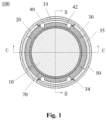
- Fig. 1 is an axial cross-sectional view of a hydraulic composite bushing 100 according to one embodiment of the present invention.
- the hydraulic composite bushing 100 includes a core shaft 10, a rubber member 20 disposed on an outer periphery of the core shaft 10, a support ring 30 arranged on the rubber member 20 at an radially outer side thereof, and an outer cover 50 pressed on the support ring 30 through interference fit at an radially outer side thereof.
- the core shaft 10 is usually a pre-formed element, and both ends of the core shaft 10 can be connected to, for example, a bogie frame of a rail vehicle.
- the core shaft 10 and the support ring 30 are integrally formed by vulcanization, which greatly enhances the overall performance of the hydraulic composite bushing 100.
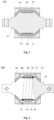
- a flow channel groove 11 is formed on an outer surface of the core shaft 10. As shown in Fig. 2 and Fig. 3 , the flow channel groove 11 is formed in a spiral shape around the outer surface of the core shaft 10, and extends in a continuous manner along a circumferential direction and an axial direction of the core shaft 10. The function of the flow channel groove 11 will be described below.
- the rubber member 20 is arranged on the outer surface of the core shaft 10.
- the rubber member 20 is formed by vulcanization in such a way of conforming to the contour of the outer surface of the core shaft 10.
- the rubber member 20 is provided with two recesses, which are arranged radially opposite to each other. Said two recesses are arranged at a radially outer side of the flow channel groove 11 accordingly. The two recesses are configured to extend over a part of the whole circumferential direction, and located in a middle region of the rubber member 20 along the axial direction.
- the support ring 30 is arranged around the outer peripheral surface of the rubber member 20 accordingly, and completely covers the recesses of the rubber member 20, thereby forming two sealed hydraulic chambers 40 between the support ring 30 and the rubber member 20, which are arranged radially opposite to each other and used to accommodate hydraulic fluid.
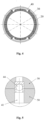
- the rubber member 20 and the support ring 30 of the hydraulic composite bushing 100 can be designed as a structure consisting of multiple lobes, dependent on a thickness of the support ring 30. As shown in Fig. 4 , the number of lobes of the hydraulic composite bushing 100 may be determined according to the amount of interference. This can further improve the performance of stiffness adjustment of the hydraulic composite bushing 100.
- a first through hole and a second through hole are respectively formed in a side wall of the outer cover 50 and that of the support ring 30 both corresponding to the hydraulic chambers 40.
- the first through hole is in communication with the second through hole, thus forming a liquid injection port 41 that is in communication with a respective hydraulic chamber 40.
- the liquid injection port 41 is used to inject the hydraulic fluid into the hydraulic chamber 40.
- the liquid injection port 41 is sealed with a high pressure ball plug 44.
- the liquid injection port 41 can be opened by the high pressure ball plug 44, in order to replenish the hydraulic fluid into the hydraulic chamber 40. After that, the liquid injection port 41 can be effectively blocked by the high pressure ball plug 44, thereby closing the liquid injection port 41.
- the high pressure ball plug 44 can effectively seal the liquid injection port 41, which is very beneficial to improve the sealing reliability of the hydraulic chamber 40.
- a flow channel pipe 60 is arranged in the flow channel groove 11.
- the flow channel pipe 60 is arranged in the flow channel groove 11, so as to extend around the core shaft 10 in a spiral manner. Two ends of the flow channel pipe 60 pass through the rubber member 20 along the radial direction thereof, respectively, to extend into the hydraulic chambers 40, so that said two hydraulic chambers 40 are in communication with each other through the flow channel pipe 60.
- the flow channel pipe 60 can be made of copper tube, stainless steel tube, plastic tube or the like, which can effectively improve the stiffness of the flow channel pipe 60. Therefore, by arranging the flow channel pipe 60 for liquid flow in the flow channel groove 11, lateral displacement of the liquid in the flow channel groove 11 can be effectively avoided, so that the sealing effect of the overall structure of the hydraulic composite bushing 100 is significantly enhanced.
- the bottom of the flow channel groove 11 is configured as a semicircle structure, which corresponds to the cross section of the tubular body of the flow channel pipe 60.
- the top of the flow channel groove 11 is configured as a square groove, which has a width equal to a diameter of the tubular body of the flow channel pipe 60.
- the overall depth of the flow channel groove 11 is greater than the diameter of the tubular body of the flow channel pipe 60. In this manner, it can ensure that more plastic will enter into the flow channel groove 11 during injection, thereby effectively fixing the tubular body of the flow channel pipe 60.
- a pressing sleeve 70 is subjected to a larger shock load, more load can be distributed on a metal spacer of the core shaft, thereby effectively protecting the flow channel pipe 60.
- a pressing sleeve 70 is provided between the core shaft 10 and the rubber member 20 in the radial direction. As shown in Figs. 1 to 3 , the pressing sleeve 70 is disposed on an area of the outer surface of the core shaft 10 where the flow channel groove 11 is provided. In one embodiment, an annular recess is provided on the outer peripheral surface of the core shaft 10, and the flow channel groove 11 is arranged at the bottom of the annular recess. The pressing sleeve 70 is arranged in the annular recess, and has an outer diameter equal to the outer diameter of the core shaft 10. In this manner, the outer peripheral surface of the press sleeve 70 is flush with that of the core shaft 10.
- the pressing sleeve 70 can apply on the flow channel pipe 60 a mounting pressure, which is directed radially inward.
- the axial length of the pressing sleeve 70 is greater than the length of the flow channel pipe 60 extending in the axial direction, so as to ensure that the flow channel pipe 60 is totally pressed by the pressing sleeve 70.
- both ends of the flow channel pipe 60 are arranged to pass through the pressing sleeve 70 in the radial direction thereof, and then continue to extend along the radial direction of the rubber member 20 to pass therethrough, until the ends of the flow channel pipe 60 extend into the respective hydraulic chambers 40.
- the pressing sleeve 70 may be made of plastic, rubber, polyurethane material or the like, and formed on the outer surface of the core shaft 10 by injection molding.
- a groove can be formed on an outer surface of the pressing sleeve 70.
- the groove may have a cross-sectional shape of ellipse, square, or the like.
- the hydraulic composite bushing 100 also includes a sealing device 80.
- the sealing device 80 is arranged at each end of the flow channel pipe 60, in order to form a seal between the flow channel pipe 60 and the flow channel groove 11 of the core shaft 10, thereby avoiding leakage of hydraulic fluid.
- the sealing device 80 can effectively prevent each end of the flow channel pipe 60 from being bent and deformed due to the internal pressure of a mold cavity during the injection molding and the vulcanization of the rubber member 20.
- the sealing device 80 includes a cylindrical sealing body 81.
- a mounting portion 82 which is a through hole penetrating the sealing body 81 in the axial direction, is arranged in the sealing body 81 for receiving the flow channel pipe 60.
- the sealing body 81 is further provided with a rectangular through hole 83 extending in the radial direction.
- the end of the flow channel pipe 60 extends over the rectangular through hole 83 along the axial direction of the sealing body 81 to be fitted within the mounting portion 82. Therefore, the sealing device 80 can be mounted at each end of the flow channel pipe 60.
- a first end of the sealing body 81 is fitted within the flow channel groove 11, and a second end thereof passes through the pressing sleeve 70 and the rubber member 20 in sequence to extend into the hydraulic chamber 40.
- the pressing sleeve 70 disposed between the core shaft 10 and the rubber member 20 will completely fill the rectangular through hole 83, and thus entirely enclose the flow channel pipe 60. Therefore, an effective seal is formed between the flow channel pipe 60 and the sealing body 81, thus effectively preventing the liquid from entering the gap between the flow channel pipe 60 and the flow channel groove 11 to cause leakage. In this manner, the flow channel pipe 60 and the flow channel groove 11 are sealed by the sealing device 80.
- the structure of the sealing device 80 effectively improves the sealing reliability of the flow channel pipe 60, the hydraulic chamber 40 and the connecting area therebetween, which is very beneficial to enhance the sealing performance between the flow channel pipe 60 and the flow channel groove 11. Moreover, it is also convenient to mount the sealing device 80.
- a filter element 61 is provided at each end of the flow channel pipe 60.
- the filter element 61 can be, for example, a filter screen, which has a lower end surface that can be positioned through an end face of the rectangular through hole 83, and an upper end surface that is flush with an upper end face of the sealing body 81.
- the filter element 61 can effectively prevent debris generated inside the hydraulic chambers 40 from clogging the flow channel pipe 60 in operation.
- the end of the flow channel pipe 60 extending into the hydraulic chamber 40 is arranged to extend over a radially inner wall surface of the hydraulic chamber 40.
- said end extends over the radially inner wall surface of the hydraulic chamber 40 by at least 5 mm.
- This stepped layer structure can enlarge the engagement area between the sealing device 80 and the injection mold for vulcanization, and in particular, effectively prevent the blockage caused by the penetration of the rubber material into the flow channel pipe 60 during the vulcanization.
- a key slot is provided at each end of the flow channel groove 11 of the core shaft 10.
- An end face of the first end of the sealing body 81 is configured to be fitted with a bottom face of the key slot, so that said end face of the first end of the sealing body 81 can closely contact with the bottom face of the key slot.
- the end face of the first end of the sealing body 81 and the bottom face of the key slot can be configured as arc-shaped curved surfaces engaged with each other.
- the sealing device 80 can be effectively mounted and fixed, and an effective seal can be formed between the sealing device 80 and the flow channel groove 11.
- the sealing performance between the flow channel pipe 60 and the flow channel groove 11 can be further improved, and leakage caused by the hydraulic fluid flowing between the flow channel pipe 60 and the flow channel groove 11 can be effectively avoided.
- the rubber member 20 is configured to conform to the outer contour of the core shaft 10.
- the core shaft 10, the support ring 30 and the pressing sleeve 70 are formed into one piece by vulcanization, which effectively enhances the overall performance of the hydraulic composite bushing 100.
- the core shaft 10 may have different structures, and the specific structures of the core shaft 10 and the rubber member 20 according to different embodiments will be described in detail below.
- Figs. 1 to 3 show the structure of the hydraulic composite bushing 100 according to one embodiment of the present invention.
- the core shaft 10 is configured as a stepped shaft with a central projecting portion.
- Each axial end of the central projecting portion is form as a conical surface, so that each axial end of the central projecting portion of the core shaft 10 has a diameter gradually increasing from the axial end to a middle region between two conical surfaces of the central projecting portion, but the middle region has an unchanged diameter.
- the flow channel groove 11 is provided in the axial middle region of the central projecting portion, and each end of the flow channel groove 11 terminates axially inner of a corresponding conical surface.
- the rubber member 20 is formed by vulcanization in a manner of conforming to the outer surface contour of the core shaft 10, whereby the rubber member 20 forms the same structure as the outer contour of the core shaft 10. That is, two axial ends of the rubber member 20 each form a conical surface, while the middle region thereof forms a cylindrical surface, so that the rubber member 20 forms a substantially V-shaped structure on the end surface along the diameter direction of the core shaft 10 (as shown in Figs. 2 and 3 ). In addition, two recesses extend radially inward, and are disposed diametrically opposite to each other in the axial middle region of the rubber member 20, so that they are located radially outer of the flow channel groove 11 of the core shaft 10 accordingly.
- the V-shaped structure of the rubber member 20 can realize a flexible adjustment on the stiffness of three directions, i.e., the hollow radial direction, the solid radial direction and the axial direction, in the overall structure, thus effectively improving the fatigue performance of the product.
- the support ring 30 includes a cylindrical support ring body 35, and a cover plate 33 fitted to the support ring body 35.
- the inner sidewall of the support ring 30 is configured to have a diameter increasing from each end toward the middle region in the axial direction, so that the surface of the inner sidewall of the support ring 30 is configured to be able to, at each end thereof, fit with the V-shaped conical surface of each end of the rubber member 20.
- the support ring body 35 is arranged on the outer peripheral surface of the rubber member 20, and the cover plate 33 and the support ring body 35 are fitted with each other in a sealing manner, so that the support ring 30 covers the recesses to form the hydraulic chambers 40.
- the cover plate 33 is adaptively mounted in the stepped hole, and in particular fitted with the stepped face of the stepped hole vulcanized with the rubber layer 34 to completely cover the corresponding recess, so that the hydraulic chamber 40 is formed between the support ring 30 and the rubber member 20.
- the outer cover 50 is arranged around the support ring 30 from a radially outer side thereof through an interference fit, in order to form a press-fit seal on the support ring body 35 and the cover plate 33. Therefore, the rubber member 20, the support ring body 35 and the cover plate 33 jointly form a seal for the hydraulic chambers 40.
- the cover plate 33 covers the recess to form the hydraulic chamber 40 together with the recess.
- a radial protrusion 42 extending radially outward is provided in the middle of each recess, and has a maximum outer diameter smaller than the maximum outer diameter of the rubber member 20.
- each hydraulic chamber 40 has a radial thickness in a central region along the circumferential direction which is smaller than that in each of two side regions along the circumferential direction, and has a radial thickness in a central region along the axial direction which is smaller than that in each of two side regions along the axial direction.
- the radial protrusion 42 can restrict the scope of relative movement between the outer cover 50 and the core shaft 10, so as to achieve secondary stiffness.
- Figs. 9 to 11 show the structure of a hydraulic composite bushing 200 according to another embodiment of the present invention.
- a core shaft 210 is configured as a stepped shaft having a central projecting portion, which has an annular protrusion 212 extending radially outward at each of both axial ends of the central projecting portion.
- a flow channel groove 211 is formed in an axial middle part of the central projecting portion, and located between two annular protrusions 212 in the axial direction. Each end of the flow channel groove 211 terminates axially inner of a corresponding annular protrusion 212.
- a rubber member 220 is disposed between the two annular protrusions 212 along the axial direction.
- the rubber member 220 is formed on the outer peripheral surface of the core shaft 210 by vulcanization, in a manner of conforming to the outer contour of the core shaft 210, so that the rubber member 220 has the same structure as the outer contour of the core shaft 10.
- a pressing sleeve 270 is formed on the outer circumference of the core shaft 210 in a middle region thereof, for pressing a flow channel pipe 260 into a spiral flow channel groove 211 formed in the surface of the core shaft 210.
- Two recesses extend radially inward, and are arranged in an axial middle region of the rubber member 220 in a manner of diametrically opposite to each other, so that they are located radially outside of the flow channel groove 211 on the core shaft 210.
- a support ring 230 includes a cylindrical support ring body 235, and a cover plate 233 fitted to the support ring body 235.
- the support ring 230 is bonded with the core shaft 210 into one piece through vulcanization.
- In the sidewall region of the support ring body 35 corresponding to each recess is formed with a stepped hole, which penetrates the sidewall of the support ring body 235, with a rubber layer vulcanized on a stepped face of the stepped hole.
- the cover plate 33 is adaptively mounted in the stepped hole, and in particular fitted with the stepped face of the stepped hole vulcanized with the rubber layer to completely cover the corresponding recess, so that a hydraulic chamber 240 is formed between the support ring 230 and the rubber member 220.
- An outer cover 250 is arranged around the support ring 230 from a radially outer side thereof through an interference fit, in order to form a press-fit seal on the support ring body 235 and the cover plate 233. Therefore, the rubber member 220, the support ring body 235 and the cover plate 233 jointly form a seal for the hydraulic chambers 240.
- the structure of the support ring 230 can not only effectively ensure the sealing property of the hydraulic chamber 40, but also enhance the integrity of the support ring 230 and the rubber member 220, which further enhances the stiffness performance of the hydraulic composite bushing 200, thereby ensuring stable operation of the train.
- a radial protrusion 232 extending radially outward is provided in the sidewall region of the cover plate 233 corresponding to the hydraulic chamber 240, and has an inner diameter larger than the inner diameter of the hydraulic chamber 240.
- each hydraulic chamber 40 has a radial thickness in a central region along the circumferential direction which is smaller than that in each of two side regions along the circumferential direction, and has a radial thickness in a central region along the axial direction which is smaller than that in each of two side regions along the axial direction.
- the radial protrusion 232 can similarly restrict the scope of relative movement between the outer cover 250 and the core shaft 210, so as to achieve secondary stiffness.
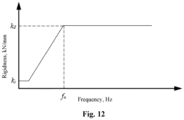
- Fig. 12 is a schematic diagram showing stiffness of the hydraulic composite bushing 200.
- eight preset threshold frequencies are 1Hz, 2Hz, 3Hz, 4Hz, 5Hz, 6Hz, 7Hz and 8Hz, respectively, and ⁇ at each frequency is: ⁇ 1 , ⁇ 2 , ⁇ 3 , ⁇ 4 , ⁇ 5 , ⁇ 6 , ⁇ 7 and ⁇ 8 .
- ⁇ at each frequency must satisfy: ⁇ 1 > ⁇ 2 > ⁇ 3 > ⁇ 4 > ⁇ 5 > ⁇ 6 > ⁇ 7 > ⁇ 8 , and ⁇ 1 - ⁇ 2 > ⁇ 2 - ⁇ 3 >...> ⁇ 6 - ⁇ 7 > ⁇ 7 - ⁇ 8 .
- an equivalent piston area S of each hydraulic chamber 40 under each preset ⁇ n should satisfy the following relationship: S 1 ⁇ S 2 ⁇ ... ⁇ S n , and S 2 ⁇ S 1 > S 3 ⁇ S 2 > ... ... > S n ⁇ S n ⁇ 1 , wherein: f n is the threshold frequency of the hydraulic composite bushing; ⁇ n is the ratio of dynamic stiffness to static stiffness of the hydraulic composite bushing; n is a non-zero natural number; f n and ⁇ n are each an increasing arithmetic progression; L is the length of the flow channel pipe; D is the hydraulic diameter of the flow channel pipe; ⁇ n is the ratio of length to diameter of the flow channel pipe; and S n is the equivalent piston area of the hydraulic chamber.
- a sealing method for the hydraulic composite bush according to the present invention is described below.
- the flow channel pipe 60 is arranged in the flow channel groove 11, presenting a spiral shape.
- the sealing device 80 is fixedly mounted at each end of the flow channel pipe 60.
- the end of the flow channel pipe 60 is mounted in the mounting portion 81 after extending over the rectangular through hole 83, and aligned with the second end of the sealing body 81.
- the pressing sleeve 70 is formed on the outer peripheral surface of the core shaft 10 by injection molding.
- both ends of the flow channel tube 60 are exposed to pass through the pressing sleeve 70 in the radial direction, and the first end face of the sealing device 80 is formed as an arc-shaped surface, which corresponds to the key slot in the flow channel groove 11 and thus forms a tight fit therewith.
- the pressing sleeve 70 fills the rectangular through hole 83 in the sealing device 80 to enclose the flow channel pipe 60 during the injection molding, thereby forming a seal between the flow channel pipe 60 and the flow channel groove 11.
- rubber is vulcanized on the outer peripheral surface of the core shaft 10 to form the rubber member 20, so that the hydraulic chambers 40 are formed inside the rubber member 20.
- the sealing device 80 radially passes through the rubber member 40 to extend into the hydraulic chambers 40, with the length of the second end of the sealing device 80 extending into the hydraulic chambers 40 not less than 5 mm. This can effectively prevent both ends of the flow channel pipe 60 from being bent and deformed due to the internal pressure of a mold cavity during the injection molding and the vulcanization, and also effectively prevent the blockage caused by the penetration of the rubber material into the flow channel pipe 60 during the vulcanization of the rubber member 20.
- the support ring 30 and the core shaft 10 are bonded into one piece by vulcanization, and a rubber layer 34 is vulcanized on the stepped face of the stepped hole of the support ring body 35, and then the cover plate 33 is placed to cover the recess completely, so that the hydraulic chamber 40 is formed between the support ring 30 and the rubber member 20.
- the outer cover 50 is placed on the support ring 30 from the radially outer side thereof through interference fit, thus forming a press-fit seal on the support ring body 35 and the cover plate 33. Therefore, the rubber member 20, the support ring 30 and the cover plate 33 jointly form a seal for the hydraulic chambers 40. In this manner, the hydraulic composite bushing 100 is completed, with sealing effect achieved for the flow channel pipe 60, the hydraulic chambers 40 and connections thereof.
- two radially opposite hydraulic chambers 40 of the hydraulic composite bushing 100 are in communication with each other through the flow channel pipe 60 arranged in a spiral shape, so that the hydraulic composite bushing 100 can realize stiffness adjustments in the radial hollow direction, the radial real direction and the axial direction. Therefore, the performance of stiffness adjustment of the hydraulic composite bushing 100 is greatly enhanced, and the fatigue performance of the product is effectively improved.
- the flow channel pipe 60 and the flow channel groove 11 are sealed relative to each other by the sealing device 80.
- the sealing device 80 significantly enhances the sealing performance between the flow channel pipe 60 and the flow channel groove 11, thereby effectively preventing leakage caused by flow of the hydraulic fluid in the gap formed between the flow channel pipe 60 and the flow channel groove 11.
- the procedure of arrangement and installation of the flow channel pipe 60 and the sealing device is simple and convenient.
- the core shaft 10, the support ring 30 and the pressing sleeve 70 are integrally formed by vulcanization, which significantly enhances the integrity and stiffness of the hydraulic composite bushing 100, improves the flexibility of the stiffness adjustment of the hydraulic composite bushing 100, and effectively prolongs the service life of the hydraulic composite bushing 100.
- the sealing method for the hydraulic composite bushing according to the present invention requires a simple structure only, can meet high stiffness requirements, improve the sealing performance, prolong the service life, and has high production efficiency, which is suitable for mass production.
Landscapes
- Engineering & Computer Science (AREA)
- General Engineering & Computer Science (AREA)
- Mechanical Engineering (AREA)
- Manufacturing & Machinery (AREA)
- Chemical & Material Sciences (AREA)
- Combustion & Propulsion (AREA)
- Transportation (AREA)
- Combined Devices Of Dampers And Springs (AREA)
- Moulds For Moulding Plastics Or The Like (AREA)
Claims (15)
- Hydraulikverbundbuchse, umfassend:eine Kernwelle (10), deren Außenoberfläche mit einer Strömungskanalnut (11) bereitgestellt ist, die sich kontinuierlich in einer Spiralform erstreckt;ein Gummielement (20), das auf der Kernwelle angeordnet ist und mit zwei einander diametral gegenüberliegenden Aussparungen bereitgestellt ist, wobei die Aussparungen radial außerhalb der Strömungskanalnut angeordnet sind;einen Stützring (30), der um das Gummielement herum angeordnet ist und die Aussparungen abdeckt, um zwei Hydraulikkammern (40) zur Aufnahme von Hydraulikfluid zu bilden;eine äußere Abdeckung (50), die von einer radial äußeren Seite des Stützrings auf diesen aufgepresst ist; dadurch gekennzeichnet, dass die Hydraulikverbundbuchse weiter umfasst:eine Dichtungsvorrichtung (80), die an einem Ende eines in der Strömungskanalnut angeordneten Strömungskanalrohrs (60) montiert ist,wobei zwei Enden des Strömungskanalrohrs in einer radialen Richtung durch das Gummielement hindurch verlaufen, um sich jeweils in die beiden Hydraulikkammern zu erstrecken, sodass die beiden Hydraulikkammern durch das Strömungskanalrohr hindurch miteinander in Kommunikation stehen, unddie Dichtungsvorrichtung an jedem Ende des Strömungskanalrohrs angeordnet ist, wobei ein Ende der Dichtungsvorrichtung in der Strömungskanalnut angeordnet ist, während das andere Ende davon durch das Gummielement hindurch verläuft, um sich in eine entsprechende Hydraulikkammer zu erstrecken, wodurch eine Dichtung zwischen dem Strömungskanalrohr und der Strömungskanalnut gebildet wird.
- Hydraulikverbundbuchse nach Anspruch 1, wobei zwischen der Kernwelle und dem Gummielement eine Presshülse (70) bereitgestellt ist und durch Spritzgießen von Kunststoff, Gummi oder Polyurethanmaterial zu einem Stück mit der Kernwelle geformt ist, um das Strömungskanalrohr in die Strömungskanalnut einzupressen.
- Hydraulikverbundbuchse nach Anspruch 2, wobei die Dichtungsvorrichtung einen zylindrischen Dichtungskörper (81) umfasst, der mit einem Montageabschnitt (82) bereitgestellt ist, der den Dichtungskörper axial durchdringt, und ein rechteckiges Durchgangsloch (83), das sich in radialer Richtung erstreckt, und
das Ende des Strömungskanalrohrs durch das rechteckige Durchgangsloch verläuft und in den Montageabschnitt eingepasst wird, sodass die Presshülse das rechteckige Durchgangsloch füllt, um das Strömungskanalrohr beim Spritzgießen zu umschließen und dadurch die Dichtung zu bilden. - Hydraulikverbundbuchse nach Anspruch 3, wobei ein erstes Ende des Dichtungskörpers mit der Strömungskanalnut ausgestattet ist und ein zweites Ende davon durch das Gummielement hindurch verläuft, um sich in eine entsprechende Hydraulikkammer zu erstrecken, wobei sich eine Spitze des zweiten Endes um mindestens 5 mm über eine radial innere Seitenwandoberfläche der Hydraulikkammer hinaus erstreckt.
- Hydraulikverbundbuchse nach Anspruch 3 oder 4, wobei das Ende des Strömungskanalrohres über die Dichtungsvorrichtung fest mit einem Filterelement (61) verbunden ist.
- Hydraulikverbundbuchse nach Anspruch 3 oder 4, wobei an jedem Ende der Strömungskanalnut ein Schlüsselschltz bereitgestellt ist, und
eine erste Endoberfläche des Dichtungskörpers konfiguriert ist, um mit einer Bodenoberfläche des Schlüsselschlitzes in Eingriff zu kommen, sodass die erste Endoberfläche des Dichtungskörpers und die Bodenoberfläche des Schlüsselschlitzes eng aneinanderliegen, um die Dichtung zu bilden. - Hydraulikverbundbuchse nach Anspruch 1, wobei in den Seitenwandbereichen der Außenabdeckung und des Stützrings, die den Hydraulikkammern entsprechen, ein erstes Durchgangsloch bzw. ein zweites Durchgangsloch bereitgestellt sind, und das erste Durchgangsloch mit dem zweiten Durchgangsloch kommuniziert, um eine Flüssigkeitseinspritzöffnung (41) in Kommunikation mit einer entsprechenden Hydraulikkammer zum Einspritzen von Hydraulikfluid in die Hydraulikkammer zu bilden.
- Hydraulikverbundbuchse nach Anspruch 7, wobei die Flüssigkeitseinspritzöffnung durch einen Hochdruck-Kugelstopfen (44) abgedichtet ist.
- Hydraulikverbundbuchse nach Anspruch 1, wobei der Stützring einen zylindrischen Stützringkörper (35) und eine Abdeckplatte (33), die mit dem Stützringkörper ausgestattet ist, umfasst, und
der Stützringkörper adaptiv auf einer Außenumfangsoberfläche des Gummielements angeordnet ist, während die Abdeckplatte dichtend mit dem Stützringkörper ausgestattet ist, sodass der Stützring die Aussparungen abdeckt, um die Hydraulikkammern zu bilden. - Hydraulikverbundbuchse nach einem der Ansprüche 1 bis 9, wobei die Kernwelle als abgestufte Welle mit einem zentralen Vorsprungsabschnitt konfiguriert ist, dessen axiales Ende jeweils als konische Oberfläche gebildet ist, wobei die Strömungskanalnut in einem axialen mittleren Bereich des zentralen Vorsprungsabschnitts angeordnet ist.
- Hydraulikverbundbuchse nach Anspruch 10, wobei in einer Mitte jeder Aussparung ein radialer Vorsprung (42) bereitgestellt ist, der sich radial nach außen erstreckt, wobei ein maximaler Außendurchmesser des radialen Vorsprungs kleiner ist als jener des Gummielements, und
die radiale Dicke in jeder von einer Umfangsrichtung und einer axialen Richtung jeder Hydraulikkammer in ihrem Mittelbereich geringer ist als in jedem ihrer beiden Seitenbereiche. - Hydraulikverbundbuchse nach Anspruch 9, wobei die Kernwelle als abgestufte Welle mit einem zentralen Vorsprungsabschnitt konfiguriert ist, wobei jedes axiale Ende davon mit einem ringförmigen, sich radial nach außen erstreckenden Vorsprung (212) bereitgestellt ist, und die Strömungskanalnut in einem axialen mittleren Bereich des zentralen Vorsprungsabschnitts angeordnet ist.
- Hydraulikverbundbuchse nach Anspruch 12, wobei ein radialer Vorsprung (232), der sich radial nach innen erstreckt, an einem Innenwandbereich der Abdeckplatte bereitgestellt ist, wobei ein Innendurchmesser des radialen Vorsprungs größer ist als jener von jeder Hydraulikkammer, und
eine radiale Dicke in jeder von der Umfangsrichtung und der axialen Richtung jeder Hydraulikkammer in ihrem Mittelbereich geringer sind als in jedem ihrer beiden Seitenbereiche. - Hydraulikverbundbuchse nach Anspruch 1, wobei die Hydraulikverbundbuchse imstande ist, unter verschiedenen Betriebsbedingungen ein voreingestelltes Verhältnis λn von dynamischer Steifigkeit zu statischer Steifigkeit zu erreichen, das bei einer voreingestellten Schwellenfrequenz fn nicht kleiner als 2 ist, undbei einem gleichen Verhältnis λ von dynamischer Steifigkeit zu statischer Steifigkeit ein Verhältnis β von Länge zu Durchmesser des Strömungskanalrohrs bei jeder voreingestellten Schwellenfrequenz fn die folgenden Beziehungen erfüllt:


 und bei einer gleichen Schwellenfrequenz f eine äquivalente Kolbenfläche S jeder Hydraulikkammer unter jeweiligem λn die folgenden Beziehungen erfüllt:
 wobei: fn eine Schwellenfrequenz der Hydraulikverbundbuchse ist; λn das Verhältnis von dynamischer Steifigkeit zu statischer Steifigkeit der Hydraulikverbundbuchse ist; n eine von Null verschiedene natürliche Zahl ist; fn und λn jeweils eine ansteigende arithmetische Progression sind; L eine Länge des Strömungskanalrohrs ist; D ein Hydraulikdurchmesser des Strömungskanalrohrs ist; βn das Verhältnis von Länge zu Durchmesser des Strömungskanalrohrs ist; und Sn die äquivalente Kolbenfläche der Hydraulikkammer ist.
 - Dichtungsverfahren für eine Hydraulikverbundbuchse nach einem der Ansprüche 1 bis 14, die Schritte umfassend zum:Anordnen des Strömungskanalrohrs in der Strömungskanalnut, um sich in einer Spiralform zu erstrecken;Montieren der Dichtungsvorrichtung an jedem Ende des Strömungskanalrohrs und Bilden der Presshülse auf einer Außenumfangsoberfläche der Kernwelle durch Spritzgießen; undBilden des Gummielements auf der Außenumfangsoberfläche der Kernwelle durch Vulkanisieren von Gummi, um die Hydraulikkammern innerhalb des Gummielements zu bilden, und Durchführen der Dichtungsvorrichtung durch das Gummielement hindurch, um sich in eine entsprechende Hydraulikkammer zu erstrecken,wobei die Presshülse während des Spritzgießens das rechteckige Durchgangsloch der Dichtungsvorrichtung füllt, um eine Abdichtung zwischen dem Strömungskanalrohr und der Strömungskanalnut zu bilden, undsich während des Vulkanisierens eine Spitze eines zweiten Endes der Dichtungsvorrichtung um eine Länge von nicht weniger als 5 mm in die Hydraulikkammer erstreckt.
Applications Claiming Priority (2)
| Application Number | Priority Date | Filing Date | Title |
|---|---|---|---|
| CN202010459495.XA CN111706638B (zh) | 2020-05-27 | 2020-05-27 | 一种液压复合衬套及其密封方法 |
| PCT/CN2020/119488 WO2021238008A1 (zh) | 2020-05-27 | 2020-09-30 | 一种液压复合衬套及其密封方法 |
Publications (4)
| Publication Number | Publication Date |
|---|---|
| EP4112970A1 EP4112970A1 (de) | 2023-01-04 |
| EP4112970A4 EP4112970A4 (de) | 2023-08-16 |
| EP4112970B1 true EP4112970B1 (de) | 2024-11-20 |
| EP4112970C0 EP4112970C0 (de) | 2024-11-20 |
Family
ID=72538278
Family Applications (1)
| Application Number | Title | Priority Date | Filing Date |
|---|---|---|---|
| EP20937391.9A Active EP4112970B1 (de) | 2020-05-27 | 2020-09-30 | Hydraulikverbundbuchse und dichtungsverfahren dafür |
Country Status (5)
| Country | Link |
|---|---|
| US (1) | US12379012B2 (de) |
| EP (1) | EP4112970B1 (de) |
| CN (1) | CN111706638B (de) |
| ES (1) | ES2997035T3 (de) |
| WO (1) | WO2021238008A1 (de) |
Families Citing this family (8)
| Publication number | Priority date | Publication date | Assignee | Title |
|---|---|---|---|---|
| CN111706638B (zh) | 2020-05-27 | 2022-01-21 | 株洲时代新材料科技股份有限公司 | 一种液压复合衬套及其密封方法 |
| CN116923017B (zh) * | 2023-08-23 | 2026-03-06 | 江西积裕实业有限公司 | 一种具有高强度高韧性的三角臂 |
| CN117302287A (zh) * | 2023-10-24 | 2023-12-29 | 株洲时代瑞唯减振装备有限公司 | 一种高径向承载、高偏转能力的牵引拉杆节点 |
| CN118517495A (zh) * | 2024-05-17 | 2024-08-20 | 株洲时代瑞唯减振装备有限公司 | 一种纵向变刚度液体橡胶复合锥形簧、灌液方法、一系簧及轨道车辆 |
| EP4650621A1 (de) * | 2024-05-17 | 2025-11-19 | Zhuzhou Times New Material Technology Co., Ltd | Flüssiggummiverbundknoten zur reduzierung des fahrzeugradschienenverschleisses und vibrationsgeräuschs auf basis von flüssigkeitsdämpfung, einstufiges aufhängungssystem und schienenfahrzeug |
| CN118462764B (zh) * | 2024-05-17 | 2025-10-03 | 株洲时代新材料科技股份有限公司 | 一种多向刚度可调的液体复合节点 |
| CN119712649A (zh) * | 2024-11-25 | 2025-03-28 | 株洲时代新材料科技股份有限公司 | 一种液压扭矩补偿装置 |
| CN119567534B (zh) * | 2025-01-07 | 2025-11-21 | 浙江康骏机械有限公司 | 一种淋膜纸复合用的高温持续挤出设备 |
Family Cites Families (18)
| Publication number | Priority date | Publication date | Assignee | Title |
|---|---|---|---|---|
| US4974819A (en) * | 1986-02-14 | 1990-12-04 | Cooper Tire & Rubber Company | Mount for controlling or isolating vibration |
| DE3839914A1 (de) * | 1988-11-26 | 1990-05-31 | Freudenberg Carl Fa | Huelsengummifeder |
| DE10050159A1 (de) * | 2000-10-11 | 2002-04-25 | Daimler Chrysler Ag | Hydraulisch dämpfendes Lager |
| US6749186B2 (en) * | 2001-12-19 | 2004-06-15 | Freudenberg-Nok General Partnership | Hydraulic bushing with springs in parallel |
| DE10310633A1 (de) * | 2003-03-10 | 2004-09-30 | Carl Freudenberg Kg | Buchse für ein Lager zur elastischen Verbindung von Teilen eines Laufwerks |
| JP2010196841A (ja) * | 2009-02-26 | 2010-09-09 | Tokai Rubber Ind Ltd | 流体封入式筒形防振装置 |
| CN202132613U (zh) * | 2011-05-12 | 2012-02-01 | 广西柳工机械股份有限公司 | 驾驶室过管孔密封结构 |
| CN104315076B (zh) * | 2014-09-12 | 2016-04-27 | 东风小康汽车有限公司重庆分公司 | 汽车悬架用自适应可变阻尼液压橡胶隔振装置 |
| CN104191927B (zh) * | 2014-09-12 | 2016-03-23 | 东风小康汽车有限公司重庆分公司 | 汽车悬架用轴向型阻尼可变液压衬套 |
| CN105605133B (zh) * | 2016-03-25 | 2018-01-02 | 吉林大学 | 一种惯性通道截面可变的液压衬套 |
| CN206555347U (zh) * | 2016-12-02 | 2017-10-13 | 株洲时代新材料科技股份有限公司 | 一种轨道交通用液压衬套 |
| DE102018200344A1 (de) * | 2018-01-11 | 2019-07-11 | Contitech Luftfedersysteme Gmbh | Hydraulische Lagerbuchse |
| DE102018200346A1 (de) * | 2018-01-11 | 2019-07-11 | Contitech Luftfedersysteme Gmbh | Hydraulische Lagerbuchse |
| CN108679145B (zh) * | 2018-06-08 | 2020-06-30 | 北京长安汽车工程技术研究有限责任公司 | 一种轴向式液压摆臂衬套 |
| CN210510107U (zh) * | 2019-05-17 | 2020-05-12 | 株洲时代新材料科技股份有限公司 | 一种用于液压衬套的内套 |
| CN110397700B (zh) * | 2019-08-30 | 2024-06-07 | 株洲时代瑞唯减振装备有限公司 | 通过增设四瓣式中间隔套形成液体空腔的方法及空腔结构 |
| CN110388401A (zh) | 2019-08-30 | 2019-10-29 | 株洲时代新材料科技股份有限公司 | 一种带有管体流道液体橡胶复合节点的形成方法及节点 |
| CN111706638B (zh) * | 2020-05-27 | 2022-01-21 | 株洲时代新材料科技股份有限公司 | 一种液压复合衬套及其密封方法 |
-
2020
- 2020-05-27 CN CN202010459495.XA patent/CN111706638B/zh active Active
- 2020-09-30 ES ES20937391T patent/ES2997035T3/es active Active
- 2020-09-30 EP EP20937391.9A patent/EP4112970B1/de active Active
- 2020-09-30 US US17/922,698 patent/US12379012B2/en active Active
- 2020-09-30 WO PCT/CN2020/119488 patent/WO2021238008A1/zh not_active Ceased
Also Published As
| Publication number | Publication date |
|---|---|
| CN111706638A (zh) | 2020-09-25 |
| CN111706638B (zh) | 2022-01-21 |
| EP4112970A4 (de) | 2023-08-16 |
| EP4112970A1 (de) | 2023-01-04 |
| US20230204087A1 (en) | 2023-06-29 |
| ES2997035T3 (en) | 2025-02-14 |
| US12379012B2 (en) | 2025-08-05 |
| EP4112970C0 (de) | 2024-11-20 |
| WO2021238008A1 (zh) | 2021-12-02 |
Similar Documents
| Publication | Publication Date | Title |
|---|---|---|
| EP4112970B1 (de) | Hydraulikverbundbuchse und dichtungsverfahren dafür | |
| US4700934A (en) | Pretensionable and hydraulically damped mounting element | |
| EP4023904B1 (de) | Verfahren zur herstellung eines flüssiggummiverbundknotens mit rohrströmungskanal | |
| JPH0226098B2 (de) | ||
| CN110454537B (zh) | 一种分瓣式液体橡胶复合节点刚度调节结构及方法 | |
| CN110469623B (zh) | 一种带阻尼通孔的液体橡胶复合节点的形成方法及节点 | |
| EP0410397B1 (de) | Obere Halterung für einen Radaufhängungsstossdämpfer mit elastisch gelagertem Resonanzglied | |
| US4641817A (en) | Vibration absorbing mountings | |
| EP0641955B1 (de) | Elastisches, zylindrisches Lager, das eine hochviskose Flüssigkeit enthält und einen Einlass zum Einspritzen dieser Flüssigkeit hat | |
| CN112065909B (zh) | 动态刚度特性调整方法及带辅助空腔的液体橡胶复合节点 | |
| US5906360A (en) | Elastic mounting device including fluid-filled elastic mount and synthetic resin bracket for fixing the elastic mount, and method of manufacturing the same | |
| JPS58203242A (ja) | サスペンシヨンブツシユ並びにその製造法 | |
| CN110499678B (zh) | 一种带阻尼通孔的分瓣式液体橡胶复合节点及形成方法 | |
| CN114810916B (zh) | 一种可调节静刚度曲线的液压衬套及其组装方法 | |
| US5145155A (en) | Method of manufacturing fluid-filled elastic mount having fluid injection hole for filling pressure-receiving and equilibrium chambers | |
| CN210510107U (zh) | 一种用于液压衬套的内套 | |
| US12398777B2 (en) | Hydraulic composite bushing, flow channel for same, and method for forming flow channel | |
| KR102454512B1 (ko) | 마운팅 부시 | |
| US5310168A (en) | Fluid-filled cylindrical elastic mount having annular fluid chamber with constant cross sectional area over the entire circumference | |
| JPS6110138A (ja) | 流体入りブツシユ | |
| CN210265649U (zh) | 用于液压衬套的流道体 | |
| CN110345193B (zh) | 一种带有外槽流道液体橡胶复合节点的形成方法及节点 | |
| JPH01238731A (ja) | 流体入りブッシュ | |
| JP4066267B2 (ja) | ゴムブッシュ | |
| JPH0729318Y2 (ja) | 流体封入式筒型マウント装置 |
Legal Events
| Date | Code | Title | Description |
|---|---|---|---|
| STAA | Information on the status of an ep patent application or granted ep patent |
Free format text: STATUS: THE INTERNATIONAL PUBLICATION HAS BEEN MADE |
|
| PUAI | Public reference made under article 153(3) epc to a published international application that has entered the european phase |
Free format text: ORIGINAL CODE: 0009012 |
|
| STAA | Information on the status of an ep patent application or granted ep patent |
Free format text: STATUS: REQUEST FOR EXAMINATION WAS MADE |
|
| 17P | Request for examination filed |
Effective date: 20220929 |
|
| AK | Designated contracting states |
Kind code of ref document: A1 Designated state(s): AL AT BE BG CH CY CZ DE DK EE ES FI FR GB GR HR HU IE IS IT LI LT LU LV MC MK MT NL NO PL PT RO RS SE SI SK SM TR |
|
| A4 | Supplementary search report drawn up and despatched |
Effective date: 20230718 |
|
| RIC1 | Information provided on ipc code assigned before grant |
Ipc: B62D 7/22 20060101ALI20230712BHEP Ipc: B60G 7/04 20060101ALI20230712BHEP Ipc: F16F 13/14 20060101AFI20230712BHEP |
|
| DAV | Request for validation of the european patent (deleted) | ||
| DAX | Request for extension of the european patent (deleted) | ||
| REG | Reference to a national code |
Free format text: PREVIOUS MAIN CLASS: F16F0013140000 Ref country code: DE Ref legal event code: R079 Ref document number: 602020041880 Country of ref document: DE Ipc: B61F0005320000 |
|
| GRAP | Despatch of communication of intention to grant a patent |
Free format text: ORIGINAL CODE: EPIDOSNIGR1 |
|
| STAA | Information on the status of an ep patent application or granted ep patent |
Free format text: STATUS: GRANT OF PATENT IS INTENDED |
|
| RIC1 | Information provided on ipc code assigned before grant |
Ipc: F16F 13/14 20060101ALI20240708BHEP Ipc: B61F 5/32 20060101AFI20240708BHEP |
|
| INTG | Intention to grant announced |
Effective date: 20240805 |
|
| GRAS | Grant fee paid |
Free format text: ORIGINAL CODE: EPIDOSNIGR3 |
|
| GRAA | (expected) grant |
Free format text: ORIGINAL CODE: 0009210 |
|
| STAA | Information on the status of an ep patent application or granted ep patent |
Free format text: STATUS: THE PATENT HAS BEEN GRANTED |
|
| AK | Designated contracting states |
Kind code of ref document: B1 Designated state(s): AL AT BE BG CH CY CZ DE DK EE ES FI FR GB GR HR HU IE IS IT LI LT LU LV MC MK MT NL NO PL PT RO RS SE SI SK SM TR |
|
| REG | Reference to a national code |
Ref country code: GB Ref legal event code: FG4D |
|
| REG | Reference to a national code |
Ref country code: CH Ref legal event code: EP |
|
| REG | Reference to a national code |
Ref country code: DE Ref legal event code: R096 Ref document number: 602020041880 Country of ref document: DE |
|
| REG | Reference to a national code |
Ref country code: IE Ref legal event code: FG4D |
|
| U01 | Request for unitary effect filed |
Effective date: 20241120 |
|
| U07 | Unitary effect registered |
Designated state(s): AT BE BG DE DK EE FI FR IT LT LU LV MT NL PT RO SE SI Effective date: 20241127 |
|
| REG | Reference to a national code |
Ref country code: ES Ref legal event code: FG2A Ref document number: 2997035 Country of ref document: ES Kind code of ref document: T3 Effective date: 20250214 |
|
| PG25 | Lapsed in a contracting state [announced via postgrant information from national office to epo] |
Ref country code: HR Free format text: LAPSE BECAUSE OF FAILURE TO SUBMIT A TRANSLATION OF THE DESCRIPTION OR TO PAY THE FEE WITHIN THE PRESCRIBED TIME-LIMIT Effective date: 20241120 Ref country code: IS Free format text: LAPSE BECAUSE OF FAILURE TO SUBMIT A TRANSLATION OF THE DESCRIPTION OR TO PAY THE FEE WITHIN THE PRESCRIBED TIME-LIMIT Effective date: 20250320 |
|
| PG25 | Lapsed in a contracting state [announced via postgrant information from national office to epo] |
Ref country code: NO Free format text: LAPSE BECAUSE OF FAILURE TO SUBMIT A TRANSLATION OF THE DESCRIPTION OR TO PAY THE FEE WITHIN THE PRESCRIBED TIME-LIMIT Effective date: 20250220 |
|
| PG25 | Lapsed in a contracting state [announced via postgrant information from national office to epo] |
Ref country code: GR Free format text: LAPSE BECAUSE OF FAILURE TO SUBMIT A TRANSLATION OF THE DESCRIPTION OR TO PAY THE FEE WITHIN THE PRESCRIBED TIME-LIMIT Effective date: 20250221 |
|
| PG25 | Lapsed in a contracting state [announced via postgrant information from national office to epo] |
Ref country code: PL Free format text: LAPSE BECAUSE OF FAILURE TO SUBMIT A TRANSLATION OF THE DESCRIPTION OR TO PAY THE FEE WITHIN THE PRESCRIBED TIME-LIMIT Effective date: 20241120 |
|
| PG25 | Lapsed in a contracting state [announced via postgrant information from national office to epo] |
Ref country code: RS Free format text: LAPSE BECAUSE OF FAILURE TO SUBMIT A TRANSLATION OF THE DESCRIPTION OR TO PAY THE FEE WITHIN THE PRESCRIBED TIME-LIMIT Effective date: 20250220 |
|
| PG25 | Lapsed in a contracting state [announced via postgrant information from national office to epo] |
Ref country code: SM Free format text: LAPSE BECAUSE OF FAILURE TO SUBMIT A TRANSLATION OF THE DESCRIPTION OR TO PAY THE FEE WITHIN THE PRESCRIBED TIME-LIMIT Effective date: 20241120 |
|
| PG25 | Lapsed in a contracting state [announced via postgrant information from national office to epo] |
Ref country code: SK Free format text: LAPSE BECAUSE OF FAILURE TO SUBMIT A TRANSLATION OF THE DESCRIPTION OR TO PAY THE FEE WITHIN THE PRESCRIBED TIME-LIMIT Effective date: 20241120 |
|
| PG25 | Lapsed in a contracting state [announced via postgrant information from national office to epo] |
Ref country code: CZ Free format text: LAPSE BECAUSE OF FAILURE TO SUBMIT A TRANSLATION OF THE DESCRIPTION OR TO PAY THE FEE WITHIN THE PRESCRIBED TIME-LIMIT Effective date: 20241120 |
|
| PLBE | No opposition filed within time limit |
Free format text: ORIGINAL CODE: 0009261 |
|
| STAA | Information on the status of an ep patent application or granted ep patent |
Free format text: STATUS: NO OPPOSITION FILED WITHIN TIME LIMIT |
|
| REG | Reference to a national code |
Ref country code: CH Ref legal event code: U11 Free format text: ST27 STATUS EVENT CODE: U-0-0-U10-U11 (AS PROVIDED BY THE NATIONAL OFFICE) Effective date: 20251001 |
|
| U20 | Renewal fee for the european patent with unitary effect paid |
Year of fee payment: 6 Effective date: 20250911 |
|
| 26N | No opposition filed |
Effective date: 20250821 |
|
| PGFP | Annual fee paid to national office [announced via postgrant information from national office to epo] |
Ref country code: CH Payment date: 20251001 Year of fee payment: 6 |
|
| PGFP | Annual fee paid to national office [announced via postgrant information from national office to epo] |
Ref country code: ES Payment date: 20251030 Year of fee payment: 6 |