EP4112277B1 - Ausrichtung von energiestrahlen in generativen fertigungssystemen und maschinen - Google Patents
Ausrichtung von energiestrahlen in generativen fertigungssystemen und maschinen Download PDFInfo
- Publication number
- EP4112277B1 EP4112277B1 EP22178646.0A EP22178646A EP4112277B1 EP 4112277 B1 EP4112277 B1 EP 4112277B1 EP 22178646 A EP22178646 A EP 22178646A EP 4112277 B1 EP4112277 B1 EP 4112277B1
- Authority
- EP
- European Patent Office
- Prior art keywords
- energy
- energy beam
- measurement
- irradiation device
- sensors
- Prior art date
- Legal status (The legal status is an assumption and is not a legal conclusion. Google has not performed a legal analysis and makes no representation as to the accuracy of the status listed.)
- Active
Links
Images






Classifications
-
- B—PERFORMING OPERATIONS; TRANSPORTING
- B29—WORKING OF PLASTICS; WORKING OF SUBSTANCES IN A PLASTIC STATE IN GENERAL
- B29C—SHAPING OR JOINING OF PLASTICS; SHAPING OF MATERIAL IN A PLASTIC STATE, NOT OTHERWISE PROVIDED FOR; AFTER-TREATMENT OF THE SHAPED PRODUCTS, e.g. REPAIRING
- B29C64/00—Additive manufacturing, i.e. manufacturing of three-dimensional [3D] objects by additive deposition, additive agglomeration or additive layering, e.g. by 3D printing, stereolithography or selective laser sintering
- B29C64/20—Apparatus for additive manufacturing; Details thereof or accessories therefor
- B29C64/264—Arrangements for irradiation
-
- B—PERFORMING OPERATIONS; TRANSPORTING
- B22—CASTING; POWDER METALLURGY
- B22F—WORKING METALLIC POWDER; MANUFACTURE OF ARTICLES FROM METALLIC POWDER; MAKING METALLIC POWDER; APPARATUS OR DEVICES SPECIALLY ADAPTED FOR METALLIC POWDER
- B22F10/00—Additive manufacturing of workpieces or articles from metallic powder
- B22F10/30—Process control
- B22F10/31—Calibration of process steps or apparatus settings, e.g. before or during manufacturing
-
- B—PERFORMING OPERATIONS; TRANSPORTING
- B22—CASTING; POWDER METALLURGY
- B22F—WORKING METALLIC POWDER; MANUFACTURE OF ARTICLES FROM METALLIC POWDER; MAKING METALLIC POWDER; APPARATUS OR DEVICES SPECIALLY ADAPTED FOR METALLIC POWDER
- B22F12/00—Apparatus or devices specially adapted for additive manufacturing; Auxiliary means for additive manufacturing; Combinations of additive manufacturing apparatus or devices with other processing apparatus or devices
- B22F12/40—Radiation means
- B22F12/44—Radiation means characterised by the configuration of the radiation means
-
- B—PERFORMING OPERATIONS; TRANSPORTING
- B22—CASTING; POWDER METALLURGY
- B22F—WORKING METALLIC POWDER; MANUFACTURE OF ARTICLES FROM METALLIC POWDER; MAKING METALLIC POWDER; APPARATUS OR DEVICES SPECIALLY ADAPTED FOR METALLIC POWDER
- B22F12/00—Apparatus or devices specially adapted for additive manufacturing; Auxiliary means for additive manufacturing; Combinations of additive manufacturing apparatus or devices with other processing apparatus or devices
- B22F12/40—Radiation means
- B22F12/44—Radiation means characterised by the configuration of the radiation means
- B22F12/45—Two or more
-
- B—PERFORMING OPERATIONS; TRANSPORTING
- B22—CASTING; POWDER METALLURGY
- B22F—WORKING METALLIC POWDER; MANUFACTURE OF ARTICLES FROM METALLIC POWDER; MAKING METALLIC POWDER; APPARATUS OR DEVICES SPECIALLY ADAPTED FOR METALLIC POWDER
- B22F12/00—Apparatus or devices specially adapted for additive manufacturing; Auxiliary means for additive manufacturing; Combinations of additive manufacturing apparatus or devices with other processing apparatus or devices
- B22F12/90—Means for process control, e.g. cameras or sensors
-
- B—PERFORMING OPERATIONS; TRANSPORTING
- B23—MACHINE TOOLS; METAL-WORKING NOT OTHERWISE PROVIDED FOR
- B23K—SOLDERING OR UNSOLDERING; WELDING; CLADDING OR PLATING BY SOLDERING OR WELDING; CUTTING BY APPLYING HEAT LOCALLY, e.g. FLAME CUTTING; WORKING BY LASER BEAM
- B23K26/00—Working by laser beam, e.g. welding, cutting or boring
- B23K26/02—Positioning or observing the workpiece, e.g. with respect to the point of impact; Aligning, aiming or focusing the laser beam
- B23K26/04—Automatically aligning, aiming or focusing the laser beam, e.g. using the back-scattered light
- B23K26/042—Automatically aligning the laser beam
-
- B—PERFORMING OPERATIONS; TRANSPORTING
- B23—MACHINE TOOLS; METAL-WORKING NOT OTHERWISE PROVIDED FOR
- B23K—SOLDERING OR UNSOLDERING; WELDING; CLADDING OR PLATING BY SOLDERING OR WELDING; CUTTING BY APPLYING HEAT LOCALLY, e.g. FLAME CUTTING; WORKING BY LASER BEAM
- B23K26/00—Working by laser beam, e.g. welding, cutting or boring
- B23K26/34—Laser welding for purposes other than joining
- B23K26/342—Build-up welding
-
- B—PERFORMING OPERATIONS; TRANSPORTING
- B29—WORKING OF PLASTICS; WORKING OF SUBSTANCES IN A PLASTIC STATE IN GENERAL
- B29C—SHAPING OR JOINING OF PLASTICS; SHAPING OF MATERIAL IN A PLASTIC STATE, NOT OTHERWISE PROVIDED FOR; AFTER-TREATMENT OF THE SHAPED PRODUCTS, e.g. REPAIRING
- B29C64/00—Additive manufacturing, i.e. manufacturing of three-dimensional [3D] objects by additive deposition, additive agglomeration or additive layering, e.g. by 3D printing, stereolithography or selective laser sintering
- B29C64/10—Processes of additive manufacturing
- B29C64/141—Processes of additive manufacturing using only solid materials
- B29C64/153—Processes of additive manufacturing using only solid materials using layers of powder being selectively joined, e.g. by selective laser sintering or melting
-
- B—PERFORMING OPERATIONS; TRANSPORTING
- B29—WORKING OF PLASTICS; WORKING OF SUBSTANCES IN A PLASTIC STATE IN GENERAL
- B29C—SHAPING OR JOINING OF PLASTICS; SHAPING OF MATERIAL IN A PLASTIC STATE, NOT OTHERWISE PROVIDED FOR; AFTER-TREATMENT OF THE SHAPED PRODUCTS, e.g. REPAIRING
- B29C64/00—Additive manufacturing, i.e. manufacturing of three-dimensional [3D] objects by additive deposition, additive agglomeration or additive layering, e.g. by 3D printing, stereolithography or selective laser sintering
- B29C64/20—Apparatus for additive manufacturing; Details thereof or accessories therefor
- B29C64/264—Arrangements for irradiation
- B29C64/268—Arrangements for irradiation using laser beams; using electron beams [EB]
-
- B—PERFORMING OPERATIONS; TRANSPORTING
- B29—WORKING OF PLASTICS; WORKING OF SUBSTANCES IN A PLASTIC STATE IN GENERAL
- B29C—SHAPING OR JOINING OF PLASTICS; SHAPING OF MATERIAL IN A PLASTIC STATE, NOT OTHERWISE PROVIDED FOR; AFTER-TREATMENT OF THE SHAPED PRODUCTS, e.g. REPAIRING
- B29C64/00—Additive manufacturing, i.e. manufacturing of three-dimensional [3D] objects by additive deposition, additive agglomeration or additive layering, e.g. by 3D printing, stereolithography or selective laser sintering
- B29C64/20—Apparatus for additive manufacturing; Details thereof or accessories therefor
- B29C64/264—Arrangements for irradiation
- B29C64/277—Arrangements for irradiation using multiple radiation means, e.g. micromirrors or multiple light-emitting diodes [LED]
- B29C64/282—Arrangements for irradiation using multiple radiation means, e.g. micromirrors or multiple light-emitting diodes [LED] of the same type, e.g. using different energy levels
-
- B—PERFORMING OPERATIONS; TRANSPORTING
- B29—WORKING OF PLASTICS; WORKING OF SUBSTANCES IN A PLASTIC STATE IN GENERAL
- B29C—SHAPING OR JOINING OF PLASTICS; SHAPING OF MATERIAL IN A PLASTIC STATE, NOT OTHERWISE PROVIDED FOR; AFTER-TREATMENT OF THE SHAPED PRODUCTS, e.g. REPAIRING
- B29C64/00—Additive manufacturing, i.e. manufacturing of three-dimensional [3D] objects by additive deposition, additive agglomeration or additive layering, e.g. by 3D printing, stereolithography or selective laser sintering
- B29C64/30—Auxiliary operations or equipment
- B29C64/386—Data acquisition or data processing for additive manufacturing
- B29C64/393—Data acquisition or data processing for additive manufacturing for controlling or regulating additive manufacturing processes
-
- B—PERFORMING OPERATIONS; TRANSPORTING
- B33—ADDITIVE MANUFACTURING TECHNOLOGY
- B33Y—ADDITIVE MANUFACTURING, i.e. MANUFACTURING OF THREE-DIMENSIONAL [3D] OBJECTS BY ADDITIVE DEPOSITION, ADDITIVE AGGLOMERATION OR ADDITIVE LAYERING, e.g. BY 3D PRINTING, STEREOLITHOGRAPHY OR SELECTIVE LASER SINTERING
- B33Y10/00—Processes of additive manufacturing
-
- B—PERFORMING OPERATIONS; TRANSPORTING
- B33—ADDITIVE MANUFACTURING TECHNOLOGY
- B33Y—ADDITIVE MANUFACTURING, i.e. MANUFACTURING OF THREE-DIMENSIONAL [3D] OBJECTS BY ADDITIVE DEPOSITION, ADDITIVE AGGLOMERATION OR ADDITIVE LAYERING, e.g. BY 3D PRINTING, STEREOLITHOGRAPHY OR SELECTIVE LASER SINTERING
- B33Y30/00—Apparatus for additive manufacturing; Details thereof or accessories therefor
-
- B—PERFORMING OPERATIONS; TRANSPORTING
- B33—ADDITIVE MANUFACTURING TECHNOLOGY
- B33Y—ADDITIVE MANUFACTURING, i.e. MANUFACTURING OF THREE-DIMENSIONAL [3D] OBJECTS BY ADDITIVE DEPOSITION, ADDITIVE AGGLOMERATION OR ADDITIVE LAYERING, e.g. BY 3D PRINTING, STEREOLITHOGRAPHY OR SELECTIVE LASER SINTERING
- B33Y40/00—Auxiliary operations or equipment, e.g. for material handling
-
- B—PERFORMING OPERATIONS; TRANSPORTING
- B33—ADDITIVE MANUFACTURING TECHNOLOGY
- B33Y—ADDITIVE MANUFACTURING, i.e. MANUFACTURING OF THREE-DIMENSIONAL [3D] OBJECTS BY ADDITIVE DEPOSITION, ADDITIVE AGGLOMERATION OR ADDITIVE LAYERING, e.g. BY 3D PRINTING, STEREOLITHOGRAPHY OR SELECTIVE LASER SINTERING
- B33Y50/00—Data acquisition or data processing for additive manufacturing
- B33Y50/02—Data acquisition or data processing for additive manufacturing for controlling or regulating additive manufacturing processes
-
- G—PHYSICS
- G02—OPTICS
- G02B—OPTICAL ELEMENTS, SYSTEMS OR APPARATUS
- G02B27/00—Optical systems or apparatus not provided for by any of the groups G02B1/00 - G02B26/00, G02B30/00
- G02B27/10—Beam splitting or combining systems
- G02B27/1073—Beam splitting or combining systems characterized by manufacturing or alignment methods
-
- G—PHYSICS
- G02—OPTICS
- G02B—OPTICAL ELEMENTS, SYSTEMS OR APPARATUS
- G02B27/00—Optical systems or apparatus not provided for by any of the groups G02B1/00 - G02B26/00, G02B30/00
- G02B27/32—Fiducial marks and measuring scales within the optical system
-
- B—PERFORMING OPERATIONS; TRANSPORTING
- B22—CASTING; POWDER METALLURGY
- B22F—WORKING METALLIC POWDER; MANUFACTURE OF ARTICLES FROM METALLIC POWDER; MAKING METALLIC POWDER; APPARATUS OR DEVICES SPECIALLY ADAPTED FOR METALLIC POWDER
- B22F10/00—Additive manufacturing of workpieces or articles from metallic powder
- B22F10/20—Direct sintering or melting
- B22F10/28—Powder bed fusion, e.g. selective laser melting [SLM] or electron beam melting [EBM]
-
- B—PERFORMING OPERATIONS; TRANSPORTING
- B22—CASTING; POWDER METALLURGY
- B22F—WORKING METALLIC POWDER; MANUFACTURE OF ARTICLES FROM METALLIC POWDER; MAKING METALLIC POWDER; APPARATUS OR DEVICES SPECIALLY ADAPTED FOR METALLIC POWDER
- B22F2999/00—Aspects linked to processes or compositions used in powder metallurgy
-
- H—ELECTRICITY
- H01—ELECTRIC ELEMENTS
- H01S—DEVICES USING THE PROCESS OF LIGHT AMPLIFICATION BY STIMULATED EMISSION OF RADIATION [LASER] TO AMPLIFY OR GENERATE LIGHT; DEVICES USING STIMULATED EMISSION OF ELECTROMAGNETIC RADIATION IN WAVE RANGES OTHER THAN OPTICAL
- H01S3/00—Lasers, i.e. devices using stimulated emission of electromagnetic radiation in the infrared, visible or ultraviolet wave range
- H01S3/0014—Monitoring arrangements not otherwise provided for
-
- H—ELECTRICITY
- H01—ELECTRIC ELEMENTS
- H01S—DEVICES USING THE PROCESS OF LIGHT AMPLIFICATION BY STIMULATED EMISSION OF RADIATION [LASER] TO AMPLIFY OR GENERATE LIGHT; DEVICES USING STIMULATED EMISSION OF ELECTROMAGNETIC RADIATION IN WAVE RANGES OTHER THAN OPTICAL
- H01S3/00—Lasers, i.e. devices using stimulated emission of electromagnetic radiation in the infrared, visible or ultraviolet wave range
- H01S3/005—Optical devices external to the laser cavity, specially adapted for lasers, e.g. for homogenisation of the beam or for manipulating laser pulses, e.g. pulse shaping
-
- H—ELECTRICITY
- H01—ELECTRIC ELEMENTS
- H01S—DEVICES USING THE PROCESS OF LIGHT AMPLIFICATION BY STIMULATED EMISSION OF RADIATION [LASER] TO AMPLIFY OR GENERATE LIGHT; DEVICES USING STIMULATED EMISSION OF ELECTROMAGNETIC RADIATION IN WAVE RANGES OTHER THAN OPTICAL
- H01S3/00—Lasers, i.e. devices using stimulated emission of electromagnetic radiation in the infrared, visible or ultraviolet wave range
- H01S3/005—Optical devices external to the laser cavity, specially adapted for lasers, e.g. for homogenisation of the beam or for manipulating laser pulses, e.g. pulse shaping
- H01S3/0071—Beam steering, e.g. whereby a mirror outside the cavity is present to change the beam direction
-
- Y—GENERAL TAGGING OF NEW TECHNOLOGICAL DEVELOPMENTS; GENERAL TAGGING OF CROSS-SECTIONAL TECHNOLOGIES SPANNING OVER SEVERAL SECTIONS OF THE IPC; TECHNICAL SUBJECTS COVERED BY FORMER USPC CROSS-REFERENCE ART COLLECTIONS [XRACs] AND DIGESTS
- Y02—TECHNOLOGIES OR APPLICATIONS FOR MITIGATION OR ADAPTATION AGAINST CLIMATE CHANGE
- Y02P—CLIMATE CHANGE MITIGATION TECHNOLOGIES IN THE PRODUCTION OR PROCESSING OF GOODS
- Y02P10/00—Technologies related to metal processing
- Y02P10/25—Process efficiency
Definitions
- the present disclosure generally pertains to irradiation devices for irradiating powder material to additively manufacture three-dimensional objects, such as irradiation devices used in powder bed fusion processes.
- Claim 1 defines the apparatus according to the invention
- claim 14 defines the method according to the invention
- claim 15 defines the computer-readable medium according to the invention.
- Three dimensional objects may be additively manufactured using a powder bed fusion process in which an energy beam is directed onto a powder bed to melt and/or sinter sequential layers of powder material.
- the properties of the three dimensional object formed by melting and/or fusing the powder material may depend at least in part on one or more parameters of the energy beam, including, for example, the extent to which an irradiation device provides and/or maintains good alignment of the energy beam with an optical axis of the irradiation device.
- WO 2018/234984 A1 relates to an additive manufacturing apparatus which includes an optical arrangement for directing an energy beam onto a material bed and control means configured to control one or more components of the optical arrangement in order to compensate for thermal lensing.
- the control arrangement includes a control unit which is in electronic communication with a beam sensor configured to monitor at least one property of an energy beam.
- the control unit receives and analyses a signal received from the beam sensor and if the analysed signal is not within a predefined range of values, causes an adjustment of at least one variable parameter associated with the energy beam in order to bring the property monitored by the beam sensor within the predetermined value.
- the present disclosure embraces systems for additively manufacturing a three-dimensional object.
- An exemplary system includes an irradiation device configured to emit an energy beam having a manufacturing power level selected to additively manufacturing a three-dimensional object by irradiating a powder material, and a controller configured to perform one or more beam alignment operations when irradiating the powder material with the energy beam to additively manufacture the three-dimensional object.
- the irradiation device includes a beam source, one or more beam positioning elements disposed downstream from the beam source, a beam splitter disposed downstream from the one or more beam positioning elements and configured to split a measurement beam from the energy beam, and one or more beam sensors configured to determine one or more parameters of the measurement beam, with the measurement beam propagating along a measurement path to the one or more beam sensors, and the energy beam propagating along an irradiation path to the powder material.
- the one or more beam alignment operations include determining with the one or more beam sensors, position information of the energy beam based at least in part on the one or more parameters of the measurement beam, and aligning the energy beam at least partially with an optical axis of the irradiation device at least in part by adjusting a position of the one or more beam positioning elements based at least in part on the position information determined with the one or more beam sensors.
- An exemplary method includes irradiating a powder material with an energy beam emitted from an irradiation device, with the energy beam having a manufacturing power level selected to additively manufacturing a three-dimensional object, and performing, with a controller, one or more beam alignment operations when irradiating the powder material with the energy beam to additively manufacture the three-dimensional object, with the one or more beam alignment operations determined based at least in part on one or more parameters of a measurement beam.
- the irradiation device is configured as described herein.
- the one or more beam alignment operations includes operations as described herein.
- An exemplary computer-readable medium includes computer-executable instructions, which when executed by a processor associated with an additive manufacturing machine, causes the additive manufacturing machine to perform a method in accordance with the present disclosure.
- the present disclosure generally provides systems and apparatuses for additively manufacturing three-dimensional objects that include an irradiation device configured to perform beam alignment operations, including calibrating alignments prior to additively manufacturing at least a portion of a three-dimensional object and/or manufacturing alignment during additively manufacturing at least the portion of the three-dimensional object.
- the beam alignment operations is performed with one or more beam positioning elements configured to adjust an axial and/or angular orientation of the energy beam based at least in part on sensor information from one or more beam sensors configured to determine sensor information from a measurement beam extracted or split from the energy beam.
- the presently disclosed systems and apparatuses allow for beam alignments to be performed using the same energy beam as used to additively manufacture three-dimensional objects.
- Adjustments to the alignment of the energy beam may be performed prior to commencing additive manufacturing, as well as during the additive manufacturing process, allowing, for example, adjustments to compensate for changing operating conditions and/or changing operating environments.
- changes in temperature of various components of an irradiation device may be compensated for over the course of an additive manufacturing process by performing beam alignment operations in accordance with the present disclosure.
- the presently disclosed systems and apparatuses can be utilized to mitigate or eliminate possible misalignments of the energy beam that might otherwise be caused by changes in temperature of various components of the irradiation device, including, for example, by providing adjustments to the alignment of the energy beam to compensate for gradual changes in temperature over the course of an additive manufacture process.
- a beam splitter is configured to split or extract from an energy beam, a measurement beam with an intensity and/or power level that is suitable for use with a beam sensor without overloading the beam sensor both during a calibrating alignment and a manufacturing alignment, for example, even though the energy beam may have a power level during a manufacturing alignment that is at least one order of magnitude larger than a power level of the energy beam during a calibrating alignment.
- a beam sensor may be configured to provide a signal within a suitable amplitude for measurement beams across a wide range of intensity and/or power levels.
- a beam sensor may provide automatic gain control, and/or a beam sensor may provide a plurality of sensor elements configured for use with different power levels.
- the presently disclosed subject matter also provides for automatic beam alignment by beam positioning elements that include a kinematic optical element integrated into an irradiation device.
- the beam positioning elements 202 may provide linear displacements at nano-scale increments, realized by a combination of piezoelectric actuators and kinematic couplings that provide a level of sensitivity commensurate with nano-scale position sensing capabilities realized by exemplary beam sensors.
- Exemplary irradiation devices are configured to align the energy beam used to additively manufacture three-dimensional objects with an optical axis of the irradiation device, and/or to maintain alignment with the optical axis, based at least in part on sensor data obtained from a measurement beam extracted or split from the energy beam.
- optical axis refers to a path passing through various optical elements of an irradiation device that coincided with an axis of rotational symmetry of the respective optical elements.
- An optical axis may coincide with a mechanical axis, however, off-axis optical elements are also contemplated in which an optical axis differs from a mechanical axis.
- axial orientation with reference to a beam refers to a vertical and/or horizontal position of the beam relative to an optical axis.
- angular orientation with reference to a beam refers to an angle of the beam relative to an optical axis.
- additive manufacturing refers generally to manufacturing technology in which components are manufactured in a layer-by-layer manner.
- An exemplary additive manufacturing machine may be configured to utilize any desired additive manufacturing technology.
- the additive manufacturing machine may utilize an additive manufacturing technology that includes a powder bed fusion (PBF) technology, such as a direct metal laser melting (DMLM) technology, a selective laser melting (SLM) technology, a directed metal laser sintering (DMI,S) technology, or a selective laser sintering (SLS) technology.
- PPF powder bed fusion
- DMLM direct metal laser melting
- SLM selective laser melting
- DMI,S directed metal laser sintering
- SLS selective laser sintering
- thin layers of powder material are sequentially applied to a build plane and then selectively melted or fused to one another in a layer-by-layer manner to form one or more three-dimensional objects.
- Additively manufactured objects are generally monolithic in nature and may have a variety of integral sub-components.
- suitable additive manufacturing technologies include, for example, Fused Deposition Modeling (FDM) technology, Direct Energy Deposition (DED) technology, Laser Engineered Net Shaping (LENS) technology, Laser Net Shape Manufacturing (LNSM) technology, Direct Metal Deposition (DMD) technology, Digital Light Processing (DLP) technology, Vat Polymerization (VP) technology, Stereolithography (SLA) technology, and other additive manufacturing technology that utilizes an energy beam.
- FDM Fused Deposition Modeling
- DED Direct Energy Deposition
- LENS Laser Engineered Net Shaping
- LNSM Laser Net Shape Manufacturing
- DMD Direct Metal Deposition
- DLP Digital Light Processing
- VP Vat Polymerization
- SLA Stereolithography
- Additive manufacturing technology may generally be described as fabrication of objects by building objects point-by-point, layer-by-layer, typically in a vertical direction. Other methods of fabrication are contemplated and within the scope of the present disclosure. For example, although the discussion herein refers to the addition of material to form successive layers, the presently disclosed subject matter may be practiced with any additive manufacturing technology or other manufacturing technology, including layer-additive processes, layersubtractive processes, or hybrid processes.
- the powder material may be metal, ceramic, polymer, epoxy, photopolymer resin, plastic, concrete, or any other suitable material that may be in solid, liquid, powder, sheet material, wire, or any other suitable form.
- Each successive layer may be, for example, between about 10 ⁇ m and 200 ⁇ m, although the thickness may be determined based on any number of parameters and may be any suitable size.
- the term "build plane" refers to a plane defined by a surface upon which an energy beam impinges during an additive manufacturing process. Generally, the surface of a powder bed defines the build plane. During irradiation of a respective layer of the powder bed, a previously irradiated portion of the respective layer may define a portion of the build plane, and/or prior to distributing powder material across a build module, a build plate that supports the powder bed generally defines the build plane.
- upstream and downstream refer to the relative direction with respect to fluid flow in a fluid pathway.
- upstream refers to the direction from which the fluid flows
- downstream refers to the direction to which the fluid flows.
- top refers to the direction from which the fluid flows
- downstream refers to the direction to which the fluid flows.
- Approximating language may be applied to modify any quantitative representation that could permissibly vary without resulting in a change in the basic function to which it is related. Accordingly, a value modified by a term or terms, such as “about,” “substantially,” and “approximately,” are not to be limited to the precise value specified. In at least some instances, the approximating language may correspond to the precision of an instrument for measuring the value, or the precision of the methods or machines for constructing or manufacturing the components and/or systems. For example, the approximating language may refer to being within a 10 percent margin.
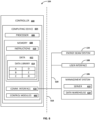
- FIG. 1 schematically depicts an exemplary additive manufacturing system 100.
- the additive manufacturing system 100 may include one or more additive manufacturing machines 102.
- the one or more additive manufacturing machines 102 may include a control system 104.
- the control system 104 may be included as part of the additive manufacturing machine 102 or the control system 104 may be associated with the additive manufacturing machine 102.
- the control system 104 may include componentry integrated as part of the additive manufacturing machine 102 and/or componentry that is provided separately from the additive manufacturing machine 102.
- Various componentry of the control system 104 may be communicatively coupled to various componentry of the additive manufacturing machine 102.
- the control system 104 may be communicatively coupled with a management system 106 and/or a user interface 108.
- the management system 106 may be configured to interact with the control system 104 in connection with enterprise-level operations pertaining to the additive manufacturing system 100. Such enterprise level operations may include transmitting data from the management system 106 to the control system 104 and/or transmitting data from the control system 104 to the management system 106.
- the user interface 108 may include one or more user input/output devices to allow a user to interact with the additive manufacturing system 100.
- an additive manufacturing machine 102 may include a build module 110 that includes a build chamber 112 within which an object or objects 114 may be additively manufactured.
- An additive manufacturing machine 102 may include a powder module 116 and/or an overflow module 118.
- the build module 110, the powder module 116, and/or the overflow module 118 may be provided in the form of modular containers configured to be installed into and removed from the additive manufacturing machine 102 such as in an assembly-line process. Additionally, or in the alternative, the build module 110, the powder module 116, and/or the overflow module 118 may define a fixed componentry of the additive manufacturing machine 102.
- the powder module 116 contains a supply of powder material 120 housed within a supply chamber 122.
- the powder module 116 includes a powder piston 124 that elevates a powder floor 126 during operation of the additive manufacturing machine 102. As the powder floor 126 elevates, a portion of the powder material 120 is forced out of the powder module 116.
- a recoater 128 such as a blade or roller sequentially distributes thin layers of powder material 120 across a build plane 130 above the build module 110.
- a build platform 132 supports the sequential layers of powder material 120 distributed across the build plane 130.
- a build platform 132 may include a build plate (not shown) secured thereto and upon which an object 114 may be additively manufactured.
- the additive manufacturing machine 102 includes an energy beam system 134 configured to generate one or more of energy beams such as laser beams and to direct the respective energy beams onto the build plane 130 to selectively solidify respective portions of the powder bed 138 defining the build plane 130. As the respective energy beams selectively melt or fuse the sequential layers of powder material 120 that define the powder bed 138, the object 114 begins to take shape.
- the one or more energy beams or laser beams may include electromagnetic radiation having any suitable wavelength or wavelength range, such as a wavelength or wavelength range corresponding to infrared light, visible light, and/or ultraviolet light.
- the powder material 120 is fully melted, with respective layers being melted or re-melted with respective passes of the energy beams.
- DMLS or SLS systems typically the layers of powder material 120 are sintered, fusing particles of powder material 120 to one another generally without reaching the melting point of the powder material 120.
- the energy beam system 134 may include componentry integrated as part of the additive manufacturing machine 102 and/or componentry that is provided separately from the additive manufacturing machine 102.
- the energy beam system 134 includes one or more irradiation devices 142 configured to generate a plurality of energy beams 144 and to direct the energy beams 144 upon the build plane 130.
- the irradiation devices may respectively have an energy beam source, a galvo-scanner, and optical assembly 136 that includes a plurality of optical elements configured to direct the energy beam onto the build plane 130.
- the optical assembly 136 may include one or more optical elements, such as lenses through which an energy beam may be transmitted along an optical path from the energy beam source to the build plane.
- an optical assembly 136 may include one more focusing lenses that focus an energy beam on a build plane 130.
- an optical assembly 136 may include a window, such as a protective glass, that separates one or more components of the energy beam system 134 from a process chamber 140 within which powder material is irradiated by one or more energy beams 144 to additively manufacture a three-dimensional object 114.
- the window or protective glass may include one or more optical elements, such as lenses or panes, through which an energy beam passes along an optical path to the build plane 130.
- the window or protective glass may separate the one or more components of the energy beam system from conditions existing within the process chamber 140 of an additive manufacturing machine 102.
- Such window or protective glass may prevent contaminants associated with the additive manufacturing process, such as powder material, dust, soot, residues from fumes or vapor, and the like, from coming into contact with sensitive components of an energy beam system 134. Accumulation of contaminants upon various optical elements of an optical assembly 136 may adversely affect operation of the energy beam system 134 and/or quality metrics associated with an energy beam system. Additionally, or in the alternative, such contaminants may cause damage to various optical elements of an optical assembly 136.
- the presently disclosed optical element monitoring systems are configured to monitor various optical elements of an optical assembly 136 for accumulation of contaminants and/or damage. Additionally, or in the alternative, the presently disclosed optical element monitoring systems may be configured to initiate cleaning, maintenance, and/or replacement of various optical elements of an optical assembly 136.
- the energy beam system 134 includes a first irradiation device 142a and a second irradiation device 142b.
- the first irradiation device 142a may include a first optical assembly 136a
- the second irradiation device 142b may include a second optical assembly 136b.
- an energy beam system 134 may include three, four, six, eight, ten, or more irradiation devices, and such irradiation devices may respectively include an optical assembly 136.
- the plurality of irradiation devices 142 are configured to respectively generate one or more energy beams that are respectively scannable within a scan field incident upon at least a portion of the build plane 130.
- the first irradiation device 142a generates a first energy beam 144a that is scannable within a first scan field 146a incident upon at least a first build plane region 148a.
- the second irradiation device 142b may generate a second energy beam 144b that is scannable within a second scan field 146b incident upon at least a second build plane region 148b.
- the first scan field 146a and the second scan field 146b may overlap such that the first build plane region 148a scannable by the first energy beam 144a overlaps with the second build plane region 148b scannable by the second energy beam 144b.
- the overlapping portion of the first build plane region 148a and the second build plane region 148b may sometimes be referred to as an interlace region 150. Portions of the powder bed 138 to be irradiated within the interlace region 150 may be irradiated by the first energy beam 144a and/or the second energy beam 144b in accordance with the present disclosure.
- the one or more irradiation devices respectively direct the plurality of energy beams (e.g., the first energy beam 144a and the second energy beam 144b) across the respective portions of the build plane 130 (e.g., the first build plane region 148a and the second build plane region 148b) to melt or fuse the portions of the powder material 120 that are to become part of the object 114.
- the plurality of energy beams e.g., the first energy beam 144a and the second energy beam 144b
- the build plane 130 e.g., the first build plane region 148a and the second build plane region 148b
- the first layer or series of layers of the powder bed 138 are typically melted or fused to the build platform 132, and then sequential layers of the powder bed 138 are melted or fused to one another to additively manufacture the object 114.
- a build piston 152 gradually lowers the build platform 132 to make room for the recoater 128 to distribute sequential layers of powder material 120.
- the distribution of powder material 120 across the build plane 130 to form the sequential layers of the powder bed 138, and/or the irradiation imparted to the powder bed 138 may introduce contaminants, such as powder material, dust, soot, residues from fumes or vapor, and the like, into the environment of the process chamber 140. Such contaminants may accumulate on various optical elements of the optical assembly 136 associated with the energy beam system 134.
- an additive manufacturing machine may utilize an overflow module 118 to capture excess powder material 120 in an overflow chamber 154.
- the overflow module 118 may include an overflow piston 156 that gradually lowers to make room within the overflow chamber 154 for additional excess powder material 120.
- an additive manufacturing machine may not utilize a powder module 116 and/or an overflow module 118, and that other systems may be provided for handling the powder material 120, including different powder supply systems and/or excess powder recapture systems.
- the subject matter of the present disclosure may be practiced with any suitable additive manufacturing machine without departing from the scope hereof.
- an additive manufacturing machine 102 may include an imaging system 158 configured to monitor one or more operating parameters of an additive manufacturing machine 102, one or more parameters of an energy beam system 134, and/or one or more operating parameters of an additive manufacturing process.
- the imaging system may a calibration system configured to calibrate one or more operating parameters of an additive manufacturing machine 102 and/or of an additive manufacturing process.
- the imaging system 158 may be a melt pool monitoring system.
- the one or more operating parameters of the additive manufacturing process may include operating parameters associated with additively manufacturing a three-dimensional object 114.
- the imaging system 158 may be configured to detect an imaging beam such as an infrared beam from a laser diode and/or a reflected portion of an energy beam (e.g., a first energy beam 144a and/or a second energy beam 144b).
- an imaging beam such as an infrared beam from a laser diode and/or a reflected portion of an energy beam (e.g., a first energy beam 144a and/or a second energy beam 144b).
- An energy beam system 134 and/or an imaging system 158 may include one or more detection devices.
- the one or more detection devices may be configured to determine one or more parameters of an energy beam system 134, such as one or more parameters associated with irradiating the sequential layers of the powder bed 138 based at least in part on an assessment beam detected by the imaging system 158.
- One or more parameters associated with irradiating the sequential layers of the powder bed 138 may include irradiation parameters and/or object parameters, such as melt pool monitoring parameters.
- the one or more parameters determined by the imaging system 158 may be utilized, for example, by the control system 104, to control one or more operations of the additive manufacturing machine 102 and/or of the additive manufacturing system 100.
- the one or more detection devices may be configured to obtain assessment data of the build plane 130 from a respective assessment beam.
- An exemplary detection device may include a camera, an image sensor, a photo diode assembly, or the like.
- a detection device may include charge-coupled device (e.g., a CCD sensor), an active-pixel sensor (e.g., a CMOS sensor), a quanta image device (e.g., a QIS sensor), or the like.
- a detection device may additionally include a lens assembly configured to focus an assessment beam along a beam path to the detection device.
- An imaging system 158 may include one or more imaging optical elements (not shown), such as mirrors, beam splitters, lenses, and the like, configured to direct an assessment beam to a corresponding detection device.
- the imaging system 158 may be configured to perform one or more calibration operations associated with an additive manufacturing machine 102, such as a calibration operation associated with the energy beam system 134, one or more irradiation devices 142 or components thereof, and/or the imaging system 158 or components thereof.
- the imaging system 158 may be configured to project an assessment beam and to detect a portion of the assessment beam reflected from the build plane 130.
- the assessment beam may be projected by an irradiation device 142 and/or a separate beam source associated with the imaging system 158.
- the imaging system 158 may be configured to detect an assessment beam that includes radiation emitted from the build plane 130, such as radiation from an energy beam 144 reflected from the powder bed 138 and/or radiation emitted from a melt pool in the powder bed 138 generated by an energy beam 144 and/or radiation emitted from a portion of the powder bed 138 adjacent to the melt pool.
- the imaging system 158 may include componentry integrated as part of the additive manufacturing machine 102 and/or componentry that is provided separately from the additive manufacturing machine 102.
- the imaging system 158 may include componentry integrated as part of the energy beam system 134.
- the imaging system 158 may include separate componentry, such as in the form of an assembly, that can be installed as part of the energy beam system 134 and/or as part of the additive manufacturing machine 102.
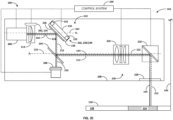
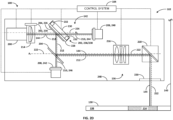
- An additive manufacturing system 100 and/or an additive manufacturing machine 102 includes one or more irradiation devices 142 configured as described with reference to FIGs. 2A-2D .
- an irradiation device 142 may include on or more optical elements configured to operate upon an energy beam 144.
- the optical elements may include lenses, mirrors, collimators, dichroic elements, diffractive elements, refractive elements, polarizers, phase shifters, frequency shifters, beam shaping elements, aperture elements, and so forth.
- the one or more optical elements may be integrated into the irradiation device 142 and/or may be provided as separate components.
- Respective optical elements may be selected to provide a suitable energy beam 144 for the particular use of the irradiation device 142, such as for the type of additive manufacturing to be performed using the irradiation device 142 and/or the type of powder material 120 to be utilized to additively manufacture three-dimensional objects 114.
- an irradiation device 142 includes a beam source 200, and one or more beam positioning elements 202 disposed downstream from the beam source 200.
- the beam source 200 may include a laser fiber or a laser fiber array, or a laser diode or a laser diode array; however, other types of beam sources 200 are also contemplated and the examples given are not to be limiting.
- a beam splitter 204 is positioned downstream from the one or more beam positioning elements 202. The beam splitter 204 is configured to extract or split a measurement beam 206 from the energy beam 144.
- the measurement beam 206 propagates along a measurement path 210 to the one or more beam sensors 208, while the energy beam 144 popagates along an irradiation path 212 to the powder material 120.
- the one or more beam sensors 208 are configured to determine one or more parameters of the measurement beam 206.
- the one or more parameters of the measurement beam 206 are utilized to align the energy beam 144 with an optical axis of the irradiation device 142.
- An exemplary an irradiation device 142 may be configured to emit an energy beam 144 that has a manufacturing power level selected to additively manufacturing a three-dimensional object 114 by irradiating a powder material 120. Additionally, or in the alternative, the irradiation device 142 may be configured to emit an energy beam 144 that has a calibration power level.
- the manufacturing power level may exceed the calibration power level by at least one order of magnitude.
- the manufacturing power level may be from about 100 watts (W) to about 3,000 W, such as from about 500 W to about 1,500 W.
- the calibration power level may be from about 1 W to about 100 W, such as from about 10 W to about 5 0 W.
- the beam splitter 204 may include a dichroic element, such as a dichroic mirror, a dichroic filter, or the like.
- the beam splitter 204 provides a measurement beam 206 that has a relatively low power level and/or intensity, for example, that is suitable for use with the one or more beam sensors 208.
- a beam splitter may provide a measurement beam 206 with a suitable power level and/or intensity for performing a calibrating alignment with the energy beam 144 operating at a reduced power level.
- the measurement beam 206 may exhibit a suitable power level and/or intensity for performing a manufacturing alignment with the energy beam 144 operating at a nominal power level for additively manufacturing a three-dimensional object 114.
- the beam splitter 204 may be configured with relatively high reflectance, such that the energy beam 144 is reflected and the measurement beam 206 is transmitted by the beam splitter 204.
- a transmission ratio may be determined for a beam splitter 204 as a ratio of the intensity of a transmitted beam to the intensity of a reflected beam (%T/%R).
- a transition ratio of a beam splitter 204 with a relatively low transmittance, as determined by a ratio of the intensity of the transmitted beam to the intensity of the reflected beam (%T/%R) may be from 15% to about 0.1%, such as from about 10% to about 0.5%, or such as from about 5% to about 1%.
- the beam splitter 204 may be configured with a relatively high transmittance, such that the measurement beam 206 is reflected by the beam splitter 204 and the energy beam 144 is transmitted by the beam splitter 204.
- the transmission ratio of a beam splitter 204 with a relatively high transmittance may be from about 15% to about 0.1% of the intensity of the energy beam 144, such as from about 10% to about 0.5%, or such as from about 5% to about 1% of the intensity of the energy beam 144.
- the one or more beam sensors 208 may include one or more photodiodes, configured, for example, as a quadrant sensor, a lateral displacement sensor, a charge-coupled device (e.g., a CCD sensor), an active-pixel sensor (e.g., a CMOS sensor), a quanta image device (e.g., a QIS sensor), or the like.
- An exemplary quadrant sensor may be configured to determine a position of a measurement beam 206 based at least in part on an intensity value determined from respective ones of four photosensors corresponding to respective quadrants.
- a photosensor with a relatively higher intensity value may indicate that the measurement beam 206 is oriented towards the quadrant corresponding to such photosensor, and/or a photosensor with a relatively lower intensity value may indicate that the measurement beam 206 is oriented towards the quadrant corresponding to such photosensor.
- a lateral displacement sensor may include an array of photosensitive pixels.
- a lateral displacement sensor may determine an orientation of a measurement beam 206 based at least in part on lateral displacement. The lateral displacement may be determined based at least in part on which pixels from the array are activated by the measurement beam 206.
- Exemplary beam sensors may be configured to detect a measurement beam 206 with a power of from about 1 microwatt ( ⁇ W) to about 100 milliwatt (mW), such as from about 1 ⁇ W to about 1,000 ⁇ W, or such as from about 10 ⁇ W to about 100 ⁇ W.
- the beam splitter 204 may be configured to provide a measurement beam 206 with a power level and/or intensity suitable for use with the one or more beam sensors 208.
- an irradiation device 142 may include a beam collimator 214.
- the beam collimator 214 may include one or more optical elements configured to collimate the energy beam 144.
- the beam collimator 214 may be operably coupled to the beam source 200. Additionally, or in the alternative, the beam collimator 214 may be positioned downstream from the beam source 200. In some embodiments, the beam collimator 214 may be located upstream from the one or more beam positioning elements 202.
- the beam collimator 214 may include one or more lenses configured to collimate and/or otherwise condition the energy beam 144 for irradiating the powder bed 138 to additively manufacture a three-dimensional object 114. For example, the beam collimator 214 may be configured to collimate the energy beam 144 prior to becoming incident upon the one or more beam positioning elements 202
- An irradiation device 142 may additionally include a focusing lens assembly 216.
- the focusing lens assembly 216 may be located downstream from the one or more beam positioning elements 202.
- the focusing lens assembly 216 may include one or more lenses configured to focus and/or otherwise condition the energy beam 144, such as after having been collimated by the beam collimator 214, for irradiating the powder bed 138 to additively manufacture a three-dimensional object 114.
- the focusing lens assembly 216 may include a flat-field lens assembly, such as a telecentric lens assembly.
- the flat-field lens assembly may be configured as a Fourier lens assembly, an f-theta lens assembly, an f-tan-theta lens assembly, or the like.
- the energy beam 144 may propagate from the focusing lens assembly 216 directly to the build plane 130. Additionally, or in the alternative, one or more mirrors may be disposed along the irradiation path 212 between the focusing lens assembly 216 and the build plane 130.
- the irradiation device 142 may include a scanner 218, such as a galvo-scanner or the like, configured to cause the energy beam 144 to follow a scan path that propagates across the build plane 130 to irradiate specified portions of the powder bed 138, thereby forming an additively manufactured three-dimensional object 114.
- the irradiation device 142 may include a window 220, such as a protective glass, that separates one or more components of the irradiation device 142 from a process chamber 140 within which powder material is irradiated by the energy beam 144 to additively manufacture a three-dimensional object 114.
- the window 220 may include one or more optical elements, such as lenses or panes, through which an energy beam 144 passes along the irradiation path 212 to the build plane 130.
- the window or protective glass may separate the components of the irradiation device 142 from conditions existing within the process chamber 140.
- the window 220 may prevent contaminants associated with the additive manufacturing process, such as powder material, dust, soot, residues from fumes or vapor, and the like, from coming into contact with sensitive components of the irradiation device 142.
- the one or more beam positioning elements 202 are configured to align the energy beam 144 with an optical axis of the irradiation device 142.
- An axial orientation of the energy beam 144 and/or an angular orientation of the energy beam 144 may be at least partially aligned with an optical axis of the irradiation device 142 at least in part by adjusting a position of the one or more beam positioning elements 202.
- the one or more beam positioning elements 202 may at least partially align the energy beam 144 with an optical axis of the focusing lens assembly 216, which may sometimes be referred to as a focusing lens-optical axis (A F ) 222.
- the one or more beam positioning elements 202 may at least partially align the energy beam 144 with an optical axis of the beam collimator 214, which may sometimes be referred to as a collimator-optical axis (A C ) 224.
- the one or more beam positioning elements 202 are configured to adjust a position and/or orientation of the energy beam 144 based at least in part on position information determined with the one or more beam sensors 208.
- a beam positioning element 202 may include an optical element 226, an optical element mount 228 configured to hold the optical element 226, an adjustment bracket 230, and one or more actuators 232 configured to move the optical element mount 228 relative to the adjustment bracket 230.
- the one or more actuators 232 may be controlled by a control system 104 based at least in part on position information from the one or more beam sensors 208.
- the beam positioning element may be configured as a kinematic optical element as described with reference to FIGs. 5A-5D .
- Adjustments to the one or more beam positioning elements 202 may bring the energy beam 144 at least partially into alignment with an optical axis of the irradiation device 142, such as a focusing lens-optical axis (A F ) 222 and/or a collimator-optical axis (A C ) 224. Additionally, or in the alternative, adjustments to the one or more beam positioning elements 202 may maintain the energy beam 144 at least partially in alignment with such an optical axis of the irradiation device 142, such as over a period of time when additively manufacturing a three-dimensional object 114.
- an optical axis of the irradiation device 142 such as a focusing lens-optical axis (A F ) 222 and/or a collimator-optical axis (A C ) 224.
- adjustments to the one or more beam positioning elements 202 may maintain the energy beam 144 at least partially in alignment with such an optical axis of the irradiation device 142,
- an irradiation device 142 may include a beam collimator 214 configured to adjust a position and/or orientation of the energy beam 144, based at least in part on position information determined with the one or more beam sensors 208.
- the beam collimator 214 may include a collimator positioning element 234 configured to adjust a position of the beam collimator 214.
- the position of the beam collimator 214 may be adjusted, such as by adjusting the collimator positioning element 234, based at least in part on position information from the one or more beam sensors 208.
- the energy beam 144 may be at least partially aligned with an optical axis of the irradiation device 142 at least in part by adjusting the collimator positioning element 234.
- the collimator positioning element 234 may be configured as, or may include, a beam positioning element 202, including with an optical element 226, an optical element mount 228 configured to hold the optical element 226, an adjustment bracket 230, and one or more actuators 232 configured to move the optical element mount 228 relative to the adjustment bracket 230.
- the one or more actuators 232 may be controlled by a control system 104 based at least in part on position information from the one or more beam sensors 208.
- Adjustments to the collimator positioning element 234 may bring the energy beam 144 at least partially into alignment with an optical axis of the irradiation device 142, such as a focusing lens-optical axis (A F ) 222 and/or a collimator-optical axis (A C ) 224. Additionally, or in the alternative, adjustments to the collimator positioning element 234 may maintain the energy beam 144 at least partially in alignment with such an optical axis of the irradiation device 142, such as over a period of time when additively manufacturing a three-dimensional object 114.
- an optical axis of the irradiation device 142 such as a focusing lens-optical axis (A F ) 222 and/or a collimator-optical axis (A C ) 224.
- an irradiation device 142 includes a first beam positioning element 236 and a second beam positioning element 238.
- the first beam positioning element 236 and the second beam positioning element 238 may be positioned upstream from a focusing lens assembly 216.
- the first beam positioning element 236 and the second beam positioning element 238 may be configured to work in concert to align the energy beam 144 with an optical axis of the irradiation device 142, such as with the focusing lens-optical axis (A F ) 222.
- the first beam positioning element 236 may be configured to adjust an axial orientation of the energy beam 144.
- the second beam positioning element 238 may be configured to adjust an angular orientation of the energy beam 144.
- a measurement beam 206 may be extracted or split from the energy beam 144 by a beam splitter 204 located upstream from the focusing lens assembly 216. Additionally, or in the alternative, as shown in FIG. 2B , a measurement beam 206 may be extracted or split from the energy beam 144 by a beam splitter 204 located downstream from the focusing lens assembly 216. Regardless of whether the measurement beam 206 is obtained upstream or downstream from the focusing lens assembly, the measurement beam 206 is directed to one or more beam sensors 208 configured to determine one or more parameters of the measurement beam 206.
- the beam sensor 208 is configured to provide position information from the measurement beam 206 corresponding to an axial orientation and/or an angular orientation of the energy beam 144.
- Position information corresponding to an axial orientation and/or an angular orientation of the energy beam 144 may be utilized to at least partially align the energy beam 144 with an optical axis of the irradiation device 142.
- one or more beam positioning elements 202 such as the first beam positioning element 236, are configured to at least partially align the energy beam 144 with respect to an axial orientation of the energy beam 144, based at least in part on the position information from the beam sensor 208.
- the one or more beam positioning elements 202 may be configured to at least partially align the energy beam 144 with respect to an angular orientation of the energy beam 144, based at least in part on the position information from the beam sensor 208.
- an irradiation device 142 includes a single beam positioning element 202, such as a first beam positioning element 236.
- the first beam positioning element 236 may be positioned upstream from a focusing lens assembly 216.
- the first beam positioning element 236 may be configured to align the energy beam 144 with an optical axis of the irradiation device 142, such as with the focusing lens-optical axis (A F ) 222.
- the first beam positioning element 236 may be configured to adjust an axial orientation of the energy beam 144 and/or an angular orientation of the energy beam 144. As shown in FIG.
- a measurement beam 206 may be extracted or split from the energy beam 144 by a beam splitter 204 located upstream from the focusing lens assembly 216. Additionally, or in the alternative, a measurement beam 206 may be extracted or split from the energy beam 144 by a beam splitter 204 located downstream from the focusing lens assembly 216, as shown in FIG. 2B .
- the measurement beam 206 is directed to one or more beam sensors 208 configured to determine one or more parameters of the measurement beam 206.
- an irradiation device 142 includes a first beam sensor 240 and a second beam sensor 242.
- the first beam sensor 240 may be configured to provide position information corresponding to an axial orientation of the energy beam 144.
- the second beam sensor 242 may be configured to provide position information corresponding to an angular orientation of the energy beam 144.
- a beam positioning element 202 may include a beam splitter 204.
- the optical element 226 mounted to the optical element mount 228 of the beam positioning element 202 may be configured as a beam splitter 204.
- a first beam sensor 240 may be configured to receive a first measurement beam 244 propagating from the optical element 226 of the beam positioning element 202, such as from a first beam splitter 204 mounted in the optical element mount 228 of the beam positioning element 202. Additionally, or in the alternative, a second beam sensor 242 may be configured to receive a second measurement beam 246 propagating from a second beam splitter 204 disposed downstream from the beam positioning element 202.
- Position information corresponding to an axial orientation of the energy beam 144 is utilized to at least partially align the energy beam 144 with an optical axis of the irradiation device 142.
- one or more beam positioning elements 202 such as the first beam positioning element 236, may be configured to at least partially align the energy beam 144 with an optical axis of the irradiation device 142, such as with respect to an axial orientation of the energy beam 144, based at least in part on the position information from the first beam sensor 240.
- position information corresponding to an angular orientation of the energy beam 144 may be utilized to at least partially align the energy beam 144 with an optical axis of the irradiation device 142.
- one or more beam positioning elements 202 such as the first beam positioning element 236, may be configured to at least partially align the energy beam 144 with an optical axis of the irradiation device 142, such as with respect to an angular orientation of the energy beam 144, based at least in part on the position information from the second beam sensor 242.
- an irradiation device 142 may include a beam collimator 214 with a collimator positioning element 234, for example, in addition or in the alternative to the one or more beam positioning elements 202.
- the collimator positioning element 234, when included, may operate in concert with, or as an alternative to, a first beam positioning element 236 and/or a second beam positioning element 238 to at least partially align an energy beam 144 with an optical axis of the irradiation device 142.
- a collimator positioning element 234 may be configured to at least partially align the energy beam 144 with respect to an axial orientation of the energy beam 144 and/or a beam positioning element 202 may be configured to at least partially align the energy beam 144 with respect to an angular orientation of the energy beam 144, based at least in part on the position information from the beam sensor 208.
- the irradiation device 142 may include a structural frame element 248, and the adjustment bracket 230 may be coupled directly or indirectly to the frame element 248. By coupling the adjustment bracket 230 to the frame element 248, vibrations that may otherwise translate to the beam positioning element may be minimized.
- one or more additional optical elements of the irradiation device 142 may be coupled to the frame element 248.
- the beam source 200, the one or more beam positioning elements 202, the beam splitters 204, the one or more beam sensors 208, the beam collimator 214, the focusing lens assembly 216, and/or the scanner 218 may be directly or indirectly coupled to the frame element 248.
- a beam position element 202 may include an optical element 226, such as a lens, a mirror, or the like.
- the optical element 226 may include a beam splitter, such as a dichroic element.
- the optical element 226 may be mounted to, or in, or otherwise supported by, an optical element mount 228.
- the optical element mount 228 may be coupled to an adjustment bracket 230 at least in part by one or more actuators 232 configured to move the optical element mount 228 relative to the adjustment bracket 230.
- the beam positioning element may be configured as a kinematic optical element.
- kinematic optical element refers to an optical element, such as a beam positioning element 202 and/or a collimator positioning element 234, that includes one or more kinematic couplings.
- kinematic coupling refers to a coupling for which the number of independent constraint points equals the number of degrees of freedom constrained. For example, there are six (6) potential degrees of freedom in a mechanical system, and a kinematic coupling may include a total of six (6) independent constraint points.
- a kinematic coupling may operate according to principles of kinematic determinacy at least to a first-order approximation.
- An exemplary kinematic coupling may include three (3) kinematic constraints respectively configured as a tetrahedral constraint (3 independent constraint points), a v-groove constraint (2 independent constraint points), and a flat constraint (1 independent constraint), such as a Kelvin coupling, or the like.
- Another exemplary kinematic coupling may include three (3) kinematic constraints configured as a radial v-grooves (2 independent constrain points) that respectively mate with three radial hemispheres, such as a Maxwell coupling, or the like.
- an exemplary beam positioning element 202 may include one or more kinematic couplings 300.
- the one or more kinematic couplings 300 may include a plurality of kinematic constraints 302.
- a beam positioning element 202 may include a kinematic coupling 300 with a first kinematic constraint 304, a second kinematic constraint 306, and a third kinematic constraint 308.
- the first kinematic constraint 304 may be configured as a tetrahedral constraint.
- the second kinematic constraint 306 may be configured as a v-groove constraint.
- the third kinematic constraint 308 may be configured as a flat constraint.
- the first kinematic constraint 304, the second kinematic constraint 306, and the third kinematic constraint 308 may together provide a kinematic coupling configured as a Kelvin coupling.
- the first kinematic constraint 304, the second kinematic constraint 306, and the third kinematic constraint 308 may be respectively configured as radial v-groove constraints that respectively mate with a radial hemisphere.
- the plurality of kinematic constraints 302 may together provide a kinematic coupling 300 configured as a Maxwell coupling.
- the kinematic coupling 300 may be coupled to a frame element 248 of the irradiation device 142 with zero (0) degrees of freedom. As shown in FIG. 3A , the kinematic coupling 300 may be coupled to the frame element 248 in a configuration or arrangement such that the respective kinematic constraints 302 are adjacent to the frame element 248. As shown in FIG. 3B , the kinematic coupling 300 may be coupled to the frame element 248 in a configuration or arrangement such that the kinematic constraint 302 with the highest number of independent constraints is located adjacent to the frame element 248.
- a first beam positioning element 236 may be configured to adjust an axial orientation of the energy beam 144, and the first beam positioning element 236 may include a kinematic coupling 300 that is adjustable with respect to one or more linear degrees of freedom and constrained with respect to one or more rotational degrees of freedom.
- the first beam positioning element 236 may be constrained with respect to three (3) rotational degrees of freedom (pitch, roll, and yaw rotation), and/or the first beam positioning element 236 may be adjustable with respect to three (3) linear degrees of freedom (x, y, and z axis).
- a second beam positioning element 238 may be configured to adjust an angular orientation of the energy beam 144, and the second beam positioning element 238 may include a kinematic coupling 300 that is adjustable with respect to one or more rotational degrees of freedom and constrained with respect to one or more linear degrees of freedom.
- the second beam positioning element 238 may be constrained with respect to three (3) linear degrees of freedom (x, y, and z axis), and/or the second beam positioning element 238 may be adjustable with respect to three (3) rotational degrees of freedom (pitch, roll, and yaw rotation).
- a collimator positioning element 234 may include a kinematic coupling 300.
- the collimator positioning element 234 may be adjustable with respect to one or more linear degrees of freedom and constrained with respect to one or more rotational degrees of freedom.
- the collimator positioning element 234 may be constrained with respect to three (3) rotational degrees of freedom (pitch, roll, and yaw rotation), and/or the collimator positioning element 234 may be adjustable with respect to three (3) linear degrees of freedom (x, y, and z axis).
- a beam positioning element 202 disposed downstream from the collimator positioning element 234 may be configured to adjust an angular orientation of the energy beam 144, and the beam positioning element 202 may include a kinematic coupling 300 that is adjustable with respect to one or more rotational degrees of freedom and constrained with respect to one or more linear degrees of freedom.
- a beam positioning element 202 downstream from a collimator positioning element 234 may be constrained with respect to three (3) linear degrees of freedom (x, y, and z axis), and/or the beam positioning element 202 may be adjustable with respect to three (3) rotational degrees of freedom (pitch, roll, and yaw rotation).
- a beam positioning element 202 such as a beam positioning element that includes a kinematic coupling 300, may include one or more actuators 232 configured to move an optical element mount 228 relative to an adjustment bracket 230.
- the beam positioning element 202 may include a first actuator 310 and a second actuator 312.
- the first actuator 310 may be associated with one or more kinematic constraints 302, such as a second kinematic constraint 306.
- the second actuator 312 may be associated with one or more kinematic constraints 302, such as a third kinematic constraint 308.
- a beam positioning element 202 may include a third actuator 314, such as a third actuator 314 associated with a first kinematic constraint 304.
- the one or more actuators 232 may be actuated by any desired motive force, including electric, hydraulic, pneumatic, and/or mechanical motive force. Additionally, or in the alternative, the one or more actuators 232 may be actuated manually, such as by an operator or a technician that applies a mechanical motive force, such as using a tool. As shown in FIGs. 3C and 3D , in some embodiments, a beam positioning element 202 may include one or more piezoelectric actuators 316 configured to adjust a position of an optical element mount 228. As used herein, the term "piezoelectric actuator" refers to an actuator 232 configured to be actuated at least in part by one or more piezoelectric elements.
- a beam positioning element 202 may include one or more piezoelectric actuators 316 configured to move an optical element mount 228 relative to an adjustment bracket 230.
- a beam positioning element 202 that includes a piezoelectric actuator 316 may include one or more piezoelectric elements 318 configured to exert a piezoelectric motive force, and one or more gripping elements 320 configured to move an actuating element 322 responsive to the motive force from the piezoelectric elements 318.
- the actuating element 322 may be a fine-thread screw.
- the one or more gripping elements 320 may be configured to rotate the actuating element, such as a fine-thread screw.
- the piezoelectric actuator 316 may provide a step length from the one or more piezoelectric elements 318 that corresponds to a rotation of the actuating element 322 of from about 0.1 microradians ( ⁇ rad) to about 100 ⁇ rad, such as from about 0.1 ⁇ rad to about 10 ⁇ rad, or such as from about 0.1 ⁇ rad to about 1 ⁇ rad.
- the rotation of the actuating element 322 may provide a linear displacement of the actuating element 322 of from about 1 nanometer (nm) per step to about 1,000 nm per step, such as from about 10 nm per step to about 500 nm per step.
- the one or more gripping elements 320 may include teeth 324 that mate with or otherwise grip a surface of the actuating element 322.
- the piezoelectric actuator 316 may include a preload element 326, such as a spring or the like, configured to apply a force that holds the one or more gripping elements 320 in contact with the actuating element 322.
- the piezoelectric actuator 316 may be configured as an inertia drive. Additionally, or in the alternative, the piezoelectric actuator 316 may be self-locking when at rest.
- the piezoelectric actuator may provide a holding force of from about 10 newtons (N) to about 150 N, such as from about 25 N to about 100 N.
- An exemplary beam sensor 208 may include one or more sensor elements 400.
- a respective sensor element 400 may include a photoreceptor set 402 that includes one or more photoreceptors, such as photodiodes, phototransistors, or other photoconductive elements.
- the photoreceptor set 402 may be configured as a single photoreceptor, or as a plurality of photoreceptors, such as a two-dimensional array of photoreceptors.
- a sensor element 400 may include a photoreceptor set 402 configured as a sensor detector, a lateral displacement sensor, a charge-coupled device (e.g., a CCD sensor), an active-pixel sensor (e.g., a CMOS sensor), a quanta image device (e.g., a QIS sensor), or the like.
- a photoreceptor set 402 may be configured as an optical integrated circuit that includes one or more photodiodes and an electronic signal-processing circuitry.
- a beam sensor 208 may include a single sensor element 400.
- a beam sensor 208 may include a plurality of sensor elements 400, such as a first sensor element 404 and a second sensor element 406.
- the first sensor element 404 may include one or more photoreceptor sets 402
- the second sensor element 406 may include one or more photoreceptor sets 402.
- the respective sensor elements 400 may be configured as shown in FIG. 4A, FIG. 4B , and/or FIG. 4C .
- a measurement beam 206 may become incident upon the one or more sensor elements 400, and the one or more sensor elements 400 may be configured to provide a signal from which one or more parameters of the measurement beam 206 may be determined.
- the one or more parameters of the measurement beam 206 may be utilized to determine providing position information that may be utilized to determine position information of an energy beam 144 from which the measurement beam 206 was extracted.
- a sensor element 400 may include a measurement beam-splitter 408 configured to split a measurement beam 206, providing a first measurement beam portion 410 and a second measurement beam portion 412.
- a beam sensor 208 may have an interferometer-type configuration. As shown in FIG. 4B , the first measurement beam portion 410 may become incident upon a first photoreceptor set 414, and/or the second measurement beam portion 412 may become incident upon a second sensor element 406.
- the first photoreceptor set 414 may be configured to determine a first one or more parameters of the measurement beam 206 (e.g., from the first measurement beam portion 410) and/or the second photoreceptor set 416 may be configured to determine a second one or more parameters of the measurement beam 206 (e.g., from the second measurement beam portion 412).
- the sensor element 400 may be configured to determine an axial orientation of the measurement beam 206, for example, from the first measurement beam portion 410 detected by the first photoreceptor set 414. Additionally, or in the alternative, the sensor element 400 may be configured to determine an angular orientation of the measurement beam 206, for example, from the second measurement beam portion 412 detected by the second photoreceptor set 416. As shown in FIG.
- the first measurement beam portion 410 and the second measurement beam portion 412 may become incident upon a common photoreceptor set 402.
- the first measurement beam portion 410 may be reflected onto the photoreceptor set 402 at least in part by a first measurement beam reflector 418, and/or the second measurement beam portion 412 may be reflected onto the photoreceptor set 402 at least in part by a second measurement beam reflector 420.
- the first measurement beam portion 410 and the second measurement beam portion 412 may be directed onto different regions of the photoreceptor set 402.
- the axial orientation and the angular orientation of the measurement beam 206 may be differentiated from one another based at least in part on a difference in beam path lengths as between the first measurement beam portion 410 and the second measurement beam portion 412, and/or based at least in part on a location upon which the first measurement beam portion 410 and the second measurement beam portion 412 become incident upon the respective photoreceptor set 402.
- the axial orientation and/or the angular orientation of the measurement beam 206 may be utilized to determine an axial orientation and/or an angular orientation of the energy beam 144.
- the first measurement beam portion 410 and the second measurement beam portion 412 may have different beam path lengths.
- a first adjustment to an orientation of an energy beam 144 may be performed followed by a second adjustment to the orientation of the energy beam 144.
- the first adjustment may be performed with respect to an axial orientation of an energy beam 144.
- the second adjustment may be performed with respect to an angular orientation of the energy beam 144.
- the first adjustment may be performed based at least in part on sensor information from a first photoreceptor set 414 (e.g., FIG. 4B ) and/or a first portion of a common photoreceptor set 402 (e.g., FIG. 4C ).
- the second adjustment may be performed based at least in part on sensor information from a second photoreceptor set 416 (e.g., FIG.
- the sensor information for the first adjustment and the second adjustment may be obtained from a common beam sensor 208, or the sensor information for the first adjustment may be obtained from a first beam sensor 240 and the second adjustment may be obtained from a second beam sensor 242.
- a beam positioning element 202 may be configured to adjust axial orientation of the energy beam and/or an angular orientation of an energy beam based at least in part on the sensor information.
- a first beam positioning element 236 may be configured to adjust an axial orientation of the energy beam 144.
- a second beam positioning element 238 may be configured to adjust an angular orientation of the energy beam 144.
- a beam sensor 208 may include one or more sensor elements 400 configured to provide automatic gain control.
- the automatic gain control may allow the respective sensor elements 400 to utilize measurement beams 206 that have a wide range of intensity and/or power levels.
- a sensor element 400 configured to provide automatic gain control may allow a respective photoreceptor set 402 to provide a signal within a suitable amplitude for measurement beams across a wide range of intensity and/or power levels.
- the automatic gain control may allow a photoreceptor set 402 to provide a suitable signal for a measurement beam 206 corresponding to a calibration power level and/or a manufacturing power level.
- the automatic gain control may be provided by a variable gain amplifier 422.
- the variable gain amplifier may be integrated into a photoreceptor set 402, such as in the form of an optical integrated circuit.
- the variable gain amplifier 422 may include any suitable amplifier.
- the variable gain amplifier 422 may include a digitally controlled amplifier.
- the digitally controlled amplifier may be integrated into a photoreceptor set 402, such as in the form of an optical integrated circuit, including, for example, a series of stepped feedback resistors that respectively provide desired gain settings.
- the digitally controlled amplifier may include a plurality of resistor sets, such as a first resistor set configured to provide a first gain setting corresponding to a calibration power level, and/or a second resistor set configured to provide a second gain setting corresponding to a manufacturing power level.
- the photoreceptor set 402 may include a microcontroller configured to toggle between respective resistor sets to provide a desired gain level.
- a variable gain amplifier 422 may additionally or alternatively include a voltage-controlled resistor, an operational transconductance amplifier, an inverting amplifier, or a non-inverting amplifier.
- a beam sensor 208 may include a plurality of sensor elements 400, as shown, for example in FIG. 4D .
- the beam sensor 208 may include a beam switch 424 configured to alternatively direct a measurement beam 206 to respective ones of a plurality of sensor elements 400.
- the respective sensor elements 400 may be configured for use with a measurement beam 206 within a specified range of intensities or power levels.
- a first sensor element 404 may be configured for use with a measurement beam 206 that has an intensity and/or power level corresponding to a calibration power level
- a second sensor element 406 may be configured for use with a measurement beam 206 that has an intensity and/or power level corresponding to a manufacturing power level
- the beam switch 424 may be configured to direct the measurement beam 206 along a first measurement beam path 426 to the first sensor element 404 such that the first sensor element 404 may be utilized during a calibration operation, such as when the energy beam 144 may exhibit a calibration power level that is relatively lower than the power level of the energy beam during a manufacturing operation, such as at least one order of magnitude lower than the power level of the energy beam during a manufacturing operation.
- beam switch 424 may be configured to direct the measurement beam 206 along a second measurement beam path 428 to the second sensor element 406 such that the second sensor element 406 may be utilized during a manufacturing operation, such as when the energy beam 144 may exhibit a manufacturing power level that is relatively higher than the power level of the energy beam during a calibration operation, such as at least one order of magnitude higher than the power level of the energy beam during a calibration operation.
- a beam sensor may include one or more targets 500 configured to assist with determining one or more properties of an energy beam 144.
- the one or more targets 500 may have known geometry configured to obstruct at least a portion of a measurement beam 206.
- One or more parameters of the measurement beam 206 incident upon a beam sensor 208 may be determined, such as an axial and/or angular orientation of the measurement beam 206, based at least in part by known geometry of the one or more targets 500.
- a target 500 may include one or more crosshairs 502 configured to intersect at least a portion of the measurement beam 206, such as a vertical crosshair 502 and/or a horizontal crosshair 502 as shown in FIG.
- a measurement beam 206 may become incident upon an incident region 504 of a beam sensor 208, such as an incident region 504 of a photoreceptor set 402, as shown.
- the incident region 504 may correspond to a portion of the measurement beam 206 unobstructed by the target.
- FIG. 5B shows an incident region 504 corresponding to the target shown in FIG. 5A
- FIG. 5D shows an incident region 504 corresponding to the target shown in FIG. 5C .
- a beam sensor 208 may include a first target 500 (e.g. FIG. 5A ) that corresponds to a sensor element 400 configured to receive a first measurement beam 244 and/or a first measurement beam portion 410, and a second target 500 (e.g., FIG. 5C ) that corresponds to a sensor element 400 configured to receive a second measurement beam 246 and/or a second measurement beam portion 412.
- a first beam sensor 208 and/or a first sensor element 400 may include a first target 500 (e.g. FIG. 5A ) that corresponds to a sensor element 400 configured to receive a first measurement beam 244 and/or a first measurement beam portion 410.
- a second beam sensor 208 and/or a second sensor element 400 may include a second target 500 (e.g., FIG. 5C ) that corresponds to a sensor element 400 configured to receive a second measurement beam 246 and/or a second measurement beam portion 412.
- a first target 500 may be configured as an axial orientation target and/or a second target 500 may be configured as an angular orientation target.
- An axial orientation target may be configured to determine an axial orientation of a measurement beam 206, from which an axial orientation of an energy beam 144 may be determined.
- An angular orientation target may be configured to determine an angular orientation of a measurement beam 206, from which an angular orientation of an energy beam 144 may be determined.
- Data from a first incident region 504 (e.g., FIG. 5B ) and data from a second incident region 504 (e.g., FIG. 5D ) may be superimposed to provide a superimposed incident region 506 as shown, for example, in FIG. 5E .
- the superimposed incident region 506 may include a plurality of overlapping incident regions 508.
- One or more parameters of the measurement beam 206 may be determined, such as an axial and/or angular orientation of the measurement beam 206, based at least in part on the superimposed incident region 506 and/or respective ones of the plurality of overlapping incident regions 508.
- the presently disclosed energy beam systems 134, irradiation devices 142, and/or methods may provide an energy beam 144 with an improved quality.
- the improved quality may be attributable at least in part to improved beam alignment with an optical axis of the irradiation device 142, and/or to adjustments made to one or more beam quality parameters, such as after having aligned the energy beam 144 with the optical axis of the irradiation device 142.
- Exemplary beam quality parameters that may be adjusted include: beam profile, waist position, intensity, caustic, spot size, and/or focal length, as well as combinations of these.
- the quality of an energy beam 144, and/or an improvement in the quality of the energy beam 144 may be described with reference to a beam quality factor (M 2 ) according to ISO Standard 11146.
- the beam quality factor (M 2 ) represents a variation of a beam from a diffraction-limited Gaussian beam with the same wavelength.
- a diffraction-limited Gaussian beam has an M 2 value of 1.0.
- the presently disclosed energy beam systems 134, irradiation devices 142, and/or methods may provide an energy beam 144 with an M 2 value of from about 1.05 to about 2.0, such as from about 1.05 to about 1.5, such as from about 1.05 to about 1.2, or such as from about 1.05 to about 1.15.
- a control system 104 is configured to perform one or more control operations associated with an additive manufacturing system 100 and/or an additive manufacturing machine 102.
- the control operations include, one or more control commands configured to control operations of an energy beam system 134 and/or an irradiation device 142.
- an exemplary control system 104 includes a controller 600.
- the controller includes one or more control modules 602 configured to cause the controller 600 to perform one or more control operations.
- the one or more control modules 602 include control logic executable to provide control commands configured to control one or more controllable components associated with an additive manufacturing machine 102, such as controllable components associated with an energy beam system 134 and/or an imaging system 158.
- a control module 602 is configured to provide one or more control commands executable to control operation of one or more components of an energy beam system 134 and/or an irradiation device 142, such as operation of one or more beam positioning elements 202, one or more beam sensors 208, one or more collimator positioning element 234, and/or any one or more other components of an irradiation device 142.
- the controller 600 is communicatively coupled with an additive manufacturing machine 102.
- the controller 600 is communicatively coupled with one or more components of an additive manufacturing machine 102, such as one or more components of an energy beam system 134 and/or an irradiation device 142, such as operation of one or more beam positioning elements 202, one or more beam sensors 208, one or more collimator positioning element 234, and/or any one or more other components of an irradiation device 142.
- the controller 600 may also be communicatively coupled with a management system 106 and/or a user interface 108.
- the controller 600 may include one or more computing devices 604, which may be located locally or remotely relative to an additive manufacturing machine 102, an energy beam system 134, and/or an irradiation device 142.
- the one or more computing devices 604 may include one or more processors 606 and one or more memory devices 608.
- the one or more processors 606 may include any suitable processing device, such as a microprocessor, microcontroller, integrated circuit, logic device, and/or other suitable processing device.
- the one or more memory devices 608 may include one or more computer-readable media, including but not limited to non-transitory computer-readable media, RAM, ROM, hard drives, flash drives, and/or other memory devices 608.
- processors and “computer” and related terms, such as “processing device” and “computing device”, are not limited to just those integrated circuits referred to in the art as a computer, but broadly refers to a microcontroller, a microcomputer, a programmable logic controller (PLC), an application specific integrated circuit, and other programmable circuits, and these terms are used interchangeably herein.
- a memory device 608 may include, but is not limited to, a non-transitory computer-readable medium, such as a random access memory (RAM), and computer-readable nonvolatile media, such as hard drives, flash memory, and other memory devices.
- RAM random access memory
- floppy disk a compact disc-read only memory (CD-ROM), a magneto-optical disk (MOD), and/or a digital versatile disc (DVD) may also be used.
- CD-ROM compact disc-read only memory
- MOD magneto-optical disk
- DVD digital versatile disc
- non-transitory computer-readable medium is intended to be representative of any tangible computer-based device implemented in any method or technology for short-term and long-term storage of information, such as, computer-readable instructions, data structures, program modules and sub-modules, or other data in any device.
- the methods described herein may be encoded as executable instructions embodied in a tangible, non-transitory, computer readable media, including, without limitation, a storage device and/or a memory device. Such instructions, when executed by a processor, cause the processor to perform at least a portion of the methods described herein.
- non-transitory computer-readable medium includes all tangible, computer-readable media, including, without limitation, non-transitory computer storage devices, including, without limitation, volatile and nonvolatile media, and removable and non-removable media such as a firmware, physical and virtual storage, CD-ROMs, DVDs, and any other digital source such as a network or the Internet, as well as yet to be developed digital means, with the sole exception being a transitory, propagating signal.
- the one or more memory devices 608 may store information accessible by the one or more processors 606, including computer-executable instructions 610 that can be executed by the one or more processors 606.
- the instructions 610 may include any set of instructions which when executed by the one or more processors 606 cause the one or more processors 606 to perform operations, including optical element monitoring operations, maintenance operations, cleaning operations, calibration operations, and/or additive manufacturing operations.
- the memory devices 608 may store data 612 accessible by the one or more processors 606.
- the data 612 can include current or real-time data 612, past data 612, or a combination thereof.
- the data 612 may be stored in a data library 614.
- the data 612 may include data 612 associated with or generated by an additive manufacturing system 100 and/or an additive manufacturing machine 102, including data 612 associated with or generated by the controller 600, an additive manufacturing machine 102, an energy beam system 134, an imaging system 158, a management system 106, a user interface 108, and/or a computing device 604, such as operational data 612 and/or calibration data 612 pertaining thereto.
- the data 612 may also include other data sets, parameters, outputs, information, associated with an additive manufacturing system 100 and/or an additive manufacturing machine 102.
- the one or more computing devices 604 may also include a communication interface 616, which may be used for communications with a communication network 618 via wired or wireless communication lines 620.
- the communication interface 616 may include any suitable components for interfacing with one or more network(s), including for example, transmitters, receivers, ports, controllers, antennas, and/or other suitable components.
- the communication interface 616 may allow the computing device 604 to communicate with various nodes on the communication network 618, such as nodes associated with the additive manufacturing machine 102, the energy beam system 134, the imaging system 158, the management system 106, and/or a user interface 108.
- the communication network 618 may include, for example, a local area network (LAN), a wide area network (WAN), SATCOM network, VHF network, a HF network, a Wi-Fi network, a WiMAX network, a gatelink network, and/or any other suitable communication network 618 for transmitting messages to and/or from the controller 600 across the communication lines 620.
- the communication lines 620 of communication network 618 may include a data bus or a combination of wired and/or wireless communication links.
- the communication interface 616 may allow the computing device 604 to communicate with various components of an additive manufacturing system 100 and/or an additive manufacturing machine 102 communicatively coupled with the communication interface 616 and/or communicatively coupled with one another.
- the communication interface 616 may additionally or alternatively allow the computing device 604 to communicate with the management system 106 and/or the user interface 108.
- the management system 106 may include a server 622 and/or a data warehouse 624.
- at least a portion of the data 612 may be stored in the data warehouse 624, and the server 622 may be configured to transmit data 612 from the data warehouse 624 to the computing device 604, and/or to receive data 612 from the computing device 604 and to store the received data 612 in the data warehouse 624 for further purposes.
- the server 622 and/or the data warehouse 624 may be implemented as part of a control system 104 and/or as part of the management system 106.
- FIG. 7 schematically depicts an exemplary beam parameter module 700 that may be utilized by a control system 104 associated with an irradiation device 142 of an additive manufacturing machine 102.
- the beam parameter module 700 may be configured to provide beam parameter control commands 702.
- the beam parameter control commands 702 may be determined by the beam parameter module 700 based at least in part on beam sensor data 704.
- the beam parameter module 700 may receive the beam sensor data 704 directly or indirectly from one or more beam sensors 208.
- the beam parameter module 700 may include one or more submodules that may be utilized individually or in combination.
- the beam parameter control commands 702 may be determined based at least in part one or more of the beam alignment submodules.
- An irradiation device 142 may be configured to perform one or more beam alignment operations, for example, in accordance with beam parameter control commands 702 from a beam parameter module 700.
- the beam alignment operations may include calibrating alignments and/or manufacturing alignment.
- An irradiation device 142 may be configured to perform a calibrating alignment prior to additively manufacturing at least a portion of a three-dimensional object 114.
- a calibrating alignment may include performing one or more beam alignment operations with an energy beam 144 emitted by the irradiation device 142 exhibiting a calibration power level.
- An irradiation device 142 may be configured to perform a manufacturing alignment during additively manufacturing at least the portion of the three-dimensional object 114.
- the manufacturing alignment may include performing one or more beam alignment operations with an energy beam 144 emitted by the irradiation device 142 exhibiting a manufacturing power level.
- the one or more beam alignment operations may be determined based at least in part on one or more parameters of a measurement beam 206, for example, according to beam sensor data 704.
- the beam parameter module may include a gain adjustment submodule 706, a beam orientation submodule 708, and/or a beam quality submodule 710.
- a gain adjustment submodule 706 may be configured to determine a gain value for one or more beam sensors 208, to select a sensor element 400 from among a plurality of sensor elements 400, and/or to determine a position for a beam switch 424 configured to direct a measurement beam 206 to a respective sensor element 400.
- a beam orientation submodule 708 may be configured to determine one or more beam orientation parameters of an energy beam 144 based at least in part on data from one or more beam sensors 208, such as data corresponding to an incident region 504 of a sensor element 400 and/or data corresponding to a superimposed incident region 506 and/or a plurality of overlapping incident regions 508.
- a beam orientation submodule may be configured to determine an axial orientation and/or an angular orientation of the energy beam 144.
- a beam quality submodule 710 may be configured to determine one or more quality parameters of an energy beam 144, such as beam profile, waist position, intensity, caustic, spot size, focal length, and so forth, as well as combinations of these.
- the one or more quality parameters may be determined by the beam quality submodule 710 based at least in part on data from the one or more beam sensors 208.
- the beam parameter control commands 702 may be configured to adjust a gain value for a beam sensor 208, to activate a sensor element 400 from among a plurality of sensor elements 400, and/or to actuate a beam switch 424 configured to direct a measurement beam 206 to a respective sensor element 400. Additionally, or in the alternative, the beam parameter control commands 702 may be configured to adjust one or more beam orientation parameters of an energy beam 144 based at least in part on data from a beam sensor 208, for example, at least in part by adjusting a position of the one or more beam positioning elements 202 based at least in part on position information determined with the one or more beam sensors 208.
- the adjustments to the one or more beam positioning elements 202 imparted by the beam parameter control commands 702 may be configured to align the energy beam 144 at least partially with an optical axis of the irradiation device 142. Additionally, or in the alternative, the beam parameter control commands 702 may be configured to adjust one or more quality parameters of an energy beam 144, such as beam profile, waist position, intensity, caustic, spot size, focal length, and so forth, as well as combinations of these. The one or more quality parameters may be adjusted in accordance with beam parameter control commands 702 by determined based at least in part on data from the one or more beam sensors 208.
- Exemplary methods 800 may include any one or more elements described with respect to respective blocks in the flow chart. They are according with the claimed invention when all method steps disclosed in claim 14 are present. Respective parts of the method may be performed in a single step or in a plurality of steps, in sequence or in parallel, and/or in order or out of order, as may be desired. Exemplary methods may be performed at least in part by a control system 104, and/or one or more control modules 602 associated with the control system 104.
- exemplary methods may be performed at least in part by an additive manufacturing system and/or an additive manufacturing machine 102, for example, by a control system 104 associated therewith.
- the portions of the method described with reference to FIG. 8A, FIG. 8B , and FIG. 8C may be performed in combination with one another and/or as separate respective methods.
- an exemplary method 800 includes, at block 802, irradiating a powder material 120 with an energy beam 144 emitted from an irradiation device 142.
- the energy beam 144 may have a manufacturing power level selected to additively manufacturing a three-dimensional object 114.
- an exemplary method 800 includes performing, with a controller 600, one or more beam alignment operations when irradiating the powder material 120 with the energy beam 144 to additively manufacture the three-dimensional object 114.
- the one or more beam alignment operations are determined based at least in part on one or more parameters of a measurement beam 206.
- an exemplary method 800 includes performing one or more beam alignment operations, including a calibrating alignment and/or a manufacturing alignment.
- an exemplary method 800 may include, at block 806, performing a calibrating alignment prior to additively manufacturing at least a portion of the three-dimensional object 114. The calibrating alignment may be performed with the energy beam 144 exhibiting a calibration power level.
- an exemplary method 800 may include, at block 808, performing a manufacturing alignment during additively manufacturing at least the portion of the three-dimensional object 114.
- the manufacturing alignment may be performed with the energy beam 144 exhibiting a manufacturing power level.
- the manufacturing power level may exceed a calibration power level by at least one order of magnitude.
- the manufacturing calibration may be performed while the energy beam 144 is actively melting and/or sintering the powder material 120.
- the flow chart shown in FIG. 8C may illustrate portions of a method 800 that may be performed in connection with the flow chart shown in FIG. 8A and/or FIG. 8B .
- the flow chart shown in FIG. 8C may illustrate portions of a method 800 that may be performed in connection with a beam alignment operation described with reference to FIG. 8A (e.g., at block 804).
- the flow chart shown in FIG. 8C may illustrate portions of a method 800 that may be performed in connection with a calibrating alignment (e.g., at block 806) and/or in connection with a manufacturing alignment (e.g., at block 808) described with reference to FIG. 8B .
- the flow chart shown in FIG. 8C may represent a method 800 performed independently from the subject matter described with reference to FIGs. 8A and 8B .
- an exemplary method 800 includes, at block 810, determining with one or more beam sensors 208, position information of an energy beam 144 based at least in part on one or more parameters of a measurement beam 206.
- an exemplary method 800 includes aligning the energy beam 144 at least partially with an optical axis of an irradiation device 142 at least in part by adjusting a position of one or more beam positioning elements 202 based at least in part on the position information determined with the one or more beam sensors 208.
- an exemplary method 800 may include, at block 814, aligning an energy beam 144 at least partially with an optical axis of an irradiation device 142 at least in part by adjusting a position of a beam collimator 214 based at least in part on the position information from the one or more beam sensors 208.
- the one or more beam positioning elements 202 and/or the beam collimator 214 may be configured to at least partially align an axial orientation of the energy beam 144 with the optical axis of the irradiation device 142.
- the one or more beam positioning elements 202 and/or the beam collimator 214 may be configured to at least partially align an angular orientation of the energy beam 144 with the optical axis of the irradiation device 142.
- an exemplary method 800 may include adjusting one or more beam quality parameters of the energy beam 144 at least in part by adjusting a position of the one or more beam positioning elements 202 based at least in part on the position information from the one or more beam sensors. Additionally, or in the alternative, an exemplary method 800 may include, at block 818, adjusting one or more beam quality parameters of the energy beam 144 at least in part by adjusting a position of the beam collimator 214 based at least in part on the position information from the one or more beam sensors 208.
- the one or more beam quality parameters may include: beam profile, waist position, intensity, caustic, spot size, and/or focal length, as well as combinations of these.
Landscapes
- Engineering & Computer Science (AREA)
- Chemical & Material Sciences (AREA)
- Materials Engineering (AREA)
- Physics & Mathematics (AREA)
- Manufacturing & Machinery (AREA)
- Optics & Photonics (AREA)
- Mechanical Engineering (AREA)
- Health & Medical Sciences (AREA)
- Toxicology (AREA)
- Plasma & Fusion (AREA)
- General Health & Medical Sciences (AREA)
- General Physics & Mathematics (AREA)
- Automation & Control Theory (AREA)
- Microelectronics & Electronic Packaging (AREA)
- Analytical Chemistry (AREA)
Claims (15)
- Ein System (100) zur additiven Herstellung eines dreidimensionalen Objekts (114), das System umfasst:eine Bestrahlungseinrichtung (142), die so konfiguriert ist, dass sie einen Energiestrahl (144) mit einem Herstellungsleistungsgrad ausgibt, der für die additive Fertigung eines dreidimensionalen Objekts (114) durch Bestrahlung eines Pulvermaterials (120), der Bestrahlungseinrichtung (142) ausgewählt ist, die eine Strahlquelle (200), ein oder mehrere Strahlpositionierungselemente (202) umfasst, die stromabwärts von der Strahlquelle (200), einem Strahlteiler (204) angeordnet sind. der Strahlteiler (204), der so konfiguriert ist, einen Messstrahl (206) vom Energiestrahl (144) und einen oder mehrere Strahlsensoren (208) zur Bestimmung eines oder mehrerer Parameter des Messstrahls (206), des Messstrahls (206), der sich entlang eines Messpfades (210) zu den einen oder mehreren Strahlsensoren (208) ausbreitet, und des Energiestrahls (144), der sich entlang eines Bestrahlungspfades (212) auf das Pulvermaterial (120) ausbreitet; undeine Steuerung (600), die so konfiguriert ist, dass ein oder mehrere Strahlausrichtungsvorgänge ausgeführt werden, wenn das Pulvermaterial (120) mit dem Energiestrahl (144) bestrahlt wird, um das dreidimensionale Objekt (114) additiv herzustellen, wobei die eine oder mehrere Strahlausrichtungsvorgänge zumindest teilweise anhand eines oder mehrerer Parameter des Messstrahls (206) bestimmt werden;wobei die eine oder mehrere Strahlausrichtungsoperationen Folgendes umfassen:Bestimmung mit einem oder mehreren Strahlsensoren (208), Positionsinformationen des Energiestrahls (144) zumindest teilweise auf der Grundlage eines oder mehrerer Parameter des Messstrahls (206); undAusrichtung des Energiestrahls (144) zumindest teilweise mit einer optischen Achse der Bestrahlungseinrichtung (142) zumindest teilweise durch Einstellen einer Position der ein oder mehrerer Strahlpositionierungselemente (202) zumindest teilweise auf der Positionsinformation, die mit den einen oder mehreren Strahlsensoren (208) bestimmt wurde.
- Das System nach Anspruch 1, wobei die Bestrahlungsvorrichtung (142) umfasst:
ein Strahlkollimator (214), der stromaufwärts von einem oder mehreren Strahlpositionierungselementen (202) angeordnet ist, wobei der Strahlkollimator (214) ein oder mehrere optische Elemente (226) umfasst, die zur Kollimierung des Energiestrahls (144) konfiguriert sind. - Das System nach Anspruch 2, wobei die eine oder mehrere Strahlausrichtungsvorgänge Folgendes umfassen:
Ausrichtung des Energiestrahls (144) zumindest teilweise mit der optischen Achse der Bestrahlungseinrichtung (142) zumindest teilweise durch Einstellen einer Position des Strahlkollimators (214), die zumindest teilweise auf den Positionsinformationen der einen oder mehrerer Strahlsensoren (208) basiert. - Das System nach Anspruch 3, wobei der Strahlkollimator (214) ein Kollimatorpositionierungselement (234) umfasst.
- Das System nach Anspruch 3 oder 4, wobei die Strahlquelle (200) eine Laserfaser oder eine Laserfaseranordnung umfasst, oder worin die Strahlquelle (200) eine Laserdiode oder ein Laserdiodenarray umfasst.
- Das System nach einem der Ansprüche 2-5, wobei die eine oder mehrere Strahlausrichtungsvorgänge Folgendes umfassen:
Anpassung eines oder mehrerer Strahlqualitätsparameter des Energiestrahls (144) zumindest teilweise durch Einstellen einer Position des Strahlkollimators (214), die zumindest teilweise auf den Positionsinformationen der einen oder mehrerer Strahlsensoren (208) basiert, die einen oder mehrere Strahlqualitätsparameter umfassen: Strahlprofil, Taillenposition, Intensität, ätzend, Spotgröße und/oder Brennweite. - Das System nach einem der Ansprüche 1-6, wobei die Bestrahlungsvorrichtung (142) umfasst:ein erstes Strahlpositionierungselement (236), das so konfiguriert ist, dass eine axiale Ausrichtung des Energiestrahls (144) eingestellt wird; undein zweites Strahlpositionierungselement (238), das zur Einstellung einer Winkelausrichtung des Energiestrahls (144) konfiguriert ist.
- Das System nach einem der Ansprüche 1-7, wobei die ein oder mehrere Strahlpositionierungselemente (202) jeweils ein kinematisches optisches Element (226) umfassen.
- Das System nach einem der Ansprüche 1-8, wobei die einen oder mehrere Strahlsensoren (208) zur Bestimmung einer axialen Ausrichtung des Energiestrahls (144) und/oder einer Winkelausrichtung des Energiestrahls (144) konfiguriert sind.
- Das System nach einem der Ansprüche 1-9, wobei der eine oder mehrere Strahlsensoren (208) eine Interferometerkonfiguration aufweist.
- Das System nach einem der Ansprüche 1-10, wobei der eine oder mehrere Strahlsensoren (208) einen seitlichen Wegsensor oder einen Quadrantensensor umfasst.
- Das System nach einem der Ansprüche 1-11, wobei die eine oder mehrere Strahlsensoren (208) ein oder mehrere Ziele (500) umfassen, die eingerichtet sind, um zumindest einen Teil des Messstrahls (206) zu versperren.
- Das System nach Anspruch 12, wobei das eine oder mehrere Targets (500) ein axiales Orientierungsziel (500) und/oder ein Winkelausrichtungsziel (500) umfasst.
- Ein Verfahren (800) zur additiven Herstellung eines dreidimensionalen Objekts (114), wobei das Verfahren (800) umfasst:Bestrahlung eines Pulvermaterials (120) mit einem Energiestrahl (144), der von einer Bestrahlungseinrichtung (142) ausgestrahlt wird, wobei der Energiestrahl (144) einen Herstellungsleistungsgrad aufweist, der für die additive Fertigung eines dreidimensionalen Objekts (114) ausgewählt wurde; undDurchführung eines oder mehrerer Strahlausrichtungsvorgänge bei Bestrahlung des Pulvermaterials (120) mit dem Energiestrahl (144) zur additiven Herstellung des dreidimensionalen Objekts (114), wobei eine oder mehrere Strahlausrichtungsvorgänge zumindest teilweise anhand eines oder mehrerer Parameter eines Messstrahls (206) bestimmt werden;wobei die Bestrahlungseinrichtung (142) eine Strahlquelle (200), ein oder mehrere Strahlpositionierungselemente (202) umfasst, die stromabwärts von der Strahlquelle (200), einen Strahlteiler (204) angeordnet sind, der von den einem oder mehreren Strahlpositionierungselementen (202) abgelagert ist, den Strahlteiler (204) zur Trennung des Messstrahls (206) vom Energiestrahl (144) und einen oder mehrere Strahlsensoren (208), die zur Bestimmung des einen oder mehrerer Parameter des Messstrahls (206) konfiguriert sind, der Messstrahl (206), der sich entlang eines Messpfades (210) zu den einen oder mehreren Strahlsensoren (208) ausbreitet, und der Energiestrahl (144), der sich entlang eines Bestrahlungspfades (212) zum Pulvermaterial (120) ausbreitet; undwobei die eine oder mehrere Strahlausrichtungsoperationen Folgendes umfassen:Bestimmung mit einem oder mehreren Strahlsensoren (208), Positionsinformationen des Energiestrahls (144) zumindest teilweise auf der Grundlage eines oder mehrerer Parameter des Messstrahls (206); undAusrichtung des Energiestrahls (144) zumindest teilweise mit einer optischen Achse der Bestrahlungseinrichtung (142) zumindest teilweise durch Einstellen einer Position der ein oder mehrerer Strahlpositionierungselemente (202) zumindest teilweise auf der Positionsinformation, die mit den einen oder mehreren Strahlsensoren (208) bestimmt wurde.
- Ein computerlesbares Medium, das computerausführbare Anweisungen (610) umfasst, die, wenn sie von einem Prozessor ausgeführt wird, der mit einer additiven Fertigungsmaschine (102) verbunden ist, die eine Bestrahlungsvorrichtung (142) umfasst, die so konfiguriert ist, dass sie einen Energiestrahl (144) mit einem Herstellungsleistungsgrad ausgibt, der ausgewählt wird, um ein dreidimensionales Objekt (114) durch Bestrahlung eines Pulvermaterials (120) additiv herzustellen, dass die additive Fertigungsmaschine (102) ein Verfahren (800) ausführt, das Folgendes umfasst:Bestrahlung eines Pulvermaterials (120) mit dem Energiestrahl (144) aus der Bestrahlungseinrichtung (142), des Energiestrahls (144) mit dem für die additive Fertigung eines dreidimensionalen Objekts (114) ausgewählten Herstellungsleistungsgrad; undDurchführung eines oder mehrerer Strahlausrichtungsvorgänge bei Bestrahlung des Pulvermaterials (120) mit dem Energiestrahl (144) zur additiven Herstellung des dreidimensionalen Objekts (114), wobei eine oder mehrere Strahlausrichtungsvorgänge zumindest teilweise anhand eines oder mehrerer Parameter eines Messstrahls (206) bestimmt werden;wobei die Bestrahlungseinrichtung (142) eine Strahlquelle (200), ein oder mehrere Strahlpositionierungselemente (202) umfasst, die stromabwärts von der Strahlquelle (200), einen Strahlteiler (204) angeordnet sind, der von den einem oder mehreren Strahlpositionierungselementen (202) abgelagert ist, den Strahlteiler (204) zur Trennung des Messstrahls (206) vom Energiestrahl (144) und einen oder mehrere Strahlsensoren (208), die zur Bestimmung des einen oder mehrerer Parameter des Messstrahls (206) konfiguriert sind, der Messstrahl (206), der sich entlang eines Messpfades (210) zu den einen oder mehreren Strahlsensoren (208) ausbreitet, und der Energiestrahl (144), der sich entlang eines Bestrahlungspfades (212) zum Pulvermaterial (120) ausbreitet; undwobei die eine oder mehrere Strahlausrichtungsoperationen Folgendes umfassen:Bestimmung mit einem oder mehreren Strahlsensoren (208), Positionsinformationen des Energiestrahls (144) zumindest teilweise auf der Grundlage eines oder mehrerer Parameter des Messstrahls (206); undAusrichtung des Energiestrahls (144) zumindest teilweise mit einer optischen Achse der Bestrahlungseinrichtung (142) zumindest teilweise durch Einstellen einer Position der ein oder mehrerer Strahlpositionierungselemente (202) zumindest teilweise auf der Positionsinformation, die mit den einen oder mehreren Strahlsensoren (208) bestimmt wurde.
Applications Claiming Priority (1)
| Application Number | Priority Date | Filing Date | Title |
|---|---|---|---|
| US17/361,782 US12552105B2 (en) | 2021-06-29 | 2021-06-29 | Alignment of energy beams in additive manufacturing systems and machines |
Publications (2)
| Publication Number | Publication Date |
|---|---|
| EP4112277A1 EP4112277A1 (de) | 2023-01-04 |
| EP4112277B1 true EP4112277B1 (de) | 2024-08-07 |
Family
ID=82021091
Family Applications (1)
| Application Number | Title | Priority Date | Filing Date |
|---|---|---|---|
| EP22178646.0A Active EP4112277B1 (de) | 2021-06-29 | 2022-06-13 | Ausrichtung von energiestrahlen in generativen fertigungssystemen und maschinen |
Country Status (3)
| Country | Link |
|---|---|
| US (1) | US12552105B2 (de) |
| EP (1) | EP4112277B1 (de) |
| CN (1) | CN115609921A (de) |
Families Citing this family (2)
| Publication number | Priority date | Publication date | Assignee | Title |
|---|---|---|---|---|
| CN119502335B (zh) * | 2023-08-23 | 2025-11-25 | 广东汉邦激光科技有限公司 | 3d打印设备振镜点校准装置及3d打印设备振镜点校准方法 |
| US20250146900A1 (en) * | 2023-11-06 | 2025-05-08 | General Electric Company | Methods and apparatus to measure focal length of a three-dimensional optical system |
Family Cites Families (17)
| Publication number | Priority date | Publication date | Assignee | Title |
|---|---|---|---|---|
| DE3406677A1 (de) | 1984-02-24 | 1985-09-05 | Fa. Carl Zeiss, 7920 Heidenheim | Einrichtung zur kompensation der auswanderung eines laserstrahls |
| US6392192B1 (en) | 1999-09-15 | 2002-05-21 | W. A. Whitney Co. | Real time control of laser beam characteristics in a laser-equipped machine tool |
| KR100630083B1 (ko) | 2002-04-26 | 2006-09-27 | 삼성전자주식회사 | 버스트모드 광 수신기의 자동이득조절 장치 |
| DE20320269U1 (de) | 2003-03-28 | 2004-04-15 | Raylase Ag | Optisches System zur variablen Fokussierung eines Lichtstrahls |
| KR100562397B1 (ko) | 2004-05-17 | 2006-03-22 | 고등기술연구원연구조합 | 레이저 가공장치의 레이저 스캐너 |
| JP2006049606A (ja) | 2004-08-05 | 2006-02-16 | Sumitomo Heavy Ind Ltd | レーザ加工装置 |
| US20080015553A1 (en) | 2006-07-12 | 2008-01-17 | Jaime Zacharias | Steering laser treatment system and method of use |
| JP2009078277A (ja) * | 2007-09-25 | 2009-04-16 | Seiko Epson Corp | レーザ処理装置におけるレーザ光学系の調整方法およびレーザ処理装置 |
| GB201505458D0 (en) | 2015-03-30 | 2015-05-13 | Renishaw Plc | Additive manufacturing apparatus and methods |
| EP4640361A3 (de) | 2015-06-19 | 2026-01-28 | IPG Photonics Corporation | Laserschweisskopf mit zwei beweglichen spiegeln für strahlbewegung und laserschweisssysteme und verfahren damit |
| CN107276548A (zh) | 2016-04-07 | 2017-10-20 | 江西云晖生物芯片技术有限公司 | 一种next系列产品cmos自动增益控制电路 |
| CN114160813A (zh) * | 2016-04-29 | 2022-03-11 | 努布鲁有限公司 | 可见光激光增材制造 |
| US11325207B2 (en) | 2017-01-20 | 2022-05-10 | General Electric Company | Systems and methods for additive manufacturing |
| BE1025292B1 (nl) * | 2017-06-06 | 2019-01-15 | Layerwise N.V. | Apparaat voor het additief vervaardigen van een product met een kalibratie-inrichting en werkwijze voor het kalibreren van een dergelijk apparaat |
| WO2018234984A1 (en) | 2017-06-20 | 2018-12-27 | Csir | Control system and method of controlling an energy beam in an additive manufacturing apparatus |
| WO2019226463A1 (en) | 2018-05-25 | 2019-11-28 | Velo3D, Inc. | Processing field manipulation in three-dimensional printing |
| DE102018128266A1 (de) * | 2018-11-12 | 2020-05-14 | Eos Gmbh Electro Optical Systems | Verfahren und Vorrichtung zum Bestrahlen eines Materials mit einem Energiestrahl |
-
2021
- 2021-06-29 US US17/361,782 patent/US12552105B2/en active Active
-
2022
- 2022-06-13 EP EP22178646.0A patent/EP4112277B1/de active Active
- 2022-06-28 CN CN202210740260.7A patent/CN115609921A/zh active Pending
Also Published As
| Publication number | Publication date |
|---|---|
| US12552105B2 (en) | 2026-02-17 |
| EP4112277A1 (de) | 2023-01-04 |
| US20220410488A1 (en) | 2022-12-29 |
| CN115609921A (zh) | 2023-01-17 |
Similar Documents
| Publication | Publication Date | Title |
|---|---|---|
| EP3351323B1 (de) | Generativer fertigungsapparat mit systemen zur integrierten beurteilung der generativen fertigung und korrektur der laserrichtgenauigkeit für mehrlaserapparat | |
| CN107107481B (zh) | 用于生成地制造三维结构件的设备 | |
| EP4112277B1 (de) | Ausrichtung von energiestrahlen in generativen fertigungssystemen und maschinen | |
| BE1025292B1 (nl) | Apparaat voor het additief vervaardigen van een product met een kalibratie-inrichting en werkwijze voor het kalibreren van een dergelijk apparaat | |
| US20250387970A1 (en) | Energy beam methods for additive manufacturing machines | |
| EP4400234A1 (de) | Verfahren und systeme zur kalibrierung einer maschine zur generativen fertigung | |
| EP3984668A1 (de) | Systeme und verfahren zur handhabung optischer anomalien auf optischen elementen einer maschine zur generativen fertigung | |
| EP3839422B1 (de) | Messsystem zur messung von schichten und zugehöriges additives fertigungsverfahren | |
| US20230381864A1 (en) | Detecting optical anomalies on optical elements used in an additive manufacturing machine | |
| JP6880110B2 (ja) | 3次元の物体を付加製造する装置及び3次元の物体を付加製造する装置を構成する方法 | |
| EP3564034B1 (de) | Verfahren zur bestimmung mindestens einer fokalposition eines energiestrahls | |
| EP3495143B1 (de) | Vorrichtung und verfahren zur generativen fertigung dreidimensionaler objekte | |
| EP4001993A1 (de) | Energiestrahlerzeugungssysteme und optische systeme mit erweiterten abtastfeldern | |
| US12290987B2 (en) | Additive manufacturing methods and systems | |
| US12569913B2 (en) | Energy beam directing device | |
| CN118871232A (zh) | 用于校正激光装置的设备、系统和方法 | |
| EP4353385A1 (de) | Verfahren und systeme zur generativen fertigung | |
| EP4427868A1 (de) | Bestrahlungsvorrichtungen mit optischen modulatoren zur generativen fertigung dreidimensionaler objekte | |
| JP2019137912A (ja) | 3次元の物体を付加製造する装置 |
Legal Events
| Date | Code | Title | Description |
|---|---|---|---|
| PUAI | Public reference made under article 153(3) epc to a published international application that has entered the european phase |
Free format text: ORIGINAL CODE: 0009012 |
|
| STAA | Information on the status of an ep patent application or granted ep patent |
Free format text: STATUS: THE APPLICATION HAS BEEN PUBLISHED |
|
| AK | Designated contracting states |
Kind code of ref document: A1 Designated state(s): AL AT BE BG CH CY CZ DE DK EE ES FI FR GB GR HR HU IE IS IT LI LT LU LV MC MK MT NL NO PL PT RO RS SE SI SK SM TR |
|
| STAA | Information on the status of an ep patent application or granted ep patent |
Free format text: STATUS: REQUEST FOR EXAMINATION WAS MADE |
|
| 17P | Request for examination filed |
Effective date: 20230623 |
|
| RBV | Designated contracting states (corrected) |
Designated state(s): AL AT BE BG CH CY CZ DE DK EE ES FI FR GB GR HR HU IE IS IT LI LT LU LV MC MK MT NL NO PL PT RO RS SE SI SK SM TR |
|
| RIC1 | Information provided on ipc code assigned before grant |
Ipc: G02B 27/32 20060101ALI20240222BHEP Ipc: G02B 27/10 20060101ALI20240222BHEP Ipc: B23K 26/342 20140101ALI20240222BHEP Ipc: B23K 26/042 20140101ALI20240222BHEP Ipc: B29C 64/268 20170101ALI20240222BHEP Ipc: B29C 64/393 20170101ALI20240222BHEP Ipc: B33Y 10/00 20150101ALI20240222BHEP Ipc: B33Y 30/00 20150101ALI20240222BHEP Ipc: B33Y 50/02 20150101ALI20240222BHEP Ipc: B22F 10/28 20210101ALI20240222BHEP Ipc: B22F 10/31 20210101ALI20240222BHEP Ipc: B22F 12/44 20210101ALI20240222BHEP Ipc: B22F 12/45 20210101ALI20240222BHEP Ipc: B22F 12/90 20210101ALI20240222BHEP Ipc: B23K 26/067 20060101ALI20240222BHEP Ipc: G02B 27/28 20060101ALI20240222BHEP Ipc: H01S 5/00 20060101ALI20240222BHEP Ipc: H01S 3/00 20060101ALI20240222BHEP Ipc: B29C 64/153 20170101AFI20240222BHEP |
|
| GRAP | Despatch of communication of intention to grant a patent |
Free format text: ORIGINAL CODE: EPIDOSNIGR1 |
|
| STAA | Information on the status of an ep patent application or granted ep patent |
Free format text: STATUS: GRANT OF PATENT IS INTENDED |
|
| INTG | Intention to grant announced |
Effective date: 20240404 |
|
| GRAS | Grant fee paid |
Free format text: ORIGINAL CODE: EPIDOSNIGR3 |
|
| GRAA | (expected) grant |
Free format text: ORIGINAL CODE: 0009210 |
|
| STAA | Information on the status of an ep patent application or granted ep patent |
Free format text: STATUS: THE PATENT HAS BEEN GRANTED |
|
| AK | Designated contracting states |
Kind code of ref document: B1 Designated state(s): AL AT BE BG CH CY CZ DE DK EE ES FI FR GB GR HR HU IE IS IT LI LT LU LV MC MK MT NL NO PL PT RO RS SE SI SK SM TR |
|
| P01 | Opt-out of the competence of the unified patent court (upc) registered |
Free format text: CASE NUMBER: APP_39300/2024 Effective date: 20240702 |
|
| REG | Reference to a national code |
Ref country code: GB Ref legal event code: FG4D |
|
| REG | Reference to a national code |
Ref country code: CH Ref legal event code: EP |
|
| REG | Reference to a national code |
Ref country code: IE Ref legal event code: FG4D |
|
| REG | Reference to a national code |
Ref country code: DE Ref legal event code: R096 Ref document number: 602022005105 Country of ref document: DE |
|
| REG | Reference to a national code |
Ref country code: LT Ref legal event code: MG9D |
|
| REG | Reference to a national code |
Ref country code: NL Ref legal event code: MP Effective date: 20240807 |
|
| PG25 | Lapsed in a contracting state [announced via postgrant information from national office to epo] |
Ref country code: NO Free format text: LAPSE BECAUSE OF FAILURE TO SUBMIT A TRANSLATION OF THE DESCRIPTION OR TO PAY THE FEE WITHIN THE PRESCRIBED TIME-LIMIT Effective date: 20241107 |
|
| REG | Reference to a national code |
Ref country code: AT Ref legal event code: MK05 Ref document number: 1710478 Country of ref document: AT Kind code of ref document: T Effective date: 20240807 |
|
| PG25 | Lapsed in a contracting state [announced via postgrant information from national office to epo] |
Ref country code: PT Free format text: LAPSE BECAUSE OF FAILURE TO SUBMIT A TRANSLATION OF THE DESCRIPTION OR TO PAY THE FEE WITHIN THE PRESCRIBED TIME-LIMIT Effective date: 20241209 Ref country code: FI Free format text: LAPSE BECAUSE OF FAILURE TO SUBMIT A TRANSLATION OF THE DESCRIPTION OR TO PAY THE FEE WITHIN THE PRESCRIBED TIME-LIMIT Effective date: 20240807 Ref country code: NL Free format text: LAPSE BECAUSE OF FAILURE TO SUBMIT A TRANSLATION OF THE DESCRIPTION OR TO PAY THE FEE WITHIN THE PRESCRIBED TIME-LIMIT Effective date: 20240807 Ref country code: PL Free format text: LAPSE BECAUSE OF FAILURE TO SUBMIT A TRANSLATION OF THE DESCRIPTION OR TO PAY THE FEE WITHIN THE PRESCRIBED TIME-LIMIT Effective date: 20240807 Ref country code: GR Free format text: LAPSE BECAUSE OF FAILURE TO SUBMIT A TRANSLATION OF THE DESCRIPTION OR TO PAY THE FEE WITHIN THE PRESCRIBED TIME-LIMIT Effective date: 20241108 |
|
| PG25 | Lapsed in a contracting state [announced via postgrant information from national office to epo] |
Ref country code: BG Free format text: LAPSE BECAUSE OF FAILURE TO SUBMIT A TRANSLATION OF THE DESCRIPTION OR TO PAY THE FEE WITHIN THE PRESCRIBED TIME-LIMIT Effective date: 20240807 |
|
| PG25 | Lapsed in a contracting state [announced via postgrant information from national office to epo] |
Ref country code: LV Free format text: LAPSE BECAUSE OF FAILURE TO SUBMIT A TRANSLATION OF THE DESCRIPTION OR TO PAY THE FEE WITHIN THE PRESCRIBED TIME-LIMIT Effective date: 20240807 |
|
| PG25 | Lapsed in a contracting state [announced via postgrant information from national office to epo] |
Ref country code: AT Free format text: LAPSE BECAUSE OF FAILURE TO SUBMIT A TRANSLATION OF THE DESCRIPTION OR TO PAY THE FEE WITHIN THE PRESCRIBED TIME-LIMIT Effective date: 20240807 Ref country code: IS Free format text: LAPSE BECAUSE OF FAILURE TO SUBMIT A TRANSLATION OF THE DESCRIPTION OR TO PAY THE FEE WITHIN THE PRESCRIBED TIME-LIMIT Effective date: 20241207 |
|
| PG25 | Lapsed in a contracting state [announced via postgrant information from national office to epo] |
Ref country code: HR Free format text: LAPSE BECAUSE OF FAILURE TO SUBMIT A TRANSLATION OF THE DESCRIPTION OR TO PAY THE FEE WITHIN THE PRESCRIBED TIME-LIMIT Effective date: 20240807 |
|
| PG25 | Lapsed in a contracting state [announced via postgrant information from national office to epo] |
Ref country code: RS Free format text: LAPSE BECAUSE OF FAILURE TO SUBMIT A TRANSLATION OF THE DESCRIPTION OR TO PAY THE FEE WITHIN THE PRESCRIBED TIME-LIMIT Effective date: 20241107 Ref country code: ES Free format text: LAPSE BECAUSE OF FAILURE TO SUBMIT A TRANSLATION OF THE DESCRIPTION OR TO PAY THE FEE WITHIN THE PRESCRIBED TIME-LIMIT Effective date: 20240807 |
|
| PG25 | Lapsed in a contracting state [announced via postgrant information from national office to epo] |
Ref country code: RS Free format text: LAPSE BECAUSE OF FAILURE TO SUBMIT A TRANSLATION OF THE DESCRIPTION OR TO PAY THE FEE WITHIN THE PRESCRIBED TIME-LIMIT Effective date: 20241107 Ref country code: PT Free format text: LAPSE BECAUSE OF FAILURE TO SUBMIT A TRANSLATION OF THE DESCRIPTION OR TO PAY THE FEE WITHIN THE PRESCRIBED TIME-LIMIT Effective date: 20241209 Ref country code: PL Free format text: LAPSE BECAUSE OF FAILURE TO SUBMIT A TRANSLATION OF THE DESCRIPTION OR TO PAY THE FEE WITHIN THE PRESCRIBED TIME-LIMIT Effective date: 20240807 Ref country code: NO Free format text: LAPSE BECAUSE OF FAILURE TO SUBMIT A TRANSLATION OF THE DESCRIPTION OR TO PAY THE FEE WITHIN THE PRESCRIBED TIME-LIMIT Effective date: 20241107 Ref country code: NL Free format text: LAPSE BECAUSE OF FAILURE TO SUBMIT A TRANSLATION OF THE DESCRIPTION OR TO PAY THE FEE WITHIN THE PRESCRIBED TIME-LIMIT Effective date: 20240807 Ref country code: LV Free format text: LAPSE BECAUSE OF FAILURE TO SUBMIT A TRANSLATION OF THE DESCRIPTION OR TO PAY THE FEE WITHIN THE PRESCRIBED TIME-LIMIT Effective date: 20240807 Ref country code: IS Free format text: LAPSE BECAUSE OF FAILURE TO SUBMIT A TRANSLATION OF THE DESCRIPTION OR TO PAY THE FEE WITHIN THE PRESCRIBED TIME-LIMIT Effective date: 20241207 Ref country code: HR Free format text: LAPSE BECAUSE OF FAILURE TO SUBMIT A TRANSLATION OF THE DESCRIPTION OR TO PAY THE FEE WITHIN THE PRESCRIBED TIME-LIMIT Effective date: 20240807 Ref country code: GR Free format text: LAPSE BECAUSE OF FAILURE TO SUBMIT A TRANSLATION OF THE DESCRIPTION OR TO PAY THE FEE WITHIN THE PRESCRIBED TIME-LIMIT Effective date: 20241108 Ref country code: FI Free format text: LAPSE BECAUSE OF FAILURE TO SUBMIT A TRANSLATION OF THE DESCRIPTION OR TO PAY THE FEE WITHIN THE PRESCRIBED TIME-LIMIT Effective date: 20240807 Ref country code: ES Free format text: LAPSE BECAUSE OF FAILURE TO SUBMIT A TRANSLATION OF THE DESCRIPTION OR TO PAY THE FEE WITHIN THE PRESCRIBED TIME-LIMIT Effective date: 20240807 Ref country code: BG Free format text: LAPSE BECAUSE OF FAILURE TO SUBMIT A TRANSLATION OF THE DESCRIPTION OR TO PAY THE FEE WITHIN THE PRESCRIBED TIME-LIMIT Effective date: 20240807 Ref country code: AT Free format text: LAPSE BECAUSE OF FAILURE TO SUBMIT A TRANSLATION OF THE DESCRIPTION OR TO PAY THE FEE WITHIN THE PRESCRIBED TIME-LIMIT Effective date: 20240807 |
|
| PG25 | Lapsed in a contracting state [announced via postgrant information from national office to epo] |
Ref country code: DK Free format text: LAPSE BECAUSE OF FAILURE TO SUBMIT A TRANSLATION OF THE DESCRIPTION OR TO PAY THE FEE WITHIN THE PRESCRIBED TIME-LIMIT Effective date: 20240807 Ref country code: SM Free format text: LAPSE BECAUSE OF FAILURE TO SUBMIT A TRANSLATION OF THE DESCRIPTION OR TO PAY THE FEE WITHIN THE PRESCRIBED TIME-LIMIT Effective date: 20240807 |
|
| PG25 | Lapsed in a contracting state [announced via postgrant information from national office to epo] |
Ref country code: EE Free format text: LAPSE BECAUSE OF FAILURE TO SUBMIT A TRANSLATION OF THE DESCRIPTION OR TO PAY THE FEE WITHIN THE PRESCRIBED TIME-LIMIT Effective date: 20240807 |
|
| PG25 | Lapsed in a contracting state [announced via postgrant information from national office to epo] |
Ref country code: CZ Free format text: LAPSE BECAUSE OF FAILURE TO SUBMIT A TRANSLATION OF THE DESCRIPTION OR TO PAY THE FEE WITHIN THE PRESCRIBED TIME-LIMIT Effective date: 20240807 |
|
| PG25 | Lapsed in a contracting state [announced via postgrant information from national office to epo] |
Ref country code: SK Free format text: LAPSE BECAUSE OF FAILURE TO SUBMIT A TRANSLATION OF THE DESCRIPTION OR TO PAY THE FEE WITHIN THE PRESCRIBED TIME-LIMIT Effective date: 20240807 |
|
| REG | Reference to a national code |
Ref country code: DE Ref legal event code: R097 Ref document number: 602022005105 Country of ref document: DE |
|
| PLBE | No opposition filed within time limit |
Free format text: ORIGINAL CODE: 0009261 |
|
| STAA | Information on the status of an ep patent application or granted ep patent |
Free format text: STATUS: NO OPPOSITION FILED WITHIN TIME LIMIT |
|
| PGFP | Annual fee paid to national office [announced via postgrant information from national office to epo] |
Ref country code: DE Payment date: 20250520 Year of fee payment: 4 |
|
| 26N | No opposition filed |
Effective date: 20250508 |
|
| PG25 | Lapsed in a contracting state [announced via postgrant information from national office to epo] |
Ref country code: SE Free format text: LAPSE BECAUSE OF FAILURE TO SUBMIT A TRANSLATION OF THE DESCRIPTION OR TO PAY THE FEE WITHIN THE PRESCRIBED TIME-LIMIT Effective date: 20240807 |
|
| REG | Reference to a national code |
Ref country code: CH Ref legal event code: H13 Free format text: ST27 STATUS EVENT CODE: U-0-0-H10-H13 (AS PROVIDED BY THE NATIONAL OFFICE) Effective date: 20260127 |
|
| PG25 | Lapsed in a contracting state [announced via postgrant information from national office to epo] |
Ref country code: IT Free format text: LAPSE BECAUSE OF FAILURE TO SUBMIT A TRANSLATION OF THE DESCRIPTION OR TO PAY THE FEE WITHIN THE PRESCRIBED TIME-LIMIT Effective date: 20240807 |
|
| PG25 | Lapsed in a contracting state [announced via postgrant information from national office to epo] |
Ref country code: MC Free format text: LAPSE BECAUSE OF FAILURE TO SUBMIT A TRANSLATION OF THE DESCRIPTION OR TO PAY THE FEE WITHIN THE PRESCRIBED TIME-LIMIT Effective date: 20240807 |
|
| PG25 | Lapsed in a contracting state [announced via postgrant information from national office to epo] |
Ref country code: LU Free format text: LAPSE BECAUSE OF NON-PAYMENT OF DUE FEES Effective date: 20250613 |
|
| REG | Reference to a national code |
Ref country code: BE Ref legal event code: MM Effective date: 20250630 |