EP4109367B1 - Verfahren und vorrichtung zur verwaltung von projekten unter verwendung von datenfilterung - Google Patents
Verfahren und vorrichtung zur verwaltung von projekten unter verwendung von datenfilterung Download PDFInfo
- Publication number
- EP4109367B1 EP4109367B1 EP22180517.9A EP22180517A EP4109367B1 EP 4109367 B1 EP4109367 B1 EP 4109367B1 EP 22180517 A EP22180517 A EP 22180517A EP 4109367 B1 EP4109367 B1 EP 4109367B1
- Authority
- EP
- European Patent Office
- Prior art keywords
- child
- project
- data
- child project
- task
- Prior art date
- Legal status (The legal status is an assumption and is not a legal conclusion. Google has not performed a legal analysis and makes no representation as to the accuracy of the status listed.)
- Active
Links
Images
















Classifications
-
- G—PHYSICS
- G06—COMPUTING OR CALCULATING; COUNTING
- G06Q—INFORMATION AND COMMUNICATION TECHNOLOGY [ICT] SPECIALLY ADAPTED FOR ADMINISTRATIVE, COMMERCIAL, FINANCIAL, MANAGERIAL OR SUPERVISORY PURPOSES; SYSTEMS OR METHODS SPECIALLY ADAPTED FOR ADMINISTRATIVE, COMMERCIAL, FINANCIAL, MANAGERIAL OR SUPERVISORY PURPOSES, NOT OTHERWISE PROVIDED FOR
- G06Q10/00—Administration; Management
- G06Q10/06—Resources, workflows, human or project management; Enterprise or organisation planning; Enterprise or organisation modelling
- G06Q10/063—Operations research, analysis or management
- G06Q10/0631—Resource planning, allocation, distributing or scheduling for enterprises or organisations
- G06Q10/06311—Scheduling, planning or task assignment for a person or group
-
- G—PHYSICS
- G06—COMPUTING OR CALCULATING; COUNTING
- G06Q—INFORMATION AND COMMUNICATION TECHNOLOGY [ICT] SPECIALLY ADAPTED FOR ADMINISTRATIVE, COMMERCIAL, FINANCIAL, MANAGERIAL OR SUPERVISORY PURPOSES; SYSTEMS OR METHODS SPECIALLY ADAPTED FOR ADMINISTRATIVE, COMMERCIAL, FINANCIAL, MANAGERIAL OR SUPERVISORY PURPOSES, NOT OTHERWISE PROVIDED FOR
- G06Q10/00—Administration; Management
- G06Q10/06—Resources, workflows, human or project management; Enterprise or organisation planning; Enterprise or organisation modelling
- G06Q10/063—Operations research, analysis or management
- G06Q10/0631—Resource planning, allocation, distributing or scheduling for enterprises or organisations
- G06Q10/06311—Scheduling, planning or task assignment for a person or group
- G06Q10/063114—Status monitoring or status determination for a person or group
-
- G—PHYSICS
- G06—COMPUTING OR CALCULATING; COUNTING
- G06Q—INFORMATION AND COMMUNICATION TECHNOLOGY [ICT] SPECIALLY ADAPTED FOR ADMINISTRATIVE, COMMERCIAL, FINANCIAL, MANAGERIAL OR SUPERVISORY PURPOSES; SYSTEMS OR METHODS SPECIALLY ADAPTED FOR ADMINISTRATIVE, COMMERCIAL, FINANCIAL, MANAGERIAL OR SUPERVISORY PURPOSES, NOT OTHERWISE PROVIDED FOR
- G06Q10/00—Administration; Management
- G06Q10/06—Resources, workflows, human or project management; Enterprise or organisation planning; Enterprise or organisation modelling
- G06Q10/063—Operations research, analysis or management
- G06Q10/0631—Resource planning, allocation, distributing or scheduling for enterprises or organisations
- G06Q10/06316—Sequencing of tasks or work
-
- G—PHYSICS
- G06—COMPUTING OR CALCULATING; COUNTING
- G06Q—INFORMATION AND COMMUNICATION TECHNOLOGY [ICT] SPECIALLY ADAPTED FOR ADMINISTRATIVE, COMMERCIAL, FINANCIAL, MANAGERIAL OR SUPERVISORY PURPOSES; SYSTEMS OR METHODS SPECIALLY ADAPTED FOR ADMINISTRATIVE, COMMERCIAL, FINANCIAL, MANAGERIAL OR SUPERVISORY PURPOSES, NOT OTHERWISE PROVIDED FOR
- G06Q10/00—Administration; Management
- G06Q10/06—Resources, workflows, human or project management; Enterprise or organisation planning; Enterprise or organisation modelling
- G06Q10/063—Operations research, analysis or management
- G06Q10/0639—Performance analysis of employees; Performance analysis of enterprise or organisation operations
- G06Q10/06395—Quality analysis or management
-
- G—PHYSICS
- G06—COMPUTING OR CALCULATING; COUNTING
- G06Q—INFORMATION AND COMMUNICATION TECHNOLOGY [ICT] SPECIALLY ADAPTED FOR ADMINISTRATIVE, COMMERCIAL, FINANCIAL, MANAGERIAL OR SUPERVISORY PURPOSES; SYSTEMS OR METHODS SPECIALLY ADAPTED FOR ADMINISTRATIVE, COMMERCIAL, FINANCIAL, MANAGERIAL OR SUPERVISORY PURPOSES, NOT OTHERWISE PROVIDED FOR
- G06Q10/00—Administration; Management
- G06Q10/10—Office automation; Time management
- G06Q10/103—Workflow collaboration or project management
Definitions
- Embodiments of the inventive concept described herein relate to a method and device for managing a project by using data filtering.
- the crowdsourcing is a compound word of crowd and outsourcing, and means to involve the crowd in some process of corporate activities.
- the crowdsourcing has a structure suitable for gig economy having the meaning of fixed-term task traded in a digital marketplace and may be provided in an optimized form for on-demand indicating that a company immediately provides a service depending on the demand of the consumer.
- High-quality project results may also be provided to consumers by using a digital work force obtained by combining cloud and AI-based RPA technology, cognitive analysis, and smart analysis.
- the crowdsourcing may be used for human resource management (HR Tech) and data labeling services such as data labeling automation, distributed processing design, and online non-face-to-face management. Furthermore, to advance artificial intelligence solutions such as autonomous driving and video learning, the crowdsourcing is being actively used in industries that require a large amount of standardized learning data.
- HR Tech human resource management
- data labeling services such as data labeling automation, distributed processing design, and online non-face-to-face management.
- the crowdsourcing is being actively used in industries that require a large amount of standardized learning data.
- a plurality of tasks are allocated to each of a plurality of workers. Each worker performs a plurality of allocated tasks and provides task results. Afterward, a plurality of inspection tasks are allocated to each of a plurality of checkers. Each checker performs the plurality of inspection tasks.
- a conventional project is operated to obtain a result through a single task.
- the conventional project has a simple structure. That is, when source data is provided to a worker, result data is generated by the worker performing a task on the provided source data.
- projects required by companies are gradually changed to have a complex structure including various types of tasks.
- US 2020/160250 A1 discloses a project management tool for crowdsourcing.
- an efficient project operation process is needed to classify a project into minimum unit tasks depending on a task type such that a project is capable of being performed for each minimum unit task.
- Embodiments of the inventive concept provide a method and device for managing a project by using data filtering.
- a project management method which is performed by a project management device and which uses data filtering, includes transmitting source data of an n-th child project among a plurality of child projects connected in sequential order to a first task processing terminal and requesting the first task processing terminal to process the n-th child project, 'n' being a natural number, performing a first update on data attribute information associated with the n-th child project based on a processing request for the n-th child project, receiving result data that is a processing result of the n-th child project from the first task processing terminal, in response to the request, performing a second update on the data attribute information associated with the n-th child project based on the received result data, filtering the result data of the n-th child project based on the data attribute information on which the second update is performed, performing a third update on the data attribute information associated with the n-th child project based on the filtered result data, selecting the result data as source data of a (n+1)-th child project among the plurality of child projects connected
- the data attribute information may be updated as the plurality of child projects are processed depending on the order, and may include a final unit task ID, a processing status, a filtering status, and a filter pass list.
- the final unit task ID in the first update, may be updated from a null value to an ID related to the n-th child project, and the processing status may be updated from the null value to a value indicating "progress”.
- the final unit task ID in the second update, may be maintained as the ID related to the n-th child project, and the processing status may be updated from the value indicating "progress" to a value indicating "completion”.
- the filtering may include, when the processing status is updated to the value indicating "completion", performing the filtering by determining that the received result data of the n-th child project satisfies a filtering target condition.
- the filtering may include, when both a processing status for the (n-1)-th child project and a processing status for the (n-2)-th child project are updated to the value indicating "completion", performing the filtering by determining that result data of the (n-1)-th child project and result data of the (n-2)-th child project satisfy the filtering target condition.
- the filtering may include determining that a filter condition for a corresponding result data is verified when the received result data is the result data of the n-th child project having a previous order of the (n+1)-th child project, and determining that a filter condition for a corresponding result data is not verified when the received result data is result data of another child project, which does not have the previous order of the (n+1)-th child project.
- the filtering status when it is determined that the filter condition is verified, the filtering status may be updated from a false value to a true value, and the filter pass list may be updated to include a filter ID related to the (n+1)-th child project.
- the selecting of the result data may include determining that the received result data of the n-th child project satisfies a task target data condition, and selecting the received result data as the source data of the (n+1)-th child project when the filter ID related to the (n+1)-th child project is included in the filter pass list.
- the selecting of the result data may include determining that the received result data of the n-th child project satisfies the task target data condition, and selecting the received result data as the source data of the (n+1)-th child project and source data of the (n+2)-th child project when the (n+1)-th child project is connected in parallel to the (n+2)-th child project among the plurality of child projects in a next order of the n-th child project, even when both the filter ID related to the (n+1)-th child project and a filter ID related to the (n+2)-th child project are included in the filter pass list.
- the final unit task ID may be updated from an ID related to the n-th child project having the previous order to an ID related to the (n+1)-th child project
- the processing status may be updated from a value indicating that processing of the n-th child project having a previous order is completed, to a value indicating that the (n+1)-th child project is in progress.
- a project management device using data filtering includes a communication unit, a memory including at least one process necessary for project management using data filtering, and a processor operating depending on the process.
- the processor transmits source data of an n-th child project among a plurality of child projects connected in sequential order to a first task processing terminal and requests the first task processing terminal to process the n-th child project, 'n' being a natural number, performs a first update on data attribute information associated with the n-th child project based on a processing request for the n-th child project, receives result data that is a processing result of the n-th child project from the first task processing terminal, in response to the request, performs a second update on the data attribute information associated with the n-th child project based on the received result data, filters the result data of the n-th child project based on the data attribute information on which the second update is performed, performs a third update on the data attribute information associated with the n-th child project
- a project may be efficiently operated by dividing a project based on a minimum unit task and designing a plurality of child projects connected in sequential order such that a plurality of child projects proceed in order.
- the productivity of the project may be increased, the total required time of the project may be shortened, and the utilization of human resources may be improved.
- inventive concept may be embodied in various different forms, and should not be construed as being limited only to the illustrated embodiments. Rather, these embodiments are provided as examples so that the inventive concept will be thorough and complete, and will fully convey the scope of the inventive concept to those skilled in the art.
- inventive concept may be defined by the scope of the claims.
- a 'device' includes all various devices capable of providing results to a user by performing arithmetic processing.
- a device may be in a form of a computer and a mobile terminal.
- the computer may correspond to a server that receives a request from a client and processes information.
- the mobile terminal may include a mobile phone, a smart phone, personal digital assistants (PDA), a portable multimedia player (PMP), a navigation system, a notebook PC, a slate PC, a tablet PC, a ultrabook, a wearable device (e.g., a smart watch, a smart glass, or a head mounted display (HMD)), and the like.
- PDA personal digital assistants
- PMP portable multimedia player
- HMD head mounted display
- FIG. 1 is a diagram for describing a project management device 100, according to an embodiment of the inventive concept.
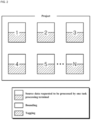
- FIG. 2 is a diagram for describing a conventional project operating method.
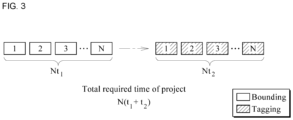
- FIG. 3 is a diagram for describing a total required time of a project, according to a conventional project operating method.
- FIG. 4 is a diagram for describing a project operating method, according to an embodiment of the inventive concept.
- FIG. 5 is a diagram for describing a total required time of a project, according to an embodiment of the inventive concept.
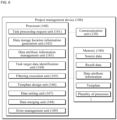
- FIG. 6 is a block diagram schematically illustrating a project management device 100, according to an embodiment of the inventive concept.
- a project management device 100 (hereinafter, referred to as a "device") for smoothly progressing a project according to an embodiment of the inventive concept will be described with reference to FIGS. 1 to 6 .
- the device 100 may receive a project request from a client server 200. While providing thousands or tens of thousands of source data and task request information to the device 100, the client server 200 may request a project.
- the source data may be task target data that is requested to be processed by a task processing terminal 300.
- the source data includes various types of data such as an image, a text, and the like.
- the task processing terminal 300 has the source data and performs a task requested in the project.
- the task request information may mean various pieces of condition information associated with the form of a final result obtained by the client server 200 through the project.
- the client server 200 may provide the device 100 with condition information for specifying a person (an object) in an image and classifying characteristics of the corresponding person as the task request information.
- the device 100 which receives a project request together with the source data and the task request information, may design a project based on the corresponding task request information. For example, the device 100 may design the project including a human bounding task and a tagging task from task request information for specifying a person (object) in an image and classifying the person's characteristics.
- the device 100 opens the project on a platform, provides a guide based on the task request information together with the source data to each of the plurality of task processing terminals 300, and allows each of the task processing terminals 300 to properly perform the allocated task.
- Each of the task processing terminals 300 may perform a bounding task by finding a person in the source data requested to be processed and may perform a tagging task on a bounding box.
- the result data obtained after these two tasks are completed may be provided to the task management terminal 400 and may be checked by a quality manager.
- the result data, which is completely checked, may be extracted as the final result.
- Result data for thousands or tens of thousands of source data is provided as a final result to the client server 200.
- the task processing terminal 300 may be a terminal used by a task handler, that is, a worker performing a task on source data.
- the task processing terminal 300 may be connected to the device 100 over a network, such as a mobile phone, a smartphone, a personal digital assistant (PDA), a portable multimedia player (PMP), or a tablet PC.
- the task processing terminal 300 may include a camera and may be all types of handheld-based wireless communication device capable of input/output of various pieces of information through a screen.
- the task processing terminal 300 may participate in the project opened on a platform through an application or website, which is provided by the device 100.
- the task management terminal 400 may be a terminal used by a quality manager, that is, a checker that inspects the result data processed by the task handler.
- the task management terminal 400 may be connected to the device 100 over a network, such as a mobile phone, a smartphone, a personal digital assistant (PDA), a portable multimedia player (PMP), or a tablet PC.
- the task processing terminal 300 may include a camera and may be all types of handheld-based wireless communication device capable of input/output of various pieces of information through a screen.
- the task management terminal 400 may participate in the project opened on a platform through an application or website, which is provided by the device 100.
- a project includes 'N' source data, and respective source data includes a bounding task and a tagging task.
- the device 100 may respectively provide 'N' bounding tasks to the plurality of task processing terminals 300 and may respectively request the plurality of task processing terminals 300 to process the 'N' bounding tasks.
- the device 100 may again provide each of the 'N' source data, for which the bounding task is completed, to the same or different task processing terminal 300 and may request processing for the tagging task.
- the conventional operating method completes processing of 'N' source data for one task type and then completes processing of 'N' source data for another task type.
- the next task type needs to be in a waiting state without a promise, and thus the total required time of a project may be longer.
- the total required time of the project may be calculated as "N(t 1 +t 2 )" in the conventional operating method.
- the project operating method may divide one project into small projects for each minimum unit task and may individually manage the small projects, by classifying the original project into minimum unit tasks and designing a plurality of child projects.
- a project includes 'N' source data, and respective source data includes a bounding task and a tagging task.
- an original project including 'N' source data may be classified into a first child project including 'N' bounding tasks and a second child project including 'N' tagging tasks.
- the device 100 may manage 'N' source data individually. That is, each of the N pieces of source data may be independently processed, in a plurality of child projects.
- the device 100 may request one task processing terminal 300 to process the first child project for source data 1.
- the device 100 may request another task processing terminal 300 to process the second child project for source data 1.
- the device 100 may request one task processing terminal 300 to process the first child project for source data 2.
- the device 100 may request another task processing terminal 300 to process the second child project for source data 2.
- the device 100 may request processing for the second child project.
- the operating method according to an embodiment of the inventive concept may individually process a plurality of child projects for each of 'N' source data. Even when a bottleneck occurs in specific source data due to some reasons, other source data is being processed normally, and thus all of the data do not need to wait as in the conventional method. Accordingly, the total required time of the project may be shortened compared to the conventional method.
- the total required time of the project may be calculated as "t 1 +Nt 2 " in the operating method according to an embodiment of the inventive concept.
- the total required time of the project is "N(t 1 +t 2 )" in the conventional operating method and the total required time of the project is "t 1 +Nt 2 " in the operating method according to an embodiment of the inventive concept.
- a project is operated according to an embodiment of the inventive concept, it is possible to save time as much as “t 1 (N-1)" in proceeding with the project.
- the device 100 may include a communication unit 120, a memory 140, and a processor 160.
- the device 100 may include fewer or more components than the components illustrated in FIG. 6 .
- the communication unit 120 may include one or more modules that enable wireless communication between the device 100 and the client server 200, between the device 100 and the task processing terminal 300, between the device 100 and the task management terminal 400, between the device 100 and an external server (not illustrated), or between the device 100 and a communication network (not illustrated).
- the communication unit 120 may include one or more modules connecting the device 100 to one or more networks.
- the memory 140 may store data for supporting various functions of the device 100.
- the memory 140 may store a plurality of application programs (or applications) running in the device 100, data for an operation of the device 100, and instructions. At least part of the application programs may be present for basic functions of the device 100.
- the application program may be stored in the memory 140, may be installed in the device 100, and may be driven by the processor 160 so as to perform an operation (or function) of the device 100.
- the memory 140 may store source data of the project, which is thousands or tens of thousands of original data provided from the client server 200.
- the memory 140 may store result data for which the task processing terminal 300 and the task management terminal 400 complete the task and inspection.
- the memory 140 may store data attribute information updated as a plurality of child projects are performed for respective source data.
- the memory 140 may store a template, which is related to the arrangement of result data for a plurality of child projects and which is designed for respective source data, for respective source data.
- the memory 140 may include a plurality of processes for project management.
- the plurality of processes will be described below when an operation of the processor 160 is described.
- the processor 160 may generally control overall operations of the device 100.
- the processor 160 may provide or process appropriate information or functions to a user, by processing a signal, data, information, or the like, which is input or output through the above-described components, or driving the application program stored in the memory 140.
- the processor 160 may control at least part of the components described with reference to FIG. 6 to operate the application program stored in the memory 140. Furthermore, the processor 160 may combine and operate at least two or more of the components included in the device 100 to operate the application program.
- the processor 160 includes a task processing request unit 161, a data storage location information generation unit 162, a data attribute information management unit 163, a task target data identification unit 164, a filtering execution unit 165, a template design unit 166, a data setting unit 167, a data merging unit 168, and an error management unit 169.
- the processor 160 may include fewer or more components than the components illustrated in FIG. 6 . A description of various components included in the processor 160 will be described later while describing embodiments of a project management method.
- FIG. 7 is a flowchart of a project management method using a data pointer, according to an embodiment of the inventive concept.
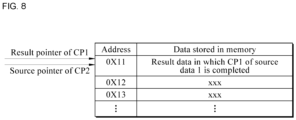
- FIG. 8 is a diagram for describing a result pointer of a previous child project and a source pointer of a next child project when a plurality of child projects are connected in a one-to-one manner, according to an embodiment of the inventive concept.
- FIG. 9 is a diagram for describing a result pointer of a previous child project and a source pointer of the next child project when a plurality of tasks are included in the previous child project, according to an embodiment of the inventive concept.
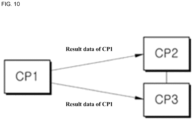
- FIG. 10 is a diagram for describing a plurality of child projects connected at a one-to-many (1:m) manner, according to an embodiment of the inventive concept.
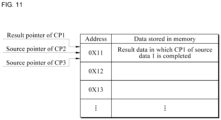
- FIG. 11 is a diagram for describing source pointers of 'N' child projects when a plurality of child projects are connected in a one-to-many (1:m) manner, according to an embodiment of the inventive concept.
- FIG. 12 is a diagram for describing a plurality of child projects connected in a many-to-one (m:1) manner, according to an embodiment of the inventive concept.
- FIG. 13 is a diagram for describing source pointers of 'N' child projects when a plurality of child projects are connected in a many-to-one (m:1) manner, according to an embodiment of the inventive concept.
- FIG. 14 is a diagram for describing metadata for respective source data, according to an embodiment of the inventive concept.
- the source data is original data that is received from the client server 200 and has been prepared through a data setting process including a process, in which a manager manually uploads source data, such that the source data is used for a task.
- the result data generated through one task needs to be used as source data of another task.
- the process needs to be performed automatically without the intervention of a manager.
- the process is performed in such a way in which the manager manually copies result data of the previous task and provides the result data of the previous task as source data of the next task. This is very inefficient because time, CPU, memory, and storage resources are consumed in proportion to the capacity and quantity of data in a data copy process.
- the processor 160 of the device 100 may use result data of a child project in the previous order as source data of the child project in the next order among a plurality of child projects that are classified based on the minimum unit task and connected in sequential order, by automatically performing a first process required for project management using a data pointer.
- the task processing request unit 161 included in the processor 160 of the device 100 may transmit source data of an n-th child project to the first task processing terminal 300 among a plurality of child projects connected in sequential order and then may request the first task processing terminal 300 to process the n-th child project (S110).
- 'n' may be a natural number.
- the n-th child project may mean a child project in the third order among the five child projects.
- the source data of the n-th child project may be original data that is previously set up.
- the first child project a child project having the first order
- the source data of the first child project may be original data such as image data or text data, which is provided by a client through the client server 200.
- the source data of the n-th child project may be result data of the (n-1)-th child project among the plurality of child projects.
- source data of the second child project (a child project having the second order) transmitted to the first task processing terminal 300 may be result data of the first child project (a child project having the first order).
- the source data of the second child project may be data in which the processing result for the first child project is displayed in the original data.
- each of the plurality of child projects includes one or more tasks, and may be divided depending on the type of a task included therein.
- the task may indicate a minimum unit task to be processed by the task processing terminal 300.
- each of 'N' source data may be designed as two child projects.
- each of the 'N' source data may be divided into a first child project including a task related to the bounding task and a second child project including a task related to the tagging task.
- the first task processing terminal 300 which has been requested to process the first child project, may process only the bounding task.
- the first task processing terminal 300 which has been requested to process the second child project, may process only the tagging task.
- the communication unit 120 of the device 100 may receive result data that is the processing result of the n-th child project from the first task processing terminal 300 in response to a request (S120).
- the result data of the first child project may be data in which the processing result for the first child project is displayed in the original data provided by the client through the client server 200.
- the result data of the second child project may be data in which the processing result for the second child project is again overlapped and displayed in the data (source data of the second child project) where the processing result for the first child project is displayed in the original data.
- the data storage location information generation unit 162 included in the processor 160 of the device 100 may generate location information, at which the result data is stored, by storing the result data in the memory 140 (S130).
- the data storage location information generation unit 162 may store the corresponding result data at a specific location in the memory 140 and may generate location information including an address value of a specific location at which the result data is stored.
- the data attribute information management unit 163 included in the processor 160 of the device 100 may record the location information at a result pointer of the n-th child project (S140).
- the data attribute information management unit 163 may record the location information at a source pointer of the (n+1)-th child project among the plurality of child projects (S150).
- the task target data identification unit 164 included in the processor 160 of the device 100 may obtain the result data stored at the location indicated by the source pointer as the source data of the (n+1)-th child project (S160).
- the data attribute information management unit 163 may record and manage various data attribute information generated or changed as the plurality of child projects are processed.
- the data attribute information may include the progress status of each of the plurality of child projects, a source pointer, and a result pointer, but is not limited thereto.
- the task target data identification unit 164 may identify result data of a child project in the previous order as task target data at a point in time when a specific condition is satisfied, and then may obtain the result data as the source data of a child project in the next order.
- the specific condition refers to whether a specific address value is recorded at the source pointer of the child project in the next order.
- the task target data identification unit 164 may determine that the specific condition is satisfied when the specific address value is recorded at the source pointer of the child project in the next order, may identify result data stored at a location indicated by the specific address value as the task target data, and may obtain the result data as the source data of the child project in the next order.
- a value of the result pointer of the n-th child project may be changed and recorded from a garbage value or null value to an address value corresponding to the location information.
- a value of the source pointer of the (n+1)-th child project may also be changed and recorded from a garbage value or null value to an address value corresponding to the location information.
- the result pointer of the n-th child project and the source pointer of the (n+1)-th child project may indicate the same address value.
- a result pointer of the first child project CP1 of source data 1 and a source pointer of a second child project CP2 of source data 1 may identically indicate the address value of "0X11".
- the task target data identification unit 164 may obtain the result data stored at the location corresponding to the address value of "0X11" as the source data of the second child project CP2.
- one location information may be generated by storing result data for each of the plurality of tasks at the same location in the memory.
- the first child project CP1 among a plurality of child projects includes a task (task 1) related to a bounding task and a task (task 2) related to a tagging task (i.e., a total of two tasks)
- result data of the task (task 1) related to the bounding task and result data of the task (task 2) related to the tagging task may be stored at the same location in the memory. That is, even when pieces of result data for one child project are received, the pieces of result data for one child project are stored at the same location in a bundle, and thus only one location information may be generated with respect to one child project. As described above, the generated location information may be recorded at the result pointer of the first child project CP1 and the source pointer of the second child project CP2.
- the task target data identification unit 164 may obtain the result data, which is stored at the location corresponding to one address value in a bundle, as the source data of the second child project CP2.
- the task processing request unit 161 may transmit source data of the (n+1)-th child project to the second task processing terminal 300 and then may request the second task processing terminal 300 to process the (n+1)-th child project (S170).
- the second task processing terminal 300 performs the tagging task on result data of the n-th child project (i.e., the bounding-processed data).
- the result data of the n-th child project may be used as source data of the (n+1)-th child project and source data of the (n+2)-th child project.
- result data of the first child project CP1 may be provided as source data of the second child project CP2 and source data of the third child project CP3. Accordingly, a handler who receives a processing request for the second child project CP2 and a handler who receives a processing request for the third child project CP3 perform their respective tasks (a task included in each child project) with the same result data.
- the source pointer of the (n+1)-th child project and the source pointer of the (n+2)-th child project may indicate one address in the memory 140.
- the one address in the memory 140 may correspond to location information at which the result data of the n-th child project is stored.
- a result pointer of the first child project CP1 of source data 1 among thousands or tens of thousands of source data of the original project is stored at a location corresponding to an address value of "0X11" in the memory 140
- a result pointer of the first child project CP1 of source data 1 may identically indicate the address value of "0X11".
- the task target data identification unit 164 may obtain the result data stored at the location corresponding to the address value of "0X11" as the source data of the second child project CP2 and the source data of the third child project CP3.
- the result data of the (n+1)-th child project and the result data of the (n+2)-th child project may be used as source data of the (n+3)-th child project among the plurality of child projects.
- result data of the first child project CP1 may be provided as source data of the second child project CP2 and source data of the third child project CP3. This is the same as described above, and thus a description thereof will be omitted to avoid redundancy.
- the result data of the second child project CP2 and the result data of the third child project CP3 may be provided as source data of the fourth child project CP4. Accordingly, a handler who receives a processing request for the fourth child project CP4 performs the same task (a task included in the fourth child project) with the two result data.
- the source pointer of the (n+3)-th child project is implemented with multiple pointers indicating two different addresses in the memory 140, the two different addresses in the memory 140 may correspond to location information where the result data of the (n+1)-th child project is stored and location information where the result data of the (n+2)-th child project is stored, respectively.
- the result data of the second child project CP2 of source data 1 is stored at a location corresponding to the address value of "0X12" in the memory 140 and the result data of the third child project CP3 of source data 1 is stored at a location corresponding to the address value of "0X13" in the memory 140
- the result pointer of the second child project CP2 of source data 1 may indicate the address value of "0X12”
- the result pointer of the third child project CP3 may indicate the address value of "0X13”
- the source pointer of the fourth child project CP4 may indicate two address values of "0X12" and "0X13".
- the task target data identification unit 164 may obtain both the result data stored at the location corresponding to the address value of "0X12" and the result data stored at the location corresponding to the address value of "0X13" as source data of the fourth child project CP4.
- a project management method using a data pointer may further include updating data attribute information as the plurality of child projects are processed depending on the sequential order.
- the data attribute information management unit 163 may record and manage various data attribute information generated or changed as the plurality of child projects are processed. For example, when a specific address value is recorded at the result pointer of the first child project and the source pointer of the second child project after the result data of the first child project is received, result pointer information of the first child project and source pointer information of the second child project included in the data attribute information may be updated as the corresponding address value. In this case, even when a specific item is updated as new information in updating data attribute information, the existing information may not disappear, but the existing information and the new information may be accumulated and stored.
- metadata for source data 1 may be stored and managed. That is, the metadata for source data 1 may indicate data in which all histories related to updates for a plurality of child projects of source data 1 are recorded.
- the metadata of source data 1 may be managed after a task processing terminal ID for all child projects, a source pointer value, and a result pointer value are recorded. Items managed through metadata are not limited thereto. All data related to respective source data may be recorded and managed.
- various data connection configurations are possible by using data and a pointer structure, and thus there is no need to copy the data itself. Accordingly, even when a plurality of child projects are complexly connected, it is possible to automatically provide result data of the previous task as source data of the next task by using a pointer, thereby optimizing performance and resource use.
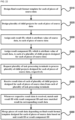
- FIG. 15 is a flowchart of a project management method using data filtering, according to an embodiment of the inventive concept.
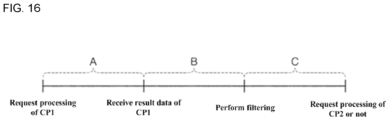
- FIG. 16 is a diagram for describing result data filtering, according to an embodiment of the inventive concept.
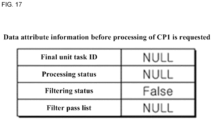
- FIG. 17 is a diagram for describing data attribute information at a point in time before a processing request for a previous child project, according to an embodiment of the inventive concept.
- FIG. 18 is a diagram for describing data attribute information at a point in time when a previous child project is being processed, according to an embodiment of the inventive concept.
- FIG. 19 is a diagram for describing data attribute information at a point in time when a previous child project is completely processed, according to an embodiment of the inventive concept.
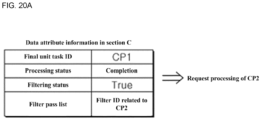
- FIGS. 20A and 20B are diagrams for describing data attribute information at a point in time when filtering for a previous child project is completed, according to an embodiment of the inventive concept.
- FIG. 21 is a diagram for describing metadata for respective source data, according to an embodiment of the inventive concept.
- the processor 160 of the device 100 may use the result data of the child project in the previous order as the source data of the child project in the next order among a plurality of child projects that are classified based on the minimum unit task and connected in sequential order, by automatically performing a second process required for project management using data filtering.
- the task processing request unit 161 included in the processor 160 of the device 100 may transmit source data of an n-th child project to the first task processing terminal 300 among a plurality of child projects connected in sequential order and then may request the first task processing terminal 300 to process the n-th child project (S210).
- 'n' may be a natural number.
- the n-th child project may mean a child project in the third order among the five child projects.
- the source data of the n-th child project may be original data that is previously set up.
- the first child project a child project having the first order
- the source data of the first child project may be original data such as image data or text data, which is provided by a client through the client server 200.
- the source data of the n-th child project may be result data of the (n-1)-th child project among the plurality of child projects.
- source data of the second child project (a child project having the second order) transmitted to the first task processing terminal 300 may be result data of the first child project (a child project having the first order).
- the source data of the second child project may be data in which the processing result for the first child project is displayed in the original data.
- each of the plurality of child projects includes one or more tasks, and may be divided depending on the type of a task included therein.
- the task may indicate a minimum unit task to be processed by the task processing terminal 300.
- each of 'N' source data may be designed as two child projects.
- each of the 'N' source data may be divided into a first child project including a task related to the bounding task and a second child project including a task related to the tagging task.
- the first task processing terminal 300 which has been requested to process the first child project, may process only the bounding task.
- the first task processing terminal 300 which has been requested to process the second child project, may process only the tagging task.
- the data attribute information management unit 163 included in the processor 160 of the device 100 may perform a first update on data attribute information related to the n-th child project (S220).
- the data attribute information management unit 163 may record and manage various data attribute information generated or changed as the plurality of child projects are processed.
- the data attribute information may include, but is not limited to, a progress status of each of a plurality of child projects, a final unit task ID, a processing status, a filtering status, and a filter pass list.
- the data attribute information may be updated as the plurality of child projects are processed in the order in which the plurality of child projects are sequentially connected. That is, the data attribute information such as a final unit task ID, a processing status, a filtering status, a filter pass list, or the like may be updated in real time as the plurality of child projects are processed.
- operation S220 may be performed in section A (time point A). That is, after processing of the first child project CP1 among a plurality of child projects is requested, the first update may be performed.
- the final unit task ID has a null value
- the processing status has a null value
- the filtering status has a false value
- the filter pass list has a null value.
- the final unit task ID may be updated from a null value to an ID (CP1) related to the n-th child project, and the processing status may be updated from a null value to a value indicating "progress".
- the remaining information may be maintained as it is before the filtering is performed.
- operation S220 may be performed in the same manner as operation S290, which will be described later.
- the communication unit 120 of the device 100 may receive result data that is the processing result of the n-th child project from the first task processing terminal 300 in response to a request (S230).
- the result data of the first child project may be data in which the processing result for the first child project is displayed in the original data provided by the client through the client server 200.
- the result data of the second child project may be data in which the processing result for the second child project is again overlapped and displayed in the data (source data of the second child project) where the processing result for the first child project is displayed in the original data.
- the data attribute information management unit 163 may perform a second update on data attribute information related to the n-th child project (S240).
- operation S240 may be performed in section B (time point B). That is, after processing of the first child project CP1 among a plurality of child projects is completed, the second update may be performed.
- the final unit task ID may be maintained as an ID related to the n-th child project, and the processing status may be updated from a value indicating "progress” to a value indicating "completion”.
- the remaining information may be maintained as it is before the filtering is performed.
- the second update may be performed as described above.
- the filtering execution unit 165 included in the processor 160 of the device 100 may filter result data of the n-th child project based on the data attribute information, on which the second update is performed (S250).
- the filtering execution unit 165 may determine that the received result data of the n-th child project satisfies a filtering target condition, and may filter the corresponding result data.
- the filtering execution unit 165 may determine that the result data of the (n-1)-th child project and the result data of the (n-2)-th child project satisfy the filtering target condition, and may perform filtering.
- the filtering execution unit 165 filters the two result data.
- the filtering execution unit 165 may filter result data that satisfies the filtering target condition.
- the filtering execution unit 165 may determine that the filter condition for the corresponding result data is verified.
- the filtering execution unit 165 may determine that the filter condition for the corresponding result data is not verified.
- a plurality of child projects are connected many-to-one (m:1) (here, 'm' is a natural number greater than or equal to 2).
- m:1 many-to-one
- 'm' is a natural number greater than or equal to 2
- the filtering execution unit 165 may filter both result data of the first child project and result data of the second child project, may determine that the filter condition for the result data of the first child project is verified, and may determine that the filter condition for the result data of the second child project is not verified.
- the data attribute information management unit 163 may perform a third update on data attribute information related to the n-th child project based on the filtered result (S260).
- operation S260 may be performed in section C (time point C).
- operation S250 when it is determined that the filter condition for the result data of the n-th child project is verified, as shown in FIG. 20A , the filtering status among the data attribute information for the result data of the n-th child project is updated from a false value to a true value, and the filter pass list may be updated to include a filter ID related to the (n+1)-th child project.
- operation S250 when it is determined that the filter condition for the result data of the n-th child project is not verified, as shown in FIG. 20B , the filtering status among the data attribute information for the result data of the n-th child project is updated from a false value to a true value, and the filter pass list may maintain a null value as it is.
- the filter pass list among the data attribute information about a child project in the previous order may be updated to include filter IDs for all of the 'm' child projects.
- the filter pass list among the data attribute information for the first child project may be updated to include both a filter ID related to the second child project and a filter ID related to the third child project.
- the third update may be performed as described above.
- the task target data identification unit 164 included in the processor 160 of the device 100 may select the result data as source data of the (n+1)-th child project among the plurality of child projects based on the data attribute information on which the third update is performed (S270).
- the task processing request unit 161 may transmit source data of the (n+1)-th child project to the second task processing terminal and then may request the second task processing terminal to process the (n+1)-th child project (S280).
- the task target data identification unit 164 may identify result data of a child project in the previous order as task target data at a point in time when a specific condition is satisfied, and then may obtain the result data as the source data of a child project in the next order.
- the specific condition may refer to whether a filter ID related to the (n+1)-th child project is included in the filter pass list among the data attribute information.
- the task target data identification unit 164 may determine that the received result data of the n-th child project satisfies the task target data condition, may select the received result data as the source data of the (n+1)-th child project, may transmit the selected source data to the second task processing terminal 300, and may request the second task processing terminal 300 to process the (n+1)-th child project.
- the task target data identification unit 164 may determine that the result data of the received n-th child project does not satisfy the task target data condition, and may not select the result data as the source data of the (n+1)-th child project.
- the task target data identification unit 164 may determine that the received result data of the n-th child project satisfies the target data condition, and may select the result data as source data of the (n+1)-th child project and source data of the (n+2)-th child project.
- the task target data identification unit 164 may determine that the result data of the n-th child project satisfies the target data condition, and may select the result data as source data of the (n+1)-th child project.
- the data attribute information management unit 163 may perform a fourth update on data attribute information related to the (n+1)-th child project (S290).
- operation S290 may be performed after section C (time point C). That is, after processing of the second child project CP2 among a plurality of child projects is requested, the fourth update may be performed.
- the final unit task ID may be updated from an ID related to the n-th child project in the previous order to an ID related to the (n+1)-th child project, and the processing status may be updated from a value indicating that the processing of the n-th child project in the previous order is completed, to a value indicating the progress of the (n+1)-th child project.
- the filtering status may be changed from a true value to a false value, and the filter pass list may be changed back to null value, but is not limited thereto.
- the filter pass list may continuously include a filter ID related to the previous child project.
- metadata for source data 1 may be stored and managed. That is, the metadata for source data 1 may indicate data in which all histories related to updates for a plurality of child projects of source data 1 are recorded.
- the metadata of source data 1 may be managed after values of a task processing terminal ID, a processing status, a filtering status, and a filter pass list for all of the child projects are recorded. Items managed through metadata are not limited thereto. All data related to respective source data may be recorded and managed.
- a project may be expanded and operated by configuring an independent filter process between a child project and a child project.
- result data of a child project of the previous task may be exactly provided as source data of a child project of the next task.
- FIG. 22 is a flowchart of a project management method using data merging, according to an embodiment of the inventive concept.
- FIG. 23 is a diagram for describing a unit result ID and a result component ID, according to an embodiment of the inventive concept.
- FIG. 24 is a diagram for describing merging of result data into a template when a plurality of child projects are connected in sequential order, according to an embodiment of the inventive concept.
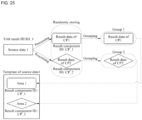
- FIG. 25 is a diagram for describing merging of result data into a template when a plurality of child projects are not connected in sequential order, according to an embodiment of the inventive concept.
- the processor 160 of the device 100 may merge pieces of result data of a plurality of child projects divided based on a minimum unit task depending on a predetermined template such that a third process required for project management using data merge is automatically performed, and may provide a final result suitable for a format desired by a client.
- the template design unit 166 included in the processor 160 of the device 100 may design a final result format template for each of pieces of source data provided from the client server 200 (S310).
- the template design unit 166 may design the final result format template for respective source data by determining a configuration of a result format of thousands or tens of thousands of source data thus requested.
- the result format is one of initial negotiation requirements (task request information) provided from the client server 200.
- the template design unit 166 may define elements to be included in the final result before a child project is designed depending on the result format.
- the final result format template designed for respective source data may include a plurality of areas (elements) to which pieces of result data for the corresponding source data are attached.
- the final result format template designed for specific source data among the pieces of source data may include a plurality of areas, to each of which result data of each of a plurality of child projects designed for the specific source data is to be attached after operation S320.
- the template design unit 166 may set the size and location for each of the plurality of areas included in the final result format template designed for specific source data and may assign the result component ID to each of the plurality of areas. That is, each of the elements defined depending on the result format may be set to have the location and size that need to be implemented in the format of the final result.
- a result component ID may be assigned as a unique identification value for each element.
- a child project design unit included in the processor 160 of the device 100 may design a plurality of child projects for each of piece of source data (S320).
- Operation S320 is the same as the descriptions described with reference to FIGS. 3 and 4 , and thus a detailed description thereof will be omitted to avoid redundancy.
- each of the plurality of child projects includes one or more tasks, and may be divided depending on the type of a task included therein.
- the task may indicate a minimum unit task to be processed by the task processing terminal 300.
- each of 'N' source data may be designed as two child projects.
- each of the 'N' source data may be divided into a first child project including a task related to the bounding task and a second child project including a task related to the tagging task.
- the first task processing terminal 300 which has been requested to process the first child project, may process only the bounding task.
- the first task processing terminal 300 which has been requested to process the second child project, may process only the tagging task.
- the data setting unit 167 included in the processor 160 of the device 100 may assign a unit result ID, which is an attribute value of source data, to each of the piece of source data (S330).
- the data setting unit 167 may assign a result component ID, which is an attribute value of result data, to each of a plurality of child projects designed for each of the pieces of source data (S340).
- the data setting unit 167 may assign a unit result ID such as SD_1, SD_2, SD_3, ..., and SD_N to each of the 'N' source data.
- result component IDs such as CP_1 and CP_2 may be assigned to the first child project and the second child project for respective source data, respectively.
- FIG. 23 illustrates that result component IDs assigned to the first child project and the second child project for respective source data are the same as each other.
- result component IDs such as CP_1_1, CP_1_2, CP_2_1, CP_2_2, ..., CP_N_1, and CP_N_2 may be assigned differently from one another.
- respective source data is identically designed as two child projects.
- respective source data may have the different number of designed child projects.
- the task processing request unit 161 included in the processor 160 of the device 100 may request the plurality of task processing terminals 300 to process a plurality of child projects designed for each of the pieces of source data, respectively (S350).
- the communication unit 120 of the device 100 may receive result data, which is a processing result of each of a plurality of child projects designed for each of the pieces of source data from each of the plurality of task processing terminals 300 (S360).
- Operation S350 and operation S360 related to the reception of result data and a processing request for a child project are the same as described in operation S110, operation S120, operation S170, operation S210, operation S230, and operation S280, and thus a detailed description thereof will be omitted to avoid redundancy.
- the task processing request unit 161 may request the first task processing terminal 300 to process the first child project, and the communication unit 120 may receive first result data of a first child project from the first task processing terminal 300 in response to a request. Afterward, the task processing request unit 161 may request the second task processing terminal 300 to process the second child project, and the communication unit 120 may receive second result data of the second child project from the second task processing terminal 300.
- the task processing request unit 161 may request the task processing terminal 300 to process a plurality of child projects designed for each of the entire 'N' source data, and the communication unit 120 may receive pieces of result data of a plurality of child projects for the 'N' source data from the task processing terminal 300.
- an ID matching unit included in the processor 160 of the device 100 may match the unit result ID with the result component ID and may store the matched result in the corresponding result data (S370).
- the unit result ID and result component ID assigned in advance to source data corresponding to the corresponding result data may be matched and stored.
- the unit result ID matched to the first result data may be the same as the unit result ID matched to the second result data, and the result component ID matched to the first result data may be different from the result component ID matched to the second result data.
- the ID matching unit may match the unit result ID to SD_3 for the corresponding result data and may match the result component ID to CP_1 (or CP_3_1).
- the ID matching unit may match the unit result ID to SD_3 for the corresponding result data and may match the result component ID to CP_2 (or CP_3_2).
- the data merging unit 168 included in the processor 160 of the device 100 may merge pieces of result data depending on a final result format template designed for each of the pieces of source data based on the unit result ID or the result component ID (S380).
- the data merging unit 168 may extract the first result data and the second result data, to which a unit result ID identical to the unit result ID for specific source data among the pieces of result data (all pieces of result data for each of the 'N' source data) is matched, and may merge the extracted first result data and second result data into a final result format template designed for the specific source data.
- result data which has the same unit result ID, from among a lot of collected result data may be extracted. For example, only result data having the unit result ID of SD_1 may be extracted, and only result data having the unit result ID of SD_2 may be extracted. As such, only result data may be extracted for each unit result ID.
- the first result data and the second result data may be merged into the first area and the second area included in the final result format template based on the order, respectively.
- the first child project CP1 and the second child project CP2 designed for one source data are connected in sequential order, as described above, the first result data of the first child project CP1 and the second result data of the second child project CP2 for the corresponding source data are sequentially stored.
- the data merging unit 168 may merge the first result data of the first child project CP1 into area 1, to which the result component ID of CP_1 is assigned in the template of source data 1 and may merge the second result data of the second child project of CP2 into area 2, to which the result component ID CP_2 is assigned in the template of source data 1.
- the data merging unit 168 may extract the first result data and the second result data, to which the same unit result ID as the unit result ID for the specific source data is matched, from among the pieces of result data (all pieces of result data for each of the 'N' source data), may group the first result data matched with the first result component ID into a first group, may group the second result data matched with the second result component ID into a second group, and may merge the first group and the second group into a final result format template designed for the specific source data.
- the data merging unit 168 may merge the first group into the first area and may merge the second group into the second area.
- the first child project CP1 and the second child project CP2 designed for one source data are not connected in sequential order, the first result data of the first child project CP1 and the second result data of the second child project CP2 for the corresponding source data are randomly stored.
- pieces of result data for the same source data may be first extracted by using a unit result ID, and pieces of result data may be grouped for each result component ID by using the result component ID assigned to the extracted result data.
- the result data of the first child project CP1 grouped into group 1 may be merged in area 1 to which the result component ID of CP_1 is assigned in the template.
- the result data of the second child project CP2 grouped into group 2 may be merged into area 2 to which the result component ID of CP_2 is assigned in the template.
- the pieces of result data may be grouped for each result component ID and then the groups may be efficiently merged into a template.
- task result data may be configured depending on the desired final result format.
- a configuration of result data is determined depending on a screen element design
- all pieces of result data are merged at an appropriate location depending on the template format after all tasks are completed, it is possible to arbitrarily design result data independently of a task screen element design.
- FIG. 26 is a flowchart of a project management method using a cost payment time point setting, according to an embodiment of the inventive concept.
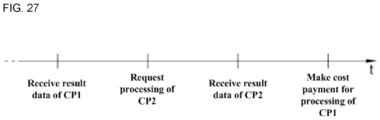
- FIG. 27 is a diagram for describing a cost payment for processing of a next child project, according to an embodiment of the inventive concept.
- FIG. 28 is a diagram for describing re-processing of a previous child project, according to an embodiment of the inventive concept.
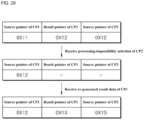
- FIGS. 29 is a diagram for describing pointer-related data attribute information changed when a processing-impossibility selection is received or re-processed result data is received, according to an embodiment of the inventive concept.
- FIGS. 30 is a diagram for describing filtering-related data attribute information changed when a processing-impossibility selection is received or re-processed result data is received, according to an embodiment of the inventive concept.
- the processor 160 of the device 100 may determine whether to pay a cost for processing a previous child project depending on whether an error occurs in the processing result of a previous child project in a next child project among a plurality of child projects that are classified based on a minimum unit task and connected in sequential order, by automatically performing a fourth process required for project management using the setting of a cost payment time point.
- the task processing request unit 161 included in the processor 160 of the device 100 may transmit source data of an n-th child project to a first task processing terminal among a plurality of child projects connected in sequential order and then may request the first task processing terminal to process the n-th child project (S410).
- the communication unit 120 of the device 100 may receive result data, which is the processing result of the n-th child project, from the first task processing terminal in response to a request (S420).
- Operation S410 and operation S420 related to the reception of result data and a processing request for a child project are the same as described in operation S110, operation S120, operation S210, and operation S230, and thus a detailed description thereof will be omitted to avoid redundancy.
- the task target data identification unit 164 included in the processor 160 of the device 100 may obtain the result data as source data of an (n+1)-th child project among the plurality of child projects (S430).
- the task target data identification unit 164 may obtain the result data of the n-th child project as source data of the (n+1)-th child project by using at least one of a data pointer and data filtering.
- the data attribute information management unit 163 included in the processor 160 of the device 100 may update data attribute information related to the n-th child project or the (n+1)-th child project (S440).
- the data attribute information management unit 163 may update pointer-related data attribute information.
- the pointer-related data attribute information may include a result pointer value of the n-th child project and a source pointer value of the (n+1)-th child project.
- the result pointer of the first child project CP1 of source data 1 and the source pointer of the second child project CP2 of source data 1 may be updated to indicate the same address value (e.g., 0X11).
- the data attribute information management unit 163 may update filtering-related data attribute information.
- the filtering-related data attribute information may include a filtering status of the n-th child project and a filter pass list.
- the filtering status of the first child project CP1 of source data 1 may have a true value, and the filter pass list may be updated to include a filter ID related to the second child project CP2.
- the task processing request unit 161 may transmit source data of the (n+1)-th child project to the second task processing terminal and then may request the second task processing terminal to process the (n+1)-th child project (S450).
- Operation S410 and operation S450 related to the reception of result data and a processing request for a child project are the same as described in operation S170 and operation S280, and thus a detailed description thereof will be omitted to avoid redundancy.
- the error management unit 169 included in the processor 160 of the device 100 may determine a cost payment for the processing of the n-th child project to the first task processing terminal 300 based on a response of the second task processing terminal to a request (S460).
- the error management unit 169 may determine the cost payment for the processing of the n-th child project to the first task processing terminal.
- the cost payment for the processing of the first child project CP1 is made after the result data of the second child project CP2 is received.
- the first child project CP1 and the second child project CP2 are connected in sequential order.
- the cost payment for the first child project is made before the processing of the second child project CP2 is completed, it is difficult to get a refund on the cost already paid even when an error occurs in the result data of the first child project CP1 later. Accordingly, the cost payment for the first child project CP1 needs to be made after the processing of the second child project CP2 is completed.
- the cost payment time point for the processing of the n-th child project may be set in advance as a time point at which data attribute information related to the (n+1)-th child project is updated from a value indicating that the processing for the (n+1)-th child project is in progress, to a value indicating "completion". Accordingly, when the processing status among the data attribute information related to the (n+1)-th child project is updated to a value indicating "completion", the error management unit 169 may identify the processing status, and may request a cost payment unit (not shown) to make a cost payment for processing the first child project CP1 to the first task processing terminal 300.
- the error management unit 169 may receive a processing-impossibility selection for the (n+1)-th child project from the second task processing terminal 300 and may request the first task processing terminal 300 to re-process the n-th child project instead of a cost payment for the processing of the n-th child project.
- the task processing request unit 161 may request the first task processing terminal 300 to re-process the first child project CP1.
- a handler who receives a processing request for the second child project CP2 may execute a task included in the second child project CP2 through the second task processing terminal 300. In the case, when it is determined that the processing of the task is impossible, the handler may select a processing-impossibility button, or the like through the second task processing terminal 300.
- the source data of the second child project CP2 provided to the second task processing terminal 300 is data in which the processing result for the first child project CP1 is displayed.
- the first child project CP1 is a task related to a bounding task.
- the handler may select the processing-impossibility for the corresponding source data.
- related data attribute information may be changed.
- the error management unit 169 may request the data attribute information management unit 163 to change a source pointer value of the n-th child project included in pointer-related data attribute information to a result pointer value of the n-th child project.
- the task processing request unit 161 may transmit result data of the n-th child project stored at a location indicated by the changed source pointer value to the first task processing terminal 300 and may request the first task processing terminal 300 to re-process the n-th child project.
- source data of the first child project CP1 provided to the first task processing terminal 300 in response to a re-processing request may be result data of the first child project CP1 that has been previously executed. That is, the handler of the first task processing terminal 300 may identify result data of the previous task and may correct the wrong part.
- the filtering status of the n-th child project included in the filtering-related data attribute information may be changed from a true value to a false value, and a filter ID related to the (n+1)-th child project may be excluded from the filter pass list.
- the filtering status value of the first child project may be changed from "True” to "False", and a filter ID Filter_CP2 related to the second child project may be excluded from the filter pass list.
- the filtering status value for the re-processed result data may be changed from "False” to "True”, and the filter pass list may again include the filter ID Filter_CP2 related to the second child project.
- the data attribute information may be updated as the plurality of child projects are processed depending on the order.
- the data attribute information may be updated as the plurality of child projects are processed in the order in which the plurality of child projects are sequentially connected. That is, the data attribute information such as a progress status of each of a plurality of child projects, a source pointer, and a result pointer, a final unit task ID, a processing status, a filtering status, a filter pass list, or the like may be updated in real time as the plurality of child projects are processed.
- the descriptions thereof the same as described above and thus detailed description thereof will be omitted to avoid redundancy.
- the method of the inventive concept may further include transmitting result data re-processed by the first task processing terminal 300 to the second task processing terminal 300 that has selected processing-impossibility and requesting the second task processing terminal 300 to process the (n+1)-th child project again. That is, as described above, metadata is managed for respective source data, and thus the second task processing terminal 300 to which the (n+1)-th child project was previously assigned may be identified. Accordingly, the same handler may be in charge of processing the same child project by providing result data of the re-processing of the n-th child project to the same second task processing terminal 300 that had previously selected processing-impossibility for the n-th child project.
- FIGS. 1 to 26 are not limited to the referenced drawings and descriptions thereof, and the embodiments of the inventive concept may be combined and applied in various ways or forms with each other.
- operation S110 to operation S460 may be further divided into additional operations or may be combined into fewer operations, according to an embodiment of the inventive concept.
- some operations may be omitted as necessary, and the order between operations may be changed.
- a unit task management method of crowdsourcing-based project may be implemented by a program (or an application) and may be stored in a medium such that the program is executed in combination with a server being hardware.
- the above-described program may include a code encoded by using a computer language such as C, C++, JAVA, a machine language, or the like, which a processor (CPU) of the computer may read through the device interface of the computer, such that the computer reads the program and performs the methods implemented with the program.
- the code may include a functional code related to a function that defines necessary functions executing the method, and the functions may include an execution procedure related control code necessary for the processor of the computer to execute the functions in its procedures.
- the code may further include a memory reference related code on which location (address) of an internal or external memory of the computer should be referenced by the media or additional information necessary for the processor of the computer to execute the functions.
- the code may further include a communication related code on how the processor of the computer executes communication with another computer or the server or which information or medium should be transmitted/received during communication by using a communication module of the computer.
- the stored medium refers not to a medium, such as a register, a cache, or a memory, which stores data for a short time but to a medium that stores data semi-permanently and is read by a device.
- the stored media include, but are not limited to, ROM, RAM, CD-ROM, magnetic tape, floppy disk, optical data storage device, and the like. That is, the program may be stored in various recording media on various servers, which the computer may access, or in various recording media on the computer of the user. Further, the media may be distributed in computer systems connected over a network such that codes readable by the computer are stored in a distributed manner.
- Steps or operations of the method or algorithm described with regard to an embodiment of the inventive concept may be implemented directly in hardware, may be implemented with a software module executable by hardware, or may be implemented by a combination thereof.
- the software module may reside in a random access memory (RAM), a read only memory (ROM), an erasable programmable ROM (EPROM), an electrically erasable programmable ROM (EEPROM), a flash memory, a hard disk, a removable disk, a CD-ROM, or a computer-readable recording medium well known in the art to which the inventive concept pertains.
- RAM random access memory
- ROM read only memory
- EPROM erasable programmable ROM
- EEPROM electrically erasable programmable ROM
- flash memory a hard disk, a removable disk, a CD-ROM, or a computer-readable recording medium well known in the art to which the inventive concept pertains.
Landscapes
- Business, Economics & Management (AREA)
- Human Resources & Organizations (AREA)
- Engineering & Computer Science (AREA)
- Strategic Management (AREA)
- Entrepreneurship & Innovation (AREA)
- Economics (AREA)
- Theoretical Computer Science (AREA)
- General Physics & Mathematics (AREA)
- Physics & Mathematics (AREA)
- Tourism & Hospitality (AREA)
- Quality & Reliability (AREA)
- Operations Research (AREA)
- General Business, Economics & Management (AREA)
- Marketing (AREA)
- Development Economics (AREA)
- Educational Administration (AREA)
- Game Theory and Decision Science (AREA)
- Data Mining & Analysis (AREA)
- Software Systems (AREA)
- Management, Administration, Business Operations System, And Electronic Commerce (AREA)
- General Engineering & Computer Science (AREA)
Claims (7)
- Projektverwaltungsverfahren, welches von einer Projektverwaltungsvorrichtung ausgeführt wird, und welches Datenfilterung verwendet, wobei das Verfahren die folgenden Schritte aufweist:Senden von Quelldaten eines n-ten Unterprojekts unter mehreren Unterprojekten, die in sequentieller Ordnung mit einem ersten Aufgabenverarbeitungsendgerät verbunden sind, und Auffordern des ersten Aufgabenverarbeitungsendgeräts, das n-te Unterprojekt zu verarbeiten, wobei "n" eine natürliche Zahl ist;Durchführen einer ersten Aktualisierung von dem n-ten Unterprojekt zugeordneten Datenattributinformationen basierend auf einer Verarbeitungsanforderung für das n-te Unterprojekt;Empfangen von Ergebnisdaten, die ein Verarbeitungsergebnis des n-ten Unterprojekts sind, von dem ersten Aufgabenverarbeitungsendgerät in Reaktion auf die Anforderung;Durchführen einer zweiten Aktualisierung von dem n-ten Unterprojekt zugeordneten Datenattributinformationen basierend auf den empfangenen Ergebnisdaten;Filtern der Ergebnisdaten des n-ten Unterprojekts basierend auf den Datenattributinformationen, für welche die zweite Aktualisierung durchgeführt wird;Durchführen einer dritten Aktualisierung von dem n-ten Unterprojekt zugeordneten Datenattributinformationen basierend auf den gefilterten Ergebnisdaten;Wählen der Ergebnisdaten als Quelldaten eines (n+1)-ten Unterprojekts unter den mehreren Unterprojekten basierend auf den Datenattributinformationen, für welche die zweite Aktualisierung durchgeführt wird;Senden der Quelldaten des (n+1)-ten Unterprojekts an ein zweites Aufgabenverarbeitungsendgerät und Auffordern des zweiten Aufgabenverarbeitungsendgeräts, das (n+1)-te Unterprojekt zu verarbeiten; undDurchführen einer vierten Aktualisierung von dem (n+1)-ten Unterprojekt zugeordneten Datenattributinformationen basierend auf einer Verarbeitungsanforderung für das (n+1)-te Unterprojekt,wobei jedes der mehreren Unterprojekte eine oder mehrere Aufgaben aufweist, und in Abhängigkeit von einem Typ einer in jedem der mehreren Unterprojekte enthaltenen Aufgabe unterteilt wird,wobei jede der Aufgaben eine Mindest-Teilaufgabe angibt, die von einem Aufgabenverarbeitungsendgerät zu verarbeiten ist;wobei Ergebnisdaten eines n-ten Unterprojekts in der vorhergehenden Ordnung als Quelldaten des (n+1)-ten Unterprojekts in der nächsten Ordnung unter mehreren Unterprojekten, welche basierend auf der Mindest-Teilaufgabe unterteilt sind, verwendet werden können, wobei ein Datenpointer verwendet wird;wobei die Datenattributinformationen beim Verarbeiten der mehreren Unterprojekte in Abhängigkeit von der Ordnung aktualisiert werden und eine finale Teilaufgaben-ID, einen Verarbeitungsstatus, einen Filterungsstatus und eine Filterpassliste aufweisen,wobei das Filtern die folgenden Schritte aufweist:wenn die empfangenen Ergebnisdaten die Ergebnisdaten des n-ten Unterprojekts sind, das eine vorhergehende Ordnung des (n+1)-ten Unterprojekts aufweist, Feststellen, dass eine Filterbedingung für entsprechende Ergebnisdaten erfüllt ist; undwenn die empfangenen Ergebnisdaten Ergebnisdaten eines anderen Unterprojekts sind, welches nicht die vorhergehende Ordnung des (n+1)-ten Unterprojekts aufweist, Feststellen, dass eine Filterbedingung für entsprechende Ergebnisdaten nicht erfüllt ist,wobei, wenn festgestellt wird, dass die Filterbedingung erfüllt ist, bei der dritten Aktualisierung der Filterungsstatus von einem False-Wert zu einem True-Wert aktualisiert wird und die Filterpassliste derart aktualisiert wird, dass sie eine das (n+1)-te Unterprojekt betreffende Filter-ID aufweist,wobei das Wählen der Ergebnisdaten die folgenden Schritte aufweist:wenn die das (n+1)-te Unterprojekt betreffende Filter-ID in der Filterpassliste enthalten ist, Feststellen, dass die empfangenen Ergebnisdaten des n-ten Unterprojekts eine Aufgaben-Zieldatenbedingung erfüllen, und Wählen der empfangenen Ergebnisdaten als die Quelldaten des (n+1)-Unterprojekts,wobei das Wählen der Ergebnisdaten die folgenden Schritte aufweist:wenn das (n+1)-te Unterprojekt parallel mit dem (n+2)-ten Unterprojekt unter den mehreren Unterprojekten in einer nächsten Ordnung des n-ten Unterprojekts verbunden ist,selbst wenn sowohl die das (n+1)-te Unterprojekt betreffende Filter-ID und eine die das (n+2)-te Unterprojekt betreffende Filter-ID in der Filterpassliste enthalten sind, Feststellen, dass die empfangenen Ergebnisdaten des n-ten Unterprojekts die Aufgaben-Zieldatenbedingung erfüllen, und Wählen der empfangenen Ergebnisdaten als die Quelldaten des (n+1)-ten Unterprojekts und die Quelldaten des (n+2)-ten Unterprojekts.
- Verfahren nach Anspruch 1, bei welchem bei der dritten Aktualisierung die finale Teilaufgaben-ID von einem Null-Wert auf eine das n-te Unterprojekt betreffende ID aktualisiert wird, und der Verarbeitungsstatus von dem Null-Wert auf einen "Fortschritt" angebenden Wert aktualisiert wird, und
wobei bei der zweiten Aktualisierung die finale Teilaufgaben-ID als die das n-te Unterprojekt betreffende ID beibehalten wird, und der Verarbeitungszustand von dem "Fortschritt" angebenden Wert zu einem "Abschluss" angebenden Wert aktualisiert wird. - Verfahren nach Anspruch 2, bei welchem das Filtern den folgenden Schritt aufweist: wenn der Verarbeitungsstatus auf den "Abschluss" angebenden Wert aktualisiert wird, Durchführen des Filterns durch Feststellen, dass die empfangenen Ergebnisdaten des n-ten Unterprojekts eine Filter-Zielbedingung erfüllt.
- Verfahren nach Anspruch 3, bei welchem, wenn ein (n-1)-tes Unterprojekt und ein (n-2)-tes Unterprojekt in einer vorangehenden Ordnung des n-ten Unterprojekts parallel verbunden sind, das Filtern den folgenden Schritt aufweist:
wenn sowohl ein Verarbeitungsstatus für das (n-1)-te Unterprojekt als auch ein Verarbeitungsstatus für das (n-2)-te Unterprojekt auf den "Abschluss" angebenden Wert aktualisiert werden, Durchführen des Filterns durch das Feststellen, dass Ergebnisdaten des (n-1)-ten Unterprojekts und Ergebnisdaten des (n-2)-ten Unterprojekts die Filter-Zielbedingung erfüllen. - Verfahren nach Anspruch 1, bei welchem bei der vierten Aktualisierung die finale Teilaufgaben-ID von einer das n-te Unterprojekt mit der vorangehenden Ordnung betreffenden ID zu einer das (n+1)-te Unterprojekt betreffenden ID aktualisiert wird, und der Verarbeitungsstatus von einem Wert, welcher angibt, dass die Verarbeitung des n-ten Unterprojekts mit einer vorangehenden Ordnung abgeschlossen ist, zu einem Wert aktualisiert wird, welcher angibt, dass das (n+1)-te Unterprojekt in Arbeit ist.
- Projektverwaltungsvorrichtung, welche Datenfilterung verwendet, wobei die Projektverwaltungsvorrichtung aufweist:eine Kommunikationseinheit;einen Speicher, der mindestens einen Prozess aufweist, welcher für eine Datenverwaltung unter Verwendung von Datenfilterung erforderlich ist; undeinen Prozessor, der in Abhängigkeit von dem Prozess arbeitet,wobei der Prozessor dazu ausgebildet ist, basierend auf dem Prozess,Quelldaten eines n-ten Unterprojekts unter mehreren Unterprojekten, die in sequentieller Ordnung mit einem ersten Aufgabenverarbeitungsendgerät verbunden sind, zu senden und das erste Aufgabenverarbeitungsendgerät aufzufordern, das n-te Unterprojekt zu verarbeiten, wobei "n" eine natürliche Zahl ist;eine erste Aktualisierung von dem n-ten Unterprojekt zugeordneten Datenattributinformationen basierend auf einer Verarbeitungsanforderung für das n-te Unterprojekt durchzuführen;Ergebnisdaten, die ein Verarbeitungsergebnis des n-ten Unterprojekts sind, von dem ersten Aufgabenverarbeitungsendgerät in Reaktion auf die Anforderung zu empfangen;eine zweite Aktualisierung von dem n-ten Unterprojekt zugeordneten Datenattributinformationen basierend auf den empfangenen Ergebnisdaten durchzuführen;die Ergebnisdaten des n-ten Unterprojekts basierend auf den Datenattributinformationen, für welche die zweite Aktualisierung durchgeführt wird, zu filtern;eine dritte Aktualisierung von dem n-ten Unterprojekt zugeordneten Datenattributinformationen basierend auf den gefilterten Ergebnisdaten durchzuführen;die Ergebnisdaten als Quelldaten eines (n+1)-ten Unterprojekts unter den mehreren Unterprojekten basierend auf den Datenattributinformationen, für welche die zweite Aktualisierung durchgeführt wird, zu wählen;die Quelldaten des (n+1)-ten Unterprojekts an ein zweites Aufgabenverarbeitungsendgerät zusenden und das zweite Aufgabenverarbeitungsendgerät aufzufordern, das (n+1)-te Unterprojekt zu verarbeiten; undeine vierte Aktualisierung von dem (n+1)-ten Unterprojekt zugeordneten Datenattributinformationen basierend auf einer Verarbeitungsanforderung für das (n+1)-te Unterprojekt durchzuführen,wobei jedes der mehreren Unterprojekte eine oder mehrere Aufgaben aufweist, und in Abhängigkeit von einem Typ einer in jedem der mehreren Unterprojekte enthaltenen Aufgabe unterteilt wird,wobei jede der Aufgaben eine Mindest-Teilaufgabe angibt, die von einem Aufgabenverarbeitungsendgerät zu verarbeiten ist;wobei Ergebnisdaten eines n-ten Unterprojekts in der vorhergehenden Ordnung als Quelldaten des (n+1)-ten Unterprojekts in der nächsten Ordnung unter mehreren Unterprojekten, welche basierend auf der Mindest-Teilaufgabe unterteilt sind, verwendet werden können, wobei ein Datenpointer verwendet wird;wobei die Datenattributinformationen beim Verarbeiten der mehreren Unterprojekte in Abhängigkeit von der Ordnung aktualisiert werden und eine finale Teilaufgaben-ID, einen Verarbeitungsstatus, einen Filterungsstatur und eine Filterpassliste aufweisen,wobei der Prozessor ferner dazu ausgebildet ist, beim Filtern der Ergebnisdaten,wenn die empfangenen Ergebnisdaten die Ergebnisdaten des n-ten Unterprojekts sind, das eine vorhergehende Ordnung des (n+1)-ten Unterprojekts aufweist, festzustellen, dass eine Filterbedingung für entsprechende Ergebnisdaten erfüllt ist; und wenn die empfangenen Ergebnisdaten Ergebnisdaten eines anderen Unterprojekts sind, welches nicht die vorhergehende Ordnung des (n+1)-ten Unterprojekts aufweist, festzustellen, dass eine Filterbedingung für entsprechende Ergebnisdaten nicht erfüllt ist,wobei der Prozessor ferner dazu ausgebildet ist, bei der dritten Aktualisierung den Filterungsstatus von einem False-Wert zu einem True-Wert zu aktualisieren und die Filterpassliste derart zu aktualisieren, dass sie eine das (n+1)-te Unterprojekt betreffende Filter-ID aufweist, wenn festgestellt wird, dass die Filterbedingung erfüllt ist,wobei der Prozessor beim Wählen der Ergebnisdaten dazu ausgebildet ist,wenn die das (n+1)-te Unterprojekt betreffende Filter-ID in der Filterpassliste enthalten ist, festzustellen, dass die empfangenen Ergebnisdaten des n-ten Unterprojekts eine Aufgaben-Zieldatenbedingung erfüllen, und die empfangenen Ergebnisdaten als die Quelldaten des (n+1)-Unterprojekts zu wählen,wobei der Prozessor beim Wählen der Ergebnisdaten dazu ausgebildet ist,wenn das (n+1)-te Unterprojekt parallel mit dem (n+2)-ten Unterprojekt unter den mehreren Unterprojekten in einer nächsten Ordnung des n-ten Unterprojekts verbunden ist,selbst wenn sowohl die das (n+1)-te Unterprojekt betreffende Filter-ID und eine die das (n+2)-te Unterprojekt betreffende Filter-ID in der Filterpassliste enthalten sind, festzustellen, dass die empfangenen Ergebnisdaten des n-ten Unterprojekts die Aufgaben-Zieldatenbedingung erfüllen, und die empfangenen Ergebnisdaten als die Quelldaten des (n+1)-ten Unterprojekts und die Quelldaten des (n+2)-ten Unterprojekts zu wählen.
- Computerlesbares Aufzeichnungsmedium, das ein Programm speichert, kombiniert mit einem Computer, welcher ein Hardwareteil zur Ausführung des Verfahrens nach Anspruch 1 ist.
Applications Claiming Priority (1)
| Application Number | Priority Date | Filing Date | Title |
|---|---|---|---|
| KR1020210081193A KR102315397B1 (ko) | 2021-06-22 | 2021-06-22 | 데이터 필터링을 활용한 프로젝트 관리 방법 및 장치 |
Publications (2)
| Publication Number | Publication Date |
|---|---|
| EP4109367A1 EP4109367A1 (de) | 2022-12-28 |
| EP4109367B1 true EP4109367B1 (de) | 2024-12-18 |
Family
ID=78268034
Family Applications (1)
| Application Number | Title | Priority Date | Filing Date |
|---|---|---|---|
| EP22180517.9A Active EP4109367B1 (de) | 2021-06-22 | 2022-06-22 | Verfahren und vorrichtung zur verwaltung von projekten unter verwendung von datenfilterung |
Country Status (3)
| Country | Link |
|---|---|
| US (1) | US12277515B2 (de) |
| EP (1) | EP4109367B1 (de) |
| KR (1) | KR102315397B1 (de) |
Family Cites Families (19)
| Publication number | Priority date | Publication date | Assignee | Title |
|---|---|---|---|---|
| US20070156484A1 (en) * | 2005-12-29 | 2007-07-05 | Sandra Fischbach | Cross company project management |
| US20080077530A1 (en) * | 2006-09-25 | 2008-03-27 | John Banas | System and method for project process and workflow optimization |
| US8032573B2 (en) * | 2007-06-10 | 2011-10-04 | Philippe Richard | System and method for managing and updating data from a number of sources for a project |
| US7945598B2 (en) * | 2008-10-28 | 2011-05-17 | International Business Machines Corporation | Methodology for the automatic capture of process information in federated knowledge systems |
| JP5355227B2 (ja) * | 2009-05-29 | 2013-11-27 | 株式会社東芝 | 文書管理支援システム、情報管理サーバ装置及び情報媒体制御装置 |
| JP5165662B2 (ja) * | 2009-10-27 | 2013-03-21 | 株式会社高速屋 | ビット列キー分類・分配装置、分類・分配方法及びプログラム |
| US8626545B2 (en) * | 2011-10-17 | 2014-01-07 | CrowdFlower, Inc. | Predicting future performance of multiple workers on crowdsourcing tasks and selecting repeated crowdsourcing workers |
| CA2805527A1 (en) * | 2012-02-01 | 2013-08-01 | James Joseph Anthony Pinto | Collaborative systems, devices, and processes for performing organizational projects, pilot projects and analyzing new technology adoption |
| US9928109B2 (en) * | 2012-05-09 | 2018-03-27 | Nvidia Corporation | Method and system for processing nested stream events |
| KR20140095956A (ko) | 2013-01-25 | 2014-08-04 | 한국전자통신연구원 | 크라우드 소싱기반 영상 지식 콘텐츠 생성 시스템 및 방법 |
| KR101620896B1 (ko) * | 2014-02-27 | 2016-05-13 | 서울시립대학교 산학협력단 | 이기종 프로세싱 타입을 고려한 맵리듀스 프로그램 모델의 수행 성능 향상 방법, 수행 성능 향상 장치 및 수행 성능 향상 시스템 |
| US11644955B1 (en) * | 2019-07-16 | 2023-05-09 | Splunk Inc. | Assigning a global parameter to queries in a graphical user interface |
| KR102155839B1 (ko) * | 2019-09-26 | 2020-09-14 | 주식회사 크라우드웍스 | 작업불가 사유 기반의 작업자 모니터링 방법 및 장치 |
| KR102155877B1 (ko) * | 2020-03-20 | 2020-09-14 | 주식회사 크라우드웍스 | 인공지능 학습 데이터 생성을 위한 크라우드소싱 플랫폼의 참여 자격에 매칭되는 프로젝트 정보 제공 방법 |
| KR102155889B1 (ko) * | 2020-04-13 | 2020-09-15 | 주식회사 크라우드웍스 | 인공지능 학습데이터 생성을 위한 크라우드소싱 기반 프로젝트의 다른 작업자의 작업 결과에 대한 2차 작업을 통한 품질 개선 방법 |
| US12112195B2 (en) * | 2020-08-26 | 2024-10-08 | International Business Machines Corporation | Concurrent marking garbage collection with finger pointer |
| CN112100288B (zh) * | 2020-09-15 | 2023-07-28 | 北京百度网讯科技有限公司 | 用于输出信息的方法、装置、设备以及存储介质 |
| US20230004900A1 (en) * | 2021-03-31 | 2023-01-05 | F3Systems Limited | System and method for 3 dimensional visualization and interaction with project management tickets |
| US11783295B2 (en) * | 2021-03-31 | 2023-10-10 | Fu3e Limited | System and method for tracking project tasks in real time |
-
2021
- 2021-06-22 KR KR1020210081193A patent/KR102315397B1/ko active Active
-
2022
- 2022-06-22 EP EP22180517.9A patent/EP4109367B1/de active Active
- 2022-06-22 US US17/846,471 patent/US12277515B2/en active Active
Also Published As
| Publication number | Publication date |
|---|---|
| US20220405676A1 (en) | 2022-12-22 |
| KR102315397B1 (ko) | 2021-10-20 |
| US12277515B2 (en) | 2025-04-15 |
| EP4109367A1 (de) | 2022-12-28 |
Similar Documents
| Publication | Publication Date | Title |
|---|---|---|
| CN114416805B (zh) | 数据核对方法、装置、计算机设备和存储介质 | |
| CN115545577B (zh) | 排程数据的处理方法和设备 | |
| CN112183982B (zh) | 一种工作流程创建方法、装置、计算机设备及存储介质 | |
| CN112102099B (zh) | 保单数据处理方法、装置、电子设备及存储介质 | |
| US11238354B2 (en) | Event-based feature engineering | |
| CN116820714A (zh) | 一种算力设备的调度方法、装置、设备和存储介质 | |
| EP4109366A1 (de) | Verfahren und vorrichtung zur verwaltung von projekten unter verwendung von datenzusammenführung | |
| CN113806033B (zh) | 用于任务系统的任务执行方法、装置、服务器和介质 | |
| WO2020170656A1 (ja) | 構成変更管理方法、構成変更管理システム、およびノード | |
| EP4109364B1 (de) | Verfahren und vorrichtung zur verwaltung von projekten unter verwendung eines datenzeigers | |
| EP4109365A1 (de) | Verfahren und vorrichtung zur verwaltung von projekten unter verwendung von kostenzahlungszeitpunkteinstellung | |
| EP4109367A1 (de) | Verfahren und vorrichtung zur verwaltung von projekten unter verwendung von datenfilterung | |
| US20220374810A1 (en) | Accelerating outlier prediction of performance metrics in performance managers deployed in new computing environments | |
| US20250321763A1 (en) | Information presentation method and apparatus, electronic device, and storage medium | |
| KR102868427B1 (ko) | 디지털 생산 계획 정보를 제공하는 장치, 디지털 생산 계획 정보를 제공하는 방법 및 디지털 생산 계획 정보를 제공하는 컴퓨터로 실행 가능한 소프트웨어를 저장하는 저장 매체 | |
| KR102868431B1 (ko) | 디지털 생산 계획 정보를 제공하는 장치, 디지털 생산 계획 정보를 제공하는 방법 및 디지털 생산 계획 정보를 제공하는 컴퓨터로 실행 가능한 소프트웨어를 저장하는 저장 매체 | |
| KR102868436B1 (ko) | 디지털 생산 계획 정보를 제공하는 장치, 디지털 생산 계획 정보를 제공하는 방법 및 디지털 생산 계획 정보를 제공하는 컴퓨터로 실행 가능한 소프트웨어를 저장하는 저장 매체 | |
| KR102868432B1 (ko) | 디지털 생산 계획 정보를 제공하는 장치, 디지털 생산 계획 정보를 제공하는 방법 및 디지털 생산 계획 정보를 제공하는 컴퓨터로 실행 가능한 소프트웨어를 저장하는 저장 매체 | |
| KR102868422B1 (ko) | 디지털 생산 계획 정보를 제공하는 장치, 디지털 생산 계획 정보를 제공하는 방법 및 디지털 생산 계획 정보를 제공하는 컴퓨터로 실행 가능한 소프트웨어를 저장하는 저장 매체 | |
| CN119671687B (zh) | 一种基于llm模型的资源发布方法、装置 | |
| KR102868434B1 (ko) | 디지털 생산 계획 정보를 제공하는 장치, 디지털 생산 계획 정보를 제공하는 방법 및 디지털 생산 계획 정보를 제공하는 컴퓨터로 실행 가능한 소프트웨어를 저장하는 저장 매체 | |
| KR102868403B1 (ko) | 디지털 생산 계획 정보를 제공하는 장치, 디지털 생산 계획 정보를 제공하는 방법 및 디지털 생산 계획 정보를 제공하는 컴퓨터로 실행 가능한 소프트웨어를 저장하는 저장 매체 | |
| KR102453579B1 (ko) | 작업자들 간의 협업을 위한 협업 솔루션 제공시스템 | |
| CN120610785A (zh) | 机器人任务流程管理方法、装置、计算机设备及存储介质 | |
| CN119847760A (zh) | 需求数据处理方法、装置、计算机设备和存储介质 |
Legal Events
| Date | Code | Title | Description |
|---|---|---|---|
| PUAI | Public reference made under article 153(3) epc to a published international application that has entered the european phase |
Free format text: ORIGINAL CODE: 0009012 |
|
| STAA | Information on the status of an ep patent application or granted ep patent |
Free format text: STATUS: REQUEST FOR EXAMINATION WAS MADE |
|
| 17P | Request for examination filed |
Effective date: 20220622 |
|
| AK | Designated contracting states |
Kind code of ref document: A1 Designated state(s): AL AT BE BG CH CY CZ DE DK EE ES FI FR GB GR HR HU IE IS IT LI LT LU LV MC MK MT NL NO PL PT RO RS SE SI SK SM TR |
|
| STAA | Information on the status of an ep patent application or granted ep patent |
Free format text: STATUS: EXAMINATION IS IN PROGRESS |
|
| 17Q | First examination report despatched |
Effective date: 20231013 |
|
| REG | Reference to a national code |
Ref country code: DE Ref legal event code: R079 Ref document number: 602022008764 Country of ref document: DE Free format text: PREVIOUS MAIN CLASS: G06Q0010060000 Ipc: G06Q0010100000 |
|
| GRAP | Despatch of communication of intention to grant a patent |
Free format text: ORIGINAL CODE: EPIDOSNIGR1 |
|
| STAA | Information on the status of an ep patent application or granted ep patent |
Free format text: STATUS: GRANT OF PATENT IS INTENDED |
|
| RIC1 | Information provided on ipc code assigned before grant |
Ipc: G06Q 10/0631 20230101ALI20240625BHEP Ipc: G06Q 10/10 20120101AFI20240625BHEP |
|
| INTG | Intention to grant announced |
Effective date: 20240710 |
|
| GRAS | Grant fee paid |
Free format text: ORIGINAL CODE: EPIDOSNIGR3 |
|
| GRAA | (expected) grant |
Free format text: ORIGINAL CODE: 0009210 |
|
| STAA | Information on the status of an ep patent application or granted ep patent |
Free format text: STATUS: THE PATENT HAS BEEN GRANTED |
|
| AK | Designated contracting states |
Kind code of ref document: B1 Designated state(s): AL AT BE BG CH CY CZ DE DK EE ES FI FR GB GR HR HU IE IS IT LI LT LU LV MC MK MT NL NO PL PT RO RS SE SI SK SM TR |
|
| REG | Reference to a national code |
Ref country code: CH Ref legal event code: EP |
|
| REG | Reference to a national code |
Ref country code: DE Ref legal event code: R096 Ref document number: 602022008764 Country of ref document: DE |
|
| REG | Reference to a national code |
Ref country code: IE Ref legal event code: FG4D |
|
| REG | Reference to a national code |
Ref country code: LT Ref legal event code: MG9D |
|
| PG25 | Lapsed in a contracting state [announced via postgrant information from national office to epo] |
Ref country code: HR Free format text: LAPSE BECAUSE OF FAILURE TO SUBMIT A TRANSLATION OF THE DESCRIPTION OR TO PAY THE FEE WITHIN THE PRESCRIBED TIME-LIMIT Effective date: 20241218 |
|
| PG25 | Lapsed in a contracting state [announced via postgrant information from national office to epo] |
Ref country code: FI Free format text: LAPSE BECAUSE OF FAILURE TO SUBMIT A TRANSLATION OF THE DESCRIPTION OR TO PAY THE FEE WITHIN THE PRESCRIBED TIME-LIMIT Effective date: 20241218 |
|
| PG25 | Lapsed in a contracting state [announced via postgrant information from national office to epo] |
Ref country code: BG Free format text: LAPSE BECAUSE OF FAILURE TO SUBMIT A TRANSLATION OF THE DESCRIPTION OR TO PAY THE FEE WITHIN THE PRESCRIBED TIME-LIMIT Effective date: 20241218 |
|
| PG25 | Lapsed in a contracting state [announced via postgrant information from national office to epo] |
Ref country code: NO Free format text: LAPSE BECAUSE OF FAILURE TO SUBMIT A TRANSLATION OF THE DESCRIPTION OR TO PAY THE FEE WITHIN THE PRESCRIBED TIME-LIMIT Effective date: 20250318 |
|
| REG | Reference to a national code |
Ref country code: NL Ref legal event code: MP Effective date: 20241218 |
|
| PG25 | Lapsed in a contracting state [announced via postgrant information from national office to epo] |
Ref country code: LV Free format text: LAPSE BECAUSE OF FAILURE TO SUBMIT A TRANSLATION OF THE DESCRIPTION OR TO PAY THE FEE WITHIN THE PRESCRIBED TIME-LIMIT Effective date: 20241218 Ref country code: GR Free format text: LAPSE BECAUSE OF FAILURE TO SUBMIT A TRANSLATION OF THE DESCRIPTION OR TO PAY THE FEE WITHIN THE PRESCRIBED TIME-LIMIT Effective date: 20250319 |
|
| PG25 | Lapsed in a contracting state [announced via postgrant information from national office to epo] |
Ref country code: RS Free format text: LAPSE BECAUSE OF FAILURE TO SUBMIT A TRANSLATION OF THE DESCRIPTION OR TO PAY THE FEE WITHIN THE PRESCRIBED TIME-LIMIT Effective date: 20250318 |
|
| PG25 | Lapsed in a contracting state [announced via postgrant information from national office to epo] |
Ref country code: NL Free format text: LAPSE BECAUSE OF FAILURE TO SUBMIT A TRANSLATION OF THE DESCRIPTION OR TO PAY THE FEE WITHIN THE PRESCRIBED TIME-LIMIT Effective date: 20241218 |
|
| REG | Reference to a national code |
Ref country code: AT Ref legal event code: MK05 Ref document number: 1752856 Country of ref document: AT Kind code of ref document: T Effective date: 20241218 |
|
| PG25 | Lapsed in a contracting state [announced via postgrant information from national office to epo] |
Ref country code: SM Free format text: LAPSE BECAUSE OF FAILURE TO SUBMIT A TRANSLATION OF THE DESCRIPTION OR TO PAY THE FEE WITHIN THE PRESCRIBED TIME-LIMIT Effective date: 20241218 |
|
| PG25 | Lapsed in a contracting state [announced via postgrant information from national office to epo] |
Ref country code: PL Free format text: LAPSE BECAUSE OF FAILURE TO SUBMIT A TRANSLATION OF THE DESCRIPTION OR TO PAY THE FEE WITHIN THE PRESCRIBED TIME-LIMIT Effective date: 20241218 |
|
| PGFP | Annual fee paid to national office [announced via postgrant information from national office to epo] |
Ref country code: DE Payment date: 20250617 Year of fee payment: 4 |
|
| PG25 | Lapsed in a contracting state [announced via postgrant information from national office to epo] |
Ref country code: ES Free format text: LAPSE BECAUSE OF FAILURE TO SUBMIT A TRANSLATION OF THE DESCRIPTION OR TO PAY THE FEE WITHIN THE PRESCRIBED TIME-LIMIT Effective date: 20241218 |
|
| PG25 | Lapsed in a contracting state [announced via postgrant information from national office to epo] |
Ref country code: IS Free format text: LAPSE BECAUSE OF FAILURE TO SUBMIT A TRANSLATION OF THE DESCRIPTION OR TO PAY THE FEE WITHIN THE PRESCRIBED TIME-LIMIT Effective date: 20250418 |
|
| PG25 | Lapsed in a contracting state [announced via postgrant information from national office to epo] |
Ref country code: PT Free format text: LAPSE BECAUSE OF FAILURE TO SUBMIT A TRANSLATION OF THE DESCRIPTION OR TO PAY THE FEE WITHIN THE PRESCRIBED TIME-LIMIT Effective date: 20250421 |
|
| PG25 | Lapsed in a contracting state [announced via postgrant information from national office to epo] |
Ref country code: EE Free format text: LAPSE BECAUSE OF FAILURE TO SUBMIT A TRANSLATION OF THE DESCRIPTION OR TO PAY THE FEE WITHIN THE PRESCRIBED TIME-LIMIT Effective date: 20241218 |
|
| PGFP | Annual fee paid to national office [announced via postgrant information from national office to epo] |
Ref country code: FR Payment date: 20250618 Year of fee payment: 4 |
|
| PG25 | Lapsed in a contracting state [announced via postgrant information from national office to epo] |
Ref country code: AT Free format text: LAPSE BECAUSE OF FAILURE TO SUBMIT A TRANSLATION OF THE DESCRIPTION OR TO PAY THE FEE WITHIN THE PRESCRIBED TIME-LIMIT Effective date: 20241218 Ref country code: RO Free format text: LAPSE BECAUSE OF FAILURE TO SUBMIT A TRANSLATION OF THE DESCRIPTION OR TO PAY THE FEE WITHIN THE PRESCRIBED TIME-LIMIT Effective date: 20241218 |
|
| PG25 | Lapsed in a contracting state [announced via postgrant information from national office to epo] |
Ref country code: SK Free format text: LAPSE BECAUSE OF FAILURE TO SUBMIT A TRANSLATION OF THE DESCRIPTION OR TO PAY THE FEE WITHIN THE PRESCRIBED TIME-LIMIT Effective date: 20241218 |
|
| PG25 | Lapsed in a contracting state [announced via postgrant information from national office to epo] |
Ref country code: CZ Free format text: LAPSE BECAUSE OF FAILURE TO SUBMIT A TRANSLATION OF THE DESCRIPTION OR TO PAY THE FEE WITHIN THE PRESCRIBED TIME-LIMIT Effective date: 20241218 |
|
| PG25 | Lapsed in a contracting state [announced via postgrant information from national office to epo] |
Ref country code: IT Free format text: LAPSE BECAUSE OF FAILURE TO SUBMIT A TRANSLATION OF THE DESCRIPTION OR TO PAY THE FEE WITHIN THE PRESCRIBED TIME-LIMIT Effective date: 20241218 |
|
| PG25 | Lapsed in a contracting state [announced via postgrant information from national office to epo] |
Ref country code: SE Free format text: LAPSE BECAUSE OF FAILURE TO SUBMIT A TRANSLATION OF THE DESCRIPTION OR TO PAY THE FEE WITHIN THE PRESCRIBED TIME-LIMIT Effective date: 20241218 |
|
| REG | Reference to a national code |
Ref country code: DE Ref legal event code: R097 Ref document number: 602022008764 Country of ref document: DE |
|
| PG25 | Lapsed in a contracting state [announced via postgrant information from national office to epo] |
Ref country code: DK Free format text: LAPSE BECAUSE OF FAILURE TO SUBMIT A TRANSLATION OF THE DESCRIPTION OR TO PAY THE FEE WITHIN THE PRESCRIBED TIME-LIMIT Effective date: 20241218 |
|
| PLBE | No opposition filed within time limit |
Free format text: ORIGINAL CODE: 0009261 |
|
| STAA | Information on the status of an ep patent application or granted ep patent |
Free format text: STATUS: NO OPPOSITION FILED WITHIN TIME LIMIT |
|
| REG | Reference to a national code |
Ref country code: CH Ref legal event code: L10 Free format text: ST27 STATUS EVENT CODE: U-0-0-L10-L00 (AS PROVIDED BY THE NATIONAL OFFICE) Effective date: 20251029 |
|
| 26N | No opposition filed |
Effective date: 20250919 |
|
| REG | Reference to a national code |
Ref country code: CH Ref legal event code: H13 Free format text: ST27 STATUS EVENT CODE: U-0-0-H10-H13 (AS PROVIDED BY THE NATIONAL OFFICE) Effective date: 20260127 |
|
| PG25 | Lapsed in a contracting state [announced via postgrant information from national office to epo] |
Ref country code: MC Free format text: LAPSE BECAUSE OF FAILURE TO SUBMIT A TRANSLATION OF THE DESCRIPTION OR TO PAY THE FEE WITHIN THE PRESCRIBED TIME-LIMIT Effective date: 20241218 |
|
| PG25 | Lapsed in a contracting state [announced via postgrant information from national office to epo] |
Ref country code: LU Free format text: LAPSE BECAUSE OF NON-PAYMENT OF DUE FEES Effective date: 20250622 |
|
| REG | Reference to a national code |
Ref country code: BE Ref legal event code: MM Effective date: 20250630 |
|
| PG25 | Lapsed in a contracting state [announced via postgrant information from national office to epo] |
Ref country code: IE Free format text: LAPSE BECAUSE OF NON-PAYMENT OF DUE FEES Effective date: 20250622 |
|
| PG25 | Lapsed in a contracting state [announced via postgrant information from national office to epo] |
Ref country code: BE Free format text: LAPSE BECAUSE OF NON-PAYMENT OF DUE FEES Effective date: 20250630 |
|
| PG25 | Lapsed in a contracting state [announced via postgrant information from national office to epo] |
Ref country code: CH Free format text: LAPSE BECAUSE OF NON-PAYMENT OF DUE FEES Effective date: 20250630 |