EP4107570B1 - A method for analysing scanning efficacy - Google Patents
A method for analysing scanning efficacy Download PDFInfo
- Publication number
- EP4107570B1 EP4107570B1 EP21731566.2A EP21731566A EP4107570B1 EP 4107570 B1 EP4107570 B1 EP 4107570B1 EP 21731566 A EP21731566 A EP 21731566A EP 4107570 B1 EP4107570 B1 EP 4107570B1
- Authority
- EP
- European Patent Office
- Prior art keywords
- focus
- image
- target
- scan
- imaging scan
- Prior art date
- Legal status (The legal status is an assumption and is not a legal conclusion. Google has not performed a legal analysis and makes no representation as to the accuracy of the status listed.)
- Active
Links
Images



Classifications
-
- G—PHYSICS
- G06—COMPUTING OR CALCULATING; COUNTING
- G06T—IMAGE DATA PROCESSING OR GENERATION, IN GENERAL
- G06T7/00—Image analysis
- G06T7/0002—Inspection of images, e.g. flaw detection
- G06T7/0012—Biomedical image inspection
-
- G—PHYSICS
- G02—OPTICS
- G02B—OPTICAL ELEMENTS, SYSTEMS OR APPARATUS
- G02B21/00—Microscopes
- G02B21/24—Base structure
- G02B21/241—Devices for focusing
- G02B21/244—Devices for focusing using image analysis techniques
-
- G—PHYSICS
- G02—OPTICS
- G02B—OPTICAL ELEMENTS, SYSTEMS OR APPARATUS
- G02B21/00—Microscopes
- G02B21/0004—Microscopes specially adapted for specific applications
- G02B21/002—Scanning microscopes
- G02B21/0024—Confocal scanning microscopes (CSOMs) or confocal "macroscopes"; Accessories which are not restricted to use with CSOMs, e.g. sample holders
- G02B21/008—Details of detection or image processing, including general computer control
-
- G—PHYSICS
- G02—OPTICS
- G02B—OPTICAL ELEMENTS, SYSTEMS OR APPARATUS
- G02B21/00—Microscopes
- G02B21/36—Microscopes arranged for photographic purposes or projection purposes or digital imaging or video purposes including associated control and data processing arrangements
- G02B21/365—Control or image processing arrangements for digital or video microscopes
- G02B21/367—Control or image processing arrangements for digital or video microscopes providing an output produced by processing a plurality of individual source images, e.g. image tiling, montage, composite images, depth sectioning, image comparison
-
- G—PHYSICS
- G06—COMPUTING OR CALCULATING; COUNTING
- G06T—IMAGE DATA PROCESSING OR GENERATION, IN GENERAL
- G06T7/00—Image analysis
- G06T7/0002—Inspection of images, e.g. flaw detection
- G06T7/0012—Biomedical image inspection
- G06T7/0014—Biomedical image inspection using an image reference approach
-
- G—PHYSICS
- G06—COMPUTING OR CALCULATING; COUNTING
- G06T—IMAGE DATA PROCESSING OR GENERATION, IN GENERAL
- G06T7/00—Image analysis
- G06T7/80—Analysis of captured images to determine intrinsic or extrinsic camera parameters, i.e. camera calibration
-
- G—PHYSICS
- G02—OPTICS
- G02B—OPTICAL ELEMENTS, SYSTEMS OR APPARATUS
- G02B21/00—Microscopes
- G02B21/0004—Microscopes specially adapted for specific applications
- G02B21/002—Scanning microscopes
-
- G—PHYSICS
- G06—COMPUTING OR CALCULATING; COUNTING
- G06T—IMAGE DATA PROCESSING OR GENERATION, IN GENERAL
- G06T2207/00—Indexing scheme for image analysis or image enhancement
- G06T2207/10—Image acquisition modality
- G06T2207/10056—Microscopic image
-
- G—PHYSICS
- G06—COMPUTING OR CALCULATING; COUNTING
- G06T—IMAGE DATA PROCESSING OR GENERATION, IN GENERAL
- G06T2207/00—Indexing scheme for image analysis or image enhancement
- G06T2207/10—Image acquisition modality
- G06T2207/10141—Special mode during image acquisition
- G06T2207/10148—Varying focus
-
- G—PHYSICS
- G06—COMPUTING OR CALCULATING; COUNTING
- G06T—IMAGE DATA PROCESSING OR GENERATION, IN GENERAL
- G06T2207/00—Indexing scheme for image analysis or image enhancement
- G06T2207/30—Subject of image; Context of image processing
- G06T2207/30004—Biomedical image processing
- G06T2207/30024—Cell structures in vitro; Tissue sections in vitro
-
- G—PHYSICS
- G06—COMPUTING OR CALCULATING; COUNTING
- G06T—IMAGE DATA PROCESSING OR GENERATION, IN GENERAL
- G06T2207/00—Indexing scheme for image analysis or image enhancement
- G06T2207/30—Subject of image; Context of image processing
- G06T2207/30168—Image quality inspection
Definitions
- the present invention relates to a method for analysing the efficacy of an imaging scan acquired using a microscope scanner.
- a biopsy of tissue is mounted in a block of paraffin as support.
- a thin layer of approximately 4 ⁇ m is taken from the block and placed onto a slide. Then the slide is stained to show the tissue of interest and the background tissue. The paraffin is removed, by evaporation, and a protective coverslip is glued over the tissue. With the use of Whole Slide Imaging scanners, the tissue is then scanned to a digital file for either the pathologist to examine or software algorithms to examine and indicate if disease is present. Typically, the pixel size for digitising an image is around 0.25 ⁇ m and the natural aperture of the imaging limits the depth of focus to around 1 ⁇ m. The slide on which the tissue is mounted is not flat to within 1 ⁇ m.
- Standard equations of a perfectly manufactured slide indicate that the slide will bend by around 2 ⁇ m under its own weight and distortions from the manufacture and mounting of the slide can give much larger errors.
- the tissue itself is typically not always a uniform thickness with some parts of the tissue being sliced thinner than other types, or the tissue is sliced in a wedge shape.
- EP2884326B1 teaches a method for estimating an in-focus position of a target using an image scanning apparatus. A pre-scan is performed and a focus parameter is monitored for a plurality of locations along the pre-scan path.
- An imaging scan is next performed wherein the focal parameter monitored for a current location on the image scan path is compared with the focal parameter monitored for a similar location on the pre-scan path. If this comparison indicates that the pre-scan focal position was more in focus, then the scan focal position is adjusted toward that of the pre-scan focal position. If the comparison indicates that the present image scan focal position is more in focus than the pre-scan focal position, then the focal scan position is adjusted based on the focal position of the previous image scan location.
- the invention is set in the context of finding a quicker and more effective method for analysing the efficacy of the scanned image so that a second scan may be performed, if needed, that corrects any defects found in the first scan.
- a first aspect of the invention provides a method for operating a microscope scanner according to claim 1.
- An improved method is therefore provided which analyses the efficacy of an imaging scan using focus control data generated during the imaging scan.
- the focus control data is generated for the purposes of performing the imaging scan only, whereas it is the image that is produced from the imaging scan that would be looked at to assess if the scan had been successful.
- the above method uses the focus control data to analyse the efficacy of the imaging scan. This may be achieved through a number of different techniques (as will be discussed), and each of these facilitate a quick and effective result without placing a high demand on computer processing resources. This result is the determination of a change to one or more scanning parameters from the first imaging scan so that corrective action can be taken in a second imaging scan. This ensures that the user may obtain a high quality scanned image of the target with minimal delay.
- the first imaging scan is performed across a first scanning region comprising the one or more AOI, and determining a change to one or more scanning parameters comprises selecting a second scanning region on the target that is different from the first scanning region.
- determining a change to one or more scanning parameters comprises selecting a second scanning region on the target that is different from the first scanning region.
- Analysing the efficacy of the first imaging scan therefore preferably comprises: identifying one or more boundary locations on the target where the focus control data indicates that the detector array was predominantly in focus at a boundary of the first scanning region; and selecting a second scanning region preferably comprises adjusting the first scanning region to incorporate an area of the target outside of the first scanning region surrounding the one or more boundary locations.
- the first scanning region may be increased by a pre-set amount surrounding the boundary location(s) in attempt to encompass the outline of the sample outside of the first scanning region.
- a mathematical prediction may be made of the shape of the sample on the target.
- analysing the efficacy of the first imaging scan may comprise identifying one or more sample focus regions on the target from the focus control data, wherein the focus control data indicates that the detector array was predominantly in focus throughout the one or more sample focus regions; and selecting a second scanning region may comprise interpolating a region of the target across which the sample extends outside of the one or more sample focus regions imaged during the first imaging scan.
- the shape of the interpolated region may be found by applying a shape fitting to an outline of a said sample focus region, such as fitting a circle or arc or spline curve to a tissue edge determined from the focus control data. This enables a more intelligent estimation to be made of where the sample extends outside of the first scanning region so that the scanning region is extended by the amount necessary to cover the sample, without also extending over regions of the target where the sample is absent.
- Evaluating the efficacy of the first imaging scan preferably further comprises identifying one or more poor focus regions on the target, wherein the focus control data indicates the that the detector array was predominantly out of focus throughout the one or more poor focus regions during the first imaging scan.
- the poor focus region(s) may be used in the process of determining the second scanning area.
- determining a change to one or more scanning parameters may comprise adjusting a focusing procedure so as to obtain images of the target at a different focal height within one or more regions of the target, such as the one or more poor focus regions, during the second imaging scan in comparison with the corresponding images from the first imaging scan.
- Such a scenario may occur where the analysis of the focus control data indicates that the detector array was not properly focused on the sample in one or more AOI during the first imaging scan.
- a change in a scanning parameter, in the form of a new focusing procedure, is then determined so that the detector array has a different focus within these regions during a second imaging scan.
- the first imaging scan is preceded by a pre-scan which is performed at a much larger depth of focus so as to obtain a low-resolution image of the target from which the one or more AOI may be selected.
- the method of claim 1 comprises: performing a pre-scan so as to generate a pre-scan image of the target, wherein the depth of focus for the pre-scan is in excess of 500 micrometres and wherein the depth of focus for each image acquired during the first imaging scan is below 3 micrometres; and performing an automated image analysis of the pre-scan image to produce a first probability map indicating where the sample is expected to be present on the target, wherein the one or more AOI are selected from the first probability map.
- This process of performing a pre-scan to identify one or more AOI has been found to be particularly fast and effective in enabling the parameters to be set from which the first imaging scan can be performed.
- the detector array preferably comprises an array of photodetectors, typically arranged as a narrow strip of CCDs. As such the detector array is typically a line detector but it could also be a 2D camera.
- the first imaging scan typically further comprises generating a first image of the target from the images acquired along the image scan path. Such an image may correspond to the combination of each of the individual images or "lines" acquired by the detector array along the image scan path. The first image may therefore have a relatively high resolution and so require significant computer processing resources to load. It is preferable therefore for a second image of the target to be derived from the first image, wherein the resolution of the second image is lower than the resolution of the first image.
- the second image may be viewed by a user to obtain a "snapshot" of the target at low magnification without the additional data present in the first image needing to be loaded by a computing system.
- this second image may be further used to assist with the identification of the one or more poor focus regions earlier described because it will have a much smaller depth of focus in comparison with the pre-scan image used to select the one or more AOI.
- Surface detail, such as dirt or scratches on the target, which may have been visible in the pre-scan image and incorrectly identified as corresponding to sample regions, will likely therefore not appear in the first or second image.
- Analysing the efficacy of the first imaging scan may therefore further comprise: performing an automated image analysis of the second image to produce a second probability map for regions of the target where the sample is expected to be present; and identifying surface detail in the pre-scan image corresponding to locations on the target where the first probability map indicates the sample is expected to be present and the second probability map indicates that the sample is not present; wherein said one or more poor focus regions exclude locations on the target having said surface detail.
- the resolution of the second image is preferably equal or approximately equal to the resolution of the pre-scan image. This enables the same or similar algorithms to be used to generate the second probability map as were used to generated the first probability map without incurring significant processing resources. This also enables effective comparison between the first and second probability maps for the identification of the surface detail.
- Identifying one or more poor focus regions on the target may then comprise identifying one or more positional error locations at which the difference between the estimated focal surface and the actual focal height of the detector array exceeds an error threshold.
- the error threshold is typically approximately equal to or exceeds the depth of focus for the detector array.
- the focal height of the detector array will therefore not necessarily arrive at the measured in-focus position for the seed location during the first imaging scan, however if the focal height is significantly different (for example the difference is above a threshold separation) then the in-focus position may be identified as being in error.
- the microscope scanner is typically a bright-field microscope scanner, preferably still a virtual microscope, and the computer program product typically corresponds to a non-transient computer readable medium, such as a hard drive.
- the target may take a number of forms however preferably the target comprises a biological tissue sample.
- the target preferably shows no substantial variation in surface height and so is essentially flat.
- the target could be a stained tissue extract that has been sliced and retained between flat glass slides.
- FIG. 1 An example of a bright-field microscope scanner 1 is shown in Figure 1 .
- This comprises a scan head 2 comprising a line scanner 3 in the form of a linear photodetector array.
- the scan head 2 further comprises an adjustable focus system 4 and a pre-scan camera 12.
- a platen 5 is provided upon which is positioned a target 6 in the form of a pathology slide containing a sample.
- a drive mechanism 7 attaches the scan head 2 to a track 8 such that the scan head can be moved with respect to the target 6 as indicated by the arrows 9.
- the track 8 can also allow the scan head 2 to be displaced laterally (perpendicular to the optical axis 11 of the scan head 2 and the scanning direction 9) for imaging adjacent swathes.
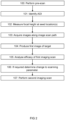
- step 102 at which point a seed location is selected in the xy plane within each AOI (typically at the centre of the AOI) and the focal height of the sample measured at that location using the line scanner 3.
- the focal height of the adjustable focus system 4 is varied through a predefined range of focal heights so as to obtain image information from the target 6 at a number of different focal positions along the z-axis with a depth of focus to around 1 ⁇ m.
- An in-focus position is then calculated from the image information at each focal position through use of a focus parameter in the form of a focus merit value.
- a focus merit value is a numerical measure of the degree of complexity within an image, wherein the greater the value the greater the detail in the image. A more in-focus image has a corresponding higher merit value.
- the focal height having the highest merit value is then stored as the measured in-focus position for the seed location and the process repeated for any remaining seed locations identified.
- the focal height of the line scanner 3 is adjusted between each xy location along the image scan path in the direction of or to the estimated in-focus position.
- the target 6 is imaged in one or more swathes in this manner until each AOI has been imaged entirely. Then, at step 104, the individual images acquired by the line scanner 3 are combined together to form a first image of the target.
- the first image is desirable for the first image to include the entirety of the sample across the xy plane and to be in-focus throughout. However, a number of errors can occur in the preceding method steps that prevent this from occurring.
- the efficacy of the first imaging scan (which may be thought of as the extent to which the first imaging scan produced the intended result) is then analysed at step 105. This analysis may involve any number of individual sub-processes for checking respective criteria, examples of which will be discussed in further detail with reference to Figure 3 . Typically, however, it involves an assessment regarding whether the area on the target imaged sufficiently covered the area of the target 6 occupied by the sample, and/or whether the sample is correctly focused throughout the image. Importantly, this process is performed with reference to the focus control data acquired during the first imaging scan.
- a change to a scanning parameter is determined at step 106 so that these may be corrected in a second imaging scan.
- the second imaging scan is then performed at step 107 with the relevant changes in the scanning parameter (such as the focusing procedure used or the area of the target 6 imaged) so as to improve the efficacy of the imaging scan.
- step 201 the first imaging scan is performed so that each AOI is imaged using the line scanner 3. This is equivalent to step 103 in Figure 2 .
- step 202 the computer system 10 performs the first of a series of tests to analyse the efficacy of the first imaging scan. The question is asked whether more than one AOI were imaged during the first imaging scan, and if the answer is "yes" then the method proceeds to step 203, otherwise it proceeds to step 205.
- the average focal height of the AOI are not similar to each other or within expected tolerances due to slide tilt, slide distortion, thickness variance of tissue then it can be assumed that at least one of the AOIs will not have the correct focus.
- the line scanner 3 will have mistakenly focused on something on the top of the coverslip for the target 6 and if there is enough detail present on the top of the coverslip it will appear to have scanned. In this case there will be typically be the thickness of a coverslip difference between focus levels, around 170 ⁇ m. Therefore, at step 203, an assessment is made whether the average focus of each AOI matches a tolerance. The AOI having the lowest average focal height is found and the tolerance is set to within a threshold difference from the lowest average focal height.
- the threshold may be set depending on the application but it typically exceeds the thickness of the sample and in this case is 20 ⁇ m. More generally the threshold might typically be selected within the range of 10-30 ⁇ m. If the average focus of each AOI is below this threshold then it can be assumed that the line scanner 3 has not focused on a region of the coverslip and the method proceeds to step 205. Otherwise, if the average focus one of the AOI exceeds the threshold then the method proceeds to step 204. At step 204 a change in a scanning parameter from the first imaging scan is determined for the performance of a second imaging scan. In particular, a change in the focusing procedure is determined. The lowest average focal height of the AOI will give a good indication of the correct tissue focus level.
- a focus merit tissue map is generated indicating the focus merit value calculated for each location along the image scan path during the preceding imaging scan. From the focus merit values it can be determined where the line scanner 3 was in focus. Where tissue is present, even on slightly out of focus areas, focus merit values will be large. This gives an alternative map of where tissue is present. If high focus merit values are recorded at the edge of a first scanning region imaged during the first imaging scan then it can be assumed that the AOI was set too small to capture all of the tissue. At step 206 any "boundary locations" where the focus merit values are above a threshold number at a boundary of the AOI are identified. If there are a series of adjacent boundary locations identified, indicating that the first scanning region was too small to capture the sample, the method proceeds to step 207.
- a change to a scanning parameter is determined by calculating a second scanning region covering a larger portion of the target than the first scanning region.
- the second scanning region may simply be a small increase in the boundary where the first scanning region was not large enough or a mathematical prediction of the sample shape, such as fitting a circle or arc or spline curve to a tissue edge determined from the focus merit tissue map. It is desirable not to increase the scanning region unnecessarily so as to cover regions of the target where the sample can be assumed to be absent as this will unnecessarily increase the scanning time.
- step 208 Any surface detail visible in the pre-scan image is identified at step 208. This is achieved through a comparison of the pre-scan image with the imaging data acquired from the first imaging scan. It will be recalled from step 104 ( Figure 2 ) that a first image of the target was produced corresponding to a combination of the individual images acquired during the imaging scan. This image will have a completely different numerical aperture and as such a completely different depth of focus to the pre-scan image.
- the pre-scan image will have a larger depth of focus which means defects such as dirt and scratches on the surface of the slide and coverslip are in focus whilst the small depth of focus of the imaging scan means the dirt and scratches on the surface of the slide and coverslip are not in focus.
- the resolution of the first image is scaled down to a resolution similar or identical to the pre-scan image.
- a typical Whole Slide Imaging image file contains multiple layers of images, each at a different resolution. This enables the image viewing application to zoom out of the image and move around the image without having to access large amounts of data. For example, if the image file has 0.25 ⁇ m pixels and the viewing application shows 2000x3000 pixels to show this requires 6 Mpixels to be read which, uncompressed, is 18 Mbytes of data. With compression, this might only be 2Mbytes of data. If the viewer were asked to display a larger area at lower resolution "zoom out" at, for example 10x the area, then to read this from the 0.25 ⁇ m pixel data would require 60Mpixels or 20Mbytes of compressed data. To avoid this condition, it is typical that the file contains an addition image that is near to the required resolution.
- the second image of the target and is analysed at step 208 to identify surface detail.
- the second image typically has a resolution that is similar to or identical to the pre-scan image. For example, the resolution of these images may be comparable to within a factor of two.
- the second image may then resolve similar sized features to the pre-scan image, and can be processed considerably faster than the HR "first image” (for example approximately 4000 times faster).
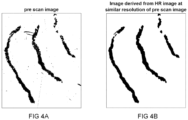
- Figure 4A show an example of a pre-scan image of the target with two scratches shown in the upper middle portion of the image.
- the corresponding second image, derived from the first image, of similar or equal resolution to the pre-scan image is shown in Figure 4B and does not show these scratches.
- a first probability map of the pre-scan image was generated in step 101 in order to identify the one or more AOI.
- a probability map (referred to herein as the "second probability map”) is generated in a similar manner but using the second image of the target to identify regions of the image apparently showing the sample. The second probability map is then subtracted from the first probability map to show the regions of the target where surface detail is visible in the first image.
- step 208 the focus control data from the first imaging scan is analysed to identify one or more "poor focus regions" where the line scanner 3 was not focused on the sample. This may be achieved by identifying locations on the target where the focus merit value was below a threshold number during the first imaging scan. It can be expected that the focus merit values recorded for the locations on the target where the surface detail was found may be below this threshold. Such locations may have only been imaged because they were incorrectly identified as having tissue in step 101 and so it is not necessary to repeat the imaging scan in these locations. However, if one or more poor focus regions remain (excluding the surface detail locations) then the method proceeds to step 210.
- the method only proceeds from step 209 to step 210 if the poor focus region(s) have a minimum size, for example a length of at least 0.5 mm in any direction, otherwise it proceeds to step 211.
- the minimum size may optionally be set by the user of the computer system 10.
- a new focusing procedure is determined for the performance of a second imaging scan. In this case it is determined that the first imaging scan should be repeated but with the in-focus position being found for additional seed locations at step 101 within the one or more poor focus regions. With the in-focus position being measured at these additional locations, the second imaging scan will proceed with the line scanner 3 imaging the target at a different focal height across the one or more poor focus regions.
- step 209 If the outcome of step 209 is that there are no remaining poor focus regions then the method instead proceeds to step 211.
- the focus control data For each location along the image scan path the focus control data provides an estimate of the correct focal height for the sample (also referred to as the "focal surface") and a record of the actual focal height for the line scanner 3 when the image was acquired. From this it can be determined where the scanner focus was outside one depth of focus of the tissue focus, thereby enabling areas of tissue where the focus was known to be in error to be identified. This might be more typical at the very edge of the tissue as the scanner has to predict where the focus of the tissue is as it approaches the tissue.
- the focus mechanism identifies the prediction error but it can take a little distance to correct the prediction error.
- Other conditions that may occur which give this focus tracking error may include the tissue changing focus rapidly such as when the tissue is folded over itself or buckled.
- a positional error map is created in which all areas of the tissue for which the actual focal height of the line scanner 3 deviated from the actual focal surface of the sample by at least 1 ⁇ m, or where the correct focal height was unknown, are identified.
- Figure 5A shows an image of the target in which the clear slide is shown as white and the regions of the sample that are in focus are shown as grey. The poor focus regions (where the positional error exceeds 1 ⁇ m or the focus is unknown) are shown as black. There will be a tolerance to the positional error but when the error is too large it may be deemed unacceptable.
- an automated analysis of the quality of the first image may be performed at step 213 that is limited to these regions, for example using an algorithm similar to that described in US 2019/0266726 (earlier discussed).
- Other automated analysis techniques may alternatively be used, including 2D standard deviations, gradient analysis and edge filtering (as known in the art).
- a result of the analysis will either be that the focus of the image is acceptable for the purposes of the user (typically for performing a pathology assessment), or it is unacceptable.
- Figure 5B provides a second example of an image of the target that is the same as Figure 5A except that the regions now identified as being of acceptable focus quality (following performance of the above image analysis technique) are grey also. If any poor focus areas remain in the first image (corresponding to those regions marked black), or if such areas exceed a threshold proportion of the first image, a change to a scanning parameter may be determined for the performance of a second imaging scan. For example, it may be determined that the first imaging scan should be repeated with in-focus measurements being taken for additional seed locations inside the remaining poor focus regions. Optionally the resulting map of errors may instead be displayed to a user as a guide to which areas of the image to examine, which will improve the speed and accuracy of the task.
- step 215 If the result of step 215 is that each seed focus matches the tracked focus ascertained from the focus control data then first imaging scan is determined to be acceptable. The scanning parameters will then not require changing for the performance of a second imaging scan and the first image of the target generated in step 104 may be displayed to the user for analysis.
- an improved method for operating a microscope scanner including a method for analysing the data generated by an imaging scan so as to ensure the target has been properly imaged.
- the analysis is advantageously performed using focus control data generated during the imaging scan. This enables a result to be obtained in a quick and efficient manner. If any errors are identified in the first imaging scan as a result of this analysis then a change to a scanning parameter is identified so that a second imaging scan may be performed that corrects this error.
Landscapes
- Engineering & Computer Science (AREA)
- Physics & Mathematics (AREA)
- Computer Vision & Pattern Recognition (AREA)
- General Physics & Mathematics (AREA)
- Chemical & Material Sciences (AREA)
- Analytical Chemistry (AREA)
- Optics & Photonics (AREA)
- Multimedia (AREA)
- Theoretical Computer Science (AREA)
- Radiology & Medical Imaging (AREA)
- Quality & Reliability (AREA)
- Nuclear Medicine, Radiotherapy & Molecular Imaging (AREA)
- Medical Informatics (AREA)
- General Health & Medical Sciences (AREA)
- Health & Medical Sciences (AREA)
- General Engineering & Computer Science (AREA)
- Microscoopes, Condenser (AREA)
Applications Claiming Priority (2)
| Application Number | Priority Date | Filing Date | Title |
|---|---|---|---|
| GB2008690.6A GB2595873B (en) | 2020-06-09 | 2020-06-09 | A method for analysing scanning efficacy |
| PCT/GB2021/051271 WO2021250373A1 (en) | 2020-06-09 | 2021-05-26 | A method for analysing scanning efficacy |
Related Child Applications (1)
| Application Number | Title | Priority Date | Filing Date |
|---|---|---|---|
| EP25154442.5 Division-Into | 2025-01-28 |
Publications (2)
| Publication Number | Publication Date |
|---|---|
| EP4107570A1 EP4107570A1 (en) | 2022-12-28 |
| EP4107570B1 true EP4107570B1 (en) | 2025-03-05 |
Family
ID=71616083
Family Applications (1)
| Application Number | Title | Priority Date | Filing Date |
|---|---|---|---|
| EP21731566.2A Active EP4107570B1 (en) | 2020-06-09 | 2021-05-26 | A method for analysing scanning efficacy |
Country Status (6)
| Country | Link |
|---|---|
| US (1) | US12422658B2 (https=) |
| EP (1) | EP4107570B1 (https=) |
| JP (1) | JP7655947B2 (https=) |
| CN (1) | CN115836241B (https=) |
| GB (1) | GB2595873B (https=) |
| WO (1) | WO2021250373A1 (https=) |
Families Citing this family (3)
| Publication number | Priority date | Publication date | Assignee | Title |
|---|---|---|---|---|
| GB2597502A (en) * | 2020-07-24 | 2022-02-02 | Ffei Ltd | A whole slide imaging method for a microscope |
| CN113592800B (zh) * | 2021-07-22 | 2024-06-28 | 梅卡曼德(北京)机器人科技有限公司 | 基于动态扫描参数的图像扫描方法及装置 |
| CN118603879A (zh) * | 2024-06-24 | 2024-09-06 | 飞秒激光研究中心(广州)有限公司 | 成像辅助装置、生物组织样本的成像方法及激光成像系统 |
Citations (1)
| Publication number | Priority date | Publication date | Assignee | Title |
|---|---|---|---|---|
| US20200064612A1 (en) * | 2017-09-29 | 2020-02-27 | Leica Biosystems Imaging, Inc. | Real-time autofocus scanning |
Family Cites Families (14)
| Publication number | Priority date | Publication date | Assignee | Title |
|---|---|---|---|---|
| US7518652B2 (en) * | 2000-05-03 | 2009-04-14 | Aperio Technologies, Inc. | Method and apparatus for pre-focus in a linear array based slide scanner |
| US7155049B2 (en) * | 2001-01-11 | 2006-12-26 | Trestle Acquisition Corp. | System for creating microscopic digital montage images |
| US7813579B2 (en) * | 2004-05-24 | 2010-10-12 | Hamamatsu Photonics K.K. | Microscope system |
| EP1751599B1 (en) * | 2004-05-27 | 2018-07-11 | Leica Biosystems Imaging, Inc. | System and method for assessing virtual slide image quality |
| CA2842661C (en) * | 2009-10-19 | 2016-02-23 | Ventana Medical Systems, Inc. | Imaging system and techniques |
| GB2505691B (en) | 2012-09-07 | 2018-02-21 | Ffei Ltd | Method and apparatus for image scanning |
| JP5941395B2 (ja) * | 2012-10-31 | 2016-06-29 | 浜松ホトニクス株式会社 | 画像取得装置及び画像取得装置のフォーカス方法 |
| GB201322188D0 (en) * | 2013-12-16 | 2014-01-29 | Ffei Ltd | Method and apparatus for estimating an in-focus position |
| US10482595B2 (en) * | 2014-08-27 | 2019-11-19 | S.D. Sight Diagnostics Ltd. | System and method for calculating focus variation for a digital microscope |
| WO2016120441A2 (en) * | 2015-01-30 | 2016-08-04 | Ventana Medical Systems, Inc. | Quality metrics for automatic evaluation of dual ish images |
| CN110709749B (zh) | 2017-06-09 | 2021-10-26 | 电子慕泽雷帕里公司 | 组合式明视场和相衬显微镜系统及配备其的图像处理设备 |
| WO2019034328A1 (en) * | 2017-08-15 | 2019-02-21 | Siemens Healthcare Gmbh | IDENTIFYING THE QUALITY OF CELLULAR IMAGES ACQUIRED USING DIGITAL HOLOGRAPHIC MICROSCOPY USING CONVOLUTIONAL NEURAL NETWORKS |
| US10861156B2 (en) | 2018-02-28 | 2020-12-08 | Case Western Reserve University | Quality control for digital pathology slides |
| CN111007661B (zh) * | 2019-12-02 | 2022-02-22 | 湖南国科智瞳科技有限公司 | 一种基于深度学习的显微图像自动聚焦方法及装置 |
-
2020
- 2020-06-09 GB GB2008690.6A patent/GB2595873B/en active Active
-
2021
- 2021-05-26 JP JP2022573304A patent/JP7655947B2/ja active Active
- 2021-05-26 WO PCT/GB2021/051271 patent/WO2021250373A1/en not_active Ceased
- 2021-05-26 CN CN202180041233.4A patent/CN115836241B/zh active Active
- 2021-05-26 US US18/009,152 patent/US12422658B2/en active Active
- 2021-05-26 EP EP21731566.2A patent/EP4107570B1/en active Active
Patent Citations (1)
| Publication number | Priority date | Publication date | Assignee | Title |
|---|---|---|---|---|
| US20200064612A1 (en) * | 2017-09-29 | 2020-02-27 | Leica Biosystems Imaging, Inc. | Real-time autofocus scanning |
Also Published As
| Publication number | Publication date |
|---|---|
| GB2595873B (en) | 2023-01-25 |
| GB2595873A (en) | 2021-12-15 |
| GB202008690D0 (en) | 2020-07-22 |
| JP2023529083A (ja) | 2023-07-07 |
| CN115836241B (zh) | 2024-06-25 |
| US20230258919A1 (en) | 2023-08-17 |
| JP7655947B2 (ja) | 2025-04-02 |
| US12422658B2 (en) | 2025-09-23 |
| EP4107570A1 (en) | 2022-12-28 |
| CN115836241A (zh) | 2023-03-21 |
| WO2021250373A1 (en) | 2021-12-16 |
Similar Documents
| Publication | Publication Date | Title |
|---|---|---|
| US12387328B2 (en) | System and method for calculating focus variation for a digital microscope | |
| EP4107570B1 (en) | A method for analysing scanning efficacy | |
| US5647025A (en) | Automatic focusing of biomedical specimens apparatus | |
| US10462351B2 (en) | Fast auto-focus in imaging | |
| EP2671113B1 (en) | Fast auto-focus in microscopic imaging | |
| TWI478101B (zh) | 評估影像聚焦品質的方法 | |
| US8350905B2 (en) | Microscope system, image generating method, and program for practicing the same | |
| CN102947858B (zh) | 包括重叠边缘对比的图像质量评价 | |
| EP3420393B1 (en) | System for generating a synthetic 2d image with an enhanced depth of field of a biological sample | |
| US20100272334A1 (en) | Microscope System, Specimen Observation Method, and Computer Program Product | |
| CN113366364A (zh) | 载玻片扫描系统中的实时聚焦 | |
| US20120212599A1 (en) | Imaging apparatus and imaging method | |
| CN113705298A (zh) | 图像采集方法、装置、计算机设备及存储介质 | |
| CN120972356A (zh) | 对焦方法、装置和设备 | |
| US7653260B2 (en) | System and method of registering field of view | |
| JP2023529083A5 (https=) | ||
| JP7633373B2 (ja) | 顕微鏡のための全スライド撮像方法 | |
| Wang et al. | Surface Roughness Measurement from Shape-from-focus | |
| WO2025198613A1 (en) | Automated focus labeling of histological images for training machine-learning models |
Legal Events
| Date | Code | Title | Description |
|---|---|---|---|
| STAA | Information on the status of an ep patent application or granted ep patent |
Free format text: STATUS: UNKNOWN |
|
| STAA | Information on the status of an ep patent application or granted ep patent |
Free format text: STATUS: THE INTERNATIONAL PUBLICATION HAS BEEN MADE |
|
| PUAI | Public reference made under article 153(3) epc to a published international application that has entered the european phase |
Free format text: ORIGINAL CODE: 0009012 |
|
| STAA | Information on the status of an ep patent application or granted ep patent |
Free format text: STATUS: REQUEST FOR EXAMINATION WAS MADE |
|
| 17P | Request for examination filed |
Effective date: 20220922 |
|
| AK | Designated contracting states |
Kind code of ref document: A1 Designated state(s): AL AT BE BG CH CY CZ DE DK EE ES FI FR GB GR HR HU IE IS IT LI LT LU LV MC MK MT NL NO PL PT RO RS SE SI SK SM TR |
|
| P01 | Opt-out of the competence of the unified patent court (upc) registered |
Effective date: 20230514 |
|
| DAV | Request for validation of the european patent (deleted) | ||
| DAX | Request for extension of the european patent (deleted) | ||
| RAP1 | Party data changed (applicant data changed or rights of an application transferred) |
Owner name: VENTANA MEDICAL SYSTEMS, INC. |
|
| GRAP | Despatch of communication of intention to grant a patent |
Free format text: ORIGINAL CODE: EPIDOSNIGR1 |
|
| STAA | Information on the status of an ep patent application or granted ep patent |
Free format text: STATUS: GRANT OF PATENT IS INTENDED |
|
| INTG | Intention to grant announced |
Effective date: 20241004 |
|
| GRAS | Grant fee paid |
Free format text: ORIGINAL CODE: EPIDOSNIGR3 |
|
| GRAA | (expected) grant |
Free format text: ORIGINAL CODE: 0009210 |
|
| STAA | Information on the status of an ep patent application or granted ep patent |
Free format text: STATUS: THE PATENT HAS BEEN GRANTED |
|
| AK | Designated contracting states |
Kind code of ref document: B1 Designated state(s): AL AT BE BG CH CY CZ DE DK EE ES FI FR GB GR HR HU IE IS IT LI LT LU LV MC MK MT NL NO PL PT RO RS SE SI SK SM TR |
|
| REG | Reference to a national code |
Ref country code: GB Ref legal event code: FG4D |
|
| REG | Reference to a national code |
Ref country code: CH Ref legal event code: EP |
|
| REG | Reference to a national code |
Ref country code: DE Ref legal event code: R096 Ref document number: 602021027160 Country of ref document: DE |
|
| REG | Reference to a national code |
Ref country code: IE Ref legal event code: FG4D |
|
| PG25 | Lapsed in a contracting state [announced via postgrant information from national office to epo] |
Ref country code: RS Free format text: LAPSE BECAUSE OF FAILURE TO SUBMIT A TRANSLATION OF THE DESCRIPTION OR TO PAY THE FEE WITHIN THE PRESCRIBED TIME-LIMIT Effective date: 20250605 |
|
| PG25 | Lapsed in a contracting state [announced via postgrant information from national office to epo] |
Ref country code: FI Free format text: LAPSE BECAUSE OF FAILURE TO SUBMIT A TRANSLATION OF THE DESCRIPTION OR TO PAY THE FEE WITHIN THE PRESCRIBED TIME-LIMIT Effective date: 20250305 |
|
| PGFP | Annual fee paid to national office [announced via postgrant information from national office to epo] |
Ref country code: DE Payment date: 20250423 Year of fee payment: 5 |
|
| REG | Reference to a national code |
Ref country code: NL Ref legal event code: MP Effective date: 20250305 |
|
| PG25 | Lapsed in a contracting state [announced via postgrant information from national office to epo] |
Ref country code: ES Free format text: LAPSE BECAUSE OF FAILURE TO SUBMIT A TRANSLATION OF THE DESCRIPTION OR TO PAY THE FEE WITHIN THE PRESCRIBED TIME-LIMIT Effective date: 20250305 |
|
| REG | Reference to a national code |
Ref country code: LT Ref legal event code: MG9D |
|
| PG25 | Lapsed in a contracting state [announced via postgrant information from national office to epo] |
Ref country code: NO Free format text: LAPSE BECAUSE OF FAILURE TO SUBMIT A TRANSLATION OF THE DESCRIPTION OR TO PAY THE FEE WITHIN THE PRESCRIBED TIME-LIMIT Effective date: 20250605 |
|
| PG25 | Lapsed in a contracting state [announced via postgrant information from national office to epo] |
Ref country code: HR Free format text: LAPSE BECAUSE OF FAILURE TO SUBMIT A TRANSLATION OF THE DESCRIPTION OR TO PAY THE FEE WITHIN THE PRESCRIBED TIME-LIMIT Effective date: 20250305 |
|
| PG25 | Lapsed in a contracting state [announced via postgrant information from national office to epo] |
Ref country code: LV Free format text: LAPSE BECAUSE OF FAILURE TO SUBMIT A TRANSLATION OF THE DESCRIPTION OR TO PAY THE FEE WITHIN THE PRESCRIBED TIME-LIMIT Effective date: 20250305 |
|
| PGFP | Annual fee paid to national office [announced via postgrant information from national office to epo] |
Ref country code: FR Payment date: 20250423 Year of fee payment: 5 |
|
| PG25 | Lapsed in a contracting state [announced via postgrant information from national office to epo] |
Ref country code: GR Free format text: LAPSE BECAUSE OF FAILURE TO SUBMIT A TRANSLATION OF THE DESCRIPTION OR TO PAY THE FEE WITHIN THE PRESCRIBED TIME-LIMIT Effective date: 20250606 Ref country code: BG Free format text: LAPSE BECAUSE OF FAILURE TO SUBMIT A TRANSLATION OF THE DESCRIPTION OR TO PAY THE FEE WITHIN THE PRESCRIBED TIME-LIMIT Effective date: 20250305 |
|
| PGFP | Annual fee paid to national office [announced via postgrant information from national office to epo] |
Ref country code: CH Payment date: 20250601 Year of fee payment: 5 |
|
| REG | Reference to a national code |
Ref country code: AT Ref legal event code: MK05 Ref document number: 1773418 Country of ref document: AT Kind code of ref document: T Effective date: 20250305 |
|
| PG25 | Lapsed in a contracting state [announced via postgrant information from national office to epo] |
Ref country code: NL Free format text: LAPSE BECAUSE OF FAILURE TO SUBMIT A TRANSLATION OF THE DESCRIPTION OR TO PAY THE FEE WITHIN THE PRESCRIBED TIME-LIMIT Effective date: 20250305 |
|
| PG25 | Lapsed in a contracting state [announced via postgrant information from national office to epo] |
Ref country code: SE Free format text: LAPSE BECAUSE OF FAILURE TO SUBMIT A TRANSLATION OF THE DESCRIPTION OR TO PAY THE FEE WITHIN THE PRESCRIBED TIME-LIMIT Effective date: 20250305 |
|
| PG25 | Lapsed in a contracting state [announced via postgrant information from national office to epo] |
Ref country code: SM Free format text: LAPSE BECAUSE OF FAILURE TO SUBMIT A TRANSLATION OF THE DESCRIPTION OR TO PAY THE FEE WITHIN THE PRESCRIBED TIME-LIMIT Effective date: 20250305 |
|
| PG25 | Lapsed in a contracting state [announced via postgrant information from national office to epo] |
Ref country code: PT Free format text: LAPSE BECAUSE OF FAILURE TO SUBMIT A TRANSLATION OF THE DESCRIPTION OR TO PAY THE FEE WITHIN THE PRESCRIBED TIME-LIMIT Effective date: 20250707 |
|
| PG25 | Lapsed in a contracting state [announced via postgrant information from national office to epo] |
Ref country code: IT Free format text: LAPSE BECAUSE OF FAILURE TO SUBMIT A TRANSLATION OF THE DESCRIPTION OR TO PAY THE FEE WITHIN THE PRESCRIBED TIME-LIMIT Effective date: 20250305 Ref country code: PL Free format text: LAPSE BECAUSE OF FAILURE TO SUBMIT A TRANSLATION OF THE DESCRIPTION OR TO PAY THE FEE WITHIN THE PRESCRIBED TIME-LIMIT Effective date: 20250305 |
|
| PG25 | Lapsed in a contracting state [announced via postgrant information from national office to epo] |
Ref country code: AT Free format text: LAPSE BECAUSE OF FAILURE TO SUBMIT A TRANSLATION OF THE DESCRIPTION OR TO PAY THE FEE WITHIN THE PRESCRIBED TIME-LIMIT Effective date: 20250305 |
|
| PG25 | Lapsed in a contracting state [announced via postgrant information from national office to epo] |
Ref country code: CZ Free format text: LAPSE BECAUSE OF FAILURE TO SUBMIT A TRANSLATION OF THE DESCRIPTION OR TO PAY THE FEE WITHIN THE PRESCRIBED TIME-LIMIT Effective date: 20250305 Ref country code: EE Free format text: LAPSE BECAUSE OF FAILURE TO SUBMIT A TRANSLATION OF THE DESCRIPTION OR TO PAY THE FEE WITHIN THE PRESCRIBED TIME-LIMIT Effective date: 20250305 |
|
| PG25 | Lapsed in a contracting state [announced via postgrant information from national office to epo] |
Ref country code: RO Free format text: LAPSE BECAUSE OF FAILURE TO SUBMIT A TRANSLATION OF THE DESCRIPTION OR TO PAY THE FEE WITHIN THE PRESCRIBED TIME-LIMIT Effective date: 20250305 |
|
| PG25 | Lapsed in a contracting state [announced via postgrant information from national office to epo] |
Ref country code: SK Free format text: LAPSE BECAUSE OF FAILURE TO SUBMIT A TRANSLATION OF THE DESCRIPTION OR TO PAY THE FEE WITHIN THE PRESCRIBED TIME-LIMIT Effective date: 20250305 |
|
| PG25 | Lapsed in a contracting state [announced via postgrant information from national office to epo] |
Ref country code: IS Free format text: LAPSE BECAUSE OF FAILURE TO SUBMIT A TRANSLATION OF THE DESCRIPTION OR TO PAY THE FEE WITHIN THE PRESCRIBED TIME-LIMIT Effective date: 20250705 |
|
| REG | Reference to a national code |
Ref country code: DE Ref legal event code: R097 Ref document number: 602021027160 Country of ref document: DE |
|
| PLBE | No opposition filed within time limit |
Free format text: ORIGINAL CODE: 0009261 |
|
| STAA | Information on the status of an ep patent application or granted ep patent |
Free format text: STATUS: NO OPPOSITION FILED WITHIN TIME LIMIT |
|
| PG25 | Lapsed in a contracting state [announced via postgrant information from national office to epo] |
Ref country code: DK Free format text: LAPSE BECAUSE OF FAILURE TO SUBMIT A TRANSLATION OF THE DESCRIPTION OR TO PAY THE FEE WITHIN THE PRESCRIBED TIME-LIMIT Effective date: 20250305 |
|
| REG | Reference to a national code |
Ref country code: CH Ref legal event code: L10 Free format text: ST27 STATUS EVENT CODE: U-0-0-L10-L00 (AS PROVIDED BY THE NATIONAL OFFICE) Effective date: 20260114 |
|
| PG25 | Lapsed in a contracting state [announced via postgrant information from national office to epo] |
Ref country code: LU Free format text: LAPSE BECAUSE OF NON-PAYMENT OF DUE FEES Effective date: 20250526 |
|
| REG | Reference to a national code |
Ref country code: BE Ref legal event code: MM Effective date: 20250531 |
|
| PG25 | Lapsed in a contracting state [announced via postgrant information from national office to epo] |
Ref country code: MC Free format text: LAPSE BECAUSE OF FAILURE TO SUBMIT A TRANSLATION OF THE DESCRIPTION OR TO PAY THE FEE WITHIN THE PRESCRIBED TIME-LIMIT Effective date: 20250305 |
|
| 26N | No opposition filed |
Effective date: 20251208 |
|
| PGFP | Annual fee paid to national office [announced via postgrant information from national office to epo] |
Ref country code: GB Payment date: 20260317 Year of fee payment: 6 |
|
| PG25 | Lapsed in a contracting state [announced via postgrant information from national office to epo] |
Ref country code: IE Free format text: LAPSE BECAUSE OF NON-PAYMENT OF DUE FEES Effective date: 20250526 |
|
| PG25 | Lapsed in a contracting state [announced via postgrant information from national office to epo] |
Ref country code: BE Free format text: LAPSE BECAUSE OF NON-PAYMENT OF DUE FEES Effective date: 20250531 |