EP4104166B1 - Berechnungsarchitektur für eine aktive geräuschreduzierungsvorrichtung - Google Patents
Berechnungsarchitektur für eine aktive geräuschreduzierungsvorrichtung Download PDFInfo
- Publication number
- EP4104166B1 EP4104166B1 EP21717590.0A EP21717590A EP4104166B1 EP 4104166 B1 EP4104166 B1 EP 4104166B1 EP 21717590 A EP21717590 A EP 21717590A EP 4104166 B1 EP4104166 B1 EP 4104166B1
- Authority
- EP
- European Patent Office
- Prior art keywords
- dsp processor
- processor
- anr
- general purpose
- dsp
- Prior art date
- Legal status (The legal status is an assumption and is not a legal conclusion. Google has not performed a legal analysis and makes no representation as to the accuracy of the status listed.)
- Active
Links
Images

Classifications
-
- G—PHYSICS
- G10—MUSICAL INSTRUMENTS; ACOUSTICS
- G10K—SOUND-PRODUCING DEVICES; METHODS OR DEVICES FOR PROTECTING AGAINST, OR FOR DAMPING, NOISE OR OTHER ACOUSTIC WAVES IN GENERAL; ACOUSTICS NOT OTHERWISE PROVIDED FOR
- G10K11/00—Methods or devices for transmitting, conducting or directing sound in general; Methods or devices for protecting against, or for damping, noise or other acoustic waves in general
- G10K11/16—Methods or devices for protecting against, or for damping, noise or other acoustic waves in general
- G10K11/175—Methods or devices for protecting against, or for damping, noise or other acoustic waves in general using interference effects; Masking sound
- G10K11/178—Methods or devices for protecting against, or for damping, noise or other acoustic waves in general using interference effects; Masking sound by electro-acoustically regenerating the original acoustic waves in anti-phase
- G10K11/1787—General system configurations
- G10K11/17879—General system configurations using both a reference signal and an error signal
- G10K11/17881—General system configurations using both a reference signal and an error signal the reference signal being an acoustic signal, e.g. recorded with a microphone
-
- G—PHYSICS
- G10—MUSICAL INSTRUMENTS; ACOUSTICS
- G10K—SOUND-PRODUCING DEVICES; METHODS OR DEVICES FOR PROTECTING AGAINST, OR FOR DAMPING, NOISE OR OTHER ACOUSTIC WAVES IN GENERAL; ACOUSTICS NOT OTHERWISE PROVIDED FOR
- G10K11/00—Methods or devices for transmitting, conducting or directing sound in general; Methods or devices for protecting against, or for damping, noise or other acoustic waves in general
- G10K11/16—Methods or devices for protecting against, or for damping, noise or other acoustic waves in general
- G10K11/175—Methods or devices for protecting against, or for damping, noise or other acoustic waves in general using interference effects; Masking sound
- G10K11/178—Methods or devices for protecting against, or for damping, noise or other acoustic waves in general using interference effects; Masking sound by electro-acoustically regenerating the original acoustic waves in anti-phase
- G10K11/1781—Methods or devices for protecting against, or for damping, noise or other acoustic waves in general using interference effects; Masking sound by electro-acoustically regenerating the original acoustic waves in anti-phase characterised by the analysis of input or output signals, e.g. frequency range, modes, transfer functions
- G10K11/17821—Methods or devices for protecting against, or for damping, noise or other acoustic waves in general using interference effects; Masking sound by electro-acoustically regenerating the original acoustic waves in anti-phase characterised by the analysis of input or output signals, e.g. frequency range, modes, transfer functions characterised by the analysis of the input signals only
-
- G—PHYSICS
- G06—COMPUTING OR CALCULATING; COUNTING
- G06N—COMPUTING ARRANGEMENTS BASED ON SPECIFIC COMPUTATIONAL MODELS
- G06N20/00—Machine learning
-
- G—PHYSICS
- G10—MUSICAL INSTRUMENTS; ACOUSTICS
- G10K—SOUND-PRODUCING DEVICES; METHODS OR DEVICES FOR PROTECTING AGAINST, OR FOR DAMPING, NOISE OR OTHER ACOUSTIC WAVES IN GENERAL; ACOUSTICS NOT OTHERWISE PROVIDED FOR
- G10K11/00—Methods or devices for transmitting, conducting or directing sound in general; Methods or devices for protecting against, or for damping, noise or other acoustic waves in general
- G10K11/16—Methods or devices for protecting against, or for damping, noise or other acoustic waves in general
- G10K11/175—Methods or devices for protecting against, or for damping, noise or other acoustic waves in general using interference effects; Masking sound
- G10K11/178—Methods or devices for protecting against, or for damping, noise or other acoustic waves in general using interference effects; Masking sound by electro-acoustically regenerating the original acoustic waves in anti-phase
- G10K11/1783—Methods or devices for protecting against, or for damping, noise or other acoustic waves in general using interference effects; Masking sound by electro-acoustically regenerating the original acoustic waves in anti-phase handling or detecting of non-standard events or conditions, e.g. changing operating modes under specific operating conditions
- G10K11/17833—Methods or devices for protecting against, or for damping, noise or other acoustic waves in general using interference effects; Masking sound by electro-acoustically regenerating the original acoustic waves in anti-phase handling or detecting of non-standard events or conditions, e.g. changing operating modes under specific operating conditions by using a self-diagnostic function or a malfunction prevention function, e.g. detecting abnormal output levels
-
- G—PHYSICS
- G10—MUSICAL INSTRUMENTS; ACOUSTICS
- G10K—SOUND-PRODUCING DEVICES; METHODS OR DEVICES FOR PROTECTING AGAINST, OR FOR DAMPING, NOISE OR OTHER ACOUSTIC WAVES IN GENERAL; ACOUSTICS NOT OTHERWISE PROVIDED FOR
- G10K11/00—Methods or devices for transmitting, conducting or directing sound in general; Methods or devices for protecting against, or for damping, noise or other acoustic waves in general
- G10K11/16—Methods or devices for protecting against, or for damping, noise or other acoustic waves in general
- G10K11/175—Methods or devices for protecting against, or for damping, noise or other acoustic waves in general using interference effects; Masking sound
- G10K11/178—Methods or devices for protecting against, or for damping, noise or other acoustic waves in general using interference effects; Masking sound by electro-acoustically regenerating the original acoustic waves in anti-phase
- G10K11/1785—Methods, e.g. algorithms; Devices
- G10K11/17853—Methods, e.g. algorithms; Devices of the filter
- G10K11/17854—Methods, e.g. algorithms; Devices of the filter the filter being an adaptive filter
-
- G—PHYSICS
- G10—MUSICAL INSTRUMENTS; ACOUSTICS
- G10K—SOUND-PRODUCING DEVICES; METHODS OR DEVICES FOR PROTECTING AGAINST, OR FOR DAMPING, NOISE OR OTHER ACOUSTIC WAVES IN GENERAL; ACOUSTICS NOT OTHERWISE PROVIDED FOR
- G10K11/00—Methods or devices for transmitting, conducting or directing sound in general; Methods or devices for protecting against, or for damping, noise or other acoustic waves in general
- G10K11/16—Methods or devices for protecting against, or for damping, noise or other acoustic waves in general
- G10K11/175—Methods or devices for protecting against, or for damping, noise or other acoustic waves in general using interference effects; Masking sound
- G10K11/178—Methods or devices for protecting against, or for damping, noise or other acoustic waves in general using interference effects; Masking sound by electro-acoustically regenerating the original acoustic waves in anti-phase
- G10K11/1785—Methods, e.g. algorithms; Devices
- G10K11/17855—Methods, e.g. algorithms; Devices for improving speed or power requirements
-
- G—PHYSICS
- G10—MUSICAL INSTRUMENTS; ACOUSTICS
- G10K—SOUND-PRODUCING DEVICES; METHODS OR DEVICES FOR PROTECTING AGAINST, OR FOR DAMPING, NOISE OR OTHER ACOUSTIC WAVES IN GENERAL; ACOUSTICS NOT OTHERWISE PROVIDED FOR
- G10K11/00—Methods or devices for transmitting, conducting or directing sound in general; Methods or devices for protecting against, or for damping, noise or other acoustic waves in general
- G10K11/16—Methods or devices for protecting against, or for damping, noise or other acoustic waves in general
- G10K11/175—Methods or devices for protecting against, or for damping, noise or other acoustic waves in general using interference effects; Masking sound
- G10K11/178—Methods or devices for protecting against, or for damping, noise or other acoustic waves in general using interference effects; Masking sound by electro-acoustically regenerating the original acoustic waves in anti-phase
- G10K11/1787—General system configurations
-
- H—ELECTRICITY
- H04—ELECTRIC COMMUNICATION TECHNIQUE
- H04R—LOUDSPEAKERS, MICROPHONES, GRAMOPHONE PICK-UPS OR LIKE ACOUSTIC ELECTROMECHANICAL TRANSDUCERS; ELECTRIC HEARING AIDS; PUBLIC ADDRESS SYSTEMS
- H04R1/00—Details of transducers, loudspeakers or microphones
- H04R1/10—Earpieces; Attachments therefor ; Earphones; Monophonic headphones
- H04R1/1083—Reduction of ambient noise
-
- G—PHYSICS
- G10—MUSICAL INSTRUMENTS; ACOUSTICS
- G10K—SOUND-PRODUCING DEVICES; METHODS OR DEVICES FOR PROTECTING AGAINST, OR FOR DAMPING, NOISE OR OTHER ACOUSTIC WAVES IN GENERAL; ACOUSTICS NOT OTHERWISE PROVIDED FOR
- G10K2210/00—Details of active noise control [ANC] covered by G10K11/178 but not provided for in any of its subgroups
- G10K2210/10—Applications
- G10K2210/108—Communication systems, e.g. where useful sound is kept and noise is cancelled
- G10K2210/1081—Earphones, e.g. for telephones, ear protectors or headsets
-
- G—PHYSICS
- G10—MUSICAL INSTRUMENTS; ACOUSTICS
- G10K—SOUND-PRODUCING DEVICES; METHODS OR DEVICES FOR PROTECTING AGAINST, OR FOR DAMPING, NOISE OR OTHER ACOUSTIC WAVES IN GENERAL; ACOUSTICS NOT OTHERWISE PROVIDED FOR
- G10K2210/00—Details of active noise control [ANC] covered by G10K11/178 but not provided for in any of its subgroups
- G10K2210/30—Means
- G10K2210/301—Computational
- G10K2210/3026—Feedback
-
- G—PHYSICS
- G10—MUSICAL INSTRUMENTS; ACOUSTICS
- G10K—SOUND-PRODUCING DEVICES; METHODS OR DEVICES FOR PROTECTING AGAINST, OR FOR DAMPING, NOISE OR OTHER ACOUSTIC WAVES IN GENERAL; ACOUSTICS NOT OTHERWISE PROVIDED FOR
- G10K2210/00—Details of active noise control [ANC] covered by G10K11/178 but not provided for in any of its subgroups
- G10K2210/30—Means
- G10K2210/301—Computational
- G10K2210/3027—Feedforward
-
- G—PHYSICS
- G10—MUSICAL INSTRUMENTS; ACOUSTICS
- G10K—SOUND-PRODUCING DEVICES; METHODS OR DEVICES FOR PROTECTING AGAINST, OR FOR DAMPING, NOISE OR OTHER ACOUSTIC WAVES IN GENERAL; ACOUSTICS NOT OTHERWISE PROVIDED FOR
- G10K2210/00—Details of active noise control [ANC] covered by G10K11/178 but not provided for in any of its subgroups
- G10K2210/30—Means
- G10K2210/301—Computational
- G10K2210/3028—Filtering, e.g. Kalman filters or special analogue or digital filters
-
- G—PHYSICS
- G10—MUSICAL INSTRUMENTS; ACOUSTICS
- G10K—SOUND-PRODUCING DEVICES; METHODS OR DEVICES FOR PROTECTING AGAINST, OR FOR DAMPING, NOISE OR OTHER ACOUSTIC WAVES IN GENERAL; ACOUSTICS NOT OTHERWISE PROVIDED FOR
- G10K2210/00—Details of active noise control [ANC] covered by G10K11/178 but not provided for in any of its subgroups
- G10K2210/30—Means
- G10K2210/301—Computational
- G10K2210/3053—Speeding up computation or convergence, or decreasing the computational load
-
- G—PHYSICS
- G10—MUSICAL INSTRUMENTS; ACOUSTICS
- G10K—SOUND-PRODUCING DEVICES; METHODS OR DEVICES FOR PROTECTING AGAINST, OR FOR DAMPING, NOISE OR OTHER ACOUSTIC WAVES IN GENERAL; ACOUSTICS NOT OTHERWISE PROVIDED FOR
- G10K2210/00—Details of active noise control [ANC] covered by G10K11/178 but not provided for in any of its subgroups
- G10K2210/30—Means
- G10K2210/301—Computational
- G10K2210/3056—Variable gain
-
- G—PHYSICS
- G10—MUSICAL INSTRUMENTS; ACOUSTICS
- G10K—SOUND-PRODUCING DEVICES; METHODS OR DEVICES FOR PROTECTING AGAINST, OR FOR DAMPING, NOISE OR OTHER ACOUSTIC WAVES IN GENERAL; ACOUSTICS NOT OTHERWISE PROVIDED FOR
- G10K2210/00—Details of active noise control [ANC] covered by G10K11/178 but not provided for in any of its subgroups
- G10K2210/30—Means
- G10K2210/321—Physical
- G10K2210/3214—Architectures, e.g. special constructional features or arrangements of features
-
- H—ELECTRICITY
- H04—ELECTRIC COMMUNICATION TECHNIQUE
- H04R—LOUDSPEAKERS, MICROPHONES, GRAMOPHONE PICK-UPS OR LIKE ACOUSTIC ELECTROMECHANICAL TRANSDUCERS; ELECTRIC HEARING AIDS; PUBLIC ADDRESS SYSTEMS
- H04R1/00—Details of transducers, loudspeakers or microphones
- H04R1/10—Earpieces; Attachments therefor ; Earphones; Monophonic headphones
- H04R1/1016—Earpieces of the intra-aural type
Definitions
- This disclosure generally relates to personal active noise reduction (ANR) devices. More particularly, the disclosure relates to a computational architecture for efficiently handling disparate ANR processing functions.
- ANR personal active noise reduction
- ANR headphones counter unwanted environmental noise with the active generation of anti-noise signals.
- PNR headsets in which a user's ears are simply physically isolated from environmental noises.
- ANR headphones that also incorporate audio listening functionality, thereby enabling a user to listen to electronically provided audio (e.g., playback of recorded audio or audio received from another device) without the intrusion of unwanted environmental noise.
- ANR devices become more popular, the demand to increase performance and add more robust features drives the need for more complex computational requirements. For example, in addition to providing state of the art signal processing, ANR devices are tasked with providing enhanced features such as providing multiple I/O ports (e.g., Bluetooth, USB, etc.), high quality telephony services, noise level control management, event handling, user experience command processing, etc. With increased computational requirements, both cost and power consumption are increased as more complex hardware is added to ANR devices.
- I/O ports e.g., Bluetooth, USB, etc.
- EP2216774 , US2015/264469 , US2013/156214 and US2018/261199 disclose prior art active noise reduction devices.
- the present invention relates to a personal active noise reduction device and an active noise reduction computational architecture according to the independent claims.
- Advantageous embodiments are set forth in the dependent claims.
- Systems and methods are disclosed that describe a computational architecture for efficiently handling disparate ANR processing functions in an ANR device.
- the described computational architecture includes at least three distinct processors, each configured to perform a set of computational functions suited to the individual processor.
- the architecture allows different types of required functions to be handled by a processor that aligns with the requirements (e.g., priority, speed, memory resources) of the task. By dividing functions amongst the different processors, computational efficiencies are gained and power consumption is reduced.
- ANR personal active noise reduction
- the ANR computational architecture includes also: a first DSP processor configured to: receive the source audio stream and signals from the microphone system, perform ANR on the source audio stream according to a set of operational parameters deployed in the first DSP processor, and output a processed audio stream to the driver; a second DSP processor configured to: generate state data in response to an analysis of at least one of the source audio stream, signals from the microphone system, and the processed audio stream; and alter the set of operational parameters on the first DSP; and a general purpose processor operationally coupled to the first DSP processor and the second DSP processor and configured to: communicate control signals with the communication interface, process state data from the second DSP processor, and alter the set of operational parameters on the first DSP processor.
- Implementations may include one of the following features, or any combination thereof.
- the operational parameters are selected from a group consisting of: filter coefficients, compressor settings, signal mixers, gain terms, and signal routing options.
- the state data generated by the second DSP processor includes error conditions detected in the processed audio stream.
- the state data generated by the second DSP processor includes frequency domain overload conditions detected in the processed audio stream.
- the state data generated by the second DSP includes sound pressure level (SPL) information detected from the microphone system and processed audio stream.
- SPL sound pressure level
- the communication interface includes a Bluetooth system.
- the general purpose processor includes a sleep mode to conserve power, and wherein the sleep mode is configured to be woken by at least one of the first DSP processor, second DSP processor and the communication interface.
- the general purpose processor is further configured to apply machine learning to the state data received from the second DSP processor.
- the general purpose processor is further configured to apply machine learning to time-based signals.
- the time-based signals include blocks of raw audio data received from a microphone system and/or via a Bluetooth system.
- the operational parameters include filter coefficients and the general purpose processor is further configured to calculate and install updated filter coefficients on the first DSP processor.
- the general purpose processor is further configured to: evaluate the state data to identify a damage condition with the personal ANR.
- ANR active noise reduction
- Various implementations of the disclosure describes a computational architecture for an active noise reduction (ANR) device that includes at least three distinct processors, each configured to perform a set of computational functions suited to the individual processor.
- the architecture thus allows each required function to be handled by a processor that aligns with the requirements (e.g., priority, speed, memory resources) of the task. By dividing functions amongst the different processors, computational efficiencies can be gained and power consumption may be reduced.
- ANR devices i.e., devices that are structured to be at least partly worn by a user in the vicinity of at least one of the user's ears to provide ANR functionality for at least that one ear.
- personal ANR devices may include headphones, two-way communications headsets, earphones, earbuds, audio eyeglasses, wireless headsets (also known as "earsets') and ear protectors, presentation of specific implementations are intended to facilitate understanding through the use of examples, and should not be taken as limiting either the scope of disclosure or the scope of claim coverage.
- the solutions disclosed herein are applicable to personal ANR devices that provide two-way audio communications, one-way audio communications (i.e., acoustic output of audio electronically provided by another device), or no communications, at all. Further, what is disclosed herein is applicable to personal ANR devices that are wirelessly connected to other devices, that are connected to other devices through electrically and/or optically conductive cabling, or that are not connected to any other device, at all.
- ANR devices having physical configurations structured to be worn in the vicinity of either one or both ears of a user, including and not limited to, headphones with either one or two earpieces, over-the-head headphones, behind-the neck headphones, headsets with communications microphones (e.g., boom microphones), wireless headsets (i.e., earsets), audio eyeglasses, single earphones or pairs of earphones, as well as hats, helmets, clothing or any other physical configuration incorporating one or two earpieces to enable audio communications and/or ear protection.
- Figure 1 depicts a block diagram of a personal ANR device 10, which in one example may be structured to be worn by a user to provide active noise reduction (ANR) in the vicinity of at least one of the user's ears.
- the personal ANR device 10 may have any of a number of physical configurations, including configurations that incorporate a single earpiece to provide ANR to only one of the user's ears, others that incorporate a pair of earpieces to provide ANR to both of the user's ears, and others that incorporate one or more standalone speakers to provide ANR to the environment around the user.
- the personal ANR device 10 incorporates functionality that may provide either or both feedback-based ANR and feedforward-based ANR, in addition to possibly further providing pass-through audio.
- ANR device 10 includes a wireless communication interface, in this case Bluetooth system 12, that provides communications with an audio gateway device (or simply, gateway device) 30, such as a smartphone, wearable smart device, laptop, tablet, server, etc.
- Bluetooth system 12 may for example be implemented as a Bluetooth System-On-Chip (SoC), Bluetooth Low Energy (BLE) module, or in any other manner. It is noted that while ANR device 10 is shown using a Bluetooth system 12 to provide wireless communications, any type of wireless technology could be used in its place (e.g., Wi-Fi Direct, Cellular, etc.).
- Communication with the ANR device 10 may also occur via a first universal serial bus (USB) port 16 that interfaces with Bluetooth system 12 and/or a second USB port 18 that interfaces with a general purpose (GP) processor 24.
- GP processor 24 is one of at least three processors implemented on ANR device 10, the others being a first digital signal processing (DSP) processor 20 and a second DSP processor 22, the two of which form a DSP system 14.
- DSP digital signal processing
- a source audio stream 32 is received via the Bluetooth system 12 from gateway device 30 and passed to the DSP system 14, where the first DSP processor 20 performs ANR and generates a processed audio stream 34, which is then broadcast via an acoustic driver 26 (i.e., speaker).
- a microphone system 28 captures environmental noise sounds that are provided to the DSP system 14 to, e.g., provide a reference signal for generating anti-noise sounds for ANR. For instance, using the captured sounds, anti-noise signals are calculated and output by the acoustic driver 26 with amplitudes and time shifts calculated to acoustically interact with unwanted noise sounds in the surrounding environment.
- Microphone system 28 may also be used to capture the user's voice for telephony applications and the like which can be communicated via an output audio stream 36 to the Bluetooth system 12, and then to gateway device 30. It is understood that the number and position of individual microphones in the microphone system 28 will depend on the particular requirements of the ANR device 10. In addition, as noted, rather than using Bluetooth system 12 to communicate with gateway device 30, any type of communication interface may be implemented, e.g., USB ports 16, 18 or other communication ports and protocols (not shown).
- control signals 40 can also be communicated between the gateway device 30 and the GP processor 24.
- Control signals 40 may for example include: data packets from the gateway device 30 (e.g., to update controllable noise cancellation (CNC) levels); ANR device generated data packets that are communicated to the gateway device 30 (e.g., to provide coordination between a pair of ear buds); user generated control signals (e.g., skip to the next song, answer the phone, set CNC levels, etc.), etc.
- GP processor 24 can generate feedback 42 (e.g., product usage characteristics, fault detections, etc.) that can be reported back to the gateway device 30 and/or to a remote service such as cloud platform 31. Feedback 42 can for example be used to enhance the user experience by providing details regarding how the ANR device 10 is used, reporting on error conditions, etc.
- feedback 42 can for example be used to enhance the user experience by providing details regarding how the ANR device 10 is used, reporting on error conditions, etc.
- ANR device 10 generally includes additional components, which are omitted for brevity, including, e.g., a power source, visual input/outputs such as a GUI and/or LED indicators, tactile inputs/outputs, power and control switches, additional memory, capacitive inputs, sensors, etc.
- additional components e.g., a power source, visual input/outputs such as a GUI and/or LED indicators, tactile inputs/outputs, power and control switches, additional memory, capacitive inputs, sensors, etc.
- the computational architecture of ANR device 10 utilizes at least three distinct processors that provide a modular and hierarchical operational platform for implementing functions associated with the ANR device 10. Using this architecture, the processing capabilities of each processor are aligned with specific tasks to enhance the efficiency of the system.
- the first DSP processor 20 provides a set of core ANR algorithms 50 designed to provide active noise reduction to the audio stream 32;
- the second DSP processor 22 provides a set of signal analytics (SA) algorithms 52 designed to analyze the ANR operations and provide state data such as operational characteristics, faults, etc., as well as automatically adjust parameters within ANR algorithms 50 in response to any available signals within ANR device 10;
- the GP processor 24 provides a set of high level functions 54 such as managing user controls, providing I/O processing, handling events generated by the DSP system 14, implementing power mode levels, etc.
- SA signal analytics
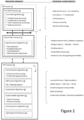
- Figure 2 depicts the processer hierarchy and characteristics in greater detail.
- the first DSP processor 20 and second DSP processor 22 share a common bus 21 such that they both have access to the GP processor 24, microphone system 28, audio streams, etc.
- the first DSP processor 20 includes a set of core ANR algorithms 50 that process an inputted audio stream 32 ( Figure 1 ), including for example, feedback loop processing, compensator processing, feed forward loop processing, and audio equalization.
- the core ANR algorithms 50 may include operational ANR parameters that, for example, dictate filter coefficients, compressor settings, signal mixers, gain terms, signal routing options, etc.
- Core ANR algorithms 50 can generally be characterized as processes that are stream processing oriented and require a high level of processor performance but relatively low complexity.
- the functions performed by the core ANR algorithms 50 are intended to operate extremely quickly with a minimal amount of processing options and storage requirements. For these types of stream processing functions, very low latency is required, e.g., on the order of 1-10 microseconds.
- the first DSP processor 20 provides the core ANR functionality, the first DSP processor 20 must be continuously powered on so long as the ANR device 10 is operational.
- the first DSP processor 20, consequently, is tailored to implement calculations for ANR algorithms 50 using as little power as possible.
- the second DSP processor 22 includes a set of signal analytics algorithms 52 that do not directly provide ANR processing, but instead analyze signals and generate state data that, e.g., characterize signals within the ANR device 10 and ANR processing being performed by the first DSP processor 20.
- the state data may include, for example, fault information, instability detection, performance characteristics, error conditions, frequency domain overload conditions, sound pressure level (SPL) information etc.
- the signal analytics algorithms 52 perform different types of analysis that may employ threshold values and rules. For instance, if a series of frequency characteristics deviate from an expected range, a fault can be triggered causing a corresponding "event" to be outputted to the GP processor 24, which can then take corrective action.
- Non-limiting illustrative signal analytics algorithms 52 are described, for example, in: US Patent No. 10,244,306 issued on March 26, 2019 , entitled, "Real-time detection of feedback instability” (e.g., describing instability detection); US Pub. Nos.: 2018/0286374 , entitled, "Parallel Compensation in Active Noise Reduction Devices”; 2018/0286373 , entitled, “Dynamic Compensation in Active Noise Reduction Devices”; 2018/0286375 , entitled Automatic Gain Control in Active Noise Reduction (ANR) Signal Flow Path” (e.g., describing overload conditions); and US Pub. No. 2019/0130928 , entitled, “Compressive Hear-through in Personal Acoustic Devices” (e.g., describing control of ANR to produce maximum loudness at the ear).
- the second DSP processor 22 can also directly alter the operational (i.e., ANR) parameters of the first DSP processor 20.
- the signal analytics algorithms 52 are deployed to automatically adjust ANR parameters (i.e., within core ANR algorithms 50) to achieve a desired experience based upon internal signals captured from algorithms 50, 52, from GP processor 24, from any of the microphones 28, from the input audio stream 32, and/or from control signals 40.
- ANR parameters are adjusted using external signals monitored by algorithms 52 such as external sound pressure level (SPL) characteristics received by the microphone(s) 28.
- SPL external sound pressure level
- the second DSP processor 22 does not directly implement core ANR services, a relatively lesser amount of performance is required, however a relatively greater amount of computational complexity is provided. For example, in particular cases, tasks performed by the second DSP processor 22 may tolerate a greater amount of latency on the order of, e.g., 100 microseconds to 10 milliseconds. Similar to the first DSP processor 20, the second DSP processor is also continuously powered when device 10 is operational. In certain implementations, the second DSP processor 22 is configured to perform both stream and block processing, and includes a moderate amount of data storage and programmability to perform analysis tasks in an effective manner.
- GP processor 24 includes a set of high level functions 54 that are one level further removed from the ANR processing performed by the first DSP processor 20.
- the specific functions 54 implemented by the GP processor 24 can depend on the requirements of the ANR device 10.
- a set of illustrative functions are shown in Figure 2 .
- communication algorithms 56 handle I/O and command processing functions.
- the communications algorithms 56 include a unified messaging interface for converting different communication protocols (e.g., USB versus Bluetooth) into a common protocol.
- the unified messaging interface allows code for interpreting commands to be stored and implemented in a single location (i.e., the GP processor 24), and thus allows all commands to be routed to the GP processor 24 for handling.
- GP processor 24 is generally tasked with handling larger and more complicated calculations. In some implementations, GP processor 24 calculates "one-time" filter coefficients that are customized to an individual user based on how the product fits on his or her head. In particular implementations, user experience algorithms 64 analyze user fit based, e.g., on control signals 40 and feedback 42, and communication algorithms 56 inform the user to adjust the fit of the device 10 in response to a fitting algorithm.
- the GP processor 24 further includes ANR control algorithms 58 that update operational parameters for the first DSP processor 20 in response to events received from the DSP system 14, or in response to control signals 40 received from the gateway device 30 ( Figure 1 ).
- control algorithms 58 implement CNC (controllable noise cancellation) features, etc.
- GP processor 24 may receive "events" from the second DSP processor 22, e.g., indicating instability or some other issue, e.g., detected using the techniques described in US Patent No. 10,244,306 . If immediate changes are required to mitigate instability based on one or more received events, the second DSP processor 22 would typically be responsible for altering ANR parameters in the first DSP processor 20. Regardless as to whether immediate alterations are required, the GP processor 24 can record events are they are generated in local memory and report the event(s) out via the Bluetooth system 12 ( Figure 1 ).
- GP processor 24 can utilize one or more of its algorithms to identify and/or address conditions. For example, if multiple instability events are detected, then system health algorithms 62 are deployed to determine if a more severe issue exists (e.g., a malfunction in the ANR device 10). In the case that a malfunction is identified, the system health algorithm 62 is configured to characterize the malfunction, and based on the nature of the malfunction, system heath algorithm 62 directly initiates ANR parameter changes on the DSP processor 20. In other cases, system health algorithms 62 take other actions such as analyze event data, report the analysis to the gateway device 30, apply machine learning to determine the cause of the malfunction, etc. As noted, damage conditions of the ANR device 10 are reported back to the gateway device 30 to inform the device user (or another user) that the ANR device 10 is malfunctioning.
- system health algorithms 62 are deployed to determine if a more severe issue exists (e.g., a malfunction in the ANR device 10). In the case that a malfunction is identified, the system health algorithm 62 is configured to characterize the
- coordination algorithms 60 are deployed to coordinate performance between a pair of earphones (e.g., earbuds, over-ear audio devices, etc.). For example, in response to detecting that a first earphone is operating at a low ANR performance level (e.g., due to a detected fault), the coordination algorithm 60 cause the second earphone to match the ANR performance level of the first earphone to avoid a performance mismatch and ensure a better user experience.
- user experience algorithms 64 are deployed to provide user controls such as volume, equalization, etc., and implement different operating modes such as telephony, music listening, etc.
- User experience algorithms 64 can be implemented to analyze sensor data to automatically control the ANR device 10 (e.g., provide special settings when on an airplane), collect and provide feedback that can be analyzed remotely, etc.
- the algorithms 64 respond to state data that the ANR device 10 is poorly fit (e.g., a proper seal with the user's ear canal is not detected) and output a warning (e.g., to the device user or another user).
- GP processor 24 is configured to implement machine learning models or event classifiers. In some examples, the GP processor 24 is configured to apply machine learning to state data received from the second DSP processor 22. In more particular examples, the GP processor 24 is configured to apply machine learning to state data received from the second DSP processor 22 and to time-based signals such as blocks of raw audio data. In some cases, the time-based signals (which can include raw, or unprocessed audio data) are received via microphone system 28 and/or Bluetooth system 12 (e.g., as an audio stream 32). Illustrative machine learning techniques involving signal processing are described in US Application No. 16/425,550, filed May 29, 2019 , titled “Automatic Active Noise Reduction (ANR) Control" and US App. No. 16/690,675, filed November 21, 2019 , titled “Active Transit Vehicle Classification”.
- ANR Automatic Active Noise Reduction
- a lightweight operating system (OS) and/or functional libraries 66 can be implemented that: allows algorithms and routines to be easily accessed, added and removed; allows software updates to be performed; provides access to storage; provides use of higher level scripts and/or programming languages, etc.
- OS operating system
- functional libraries 66 can be implemented that: allows algorithms and routines to be easily accessed, added and removed; allows software updates to be performed; provides access to storage; provides use of higher level scripts and/or programming languages, etc.
- the GP processor 24 does not perform any time-critical signal processing services, the GP processor 24 is implemented with relatively low performance, but requires a relatively high amount of computational complexity in order to provide a wide assortment of functionality. Latency can be relatively high, e.g., on the order of 100 milliseconds to 10 seconds, when performing functions. Furthermore, because its functionality is not always required, GP processor 24 is configured to be placed into a lower power mode or sleep mode when not needed (e.g., when no events are detected or require analysis). The sleep mode is configured to be woken by at least one of the first DSP processor 20, second DSP processor 22 and/or control signals received from one of the communications interfaces. Generally, GP processor 24 need not handle any stream processing, but rather processes data as blocks using standard memory configurations. Data storage can be implemented, e.g., using internal storage and/or flash drives as needed.
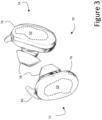
- FIG 3 is a schematic depiction of an illustrative wearable audio device 70 that includes the ANR device 10 of Figure 1 .
- the wearable audio device 70 is an audio headset that includes two earphones (for example, in-ear headphones, also called "earbuds") 72, 74.
- the audio headset 70 includes a tethered wireless configuration (whereby the earphones 72, 74 are connected via wire with a wireless connection to a playback device) or a wired configuration (whereby at least one of the earphones 72, 74 has a wired connection to a playback device).
- Each earphone 72, 74 is shown including a body 76, which can include a casing formed of one or more plastics or composite materials.
- the body 76 can include a nozzle 78 for insertion into a user's ear canal entrance and a support member 80 for retaining the nozzle 78 in a resting position within the user's ear.
- Each earphone 72, 74 includes an ANR device 10 for implementing some or all of the various functions described herein. Other wearable device forms could likewise be implemented with the ANR device 10, including around-the-ear headphones, audio eyeglasses, open-ear audio devices etc.
- ANR device 10 may be implemented as hardware and/or software, and the various components may include communications pathways that connect components by any conventional means (e.g., hard-wired and/or wireless connection).
- non-volatile devices e.g., centralized or distributed devices such as flash memory device(s)
- the functionality described herein, or portions thereof, and its various modifications can be implemented, at least in part, via a computer program product, e.g., a computer program tangibly embodied in an information carrier, such as one or more non-transitory machine-readable media, for execution by, or to control the operation of, one or more data processing apparatus, e.g., a programmable processor, a computer, multiple computers, and/or programmable logic components.
- a computer program product e.g., a computer program tangibly embodied in an information carrier, such as one or more non-transitory machine-readable media, for execution by, or to control the operation of, one or more data processing apparatus, e.g., a programmable processor, a computer, multiple computers, and/or programmable logic components.
- a computer program can be written in any form of programming language, including compiled or interpreted languages, and it can be deployed in any form, including as a stand-alone program or as a module, component, subroutine, or other unit suitable for use in a computing environment.
- a computer program can be deployed to be executed on one computer or on multiple computers at one site or distributed across multiple sites and interconnected by a network.
- Actions associated with implementing all or part of the functions can be performed by one or more programmable processors executing one or more computer programs to perform the functions. All or part of the functions can be implemented as, special purpose logic circuitry, e.g., an FPGA (field programmable gate array) and/or an ASIC (application-specific integrated circuit).
- processors suitable for the execution of a computer program include, by way of example, both general and special purpose microprocessors, and any one or more processors of any kind of digital computer.
- a processor may receive instructions and data from a read-only memory or a random access memory or both.
- Components of a computer include a processor for executing instructions and one or more memory devices for storing instructions and data.
- Networked computing devices can be connected over a network, e.g., one or more wired and/or wireless networks such as a local area network (LAN), wide area network (WAN), personal area network (PAN), Internet-connected devices and/or networks and/or a cloud-based computing (e.g., cloud-based servers).
- LAN local area network
- WAN wide area network
- PAN personal area network
- cloud-based computing e.g., cloud-based servers
- electronic components described as being "coupled” can be linked via conventional hard-wired and/or wireless means such that these electronic components can communicate data with one another. Additionally, sub-components within a given component can be considered to be linked via conventional pathways, which may not necessarily be illustrated.
Landscapes
- Engineering & Computer Science (AREA)
- Physics & Mathematics (AREA)
- Acoustics & Sound (AREA)
- Multimedia (AREA)
- Theoretical Computer Science (AREA)
- Software Systems (AREA)
- Medical Informatics (AREA)
- Evolutionary Computation (AREA)
- Data Mining & Analysis (AREA)
- Computer Vision & Pattern Recognition (AREA)
- Computing Systems (AREA)
- General Engineering & Computer Science (AREA)
- General Physics & Mathematics (AREA)
- Mathematical Physics (AREA)
- Artificial Intelligence (AREA)
- Signal Processing (AREA)
- Circuit For Audible Band Transducer (AREA)
- Soundproofing, Sound Blocking, And Sound Damping (AREA)
- Headphones And Earphones (AREA)
Claims (12)
- Persönliche Vorrichtung mit aktiver Geräuschunterdrückung, ANR, umfassend:eine Kommunikationsschnittstelle, die so konfiguriert ist, dass sie einen Quellaudiostrom und Steuersignale empfängt;einen Treiber;ein Mikrofonsystem; undeine ANR-Berechnungsarchitektur, umfassend:einen ersten DSP-Prozessor (20), der so konfiguriert ist, dass er: den Quellaudiostrom und die Signale vom Mikrofonsystem empfängt, ANR am Quellaudiostrom gemäß einem Satz Betriebsparameter, die im ersten DSP-Prozessor eingesetzt werden, durchführt und einen verarbeiteten Audiostrom an den Treiber ausgibt;einen zweiten DSP-Prozessor (22), der so konfiguriert ist, dass er: in Reaktion auf eine Analyse mindestens eines des Quellaudiostroms, der Signale vom Mikrofonsystem und des verarbeiteten Audiostroms Statusdaten erzeugt; und den Satz Betriebsparameter auf dem ersten DSP-Prozessor abändert;einen Universalprozessor (24), der betriebsmäßig mit dem ersten DSP-Prozessor und dem zweiten DSP-Prozessor gekoppelt ist;wobei sich der erste DSP-Prozessor und der zweite DSP-Prozessor einen gemeinsamen Bus (21) teilen,wobei der zweite DSP-Prozessor im Vergleich zum ersten DSP-Prozessor so konfiguriert ist, dass er hinsichtlich Latenz eine relativ kleinere Menge an Leistung, aber eine relativ größere Menge an Rechenkomplexität bereitstellt,wobei die persönliche ANR-Vorrichtung dadurch gekennzeichnet ist, dass:der Universalprozessor (24) so konfiguriert ist, dass er: Steuersignale mit der Kommunikationsschnittstelle kommuniziert, Statusdaten vom zweiten DSP-Prozessor verarbeitet und den Satz Betriebsparameter auf dem ersten DSP-Prozessor abändert; undwobei sich der erste DSP-Prozessor und der zweite DSP-Prozessor den gemeinsamen Bus (21) teilen, mit dem sie beide Zugriff auf den Universalprozessor, das Mikrofonsystem und die Audioströme haben, undwobei der Universalprozessor im Vergleich zum ersten und dem zweiten DSP-Prozessor hinsichtlich Latenz mit einer relativ niedrigen Leistung, aber einer relativ hohen Menge an Rechenkomplexität konfiguriert ist.
- Persönliche ANR-Vorrichtung nach Anspruch 1, wobei die Betriebsparameter ausgewählt sind aus einer Gruppe, bestehend aus: Filterkoeffizienten, Kompressoreinstellungen, Signalmischern, Verstärkungstermen und Signalrouting-Optionen.
- Persönliche ANR-Vorrichtung nach Anspruch 1, wobei die vom zweiten DSP-Prozessor erzeugten Statusdaten Fehlerzustände beinhalten, die im verarbeiteten Audiostrom erkannt werden.
- Persönliche ANR-Vorrichtung nach Anspruch 1, wobei die vom zweiten DSP-Prozessor erzeugten Statusdaten Frequenzbereichsüberlastzustände beinhalten, die im verarbeiteten Audiostrom erkannt werden.
- Persönliche ANR-Vorrichtung nach Anspruch 1, wobei die Betriebsparameter Filterkoeffizienten beinhalten und der Universalprozessor weiter so konfiguriert ist, dass er aktualisierte Filterkoeffizienten berechnet und auf dem ersten DSP-Prozessor installiert.
- Persönliche ANR-Vorrichtung nach Anspruch 1, wobei der Universalprozessor weiter so konfiguriert ist, dass er: die Statusdaten auswertet, um einen Schadenszustand bei der persönlichen ANR zu identifizieren und den Schadenszustand über die Kommunikationsschnittstelle an eine externe Vorrichtung zu kommunizieren.
- Persönliche ANR-Vorrichtung nach Anspruch 1, wobei der Universalprozessor weiter so konfiguriert ist, dass er Einmalfilterkoeffizienten berechnet, die auf einen einzelnen Benutzer auf Basis dessen, wie die Vorrichtung auf seinen Kopf passt, individualisiert sind.
- Persönliche ANR-Vorrichtung nach Anspruch 1, wobei der Universalprozessor weiter so konfiguriert ist, dass er Ereignisse , die auf Instabilität oder ein anderes Problem hinweisen, vom zweiten DSP-Prozessor empfängt und nach dem Sammeln einer Reihe von Ereignissen, um eine Fehlfunktion in der Vorrichtung zu identifizieren, und unter Verwendung eines Systemgesundheitsalgorithmus (62) und auf Basis der Art der Fehlfunktion ANR-Parameteränderungen am ersten DSP-Prozessor initiiert.
- Persönliche ANR-Vorrichtung nach Anspruch 1, wobei der Universalprozessor weiter so konfiguriert ist, dass er unter Verwendung von Koordinationsalgorithmen (60) die ANR-Leistung zwischen einem Kopfhörerpaar koordiniert.
- Persönliche ANR-Vorrichtung nach Anspruch 1, wobei der Universalprozessor einen Ruhemodus umfasst, um Strom zu sparen, wobei der Ruhemodus so konfiguriert ist, dass er von mindestens einem des ersten DSP-Prozessors, des zweiten DSP-Prozessors und der Kommunikationsschnittstelle geweckt wird.
- Persönliche ANR-Vorrichtung nach Anspruch 1, wobei der Universalprozessor weiter so konfiguriert ist, dass er unter Verwendung von Benutzererfahrungsalgorithmen (64) Sensordaten analysiert, um die persönliche ANR-Vorrichtung 10 automatisch zu steuern, Feedback zu sammeln und bereitzustellen, das aus der Ferne analysiert werden kann.
- Persönliche ANR-Vorrichtung nach Anspruch 1, wobei der erste DSP-Prozessor eine niedrige Latenz zwischen 1 und 10 µs aufweist, der zweite DSP-Prozessor eine mittlere Latenz zwischen 100 µs und 10 ms aufweist und der Universalprozessor eine höhere Latenz zwischen 100 ms und 10 s aufweist.
Priority Applications (1)
| Application Number | Priority Date | Filing Date | Title |
|---|---|---|---|
| EP25170775.8A EP4568277A3 (de) | 2020-02-12 | 2021-02-10 | Aktive geräuschreduzierung |
Applications Claiming Priority (2)
| Application Number | Priority Date | Filing Date | Title |
|---|---|---|---|
| US16/788,365 US11386882B2 (en) | 2020-02-12 | 2020-02-12 | Computational architecture for active noise reduction device |
| PCT/US2021/017387 WO2021163137A1 (en) | 2020-02-12 | 2021-02-10 | Computational architecture for active noise reduction device |
Related Child Applications (2)
| Application Number | Title | Priority Date | Filing Date |
|---|---|---|---|
| EP25170775.8A Division EP4568277A3 (de) | 2020-02-12 | 2021-02-10 | Aktive geräuschreduzierung |
| EP25170775.8A Division-Into EP4568277A3 (de) | 2020-02-12 | 2021-02-10 | Aktive geräuschreduzierung |
Publications (2)
| Publication Number | Publication Date |
|---|---|
| EP4104166A1 EP4104166A1 (de) | 2022-12-21 |
| EP4104166B1 true EP4104166B1 (de) | 2025-06-11 |
Family
ID=75439438
Family Applications (2)
| Application Number | Title | Priority Date | Filing Date |
|---|---|---|---|
| EP21717590.0A Active EP4104166B1 (de) | 2020-02-12 | 2021-02-10 | Berechnungsarchitektur für eine aktive geräuschreduzierungsvorrichtung |
| EP25170775.8A Pending EP4568277A3 (de) | 2020-02-12 | 2021-02-10 | Aktive geräuschreduzierung |
Family Applications After (1)
| Application Number | Title | Priority Date | Filing Date |
|---|---|---|---|
| EP25170775.8A Pending EP4568277A3 (de) | 2020-02-12 | 2021-02-10 | Aktive geräuschreduzierung |
Country Status (5)
| Country | Link |
|---|---|
| US (4) | US11386882B2 (de) |
| EP (2) | EP4104166B1 (de) |
| JP (3) | JP7562685B2 (de) |
| CN (2) | CN121438795A (de) |
| WO (1) | WO2021163137A1 (de) |
Family Cites Families (44)
| Publication number | Priority date | Publication date | Assignee | Title |
|---|---|---|---|---|
| JPH08170383A (ja) * | 1994-12-16 | 1996-07-02 | Matsushita Electric Ind Co Ltd | 建築遮音部材 |
| JPH09230874A (ja) * | 1996-02-22 | 1997-09-05 | Fujitsu Ltd | 能動的騒音/振動制御システム |
| JPH10247088A (ja) * | 1997-03-06 | 1998-09-14 | Oki Electric Ind Co Ltd | 適応型能動騒音制御装置 |
| US6073150A (en) | 1997-06-23 | 2000-06-06 | Sun Microsystems, Inc. | Apparatus for directing a parallel processing computing device to form an absolute value of a signed value |
| JP4137401B2 (ja) * | 2001-04-16 | 2008-08-20 | ティーオーエー株式会社 | 能動型雑音除去装置 |
| US6717537B1 (en) | 2001-06-26 | 2004-04-06 | Sonic Innovations, Inc. | Method and apparatus for minimizing latency in digital signal processing systems |
| CA2452945C (en) * | 2003-09-23 | 2016-05-10 | Mcmaster University | Binaural adaptive hearing system |
| EP2030420A4 (de) * | 2005-03-28 | 2009-06-03 | Sound Id | Persönliches sound-system |
| JP4572945B2 (ja) * | 2008-03-28 | 2010-11-04 | ソニー株式会社 | ヘッドフォン装置、信号処理装置、信号処理方法 |
| KR100935769B1 (ko) | 2008-05-02 | 2010-01-06 | 소리젠 주식회사 | 피드백 제어를 갖는 주파수 특성 보상형 능동형 소음 제어장치 및 방법 |
| EP2216774B1 (de) | 2009-01-30 | 2015-09-16 | Harman Becker Automotive Systems GmbH | Adaptives Geräuschdämpfungssystem und entsprechendes Verfahren |
| JP5651923B2 (ja) * | 2009-04-07 | 2015-01-14 | ソニー株式会社 | 信号処理装置及び信号処理方法 |
| US8144890B2 (en) | 2009-04-28 | 2012-03-27 | Bose Corporation | ANR settings boot loading |
| US8532310B2 (en) | 2010-03-30 | 2013-09-10 | Bose Corporation | Frequency-dependent ANR reference sound compression |
| US8280066B2 (en) | 2009-04-28 | 2012-10-02 | Bose Corporation | Binaural feedforward-based ANR |
| US8165313B2 (en) | 2009-04-28 | 2012-04-24 | Bose Corporation | ANR settings triple-buffering |
| EP2574078B1 (de) * | 2009-04-28 | 2018-01-24 | Bose Corporation | Dynamisch konfigurierbarer Aktiv-Geräuschreduzierung-Schaltkreis und persönliches Gerät mit diesem Aktiv-Geräuschreduzierung-Schaltkreis |
| US8073150B2 (en) | 2009-04-28 | 2011-12-06 | Bose Corporation | Dynamically configurable ANR signal processing topology |
| US8184822B2 (en) | 2009-04-28 | 2012-05-22 | Bose Corporation | ANR signal processing topology |
| US8073151B2 (en) | 2009-04-28 | 2011-12-06 | Bose Corporation | Dynamically configurable ANR filter block topology |
| US9368096B2 (en) | 2011-12-20 | 2016-06-14 | Texas Instruments Incorporated | Method and system for active noise cancellation according to a type of noise |
| GB201205275D0 (en) * | 2012-03-26 | 2012-05-09 | Soundchip Sa | Media/communications system |
| US9886968B2 (en) * | 2013-03-04 | 2018-02-06 | Synaptics Incorporated | Robust speech boundary detection system and method |
| US9881601B2 (en) * | 2013-06-11 | 2018-01-30 | Bose Corporation | Controlling stability in ANR devices |
| JP2015173369A (ja) | 2014-03-12 | 2015-10-01 | ソニー株式会社 | 信号処理装置、信号処理方法、およびプログラム |
| JP2017530413A (ja) * | 2014-09-30 | 2017-10-12 | アバネラ コーポレイションAvnera Corporation | 低レイテンシを有する音響処理装置 |
| WO2016061283A1 (en) * | 2014-10-14 | 2016-04-21 | Skytree, Inc. | Configurable machine learning method selection and parameter optimization system and method |
| MX370825B (es) * | 2014-12-23 | 2020-01-08 | Degraye Timothy | Método y sistema para compartir audio. |
| US9788114B2 (en) * | 2015-03-23 | 2017-10-10 | Bose Corporation | Acoustic device for streaming audio data |
| US9945728B2 (en) | 2015-04-03 | 2018-04-17 | Raytheon Bbn Technologies Corp. | Graphene-based infrared single photon detector |
| WO2017038260A1 (ja) * | 2015-08-28 | 2017-03-09 | ソニー株式会社 | 情報処理装置、情報処理方法、およびプログラム |
| JP6795613B2 (ja) | 2016-04-06 | 2020-12-02 | エーバーシュペッヒャー・エグゾースト・テクノロジー・ゲーエムベーハー・ウント・コンパニー・カーゲー | 音に能動的に影響を与えるためのシステムおよび方法 |
| US10757503B2 (en) * | 2016-09-01 | 2020-08-25 | Audeze, Llc | Active noise control with planar transducers |
| US10121094B2 (en) | 2016-12-09 | 2018-11-06 | International Business Machines Corporation | Signal classification using sparse representation |
| US9894452B1 (en) * | 2017-02-24 | 2018-02-13 | Bose Corporation | Off-head detection of in-ear headset |
| US10283103B2 (en) | 2017-03-09 | 2019-05-07 | Avnera Corporation | Real-time acoustic processor |
| JP6928865B2 (ja) * | 2017-03-16 | 2021-09-01 | パナソニックIpマネジメント株式会社 | 能動型騒音低減装置及び能動型騒音低減方法 |
| US10553195B2 (en) | 2017-03-30 | 2020-02-04 | Bose Corporation | Dynamic compensation in active noise reduction devices |
| US10580398B2 (en) | 2017-03-30 | 2020-03-03 | Bose Corporation | Parallel compensation in active noise reduction devices |
| US10614790B2 (en) | 2017-03-30 | 2020-04-07 | Bose Corporation | Automatic gain control in an active noise reduction (ANR) signal flow path |
| US10573333B2 (en) * | 2017-10-26 | 2020-02-25 | Hand Held Products, Inc. | Real time device customization apparatus and methods of performing the same |
| US11087776B2 (en) | 2017-10-30 | 2021-08-10 | Bose Corporation | Compressive hear-through in personal acoustic devices |
| US10244306B1 (en) | 2018-05-24 | 2019-03-26 | Bose Corporation | Real-time detection of feedback instability |
| US11151043B2 (en) * | 2019-08-12 | 2021-10-19 | Micron Technology, Inc. | Demand delay and data value correlated memory pre-fetching systems and methods |
-
2020
- 2020-02-12 US US16/788,365 patent/US11386882B2/en active Active
-
2021
- 2021-02-10 CN CN202511526852.9A patent/CN121438795A/zh active Pending
- 2021-02-10 EP EP21717590.0A patent/EP4104166B1/de active Active
- 2021-02-10 WO PCT/US2021/017387 patent/WO2021163137A1/en not_active Ceased
- 2021-02-10 JP JP2022548768A patent/JP7562685B2/ja active Active
- 2021-02-10 EP EP25170775.8A patent/EP4568277A3/de active Pending
- 2021-02-10 CN CN202180014361.XA patent/CN115104150B/zh active Active
-
2022
- 2022-06-09 US US17/836,423 patent/US11763794B2/en active Active
-
2023
- 2023-08-17 US US18/451,457 patent/US12148413B2/en active Active
-
2024
- 2024-07-31 JP JP2024124926A patent/JP7680611B2/ja active Active
- 2024-10-16 US US18/917,266 patent/US20250037699A1/en active Pending
-
2025
- 2025-05-02 JP JP2025076927A patent/JP2025118778A/ja active Pending
Also Published As
| Publication number | Publication date |
|---|---|
| US20210248991A1 (en) | 2021-08-12 |
| JP2023514217A (ja) | 2023-04-05 |
| JP7562685B2 (ja) | 2024-10-07 |
| US20250037699A1 (en) | 2025-01-30 |
| US11386882B2 (en) | 2022-07-12 |
| EP4104166A1 (de) | 2022-12-21 |
| JP7680611B2 (ja) | 2025-05-20 |
| CN115104150B (zh) | 2025-11-07 |
| CN121438795A (zh) | 2026-01-30 |
| WO2021163137A1 (en) | 2021-08-19 |
| JP2025118778A (ja) | 2025-08-13 |
| EP4568277A3 (de) | 2025-08-20 |
| US20230395057A1 (en) | 2023-12-07 |
| JP2024167206A (ja) | 2024-12-03 |
| US20220301540A1 (en) | 2022-09-22 |
| CN115104150A (zh) | 2022-09-23 |
| US11763794B2 (en) | 2023-09-19 |
| US12148413B2 (en) | 2024-11-19 |
| EP4568277A2 (de) | 2025-06-11 |
Similar Documents
| Publication | Publication Date | Title |
|---|---|---|
| US11438711B2 (en) | Hearing assist device employing dynamic processing of voice signals | |
| US10075783B2 (en) | Acoustically summed reference microphone for active noise control | |
| EP3400720B1 (de) | Binaurales hörhilfesystem | |
| US11553286B2 (en) | Wearable hearing assist device with artifact remediation | |
| EP3977753B1 (de) | Dynamische steuerung von mehreren vorwärtsgekoppelten mikrofonen in aktiven geräuschverminderungsvorrichtungen | |
| JP2020534574A (ja) | 音響デバイスの並列能動騒音低減(anr)及びヒアスルー信号伝達経路 | |
| EP4118648B1 (de) | Audioverarbeitung unter verwendung eines verteilten maschinenlernmodells | |
| EP4104166B1 (de) | Berechnungsarchitektur für eine aktive geräuschreduzierungsvorrichtung | |
| US20230178063A1 (en) | Audio device having aware mode auto-leveler | |
| US12520078B2 (en) | Wearable audio devices with enhanced voice pickup | |
| US20250349279A1 (en) | Audio device having aware mode auto-leveler | |
| US20250088793A1 (en) | Wearable audio devices with enhanced voice pickup |
Legal Events
| Date | Code | Title | Description |
|---|---|---|---|
| STAA | Information on the status of an ep patent application or granted ep patent |
Free format text: STATUS: UNKNOWN |
|
| STAA | Information on the status of an ep patent application or granted ep patent |
Free format text: STATUS: THE INTERNATIONAL PUBLICATION HAS BEEN MADE |
|
| PUAI | Public reference made under article 153(3) epc to a published international application that has entered the european phase |
Free format text: ORIGINAL CODE: 0009012 |
|
| STAA | Information on the status of an ep patent application or granted ep patent |
Free format text: STATUS: REQUEST FOR EXAMINATION WAS MADE |
|
| 17P | Request for examination filed |
Effective date: 20220728 |
|
| AK | Designated contracting states |
Kind code of ref document: A1 Designated state(s): AL AT BE BG CH CY CZ DE DK EE ES FI FR GB GR HR HU IE IS IT LI LT LU LV MC MK MT NL NO PL PT RO RS SE SI SK SM TR |
|
| DAV | Request for validation of the european patent (deleted) | ||
| DAX | Request for extension of the european patent (deleted) | ||
| STAA | Information on the status of an ep patent application or granted ep patent |
Free format text: STATUS: EXAMINATION IS IN PROGRESS |
|
| 17Q | First examination report despatched |
Effective date: 20240306 |
|
| GRAP | Despatch of communication of intention to grant a patent |
Free format text: ORIGINAL CODE: EPIDOSNIGR1 |
|
| STAA | Information on the status of an ep patent application or granted ep patent |
Free format text: STATUS: GRANT OF PATENT IS INTENDED |
|
| INTG | Intention to grant announced |
Effective date: 20250311 |
|
| GRAS | Grant fee paid |
Free format text: ORIGINAL CODE: EPIDOSNIGR3 |
|
| GRAA | (expected) grant |
Free format text: ORIGINAL CODE: 0009210 |
|
| STAA | Information on the status of an ep patent application or granted ep patent |
Free format text: STATUS: THE PATENT HAS BEEN GRANTED |
|
| AK | Designated contracting states |
Kind code of ref document: B1 Designated state(s): AL AT BE BG CH CY CZ DE DK EE ES FI FR GB GR HR HU IE IS IT LI LT LU LV MC MK MT NL NO PL PT RO RS SE SI SK SM TR |
|
| REG | Reference to a national code |
Ref country code: GB Ref legal event code: FG4D |
|
| REG | Reference to a national code |
Ref country code: CH Ref legal event code: EP |
|
| REG | Reference to a national code |
Ref country code: DE Ref legal event code: R096 Ref document number: 602021032110 Country of ref document: DE |
|
| REG | Reference to a national code |
Ref country code: IE Ref legal event code: FG4D |
|
| PG25 | Lapsed in a contracting state [announced via postgrant information from national office to epo] |
Ref country code: FI Free format text: LAPSE BECAUSE OF FAILURE TO SUBMIT A TRANSLATION OF THE DESCRIPTION OR TO PAY THE FEE WITHIN THE PRESCRIBED TIME-LIMIT Effective date: 20250611 Ref country code: ES Free format text: LAPSE BECAUSE OF FAILURE TO SUBMIT A TRANSLATION OF THE DESCRIPTION OR TO PAY THE FEE WITHIN THE PRESCRIBED TIME-LIMIT Effective date: 20250611 |
|
| REG | Reference to a national code |
Ref country code: LT Ref legal event code: MG9D |
|
| PG25 | Lapsed in a contracting state [announced via postgrant information from national office to epo] |
Ref country code: NO Free format text: LAPSE BECAUSE OF FAILURE TO SUBMIT A TRANSLATION OF THE DESCRIPTION OR TO PAY THE FEE WITHIN THE PRESCRIBED TIME-LIMIT Effective date: 20250911 Ref country code: GR Free format text: LAPSE BECAUSE OF FAILURE TO SUBMIT A TRANSLATION OF THE DESCRIPTION OR TO PAY THE FEE WITHIN THE PRESCRIBED TIME-LIMIT Effective date: 20250912 |
|
| REG | Reference to a national code |
Ref country code: NL Ref legal event code: MP Effective date: 20250611 |
|
| PG25 | Lapsed in a contracting state [announced via postgrant information from national office to epo] |
Ref country code: BG Free format text: LAPSE BECAUSE OF FAILURE TO SUBMIT A TRANSLATION OF THE DESCRIPTION OR TO PAY THE FEE WITHIN THE PRESCRIBED TIME-LIMIT Effective date: 20250611 |
|
| PG25 | Lapsed in a contracting state [announced via postgrant information from national office to epo] |
Ref country code: HR Free format text: LAPSE BECAUSE OF FAILURE TO SUBMIT A TRANSLATION OF THE DESCRIPTION OR TO PAY THE FEE WITHIN THE PRESCRIBED TIME-LIMIT Effective date: 20250611 |
|
| PG25 | Lapsed in a contracting state [announced via postgrant information from national office to epo] |
Ref country code: RS Free format text: LAPSE BECAUSE OF FAILURE TO SUBMIT A TRANSLATION OF THE DESCRIPTION OR TO PAY THE FEE WITHIN THE PRESCRIBED TIME-LIMIT Effective date: 20250911 |
|
| PG25 | Lapsed in a contracting state [announced via postgrant information from national office to epo] |
Ref country code: LV Free format text: LAPSE BECAUSE OF FAILURE TO SUBMIT A TRANSLATION OF THE DESCRIPTION OR TO PAY THE FEE WITHIN THE PRESCRIBED TIME-LIMIT Effective date: 20250611 |
|
| PG25 | Lapsed in a contracting state [announced via postgrant information from national office to epo] |
Ref country code: NL Free format text: LAPSE BECAUSE OF FAILURE TO SUBMIT A TRANSLATION OF THE DESCRIPTION OR TO PAY THE FEE WITHIN THE PRESCRIBED TIME-LIMIT Effective date: 20250611 |
|
| PG25 | Lapsed in a contracting state [announced via postgrant information from national office to epo] |
Ref country code: PT Free format text: LAPSE BECAUSE OF FAILURE TO SUBMIT A TRANSLATION OF THE DESCRIPTION OR TO PAY THE FEE WITHIN THE PRESCRIBED TIME-LIMIT Effective date: 20251013 |
|
| REG | Reference to a national code |
Ref country code: AT Ref legal event code: MK05 Ref document number: 1802916 Country of ref document: AT Kind code of ref document: T Effective date: 20250611 |
|
| PG25 | Lapsed in a contracting state [announced via postgrant information from national office to epo] |
Ref country code: IS Free format text: LAPSE BECAUSE OF FAILURE TO SUBMIT A TRANSLATION OF THE DESCRIPTION OR TO PAY THE FEE WITHIN THE PRESCRIBED TIME-LIMIT Effective date: 20251011 |
|
| PG25 | Lapsed in a contracting state [announced via postgrant information from national office to epo] |
Ref country code: AT Free format text: LAPSE BECAUSE OF FAILURE TO SUBMIT A TRANSLATION OF THE DESCRIPTION OR TO PAY THE FEE WITHIN THE PRESCRIBED TIME-LIMIT Effective date: 20250611 Ref country code: SM Free format text: LAPSE BECAUSE OF FAILURE TO SUBMIT A TRANSLATION OF THE DESCRIPTION OR TO PAY THE FEE WITHIN THE PRESCRIBED TIME-LIMIT Effective date: 20250611 |
|
| PG25 | Lapsed in a contracting state [announced via postgrant information from national office to epo] |
Ref country code: CZ Free format text: LAPSE BECAUSE OF FAILURE TO SUBMIT A TRANSLATION OF THE DESCRIPTION OR TO PAY THE FEE WITHIN THE PRESCRIBED TIME-LIMIT Effective date: 20250611 |
|
| PG25 | Lapsed in a contracting state [announced via postgrant information from national office to epo] |
Ref country code: PL Free format text: LAPSE BECAUSE OF FAILURE TO SUBMIT A TRANSLATION OF THE DESCRIPTION OR TO PAY THE FEE WITHIN THE PRESCRIBED TIME-LIMIT Effective date: 20250611 |
|
| PG25 | Lapsed in a contracting state [announced via postgrant information from national office to epo] |
Ref country code: EE Free format text: LAPSE BECAUSE OF FAILURE TO SUBMIT A TRANSLATION OF THE DESCRIPTION OR TO PAY THE FEE WITHIN THE PRESCRIBED TIME-LIMIT Effective date: 20250611 |
|
| PG25 | Lapsed in a contracting state [announced via postgrant information from national office to epo] |
Ref country code: SK Free format text: LAPSE BECAUSE OF FAILURE TO SUBMIT A TRANSLATION OF THE DESCRIPTION OR TO PAY THE FEE WITHIN THE PRESCRIBED TIME-LIMIT Effective date: 20250611 |
|
| REG | Reference to a national code |
Ref country code: DE Ref legal event code: R097 Ref document number: 602021032110 Country of ref document: DE |
|
| PGFP | Annual fee paid to national office [announced via postgrant information from national office to epo] |
Ref country code: GB Payment date: 20260121 Year of fee payment: 6 |
|
| PG25 | Lapsed in a contracting state [announced via postgrant information from national office to epo] |
Ref country code: DK Free format text: LAPSE BECAUSE OF FAILURE TO SUBMIT A TRANSLATION OF THE DESCRIPTION OR TO PAY THE FEE WITHIN THE PRESCRIBED TIME-LIMIT Effective date: 20250611 |
|
| PGFP | Annual fee paid to national office [announced via postgrant information from national office to epo] |
Ref country code: DE Payment date: 20260121 Year of fee payment: 6 |
|
| PG25 | Lapsed in a contracting state [announced via postgrant information from national office to epo] |
Ref country code: IT Free format text: LAPSE BECAUSE OF FAILURE TO SUBMIT A TRANSLATION OF THE DESCRIPTION OR TO PAY THE FEE WITHIN THE PRESCRIBED TIME-LIMIT Effective date: 20250611 |
|
| PLBE | No opposition filed within time limit |
Free format text: ORIGINAL CODE: 0009261 |
|
| STAA | Information on the status of an ep patent application or granted ep patent |
Free format text: STATUS: NO OPPOSITION FILED WITHIN TIME LIMIT |
|
| PGFP | Annual fee paid to national office [announced via postgrant information from national office to epo] |
Ref country code: FR Payment date: 20260121 Year of fee payment: 6 |
|
| REG | Reference to a national code |
Ref country code: CH Ref legal event code: L10 Free format text: ST27 STATUS EVENT CODE: U-0-0-L10-L00 (AS PROVIDED BY THE NATIONAL OFFICE) Effective date: 20260423 |