EP4101677B1 - System, verfahren und computerprogramm zur steuerung einer luftauslassvorrichtung - Google Patents
System, verfahren und computerprogramm zur steuerung einer luftauslassvorrichtung Download PDFInfo
- Publication number
- EP4101677B1 EP4101677B1 EP22176965.6A EP22176965A EP4101677B1 EP 4101677 B1 EP4101677 B1 EP 4101677B1 EP 22176965 A EP22176965 A EP 22176965A EP 4101677 B1 EP4101677 B1 EP 4101677B1
- Authority
- EP
- European Patent Office
- Prior art keywords
- outgoing air
- air flow
- air outlet
- representations
- control
- Prior art date
- Legal status (The legal status is an assumption and is not a legal conclusion. Google has not performed a legal analysis and makes no representation as to the accuracy of the status listed.)
- Active
Links
Images

Classifications
-
- B—PERFORMING OPERATIONS; TRANSPORTING
- B60—VEHICLES IN GENERAL
- B60K—ARRANGEMENT OR MOUNTING OF PROPULSION UNITS OR OF TRANSMISSIONS IN VEHICLES; ARRANGEMENT OR MOUNTING OF PLURAL DIVERSE PRIME-MOVERS IN VEHICLES; AUXILIARY DRIVES FOR VEHICLES; INSTRUMENTATION OR DASHBOARDS FOR VEHICLES; ARRANGEMENTS IN CONNECTION WITH COOLING, AIR INTAKE, GAS EXHAUST OR FUEL SUPPLY OF PROPULSION UNITS IN VEHICLES
- B60K35/00—Instruments specially adapted for vehicles; Arrangement of instruments in or on vehicles
- B60K35/20—Output arrangements, i.e. from vehicle to user, associated with vehicle functions or specially adapted therefor
- B60K35/28—Output arrangements, i.e. from vehicle to user, associated with vehicle functions or specially adapted therefor characterised by the type of the output information, e.g. video entertainment or vehicle dynamics information; characterised by the purpose of the output information, e.g. for attracting the attention of the driver
-
- B—PERFORMING OPERATIONS; TRANSPORTING
- B60—VEHICLES IN GENERAL
- B60H—ARRANGEMENTS OF HEATING, COOLING, VENTILATING OR OTHER AIR-TREATING DEVICES SPECIALLY ADAPTED FOR PASSENGER OR GOODS SPACES OF VEHICLES
- B60H1/00—Heating, cooling or ventilating devices
- B60H1/00642—Control systems or circuits; Control members or indication devices for heating, cooling or ventilating devices
- B60H1/00985—Control systems or circuits characterised by display or indicating devices, e.g. voice simulators
-
- B—PERFORMING OPERATIONS; TRANSPORTING
- B60—VEHICLES IN GENERAL
- B60H—ARRANGEMENTS OF HEATING, COOLING, VENTILATING OR OTHER AIR-TREATING DEVICES SPECIALLY ADAPTED FOR PASSENGER OR GOODS SPACES OF VEHICLES
- B60H1/00—Heating, cooling or ventilating devices
- B60H1/34—Nozzles; Air-diffusers
-
- B—PERFORMING OPERATIONS; TRANSPORTING
- B60—VEHICLES IN GENERAL
- B60K—ARRANGEMENT OR MOUNTING OF PROPULSION UNITS OR OF TRANSMISSIONS IN VEHICLES; ARRANGEMENT OR MOUNTING OF PLURAL DIVERSE PRIME-MOVERS IN VEHICLES; AUXILIARY DRIVES FOR VEHICLES; INSTRUMENTATION OR DASHBOARDS FOR VEHICLES; ARRANGEMENTS IN CONNECTION WITH COOLING, AIR INTAKE, GAS EXHAUST OR FUEL SUPPLY OF PROPULSION UNITS IN VEHICLES
- B60K35/00—Instruments specially adapted for vehicles; Arrangement of instruments in or on vehicles
- B60K35/10—Input arrangements, i.e. from user to vehicle, associated with vehicle functions or specially adapted therefor
-
- B—PERFORMING OPERATIONS; TRANSPORTING
- B60—VEHICLES IN GENERAL
- B60K—ARRANGEMENT OR MOUNTING OF PROPULSION UNITS OR OF TRANSMISSIONS IN VEHICLES; ARRANGEMENT OR MOUNTING OF PLURAL DIVERSE PRIME-MOVERS IN VEHICLES; AUXILIARY DRIVES FOR VEHICLES; INSTRUMENTATION OR DASHBOARDS FOR VEHICLES; ARRANGEMENTS IN CONNECTION WITH COOLING, AIR INTAKE, GAS EXHAUST OR FUEL SUPPLY OF PROPULSION UNITS IN VEHICLES
- B60K35/00—Instruments specially adapted for vehicles; Arrangement of instruments in or on vehicles
- B60K35/20—Output arrangements, i.e. from vehicle to user, associated with vehicle functions or specially adapted therefor
- B60K35/21—Output arrangements, i.e. from vehicle to user, associated with vehicle functions or specially adapted therefor using visual output, e.g. blinking lights or matrix displays
- B60K35/22—Display screens
-
- B—PERFORMING OPERATIONS; TRANSPORTING
- B60—VEHICLES IN GENERAL
- B60K—ARRANGEMENT OR MOUNTING OF PROPULSION UNITS OR OF TRANSMISSIONS IN VEHICLES; ARRANGEMENT OR MOUNTING OF PLURAL DIVERSE PRIME-MOVERS IN VEHICLES; AUXILIARY DRIVES FOR VEHICLES; INSTRUMENTATION OR DASHBOARDS FOR VEHICLES; ARRANGEMENTS IN CONNECTION WITH COOLING, AIR INTAKE, GAS EXHAUST OR FUEL SUPPLY OF PROPULSION UNITS IN VEHICLES
- B60K35/00—Instruments specially adapted for vehicles; Arrangement of instruments in or on vehicles
- B60K35/80—Arrangements for controlling instruments
-
- G—PHYSICS
- G06—COMPUTING OR CALCULATING; COUNTING
- G06F—ELECTRIC DIGITAL DATA PROCESSING
- G06F3/00—Input arrangements for transferring data to be processed into a form capable of being handled by the computer; Output arrangements for transferring data from processing unit to output unit, e.g. interface arrangements
- G06F3/01—Input arrangements or combined input and output arrangements for interaction between user and computer
- G06F3/03—Arrangements for converting the position or the displacement of a member into a coded form
- G06F3/041—Digitisers, e.g. for touch screens or touch pads, characterised by the transducing means
-
- G—PHYSICS
- G06—COMPUTING OR CALCULATING; COUNTING
- G06F—ELECTRIC DIGITAL DATA PROCESSING
- G06F3/00—Input arrangements for transferring data to be processed into a form capable of being handled by the computer; Output arrangements for transferring data from processing unit to output unit, e.g. interface arrangements
- G06F3/01—Input arrangements or combined input and output arrangements for interaction between user and computer
- G06F3/048—Interaction techniques based on graphical user interfaces [GUI]
- G06F3/0484—Interaction techniques based on graphical user interfaces [GUI] for the control of specific functions or operations, e.g. selecting or manipulating an object, an image or a displayed text element, setting a parameter value or selecting a range
- G06F3/04845—Interaction techniques based on graphical user interfaces [GUI] for the control of specific functions or operations, e.g. selecting or manipulating an object, an image or a displayed text element, setting a parameter value or selecting a range for image manipulation, e.g. dragging, rotation, expansion or change of colour
-
- B—PERFORMING OPERATIONS; TRANSPORTING
- B60—VEHICLES IN GENERAL
- B60K—ARRANGEMENT OR MOUNTING OF PROPULSION UNITS OR OF TRANSMISSIONS IN VEHICLES; ARRANGEMENT OR MOUNTING OF PLURAL DIVERSE PRIME-MOVERS IN VEHICLES; AUXILIARY DRIVES FOR VEHICLES; INSTRUMENTATION OR DASHBOARDS FOR VEHICLES; ARRANGEMENTS IN CONNECTION WITH COOLING, AIR INTAKE, GAS EXHAUST OR FUEL SUPPLY OF PROPULSION UNITS IN VEHICLES
- B60K2360/00—Indexing scheme associated with groups B60K35/00 or B60K37/00 relating to details of instruments or dashboards
- B60K2360/11—Instrument graphical user interfaces or menu aspects
- B60K2360/111—Instrument graphical user interfaces or menu aspects for controlling multiple devices
-
- B—PERFORMING OPERATIONS; TRANSPORTING
- B60—VEHICLES IN GENERAL
- B60K—ARRANGEMENT OR MOUNTING OF PROPULSION UNITS OR OF TRANSMISSIONS IN VEHICLES; ARRANGEMENT OR MOUNTING OF PLURAL DIVERSE PRIME-MOVERS IN VEHICLES; AUXILIARY DRIVES FOR VEHICLES; INSTRUMENTATION OR DASHBOARDS FOR VEHICLES; ARRANGEMENTS IN CONNECTION WITH COOLING, AIR INTAKE, GAS EXHAUST OR FUEL SUPPLY OF PROPULSION UNITS IN VEHICLES
- B60K2360/00—Indexing scheme associated with groups B60K35/00 or B60K37/00 relating to details of instruments or dashboards
- B60K2360/11—Instrument graphical user interfaces or menu aspects
- B60K2360/119—Icons
-
- B—PERFORMING OPERATIONS; TRANSPORTING
- B60—VEHICLES IN GENERAL
- B60K—ARRANGEMENT OR MOUNTING OF PROPULSION UNITS OR OF TRANSMISSIONS IN VEHICLES; ARRANGEMENT OR MOUNTING OF PLURAL DIVERSE PRIME-MOVERS IN VEHICLES; AUXILIARY DRIVES FOR VEHICLES; INSTRUMENTATION OR DASHBOARDS FOR VEHICLES; ARRANGEMENTS IN CONNECTION WITH COOLING, AIR INTAKE, GAS EXHAUST OR FUEL SUPPLY OF PROPULSION UNITS IN VEHICLES
- B60K2360/00—Indexing scheme associated with groups B60K35/00 or B60K37/00 relating to details of instruments or dashboards
- B60K2360/143—Touch sensitive instrument input devices
- B60K2360/1438—Touch screens
-
- B—PERFORMING OPERATIONS; TRANSPORTING
- B60—VEHICLES IN GENERAL
- B60K—ARRANGEMENT OR MOUNTING OF PROPULSION UNITS OR OF TRANSMISSIONS IN VEHICLES; ARRANGEMENT OR MOUNTING OF PLURAL DIVERSE PRIME-MOVERS IN VEHICLES; AUXILIARY DRIVES FOR VEHICLES; INSTRUMENTATION OR DASHBOARDS FOR VEHICLES; ARRANGEMENTS IN CONNECTION WITH COOLING, AIR INTAKE, GAS EXHAUST OR FUEL SUPPLY OF PROPULSION UNITS IN VEHICLES
- B60K2360/00—Indexing scheme associated with groups B60K35/00 or B60K37/00 relating to details of instruments or dashboards
- B60K2360/146—Instrument input by gesture
- B60K2360/1468—Touch gesture
-
- B—PERFORMING OPERATIONS; TRANSPORTING
- B60—VEHICLES IN GENERAL
- B60K—ARRANGEMENT OR MOUNTING OF PROPULSION UNITS OR OF TRANSMISSIONS IN VEHICLES; ARRANGEMENT OR MOUNTING OF PLURAL DIVERSE PRIME-MOVERS IN VEHICLES; AUXILIARY DRIVES FOR VEHICLES; INSTRUMENTATION OR DASHBOARDS FOR VEHICLES; ARRANGEMENTS IN CONNECTION WITH COOLING, AIR INTAKE, GAS EXHAUST OR FUEL SUPPLY OF PROPULSION UNITS IN VEHICLES
- B60K2360/00—Indexing scheme associated with groups B60K35/00 or B60K37/00 relating to details of instruments or dashboards
- B60K2360/16—Type of output information
- B60K2360/161—Explanation of functions, e.g. instructions
-
- B—PERFORMING OPERATIONS; TRANSPORTING
- B60—VEHICLES IN GENERAL
- B60K—ARRANGEMENT OR MOUNTING OF PROPULSION UNITS OR OF TRANSMISSIONS IN VEHICLES; ARRANGEMENT OR MOUNTING OF PLURAL DIVERSE PRIME-MOVERS IN VEHICLES; AUXILIARY DRIVES FOR VEHICLES; INSTRUMENTATION OR DASHBOARDS FOR VEHICLES; ARRANGEMENTS IN CONNECTION WITH COOLING, AIR INTAKE, GAS EXHAUST OR FUEL SUPPLY OF PROPULSION UNITS IN VEHICLES
- B60K2360/00—Indexing scheme associated with groups B60K35/00 or B60K37/00 relating to details of instruments or dashboards
- B60K2360/16—Type of output information
- B60K2360/162—Visual feedback on control action
-
- B—PERFORMING OPERATIONS; TRANSPORTING
- B60—VEHICLES IN GENERAL
- B60K—ARRANGEMENT OR MOUNTING OF PROPULSION UNITS OR OF TRANSMISSIONS IN VEHICLES; ARRANGEMENT OR MOUNTING OF PLURAL DIVERSE PRIME-MOVERS IN VEHICLES; AUXILIARY DRIVES FOR VEHICLES; INSTRUMENTATION OR DASHBOARDS FOR VEHICLES; ARRANGEMENTS IN CONNECTION WITH COOLING, AIR INTAKE, GAS EXHAUST OR FUEL SUPPLY OF PROPULSION UNITS IN VEHICLES
- B60K2360/00—Indexing scheme associated with groups B60K35/00 or B60K37/00 relating to details of instruments or dashboards
- B60K2360/16—Type of output information
- B60K2360/171—Vehicle or relevant part thereof displayed
Definitions
- the present invention relates to a system for controlling an air outlet device, such as an air vent, configured to independently control at least the direction of an outgoing air flow from several air outlet devices through a graphical user interface.
- an air outlet device such as an air vent
- the present invention relates to a method for controlling an air outlet device, adapted to operate the system of the first aspect.
- a third aspect of the present invention relates to a computer program, adapted to implement the steps of the method of the second aspect.
- a schematic, two-dimensional, overhead representation of the vehicle cabin is offered, including the position of the air outlet devices, the windows and the seats thereof.
- the user can perform a contact and drag movement on the schematic representation, and based on the starting point and the ending point of said drag, as well as on other variables in general, such as the speed of the vehicle and the opening position of the windows, the total air flow circulating inside the vehicle cabin is controlled, in this case only in a horizontal direction.
- the user does not directly control the outgoing air flow, or even the total flow, since the resulting flow generally depends on said different variables, meaning that it may result in direct air directions on the user, which can be very annoying, or affect other users of the vehicle (for example, the occupants of the rear seats), in a negative and unexpected way for the user who tries to control such air flow, since he or she will not know what the resulting air flow will finally be like.
- the present invention relates to a system for controlling an air outlet device, comprising:
- the independent control of the direction (and also of the flow rate for some embodiments, which will be described later) of the outgoing air flows offers numerous advantages, such as allowing the user to be assisted and guided in performing the task of directing each air vent in the desired direction, or also allowing the status or positioning of the vents and/or representations of the direction of the outgoing air flows to be displayed (for the exemplary embodiment described in the following paragraph).
- the latter is especially relevant for air vents that do not show the mobile slats that direct the air, since the user cannot know where the air is directed when looking at the air vents, but they can know this when looking at the screen, where this information is displayed.
- the direction of the outgoing air flows is individually displayed at all times, both the initial and the modified direction, and practically in real-time while it is being modified by the user.
- control unit is configured to provide a portion of said control signals to an actuator in charge of controlling the direction of the outgoing air flow in one of said two different directions, for example, in a horizontal direction X, and another portion of the control signals to another actuator that is in charge of controlling the direction of the outgoing air flow in the other of said two different directions, for example, in a vertical direction Y.
- the graphical user interface is configured to display on said display area of the touch screen a representation of each of the at least two air outlet devices, and to display each of said representations of the outgoing air flow, defining it with visual properties that allow it to be differentiated from the rest of the elements represented in the display area, by means of a respective shape that can be elongated/shortened, which, when it takes an elongated shape, has a first end located on or adjacent to the representation of the corresponding air outlet device and a second end located on said area of the representation of the corresponding outgoing air flow, wherein said elongated shape runs according to the desired direction for the outgoing air flow.
- the graphical user interface is configured to display, on the display area of the touch screen, each visual element on or adjacent to the second end of the representation of the respective outgoing air flow.
- the aforementioned shape that can be elongated/shortened also takes shapes that are not elongated, in this case when the second end and/or respective visual element is on or very close to the representation of the corresponding air outlet device.
- control unit is configured to generate the control signals to control the direction of the outgoing air flow based on the location, in the display area of the touch screen, of a portion of the elongated shape that does not include the first end or the respective visual element, with respect to the position of the respective air outlet device.
- control unit is configured to generate the control signals to control the direction of the outgoing air flow based on the location of the said portion of the elongated shape that does not include the first end or the location of the respective visual element, once the contact maintained along a drag movement has ceased.
- the visual element takes the shape of a geometric figure, such as a circle.
- each of the representations of the outgoing air flow from the at least two air outlet devices is a perspective or three-dimensional representation.
- This exemplary embodiment offers the advantages of being able to control, by means of a single input, i.e., by means of the drag (contact plus drag movement) described herein, both the flow rate and the direction of each of the outgoing air flows, which provides greater driving safety when the system is applied to the control of motor vehicle air vents, especially when the driver is in charge of controlling the same, since they should hardly take their eyes off the road.
- the user can know, through a single graphic element, both the direction and flow rate status of the corresponding outgoing air flow.
- the flow rate is controlled by the user through interaction with corresponding actuators and intensity indicators of fans associated with the air outlet devices, which are displayed in the display area.
- control unit is configured to provide a portion of the control signals to an actuator in charge of controlling the intensity or flow rate of the respective outgoing air flow.
- the length of the elongated shape is proportional to the desired intensity or flow rate for the corresponding outgoing air flow
- the control unit being configured to generate and provide the control signals to the at least one actuator of the respective air outlet device, to control it so that it increases or decreases the intensity or flow rate of the outgoing air flow based on the length of the elongated shape.
- control unit is configured to generate and provide the control signals to the at least one actuator of the respective air outlet device, to control it so that it allows or prevents the outlet of the outgoing air flow based on the length of the elongated shape and/or the position, in the display area, of the aforementioned area of the representation of the respective outgoing air flow or of the visual element represented on or adjacent to the same.
- control unit is configured to generate and provide the control signals to the at least one actuator of the respective air outlet device, to control it so that it completely prevents the outlet of the outgoing air flow when the visual element associated with the same coincides with a central area of the representation of the respective air outlet device, in the display area.
- the user by only moving "the actionable element" (either the visual element or the aforementioned area of the representation of the outgoing air flow), i.e., performing a contact and drag movement, and without releasing it from the screen, can change the direction of the outgoing air flow and, optionally, the flow rate thereof in real time or very close to real time, and choose the ones they like.
- the actionable element either the visual element or the aforementioned area of the representation of the outgoing air flow
- the said portion of the elongated shape that does not include the first end is the said second end or it includes the same, such that, if the representation is mathematically simplified by a vector, its direction results in the air flow direction desired by the user and its module in the intensity or flow rate thereof.
- the direction of the existing vector is checked from the centre of the air outlet device to the centre of the actionable element, measuring the X and Y coordinates.
- These coordinates will be transmitted to the control unit so that, in the event that the air outlet device is an air vent, it moves the motors of the vertical slats and the horizontal slats until the air is directed in that direction.
- the amount of movement of the motor will be proportional to the increase of the corresponding coordinate on the screen (X or Y).
- a structure of cells (not seen by the user) is created, dividing the screen into a multitude of areas. Each area corresponds to a predefined position of the air vents (horizontal and vertical motor position). It is therefore a matter of discretising the screen in order to simplify the calculations.
- a second aspect of the present invention relates to a computer-implemented method for controlling an air outlet device, comprising:
- the method proposed by the present invention further comprises:
- the method further comprises using the graphical user interface to:
- the present invention relates to a computer program, which comprises code instructions that when executed in at least one processor implement the steps of the method of the second aspect of the present invention.
- the present invention relates to a system for controlling an air outlet device, comprising:
- the graphical user interface is configured to:
- the control unit C is configured to generate said control signals to independently control the direction of each of the four outgoing air flows in two different directions (X and Y), on mutually transverse planes, as well as, optionally, the intensity or flow rate of the same, in response to the detection of each of the four contacts maintained along respective drag movements.
- the graphical user interface is configured to display on the display area A of the touch screen T a representation D of each of the four air outlet devices, and to display each of the representations F of the four outgoing air flows, defining them with visual properties that allow them to be differentiated from the rest of the elements represented in the display area A, by means of a respective shape that can be elongated/shortened, by means of the drag (contact plus drag movement) performed on the same.
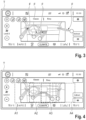
- the aforementioned shapes of the representations F that can be elongated/shortened, as shown in Figures 3 and 4 , can take respective elongated shapes (in this case, a group of parallel lines), the length of which is proportional to the intensity or flow rate to be obtained, and their directions to the desired directions (horizontal X and vertical Y) to be obtained for the outgoing air flows.
- each of the elongated shapes has a first end located on or adjacent to the representation D of the corresponding air outlet device and a second end adjacent to a respective circle V.
- the shapes of the representations F that can be elongated/shortened take shapes that are not elongated, in this case the second end and respective circle V being very close to the representation of the corresponding air outlet device D.
- control unit C controls the respective actuator so that it completely prevents the outlet of the outgoing air flow therefrom.
- each of the representations F of the outgoing air flow from the air outlet devices is a perspective or three-dimensional representation, so that the user can know at any time what the outgoing air flow obtained will be like by interacting with a virtual perspective or three-dimensional representation of the same.
- each representation F of the outgoing air flow independently indicates to the user the status of each of the air outlet devices, showing through a single element associated with each air outlet device the direction of the air flow extracted by each of the vents, as well as, optionally, the flow rate or intensity of said air flow.
- the same representation F can indicate to the user the operating status of said vent, i.e., if it allows or prevents the passage of air flow through the respective air outlet device.
- the display area A shows, for the illustrated exemplary embodiment, a layout or arrangement of the front portion of a motor vehicle cabin, including the dashboard, steering wheel, representations of the air vents D, and representations F of the outgoing air flows, seen from the same perspective that the driver would have, so that said driver can correctly interpret the information provided by each representation F.
- This arrangement or layout shows fixed graphic information (dashboard, steering wheel, representations D, etc.) and mobile graphic information, i.e., changing so that it displays a movement of the same in the display area A, the latter being relative to the representations F and visual elements C.
- the graphical user interface defines display sub-areas A1, A2, A3, A4 (which, in general, are not shown) within the display area A, which delimit the regions where each representation F and associated circle V can be moved virtually (during the corresponding drags), i.e., they establish virtual limits.
- the objective of limiting those positions of the actuator element, i.e., of the circle V, based on the maximum air direction ranges for example, a displacement of four centimetres in Y on the screen is equivalent to the maximum angle of the vertical adjustment slats of the corresponding air outlet device; the user will not be able to move the circle V above said virtual limit.
- the objective is achieved where the circles V do not mix with each other when displayed on the screen T, which would make it difficult for the user to handle them.
- the circles C cannot cross each other, such that the aforementioned virtual limits are arranged which the respective circle C will not be able to cross. Regardless of how much the user drags on the screen, the movement of the circle C and the corresponding actuator of the air outlet device will be limited to its maximum position on the screen.
- the display area A also illustrates, for the illustrated exemplary embodiment, a plurality of virtual elements, at least some of which allow the user to interact with them to activate and/or monitor a specific function.
- FIG. 2 , 3 and 4 Another such virtual element illustrated in Figures 2 , 3 and 4 is an INDIRECT/DIRECT air flow actuator (in the figures the “indirect” legend is shown because that is the selected mode; clicking on it would change the mode to "direct”), which, combined with seat occupancy information (obtained by means of any known detection system), determines the direction of the air flow towards the user (direct) or without impacting them (indirect).
- INDIRECT/DIRECT air flow actuator in the figures the "indirect” legend is shown because that is the selected mode; clicking on it would change the mode to "direct”
- seat occupancy information obtained by means of any known detection system
- the "indirect” mode if it is activated, it will have priority over the corresponding drag. In other words, even if a drag is performed which directs the representation F of the air flow towards the user, the actual air flow will not be controlled in a way that coincides with that of said representation F, since the user does not want it to impact them.
- activating the "indirect” mode defines additional virtual limits that prevent even the representation F of the air flow from being directed towards the user.
- control unit C will control the actuators of the air vents so that they will direct the corresponding outgoing air flow so that it does not directly impact the users.
- This change will be shown in the respective representations F, which will be modified to adapt to the position of the actuators.
Landscapes
- Engineering & Computer Science (AREA)
- Mechanical Engineering (AREA)
- Combustion & Propulsion (AREA)
- Transportation (AREA)
- Chemical & Material Sciences (AREA)
- Physics & Mathematics (AREA)
- Theoretical Computer Science (AREA)
- General Engineering & Computer Science (AREA)
- Thermal Sciences (AREA)
- Human Computer Interaction (AREA)
- General Physics & Mathematics (AREA)
- Position Input By Displaying (AREA)
- Exhaust Gas After Treatment (AREA)
- Devices For Indicating Variable Information By Combining Individual Elements (AREA)
Claims (12)
- System zum Steuern einer Luftauslassvorrichtung, umfassend:- eine Steuereinheit (C), die dazu konfiguriert ist, Steuersignale an mindestens eine Betätigungsvorrichtung mindestens einer Luftauslassvorrichtung bereitzustellen, um die Richtung eines daraus austretenden Luftstroms zu steuern; und- eine grafische Benutzeroberfläche, die mindestens einen Touchscreen (T) umfasst, der mit der Steuereinheit (C) wirkverbunden ist und dazu konfiguriert ist:- auf einem Anzeigebereich (A) des Touchscreens (T) mindestens eine Darstellung anzuzeigen, die der mindestens einen Luftauslassvorrichtung zugeordnet ist; und- einen Kontakt, der entlang einer Schleppbewegung, die von einem Benutzer auf der Darstellung ausgeführt wird, aufrechterhalten wird, in einem Berührungseingabebereich des mindestens einen Touchscreens (T) zu erfassen;wobei die Steuereinheit (C) dazu konfiguriert ist, die Steuersignale als Reaktion auf die Erfassung des Kontakts, der entlang einer Schleppbewegung aufrechterhalten wird, zu erzeugen;- wobei die grafische Benutzeroberfläche dazu konfiguriert ist:- auf dem Anzeigebereich (A) des Touchscreens (T) mindestens zwei Darstellungen (F) anzuzeigen, die jeweils der unabhängigen Steuerung von mindestens zwei Luftauslassvorrichtungen zugeordnet sind; und- unabhängig jeden von mindestens zwei Kontakten, die entlang jeweiliger Schleppbewegungen aufrechterhalten werden, zu erfassen, wobei jeder mindestens einen Kontakt auf einem Bereich einer jeweiligen der mindestens zwei Darstellungen (F) oder auf einem auf oder angrenzend an diese dargestellten visuellen Element (V) einschließt, wobei jedes visuelle Element (V) einer jeweiligen Darstellung (F) der mindestens zwei Darstellungen (F) zugeordnet ist;- die Steuereinheit (C) dazu konfiguriert ist, die Steuersignale zu erzeugen, um die Richtung jedes der mindestens zwei austretenden Luftströme unabhängig als Reaktion auf die Erfassung jedes der mindestens zwei Kontakte, die entlang jeweiliger Schleppbewegungen aufrechterhalten werden, zu steuern;- die grafische Benutzeroberfläche dazu konfiguriert ist:- auf dem Anzeigebereich (A) des Touchscreens (T) mindestens zwei Darstellungen (F), die den mindestens zwei austretenden Luftströmen aus den mindestens zwei Luftauslassvorrichtungen entsprechen, anzuzeigen;- unabhängig voneinander jeden von mindestens zwei Kontakten, die entlang jeweiliger Schleppbewegungen aufrechterhalten werden, zu erfassen, wobei jeder mindestens einen Kontakt auf einem Bereich einer jeweiligen der mindestens zwei Darstellungen (F) der mindestens zwei austretenden Luftströme oder auf dem visuellen Element (V), das darauf oder daran angrenzend abgebildet ist, einschließt; und- unabhängig jede der mindestens zwei Darstellungen (F) des austretenden Luftstroms als Reaktion auf die Erfassung des entsprechenden Kontakts, der entlang einer Schleppbewegung aufrechterhalten wird, zu ändern;und- die Steuereinheit (C) dazu konfiguriert ist, die Steuersignale zu erzeugen, um die Richtung jedes der mindestens zwei austretenden Luftströme in mindestens zwei unterschiedlichen Richtungen auf zueinander quer verlaufenden Ebenen als Reaktion auf die Erfassung jedes der mindestens zwei Kontakte, die entlang jeweiliger Schleppbewegungen aufrechterhalten werden, unabhängig zu steuern;dadurch gekennzeichnet, dass die grafische Benutzeroberfläche dazu konfiguriert ist:- Anzeigeteilbereiche (A1, A2, A3, A4) innerhalb des Anzeigebereichs (A) zu definieren, wobei jeder der Anzeigeteilbereiche (A1, A2, A3, A4) auf der Grundlage der maximalen Luftrichtungsbereiche der entsprechenden Luftauslassvorrichtung maßlich begrenzt ist, und innerhalb jedes der Anzeigeteilbereiche (A1, A2, A3, A4) jeweils eine der mindestens zwei Darstellungen (F) und ein darauf oder dazu angrenzend dargestelltes visuelles Element (V) anzuzeigen; und- die Änderung jeder der mindestens zwei Darstellungen (F) des austretenden Luftstroms unabhängig durchzuführen und diese zusammen mit dem visuellen Element (V), das darauf abgebildet ist oder an dieses angrenzt, nur innerhalb des jeweiligen Anzeigeteilbereichs (A1, A2, A3, A4) davon anzuzeigen.
- System nach Anspruch 1, wobei die grafische Benutzeroberfläche dazu konfiguriert ist, auf dem Anzeigebereich (A) des Touchscreens (T) eine Darstellung (D) jeder der mindestens zwei Luftauslassvorrichtungen anzuzeigen und jede der Darstellungen (F) des austretenden Luftstroms anzuzeigen, indem sie sie mit visuellen Eigenschaften definiert, die es ermöglichen, sie von dem Rest der Elemente, die in dem Anzeigebereich (A) dargestellt sind, mittels einer jeweiligen Form zu unterscheiden, die verlängert/verkürzt werden kann, die, wenn sie eine längliche Form annimmt, ein erstes Ende aufweist, das sich in oder angrenzend an die Darstellung (D) der entsprechenden Luftauslassvorrichtung befindet, und ein zweites Ende, das sich in dem Bereich der Darstellung (F) des entsprechenden austretenden Luftstroms befindet, wobei die längliche Form gemäß der gewünschten Richtung für den austretenden Luftstrom verläuft.
- System nach Anspruch 2, wobei die grafische Benutzeroberfläche dazu konfiguriert ist, in dem Anzeigebereich (A) des Touchscreens (T) jedes visuelle Element (V) auf dem oder angrenzend an das zweite Ende der Darstellung (F) des jeweiligen austretenden Luftstroms anzuzeigen.
- System nach Anspruch 2 oder 3, wobei die Steuereinheit (C) dazu konfiguriert ist, die Steuersignale zum Steuern der Richtung des austretenden Luftstroms basierend auf der Lage eines Teils der länglichen Form in dem Anzeigebereich (A) des Touchscreens (T), der weder das erste Ende noch das jeweilige visuelle Element (V) einschließt, in Bezug auf die Position der jeweiligen Luftauslassvorrichtung zu erzeugen.
- System nach Anspruch 3, wobei:- der Anzeigebereich des Touchscreens (T) in vordefinierte Zellen unterteilt ist, von denen jede einer jeweiligen vorgegebenen Richtung des jeweiligen austretenden Luftstroms zugeordnet ist; und- die Steuereinheit (C) dazu konfiguriert ist, die Steuersignale zu erzeugen, um die Richtung des jeweiligen austretenden Luftstroms basierend auf der Position eines Teils der länglichen Form in einer der vordefinierten Zellen zu steuern, die weder das erste Ende noch das jeweilige visuelle Element (V) einschließt.
- System nach Anspruch 4 oder 5, wobei die Steuereinheit (C) dazu konfiguriert ist, die Steuersignale zum Steuern der Richtung des austretenden Luftstroms basierend auf der Lage des Abschnitts der länglichen Form, der nicht das erste Ende oder das jeweilige visuelle Element (V) einschließt, zu erzeugen, sobald der entlang einer Schleppbewegung aufrechterhaltene Kontakt aufgehört hat.
- System nach einem der vorstehenden Ansprüche, wobei:- jede der Darstellungen (F) des austretenden Luftstroms, die durch die grafische Benutzeroberfläche angezeigt und geändert wird, Informationen über die Richtung und Intensität oder Strömungsrate des aus der jeweiligen Luftauslassvorrichtung austretenden Luftstroms darstellt; und- die Steuereinheit (C) dazu konfiguriert ist, die Steuersignale zu erzeugen, um auch die Intensität oder Strömungsrate des jeweiligen austretenden Luftstroms als Reaktion auf die Erfassung jedes der mindestens zwei Kontakte, die entlang der jeweiligen Schleppbewegungen aufrechterhalten werden, zu steuern.
- System nach Anspruch 7, sofern dieser von Anspruch 2 abhängt, wobei die Länge der länglichen Form anteilsmäßig zu der gewünschten Intensität oder Strömungsrate des entsprechenden austretenden Luftstroms ist, wobei die Steuereinheit (C) dazu konfiguriert ist, die Steuersignale zu erzeugen und dem mindestens einen Betätigungsvorrichtung der jeweiligen Luftauslassvorrichtung bereitzustellen, um diese derart zu steuern, dass sie die Intensität oder Strömungsrate des austretenden Luftstroms basierend auf der Länge der länglichen Form erhöht oder verringert.
- System nach Anspruch 8, wobei die Steuereinheit (C) dazu konfiguriert ist, die Steuersignale zu erzeugen und mindestens einer Betätigungsvorrichtung der jeweiligen Luftauslassvorrichtung bereitzustellen, um diesen derart zu steuern, dass er den Auslass des austretenden Luftstroms basierend auf der Länge der länglichen Form und/oder der Position der Darstellung (F) des jeweiligen austretenden Luftstroms bzw. des darauf oder angrenzend dargestellten visuellen Elements (V) in dem Anzeigebereich (A) zulässt oder verhindert.
- System nach Anspruch 9, wobei die Steuereinheit (C) dazu konfiguriert ist, Steuersignale zu erzeugen und der mindestens einen Betätigungsvorrichtung der jeweiligen Luftauslassvorrichtung bereitzustellen, um diesen derart zu steuern, dass er den Auslass des austretenden Luftstroms vollständig verhindert, wenn das visuelle Element (V) mit einem zentralen Bereich der Darstellung (D) der jeweiligen Luftauslassvorrichtung in dem Anzeigebereich (A) übereinstimmt.
- Computerimplementiertes Verfahren zum Steuern einer Luftauslassvorrichtung, umfassend:- Anzeigen, durch eine grafische Benutzeroberfläche in einem Anzeigebereich (A) eines Touchscreens (T), den die grafische Benutzeroberfläche umfasst, mindestens einer Darstellung, die der mindestens einen Luftauslassvorrichtung zugeordnet ist;- Erfassen, durch die grafische Benutzeroberfläche eines Kontakts, der entlang einer von einem Benutzer auf der Darstellung ausgeführten Schleppbewegung in einem Berührungseingabebereich des mindestens einen Touchscreens (T) aufrechterhalten wird;- Erzeugen von Steuersignalen durch eine Steuereinheit (C), die mit der grafischen Benutzeroberfläche wirkverbunden ist, als Reaktion auf die Erfassung des Kontakts, der entlang einer Schleppbewegung aufrechterhalten wird; und- Bereitstellen der Steuersignale durch die Steuereinheit (C) an mindestens eine Betätigungsvorrichtung mindestens der Luftauslassvorrichtung, um die Richtung eines daraus austretenden Luftstroms zu steuern;wobei das Verfahren umfasst:- Verwenden der grafischen Benutzeroberfläche, um:- auf dem Anzeigebereich (A) des Touchscreens (T) mindestens zwei Darstellungen (F) anzuzeigen, die jeweils der unabhängigen Steuerung von mindestens zwei Luftauslassvorrichtungen zugeordnet sind; und- unabhängig jeden von mindestens zwei Kontakten, die entlang jeweiliger Schleppbewegungen aufrechterhalten werden, zu erfassen, wobei jeder mindestens einen Kontakt auf einem Bereich einer jeweiligen der mindestens zwei Darstellungen (F) oder auf einem auf oder angrenzend an diese dargestellten visuellen Element (V) einschließt, wobei jedes visuelle Element (V) einer jeweiligen Darstellung (F) zugeordnet ist;- Verwenden der Steuereinheit (C) zum Erzeugen der Steuersignale, um die Richtung jedes der mindestens zwei austretenden Luftströme unabhängig als Reaktion auf die Erfassung jedes der mindestens zwei Kontakte, die entlang jeweiliger Widerstandsbewegungen aufrechterhalten werden, zu steuern;- Verwenden der grafischen Benutzeroberfläche, um:- auf dem Anzeigebereich (A) des Touchscreens (T) mindestens zwei Darstellungen (F), die den mindestens zwei austretenden Luftströmen aus den mindestens zwei Luftauslassvorrichtungen entsprechen, anzuzeigen;- unabhängig voneinander jeden von mindestens zwei Kontakten, die entlang jeweiliger Schleppbewegungen aufrechterhalten werden, zu erfassen, wobei jeder mindestens einen Kontakt auf einem Bereich einer jeweiligen der mindestens zwei Darstellungen (F) der mindestens zwei austretenden Luftströme oder auf dem visuellen Element (V), das darauf oder daran angrenzend abgebildet ist, einschließt; und- unabhängig jede der mindestens zwei Darstellungen (F) des austretenden Luftstroms als Reaktion auf die Erfassung des entsprechenden Kontakts, der entlang einer Schleppbewegung aufrechterhalten wird, zu ändern;und- Verwenden der Steuereinheit (C) zum Erzeugen der Steuersignale, um die Richtung jedes der mindestens zwei austretenden Luftströme in mindestens zwei unterschiedlichen Richtungen auf zueinander quer verlaufenden Ebenen als Reaktion auf die Erfassung jedes der mindestens zwei Kontakte, die entlang jeweiliger Schleppbewegungen aufrechterhalten werden, unabhängig zu steuern;dadurch gekennzeichnet, dass das Verfahren weiter die Verwendung der grafischen Benutzeroberfläche umfasst, um:- Anzeigeteilbereiche (A1, A2, A3, A4) innerhalb des Anzeigebereichs (A) zu definieren, wobei jeder der Anzeigeteilbereiche (A1, A2, A3, A4) auf der Grundlage der maximalen Luftrichtungsbereiche der entsprechenden Luftauslassvorrichtung maßlich begrenzt ist, und innerhalb jedes der Anzeigeteilbereiche (A1, A2, A3, A4) jeweils eine der mindestens zwei Darstellungen (F) und ein darauf oder dazu angrenzend dargestelltes visuelles Element (V) anzuzeigen; und- die Änderung jeder der mindestens zwei Darstellungen (F) des austretenden Luftstroms unabhängig durchzuführen und diese zusammen mit dem visuellen Element (V), das darauf abgebildet ist oder an dieses angrenzt, nur innerhalb des jeweiligen Anzeigeteilbereichs (A1, A2, A3, A4) davon anzuzeigen.
- Computerprogramm, das Codeanweisungen umfasst, die, wenn sie in mindestens einem Prozessor ausgeführt werden, die Schritte des Verfahrens nach Anspruch 11 implementieren.
Applications Claiming Priority (1)
| Application Number | Priority Date | Filing Date | Title |
|---|---|---|---|
| ES202130524A ES2930480A1 (es) | 2021-06-08 | 2021-06-08 | Sistema, metodo y programa de ordenador para el control de un dispositivo de salida de aire |
Publications (2)
| Publication Number | Publication Date |
|---|---|
| EP4101677A1 EP4101677A1 (de) | 2022-12-14 |
| EP4101677B1 true EP4101677B1 (de) | 2024-12-18 |
Family
ID=83978918
Family Applications (1)
| Application Number | Title | Priority Date | Filing Date |
|---|---|---|---|
| EP22176965.6A Active EP4101677B1 (de) | 2021-06-08 | 2022-06-02 | System, verfahren und computerprogramm zur steuerung einer luftauslassvorrichtung |
Country Status (2)
| Country | Link |
|---|---|
| EP (1) | EP4101677B1 (de) |
| ES (2) | ES2930480A1 (de) |
Families Citing this family (2)
| Publication number | Priority date | Publication date | Assignee | Title |
|---|---|---|---|---|
| FR3147023A1 (fr) * | 2023-03-22 | 2024-09-27 | Psa Automobiles Sa | Procédé et dispositif de contrôle d’une interface utilisateur d’un véhicule |
| FR3165815A1 (fr) * | 2024-08-28 | 2026-03-06 | Stellantis Auto Sas | Procédé et dispositif de contrôle d’un système de ventilation d’un habitacle d’un véhicule |
Family Cites Families (8)
| Publication number | Priority date | Publication date | Assignee | Title |
|---|---|---|---|---|
| KR20130119770A (ko) * | 2012-04-24 | 2013-11-01 | 현대모비스 주식회사 | 터치 입력에 따른 차량 공조 제어 시스템 및 그 방법 |
| DE102012016109A1 (de) * | 2012-08-15 | 2014-02-20 | Volkswagen Aktiengesellschaft | Bedienvorrichtung zum Einstellen einer Klimatisierungsvorrichtung eines Fahrzeugs und Verfahren hierzu |
| CN105579258B (zh) | 2013-10-23 | 2017-11-10 | 爱信艾达株式会社 | 车厢环境控制系统、车厢环境控制方法以及记录介质 |
| JP6418176B2 (ja) * | 2015-04-02 | 2018-11-07 | 株式会社デンソー | 車両用空調設定装置 |
| JP6593271B2 (ja) * | 2016-07-28 | 2019-10-23 | 株式会社デンソー | 風向制御システム、風向制御方法 |
| DE102016114354A1 (de) * | 2016-08-03 | 2018-02-08 | Volkswagen Ag | Verfahren und Bedienvorrichtung zum Bedienen einer Klimatisierungsvorrichtung eines Fahrzeugs |
| CN113226809B (zh) * | 2018-11-13 | 2024-06-28 | 瑞伟安知识产权控股有限公司 | 用于控制车辆的通气孔的系统和方法 |
| CN212148315U (zh) * | 2020-06-03 | 2020-12-15 | 黑龙江天有为电子有限责任公司 | 汽车空调控制装置及汽车 |
-
2021
- 2021-06-08 ES ES202130524A patent/ES2930480A1/es active Pending
-
2022
- 2022-06-02 EP EP22176965.6A patent/EP4101677B1/de active Active
- 2022-06-02 ES ES22176965T patent/ES3010086T3/es active Active
Also Published As
| Publication number | Publication date |
|---|---|
| EP4101677A1 (de) | 2022-12-14 |
| ES3010086T3 (en) | 2025-04-01 |
| ES2930480A1 (es) | 2022-12-13 |
Similar Documents
| Publication | Publication Date | Title |
|---|---|---|
| EP4101677B1 (de) | System, verfahren und computerprogramm zur steuerung einer luftauslassvorrichtung | |
| EP2545430B1 (de) | Verfahren und vorrichtung zum betreiben einer benutzerschnittstelle | |
| US9433140B2 (en) | Visualization device | |
| EP2885142B1 (de) | Bedienvorrichtung zum einstellen einer klimatisierungsvorrichtung eines fahrzeugs und verfahren hierzu | |
| EP3756949B1 (de) | Kameraüberwachungssystem für kraftfahrzeuge | |
| US20230176726A1 (en) | Interactive air vent control interface | |
| US10723198B2 (en) | Ventilation system and ventilation method for a motor vehicle | |
| US10449829B2 (en) | Method and device for operating a climate control device of a vehicle | |
| WO2006074712A2 (de) | Eingabevorrichtung und verfahren zum betrieb derselben | |
| CN105511662B (zh) | 用于车辆的二元操作触屏装置 | |
| DE102010018105B4 (de) | Fahrzeugcockpit mit einer Bedieneinrichtung zum Erfassen von Nutzereingaben und Verfahren zum Betreiben einer solchen | |
| CN108430832A (zh) | 具有操纵板模块的机动车 | |
| JP7800610B2 (ja) | 車載機器制御装置及び車載機器制御方法 | |
| EP3067244A1 (de) | Kraftfahrzeug mit situationsadaptivem automatischem fahrmodus | |
| EP3088220B1 (de) | Verfahren und bedienvorrichtung zum einstellen einer klimatisierungsvorrichtung eines fahrzeugs | |
| EP2896524B1 (de) | Benutzerschnittstelle zur Steuerung einer Klimaanlage eines Fortbewegungsmittels | |
| CN114030355A (zh) | 一种车辆控制方法、装置、车辆及介质 | |
| EP3802191B1 (de) | Verfahren und system zum betreiben einer automatischen fahrfunktion in einem fahrzeug | |
| DE102016100787A1 (de) | Lüftungssystem für ein Kraftfahrzeug | |
| EP3671417B1 (de) | Fahrzeugfensterverstellsteuerung, computerimplementiertes verfahren und computerprogramm zum steuern mehrerer fenster eines fahrzeugs | |
| EP3671421B1 (de) | Fahrzeugrückspiegelverstellungsteuerungssystem, computerimplementiertes verfahren und computerprogramm zur steuerung der position von rückspiegeln an einem fahrzeug | |
| JP5474395B2 (ja) | 車両用シート駆動装置 | |
| DE102024202380A1 (de) | Bedienung eines Kraftfahrzeugs mittels Eyetracking |
Legal Events
| Date | Code | Title | Description |
|---|---|---|---|
| PUAI | Public reference made under article 153(3) epc to a published international application that has entered the european phase |
Free format text: ORIGINAL CODE: 0009012 |
|
| STAA | Information on the status of an ep patent application or granted ep patent |
Free format text: STATUS: THE APPLICATION HAS BEEN PUBLISHED |
|
| AK | Designated contracting states |
Kind code of ref document: A1 Designated state(s): AL AT BE BG CH CY CZ DE DK EE ES FI FR GB GR HR HU IE IS IT LI LT LU LV MC MK MT NL NO PL PT RO RS SE SI SK SM TR |
|
| STAA | Information on the status of an ep patent application or granted ep patent |
Free format text: STATUS: REQUEST FOR EXAMINATION WAS MADE |
|
| 17P | Request for examination filed |
Effective date: 20230601 |
|
| RBV | Designated contracting states (corrected) |
Designated state(s): AL AT BE BG CH CY CZ DE DK EE ES FI FR GB GR HR HU IE IS IT LI LT LU LV MC MK MT NL NO PL PT RO RS SE SI SK SM TR |
|
| REG | Reference to a national code |
Ref country code: DE Ref legal event code: R079 Free format text: PREVIOUS MAIN CLASS: B60K0035000000 Ipc: B60K0035100000 Ref country code: DE Ref legal event code: R079 Ref document number: 602022008755 Country of ref document: DE Free format text: PREVIOUS MAIN CLASS: B60K0035000000 Ipc: B60K0035100000 |
|
| RIC1 | Information provided on ipc code assigned before grant |
Ipc: G06F 3/04845 20220101ALI20240611BHEP Ipc: B60H 1/00 20060101ALI20240611BHEP Ipc: B60H 1/34 20060101ALI20240611BHEP Ipc: B60K 35/28 20240101ALI20240611BHEP Ipc: B60K 35/22 20240101ALI20240611BHEP Ipc: B60K 35/10 20240101AFI20240611BHEP |
|
| GRAP | Despatch of communication of intention to grant a patent |
Free format text: ORIGINAL CODE: EPIDOSNIGR1 |
|
| STAA | Information on the status of an ep patent application or granted ep patent |
Free format text: STATUS: GRANT OF PATENT IS INTENDED |
|
| INTG | Intention to grant announced |
Effective date: 20240724 |
|
| GRAS | Grant fee paid |
Free format text: ORIGINAL CODE: EPIDOSNIGR3 |
|
| GRAA | (expected) grant |
Free format text: ORIGINAL CODE: 0009210 |
|
| STAA | Information on the status of an ep patent application or granted ep patent |
Free format text: STATUS: THE PATENT HAS BEEN GRANTED |
|
| P01 | Opt-out of the competence of the unified patent court (upc) registered |
Free format text: CASE NUMBER: APP_58493/2024 Effective date: 20241025 |
|
| AK | Designated contracting states |
Kind code of ref document: B1 Designated state(s): AL AT BE BG CH CY CZ DE DK EE ES FI FR GB GR HR HU IE IS IT LI LT LU LV MC MK MT NL NO PL PT RO RS SE SI SK SM TR |
|
| REG | Reference to a national code |
Ref country code: CH Ref legal event code: EP |
|
| REG | Reference to a national code |
Ref country code: DE Ref legal event code: R096 Ref document number: 602022008755 Country of ref document: DE |
|
| REG | Reference to a national code |
Ref country code: IE Ref legal event code: FG4D |
|
| REG | Reference to a national code |
Ref country code: ES Ref legal event code: FG2A Ref document number: 3010086 Country of ref document: ES Kind code of ref document: T3 Effective date: 20250401 |
|
| REG | Reference to a national code |
Ref country code: LT Ref legal event code: MG9D |
|
| PG25 | Lapsed in a contracting state [announced via postgrant information from national office to epo] |
Ref country code: HR Free format text: LAPSE BECAUSE OF FAILURE TO SUBMIT A TRANSLATION OF THE DESCRIPTION OR TO PAY THE FEE WITHIN THE PRESCRIBED TIME-LIMIT Effective date: 20241218 |
|
| PG25 | Lapsed in a contracting state [announced via postgrant information from national office to epo] |
Ref country code: FI Free format text: LAPSE BECAUSE OF FAILURE TO SUBMIT A TRANSLATION OF THE DESCRIPTION OR TO PAY THE FEE WITHIN THE PRESCRIBED TIME-LIMIT Effective date: 20241218 |
|
| PG25 | Lapsed in a contracting state [announced via postgrant information from national office to epo] |
Ref country code: BG Free format text: LAPSE BECAUSE OF FAILURE TO SUBMIT A TRANSLATION OF THE DESCRIPTION OR TO PAY THE FEE WITHIN THE PRESCRIBED TIME-LIMIT Effective date: 20241218 |
|
| PG25 | Lapsed in a contracting state [announced via postgrant information from national office to epo] |
Ref country code: NO Free format text: LAPSE BECAUSE OF FAILURE TO SUBMIT A TRANSLATION OF THE DESCRIPTION OR TO PAY THE FEE WITHIN THE PRESCRIBED TIME-LIMIT Effective date: 20250318 |
|
| REG | Reference to a national code |
Ref country code: NL Ref legal event code: MP Effective date: 20241218 |
|
| PG25 | Lapsed in a contracting state [announced via postgrant information from national office to epo] |
Ref country code: LV Free format text: LAPSE BECAUSE OF FAILURE TO SUBMIT A TRANSLATION OF THE DESCRIPTION OR TO PAY THE FEE WITHIN THE PRESCRIBED TIME-LIMIT Effective date: 20241218 Ref country code: GR Free format text: LAPSE BECAUSE OF FAILURE TO SUBMIT A TRANSLATION OF THE DESCRIPTION OR TO PAY THE FEE WITHIN THE PRESCRIBED TIME-LIMIT Effective date: 20250319 |
|
| PG25 | Lapsed in a contracting state [announced via postgrant information from national office to epo] |
Ref country code: RS Free format text: LAPSE BECAUSE OF FAILURE TO SUBMIT A TRANSLATION OF THE DESCRIPTION OR TO PAY THE FEE WITHIN THE PRESCRIBED TIME-LIMIT Effective date: 20250318 |
|
| PG25 | Lapsed in a contracting state [announced via postgrant information from national office to epo] |
Ref country code: NL Free format text: LAPSE BECAUSE OF FAILURE TO SUBMIT A TRANSLATION OF THE DESCRIPTION OR TO PAY THE FEE WITHIN THE PRESCRIBED TIME-LIMIT Effective date: 20241218 |
|
| REG | Reference to a national code |
Ref country code: AT Ref legal event code: MK05 Ref document number: 1752002 Country of ref document: AT Kind code of ref document: T Effective date: 20241218 |
|
| PG25 | Lapsed in a contracting state [announced via postgrant information from national office to epo] |
Ref country code: SM Free format text: LAPSE BECAUSE OF FAILURE TO SUBMIT A TRANSLATION OF THE DESCRIPTION OR TO PAY THE FEE WITHIN THE PRESCRIBED TIME-LIMIT Effective date: 20241218 |
|
| PG25 | Lapsed in a contracting state [announced via postgrant information from national office to epo] |
Ref country code: PL Free format text: LAPSE BECAUSE OF FAILURE TO SUBMIT A TRANSLATION OF THE DESCRIPTION OR TO PAY THE FEE WITHIN THE PRESCRIBED TIME-LIMIT Effective date: 20241218 |
|
| PGFP | Annual fee paid to national office [announced via postgrant information from national office to epo] |
Ref country code: DE Payment date: 20250626 Year of fee payment: 4 |
|
| PG25 | Lapsed in a contracting state [announced via postgrant information from national office to epo] |
Ref country code: IS Free format text: LAPSE BECAUSE OF FAILURE TO SUBMIT A TRANSLATION OF THE DESCRIPTION OR TO PAY THE FEE WITHIN THE PRESCRIBED TIME-LIMIT Effective date: 20250418 |
|
| PG25 | Lapsed in a contracting state [announced via postgrant information from national office to epo] |
Ref country code: PT Free format text: LAPSE BECAUSE OF FAILURE TO SUBMIT A TRANSLATION OF THE DESCRIPTION OR TO PAY THE FEE WITHIN THE PRESCRIBED TIME-LIMIT Effective date: 20250421 |
|
| PG25 | Lapsed in a contracting state [announced via postgrant information from national office to epo] |
Ref country code: EE Free format text: LAPSE BECAUSE OF FAILURE TO SUBMIT A TRANSLATION OF THE DESCRIPTION OR TO PAY THE FEE WITHIN THE PRESCRIBED TIME-LIMIT Effective date: 20241218 |
|
| PGFP | Annual fee paid to national office [announced via postgrant information from national office to epo] |
Ref country code: FR Payment date: 20250624 Year of fee payment: 4 |
|
| PG25 | Lapsed in a contracting state [announced via postgrant information from national office to epo] |
Ref country code: AT Free format text: LAPSE BECAUSE OF FAILURE TO SUBMIT A TRANSLATION OF THE DESCRIPTION OR TO PAY THE FEE WITHIN THE PRESCRIBED TIME-LIMIT Effective date: 20241218 Ref country code: RO Free format text: LAPSE BECAUSE OF FAILURE TO SUBMIT A TRANSLATION OF THE DESCRIPTION OR TO PAY THE FEE WITHIN THE PRESCRIBED TIME-LIMIT Effective date: 20241218 |
|
| PG25 | Lapsed in a contracting state [announced via postgrant information from national office to epo] |
Ref country code: SK Free format text: LAPSE BECAUSE OF FAILURE TO SUBMIT A TRANSLATION OF THE DESCRIPTION OR TO PAY THE FEE WITHIN THE PRESCRIBED TIME-LIMIT Effective date: 20241218 |
|
| PG25 | Lapsed in a contracting state [announced via postgrant information from national office to epo] |
Ref country code: CZ Free format text: LAPSE BECAUSE OF FAILURE TO SUBMIT A TRANSLATION OF THE DESCRIPTION OR TO PAY THE FEE WITHIN THE PRESCRIBED TIME-LIMIT Effective date: 20241218 |
|
| PG25 | Lapsed in a contracting state [announced via postgrant information from national office to epo] |
Ref country code: IT Free format text: LAPSE BECAUSE OF FAILURE TO SUBMIT A TRANSLATION OF THE DESCRIPTION OR TO PAY THE FEE WITHIN THE PRESCRIBED TIME-LIMIT Effective date: 20241218 |
|
| PG25 | Lapsed in a contracting state [announced via postgrant information from national office to epo] |
Ref country code: SE Free format text: LAPSE BECAUSE OF FAILURE TO SUBMIT A TRANSLATION OF THE DESCRIPTION OR TO PAY THE FEE WITHIN THE PRESCRIBED TIME-LIMIT Effective date: 20241218 |
|
| REG | Reference to a national code |
Ref country code: DE Ref legal event code: R097 Ref document number: 602022008755 Country of ref document: DE |
|
| PGFP | Annual fee paid to national office [announced via postgrant information from national office to epo] |
Ref country code: ES Payment date: 20250710 Year of fee payment: 4 |
|
| PG25 | Lapsed in a contracting state [announced via postgrant information from national office to epo] |
Ref country code: DK Free format text: LAPSE BECAUSE OF FAILURE TO SUBMIT A TRANSLATION OF THE DESCRIPTION OR TO PAY THE FEE WITHIN THE PRESCRIBED TIME-LIMIT Effective date: 20241218 |
|
| PLBE | No opposition filed within time limit |
Free format text: ORIGINAL CODE: 0009261 |
|
| STAA | Information on the status of an ep patent application or granted ep patent |
Free format text: STATUS: NO OPPOSITION FILED WITHIN TIME LIMIT |
|
| REG | Reference to a national code |
Ref country code: CH Ref legal event code: L10 Free format text: ST27 STATUS EVENT CODE: U-0-0-L10-L00 (AS PROVIDED BY THE NATIONAL OFFICE) Effective date: 20251029 |
|
| 26N | No opposition filed |
Effective date: 20250919 |
|
| REG | Reference to a national code |
Ref country code: CH Ref legal event code: H13 Free format text: ST27 STATUS EVENT CODE: U-0-0-H10-H13 (AS PROVIDED BY THE NATIONAL OFFICE) Effective date: 20260127 |
|
| PG25 | Lapsed in a contracting state [announced via postgrant information from national office to epo] |
Ref country code: MC Free format text: LAPSE BECAUSE OF FAILURE TO SUBMIT A TRANSLATION OF THE DESCRIPTION OR TO PAY THE FEE WITHIN THE PRESCRIBED TIME-LIMIT Effective date: 20241218 |
|
| PG25 | Lapsed in a contracting state [announced via postgrant information from national office to epo] |
Ref country code: LU Free format text: LAPSE BECAUSE OF NON-PAYMENT OF DUE FEES Effective date: 20250602 |
|
| REG | Reference to a national code |
Ref country code: BE Ref legal event code: MM Effective date: 20250630 |
|
| PG25 | Lapsed in a contracting state [announced via postgrant information from national office to epo] |
Ref country code: IE Free format text: LAPSE BECAUSE OF NON-PAYMENT OF DUE FEES Effective date: 20250602 |
|
| PG25 | Lapsed in a contracting state [announced via postgrant information from national office to epo] |
Ref country code: BE Free format text: LAPSE BECAUSE OF NON-PAYMENT OF DUE FEES Effective date: 20250630 |
|
| PG25 | Lapsed in a contracting state [announced via postgrant information from national office to epo] |
Ref country code: CH Free format text: LAPSE BECAUSE OF NON-PAYMENT OF DUE FEES Effective date: 20250630 |